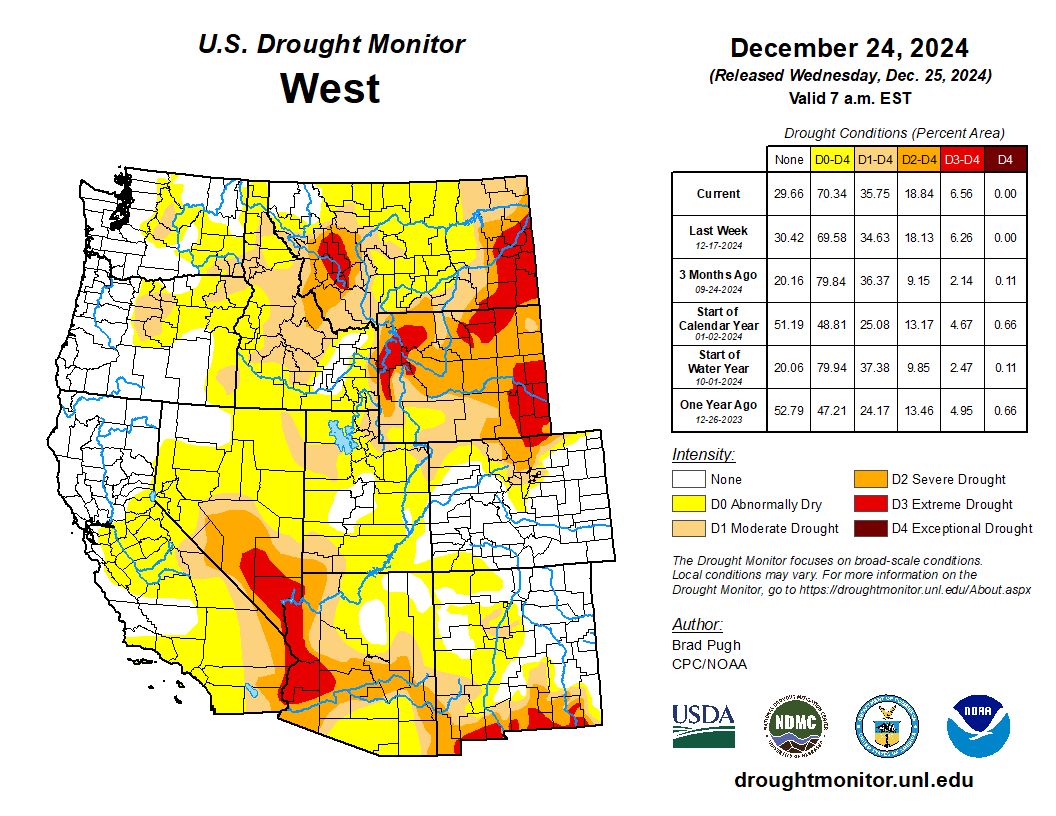
#Drought news December 26, 2024: Since the beginning of October, precipitation has generally averaged below normal across the Central Rockies, Great Basin, Southwest, and southern #California

Click on a thumbnail graphic to view a gallery of drought data from the US Drought Monitor website.
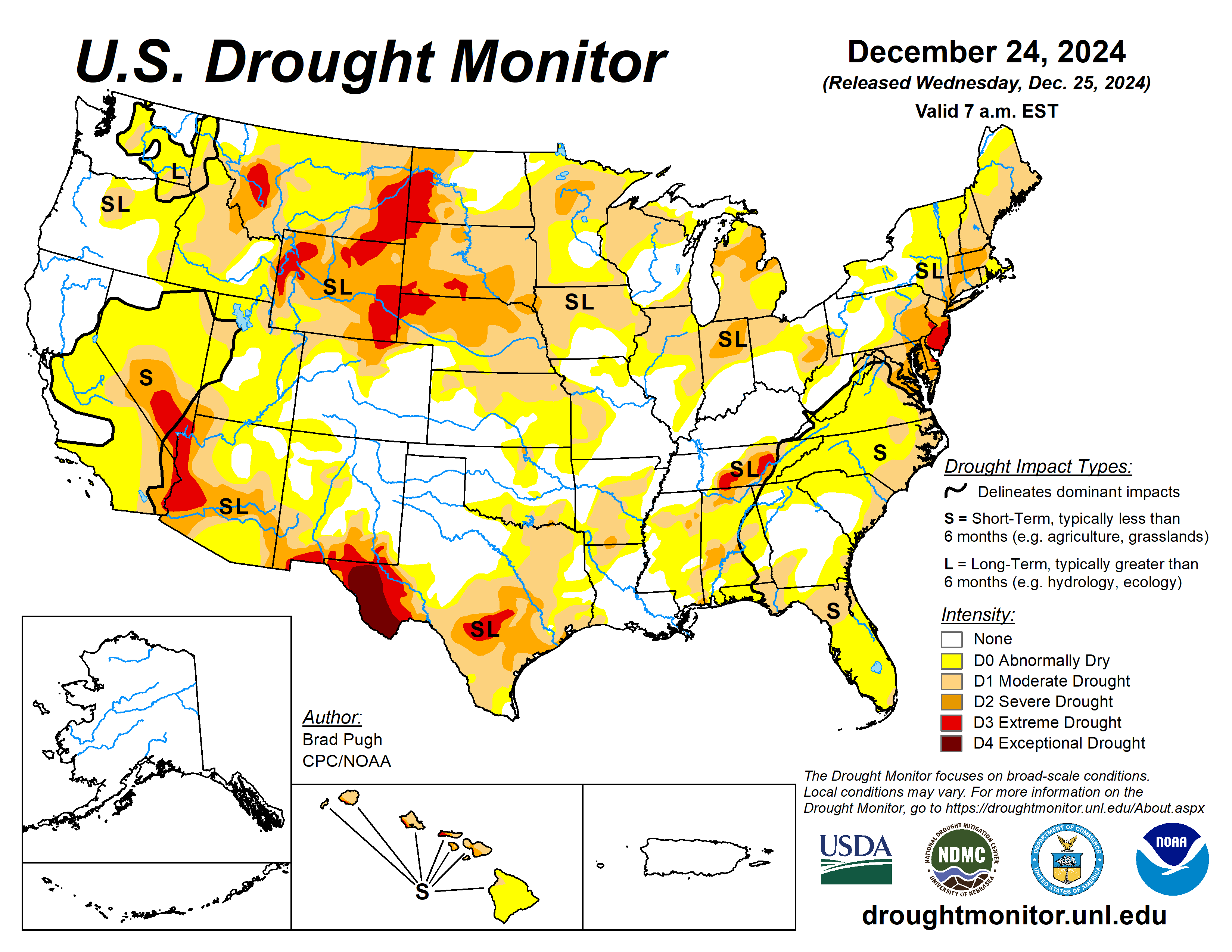
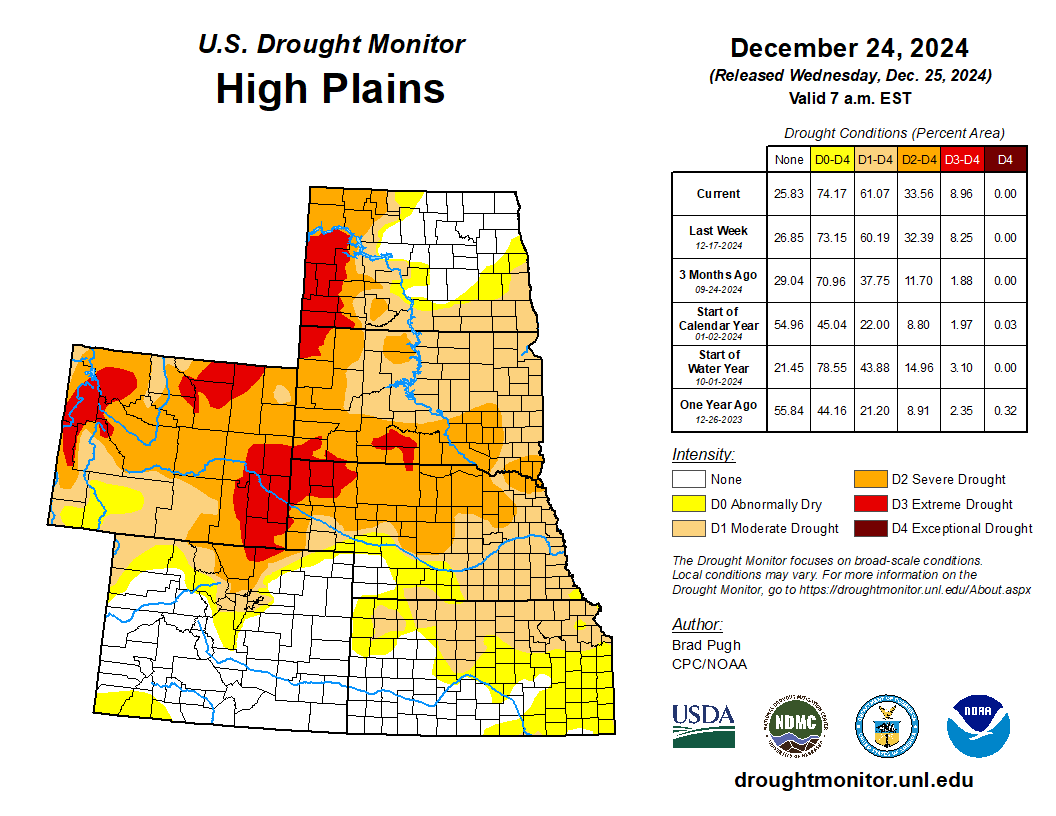
Click the link to go to the US Drought Monitor website. Here’s an excerpt:

This Week’s Drought Summary

A swath of precipitation (0.5 to 1.5 inches) this past week led to small improvements from parts of Oklahoma and Arkansas northeastward to the Central Appalachians. Since the major drought that affected the Central Appalachians and Upper Ohio Valley peaked in late September, drought has steadily improved across these areas the past two months. Near to above-normal precipitation during the past 30 days supported drought improvement across parts of the Northeast. Farther to the south across the Southeast, Lower Mississippi Valley, and Texas, 30 to 60-day precipitation deficits continue to increase with expanding and intensifying drought during mid to late December. December is typically a drier time of year for the Upper Midwest and Northern to Central Great Plains where little to no weekly drought change was warranted. Since the beginning of October, precipitation has generally averaged below normal across the Central Rockies, Great Basin, Southwest, and southern California. From December 17-23, enhanced onshore flow resulted in wetter-than-normal conditions across coastal northwestern California and much of the Pacific Northwest. 7-day temperatures, ending on December 23, averaged above normal throughout the West and Central to Southern Great Plains with colder-than-normal temperatures limited to the Great Lakes and Northeast…

High Plains

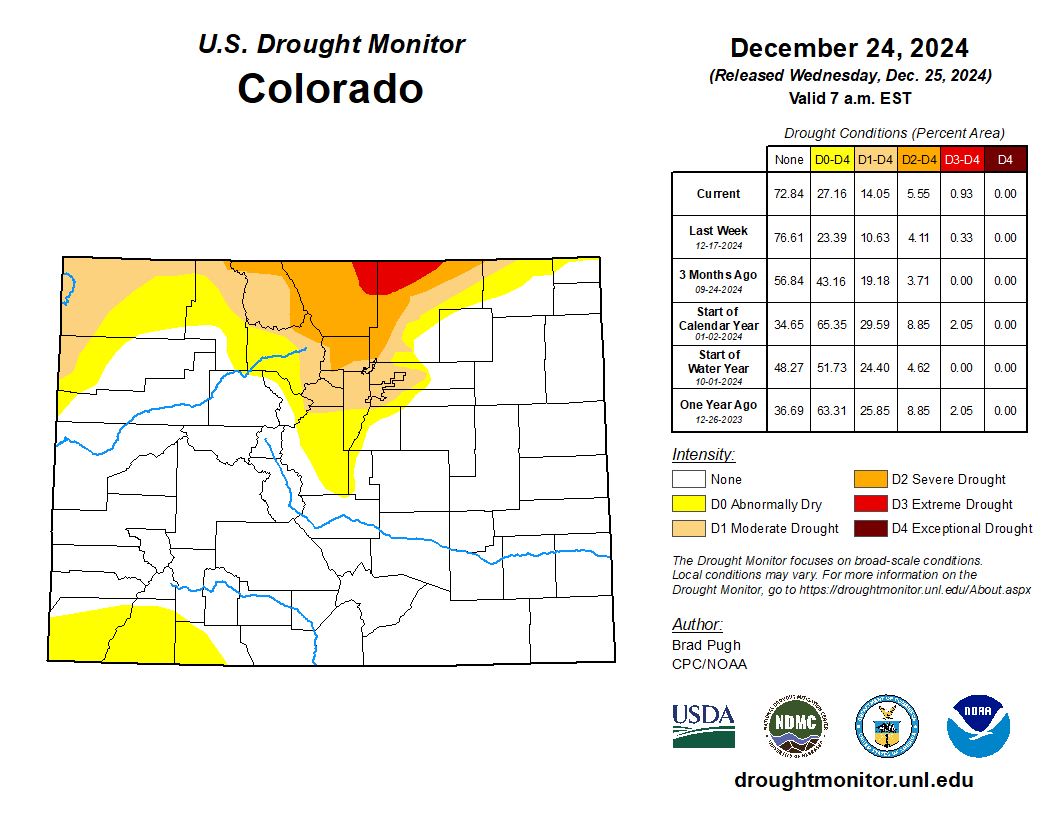
Based on SPIs at various time scales, low snowpack, and the NDMC short-term blend, a 1-category degradation was made to northern Colorado along with southern and northwestern Wyoming. Snow water equivalent amounts are below the 5th percentile where extreme drought (D3) was expanded in Wyoming. These same indicators justified an expansion of abnormal dryness (D0) across southwestern Colorado. Severe drought (D2) was expanded across western Nebraska due to soil moisture percentiles falling below the 10th percentile and support from the 90 to 120-day SPI…
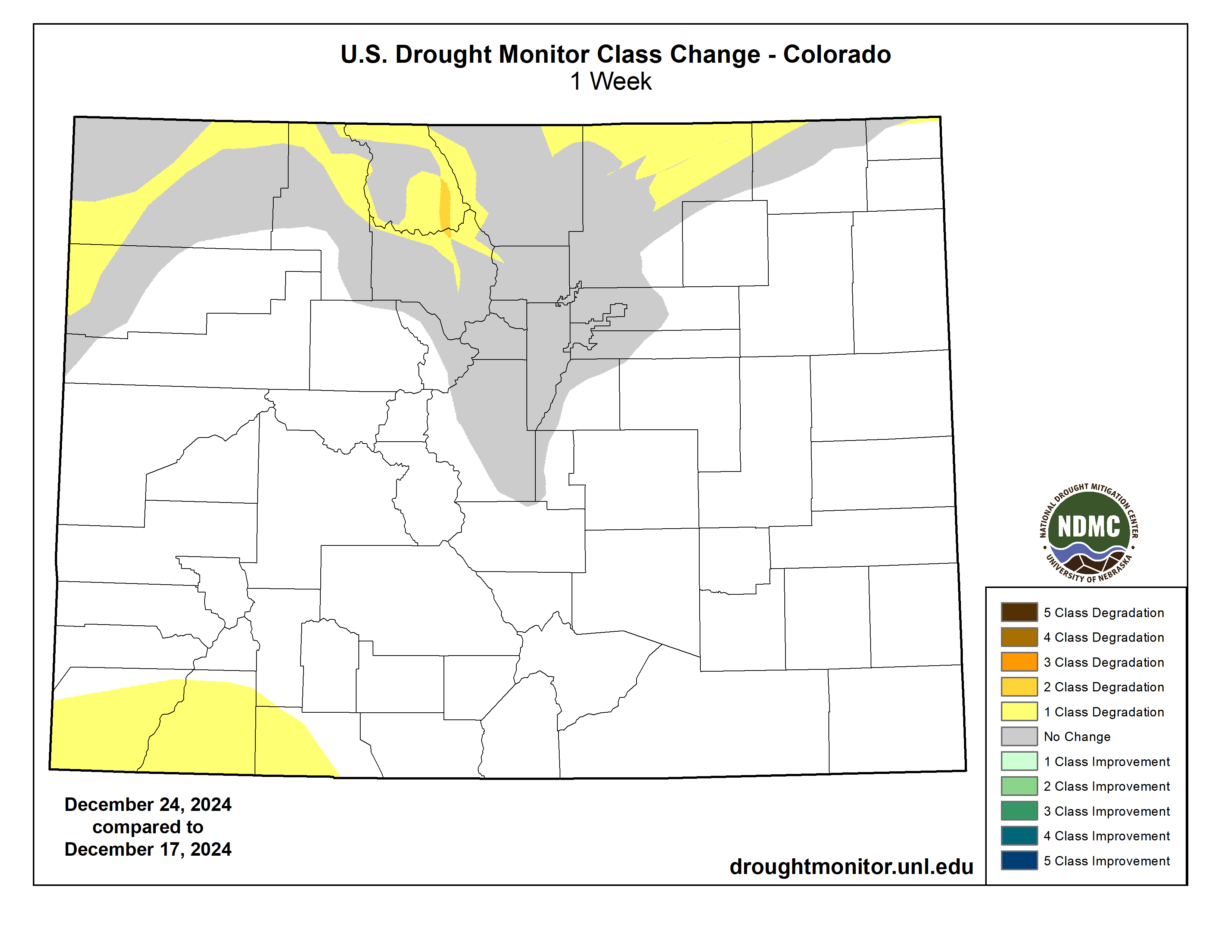
Colorado Drought Monitor one week change map ending December 24, 2024.

West

Based on increasing water year to date (WYTD: October 1-December 23) precipitation deficits, a 1-category degradation was warranted for central Nevada. For this same reason, moderate drought (D1) was added to portions of northeastern Nevada. Elsewhere, no other changes were made. WYTD precipitation was at or above-normal for much of the Pacific Northwest and northern California and below-normal for the remainder of the West region. As of December 23, snow water equivalent (SWE) was below-normal across the Northern Rockies of Montana and Wasatch Mountains of Utah. SWE was near average for the Sierra Nevada Mountains and highly variable throughout the Cascades…

South

Based on increasing short-term precipitation deficits and 30 to 90-day SPIs, abnormal dryness (D0) and moderate drought (D1) were expanded across northern Louisiana and portions of south-central Mississippi. These same indicators along with the NDMC short-term blend supported the expansion of D1 to severe drought (D2) across portions of eastern and southern Texas. Around one inch of precipitation supported a 1-category improvement across portions of Arkansas and central to southeastern Oklahoma. Recent precipitation also led to improvement across northern Tennessee to be consistent with bordering areas of southeastern Kentucky…
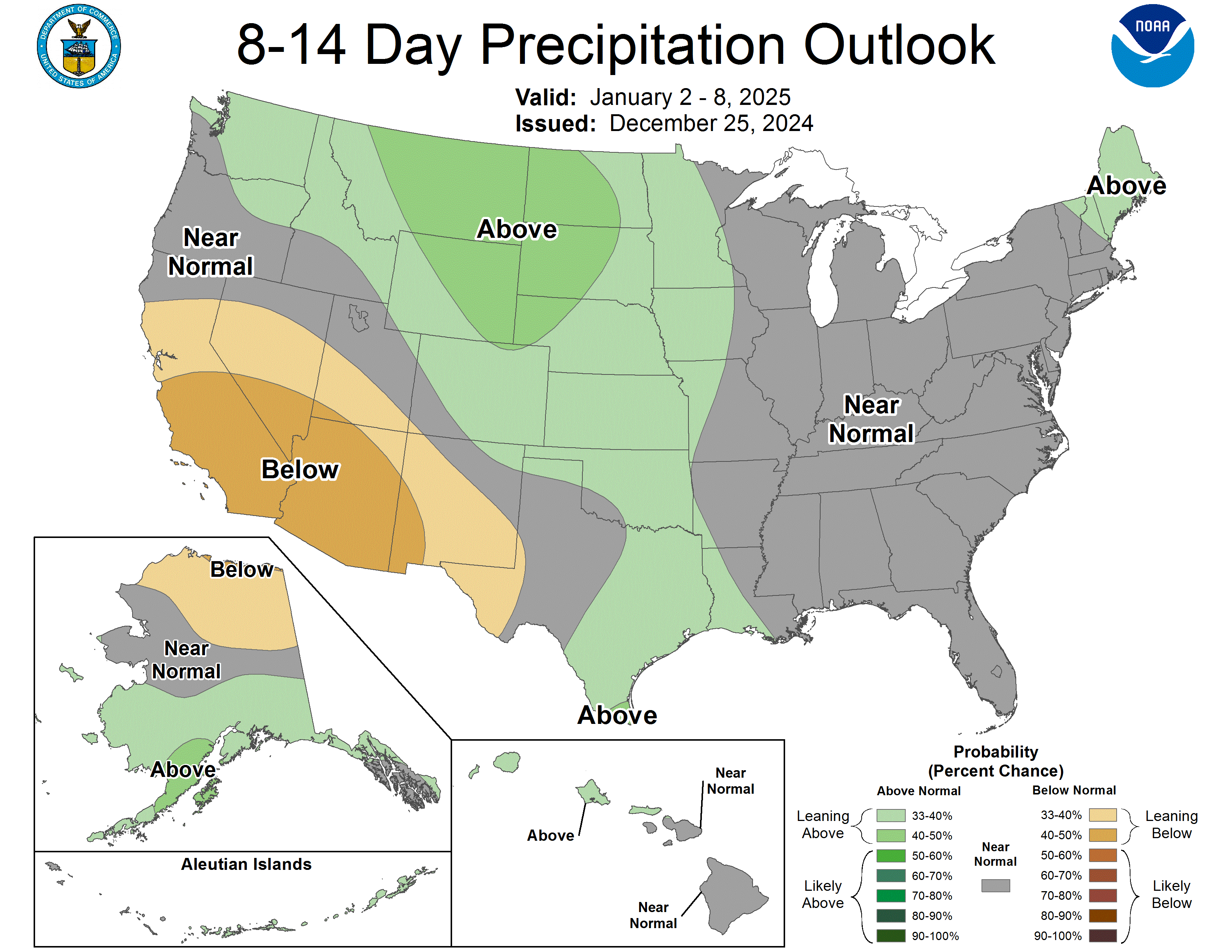
Looking Ahead

During late December, multiple low pressure systems will bring heavy precipitation (rain and high-elevation snow) to the Pacific Northwest and northern California. On December 27, widespread rain with locally heavy amounts (more than 2 inches) is forecast for eastern Oklahoma, eastern Texas, and Arkansas. A slow-moving low pressure system and trailing front are forecast to bring varying precipitation amounts (0.5 to 1.5 inches) to the Ohio and Tennessee Valleys, Mid-Atlantic, and Northeast.

The Climate Prediction Center’s 6-10 day outlook (valid December 30, 2024-January 3, 2025) favors above-normal temperatures across the East, Southern Great Plains, and Southwest. Near normal temperatures are favored for the Northern Great Plains, Northern Rockies, and Pacific Northwest as above-normal temperatures are forecast to moderate during this 5-day period. A pattern change is forecast during the first week of the New Year with a transition towards near or below-normal temperatures for much of the lower 48 states. Elevated above-normal precipitation probabilities are forecast for the Pacific Northwest, Great Plains, Midwest, and Northeast. Below-normal precipitation is more likely for the southern two-thirds of California and the Southwest.
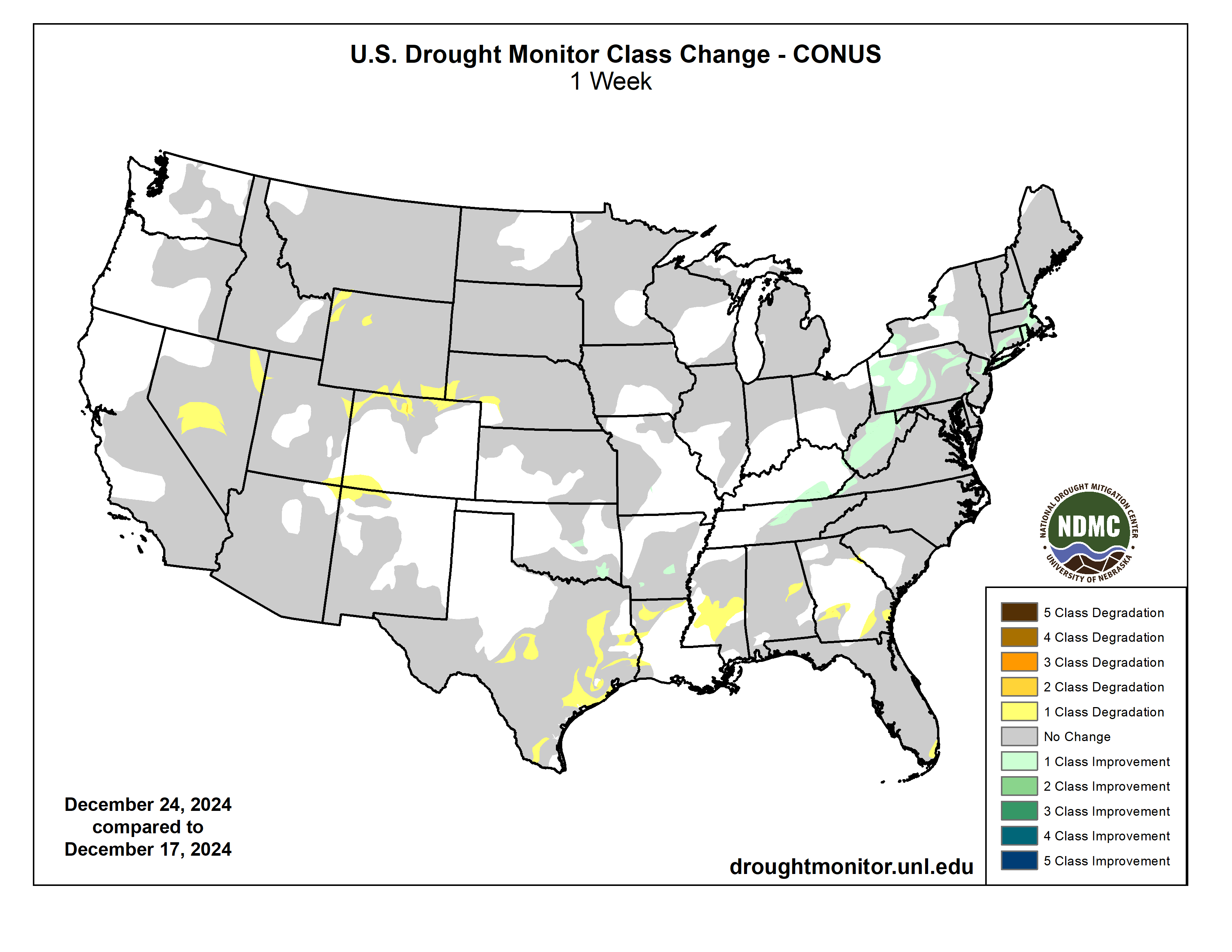
US Drought Monitor one week change map ending December 24, 2024.

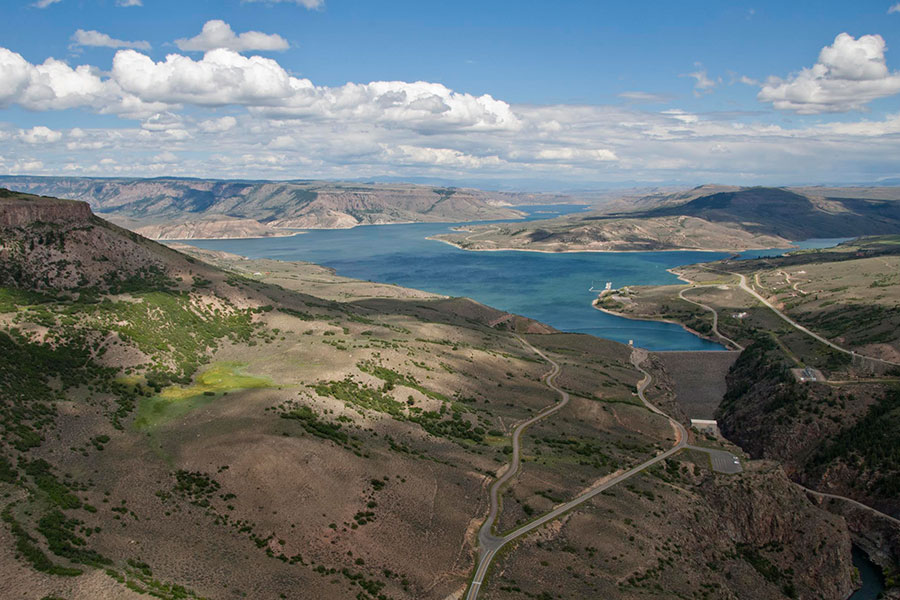
Cash flows to help update Blue Mesa power plant — The #Montrose Press #GunnisonRiver

Blue Mesa Dam. Photo credit: Reclamation

Click the link to read the article on The Montrose Press website (Katharynn Heidelberg). Here’s an excerpt:

December 7, 2024

Hydropower infrastructure at Blue Mesa Reservoir will see some urgent updates, with the help of money coming through the Interior Department’s Aging Infrastructure Account. The account received more than $3 billion through the Bipartisan Infrastructure Law. As part of an $849 million disbursement announced by the Interior on Dec. 3, more than $32.03 million will go to replace butterfly valves at the Blue Mesa power plant and to refurbish two ring follower gates at the dam there. This funding will pay for planning, final design and implementation.

ā€œThe infrastructure at Blue Mesa dates to the facility’s original construction, with most installations made in 1963,ā€ a Bureau of Reclamation official said via email, in response to questions. ā€œGiven a typical service life of 50 years, much of the equipment has exceeded this threshold and requires either refurbishment or replacement. Currently, funding is allocated to priority projects that address these urgent needs.ā€

The government further is providing $1.3 million to pave the public access road to the power plant and $650,000 to replace the electrical ā€œbusā€ that transmits power from generator to transformer at the plant…According to Bureau of Reclamation information, Blue Mesa’s power plant is composed of two 30,000-kilowatt generators, driven by 41.55-horsepower turbines; each turbine operates at a maximum head of 360 feet. The plant’s generating capacity is 86,000 kilowatts…The Department of the Interior in its announcement said the money is an investment through President Joe Biden’s Investing in America agenda, and aimed at revitalizing aging water delivery systems. The funding is gong to 77 projects overall, in several Western states, including 14 in the Colorado River Basin, totaling $118.3 million.

Hydroelectric Dam

Survey: 23 #Colorado cities need to replace at least 20,000 lead pipes that could taint drinking water — Jerd Smith (Fresh Water News)

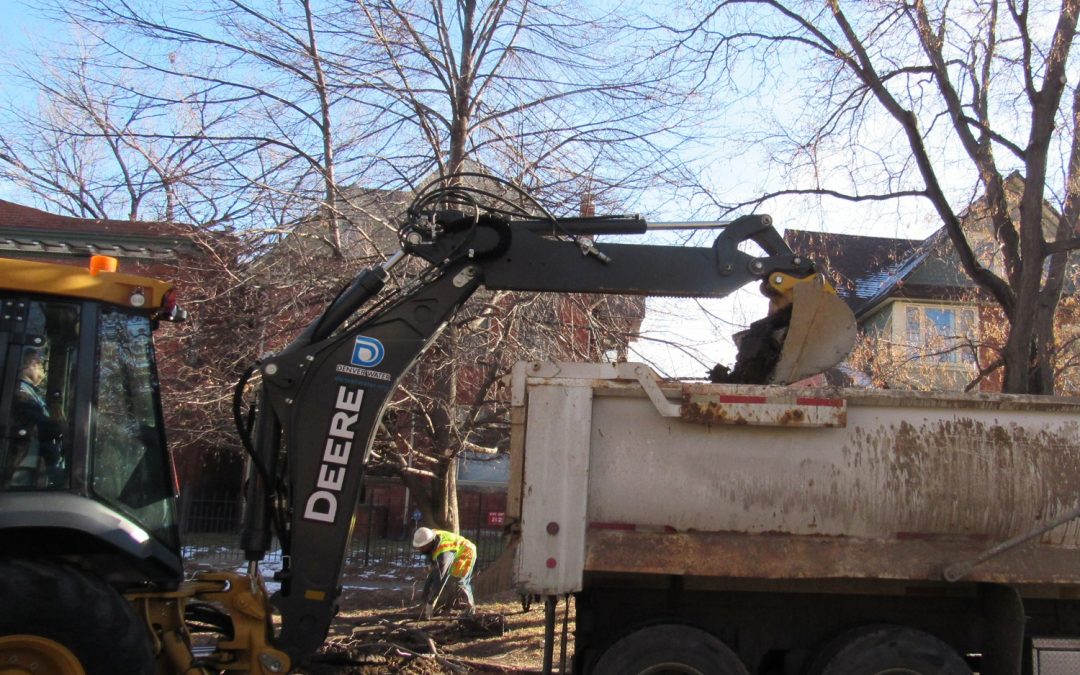
Denver Water crews replacing a lead service line at 1657 Vine Street. Jan. 12, 2021. Credit: Jerd Smith

Click the link to read the article on the Water Education Colorado website (Jerd Smith):

December 22, 2024

A  new statewide survey shows that 23 Colorado cities have aging lead water delivery pipes, roughly 20,000 of them, that could potentially taint drinking water.

Under federal rules, those cities must identify all contaminated pipes and replace them by 2037, according to the Colorado Department of Public Health and Environment.

But the initial survey, completed in October, also found that 170,000 additional water lines still need to be examined. Cities that have untested water delivery pipes are notifying customers of the risk and have through November of next year to finish the identification process, according to Seth Clayton, executive director of Pueblo Water.

ā€œIt took a significant effort to get the initial inventory completed,ā€ Clayton said, ā€œand then we sent out 22,000 letters to customers saying their service line type is unknown and could be lead. That sparks a bit of panic because of the misinformation out there. But call volumes and our customer service time is starting to decrease.ā€

The City of Lafayette banned lead pipes in 1959, according to Melanie Asquith, the city’s principal utility engineer. As part of the new survey, it has identified just one partial pipe that contains lead. Still, the city is notifying 770 customers who have unknown line types and plans to begin testing them early next year.

The communities on the list are: Sterling, Denver Water, Manitou Springs, Steamboat Springs, Georgetown, Grand Junction, Golden, Ft. Morgan, Englewood, Loveland, Aurora, Yampa, Flager, Lafayette, Limon, Bristol Water and Sanitation District, Pueblo Water,  Eckley, Parkville Water District, Silver Plume, Greeley, Morgan County Quality Water District, Lost Valley Ranch Corp.

Lead water lines were commonly used up until the 1980s, when they were banned by the EPA. Though water entering the pipes may be clean, erosion of the aging lines causes lead to seep into the water. No levels of lead are considered safe for children and can cause serious health problems in adults, according to the Colorado Department of Public Health and Environment.

To help finance the testing and replacement work, this year the EPA awarded the state $32.8 million. It is part of a $2.6 billion national replacement initiative funded through the federal Bipartisan Infrastructure Law.

Even before the new mandate to replace all lead lines, the EPA ordered cities such as Denver to begin replacement programs because some lead had been detected in water delivered to homes, violating federal standards at the time. Denver Water has removed 30,000 lines, with another 30,000 to go, according to agency spokesman Todd Hartman.

Other cities that have never had lead levels that exceed federal standards began replacing lead lines years ago as part of routine maintenance and leak repair programs, according to Mark Ritterbush, Grand Junction’s water services manager.

ā€œWe’ve been chipping away at it over time because we knew the EPA was going to do this. There’ve been rumblings for at least a decade,ā€ Ritterbush said.

Still, he said, the city has spent $1 million to comply with the lead pipe rules and meet the survey deadline. ā€œWe had a good foundation. But because we’re on the clock, it’s a lot to handle.ā€

More by Jerd Smith

Roman lead pipe — Photo via the Science Museum