
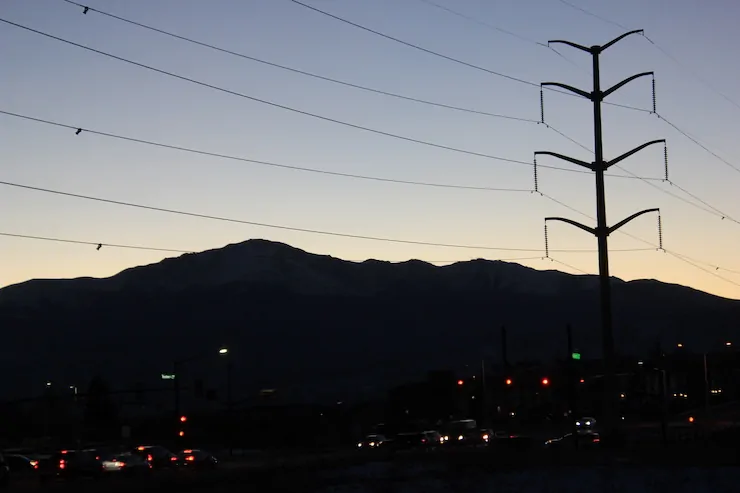
Why we need the interstate highways of electricity — Allen Best (@BigPivots) #ActOnClimate

Colorado Springs. Photo credit: Allen Best/Big Pivots

Click the link to read the article on the Big Pivots website (Allen Best):

December 19, 2024

Transmission line in southeast Colorado a cause for guarded optimism among utility leaders

Interstate highways have transformed Colorado and America altogether. People growing up in the 1950s rarely had fresh fruit or vegetables in winter. Now, broccoli beheaded yesterday in a field near Yuma, Ariz., can be on a store shelf in metro Denver within a day or two. Much of that journey will be on an interstate highway.

High-voltage transmission lines are our four-lane highways of electricity. They worked well enough when giant coal plants provided most of our electricity. Now, as Colorado and other states strive to replace fossil fuels with renewables, new connections must be built, to knit us together across broader areas.

A federal agency this week delivered cause for cautious optimism. The Department of Energy has picked three transmission corridors among 10 national candidates for advanced work. One of them, the Southwestern Grid Connector Corridor, would begin in southeast Colorado near Lamar, and work south into New Mexico and then somewhat west.

The 2021 Bipartisan Infrastructure Law authorized the secretary of energy to designate any geographic area as a national interest electric transmission corridor. The energy department has found that absence of transmission harms consumers. With more transmission, we can share low-cost renewable generation across broader areas. We need an electric grid larger than one weather system and covering more than one time zone.

The existing transmission network is akin to our highways of 50 to 60 years ago. We have transmission, but it’s as if Interstate 70 stopped at the state line. In fact, transmission lines do. Colorado is in the Western electrical grid of 10 states and some adjoining areas. This grid, however, is better understood as a collection of 34 different islands connected by narrow causeways.

“A cautious hurrah,” said Mark Gabriel, the CEO of United Power when I asked his reaction. The Brighton-based electrical cooperative supplies 113,000 members from the foothills to Weld County’s oil and gas fields, including many new industrial centers along I-76.

“Anything that promotes additional transmission is a good thing,” said Gabriel. “However, the challenge remains in actually getting something constructed in a reasonable period of time to make a difference.”

Gabriel pointed out that more than $40 billion in transmission projects have been announced. “Only a fraction are actually being built.”

Permitting has been the bane of many transmission projects. For example, it took 18 years before the TransWest Express Transmission project that will ferry wind-generated electricity from southern Wyoming to Utah and West Coast markets finally broke ground in 2023. It nicks the corner of northwest Colorado.

A bill being negotiated in Congress would ease federal permitting requirements to allow more rapid creation of transmission lines. Other provisions of the Energy Permitting Reform Act of 2024 would also benefit oil and gas extraction.

Tri-State Generation and Transmission, the wholesale provider for 17 of Colorado’s 22 electrical cooperatives, pointed to the need for streamlined permitting in its reaction to the transmission line in southeastern Colorado.

Transmission doesn’t come cheap. And just as interstate highways have their unsavory aspects — my companion and I can routinely hear I-70 roaring a mile away — transmission lines have their downsides. Who wants one in their backyard?

Baca County has Colorado’s best wind resource and it gets plenty of sunshine. Lacking has been transmission. Top photo transmission in Colroado Springs. Photo credit: Allen Best/Big Pivots

Some want to believe nuclear energy will solve all of our problems. The Pueblo City Council, while saying nice things about nuclear, intends to scrap a goal of 100% renewables by 2035. Maybe nuclear will be an answer, but recent projects have had eye-bulging costs. Natural gas has problems, too, as was evident in Winter Storm Uri of February  2021 when costs soared.

Chris Hansen, as a state legislator from Denver, sponsored key legislation to push transmission planning in Colorado. Now in Durango as CEO of La Plata Electric, he has started working on guiding his electrical cooperative to 97% emission-free electricity in the next decade. Transmission, he says, will be crucial.

Capacity of existing transmission lines can be expanded by reconductoring and other technology. But we altogether need to be better connected east and west, north and south.

One crucial question, says Hansen, is whether Denver-based Chris Wright, the choice of Donald Trump to be secretary of energy, will support continued transmission planning. His Colorado-based career has been in oil and gas. Wright sees renewables as a distant solution.

Southeastern Colorado brims with renewable energy potential. Baca County has Colorado’s best wind, according to a 2017 study by the National Renewable Energy Laboratory. It also has strong solar. That’s why corn grows so well there — assuming it has water. The water of the Ogallala Aquifer won’t last, but the solar and wind almost certainly will. What it lacks now is a farm-to-market transmission highway.

Beautiful Bears Ears is at risk, again — Jonathan P. Thompson (High Country News)

Valley of the Gods and Cedar Mesa in Bears Ears National Monument. Photo credit: Jonathan P. Thompson

Click the link to read the article on the High Country News website (Jonathan P. Thompson):

November 22, 2024

This story was originally published by The Land Desk and is republished here by permission.

On a mid-November evening I stood on a gravelly plain, shivering in the wind as clouds dangled their wispy fingers of snow onto Cedar Mesa to the north of me. The long sunset finally fizzled into darkness and I watched for the one-day-past-full moon to rise over the Valley of the Gods. But the dark horizon never yielded the anticipated orb. Instead, I was treated to evanescent shards of orangish light escaping through cracks in the clouds. 

I was in southeastern Utah on a nearly flat expanse of scrub-covered limestone some 1,200 feet above the winding and silty San Juan River. I was also just barely inside the boundaries of Bears Ears National Monument. At least for now. But the national monument protections on my little dispersed campsite, along with a good portion of the landscape I looked out upon, will likely go away shortly after President-elect Donald Trump takes office next year. 

Last week the New York Times reported that Trump will again shrink Bears Ears and Grand Staircase-Escalante National Monuments back to the diminished boundaries he established in 2017. The 1.36-million-acre Bears Ears — which President Joe Biden restored in 2021 — will become a 200,000 acre national monument divided into two discrete units. Left out will be Valley of the Gods, Cedar Mesa, the Goosenecks of the San Juan, the White Canyon and Dark Canyon regions, and portions of Butler and Cottonwood Washes.

Raplee Ridge in Bears Ears National Monument. Photo credit: Jonathan P. Thompson

The act is likely illegal, since the Antiquities Act only gives presidents the power to establish national monuments, not shrink or eliminate them. And it will revive lawsuits still pending since Trump’s previous shrinkage. But while the legal challenges wend their ways through the courts, Trump’s shrinkage will take hold (barring a court injunction). The draft management plan that federal officials and tribal representatives have worked on for years will be rendered obsolete before it’s even approved, and about 1.2 million acres of public land will be re-opened to new mining claims and oil and gas and coal leasing. 

There are the conservation consequences to think of, which I’ll get to, but more importantly is the symbolic significance. Bears Ears was originally proposed and conceived of and pushed by five sovereign tribal nations — with the backing of another two dozen tribes — who were looking to protect lands that had been stolen from them and put into the “public domain.” Representatives from those tribes had a hand in crafting the new management plan, which uniquely incorporates Indigenous knowledge into decision-making. 

By overturning the national monument, Trump is thumbing his noses at those same tribal nations, essentially telling them that their efforts and ties to this land are meaningless. As I stood out there dissolving into the darkness, a question arose: Why? Why the hell would a Manhattan real estate developer and reality show personality, who probably had never set foot on the West’s public lands, make such a cruel and thoughtless gesture? What was he hoping to achieve?

I’ve posited potential motives for the initial shrinkage. Trump wanted to curry favor with the powerful Sen. Orrin Hatch, of Utah, so he could gut Obamacare and get tax cuts for the wealthy through Congress. He wanted to help out his friends in the uranium mining and oil and gas industries. He wanted to repay Utah voters for abandoning their principles and voting for him.

Snow virgas over Cedar Mesa. Photo credit: Jonathan P. Thompson

But the oil and gas industry isn’t exactly champing at the bit to drill in the Bears Ears area. There are many other more accessible and profitable places to chase hydrocarbons. And in 2017 the domestic uranium mining industry was virtually nonexistent, and its 200 or so employees hardly made for a significant voting bloc. Mark Chalmers and Curtis Moore, the CEO and VP of Energy Fuels, probably the most viable uranium mining and milling company out there, didn’t even donate to any of Trump’s presidential campaigns.

It really seems that Trump diminished Bears Ears and Grand Staircase-Escalante National Monuments for no other reason than to dismantle the environmental legacies of his rivals and predecessors, former Presidents Bill Clinton and Barack Obama. And given his cabinet picks so far, Trump is planning on more of the same in his second term. He “governs” out of greed and self-interest, first, followed closely by spite — aimed at liberals, his political rivals, and Republicans who don’t show enough fealty to him. 

The expected shrinkage won’t have an immediate impact on the landscape where the protections are lifted, which will simply revert back to federal land managed under the multiple-use mandate. Come Jan. 20, there will not be a battalion of drilling rigs marching upon the weird formations of Valley of the Gods or mines opening up in White Canyon’s cliffs.

Yet there will be longer term consequences. All of the debate and back and forth over the national monument has attracted more visitors to the general area, and that has brought more impacts. Taking away national monument status from most of those lands will not reduce visitation, but it will take away resources for and opportunities to manage their impacts. The Trump-era management plan, which was hardly a plan at all and replaced the tribal commission with a bunch of monument opponents, will remain in place, rendering what’s left of the national monument almost meaningless.

After Trump’s first shrinkage, speculators and would-be mining firms staked a handful of claims in lands that had been taken out of Bears Ears national monument. That was when the uranium industry was moribund. Now, higher prices, a renewed interest in nuclear power, and a ban on enriched reactor fuel from Russia has given the industry new life. While uranium production remains minimal, exploration has kicked up significantly, including in lands just outside the Bears Ears boundary. This time around we’re likely to see not only mining claims being staked soon after the shrinkage in places like White Canyon and Cottonwood Creek, but also exploratory drilling. Even if companies don’t have any short-term interest in mining in the area, the drilling can help them establish the claims’ validity, thereby increasing the likelihood that the right to mine those parcels would be locked in if a future administration or the courts were to restore Bears Ears. 

Plus, the shrinkage will make the land removed from the national monument more vulnerable to Utah’s attempt to seize control of all “unappropriated” public lands within the state’s boundaries.

Just as night became complete, the moon emerged from behind the clouds and cast a pale light over everything. At the same time, I saw my friends’ truck’s headlights bouncing up the road, so I trudged through the cold to guide them to the campsite. We laughed and talked and played music. One was still reeling from the shock of the presidential election’s outcome, the other, who works with rural communities across the West, had seen Trump’s victory as almost inevitable.

Eventually, I snuggled up in my sleeping bag in my little tent and emerged more than ten hours later, just as the moon was getting ready to set and the sun prepared to rise over the corner of the Carrizo Mountains along the New Mexico-Arizona border. The landscape around me slowly revealed itself as if awakening from slumber. Later, under the almost harsh blue sky, my friends and I made our way almost aimlessly across the scrub-covered plain, trying to avoid the Russian thistle that had proliferated after more than a century of cattle grazing and following the erratic cow paths when we encountered them.

At one point we heard the report of what sounded like a semi-automatic firearm being shot in the distance. It wasn’t a hunter, I’m sure of that. More likely a recreational shooter looking to waste some ammo before the proposed shooting ban goes into effect — though now it’s not likely to. Maybe they were targeting cans, or petroglyphs, or a desert-varnish-covered boulder or grazing cattle. I involuntarily flinched at each bang.

Sunset in Bears Ears National Monument. Photo credit: Jonathan P. Thompson

I walked with gratitude for the beauty all around and the freedom to wander through it. I walked with sadness, too, and anger at those who would try to reduce this place, this living landscape, to a pawn in their petty and vindictive game, and who would try to open it back up to corporations looking to wring every last particle of profit from it. But I also found hope in the knowledge that powerful tribal nations, land protectors and nonprofits will continue their fight to protect this land and challenge the spiteful attempts to diminish this place.

We came to the edge of the San Juan River gorge and dropped into it, following a path forged by gold prospectors back during the “Bluff Excitement” of the early 1890s, when folks thought they could get rich by scouring the San Juan River’s banks for flakes of gold. The gold rush fizzled before it got started, but the trail endures. After reaching its terminus, we stopped our banter and sat quietly and listened to the silty waters gurgle by slowly and watched a red tail hawk frolic reassuringly in the updrafts far above. The future is uncertain, but this much I know: Beauty will persist regardless of who occupies the White House.

Film: Saving Silence — Protect our Winters

In the heart of Northern Minnesota lies a place that inspired the powerful film Saving Silence. Join POW Creative Alliance Captain, Emily Tidwell as she returns to the Boundary Waters Canoe Area, reflecting on how this wild landscape saved her life. ‘Saving Silence’ dives deep into mental health, the critical importance of public lands, and the unsettling presence of microplastics in some of the world’s most remote places. Emily reconnects with Arctic explorer Lonnie Dupre and Clare Shirley, owner of Sawbill Canoe Outfitters, to discuss why protecting this pristine wilderness is more crucial than ever. Thank you to Fat Tire and Visit County Cook for making this possible! Written and produced by Emily Tidwell. Cinematography and editing by Beau Larson. Additional cinematography Spencer Duclos. Audio Design Keith White. Color Design by Jonny Siroteck and Logan Pehota.