Las Vegas has reduced its water consumption even as its population has increased. (Source: Southern Nevada Water Authority)
Click the link to read the article on The Denver Post website (Elise Schmelzer). Here’s an excerpt:
December 6, 2024
Policymakers, academics, irrigators and water attorneys gathered in the Nevada desert this week to discuss the future of the highly contentious river that makes modern life possible for so many people across a vast swath of the American Southwest. The current guidelines that dictate how water is shared among the seven Colorado River basin states are set to expire at the end of 2026, and government leaders must create a new plan before then.
Udall/Overpeck 4-panel Figure Colorado River temperature/precipitation/natural flows with trend. Lake Mead and Lake Powell storage. Updated through Water Year 2024. Credit: Brad Udall
To do so, they must decide who will get less water — and when — as climate change shrinks the river’s flows.
“The tensions are extremely high this year,” said Tanya Trujillo, water policy advisor and deputy state engineer for New Mexico. “Of the 20 years I’ve been coming to this conference, this is the one with the least-good relations among the states.”
[…]
Carly Jerla speaking at the Colorado River Water User’s Association Conference December 5, 2024. Photo credit: USBR
The U.S. Bureau of Reclamation, which operates Lakes Mead and Powell, must create a new operating plan for the reservoirs before current guidelines expire at the end of 2026. The bureau is halfway through the process, said Carly Jerla, senior program manager at the agency. The bureau must complete environmental analyses of potential operating guidelines, take public comment and make a final decision by August 2026, she said.
“We need to be moving, as a basin, a lot faster in this second half than we did in our first half” of the process, Jerla said…
Upper Basin negotiators believe their basin should be exempt from mandatory water-use cuts imposed by the federal government because water use in the basin is already restricted by the amount of precipitation. While the Lower Basin can use water stored in Mead and Powell in dry years, Upper Basin states do not have large upstream reservoirs and must instead rely on snowpack and rainfall. Historically, the Upper Basin has never been able to use its full allocation of water, negotiators from the basin said. Water users in Colorado have their water cut off every year because there is not enough, Mitchell said. The Lower Basin must acknowledge those losses and recognize that the Upper Basin has been living with the impacts of climate change for years, she said.
NASA satellite images show water decline in Lake Mead from 2000, at left, to 2022, the largest reservoir in the United States. Credit: Colorado State University
Click the link to read the article on the InkStain website (John Fleck):
My colleagues with the Colorado River Research Group have a new policy brief out today taking another whack at the question of “assigned water” – water kinda sorta conserved, but left in storage so water agencies can pull it out again at some future date. Think “Intentionally Created Surplus” (ICS). At this point, nearly 40 percent of the water in Lake Mead is tagged as some agency’s private storage account, rather than being available for general system use.
This is the issue Arizona State’s Kathryn Sorensen (one of my CRRG colleagues) has been raising, and that Kathryn (with help from Sarah Porter and I) wrote about in October. The new CRRG paper argues that, as we move toward expanding the assigned water programs available to basin water users, we need to be mindful of the risks.
Map of the Colorado River drainage basin, created using USGS data. By Shannon1 Creative Commons Attribution-Share Alike 4.0
Drawdown of the Colorado River’s reservoirs now slightly exceeds the amount of gain that occurred during the 2024 snowmelt season. For the next four months until snowmelt begins again, the basin’s reservoirs will be drawing from the excess accumulated in 2023, demonstrating the immense challenge in balancing water consumption with supply.
In Detail…
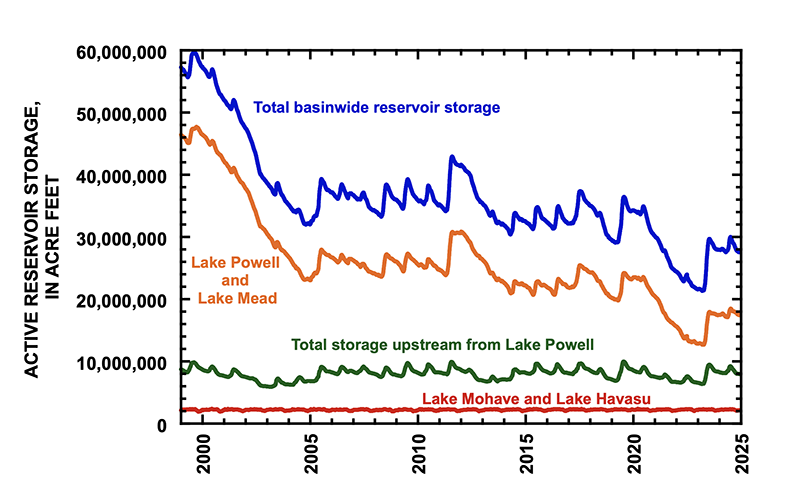
On 30 November 2024, total basin reservoir storage was 27.5 million af (acre feet)1, approximately two years’ supply at today’s rate of consumptive use and loss (Fig. 1). That amount is 43% of the maximum system contents of July 19832 and is the same amount as at the beginning of July 2021 when the basin’s water managers were beginning to get worried. Conditions are not quite as bleak as in summer 2021, because that year’s snowmelt season had already passed. Now, we can hope that the 2025 snowmelt season might be a good one. Nevertheless, reservoir storage is the bank account from which we draw to maintain the economy of the American Southwest and parts of northwestern Mexico. It would be preferable for there to be more water in that account.
Figure 1. Graph showing total storage in 46 reservoirs (blue line) in the Colorado River basin since 1 January 1999. Also shown are the total contents of Lake Mead and Lake Powell (orange line), total contents of Lake Mohave and Lake Havasu (red line), and 42 reservoirs upstream from Lake Powell (green line) which includes reservoirs managed by the federal and state governments, municipalities, and water districts. Credit: Jack Schmidt/Center for Colorado River Studies.
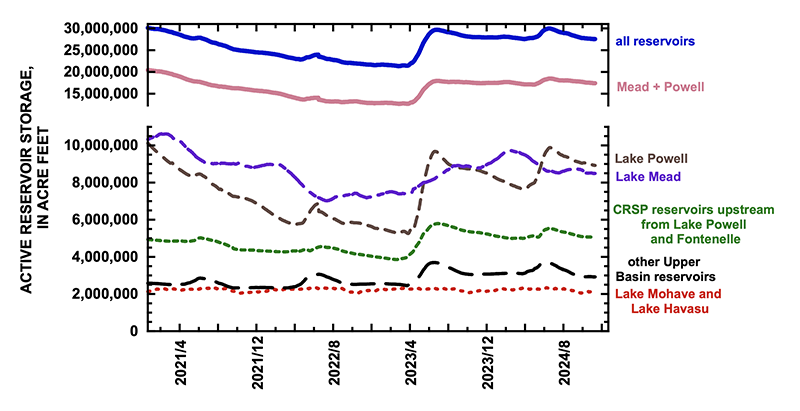
Approximately 63% of current total reservoir storage is in Lake Mead and Lake Powell. Presently, there is approximately 400,000 af more water in Lake Powell than in Lake Mead, but the contents of Lake Powell are slowly being depleted. The contents of Lake Mead held fairly constant during the past month. The contents of Lake Powell decreased by approximately 4300 af/day during November, but the contents of Lake Mead decreased by only 800 af/day (Fig. 2). Upstream from Lake Powell, Colorado River Storage Project (CRSP) initial unit reservoirs, as well as Fontenelle Reservoir, decreased by only 600 af/day in November, and other Upper Basin reservoirs lost even less (400 af/day).
Figure 2. Graph showing total basin reservoir storage (blue line), and storage in different parts of the Colorado River watershed between 1 January 2021 and 30 November 2024. Credit: Jack Schmidt/Center for Colorado River Studies
Basin reservoir storage must be increased to improve the security of our water supply. We need to increase the balance in our “bank account,” and the only way to do that is to spend less than the amount of our actual water “income.” Most of our income arrives during the snowmelt season of late spring and early summer. Mid- and late-summer, fall, winter, and early spring is the period when we spend the snowmelt-season income, although summer rains and groundwater inflow offset some of our uses.
Occasionally, we have an unusually snowy winter, and the basin’s reservoirs significantly refill. 2023 was one of those years. Reclamation estimates that the natural flow of the Upper Basin3 was 17.4 million af in 2023, the third largest of the 21st century (after 2011 and 2019), and total basin storage increased by 8.38 million af, only exceeded by the increase in storage in 20114. 2024 was a moderately snowy winter.
2024 was a different story, however. The NRCS estimated that the peak snow water content in 2024 was 14% greater than the 30-year average, but dry soils and other effects of a warming climate limited natural flows to between 11.9 and 12.1 million af, which is less than the average for the 21st century5. In 2024, the basin’s reservoirs increased in storage by 2.45 million af. The drawdown of the basin’s reservoirs as of 30 November was 2.46 million af, slightly more than the gain from snowmelt (Fig. 3). The contents of Lake Mead and Lake Powell increased by 1.39 million af in 2024, and the drawdown in those two reservoirs has been 1.07 million af this year. During the next four months, the basin will begin drawing from storage that accumulated in 2023.
Figure 3. Graph showing reservoir storage between 1 January 2023 and 30 November 2024, highlighting the amount of reservoir recovery during the past two snowmelt seasons and the amount of intervening reservoir drawdown. The drawdown of the basin’s reservoirs since July 2024 slightly exceeds the recovery that occurred due to snowmelt in 2024. Credit: Jack Schmidt/Center for Colorado River Studies
Drawdown of the basin’s reservoirs has been much greater in 2024 than in 2023. The amount of drawdown between early summer and today is slightly more than the median drawdown for the past 15 years6 and is 43% greater than the drawdown at this time last year (Table 1). The drawdown of Lake Mead and Lake Powell in 2024 is slightly less than the median for the past 15 years7 but is 98% greater than it was at this time last year.
The total reservoir drawdown between early summer and 30 November is now 14% greater than in all of last year, and drawdown in Mead and Powell also exceeds the total drawdown in those reservoirs last year (Table 2). We did well last year, but not so well this year. Credit: Jack Schmidt/Center for Colorado River Studies
Credit: Jack Schmidt/Center for Colorado River Studies
There are many details ignored in this overview. Reservoir drawdown in the Upper Basin is not only determined by consumptive use, but also by reservoir operating rules that require winter drawdown and by requirements to provide environmental flows. Water use in southern California is significantly affected by water supply available from northern California, the Owens River, and locally. Nevertheless, every drop of water released from upstream is used, lost, or stored in a downstream reservoir, and total basin storage is the only available supply to make up the shortfall between annual precipitation and annual use.
Conservation in the Lower Basin and in Mexico is reducing drawdown in Lake Mead, and the storage contents of Lake Mead are likely to increase during the next few months as water is delivered from upstream. Drawdown of the total contents of Lake Mead and Lake Powell is still 0.32 million af less than what accumulated there from the 2024 inflow season and a 2024 deficit might not occur is Lower Basin water use is drastically reduced or if Upper Basin reservoirs are emptied.
Efforts to date to reduce water consumption in the basin have been significant, and required a significant investment by the federal government. Despite those efforts, we have four months ahead of us before snowmelt in 2025 begins, and we are likely to begin deficit spending unless radical changes in use are immediately implemented. The challenge faced by the federal government, Mexico, the seven basin states, every tribe, and every water user is immense and is not solely restricted to negotiating the post-2026 agreements. We remain in a water crisis today, and the time to greatly reduce water consumption is right now in the present moment. [ed. emphasis mine]
[2] There was 63.6 million af of storage in the basin on 15 July 1983. Some of this storage exceeded the generally accepted capacity of some reservoirs, notably Lake Powell.
[3] at Lees Ferry
[4] Basin reservoir storage increased by 8.78 million af in 2011.
[5] Natural flows for calendar year and water year 2024 were 12.1 and 11.9 million af, respectively, based on Reclamation’s 12 September 2024 estimate. The average natural flow at Lees Ferry between 2000 and 2024 was 12.4 million af/yr, based on Reclamation’s estimates.
[6] The median drawdown between the summer peak and 30 November during the past 15 years was 2.26 million af for the 46 reservoirs of the watershed.
[7] The median drawdown between the summer peak and 30 November during the past 15 years was 1.16 million af for the total contents of Lake Mead and Lake Powell.
[8] Includes drawdown of Lake Mohave and Lake Havasu.