

Click the link to read the article on the WyoFile.com website (Dustin Bleizeffer):
January 30, 2025
Despite growing support for nuclear energy nationally and here in Wyoming, there are simply too many concerns to entertain the possibility of opening the state to the country’s growing stockpile of spent nuclear fuel waste, some lawmakers say.
House Bill 16, “Used nuclear fuel storage-amendments,” touted by its backers as a tool to initiate a larger conversation, died Wednesday morning in the House Minerals, Business and Economic Development Committee.
In addition to being flooded with emails and phone calls from constituents opposed to warehousing the deadly, radioactive material, several lawmakers on the panel were not convinced that a “temporary” storage facility would, in fact, be temporary. They noted that the federal government has tried and failed for decades to establish a permanent nuclear waste repository that would give some legitimacy to the “temporary” storage concept.
“This appears to be a huge game of hot potato,” Gillette Republican Rep. Reuben Tarver said.
Reacting to several claims during the hearing that the storage of radioactive nuclear fuel waste poses no human health or environmental risks, Rep. Scott Heiner of Green River listed a litany of reported leaks from the same type of “dry cask” containers in other states that would come to Wyoming.
“They’re still cleaning that up,” Heiner said. “Multi-billion-dollar environmental cleanup — to take decades. So even though there’s a lot of safety precautions in place, we can’t guarantee [storage is] 100% risk-free.”
What was in the bill
The push to open the state to spent-nuclear fuel waste has persisted for decades, including a years-long effort in the early 1990s, which ended when then-Gov. Mike Sullivan vetoed a similar measure, noting that the issue was simply too divisive and fraught with unanswered questions.
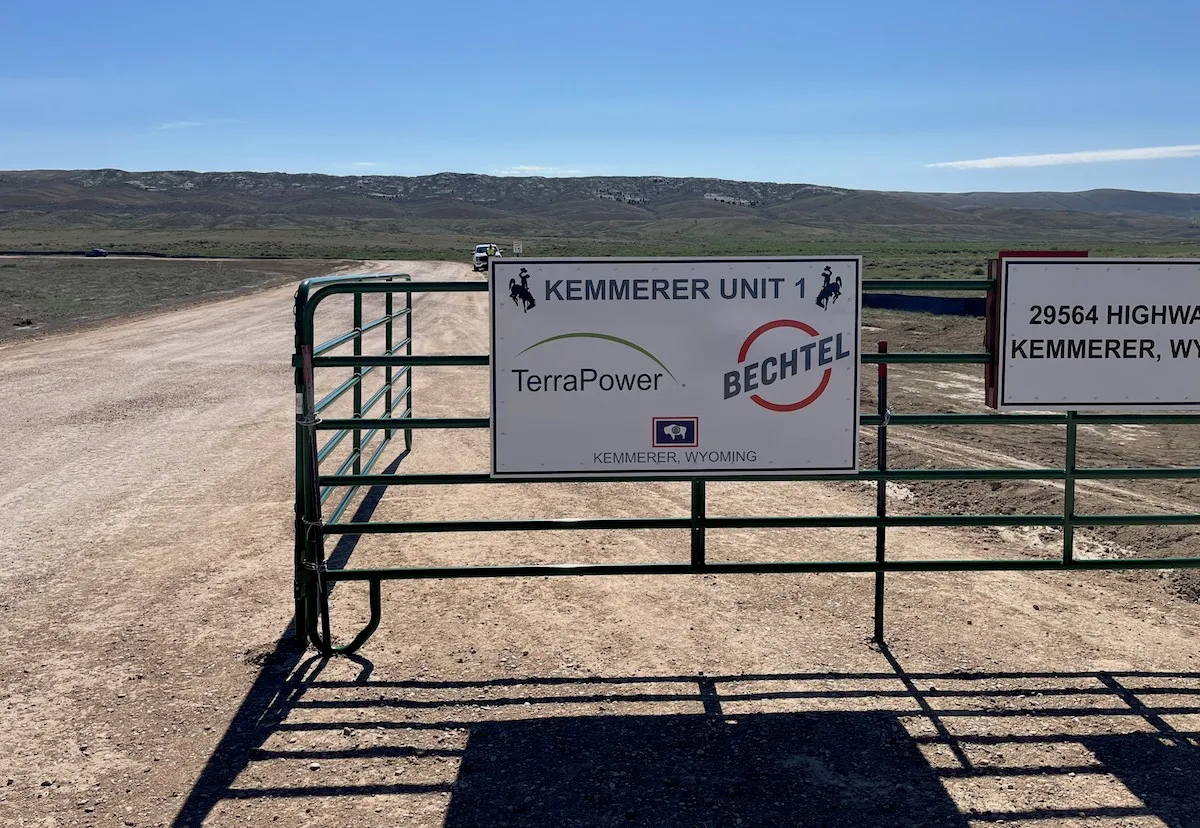
Since then, Wyoming lawmakers have tinkered with state statutes, notably a few years ago to accommodate limited storage at the site of nuclear power generation to help clear the way for TerraPower’s Natrium nuclear power plant project near Kemmerer. But state law still prohibits high-level radioactive waste storage, as envisioned in HB 16, unless the federal government establishes a permanent repository.
House Bill 16 would have set the stage to remove that statutory barrier in anticipation of a permanent, federal waste storage repository, Lander Republican Rep. Lloyd Larsen said.
“That seems to be in the works now,” he told committee members.
The legislation also sought to change language throughout Wyoming law referring to radioactive material as “waste” to “used nuclear fuel” — an attempt to alter public perception, as well as promote the idea that the materials might one day be reprocessed for re-use.
In fact, former Republican Rep. Donald Burkhart Jr. of Rawlins, when he introduced the bill to the committee in July, said if Wyoming takes on temporary nuclear fuel waste storage it would prime the state to eventually win a lucrative industry in reprocessing.
“Currently, the United States does not reprocess nuclear fuel,” Burkhart told committee members then. “I feel that within the next five years, that will change, and when it changes, wherever the fuel is stored is where they will do the reprocessing.”
Lack of public engagement
Burkhart’s rollout of the measure last year was also a major point of contention for the committee and several people who testified on Wednesday.

Burkhart, who did not run for another term, waited until the final minutes of a two-day hearing in Casper in July to introduce the draft measure to the Minerals Committee. He also forbade the Legislative Service Office from sharing the draft measure publicly until days before an October hearing, leaving scant opportunity for the public to digest the proposed law and research its implications.
“So many questions,” Gillette Republican Rep. Christopher Knapp said. “I think that part of this is because, although this says it came out as an interim bill, you really didn’t discuss this during the interim. This came as a last-minute bill in front of us, and here we sit in a committee meeting that probably should last for days with questions to get this through.”
Lawmakers on the panel also expressed suspicions that long-time backers of nuclear waste storage already have potential locations in mind, including perhaps sites on or near the Wind River Indian Reservation — without consulting the tribal communities.