#Drought news July 24, 2025: The U.S. Bureau of Reclamation is reporting (July 21) Lake Powell at 31% full (47% of average for the date), Lake Mead at 31% full (52%), and the total Colorado system (July 20) at 39% of capacity (compared to 45% of capacity the same time last year)

Click on a thumbnail graphic to view a gallery of drought data from the US Drought Monitor website.

Click the link to go to the US Drought Monitor website. Here’s an excerpt:

This Week’s Drought Summary

This U.S. Drought Monitor (USDM) week saw improvement in drought-related conditions across areas of the Southeast, South, Midwest, central and northern Plains, Intermountain West, and Desert Southwest, where short-term precipitation accumulations (past 30-day period) have helped to improve drought-related conditions. For the week, the most significant rainfall accumulations were observed across northern Kansas and areas of the Midwest including Missouri, Iowa, Illinois, and Indiana where accumulations ranged from 3 to 10+ inches, with the highest accumulations observed in northeastern Kansas. On the map, improving conditions over the past 30 to 60 days led to reduction in areas of drought in the Plains states, Kansas to North Dakota, as well as across drought-affected areas across the Midwest. Elsewhere, short-term dryness led to widespread expansion of areas of Abnormally Dry (D0) across the Southeast states including the Carolinas, Georgia, Alabama, and the Florida Panhandle. In the South, drought conditions continued to improve in Texas, including in the Trans-Pecos region in western Texas where short and mid-term composite drought indicators are showing improving conditions in terms of precipitation, soil moisture, and vegetation health. In the West, conditions were generally dry regionally, however, some isolated monsoon thunderstorms provided a much-needed boost in moisture (2 to 3 inch accumulations during the past week) to drought-affected areas of east-central and southeastern Arizona as well as lesser accumulations observed in central and northern Arizona. In terms of reservoir storage in the West, California’s reservoirs continue to be at or above historical averages for the date (July 22), with the state’s two largest reservoirs, Lake Shasta and Lake Oroville, at 105% and 117% of average, respectively. In the Southwest, the U.S. Bureau of Reclamation is reporting (July 21) Lake Powell at 31% full (47% of average for the date), Lake Mead at 31% full (52%), and the total Colorado system (July 20) at 39% of capacity (compared to 45% of capacity the same time last year)…

High Plains

On this week’s map, improvements were made in the region, namely in central northern Kansas, southeastern Nebraska, and South Dakota, where shorter-term precipitation (past 30-60 days) was normal to above normal. Additionally, these areas were showing improvements in other drought indicators including soil moisture, streamflow activity, and crop-related vegetation health indices. Conversely, conditions degraded on the map in areas of central South Dakota as well as in northern North Dakota, where dry conditions have prevailed during the past 30 to 60 days. For the week, light-to-heavy rainfall accumulations (ranging from 1 to 10 inches) were observed, with the heaviest amounts impacting northern Kansas and southeastern Nebraska. Below-normal average temperatures (ranging from 1 to 8 degrees F) were logged across most of the entire region…

Colorado Drought Monitor one week change map ending July 22, 2025.

West

Out West, generally dry conditions prevailed over much of the region with the exception of isolated areas of the Four Corners states, which observed monsoon-related thunderstorm activity with accumulations ranging from 1 to 4 inches. The storms led to targeted improvements on the map in Arizona. Likewise, isolated areas of the Pacific Northwest and eastern Plains of Montana and Wyoming observed isolated shower activity with accumulations generally of < 2 inches. On the map, persistent dry conditions led to expansion of areas of drought in southeastern Idaho, western Wyoming, and in eastern and southwestern Montana. For the week, average temperatures were mainly below normal with anomalies ranging from 2 to 10 degrees F and the greatest departures logged were observed in eastern Montana…

South

On this week’s map, improvements were made in the Hill Country and Trans-Pecos regions of Texas in response to improving conditions during the past 30-90 days. In these regions, targeted improvements were made in all drought categories (D1-D4). In Tennessee, a mix of degradations and improvements were made on the map in isolated areas of central and eastern Tennessee. For the week, average temperatures were generally above normal in eastern areas of the region, with anomalies ranging from 2 to 8 degrees F. Conversely, the western extent of the region, including much of Texas and Oklahoma, experienced temperatures ranging from 1 to 5 degrees F below normal. Texas reservoirs are reported to be 80% full, with many in the eastern part of the state in good condition (over 90% full), while numerous others in the western portion of the state continue to experience below-normal levels, according to Water Data for Texas (July 23). In terms of streamflow activity (July 23), the U.S. Geological Survey is reporting well above normal streamflows (>90th percentile) across areas of central and eastern Texas, eastern Oklahoma, and north-central Tennessee, while areas of the Texas Gulf Coast and South Texas Plains, northern Louisiana, and southern Mississippi are experiencing below normal levels (1st to 24th percentile range)…
Looking Ahead

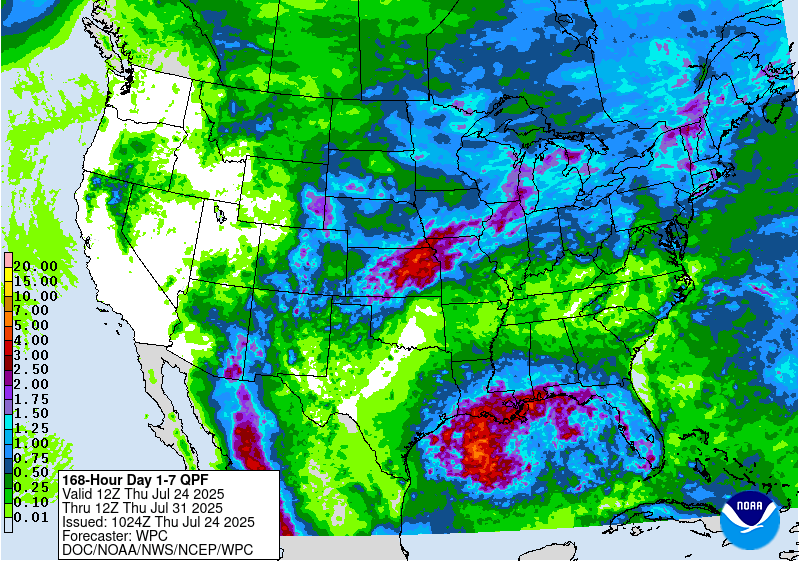
The NWS Weather Prediction Center (WPC) 7-Day Quantitative Precipitation Forecast (QPF) calls for relatively dry conditions across the western U.S., areas of the South, and southern Plains. Elsewhere, light-to-moderate accumulations are expected across areas of the central and northern Plains, Northeast, and the Gulf Coast region of the South and Southeast. The Climate Prediction Center (CPC) 6-10-day outlooks call for a moderate-to-high probability of above-normal temperatures across most of the conterminous U.S. with the exception of portions of California and Maine where below-normal temperatures are forecasted. In terms of precipitation, there is a low-to-moderate probability of above-normal precipitation across the Pacific Northwest, northern portions of the Intermountain West, central and northern Plains, Gulf Coast region, and much of the Eastern Seaboard…
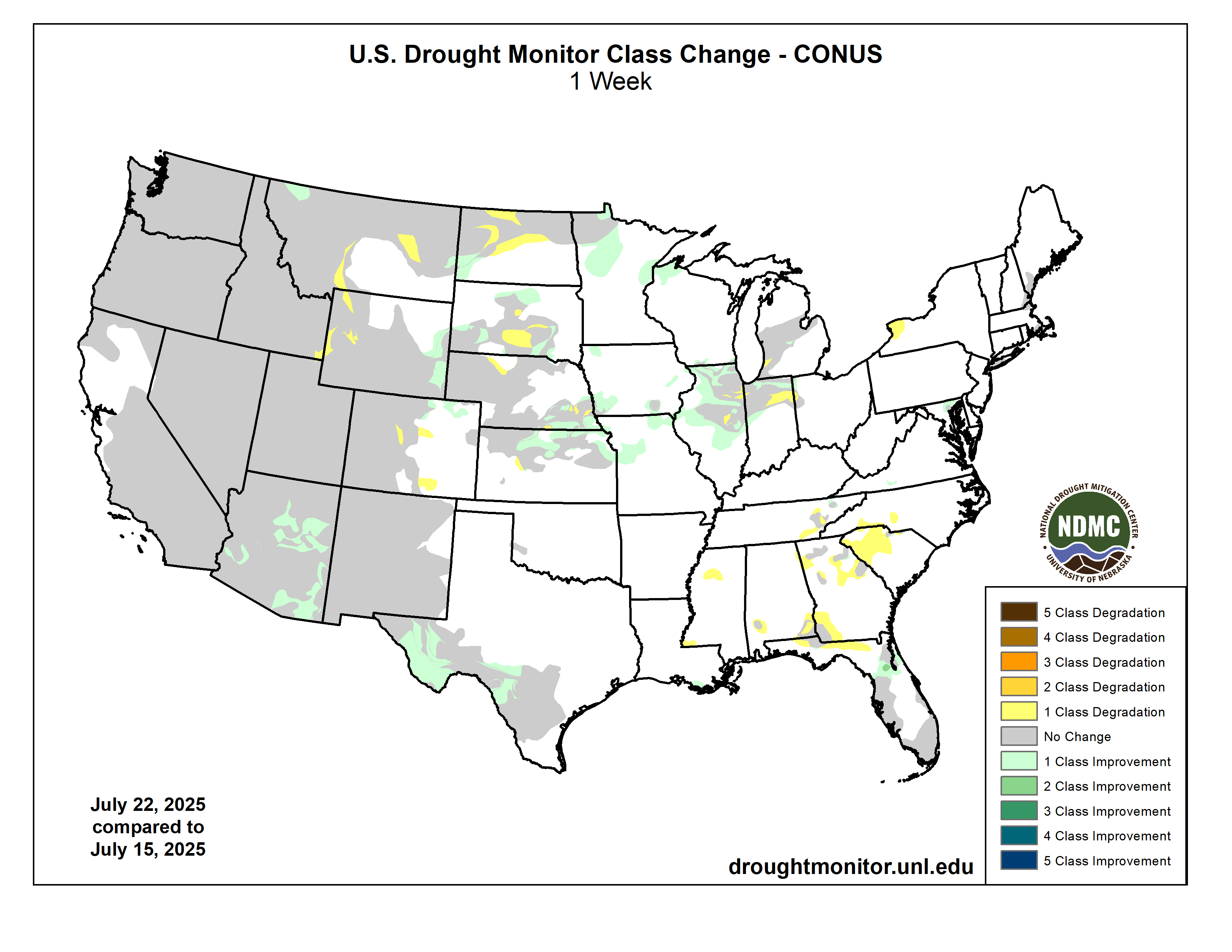

US Drought Monitor one week change map ending July 22, 2025.

R.I.P. Ozzy Osbourne: “Mama, I’m coming home”

Ozzy Osbourne in 1970. By Warner Bros. Records – Billboard, page 7, 18 July 1970, Public Domain, https://commons.wikimedia.org/w/index.php?curid=170537493

Click the link to read the obituary on The New York Times website (Gavin Edwards). Here’s an excerpt:

July 22, 2025

Ozzy Osbourne, who achieved enormous success as a pioneer of two wildly popular entertainment genres, heavy metal music and reality television, died on Tuesday. He was 76. His family announced the death in a statement, which did not say where he died or specify a cause. He had been treated in recent years for a variant of Parkinson’s disease that he identified as Parkinsonism or Parkin 2, a condition exacerbated by his chronic drug abuse. Although Mr. Osbourne repeatedly announced his retirement over the years — he called a series of live dates in 1992 the ā€œNo More Toursā€ tour and a 2018 series ā€œNo More Tours IIā€ — he gave his final concert this month, at a festival in his hometown, Birmingham, England, in his honor. Seated on a black throne, visibly moved by the enthusiasm of the crowd, he closed out his career by reuniting the original lineup of his heavy metal group Black Sabbath…As the lead singer of Black Sabbath, Mr. Osbourne was one of the inventors of heavy metal. As a solo artist, he became a remarkably durable star, with 13 platinum albums and the nickname ā€œPrince of Darkness.ā€ But he achieved even wider fame for his rock ’n’ roll excess, including an onstage incident in which he bit the head off a bat…

ā€œAll the stuff onstage, the craziness, it’s all just a role that I play, my work,ā€ Mr. Osbourne insisted in an interview with The New York Times in 1992. ā€œI am not the Antichrist. I am a family man.ā€

[…]

Born John Michael Osbourne in Birmingham on Dec. 3, 1948, he was the fourth of six children of John Thomas Osbourne, a toolmaker who worked the night shift at a power plant, and Lillian (Levy) Osbourne, who worked the day shift at an auto-parts factory. The Osbournes were crammed into a small working-class home; when Ozzy was young, it had no indoor plumbing. An indifferent student with undiagnosed dyslexia and attention deficit disorder, Ozzy dropped out of school at age 15 and had a series of short-lived jobs, including 18 months at a local slaughterhouse. After he was fired from that job (for fighting), he had a brief career as a burglar; when he was arrested, his father declined to pay the fine, and Ozzy spent three months in prison, which led him to abandon his criminal ambitions.

Dismantling of EPA’s Scientific Research Arm Fulfills Key Chemical Industry Goal — Marianne Lavelle (InsideClimateNews.com)

EPA-estimated cancer risk in the region (Cancer Alley). By MiseDominic – Own work, CC0, https://commons.wikimedia.org/w/index.php?curid=147151609

Click the link to read the article on the Inside Climate News website (Marianne Lavelle):

July 21, 2025

Companies feared rules and lawsuits based on the Office of Research and Development’s assessments of the dangers of formaldehyde, ethylene oxide and other substances.

Soon after President Donald Trump took office in January, a wide array of petrochemical, mining and farm industry coalitions ramped up what has been a long campaign to limit use of the Environmental Protection Agency’s assessments of the health risks of chemicals.

That effort scored a significant victory Friday when EPA Administrator Lee Zeldin announced his decision to dismantle the agency’s Office of Research and Development (ORD).

The industry lobbyists didn’t ask for hundreds of ORD staff members to be laid off or reassigned. But the elimination of the agency’s scientific research arm goes a long way toward achieving the goal they sought. 

In a January 27 letter to Zeldin organized by the American Chemistry Council, more than 80 industry groups—including leading oil, refining and mining associations—asked him to end regulators’ reliance on ORD assessments of the risks that chemicals pose for human health. The future of that research, conducted under EPA’s Integrated Risk Information System program, or IRIS, is now uncertain.

ā€œEPA’s IRIS program within ORD has a troubling history of being out of step with the best available science and methods, lacking transparency, and being unresponsive to peer review and stakeholder recommendations,ā€ said an American Chemistry Council spokesperson in an email when asked about the decision to eliminate ORD. ā€œThis results in IRIS assessments that jeopardize access to critical chemistries, undercut national priorities, and harm American competitiveness.ā€

The spokesperson said the organization supports EPA evaluating its resources to ensure tax dollars are being used efficiently and effectively.

H. Christopher Frey, an associate dean at North Carolina State University who served as EPA assistant administrator in charge of ORD during the Biden administration, defended the quality of the science done by the office, which he said is ā€œthe poster case study of what it means to do science that’s subject to intense scrutiny.ā€

ā€œThere’s industry with a tremendous vested interest in the policy decisions that might occur later on,ā€ based on the assessments made by ORD. ā€œWhat the industry does is try to engage in a proxy war over the policy by attacking the science.ā€

Among the IRIS assessments that stirred the most industry concern were those outlining the dangers of formaldehyde, ethylene oxide, arsenic and hexavalent chromium. Regulatory actions had begun or were looming on all during the Biden administration.

The Biden administration also launched a lawsuit against a LaPlace, Louisiana, plant that had been the only U.S. manufacturer of neoprene, Denka Performance Elastomer, based in part on the IRIS assessment of one of its air pollutants, chloroprene, as a likely human carcinogen. Denka, a spinoff of DuPont, announced it was ceasing production in May because of the cost of pollution controls.

Public health advocates charge that eliminating the IRIS program, or shifting its functions to other offices in the agency, will rob the EPA of the independent expertise to inform its mission of protection.

ā€œThey’ve been trying for years to shut down IRIS,ā€ said Darya Minovi, a senior analyst with the Union of Concerned Scientists and lead author of a new study on Trump administration actions that the group says undermine science. ā€œThe reason why is because when IRIS conducts its independent scientific assessments using a great amount of rigor … you get stronger regulations, and that is not in the best interest of the big business polluters and those who have a financial stake in the EPA’s demise.ā€

The UCS report tallied more than 400 firings, funding cuts and other attacks on science in the first six months of the Trump administration, resulting in 54 percent fewer grants for research on topics including cancer, infectious disease and environmental health.

EPA’s press office did not respond to a query on whether the IRIS controversy helped inform Zeldin’s decision to eliminate ORD, which had been anticipated since staff were informed of the potential plan at a meeting in March. In the agency’s official announcement Friday afternoon, Zeldin said the elimination of the office was part of ā€œorganizational improvementsā€ that would deliver $748.8 million in savings to taxpayers. The reduction in force, combined with previous departures and layoffs, have reduced the agency’s workforce by 23 percent, to 12,448, the EPA said.

With the cuts, the EPA’s workforce will be at its lowest level since fiscal year 1986.

ā€œUnder President Trump’s leadership, EPA has taken a close look at our operations to ensure the agency is better equipped than ever to deliver on our core mission of protecting human health and the environment while Powering the Great American Comeback,ā€ Zeldin said in the prepared statement. ā€œThis reduction in force will ensure we can better fulfill that mission while being responsible stewards of your hard-earned tax dollars.ā€

The agency will be creating a new Office of Applied Science and Environmental Solutions; a report by E&E News said an internal memo indicated the new office would be much smaller than ORD, and would focus on coastal areas, drinking water safety and methodologies for assessing environmental contamination.

Zeldin’s announcement also said that scientific expertise and research efforts will be moved to ā€œprogram officesā€ā€”for example, those concerned with air pollution, water pollution or waste—to tackle ā€œstatutory obligations and mission essential functions.ā€ That phrase has a particular meaning: The chemical industry has long complained that Congress never passed a law creating IRIS. Congress did, however, pass many laws requiring that the agency carry out its actions based on the best available science, and the IRIS program, established during President Ronald Reagan’s administration, was how the agency has carried out the task of assessing the science on chemicals since 1985.

Justin Chen, president of the American Federation of Government Employees Council 238, the union representing 8,000 EPA workers nationwide, said the organizational structure of ORD put barriers between the agency’s researchers and the agency’s political decision-making, enforcement and regulatory teams—even though they all used ORD’s work.

ā€œFor them to function properly, they have to have a fair amount of distance away from political interference, in order to let the science guide and develop the kind of things that they do,ā€ Chen said. 

ā€œThey’re a particular bugbear for a lot of the industries which are heavy donors to the Trump administration and to the right wing,ā€ Chen said. ā€œThey’re the ones, I believe, who do all the testing that actually factors into the calculation of risk.ā€

ORD also was responsible for regularly doing assessments that the Clean Air Act requires on pollutants like ozone and particulate matter, which result from the combustion of fossil fuels. 

Frey said a tremendous amount of ORD work has gone into ozone, which is the result of complex interactions of precursor pollutants in the atmosphere. The open source computer modeling on ozone transport, developed by ORD researchers, helps inform decision-makers grappling with how to address smog around the country. The Biden administration finalized stricter standards for particulate matter in its final year based on ORD’s risk assessment, and the Trump administration is now undoing those rules.

Aidan Hughes contributed to this report.

Federal Water Tap, July 21, 2025: Draft House Budget Would Cut Key Water Infrastructure Funds — Brett Walton (circleofblue.org)

December 22, 2008 Kingston Fossil Plant coal ash retention pond failure via the Environmental Protection Agency and the Tennessee Valley Authority

Click the link to read the article on the Circle of Blue website (Brett Walton):

The Rundown

  • The House budget, though not as severe as the White House’s, proposes a 25 percent cut to the main source of federal funding forĀ local water systems.
  • Senate approves Trump’s $9.4 billion in cuts toĀ public broadcasting and foreign aid.
  • OtherĀ water bills in CongressĀ include tribal water infrastructure funding, sinkhole monitoring, microplastics, and Great Lakes fisheries.
  • Bureau of Reclamation announces $200 million forĀ water recycling projectsĀ in two western states.
  • EPA delays requirements to monitor groundwater atĀ coal ashĀ dumps.
  • Before taking summer break, Congress will holdĀ hearingsĀ this week on fossil fuel pipeline safety, rising electricity demand, FEMA improvement, and NEPA reviews.

And lastly, Congress’s watchdog finds NRCS could improve its dam safety approach.

ā€œWhile requests greatly exceeded the funding available for projects, we did our best to provide some funding for all eligible projects given the impact these dollars will have in communities across the country.ā€ Rep. Mike Simpson (R-ID), speaking about water infrastructure earmarks in his committee’s 2026 budget proposal.

By the Numbers

$200 Million: Bureau of Reclamation funding announced for two water reuse projects in the western states. Phoenix will receive $179 million for its North Gateway project, which will produce 8 million gallons of recycled water a day. Washington County Water Conservancy District, which encompasses high-growth St. George in southwest Utah, will see more than $20 million for its regional recycled water system. The final cost for that system is expected at more than $1 billion.

News Briefs

House Proposes Water Cuts
In its draft fiscal year 2026 budget, a House Appropriations subcommittee proposes a 25 percent combined cut to the state revolving funds, the main source of federal funding for local water systems.

The Drinking Water State Revolving Fund would be funded at $895 million, down from $1.1 billion. The Clean Water State Revolving Fund, which is for sewer and stormwater projects, would be funded at $1.2 billion, compared to $1.6 billion in 2025.

Though not as deep as President Trump’s proposal of a 90 percent cut, the budget proposal still drew criticism from water utility groups, who would prefer federal assistance be maintained or increased.

Combined, half of the appropriated funds would be redirected as earmarks to specific projects. This action pulls money out of circulation in the revolving funds, which grow as utilities repay interest. Water groups worry that if Congress continues down this path of carving out earmarks from the revolving funds the viability of the funds will be at risk.

In context: Will Congress Defy Trump on Water Infrastructure Spending?

Delaying Coal Ash Compliance
The EPA granted states and utilities more time to meet federal rules for cleaning up waste pits at coal-fired power plants that pollute groundwater and rivers.

Groundwater monitoring requirements will not be mandatory until August 2029, according to the new timeline. It is a 15-month extension.

In context: President Trump Wants Coal Ash in State Hands

Senate Approves Foreign Aid, Public Broadcasting Cuts
Joining the House, the Senate endorsed the president’s desire to cut $9.4 billion in already approved spending on public broadcasting and foreign aid.

Reuters details the on-the-ground fallout from U.S. foreign aid cuts, documenting 21 water projects that were abandoned before completion.

Other Water Bills in Congress
Besides the budget, members introduced bills on microplastics, tribal water access, and sinkholes.

  • Representatives from Florida and Oregon introducedĀ a bipartisan billĀ in both chambers that would require a federal study on the damage to human health from microplastics in food and water.
  • The House Natural Resources Committee approvedĀ a billĀ to reauthorize a federal research program for Great Lakes fisheries.
  • The House passedĀ a billĀ to establish within the U.S. Geological Survey a sinkhole mapping and risk assessment program.
  • Democrats in the House and Senate introduced theĀ Tribal Access to Clean Water Act, a bill that would increase funding authorizations for a number of federal programs that invest in water infrastructure and technical assistance on tribal lands. The largest chunk would be directed to the Indian Health Service, authorized at $500 million annually through 2030 for sanitation facilities. Even if the bill were to pass, Congress would still need to appropriate the money.

Studies and Reports

Dam Safety
The Government Accountability Office reviewed the Natural Resources Conservation Service’s approach to dam safety.

The report found that NRCS could improve in several areas. For one, the agency does not monitor completion of dam inspections with its local project sponsors.

Also, the agency is missing data on the condition of the dams, even those that are rated high-hazard and threaten lives and property downstream if they fail.

NRCS helped to plan, design, and construct nearly 12,000 dams.

On the Radar

Congressional Hearings
A few hearings on tap this week before the representatives take summer break.

On July 22, the House Natural Resources Committee will hold a hearing on NEPA reviews, which agencies are beginning to shorten.

That same day, a House Energy and Commerce subcommittee will hold a hearing on fossil fuel pipeline safety. This week marks the 15th anniversary of one of the nation’s largest inland oil spills. In July 2010, an Enbridge pipeline ruptured near Marshall, Michigan, spilling more than 843,000 gallons of oil into local waterways.

Also on July 22, the House Appropriations Committee will vote on the fiscal year 2026 budget bill for EPA and Interior.

On July 23, the Senate Energy and Natural Resources Committee will discuss challenges to meeting rising electricity demand. Data center growth is causing energy demand to soar.

Also on July 23, a House Transportation and Infrastructure subcommittee will discuss ways to improve FEMA’s disaster response.

Cybersecurity Webinar for Water Utilities
The EPA and the federal government’s cybersecurity agency will hold a free webinar for water utilities on cybersecurity vulnerabilities.

The webinar is July 24 at 2:00 p.m. Eastern. Register here.

Federal Water Tap is a weekly digest spotting trends in U.S. government water policy. To get more water news, follow Circle of Blue on Twitter and sign up for our newsletter.

Part II: South Metro #Denver cities starting to diversify water sources: #CastleRock and #Parker 25 years ago were almost entirely dependent upon #groundwater. They are diversifying, and one plan is to import water from far down the #SouthPlatteRiver Valley — Allen Best (BigPivots.com)

Castle Rock. Photo credit: Allen Best

Click the link to read the series on the Water Education Colorado website. Click the link to read the article on the Big Pivots website (Allen Best):

July 20, 2025

This is Part II of a four-part series about groundwater basins in Colorado. The story was commissioned by Water Education Colorado and appears in a variant form in the summer 2025 issue of Headwaters magazine. Photos by Allen Best unless otherwise noted.

Unlike the sparsely populated Republican River Basin, the south metro area of the Denver Basin has large and still-growing cities. Most of the south metro area lies within Douglas County, whose population ballooned between 1980 and 2025 from 25,200 to nearly 400,000.

Castle Rock, the county’s largest city, has 87,000 residents. Based on approved development, the city expects to grow to a population of 120,000 to 140,000. Parker, the second largest city, has 68,000 residents and has zoning for 80,000. Utilities serving these two cities in 2005 were almost 100% dependent upon extractions from the underlying Dawson, Denver, Arapahoe and Laramie-Fox Hills aquifers. Both cities as well as other jurisdictions have lessened their dependence, but they have much work to do.

How much water remains? That’s not an easy answer to deliver, as a consultant told the Castle Rock City Council in 2005. A council member asked him: ā€œJust how much water remains?ā€ Perhaps leery of trying to offer easy answers that required a half-hour explanation, he simply smiled and said: ā€œIt’s dark down there.ā€

That absence of total certainty was at the heart of a Colorado Supreme Court decision handed down in late 2024. Parker Water and Sanitation District, Castle Rock Water and others had squared off in water court beginning in 2021 with the Colorado Division of Water Resources. Parker Water has 33 wells that are 515 to 2,745 feet deep. State-issued permits for the newest five wells limit the volumes to what could be withdrawn during 100 years at a rate of 1% a year. Parker Water and several other south-metro jurisdictions disputed the state’s authority to attach this stipulation.

The stipulation was premised on a 1973 law in which state legislators ordered a ā€œslow sipā€ of Denver Basin aquifers. Later legislation and rulemaking clarified that withdrawals were not to exceed 1% of total recoverable water in that portion underlying the land of the permittee’s well in any given year.

Castle Rock believes it has underlying water in the Denver Basin aquifers to satisfy its needs for 300 years but is also making efforts to reduce per-capita use while also diversifying sources. It has 87,000 residents now but expects to grow to between 120,000 and 140,000. Photo credit: Allen Best/Big Pivots

This dispute is about the future. When the cities reach those 100-year limits and the total volumetric limits associated with their wells, will they be able to continue pumping. Must they cease pumping even if water remains in the aquifer?

Aurora, which lies within a half-mile of Parker Water wells, argued its water rights could be harmed if Parker pumped more than the total volume of water found to be available for its wells.

It’s crucial to understand that water underground knows no property lines, no signs saying ā€œWelcome to Parker.ā€ Water could, in theory, flow from below Aurora’s land to Parker’s wells. Underground, there are no fences.

Colorado Supreme Court justices, in their November 2024 majority opinion, warned of a ā€œrace to the bottom of the aquifer, with earlier permittees receiving a significant head start.ā€ What would happen if Parker Water, Castle Rock Water and others had their druthers? ā€œAbsent a total volumetric limit, a permittee who continues to pump at the maximum permitted rate for more than 100 years would end up pulling water to its well that would not otherwise be underlying its land,ā€ said the justices in their majority opinion.

In his dissent, Justice Brian Boatright came to the opposite conclusion, siding with the south-metro jurisdictions.

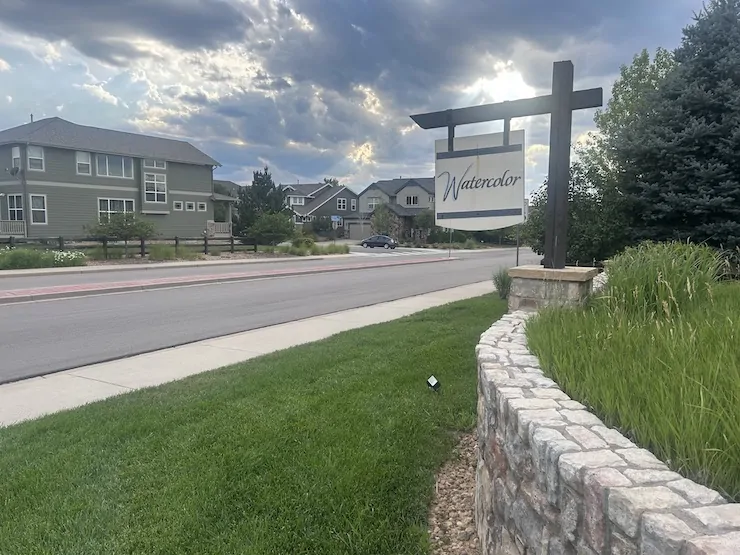
A study by the U.S. Geological Survey published in 2011 used a model that found 1% to 2% of precipitation becomes water in the bedrock aquifers and 7% in the alluvial aquifer. For urban irrigation, such as at the Watercolor subdivision in Castle Rock, 2.5 inches of water makes it back to underlying aquifers each year. Photo credit: Allen Best/Big Pivots

Some south-metro entities may seek state legislation that reflects what they believe is the best policy. As it stands now, a permit-holder that has withdrawn the total volumetric amount identified on a well permit must cease pumping, says Jason Ullmann, the state engineer and director of the Colorado Division of Water Resources. He has authority to notify users in writing of their violations. Could he shut down wells? They would be given ā€œtime as may reasonably be necessary to correct deficiencies,ā€ he says. But yes, they would be ā€œsubject to enforcement.ā€

Just how much water remains in the Denver Basin aquifers? The Division of Water Resources issues well permits, and in doing so, estimates the potential volume of water underlying the applicant’s parcel. But the state agency does not track changes in volume over time, nor does it track the amount of water that wells pump. It requires well owners to maintain pumping records.

When asked how much water remains in Castle Rock’s wells, Mark Marlowe, director of the city’s water utility, suggested consultation of a hydrogeologist, perhaps from the U.S. Geological Survey. Pressed further, he said Castle Rock’s groundwater supply will last more than 300 years ā€œfrom a legal standpointā€ based on current rates of use.

The practical effect of the Supreme Court ruling on Castle Rock? Very little in the short term, Marlowe says. In 2005, Castle Rock set out to create a pathway to dramatically lessen groundwater dependence. ā€œWe’ve been headed down this road for a long time,ā€ he says. So why participate in Parker’s lawsuit? Because, he replied, the city wants to make long-term use of its investment in groundwater extraction. And as a practical matter, the city commonly extracts less than the 1% allowed annually.

Marlowe’s answer is not totally satisfying, but the work done by Castle Rock since 2005 must be acknowledged. It was 100% dependent on groundwater extraction then. It is adding new impoundments to store surface water, pumping water upstream from Chatfield Reservoir, and doubling the daily capacity for treating wastewater. Castle Rock already has lessened its dependence on groundwater to less than 69% over the last four years and Marlowe says he’s confident that by 2050 it will lessen to 25%.

Several of Castle Rock’s successes have involved working with other south-metro jurisdictions, including the Parker Water and Sanitation District. In 2013, when Ron Redd was hired by Parker Water as general manager, the utility was still 90% groundwater reliant. He was given a mission: transition to renewable sources.

A key project has been water reuse. Water introduced into the South Platte River from other basins or from groundwater can be reused. Aurora Water set out to do so in 2003. The $680 million Prairie Waters Project pumps water from the river-side aquifer near Fort Lupton to a reservoir in the southeast metropolitan area. From there, in 2010, Parker Water, Castle Rock and eight other south-metro communities joined Denver Water and Aurora Water in a partnership called WISE (Water Infrastructure and Supply Efficiency) to further manage infrastructure cooperatively and deliver the reclaimed water to their members.

Making this possible was a new 75,000-acre-foot impoundment called Rueter-Hess Reservoir. Completed in 2012, it is a core asset for Parker Water and three other utilities who share its use.

Jim Yahn, left, manager of the Prewitt Reservoir, which might become part of the Platte Valley Water Partnership, speaks with Ron Red, manager of Parker Water and Sanitation District, and Joe Frank, general manager of the Lower South Platte Water Conservancy District, which is part of the proect. There is still hope that Prewitt would be part of the plan,ā€ says Yahn. ā€œThe decree that Parker and Lower South Platte are seeking still has Prewitt Reservoir as a component of the plan.ā€ Photo credit: Allen Best/Big Pivots

The Platte Valley Water Partnership is even more ambitious. Parker Water and Castle Rock Water have joined with the Lower South Platte Water Conservancy District.

They plan to detain South Platte River water that currently flows downstream into Nebraska during winter and spring runoff. The South Platte River Compact allows the use of this water. Little excess exists in many years, but when there is, such as in 2023, no place exists to store that water. The project plans to use Prewitt Reservoir and a new reservoir northwest of Akron in the capture and storage of those flows before pumping some of that water 125 miles to Rueter-Hess Reservoir.

Farmers will also have access to a cut of this ā€œnewā€ water — with agricultural users receiving 50% of the captured water and municipalities receiving 50%. Construction is set to begin around 2035, at an anticipated cost of $780 million.

As of mid-July, it’s not clear how the Nebraska lawsuit against Colorado involving water for Nebraska’s proposed Perkins Canal might affect this project.

A final important component of the path forward for the water utilities who mine Denver Basin aquifers lies in conservation, particularly for outdoor landscaping. The prevailing theme at one time was use as much as you want — but pay for it. That thinking has shifted to limits and goals of reduced use.

Parker has reduced groundwater dependence to 60% and has goals to reduce it to 25%. Might that be achieved in tapping the aquifers of the San Luis Valley? The idea has provoked outrage for more than 30 years.

ā€œThanks, but no thanks,ā€ is how Redd describes Parker’s response to the idea of a lengthy straw sucking water from two river basins away.

ā€œWe have our project, and financially it makes a lot more sense to go that route.ā€

For that matter, the San Luis Valley aquifers have their own problems.

Part III: Declines in flows of the Rio Grande parallel those of the Colorado River during the 21st century. There were problems anyway for the potato and other growers around in the eponymously named San Luis Valley farm community of Center. Simply put, less water must be pumped from underground. Easier said than done.  You can also download the entire story here in a magazine format.

Colorado Rivers. Credit: Geology.com