
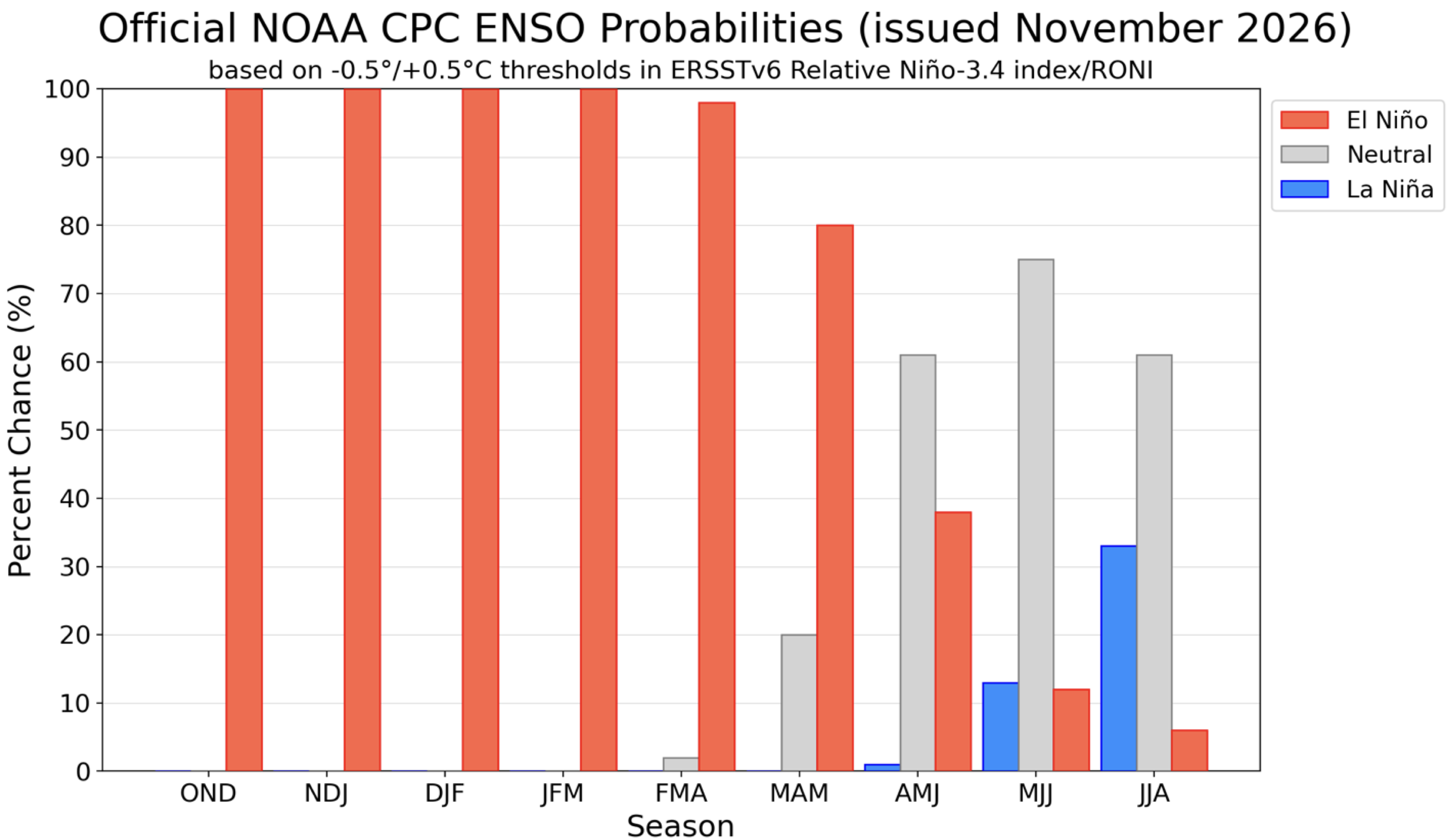
(5°N-5°S, 170°W -120°W) minus tropical mean (20°N-20°S). The relative index is re-scaled to
match the variance of the traditional index. Figure updated 12 November 2026. Higher resolution
image/table: https://cpc.ncep.noaa.gov/products/analysis_monitoring/enso/roni/probabilities/
Click the link to read the discussion on the Climate Prediction Center website:
ENSO Alert System Status: El Niño Advisory
Synopsis: El Niño continues to strengthen, with a strong-to-very strong El Niño likely through January-March 2027 (remaining greater than a 79% chance).
Compared to last month, El Niño strengthened as sea surface temperature anomalies exceeded 4.0°C, extending farther westward across the eastern equatorial Pacific Ocean. The Niño indices increased, reaching +2.5°C in Niño-3.4, +3.6°C in Niño-3, and +4.4°C in Niño-1+2. The equatorial subsurface temperature index (average from 180°–100°W) remained significantly above average, associated with a deeper-than-average thermocline and anomalies exceeding +10.0°C at depth in the eastern Pacific Ocean. Low-level westerly and upper-level easterly wind anomalies extended from the western to the east-central equatorial Pacific. Convection and rainfall remained enhanced from the central to the eastern Pacific, while suppressed conditions persisted over Indonesia. The traditional and equatorial Southern Oscillation indices were consistently negative. Collectively, the coupled ocean-atmosphere system reflected the ongoing evolution of El Niño.
The CPC Official ENSO outlook, which synthesizes multiple models from North America and abroad, indicates El Niño will continue to strengthen before beginning to weaken in early 2027. Chances for a historic event exceeding previous El Niños dating back to 1950 (+2.5°C or more for a 3-month RONI value) are now ~60% for the October–December and November–January periods, remaining at better than even odds. Even with a very strong El Niño, the chances of experiencing impacts consistent with El Niño are higher, though not guaranteed (see CPC outlooks for probabilities of seasonal anomalies). In summary, El Niño continues to strengthen, with a strong-to-very strong El Niño likely through January–March 2027 (remaining greater than a 79% chance).
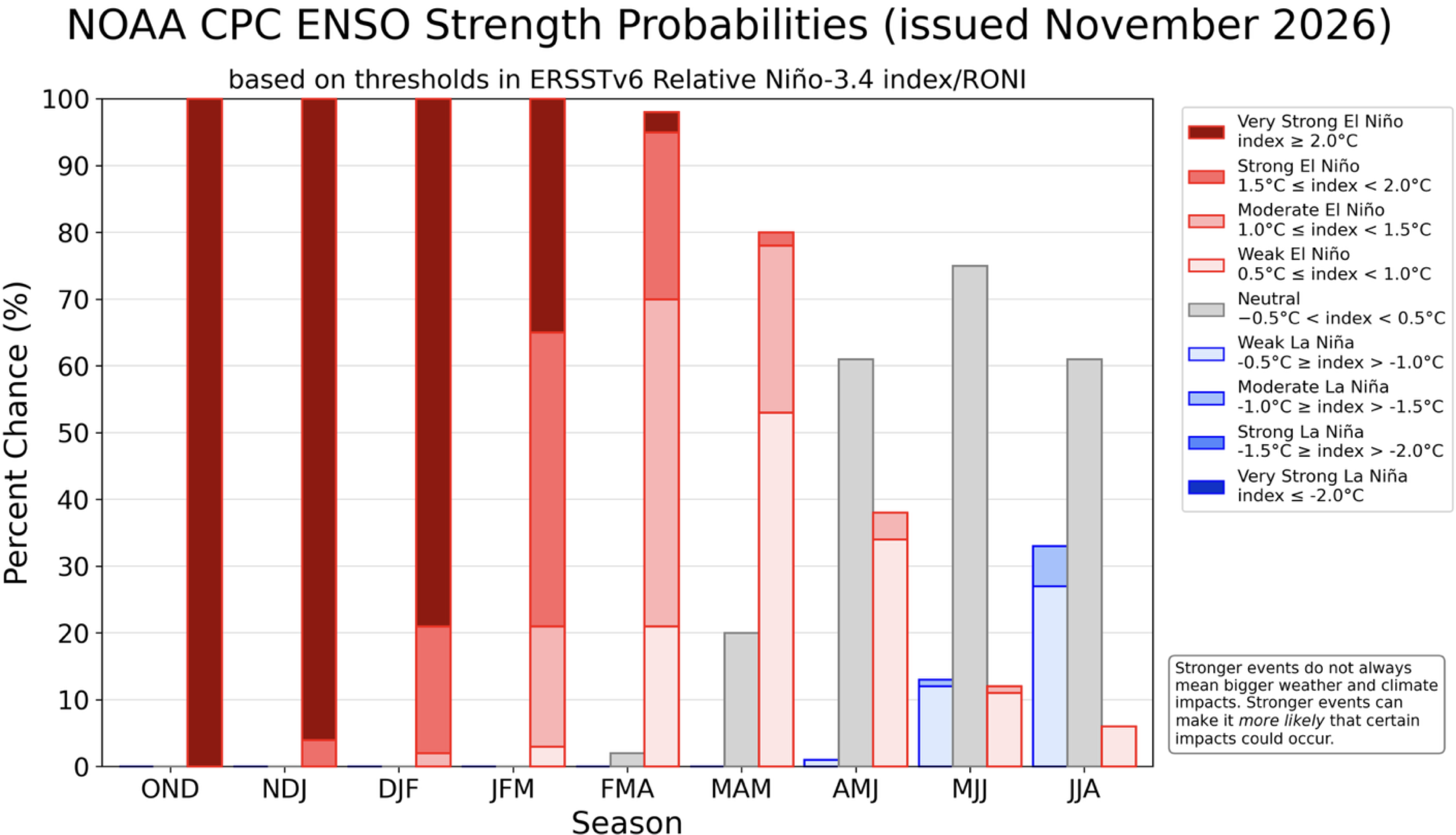
(5°N-5°S, 170°W-120°W) minus tropical mean (20°N-20°S). The relative index is re-scaled to
match the variance of the traditional index. Figure updated 12 November 2026. Higher resolution
image/table: https://cpc.ncep.noaa.gov/products/analysis_monitoring/enso/roni/strengths/