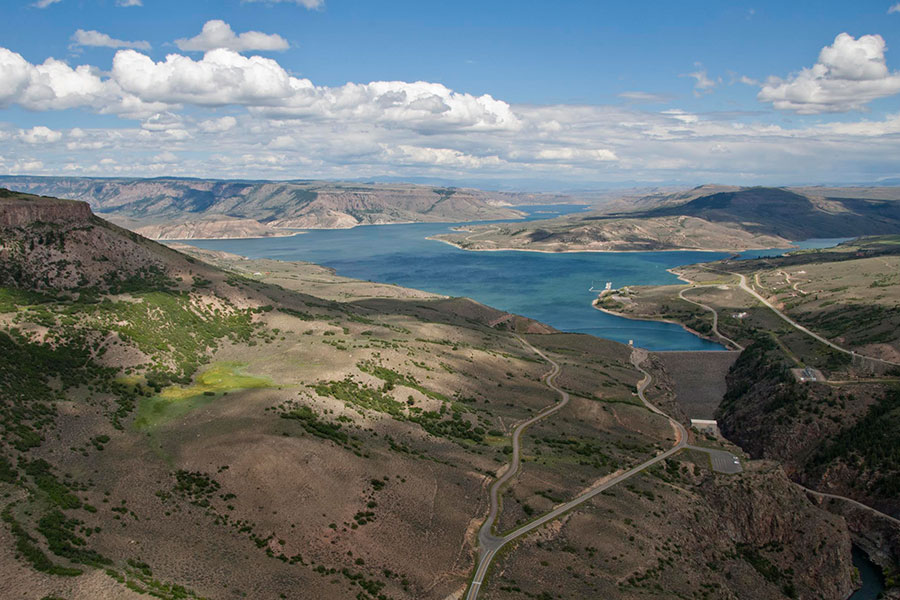
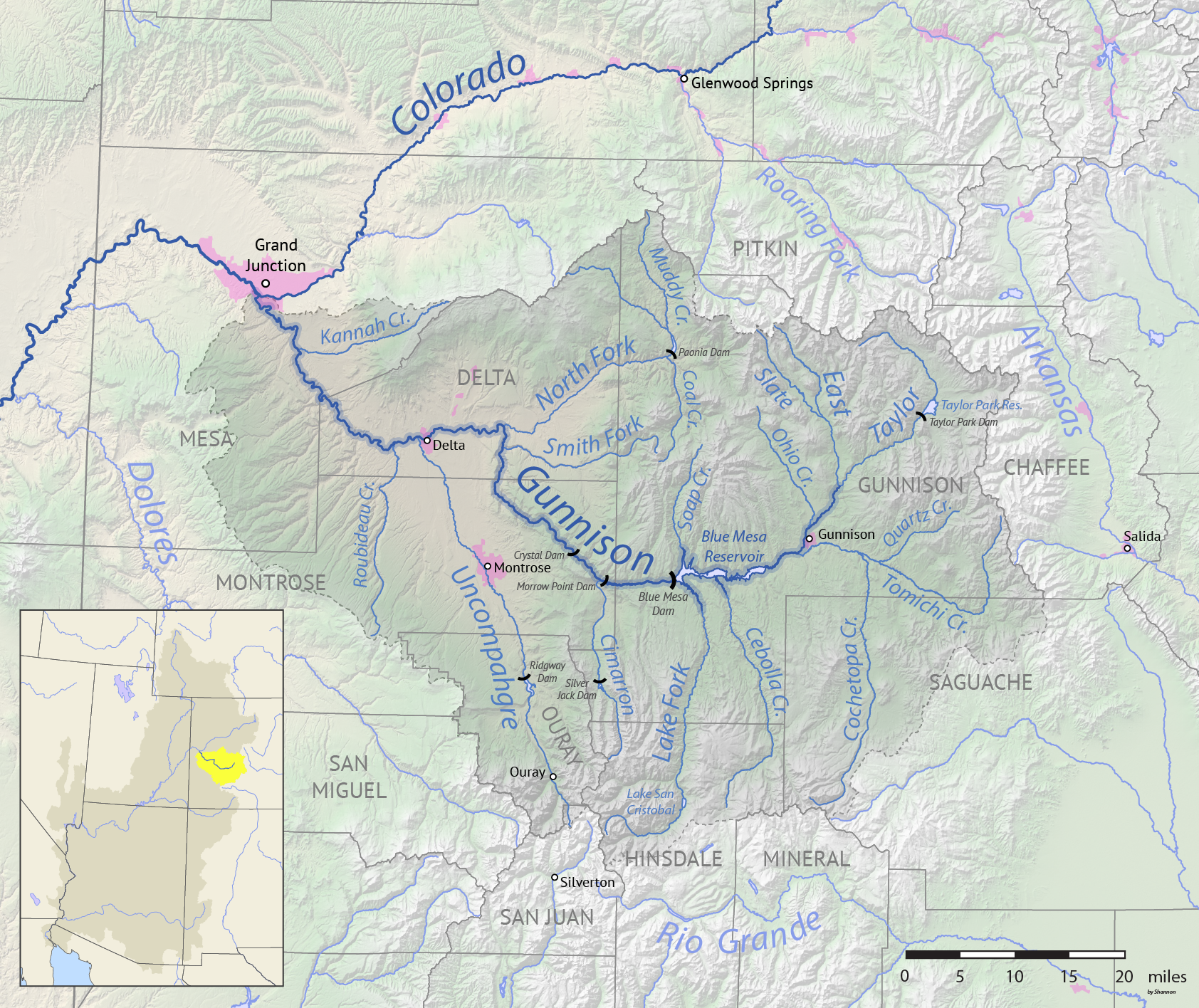
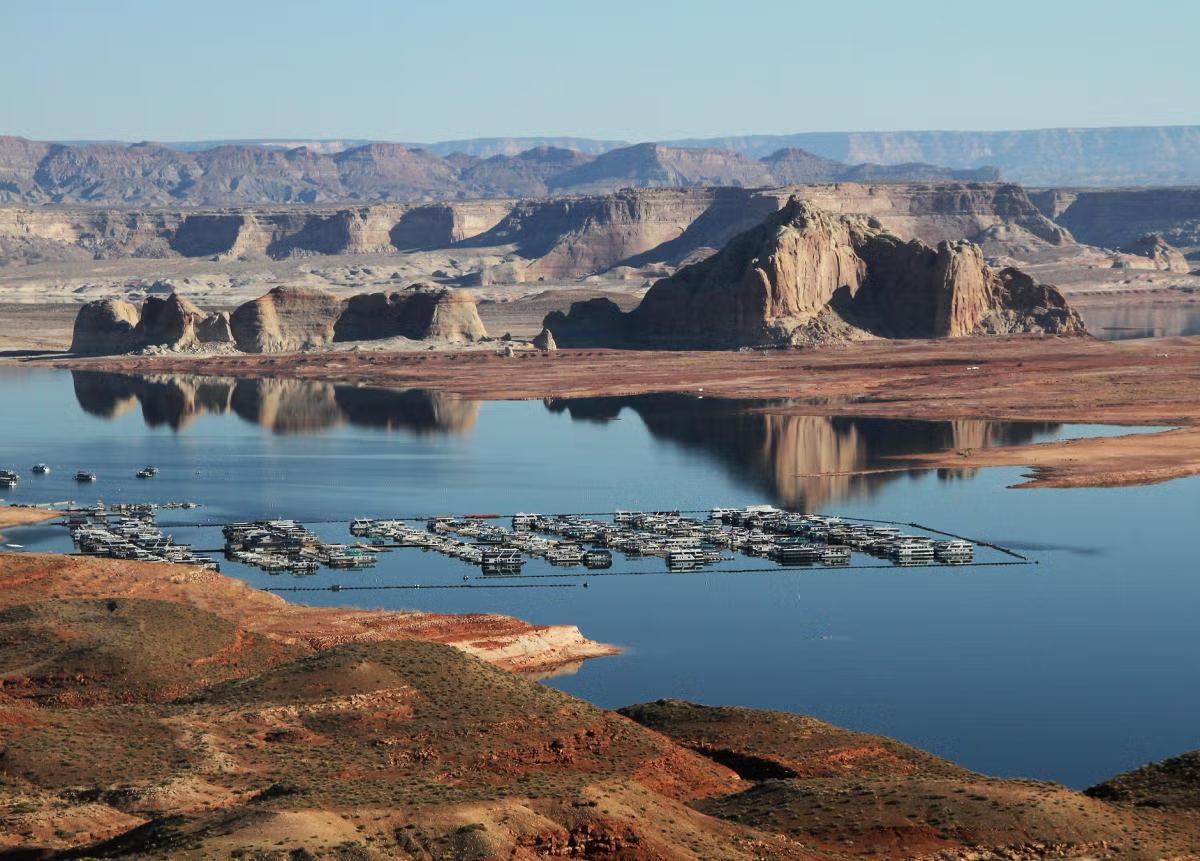
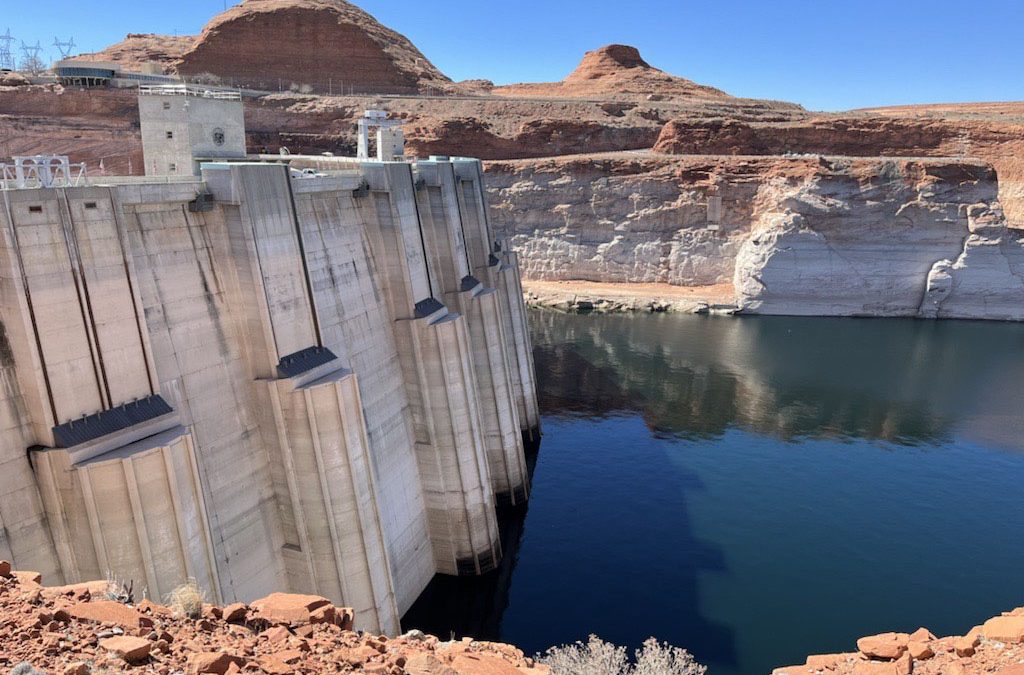
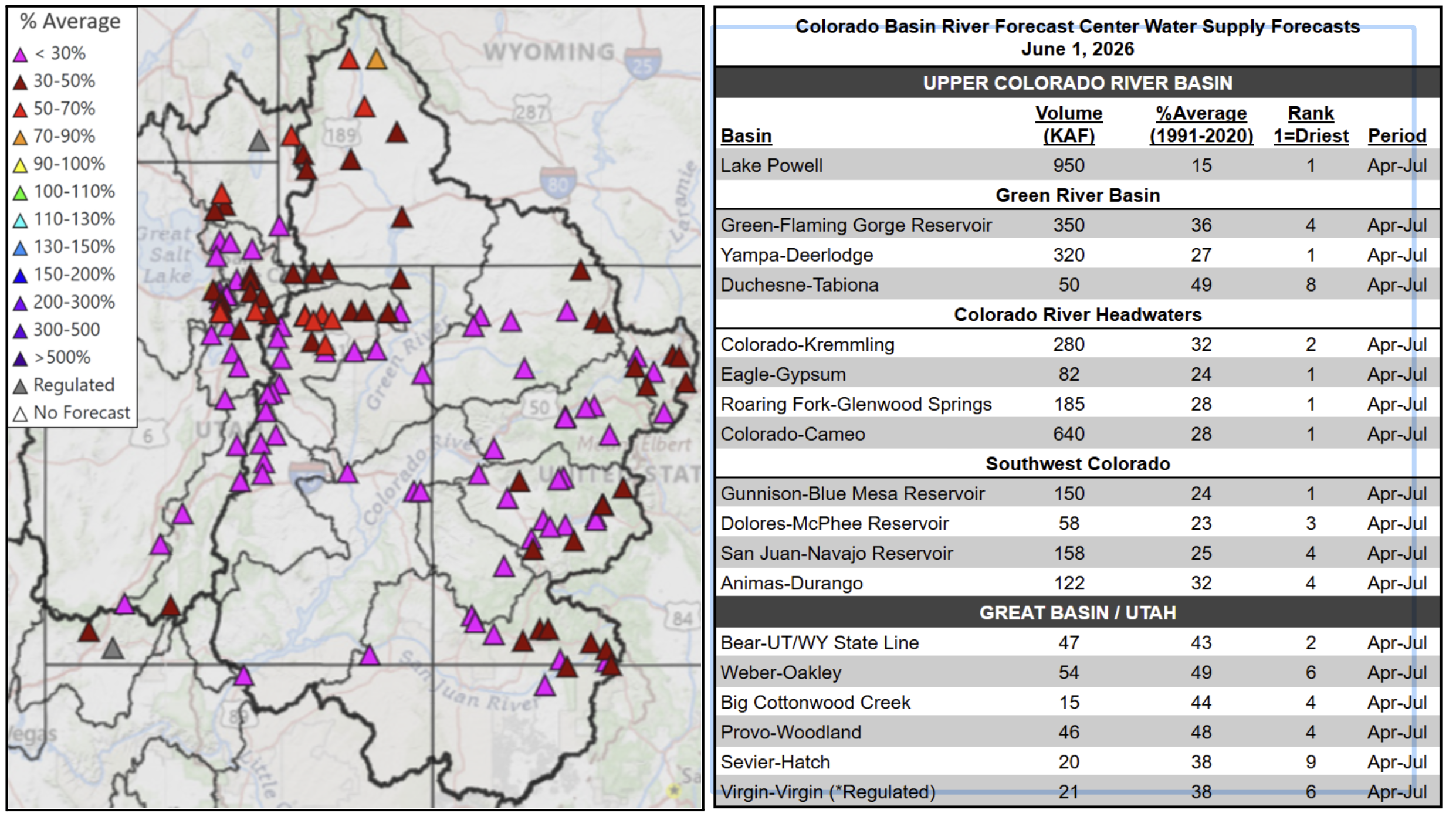
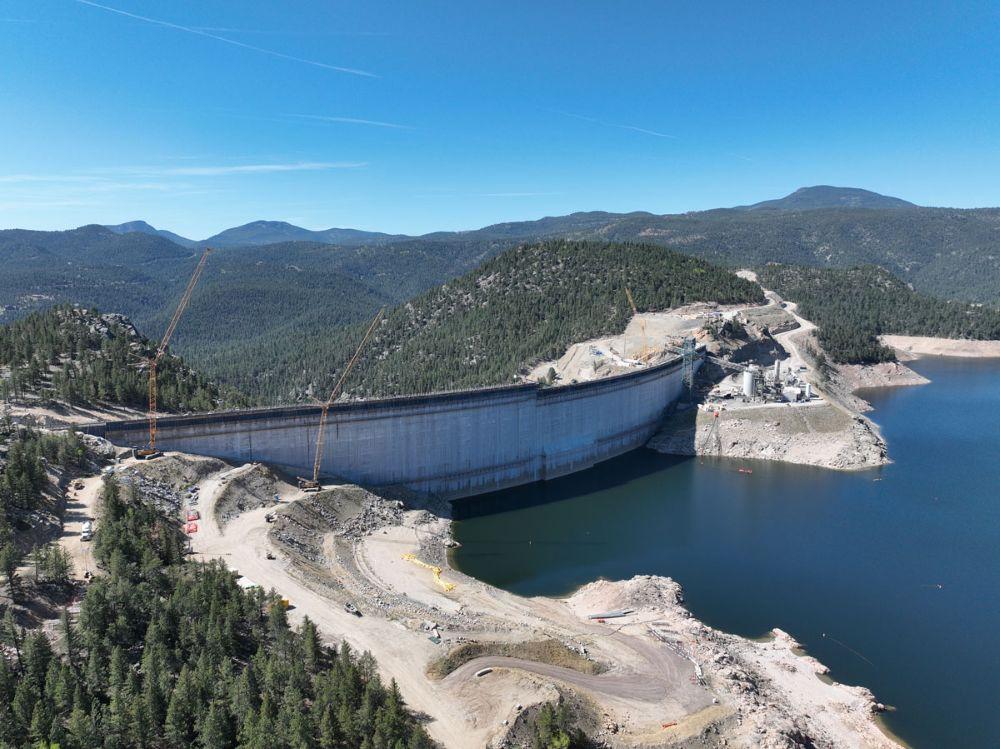
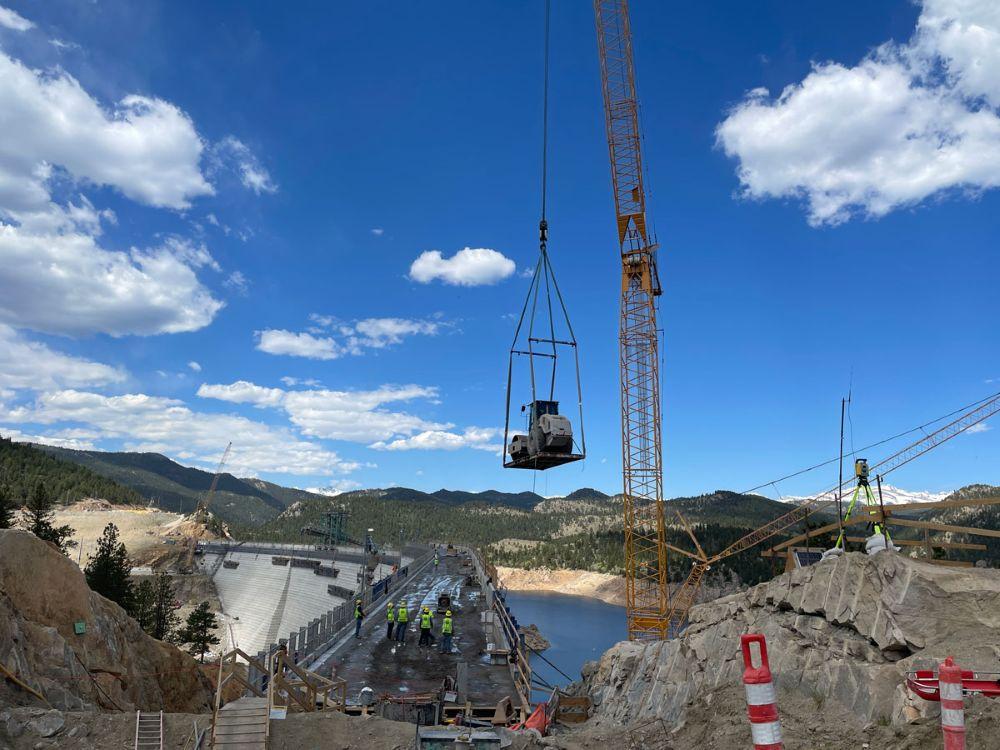
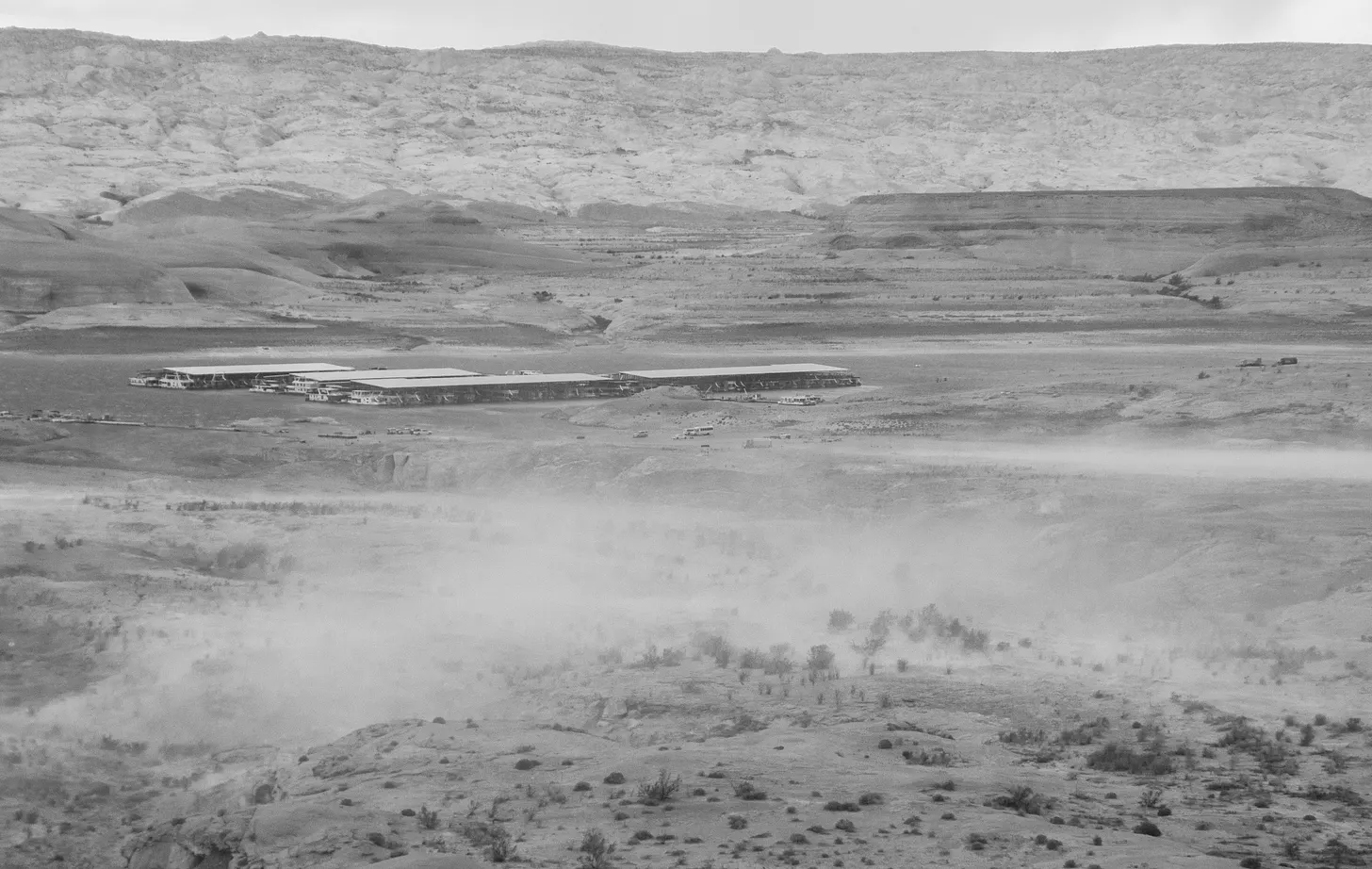
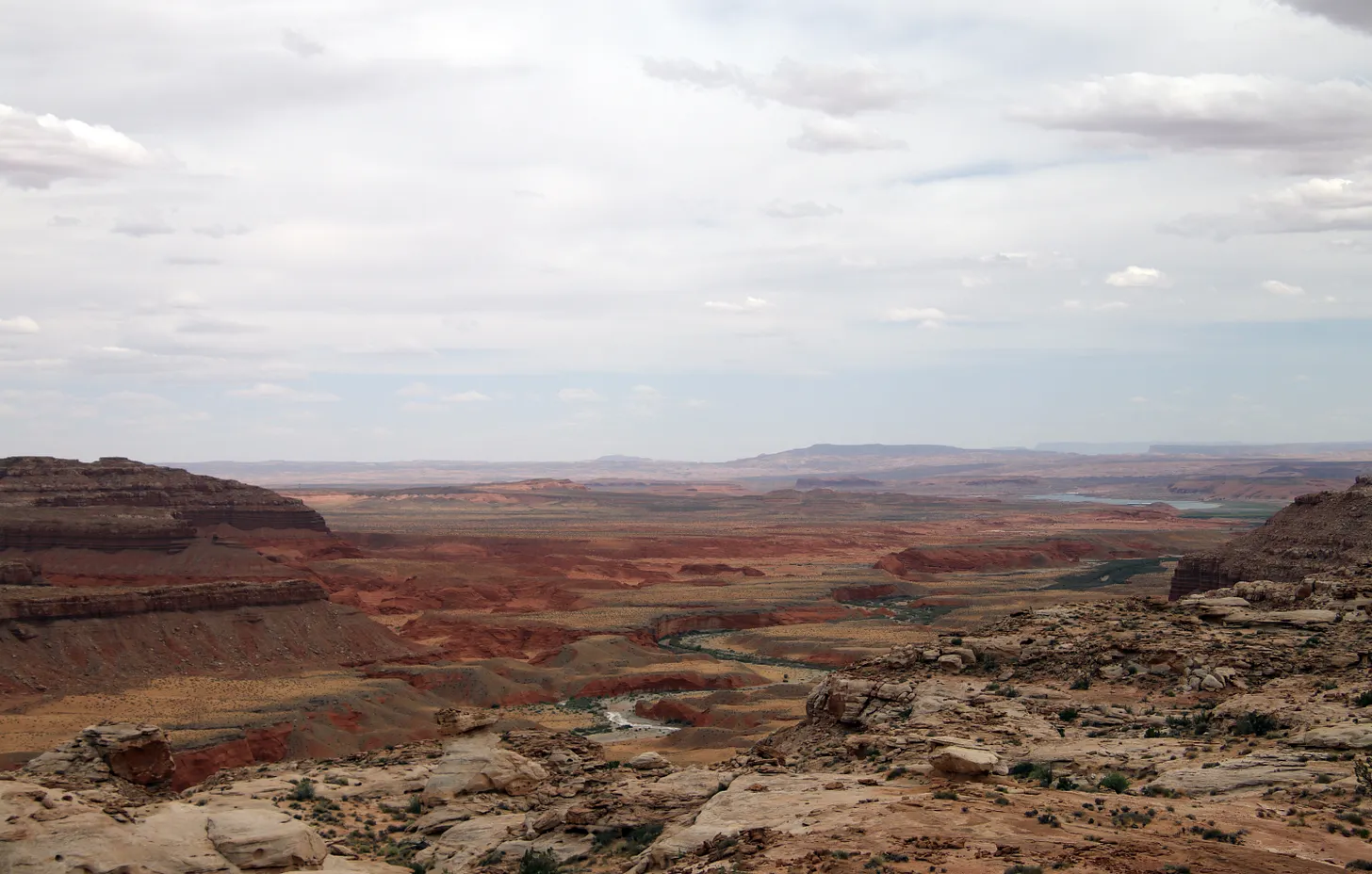
As of July 12, Blue Mesa Reservoir near Gunnison sat only 32% full at 266,000 acre feet of storage water — about 35,000 acre feet less than the historic minimum for that date, down 35%…Severe drought conditions at the reservoir have resulted in critically low storage levels, a limitation on water allocation to the Uncompahgre Valley and its agricultural water users, limited flows for releasing endangered fish species, decreased recreational opportunities on the water that go hand-in-hand with a downturn in the regional recreational economy, and uncertainty over power generation and water usage in the near future. Colorado River District spokeswoman Lindsay DeFrates called it a “crisis”, as the reservoir and the Wayne N. Aspinall Unit — which stores water and generates hydroelectric power through the reservoir as well as the Morrow Point and Crystal Reservoir dams — is one of the upper units that feeds the crucial Lake Powell downstream.
“Everyone’s looking downstream at Lake Powell while we have this happening in our backyard right now,” DeFrates said…
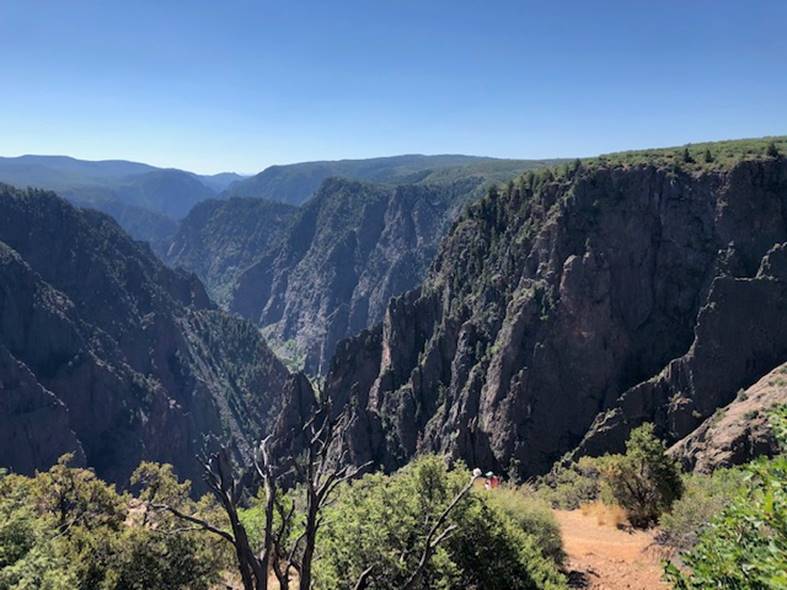
Black Canyon July 2020. Photo credit: Cari Bischoff
When he was the Division 4 assistant engineer for the Colorado Division of Water Resources (DWR), Jason Ullmann would have never entertained the notion that the Black Canyon of the Gunnison National Park’s portion of the river could ever dry up. Now, as the DWR director and Colorado state engineer, he said it’s unlikely to happen this year or next — but it’s “not an impossibility.”
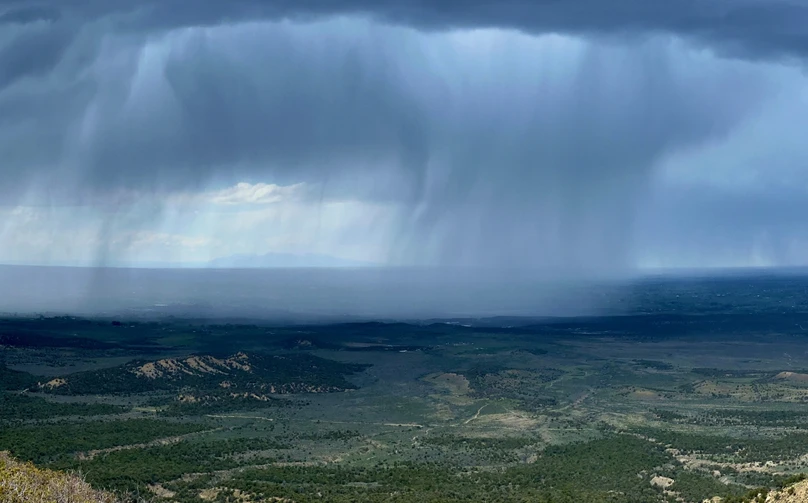
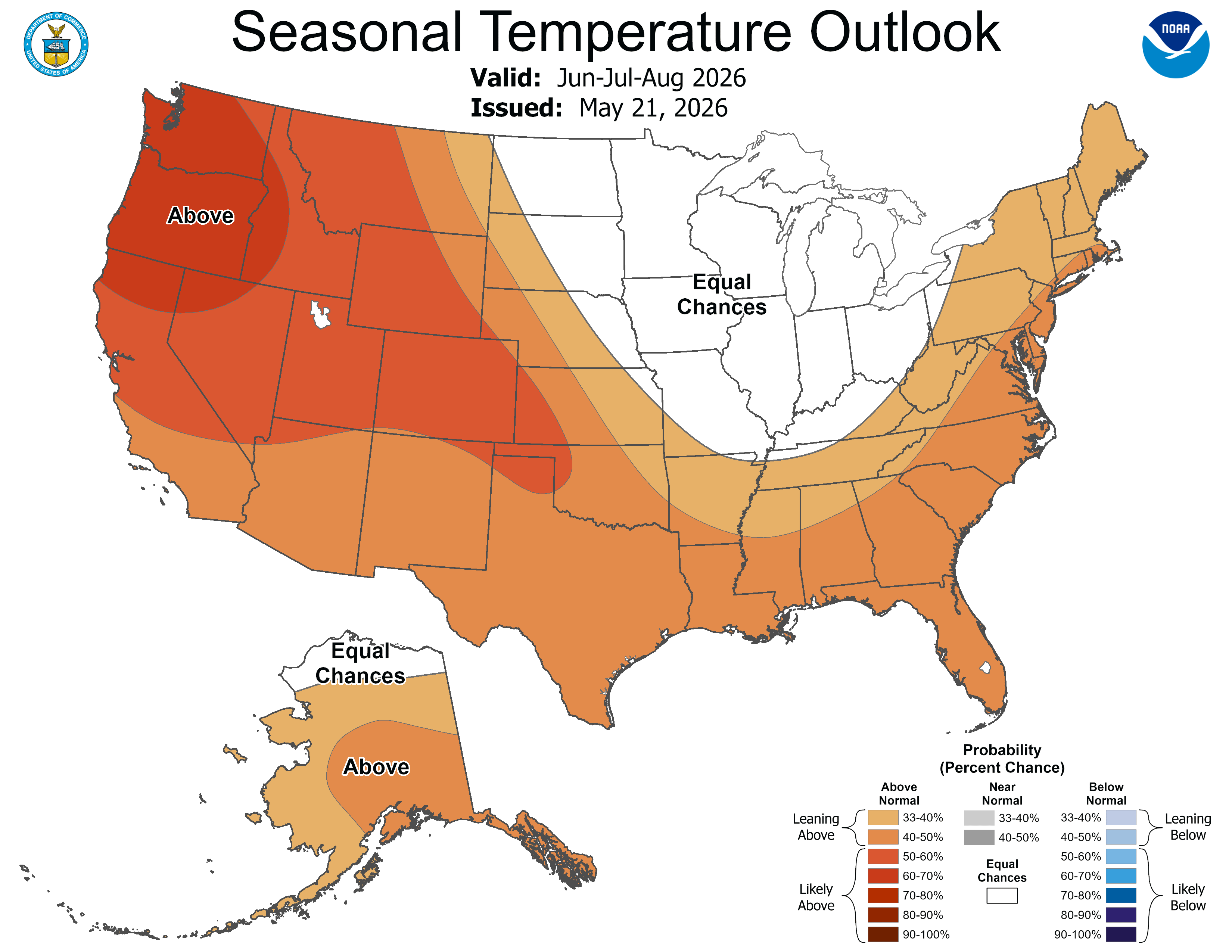
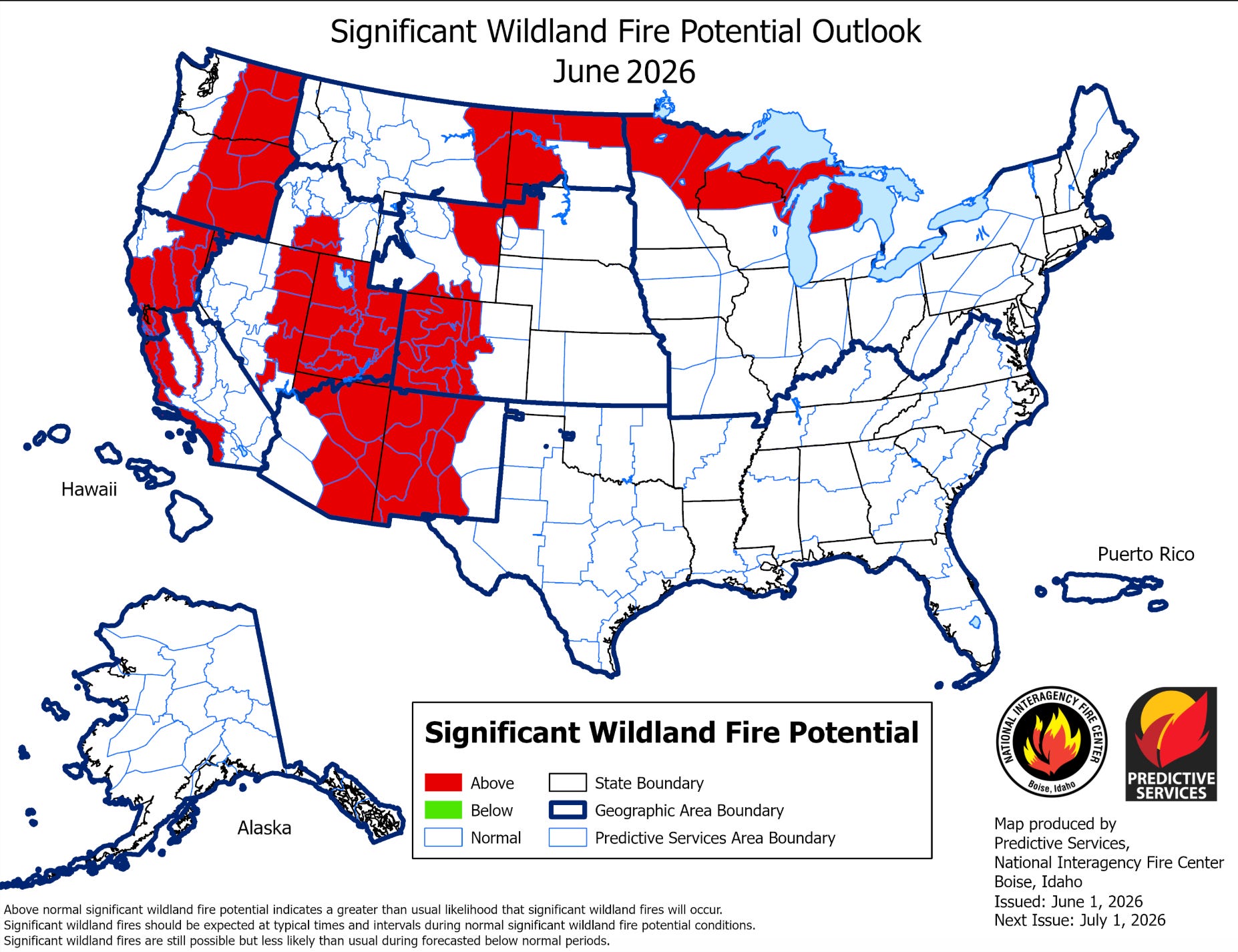
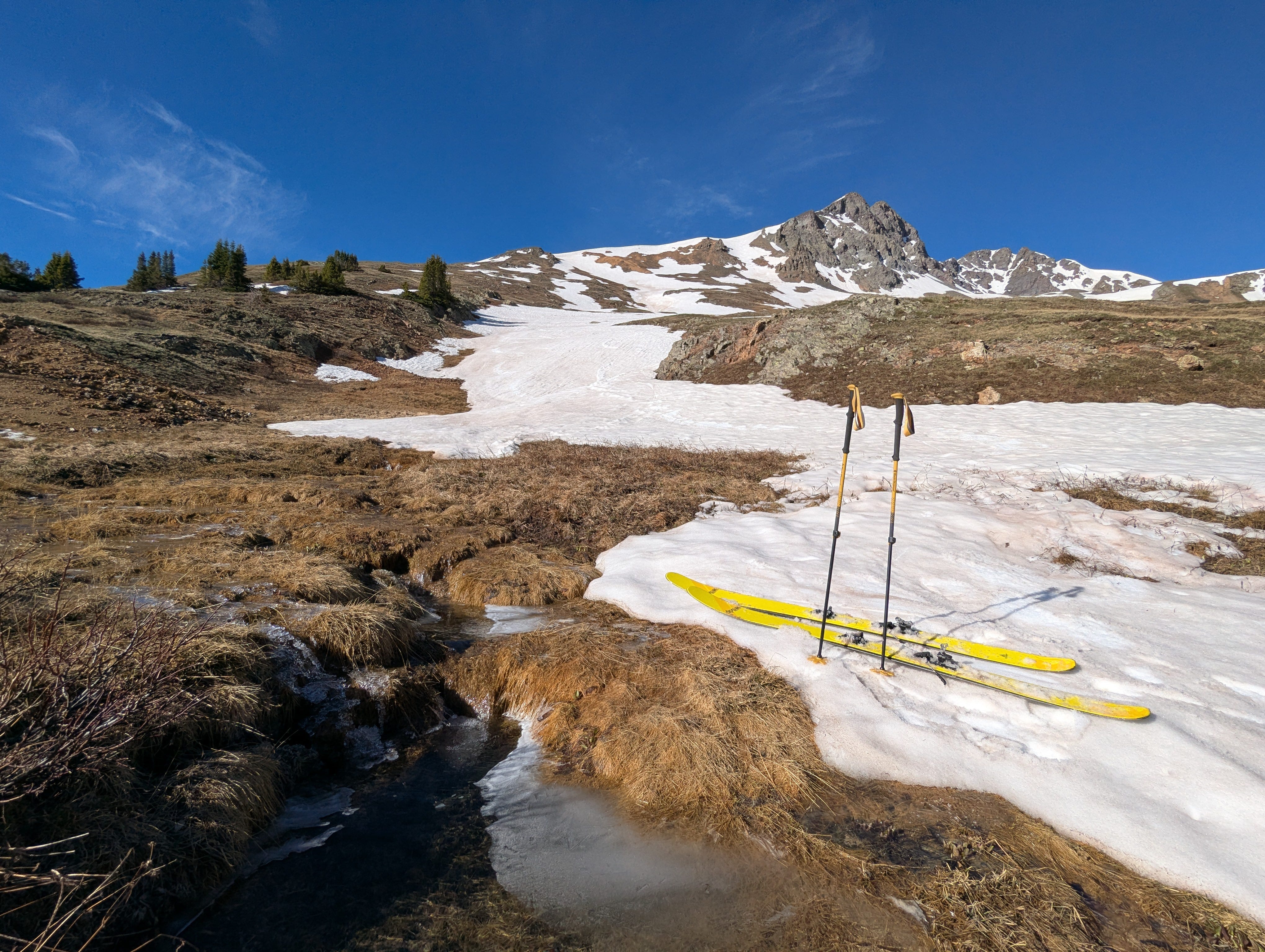
“The actual inflow from April to July this year was the lowest on record. Barring a change in the climate conditions that produce this monsoon everybody’s waiting for, it doesn’t seem like we’re going to have a significant increase in inflow. We’re going to have one of the lowest inflow seasons — if not the lowest — on record at Blue Mesa,” Ullmann said. “Blue Mesa started the year approximately 20 feet below the normal level it would start the year on. The water levels are very low and will continue to drop.”
Colorado River District Senior Water Resources Engineer Caleb Foy compared 2026 to some of the region’s driest years — 1977, 2002, 2012 and 2018 — and said 2026 “takes the gold medal in terms of poor hydrological conditions”, impacting water storage at Blue Mesa Reservoir which, in turn, has multiple impacts downstream…
Foy noted that the reservoir’s storage could drop below the power pool level, which is the minimum amount of water needed to produce hydropower from the dam. According to the U.S. Bureau of Reclamation’s June 2026 24-month study, this drop could happen as soon as February 2027. According to other forecasts, this drop could happen as soon as the end of this summer if the region sees no monsoon conditions and current operations aren’t modified to preserve storage at the reservoir…A reduction in downstream flow would negatively affect downstream diversions, Colorado River flow, the Black Canyon of the Gunnison, and endangered fish species in both the Gunnison and Colorado rivers. The BOR has worked with Fish and Wildlife to temporarily reduce flow targets while trying to minimize negative impacts to endangered fish species. Ullmann said the minimal target flow for the Endangered Fish Recovery Rights is, in a typical year, no lower than 750 cubic feet per second. This year, the target is at 750 cfs — and last week, the flow was as low as 700 cfs. This has been alarming enough to spark conversations between the state and the BOR.
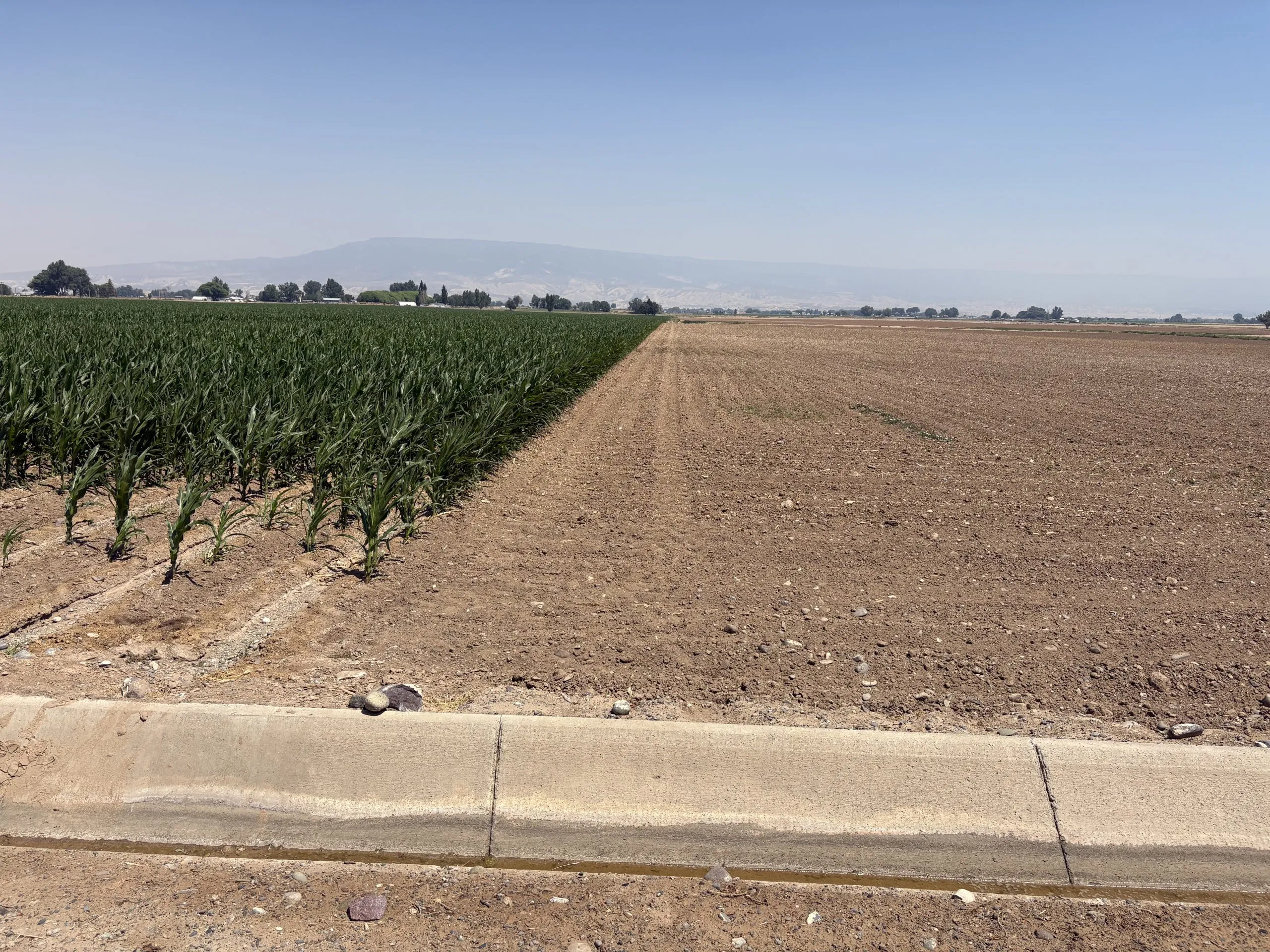
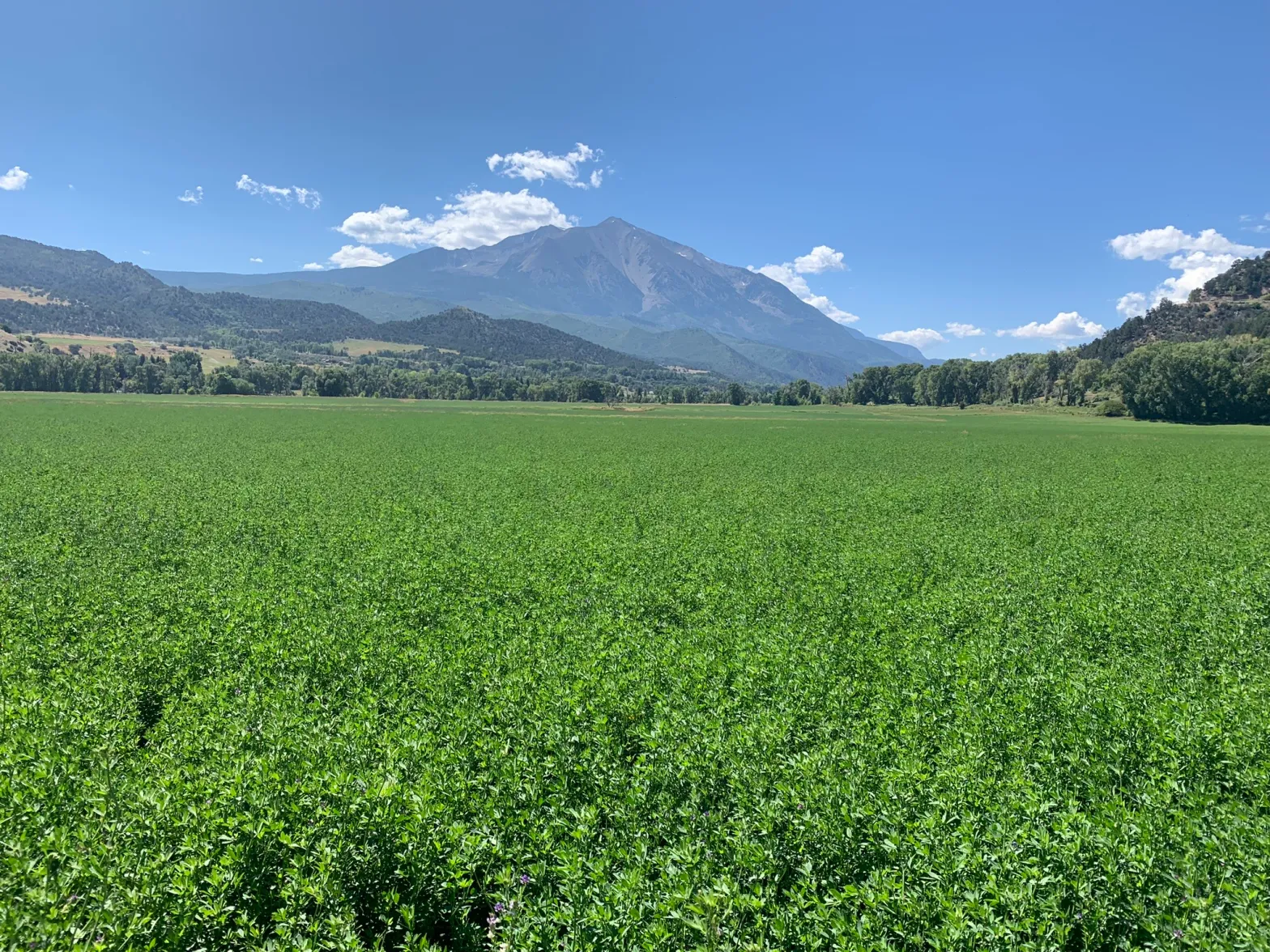
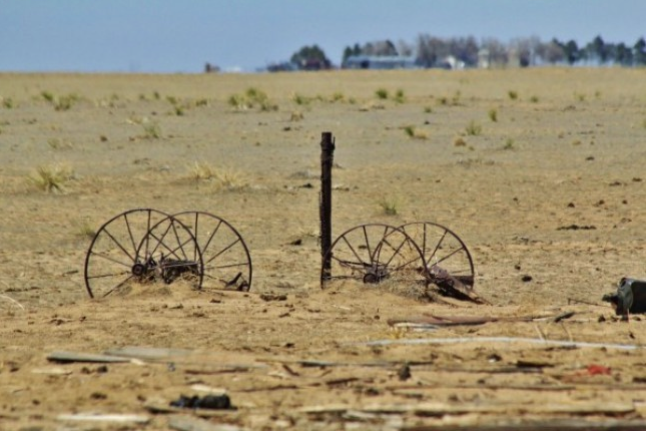
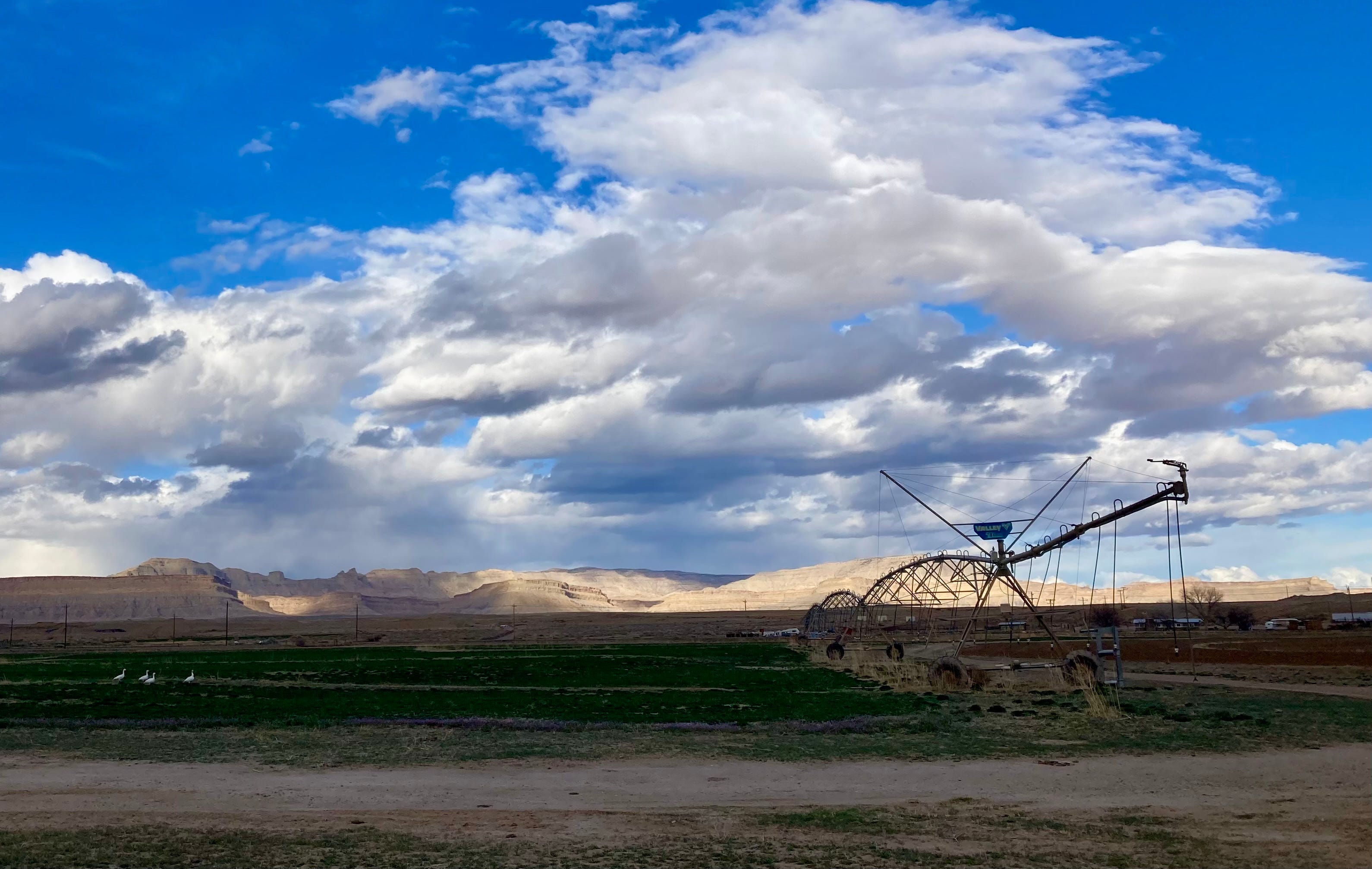
This field in the Uncompahgre Valley Water Users Association district has been fallowed this season (2026) due to a lack of water. The state of Colorado announced Wednesday that it will set up a conservation program using federal dollars, which means more fields on the Western Slope could soon look like this. CREDIT: HEATHER SACKETT/ASPEN JOURNALISM
In the culmination of a process that has been years in the making, Colorado officials Wednesday announced the creation of a state-run water conservation program.
In what officials are calling a “near-term contribution program,” the Upper Basin states (Colorado, New Mexico, Utah and Wyoming) will pay water users to voluntarily cut back in 2027 and 2028, using $100 million in promised funding from the U.S. Bureau of Reclamation. Colorado will now join Utah and Wyoming in setting up a conservation program within their respective states.
The noteworthy, long-expected announcement came at the regular July meeting of the Colorado Water Conservation Board, where board members considered the criteria for the program. A draft list says the program must, among other criteria, avoid negative community impacts; encourage contributions from across the state and water-use sectors; incentivize environmental benefits; encourage tribal participation; and build local drought resiliency. The board is scheduled to finalize the program criteria at its September meeting.
These types of conservation programs have traditionally targeted agricultural water users, often seen as the low-hanging fruit for water savings because they use the majority of Colorado River water. But officials are hoping this program will have participation across all water-use sectors, including municipal and industrial.
“I love that it is called a contribution program because that kind of imagines broader participation and engagement,” said board member Taylor Hawes. “So I think that is good. I think the more flexibility we can have, the better in a program like this.”
But details were scant on exactly how much water Colorado will contribute to the program and how the saved water would be used. And although some experts have begun calling for permanent reductions in water use, it remains — for now — a temporary, short-term program.
“We cannot guarantee a certain amount of water will be conserved in a given year because we don’t know how much water our water users are going to get,” said Amy Ostdiek, interstate section chief at the CWCB. “We have been clear that we just can’t do that.”
In a May letter to federal officials, the Upper Colorado River Commission said it has a goal of saving 100,000 acre-feet by the end of September 2028, which marks the end of water year 2028, but only if sufficient federal funding is available and hydrologic conditions allow. Colorado’s share of the Upper Basin’s allocation is 51.75%, meaning Colorado could be on the hook for 51,750 acre-feet over the next two years.
But Ostdiek said they are not at this time discussing a specific target that Colorado or the Upper Basin would have to contribute in exchange for the $100 million from the Bureau of Reclamation.
“We have felt confident that we can generate up to 100,000 acre-feet by 2028,” Ostdiek said in a Q&A session with the media after her presentation to the CWCB. “But really, what we’re going to be focused on is getting robust participation.”
It’s also unclear exactly how the saved water will be used. Officials said it’s not meant for use by the Lower Basin (California, Arizona and Nevada); it will be for the benefit of the Upper Basin. The water will need to have a home in Upper Basin storage buckets — Lake Powell, Navajo, Blue Mesa or Flaming Gorge reservoirs — but how it will fit into broader reservoir operations is unknown. [ed. emphasis mine]
“I think that is going to be the subject of ongoing discussion, exactly how this water is used and characterized,” Ostdiek said. “I think what we know is that it needs to be credited to or subject to the discretion of the Upper Division states in some way.”
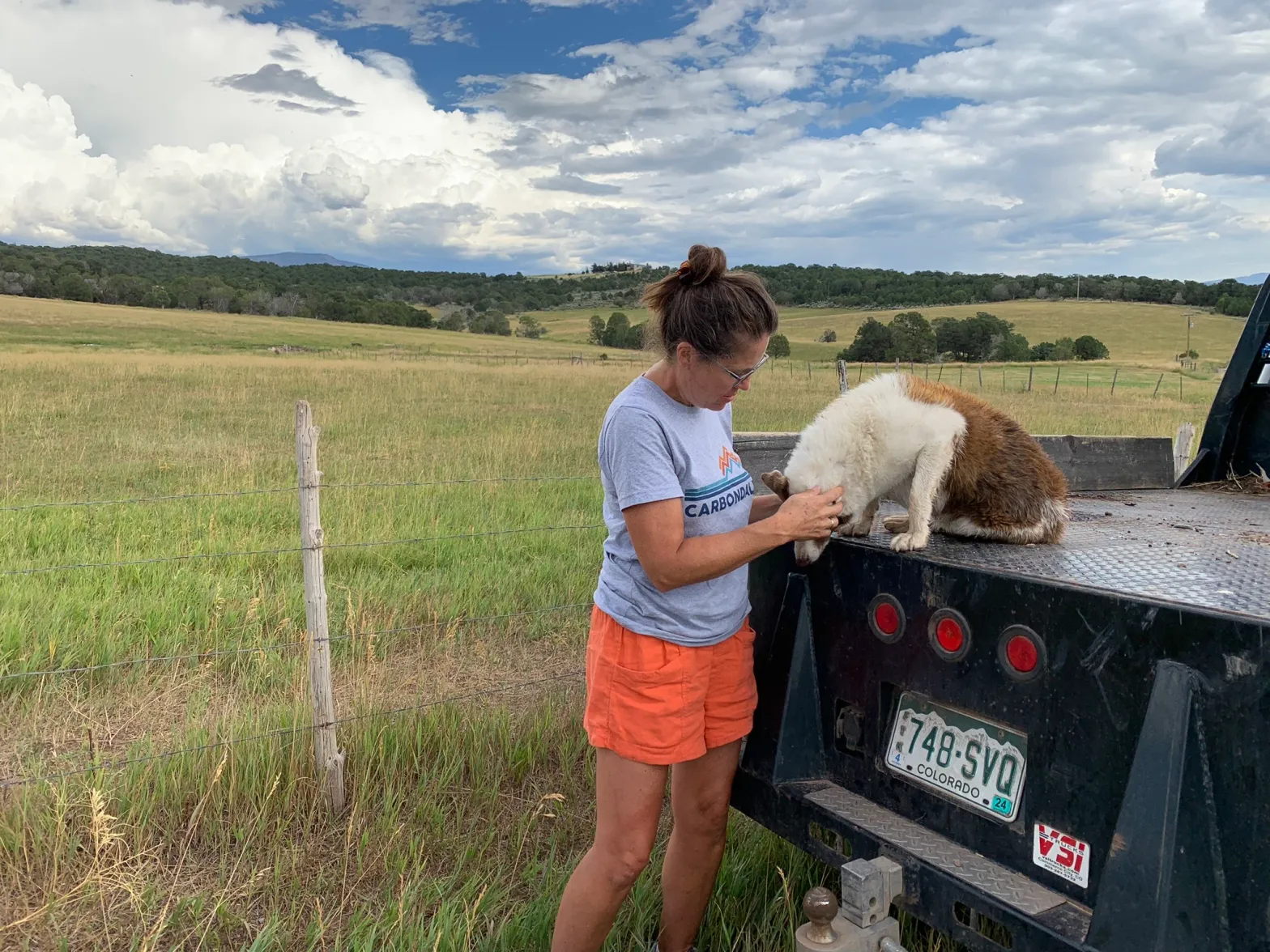
Missouri Heights resident Cassie Cerise pets her dog Dinah on her ranch outside of Carbondale in summer 2023. Cerise enrolled the field behind her in the Upper Colorado River Commission’s System Conservation Program, getting paid to not irrigate it. CREDIT: HEATHER SACKETT/ASPEN JOURNALISM
Conservation concept is not new
These types of programs that pay water users to cut back are not new to Colorado, and officials said they are incorporating the lessons learned from previous demand-management studies beginning in 2019, stakeholder input and pilot programs. The state participated in the 2023 and 2024 System Conservation Pilot Program, as well as an earlier version that ran from 2015 to 2018.
But conservation programs remain controversial. The Grand Valley Water Users Association, one of the largest irrigation districts on the mainstem of the Colorado River, did not allow its members to participate in SCPP for fear of negative impacts to other water users in the district.
All of the projects enrolled in SCPP involved agricultural water users on the Western Slope, a potentially risky situation, according to the Colorado River Water Conservation District. The Glenwood Springs-based agency, which represents 15 counties across the Western Slope, had tried to influence the creation of criteria for participation in SCPP to avoid negative impacts to rural agricultural communities.
Ultimately, only the Upper Colorado River Commission determined who got to participate in SCPP. Now, it seems state officials are taking to heart the River District’s recommendations. River District General Counsel Peter Fleming thanked Ostdiek for including some of the criteria that the district had set forth in its principles about how to create a conservation program.
Fleming encouraged the board members to adopt variable pricing to account for the difference in the value of relatively cheap water on the Western Slope versus more-expensive water on the Front Range. Pueblo Water had wanted to participate in SCPP, but the $509 per acre-foot offered in 2024 to Colorado participants was too far below market value.
“You can see the variable economic values of the water assigned there and the need to have variable pricing in order to encourage widespread participation,” Fleming said.
The River District’s position is that the entire burden of a conservation program shouldn’t be borne by the Western Slope, but must also be shouldered by Front Range water providers, who collectively deplete the Colorado River basin by about 500,000 acre-feet a year.
He added that a program should also have a strong element of local control.
“The River District obviously would like to stay involved in this process,” he said.
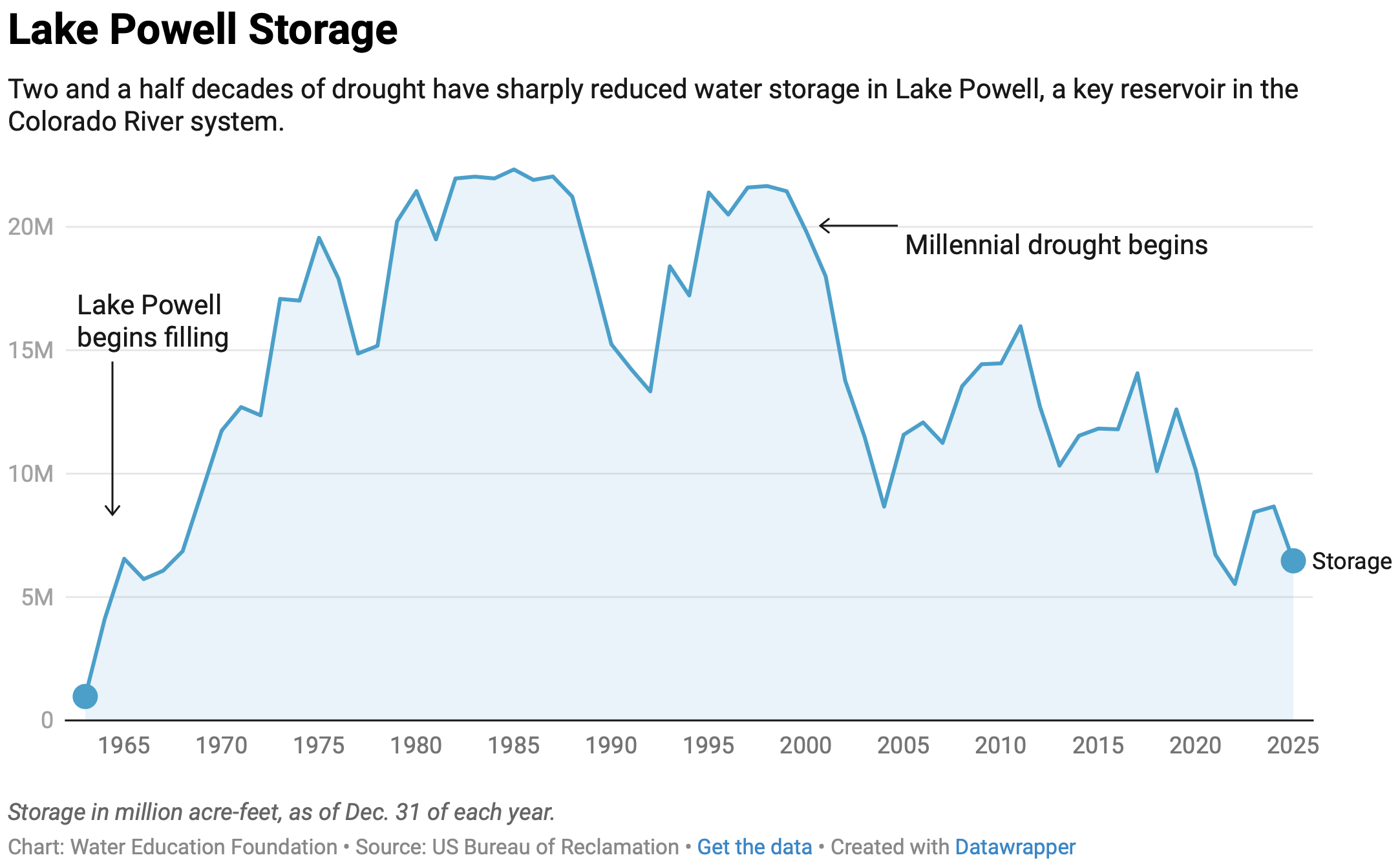
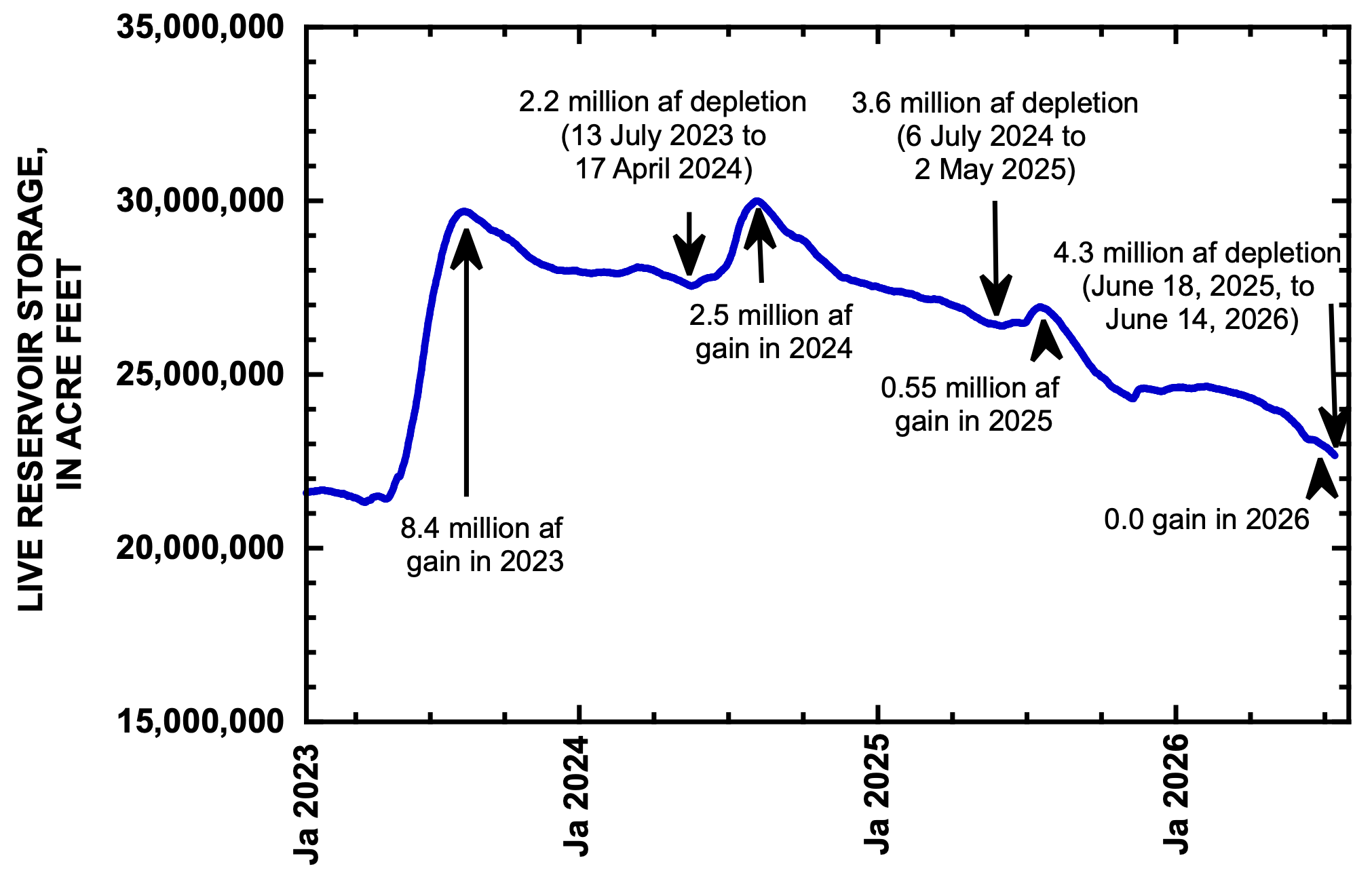
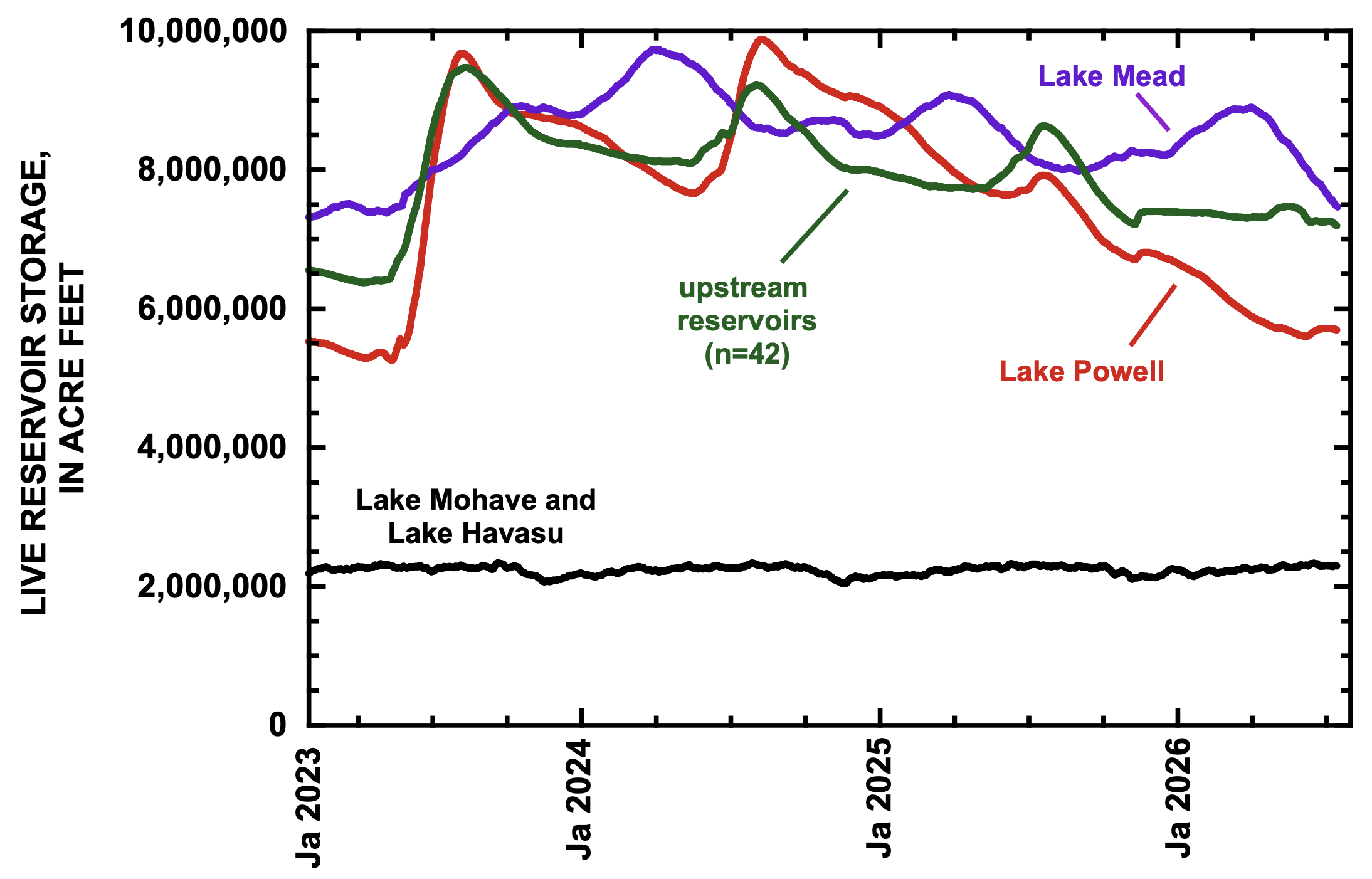
The creation of a conservation program for Colorado comes at a critical time for the basin, which remains locked in the grip of a historic drought, with combined storage in Lake Powell and Lake Mead at an all-time low since the reservoirs began filling. Although the Upper Basin has argued that it has never used its entire allocation granted by the 1922 Colorado River Compact (and therefore shouldn’t have to cut back), in the face of dwindling flows and calls for conservation from its downstream neighbors, the four states can no longer avoid reducing their water demand.
The Colorado River basin is also in the midst of a management crisis, with the seven states that share the river still unable to find agreement on a new framework after more than two years of failed negotiations. The current guidelines for how shortages are shared and how reservoirs are operated expire this year, and the feds are poised to step in with their own management plan, expected later this month.
The Upper Basin would need separate parallel agreements with Reclamation alongside the federal management plan to account for and get credit for water saved through the contribution program.
In her presentation, Ostdiek gave a preview of Reclamation’s expected plan, which could allow for a pool in Lake Powell to store up to 3 million acre-feet conserved by Upper Basin states. But board chair Barbara Vasquez worried about overestimating the amount of water that could be contributed given the recent historically dry conditions. Farmers and ranchers across Colorado are now experiencing the fallout from the worst snowpack on record in the form of shortages and fallowed fields.
“So prior programs, we spent a lot of money for very little water conserved. I worry that next year may be even worse than this year, and it’s not willingness, but ability,” Vasquez said. Given the water that’s available, she said, “that might disappoint expectations on the part of the negotiators at the table for the Colorado River.”
Aspen Journalism is a nonprofit, investigative news organization covering water, environment, social justice and more. Visit aspenjournalism.org.
Colorado River “Beginnings”. Photo: Brent Gardner-Smith/Aspen Journalism
Click the link to read the article on The Denver Post website (Elise Schmelzer). Here’s an excerpt:
July 15, 2026
Even in the driest of years — like this one — powerful Western Slope water rights on the mainstem of the Colorado River draw water downstream, making boating on the state’s major water artery possible.
“For mainstem floating, we should still have pretty darn good flows for the rest of the season for as long as people want to be boating,” said Sam Calahan, a water resources specialist for the Colorado River District. The taxpayer-funded agency is based in Glenwood Springs and works to protect Western Slope water…
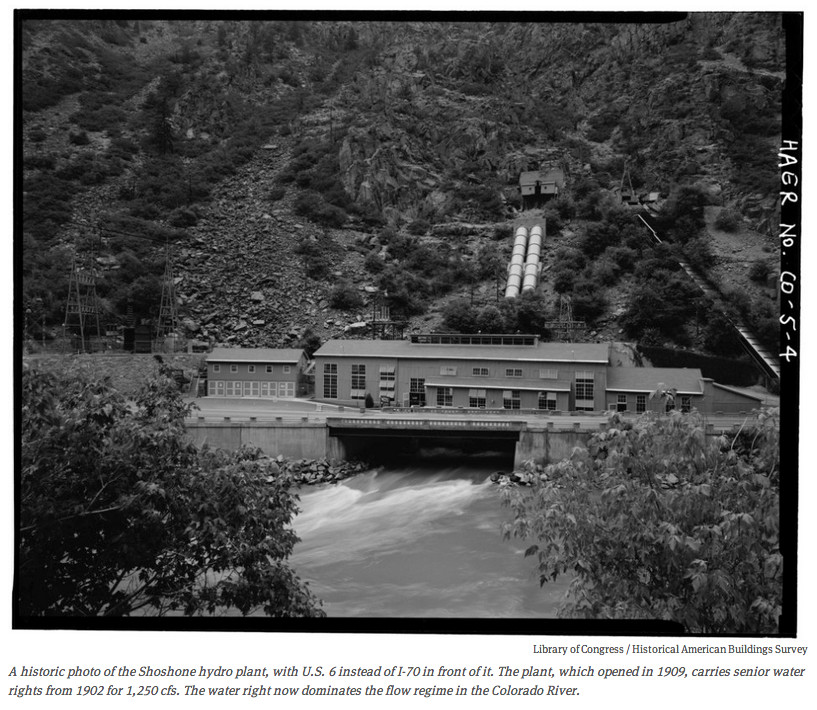
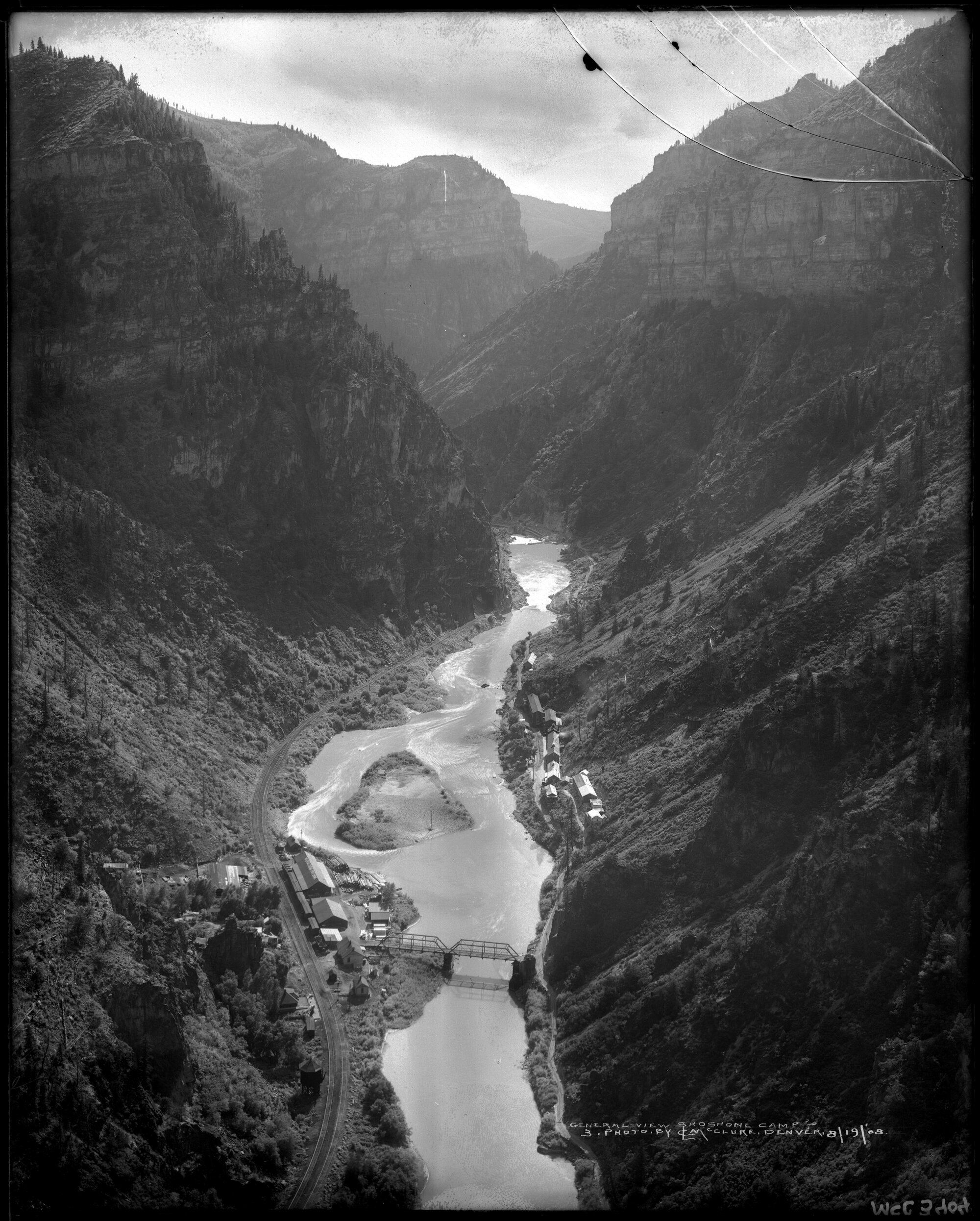
On Wednesday, Browns Canyon — a popular section of the Arkansas River near Buena Vista — was flowing at the lowest level in 55 years of data and at 16% of its median flow for that date. Clear Creek near Idaho Springs was flowing at 61 cubic feet per second on Wednesday, also a record low for the date in 72 years of data. The median flow for the date is 347 cfs, or more than five times as much water…But flows on much of the Colorado River were high enough for rafts and kayaks this week. Flows on a popular section near Kremmling were near normal, as were water levels farther downstream in Glenwood Canyon. Two major factors keep water flowing down the Colorado River during drought: large senior water rights owned by farmers in Mesa County’s Grand Valley and the water rights connected to the Shoshone Power Plant, a hydroelectric facility in Glenwood Canyon owned by Xcel Energy. Irrigators and power plant operators can call water to their facilities from upstream reservoirs, like Green Mountain Reservoir, which is on the Blue River — a tributary of the Colorado River — north of Silverthorne. This year, the irrigators began calling down water on July 1, boosting flows in the Colorado River.
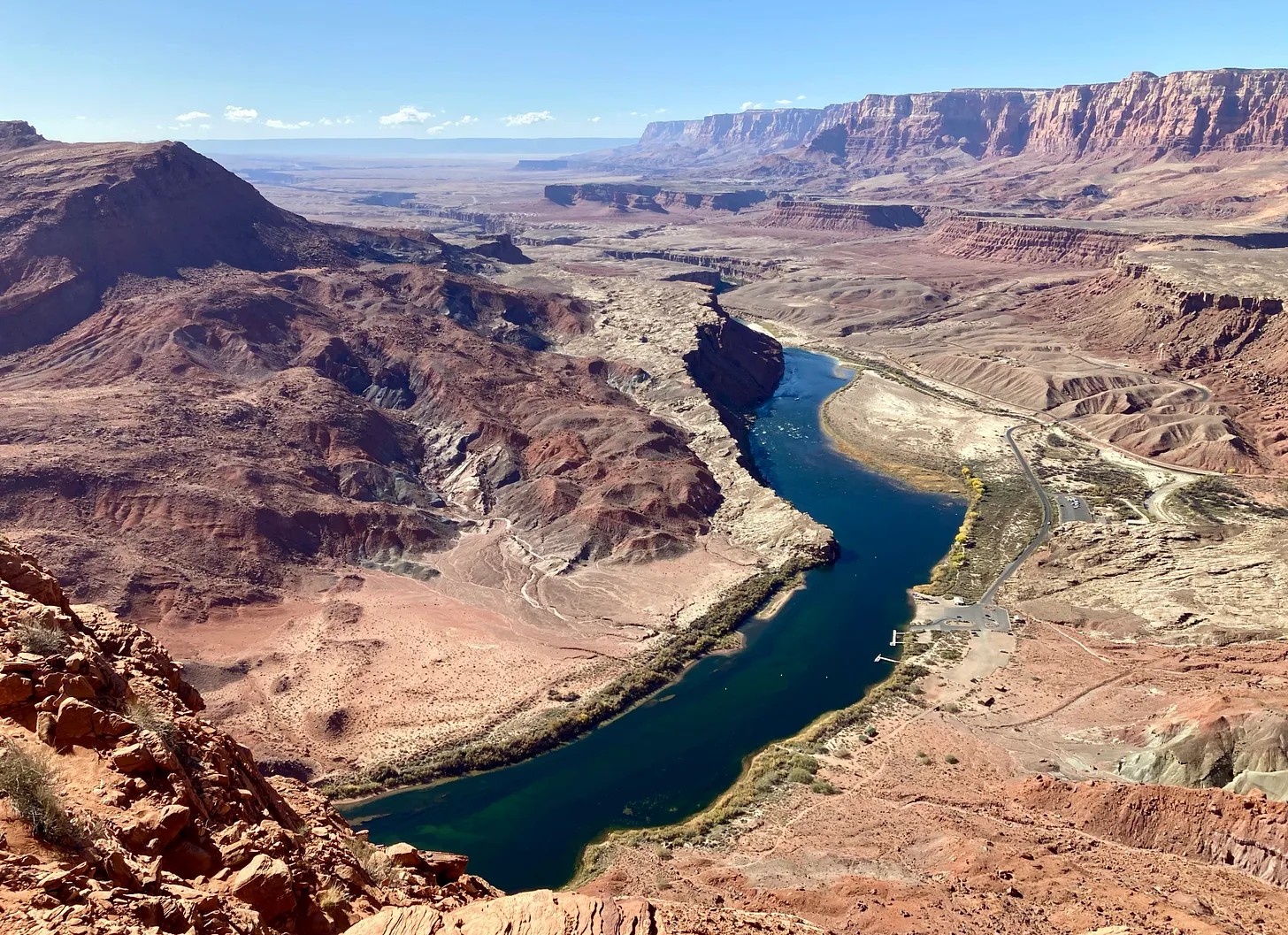
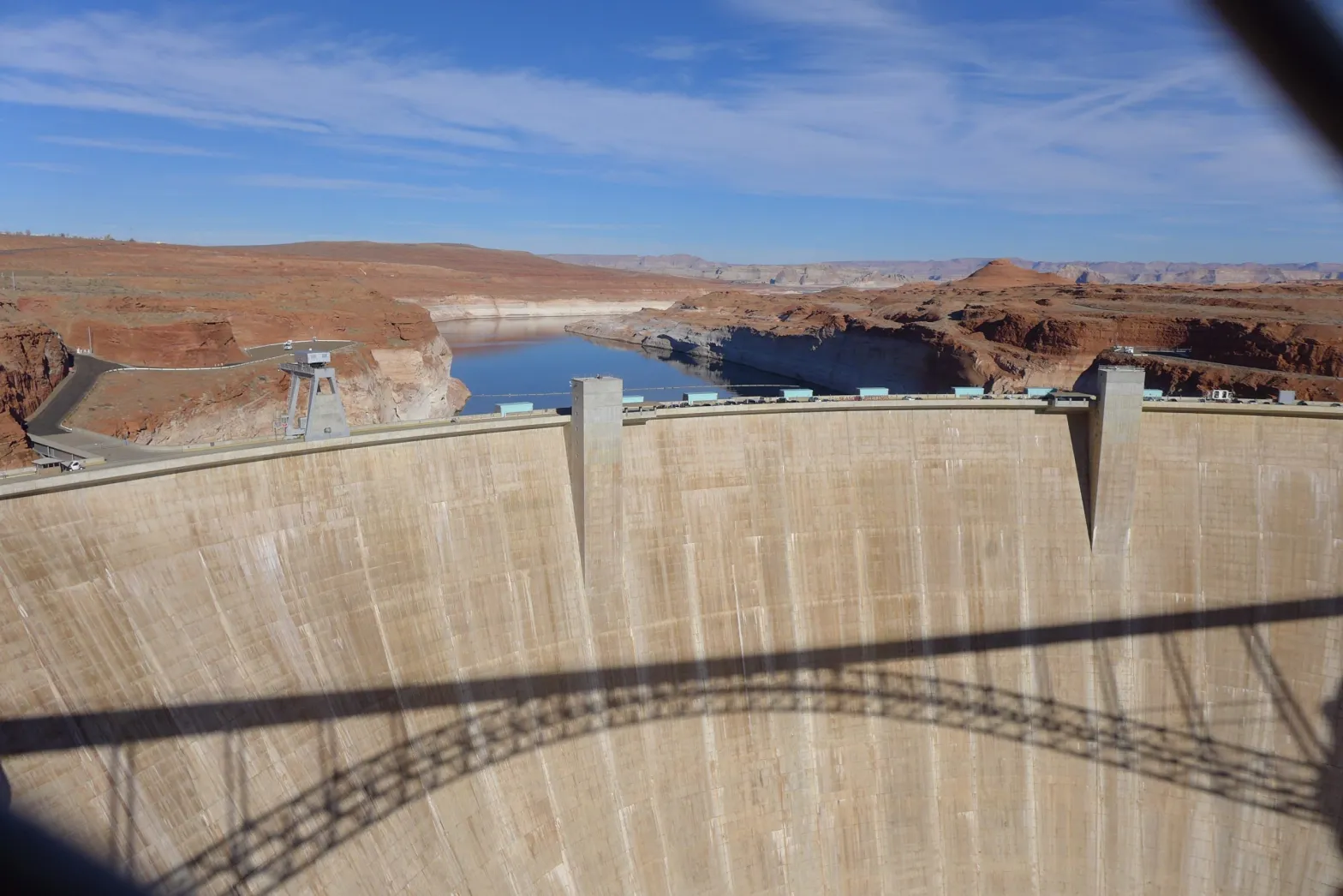
Looking down at the Colorado River, Lees Ferry, and the Paria River. Jonathan P. Thompson photo.
Click the link to read the article on the KJZZ website (Alex Hager). Here’s an excerpt:
July 16, 2026
Sara Porterfield, Colorado River program director with the conservation nonprofit Trout Unlimited, stood on a narrow, rocky river beach, about as close to Glen Canyon Dam as a boat can go.
“This is not a zero sum game,” she said. “Investing in watershed health is not an either-or. We need the system to be healthy from an ecological perspective in order for the rest of it to function.”
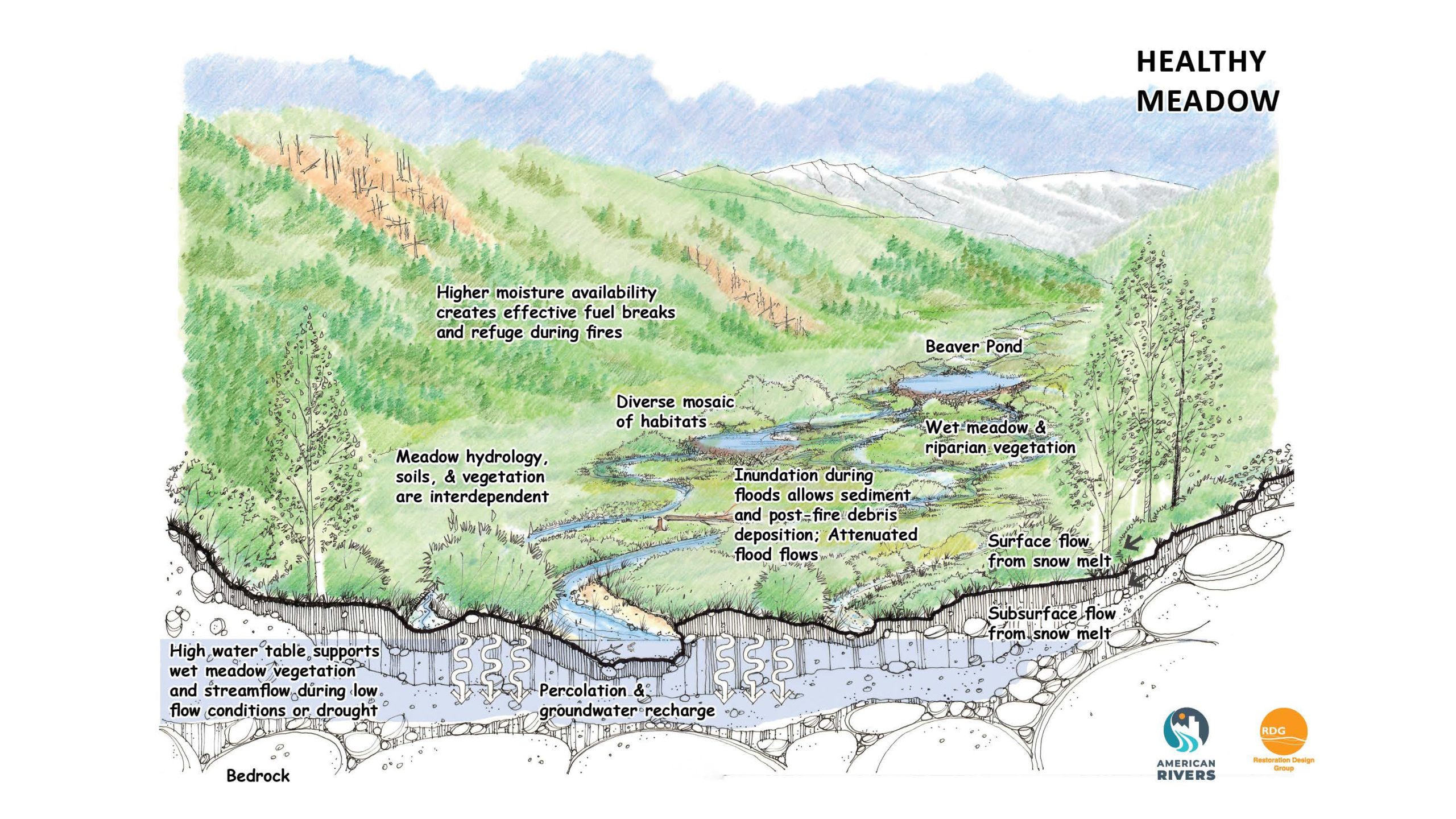
The river, Porterfield said, cannot deliver big volumes of clean water if it does not, at least partially, function like a normal, healthy river. For example, if the river’s upper reaches are dried out, they’ll be susceptible to wildfires and wetland degradation, which make it harder for them to hold on to water and release it slowly into the streams where humans have been able to reliably divert and collect it for generations.
“It’s not just plumbing, but it’s also not just water in a river,” Porterfield said as the dam’s hydroelectric generators emitted a whining hum in the background. “We’re not separate from the natural world, we’re part of it. When we recognize that, and we take help to take care of it, we get a lot further than when we’re just thinking about a plumbing system.”
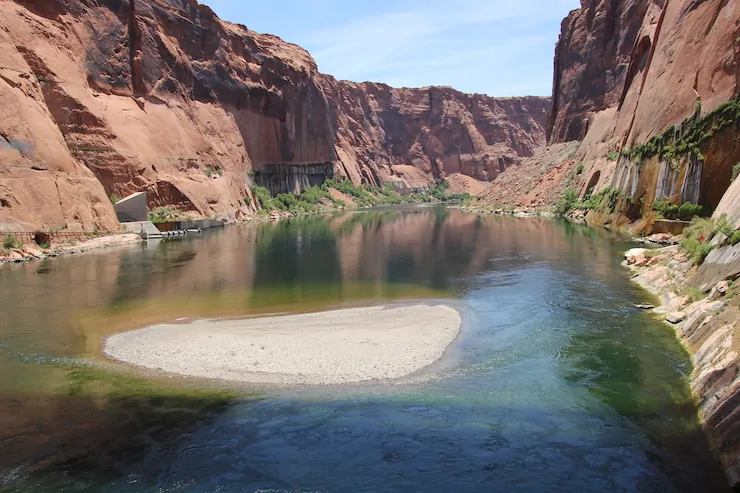
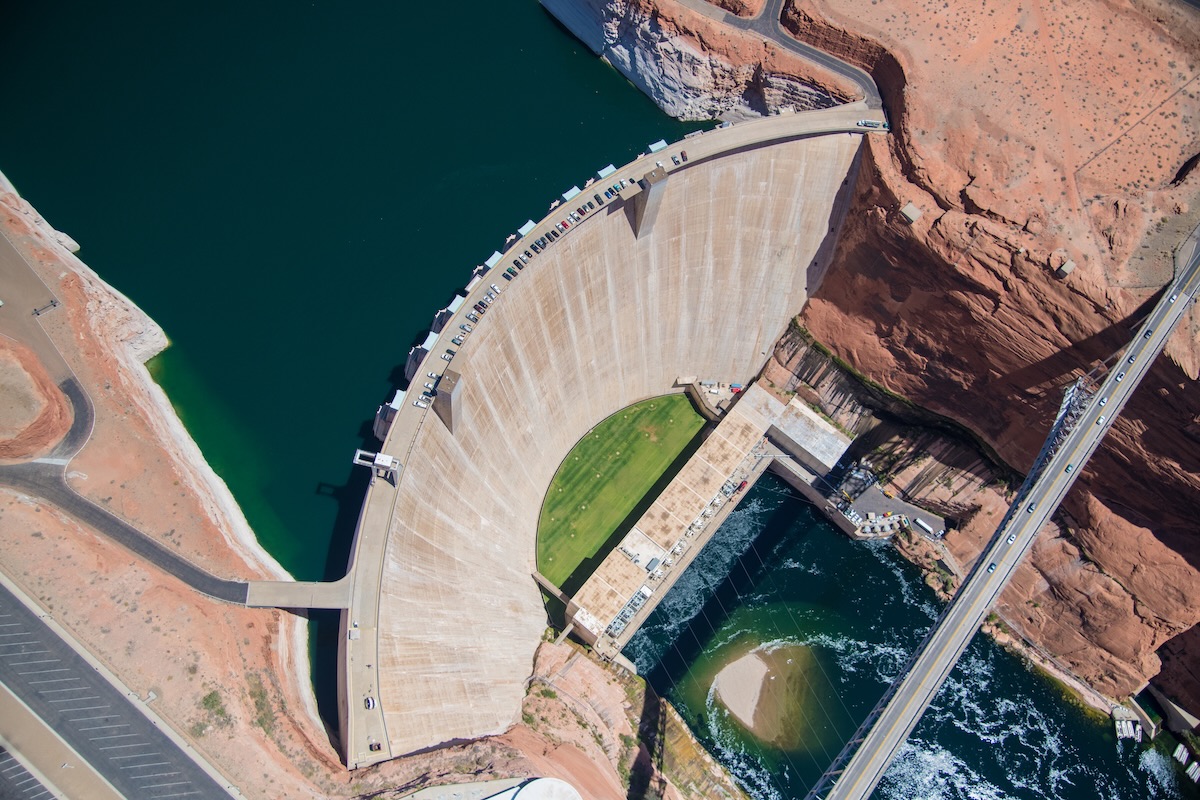
Glen Canyon downstream from Glen Canyon Dam. Photo credit: Allen Best/Big Pivots
Porterfield, who has a Ph.D. in Colorado River history, said calling the river a “plumbing system” is a useful way to think about one of its jobs, but not the whole picture. Environmental advocates say the river can be protected while still flowing through the dams and canals that keep the West wet for humans. Those protections can even be part of the wonky and rigid legal policies that dictate where water goes. John Berggren, a water policy manager at the conservation nonprofit Western Resource Advocates, had some recommendations for the next set of river-sharing rules. An important one, he said, is to get the river out of “crisis mode.”
[…]
“You can be much more proactive and thoughtful and careful and intentional about how you manage the river and include river health,” he said.
Another way to help protect the river’s ecosystems, creatures and flows, Berggren said, is by carefully timing the release of water from reservoirs. For example, policymakers can write flexible rules about where and when water is stored, so water that is flowing downstream to cities and farms can also help make life better for native fish. The water can be used to help the environment without being taken away from humans downstream.
“They’re going to move the water anyway,” he said. “Let’s do it in a way that actually benefits ecological conditions.”
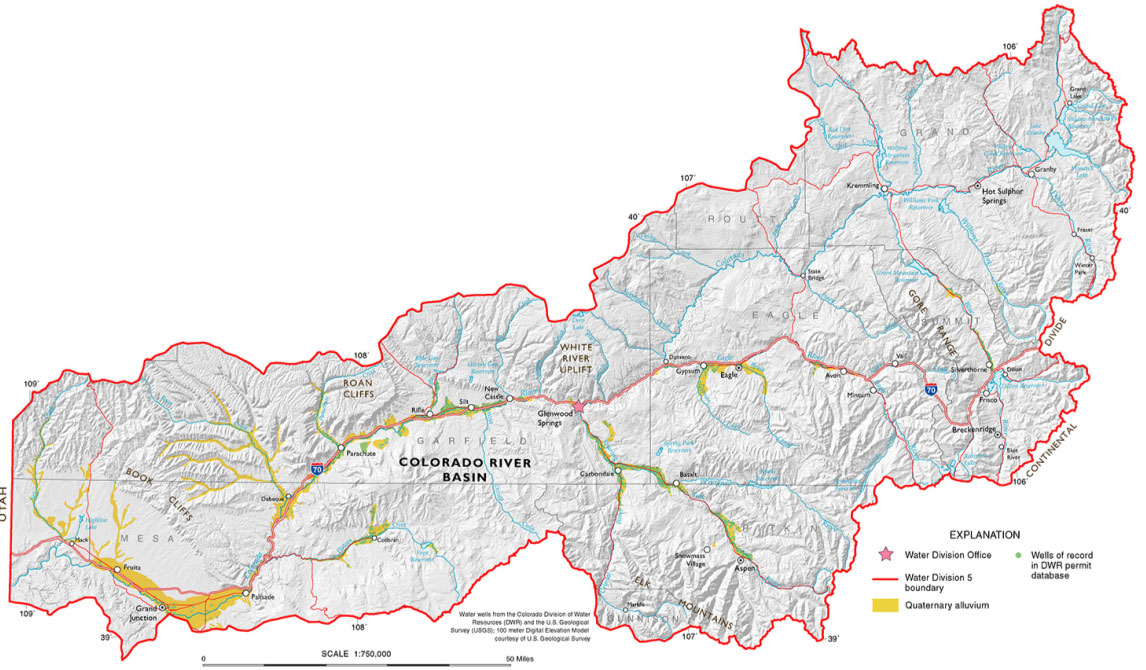
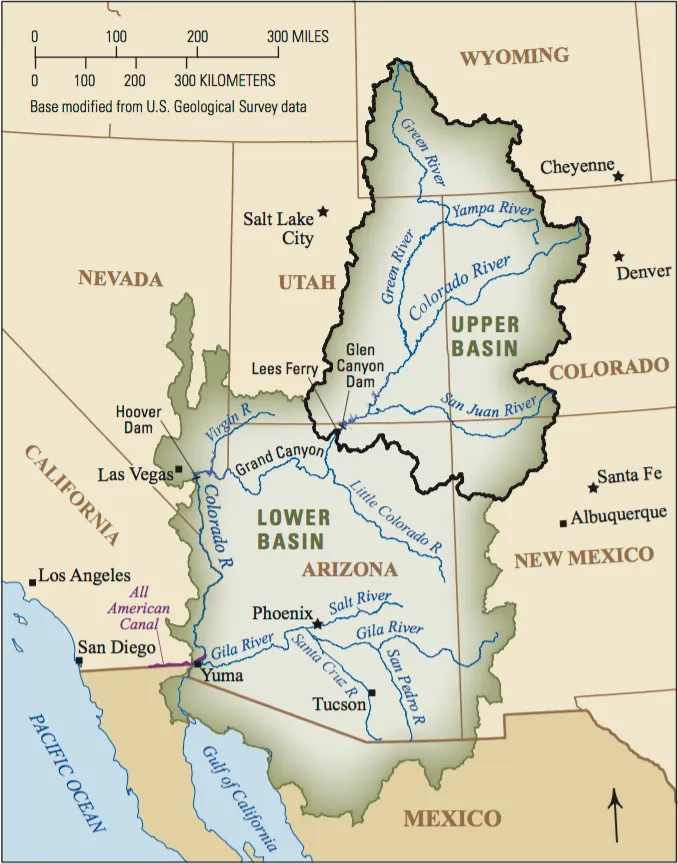
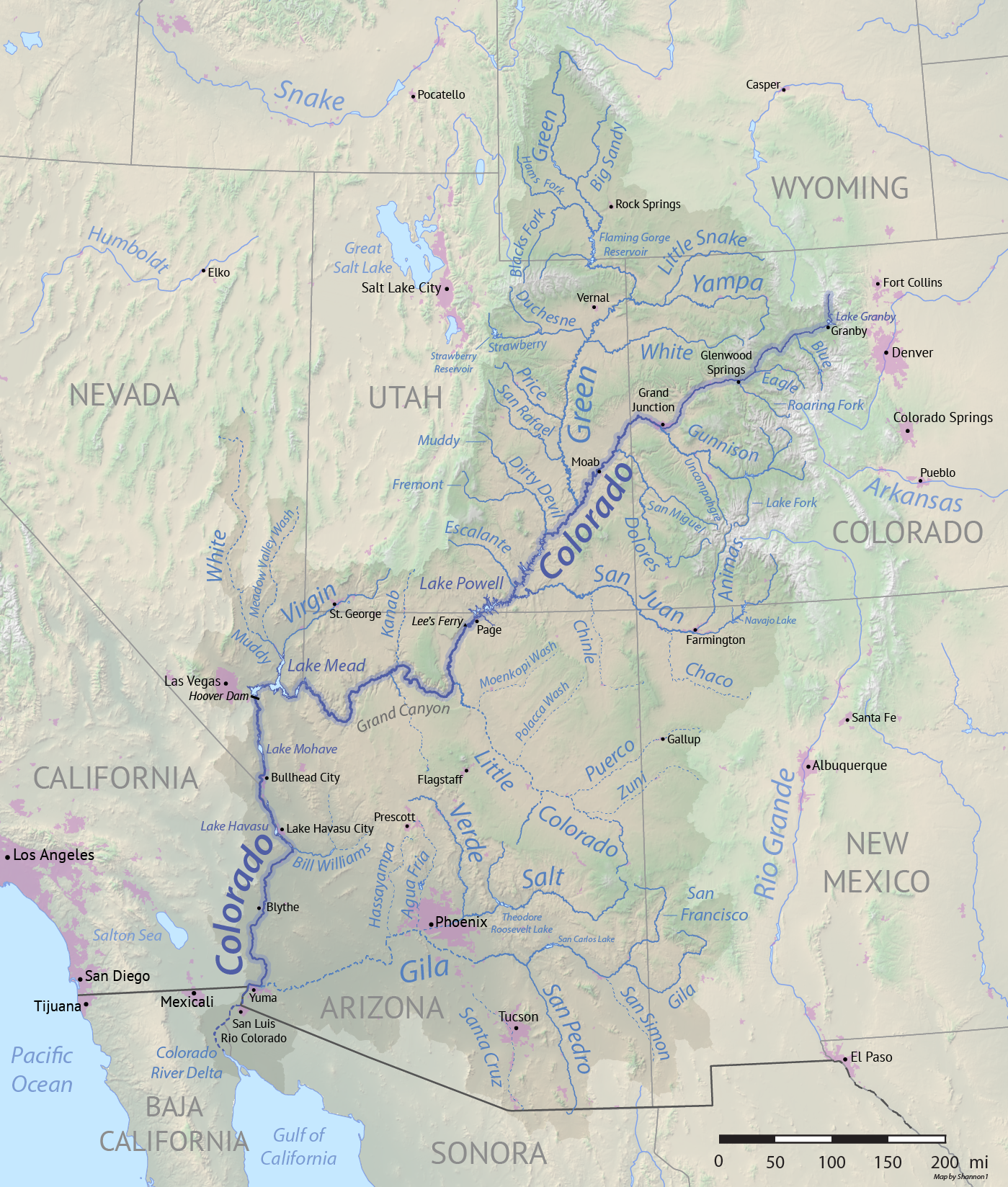
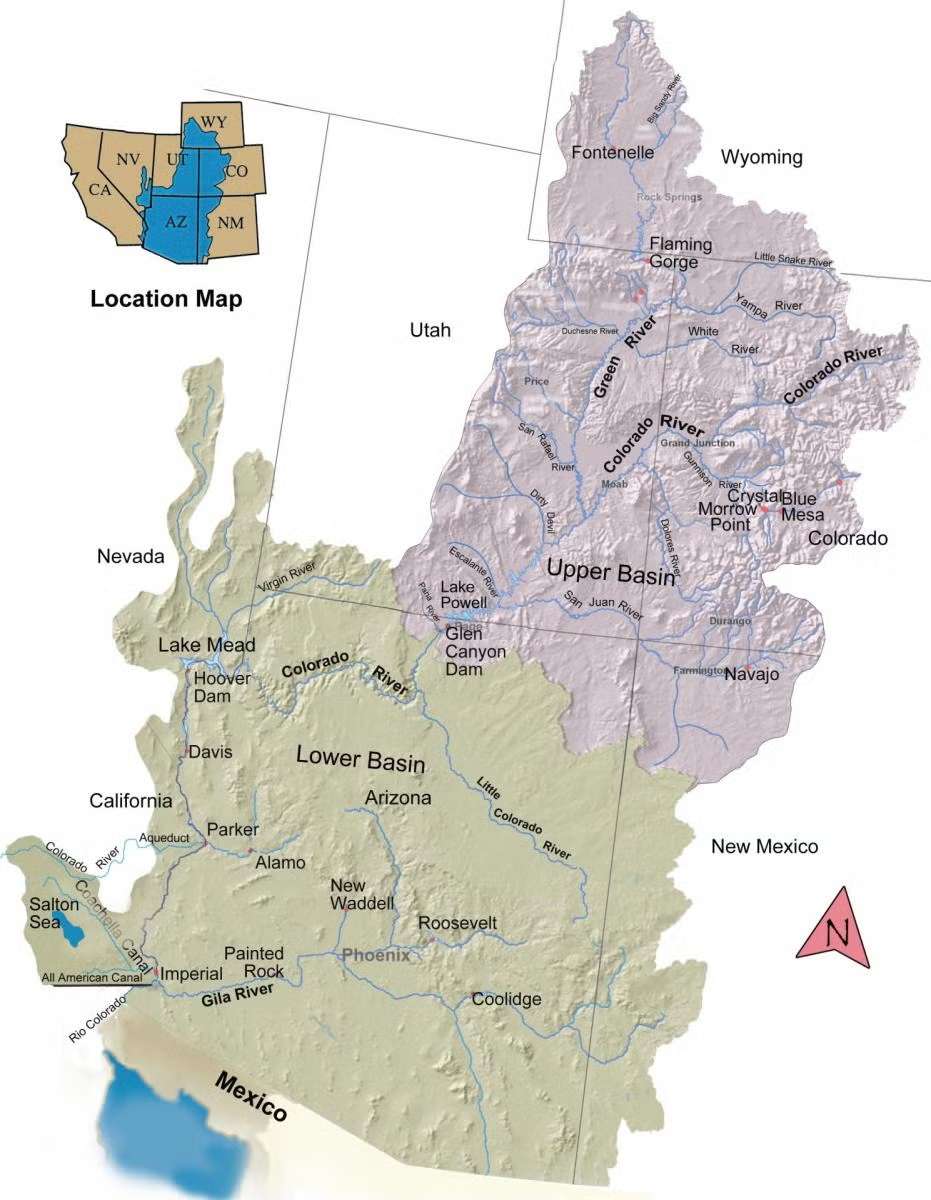
Map of the Colorado River drainage basin, created using USGS data. By Shannon1 Creative Commons Attribution-Share Alike 4.0
Rumors of data centers have local government agencies in the San Luis Valley preparing for the inevitable – an application for a data center.
Costilla County and the town of South Fork are the latest local governments to place moratoriums on artificial intelligence data centers. Though no applications or projects are being proposed, local governments want to give themselves time to create land use codes to address data centers.
A packed room and a packed Zoom at the Costilla County Planning Commission meeting Wednesday morning saw tensions high as the public continues to express opposition to data centers. The commission approved a year-long moratorium. The moratorium will now go to county commissioners for approval.
The town of South Fork’s planning and zoning board is poised to do the same thing during a public hearing Wednesday night’s planning and zoning commission meeting as the town does not have specific zoning regulations that address data centers. The board will use the public hearing for feedback as members begin their work over the next year to devise specific codes.
At Wednesday morning’s Costilla County meeting, planning commissioner Joseph Quintana dispelled rumors and reassured the public that a data center application has not been submitted to the county and that “nobody’s approved anything.”
He said that when the planning commission was first formed the commission came up with a mission plan with a set of goals that were aimed at protecting the environment and the way of life.
“A data center is the antithesis, the complete opposite of what we would want in this community,” he said.
He went on to say, “Our job here is to follow that mission that was established 30 years ago with public comment. So I just want to make sure everybody understands, nobody’s approved a data center that I’m aware of. Nobody’s even applied for a data center here. There’s nobody that’s asked to build one or tried to get a permit or anything like that.”
In June, the Costilla County Commissioners asked the planning commission to address data centers “and get ahead before a problem develops,” Quintana said.
Commissioner Frank Vigil said they wanted the year to create a “thoughtful” ordinance that “reflects the feelings of the general public.”
“Our code doesn’t even have the two words ‘data center’ in it anywhere at all,” said county attorney Carle Turnetzer-Decker. “We were just concerned, I think, the board of county commissioners and the commission here, that if someone did approach us we have absolutely no way to handle it, restrict it, regulate it, do any of that.”
South Fork made a public statement on Tuesday that said, “To dispel rumors that are circulating within the community. The Town instituted a moratorium on Data Centers within the Town of South Fork last month which will last one year. The Town has not had any companies approach the town about data centers. We are simply trying to get ahead of any that may approach the Town. Obviously, there are concerns with them and rest assured your Board of Trustees share your concerns. Please come share your thoughts so we know how best to represent the community in making policy on this.”
Saguache County was the first local government in the Valley to place a moratorium on data centers while it figures out how its land use codes would address any data center application.
Earlier in June, the Rio Grande Basin Roundtable heard from Lindsay Rogers of Western Resources Advocates, who noted how rural markets are becoming targets for data center applications because of the assumption of “less red tape.”
Western Resources Advocates, Rogers said, has a particular interest working in the San Luis Valley as part of a grant process for local policy decision-making around large water users.
“One concern that we have which we’ve seen playing out in other states in our region, is that developers may target rural communities where they feel there may be less red tape to developing these data centers. Our communities may not have the time or resources needed to ensure the proposal fits within their own goals and their own resource availability. So we think it’s really important to think about these policy options proactively before developers come to town instead of responding to them once they’ve arrived.”
Solar panels San Luis Valley. Photo credit: Allen Best/Big Pivots
Richard Hubler, planning director for Alamosa County, said at the roundtable, “There’s a very real possibility, as we move forward, that because of our fiber networks here and our broadband capacity, our cheap land and what may end up being a glut of solar production that we could be a target in the Valley for somebody who says, ‘Hey, there’s more power than the Valley could use there.
“I could take a circle next to that 600 megawatt project and use the other 400 megawatts they may have.’ And we don’t know how to handle that now as a county or as a Valley. I think that this is timely because we really do want to get ahead of it before we have to deal with an application.”
In May, SLV Rural Electric Cooperative CEO Eric Eriksen said the Valley has underutilized energy capacity and that “rural data centers” are the “most relevant for us.” Rural data centers are described as smaller, more efficient facilities that are often housed within buildings no larger than small commercial buildings and operate anywhere from 50 kilowatts up to 50 megawatts.
These centers commonly use air-cooling or closed-loop refrigeration instead of consuming water.
In May, SLV Rural Electric Cooperative CEO Eric Eriksen said the Valley has underutilized energy capacity and that “rural data centers” are the “most relevant for us.” Rural data centers are described as smaller, more efficient facilities that are often housed within buildings no larger than small commercial buildings and operate anywhere from 50 kilowatts up to 50 megawatts.
These centers commonly use air-cooling or closed-loop refrigeration instead of consuming water.
In SLVREC’s position, the agriculture’s energy demand is declining and that company sees “the underutilized capacity” as an opportunity “to serve five, 10, 20, 50 megawatts or more of rural data centers.”
According to SLVREC, there are seven long-haul fiber routes into and out of the Valley, “with terabytes of unused capacity that is ideal for data centers.”
Rio Grande and Pecos River basins. Map credit: By Kmusser – Own work, Elevation data from SRTM, drainage basin from GTOPO [1], U.S. stream from the National Atlas [2], all other features from Vector Map., CC BY-SA 3.0, https://commons.wikimedia.org/w/index.php?curid=11218868
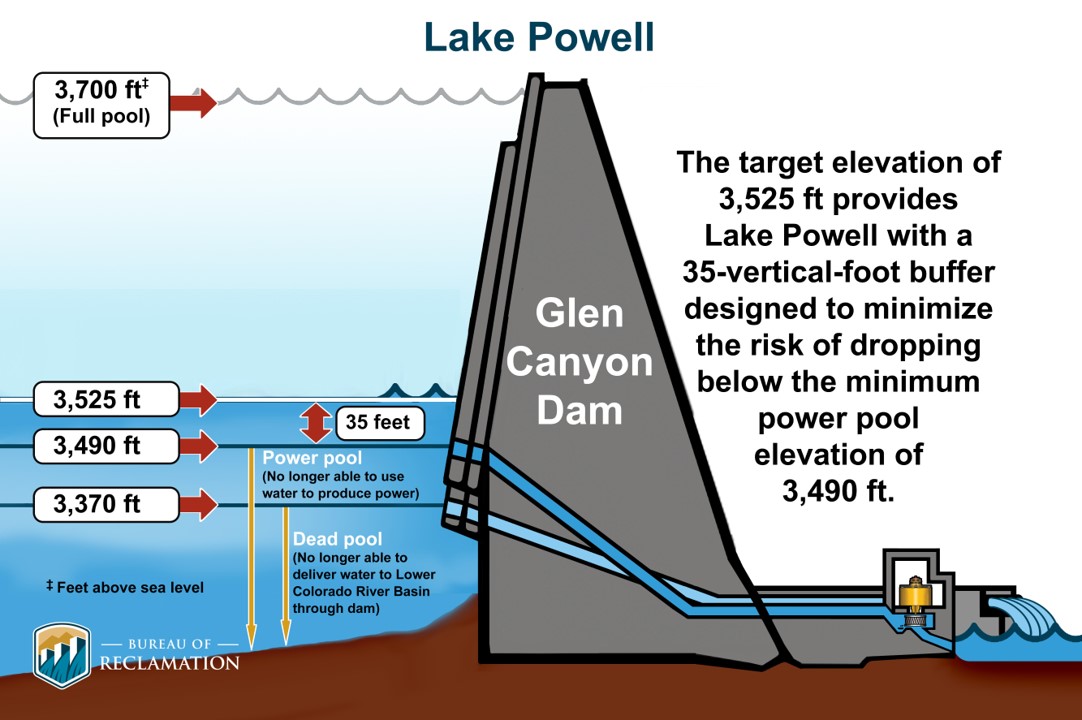
Diagram showing critical reservoir levels at Glen Canyon Dam and Lake Powell. Land Desk diagram with data from the Bureau of Reclamation. Click to enlarge.
The Colorado River watershed’s spring runoff — if you can call the measly increase in streamflows “runoff” — peaked in mid-May and was pretty much over by mid-June.
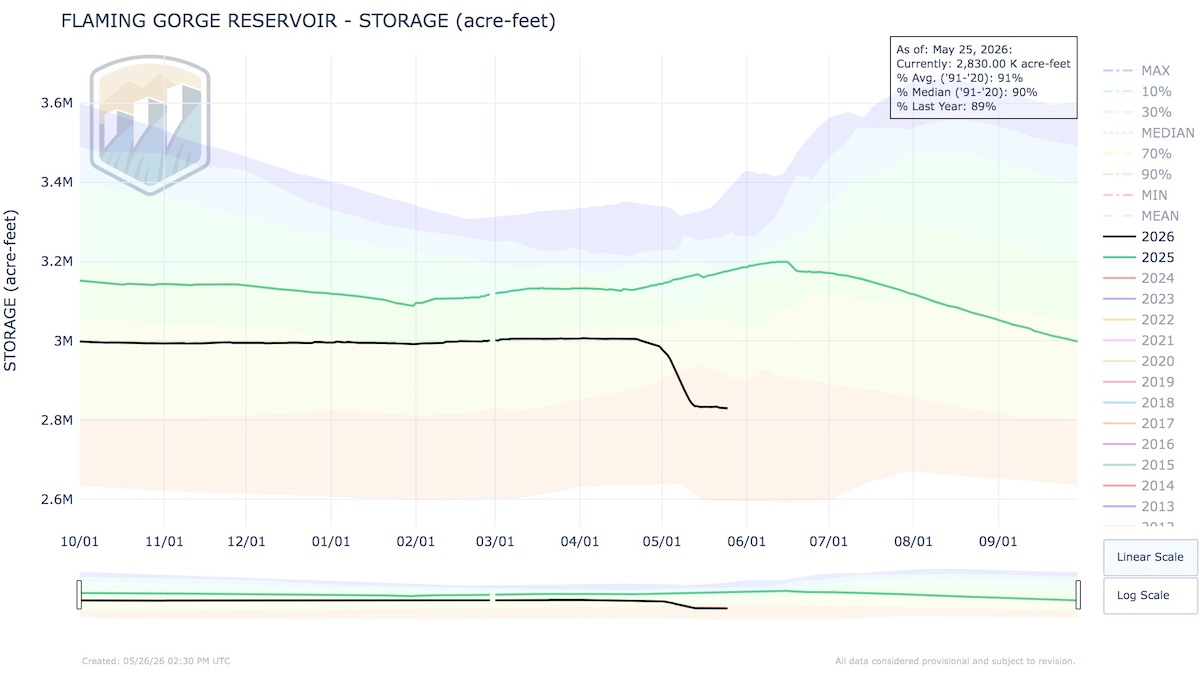
The variations in streamflow showed up as a little bump in Lake Powell’s total inflows, which were augmented by extra releases from Flaming Gorge reservoir on the Wyoming-Utah border, many miles upstream. That buoyed Lake Powell’s surface level to a high point of 3,528 feet in early June, before it began its long decline that’s likely to continue until next year’s runoff.
The reservoir’s surface level is currently at about 3,525 feet, the lowest it has been since 2023 and the lowest it has been on this date since it was filled. It’s also the level that would trigger a reduction in releases from Glen Canyon Dam to 7.48 million acre-feet per year. This year that’s not going to happen, because releases are already on track to be closer to 6 MAF.
The data show why, even with reduced releases, the surface level is falling at about two inches per day as of the beginning of July.
3,527.97; 3,524.99 feet above sea level: Surface elevation of Lake Powell on June 1 and July 6, respectively.
2.1 million acre-feet: Median total inflows into Lake Powell (1991-2020).
399,304 acre-feet: Total inflows into Lake Powell during the month of June 2026, or about 19% of “normal.” The “unregulated inflow,” which is what the inflow would be without augmentation from upstream reservoirs, was just 305,000 af.
507,747 acre-feet: Total releases from Glen Canyon Dam in June 2026. At this level, all releases go through the hydroelectric turbines and generate power.
20,475 acre-feet: Estimated amount of water lost to evaporation from Lake Powell in June 2026.
8,951 acre-feet: Inflow into Lake Powell on July 7, 2026.
15,546 acre-feet: Release from Glen Canyon Dam on July 7, 2026.
788 acre-feet: Estimated evaporation from Lake Powell on July 7, 2026.
(7,383 acre-feet): Lake Powell’s daily water deficit on July 7, 2026.
In other words, as of early July the reservoir was losing nearly 7,400 acre-feet of water each day, or about 220,000 acre-feet per month. If this rate of decline continues or speeds up, then we can expect the reservoir to reach de facto deadpool — or 3,500 feet — before the end of the year.
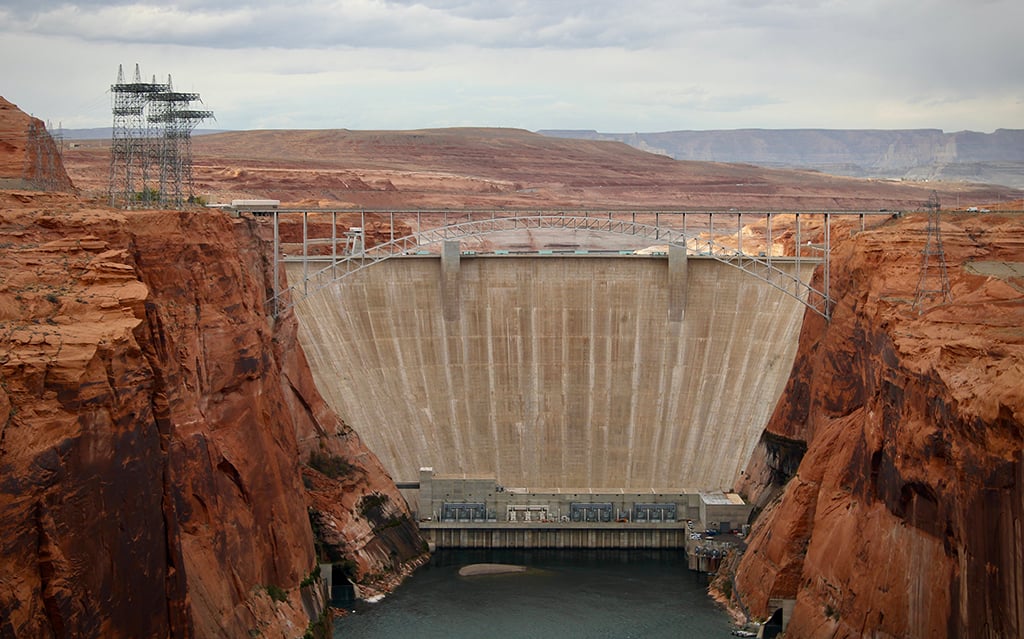
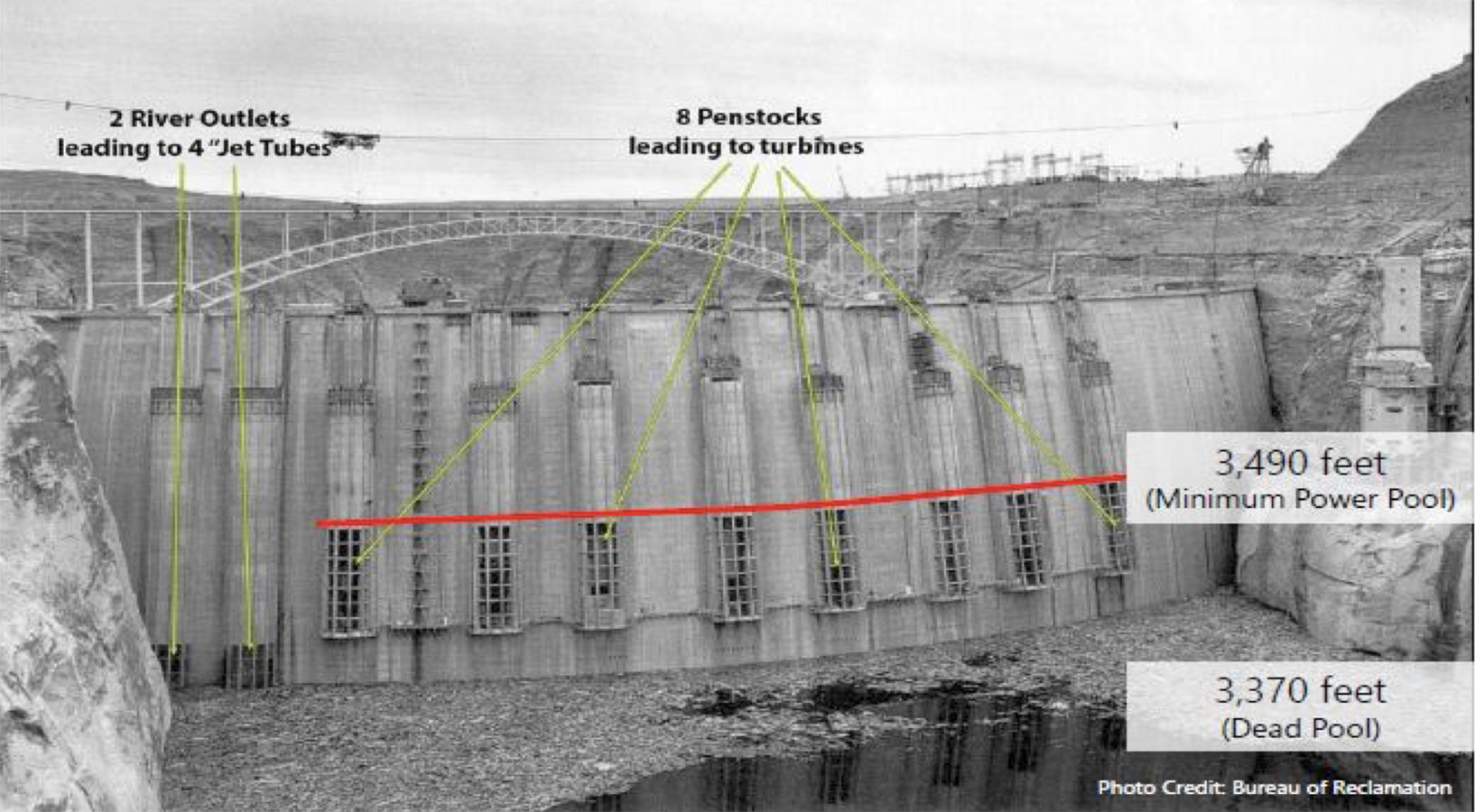
If the level drops below 3,500 feet, dam operators will no longer be able to release water through the penstocks and hydroelectric turbines, meaning they must rely entirely on the river outlets lower on the dam for all releases. This would not only zero out the dam’s hydropower output, but could also damage the outlet tubes, since they aren’t engineered for long-term, sustained use.
One possible scenario: Dam operators switch to the river outlets for releases, the reservoir’s surface level is drawn down to, say, 3,475 feet, then the river outlet tubes begin deteriorating due to cavitation, forcing them to be shut down. This would then make it impossible to release any water from the dam until the outlets were repaired or the lake level rose back up to 3,500 feet, meaning the Colorado River in the Grand Canyon would effectively dry up completely.
That’s why the Bureau of Rec is so intent on “defending” that 3,500-foot level, presumably even if it means going to a run-of-the-river operation, in which water is released from the dam at the approximate rate that it is flowing into the reservoir, minus evaporation. On July 7, this would have amounted to about 2,800 cubic feet per second, or about one-third of current releases, diminishing hydropower output, and affecting downstream recreation and aquatic life.
If — or more likely, when — this occurs, it will render Lake Powell useless as a water savings account, and reduce it to a marginal power generator, silt collector, and evaporation pool. Boating will still be possible, but most existing boat ramps will no longer be usable. This will lend strength to calls to drain the reservoir, either by decommissioning the dam altogether, or by building bypass tunnels that can be shut down if climatic conditions change and aridification is reversed.
In the video above Katrina Grants from Reclamation explained how her agency is planning operations of Glen Canyon Dam for the next few years and emphasized that they can operate safely with just the outlet tubes, with increased maintenance activity. The planning shows the river hydrology is the primary driver of releases rather than limitations from the tube design. “We can release the water if it is there,” she said.
⛏️ Mining Monitor ⛏️
The U.S. Forest Service granted final approval to South32’s proposal to re-open and expand the Hermosa Mine in southern Arizona to extract battery materials such as manganese and zinc, along with silver and lead.
The mine is on patented claims (private land), but would be expanded onto unpatented claims in the Coronado National Forest in southern Arizona’s Patagonia Mountains, an area long inhabited by the Sobaipuri O’odham and Hohokam people. The mountains occupy the nexus of several different biological provinces and are home to hundreds of species of birds, bees, bats, and butterflies, as well as the unique Madrean Pine-Oak Woodlands.
The approved plan of operations includes:
Disturbance of about 400 acres of Forest Service land, including 225 acres for tailings and waste storage.
Mining will be done by the long-hole open stope method at a projected rate of about 4.7 million tons of ore per year.
The Australian company has approval to discharge up to 4,500 gallons per minute of treated water into Harshaw Creek, Mowry Wash South, and Goldbaum Canyon.
During operations the plan anticipates 169 heavy truck round trips per day and 76 light vehicle or bus round trips per day on the main access road, which will be constructed for the project.
The Biden administration expedited the environmental review for the proposed plan back in 2023 because the materials extracted are considered “critical.” Manganese is used in large capacity batteries; zinc is used to galvanize steel.
Area residents and advocates worry this sort of industrialization will harm the delicate and unique ecosystem and the diverse array of wildlife that depends on it. As is often the case with underground hardrock mining, a primary concern is for its effects on water quality and quantity. Groundwater pumping is expected to deplete area aquifers, which could affect springs and wells. Acid mine drainage is expected to occur in the sulfide ore body, which, if not treated properly, could contaminate groundwater or streams in the arid region.
The West these days is teeming with so many fly-by-night mining companies and speculators staking claims on public lands and launching exploratory drilling projects that it’s hard to tell which ones to take seriously. Most of these bids will likely fizzle out as soon as commodity prices fall.
Faraday Copper’s Copper Creek Project, however, seems to be worth paying attention to, if only because they have some serious financial backing.
The Canada company just finalized its agreement to acquirethe shuttered San Manuel copper mine in southern Arizona from BHP Group Limited. BHP, a global corporation and a co-proponent of the proposed Resolute copper mine at Oak Flat, will take a 30% equity interest in Faraday when the deal is completed later this year.
The San Manuel mine, just outside Mammoth, Arizona, was once the nation’s largest underground copper mine and a significant producer up to its closure in 1999. “The definitive agreement provides a pathway for the development by Faraday of a new copper hub in Arizona,” said a BHP press release, “combining existing infrastructure and mineral inventory at San Manuel with Faraday’s adjacent Copper Creek project.”
Faraday’s Copper Creek Project properties near Mammoth, Arizona.
The proposed Copper Creek mine covers about 78 square kilometers in the Galiuro Mountains about nine miles east of Mammoth. Its open pit would likely be in the middle of Copper Creek, a tributary to the Lower San Pedro River. Last June, the Bureau of Land Management approved Faraday’s plan to construct 67 drill pads, along with associated roads and infrastructure, and the company recently completed the first round of water-intensive drilling. The firm reports that the drilling identified oxide mineralization that “supports potential open-pit resource expansion.”
Faraday’s preliminary mining plan for the Copper Creek Project. Source: Faraday Copper.
For now, at least, Faraday is not really a mining company. It holds mining claims at the Copper Creek project in Arizona and another “pre-feasibility” project in Nevada, but it has yet to do any actual mining. It’s an exploratory company that last year posted a net loss of nearly $28 million.
Still, it’s getting some help from some very deep-pocketed interests. First off there’s BHP, assuming the San Manuel deal goes through. And then there’s the backing of the Lundin Group, which owns metal and diamond mining, petroleum, and renewable energy companies around the world. Lundin, which was founded in Sweden, is also known for human rights violations. Two executives of Lundin Oil (now Orrön Energy and owned by another company) allegedly aided and abetted war crimes in what is now South Sudan in the late 1990s and early 2000s. Their trial in Stockholm ended in late May and a verdict is expected later this year.
The development has sparked pushback from residents, advocates, and tribal nations, who worry about the drilling’s potential impacts to water quantity and quality in the Lower San Pedro River, which flows nearby, not to mention the prospect of a giant open pit mine in the biodiverse mountain range. The proposed mine site is also near the Aravaipa Wilderness Area, a stunning canyon and desert riparian zone.
For now, at least, Faraday is not really a mining company. It holds mining claims at the Copper Creek project in Arizona and another “pre-feasibility” project in Nevada, but it has yet to do any actual mining. It’s an exploratory company that last year posted a net loss of nearly $28 million.
Still, it’s getting some help from some very deep-pocketed interests. First off there’s BHP, assuming the San Manuel deal goes through. And then there’s the backing of the Lundin Group, which owns metal and diamond mining, petroleum, and renewable energy companies around the world. Lundin, which was founded in Sweden, is also known for human rights violations. Two executives of Lundin Oil (now Orrön Energy and owned by another company) allegedly aided and abetted war crimes in what is now South Sudan in the late 1990s and early 2000s. Their trial in Stockholm ended in late May and a verdict is expected later this year.
Copper Creek Canyon. Photo credit: Russ McSpadden/Center for Biological Diversity
The development has sparked pushback from residents, advocates, and tribal nations, who worry about the drilling’s potential impacts to water quantity and quality in the Lower San Pedro River, which flows nearby, not to mention the prospect of a giant open pit mine in the biodiverse mountain range. The proposed mine site is also near the Aravaipa Wilderness Area, a stunning canyon and desert riparian zone.
There’s also an ironic twist to this situation. In order for Resolution Copper — a BHP/Rio Tinto partnership — to move forward on its Oak Flat mine near Superior, Arizona, about 40 miles northwest of the Copper Creek project, the company had to do a land exchange. It would take ownership of Oak Flat — USFS land that had been withdrawn from mineral entry in 1955 — in exchange for various private parcels in the region with environmental or recreational significance. One of those gained by the federal government is a 3,050-acre parcel along the Lower San Pedro just east of Mammoth; putting it in federal hands should have protected the stretch from development. But it also covers the Copper Creek-Lower San Pedro confluence, and lies between Faraday’s Copper Creek Project and BHP’s San Manuel Mine. In other words, it would potentially be affected, directly or indirectly, by Faraday’s project.
Actual mining isn’t going to happen anytime soon; Faraday has paused its drilling program for the summer and doesn’t plan to resume until the fall. But the deal with BHP and the funding from Lundin are reason enough to keep an eye on this one.
🥵 Aridification Watch 🐫
Speaking of the San Pedro River, one of southern Arizona’s iconic streams and biodiversity zones, it reportedly has gone dry for only the second time in the last century at its Charleston gage. To be clear, the San Pedro is not a huge river, and it has been reduced to a mere trickle at times. But for it to completely vanish at this particular gage — the last time it happened was in 2005 — is a sign that aridification and groundwater overpumping are coming together to destroy one of the last un-dammed desert rivers in the Southwest.
USGS hydrograph for the San Pedro River at Charleston for the last year. While it normally plummets to below 3 cfs in late June, it also normally starts rebounding in early July when the monsoon arrives. Source: USGS.
Of course, the San Pedro is not alone. Nearly every stream in the Interior West is running at below normal flows currently. The Dolores River below McPhee Dam is so depleted that a helicopter searching the stream for water to dump on the Ferris Fire came up empty. The San Miguel River at Uravan, Colorado, is flowing at just 6 cubic feet per second, which is about 2% of the median flow for this date. And the Animas River below Aztec, New Mexico, is running at a measly 16 cfs, which is far too low for Farmington’s surf wave.
And of course, we can’t forget about the beleaguered Rio Grande. Laura Paskus reports that 87 miles of the Middle Rio Grande have gone dry. She has a heartbreaking account of walking a stretch of the dry zone near Albuquerque at her Substack newsletter.
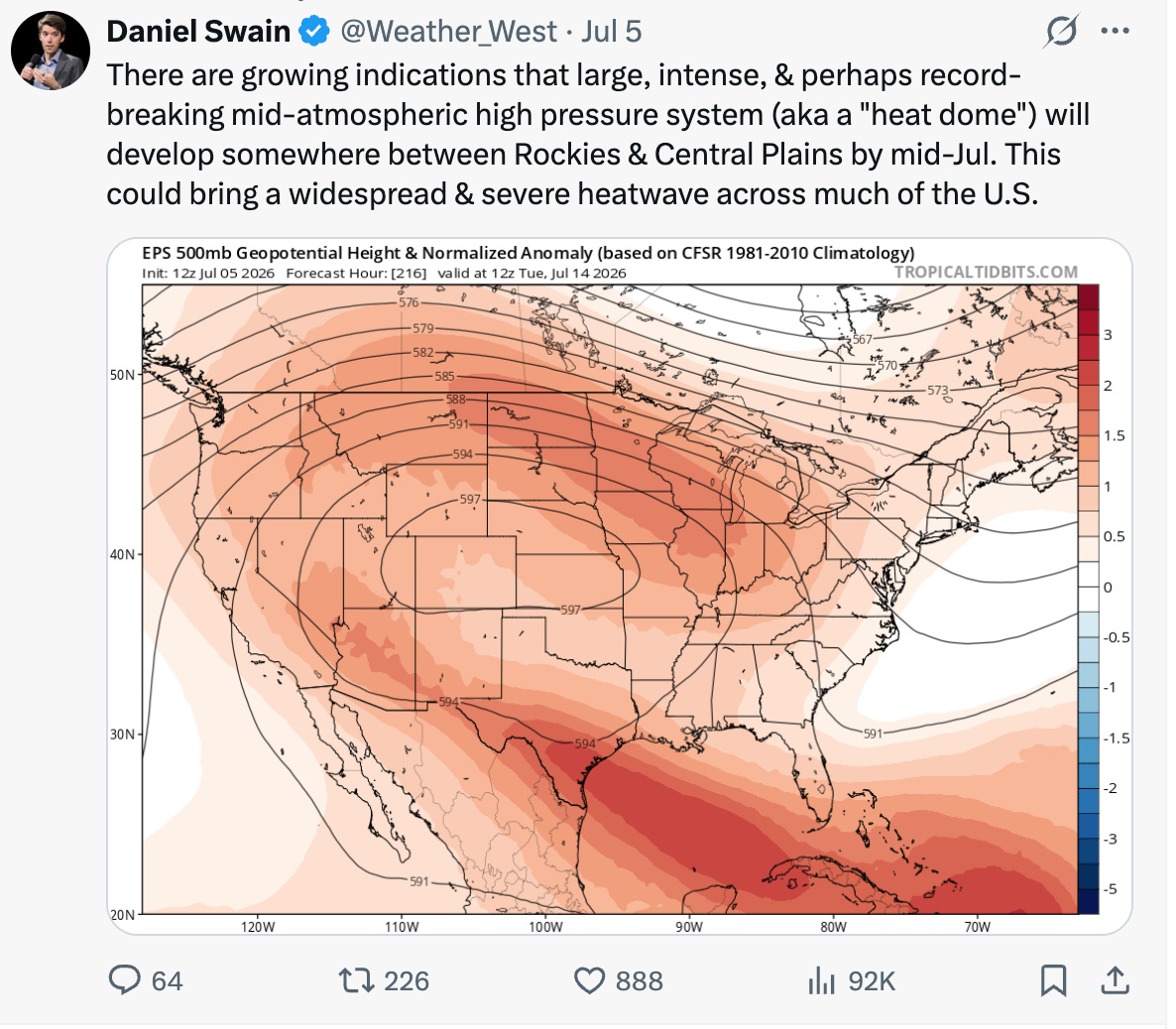
Unfortunately, conditions are likely only to get worse this weekend, as a heat wave moves in and scorches the West, especially parts of the central and northern Rocky Mountains. Temperatures are forecasted to reach the triple digits in places like Hotchkiss and Grand Junction, Colorado. And check out this weekend forecast (7/11-7/14) for Thermopolis, Wyoming.
107° F in Thermopolis, Wyoming?!? Ouch. I think I’d avoid the hot springs this weekend [July 11, 2026] and stick to the river. Source: NWS.
🤯 Oh, the Humans! 😱
The San Miguel County Sheriff’s Office is a bit irritated, if their social media posts are any indication. This week they received a Garmin SOS signal from someone who had apparently fallen 150 to 200 feet in the Columbine Basin above Telluride, broken his leg, and needed search and rescue’s help.
Following an extensive rescue team deployment, which included a CARE Flight helicopter flying into the scene at 13,000 feet in elevation, the SAR team found the victim walking around. He told them he was BASE jumping on his own, his chute didn’t open, and he was injured in the fall. But the broken leg thing? Nope: He not only refused a helicopter flight, but any assistance at all. Adding to the annoyance: The purported victim had previously triggered a massive SAR operation while BASE jumping in the Swiss Alps that included a $175,000 air evacuation.
“Our SAR team consists of skilled professionals who risk their own lives to help others in need,” said Sheriff Dan Covault in a statement. “This individual chose to participate in an extremely dangerous activity alone, and particularly given his prior rescue history, his actions demonstrated a disregard for the risks involved and the resources required to rescue him. His decisions unnecessarily diverted emergency resources, including a Care Flight helicopter, that may have been needed for other emergencies. The fact that he was able to hike back down shows a profound lack of respect for the tremendous effort and resources devoted to this rescue.”
📸 Parting Shot 🎞️
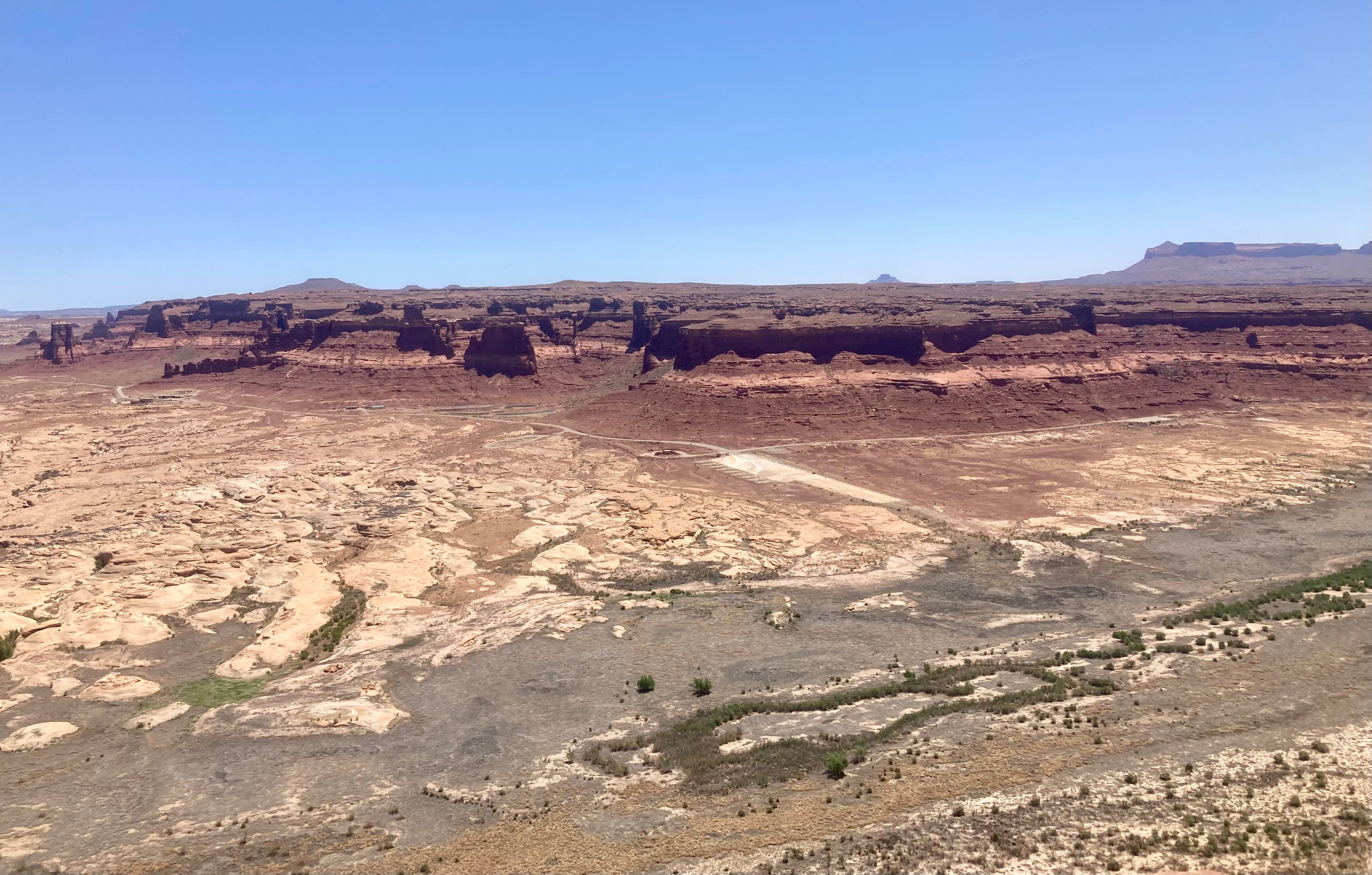
Images from badlands in northwestern New Mexico that Georgia O’Keefe painted and called the “Black Place.”
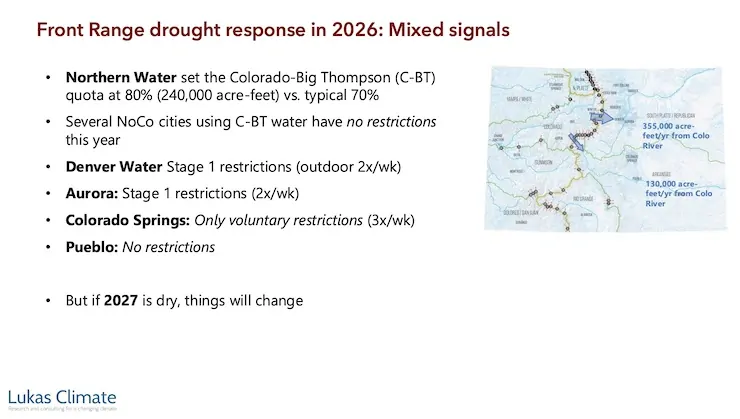
The Northern Water Board of Directors has unanimously approved a change to Colorado-Big Thompson Project accounting procedures concerning C-BT water tracking.
During a rule-making hearing at the June 11 Board meeting, Directors heard about the changes to the rules surrounding the tracking of water from the Project. The new accounting procedures will require accounting of tracking data to be provided in a manner to allow for the administration of C-BT Project water return flows, which will help Northern Water protect them as described in the District’s Repayment Contract with the Bureau of Reclamation, the Water Conservancy Act and contracts with allottees.
The modifications affect only domestic and municipal users, and Northern Water staff met or contacted 26 municipalities, water districts and treatment plants in the months before the rule change was approved.
Map of the Colorado-Big Thompson Project via Northern Water
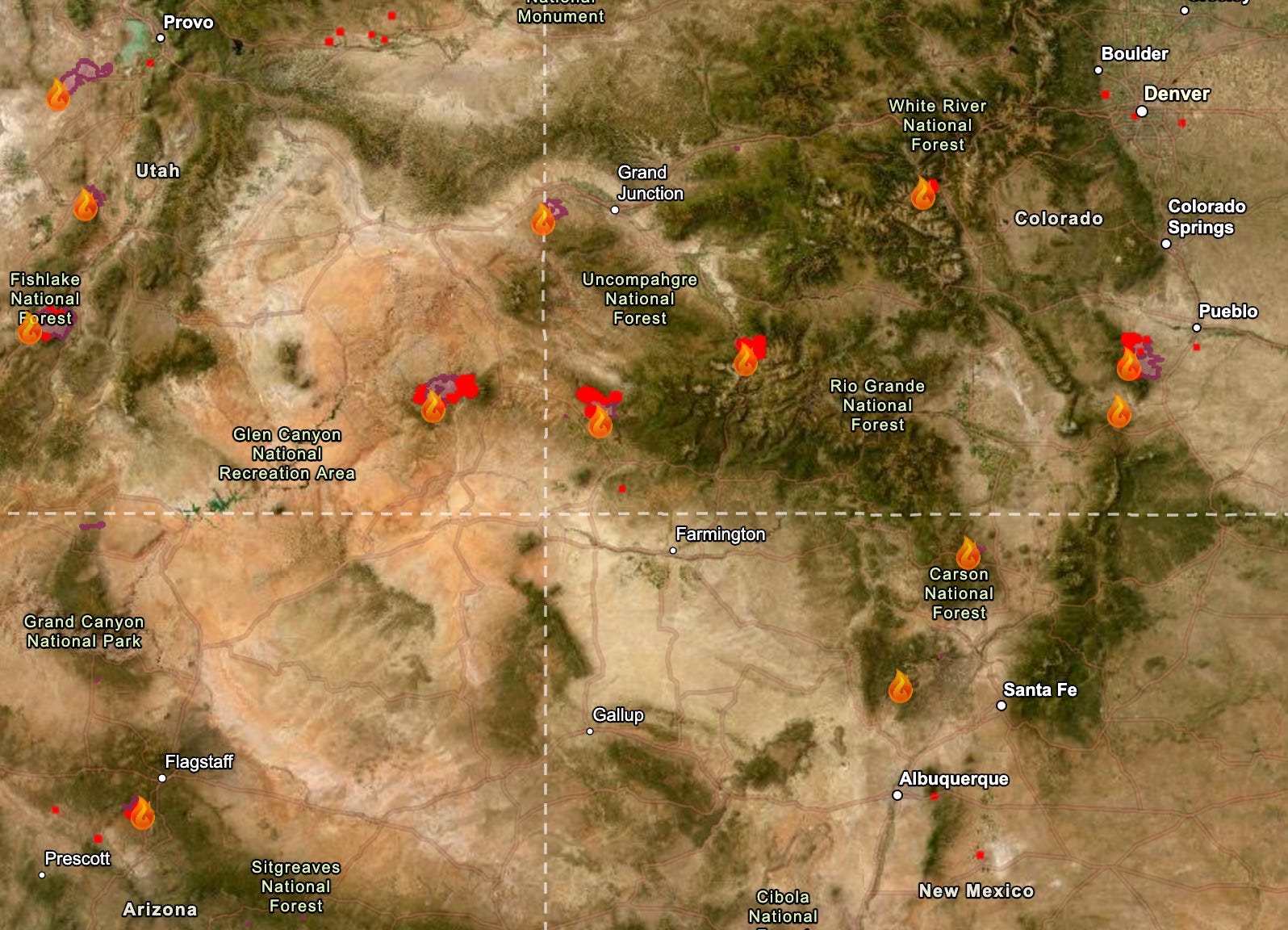
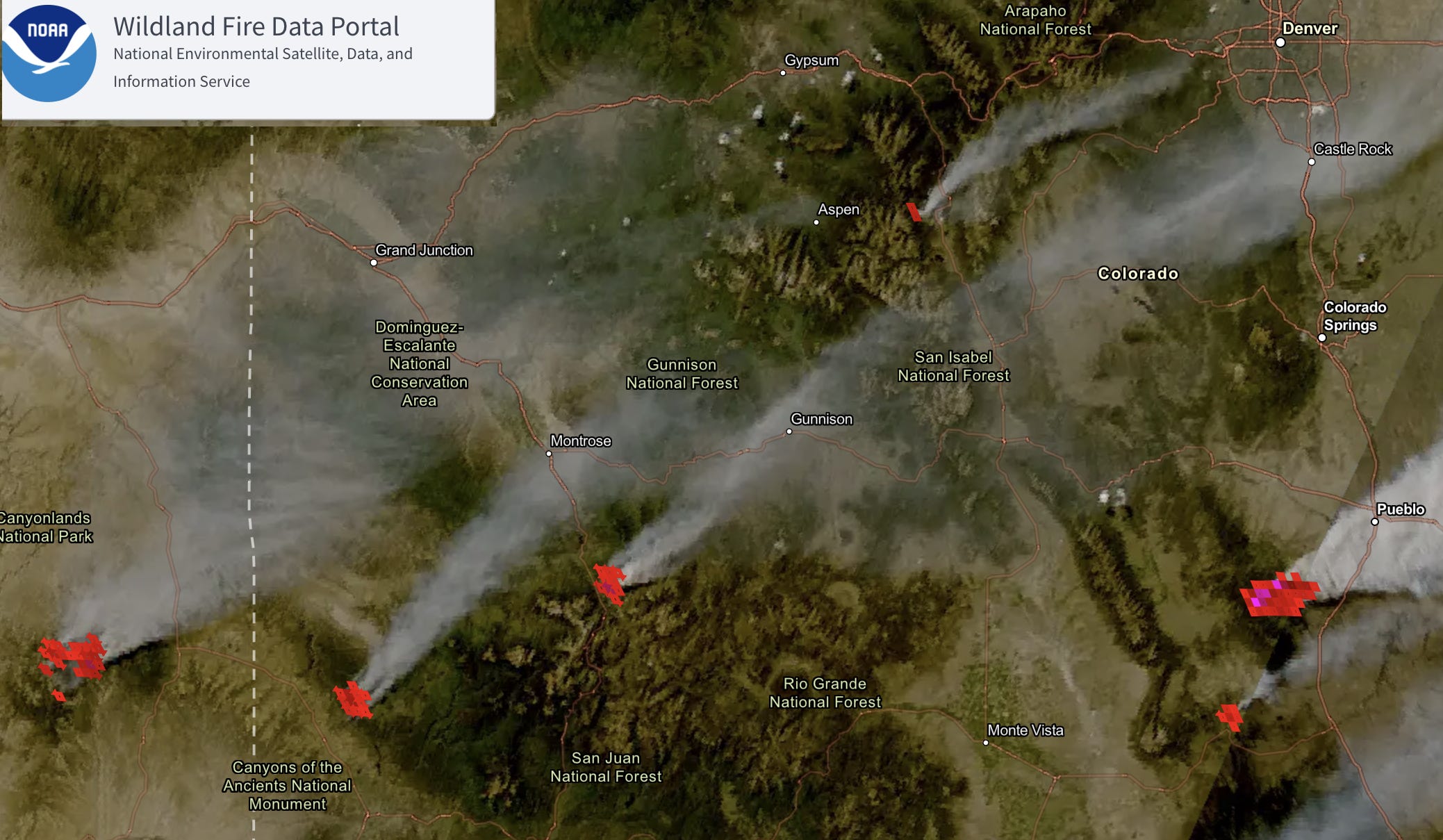
The fire situation in the Four Corners area is not improving. The weather remains hot, dry, and windy, and this week’s forecast calls for more of the same. Next week may even be hotter, if longer-range models hold. Meanwhile, air quality has deteriorated in some places that previously seemed to avoid the worst of the smoke. The good news is that the Fourth of July weekend came and went without any new major fire starts in the region.
So far this year some 37,209 fires have burned through about 3.3 million acres, according to the National Interagency Fire Center. That’s the second highest acreage for the first half of the year in the last decade.
Here’s a rundown of some of the Four Corners area fires. By no means is this a complete list.
The Babylon Fire, burning in the higher elevation parts of Bears Ears National Monument in southeastern Utah, had grown to over 96,000 acres by Monday night, making it the nation’s largest active blaze (the Cottonwood Fire in the western part of the state has gone through about the same amount of acreage, according to Watch Duty). The two are also tied for the fourth largest fires in the state’s recorded history. The Babylon Fire is at 0% containment, with the most active area moving up the west slope of the Abajo Mountains, between Shay Mountain and Mount Linnaeus. Air tankers are pulling water from Lake Powell, and officials are asking boaters to avoid the area between Dangling Rope and Rainbow Bridge.
Closed public lands include: The Needles District of Canyonlands National Park, Manti-La Sal National Forest lands within the Monticello Ranger District, and BLM lands in the Indian Creek Corridor, Beef Basin, Dark Canyon, and the Sweet Alice Wilderness Study Area. Still Open: Natural Bridges National Monument, Cedar Mesa, Grand Gulch, and other lower elevation areas in the southern reaches of Bears Ears National Monument.
The Ferris Fire along the Dolores-Montezuma County line in southwestern Colorado initially burned in a northeasterly direction toward the Disappointment Valley. Then the winds shifted and the most active front of the fire curved back to the northwest, crossing the Ponderosa Gorge of the Dolores River, and is within about 12 miles of the town of Dove Creek. As of Monday night the fire was at 51,622 acres and 22% containment.
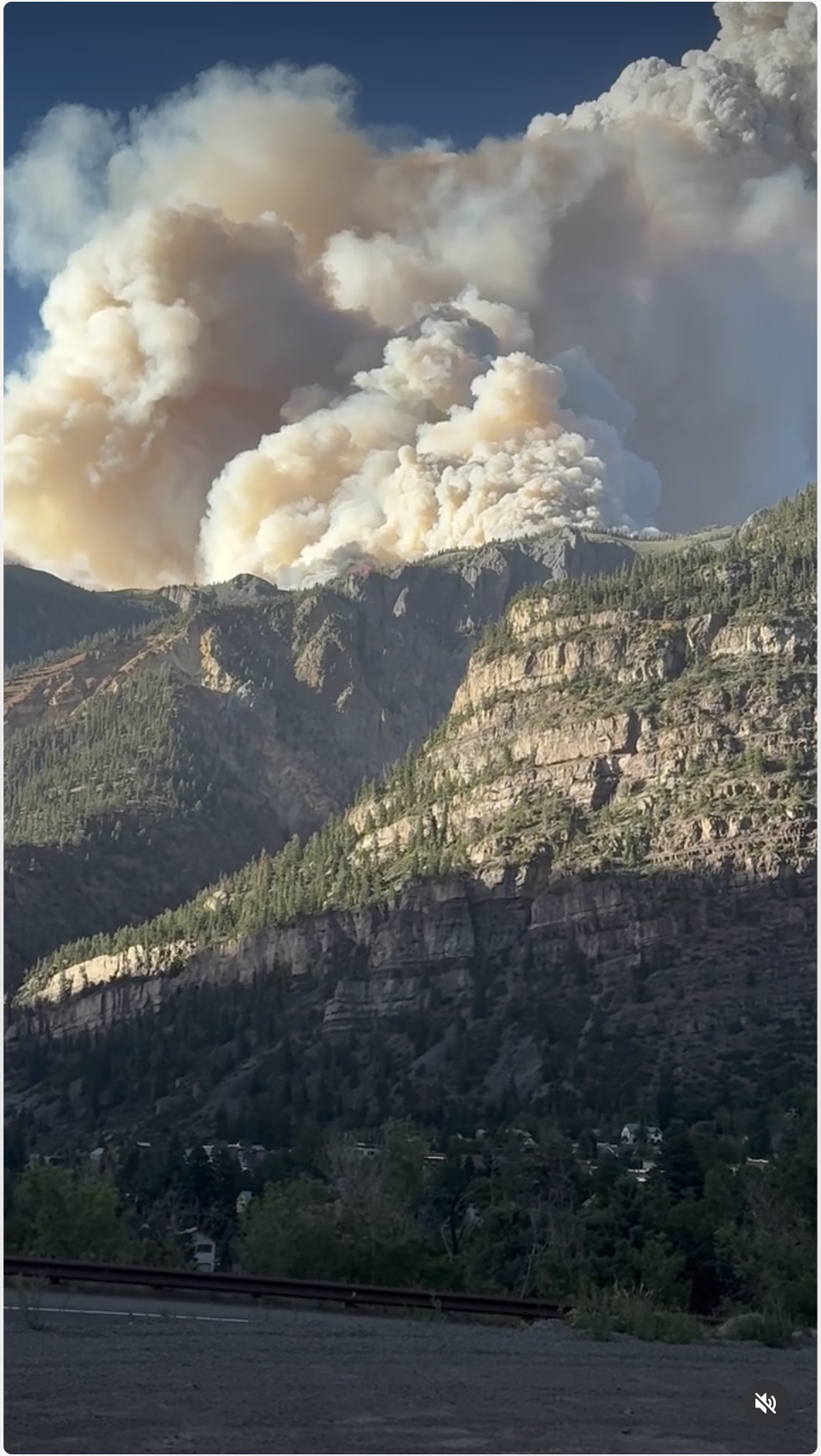
The Gold Mountain Fire north of Ouray, Colorado, has burned across almost 29,300 acres of San Juan Mountain high country and was 2% contained as of Monday night. Firefighters on Monday conducted strategic backfiring operationseast of Ridgway to provide more protection for structures in that area. There is a chance of thunderstorms this afternoon and evening, which could bring dry lightning along with gusty and erratic winds, with high temperatures reaching the high 80s and low 90s.
The Pocket Fire north of Sedona, Arizona, has reached 26,442 acres and was at 48% containment as of Monday night. Forecasters are predicting more hot and dry weather today, with the mercury topping out around 100° F and sub-20% relative humidity.
On July 6, the Arizona Department of Environmental Quality approved Energy Fuels’ request to amend its aquifer quality permit for a groundwater monitoring well at its Pinyon Plain Mine near the Grand Canyon. The change raises the allowable concentration of arsenic from .050 milligrams per liter to .055 milligrams per liter and the associated alert level from .040 to .050 mg/l.
The Havasupai Tribe strongly condemned the change in a written statement, calling the approval a “profound attack on the Tribe’s inherent responsibility to guard and protect the waters of the Grand Canyon.”
Energy Fuels asked for the revision — and ADEQ granted it — after finding that construction of the mine’s shaft had created a hydraulic sink that allowed naturally occurring arsenic — a known toxic substance — to move toward the facility’s perimeter wells, putting them in violation of their permit.
So, regulators simply altered the permit’s limits and, according to the tribal nation’s statement, “chosen to weaken environmental protections instead of strengthening them.”
Dr. Bradley K. Esser, a retired Lawrence Livermore Laboratory scientist, submitted technical comments on the proposed revision last year. He cast doubt on Energy Fuels’ hydraulic sink explanation, and demonstrated that the arsenic concentrations detected in the monitoring wells are far higher than regional natural background levels. He posited that it was far more likely the elevated arsenic concentrations came from sump water from the mine’s workings contaminating the groundwater.
Uranium, arsenic, and lead concentrations shot up in the Pinyon Plain Mine’s “sump water,” or groundwater that had flowed into the mine shaft, after active mining began in 2023. While an independent scientist acknowledges that it’s possible elevated arsenic levels in perimeter monitoring wells are the result of a mining-related hydraulic sink pulling naturally occurring arsenic to the wells, he posited that it’s more likely that sump water made its way into the groundwater in the wells. Source: Grand Canyon Trust.
Esser also writes:
🥵 Aridification Watch 🐫
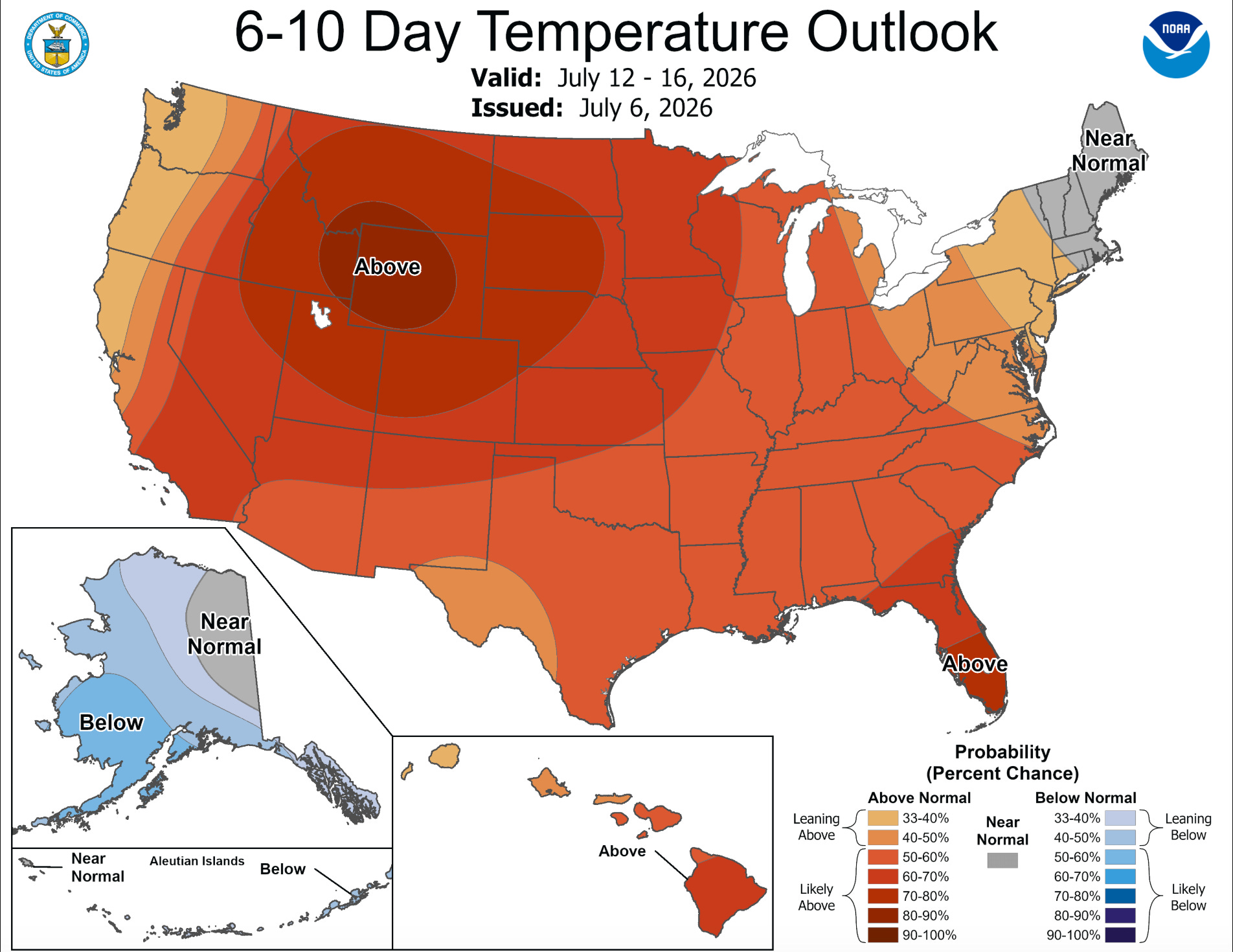
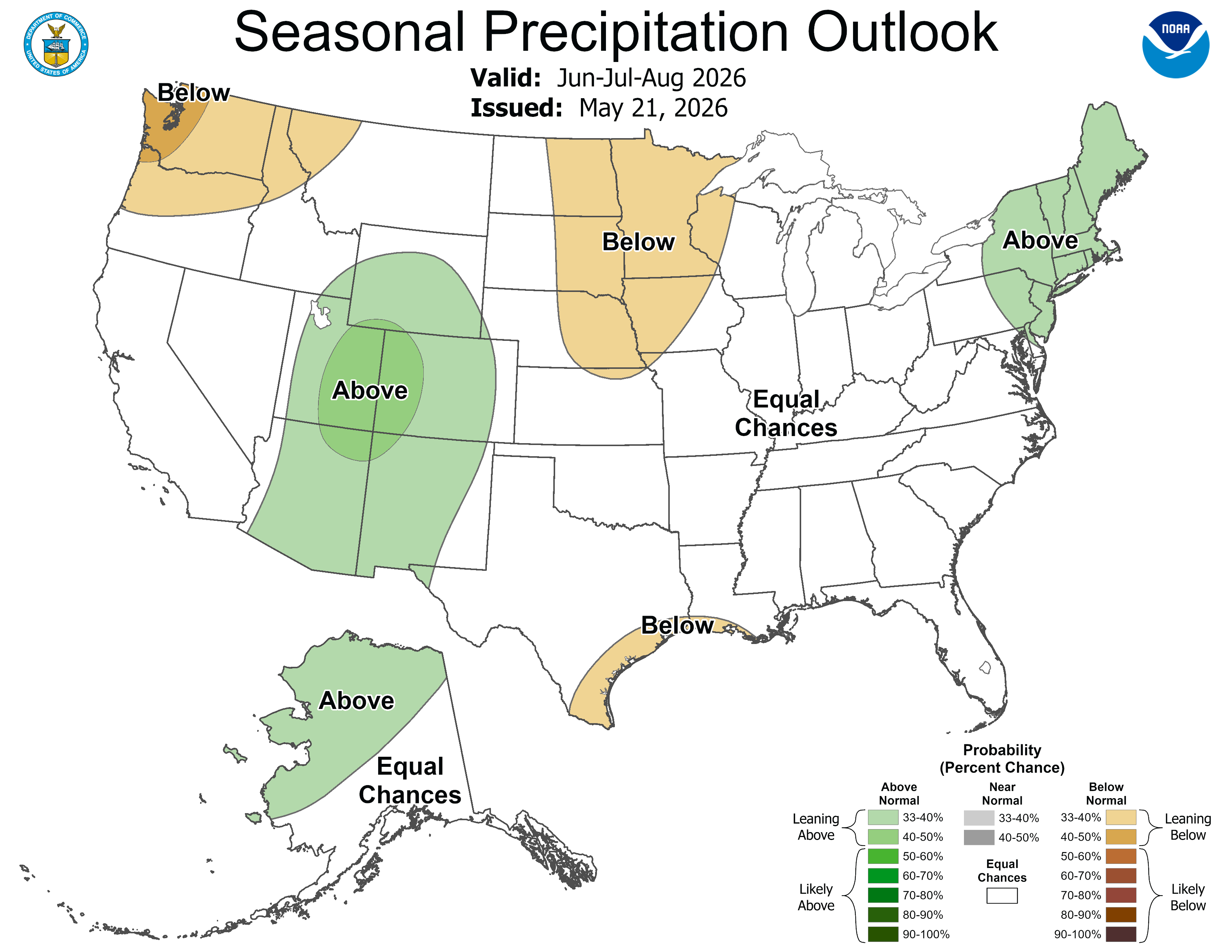
Monsoon season officially kicked off in the Southwest in the middle of last month, but it has yet to bring significant amounts of moisture. Earlier forecasts predicting higher than average precipitation beginning later this month are still in place for some parts of the West, but they likely will be accompanied by above-normal temperatures just about everywhere.
Next week isn’t looking so hot for fire-dousing moisture in the Southwest, but after that the chances of above-normal precipitation start climbing.
Smoky skies and three-digit heat? Ick.
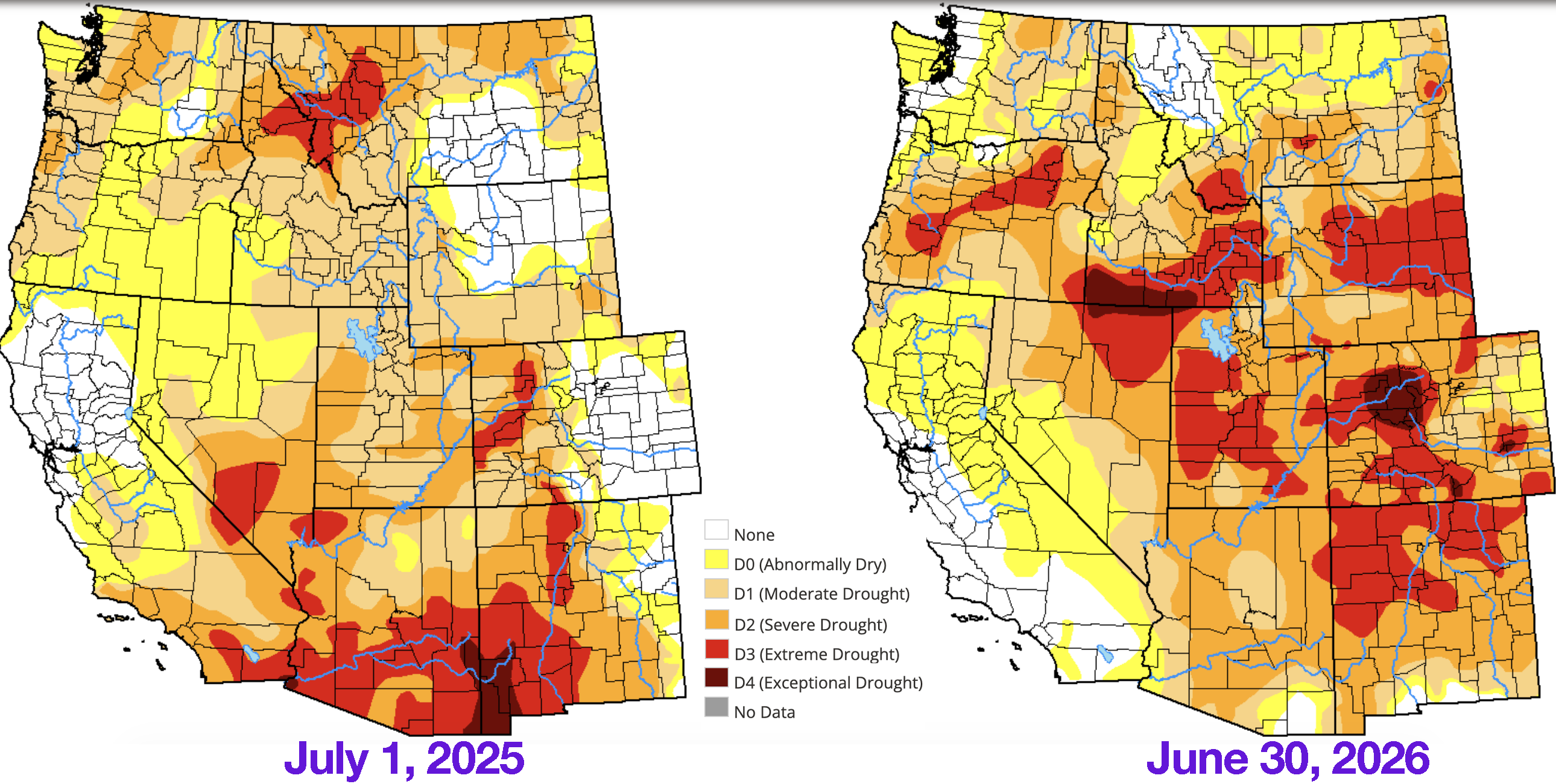
The drought situation has grown worse over the last year in most of the Interior West, though there has been improvement in the deep Southwest. Source: U.S. Drought Monitor.
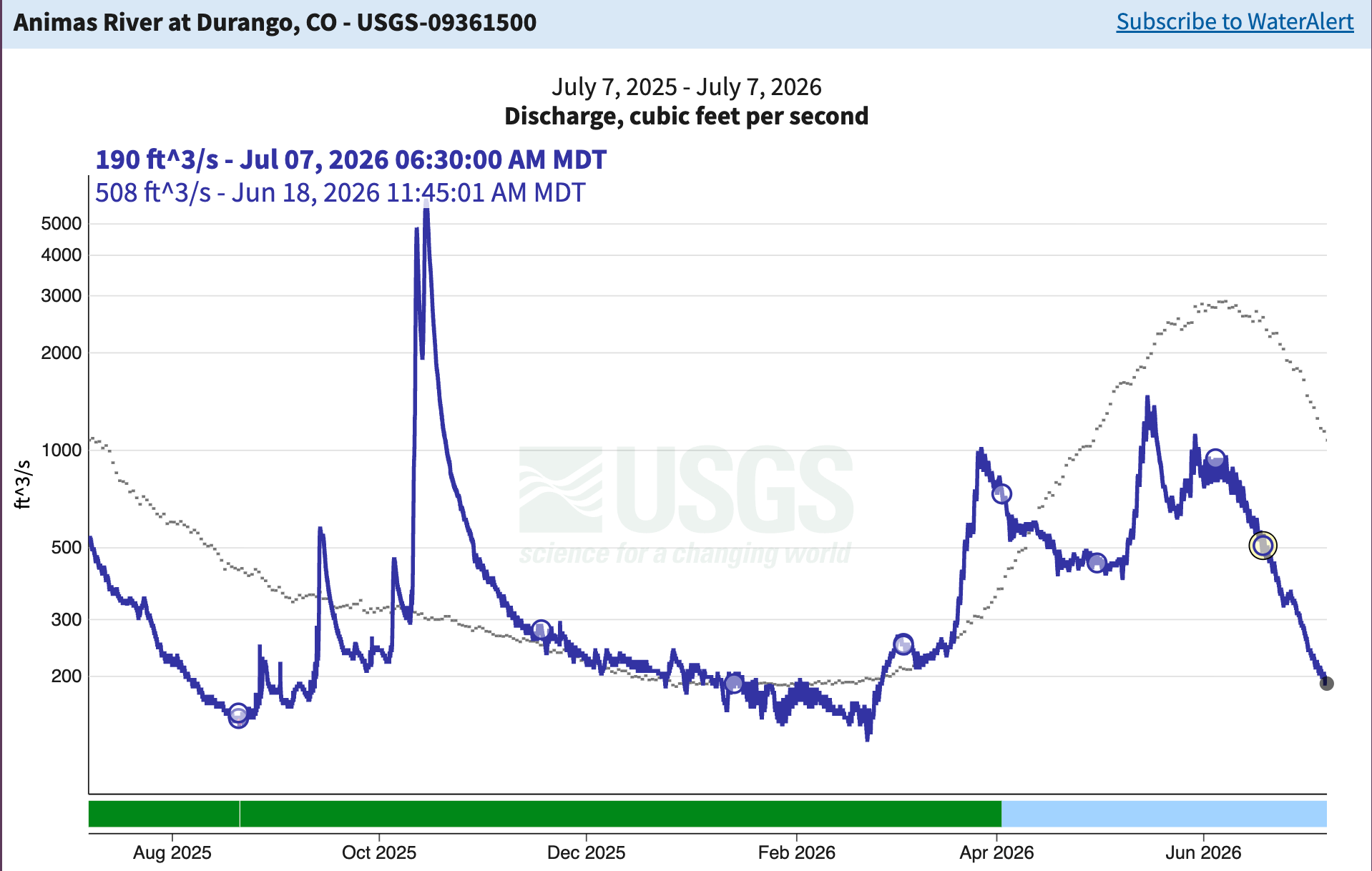
‘As you might expect, the hot, dry weather is taking a toll on streams around the region. The Animas River through Durango is running at 190 cubic feet per-second; the median flow for this date is over 1,000 cfs.
📸 Parting Shot 🎞️
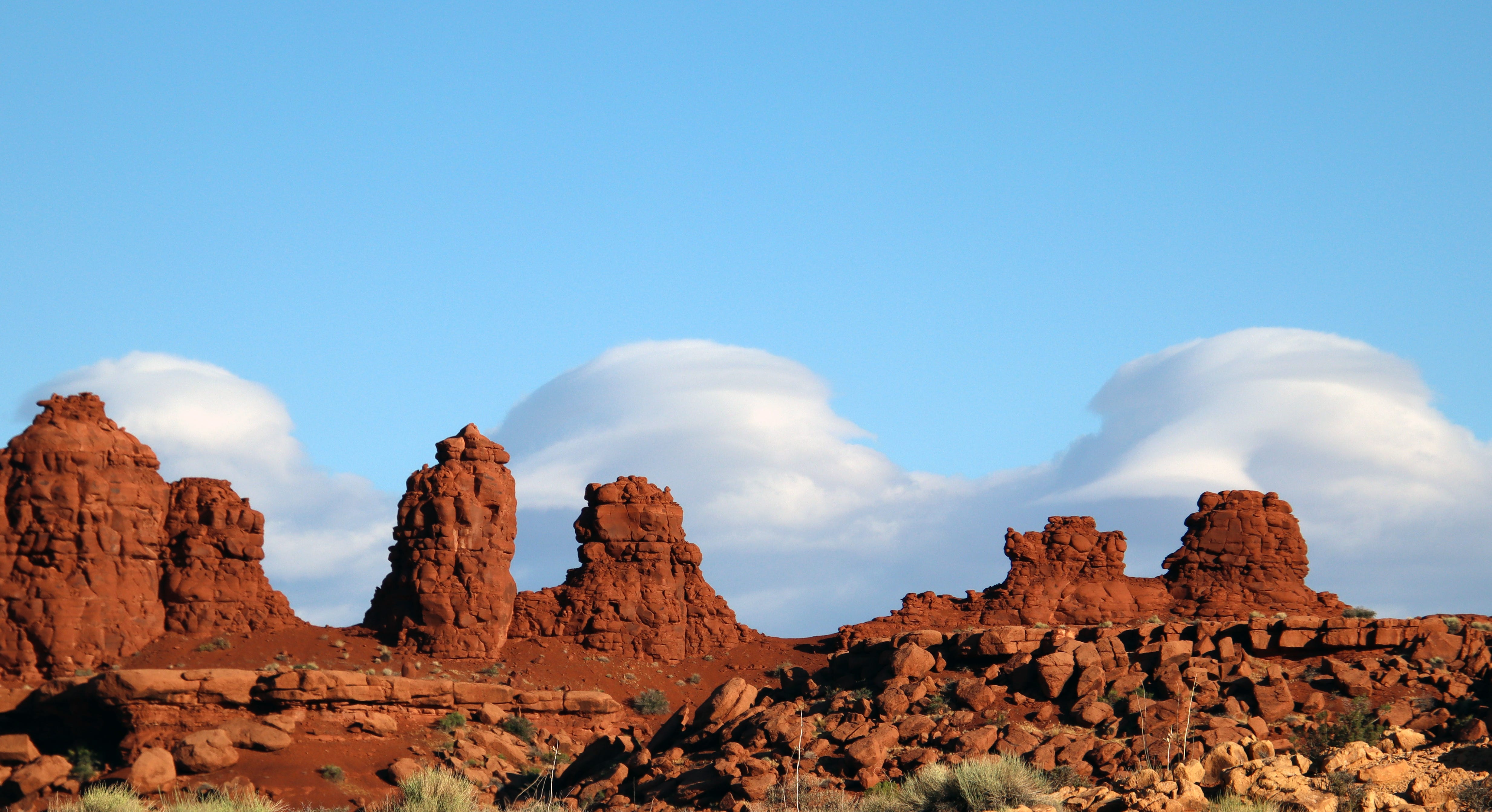
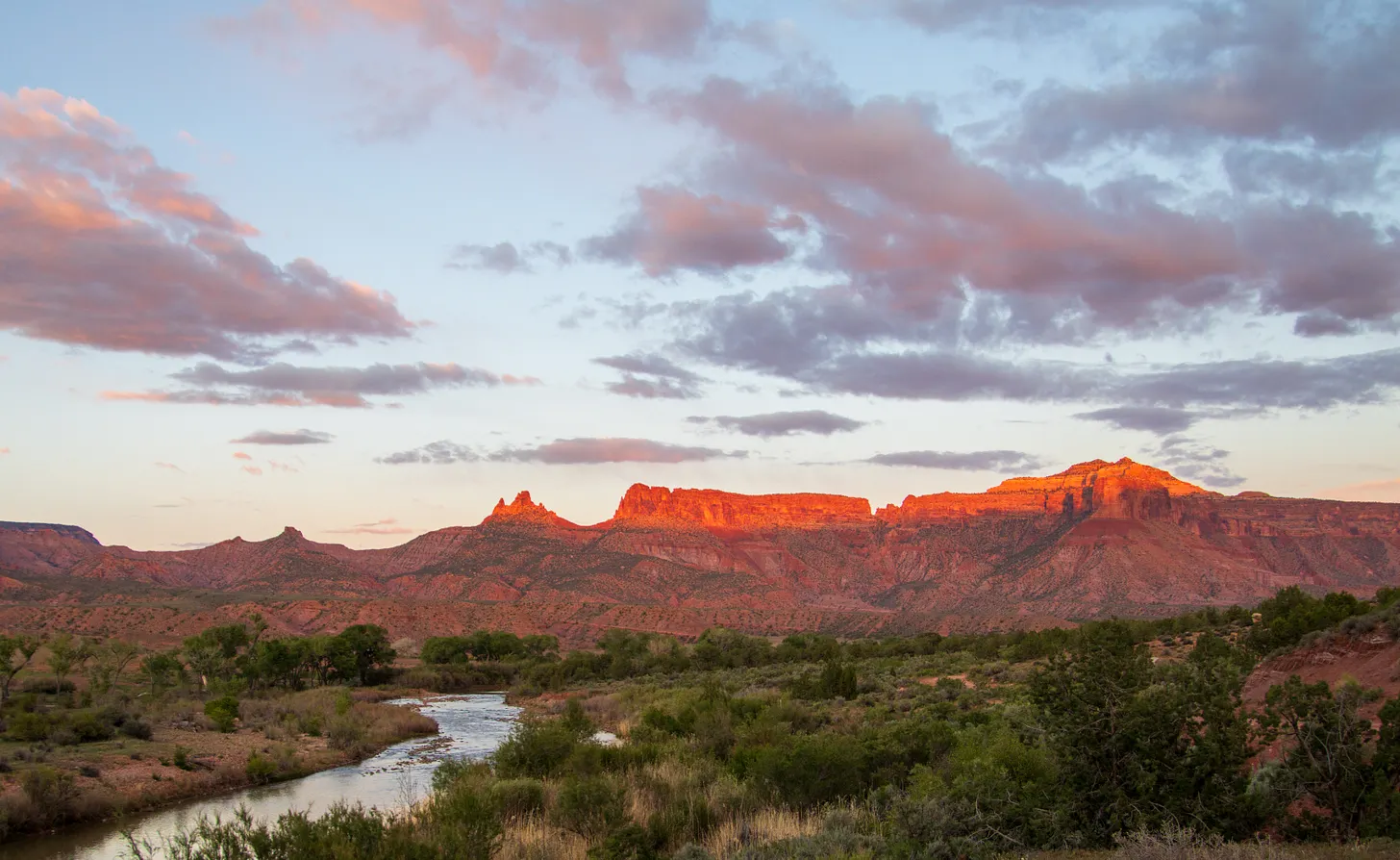
Red rocks and crazy clouds in Utah before fire season had arrived and sullied up the skies. Jonathan P. Thompson photo.
Three federal firefighters were killed and two seriously injured when the Knowles and Gore fires overtook them southwest of Grand Junction near the Utah-Colorado line. The fires joined with others to become the Snyder Fire, which had grown to 30,000 acres as of Monday.
The fatalities were the tragic result of what has become a downright terrifying wildfire situation in the Interior West, with more than a dozen 1,000-acre-plus blazes tearing through forests in Utah, Colorado, Arizona, and New Mexico during the last days of June. Without substantial and soaking rainfall soon, it’s likely to get even worse.
The fury of these conflagrations is evident in their rapid rate of growth.
The Babylon Fire within Bears Ears National Monument, for example, was first reported on the afternoon of June 26 on Elk Ridge north of the Bears Ears Buttes. By the evening of June 29 it was mapped at over 48,000 acres and was spreading northward. The National Park Service closed the Needles District of Canyonlands National Park as a result and the Manti-La Sal National Forest shut down the entire Elk Ridge area.
Further east, in Colorado, the Ferris Fire was first reported late on June 27 just north of the Dolores River along the Dolores and Montezuma county line. It quickly tore through piñon and juniper, then scrub oak and ponderosa forest toward the Disappointment Valley, and had reached about 20,600 acres as of Monday night.
The Gold Mountain Fire, apparently ignited when a tree fell on a powerline, was first reported Saturday afternoon near the Bachelor Syracuse Mine Tour north of Ouray. By Monday night it was over 8,300 acres and had forced evacuations and the closure of Highway 550.
On the eastern side of the Divide the Aspen Acres Fire grew to 23,000 acres in less than 24 hours, driven through a parched landscape by 100-mile-per-hour winds, and was threatening the towns of Beulah and Rye. The Willow Fire in Lake County is at a relatively small 1,900 acres, but is perilously close to Leadville.
Many factors contribute to the intensity, size, and frequency of the fires, from decades of fire suppression, to human encroachment in forests, to flammable noxious weed infestations. But the biggest driver of this regional calamity is clearly the hot, dry weather, which has been exacerbated by human-caused climate change.
Winter was an utter dud as far as the snowpack was concerned, in large part because of the unusually high temperatures. The hot, dry weather continued into the spring — with July-like temps at the end of March — sucking moisture from the soil and vegetation, and pushing huge swaths of the Interior West into severe to extreme drought conditions. Throw in gusty wind and a June heat wave — nearly 1,000 daily high temperature records were tied or broken in the West this month — and you’ve got a recipe for disaster.
There have been hot and dry years in the past, along with catastrophic wildfires: In 1879 the Lime Creek Burn charred 26,000 high-country acres south of Silverton, burning through what later became known as the “asbestos forest” due to its apparent blaze-resistance.
Back then, however, 1879-like dry and warm years were anomalous, as were mega fires. The Lime Creek Burn stood as the state’s largest blaze until 2002; now it’s not even in the top 20 for acreage burned. This year, while relatively extreme, is no outlier. The West’s temperatures have been trending upward since reliable record-keeping began some 130 years ago, and the Southwest is suffering through year 26 of an ongoing megadrought, the most severe in at least 1,200 years.
Nor is the phenomenon isolated to the arid West. A heat dome is on its way to the Midwest and East Coast. And a record-breaking heat wave has gripped much of western Europe. France has recorded over 1,000 heat-related fatalities in recent days, and was forced to shut down nuclear reactors because the rivers from which they pull their cooling waters are too warm (and the discharged water is even warmer, threatening river ecosystems).
So it’s utterly surreal to, on the one hand, breathe in the blanket of smoke that’s settling into the West’s valleys, to observe new flame icons popping up on the Watch Duty map, and see satellite imagery smoke plumes stretch across the region, and on the other to hear U.S. Energy Secretary Chris Wright downplay the deaths in Europe. Unlike his boss, President Trump, Wright acknowledges that human-related greenhouse gas emissions are heating the planet, but he says it’s not a crisis and that its effects are “manageable.”
Wright’s disrespect for the victims, including the injured and killed firefighters in Colorado, is dumbfounding. And his willful ignorance of the science and reality on the ground in order to perpetuate Trump’s drill-baby-drill agenda and bolster oil company profits is simply sickening. The same goes for Trump’s Interior Secretary Doug Burgum. His department now oversees the nation’s wildland firefighting force. And yet he is also leading the charge to deregulate the oil and gas industry and allow them to spew more planet-warming methane in order to spur more oil and gas drilling on public lands — ultimately leading to more fossil fuel burning, carbon emissions, warmer global temperatures, and more severe fires.
It reminds me a little bit of the story of the California firefighter who admitted setting dozens of fires as a job-creation scheme, allowing him and his colleagues to earn overtime pay. The difference here is that Burgum is not only playing his dangerous game with the lives of the firefighters under his command, but also with the planet as a whole.
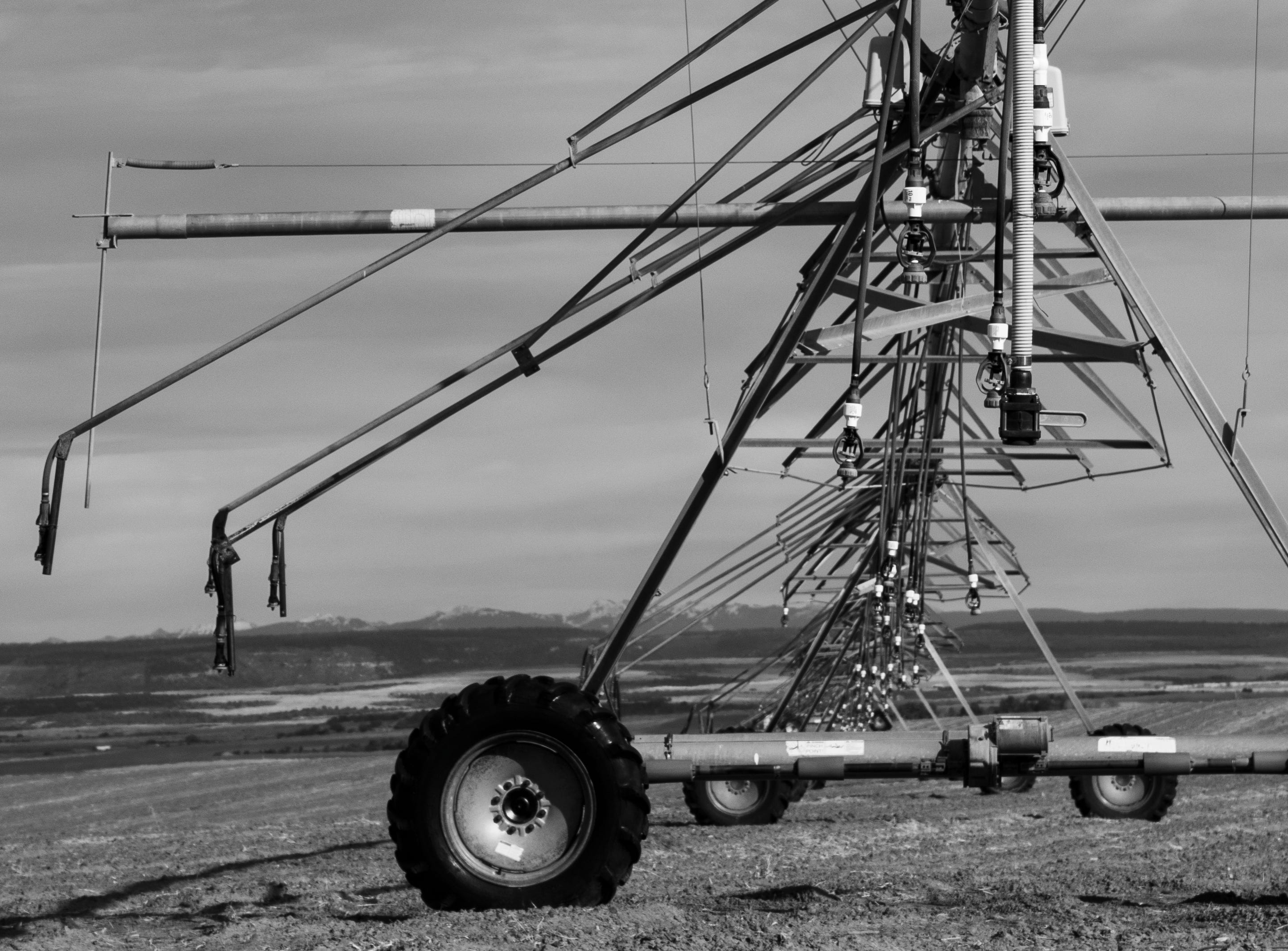
Sprinklers on the Great Sage Plain in southwestern Colorado. Jonathan P. Thompson photo.
One of the many things I’m interested in is the water-energy nexus: The way a coal plant requires vast amounts of water to make steam to turn turbines to generate electricity to run the pumps on the Central Arizona Project canals, for example. Now, with dry times in full-swing and electricity prices on the rise almost everywhere, the spotlight is on the water-energy-agriculture/food nexus.
In the arid West, most agriculture is of the irrigated kind. In many cases, this means relying on pumps to move the water across the land, to bring groundwater up from a well, and to pressurize sprinkler systems. And pumps require energy, in the form of electricity from the grid, from distributed solar or wind systems, or from diesel or gasoline motors or generators.
During a dry year like this one, farmers need to start irrigating earlier in the season, meaning their pumps run more often and consume more energy, which costs more money. That’s the situation Wyoming farmers and ranchers Tim Teichert and Jason Thornock are up against this year, according to a June 11 WyoFile report by Dustin Bleizeffer. These guys fork out up to $150,000 annually for electricity, the drought is pushing that bill higher, and now Rocky Mountain Power — a subsidiary of Berkshire Hathaway — is looking for a 37.7% rate increase on irrigators. Ouch.
Here’s where the nexus comes in: If the rate hike goes through, it will make it prohibitively expensive for other farmers to switch from flood irrigation to more efficient sprinkler systems. While this would seem to be the perfect opportunity for farmers to go solar, that’s not so easy in Wyoming, either. State law caps the size of solar arrays eligible for net metering, or the system by which the utility credits a customer for exporting excess power into the grid, at 25 kilowatts, which is far smaller than most farmers would need to power their pumps.
Down in Arizona the stakes are even higher, according to a study by Andrew Berry and Mikhail V. Chester published in 2017 in Environmental Research Letters. They highlighted the fact that in Arizona, most irrigation is powered by electricity.
The Central Arizona Project’s 15 pumping stations guzzle 2.8 gigawatt-hours of electricity annually to move water more than 300 miles from the Colorado River to the middle of the state, with a total vertical climb of about 3,000 feet. Then the farmers have to pump it from the canal to their fields and rely on pumps to power sprinkler systems. Arizona farmers that don’t rely on the canals use groundwater, which also requires pumping.
When temperatures go up or precipitation decreases, the farmers need more water, which means they also use more energy, putting more strain on the electrical grid. And even without all of those irrigation pumps churning away, heat stresses the grid in other ways, primarily because power demand surges in the afternoons, when everyone cranks up their air conditioners. Also, hot power lines are less efficient, wildfires can take out transmission lines and other electricity infrastructure, smoke diminishes solar output, and low streamflows can deplete hydropower generation.
All of this has the potential to take down the power grid, which would cause the irrigation and water-movement systems to shut down, which would affect crops and food supplies.
Over the last century and a half, especially in the years following World War II, the federal and state governments, utilities, and private interests have created huge networks for generating and moving power and for diverting, storing, and delivering water. Research and stories like the ones mentioned here just go to show how inextricably intertwined the two systems have become, how important they both are to Western communities, and how fragile they can be. Climate change — along with increasing demand — is raising the risk of a catastrophic, cascading failure in these systems, which would be calamitous for the entire region.
Last month, leaders from across Colorado’s Western Slope celebrated the release of $40 million in federal funding for the Shoshone Water Rights Preservation Project. At a time when Colorado is celebrating its 150th anniversary and our nation approaches its 250th birthday, this investment represents more than a funding milestone; it marks one of the most significant water preservation achievements our state has seen in generations. It also would not have happened without the determination of our congressional representative, Jeff Hurd, who made this project a priority and worked tirelessly to deliver results for the communities he serves. What Rep. Hurd understands is the same thing that has united more than 100 local, state, and federal elected officials and leaders in support of preserving these critical senior water rights: the future of the Western Slope is inseparable from the future of the Shoshone water rights. Protecting these rights protects the flows of the Colorado River, sustains our agricultural heritage, strengthens our recreation- and tourism-based economies, and helps preserve the rural communities that make this part of Colorado unique…
I believe that 150 years from now, our grandchildren’s grandchildren will look back on the Shoshone Water Rights project as a turning point. They will see a generation of leaders who understood what was at stake and chose to act. They will see communities that put aside differences, came together, and made a long-term investment in the future of the Colorado River. History will remember the Shoshone project as a major milestone in the stewardship of our most precious resources. From Western Slope ditch companies and water conservancy districts to local governments, state leaders, and members of Congress, countless individuals are still working together to turn this vision into reality. The lesson is an important one. On the Western Slope, progress happens when we pull in the same direction. It takes communities working in harness together to move mountains and sometimes to move water. And it takes elected leaders like Jeff Hurd who are willing to put their shoulders into that work. The Shoshone project demonstrates what is possible when rural Colorado speaks with one voice about protecting its water, its economy, and its future.
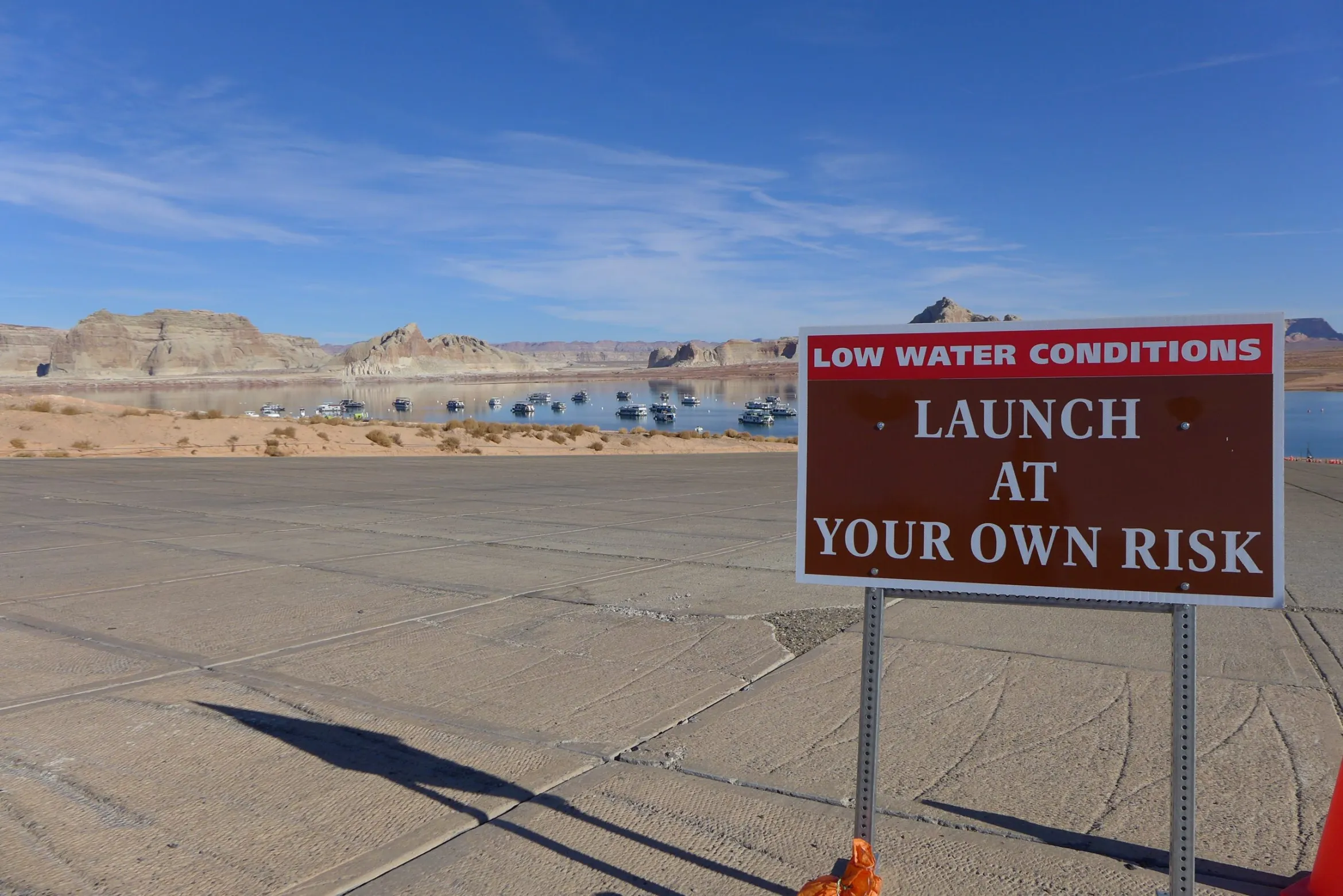
The main boat ramp at Wahweap Marina was unusable due to low water levels in Lake Powell in December 2021. Water levels are projected to soon fall even lower than this at the nation’s second-largest reservoir. CREDIT: HEATHER SACKETT/ASPEN JOURNALISM
Western Slope lawmakers had harsh words for water managers at a state committee hearing last week, questioning whether Colorado has done enough to avoid a lawsuit with its downstream neighbors.
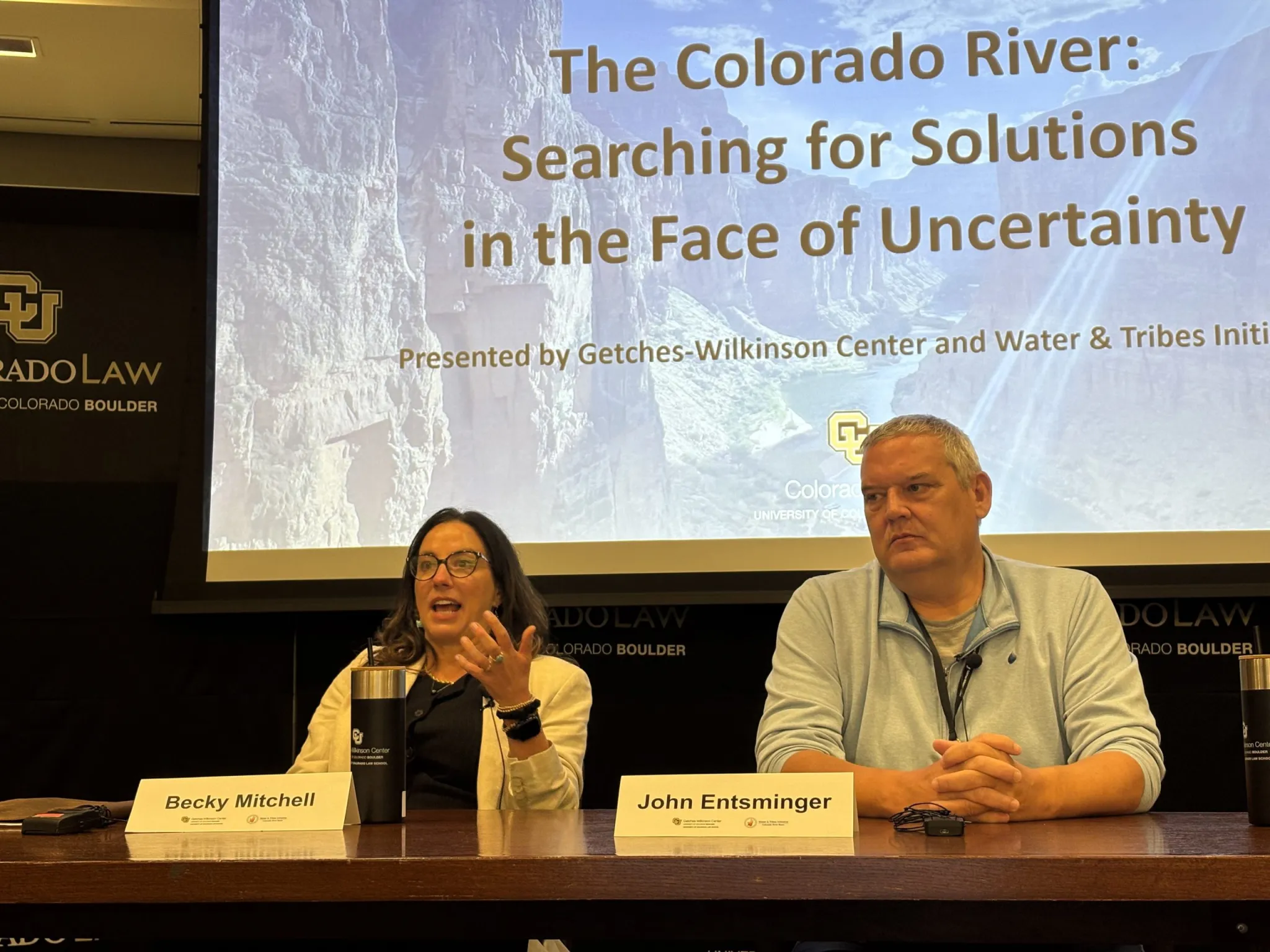
Colorado Sen. Dylan Roberts, a District 8 Democrat who represents several Western Slope counties, including Eagle, Grand, Garfield, Routt and Summit, asked Colorado’s lead negotiator, Becky Mitchell, whether the people of Colorado should have confidence that negotiations among the seven states that share the Colorado River have put the state in the best possible position. The states have been at an impasse for more than two years without a deal for future management as reservoirs continue to decline to record-low levels.
“My constituents just see fighting and intransigence,” Roberts said. “And it’s concerning to me, especially as a Western Slope lawmaker … that the strategy is just ‘Let’s hire more lawyers; we’re going to court no matter what.’ That doesn’t give me confidence, because I don’t think Colorado fares well when we go to court against Arizona and California and Nevada, throwing our fate to the nine justices on the U.S. Supreme Court.”
The remarks came at Thursday’s meeting of the state Water Resources and Agriculture Review Committee in Denver. Along with Mitchell, in the hot seat were state engineer Jason Ullmann and Amy Ostdiek, interstate section chief at the Colorado Water Conservation Board. The three are employees of the state Department of Natural Resources and have the backing of the Attorney General’s office in negotiations.
Roberts’ line of questioning seemed prompted by recent projections that show river flows dipping below a threshold that could trigger litigation. The Lower Basin states (Arizona, California and Nevada) believe that the Upper Basin states (Colorado, New Mexico, Utah and Wyoming) are bound by the 1922 Colorado River Compact to deliver 82.5 million acre-feet of water over a 10-year rolling average. According to the Upper Colorado River Commission, the 10-year average will dip later this year to about 81.3 million acre-feet because of persistent drought.
Some experts believe that this amounts to a “tripwire” that could trigger a lawsuit from the Lower Basin states (Arizona, in particular, has been openly preparing for litigation) that could result in mandatory cuts in water use for the Upper Basin. Upper Basin water managers don’t subscribe to this interpretation, saying their states are only required not to deplete the river’s flows by more than 75 million acre-feet over 10 years.
Mitchell was reluctant to share details of Colorado’s legal strategy in a public forum, but she answered “absolutely” that her team’s work was putting Colorado in the best position. She said cutting back prematurely just to satisfy the Lower Basin’s interpretation of the century-old agreement would be bad for the state.
“If we initiate curtailment now, that is worse for Coloradans,” Mitchell said. “I think that is an important thing to remember.”
Wracked by drought, climate change and a management crisis, the situation on the river has never been more dire. The current management guidelines expire this year, and in the absence of a seven-state deal to share shortages and operate the nation’s two largest reservoirs, Lake Powell and Lake Mead, the feds are poised to step in. The U.S. Bureau of Reclamation plans to release a more detailed, short-term plan to manage the river for the next two years by mid-to-late summer.
State Rep. Julie McCluskie, a District 13 Democrat, said communities in her district have been living with the incredible angst, anxiety and pain of no snow and low reservoirs.
“The frustration I hear in my community is that we have missed multiple deadlines; they are becoming a funny joke,” McCluskie said. “There is such a fear about the lengthy litigation process, the fear of an outcome that is far worse for Colorado than a compromise that we have some control over.”
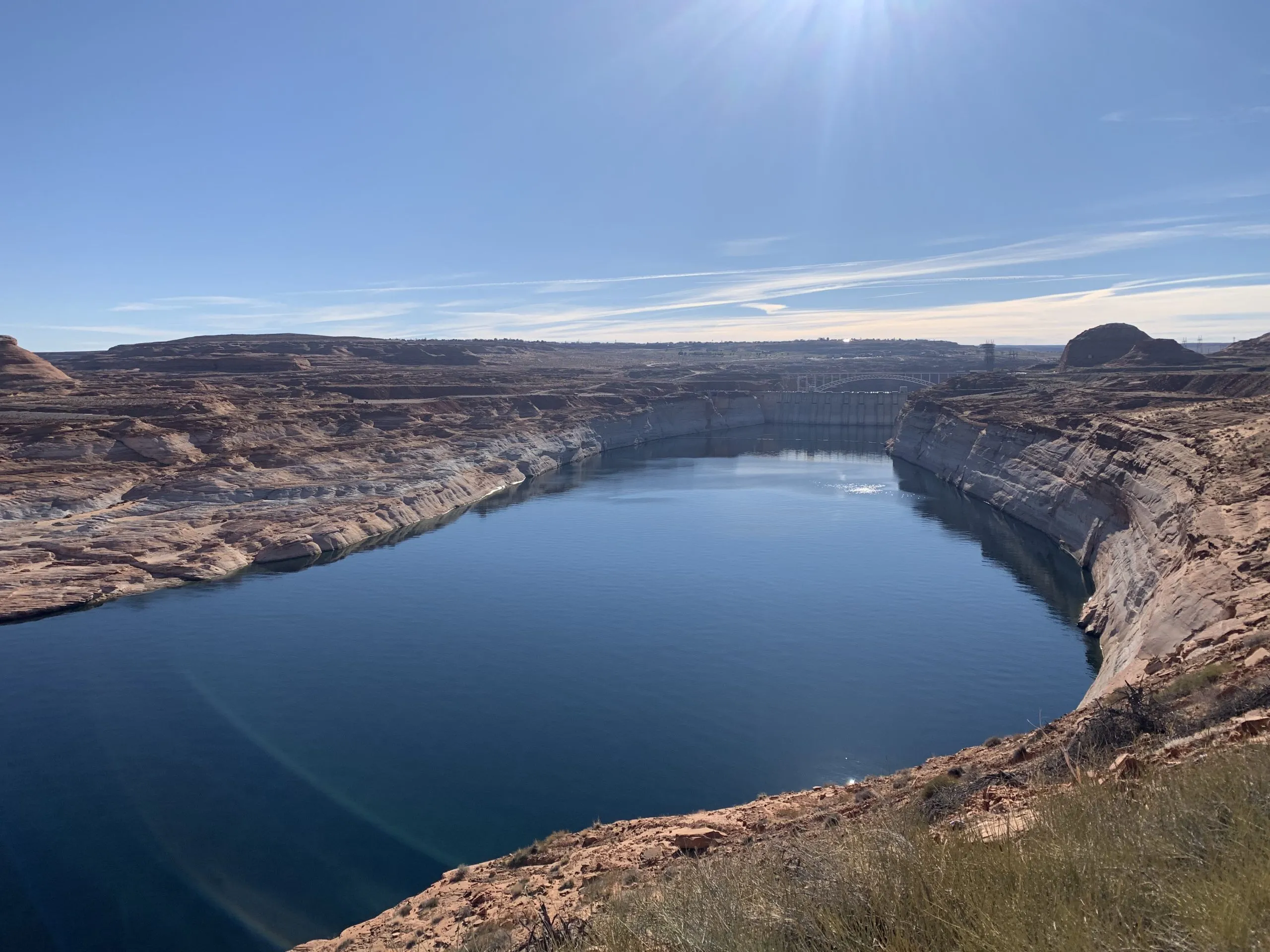
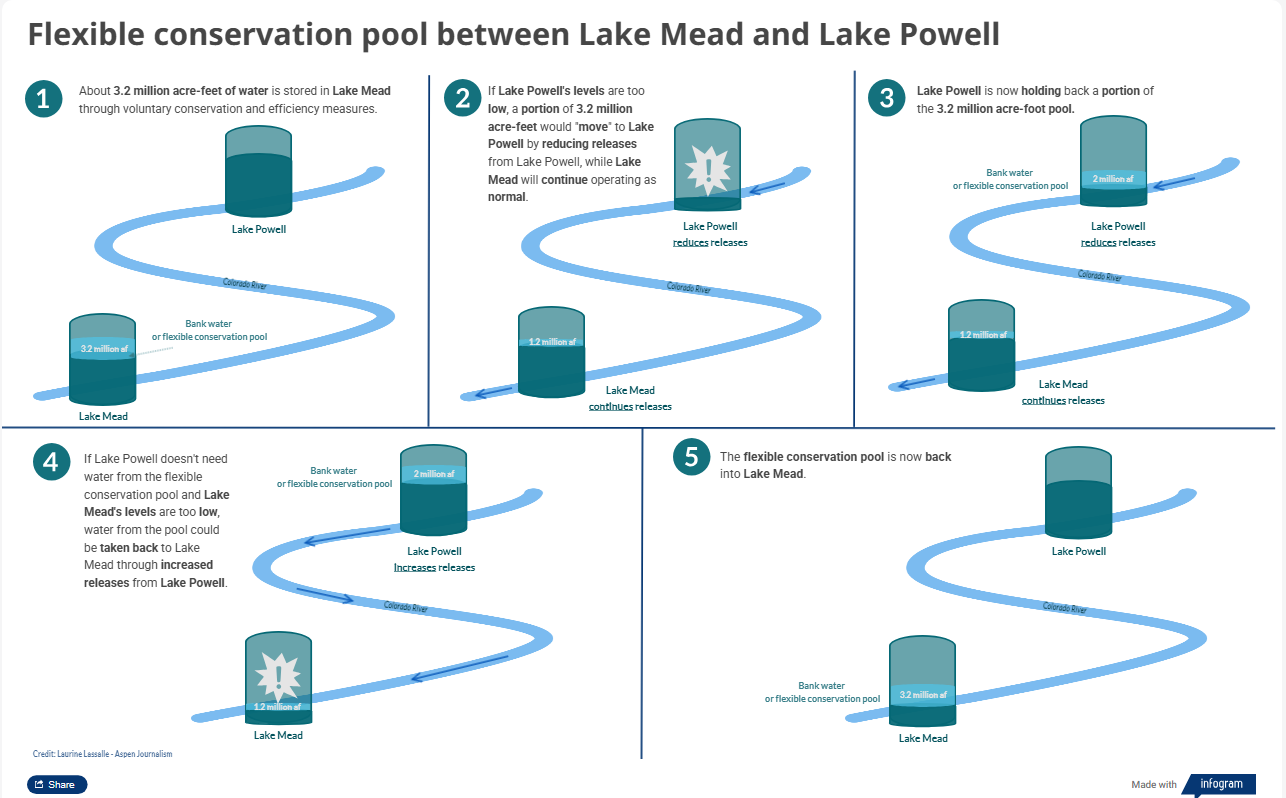
Lake Powell is formed by Glen Canyon Dam. In a concept pitched by a conservation organization, a flexible pool of water could be moved between Upper Basin reservoirs to wherever it’s needed most. CREDIT: HEATHER SACKETT/ASPEN JOURNALISM
Conservation conversation is the ‘bare minimum’
Lawmakers also had strong words for state officials regarding conservation, saying legislators must be involved in the creation of any program.
Colorado has dabbled with pilot conservation programs in the past, but traditional programs that pay farmers and ranchers to temporarily cut back on water use remain controversial. This is especially true on the Western Slope, which has long been the target for these types of programs, and where some worry that they could harm rural communities if not done carefully. After two years of exploring how the state could set up a temporary, voluntary and compensated conservation program, officials shelved the idea in favor of focusing on drought-resilience initiatives.
“Other states out of the seven have very clear and actionable roles for their general assemblies, their legislatures,” McCluskie said. “We have less so, and yet the stakes are so high. So I beg of you, decision-makers, that it is essential that we be a part of those next steps.”
Julie McCluskie. Photo credit: Colorado General Assembly
Ostdiek said that any program would need to start slow and make sure it incorporates input from people throughout the state.
“I think that we can continue to assess as we go what we might need from you all, and what a program like that might look like,” Ostdiek said. “I think what we can certainly commit to is continuing this dialogue and continuing the discussion about what we might need to make this a success.”
In 2023, Colorado lawmakers tried to force stakeholders to come up with recommendations on conservation programs by creating a statewide task force, which met 10 times over six months. But the group failed to find a consensus, with some saying it was “premature” to create a conservation program.
As part of a post-2026 framework, the Upper Basin states plan to create a “contribution” pool in Lake Powell, which could be used to help stabilize the system, keeping water levels above critical thresholds to protect hydropower at Glen Canyon Dam and acting as an insurance pool against forced cutbacks. In a May 22 letter to federal officials, the Upper Basin states said they have a goal of saving 100,000 acre-feet by the end of water year 2028, but only if sufficient federal funding is available and hydrologic conditions allow.
Three Upper Basin states have different methods for contributing to this pool: Utah has its own demand management program; Wyoming lawmakers passed a law this year allowing for a conservation program; and New Mexico plans to release water from Navajo Reservoir.
But precisely how — and how much — Colorado would contribute to this pool is unclear. The state’s share of the Upper Basin’s allocation is 51.75%, meaning Colorado could be on the hook for 51,750 acre-feet.
And ensuring that saved water actually gets into a pool in Lake Powell remains part of the problem. Currently, conserved water that stays in the river can just be picked up by a downstream user, with no net gain to Lake Powell. Colorado officials say they do not have the authority to “shepherd” water past other water users to the state line unless it is specifically for compact compliance. [ed. emphasis mine]
Last year, some Delta County ranchers asked lawmakers to take up the issue and pass a law that would address this issue, allowing water users to conserve and get credit for contributing water to a Lake Powell pool. But legislators did not take up a bill in the 2026 session.
Colorado officials told lawmakers they were continuing to explore what a program might look like and whether legislation would be needed.
Roberts said conversations with the legislature should be the bare minimum if Colorado is going to have a conservation program.
“If the department or any agency of the state were to pursue a conserved consumptive use program or demand management program that used state tax dollars to pay for it and did not go through the legislature in a formal process, I imagine that all of us on this panel and many of our colleagues would raise holy hell about the unilateral decision-making coming from Denver about programs impacting all parts of the state,” Roberts said. “So, please, let’s just cut that off at my recommendation. Let’s work together on this.”
Officials opened the hearing by highlighting the impacts of this year’s severe drought on Colorado’s farmers and ranchers, noting how even some of the most senior water users will experience shortages as streamflows dwindle. Orchards in the North Fork Valley and row crops in the Uncompahgre River Valley already have unprecedented shortages.
In response to Roberts’ concerns about the failure to find a compromise among the seven states, Mitchell posed a high-stakes rhetorical question: “I would ask, ‘What else do you think we can give?’”
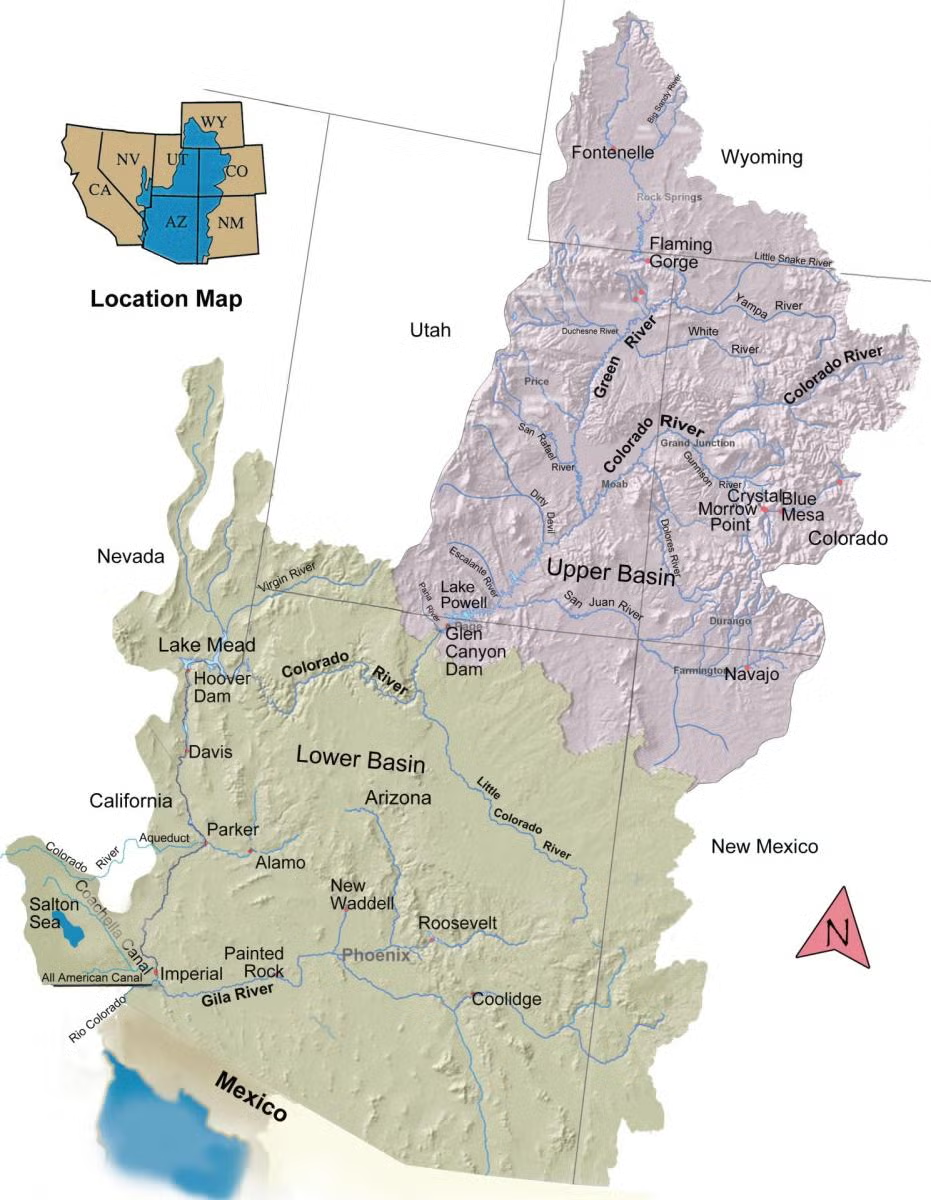
The Colorado River Basin spans seven U.S. states and is divided into Upper and Lower Basins. Lake Powell, upstream from the Grand Canyon, and Lake Mead, near Las Vegas, are the two principal reservoirs in the Colorado River water-supply system. (Bureau of Reclamation)
While the Trump administration 2.0 has so far rexfrained from trying to shrink or eliminate national monuments, its non-executive-branch proxies just keep on trying.This week the 10th Circuit federal appeals court issued a decision keeping alive Utah’s lawsuit challenging Joe Biden’s 2021 re-establishment of Grand Staircase-Escalante and Bears Ears national monuments following Trump 1.0’s shrinkage of the same.
The state and Garfield and Kane counties filed one lawsuit in 2022, with the Blue Ribbon Coalition and other parties filing their own suit. In 2023, a federal court dismissed both lawsuits; that ruling was appealed.
This week’s decision confirmed the dismissal of the Blue Ribbon suit. But it also determined that presidential national monument designations under the Antiquities Act are subject to federal judicial review, and sent Utah’s case back to the district court.
***
Photo credit: Jonathan P. Thompson/The Land Desk
The Bureau of Land Management is moving forward with three travel management plans in Utah that will determine which roads, trails, and areas of the respective field offices’ jurisdiction are open to motorized vehicles. Given that the stated aim is to bring the plans in line with Trump’s recent executive order rescinding restrictions on motorized vehicles on public lands, we can assume that the idea here is to expand motorized access to some remote areas. The plans include:
The Moab Field Office has released preliminary alternatives for the Dolores River Travel Management Plan on about 127,000 acres in Grand County, Utah, east of Moab and abutting the Colorado border. This would include roads along the Utah section of the Lower Dolores River, and on mesas and in canyons on either side of it. Maps of the alternatives can be found here. This one is not yet open to public comment.
The Kanab Field Office has released a draft environmental assessment for its Trail Canyon Travel Management Plan on nearly 330,000 acres in Kane County. It is open to public input.
And the Vernal Field Office has also released a draft review for the Dinosaur North Travel Management Plan. The public comment period is open.
***
I typically stay away from electoral politics, especially the horse-race part of it and polls and such. But sometimes a particular contest or candidate can provide a lens on bigger trends or phenomena, and so are worth looking into.
The latest race that has caught my interest is the one to replace Sen. Cynthia Lummis, the Wyoming Republican who is retiring at the end of this term. Since it’s Wyoming in 2026, it’s safe to assume the winner will be a Republican (though this wasn’t always the case), meaning the primary is the contest that matters. The front-runner, I suppose, is Rep. Harriet Hageman, the Trump sycophant and MAGA extremist who unseated Liz Cheney back in 2022 after Cheney failed to show adequate fealty to Trump.
But it’s one of her challengers that I’m interested in: Sam Mead. Mead is a fifth-generation Wyoming rancher, comes from a long line of Republican Wyoming politicians, and is the nephew of former governor Matt Mead. Mead is young (36), charismatic, has strong conservative credentials on fiscal issues and gun-rights, and a background in engineering and business, having run a whiskey distillery in Kirby. But what really distinguishes him from his opponents is his willingness to speak out against some of Trump’s policies, and his priority on protecting public lands and keeping them in the public’s hands.
Mead, in other words, appears to be an old-school, pre-MAGA Western Republican. He reminds me a bit of Wyoming Gov. Mark Gordon, back before extreme polarization pulled him more and more rightward and into MAGA land. Wyoming’s primary is on Aug. 18.
Meanwhile, Utah just held its primaries, with some surprising results. Utah State Senate President Stuart Adams, a Republican, was defeated by challenger Stephanie Hollist. Adams was a strong supporter of the controversial proposed Stratos Project data center complex on the north shore of the Great Salt Lake. Also, incumbent Rep. Celeste Maloy trounced challenger Phil Lyman in the GOP primary for the 3rd Congressional District, with about 70% of the vote.
While Maloy was endorsed by Trump, and has plenty of extreme views, Lyman is the more MAGA of the two. And Trump pardoned Lyman after his conviction for leading an OHV rally down Recapture Canyon in the southeastern part of the state. Political consultant Taylor Morgan told the Utah News Dispatch that Lyman’s resounding defeat showed that his “very angry, very conspiracy-based, populist, toxic form of Republicanism (is) frankly wearing very thin, especially here in Utah.” Let’s hope he’s right!
Pumpjack in the Aneth oil field. Jonathan P. Thompson photo.
I wrote Tuesday about how the Trump administration is eviscerating Biden-era oil and gas rules aimed at reducing methane emissions and ensuring companies clean up their own messes rather than foisting them onto the taxpayers. Now the changes are open for public comment.
Here are a few of the changes Trump and co. are proposing:
Bring back pre-Biden reclamation bond rates, which amount to just over $2,000 per well, which is insane, since the cost to reclaim and plug a single well easily can exceed $100,000. These numbers incentivized petroleum companies to walk away, forsake the bond, and abandon the well, leaving the tab for the taxpayers.
Reduce the current $10 minimum per-acre bid for leasing public land to $2, restore noncompetitive leasing, and slash royalties and filing fees for oil and gas companies.
Implement a new fee for protesting leases. And they plan to cut the 90-day public input period to just 10 days. In other words, they’re trying to cut out the public from decisions regarding public lands.
Gut the waste prevention rule (they wanted to roll it back altogether, but chose to revise it instead because it wasn’t clear which rule would replace it) by removing limits on royalty-free flaring and killing requirements that companies develop leak detection and repair plans.
Trump’s changes to the waste prevention rule will turn back the regulatory clock to the days when oil and gas operations on federal and tribal land vented and flared an average of 44.2 billion cubic feet annually of methane, which is usually accompanied by nasty volatile organic compounds and other dangerous compounds. That’s as bad for the climate as burning around 9 million tons of coal. But it also amounts to lighting money — your money — on fire and throwing it away. That vented methane is basically the same stuff you pay for to run your furnace, or to generate much of the electricity running through the grid. And since operators don’t pay royalties on gas they throw away, that cost American taxpayers some $166 million in lost revenue over a decade.
The result of all of this (and more) will be to rob taxpayers and sacrifice public lands and the climate to subsidize the same energy corporations that are raking in obscene profits thanks to Trump’s disastrous war on Iran. The administration argues that their proposed changes will save petroleum corporations operating on federal lands $17 million annually in compliance costs.
That sounds like a lot of money, until you realize that high oil prices have driven corporation’s profits to absurd highs. During the first quarter of 2026 alone, ExxonMobil raked in $8.8 billion in underlying, adjusted profits. Somehow, I don’t think several million in compliance costs is going to deter them from drilling.
🐟 Colorado River Chronicles 💧
Many of the West’s streams have entered their summer low-flow phase, a period that falls between the end of snowmelt and the beginning of the monsoon, while irrigation diversions are in full-swing. One of the most dramatic cases of this is, perhaps, the Colorado River itself as it flows through Grand Junction. This morning, the river was running at just 366 cubic feet per second near Palisade, which as reader Dave Grossman pointed out is low enough to allow someone to walk across the sprawling river bed.
Some other notably low flows:
Animas River in Farmington, NM: 104 cfs.
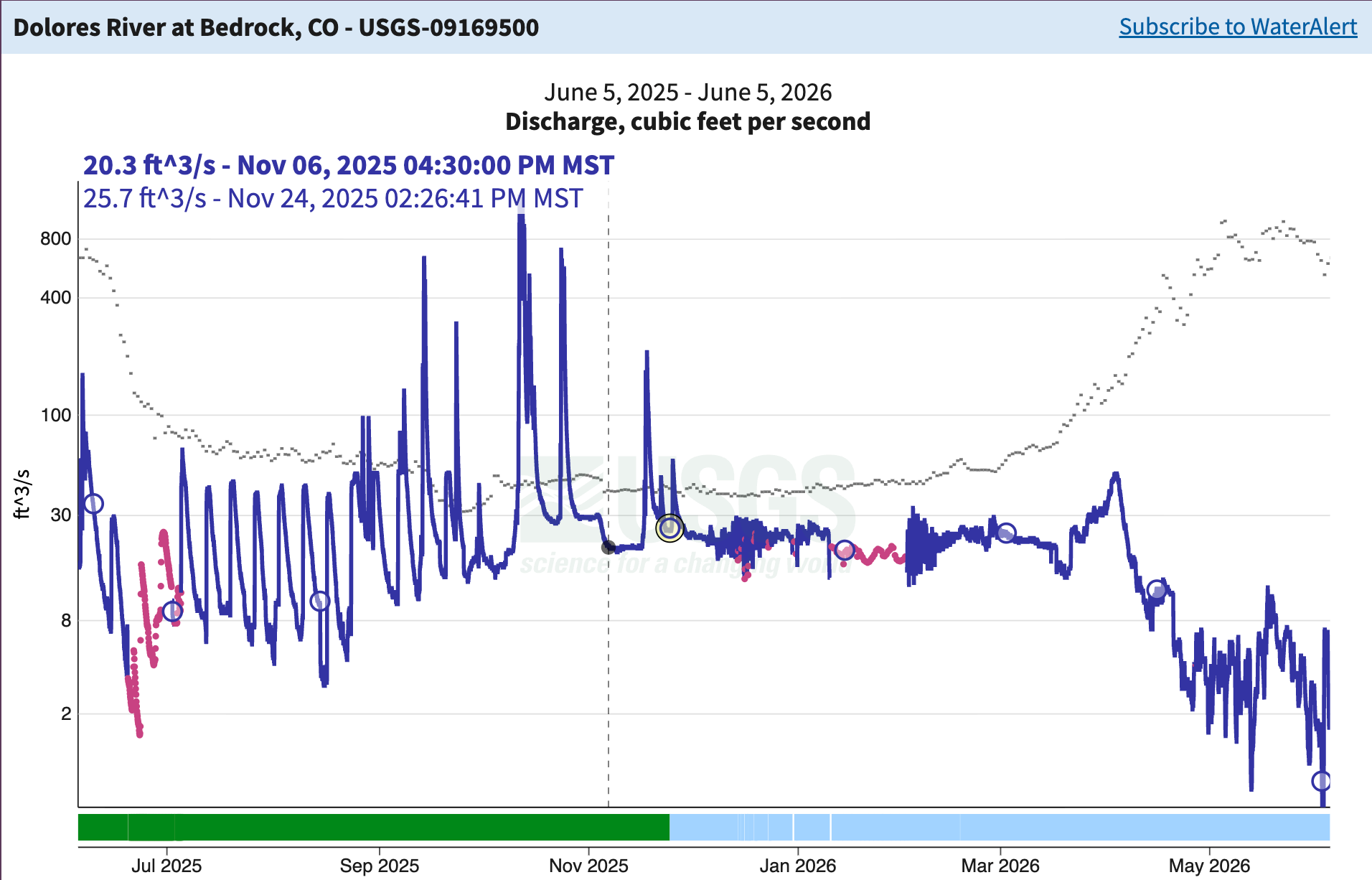
Dolores River at Bedrock, CO: .76 cfs (effectively dry)
White River near Watson, UT: 76.4 cfs
Green River above Flaming Gorge: 551 cfs
Green River below Flaming Gorge: 1,590 cfs
San Juan River near Caracas, CO (above Navajo Reservoir): 85 cfs
Colorado River near Hite, UT: 4,300 cfs
This has reduced daily average inflows into Lake Powell to about 4,800 cfs and dropping. It would be much lower than that, except that flows are being bolstered by upstream reservoir releases. Either way, inflows are far less than Glen Canyon Dam releases, which are averaging about 8,500 cfs daily (approx. 6,500 cfs at night and 10,600 cfs during the day). This disparity, exacerbated by reservoir evaporation, is lowering Lake Powell’s surface level, which currently sits at about 3,526.75 feet. Without substantial upstream rain, it will likely drop to 3,520 feet by early August.
📖 Reading (and watching) Room 🧐
Matt Jenkins wrote an excellent overview for the Water Education Foundation of the potential “Grand Bargain” on the Colorado River, which would require both the Upper and Lower basins to give up some of their Colorado River Compact claims not only to keep the system from collapsing, but also to avoid litigation.
The piece lays out the fact that the Compact is not only outdated, but also internally conflicted, in that it apportions the Upper Basin 7.5 million acre-feet of water per year, while also obligating it to allow the same amount of water to flow to the Lower Basin annually. That’s just not possible these days, given that there’s far less than 15 MAF in the river.
Southeastern Utah is known mostly as a mining hotspot for uranium, copper, with lithium emerging more recently. But it also hosts a potash extraction industry, and at least one company is looking to expand the potash footprint. Sage Potash says it has secured permits from Utah and San Juan County to begin drilling at is Sage Plain Potash project.
While this is only exploratory drilling, it’s notable in that it’s not occurring in the Lisbon Valley or near existing potash sites near Moab. Rather it is on the Great Sage Plain southeast of Monticello, in the archaeologically rich zone north of Hovenweep National Monument.
***
Prior to mining, snowmelt and rain seep into natural cracks and fractures, eventually emerging as a freshwater spring (usually). Graphic credit: Jonathan Thompson
Yet another reason to worry about spewing more carbon dioxide into the atmosphere via fossil fuel burning: It can exacerbate acid mine drainage, the phenomenon that leads to toxic heavy metal loading in streams and other waterways. That’s the conclusion of a peer-reviewed study published in Communications Earth & Environment this April.
Acid mine drainage occurs when a mine excavation exposes once-buried sulfide-bearing rocks such as iron pyrite (FeS2) to oxygen and water. The hydrogen, sulfide, and oxygen come together to form sulfuric acid (H2SO4). Thus, the water becomes acidic, or its pH drops. The acidity dissolves heavy metals and the water picks them up. As the pH level of the water drops below 4.8, acidophilic bacteria begin feeding off the metals, releasing more acid into the solution and causing metal loading to occur up to 1 million times faster than in water with higher pH. Metal loading is bad for fish and other aquatic life.
The study found that elevated atmospheric carbon dioxide levels enhance the acidophilic bacterial activity, which accelerates iron and sulfur oxidation, acid formation, and metal loading. Zinc and cadmium, both of which are harmful to aquatic life, are more sensitive than other metals to rising carbon dioxide levels. Zinc loading is especially problematic in the Upper Animas watershed in southwestern Colorado.
***
Okay, I really don’t care that Anfield bought its first underground haul truck for its Velvet-Wood uranium mine in the Lisbon Valley of southeastern Utah. But I found this press release interesting for another tidbit: The haul truck was built by Young’s Machine Company, located in Monticello, Utah. I never knew Monticello had this sort of manufacturing industry. I gotta say, it’s kind of cool.
The Hoback River joins the Snake River following a landslide upstream on June 18, 2026. Robert Frodeman photo.
🚣🏽 Water Watch 🌊
Water Quality in the Greater Yellowstone
A Guest Post by Robert Frodeman
Four million people visit Teton County, Wyoming, each year. They come to hike, float, and ski, snap pictures under the elk antler arches, and to partake in the myths of the American West. As the sign at the top of Teton Pass says, “Welcome Stranger. Yonder is Jackson Hole, the Last of the Old West.” Visitors expect to find a pristine environment. They don’t expect water quality problems reminiscent of a developing nation.
Teton County has some of the best drinking water in the country. Or most of Teton County does: Hoback, in the southern part of the County, has a nitrate problem. Nitrate is a health risk — most acutely to infants under six months, in whom nitrate is converted to nitrite by gut bacteria, interfering with oxygen transport in the blood and causing methemoglobinemia (blue baby syndrome). Many of the water systems in Hoback are on their last legs: two weeks ago, I had no running water and then a boil order at my home.
Jackson is the town, Jackson Hole is the valley that runs north of town in front of the Tetons. (‘Hole’ was what mountain men called a valley.) If you drill 20,000 feet into the valley floor you will hit the same sandstone layer that sits on top of the Tetons. This implies that the Tetons have risen some 25,000 feet over the last 10 million years.
Of course, mountains come down as they go up: the Tetons have been shedding sediment across all that time, piling up thousands of feet of gravel on the valley floor. Still more gravel was brought by the glaciers that flowed down from the Yellowstone Plateau. The Snake River meanders in front of the Tetons, but much of the river passes unseen below the surface, forming what is known as the Snake River Aquifer.
In effect, Jackson and Jackson Hole sit on top of a huge bathtub filled with gravel and water. This provides an abundant source of high-quality water for the town. But the bathtub only extends so far. The southern rim of the tub comes up at Munger Mountain five miles south of town. This is where the Yellowstone glacier stopped, and where the Snake River Canyon begins, which runs for 30 miles to Alpine and the Mormon communities of Star Valley.
Hoback lies four miles south of Munger Mountain — beyond the reach of the aquifer. Local residents must drill for their water. Local wells reach 200 feet down to the Bear River Formation. The water isn’t ideal – it’s brackish and can have a distinct sulfur smell (as do some of the local hot springs). The groundwater is also contaminated from horse farms and pig farms and (mainly) septic tanks and leach fields. Septic tanks can leak, and there is not enough biotic activity at this elevation and latitude for leach fields to function well. The result is nitrate levels in our drinking water which sometimes exceed EPA daily maximums.
Hoback is distinctive not only because of its geology. The billionaires live elsewhere in the County. There are two trailer parks nearby. Historically, local politicians have directed their attention to the Town of Jackson, Wilson, and the ski resort of Teton Village. But this has changed in recent years. Carlin Gerard of the Teton Conservation District formed a Hoback Stakeholders Group in 2019 to highlight drinking water problems. Covid disrupted that effort, but then a local non-profit called Protect Our Water Jackson Hole brought its energy and resources to southern Teton County.
In 2023 Hoback residents formed a water and sewer district. The district has now raised $7 million from the County and the State to build a municipal drinking water system. Water will be drawn from the Snake River just above the confluence with the Hoback. Construction should begin this fall and be done in a year or two depending on the weather.
At first it will only serve 125 residents: the district was made small out of fear of opposition. Teton County is solid blue, but past attempts had failed because of Hoback’s history of Red State, don’t-tread-on-me politics. In any case, it turned out that the demographic transition had already occurred: when the election was held the vote was 36-0 in favor. And there are now plans to annex a new affordable housing development that Teton County hopes will help address the local housing shortage.
Of course, the new system will only isolate residents from the nitrate problem. The environment will remain polluted, and people outside the district will still be on wells. The district has begun to price out a wastewater system, which is liable to be quite expensive. But you’d hope for nothing less for the Greater Yellowstone Ecosystem – and officials would hate to see an article in the New York Times about Teton County’s leaky septic systems.
Map of Greys River in Wyoming, United States. By Feydey – Nasa World Wind 1.3.5 public domain NLT Landsat 7 satellite photo, layered with PD vmap0 vector data. Image:Map_of_USA_highlighting_Wyoming.png was used for the smaller image., CC BY-SA 3.0, https://commons.wikimedia.org/w/index.php?curid=1589723
Becky Mitchell. Photo credit: Allen Best/Big Pivots
Click the link to read the article on the Big Pivots website (Allen Best):
June 25, 2026
In haggling with their down-river states about sharing the rapidly shrinking Colorado River, the headwater states have delivered a consistent message.
We don’t have two big reservoirs named Mead and Powell sitting upstream from us, they say. Mostly we must make do with what the sky delivers.
At the Upper Colorado River Commission meeting in Denver this week, the states reiterated this message, offering ample evidence from places like Emery, Utah, and Kemmerer, Wyo.
Lest anybody miss the message, Chuck Cullom, the director of the upper-basin commission, showed aerial images of farming areas in Colorado and the other upper-basin states. Far less green was evident in the Montrose area and on the Ute Mountain Ute Reservation during June than in 2024.
This exceptional year for drought and heat was described by several speakers in Denver as dire. “I want you all to recognize the significance and severity of the things we’re dealing with,” said the Utah representative, Gene Shawcroft. “Totally unprecedented.”
In western Colorado, a Meeker rancher used the same word to describe withered streams. “The situation here has gone from bad to dire.”
Upper-basin states have been in a tug-of-war for the last three years with lower-basin states about how to share this diminished river. As Becky Mitchell (above), Colorado’s representative, says repeatedly, we have a math problem. It’s impossible to continue releasing more water from reservoirs than flow into them. Upper-basin states, she says, “live within the means of the river.”
Udall/Overpeck 4-panel Figure Colorado River temperature/precipitation/natural flows with trend. Lake Mead and Lake Powell storage. Updated through Water Year 2025. Note the tiny points on the annual data so that you can flyspeck the individual years. Credit: Brad Udall
In crafting the Colorado River Compact in 1922, delegates assumed annual flows of roughly 17 to 18 million acre-feet annually at Lee Ferry, the legal division point separating the upper and lower basins. The 20th century delivered naturalized flows of 15.2 million on average.
In this century, flows have slackened even more. Since 2019 they have averaged 10.2 million acre-feet. This year less than 1 million acre-feet is expected to flow into Lake Powell other than releases from upstream reservoirs.
The compact pledged 7.5 million acre-feet to each of the two basins. The lower-basin states for many years over-used their allocation. Upper-basin states topped out at about 4.5 million acre-feet, using 3.5 million acre-feet in drier years.
Colorado and other basins states insist upon the right to use more water — if it’s there. Pre-compact rights of all Native American tribes have yet to be realized. All this creates a different math problem.
When the four upper basin states adopted their own compact in 1948, they wisely chose to use a percentage not an absolute number. That would make sense for the Colorado River Basin altogether — if the two basins could agree upon it. Tensions have elevated. Outwardly this marriage looks very rocky.
Might there be another way? Tanya Trujillo, New Mexico’s new representative, offered an intriguing statement at the Denver meeting.
“I think we need to think differently about some things,” she said. “In New Mexico, we’re going to be taking a fresh look at some of the issues that we are facing and really try to look for a collaborative process going forward.”
In time of crisis, she added, it’s important to “project calm, knowledgeable reassurance and try to be part of the solution, not part of the problem.”
For whom was that message intended? It was not clear. However, even in Colorado, some have suggested upper-basin states have overstated their case.
What cannot be contested is Mitchell’s assertion that demands cannot exceed supplies. This year, we’re robbing Peter to pay Paul. Water is being taken from Flaming Gorge and other federal upstream reservoirs to keep water in Powell. Blue Mesa Reservoir near Gunnison may have too little water to release any downstream, a condition called dead pool. The Bureau of Reclamation similarly sees that possibility for Navajo, the reservoir on the Colorado-New Mexico border.
The Bureau intends to release six million acre-feet from Powell for the lower-basin, leaving Powell 80% empty. The agency’s “most probable” projections see reservoir levels at Glen Canyon Dam early next year being too low to generate electricity.
In Grand Junction this week, people stood in the rain with sheer delight. It was a feel-good moment. But will El Niño save us from calamity? Maybe, but don’t bet on it. The warming climate seems to be rewriting the rules about how much water from the Pacific Ocean arrives on our mountains.
hat was the takeaway from a recent presentation by Brad Udall, a scientist scholar affiliated with Colorado State University. El Niños in the past have produced big water years. One was in 1983, the year that flood waters nearly broke Glen Canyon Dam. Often, though, an El Niño produces no more moisture than a La Niña.
“The real question” said Shawcroft, the Utah representative, “is what happens if next year looks like this?”
Map of the Colorado River drainage basin, created using USGS data. By Shannon1 Creative Commons Attribution-Share Alike 4.0
This field of alfalfa near Carbondale is grown with water from the Crystal River. Some Colorado River experts are advocating for a permanent reduction in the use of water by agriculture. CREDIT: HEATHER SACKETT/ASPEN JOURNALISM
Some Colorado River experts are floating a concept to address the basin’s water woes that is both radical and mundane: permanently reducing the amount of water used by agriculture.
Many cities have already reduced their water use in recent decades while adding residents, proving that population growth doesn’t have to be tied to an increase in water use. A 2024 study by Colorado River scientists found that agriculture is responsible for about 74% of water used by people in the basin, meaning urban conservation alone cannot solve the crisis.
“I think we need to have permanent reductions in use on the table and agriculture will have to be part of that,” said Anne Castle, a Colorado River expert and a former federal representative to the Upper Colorado River Commission.
Castle was the lead author on a June 1 paper that urgently called on the entire basin to permanently decrease consumptive uses to avoid the worst impacts to reservoirs and water users. Castle and the paper’s other authors are Colorado River experts and academics, and are the brain trust of the basin sometimes referred to as the Traveling Wilburys, a joking reference to the rock music supergroup. But their message is anything but humorous.
The latest paper says another dry winter would deplete remaining storage and result in devastating consequences like run-of-the-river operations where the nation’s two largest reservoirs can only release downstream the same amount of water that flows into them. It’s the last stop before deadpool, when levels are too low to release water. The authors urge water managers to act immediately to reduce use and avoid a system crash.
But permanently cutting the amount of water that goes to agriculture remains a controversial topic, and water managers from both the Upper and Lower basins say drying up land is not a solution for their basin. Most conservation programs up until now either have been temporary or have allowed the saved water to be used elsewhere. Castle said the problem is especially difficult when people’s livelihoods are on the line.
“The folks who are vulnerable to those kinds of permanent reductions are understandably resistant,” Castle said. “But there’s not enough water. The river won’t allow us to use the same amount of water that we’ve been accustomed to using in the past.”
The seven states that share the Colorado River are under increasing pressure to cut water use as one of the worst droughts on record threatens the water supply for millions of people. On the heels of one of the hottest and driest winters since measuring began, spring flows into Lake Powell this year are projected to be the lowest on record.
Much of the $4 billion from the Inflation Reduction Act earmarked for drought mitigation has gone toward short-term conservation. Water users in the Lower Basin states (California, Arizona and Nevada) were paid to temporarily leave water in Lake Mead. And in the Upper Basin (Colorado, New Mexico, Utah and Wyoming), the feds paid irrigators $45 million to leave fields dry during a two-year reboot of a pilot conservation program.
But in the midst of a climate change-fueled megadrought that has already robbed the river of at least 20% of its flows, experts say temporary measures no longer cut it. Water managers are reckoning with the reality that the river will probably never again deliver what was promised a century ago by the Colorado River Compact. The demand for water now far outstrips the dwindling supply.
“Are we going to continue to spend hundreds of millions of dollars a year and not have a permanent solution?” said author and Colorado River expert Eric Kuhn. “I think, at some point, it just makes economic sense to go ahead and say, ‘Let’s buy out the existing demand.’” [ed. emphasis mine]
These hay bales stand ready to be collected on a ranch outside of Carbondale. Credit: Heather Sackett/Aspen Journalism
Buying out demand
Against this backdrop, some in the academic community are advocating for the federal government to either set up a voluntary program to buy and retire lands that use a lot of water or pay landowners who agree to permanent restrictions on water use.
A paper released last year and authored by Kathryn Sorensen and Sarah Porter, who are Colorado River experts at the Kyl Center for Water Policy at Arizona State, lays out how this could be done. Eligible land would have to meet certain characteristics, including being in an area where the economic impacts of not using water are least painful and where impacted crops could be feasibly grown outside of the Colorado River basin, among others.
According to Porter, the federal government should be the entity that buys down demand. The large infrastructure projects funded by the feds in the 20th century are what created booming irrigated agriculture in the West to begin with. And the other entities in the basin that have the ability to buy agricultural water want to use it themselves, not keep it in the system.
“A reset in the Colorado River basin really is needed,” Porter said. “We have a lot of agriculture that’s really a legacy of how the United States was settled… . And now we’re grappling with overallocation and shortage and struggling to figure out a way to manage the Colorado River.”
The proposal is different from the much-derided “buy-and-dry” which usually involves an opportunistic transferring of water from agriculture to cities, not an overall reduction in water use. Still, the potential negative impacts to rural communities have to be considered.
“You have to have a provision for what happens to the land when you remove agriculture and what happens to the local economy when you remove agriculture,” Porter said.
And experts say there is a precedent for the type of federal buyouts that could help the drought-stricken river: the Bankhead-Jones Tenant Farm Act from 1937. This New Deal piece of legislation was a response to the Dust Bowl and allowed the federal government to buy and retire badly eroded or economically unproductive farmland.
The paper says a Colorado River program could start not with those that grow valuable vegetables in winter but, rather, with lands that use a lot of water but have low economic output. The paper says retired agricultural lands could be used for alternative purposes that support local economies such as recreational opportunities or low water-use industries.
Figuring out how to implement conservation programs without harming rural agricultural communities has been a main focus in recent years of the Colorado River Water Conservation District, which works to keep water on the Western Slope. River District General Manager Andy Mueller said that agriculture has a role to play in reducing water consumption, but that permanently retiring agricultural land is a misguided approach that will put the country in danger of not being able to feed itself. Programs should remain temporary, and focus on efficiency improvements and growing less-thirsty crops, he said.
“If it’s temporary, if it’s well-designed in a way that respects local communities, traditions and practices, is custom-built for each community in a way that really tries to do as little economic damage as possible — potentially even bringing some benefits to those farming families that participate — there are ways to do it,” Mueller said.
A tractor on a farm in California’s Imperial Irrigation District, the largest user of agricultural water in the Colorado River basin. A California representative says there is no interest in drying up ag land because it’s so extremely productive. CREDIT: HEATHER SACKETT/ASPEN JOURNALISM
On the fringe
Although certain academics and experts are talking about permanently drying up agricultural lands as a means of saving water, the concept remains on the fringe of Colorado River politics. It’s both the third rail and the elephant in the room.
“It’s going to pull away from the fringe really quickly when you’ve got to really justify continuing to pay on an annual basis forever,” Kuhn said. “We’re just trying to get the discussion out there, make it acceptable to have the discussion.”
On top of the abysmal hydrologic conditions, the basin is also in the midst of a management crisis. After two years of negotiating, the Upper Basin and Lower Basin states have failed to reach a consensus on how they will share future cuts and have blown past deadlines to come up with a plan. The responsibility for river management now falls to the federal government, which is scheduled to release this summer a short-term operating plan for Lake Powell and Lake Mead.
Part of what makes the problem so tricky is that water managers are still guided by the Colorado River Compact, a century-old agreement that splits the river’s flows evenly between the two basins. Upper Basin water managers still cling to the notion that because their states are already living within the 7.5 million acre-feet of water allotted to them annually, cutbacks are the responsibility of the Lower Basin, which they say uses more than its fair share.
Becky Mitchell, Colorado’s lead negotiator in talks among the seven states, said that permanent dry-up of agriculture in the Upper Basin isn’t necessary because the Upper Basin states already send more than 8 million acre-feet — more than legally required — of water downstream per year. Dry-up may be part of the overall solution, she said, but each state should take its own individual approach to making cuts.
“Those durable reductions are going to be required (for the Lower Basin) to first get in line with their apportionment, but then getting in line with the available supplies is a whole ’nother conversation,” Mitchell said.
California’s representative, JB Hamby, said permanent fallowing doesn’t have a place in reducing the state’s demand either. California is home to the biggest urban and agricultural water districts, as well as the largest allocation of Colorado River water of any of the seven states that share the river.
“In the case of California, there’s no real discussion or interest whatsoever in the retirement of ag lands,” Hamby said. “Land in Southern California that receives Colorado River water is so extremely productive. There is a year-round growing season where every single day of the year there are things being grown.”
Past water savings in Southern California have mostly come from efficiency improvements on farms and in delivery systems, and from deficit irrigation programs in which water is temporarily taken off fields for part of a season. In the absence of a seven-state deal, the Lower Basin states have offered up 700,000 acre-feet of cuts per year through 2028, which is on top of an initial 1.5 million acre-feet in cuts. Most estimates say the basin needs to cut water use by 2 million to 4 million acre-feet.
“There’s full agreement that water should be reduced,” he said. “There’s not agreement in how or where it should be reduced. So the Lower Basin is moving forward, doing our thing, making reductions.”
Cowgirls wrangle a calf at a Delta County ranch. Farming and ranching are an important part of the heritage of the American West, which makes permanently reducing water for agriculture a tricky issue. CREDIT: HEATHER SACKETT/ASPEN JOURNALISM
Ultimately, discussions about permanently reducing the amount of water that goes to farmlands in the basin remain difficult, in part because agricultural water rights are some of the biggest, oldest and most politically powerful in the basin. But there is also an attachment to the American West’s farming and ranching heritage.
“We love agriculture; it’s part of our roots,” Porter said. “We don’t like to think about losing agricultural production. I think we are generally hesitant to have that conversation, and we really haven’t had it as a basin.”
Map of the Colorado River drainage basin, created using USGS data. By Shannon1 Creative Commons Attribution-Share Alike 4.0
Glen Canyon Dam and Lake Powell, one of the nation’s largest-capacity reservoirs whose operation has been a point of contention between the Upper and Lower Basins of the Colorado River. (Alexander Heilner, The Water Desk)
Western Water In-depth: A ‘wild idea’ to defuse the colorado river compact’s legal time bomb has been kept alive by seasoned observers who believe it could still save the river
For the past 20 years, the Colorado River has been operated under a set of guidelines negotiated between the seven states that depend on the river. Those guidelines expire this year, and after five years of grinding negotiations over a new agreement, the upstream states of Colorado, Wyoming, Utah and New Mexico remain deadlocked against the downstream states of California, Arizona and Nevada.
Some 40 million people and 5.5 million acres of farmland depend on the river’s water. But after the states failed to meet two federal deadlines in three months, the river is in a moment of unprecedented crisis. A dire snowpack has left flows just 15 percent of normal, many farms without water and several cities scrambling to secure water supplies as they gird themselves for shortages.
That has set up a showdown over a legal time bomb that’s been ticking away at the heart of the Colorado River Compact since the river’s guiding document was signed more than 100 years ago. The Lower Basin states believe the Compact promised them a minimum delivery of water sent down the river from the Upper Basin. The Upper Basin states believe the Compact promised them a fixed amount of water that they could rely on to meet future growth. As the river’s flows have dwindled, those two supposed guarantees are proving to be irreconcilable.
Experts have seen the showdown coming for a long time, but climate change has accelerated the day of reckoning. In 2000, a drought sunk its teeth into the river and hasn’t let up. Dubbed the Millennium Drought, it is now recognized as one of the worst droughts on the river in more than 1,200 years — and may actually be the beginning of a long-term shift to a drier reality.
Despite near-endless negotiations to find a way to keep the river’s massive reservoir system from crashing — an effort that began over two decades ago — the drought may have finally pushed the Colorado River Compact to its limit. Now, the system is nearly empty and runoff from this winter’s snowpack, the source of any water that might offer even a small hope of relief, will be among the lowest since Glen Canyon Dam was built near the Arizona-Utah border, creating Lake Powell, more than 60 years ago. Flows in the river are perilously close to hitting the primary legal “tripwire” in the Compact. Once that’s crossed, the Lower Basin states would likely try to force the Upper Basin to deliver their water apportionment downstream — a prospect long considered unthinkable.
“All those negotiations helped push the day of reckoning back further, and helped delay the inevitable,” says Doug Kenney, who heads the University of Colorado’s Western Water Policy Program. “But at some point, you just have to acknowledge the fact that the numbers don’t add up and you’re going to have to deal with it. We’re at that point.”
Two obvious paths now lie ahead. One is a courtroom fight, either against the U.S. Secretary of the Interior or a challenge between two states under the terms of the Colorado River Compact, which would go directly before the Supreme Court. A high court case would be a doomsday scenario, a messy and protracted legal battle that, until now, the seven states desperately sought to avoid. The other potential path is a stopgap fix, a short-term interim plan negotiated between the states or imposed by the Interior secretary. That could, at least temporarily, forestall a trip to court, but it wouldn’t resolve the fundamental conflict.
For more than two decades, however, the possibility of a third path has stubbornly persisted in the background: A “grand bargain,” an idea first proposed in 2005 by Colorado’s negotiating team early in the effort to grapple with the worsening drought. The concept was an unorthodox bid to defuse the ticking time bomb — but it would require each basin to trade away its most cherished claim on the river.
‘A WILD IDEA’
Roughly 90 percent of the Colorado River’s flow originates as snowpack in the Rocky Mountains. One of the principal goals of the 1922 Compact, which is essentially a seven-state treaty, was to avoid future legal battles by creating an “equitable division and apportionment” of water between the Upper Basin states in the river’s headwaters and the faster-growing Lower Basin. The Compact apportioned 7.5 million acre-feet a year from the mainstem of the river to each basin. (An acre-foot is 325,851 gallons, enough to supply the average annual needs of roughly 3 households, depending on their location and climate.)
The Colorado River Basin spans seven U.S. states and is divided into Upper and Lower Basins. Lake Powell, upstream from the Grand Canyon, and Lake Mead, near Las Vegas, are the two principal reservoirs in the Colorado River water-supply system. (Bureau of Reclamation)
The Compact also contains a requirement that the headwaters states not deplete the flow of the river below 75 million acre-feet, plus another roughly 7.5 million acre-feet (half of the apportionment earmarked for Mexico), on a 10-year running average. Those provisions were intended to provide surety to the downstream Lower Basin states that they would receive their 7.5 million-acre-foot annual apportionment and that the basins would share equally in the Mexican obligation. If the 10-year running average requirement is violated, the Lower Basin states could — at least in theory — initiate a Compact “call” against the Upper Basin in an attempt to force the headwaters states to deliver more water downstream.
For roughly 80 years after the Compact was signed, the prospect of a Compact call was purely theoretical. Then the Millennium Drought set in. By 2005, the two flagship reservoirs on the Colorado River — Lakes Mead and Powell — were half empty.
The drought was pushing the river’s flows closer to a Compact violation trigger, making the risk of a call by the Lower Basin a growing probability. The Lower Basin, particularly Arizona, was insisting on guaranteed releases of water from Lake Powell. And because Colorado has the biggest share of the river within the Upper Basin and uses a greater portion of its apportionment than the other upstream states, it is most at risk. It began searching for a way to slip out of the legal noose of a Compact call.
In September 2005, the seven states’ top negotiators met in Albuquerque, New Mexico. During a lunch break, Colorado’s team made its pitch. The state’s negotiators proposed that the Lower Basin waive its right to force a downstream delivery through a Compact call. In exchange, the Upper Basin states would limit their water use to less than what’s strictly apportioned in the Compact, thereby reducing potential demand in the headwaters of Colorado and Wyoming that supply nearly the entirety of the river’s flow.
The offer was essentially a simplification and reframing of a dizzying array of technical disagreements over various provisions of the Compact — an attempt to throw spaghetti at the wall to see if it would stick.
Jim Lochhead, who had previously been Colorado’s top negotiator and in 2005 was serving as a legal advisor on the state’s team.
“My recollection was that it was a pretty spontaneous proposal,” says Jim Lochhead, who had previously been Colorado’s top negotiator and in 2005 was continuing to serve as a legal advisor on the state’s team. “We weren’t making any progress, and it was pitched as, ‘If you really want to cut through all of this and get to the bottom, here’s a wild idea.’”
The proposal sparked discussion among all the parties at the negotiating table but also raised difficult issues.
“It was a great concept on paper,” says Pat Mulroy, who was the head of the Southern Nevada Water Authority and Nevada’s principal negotiator at the time. “Whether it was politically doable or not is a whole other ball game.”
In large part, that’s because a grand bargain would have forced both basins to give up assurances in the Compact that they consider sacrosanct.
“I’m not sure the Upper Basin would ever have agreed to limiting their ability to fully develop their 7.5. It’s like giving up your birthright — I’m not sure they could have sold that at home,” says Mulroy. Conversely, she says, “giving up that call provision is really the only weapon the Lower Basin has.”
And, indeed, following its spontaneous birth in Albuquerque, the proposal ran into stiff political headwinds back home in Colorado, where it failed to get then-governor Bill Owens’ blessing.
“I wasn’t directly representing the state of Colorado at that time; I was representing Colorado water users,” Lochhead says. “And when I brought the idea back to the state, it pretty quickly got shot down: ‘No, we can’t agree to anything that would not keep the dream alive of 7.5 million acre-feet being developed in the Upper Basin.’”
The prospect of a grand bargain itself faded from discussion. And yet, in ways that aren’t often acknowledged, it continued to shape the broad contours of the negotiations that unfolded over the next two decades.
The quest to escape the noose of a Compact call has remained central to Colorado’s bargaining position.
“The concept of a waiver of a Compact call is alive and well,” says Anne Castle, a former assistant Interior secretary who is now a senior fellow at the University of Colorado. “The quid pro quo for that waiver has taken different forms.”
To a large extent, the details of the various offers the Lower Basin has made in exchange for a possible waiver — which have sometimes been characterized within the negotiations as “mini grand bargains” — have never become public. What is clear is that the two basins have consistently failed to cut a deal.
Instead, the seven states adopted a more incremental approach, negotiating a series of drought-protection agreements based on smaller, more politically palatable deals. While that’s been a safer path for everyone politically, it has brought other kinds of risk.
“It just added layer upon layer of Gorilla Glue and Band-Aids that’s made it much more complicated to try to unwind or develop new agreements,” Lochhead says, “and has obviously proven to be inadequate in protecting the system.”
A SECOND LIFE
While the concept of a grand bargain led a short life at the negotiating table, it has gone on to live a remarkable second life. The idea was picked up and revived by a loose-knit group of seasoned observers of Colorado River issues who, for years, have called for more durable alternatives to the patchwork of ideas [ed. “The Law of the River”] in play among negotiators.
Eric Kuhn was a member of Colorado’s negotiating team when the grand bargain was proposed in 2005. At the time, he was the general manager of the Colorado River Water Conservation District based in Glenwood Springs and he has written thoughtfully and voluminously about the river’s problems. After his retirement in 2018, he partnered with John Fleck, a former journalist who is now author-in-residence at the University of New Mexico’s Utton Center, to write Science Be Dammed: How Ignoring Inconvenient Science Drained the Colorado River.
Kuhn and Fleck concluded the book by observing that “there is not enough water in the Colorado River for all the lawyers to be right,” and suggested the grand bargain as a way to avoid the courtroom.
“The basic idea of a grand bargain is, in lieu of litigation, we’re going to agree to something that both sides want,” says Kuhn.
He and Fleck weren’t the only ones who pushed for more serious consideration of the idea. Doug Kenney at the University of Colorado also has championed the concept. In 2012, he enlisted Kevin Wheeler, a widely respected engineer and fellow at Oxford University, to undertake modeling analysis of the kinds of trade-offs a grand bargain might require.
Persistent drought has lowered Lake Powell’s water level and exposed land that was once submerged at Wahweap Marina, as seen in this 2022 photo. (Bureau of Reclamation)
In 2021, Wheeler — together with a group of collaborators including Kuhn, climate scientist Brad Udall and Jack Schmidt, the director of Utah State’s Center for Colorado River Studies — published a white paper called “Alternative Management Paradigms for the Future of the Colorado and Green Rivers.” It was a comprehensive assessment of more ambitious strategies for weathering the drought and climate change than had emerged from now-perpetual negotiations between the states.
“New approaches that are responsive to significantly drier climate conditions and changing patterns of consumptive uses may require bolder policy initiatives that exceed the incremental approach of modern management,” the group wrote. “It is critical to explore alternative water management strategies that may extend beyond the framework of the Law of the River as presently interpreted.”
The following year, the team published a paper in the journal Science titled “What Will it Take to Stabilize the Colorado River?” And, it turned out, stabilizing the system would take something that looked a lot like a grand bargain.
Assuming the drought persists as it has since 2000, Wheeler and his partners identified two scenarios that would stabilize the river, both of which assumed the Lower Basin had waived its ability to make a Compact call. In one, the Lower Basin would need to decrease its water use by about 2 million acre-feet a year when Lake Mead and Lake Powell reach low levels. That would assure it of about 78 percent of its apportionment — an amount roughly in line with cuts it has already committed to taking. In exchange, the Upper Basin would have to cap its water use at 4 million acre-feet. But that’s only slightly more than half of its 7.5 million-acre-foot Compact apportionment, and roughly 300,000 acre-feet less than what it currently uses.
The second scenario — call it the “near-parity scenario” for simplicity — more equally distributed the Upper and Lower Basins’ relative cuts in apportionment. In it, the Upper Basin would cap its use at 4.5 million acre-feet, leaving it with 60 percent of its Compact apportionment. The Lower Basin would be able to use about 67 percent of its Compact apportionment when reservoirs are low, just slightly more percentage-wise than the Upper Basin. But it would have to cut its uses by 3 million acre-feet below its apportionment.
That would stabilize the system — or at least go a long way toward doing so — while largely meeting existing water demands in both basins. The Upper Basin currently uses about 4.3 million acre-feet per year. The Lower Basin, after ramping up an aggressive water conservation effort since 2007, has driven its annual use down to about 6 million acre-feet per year, and has signaled that it could likely reduce demand further.
But it would leave practically no leeway for future growth, at least without reshaping the socioeconomic landscape across the entire Basin. In particular, any future urban growth could come only by shifting significant amounts of water from farms to cities.
HARD MATH
Today, there is a simple, hard reality on the Colorado River: The available water supply is already maxed out. Water use throughout the basin needs to be reduced by roughly 25 percent just to make the numbers work now — to say nothing of the future, which is likely to be significantly drier.
In Colorado, that has raised hard questions about fairness, the “equitable division and apportionment” provision of the Compact, and the assurance the state thought it had that its water would be there to develop when it’s finally ready.
“Everyone agrees that there should be an equitable division of water, and the word ‘equity’ is one that everyone will rally around,” says Kenney. “But does equitable mean equal? That’s the crux of the issue.”
Over the past several years, Colorado’s attorney general, Phil Weiser, has been building his office’s staff of water lawyers. This January, Weiser, who is currently running for governor, appeared before a joint hearing of the state legislature’s judiciary committees.
“If we can’t get a deal — and I’m committed to not getting a bad deal just to get a deal — we’ll be in litigation. We’re ready for it,” he said. “If and when we can get a reasonable deal based in reality, I’m for it. But if we can’t, then we will be falling back on our rights under (the) 1922 Compact.”
Because of the peculiarities of the water-rights hierarchy in the Lower Basin, Arizona is arguably most at risk there. In March, that state — whose governor, Katie Hobbs, is running for re-election — retained the high-powered law firm Sullivan & Cromwell to represent it in potential Colorado River litigation. At the time, a spokesman for the governor said, “it’s critical that Arizona be prepared to defend ourselves in court if an agreement cannot be reached or the Law of the River is violated.”
Anne Castle, a veteran of Colorado River issues. Former U.S. Commissioner, Upper Colorado River Commission • Former Assistant Secretary for Water and Science, U.S. Department of the Interior. (Source: Water Education Foundation)
“It is very difficult for a political figure — and they’re all political figures, even if they’re not elected — to agree to reduce the water use of their constituents and keep their career alive,” says Anne Castle. “They have to be able to tell their constituents, ‘I’m fighting for your water. I’m doing everything I can to keep your water secure, and it’s the other guy’s fault.’ The political incentives are directly at odds with the kind of compromise that’s needed in this type of hydrologic situation.”
Following the breakdown in negotiations between the Colorado River states, the federal government has announced its intention to step in. In May, the Bureau of Reclamation, on behalf of the Department of the Interior, revealed that it is preparing the first of what could be a series of five two-year interim plans for the river.
The final details are expected to be released this summer. But the federal government has indicated that the Interior secretary could cut water deliveries to the Lower Basin states by up to 3 million acre-feet — 40 percent of their Compact apportionment. During a briefing for Arizona water users in May, Brenda Burman, the head of the Central Arizona Project, presented modeling analysis of the proposed reductions and noted that, given the diminished releases from Lake Powell, the Upper Basin is “in a definite breach of the Compact by Sept. 30 of 2026.”
Owing to some quirks of river history, the secretary debatably has less authority in the Upper Basin, and so Reclamation has proposed no cuts there. But as climate change continues to eat away at snowpack and river flows, the Upper Basin states will likely be forced to cut back their uses anyway. Regardless of what the Compact says the Upper Basin gets, the water simply won’t be there.
And so now the seven states are facing a situation eerily similar to those in the near-parity scenario Wheeler and his colleagues laid out in their Science paper four years ago — but without a bargain.
COMING FULL CIRCLE?
In many ways, the prospects have never been worse for something like a grand bargain. Yet the fundamental problems the grand bargain was intended to solve have only grown sharper in the 20 years since it was first proposed.
“The grand bargain has gotten a bad name,” Kuhn says. “But if these issues aren’t resolved through a grand bargain, they’re going to be resolved through litigation.” In 2007, he says, the river’s reservoirs still had ample water to work with. “With empty reservoirs, you cannot finesse these issues.”
Glen Canyon Dam creates water storage on the Colorado River in Lake Powell. Credit: U.S. Bureau of Reclamation
Litigation could come as soon as August, when Reclamation will likely release a record of decision for its proposed new operating plan. Legal action could take one of several paths. The one with the highest stakes would be direct enforcement of the Compact, likely in the form of a Compact call brought by Arizona and the other Lower Basin states against the Upper Basin states. Because the Compact is essentially a treaty between multiple states, that would go directly before the Supreme Court. But such cases are often grindingly long: Arizona’s 1952 lawsuit against California over Colorado River rights took a dozen years to resolve. A case in the Supreme Court could put the river in protracted litigation during a time of profound crisis.
Other, more limited challenges are possible, most likely against the Bureau of Reclamation or the secretary of the Interior for failure to comply with the Compact or violating environmental laws. But they, too, are not without risk.
“I have a hard time believing you could keep litigation contained, once that genie’s out of the bottle,” says Kenney. “I just have to believe that inevitably blows up into a full-fledged interstate litigation and it bumping right up to the Supreme Court.”
As the odds rise of a legal challenge to the Compact that could ultimately wind up before the highest court in the land, the fundamental tension the grand bargain was intended to resolve will likely be front and center before the justices. And, paradoxically, that could force the states themselves to finally make the really tough sacrifices they’ve been trying to avoid.
“I think that a road to a grand bargain runs through litigation,” says Kuhn.
That’s because in past interstate fights over shared rivers, the Supreme Court has typically appointed a water-law expert known as a special master to referee such cases. The most recent example is the dispute between Texas, New Mexico and Colorado over the Rio Grande. In that case, Kuhn notes, “the special master said, ‘You don’t want me or the court to decide this; get in a room and negotiate it.’ The special master kept the pressure on the states to negotiate.”
This May, the Supreme Court approved a settlement between those three states. Still, even that resolution only came a full 13 years after the case was initially filed, and it involves relatively small reductions in overall water use.
On the Colorado River, both water and time are in far shorter supply.
Western Water, our flagship publication by Foundation journalists, is available online. Check out our latest articles. Reach writer Matt Jenkins at mjenkins@watereducation.org.
Know someone who wants to stay connected to water in the West? Encourage them to sign up for Western Water and follow us on LinkedInand Instagram.
Colorado River “Beginnings”. Photo: Brent Gardner-Smith/Aspen Journalism
Last post here, I suggested that at least some of the ongoing failure of the seven Colorado River states to reach agreement on a river management plan for even the next several years, let alone new century, stems from some ‘elephants in the river.’ You know – the big things that nobody wants to look at because they are so big. So big that some of the rules and guidelines we operate under were created to avoid having to address them.
The first ‘elephant in the river’ I discussed last time was the single-minded focus on the Colorado’s surface waters, and a failure to begin considering the whole integrated water supply, surface water and groundwater – of which the surface water is a relatively minor part, with users going to the groundwater in a haphazard way when the surface water is insufficient.
I did make an incorrect statement in that analysis, however. I said that Colorado was the first, and thus far only, state to begin integrating groundwater into its appropriation priority system statewide. (Arizona developed – by federal mandate – a Groundwater Management Plan circa 1970 for those specific parts of the state served by the Central Arizona Project.)
This is true about Colorado – but I was mistaken in implying that the all groundwater use was integrated into its appropriation system by 1969 legislation. Only alluvial groundwater is covered by that law – groundwater that is naturally integrated with surface water, either trickling into the surface streams when the groundwater table is high or drawing riparian water from the surface streams when the water table is low.
Not covered by the Colorado law are ‘non-tributary’ aquifers that have no natural interaction with the surface waters – aquifers like the Oglalla Aquifer in eastern Colorado, or the Denver Basin aquifer. Most of their water filters down from the alluvial groundwater, and only modern pumping technology makes that groundwater accessible to surface use. Most of these deep aquifers have accumulated their water slowly over geological periods of time, and even moderate use of their water dips quickly into ‘water-mining.’ Colorado law for such aquifers attempts to limit annual use to a hundredth of a presumed 100-year supply, but no one knows for sure how much water is really down there, or whether it will truly constitute a 100-year supply.
The standard response throughout much of the basin to shortages in surface water is to go to groundwater pumping; if ‘tributary’ (alluvial) groundwater is tapped, the pumping will gradually lower the water table – which in turn will begin to diminish the surface streams, which in turn will increase the pumping – et cetera, a vicious downward cycle. And the pumping of ‘non-tributary’ aquifers is largely unregulated in the basin.
At any rate – apologies for the error, and thanks to John McClow for pointing it out.
And on to another elephant in the room. Is it finally time to determine limits on the presumed universal applicability of the appropriation doctrine? To avoid being shot before I finish the paragraph, I will say immediately I am not suggesting doing away with the appropriation doctrine; it is a good enough last resort down on the ground where the appropriation doctrine started, for working out local problems of water use on a surface stream when neighborliness fails – that is, when old grumps and feuds preclude the ‘gentlemen’s agreement’ on sharing out what water is available, rather than shutting down the junior users with a ‘call’ so the seniors can get all their decreed water. After two or three generations, seniority can be acknowledged, but is too abstract to apply against your neighbors, if a plan for sharing blameless misfortune can be worked out.
The abstraction, however, becomes more applicable when it is distant water organizations calling out other water organizations upstream, or an earlier developed watershed placing a call on users in an adjacent more recently developed watershed. And when a stream is declared by the district engineer to be over-appropriated – not enough water to fill everyone’s decrees in a near-average year – it becomes even more abstract, a tool for enforcing a status quo, and nothing anywhere about what represents the best uses of the water.
There are, in other words, some areas in which the appropriation doctrine gets stretched beyond its elastic limits by emerging challenges of water use; any questions about ‘best and highest use’ have been essentially declared unanswerable as a matter of conflicting values, and it just seems easier to let seniority of use be the ultimate determinant of priorities.
A century ago, with California quintupling its population in the first two decades of the 20th century, the other six of the seven states in the Colorado River Basin (Arizona, Nevada, Colorado, New Mexico, Utah and Wyoming) began to worry that California might put so much of the river’s water to use that there would not be enough unappropriated water for them to put to use when their time of growth came. They were all committed to versions of the appropriation doctrine within their states, but came to believe that reliance on the appropriation doctrine alone at the interstate level could cause more regional problems than it would resolve.
That concern was affirmed in 1922 when the U.S. Supreme Court resolved a conflict between Colorado and Wyoming over a Laramie River tributary that started in Colorado but was put to use first in Wyoming; the court declared that states who used the appropriation doctrine intrastate would also have to respect each other’s appropriations interstate. This made real the specter of slow-growing upstream states having to let all their Colorado River water go downstream to fill huge Arizona and California decrees.
So they assembled in 1922 to try to do something about that – a fundamental fact about the Colorado River Compact commission that we tend to forget: the original intent of the compact commissioners in 1922 was to develop an alternative to the appropriations doctrine at the interstate level. They came together with the intent of working out a seven-way division of the use of the river, based on possible future development, that would eliminate a horse-race of interstate appropriative competition. Six of the states convened the commission because they feared California, and California reluctantly participated because it knew the feds would never build the big control and storage dam they needed until all seven states were on board with it. That seven-way division trumping interstate appropriation was what the Compact Commissioners assembled to do –and spent a frustrating week early in 1922 trying to do.
They were unable to effect a seven-way split for a couple of reasons: for one thing they had no good measure of how much dependable water was in the river; estimates at the time ranged from 12 to 20 million acre-feet (maf). But for a second thing, the sum total of the water they each felt their state needed, based on rosy early-20th-century estimates, was closer to 24 maf – and nobody wanted to go home having backed down from their carefully imagined numbers.
Members of the Colorado River Commission, in Santa Fe in 1922, after signing the Colorado River Compact. From left, W. S. Norviel (Arizona), Delph E. Carpenter (Colorado), Herbert Hoover (Secretary of Commerce and Chairman of Commission), R. E. Caldwell (Utah), Clarence C. Stetson (Executive Secretary of Commission), Stephen B. Davis, Jr. (New Mexico), Frank C. Emerson (Wyoming), W. F. McClure (California), and James G. Scrugham (Nevada). CREDIT: COLORADO STATE UNIVERSITY WATER RESOURCES ARCHIVE via Aspen Journalism
What they did instead – in order to persuade Congress that there was general agreement – was to cobble together the Compact we are burdened with today; they created what Commission Chair Herbert Hoover called a ‘temporary equitable division’ of the seven states into Upper and Lower River Basins, until ‘ those men who may come after us, possessed of a far greater fund of information’ could do the ‘further division’ of the river among the states.
They also decided – as early 20th-century Americans would – to lean toward the more optimistic estimates of river flow, dividing ‘equally’ between the Basins only 15 maf of a river they presumed would continue running 16-20 maf – hence the 7.5 maf for each Basin written into the compact, to be further divided among the states of each Basin in their own good time. That left some water for Mexico, but they did nothing specific for the Indian tribes in the basins because national Indian policy at that time was ‘soft genocide’ – full assimilation (‘kill the Indian, save the man’), leaving tribal water a concern they thought would disappear.
This all made reasonable sense with a river running a quarter-century average of just under 18 maf – but then through the 1930s the river experienced a drought unsurpassed until the past quarter century. By the end of World War II, Colorado river water users had a ‘far greater fund of information’ about the river’s flow, which would have made it a good time to have ‘fixed’ the Compact – but the growing fund of information was all bad news that no one wanted to incorporate into a more realistic policy. So by default the ‘temporary equitable division,’ with its mythic 18 maf river, took on the permanence of something carried off a sacred mountain carved in stone.
And now – we are seeing it reduced to a sad irony. The states of the Lower Basin had their fears too, and wanted a clause in the Compact stating that, should the Upper Basin states have a wild spurt of growth, they should not ‘deplete the flow’ to the Lower Basin below an average of 7.5 maf a year. But now – when it looks like diminished flows throughout the basin might really drop the flow at the division point between basins below that average – the Lower Basin is threatening the Upper Basin with an Article III(d) ‘call,’ saying the upper states will have to cut their own uses enough to meet the lower states’ fantasy 7.5 maf. States that set out a century ago to create a compact that would transcend the appropriation doctrine at the interstate level are now trying to turn that ‘temporary equitable division’ into what amounts to a senior interstate water right.
There has to be a level, or category, of action in which the law of first-come first-served is transcended by other considerations. And can we not say, at this point a century later, that the original intention of the compact commission has been achieved de facto? No state will ever get the use of more water than it had (or believed it had) around the turn of the century because there is even less water now. For better or worse, the use of the river has been distributed among the states (including some of the tribes) and Mexico.
Udall/Overpeck 4-panel Figure Colorado River temperature/precipitation/natural flows with trend. Lake Mead and Lake Powell storage. Updated through Water Year 2025. Note the tiny points on the annual data so that you can flyspeck the individual years. Credit: Brad Udall
Whether this is an equitable division is arguable; the states of the Lower Basin have been using roughly two-thirds of the river’s water, the Upper Basin states around one third, rather than the 50-50 split explicit in the Compact (7.5 maf per Basin). But arguably that does reflect the relative productivity of Lower Basin agricultural use (by far the largest use) and also its millions of urbanites drawing on it for at least part of their municipal water. It was a huge step toward reality when the Lower Basin states finally agreed that they must absorb the Lower Basin’s system losses (mostly evapotranspiration) and their half of Mexico’s allotment out of their own shares of the river, rather than relying on a fictional surplus to cover it – a fiction that combined with drought to draw down both Powell and Mead Reservoirs to the dangerous level where they linger today.
Yampa River Basin via Wikimedia. Note the Little Snake River crossing the Colorado-Wyoming line.
The 1948 Upper Colorado River Compact was the first reality-based document in the ‘Law of River’ portfolio because its negotiators knew by then – that ‘greater fund of knowledge’ – that it was doubtful that there would always be 7.5 maf for their use, and actually accepted that as their reality. So the divided their ‘half’ of the river into percentages for each state of whatever was left for the upper states after the Lower Basin got it Boulder Canyon Project Act waters. After three-quarters of a century, the four states are not too far from those percentages in their development of around 4.5 maf; only Wyoming is significantly under its 13 percent; Utah is a little below its 23 percent; and Colorado is a little over its 51.75 percent. Given the geographic irrelevance of western state boundaries (the Little Snake River crosses the Colorado-Wyoming border half a dozen times), this was pretty good 1948 estimating.
The reality today is that all Colorado River water users in all seven basin states are using a finite and measurable resource that will probably continue to diminish for the foreseeable future as we continue to heat up the planet, and we need to come to an agreement on what that means for all users. [ed. emphasis mine]
It seems to me there are three ways to address that diminishing flow. One way is to continue to accept the divine sanctity of the Colorado River Compact, with the Upper Basin states forced by the Supremes (they ride for power, not for the law) to cut back their own uses to meet the 7.5 maf average delivery to the Lower Basin – basically the interstate nightmare (for the upper states) the Compact was meant to address. Call this the stubborn denial option.
A second way would be to accept the evolved eight-way division (seven states plus Mexico) of the use of the river’s water, which was what the seven states wanted to do in 1922, instead of the ‘temporary equitable’ compact they came up with. Percentages for each basin state could be set according to the amount each state was using at the end of the major river development era, say in Y2K (remember that?), when the 70-year average annual flow was ~14.5 maf (1930-2000). Those state percentages of the river’s consumptive use could be retained – but the actual volume of water for each state would gradually diminish as the combination of ‘dry drought’ and ‘heat drought’ continues to diminish the river. Given that losses attributable to climate warming are both everybody’s and nobody’s fault, the losses to each states would be proportionate to their percentage of the river’s consumptive use, with no falling back on seniority, as though it were just a squabble between users. Each state could then either stay with the appropriation doctrine intrastate with junior users bearing the loss, or equitably share out the loss proportionate to use. Call the latter the shared reality option.
Photo of Crowley County by Jennifer Goodland
A third way lies between stubborn denial and shared reality, and will probably prevail as the default American Way: let money work it out. Municipal and industrial users will continue to work out money-for-water deals with agricultural users, like San Diego and the Metropolitan Water District have done with the Palo Verde and Imperial Valley ag districts, with responsible districts using the money for systemic improvements that minimize the impact of lost water. This is by no means going to ‘dry up’ agriculture. With 75-85 percent of the river’s water being used by agriculture, a doubling of M&I use would only require transfer of 10-15 percent of ag water, although (money being blind to all but profitability) the transfers would probably cause some local tragedies like Crowley County in Colorado where too much water was bought out of a single small irrigation district by Front Range entrepreneurs.
The appropriation doctrine, with its strange ‘property right’ independent of the property for which it was granted, is quite compatible with the money option for resolving water distribution, once over-appropriation is achieved. The idea that water’s seniority in a certain use can be transferred to a totally different use along with the water strikes me as strange – shouldn’t a new use initiate a new right? It is also contradictory to the doctrine’s initial democratic-populist effort to prevent the dominance of big money in water distribution by limiting water rights to what one could put to use. But it does seem to be the American way that everything eventually comes down to money as the base determinant of value.
Enough for today. The elephants in the river. I obviously favor ‘ratifying’ the evolved split of the use of the river, and an equitable proportionate sharing among all states – and within all states – of the consequences of our cultural climate changes. But that will not fly among those who have steadfast faith (senior water right holders) in the appropriation doctrine as the answer to all problems.
The river? It abides, rises and falls with the water table in its surrounding groundwater, and it may occasionally disappear, but it won’t have died, it will just have gone underground until the water table rises again and the ground can’t hold all the water – if we figure out how to let that happen.
Map of the Colorado River drainage basin, created using USGS data. By Shannon1 Creative Commons Attribution-Share Alike 4.0
Click the link to read the article on The Denver Post website (Elise Schmelzer). Here’s an excerpt:
June 21, 2026
The two major reservoirs on the Colorado River face dire outlooks that will likely spur federal officials to restrict the amount of water flowing downstream — and decrease hydropower generation — in the coming months, even after they ordered recent emergency measures. Projections released last week by the U.S. Bureau of Reclamation show that if dry conditions persist, Lake Powell’s water level could dip below a threshold called “minimum power pool” as soon as February. That’s the level below which water can no longer flow through the reservoir’s hydropower turbines. Without intervention, the projections say, the lake will remain below the critical elevation for the foreseeable future.
Lake Powell key elevations. Credit: Reclamation
The threat of Powell hitting that threshold — 3,490 feet in elevation — has hovered above federal water managers for months as the reservoir has continued to drop to record-low levels. In April, U.S. Bureau of Reclamation leaders announced that they would send up to 1 million acre-feet of water from the upstream Flaming Gorge Reservoir to Powell and reduce the amount of water released from Powell to keep the reservoir’s level at 3,500 feet above sea level — which includes a small buffer Reclamation officials want to maintain to stay above the power pool level. Powell’s water levels continue to drop as Colorado River leaders deal with two crises: one climatological and one political. Long-term drought fueled by climate change has shrunk the Colorado River’s flows as federal officials and water leaders in the seven basin states — including Colorado, home to its headwaters — struggle to agree on longer-term plans for the river’s management. So far, they’ve failed to find agreement on how to divvy up the usage cuts necessary to adapt to lower flows that reduce the water supply for farmers and residents in a region that’s home to 40 million people.
The back of Glen Canyon Dam circa 1964, not long after the reservoir had begun filling up. Here the water level is above dead pool, meaning water can be released via the river outlets, but it is below minimum power pool, so water cannot yet enter the penstocks to generate electricity. Bureau of Reclamation photo. Annotations: Jonathan P. Thompson
When Lake Powell’s levels fall below minimum power pool, that means water can no longer flow through the intake tubes for Glen Canyon Dam‘s hydropower facility, which is the primary method for moving water downstream from the reservoir in southern Utah. Instead, water can move only through much smaller bypass tubes that, for years, have been considered unsafe for long-term use — though Reclamation officials now say they can be operated safely with continuous maintenance. The bureau’s most recent projections, released Tuesday, show that the emergency measures taken this spring will only be a stopgap, unless extremely wet weather returns…If Lake Powell falls below minimum power pool, the only way to release water downstream is through four 8-foot-diameter tubes called the river outlet works. For years, Bureau of Reclamation officials have said the tubes were not designed for long-term use at low water levels, and such use could cause structural damage to the dam. But officials now say there’s a way to safely use the river outlet works, if needed…Recent studies of the river outlet works have shown that managers can operate the backup tubes continuously in a safe way, said Katrina Grantz, the deputy regional director for Reclamation’s Upper Colorado Region, at a conference in Boulder earlier this month. But the outlets require frequent inspections and maintenance when used continuously, which means that one of the four conduits will routinely be offline. Over the course of a year, the maintenance rotation will result in an effective capacity of about three and a half outlets operating continuously, bureau spokesman Peter Soeth wrote in an email in response to follow-up questions from The Denver Post.
“The river outlet works were never designed to serve as the primary or long‑term release pathway,” Soeth said. “Relying on them continuously would reduce operational flexibility and, over extended periods, could introduce wear that requires more intensive maintenance.”
Hite Marina and boat ramp on what once was the northern end of Lake Powell. Jonathan P. Thompson photo via The Land Desk.
Click the link to read the article on the Grist website (Jake Bittle):
June 23, 2026
Desalination. Pipelines. Cloud seeding. Those are just a few ideas for how the Trump administration should save the desiccated waterway.
The crisis on the Colorado River is simple: The seven Western states that border the essential waterway use more water than it contains. Chronic overuse [ed. allowed and caused by the “Law of the River”] has drained its two largest reservoirs, Lake Powell and Lake Mead, and a two-decade drought cycle has pushed them to the point of collapse.
The dream solution to this crisis is an agreement among all involved to use less water. Such a deal would decide who must reduce consumption, which means asking which cities would ban irrigating lawns and washing cars and which farmers would rip up their fields.
This has proven impossible. The states have been trying to work this out since the last dry spell, in 2022, but talks have ended in frustration and name-calling. The main sticking point is between the Upper Basin states, led by Colorado and Utah (along with Wyoming and New Mexico), and the Lower Basin states of Arizona, California, and Nevada. Each side believes the other has a legal and a moral responsibility to cut usage during dry years. The stalemate means the Trump administration must design a schedule of restrictions ahead of a crucial deadline in September. So far, Interior Secretary Doug Burgum has balked at resolving the quarrel.
Instead, the administration is turning to a far less controversial plan: Throw money at the problem. The Interior Department and Congress are pondering a slew of projects that could increase supply — a reversal of President Trump’s zeal for cutting federal grants. The seven state governors have sent Washington a “wish list” of over $50 billion, and several startups have their hands out as well.
Federal investment makes sense given the scale of the problem and the intractable impasse, said Jennifer Pitt, the Colorado River program director at the National Audubon Society and an expert on the governance of the river.
“It is something easier for people to agree on,” she said. “This is a slow moving crisis, but it is a crisis, and we do see the federal funding come in to address crises in other parts of the country. Just because this is a slow moving one doesn’t make it any less worthy.”
During a Senate committee hearing last week, the Interior Department’s top water official, Andrea Travnicek, said the agency has yet to vet the wish list. She didn’t offer a specific funding request, and urged lawmakers to be “thoughtful” about how they spend taxpayer money. But senators in both parties seemed to encourage new investments. “The basin should not be forced to choose between stabilizing the present and negotiating the future,” said Senator Martin Heinrich, a Democrat from New Mexico.
The possibility of new funding marks a return to the policy of Joe Biden’s administration. During the last extreme drought in 2022, the Interior Department paid farmers billions to leave their fields fallow, but that money, from the Inflation Reduction Act, has almost run dry.
The difference now is that the roster of proposals is far more ambitious, and some far less certain to bolster the basin’s water supply. They range from desalination plants and desert groundwater pipelines to forest ecosystem restoration.
Here are a few of the major solutions state officials and companies are proposing.
The Claude “Bud” Lewis Desalination Plant in Carlsbad, California. Photo by Robert Marcos
Desalination
As the Colorado River crisis has deepened, some cities in the Southwest have eyed desalination, which extracts salt from sea water. A company called Poseidon Water opened such a plant in San Diego in 2015 and tried for decades to open another in Los Angeles. The wish list to the Interior Department requests as much as $6 billion to build one across the border in the Mexican state of Baja California to supplement Arizona’s vanishing Colorado River supplies.
The Interior Department also signed an agreement in early June with San Diego’s water agency that explains how that plant would help. Rather than sending treated seawater inland, states would pay the city to take less from the Colorado River. Arizona stands to lose the most water during drought years, and it would be the most likely to participate in that exchange.
But desalination is expensive, requires enormous amounts of electricity, and state-of-the-art industrial technology. The Poseidon facility cost $1 billion, but San Diego has diversified its water portfolio so much that it no longer needs all the water it must purchase from the plant. Trading water could help it offset some of that cost.
Taming tech and power
Nevada uses less water than any state on the river and has cut usage in Las Vegas by replacing grass with artificial turf. It is now seeking money to slake some of its last thirsty industries: power plants and data centers. These facilities need a fraction of what agriculture requires, but they dominate usage in the Silver State.
The state’s wish list includes $300 million to retrofit its largest natural gas plant and reduce water consumption by an amount equivalent to more than 3,000 average homes. It also seeks $650 million to install zero-water cooling systems in airports, schools, and industrial facilities. These closed-loop systems, which recirculate the same cooled water or, in the case of data centers, blast hot servers with cold air, have become more popular in Western states amid concerns about the tech boom’s growing thirst.
A cloud seeding generator is located in Grand Mesa. The Colorado Water Conservation Board administers the state’s weather modification program, which permits cloud seeding operations. Colorado Water Conservation Board/Courtesy photo
Squeezing rain from the clouds
Whereas Lower Basin states like Arizona and California can draw from the Colorado River’s big reservoirs on demand, northern states at its headwaters only receive the rain and snow that feed it.
These Upper Basin states have been trying for decades to engineer more precipitation, with support from Washington, D.C. It sounds futuristic, but cloud seeding — spraying salt or silver iodide into clouds, forcing them to release water they might otherwise retain — has proven fairly effective on a small scale. Utah spends a few million dollars each year doing this, and officials say it could boost annual snowpack by as much as 10 percent.
In addition, a few startups are pitching cheaper and more scalable versions of this technology. Rain Enhancement, a Florida-based outfit, says it has brought about 15,000 homes’ worth of rain to a river tributary in Utah this year; another, Rainmaker, says it can produce 1,000 times that much by 2031. That’s enough to close the supply gap on the river. That promise is fanciful, but these companies could secure federal funding from an administration that loves the tech industry.
Mining a hoard of desert groundwater
The West teems with companies that have promised miracles, from building a 300-mile pipeline to tapping a hoard of groundwater in Nevada. But perhaps no project has had a longer and more turbulent history than Cadiz, a proposal, almost 30 years old, to export groundwater from an aquifer in the Mojave Desert.
This has drawn vicious opposition from environmentalists and the late California Senator Dianne Feinstein, who called it a “grave threat” to the desert. Cadiz experienced several setbacks during the Biden administration: It lost a federal permit, California ended its pipeline lease, Arizona declined to support it, and its stock price fell to almost zero. But Susan Kennedy, its CEO, says Cadiz is flowing again with a funding agreement from the Interior Department to study exchanges between Cadiz and the Colorado River.
The company still needs to finish two pipelines, one to the Central Valley and another to the aqueduct that carries Colorado River water to California. It also must build a plant to remove contaminants in the water, but Kennedy believes she can have the tap running by 2028.
“This isn’t a competition; it’s an all-of-the-above situation,” she said of the situation on the river. That may be so, but the seven states did not include Cadiz on the wish list sent the Interior Department.
Map of the Colorado River drainage basin, created using USGS data. By Shannon1 Creative Commons Attribution-Share Alike 4.0
“Colorado River Negotiators” in Cataract Canyon. No clue how the gal in the Earth First! shirt slipped in there? Photo credit: Wild Words
Click the link to read the article on the Wild Words website (Morgan Sjogren):
On Monday, June 15, a new cadre of representatives from seven Colorado River Basin states convened below Cataract Canyon for water negotiations. The open-air meeting was held in an eddy flanked by a thick layer of the Dominy Formation.1 Silt tumbled into the banks in low runoff conditions as the Upper Basin (Colorado, Utah, Wyoming, New Mexico) and Lower Basin (California, Arizona, Nevada) prepared statements about how to reduce over-consumption of the shrinking Colorado River.
The impromptu Colorado River standoff theater was not real. It was a beach game intended to explain water overallocation. That it still resulted in imaginary litigation speaks loudly to this moment in history. The ability to take this lunchtime activity a little too literally was also because the participants were members of Glen Canyon Institute and guides for Holiday River Expeditions. These shenanigans took place in the final hours of a five-day river trip in Cataract Canyon to support GCI’s ongoing efforts for the restoration of Glen Canyon.
The group was certainly highly astute to Colorado River current events to throw down such an intricate dialogue on the spot. Instead of making a list of the very real solutions to distribute Colorado River water to forty million people, the group recognized what is literally standing in the way: seven state representatives who are just as responsible for the looming potential for a Colorado River crash as Glen Canyon Dam.
The basin-wide impasse is by far the most frustrating aspect of explaining the current problems and future management of the Colorado River. The potential solutions are abundant, even obvious. Everyone in the basin needs to use less water.
Other critical changes, like giving all thirty Colorado River-connected tribes a seat at the negotiating table and updating the 1922 Colorado River Compact to actually meet river flows where they are at in 2026 (an average of 12.5 million acre-feet down from 15 million acre-feet a century ago), are long overdue. Not to mention, ensuring the Colorado River’s right to flow, in line with the Colorado River Indian Tribe’s legal personhood status for the river under their Tribal law.
Beyond the dam, is the Colorado River’s most glaring problem, both concealed and amplified by the water crisis-–is this what democracy is supposed to look like? And what can a citizen of the Colorado River watershed actually do about it?
Despite this broken system, advocacy, especially in the long-term, can move the needle. Until recently, opposition to Glen Canyon Dam was viewed by some as a fringe environmental cult.
Yet Glen Canyon Institute has maintained a constant presence on the front lines of this issue. Since 1996, GCI “embarked upon a multi-year campaign to protect and restore Glen Canyon and reverse the decline of Grand Canyon’s fragile ecosystem.” The Fill Mead First plan takes a hard look at the long-term realities of keeping two major reservoirs, Powell and Mead, more than half empty. Then, in 2024, the Bureau of Reclamation made an announcement that opened minds (and some hearts) to consider that Glen Canyon Dam is a major part of the current problem.
Through persistent love and devotion of these advocacy efforts, awareness for the recovery of Glen Canyon continues to gain momentum. So does dealing with Glen Canyon Dam’s outdated infrastructure which is becoming more mainstream and realistic everyday. In a recent letter, the Lower Basin states urged the Bureau of Reclamation to make dam modifications.2
While it is electrifying to be on the pulse of a major change that stands to benefit Glen Canyon and the lower Colorado River, the current negotiation process is still a dystopian nightmare circus.3
Holiday named a new raft Dominy to spur conversation among guests. Some of us felt superstitiously avoidant of this boat during the rapids. Photo credit: Wild Words
Did I mention mud? Our put-in situation at Mineral Bottom on the Green River was enhanced by recent emergency releases and fish management pulse flows from Flaming Gorge Dam. Holiday’s guides insist this put-in is more challenging than the old North Wash Boat Ramp, which is now repaired and fodder for a different story. Photo credit: Wild Words
For some folks, like myself, this shit show is so fascinating that we are keen to immerse ourselves in the muck. However, even if you care deeply for the Colorado River, this can be overwhelming, especially amid the persistant horrors of this era. Naturally, our instinct may be to turn away. This came up during a riverside policy talk on the trip led by GCI’s projects and development manager Anna Penner and me. With so much going on and the constant information overload online, it is important to trust your gut instinct and give yourself space away from the news. Just don’t pull your heart from the Colorado River itself. [ed. emphasis mine]
The Colorado River carries hope. The side effects of drought, overallocation, and indecision is the steady return of a free flowing Colorado River and Glen Canyon emerging from a shrinking reservoir. I’ve written before that many of us were too late to experience Glen Canyon before the dam, but we are now right on time to witness its resurrection. Cataract Canyon is an ideal place to experience the changes in motion. From muddy sediment-rich river flows and returning rapids to strongholds of native plants like box elders and seep willows propagating in tributary canyons.
Photo credit: Wild Words
For one guest, Tom, these watershed moments for Glen Canyon are major bookends in his life. As a young lad, his family crossed the old Hite Ferry at Dandy Crossing in their station wagon during a road trip. They then drove up the rock-rutted and sandy North Wash, sans road, before it became Highway 95. He also boated on Lake Powell in 1965, before it filled completely, and vividly recalls seeing the fully exposed Hole-in-the-Rock site. Now age seventy seven, Tom and his lifelong friend Paul make time every year to return to the Colorado River with GCI. He has been a member for twenty-one years
Photo of Dandy Crossing: Photo credit: Cindy Stafford
North Wash travel. Credit: Cindy Stafford
This was Aaron’s first Cataract River trip, and a deserved reward for living with my Colorado River obsession. His perpetual and ever-widening smile affirmed how important quality time with the river is, now and always. Post-trip, he told me his favorite part of the trip was “watching the swirling eddy lines at sunset, while sitting on the beach with the group.”
Right now, we are all in an eddy. The decisions made, or not, in 2026 will ripple beyond our lifetime. But so will our unrelenting love for the river and the water that sustains life in the West. Impossible dreams, like the EarthFirst! symbolic crack in the dam, may come to life in yet unimagined ways, so long as we do not give up.
Glen Canyon Institute 2026 river trip group photo. Photo credit: Wild Words
Charles L. Bernheimer. Credit: “Path of Light” — Morgan Sjogren
To this, I pause and take another swig of whiskey and muddy water. This spring, I had more than one interview with so-called major environmental groups that sounded more like public relations agents for Glen Canyon Dam and Lake Powell.
Lee continued:
Exhausting? Perhaps. But better tired than apathetic. With tin cups filled with muddy water, this moment asks us to stand with all who have defended the Colorado River in the past and will continue on into the future. Protecting what we love is a journey without end.
To support efforts to restore Glen Canyon and ensure continued water deliveries below Glen Canyon Dam, consider becoming a supporter of Glen Canyon Institute.
Wild Words is a reader-supported publication. To receive new posts and support my work, consider becoming a free or paid subscriber.
1 The reservoir sediment left behind as Lake Powell drops is not so affectionately named in reference to Floyd Dominy, the former Bureau of Reclamation Director responsible for the creation of Glen Canyon Dam. Some of us have thoughts about this. I am saving these for my next book, Riverside, to be published by Torrey House Press in 2027.)
by Marcus Reichley, Cronkite News June 10, 2026 Cronkite News offers an audio version of this story using an automated voice created by AI. Errors in pronunciation, pacing and intonation may occur. If you notice an error please contact cronkitenews@asu.edu.
WASHINGTON – The chair of the Senate Energy and Natural Resources Committee warned Arizona and two other states that rely on the Colorado River on Wednesday that they will lose access to hundreds of millions in conservation aid if they pursue litigation over water rights.
Roughly $354 million is still available under a 2022 climate law. But the funds expire at the end of September.
“States that choose to sue their fellow basin states over Colorado River operations should not expect Congress to reward that decision with additional federal funding,” Sen. Mike Lee, a Republican from Utah – one of the four Upper Basin states, said at the outset of a hearing on the stalemate among the seven states that share the river. “Federal taxpayers should not be asked to subsidize litigation among the states.”
Glen Canyon Dam holds back Lake Powell on Nov. 2, 2022. States upstream and downstream of the dam have different ideas about how to manage the amount of water released from the reservoir, which has become a key sticking point in ongoing negotiations about the Colorado River’s future. (Photo by Alex Hager/KUNC)
Arizona, California and Nevada have been at odds with Colorado, Utah, New Mexico and Wyoming over how to divide the dwindling water supply when the most recent 19-year deal expires at the end of 2026.
The funds Lee threatened to block are a key element of the Lower Basin’s most recent proposal from May 1, which relies on the funding to incentivize voluntary water conservation as an alternative to mandatory cuts.
The $354 million comes from the Inflation Reduction Act signed in 2022 by President Joe Biden, which set aside $4 billion for drought mitigation and compensation for voluntary conservation. Funds that remain unused when the current fiscal year ends Sept. 30 will revert to the Treasury.
He chastised officials in the Lower Basin states for, among other things, taking out newspaper ads attacking Upper Basin states.
Negotiators appeared to be “preparing actively for litigation,” he said – and in fact, key officials in both camps have told Cronkite News in recent days they are preparing for that possibility.
Congress “will not be a bystander in this process,” Lee said, noting that under the Constitution, Congress holds approval authority over any long-term interstate compact.
He also expressed sympathy with the Upper Basin’s stance, warning that any proposal asking those states to absorb greater operational burdens without regard to the river’s existing legal framework “will face a difficult path forward” in Congress.
The chairman framed the moment as a failure of collective will, cataloguing a string of missed deadlines. “The basin can no longer afford to wait,” he said.
After Lee delivered his rebuke, Arizona Sen. Ruben Gallego, a Democrat, pressed the Trump administration from the opposite direction.
Gallego asked Andrea Travnicek, assistant secretary for water and science at the Department of the Interior, how the department plans to weigh Arizona’s economic stakes as it finalizes its decision.
“The Colorado River is a lifeline for Arizona,” Gallego said, noting the state is home to the most advanced semiconductor manufacturing hub in the Western Hemisphere and that the success of its industries are essential to the nation.
“The technological industries, the domestic food supply, and energy security are all top priorities for the United States, including the president’s agenda,” he said.
Travnicek said the department cannot accept either the May 1 proposal from the Lower Basin nor the latest Upper Basin proposal as they currently stand.
“We have some concerns and areas where we think that there should be adjustments,” she said.
She confirmed that the Interior Department is coordinating with the Energy Department and U.S. Department of Agriculture, among other agencies. She said an interagency water subcabinet meeting will be held Thursday.
The hearing laid bare the tension that has made a seven-state deal so elusive, with senators from both basins on hand.
Travnicek fielded pressure from both directions without committing to either.
The stakes are straightforward and very high.
Decades of drought have pushed water levels to dangerously low levels even as demand and population grow. The river now provides barely half the amount of water each basin has been legally entitled to draw.
“Delay carries its own consequences,” Lee said, “and the basin can no longer afford to wait.”
One of Pagosa Springs’ oldest parks, Town Park straddles the San Juan River in the heart of downtown Pagosa Springs. The site of many events, Town Park is by far one of the most popular parks in Pagosa Springs. Photo credit: Town of Pagosa Springs
Click the link to read the article on the Pagosa Springs Sun website (Clayton Chaney). Here’s an excerpt:
June 17, 2026
During a regular meeting held by the Archuleta County Board of County Commissioners (BoCC) in Arboles on June 16, the board unanimously approved Resolution 2026-47, putting a six-month moratorium on data centers in the county. The matter was brought up by Commissioner Veronica Medina earlier that day during a BoCC work session, where she explained that she had talked with other counties across the state about issues with data centers, “and just the draw on power and water that they tend to use,” noting that they don’t seem to be a good fit for Archuleta County. Medina also mentioned technologies do change and that moving forward things may look different with data centers, but that the county’s current infrastructure and water situation would not support a data center.
“Colorado is in a fight for its life for water,” she said, adding, “If we don’t have water, we don’t have life.”
Medina explained that the county can only do a six-month moratorium at a time, suggesting that she would like to take the matter to the voters at some point and engage the community on if it should be a long-term ban. Medina then stated that for most counties that have data centers, they draw the majority of power in the community.
THE NEWS:Sen. Mike Lee, the ultra-MAGA Utah Republican, failed once again to diminish public lands protections when his bid to use the Congressional Review Act to revoke Grand Staircase-Escalante National Monument’s management plan expired before getting a vote.
THE CONTEXT: This spring, Lee and Rep. Celeste Maloy, also a Utah Republican, introduced a joint resolution of disapproval in both houses of Congress aimed at repealing the 2024 management plan. That started the clock ticking on a 60-day time-limit for a simple majority vote to overturn the plan. The deadline passed on June 11 without any action, meaning that any effort to toss the plan now would be subject to the Senate filibuster, so would need 60 votes to pass — a highly unlikely prospect.
Had the resolution passed, the national monument’s management would have reverted back to the weak and inadequate 2020 Trump I-era plan, which allowed more grazing, more damaging “vegetation management,” and more off-road vehicle use. Plus the 2020 plan only covered the 1 million acres left in the national monument after Trump removed about 900,000 acres from its boundaries, meaning almost half of the national monument would in a sort of management limbo.
This would have sown chaos and confusion, yet it wouldn’t have diminished the national monument or the protections that were baked into the establishing proclamation. The monument boundaries would have remained intact, along with the prohibition on new oil and gas drilling, mining claims, and other energy development.
Nevertheless, it clearly was intended as an attack on the national monument and the attendant protections, which have been a sore spot for Utah sagebrush rebel-leaning politicians since Bill Clinton established it under the Antiquities Act 30 years ago this September. What Maloy or Lee hoped to actually achieve with the attack is a little less clear, even if it had hit its target.
Maloy likely was trying to brush up on her anti-federal-land-management credentials before what could be a bruising primary. Her challenger is notorious sagebrush rebel Phil Lyman, who led an illegal OHV-ride down the archaeologically rich Recapture Canyon in 2014 to protest what he called “federal overreach.”
So far, Maloy is winning the fundraising race by a healthy margin. Utah Political Watchreports that the Defend our Values Super PAC run by former Rep. Chris Stewart, R-Utah, just donated $900,000 to Maloy’s campaign. The American Conservation Coalition PAC, which says it “helps elect leaders who champion American energy dominance, environmental conservation, and cutting-edge innovation,” has spent over $150,000 in support of Maloy, as well. Maloy isn’t exactly living up to the conservation part of that, but I’m not sure the PAC folks care too much about it, either.
And then there’s Lee. Sometimes it feels as if he’s taking up the tasks Project 2025 guided the Trump administration to execute, but that the administration has backed off from because of how deeply unpopular they have turned out to be. It’s almost as if the administration is tasking Lee with feeding some red meat to the MAGA base, but also is setting him up to fail.
Rock climber in Unaweep Canyon, Colorado (not a wilderness area). Jonathan P. Thompson photo.
THE NEWS: The U.S. Interior Department is launching a “review” of rock climbing management and wilderness study area policies. On June 15 it opened the 60-day public comment period on its proposals to establish “a consistent approach to recreational rock climbing management across designated wilderness areas,” and to evaluate whether “existing wilderness study areas and lands with wilderness characteristic policies should be updated, clarified, or revised.”
THE CONTEXT: Any time the Trump administration decides to “review” something, it pays to be wary, since more often than not the review leads to the evisceration of some sort of environmental protection. They tend to couch it in euphemisms, however, such as this bit from an Interior press release: “… Interior is focused on expanding outdoor recreation opportunities, removing unnecessary barriers to access, and use, and managing public lands in a way that benefits the American people.”
Wilderness areas are designated by Congress and are governed by a set of specific rules that can’t be altered by the administration. However, the question of whether installing fixed climbing bolts and anchors is permitted or not is vague and has shifted over the years (what is clear is that power drills cannot be used to install them). The administration is looking to clear this up, and to allow fixed anchors in wilderness areas as long as they follow certain guidelines.
Wilderness study areas share many of the same qualities and protections as wilderness areas, but have not been designated as such by Congress. In 1976, Congress tasked the BLM with identifying potential wilderness areas within its domain and make recommendations regarding them. Those that were identified and fit certain criteria but not designated became wilderness study areas, or WSAs. There are currently 491 wilderness study areas covering over 11 million acres. Look at a map of areas that have large swaths of BLM land — particularly in Utah — and you’ll almost certainly find a few.
The Federal Land Policy Management Act directed the BLM to manage the WSAs “in a manner so as not to impair the suitability of such areas for preservation as wilderness”and prevent “unnecessary or undue degradation.” In other words, you couldn’t build a permanent road through a WSA because that would preclude it from being designated as a wilderness area later.
This leaves room for agency interpretation. The current BLM policy, carried out in accordance with a 2012 manual, is to “continue resource uses on land designated as WSAs in a manner that maintains the area’s suitability for preservation as wilderness.” Under that policy, the agency almost certainly would not permit a road through a WSA, because that would preclude it from being designated as a wilderness area later. And, according to the memo, it most likely would not allow motorized or mountain bike use in a WSA.
The current administration is unlikely to get away with allowing permanent roads in WSAs. However, given its language about removing barriers to access, one can expect it to apply a broader and more permissive interpretation of the non-impairment standard to its policies. This might mean allowing motorized vehicle or mountain bike use within WSAs on existing trails, for example, or even some logging or small-scale mining, so long as the agency officials could convince themselves that it would be cleaned up later.
Finally, the BLM also has a policy for managing lands with wilderness characteristics that are not WSAs or designated wilderness areas. The administration is reviewing this policy, as well.
Interior announced all of these policies in one press release, but you need to comment on them individually. Here’s how:
For the fixed anchors and other climbing management changes in wilderness areas, go to the Federal Register page and follow the instructions, or go directly to the regulations.gov page and click on “Comment.”
For changes to wilderness study area management, go to the Federal Register page, and read the instructions, or go directly to the regulations.gov page and click on “Comment.”
For changes to lands with wilderness characteristics management, go to the Federal Register page, and follow the instructions, or go directly to the regulations.gov page and click on “Comment.”
Colorado River “Beginnings”. Photo: Brent Gardner-Smith/Aspen Journalism
🐟 Colorado River Chronicles 💧
Guest Commentary: A Fair Allocation for the Colorado River
by Levi Tenen
This summer is the last chance for seven Western states to allocate the Colorado River voluntarily before the federal government steps in1. Gridlock persists: Lower Basin states (California, Arizona, and Nevada) have offered to reduce their water usage the most, but they believe that Upper Basin States (Colorado, New Mexico, Wyoming, and Utah) ought to reduce their usage as well if the region dries up too much.2 The Upper Basin states reject this proposal, refusing to reduce the amount of water that was allotted to them under previous agreements.3 The federal government has proposed solutions of its own, all of which seem to favor the Upper Basin states.4
The debate raises fundamental questions: how should resources be allocated in times of scarcity, and do past agreements matter today? From my research in ethics, I think there is an answer, and one that has not been noticed by others. Justice demands that Upper Basin states give up some of their allotted, promised water, but Lower Basin states must greatly limit their water usage and—the new idea—Lower Basin states ought to pay for the extra water they receive.5
To see why, consider a thought experiment from philosopher Jeremy Waldron6: Imagine you and I own ranches in an arid region. We drill wells on our respective properties and enjoy plentiful water. Good times come to an end, however, when a drought sets in and my well runs dry. Unable to relocate, I am stuck in a dire circumstance. Due to the geography of the area, however, you continue to have a surplus of water. What, if anything, do you owe me? Without anyone else around to help me, are you obligated to share your water? The answer is yes, to an extent. It would be wrong, for instance, if you prevented me access to your well just to let the water go unused, leaving me to die. It would also be wrong if you kept me from your well so that you could build a nice new pool, or even so that you could increase your wealth by adding many more head of cattle, all while I perish nearby. Put simply, in times of scarcity and desperation, justice limits a person’s property rights. Justice will never require you to endanger yourself, but more modest sacrifices can become obligatory.
What most people miss, however, is that obligations often fall onto the recipients of aid. Return to the above case. First, even though water is scarce, other resources may not be. So, while you are obliged to give me water, if I have money, labor, or something else to give in return, I ought to do so. It would be unfair, after all, for me to hold onto large amounts of disposable wealth and take your water, leaving you altogether worse off and me only better off.
Secondly, even though I receive water from you, I cannot use it however I want. For, I do not have the right to an endless amount of your water. The water you owe me is only for the basic conditions of life, not for wasting away or for self-serving, economic growth. So, I mustn’t add more cattle to my ranch or build a pretty fountain in my courtyard. Indeed, if scarcity persists, I need to reduce my water consumption greatly, scaling back my ranch operations. To do otherwise would be to limit your future opportunity unjustly.
Carried over to the Colorado River, this much then seems clear: Upper Basin states ought to give some of their unused water to Lower Basin states, even though they all previously agreed to allocate that water to the Upper Basin. The scarce and desperate times limit the past agreements, particularly because the scarcity was unforeseen. And make no mistake: the Lower Basin states are facing dire times. Tens of millions of people in those states depend on the river for drinking water.7 Moreover, 70% of the water goes to food production, with the majority going towards crops in Lower Basin states.8 Running out of water is an existential threat to the cities and peoples in the Lower Basin, and it is a threat to food security the nation over.9
However, the Lower Basin states ought to purchase the water from Upper Basin states and they need to minimize their burden on those states, even if that means ceasing new housing developments and industrial projects. Perhaps if the Lower Basin states add these conditions to their offer, negotiations will move forward and the Upper Basin will accept their share of the burden: sending some of their allotted water downstream.
Levi Tenen is an Assistant Professor of Philosophy at Virginia Wesleyan University. He grew up in Arizona and conducts research at the intersection of Ethics, Political Philosophy, and Environmental Law.
Click the link to read the article on the Getches-Wilkinson Center website (Jack Schmidt,1 Anne Castle,2 Eric Kuhn, 3 Kathryn Sorensen,4 Katherine Tara5
June 18, 2026
In the next few weeks, we will share a few graphs and charts that we find informative in understanding today’s water supply crisis on the Colorado River. This short paper concerns the present status of reservoir storage.
IN BRIEF
In 2026 and for only the third time in the 21st century, there was no accumulation, and no recovery, of total Basin live storage6 during the snowmelt season. Nor was there any accumulation or recovery of total live storage in Lake Powell and Lake Mead during the 2026 snowmelt season. Total Basin live storage (hereafter, total Basin storage) is all the water available in the Colorado River Basin’s reservoir “savings account” and stored in reservoirs within the watershed.7 On June 1, total Basin storage was 22.94 million acre feet (maf), only 1.62 maf above the previous minimum of March 20238 and less than 2 years supply at the current rate at which water is consumptively used or lost in the Basin. Total Basin storage will almost certainly drop to less than the previous record minimum by March 2027.
THE PRESENT CONDITION
On June 1, 2026, total Basin storage in 46 reservoirs in the Colorado River Basin was 22.94 maf, 9 39% of the content of those same reservoirs in late August 1999, the last time those reservoirs were relatively full.10 On June 1, Lake Mead held 33% of the Basin’s active storage, 32% was in 42 reservoirs upstream from Lake Powell, 25% in Lake Powell, and 10% in Lake Mohave and Lake Havasu. The combined live storage in Lake Mead and Lake Powell was 28% of the total live storage of those two reservoirs in late summer 1999.11
Why Total Basin Storage?
Most policy analysis of reservoir storage in the Colorado River Basin focuses on Lake Powell and Lake Mead or, alternatively, on all federally managed reservoirs in the Basin. These reservoirs are the focus of ongoing negotiations among the Basin states and will be impacted by impending management decisions by the federal government. On June 1, 89% of total Basin storage was held in 12 federally managed reservoirs.12 Slightly more than 60% of live storage upstream from Lake Powell was held in 8 federally managed reservoirs.
Total Basin storage is the total amount of water stored in reservoirs in the Colorado River watershed. In addition to the 12 federally managed reservoirs, Basin storage includes federal project reservoirs managed by other entities and non-federal reservoirs managed by municipal water providers and water conservation and conservancy districts. Some of the non-federal reservoirs act as forebays that facilitate trans-basin diversions to the Colorado Front Range or Utah’s Wasatch Front. Water stored in these non-federally managed reservoirs is not subject to current or proposed federal operating guidelines. In the Upper Basin, however, water stored in the non-federally managed reservoirs is one determinant of total Upper Basin consumptive use.Therefore, the status of storage in all the Basin’s reservoirs is an indicator of the overall condition of the Colorado River reservoir system and its ability to buffer continued declining inflow. Transfer of water from one reservoir to another, such as the on-going transfer from Flaming Gorge Reservoir to Lake Powell, does not affect total Basin storage. Although such management policy is critical to protecting dam infrastructure and maintaining realistically accessible storage in Lake Powell, 13 such policy merely shifts the location of the Basin’s deck chairs. What matters is whether the ship is sinking. [ed, emphasis mine]
Accumulation Period And Depletion Period
In terms of reservoir storage, we have previously distinguished two periods of the year – the period of reservoir rise (i.e., accumulation period) and the period of reservoir decline (i.e., depletion period).14 In terms of total Basin storage, the 2-3 month long accumulation period typically begins in mid-April, although it has begun as early as mid-March (Supplemental Table 1). The accumulation period typically ends in early July but has sometimes ended in early June and as late as early August. In rare cases, as discussed below, there has been no accumulation. The depletion period typically occurs from mid-summer until the following spring and lasts 9-10 months.
BASINWIDE STORAGE SHOWS CONTINUED DOWNWARD TREND DESPITE PERIODIC WET WINTERS
Basin Reservoirs in Spring 2023 Were at an Unprecedented Low.
Figure 1 shows total live storage in 46 reservoirs during the past 3.5 years. The minimum amount of water in those reservoirs was on March 14, 2023, immediately before snowmelt began from the winter 2022/2023 snowpack. At that time, the Basin’s reservoirs only held 21.32 maf. Total Basin storage had not been that low since May 1965 when the newly constructed Colorado River Storage Project reservoirs were beginning to fill.15
Figure 1. Graph showing total storage in 46 reservoirs in the Colorado River Basin since January 1, 2023. The minimum amount during this period occurred in mid-March 2023, when total storage was less than at any time since late May 1965. The amount of increase or decrease in total Basin storage during the accumulation and depletion periods of each year are shown. Updated to June 14, 2026.
Snowmelt in 2023 was unusually large for the 21st century, and reservoir storage significantly recovered. The 8.38 maf increase in reservoir storage during the 2023 accumulation period was the second largest single-year increase of the 21st century and resulted from the second largest unregulated inflow to Lake Powell of the 21st century.16 The Basin’s reservoirs were subsequently drawn down by only 2.15 maf between July 13, 2023, and April 17, 2024, the smallest depletion period since at least 2010. Unregulated inflow to Lake Powell in Water Year (WY) 2024, primarily due to the 2024 snowmelt season, was typical of the 21st century,17 and the Basin’s reservoirs recovered 2.45 maf. Because Basin reservoir recovery exceeded the drawdown during the preceding 2023-2024 depletion period, Basin storage reached its highest recent peak at the beginning of the 2024-2025 depletion period.18
The gains of 2023 and 2024 were subsequently lost between summer 2024 and today, because depletion exceeded accumulation. In spring 2027, total Basin storage is likely to be less than it was in March 2023.
In early July 2024, the multi-year downward turn of reservoir storage began. The Basin’s reservoirs were depleted by 3.60 maf during the 2024-2025 depletion period, more than 1 maf greater than the preceding accumulation. Unregulated inflow to Lake Powell in WY2025 was the fourth driest of the 21st century19, and the Basin’s reservoirs only accumulated 0.55 maf, a small amount. Despite hard-fought, politically contentious, and economically expensive system conservation and assigned water efforts as well as a wet fall in the southern part of the Basin, the Basin’s reservoirs were depleted by 4.00 million af during the 2025-2026 depletion period.20 The most probable unregulated inflow to Lake Powell in WY2026 is forecast to be 3.40 maf, the second lowest inflow of the 21st century.21 There will be no accumulation this year.22
As of June 1, 2026, the Basin’s total storage was only 1.62 maf more than total storage at its record-breaking low in March 2023. It is likely that Basin storage in spring 2027, before the 2027 accumulation season begins, will be lower than at any time since 1965, because depletion during the 2016-2027 period will probably exceed 1.62 maf.23
The depletion of reservoir storage that began in summer 2024 occurred despite a significant effort to reduce Lower Basin water use. Water use in California and Arizona in Calendar Year (CY) 2025 was the lowest and third lowest, respectively, since CY2010, and use in those two states in CY2024 was the fourth lowest since CY2010. Water use in Arizona in CY2026 is forecast to be the lowest since CY2010. Upper Basin use in CY2024 was typical for the period CY2010-CY2024; Upper Basin use data for CY2025 are not yet available.
Despite each spring’s snowmelt inflow, each part of the Basin’s reservoir system that stores water – Lake Mead, Lake Powell, and the reservoirs upstream from Lake Powell – has declined since their recent maximums in summer 2024.
Lake Mead typically peaks between January and March and then declines until August (Fig. 2). This pattern contrasts from that of Lake Powell and of reservoirs further upstream. The winter peaks of Lake Mead in 2024, 2025, and 2026 have been progressively lower each year, and the summer minimums have also been lower each year. In 2026, Lake Mead peaked on February 28 and lost 1.23 maf between March 1 and June 1 and will probably continue to drop during the rest of summer. On June 1, 2026, Lake Mead stored only 0.34 maf more than its recent minimum of January 1, 2023.24
Figure 2. Graph showing live storage in Lake Mead, Lake Powell, in 42 reservoirs upstream from Lake Powell, and in Lake Mohave and Lake Havasu since January 1, 2023. Updated to June 14, 2026.
In the last two years, Lake Powell has dropped more than other reservoirs. Lake Powell lost more than 4 maf of stored water since early July 2024. In 2026, Lake Powell steadily declined from the beginning of the year until May 7 and stabilized following the onset of snowmelt runoff, increased releases from Flaming Gorge Reservoir, and reduction of releases at Glen Canyon Dam.25 On June 1, decline in Lake Powell resumed. The total live storage in Lake Mead and Lake Powell on June 1 was 13.38 maf, significantly less than the capacity of either individual reservoir.
Total storage in 42 reservoirs upstream from Lake Powell also declined during the past 3.5 years. Those reservoirs rise every spring and typically recover until sometime in June or July. Presently, many reservoirs in the headwaters of the upper Colorado River are still rising, 26 as are Fontenelle and Big Sandy in the upper Green River Basin. However, total reservoir storage in the Gunnison and Green River watersheds is already at its lowest of the year. Total reservoir storage in the San Juan River watershed has been declining since mid-April but is not yet at its lowest point for the year.
OVERALL TRENDS IN BASIN STORAGE DEMONSTRATE RATCHET EFFECT IN FULL FORCE
In the context of the entire 21st century, Basin storage significantly dropped during two multi-year dry periods, 2000-2004 and 2020-2022 (Fig. 3).27 In other years, the bounty of snowmelt was temporarily stored but completely consumed in subsequent years. The resulting pattern for the 21st century is jagged, but the overall trend in storage has been relentlessly downward, because Basin average uses and losses have consistently exceeded average inflows. We call this pattern the Ratchet Effect, because a rachet is a mechanical device that only allows movement in one direction, in this case towards ever declining Basin storage and deeper into crisis.28 Despite laudable efforts to maintain balance through system conservation and assigned water programs, the ship continues to sink.
Figure 3. Graph showing live storage in the Basin’s reservoirs since January 1, 1999. We call this pattern the Ratchet Effect of declining Colorado River Basin storage in the 21st century. Updated to June 14, 2026.
SUPPLEMENTAL TABLE
Supplemental Table 1. Beginning and end dates of the reservoir storage accumulation period for the entire watershed and for Lake Powell plus Lake Mead. The volume in storage for each date is indicated. The value at the beginning of the accumulation period is the minimum storage at the end of the preceding 9-10 month depletion period. Numbers in bold brackets are the accumulation, in millions of acre feet. Tan shading indicates years that were among the five driest of the 21st century. Blue shading were years that were among the five wettest of the 21st century.
1 Center for Colorado River Studies, Utah State University, former Chief, Grand Canyon Monitoring and Research Center.
2 Getches-Wilkinson Center, Univ. of Colorado Law School, former US Commissioner, Upper Colorado River Commission, former Assistant Secretary for Water and Science, US Dept. of the Interior.
3 Retired General Manager, Colorado River Water Conservation District.
4 Kyl Center for Water Policy, Arizona State University, former Director, Phoenix Water Services.
5 Staff Attorney, Utton Transboundary Resources Center, University of New Mexico.
6 Live storage is all water stored in reservoirs that can be vacated by gravity, no matter how difficult or slow would be the process of withdrawing that water. Active storage is all water stored above minimum power pool, and inactive storage is water stored between dead pool and minimum power pool. These definitions differ from those used in previous papers that we have written. In past papers, we used the term active storage to refer to what we now refer to as live storage. This change is made to be consistent with terminology of Bureau of Reclamation.
7 We do not consider reservoirs that store Colorado River water but are located beyond the watershed boundary, such as Horsetooth or Twin Lakes Reservoirs in Colorado.
8 As discussed below, the March 2023 minimum was the lowest total Basin storage since May 1965 when the reservoirs of the Colorado River Storage Project were beginning to fill.
10 The total amount of water in the 46 reservoirs on August 24, 1999, was 59.52 maf. The only previous periods when total Basin storage exceeded that amount were for ~4.5 months between June 9 and October 24, 1983, and during parts of summer 1984, 1985, 1986, and 1998 The largest amount of live storage in these reservoirs was 63.61 maf on July 15, 1983.
11 Total live storage in Lake Mead and Lake Powell peaked at 47.70 maf on September 19, 1999, and was 13.38 maf on June 1, 2026.
12 The contents of these 12 reservoirs are reported in Reclamation’s 24-Month Study reports and include Taylor Park, Blue Mesa, Morrow Point, Crystal, Fontenelle, Flaming Gorge, Vallecito, and Navajo that are upstream from Lake Powell, as well as Lake Powell, Lake Mead, Lake Mohave, and Lake Havasu. The contents of the latter two reservoirs, as well as Morrow Point and Crystal, do not change much during the year.
15 The 12 federal reservoirs had 18.93 maf of active storage on March 14, 2023, and were at their lowest since early May 1965.
16 The largest single-year accumulation of Basin storage was in 2011, when storage increased 8.78 million af. Unregulated inflow in WY2011 was 15.97 maf, and natural flow in WY2011 was the largest of the 21st century (WY2011 = 20.16 million af). Unregulated inflow to Lake Powell in WY2023 was 13.42 million af, and natural flow of the Colorado River in WY2023 was 17.41 million af, the third largest of the 21st century.
17 Unregulated inflow was 7.98 million af, 2% less than the average for the 21st century (2000-2026). Natural flow at Lees Ferry in WY2024 (11.88 million af) was 1.5% less than the 21st century average.
18 Total Basin storage was 29.99 million af on July 6, 2024, the largest peak since mid-January 2021.
19 WY2025 unregulated inflow was 4.69 million af. Natural flow at Lees Ferry was 8.50 million af, the fifth driest of the 21st century.
20 J. C. Schmidt et al. 2026. Lake Powell and Lake Mead are moving in opposite direction – what gives? https://qanr.usu.edu/coloradoriver/news/blog-2026-2-9. Here, we are arbitrarily ending the 2025-2026 depletion period on June 1, 2026, when the 2026-2027 depletion period begins.
21 June 24-Month Study.
22 The only other years in the 21st century when there was no accumulation of total Basin storage were 2002 and 2012.
23 The median drawdown of the Basin’s reservoirs since 2010 during each depletion period has been approximately 3.6 maf, and the smallest previous depletion was 2.15 maf. There have only been six years when Basin-wide reservoir depletion was less than 3.0 million af: 2023-2024 (2.15 million af), 2022-2023 (2.19 million af), 2014-2015 (2.61 million af), 2016-2017 (2.75 million af), 2019-2020 (2.82 million af), and 2011-2012 (2.93 million af).
24 Active storage in Lake Mead on January 1, 2023, was 7.32 million af.
25 Lake Powell only gained 0.12 million af between May 7 and May 31.
26 These reservoirs include Granby, Dillon, Ruedi, Green Mountain, Taylor Park, and Ridgway.
27 J. C. Schmidt et al. 2023. The Colorado River water crisis: its origin and the future. WIREs Water 10.1002/wat2.1672.
Anglers flock to Flaming Gorge Reservoir on Memorial Day weekend. Kokanee salmon and trophy-sized lake trout draw tens of thousands of visitors to the reservoir each year, supporting a recreational economy in southwestern Wyoming and northeastern Utah. (Hannah Romero/Green River Star)
Click the link to read the article on the WyoFile website (Dustin Bleizeffer and Hannah Romero):
June 4, 2026
As campers with boats flocked to Buckboard Marina at the start of Memorial Day weekend, Tony Valdez was busy issuing refunds and repairing broken boat ramps. One older Green River man, who walked with two canes, left with his money refunded for the season after discovering he could not safely make it down to the boat slip. Due to dropping water levels at Flaming Gorge Reservoir, the ramp is now buckled, angling up and down like a pitched roof.
“It’s devastating, not just to me, it’s all the marina owners,” said Valdez, who owns Buckboard Marina, south of Green River. “It’s a big loss, and this is a big loss to the community.”
Along the cliffs and shoreline, darker and lighter lines of rock and sand trace the water’s elevations, showing where the water hits when the marina is full, where it hovered this spring and where it dropped after an initial “flush.” Valdez estimates the reservoir has dropped by 7 feet since April.
But that’s not the worst of it. Valdez anticipates that by the end of this summer, the reservoir will be as low as it’s ever been.
Why the drain?
For all its charm as a beloved recreation spot and its utility as a local economic driver, Flaming Gorge Reservoir owes its existence to a legal compact that essentially regards it as an insurance policy in times of drought.
Its primary purpose, according to federal officials and Colorado River Compact scholars, is to serve as a backup water bank to help maintain the Colorado River system. Specifically, Flaming Gorge and a handful of other reservoirs in the upper Colorado River Basin states of Wyoming, Colorado, Utah and New Mexico are key to ensuring a minimum flow of 7.5 million acre-feet of water, on a running 10-year average, at Lees Ferry just downstream of Lake Powell, a massive man-made reservoir straddling the Utah-Arizona border.
Today, after more than 20 years of drought intensified by human-caused climate change, the Colorado River is in crisis, putting at risk massive agricultural irrigation operations that consume about 80% of its water. This past winter saw historically low snowpack in the Upper Colorado River Basin — a primary source for the river’s flow.
This annotated 1963 photo of the Glen Canyon Dam shows the minimum level of Lake Powell, below which would render the dam’s power generation components inoperable. (Bureau of Reclamation)
Combined with record heat in March, Lake Powell is at risk of dropping below Glen Canyon Dam’s “minimum power pool,” the point at which it can no longer produce hydroelectric power, according to water officials. If it falls even lower, the dam, which holds back Lake Powell, could be at risk of structural damage or unable to allow water to flow downstream.
The situation triggered a drought response operations agreement that calls for restricting releases from Lake Powell and an order to draw extra water from Flaming Gorge upstream. In total, water managers will release about 1 million additional acre-feet of water from Flaming Gorge in April 2026 through April 2027.
“These actions are expected to lower [Flaming Gorge’s] elevation by roughly 35 feet over the next year to approximately 59% of capacity,” the bureau said in April.
“The elevations are real critical,” Valdez said. At Buckboard Marina, high water has hovered between 6,030 and 6,040 feet above sea level over the past 50 years, he said. Dropping 35 feet could expose 400 feet of shoreline in some places, including marinas with boat ramps, he said.
Dropping water levels in the Flaming Gorge Reservoir by 35 feet could expose over 400 feet of shoreline in some places, including marinas with boat ramps, according to Buckboard Marina owner Tony Valdez. (Hannah Romero/Green River Star)
If the water elevation continues to retreat, it could reach a point where boats can’t be brought in or out.
“By September, this thing is going to be down to 6,000 feet. That’s it,” Valdez said. “Next year, if it goes below that, there’s no more marina here.”
Setting a course
Water managers set a course in April to “stabilize” Flaming Gorge’s outflow to about 1,100 cubic feet per second, representing the rate needed to achieve the 1 million acre-feet of extra water release, according to the bureau. On top of that, there are two previously planned “flushes” from the Gorge. The first, in early May, temporarily increased the outflow to about 8,600 cubic feet per second to enhance the proliferation of razorback sucker larvae, and a second 72-hour flush beginning June 8 will temporarily increase the outflow to about 4,600 cubic feet per second to discourage the proliferation of smallmouth bass.
So far, Flaming Gorge has dropped from about 3 million acre-feet in April (or 82% capacity) to about 2.83 million acre-feet as of May 25. Meanwhile, water managers warn, “This release plan is subject to change depending on evolving river conditions and weather forecasts.”
Click to enlarge: This chart depicts water storage levels at Flaming Gorge Reservoir. (Bureau of Reclamation)
Those evolving conditions include forecasted versus actual flows from streams feeding the system. For example, those “unregulated” or natural flows are forecasted to be much lower than normal: 70,000 acre-feet of water into Flaming Gorge during May (28% of average), 175,000 acre-feet in June (45% of average) and 84,000 acre-feet (42%), according to the Bureau of Reclamation.
Water officials caution that water flowing from the Flaming Gorge Dam could change, and that those recreating on the Green River below should monitor release schedules at this website. The bureau also noted, “Water will be colder than usual and will run high and swift during periods of elevated releases.”
Water floats recreation economy
Buckboard Marina went through a similar drop in water a few years ago. The Bureau of Reclamation began pulling water from the Flaming Gorge in 2021, and by 2022, the marina’s water level was at an all-time low. While the reservoir recovered somewhat in 2023 thanks to a good year for moisture, Valdez said, the reservoir has continued to decline since then.
Buckboard Marina owner Tony Valdez stands next to a stake that indicates the extent of lowering water levels at Flaming Gorge Reservoir Sept. 26, 2022. (Dustin Bleizeffer/WyoFile)
Kokanee salmon and trophy-sized lake trout draw tens of thousands of visitors to Flaming Gorge each year, supporting a recreational economy in southwestern Wyoming and northeastern Utah. But as the lake is drawn down, water recedes from shallow shorelines and fish are forced into a smaller space, essentially shrinking the fishery toward the dam side of the reservoir.
One of Valdez’s primary concerns is that water levels could drop below the ideal elevation for kokanee to spawn in the reservoir.
“I think people don’t realize the economic value it brings,” he said. “It is a big deal when you lose your kokanees.”
Valdez has already lost money this year just from people being concerned about water levels. He estimated that the marina lost roughly $30,000 in cancellations when discussions about releasing water began as early as February.
Other problems also start to arise as the water drops. The marina will lose access to drinking water at 6,010 feet, below their floating pump that supplies potable water. It’s only 7 feet away from the current level.
“That’s scary to me,” Valdez said.
The marina can truck in water from Rock Springs, but it costs about $1,200 to bring in 8,000 gallons, which lasts about two weeks. For Valdez, it feels “asinine” to lose water at a marina.
“Why would we run out of water on a lake?”
Water levels also impact the location of the fuel dock and fuel lines extending to it. If the reservoir sinks too low, it could cost up to $100,000 to adapt, he said.
Drawing down water levels quickly — as happened in early May — can damage marina structures. After the 2021-22 drawdown, Valdez said he spent about $130,000 in repairs.
Buckboard Marina owner Tony Valdez shows a boat ramp that now angles up steeply before dropping down after the reservoir’s water levels dropped several feet. (Hannah Romero/Green River Star)
This time, he’d hoped to keep up. He and a group of 10 men worked to keep pace with the dropping water levels, repairing and modifying ramps. It wasn’t enough.
“The drop was dramatic enough to break all of our approaches, our bridges, our stuff, so it broke a lot of the welds, broke a lot of the structured steel, because it just vertically dropped too fast for the weight,” he said.
When structures go from water to land that quickly, the weight is too much for them to hold up, Valdez said.
“I’m re-rigging everything, and this is only a temporary fix ’til September, because that’s when the season ends.”
The marina should remain mostly functional until the summer season ends, he said. But with extra water releases set to continue through the winter, the lake could drop another 10 to 12 feet by the spring.
“We’re getting into numbers that I don’t even want to talk about,” Valdez said. “I mean, there’s no marina.”
What’s next?
“The guy with the boots on the ground that watches this every day,” as Valdez describes himself, can see what water managers can’t, and he questions whether official numbers and estimates match reality.
“It’s hard to watch this when it’s out of your hands.”
Valdez is critical of the 1922 compact, doubting the legal rationale of sending Wyoming water to places like Arizona. He also wonders about the role of local industries — refineries, coal-fired power plants and trona mines — that use large amounts of water, and the idea of adding more industrial facilities that require even more water, like data centers.
“We don’t have the water to give away,” Valdez said.
Aerial photo of the Glen Canyon Dam near Page, Arizona. Photo by Alexander Heilner/The Water Desk, with aerial support by LightHawk.
Bryan Seppie, general manager for the Joint Powers Water Board for Sweetwater County, Rock Springs and Green River, agrees. “The poor hydrology this past winter has affected most all water users in some form or another,” he said.
His board monitors the Colorado River system closely. Just upstream from Flaming Gorge, the Bureau of Reclamation reduced releases from Fontenelle Reservoir due to poor inflow projections. Although the water will still be enough for river users, the low summer flows will have a negative impact.
“Low river flows typically result in higher water temperatures, which generally leads to higher levels of moss/algae and overall lower water quality,” Seppie said in an email.
What about recovery?
Valdez wonders: What’s the plan to allow the reservoir to bounce back?
Wyoming State Engineer Brandon Gebhart and his staff have warned for months that although Flaming Gorge can serve as a backup to Lake Powell this year, it drains the Gorge’s ability to play a similar role next year, or the year after. It takes time for Mother Nature to replenish the bank.
“The big thing that nobody is talking about is the recovery,” Valdez said. “Where is the recovery of our water?”
This year’s drain on Flaming Gorge began at a low point. The reservoir hadn’t fully recovered after the last major pull. Rather than starting at a high point of 6,040 feet, the marina was at about 6,024 feet, he said.
“There’s no recovery plan,” he said. “We can’t just let them keep taking. I mean, where’s this end?”
Rings line the shore of Flaming Gorge Reservoir, showing the drop in the water level at the popular recreation spot that spans the Wyoming-Utah border. (Hannah Romero/Green River Star)
If there is no grace period for the reservoir to replenish and officials want to take even more in the near future, starting from such a low elevation point, it will be “devastating,” Valdez said.
“The water going down is not the end of the world, it’s the recovery in a timely manner that really matters,” he said. “I can’t preach recovery enough.”
Watching people come to the marina and seeing how happy they are still motivates Valdez to keep going. Despite the drawdown, there’s nowhere else he’d rather be.
“We’re not going to run away. We’re not going to give up,” he said. “We’re going to fight.”
The new conveyor system moved concrete across the gap where the spillway channel will be to the far side of the dam. Photo credit: Denver Water.
Click the link to read the article on The Denver Post website (Elise Schmelzer). Here’s an excerpt:
June 14, 2026
…it remains unclear whether Denver Water will ever be able to fill the reservoir to its new full capacity as a yearslong court battle lumbers on between the utility and environmentalists. Months of mediation between the parties have failed. Denver Water is now asking a federal appeals court to reverse a lower court judge’s 2025 order barring the utility from filling the expanded reservoir and ordering the yearslong federal permitting process to be redone. A panel of three judges for the 10th U.S. Circuit Court of Appeals is scheduled to hear arguments in the case on July 31 in Santa Fe…
U.S. District Court Judge Christine Arguello in 2024 found that federal regulators violated environmental protection laws when they failed to properly analyze the environmental impact of the project or consider reasonable alternatives to the dam expansion that would be less harmful. She later issued the order against filling the reservoir. Environmental groups argued in court, and in their filings, that regulators failed to evaluate how siphoning more water from the drought-stricken Colorado River would impact the basin as a whole. And the groups charged that they failed to weigh other project options that wouldn’t require the clear-cutting of a half-million trees or risk damage to wetlands. The case has drawn the attention of other Front Range water providers, lawyers from across the county and the U.S. Chamber of Commerce — all of which have filed briefs in the appeals case…
While the dam structure itself is complete, at least a year of work remains to fully finish the project, Martin said. Construction crews must finish the spillway and place the final topper foot of concrete on the completed dam structure. Divers will place a gate between the reservoir’s water and the dam’s intake tubes. But the crews on site will diminish in the coming months, from up to 500 workers a day to closer to 100. On the morning of June 3, crane operators already worked to remove from the dam crest the heavy machinery that was necessary to build the main structure.
Roller-compacted concrete will be placed on top of the existing dam to raise it to a new height of 471 feet. A total of 118 new steps will make up the new dam. Image credit: Denver Water.
A rainstorm over southern Colorado. Photo: Abby Burk
Click the link to read the article on the Audubon website (Abby Burk):
May 7, 2026
Drought in Colorado isn’t abstract—it’s shaping decisions right now, from headwater streams to major reservoirs. And this year, the signals are hard to ignore. At the same time, conversations about water are tightening. There’s more concern and more sensitivity—especially around anything tied to water availability.
Snowpack across the Upper Basin has dropped to record or near-record lows. By early April, snow water equivalent in many areas fell to a fraction of normal, and snow cover reached the lowest levels observed in the satellite record. At the same time, this winter ranked among the warmest on record—reducing snow accumulation, accelerating melt, and increasing evaporative losses. These patterns are consistent with the impacts of climate change across the Colorado River Basin, where rising temperatures are diminishing snowpack reliability and reducing overall runoff efficiency.
June 1, 2026 seasonal water supply forecast summary.
Those conditions are now reflected in forecasts. Runoff across the Upper Basin watersheds is expected to be among the lowest on record, with sharply reduced inflows into Lake Powell. Meanwhile, Lake Powell and Lake Meadcontinue to sit near historic lows—leaving very little buffer in the system.
Even where spring storms have brought some relief, the underlying deficitremains. Dry soils, warm temperatures, and reduced snowpack mean less water ultimately reaches rivers.
This is not just a dry year. It’s a system under compounding stress.
Why This Matters: Ecological Drought
Ecological drought helps explain what those conditions mean on the ground.
That definition matters because it expands how we think about drought.
It’s not just about precipitation. It’s about how drought moves through a system:
From snowpack to soil moisture
From soil moisture to vegetation and habitat
From ecosystems to the services people depend on
Modern droughts are also changing. They are becoming hotter, longer, and more widespread, with impacts amplified by both climate conditions and human water use.
And those impacts don’t stay contained.
Ecological drought is fundamentally about connected systems. When ecosystems cross critical thresholds—losing wetland function, shifting vegetation, or degrading habitat—those changes feed back into water supply, with wide-ranging implications to agriculture, wildfire risk, and community stability.
What it Looks Like Right Now
In Colorado, ecological drought is showing up as a shift in timing, duration, and connectivity.
Even with recent moisture:
Peak river flows are shorter and less effective
River baseflows drop earlier
Floodplains connect less often
Wetlands and side channels dry sooner
These aren’t always dramatic changes—but they compound, especially when they occur in back-to-back years, reducing recovery time.
That’s a critical shift. Drought is no longer just episodic. It’s increasingly persistent, with ecosystems spending less time in recovery and more time under stress.
Birds Are Early Indicators
For birds, these shifts are immediate.
Migratory species depend on wetlands that function like stepping stones across the landscape. When those wetlands shrink or disappear earlier, habitat becomes compressed.
Riparian birds like the Northern Yellow Warbler and Song Sparrow rely on dense, water-supported vegetation during breeding season. Earlier drying reduces both cover and food availability.
And beneath all of this, food webs shift. Aquatic insects emerge differently under drier conditions, creating mismatches with nesting cycles.
Birds are often the first to show us what’s changing—but they’re not the only ones affected.
People Are In This System, Too
Ecological drought makes one thing clear: this is a single, connected system responding together. The same processes that shape habitat also shape outcomes for people. Soil moisture influences forage conditions for agriculture. Water timing and availability affect the reliability of community supplies. River flows support recreation and local economies, while connected floodplains help reduce risk and support recovery after disturbance.
This is what we mean by ecosystem services—the benefits people receive from functioning natural systems. When those systems are strained or begin to break down, those benefits decline as well.
What This Means for the Basin
The science is pointing to something bigger than a single dry year.
The Colorado River Basin is increasingly operating in a warmer, drier regime, where snowpack is less reliable and variability is higher. Recent conditions mirror some of the most consequential low-flow years in recent history—and they are becoming more frequent.
At the same time, current operating guidelines are set to expire, and the decisions made now will shape how the system responds to these conditions going forward.
What’s needed is a shift—from reactive, year-to-year crisis management to more durable and flexible operations; from short-term fixes to sustained investment in long-term resilience; and from fragmented efforts to stronger alignment across states, Tribes, and water users.
There is growing recognition that solutions must include conservation, efficiency, infrastructure, and watershed health—including restoration that improves how water is stored and functions across the landscape. Without that kind of alignment, risks will continue to compound—ecologically, economically, and socially.
A Clearer Lens for What’s Ahead
Ecological drought is not a new agenda. It’s a way to understand how drought actually works in today’s world—how water shortages move through ecosystems, how impacts cascade, and how those impacts ultimately reach people.
It connects snowpack to rivers, rivers to habitat, and habitat to communities. And it underscores something essential: when ecosystems are pushed beyond their limits, the consequences don’t stay ecological—they become systemic.
That’s why this matters now. Because the question in front of us isn’t just how we respond to this year’s drought. It’s whether we’re building a system that can function—ecologically and socially—under the conditions we know are coming (or are here).
Heat-emitting Phoenix-area data centers next to already hot neighborhoods. Good thing a lot of those houses have swimming pools. They’ll need them. Source: Data Center Waste Heat as an Emerging Urban Thermal Hazard: First Field Measurements of Neighborhood-Scale Air Temperature Impacts, by David J. Sailor, Soroush Samareh Abolhassani, Eli P. Martin.
🤖 Data Center Watch 👾
Phoenix is hot, thanks to its location and elevation; it’s getting hotter, due to climate change, all that concrete and steel and glass and the urban heat island effect, and heat output from thousands of overworked air conditioning units; and it’s bound to get even hotter thanks to … data centers.
A team of Arizona State University researchers recently published a report on data center waste heat as an “emerging thermal hazard.” What they found will make folks who live near the facilities sweat, literally.
Data centers do a lot of work crunching information to stream movies, power AI queries, make those Tik Tok videos, and keep you doomscrolling, and work creates heat, meaning that data centers need constant cooling. As the paper’s authors put it, “virtually all electrical energy consumed by information technology equipment is ultimately converted to sensible heat,” and data centers consume huge amounts of electricity. More and more data centers, especially in arid areas, are using air cooling technology, which means taking that heat away from the equipment and putting it elsewhere — i.e. outside the facility, creating thermal plumes.
The researchers determined that these thermal plumes are migrating into adjacent neighborhoods and heating them up, with downwind air temperatures measuring up to .9° C warmer than upwind temperatures. The data centers’ excess heat was detected up to 500 meters, or about 1,600 feet, away from the facility. This is troubling given that many data centers are being constructed in or next to residential neighborhoods. The massive Cyrus One server farm complex in Chandler, Arizona, for example, is about 600 feet from single-family residences.
The authors write:
Keep in mind that this study only looked at the warming effect of on-grid facilities. Many of the new hyperscale data centers in the pipeline are planning to install power generation infrastructure, usually natural gas-fired, on-site, most likely radiating even more heat than the data centers alone. Putting your data center in Wyoming or Alaska rather than Phoenix or Las Vegas is making more and more sense.
⛈️ Wacky Weather Watch⚡️
Will it be the Sultry Summer of 2026 for the Four Corners region? The long-range forecasts sure do look that way. The good news is that it’s looking more and more likely that the monsoon will be potent in the Southwest, with the National Weather Service predicting above average precipitation over the next three months. The bad news is they are also calling for higher-than-normal temperatures for the entire West during that time period, which could offset some of the benefits of the rain.
But whether it’s normally hot or abnormally so, the extra moisture will be especially welcome this year. Many an irrigation ditch is likely to go dry in the next month or so, thanks to extra-low streamflows, and regular afternoon downpours could help farmers get their crops to harvest, so long as the storms aren’t too severe and don’t produce softball-sized hail stones or whatever.
Once the monsoon arrives, it should help dampen wildfire hazard a bit (although the lightning that always comes with it will certainly spark many a blaze). In the meantime, however, big swaths of the West are expected to have above normal wildland fire potential for the next month or so.
And blazes are flaring up here and there, including a small conflagration atop Hermosa Mountain north of Durango that is eerily reminiscent of the 416 Fire in 2018: This winter’s snowpack resembled 2018’s, the 416 broke out on June 1, and the starting points are in the same general area.
The current fire is burning in a hard-to-reach area at higher elevation and was definitely not started by sparks from the railroad. It’s also growing relatively slowly, having reached just 18 acres as of the evening of June 4.
***
Emery Peak near Silverton, Colorado, on June 2, 2026. Andy Gleason photo.
I don’t know about y’all, but the crazy winter and spring has screwed up my perception of the water situation. When skiing-obsessed snow-nerd Andy Gleason sent me this photo, I was somewhat surprised to see that there was any snow at all left in the high country, especially enough to carve a few turns on. When I see that the Animas River is running above 800 cfs right now, I think: That’s not so bad! And when I see Lake Powell’s surface level inching upwards rather than downwards a temporary feeling of relief washes over me.
Then I remember: It’s the beginning of June. The north facing high mountains should be coated with several feet of snow, not a few inches. The Animas should be running at 3,000 cfs, at least, and in a good year still would be approaching its peak. And Lake Powell’s inflows should far exceed releases at this time of year, bringing the surface level up by several feet or more, without requiring Flaming Gorge to be drawn down to “devastating” levels.
That bout of summer-like weather at the end of March set my internal season clock a couple of months ahead, so that I expect the conditions to be like they typically would be in late July. So once that split second of disorientation, and accompanying optimism, passes, there’s a sort of letdown.
Because, yes, the conditions are grim. And it was one of the worst winters, in terms of snowpack, on record. But there are reasons not to despair. While the snow was dismal, precipitation accumulation for the water year so far has been far less so, keeping extreme drought at bay. Temperatures cooled after the March heat spell, a series of storms kept the forests from becoming kindling, and desert rains summoned the wildflowers. Patches of globe mallow, sego lily, primrose, and prince’s plume brightened up the burnished sands of Utah, and my friend and I rode our bikes through a purple-hued super bloom near Farmington.
The land may be dry, but it still offers beauty, solace, and refuge from these trying times. [ed. emphasis mine]
Redrock reflection on the Dolores River near Gateway, downstream from the confluence with the San Miguel. Jonathan P. Thompson photo.
Last month I wrote about the despair I felt as I witnessed the virtually dry Dolores River bed a mile or so above its confluence with the San Miguel River. Neither the dryness nor the despair are new, though they both came early this year.
For decades, the wild Dolores would swell up into a raging torrent during the spring runoff. Then, during the summer, Montezuma Valley irrigators would divert nearly all of the stream’s flow, reducing these lower reaches to little more than a trickle come late July and August.
McPhee Dam started holding back those spring flows in the early 1980s. Like any dam, this one robbed so much life from the river. Yet this one also promised to give some life back to the beleaguered river by mitigating the impacts of all of that irrigation. The idea was to capture enough of the runoff to fill up the reservoir in the spring. During summer, the storage could be drawn down to serve irrigators, while most or all of the river’s natural flow could be sent through the dam to the Lower Dolores. It was like putting the river’s manic-depressive flows on lithium.
It worked, for a while: The massive spring runoffs, known to hit upwards of 11,000 cfs, were tempered, but enough water still flowed downstream to scour beaches and preserve Snaggletooth’s whitewater snarl. And for the first time in a century the lower Dolores didn’t run dry in July. In fact, the year-round flows were enough to build and sustain a cold-water fishery for trout in the first dozen or so miles below the dam and a habitat for native fish below that. Meanwhile, the Dolores River water was able to reach far more irrigators, including the Ute Mountain Ute Tribe and former dryland farmers out Dove Creek way.
It appeared to be a win-win situation. Then, beginning in 2000, things went awry as a long-term drought gripped the region. More often than not, the dam’s operators held back almost all of the water running into the reservoir to allow them to continue delivering something to the irrigators. And even then the reservoir still isn’t full enough to deliver all of the water that’s allocated: This year the Ute Mountain Ute Tribe and irrigators outside of the Montezuma Valley Irrigation Company will receive just 13% of their allotted amount. The river below the dam, of course, is the biggest loser, receiving virtually nothing.
And yet, not all is lost. The Dolores River Boating Advocates recently put out a postdetailing the grim forecast for this year, but also reporting on a new Colorado Parks and Wildlife effort to help fish in the Lower Dolores: pulse flows. They tested the concept last year by holding water back behind the dam for a few days by reducing release flows to 24 cfs, then bumping up releases to 75 cfs create a slight surge of water to reconnect downstream pools, to induce enough current to keep the water cooler, and allow fish to move around again.
Graph showing the pulse flows last summer as they reached Bedrock. So far this spring flows there have been below a dismal 10 cfs. Source: USGS.
The Boating Advocates write:
Of course streams also need water, and it’s so scarce this year that the base flows will be just 5 cfs, or one-fifth of last year’s base flows. And so the sorrows continue for the poor Dolores River.
And here’s the thing: closed loop water systems are 100% possible. They just require a bit more investment.Similarly, powering data centers off clean energy is also 100% possible. In some cases, it’s even cheaper!This disastrous overconsumption is not a technological failure: it’s a policy one.
Glen Canyon Dam forms Lake Powell on the Colorado River near Page, Ariz. Officials from the U.S. Bureau of Reclamation are holding back water and releasing water from an upstream reservoir to prop up levels in Lake Powell. CREDIT: HEATHER SACKETT/ASPEN JOURNALISM
Federal officials announced on Thursday that they plan on using a shorter-term framework for future Colorado River management so they can be more responsive to changing conditions and reservoir levels.
Acting Commissioner of the U.S. Bureau of Reclamation Scott Cameron said at an annual conference on water policy that the agency will be using a 10-year framework, issuing new operational guidelines every two years. In the absence of a seven-state deal for sharing shortages and managing reservoirs, river management now falls to the federal government — an outcome nearly everyone had hoped to avoid.
“We would love to have a 20-year deal or a 30-year deal but, frankly, we haven’t even been able to get the seven states to agree on what a two-year deal would look like,” Cameron said. “Given the highly unusual hydrological situation in the basin … we think it makes sense to take a second look at decision making every couple of years.”
As part of the required process under the National Environmental Policy Act, Cameron said Reclamation will release a final Environmental Impact Statement with its “preferred alternative,” in mid-to-late summer. It will lay out a more detailed 10-year operations plan for the nation’s two largest reservoirs, Lake Powell and Lake Mead, and will include short-term operational guidelines for 2027 and 2028. He said the plan provides a stable, transparent and adaptable framework for river management.
Scott Cameron is the acting commissioner of the U.S. Bureau of Reclamation. He announced Thursday the federal agency is planning to release a river management plan in mid-to-late summer that includes a 10-year framework, with new operational guidelines every two years. CREDIT: U.S. BUREAU OF RECLAMATION
“We want to pay more attention to what’s actually happening in the river and what’s happening in terms of the elevation of the reservoirs,” Cameron said. “We want to manage conservatively during low inflow periods and hopefully be able to transition to recovery as conditions improve across the basin to keep the system stable and resilient.”
Cameron left the door open for a return to future management by the states and added that if they eventually come to an agreement, it could supplant the federal plan.
Cameron’s update came at the Colorado Law Conference on Natural Resources at the University of Colorado Boulder, hosted by the Getches-Wilkinson Center and the Water & Tribes Initiative. Water managers from around the basin gathered at the Wolf Law School in the midst of one of the worst droughts on record that threatens the water supply for about 40 million people in the American Southwest. Record hot temperatures and one of the worst snowpacks since measuring began resulted in streamflows that peaked much lower than normal and, in some reaches, a month early. Reclamation’s most recent projections put spring runoff into Lake Powell at just 800,000 acre-feet, which would be 13% percent of normal and the lowest on record.
On top of the abysmal hydrologic conditions, the basin is also in the midst of a management crisis. The Upper Basin states (Colorado, New Mexico, Utah and Wyoming) and Lower Basin states (California, Arizona and Nevada) after two years of negotiating have failed to reach a consensus on how they will share future cuts and have blown past deadlines to come up with a plan. The current guidelines, which have determined shortages and releases since 2007, expire at the end of the year. But for all intents and purposes, water managers need a new plan in place by the start of the new water year on Oct. 1.
Some of the problem still centers around the 1922 Colorado River Compact, which allocated half of the river’s flows (7.5 million acre-feet a year) to each basin. But this framework no longer applies under 21st century conditions, which has seen flows decline by 20% due to climate change. Despite indications a year ago that the states were moving to a supply-driven model based on each year’s snowpack and available water — rather than a fixed allocation of water — a new management framework the states can agree on has remained out of reach.
Colorado representative Becky Mitchell and Nevada representative John Entsminger speak at a conference on Colorado River policy in Boulder on Friday, June 5, 2026. The federal government is set to release a plan for future river management in mid-to-late summer. CREDIT: HEATHER SACKETT/ASPEN JOURNALISM
Beyond the band-aid
The feds’ operating plan for the first two years may be based on a proposal submitted by the Lower Basin states in early May, in which they propose to cut another 700,000 acre-feet of water per year through 2028, on top of the 1.5 million acre-feet they had already promised. California and Arizona will each take another 300,000 acre-feet of cuts and Nevada will take a cut of 100,000 acre-feet. The proposal does not include any mandatory conservation from the Upper Basin.
Federal officials responded in a May 28 letter with adjustments to make the proposal feasible, including the requirement that the Lower Basin states help pay for the 700,000 acre-feet of conservation. In the past, conservation programs have depended heavily on federal funding.
Becky Mitchell, who represents Colorado in the negotiations among the states, said during a Friday panel that the feds’ plan was a starting point but raises some concerns. Constantly renegotiating an operating plan every two years would be hard to fathom, she said.
“How do we fund and finance if we’re constantly renegotiating?” Mitchell said. “And how do we create the certainty that the 40 million people deserve?”
The feds have already stepped in this spring to prevent the worst consequences of the exceptionally dry winter and keep water levels at Lake Powell from falling below the threshold for making hydropower at Glen Canyon Dam. They are releasing up to 1 million acre-feet from Flaming Gorge Reservoir to prop up Powell and holding back Powell releases by about 1.5 million acre-feet. Cameron conceded, however, that these are temporary, stop-gap measures meant to address a critical situation.
“I think we succeeded in making everybody unhappy and everybody mad, which maybe means we’re doing the right thing in terms of Lake Powell,” Cameron said.
The Upper Basin states, including Colorado, are exploring ways to contribute water to a pool in Lake Powell as a means of maintaining higher water levels and an insurance policy against drastic cuts. But officials have not budged from their position that the Upper Basin is limited in what it can do and that cutting Lower Basin overuse is the primary solution to the Colorado River crisis.
Brad Udall, a water and climate scientist at Colorado State University whose presentation kicked off the conference, asked water managers not to waste this unique opportunity to redo 100 years of law and policy around how to manage a critical resource. And he directed a plea at the Upper Basin, saying that they, too, are part of the problem.
“We need everybody with a shoulder to this wheel,” Udall said. “We understand that the Upper Basin is different. We understand that they don’t have (large upstream) reservoirs and that every year people suffer. But we need you to help. Please help us.”
Udall/Overpeck 4-panel Figure Colorado River temperature/precipitation/natural flows with trend. Lake Mead and Lake Powell storage. Updated through Water Year 2025. Note the tiny points on the annual data so that you can flyspeck the individual years. Credit: Brad Udall
Map of the Colorado River drainage basin, created using USGS data. By Shannon1 Creative Commons Attribution-Share Alike 4.0
Click the link to read the article on the InkStain website (John Fleck):
June 1, 2026
I’ve been on a “Colorado River sabbatical” of late, but I took a peek last week at Reclamation’s latest 24-month study. Holy moly things have gotten bad since the last time I looked!
Those not on sabbatical already know all of this, but to keep Lake Powell above a surface elevation of 3,500 feet, Reclamation is:
increasing releases out of Flaming Gorge on the Wyoming-Utah border
dropping releases out of Lake Powell to 6 million acre feet this year
Even with those two “hail Mary” moves, Lake Mead is projected in the “most probable” scenario to drop to elevation 1,020 by summer 2027. Under the “minimum probable” forecast, Mead drops all the way to elevation 1,008 in 2027.
We are on the brink, as a group of my colleagues explains in a new analysis out this morning (Monday June 1, 2026), of a system crash:
Even a wet year, my friends conclude, would only provide a short reprieve from the need to significantly reduce consumptive use.
Building on a similar analysis done last September (I was a co-author on that one), the authors attempt to overcome one of the shortcomings of the traditional Colorado River accounting systems, which is to treat any water above “dead pool” as usable storage. This is not the case, with clear do-not-cross lines in the reservoirs that are maintained for technical reasons well above the bottom, defined by my colleagues as…
One of the reasons for my “sabbatical” is, frankly, an agonized frustration with the abject failure of Colorado River governance at the basin scale, and a desire to turn my attention to the local level, which is where the problem solving responsibility seems to rest right now. Each community needs to be having a serious conversation right now about the specifics of its Colorado River water supply, and how it intends to go about using less. Blaming other people for using too much isn’t particularly useful at this point, we seem to have chosen to hand that set of questions (the rule-based part of “who is entitled to how much”) over to the courts, and who knows what that process holds. We know the answer for everyone is “use less water”, and each community needs to be getting on with that conversation.
A large crowd listens to a presentation at the University of Colorado Boulder law school about securing powerful new water rights on Colorado’s West Slope to benefit the health of the Colorado River. Scott Franz/KUNC
June 5, 2026
This story is part of ongoing coverage of the Colorado River, produced by KUNC in Colorado and supported by the Walton Family Foundation. KUNC is solely responsible for its editorial coverage.
Water negotiators, river enthusiasts, Native tribes and lots of lawyers convened at the University of Colorado Law School on Thursday to take stock of the future of the dwindling Colorado River.
Here are five things KUNC’s water and environment reporter learned on the first day of the gathering.
There’s a thirst for treating the river as more than something to be consumed, and monetized and stretched out
Dale Sinquah, a tribal council member for Arizona’s Hopi tribe, is among a growing number of people who view the Colorado as a living being that should have the same rights as a person.
“If you look at it at that level and you allow it to, then it starts changing the ways in which you think about it, and maybe your actions,” he said.
Late last year, the Colorado River Indian Tribes of Arizona and California voted to give their namesake waterway the same legal rights as a person, saying the ‘living being’ deserves more protection while it’s being threatened by overuse and drought.
Sinquah said he had mixed reviews of the discussions at the water conference halfway through the first day.
“I’m kind of wondering if we’re stuck in that mode where you know personal interest (is winning) instead of how do we fix this as a whole, as a group,” he said. “It works better when you work together as a group.”
There’s still no finalized federal plan for the river yet, and the White House could have the final say…
Scott Cameron, the acting commissioner of the Bureau of Reclamation overseeing the operations of Lake Powell and Lake Mead, said the Interior Department is expecting to publish a short term operating plan for the reservoirs by “mid-summer.”
He said the plan would have to be renegotiated every two years and could be replaced at any time with one that the seven states can agree on.
“The good news is that the White House is very interested in what’s going on with the Colorado, so we’ll probably have to brief the White House on the (Secretary of the Interior’s) decision before it’s final,” Cameron said.
U.S. Interior Secretary Doug Burgum, center, speaks during a gathering with governors from six states in the Colorado River basin on Friday, Jan. 30, 2026. Photo credit: Lowell Whitman/Department Of Interior
River negotiations are ongoing, but details are scarce…
First governors from all seven states in the river basin were summoned to Washington, DC, ahead of the Feb. 14 deal deadline they missed.
Then, after that didn’t work, came the Microsoft Teams meeting.
Scott Cameron, the acting commissioner of the Bureau of Reclamation, said Interior Secretary Doug Burgum recently talked with the seven governors again on the virtual meeting platform.
“The fact that he is trying to wrangle his gubernatorial colleagues twice, I think, indicates how seriously Secretary Burgum takes what’s happening in the Colorado River,” Cameron said.
However, no deal has yet to materialize as the states remain at an impasse, and some in the upper basin have called for a different mediator to intervene.
June 1, 2026 seasonal water supply forecast summary.
One thing is clear.
Forecasts for the river have gotten worse in recent months. And there was an acknowledgement that the status quo is not sustainable.
Graphic via Holly McClelland/High Country News.
Could the feds get more involved in the management of upper basin reservoirs like Flaming Gorge? The answer is murky…
The audience asked Cameron, the Bureau of Reclamation official, about his thinking on how Interior should manage four large reservoirs in the upper basin that are collectively known as the upper initial units (they include Flaming Gorge on the Wyoming-Utah border).
Flaming Gorge is currently being partially drained so water can be sent down to Lake Powell so it doesn’t get so low that it stops producing hydropower.
Cameron said the Interior Secretary could exert more control over the reservoirs in the future in the event of an “emergency.”
“And what an emergency is, I think, is probably in the eyes of the beholder,” he said. “Now, you put four or five lawyers in a room. You’ll probably get nine answers on how much discretion the secretary has or doesn’t have in the upper initial units.”
Parts of the lake that have only recently been uncovered are full of old beer cans and other relics of boating escapades, including sunken boats.
But deeper down, Podmore shared photos of Native artifacts that have survived decades of being submerged.
New ecosystems are also taking shape.
The Colorado River Basin spans seven U.S. states and part of Mexico. Lake Powell, upstream from the Grand Canyon, and Lake Mead, near Las Vegas, are the two principal reservoirs in the Colorado River water-supply system. (Bureau of Reclamation)
Doug Kenney at the Getches-Wilkinson Center 2026 Conference on the Colorado River June 5, 2026. Photo credit: Allen Best
Click the link to read the article on the Big Pivots website (Allen Best):
June 7, 2026
Doug Kenney, principal organizer of annual gathering in Boulder, talks about how the growing tensions among basin states pose challenges in setting the agenda
The Colorado River has always had a magnetic appeal to the public consciousness. John Wesley Powell and his crew were instant national heroes after they emerged from the Grand Canyon in 1869.
That interest continues to this day. Bathtub rings are an absorbing visual, an easy way to communicate declines in the two biggest reservoirs in the basin, Mead and Powell. The river is being hammered by a warming climate and archaic governance of the shared resource.
This provides much to chew on, and that discussion continued again on June 4-5 at the Colorado River Conference hosted by the Getches-Wilkinson Center at the University of Colorado Law School. Organizers reported 373 people were registered to attend in person and another 132 remotely, a record for both. This surpasses a record set last year.
Afterward, Big Pivots sat down with Doug Kenney, the principal organizer of the conference, to take stock of what had just transpired. He directs the Western Water Policy Program and chairs the Colorado River Research Group.
What year did this conference begin? What was the thinking that gave birth to it?
I believe 1983 was the first one. This was mostly a creation of Larry MacDonnell, (the first director of the Natural Resources Law Center, a position he held from 1983 to 1994).
Larry pursued a dual mandate of researching key issues but also of trying to involve the public and other constituencies. A conference was a natural thing to do. We are an educational institution.
I’ve done the last 30 or so of them, but Larry got it started,
It seems like two or three, maybe three years ago, the tribes became a major presence in attendance and on the agenda. How did this come about?
Mostly through our professional networks. We knew people who were associated with the (Colorado River Basin) Water and Tribes Initiative. They wanted to broaden their reach and their influence. At the same time, we’ve here always wanted to involve tribal interests in what we do, going back to the work of David Getches and Charles Wilkinson.
We decided we’d try co-hosting a conference. It’s a partnership, and like all partnerships, it grows over time. But it’s working pretty well, I think.
Am I wrong? Was I missing something? I didn’t notice much of tribal presence in the agenda or participation until just a few years ago.
We’d usually maybe have one tribal speaker sprinkled in the program somewhere, but it was pretty hit and miss, in part I think because you kind of need a critical mass of involvement from the tribal community for other tribes to feel like this is a place that they’d be taken seriously and that they’d be welcomed. It wasn’t a slow linear growth to where we’re at today. There was a pretty dramatic shift four or five years ago.
How new is the Water Tribal Initiative?
They’ve been around I think for about a decade. They’re co-managed by Matt McKinney, who wasn’t here, and Daryl Vigil.
Native America in the Colorado River Basin. Credit: USBR
It’s not a national thing, but the Colorado Basin has 30 different tribes. That’s a pretty big number of tribes to keep track of. It’s a network as much as it is anything, and every so often they try to get together. They consider this conference their big convening. They also get to get together at CRWUA (Colorado River Water Users Association, which holds an annual conference during December in Las Vegas).
They have also produced a few research reports. This week they talked about their report on tribal sovereignty. And they have particular initiatives within the Water and Tribes Initiative, such as universal access to clean water. They are pushing, mostly through federal legislation, to provide assurances that all tribes have access to clean water.
Do they have a strong benefactor?
I don’t think so, but they have a very broad base of funders and supporters. A lot of water agencies, a lot of people, and a lot of organizations that know tribes have been treated poorly and that tribes have legitimate interests in the basin but (know) that many tribes just don’t have the resources to do this without some assistance.
As I’ve attended most years since 2002, I have noticed some ebbs and flows. There were some empty seats this afternoon, but the seats were mostly occupied through the first day and a half, and that’s somewhat different than, say, 10 years ago. What explains the ebb and flow?
I attribute that mostly to two things: one is this partnership with the Water and Tribes Initiative. The other thing is the fact that we’re talking about the Colorado River, which by every measure is in a crisis. It’s easier to get people’s attention when you’re talking about a crisis than when you’re talking about something that’s still not that serious. That’s part of it.
We used to be in another building. This is clearly a better facility for audience and speakers alike. That helps us attract a larger audience. We’ve had good foundation support, good funders. It takes a lot of money to do this, but we’ve had funders that see value in it. That has allowed us to make this a bigger event.
The conference is always the first week of June, so when do you begin rough-drafting the agenda?
Usually January. In some years it’s easier than others. This year was the most difficult. It was the easiest year in terms of attracting an audience. The hardest year in terms of putting the program together.
Everyone’s mad at each other, and everyone is — I can’t tell you all the back stories. Becky Mitchell said something today about how it’s hard to negotiate and prepare for litigation at the same time. She’s right. And I was thinking to myself, it’s hard to bring people together to talk at a conference while acknowledging the fact that they’re all mad at each other, and some of them are about to sue each other, and some can’t be in the same room with each other because they’re that angry, and some will be deeply offended if someone else is there.
It’s one of these years that there’s just so many delicate issues and angry folks — and angry for legitimate reasons; I’m not discounting that. But it’s been a really challenging year.
Your answer anticipates my next question, but I’ll ask it nonetheless. If memory serves me, a few years ago you had representatives of all seven basin states at the same table. This year you had two. I guess it’s fair to say that agenda setting has become more politically sensitive.
Every year for the last four or five years we’ve given all seven principals, all seven states, an opportunity to sit at the same table and have a discussion. In every passing year it becomes more difficult to do that.
Commissioner to the Upper Colorado River Commission Becky Mitchell, center, speaks on a panel with representatives of each of the seven basin states at the annual Colorado River Water Users Association conference in Las Vegas Thursday, December 15, 2022. CREDIT: HEATHER SACKETT/ASPEN JOURNALISM
You have seen this at CRWUA as well. Some years they had to divide into two sessions, upper and lower basin sessions. For awhile we were thinking of just having a lower basin session. The lower basin folks were happy to do that, but the upper basin folks weren’t as comfortable. We (also) thought about a different part of the session or a different location.
Ultimately we came to the conclusion that everyone could agree if it would be a conversation, not a posturing or confrontational thing. (Having) one upper basin person and one lower basin person, that was a format that could work. That’s what we did (with Becky Mitchell from Colorado and John Entsminger of Nevada). Anything more elaborate than that I don’t think was viable this year. It’s a really delicate time.
In terms of conferences devoted to the Colorado River do you have rivals for what you’re doing? Are there other places in Arizona or California, for example, that are kind of like must-go sessions?
There are two must-attend Colorado River conferences each year, and this is one of them. CRWUA (in Las Vegas) is the other one.
We specifically try to be different than CRWUA. We’re the opposite end of the calendar, roughly six months away. CRWUA is in many respects much more of a social event. We try to be more academic and about policy, with serious talk about serious issues. CRWUA, just like us, ebbs and flows from year to year in terms of what it looks like. But we try to be a little more hard-hitting and less of a, you know, take-the-family-and-have-a-vacation sort of event. I don’t mean to sound like I’m negative on CRWUA. I think we’re the perfect compliment.
Aside from that, there are some meetings such as CLE, Continuing Legal Education. It always has a Colorado River event. This year was quite good. Many other years, it’s not as strong. For practicing attorneys, that’s something that they want to go to every year, because they can get some credits there.
Still another one in New Mexico that’s held each year kind of commemorates the signing of the compact.
How do you measure success? I’m sure you constantly ask that question of yourself.
You understand the challenge of it all. We can measure success by the size of the crowd and that they mostly seemed to have a good time. In that sense, that’s success.
The other side of that is that we’ve been focused just on the Colorado River issues for the last five or six of these, and things have only gotten worse on the river. Obviously, we don’t think we’re to blame for that. But clearly, there’s no great success story that we can lay credit to either.
So I think we’re successful in that we promote conversation and the exchange of ideas, and we shine a light on new and innovative ideas, and we give a voice to people who sometimes don’t have a voice. This is where the tribes come into play again.
Some elements I think are successful, but in the very big scope of things, the issues that we’ve been addressing in our conference aren’t getting any better. It does force me to think about (and question) whether there is a better way for us to make a difference. I don’t know what that would be, but I do think about that a lot.
Map of the Colorado River drainage basin, created using USGS data. By Shannon1 Creative Commons Attribution-Share Alike 4.0
Tesla Model Y and electric camper trailer charging in Lake St. Louis June 5, 2026. Sorry, I forgot to ask the dude for the manufacturer information.
I am in St. Louis for my first ever punk rock concert and some baseball!
The owner of the rig in the photo told me that the trailer was fully electric, but he said that the Tesla couldn’t draw charge from the trailer. Nice light low-profile rig.
The Model Y I am driving (rented from Turo) has Grok integrated so you can set and change your navigation interactively. I asked many questions of her (I mean IT!) during the solo drive from Denver so it’s sort of like having your computer available while driving. Of course the discourse was mostly, “What river am I crossing?”
Grok, “That is likely the Missouri River which is located in this general area.” Sure enough, a road sign validated Grok’s message — one correct query!
The Trump administration is attacking public lands again, this time in an apparent effort to open more special places to off-road vehicles. Late last Friday, Trump issued an executive order revoking a Nixon-era policy aimed at ensuring “that the use of off-road vehicles on public lands will be controlled and directed so as to protect the resources of those lands, to promote the safety of all users of those lands, and to minimize conflicts among the various uses of those lands.”
No, this does not mean unfettered swarms of ATVs will be kicking up dust on your favorite public lands next week. But it does bolster the off-road vehicle lobby’s effort to open up motorized access to federal lands, and takes away one of the long-term planning tools used by land management agencies to protect those places from off-road vehicle use and abuse.
In the nearer-term, Trump’s order could end or diminish the ban on OHVs in national parks, allowing the vehicles to travel backroads in, say, Capitol Reef National Park. This might not sound so bad: If a three-ton SUV can drive there, why not let a smaller side-by-side or four-wheeler on the same road?
The answer lies in the nature of the newer OHVs, namely “side-by-sides” or razors, which more closely resemble souped-up dune buggies than conventional SUVs. While some people use OHVs as mere modes of transportation, the vehicles are more commonly treated and utilized like recreational playthings — very powerful, fast, and noisy toys that tend to travel in herds. They therefore bring their own type of impacts.
Alpine Loop Backcountry Scenic Byway near Lake City, Ouray, Powderhorn, Ridgway, Silverton Credit: ColoradoDirectory.com
Anyone who has traveled on or hiked around the Alpine Loop in the San Juan Mountains of southwestern Colorado on a busy summer day has likely experienced these particular impacts first-hand. Those roads were first opened up to OHVs in the early 2000s. Since then Alpine Loop traffic numbers have exploded, with at least half of the motorized traffic made up of OHVs.
Law enforcement officers now spend a disproportionate amount of time and energy trying to keep the OHV drivers on designated routes and in compliance with traffic laws. OHV crashes, often resulting in serious injury, are not uncommon. And each summer several riders surrender to the temptation to illegally leave the road — these are off-road vehicles, after all — and rip across the tundra, causing irreversible damage. Unlike regular vehicles, OHVs tend to travel in herds, spewing exhaust and kicking up dust, their collective buzzing reaching far beyond the roads on which they travel. It has become almost impossible during the high season to completely escape the incessant din of OHVs on the Alpine Loop, even in wilderness study areas.
This same phenomenon could now be coming to a national park near you.
The administration claims it eliminated the policy because it was outdated, vague, and redundant, because Congress has since passed a host of other laws protecting public lands from OHVs and other uses. The order goes on to say:
This makes very little sense. Sure, the restrictions on OHVs could hamper energy or timber development if it required destructive off-road vehicle use, but you’re not going to haul a drill rig into the backcountry on a side-by-side. And the idea that a hiker might feel “banned” from a trail because they couldn’t ride get there on an OHV is just silly.
The dubious statement reeks of the rhetoric of the crowd that claims that motorized vehicle restrictions are locking folks out of public lands, and therefore are discriminating against the type of people who drive these vehicles. But the discrimination claim simply does not fly. Mountain bikes are banned from wilderness areas, from a majority of trails in national parks, from some trails on BLM land, and are not allowed to ride off-trail on all federal land. This has nothing to do with the people who ride the bikes, or even the funny clothes they tend to wear, and everything to do with the vehicles’ potential impacts.
Trump probably did this at the behest of the Blue Ribbon Coalition and the likes of Sen. Mike Lee, who has pushed legislation that would open up national parks to OHVs. Maybe he’s trying to garner support from somewhere, given his terrible favorability ratings. Or perhaps he’s trying to appease the motorized crowd, which is probably a bit miffed that their drug of choice — gasoline — is so damned expensive thanks to Donny’s dumb war. Maybe he’s even trying to increase national park entry fee revenues so he can funnel it to his ballroom/drone-port or his White House UFC fight.
Near Hite with the Henry Mountains. Jonathan P. Thompson photo.
🐟 Colorado River Chronicles 💧
It pretty much goes without saying that if next winter is as bad as this past winter, in terms of mountain snowpack, then the collective users of the Colorado River and its infrastructure will be toast — at least figuratively (maybe literally, too?). Now, my favorite team of Colorado River wonks1 [Anne Castle, Jack Schmidt, Eric Kuhn, Kathryn Sorensen, Katherine Tara] have crunched the latest water numbers, and they’ve found that even a nearly “normal” winter won’t stop depletion of “reasonably accessible storage in Lake Powell and Lake Mead, leading to “devastating consequences.”
Back in 1999, the Colorado River’s storage system, which consists of Lake Powell, Lake Mead, and several other smaller reservoirs in the Upper and Lower basins, was almost full, holding about 60 million acre-feet of active, or available, storage. This provided a robust savings account that could be tapped during the inevitable dry spells on the notoriously fluctuating river system.
The reserve, however, was not adequate for the megadrought — or long-term aridification — that started in 2000 and continues today. Instead of following the usual up-down cycle, the Colorado River’s flows began a downward trend that is on track to hit its lowest point so far this water year, while consumptive use stayed more or less steady. Demand exceeded supply more years than not, drawing the savings account down significantly. That has forced the Bureau of Reclamation to take extraordinary measures, such as reducing downstream releases and tapping upstream reservoirs, to keep Lake Powell’s surface level from dropping below 3,500 feet, or what I call de facto dead pool 2.
Thanks in part to extra releases from Flaming Gorge Reservoir in May, Lake Powell’s surface level climbed slightly to 3,528 feet last month. Given that spring runoff in the Upper Basin has peaked and most tributary flows are decreasing, we can expect that number to start dropping, perhaps precipitously, at least until the monsoon arrives.
The wonks wanted an idea of how things might play out in the slightly longer-term, so they modeled two scenarios:
In the first scenario, they assume that the Colorado River’s natural flow, or the estimated amount of water in the river without human consumption or interference, will be similar to water year 2025, when the mountain snowpack was below average but not nearly as slim as this year. They also assume that consumptive uses will remain at the lowest levels in recent years.
Natural flow: 8.5 MAF at Lees Ferry + .70 MAF from Grand Canyon and Virgin River = 9.20 MAF Consumptive use: 3.56 MAF Upper Basin (includes evaporation and other losses) + 8.23 MAF Lower Basin + Mexico (incl. evap and other losses) = 11.79 MAF Deficit and resulting reservoir drawdown: 2.59 MAF Realistically accessible storage (RAS) remaining in Mead, Powell, and Flaming Gorge: 3.63 MAF
For the second, they plug in snowpack/flow numbers similar to those from water year 2023, which was a huge winter. Consumptive use would be about the same as in 2023.
Under the first scenario, the BoR will almost certainly have to go to a run-of-the-river situation on Glen Canyon Dam to defend 3,500 feet. That would mean releases would be approximately equal to inflows minus evaporation and seepage from the reservoir, and might drop to 3,000 to 4,000 cubic feet per-second or even lower. In the summer of 2002 inflows at times dropped below 1,000 cfs. This would turn the river through the Grand Canyon into a relative trickle, and cause a significant drawdown of Lake Mead.
The second scenario would be far better, but is far from an enduring solution. At best it would buy a little time, perhaps enough for the feds to build bypass tunnels around Glen Canyon Dam to allow for sustained releases below 3,500 feet. If it were followed by another three or four 2023-like winters, then things would start to look pretty darned good.
But if it were followed by just one more dry year it would bring everything back to today’s rather dire situation.
Since there’s no way to bolster supplies, the only way out of this mess is to continue to slash demand. The paper’s authors write:
Oof.
As long as we’re on the topic, the BoR recently released its Lower Basin accounting report for 2025, which tallies up consumptive uses in the basin. As you can see from the following graphs, which the Land Desk whipped up using the BoR data, the Lower Basin uses significantly less water now than it did in 1999, just before the current megadrought began. Upper Basin consumptive use figures for 2025 are not yet available. The following figures do not include reservoir evaporation, conveyance losses, or Mexico’s use.
All three Lower Basin states have substantially reduced Colorado River water consumption since 1999. However, more cuts will be needed if current climatic and streamflow trends continue. Data: USBR, Graphic: The Land Desk
🤖 Data Center Watch 👾
Has Enchant Energy finally found a raison d’être? The Farmington-based company was created in 2019 to try to save the San Juan coal-fired power plant from retirement by retrofitting it with carbon capture equipment. Enchant would then sell the carbon to oil producers in the Permian Basin, while also receiving generous federal tax credits. Basically they wanted to turn the power plant into a taxpayer subsidized carbon dioxide factory. It flopped for various reasons. Now the San Juan plant — and all of its pollution — are no more. We suspected Enchant Energy had met a similar fate.
But then I received a press release letting me know the not-so-up upstart is not dead, but has instead signed a letter of intent with Creekstone Energy to capture carbon from the tech firm’s proposed hyperscale Delta Gigasite data center in Delta, Utah. As is often the case, Creekstone touts all of the renewable energy it plans on building for its center, but the first phase will be powered by natural gas, which emits carbon dioxide.
Enchant hopes to capture the carbon from the gas plant and convert it into marketable fuel. The company has apparently given up on trying to give coal-burning a slightly more climate-friendly veneer (after all, Trump has declared coal to be “clean” and “beautiful”). Instead, it looks like they’re jumping on the data center bandwagon, along with wannabe nuclear reactor developers and the like.
Who knows, maybe this is the thing that finally gives Enchant some meaning. But we’re not holding our breath. After spending gobs of money on lobbying, pulling in some hefty federal grants, then failing spectacularly with the San Juan generating bid, Enchant partnered with another firm and tried to buy the Intermountain coal plant in Delta to use it to power its own data center. That didn’t work, either.
Dolores Canyon solar project outside of Cahone, Colorado, with Airproduct’s apparently defunct helium plant on the right. Jonathan P. Thompson photo.
🔋Notes from the Energy Transition 🔌
Yes, the energy transition may have run into some stumbling blocks, i.e. the Trump administration’s hatred for anything that might compete with coal and oil and gas, but it’s still quietly underway. For example, out by the aforementioned, defunct San Juan coal plant, DESRI recently broke ground on two utility-scale solar installations: the 170-megawatt Foxtail Flats solar-plus-battery storage array; and the 100-MW Four Mile Mesa solar-plus-storage project.
That’s some pretty serious generating capacity and adds to the existing San Juan solar facility nearby. Los Alamos County has signed on to purchase power from Foxtail Flats, and Meta will be drawing electricity Four Mile Mesa via PNM to power its data centers.
Both of the new facilities are under development on Ute Mountain Ute tribal land.
📸 Parting Shot 🎞️
In last week’s comments, ncoffey94 asked what kind of bike I ride. It’s a 2023 Niner RLT, with an aluminum frame, carbon fork, and SRAM Apex parts. It’s nothing fancy and isn’t super light. But I dig it for riding on the roads, dirt, and even singletrack. It’s got 40 mm tires, so isn’t so great in the sand, and with no suspension I don’t do big drops or super-cobbly stuff. But it sure is nice having just one bike for all uses.
Photo credit: Jonathan P. Thompson.
1Anne Castle, Jack Schmidt, Eric Kuhn, Kathryn Sorensen, and Katherine Tara.
2 Water can no longer be released through the penstocks and hydropower turbine below 3,500 feet, forcing dam operators to rely on the lower river outlets for all downstream water releases. Those outlets are not engineered for sustained, long-term use, however, and could be damaged. The feared scenario looks kind of like this: The penstocks are closed; the river outlets release water faster than reservoir inflows; the reservoir surface level drops down to, say, 3,450 feet; the river outlets get damaged so must be shut down altogether, trapping the remaining water behind the dam and halting all releases until the water climbs back up to 3,500 feet. This would effectively dry up the Grand Canyon and cause Lake Mead to start plummeting as well. Of course, no one wants this to happen, so BoR is doing all it can to defend 3,500 feet, making that level the effective dead pool, even though technically 3,370 feet (the river outlet elevation) is the actual dead pool.
Blue Castle Holdings is proposing to build a nuclear power plant in Green River, Utah. You have not gone through a time warp, nor is this a “this date in history” sorta thing, though it could be. The same company tried to build a reactor in Green River a couple of decades ago, during the last “nuclear renaissance,” but the project fizzled amid fierce opposition, uncertainty over water rights, and as the nuke boom busted before it ever really got going.
This week, Blue Castle announced that the concept had only been dormant, not dead, and that it was coming out of hibernation in a spiffed up form in hopes of serving rapidly growing data center-driven electricity demand. Instead of constructing two, 1,500 MW reactors, the company — in partnership with Fulcrum Point Holdings — looks to install small modular reactors. It has not specified what the nameplate capacity will be, but says the units can be air-cooled, meaning they wouldn’t use as much water as conventional reactors.
Blue Castle has a bit of a head start on the project, since they’ve already done most of the site characterization work (on private land about five miles west of Green River). But they’ll still have to jump through the nuclear reactor licensing hoops, which can be arduous. That said, it should be a lot easier with both the Trump administration and the Cox administration champing at the bit to get more nukes up and running. Meanwhile, opposition to the idea is not likely to be any less fervent now than it was 20 years ago, and they’ll still have to secure water in an increasingly aridified region.
The melon-farming town along the banks of the Green River has become a magnet for proposed and actual industrial projects lately. The prospective nuclear plant joins Anson Resources’ lithium extraction project, Western Uranium & Vanadium’s proposed uranium mill, a 400-megawatt solar-plus-storage installation, and various uranium, lithium, and potash extraction proposals in the surrounding areas.
Check the weather report before heading out on this road. Photo credit: NPS
🌵 Public Lands 🌲
Well, they’ve gone and done it now. Garfield County has paved the Hole-in-the-Rock Road, or at least the first 10 miles of it. To folks who are unfamiliar with the road situation in Utah, paving — chip-sealing, actually — a notoriously washboarded, suspension-blasting, teeth-rattling dead-end dirt road may not seem like such a big deal. But this little maintenance action could have real consequences for the public land it runs through, i.e. Grand Staircase-Escalante National Monument, and sets a dangerous legal precedent when it comes to roads on public lands. It is also a symbolic move for both the opponents and proponents of the asphalt-laying project.
The Hole-in-the-Rock (HITR) road roughly follows the first segment of the Hole-in-the-Rock trail, which is the route Church of Latter Day Saints colonists forged in 1879 to get from Escalante to what would become Bluff City on the banks of the San Juan River in the southeastern corner of Utah. When the early Mormon travelers reached the seemingly-impassable, 2,000-foot-deep Glen Canyon on the Colorado River, they blasted and built a passage for their wagons, horses, and cattle through a natural opening in the cliff and called it Hole in the Rock.
It may have been this experience, in part, that led the descendants of those folks to develop a kind of fetish for roads, especially ones that cross federal land. By building the path across an especially rugged chunk of country and even crossing the mighty Colorado, they were able to assert a certain amount of control over what they saw as a hostile and wild landscape. Now county commissioners in Utah fight for control over backcountry roads* as a sort of proxy for dominating the lands they pass through. Garfield County has long looked to take ownership of the HITR road so that they can improve and pave it and be sure the Bureau of Land Management never closes it.
Environmental groups, meanwhile, have pushed back against county control. While the feds almost never close roads, they are more likely than counties to do so if necessary to protect cultural or ecological resources**. Counties are more likely to improve the roads, which leads to more people and attendant impacts in the backcountry.
Today’s HITR road runs 62 miles, from just outside Escalante to Hole in the Rock, where the canyon below is now mostly inundated by Lake Powell. It snakes its way on a rough parallel path to the Escalante River and passes near the heads of many of its tributary canyons that are popular with backcountry adventurers.
As visitation to the national monument and its surroundings has increased, so has the HITRR’s traffic: Garfield County’s road crew says some 600 vehicles per day travel the washboard-plagued road, with as many as 1,500 each day on weekends. All those cars wreak havoc on the road, and the county says it has been spending $150,000 annually on maintenance, some of which it claims could be avoided if it were allowed to pave the road.
Last July, a federal court ruled in favor of Garfield County and granted it quiet title to the section of the HITR Road in the county (the lower section is in Kane County, which also won quiet title to that portion of the road). In February, the county began preparing the route for chip-sealing. It informed the BLM of the work, but did not apply for a permit, and the BLM did nothing to stop the work. That was two victories in a row for the local-control over the public’s land crowd.
The Southern Utah Wilderness Alliance sued both the BLM and the county, saying the work required federal approval, since it occurred on federal land. It also sought an emergency injunction on further work while the case is pending.
Earlier this month, a judge denied the injunction request, clearing the way for Garfield County to proceed. A few days later, the machines were out there laying asphalt, while county officials and their backers crowed triumphantly and public land lovers cried foul. The courts may eventually rule against the county, but the chip seal is there to stay.
“Paving will lead to more, faster, and louder traffic,” said SUWA attorneys in a written statement, “changing the remote, serene backcountry experience the monument was created to protect, and that draws visitors from around the world.”
Even pavement/chip-seal can’t stop the desert from taking back the Burr Trail. Jonathan P. Thompson photo.
The HITR Road battle is an echo of an almost identical fight over the Burr Trail, another backcountry road between Boulder, Utah, which lies within Grand Staircase-Escalante National Monument, and Ticaboo/Bullfrog on the shores of Lake Powell. The sections on BLM land on either side of the route have been paved and/or chip-sealed after years of conflict. But the National Park Service has blocked Garfield County from paving the middle segment, which passes through Capitol Reef National Park.
I drive the Burr Trail any chance I get, simply because I love the country it travels through and because the slower pace the road requires allows me to see more, and facilitates frequent stops to get out of the car and look around.
I’m sure that traffic has increased since the paving. Just based on my observations, however, I would say that the added number of vehicles is not necessarily increasing the number of folks going into the surrounding backcountry. What I’ve seen are more RVs and low-slung sedans heading down the road from Boulder, going beyond the end of the pavement, stopping at the top of the switchbacks through the Waterpocket Fold (where the road is steep, loose gravel, and washboarded), then turning around and heading back up to Boulder. The eastern paved section, towards Bullfrog, has very little traffic. (On my most recent trip I did see a few vehicles drive up the Burr Trail switchbacks, then come back down before heading north on the Notom Road back toward Capitol Reef, a phenomenon that was also evident at the Moqui Dugway road in San Juan County.)
Looking down at the unpaved part of Burr Trail from the switchbacks. Jonathan P. Thompson photo
So while paving HITRR is a sort of symbolic and even spiritual defeat for those public lands and the folks looking to protect them, I’m also not sure that it will necessarily lead to more impacts to the surrounding backcountry. Garfield County’s vehicle count numbers, if correct, indicate that the automobile-driving masses are already driving the road. How could you cram more than 1,500 vehicles a day onto that little section?
In any event, it’s certainly the end of an era, and driving the first ten miles of the HITRR will be a completely different experience than it was pre-blacktop. Whether the phenomenon will be limited to those ten miles (and the Burr Trail), or spread throughout the rutted byways of Utah may depend on the outcome of SUWA’s lawsuit.
Campsite boulder. Utah. Jonathan P. Thompson photo.
🛻 Notes from the Road 🏕️
The hummingbirds have come back to southern Utah for the spring. Are they earlier than usual? Later? Maybe all that really matters is the penstemon are blooming, scarlet red.
***
One of my non-Land Desk gigs is compiling and summarizing Western energy news for a Canary Media newsletter every Monday, Wednesday, and Friday morning. This requires early morning internet, so when I’m out and about it means staying in a hotel on those nights or camping in a site where I know there is a strong and steady cell signal.
Stone, water, light. Utah. Jonathan P. Thompson photo.
But on Tuesdays and Thursdays and weekends, I’m free to wander as far off grid as I can get. This is not difficult in southern Utah, which may have the highest proportion of out-of-cell-signal-range lands in the continental U.S.
Liberated from the digital shackles, I meander impulsively, by car, by bike, on foot, in search of the perfect campsite, a cool pool of desert water, a viewpoint from which the landscape unfurls before me, the post-storm light playing among the red rock crevices and spires far below. The sense of time slips away and I quickly forget what day it is. The lack of destination or deadline allows me to wander down whatever road, canyon, or trail looks appetizing. More often than not, they are dead ends, which is just fine.
A tinaja, or pothole, after a good rain. Southeastern Utah. Jonathan P. Thompson photo.
Recently I set off on such an amble from Bullfrog Marina on Lake Powell. A storm had blown through the night before, leaving a few inches of wet snow on the steep slopes of the Henry Mountains and clearing the haze and smoke and dust from the air. Remnants of the storm lingered over the mountains and high mesas, defying the weather forecasts.
Following a bike ride up the paved part of the Burr Trail, I headed in el Burro Blanco onto the eastern slope of the Henries, and followed a back road that traversed the incline.
The soil was rocky enough to naturally gravel the road, or rather, to cobblestone it. While it wasn’t a smooth ride, it did keep the surface solid despite a couple of inches of moisture that fell the previous night and morning, at least for a while. Then, after topping a little rise, and as I descended a north-facing slope into a small drainage, the cobbles vanished, giving way to classic southern Utah clay. Goopy nasty stuff, that is, the kind of mud that steals your shoes, builds up on your tiles, and turns a motorized vehicle into a slip-sliding, uncontrollable, wheeled sled and that inspires signs warning “Impassible When Wet.”
Post-rain arroyo patterns. Jonathan P. Thompson photo.
Luckily, the fall line followed the line of travel, meaning I landed safely on a more solid patch of road at the trough of the drainage. I got out and surveyed the path ahead on foot, only to find that conditions worsened. I could either camp there and wait for the road to dry, or try to make it back up the hill I had just slid down in my rear-wheel drive pickup.
The former was the more intelligent choice, of course. But the campsite was far from ideal, and the clouds were still pretty thick, meaning it might rain or snow even more, and I don’t always make the smartest choices. Then I remembered: I had bought chains for the truck soon after inheriting it. I broke them out, chained up the rear wheels, did a thirty-point turnaround, and barreled back up the way I came, no problemo.
A couple of hours later, after venturing down another backroad, albeit one on more stable soil and at a considerably lower elevation, I landed in a delightful campsite. The rain had flushed away the gnats, settled the dust, sculpted the sand in the arroyos that flowed past the camp, summoned the wildflowers to bloom, and filled the tinajas and potholes to the brim with murky, cool water.
***
Photo credit: Jonathan P. Thompson/The Land Desk
I’ve included a lot of different types of content in the Land Desk, from Messing with Maps, to Data Dumps, to movie reviews, but I don’t believe I’ve ever included a recipe here. That all changes today. I would recommend that you not try this recipe at home; it’s refined nature can only be fully appreciated when prepared on a camp stove and eaten in the outdoors, preferably while watching the evening light slide slowly across the desert.
I grew up going camping, usually in the Utah desert, with my family. It’s just what we did on many a weekend and on just about every school break. We didn’t have enough money for “real” family vacations, and we wouldn’t have wanted to do the Disneyland thing, anyway. This means I also grew up eating my father’s distinctive camp cooking, almost always made over a campfire because we didn’t have a camp stove.
I remember liking the food back then, but looking back I do have to wonder whether it wasn’t a form of child abuse. Delicacies included Dinty Moore beef stew on top of a bed of those canned deep-fried chow mein noodles; corned beef hash from a can; Vienna sausages — my dad’s friend called them cows lips in order to get us to hand them over; generic grape, orange, or black-cherry soda-pop; and, my personal favorite, those Pillsbury biscuits in a can cooked in a skillet over the fire in a sizzling reservoir of Country Crock squeeze-bottle margarine.
I’ve spent years trying to heal the taste-bud trauma, partially by sprinkling my food with truffle oil whenever someone else is paying for it, and have come quite a ways in my recovery. But it all went to hell in a hand basket when I went camping with a friend, who originally hails from the Midwest, and let him assume dinner duties one night. To my horror and dismay, he prepared something called Chili-Mac, which consists of a can of Hormel canned beef chili dumped into a batch of Krafts instant macaroni and cheese. I guess I’m lucky he didn’t do his other specialty, which involves hot dogs and mac-and-cheese — entirely too reminiscent of those damned jelly-coated cows’ lips, er, Vienna sausages.
Anyway, I learned my lesson, and I vet all of his dinner choices beforehand, and bring backup food just in case he tries to pull a fast one. Meanwhile, I’ve developed a more regionally and taste-bud appropriate alternative to his Chili-Mac. I call it Mac-n-Chile. Here’s the recipe (serves one hungry person):
One box of Annie’s macaroni and cheese. I prefer the aged cheddar stuff, but any flavor will do.
One can of hot Hatch green chiles. Yes, you can bring fresh roasted chiles if you want, but that adds to the work and complexity and who wants all of that? The canned stuff is fine.
A liberal sprinkling of Cobblestone farm’s garlic powder. Oh, you want to buy the cheap grocery store stuff that has no flavor and is filled with anti-caking agents like silicon dioxide? Suit yourself! But if you want the best, you gotta go with Cobblestone Farms.
A touch of salt and olive oil or butter.
Follow the instructions on the box, but salt the pasta water (they don’t put enough salt in those cheese packets), and add some olive oil or butter when mixing in the dried cheese. Dump in the green chiles and a liberal sprinkling of garlic powder — more is better. Pour yourself a beverage of your choice, sit down on your camp chair, truck’s tailgate, or a slab of sandstone, and devour it.
Oh, and keep your eyes open for those hummingbirds. I hear they’re buzzing about the canyon country these days.
One good thing the Trump administration’s and the GOP’s attack on public lands has brought about is more attention to public lands and the sometimes arcane policies governing them. When I started the Land Desk back in 2021, it was one of the only Substack-like outlets focusing on public lands issues; now there are more than a dozen of them, put out by journalists, quasi-journalists, and advocacy groups — with a fair amount of overlap. Meanwhile, more conventional media outlets have also beefed up their public lands coverage since Trump took office.
I’m all for it — a well informed public makes for a stronger democracy — but it does have a major downside. There has been a noticeable increase in disinformation and misinformation and simply erroneous coverage of the issues and, especially, of the potential effects of the administration’s actions. The motives are surely mixed, ranging from honest misunderstandings to the writer trying to simplify complex issues for the average reader. Maybe they feel that the nuanced reality won’t rally the troops as effectively as hyperbolic alarmism. Maybe they know that outrage is more likely than mere concern to garner clicks, subscriptions, and donations.
While I understand the need to get people fired up about these issues and actions — most of which should indeed be stopped — I also worry that writing one’s congress member or commenting to the federal agencies based on erroneous information will be ineffective or even counterproductive. The truth in most of these cases is bad enough. Let’s just stick with it. Please?
Here are a few examples of what’s got my goat:
The claim: Revoking Grand Staircase-Escalante National Monument’s management plan will open up nearly 900,000 acres of the monument to oil and gas drilling, coal extraction, and uranium mining.
The messier reality: MAGA Sen. Mike Lee’s and Rep. Celeste Maloy’s attempts to use the Congressional Review Act to revoke Grand Staircase-Escalante National Monument’s management plan is abhorrent, stupid, and is done out of spite rather than for any pragmatic reasons. If they succeed, the monument’s management will revert back to the far weaker 2020 plan that allowed more grazing, more damaging “vegetation management,” and more off-road vehicle use. Plus the 2020 plan only covered the 1 million acres left in the national monument after Trump removed about 900,000 acres from its boundaries, meaning there would be a sort of management limbo on those 900,000 acres.
However, rescinding the plan will not eliminate or shrink the national monument or its basic protections, nor will it allow drilling or mining or other development anywhere within the 1.9 million acre national monument. The boundaries will remain the same, which means that the terms set in the 2021 proclamation restoring them also remain in effect1, and that includes no new oil and gas or coal leases or mining claims within the national monument.
Furthermore, the claims about grazing have been exaggerated as well. The 2020 plan allowed grazing in all but 125,800 acres of the national monument, but did not allow it right along the Escalante River or in Lower Calf Canyon, and it would have allowed suspended allotments to be reissued (if a rancher wanted them). The 2024 plan put 314,700 acres off-limits to grazing — including bigger buffers around the Escalante River — and would have permanently retired suspended allotments.
The claim:Moving the U.S. Forest Service headquarters to Salt Lake City, “the beating heart of the anti-public-lands movement in America,” will lead to a mass selloff of public lands and is part of an “execution” of the agency.
The messy reality: Look, I know that Utah politicians are kooky and that they don’t like the idea of federal land management. I wrote a whole damned book about it. But that doesn’t mean that once you cross the border into Utah you become a raving sagebrush rebel. There are pros and cons to moving a federal agency to the West, but it’s not like Phil Lyman, Mike Lee, Celeste Maloy, Ken Ivory, and the ghost of Cal Black are going to have more influence over the agency’s HQ in SLC than they would in D.C. Nor is the relocation, alone, going to lead to public land sales. Utah happens to be home to strong public lands advocacy and environmental groups, including SUWA, Grow the Flow, Utah Rivers Council, HEAL Utah, Uranium Watch, Torrey House Press, and others. Salt Lake City is more progressive politically than many cities in blue states. Over the last three decades it has elected liberal mayors and other city leaders, including climate, human rights, and air quality activists.
Instead of fear-mongering over Utah, maybe we should be focused on the severe budget cuts plaguing the Forest Service, the loss of thousands of staffers and their deep well of institutional knowledge, its growing inability to manage lands under its purview regardless of where it’s headquartered, along with policies aimed at increasing logging and grazing on the nation’s forests. That’s the real danger.
The mislead:Almost every story or blog post or call to action regarding the administration’s move to rescind the oil and gas leasing moratorium in the area around Chaco Culture National Historical Park is accompanied by a photo of Pueblo Bonito, Casa Rinconada, or another site inside the park itself.
The messy reality: This is misleading because it gives the impression that those structures will now be open to drilling. That’s not the case. The park and the pueblos in it retain their protections no matter what happens with the moratorium. The leasing ban is for a ten mile radius outside the park boundaries, which is, indeed, a very significant cultural landscape, replete with Chacoan “roads,” outlier pueblos and great houses, shrines, and other sites — and absolutely should be protected from energy development. This is an innocent mistake: The sites in “downtown Chaco” are not only photogenic, but most outlets probably can’t find stock images of the sites that could be wrecked by drilling if the moratorium is lifted. Still, they could ask me …
So yes, write to your congress member, protest, write letters to the editor, and send your two cents to your public lands agencies. But please, base your protests and suggestions and recommendations on facts, not on outrage-inciting hyperbole or speculation.
The Shootaring uranium mill near Ticaboo, Utah. Anfield says it plans to restart the facility. Built in 1980, the facility ran for only six months or so before shutting down. It has remained idle ever since. Jonathan P. Thompson photo.
⛏️ Mining Monitor ⛏️
If nuclear reactors could run on hype, alone, then we’d have plenty of power for all of those hyperscale data centers in the pipeline. The optimistic, gold-rushesque press releases about new uranium mining claims, acquisitions, and exploration just keep coming, giving the impression that there is a nuclear renaissance underway in the West. Maybe there is, sort of, but it hasn’t made it to the uranium mining space yet.
The one substantial move forward was the Nuclear Regulatory Commission granting a construction license to Bill Gates-backed Terra Power, allowing it to begin building its Natrium advanced reactor in Kemmerer, Wyoming. It’s a big deal, but the company doesn’t expect to bring the plant online until 2030, at least, and will still need an operating license to do so.
It will take more than one reactor to bring the western Colorado and eastern Utah uranium mining industry back to anywhere near its Cold War-era glory days, though that’s not stopping mining firms from courting investors.
Some of the latest hype includes:
American Atomics’ website banner is an image of Monument Valley, where Diné miners worked Cold War-era uranium mines with virtually no safety measures or protective equipment, despite industry and government knowledge of the occupational hazards. Many of those workers eventually fell sick and died from exposure to radon and other substances in the mine. Now the company hopes to “reshape how nations fuel their power grids and defend their energy sovereignty” by building a “fully American-controlled nuclear fuel cycle, from exploration and extraction to enrichment and supply.” They hope to seed the effort with the 217-claim Big Indian project in the Lisbon Valley in cooperation with a company run by Mark Steen, the son of Charles Steen. American Atomics also has a block of mining claims in the Uravan uranium belt in western Colorado.
After abandoning its proposal to use high-pressure slurry ablation, or HPSA, to extract uranium from the October waste rock pile near Gateway, Colorado, Disa applied to do the same on the smaller Mary Ann pile in Montrose County. On April 22, the NRC replied to Disa with a request for more information. Disa filed an amendment to its application on May 14.
Anfield Energy submitted a permit to restart its long-idle JD-8 mine located on a mesa south of the Paradox Valley in western Colorado. This is part of an effort to restart its entire Monogram Mesa Complex, which consists of five inactive facilities. The company claims it plans on being permitted and starting production in mid-2026. If it hits its target, however, it doesn’t appear to have a place to mill the ore. While it says it plans to restart the Shootaring Mill near Ticaboo, Utah, the state hasn’t issued a permit for it to do so. However, Anfield did apparently drill monitoring wells at the Shootaring Mill and at its Slick Rock project near the western Colorado hamlet of the same name.
Anfield, as you may remember, is the company behind the Velvet-Wood uranium mine in the Lisbon Valley. The same one the Trump administration dramatically fast-tracked permitting for to help solve the so-called “energy emergency.” Well, Anfield did do some work at the mine, but they still don’t have state air quality, ventilation shaft, or groundwater remediation permits, meaning actual production is a long ways off. That must be some emergency, eh?
The Velvet Wood-Mine as it appeared in May 2026. Without critical state permits, they won’t be solving the energy emergency anytime too soon. Jonathan P. Thompson photo.
1 It’s worth remembering that restored GSENM was managed by the Trump-era plan for the three years between when Biden restored the monument in 2021, and when the new management plan went into effect in 2024.
The energy-efficient desalination system produces fresh water without chemical additives and transforms leftover salts into useful materials.
Big takeaways
A new desalination method produces drinking water from seawater without chemical additives.
The solar-powered system uses specially engineered black metal to absorb sunlight.
Its self-cleaning surface separates and collects salts, instead of dumping them as harmful brine waste.
From the salts, the system can extract lithium, a key material for rechargeable batteries.
The approach could help address global water shortages and growing mineral demand.
The United Nations estimates that 2.2 billion people lack safely managed drinking water, and communities from California to the Middle East rely on desalination plants to convert ocean water to fresh water. Common desalination techniques, such as reverse osmosis and thermal distillation, are energy-intensive, require pre- and post-water treatment, and leave behind a concentrated saltwater byproduct called brine. The brine byproduct wreaks havoc on sea life when it’s deposited back into the ocean by raising the salt level and lowering oxygen in the water.
But a novel approach developed at the University of Rochester offers a way to overcome these drawbacks. Researchers at URochester’s Institute of Optics developed a new solar-thermal desalination process to produce fresh water in an energy-efficient way that does not leave behind brine and requires no chemical additives to pre-treat the water. A team led by Chunlei Guo, a professor of optics and of physics and a senior scientist at URochester’s Laboratory for Laser Energetics, describes their method in a paper published in Light: Science & Applications.
Vials of l-r: seawater, Great Salt Lake water, nickel and phosphorus waste, and desalinated water along with evaporated salt are pictured in the lab of University of Rochester professor Chunlei Guo April 8, 2026. Guo and his team have a paper coming out in Light: Science and Applications that describes new solar-powered ocean water desalination devices he engineered that feature his superwicking laser-etched black metal. The devices are highly efficient compared to current desalination methods and the new process doesn’t produce the brine waste that current methods do. The process takes ocean water (they collected smaples from three continents) and breaks it down into fresh water and salts. // photo by J. Adam Fenster / University of Rochester
The technology uses solar panels made of black metal etched with femtosecond lasers to make the surface super light-absorbing and superwicking—or extremely attractive to water. The panels have a laser-treated active region that pulls a thin layer of water across the surface, absorbs nearly all solar radiation, distills the water, and deposits the leftover salts and minerals into the panel’s untreated sides or “passive” region so that the salt does not clog the active region and disrupt continuous desalination.
Leveraging the ‘coffee ring’ effect
Guo says other researchers have developed solar-thermal desalination techniques that work well in lab experiments using simulated seawater made of only water and sodium chloride. As the water evaporates, the sodium chloride crystallizes in a grainy and porous fashion allowing water to pass through to dissolve the salt. The solar panels, meanwhile, can be easily cleaned.
But real ocean has a much more complex composition, and these systems tend to encounter issues when tested in the field. Unlike sodium chloride, many other components in seawater, such as magnesium- and calcium-based materials, crystallize in a crusty and non-porous fashion on the solar panel’s surface, clogging it. Eventually, water can no longer seep through. This is the same phenomenon as your shower head clogging over time or your teapot lined with scales, except that seawater contains hundreds of times more salts than your tap water.
To keep their solar panel surface from gumming up similarly, Guo’s team precisely etched the black metal’s grooves so the various salts and minerals in ocean water would simply slough off. They also leveraged a physical phenomenon that has plagued clumsy javaphiles for centuries: the coffee ring effect.
“If you drop coffee on a surface, eventually the water evaporates, and there’s a ring left at the outer edge that is the concentrated coffee particles,” says Guo. “We use that same principle to advance the salts to the passive region.”
Testing their solar-thermal desalination technique using samples of water from the Pacific, Atlantic, and Indian Oceans, Guo and his team were able to make the surface self-cleaning. In other words, it extracted freshwater and directed the remaining salts to the passive region where they could be later collected without reducing the panel’s efficiency.
Vials of l-r: seawater, Great Salt Lake water, Nickel(II) sulfate (NiSO4) and Copper(II) chloride wastewater, and desalinated water along with evaporated salt are pictured in the lab of University of Rochester professor Chunlei Guo April 8, 2026. Guo and his team have a paper coming out in Light: Science and Applications that describes new solar-powered ocean water desalination devices he engineered that feature his superwicking laser-etched black metal. The devices are highly efficient compared to current desalination methods and the new process doesn’t produce the brine waste that current methods do. The process takes ocean water (they collected smaples from three continents) and breaks it down into fresh water and salts. // photo by J. Adam Fenster / University of Rochester
Turning waste into resources
One of the new desalination method’s distinct advantages is that instead of leaving behind brine that must be disposed of or processed, it extracts nearly 100 percent of the salts in solid form. This could not only produce an abundant supply of table salt, but it could also be used to extract more precious minerals, including lithium, which is used in the lithium-ion batteries that power electric vehicles and other electronics.
In a related paper in the Journal of Materials Chemistry A, Guo and his colleagues show how they can use the same superwicking solar panels to separate lithium from the rest of other salts in desalination. Embedding nanoparticles made of hydrogen titanate in the tiny grooves of the black metal surface isolates the lithium from other salts and minerals.
“Mining lithium from the earth has proven to be very taxing from an energy and environmental standpoint, so pulling lithium directly from saltwater could be a very important future route,” says Guo.
Using water samples from Great Salt Lake, the researchers extracted about 50 percent of the lithium from the salts left behind by the desalination process.
Guo says now that the superwicking desalination technology has been demonstrated in proofs of concept on small-scale devices, he sees the technology inherently scalable, capable of improving global access to drinking water and building more sustainable supply chains for precious minerals.
The National Science Foundation, the Bill & Melinda Gates Foundation, and Worldwide Universities Network supported this research. Guo’s colleagues from the Institute of Optics who contributed to the research include Senior Scientist Subash Singh, alumnus Ran Wei ’24 (PhD), PhD students Luheng Tang and Tainshu Xu, and Mingjiang Ma.
Each stage of a big construction project has its own challenges and puzzles to solve along the way. Raising Gross Dam is no different.
Denver Water is raising the height of the dam by 131 feet, with the final 22 feet going up this spring in two sections that are separated by a giant gap. The Gross Reservoir Expansion Project, which began construction in 2022, is designed to nearly triple the reservoir’s storage capacity. Major construction work resumed in April following a winter break.
And this year’s construction puzzles included:
How to move concrete across a 160-foot gap between where the concrete is made and where it’s placed?
And, how do you move construction vehicles across that same gap when work on the first section is finished?
“We are building the top of the dam in two sections because we need to leave a 160-foot gap in the middle of the dam for the spillway channel,” said Casey Dick, Denver Water’s deputy program manager for the Gross Reservoir Expansion Project.
Denver Water is building the last 22 feet of Gross Dam in two sections. The photo shows the left side at its new height. The right side’s last 22 feet will be finished in June. Photo credit: Denver Water.
Spillway channels are safety features on dams that allow water to safely flow out of a reservoir if needed due to flooding rains or exceptionally high and rapid snowmelt.
Raising the dam’s last two major sections, while leaving a 160-foot gap between them, meant coming up with a new way to move concrete across the construction site.
On the lower portion of the dam, crews worked on one continuous structure, which allowed trucks and equipment to easily move from one side of the dam to the other, and to move concrete from the batch plant down a large chute to where it was put into place.
However, with the final 22 feet going up in two sections, construction crews had to find a way to deliver concrete from the batch plant and across the 160-foot spillway gap as the first section went up.
The solution to this puzzle? A series of conveyors positioned in the middle of the dam that tilted higher as the first section rose higher.
“Building the new conveyor system is just another example of all the ingenuity we go through out here to build the dam,” Dick said. “With each new phase, there are new challenges that our team has to figure out.”
The new conveyor system moved concrete across the gap where the spillway channel will be to the far side of the dam. Photo credit: Denver Water.
Construction crews finished placing roller-compacted concrete on the dam’s left side on May 12.
But once that was done, crews faced the second challenge: How do you move the equipment off the finished, 22-foot higher section of the dam, across the spillway gap, down to where they are needed to complete the second section?
Short answer: If you can’t go over, go around.
Cranes lifted equipment off the higher section of the dam to the road, where the machines convoyed about 4.5 miles around to the other side using the dam’s access road.
A crane lifts a piece of equipment off the dam. Because of the new spillway gap, equipment was driven across the dam’s access road to get into position on the other side of the dam. Photo credit: Denver Water.
Construction on the final 22 feet of the second side of the dam began at the end of May and is expected to be completed in June.
Once the second section is done this summer, a year’s worth of remaining work includes: finishing the top of the dam, building safety walls; constructing the actual spillway; building a bridge over the spillway and completing the stilling basin at the bottom of the dam.
This view from the bottom of the dam shows the new baffle blocks on the bottom of the stilling basin. The baffle blocks reduce the energy of the water that flows down the spillway. Photo credit: Denver Water.
Full construction on the dam raising project is expected to wrap up in mid-2027.
“There are hundreds of logistical challenges throughout this project, but our team has been able to meet every one of them along the way,” Dick said. “We’re making good progress so far in 2026 and are looking forward to getting a lot of work done in the coming months.”
The Gross Reservoir Expansion Project involves raising the height of the existing dam by 131 feet. The dam will be built out and will have “steps” made of roller-compacted concrete to reach the new height. Image credit: Denver Water
A mini-sandstorm partially obscures the Bullfrog Marina on Lake Powell. Dropping reservoir levels are forcing officials to move the marina to a deeper part of the lake. Jonathan P. Thompson photo.
Maybe sitting next to the wall of plate glass windows was not the smartest move, I thought, as a sienna-colored cloud of sand lifted up from the lakeside and made its way in my direction. I had just tucked into my $16 grilled chicken sandwich at the Anasazi Restaurant at Bullfrog Marina on Lake Powell when the wind kicked up, sandblasting the windows and causing a sizable milk crate to slide back and forth along the railings of the patio outside. It was an eerie scene. Had this been an apocalyptic cli-fi film set in a calamitously aridified West, this would have been the moment when a pterodactyl-like creature smashed through the window and plopped down all bloody and sandy in my plate of fries, an omen of the horrors to come.
It was not, however, a film. The dystopian scene was real as was the aridification, though it did not include any prehistoric creatures — only a handful of staff and other diners who, much to my dismay, seemed utterly unperturbed by the sandstorm and the havoc it was wreaking on a set of outdoor furniture. And, outside, a few ravens who seemed delighted to frolic in the gusts’ updrafts.
When we think of climate change’s effects, we might imagine communities inundated by rising seas, unhoused folks exposed to ever more severe heat waves, or entire towns wiped out by megafires. I was here at Bullfrog to see how a warmer and drier climate is affecting the communities, infrastructure, and economies that rose up around and depend upon Lake Powell-based recreation.
Bullfrog is the largest and most extensive marina on Lake Powell’s northern end. It has a 48-room hotel, the aforementioned restaurant, a gas station and convenience store, an RV park, and other lodging, along with its own school, which this year had four students in grades K-6. The population of some 50 to 100 consists mostly of employees of the National Park Service and Aramark, the private concessionaire that runs the reservoir’s marinas and other facilities. Nearby Ticaboo, which lies outside Glen Canyon National Recreation Area but also relies on Lake Powell recreation, has another 50 to 100 residents. The nearest incorporated town is Hanksville, some 67 miles to the north.
Bullfrog Creek along the southern end of the Burr Trail and Bullfrog Bay on Lake Powell in the distance. Jonathan P. Thompson photo.
Bullfrog lies at the end of the road on a bay at the mouth of Bullfrog Creek, where the water is shallower than on the main channel of the Colorado River, making the marina and its facilities more vulnerable to dropping water levels. While the main boat ramp is still being used, it will likely become unusable later this summer as the reservoir’s surface levels falls toward 3,500 feet. In coming weeks, the entire floating marina will be towed across the reservoir to deeper water adjacent to Halls Crossing Marina; Bullfrog’s fuel and boat rental docks have already been moved. The ferry between Bullfrog and Halls Crossing isn’t functional at low water levels, so is expected to be out of commission for the rest of this year, making for a 145-mile car trip between the facilities at Bullfrog and the boat ramps and marina at Halls Crossing.
I visited Bullfrog on a Sunday in mid-May. Because I needed to do some internet-related work early on Monday morning, I stayed in the hotel. I initially regretted not staying in the campground, since it was mostly empty and had a strong cell phone signal, but when the tent-shredding winds and skin blasting sands kicked up I was happy to be ensconced in more secure lodging, especially given the relatively reasonable price.
It was the high tourist season elsewhere in Canyon Country. The trailhead parking lots at Capitol Reef National Park were all full or overflowing that morning as I drove through, and Torrey had been busy during my stay there for a writing conference. As I slowly made my way down the Notom Road and Burr Trail, stopping frequently to gaze at the curves and crevices in the Waterpocket Fold and for a quick bike ride, I saw maybe a half-dozen other vehicles.
Waterpocket Fold. Jonathan P. Thompson photo.
Waterpocket Fold detail. Jonathan P. Thompson photo.
Bullfrog, meanwhile, was decidedly quiet. The hotel was nearly empty. Only a few sites in the RV park were occupied, and I later saw that most of the sites were out of order and closed. A couple of dozen cars, at the very most, were parked on the only operable boat ramp. The shelves on the little convenience store were sparsely stocked, and a box of Triscuits was going for $7.50 — though there was no cheese to accompany them — and gas was selling for $5.17. In May of 2000, the Bullfrog District received 33,000 visits, according to National Park Service statistics; in May 2025 only 10,886 visitors passed through the entrance gate. Current numbers aren’t yet available, but I imagine this year’s visitation will be far lower. And once the boat ramp ceases to function, I imagine the numbers will plummet further.
Boats, redrock, and snowy Henry Mountains at Bullfrog Marina. Jonathan P. Thompson photo.
The National Park Service is planning to build a new, deeper-water boat launch at Stanton Creek, a couple of miles from central Bullfrog, where the marina can be moved permanently. The project is expected to cost some $73 million, and won’t be completed this year. It’s a type of climate adaptation, I suppose, though one can’t help wonder how long the fix will last if the reservoir’s levels keep dropping.
Meanwhile, Bullfrog’s future is in doubt. A series of especially snowy winters in the high country might be enough to bring Bullfrog back from the edge of obsolescence. Maybe they won’t even need the Stanton Creek site. On the other hand, just one more below-average snowpack year could doom Lake Powell altogether. If Colorado River flows don’t increase substantially in the next year or two, the Bureau of Reclamation will have little choice but to build tunnels to bypass Glen Canyon Dam and effectively drain the reservoir in order to keep water running into the Grand Canyon and on to Lake Mead.
The question then would be whether Bullfrog could (or would even want to) adapt to a different sort of tourism.
The place might try to cater to hikers and small-watercraft users looking to check out newly revealed parts of Glen Canyon that have been inundated for the last several decades. And it could lure travelers exploring the greater region’s backcountry, though it’s not clear that type of visitor is going to be interested in the type of accommodations and services Bullfrog currently offers. Maybe it will just become a destination for disaster-tourist voyeurs looking to see the effects of climate change in real-time. Or, perhaps Bullfrog will become another Hite Marina, which the shrinking reservoir has left high and dry, its boat ramp separated from the lake by some six miles, the store and campground permanently shuttered and gated off.
Sightseers at Hite Overlook gazing down at the “Dominy Formation” of silt left behind by the receding waters of Lake Powell. Jonathan P. Thompson photo.
Hite Marina and boat ramp on what once was the northern end of Lake Powell. Jonathan P. Thompson photo.
The last time I visited Bullfrog was in the late 1980s. My dad, my brother, and I camped at Halls Crossing, then woke up and rode the ferry across the lake. From there we made an epic loop around and over the Henry Mountains along the then-unimproved Burr Trail and another gnarly road in our 1967 Pontiac Catalina. It took at least eight hours and involved some extensive road-building to keep the boat-like vehicle from bottoming out. Anyway, I remember Bullfrog as being a bustling resort with a sort of spring break party vibe, relative to the more bare-bones Halls Crossing. Of course, those were the glory days for Lake Powell, when the reservoir was full, and at the end of a bone-jarring drive across the desert one could stop at the Hite Marina for refreshments.
That night I listened to the sand batter the sliding glass door of my hotel room. The next morning, the reservoir’s placid waters reflected dawn’s first light, and the distant sandstone dunes seemed to glow from within. And to the north, a fresh coating of snow covered the craggy slopes of the Henry Mountains, promising a little bit of relief from these dry and trying times.
Henry Mountains. Jonathan P. Thompson photo.
📸 Parting Shots 🎞️
Early light, the Colorado River canyon, and the Henry Mountains from the White Canyon drainage. Jonathan P. Thompson photo.
Apache Plume and canyon in Utah. Jonathan P. Thompson photo.
Click the link to read the article on the Big Pivots website (Allen Best):
May 26, 2026
Dissonance exists between life-close-to-normal policies regarding urban water use and the growing crisis on the river
Casually surveying the urban landscapes in much of Colorado’s Front Range, you’d never know that the Colorado River — the source for roughly half the water of the cities — has deteriorated to its most pitiful shape of perhaps the last century.
Oh, yes, some utilities — notably Denver Water and Aurora Water, which together serve 1.9 million residents — have imposed rigorous stage-one drought watering restrictions. Outdoor irrigation is allowed twice per week and never during the heat of day. Other water utilities that tap Colorado River water, however, have asked only for voluntary cutbacks, if any at all.
Jeff Lukas via the Western Water Assessment.
Jeff Lukas, a water consultant with several decades invested in climate change work, says this seeming aloofness of some cities will not persist indefinitely. That is certainly true if the record heat and abnormal dryness of the past winter continues into 2027. They may have no choice.
“I think Front Range cities will be asked, whether nicely or not, to reduce their Colorado River diversions,” said Lukas in a May 11 webinar. “The mechanism for that is unclear, but I think it’s going to happen.”
Water rights of the Front Range cities — and many of those on the Western Slope, too — are junior to the Colorado River Compact. It was negotiated in 1922, making diversions more recent than that junior.
Problems in the basin were becoming apparent in the 1990s. The warming climate in this century has provoked changes. By all accounts, they have not been enough.
Lukas, as a dendrochronologist at the Institute of Alpine and Arctic Research in Boulder 20 years ago, was teasing out evidence from tree rings to understand the climates of the Colorado River Basin during the last 1,200 years.
Later, as a scientist with the Western Water Assessment, Lukas co-authored (with Liz Peyton) a 2020 report called Colorado River Basin Climate and Hydrology: State of the Science. That 500-page report integrated more than 800peer-reviewed studies to help water managers understand physical processes, climate risks, and forecasting tools across the basin.
In 2024, with the state climatologist, Russ Schumacher, and several others, Lukas turned out the 100-page volume called “Climate Change in Colorado.”
Based in Lafayette, Lukas now works as a consultant. At Lukas Climate Research and Consulting, he specializes in the overlapping areas of climate hazards, water resources, and ecosystems.
Lukas, in a presentation he titled “Running dry on the Colorado River: The roots of the crisis & its implications for the Front Range,” explained the big picture and Colorado’s Front Range part in it.
Defined by the Continental Divide, Colorado has an inverse relationship between its eastern and western slopes. About 90% of the state’s residents live to the east, nearly all at the foot of the Rocky Mountains, whereas 80% of the state’s precipitation originates on the west side, in the headwaters of the Colorado River and its tributaries.
Snow from the Gore Range and other “islands” of precipitation in Colorado provide 50% to 60% of the water in the Colorado River. Photo credit: Allen Best/Big Pivots
Colorado itself provides 50% to 60% of the water in the entire Colorado River, depending upon the year. This year has been a terrible year everywhere in the basin, Colorado included.
Lukas explained that “islands of moisture” provide nearly all the water in this 244,000-square-mile basin. The high mountains constitute these islands. Some places deliver more than others. Buffalo Pass, near Steamboat, famously has had prodigious volumes of snow. This snow, when melted, can produce 50 inches of water.
It takes 20 inches or more of precipitation in these mountain islands to produce meaningful runoff. Even then, it doesn’t all end up in the Colorado River. In Colorado and the three upper-basin states, he said, 16% of the rain and snow that falls becomes water in the Colorado River. In the hotter lower basin, the figure is 3%.
“The atmosphere takes back most of what it giveth, even in the wetter upper basin,” he said.
Evaporation and transpiration are the pickpockets of this water. Heat produces evaporation, and we’ve had plenty of that this year.
Temperatures during November through April were the warmest on record in Colorado for that span of months. March heat was exceptional. This produced runoff in the rivers that in most cases may surpass that of May or June, the traditional times for peak runoff. Peak runoff has been trending earlier by several weeks during the last few decades, but this was a leap of about two months.
Runoff for April through July — a time that normally accounts for 70% to 80% of annual streamflows — this year will likely deliver no better than 20% to 40%. In its May report, the Bureau of Reclamation said April flows into Lake Powell were 40% of the average during the last 30 years and it expects flows in May to sink to 9% of that average.
Can it get any worse? Count on it, said Lukas.
“We should expect not every year to look like 2026 from here on out, but more years in the future will look like 2026. And somewhere down the pipe, not as far in the future as we would like, there will be a year worse than 2026 for the Colorado River.”
Members of the Colorado River Commission, in Santa Fe in 1922, after signing the Colorado River Compact. From left, W. S. Norviel (Arizona), Delph E. Carpenter (Colorado), Herbert Hoover (Secretary of Commerce and Chairman of Commission), R. E. Caldwell (Utah), Clarence C. Stetson (Executive Secretary of Commission), Stephen B. Davis, Jr. (New Mexico), Frank C. Emerson (Wyoming), W. F. McClure (California), and James G. Scrugham (Nevada) CREDIT: COLORADO STATE UNIVERSITY WATER RESOURCES ARCHIVE via Aspen Journalism
This is so very different from what was assumed by the delegates from the seven basin states who gathered in 1922 in Santa Fe to apportion the Colorado River.
The role of reservoirs
Taking the big, long-term view, Lukas pointed out that the overall story of the Colorado River is one of modifications needed to suit human uses. “It’s all about smoothing out the natural variability in the availability of water over space and over time.”
Reservoirs are the primary means by which humans have been able to “smooth out the natural variability.”
The Colorado River Basin has 60 million acre-feet of storage. That’s four times the annual flow. Five-sixths of the storage capacity is found in the desert in two vessels: lakes Mead and Powell. The headwaters have many reservoirs but they are relatively small. The total storage capacity is 2,000 times more than the volume of Dillon Reservoir.
Illustration from the report, “Antique Plumbing & Leadership Postponed” from the Utah Rivers Council, Glen Canyon Institute and the Great Basin Water Network. Courtesy of Utah Rivers Council
Since 2000, stored water in those two big buckets, Mead and Powell, has declined from 49 million acre-feet to 16 million acre-feet as of May. Of that, 9 million lies at elevations below the lowest outlets. These are called dead pools.
Those delegates in 1922 who crafted the Colorado River Compact, the legal document that provided the basis for nearly all these dams and aqueducts subsequently built, assumed annual flows of 17 million to 18 million acre-feet. They were overly optimistic. The 20th century average was 15.2 million acre-feet.
Now comes the 21st century, and the average at Lee Ferry has dipped to 12.2 million acre-feet. This has implications for the Front Range cities but also farms. If Colorado must reduce its diversions to accord with the compact, those rights dated before 1922 will be exempt from reductions. The giant transmountain diversions have come more recently, as have many of the diversions for towns and cities on the Western Slope.
Accumulating evidence fingers human-caused climate change with large amounts of responsibility for declined flows. Lukas said his rule of thumb is that the role of greenhouse gases overall are responsible for two-thirds of lower flows.
Colorado statewide annual temperature anomaly (°F) with respect to the 1901-2000 average. Graphic credit: Colorado Climate Center
As for the mechanics of this shift, rising heat is one important “knob,” said Lukas. As the atmosphere warms, it reduces “runoff efficiency” even more, sending water into the atmosphere instead of into streams and then rivers. Accumulating evidence fingers human-caused climate change with responsibility for most and possibly all of increased temperatures.
Precipitation has declined about 5% since 2000, with a larger reduction in spring, an important time of year to get moisture. Here, the link to the warming climate is less clear. “It seems increasingly likely that climate change is changing the dynamics of storm tracks and the persistence of, say, high-pressure systems over the interior West,” said Lukas. “That is, at least in part, responsible for why we’ve had less precipitation since 2000.”
The Colorado River, though, had problems even before the warming climate began throwing sharp elbows in water volumes. The reservoirs of the Colorado River Basin were 92% full in 1999, a wet decade overall. Even then, however, the Colorado River had ceased to reach the Pacific Ocean. There were too many straws inserted.
Less than 12% of the river’s flow goes to urbanized and industrial uses. Lukas pointed out that cities have become more efficient in their use of water. The rule of thumb for Denver and other Western cities is that one acre-feet of water meets the needs of a three households on an annual basis. That compares with two households a few decades ago.
Mining of fossil fuels and minerals uses a small amount. Evaporation from reservoirs and rivers and other “system losses” accounts for about 15%.
That takes us to agriculture. It uses 75% of the river’s water in the Colorado River for irrigation on 5 million acres. Some of that land lies outside the basin itself. That includes the South Platte and Arkansas River valleys of eastern Colorado.
Over half of that water — about 9 million acre-feet — gets used to grow feed for livestock, mainly alfalfa and pasture grass.
Might cities want to cut deals with farmers to “share” the water? This discussion has been underway for at least 15 to 20 years. Some pilot projects in Colorado and elsewhere have been launched to see what this might look like. A strong proponent has been James Eklund, a water attorney in Denver. Others question how this is done and, for that matter, whether we want to do it. But certainly, water for urban uses has higher monetary value than growing hay to feed cattle.
Why the restraint of cities?
As for the Front Range cities, the big question is whether they are planning for a river that produces even less than it does now.
In 2024, Andy Mueller, the general manager of the Colorado River Water Conservation District, suggested the need to start planning for a river that may deliver less than 10 million acre-feet in coming decades. Some thought then that the state engineer, Jason Ullman, needed to start sorting through this matter of junior vs. senior rights. Jim Lochhead, a former water attorney on the Western Slope and later CEO of Denver Water, pushed back, saying it was premature given the huge amount of work that would be required. See: “Heading for the Colorado River Cliff,” Big Pivots, Oct. 20, 2024.
At the Zoom session on May 11, I asked Lukas about the modest watering restrictions by Front Range water providers. He had previously described mixed signals from the water utilities. If 2027 is dry again, expect more uniformity around drought restrictions. “But it’s pretty weird right now,” he said.
With the attention to the Colorado River in the news media, it seemed like a perfect opportunity for the water utilities to mount more aggressive campaigns. Any idea why they had not, I wondered.
The utilities, he said, are reluctant to deliver regulations that produce discomfort around outdoor water-use restrictions. They don’t want to do this unless absolutely necessary.
Part of this is because of experiences during the covid epidemic. A lesson to public servants during that time made them more reluctant to push the public to do things they don’t want to do. “You only want to exercise that authority, that public legal authority, sparingly and only when it’s clear that is what is really necessary.”
Revenue was another consideration. Water infrastructure is expensive, and the money to pay for it comes from charges for water use. By imposing limits, you reduce revenue and hence must charge more for water. The conundrum is that reducing use doesn’t necessarily mean you pay less. In some cases, less water may require more infrastructure. This is a hard message to convey.
“What you’re seeing is a dissonance between the circumstances and what’s happening, at least this year,” he said.
Or at least right now. We have had rainy weather in May. Some meteorologists think we may end up with healthy rainfall this summer. If instead the summer is like the winter, very hot and dry, I expect the utilities might pick up their game.
View of Shoshone Hydroelectric Plant construction in Glenwood Canyon (Garfield County) Colorado; shows the Colorado River, the dam, sheds, a footbridge, and the workmen’s camp. Creator: McClure, Louis Charles, 1867-1957. Credit: Denver Public Library Digital Collections
Click the link to read the article on The Denver Post website (Elise Schmelzer). Here’s an excerpt:
May 22, 2026
For more than a year, the U.S. Bureau of Reclamation has withheld $40 million awarded to the Colorado River District for the purchase of the water rights attached to Xcel Energy’s aging Shoshone Power Plant in Glenwood Canyon. The release of the federal funding brings the total amount secured for the purchase to $97 million — just shy of the $99 million needed for the project. For years, the river district — a taxpayer-funded agency based in Glenwood Springs that works to protect Western Slope water — has worked to purchase the rights from the utility. Its leaders want to ensure that, even in dry years, the billions of gallons of water the rights command continue to flow west through the canyon and to the communities, wildlife habitats and farms downstream. The district and other Western Slope entities feared the certainty of the flows would be threatened if another purchaser — like a Front Range utility — were able to snag the rights first. The purchase is a “once-in-a-generation” investment in securing Western Slope water supplies, said Andy Mueller, the general manager of the Colorado River District, in a news release Friday. The federal dollars will add to the $20 million contributed by the Colorado Water Conservation Board and the $37 million raised by the district from Western Slope governments, organizations and irrigators.
“This award is a major breakthrough in our coalition’s effort to permanently secure historic flows on the Colorado River,” he said…
The federal funding brings the Shoshone water rights deal — originally inked in 2023 — one step closer to completion. Xcel Energy still needs approval for the sale from Colorado’s public utility regulators, and the river district m
Water influences every aspect of our lives through a delicate cycle that transforms liquid water into vapor and back again.
As the Earth warms, more of that precipitation is arriving in intense storms that deliver more water than the landscape can handle. When storms drop a few inches of rain over a few days, the water sinks into the soil, nourishing plants and replenishing groundwater. But during heavy downpours, the rain can’t sink in fast enough, and much of the water runs off instead, often fueling flooding.
Water also evaporates faster in warmer temperatures. So, despite an increase in total annual precipitation nationally, the landscape is drying out more rapidly as temperatures rise, resulting in more severe and frequent droughts.
I’m a hydrologist at UMass Amherst. My colleagues and I are documenting these broad shifts and what they mean for the future of the terrestrial hydrological cycle – the water cycle on land – and the people and ecosystems that depend on it. The effects are occurring across climates around the world.
A hydrological cycle out of sync
Fundamentally, the terrestrial hydrological cycle is controlled by two things: precipitation that adds moisture to the ground and evapotranspiration, meaning water that evaporates either from the land back into the atmosphere or from plants releasing it through their leaves.
During heavy precipitation in the U.S. Northeast, water is rapidly routed through the shallow subsurface rather than reaching deeper soil and groundwater storage. Julianna C Huba, et al., 2026
When this balance shifts or becomes out of sync with its natural state, it affects how water moves through the landscape. And that directly influences where water is available and how much is there.
These shifts in precipitation are occurring alongside longer growing seasons that allow the land to accumulate more heat. As temperatures rise, drier air also pulls more water from the landscape, increasing the risk of drought.
The changing timing of precipitation can result in counterintuitive feedbacks, as recent studies in the Northeast have shown.
In one study, scientists at Harvard Forest found that more intense storms are delivering greater amounts of water at rates exceeding the soil’s capacity to retain it. For example, in 2023 they found that high-intensity events in their research area made up about 42% of the year’s total precipitation.
This effect from bursts of heavy rain with dry periods in between shows up in data. My research group at UMass found in a separate study that while wet years in the Northeast are becoming more frequent, dry years are also becoming more frequent.
Data collected by scientists with Harvard Forest, near Petersham, Mass., from 1964 to 2023 shows how precipitation has been increasing, with a large percentage of it coming from downpours. Samuel Jurado and Jackie Matthes, 2025, CC BY-NC-SA
During the wettest years over the past decade, we found an accumulation of approximately 2 inches of water in the shallow ground, contributing to higher water tables, more frequent flooding and damage to infrastructure during heavy rainstorms.
Many states are now incorporating climate science into decisions about infrastructure and land use to better understand the risks ahead. Massachusetts, for example, created a climate data clearinghouse to make research and data widely available. It also invested in computer models to examine potential future scenarios of water storage on the landscape so communities and farmers can prepare.
Communities can boost their resilience to extreme storms with urban designs and construction that take flood risk into account, include careful drainage as more areas are paved and add features such as rain gardens, riverside parks and bioswales that move and hold more water where needed.
To manage dry years, communities can implement conservation measures, such as limiting outdoor watering, subsidizing low-flow toilets and showers, and using water pricing to encourage more careful use. They can also teach residents how to use less water and generally be more mindful of water use.
On a larger scale, a new study using computer models indicates that more aggressive efforts to reduce the drivers of climate change – particularly reducing greenhouse gas emissions from burning fossil fuels – can reverse the trend of extreme precipitation, eventually returning to rates seen in the 20th century.
Until that happens, however, the world will have to adapt to a changing hydrological cycle.
The cover of a new book I’ve just published, Storm in My Head, a collection of poetry written over the 60 years I’ve been living in the headwaters of the Colorado River, since 1966 — George Sibley
This is the cover of a new book I’ve just published, Storm in My Head, a collection of poetry written over the 60 years I’ve been living in the headwaters of the Colorado River, since 1966. My 60-year celebration. Those of you who prefer your literature in sprints and strolls over the marathon essays I impose on you might enjoy this book. I’m in the process of getting it distributed, and it may eventually be in a bookstore near you or on Amazon; but for the time being, if you are interested, an email to me, george@gard-sibley.org, will initiate a response on how to get a little money to me (10 bucks plus shipping) to get an inscribed copy wending its way to you.
End of advertisement – back to the river….
Romancing the River – Elephants in the River
The Colorado River situation is moving toward replacing the existing ‘Interim Guidelines’ for managing the river system with a new set of interim guidelines for managing the river system. This new set is devised mostly by the Bureau of Reclamation, which is growing a little desperate to avoid the embarrassment of having its river system cause the flow of the river to stop – ‘dead pool’ – behind one or another of its big dams, in a river management system built for a considerably larger Colorado River – now as mythic a river as the biblical four that flowed out of the Garden of Eden.
All this makes me think I’ll briefly abandon my historical update of Frederick Dellenbaugh’s Romance of the Colorado River, and try to sort through what has been happening recently in the present, most of which we’ve been reading or hearing about in the media.
Reports on the river’s flow after the Weirdest Winter Ever (at least in recorded time) have just gotten worse and worse; now the anticipated inflow to Powell Reservoir is 13 percent of the thirty-year average, from tributary runoffs that peaked as much as two months earlier than the usual early June. The Bureau of Reclamation’s 24-month projection indicates that, if last year’s releases from Powell were replicated this year, they might have to stop generating power by late summer to protect the power turbines – which in effect declares the remaining quarter of the reservoir’s potential storage ‘dead pool,’ since the only other way past Glen Canyon Dam is through four outflow tubes of questionable viability that the Bureau would like to use as little as possible.
The Bureau will address this with two emergency measures: first, by bringing a large quantity of stored water down the Green River from Flaming Gorge Reservoir, and second, by cutting releases from Powell Reservoir by close to two million acre-feet (maf) – which in turn will leave Mead Reservoir lower and diminish its power generation. This is an emergency plan that can nowise be considered long-range planning.
The Lower Basin states in turn have bumped up their willingness to take more shortages for the next couple years by roughly doubling shortages they have already agreed to accept – if the feds will pay them something for not using water that is not there. Their earlier cuts were basically just enough to finally start taking out of their individual allotments the system losses (mostly evaporation) they have been dismissing, with Bureau cooperation, as being met through ‘surplus flows’ that effectively disappeared when the Central Arizona Project came online in the 1990s.
The four Upper Basin states have responded by suggested that it might be time to bring in a facilitator or mediator to conduct the seven-state negotiations on future management planning. This launched an episode of fussing between the Lower and Upper Basins as to who first had that idea, with the other basin objecting to it. But no one seems to be totally opposed to the idea at this point, and it might happen.
Udall/Overpeck 4-panel Figure Colorado River temperature/precipitation/natural flows with trend. Lake Mead and Lake Powell storage. Updated through Water Year 2025. Note the tiny points on the annual data so that you can flyspeck the individual years. Credit: Brad Udall
But basically it all seems to be in reaction to an ‘emergency’ water year, with no advance on more long-range planning – and there is no reason to believe that this year in just a one-shot emergency like the 1977 water year. It is just the most extreme year in an extreme period – the past quarter century – that is probably the shape of the future in the Colorado River region, and there are no more Flaming Gorge reservoirs to draw down for the next emergency year….
It’s probably important to remember a distinction: there is a river, the Colorado River, and we have overlaid on that river a management systemfor managing the river’s water for its human uses, a system whose parts either store water or distribute stored water to users. But we do not directly ‘manage’ the river itself, which runs according larger ‘operators’ – to global climate factors that we can inadvertently change but do not directly control, to what is happening to precipitation that falls in the river’s watersheds, and to how much what lives on the land (including us) interacts with the flow both on and below the land surface.
That last point – the water ‘on and below the land surface’ – strikes me as very important but largely ignored in the stalemated negotiations. You remember the metaphor of ‘the elephant in the room’: a big thing that everyone in the room is trying to ignore because to acknowledge it is to open a can of worms? (Sorry, mixing metaphors here.)
Well, we have ‘elephants in the river’ – or rather maybe in the ‘box’ containing the sacred Law of the River, through which we try to manage to the river. That’s the box that we’re all supposed to be ‘thinking outside of.’ Beginning to work ‘outside the box’ on anything will open a can of worms, but… are we going to have any choice, further down the road when it will be even harder if the elephants in the river continue to be ignored?
Trying to think in an integrated way of the water under the land as well as that on the land is one of our elephants in the river. We need to keep in mind the distribution of the freshwater all land-based life depends on (basically a solar-distilled three percent of the ocean’s water). In our times more than half of the freshwater on the planet is ‘banked’ in mountain glaciers and the ice sheets of the polar regions and Greenland – although this fraction is gradually diminishing under the changing climate. Of the remaining 35-40 percent, most of it is groundwater – water that soaks into the land, nurturing nearly all of the plant life that is the foundational food, fuel and housing supply for the animal kingdom (including us). This leaves only a small fraction of the water on the surface – lakes, wetlands, streams and rivers – and this is also a diminishing fraction, as the warming climate increases sublimation and evaporation from all waters exposed to the sun’s increasing power.
Typical water well
Yet that is also the fraction of freshwater over which nearly all the human squabbling is happening. For a long time, until the last century-plus, that was all the water that most of the animal kingdom could access, but now we have – and use, not wisely – pumps that make the groundwater accessible too.
We also know that most of that small fraction of surface water is pretty intimately connected to the groundwater. A river is not just a drain for water that failed to soak into the ground; as a river runs through its low-elevation course in a watershed, it constantly interacts with the groundwater, gaining water when the land is wet and the ground is full of water, and giving water to the land, as gravity permits, when the land is dry.
Healthy mountain meadows and wetlands are characteristic of healthy headwater systems and provide a variety of ecosystem services, or benefits that humans, wildlife, rivers and surrounding ecosystems rely on. The complex of wetlands and connected floodplains found in intact headwater systems can slow runoff and attenuate flood flows, creating better downstream conditions, trapping sediment to improve downstream water quality, and allowing groundwater recharge. These systems can also serve as a fire break and refuge during wildfire, can sequester carbon in the floodplain, and provide essential habitat for wildlife. Graphic by Restoration Design Group, courtesy of American Rivers
This knowledge ought to drive us toward thinking of groundwater and surface water as a single water source – not just our awareness that pumping the land dry will also diminish the river, but also our awareness that irrigating the chronically dry lands from the streams and rivers not only grows more plants and animal foods that the dry land could – but some of that irrigation water also sinks below the root zone to recharge the groundwater. The city of Gunnison, where I live, bought a ranch adjacent to the city because the city leaders knew enough about alluvial water to know that their groundwater supply (several relatively shallow wells) depended on keeping that ranch under irrigation from the river — water mostly cleaned by the ground it passes through.
But back to the Colorado River, the fraction of the water that does not soak into the land is a larger fraction than you would find in gentler lands primarily because most of the water falls on mountains in winter as snow, which melts in a relatively short time period as the weather warms, too fast for all of it to sink into land that is often too steep or too rocky for absorbing it anyway. But even in that ‘runoff period,’ scientists are learning that a lot of the water in the stream in the ‘spring flood’ season is groundwater flowing in from saturated lands.
Despite knowing all this, however, we persist in fighting over the fraction of freshwater that flows in the river’s watersheds through the year in the Colorado River region (natural basin plus out-of-basin extensions), and pay little in a basin-wide way to the use and abuse of groundwater. Only Colorado – to the best of my knowledge – has tried statewide to legally integrate the use of surface waters and groundwater: since 1969 all groundwater users had to acquire water rights, in the same priority system with surface water users. And – before there was easy access to computers and spreadsheets – all groundwater uses going back almost a century were also integrated into that priority system, a massive ‘can of worms’ to negotiate.
What’s been happening in Colorado for 35 years then is the beginning of the intelligent management of an integrated surface-and-groundwater supply – apparently far too intelligent for the Trumpish agri-industrialists of the two largest Colorado River water users, Southern California and Arizona. Arizona was forced to develop a groundwater management plan (1970) for the areas of Arizona that would be served by the federal Central Arizona Project, in order to get Congress to pass the project; but the rest of the state has been pumping groundwater at prodigious rates, with surface subsidence as evidence of collapsing emptied aquifers that are lost forever. Most of California’s groundwater overpumping is up in the Central Valley, not ‘served’ by the Colorado River, but as Colorado River flows inexorably diminish in a warming world, there will be growing temptations to pump in the Imperial and Coachella Valleys.
I have not found figures for the amount of unregulated groundwater ‘mining’ that goes on in the Colorado river region, but the number and volume of aquifers that have collapsed and been lost due to water-mining would probably go a long way toward filling Mead and Powell Reservoirs. And if you pause for a second and think about it, storing water underground is probably better than storing it in open reservoirs under a desert sun.
That is not the only elephant in the Colorado River – and most of them lead back, one way or another to the Colorado River Compact. The ‘temporary’ two-basin division that has clearly become toxic. Acknowledgement that the compact commission’s original goal of a seven-state division is not just possible now, but has been realized, to everyone’s discontent, making the two-basin division nothing but a battleground. Acceptance of the fact that the diminished river will continue to diminish so long as we continue to put greenhouse gases into the atmosphere faster than the planet can absorb them. Acknowledgment of the fact that as the planet warms, surface storage in big desert reservoirs is a bad idea that will get worse. Acceptance of the fact that the reconvening of a compact commission is overdue, to formalize the seven-state division and its appropriative consequences. And maybe the biggest worm-can of all: are some reasonable, even moral, limits on the appropriation doctrine possible?
We’ll look at some of these other elephants in future posts here – which I think is where the ‘romance of the Colorado River’ is today. I also think we will never have a workable resolution to our current river-system problems until we take on the elephants and bump our own consciousness of water in the arid regions up a notch from the naive ‘conquest of the desert.’
Map of the Colorado River drainage basin, created using USGS data. By Shannon1 Creative Commons Attribution-Share Alike 4.0
Udall/Overpeck 4-panel Figure Colorado River temperature/precipitation/natural flows with trend. Lake Mead and Lake Powell storage. Updated through Water Year 2025. Note the tiny points on the annual data so that you can flyspeck the individual years. Credit: Brad Udall
Click the link to read the article on the KVNF website (Brody Wilson). Here’s an excerpt:
May 19, 2026
A special mid-year West Slope Water Summit brought together water managers and community leaders to address a dire water year. Projected inflows into Lake Powell are expected to be well below half of normal — and negotiations over the river’s future remain unresolved.
A special mid-year West Slope Water Summit convened this week in Montrose — called early because the situation couldn’t wait until November. Montrose County Commissioner Sue Hansen organized the gathering after attending the Colorado River District’s State of the River address. She told attendees it was time to step up the urgency.
“This year is the first year that I am not optimistic,” Hansen said. “This is unprecedented and perhaps sobering for all of us.”
[…]
“The Lower Basin has put out, maybe you guys have heard of this, bridge proposal a couple weeks ago that in my opinion is a joke,” she said.
Her frustration centers on the math. The proposal calls for reducing water use by 3 million acre-feet over two years. But Flinker says that’s nowhere near enough — the river needs cuts of at least that much every single year. At the heart of the standoff is a hard reality. There is currently much less water in the river than we have been using, and no one anticipates that changing any time soon.
As Flinker puts it, “Well, I can speak for myself and you probably have the same opinion. Who wants to reduce their water usage? Right? No one. And the Lower Basin has used over 10 million, close to 11 million, acre-feet out of this river every year, much above their allocation. They don’t want to use less – especially when it’s not a little less – it’s like half, right?”
On Friday, May 22, 2026, Congressman Jeff Hurd announced the release of a $40 million award to the Colorado River District for the purchase and permanent protection of the Shoshone Water Rights. The final approval of $40 million award brings the total amount of funding secured to $97 million of the $99 million needed for the purchase. The process now moves into the contracting phase during which the River District will work with the Bureau of Reclamation to finalize the terms of the award.
Colorado River District General Manager Andy Mueller offered the following remarks regarding the broad, bi-partisan support of this project from our federal, state and local representatives:
“This award is a major breakthrough in our coalition’s effort to permanently secure historic flows on the Colorado River. This funding would not have been possible without the leadership of Representative Jeff Hurd. His unwavering advocacy within the Administration helped secure this once-in-a-generation investment in a project that is vital to the prosperity of rural communities, farmers and ranchers on the Western Slope.
Senator Michael Bennet demonstrated valuable foresight appropriating Inflation Reduction Act funding to address the growing water challenges facing the Colorado River Basin. His leadership helped deliver this historic investment in long-term water security and protect our state’s namesake river for generations to come.
As founders of the Colorado River Caucuses in both the Senate and House, Senator Hickenlooper and Representative Neguse fought for these dollars by developing and strengthening coalitions across divides – both geographical and political. By advocating for the Shoshone Water Rights Project in Colorado and Washington, they helped deliver a durable and permanent solution for the entire Colorado River system.
Shoshone Hydroelectric Plant back in the days before I-70 via Aspen Journalism
Veo vehicles hogging all the public bicycle parking at W. 44th & Tennyson, May 22, 2026.
Veo is parking their scooters and bicycles in the public bicycle parking on Tennyson Street and there is nowhere for bicyclists to lock up to do business with the merchants. The Denver bureaucracy was unresponsive to my inquiries. 311 did closed the request without action.
Maybe the respondents don’t ride bicycles, but if they did they would want to lock them up when snagging some cherry pie, brown sugar cinnamon ice cream, or croissants, like I do.
Veo vehicles taking up public bicycle parking at W. 43rd & Tennyson May 22, 2026.
Look, bicyclists are fine with the for profit folks making a buck, helping out with transportation, and helping to meet Denver’s carbon footprint goals. Just get the damn Veo vehicles out of the public bicycle parking!
It looks like some NorthSiders fixed Veo’s stupid near W. 39th & Tennyson May 22, 2026.
Lake Powell is formed by Glen Canyon Dam. In a concept pitched by a conservation organization, a flexible pool of water could be moved between Upper Basin reservoirs to wherever it’s needed most. CREDIT: HEATHER SACKETT/ASPEN JOURNALISM
An environmental organization is floating a concept that could help the Colorado River system during extremely dry years like this one and keep the nation’s two largest reservoirs above critical thresholds.
Boulder-based Western Resource Advocates has released a concept paper that explores the idea of a flexible pool of water that can be moved wherever it’s needed most among the basin’s biggest reservoirs.
Water users in the Lower Basin states — California, Arizona and Nevada — currently have about 3.2 million acre-feet stored in Lake Mead through voluntary conservation and efficiency measures. Water users bank water in this pool, known as the Intentionally Created Surplus, and can take this water back out again to use under certain circumstances.
The paper’s authors — John Berggren, a regional policy manager with Western Resource Advocates, and Kevin Wheeler, principal and engineer with Water Balance Consulting — used the ICS pool as an example to explore how the idea would work. They say that if the ICS pool could be moved from Lake Mead to Lake Powell, the U.S. Bureau of Reclamation could have a buffer to more easily protect Glen Canyon Dam infrastructure, minimize the need for large releases from upstream reservoirs and reduce the risk of litigation among the seven basin states that share the Colorado River.
“If you took a million or two million acre-feet out of Mead in the form of a conservation pool and moved it to Powell, then you could protect Powell without having to do all the DROA and the 6e releases,” Berggren said. “This is a perfect year where we would like to have the flexibility to move this water wherever it’s needed most, in this case in Powell.”
Berggren is referring to the actions that the federal government is taking this year: releasing up to 1 million acre-feet from Flaming Gorge Reservoir to prop up Powell, as well as reducing releases down to just 6 million acre-feet from Powell instead of the originally expected 7.48 million acre-feet. Projections from Reclamation show the reservoir falling below 3,500 feet by this summer if these actions aren’t taken, jeopardizing the ability to make hydropower at Glen Canyon Dam.
This is a pivotal moment for the Colorado River Basin’s 40 million water users, with a historically bad snowpack and streamflows pushing reservoir levels to new lows and management into crisis mode. The seven states that share the river have not been able to reach an agreement for how reservoirs will be operated and shortages will be shared after the current framework expires this year. The feds are poised to step in with their own management rules, but the actions they are allowed to legally take may not go far enough to keep the system from crashing.
Graphic credit: Aspen Journalism
An invisible pool
Berggren’s paper lays out a surplus pool that would be flexible and “operationally neutral,” and would be separate from the rest of the stored water in both reservoirs. That means it wouldn’t count toward calculations of how much water is in Lake Powell or Lake Mead for the purpose of determining how water shortages would be shared.
There isn’t a way to physically move water upstream, but according to WRA, water could be transferred between reservoirs through adjustments to dam releases and careful accounting. A pool could be “moved” from Mead to Powell by holding back water in Powell. It could be moved back to Mead by increasing releases from Powell.
The concept paper does not advocate for taking such actions this year, presenting them as a potential strategy to be used under a new river management framework that is being hashed out between the states that share the river and the federal government.
“There are a lot of concerns about operational neutrality, but we’re trying to show that it’s actually not that scary and can provide benefit with less risk than the current options,” Berggren said.
Reservoir levels in Mead currently determine how deep cuts to the Lower Basin states are; as Mead is drawn down, it triggers deeper cuts. Some water experts have said the ICS pool allows Lower Basin water users to game the system. By leaving their water in the ICS pool, it keeps reservoir levels artificially high and lets water users avoid taking deeper cuts. If the ICS pool had remained separate from the rest of Lake Mead, shortage triggers and mandatory conservation would have happened earlier.
Making this pool “operationally neutral,” or invisible to reservoir operations, fixes this issue.
In a proposal submitted to the federal government May 1, the Lower Basin states expressed support for this concept, but they did not lay out a plan to implement it.
“The goal is to achieve operational neutrality of ICS,” the submittal reads. “The Lower Division States will continue to determine when and how to convert ICS to operational neutrality at higher elevations in Lake Mead.”
They also said the long-term goal is to create an operationally neutral common pool of new water savings to be strategically deployed at low elevations to help delay and offset additional reductions to the Lower Basin.
Some experts say there are concerns and unanswered questions about these types of pools. The dividing line where water delivery is measured from the Upper Basin (Colorado, New Mexico, Utah and Wyoming) to the Lower Basin is Lee Ferry, just downstream of Lake Powell. Water measured at this location determines whether the Upper Basin remains in compliance with the 1922 Colorado River Compact. Moving water between reservoirs would have to deal with this issue.
“You would just have to agree on the rules of when is it considered a delivery at Lee Ferry and when isn’t it a delivery at Lee Ferry,” said Colorado River expert and author Eric Kuhn.
Another problem is that removing the ICS pool from reservoir accounting would leave a 3.2-million-acre-foot hole in Lake Mead that would need to be filled.
“It’s hard to get there because there isn’t a way to make ICS operationally neutral unless you impose the shortages that would occur if the ICS weren’t there,” said Kathryn Sorensen, director of research and professor of practice at the Kyl Center for Water Policy at Arizona State University. “I don’t know how else you can do it. You have to pay the piper.”
The infamous bathtub ring around Lake Mead can be seen in this photo of the intakes at Hoover Dam in December 2021. A conservation organization says flexible pools could be used to “move” water from Lake Mead to Lake Powell, where water levels could be critically low this year. CREDIT: HEATHER SACKETT/ASPEN JOURNALISM
Lower Basin proposal
Last week, the Lower Basin states submitted a proposal to Reclamation to operate the reservoirs through 2028 that includes more conservation. This short-term deal could provide a temporary fix while states continue to hammer out a long-term strategy to share the river.
The Lower Basin states are proposing to cut another 700,000 acre-feet of water per year through 2028, on top of the 1.5 million acre-feet they had already promised. California and Arizona will each take another 300,000 acre-feet of cuts and Nevada will take a cut of 100,000 acre-feet. The proposal does not include any mandatory conservation from the Upper Basin.
“It was a monumental undertaking in a very short time frame to come up with all of this,” said JB Hamby, California’s lead negotiator. “We need a bridge to the future, and we welcome and look forward to an opportunity for a full seven-state deal where all states are part of the solution.”
The Lower Basin proposal also says that this year’s release from Flaming Gorge to prop up Powell should be as close to the maximum amount of Reclamation’s rangeof 1 million acre-feet as possible. The proposal also calls for increasing releases from Lake Powell if hydrology and projected reservoir levels improve.
“The intent under improved hydrology is to share the benefits of improved hydrology between both basins,” the proposal reads.
Colorado’s negotiator, Becky Mitchell, said in a prepared statement that the Lower Basin’s proposal for water-use reductions is a good first step but they still call for too much water to be released out of Lake Powell and other Upper Basin reservoirs.
“The Lower Division States’ proposal would also drain the Upstream Initial Units with limited opportunities for recovery,” Mitchell’s statement reads. “Lake Powell should properly be viewed as a savings account for the Lower Basin: The Lower Basin’s own resiliency depends upon it. The entire Basin should support sustainable, supply-driven operations at Lake Powell that rebuild storage.”
Upper Basin officials have proposed a mediator to help move the needle on talks about future management to try to get to a seven-state deal.
Berggren said that although the concept of a flexible, floating pool doesn’t solve the basic supply-and-demand problem on the Colorado River, it’s still an important tool for future management.
“There are a bunch of other things needed, including Lower Basin users and Upper Basin users using less water overall,” Berggren said. “This is just one component. But it helps provide some benefit in dry years like this one.”
As the keynote speaker at the Arkansas River Basin Water Forum in Salida, Upper Colorado River Commissioner Rebecca Mitchell spoke about the Colorado River crisis and water-use negotiations among the seven Colorado River Basin states. Photo credit: Joe Stone/Heart of the Rockies Radio
As the keynote speaker at the Arkansas River Basin Water Forum in Salida, Upper Colorado River Commissioner Rebecca Mitchell spoke about the Colorado River crisis and water-use negotiations among the seven Colorado River Basin states.
Following a warm winter with the lowest snowfall on record, Colorado faces a dire water-resource challenge. Mitchell acknowledged these unprecedented conditions and repeatedly avowed hydrologic reality in the Colorado River Basin as the basis for administering water use.
The 1922 Colorado River Compact governs water allocations in the Colorado Basin and delineates Upper Basin states – Wyoming, Utah, Colorado and New Mexico – and Lower Basin States – Nevada, Arizona and California.
Negotiated during one of the Basin’s wettest known climate patterns, the Compact allocates 7.5 million acre-feet of Colorado River water to the Upper Basin states. The Lower Basin allocation is 7.5 million acre-feet from the Upper Basin plus a million acre-feet from Lower Basin tributaries.
“Let’s look at the numbers,” Mitchell said. “Even in the most recent years … with reservoirs near the brinks of collapse,” Lower Basin water use was almost 11 million acre-feet in 2021, 2.5 million acre-feet more than the Lower Basin’s allocation. That overuse is based on “a very flawed legal opinion,” not science.
By contrast, the Upper Basin states cut usage by almost a million acre-feet from the previous year, using less than 4 million acre-feet, or 3.5 million acre-feet less than their allocation.
Mitchell also compared annual water flows into Lake Powell with the amount of water that the U.S. Bureau of Reclamation released from Lake Powell. “Sixteen out of 20 years, more water left Lake Powell than came in. That mass balance equation simply doesn’t work.”
Those excessive water releases “were not tied to what was happening with hydrology,” she said. “They were tied purely to the reservoir elevations” established by the 2007 Interim Guidelines “and releases that were desired by the Lower Basin.”
Other numbers Mitchell cited include reservoir levels for recent years in which the Lower Basin states used more than their water allocations under the Compact.
In 2000, “you can see Powell is about 86% full. And you look at where we are in 2025, and we’re predicted to be in an even worse situation at the end of this year. … This didn’t work. You see a steady decline.”
The Interim Guidelines “incentivized pulling down Meade so more water would come from Lake Powell. That put us in the situation that we are in today,” Mitchell said. “These guidelines didn’t respond to real world hydrology. They incentivized use – unsustainable use … and they prioritized one basin over the other” – i.e., the Lower Basin over the Upper Basin.
As a result, “two countries are struggling. Forty million people are struggling. Thirty tribes haven’t been at the table before this, (and they) deserve to be. This wasn’t the way to get security for the Western United States.”
The solution, she emphasized, is having flexibility to adapt to changing conditions across the entire Colorado Basin by planning for variable operations. Colorado’s Prior Appropriation (Priority) System, embedded in the Colorado Constitution, requires that flexibility.
Colorado’s Priority System has produced a system of year-round real-time administration of water use based on legal priority.
“You all know the Priority System,” Mitchell said. “There is a priority system in the Lower Basin” that “has been used … yeah, zero times. …
“I think the truth is important, and facts are important. Science is important. … (The Lower Basin’s) overuse essentially put us in the situation that we are in today. … We’re in this together. But we have to pivot to that.
“And we have to engage the tribal nations and Mexico. We can’t do this the way that we have done it before. … One user is not more important than the other users, one side of the Basin is not more important than the other side of the Basin.”
Upper Basin states, led by Colorado, have proposed multiple collaborative, science-based approaches to resolving the Colorado River crisis, but “the Lower Basin is coming up with yet another one of their own plans that involve our resources. …
“They’re irresponsible. They’re not doing enough.” Their rhetoric “puts all of us at risk. And I think we have the responsibility to do better. … One of the things that we’ve always done is really look at what we can do based on the resources that we have – the systems that we already work under.”
Mitchell insisted that the Upper Basin states had put on the table “a generous rule curve of releases from Powell” as well as upstream reservoirs like Blue Mesa and Flaming Gorge.
“Now that we know a year like this is possible, we need to factor that in and be prepared for that. … We have to figure out how do we save in the good years so we can get through the years like this year? …
“I was just in Grand Junction. I had grown men come to me crying. They know this year is going to suck. Literally. And if we don’t acknowledge that as part of our path forward, then we’re really not acknowledging who we are, and we’re also not acknowledging what needs to be done.”
Udall/Overpeck 4-panel Figure Colorado River temperature/precipitation/natural flows with trend. Lake Mead and Lake Powell storage. Updated through Water Year 2025. Note the tiny points on the annual data so that you can flyspeck the individual years. Credit: Brad Udall
Udall/Overpeck 4-panel Figure Colorado River temperature/precipitation/natural flows with trend. Lake Mead and Lake Powell storage. Updated through Water Year 2025. Note the tiny points on the annual data so that you can flyspeck the individual years. Credit: Brad Udall
Click the link to read the article on the AZCentral website (Brandon Loomis). Here’s an excerpt:
May 14, 2026
Key Points
The U.S. Bureau of Reclamation is now seeking a 10-year water-sharing plan for the Colorado River states, adjusting cutbacks every two years.
A worst-case scenario being modeled could slash water shares for Arizona, California and Nevada by 40%.
The Lower Basin states have proposed their own conservation plan, which could cover the first two years of the new federal framework.
Unable to get Colorado River states to hash out a new 20-year deal to share in worsening water shortages, the U.S. Bureau of Reclamation has told them it’s now aiming for a 10-year plan with prescribed cutbacks to be reassessed every two years. Federal officials informed the seven states of their new preference late last week, and Arizona’s lead negotiator made it public on Wednesday, May 13, during a meeting of a committee representing the cities, tribes and other water users who meet to develop a unified state position.
The shift to what could effectively become five two-year plans carries both opportunities and risks for Arizona. On the one hand, state Water Resources Director Tom Buschatzke said, it means a proposal that the Lower Basin states — Arizona, California and Nevada — recently submitted to boost their conservation through 2028 could cover the first two-year term if federal officials agree. That would keep water moving through the Central Arizona Project Canal, an economic lifeline that is at risk under some other scenarios. On the other hand, a move to bite-size plans “has us in a room negotiating for the next 10 years,” Buschatzke said at a meeting of the Arizona Reconsultation Committee. “That’s not something that creates the certainty that we’ve heard some people desire.”
[…]
New rules are necessary because the shortage-sharing guidelines that covered the last 20 years expire this fall — and because the river keeps shrinking along with a paltry snowpack in the Rocky Mountains. A deepening shortage has increased the stakes, keeping a consensus deal out of reach…In pitching their new 10-year “framework,” federal officials also informed the states that they intend to at least model the potential effects of a 3 million acre-foot annual reduction to what the three Lower Basin states could pull from Lake Mead. That worst-case scenario would slash 40% from what the century-old Colorado River Compact promised those Lower Basin states, and it could dry up the CAP Canal. It’s nearly twice the reduction that those states offered in their recent proposal…A 10-year program with a broad menu of potential guidelines that update every two years allows flexibility to adapt to both the changing hydrology and the potential for a political breakthrough on a consensus deal, [Alex] Smith said.
Map of the Colorado River drainage basin, created using USGS data. By Shannon1 Creative Commons Attribution-Share Alike 4.0
In this special episode, SNWA General Manager John Entsminger joins City Cast Las Vegas Podcast host Jesse Merrick to discuss how the aging Law of the River is colliding with a modern climate. 🎧: https://t.co/uTIfvvnCKbpic.twitter.com/n6Jio3BBFD
— Southern Nevada Water Authority (@SNWA_H2O) May 13, 2026