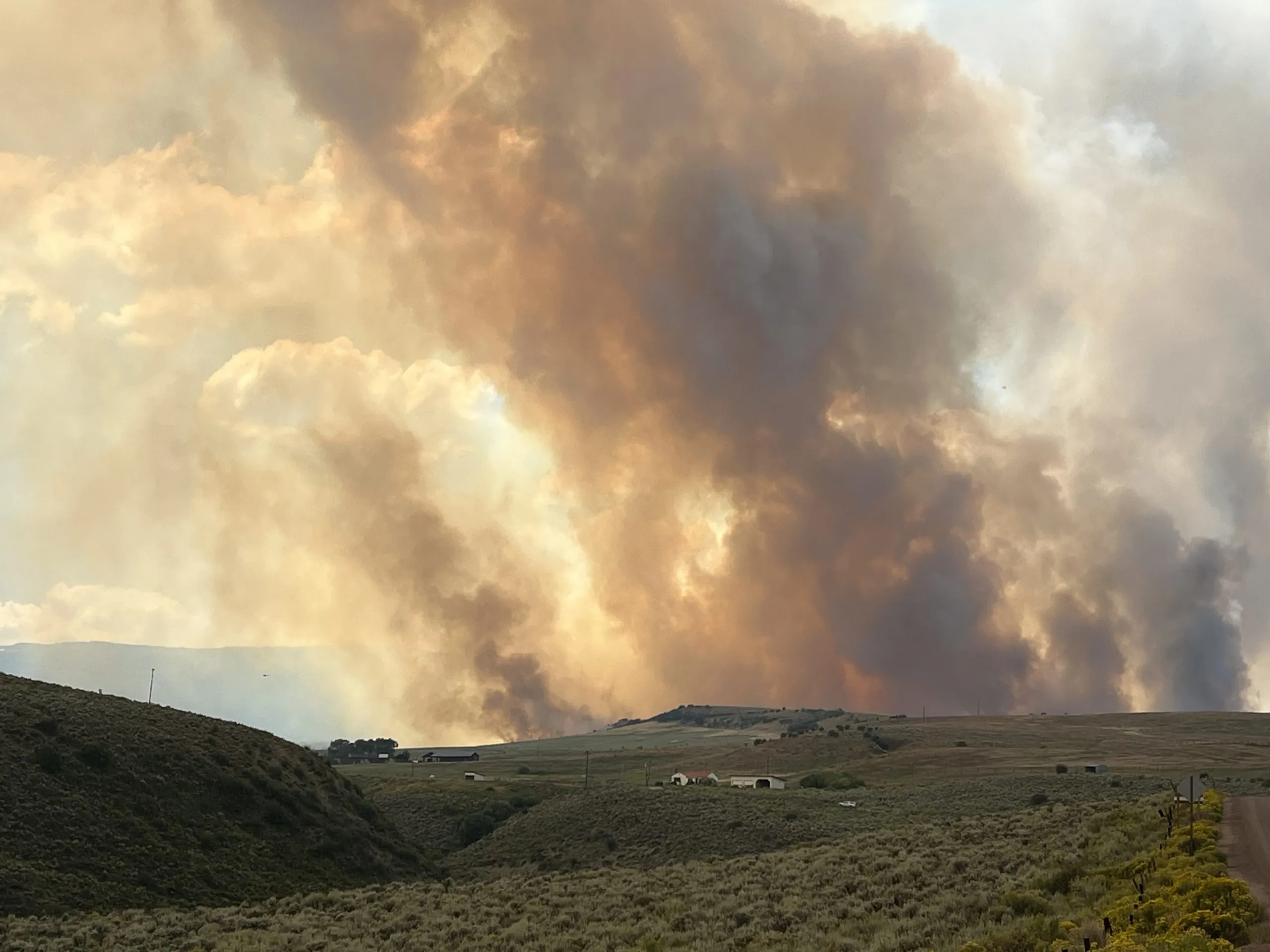
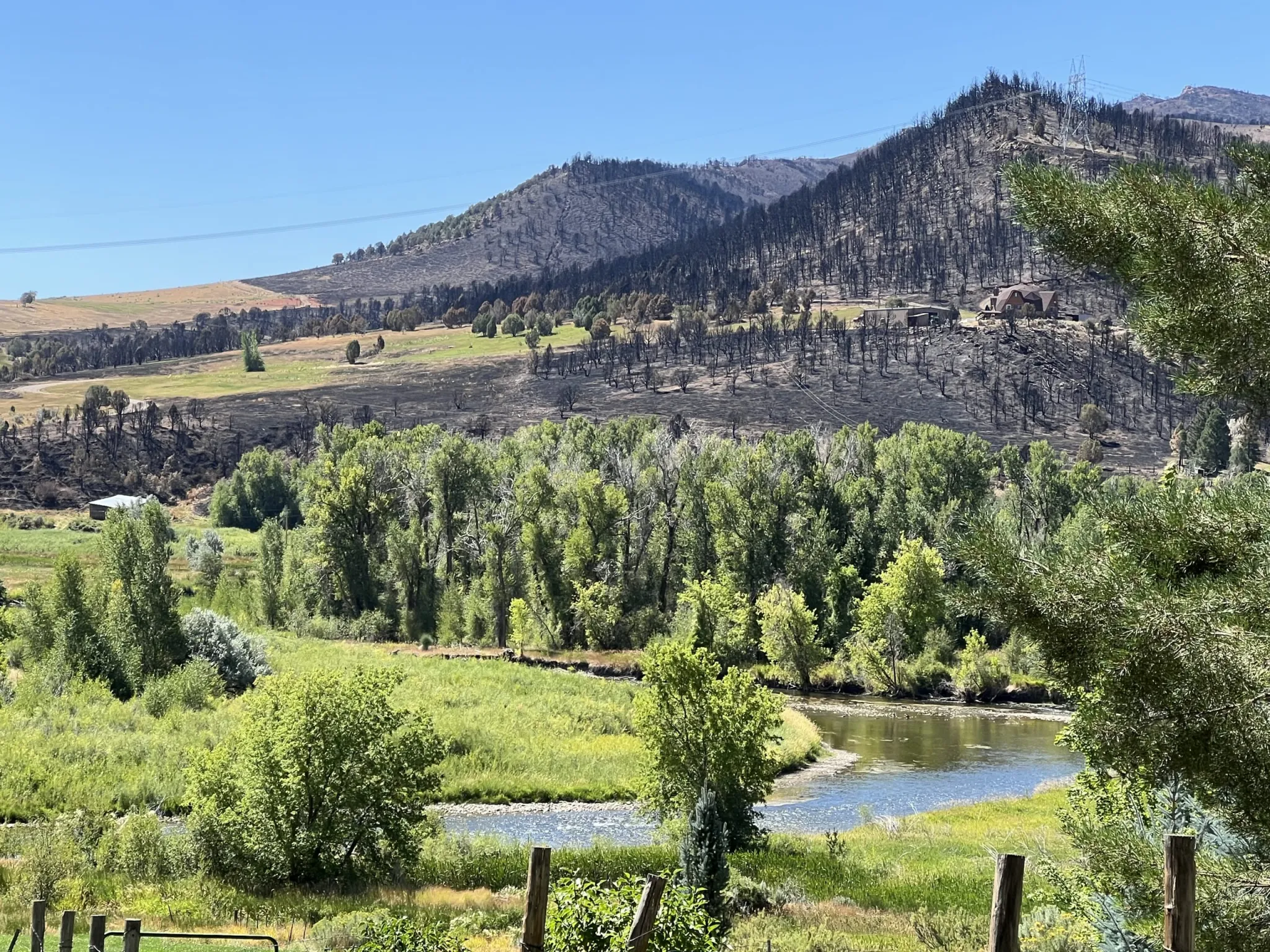
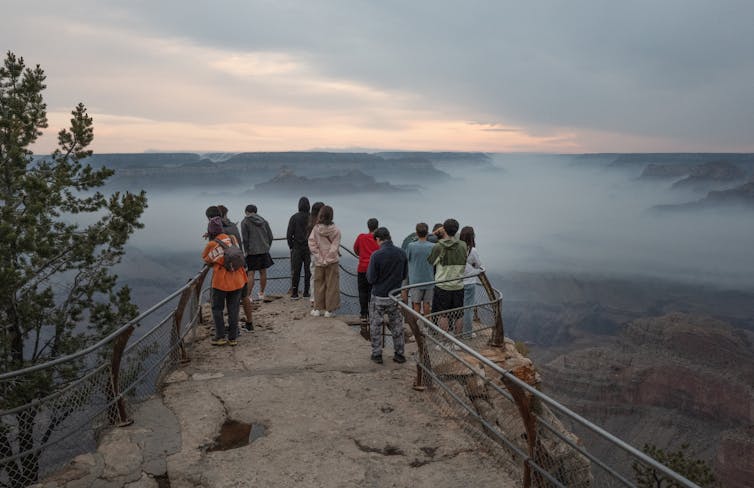
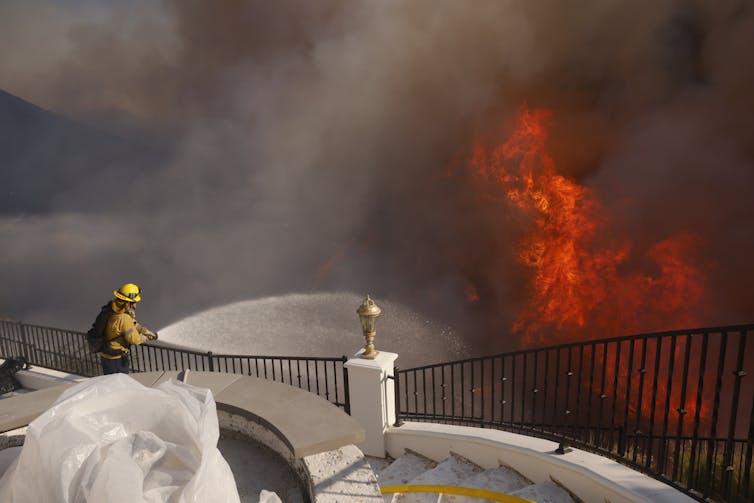
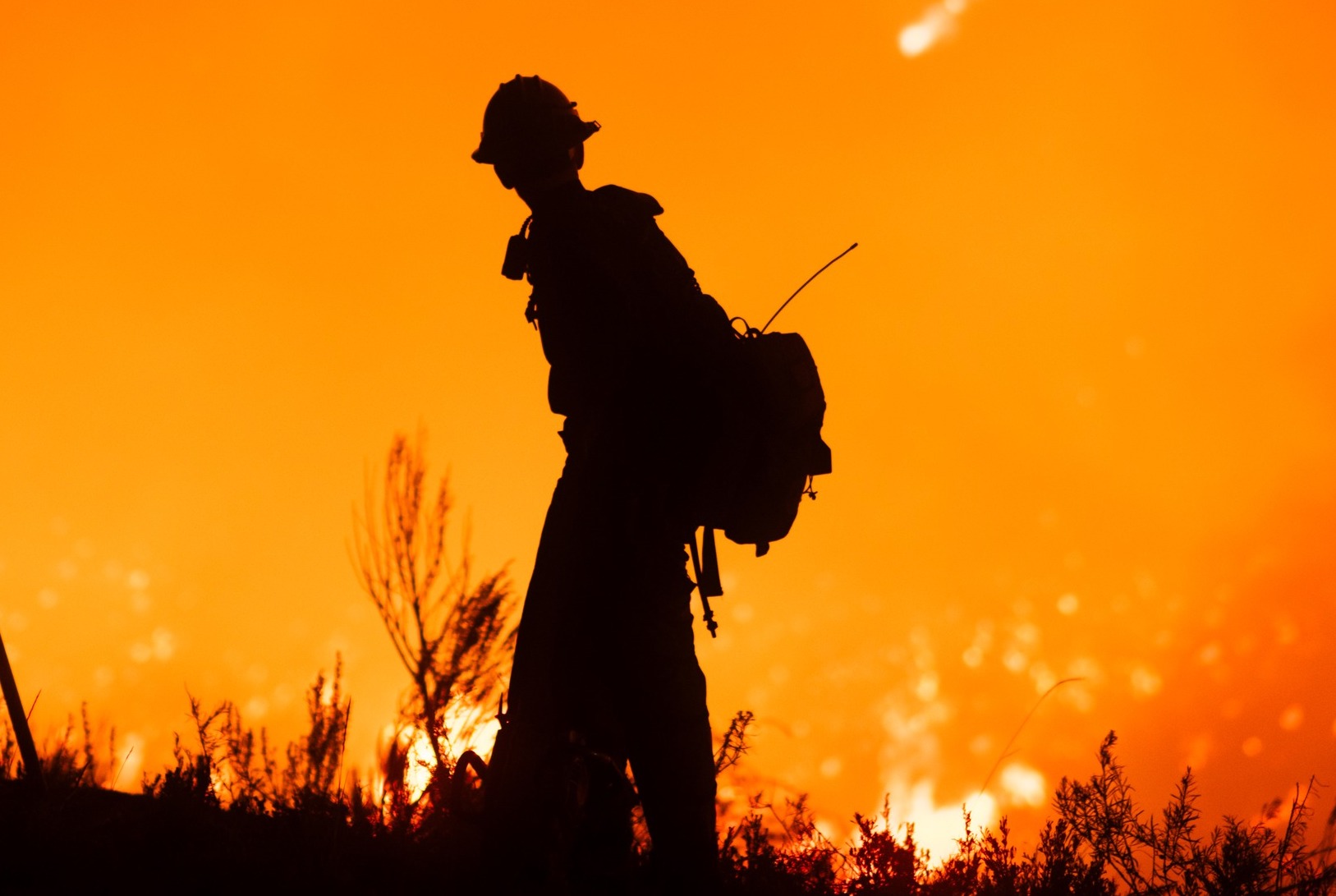
A Douglas County firefighting helicopter brought members of its helitack team to help fire the fire and made multiple drops of water on the late July blaze.
Fran and Terry Haury
Click the link to read the article on the Canyon Courier website (Jan Reuter). Here’s an excerpt:
August 13, 2025
Fran and Terry Haury were eating lunch in their mountaintop Conifer-area home July 22 when thunder and lightning struck.
“It was so instantaneous, and the noise was so loud, we didn’t even realize there was a light flash,” Terry Haury said. “I didn’t see any smoke, but another neighbor called and said they had. Sure enough, a tree was on fire. Then it just blew up, and the fire was higher than the trees.”
That was the start of the White Hawk fire. Due to the steep, rocky terrain and that day’s windy conditions, the blaze had the potential to be disastrous. Instead, just more than a single acre burned…Neighbors, firefighters and state officials attribute its minimal impact to two factors: mitigation and a swift attack…
A decade before, eight neighboring landowners used a grant and pooled their funds to pay the balance for the Jefferson Conservation District to mitigate 235 acres. JCD assists private landowners with planning and implementing forest and noxious weed management projects to restore ecosystems and mitigate wildfire hazards…Firefighter response was also crucial. Elk Creek Fire, the Conifer Wildland Division, the Jefferson County Sheriff’s Office and a Douglas County helicopter equipped with a water tank joined forces at the site…The JCD’s efforts, which also include a slash program, are voluntary. It exists to help private landowners address resource concerns about wildlife habitat, wildfire, water and invasive species…JCD’s preference is to mitigate across multiple landowner boundaries to make a treated area as large as possible. That magnifies the positive impact on wildlife and wildfire mitigation, Stephens said.
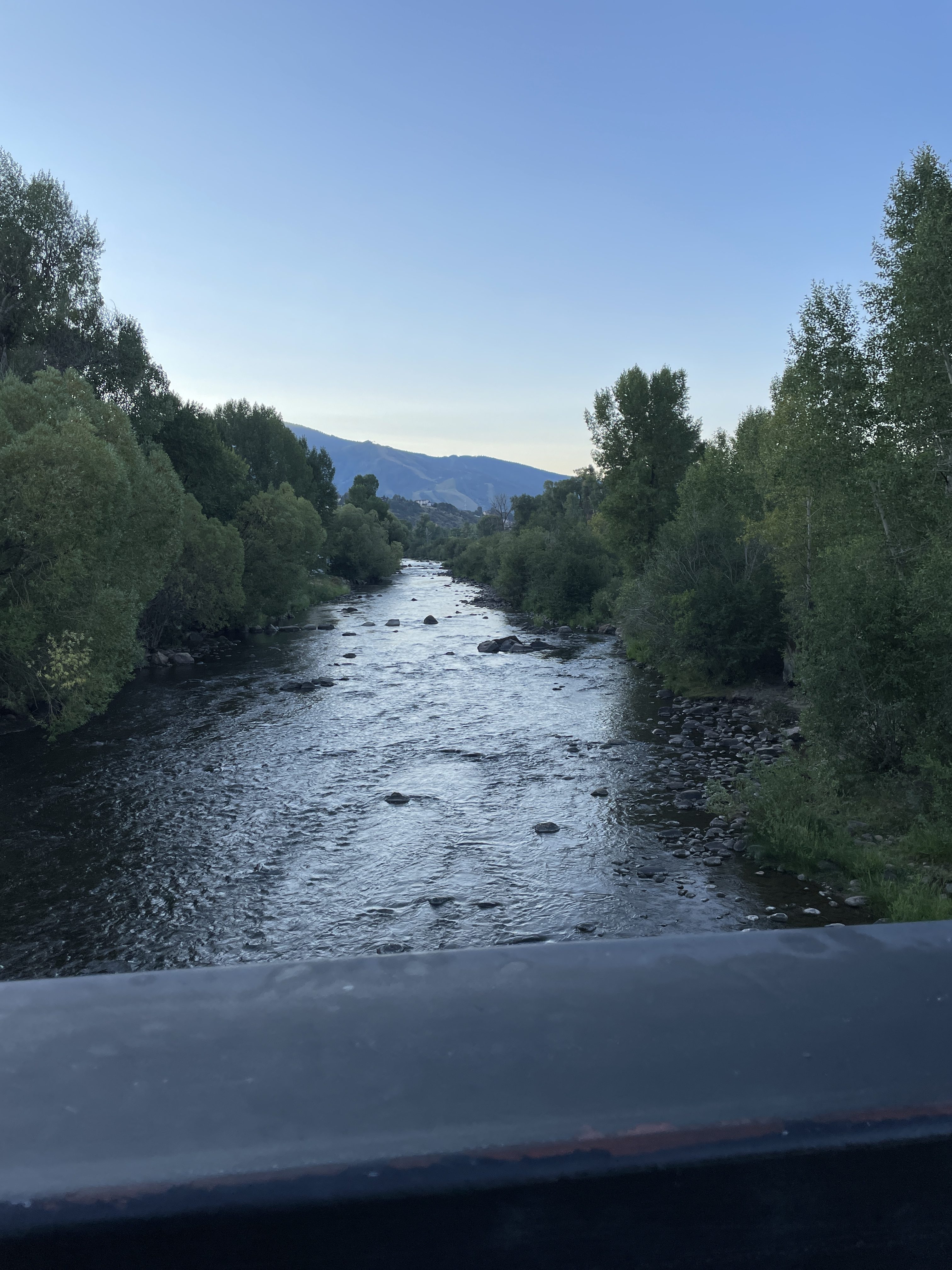
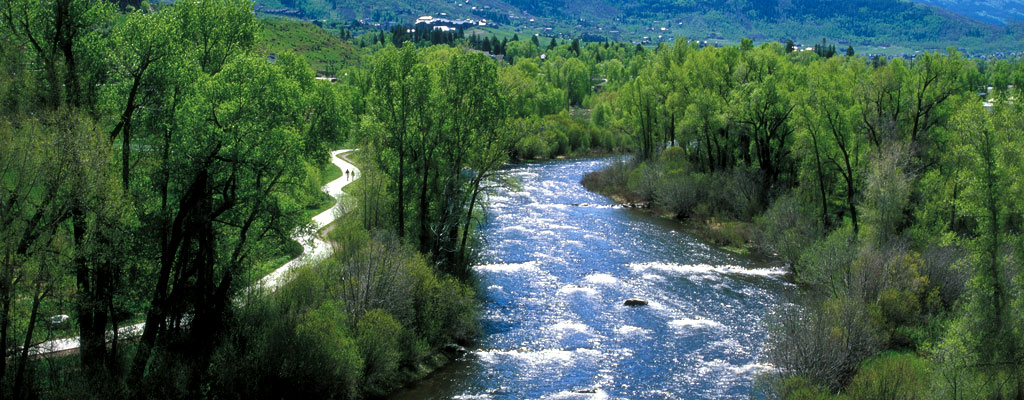
Colorado River “Beginnings”. Photo: Brent Gardner-Smith/Aspen Journalism
From email from the Arizona Department of Water Resources (Doug Maceachern):
September 2, 2025
It’s time to set the record straight regarding the negotiations among Arizona, California, Nevada, Utah, Wyoming, New Mexico and Colorado regarding the post-2026 Colorado River operations.
Amid the backdrop of prolonged drought and declining flows of the Colorado River, the seven states have the unenviable task of balancing the amount of water Mother Nature provides and the stressors related to the use of that water for 40 million people and millions of acres of farmland.
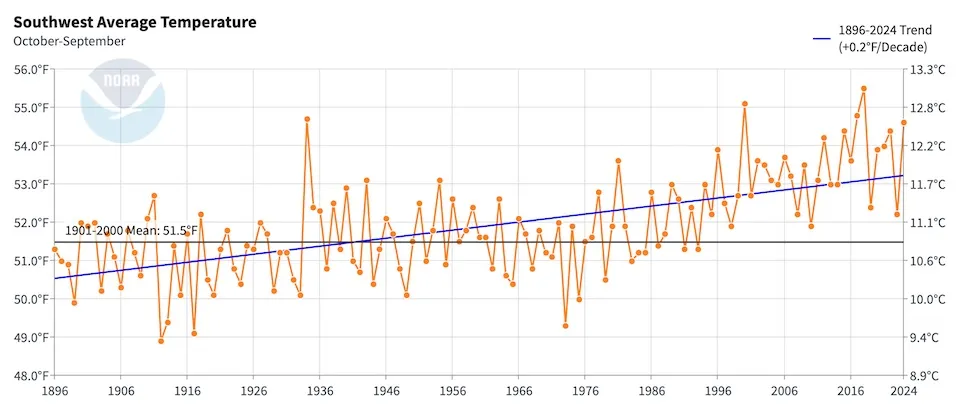
Udall/Overpeck 4-panel Figure Colorado River temperature/precipitation/natural flows with trend. Lake Mead and Lake Powell storage. Updated through Water Year 2024. Credit: Brad Udall
Discussions among the seven basin states continue, but finding common ground has been extremely challenging. The United States has told the seven basin states that if an agreement is not reached by November 11, 2025, they will move forward with an alternative. The terms and conditions of that alternative have not been disclosed. There is still an opportunity to avoid the path of federally imposed operating guidelines and the legal entanglements that would likely follow. But the clock is ticking.
However, Arizona, California, Nevada, and our partners in Mexico have not been idle. Over the last decade, we have reduced our water use so that the elevation of Lake Mead, the primary storage reservoir supplying water to our three states and Mexico, is over 100 feet higher because of those water-use reductions. That is over two trillion gallons of water. Arizona’s contribution to that success story? Nearly a trillion gallons of that total entirely on our own.
Those reductions have been painful, but they have not been enough to sustain the river. Moving forward, all seven states must do more.
That outcome requires bold thinking, sacrifice, and a willingness to share in protecting the Colorado River by all seven states that benefit from its bounty. The tool to achieve that goal is simple: reduce water use.
Arizona, California, and Nevada have put forth a Post 2026 operational proposal that requires mandatory, certain and verifiable water-use reductions of additional billions of gallons of water by the three Lower Basin states.
To the contrary, Colorado, Wyoming, Utah, and New Mexico have not agreed, nor have they proposed, any mandatory, certain and verifiable reductions in their water use. Not. One. Single. Gallon. Instead, they propose that water-use reductions needed to save the Colorado River come solely from Arizona, California and Nevada.
Map of the Colorado River drainage basin, created using USGS data. By Shannon1 Creative Commons Attribution-Share Alike 4.0
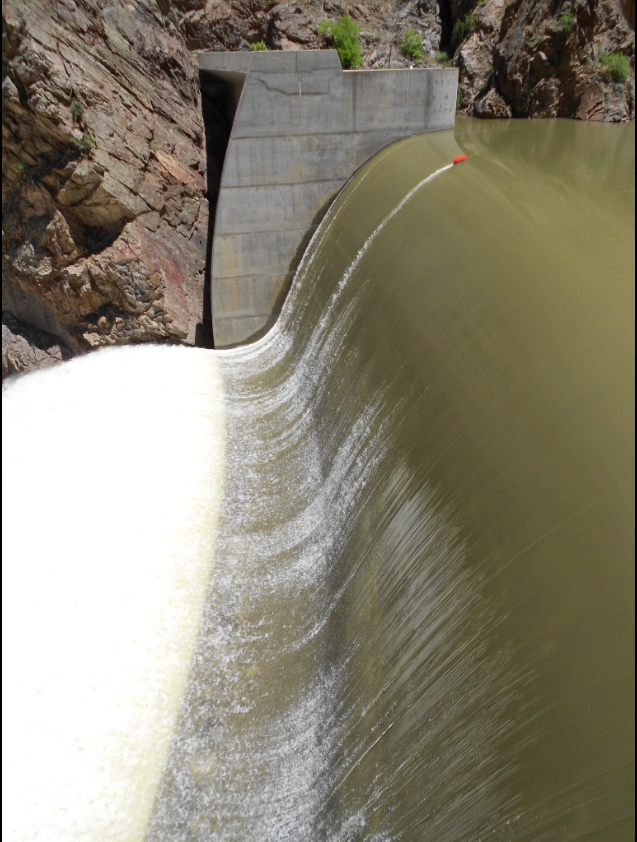
Crystal Dam, part of the Colorado River Storage Project, Aspinall Unit. Credit Reclamation.
From email from Reclamation (Conor Felletter):
September 4, 2025
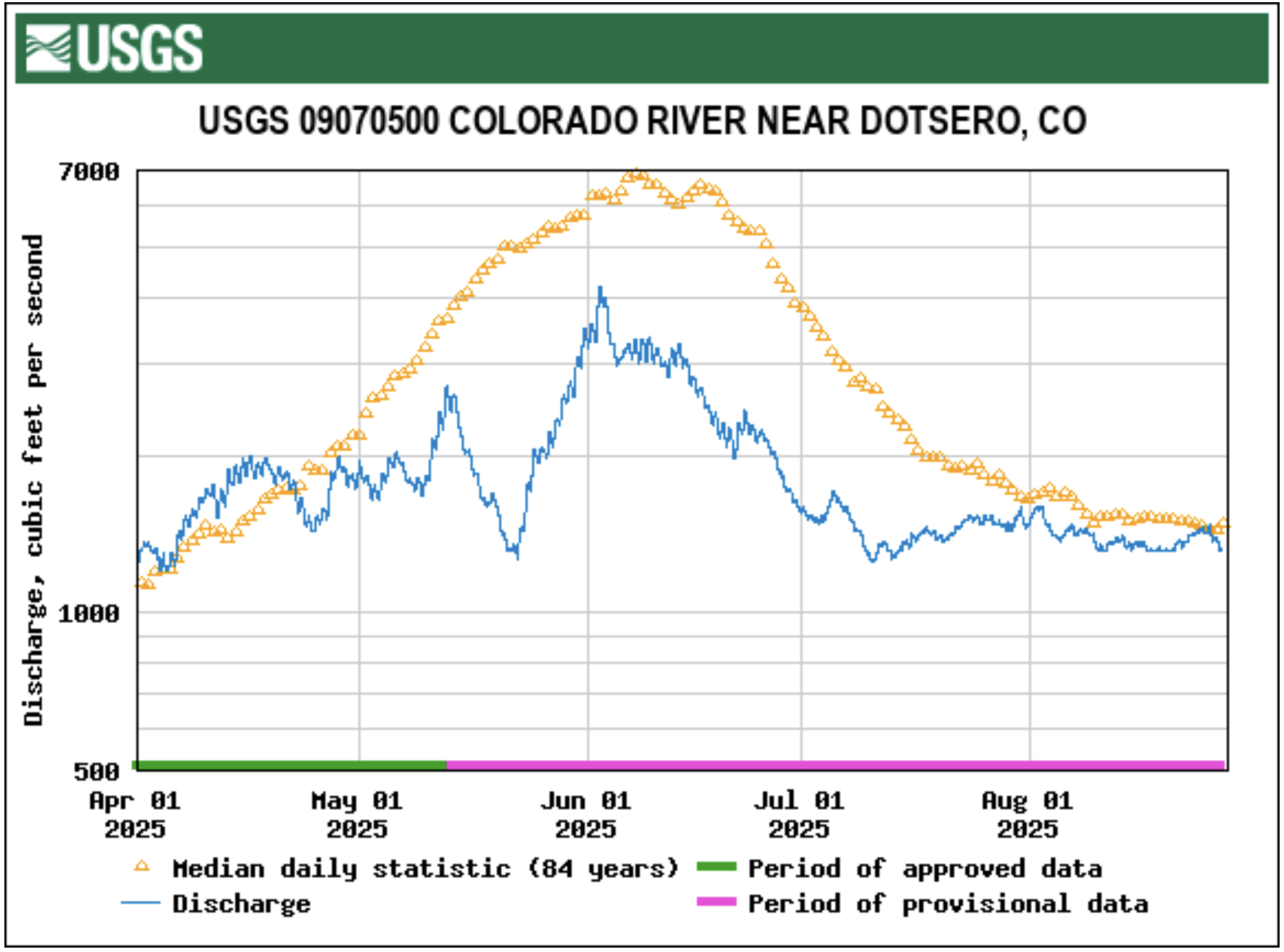
On Saturday, September 6, 2025 at 6pm MT, Reclamation will decrease releases from Crystal Dam to 1,450 cfs from the current release of 1,500 cfs. Gunnison Tunnel diversions remain at 1025 cfs. Gunnison River flows in the Black Canyon/Gunnison Gorge, currently ~460 cfs, are anticipated to decrease to ~410 cfs. This schedule will remain in effect until a new notification is issued. Scheduled releases are subject to changes with changes in river flows and weather conditions.
Releases are made for the authorized purposes of the Aspinall Unit, and to maintain target base flows through the endangered fish habitat along the Gunnison River between Delta and Grand Junction.
Contact Conor Felletter (cfelletter@usbr.gov or 970-637-1985) for more information regarding Aspinall operations.
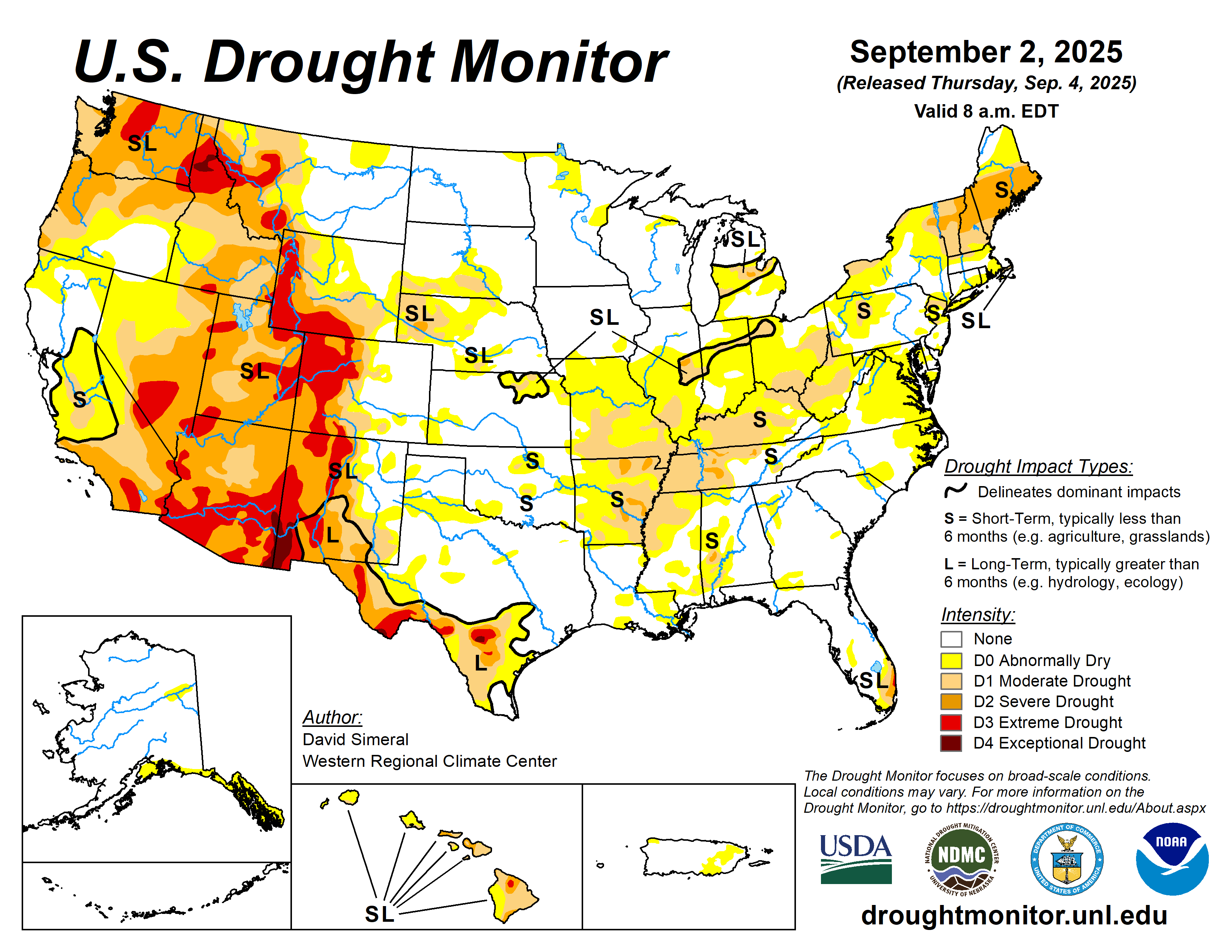
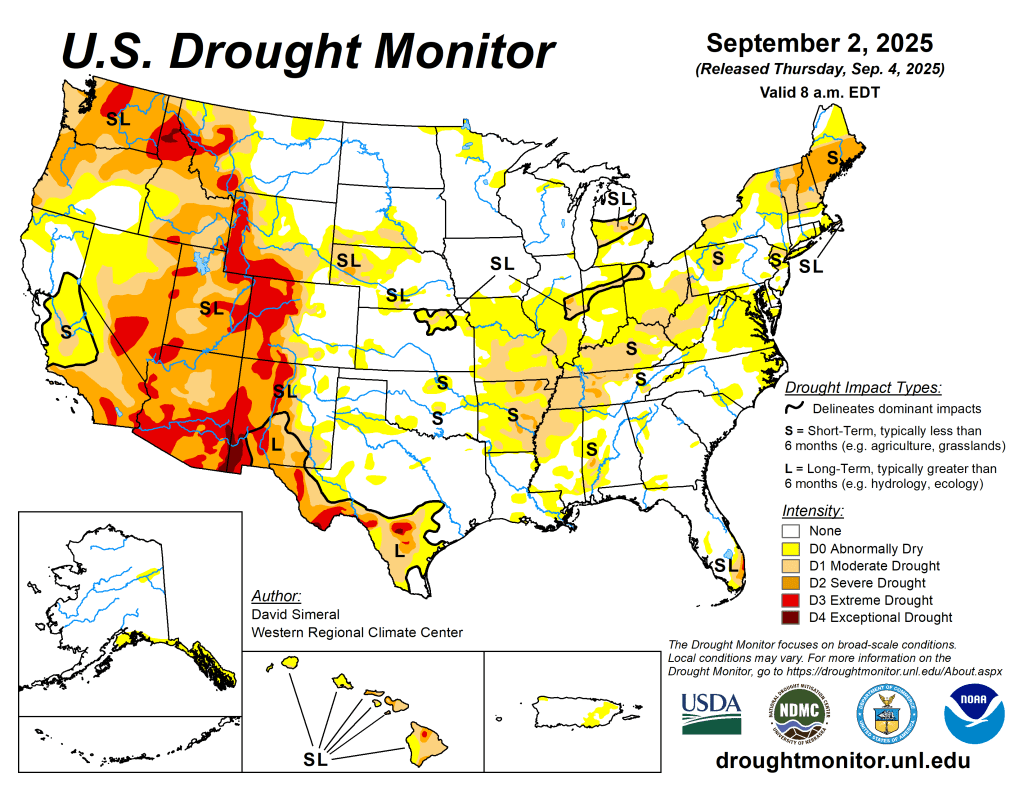
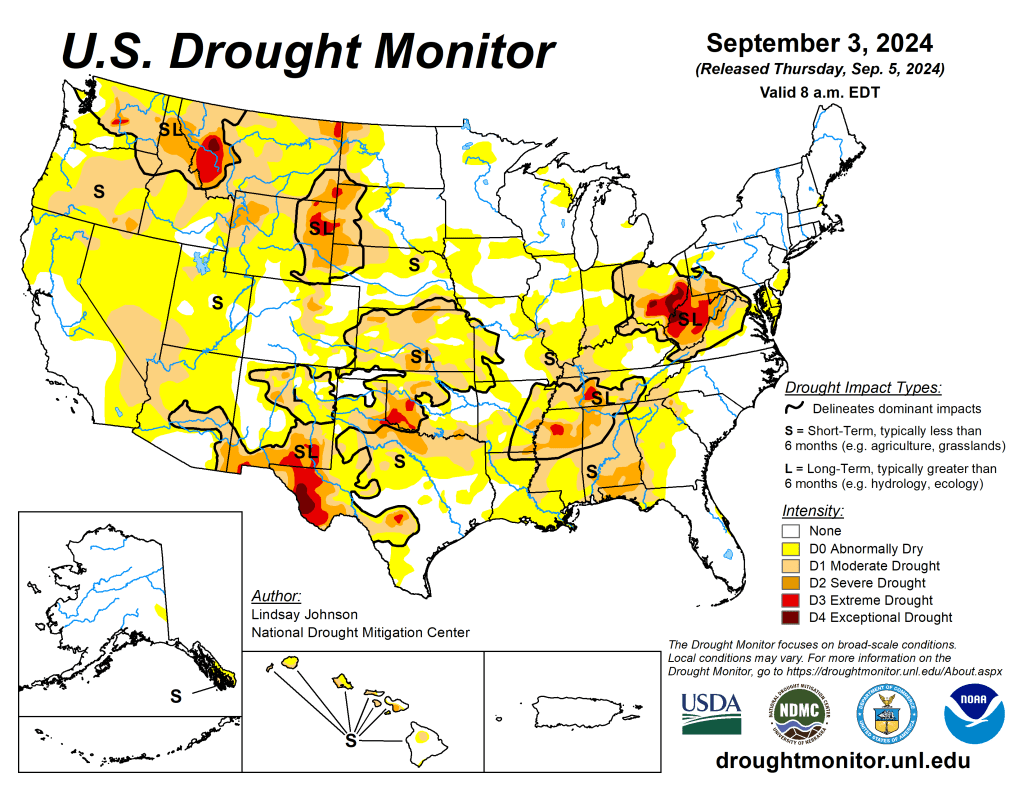
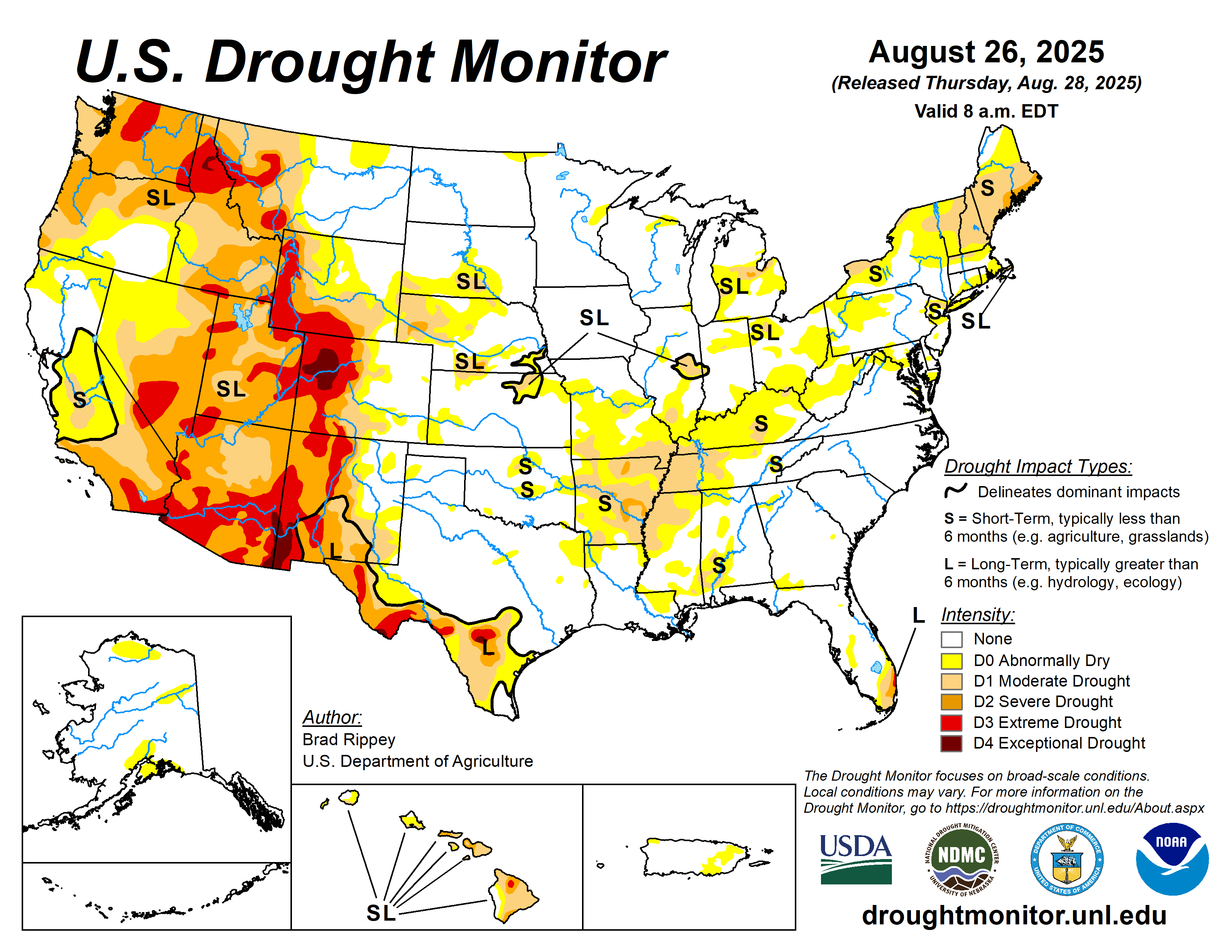
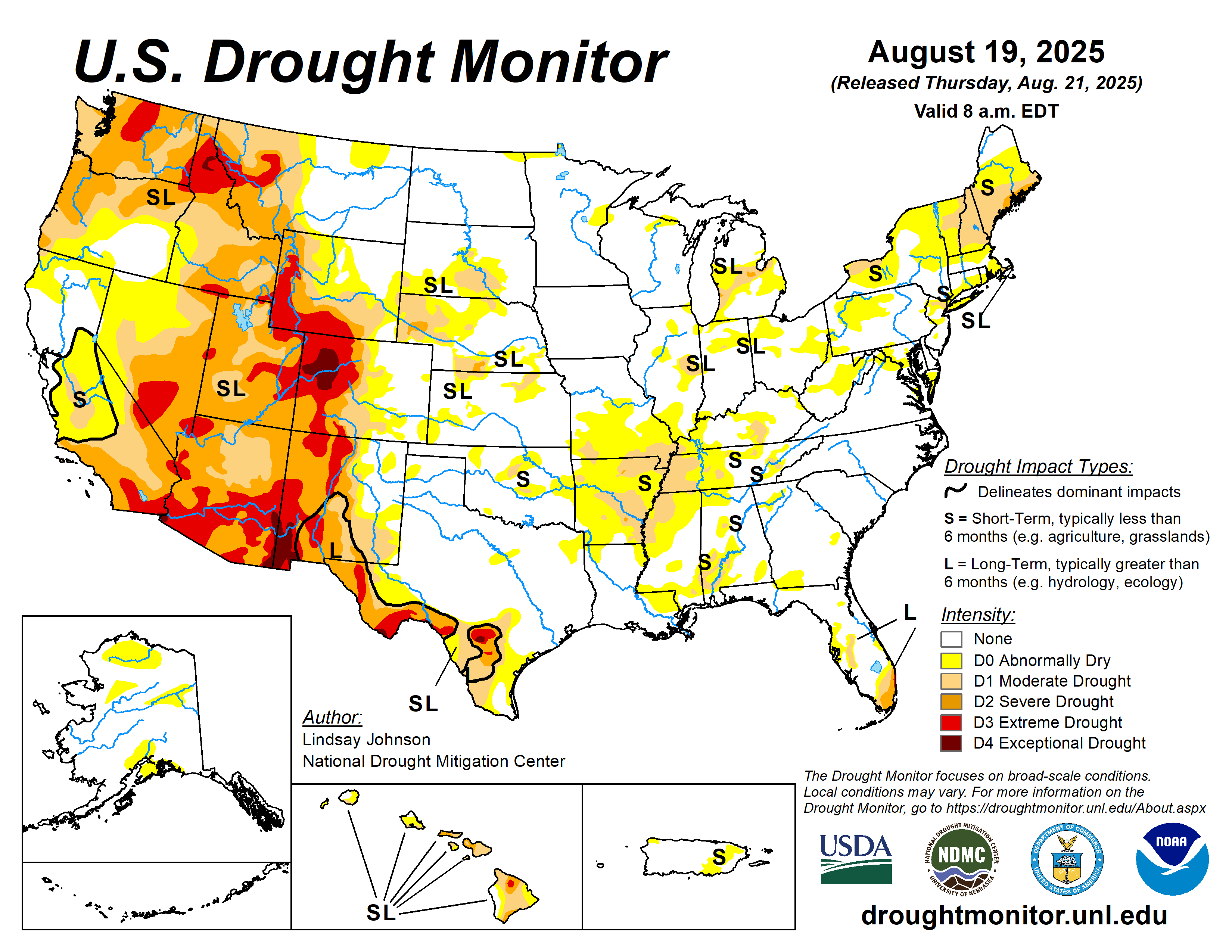
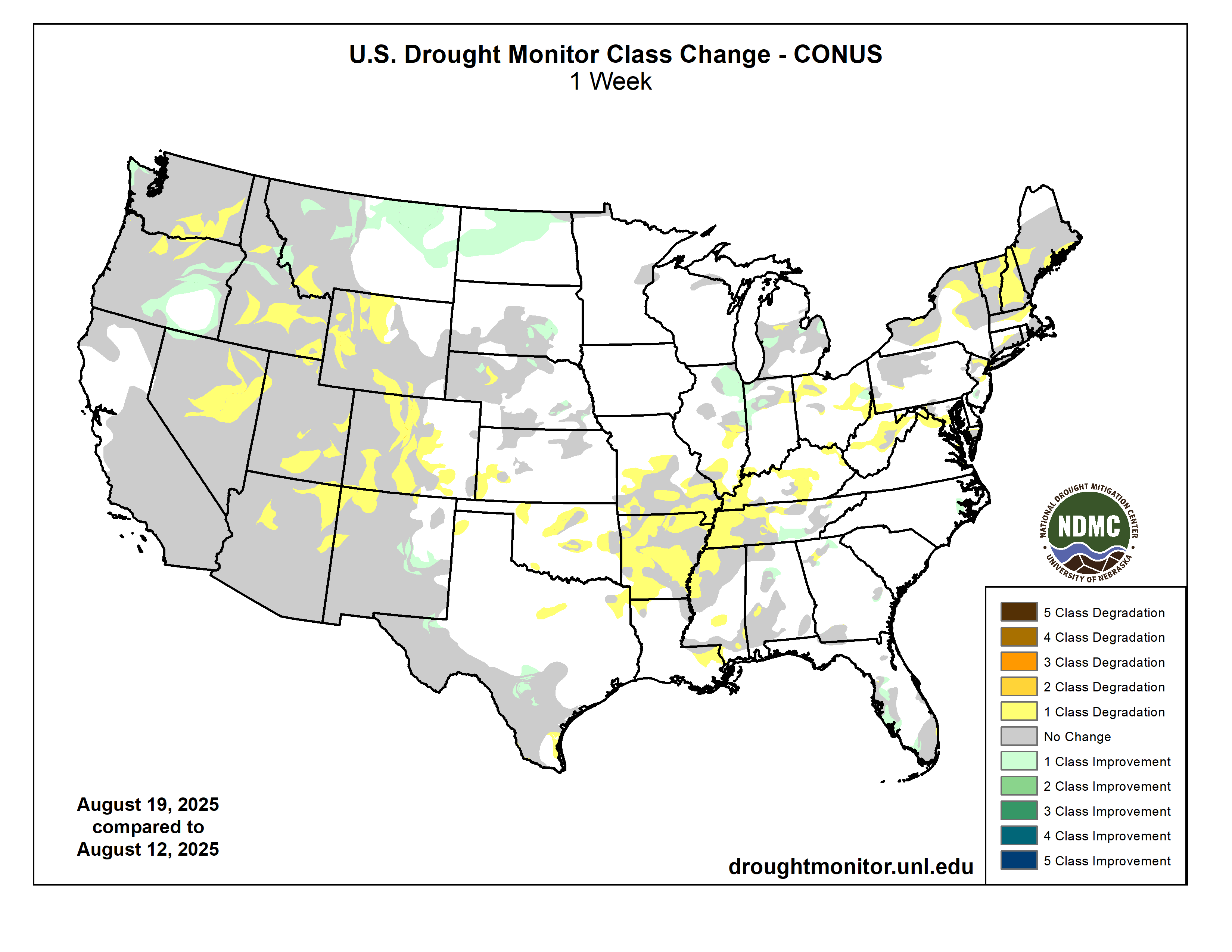
This U.S. Drought Monitor (USDM) week saw widespread degradation in drought-related conditions across areas of the Midwest, Mid-Atlantic, and Northeast where precipitation during the past 30-day period has been below normal. In these areas, rainfall deficits ranged from 3 to 5 inches with the largest deficits observed across areas of New England and Lower Midwest. Elsewhere, short-term dryness and drought impact reports from the agricultural sector led to degradations in isolated areas of the Southeast and South. For the week, most of the eastern half of the conterminous U.S. experienced unseasonably cooler temperatures, while temperatures out West were above normal, especially across the Pacific Northwest and Desert Southwest. In the West, conditions were generally dry, however, some isolated monsoon thunderstorm activity was observed in the Southwest, Sierra Nevada Range of California, Great Basin, and in the Rocky Mountains. In the Pacific Northwest, continued dryness as well as declining streamflow and soil moisture levels led to expansion of areas of exceptional drought in the Idaho Panhandle. In terms of reservoir storage in the West, California’s reservoirs continue to be at or above historical averages for the date (September 2), with the state’s two largest reservoirs, Lake Shasta and Lake Oroville, at 104% and 112% of average, respectively. In the Southwest, the U.S. Bureau of Reclamation is reporting (September 1) Lake Powell at 29% full (44% of average for the date), Lake Mead at 31% full (52%), and the total Colorado system (September 1) at 38% of capacity (compared to 44% of capacity the same time last year)…
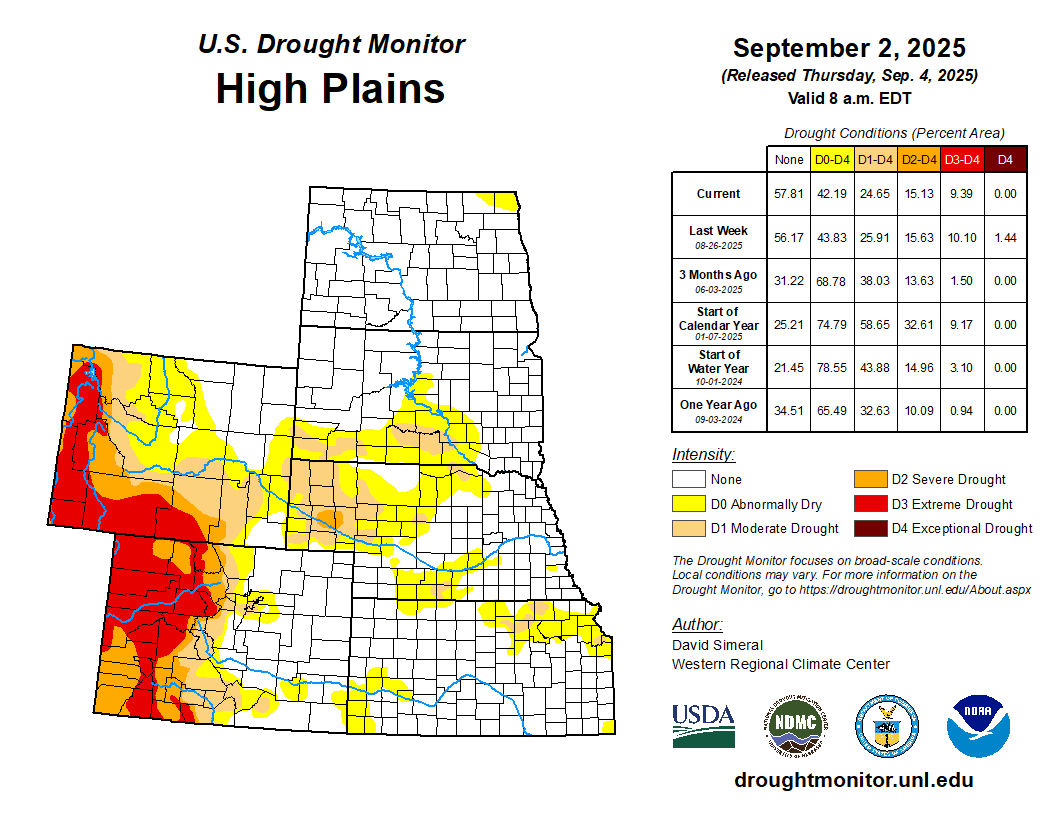
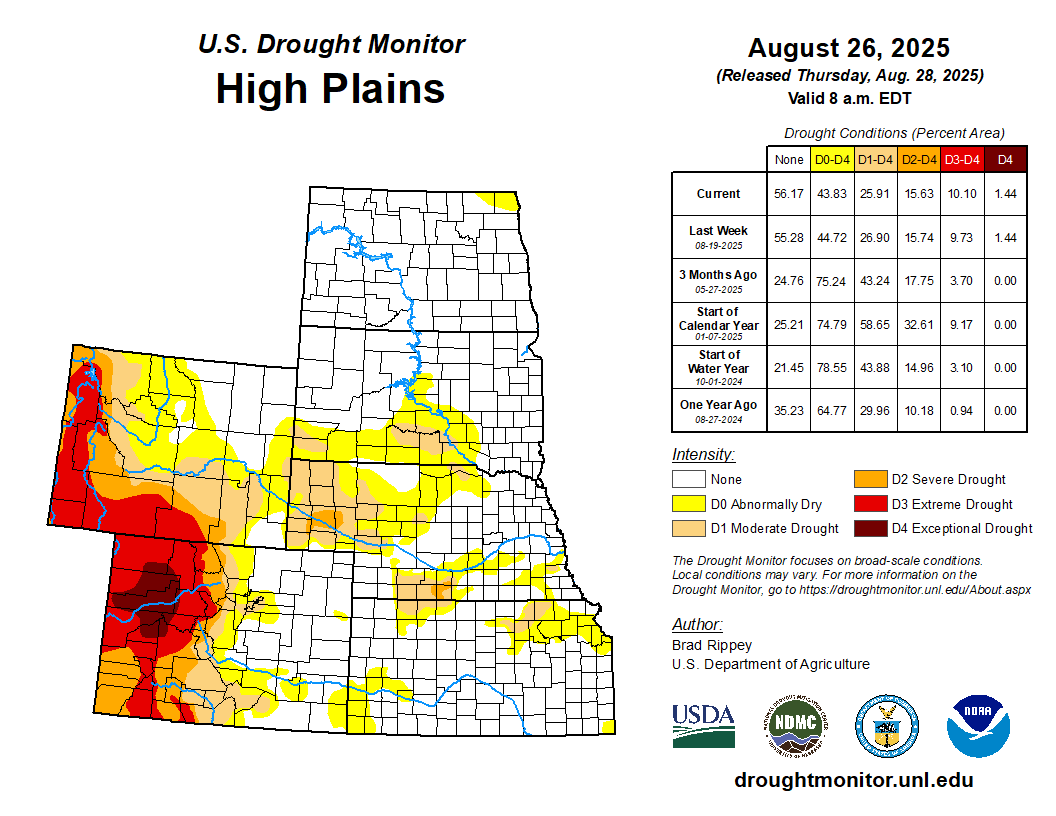
On this week’s map, improvements were made in the region, namely in northern Kansas, and southern Nebraska, where some isolated shower activity (1 to 5+ inches) during the past week continued to help chip away at the longer-term precipitation deficits. For the past 60-day period, the Lincoln AP observed its 6th wettest on record with 10.24 inches (+3.69 departure from normal), according to the SERCC. Conversely, conditions deteriorated on the map in the southwestern extent of South Dakota where a combination of short and long-term precipitation deficits have persisted leading to expansion of areas of Moderate Drought (D1). For the week, above-normal temperatures (ranging from 2 to 10 degrees F) were logged across northern North Dakota, while much of the remainder of the region experienced below normal temperatures (ranging from 1 to 10 degrees F), especially in the southern extent of the entire region…
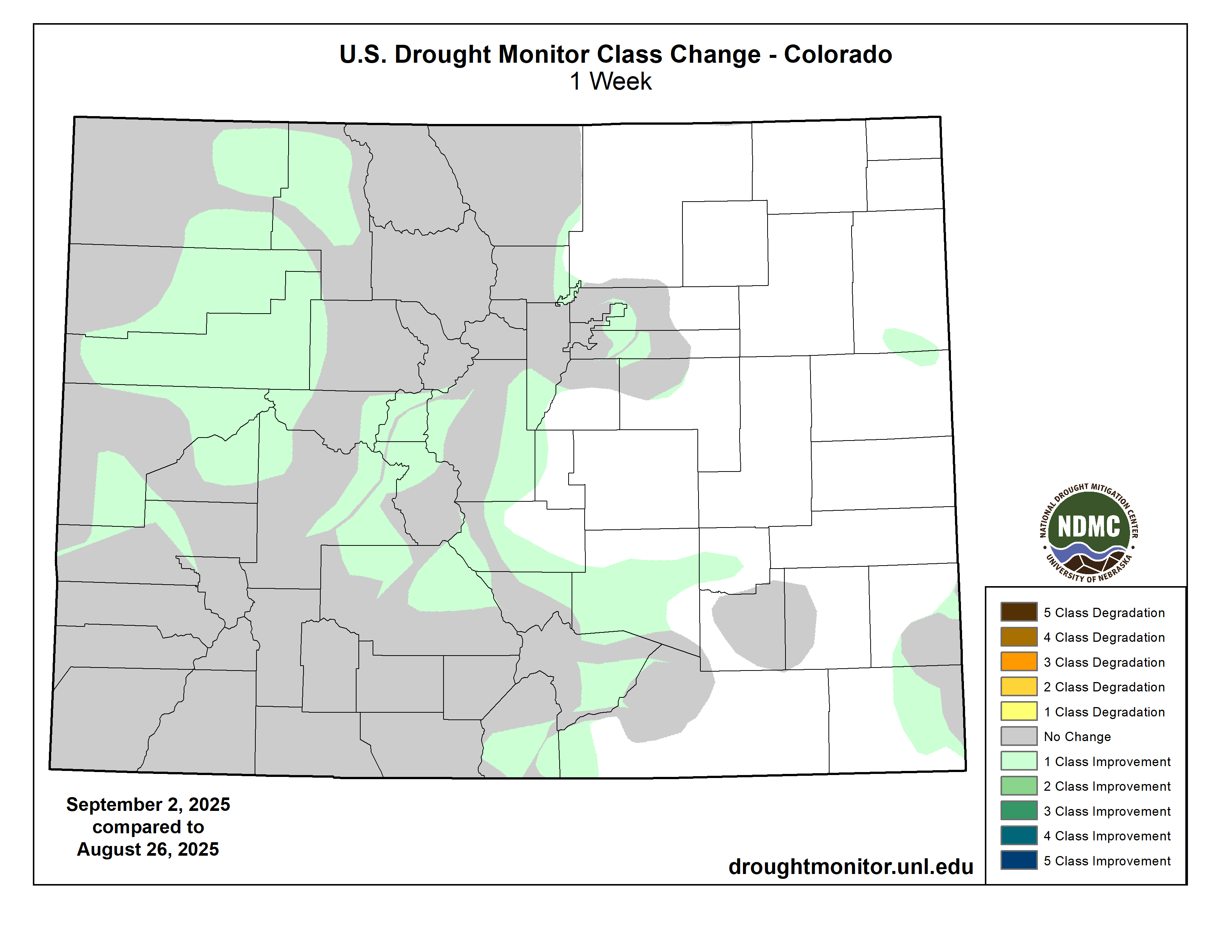
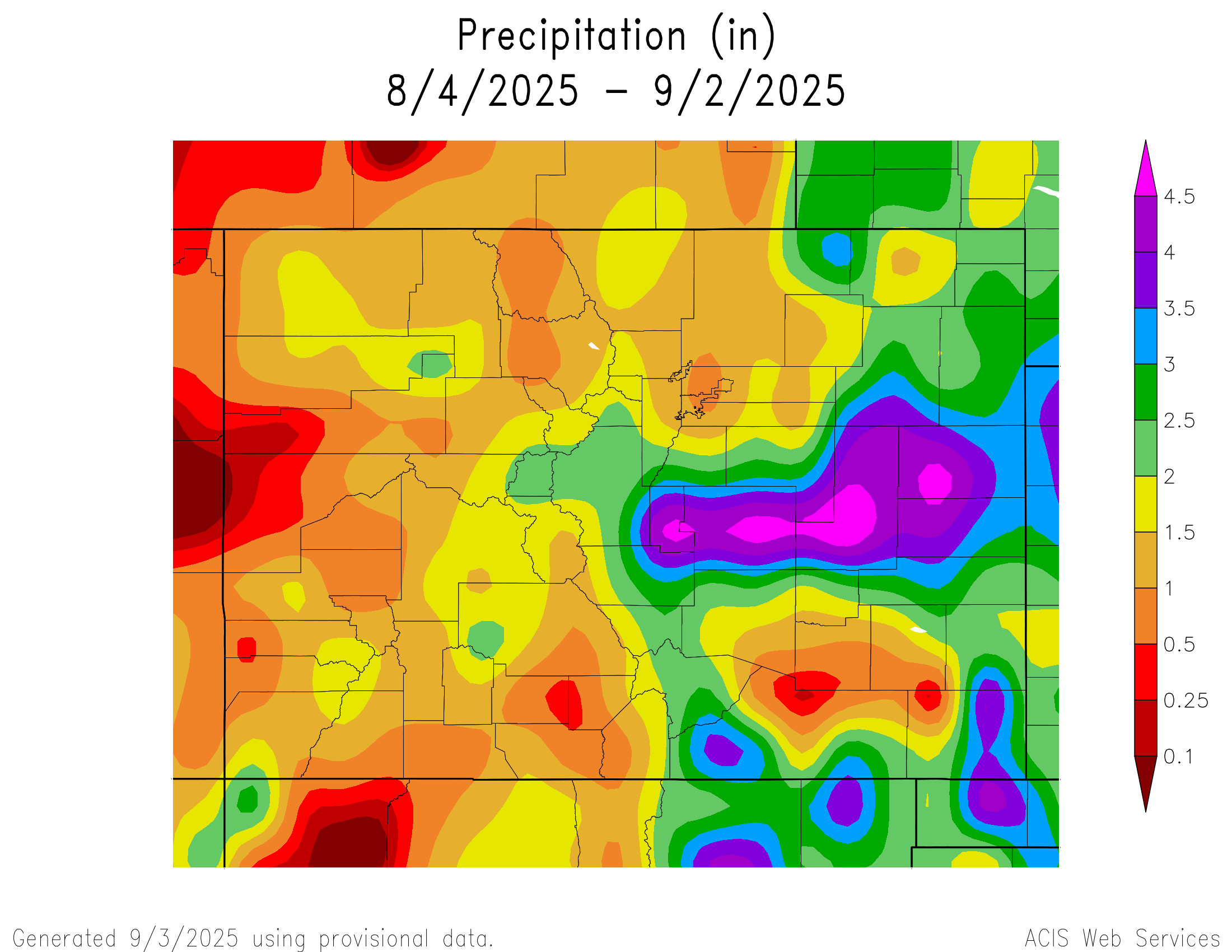
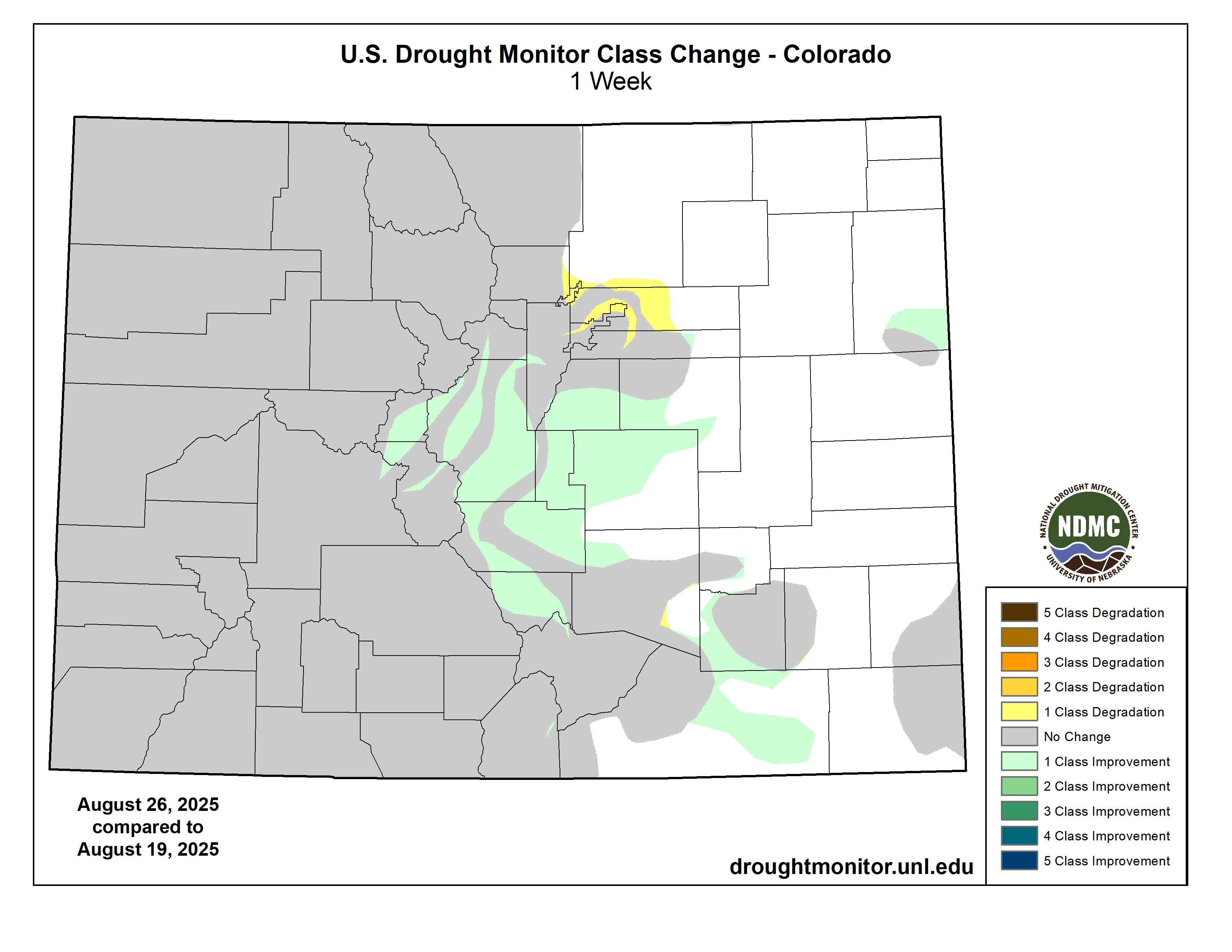
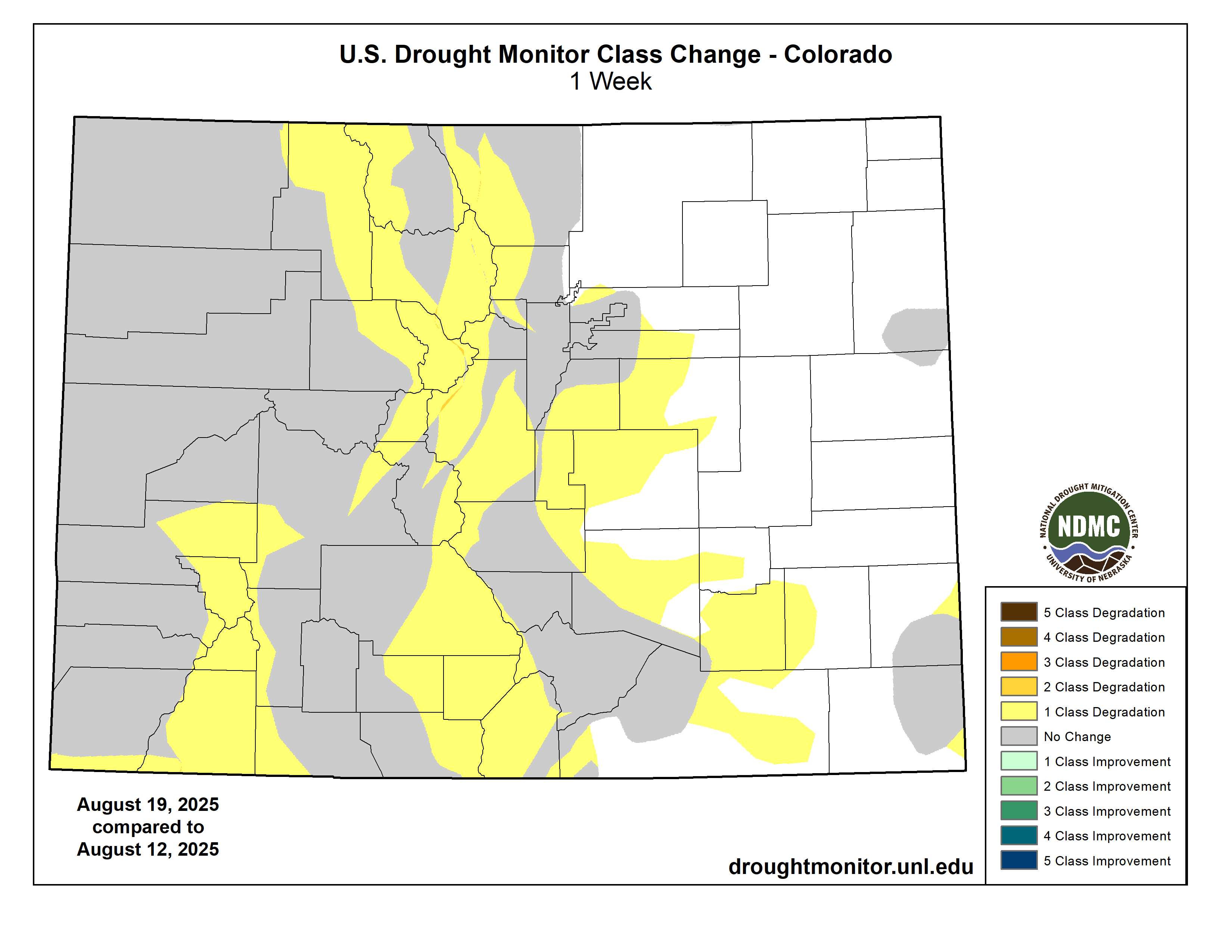
Colorado Drought Monitor one week change map ending September 2, 2025.
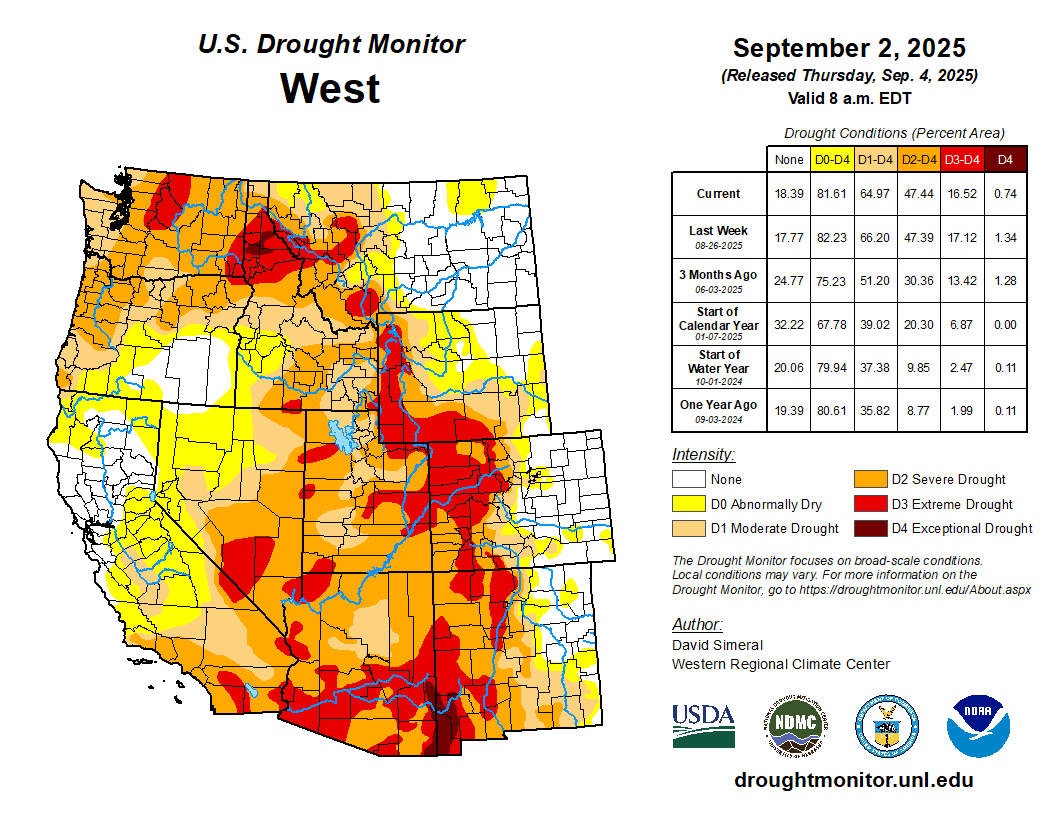
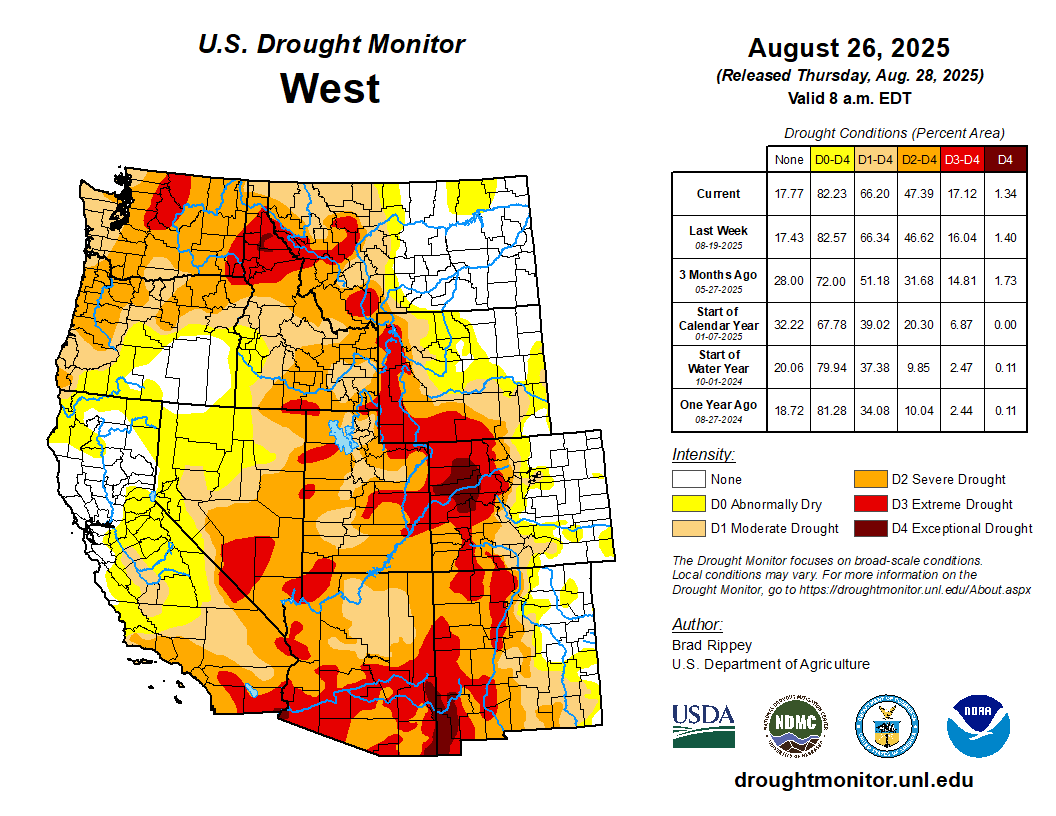
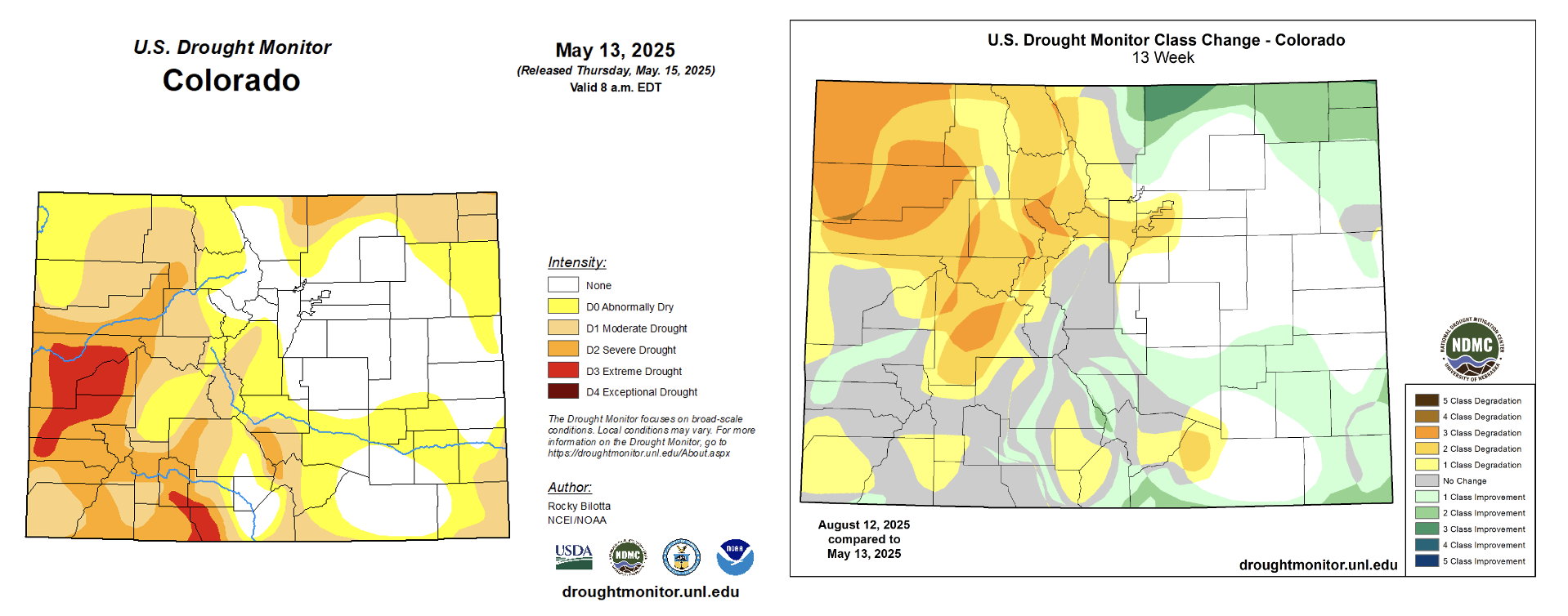
Out West, some isolated monsoon shower activity was observed across areas of the Desert Southwest, Sierra Nevada, and Great Basin as well as areas of the central and northern Rockies. Improvements were made on the map in Colorado, western Montana, southern Idaho, northern Utah, and southeastern California, while some degradations were made in north-central Arizona where monsoon-season precipitation has been below normal. According to the National Weather Service in Tucson, 2025 monsoon rainfall has been below normal across much of the state including Flagstaff, Phoenix, and Tucson. Conversely, a more active monsoon season has affected areas of New Mexico including southern and eastern portions of the state. For the week, average temperatures were below normal across areas of eastern California, central Great Basin, and areas of the Intermountain West including Utah, Colorado, and southern Wyoming where temperatures were 5 to 10 degrees below normal. In the Pacific Northwest, temperatures were above normal with anomalies ranging from 2 to 15 degrees F and the greatest departures observed in eastern Washington, Idaho Panhandle, and northwestern Montana…
On this week’s map, improvements were made in eastern Texas, northern Louisiana, northern Arkansas, and central Oklahoma in response to locally heavy rainfall (ranging from 2 to 6+ inches) observed during the past week. Elsewhere, short-term dryness led to introduction of areas of Abnormally Dry (D0) in areas of Texas including the Panhandle and Edwards Plateau. In Tennessee, degradations were made on the map in central and western portions in response to precipitation shortfalls (1 to 4 inches) during the past 30-day period. In terms of hydrologic conditions in Texas, the state’s reservoirs (cumulatively) were 77% full with many in the eastern part of the state in good condition (over 90% full), while numerous others in the western portion of the state continue to experience below-normal levels, according to Water Data for Texas (September 3). For the week, average temperatures were below normal (2 to 8 degrees F) across most of the region with the exception of southern and western portions of Texas where temperatures were 1 to 5 degrees above normal…
Looking Ahead
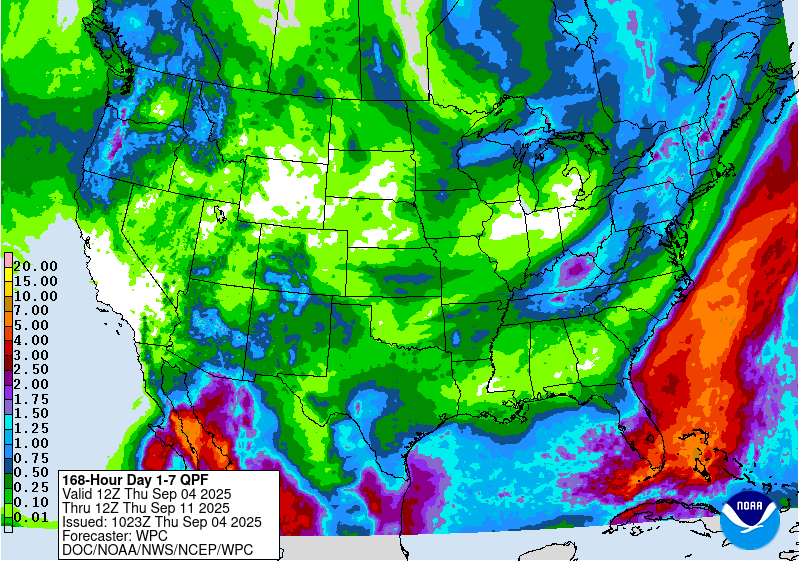
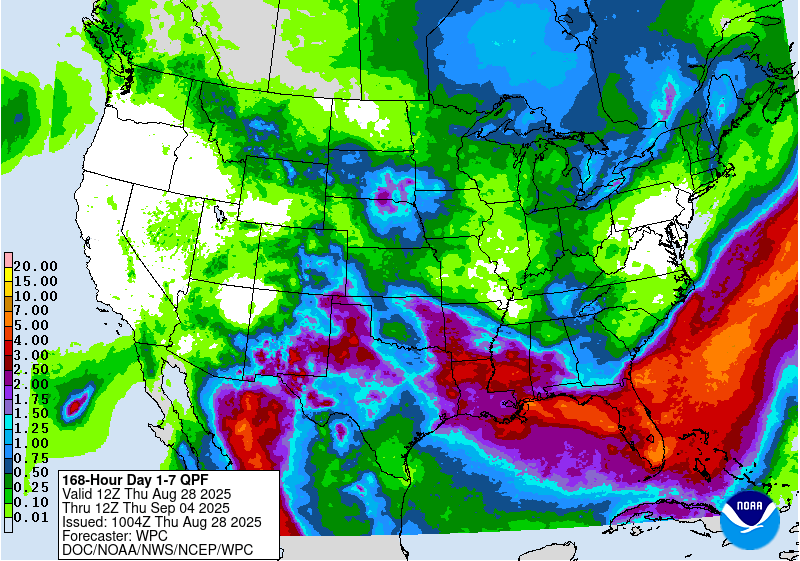
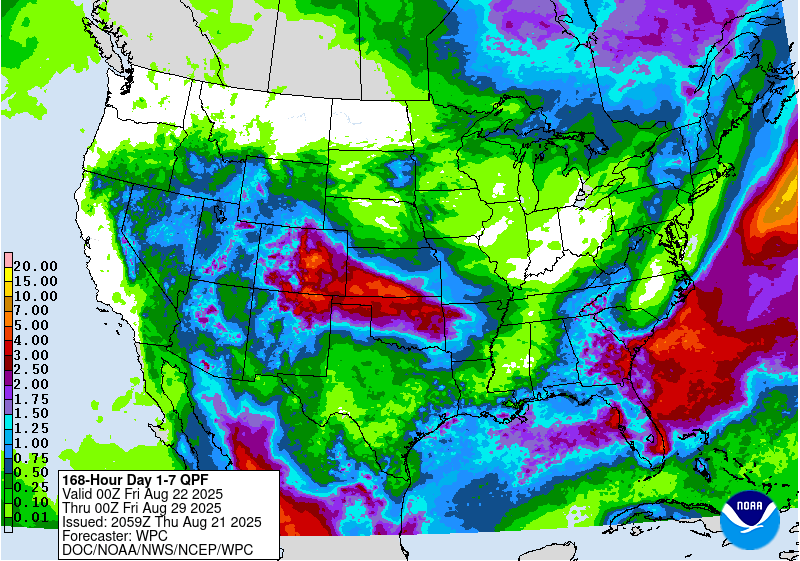
The NWS Weather Prediction Center (WPC) 7-Day Quantitative Precipitation Forecast (QPF) calls for moderate to heavy precipitation accumulations across areas of the Desert Southwest (southeastern Arizona) in association with remnant moisture from Hurricane Lorena. Additionally, heavy rainfall is expected in southern Florida, while light-to-moderate accumulations are expected across areas of the Pacific Northwest, Rockies, Texas, Lower Midwest, and Northeast. The Climate Prediction Center (CPC) 6-10-day outlooks call for a moderate-to-high probability of above-normal temperatures across most of the West, Central and Northern Plains, and Gulf Coast region. Conversely, below-normal temperatures are forecasted for the Midwest, Mid-Atlantic, Northeast, and areas of eastern California and western Great Basin. In terms of precipitation, there is a low-to-moderate probability of above-normal precipitation across most of the conterminous U.S. with exception of areas of the Southwest, Upper Midwest, and New England in proximity to the Great Lakes and Canadian border where below-normal precipitation is expected.
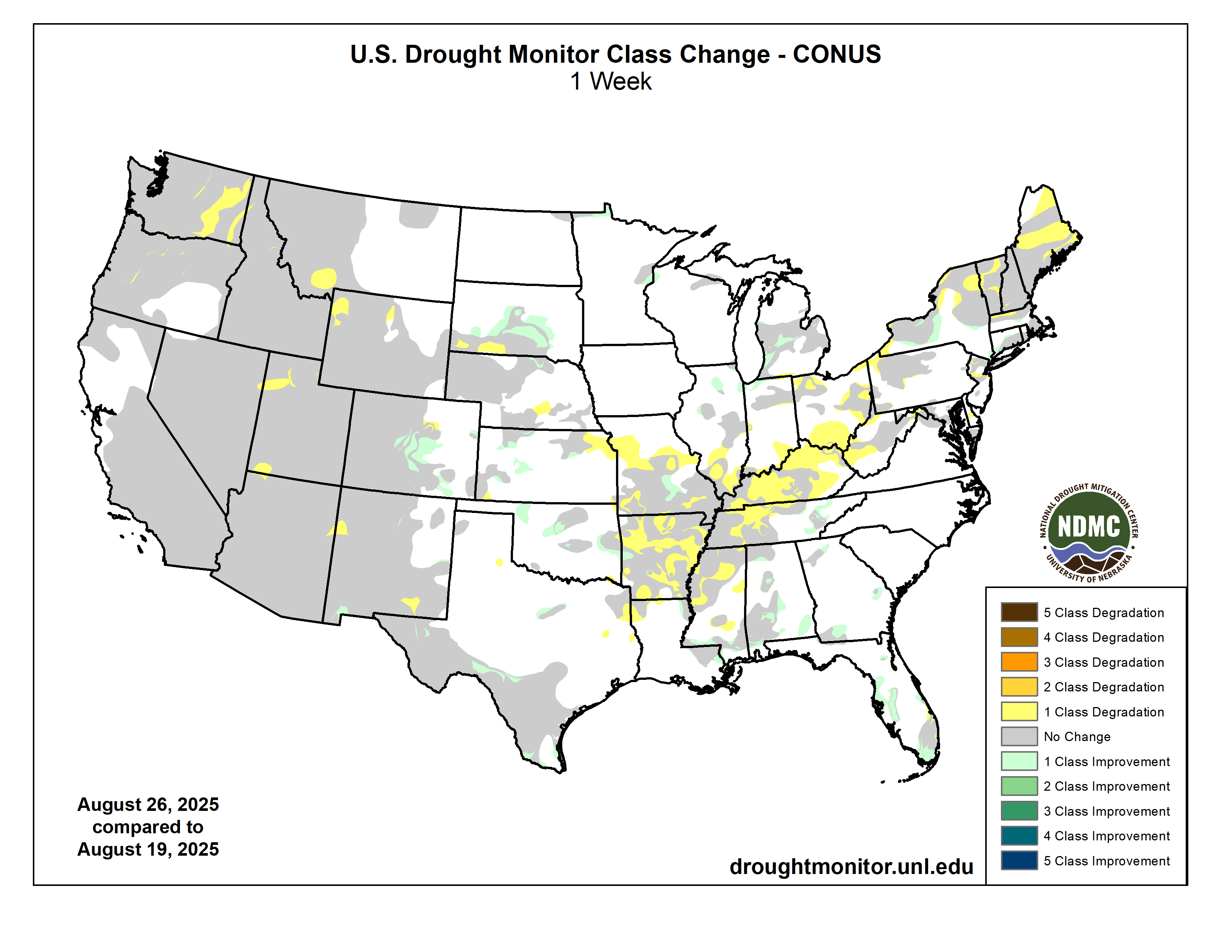
US Drought Monitor one week change map ending September 2, 2025.
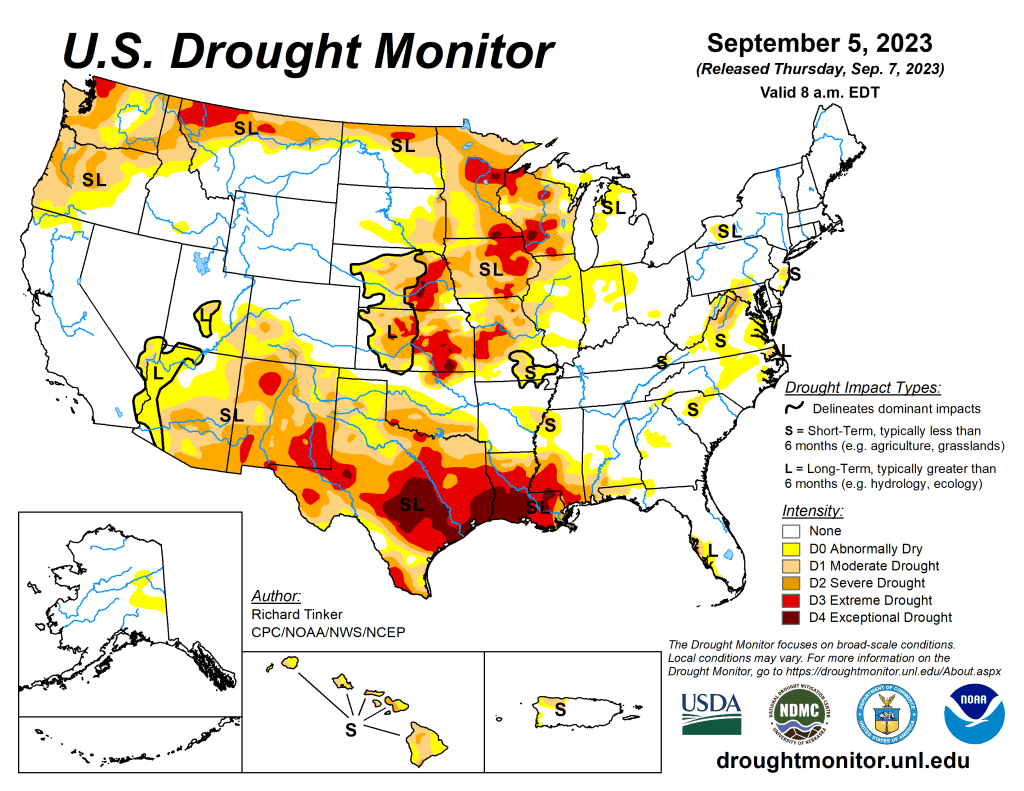
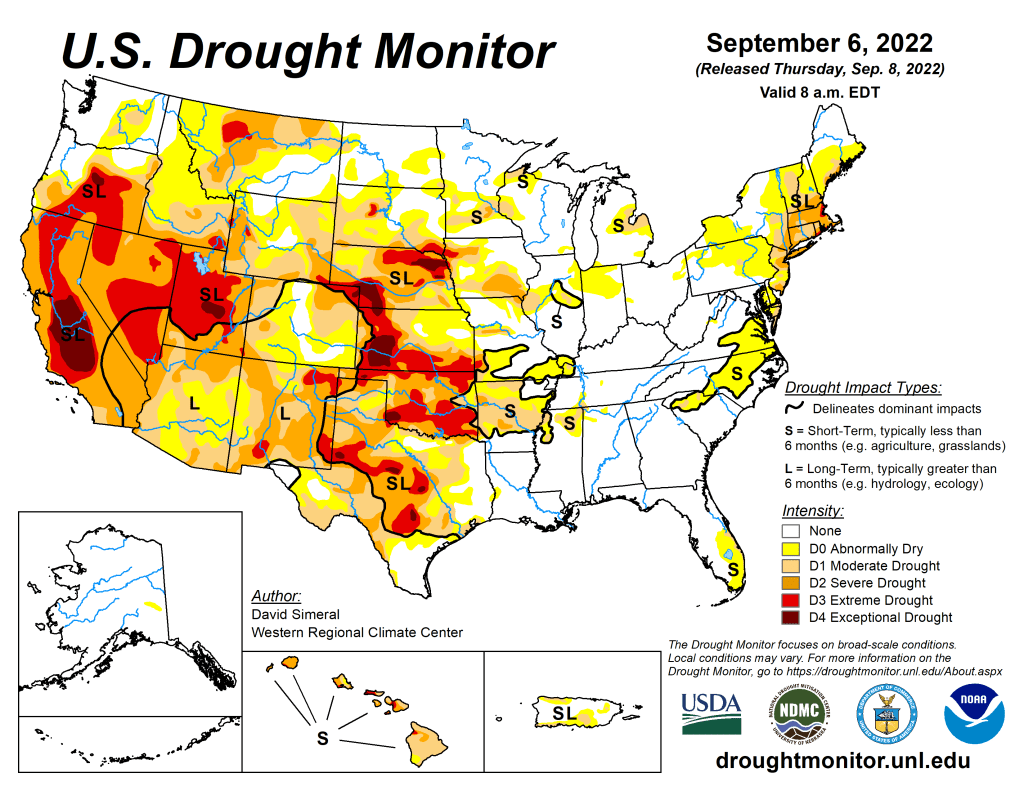
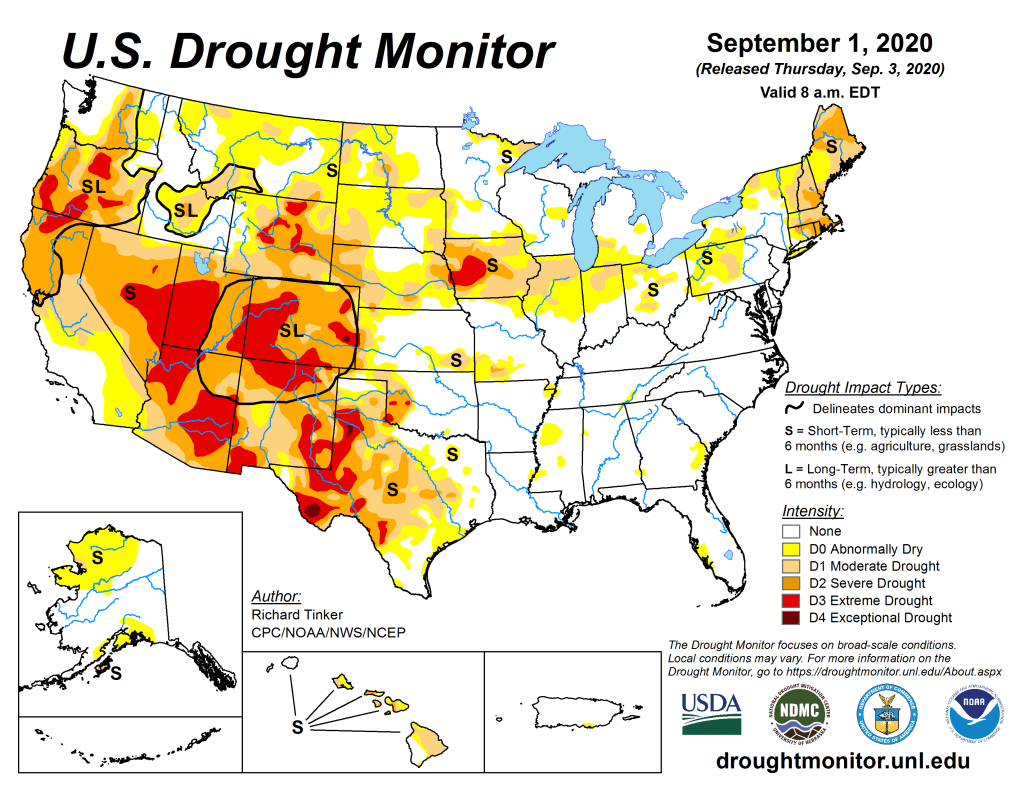
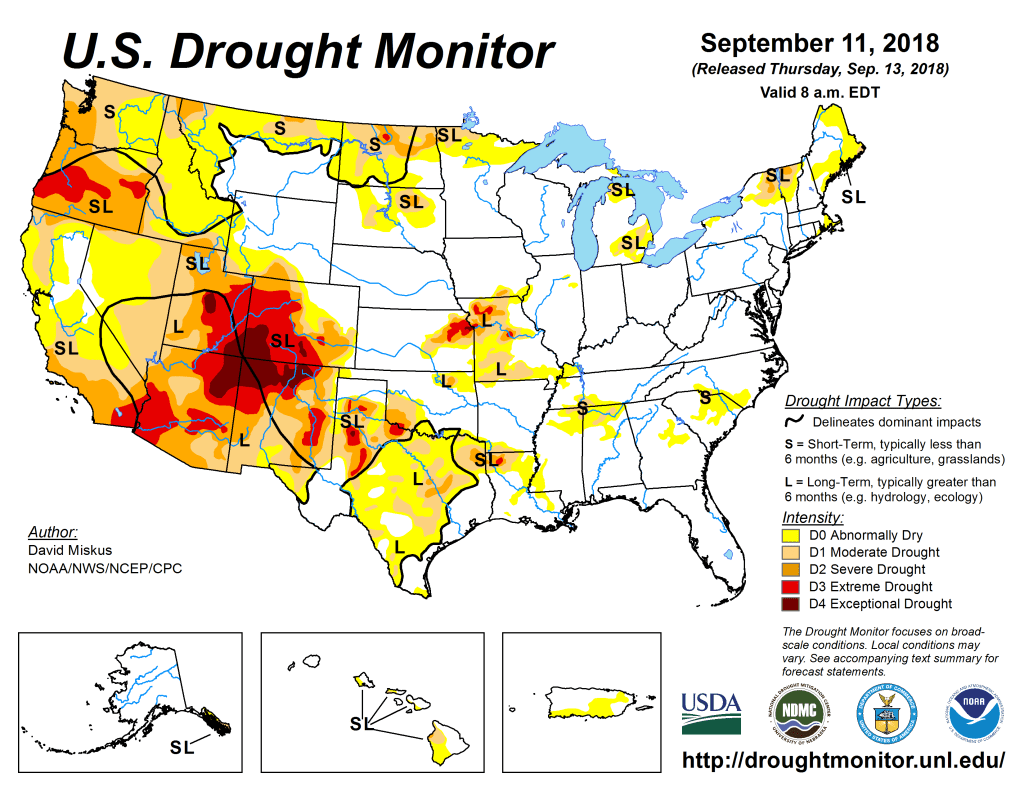
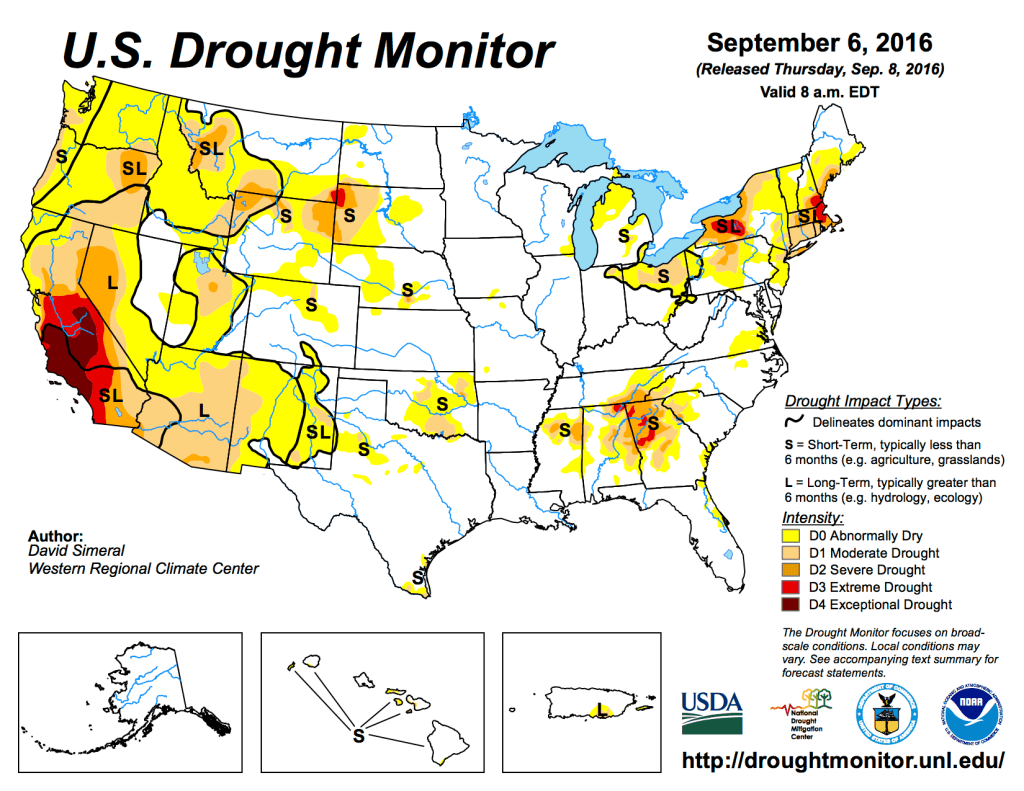
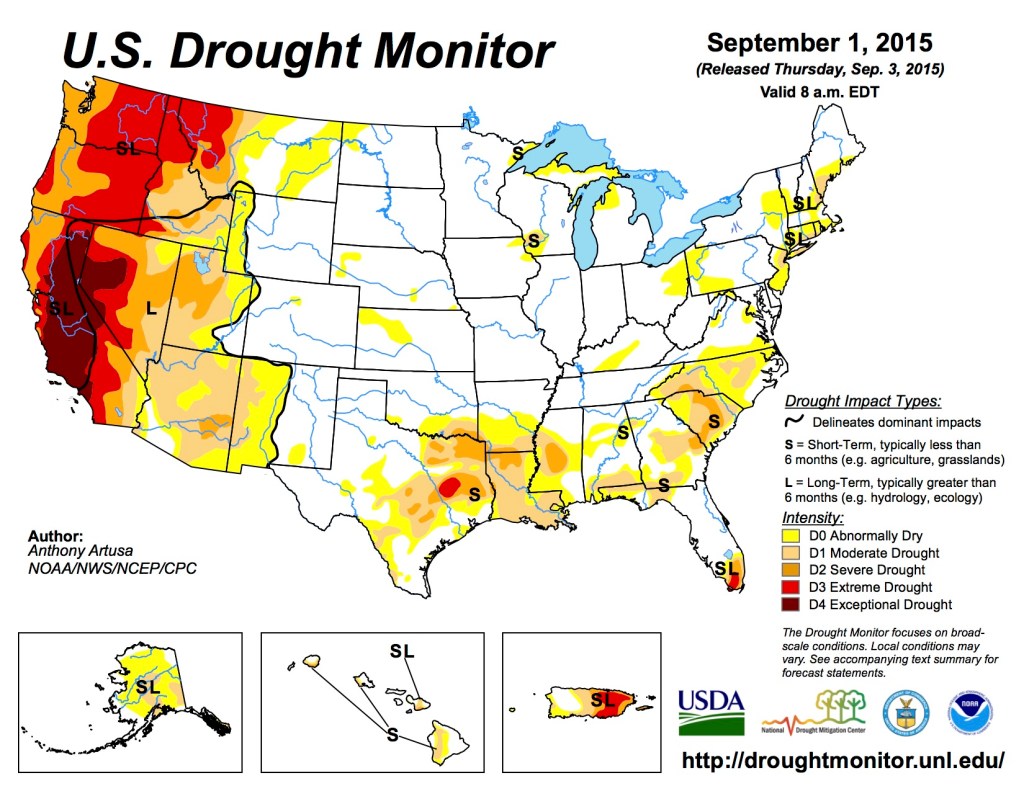
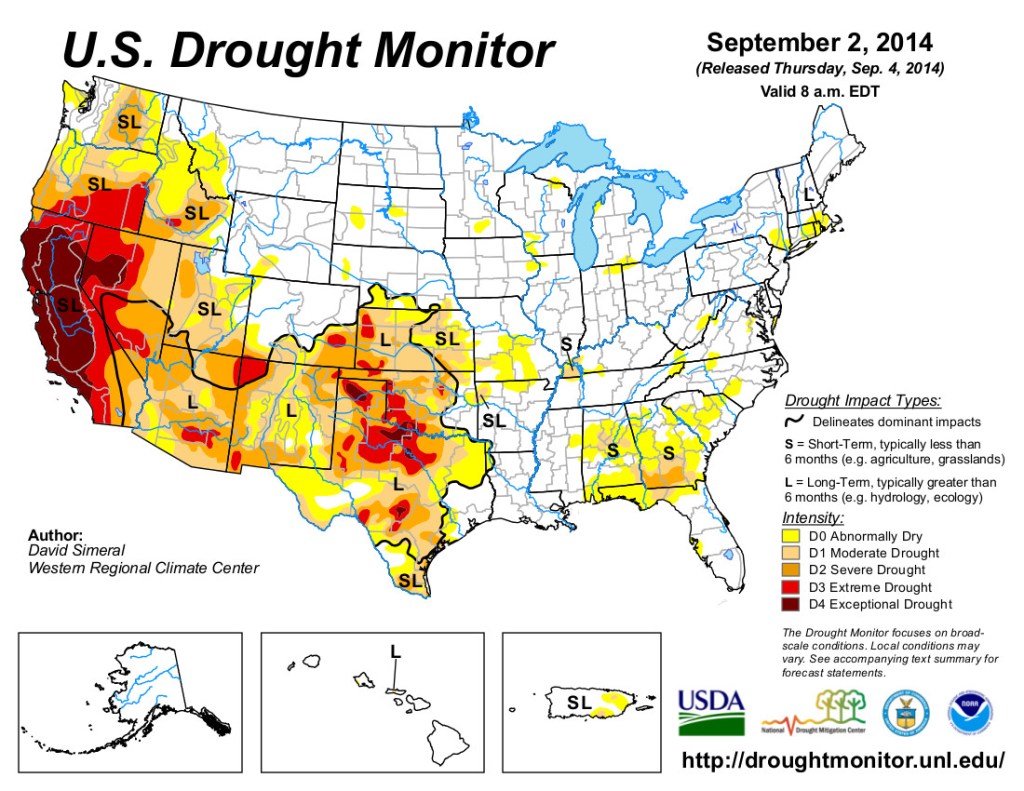
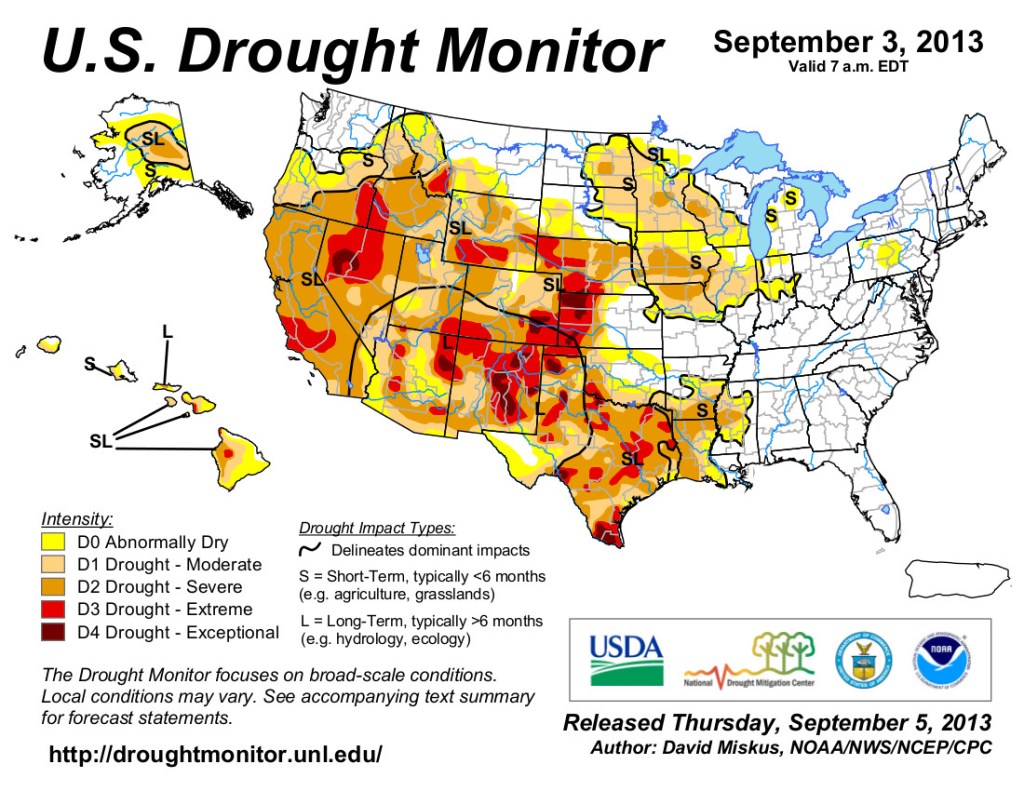
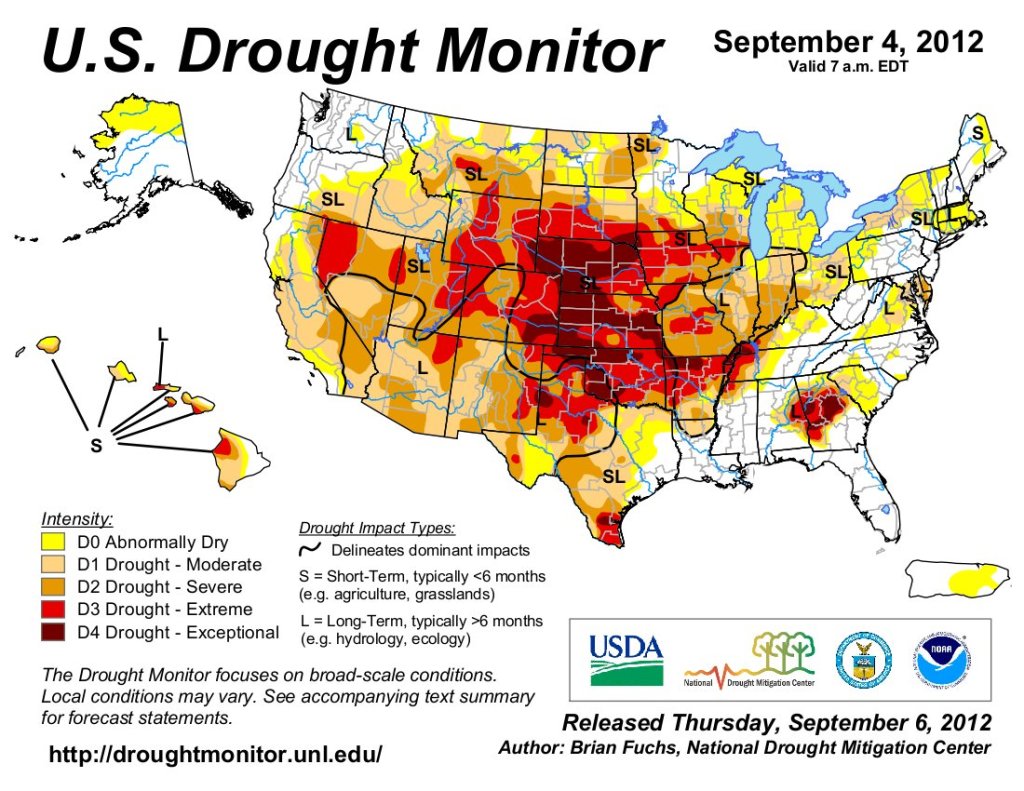
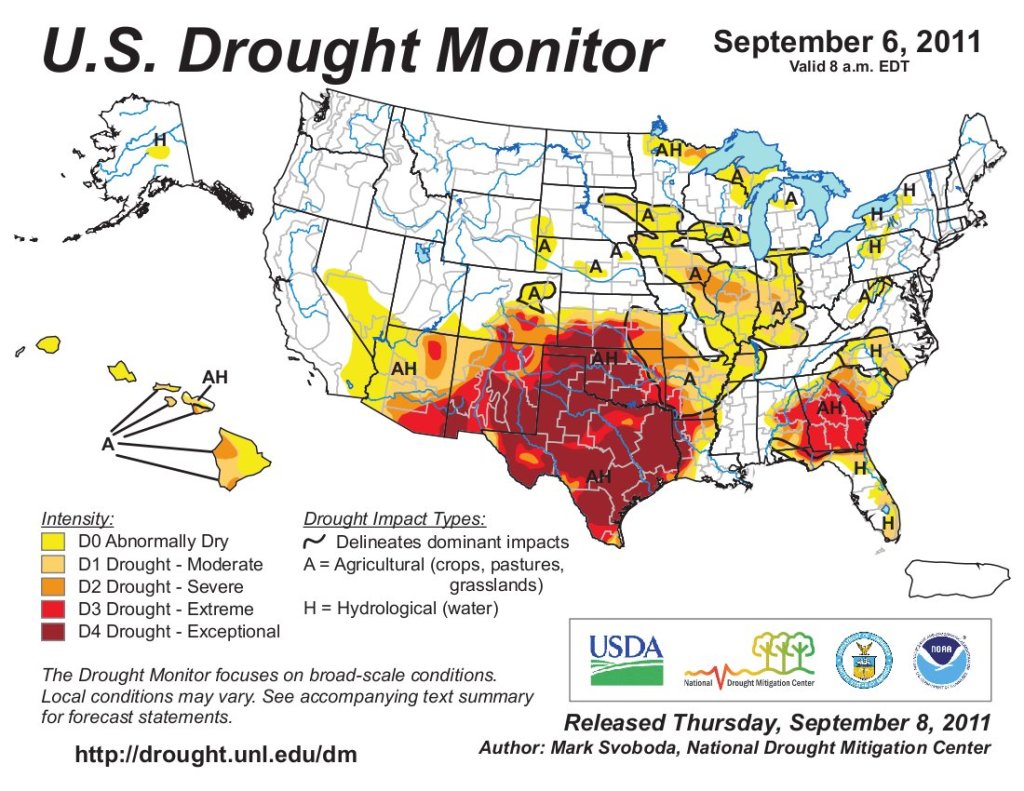
Just for grins, here’s a slideshow of US Drought Monitor maps for early September for the last few years.
Every element that a wildfire needs in order to burn big, hot and fast converged in the northwestern corner of Colorado in early August.
Persistent daytime temperatures neared record highs. Winds gusted at 40 mph. Humidity levels hovered at about 2% — a percentage typically only seen in the Mojave Desert, said fire-behavior analyst Béla Harrington.
After six months of scant precipitation, the soil and vegetative fuels were bone dry, ready to explode with any extraneous spark.
The hot, thirsty air had sucked nearly every bit of remaining moisture out of the grasses, shrubs and trees.
With extremely low fuel moisture content levels in all types of vegetation, “The live fuels act like dead fuels,” Harrington said.
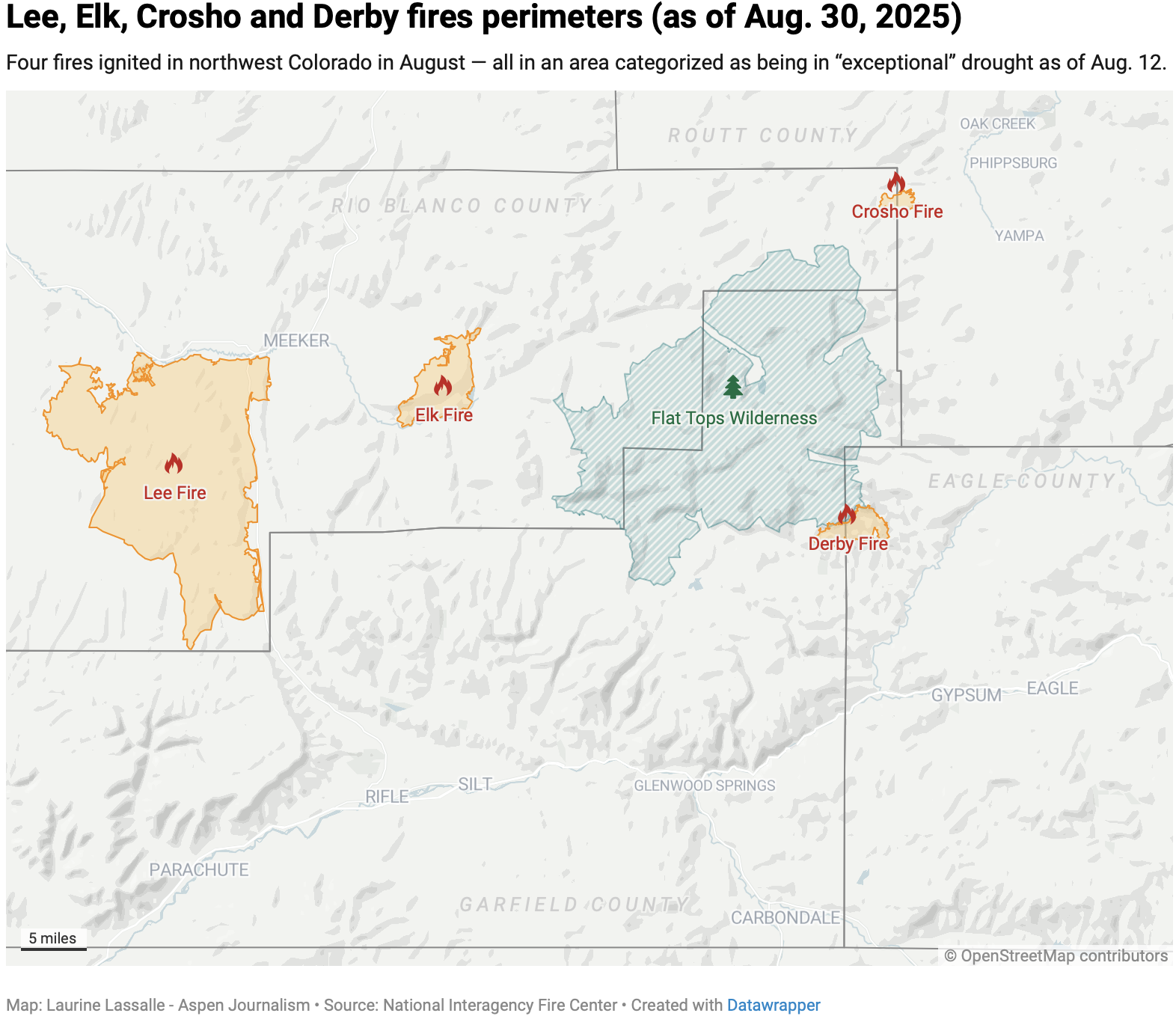
Between Aug. 6 and 9, the Lee and Elk fires near the town of Meeker scorched more than 100,000 acres.
By the time it was 95% contained on Aug. 31, the Lee Fire had become the state’s fourth largest fire in recorded history, with 138,844 acres burned.
“It’s the drought,” Harrington said from the Incident Command Center on Aug. 18 in Meeker, referring to why the Lee fire grew so big and so fast. At one point, the fire jumped across Highway 13 and came within less than 2 miles of the western edge of the town.
Had it not been for a change in wind direction that shifted the fire’s fury south toward Rifle — combined with the federal deployment of a massive amount of firefighting resources — the town may have faced a full evacuation.
On Aug. 11, the day before the larger region officially entered “exceptional drought” conditions, the Crosho fire started about 40 miles east of Meeker across the Flat Tops Wilderness, threatening the town of Yampa and ultimately burning more than 2,000 acres before it was declared fully contained Aug. 26.
Less than 30 miles to the south of the Crosho fire, lightning on Aug. 19 ignited the Derby fire on steep forested terrain, burning more than 5,700 acres near Dotsero.
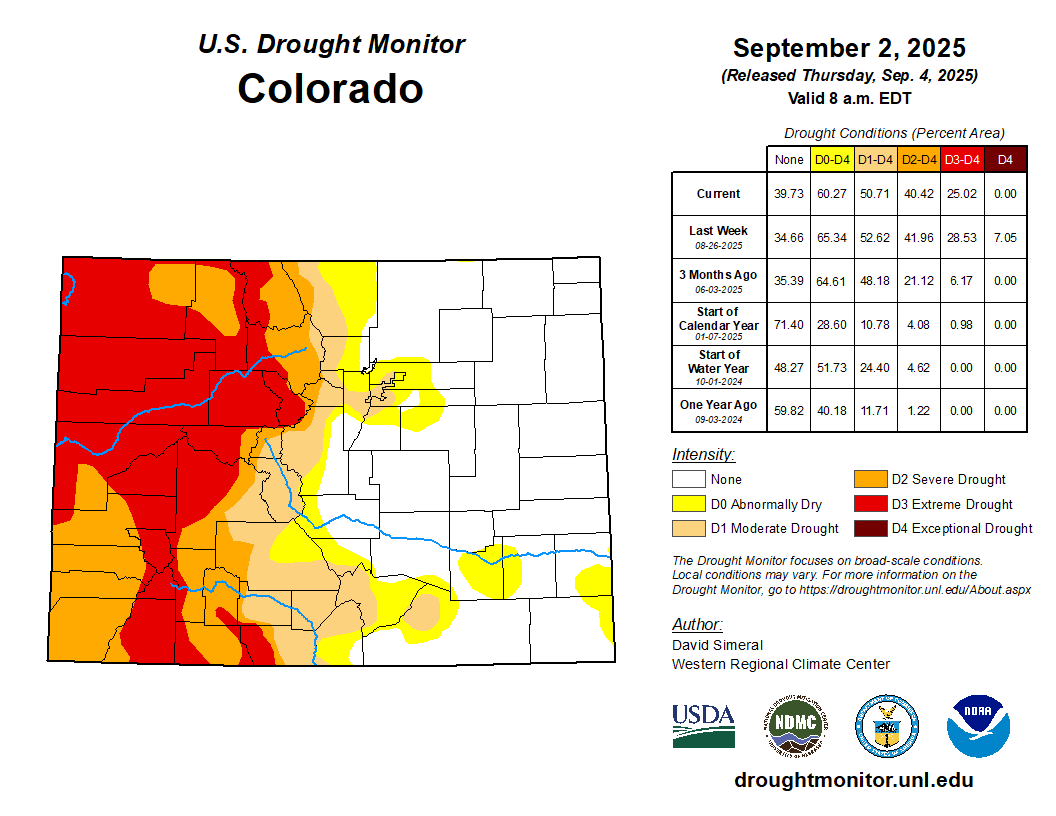
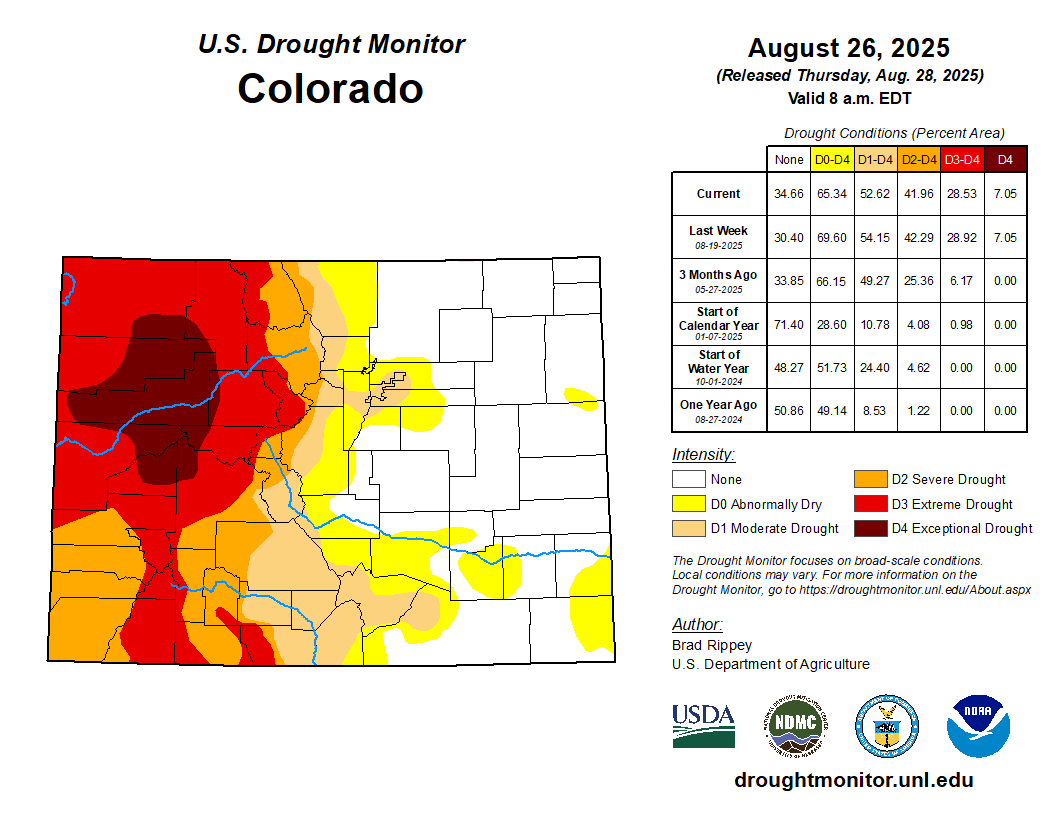
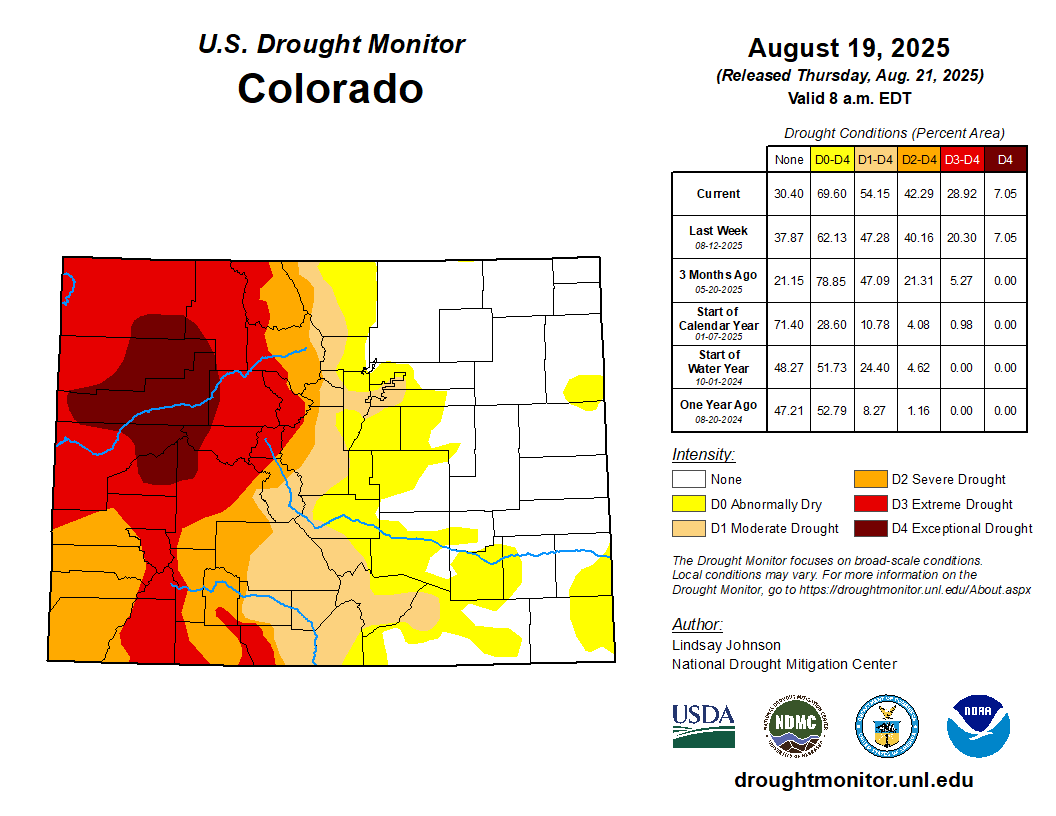
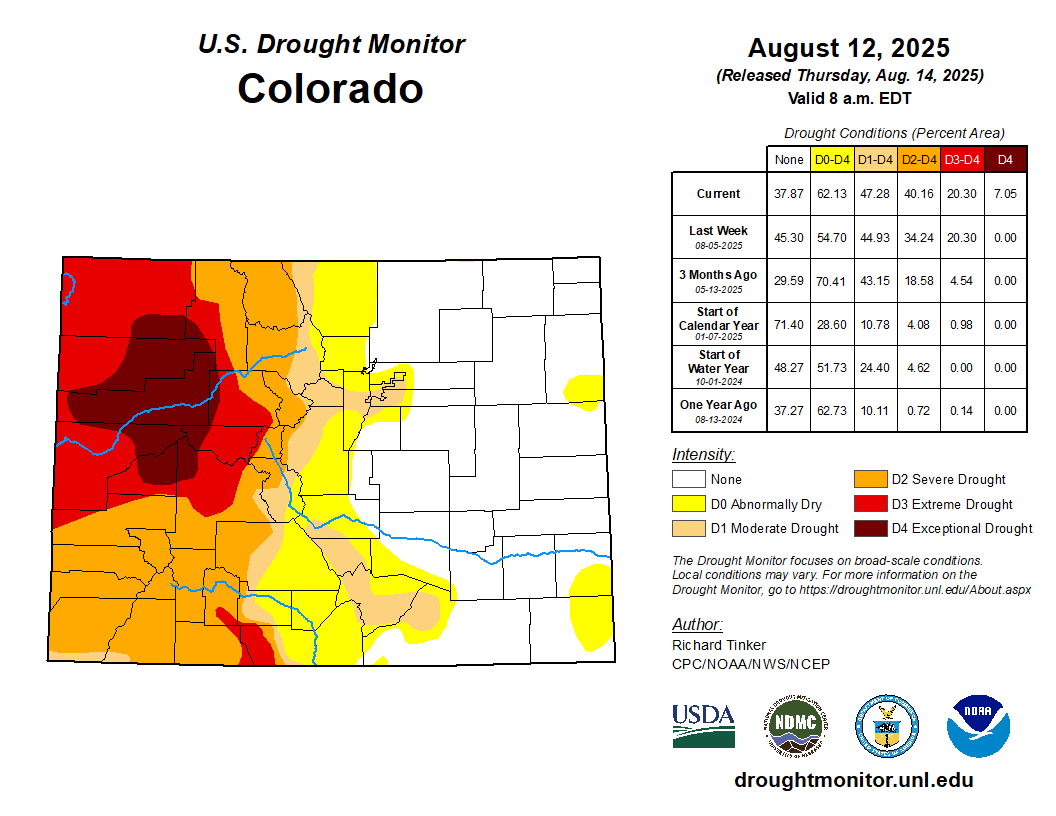
Colorado’s only current area of D4 drought — the highest designation on the U.S. Drought Monitor’s 0-4 scale — encompasses the footprints of the four fires as well as nearly all of Garfield County, much of Rio Blanco County, and pieces of Moffatt, Routt, Eagle, Pitkin, Gunnison, Delta and Mesa counties.
The drought map of Colorado as of Aug. 28. Exceptional drought — the most extreme category — has fueled wildfires in the northwest region of the state.
Over much of the region, the soil is parched, the grass is yellow and wilted leaves are already changing colors.
From Meeker, Harrington pointed to red, orange and yellow serviceberry bushes on the hillside. “That doesn’t usually happen until October,” he said.
The monsoon season, which typically brings precipitation to the region starting in mid-July, didn’t show up until the end of August, said Colorado State climatologist Russ Schumacher. Before the season’s arrival this year, there were hot days, little cloud cover and very low humidity.
Mary Flynn, a fire prevention officer with the White River National Forest, said early color changes usually signal tree stress. Trees and shrubs in the region are going into winter dormancy early because of the drought, she said.
“With prolonged drought, trees are forced to conserve energy and resources. Lack of water will halt chlorophyll production and trigger leaf shedding to conserve water,” she said. “When a forest becomes severely impacted by drought, the small diameter plants, branches and grasses catch fire easily. Once the small diameter fuels are burning, fire spreads quickly to larger dry branches and plants. Once a fire is established, the resulting heat causes fire to spread even more quickly.”
In John Vaillant’s book “Fire Weather, he writes, “The drier the fuel and the hotter the air, the more explosive the fires, the more intensely they burn, the harder they are to extinguish and the more likely they are to produce their own weather in the form of wind and pyrocumulus clouds, which can generate fire whirls, tornadoes and more lightning, resulting in yet more fires that will perpetuate themselves for as long as fuel and weather conditions allow.”
On Aug. 9, the Lee fire created its own weather system, reaching above 30,000 feet with a pyrocumulus cloud.
The Lee fire’s smoke cloud was so big, it shaded the nearby Elk fire, Harrington said, cooling the smaller fire and giving firefighters an advantage. Burning along the White River just east of the Lee fire, the Elk fire was fully contained Aug. 16 at 14,518 acres.
A D4 drought is expected about once in 50 years, said Schumacher. “It’s reserved for the most extreme drought conditions,” he said.
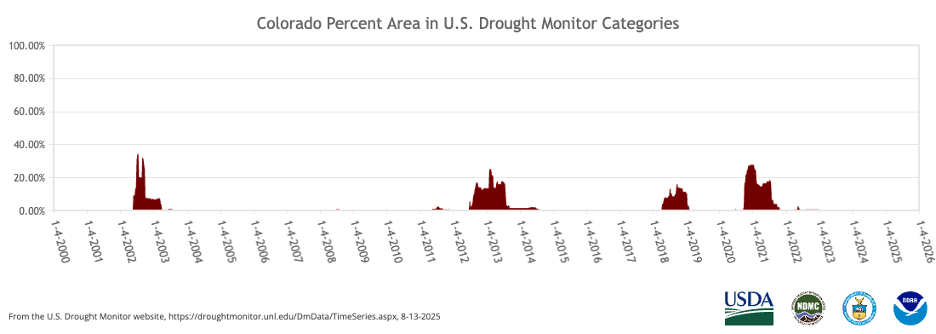
But parts of Colorado have entered into exceptional drought at least five times since 2000.
“Based on tree-ring analysis, it has been determined that the American West is currently in the most severe drought of the past 1,200 years,” Vaillant writes in “Fire Weather.”
“Climate change is expected to continue to exacerbate impacts to forested ecosystems by increasing the frequency, size and severity of wildfires across the western United States,” according to a 2023 study by Tzeidle Wasserman and Stephanie Mueller and published in Fire Ecology.
And the trends are by no means isolated to the American West.
Canada set records in 2023 for its worst fire season and is currently experiencing its second-worst fire season in recorded history.
The European Union is experiencing its worst wildfire season on record.
National Interagency Fire Center public information officer Eric Coulter describes the fast moving progression of the Lee Fire in early August. CREDIT: KARI DEQUINE/ASPEN JOURNALISM
Good fire versus bad fire
Decades of excluding fire from the landscape inadvertently led to a mass buildup of fuel, said Angie Davlyn, executive director of the Roaring Fork Valley Wildfire Collaborative. Today, land managers are “doing great things to bring fire back in safe ways,” she said. However, Davlyn described this season’s drought conditions, when combined with the amount of “flammable stuff ready to ignite,” as “scary.”
Fire needs to be an essential part of the ecosystem, said Harrington. Some species of vegetation actually require heat in order to regenerate. Fire clears debris to make way for healthy new growth. “But you want low-intensity fire,” he said.
Schumacher said: “In the big picture, what we probably need is more fire on the landscape than less. But what we don’t want is really fast-growing, really intense fires. For one, they tend to be really hard to fight and raise the chance of approaching towns like Meeker or Rifle.”
Ecosystem recovery can also look different with higher-intensity fires, he said.
“When fires burn so hot and so intensely, they are not as healthy to the vegetation cycle regrowth,” he said. “When vegetation is scorched so completely, it takes a lot longer to come back,” and that creates conditions for invasive species such as fire-prone cheatgrass to infiltrate. “A really hot, intense, fast-moving fire can alter the ecosystem. That’s the difference.”
Fire severity — which is the extent of damage to vegetation and soil — is determined after a fire and plays a key role in recovery.
Drought can play a significant role in how fires affect ecosystems, according to a 2024 NASA analysis of 1,500 fires from 2014 to 2020 across the West. The research showed that “forests, grasslands and scrublands all struggle to recover from droughts that occur close in time with high-severity fires, which are becoming more common in the West,” writes Emily DeMarco, who is with NASA’s Earth Sciences Division. “That can lead to potentially lasting changes not only in the plant communities but also in local and regional water dynamics.”
Schumacher noted the increased fire risk after wetter years, when vegetation flourishes and grows dense.
“If it is dry, dry, dry all the time, the fuel never builds up, so you don’t have a lot of stuff to burn,” he said. “The amplification of extremes is a pretty common theme in what we can expect with a warmer climate.”
He also noted how wildfire burn scars increase the risk of flash flooding and mudslides, with vegetation killed and the topsoil layer turned hydrophobic, meaning it can’t absorb water. Schumacher pointed to the postfire mudslides that closed Interstate 70 in Glenwood Canyon the year after 2020’s Grizzly Creek fire, and deadly floods near Fort Collins two years after the Cameron Peak fire in 2020.
On July 8 in Ruidoso, New Mexico, destructive and deadly flash floods swept through the town that had been devastated by two wildfires in 2024.
The late-August rains prompted flash-flood warnings near the Lee fire with mudslides reported in Rio Blanco County. Although some area roads were impacted, no damage or injuries were reported.
Harrington said he had hope for renewed fertile pastures and healthy forage for deer and elk in at least some of the Lee fire’s footprint.
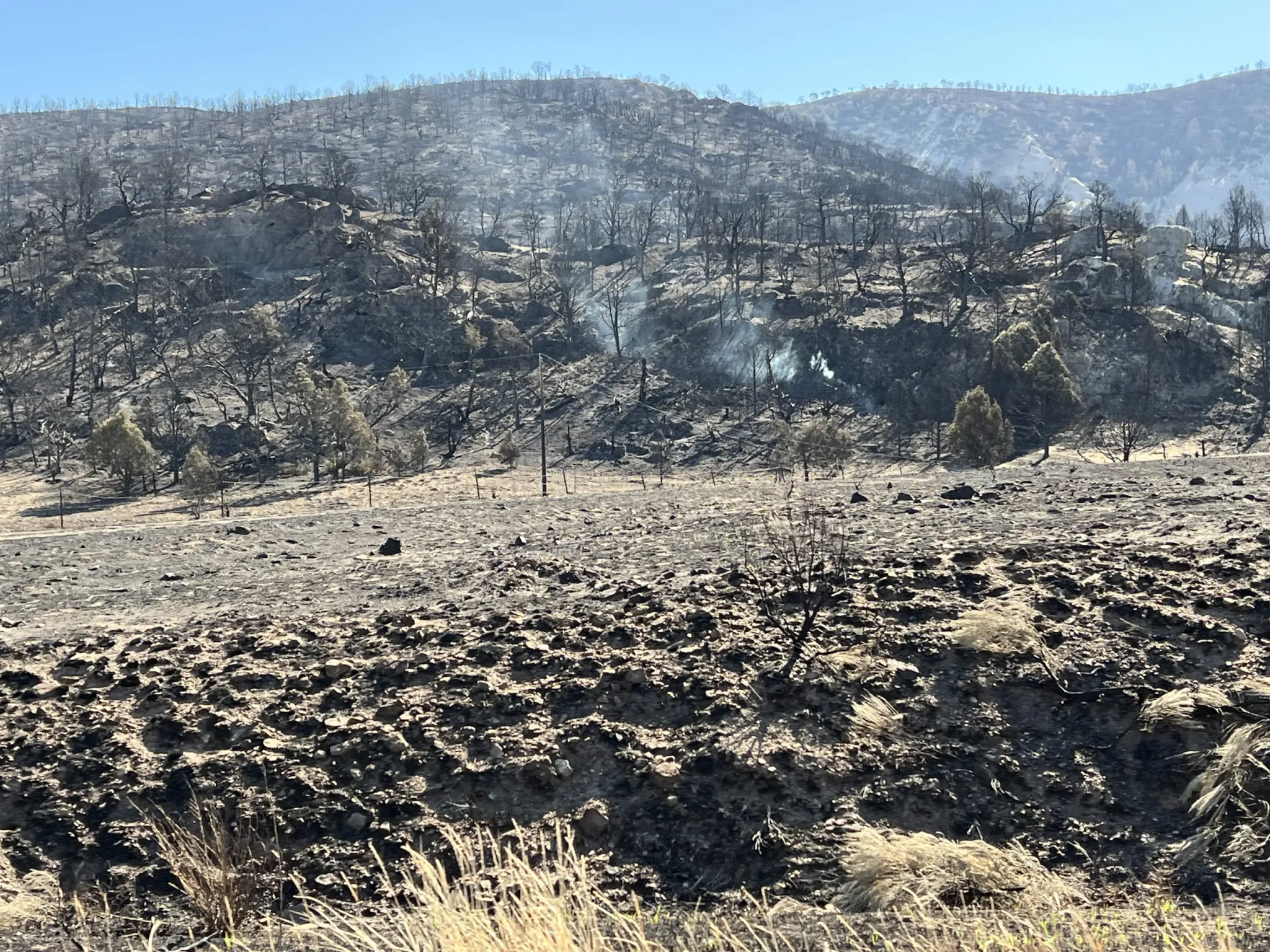
The Lee Fire smolders along Highway 13 south of Meeker on Aug. 18. The highway reopened on Aug. 16. CREDIT: KARI DEQUINE/ASPEN JOURNALISM
Bigger fires, longer seasons
A sign in Moffat County commemorates the 1988 “I Do” fire, which burned 15,000 acres and became, at that point, the state’s largest recorded fire.
The brutal fire season of 2002 brought many larger fires, including the Hayman fire, which became the largest ever in Colorado, at 137,760 acres. Then, in a single drought-fueled fire season in 2020, the Hayman was pushed to fourth place by the Cameron Peak fire (208,913 acres), the East Troublesome fire (193,812 acres) and the Pine Gulch fire (139,007 acres).
“Fire has always been a part of the landscape in the Western U.S.,” Schumacher said. “But these really big destructive fires are a relatively new phenomenon in western Colorado.”
Firefighter helicopter pilot and Basalt resident Steve Cohen said that in his 25-year career, he has seen firsthand fires steadily increasing in size. It wasn’t that long ago, he said, that “we’d never heard of a 100,000-acre fire.”
Cohen worked on the Lee, Elk and Crosho fires. Flying a six-seater A-Star helicopter, his duties include scoping out reports of smoke and transporting firefighters into and out of precarious terrain. Once he drops the crews, he takes the helicopter door off and sets up his neoprene bucket hanging at the end of a 100- to 150-foot cable, designed to scoop water from nearby ponds and lakes before dumping it on a fire.
Cohen also noted that many helicopter pilots are now required to work year-round contracts for what used to be a summer job. Thankfully grandfathered into his seasonal role, Cohen works as a ski patroller on Aspen Mountain in the winter.
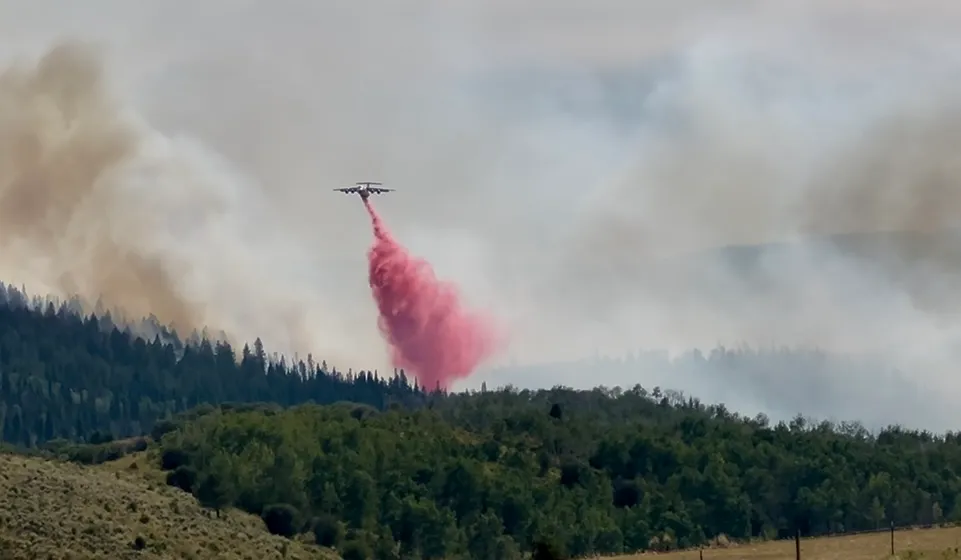
A large aircraft drops retardant onto the edge of the Crosho Fire on Aug. 13 as it nears homes along County Road 8 near Dunkley Pass. CREDIT: KARI DEQUINE/ASPEN JOURNALISM
Firefighters save the day
While towns, surrounding neighborhoods and ranches were largely spared the wrath of the four northwestern Colorado fires, the Lee fire destroyed 30 structures, as well as an unknown number of cattle that could not be evacuated in time. According to the incident response team, seven of the structures were homes or cabins and 23 were “outbuildings.” Oil-and-gas infrastructure is still being evaluated for damage.
Eight structures were lost to the Elk fire, no structure was lost to the Crosho fire and one structure has been destroyed in the Derby fire, which was 6% contained as of Aug. 31.
The containment efforts by fire crews benefited significantly from the proximity of the fires to one another. When the Crosho and Derby fires ignited, abundant resources were already staged nearby, said Caleb Ashby, a Bureau of Land Management public affairs specialist with the National Interagency Fire Center (NIFC).
Crews worked on the Lee fire round the clock — bringing in a large amount of federal resources also protecting critical oil-and-gas infrastructure located near the fire’s northwestern boundary, said Eric Coulter, a NIFC public information officer.
At the Lee fire’s peak, there were nearly 1,300 inhabitants of the Incident Command Center staged at the Rio Blanco Fairgrounds in Meeker.
They utilized the most drones on any fire to date, Coulter said, including aircraft equipped with small “ping pong” balls filled with a chemical powder and then injected with glycol upon release, giving crews an aerial and overnight option to fight fire with fire in order to destroy fuel in the path of the fire and slow and control the burn.
At the Crosho fire, the federal response was immediate, and the air show was impressive. Not long after smoke was first reported, four red and yellow “Super Scooper” planes skimmed the surface of nearby Stagecoach Reservoir, filling their massive bellies before emptying them onto the fire.
Additional aircraft dropped countless loads of bright-pink retardant on the fire’s edges, while several different types of helicopters dumped water. Another plane flew high overhead, coordinating the whole show with military precision.
On Aug. 14, Colorado Gov. Jared Polis declared a disaster emergency and authorized the National Guard to help with the fire response, primarily utilized on the larger Lee and Elk Fires.
Rain fell on the Lee and Crosho fires on Aug. 15, helping turn the corner.
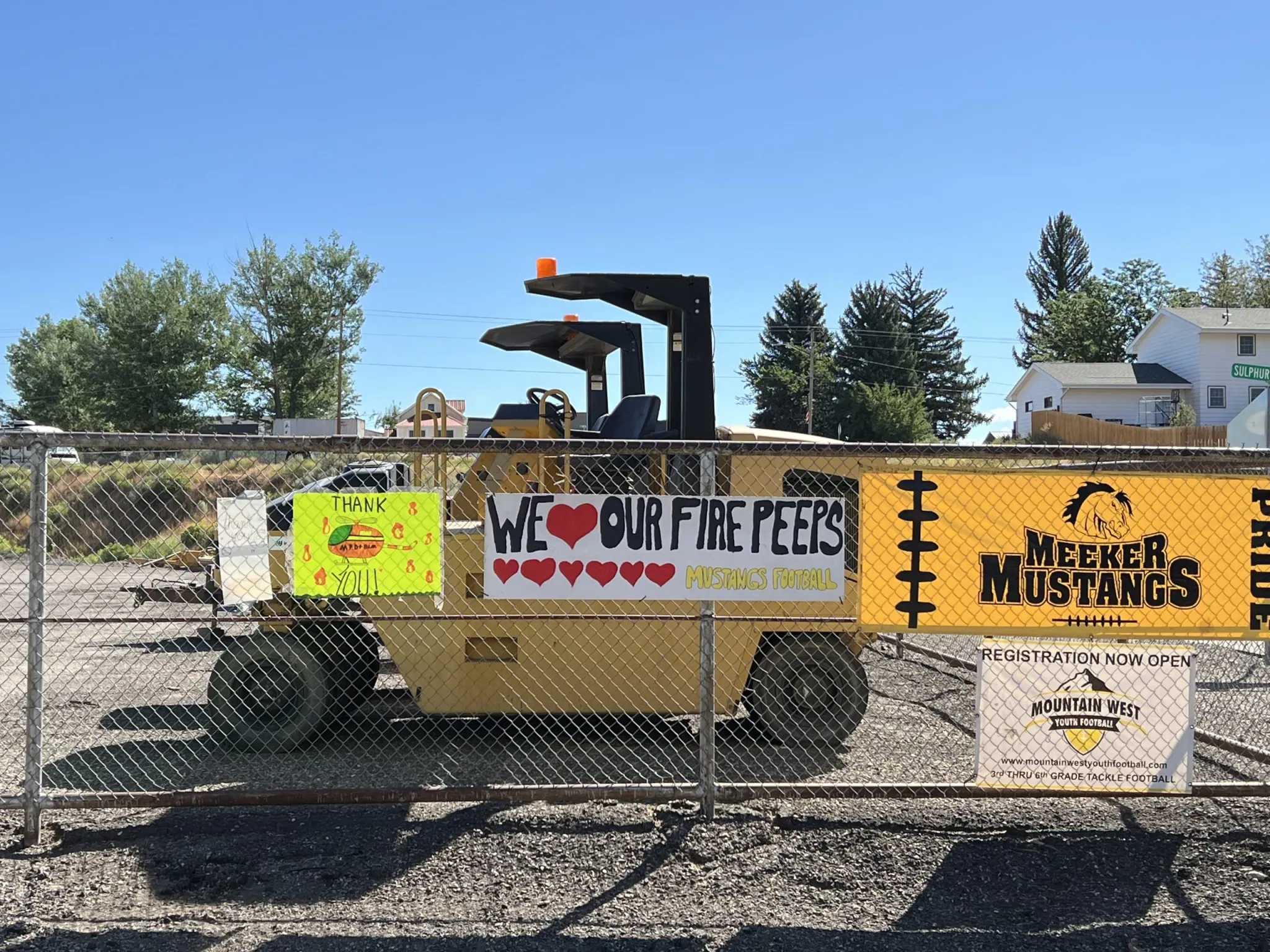
In communities near the four fires, handmade signs hung on fences and buildings expressing gratitude to the firefighters. Without the fast and massive local and federal responses — and lucky weather breaks — outcomes could have undoubtedly been worse.
Handmade signs of thanks cover the fence around the Rio Blanco County Fairgrounds — the temporary staging ground for the Lee and Elk fires’ incident command center. CREDIT: KARI DEQUINE/ASPEN JOURNALISM
Limited resources
The United States is currently at a Preparedness Level 4 (PL4), indicating that “national resources are heavily committed,” according to the NIFC.
A PL5 — the highest level — indicates “national resources are heavily committed, and additional measures are taken to support geographic areas. Active geographic areas must take emergency measures to sustain incident operations.”
At a PL5, it is possible that fire-response teams can’t get the resources that they request, Ashby said, although, ideally, resources are available but need to be moved around more strategically with a focus on protecting “values.”
“It is extremely impressive how fast we can move resources across the country to the folks who need them,” he said.
Still, “If we are at a PL5, resources are stretched extremely thin,” Ashby said. “Everyone is competing for the same resources.”
The values prioritized for protection include life, property, critical infrastructure and natural resources, Ashby said. With the critical fire weather conditions on display through most of August, the focus is on the initial attack.
“If we can keep a fire small before it grows into a large fire, that saves a lot of resources,” he said.
Collectively, the four fires surrounding the Flat Tops have cost the federal government about $65 million to fight, according to the most recent Incident Management Situation Reports.
The Lee fire alone has a price tag of $29.1 million as of Aug. 31. And that has not even been the state’s most expensive fire. The Turner Gulch fire, in Mesa County, has an estimated cost of $39.8 million to the federal government as of Aug. 28.
Ashby noted that these costs are just estimates at this time. Full costs include suppression repair, rehabilitation and local reimbursements, and they are not fully borne out until long after a fire has been extinguished.
On Aug. 6 and 7 the Lee Fire jumped across Highway 13, encroaching over the “Hogback” less than two miles from the edge of the town of Meeker. CREDIT: KARI DEQUINE/ASPEN JOURNALISM
The forecast
As fortuitous days of rain — heavy at times — fell on all four fires during the final week of August, it appeared that Mother Nature decided that the extremely drought-stricken corner of Colorado had had enough fire, for now.
The double-edged sword of precipitation also brought lightning and numerous new fire starts in the region, all of which were quickly contained.
Schumacher said he sees drought and fire comparisons to 2020, although he noted that the state’s second-biggest fire on record — East Troublesome — was ignited Oct. 14 of that year.
“2020 was exceptional in how long fire conditions persisted,” he said. “It remains to be seen if we have fires continue into the fall.”
At this time, the forecast is tilted toward a warmer-than-average fall, Schumacher said.
“The key question now is: Are we going to get relief here later in August and September, and see the end of fire season at that point? Or will we go back to a warm and dry fall and see things happening later in the season like 2020?”
Globally, 2025 is on track to become the second or third hottest year on record, behind 2024 and 2023.
Although there is only so much that humans can do in the face of bigger, hotter and faster fires, approximately 85% of wildfires nationwide are human-caused, according to the NIFC.
Davlyn said about half of Colorado’s annual average of 2,500 wildfires are caused by lightning.
Human-caused fires take resources away from lightning-caused fires, said Ashby. And although the late-August rains tempered the four fires and brought a collective sigh of relief from surrounding communities, “It’s not going to end this drought,” Davlyn said. “It’s not going to rehabilitate trees that have been in critical condition for months. It doesn’t work that instantaneously.”
Flynn echoed the need for continued vigilance. “This week’s moisture is providing much-needed relief on dry, stressed fuels in western Colorado,” she said. “But it may not be enough to significantly reduce fire danger moving into the fall.”
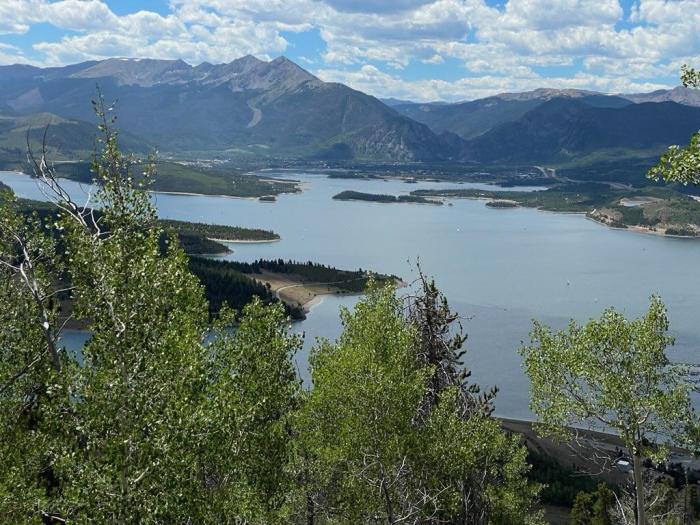
Up until late August, this summer has been particularly dry, both for the Denver region and for the West Slope, the source of half of Denver Water’s supply. And that combination has translated into a heavy workload for the utility’s largest reservoir, the 257,000-acre-foot Dillon Reservoir in Summit County.
Dillon Reservoir in Summit County is Denver Water’s largest reservoir. Photo credit: Denver Water.
A summer largely bereft of the monsoon rains (which bolster our water supply and reduce water use by our water-smart customers) combined with long stretches of days above 90 degrees pushed up demand among the 1.5 million people Denver Water serves.
The dry summer situation also triggered calls for more water from farmers and ranchers who have senior water rights that put them at the front of the line for receiving water from the South Platte River system. Denver Water’s supplies are also constrained on the north side of its system, as ongoing work on the Gross Reservoir Expansion Project requires the utility reduce the amount of water it stores in that reservoir during the project.
Dillon Reservoir provides Denver Water with a supplemental supply to use when the amount of water available from its south system source, the South Platte River, is not enough to meet demands.
That all combined to make Denver Water more heavily reliant on Dillon Reservoir than usual, forcing the utility to push higher volumes from Dillon through the Roberts Tunnel to the Front Range.
“A lot of factors combined to see us lean hard into our Dillon supplies this summer,” said Nathan Elder, manager of supply for Denver Water. “We know this impacts recreation, both what we release into the Blue River below the reservoir and the water levels for the marinas at Dillon Reservoir. We try very hard to maintain good conditions for recreation at Dillon, but this summer posed challenges.”
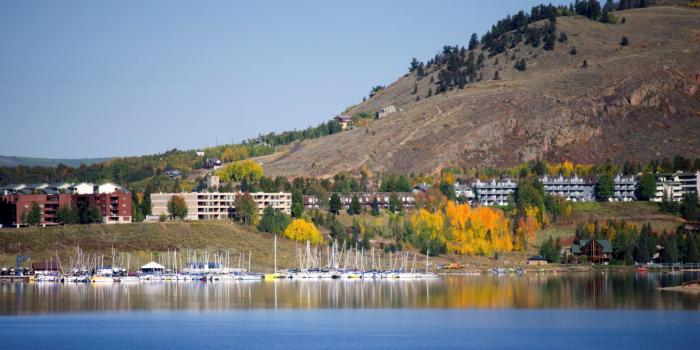
The Dillon Marina at Dillon Reservoir. Photo credit: Denver Water.
Overall, the amount of water flowing into Dillon was at just 70% of normal in the April-through-July stretch. July alone saw just 48% of typical flows into the reservoir — that’s 20,000 acre-feet below average, about the capacity of Antero Reservoir west of Fairplay.
The situation serves as a reminder for Denver Water customers to stay smart about water use.
Especially amid a hot, dry summer, customers should make sure to follow watering rules and skip irrigation during rainy periods. And they should consider landscape changes that replace thirsty turfgrass with plants that need less water.
Yet, despite relentless dry periods covering July and most of August, Denver Water customers did a good job managing irrigation. They used water at a rate of just about 2% above the five-year average, and just 1.6% above the longer term, 2000-2024 average.
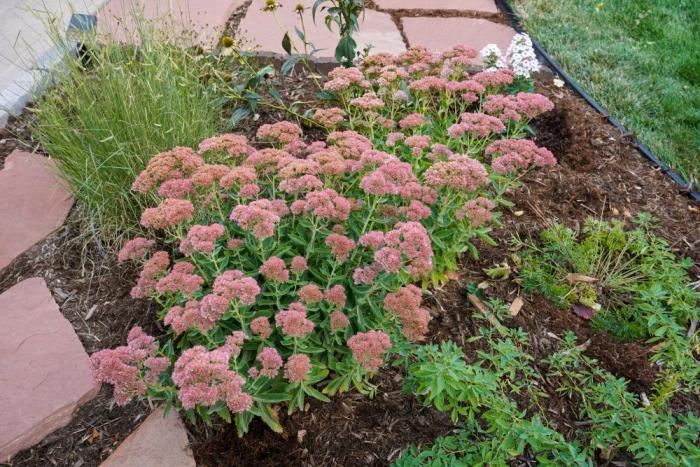
These plants from Resource Central’s Garden In A Box program are water-wise and interesting throughout the year. Photo credit: Denver Water.
But even as Denver Water customers kept demands low by historical standards, the combination of conditions saw water levels in Dillon fall below levels optimal for the marinas at the reservoir by the end of August.
Typically, Denver Water tries to keep the surface of Dillon Reservoir at 9,012 feet in elevation through Labor Day. But this year, levels will fall a few feet below that.
And water volumes flowing out of Dillon into the Blue River — flows important to rafters and anglers — also fell significantly. Since late July, those outflows were about 100 cubic feet per second, about half of normal for this time of year. In August they dropped even further, to 75 cubic feet per second.
The overall picture began to improve slightly in late August, as the state benefited from a cooling trend and bursts of rainfall. The cooler, wetter weather in the metro area cut Denver Water customers’ demand for water in the Denver region, easing the need to pull as much water from Dillon.
Even so, the tough summer means Denver Water will likely enter the new, 12-month water year, which begins Oct. 1, with its reservoirs, including Dillon, at below-average elevations.
That puts the onus on the upcoming winter season to come through with a good snowpack, never a sure thing.
“We’ll hope to see water demands fall in September and then look to a good snowpack in the winter and spring,” Elder said.
“But we’ll be starting from behind. We hope we can make up the gap in reservoir storage with a wet winter and spring. And we’ll need our customers to help us with smart water practices.”
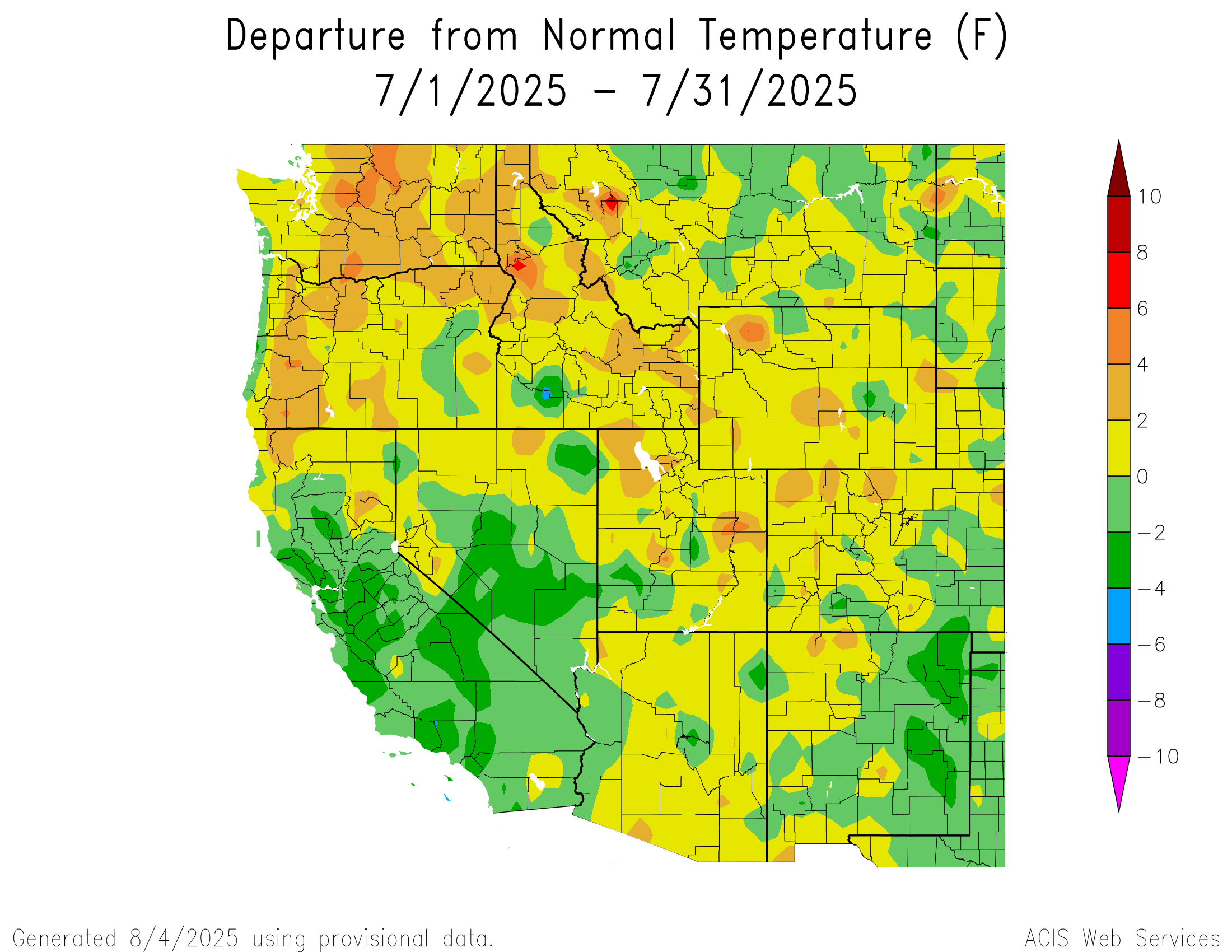
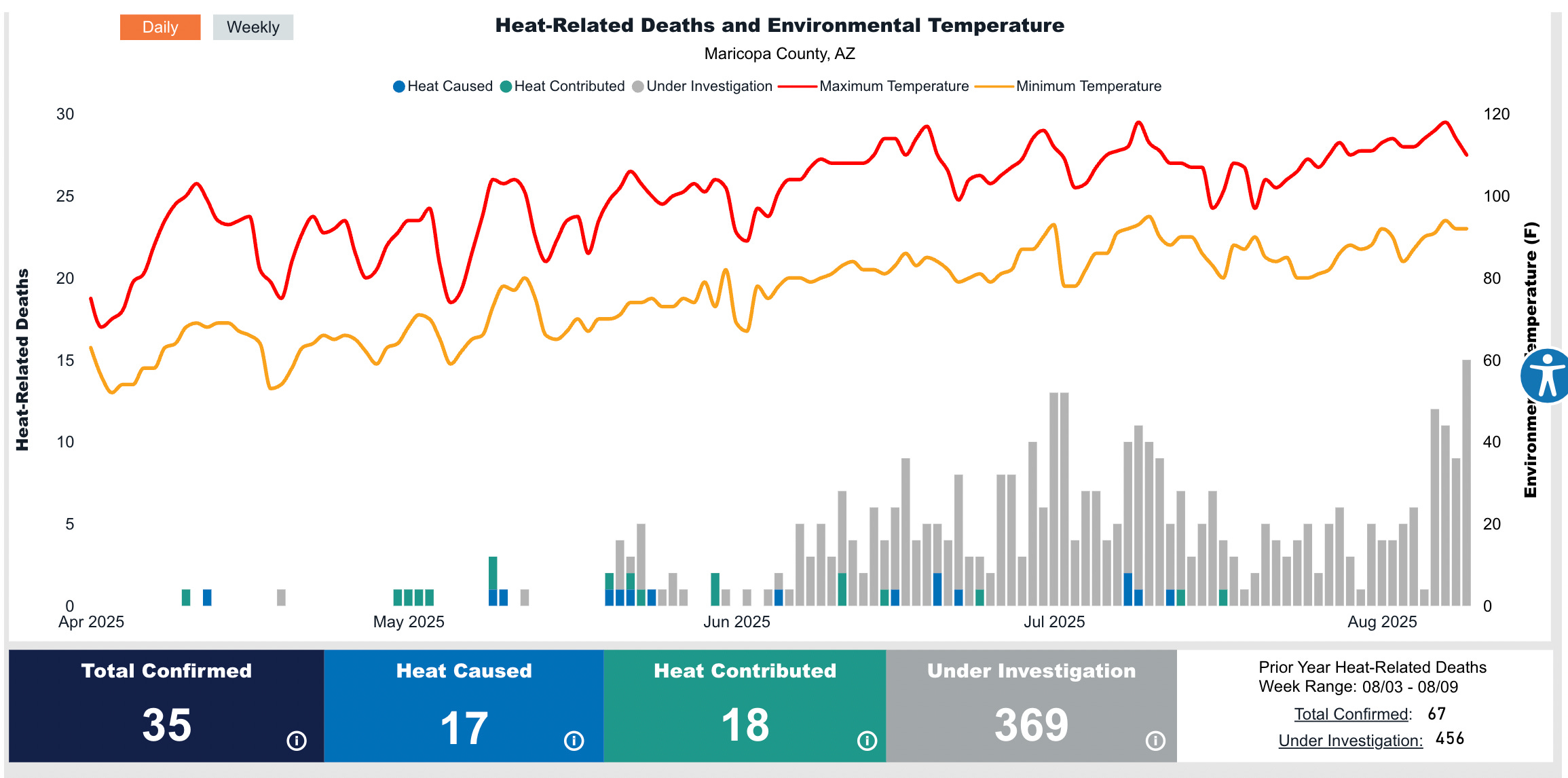
Summer’s officially over. Meteorological summer, that is. And damn what a dry and hot and smoky summer it was. It wasn’t one of those summers with superlative maximum temps: The mercury in Death Valley only climbed to 124 on a couple of occasions this summer, for example, far off the record high. But in most places the average temperatures for the months of July and August were far higher than normal.
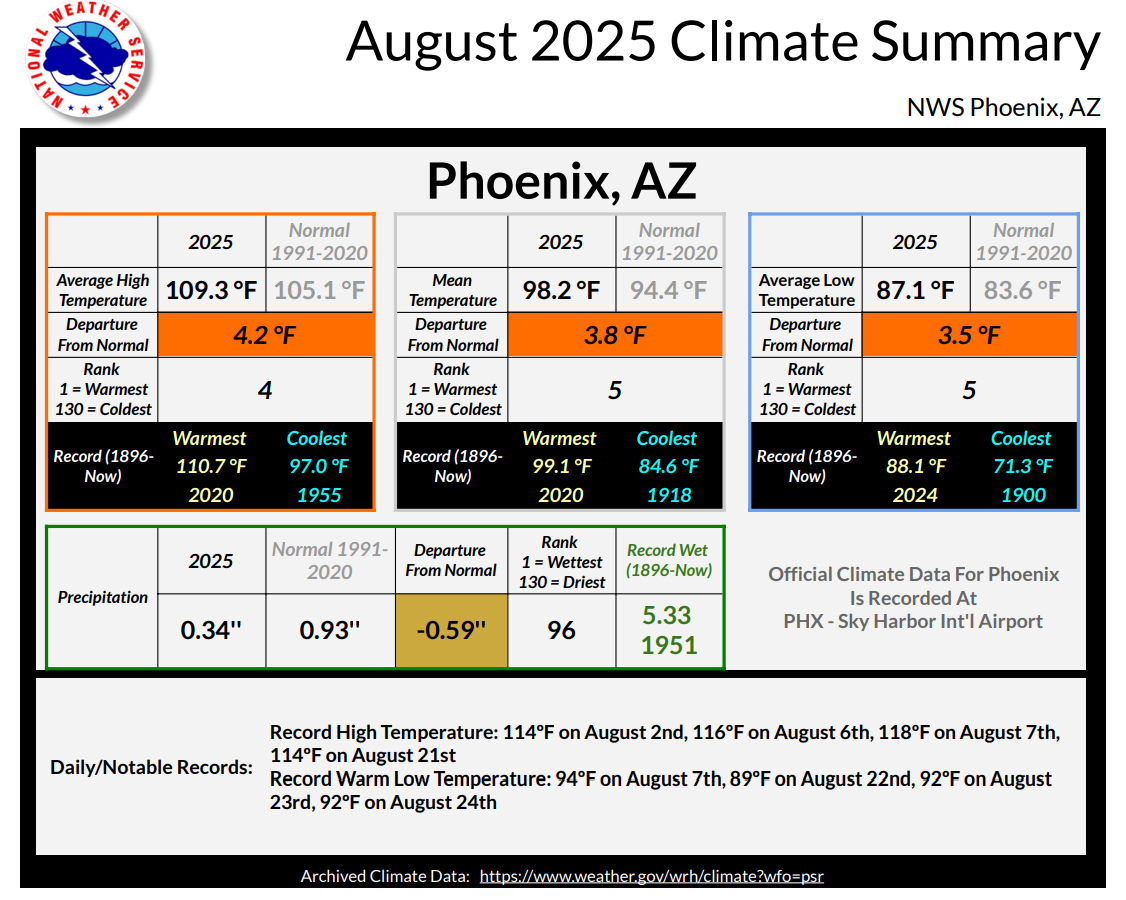
Phoenix’s max temp hit 118°F on two occasions this summer and 117°F once. More significant, though, was the relentlessness of the heat, and the lack of much monsoon relief. The result was significantly higher average temperatures than normal. National Weather Service.
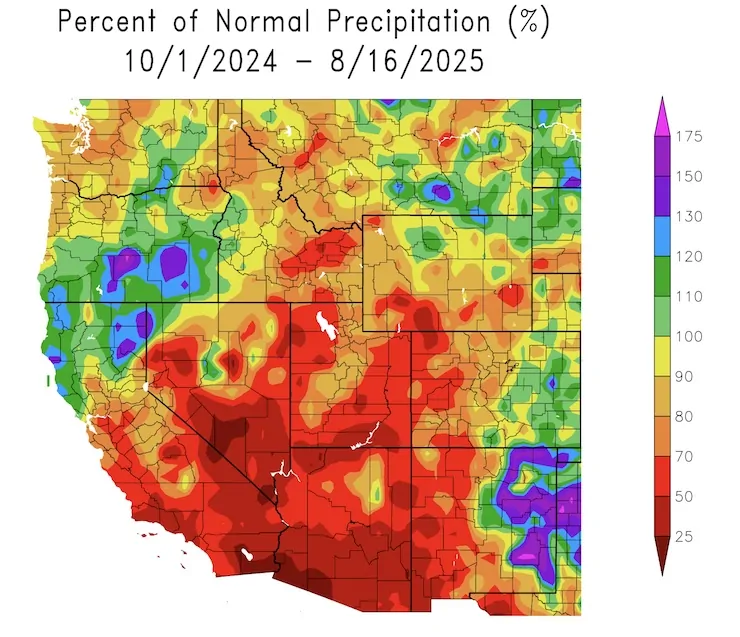
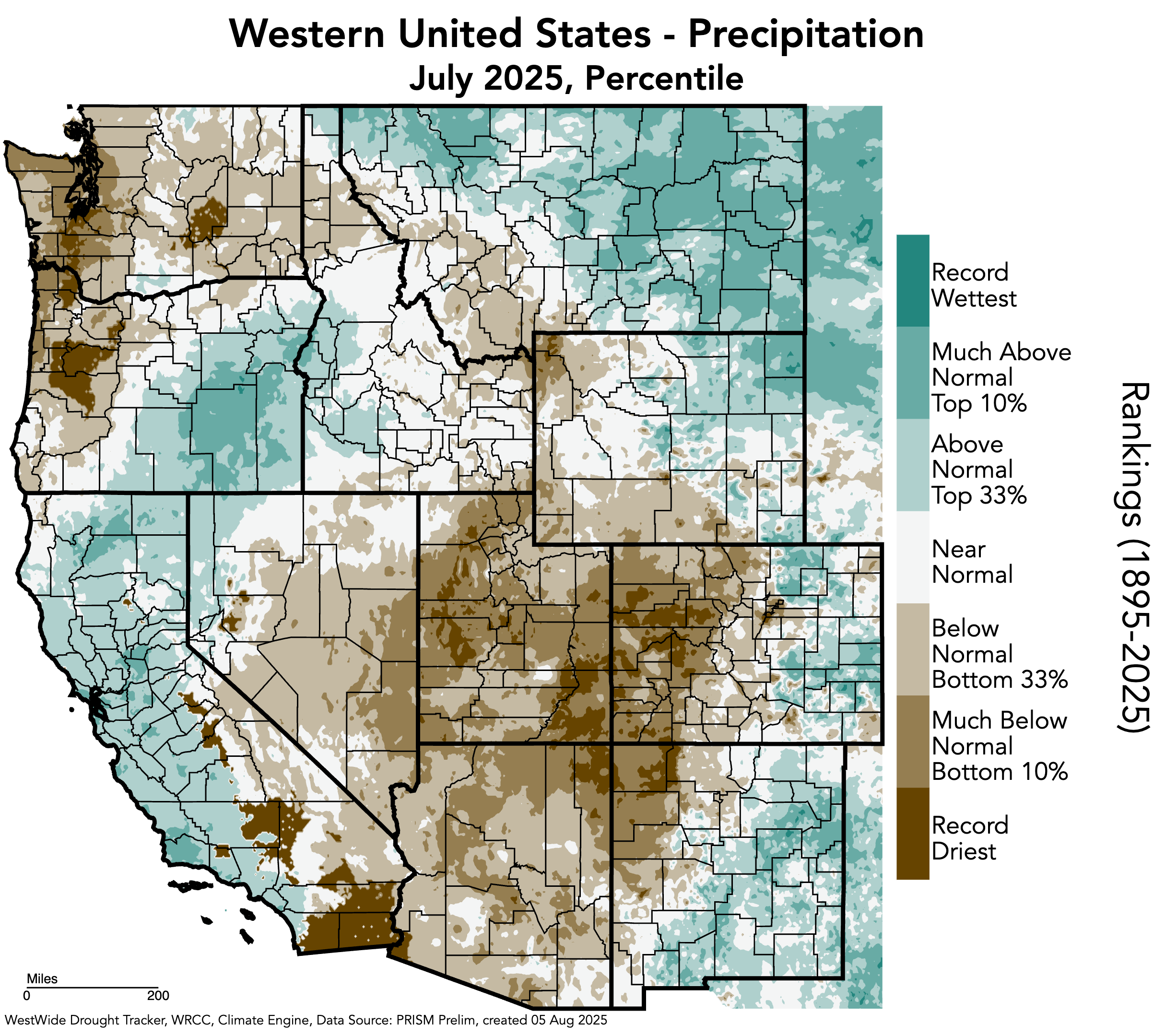
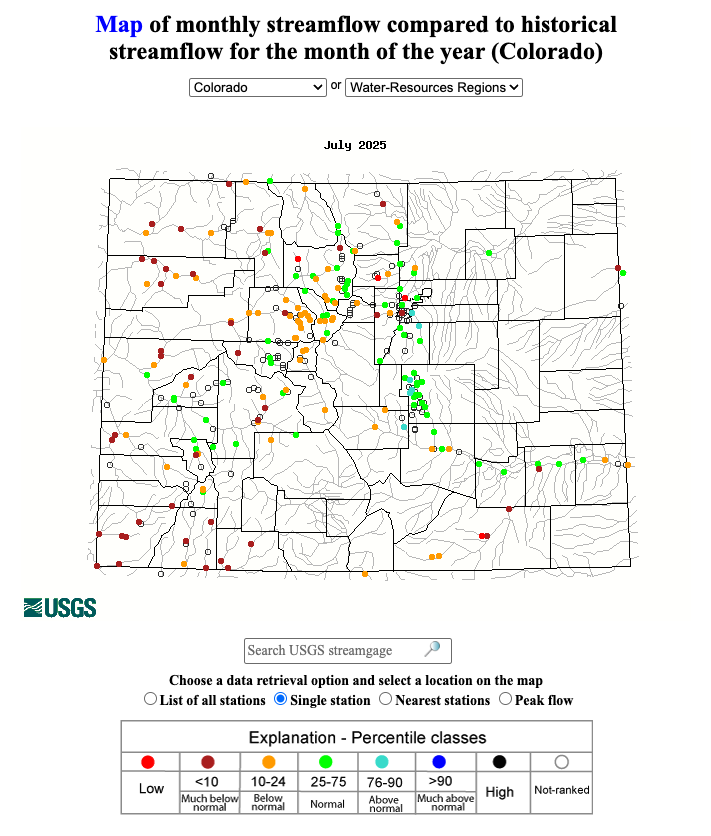
Meanwhile, almost everywhere in the West was cursed with below normal precipitation. The monsoon was late, and when it finally did arrive, it was a dud. At least it has been so far. Not only were rainfall amounts lower than usual, but the soil was so dry that it sucked up a lot of the moisture before it reached the rivers. That has meant that the typical August streamflow jumps never really materialized, especially in the Colorado River Basin. The fish aren’t doing so well. Heather Sackett of Aspen Journalism reports that the Crystal River, along with the rest of the Roaring Fork, Gunnison, and White/Yampa River Basins are hurting, prompting officials to institute voluntary fishing and floating closures.
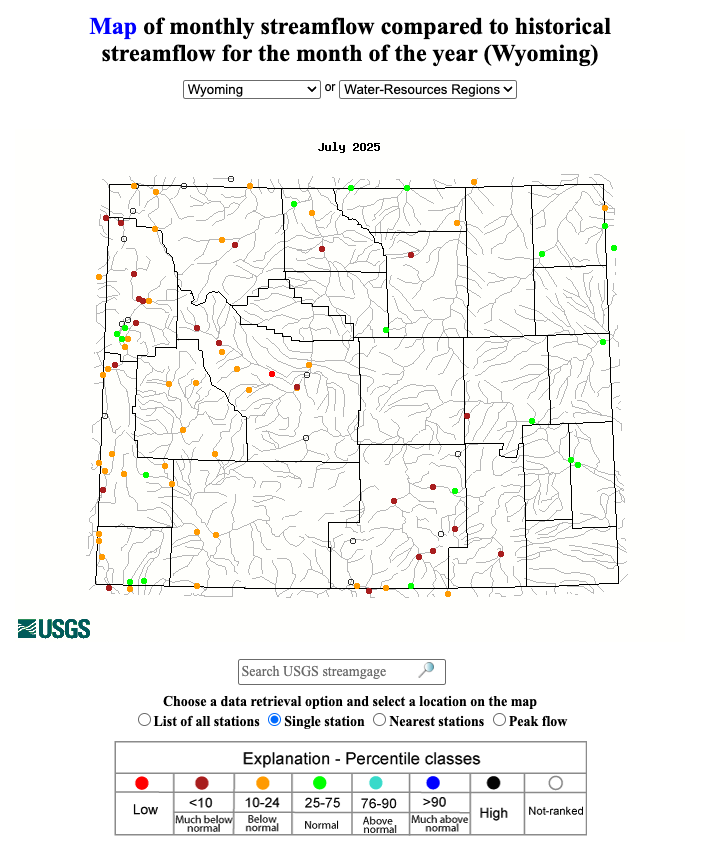
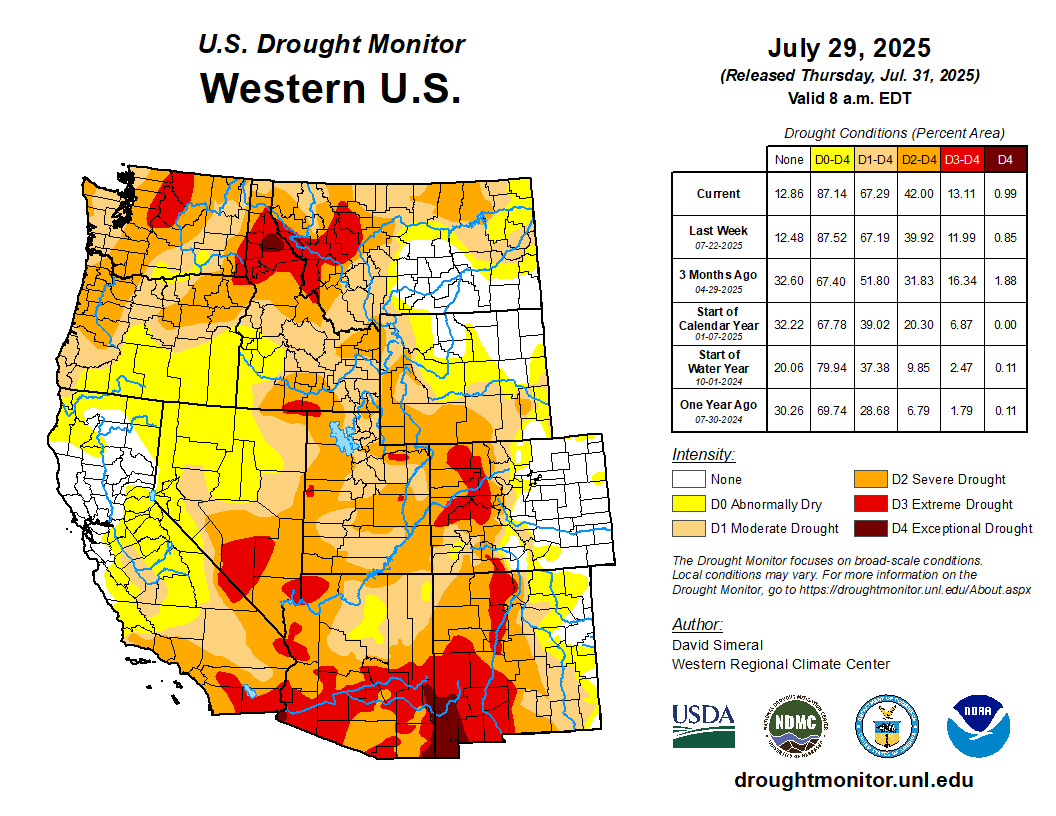
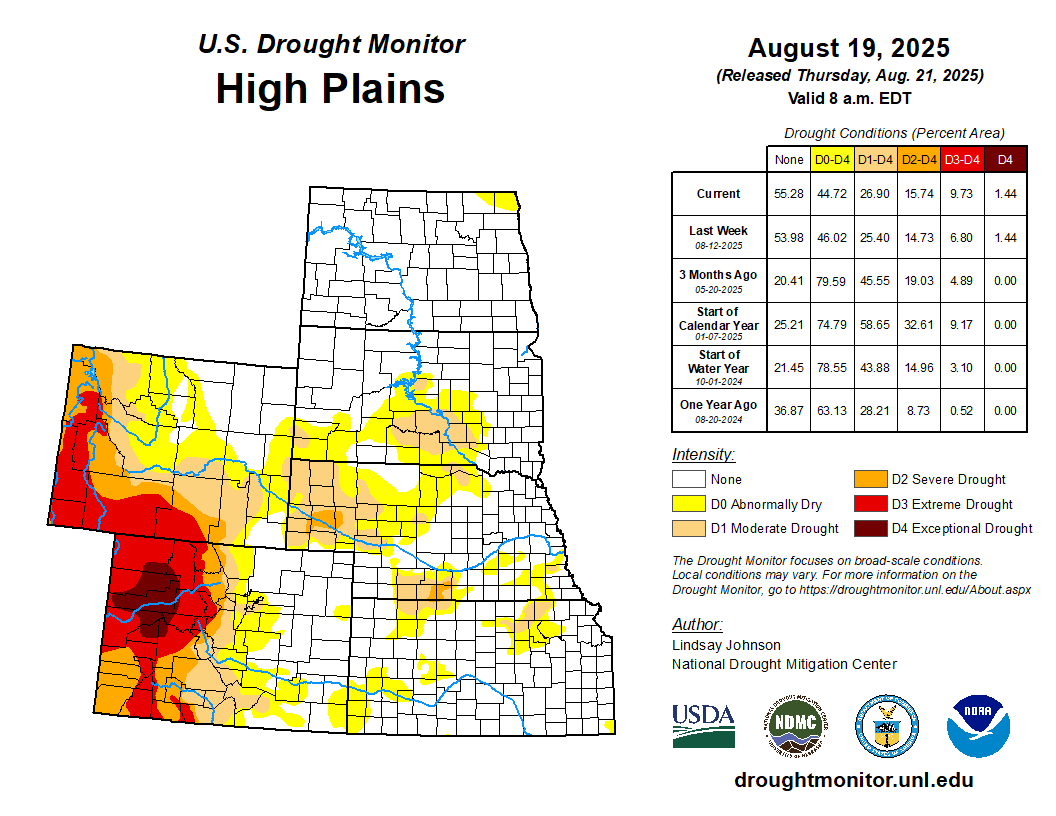
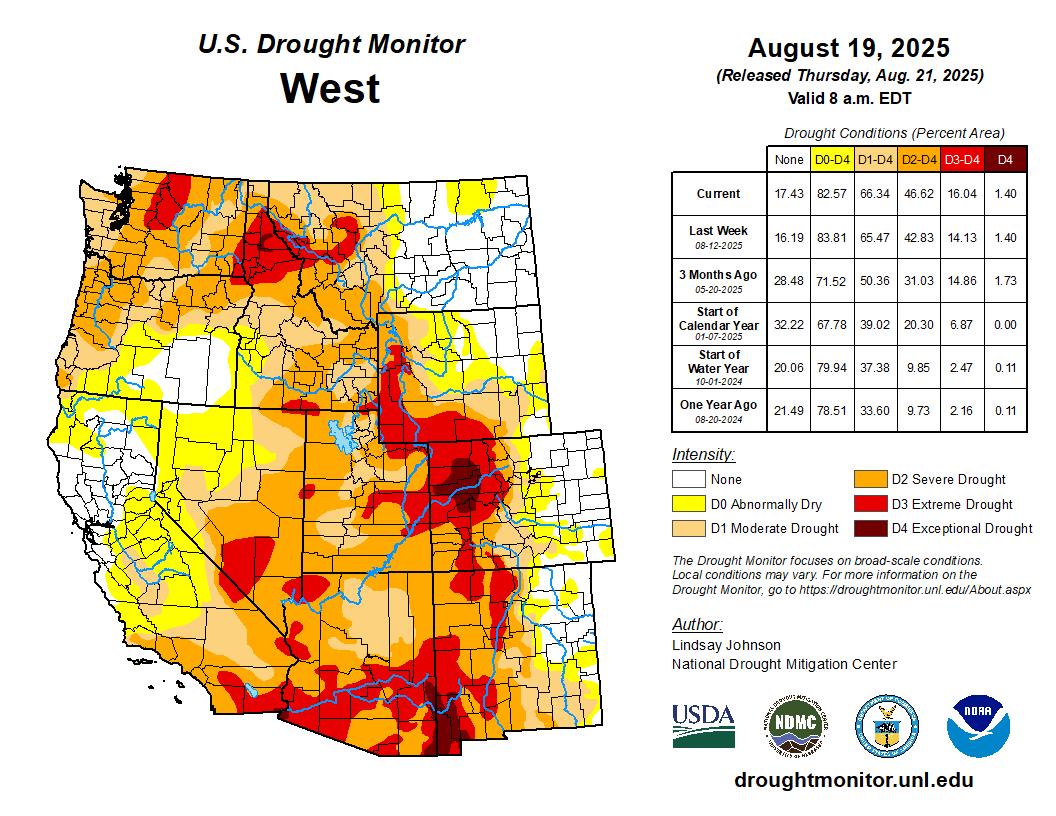
About 82% of the West is in drought, with about 47% suffering from severe to exceptional drought. The hardest hit areas include northwestern Colorado and southwestern Wyoming (aka the Colorado River headwaters), southeastern Arizona and southwestern New Mexico, and the Idaho panhandle.
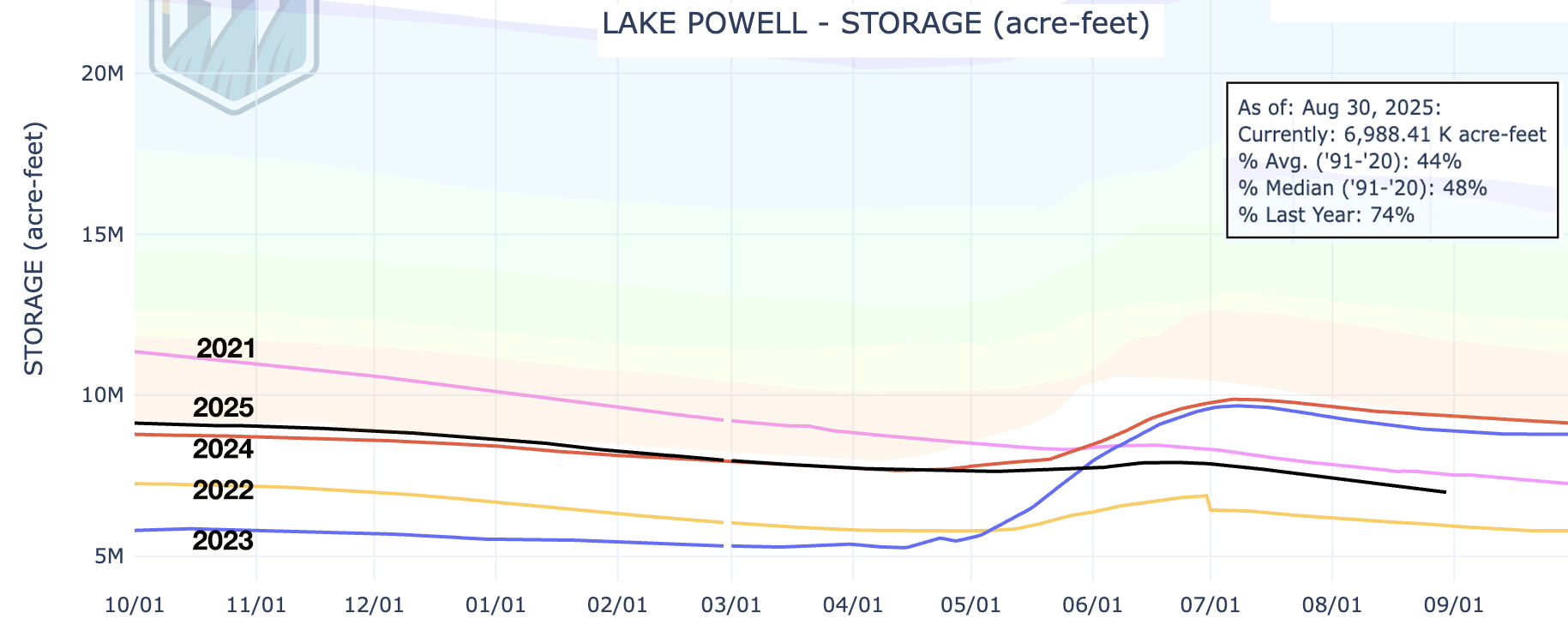
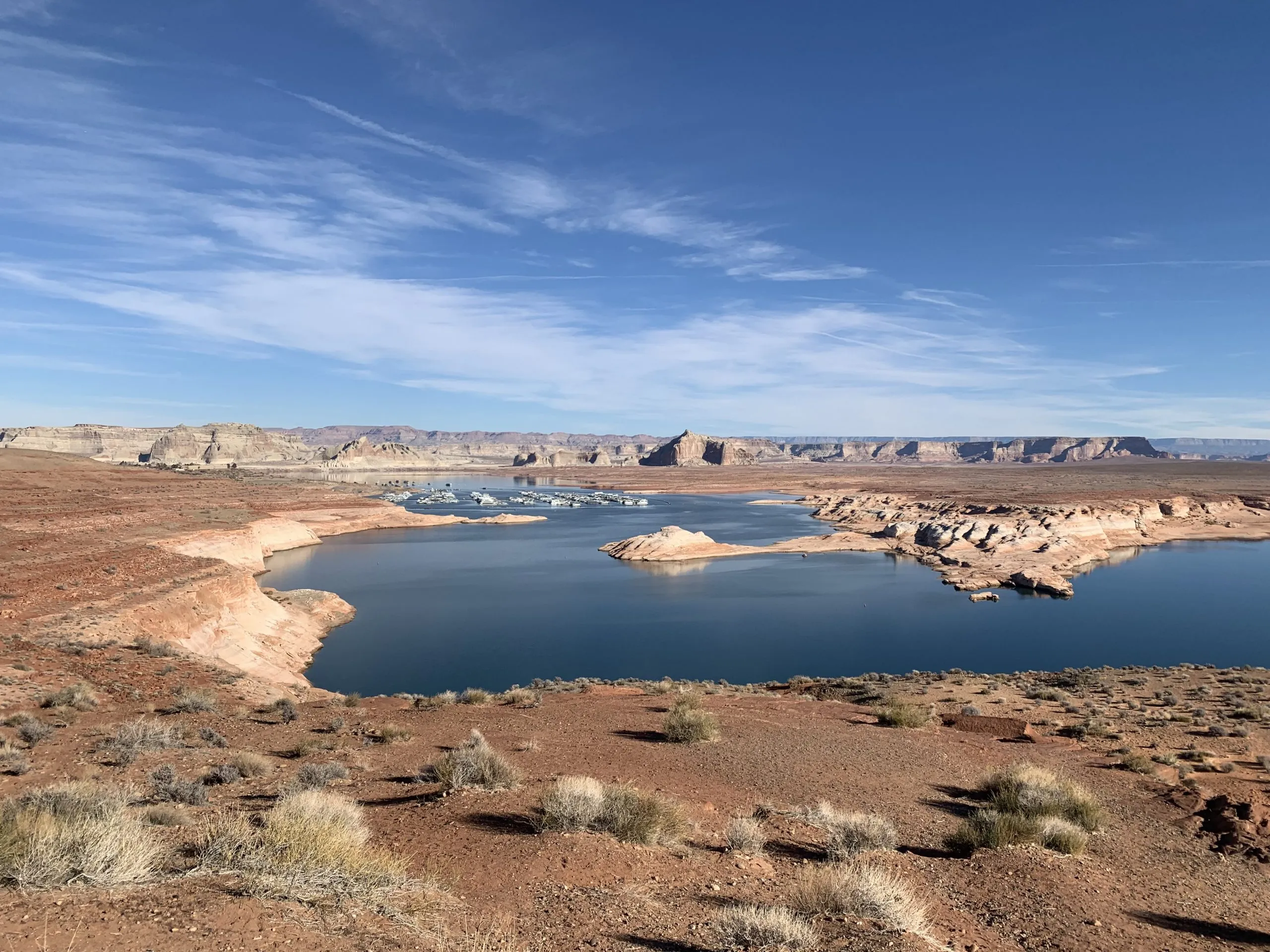
The combination of factors has resulted in low inflows into and steep declines in water storage in Lake Powell. The reservoir — which is both a barometer of the Colorado River’s health and the Upper Basin’s savings account — is now at about the same level as it was in early September of 2021. It both complicates and adds urgency to negotiations over how to split up the Colorado River in a warmer, dryer world.
Let’s look at some graphics:
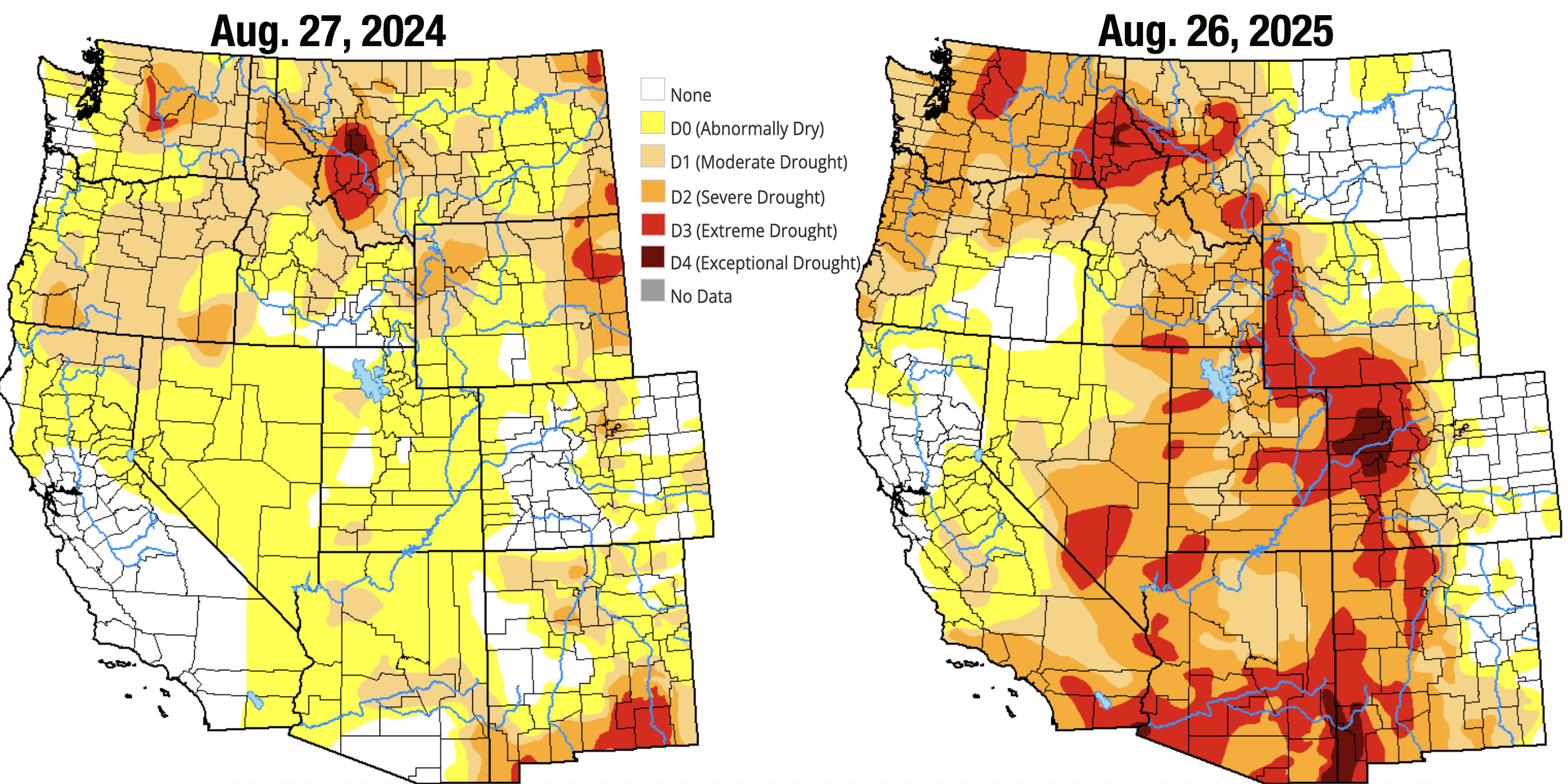
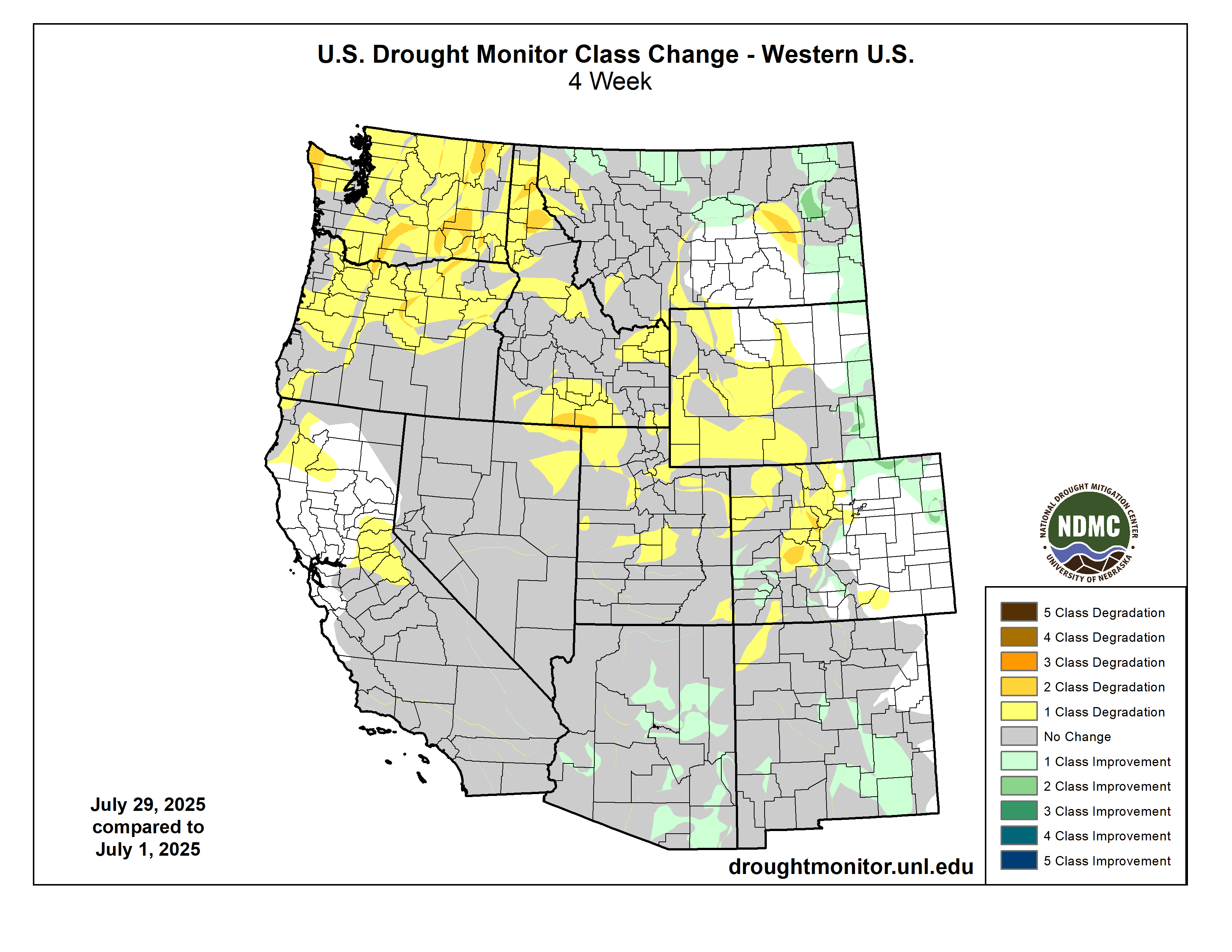
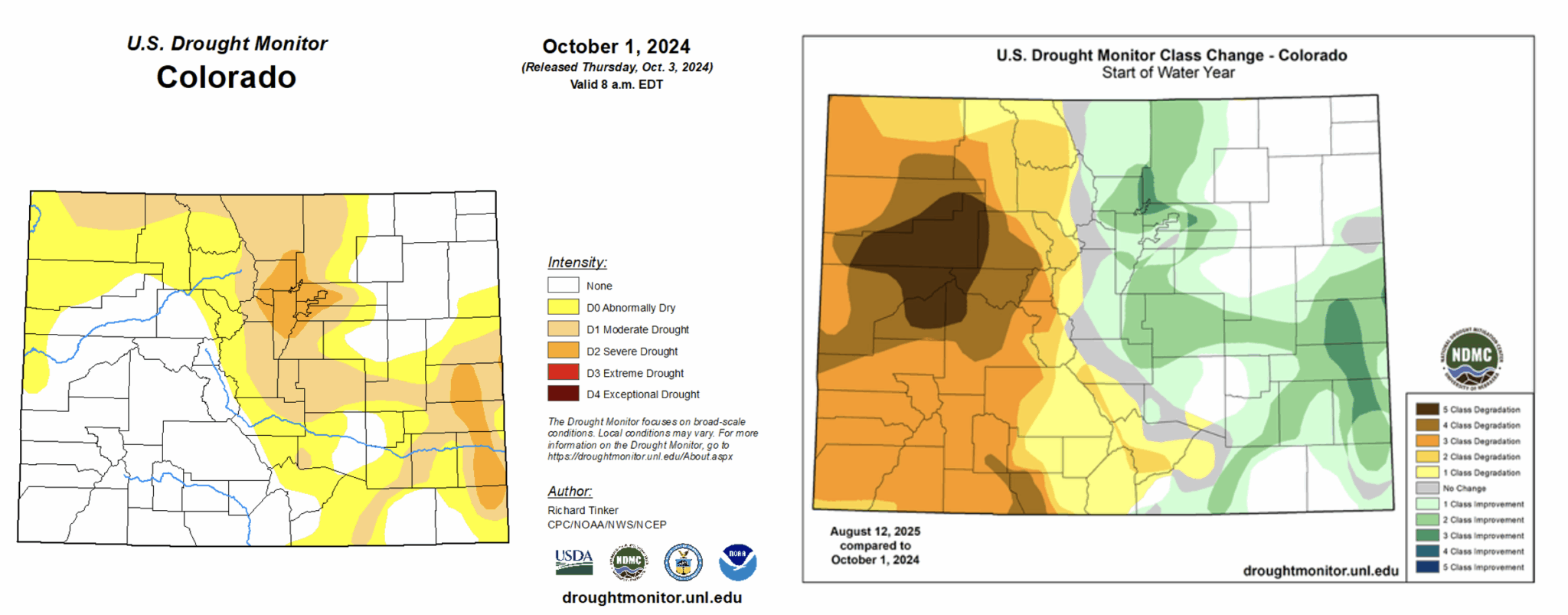
What a difference a year makes. At the end of last summer, most of the West was fairly healthy, moisture-wise, and a wet September, October, and November further improved the situation. But after that, things started drying out and warming up, desiccating large swaths of the region, with only northern California, southern Oregon, and the plains getting a reprieve. Source: U.S. Drought Monitor.
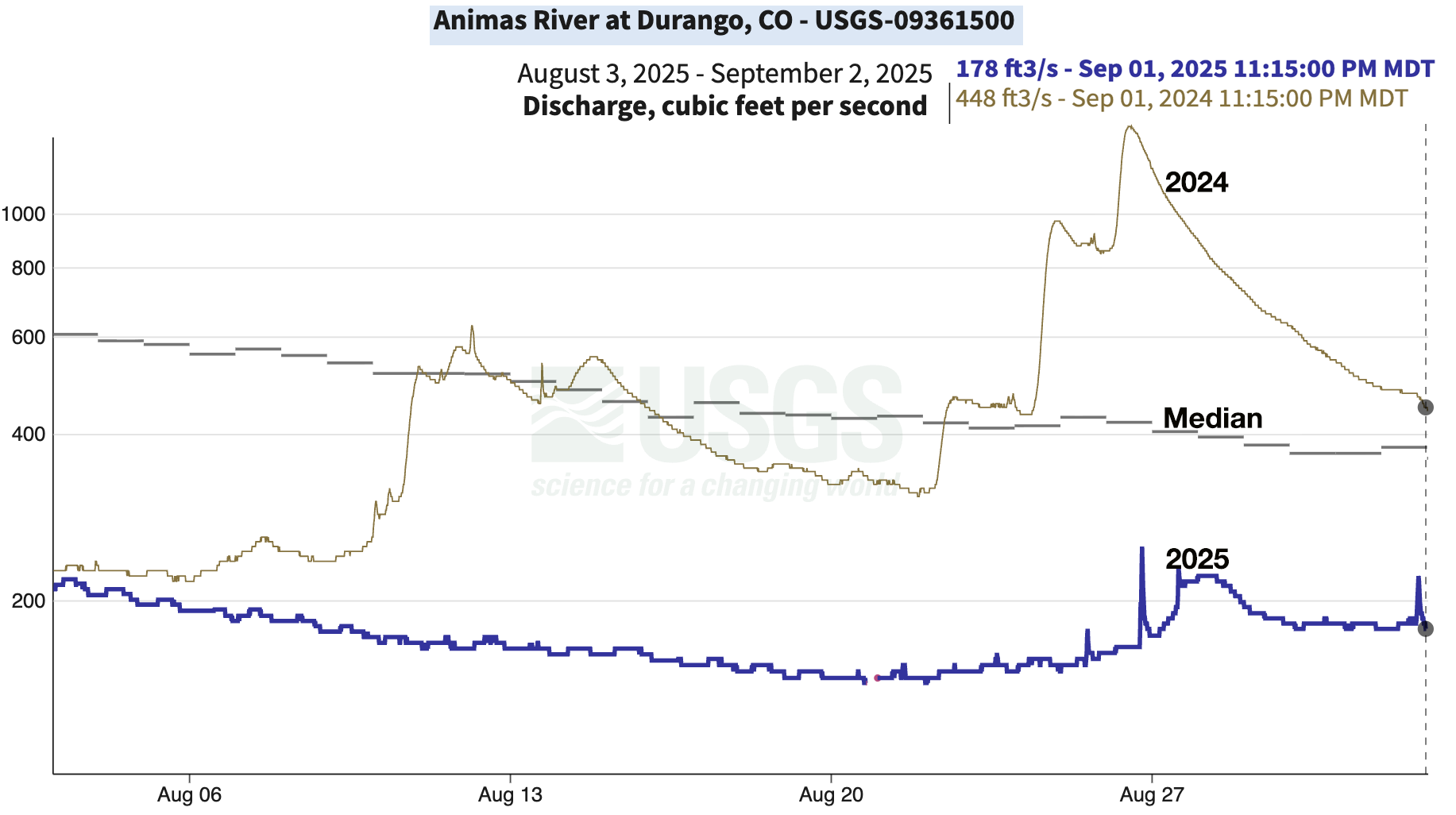
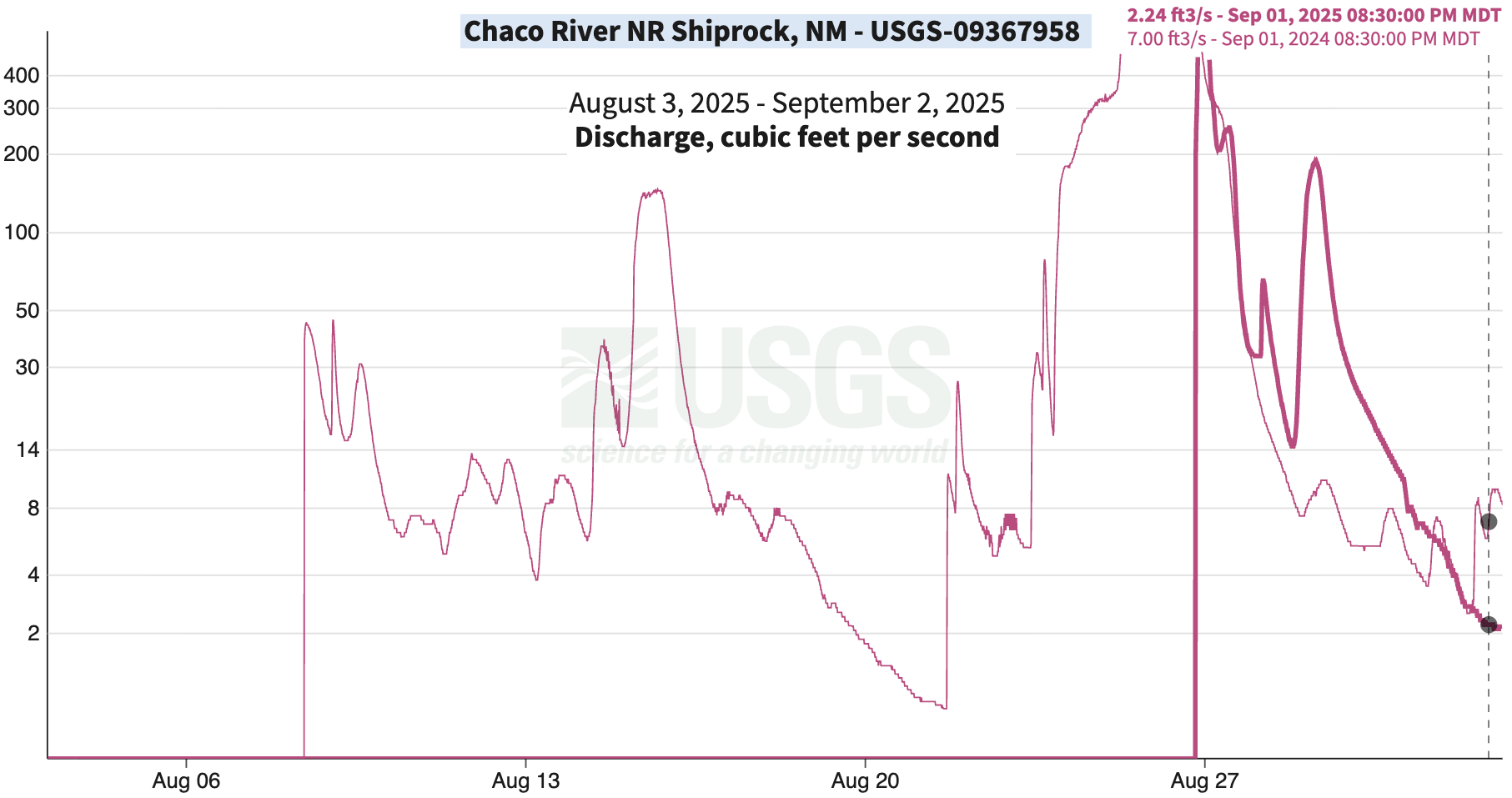
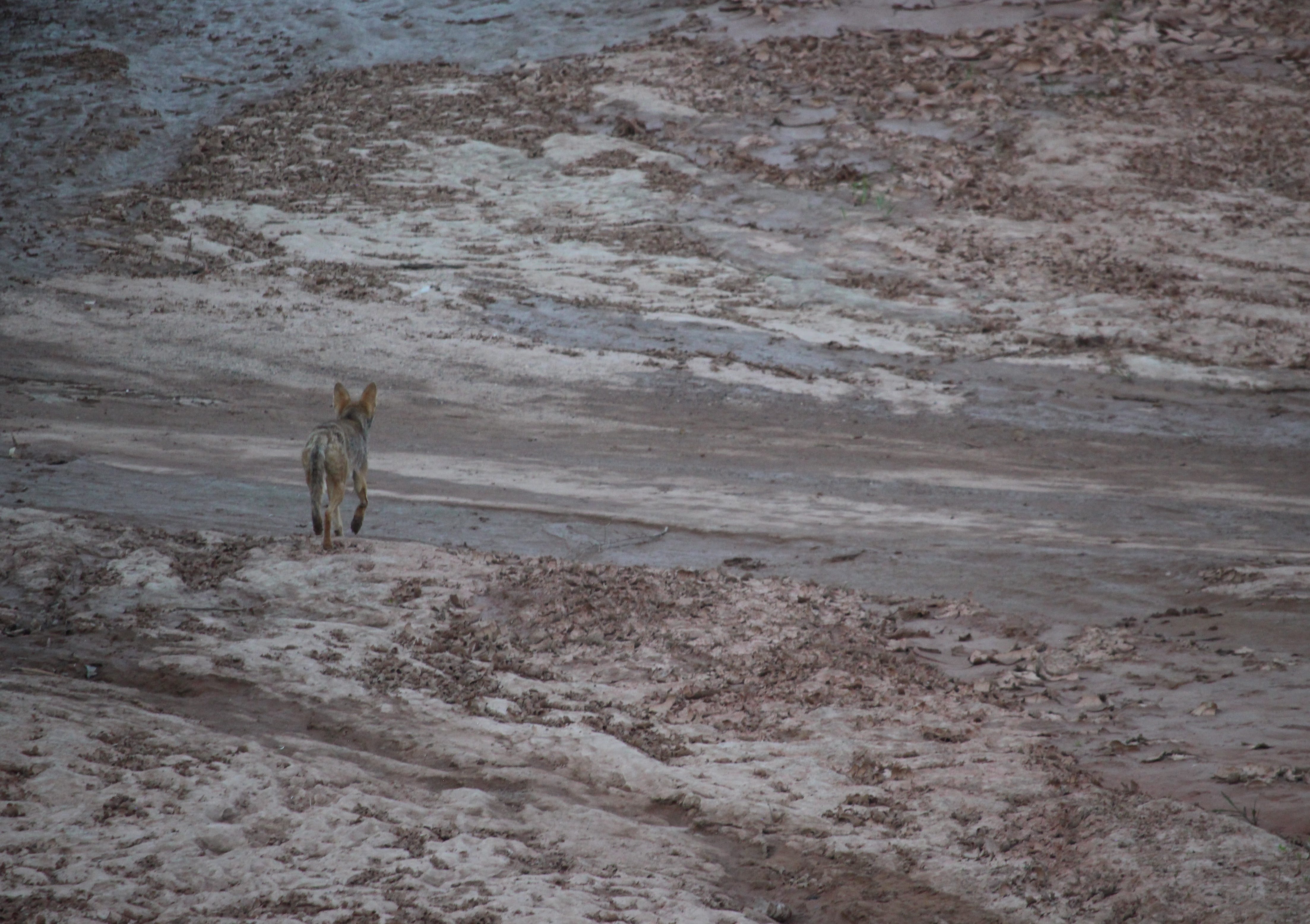
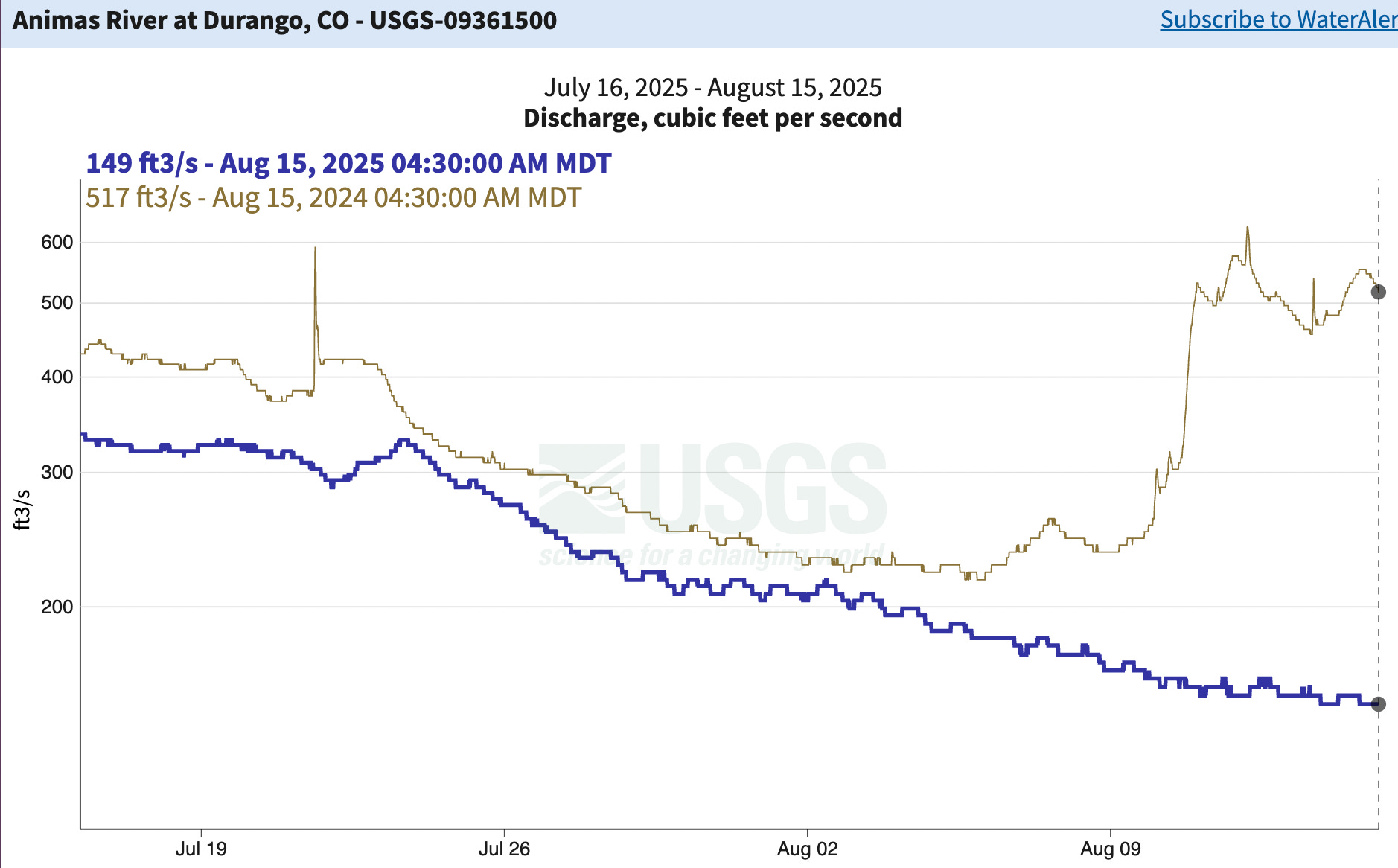
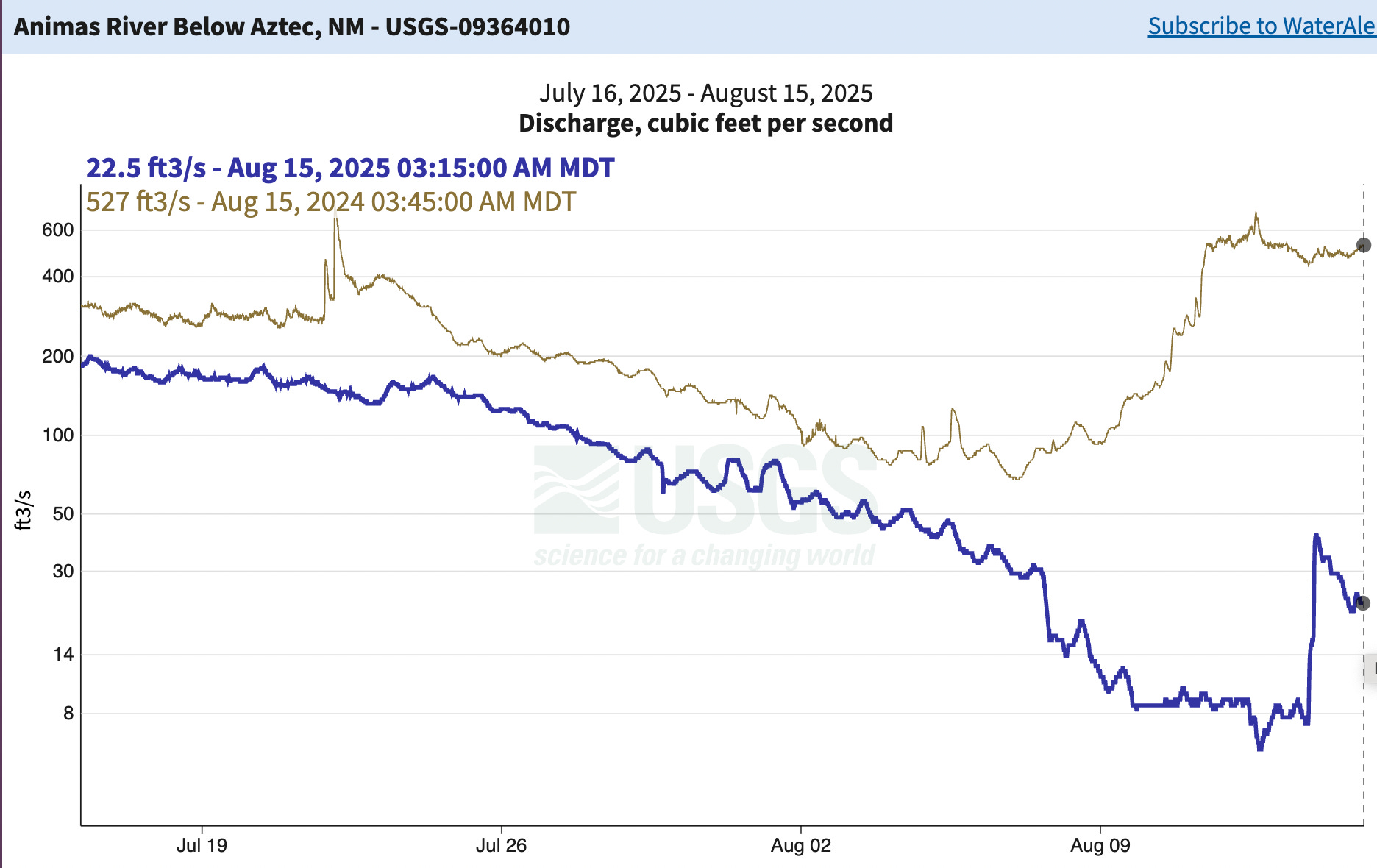
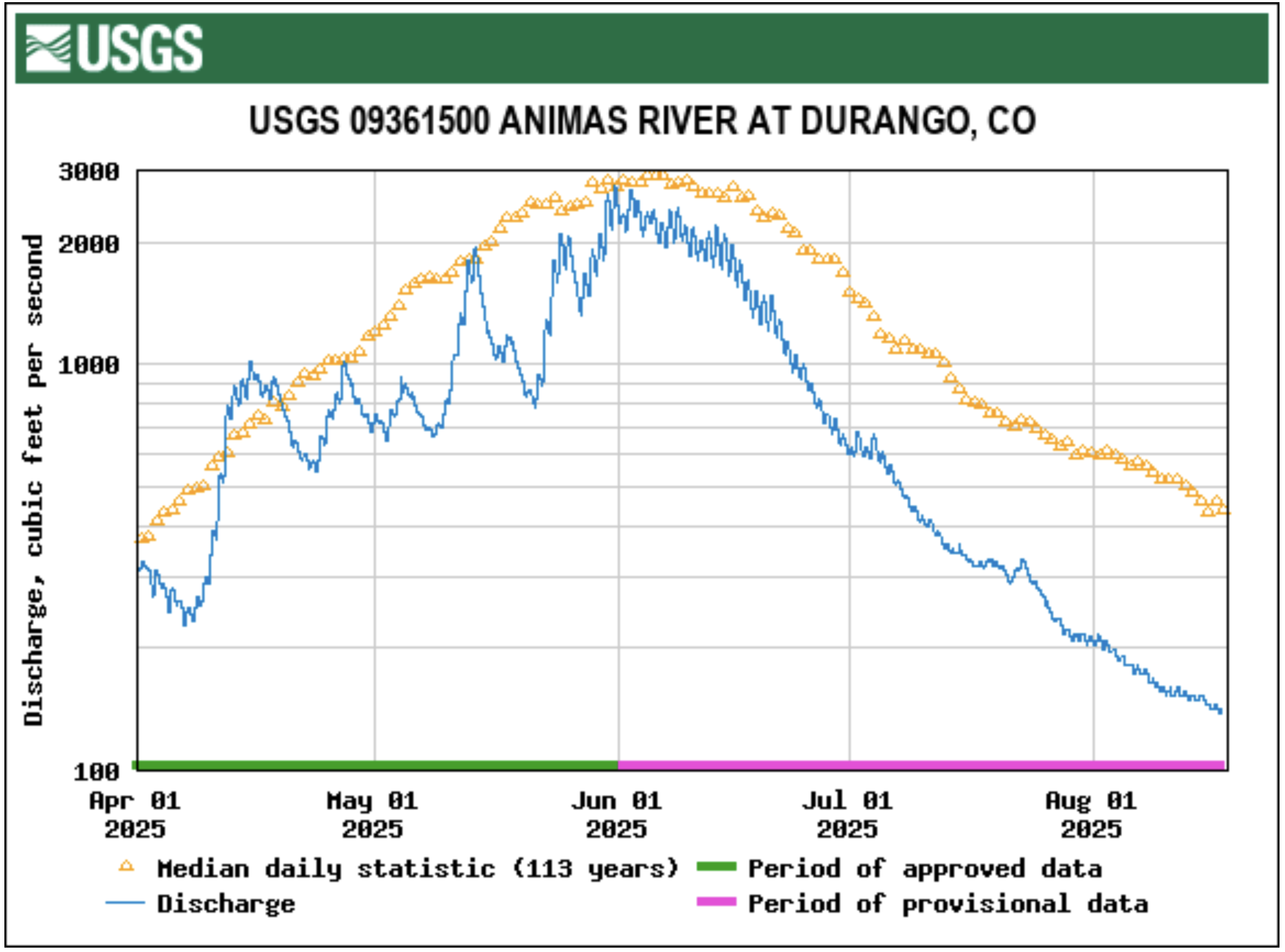
These hydrographs for the Animas River in Durango, the Chaco River just above its confluence with the San Juan, and the Rio Grande through Albuquerque, show that the monsoon did, in fact, arrive, albeit dreadfully late and bringing nothing but chips and cheap bean dip (a potluck metaphor, by the way). The Chaco River ballooned from bone dry to raging river (off the charts!) in a matter of hours, but was nothing but a muddy trickle a couple days later. The Animas also got a boost, but nothing close to as big as it normally gets this time of year. For once, the Rio Grande looks the best, with flows jumping from zero to about 300 cfs, before plateauing around 120 cfs for several days now.
A couple of decent storms basically kept the Animas from drying up entirely, but not much more than that.
It looks like the Chaco River went from very, very dry to about 600 cfs (it literally jumped off the chart at 460 cfs, so….) and did so in the form of a wall of water.
The Rio Grande in Albuquerque was dry until the monsoon managed to kick it up to a not-dry 120 cfs or so.
Of course, these charts could turn around at any time. The monsoon may just be getting started, and will end up bringing steady, autumn rain and sustained higher streamflows with it. The biggest floods of the region have typically come in September and October, usually as tropical storms make their way inland and dump their load on the Interior West, think Oct. 1911 or Sept. 1970. That could happen again.
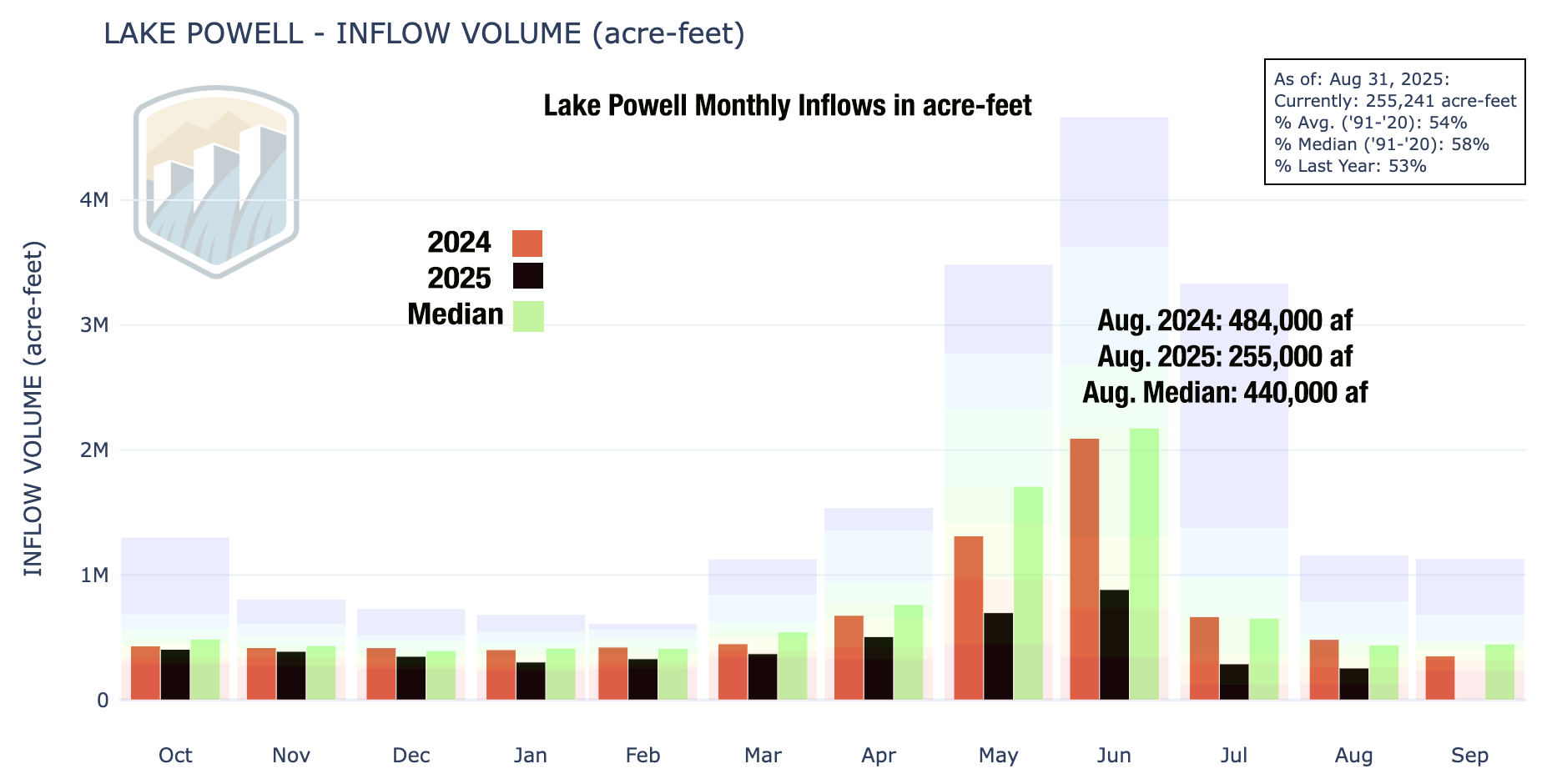
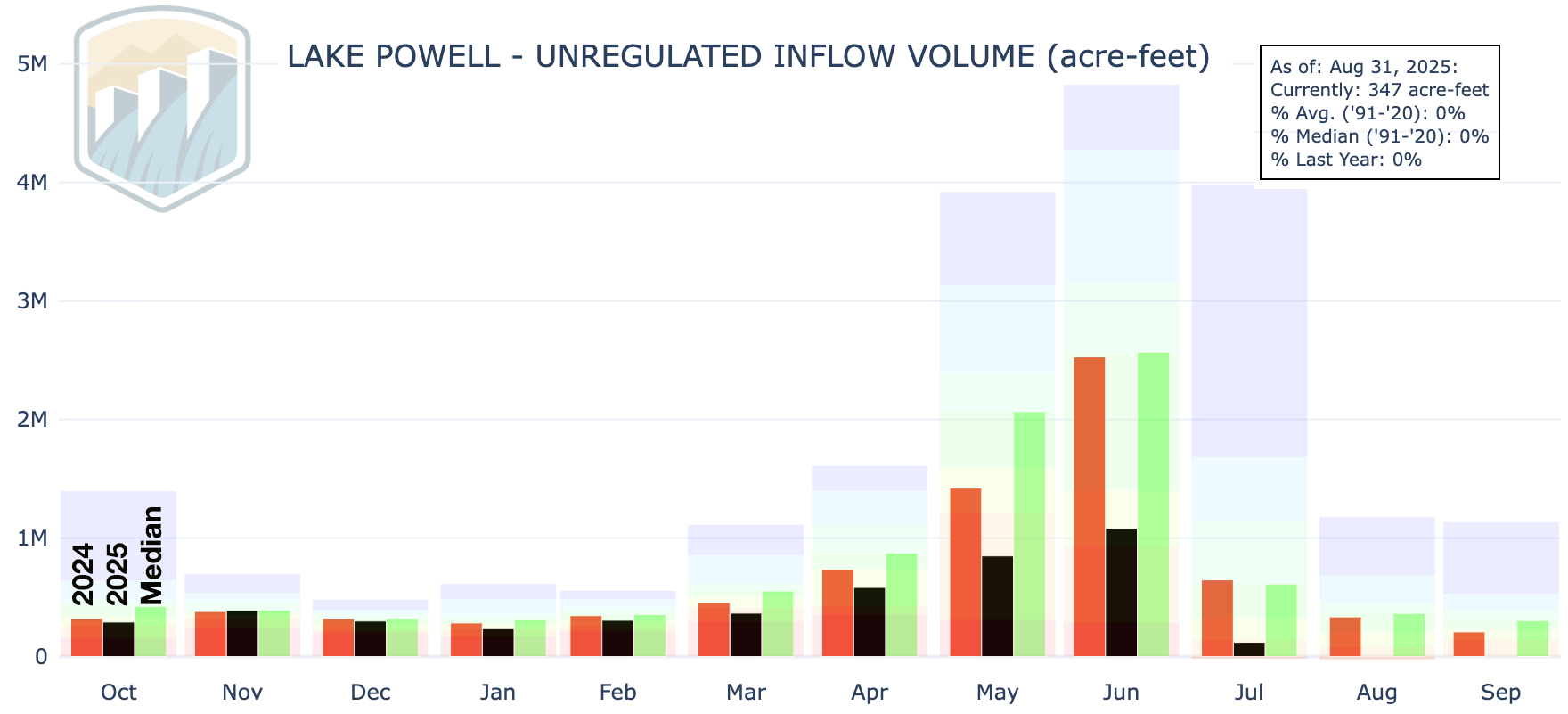
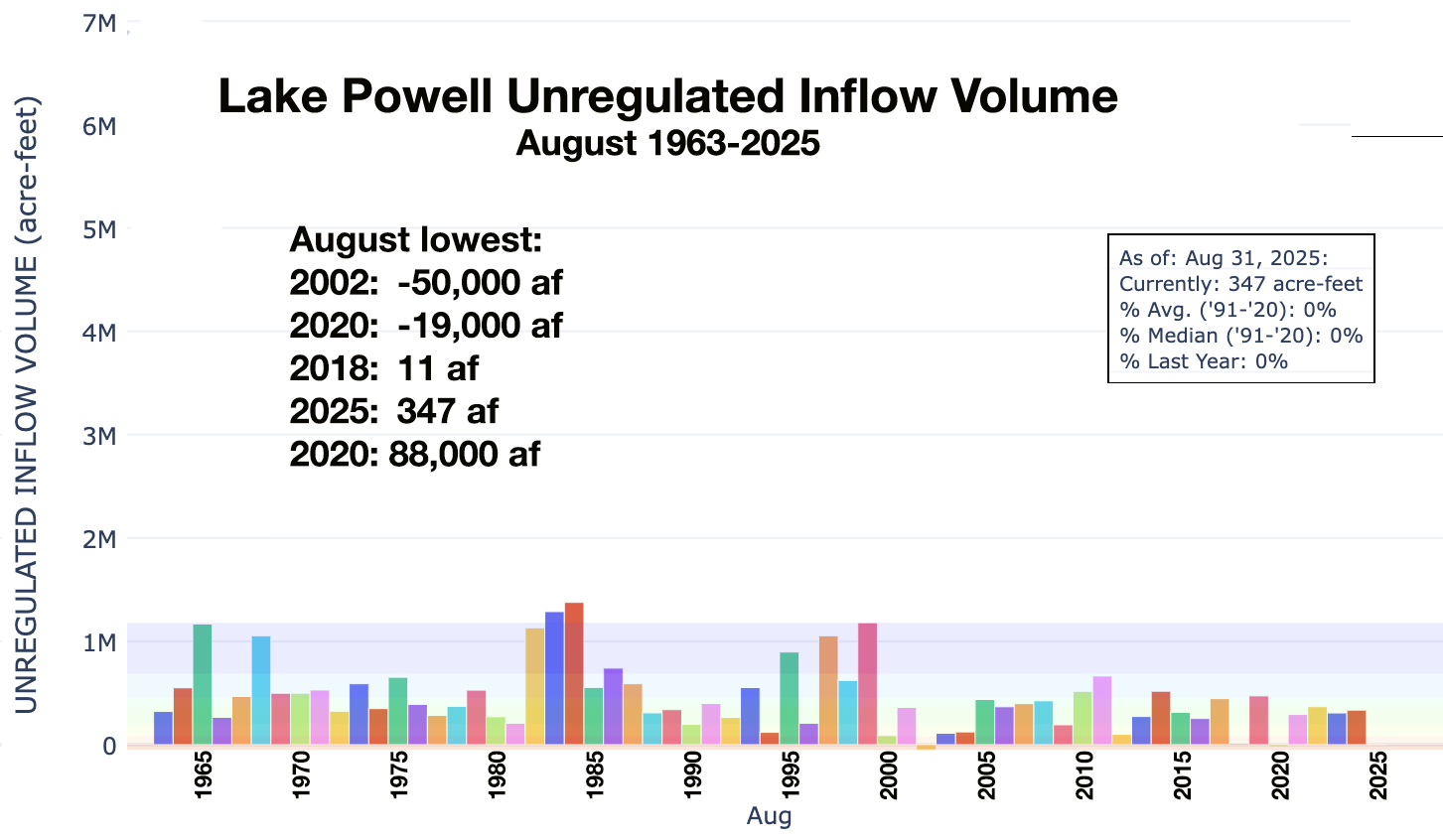
Even multiple deluges won’t reverse the Lake Powell deficit that’s built up this year, however. This water year’s actual inflows into the reservoir have been below normal for nearly every month, and were especially low in August. But more alarming are the unregulated inflows, which are an estimate of how much water would be flowing into the reservoir if there were no diversions or reservoirs upstream. This can look a bit weird, since in some months the estimate is a negative number.
During August, about 255,000 acre-feet ran into Lake Powell. This was just 58% of normal. But that’s more than 254,000 acre-feet more than it would have been without upstream reservoir releases.
Note that the unregulated inflow volume tends to be higher than the actual inflow volumes during spring runoff (when upstream reservoirs are holding water back) and lower during the summer (when upstream reservoirs are releasing water for irrigation and so forth). The unregulated inflows have been lower than normal all water year so far.
The negative numbers shouldn’t be taken literally — I don’t know what that would look like. It’s just showing that without upstream reservoir releases, the flows would have gotten pretty meager in August during the pre-dam days.
Lake Powell’s storage is at its second lowest level ever for the end of August. An average or below average winter could further drain it to critical levels by next year.
Rio Grande and Pecos River basins. Map credit: By Kmusser – Own work, Elevation data from SRTM, drainage basin from GTOPO [1], U.S. stream from the National Atlas [2], all other features from Vector Map., CC BY-SA 3.0, https://commons.wikimedia.org/w/index.php?curid=11218868
EPA withdraws a proposed rule to reduce wastewater pollution from slaughterhouses.
EPA will seek to cut federal protections for wetlands.
USDA will prepare an environmental impact statement for repealing the Roadless Rule that shields national forests and grasslands from logging and road building.
New Mexico and Texas agree to Rio Grande lawsuit settlement.
CBO reports on U.S. agriculture’s greenhouse gas emissions.
EPA proposes allowing Wyoming to manage its own coal-waste program.
Interior Department completes work on soil burn severity assessment for a large fire north of the Grand Canyon.
And lastly, the Department of Energy supports a feasibility study for what would be one of the country’s largest pumped storage hydropower projects.
“The seven states need to recognize that there is pain and sacrifice all over the place and try and get past that visceral perception and figure out what they can do to work together to provide water reliability for the 40 million people who depend on the Colorado River.” – Scott Cameron, senior adviser to the interior secretary, speaking at a meeting of the Glen Canyon Dam Adaptive Management Work Group on August 20. Cameron, who said he is “cautiously optimistic” about a seven-state deal on managing the river before the current operating rules expire at the end of next year, said the basin needs to look for strategies to reduce consumption and “to facilitate transfers and exchanges.”
By the Numbers
10 Percent: Share of U.S. greenhouse gas emissions generated by agriculture, according to a Congressional Budget Office report. The main pollutants in this total are nitrous oxide, a byproduct of fertilizer, and methane, which comes from livestock manure and cow burps.
$21 Million: Research and development funding from the Department of Energy for hydropower projects. The largest portion ($7.1 million) is to investigate the feasibility of a massive pumped storage hydropower project proposed for Navajo Nation land. Pumped storage toggles water between a lower and upper reservoir, a system that functions like a battery. New Mexico State University is the co-investigator for Carrizo Four Corners, the 1,500-megawatt pumped storage project that could provide 70 hours of energy storage, far more than the several hours of storage provided by the largest lithium-ion batteries.
News Briefs
Slaughterhouse Waste The Environmental Protection Agency will not strengthen wastewater discharge rules for meat and poultry producers. The rules were proposed during the Biden administration.
To justify the action, the agency cited its desire to lower food prices and reduce industry operating costs.
The Biden-era rule intended to reduce the volume of pollutants that enter waterways from some 3,879 slaughterhouses nationally. Those pollutants include nitrogen, phosphorus, organic matter, fecal coliform, and grease. They contribute to harmful algal blooms and low-oxygen dead zones in rivers, lakes, and coastal ecosystems.
A Narrow Wetlands Definition The EPA is preparing to release a rule by the end of the year that would shrink the number of wetlands with federal protection under the Clean Water Act, E&E News reports.
According to a slide presentation seen by E&E, the agency “would regulate wetlands only if they meet a two-part test: They would need to contain surface water throughout the ‘wet season,’ and they would need to be abutting and touching a river, stream or other waterbody that also flows throughout the wet season.”
The changes are in response to a 2023 Supreme Court ruling that provided narrower, but undefined criteria for determining which water bodies have federal protection.
Rio Grande Settlement By signing a settlement agreement, New Mexico, Texas, and the Justice Department are closer to ending a long-running dispute over water rights from the Rio Grande and the groundwater pumping that affects river flows, Inside Climate News reports.
“The settlement package includes new formulas to calculate how much water each entity is owed; an agreement for New Mexico to reduce groundwater depletion, and changes to the operating manual for the Bureau of Reclamation’s Rio Grande Project.”
Roadless Rule The U.S. Department of Agriculture is pushing ahead with its attempt to undo a 24-year-old rule that prevents logging and road building in “roadless” areas of national forests and grasslands.
Rescinding the Roadless Rule, which was adopted in the last month of the Clinton administration, will affect more than 44 million acres, mostly in 10 western states.
The department will prepare an environmental impact statement for its intent to repeal the rule. It argues that more local control over land management decisions are needed.
Comments are due September 19. Submit them via http://www.regulations.gov using docket number FS-2025-0001.
Studies and Reports
Dragon Bravo Fire Burn Severity An Interior Department team completed an evaluation of the soil burn severity of the Dragon Bravo Fire, which has burned across more than 149,000 acres north of the Grand Canyon.
The fire severely burned the soils on just over 2 percent of the acres. Another 26 percent was moderately burned. The most severe burns cook the soil, which increases surface runoff after storms. Erosion and downstream floods can be the result.
Emergency Alert System Improvements The Federal Communication Commission is beginning the process to assess and potentially upgrade the nation’s emergency alert systems that local agencies use to inform residents about natural hazards like floods and fires.
The commission is taking public comments through September 25. Submit them hereusing docket number 25-224.
Wyoming Coal Waste The EPA wants to grant more states the authority to regulate waste products from burning coal for electricity. Wyoming is the latest state to seek this power, called primacy.
The agency is proposing to approve Wyoming’s bid to oversee its coal ash permitting program.
A public meeting will be held October 30. Public comments on the proposed approval are due November 3. Details are in the above link.
Three states currently have primacy. North Dakota’s application is being reviewed.
Federal Water Tap is a weekly digest spotting trends in U.S. government water policy. To get more water news, follow Circle of Blue on Twitter and sign up for our newsletter.
At the town of Kremmling board of trustees meeting on Aug. 20, members approved an emergency declaration for watering restrictions due to ongoing drought conditions. The following Level 1 restrictions are in effect:
Even-numbered addresses (street numbers ending in 0, 2, 4, 6, 8) may use municipal water for outside irrigation and other outdoor purposes only on even-numbered days of the month.
Odd-numbered addresses (street numbers ending in 1, 3, 5, 7, 9) may use municipal water for outside irrigation and other outdoor purposes only on odd-numbered days of the month.
Town Parks will be watered no more than every third day.
“The restrictions are necessary because of a dry summer and our aging water treatment plant’s inability to keep up with current demands,” stated town manager Jen MacPherson. “They are important for residents to follow because we are in a position where we can hopefully prevent additional restrictions if everyone pulls together and cuts back now.”
The Rio Grande flows over 1,800 miles from the mountains of southwestern Colorado to the Gulf of Mexico. A lawsuit filed in 2013 between Texas and New Mexico over Rio Grande water has taken as many twists and turns as the river itself.
A settlement signed this week by New Mexico, the Department of Justice and two irrigation districts, and reviewed by Inside Climate News, lays out agreements for irrigation management on the Rio Grande. It is one part of a larger settlement package that will be presented to a special master in the case, Judge D. Brooks Smith of the U.S. Third Circuit Court of Appeals, for approval next month.
The outcome of the case is expected to have broad implications for cities that rely on the Rio Grande and farmers throughout New Mexico and far west Texas.
The settlement package includes new formulas to calculate how much water each entity is owed; an agreement for New Mexico to reduce groundwater depletion, and changes to the operating manual for the Bureau of Reclamation’s Rio Grande Project.
Under the settlement, New Mexico could transfer water rights from the Elephant Butte Irrigation District (EBID) in Southern New Mexico in order to meet its obligations to Texas. The state agrees in the settlement that it would compensate EBID.
The case began when Texas alleged that groundwater pumping in Southern New Mexico deprives the state of water it is owed under the Rio Grande Compact. Colorado and the United States are also parties to the case. Local irrigation districts, cities and agricultural interest groups have been involved as friends of the court. The case has evolved from a dispute between Texas and New Mexico to encompass conflicts between groundwater and surface water users in the area.
“We are ecstatic to have reached a settlement and look forward to continue delivering water to our farmers and the City of El Paso,” said Jay Ornelas, general manager of the El Paso Water Improvement District No. 1, an irrigation district. “The agreement provides long-term protection to El Paso farmers and the City of El Paso that rely on water from the federal Rio Grande Project.”
A Strained Inter-State Compact
The Rio Grande Compact, signed in 1938, lays out how much water Colorado, New Mexico and Texas can use from the Rio Grande. The compact only addresses surface water in the river. But hydrologists now understand that aquifers and rivers are connected. Wells drilled into adjoining aquifers can reduce the flow of water into the Rio Grande.
At issue in the case is a 100-mile stretch of the river between Elephant Butte Reservoir in Southern New Mexico and the Texas-New Mexico state line. Water is released from the reservoir for both Southern New Mexico and far West Texas, including El Paso.
As agriculture expanded and severe droughts hit the region, farmers drilled more wells into the aquifer. Texas argues these wells in Southern New Mexico are siphoning off water that should flow to Texas.
“In one way it’s a conflict between the state of Texas and the state of New Mexico,” said Burke Griggs, a professor of water law at Washburn University in Topeka, Kansas. “But the conflict that really matters here is the conflict between surface water rights and groundwater pumping.”
Climate change is impacting snowmelt in the river’s headwaters. Extreme heat is increasing evaporation rates from the river where it flows downstream through the desert. The case is closely watched in New Mexico, where scientists predict thatwithin 50 years water supply from rivers and aquifers will decline by 25 percent. The City of El Paso, which relies on Rio Grande water, has diversified its water sources as the river became less reliable.
The Supreme Court rejected a settlement that the states reached in 2022 because the federal government had not consented to its terms. The parties went back to the drawing board. A new settlement was announced on May 15, with the United States on board.
“The United States got what it needed in terms of firm commitments by New Mexico to reduce groundwater depletions,” Griggs said.
In a statement, the El Paso Water Improvement District No. 1 said that the settlement will improve efficiency, conserve scarce water resources and ensure that water is available for the district’s farmers and the City of El Paso. EBID has also signed on to the settlement.
Judge Smith, the special master, has called the parties to appear in court in Philadelphia on September 30 to explain the agreements. The details of the other parts of the settlement package have not been made public. As surface water dwindles across the Southwest, the settlement could bring to an end years of uncertainty surrounding the Rio Grande.
“We’ll know with this settlement, I think with much greater precision, how much water there is to be used, how much water people are going to be able to pump a year or two out,” Nat Chakeres, general counsel for New Mexico’s Office of the State Engineer, told lawmakers in Santa Fe earlier this month.
While Texas v. New Mexico may soon come to a close, water challenges in the desert Southwest are becoming ever more urgent. The settlement comes as Elephant Butte reservoir is at less than four percent capacity, nearly a record low, and the Rio Grande south of Albuquerque has run dry for over a month.
Rio Grande and Pecos River basins. Map credit: By Kmusser – Own work, Elevation data from SRTM, drainage basin from GTOPO [1], U.S. stream from the National Atlas [2], all other features from Vector Map., CC BY-SA 3.0, https://commons.wikimedia.org/w/index.php?curid=11218868
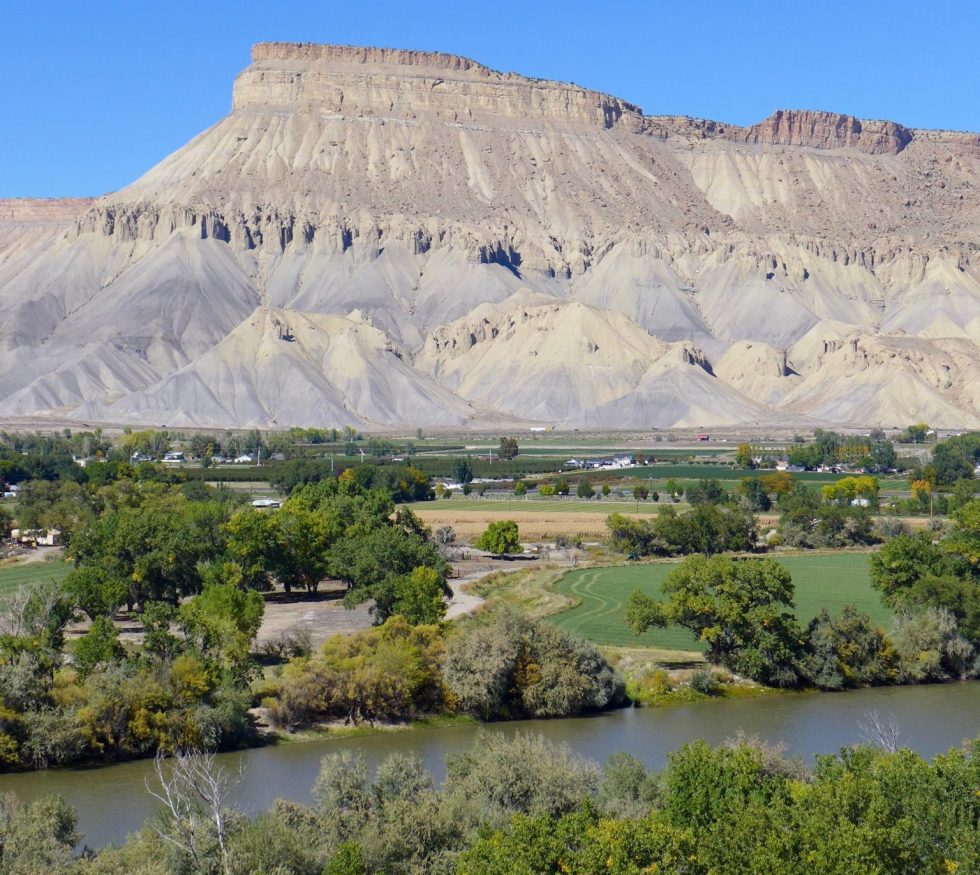
Every year, millions of tons of salt flows down the Colorado River. The Colorado Department of Agriculture works with local irrigation companies and agricultural producers to limit the amount drawn from Colorado’s farming industry. On Thursday [August 14, 2025], members of the Department of Agriculture and others toured different areas around Palisade from a lined canal to a peach orchard to see what methods are being used to limit how much salt the Grand Valley washes into the river. Colorado Department of Agriculture Salinity Program Coordinator Paul Kehmeier explained that the soils around the Grand Valley contain salt that can be washed into the river by irrigating fields too deeply.
“It doesn’t really feel like it this morning, but we’re actually standing on the bottom of an ocean right now,” Kehmeier said. “The water’s gone, but all the salt from the ocean is still here. When the water from the Colorado River gets in contact with it, it dissolves the salt and the salt gets into the water and it’s carried down on the river.”
Kehmeier said the salt content in the river in Colorado is still low, but more gets dissolved along the river’s course and there is a large amount by the time it reaches the Lower Colorado Basin states. In the 1970s, the federal government passed legislation to reduce the salt level in the river…Cindy Lair, the Colorado Department of Agriculture deputy director for conservation services division and climate resilience specialist, said over time the federal government shifted to allow states to take the lead in reducing salt levels in the river by providing grant funding. The types of projects that can reduce salinity include things like lining canals and helping farmers use more efficient irrigation systems that don’t soak down below the root level of the crops.
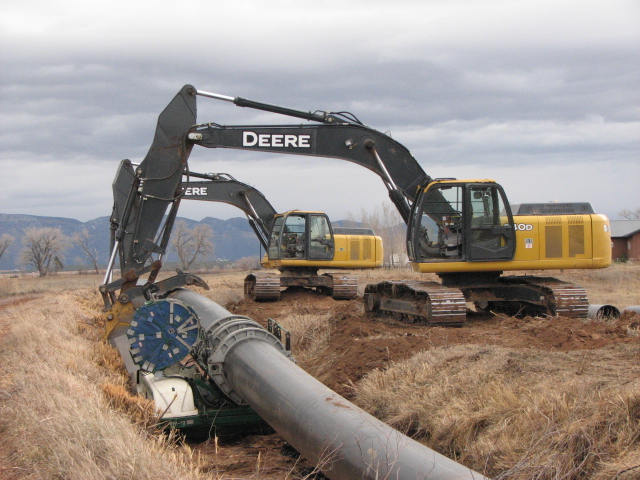
Laying pipe near Crawford, Colorado. Photo credit: USBR
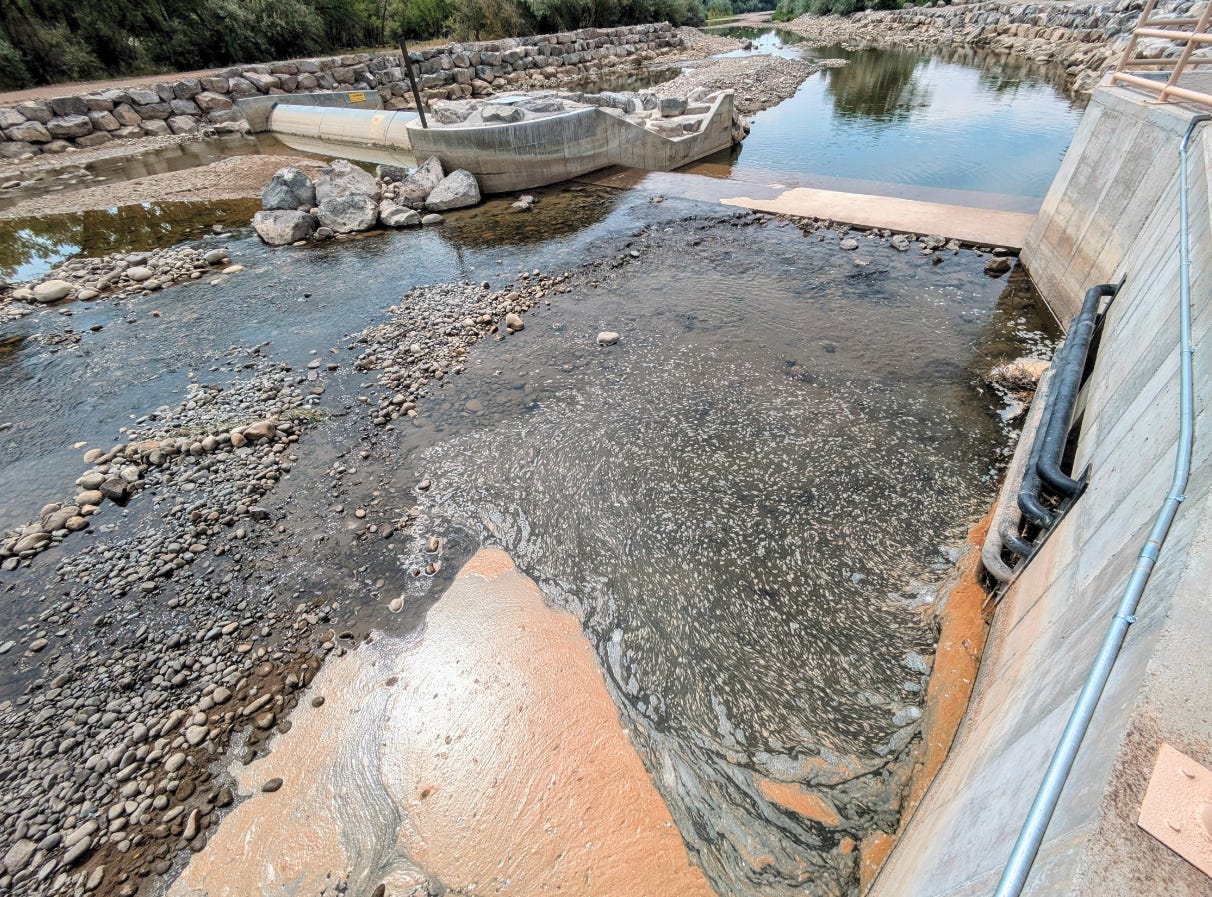
This image was taken during the peak outflow from the Gold King Mine spill at 10:57 a.m. Aug. 5, 2015. The waste-rock dump can be seen eroding on the right. Federal investigators placed blame for the blowout squarely on engineering errors made by the Environmental Protection Agency’s-contracted company in a 132-page report released Thursday [October 22, 2015]
Click the link to read the article on The Denver Post website (Elise Schmelzer). Here’s an excerpt:
August 31, 2025
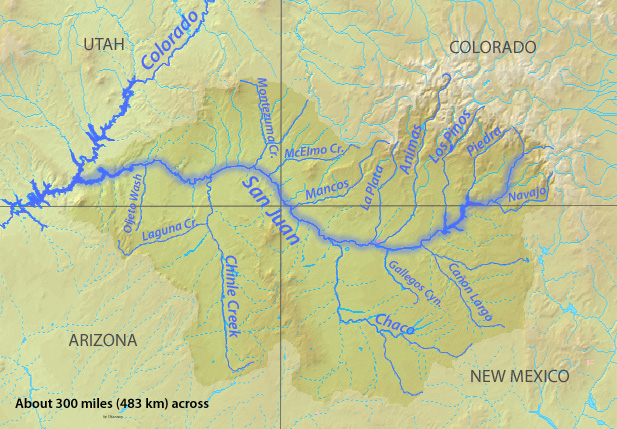
Three million gallons of acidic mine drainage flooded into the Animas River basin 10 years ago, turning the southern Colorado river a mustard yellow and making international headlines. Caused by federal contractors working to treat pollution from the Gold King Mine, the accidental release of water laden with heavy metals prompted the creation of a Superfund site and a reckoning with lingering environmental harms from the area’s mining legacy, including hundreds of abandoned mines high in the San Juan mountains. A decade later, community members and Environmental Protection Agency staff are still grappling with the long-term cleanup of the area’s mines and tailings piles. Forty-eight of them now make up the Bonita Peak Mining District Superfund site outside Silverton. They continue to leak heavy metals into local waterways and soils.
“We’re pleased that the EPA is at the point where in the next 18 months, we’re going to see some decisions made about how those sites are cleaned up,” said Chara Ragland, the chair of the site’s community advisory group.
Cement Creek photo via the @USGS Twitter feed
Studies have since shown that the Aug. 5, 2015, Gold King spill had little long-term environmental impact because the water already contained so many heavy metals from runoff and other mines. Locals hope the federal Superfund cleanup process will improve water quality in the Animas River basin so that it will be cleaner than before the Gold King incident.
The “Bonita Peak Mining District” superfund site. Map via the Environmental Protection Agency
Residents of Boone County, Indiana, had a lot to be anxious about in 2023 when state authorities revealed the scope of a nearly 10,000-acre innovation and high-tech manufacturing park they were developing outside Lebanon, a half-hour drive northwest of Indianapolis.
One concern was the public taxpayer cost of the LEAP project – short for Limitless Exploration/Advanced Pace – now nearing $1 billion. Another was the way authorities made big decisions for the “mega site with mega opportunities” with zero public consideration. Energy demand and managing the development’s wastes also commanded attention. Still, even in a Great Lakes state where water is commonly considered to be available in abundance, Boone County’s central worry was this: How much water would the project’s tenants need for operations?
Two years later that question has been resolved. Largely due to effective civic organizing that resulted in public meetings attended by hundreds of people of every political alignment – encompassing the right, the left, and everyone between – Indiana lawmakers set out to accomplish an all-too-rare display of good governance. In April, Republican Gov. Mike Braun signed a new state law to assure that water demands for new developments undergo evaluation and permitting so they don’t drain Indiana’s surface and groundwater reserves.
The intensity of the civic resistance and the state’s response opens one more all-too-rare opportunity. In an era rife with political disagreement, Americans are capable of finding common ground in the work of securing their water supply.
“Folks on the left, folks on the right got together,” said Kerwin Olson, executive director of Citizens Action Coalition, an Indianapolis-based environmental advocacy group that helped build public consensus. “Groups were formed. Meetings were held where there were in excess of 1,000 people. Legislators lost their jobs. It really, truly was water. Water is life. Water is a unifying issue.”
The idea that water can produce political unity is not new. International treaties to share water, like the one that the U.S. and Mexico signed in 1944 for three transboundary rivers, are common around the world. Across the arid American West, assuring ample water has been a requirement for new industrial development for decades.
Still, a convergence of powerful trends in climate, population growth, and the escalating water demands of advanced manufacturing and technology industries is driving water supply to new prominence as a public concern in places it never was before. In 2007, for instance, Indiana recruited Nestle to build a 215,000 square-foot water bottling plant in Greenwood with scant public attention to its water demand.
Such civic indifference no longer exists in America east of the Mississippi River. Examples abound.
Facing a sharp growth in demand, Georgia just approved $501 million for water treatment and water delivery infrastructure near Savannah to satisfy the needs of Hyundai’s new electric vehicle manufacturing plant.
Water supply lies at the center of public opposition to a new electric vehicle battery plant in Mecosta County, Michigan.
Indiana Compelled to Consider Water Water wasn’t a primary consideration when the Indiana Economic Development Corporation began assembling farm land outside Lebanon for LEAP. The central marketing message was that the immense development would sit alongside I-65 at the center of a “world without limits” 30 miles northwest of Indianapolis, the state’s capital and largest city, and easily accessible to Purdue University’s world-class science and technology programs.
That was enticing to Eli Lilly, the Indianapolis-based drug manufacturer, which jumped in with an investment that now totals $13 billion to build research, processing, and manufacturing plants for its next-generation therapies and for its diabetes and obesity medicines. Meta, the parent company of Facebook, also expressed interest in building a 1,500-acre mega-water-gulping data center. Other companies were and still are being recruited to build advanced manufacturing plants in agricultural products, electrified transportation, and computer chips.
When state authorities revealed proposals to build two water pipelines, each about 50 miles long, to transport 150 million gallons a day from surface and groundwater reserves to serve LEAP’s demand, public anxiety escalated into powerful civic resistance.
Enter Citizens Action Coalition and its compelling December 2023 report charging state authorities with operating in secret, and raising concerns about the development’s cost to taxpayers and utility ratepayers. Most importantly, the group found that the region north of the state capital may have insufficient supplies of water to support the LEAP development. CAC called for Indiana to develop a new statewide industrial development policy to “secure water availability for communities into the future.”
States too often treat public campaigns that raise big questions about the economy, policy, and security of natural resources as an imposition unworthy of either serious consideration or concerted action. Not this time in Indiana. Former Republican Gov. Eric Holcomb ordered two studies that found that the supply of water will meet LEAP’s requirements and future demand. The authors of both reports also called for more aggressive water conservation practices to ensure adequate supplies.
Then came passage of the new water supply law. Since then, “water has mostly died down,” said Kerwin Olson of CAC. Still, the public vigilance about LEAP’s tenants remains keen. “Other things have overwhelmed the conversation,” Olson added. “Like the energy piece.”
In two years, Indiana assembled civic restiveness, agency oversight, and legislative consideration into a consensus that quelled concern over the supply of an essential resource. The pace and success of the state’s response to overwhelming public concern is unusual and noteworthy in our era of political belligerence.
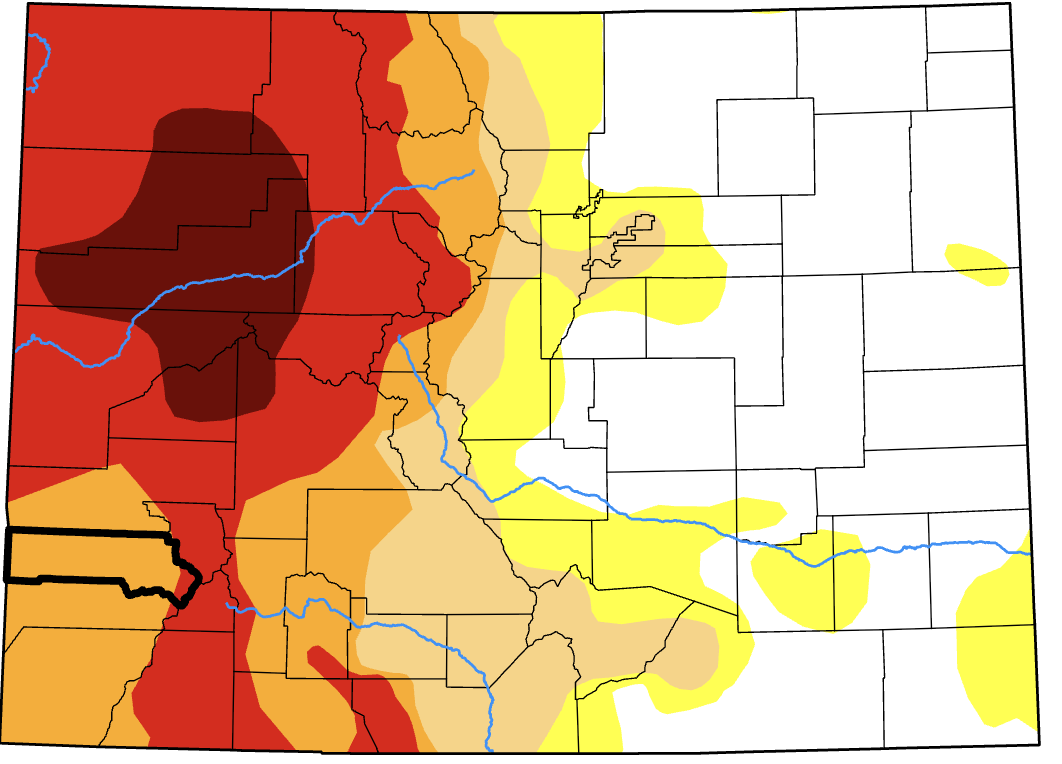
Current drought conditions across the state of Colorado, with San Miguel County outlined in black, as of Aug. 26. The Town of Telluride implemented outdoor water restrictions on Monday, Aug. 25, due to ongoing drought conditions and limited water availability locally. (Map courtesy of the U.S. Drought Monitor)
The Town of Telluride implemented outdoor water restrictions beginning Monday, Aug. 25, due to ongoing drought conditions and limited water availability locally. All water utility customers for the Town of Telluride, including Lawson Hill, Hillside and Sunnyside, are required to follow an irrigation schedule, with outdoor watering only permitted on Mondays, Wednesdays and Fridays. Watering must take place between 7 p.m. and 8 a.m. Irrigation systems should be set to 70-75% of normal water use, and all exterior water features must be turned off. No users are permitted to truck in additional water…Additionally, restaurants and businesses should serve water only upon request, and people are requested to fix any leaks immediately. Water audits and monitoring of water bills for excessive use can also help people regulate their use. Property owners who have landscaping that has been installed since spring 2024 can apply for additional permission to water. The public works department will review variances for new or modified landscaping on a case-by-case basis…
Although monsoonal rains have recently brought some moisture to the local area, it is still very dry. On the Western Slope, drought conditions remain dire, with several zones in northwestern Colorado in the category of ‘exceptional’ drought. Exceptional is the most severe category of drought and is often linked to hydrologic and agricultural issues.
“The ongoing lack of precipitation has been to blame for that, and it was very hot last week,” Allie Mazurek, engagement climatologist at the Colorado Climate Center, told the Daily Planet. “We have an elevated wildfire risk.”
[…]
Over 7% of Colorado remains under exceptional drought, and 1.86 million people are experiencing some type of drought, according to the most recent data from the U.S. Drought Monitor, published on Aug. 28. Exceptional drought typically happens about once every 50 years, although parts of Colorado also experienced exceptional drought in 2023. San Miguel County is faring slightly better than much of the Western Slope, although all of the county is under at least severe drought, and the eastern edge is under extreme drought…
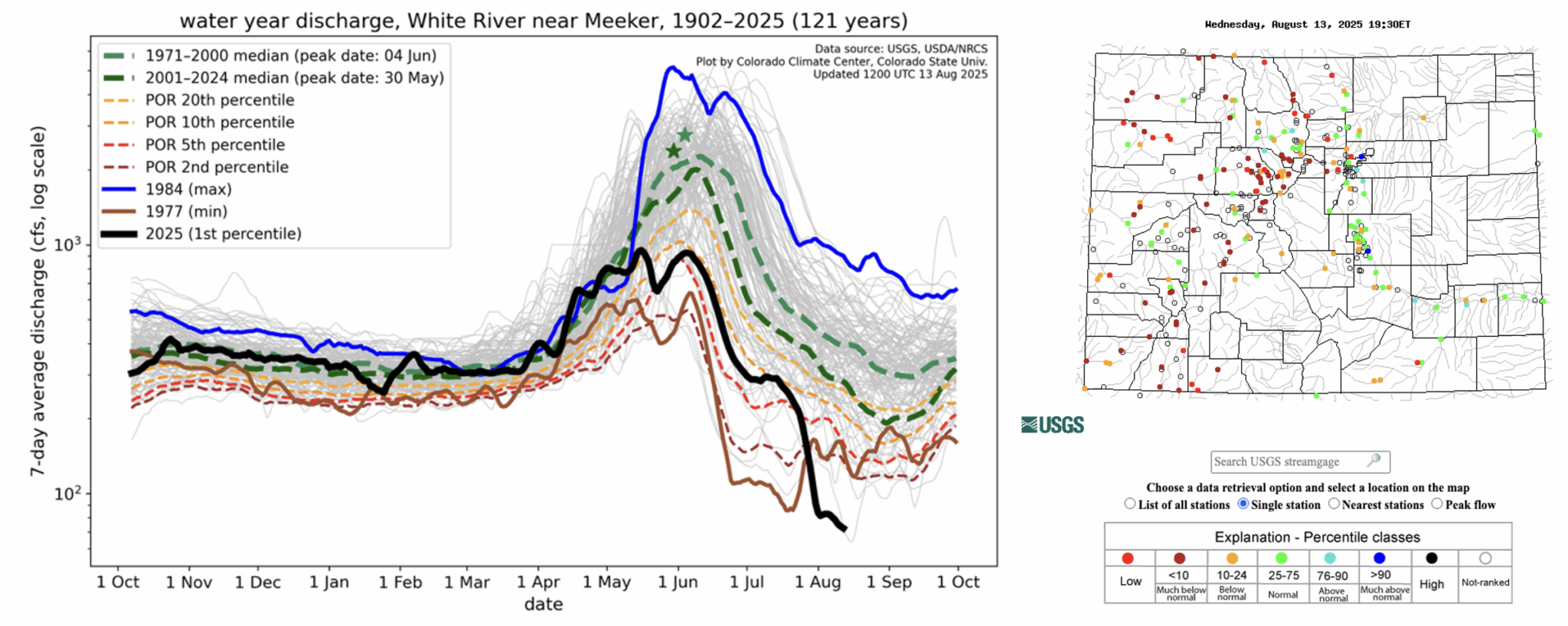
Locally, the San Miguel River, measured at the Placerville gauge, ended up at 62% of normal total streamflow volume for the April through July period, and the Uncompahgre River at Ridgway Reservoir was at 66%. The Animas at Durango was also at 62% of median, and the Dolores was at 52%. Some of these streamflows are historical lows…This year’s observed streamflow for the Dolores and Animas is only in the ninth percentile out of more than 100 years of observation…For the most current information on Telluride’s Water Conservation Program, visit bit.ly/totwater or follow @townoftelluride on social media.
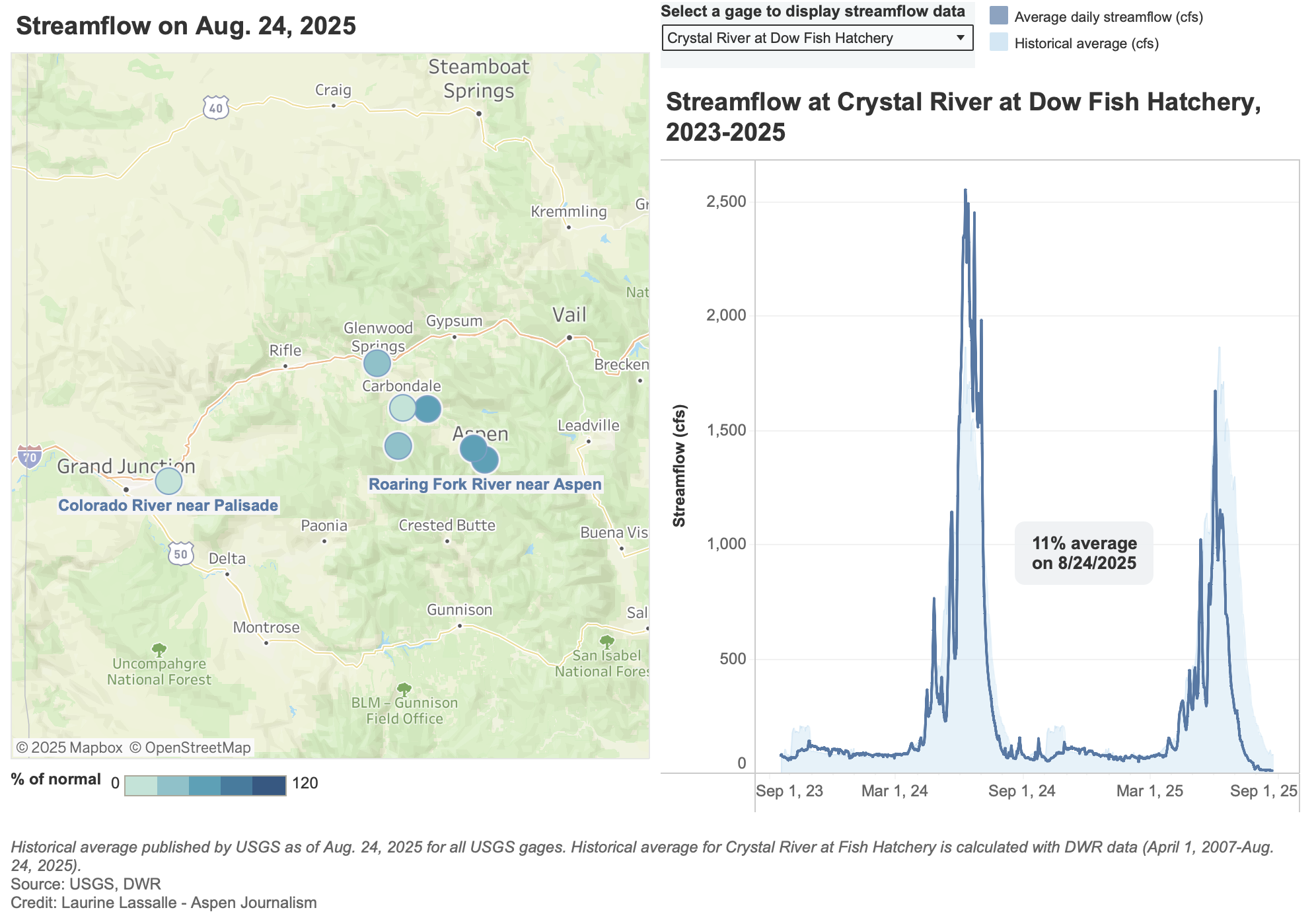
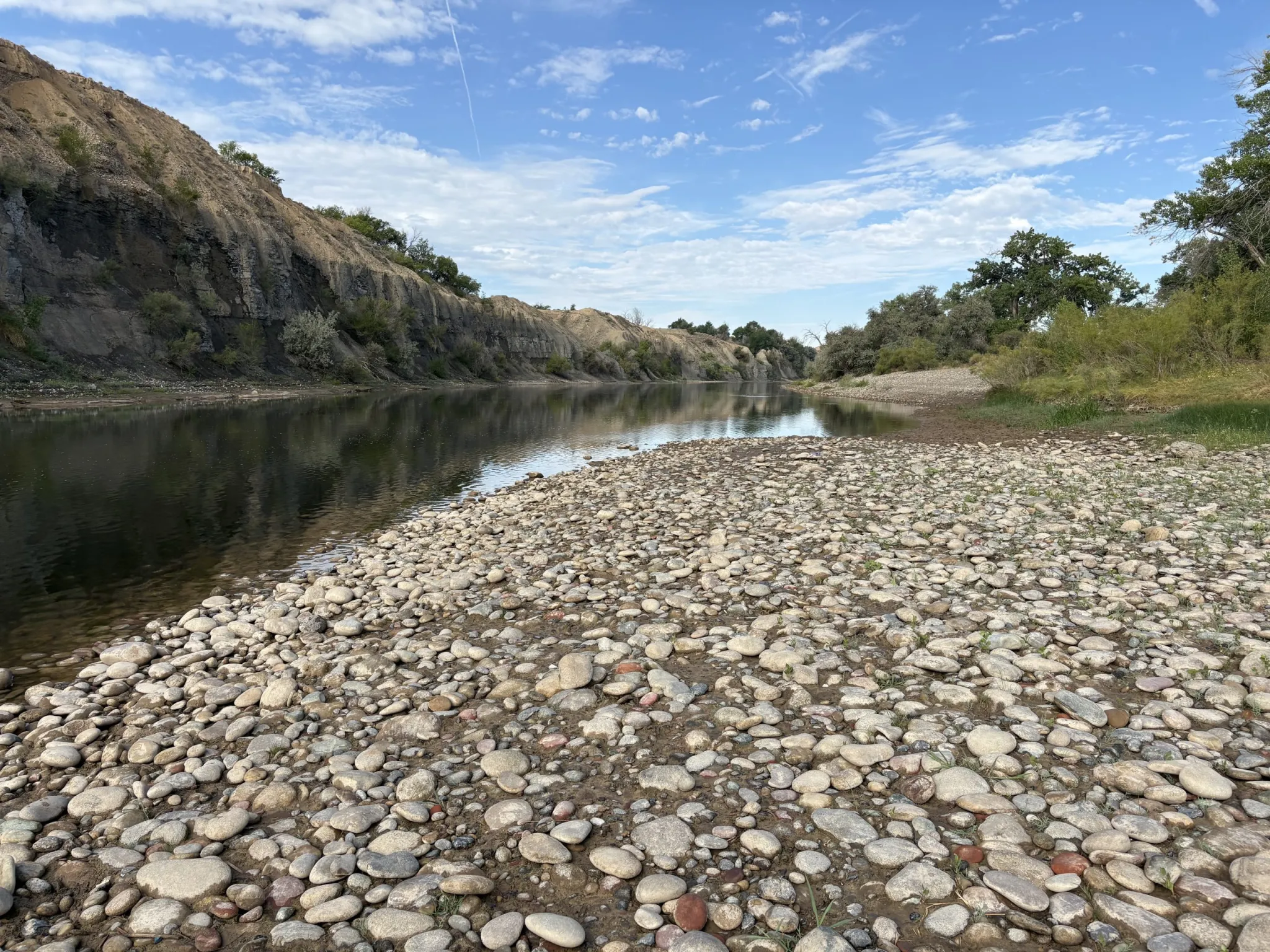
The Crystal River was running under 8 cfs on Aug. 24, 2025. This section of river is downstream of big agricultural diversions and ditches owned and maintained by the Town of Carbondale. CREDIT: HEATHER SACKETT/ASPEN JOURNALISM
Streamflows on the Western Slope have plummeted over the last month, sending water managers scrambling to boost flows for endangered fish and ranking it among the driest years in recent history.
According to the Natural Resources Conservation Service, the Roaring Fork River basin ended the month of July at 28% of average streamflows. The Colorado River headwaters was at 42% of average; the Gunnison River basin was at 34% of average and rivers in the White/Yampa/Green River basin in the northwest corner of the state were running at 24% of average. Prior to this week’s rains, the Crystal River near the Colorado Parks and Wildlife fish hatchery was running at 7.5 cfs, or 10% of average.
“We’ve been seeing pretty widespread well-below-normal flows across the entire upper Colorado River basin due to extremely dry conditions starting back in December,” said Cody Moser, a senior hydrologist with the Colorado Basin River Forecast Center.
For most of August, the Crystal River near fish hatchery was running at less than 15 cfs. These extremely low conditions plus water temperatures above 71 degrees Fahrenheit, prompted CPW to implement on Aug. 15 a full-day voluntary fishing closure on the Crystal from mile marker 64 on Highway 133 to the confluence with the Roaring Fork. This section of the Crystal is downstream from big agricultural diversions and ditches owned and operated by the town of Carbondale.
The upper Roaring Fork River and its tributaries are also suffering the consequences of low flows. On Aug. 25 the Colorado Water Conservation Board placed a call for the minimum instream flow on a seven-mile section of the Roaring Fork through Aspen, between Difficult and Maroon creeks. The call was released the next day after rain boosted flows above the 32 cfs minimum amount.
The CWCB is the only entity in the state allowed to hold instream flow water rights, which are intended to preserve the natural environment to a reasonable degree. It’s not uncommon for the CWCB to place calls for this stretch in late summer and it did so in other years, including 2012, 2018, 2020, 2021 and 2022.
Low flows have also affected recreation at the North Star Nature Preserve, a popular area for paddle boarders east of Aspen. On July 24, Pitkin County implemented a voluntary float closure — asking people to launch at South Gate instead of Wildwood — which occurs when the river falls below 60 cfs.
“At low water levels, users are at risk of touching bottom, which could damage the riparian habitat and would be considered trespassing,” a Pitkin County official said in an email.
Before this week’s rainfall, the Roaring Fork above Aspen hovered around 30 cfs.
Streamflows across the Western Slope are often at some of their lowest points of the year during the late summer and early fall when snowmelt has waned and irrigators are still drawing from streams. But this summer’s lack of precipitation and low soil moisture were the main drivers of dry streams. Much of the Western Slope is in extreme or exceptional drought, according to the U.S. Drought Monitor.
“The biggest factor is the dry spring conditions and layered on top of them a much drier than normal summer,” said Peter Goble, assistant state climatologist. “We will be watching those base flows but also soil moisture levels as we go into fall and early winter to see if those pick back up.”
Dry soils that suck up snowmelt before it makes it to streams can mean a normal snowpack translates into below-normal runoff.
This section of the Colorado River at the boat launch near Corn Lake dipped to around 150 cfs in lake August. Known as the 15-mile reach, this stretch of river should have at least 810 cfs to meet the needs of endangered fish. CREDIT: HEATHER SACKETT/ASPEN JOURNALISM
Stressed out fish
Another area hard hit by low flows is the 15-mile reach of the Colorado River between Palisade and the confluence with the Gunnison River. The chronically dry section is home to multiple endangered fish species and is downstream from some of the biggest agricultural diversions from the Colorado River in the state. Each year water managers work together to time voluntary releases from upstream reservoirs to boost late-season flows for the fish.
But even with many entities working with the Upper Colorado River Endangered Fish Recovery Program, a 2022 memo from the U.S. Fish and Wildlife Service found that during the irrigation season of dry years, flows did not meet the 810 cfs target 39% of the time.
This year, flows have not been above 810 cfs since July 9. And although flows in the 15-mile reach have been climbing since Aug. 23, — up to about 650 cfs on Aug. 27 — nearly all the water in the reach before this week’s rain was attributable to upstream reservoir releases specifically intended for endangered fish. Without releases for the recovery program, flows in the 15-mile reach could have dipped as low as 30 to 50 cfs.
“From my standpoint it’s amazing how a dry year just makes it really hard to get down even a third of that flow target,” said Bart Miller, healthy rivers director with Western Resource Advocates. “It’s a challenging time for water users, but a super challenging time for fish. For the fish it’s a huge stressor.”
This map shows the 15-mile reach of the Colorado River near Grand Junction, home to four species of endangered fish. Map credit: CWCB
This year there was about 29,175 acre-feet earmarked for endangered fish, according to a presentation by program staff. But by Sept. 1 nearly all this water was scheduled to be used up. The nonprofit Colorado Water Trust has stepped in to lease an additional 5,000 acre-feet out of Ruedi Reservoir. The water is owned by the town of Palisade, the Colorado River Water Conservation District and QB Energy. The releases of about 100 cfs are projected to begin Aug. 27 and continue through mid-October, said Danielle Snyder, a water resources specialist with the Colorado Water Trust.
“This particular stretch is very critical for the health of the ecosystem,” Snyder said. “We saw a lot of benefit for both the community and the environment and we thought this would be a great opportunity given we have the capacity and funds to provide water to that region.”
The CWCB will also lease an additional 2,350 acre-feet for fish flows.
Locally dwindling streamflows have big implications downstream. Projections released earlier this month from the U.S. Bureau of Reclamation show the nation’s two largest reservoirs — Lake Powell and Lake Mead — continuing to drop. Lake Powell could drop below the level needed to make hydropower by late 2026. As proof of how dry the month of July was across the basin, inflow to Lake Powell was just 12% of normal.
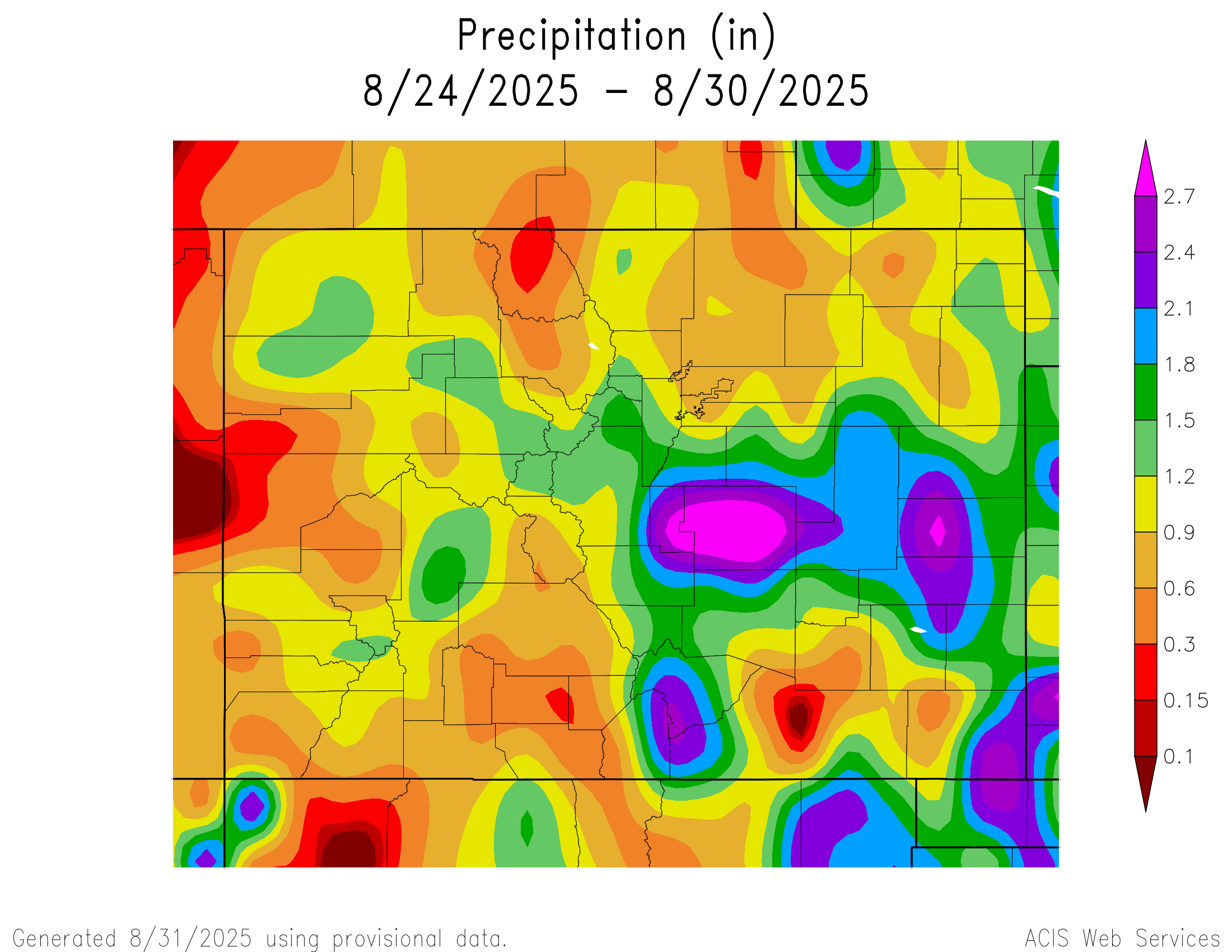
One bright spot in an otherwise bleak forecast is that parts of the Western Slope are finally seeing some relief from the hot and dry summer with rain this week. But it probably won’t be enough to make up for the months-long lack of precipitation.
“We have been dry for six-plus months so I don’t imagine it will have a significant impact long term, but it’s nice to finally see some precipitation in the forecast and observed over the last day or two,” Moser said.
Click the link to read the article on The Land Desk website (Jonathan P. Thompson):
August 26, 2025
🤖 Data Center Watch 👾
What I’m about to write is strange, even a little surreal, even to me. It seems over the top, hyperbolic, and alarmist, all things I try to avoid in my writing (unless I’m going for satire). But here it is: The Big Data Center Buildup is transforming the West (and other regions) as quickly and radically as the post-war Big Buildup of coal plants and other power infrastructure in the 1950s, ‘60s, and ‘70s.
See what I mean by hyperbolic? After all, data centers are just big box stores filled with walls of computer, processors, servers, and other equipment rather than cheap plastic items. How transformative could they really be?
Very, it turns out. As I’ve written here before, data centers use huge amounts of energy and water, and if they keep sprouting like weeds in business parks and rural areas, then they very well could not only hamper, but reverse the transition away from fossil fuels.
Tech bros will certainly say I’m being hysterical, and point to the latest estimates showing that each AI query uses a tiny fraction of the energy and water that a person consumes by doing other cyberspace activities or, for that matter, simply existing in modern times. Google, for example, says a “median” Gemini text query uses .24 watt-hours of electricity, which is about the same as watching 9 seconds of television, or microwaving for 1 second, or running a refrigerator for six seconds. And growing the beef for a single hamburger uses hundreds of times more water than hundreds of AI queries.
As far as I can tell, these figures are accurate. But what do they really tell us? I suppose we can feel a bit less guilty about succumbing to the temptation to use that iPhone AI thingy to identify something we photograph, or for asking ChatGPT to pen a song. It has no bearing, however, on what’s playing out on the ground, which is a sort of colonization of the power grid by larger and larger server farms.
I closely follow energy-related news as part of my job, and hardly a day goes by when I don’t encounter a story about the growing electricity demand from new data centers and utilities scrambling to keep up. Less than a decade ago, most Western utilities were expecting power consumption to plateau or even begin decreasing by now.
In 2018, for example, California utility regulators approved a plan to shutter Diablo Canyon’s two nuclear reactors in 2024 and 2025. Doing so would deprive the state’s grid of enough juice to power some 1.7 million homes. But Pacific Gas & Electric, the plant’s operator, figured it wouldn’t be a problem, since demand was expected to decline over time due to efficiency gains and more rooftop solar, and they could cover the rest with new renewables.
Instead, demand has increased substantially on PG&E’s grid since then, in large part due to new data centers in Silicon Valley, and it’s likely to continue to balloon over the next couple of decades. This forecast-blowing turnaround has prompted PG&E to toss out its old resource plans, work on acquiring more energy generation, and delay Diablo Canyon’s retirement for at least another five years. The pattern is being repeated all over the West with alarming regularity. It seems as if no place is safe from the invasion.
Some recent examples:
In late July, PG&E said it expects 10 gigawatts of new data center capacity to connect to its grid over the next ten years. Ten gigawatts, or 10,000 megawatts, is about one-fourth of the total demand on the California grid on a hot summer’s day, or equivalent to about five Diablo Canyons. It’s a crapload of power, in other words, and there’s no way they’re going to serve that kind of demand growth with just solar and wind, especially since a certain administration is doing all it can to stop all solar and wind from being built. It’s also notable because it’s a 20% increase in projected data center capacity since May.
NorthWestern Energy signed on to provide up to 1,000 MW of power — or nearly all of the utility’s generating capacity — to Quantica Infrastructure’s AI data center under development in Montana’s Yellowstone County. This would require the utility to either construct or purchase additional power, which could lead to higher rates for their existing customers. Now NorthWestern is proposing to merge with Black Hills Corp., another electricity and gas utility, saying the combined utility would be better positioned to meet rising power demand from, you guessed it, new data centers.
Xcel Energy expects to spend about $22 billion in the next 15 years to meet new data centers’ projected power demand in Colorado, potentially doubling or even tripling legacy customers’ rates. Also of concern: If the projections are overblown, Xcel could end up building a bunch of new generation that’s not needed, leaving the utility and its customers with a bunch of stranded assets.
Wyoming officials have worked to lure data centers and cryptocurrency firms to the state, and it seems to be working. Earlier this month energy firm Tallgrass proposed building an 1,800 MW data center, along with dedicated gas-fired and renewable power facilities, near Cheyenne. That adds to Meta’s facility in Cheyenne and the 1,200 MW natural gas-powered Prometheus Hyperscale data center under development in Evanston. Observers say electricity demand from these centers could transform the physical and regulatory utility landscape and potentially drive up costs for “legacy” customers.
New Mexico utilities are struggling to meet growing demand from an increasing number of data centers, while also complying with the state’s Energy Transition Act’s requirements for cutting greenhouse gas emissions.
Numerous companies are eyeing Delta, Utah, as a site for new data centers. This is in part because land is cheap there. But also because it is home to the Intermountain Power Project, a massive coal plant built during the Big Buildup. The plant is scheduled to be converted to run off natural gas and, ultimately, hydrogen, but Utah lawmakers want at least one of its units to continue to burn coal. They just need a buyer for the dirty power: Enter data centers. Fibernet MercuryDelta is looking to construct the 20-million-square-foot Delta Gigasite there; and Creekstone Energy plans to manage 10 gigawatts of capacity there, with power coming from coal, solar, and natural gas.
And Arizona’s largest utilities say demand from planned new data centers could increase total power load by 300% over current levels. Recently, Arizona Public Service announced it would keep burning coal at Four Corners Power Plant beyond its scheduled 2031 retirement to help meet this growing demand.
Sometimes the tech firms will purchase renewable power or build their own solar, wind, or geothermal facilities. But in most cases, they rely partly or wholly on fossil fuel generation, whether it’s from the grid — which is still largely dominated by natural gas and coal in many places — or from dedicated generators. While a lot of solar is still being added to the grid, it isn’t enough to keep up with rapidly growing demand. Plus, it may not last. The GOP phased out federal tax credits for wind and solar. And the Trump administration killed the Solar for All program that funded rooftop solar for lower-income households, and crippled the REAP program, which helps farmers install solar panels. Interior Secretary Doug Burgum has vowed to make it as difficult as possible to develop solar and wind on federal lands.
What that means is that we’re likely to see another Big Buildup for the cyber age. It will include single new data centers that span nearly 500 acres and consume more power than all of the homes of Montana and Wyoming combined. And it will include the generating facilities to run the servers and to keep them cool. In the absence of policies limiting fossil fuel burning and preventing cost shifts to existing customers, we’re all going to pay the price.
📸 Parting Shot 🎞️
Bullfrog Creek and the Little Rockies, Utah. Jonathan P. Thompson photo.
Revel in every drop of rain falling in your neighborhood right now, because the state is drying out again, with drought spreading, monsoon rains falling short, and a fall and winter forecast calling for dry weather.
Statewide, Colorado precipitation is measuring at just 81% of normal, well below last year’s mark at this time, when moisture registered at 104% of normal, according to Nagam Bell, hydrologist with the Natural Resources Conservation Service in Lakewood.
Bell’s report came Tuesday at a meeting of the state’s water monitoring committee, which tracks rain, snow and soil moisture levels to help urban and rural communities plan for shortages and, this year on the Western Slope, flood hazards.
Water officials said dry conditions have come back with a vengeance, said Allie Mazurek, a climatologist with the Colorado Climate Center at Colorado State University. “Over the last four weeks, lots of our state has begun experiencing drought. Colorado has become the epicenter of drought in the West.”
But the Western Slope has suffered the most, she said, as evidenced by the fierce wildfires.
Particularly worrisome, she said, are measurements that show at least one monitoring gauge in the Gunnison River Basin recording precipitation levels that are the lowest seen since 1894.
One buffer against dry times are Colorado’s water storage reservoirs, and those too are below normal, registering at 83%. In areas such as metro Denver, stored water supplies are holding their own, according to Nathan Elder, water supply manager with Denver Water, the state’s largest water utility.
“It’s not great, but it’s not dire,” Elder said.
The outlook in Highlands Ranch is more worrisome, said Swithin Dick, water resources administrator for Highlands Ranch Water, which serves the large residential community in Douglas County.
Dick said water use is up 25% this summer while stored water supplies have dropped to 58% of normal.
Last year, Mazurek said, the picture was much different. “Most of Colorado wasn’t experiencing any drought at the start of the water year,” she said, referring to the Oct. 1 through Sept. 30 period that water managers use to measure supplies. “But over the last water year we’ve had poor snowpack, followed by hot and dry conditions over the summer.”
Forecasts indicate the weather will begin to dry out more next month and that La Niña conditions will develop in the winter. These refer to a weather pattern over the Pacific Ocean in which cold temperatures prevail and trigger drier than normal winter weather in places such as Colorado.
“I don’t anticipate any issues this year,” Dick said, “but we will be watching the winter intensely and I am a little nervous about 2026.”
Under the 1922 Colorado Compact, the Upper Division states of Colorado, New Mexico, Utah and Wyoming share the river with the Lower Division states of Arizona, California and Nevada, with each Division apportioned 7,500,000 acre-feet of water annually. Over eighty percent of the water of the Colorado River originates as snowpack in the Upper Division, so sharing of the River’s flows is accomplished through Article 3.d of the Colorado Compact, which provides that the Upper Division States will not cause the flow of the river at Lee Ferry, which is in Arizona just below Lake Powell, to be depleted below an aggregate of 75,000,000 acre-feet for any period of ten consecutive years. Under a 1944 treaty, the Republic of Mexico is entitled to 1,500,000 acre-feet of Colorado River water each year. Lake Mead and Lake Powell, the largest reservoirs in the United States, hold Colorado River water for delivery to the states and Mexico and are operated under the authority of the Secretary of the Interior (Secretary) through the U.S. Bureau of Reclamation.
The U.S. Supreme Court’s ruling Arizona v. California, 373 U.S. 546 (1963) determined that Arizona entitled to divert 2.8 million acre-feet per year of Colorado River water in normal years. This is an important supply, constituting approximately 36% of Arizona’s total water use.
Glen Canyon Dam, which forms Lake Powell, was completed in 1963, and thereafter Lakes Powell and Mead were operated under guidelines finalized in 1970, called the Long Range Operating Criteria (LROC). In 2007, in response to several years of drought and declining reservoir levels, the Secretary, in collaboration with the Colorado River states and other stakeholders, adopted a new set of operating guidelines. The 2007 Guidelines were designed to help stabilize water levels in Lakes Powell and Mead, to provide certainty regarding shortage conditions and to incentivize conserving water in Lake Mead by providing flexibility in deliveries to certain entities through the creation of “assigned water” (also commonly known as “Intentionally Created Surplus”). The 2007 Guidelines expire on December 31, 2025 but its provisions generally remain in effect through the end of 2026. The 2007 Guidelines include three important aspects of Colorado River management that impact all who share the river. These are:
The amount of water the Secretary releases annually from Lake Powell into Lake Mead under different reservoir conditions.
Broadly speaking, the goal of these releases is to equalize the amount of water in Lakes Powell and Mead. Releases are based on water levels in Lake Powell relative to water levels in Lake Mead among other factors.1
2. The conditions under which the Secretary declares a shortage of Colorado River water in the Lower Division and of the amount of shortage assessed to each state.
A shortage is declared in the Lower Division when the U.S. Bureau of Reclamation annual August 24-Month Study projects that Lake Mead will be at or below elevation 1,075’ on the following January 1.
Arizona is shorted 320,000 acre-feet of water below Lake Mead elevation 1,075’ and above 1,050’ , 400,000 acre-feet of water below elevation 1,050’ and above 1,025’ and 480,000 acre-feet of water below elevation 1,025’. Nevada takes shortages at these levels proportional to its 300,000 acre-foot allocation and no shortages are defined at these reservoir levels for California’s allocation of 4.4 million acre-feet.
3. The terms under which entities can voluntarily create and hold volumes of assigned water in Lake Mead.
Assigned water is created and held in Lake Mead under the Secretary’s authority to allocate surplus water under Article II(B)(2) of the consolidated Supreme Court decree in Arizona vs California and via treaty with Mexico. It is assigned to and held by an individual entity separate from the priority system of water allocation to which all other water in Lake Mead available for delivery in the Lower Division is subject.2
As of 2024, the Central Arizona Water Conservation District, the Gila River Indian Community, the Colorado River Indian Tribes, the Metropolitan Water District of Southern California, the Imperial Irrigation District, the Southern Nevada Water Authority and the Republic of Mexico hold accounts of assigned water in Lake Mead.
Generally, water in Lake Mead available to but not ordered by one Colorado River contract entitlement holder can be ordered by another for delivery. Thus, for assigned water to be held in Lake Mead, several entities with contracts to Colorado River water must agree to forego their rights to order the same water over all of the years that the assigned water is held in Lake Mead. These entities signed a Forbearance Agreement in which they agreed not to order another entity’s assigned water under certain conditions. The Forbearance Agreement expires on December 31, 2025 but forbearance provisions for assigned water created through intentional conservation that exists as of that date continue through 2036 and through 2056 for assigned water created through other means.
Despite the efforts taken through the 2007 Guidelines, and due to chronic over-allocation of the river and continuing drought, water levels in Lakes Powell and Mead are at or near historic lows. To address continuing declines in water storage, various entities in Arizona, California and Nevada entered into several agreements including the 2019 Lower Basin Drought Contingency Plan, the 2021 500+ Agreement and the 2023 System Conservation Agreement. Through these agreements the states committed to:
Voluntarily leave specified volumes of water in Lake Mead as Drought Contingency Plan contributions 3 through the year 2026.
The voluntary contribution of water totals 192,000 acre-feet per year for Arizona between Lake Mead water levels below 1,090’ and above 1,045’ and totals 240,000 acre-feet per year below 1,045’.
The voluntary contribution of water totals 8,000 and 10,000 acre-feet per year for Nevada at these levels. California did not agree to voluntary contributions of water at Lake Mead water levels above 1,045’.
2. Through the year 2026, voluntarily leave some water in Lake Mead as unassigned water.
Unassigned water in Lake Mead belongs to no one entity and bolsters the supply of water available through the priority system to all Colorado River contract entitlement holders in the Lower Division (referred to as “System Conservation”).
The states agreed to leave approximately three million acre-feet of unassigned water in Lake Mead. The federal government paid various entities with entitlements to Colorado River water, such as municipal water providers, agricultural interests, Tribes and mining companies to leave this water in Lake Mead.
The Secretary agreed to take affirmative actions to create or conserve 100,000 acre-feet per annum or more of Colorado River system water to contribute to conservation of water supplies in Lake Mead.
For unassigned water to be left in Lake Mead, several entities with contracts to Colorado River water must agree to forego their rights to order the same water. However, in the case of System Conservation, the water is held in Lake Mead only in the year the conservation takes place and subsequently becomes available the next year for delivery through the priority system. A group of entities, including the Director of Water Resources on behalf of the State of Arizona, signed various forbearance agreements in which they agreed not to order another entity’s conserved water. In these cases, forbearance is only required in the same year in which the system conservation activity takes place. These agreements expire at the end of 2026.
If no new set of operational guidelines is in place, upon expiration of the 2007 Guidelines and the Forbearance Agreements:
Rules for annual releases of water from Lake Powell into Lake Mead revert to the guidelines set forth in the LROC.
Generally, annual releases from Lake Powell to Lake Mead are set at 8.23 million acre-feet as an objective subject to Secretarial discretion and other factors. Arguably the Secretary has more discretion under LROC to set annual releases than under the 2007 Guidelines, which more precisely define releases based on relative water levels in Lakes Powell and Mead.
2. The specified shortages assessed to Arizona and Nevada under the 2007 Guidelines become moot and shortage determinations revert to the Secretary’s authority, which has been broadly interpreted in times of shortage by the U.S. Supreme Court in its 1963 decision, Arizona v. California.
Under LROC, the Secretary has authority to “determine from time to time when insufficient mainstream water is available to satisfy annual consumptive use requirements of 7,500,000 acre-feet” after consideration of various factors.
• When insufficient water is available,
o Deliveries through the Central Arizona Project are cut to the extent necessary to meet the demands of more senior Colorado River rights or entitlement holders in Arizona, California and Nevada.
o If after these cuts there still remains insufficient water available to meet the demands of more senior Colorado River contract entitlement holders, the shortage provisions of Article II(B)(3) of the decree in Arizona v. California become effective, meaning that the rights of the Chemehuevi Indian, Cocopah Indian, Fort Yuma Indian, Colorado River Indian and Fort Mohave Indian Reservations are satisfied first, without regard to state lines, in order of their priority dates, and then present perfected rights are satisfied according to priority.
3. Some, but not all, forms of assigned water can no longer be created.
Creation of assigned water in Lake Mead through extraordinary conservation activities can no longer occur.
Creation of assigned water through importation of non-Colorado River system water and through certain tributary water into the Colorado River mainstem can continue to occur.
Creation of a special class of assigned water, called Developed Drought Supply, can continue to occur. Developed Drought Supply water can only be created during declared shortages and must be delivered in the same year it is created.
Rights to hold and deliver existing assigned water continue through 2036 for assigned water created through extraordinary conservation activities and through 2057 for assigned water used for Drought Contingency Plan contributions, and created through tributary water importation, non- Colorado River system water importation and Developed Drought Supply water.
Colorado River contract entitlement holders could theoretically continue to voluntarily leave water in Lake Mead as unassigned water, either compensated or not, but the expiration of the forbearance agreements means that another entity could simply order that same water for delivery.
Deliveries of Colorado River water to the Republic of Mexico are governed under a 1944 treaty and subsequent treaty minutes. Through various treaty minutes Mexico agreed to cuts to its deliveries under certain shortage conditions. These treaty minutes also allow Mexico to create assigned water in Lake Mead. The provisions regarding cuts to Mexican deliveries during shortage and the creation of Mexican assigned water expire at the end of 2026, though Mexico can continue to hold and request delivery of existing assigned water under generally the same terms and conditions that govern assigned water created by the Lower Division states through extraordinary conservation activities and used for Drought Contingency Plan contributions.
What Expiration of the 2007 Guidelines and the Forbearance Agreements Means for Arizona
Absent additional guidance from the Secretary or an agreement among the seven states that share the Colorado River, and assuming continued poor hydrology and runoff, water levels in Lakes Powell and Mead will continue to decline and Arizona can expect potentially very deep cuts to the Colorado River water imported into central Arizona via the Central Arizona Project. Eventually cuts could be deep enough to impact higher priority water users in Mohave, La Paz and Yuma Counties.
If less than 82,500,000 acre-feet of water is delivered to the Lower Division over any ten consecutive years, the United States and the Upper Division may have to contend with a legal demand from the Lower Division under Article 3.d of the Colorado Compact, which states that the Upper Division States “will not cause the flow of the river at Lee Ferry to be depleted below an aggregate of 75,000,000 acre-feet for any period of ten consecutive years.” The Lower Division asserts that the Upper Division is also responsible to deliver half of the obligation to Mexico, bringing the total ten-year obligation to 82,500,000 acre-feet. Under continued poor hydrology and runoff, it is likely that the ten-year consecutive total will fall below 82,500,000 in 2027. [ed. emphasis mine]
1 If Lake Powell were drawn down too far while Lake Mead remained relatively full, the risk that deliveries at Lee Ferry would be depleted below an aggregate of 75,000,000 acre-feet over ten consecutive years would increase, which would put the Upper Division at risk of failing to meet Colorado Compact requirements. At the same time, keeping Lake Mead relatively full avoids deep water shortages in the Lower Division. A goal of equalization between the reservoirs balances these risks.
2 Though, holders of Priority 1-3 entitlements would likely contest the Secretary’s authority to cut their deliveries while withholding assigned water from the priority system.
3 If assigned water is chosen as the form of DCP contribution, it remains recoverable above elevation 1,110 until 2057.
Udall/Overpeck 4-panel Figure Colorado River temperature/precipitation/natural flows with trend. Lake Mead and Lake Powell storage. Updated through Water Year 2024. Credit: Brad Udall
On August 21, Hurricane Erin passed about 200 miles east of North Carolina’s Outer Banks, with minimal weather impacts aside from gusty winds along portions of the Atlantic Seaboard. A peak northerly wind gust to 43 mph was clocked on Cape Hatteras, North Carolina. More broadly, Erin resulted in an extended period of Atlantic coastal impacts, such as life-threatening surf and higher-than-normal tides. Meanwhile, patchy downpours maintained adequate to locally excessive soil moisture in much of the upper Midwest, while locally heavy showers dotted the central and southern Plains and the lower Southeast. However, mostly dry weather in many other areas across the central and eastern U.S. led to declining topsoil moisture reserves, especially where combined with late-summer heat. Cooler air arrived, however, late in the drought-monitoring period, starting in the North and soon reaching all areas east of the Rockies but the northern High Plains and the Deep South. Meanwhile in the West, hot, mostly dry weather prevailed until late in the period, when shower activity increased and began to spread northward….
The High Plains region experienced a mix of drought improvement and deterioration. The region’s most significant drought exists across western sections of Colorado and Wyoming. On August 24, statewide topsoil moisture—as reported by the U.S. Department of Agriculture—was rated 70% very short to short in Wyoming. During the drought-monitoring period, the most significant drought improvement occurred in central Colorado, although there were also targeted improvements in Kansas, Nebraska, and South Dakota…
Colorado Drought Monitor one week change map ending August 26, 2025.
A hot weather pattern gradually yielded to increasingly cloudy and showery weather. In most areas, however, showers were insufficient to result in significant drought relief, except in central Colorado and environs. Still, there were several episodes of significant weather, including a thunderstorm-fueled haboob on August 25 in Phoenix, Arizona, where high winds (clocked to 70 mph at Sky Harbor International Airport) and near-zero visibility in blowing dust led to travel and electrical disruptions. By August 26, at the end of the drought-monitoring period, shower activity began to shift farther north and east. In the Northwest, where hot, dry weather prevailed for much of the period, there was some drought expansion, with two previously separate areas of severe drought (D2) merging across eastern Washington. Some of the worst agricultural conditions in the country have been noted in recent weeks across Washington, with the U.S. Department of Agriculture reporting that 47% of the state’s rangeland and pastures were rated in very poor to poor condition on August 24. On the same date, Washington led the U.S. with 57% of its barley and 53% of its spring wheat rated very poor to poor…
Flash-drought conditions across the mid-South contrasted with the arrival of heavy rain in Oklahoma and neighboring areas. On August 24, prior to the heavy rain, statewide topsoil moisture was rated 60% very short to short in Texas, along with 53% in Oklahoma. Portions of central and northwestern Oklahoma received 3 to 6 inches of rain during the drought-monitoring period. Meanwhile, topsoil moisture was rated more than one-half very short to short on August 24 in Arkansas (92%), Tennessee (63%), and Mississippi (53%). Aside from eastern Tennessee, southern Mississippi, and west-central Arkansas, where some heavy rain fell, conditions generally worsened across those three states, with broad expansion of abnormal dryness (D0) and moderate to severe drought (D1 to D2)…
Looking Ahead
A generally cool weather pattern will persist in most areas of the country for the remainder of the month. However, heat will gradually return across the West, with temperatures in parts of the Desert Southwest topping 110°F by the last day of August. East of the Rockies, anomalous warmth should be limited to the northern High Plains and the Deep South, mainly from southern Texas to southern Florida. Meanwhile, much of West will experience a drying trend, although late-month downpours in portions of the central and southern Rockies could lead to flash flooding and debris flows, especially on burn-scarred hillsides. Heavy, late-month rainfall (locally 2 to 4 inches or more) may also affect an area stretching from the mid-South to the southern Atlantic Coast. In contrast, little or no rain will fall during the next 5 days from the middle Mississippi Valley into the middle Atlantic States.
The NWS 6- to 10-day outlook for September 2 – 6 calls for the likelihood of below-normal temperatures in the central and eastern U.S., aside from warmer-than-normal weather in northern Maine, peninsular Florida, and the western Gulf Coast region. In contrast, late-summer warmth will dominate the West, except in the central and southern Rockies. Meanwhile, near- or above-normal precipitation across most of the country should contrast with drier-than-normal conditions in parts of the Pacific Northwest.
US Drought Monitor one week change map ending August 26, 2025.
Whether its potable water, agricultural needs, or recreation, seven different states between Colorado and the Pacific Ocean actively rely on the water that flows through Garfield County. Yet with consistently increasing yearly temperatures, decreasing yearly snowpacks, and constant threat of wildfires — the health of the legendary watershed has never been more important. The Colorado, Roaring Fork, Crystal, and Frying Pan Rivers all have individual and unique impacts that stretch from the local economy to produce and amenities…Following a “mixed” winter resulting in the lowest snowpack seen in 10 years, it was not unexpected that riverflows would fail to hit an 80-year median this summer season. But a dramatically dry summer took a bad situation and made it worse.
In 2025, the Colorado River peaked barely above 4,000 Cubic Feet per Second (CFS), measured by the United States Geological Survey near Dotsero. The 4,120 CFS peak on June 3 fell far short of the median of 6,200 CFS (1940-2025)…[Brendon] Langenhuizen said he was more concerned about the near-nonexistent monsoonal season this summer — and its implications for what future monsoon seasons could look like.
“The monsoons just aren’t really coming in like they were forecasted to three months ago,” he said.
He explained that the supplement of heavy rains in the higher alpine can both briefly reinvigorate the tributaries and provide much needed assistance to the ranching community.
“(The peak) means that it’s just a drier year,” Langenhuizen said. “I think that not getting those monsoons — which haven’t shown up yet — is really what has put us into this situation. We had average snowfall to lower yield, which put us into this dry category of year, and we haven’t had those monsoons that bolster those flows later throughout the late summer months.”
Monsoon storm near Tucson 2021. Image credit: Roberto (Bear) Guerra/High Country News
Hard times in the Colorado River region. A near-average snowpack dissipated into an inflow into Powell Reservoir of only 40 percent of average; dry soils in the headwaters and high deserts, and increased evaporation and plant transpiration in a warming world are taking big tolls. And the negotiators for the seven Basin states, trying to work out a river management plan to replace the failing current management strategies, with the 30 Indian nations and Mexico looking over their shoulders, are continuing to… negotiate. Trump’s Interior Department officials have given then until November to negotiate a draft plan for beyond 2026.
Projected Lake Powell end-of-month physical elevations from the latest 24-Month Study inflow scenarios.
Meanwhile the Bureau of Reclamation has issued its annual 24-month projection, and it has no good news. Its worst case scenario – the one everyone looks at – suggests that, barring a huge winter this year, Powell Reservoir might drop to the elevation at which it can no longer produce hydropower by late fall 2026 – at which point it cannot even make large deliveries downstream, because all the water would then have to go through four antique tubes never meant to carry that much water 24/7. This could undermine the best-laid plans of the negotiators, should they achieve a plan, with no ability to move sufficient water past Glen Canyon Dam until the reservoir filled back up to the power level. No plans have been announced for creating a Glen Canyon Dam bypass.
All the news dribbling out of the negotiations indicate that the negotiators persist in carrying forward the Colorado River Compact’s division of the river into Upper and Lower Basins. Do they not see that this is no longer necessary, or even desirable – nothing but a cause of conflict and contention?
When representatives from the seven Colorado River Basin states gathered in Washington in January 1922, six of the states knew what they wanted: they wanted a seven-way division of the consumptive use of the river’s waters that would transcend on the interstate level the appropriation doctrine all seven states adhered to intrastate.
They wanted this because southern California, the seventh state, was growing so fast, and already using so much of the river’s water, that the other six knew they would be losers in a seven-state horse race to appropriate the river’s water. The representatives all accepted the first-come first-served appropriation law as holy writ within their states, but saw its limits when looking at the whole river and the regional challenge of uneven development.
California sat down with the other six states because at that point, the other six states held a big card: California needed a interstate river to control floods and ‘rationalize’ the flow and distribution of the river’s water, rather than watching an uncontrolled flood of snowmelt ‘waste’ most of the water to the ocean. And California knew that Congress would provide for that big dam only if all seven states were sure they would have a share of the water, once the river was controlled. So California had to participate in setting long-term limits on itself in order to get what it needed in the short term.
But after several days of trying to work out that seven-way division, the compact negotiators gave up in frustration. Each negotiator had come with estimates of his state’s future water needs based on potentially arable land, mining-generated industry, possible urban development. Not really knowing what the future would bring did not dim their estimates at the turn of the 20th century, with the imperial impetus to ‘create our own reality’ just kicking into high gear. But by the time the seven negotiators had laid out their states’ envisioned water needs, the basin-wide total was half again even the Bureau of Reclamation’s rosiest estimates of Colorado River flows. And no one wanted to cut their estimates, go home to tell their governor and legislators he’d had to diminish the state’s envisioned future by a quarter or so.
Several of the frustrated negotiators thought they should abandon the whole idea of an interstate compact, but the federal representative and chairman, Herbert Hoover – himself an engineer eager to see the big dam built – persuaded them to stay with the idea for the rest of the year. They convened for some hearings around the west in the summer, and had a tour of the proposed big dam sites. But then Hoover and Colorado’s representative to the commission, Delph Carpenter, began circulating the idea of a two-basin division to break the impasse over the seven-way division, and Hoover was able to convene a November charrette to work until a compact was done.
Toward the end of an eleven-day marathon at a resort near Santa Fe, with 18 transcribed sessions and who knows how many informal barroom and hotel room caucuses, Chairman Hoover summarized their situation:
“We finally reached, in effect, this general conclusion as to the form of the compact, and that was that none of the figures and data in our possession, or within the possibility of possession at this time were sufficient upon which we could make an equitable division of the waters of the Colorado River [in perpetuity]…. [W]e make now, for lack of a better word, a temporary equitable division, reserving a certain portion of the flow of the river to the hands of those men who may come after us, possessed of a far greater fund of information; that they can make a further division of the river at such a time, and in the meantime we shall take such means at this moment to protect the rights of either basin as will assure the continued development of the river. (Text from the 12th of 18 transcribed November meetings, boldface added)“
That was the Colorado River Compact as seen in process by the commission chairman: ‘a temporary equitable division’ to be refined and finished when ‘a greater fund of information’ about both the river’s flows and the flow of the future was known. No one – with the probable exception of Delph Carpenter – was very happy with the Compact the commissioners took home to their states. Arizona refused to ratify it, and it took several years to get it through the other six state legislatures. But the U.S. Congress was actually somewhat eager to develop the river, making its desert lands available for development, and decided that six of the seven states on board was good enough. The Boulder Canyon Project Act was passed in 1928, and Hoover – then President – was able to launch construction of not just the huge Hoover Dam, but Parker Dam as the holding bay for the Metropolitan Water District’s 250-mile aqueduct, and the Imperial Dam and All-American Canal to carry water to the Imperial and Coachella Valleys – a major regional development that really set a course for the 20th century.
Enabling that, and what followed over the next four or five decades, did achieve the Compact goal to ‘secure the expeditious agricultural and industrial development of the Colorado River Basin,’ probably the major goal stated in its preamble (Article I) for most of those involved. But a century later we can say pretty definitely that its ‘temporary equitable division’ (still apparently regarded as permanent), has not achieved most of the other goals listed in the preamble. It did not ‘provide for the equitable division and apportionment of the use of the waters,’ either in the division between Basins explicit in Article III(a) nor in the relationship between the two Basins stated in Article III(d); it obviously did not ‘promote interstate comity’; and the two-basin division did not ‘remove causes of present and future controversies.’ If anything, the Compact created controversies with badly written sections like Article III(c) on the Mexican obligation, and Article III(d) on interbasin ‘obligations.’ (If you would like to review the Compact, you can find it here.)
More to the point – it is possible now to achieve what the 1922 commissioners originally wanted: an equitable seven-way division of the use of the river with a share for Mexico, which renders the two-basin ‘temporary division’ irrelevant and burdensome.
The seven-way division has been effected, not through interstate negotiation but through the ‘continued development of the river’; today, the seven states and Mexico all know, practically to the acre-foot, what has evolved as their share of the river as we have known it – the 14.6 million acre-foot average flow of the development period, the 1930s through the 1990s.
Allotments for the three Lower Basin states were set by the Boulder Canyon Project Act in 1929 as acre-foot portions of the Compact allotment of 7.5 maf, and confirmed by the Supreme Court in its 1963-4 Arizona v. California decision. Mexico received its share, 1.5 maf, in a 1944 treaty negotiated through the U.S. State Department. And the four Upper Basin states negotiated a compact for their share of the river in 1948 – by then known to be a variable quantity, usually less than the Compact’s allotment of 7.5 maf, so they divided their fluctuating share by percentages.
Native America in the Colorado River Basin. Credit: USBR
The ‘federal reserved rights’ of the Basin’s 30 Indian nations – barely given a ‘placeholder’ in the Compact – have been shoehorned in as state responsibilities through the 1952 ‘McCarran Amendment’ to a resource bill; this says that all federal reserved water rights, for all public lands as well as the Indian reservations, have to be adjudicated in the state water courts. The ‘equity’ of this is questionable; some states have only a few Indian nations; Arizona has 22 of them. Most of the Indian nations that have not already achieved some water rights are working on ‘settlements’ out of court, negotiating with those who have been using water for which the Indians had a prior claim (dating from the creation of their reservation) for water and money with which to develop the water they can get. The federal government puts up much of the money for the development of Indian water rights; there is still a long way to go in correcting this long-standing dereliction and shame, but there has been more activity in the past couple decades than in the previous century.
The point being – nearly everyone knows with some accuracy how much water they have had to use from the Colorado River – in the 20th century. Hardly anyone is happy with the resulting numbers, but we also all know that this is all the water there is – or was, in the 20th century. The river has been divided among the states and nations, de facto, if not yet de jure.
The structural deficit refers to the consumption by Lower Basin states of more water than enters Lake Mead each year. The deficit, which includes losses from evaporation, is estimated at 1.2 million acre-feet a year. (Image: Central Arizona Project circa 2019)
The alarming draw-down of the river’s major reservoirs in the early 21stcentury to date has been only partially caused by the ‘drought’ and permanent climate-related aridification. The bulk of the draw-down has been a ‘structural deficit’ stemming from the Lower Basin states’ blithe refusal to incorporate their ‘system losses’ – evaporation and transpiration, riparian losses, etc – and their portion of the Mexican share into their allotments, preferring to let the amenable Bureau release them as ‘surplus’ from Powell and Mead storage – a surplus that has not existed since the Central Arizona Project began to come on line after 1985, along with increased Upper Basin uses (still well below its ‘Compact allotment’). The Compact failed to include system loss provisions – probably around 12-14 percent of the water that flows from the headwaters snowpack.
The good news there is that, in the planning for river management beyond 2026, the Lower Basin states have agreed to absorb the ‘structural deficit’ and their share of the Mexican obligation into their river shares. The Upper Basin users have already absorbed their system losses by the time the Bureau moves Lower Basin water out of Powell.
It is not rocket science to lay out the seven-states-plus-Mexico division of the waters in a chart, a feat impossible in 1922, but largely accomplished de facto by the Compact’s century mark – a chart without any reference to the ‘temporary equitable division’ into two basins. If we were to eliminate the two-basin division form our future management plans, we would unload quite a lot of unnecessary baggage. We would be much closer to thinking of the Colorado again as one river, with one set of challenges for everyone, rather than this ‘Cold War’ between Upper and Lower.
The big challenge comes in trying to fit that division of the 14.6 maf river of 1930-2000 into the river we have today – ~12.5 maf, and dropping incrementally but steadily.
If we lived in a fair, just and moral universe, resolution of management guidelines for the future of the one river would just be a matter of applying basic high school math: if a state’s allotment (including a proportionate share of system losses) of a 14.6 maf river is X maf, what will be that state’s new allotment if the river’s volume drops to 12.5 maf? Or to 11.5 maf by 2050? Easy: you just convert the state’s allotment to a percentage of the 14.6 maf river, and multiply those percentages by 12.5 maf, or whatever the flow has dropped too. Do that for all users and, presto, there’s everyone’s new 21st-century allotment, learn how to live with it –
Wups. Uh-oh. One can already hear the ‘harrumphing’ firing up in the Imperial Valley: what about our senior water rights?! If you say we have to take the same cuts as everyone else, we’ll see you in court!
The Interior Department’s current acting assistant secretary for water and science, Scott Cameron, actually spoke to that eventuality or probability in a meeting of water mavens in Arizona: ‘Having senior water rights is a wonderful thing, but having senior water rights does not give you a free pass to ignore what’s happening in the greater community.’
What’s happening in the greater community is diminishing flows for everyone due to a warming, drying climate that is everyone’s and no one’s fault – a problem of a different order of magnitude from the issues the senior-junior appropriation doctrine developed to resolve. If Asst. Secretary Cameron’s perception (unusually perceptive from an official in the Trump administration) were to prevail as federal policy, it might facilitate a serious discussion in the arid West about how far and how high a body of law should be applied, that originated for working out squabbles between neighbors – with ‘first-come first-served’ the one-size-fits-all resolution. A resolution that is usually transcended locally in dry times with ‘gentlemen’s agreements’ to share the pain between neighbors who have also become friends.
Members of the Colorado River Commission, in Santa Fe in 1922, after signing the Colorado River Compact. From left, W. S. Norviel (Arizona), Delph E. Carpenter (Colorado), Herbert Hoover (Secretary of Commerce and Chairman of Commission), R. E. Caldwell (Utah), Clarence C. Stetson (Executive Secretary of Commission), Stephen B. Davis, Jr. (New Mexico), Frank C. Emerson (Wyoming), W. F. McClure (California), and James G. Scrugham (Nevada)
CREDIT: COLORADO STATE UNIVERSITY WATER RESOURCES ARCHIVE via Aspen Journalism
The westerners who convened for the 1922 compact commission wanted to suspend at the interstate level the appropriation doctrine they all adhered at home, for good reasons involving the uneven pace of regional development. We are now confronting a reduced volume of water for everyone, caused by a changing climate that is no one’s and everyone’s fault. Is this not a problem on a scale with the problem that convened a Compact commission a century ago to suspend – or more accurately, maybe, transcend – the appropriation doctrine at the interstate level?
Well – we keep getting news every day about the fairness, justice and morality of our small sector of the universe. Pray for rain; it’s more likely.
Map of the Colorado River drainage basin, created using USGS data. By Shannon1 Creative Commons Attribution-Share Alike 4.0
Colorado River “Beginnings”. Photo: Brent Gardner-Smith/Aspen Journalism
Click the link to read the article on the AZCentral.com website (Kate Gallego, Chad Franke, Tom Kiernan and Manuel Heart). Here’s an excerpt:
August 25, 2025
Key Points
The Colorado River, a vital resource for millions, has reached a critical tipping point, thanks to drought and overuse.
The river needs urgent, collaborative action and flexible solutions for long-term water security.
Failure to reach agreements risks costly litigation and uncertain outcomes.
Reservoirs like Lakes Mead and Powell are again approaching record lows, and every water user is being affected…Against this backdrop, we urgently need unified action. We must proactively adjust our plans given the Colorado River’s changing water supply. We must confront the crisis with urgency and collaboration to build a workable water future for the broad network of Colorado River interests. To succeed, comprehensive, forward-looking solutions must replace the current crisis-to-crisis management approach…
Solutions must be rooted in flexibility, innovation and cooperation — and acknowledge both the urgency of today’s water supply shortages and the need for long-term water reliability and resilience. Doing so will require the immediate development of durable agreements — not just between Upper and Lower Basin states, but also among the states, U.S. and tribes, and between the U.S. and Mexico — that re-balance water demands with the river’s shrinking supply…Creating comprehensive, forward-looking solutions also requires immediate engagement with tribes, water users and other stakeholders. Their input is needed to tailor flexible strategies that meet the needs of different water users across various basin geographies, including the mountain headwaters, the Colorado Plateau and the desert Southwest…Without such tools and agreements, the Colorado River’s future will be decided by the courts following litigation that inevitably breeds a failure of dialogue, delays progress and leads to costly, drawn-out battles. At the end of that road lies a loss of local control as well as uncertain and harmful outcomes to water users throughout the basin.
Glen Canyon Dam May 2022. Photo credit: Allen Best/Big Pivots
Click the link to read the article on the Big Pivots website (Allen Best):
August 18, 2025
The words “urgency” and “immediate action” were used by Trump administration officials on Aug. 15 in releasing the U.S. Bureau of Reclamation 24-month study for the Colorado River Basin.
The study sees a high probability of water levels of Lake Powell falling to within 48 feet of the minimum power pool by January. That elevation, 3,490 feet above sea level, is the reservoir’s lowest level at which hydroelectricity can be produced. That has not happened since soon after Powell began filling after completion of Glen Canyon Dam in 1966.
“This underscores the importance of immediate action to secure the future of the Colorado River,” said David Palumbo, acting commissioner for the agency.
Scott Cameron, the acting assistant secretary for water and science in the Department of Interior, had similar words of warning to the seven states that share use of the river.
“As the basin prepares for the transition to post-2026 operating guidelines, the urgency for the seven Colorado River Basin states to reach a consensus agreement has never been clearer,” said Cameron. “We cannot afford to delay.”
The announcement cited “unprecedented drought” but made no mention of climate change. This seems to be a theme. [ed. emphasis mine]
Cameron, at the Getches-Wilkinson Center’s annual water seminar in Boulder during June, talked for 24 minutes without once mentioning climate change. He even answered a question about climate change without using the phrase. He did seem to acknowledge it, saying that in the “real world” there is less water than before, “and that is probably not going to change a whole bunch.”
Might the situation be even worse than what Bureau of Reclamation has projected will be most likely?
A bias of optimism
On Aug. 14, a day before the bureau’s release of the 24-month study, John Fleck and others posted an analysis on Fleck’s Inkstain that warned the study would likely be overly optimistic.
The problem, explained Fleck and his co-authors, is that the “assumptions underlying the study do not fully capture the climate-change driven aridification of the Colorado River Basin.”
The precipitation received from October through July in the Colorado River Basin fits in with a theme that is best understood when coupled with rising temperatures, which produces greater evaporation and transpiration. Image/Western Water Assessment
The bureau uses a 30-year average in predicting what lies ahead. However, using the hydrology of the Colorado River Basin since the 1990s no longer provides the same usefulness in predicting what lies ahead during the next 24 months. The climate is changing too fast.
In that paper, Milley and his co-authors argued that human-induced climate changes were altering the means and extremes of precipitation, evapotranspiration, and the rates of runoff in rivers. As such, they contended, using the old models to guide water management no longer worked as well.
In their posting at Inkstain, Fleck and his coauthors — Anne Castle, Erick Kuhn, Jack Schmidt, Kathryn Sorensen and Katherine Tara — noted that the Bureau of Reclamation’s 24-month study a year ago found that the “most probable” level for Powell would be 3,593 at the end of July 2025.
It was 38 feet lower than the projection. It had been another so-so or worse winter and then an early, warm spring.
This, they said, illustrated the bias toward optimism in the models used by the agency. That bias had been detailed in a 2022 study of past projections by a team led by Jian Wang of the Utah State Center for Colorado River Studies.
“Most probable” in the Bureau of Reclamation projections occupied a band of 80% likelihood. The bureau also issues maximum and minimum probable scenarios.
Fleck and his team contend that the bureau’s “minimum probable scenario has become the most valuable in providing a reliable indicator of the future” for Colorado River flows.
This past winter was mediocre, near average snowfall in some basins but among the worst in the San Juans. Spring was warm or more in many places, and rains in July were almost entirely absent.
The preliminary estimated inflow into Powell for April through July was 41% of the average from 1991 through 2020, according to the bureau’s most-probable study. During July, runoff slipped to 12% of that 30-year average.
Might fortunes soon be reversed? Not likely in months ahead, said Fleck and his team. They noted this summer’s weak monsoon for most of the upper basin coupled with the seasonal outlook by the National Oceanic and Atmospheric Administration. Together, they point to a warmer and drier than average fall.
“It’s a good bet that this trend will continue at least through winter,” they wrote.
As it stands, levels in Lake Mead, downstream from Powell, will necessitate cuts in the lower-basin as required by several agreements reached between 2007 and 2019. Arizona is to see an 18% cut and Nevada a 7% cut in their annual apportionments. Mexico is to get 5% less than its annual allotment. In acre-feet, that’s 412,000 for Arizona, 21,000 for Nevada, and 80,000 for Mexico.
A new agreement
The big story continues to be what agreements the seven basin states can achieve in recognition of the inadequacy of past agreements given reduced flows.
Drought as conventionally understood is part of the story, but only a part. A 2017 study by Jonathan Overpeck and Brad Udall, “The 21st Century Hot Drought and Implications for the Future,”concluded that between a third and a half of reduced flows in the Colorado from 2000 to 2014 could be attributed to the rising greenhouse gas emissions. They spoke about “megadrought,” a word now common in Colorado River discussions, as is “aridification.”
This year has brought more studies that strengthen the evidence. Included is a study published just last week in Nature, that identifies new ways that the warming climate has altered the hydrology of Colorado and other southwestern states. See: “Why rain and snow skip the Southwest.”
In 2018, an agreement among the states was reached regarding how to deal with drought. It was universally recognized as an interim agreement, with a final agreement to be reached in advance of a 2026 deadline. That deadline is now close at hand.
That impending deadline was alluded to in the comments of the federal officials.
“Health of the Colorado River system and the livelihoods that depend on it are relying on our ability to collaborate effectively and craft forward-thinking solutions that prioritize conservation, efficiency, and resilience,” said Cameron, Interior’s undersecretary, in the Aug. 15 announcement.
In June, Cameron had called on the Colorado River Basin states to submit details of a preliminary operations agreement by mid-November and share a final seven-state proposal by mid-February 2026. The plan would be to reach a final decision in the summer of 2026 with implementation beginning in October 2026.
Non-government organizations issued statements also calling for the states to figure out a way forward.
“This is not just a crisis. It’s also a call to action to use remaining time wisely to replace our current, reactive, emergency-based management framework with new, long-term solutions,” said John Berggren, the regional policy manager for Western Resource Advocates. “We can’t litigate our way out — we must collaborate forward.”
For many months, all reports suggested that the four-upper basin states — who speak with one voice in these negotiations — and the three lower-basin states remained far apart. A story on June 27 in the Las Vegas Review Journal described the meetings as “tense” and “deadlocked.”
Wyoming, Utah and New Mexico along with Colorado constitute the upper basin. Arizona, Nevada and California make up the lower basin.
Becky Mitchell, Colorado’s representative in the negotiations, told a forum in Silverthorne covered by Big Pivots in May that hydrologic risk must be shared between the upper basin and the lower-basin states.
The Blue River flowing through Silverthorne just below Dillon Dam in May 2025. Photo/Allen Best
This sore spot has long festered. The Colorado River Compact of 1922 specified that the upper basin states “will not cause the flow of the river at Lee Ferry to be depleted” below an aggregate of 75 million acre-feet for any 10 consecutive years. The location is between Glen Canyon and the Grand Canyon.
But what if the river fails to deliver that much water? Upper basin states have delivered that volume so far, but that’s mostly because Wyoming, in particular, has not developed what was expected 100 yeas ago.
Those who had originally gathered in Santa Fe in 1922 to negotiate the compact had understood drought, but only as a temporary thing. They had no extensive long-term perspective — and chose to ignore what evidence was at hand, according to a 2019 book by Fleck and Kuhn, “Science be Dammed: How Ignoring Inconvenient Science Drained the Colorado River.”
Colorado’s beef and that of other upper-basin states has been that the two big dams on the river provided certainty for the lower-basin states to get water. However, the headwaters states have no certainty. They must live with what Mother Nature provides. They have balked at cutting water use to provide certainty for downstream states. They want the risk shared.
Natural flow proposal
In June came the first public word of what may have been a breakthrough. It is called the “natural flow proposal.” As explained by Tom Buschatzke, the director of Arizona Water Resources, to the Arizona Republic in a story on June 18, the idea is to focus less on who gets what and more on what the river can realistically provide.
“We do have to recognize what the hydrologic risks are to us,” he said after presenting the idea to a committee,” and we have to kind of find an equitable way to share those risks.”
That idea being discussed would employ a rolling three-year average of the natural flow of the river. Natural would be defined as the volume if there were no diversions and impoundments.
Buschatzke — a frequent visitor at the Colorado River forum sponsored by the University of Colorado’s Getches-Wilkinson Center each June — pointed out that the goal would be to spread the pain equitably, not equally. The lower basin would need more water than the upper basin, which has still to develop all the water allocated it in the 1922 compact.
“It is not 50-50,” he told represents at the June 17 meeting. “I won’t try to speculate on what the number might be.”
California uses the most water of any state in the Colorado River Basin, partly for its cities along the Pacific Coast but a substantial amount for agriculture in the Imperial Valley. Photo December 2015/Allen Best
A few weeks later, John Entsminger, Nevada’s representative in interstate talks, similarly was vague about details. “It’s not something where I can tell you what the score is in the third inning: the baseball game is still being played,” he told the Las Vegas Review-Journal. Details remain sparse, he added.
“Everybody’s pretty much accepted that we’ve got to come up with a new formula for dividing the river,” Mark Squillace, an environmental law professor at the University of Colorado, Boulder, told the Las Vegas newspaper. “The devil’s in the details about getting the numbers right.”
According to the best information that Big Pivots was able to obtain, there is still no agreement about what the percentage should be, although it is not 50-50.
Mitchell, Colorado’s representative on the Upper Colorado River Commission (and its acting chair), told the Review-Journal that the 2007 guidelines that provide the management map of the river’s operations “are not ustainable, because the water is just not there. It’s not in storage, and it’s not in the river.”
For a late-June story in Politico’s E&E, Mitchell described the natural flows idea as a math problem. “The concept under discussion is that Powell would release a certain percentage of volume of the average of the last few years of natural flows, as measured at Lee Ferry,” she said.
E&E described a more complex challenge.
“The theory — the premise of sharing the river based on how much water would travel downstream without dams or diversions or other human interventions — is actually a complex mathematical problem, rife with potential pitfalls and technical issues.”
This idea of basing releases from Lake Powell likely would take several years to implement. As such, it would not immediately impact levels in the reservoir.
As for the minimum power pool at Powell, that’s the level at which hydroelectricity can no longer be generated. Some 16 municipal and cooperative electrical utilities in Colorado get power from the dam. Those amounts tend to be smaller, about 5% or less, although important if the utilities are stretching to achieve decarbonization goals.
The greatest value of Glen Canyon is that if the Western grid has a blackout, the grid can be restarted with hydropower from the dam.
And too, the role of Congress
As administrator of the two big dams in the basin and several smaller ones, the federal government must figure out how to manage them consistently with the agreements among the states. It is also the formal administrator among the lower-basin states.
At the conference in Boulder, Cameron clearly said the federal government wants the states to figure out the solution. However, he also said that if the states cannot come to agreement, the federal government, as the administrator of the infrastructure, has authority to set policy, too.
And finally, he mentioned that the whole package may need to go to Congress, as was the case with the Colorado River Compact. It was approved in 1929. (Arizona had refused to endorse the compact until much later).
Map of the Colorado River drainage basin, created using USGS data. By Shannon1 Creative Commons Attribution-Share Alike 4.0
Lake Powell at Wahweap Marina as seen in December 2021. Dwindling streamflows and falling reservoir levels have made it more likely that what some experts call a Colorado River Compact “tripwire” will be hit in 2027. Credit: Heather Sackett/Aspen Journalism
Climate change appears to have driven an ongoing 25-year shortfall in winter rains and mountain snows across the U.S. Southwest, worsening a regional water crisis that’s also related to hotter temperatures and growing demand. Multiple studies now suggest that human-caused climate change is boosting an atmospheric pattern in the North Pacific that favors unusually low winter precipitation across the Southwest.
This weather pattern – known to scientists as a negative mode of the Pacific Decadal Oscillation, or PDO – is one phase of a slow-moving swing between warm and cool temperatures in the northeast and tropical Pacific Ocean. The PDO’s monthly value for July was the lowest in 171 years of data (see Fig. 1 below).
Climate change was already implicated in warming temperatures that pull more moisture from the landscape and shorten periods of mountain snow cover, thus exacerbating the impacts of dry spells. But scientists had previously assumed that the PDO’s variations over decades, which affect the rainfall and snowfall itself, were largely natural.
A study published in Nature on Wednesday, August 13, finds that emissions of climate-warming greenhouse gases and tiny sun-blocking particles called aerosols have driven long-term PDOchanges over the last few decades, depriving the Southwest of much-needed winter rain and snow.
Using new techniques to extract signal from noise in model output, the researchers found that “observed PDO impacts – including the ongoing multidecadal drought in the western United States – can be largely attributed to human activity.” [ed. emphasis mine}
Figure 1. Monthly variations in the Pacific Decadal Oscillation from 1854 to present. Most months since 1998 have registered negative PDO values. Last month’s reading of -4.00 (July 2025) was the lowest value in the entire 171-year dataset, and the current stretch of 67 consecutive months of negative PDO values is the longest on record. (Image credit: NOAA/NCEI)
For the past quarter-century, precipitation across the Southwest has been on par with the driest periods in modern history. As the landscape dries, sunshine is able to warm it more effectively, helping boost temperatures even more and worsening the drying effects on the rivers, reservoirs, and landscapes crucial for the Southwest’s growing population.
Until now, those temperature effects were believed to be the main human-caused climate factor in the mix.
But scientists looked more closely at the PDO in part because of its relationship to a better-known pattern, the El Niño and La Niña oscillations in the tropical Pacific that influence weather across the world. Shorter-term La Niña events, lasting 1 to 3 years, are more common and can be stronger when the longer-term PDO phase is negative, and both of these patterns strongly favor drier-than-usual winters across the Southwest.
During the last 25 years, La Niña has been in place for 12 winters versus just eight winters for El Niño, a tilt that has helped to reduce winter precipitation in the Southwest. The latest outlook from NOAA predicts a near-even chance of La Niña conditions yet again in 2025-26.
Figure 2. La Niña causes the jet stream to move northward and to weaken over the eastern Pacific. During La Niña winters, the Southwest tends to see warmer and drier conditions than usual. Since La Niña conditions are more common during the negative phase of the Pacific Decadal Oscillation, a negative PDO is likewise associated with warmer, drier conditions across the Southwest. (Image credit: NOAA)
The Southwest’s largest two reservoirs, Lake Powell and Lake Mead, were both running at less than a third of capacity as of August 3, and total inflow for the water year ending this summer was expected to be only about 50% of average.
In recent years, the Southwest’s normally scorching heat has intensified to levels that are smashing record after record. On August 7, Phoenix reached 118 degrees Fahrenheit, the highest reading ever observed there so late in any summer in data going back 130 years.
Experts in the Phoenix area have documented a major spike in heat mortality over the past decade, as population and vulnerabilities increase along with the heat itself. More than a thousand heat-related deaths were recorded in 2023 and 2024 alone.
"Phoenix is experiencing record-breaking, prolonged extreme heat driven by climate change, pushing the city into uncharted territory with growing risks to health, infrastructure, and daily life." via weather.com/news/climate…
Even more disconcerting is what the new work suggests for the Southwest going forward. The Nature study warns that as long as human-produced greenhouse gases and aerosols continue to produce these effects, “the PDO will remain persistent in its negative state, driving continued precipitation deficits in the western U.S.”
Confounding expectations
The puzzling behavior of the Pacific over the last several decades has drawn increasing scrutiny, especially since it’s long been expected that 21st-century warming would lead to an El Niño-like pattern. Instead, the Pacific has behaved in the opposite fashion. It’s been unclear why model projections of the PDO have been off track for so long.
“I don’t think we’ve untangled all this yet, but I think this opens up new possibilities for what models are missing,” said Jeremy Klavans of the University of Colorado Boulder, lead author of the Nature paper.
Figure 3. A schematic showing where sea surface temperatures are generally above and below average during the positive (warm) phase of the Pacific Decadal Oscillation. The “warm” refers to the horseshoe-like arc of warmer-than-average readings from the Gulf of Alaska along the west coast of North America and into the eastern tropical Pacific, where it often coincides with an El Niño event. Since 2000, most years have featured the opposite pattern, with the horseshoe in blue instead of red and the eastern Pacific often in a La Niña mode. (Image credit: Adapted by NOAA Climate.gov from original by Matt Newman based on NOAA ERSSTv4 data.)
Figure 2. La Niña causes the jet stream to move northward and to weaken over the eastern Pacific. During La Niña winters, the Southwest tends to see warmer and drier conditions than usual. Since La Niña conditions are more common during the negative phase of the Pacific Decadal Oscillation, a negative PDO is likewise associated with warmer, drier conditions across the Southwest. (Image credit: NOAA)
Plucking the signal of climate change out of decades of noise
The large year-to-year and decade-to-decade variability in the PDO makes it hard to detect subtle but important longer-term trends. Moreover, climate models tend to exaggerate the peaks and valleys in the PDO’s natural variability.
Scientists increasingly study questions like the PDO’s recent behavior using model ensembles – dozens of simulations from the same model for the same period, with tiny variations in the starting-point data that account for inherent uncertainty in models and observations. Klavans and colleagues found that at least 70 simulations were needed in order for a model ensemble to extract the longer-term climate-change influence from the natural variations. Their project ended up drawing on 572 ensemble members from 13 separate models.
Like a sound mixer at a recording studio boosting an instrument that would otherwise be drowned out, the researchers amped up the strength of the PDO’s longer-term climate change signal while retaining its shorter-term variability. After this adjustment, the models ended up doing a much better job of replicating the recent multi-decade drop in winter precipitation across the Southwest. This finding suggests that the fainter, longer-term signal, obscured until now, is actually a crucial part of what’s happening.
Based on prior work in the Atlantic Ocean, it appears that the climate-change impact on the PDO stems from greenhouse gas increases as well as the global evolution of sun-blocking air pollution over the last few decades.
“We’ve now demonstrated the signal-to-noise problem in both the North Atlantic and North Pacific,” Klavans said. In both cases, the signals of longer-term climate change in atmospheric patterns were getting drowned out by the noise of natural variability. The techniques employed to get around this problem are helping to reveal strengths in model performance that can now be accessed, according to Klavans: “We think this example is just scratching the surface of what models can tell us more broadly about regional climate impacts.”
The biggest El Niño events can sometimes push the PDO into a positive mode that can persist for years or decades, but the strong El Niño of 2023-24 didn’t accomplish that feat. Next time around, Klavans will be watching intently: “If the eastern equatorial Pacific starts warming, if we get an El Niño-like response, does it flip the PDO?”
More sleuthing bolsters the case
Another recent paper, published last month in Nature Geoscience, reinforces the idea that climate change itself has pushed the Southwest into a lower-precipitation mode since the 1980s. Using a variety of model simulations, the authors show that sun-blocking aerosol emissions appear to have teamed up with the influence of human-produced warming in the tropics to favor persistently high pressure in the North Pacific. In turn, this negative-PDO-like pattern has helped steer wintertime precipitation away from the Southwest.
Climate scientists refer to these chains of events as “forcings”, meaning that something other than natural variability has driven, or forced, changes to weather and climate. Forcings can be anything from a one-time massive volcanic eruption to decades of sun-blocking pollution or centuries of greenhouse-gas emissions.
“The main takeaway is that there’s this forced signal in historical droughts for the Southwest since 1980, not only in temperature but also in the precipitation changes,” said lead author Yan-Ning Kuo of Cornell University.
There’s been some research suggesting that the long-expected climate-change trend toward El Niño-like patterns in the Pacific could finally emerge later this century as the world continues to warm. But even if that occurs, “it is unlikely to substantially alleviate the currently projected future drought risk,” Kuo and colleagues warn in their new paper.
“For the longest time, we chalked these precipitation changes up to natural variability,” said Cornell’s Flavio Lehner, a co-author on the paper. “I think we’re revisiting that, and it heightens the stakes. If indeed the forcings continue to act in this way, then precipitation decline in the Southwest may continue. It makes a much stronger case for human influenceRead: Wet winter won’t fix Colorado River woes
Clues from 6,000 years ago
Yet another just-published study – this one looking back thousands of years – suggests that a warming planet itself, even without human-added greenhouse gases, can help push the PDO into its drier-in-the-Southwest mode for many years. This paper, also published in Nature Geoscience last month, focuses on the mid-Holocene period, about 6,000 years ago.
At that point, Earth’s 23,000-year precession cycle (basically a wobble around Earth’s rotation axis) had lined up Northern Hemisphere summer with perihelion, the planet’s closest approach to the Sun. As a result, winters were generally colder and summers warmer than today. Also, the current Sahara Desert had been layered with vegetation for millennia; it would be hundreds of years more before it would start morphing into the arid landscape that “Sahara” brings to mind.
Although the causes were different from today, the climate was relatively warm across the world, making this study period useful for shedding light on what’s happening now, said the study’s lead author, Victoria Todd of the University of Texas at Austin.
When a set of 23 paleoclimate simulations from 17 models replicated this period, they produced a long-lived negative-PDO-like pattern. This matches up with winter precipitation records for the Southwest, inferred from new leaf-wax isotope records from sites in New Mexico and Colorado that extend back 12,000 to 14,000 years.
“We found that Northern Hemisphere warming in the past, and what we see in the future projections, really does keep the North Pacific in this persistent sea surface temperature pattern that resembles the negative phase of the PDO, and that this drives long-term drought in the Southwest U.S.” Todd said.
Todd and co-authors end their paper with a stark warning that captures the mood of all three recent studies:
“models may be underestimating the severity of future winter precipitation changes and the future risk of drought in the Southwest United States.”
Clara Deser, a senior scientist at the NSF National Center for Atmospheric Research and a longtime researcher on variability and change in the Earth system, is among the coauthors on the papers led by Klavans and Kuo. “I still think there is a role for both natural variability and anthropogenic [human-related] influences on PDO trends over the past 30 years or so,” Deser said. “But the new research (which comes from independent lines of evidence) is pointing to a relatively larger role for the latter compared to the former.”
Dive deeper: What exactly does “drought” mean?
The term “drought” is often used in multiple and overlapping ways that can get confusing. When precipitation is below average for an extended period, that’s meteorological drought. When such a dry period affects soils and crops, it’s agricultural drought, and when it hits water supplies, it’s hydrological drought. More recently, the term ecosystem drought has come into use, referring to more general landscape drying.
The U.S. Southwest has dealt with all of these unwelcome guests over most of the last quarter-century. A number of high-profile studies have classified the period since 2000 as a megadrought, which refers to an intense, multi-decade drought – in this case, an especially stark one in its impacts on the environment and society.
An analysis led by Park Williams (University of California, Los Angeles) deemed the period from 2000 to 2021 as the worst megadrought in at least 1,200 years for a broad region from southern Idaho and Oregon to northwest Mexico.
What about the drought subtypes? Precipitation has fallen persistently short of average in this megadrought period, with 17 out of 25 water years from 1999-2000 to 2024-25 running drier than the 20th-century average. Looking purely at meteorological drought, this has been a prolonged, high-impact event, yet it’s not completely unprecedented. Across the Southwest climate region (Arizona, Colorado, New Mexico, and Utah), total water-year precipitation from 1999-2000 through 2024-25 averaged 13.53 inches, according to NOAA. These values were actually a touch lower during several periods in the mid-20th century, including 13.42 inches from 1942-43 through 1966-67.
Figure 4. Average water-year precipitation (October through September), 1895-96 through 2024-25, for the Southwest region (the Four Corners states of Arizona, Colorado, New Mexico, and Utah). Annual amounts are in green; the running five-year average is in red. The lowest five-year averages occurred in the mid-1950s and the early 2000s. The linear precipitation trend (not shown) is about 0.04 inch per decade, or about 0.52 inch from 1895-96 through 2024-25. (Image credit: NOAA/NCEI)
It’s all too clear what has pushed this dry period into truly historic territory: a warming climate. Distinctly hotter temperatures across the Southwest – rising about 2.6 degrees Fahrenheit over the past 130 years, close to the rate of global-scale warming – have drawn more and more moisture out of the landscape.
Figure 5. Average annual temperatures (October through September), 1895-96 through 2024-25, for the Southwest region (the Four Corners states of Arizona, Colorado, New Mexico, and Utah). (Image credit: NOAA/NCEI)
In their 2022 study noted above, Williams and colleagues based their worst-megadrought designation on soil moisture, reconstructed over the past 1,200 years using proxy data from tree rings, whose width corresponds closely to annual moisture.
We can’t know for sure how much rain or snow fell across these 1,200 years. But Williams and colleagues estimated that without human-caused climate change, “the turn-of-the-twenty-first-century drought would not be on a megadrought trajectory in terms of severity or duration.” Based on model output, they attributed 42% of the 22-year drought (as defined by soil-moisture loss) to climate change. One could imagine that percentage going higher if the most recent PDO-related research above were taken into account.
In July, regional precipitation was generally below normal, with record-dry conditions throughout much of the region, including western and southeastern Utah and the West Slope of Colorado. Regional temperatures were generally above normal, with much above normal temperatures throughout much of Utah and western Colorado. Regional streamflow was normal to much below normal, with much below normal conditions observed in many river basins throughout each state. As of August 1, Colorado reservoirs are 63% full, Utah reservoirs are 75% full, and Wyoming reservoirs are 72% full. Regional drought coverage in late July was 62%, with extreme drought expanding in western Colorado and developing in Utah. ENSO-neutral conditions are expected to continue through early fall. The NOAA seasonal outlook for August-October suggests an increased probability of below average precipitation and above average temperatures in the region.
Regional July precipitation was below normal for the majority of Utah, western Colorado, and southern Wyoming. Large swaths of 5-25% of normal conditions occurred throughout Utah and western Colorado, and a large pocket of less than 2% of normal conditions occurred in Tooele, Juab, and Millard Counties in western Utah. Smaller pockets of less than 2% of normal precipitation occurred across Utah, including in Washington, Cache, San Juan, and Beaver Counties. Record-dry conditions occurred throughout much of western and southeastern Utah and the West Slope of Colorado, with small pockets scattered throughout Utah, Park and Teton Counties in Wyoming, Jefferson, Arapahoe, and Douglas Counties in the Denver metro, and more. Small pockets of above normal precipitation occurred in northern and southeastern Wyoming, eastern and southern Colorado, and Emery County in Utah. Pockets of 150-200% of normal conditions occurred in Washington County in Colorado and Laramie County in Wyoming, with large swaths across north-central and northeastern Wyoming. Large pockets of 200-400% of normal conditions occurred in several Wyoming counties, particularly in Sheridan, Big Horn, Washakie, and Natrona Counties. One pocket of 400-800% of normal precipitation occurred in Big Horn County in northern Wyoming.
Regional July temperatures were near to above average. In July, temperatures were two degrees above normal for much of the region, except for southern and eastern Colorado and southwestern Utah where temperartures were two degrees below average. In northern Colorado, northern Utah, and western Wyoming, July temperatures were two to four degrees above average. Pockets of four to six degrees above average temperatures were observed in Park County, Wyoming, and between Uintah and Carbon Counties in Utah. July temperatures were in the top 10% of historical observations throughout much of Utah and Colorado, particularly in northern and eastern Utah and western Colorado, the Front Range and the southwestern half of Wyoming.
July streamflow was below normal throughout the region except for eastern Colorado and eastern Wyoming where average July streamflow conditions were observed. Below to much below normal streamflow conditions were observed throughout the region, particularly in western Colorado, western Wyoming, and most of Utah. Several USGS stream gauges reported July streamflow conditions in the lowest 3% of all historical observations, including four in Colorado, two in Wyoming, and one in Utah.
As of August 1, Colorado reservoirs are 63% full and at 83% of median capacity, Utah reservoirs are 75% full and at 100% of median capacity, and Wyoming reservoirs are 72% full and at 87% of median capacity. There are many reservoirs with 80% or more of capacity, including Carter Lake, Horsetooth, Lake Granby, and Morrow Point in Colorado, East Canyon, Flaming Gorge, Jordanelle, Scofield, Strawberry, and Utah Lake in Utah, and Alcova, Belle Fourche, Buffalo Bill, Fontenelle, and Jackson Lake in Wyoming. Reservoirs with less than 60% capacity include McPhee, Navajo, and Pueblo in Colorado, Lake Powell and Willard Bay in Utah, and Angostura, Glendo, Keyhole, Pathfinder, and Seminoe in Wyoming.
On July 29, moderate (D1) drought conditions covered 62% of the region, nearly unchanged since July 1. Severe (D2) drought expanded by 8% in Colorado, 16% in Utah, and 19% in Wyoming. Extreme (D3) drought expanded by 4% on the West Slope of Colorado, developed in Utah to 2% coverage, and remains at 0% in Wyoming.
ENSO-neutral conditions continued in July, and ENSO-neutral conditions are favored through the rest of the summer with chances exceeding 50% through early fall. The NOAA monthly outlook for August suggests an increased probability of below average precipitation in Colorado, Utah, and southern Wyoming, and above average temperatures throughout the region, particularly in southern Utah and southwestern Colorado. The NOAA seasonal outlook for August-October suggests an increased probability of below average precipitation throughout the region, particularly in eastern Wyoming and northern Colorado, and above average temperatures throughout the region, particularly in Utah, western Colorado, and southwestern Wyoming.
Significant weather event: Large wildfire in Utah. The Monroe Canyon Fire began on July 13, 2025, near Richfield in Sevier County, Utah, and is currently the largest active wildfire in Utah. As of August 6, it has burned approximately 64,957 acres and is 15% contained. The cause remains undetermined. However, Utah Governor Spencer Cox said 72% of this year’s Utah wildfires were human-caused. During a press briefing on August 1, Governor Cox said, “I haven’t begged in a long time. I’m begging people right now to please exercise extreme caution.” Governor Cox declared a 30-day state of emergency to mobilize resources and protect lives, property, livestock, drinking water supplies, and critical infrastructure. On August 3, fire crews were able to gain some control amid lower temperatures and milder winds and have since made progress in containment efforts along Highway 24 and in areas like Elk Country, Bagley Ranch, and Manning Meadows. Some evacuation orders have been lifted, but officials continue to urge caution due to the ongoing fire danger. The fire is under red flag conditions that are predicted to remain at least until the end of the week, with high temperatures, low humidity, strong winds, and critically dry fuels contributing to these conditions. These challenges follow record-low snowpack in the mountains near the fire. Additionally, several thunderstorms are expected to pass through the area later in the week, but unfortunately, they will not bring moisture with them.
The Bureau of Reclamation recently released its August 24-month study of the Colorado River, its projected water supplies, and the effect on reservoir levels and water cutbacks. It’s a doozy that, according to the Bureau, reaffirms the “impacts of unprecedented drought,” and necessitates continued water-use reductions for Arizona, Nevada, and Mexico.
Thing is, it may actually be even worse than the feds predict.
Here’s the chart for Lake Powell, showing reservoir levels for July, and projected levels for the maximum, minimum, and most probable inflow scenarios. Check it out:
Projected Lake Powell end-of-month physical elevations from the latest 24-Month Study inflow scenarios.
A couple of details struck me right off the bat. The first is that in order for the maximum scenario to come to fruition, there would have to be a big surge of flow in the Colorado River upstream from Lake Powell in October, November, and December (see how the blue line departs from the others in October?), followed by a massively snowy winter. It’s possible, but seems pretty unlikely, given that inflows and water levels almost always drop in the fall and winter.
The second is that even in the minimum flow scenario, they are predicting that next year’s spring runoff will increase lake levels by about eight feet, whereas this year the runoff only boosted the level by four feet. So even the worst case scenario is better than the most recent reality. For the most probable scenario to work out, meanwhile, this coming winter would have to be far snowier than this past one — possible, but I wouldn’t bank on it.
Now, I don’t really know what I’m talking about here. But John Fleck, Anne Castle, Eric Kuhn, et al, most certainly do. And they wrote a piece warning that the Bureau of Reclamation’s forecasts historically tend toward the optimistic. “Whatever you see in Reclamation’s report of the ‘Most Probable’ reservoir levels for the next two years,” they write on Fleck’s Inkstain blog, “we must prepare for things to be much worse.”
They remind readers that last year, Reclamation predicted Lake Powell would most probably be up to 3,593 feet above sea level by the end of this July. In fact, it was at 3,555 feet (and has dropped another four feet since then). So, yeah, Rec was way the heck off, and it certainly wasn’t the first time. Fleck and company say this is because the study does not “fully capture the climate-change driven aridification of the Colorado River Basin.”
This all matters because Reclamation bases water deliveries and cuts on these studies. And if they have an “optimistic bias,” then it could affect planning, and may lead to Lake Powell’s levels dropping far faster than predicted, which could in turn lead to another “Challenge at Glen Canyon” a la 1983, albeit due to too little water rather than too much.
It has once again prompted the Utah Rivers Council, Glen Canyon Institute, and Save the Colorado to call for the feds to overhaul the river outlet tubes and provide a bypass outlet for Glen Canyon Dam that will allow water to be released safely when levels drop below the minimum power pool.
The back of Glen Canyon Dam circa 1964, not long after the reservoir had begun filling up. Here the water level is above dead pool, meaning water can be released via the river outlets, but it is below minimum power pool, so water cannot yet enter the penstocks to generate electricity. Bureau of Reclamation photo. Annotations: Jonathan P. Thompson
Thunderheads at sunset over the Four Corners Country. Jonathan P. Thompson photo.
It always began with a hot summer’s day in late July or early August. The sun beating down from a cloudless noontime sky, the high growl of lawnmowers harmonizing in the distance, the pungent smell of freshly cut grass. Stillness. Maybe a bit of loneliness, too, as the other neighborhood kids are off at their other parent’s house, or at summer camp, or whatever. Maybe my brother will take me fishing with him. Put the worm on the hook, toss it into the murky pool upstream from the bridge, grow impatient and decide to catch the little bullheads instead. Mottled sculpin, actually. The river’s low this time of year, low enough to drag an old log in and ride it downstream for a bit till it bucks us off and we scramble to stand up on the slippery rocks in the current, and that’s when we notice the sun is not so bright and look up to see towering thunderheads all billowy above Smelter Mountain and the breeze kicks up prickly sand and throws it at us and suddenly it’s not hot anymore and it’s time to get home before the rain and the lightning, even though our jeans and shirts and TG&Y sneakers are soaking wet already.
We jog through the park and up the hill and another block to the house and I stay out in the yard to await the storm. The wind bends the big maple and elm and ash trees, threatens to tear another branch off the old apricot, rushes through my hair. The sky, now, is dark grey, almost cobalt blue. A flash of lightning … one-one-thousand, two-one-thousand, three —- boom! It’s getting close. And then the first drop of rain hits my outstretched hand, big and cold, and I run onto the porch to revel in the petrichor and the tempest to come.
Butte and monsoon sky, Southeastern Utah. Jonathan P. Thompson photo.
It is the monsoon season in the Southwest, which, once upon a time, meant that a violent thunderstorm would arrive every afternoon, bringing huge amounts of precipitation in a short period of time, perhaps in the form of hail or sleet, leading to gully busters and flash floods and overflowing gutters and a spike in the river’s flow. Then the clouds would move on, the sun would return for the last hour or two of the day, and steam would rise from the pavement, giving the arid town a glimpse of sultriness.
It has always been my favorite time of year, especially in Durango and the Animas Valley. There’s just something about the combination of colors: The slate-blue sky against the desert-varnish-striped Entrada sandstone against the deep red Cutler and Chinle formation against the emerald green of irrigated hayfields. And the weird patterns the storms follow as they move through the valley. Downtown can be deluged, while just north or south of town stays bone dry.
Horses, sky, Ute Mountain. Jonathan P. Thompson photo.
But then, each part of the West is special during the monsoon: The mountains are downright frightening, especially when you’re rushing to summit a peak before the storm and you look over to see your companion’s hair standing on end. Canyon Country can be a blast, so long as you’re in an elevated area where you can watch the water spill off sandstone cliffs and race through sandy arroyos and you don’t have to drive back across that arroyo to get to work or something. And down in Tucson and Phoenix it often provides extra excitement in the form of dust clouds, then crazy lightning and thunder displays, followed by torrents that provide a bit of relief from the searing heat.
This year, however, the monsoon has so far failed to arrive. In fact, over the last decade or so, it seems to have been far less reliable generally than it was in my youth. Memory, however, is fallible, especially when it comes to recalling weather patterns from the distant and even not so distant past. So I checked the records, and they verify that I’m not totally fabricating things here.
Durango’s online records only go back to 2000, so they don’t do me much good. Instead, I relied on Mesa Verde National Park, which has records back to the 1920s (but tends to be drier than Durango). Based on a random sampling from each decade, it would appear that the monsoon nearly always delivers in parts of July and August, with normal monthly precipitation totals of 1.4” and 2.05” respectively. However, my memory of nearly daily storms was off: Even way back when I was a kid, it only rained every three days or so, sometimes less often. Meanwhile, the more recent past hasn’t been quite as bad as I thought. The July-August precipitation totals were below normal for six of the last ten years, and above normal during the other four. Not great, but not catastrophic.
Still, August is more than halfway over and the two month total so far is only .27” of precipitation, all of which fell in July.
Dark sky, road, ball. Jonathan P. Thompson photo.
***
The result, naturally, is lower-than-normal streamflows (which were already down due to the lack of snow last winter and above-normal temperatures). This isn’t only bad for us terrestrial water users, but also harms fish and other aquatic life, especially when accompanied by high water temperatures. The Yampa River in northwestern Colorado, for example, is running at just 56 cubic feet per second at the USGS’s Deerlodge Park gauge, which is not good. But more concerning is that the water temperature has been shooting up to 81° F during the day. Trout start to struggle at around 70°.
🫣 Correction 🙀
Remember the Monkeywrenching essay I wrote last week? I have been informed by a very reliable source, eyewitness, and possible accomplice — who will remain anonymous, of course — that I was wrong about my father and companions burning a single billboard near Silverton. Here’s how it really unfolded:
The Colorado River flows near Parker, Arizona on August 5, 2025. The Colorado River Indian Tribes want to give the river the same legal rights as a person, taking millennia of cultural values and putting them into law. Alex Hager/KUNC
Click the link to read the article on the KUNC website (Alex Hager):
August 20, 2025
This story is part of ongoing coverage of water in the West, produced by KUNC in Colorado and supported by the Walton Family Foundation. KUNC is solely responsible for its editorial coverage.
In far western Arizona, the dusty beige expanse of desert stretches as far as the eye can see. Under the baking summer sun, which regularly pushes temperatures above 110 degrees in the summer, even scrubby desert bushes can struggle to survive.
But in the middle of that desert, the Colorado River creates a striking strip of green.
The river winds through the valleys and deserts of the Southwest, carrying Rocky Mountain snowmelt hundreds of miles away, giving life to places like Parker, Arizona. It’s home to the Colorado River Indian Tribes – one of 30 federally recognized tribes in the Colorado River Basin, but one of the few whose land includes a stretch of the river itself.
“It’s our lifeblood,” said Dillon Esquerra, a member of the tribe who serves as its water resources director. “It’s who we are. It’s part of our identity.”
People in this community have deep cultural ties to the river that go back millennia. Many of those people, Esquerra said, have a close personal relationship with its life-giving water.
“We look at it as something that nurtures us,” he said, “So we have to protect it.”
Dillon Esquerra, water resources director for the Colorado River Indian Tribes, poses in the ‘Ahakhav Tribal Preserve near Parker, Arizona on August 6, 2025. “[The Colorado River] is our lifeblood,” he said. “It’s who we are. It’s part of our identity.” Alex Hager /KUNC
Now, the Colorado River Indian Tribes, often referred to as CRIT, is trying to take those long-held cultural ideas and put them into law. They are planning to establish legal personhood status for the Colorado River, giving it some of the same rights and protections a human could hold in court. No government, tribal or otherwise, has given these kinds of rights to the Colorado River before.
The effort comes at a critical juncture in the river’s future. Climate change means there’s less water in the river each year, and steady demand from cities and farms is stretching that supply thin. The region’s indigenous people have largely been shut outfrom decisions about its management, despite a long history of using — and living alongside — the river long before it was divided and allocated according to the laws of white settlers.
CRIT, in essence, is trying to work within those laws to get some representation for a river that it sees as a living, beleaguered individual.
People along the river
The people of CRIT are river people. It’s in their name. The traditional name of the Mohave, Hamakhav, means “people along the river.”
CRIT itself is a relatively modern construct, a reservation established by the U.S. government that puts four different ethnic groups under the umbrella of one tribal government. The tribe’s current reservation lands were originally occupied by the Mohave people, then the Chemehuevi. In the 1940s and 1950s, Hopi and Navajo people were relocated to the reservation from further north.
What many of those people share, especially those who grew up on CRIT’s riverside reservation, is a deep reverence for the Colorado River.
The Colorado River flows into Parker, Arizona on August 5, 2025. The river holds deep cultural importance to the people of the Colorado River Indian Tribes. “We’re supposed to be the stewards of these gifts from our creator,” said Anisa Patch, a tribal council member. Alex Hager/KUNC
In our culture, the river is precious,” said Anisa Patch, a member of the CRIT tribal council who is among those pushing for legal personhood status. “We’re supposed to be the stewards of these gifts from our creator. That’s what was taught to us by my grandmother, our aunts, our other relatives. It’s in the stories.”
Patch explained that personhood is a way to take those deeply-held cultural and spiritual values and put them into a lasting, enforceable code — one that will stay in writing across generations and changes in political leadership.
“We want to have a stake in the ground to stand firm on,” she said. “To say that you have to recognize this is something not just personal to us, but something of cultural significance, something of significance to life itself for a lot of people.”
A river at a crossroads
CRIT’s decision to declare personhood status for the Colorado River is a timely one.
The river is used by nearly 40 million people and a massive agriculture industry across seven states. That includes major cities like Denver and Los Angeles, as well as farms that send produce to grocery shelves across the nation. It has been cut and divided and redirected in ways that exemplify humanity’s attempts to defy the design of nature. The Colorado River is stored in reservoirs that represent historic feats of engineering. Its water is pumped hundreds of miles through tunnels and canals that carve through deserts and mountains.
With the river portioned out by a complicated web of physical and legal infrastructure, CRIT’s leadership worries that there isn’t much water left for the river itself, nor the plants and animals that rely on it.
“We’ve taken, we’ve taken, we’ve taken, we’ve taken from this river,” said Amelia Flores, CRIT’s chairwoman. “We’re not giving back. We’re not being reciprocal and giving back.”
The sun rises over a boat dock on the Colorado River near Parker, Arizona on August 6, 2025. Boaters visiting the Colorado River Indian Tribe’s land and riverside casino resort provide an economic benefit to the community. Alex Hager/KUNC
Right now, the Colorado River is at a crossroads. Policymakers are negotiating a new plan to share its water after the current rules expire in 2026, and they are facing calls to implement painful, permanent cuts to some areas’ water supplies.
A Supreme Court decree, Arizona v. California, recognized CRIT as having the most senior water rights on the lower Colorado River, and among the most senior in the entire basin. That means CRIT has some of the most legally untouchable water rights along the lower half of the Colorado River, making the tribe the last to face cutbacks in times of shortage.
Longstanding legal precedent means the fast-growing Phoenix area would likely be the first to face cutbacks. As that possibility settles in, cities and municipalities in the nation’s 10th-largest metro area are knocking on CRIT’s door, looking to lease some of the tribe’s water. The tribe’s land is about 130 miles west of Phoenix, straddling the Arizona-California border.
Tribal leaders said the new legal protections would serve two purposes: a symbolic one and a practical one. The first is about sending a message.
As those Phoenix-area cities come to do business with CRIT, those legal protections would force outside governments and water agencies to sign deals acknowledging the nuanced importance of the river.
“It’s not just going to be an economic transaction,” said John Bezdek, a water attorney employed by the tribe. “It’s going to be one that talks about the river, the needs of the community and how those are intertwined.”
Colorado River water flows through La Paz County, Arizona on August 6, 2025. The Central Arizona Project canal carries water from near the Colorado River Indian Tribes reservation to Phoenix and Tucson. Cities in the Phoenix area may look to the tribe in search of more water amid the threat of mandatory cutbacks to their existing Colorado River supplies. Alex Hager/KUNC
The second purpose, Bezdek said, is more practical.
Tribal council members are considering setting up a fund for the river, and anybody leasing water from the tribe would have to pay into it in order to do business. That money could be used for habitat restoration along the river, like improving wetlands, setting up ponds for migrating birds or expanding a nature preserve on the reservation. It could also boost tribal members’ access to the river by funding new parks or designated swimming areas.
The money could also be used to teach tribal youth about the importance of the Colorado River.
“We want to keep that essence alive as much as we can,” Flores said. “And if the essence is in this Western way of thinking, then so be it, because the next generation coming up may not have that cultural tie, that religious tie to the river.”
Beyond the Colorado River
While legal personhood for the Colorado River would be new, the idea of giving rights to an element of nature has been around for a while.
CRIT’s effort is part of the “rights of nature” movement, which has seen tribal and non-tribal governments around the world try to establish protections for the waters, lands and plants that are important to them.
Flores said the idea for Colorado River personhood came from a series of trips to New Zealand, where she canoed the Whanganui River with the indigenous Māori people. They achieved legal personhood for the river in 2017 after one of New Zealand’s longest-running court cases.
Cases like the Whanganui, and a handful of similar legal efforts in the United States, can provide some insights on what might happen with this historic rights of nature declaration on the Colorado River.
Amelia Flores, chairwoman of the Colorado River Indian Tribes, poses near the tribe’s government offices on August 6, 2025. Tribal leaders view legal personhood as a way to put their cultural values and reciprocal relationship with the river into law. Alex Hager/KUNC
Erin O’Donnell, a senior lecturer at the University of Melbourne in Australia, researches water law with a focus on the global rights of nature movement. O’Donnell said those rights can be a “powerful transformative process to shift human relationships with rivers,” but also a “sword that can cut both ways” by inciting legal backlash, especially in the U.S.
O’Donnell cited a 2019 case in which the city of Toledo, Ohio, established a “bill of rights” for Lake Erie, and was promptly sued by a farming corporation. Not long after, the bill of rights was struck down in court for being “unconstitutionally vague.”
“We have seen significant backlash in the United States,” O’Donnell said. “A real rejection of the idea that nature should have rights, and a kind of fear-based reaction that says, ‘I’m going to sue to dismantle these rights and make them invalid before they can be weaponized against me.’”
O’Donnell said that tribal rights of nature declarations are often perceived differently, though, because they are focused on humans’ relationship with nature, not just legal rights. In cases like CRIT’s, she said, granting legal personhood to a river can start to change the way that people outside the river think about its water and health.
“The most successful examples of rights of nature around the world have been the ones that are indigenous led,” O’Donnell said. “They tend to be the ones that get less backlash. Not necessarily no backlash, but certainly a lot less.”
New Zealand’s Whanganui River, which directly inspired CRIT’s legal push, O’Donnell said, is “an outstanding example of almost no backlash.”
Cars exit the Colorado River Indian Tribes reservation on August 5, 2025. Tribal leaders said they would use legal personhood rights to fund habitat improvements along the river and education programs for the community’s youth. Alex Hager/KUNC
The biggest questions about how CRIT’s declaration will play out have to do with how the river’s new rights will be deployed in court.
The Colorado River will only have legal personhood under CRIT tribal law, which only applies to the water that it has the legal right to use and lease.
So, if a faraway water user, outside of tribal land, does something to the river that impacts the stretch running through CRIT’s land, can they be sued? O’Donnell said that it depends a lot on how the new law is written.
Bezdek said CRIT does not plan to use legal personhood status to go after a person or entity that is harming the river outside of tribal lands, which would fall outside of tribal law.
But, O’Donnell said, creating legal personhood for the Colorado River could leave the door open to lawsuits. Another case in the U.S. gives us clues about how that might play out.
In 2018, the White Earth Band of Ojibwe in Minnesota recognized the rights of manoomin, or wild rice. Courts have mostly interpreted those protections narrowly and haven’t held faraway entities liable for harm to the water rice needs to grow. That example, O’Donnell said, shows it would be difficult for similar cases on the Colorado River to succeed.
New tools for an uncertain future
How CRIT’s plans will shape the broader debate over the future of the Colorado River remains to be seen. Tribes have largely been excluded from negotiations about sharing its water. Many of them have directly called for greater inclusion in today’s talks. For the most part, tribes still do not have a formal role in the state and federal discussions that will shape the river’s next chapter.
A personhood declaration may not directly change that, but one tribal law expert says it’s worth trying anyway.
”We have to recognize that what has happened to date hasn’t really worked, but the river is still in decline,” said Heather Tanana, a member of the Navajo Nation and a law professor at the University of Denver. “We’re still over-allocating and over-using, so turning to new ideas, new tools, definitely should be explored, and rights of nature is one of those.”
Tanana said rights of nature can change the way people think about the natural world at a time when the Colorado River faces complicated, unprecedented challenges.
d Dillon Esquerra, water resources director for the Colorado River Indian Tribes, watches water flow into an irrigation canal near Parker, Arizona on August 6, 2025. ““As far I’m concerned,” he said, “We’ve always looked at the river as a person.” Alex Hager/KUNC
Only one tribe in the U.S. has succeeded in giving rights of nature to a river. The Yurok tribe secured legal personhood for the Klamath River, which runs through Oregon and California. Amy Bowers Cordalis, a Yurok member and lawyer for the tribe, said it was a “100% good idea” for CRIT to pursue legal personhood.
“Tribal rights of nature is a really important step in bringing social, economic and environmental justice to tribes,” Cordalis said. “Because it is a declaration of the tribe’s relationships with the natural environment. It’s a critical step into bringing those values and rights into modern U.S. law.”
Cordalis said the Yurok Tribe’s personhood declaration has had impacts outside of the courtroom. Putting tribal wisdom and ecosystem health at the forefront of decision making gave people “tremendous hope.”
“However, CRIT decides to approach this,” Cordalis said. “If it’s consistent with their values, their sovereignty, the future they want to create, then it is a positive step in the right direction.”
While rights of nature may be a modern legal tool, the values they represent go back generations.
Dillon Esquerra, CRIT’s water resources director, stood amid the tall reeds and grasses of the ‘Ahakhav Tribal Preserve, a backwater of the Colorado River, where native plants and animals thrive across more than 1,200 acres of protected habitat. In the background, birds chirped and cooed. Under the water’s surface, fish flitted in and out of clustered aquatic plants.
“As far as I’m concerned we’ve always looked at the river as a person. It’s an entity,” said Esquerra. “It’s what we rely on to survive, you know. It is a person to us. It’s a living, breathing person.”
“It’s a really scary time to be living in the basin and trying to help with water management at a time where there’s so much fear and stress,” she said.
Directing the Colorado River Program, Hawkins will lead teams working within seven U.S. states, 30 tribal nations and Mexico. Programs range from on-the-ground conservation projects to basinwide policy issues and interstate negotiations.
Colorado water officials announced Wednesday a rough plan to figure out how the state would handle an unwelcome specter in the Colorado River Basin: forced water cuts.
Mandatory water cuts are possible under a 103-year-old Colorado River Compact in certain circumstances, mainly if the river’s 10-year flow falls too low. It’s a possibility that is one or two “bad years” away, some experts say.
Colorado, however, does not have a clearly defined plan, or regulations, for how exactly it would handle such forced water cuts. It’s time to start preparing, according to state engineer Jason Ullmann, Colorado’s top water cop.
Over the years, Coloradans on both sides of the Continental Divide have asked about these “compact administration regulations,” Ullmann told state lawmakers during the Water Resources and Agriculture Review Committee hearing Wednesday in Steamboat Springs.
“We’ve heard those questions,” Ullmann, director of the Division of Water Resources, said as hundreds of water professionals listened at the Colorado Water Congress Summer Meeting.
If the river’s flow falls below a 10-year rolling average of about 82.5 million acre-feet, the Lower Basin states — Arizona, California and Nevada — could demand that the Upper Basin send more water downstream based on the 1922 Colorado River Compact. In the water world, this is often called a “compact call.”
The Upper Basin states — Colorado, New Mexico, Utah and Wyoming — argue that the trigger is actually 75 million acre-feet because of a difference in legal opinions about how the basin states should meet their obligations to share Colorado River water with Mexico.
That 10-year average flow was forecast to be about 82.8 million acre-feet by September 2026. If the flow falls below the tripwire, it would cause a legal mire that could take years to sort out.
State officials said Colorado is in compliance and expects to remain so in the future. If a compact call ever happened, it would be a historic first for the Colorado River Basin.
Colorado officials would need to be able to send more water downstream. But the state doesn’t have regulations to say who cuts back, where the water comes from, when cuts happen or how it would track the water to make sure it would end up where it needed to go.
State officials have debated whether they should even have these discussions in light of larger basin negotiations over water use. Some people wanted to focus the state’s resources on the negotiations. Others feared that finding water supplies that could be cut would weaken the state’s stance that it has no extra water to spare.
Based on Ullmann’s remarks, the state is shifting its next course of action: many, many feedback meetings with communities.
This is pretty big news, said state Sen. Dylan Roberts, a Frisco Democrat, asking for more details about the timeline.
This winter and spring, state officials will reach out to key water user groups to host small listening sessions to hear their thoughts on the need for compact administration regulations, Ullmann said.
After that, the state will hold broader public meetings to get more input.
“It’s not something that we intend on doing in a vacuum,” Ullmann said. “It’s important for everybody in the state of Colorado that this would be a very transparent question.”
The state has already started on another key task when it comes to managing mandatory water cuts: improving how the Western Slope measures its water diversions.
“You can’t manage what you can’t measure,” Ullmann said.
Western Slope water users do already measure their use, but the measurements are not as advanced or consistent as in other river basins where Coloradans already curtail their use to meet interstate water sharing obligations, he said.
The state has already made progress on improving measurement rules and requirements in northwestern Colorado, southwestern Colorado and the Gunnison River area. Water diversions along the Colorado River in western Colorado are next up, a process that will wrap up in November.
Colorado could also adapt to the prospect of forced cuts by creating a “conservation pool,” like a savings account that could be tapped in the event of a compact call, according to other water experts who spoke to lawmakers.
Some pinned their hopes on the state’s Colorado River negotiators who have been charged with reaching a seven-state agreement for how to manage the basin’s major reservoirs after the current operating rules expire in 2026.
“We’re not going to have a compromise unless they [the Lower Basin] waive compact compliance threats. We just can’t enter into any agreement with that,” said Andy Mueller, general manager of the Colorado River District.
Those negotiations have been stalled over fundamental issues like how to cut back on water in the basin’s driest water years.
Colorado’s Colorado River Commissioner, Becky Mitchell, told lawmakers Wednesday that the discussions continue to be challenging. Negotiators have until November to share more information about a seven-state agreement with the federal government.
“Whether or not we reach a seven-state consensus, all of us will be forced to deal with this reality in one way or another,” Mitchell said. “But today, what we’re hearing from our counterparts is they may be unwilling to reduce their uses in some dry years. It appears they believe that this gap should somehow be filled by the Upper Basin water, using any means necessary.”
Click the link to read the article on the Colorado Politics website (Eugene Buchanan). Here’s an excerpt:
Tribal leaders are pushing for a seat at the negotiating table, where allocation and management of the Colorado River will be determined. The representatives from tribal nations joined a panel discussion called “Colorado River: The Emerging Role of Tribes in the 2026 Negotiations,” moderated by the Nature Conservancy’s Western Colorado Water Project Director Celene Hawkins, at the Colorado Water Congress in Steamboat Springs. During the panel, water executives from several of the 30 tribes relying on the Colorado River Basin’s water talked about their challenges and successes in managing the precious resource. While Native American Tribes hold significant water rights in the Colorado River Basin, their role in the system’s management is limited. Key hurdles, they said, include funding to implement water programs, infrastructure improvements, and water accountability…
“In the past, tribes have been treated as an afterthought when it comes to water issues and negotiations,” said Lisa Yellow Eagle. “But now we’re having open, honest dialogue.”
Native America in the Colorado River Basin. Credit: USBR
The Colorado River Water Conservation District spans 15 Western Slope counties. Voters across the district are considering a mill-levy increase that would raise the River District’s budget by $5 million, funding a variety of water-related projects.
Colorado River District/Courtesy image
The Colorado River District Board of Directors unanimously approved and adopted a new five-year strategic plan at its quarterly meeting on July 15–16, 2025. The new Strategic Plan outlines a clear vision and action-oriented roadmap for advancing the District’s mission to lead in the protection, conservation, use, and development of the water resources of the Colorado River Basin for the benefit of West Slope water users.
The newly adopted plan is the product of a year-long collaborative effort between the Board, staff, and strategic consultants. Through surveys, interviews, retreats, and intensive staff workgroup sessions, the plan identifies focused priorities and initiatives aligned with the evolving water challenges facing the West Slope.
“This plan is the result of close collaboration between our Board, staff, and consulting team, and it charts a strong course for the next five years,” said Marc Catlin, Board President of the Colorado River District. “It positions the River District to act as a leader, respond quickly to change, and deliver real, lasting benefits to West Slope communities.”
The new Strategic Plan is built around three key focus areas: Community Protection, Trusted Resource, and Recognized Leader on Colorado River Matters. It outlines goals and actionable steps to address the water needs of western Colorado in a hotter, drier future, protect water resources for agriculture and local communities that rely on them, and reinforce the River District’s role as a trusted, data-informed voice in water policy across the district and the basin. The plan also includes efforts to support core organizational services and retain staff, ensuring that essential day-to-day work continues alongside new strategic priorities.
“The Strategic Plan is a collaborative, working strategy that affirms our commitment to our constituents and communities,” said Amy Moyer, the District’s Chief of Strategy. “Implementation is already underway, and we’re building internal structures to ensure that the initiatives are aligned with the realities of Colorado’s water future.”
To support implementation, the River District plans to develop internal workgroups for each focus area and track progress through regular updates to the Board each July, with quarterly updates embedded into staff reports throughout the year. The River District extends its gratitude to the Board and all who contributed to the planning process. The complete 2025-2030 Strategic Plan is available at ColoradoRiverDistrict.org.
Between Aug. 13–19, 2025, dry and drought conditions were widespread, driven by hotter-than-average temperatures and below normal precipitation across much of the country. Temperatures across the country were mostly 1 to 5 degrees above normal, while isolated areas of North Dakota, Minnesota and California saw below-normal temperatures. Areas in the central High Plains and Midwest, Arkansas, along the Ohio River, central Pennsylvania and New York saw temperatures of 5 to 10 degrees above normal. Precipitation was mostly near to slightly below normal for much of the country. Along the Pacific Northwest coastline, rainfall was 1 to 3 inches above normal. The Southeast also saw areas of 1 to 3 inches above normal precipitation where thunderstorms dropped heavy precipitation. A series of storms brought above normal rainfall from South Dakota to Lake Michigan, with areas of eastern South Dakota, southern Minnesota and northeastern Illinois recording 2 to 5 inches. Storms that brought decent moisture saw improvements across the northern Intermountain West, central High Plains and the western Great Lakes region. In the West, severe to exceptional drought (D2–D4) remained widespread across California, Nevada, Arizona, and New Mexico, while hot, dry weather pushed drought to expand in Oregon, Washington, and Idaho. These conditions also fueled large wildfires, particularly in California and the Southwest, where dry vegetation and gusty winds created dangerous fire behavior. The High Plains also saw abnormal dryness and drought intensify across Nebraska, Kansas, and the Dakotas as above-normal temperatures and limited rainfall added stress to crops and rangeland. A few localized showers, however, offered minor improvements. In the South, scattered storms brought limited relief to parts of Texas and south-central Tennessee. Along the Tennessee and mid-Mississippi River valleys, flash drought conditions led to widespread intensification and expansion of abnormal dryness (D0) and moderate drought (D1)—particularly in southern Missouri, western Kentucky and Tennessee, northwestern Mississippi and Arkansas. Areas of the Midwest that received heavy rains saw steady or improved conditions in Minnesota, Wisconsin, and Iowa, while continued dryness led to worsening drought in Illinois, Indiana and Ohio. The Southeast saw mostly stable conditions, though moderate drought and abnormally dry areas persisted in Alabama, Georgia, and the Carolinas. Meanwhile, the Northeast continued to dry up, with the expansion of abnormal dryness (D0) and moderate drought (D2) across New England…
The High Plains saw a mixed pattern of drought changes between Aug. 13–19. North Dakota improved the most, as widespread storms erased nearly all dryness, leaving only a small pocket in the northeast. South Dakota had patchy outcomes, with rainfall trimming drought in some central and southern counties while western areas remained dry. Nebraska also showed contrasts with severe dryness expanding in the Sandhills, especially in Cherry and nearby counties, while parts of the east improved after storms. Kansas slipped slightly drier, with abnormal dryness spreading into the southwest. Conditions were most concerning in Colorado and Wyoming, where persistent heat and limited rainfall drove drought deeper. In Colorado, drought expanded along the Front Range and southwest into northern New Mexico, while Wyoming saw new extreme drought in the northwest and broader expansion of abnormally dry conditions across central counties. These worsening conditions have fueled wildfire activity, most notably Colorado’s Lee Fire, which has already burned more than 137,000 acres, ranking among the state’s largest, while Wyoming has faced smaller but fast-moving rangeland fires…
Colorado Drought Monitor one week change map ending August 19, 2025.
Hot, dry weather dominated much of the West, fueling widespread drought expansion. Arizona and New Mexico saw severe to extreme drought spread north and east as monsoon rains largely missed these areas. In Utah, drought expanded in the south and along the borders of Colorado and Wyoming. Idaho worsened, with severe (D2) and extreme (D3) drought spreading in the southeast and north. Montana was mixed: heavy rains in the northeast allowed drought to ease, but hot, dry weather in the southwest caused drought to intensify. Oregon and Washington saw smaller changes, with some localized improvement in southeast Oregon but worsening conditions in northern Oregon and southern Washington. California remained locked in extreme (D3) to exceptional (D4) drought in the southern regions with no major change. The dry conditions have fed several large wildfires: Arizona’s Dragon Bravo Fire has burned over 145,000 acres and California’s Gifford Fire about 130,000 acres. A record-breaking heat wave, with temperatures above 110°F in desert areas and red-flag warnings across California, has heightened fire danger…
The South saw widespread drought expansion over the week, despite scattered thunderstorms that brought brief, localized relief. Texas saw some improvements due to heavy rains and flooding in south-central counties earlier in the month that continued to ease drought there. Temperatures across the region stayed hot and humid, with heat index values topping 100°F in Texas and Oklahoma. Fire danger also crept higher in Oklahoma and Texas, where persistent heat and dry rangelands created favorable conditions for grassfires. Abnormal dryness (D0) formed in the Panhandle and north-central Texas. There was widespread expansion of abnormal dryness (D0) and moderate drought across much of Oklahoma under hot, windy conditions. Arkansas is experiencing a flash drought with conditions deteriorating quickly, with nearly the entire state now abnormally dry (D0) or worse and pockets of severe drought (D2) developing in the northeast and central counties, along with the expansion of moderate drought (D1). Louisiana also saw abnormal dryness (D0) expand in the northwest and in the southeast and into Mississippi. Mississippi saw moderate drought (D1) expand in both the south and northwest, while Tennessee recorded broad expansion of drought in the west, despite some trimming in the south-central counties. Overall, the South ended the week with worsening drought almost everywhere, reinforcing the strain of prolonged heat and limited rainfall…
Looking Ahead
From Aug. 21 to 26, the heaviest precipitation is forecast along the East Coast, especially from North Carolina through the Mid-Atlantic and into southern New England, where amounts may exceed 5 inches, likely tied to a coastal storm system. Pockets of heavier rain are also expected in parts of the central Rockies, High Plains and southern Texas, with localized totals between 2 and 4 inches. Much of the Midwest, Southeast and Southwest are forecast to receive lighter but widespread rainfall, generally between 0.5 and 2 inches. By contrast, the Pacific Northwest and much of California show little to no precipitation expected. Overall, the forecast highlights a wet period for the East Coast and scattered parts of the interior U.S., while the West Coast remains mostly dry.
The Climate Prediction Center’s 6-10 day outlook (valid Aug. 26-30) shows much of the central and eastern U.S. is expected to be cooler than normal, with the greatest chance for well-below-average temperatures across the Midwest and Ohio Valley. In contrast, warmer-than-normal conditions are favored along the West Coast, especially in the Pacific Northwest and northern California, as well as in Florida, parts of Alaska and Hawaii. Rainfall patterns show a split across the country: wetter-than-normal conditions are likely in the central and southern Rockies, the Southwest and the central Plains, along with parts of Alaska. Drier-than-normal conditions are forecast for the Great Lakes, Ohio Valley, and portions of the interior Northeast. The Southeast, Gulf Coast and parts of the interior West are generally expected to see near-normal precipitation. Overall, the late-August outlook points to a cool and damp stretch for much of the central U.S., warmer weather along the West Coast and in the far South, and a drier setup in the Great Lakes and Ohio Valley.
US Drought Monitor one week change map ending August 19, 2025.
There was a very interesting session on Day 2, “Tools and Techniques in Agricultural Water Conservation“. During the session Ea’mon O’Toole (Ladder Ranch) made this point: There needs to be a streamlined process for storage less than 15,000 AF. Let’s construct storage high in the mountains so the conserved water doesn’t evaporate from Lake Mead. He also mentioned that there is no way to shepherd conserved water downstream.
In defense of the irrigation methods on his ranch he added: I create habitat with flood irrigation. For me the ducks, etc. are just as important as my crop.
Oak Flat, Arizona features groves of Emory oak trees, canyons, and springs. This is sacred land for the San Carlos Apache tribe. Resolution Copper (Rio Tinto subsidiary) lobbied politicians to deliver this National Forest land to the company with the intent to build a destructive copper mine. By SinaguaWiki – Own work, CC BY-SA 4.0, https://commons.wikimedia.org/w/index.php?curid=98967960
Click the link to read the article on the AZCentral website (Debra Utacia Krol). Here’s an excerpt:
August 20, 2025
Key Points
Hours after the 9th U.S. Circuit Court of Appeals blocked a land swap for a copper mine at Oak Flat, President Donald Trump called the mine’s critics “Anti-American.”
Tribal leaders reacted quickly, reminding the president that they are the first Americans and are trying to protect their sacred lands.
Trump reportedly met with mining executives at the White House and, in his Truth Social post, argued that the United States needed to protect its copper reserves.
Arizona tribal leaders struck back after President Donald Trump called opponents of a planned copper mine at Oak Flat “anti-American,” suggesting they were allied with other copper-producing countries like China. Trump posted comments on Truth Social on Aug. 19, hours after the 9th U.S. Circuit Court of Appeals temporarily halted a land exchange that would allow Resolution Copper to build the mine on a site east of Phoenix held sacred by the Apache people and other Indigenous communities. “Those that fought (the mine) are Anti-American, and representing other Copper competitive Countries,” Trump wrote, while claiming that the 9th Circuit Court is “a Radical Left Court.” He did not include any evidence to support his claims…Currently, 10 of the judges on the 9th Circuit’s panel are Trump appointees; another three are Republican-appointed justices, while the remaining 16 judges in the circuit court are Democratic appointees, according to the legal news outlet Daily Journal. The president also said the U.S. needs copper now…
In a Facebook post on Aug. 20, San Carlos Apache Tribe Chairman Terry Rambler hit back: “As first Americans, the San Carlos Apache Tribe agrees on the importance of protecting America’s interests,” he said, but “the President’s comments mirror misinformation that has been repeated by foreign mining interests that want to extract American copper.” Rambler also pointed out that a Chinese company, Chinalco, is the largest shareholder of Rio Tinto and BHP, the two British-Australian firms that jointly own Resolution Copper. “Of course their interest is in mining this copper and shipping it to China.” With just three smelters in the U.S., and one of those currently non-functional, mines have been shipping crushed ore to China for processing for years.
The San Carlos Apache Tribe and a coalition of environmental groups have fought for years against the Resolution Copper mine, which would become one of the country’s largest at the cost of a site revered by the tribe.
Just hours before the deal was set to go through, a federal appeals court temporarily blocked a land transfer in Arizona on Monday that would ultimately lead to the destruction of a site sacred to Western Apache people.
The 9th U.S. Circuit Court of Appeals’ temporary restraining order is the latest in a long-running saga in which the U.S. Forest Service has planned to transfer the land to a mining company, Resolution Copper, while the San Carlos Apache Tribe and a coalition of environmental groups have fought to protect the sacred site of Oak Flat, or Chí’chil Biłdagoteel in Apache.
The company has worked for two decades to gain access to the 2,200 acres of land in Tonto National Forest that contains both the sacred site and one of the world’s largest untapped copper deposits. The restraining order halts the land transfer until the court can rule on two consolidated cases, which have argued in lower courts that approval of the land transfer and mine violates the National Environmental Policy Act and failed to adequately consult with the tribe.
“The Apache people will never stop fighting for Chí’chil Biłdagoteel,” said San Carlos Apache Tribe Chairman Terry Rambler in a statement. “We thank the court for stopping this horrific land exchange and allowing us to argue the merits of our pending lawsuit in court.”
A spokesperson for Resolution Copper said in a written statement that the order is “merely a temporary pause so that the court of appeals can consider plaintiffs’ eleventh hour motions,” and that the company is “confident the court will ultimately affirm the district court’s well-reasoned orders explaining in detail why the congressionally directed land exchange satisfies all applicable legal requirements.”
U.S. District Judge Dominic W. Lanza on Friday denied the tribe and environmental groups’ challenges, which had cleared the way for the land transfer to go through. In his order, he acknowledged the mine would destroy the sacred area and use a massive amount of the region’s scarce groundwater. But he noted that the transfer was signed into law in 2014 by President Barack Obama—mandated by Congress in a rider attached to a defense bill—and that the Supreme Court declined to hear another case challenging the mine.
A spokesperson from the U.S. Department of Agriculture, which oversees the Forest Service, declined to comment on the latest court order, but said the bill authorizing the land transfer aligns with the Trump administration’s efforts “to strengthen domestic mineral and energy production, advancing the nation’s economic and strategic goals.”
In April, the Trump administration signaled it would approve the project. A years-long religious freedom case brought by Apache Stronghold, an Apache religious group, was denied by the Supreme Court in May. Then, the U.S. Forest Service postedthe final environmental impact statement and draft record of decision for the Resolution Copper project, setting the stage for Oak Flat to be transferred to the mining company by Aug. 19.
Since then, the proposed mine has become one of the most high-profile environmental battles in the U.S. The 9th Circuit’s order requires the tribe and environmental groups to file their opening brief by Sept. 9, with answering briefs from the Forest Service and Resolution Copper due by Sept. 29.
“We’re thankful that the court has paused this ill-conceived land exchange that would destroy Oak Flat and all that makes it special, including the old Emory oak trees, endangered hedgehog cactus, and its significant cultural and recreational values,” said Sandy Bahr, director of the Sierra Club’s Grand Canyon Chapter, in a statement. The Sierra Club is one of the plaintiffs. “There is still a lot to do to save this special place, but we remain committed to doing everything we can to ensure Oak Flat is here for future generations.”
Map of the Colorado River drainage basin, created using USGS data. By Shannon1 Creative Commons Attribution-Share Alike 4.0
Yesterday was a hoot. The workshop “Pathways to a Pool – How to Make Voluntary Conservation Add Up” was a firehose of information and ideas as to how Colorado can work to shore up storage on the Colorado River and keep agriculture whole. Another highlight was Governor Polis’ recap of what the state has accomplished during his time in office and his introduction of ColoradoRiver.com.
Save The Poudre will not appeal a judge’s ruling allowing Thornton’s pipeline project to proceed.
The environmental advocacy group focused on the Poudre River contends Colorado water law, created more than 100 years ago, is not in line with public values today.
Save The Poudre urges Thornton to take a more active role in protecting and restoring the Poudre River
In announcing the decision not to appeal the judge’s ruling, Save The Poudre Executive Director Gary Wockner said Colorado’s water law gives agencies the right to drain rivers, and it doesn’t seem like a wise use of resources to appeal when a challenge would likely fail…
Todd Barnes, communications director for the city of Thornton, noted the deadline to appeal is still ahead, on Aug. 21. He said Thornton doesn’t plan to issue a statement about the development as of now…Thornton and Northern Water have planned to co-locate a few miles of their pipelines to reduce disruption. But Barnes said Thornton has heard nothing concrete from NISP. Regardless, he said, the city will follow through with all of the requirements of its permit, which includes co-location.
The Yampa River Core Trail runs right through downtown Steamboat. Photo credit City of Steamboat Springs.
I’m hopping on my bicycle for the ride up the Yampa River to the Steamboat Grand for Day 1 of the Colorado Water Congress Summer Convention. Today starts with workshops and then the general sessions kick off after lunch. Here’s the agenda and Timeline: https://coloradowatercongress.growthzoneapp.com/ap/CloudFile/Download/rX4NKmlr
Visitor volume to Las Vegas in June was down 11.3% from the previous year, according to local statistics. Visitation to Southwestern national parks is also lagging. Jonathan P. Thompson photo.
Last month I took a look at national park visitation numbers for the first half of the year to try to get a sense of how a drop in international travelers is affecting Western gateway communities. It wasn’t all that conclusive: Most parks were seeing numbers similar to in the past, though they were beginning to dip in June.
Now July figures are available for many parks, and they show that the June slump was no anomaly. Media reports indicate the tourism sectors across the West is starting to feel the pain.
The Moab Times-Independentreported that community resort taxes for April were down 11% from the previous year. And that was even before visitation had started dropping off at national parks. Moab’s figures for June and July aren’t available yet, but local business owners told the Times-Independent that they’ve seen fewer international tourists this year. A Colorado Sunstory by Jason Blevins records the same phenomenon on Colorado’s Western Slope, where visitation and tourist spending has dropped since last year.
The World Travel & Tourism Council predicted the U.S. will lose about $12.5 billion in international spending this year and is the only nation it tracks that is seeing a decline in tourism. Visitation from the U.K., Germany, South Korea, Canada, and other European countries is down significantly.
“This is a wake-up call for the U.S. government,” said Travel & Tourism Council President Julia Simpson in a written statement. ”While other nations are rolling out the welcome mat, the U.S. government is putting up the ‘closed’ sign.” That is to say, Trump administration policies and actions are generally hostile toward the rest of the world, which understandably is dampening the desire to travel to the U.S.
The good news is the crowds are ebbing slightly at some of the West’s most popular national parks. This, of course, isn’t so good for the economies of nearby communities that have come to rely almost entirely on tourism.
Some numbers:
Zion National Park had 529,798 visitors in July, a huge number, yes, but also the third lowest in the last decade (with only 2018 and COVID-affected 2020 lower).
Canyonlands had its second slimmest visitation in July since 2014.
Capitol Reef saw 111,183 visitors in July, which is higher than in 2022 (107,562), but lower than during any other year since 2014.
Lake Mead NRA saw 1.18 million visitors this June and July combined, the second lowest (after 2023) number for those two months since 1981. This jibes with tourism statistics for Las Vegas, where total visitor volume in June was down a whopping 11.3% from last year.
It’s a similar story at Bryce Canyon, Natural Bridges National Monument, Mesa Verde, Glen Canyon National Recreation Area, Joshua Tree, Great Sand Dunes, and the Grand Canyon (there is a huge fire burning there, after all, but the South Rim remains open).
The downward trend does not seem to have spread further north. Glacier, Yellowstone, and Grand Teton national parks are doing fine so far this year.
Hoover Dam, at Lake Mead National Recreation Area, where visitation is down significantly from past years. Jonathan P. Thompson photo.
🥵 Aridification Watch 🐫
The good news: As I write this, there is a flash flood watch for parts of the Phoenix area and on the North Rim of the Grand Canyon.
The bad news, climate-wise: Just about everything else.
This year’s dry and hot spell continues, manifested in trickling streams and smoky skies and heat-related death. The current “spell” is a continuation of the quarter-century-long megadrought that is the worst to hit the Southwest in 1,200 years. And a new study finds the aridification likely will continue well into the future.
Let’s start with the study.
University of Colorado researchers have found that the Colorado River Basin’s megadrought is linked to the Pacific decadal oscillation climate pattern, in which the ocean’s water temperatures fluctuate and move around in two-decade-long cycles. Or at least that’s what’s supposed to happen. But since the early 1990s, the oscillation has been stuck in its negative phase, causing a reduction in precipitation in the Southwest.
While the oscillation is natural, the researchers found that it can also be influenced by external forces, and since the middle of the last century, greenhouse gas and aerosol emissions have had an increasing impact and have been responsible for a good part of the megadrought. What this means, researchers say, is that if greenhouse gas emissions continue at current levels — which they almost undoubtedly will, given the societal reticence to give up fossil fuel burning — then the drought will continue for decades to come.
Meaning this year’s desiccation is, indeed, part of the new normal, which is damned frightening.
The ongoing aridification can be seen in very concrete ways in the streamflows — or lack thereof — in my home river, the Animas in southwestern Colorado (which I choose because its flow through Durango is largely unregulated, given there are no dams or large diversions upstream).
Today, the flow through Durango dropped below 150 cubic feet per second, putting some sections into the boat-bottom-dragging territory, and prompting rafting companies to consider shutting down operations early. But that’s bountiful compared to what’s happening downstream: The river below Aztec and through Farmington has come perilously close to drying out altogether. Check out the charts of the last month compared to last year:
The blue line is this year’s streamflow in cubic feet per second (149 cfs and falling) compared to last year (in the kahki/olive green color). Last year, flows didn’t even drop below 200 cfs before the monsoon came, pushing it back up into the 600s. This year it dropped below 200 cfs in early August, and with no significant rainfall in sight is likely to continue dropping.
Float downstream (if you can) a few dozen miles, and past more diversion points, and things look really grim. The Animas below Aztec dropped below 8 cfs for a moment before jumping back up on Aug. 14. While the increase looks like the result of a heavy downpour it was not (there was no rain in the area, and the gage at Cedar Hill, just 11 miles upstream, didn’t show the same spike. That leads me to believe it was the result of a big diversion, probably one of the upstream irrigation ditch withdrawals, being shut off. While it put some water back in the river, it’s still just a trickle.
Here’s another visual, sent to my by David Fosdeck. It shows the new surf wave infrastructure on the Animas as it runs through Farmington. Surf is not up, needless to say.
Farmington’s new surf wave, sans surf. Source: David Fosdeck.
Lake Powell’s surface level has now dropped down to 3,552 feet above sea level, almost exactly what it was on this date in 2021.
And now for a quick update on the current fire situation:
The Lee Fire in Rio Blanco County, Colorado, has reached 134,000 acres, making it the fifth largest blaze on record in the state’s history. It is only 10% contained, meaning there’s a damned good chance it will jump up to the third largest before long.
The Stoner Mesa Fire in the southwest corner of the state has grown to 7,400 acres.
The Middle Mesa Fire east of Navajo Reservoir and just south of the Colorado-New Mexico line is now 92% contained.
The Dragon Bravo Fire on the Grand Canyon’s North Rim is up to 145,000 acres, but is 56% contained.
The other day, I was chatting with the venerable Sammy Roth of the Los Angeles Times for his Boiling Point podcast. We were talking about how fire season has changed in my lifetime, and I remarked that up until 2002, the Lime Creek Burn — which in 1879 charred forests south of Silverton — was the largest blaze in the state’s recorded history.
When I told Roth that the blaze was a mere 26,000 acres, he looked a little befuddled. That’s because in this age of megafires, a 26,000-acre wildfire is relatively small. In fact, the Lime Creek Burn no longer makes the state’s top 20 largest blazes — all of which have occurred since 2002. Even the 70,000-acre Missionary Ridge Fire, which seemed gargantuan when it blew through forests north of Durango in 2002, is now only number 7, er, 8 (because the Lee Fire slotted in above it).
Climate change: United Nations • Climate change refers to long-term shifts in temperatures and weather patterns. Human activities have been the main driver of climate change, primarily due to the burning of fossil fuels like coal, oil and gas.
The lack of a good monsoon so far has also meant the lack of cooling afternoon rains in the hottest parts of the Southwest. And that has exacerbated the danger posed by the heat. Phoenix has suffered through an unusually hot August so far, with daily average temperatures reaching 11 degrees higher than normal. If current trends continue, this could end up being the hottest August on record for the city.
And it’s taking its toll on the people of Phoenix, as Maricopa County’s heat-related mortality report shows. So far this year the heat has killed or contributed to the deaths of 35 people, but another 369 cases remain under investigation (at the end of the year, most of these tend to end up in the heat-caused or heat-contributed category).
📸 Parting Shot 🎞️
Dragonfly in Natural Bridges National Monument. Jonathan P. Thompson photo.
Coyote Gulch on the Yampa River Core Trail August 2022 during the Colorado Water Congress Summer Conference.
I’m heading over to Steamboat Springs for the CWC 2025 Summer Conference “Conservation: Meeting Demands, Managing Responsibly”. Follow along on my BlueSky feed: https://bsky.app/profile/coyotegulch.bsky.social. I also hope to get a few posts up here at Coyote Gulch.
As of Tuesday, the Animas River was running noticeably low – at 35% normalcy for this time of year, according to a recent SnoFlo report. According to U.S. Geological Survey data, the streamflow on Tuesday was at 153 cubic feet per second, and its gauge height was measured at 2.17 feet. Last week, the flow sat around 199 cfs, with the water height resting near the 2.24-foot level, representing a small piece of a larger decline seen historically across the river’s history…
Aquatic wildlife can be impacted by low river levels, said John Livingston, spokesman with Colorado Parks and Wildlife. One effect of low water levels is an overgrowth of riverbed vegetation. Algae, in an attempt to get closer to the sun, may grow thicker and taller than usual, Livingston said. In the Animas River, blue-green algae blooms, also called cyanobacterial harmful algal blooms, are the most likely culprits of this overgrowth, he said.
Late light on Glen Canyon rock formations. Jonathan P. Thompson photo.
August 1, 2025
When I was in college and my friends all went to study abroad, I attended a field study program run by The Sierra Institute, an outpost of the University of California, Santa Cruz. Over the course of an academic quarter, we learned about four California ecosystems by studying in them: the Mojave Desert, the Big Sur coast, the High Sierra and the Klamath Mountains. Along the way we hiked and camped and read and wrote and took turns with cooking, cleanup, fire tending and latrine duty.
“Nature, Philosophy and Religion” was the course title and our area of inquiry. We studied the thinkers and spiritual traditions that have been concerned with the splendor of nature, the sustenance humans get from it, and our mutual symbiosis. We considered our own obligations as individuals and as a species. Rather than a distant place and foreign language, we immersed ourselves in the ways that humans live with, steward and find holiness in the natural world.
These are not values I see reflected in today’s political discourse. Our government is working to cancel any programs aimed at sustainability. Elected and appointed officials are erasing climate data and defunding climate action. They are seeking to sell and develop public land and ignoring, at great risk, the ways humans depend on healthy natural systems. They have no interest in the ethics of their policies: who or what will be impacted, and how. Any deference to the land and its creatures — canceled!
Jennifer Sahn, editor-in-chief. Photo credit: High Country News
If everyone could do an extended field study program, could be exposed to natural wonder and experience close-knit community, perhaps the idea of having a responsibility toward the Earth, each other and future generations would be more widely understood and accepted. If you’ve haven’t learned why it’s important to respect and preserve natural systems, how would you understand that you have a choice, at this very moment, to be on the side of life — all life — and against the denigration and desecration of habitats and wild places, the last refugia where humans are required to show restraint. At High Country News, we side with life.
Sadly, after 40 years of running field programs in the backcountry, The Sierra Institute closed in 2015. A post on its Facebook page read, “It is something of a mystery as to why over the last decade the programs became more and more difficult to fill, but it is likely due to a broader cultural change than merely a miscalculation of how to advertise and promote.” The broader cultural change we so desperately need is one in which people believe in the value of nature because they have experienced it and want to continue experiencing it, and because they want those experiences to be available to future generations.
Colorado River water flows through La Paz County, Arizona on August 6, 2025. The Central Arizona Project is among the agencies facing cutbacks on water supply while the river is under shortage conditions. Alex Hager/KUNC
Click the link to read the article on the KUNC website (Alex Hager):
August 15, 2025
This story is part of ongoing coverage of water in the West, produced by KUNC in Colorado and supported by the Walton Family Foundation. KUNC is solely responsible for its editorial coverage.
The latest projections for the Colorado River are out, and they paint a picture of more dry conditions and dropping reservoirs.
The river supplies water to nearly 40 million people across the Southwest, and it’s stretched thin by climate change and steady demand. New data from the Bureau of Reclamation shows low inflows and dropping water levels at the nation’s two largest reservoirs – Lake Powell and Lake Mead. This is just the latest bad news in the midst of a megadrought going back more than two decades.
Projected Lake Mead end-of-month physical elevations from the latest 24-Month Study inflow scenarios.
Projected Lake Powell end-of-month physical elevations from the latest 24-Month Study inflow scenarios.
The river will enter 2026 in a “Tier 1 Shortage,” under which Arizona and Nevada will face mandatory cutbacks to their water supply. While they put some water users in an uncomfortable pinch, those cutbacks aren’t raising the same alarm bells they once did. Dry conditions and water reductions have become a sort of new normal. Shortage conditions for the lower Colorado River basin were first declared in 2021, and have been in place since.
On the ground, the agencies that have to deal with these cutbacks seem to be adapting. Major water users tout their conservation efforts. The towns and cities that are most likely to face permanent reductions to their water use are putting hundreds of millions of dollars into systems that will steel them against smaller water deliveries in the future.
This 2023 diagram shows the tubes through which Lake Powell’s fish can pass through to the section of the Colorado River that flows through the Grand Canyon. Credit: USGS and Reclamation 2023
Meanwhile, further upstream, dropping levels at Lake Powell are creating a near-term crisis. The new federal water data shows the reservoir ending this year only 27% full. If it drops much lower, the reservoir could fall below the pipes which allow water to flow through hydropower generators inside the dam – jeopardizing electricity generation for about five million people across seven states. The new data shows that could happen as soon as November 2026.
The back of Glen Canyon Dam circa 1964, not long after the reservoir had begun filling up. Here the water level is above dead pool, meaning water can be released via the river outlets, but it is below minimum power pool, so water cannot yet enter the penstocks to generate electricity. Bureau of Reclamation photo. Annotations: Jonathan P. Thompson
Policymakers who can shape the region’s long-term response to dry conditions have been facing mounting calls for action. They are under pressure to come up with new rules for managing the river in the long-term before the current guidelines expire in 2026.
Cynthia Campbell, who directs a water policy research center at Arizona State University, said instead of urgently working on a long-term plan, those policymakers seem to have spent the past few years “gambling” on the idea that water might come back and reverse the crisis at major reservoirs.
“If they were betting on that,” she said, “Then they’re losing, because it is continuing to march on. Mother Nature is continuing to march on, and we’re continuing to see declines in the system.”
While some small glimmers of hope have emerged from negotiations, water managers from the seven states that use the Colorado River seem stuck at an impasse.
“We have yet to see any courage in the sense of making choices that will bolster long-term system reliability,” said Campbell, who formerly served as a top water lawyer for the city of Phoenix. “There seems to be an unwillingness on the collected parties to do that, and that is not good news.”
Climate scientists say the river’s dry conditions are unlikely to turn around anytime soon. A warming, drying climate is sapping the region of its water at every turn, and significant reductions to demand are likely the only solution to that new reality.
Click the link to read the article on The Denver Post website (Elise Schmelzer). Here’s an excerpt:
August 15, 2025
Drought and long, hot summer days are sucking Western Colorado’s rivers dry, parching farm fields and fueling the massive wildfires proliferating across the region. A chunk of northwestern Colorado in the last week plunged into exceptional drought — the most dire category recorded by the U.S. Drought Monitor. The swath of affected land represents 7% of the state and covers most of Garfield and Rio Blanco counties, as well as parts of Moffat, Mesa, Delta, Routt and Pitkin counties…Exceptional drought is expected to occur once every 50 years, [Russ] Schumacher said. So far this summer, the afternoon monsoon rains that provide relief have been largely absent from the Western Slope. The higher-than-normal temperatures and a lack of rain have sapped the rivers in the Western half of Colorado. Streamflows statewide are at only half of the median recorded between 1991 and 2020, according to National Water and Climate Center data. The lack of water has limited fishing and rafting opportunities, reduced agricultural irrigation and threatened river environments…Nearly half of Colorado is experiencing some level of drought, according to new data released Thursday by the U.S. Drought Monitor. More than 1.4 million people live in that drought-impacted area, which encompasses the entire western half of the state, parts of metro Denver and some areas of southern Colorado…
This summer has been one of the driest on record for the state’s critical Colorado River basin, similar to 2018 and 2021, said Calahan of the Colorado River District. Drought in those years made the Colorado River look more like a creek than a river and prompted a 120-mile-long fishing ban on its mainstem…Streamflow in the basin is worst on its western flank and best on its eastern side near the headwaters, he said…The [Colorado River] district is speaking weekly with irrigators across the region to best divvy up the water that remains. Low flows are being supplemented by releases from reservoirs…A lack of water in the Eagle River near Vail prompted local water authorities to warn of a potential coming water shortage. Flows on the river near Avon were about half of normal — and the third-lowest recorded on the stream gauge’s 26-year record, said Siri Roman, the general manager of the Eagle River Water and Sanitation District…Thirteen of the 14 stream gauges with historic data in the Upper San Juan basin were reporting flows below or extremely below normal on Wednesday. The Animas River in Durango was flowing at 153 cubic feet per second — a fraction of the median of 499 cfs for the day across 113 years of data, and close to the historic low for that date of 137 cfs…Several stream gauges in the basin were recording record daily lows, like the San Juan River in Pagosa Springs and on Vallecito Creek…On the opposite side of the state, the Yampa River basin, too, is struggling. The river above Stagecoach Reservoir was flowing at less than half of the 36-year median.
As wildfire crews battled the Dragon Bravo Fire on the Grand Canyon’s North Rim in July 2025, the air turned toxic.
A chlorine gas leak had erupted from the park’s water treatment facility as the building burned, forcing firefighters to pull back. The water treatment facility is part of a system that draws water from a fragile spring. It’s the only water source and system for the park facilities on both rims, including visitor lodging and park service housing.
The fire also damaged some of the area’s water pipes and equipment, leaving fire crews to rely on a fleet of large water trucks to haul in water and raising concerns about contamination risks to the water system itself.
By mid-August, Dragon Bravo was a “megafire,” having burned over 140,000 acres, and was one of the largest fires in Arizona history. It had destroyed more than 70 structures, including the iconic Grand Canyon Lodge, and sent smoke across the region.
A National Park Service worker assesses a split in an exposed section of the Grand Canyon’s fragile water lines in 2014. The water pipeline, installed in the mid-1960s, feeds water from Roaring Springs, located approximately 3,500 feet below the North Rim. Grand Canyon National Park via Flickr
Wildfires like this are increasingly affecting water supplies across the U.S. and creating a compounding crisis that experts in water, utilities and emergency management are only beginning to wrestle with.
A pattern across the West
Before 2017, when the Tubbs Fire burned through neighborhoods on the edge of Santa Rosa, California, most research on the nexus of wildfire and water had focused on issues such as drought and how climate change effects ecosystems.
The Tubbs Fire destroyed thousands of buildings and also melted plastic water pipes. After the fire, a resident’s complaint about the taste and odor of tap water led to the discovery that the fire’s damage had introduced contaminants including benzene, a carcinogen, into parts of the public water system.
It quickly became obvious that the damage discovered at the Tubbs Fire was not unique.
In southern Oregon, the 2020 Almeda Fire damaged water pipes in buildings, leaving water to flow freely. That contributed to low system pressure just when people fighting the fire needed the water.
Water meters and pipes are vulnerable to damage during a fire. Andrew Whelton/Purdue University, CC BY
In Colorado, the 2021 Marshall Fire burned through urban water lines, damaging six public drinking-water systems along with more than 1,000 structures in the Boulder suburbs. All six systems lost power, which in some cases led to a loss of water pressure, hampering firefighting.
As firefighters worked on the Marshall Fire, water system operators raced to keep water flowing and contaminants from being transported into the water systems. But tests still detected chemical contamination, including benzene, in parts of the systems a few weeks later.
Then, in January 2025, the Los Angeles fires supercharged concerns about water and wildfire. As firefighters raced to put out multiple fires, hydrants ran dry in some parts of the region, while others at higher elevations depressurized. Ultimately, over 16,000 structures were damaged, leading to insured losses estimated to be as high as US$45 billion.
Water supplies are crucial to fighting fires. In cities, fire crews like this one battling the Palisades Fire in Los Angeles in January 2025 can often rely on hydrants. But water systems can lose pressure and potentially the power to run their pumps during fires. AP Photo/Etienne Laurent
Water infrastructure is not merely collateral damage during wildfires – it is now a central concern.
It also raises the question: What can residents, first responders and decision-makers reasonably expect from water systems that weren’t designed with today’s disasters in mind?
Addressing the growing fire and water challenge
While no two water systems or fires are the same, nearly every water system component, ranging from storage tanks to pipelines to treatment plants, is susceptible to damage.
The Grand Canyon’s Roaring Springs system exemplifies the complexity and fragility of older systems. It supplies water to both rims of the park through a decades-old network of gravity-fed pipes and tunnels and includes the water treatment facility where firefighters were forced to retreat because of the chlorine leak.
Many water systems have vulnerable points within or near flammable wildlands, such as exposed pump houses that are crucial for pulling water from lower elevations to where it is needed.
A stand pipe at Zorthian Ranch in Altadena, Calif., failed during the January 2025 fire there, making it even more difficult for Alan Zorthian to fight the flames sweeping across his property. He used a pump drawing water from a swimming pool to try to fight the flames, but numerous structures were destroyed. Myung J. Chun/Los Angeles Times via Getty Images
In addition, hazardous materials such as chlorine or ammonia may be stored on-site and require special considerations in high fire risk areas. Staff capacity is often limited; some small utilities depend on a single operator, and budgets may be too constrained to modernize aging infrastructure or implement fire mitigation measures.
As climate change intensifies wildfire seasons, these vulnerabilities can become disaster risks that require making water infrastructure a more integral part of fighting and preparing for wildfires.
Prioritizing fire-resistant construction, better shielding of chemicals and, in some cases, decentralizing water systems can help protect critical facilities, particularly in high-risk zones. Having backup power supplies, mobile treatment systems and alternate water sources are essential to provide more security in the face of a wildfire.
Emergency command protocols and interagency coordination are most effective when they include water utilities as essential partners in all phases of emergency response, from planning to response to recovery. Fire crews and water operators can also benefit from joint training in emergency response, especially when system failure could hinder firefighting itself.
Longer term, protecting upstream watersheds from severe fire by thinning forests and using controlled burns, along with erosion control measures, can help maintain water quality and reduce water pollution in the aftermath of fires.
Smaller and more isolated systems, particularly in tribal or low-income communities, often need assistance to plan or implement new measures. These systems may require technical assistance, and regional support hubs could support communities with additional resources, including personnel and equipment, so they can respond quickly when crises strike.
Looking ahead
The Dragon Bravo Fire isn’t just a wildfire story, it’s also a water story, and it signals a larger, emerging challenge across the West. As fire seasons expand in size and complexity, the overlap between fire and water will only grow.
The Grand Canyon fire offers a stark illustration of how wildfire can escalate into a multifaceted infrastructure crisis: Fire can damage water infrastructure, which in turn limits firefighting capabilities and stresses water supplies.
The question is not whether this will happen again. It’s how prepared communities will be when it does.
The latest US Drought Monitor (released August 14) highlights big changes to the current drought situation in western Colorado, including the introduction of “exceptional” or “D4” conditions to some locations. Exceptional drought represents the most severe category of drought and is frequently tied to widespread hydrologic and agricultural impacts.
Colorado Drought Monitor map August 12, 2025.
Historical context and current impacts
Exceptional drought hasn’t been seen in Colorado since May 2023, when a very small fraction of the southeast corner of the state (Baca County) was classified under such conditions. And the last time that exceptional drought conditions were realized in the western half of the state was nearly four years ago in October 2021, when parts of Moffat County were included in the D4 category. The current exceptional drought area covers a larger fraction of the state than either of those two recent examples (roughly 7% of it) and includes portions of Moffat, Routt, Rio Blanco, Garfield, Eagle, Pitkin, Gunnison, Delta, and Mesa counties.
Colorado’s “high and dry” climate makes it no stranger to drought, and some part of the state will be experiencing some degree of drought at any nearly any given time. However, long-livedexceptional drought tends to be rarer. Since the inception of the US Drought Monitor, there have been four widespread and persistent periods of exceptional drought, with the most recent being 2020-2021.
Time series showing the percent of Colorado that has been classified under D4 or exceptional drought conditions from 2000-present.
Current impacts to water, soils, and vegetation in the most drought-afflicted areas help capture the current severity of the situation. For example, streamflow along the White River at Meeker is in the 1st percentile among its 121-year record, and current flow is very close to the station’s all-time record low. Many other streamgauge sites, including those along the Yampa, Colorado, Animas, and Dolores rivers, show streamflow below the 10th percentile, indicating well below-normal flow conditions.
Left: Hydrograph showing 7-day averaged streamflow for 2025 (black line) compared to previous years and various percentiles for the White River near Meeker. Right: USGS streamgauge sites in Colorado. [Source: USGS]
The multiple wildfires currently burning across western Colorado are evidence that there is stress on vegetation and soils in the drought-afflicted areas. This includes the Lee Fire (near Meeker, CO), which at over 127,000 acres is now firmly Colorado’s fifth-largest wildfire on record. Satellite-based drought products show severe vegetation stress and soil moisture percentiles below the 5th percentile, further confirming that surface conditions are extremely dry in western Colorado.
Left: Active wildfires and perimeters across western Colorado. Data are from August 14. [Source: NIFC] Right: Vegetation Drought Response Index valid August 10. [Source: NDMC/USGS]
How did we get here? A look back at Water Year 2025
With only about a month and a half left in Water Year 2025, it is worth looking back at how the drought landscape has changed in Colorado since last October. Water years run from October 1 to September 30 and are designed to capture the movement of water from the time that streamflows are generally at their minimum (in the fall), through the build up of the water supply as snowpack during the winter, to the annual runoff in the spring and summer. Keeping track of drought and precipitation over the course of a water year is helpful for tracking and managing water resources.
At the start of the Water Year 2025, nearly everywhere west of the Continental Divide was drought-free, while the Front Range, Urban Corridor, and parts of the Eastern Plains were experiencing moderate to severe drought conditions. That pattern has switched in many ways, with most areas east of the Divide now currently drought-free, while nearly everywhere west of the Divide is being impacted by at least D1 drought conditions. The class change map comparing the drought monitor at the start of Water Year 2025 to the current drought monitor highlights this shift well:
Left: US Drought Monitor from October 1, 2024. Right: US Drought Monitor class change map from October 1, 2024 compared to the latest US Drought Monitor (August 12, 2025).
The current drought in western Colorado did not immediately unfold at the onset of the new water year. In early winter, drought was largely avoided in this area in part thanks to a major snowstorm in early November (refresh your memory with our blog post here). That event brought drought relief to much of the Eastern Plains and gave an early boost to the winter snowpack for most of the rest of the state.
However, the snow largely ceased across southern Colorado in December and January, and substantial high country snowpack deficits became apparent by the end of February, with the snowpack in several basins standing at only ~2/3rds of average. At the beginning of March, most of southwestern Colorado and the lower elevations of the West were experiencing D1-D2 drought conditions according to the US Drought Monitor.
While the state’s northern river basins were spared from significant snowpack deficits for most of the winter, March and April ended up being drier than normal. For this part of Colorado, the spring months are typically the wettest on average, and they are crucial months for amassing snowpack to accommodate warm season water needs (in the form of runoff). While deficits remained in better shape compared to southern Colorado’s basins, snowpack peaked earlier than normal across much of the state. This below-average winter snowpack has undoubtedly played an important role in the current drought situation across the western half of the state.
This brings us to mid-May—the last time we wrote a blog post about drought. By that time, most areas west of the Continental Divide were experiencing some level of drought, including D3 or “extreme” drought conditions over parts of the West Slope and San Juans. Aside from a decent precipitation event in early June, conditions in western Colorado have been abnormally hot and dry. Northwest Colorado has seen some of the quickest drought development in the state, with some locations going from D0-D1 conditions in Mid-May to D3-D4 conditions just three months later. June-July 2025 was among the top-10 hottest and driest on record for most of that area.
Left: US Drought Monitor from May 13, 2025. Right: US Drought Monitor class change map from May 13, 2025 compared to the latest US Drought Monitor (August 12, 2025).
While areas east of the Divide saw some drought development in the spring as well, much of that was alleviated thanks to widespread and persistent thunderstorm activity throughout the summer. This regular rainfall has also continued to help ward off major drought development (though some locations that have missed out on recent precipitation, such as the Denver Metro, have begun to slip back into drought conditions). Locations west of the Divide have not been as fortunate. These areas typically benefit from the North American Monsoon (NAM), which (when active) provides increased moisture and precipitation throughout July and August. The lack of relief from the NAM combined with the below-average snowpack from last winter have brought us to the current drought situation.
What can we expect in the coming weeks/months?
First, let’s briefly talk precipitation climatology (stay tuned for more on this in an upcoming blog post). For much of the West Slope, August-October tends to be the time of year that this area receives its greatest amounts of precipitation. Seeing that we’re only about halfway through August, there is plenty of time remaining in this wetter time of year. However, this seasonality does not guarantee “drought-busting” precipitation, nor should we expect our weather patterns to perfectly follow climatology.
Percent of average annual precipitation that falls between August-October. [Data from PRISM]
Still, there is a little hope in the medium-range outlook for precipitation in the western half of the state. The 8-14 day precipitation outlook from the NOAA Climate Prediction Center suggests elevated chances for above-average precipitation towards the end of the month, with the greatest likelihood spanning the western and central parts of the state. At the same time, above-average temperatures are expected to persist over this time frame, which could work against precipitation driven drought relief (warmer temperatures are connected to increased evaporative demand, or potential water loss from the Earth’s surface).
8-14 day precipitation (left) and temperature (right) outlooks from the NOAA Climate Prediction Center, issued August 13.
Looking even further ahead, the Climate Prediction Center 3-month outlook (August-October) that was released in mid-July does not inspire much optimism for drought relief as we head into fall. Their predictions call for elevated chances of below-normal precipitation across most of Colorado. Additionally, it is becoming increasingly likely that La Niña conditions will develop in late fall to early winter. While there is some evidence that La Niña favors wetter conditions over parts of north and central Colorado during the winter months, it favors overall drier conditions statewide, especially during the fall (though the correlations between ENSO phase and precipitation are relatively weak compared to other locations).
(Left) seasonal precipitation outlook for August-October and (right) El Niño Southern Oscillation (ENSO) probabilities through May 2026. [Source: NOAA Climate Prediction Center]
To summarize: poor snowpack during the winter teed up western Colorado for drought heading into summer, and the dry, hot conditions over the past few months have exacerbated conditions. These factors have lead to the widespread extreme to exceptional drought conditions that are currently depicted in the US Drought Monitor. There are a couple reasons to remain optimistic about precipitation in following weeks and months, but many uncertainties remain, and *a lot* of precipitation will be needed to alleviate drought conditions in western Colorado.
When I was a kid, I collected pinback buttons, political and otherwise. Most of you probably know what that is, but for the youngs out there, it’s basically an analog meme you pin to your clothing to let folks know which political candidate or other cause you might support.
I’m pretty sure I had a “John Anderson for President” button. My parents supported the Independent candidate in the 1980 election because he had been a vocal opponent of the Vietnam War. Jimmy Carter, while championing environmental preservation, had supercharged the fossil fuel industries in the West, which ravaged landscapes and economies, losing their support. I had a couple of buttons from the early Snowdown celebrations in Durango, and one from Wolverton Mountain Days, a funky event held at the Durango nordic center whose motto was: “Track, Telly, Twinkie,” or something along those lines. Maybe the little collection included a “Gilbert Slade for County Commissioner,” that I would have picked up at one of Slade’s Democratic Party goat roasts out on the Dryside.
But perhaps the most intriguing one was small, dark blue or black, with a bold white typeface declaring: “Fight Blight / Burn a Billboard Tonight.” I probably had to ask an adult what blight meant, though the second part I understood. It was, perhaps, my first encounter with the concept of monkey-wrenching, or sabotaging equipment or structures or billboards as a form of protest, usually with environmental motivations.
This would have been shortly after Edward Abbey’s The Monkey Wrench Gang was published (50 years ago this month), in which Doc Sarvis and Bonnie Abbzug did some billboard burning of their own before joining up with Seldom Seen and George Hayduke and moving on to bigger acts of sabotage. But the button’s text preceded the novel. The slogan was a favorite of David Brower, according to John McPhee’s “Encounters of the Archdruid,” which ran in the New Yorker in 1971.
Though I wouldn’t find out until much later, it turns out my father lived out the slogan during his younger days in Silverton, Colorado.
***
Up until the 1950s, Silverton was a full-on mining town, with a little bit of tourism on top. Following World War II, however, the last big mine, the Shenandoah-Dives, shut down. The local economy, sputtered and gasped, ushering in what Silvertonians would come to call the “Black Decade.”
Desperate, the townsfolk turned to tourism, capitalizing on a Hollywood-fueled, global fascination with the Wild West of American mythology. The Durango-to-Silverton stretch of railroad switched from hauling ore to carrying sightseers, and almost overnight Silverton morphed from mining town to a facsimile of a Hollywood version of a place that never existed. In order to lure motorists, some local businesses installed billboards along Highway 550 as it dropped into town from Molas Pass.
My parents arrived in Silverton in the 1960s. Mining had come back in force, with Standard Metals’ American Tunnel facilitating the re-opening of the fabled Sunnyside Mine. Yet the tourism industry and its cheesy theatrics persisted, much to the disgust of my parents and their peers, who were members of a sort of rural Western intelligentsia, drawn there by the mountains, the wildness, the culture, the history, and perhaps most of all, the authenticity of the community. They saw the tchotchke-peddling economy as the antithesis of the richer, more real mining culture.
In July 1963, Terry Marshall summed up the sentiment in a Silverton Standard editorial on the surreal scene that unfolded every day at “train time.”
Ultimately, the town would pass statutes and rules that reined in the carnival atmosphere. Yet the billboards on 550 remained and fell into disrepair, and efforts to have the highway department take them down apparently went nowhere. One day in the late 1960s — the story goes 1 — my father was telling his cousin about his frustration with the situation, not just at how ugly the billboards were, but at the powerlessness to do anything about it. This relative (who will remain nameless), suggested in his sanguine way: “Let’s just burn it.”
And so, on one dark night, that’s exactly what they did, with my mother possibly driving the get-away car, nearly a decade before the fictional George Hayduke sabotaged the equipment building the road through Comb Ridge. My father and accomplices were never caught. Indeed, the billboard was so damned ugly that maybe nobody cared.
***
People who knew or knew of my father might find it incredible that he would go to this extreme. He was a diplomat and uniter, someone who could bring together disparate factions to benefit the community. He also had a strong moral compass and cared deeply about this land and its communities, and would do what he could to defend it — within reason — even if it may have skirted the law just a little bit.
I know this because when I was maybe 12 or 13, I went camping with my dad and his friend and the friend’s kid. It was way up near Raplee Ridge, in southeastern Utah, looking down into the San Juan River, on a dusty two-track. On the way to the campsite, we noticed some survey flags sticking up from the sparse and rocky earth.
This would have been the early 1980s, when the Carter-era quest for “energy independence” was still in full-force, and miners and drillers were ripping apart the Western landscape for whatever uranium, coal, oil and gas, or oil shale they could find. My young heart ached at the realization that the stakes marked a future extraction site, that soon the bulldozers and the drill rigs would show up and tear the earth apart and suck out whatever minerals dwelled down there.
On the way back, the adults stopped the car near the site, told us kids to stay put, got out, walked over to the stakes, methodically pulled them out of the ground, and threw them over the edge of the cliff. Then they got back in and we drove away, without saying anything else about it. It was a soothing site to witness, even from the remove of the old car.
The site was never developed or drilled or mined, though I’m guessing that had less to do with this little act of sabotage than with the fact that the energy booms all faded shortly thereafter. For them, however, it was a significant act of resistance, and perhaps of love for the Place. Maybe just as importantly, they were defying the powerlessness we feel in the face of the churning gears of progress and greed, apathy and cruelty.
***
The Monkey Wrench Gang is often considered monkey-wrenching’s literary debut. It’s not. Two years before Abbey published his book, there was Jim Harrison’s A Good Day to Die, which followed a trio on a Florida-to-Idaho road trip in a quest to blow up a dam.
Harrison’s protagonist is named Tim, a Hayduke-esque guy just back from a couple tours in Vietnam, scarred in more ways than one and with a hankering for booze and pills to ease the pain. The story’s narrator, a bit of a cad with relationship issues, is on a fishing trip and escapist odyssey in Florida’s Keys when he encounters Tim. During a drinking session, the narrator tells Tim offhandedly that there’s a dam in the Grand Canyon, or at least they are planning one, pushing Tim into a melancholic slump. “Jesus Christ,” he says, “it will fill up with water.”
Tim is immediately fixated by the idea, noting that he has never seen the Grand Canyon. The narrator “had seen Glen Canyon years ago before it was literally drowned and liked it better but any comparison was absurd with such splendors.” After a little more thought, he notes, casually: “We probably ought to blow up the goddamn thing.”
Tim takes the idea and runs with it, though it isn’t entirely clear what his motives are. Is he truly looking to defend the environment and free the Colorado River? Is he seeking to punish those who deigned dam up something as sacred as the Grand Canyon? Or is he merely lashing out at the general injustice of the world, hoping to be heard among all the cruel noise?
Whatever it is, the narrator gets caught up in it, too, maybe just to have a bit of purpose beyond baking in the sun and waiting for the fish to bite. When Tim suggests a trip West, the narrator hesitates and says only if they return quickly. But as the story progresses he becomes more invested in the act, even if it is only a means for pursuing the alluring Sylvia, Tim’s on-again-off-again girlfriend.
When they discover there is no dam in the Grand Canyon, the narrator refuses to abandon the mission, and suggests they instead decommission an earthen dam on a tributary of the Clearwater in Idaho, “where a wealthy rancher ruined a good steelhead stream … out of greed and contempt for the natural world.” Once the new target is picked, the narrator feels “strong and clean and very moral. Heroic, in fact.” 2
***
A Good Day to Die may have preceded and even inspired the Monkey Wrench Gang, but the latter was far more widely read and influential. Abbey’s classic was published 50 years ago this month, inspiring many acts of low- and high-level eco-sabotage in the decades that followed. And in 1985, Bill Haywood and Dave Foreman published a manual for Abbey’s acolytes called Ecodefense: A Field Guide to Monkeywrenching.
Monkeywrenchers pulled up survey stakes by the dozen, spiked trees to halt logging projects, cut commercial fishing drift nets, dumped sand and corn syrup into bulldozers’ gas tanks and crankcases, vandalized ski-lift supports, cut power to uranium mines, and plotted to topple transmission towers carrying electricity from nuclear plants. Some were caught. Others were not.
In the late 1990s, factions of the Animal Liberation Front and the Earth Liberation Front took it up a notch by torching a Bureau of Land Management wild horse captivity facility in Burns, Oregon. Then, in 1998, they burned down several structures at the Vail Ski Resort in an effort to block the ski area expansion and its deleterious effects on lynx habitat.
The ski area recovered and expanded, despite an estimated $24 million worth of damage. Direct environmental action, however, took a hit as federal law enforcement (and corporate interests) began throwing around the term “eco-terrorist,” the connotations of which became far more grim after 9/11 3. The FBI then declared monkeywrenching to be one of the nation’s leading domestic terror threats, surpassing even right-wing militia groups, despite the fact that the saboteurs only damage property and make a point of not harming humans or other living beings.
This put quite a damper on environmental direct action, since even pulling up a few survey stakes might get you labeled a terrorist and tossed in the clink — or even Guantanamo Bay — for years. Monkeywrenching, however, did not die. In 2016, for example, a crew of “Valve Turners” managed to shut down several major oil pipelines in an attempt to slow fossil fuel burning and bring attention to the climate crisis (Michelle Nijhuis wrote a terrific piece on this in 2018). Otherwise there have been very few high-profile direct-action eco-sabotage cases, at least from what I can gather.
***
Monkeywrenching is on my mind not because it’s MWG’s half-century birthday or even because the White House, Congress, and the courts have been occupied by authoritarians, oligarchs, and their enablers, who value profit over everything else, especially the environment. I’ve actually been pondering it for several months, since long before Trump was elected.
A couple of things sparked this line of thought. First, it seems as if there’s a bit of a literary revival of monkeywrenching. It’s one of the methods employed by climate activists in Stephen Markey’s excellent novel The Deluge. And it is the main theme of the film, How to Blow Up a Pipeline, which is a fictional rendering of Andreas Malm’s non-fiction treatise of the same name.
I began to write that these books and films are Monkey Wrench Gangs for the global warming age. But I don’t think that’s quite right. The tone of the newer book and film is far different — more urgent and somber — than MWG or a Good Day to Die. And the motives of the protagonists are also more serious and deep, if you will. Pipeline’s characters, for example, mostly were direct victims of the fossil fuel industry, making their sabotage a form of self-defense, while the Deluge’s eco-saboteurs see themselves as warriors fighting for the planet’s very survival.
It’s not surprising that eco-sabotage is experiencing a revival, even if it’s only fictional. The urgency of a warming climate is becoming acute, and yet the powers that be are diddling their thumbs. More and more people are frustrated and fed up with the lugubrious process of fighting climate change and environmental destruction in legal and legitimate ways. Even when the Democrats control the executive and legislative branches of the federal government, they rarely are able to take more than a half-step forward policy-wise, only to see their incremental progress obliterated by Trump, the MAGA-dominated Congress, and a runaway Supreme Court within weeks after taking power.
Now the Trump administration is even precluding public input for major mines, oil and gas drilling, and other developments on public lands, all in the name of a bogus “energy emergency.” They are literally blocking the public’s legal avenues for making a difference, leaving concerned citizens with little choice but to take more direct action.
What is surprising to me is that a new wave of eco-sabotage has not made it from the screen and page to real life. 4 Instead, climate activists are throwing soup, paint, and other stuff at prominent artworks, hoping to bring attention to their cause. They are gluing themselves to the road and disrupting bicycle races, from the World Championships in Scotland to the Tour de France, and Just Stop Oil even defaced Charles Darwin’s graves.
The activists and their supporters claim that these actions raise public awareness. That may be so, but awareness of what, exactly? How does disrupting a bike race, of all things, reduce fossil fuel combustion? How does defacing a painting — even if only “symbolically” — relate to environmental destruction? And what’s with targeting Darwin’s grave? While I appreciate the zeal, I can’t help but wonder: If you’re going to vandalize something and risk jail time, why not do something that makes a direct and immediate difference — even if only temporarily?
When the narrator in a Good Day to Die decides to get rid of the dam in Idaho, he is hit with a moment of moral clarity. I suspect it has to do with the directness of his planned action. He sees a problem, a fish-harming dam, and sets about to solve it in the most logical and direct way possible: blowing it up — preferably without harming anybody. He’s not looking to send a message, to make a symbolic gesture, or raise awareness. He’s just trying to fix something that’s wrong, not unlike burning an atrocious billboard or surreptitiously removing some survey stakes from a remote area or destroying a pipeline that defiles the land and carries planet-killing fossil fuels.
Don’t get me wrong. I’m not suggesting that anyone go out and do anything illegal. I’m just saying that when a person’s home — whether that’s a house, a community, a Place, or the entire planet — comes under attack, it shouldn’t be surprising that they would go to extreme lengths to defend it.
Four Corners Power Plant. Jonathan P. Thompson photo.
For the last several years, the coal industry in the Western U.S. has been suffering from what I call the Big Breakdown — as opposed to the Big Buildup of the 1960s and 1970s, when coal power plants and mines popped up all over the Colorado Plateau and beyond. Now, it appears that the proliferation of energy-intensive data centers is stalling the Breakdown, maybe even reversing it. Last week, Arizona Public Service announced it would keep the Four Corners coal plant in northwestern New Mexico running — and polluting — for another seven years beyond its scheduled 2031 retirement.
The coal-burning extension is part of the state’s largest utility’s plan to shift its climate goal from becoming zero carbon by 2050 to carbon neutral. While that sounds like a mere semantic switch, its on-the-ground effects will be significant. Along with the coal plant news, APS and the state’s other largest utilities are going in on a new natural gas pipeline from the Permian Basin so it can increase fossil fuel generation rather than pivoting entirely to solar, wind, battery energy storage, and other carbon-free sources.
APS officials say the shift is necessary to meet growing power demand. While population growth and increasingly hot temperatures play a role in the ever-larger load on the grid, the crop of new energy-intensive data centers sprouting in the Phoenix area is a principle driver. The utility is also likely reacting to the Trump administration’s fondness for fossil fuels and disdain for renewables.
The Four Corners plant and its accompanying Navajo Mine were constructed about 15 miles west of Farmington in the early 1960s by a consortium of utilities led by APS and Utah Construction & Mining Co, a subsidiary of Kennecott, a global mining firm. It was the flagship of a much larger fleet that would include the San Juan, Navajo, Mojave, Cholla, Coronado, and Escalante plants. Mojave was shuttered in 2005, with the other big plants closing down more recently (Coronado will be converted to natural gas). That leaves just Four Corners, which was supposed to be shuttered in 2031, or even sooner, if Public Service Company of New Mexico were able to get out of its 13% stake before then.
But over the last few years, utilities have been second-guessing plans to decommission the aging behemoths as data centers have sprouted across the region, significantly increasing demand on the power grid. Over the last week, both Salt River Project and APS have set new peak power demand records as both residents and data centers crank up the coolers to offset extreme heat. Demand is projected to grow significantly over the next decade, mostly due to new data centers. It’s the Big Buildup all over again, only this time it’s high-tech server farms sprouting all over the place, with power generating sources struggling to keep up.
1 *I didn’t hear this story until after my father died, so this is all second-hand and the details may be a bit off.
2 I won’t tell you what happens. If you read the book, you should be warned that reviewers of the time sneered at it for being too macho, too crude, having too much drug and alcohol use, “adolescent,” and so forth. Maybe that’s all true, but I liked it the first time I read it decades ago, and I still liked it when I read it again recently.
3 * The term was apparently coined in the 1980s by Ron Arnold, the founder of the anti-environment Wise Use Movement.
4** Right-wing nationalist attacks on the power grid are not, in my mind, a form of monkeywrenching. Their goal is to disrupt and harm society, including humans, not to stop environmental damage or even make a political protest.
The 24-Month Study projects future Colorado River system conditions using single-trace hydrologic scenarios simulated with the Colorado River Mid-term Modeling System (CRMMS) in 24-Month Study Mode. The Most Probable and Probable Minimum 24-Month Studies are released monthly, typically by the 15th day of the month. The Probable Maximum 24-Month Study is released alongside other 24-Month Studies in January, April, August, and October.
Initial Conditions: The 24-Month Study is initialized with previous end-of-month reservoir elevations.
Hydrology: In the Upper Basin, the first year of the Most Probable inflow trace is based on the 50th percentile of Colorado Basin River Forecast Center (CBRFC) forecasts and the second year is based on the 50th percentile of historical flows. To represent dry and wet future conditions, the Minimum Probable and Maximum Probable traces use the 10th and 90thforecast percentiles in the first year and the 25th and 75th percentiles of historical flows in the second year, respectively. The Lower Basin inflows are based only on historical intervening flows that align with the Upper Basin percentiles.
Water Demand: Upper Basin demands are estimated and incorporated in the unregulated inflow forecasts provided by the CBRFC; Lower Basin demands are developed in coordination with the Lower Basin States and Mexico.
Policy: 2007 Interim Guidelines, 2024 Supplement to the 2007 Interim Guidelines, Lower Basin Drought Contingency Plan, and Minute 323 are modeled reflecting Colorado River policies. For modeling purposes, simulated years beyond 2026 assume a continuation of the 2007 Interim Guidelines including the 2024 Supplement to the 2007 Interim Guidelines (no additional SEIS conservation is assumed to occur after 2026), the 2019 Colorado River Basin Drought Contingency Plans, and Minute 323 including the Binational Water Scarcity Contingency Plan. With the exception of certain provisions related to ICS recovery and Upper Basin demand management, operations under these agreements are in effect through 2026. Reclamation initiated the process to develop operations for post-2026 in June 2023, and the modeling assumptions described here are subject to change.
Reclamation will continue to carefully monitor hydrologic and operational conditions and assess the need for additional responsive actions and/or changes to operations. Reclamation will continue to consult with the Basin States, Basin Tribes, the Republic of Mexico and other partners on Colorado River operations to consider and determine whether additional measures should be taken to further enhance the preservation of these benefits, as well as recovery protocols, including those of future protective measures for both Lakes Powell and Mead.
For more detailed information about the approach to the 24-Month Study modeling, see the CRMMS 24-Month Study Modepage. All modeling assumptions and projections are subject to varying degrees of uncertainty. Please refer to this discussion of uncertainty for more information.
Projections
The latest 24-Month Study reports for each study can be found at the links below: