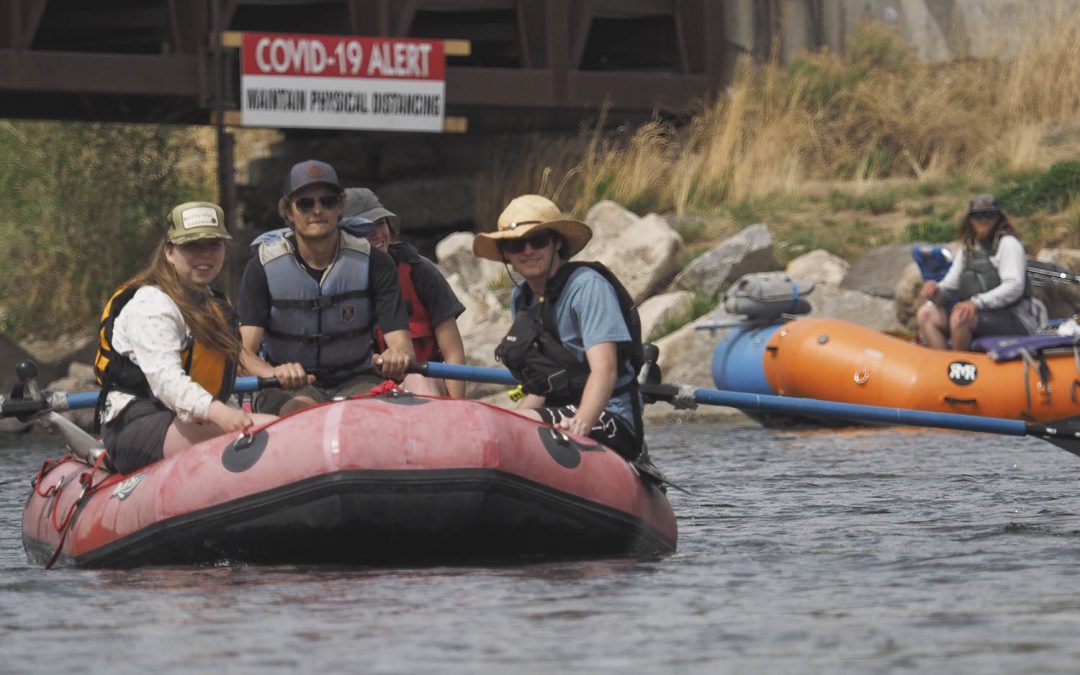
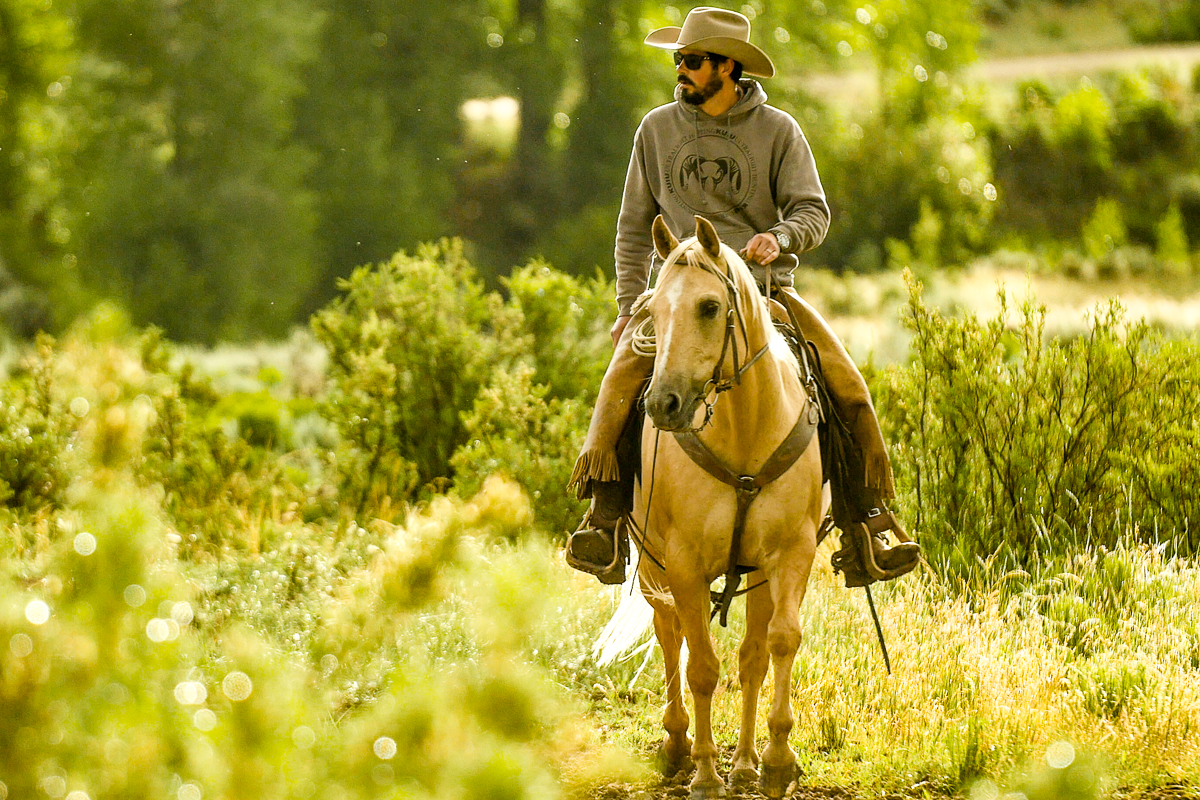
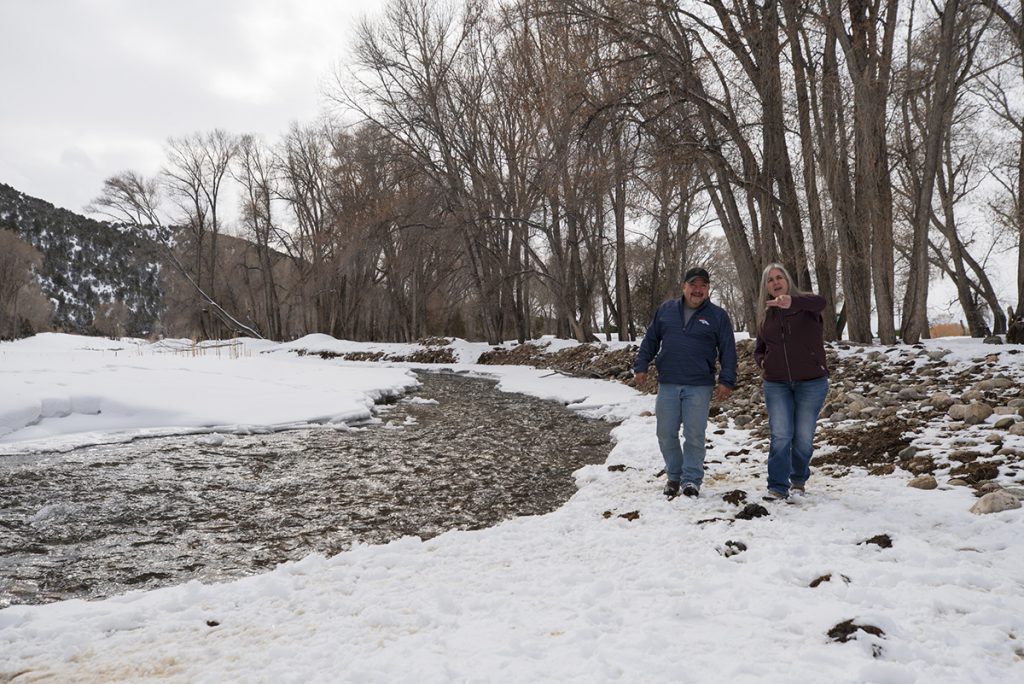
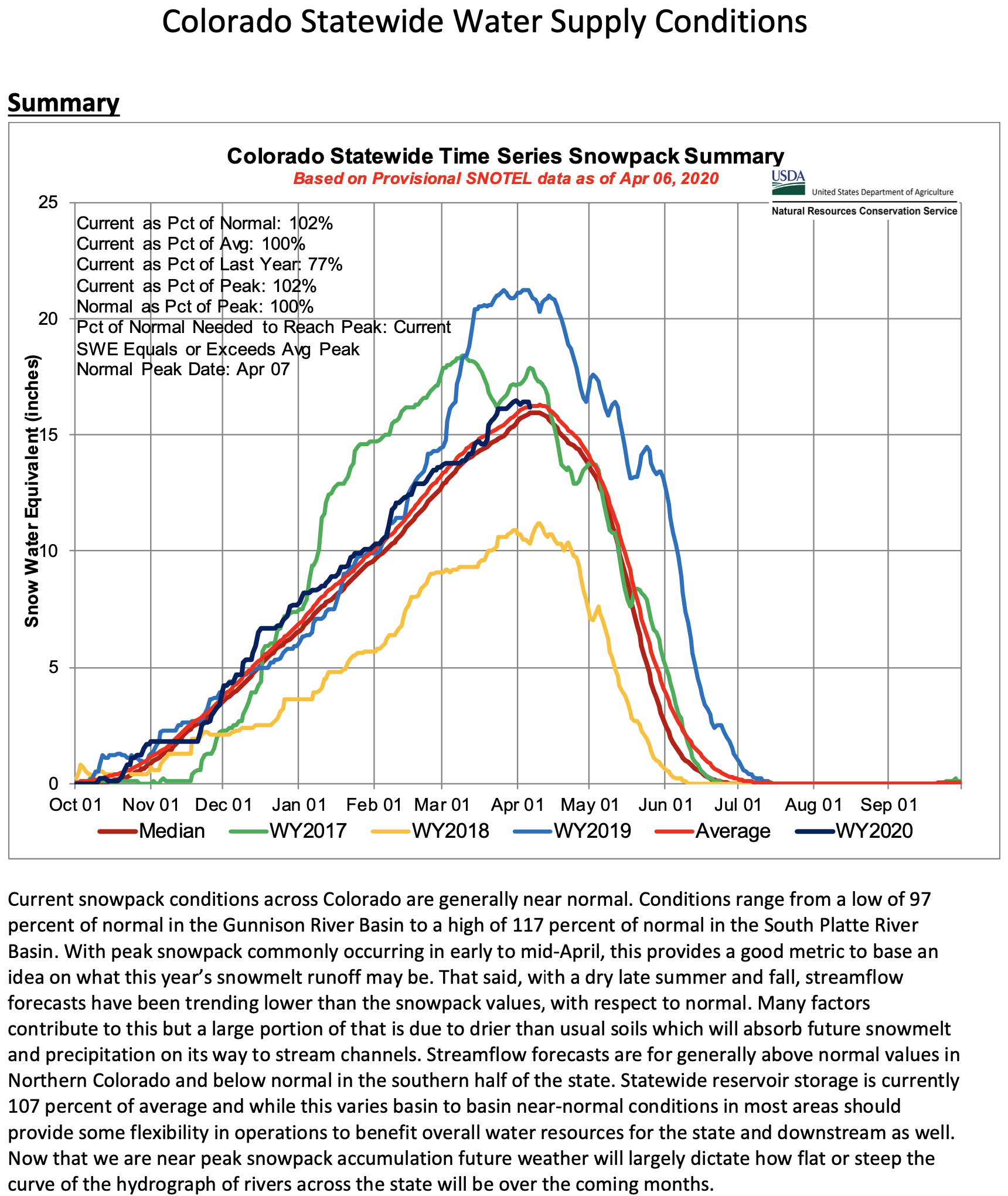
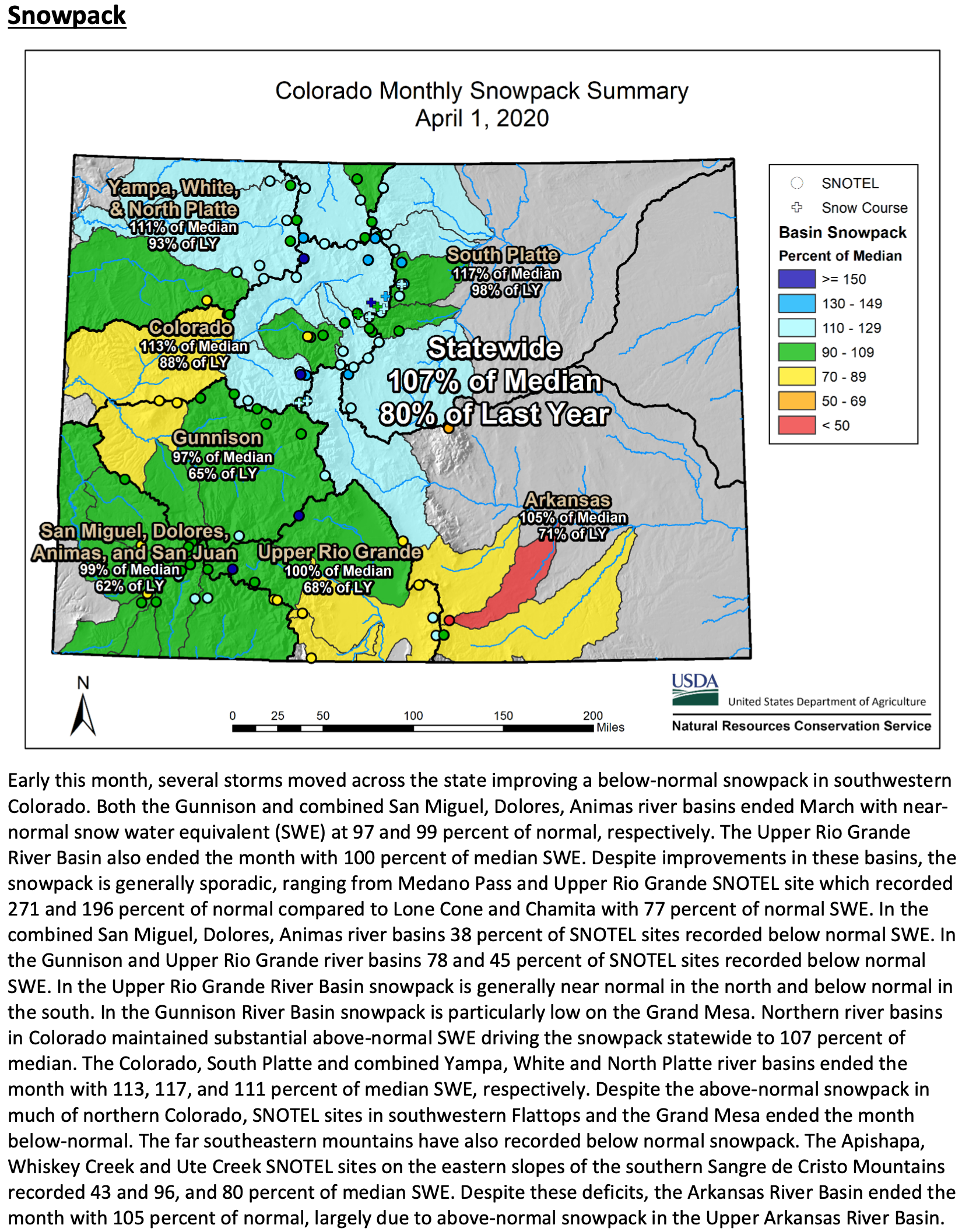
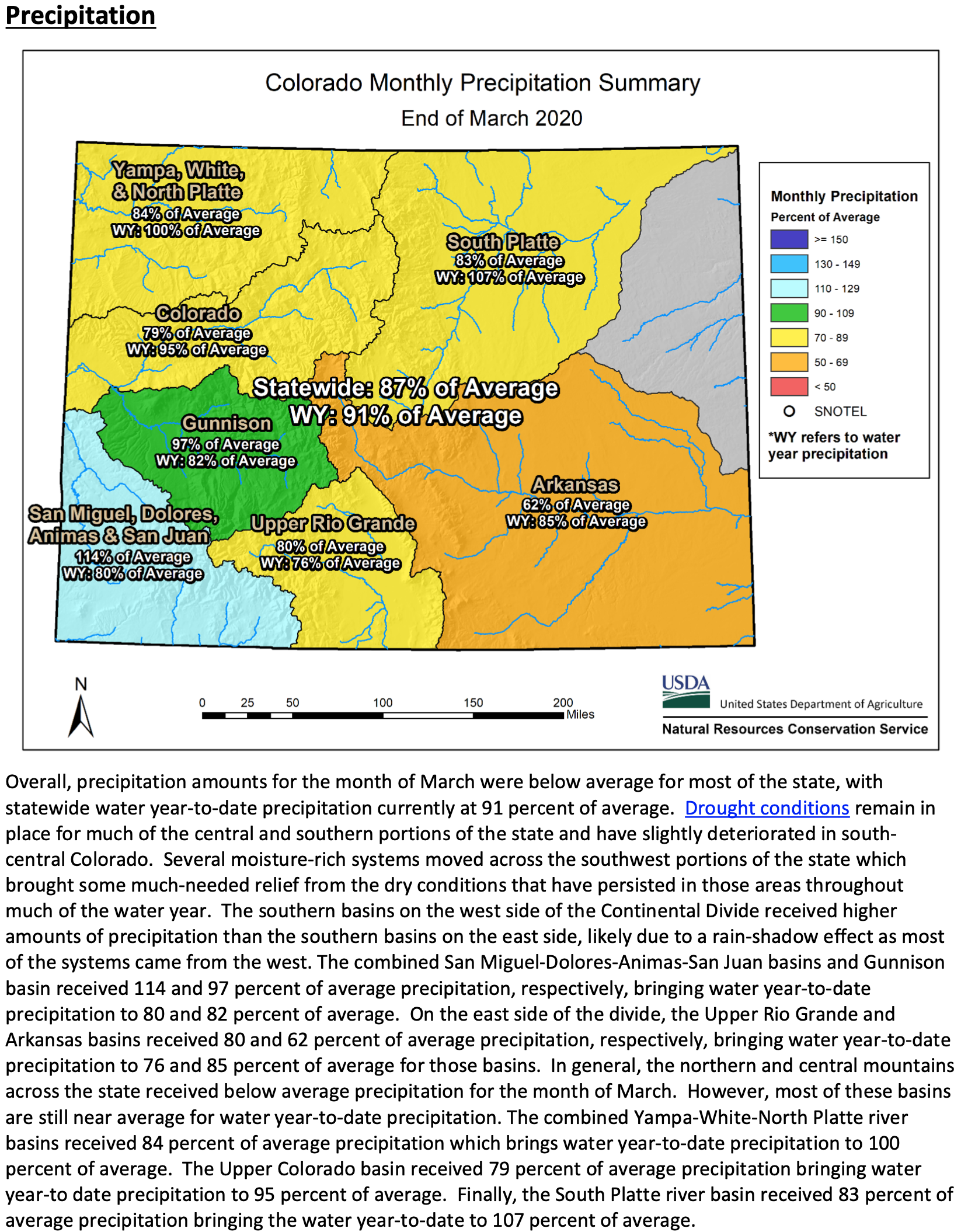
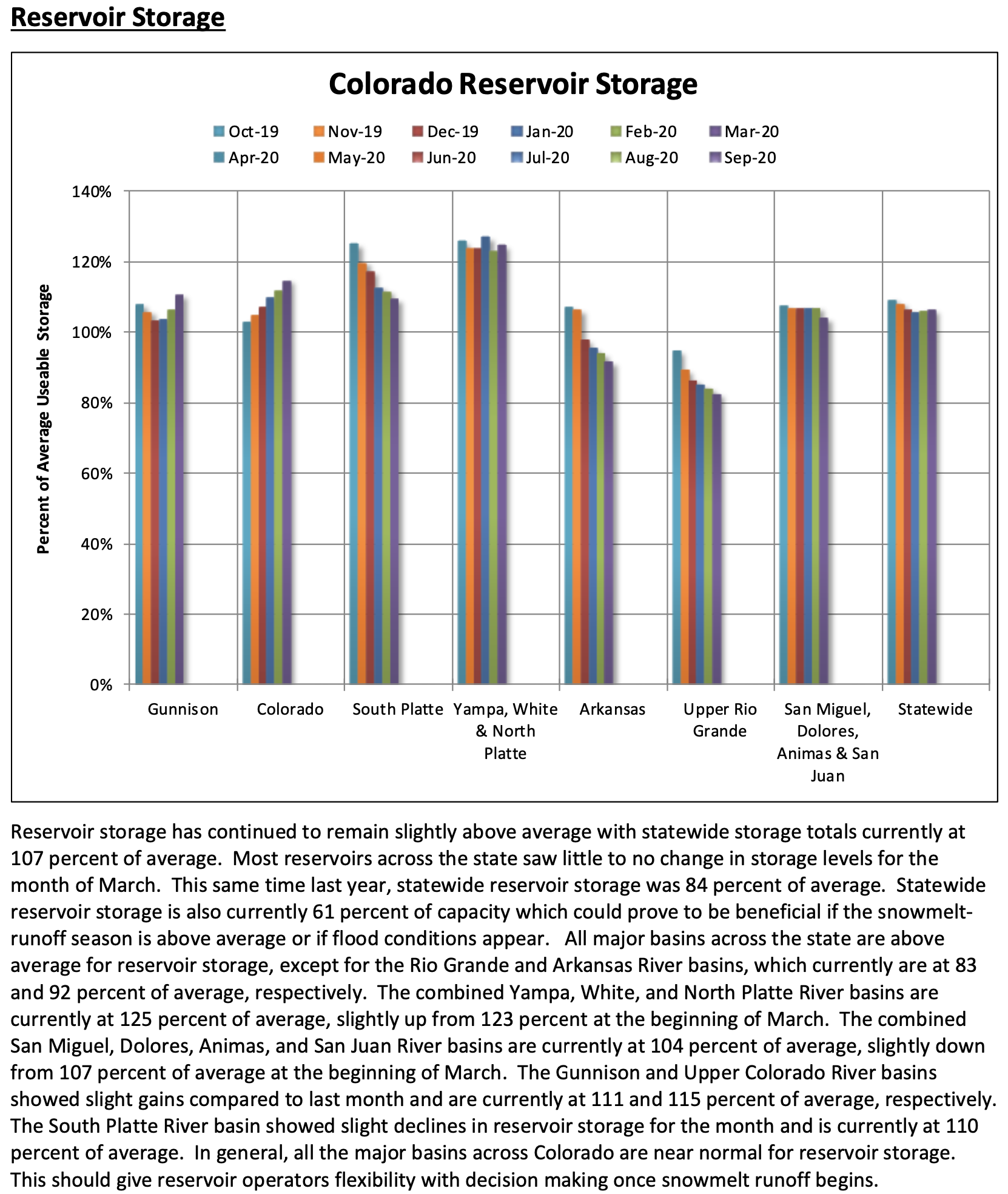
Rafters enjoy a day on the Gunnison River near Gunnison, Colo., on May 17, 2020. The Gunnison is flowing at about 80 percent of its normal volume for this time of year. Overall, Colorado’s snowpack is melting faster than usual. Along with lower river flows the presence of COVID-19 is creating challenges for commercial river running companies as well as private boaters. Credit: Dean Krakel/Special to Fresh Water News
With warming temperatures in Colorado’s mountains and spring runoff in full swing, the whitewater boating season should be off to a roaring start.
But Colorado’s stringent COVID-19 travel and recreation restrictions are forcing commercial rafting companies to create social distance on unruly rivers and face the potential for smaller crowds.
“The snowpack’s in good shape,” said John Kreski, rafting coordinator for Colorado Parks and Wildlife’s Arkansas River Headwaters Area. “But the phones aren’t ringing. This is very frustrating.”
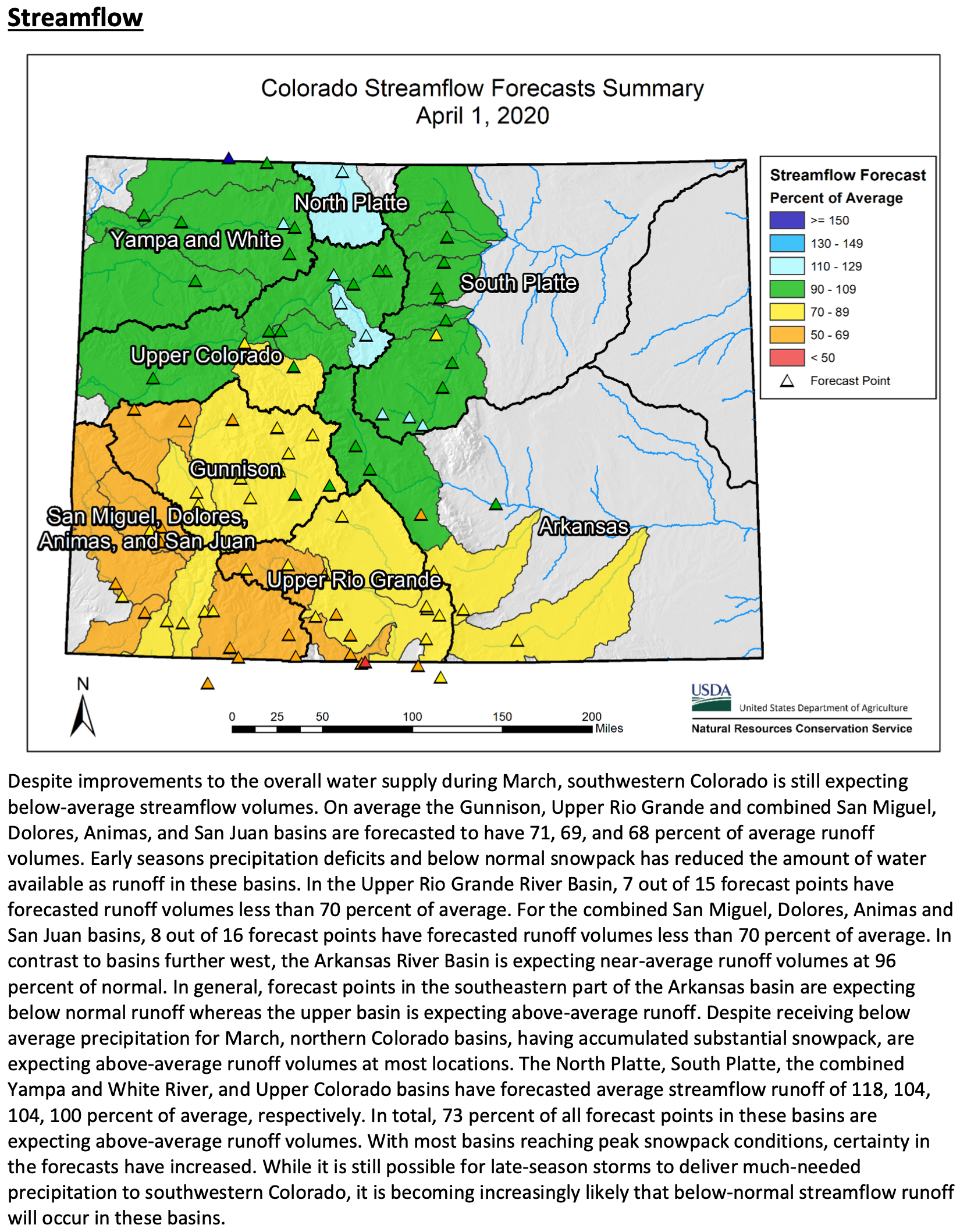
Colorado’s highest flows, as of mid-May, are in the northern part of the state, with the Poudre and North Platte at 100 to 120 percent of normal, according to Aldis Strautins, a hydrologist for the National Weather Service in Grand Junction.
The upper Colorado, Gunnison, Green and lower Colorado rivers are all flowing at between 70 to 80 percent of normal, while the Arkansas River, from Buena Vista to the Royal Gorge, is flowing at 80 percent of normal.
Because of an unusually warm and dry April, flows are trending downward in the central and southern mountains.
The South Platte River and Clear Creek are running at 64 to 70 percent of normal, while the Rio Grande and San Juan River are just 45 percent of normal.
Northern Colorado rivers, such as the Poudre, will have enough snowmelt to extend flows for boating into late summer. Elsewhere in the state the best floating will occur from May into early July. “Get down into that 70 to 75 percent and you’re looking at a reduced season,” Strautins said. “There’s just not enough snow to extend it.”
Hoping to maximize the early season flows, outfitters are anxiously waiting to see how many visitors will show, according to Bob Hamel, executive director of the Arkansas River Outfitters Association, a trade group.
“Who’s going to travel? Who’s got money? Will we even be traveling or flying to destinations?” he asked.
Still, Hamel is hopeful that the state’s waterways can be opened for commercial use by early June, bringing some much-needed economic activity to the state.
Colorado’s rafting industry is the No. 2 contributor to the state’s recreation economy, behind skiing. Centered on the Colorado, Rio Grande, Arkansas and Platte rivers, it contributed nearly $188 million to the state’s economy, according to a report of the Colorado River Outfitters Association. Visitors spent an average of $135 on a river adventure, including food, lodging, gas and souvenirs.
These numbers don’t include hundreds of homegrown rafters and kayakers who recreate on Colorado’s rivers or the large numbers of boaters from out of state that bring their own gear to the hallmark waterways.
How COVID-19 will impact the industry this summer isn’t clear yet, though major changes are underway.
“Every river floating company will have to adapt their own safety procedures to the kind of trips that they offer,” said Hamel. “A half-day trip down the Taylor River can’t be handled the same as a multi-day trip down the Gunnison Gorge. Some rafts are bigger. Some are smaller. The rafting industry can’t do a one size fits all.”
One set of COVID-19 rafting guidelines developed by Mark Schumacher, owner of Three Rivers Resort in Almont, Colo., includes daily screening of employees, non-touch guest check-in, and hand sanitizer in all office and retail areas.
In addition, directional signs will guide visitors to wherever they need to go, with group size monitored by employees. The number of people on a raft will be reduced to maintain proper social distancing, with spaced seating and open windows on vans and shuttles, disinfection of equipment after each use, and instructions to clients to bring their own water bottles and food.
Andy Neinas, a river running veteran with Echo Canyon Outfitters in Cañon City, said the rafting industry is well-equipped to handle the COVID-19 restrictions.
“All of us are juggling things to make it all work. We’re going to being doing it differently, but nobody does it better than Colorado,” Neinas said.
Dean Krakel is a photographer and writer based in Almont, Colo. He can be reached at dkrakel@gmail.com.
FromThe Grand Junction Daily Sentinel (Alex Zorn):
According to the National Weather Service, rising temperatures this week led to rising river levels.
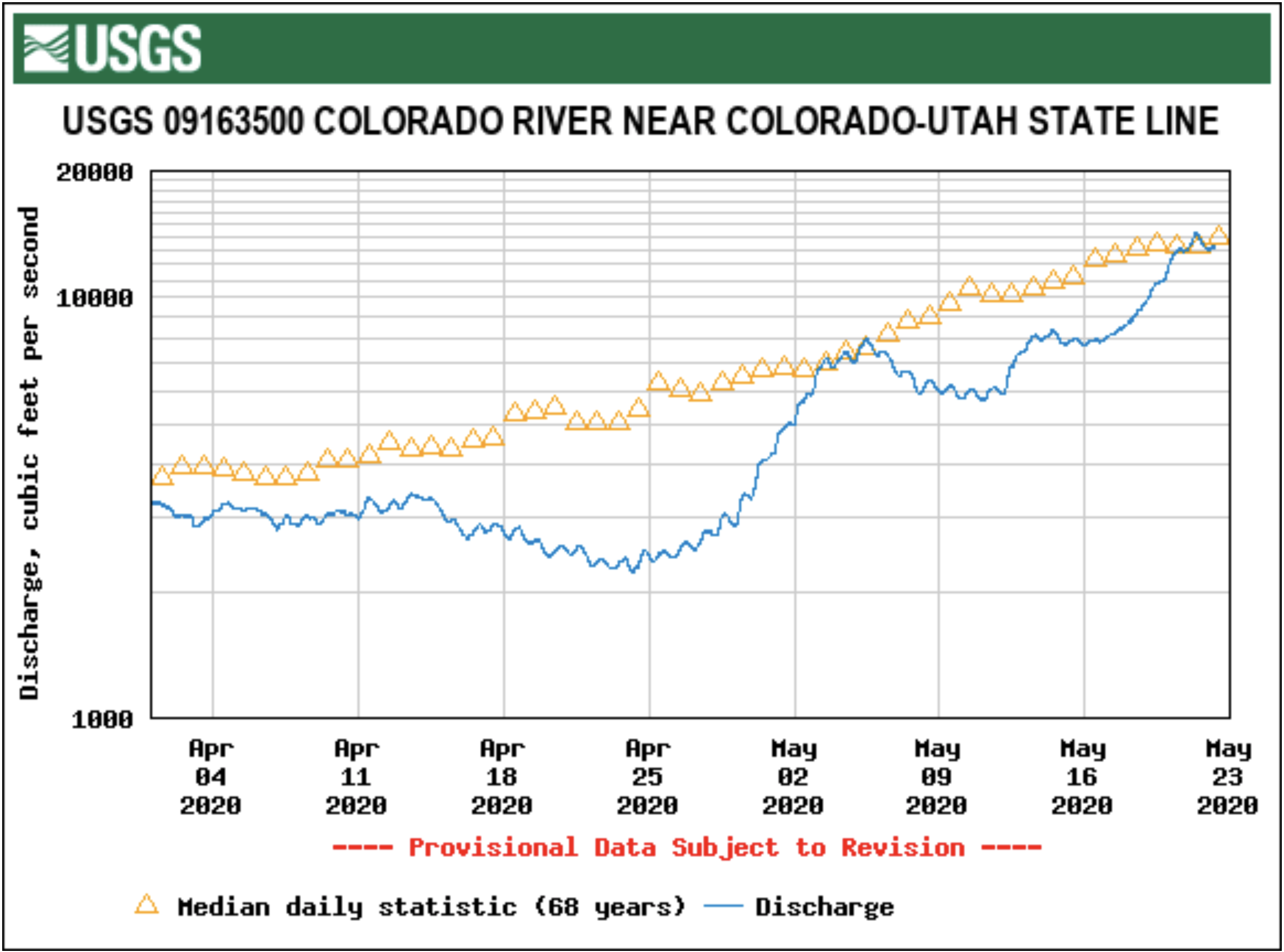
In fact, in the past week, river flows at the Colorado/Utah border have climbed from just over 7,000 cubic feet per second to nearly 13,000 cfs, according to flow data from the United States Geological Survey.
NWS service hydrologist Aldis Strautins said warmer days and nights helped the snowpack melt in the beginning of the week, resulting in higher river flows.
“Most sites will stay below any flood concerns. A few areas in the northwest part of Colorado, including the Yampa Basin and some of the smaller rivers, may reach higher levels,” he said. “We’re monitoring it right now.”
Wednesday’s river flow data for the Colorado River at the Utah border had the river flowing at 12,900 cfs. The average for May 20 at that spot in the river is more than 15,100 cfs.
Addressing flood risk after an area has already developed is complicated, expensive, and messy in every way you can imagine. This video will recap a challenging flood mitigation project that was 20 years in the making and contrast it with the Mile High Flood District’s modern approach to urban stream design – an approach we call High Functioning and Low Maintenance Streams (HFLMS)
Ephemeral streams are streams that do not always flow. They are above the groundwater reservoir and appear after precipitation in the area. Via Socratic.org
Colorado and other Western states will be hard pressed to shield their rivers and streams under a new federal Clean Water Act rule finalized last month, largely because hundreds of shallow Western rivers are no longer protected, and writing new state laws and finding the cash to fill the regulatory gap will likely take years to accomplish, officials said.
“We are pleased the final rule protects important agriculture exemptions and provides continued assurance that states retain authority and primary responsibility over land and water resources…However, the federal government’s decision to remove from federal oversight ephemeral waters, certain intermittent streams, and many wetlands is based on flawed legal reasoning and lacks a scientific basis,” Weiser said in a statement.
Legal strategy?
Whether Colorado will seek an injunction to stop the new rule from being enforced and whether it will join other Western states in a legal challenge isn’t clear. Weiser and Pfaltzgraff declined to discuss their legal strategy, other than vowing to take action.
The Colorado Water Congress, which represents hundreds of water agencies and agricultural interests, had been largely supportive of the new rule before it was finalized. But Executive Director Doug Kemper said the group hasn’t finished its analysis of the final version.
Formally adopted by the U.S. Environmental Protection Agency April 21, the move to significantly revise the WOTUS rule began after President Trump took office and vowed to reverse policies established under the Obama Administration.
The new rule has already triggered a handful of lawsuits seeking to stop the EPA from enforcing them. One was filed by cattle growers in New Mexico alleging that the rule is still too onerous, and at least two others have been filed by environmental interests in South Carolina and Massachusetts, who say the rule leaves too many streams unprotected.
And more are expected.
The Clean Water Act (CWA) has been legally hamstrung for years over murky definitions about which waterways fall under its jurisdiction, which wetlands must be regulated, what kinds of dredge-and-fill work in waterways should be permitted, what authority the CWA has over activities on farms and Western irrigation ditches, and what is allowable for industries and wastewater treatment plants to discharge into streams.
One rule never fits all
Administered by the U.S. Army Corps of Engineers and the EPA, the CWA, now nearly 50 years old, is credited with making U.S. waters some of the cleanest in the world. But it has also been, at times, fiendishly difficult to administer, in part because of the nation’s widely different geographies.
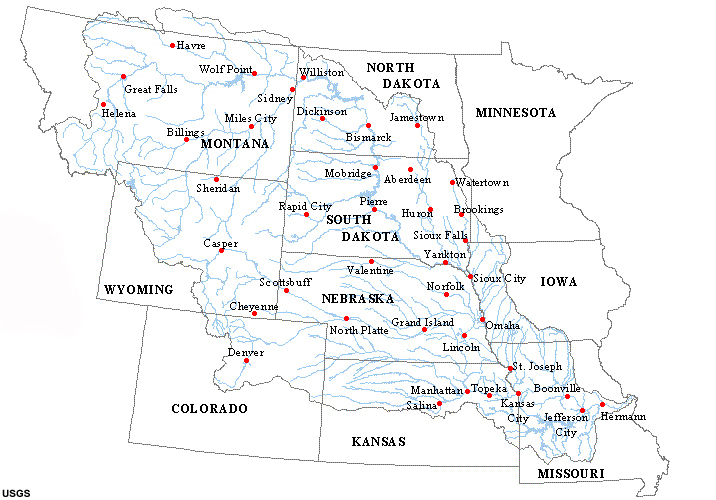
Go to the East or Midwest, and massive rivers, such as the Ohio and Missouri, are filled with barge and shipping traffic and are clearly “navigable.” That was the term early courts used to determine how water would be regulated. If a stream was considered navigable, it was subject to federal law.
But Colorado and other Western states rely on shallow streams that don’t carry traditional commercial traffic. The U.S. Geological Survey estimates 44 percent of Colorado’s streams are intermittent, meaning they are sometimes dry, and 24 percent are ephemeral, meaning they can be dry for months or years and appear only after extraordinary rain or snow. Just 32 percent of Colorado streams are classified as being perennial, meaning they flow year round.
Under the new rule, only perennial and intermittent streams, or those deemed navigable, will be regulated, meaning that thousands of miles of streams in Colorado and other Western states would no longer be protected under the law.
A financial quandary
And that worries state water quality officials who are responsible for protecting Colorado’s streams.
They warn that writing state rules and finding millions of dollars in new cash to enforce water quality protections will be difficult, especially as the COVID-19 budget crisis unfolds. Officials of the Colorado Department of Public Health and Environment (CDPHE), which includes the Water Quality Control Division, say that until state rules are in place, new housing developments and other projects could be stopped because there is no mechanism yet to issue the permits that were once issued by the federal government.
“While the specific impacts of this rule still are being determined, there’s no question this rollback removes huge swaths of Colorado’s waters from federal jurisdiction—the most of any administration since the passage of the Clean Water Act in 1972. The state will need to put in significant resources to determine how to continue to protect these waters and to determine how this rule will be implemented as the rule is unclear as written,” the CDPHE said in an email.
“Specific construction projects and associated permitting processes that were originally covered…won’t be able to move forward without doing so illegally and harming the environment,” the CDPHE said.
Potential dysfunction
Melinda Kassen, general counsel for the Theodore Roosevelt Conservation Partnership, said it would make sense to pursue an injunction to give the state time to set up its own regulations and find a way to fund them.
“If you read the economic analysis that accompanies the rule, there are assumptions that the states will step up and take this over. The potential is for it to be really dysfunctional. We’ve got to get something set up,” Kassen said.
EPA officials have said they don’t expect federal funding to enforce the Clean Water Act will be reduced, even though the new WOTUS rule is smaller in scope and governs fewer waterways.
Still the CDPHE and most opponents of the new rule believe millions of dollars will be needed to fill in any regulatory gap.
How far Colorado will go to challenge the new rule isn’t clear. The CDPHE’s Pfaltzgraff said his agency is still analyzing its next steps.
“It is now up to the state to provide the necessary protection of both Colorado’s economy and the environment,” Pfaltzgraff said in a statement. “We are going to do everything we can, while also addressing the impacts from COVID-19, to ensure Coloradans live in the healthy state they deserve.”
Jerd Smith is editor of Fresh Water News. She can be reached at 720-398-6474, via email at jerd@wateredco.org or @jerd_smith.
Click here to read the newsletter. Here’s an excerpt:
We’ve been sending a weekly “Six Feet in Solidarity” email on Thursdays to stay connected and continue serving up resources to build your water knowledge around different topics while social distancing. We’ve been pulling from our library of publications, news stories, webinars, videos, radio programs, and more, and also sharing key resources produced by others in the water community.
Thus far we’ve sent emails focused on land use and water, stream management plans in Colorado, environmental justice and equity in the water sector, water reuse, alternatives to ag transfers or ATMs, forest and watershed health, and climate change and its projected impacts on Western water.
After eight weeks, as Colorado’s stay-at-home order is replaced with its new safer at home, we bring you the last in our Six Feet in Solidarity series. This week is Drinking Water Week, which recognizes the vital role tap water plays in daily life, the infrastructure that is required to carry it to and from homes and businesses, and the important behind-the-scences work of water professionals. To celebrate, we’re focusing our final solidarity email on drinking water. Read on to learn more. Continue to be well and don’t stop social distancing!
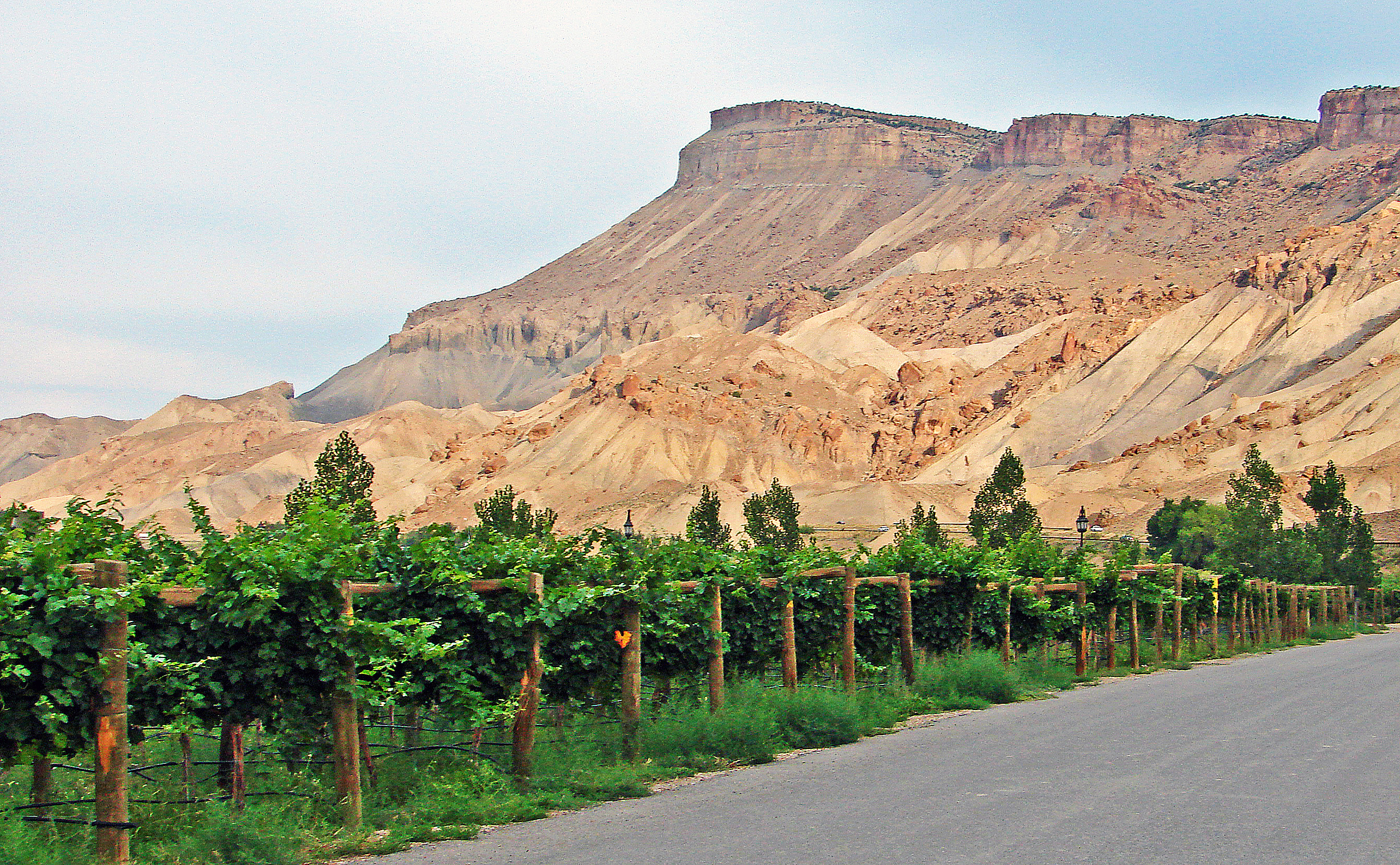
Palisade is just east of Grand Junction and lies in a fertile valley between the Colorado River and Mt. Garfield which is the formation in the picture. They’ve grown wonderful peaches here for many years and have recently added grape vineyards such as the one in the picture. By inkknife_2000 (7.5 million views +) – https://www.flickr.com/photos/23155134@N06/15301560980/, CC BY-SA 2.0,
Here’s a guest column from Hannah Holm that’s running in The Grand Junction Daily Sentinel:
It seems like the pandemic has soaked up most of the newsprint lately, but even now, when so much has come to a standstill, our rivers keep flowing. As Jim Pokrandt pointed out in a recent op-ed, our canals have started flowing, too, as Grand Valley farmers begin the annual ritual of putting water on the land to reap a harvest, and an income, later in the year.
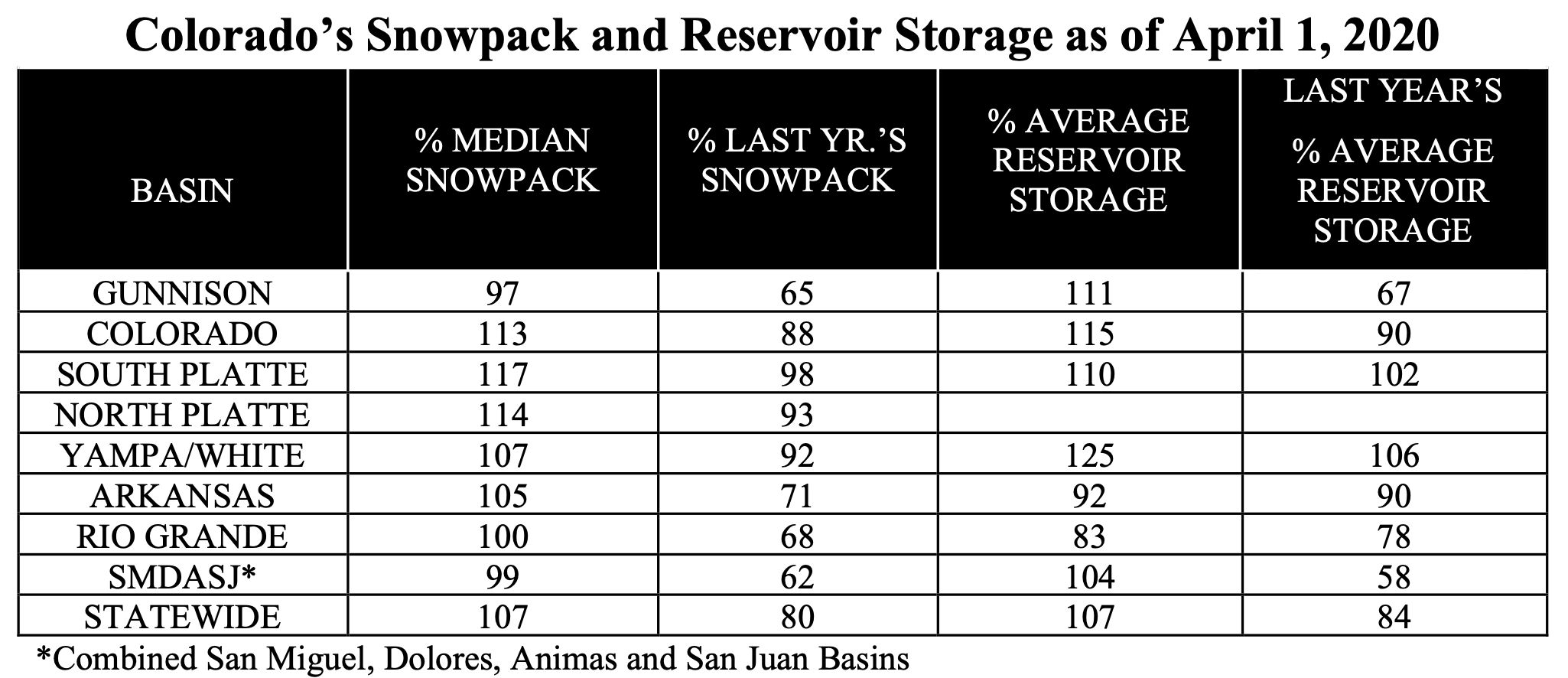
Another annual ritual, monitoring the forecasts for how much spring snowmelt will flow down the rivers, has also begun. This year, we have an above-average snowpack in the mountains that feed the Colorado River, but below-average runoff into Lake Powell is expected. Parched soils from last year’s dry summer are expected to soak up much of the water before it can make it into the river.
If that forecast proves accurate, it will mark the 15th time in 20 years in which runoff into Lake Powell has been below average. This is one more piece of data to support the conclusion that the Colorado River is shrinking. Coming to terms with this fact is the central challenge facing all who depend on the Colorado River — about 40 million people throughout the Southwest.
A shrinking river is a particularly hard to adapt to when it is already being completely used up — the Colorado River rarely reaches the sea any more, and its major reservoirs are less than half full. So how, and what, are we doing? Here’s a rundown of a few things that are happening.
Downstream, California, Arizona and Nevada agreed to a detailed schedule of water delivery cuts triggered by different water levels in Lake Mead. This is the first year they are taking reduced deliveries.
Here in Colorado, along with Wyoming, Utah and New Mexico, water leaders are continuing to study “demand management:” paying water users to temporarily leave some of the water they are entitled to in the river. State-sponsored work groups on demand management are hashing out technical details on financing, legal issues, how to measure saved water, and the potential economic and environmental impacts of different approaches. You can learn more about these discussions here: https://cwcb.colorado.gov/demand-management.
In related efforts, scientists and ranchers are about to start working together in Grand County to figure out what happens to high-elevation hay fields if you take a pause on irrigating them. This will help ranchers determine whether they might want to participate in demand management or not. Other studies are also looking at the potential impacts on communities of reductions in irrigated agriculture.
Scientists are also working hard to refine their tools for understanding and forecasting water supplies. A new report from Western Water Assessment at CU-Boulder synthesizes information from nearly 800 studies and reports on Colorado River Basin science and hydrology. If you are interested, you can check it out at https://wwa.colorado.edu/.
So far, we’re mostly studying different options for cutting back our water use from the Colorado River, without many people actually having to do it yet. But if current trends continue, which long-term projections indicate that they will, that day will come.
Any change is hard, and abrupt change is especially hard. Abrupt change without data is terrifying, as we’ve recently learned. The good thing about the troubling situation on the Colorado River is that we don’t have to suffer the terror of change without data. The bad thing about the situation on the Colorado River is that we can’t study our way out of actually having to do something about it — sooner or later. [ed. emphasis mine]
Hannah Holm coordinates the Hutchins Water Center at Colorado Mesa University, which promotes research, education and dialogue to address the water issues facing the Upper Colorado River Basin. Support for Hutchins Water Center articles is provided by a grant from the Walton Family Foundation. You can learn more about the center at http://www.coloradomesa.edu/water-center.
Hayfield message to President Obama 2011 via Protect the Flows
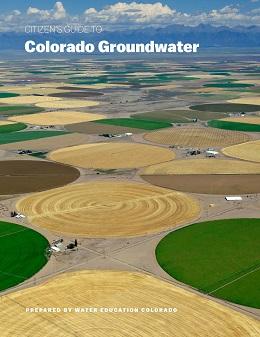
This guide discusses how groundwater is formed, regulated and used in Colorado. It explores the factors threatening groundwater supplies in some areas and illuminates how the role of groundwater could be expanded in Colorado’s water future.
Click here for all the inside skinny and to register:
This webinar will cover two new drought tools available to the public and provide a short update on drought conditions and the outlook. The tools in include Grasscast, which informs those interested and range and pasture lands on possible future conditions for that crop. The other tool we will be discussing is from NASA and maybe used in the U.S. as well as around the globe for soil moisture and groundwater monitoring and prediction. At the end of the webinar we will briefly discuss current conditions and the drought outlook in the North-Central U.S.
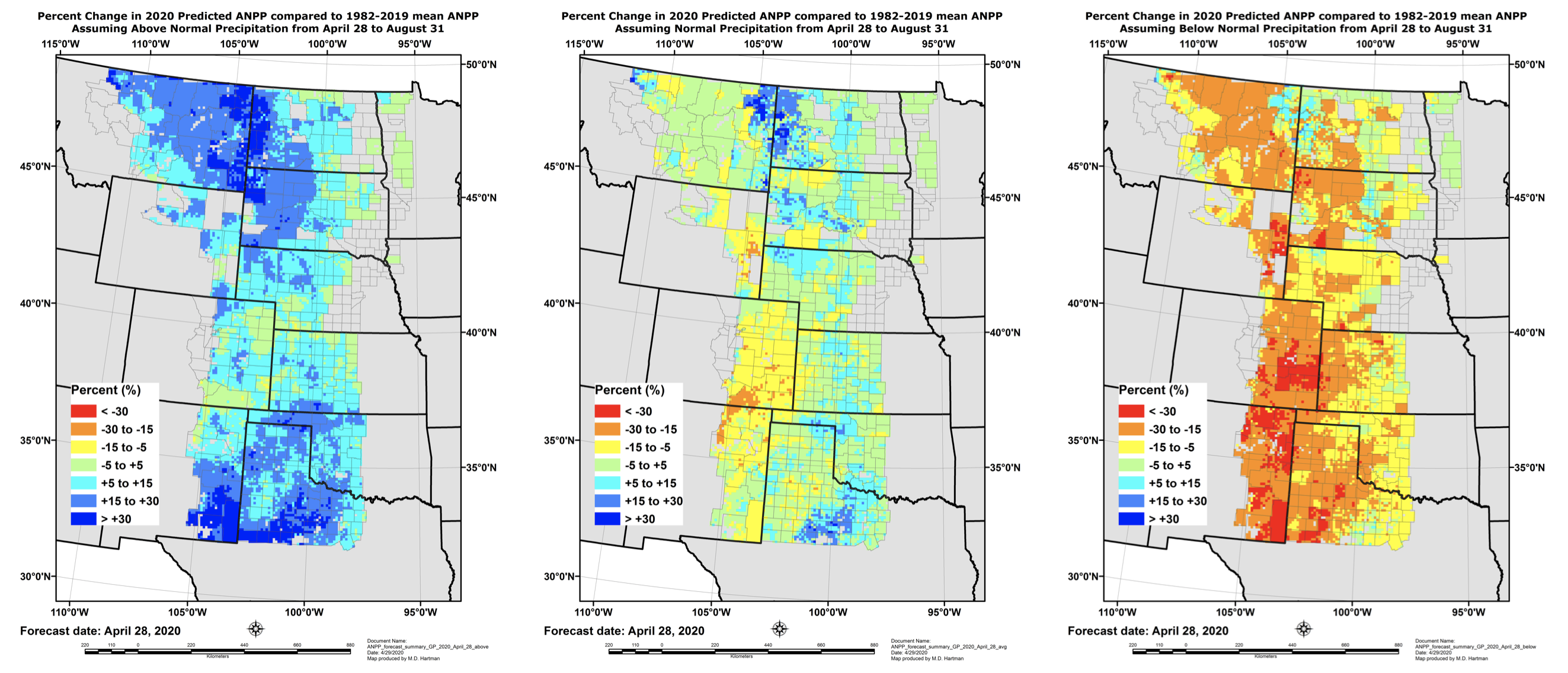
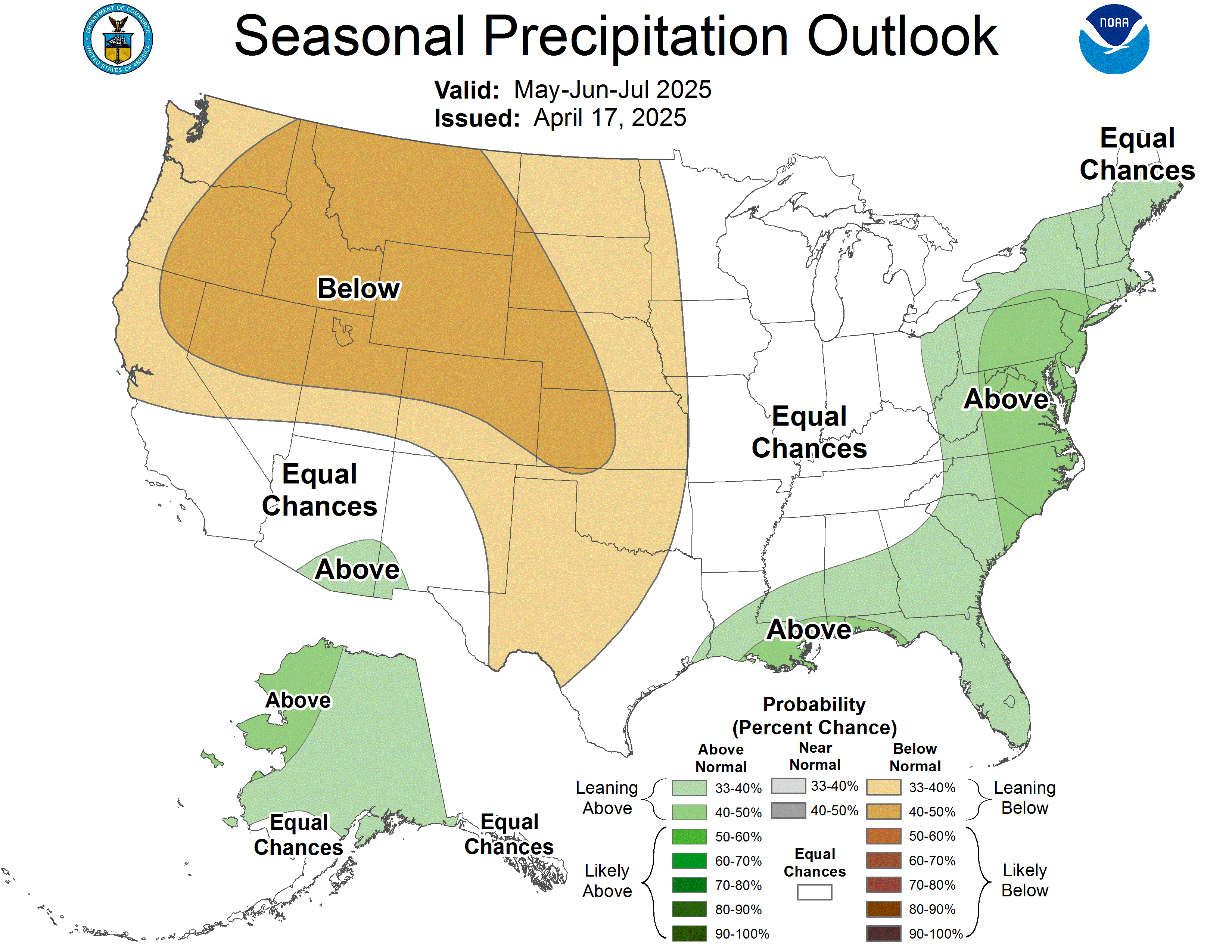
NOAA’s 3-month precipitation outlook for May-Jun-Jul is leaning slightly (33-50% chances) towards above-normal for southern ND, all of SD, NE, and KS, much of OK, as well as northeastern CO, eastern WY, and southeastern MT. So the left map might be slightly more likely for these states. For all other areas, the outlook currently shows equal chances, so the three maps above are equally likely. To check the seasonal precipitation outlook for your specific location, please visit NOAA’s outlook at: https://www.cpc.ncep.noaa.gov/products/predictions/long_range/lead01/off01_prcp.gif.
Click here for all the inside skinny and to register:
Learn about current conditions and issues in the Blue and Colorado river watersheds at the Summit State of the River. Presentations will include forecasts of how much water will be in area rivers and reservoirs later this summer, how Summit County fits into forecasted shortages facing the larger Colorado River Basin, an update on Summit County reservoirs, transmountain diversions and information about how you can participate in Blue River planning efforts to assess and sustain this valuable resource and its associated ecosystem.
Agenda
• Protecting West Slope water as we face an uncertain water future – Andy Mueller, general manager of the Colorado River District (20 minutes)
• An outlook on our water supply and updates from the Division of Water Resources – Troy Wineland, Summit County water commissioner at the Division of Water Resources (15 minutes)
• Green Mountain Reservoir and Colorado-Big Thompson Project operations – Victor Lee, hydrological engineer at the U.S. Bureau of Reclamation (15 minutes)
• Dillon Reservoir and Denver Water operations – Nathan Elder, Denver Water’s manager of water supply (10 minutes)
• Blue Lakes and Hoosier Pass system operations – Kalsoum Abbasi, Colorado Springs Utilities water planning supervisor (5 minutes)
• The Blue River Integrated Water Management Plan – Peggy Bailey, V.P., and Erika Donaghy, executive director of Blue River Watershed Group (15 minutes)
Time
May 14, 2020 06:00 PM in Mountain Time (US and Canada)
The YouTube film offers outdated and wildly misleading information on renewable energy, sacrificing progress in pursuit of unachievable perfection.
Environmentalists and renewable energy advocates have long been allies in the fight to keep unchecked industrial growth from irreversibly ruining Earth’s climate and threatening the future of human civilization. In their new YouTube documentary “Planet of the Humans,” director Jeff Gibbs and producer Michael Moore argue for splitting the two sides. Their misleading, outdated, and scientifically sophomoric dismissal of renewable energy is perhaps the most dangerous form of climate denial, eroding support for renewable energy as a critical climate solution.
“Planet of the Humans” by the end of April had more than 4.7 million views and fairly high scores at the movie critic review aggregator Rotten Tomatoes. The documentary has received glowing reviews from numerous climate “deniers” whose names are familiar to those in the climate community, including Steve Milloy, Marc Morano, and James Delingpole. Some environmentalists who have seen the movie are beginning to oppose wind and solar projects that are absolutely necessary to slow climate change.
The film by these two “progressive” filmmakers may succeed where Fox News and right-wing talk radio have failed: to undermine humanity’s last best hope for positive change. As energy journalist Ketan Joshi wrote, the film is “selling far-right, climate-denier myths from nearly a decade ago to left-wing environmentalists in the 2020s.”
The film follows Gibbs as he visits various green technology sites in the United States and ostensibly learns that each one is just as bad as the fossil fuel infrastructure that it would replace. Unfortunately, the movie is littered with misleading, skewed, and outdated scenes.
“Planet of the Humans”‘ approach is fundamentally flawed – Gibbs focuses almost exclusively on the imperfections of technologies like solar panels, wind turbines, biomass, and electric cars without considering their ability to reduce carbon and other pollutants. The film suggests that because no source of energy is perfect, all are bad, thus implying that the very existence of human civilization is the problem while offering little in the way of alternative solutions.
A badly outdated portrait of solar and wind
In an interview with Reuters, Michael Moore summarized the premise of the film: “I assumed solar panels would last forever. I didn’t know what went into the making of them.”
It’s true. Solar panels and wind turbines don’t last forever (though they do last several decades), and like every other industrial product, they require mining and manufacturing of raw materials. Sadly, that’s about as deep as the film delves into quantifying the environmental impacts of renewable energy versus fossil fuels. In fact, the misinformation in the film is at times much worse than ignorance. [ed. emphasis mine]
In one scene, author and film co-producer Ozzie Zehner falsely asserts, “You use more fossil fuels [manufacturing renewables infrastructure] than you’re getting benefit from. You would have been better off burning the fossil fuels in the first place instead of playing pretend.”
That’s monumentally wrong. A 2017 study in Nature Energy found that when accounting for manufacturing and construction, the lifetime carbon footprints of solar, wind, and nuclear power are about one-twentieth of those of coal and natural gas, even when the latter include expensive carbon capture and storage technology. The energy produced during the operation of a solar panel and wind turbine is 26 and 44 times greater than the energy needed to build and install them, respectively. There are many life-cycle assessment studies arriving at similar conclusions.
The film’s case is akin to arguing that because fruit contains sugar, eating strawberries is no healthier than eating a cheesecake.
It’s true that the carbon footprint of renewable energy is not zero. But the film somehow fails to mention that it’s far lower than the fossil fuel alternatives, instead falsely suggesting (with zero supporting evidence) that renewables are just as bad. The closest defense of that argument comes when Zehner claims that wind and solar energy cannot displace coal, and instead retired coal power plants are being replaced by even larger natural gas plants.
In reality, annual coal power generation in the U.S. has declined by about half (over 1 trillion kilowatt-hours) over the past decade, and it’s true that natural gas has picked up about two-thirds of that slack (670 billion kWh). But growth in renewables has accounted for the other one-third (370 billion kWh).* As a result, power sector carbon emissions in the U.S. have fallen by one-third since 2008 and continue to decline steadily. In fact, electricity is the only major sector in the U.S. that’s achieving significant emissions reductions.
It’s true that natural gas is a fossil fuel. To reach zero emissions, it must be replaced by renewables with storage and smart grids. But thus far the path to grid decarbonization in the U.S. has been a success story that the film somehow portrays as a failure. Moreover, that decarbonization could be accelerated through policies like pricing carbon pollution, but the film does not once put a single second of thought into policy solutions.
In perhaps its most absurd scene, Gibbs and Zehner visit a former solar facility in Daggett, California, built in the mid-1980s and replaced 30 years later. Gazing upon the sand-covered landscape of the former facility, Gibbs declares in an ominous tone, “It suddenly dawned on me what we were looking at: a solar dead zone.”
Daggett is located in the Mojave Desert. Sand is the natural landscape. Solar farms don’t create dead zones; in fact, some plants thrive under the shade provided by solar panels.
It suddenly dawned on me how hard the film was trying to portray clean energy in a negative light.
A shallow dismissal of electric vehicles
ARTICLE Michael Moore’s ‘Planet of the Humans’ documentary peddles dangerous climate denial The YouTube film offers outdated and wildly misleading information on renewable energy, sacrificing progress in pursuit of unachievable perfection.By Dana Nuccitelli | Friday, May 1, 2020
Theatre sign
Environmentalists and renewable energy advocates have long been allies in the fight to keep unchecked industrial growth from irreversibly ruining Earth’s climate and threatening the future of human civilization. In their new YouTube documentary “Planet of the Humans,” director Jeff Gibbs and producer Michael Moore argue for splitting the two sides. Their misleading, outdated, and scientifically sophomoric dismissal of renewable energy is perhaps the most dangerous form of climate denial, eroding support for renewable energy as a critical climate solution.
“Planet of the Humans” by the end of April had more than 4.7 million views and fairly high scores at the movie critic review aggregator Rotten Tomatoes. The documentary has received glowing reviews from numerous climate “deniers” whose names are familiar to those in the climate community, including Steve Milloy, Marc Morano, and James Delingpole. Some environmentalists who have seen the movie are beginning to oppose wind and solar projects that are absolutely necessary to slow climate change.
The film by these two “progressive” filmmakers may succeed where Fox News and right-wing talk radio have failed: to undermine humanity’s last best hope for positive change. As energy journalist Ketan Joshi wrote, the film is “selling far-right, climate-denier myths from nearly a decade ago to left-wing environmentalists in the 2020s.”
The film follows Gibbs as he visits various green technology sites in the United States and ostensibly learns that each one is just as bad as the fossil fuel infrastructure that it would replace. Unfortunately, the movie is littered with misleading, skewed, and outdated scenes.
“Planet of the Humans”‘ approach is fundamentally flawed – Gibbs focuses almost exclusively on the imperfections of technologies like solar panels, wind turbines, biomass, and electric cars without considering their ability to reduce carbon and other pollutants. The film suggests that because no source of energy is perfect, all are bad, thus implying that the very existence of human civilization is the problem while offering little in the way of alternative solutions.
A badly outdated portrait of solar and wind
In an interview with Reuters, Michael Moore summarized the premise of the film: “I assumed solar panels would last forever. I didn’t know what went into the making of them.”
It’s true. Solar panels and wind turbines don’t last forever (though they do last several decades), and like every other industrial product, they require mining and manufacturing of raw materials. Sadly, that’s about as deep as the film delves into quantifying the environmental impacts of renewable energy versus fossil fuels. In fact, the misinformation in the film is at times much worse than ignorance.
In one scene, author and film co-producer Ozzie Zehner falsely asserts, “You use more fossil fuels [manufacturing renewables infrastructure] than you’re getting benefit from. You would have been better off burning the fossil fuels in the first place instead of playing pretend.”
That’s monumentally wrong. A 2017 study in Nature Energy found that when accounting for manufacturing and construction, the lifetime carbon footprints of solar, wind, and nuclear power are about one-twentieth of those of coal and natural gas, even when the latter include expensive carbon capture and storage technology. The energy produced during the operation of a solar panel and wind turbine is 26 and 44 times greater than the energy needed to build and install them, respectively. There are many life-cycle assessment studies arriving at similar conclusions.
The film’s case is akin to arguing that because fruit contains sugar, eating strawberries is no healthier than eating a cheesecake.
It’s true that the carbon footprint of renewable energy is not zero. But the film somehow fails to mention that it’s far lower than the fossil fuel alternatives, instead falsely suggesting (with zero supporting evidence) that renewables are just as bad. The closest defense of that argument comes when Zehner claims that wind and solar energy cannot displace coal, and instead retired coal power plants are being replaced by even larger natural gas plants.
In reality, annual coal power generation in the U.S. has declined by about half (over 1 trillion kilowatt-hours) over the past decade, and it’s true that natural gas has picked up about two-thirds of that slack (670 billion kWh). But growth in renewables has accounted for the other one-third (370 billion kWh).* As a result, power sector carbon emissions in the U.S. have fallen by one-third since 2008 and continue to decline steadily. In fact, electricity is the only major sector in the U.S. that’s achieving significant emissions reductions.
It’s true that natural gas is a fossil fuel. To reach zero emissions, it must be replaced by renewables with storage and smart grids. But thus far the path to grid decarbonization in the U.S. has been a success story that the film somehow portrays as a failure. Moreover, that decarbonization could be accelerated through policies like pricing carbon pollution, but the film does not once put a single second of thought into policy solutions.
In perhaps its most absurd scene, Gibbs and Zehner visit a former solar facility in Daggett, California, built in the mid-1980s and replaced 30 years later. Gazing upon the sand-covered landscape of the former facility, Gibbs declares in an ominous tone, “It suddenly dawned on me what we were looking at: a solar dead zone.”
Daggett is located in the Mojave Desert. Sand is the natural landscape. Solar farms don’t create dead zones; in fact, some plants thrive under the shade provided by solar panels.
It suddenly dawned on me how hard the film was trying to portray clean energy in a negative light.
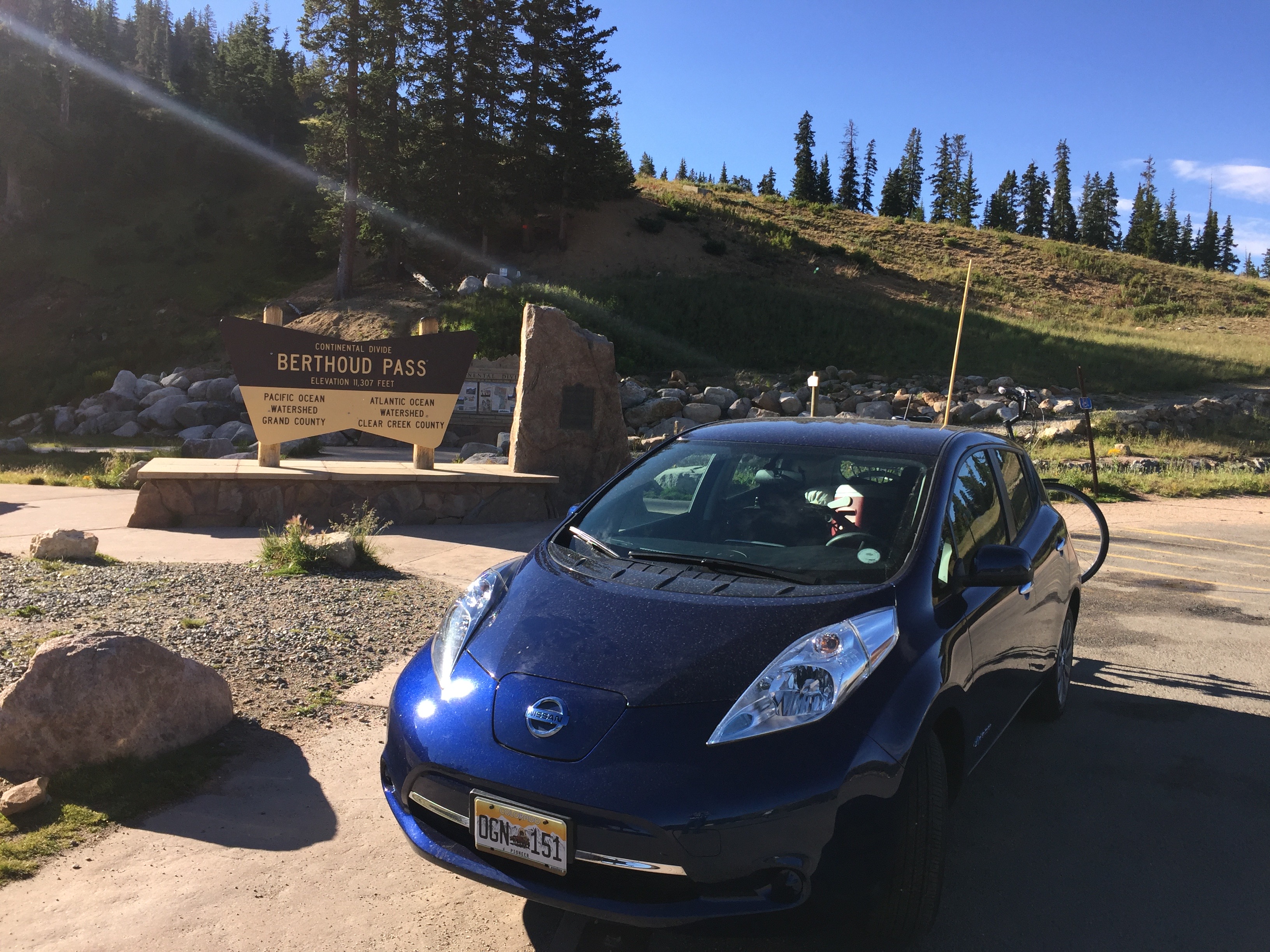
Leaf, Berthoud Pass Summit, August 21, 2017.
A shallow dismissal of electric vehicles
In another scene, Gibbs travels to a General Motors facility in Lansing, Michigan, circa 2010, as GM showcased its then-new Chevy Volt plug-in electric hybrid vehicle. Gibbs interviews a representative from the local municipal electric utility provider, who notes that they generate 95% of their supply by burning coal, and that the power to charge the GM facility’s EVs will not come from renewables in the near future.
That is the full extent of the discussion of EVs in the film. Viewers are left to assume that because these cars are charged by burning coal, they’re just greenwashing. In reality, because of the high efficiency of electric motors, an electric car charged entirely by burning coal still produces less carbon pollution than an internal combustion engine car (though more than a hybrid). The U.S. Department of Energy has a useful tool for comparing carbon emissions between EVs, plug-in hybrids, conventional hybrids, and gasoline-powered cars for each state. In Michigan, on average, EVs are the cleanest option of all, as is the case for the national average power grid. In West Virginia, with over 90% electricity generated from coal, hybrids are the cleanest option, but EVs are still cleaner than gasoline cars.
In short, EVs are an improvement over gasoline-powered cars everywhere, and their carbon footprints will continue to shrink as renewables expand to supply more of the power grid.
A valid critique of wood biomass
The film devotes a half hour to the practice of burning trees for energy. That’s one form of biomass, which also includes burning wood waste, garbage, and biofuels. Last year, 1% of U.S. electricity was generated by burning wood, but it accounted for 30% of the film run time.
In fairness, Europe is a different story, where wood biomass accounts for around 5% of electricity generation, and which imports a lot of wood chips from America. It’s incentivized because the European Union considers burning wood to be carbon neutral, and it can thus be used to meet climate targets. That’s because new trees can be planted to replace those removed, and the EU assumes the wood being burned would have decayed and released its stored carbon anyway.
There are numerous problems with those assumptions, one of which is unavoidable: time. Burning trees is close to carbon neutral once a replacement tree grows to sufficient maturity to recapture the lost carbon, but that takes many decades. In the meantime, the carbon released into the atmosphere accelerates the climate crisis at a time when slashing emissions is increasingly urgent. That’s why climate scientists are increasingly calling on policymakers to stop expanding this practice. So has 350.org founder Bill McKibben since 2016, despite his depiction in the film as a villainous proponent of clearcutting forests to burn for energy.
It’s complicated, but the carbon footprint of biomass depends on where the wood comes from. Burning waste (including waste wood) as biomass that would decay anyway is justifiable, but also generally only practical at a relatively small scale. A more detailed investigation of the wood biomass industry could make for a worthwhile documentary. It’s still a small-time player, but it does need to stay that way.
The bottom line
Gibbs asks, “Is it possible for machines made by industrial civilization to save us from industrial civilization?”
Why not? Industrial civilization has a non-zero climate and environmental footprint, but the impact of green technologies like EVs, wind turbines, and solar panels is much smaller than the alternatives. They represent humanity’s best chance to avoid a climate catastrophe.
The filmmakers call for an end to limitless economic growth and consumption. It’s difficult to envision that goal being achieved anytime soon, but even if it is, human civilization will continue to exist and require energy. To avert a climate crisis, that energy must be supplied by the clean renewable technologies pilloried in the film. To expand on the earlier analogy, the filmmakers seem to believe we should improve nutrition not by eating healthier foods like strawberries, but rather by eating a bit less cheesecake.
Like Fox News and other propaganda vehicles, the film presents one biased perspective via carefully chosen voices, virtually all of whom are comfortable white men. It applies an environmental purity test that can seem convincing for viewers lacking expertise in the topic. Any imperfect technology – which is every technology – is deemed bad. It’s a clear example of the perfect being the enemy of the good. In reality, this movie is the enemy of humanity’s last best chance to save itself and countless other species from unchecked climate change through a transition to cleaner technologies.
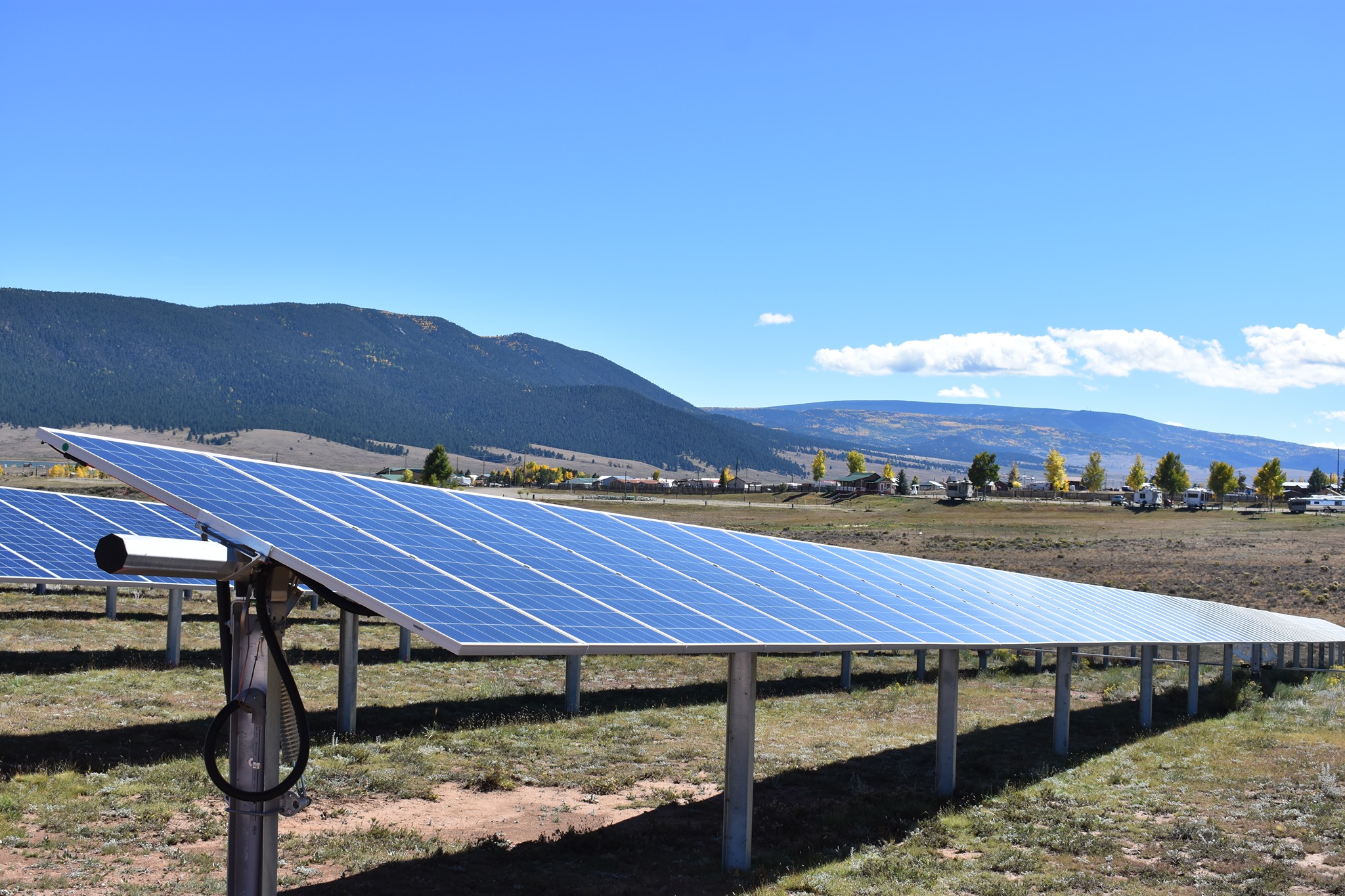
Kit Carson Electric announces solar and storage that will put the cooperative at 100% renewables during sunny days by 2021. The New Mexico cooperative will soon go to work on securing wind power. Photo credit: Allen Best/The Mountain Town News
The scientific community says that Moore’s newest film uses outdated facts to undermine renewable energy.
The film, titled “Planet of the Humans,” was released on April 21, ahead of Earth Day, and argues that the green movement is hypocritical in its environmentally friendly advocacy.
The film describes itself as “a wake-up call to the reality we are afraid to face: that in the midst of a human-caused extinction event, the environmental movement’s answer is to push for techno-fixes and band-aids.” Instead, the film’s producers say that economic concerns and population growth need to be addressed to effectively curb climate change.
Despite the premise, the film has been criticized by advocacy and scientific organizations for offering dated depictions of the technology companies aim to use to combat climate change.
Yale Climate Connections explained that the film, which follows environmental activist, journalist, and director Jeff Gibbs, draws false conclusions to portray clean energy sources in a negative light. Among the film’s arguments, it asserts that solar panels use more fossil fuels than they offset, electric cars are charged through coal-burning energy, as well as drawing issues with other renewables.
Experts point out that while some solar technology creation emits fossil fuels and that some electric cars run on coal-burning energy, the carbon offset is still comparably less than fossil fuel sources. So while renewable technology does have a carbon footprint, it is smaller than that of nonrenewable energy, making it more environmentally friendly.
Scientists have been quick to recognize this caveat and speak up.
Reported by The Guardian and Mother Jones, climate scientist and Pennsylvania State University Professor Michael Mann signed a letter authored by fellow documentary filmmaker Josh Fox demanding the film be retracted by Moore and Gibbs.
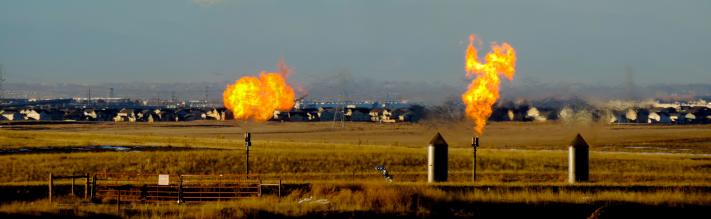
Natural gas flares near a community in Colorado. Colorado health officials and some legislators agree that better monitoring is necessary. Photo credit the Environmental Defense Fund.
What’s more, [the film] has nothing to say about fossil fuel corporations, who have pushed climate denial and blocked progress on climate policy for decades. Given the film’s loose relationship to facts, I’m not even sure it should be classified as a documentary.
There are real tradeoffs in the clean energy transition. As a scholar, I’ve done my fair share of research and writing on those exact issues over the past decade. Renewables have downsides. As do biomass, nuclear, hydropower, batteries, and transmission. There is no perfect solution to our energy challenges.
But this film does not grapple with these thorny questions; it peddles falsehoods. Films for Action, an online library of free progressive films, agrees with me. It briefly pulled the movie from its site, after documentary filmmaker Josh Fox wrote an open letter, co-signed by climate scientists and energy experts.
“We are disheartened and dismayed to report that the film is full of misinformation — so much so that for half a day we removed the film from the site,” Films for Action’s April 25 statement reads. “Ultimately, we decided to put it back up because we believe media literacy, critique and debate is the best solution to misinformation.”
Here, I will lay out the case for why this film should have stayed on the cutting room floor.
The film has several factual errors about clean energy
It’s not surprising that the film gets basic energy facts wrong and that information included is out of date: There are hardly any climate or energy experts featured.
Early in the film, Gibbs goes to see an electric vehicle demonstration. He concludes they are dirty because they probably run on coal.
Except it’s not true. Two years ago, electric vehicles already had lower emissions than new gas-powered cars across the country. This is because the US electricity system has been slowly getting cleaner over the past decade.
What made solar panels so cheap? Thank government policy.
The film’s wind and solar facts are also old. It quotes efficiency for solar PV from more than a decade ago. And it doesn’t mention the fact that solar costs have plummeted since then, and that we’ve learned how to get more wind and solar onto the grid. The film instead acts like this is impossible to do.
The largest share of the movie’s scorn goes to biomass — generally, burning wood — which supplied less than 2 percent of the US electricity mix last year. But the filmmakers obscure that fact, showing graphs that imply biomass is leading to forest destruction across the US.
A biased take on the environmental movement
There are critiques that can be made of environmental NGOs. But the way activists are portrayed in this film is inaccurate. One of the film’s main theses is that the climate movement is captured by corporations. As Gibbs puts it, environmentalists are “leading us off the cliff.”
The evidence for this assertion? The Union of Concerned Scientists’ support for electric vehicles. And Sierra Club’s promotion of solar. And the fact that 350.org has received funding from environmental foundations. I fail to see how any of these facts are problematic.
The most egregious attack is made against Bill McKibben, a dedicated and kind environmental leader. As he has said, he has never taken any money for his environmental activism with 350.org. Watching this film, you might mistake him for a robber baron.
McKibben wrote to the filmmakers, to clarify his views. They did not write back. As he put it: “That seems like bad journalism, and bad faith.”
[…]
Instead, the film denigrates the crucial work of the Sierra Club’s Beyond Coal campaign. Led by Mary Anne Hitt, this program helped stop the construction of 200 coal plants, and successfully pushed for the retirement of 300 others.
Rather than recognizing the Sierra Club’s achievement, the filmmakers falsely attribute the growth in natural gas to Beyond Coal. Alas, environmental groups are not in charge of planning new power plants: if they were, we would have a lot less fossil electricity. Utilities propose power plants to regulators, who approve them. Over the past decade, electric utilities have proposed an enormous amount of new gas facilities, which groups like the Sierra Club have opposed…
Why is Michael Moore promoting misinformation on climate change?
Throughout, the filmmakers twist basic facts, misleading the public about who is responsible for the climate crisis. We are used to climate science misinformation campaigns from fossil fuel corporations. But from progressive filmmakers? That’s new.
It’s difficult to understand Michael Moore’s motivations for blaming clean energy and environmental groups instead of fossil fuel companies or electric utilities. His previous films— like Roger & Me, Sicko, and Bowling for Columbine —were centered on holding corporations accountable. More recently, he endorsed Sen. Bernie Sanders at the same rally as climate champion Rep. Alexandria Ocasio-Cortez. The Sanders campaign centered on an ambitious 100 percent renewable energy goal.
Yet, the film Moore backed concludes that population control, not clean energy, is the answer. This is a highly questionable solution, which has more in common with anti-immigration hate groups than the progressive movement.
The fact is that wealthy people in the developed world have the largest environmental footprints — and they also have the lowest birthrates. When this message is promoted, it’s implying that poor, people of color should have fewer children.
Not to mention the fact that pushing population control is completely disrespectful of women’s reproductive autonomy. Notably, almost all the “experts” featured in the film are white men.
It is sad to think of the world we are leaving for children. Yet, if we embraced clean energy, then they would not have to grow up in a world tied to dirty fossil fuels…
We have already warmed the planet by more than 1°C, and we are running out of time to scale up clean energy. Planet of the Humans has sowed confusion at a time when we need clarity on the climate crisis.
My only hope is that this film will be buried, and few will watch it or remember it. Much like fossil fuels, it would be best left underground.
Leah C. Stokes is an assistant professor at the University of California Santa Barbara. Her new book, Short Circuiting Policy, examines electric utilities’ role in holding back progress on clean energy and climate policy.
Even before COVID-19 swept across Colorado and other states, concern over the cost of water had begun to rise.
Nearly 12 percent of American households lack access to affordable water, a number that is expected to triple in the next five years, according to a 2018 study from Michigan State University (MSU).
The good news: Western states are still able to provide relatively affordable water, but that could change as utilities try to recoup losses associated with the pandemic and begin to pay for the massive repairs and upgrades to their systems that were on the drawing board before COVID-19 struck.
Measuring affordability
In Colorado, newer infrastructure and conscious rate-setting has kept water largely affordable, as in most Western states. The MSU study found that less than 8 percent of Colorado’s census tracts were at “high risk” of an affordability crisis based on income, better than all but 12 other states. (“High risk” tracts were defined with a median income of less than $32,000, where rate increases would disproportionately affect ratepayers’ budgets.) Among the regions identified in the study as at risk were Denver, Pueblo, Colorado Springs, and Alamosa in the San Luis Valley.
Water systems built in the mid-century infrastructure boom or to comply with the Clean Water Act requirements of the 1970s are reaching the end of their useful life. That’s on top of the massive programs to replace lead and copper lines, the need to procure more water in drought-prone areas, and the cost of adapting infrastructure to cope with extreme weather from climate change.
According to the National Association of Clean Water Agencies (NACWA), water rates have risen faster than inflation since 2002.
And for customers on fixed incomes, even small increases can make a huge difference for their budgets.
“When we think about affordability, we’re not concerned about whether it’s expensive for someone to water their lawn. We want to know that people can cook, shower, clean, flush their toilets…the basic necessities,” says Manny Teodoro, an associate professor in the political science department at Texas A&M University.
States are grouped by EPA region. Colorado is in EPA Region 8, where the average annual wastewater charge in 2018 was $289—less than other regions. Graphic credit: Environmental Protection Agency
According to Denver Water spokesman Todd Hartman, most households the utility serves pay less than 1 percent of their income for water. Denver Water does not have specific numbers on how many households pay more than 1 percent for drinking water, Hartman says, but added that, “Socioeconomic conditions in the Denver Water service area compare favorably to U.S. averages and have continued to improve in recent years.”
But with costly repairs coming due, it will take a concerted effort to maintain high-quality infrastructure and deliver quality water, while keeping rates from ballooning in a way that disproportionately affects lower-income families.
In Colorado, drinking water infrastructure needs are estimated at more than $10 billion, according to the 2020 Colorado Infrastructure Report Card from the American Society of Civil Engineers, with a chunk of that cost going back to ratepayers. That’s prompted discussions about how to best fund those repairs—and how to make sure that no customer feels an unfair burden when utilities need more capital.
“The question of the [utility] bill has always been there, but it’s becoming more and more significant,” says Andrew Rheem, a senior manager with the Colorado-based consulting firm Raftelis, which has worked with utilities in Boulder, Greeley and Denver. “How it gets addressed is going to continue to evolve, but right now a lot of communities are just wondering how to find any solution.”
The cost of water
When water affordability enters the national conversation, it’s usually because of a crisis.
In 2014, the Detroit Water and Sewerage Department took an extraordinary step: In order to recoup unpaid bills, it shut off running water to more than 30,000 low-income households who were behind on payments. As the utility worked to put customers on a payment plan and restore service, the action drew a rebuke from around the world; even the United Nations sent a delegation to the city and deemed it “contrary to human rights.”
Traditionally, governments and utilities, including Denver Water, determine affordability with the EPA calculation that compares water and wastewater bills to a region’s median household income (MHI). If drinking water doesn’t exceed 2.5 percent of MHI and wastewater doesn’t exceed 2 percent, they are considered affordable.
According to Texas A&M’s Teodoro, the working poor are paying roughly 10 percent of their income on water nationally. That number could rise if economic trends continue.
“In a lot of communities, things like rent and energy are going up faster than incomes are,” Teodoro says. “Both the numerator and the denominator are going in the wrong direction.”
Most of the pain, however, is likely to be felt in the American South, where incomes are lower and infrastructure is in more desperate need of repair. Cities in the Northeast, where pipes can date back to the early 1900s and the income gap is wider, are also in greater danger.
Elizabeth Mack, who authored the MSU study, says affordability is posed to be a “burgeoning crisis.” It already weighs on households that are struggling with high rents, energy bills and food costs, but could soon rise even more.
“You can start seeing problems affecting households we consider lower-middle income,” Mack says. “These households are already squeezed from a variety of perspectives. If incomes were going up a lot, this might not be an issue, but they’re just not.”
The crisis also breaks along color lines. In a 2019 report, the National Association for the Advancement of Colored People found “a clear connection between racial residential segregation and black access to water systems,” including rising rates that disproportionately affected black neighborhoods.
The West, however, has largely avoided those problems. In Teodoro’s national analysis, he found that Western states had, on balance, more affordable rates than the rest of the country. NACWA’s annual Cost of Clean Water Index found that EPA Region 8 (Colorado, Utah, Wyoming, Montana, North Dakota and South Dakota) had the lowest average wastewater charge of any region, with a $289 annual average compared to the $504 national figure.
That’s in part because of less urgent infrastructure needs. Although much of Colorado’s water infrastructure dates back to at least the 1960s, it’s still in better shape than pipes and treatment plants in other parts of the country. The American Society of Civil Engineers estimates that Colorado needs $10.19 billion in drinking water infrastructure improvements over the next two decades, a huge bill but less than other states like Pennsylvania ($16.77 billion), Alabama ($11.26 billion), and Ohio ($13.41 billion).
Even areas where income levels could signal affordability challenges have kept water rates low. The San Luis Valley was a high-risk tract in Mack’s study, based on median income, but rates in the City of Alamosa are not a serious burden for residents. Heather Brooks, city manager for Alamosa, said the city has, if anything, kept rates too low to cover capital costs. A half-cent sales tax dedicated to water infrastructure has helped defray those costs.
Pueblo Water spokesman Joe Cervi likewise said that the utility has lowered costs by keeping a lean staff and planning ahead for major repairs. According to city data, the average bill for 11,000 gallons is $53.15, well below the Front Range average of $62.82.
A helping hand
Often, affordability can butt up against one of the biggest priorities for Colorado utilities: conservation. In 2014, Longmont Water decided to encourage conservation by charging customers based on use, rather than the lifeline rate that charged everyone the same amount for their first 2,000 gallons. There was concern, however, that the change could punish families who need lots of water to shower and cook, says Becky Doyle, a rate analyst and manager for the City of Longmont’s Department of Public Works and Natural Resources.
“A grandma who lives by herself can keep the water bill low, but that’s not the only kind of low-income household composition we need to be worrying about,” Doyle says. “Low-income households aren’t all low water users.”
Longmont already had a rebate program for fixed-income seniors, but extended that benefit to any household eligible for the Low-income Energy Assistance Program (LEAP). But, in a sign that water isn’t top of mind for many households, only two additional applicants signed up in the first year. Expanded outreach has garnered about 130 participants, but Doyle acknowledged that’s still not everyone.
Facing much-needed infrastructure repairs, other utilities across the state have sought to blunt the impact to customers with their own expanded assistance programs. Denver Water, for example, has some 140 projects planned for the next five years, which call for higher customer bills. After a rate increase in 2019 that added roughly 55 cents per month for urban customers (the increase was between $1.90 and $3.40 per month for suburban households), the board has approved another increase for 2020 that will add about a dollar more per month. (For suburban households, the increase will be between $1.15 and $1.36.)
The increases to the fixed monthly charge, which is associated with the meter size, are being done slowly to even out revenues year to year, and to limit the impact on the community, the utility says. Denver also uses a three-tiered charge and assesses indoor use, such as flushing toilets, cooking and bathing, at the lowest rate to reduce the burden on low-income families that, say, won’t pay for watering a lawn. The lowest rate is also measured during the winter, reflecting “essential, nondiscretionary usage,” Denver Water says.
Denver Water also offers assistance, like a one-time courtesy cancellation and payment extension for water shutoffs after delinquent payments and a pilot partnership with Mile High United Way to provide one-time bill relief and like other utilities has pledged to suspend shutoffs to help protect those who’ve lost their jobs as a result of the pandemic.
Elsewhere, utilities are exploring income-based structures that would ensure that the poorest families face the lowest cost burden. Philadelphia in 2017 rolled out a first-in-the-nation structure that charged lower rates for households at or below 150 percent of the federal poverty line, which some experts predicted would actually increase revenues by reducing missed or late payments. Baltimore, where some poor black residents have complained of triple-digit bills, has also debated a similar structure, and advocates are watching closely to see if the model could be expanded to more cities that are facing payment crises.
Is there a fix?
For utilities, providing service without raising rates would be easiest with an influx of federal funding. Washington has been talking about water infrastructure assistance, including through the proposed LIFT Act (Leading Infrastructure for Tomorrow’s America Act), and under some of the COVID-19 relief measures, money may be provided to help utilities offset their infrastructure costs.
And all the while, drinking water standards and infrastructure costs will only pile up. That, says MSU’s Mack, means utilities need to start planning to avoid the worst impacts.
“We can’t say what’s going to happen, but there could be some big spikes in bills if all this deferred investment comes up at one time. The risk is when that gets to households that are already being squeezed,” she says.
An earlier version of this article appeared in the Spring 2020 issue of Headwaters magazine.
Jason Plautz is a journalist based in Denver specializing in environmental policy. His writing has appeared in High Country News, Reveal, HuffPost, National Journal and Undark, among other outlets.
Fresh Water News is an independent, non-partisan news initiative of Water Education Colorado. WEco is funded by multiple donors. Our editorial policy and donor list can be viewed at wateredco.org.
Gov. Jared Polis, even as COVID-19 swept across the state, gave his stamp of approval to five major pieces of water legislation, paving the way for everything from more water for environmental streamflows to a new study on how to limit water speculation.
Lawmakers announced March 13 that they would temporarily suspend work to comply with stay-at-home orders, and now plan to return May 18 to complete the session.
Signed into law in late March and early April, the new measures represent months if not years of negotiations between farm, environmental and legal interests that came to fruition this year thanks to hard-fought bipartisan agreements.
Three of the new laws address water for streams, fish and habitat, allowing more loans of water to bolster environmental flows, protecting such things as water for livestock from being appropriated for instream flows, and using an existing water management tool, known as an augmentation plan, to set aside water rights for streams.
Expanded instream flow loans
House Bill 1157 expands the state’s existing instream flow loan program, which allows a water right holder to loan water to the Colorado Water Conservation Board to preserve flows on streams where the state agency already holds an instream flow water right. The CWCB is the only entity in Colorado that can legally hold such rights, intended to benefit the environment by protecting a stream’s flows from being diverted below a certain level. Under existing law, a loan may be exercised for just three years in a single 10-year period.
The new law, however, expands the loan program by authorizing a loan to be used to improve as well as preserve flows, and increases the number of years it can be exercised from three to five, but for no more than three consecutive years. It also allows a loan to be renewed for two additional 10-year periods.
“This bill becoming law is crucial for our state’s rivers, our outdoor recreation businesses, and downstream agricultural users who depend on strong river flows,” said Rep. Dylan Roberts, D-Avon. After a similar bill he sponsored failed to pass last year, he said, “I knew I needed to work to bring more people to the table and improve the bill so we could garner the support we needed, and that is what we did. I am thrilled that we were able to get this done with strong bipartisan support.”
To ensure protection of existing water rights, House Bill 1157 increases the comment period on loan applications from 15 to 60 days; allows appeal of the State Engineer’s decision on a loan application to water court; and requires the CWCB to give preference to loans of stored water over loans of direct flow water where available.
“There’s no injury to other water uses. And there’s a methodology if someone feels they are injured they can go to the water referee in an expedited manner,” said Rep. Perry Will, R-New Castle and one of the bill’s sponsors.
Protecting existing water uses
House Bill 1159 provides a means for existing water uses, such as water for livestock, that have not been legally quantified to continue when an instream flow right downstream is designated. Current law is unclear as to whether preexisting uses that lack a court decree are protected. To provide clarity, the bill requires the State Engineer to confirm any claim of an existing use in administering the state’s instream flow program.
Augmentation of instream flows
House Bill 1037 authorizes the CWCB to use an acquired water right, whose historic consumptive use has been previously quantified and changed to include augmentation use, to increase river flows for environmental benefits. Farmers have long used so-called augmentation water to help offset their water use, particularly of groundwater, when that use is not in priority within Colorado’s water rights system. Now that same water can be used to boost environmental flows.
Anti-speculation study and water conservation in master planning
Beyond instream flows, Gov. Polis signed Senate Bill 48, which requires the Colorado Department of Natural Resources to form a working group to explore ways to strengthen anti-speculation laws. The agency must report its recommendations to the interim Water Resources Review Committee by Aug. 15, 2021.
Also signed into law was House Bill 1095, which authorizes counties and municipalities that have adopted master plans that contain a water supply element to include state water plan goals and conservation policies that may affect land development approvals.
Larry Morandi was formerly director of State Policy Research with the National Conference of State Legislatures in Denver, and is a frequent contributor to Fresh Water News. He can be reached at larrymorandi@comcast.net.
Click here to read the newsletter. Here’s an excerpt:
HPRCC Staff Conduct Climate Summary Workshop for Tribes in the Region
As part of a Bureau of Indian Affairs-funded tribal resilience project, HPRCC staff developed and conducted the “Lower Missouri River Tribes Resilience Training Climate Summary Workshop” in mid-March for tribal environmental professionals from nine tribes in EPA Region 7: Iowa Tribe of Kansas and Nebraska, Kickapoo Tribe in Kansas, Omaha Tribe of Nebraska, Ponca Tribe of Nebraska, Prairie Band Potawatomi Nation, Sac and Fox Nation of Missouri in Kansas and Nebraska, Sac and Fox Tribe of the Mississippi in Iowa, Santee Sioux Tribe of Nebraska, and Winnebago Tribe of Nebraska. The workshop was one in a series of workshops that are part of a larger project aiming to increase tribal resilience to climate change and extremes. While the workshop was supposed to take place on the Winnebago Reservation in Sloan, IA, the workshop ended up being conducted remotely via Zoom due to the COVID-19 pandemic.
The workshop began with a series of presentations that introduced participants to basic climate concepts, the climate of the region, including trends and projections, and the process for creating a climate summary. Much of the rest of the workshop was hands-on, as participants had the opportunity to explore tools and obtain data on general climate conditions, drought and vegetation, stream- flow and snowpack, and climate outlooks.
A flight from NASA’s Airborne Snow Observatory gathers data about the snowpack above the reservoir on a June 24 flight. Information gathered from the flight helped Denver Water manage reservoir operations. Photo courtesy of Quantum Spatial
From the Colorado River District via The Rio Blanco Herald-Times:
A growing body of research shows that the Upper Colorado River Basin is growing warmer on average. In fact, the national hot spot centers on Western Colorado and much of the Southwest.
A result: a significant reduction in the snowpack that makes up the Southwest’s main water supply.
In the Colorado River District’s “Know Your Snow” webinar, Deputy Chief Engineer Dave Kanzer and National Snow and Ice Data Center researcher Jeff Deems explored how water managers and snow scientists are studying and adapting to the changes to our snowpack and water supply.
About three-quarters of the snowmelt that forms the Colorado River’s flow falls as snow at elevations above 8,500 feet in the mountains of the Upper Colorado Basin, Kanzer explained. Deems pointed out that the 15 Western Slope counties that make up the Colorado River District have warmed at a rate from about 2 degrees Fahrenheit in Summit County to more than 4 degrees in Mesa, Montrose, Ouray and Rio Blanco counties since about the early 1900s, according to data developed by the National Oceanic and Atmospheric Administration.
“We’re seeing changes on the order of 4 or 5 degrees in parts of the District,” Deems said. “This is just a slice out of this big, warming bullseye that is hitting the Upper Colorado (River) Basin over that time period. This is a problem for us because we rely on the snowpack, and that’s because warming reduces stream flow through a number of different mechanisms in this snowmelt-dominated basin.”
That reduction comes from several factors: more snow falling as rain, earlier spring snowmelt, more snow directly evaporating into the atmosphere instead of melting into streams and a longer growing season that has plants taking up more water.
Deems explained that for every 1 degree of warming, there is an estimated 3 to 4% decline in annual runoff. That’s about double the amount of water Las Vegas uses in one year, and 18 months of water supply for the city of Los Angeles, Deems said.
A recent study by the U.S. Geological Survey found that a decline in flow due to warming is even greater than earlier studies have shown, with statistics suggesting that average annual flow decreases by 9.3% for every 1.8 degrees of warming.
All of this poses a threat to drinking water, irrigation to grow our food and water to maintain healthy wildlife habitats. The Colorado River District is not only studying the water-supply risks posed by warming temperatures but also implementing solutions such as cloud seeding to make sure West Slope communities are prepared for future challenges.
Cloud-seeding graphic via Science Matters
Cloud seeding to increase snowpack
As part of an effort to boost snowpack, Kanzer coordinates the Colorado River District’s cloud seeding program. Increasingly, water managers are turning to cloud seeding, a practice that can increase how much snow winter storms produce.
“We’re trying to figure out how to mitigate and adapt to a changing world,” Kanzer said. “We’re doing this through cloud seeding, and (we’re) implementing these programs throughout Western Colorado. In fact, this is going on throughout the West and throughout the world.”
Cloud seeding requires a specific set of conditions to be successful, Kanzer explained. A cloud must contain super-cooled water. Water vapor in these clouds is cold enough to form ice crystals, around 5 to 23 degrees Fahrenheit, but it needs something on which to crystalize. When conditions in a storm system are right, with favorable winds with proper uplift, cloud seeding generators send tiny particles of silver iodide into the moisture-laden clouds, typically using propane-fired burners on the ground.
Silver iodide has been proven to be safe for the environment, Kanzer said, adding that it is effective because and it naturally has a similar crystal structure to the ice crystals that form snowflakes.
The super-cooled liquid water more efficiently freezes on to these introduced tiny particles of silver iodide, building small ice crystals that grow into snowflakes.
Kanzer said cloud seeding could increase snow on the ground by up to 15%, boosting what might have been a 10-inch snowstorm by 1.5 inches. After a successful season of cloud seeding, this might, in turn, lead to as much as a 5% increase in streamflow in watersheds where cloud seeding occurred. This increases recreation opportunities for skiers in the winter and boaters in the warmer months, he added.
“And it helps us with our water supplies, of course, and that’s what we’re really focused on here at the Colorado River District,” Kanzer said.
This map shows the snowpack depth of the Maroon Bells in spring 2019. The map was created with information from NASA’s Airborne Snow Observatory, which will help water managers make more accurate streamflow predictions. Jeffrey Deems/ASO, National Snow and Ice Data Center
Improving predictions with better data
While Kanzer’s work focuses on increasing the amount of snowpack, Deems’ research seeks to better understand what snow we have.
He explained that water supply forecasts are traditionally generated by comparing the current amount of snow on the ground at fixed locations to historical streamflow records. With the changes we are experiencing, Deems said these methods of comparing the present to the past are no longer accurate.
Additionally, snowpack is measured by a network of weather stations widely spread out across the mountain landscape where Colorado’s snowfall accumulates. While these stations provide accurate measurements in very specific locations, they don’t indicate how much snow, and how much water, might be stored high in the mountains, above the elevations where these stations are located.
Deems’ company, the Airborne Snow Observatory, uses a system called light detection and ranging — LIDAR for short — to measure snow across the entire landscape. From a plane, Deems’ team sends pulses of scanning laser light toward the earth, which reflect off the snow. Researchers can then use information in the reflection to build a three-dimensional picture of the snowscape.
This technology gives snow scientists and water planners landscape-based information about how much snow, and water, is present. This technology is detailed enough to reveal the deep pockets of snow below bare slopes where avalanches occurred or even areas where snowmaking was used to make terrain parks on a ski run.
This more comprehensive of the snowpack significantly improves water supply forecasts critical to water managers in making decisions.
Together with cloud seeding, this technology is helping water managers turn the corner from historical practices to prepare for and adapt to a changing world in the Upper Colorado River Basin.
Screen shot from this episode of “Tom Talks” April 2020.
Here’s a great stay-at-home video from Tom Cech at the One World One Water Center at Metropolitan State University of Denver (Go Roadrunners!)
“Join us in welcoming MSU Denver’s Dr. Matthew Makley on our second TomTalks! Dr. Makley teaches us about the Hohokam people and their relationship to water in the arid American West.”
West wall of the Casa Grande ca. 1880. “Casa Grande” is Spanish for “big house” (Siwañ Wa’a Ki: in O’odham); these names refer to the largest structure on the site, which is what remains of a four-story structure that may have been abandoned by 1450. The structure is made of caliche, and has managed to survive the extreme weather conditions for about seven centuries. The large house consists of outer rooms surrounding an inner structure. The outer rooms are all three stories high, while the inner structure is four stories high. The structures were constructed using traditional adobe processes. The wet adobe is thicker at the base and adds significant strength. Photo credit: By National Forest Service – http://www.nps.gov/cagr/photosmultimedia/Historic-Photos.htm, Public Domain, https://commons.wikimedia.org/w/index.php?curid=16977952Arizona Rivers Map via Geology.com.
This map shows the snowpack depth of the Maroon Bells in spring 2019. The map was created with information from NASA’s Airborne Snow Observatory, which will help water managers make more accurate streamflow predictions. Jeffrey Deems/ASO, National Snow and Ice Data Center
In the next 16-45 years, two-thirds of Western states may have to turn away from snowpack and find new tools to predict drought.
And by the late century, scientists estimate that area will grow to four-fifths of the western United States, according to a new paper in Nature Climate Change.
Ben Livneh. Photo credit: The University of Colorado
“When the temperature warms, the phase of the precipitation is likely to change from snow to rain. So less snowpack is something that’s pretty likely,” said lead author Ben Livneh, an assistant professor of civil, environmental and architectural engineering at the University of Colorado Boulder.
Water managers typically rely on artificial dates like April 1 when the snowpack is highest to predict drought. But in the coming decades, they’ll have to develop other tools like soil moisture and perhaps even satellite data to make the call.
To come up with his conclusions, Livneh analyzed the output of 28 climate models using statistical tools.
The one bright spot for Colorado is that locations above 10,000 feet of elevation will see snowpack well throughout the 21st century. Compare that to the Pacific Northwest, where water managers there could start seeing significant snowpack decline in the next 15-20 years.
Livneh said he’s hopeful that scientists will expand existing tools for water managers, and develop new ones.
Here’s the release from the University of Colorado (Kelsey Simpkins):
On April 1, water managers across the West use the amount of snowpack present as a part of a simple equation to calculate the available water supply for a given region that year. Historically, this method has accurately predicted whether large areas of the western U.S. will experience drought and to what degree. But new research from CU Boulder suggests that during the 21st century, our ability to predict drought using snow will literally melt away.
By mid-century, over two-thirds of western U.S. states that depend on snowmelt as a water source will see a significant reduction in their ability to predict seasonal drought using snowpack, according to the new study out today in Nature Climate Change. As we approach 2100, this area impacted by reduced drought prediction ability will increase to over 80%.
While measurements of soil moisture, rainfall and temperature can all help assess the chances of coming drought, even when those are taking into consideration, two-thirds of western states are projected to lose much of their ability to predict it.
“Although these other measurements increase a forecast’s accuracy, the loss of snow is something that we’re not going to be able to compensate for easily,” said Ben Livneh, author of the paper and a Fellow in the Cooperative Institute for Research In Environmental Sciences (CIRES).
Snowpack is a crucial source of water for the western U.S., where as much as 75% of freshwater originates as snow. It is also the most relied upon element of annual drought prediction in the region.
Coastal areas that receive water from nearby snowy mountains, like northern California, and regions at lower elevations, like the Washington Cascade Mountains, will be most affected. This is due to the fact that in these areas, less precipitation will fall as snow and they will lose their snow sooner from warming temperatures.
Higher elevations, including the Colorado and Northern Rocky Mountains, will keep their snowpack for longer and be able to continue relying on it as part of their predictive equations. But by the end of the century, even Colorado will not be immune to losing significant snowpack, and therefore, losing accuracy in its seasonal drought prediction.
“If you don’t accurately predict a year without drought, there’s less impact,” said Livneh, an assistant professor of Civil, Environmental and Architectural Engineering. “But there is so much to lose in a drought year by not being prepared for it.”
The point of prediction
The paper is the first to assess what vanishing snowpack might mean for future drought predictability.
Using 28 climate models looking at critical water-producing areas of the mountainous western U.S., Livneh and co-author Andrew Badger, formerly at CIRES, now an associate scientist in the Hydrological Sciences Lab at the NASA Goddard Space Flight Center, simulated snow pack, melt water, stream flow, water storage and evaporation. They calibrated these models more than 20 times against historical data from 1950 to present, to see if they could accurately predict how snowpack impacted streamflow in the past before applying these models to the future. Once satisfied with the models, they ran them up to 2100.
The researchers found that further into the future, snowpack alone became less and less accurate at predicting drought due to the reduction, and eventually, the complete loss of snow at many lower elevations. Between 2035 and 2065, 69% of the western U.S. will see a reduction in accurate seasonal drought prediction on the basis of snow information, with the affected areas increasing to 83% of the greater West between 2070 and 2099.
This reduction in drought prediction ability will affect everything from agriculture and drinking water supplies, to hydropower and flood control. It might increase our reliance on reservoirs, which could fill at different times of year and complicate how cities and states receive their water.
Regions which rely primarily on snow for drought pediction should be looking not only to other methods, but also to places nearby that observe snow at higher elevations, recommends Livneh.
The researchers hope to directly work with regional water managers in Colorado, which will be less affected, as well as those in the Pacific Northwest – which may see some of the biggest impacts of lost snowpack on drought predictability – to plan and adjust to this quickly changing equation.
“This is one way in which the connection to climate change is very clear, and the changing snow landscape has a major impact. Our drinking water, our water supply, for example, is something we take for granted,” said Livneh. “That’s something people should think about: Is that always going to be the case?”
Rancher and fly fishing guide Paul Bruchez’s daughter and nephew sit in a hay field at the family ranch near Kremmling. Bruchez is helping spearhead a study among local ranchers, which could inform a potential statewide demand management program. Photo credit: Paul Bruchez via Aspen Journalism
The Colorado River begins high in the Rocky Mountains of northern Colorado at Poudre Pass before flowing south and then west into Grand County, through the town of Kremmling, a small ranching community of just over 1,400 people.
It’s a hard place to have a ranch. The soils are sandy, and at over 7,000 feet, the growing season is short. But the real challenge is water. Powerful Front Range water utilities such as Denver Water own many of the senior water rights in Grand County, leaving many ranchers fearful of the day when the city might need the water they rely on to irrigate.
Paul Bruchez, a fifth-generation rancher and fly-fishing guide who raises cattle on 6,000 acres near Kremmling, knows firsthand the hardship caused by water shortages. In 2000, his father sold the family’s original homestead on the Front Range and bought two new ranches in Grand County, hoping for a fresh start away from the rapidly encroaching city. One of the property’s water rights was owned by Denver Water, which had agreed to lease it for 50 years — so long as the city could use the water in times of extreme drought. That time came just two years after Bruchez’s father bought the ranch, in 2002, leaving the family without enough water to irrigate. Forced to fallow half their fields, Bruchez’s family struggled to pay their mortgage.
The crisis prompted Bruchez to get involved in state-level water negotiations so he could help figure out creative solutions to the kind of problem his family faced. In 2015, he became an agriculture representative to the Colorado Basin Roundtable, where the concept of “demand management” began dominating conversations last year. At the heart of a demand-management program is paying irrigators on a voluntary, temporary and compensated basis to leave more water in the river in an effort to bolster levels in Lake Powell and help the state meet its downstream obligations.
Under the Colorado River Compact, Colorado and the three other Upper Basin states (Wyoming, Utah, and New Mexico) must send 7.5 million acre-feet to Lake Powell every year for the three Lower Basin states (California, Arizona and Nevada). Failing to meet those obligations triggers a so-called “compact call,” where junior water rights holders throughout the Upper Basin would see their water cut off — a disastrous situation that water managers are desperate to avoid.
The Colorado River Commission, in Santa Fe, in 1922.
To address that threat, the Colorado Water Conservation Board (CWCB), the agency charged with managing the state’s water resources, voted last year to begin studying the feasibility of a demand-management program. But there was a problem: Although the fields in a potential demand-management program would be at various altitudes, scientists do not have much data on the impacts of reducing irrigation water on higher elevation pastures. Bruchez saw an opportunity to help those efforts by recruiting his ranching neighbors to participate in a study that would help fill the current data gap on fields such as those in the Kremmling area.
“This is our opportunity to participate in the process,” Bruchez told them. Ranchers were receptive, but they had questions. A lot of questions. How, for instance, would they get enough hay to feed their cattle if some of their fields were out of production? How would one rancher’s curtailing of water on his fields affect his neighbors’ fields? How much water savings do you achieve and what happens to the lands themselves? How quickly do they recover?
Bruchez knew that the answers to those questions could be crucial determiners for Colorado’s demand-management investigation.
“If we do this project, it could equally indicate the lack of viability or it could indicate that this is a really great opportunity,” he said. “But at least we’ll be making those decisions based on science rather than emotions or policy without real data.”
Rancher and fly-fishing guide Paul Bruchez raises cattle on 6,000 acres near Kremmling. Bruchez has taken an active role in Colorado River issues ever since his family suffered from a critical water shortage during the 2002 drought. Photo credit: Russ Schnitzer via Aspen Journalism
Demonstration project
Bruchez, 36, is somewhat of a guru for the ranching community in the Colorado water world, participating in numerous river-restoration projects and various water focus groups in addition to his role on the Colorado Basin Roundtable, one of nine groups representing each of Colorado’s main river basins (as well as the Denver area) composed of various stakeholders working to address the state’s water challenges.
In 2012, he helped create a partnership among local ranchers called the Irrigators of the Lands in the Vicinity of Kremmling (ILVK) to secure grant funding for river-restoration initiatives such as stabilizing riverbanks and reviving irrigation channels across a 12-mile stretch of the Colorado River.
Late last fall, Bruchez began discussing the idea of a water-saving study with the ILVK, and by February he had five volunteers (with the potential for two more). Among them, they had 1,200 to 1,500 acres ranging in elevation from 7,300 to 8,300 feet in which to study the ecological and economic impacts of full- and partial-season irrigation curtailment on hayfields.
In March, the CWCB awarded Bruchez’s project a $500,000 grant under its Alternative Agriculture Water Transfer Method program, which supports proposals that offer ways to boost water supplies without relying on traditional “buy and dry” transactions. The remaining funding for the $900,000 project is coming from American Rivers, Trout Unlimited, The Nature Conservancy and private donors.
Some of the ranchers will irrigate their participating fields as normal for half a season — until June 15 — before cutting off their water, while others will not irrigate at all. For the split-season irrigation, ranchers will be compensated at $225 per acre with an additional $56 per acre of risk-mitigation payment (to pay for general upkeep and other unanticipated damages that might result from the lack of irrigation). For full-season curtailment, ranchers will receive $414 per acre with an additional $207 per acre for risk mitigation.
For Bruchez’s neighbors such as Bill and Wendy Thompson, the study is an opportunity not only to help the state potentially avoid a major water crisis but to answer some of their own questions. The Thompsons ranch on 400 acres along the Colorado River a mile south of Kremmling with views of Longs Peak and Gore Range. After Bruchez broached the idea of studying the potential for an irrigation-reduction program on high-altitude pastures, the Thompsons volunteer two of their fields — one for a partial-season curtailment and the other as a “control” field, which they will irrigate as normal.
“We don’t know enough about our own consumptive use on these meadows,” Bill Thompson said. Maybe we’ll discover a new species of grass that’ll actually grow in this sandy soil.”
Conway Farrell, another Kremmling rancher whom Bruchez recruited, hopes the study will help yield the scientific research that water managers can use to create a demand-management program that will help agriculture in the long run.
“Everyone’s been talking about this for years,” Farrell said. “It’s time to finally do something.”
Colorado State University researchers led by Dr. Perry Cabot, a water-resources specialist, will use remote sensing to determine how much water plants consume on the ranchers’ pastures and how much they save by not irrigating on select fields. The researchers will also look at the recovery patterns and risks associated with subjecting pastures to different levels of irrigation curtailment.
Joe Brummer, the forage specialist for the state of Colorado and an associate professor at CSU, has conducted one of the few studies into the effects of partial- and full-season hay fallowing at different elevations in western Colorado. His findings, though limited in scope, are encouraging: While there are short-term losses, the fields recovered after a few seasons to within 10% of full production.
“Plants are resilient,” he said.
This mowed hay field is part of Reeder Creek Ranch, owned by the Bruchez family near Kremmling. Little data exists on the impacts of reducing irrigation water on higher elevation pastures like this one, but Paul Bruchez and a group of local ranchers have volunteered their fields for a study that will help scientists learn more about what happens to pastures that receive less irrigation water. Photo credit: Paul Bruchez via Aspen Journalism
Demand management
As Bruchez ironed out the details of his initiative last winter with ranchers, researchers and the other NGO partners, he had to tread carefully.
Amy Ostdiek, the deputy chief of CWCB’s Interstate, Federal and Water Information Section, emphasized that since the state is still in the initial stages of studying the feasibility of demand management, it’s too early to know how Bruchez’s initiative will play into those efforts. The other three Upper Basin states are in the middle of similar processes as part of the Drought Contingency Planning agreement that all seven Colorado River basin states signed last May.
“We can’t do anything until all Upper Basin states agree that demand management is feasible in their states,” Ostdiek said. “If other states agree that it is, then we get to the hard work of what that program would look like.”
Almost two decades ago, Bruchez’s family overcame their own water crisis by negotiating with Denver Water so that both the utility and Grand County’s agriculture community and environment could get the water they all need. For Bruchez, the experience was a lesson in the value of simple awareness and better management when it comes to solving seemingly intractable water issues.
Speaking from his ranch a couple of weeks ago via Zoom — an online video conferencing app used due to restrictions on in-person meetings because of the COVID-19 crisis — Bruchez felt more than ever the need to be proactive about a future water crisis.
“If people in Phoenix or Denver can’t drink water, what’re we going to do about it?” Bruchez said, adding that it’s no secret that agricultural water rights would be in jeopardy. “Trying to get ahead of this is super important.”
Aspen Journalism is a 501(c)(3) nonprofit organization supported by its donors and funders. This story ran in the April 15 edition of SkyHi News.
Ophelia Watahomigie-Corliss, a Havasupai tribal councilwoman, stands for a portrait by Red Butte, Kaibab National Forest, which was originally Havasupai land. “Let us rechristen the landscape here, changing the names of places, trails and springs back to the Indigenous names, the ones the tribes are comfortable sharing with the public,” she writes. Photo credit: Amy S. Martin via The High Country News
FromThe High Country News [April 14, 2020] (Ophelia Watahomigie-Corliss):
Since time immemorial, the Havasupai have lived inside the natural wonder. We face yet another peril.
If you were one of the 6.3 million people who visited Grand Canyon National Park last year, chances are you stood on the rim and noticed a green ribbon of trees thousands of feet below you. The National Park Service calls it “Indian Garden.” And it was truly a garden, once: Our Havasupai relatives, the Tilousi family, lived and gardened there a century ago, until the National Park Service kicked them out. The Bright Angel Trail hikers use to reach this area today is an old Havasupai trail. When the Fred Harvey Company set up its hospitality industry on the South Rim near the turn of the 20th century, they hired Havasupai and created a work camp for them called Supai Camp.
Last year, the park celebrated its centennial. There were special events, but I doubt you heard anything about us, the Havasupai — the Guardians of the Grand Canyon. You may not even know about Canyon Mine, the proposed uranium mine that threatens Havasu Creek, the entire water supply of the Havasupai Reservation. Historical erasure has made us invisible. Now, our very survival is at stake, and we are asking for your help.
Inside what you call Grand Canyon National Park, the Havasupai have lived since time immemorial. We still live here. Fred Harvey and the Santa Fe Railway reached the Grand Canyon in 1901, and thousands of tourists came in their wake. Billy Burro was the last Havasupai to live in Indian Garden, a place that had been enjoyed by our people for centuries. But industry began to dictate where Indians could and couldn’t be, and public areas were forbidden because it was considered bad for business. Discrimination was rampant. At the Grand Canyon, we Havasupais were no longer welcome on our own land, because now it was reserved for tourists. Eventually, it was taken away altogether. Grand Canyon became a national park in 1919, and Billy, together with all Havasupais, were kicked out of Indian Garden. The people were relocated to the Indian work camp, with little option but to work for the railway. These were heartbreaking times for us, as our home became a tourist attraction. We had to endure constant racism; people like Billy were given the last name “Burro,” for example, as if we were no more than pack animals.
It’s time Grand Canyon officials took some responsibility and helped educate visitors about our history, land and water. The South Rim was taken by the federal government to create Grand Canyon National Park, and Havasupai voices were ignored when we pleaded for our homeland. In the early 1930s, the Park Service burned Supai Camp to the ground, and our people, including elders and children, were loaded into covered wagons in the snow, taken to the canyon’s rim and forced to walk down a grueling 17-mile trail to Supai Village. That is where the Havasupai Reservation was created in 1880. Before that, however, Supai Village was used as our summer home. Our longtime winter home had always been the newly designated park, but now we had lost it forever. In the 1970s, the park hired a new superintendent, who shut off our food, septic and water supply. Fortunately, we already relied on the springs in the canyon, and so we weathered the assault.
In addition to supporting the Havasupai people, the waters in Havasu Canyon give life to an array of animals and plants. Photo credit: Amy S. Martin via The Grand Canyon Trust
Now we have a new threat to deal with. Fifteen miles from the park boundary is a uranium mine that threatens the entire water supply for the 426 permanent residents of the Havasupai Reservation. The mine shaft at Canyon Mine is 1,470 feet below the surface, and if it leaks, it will contaminate the Redwall-Muav aquifer, which discharges into Havasu Creek — our only source of water. We have been fighting uranium mining for 40 years, but we cannot do it alone, especially if we continue to be erased.
Havasuw’ Baaja means the people of the blue-green waters. Those waters are the waters of Havasu Creek, and we are the original Guardians of the Grand Canyon. Thousands of more recent arrivals have since settled this land, built homes and raised families on our ancestral lands, and we know they love the canyon, too. Like us, they’ve come to know the names of the mountains, trails and waters in the region. The Grand Canyon has called them here, to make their lives in this incredible corner of the world. We are not so different after all.
And now it’s time for them — and for everyone who loves the Grand Canyon — to stand with us, to get to know who we are, and to work with us toward a just and shared vision for the next 100 years of this national park. We want the park to recognize our histories and to share that story permanently at the visitor center — to find a place for us in all their exhibits and in permanent signage throughout the park. Let us rechristen the landscape here, changing the names of places, trails and springs back to the Indigenous names, the ones the tribes are comfortable sharing with the public. All park rangers, personnel, outfitters and river runners should receive cultural sensitivity training, so they can teach visitors about the true history of the land.
Congress should pass S.3127 – the Grand Canyon Centennial Protection Act. This law will protect the 1 million acres of public land surrounding Grand Canyon National Park from the catastrophic impacts of uranium mining; it will also protect our homes in Supai Village.
Often, we gather at Red Butte, one of our sacred sites, to protest the project. There, we educate people about the many efforts to shut down the Canyon Mine, which is just three miles away. We invite you to join us here.
You are invited to stand strong with us and help us protect this landscape we all love, which is also the place we call home — the Grand Canyon. We have been trying to do this for many years, and we will continue to do for all generations to come. Please join us.
Ophelia Watahomigie-Corliss is a Havasupai tribal councilwoman. Email High Country News at editor@hcn.org.
In June, a small team of PBT interns set out for the highest point in the Platte Basin watershed.
We had big intentions of catching 5-star media to fill in cracks for the Grays Peak scene in the upcoming PBT documentary featuring Mike and Pete’s 55-day, 1,300-mile journey across the watershed.
Grays and Torreys, Dillon Reservoir May 2017. Photo credit Greg Hobbs.
Grays Peak is the highest point in the Platte Basin watershed. The mountain, located west of Denver in the Front Range of Colorado, is ranked as the tenth-highest summit of the Rocky Mountains of North America. With the top reaching an elevation of 14,278 feet, it may be considered to some as quite a commitment to reach the top.
The beginning of the trip went as intended. We had the car loaded with all of our equipment and prepared a schedule that would allow us enough time to focus on what we needed to do, or so we thought.
After incidents of altitude sickness, a split hiking boot, bird invasions, and a major bear spray accident, we all accepted our humorous situation of what the trip turned into. We came back with quite the story for the rest of the PBT team. Nevertheless, we agreed the trip had been a successful one and after arriving back in Lincoln, made the best out of what we managed to capture.
The Platte River is formed in western Nebraska east of the city of North Platte, Nebraska by the confluence of the North Platte and the South Platte Rivers, which both arise from snowmelt in the eastern Rockies east of the Continental Divide. Map via Wikimedia.
A confined aquifer is an aquifer below the land surface that is saturated with water. Layers of impermeable material are both above and below the aquifer, causing it to be under pressure so that when the aquifer is penetrated by a well, the water will rise above the top of the aquifer.
A water-table–or unconfined–aquifer is an aquifer whose upper water surface (water table) is at atmospheric pressure, and thus is able to rise and fall. Water-table aquifers are usually closer to the Earth’s surface than confined aquifers are, and as such are impacted by drought conditions sooner than confined aquifers.
It’s not just that rivers make our lives better. We cannot survive without them.
Healthy rivers give us critical services, from clean drinking water to flood protection. They support local businesses and strong economies. They give us opportunities to get out, be healthy, and enjoy the beauty and wonder of the natural world. And rivers connect us — to each other and to our future.
But climate change threatens our rivers and all of the benefits they provide. Maybe you’ve seen the impacts where you live: devastating floods, massive superstorms, crushing droughts.
That’s why now is the time to be bold. To make sure our rivers and water withstand the damage climate change will inflict. And to make sure people of color, low-income communities and Indigenous Peoples — who will be hardest hit by the climate crisis — can take the lead on crafting the solutions and making the decisions that will shape their lives.
America’s Most Endangered Rivers® of 2020 highlights what’s at stake — and the solutions we can choose to create a better future.
Life needs rivers, and rivers need us.
Please enjoy the article below and then Click here to become a member at Water Education Colorado.
From Water Education Colorado (Laura Paskus and Caitlin Coleman):
Interstate 70 and a Nestle Purina pet food factory loom above northeast Denver’s Elyria-Swansea neighborhoods. By Matthew Staver
When Water Justice is Absent, Communities Speak Up
Two years ago, a company that analyzes property data crunched the numbers on more than 8,600 zip codes in the United States and found that America’s most polluted neighborhood was in northeast Denver. The study, from ATTOM Data Solutions, shows that Denver’s 80216 zip code, which includes Globeville, Elyria-Swansea and River North, topped its “environmental hazard index.” As of 2017, the U.S. Environmental Protection Agency’s Toxic Release Inventory reported that 22 facilities were still releasing toxic chemicals in 80216, chemicals such as nickel, lead, methanol, creosote and more.
“The neighborhood is parked between gas refineries, the former airport, and then, also, what was at one time an Army base making mustard gas,” says University of Denver law professor Tom Romero, II, who has spent his career dissecting the factors behind environmental injustices in Colorado. There are two Superfund sites and six brownfield sites in 80216, plus the knot of Interstate 70 and Interstate 25 severs the neighborhood from the rest of Denver and increases pollution from highway traffic. The area is also home to a predominantly low-income, Hispanic and Latinx community, says Candi CdeBaca, Denver City Councilwoman for northeast Denver’s District 9.
Last year, CdeBaca became the first person from the neighborhoods to represent on the Denver City Council, ever. She points to an opposition campaign to the Central 70 Project as the beginning of the neighborhood rallying to achieve representation against environmental inequities.
The Central 70 Project broke ground in 2018 to widen the highway through Denver. It will demolish the viaduct that carries I-70 over Elyria-Swansea, replacing it with a below-grade highway. Residents had a list of worries: losing their homes to eminent domain, living even closer to the highway, and unearthing a Superfund site, which they feared would re-expose harmful heavy metals and increase health risks, CdeBaca says.
Their opposition campaign didn’t stop the highway work, but the community came together and won in one sense—the Colorado Department of Transportation will pay for a long-term health study, collecting data to determine whether toxins in the air, soil and water are making residents sick. They also gained a louder voice. “Those losses were the first start of me galvanizing some community power around environmental racism,” says CdeBaca. “Now we have this amplification of groups who never had representation in our government from the neighborhoods that were polluted.” She points to the importance of local voice and representation in all issues, particularly for communities that want to bring about environmental justice. “There is nothing that I support more than activating people power,” CdeBaca says.
With water affordability, access and quality challenges—all of which can translate into health impacts—the role of water in Colorado isn’t always one of fostering healthy communities, yet it could and should be. What contributes to these less-than-whole communities? And what does it take to recognize the issues and how they evolved, address power imbalances, engage the community, and restore equity where it’s been missing?
What is Environmental Justice?
Environmental injustices in Colorado, or anywhere, can span cities and suburbs, sovereign tribal lands, and rural communities. They have their roots in narratives of immigration, development and industry, and political power dynamics, further influenced by evolving legal and regulatory frameworks.
In 1990, EPA Administrator William Reilly created an Environmental Equity Workgroup to assess evidence that “racial minority and low-income communities bear a higher environmental risk burden than the general population.” The agency, which went on to establish an Environmental Equity office in 1992, later changing its name to the Office of Environmental Justice in 1994, defines environmental justice as the “fair treatment and meaningful involvement of all people regardless of race, color, national origin, or income, with respect to the development, implementation and enforcement of environmental laws, regulations and policies.” It has since expanded to offer a range of programs that provide services from grant funding to technical assistance and training. It also runs a National Environmental Justice Hotline.
Another early definition of environmental justice came from University of Michigan professor Bunyan Bryant, who said it refers to places “where people can interact with confidence that the environment is safe, nurturing and productive. Environmental justice is served when people can realize their highest potential.”
Scholars add additional layers to the term—it’s not just about identifying who is or isn’t harmed but includes some form of restitution, says Kelsea MacIlroy, an adjunct professor and PhD candidate in the sociology department at Colorado State University.
“There are a lot of different ways to talk about justice that aren’t just about who and how but also about a long-term social justice component,” MacIlroy says. “Does the community actually have an authentic seat at the table in addressing the ills?”
80216 may feel it all. “Denver was segregated, and that segregation manifested itself in a variety of ways in terms of water,” Romero says. “It meant that Denver’s communities of color, particularly African Americans and Mexican Americans, were living in close proximity to the areas with heavy industry, where the affordable housing is.” That’s a pattern and practice, he says, that was established in the 20th century and continues today. Many environmental justice cases have similar roots, as repeated practices that ultimately create winners and losers.
When Government Fails
Americans watched one of the most high-profile environmental justice cases unfold in Flint, Michigan, in 2015 and 2016 when corroded lead pipes poisoned the population.
To save money, in April 2014, the city switched its drinking water source and began supplying residents with Flint River water that wasn’t treated under federal anti-corrosion rules. The population was predominantly black, and more than 40 percent of residents were below the poverty threshold. According to the National Institute of Environmental Health Sciences, no level of lead exposure is safe but higher lead exposure leads to more health challenges including anemia, kidney and brain damage, heart disease, decreased IQ and more. In children, the impacts are especially toxic.
In 2016, labor and community activists in Lansing, Michigan, called for Governor Rick Snyder to resign over the Flint water contamination crisis. The former governor did not step down—his term lasted through 2019. Photo by Jim West
Residents began noticing a rusty tint to their tap water in the summer of 2015, but it wasn’t until October 2015 that the governor ordered Flint’s water source switched. By then, though the new water was safe, the plumbing wasn’t—corroded pipes continued to leach lead into drinking water. Bottled water and free faucet filters to remove lead at the point of use were distributed.
More than five years after the crisis in Flint began, the city and its residents are still recovering. The city’s FAST Start program is removing and replacing lead and galvanized steel service lines across the city, but it’s a big, expensive job. FAST Start has been funded with $25 million from the State of Michigan and $100 million allocated by Congress through the Federal Water Infrastructure Improvement for the Nation Act of 2016. As of December 2019, less than 40 percent of the city’s pipes had been replaced, with many residents still relying on faucet filters or bottled water.
Fifteen state and local officials were charged with various crimes, including involuntary manslaughter—some took plea deals and most cases were dropped. Residents now mistrust their water and water providers. That mistrust has flooded the nation, with many more communities now coping with elevated lead levels and lead pipe replacement.
According to the independent Flint Water Advisory Task Force’s final report, released in 2016, breakdowns in protocol, dismissal of problems, and failure to protect people occurred at nearly every level of government. Not only were customers supplied with unsafe drinking water, government officials were slow to acknowledge the problems and rectify the issue by providing safe water. According to the 2016 report, the Flint water crisis is a “story of government failure, intransigence, unpreparedness, delay, inaction, and environmental justice.” Had there been local control of resources and decisions, they write, the problems wouldn’t have occurred in the first place.
Coping with Forever Chemicals
Flint’s toxic water is not unlike the water quality issues discovered in 2016 in the Colorado towns of Fountain and Security-Widefield. That’s when water providers and residents learned that PFAS chemicals, short for per- and poly-fluoroalkyl substances, were detected at levels above EPA’s new 2016 health advisory levels. The source of the chemicals: firefighting foam used for decades to extinguish training fuel fires at the U.S. Air Force’s Peterson Air Force Base. The Air Force now uses a replacement foam at the base, and in 2019, the Colorado Legislature enacted restrictions and bans on PFAS foam, but the damage has been done. PFAS are known as “forever chemicals” because they bioaccumulate and remain in the environment for a long time, with half lives (the amount of time it takes the chemical to decrease to half its original value) in humans of two to eight years, depending on the chemical. They have been linked to cancers, liver and kidney damage, high cholesterol, low infant birth weight, and other ailments.
“We ended up having 16 family members that lived within that area that had cancer, and five of them died of kidney cancer,” said Mark Favors, during a public event on PFAS at Colorado School of Mines in January 2020. Favors is a former resident of Security, a U.S. Army veteran, a PFAS activist, and member of the Fountain Valley Clean Water Coalition. “A lot of [my family] are military veterans. One of my cousins, while he was doing two combat tours in Iraq, the Air Force was contaminating their drinking water. That’s the crazy part. How they’ve admitted it and it’s just hard to get any type of justice on the issue,” Favors says.
Concerned members of the Fountain Valley Clean Water Coalition took a bus to Colorado School of Mines in January 2020 to hear fellow coalition member Mark Favors speak alongside experts about PFAS. Panelists included Dr. Christopher Higgens, an engineering professor working on PFAS cleanup at Colorado School of Mines; Rob Bilott, the attorney who fought DuPont on PFAS contamination in West Virginia; and others. Photo by Matthew Staver
These southern El Paso County towns aren’t home to what are often considered disadvantaged populations—the poverty rate is between 8 and 9 percent, slightly less than the statewide average; about 60 percent of residents are white, and about 20 percent are Hispanic or Latinx, according to the 2017 U.S. Census. However, census numbers don’t represent military personnel who temporarily reside in the area. According to El Paso County’s Health Indicators report, published in 2012, four military bases in the county employ 40,500 military personnel and about 21,000 contract personnel.
When EPA tightened its health advisory levels in 2016, they were 10 times more restrictive than what the agency had previously advised, and water providers realized they had a problem. They acted quickly to provide residents with free bottled water and water filling stations while they suspended use of the aquifer, then worked to broker deals to purchase clean water from other municipalities. Some of those deals were only temporary. Since June 2018, the City of Fountain has worked to get back on its groundwater supply, treating the groundwater with granular activated carbon units provided by the Air Force. Now it is working with the U.S. Army Corps of Engineers to construct a full, permanent groundwater treatment plant. The story in Security is similar—the Security Water and Sanitation District has been importing water, primarily from Pueblo Reservoir, to meet the needs of its residents since 2016, which involved building new pipelines and purchasing extra water from Colorado Springs Utilities—an added cost. Security avoided raising water rates for a time, paying those costs out of its cash reserves. By 2018, residents had to absorb a 15 percent rate increase, with another 9.5 percent increase in 2019.
The Army Corps of Engineers is constructing a treatment facility in Security, too, which should be complete by the end of 2020. Once the plant is finished, Security will switch back to a combination of groundwater and surface water, and rates should stabilize once the costs of those pipelines are recovered, says Roy Heald, general manager at Security Water and Sanitation Districts.
Who pays to protect the health of those who rely on this water? “What responsibility did [the Air Force] have in rectifying this? What about the local sanitation districts? They have to deal with this. It’s not their fault but they’re tasked with giving clean water,” says MacIlroy at Colorado State University.
“The Air Force really has stepped up,” Heald says. But they may have to step up further—in 2019, the Security Water and Sanitation Districts and the Pikes Peak Community Foundation, another affected entity, sued the Air Force to recoup the costs of purchasing and piping in clean water. Their lawsuit cites negligence for disposal of chemicals, remediation of contamination, and breaching a responsibility to prevent dangerous conditions on the defendant’s property. Heald wouldn’t comment on the pending lawsuit, but says, “As long as [cash] reserves are at an adequate level, if we received a windfall there would be no place else for it to go besides back to our customers.” Those recouped costs would likely take the form of lower or stabilized rates.
Residents are also pushing for justice through a class-action lawsuit brought by the Colorado Springs-based McDivitt Lawfirm, which has teamed up with a personal injury law firm in New York to file against 3M, Tyco Fire Products, and other manufacturers of the firefighting foam.
“There’s going to have to be some sort of accountability and justice for these people who unknowingly, for years, drank colorless, odorless high amounts of PFAS,” says Favors. He calls for better oversight and demands that polluters are held accountable.
As for coping with PFAS-related health challenges, there are still a lot of unknowns, but El Paso County was selected to participate in two national Centers for Disease Control and Prevention studies to better assess the dangers of human exposure to PFAS, and to evaluate exposure pathways.
Locally, the study and lawsuits might help recoup some financial damages—but PFAS-related water contamination isn’t isolated to these Colorado communities. In July 2019, the Environmental Working Group mapped at least 712 documented cases of PFAS contamination across 49 states. Lawmakers in the U.S. House of Representatives, hoping to implement a national PFAS drinking water standard, estimate the number is even higher: 1,400 communities suffer from PFAS contamination. A U.S. Senate version of a PFAS-regulating bill has yet to be introduced. But in February, EPA released a draft proposal to consider regulating PFOS and PFOA, just two of the thousands of PFAS.
Justice through Water Rights
Environmental justice isn’t exclusively an urban issue. Injustices involving pollution, public health, access, affordability and water can be wrought anyplace—including rural and suburban areas. For rural communities, the issue comes to a head when people, organizations or entities in power seek more water for their needs at the cost of others.
In southern Colorado’s San Luis Valley, acequia communities fought for years to protect their water rights and way of life. Acequias are an equity-based irrigation system introduced by the original Spanish and Mexican settlers of southern Colorado. “What it means is that the entire community is only benefitted when all resources are shared,” says Judy Lopez, conservation project manager with Colorado Open Lands. There, Lopez works with landowners to preserve wildlife habitat, forests, culturally significant lands, and ag lands—including those served by acequias.
The Town of San Luis, the heart of Colorado’s acequia community, is one of the most economically disadvantaged in the state. It’s in Costilla County, where more than 60 percent of the population is Hispanic or Latinx—more than any other county in Colorado—and 25 percent of the population live in poverty, according to the 2017 U.S. Census. But the people there are long-time landowners, never separated from the land their ancestors settled, four to seven generations back, Lopez says. They have the state’s original water rights to match, including Colorado’s oldest continuously operated water right, the San Luis People’s Ditch, an acequia established in 1852.
Prior to statehood, the territorial government recognized acequia water rights. But when the Colorado Constitution established the right of prior appropriation, the priority scheme of “first in time, first in right” became the law, challenging communal rights.
“It was very difficult for [acequias] to go to water court and say, ‘This guy is taking my water,’” Lopez says. “It was very difficult to quantify the use and who was using it.”
In southern Colorado’s San Luis Valley, Judy Lopez with Colorado Open Lands and landowner Dave Marquez discuss upcoming restoration work on the Culebra River, which traverses his property. Marquez irrigates from the Francisco Sanchez Acequia to grow alfalfa-grass hay. The acequia worked with Colorado Open Lands and the bylaws project to develop bylaws that preserve their oral traditions. Photo by Christi Bode
It wasn’t until 2009 that the Colorado Legislature passed the Acequia Recognition Law. The law was developed by Rep. Ed Vigil with the help of the Sangre de Cristo Acequia Association, an entity that represents more than 73 acequias and 300 families who depend on them. Amended in 2013, the law solidifies the rights of acequia users. According to the Colorado Acequia Handbook, it allows “acequias to continue to exercise their traditional roles in governing community access to water, and also strengthens their ability to protect their water.”
In order to be recognized under the Acequia Recognition Act, acequias needed bylaws. Over the past six years, Colorado Open Lands, the Sangre de Cristo Acequia Association, and the University of Colorado Boulder have partnered to help 42 acequias write bylaws, thereby protecting their water. “The bylaws were still based, in large part, on those oral traditions,” Lopez says, “and included protective language that said, ‘If a water right is sold, or a piece of land is sold, that acequia gets the first right to purchase those rights.’”
Even having water rights doesn’t guarantee water access: Over the past few decades, the federal government has settled longstanding water rights cases with sovereign tribes, in many cases backdating tribal water rights to the dates of their reservations’ establishment. Although the tribes now have the nation’s oldest established water rights, they haven’t always, and they still come up against structural and financial barriers that prevent them from developing water and getting the real benefit of those rights.
Of the more than 570 federally recognized tribes in the United States, as of 2019 only 36 tribal water rights settlements had been federally approved. The Ute Mountain Ute and Southern Ute tribes in Colorado are among that small number, but despite their long journey, the tribes still don’t have access to all the water they own.
Tribal water rights have their roots in the Winters Doctrine, a 1908 case which established tribal water rights based on the date the federal government created their reservations—thereby moving tribal water rights to “first in line” among users.
In the 1970s and ‘80s, the U.S. government filed and worked through claims on behalf of the Ute Mountain Ute and Southern Ute tribes to surface waters in southwestern Colorado. In the 1980s, Congress approved a settlement between the tribes, the federal government and other parties; in 2000, the Colorado Ute Indian Water Rights Settlement Act was amended, entitling tribes to water from the U.S. Bureau of Reclamation’s proposed Animas-La Plata Project (A-LP), as well as from the Dolores Project’s McPhee Reservoir. Construction on A-LP began in 2001, and the project’s key feature, Lake Nighthorse—named for Sen. Ben Nighthorse Campbell—began filling in 2009.
Prior to the Dolores Project, many people living in Towaoc, on the Ute Mountain Ute Reservation, did not have running water and instead trucked it in to fill water tanks at their homes, says Ernest House, Jr., senior policy director with the Keystone Policy Center and former director of the Colorado Commission of Indian Affairs. His late father, Ernest House, Sr., was pivotal in that fight for water. “I was fortunate, my father was able to see A-LP completed. I think he probably, in his own right, couldn’t believe that it would have been done and could be done,” he says. But even today, some Southern Ute and Ute Mountain Ute communities still lack access to water, and aging infrastructure from the 1980s needs updating and repairs.
“Our tribes as sovereign nations cannot maintain or move forward without access to water,” House says. “We have to remind people that we have tribal nations in Colorado, and that we have other tribes that continue to call Colorado home, that were removed from the state, either by treaty or forced removal,” he says, adding that acknowledging the difficult past must be a part of conversations about the future.
Those conversations include state, regional, and federal-level water planning. The Colorado tribes are engaged in Colorado’s basin roundtable process, with both tribes occupying seats on the Southwest Basin Roundtable, says Greg Johnson, who heads the Colorado Water Conservation Board’s Water Supply Planning Section (and serves on the Water Education Colorado Board of Trustees). Through the roundtables, local stakeholders conduct basin-wide water planning that is eventually integrated into the statewide Colorado Water Plan. However, until recently, tribal involvement in regional Colorado River negotiations between the seven U.S. basin states and federal government has been nonexistent. Change is brewing—a 2018 federal Tribal Water Study highlighted how tribal water resources could impact Colorado River operations, while a new Water and Tribes Initiative is working to build tribal capacity and participation in water negotiations throughout the basin.
“The Utes have been in what we call Colorado for the last 10,000 to 12,000 years,” House says. “It would be a shame if we were left out of the conversations [about water].”
The External Costs of Industry
Government is vital to addressing the legacy of environmental injustice, and preventing future problems, but finding solutions also demands reconsidering how business is done.
Consider Colorado’s relationship with the extraction industry, visible in the 19th-century mines that pock mountain towns, uranium-rich communities like Nulca, and the escalation of oil and gas drilling today. Colorado is an “epicenter” of extraction and environmental justice issues, says Stephanie Malin, associate professor at Colorado State University and a sociologist who studies energy development and extraction.
Lack of local control in the past has been especially frustrating, Malin says, since private corporations earn profits off the resources but then outsource the impacts. In the end, extractive industries have a track record of leaving communities and governments to bear the costs of cleanup.
Take Gold King Mine as one high-profile example. In August 2015, wastewater from an abandoned mine in San Juan County contaminated the Animas River between Silverton and Durango. Contractors hired by EPA accidentally caused 3 million gallons of mine waste, laden with heavy metals, to wash into the Animas. New Mexico, Utah, and the Navajo Nation all filed to sue EPA, with farmers reporting that they couldn’t water their crops and others saying they had to truck in alternative water supplies. But those responsible for the contamination were long-gone. Like tens of thousands of other mines in the region, the Gold King Mine was abandoned in the early 20th century.
In August 2015, wastewater from the Gold King Mine was flowing through a series of retention ponds built to contain and filter out heavy metals and chemicals about a quarter of a mile downstream from the mine, outside Silverton, Colorado. Photo by Blake Beyea
The Comprehensive Environmental Response, Compensation, and Liability Act (CERCLA)—more commonly called Superfund—which Congress passed in 1980, was originally set up as a “polluter tax” on oil, gas and chemical companies at risk of contaminating communities or the environment. But Congress never reauthorized the tax, which expired in 1995. By the early 21st century, the fund was bankrupt. Today, these cleanups are funded entirely by taxpayers.
“It’s part of a bigger pattern of privatizing profit and nationalizing, or socializing, risk,” Malin says. “Then, communities and the environment are left holding the ‘external’ costs.” Those external costs, she says, are nearly unquantifiable: “The intergenerational impacts in particular are so hard to gauge, in terms of what the communities are absorbing.”
While these problems can seem intractable, there are solutions, Malin says. For example, the bond amounts companies are required to pay up-front should better reflect the actual cost of cleanup, she says. Last year, Colorado lawmakers made strides to unburden taxpayers in just that way, with an update to Colorado’s old mining law.
The new Colorado law, HB19-1113, makes sure water quality impacts from mining are accounted for and long-term impacts are avoided. The law says that the industry can no longer self bond—a practice that allowed mine operators to demonstrate they had the financial resources to cover clean-up costs rather than providing the resources up front. Without self bonding, taxpayers won’t be left paying for remediation if the company goes bankrupt. It also requires mine operators to factor water quality protection costs into their bond—and requires most to develop a water quality treatment plan. This means that reclamation plans must include a reasonable end date for any needed water quality treatment, hopefully ensuring Colorado will avoid new perpetually polluting mines.
State lawmakers are currently looking at a more encompassing environmental justice bill, HB20-1143, introduced in January 2020. At press time the bill was still under consideration. If it moves forward as introduced, the bill would increase the maximum civil fine for air and water quality violations—from $10,000 per day to $47,357 per day, which would be adjusted annually according to the consumer price index—reallocating some of the financial burden back on polluters. It would also authorize the use of the money in the state’s water quality improvement fund, which is where those water quality violation fines go, to pay for projects addressing impacts to communities. The bill would also bolster the state’s environmental justice efforts, with a new environmental justice advisory board and environmental justice ombudsperson who would run the advisory board and advocate for environmental justice communities.
Speaking up for Tomorrow’s Climate
Environmental justice can’t be about a single issue, says Lizeth Chacón, executive director of the Colorado People’s Alliance, a racial-justice, member-led organization based in Denver and Pueblo. That means looking at water-focused environmental justice alongside related issues such as climate change, racial justice, inequities, poverty, housing, power dynamics, and more.
“When we are talking to our members, we are talking to them about the fact that they are working two jobs and still cannot put dinner on the table in the week, talking that they live in fear of being deported and being separated from their families, talking about the fact that they are sick, or have headaches, or have to spend money on water because they can’t drink the water coming out of their tap like other people can,” she says. “It can’t be seen as one issue … This work has to be holistic.”
Lizeth Chacón is the executive director of the Colorado People’s Alliance, a racial justice organization that is working on a climate justice campaign. Chacón, a first-generation immigrant from Mexico, emphasizes the importance of engaging and creating opportunities for disadvantaged communities to lead. Photo by Matthew Staver
Currently, the Colorado People’s Alliance is working on a climate campaign directed by its members in Commerce City. “They said, ‘This is something that’s impacting all of us, regardless of where we’re from, whether we’re undocumented or documented, what our economic status is,’” she says. The Alliance is focused on greenhouse gas emissions, which have immediate health impacts and long-term water effects.
Another approach in northeast Denver is proceeding thanks to an EPA environmental justice grant, in which organizers will convene youth, local leaders, and scientists to create a community science project that leads to a more fishable and swimmable Denver South Platte River. The river flows through Elyria-Swansea and Globeville, but it used to be a dumping ground, with a landfill beside its banks. Clean ups and improved recreational access, much of which has been spearheaded by the nonprofit Greenway Foundation since its founding in 1974, have created opportunities for kayakers downtown, but river access in northeast Denver, beyond the popular Confluence Park, is limited. In addition, E. Coli levels are often high, making swimming inadvisable. Access to a healthy waterway makes communities more vibrant and whole, supporting health, wellbeing, recreation, and cultural and spiritual practices, but also connection. This may be the only recreational water access available to some urbanites.
“Rivers are one of the major pathways to healing the environment and healing ourselves,” said Jorge Figueroa at an initial workshop for this project in December 2019, where they began to establish a youth advisory board. Figueroa runs El Laboratorio, an organization that brings people together from different disciplines and cultures to creatively solve environmental challenges. (He is also on the Water Education Colorado Board of Trustees.) He’s working on this project with Lincoln Hills Cares, a nonprofit that provides outdoor education, recreation and experiences to youth who may not otherwise have these opportunities; and Colorado State University, which is developing a new campus at the National Western Center, called Spur, in the neighborhood. The partners expect to have a plan ready by the end of 2020, and the project should begin in 2021.
Figueroa, who grew up and has family in Puerto Rico, also witnessed, up close, the wave of climate refugees who left his home state after Hurricane Maria devastated it in 2017.
“It’s critical for us to invest in climate-resilient infrastructure and in the reliability of our municipal potable water systems,” Figueroa says. “But from an equity perspective, we need to ensure that the more than a trillion dollars that will be invested in the nation’s public water systems provide the most benefit to the most people.” His suggestion to build climate resiliency in an equitable way: water conservation. “Water conservation can be a supreme water equity tool: It provides cheaper water for the community and more resiliency and reliability for the system. It’s not only an ideal climate change adaptation strategy but also is one of the top, by far, equity water strategies.” When you don’t consider equity in water decisions, you can make vulnerable communities more vulnerable, he says.
Whether working to improve environmental justice structurally and physically through conservation and resiliencies, or politically and financially through new regulations, bonding or taxation, there are many opportunities to do better. But there are also social justice elements to work on. Chacón recommends involving community members at the beginning of a process—not at the end. She says it’s important to listen—and to not dismiss people when they disagree.
Looking forward, it’s up to everyone in positions of power to actively create space for disadvantaged communities to lead, says Chacón. “To us, the people who are closest to the pain are the ones closest to the solution because they know what’s happening in their community best of anyone.”
Some of the principles of engaging communities in these situations are “almost universal,” says Colorado’s Michael Wenstrom, an environmental protection specialist in EPA’s Environmental Justice Program. Wenstrom worked in Flint over the course of a year following the water emergency, “assisting them to connect with processes, in understanding what their rights are, and helping them learn how to raise their voices effectively,” he says.
He says that where communities and families are already overburdened—with poverty, crime, racism—they often don’t have time, expertise or resources to recognize the problems, nevermind address them. “In addition, people in low-income communities may be less inclined to raise their voices for various reasons,” Wenstrom says. Reasons could include racism, job discrimination, or, for some, the fear of being identified as an illegal resident.
He says officials like him who come into communities as outsiders must be careful, persistent, and work to build trust. “As trust builds, we can then start pointing people toward tackling issues related to pollution or public health,” he says. But, Wenstrom cautions, if people don’t believe they can make a difference, they won’t raise their voices in the first place.
Laura Paskus is a reporter in Albuquerque N.M., where her show, “Our Land: New Mexico’s Environmental Past, Present and Future,” airs on New Mexico PBS. Caitlin Coleman is editor of Headwaters magazine.
More than 100,000 miles of U.S. rivers and streams are polluted by nitrogen and phosphorus, much of it from agricultural runoff. In Pennsylvania, an innovative program is showing farmers how to plant cash crops in buffer zones to help stabilize stream banks and clean up waterways.
In Chester County, Pennsylvania, about 40 miles northwest of Philadelphia, Beaver Run carves a triangular piece of bottomland as it turns east to join French Creek. A gnarled old American sycamore grows in the narrow fringe of native forest bordering the stream. On a cold, gray winter’s day, agroforester Austin Unruh pulls on a woolen beanie and points out the variety of saplings poking through the straw-colored carpet of dormant grasses beyond the thin band of forest.
“Over there are American persimmons and pawpaws,” he says, identifying two of the native fruit-bearing trees he planted on the 3-acre corner of land. Scattered among them are ornamental natives such as red-twig dogwood and willows, which fetch a good price in the floral trade, he explained. With a state-funded grant from the nonprofit Stroud Water Research Center in Avondale, Pennsylvania, Unruh leased the land from Lundale Farm to demonstrate how agroforestry can be employed to create a new kind of pollution-fighting landscape called a “working buffer.”
A few hundred years ago, forests grew naturally along waterways in the eastern United States, but many have been razed to make way for towns, cities, cattle, and crops. Today, strips of streamside land replanted with native floodplain trees and shrubs, called riparian forest buffers, are essential to the health of creeks and rivers. These buffers help stabilize stream banks and decrease flooding while trapping and filtering pollutants that would otherwise end up in local waterways. Until recently, however, restoring a streamside buffer in rural areas meant taking farmland out of production.
Agroforester Austin Unruh in the buffer he created alongside Beaver Run. Courtesy of Eric Hurlock
Four years ago, with its push to create riparian forest buffers lagging far behind mandated targets, Pennsylvania established an innovative grant program to encourage farmers and landowners to plant working buffers that can yield cash crops. Unruh, who was working on a master’s degree in agroforestry, leapt at the opportunity. In addition to planting the Lundale Farm buffer, he founded Crow and Berry Land Management to help farmers in the Delaware and Chesapeake basins, the two major watersheds in eastern Pennsylvania, take advantage of state and private funding to design, plant, and maintain working buffers on their own lands.
From Lundale Farm, French Creek meanders southeast to the Schuylkill River, which continues on a winding course down to Philadelphia, where it joins the Delaware River. Stretching 330 densely populated miles from New York’s Catskill Mountains to the Atlantic Ocean, the Delaware is the lifeblood of the region, providing drinking water for more than 13 million people, including residents of New York City. The river and its web of tributaries also sustain countless orchards, dairy farms, corn and soybean fields, and nurseries. According to the Pennsylvania Association of Conservation Districts, almost 27 percent of the watershed is agricultural, a mixture of cropland and pasture.
As storm water runs off of farmland, it can wash away not only pesticides and soil but also nutrients such as nitrogen and phosphorus from commercial fertilizers and manure. These pollutants enter upstream waters, such as Beaver Run, and end up in larger water bodies like the Delaware, degrading water quality by promoting algal blooms that can harm aquatic species by depriving them of oxygen. They also create toxins and compounds in surface and groundwater supplies that can be harmful to human health.
The problem extends well beyond the Delaware watershed. According to the Environmental Protection Agency (EPA), more than 100,000 miles of U.S. rivers and streams have poor water quality because of nitrogen and phosphorus pollution, which the agency calls “one of America’s most widespread, costly, and challenging environmental problems.”
Riparian buffers not only help filter out fertilizers and other pollution. By shading streams and producing woody debris, they enhance aquatic habitat and provide food, cover, and nesting sites for birds and other animals. They also sequester carbon. The wider the buffer, the greater its benefits.
“Riparian forest buffers are a primary method that Pennsylvania is looking at for reducing its water quality problems,” says Tracey Coulter, agroforestry coordinator at the state Department of Conservation and Natural Resources (DCNR). For example, the state is responsible for fully 65 percent of the nitrogen and phosphorus polluting the Chesapeake Bay. As part of a newly updated Watershed Implementation Plan that lays out how the five states in the Chesapeake Basin intend to reduce the nutrients flowing into the bay to levels required by the EPA, Pennsylvania has committed to planting 85,650 new acres of riparian forest buffers by 2025. “It’s a massive goal, especially compared to what the rate of implementation has been lately,” says Lamonte Garber, watershed restoration coordinator at the Stroud Water Research Center.
For the past two decades, most buffers have been financed by the Conservation Reserve Enhancement Program (CREP), a federal initiative that covers 50 percent of the cost of planting riparian forest buffers at least 35 feet wide, and 100 percent for buffers 50 feet or wider. The farmers also receive a land rental check for 10 to 15 years. In return, farmers are prohibited from generating income from the buffers. CREP also requires that farmers maintain the buffers for the first three to five years while the plantings become established.
But participation in CREP has lagged, in part because farmers are reluctant to retire cropland. “Non-productive land is an anathema for farmers,” says Coulter. Many Pennsylvania farms are small, family enterprises, and in the words of Chris Kieran, senior associate of the William Penn Foundation’s watershed protection program, “the smaller the farm, the more valuable each individual acre is to the overall operation.” Many farmers also balk at the hassle involved in dealing with the federal government. In addition, most Amish and Mennonite farmers, who work a good deal of acreage in Pennsylvania, don’t believe in taking money from the government.
A recently planted riparian buffer in Dayton, Pennsylvania. The saplings are in tree sleeves to protect against deer and rodent damage. Courtesy of Clearwater Conservancy
The problem is compounded by the fact that many of the early buffers created under CREP suffered from a lack of maintenance. If there’s nothing to harvest in the buffer, maintenance often takes a back seat to other pressing farm tasks, says Coulter. “We need a way to make the buffers important to farmers,” she says.
Pennsylvania sees working buffers as a compromise that protects water quality while allowing farmers not participating in CREP to earn a living from their land. A 1998 study by University of Maryland researchers concluded that buffers can gross nearly $25,000 per acre annually. According to Jeremy Kaufman, chief operating officer of Propagate Ventures, which works with farmers to make buffers and other forms of agroforestry economically viable, “fruit and nut crops yield a much higher return per acre than a row crop operation.”
As envisioned by Pennsylvania officials, working buffers consist of three zones. While conventional forest buffers must extend at least 35 feet from the water’s edge, the strip of native woodland that comprises zone one of a working buffer can be just 15 feet wide. The principle objective of this zone is to stabilize the bank with tree roots and enhance wildlife habitat.
The second zone, which extends 15 to 35 feet from the water, is planted with trees and shrubs that can tolerate periodic flooding. In addition to slowing floodwater and taking up nutrients, this zone is designed to provide products for profit or personal use. For example, black walnut, American hazelnut, pawpaw, American persimmon, and common elderberry can tolerate the conditions in this area and yield salable fruits and nuts. To minimize soil disturbance, only hand harvesting is permitted in zone two.
Coulter calls zone three, which is adjacent to crop fields or grazing lands, “the most commercial part of the buffer.” In this zone, mechanical harvesting is allowed. Candidate crops require slightly drier soils, such as blueberry and black raspberry, as well as decorative “woody florals” such as curly willow, wild hydrangea, pussy willow, and winterberry holly.
In addition to edible fruits, nuts, mushrooms, and cut stems for the floral trade, advocates say, working buffers with beehives can produce income from honey. Depending on the location, working buffers can also yield high-value medicinal plants like ginseng and black cohosh. Mulberries and other trees can provide fodder for livestock, an attraction for dairy farmers.
How many farmers and landowners can be enticed to create working buffers remains to be seen. To date, most have been established by small landowners philosophically committed to land stewardship. This has fueled concerns that the concept could remain a cottage industry and never really spread across the landscape at a scale that would make a real difference for water quality.
“My hunch is that the number is going to be small, less than 10 percent of landowners out there who have significant stream frontage,” says Garber of the Stroud Center. “It may be an incentive for small-scale niche farmers who may have 5, 10, or 20 acres,” he says, but not for the majority of “production farmers” such as dairy operations and corn and soybean growers. “Most of those farmers have their hands full with their existing farm enterprise,” says Garber.
Some researchers at the Stroud Center, which in recent decades has done much of the research on the effectiveness of conventional riparian forest buffers, also worry that working buffers may lose some pollution-reduction power when the native forest portion is downsized and replaced with tree and shrub crops. Until proven otherwise, Garber says policymakers should not be tempted by the current enthusiasm for working buffers to stop funding and improving CREP and other traditional buffer programs.
Woody florals such as dogwood and willows can be grown in buffers and marketed to the floral trade. Courtesy of Illinois Willows
A growing number of entrepreneurs like Unruh and Kaufman are leading the transition to low-impact “regenerative” farming that integrates trees and shrubs with traditional crops, not only in working buffers but also pastures, windbreaks, and narrow, widely spaced rows of trees that produce nuts and other valuable products in the midst of traditional crops, a technique called alley cropping. However, these forms of agroforestry are unfamiliar to most American farmers. Another impediment to the adoption of working buffers as envisioned by the state is that hand harvesting is necessary, making them more labor-intensive than crops like corn and soybeans that can be harvested mechanically.
What’s more, you can’t just leave a load of persimmons at the local grain elevator. The marketing and distribution infrastructure for such products does not yet exist. “We’re trying to work out strategies for these things,” Coulter says. Among the solutions under discussion are co-ops, such as the Midwest Elderberry Cooperative in Minnesota and a woody floral co-op in Nebraska.
Most farmers are used to thinking in annual cycles, says Kaufman, so “the 20- or 30-year investment entailed with working buffers can be a challenge for them.” To allay their concerns, Propagate Ventures brings a variety of potential partners to the table with farmers willing to consider creating a working buffer. Among them are ecologically minded investors, including companies that can market their support of low-impact agriculture on their product labels. “Farmers need to know that a buyer will be available” when the tree crops begin to bear fruit, says Kaufman. Putting together the right kind of investment arrangements, purchase and lease agreements, and management and maintenance contracts is critical to making this kind of farming work, Kaufman says.
According to Unruh, states and the federal government have employed a “cookie-cutter approach” to streamside buffers, concerned only with improving water quality. If working buffers are to succeed, he says, they must incorporate the needs of individual farmers as well. “Taking a holistic approach, looking at the whole farm and not just the buffer is key,” says Kaufman. “So someone accustomed to growing grain might be more interested in a hay-production crop between rows of trees than dealing with elderberries or other shrub fruits,” he says.
This spring, Propagate Ventures and the Stroud Center will be identifying three farms willing to pilot working buffers and to work out business models for them. Meanwhile, the Pennsylvania Infrastructure Investment Authority (PENNVEST), a partner in the state’s grant program for working buffers, is keeping track of the costs the buffers accrue and the income they generate. The authority, which traditionally has managed revolving loans for sewage, storm water, and drinking water projects, hopes to do the same for working buffers. But right now there is little data to support a business plan and complete data from the farms they have funded won’t be available for three or four years, says PENNVEST executive director Brion Johnson.
“The real long-term sustainable solution,” he says, “is to move away from just grants to a low-interest, revolving loan program that can support these buffers 20, 30, 40 years into the future.”
Janet Marinelli is an award-winning independent journalist who was director of scientific and popular publications at Brooklyn Botanic Garden for 16 years. She has written and edited several books on imperiled species and the efforts to save them. She also covers ecological approaches to creating resilient landscapes and communities. Her articles have appeared in a variety of publications, from The New York Times and Audubon to Landscape Architecture and Kew magazine.
Click here to read the report (Karina de Souza, Cora Kammeyer, Michael Cohen, and Jason Morrison). Here’s an excerpt:
Corporate water stewardship in the Colorado River Basin is still relatively nascent. Compounding this challenge is the lack of forums, relationships, and institutions to help bring together diverse water users, including companies, who do not typically collaborate on shared water challenges. Two key strategies for advancing the maturity and reach of corporate water stewardship in the Basin are (1) to expand water stewardship education, decision-making data, and starter tools about the value of water stewardship and (2) to facilitate local collaboration on water stewardship.
Strategy 1: Support Water Stewardship Education, Decision-Making Data, and Starter Tools at the Global Level
Support improved corporate reporting on water use and stewardship activities.
Support online educational and risk assessment tools to help companies get started.
Support investor-led efforts to engage companies in corporate water stewardship.
Strategy 2: Facilitate Local Action on Water Stewardship
Target engagement on water-intensive industries in the Basin.
Target value chain engagement on industries with important supply chains in the Basin.
Support platforms to facilitate relationship-building and knowledge sharing between companies and NGOs, water utilities, and other key water stakeholders.
Tune into the 24th episode of our podcast: We Are Rivers. Learn all about Colorado’s instream flow program, and the significance it has on surrounding rivers and communities.
Join us for Episode 24 of We Are Rivers, as we de-wonk Colorado’s instream flow program, a critical tool to protect and enhance river flows across the state of Colorado.
Rivers form the lifelines of Colorado’s economy and lifestyle. On both sides of the Continental Divide, rivers provide world class fishing, paddling and fantastic scenic canyons. Not only do rivers provide engaging recreation opportunities, they also provide most of Colorado’s clean, safe, reliable drinking water, support our thriving agricultural communities, and substantially contribute to Colorado’s culture, heritage, and economy.
Recognizing the importance of rivers and the fact that the state needed to correlate the demands humans place on rivers with the reasonable preservation of the natural environment, Colorado established its Instream Flow Program in 1973. This program allows the Colorado Water Conservation Board (CWCB) to hold instream flow water rights – a legal mechanism to keep water in a specific reach of a river – to preserve or improve the natural environment of a stream or lake. The CWCB is responsible for the appropriation, acquisition, protection and monitoring of instream flow water rights.
The CWCB is the only entity in the state that can hold an instream flow water right, however many different entities including cities, agriculture, recreation and the environment benefit from instream flow water rights. In this episode of We Are Rivers, we explore the benefits of the program and discuss the important partnerships and collaborations that occur between different water users.
Take for example the City of Steamboat Springs. The 2002 and 2012 droughts significantly reduced flows in the Yampa River, impacting all water users. In 2002, the river experienced some of its lowest flows on record. River sports shops closed their doors, there was a voluntary ban on angling, and farmers and ranchers had less water. The river and the community suffered. Flash forward to 2012, and the community faced similar drought conditions. But partners got creative, and used the instream flow program to bolster flows in the Yampa River, preventing history from repeating itself. This partnership included the CWCB, Colorado Water Trust, and Upper Yampa Water Conservancy District. Together, they temporarily leased water from Stagecoach Reservoir, improving flows in the Yampa through the City of Steamboat. The short-term leases from Stagecoach Reservoir were vital to the health of the Yampa River and its surrounding communities, and were used not only in 2012, but also 2013 and 2017. This is just one example of how a diverse set of partners came together and utilized the instream flow program for many benefits.
The instream flow program underwent an exciting expansion earlier this year that will provide more opportunities for communities to benefit from collaborative instream flow solutions. After a multi-year stakeholder effort, the Colorado Legislature passed a bill to expand Colorado’s existing instream flow loan program – HB20-1157. The law expands protection of rivers without threatening or hindering existing water rights. It authorizes a targeted expansion of the loan program that makes the program more useful to water right owners and benefits Colorado’s rivers and streams. Specifically, it adjusts the amount of time a user can exercise a renewable loan from 3 years out of 10, to 5 years out of 10 years and it allows water right owners to renew participation in the program for up to two additional 10-year periods, for a total of 30 years. This is a huge opportunity for rivers and communities: take, for example, the benefit this provides to the Yampa River. The partners working together to secure the 3 in 10 instream flow loan on the Yampa through the city of Steamboat Springs now have two additional years in this 10-year period where water can be leased under the expanded program. Future climate conditions make frequent droughts more likely, and the opportunity to curb impacts during those back-to-back drought years is another important and timely benefit of the expanded ISF program.
The complexity of Colorado Water Law is a lot to digest, and the instream flow program is no exception. We hope you join us for Episode 24 to break down the specifics of the instream flow program and what it means for rivers and communities. Take a listen today!
Colorado mountain snows, the primary source of the state’s annual water supplies, hit 102 percent of average this week, a bit of good news that hydrologists and forecasters were glad to embrace.
“If folks are looking for something to be grateful for now, a healthy water situation is on the list,” said Peter Goble, climate specialist at Colorado State University’s Colorado Climate Center.
Snowpack is measured across the state’s eight primary river basins. The highest numbers this week were found in the South Platte River Basin, home to such major cities as Denver, Boulder and Fort Collins. Here snowpack measured 112 percent of average.
The lowest readings occurred in southwestern Colorado, where snowpack in the San Miguel/Dolores Basin measured just 93 percent of average, according to the Natural Resource Conservation Service (NRCS) snow survey.
Colorado basin-filled snowpack map April 9, 2020 via the NRCS.
Colorado’s reservoirs are also showing strength, with most projected to fill. Storage levels this month were registering at 107 percent of average statewide.
Thanks to the pandemic, the teams of hydrologists who normally climb high into the mountains to manually measure the snow each month were tied to their desks, observing the stay-at-home order and relying on the state’s remote SNOTEL sites for data. Under normal circumstances, NRCS staff combine remote sensing data and field data to compile the critical monthly snow reports.
But Karl Wetlaufer, who leads the NRCS snow survey effort in Colorado, said his team was able to use additional modeling to help fill in the data gaps this month, and they’re working on a contingency plan for compiling their last major readings May 1.
“The mountain communities were among the hardest hit [by COVID-19], so we discontinued the manual measurements for April 1 to minimize any potential spread,” he said.
While snowpack and reservoirs are strong, forecasts for streamflows, which build as melting snow reaches streams, are expected to be below normal across southwestern and southeastern parts of the state.
Snowmelt that normally would reach the streams in a healthy water year is likely to be captured by soils that have dried out, thanks to ultra-dry weather late last summer and into the fall.
“We’re a bit worried about southeastern Colorado. Dryland farm operators are struggling because it was dry last fall and they had a dry winter,” Goble said, meaning there was little moisture to help crops such as winter wheat, produced without supplemental irrigation, grow.
In the Rio Grande River Basin, where snowpack is registering at 94 percent of average, farmers are hoping they will see more moisture in the spring to compensate for the below-average snowpack and dry soils.
“Streamflows are forecast at 70 percent of normal,” said Cleave Simpson, manager of the Rio Grande Water Conservation District in Alamosa. “It’s still better than 2018, but it’s not great.”
The broader Colorado River Basin, which stretches beyond state lines all the way into Mexico, is also expected to see below-normal streamflows, impacting major regional storage reservoirs, such as Blue Mesa in Colorado and Lake Powell in Utah and Arizona, which are likely to receive just 50 percent to 70 percent of normal inflows, respectively.
As a result, according to the U.S. Bureau of Reclamation, the April-July inflow into Lake Powell is forecast to be just 78 percent of average. This is a critical number because it determines how Lake Powell will be managed this year, including how much water will be released to Arizona, California and Nevada and when.
Looking ahead, Goble said, forecasts indicate a slightly higher chance of drier, rather than wetter, weather from April through June, making it unlikely that those regions which are already beginning to dry out will see much relief.
Thanks to the lingering dry conditions, more than half of Colorado remains in drought, according to the U.S. Drought Monitor, with portions of the southeastern and southwestern parts of the state classified as being in severe drought.
Jerd Smith is editor of Fresh Water News. She can be reached at 720-398-6474, via email at jerd@wateredco.org or @jerd_smith.
Cache la Poudre River from South Trail via Wikimedia Foundation.
Click here to read the newsletter. Here’s an excerpt:
Governor Polis Signs Bill to Expand Voluntary Loans Process for Instream Flows
On March 20, Governor Jared Polis signed into law House Bill 1157 (HB20-1157), which provides additional tools to the Colorado Water Conservation Board (CWCB) for managing voluntary loans from water rights owners for the purposes of preserving and improving the natural environment… Read More
For decades, Colorado has been recycling water for landscaping purposes. More recent has been indirect potable reuse, where treated wastewater flows through an environmental buffer, such as a river, before being extracted for further treatment to make it suitable for drinking and other domestic uses.
Now, Colorado and several other water-stressed states are moving toward direct potable reuse. “Widespread development of potable reuse will be an important facet of closing the future water supply-demand gap,” said the Colorado Water Plan, published in 2015 in Chapter 6.3.2, the Water Supply Management-Reuse chapter, which includes information on reuse beginning on page 6-75.
Potable reuse most certainly won’t be a cure-all for Colorado’s water shortages. It’s just one potential tool in a kit, applicable for specialized settings. But wide adoption of direct potable reuse relies, at least in part, on adoption of state standards governing treatment processes and monitoring protocols. Read about it in “Purified” from our Fall 2018 issue of Headwaters magazine, which focused on water reuse.
Is Colorado working on state regulations to govern direct potable reuse?
Yes. A new report, crafted by a National Water Research Institute-organized panel of reuse experts, details potential Colorado Department of Public Health and Environment regulations for direct potable reuse (DPR), which isn’t addressed in current regulations.
The report is part of WateReuse Colorado’s efforts to follow up on the water plan, which said Colorado needed a clear regulatory framework on reuse if reuse is to help address the future water supply-demand gap.
Getting this framework in place will give utilities the certainty they need to pursue DPR, which is critical for optimizing supplies they already have, says Laura Belanger from Western Resource Advocates.
Read what the report says and next steps in Colorado in the story “Getting Closer to Governing Direct Potable Reuse” from the new Spring 2020 issue of Headwaters magazine.
How does reuse optimize water supplies?
Check out the graphic below to conceptualize the multiplying effect of reuse:
Graphic credit: Water Education Colorado
Is water reuse on the rise?
In February, 2019, WEco offered a webinar exploring this question. Watch it to hear local experts discuss why more communities are turning toward water reuse and what regulations, policies, or other next steps need to fall into place for water recycling to grow. Watch it here</a
From the One World One Water Center at Metropolitan State University of Denver:
The OWOW Center has launched a new series of educational videos to help us all feel a bit more connected during this very disconnected time. Every couple weeks Tom Cech will sit down with experts, some new faces and some you may recognize, to discuss and dissect the many facets of water in Colorado and around the world. So top off your water bottle and join us for the very first episode of TomTalks!
Tom Cech, co-director of the One World One Water Center at Metropolitan State University of Denver. Source: University of California, Berkeley
Here’s the release from the NRCS (Brian Domonkos):
Despite below average precipitation across much of the state in March, Colorado’s snowpack is currently very near normal at 99 percent of median statewide. There is a south to north trend in snowpack with below normal snowpack across southern Colorado and above normal snowpack across the northern half of the state. The Gunnison, combined San Miguel, Dolores, Animas, and San Juan, Rio Grande, and Arkansas basins have very similar snowpack amounts, near 90 percent of normal. The Colorado and combined Yampa and White River basins both have 104 percent of normal snowpack, right behind the North Platte at 106 percent of normal. The South Platte basin is holding the most substantial snowpack in the state at 110 percent of normal. NRCS Hydrologist Karl Wetlaufer notes “This is a very important time of the year when it comes to water resources because peak snowpack accumulation generally occurs in mid-April. Notable snowmelt has already been observed at a substantial amount of SNOTEL sites across the state”.
Colorado basin-filled snowpack map April 9, 2020 via the NRCS.
Despite a generally near normal snowpack, streamflow forecasts are mostly for lower values than would commonly be expected given snow amounts. These lower forecast values are the result of a very dry late summer and fall experienced by much of the state last year. “Those conditions led to very low soil moisture amounts going into the snow accumulation season, a deficit which will have to be replenished by melting snow and will likely reduce streamflow volumes.” Wetlaufer explains.
Reservoir storage has remained relatively steady over the last few months, with respect to normal. Only the Arkansas and Rio Grande basins in southern Colorado are currently holding below average storage volumes. Statewide reservoir storage is 107 percent of average.
While snow can certainly continue to accumulate in the high country this is a very pivotal part of the year when it comes to water resources. Much can still change over the coming months but it is an encouraging start to have near normal snowpack and reservoir conditions in most of the state. Now that substantial snowmelt is being observed at SNOTEL sites across the state it will be worth keeping a close eye on changing conditions given the dynamic nature of mountain weather conditions during the spring season.
Click here to go to the Western Water Assessment website to download the report:
Navigating a river of knowledge
In recent decades, increasing water demand, dry conditions, and warming temperatures have impacted the Colorado River, creating greater uncertainty about the future of the basin’s water supply. With support and guidance from over a dozen federal, state, and local water agencies, WWA researchers teamed up with leading experts to integrate nearly 800 peer-reviewed studies, agency reports, and other sources to assess the state of the science and technical practice relevant to water resources in the Colorado River Basin.
Colorado River Basin Climate and Hydrology: State of the Science aims to create a shared understanding of the physical setting and the latest data, tools, and research underpinning the management of Colorado River water resources. In identifying both challenges and opportunities, the report will guide water resource managers and researchers in efforts to improve the short-term and mid-term forecasts and long-term projections for the basin’s water system.
Each year the American Geophysical Union Hydrology Days meeting brings together water scientists, researchers, and students to discuss the current state of the science and latest water-related research findings. Although the traditional on-campus conference has been canceled, an online web conference will be held on April 13-14.
Adoption of permanent water conservation principles prior to a drought crisis makes sense. We live in a semiarid climate and will have periodic droughts. Long-term planning is always less costly and painful than crisis response.
The new ordinance addresses the frequency and time of watering for those using automatic sprinkler systems.
1. You may operate sprinklers up to three times per week, your choice of days. This is adequate frequency for turf and almost all plants that will do well in our climate.
2. Between May 1 and Oct. 15, sprinkler operation is prohibited from 10 a.m. to 6 p.m. During the warm hours of the day, most water applied will be lost to evaporation. While it might seem to be a good idea to run the sprinklers mid-day when it is very warm, it will actually be less beneficial to the turf than watering at a cooler time of the day.
3. Drip irrigation, watering cans and hose watering with a shut-off nozzle are allowed at any time.
4. If you are establishing a new landscape or have other special circumstances, you can apply to Colorado Springs Utilities for a permit or allocation plan.
5. Broken or leaking sprinkler systems are required to be repaired within 10 days.
6. Water runoff across nonirrigated ground, street or sidewalks is prohibited.
As waters open to boating in Colorado, aquatic nuisance species (ANS) boat inspections are underway. Keeping Colorado mussel-free depends on boaters following posted rules, purchasing an ANS stamp and undergoing mandatory inspections prior to launch. Photo credit: Colorado Parks & Wildlife
Here’s the release from Colorado Parks & Wildlife:
As the final winter frosts begin to thaw, reservoirs are opening to boating and Colorado Parks and Wildlife (CPW) officials are busy ramping up inspection stations for the upcoming season. Boat inspections for aquatic nuisance species (ANS) are mandatory in Colorado and required for motorized or trailered watercraft entering the state and prior to launching on most public waters within the state.
ANS boat inspections and COVID-19
Because of the COVID-19 outbreak, many local and federal waters are postponing opening to boating and ANS inspections at this time. Waters operated by CPW are continuing to open and provide recreation opportunities as weather permits. Boaters are reminded not to travel long distances to go boating or fishing while the COVID-19 pandemic continues to affect Colorado. Recreate at local reservoirs in compliance with the Stay-At-Home order from Gov. Jared Polis.
Boaters are reminded to stay at least six feet away from inspection station staff at all times.
Do not congregate in groups larger than 10 individuals and practice good social distancing in accordance with recommendations from the Centers for Disease and Prevention and the Colorado Department of Public Health and Environment (CDPHE). Local health orders may further limit group size; please be aware of local requirements.
Boaters should wait until the inspector calls them up to the station.
Boaters should stay in their vehicles, set the parking brake, turn their vehicles off, and remain in the vehicles unless instructed by an inspector to get out and assist with the inspection.
If you have a green seal receipt, please keep your window closed and show it to the inspector through the window glass. CPW reminds everyone to get a green seal and receipt after boating to speed up the next inspection.
CPW is diligently working to keep state parks’s waters open for boating so the public can enjoy the health benefits associated with being outside. However, visitors must enjoy parks responsibly during the COVID-19 outbreak. It’s important for everyone to follow the recommendations from CDPHE for easy, everyday actions to protect yourself and those around you.
Up-to-date information about how CPW is responding to the COVID-19 pandemic is available on our website.
Reminder: Get your ANS stamp
An ANS stamp is required prior to boating in Colorado. The stamp helps CPW fund ANS inspections, monitoring, education, and other activities across the state.
Colorado boat owners who operate motorboats and sailboats on lakes and reservoirs must purchase a $25 ANS stamp annually. The cost of the stamp for out-of-state motorboats and sailboats is $50. Boaters from out of state can purchase online at http://www.cpwshop.com.
Colorado is one of just a few states in the country that doesn’t have an infestation of adult mussels in any of its waters,” said Elizabeth Brown, invasive species program manager for CPW. “That’s directly attributable to our mandatory inspection and decontamination program that’s been in place for over a decade now.”
There have been 281 watercraft infested with zebra or quagga mussels intercepted in the state since the program’s inception. Last year, inspectors intercepted 86 infested watercraft, a huge increase from 51 in 2018 and 26 in 2017.
“CPW is very confident in the statewide inspection and decontamination system to protect our waters. However, this program relies on the compliance of the boating community,” said Reid DeWalt, Assistant Director for Aquatic, Terrestrial and Natural Resources for CPW. “Boaters need to know the rules and follow them if we are going to be effective at keeping zebra and quagga mussels out of the nation’s headwaters.”
Aquatic nuisance species, such as zebra and quagga mussels, pose a serious threat to natural resources, recreation and the water infrastructure of the state. Mussel infestations cause a variety of major problems. Because mussels consume plankton, they disrupt the food web and out-compete sport fish and native fish. Mussels clog infrastructure, including reservoir dams, outlet structures and distribution systems that carry water for irrigation, municipal and industrial uses. Mussels also infest boats and damage engines.
Mussels have caused billions of dollars in damage, especially in the upper Midwest. Nearby states where mussel infestations exist include Utah, Arizona, Kansas, Texas, Nebraska and Oklahoma. Invasive mussels could have devastating ecological, economic, and recreational impacts if infestations were to establish here.
“Keeping Colorado’s waters free of invasive species is critical to maintaining efficient water delivery and infrastructure systems, and providing high-quality fishing and boating opportunities for our residents and visitors,” Brown said. “The success of the ANS Program is due to the dedicated inspection and decontamination staff across the state. We are grateful to those individuals that are working on the front lines to provide recreation and protect our waters.”
A complete list of Colorado inspection sites and hours of operation, along with information about the ANS stamp, can be found on CPW’s boating page. Always check with your destination reservoir before going to verify hours of operation.
For more information on preventing harmful aquatic nuisance species in Colorado, visit http://www.cpw.state.co.us.
These days the Arkansas River doesn’t seem threatening as it ripples past Pueblo’s historic district. But in early June of 1921, it was a very different story. That’s when days of heavy rains combined with mountain snowmelt to catastrophic results…
Locomotives and train cars were responsible for a lot of damage; more than 1,200 were washed away, smashing through buildings. There were fires and vast amounts of mud. Telephone lines were out, leaving Pueblo cut off from the rest of the world. And the city was littered with the corpses of livestock, adding to public health concerns.
When the floodwaters receded, Puebloans got to work to make sure it wouldn’t happen again. The engineers literally moved the Arkansas River about a half-mile to the southwest and built a massive levee to protect the city.
The former river channel through downtown languished for decades, becoming an eyesore for the city…
More than fifty years after the flood, a group of locals started working to change that, with the goal of making the old riverbed into a new attraction, something to help draw people downtown. Residents inspired by San Antonio’s River Walk worked with the conservancy district that controlled the river on an effort that took decades and resulted in the HARP, the Historic Arkansas Riverwalk of Pueblo.
The Colorado Water Conservation Board, the primary water-policy agency for the state, met last week in Westminster, and afterward I had dinner with a friend. The friend, who has long worked in the environmental advocacy space, spoke of some matter before the board, and added this: “Twenty years ago this conversation never would have happened.”
Water politics in Colorado have undergone a Big Pivot. As the century turned, environmental issues had made inroads into the conversation, but water development remained a dominant theme. Then came the drought of 2002, which more or less changed everything. So has the growing realization of how the changing climate will impact the already over-extended resources of the Colorado River.
Instead of a deep, deep bucket, to be returned to again and again, the Colorado River has become more or less an empty bucket.
Jeff Tejral. Photo via The Mountain Town News
Those realizations were evident in a panel discussion at the Colorado Water Congress about water conservation and efficiency. Jeff Tejral, representing Denver Water, spoke to the “changes over the last 20 years” that have caused Denver Water and other water utilities to embrace new water-saving technology and altered choices about outdoor water use.
Denver Water literally invented the word xeriscaping. That was before the big, big drought or the understandings of climate change as a big, big deal. Twenty years ago, the Colorado Water Congress would never have hosted panels on climate change. This year it had several.
Tejral pointed to the growth in Denver, the skyscrapers now omnipresent in yet another boom cycle, one that has lifted the city’s population over 700,000 and which will likely soon move the metropolitan area’s population above 3 million. That growth argues for continued attention to water efficiency and conservation, as Denver—a key provider for many of its suburbs—has limited opportunities for development of new supplies. “The other part of it is climate change,” he said. “That means water change.”
Denver Water has partnered with a company called Greyter Water Systems on a pilot project involving 40 homes at Stapleton likely to begin in June or July. It involves new plumbing but also water reuse, not for potable purposes but for non-potable purposes. John Bell, a co-founder of the company, who was also on the panel, explained that his company’s technology allows water to be treated within the house and put to appropriate uses there at minimal cost.
“It makes no sense to flush a toilet with perfectly good drinking water, and now with Greyter, you don’t have to,” he said.
For decades Denver has had a reuse program. Sewage water treated to high standards is applied to golf courses and other landscaping purposes. Because of the requirements for separate pipes—always purple, to indicate the water is not good for drinking—its use is somewhat limited.
A proposal has been moving though the Colorado Department of Public Health rule-making process for several years now that would expand use of greywater and set requirements for direct potable reuse. The pilot project at Stapleton would appear to be part of that slow-moving process.
Greyter Water Systems, meanwhile, has been forging partnerships with homebuilders, the U.S. Department of Defense, and others in several small projects.
“It seems like 40 homes in Colorado is a small step,” said Tejral, “but a lot of learning will come out of that, which will open the door for the next 400, and then the next 4,000.”
Colorado transmountain diversions via the State Engineer’s office
There are limits to this, however, as water cannot be recycled unless it’s imported into a basin. Water users downstream depend upon releases of water from upstream. Water in the South Platte River Basin is estimated to have 6 or 7 uses before it gets to Nebraska.
In the Eagle River Valley, the streams gush with runoff from the Gore and Sawatch ranges, but there can be pinches during years of drought. That area, said Linn Brooks, who directs the Eagle River Water and Sanitation Districts, has a population of between 35,000 and 60,000 between Vail and Wolcott, “depending where we are during our tourist year.”
Water efficiency programs can make a big difference in what flows in the local creeks and rivers. Brooks pointed to 2018, a year of exceptionally low snowfall. New technologies and policies that put tools into the hands of customers reduced water use 30% during a one-month pinch, resulting in 8 cubic feet per second more water flowing in local creeks and rivers. During that time, Gore Creek was running 16 cfs through Vail. It flows into the Eagle River, which was running 25 cfs. “So saving 8 cfs was really significant,” she said.
Many of Eagle Valley’s efficiency programs focus on outdoor water use. That is because the water delivery for summer outdoor use drives the most capacity investment and delivery expenses. “Really, that is the most expensive water that we provide,” Brooks said.
Tap fees and monthly billings have been adjusted to reflect those costs. One concept embraced by Eagle River Water and Sanitation is called water budgeting. “Our hope is that water budgeting will continue to increase the downward trend of water use per customer that we’ve had for the last 20 years for at least another 10 years,” she said.
Linn Brooks. Photo via The Mountain Town News
Eagle River also has tried to incentivize good design. The district negotiates with real estate developers based on the water treatment capacity their projects will require. “That is a way to get them to build more water-efficient projects, especially on the outdoors side,” explained Brooks. “When we execute these agreements, we put water limits on them. If they go over that, we charge them more for their tap fee. That can be a pretty big cost. We don’t like to do that, but we have found that in those few cases where new developments go over their water limits, we have gone back to them and said, we might have to reassess the water tap fees, but what we really want you to do is stay within your water budget.” That tactic, she added, has usually worked.
In this concept of water budgeting, she said, “I don’t think we have even begun to scrape the surface of the potential.”
Outdoor water use has also been a focal point of efforts by Northern Colorado Water Conservancy District, the agency created to deliver water to customers from the trans-mountain diversion at Grand Lake. Municipalities from Broomfield and Boulder north to Fort Collins and Greeley, even Fort Morgan, get water from the diversion.
Frank Kinder was recently hired away from Colorado Springs Utilities to become the full-time water efficiency point person for Northern. Part of the agency’s effort is to introduce the idea that wall to wall turf need not be installed for a pleasing landscape. Instead, Northern pushes the idea of hybrid landscapes and also introduces alternatives for tricky areas that are hard to irrigate. The ultimate goal falls under the heading of “smiles per gallon.” Some of the district’s thinking can be seen in the xeriscaping displays at Northern’s office complex in Berthoud.
Kevin Reidy, who directs water conservation efforts for the Colorado Water Conservation Board, said the Colorado Water Plan posited a goal of reducing water use by 400,000 acre-feet. Don’t get caught up in that precise number, he advised. “It’s really about trying to figure out a more stable water future for our cities,” he said.
Readers might well be confused by an agency named “water conservation” having an employee with the title of “water conservation specialist.” The story here seems to be that the word conservation has changed over time. In 1937, when the agency was created, water conservation to most people meant creating dams and other infrastructure to prevent the water from flowing downhill. Now, conservation means doing as much or more with less.
On why Eagle River Water takes aim at outdoor use
The amount of water used outdoors is generally twice that used for indoor purposes, and only about 15% to 40% of water used outdoors makes its way back to local waterways.
None of this water is returned to local streams through a wastewater plant. Most of the water is consumed by plant needs or evaporation; what is leftover percolates through the ground and may eventually make its way to a local stream.
— From the Eagle River Water website
This was originally published in the Feb. 18, 2020, issue of Big Pivots.
Men viewing vortex tube sand trap in Jackson Ditch at Bellvue Hydraulic Laboratory, 1948. Photograph from Irrigation Research Papers, Water Resources Archive.
From email from the CSU Water Resources Archive (Patty Rettig):
Apologies for the mass email, but I wanted to let everyone know that Water Tables has been postponed due to the coronavirus situation. Hopefully this will all pass quickly and we can get the event rescheduled for later this year. I will keep you updated!
In the meantime, thank you for helping us get the word out originally. It’s not necessary to send further updates to your constituencies, as we have this posted on the Water Tables website.
Best,
Patty
Patricia J. Rettig
Head Archivist
Water Resources Archive
Colorado State University
Morgan Library
Fort Collins, CO 80523-1019
Patricia.Rettig@ColoState.edu
970-491-1939
Lake Powell would become home to a special 500,000 acre foot drought pool if Colorado, Wyoming, Utah and New Mexico agree to save enough water to fill it. Credit: Creative Commons
If Colorado decides to join in an historic Colorado River drought protection effort, one that would require setting aside as much as 500,000 acre-feet of water in Lake Powell, can it find a fair way to get the work done? A way that won’t cripple farm economies and one which ensures Front Range cities bear their share of the burden?
That was one of the key questions more than 100 people, citizen volunteers and water managers, addressed last week as part of a two-day meeting in Denver to continue exploring whether the state should participate in the effort. The Lake Powell drought pool, authorized by Congress last year as part of the Colorado River Drought Contingency Plan, would help protect Coloradans if the Colorado River, at some point in the future, hits a crisis point, triggering mandatory cutbacks.
But finding ways to set aside that much water, the equivalent of what roughly 1 million people use in a year at home, is a complex proposition. The voluntary program, if created, would pay water users who agree to participate. And it would mean farmers fallowing fields in order to send their water downstream and cities convincing their customers to do with less water in order to do the same. The concept has been dubbed “demand management.”
Among the key issues discussed at the joint Interbasin Compact Committee and demand management work group confab last week is whether there is a truly equitable way to fill the drought pool that doesn’t disproportionately impact one region or sector in the state.
In addition, a majority of participants reported that they wanted any drought plan to include environmental analyses to ensure whichever methods are selected don’t harm streams and river habitat.
Some pointed to the need to identify “tipping points” when reduced water use would create harmful economic effects in any given community, and suggested that demand management be viewed as a shared responsibility.
Flipping the narrative of shared responsibility, participants said sharing benefits equally was important as well. They want to ensure that people selected to participate would do so on a time-limited basis, so that a wide variety of entities have the opportunity to benefit from the payments coming from what is likely to be a multi-million-dollar program.
“People are starting to get it,” said Russell George. George is a former lawmaker who helped create the 15-year-old public collaborative program which facilitates and helps negotiate issues that arise among Colorado’s eight major river basins and metro area via basin roundtables. He chairs the Interbasin Compact Committee, composed of delegates from those roundtables.
“It’s understood that we have to be fair about this and we have to share [the burden] or it won’t work. I think we’re making great progress,” George said.
The Colorado River is a major source of the state’s water, with all Western Slope and roughly half of Front Range water supplies derived from its flows.
But growing populations, chronic drought and climate change pose sharp risks to the river’s ability to sustain all who depend on it. The concept behind the drought pool is to help reduce the threat of future mandatory cutbacks to Colorado water users under the terms of the 1922 Colorado River Compact.
The public demand management study process, facilitated by the Colorado Water Conservation Board, has caused concern among different user groups, including farmers. Because growers consume so much of the state’s water, they worry that they are the biggest target for water use reductions, which could directly harm their livelihoods if the program isn’t implemented carefully and on a temporary basis.
In early 2019 the seven states that comprise the Colorado River Basin—Arizona, California and Nevada in the Lower Basin, and Colorado, New Mexico, Utah and Wyoming in the Upper Basin—agreed for the first time to a series of steps, known as the Colorado River Basin Drought Contingency Plan, to help stave off a crisis on the river.
Colorado River Basin. Map credit: The Water Education Foundation
And while Lower Basin states have already begun cutting back water use in order to store more in Lake Mead, the four Upper Basin states are still studying how best to participate to shore up Lake Powell. For the drought pool program to move forward, all four states would need to agree and contribute to the pool. George pointed to Colorado as a leader among the four states, saying it would likely be responsible for contributing as much as 250,000 acre-feet to the pool.
“We appreciate the focus, dedication and collaboration of our work group members,” said CWCB Director Rebecca Mitchell in a statement. “This workshop was the next step in sharing ideas for Colorado’s water future, and positioning our state as a national leader for cooperative problem solving.”
The eight major volunteer work groups, addressing such topics as the law, the environment, agriculture and water administration, will continue meeting throughout the year, with a mid-point report based on their findings to date due out sometime this summer.
Travis Smith, a former CWCB board member from Del Norte who is now participating on the agriculture work group, said he is hopeful that the work groups will be able to come up with a plan the public will endorse. Any final plan will likely have to be approved by Colorado lawmakers.
“Coming together to address Colorado’s water future is something we’ve been practicing through the [nine river basin roundtables] for years. Will we get there? Absolutely,” Smith said.
Jerd Smith is editor of Fresh Water News. She can be reached at 720-398-6474, via email at jerd@wateredco.org or @jerd_smith.
We had a great time hanging out with the Sandhill cranes in the San Luis Valley over the weekend to celebrate the 48th anniversary of my 21st birthday. The folks at the Monte Vista National Wildlife Refuge have created habitat for the the crane migration — shallow water features and barley fields. The idea is to make sure that the cranes get a good feed at the start of their migration so that the “Rocky Mountain population” arrives in their breeding areas (Greater Yellowstone) in good shape.
FromThe Douglas County News Press (Elliott Wenzler):
Sterling Ranch and Rocky Mountain PBS came together Feb. 27 to help educate the people of the Front Range on water issues throughout the state as part of Water Week 2020.
At the event, RMPBS screened a portion of their new episode of the “Colorado Experience” on the history of water in Colorado. Similar events took place across the state that night, including in Pueblo, Durango, Grand Junction and Gunnison.
The goal of the event is “to increase the level of civic dialogue happening around an issue that is really vital to all of our sustainability as a state,” CEO of RMPBS Amanda Mountain said.
Water Week was developed one year ago when RMPBS organized a statewide listening tour aimed at understanding which topics are most important to residents…
The event was held at Sterling Ranch, a development in northwest Douglas County that has incorporated water conservation into its master plan.
“Anybody who grew up in Colorado knows the importance of water,” said Harold Smethills, president of the community’s board, during the event. “It’s everything.”
Sterling Ranch prioritized conservation in creating the community. It now uses less than half the water of any other community in Colorado, Smethills said…
RMPBS screened a few minutes of the episode, titled “Western Water — and Power,” which is about an hour long. It begins with a history of water in Colorado, beginning in the days of settlement, when disputes began between the Western Slope and the Front Range over water use. The full episode is available at rmpbs.org/coloradoexperience.
“Conservation means you have something you never should have had in the first place,” Smethills said. “Please don’t use it.”
From cows and plows to horticulture and hemp, Colorado’s agriculture is so diverse it can be difficult to bring everybody together around the same table.
That said, many of Colorado’s agriculture leaders had a chance to interact earlier this week in Denver at the annual Governor’s Forum on Colorado Agriculture, which was preceded by the equally diverse two-day annual conference of the Colorado Fruit and Vegetable Growers Association.
Among those attending both events was Glenda Mostek, who has worked in various capacities in the ag industry and recently took on a new job as executive director of the Colorado Nursery and Greenhouse Association.
Horticulture and nursery plants aren’t the first crop that comes to mind when most people envision agriculture. But in value terms, they actually represent the biggest segment of the specialty crops industry in the state, as defined by the U.S. Department of Agriculture. The industry is also growing rapidly, mostly due to the fast pace of residential development, Mostek said.
At the inaugural Colorado Food Summit in early January, members of Colorado State University’s food systems team emphasized the importance of building linkages across diverse agriculture sectors. Becca Jablonski, a food systems economist who helped organize the food summit and also spoke about marketing opportunities during the CFVGA conference and at the governor’s forum, said the goal is to make sure all voices are represented during discussions about the future of food and agriculture in the state.
It’s also an effort to keep all parts of the industry alerted to emerging markets represented by new outreach efforts, such as the National Western Center and Denver’s Sustainable Food Policy Council, which is working on adopting a pledge that would require institutional buyers to look at more than just price when making food purchasing decisions.
Mostek went into her position with the horticulture and greenhouse association looking for a chance to build bridges between agriculture and the general public.
“Somebody pointed out to me that the most connection a lot of city people will ever have to agriculture is going to a greenhouse to buy plants,” she said. “I’m here to create partnerships. We are all in this together with the same goals and challenges.”
[…]
Dani Traweek runs the Colorado Ag Leadership Program, charged with organizing the Governor’s ag forum each year. This year’s theme, Brand It Agriculture, speaks to the idea that while the industry is broad, dynamic and constantly evolving, it is also united under one big umbrella, she said…
The class experience is enhanced by including professionals who didn’t come out of traditional farm backgrounds, such as chefs, bankers and project organizers, she said.
Three agronomists in the current class work to some degree with the hemp industry, another new dimension of the industry that is providing opportunities to diversify for some and creating competition for land, water and labor for others.
In conversations with the program’s educational sponsors, including CSU and Aims Community College, Traweek has learned there’s a growing need for electricians and technology experts, many of which will probably come from nonfarm backgrounds.
Language and cultural differences are also important, as the industry’s pool of employees and customers becomes increasingly diverse.
During a breakout session at the Colorado Food Summit, Mostek learned about research showing Spanish-speaking customers trust outreach messages more when they’re provided in Spanish as well as English…
“We need to tell our story, and not only tell it, but tell it effectively, and make sure it’s being heard,” she said of ag advocacy efforts. “I think we’re headed in the right direction with groups like Common Ground, where we have women messaging to women.”
Mutagens, such as disinfection byproducts, in treated wastewater elicit a colorimetric response in this 96-well plate. Photo credit: King Abdullah University of Science and Technology
From King Abdullah University of Science and Technology:
Ultraviolet light could thwart antimicrobial resistance by damaging DNA material in wastewater.
Conventional wastewater disinfection using chlorine could facilitate the spread of antimicrobial resistance in bacteria1. Treating some types of wastewater with ultraviolet (UV) light instead could be part of the solution2, according to a study at KAUST’s Water Desalination and Reuse Center, published in the journal Environmental Science & Technology.
Bacteria are rapidly developing mechanisms to evade the effects of antimicrobial drugs, and this resistance is increasingly threatening public health. Pharmaceutical compounds and resistant bacteria that reach municipal and agricultural wastewater are partially to blame. Interestingly, the antimicrobial resistance of bacteria in wastewater entering water treatment plants is lower than after the wastewater leaves the treatment plant.
This may be because during wastewater disinfection, genetic material breaks out of bacteria into the surrounding water. This extracellular DNA can contain antimicrobial resistance genes. “The big question is are these extracellular resistance genes of concern to public health?” says KAUST postdoctoral fellow, David Mantilla-Calderon. “We don’t have an answer to this question yet, but the first prerequisite these genes must fulfill to be of concern is that they need to be harbored within a viable bacterial cell. This is only possible through a process called natural transformation, which allows extracellular DNA uptake and integration into the bacterial chromosome.”
Mantilla-Calderon and colleagues at KAUST found1 that natural transformation was stimulated in a bacterium commonly found in water and soil, called Acinetobacter baylyi, when it was in the presence of the chlorine byproduct, bromoacetic acid. They found that this disinfection byproduct caused DNA damage in the bacterium, inducing a DNA repair pathway that is known to also increase the integration of foreign DNA into the bacterium’s genome.
Ph.D. student Nicolas Augsburger next investigated2 the effects of sunlight and one component of sunlight, UV light, on natural transformation. “We wanted to see if there was a safer way to disinfect treated wastewater without provoking an increase in natural transformation in environmental bacteria,” he explains.
Interestingly, Augsburger and his colleagues found that, similar to bromoacetic acid, treatment with either the full spectrum of sunlight or only with UV light caused increased natural transformation in Acinetobacter baylyi.
David Mantilla-Calderon (left) and Nicholas Augsburger discuss the results of their UV treatment of the natural transformation they stimulated in a common bacterium when it was in the presence of the chlorine byproduct, bromoacetic acid, casting doubt on commonly used wastewater treatment. Photo credit: King Abdullah University of Science and Technology
“What surprised us was the finding that after treatment with UV light, the bacterium’s genes were damaged to the extent that they were no longer functional,” says Augsburger. “Thus, although treatment with UV light increased the integration of foreign DNA into the bacterium, just like disinfection byproducts and sunlight, it will not be able to express those genes.”
“Our studies question our current reliance on the use of chlorine as the final disinfection step in most wastewater treatment plants,” says microbiologist Peiying Hong, who supervised the studies. “A disinfection strategy using UV light could be considered for disinfecting low turbidity water. This could help in minimizing wastewater contribution to antimicrobial resistance.”
Hong’s lab is now investigating how various stressors might interact to affect uptake and integration rates of extracellular DNA into bacteria.
In October 2020, representatives of the 196 countries that are party to the United Nations Convention on Biological Diversity (CBD) will gather in Kunming, China, to finalize a new Global Biodiversity Framework. Like the 2015 Paris climate accord, this new agreement could mark a turning point in how we manage our relationship to nature.
But biodiversity advocates must learn an important lesson from climate activists. Global climate action gained momentum only after it became clear that the issue was about more than the environment, and would require a transformation of transport, energy, agriculture, infrastructure, and many industries. Likewise, the rapid loss of biodiversity that we are witnessing is about much more than nature. The collapse of ecosystems will threaten the wellbeing and livelihoods of everyone on the planet. Accordingly, the CBD must move beyond traditional notions of “conservation” to engage with all relevant sectors of the economy and civil society.
Since its creation following the 1992 Rio Earth Summit, the CBD has been largely successful in pushing countries to establish new protected areas, such that nearly 15 percent of global land areas are now under some sort of park designation (though the share of protected marine areas is much smaller). But despite this relative success, biodiversity loss has continued, suggesting that the creation of nature refuges is necessary but not sufficient. To slow and halt the rapid decline of species and habitats, we must address how human societies manage land and seascapes and the resources that are being extracted from them.
As matters stand, all of our economic incentives are geared toward encouraging activities that drive biodiversity loss. Agriculture, infrastructure, and urban areas are all rapidly expanding, as are extractive industries like forestry, mining, and fishing. In addition to converting landscapes directly, these practices can disrupt natural habitats and degrade much larger areas, by creating access points for illegal hunting, logging, and other activities. Pollutants, runoff, and industrial and agricultural water usage cause still more damage.
A mere 5 percent of the planet’s land surface remains unaltered by human activities, and that share is likely to shrink further unless we institute changes soon. A recent study by scientists from The Nature Conservancy (TNC) finds that if current trends hold, the construction of roads and energy infrastructure (including renewables), together with mining and agriculture, threatens to double the conversion of remaining intact wild areas in Latin America, and to triple converted lands in Africa by 2050.
Responsibility for protecting the natural world has traditionally fallen to environment ministries, park managers, and conservationists, all of whom will be at the negotiating table next year. But to be truly transformational, the post-2020 Global Biodiversity Framework must also involve finance, planning, transportation, energy, and agriculture officials, particularly those with the clout to effect change across entire economies.
Agriculture ministries, for example, are critical for maintaining natural habitats and protecting biodiversity corridors for pollinators and other wildlife. To slow habitat conversion, governments can make agricultural subsidies conditional on environmental considerations, and require foreign agribusinesses to prove that imports are produced without converting natural habitats.
Similarly, energy generation, transportation, and infrastructure are all major drivers of biodiversity loss, requiring more robust planning and mitigation efforts by ministries far beyond those charged with conservation. Whether by regulation or incentives, governments must do more to minimize the impact of these activities on nature. And when avoidance is impossible, projects should be required to compensate for biodiversity loss by investing in the restoration of degraded or deforested lands. To that end, the new framework should establish guidelines for how specific sectors can improve over time.
Ensuring real accountability and transparency requires a clear agenda. But what, specifically, should countries be accountable for? TNC has proposed a metric based on the “net gain for nature,” which would enable parties to show year-on-year improvements in the condition of natural habitats, and of biodiversity within production landscapes such as agricultural lands.
Admittedly, this kind of indicator is harder to measure than are more standard benchmarks such as protected acreage. But with new low-cost spatial technologies such as geographic positioning systems (GPS), geographic information systems (GIS), and remote sensing, the data needed to measure progress is well within reach. Ideally, we would assess the conditions of every habitat at a global scale, forming a detailed understanding of all ecosystems. And with these data, we could then monitor progress in habitats by country, ecoregion, or biome.
Saving nature is not a task for government alone; it must be a whole-of-society effort. Even with optimal legislation and enforcement, governments probably cannot eliminate all of the main drivers of biodiversity loss. Support from business, local governments, Indigenous communities, civil-society groups, and faith-based organizations will be essential. A sector-based approach that supports “net gains for nature” can be a platform whereby all stakeholders will make voluntary commitments to our broader goals.
The international community has less than one year to negotiate a framework capable of transforming our relationship to nature. If governments want the CBD meeting in Kunming to be a turning point, they will have to engage in the hard work of overhauling how we manage our land and sea resources through all stages of extraction, production, and consumption. That can happen only if negotiators recognize that the Global Biodiversity Framework is not just a matter for environmentalists.
Graphic credit: The Center For Colorado River Studies
From the Center for Colorado River Studies (Jian Wang and David E. Rosenberg):
Future consumptive water use is difficult to predict because underlying factors that influence consumptive use—future population growth, irrigation technology and practices, climate, agricultural commodity prices and other factors—are individually difficult to forecast. Future consumptive water use cannot be forecast as a point value within a range, nor with probabilities. Instead, future consumptive water use can only be authentically described using a set of scenarios that represent possible future conditions.
Since the 1980s, Bureau of Reclamation and the Upper Colorado River Commission have developed many scenarios of possible future consumptive use for the Upper Colorado River basin (Figure 1, dashed colored lines). Each scenario describes one possible trajectory of future consumptive water use out to the year 2040, 2050, and 2060. When averaged over the long term, each scenario of future consumptive use over-estimated the observed consumptive use reported by Bureau of Reclamation in its regular Colorado River Consumptive Use and Loss Reports (Figure 1, solid black line). Many other water systems also consistently overestimate their demands (Heberger, 2016; Kindler and Russell, 1984). Additionally, the trace of observed use has many more year-to-year variations due to changing precipitation and out-of-basin exports than the forecast scenarios. The disparity between the scenarios of possible future consumptive use and observed use show the inherent difficulties and uncertainties to estimate future demands and develop scenarios that span all possible future conditions. Thus, it is better to develop more scenarios to cover a wider range of future conditions. However, including more scenarios also increases the computational burden of analysis.
The question then is: How should Colorado River stakeholders manage the future Colorado River in the face of these water demand and other uncertainties? For insight, read our white paper “Managing the Colorado River for an Uncertain Future.”
In case you forgot, Colorado State University is a land-grant institution, originally formed as an agricultural college.
To further the University’s initial mission, the College of Agricultural Sciences and the College of Veterinary Medicine and Biomedical Sciences are teaming up to start the Sustainable Livestock Systems Collaborative.
“I think the impetus really is that, you know, CSU is a land-grant university,” said Mark Zabel, CVMBS associate dean for research. “We still have a commitment to agriculture and to educating Coloradans centered around those issues.”
Zabel said that while there will be no physical building or presence, the Sustainable Livestock Systems Collaborative will be a collection of stakeholders — researchers, policy makers and producers in the livestock, agriculture and dairy industries — coming together around the idea of sustainable farming practices.
“The overall goal (is) to specifically engage with livestock production and to help producers at the grassroots (level) address firstly profitability, secondly their environmental footprint, thirdly animal health and lastly human health, particularly via food safety,” said Keith Belk, head of the department of animal sciences and co-chair of the steering committee.
Applications for director of the initiative recently closed, Belk said, and research is anticipated to begin by the fall semester of this year. Belk said they will be opening a couple more faculty positions in the coming months as well.
James Pritchett, interim dean of CAS, said professionals in the agriculture industry have been coming to CSU asking for answers to questions grounded in sustainability. The driving force behind much of the research conducted by the collaborative will be issues posed to CSU by those professionals.
“For example, as the climate changes and we have disrupted weather patterns and we have periods of drought or flood, how does that affect how we can grow crops?” Zabel asked. “We can do things like try to develop heartier strains of grain that can survive droughts or that can survive floods. We can develop better feeding and watering practices for our livestock.”
Belk added that research could be anything related to the environmental impact of farming, ranching and livestock production. Water use, water contamination, soil erosion, land management and production of greenhouse gases are all topics the collaborative wants to explore and find solutions to.
The collaborative will not only provide faculty with more opportunities to conduct research, but will allow for undergraduate and graduate students to participate as well.
“I am very committed to having all of our students — at every education level — coming together as research teams to solve these problems,” Zabel said. “In (the department of microbiology, immunology and pathology), we really emphasize undergraduate research. It’s our goal to be able to train each of our undergraduates in long-term substantive research experience.”
Pritchett said funding for the collaborative comes from repurposing a base budget that funded faculty members who have since retired or moved on, and the Office of the Provost will then match that with funding from student allocations from the general fund.
“We’re going to do some of the very best science to help create sustainable food systems,” Pritchett said. “It’s reaching across not just the college of agriculture or vet med, it’s actually across our entire campus. Where we have students interested in sustainability, we’ve got scientists that are interested in it, and we’re going to be able to do great things by working together.”
Serena Bettis can be reached at news@collegian.com or on Twitter @serenaroseb.
What’s your relationship with Colorado’s rivers? For most of us, Colorado’s snowpack thaws, flows downhill to wetlands and small streams, connects to rivers, and then flows right into your home. Colorado’s rivers influence how we live our lives every single day. They are the lifeblood of our state’s economy.
Our snowpack is largely our water supply. As of February 20th, Colorado’s statewide average snowpack is 111 percent of normal. That might sound encouraging, but water is a very local issue. According to the United States Drought Monitor, approximately 71 percent of Colorado is abnormally dry or experiencing drought. More than 504,500 Coloradans are living in drought-affected areas right now.
Although Colorado snowpack is slightly higher than normal, it is expected to replenish soil moisture before entering streams and rivers. This will have impacts on the high flows needed to support healthy rivers and riparian ecosystems across the state.
Healthy flowing rivers support critical habitat for birds and other wildlife. In Colorado, an estimated 90 percent of our state’s 800 species of birds, fish and wildlife depend upon riparian habitat, even though these areas comprise less than 2% of the state. Specifically for birds – more than 90 percent of Colorado’s bird species critically rely on riparian habitats throughout some portion of their lifecycle.
Healthy, flowing rivers are essential for our birds, other wildlife, quality of life, and economies in Colorado. Colorado’s rivers contribute billions of dollars every year to the state’s economy. However, our rivers are at risk from the impacts of climate change and our growing population.
The Colorado Water Plan is a roadmap with measurable outcomes and goals to ensure that Colorado and its environment have a more secure water future. Now is the time to dedicate additional funding toward implementing this plan.
We invite you to join us for a collaborative webinar about the importance of Colorado’s Water Plan. In this webinar you will learn about a new study commissioned by Business for Water Stewardship (BWS) that looks at the full economic impact of the state’s rivers. Molly Mugglestone with BWS will go through the study’s findings and provide updated economic data on river related recreation in all nine of Colorado’s river basins (Arkansas, Colorado, Gunnison, Metro, North Platte, Rio Grande, South Platte, Southwest and Yampa/White). In 2011 BWS commissioned a similar study which showed that $9 billion are generated every year from people recreating on or near Colorado’s rivers. This new data is expected to be higher with an even greater economic impact.
This webinar will be useful to river advocates, local leaders, and municipalities looking to make the argument that healthy rivers are critical to healthy communities, thriving economies, and that we must find ways to implement and fund the Water Plan.
This webinar is hosted by Audubon Rockies, American Rivers, Conservation Colorado, Theodore Roosevelt Conservation Partnership, Water Now Alliance with support from Business for Water Stewardship and River Network.