Government agencies are just beginning to scratch the surface of costs incurred by a frustratingly hardy, toxic chemical polluting waterways across the U.S.
Air Force officials already expect to spend more than $400 million to study the chemical’s use in a firefighting foam at nearly 200 sites and replace it. Peterson Air Force Base and the Air Force Academy are on that list.
And on a local level, officials for water districts serving Security, Widefield and Fountain say they also may have to pay millions of dollars upgrading their water systems over the next few years to filter it out of tap water.
The tabs are expected to grow, and they don’t include costs associated with cleanup efforts. In one such project, the Air Force will pay $4.3 million to help filter well water across southeast El Paso County.
Nor does that tally include similar assessment efforts being conducted by the Navy and Army as well as clean up efforts in many other communities across the nation. One such study at Fort Carson had yet to start as of Wednesday.
All of it is for a chemical that the Environmental Protection Agency says may cause health ailments at levels no greater than a drop of water in a string of railroad tank cars 10 miles long.
“The fact that it doesn’t go away – it doesn’t degrade naturally, it stays in the environment – is a cause for concern,” said Daniel Medina, who is heading up the Air Force Civil Engineer Center’s response.
The substance, called perfluorinated compounds, or PFCs, remains unregulated by the Environmental Protection Agency. However, the EPA has grown increasingly concerned about the substance.
In May, the EPA’s health advisory level dropped to 70 parts per trillion – leaving every well used by water districts in Security, Widefield and Fountain above the new limit.
The advisory was tailored to ensure it protected the most sensitive population – in this case, developing fetuses and breast-fed and bottle-fed infants. That means people using water below that level should not expect health effects, even if drinking that water over a lifetime, state and federal health officials said at a town hall Thursday.
Communities across the U.S. are grappling with the chemical.
To mitigate residents’ exposure here, local water officials have relied more heavily on surface water pumped in from the Pueblo Reservoir.
Doing so has limited the number of people receiving contaminated tap water to 10,000 to 15,000, said Tyson Ingels, with the Colorado Department of Public Health and Environment’s Water Quality Control Division.
Officials running local water districts are working to drop that number to zero, though it may take time. Projects underway or in development are unlikely to change how many people receive PFC-laden water this summer, water district officials say (see accompanying report).
In the meantime, people receiving water above the EPA’s new limit should consider other water sources – especially women who are pregnant, planning to become pregnant or breastfeeding, as well as infants, a Colorado health department official said Thursday.
The exact source of the PFCs in the Widefield aquifer remains unclear, though an Air Force official recently said that the chemicals possibly originated at Peterson Air Force Base.
From 1970 through the mid-1990s, firefighters at the base used a type of foam laden with the chemicals while training to extinguish high-intensity fires, such as during plane crashes.
Ever since then, firefighter have trained using water in a lined basin. It still has the firefighting foam that contains PFCs, but it is only used in emergency situations, Medina said.
The Air Force has spent more than $137 million through Thursday as part of an effort to study 191 sites across the nation where the foam is believed to have been used, Medina said. They include active duty and National Guard installations, as well as decommissioned bases.
So far, assessments have been completed at 96 percent of those sites, he said.
The Air Force also expects to spend another $271 million incinerating that foam and replacing it with another substance, Medina said. That effort is underway at Peterson, base officials said.
The price tag is expected to grow as more thorough assessments are ordered across the nation.
At Peterson, for example, officials plan to drill monitoring wells to pinpoint the source, and a draft report is due in March 2017.
Widefield aquifer via the Colorado Water Institute.
Neighboring water districts in the Monument area sending help to the Triview Metro District which enacted emergency restrictions Tuesday amid an unexpected water shortage.
The Town of Monument notified residents via Facebook that the Donala Water District, which has a connection with Triview, will open their line temporarily to help during the shortage. The Town of Monument does not have a direct connection with Triview, but manager Chris Howe said they will send some utility workers to help where needed.
Triview District Manager Valerie Remington said the district noticed a spike in demand in mid-June. There was another peak on Monday diminishing the water supply to an emergency level.
Remington said there were no obvious signs of a major pipe break. They have not filed a report of a water theft with local law enforcement, but Remington said they have not ruled out the possibility.
“We haven’t ruled out any of the different possibilities right now,” she said. “I can’t say, since we don’t know what it is, I can’t say what it is what else I can’t say what it isn’t.”
Triview recently charged a transmission line to service the new Sanctuary Point development. Remington said no houses have been built there and the district ruled out that line a source of the sudden drop in supply.
Under the emergency restrictions, customers are prohibited from outdoor watering. Customers who violate the restriction will be warned on their first offense. Second offenses carry a $50 fine, third offenses a $500 fine and all subsequent offenses will be fined $750.
Outside watering is suspended for Monument residents.
Following a period of high usage, the Triview Metropolitan District has restricted outside watering “until further notice,” according to its website.
“We are continuing to experience a water problem and are asking that all residents stop outside watering until we are able to correct the issue,” the district said.
According to Gazette news partner KKTV, a spike in use around the holiday is to blame.
The district said demand among its 4,200 customers has risen to about 2 million gallons of water per day. Just one of the district’s eight wells has the capacity to pump 1.8 million gallons of water each day, KKTV reported.
“The restrictions went into place on July 4 as we noticed that our tank levels were always getting lower and we were having trouble recovering,” District Manager Valerie Remington told KKTV.
The Colorado Department of Public Health and Environment emphasized, in a preliminary health assessment, that there’s no established link between these perflourinated chemicals (PFCs) and the elevated kidney, lung and bladder cancer documented in Security, Widefield and Fountain.
Air Force officials on Tuesday confirmed they are stepping in with $4.3 million to set up a temporary water treatment system to try to reduce exposures to contaminated water. The Air Force also has agreed to accelerate testing at military airfields suspected as a source. They are doing this as a “good neighbor gesture,” officials said, not as an admission of fault.
CDPHE officials recommended that — as a precaution — residents in areas where PFCs levels are above the EPA’s newly established 70 parts per trillion health advisory limit should consider alternative sources of water…
Widefield water department director Brandon Bernard welcomed the Air Force intervention, aimed at deploying granulated carbon treatment technology, to give utilities “breathing room” to explore options for dealing with the PFCs in their water supplies. Most well water in the Widefield aquifer contains PFCs above the EPA limit, utility officials said, and they have joined counterparts in neighboring Security in blending water from wells as much as possible with water piped 40 miles from Pueblo.
Yet Widefield (pop. 18,000) cannot get by without using water from its 11 wells, [Brandon Bernard] said. “When we don’t have to run our wells, we won’t,” he said. “But at times of peak demand, 80 degrees, we are forced to run our wells.”
[…]
The utilities south of Colorado Springs have been scrambling since May 19, when the EPA tightened its previous 400 parts per trillion (ppt) health advisory limit for PFCs. The communities south of Colorado Springs, with a combined population of around 80,000 people, rank among the hardest-hit of 63 areas nationwide where the chemicals, widely used to fight petroleum fires, have been measured at levels the EPA deems dangerous.
These PFCs are among the worst in an expanding multitude of unregulated contaminants that federal scientists are detecting in city water supplies, including hormones, pesticides, antibiotics and anti-depressants. PFCs don’t break down and boiling water won’t get rid of them.
The CDPHE’s preliminary health assessment — “Southeast El Paso County Perfluorinated Chemicals Preliminary Assessment of Cancer” — found that overall cancer cases from 2000 to 2014 were “statistically higher than expected,” based on El Paso County cancer rates.
State health investigators determined that “lung cancers were about 66 percent higher, kidney cancers were about 17 percent higher, and bladder cancers were about 34 percent higher than expected.” However, each of these cancers has been linked to smoking, CDPHE officials said, and tobacco use in the area was relatively high…
Air Force officials stepped in with $4.3 million “as an interim measure,” said Maj. William Russell, spokesman for the 21st Space Wing at the Peterson Air Force Base, which is east of Colorado Springs and north of the contaminated watersheds.
Federal water experts at the Army Corps of Engineers, EPA and CDPHE officials and local utility crews have been discussing a temporary fix and heard from the Air Force civil engineers last week. Details were to be considered this week for a system for trying to remove PFCs, Russell said.
Air Force officials nationwide are investigating potential sources of PFC contamination and on Tuesday said they would begin drilling at Peterson Air Force Base in October…
Air Force investigators “are hoping to have that internal draft report by March 2017.”
Meanwhile, base officials are checking aircraft hangar fire suppression systems and investigating past use of PFCs. “They are also replacing their current stock” of an aqueous film-forming foam that may contain PFCs “with a newer EPA-compliant synthetic foam,” according to prepared material released Tuesday.
Peterson Air Force Base crews have used this standard fire-suppressing foam on airfields. For years, they’ve provided firefighting and emergency services to Colorado Springs in exchange for using land leased from the city. They also used the foam from 1970 to 1990 in training exercises at the base involving fire departments from across the region. This did not violate EPA guidelines, officials said.
After about 1990, training was done in a lined basin using water to fight controlled propane-fueled fires, officials said, and the foam then was used only in emergency response…
CDPHE officials had urged the Air Force to accelerate testing and on Tuesday said they are pleased with the response.
“Human studies show increased exposure to PFCs might increase the risk for some health effects,” Salley said. “However, these studies have scientific limitations, and results have not been consistent. The most consistent health effects in human studies are increases in blood cholesterol and uric acid levels, which may be associated with an increased risk of heart disease or high blood pressure.
“Studies have shown more limited findings related to low infant birth weights. It is not yet clear whether PFCs cause cancer, some studies have shown associations with higher level exposures to PFCs and increased risk of kidney and testicular cancer in humans and liver, pancreas and testicular cancer in laboratory animals. There is a large amount of uncertainty on exposure levels and health effects for PFCs.”
The Air Force’s announcement Tuesday offered a possible stop-gap solution to a problem that local water district managers say may take years to permanently fix, and it comes as residents there flock to purchase bottled water.
The chemicals, called perfluorinated compounds, or PFCs, “possibly” came from Peterson Air Force Base, where firefighters used a foam rich in those chemicals for decades to put out aircraft fires, said Steve Brady, a spokesman for the base’s 21st Space Wing.
Base officials decided to expedite in-depth testing to pinpoint the source of the contaminants after a preliminary report in June suggested the installation as a possible source…
The Air Force expects to install granular activated carbon filters – devices that can filter PFCs from the water, Air Force officials said.
The devices are positioned at or near well heads, filtering water as it is pumped from the ground. Doing so would allow local water districts to once again rely more heavily on the Widefield aquifer – a vital water source for each community.
Still, the development appears unlikely to help residents for much of the rest of this summer, due to the time needed for installation, said Roy Heald, general manager of the Security Water and Sanitation Districts.
“This will just help solidify not having a concern next summer and in years to come,” Heald said.
Once installed, local water officials said the project could help keep residents from receiving water laden with PFCs, which have been linked to low birth weights in newborns or certain cancers.
The chemicals aren’t regulated, but the Environmental Protection Agency still sets baseline levels at which the public must be notified about potential health effects.
In May, the EPA lowered its baseline level to 70 parts per trillion, and the EPA said adverse health effects might happen after prolonged use.
All public wells for the Security, Widefield and Fountain water districts tested above the new health advisory levels – leaving local water officials scrambling to minimize exposure.
Fountain shut down all of its wells, and it has only used clean surface water from the Pueblo Reservoir to keep people from drinking contaminated water from the aquifer.
Its reliance on surface water has essentially left the city running at 80-percent capacity – a move its been able to achieve so far, due to mandatory watering restrictions, said Curtis Mitchell, the city’s utilities director.
The situation appears most urgent in Security and Widefield, where water districts still use contaminated wells to meet demand.
Officials for those two water districts have been diluting that contaminated water with surface water from the Pueblo Reservoir, limiting the number of residents exposed.
The Security Water and Sanitation Districts’ tactic could cause water rates to rise in the future, Heald said. It has instituted voluntary watering restrictions to limit water use – tamping down costs and limiting the need for well water.
Meanwhile, the Widefield Water and Sanitation District is on track to run out of clean surface water by sometime in November, said Brandon Bernard, its water department manager. At that point, every resident in the district would receive chemicals in their tap water, because it would have to rely solely on contaminated well water.
For now, the areas most often receiving contaminated tap water are those in the western portions of Security and Widefield.
Infants, pregnant and nursing women and women planning to become pregnant who live in affected areas may want to switch to bottled or treated water, health officials say.
The Air Force is working with the Army Corps of Engineers’ “rapid response group,” which plans to conduct a site visit Wednesday in the Pikes Peak region, said Tom Zink, who is the Corps’ Air Force national program manager for environmental support.
The visit also will focus on private wells, Zink said.
So far, 26 private wells tapped into the Widefield aquifer have tested above the EPA’s new levels, according Danielle Oller, an El Paso County Public Health spokeswoman. That equates to slightly more than half of the wells tested so far.
The aquifer stretches from Stratton Meadows area to Fountain and extends east to the Colorado Springs Airport…
The Associated Press reported earlier this year that Peterson Air Force Base was among 664 military sites across the nation due to be examined for the presence of PFCs. Fort Carson and the Air Force Academy also were on the list.
At Peterson Air Force Base, firefighters used the foam during training exercises from 1970 through about 1990, base officials said in a statement Tuesday.
The training site also was used by fire departments across the region, and it was in compliance with EPA standards at the time, the installation’s statement said.
Since roughly 1990, firefighters have trained in a lined basin using water and fighting flames fueled by a special propane system – not jet fuel. Since then, the foam has only used “in emergency response situations,” the base said.
Base officials said they are replacing their stock of firefighting foam with a new, EPA-compliant variety, and they are double-checking aircraft hangar fire suppression systems for residual chemicals.
Click here to read the release from Petersen Air Force Base via The Colorado Springs Independent (Pam Zubeck).
The Air Force has awarded a $4.3 million rapid response contract as an interim measure to evaluate and treat PFC contaminated water in Security, Widefield and Fountain.
“This proactive measure is being taken as a good neighbor approach while the investigation continues,” said Lt. Col. Chad Gemeinhardt, 21st Civil Engineer Squadron commander.
The money will be used to evaluate affected potable water systems and develop short-term treatment solutions.
Peterson Air Force Base says that the treatment system is expected to be granulated activated carbon filters installed in the affected potable water systems to remove PFCs from drinking water.
The U.S. Army Corps of Engineers will meet with El Paso County Health, Colorado Department of Public Health & Environment, Air Force Civil Engineer Center and water district representatives July 6 to determine the best course of action.
Peterson Air Force Base officials requested and received an expedited date for further investigation as a possible source of the chemicals. The site investigation contractor will arrive at Peterson July 7, to determine best locations to drill monitoring wells. The wells will determine source and extent of the contamination, if any is found.
Drilling will begin in October 2016 and an internal draft report from the contractor is expected in March 2017. Soil samples will also be collected and sampled for PFCs to try and determine the source, according to Air Force Civil Engineer Center officials. The base was originally scheduled for further testing in May 2017, but testing was moved up to October 2016 based on the request.
Peterson provides airport firefighting and emergency services to the city of Colorado Springs in exchange for leased property from the city, and are the first responders for any aircraft or medical emergency on airport property.
Peterson used aqueous film forming foam, or AFFF, in joint fire training on Peterson, where fire departments from across the region used the training sites to adequately prepare for emergency response actions to provide public safety. The AFFF was used in a legal, responsible manner in full compliance with Environmental Protection Agency guidelines at the time.
An industry-standard fire suppressant used to extinguish flammable liquid fires such as jet fuel fires, the foam was used from 1970 until about 1990 when Peterson firefighters began training in a lined basin using water to fight a controlled propane-fueled fire, which provides realistic firefighting conditions in an environmentally-safe and controlled manner. Since developing the new lined training area, AFFF has only been used in emergency response situations.
Usually a water treatment plant just sits off to the side of a city, pumping along with little notice unless something goes wrong.
But more than 300 people gathered Friday at the Edward W. Bailey treatment plant on Colorado Springs’ east side to dedicate the Southern Delivery System.
A choir belted out “God Bless America” with its inspiration, Pikes Peak, as a backdrop. People who had worked on the project over its more than 20-year history reconnected. At the end, there was a grand toast with — what else? — a jigger of water from keepsake mini-jugs.
“The history of Colorado Springs is a history of bold and ambitious water projects,” Mayor John Suthers told the crowd. “Without those bold and ambitious water projects, Colorado Springs would be a city of only 20,000 or 30,000.”
Instead it has grown to 450,000, and with SDS makes it possible for the city to get bigger.
That made most of the people at the ceremony happy. Suthers and others praised the regional benefits of SDS, urging cooperation in areas such as economic development and transportation.
“Water has been our community’s greatest challenge and its greatest resource,” said Jerry Forte, CEO of Colorado Springs Utilities. “Nothing happens without water.”
Forte detailed the history of the $825 million water pipeline from Pueblo Dam to Colorado Springs, explaining that planning dates back to 1996, when the idea crystallized in the Colorado Springs Water Plan. It was one of four alternatives in the document, but the only one that made it to the finish line.
It was a tortured run, however, filled with disputes in Lake, Chaffee, Fremont, Pueblo and Crowley counties. Forte nodded at the entanglements only briefly.
“There were lots of opportunity to build character and relationships,” he deadpanned as the crowd started chuckling.
Instead, he concentrated on the accomplishments that led to SDS, recognizing former officials such as Lionel Rivera, who was mayor of Colorado Springs when a deal was made in 2004 on Arkansas River flows through Pueblo. Seated next to Rivera was Randy Thurston, who pushed his fellow members on Pueblo City Council to approve the agreement. He enumerated the benefits of SDS to Colorado Springs’ partners Fountain, Security and Pueblo West.
Forte also lamented that SDS required 470 permits, which was a good set-up line for Sen. Cory Gardner, R-Colo., who joked: “How many of you thought SDS stood for Still Doing Studies.”
On a serious note, Gardner praised the collaboration it took to build SDS, saying more projects like it are needed, citing their importance in Colorado’s Water Plan.
“If we do not invest in water projects, Colorado will see a shortfall of 500,000 acre-feet per year,” Gardner said. “That’s five times the supply of Colorado Springs.”
While the event maintained a festive spirit, some from Pueblo County who attended were more low-key in their assessment of SDS.
“Technologically, it’s an amazing accomplishment,” said Bill Alt, whose property on Fountain Creek is being destroyed because of increased flows from the north. “I’m not sure all the cooperation they were talking about is there. I’d have to say the stormwater agreement probably benefit everyone.”
Jane Rhodes, who also owns land on Fountain Creek, said there are still challenges ahead in dealing with Fountain Creek flooding.
“The first of the $50 million payments will come, and one of those projects is on my land,” Rhodes said. “I’m glad SDS is done so the projects can get started.”
Fifty million gallons: it’s the amount of water that will be flowing through a new water system every day.
It’s called the Southern Delivery System, or SDS. It is the largest water system built in the western U.S. so far in the 21st century.
The planning for it began 20 years ago. After nearly a billion dollars and more than 470 permits later, it’s now a reality in Colorado Springs.
“In the whole western United States, water is probably the most precious commodity that we have and all of us need to do what we can to steward water,” Colorado Springs Utilities CEO Jerry Forte said.
That is where the system comes in – it is designed to treat water efficiently, as more and more people move to southern Colorado.
“This is all the piping that goes put to the finished water tank to be delivered to the customer,” said Operations Superintendent Chad Sell. “One of the most state of the art facilities in Colorado.”
The system serves more than a half million people in Colorado Springs, parts of Pueblo and the communities of Fountain and Security. Within 50 years, though, 900,000 people are expected to get their water from SDS.
“I think the long-term vision that put this in place means we’re good for the next 50 years,” said Colorado Springs Utilities Board Chair Andy Pico. “We have water. Water in the West is critical.”
Even as they celebrate the opening of the SDS as it stands now, they’re already planning for a second phase that will eventually expand it to handle more water for more people.
Colorado Springs officials say the SDS project did not receive any state or federal dollars. The 830-million dollar project, which also came in more than $100 million under budget, is being funded through bonds and will be paid for by its water customers of today and the next 30 years.
After more than 20 years of planning and construction, Colorado Springs Utilities dedicated the historic Southern Delivery System water project at the Edward W. Bailey water treatment plant Friday morning.
On April 28, history flowed out of this historic Southern Delivery System for the first time.
It took decades of planning and six years of construction and Friday morning the hard work was recognized.
“I’ve been involved in this project for 14-plus years. To see it complete with excellence and all the people who contributed. I was overwhelmed,” said Jerry Forte, CEO of Colorado Springs Utilities…
“It’s amazing for Colorado Springs and our partners. It means water for the future. We call Southern Delivery ‘water for generations’ and what that means is our children and grandchildren will be able to have water in Colorado Springs for 50, 60-plus years from now,” said Forte.
The water is pumped out of the Pueblo Reservoir and makes its way through 50 miles of pipeline going through three pump stations and ending at Colorado Springs…
It took more than 470 permits to finalize the project.
SDS Facts
The Water Treatment Plant has approximately 200 miles of electrical wires and cables, enough to stretch from the Water Treatment Plant site nearly to the International Space Station or the Pueblo Reservoir four times.
The Water Treatment Plant used enough rebar to fill 54, 50-foot rail cars or a train half-a-mile
If the concrete masonry blocks used in construction of the Water Treatment Plant were stacked, they would be four-and-a-half times taller than Pikes Peak.
The raw water tank at the Water Treatment Plant has a capacity of 10 million gallons, enough to fill 200,000 bathtubs.
5,401 truckloads of pipe to SDS projects
Net tons of steel used for pipe furnished was 37,810.
From the Colorado Springs Independent (Pam Zubeck):
Some 400 to 500 people gathered at the Edward W. Bailey Water Treatment Plant, 977 N. Marksheffel Road, Friday morning to dedicate the Southern Delivery System pipeline project.
The project, 20 years in the making,d represents the service, safety, commitment and excellence brought to bear by hundreds, even thousands, of people, said Colorado Springs Utilities CEO Jerry Forte.
He noted that the project adds another noteworthy item to Colorado Springs’ water history, which began in the late 1800s when city founder Gen. William Jackson Palmer built the El Paso County Canal from Fountain Creek on what is now 33rd Street, Forte said.
SDS, he noted, will provide water for generations to come.
SDS first appeared in the city’s water master plan in 1996 and was geared to supply water to the 20,000-acre Banning Lewis Ranch, which had been annexed into the city in 1988. Only a fraction of that property is built out, but SDS now is viewed as a crucial component of the city’s existing system to ensure redundancy. Most of the city’s water comes from transmountain systems built in the 1950s and 1980s. SDS brings water from Pueblo Reservoir.
Although Rep. Doug Lamborn heralded the project for not requiring federal money, the Pueblo Dam and reservoir project was part of the Frying Pan-Arkansas project built in the 1960s and 1970s by the Department of the Interior’s Bureau of Reclamation, along with a special district that collected property tax money in the region. SDS, obviously, wouldn’t have been possible without that reservoir on the Arkansas River.
City Council President Merv Bennett demonstrated the span of time needed to plan and build SDS by noting 11 Councils have played key roles in the project. He recognized El Paso County Commissioner Sallie Clark, a former Council member, who he said laid the groundwork for relationships with Pueblo officials; former Mayor Lionel Rivera, who oversaw the project as both mayor and a Council member; Randy Thurston, former Pueblo City Council member; former Vice Mayor Larry Small, who now runs the Fountain Creek Watershed Flood Control and Greenway District, which grew from SDS negotiations; and Margaret Radford, former Council member who now works for an SDS contractor, MWH Global.
CSU Chair Andy Pico boasted that the project was originally envisioned to cause water rates to increase by 121 percent, but it has required increases to rates of only 52 percent. The $825 million project came in $160 million under budget.
Mayor John Suthers also spoke. His role might have been one of the most pivotal, because he sorted out a mess created by his predecessor, Steve Bach, in terms of the city’s stormwater situation, which had become a nearly insurmountable barrier to the project.
First, Suthers had to deal with federal and state clean-water regulators who have accused the city of failing to comply with the Clean Water Act for years before Suthers took office in June 2015. Those negotiations are ongoing. Second, Suthers had to find a quick solution to stormwater improvements to satisfy Pueblo County commissioners, who threatened to reopen the city’s SDS construction permit. (Bach opposed a ballot measure in 2014 that would have funded stormwater work.)
Suthers finessed a deal in which the city agreed to spend $460 million in the next 20 years to upgrade and maintain the city’s drainage facilities. Pueblo officials accepted the deal, clearing the way for water to begin flowing through the SDS pipeline in late April, as scheduled. (Bach was invited to, but did not attend, Friday’s SDS dedication.)
Suthers said the city would have remained a tourist town of 20,000 but for its water resources. “Our future is bright, and we are poised for continued success,” he said.
In a surprise development, U.S. Sen. Cory Gardner, R-Colo., showed up and lauded the city for the project. “It can’t be said enough how important water infrastructure is to the state of Colorado,” he said. “It’s our past. It’s our present, and it’s our future. It’s my hope this [project] can be replicated throughout Colorado, because water will continue to drive our success.”
Others who spoke included CSU’s Chief Water Officer Dan Higgins, and the project director since 2007, attorney John Fredell, who became the face of SDS in the past decade through contracting, negotiations with neighbors, legal wrangling and interviews with the media. About 470 permits were required for the project.
As Forte said, “We never would have reached this point today without one person,” that being Fredell.
When Fredell stepped to the dais, he received a standing ovation from a crowd that included elected officials, contractors, project partners, officials from surrounding towns and Pueblo, Utilities employees and citizens.
Fredell, in turn, thanked Forte for his “trust and vision and leading every step of the way.”
After the speeches, the crowd was invited to open gift boxes at each chair which contained a commemorative coin and a little glass of SDS water, used to toast the project.
All that was left at the end of 75 minutes of speeches was to have a sip of SDS water. Photo via the Colorado Springs Independent.
To take a trip back in time through the Coyote Gulch history of the Southern Delivery Click here and click here.
Pueblo will continue to study Fountain Creek watershed.
The Pueblo County commissioners on Wednesday voted unanimously to help fund the project.
The school will receive $37,500 from the county to continue to conduct aquatic research along the creek to produce data to public entities for dissemination.
The commissioners said they have determined that it is in the best interests of the county to approve the request under the Aid to Other Entities Program.
The county has funds available in its budget appropriated and otherwise made available for payment to other entities to promote certain activities that would benefit or enhance the community.
Projects to clean up Fountain Creek will resume this fall, after danger of flooding has subsided.
At least two projects are anticipated. One would remove debris from the channel between Eighth Street and Colorado 47, while the other would reconstruct the access road and embankment on a side detention pond behind the North Side Walmart.
“Getting debris out of the channel is the first priority,” said Jeff Bailey, Pueblo stormwater manager. “The debris that gets in there can cause havoc, and it’s the reason we lost the embankment.”
Work will have to wait until water goes down and there’s less danger of flooding.
“We’re in the flood season, and you don’t want to have equipment sitting in the creek if something happens,” Bailey said. “Also, in the summer, the vegetation is thick and your equipment can overheat. We’ll wait until the flows go down.”
The city has started cleaning up debris north of the Colorado 47 bridge, in order to reduce the chances that the detention pond could be further damaged. Some of the trees obstructing the Eighth Street bridge also were removed, although sediment still is clogging portals under the bridge.
The dredging will get a boost from a $279,000 project funded by Pueblo County, the Lower Arkansas Valley Water Conservancy District, the Fountain Creek Watershed Flood Control and Greenway District and the Colorado Water Conservation Board. Pueblo County and the Lower Ark are chipping in $100,000 each; Fountain, $74,000; and the state $5,000.
The project is the brainchild of Jay Winner, general manager of the Lower Ark district, and is similar to a project at North La Junta on the Arkansas River. The idea is to temporarily clear the channel at relatively little cost.
“It shouldn’t cost millions of dollars for routine maintenance,” Winner said. “What we will find, if we can get rid of the debris, is that we will pass the water through more quickly without flooding and get the water downstream to farmers.”
Long-term projects can be more costly, such as the Army Corps of Engineers’ $750,000 project to fortify Fountain Creek at the railroad tracks near 13th Street. That project rebuilt an earlier $500,000 project that began to wash out during last year’s floods. The detention pond and a sediment collector that were installed in 2011 as demonstration projects cost $1.5 million and are not working well.
Bailey is not sure how $3 million in payments over three years from Colorado Springs Utilities would be used. Under the April stormwater agreement between Colorado Springs and Pueblo County, the money is available if it is matched by the city of Pueblo. Pueblo can use $1.8 million previously paid to the county by Utilities for its share of the match.
“I have a pretty good idea of the types of projects: to recertify the levee, and for removal of debris, vegetation and silt,” Bailey said. “I want to make darned sure we’re using it for the purposes it was intended for in the right way.”
Report: Remediation Scenarios for Attenuating Peak Flows and Reducing Sediment Transport in Fountain Creek, Colorado, 2013
From the Lower Arkansas Valley Water Conservancy District (Norman Kincaide) via The La Junta Tribune-Democrat:
At a work session held Wednesday, May 18, 2016, the Lower Arkansas Valley Water Conservancy District (LAVWCD) board members listened to farmers’ concerns about the possibility of a dam to be built on Fountain Creek. All board members were in attendance except Melissa Esquibel. First on the agenda was Cindy Lair, Colorado Department of Agriculture. Lair reported on salinity and nutrient pollution in the Arkansas River, stating that agricultural users are not big polluters compared to municipalities. Regardless of historically high levels of salinity in the Arkansas it is likely that the salinity issue will have to be addressed in the future. This means that agricultural users will have to address the issue along with municipalities. How and by what means salinity in the Arkansas will be remediated remains to be seen but funding for remediation may come from NRCS or the Colorado Water Quality Control Department. Regardless of the means and funding, Kansas wants to see Colorado users moving in the right direction by 2022.
Following Lair’s report, Alan Frantz of Rocky Ford, gave a short slide presentation: Fountain Creek vs. Individual Water Rights. Slides showed graphs and data on Fountain Creek that from 1921 to 1965 (44 years) that there were 21 flows with less than 10,000 cfs and 10 flows higher with 13 years of data missing. From 1966 to 2014 (48 years) there were 36 flows less than 10,000 cfs and 7 flows higher with 5 years of data missing. This data came from the Fountain Creek Flood Control Study of Oct. 14, 2015. Frantz raised the question of: Is there really a problem? Speaking for ditch directors and shareholders of all the ditches, county commissioners, Ark Valley Ditch Association, well associations and others, they think there is not a problem with Fountain Creek and wanted some questions answered.
These groups want an independent engineering study to evaluate possible consequences of any type of structure on Fountain Creek, (whether it be a dam or holding ponds), an in depth assessment of historical precipitation versus stream flow and assess the validity of Duane Helton’s Fountain River study. Furthermore, a professional analysis and discussion on long term effects of structures on the whole river system was also desired. What was needed from LAVWCD was expertise and technical assistance.
Agricultural users want to form a committee consisting of 5 to 7 individuals, including farmers and ditch directors, a county commissioner or two, with Jack Gobel, District Engineer for LAVWCD, for technical support and funding from LAVWCD for completion of the study. Frantz asked if there are any valid reasons this study should not be pursued.
Farmers are concerned about the amount of press given to a Fountain Creek dam. A Pueblo Chieftain article published Tuesday, May 17, 2016, the opinions of two researchers, Del Nimmo and Scott Hermann, indicated that a dam on Fountain Creek would decrease erosion. Without mentioning the consequences to peak flow users and prior appropriations to agricultural users, Nimmo said: “A large dam could provide better understanding of what’s happening in the watershed, and be a good recreational benefit to the entire watershed of Fountain Creek.” The main reason for supporting a dam on Fountain Creek is to reduce erosion, which is the primary cause for selenium making its way into the water. Scott Hermann said: “A large dam on Fountain Creek would give us the flood control we need, but also provide recreational opportunities that are primary, with a pool of water as well as tailwater. So we have a fishery and fishing benefits from such a structure.”
Two projects to improve Fountain Creek will get underway soon after contracts were approved at Friday’s meeting of the Fountain Creek Watershed Flood Control and Greenway District.
A $67,000 contract with MWH Global was approved to evaluate flood control alternatives on Fountain Creek between Colorado Springs and Pueblo.
It’s the next phase of a project to determine the best type and placement of flood control structures on Fountain Creek, which could include a dam or several smaller detention ponds.
The planning started with a U.S. Geological Survey study in 2013 that identified the most effective concepts to protect Pueblo from severe floods and reduce harmful sedimentation. Last year, another study determined flood control projects could be built without harming water rights downstream.
The new study will use $41,800 in grants from the Colorado Water Conservation Board through the roundtable process. It is expected to be complete by Jan. 31, 2017.
A second project, totaling $60,000, was approved to continue a study of Fountain Creek stability and sediment loading by Matrix Design. The project was begun in 2010, and will identify the most critical areas for projects along Fountain Creek.
The district obtained matching funds for the projects through the payment of $125,000 from Colorado Springs Utilities to the district under terms of a recent intergovernmental agreement with Pueblo County that allowed Southern Delivery System to be put into service.
The district board also agreed on a formula to fund routine operation of the district among member governments in Pueblo and El Paso County. The district is looking at $200,000 in funding for next year’s budget. The funding is allocated by population, with Colorado Springs paying half; unincorporated El Paso County, 25 percent; small incorporated cities in El Paso County, 5 percent. The city of Pueblo would pay $26,000, or 13 percent; Pueblo County, $13,000, or 6.5 percent.
Those costs are still subject to approval by each governmental entity.
Colorado Springs Utilities presented the first of five $10 million payments to the Fountain Creek Watershed Flood Control and Greenway District this week.
The check was actually for $9,578,817, in order to reflect prepayment of $600,000 and interest payments.
The payment of $50 million to the district is a condition of the Pueblo County 1041 agreement with Pueblo County, reached in 2009 for the construction of the Southern Delivery System.
The district has plans to spend about $2.5 million this year, as it continues studies of where the best sites for dams or detention ponds are located. The money could be used to leverage funds for large projects such as a dam.
The second $10 million payment is due Jan. 15.
The money is to be used for Fountain Creek flood control projects, including a possible dam, that have a primary, not incidental benefit to Pueblo.
The release of the money was made possible by the settlement of stormwater control issues that arose after Colorado Springs abolished its stormwater enterprise in 2009. That agreement requires Colorado Springs to spend an additional $460 million to control stormwater in the city.
The enterprise was in place when Pueblo County issued its 1041 permit in 2009, which allowed Colorado Springs Utilities to construct the 17-mile portion of the pipeline in Pueblo County.
SDS is a 50-mile pipeline from Pueblo Dam to Colorado Springs. Colorado Springs, Security, Fountain and Pueblo West all benefit from the $825 million project.
Meanwhile, Fountain Creek keeps knocking out Colorado Springs’ stormwater control projects. Here’s a report from Chris Woodka writing for The Pueblo Chieftain:
Two projects meant to improve Fountain Creek through Pueblo have not held up well, but the city is not in a position to simply walk away from them.
Both were kicked off with a great deal of fanfare in 2011 as part of a $1.5 million demonstration project, but neither was able to withstand high water that came in single events in 2011 and 2013 or in a prolonged deluge in 2015.
Jeff Bailey, Pueblo’s stormwater director, gave a bleak assessment to the Fountain Creek Watershed Flood Control and Greenway District Friday of the side detention pond that was built behind the North Side Walmart and the sediment collector located just north of the confluence with the Arkansas River.
He inherited both projects two years ago, and didn’t sound thrilled with either. But because of the investment put into the collector and the environmental implications of the detention pond, he is obligated to try to make them work.
The pond was designed to collect water as it backs up from a full channel, then slowly release it as the water recedes.
But the detention pond flooded in September 2011 before the project was completely finished. That scoured the ground too deeply, causing the pond to intercept groundwater. There wasn’t enough money to fill the pond, so the city — through an arrangement with the Pueblo Board of Water Works — must repay the evaporation costs each year.
The floods in 2013 and 2015 damaged the east retaining wall of the pond and took out most of the service road to the north bank. Disaster funds from the Federal Emergency Management Agency can be applied to repairing the embankment, but the money is slow in coming, Bailey explained.
The Army Corps of Engineers won’t allow the city to disturb the wetlands that were created as part of the project. Finally, sediment has clogged the inlet/outlet pipe.
“Because of all this stuff, it’s difficult to maintain,” Bailey said.
The sediment collector was put in by Streamside Systems, and billed as a way to continuously dredge Fountain Creek by removing sediment as water washed over the large concrete structure. But differing opinions about where it should be placed and how it should be operating led to failure after it initially collected a pile of sand.
The device relies on pumps to remove sediment laden water, then return the water to the exact point where it was taken out. But when it is turned off, sediment continues to fall into it.
“It’s very labor intensive to clean out the collector and the pipes,” Bailey said.
No sediment has been collected since July 2013, and the collector is buried under 3-4 feet of sand.
“Since I came into stormwater, I’ve decided to give it one more college try and attempt to make it operational at low flows,” Bailey said. “We’re hoping to do it this winter. But we have to get it set up before we can turn it back on.”
Bailey said collectors work in other places, and there’s still a chance Pueblo’s could be functional. He plans to install a concrete “forebay” that could be easily cleaned, and then perhaps it could begin collecting large amounts of sediment.
During the initial installation, there were discussions about what to do with the sediment.
“That’s a problem I’d love to have,” Bailey said.
Some of the funding for the project could come from $3 million that Colorado Springs Utilities made available through its recent settlement with Pueblo County and $2.2 million that it paid earlier to settle dredging issues under the 1041 permit for Southern Delivery System. Already, $350,000 has been spent on the sediment collector.
Pueblo County Commissioner Terry Hart, chairman of the Fountain Creek board, said that money also has to be used for such things as debris removal as well.
“But some of the money could go for (the collector),” Hart said, “We’ve invested a lot of money in it already.”
New detention ponds and detention basins dominate the list of 71 stormwater projects that will be built throughout Colorado Springs over the next 20 years as part of a $460 million intergovernmental agreement.
Topping the list released by the city Wednesday are $2 million worth of projects through the Federal Emergency Management Agency to maintain and repair city stormwater fixtures; a $250,000 King Street detention pond; a $2.5 million detention basin at America the Beautiful Park, and a $3 million detention basin on Sand Creek, surrounded by Forest Meadows housing developments near Woodmen and Black Forest roads.
The projects are intended to stanch the flow of flood waters into Pueblo County, and cut back on sediments and other pollutants entering drainages and going downstream.
Asked why the developers aren’t providing the Sand Creek pond, Public Works Director Travis Easton said he couldn’t recall for certain but thought one of the developers was providing other stormwater work.
The America the Beautiful project calls for a consultant to be hired and to coordinate the work with Kiowa Engineering, designer for the adjacent Olympic Museum, one of three City for Champions projects that all are privately funded.
The city money isn’t being spent to benefit the museum; rather, it’s needed for that entire downtown area, Easton said.
“What we realized is we have open space in that park, with a low-lying area, and needed to route water from downtown into the pond to treat it before it enters Fountain Creek. They didn’t have detention ponds back when that was built, and it just goes straight into Fountain Creek,” he said.
Many of the detention ponds and basins got the nod from Wright Water Engineers Inc., which is representing Pueblo County in its three-way pact with the city and Colorado Springs Utilities.
Other projects throughout Colorado Springs, including many listed by the Pikes Peak Stormwater Task Force in 2013, are lower on the city’s new list.
But, Easton said, “I wouldn’t pay too much attention to the order of things farther down the list because these will change. We’re starting the top nine projects this year. We’re meeting with Pueblo County’s engineers soon to go over the list, which we’ll do every year, and plan the projects for the next five years.”
Big concessions to Pueblo County had to be made in the agreement, or Utilities could have been blocked from launching its $825 million Southern Delivery System last month. The county held a critical permit for the massive water project, and its commissioners demanded extensive stormwater work on Fountain Creek and its tributaries.
The county’s needs were heavy on flood control, sediment loading and channel stabilization, Easton said, “but we agree those are needed.”
The city’s Stormwater Division is spending $7.1 million next year on operating costs alone, primarily personnel and equipment, he said. Three new employees have been brought on board, and five more will be hired over the next three months.
“We need to make sure we have processes in place so these people can hit the ground running and do the job.”
The city has launched a new website to highlight the location of all 71 stormwater projects on an interactive map. Easton said he also plans to combine the city’s new interactive maps so stormwater and roads projects all will be in one place.
“It will be a one-stop shop for citizens to go and see where their money is being spent. This is a tool meant for the citizens, a communication tool.”
Two researchers say Fountain Creek has a rich aquatic environment that would benefit from flood control structures such as a dam.
“This is an extremely diverse biological stream and needs to be continuously studied,” said Scott Herrmann, a retired biology professor from Colorado State University-Pueblo.
“A large dam could provide better understanding of what’s happening in the watershed, and be a good recreational benefit to the entire watershed of Fountain Creek,” said Del Nimmo, who has worked with Herrmann on Fountain Creek projects for the past decade.
The pair presented a suite of studies to Pueblo County commissioners, who have funded their recent work, last week.
Those studies began in 2007 and continued for five years, providing a baseline of conditions before the Waldo Canyon and Black Forest fires, and the growth impact of the Southern Delivery System. They track selenium and mercury concentrations moving through the food chain in plants, insects and fish.
“A large dam on Fountain Creek would give us the flood control capability that we need, but also provide recreational opportunities that are primary, with a pool of water as well as a tailwater. So we would have a fishery and fishing benefits from such a structure,” Her- rmann said.
The studies began in 2007 when the Lower Arkansas Valley Water Conservancy District purchased equipment for CSU-Pueblo that allowed measurement of minute concentrations of contaminants in tissues.
Herrmann led a team that identified how bryophytes (moss) absorbed selenium.
“What it told us was that selenium is there and available (to life forms), and there is more of it as you go downstream,” Nimmo said. “But not too many people care about bryophytes, so we began to look at fish.”
Further studies looked at the impact on fish and insects, particularly chironomid midges.
Some of the studies have only been published in the last six months.
“One of the surprises was that we also found mercury in all but one of the 111 fish we tested,” Nimmo said.
Selenium may act as a protection against harmful effects of mercury for the fish, because it reduces toxicity, Herrmann said. But the presence of both elements points to the need to monitor levels in species to measure how development in El Paso County is affecting the creek.
The main reason Nimmo supports a dam on Fountain Creek is to reduce erosion, which is the primary reason for selenium making its way into the water. The Pierre shale that underlies Fountain Creek is known to contribute selenium when it comes into contact with water.
“We’re on a selenium dome,” Nimmo said.
“Nobody has tied selenium to erosion, but every time it floods there is not only damage by erosion, but to water quality.”
The studies found that Fountain Creek exceeded EPA selenium levels at all measuring points.
The insects, which provide food for the fish, are the subject of the most recent study, and the most fascinating for Herrmann.
“Fountain Creek is not a dead stream,” Herrmann said. “It’s rich in biota.”
Scientists found at least 150 species of insects on Fountain Creek, including 24 new species. The same methodology — pupal exuvia, or identifying casts left behind by adult males as they hatch — was used in an earlier study of the Colorado River through the Grand Canyon, and found just 38 species, Herrmann said.
“The question is what effects will increased SDS return flows and runoff have on the species diversity of midges?” he said.
Here’s the release from Colorado Springs Utilities:
One of the largest water infrastructure projects completed in the U.S. this century started delivering water today to homes and businesses in Colorado Springs, Colo. The commencement of the Southern Delivery System (SDS) culminates decades of planning and nearly six years of construction.
“The Southern Delivery System is a critical water project that will enable the continued quality of life southern Coloradans enjoy. The water provided through SDS means future economic growth for our community,” said Jerry Forte, Chief Executive Officer of Colorado Springs Utilities.
Not only does SDS meet the immediate and future water needs of Colorado Springs and its project partners Fountain, Security and Pueblo West through 2040, it also increases system reliability should other parts of the water system need maintenance or repairs. The project will also help provide drought protection, a significant benefit in the arid west.
Construction started in 2010 and concluded in 2016. Originally forecast to cost just under $1 billion, SDS is started on time and more than $160 million under budget costing $825 million.
“On time and under budget are words rarely used to describe large infrastructure projects,” said John Fredell, SDS Program Director. “We adopted a philosophy that ‘these are ratepayer dollars’ and managed the project with exceptional rigor. It was the responsible approach to spending hundreds of millions of dollars of public money.”
Components of SDS
SDS is a regional project that includes 50 miles of pipeline, three raw water pump stations, a water treatment plant (pictured above), and a finished water pump station. It will be capable, in its first phase, of delivering 50 million gallons of water per day and serving residents and businesses through 2040.
Key permits and approvals for SDS required $50 million in mitigation payments to the Fountain Creek Watershed District, funding for sediment control, habitat improvements and other environmental mitigation measures. Additionally, Colorado Springs and Pueblo County, just this week, both approved an intergovernmental agreement requiring Colorado Springs to invest $460 million over 20 years to improve the management of stormwater that makes its way into Fountain Creek.
Early on in the project, SDS program leaders agreed to spend at least 30 percent of construction dollars on local contractors. More than $585 million, or about 70 percent of the SDS budget, went to Colorado businesses.
“SDS is one of the most important projects many of us will ever work on,” said Forte. “This is a legacy project – one that benefits so many people today, tomorrow and for generations to come. This is an amazing day for our organization and for southern Colorado.”
The new north outlet works at Pueblo Dam — Photo/MWH Global
From the Associated Press via The Aurora Sentinel:
Water has begun flowing into Colorado Springs through a new 50-mile pipeline from the Arkansas River.
The city says the $825 million Southern Delivery System started operating Thursday.
The system is designed to handle growth in the state’s second-largest city until 2040 and provide a backup for its current aging system.
Pueblo West, Fountain and Security also get water from the pipeline.
The project includes modifications to Pueblo Dam on the Arkansas River, three pumping stations and a treatment plant.
Separately, Colorado Springs had to commit $460 million to reduce sediment in Fountain Creek. The sediment harms downstream communities in Pueblo County, and the county threatened to revoke a required permit for the pipeline if the issue wasn’t addressed.
The $825 million Southern Delivery System’s treatment plant was ready to serve drinking water Wednesday, as a project 20 years in the making finally made its debut.
The distribution system will be turned on Thursday to deliver water to Colorado Springs, Security and Fountain, and water will begin reaching those customers Friday. The SDS already supplies water to Pueblo West, which needed early assistance after a major water pipe in its system broke.
“Things are going great, just like we’ve always planned,” SDS Project Manager John Fredell said Wednesday. “We’ve worked on a lot of these issues a long time to get ready.”
The project hit a snag last year when Pueblo County, which had issued the essential SDS 1041 permit, began seriously pressuring Colorado Springs leaders.
The county insisted on more city stormwater projects to protect downstream residents from excessive flows, sediment buildup and water quality degradation in Fountain Creek.
The City Council signed an intergovernmental agreement April 20. It promises, among other things, to spend $460 million on 71 mutually beneficial stormwater projects over the next 20 years, with Colorado Springs Utilities guaranteeing any funds the city can’t provide.
Pueblo County commissioners approved that pact Monday, enabling SDS to kick off its operations on Wednesday, the target date set years ago.
“It has been a lot to get this Pueblo County agreement out of the way and taken care of successfully,” Fredell acknowledged. “But I really did not fear that it wasn’t going to happen. It was just a matter of timing.”
Colorado Springs Mayor John Suthers has spent much of his first year in office negotiating with Pueblo County and with the U.S. Environmental Protection Agency on the city’s long-time stormwater program deficiencies.
Dan Higgins, chief water services officer for Utilities, called it “a great day.”
“I look back at all the things we’ve seen our team experience,” Higgins said. “We’ve been through so much together. It’s just a fantastic experience for everybody that’s been involved.”
As usual, Fredell credits his project team for a job well done.
“I’m telling you, without all these great people putting out every ounce of energy they have, we couldn’t have done it,” Fredell said. “And to me that’s just so cool, to bring all these people together and they’re all pulling in the same direction.
“To me, that’s the coolest thing. I feel like the whole team, we have stronger friendships now than when we started. How many teams can say that? To me, that’s absolutely incredible.”
The project team determined in July 2009 that the SDS would start operating in April 2016.
“I’ll feel better Friday,” admitted Kim Mutchler, who has worked on SDS for Utilities’ government and corporate affairs team. “There’s a lot going on between now and then.
“I’m happy for these guys who have been on this project for so long. It’s just exciting to see (Utilities) board members and previous council members. We had a couple out there yesterday seeing (the plant) for the first time. It’s nice to see them excited.”
The need for Colorado Springs to control stormwater on Fountain Creek was always tied to the Southern Delivery System, and the new agreement with Pueblo County is designed to cement the relationship.
During the permitting process for SDS, stormwater control was mentioned in both the Bureau of Reclamation environmental impact statement and Pueblo County’s 1041 permit.
Ever since Colorado Springs City Council abolished its stormwater enterprise in 2009, the city engaged in political gymnastics to assure Pueblo County it was doing enough.
Monday’s completion of an intergovernmental agreement should represent an end to political bickering over stormwater, because it spells out very clearly what has to be done over the next 20 years.
Commissioners were quick to point out Monday that the items contained in the agreement are not the only things Colorado Springs must do in relation to SDS under the 1041 permit. But they have to do these things:
Fund stormwater control with at least $460 million over the next 20 years.
The funding will go toward 71 projects on a set schedule that can be adjusted only if both parties agree.
The amount of funding steps up from at least $20 million per year in the first five years to at least $26 million per year in the last five.
While the money can be matched with other funds, Colorado Springs must come up with the minimum amount, but the sources are not specified. Annual reports are required.
Colorado Springs also is required to resolve any conflicts with the IGA that might result from action by the Department of Justice, EPA and Colorado Department of Public Health and Environment over the city’s failure to meet the terms of its municipal stormwater permit from 2013-15.
A provision of the IGA requires Colorado Springs to notify Pueblo County of any variance to its drainage criteria manual. The failure to apply the document to new development was among deficiencies identified by the EPA in its audit of Colorado Springs’ stormwater permit.
Regional cooperation on Fountain Creek.
The IGA triggers the first two payments of $10 million each that were negotiated under the 1041 permit. Five annual payments of $10 million are required. The money must be used for a dam, detention ponds or other flood control structures that protect Pueblo from flows on Fountain Creek that have increased because of growth in Colorado Springs and El Paso County.
The first payment is actually $9,578,817, because of credits for payments already made and an “index” fee, which amounts to interest payments. It will come within 30 days.
The second $10 million payment will be made Jan. 15.
The payments go to the Fountain Creek Watershed Flood Control and Greenway District, which was created by the state Legislature to improve Fountain Creek.
Formed in 2009, the district grew out of discussions between the two counties. Pueblo County Commissioner Sal Pace sponsored the legislation when he served as a state representative.
The IGA also provides $125,000 to the district, which will be used in part to help fund a state study of a dam or detention ponds on Fountain Creek. The money is in addition to the $50 million required under the 1041 permit. The Fountain Creek board will determine exactly how the money is spent.
Both Pueblo County and Colorado Springs agree to work with other governments to find a permanent source of funding for the Fountain Creek district.
Colorado Springs also will pay $3 million over three years to the city of Pueblo for repairs to levees, dredging and removal of debris or vegetation in Fountain Creek.
Pueblo is required to match the money, but can use about $1.8 million that Pueblo County is still holding from $2.2 million Colorado Springs was made to pay for dredging in Pueblo. Some of the money was spent on demonstration projects.
The agreement also specifies that any disputes will be handled in the same way as disagreements in the 1041 permit. If not successful, legal action over the IGA would be handled in Pueblo District Court.
Colorado Springs Utilities plans to begin using the Southern Delivery System today, more than seven years after getting the green light from Pueblo County and the Bureau of Reclamation to build it. “We plan on 5 million gallons a day initially, but we may go less. It depends on how we use it,” said John Fredell, SDS project director. “On Thursday, the water we pump will be turned into our system.”
SDS will be able to operate after an agreement was reached on Fountain Creek stormwater control on issues not explicitly covered in Pueblo County’s 1041 permit. The new agreement contains funding benchmarks that were not originally in place.
Over the next 40 years, the amount of water pumped through SDS could increase to as much as 75 million gallons a day. Another 18 million gallons a day could be pumped to Pueblo West, which through a special agreement already is using SDS for its water supply.
The treatment plant as built can treat up to 50 million gallons per day, but eventually could be expanded to treat up to 100 million gallons per day.
As part of SDS, the city of Fountain can receive more of its water through the Fountain Valley Conduit, a line built from Pueblo Dam in the early 1980s as part of the Fryingpan-Arkansas Project.
The other partner in SDS is Security Water and Sanitation, which serves an unincorporated area south of Colorado Springs and has an immediate need for a new water source because of well contamination.
Construction on the $825 million project began in 2011, one year after the Bureau of Reclamation approved the final contract for the use of Lake Pueblo as part of the project. In 2009, Reclamation issued a record of decision that allowed the project to be built.
Also in 2009, Pueblo County commissioners approved a land-use permit under the 1974 HB1041, which lets cities or counties regulate projects that cross their boundaries.
SDS includes a new connection built at Pueblo Dam, three pump stations, a water treatment plant and a treated water pump station. The North Outlet Works, Juniper Pump Station just northeast of Pueblo Dam and about 17 miles of buried 66inch diameter pipeline are the features of SDS in Pueblo County.
The project grew out of water resources plans that began in the late 1980s, when Colorado Springs purchased controlling interest in the Colorado Canal system in Crowley County.
In order to use the water, as well as provide redundancy for its other sources of water, Colorado Springs developed a Water Resource Plan in 1996. That plan identified other alternatives to bring water to Colorado Springs, including a route from a new reservoir at Buena Vista, a Fremont County pipeline and a line from Crowley County.
By the early 2000s, the Buena Vista reservoir was eliminated by environmental protests, and Utilities ruled out Crowley County because of the expense of overcoming water quality issues. By 2008, Fremont County and Pueblo Dam were being seriously considered.
The Pueblo Dam option was chosen in Reclamation’s record of decision as the route.
In the second phase of SDS, which is anticipated to begin between 2020-25, two reservoirs would be built on Williams Creek east of Fountain. The upper reservoir would be terminal storage for the pipeline from Pueblo Dam, while the lower one would regulate return flows from Colorado Springs’ wastewater treatment plant into Fountain Creek.
SDS is designed to serve a population of 900,000, about twice the current number living in Colorado Springs.
The 1996 water resources plan came at a time when Colorado Springs’ population had increased from 70,000 in 1960 to 330,000 in 1996. Utilities already is working on a 50-year plan to meet its future water resource needs.
More Coyote Gulch Southern Delivery System coverage here and here.
It was called a historic day for Pueblo County and Colorado Springs.
Pueblo County commissioners approved an agreement over the Southern Delivery System with its Front Range neighbors to the north during a meeting at the courthouse.
The agreement is a clarification of the rules and responsibilities with regards of one of the issues with a 1041 permit dealing with the SDS project, mainly how to control stormwater, flooding and sediment transports along Fountain Creek.
“We think it is historic,” Commissioner Terry Hart said. “This has been a growing process. It’s been a learning process as the growth of Colorado Springs has impacted more and more our downstream community.”
In the agreement, Colorado Springs would pay more than $605 million to cover environmental damage for SDS should the intergovernmental agreement with Pueblo County be approved.
The proposed deal includes a guarantee to spend at least $460 million over the next 20 years to repair and build storm water structures in Colorado Springs in a way that benefits downstream communities, particularly the city of Pueblo.
Colorado Springs approved the agreement last week.
“We are thrilled that we reached this point,” Hart said.
“A lot of folks see this as an ending to a process and it’s just the opposite. It’s just the beginning. It’s a more cooperative approach between the two communities.”
Here’s an in depth look at the new Southern Delivery System which is about to go online from Billie Stanton Anleu writing in The Colorado Springs Gazette. Click through and read the whole article and to check out the photos. Here’s an excerpt:
The launch of the long-awaited SDS hinges on a vote by Pueblo County commissioners Monday to approve a stormwater deal with Colorado Springs, thus freeing the SDS 1041 permit the commissioners granted in 2009.
The start of the SDS will culminate 20 years of planning, years of quarreling between Pueblo County and Colorado Springs, and six years of building 53 miles of huge pipelines, three pump stations and a 100-acre water treatment plant.
The $825 million project will pump 5 million gallons of water a day – and up to 50 million when needed – to Colorado Springs, Pueblo West, Fountain and Security.
The project was a figment in 1996, when the Colorado Springs City Council approved a Water Resource Plan to explore how best to sate the thirst of a rapidly growing population.
In July 2009, the council approved the SDS as the best of seven alternatives – just as the recession struck. So the project was used as “our own stimulus,” says SDS Program Director John Fredell.
Workshops in Pueblo, El Paso and Fremont counties showed contractors how to work with Colorado Springs Utilities.
The only Colorado company that could build the huge pipes, of 66- and 90-inch diameter, competed against out-of-state bidders but got more than $100 million in business with the SDS.
And that firm wasn’t alone. A contract goal said 30 percent of business should go to Colorado firms. Contractors who failed to meet that threshold were penalized. And the goal was exceeded, Fredell said.
More than 430 Colorado companies have worked on the SDS. Of the $711 million spent through December, $585 million worth of work has stayed in Colorado – about $287 million in El Paso County, $75 million in Pueblo County and $222 million elsewhere in the state.
Meanwhile, what Fredell calls the toughest part of the whole project ensued.
His team spent five years creating a 3,000-page Environmental Impact Statement and obtaining the 1041 permit from Pueblo County. It also had to get about 350 other permits, 200 of them major. Even the Federal Aviation Administration had to OK the plan, as the water treatment plant off of Colorado 94 is in the Colorado Springs Airport flight line.
When construction commenced in 2010, the first challenge was connecting to the Pueblo Dam.
Water flowing from the dam’s North Outlet Works into the Arkansas River was rechanneled so the square outlet channel could get a round pipe fitting to connect to the liner pipe through the dam to the river outlet, said Dan Higgins, chief water services officer for Utilities.
A 0.3-mile pipe segment also was installed from the valve house to the Juniper Pump Station, to link Pueblo West to the SDS and carry water for the other users. Juniper is the first of three pump stations needed to move the water 53 miles uphill. El Paso County became home to the Williams Creek and Bradley pump stations.
The water is being moved through massive pipes buried 85 feet beneath Interstate 25, Fountain Creek and two sets of railroad tracks. One mile of that stretch is a tunnel about 20 miles south of downtown Colorado Springs.
The destination? The Edward W. Bailey Water Treatment Plant, named for “one of the real geniuses of the 1996 water master plan,” said City Council President Merv Bennett.
That 100-acre plant can purify 50 million gallons of water a day, which then goes through a pump station for treated water and more pipelines to reach customers.
The Bailey plant’s developed area could contain 77 football fields, said Kim Mutchler, of Utilities government and corporate affairs.
Utilities water customers are paying for this project. But they’re paying a lot less than projected, as cost-cutting measures shaved the project’s predicted $985 million price tag.
In 2009, Utilities predicted seven consecutive years of 12 percent water rate increases, followed by two years of 4 percent hikes. Instead, rates rose 12 percent in 2011 and 2012 and 10 percent in 2013 and 2014.
The project is needed for many reasons, community leaders agree.
Because Colorado’s second-biggest city isn’t near a major river, it has relied on water brought over the Continental Divide. But those pipelines are nearly 50 years old.
With another 350,000 residents expected to move to El Paso County over the next 30 years – while industry and businesses need water, too – the Southern Delivery System is seen as a move to secure the city’s future.
If water demand increases, SDS will add two reservoirs, increase the raw water delivery capacity, and expand the water treatment plant and pump stations to deliver more than 100 million gallons a day – double the maximum available starting Wednesday.
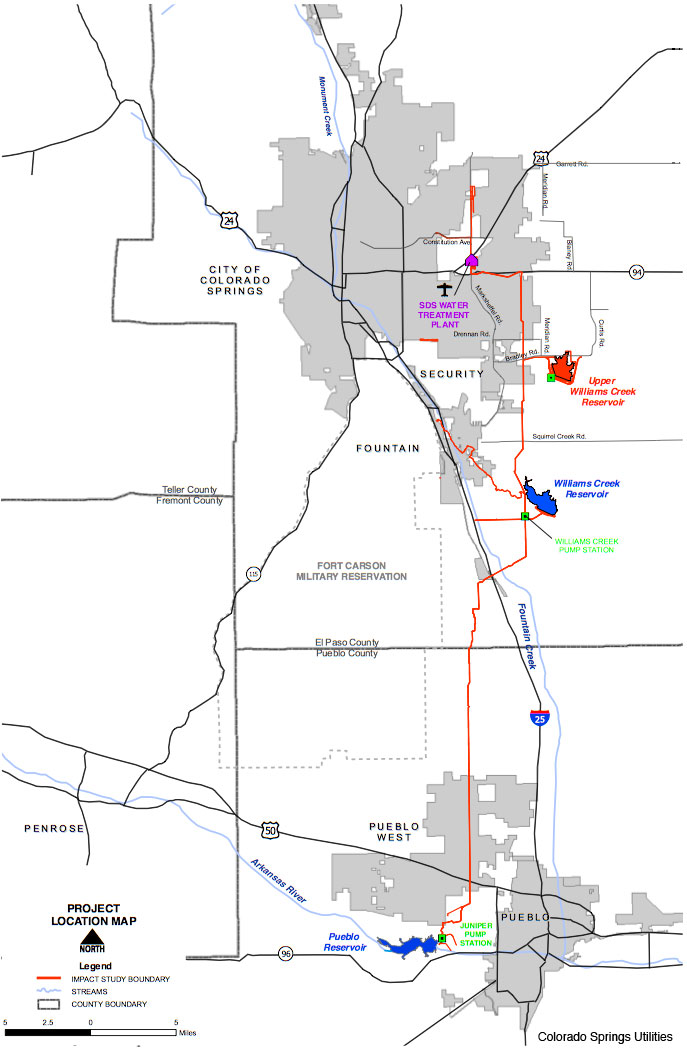
Southern Delivery System map via Colorado Springs Utilities
The City Council committed Colorado Springs on Wednesday to spend more than $460 million over 20 years on a stormwater projects pact with Pueblo County.
The intergovernmental agreement, negotiated chiefly by Mayor John Suthers, is expected to resolve Fountain Creek stormwater problems for downstream residents and avert lawsuits threatened by the U.S. Environmental Protection Agency through the Department of Justice and by Pueblo County.
Further, the accord would allow Colorado Springs Utilities’ Southern Delivery System to start pumping water as scheduled on April 27.
Pueblo County officials threatened to rescind that $825 million project’s 1041 permit, which they issued in April 2009, if the city didn’t ante up enough guaranteed funding for stormwater projects.
The deal now hinges on a vote by Pueblo County’s three commissioners, set for 9 a.m. Monday.
Any delay of the SDS would reduce the worth of warrants on equipment and work while leaving four partner communities – Colorado Springs, Pueblo West, Fountain and Security – without the water deliveries they expect.
The council, meeting in special session Wednesday, didn’t hesitate to approve the pact. Only Councilwoman Helen Collins, a steadfast foe of government spending, dissented in the 8-1 vote.
The agreement calls for 71 stormwater projects to be completed by 2035. Engineers for Pueblo County and Colorado Springs chose the projects and will review them each year to allow for fluctuating priorities.
The money will be spent in five-year increments, at a rate of $100 million the first five years followed by $110 million, $120 million and $130 million. Any private developers’ projects or other efforts would be in addition to the promised amounts.
If the projects aren’t completed in time, the accord will be extended five years. And if Colorado Springs can’t come up with the money required, the city-owned Utilities will have to do so.
The agreement was tweaked slightly Wednesday, on request of the Pueblo County commissioners, to increase one miscalculated payment to a water district by $332, to add the word “dam” to references to a study of water-control options, and to add “and vegetation” to a clause about removing debris from Pueblo’s city levees. A clause was added to note that after the agreement expires, both sides agree to coordinate and cooperate with one another, as they always will be upstream-downstream neighbors.
“This is basically an investment in this city,” said water attorney David Robbins, a consulting lawyer for the council. “The stormwater facilities would have ultimately had to be built anyway. They benefit your citizens, not just the people downstream.”
Asked about the option for a dam, Robbins said, “It has been studied, studied again, and another study may add to our knowledge, but doesn’t require this city to contribute any more money. The dam would require moving two railroads and an interstate highway. Just the facility relocation costs make it quite expensive.”
Colorado Springs has failed to properly enforce drainage regulations, conduct adequate inspections, require enough infrastructure from developers or properly maintain and operate its stormwater controls, the EPA found during inspections in August.
The downstream victim has been Pueblo County, which saw Fountain Creek sediment increase at least 278-fold since the Waldo Canyon fire in 2012, degrading water quality and pushing water levels higher, Wright Water Engineers Inc. found during a study for the county last year.
Sediment increased from 90 to 25,075 tons a year, while water yields rose from 2,500 to 4,822 acre-feet, the engineers found.
As Colorado Springs development sprawls, the amount of impermeable pavement grows. So the city also is beefing up its long-underfunded Stormwater Division, increasing the staff of 28 to 58 full-time employees, mostly inspectors, and more than doubling the $3 million budget for compliance to about $7.1 million.
The city and Utilities negotiated for nearly a year with Pueblo County, as Colorado Springs has beefed up its stormwater program to fix the problems and fend off the threats of lawsuits.
The Pueblo Board of Water Works would like to see up-front bonding and longer term for an intergovernmental agreement between Pueblo County and Colorado Springs.
Still, it’s probably the best deal possible, the board agreed during comments on the proposed deal at Tuesday’s monthly meeting.
In February, the board provided its input with a resolution recommending certain actions to Pueblo County commissioners.
Colorado Springs City Council approved the deal Wednesday, while Pueblo County commissioners will meet on it Monday. It provides $460 million for stormwater projects over the next 20 years, triggers $50 million in payments over five years for Fountain Creek dams and adds $3 million to help dredge and maintain levees in Pueblo.
“One of the things we encouraged Colorado Springs to do was bond the projects up front,” said Nick Gradisar, president of the water board. “It would be to everyone’s advantage to do the projects sooner rather than later.”
Board member Tom Autobee said the agreement is comprehensive, but was uncertain about the 20-year timeline for improvements.
“What I’d like to see is to extend it beyond 20 years for the life of the project,” Autobee said. “We need to look at that.”
Board member Jim Gardner was assured by Gradisar that Pueblo County is guaranteed a voice in which projects are completed.
“They have a priority list and can’t switch unless both sides agree, as I understand it,” Gradisar said.
“This is a great opportunity to correct the issues,” said Mike Cafasso.
“What we said got listened to,” added Kevin McCarthy. “I think this is the best deal we’re going to get.”
Colorado Springs won’t need the full use of the Southern Delivery System for years, but some can’t wait for the $825 million water pipeline to be turned on.
Pueblo County commissioners heard testimony supporting a proposed agreement with Colorado Springs designed to settle issues surrounding the City Council’s decision to abolish its stormwater enterprise after the county had incorporated it into conditions for a 1041 permit in 2009.
“One in five people in Pueblo County live in Pueblo West and are impacted by SDS,” said Jerry Martin, chairman of the Pueblo West metro board. “With the newest break, we will depend on SDS for a very long time.”
Pueblo West joined the SDS project as a costsaving alternative to a direct intake on the Arkansas River downstream of Pueblo Dam. It shared in the cost of permitting and building the pipeline.
Last summer, it used SDS when its own pipeline broke.
Pueblo West’s main supply comes from the South Outlet Works and crosses under the river. The new break is more severe, Martin explained.
An agreement reached last summer allows Pueblo West to use SDS before it is fully operational, and settled some lingering legal issues related to Pueblo West’s partnership in SDS.
Security Water and Sanitation District, located south of Colorado Springs, also needs SDS to go online before summer, said Roy Heald, general manager of the district.
“Security has an immediate need for water because there are emerging contaminant in our wells,” Heald said.
Seven of the district’s 25 wells into the Fountain Creek aquifer were found to be contaminated earlier this year. The solution is to blend water from the Arkansas River with the well water to dilute contaminants. Right now, Security gets enough water from the Fountain Valley Conduit to make its supply safe. But in summer, water demands will increase, Heald explained.
Larry Small, the executive director of the Fountain Creek Watershed Flood Control and Greenway District, said the agreement paves the way for flood control projects seven years after the district was formed.
Small was on City Council when the stormwater enterprise was abolished on a 5-4 vote. He voted against eliminating the fee that was then in place. He was hired to run the Fountain Creek district two years later. The district has representatives from both Pueblo and El Paso counties.
The district was formed by the state Legislature out of concerns about the effect of El Paso County’s growth on Fountain Creek and the danger that is posed to Pueblo.
The $460 million for Colorado Springs stormwater projects over the next 20 years is needed to slow down Fountain Creek, but that doesn’t mean Pueblo would be protected. There are at least 18 projects south of Colorado Springs involving either detention ponds or dams that the district wants to get started on.
That process would get a kick start with $20 million in the next nine months if the agreement is approved by commissioners and Colorado Springs City Council in the next week. Three more payments of $10 million over the next three years would follow under terms of the 1041 agreement.
“This agreement says that we’re not just going to put something in place, but that we’re going to monitor it,” Small told commissioners. “It’s a cooperative, collaborative process. We don’t have to rely on rumors and innuendo.”
The city of Pueblo also would benefit from a potential $6 million in Fountain Creek dredging or levee maintenance projects that would cost the city only $1.2 million over the next three years. Pueblo Stormwater Director Jeff Bailey last week told The Pueblo Chieftain that the city has projects lined up, depending on how the funds are structured.
A separate $255,000 project to dredge between Colorado 47 and the Eighth Street bridge already is in the works. It would be funded by Pueblo County, the Lower Arkansas Valley Water Conservancy District, the Fountain Creek district and the state.
For Colorado Springs, SDS is a 40-year solution to provide water both for future growth and redundancy for the major water infrastructure it already has in place. Earlier comments to commissioners from Colorado Springs officials indicated only about 5 million gallons per day initially would flow through the SDS pipeline to El Paso County. It has a capacity of 75 million gallons per day.
Colorado Springs Mayor John Suthers said warranties on the project kick in when testing on SDS is completed at the end of this month, however, so Colorado Springs also would like to see the pipeline up and running by next week.
Fountain Creek
Fountain Creek erosion via The Pueblo Chieftain
Fountain Creek swollen by stormwater November 2011 via The Pueblo Chieftain
Fountain Creek flooding 1999 via the CWCB
Fountain Creek Watershed
The confluence of Fountain Creek and the Arkansas River in Pueblo County — photo via the Colorado Springs Business Journal
The new north outlet works at Pueblo Dam — Photo/MWH Global
Pueblo County’s agreement on stormwater control with Colorado Springs comes at an ideal time for the city of Pueblo.
The city is looking at steps it must take to clear the Fountain Creek channel in order to obtain flood plain certification from the Federal Emergency Management Agency.
The agreement would provide an additional $3 million to the city of Pueblo, which could be matched by about $1.8 million in Colorado Springs money now held by the county and $1.2 million from other sources.
So, if it can find another $400,000 annually over three years, Pueblo would be able to complete $6 million in projects. Money could start arriving by the end of May if the agreement is approved.
“It’s not enough to get all the silt out,” said Jeff Bailey, Pueblo’s stormwater director. “We think it would take two or three times that to do all the work. But we could select areas and get the bulk of vegetation and silt out.”
Such critical areas would include the Eighth Street bridge, where Fountain Creek now flows through only two of the five archways because the other three are so badly silted over.
Another spot would be the north end of Fountain Creek, which is still littered with big cottonwood trees that washed down last spring.
“If we can open that up, it would provide more of an area to spread the water,” Bailey said.
A project approved by the Arkansas Basin Roundtable Wednesday would use $250,000 from the local sources and $5,000 in state money to remove debris and sediment between Colorado 47 and Eighth Street in Fountain Creek. The project would be funded by the Lower Arkansas Valley Water Conservancy District and Pueblo County — each providing $100,000 — along with the Fountain Creek Watershed Flood Control and Greenway District ($50,000 from Aurora funds through the Lower Ark).
The Lower Ark district would coordinate the project, which is patterned after a similar dredging effort at North La Junta on the Arkansas River.
Beyond the immediate cleanup, the city has hired a consultant to make recommendations for long-term fixes. It is also in the process of meeting with FEMA to determine current flood plain boundaries.
Fountain Creek is a moving target. The largest recorded flood in 1965 would be considered greater than a 100-year flood today. In addition, the increase in impervious surfaces in Colorado Springs to the north would make that same flood more intense by passing a larger volume of water more quickly. The new study will look at the new levels for a 100-year flood.
Another $6 million would help, Bailey said.
“First I would have to find out what kind of restrictions are on the money,” Bailey said. “Then, how soon can I have the money?”
As water pressures mount, Colorado Springs engineers are about to switch on one of the West’s boldest new water projects: an $825 million pipeline to siphon up to 50 million gallons a day of Arkansas River water from Pueblo, 50 miles away.
This highly contentious Southern Delivery System has been 27 years in the making. It resolves a core quandary for Colorado Springs (pop. 350,000), built on a high-and-dry, flood-prone plain away from rivers, with only two creeks to sustain people.
The project will pull from [the Fryingpan-Arkansas Project Pueblo Reservoir] — pumping water northward, uphill 1,500 feet — to support growth.
But there’s a hitch. Pueblo is demanding that Colorado Springs first commit to pay another $460 million before turning on the system as scheduled April 27 to clean up the dirty runoff Colorado Springs sends to Pueblo in Fountain Creek.
Colorado Springs leaders told The Denver Post last week they will agree, to avoid a legal war. Pueblo County officials, still reviewing a draft agreement, said they want to hear from residents Monday.
“If Fountain and Monument creeks were our only sources of water, we would only be a town of 25,000 people,” Colorado Springs Mayor John Suthers said in an interview after a treatment plant for the siphoned water was dedicated.
The SDS system “is an amazing engineering feat,” Suthers said. “It will take care of the future water needs of Colorado Springs for up to 50 years of growth.”
Pueblo and Colorado Springs officials agreed to vote on the deal April 26, the day before water engineers click a computer mouse to fire up the system.
For decades, Pueblo has been fighting Colorado Springs over the fouling of Fountain Creek, which flows from the Springs to Pueblo. The problem is stormwater runoff — chemical contaminants and sediment washing into the creek…
Under a draft deal, Colorado Springs would spend $460 million over 20 years to complete 71 stormwater cleanup projects. These include creation of ponds that slow and filter runoff and planting vegetation along drainage channels to stabilize sediment.
Colorado Springs will rely on general fund revenues from sales taxes to cover the $460 million, Suthers said. “If we have a downturn, we may have to look at something else.”
City Council president Merv Bennett said, “We’ve got to fix the stormwater problem. If we don’t do this, the EPA could require us to do it. This is a good deal.”
[…]
Eleven 2,000-plus horsepower pumps will propel the water from the reservoir through a 66-inch-diameter underground pipeline for 50 miles with an overall elevation gain of 1,500 feet.
The water must be used within the Arkansas River Basin, ruling out sales to south Denver suburbs. And wastewater, after treatment, must be returned via Fountain Creek to Pueblo.
Colorado Springs residents have paid for the system through water bills, which increased by 52 percent over four years.
City officials have been working since 1989 to install the system. “You have to handle all the legal, the permits, the right of way …,” said Edward Bailey, 80, who has led the efforts and whose name now appears on the treatment plant.
Moving water to people around the West entails altering the natural environment, Bailey said. “We have to do it right. We shouldn’t leave a big footprint. … I understand Pueblo and their concerns. We need to be very environmentally sensitive, but we cannot be preservationists.”
[…]
“Water drives our economic viability, our economic prosperity,” SDS program director John Fredell said.
“Now we’ve got it. Now we’re ready to go in Colorado Springs.”
Although we appreciate and commend the work of Pueblo County commissioners, the county planning department, county attorneys and Wright Water Engineers, we implore county officials to take more time before approving the 1041 permit that would allow water to flow from Lake Pueblo to Colorado Springs via the Southern Delivery System.
The confluence of Fountain Creek and the Arkansas River in Pueblo County — photo via the Colorado Springs Business Journal FromThe Pueblo Chieftain (Chris Woodka):
A proposed agreement between Pueblo County and Colorado Springs related to the Southern Delivery System took a year to pound out and centers on Colorado Springs’ failure to control stormwater.
Last April, Pueblo County commissioners were moving toward a compliance hearing for the 1041 permit that allowed Colorado Springs to build its $825 million pipeline project from Pueblo Dam to Colorado Springs.
At the time, Colorado Springs claimed it had spent $243 million on stormwater projects from 2004-14, but Pueblo County officials were skeptical.
A memo to commissioners from staff called the Colorado Springs accounting “conflicting and inconsistent.”
That launched a more thorough investigation that has taken as many turns as Fountain Creek itself toward reaching a final agreement.
Newly elected Colorado Springs Mayor John Suthers last summer proposed spending $19 million annually on a year-to-year basis to make up for the Colorado Springs City Council’s decision to abolish its stormwater enterprise in 2009. For just three years, the enterprise had generated about $15.2 million annually.
But a scathing EPA audit released in November revealed Colorado Springs had failed to meet even the minimum conditions of its state stormwater permit, opening the door for more mitigation.
“It elevated our status by showing that what people in Pueblo had been saying for years was true,” said Pueblo County Commissioner Terry Hart.
In January, Suthers offered Pueblo City Council and commissioners a 10-year, $19 million plan, which was met with little interest.
Council’s resolution asked for $500 million over 10 years, and commissioners questioned how projects would be verified. In early March, Suthers went public with Colorado Springs’ proposal to put a minimum of $460 million into projects over the next 20 years. He indicated that Colorado Springs Utilities was anxious to get SDS on line by April 27 to assure that warranties on water pumping and treatment are in place after testing concludes.
Later in the same week, on March 11, commissioners wrote to the Bureau of Reclamation updating 1041 permit compliance in anticipation of beginning SDS operations. Stormwater management on Fountain Creek was the major unresolved issue that could keep SDS from being turned on.
A month later, Pueblo County had obtained what commissioners and lawyers say are enforceable provisions to make sure Colorado Springs complies.
“This is a contract,” Hart said. “It has specific actions Colorado Springs has to meet, and gives us a seat at the table.”
Hart said the proposed IGA provides an additional layer of enforcement, on top of the 1041 provisions, which remain in place, and the federal Department of Justice enforcement of the Clean Water Act.
The proposed IGA also benefits Colorado Springs because it provides evidence of tangible steps toward compliance with the federal law, Hart said.
“Fixing the stormwater issues that we inherited stemming from the dissolution of the stormwater enterprise has been a top priority for me and the (Colorado Springs) City Council,” Suthers said in a statement released Monday. “Sustainable stormwater funding and management is not optional — it is something that we must do to protect our waterways, serve our downstream neighbors and meet the legal requirements of a federal permit.”
More coverage from Chris Woodka writing for The Pueblo Chieftain:
Protecting Pueblo from Fountain Creek flooding will take projects in Colorado Springs, Pueblo and everywhere in between.
A proposed intergovernmental agreement for Southern Delivery System between Colorado Springs and Pueblo County will kick-start projects in all areas, Pueblo County Commissioner Terry Hart said.
“This agreement allows the communities to get moving and tackle projects,” Hart said. “Lots of elements have value to all of the communities.”
Commissioners will hear public comments on the proposed agreement at a work session on Monday with a possible vote scheduled for April 25. There’s a lot to take in.
Last year, the county hired Wright Water Engineers to document the issues on Fountain Creek in the most comprehensive study to date. The Wright study connected the dots between Colorado Springs growth and deteriorating conditions on Fountain Creek, finding that 370,000 tons of sediment annually are stranded between Colorado Springs and the confluence with the Arkansas River each year.
That build-up is decreasing the ability of levees installed nearly 30 years ago to protect Pueblo.
“One of the best recommendations tions we had was to retain Wright Water Engineers,” said Commissioner Liane “Buffie” McFadyen. “I don’t think we’d be here without the work they did.”
One of Wright’s findings was that projects up and down Fountain Creek are needed to correct problems and protect Pueblo.
That includes the 71 projects within Colorado Springs that are covered under a $460 million, 20year commitment in the proposed IGA. Of those, 61 benefit Pueblo, so it was important for Pueblo to have a place at the table to determine timing of the projects, Hart said.
Under the proposed agreement, Pueblo’s engineers would be able to annually review progress of the projects, which over time will make up about two-thirds of the total Colorado Springs stormwater budget.
The 2013 sediment transport study by the U.S. Geological Survey showed there is some benefit to Pueblo from detention ponds in Colorado Springs. Those are among the first structures to be built under the proposed agreement. Work already has started on one in Sand Creek.
That study also showed the biggest benefit to Pueblo, both for controlling high flows and trapping sediment, would be a large dam between Colorado Springs and Pueblo.
“To build a dam, we have to get going now.
We need to know where it goes and what it looks like,” Hart said.
The Fountain Creek Watershed Flood Control and Greenway District is prepared to start working on those issues, but lacks funds. The IGA would provide $20 million from Colorado Springs in the next nine months to begin work on the dam question.
Those would be the first of five $10 million annual payments that were earlier negotiated by Pueblo County as part of its 1041 permit for SDS.
The district’s budget includes $2.5 million this year to continue a study of whether one or several dams could be built and to evaluate the relative cost effectiveness of alternatives.
The proposed agreement is important because the money might otherwise not start arriving until January 2017 at the soonest, and possibly even later if SDS were to be delayed in court, Hart said.
It also provides $125,000 for routine administrative tasks of the Fountain Creek district as a patch until more permanent funds are lined up.
Finally, work on the Pueblo levee system along Fountain Creek is the most important way to protect Pueblo in the short term, according to the Wright report.
The city of Pueblo has the primary responsibility for maintaining the levees and the new agreement would add $3 million over the next three years for that purpose. Pueblo would have to match those funds.
Pueblo County already is holding about $1.8 million, so Pueblo’s share would be $1.2 million, or $400,000 annually to leverage $6 million or more in improvements.
“We know $50 million isn’t going to be enough to build a dam,” Hart said. “We’re counting on the communities to bring in other grants or other funding for all the other projects as well.”
From the Colorado Springs Independent (Pam Zubeck):
The cost of deferred maintenance came into sharp focus Monday when Pueblo County and the city of Colorado Springs announced a 20-year, $460million deal to correct the Springs’ neglected flood-control system and pave the way for good relations over activating Springs Utilities’ $825million water pipeline from Pueblo Reservoir.
The agreement will cost the city an average of $23 million a year — 53 percent more than the $15.2 million raised by the city’s previous Stormwater Enterprise fee. The fee, adopted in 2007, was abolished in 2009 to comply with Issue 300, a ballot measure mounted by anti-tax activist Douglas Bruce as a way to end the “rain tax.” That action infuriated Pueblo County, which issued a construction permit in April 2009 for the Southern Delivery System pipeline in part on spending made possible by the stormwater fee.
Now, the city will pay considerably more.
“This IGA requires Colorado Springs to commit much more than [the Stormwater Enterprise] for stormwater mitigation to address the past practices of overlooking the stormwater problems and to address future issues,” Pueblo County Commissioner Sal Pace said in a release.
Mayor John Suthers told City Council on Monday it’s the city’s problem “regardless of the level of public support.” Besides opposing the enterprise in 2009, voters in 2014 rejected a regional drainage authority and fees, a measure opposed by former Mayor Steve Bach.
“This is not a problem that those of us in this room created,” Suthers said. “I’m not going to point fingers. But the fact of the matter is, it’s a problem we inherited. It’s a problem we have to deal with.”
He also noted that while city general funds and Springs Utilities rates will fund the agreement, nothing precludes developing a different funding source, such as fees or special taxes. Suthers also pointed out the IGA will “go a long way” toward resolving negotiations with the Justice Department over the city’s 2013 and 2015 Clean Water Act violations, which could bring fines and/or a court decree mandating levels of spending.
As outlined by Pueblo County, the intergovernmental agreement’s terms:
• Colorado Springs will spend $460 million during the next 20 years on 71 stormwater projects.
• If those projects aren’t finished by 2035, the IGA renews for five years at another $26 million per year.
• Pueblo County will play a “significant role” in timing, prioritization, selection and verification of mandated projects under a “strong mechanism for enforcement.”
• Utilities will pay the city of Pueblo $3 million ($1 million a year for three years) to protect its levees, in addition to $2.2 million already paid for that. But the money must be spent in the year in which it’s given, said David Robbins, outside attorney representing the Springs.
• Utilities also will make a one-time $125,000 payment to the Fountain Creek Watershed, Flood Control and Greenway District to help fund operations and studies, including whether to dam Fountain Creek.
• Utilities’ previously agreed-to payments to the Fountain district of $50 million over five years will be accelerated; the first payment of $9.6 million is due within 30 days of IGA approval. Then, four equal payments of $10 million will be made annually starting in January 2017. The money will fund erosion and flood control.
While the IGA’s funding is subject to annual appropriations in compliance with the Taxpayer’s Bill of Rights, the IGA is guaranteed by the Utilities enterprise, which can commit to a multi-year agreement, a city spokeswoman says.
Council and Pueblo County commissioners are expected to approve the IGA in coming weeks in advance of the April 27 scheduled activation of SDS.
Southern Delivery System map via Colorado Springs Utilities
The threat of flash floods continues to linger in the minds of western El Paso County residents.
That worry loomed large for a group that met last week in Green Mountain Falls. They were focused on what might happen if torrential rains pound the Waldo Canyon burn scar and strike areas further upstream this summer.
Their concern has precedent. Thunderstorms on the barren, burned out slopes northeast of U.S. Highway 24 and in Woodland Park have filled Fountain Creek to its edges the last few years, leaving residents of Cascade, Manitou Springs and Green Mountain Falls spending each spring stacking sandbags and cleaning up after a series of floods.
Residents of those towns find themselves repeatedly asking the same question:
“What are they doing upstream?”
[…]
Those downstream remember a brief but powerful storm that hit Woodland Park in August 2013 and sent “a wall of water” pouring down Fountain Creek.
In an interview with The Gazette, Bill Alspach outlined years of planning and channel reconstruction that he said the Teller County city at the headwaters of Fountain Creek have been doing.
“We understand the creek,” Alspach said. “We’ve committed ourselves to being good stewards of the headwaters and good stewards to our neighbors. We’re doing this because it’s the right thing to do.”
Mayor-elect Jane Newberry said there is a “general feeling” in Green Mountain Falls that growth in Woodland Park has led to more storm runoff and a greater threat that Fountain Creek could pour over its banks and threaten bridges, homes and businesses in the communities below.
During the Aug. 22, 2013 storm, two bridges were damaged in Green Mountain Falls and several homes flooded in Green Mountain Falls and Cascade.
Newberry said she has “seen the city leaders in Woodland Park” focus on updating their development requirements to include a priority on drainage mitigation.
Alspach echoed that, saying that Woodland Park began its foundation of “stormwater stewardship” when the city council passed a resolution in 1994 requiring strict criteria for runoff retention.
In 2011 Alspach updated city code to require developers to include designs that slow runoff and reduce effect on Fountain Creek. He said that entails using landscaping, ponds and other features to force water into the ground before it flows toward the channel.
Alspach said businesses with large impervious parking lots and homeowners need to be aware of runoff on their property.
“Everybody contributes to impervious areas,” he said.
In 2014 Woodland Park partnered with Colorado Springs and El Paso County officials to have consistency within the watershed, Alspach said. Woodland Park has since rebuilt the west and east forks of Fountain Creek through town with help from CDOT and the Federal Emergency Management Administration. Alspach said the water now flows through culverts that include several features to help slow the flow.
Now, the city is focused on the next phase, which runs from the convergence of those forks to Aspen Garden Way just east of the Safeway store. Alspach said the city will begin taking bids from contractors on Wednesday to rebuild that portion of the creek. The work will include clearing the channel of debris and installing cutoff walls, boulders and other elements to control flow speeds.
The creek further east is beyond Woodland Park city limits and the responsibility falls to Teller County and private landowners.
Bryan Kincaid, who manages floodplain concerns for Teller County, said consultants who have worked with Woodland Park are in the midst of a stream bed stability assessment from the edge of Woodland Park to the El Paso County line.
“Everybody knows about the feud that has started between everybody downstream and Woodland Park,” Kincaid said. “We’re stuck right in the middle.”
Roads for private landowners along Crystola Road and near Crystola Canyon Road have been closed during heavy rains that send water churning down the usually dry creek bed.
Kincaid said Teller County maintains creek crossings at County Road 21, Creekside Drive and Crystola Canyon Road. The rest of the creek is on private land, he said. Alspach added that while Woodland Park and Teller County seek federal and state aid to help pay for channel maintenance, it’s a challenge for private residents to find money to maintain the creek on their property.
“They own the creek,” Alspach said, noting that landowners can partner with volunteer agencies like the Coalition for the Upper South Platte and the Rocky Mountain Field Institute to help keep the channel safe.
CUSP and RMFI have worked with residents all along Fountain Creek and other drainages plagued by flash flooding since the June 2012 Waldo Canyon fire. The more than 18,000-acre blaze left mountain slopes west of Colorado Springs without vegetation needed to help slow runoff flows during heavy rains. Continued concerns four years later prompted the Green Mountain Falls preparedness meeting.
Flooding is a threat to historic buildings across the country, and most communities are not prepared to protect their valuable resources.
Those are the findings of a new study published in the Journal of the American Planning Association, and co-authored by professors at the University of Colorado Denver and the University of Kentucky.
“Historic resources are a big part of the local economy,” said Andrew Rumbach, Assistant Professor of Planning and Design at the University of Colorado Denver. “So losing those resources is not only bad for the character and identity of the place, but it’s also bad for the local economy.”
Rumbach says Manitou Springs in Colorado is a classic example of an historic tourist town that has done a good job at preservation.
With help from the state, the town has put millions of dollars into improvements to direct water away from historic structures.
The town, named for its mineral water springs, has experience significant flooding in recent years. The flood waters caused more than $100,000 in damage to one of Manitou’s oldest buildings, an inn named The Cliff House at Pikes Peak.
“The Cliff House was here before the flood maps were developed,” said Paul York, the general manager. “You can’t exactly move The Cliff House’s location, it’s right here!”
The hotel has built flood walls to protect its parking structure. They say the wall can be deployed by a single person in less than 30 seconds, in case there is little warning about an oncoming flood.
“It’s come to this,” said York, as he demonstrated how to seal off the flood wall.
After nearly a year of negotiations, a stormwater deal has been reached between the city of Colorado Springs, Colorado Springs Utilities and Pueblo County commissioners.
The tentative intergovernmental agreement, which Mayor John Suthers outlined Monday to the City Council, will benefit not only Pueblo and Pueblo County, but also local residents, by providing $460 million in stormwater projects by 2035.
Those improvements are sorely needed, as the U.S. Environmental Protection Agency noted in dismal audits of the city stormwater program in 2013 and last August. Unless the situation improves dramatically, the EPA likely would sue Colorado Springs and restrict the MS4 permit that allows the city to send stormwater into the interstate water system.
The more immediate concern was Pueblo County’s threat to withhold the 1041 permit it granted to Utilities for the $825 million Southern Delivery System. That massive water system is scheduled to start delivering water April 27, and the intergovernmental agreement would be signed just in the nick of time…
Suthers started negotiating almost immediately after he was sworn in as mayor last June, and the mayor, Council President Merv Bennett and key leaders from Utilities made repeated trips to Pueblo to smooth the frayed relations and ensure that stormwater improvements would be forthcoming.
The talks proved tricky, as Pueblo’s city and county leaders felt increasing pressure to play hardball with Colorado Springs.
Suthers squeezed the city budget hard to produce millions of dollars. When the city’s southern neighbors balked because they had no guarantee, he placed the burden on Utilities to come up with future funding if and when the city fell short.
Along with that assurance, Pueblo County won a promise that if 71 critical stormwater projects aren’t completed by 2035, the pact will be renewed for five years with continued, commensurate funding increases.
The City Council and Pueblo County commissioners are set to vote on the pact in two weeks.
Provided they enact the agreement, it will mark a hard-fought resolution to Suthers’ most vexing challenge during his 10 months as mayor.
“I personally don’t think we could come up with any better result by litigating on two fronts,” he hold the council. “We could litigate with Pueblo at risk of jeopardizing the SDS being turned on … But I have a certain level of confidence the stormwater program we’re funding here will go a long way toward resolving our (legal) issues with the EPA.”
Besides, he noted: “I mean this very sincerely. It’s the right thing to do. And it’s something we should do.”
Colorado Springs would pay more than $605 million to cover environmental damage for the Southern Delivery System if a draft intergovernmental agreement with Pueblo County is approved.
The proposed deal includes a guarantee to spend at least $460 million over the next 20 years to repair and build stormwater structures in Colorado Springs in a way that benefits downstream communities, particularly the city of Pueblo.
“This has been a tough, arduous negotiation that has taken months,” said Commissioner Liane “Buffie” McFadyen. “After years of Colorado Springs’ failure to honor that commitment we finally have a deal the citizens of Pueblo County can rely upon. We now have guaranteed projects, guaranteed funding and a mechanism for enforceability to back up the guarantees.”
A public hearing on the agreement will be at 1:30 p.m. April 18 in commissioners chambers at the Pueblo County Courthouse. The soonest the board is expected to act on the IGA would be April 25, which gives Colorado Springs time to consider it as well.
Mayor John Suthers is presenting the deal to Colorado Springs City Council today. That group, sitting as the Utilities Board, could pass it on April 20 at the soonest.
Colorado Springs Utilities wants to turn on SDS on April 27.
“I want to make it clear we have not voted on this,” said Commissioner Sal Pace. “I intend to listen to the public next week.” [ed. emphasis mine]
In addition to the stormwater projects, the deal includes nearly $20 million for flood control projects on Fountain Creek within the next nine months, $125,000 to keep the Fountain Creek Watershed Flood Control and Greenway District afloat and $3 million to the city of Pueblo to dredge Fountain Creek.
The $20 million is part of Colorado Springs’ commitment to pay $50 million over five years to the Fountain Creek district under Pueblo County’s 1041 permit for SDS. Within 30 days of signing the IGA, about $9.6 million will be paid, which takes into account credit for $600,000 already provided by Colorado Springs Utilities to the district. Another $10 million would be paid on Jan. 15, 2017, ending a dispute about timing of this year’s payment.
“These immediate payments to the District are desperately needed to study the possibility of, and to potentially construct, a dam on Fountain Creek – this is our opportunity to comprehensively evaluate all options to protect the citizens of Pueblo,” said Commissioner Terry Hart.
The $125,000 would fund operating costs of the district, which now has few financial resources to draw upon.
“The $125,000 was a line in the sand for us,” McFadyen said.
The $3 million to the city of Pueblo for Fountain Creek dredging would require an equal match, part of which could come from $1.8 million held by Pueblo County from an earlier agreement.
The stormwater agreement requires a continued working relationship between Pueblo County and Colorado Springs. Engineers representing both areas have rated 71 current projects for benefits to Colorado Springs and to downstream communities. All but 10 of the projects benefit both.
The list will be reviewed and adjusted over the next 20-25 years to assure compliance and reflect changes in the drainage area.
The accounting includes only money provided by Colorado Springs and Utilities toward projects on the list and require expenditures of $20 million annually the first five years, expanding to $26 million per year in 2031-35. If the list is not complete by 2036, spending of $26 million annually would be required for another five years.
The payments would be guaranteed by transfer funds already paid to the Colorado Springs by Utilities.
Ray Petros, Pueblo County’s water attorney explained the agreement to the board today. Colorado Springs would agree to pay Pueblo County’s engineering costs for drawing up the list and to resolve any IGA disputes in Pueblo District Court.
In addition to the $460 million for stormwater, $50 million for Fountain Creek flood control and $5.2 million for dredging, Colorado Springs previously agreed to spend $75 million by 2024 for sanitary sewer upgrades and $15 million for damage to roads related to SDS.
The total cost for construction of SDS is about $825 million.
Seven years ago, the Pueblo County Board of County Commissioners gave Colorado Springs Utilities permission to build the Southern Delivery System Pipeline through what’s known as a 1041 Permit. That agreement required the City of Colorado Springs to keep water from flowing faster down Fountain Creek.
But a few short months after the SDS agreement was signed, Colorado Springs voters passed ballot issue 300 and the City Council promptly ended the Stormwater Enterprise.
The backlog of storm water improvement languished for a time and it looked like things were headed to court. Commissioner McFadyen expressed relief that things didn’t reach that point.
“Hopefully it saves taxpayers dollars on both sides and actually has an agreement that’s worthwhile and get to the point, it solves the problem.”
In November, Colorado Springs received notice of violation by the Environmental Protection Agency and the Colorado Department of Public Health and Environment for noncompliance with its Municipal Separate Storm Sewer System (MS4) permit under the federal Clean Water Act. That complaint was referred to the US Justice Department for legal action.
The basis of the violation was for failure to provide adequate resources to develop and enforce the MS4 Program…
All of the money committed by Colorado Springs in the proposed agreement comes from the city’s general fund. However Mayor Suthers said the IGA is a flexible agreement.
“If at some point in time Colorado Springs decides to join the rest of the world and have a storm water enterprise, they’re free to do so and that funding source can be utilized, but the voters have turned that down as recently as November of 2014.”
Both the Colorado Springs City Council and Pueblo County Board of County Commissioners must vote to approve the agreement. Pueblo will hold its first public hearing on the issue at their next regularly scheduled board meeting April 18.
Fountain Creek photo via the Fountain Creek Watershed Flood Control and Greenway District
Fountain Creek flood debris May 2014 via The Pueblo Chieftain
Fountain Creek swollen by stormwater November 2011 via The Pueblo Chieftain
Fountain Creek erosion via The Pueblo Chieftain
Fountain Creek during monsoon July 2012 via The Pueblo Chieftain
Fountain Creek swollen by stormwater in 2011 — photo via The Pueblo Chieftain
Fountain Creek through Colorado Springs.
Fountain Creek flooding 1999 via the CWCB
Old railroad bridge over Fountain Creek near Pueblo
Fountain Creek Watershed
The confluence of Fountain Creek and the Arkansas River in Pueblo County — photo via the Colorado Springs Business Journal
From the Colorado Springs Independent (Pam Zubeck):
April 27 is the red-letter day for which Colorado Springs Utilities has waited at least 15 years. But now nobody wants to talk about it.
Mayor John Suthers refuses to discuss it. So do the three Pueblo County commissioners.
The taboo topic? Activation of the long-awaited, $825 million Southern Delivery System pipeline that will pump 50 million gallons of water a day from Pueblo Reservoir.
At issue is a rift between Colorado Springs and Pueblo County over the city’s stormwater management, or lack thereof. The city agreed to control drainage, which ultimately flows down Fountain Creek to Pueblo, as part of the so-called 1041 construction permit issued by Pueblo County in 2009. But it hasn’t done so.
Now, only weeks before SDS is turned on, Pueblo County says in a March 11 letter to the Bureau of Reclamation it might suspend the permit unless “enforceable” guarantees for stormwater control are incorporated into a pending intergovernment agreement.
Whether Pueblo County can stop water from flowing through the pipeline is in question, but Pueblo County officials hope their long-standing complaints to the bureau over stormwater eventually get traction.
Bureau spokesman Buck Feist tells the Independent that suspending SDS “is unnecessary” now, because progress is being made in complying with various SDS requirements. But he notes the bureau has authority to stop the project if the city fails to meet requirements of the Bureau of Reclamation’s 2009 Record of Decision, and that includes contracts with others, such as the 1041.
Months ago, Suthers and City Council vowed to spend $19 million annually on stormwater needs, but that apparently hasn’t satisfied Pueblo County. In an early March interview with the Gazette, Suthers bemoaned Pueblo County’s refusal to accept the city’s new offer to spend $445 million over 20 years on drainage, an average of $22.5 million per year…
Since then, Suthers has clammed up on that topic, as well as a related issue — the Environmental Protection Agency’s findings, in 2013 and again in 2015, that the city violated its federal stormwater discharge permit conditions.
“We are unable to discuss either matter at present due to the pending nature of both the EPA investigation and the continuing discussions with Pueblo,” Suthers’ communications manager Jamie Fabos says via email. She also noted no information will be released “until we have a result to share with our stakeholders and residents.”
In response to a Colorado Open Records Act request for correspondence with Pueblo County about the IGA, the city claims there were no responsive records, which suggests negotiations are verbal.
The city withheld its communications with the EPA and Justice Department, citing a CORA exemption for documents subject to a court order or Supreme Court rule. While the Indy couldn’t find a lawsuit involving the EPA violations, a court decree could be issued mandating that the city deal with stormwater problems.
But that might be “several months” away, with Department of Justice spokesperson Wyn Hornbuckle saying via email the negotiations are in the “early stages.”
Meantime, Pueblo County commissioners can’t comment, because the 1041 permitting process is a quasi-judicial function, barring them from making public statements ahead of a hearing, a county spokesman says.
Pueblo County, though, has documented the city’s failed stormwater system for years in letters to the Bureau of Reclamation. In a March 11 letter, the county noted that “negotiations on a proposed IGA continue to progress,” but added that “absent an enforceable IGA” that would address inadequate stormwater controls, county staff is “likely” to recommend county commissioners “temporarily suspend commercial operations of the SDS” and perhaps suspend or amend the 1041 permanently.
That’s the last thing Colorado Springs needs, because a noncompliance finding could impact its deals with the bureau to use Pueblo Reservoir. As Feist says via email, “Contracts between Reclamation and SDS participants do provide the bureau with the authority to immediately cease storage or conveyance of water until the commitments are implemented, if such action becomes warranted.”
Feist also says the law allows the Bureau of Reclamation to reopen the Environmental Impact Statement for SDS in certain circumstances.
As those issues loom, Colorado Springs needs to turn on the tap to test the new water treatment plant within designated warranty periods, says SDS project director John Fredell. Also, at least one SDS partner, Pueblo West, is using SDS on an emergency basis and needs regular deliveries as soon as possible, he says.
Asked if he plans to stick to the April 27 date, Fredell says, “I’m planning on it.” Asked if it will pose a hardship to the city if the pipeline isn’t activated on that date, he says, “It depends on how things shake out with our other systems.” He didn’t elaborate.
Among Pueblo County’s other complaints cited in the March letter is concern over Utilities’ Fountain Creek wetlands project. Completed in 2014 at a cost of $4.2 million, the project stabilized the creek’s banks and installed flora to improve water quality and to prevent erosion and reduce sediment washing down the creek to Pueblo.
But heavy rains and high creek flows last year disrupted the wetlands. While Fredell calls the project “a total success” for its boulder-laden banks’ withstanding the flows, it did get “beat up.”
“There was 20,000 CFS [cubic feet per second of water] in that storm,” he says. “It did get banged up, and there was a lot of sediment” jarred that filled the area. The project was designed to withstand 15,000 CFS.
Fredell estimates repairs, now underway, at $1 million, but a single wetland won’t solve the creek’s problems. He says at least 10 detention facilities and other improvement projects are needed to curb flooding and sediment transport.
The Fountain Creek Watershed Flood Control and Greenway District agrees, but needs money, which is another complaint of Pueblo County and a point of contention in the IGA debate. The 1041 permit requires Utilities to pay $10 million annually for five years after the pipeline delivers water. The county contends test flows started last fall, and the first payment was due in January.
The city says the first installment isn’t due until January 2017, assuming SDS is turned on this year.
It’s worth noting that some other agencies with a stake in SDS — including El Paso County, Colorado Department of Public Health & Environment, city of Fountain, Security Water and Sanitation Districts and Colorado Parks and Wildlife — have expressed no issues to the Bureau of Reclamation about Utilities’ permit and contract compliance.
Southern Delivery System map via Colorado Springs Utilities
Here’s the release from US Senator Cory Gardner’s office:
Senator Cory Gardner (R-CO) today announced the United States Department of Agriculture (USDA) Emergency Watershed Protection (EWP) program will make $10,240,800 available to Colorado Springs and Manitou Springs for the purposes of restoration and flood mitigation after severe weather impacted the region last year. Gardner sent a letter on July 10, 2015 to President Obama requesting federal assistance for several counties in Colorado impacted by significant weather events.
“I am pleased the Department of Agriculture has recognized Colorado’s need for federal assistance that will be used to restore the region and make infrastructure improvements to protect local communities from future flooding,” said Gardner. “Colorado Springs and Manitou Springs experienced recent flooding that devastated these localities. The impacts from the Waldo Canyon fire only made the problem worse. Western communities need flexibility to cope with the unique challenges they face, and I am pleased this grant provides local officials the necessary funds to address flooding as they see fit.”
A rock slide just west of Manitou Springs has closed the exit off U.S. 24, Memorial Day morning, May 25, 2015. (Colorado State Patrol via Twitter)
The spill was caused by some rags and roots that clogged a utility line on the south side of Woodland Park, according to utility workers. When the line became clogged, sewage shot up out of a manhole and flowed into the nearby creek.
The original gallon estimate on the spill was 400,000 gallons. But as the investigation went on, the number jumped to about 660,000.
“For one day of waste water treatment, our in-flow at the treatment plant is a little less than 600,000 gallons. So this is more than a day’s worth,” Woodland Park Utilities director Kip Wiley said.
An entire day’s worth of Woodland Park sewage in Fountain Creek could have been worse – Wiley said they dodged a bullet because the the creek was dry.
“Once it got into the creek it dissipated into the soil to where there was no running off down the creek. It wasn’t like there was other water carrying it down the creek. It simply disappeared into the soil,” Wiley said.
Colorado Springs Utilities immediately opened overflow pits on the south side to separate any sewage that made it through.
“Not something we had to do, but we felt in addition to protecting our own community it was probably a good idea to protect our downstream neighbors. That’s very important to us and it’s why we built it in the first place,” said Steve Berry with Colorado Springs Utilities.
El Paso County Public Health immediately took water samples and warned residents to stay away from the creek.
“Most folks are not recreating in Fountain Creek, but we encourage pets and people to stay out of the creek until after testing and we get a better assessment of the impact to Fountain Creek,” said Tom Gonzales with El Paso County Public Health Department.
Meanwhile, back in Woodland Park, the clog was fixed right away, but clean up took a little longer.
“We cleaned up the surrounding area around the manhole. Then cleaned up any signs of visible debris within the creek which was minimal,” said Wiley.
Woodland Park Utilities also did some testing of their own on parts of the creek that did have water and people’s well water who live along the creek. They hope to have results in the next couple days.
About 650,000 gallons of sewage that spilled into Fountain Creek Monday at Woodland Park likely won’t have any impact on Pueblo.
That’s because Fountain Creek at that point, 15 miles northwest of Colorado Springs, is typically dry, and the liquid dissipated into the soil within about 300 yards of the spill, said Kip Wiley, Woodland Park utilities director.
“Fountain Creek is dry at that point, so it didn’t make it very far, maybe 200-300 yards,” Wiley said.
A 12-inch sewer line clogged by rags and roots discharged untreated sewage from a manhole for several hours, Wiley said.
Staff noticed that the city’s south side lift station was not receiving its expected volume at about 10 a.m. Monday. The manhole, in a field, was located at about 1:30 p.m., and the blockage removed about an hour later, Wiley said.
The initial report to the Colorado Department of Public Health and Environment indicated the flow of water to Fountain Creek was under snow at the time.
“We experience blockages from time to time,” Wiley said.
The area was treated, local residents advised and governments downstream advised, according to City Manager David Buttery.
Woodland Park sits on a divide and discharges treated sewage into the South Platte River basin, rather than the Arkansas River basin. However, the blockage occurred on the Arkansas River side, causing it to flow into Fountain Creek.
It’s like being in a car where none of the passengers can leave, so they take up a voluntary collection to refuel, but make sure that everyone can afford dinner at the next roadside grill. It’s not like you have to pay.
Time to pass the hat again.
“We will have to fund it this way until the time we can go to voters and ask for a mill levy,” said Pueblo County commissioner Terry Hart, who chairs the Fountain Creek Watershed Flood Control and Greenway District.
The board looked at several options of how to distribute funding among its members, which include Pueblo and El Paso counties, Colorado Springs, Pueblo, Fountain, Monument, Manitou Springs, Palmer Lake and Green Mountain Falls — the incorporated areas within the Fountain Creek watershed.
This year, the district needs $125,000 or it will run out of money in August.
“And the number is likely to grow in future years,” Hart said.
Executive Director Larry Small showed the board several alternatives based on population, the size of general fund budgets or a subjective determination based on relative sizes of the communities.
Pueblo County could pay anywhere from 6.517 percent under the various formulas, while the city of Pueblo’s share would be 7.7-15 percent. The smaller numbers occur when only population is considered.
Also included was formula for the 2013 collection of $50,000, which simply charged both counties, Colorado Springs and Pueblo $10,000 each, Fountain $5,000 and the smaller communities $1,250 each. That only partially worked, since Monument didn’t pay and Green Mountain Falls, with just 669 people, only was able to afford $150.
“If they don’t have the money, we can’t compel them to pay,” Small said. “I want to emphasize we do need the money this year.”
The district coasted for several years on a joint payment from Colorado Springs Utilities and the Lower Arkansas Valley Water Conservancy District. It also uses management fees from grants to pay costs, including Small’s monthly salary, which has always been half of the authorized amount.
After a decade, the vision for Fountain Creek is beginning to come into focus.
It will require multiple projects up and down a waterway that can quickly turn from a placid, meandering stream to a raging muddy river in one cloudburst.
They’ll need to be coordinated.
They’ll need to be maintained.
And in the most extreme of storms, there will have to be something to hold back the water before it hits Pueblo.
The Fountain Creek Watershed Flood Control and Greenway District Friday tackled a few of those challenges and Pueblo’s representatives on the board were vocal about the next phases for flood control projects.
“Show me the detention ponds that will stop a flood,” said Pueblo City Councilman Larry Atencio. “It’s no secret that I advocate a dam. With economic and commercial development, we can’t do anything in the creek under it’s under control.”
Dennis Maroney, Pueblo’s former stormwater chief, recently surveyed Fountain Creek from the confluence with the Arkansas River to the northern city limits, and said it has radically changed over the last 10 years.
A demonstration flood control pond near the Northside Walmart will probably wash out before it can be repaired and the creek itself looks like a bomb hit it, he said.
“Fountain Creek has changed a lot,” said Maroney, who chairs the technical advisory committee and is a member of another committee looking at prioritizing projects. “If we do a project on Fountain Creek, we have to maintain it.”
“It will continue to get worse as long as we get more water,” said Jane Rhodes, who represents Fountain Creek property owners on the board. “And just wait until SDS (Southern Delivery System) if you don’t think it will change.”
The district will work with Colorado Springs and Pueblo County in coordinating stormwater projects within Colorado Springs that could impact Pueblo downstream. Right now, as part of 1041 permit negotiations, about 73 projects beneficial to both Colorado Springs and Pueblo County have been identified.
The district needs to determine how those efforts would impact its own work between Colorado Springs and Pueblo, as well as projects within Pueblo such as the detention pond that is washing out. Projects within Colorado Springs could reduce flows into Fountain Creek, but also might have the potential to move more water into the creek.
The Fountain Creek district includes a technical advisory committee with members from El Paso and Pueblo counties, cities within those counties and conservancy districts. It also is receiving input from a citizens advisory committee and a monetary mitigation committee that will prioritize projects to be funded with Colorado Springs’ $50 million payment over five years under the 1041 permit.
Pueblo County Commissioner Terry Hart could not say when the $50 million will begin arriving.
“We’re really at an impasse until we have an idea when the first $10 million will be made available to the district,” Hart said.
Pueblo County and Colorado Springs continue to negotiate over the 1041 permit for Southern Delivery System, but there has been no resolution of issues regarding stormwater control.
“We’re still engaged in negotiations,” Pueblo County Commissioner Terry Hart told The Pueblo Chieftain this week. “We have made it clear that if we are able to pound out an agreement, it will be tentative and open to public review.”
Meanwhile, Pueblo West, an SDS partner, won’t jump into the fray.
Colorado Springs Mayor John Suthers earlier this month laid out a plan to apply $450 million to stormwater projects on Fountain Creek and its tributaries over the next 20 years.
Many of those projects would benefit Pueblo County as well as Colorado Springs, and Pueblo County would have a say in prioritizing the projects, Suthers said.
The proposal is an attempt to make up for Colorado Springs’ decision to abolish its stormwater enterprise in 2009, and its failure to comply with state and federal stormwater permits.
Pueblo County officials publicly were cool to Suthers’ suggestion, pointing out that negotiations on several points have been underway for nearly a year. Meanwhile, Pueblo City Council and the Pueblo Board of Water Works adopted resolutions supporting Pueblo County in negotiations.
This week, Pueblo West Metropolitan District board member Mark Carmel attempted to get the board to weigh in on the negotiations, but other members of the board declined.
Carmel said the 20-year timeline proposed by Colorado Springs is too short and Pueblo could still be at risk from flooding on Fountain Creek caused by growth to the north. His proposal was not considered by the board.
As a result, Carmel is exploring his own candidacy for Pueblo County commissioner for the principle purpose to “influence a true agreement on SDS.”
“We need leaders who will not roll over and play dead to Colorado Springs; leaders who must remain vigilant to achieve a permanent solution to flooding before new SDS water magnifies the problem,” Carmel said.
Jerry Martin, president of the Pueblo West board, said he is generally satisfied with how Colorado Springs has treated Pueblo West in SDS.
Pueblo West became part of the SDS project in 2007, agreeing to take water from it rather than directly from the Arkansas River below Pueblo Dam as a backup to its own pipeline from the dam and as a way to increase capacity of its water system. The agreement also designated Colorado Springs as the lead negotiator for SDS.
Pueblo West has used its connection to SDS twice, once last summer and the other beginning last month, as a way to get water. Agreements signed in relation to that settled issues among Pueblo West, Pueblo County and the city of Pueblo related to water issues, but not the 1041 permit with Colorado Springs.
“Colorado Springs has performed well during the disaster last summer and now,” said Martin. “We remain silent, because we’re not involved with Fountain Creek flooding. This current resolution is between Pueblo County and Colorado Springs.”
Southern Delivery System map via Colorado Springs Utilities
Following heavy rains which fell mid-Septembet 2013 in Colorado, the pool elevation at the Bear Creek reservoir rose several feet. At 4 a.m., Sept. 15, the reservoir pool elevation surpassed its previous record elevation of 5587.1 feet, and peaked at a pool elevation of 5607.9 ft on Sept. 22, shown here. Bear Creek Dam did what it was designed to do by catching the runoff and reducing flooding risks to the hundreds of homes located downstream.
To see how a dam on Fountain Creek might function, it isn’t necessary to look far.
For more than 30 years, three flood control dams have protected downtown Denver from flooding. The first was built on Cherry Creek in 1950, but when waters from the 1965 flood inundated Denver, two other dams, Chatfield and Bear Creek were also built by the U.S. Army Corps of Engineers.
Of the three, Bear Creek Lake is the most similar to the type that would be built on Fountain Creek.
The earthen dam, 1 mile long, was completed in 1982 and usually stores a relatively small amount of water, about 2,000 acre-feet. Most of the remaining area behind and around the dam is a city of Lakewood park, which offers camping, fishing, picnic areas, trails, archery ranges and golf courses. Other recreational lakes and wetlands are behind the dam.
But twice in the past three years, the dam has prevented millions of dollars of damage by holding back water in a 236-square-mile drainage area — its primary function.
“It reached a record level in 2013 and close to that level in 2015,” said Joe Maxwell, operations manager for the Corps. “There were no abnormalities found as we monitored and it performed as it should.”
Wall of water
In the September 2013 flood, the largest in Colorado’s recorded history, damage to numerous communities, highways and water structures was recorded. But Bear Creek, Chatfield and Cherry Creek kept it from being worse.
Bear Creek Lake stored 28,500 acre-feet of the wall of water that descended during the 2013 event, well within its capacity. The lake level reached an elevation of 5,607 feet, higher than ever before and 50 feet above normal. Water releases began even as other areas still registered high water, because of the Corps’ protocols for operating all three reservoirs in tandem. It took three to four weeks to empty the floodwater.
“The goal is to release the water as soon as possible, but you don’t want to release it too fast,” Maxwell said.
Repairs to trails, roads and structures in the park cost $372,000 and were newly complete last May, when sustained rains pounded the Front Range. Like other areas, Bear Creek Canyon had weeks of sustained rain, which surprised the Corps by filling Bear Creek Reservoir again. The level of the lake rose 50 feet, and didn’t drop to normal until the end of July.
Repairs the second time around in 2015 were less extensive, because there was more warning, a different type of flooding and lessons learned from 2013, said Drew Sprafke, Lakewood regional parks supervisor.
“It was a different character without the high flow in the creek,” he said. “It re-impacted some of the same area, but we had more notice and knew how to respond.”
The city of Lakewood didn’t have to foot the whole bill, but matched county, state and federal funds to make the repairs. But the inundation of water has changed the character of the park, Sprafke said.
“We were able to make repairs,” he said. “But we lost 300 trees that will have to be clear cut. It’s a massive change to the park. The trees were under water for 11-12 weeks in both events, and invasive weeds came in. It will take at least five to 10 years to recover.”
Fountain Creek outlook
A dam, or multiple dams, on Fountain Creek would function in much the same way and has been talked about for years as a way to protect Pueblo from flooding.
The first idea for a dam on Fountain Creek came as part of an Army Corps of Engineers study in 1970 following the flood of 1965. The dam was never funded, and levees on Fountain Creek were completed through the city of Pueblo instead.
A multipurpose dam was brought up again by Pueblo County’s water attorney, Ray Petros, in 2005 as a potential alternative for Southern Delivery System.
As sedimentation has diminished the effectiveness of the levees, the dam idea has been revived in recent years.
A study last year by Wright Water Engineers for Pueblo County showed that 370,000 tons of sediment are deposited south of Colorado Springs each year as flows into Fountain Creek increase. Much of that winds up in Pueblo, raising the level of Fountain Creek and decreasing the effectiveness of the levees.
A payment of $50 million toward flood control on Fountain Creek was written into Pueblo County’s 1041 permit for SDS, and a dam is central to studies.
The Fountain Creek Watershed Flood Control and Greenway District, formed in 2009 as an outgrowth of the Vision Task Force, funded a U.S. Geological Survey study of hypothetical dam sites in 2013. That study showed the most effective way to reduce peak discharge and capture sediment would be a large dam about 10 miles upstream from the confluence of Fountain Creek at the Arkansas River.
Another alternative would involve several detention ponds north of Pueblo, which would be nearly as effective in reducing peak flows, but would capture less sediment.
A study for the district last year by engineer Duane Helton showed negligible impact on downstream water rights if flood control structures maintained a flow of 10,000 cubic feet per second through Pueblo during all but the largest flood events.
The district is now preparing for more detailed feasibility studies that would show where structures could be located and how much they would cost.
That’s a long way from the parks and trails that Lakewood residents enjoy near their flood control dam, but the Fountain Creek district is committed to protecting the creek and topping it with increased recreational opportunities only as the areas along the creek are stabilized.
The district has spearheaded both flood control and recreation demonstration projects so far.
Flooding in Colorado Springs June 6, 2012 FromKKTV.com (Jessica Leicht):
Wednesday marked this year’s first stormwater project, a detention pond at Woodmen Road and Sand Creek.
Unlike a retention pond, detention ponds temporarily store excess storm water. This project should help prevent flooding — and stop sediment from going downstream and ending up in places like Pueblo.
Colorado Springs Mayor John Suthers said this is just the beginning of the city’s stormwater commitment.
Suthers said since the city did away with the stormwater enterprise six years ago, the city hasn’t been spending the amount of money it should be spending on stormwater projects.
The city said it plans to commit $445 million over the next 20 years to projects that will benefit the city and our downstream neighbors in Pueblo County.
“We have a responsibility as the city grows and creates more impervious surfaces that drain into our creek basins; we have a responsibility to make sure that doesn’t damage property here, or downstream,” Suthers said.
The detention pond project costs $3 million and is expected to be completed by June.
The city said it plans to spend $19 million this year on stormwater projects.
Other agencies concerned with the impact of the Southern Delivery System on Fountain Creek are awaiting their chance to provide input in the face of new offers by Colorado Springs.
“I think the mayor (John Suthers) is being more realistic about how to address the problem,” said Steve Nawrocki, president of the Pueblo City Council. “What they first came to us with was $19 million for one year, so this is an improvement. I’m not sure it will be enough. We haven’t had a chance to talk about it as a council.”
In January, council unanimously approved a resolution asking that a $500 million backlog in Colorado Springs stormwater projects be addressed within 10 years, and Suthers came close to that over 20 years. Suthers indicated the number was reached during negotiations with Pueblo County, led by Commissioner Terry Hart.
Hart Tuesday said he was surprised at how Suthers had broken the news to media, but said many of the figures he presented are close to what has been discussed.
“There are also things we want in the agreement, but have not made public,” Hart said.
Nawrocki argued that the city of Pueblo should have a seat at the table in the current negotiations between Pueblo County and Utilities.
“I think the county has been pretty secretive in the way they’ve gone about it,” Nawrocki said.
Jay Winner, general manager of the Lower Arkansas Valley Water Conservancy District, agrees that there should be more openness in writing and enforcing any agreement.
He would like an outside agency, such as the Fountain Creek Watershed Flood Control and Greenway District, to review the list of 73 critical projects as well as the county in order to determine benefit to Pueblo and other downstream communities.
Pueblo County has hired Wright Water Engineers to evaluate the benefits, but as the Environmental Protection Agency’s audit of Colorado Springs’ stormwater permit showed, one set of eyes might not be enough, Winner said.
“I have more faith in John Suthers than I did in Steve Bach,” Winner said, referring to the current and previous mayors of Colorado Springs. Bach opposed a regional drainage district that voters rejected, while Suthers has actively worked to find solutions. “But everyone is term-limited. There needs to be a third party with technical expertise.”
Larry Small, executive director of the Fountain Creek district, says it’s in a chicken-and-egg situation, awaiting funding for both flood control projects and the day-to-day operation of the district.
The district is continuing its studies of what kind of flood control structures would be built and the location, but needs funding to move that work along. Small, who was vice president of Colorado Springs City Council when Pueblo County’s 1041 permit for SDS was issued, contends the first of five $10 million payments to the district is past due.
“The longer it takes them to reach an agreement, the longer it takes for us to begin work,” Small said.
It’s not clear whether the Southern Delivery System will be up and running by the end of April as Colorado Springs desires.
“We’ve seen significant movement, and the commissioners understand the sense of urgency,” said Pueblo County Attorney Greg Styduhar. “But that does not mean we will not continue to apply the same critical eye and comprehensive analysis we have used so far.”
Pueblo County, through its 1041 permit, might not have filled in all the boxes associated with turning on the water by that time, and has been working with Colorado Springs Utilities to complete the checklist. But it has taken time to work through issues, particularly the question of stormwater.
“Both sides have been working diligently and there have been some concessions, but no meeting of the minds,” Styduhar said. He said a final version of an agreement should emerge in the next few weeks, and the commissioners would like to give the public the opportunity to comment.
Once a deal is reached, the public process could add another month for more review.
For almost a year, the county and Utilities have been negotiating an IGA that would allow SDS to start up. The meetings started as an alternative to a “show-cause” hearing on whether Colorado Springs Utilities was meeting all of its commitments under the 1041 agreement. Few details of the talks have emerged up until this week.
Meanwhile, the pipeline from Pueblo Dam to Colorado Springs already has been pressed into service, twice, to supply Pueblo West, which along with Security and Fountain is an SDS partner. Testing continues and Colorado Springs wants to fire up SDS by the end of April, when testing ends and warranties kick in.
Anxious to get things moving, Colorado Springs Mayor John Suthers this week revealed a proposal to Pueblo County that puts more than $450 million into play over 20 years to fix drainage problems on Fountain Creek. It also would pave the way to release $50 million over five years to build flood control structures on Fountain Creek between Colorado Springs and Pueblo.
The offer increases the amount of money on the table, the range of projects and the time frame, all of which Pueblo County has continued to fight for in negotiations. Styduhar agrees with Suthers that it would be an enforceable contract, citing Supreme Court decisions that back that viewpoint.
The question is timing.
“Certainly, there is a time crunch,” Styduhar said. “But it’s still important to look at it with
a critical eye.”
Southern Delivery System map via Colorado Springs Utilities
Colorado Springs is upping the ante for what it would pay for stormwater control on Fountain Creek after getting a cold shoulder by Pueblo officials from presentations in January.
“I’ve dug and dug and dug,” Colorado Springs Mayor John Suthers told The Pueblo Chieftain editorial board Monday. “This is an enforceable contract.”
Colorado Springs is offering to spend at least $445 million over 20 years on 73 critical projects that have benefit both to the city and Pueblo County. That is more than double than the $190 million over 10 years If the projects are not done by that time, Colorado Springs would spend another $24 million annually until they are complete.
The offer was made Friday to Pueblo County commissioners as part of negotiations over the 1041 permit for the Southern Delivery System.
In addition, the city is offering to make EPA requirements enforceable by Pueblo County, to pay for $125,000 in administrative costs of the Fountain Creek district, offer more help with dredging and provide $3 million more for dredging Fountain Creek in Pueblo.
Finally, it would release the first $10 million for Fountain Creek dams to the district as part of the condition to provide $50 million over a 5-year period.
Colorado Springs wants to tie up all of the loose ends with the 1041 permit by the end of April, when testing of SDS will be complete.
“The city is not going to delay operating the system and let warranties expire on a $900 million project,” Suthers said, adding that litigation would be the next step if an agreement with Pueblo County cannot be reached.
Pueblo County commissioners must decide whether commitments made in the 1041 permit have been met before SDS is turned on. There is no timetable for when that would happen.
In January, Suthers and other Colorado Springs officials met with the commissioners, Pueblo City Council and the Pueblo Board of Water Works on the stormwater issue. Commissioners asked for more long-term assurances and more commitment to resolving Fountain Creek concerns. City Council asked for $500 million over 10 years, along with other conditions. Even the water board, which works cooperatively with Colorado Springs Utilities, backed the county.
Suthers outlined how the $445 million would be spent over the 20year period, escalating from about $20 million annually to $25 million per year. It would not include any outside grants. Payments would be guaranteed by excess revenue payments from Colorado Springs Utilities that total about $32 million a year.
Pueblo County engineers, at Colorado Springs’ expense, would be able to jointly review projects in order to ascertain benefits.
“CSU is an enterprise, and will guarantee the expenditures if we fall short,” Suthers said. [ed. emphasis mine]
There would be fines of up to $1 million annually if the required amounts were not spent, he added. Provisions for dispute resolution are included, and Colorado Springs would pick up the legal tab if Pueblo County prevailed in a court case.
Initially, the money would come from city cutbacks, refinancing and Utilities. That would not preclude Colorado Springs from identifying a permanent source of funding.
“Also, whatever we resolve with the EPA by court order or consent decree would be incorporated in the IGA, so is enforceable by Pueblo County,” Suthers said, referring to the city’s current violation of its stormwater permit under the Clean Water Act.
Fountain Creek erosion via The Pueblo Chieftain FromThe Colorado Springs Gazette (Billie Stanton Anleu):
Mayor John Suthers is discouraged, frustrated and more than a tad disgruntled by Pueblo County’s failure to accept Colorado Springs’ offers of hundreds of millions of dollars for stormwater projects.
Friday, the county was to receive an offer to beat all previous propositions, one that also trumps the $15 million to $16 million annual expenditures under the city’s Stormwater Enterprise, a tax-funded program that ran from 2005 to 2009.
The new proposal calls for $445 million to be spent over the next 20 years through an enforceable intergovernmental agreement that carries $1 million penalties if the promised amounts aren’t spent.
In the first five years, at least $100 million would be spent, followed by $110 million over the next five years, $115 million over the ensuing five years and $120 million over what could be the final five years.
Why “could be”? Because if 73 targeted projects aren’t done by then, $24 million would continue to be spent each year until those fixes are finished.
The county’s consulting Wright Water Engineers and the city’s consulting MWH Global engineers mutually chose those projects to benefit Pueblo and Colorado Springs.
Since he took office in June, Suthers has stressed the importance of meeting the city’s obligation to Pueblo, vowing to spend $19 million a year, including $3 million from Colorado Springs Utilities, to improve conditions along Fountain Creek and its tributaries.
The mayor, City Council and Utilities have upped the ante considerably, though, since Pueblo County threatened to withhold the 1041 permit that would allow Utilities to launch the Southern Delivery System, or SDS, on April 27…
Pueblo County isn’t the sole source of consternation, however. The U.S. Environmental Protection Agency found during an August inspection that Colorado Springs falls short on water quality and stormwater infrastructure. The EPA warned the city and the U.S. Department of Justice that it might sue to restrict the city’s MS4 water permit.
City officials have been busy since, hiring engineer Richard Mulledy to head a reorganized Stormwater Division, scurrying to clean weed-crowded culverts, scattered riprap in channels and sediment-laden pipelines.
Mulledy, who previously worked for Pueblo, is optimistic about Colorado Springs’ new program.
“The improvement plan is very good – detailed, actionable, realistic,” he said Thursday. “The city has incredibly talented, motivated professionals. That, with the plan, I think we have a great opportunity.”
But the challenges are immense, Mulledy acknowledged.
“Fountain Creek is one of the most unstable, flashy creeks in all the nation. It’s a unique animal.”
Flows can vary from a base flow of 120 cubic feet per second to 20,000 cubic feet per second during a 25-year event, swelling the creek to 100 feet wide and 10 feet deep, he said.
“On top of that, the material along that creek is an alluvial field; it’s a sand. So it’s kind of the perfect storm.”
Pueblo knows that all too well. Colorado Springs’ growth has resulted in more impermeable pavement. But with the Waldo Canyon fire in 2012 denuding mountainsides, sediment in Fountain Creek increased at least 278-fold, pushing water levels far higher, Wright Water Engineers found in a 2015 study.
Plenty of federal and state grants helped Colorado Springs address that damage, and now the city is embarking on 73 projects designed to control flooding, reduce sedimentation and improve water quality.
Three-step process a beginning
First comes a $3 million detention pond along Sand Creek – “named appropriately,” Mulledy notes – to stop the sediment flow before it hits Fountain Creek.
Next is $2 million in Federal Emergency Management Agency projects from the presidential disaster declaration after the 2013 flooding, work that will rehabilitate wash-out areas, remedy sediment transport issues and improve water quality.
Then comes a $250,000 King Street detention pond off Fountain Creek, a retrofit to ensure full detention and address channel-forming flows.
“Instead of having just a flood-control facility, it manages that flow to more closely mimic natural discharge,” Mulledy explained. “And that’s a great thing, because what transports the most sediment is the everyday flow.
“Of course, sediment is the issue, because that’s what affects their levee levels” in Pueblo.
That’s only the start of the $445 million worth of work Colorado Springs promises to provide over the next two decades.
“Man, we put everything on the table,” Suthers said Thursday. “To the extent they’ve long cited that we did away with the Stormwater Enterprise, and we’ve offered far more than that. We’ve made offers to help with sediment issues and to push forward to fund the Fountain Creek (Watershed, Flood Control and Greenway) District.”
Colorado Springs Utilities is to pay that district $10 million a year for five years to perform more flood-control measures starting in December. But the district could get its first $10 million earlier if the SDS gets to start delivering water April 27.
“The other thing we’ve done, we’ve offered that any provisions in the EPA agreement to benefit them would also be put in the IGA,” Suthers said.
“We still don’t have an agreement despite the fact that we’ve stepped up,” the mayor said. “I’m very frustrated that we’re still so far apart. If we go to court, we’re going to say we’re in for far greater amounts. Litigation would simply not be a constructive way to resolve this.”
Pueblo County commissioners are set to meet at 9 a.m. Monday and Wednesday in the Pueblo County Courthouse, 215 W. 10th St.
Three water districts said they are working on communication locally and federally after news reports highlighted the presence of Teflon in customers’ water.
Security Water District has since shut down seven wells that are impacted by the man-made chemical. Those wells are on a shared system with Fountain and Widefield which is why Teflon was also discovered in the two other districts.
EPA tests show high levels of Teflon. The chemical is used to coat non-stick pans and cooking utensils, as well as the inside of a popcorn bag. Teflon is not regulated by the EPA. Currently, the EPA is collecting data to determine if the chemical will be regulated in the future.
As part of it’s data collection, the EPA examined samples from Security, Fountain and Widefield water districts. Information showing high levels of Teflon were posted online, but the water districts said they had no idea about the Teflon until they were confronted by a journalist…
“It’s not the best position to be in,” said Security Water District General Manager Roy Heald.
“It’s a cause of concern,” said Curtis Mitchell, Utilities Director for Fountain.
While the findings were posted online by the EPA, the information was buried in millions of lines data.
“It’s right out there on the internet but I don’t think anyone realized that it was their responsibility to look at that,” said Heald.
Typically, the EPA relays the information onto Colorado’s Department of Public Health and Environment. Then, CDPHE gives the information to local water districts. However, since Teflon isn’t regulated, Mitchell said the EPA was in the early stages of data collection and hadn’t passed along the results of the findings.
“This is part of the EPA’s routine process. They are analyzing data. I would say they are early on in the process and at this point they haven’t brought it to our attention directly,” said Mitchell.
While the Teflon levels are low enough for the water to still be considered safe to drink, Security Water district has shut down seven of it’s wells until the problem can be fixed.
“There are a lot of challenges in this business, drinking water and waste water and we just have to work through them as they come along,” said Heald.
Now, the districts say it’s been a learning opportunity, highlighting the need for improved communication with Environmental Protection Agency and the Colorado Department of Public Health and Environment…
Mitchell said the EPA will investigate to try to determine the source of the Teflon. After that, the agency will work with CDPHE and the local districts to craft a long-term plan for fixing the problem and eliminating Teflon’s presence in the local water supply.
From the Colorado Springs Independent (Pam Zebeck):
In a news release, the city of Colorado Springs announces the hiring of Richard Mulledy, a former city of Pueblo employee, as its Engineering Stormwater Division Manager.
Colorado Springs is in a bind after the EPA found multiple violations of its stormwater discharge permits, not to mention lax oversight of developers’ drainage projects.
Pueblo is seizing on this in efforts to force the city to comply, and stop the flooding and erosion down Fountain Creek. “On the line,” Jan. 27, 2016.
So now, Mulledy joins Colorado Springs government, having worked for the city of Pueblo as well as a consultant after that.
Here’s the city’s news release:
“We are excited to bring Richard on board – his expertise in managing major water resource-related projects will lend itself well to overseeing our stormwater programs,” said Public Works Director Travis Easton. “His experience in municipal government, managerial skills and familiarity with Colorado Springs stormwater systems will be great assets to the City as we begin to take on a significant increase in stormwater projects over the coming years.”
Richard is a licensed Professional Engineer and brings to the City twelve years of civil engineering experience, most recently as Deputy Director of Water Resources for Matrix Design Group in Colorado Springs. He also previously served as the Drainage Engineer for the City of Pueblo.
The Engineering Stormwater Division Manager is responsible for the management of the city’s stormwater infrastructure and for administering municipal stormwater programs and procedures as required for compliance with the City’s MS4 (Municipal Separate Storm Sewer System) permit. The Stormwater Manager will oversee a $19 million annual budget and a division anticipated to grow to approximately 60 employees. The Stormwater Manager reports to the Public Works Director with an annual salary of $120,000.
Mulledy’s first day of employment with the City will be February 22.
From the Colorado Springs Business Journal (John Hazlehurst):
Recent studies in Fountain, Security and Widefield show that the water there is contaminated with industrial chemicals that could cause a public health hazard.
Known as perfluoroalkyls, or PFAs, research suggests the chemicals are potent carcinogens and endocrine disrupters at levels far below the Environmental Protection Agency’s provisional exposure limits for drinking water.
And no one seems to know where the contaminants are coming from — or even that they were there in the first place. The city of Fountain’s 2015 Drinking Water Quality Report doesn’t mention PFAs or any other “unregulated reportable contaminant.”
Ron Woolsey, who heads Fountain’s Water Department, was unaware of any PFA contamination of the city’s water supply or of the EPA test results. It’s not clear if the EPA reported these results to the three affected systems.
“We get about 70 percent of our water from the Frying Pan/Arkansas project, via Pueblo Reservoir,” he said. “The remaining 30 percent comes from wells in Fountain and wells on the Venetucci Farm that we share with Security and Widefield. When [CSU’s] SDS [Southern Delivery System] comes on line, we’ll get 100 percent of our water from Pueblo Reservoir.”
[…]
It could be that water from Fountain Valley wells or surface water sources are contaminated by either landfills or residue from industrial processes, but no one is really sure.
WHAT ARE PFAS?
Perfluoroalkyls were first developed by 3M in 1951. DuPont used them for decades to manufacture common commercial products such as Teflon and Scotchgard.
Many are ubiquitous in world ecosystems. Once in a fish, a bird or a human body, they neither decay nor metabolize. The chemicals have been found in people’s bloodstreams, in polar bears in the Arctic and salmon caught in Alaska.
PFAs are highly toxic, but it has long been assumed by public health officials that minute quantities in drinking water pose no risk.
But that might not be the case.
TESTS CONFIRM
Although industrial use of these compounds has been curtailed recently, EPA testing has found that 6.5 million Americans in 27 states are exposed to PFA-tainted drinking water. The chemicals have been detected in 94 public water systems — including the three El Paso County systems.
According to information on the EPA’s website, PFAs are present in drinking water systems that serve 70,000 customers in El Paso County; the agency found more than 200 contaminants in 106 tested samples with a maximum contaminant level of 1.3 parts per billion — among the highest levels of all the water systems that showed evidence of PFA contamination.
“In January 2009,” according to the EPA’s website, “the EPA’s Office of Water established a provisional health advisory of 0.2 micrograms per liter for PFOS and 0.4 µg/L for PFOAs to assess the potential risk from short-term exposure of these chemicals through drinking water. PHAs [advisories] reflect reasonable, health-based hazard concentrations above which action should be taken to reduce exposure to unregulated contaminants in drinking water.”
[…]
CHANGING REGULATIONS
But the EPA might soon deliver new regulations based on recent studies. A paper by Philippe Grandjean of the Harvard School of Public Health and Richard Clapp of the University of Massachusetts-Lowell published in the journal “New Solutions” found that PFAs are hazardous at much lower levels. They can cause cancer, heart disease, birth defects and weaker immune systems.
“Grandjean and Clapp suggested that the EPA’s approach in 2009 led to a presumed safe level ‘at least two orders of magnitude’ higher than the newer studies indicate would protect human health with an adequate margin of safety,” the Environmental Working Group said in an analysis of the study. “… lower than the EPA advisory level by a factor of more than 1,300.”
About 200 prominent scientists worldwide signed the 2015 Madrid Statement, calling on the international community to limit the production and use of PFAs. The statement noted the “growing body of epidemiological evidence” linking PFAs to testicular and liver cancer, liver malfunction, hypothyroidism, high cholesterol, ulcerative colitis, obesity, decreased immune response to vaccines, reduced hormone levels and delayed puberty.
If EWG’s calculations are correct, drinking water in Security, Widefield and Fountain could contain hundreds, even thousands of times the safe level of PFOA and PFOS contaminants. Other PFA contaminants detected in the three systems include perfluoroheptanoic acid, perfluorohexanesulfonic acid and perfluorobutanesulfonic acid.
A REGULATORY TANGLE
Thanks to legal constrictions, the EPA has little power to regulate industrial chemicals such as PFAs.
“Under the 1976 Toxic Substances Control Act,” reporter Nathaniel Rich pointed out in a recent New York Times article, “the EPA can test chemicals only when it has been provided evidence of harm. This arrangement, which largely allows chemical companies to regulate themselves, is the reason that the EPA has restricted only five chemicals, out of tens of thousands on the market, in the last 40 years.”
Lawsuits related to a class action against DuPont for harmful use of PFAs have been making their way slowly through the courts. Filed on behalf of thousands of residents of Ohio and West Virginia, the suits allege that DuPont is responsible for adverse health effects from PFA pollution of multiple drinking water systems.
While there are no certain guidelines that specify PFA drinking water safety levels. The lawsuit against DuPont in West Virginia included anyone whose drinking water had PFOA or PFOS levels above 0.05 parts per billion.
Water provided to residents of Fountain, Security and Widefield showed maximum PFA contaminant level of 1.3 ppb, 26 times greater than the 0.05 cut-off for West Virginia plaintiffs.
NO STATE RECOURSE
Although a handful of states — Minnesota, New Jersey and North Carolina — have established guidelines for PFA contaminants, Colorado is not among them.
CDPHE administers the federal Safe Drinking Water Act, but its regulatory flexibility is limited by state legislative mandate to be neither more nor less restrictive than those set by the EPA. CDPHE is able to give assistance to local water providers.
“We provide assistance to water systems throughout the state,” said Nicole Graziano, CDPHE’s technical and regulatory implementation and coordination unit manager for the safe drinking water program.
“We have a lot of staff who work to assure that drinking water is at the highest level of safety to protect public health.”
Fountain’s Woolsey is determined to find the source of the PFA contaminants and eliminate them. It’s not his first rodeo.
“We went through this sort of thing with Schlage Lock and PCBs (polychlorinated biphenyls) years ago,” he said. “Well pollution has always been a concern. The three systems are all interconnected in lots of ways, so it’s possible that we can identify the source, but it may not be simple.”
The EPA confirmed that the chemicals can be removed from water by implementing treatment at centralized facilities or in homes by installing activated carbon filters.
Pueblo City Council wants the federal government to crack down on Colorado Springs for violating its stormwater permit in order to reduce the risk of damage from Fountain Creek flooding.
Two weeks after approving a resolution with a list of recommended conditions for Pueblo County commissioners to apply in an anticipated intergovernmental agreement, council voted to send the same list to the U.S. Attorney’s office.
Among the conditions would be the expenditure by Colorado Springs of $50 million annually to address a $534 million backlog of stormwater control projects, adequate staffing to maintain structures already in place, a reliable source of future stormwater funding and additional help to dredge Fountain Creek in Pueblo in order to maintain levees.
The action was requested by City Council President Steve Nawrocki because Colorado Springs is on two tracks of negotiations over its lack of stormwater control, City Attorney Dan Kogovsek explained.
“Colorado Springs has offered $19 million a year, which is inadequate,” Kogovsek said.
Pueblo County is looking at assurances of future stormwater control in relation to its 1041 permit for Southern Delivery System. The U.S. Attorney’s office is working with the Environmental Protection Agency on prosecuting Colorado Springs violations of its stormwater permit.
The city’s resolution refers to the 2009 demise of the Colorado Springs stormwater enterprise as a contributing factor to continued sedimentation in Fountain Creek that increases the risk of flooding in Pueblo.
A Wright Water Engineers report for Pueblo County revealed that 370,000 tons of sediment annually is deposited in Fountain Creek between Colorado Springs and Pueblo. A root cause for the increased load is the increase in impervious surfaces in Colorado Springs since 1980.
Colorado Springs had a stormwater enterprise in March 2009 when Pueblo County issued the 1041 permit for SDS. The Bureau of Reclamation considered it to be in place when it issued a record of decision for SDS.
Colorado Springs has not confronted its stormwater problem on Fountain Creek for years, and there’s no reason to believe they will after the current crisis blows over, in Jay Winner’s opinion.
“Every elected official from the Springs knows how to feed this crap to Pueblo in order to keep sending it down Fountain Creek,” said Winner, general manager of the Lower Arkansas Valley Water Conservancy District. “Every city council comes to us with the same message. I want our elected officials in Pueblo to understand what has happened.”
Colorado Springs last month sent emissaries to the Pueblo Board of Water Works, Pueblo City Council and Pueblo County commissioners to convince them that the city has seen the light after facing legal action from the federal Department of Justice and Environmental Protection Agency.
That didn’t stop council from passing a resolution recommending that commissioners push for $50 million annual funding for stormwater in Colorado Springs, more help with dredging Fountain Creek and other measures to mitigate damage from increased flows. Commissioners maintained a hard stance that the 1041 conditions require stormwater control, and might not be enough if just followed to the letter.
Do the right thing
In short, both wanted Colorado Springs to do the right thing when it comes to Fountain Creek.
The Lower Ark district has been trying to do that since 2005, shortly after Winner stepped into his job — first through negotiations and then through the threat of a federal lawsuit. They worked cooperatively on a $1.2 million Fountain Creek corridor plan that was crucial to early funding of the Fountain Creek Watershed Flood Control and Greenway District. The relationship has soured.
Winner was at some of the meetings last month where Colorado Springs pleaded for time and understanding, but is far from convinced Colorado Springs will follow through on promises this time. He heard Colorado Springs Mayor John Suthers’ pitch that it’s better to spend money on solutions than lawyers — even though lawyers were in the mayor’s entourage.
“Put your money where your mouth is. There are a couple of ways to do this. Maybe it’s time the legal system goes through the process, to make sure Colorado Springs spends the money on the solution,” Winner said. “I believe they could be fined up to $38,000 a day, so that might get their attention. Maybe the EPA could talk to its sister agency, the Bureau of Reclamation, and not let them turn on SDS until this gets taken care of.”
2013: Shortfalls found
Winner is concerned that last year’s EPA audit said Colorado Springs had taken little action to correct deficiencies identified in a February 2013 audit.
A look at the audit reveals the Colorado Springs stormwater department had been gutted in late 2012 and personnel reassigned to other areas.
Testing of water quality samples in the Fountain Creek watershed was farmed out to the U.S. Geological Survey, the results were ignored and staff was poorly trained to do the work itself.
Waivers of regulations meant to assure developers would properly install drainage structures and ponds were granted routinely without inspection, resulting in siltedup, overgrown ditches and basins.
City staff failed to follow through on cleaning up a gasoline spill that occurred during the inspection while the EPA waited on site. Snow was forecast for the next day.
The solution promised to federal inspectors was a regional stormwater task force that would eventually try to form the Pikes Peak Regional Drainage District, which would have generated $40 million annually to address a $700 million backlog of needs in El Paso County.
When voters rejected that idea in November 2014, Colorado Springs apparently did nothing to correct the problems by the time EPA inspectors returned.
2015: Nothing fixed
The 2015 EPA audit revealed interviews with city stormwater staff who said they did not have the funding or personnel to fix the problems identified by the EPA.
It revealed other things too.
For instance, a 2010 Colorado Springs Utilities stabilization project for a 66-inch-diameter sanitary sewer line on Shooks Run was not properly installed, never inspected by city stormwater staff and never maintained.
Colorado Springs staff told inspectors $11 million in high priority projects could be undertaken when Federal Emergency Management Agency funds came through. The EPA noted that some of the projects were routine maintenance, not flood damage.
The audits are far from exhaustive. In 2013, a team of four inspectors spent four days poking through records and visiting some sites. In 2015, five inspectors spent two days.
But the offenses were judged serious enough that EPA threatened legal action last year.
Chess game
So what was the Lower Ark district doing during the two-year gap?
Trying to move stormwater into the limelight.
Unsuccessfully, it turned out, as Colorado Springs made flanking maneuvers in a political game of chess.
Colorado Springs was, in 2013, trying to deal with the aftermath of the Waldo Canyon Fire, which destroyed 346 homes in 2012 and badly damaged the mountains west of the city. The challenges included building storm detention ponds that were quickly filled in with silt and overrun by summer rains.
Winner tried to raise the issue with the Fountain Creek Watershed Flood Control and Greenway District, which had shelved its own plans to secure a funding source — state law allows it to collect a mill levy — while the stormwater task force worked in El Paso County.
In July 2013, Winner raised questions about Fountain Creek water quality as it relates to downstream farming, but was told by Colorado Springs Mayor Steve Bach and Council President Keith King that the city was not obligated to do projects that benefit Pueblo or downstream communities in the Arkansas Valley.
Bach presented a list that purported to show $46 million in stormwater projects, although many of those used federal grants, were aimed at fire mitigation or would not be completed by the end of the year. Many dealt with new damage that occurred after the 2009 demise of the stormwater enterprise.
In September 2013, during one of the most intense floods on Fountain Creek since 1999, Lower Ark attorney Peter Nichols explained the connection between high water levels on Fountain Creek and the presence of E. coli in the water at a Pueblo County commissioners hearing.
Nichols pointed out the 2012 report card of the American Society of Civil Engineers that gave Colorado Springs mostly Ds and Fs when it came to stormwater control. The city’s per capita funding was the lowest for any large city in Colorado.
At the same meeting, Pueblo County commissioners heard assurances from Colorado Springs Utilities officials and Councilwoman Jan Martin, who voted to repeal the stormwater enterprise in 2009, that stormwater needs would be met.
Colorado Springs also was successful in 2013 in fending off a legal challenge in the state Supreme Court and an appellate court by the Pueblo district attorney — Bill Thiebaut started it; Jeff Chostner finished it — over water quality in Fountain Creek.
A lawsuit is born
A week after the commissioners’ hearing, the Lower Ark board instructed Nichols to begin preparing a federal lawsuit alleging violations of the Clean Water Act. That lawsuit was put on hold last year until the EPA action plays out, but federal attorneys are plowing some of the same ground.
Originally, the Lower Ark sought to sue Reclamation because stormwater control is tied into the federal contract for Southern Delivery System. It’s also a part of Pueblo County’s 1041 permit for SDS, which must be met under federal guidelines.
After the 2014 vote against the regional stormwater authority, the focus of the lawsuit shifted to Colorado Springs.
“We’d heard enough by that point,” Winner said.
Winner has pushed for setting up stormwater as a standalone utility that would be isolated from political whims of Colorado Springs City Council. The current promise of $19 million annually doesn’t necessarily bind future councils to spend money in a way to improve conditions on Fountain Creek, he said.
“I’m glad the EPA is doing something, because Colorado Springs has been thumbing their noses at us for a long time,” Winner said. “They came down here and tried to tell the water board that street sweeping in Colorado Springs will somehow benefit Pueblo. I’d recommend we delay SDS until the EPA gives Colorado Springs a clean bill of health.”
Fountain Creek Watershed FromKOAA.com (Andy Koen):
Water bills will likely get more expensive in Monument this year. Under a proposed rate schedule, customers could end up paying nearly double what they did for water last year.
The largest increases will be applied to base rates. For residential customers, the base rate would increase nearly 5 fold from the current $8.80 per month to $40. Commercial customers would see their base rate grow some 789% from $9 per month $71.
The Town of Monument uses a tiered water rate structure that increases the price depending on the volume of water consumed. Rates would also be increased at each of the four tiers under the proposed schedule.
Factoring for water usage of between 3,000 and 6,000 gallons per month, the Town calculates a sample residential bill increasing from $28.76 per month to $46 in the winter. With a usage at 31,000 gallons per month, that same bill increases from $214.49 to $329.75 during the summer.
The worksheet also shows winter bills for commercial customers growing from $430.42 to $651.50 per month and from $805.95 to $1,267.25 in the summer.
The board is also proposing an additional 8 percent increase to the base rate every year through 2021.
Mayor Pro Tem Jeff Kaiser said previous Boards of Trustees kept water artificially low for too long.
“For the last 20 years, there has not been a water rate increase for a small subset of our population who are serviced by the town’s water district,” said Jeff Kaiser, Mayor Pro Tem.
He said the water enterprise has run deficits each year since 2012. Trustees have paid the bills by redirecting hundreds of thousands of dollars from the general fund. Kaiser said that is unfair to citizens who get water from other utilities such as Woodmoor Water and Sanitation and the Tri-View Metro District.
“Those citizens who are paying their fair share for the water, yet are being asked to in addition to that, subsidize 20 to 30 percent of our citizens such that they can enjoy extremely low water rates,” Kaiser said.
But business leaders warn the new rates are jumping too fast.
A Colorado Springs delegation, headed by Mayor John Suthers, took a trip to Pueblo Monday, and stormwater was the topic of discussion with both Pueblo County commissioners and city councilors.
Commissioners talked with the Springs leaders at length about a new inter-governmental agreement that will make sure stormwater management is a priority for years to come. They are working quickly to finalize the details before turning on the Southern Delivery System…
So Colorado Springs and Pueblo County are talking it out. On Monday, Suthers showed off all his city’s progress towards stormwater management since he was elected last year, with a new $19 million a year mitigation plan. He says unlike broken promises in the past, an additional inter-governmental agreement will ensure those measures continue beyond his tenure, with assurances to spend more than $200 million on stormwater in the first decade.
Suthers says, “Rather than having the voters say, ‘no we don’t want to pay this,’ we will be contractually, and by court order, obligated to have a sustainable, appropriately funded stormwater system.”
Pueblo County commissioners still want more input in which stormwater mitigation projects come first, namely the ones that directly impact their constituents, but the governments say they are working together better now than ever before. “Hopefully reasonable people can find reasonable solutions without having to go to court,” says McFadyen, “and likely that will be an inter-governmental agreement with enforceability clauses that both parties can agree on.”
“These are tough problems,” admits Suthers, “but they need to be resolved and I think both sides definitely want to resolve them.”
The Colorado Springs group also presented to Pueblo city councilors Monday evening, talking specifically about Fountain Creek and the funds they have given to help dredge the sediment built up over the past year.
From the Colorado Springs Independent (Pam Zebeck):
Mayor John Suthers got an earful from Pueblo County commissioners Monday after laying out the city’s plan to deal with its stormwater problem.
The city is in a tiz, because Pueblo County now has leverage to force the city of Colorado Springs to make good on past promises to control storm runoff, which empties into Fountain Creek and brings sediment rushing down to Pueblo. The creek, overwhelmed by flood waters, already has claimed hundreds of acres of farmland.
Now, as Colorado Springs gets ready to activate the Southern Delivery System pipeline from Pueblo Reservoir, it must meet requirements of a construction permit, commonly called a 1041 permit, granted by Pueblo County in 2009.
On top of that, the city is facing a federal consent degree or court order to comply with federal Clean Water Act requirements for its stormwater system due to years of noncompliance.
“We’re going to solve this problem and not kick the can down the road,” Suthers told commissioners Monday afternoon at a meeting in Pueblo. “A federal consent decree or judgment cannot be ignored, and neither can an IGA [intergovernmental agreement] with Pueblo.”
Pueblo County Commissioner Terry Hart noted the Springs has “breached” promises to deal with stormwater in the past, most notably by doing away with the Stormwater Enterprise in late 2009. Suthers noted that came after a ballot measure was approved by voters, which essentially required the city deep-six the enterprise. He said the city’s new scheme, to carve out $16 million a year from the general fund with another $3 million a year contributed by Colorado Springs Utilities for 10 years, doesn’t rely on voter approval.
But Hart wants the IGA to extend well beyond 10 years. In fact, he proposed the IGA last for the life of the SDS project, which could be 30 to 40 years.
He also asked if Colorado Springs was willing to suspend activation of the SDS pipeline until the IGA is worked out. Not likely, Suthers said, due to warranties on the components of SDS.
Hart also suggested the city pump more money into Fountain Creek restoration beyond $50 million agreed to as part of the 1041 permit.
Suthers said he’s “nervous” committing the city “into perpetuity” but said an IGA could be hammered out that allowed for additional terms beyond 10 years if certain triggers are met.
Pueblo County Commissioner Sal Pace asked if Colorado Springs could commit a substantially greater amount per year than the $19 million now identified under the IGA, to which Suthers said the amount could go up to $25 million per year based on inflation. But he noted that huge increases, such as up to $50 million a year, aren’t likely.
On one thing everyone seemed to agree: The solution doesn’t lie in another court battle. Hart noted Colorado Springs could outspend Pueblo in court, and Suthers later told media that a lawsuit isn’t the answer. That said, Hart said he wants an “enforcement mechanism,” should Colorado Springs yet again fail to meet its promises, such as the authority of Pueblo to stop flows through SDS for noncompliance. That idea seemed to be a non-starter, although Suthers was willing to discuss another demand by Hart — to allow Pueblo County officials to participate in negotiations with the Environmental Protection Agency and the Justice Department regarding its noncompliance with stormwater discharges.
Suthers said he hopes to iron out an IGA within the next 30 days.
Pueblo County commissioners were gracious but appeared unappeased Monday by Colorado Springs leaders’ promises to resolve stormwater issues that have hit downstream communities hard.
And the Pueblo City Council, in a symbolic gesture, unanimously passed a resolution Monday night to support county efforts to hold Colorado Springs accountable for stormwater problems along Fountain Creek and recommend a 10-year plan in exchange for allowing Colorado Springs Utilities to keep its 1041 permit and commence with the Southern Delivery System…
Work on the first priority project, a detention pond on Sand Creek, starts next week. Colorado Springs has hired Richard Mulledy, a professional engineer who previously worked for the City of Pueblo and most recently has been deputy director of water resources for Matrix Design Group in Colorado Springs, as Stormwater Division manager. He starts work Feb. 22.
While Colorado Springs leaders outlined a long list of measures being undertaken to address the stormwater issue, officials with Colorado Springs Utilities and the city remained baffled by the intertwining of what they see as two separate measures.
Utilities has met every condition of its 1041 project, said SDS Director John Fredell. On April 27, the project is to start pumping 5 million gallons of Arkansas River water a day initially from Pueblo Reservoir to Pueblo West, Colorado Springs, Security and Fountain.
Colorado Springs, meanwhile, is negotiating with the U.S. Environmental Protection Agency, which accused the city in October of neglecting stormwater needs for years. A two-day EPA inspection turned up deteriorating infrastructure, inadequate inspections and excessive sedimentation, among other problems.
At stake is the city’s own water permit.
The effort to hold Utilities’ 1041 permit ransom because of municipal stormwater failures by Colorado Springs is mixing apples and oranges, Suthers and Fredell noted. But Pueblo city and county leaders see the permit for the $825 million SDS as the best bargaining chip to get what they want.
When Suthers assured Pueblo city leaders that more than $250 million worth of stormwater work would be done in 10 years, newly elected Pueblo City Councilwoman Lori Winner cited a CH2M Hill engineering study from 2013 saying the stormwater needs amounted to more than $500 million.
“It’s really a wish list,” Suthers said. “The voters are not going to give me $50 million a year. I don’t want to make any agreement contingent on whether (local anti-tax activist) Doug Bruce likes it or not.”
Because Colorado Springs voters repeatedly voted down stormwater measures in recent years, as Bruce exhorted them to oppose the “rain tax” in 2014, Suthers and the council decided to pay for that need directly from the city budget. The fire and police departments were squeezed and raises frozen in the 2016 budget to find the money.
“I’ll never come up with $500 million,” Suthers said in a rare show of exasperation. “There’s just no way in hell.”
The Pueblo commissioners repeatedly intoned the need for solid enforcement measures in any intergovernmental agreement.
“We as a community have heard a lot of promises from your community for a very long time,” Commissioner Terry A. Hart said. ” . Whatever we do going forward, we can’t base it on mere promises.”
The only “silver lining” in the city’s problems with the EPA is that any resulting federal decree will serve as a mandate, ensuring that the pact with Pueblo County is enforced, Suthers said.
Another enforceable provision would be to designate Utilities, as a long-time city enterprise, to meet the financial requirements through its annual “excess revenue” returns to the city if Colorado Springs failed to meet its stormwater obligation.
Hart questioned whether a fifth branch of Utilities couldn’t be created to handle stormwater. But that would require a change in the City Charter, approval by Colorado Springs voters, who have opposed all recent stormwater measures, and other complex machinations involving ratepayers who don’t live in the city, said Andres Pico, chairman of the Utilities board.
Commissioner Sal Pace questioned whether the SDS couldn’t be turned off if sufficient stormwater work isn’t done, or whether the project could be delayed while a new agreement is drafted.
Neither idea is feasible, however. The SDS is a sprawling system with water treatment plants, pumping stations and precise chemical requirements that cannot be stopped once it gets started. And the notion of delaying it would cause Utilities to lose time on its warranties, some on millions of dollars worth of work and equipment, Suthers said.
Asked what would happen after a 10-year agreement, the mayor said language could be added to renegotiate the pact every 10 years, with a clause for inflationary increases.
“We’re going to continue our negotiations with the county and everybody else involved and try to resolve this issue,” Suthers said Monday evening.
As for the commissioners’ questions earlier in the day, he said, “I thought they brought up good points that can be the basis for more negotiations.”
Fountain Creek FromThe Pueblo Chieftain (Chris Woodka):
John Fredell, project director for Southern Delivery System, last week tried to build a case that the EPA’s enforcement action on the failure of Colorado Springs to maintain stormwater control is unrelated to SDS.
He told the Pueblo Board of Water Works that Pueblo County’s 1041 permit for SDS only applies to ensuring new development won’t increase Fountain Creek flows.
“It’s not all lumped into SDS,” Fredell said, trying to convince the water board of his position.
But a review of the history leading up to the county’s 1041 permit shows he is wrong.
The first sentence of condition No. 23 in the 1041 permit indeed mimics the incremental approach taken by the Bureau of Reclamation, holding Colorado Springs liable for new development as a result of SDS. That’s exactly the point Fredell made.
Further on in the condition, however, it states:
“Regulations shall comprehensively address peak flow conditions, runoff volumes, and flood hazards, incorporating at a minimum all relevant components of existing regulations of Colorado Springs.”
It also calls for maintaining all structures and complying with stormwater permits, things the EPA says Colorado Springs has not done.
Presumably, those regulations would not apply only to new growth, but to the entire city of 186 square miles that already exists — 20 percent of the Fountain Creek watershed.
Beyond that, Fountain Creek was always a big part of SDS.
Stormwater permits and the need to control flows into Fountain Creek are mentioned in the 2004 intergovernmental agreement that was used to get support for SDS from the city of Pueblo and the Pueblo Board of Water Works. On its face, Colorado Springs’ lapsed performance appears to put it in violation of the IGA.
When the Fountain Creek Vision Task Force began meeting in 2006, many conversations mentioned the increased flows that would occur when SDS was in operation. Planning for more flows was added to an ongoing effort to deal with flows that already had increased as Colorado Springs grew from the 1970s on.
The demise of Colorado Springs’ stormwater enterprise was foreseen by Pueblo County’s attorney in comments in 2008 as the environmental impact statement for SDS was being prepared by Reclamation.
Reclamation did not consider the possibility, saying comments about stormwater were unrelated to the federal permit in its responses. The record of decision that approved SDS made the assumption the stormwater enterprise would stay in place before and after the project was built.
So Pueblo County put additional assurances that Colorado Springs would be responsible for controlling water going into Fountain Creek. It also required the city to pay $50 million to a district that had not yet been created.
The Fountain Creek Watershed Flood Control and Greenway District was formed by the state Legislature in 2009 to improve Fountain Creek and administer those funds, and has taken Utilities to task over the timing of payments.
The county’s 1041 regulations also were written and adopted when a stormwater enterprise that generated $15.8 million in revenue annually already was in place.
More coverage from Chris Woodka writing for The Pueblo Chieftain:
Who said this?
“The City of Colorado Springs is moving forward to address long-term stormwater management.”
No, it wasn’t Colorado Springs City Council President Merv Bennett talking to the Pueblo Board of Water Works last week. The above quote came from Mayor Lionel Rivera during a presentation by Colorado Springs Utilities officials to the Pueblo City Council on July 11, 2005.
They were there to assure Pueblo that Colorado Springs was dead serious when it came to living up to the conditions of an Intergovernmental Agreement signed a year earlier. An agreement that would eventually pave the way for the construction of the Southern Delivery System.
More than a decade later, Colorado Springs Utilities and political leaders are back in town trying to head off a rising tide of outrage in Pueblo County that has been bubbling up the last two months. In November, Colorado Springs learned it faces Environmental Protection Agency enforcement action for failing to meet the minimum requirements of its state stormwater discharge permit.
“They come down here and tell us what they think we want to hear, and then they do nothing,” said Lower Arkansas Valley Water Conservancy District General Manager Jay Winner. “How many times are we going to let that happen?”
Last week, the Pueblo Board of Water Works and Lower Arkansas Valley Water Conservancy District heard what Colorado Springs had to say for itself. This week, Pueblo County commissioners and Pueblo City Council will get more of the same.
On Monday, Colorado Springs Mayor John Suthers and others is scheduled to meet with commissioners at 1:30 p.m. and with City Council at 7 p.m.
What Colorado Springs is offering involves more than lip service. There are real dollars on the table.
The city will double the size of its stormwater staff by the end of 2017, and a new stormwater director will be on board within a month. About $12 million a year will be spent on capital projects to begin to address a $535 million backlog, and $7 million for maintenance. There is another $1.5 million from other city departments directed toward maintenance.
There will be 70 actions to meet the deficiencies outlined in the EPA audit, Utilities reported.
Several slides in the Colorado Springs presentation show before and after photos of neglected drainage ditches that were highlighted in the EPA audit.
Not everyone’s convinced this is a step forward.
“Those trees in the drainage ditches must have been growing for two years to reach that size,” Winner said. “When you look at the numbers they’re throwing around, you have to wonder what happened during the seven years they didn’t have a stormwater enterprise. Are they just playing catch-up, or is this a real improvement?”
That’s been a common pattern, a review of documents about stormwater collected over the past 11 years reveals.
For instance, the progress report of stormwater improvements given to Pueblo City Council in 2007 are identical to a list of unfinished business presented to Colorado Springs City Council in 2009 as it was demolishing the stormwater enterprise after it had been operating for two years on a $15.8 million annual budget. The list of most critical projects then totaled about $40 million and none of them had been touched.
The total backlog was about $500 million.
Although the Lower Ark district, then-Rep. Sal Pace, county commissioners and other local officials pressured Colorado Springs on stormwater, there was little action for two years. The city adopted a new strong-mayor form of government and its council membership completely turned over in a four-year period. At one point, the city failed to send an elected representative to meetings of Fountain Creek district for six months in 2011.
Finally, in 2012, the city’s attorney advised then-Mayor Steve Bach that, in his legal opinion, Colorado Springs ought to be spending at least $13 million annually to control stormwater. Colorado Springs City Council and El Paso County commissioners answered by forming a regional stormwater task force, which Bach opposed on the grounds that Colorado Springs should manage its own storm systems, ultimately dooming regional stormwater control.
By 2014, the $500 million project list was scrapped after a stormwater task force decided it was old and outdated — largely because of new damage from the Waldo Canyon Fire in 2012 and to a smaller degree, the Black Forest Fire in 2013.
In a new study, CH2MHill came up with 239 projects totaling almost $535 million in Colorado Springs, carefully weeding out obsolete and duplicated projects. Of those, 44 totaling $160 million were called high priority, which indicated there are public health or safety issues evident, according to the engineers’ report.
The regional cost, which included all needed work on Fountain Creek and its tributaries in El Paso County, was $723 million.
Later in 2014, El Paso County voters rejected a proposal by the task force to raise $40 million annually with a regional drainage district to address all those issues.
The huge backlog was mentioned at both the water board and Lower Ark meetings, with some trying to do the math at how long it would take to address the problems if the $12 million annual capital expenditure stays in place — say 40 or 50 years.
But Colorado Springs backs away from saying those lists will ever be completed or that they even mean anything.
At the Lower Ark meeting last week, Colorado Springs Utilities consultant Mark Pifher called the $534 million figure a “wish list,” insisting that projects with the highest priority would be tackled first. Utilities board Chairman Andy Pico told the water board that work will start soon on the highest priority projects.
Meanwhile, Colorado Springs has found the $841 million needed to build SDS, a project that will supply the city with the water it needs for the next 40 years, completing all major construction in just five years.
“They’ve done what they wanted to do, while doing the minimum to comply with their obligations to Pueblo,” Winner said. “How much longer are we going to put up with that?”
A Pueblo West Metropolitan District board member wants Pueblo County commissioners to renegotiate the 1041 agreement for the Southern Delivery System.
“There are numerous, fatal flaws in the present 1041 agreement; too many to mention,” Pueblo West board member Mark Carmel told the Pueblo Board of Water Works this week. “I respectfully suggest that the 1041 permit must be renegotiated to create a true agreement.”
It’s a significant development because Pueblo West is a partner in the SDS water pipeline project, and has already benefited from an emergency use of SDS last summer.
The metro board took a position on Jan. 12 that its water should not be held hostage during the current SDS discussions, but Carmel made it clear that he was speaking as an individual at Tuesday’s water board meeting. The metro board will meet with Colorado Springs Utilities at 5:30 p.m. Tuesday to address Carmel’s concerns.
Both the water board and Pueblo City Council are pondering resolutions requiring more action on stormwater in relation to SDS. Pueblo County commissioners are in the process of determining 1041 compliance on stormwater and other issues in the permit.
The Lower Arkansas Water Conservancy District has requested action by the Bureau of Reclamation under the federal SDS contract and by the Pueblo County commissioners under the 1041 permit to delay SDS until a stable source of stormwater funding is found.
Carmel, a former Pueblo County engineer, said he has seen firsthand the damage Fountain Creek causes in Pueblo. He wants to make sure Colorado Springs has adequate stormwater control measures in place.
“As Colorado Springs’ partner in the SDS project, I believe perhaps Pueblo West bears the most local responsibility to ensure SDS is implemented in such a way that the city of Pueblo does not get wiped out by floodwaters, in our name, if we stand by and do nothing,” Carmel said.
He said politicians’ current assurance of $19 million in annual funding for stormwater improvements in Colorado Springs is not adequate because future councils could easily reverse the action.
“A 10-year intergovernmental agreement is not worth the paper it is written on under the Taxpayer’s Bill of Rights, because it may be canceled at any budget cycle,” he said.
Carmel said the 1041 agreement should be renegotiated to avoid future misunderstandings.
“Now is the time to ask Colorado Springs to cooperatively renegotiate the terms of the SDS 1041 permit to ensure that it is a win-win deal for both communities,” Carmel said. “Any deal that fails to prevent flooding in Pueblo — through a permanent funding mechanism that cannot change with each election — is not a win for Pueblo.”
Fountain Creek Watershed FromThe Pueblo Chieftain (Chris Woodka):
Colorado Springs Utilities claims that violations of federal stormwater standards are not related to permits for the Southern Delivery System being contested by the Lower Arkansas Valley Water Conservancy District.
“Documents for the (Bureau of Reclamation’s) Record of Decision refer to the stormwater enterprise numerous times, so to me there’s a tie,” Lower Ark General Manager Jay Winner told the board Wednesday.
The Lower Ark board agreed, and fired off two letters to regulatory agencies requesting to delay SDS until stormwater issues are solved. They ask for protection for Pueblo and other downstream communities from Fountain Creek flows that have been increased by decades of growth in Colorado Springs.
The first — brought to the board by Winner and Pueblo County board members Melissa Esquibel and Anthony Nunez — asks Reclamation to review its contract for SDS and suspend it until Colorado Springs proves it has a stormwater control plan in place.
The second letter — drafted by attorney Peter Nichols at Winner’s request — is to Pueblo County commissioners and cites provisions in the Record of Decision and Pueblo County’s 1041 permit for SDS that require Colorado Springs to meet all federal, state and local permits, regulations and laws. John Fredell, the director of the SDS project, tried to make the case Tuesday to the Pueblo Board of Water Works that the enforcement action by the Environmental Protection Agency against Colorado Springs has nothing to do with SDS.
That viewpoint was echoed Wednesday by Mark Pifher, a Colorado Springs consultant, at the same time as he enumerated renewed efforts by Colorado Springs to beef up stormwater control.
Pifher touted that new leadership in Colorado Springs is committed to correcting the errors that led up to the EPA action.
Winner wasn’t buying it.
“We listened to ‘there is a real commitment’ in 2005, when (water chief) Gary Bostrom, (council members) Lionel Rivera, Larry Small and Richard Skorman came here and told us the same thing,” Winner said. “We tried to get an IGA so there would be an enforceable document.”
Winner said the commitment appears to come and go depending on who is elected, and doubted whether the current plan to fix stormwater control would stay in place after the next cycle.
Nichols questioned whether the $19 million Colorado Springs has committed to stormwater control would come close to the $600 million in needs identified by one study.
Pifher tried to deflect that by saying many of the projects identified fall into the category of a “wish list,” while the action plan now under consideration addresses the most critical projects.
“We’re skeptical,” Nichols said.
Both letters tie the current EPA enforcement action to the Record of Decision and 1041 permit, saying the violation of the federal stormwater permit alone should trigger denial of use of SDS by Colorado Springs.
Winner added that there is no acknowledgement by Colorado Springs that flooding on Fountain Creek is a result of unchecked growth upstream.
The Security Water and Sanitation District met with the community tonight to address concerns over chemicals that have been detected in the local water supply.
A recent study from the EPA revealed that water in Security, Widefield, and Fountain has traces of PFA, a dangerous chemical.
Although the cities have some of the highest levels, city officials said the levels are still too low to be considered dangerous.
The EPA says the chemical can be removed from water at treatment plants or with activated carbon filters.
All three water districts stress that customers should not be worried about the effect this has on water quality in the area, and said their water is safe to drink.
The EPA is planning to meet with water officials in Security next week to discuss solutions.
Colorado Springs city and Utilities officials on Tuesday fended off another in a rash of recent challenges to the massive Southern Delivery System water project, scheduled to start operating April 27.
The Pueblo Board of Water Works agreed to table for one month a resolution supporting Pueblo County efforts to require guaranteed stormwater funding if the SDS is to keep its hard-won 1041 permit.
Pueblo County issued that permit only after Colorado Springs Utilities spent years negotiating and crafting complex agreements with county, local, state and multiple federal agencies.
It’s the key to the $829 million SDS, one of the biggest modern-day water projects in the West, geared to deliver up to 50 million gallons of water a day to Pueblo West, Colorado Springs, Fountain and Security.
But Utilities’ massive project and its 1041 permit are not to be confused with the city of Colorado Springs’ beleaguered MS4 permit, SDS Director John Fredell told the Water Works board.
The city’s MS4, or Municipal Separate Storm Sewer System permit, is vulnerable since longtime neglect of critical stormwater controls led the U.S. Environmental Protection Agency to cite the city in October with multiple violations.
For years, Colorado Springs hasn’t properly enforced drainage regulations, conducted adequate inspections, required developers to provide enough infrastructure or maintained and operated its own stormwater controls adequately, EPA inspections in August concluded. [ed. emphasis mine]
Now city officials are negotiating with the EPA and the Department of Justice to maintain the MS4 permit. They don’t deny the EPA’s claims. Indeed, they had discussed the problems and started scrambling for solutions shortly after John Suthers was sworn in as mayor last June, months before the EPA inspections.
Fountain Creek Watershed
But downstream Pueblo County has been a prime victim of Colorado Springs’ failure to control stormwater surging through Fountain Creek and its tributaries. And the county holds the 1041 permit, which some believe could be used as leverage.
As Colorado Springs development has sprawled farther, more sponge-like land has morphed into impermeable pavement, leaving stormwater roiling across the terrain.
Sediment in Fountain Creek has increased at least 278-fold since the Waldo Canyon fire in 2012, pushing water levels far higher, reported Wright Water Engineers Inc. of Denver, contracted by the county. [ed. emphasis mine]
Sediment grew from 90 to 25,075 tons per year while water yields increased from 2,500 to 4,822 acre-feet, the engineers found. [ed. emphasis mine]
City and Utilities officials have been meeting with those engineers and their own consulting engineering firm, MWH Global, to prioritize projects.
They’ve developed a list of 73, including 58 projects recommended by Wright Water, said city Public Works Director Travis Easton. Work on the first of those commences next week, with detention ponds to be developed along flood-prone Sand Creek near the Colorado Springs Airport.
But skepticism lingers in Pueblo County, despite that effort plus creation of a new Stormwater Division, more than doubling the number of city inspectors and enforcement staff and the vow to dedicate $19 million a year to stormwater solutions.
They’ve heard promises before, Water Works board members noted Tuesday. They want a guaranteed, ironclad source of funding to stanch the stormwater that inundates their communities. And they want it yesterday.
“History’s important,” said Dr. Thomas V. Autobee, a Water Works board member.
Jay Winner, executive director of the Lower Arkansas Valley Water Conservancy District, had threatened in August to file a federal lawsuit against Colorado Springs for violations of the Clean Water Act.
Tuesday, Winner reminded the water board of how the then-Colorado Springs City Council eradicated its stormwater enterprise fund in 2009 – soon after the 1041 permit was issued – “the definition of hoodwink.”
Voters had just passed Issue 300, requiring payments to city-owned enterprises to be phased out. The subsequent council vote still rankles downstream Fountain Creek denizens.
Still, that fund never provided more than $15.8 million, Fredell noted. By contrast, the city and Utilities now are determined to spend more than $19 million a year on stormwater for at least 10 years.
They’re working on an intergovernmental agreement that would provide the guarantees Pueblo County seeks.
“Enforceablity is always an issue,” Mark Pifher, SDS permitting and compliance manager, told the Water Works board. “But we’re in discussion with the EPA and Department of Justice. The handwriting is on the wall. There will be either a consent decree or a federal order, and nothing is more enforceable.”
“If we can work this draft into something sustainable,” Autobee said, “that’s what I’d like to see.”
Board Chairman Nicholas Gradisar said he’s encouraged by the city and Utilities’ concerted efforts and swift action. “What I’m not encouraged by is the inability to come to agreement with Pueblo County.”
Gradisar said the funding must be guaranteed in perpetuity, not only 10 years, with an enforcement mechanism that doesn’t require a federal lawsuit.
Suthers, City Council President Merv Bennett and Utilities officials will meet with the Pueblo County Board of Commissioners at 1:30 p.m. Monday to continue discussions on the fate of the 1041 permit.
That meeting is in commission chambers at the old downtown Pueblo County Courthouse, 215 W. 10th St.
That night, the Pueblo City Council is to decide on a resolution similar to that tabled by the Water Works Board. It would support the county’s efforts to obtain sustained stormwater funding from Colorado Springs.
The council meets at 7 p.m. Monday at City Hall, 1 City Hall Place, in Council Chambers on the third floor.
More coverage from Chris Woodka writing for The Pueblo Chieftain:
The Pueblo Board of Water Works decided to wait a month before dipping its toes into the fray between Colorado Springs and Pueblo County over the Southern Delivery System.
The board tabled a resolution demanding a permanent funding mechanism for stormwater control on Fountain Creek in connection with Pueblo County’s 1041 permit with SDS, after testimony muddied the waters.
After SDS Project Director John Fredell tried to convince the water board that the two issues are not related, Jay Winner, general manager of the Lower Arkansas Valley Water Conservancy District cried foul.
“When you talk about stormwater, it’s not about the law or politics,” Winner said, turning to Colorado Springs ocials and inviting them to look at the damage along Fountain Creek in Pueblo. “The people are the ones getting injured. You need to do something about stormwater. You people are causing the issue.”
Winner said the Lower Ark district has tried for more than a decade to get Colorado Springs to agree to permanent funding.
Colorado Springs City Council President Merv Bennett, under questioning by water board President Nick Gradisar, admitted that Colorado Springs has not been in compliance with its stormwater permit. He, along with Colorado Springs Councilman Andy Pico and Public Works Director Travis Easton, explained in detail how the city would spend $19 million annually to address stormwater control.
About $12 million would go toward capital costs and $7 million to maintenance.
“It’s not only for downstream users, but for the benefit of Colorado Springs,” Bennett said. “We’re not waiting.
We’re moving forward.”
Colorado Springs is trying to negotiate a 10-year agreement with Pueblo County to ensure the funds stay in place.
Part of the water board’s resolution was to support Pueblo County in the bargaining.
Gradisar questioned whether that would go far to cover $500 million in identified stormwater projects, and blamed politics for the failure of past efforts to fund flood control.
“Left to its own devices, Colorado Springs Utilities would have taken care of these problems,” Gradisar said.
Southern Delivery System route map — Graphic / Reclamation
“But your voters . . . they probably wouldn’t have passed SDS.”
Water board member Tom Autobee brought up the issue of the $50 million Colorado Springs Utilities promised to pay to the Fountain Creek Watershed Flood Control and Greenway District when SDS goes on line.
Fredell explained that the SDS pipeline, pumps and treatment plant still are in testing, so Utilities does not believe the payment is due until 2017 under the 1041 agreement. Fountain Creek district Executive Director Larry Small, a former Colorado Springs councilman, said it should have been paid last week.
Fredell argued that stormwater control is not a condition of the 1041 permit, since the permit deals with new growth related to SDS.
Since SDS is not serving customers, it does not apply, he said.
“But the damage is being caused now, what happens with SDS,” Gradisar replied?
That drew a reaction from Pueblo West Metropolitan District board member Mark Carmel, who questioned whether SDS was just a speculative venture for Colorado Springs. He called for reopening the entire 1041 permit to incorporate new concerns.
Water board member Mike Cafasso said the draft resolution presented at Tuesday’s meeting could be improved and moved to table it. Other board members agreed to take it up again at the board’s February meeting.
Channel erosion Colorado Springs July 2012 via The Pueblo Chieftain FromThe Pueblo Chieftain (Chris Woodka):
The Pueblo Board of Water Works Tuesday will consider a resolution that calls for Colorado Springs to find a permanent source of funding for stormwater control of Fountain Creek.
The resolution was provided to The Pueblo Chieftain by board President Nick Gradisar. It ties a recent Environmental Protection Agency audit of stormwater violations to a 2004 intergovernmental agreement among the board, Colorado Springs Utilities and the city of Pueblo as well as the 2009 Pueblo County 1041 permit for Southern Delivery System.
The action would direct Executive Director Terry Book to contact the EPA to relay the community’s concern over the stormwater permit violations, which were revealed in November.
It also supports Pueblo County in its enforcement of the 1041 permit, which could delay the expected operation of the SDS pipeline in April.
The water board resolution also says Utilities, which was the lead agency for obtaining the 1041 permit, should have more of a role in the stormwater negotiations.
“Pueblo Water believes any revised 1041 permit or agreement must provide an adequate enforcement mechanism such that future funding of stormwater infrastructure is no subject future funding of stormwater infrastructure is no subject to the whims of different political leaders in Colorado Springs or the other SDS participants,” the proposed resolution reads in part.
It also suggests the stormwater regulations need to be in place for as long as the SDS pipeline is in operation.
That echoes concerns expressed last year by Jay Winner, general manager of the Lower Arkansas Valley Water Conservancy District, who suggested stormwater should be a fifth utility for Colorado Springs along with water, sanitary sewer, gas and electric service.
Colorado Springs had a stormwater enterprise in place in 2009 when it received federal and Pueblo County approval to build SDS, a 50-mile, $841 million water delivery pipeline from Pueblo Dam to Colorado Springs.
After a vote to sever utility payments from the city’s general fund in November 2009, Colorado Springs City Council chose to abolish the stormwater enterprise, but left other revenuesharing mechanisms in place.
The Lower Ark has placed its proposed federal court action on hold until EPA enforcement of the state stormwater permit under the federal Clean Water Act is complete.
Pueblo County is still contemplating whether Colorado Springs has met its stormwater obligations under the 1041 permit.
Pueblo City Council is scheduled to vote on a resolution requiring Colorado Springs stormwater compliance at its Jan. 25 meeting.
Colorado Springs Mayor John Suthers and City Council have proposed a plan to redirect $19 million annually from other city and Utilities funds.
Meanwhile, here’s the view from upstream via The Colorado Springs Gazette (Billie Stanton Anleu):
Colorado Springs is revving up its stormwater program, more than doubling its staff of inspectors and engineers to deflect lawsuit threats and fix problems cited by Pueblo County and the U.S. Environmental Protection Agency.
Mayor John Suthers vowed from the start of his tenure in June to address the city’s long-neglected stormwater problems, and he soon started carving $16 million from the city’s 2016 budget to add to $3 million from Colorado Springs Utilities.
“I can’t emphasize enough, this money wasn’t easy to come by,” Suthers said. “I’ve got a lot of unhappy police officers and firefighters out there,” because raises and staff additions were frozen for the year.
That $19 million dedicated to stormwater issues this year compares with $5 million from the city’s general fund in 2015, though federal grants bolster expenditures yearly. But Pueblo County officials are lamenting the loss of the Stormwater Enterprise Fund, which the City Council dismantled in 2009. They’re pointing to the eradication of that fund as cause to possibly rescind the 1041 permit they issued to Utilities to build and operate the $829 million Southern Delivery System.
The timing of the threat couldn’t be worse. The enormous project is scheduled to start pumping April 27, delivering up to 50 million gallons of water a day to Pueblo West, Fountain, Security and Colorado Springs.
Meanwhile, the EPA has threatened to sue Colorado Springs for not meeting terms of its Municipal Separate Storm Sewer System permit, better known as the MS4. After inspections in August, the EPA reported that the city didn’t have enough resources, inspections or internal controls to maintain and operate its stormwater infrastructure properly. The city also doled out too many waivers and failed to hold developers’ “feet to the fire,” the inspectors found.
Water, of course, flows downstream. So unrestrained stormwater, excessive sedimentation and degraded water quality become problems for the people in Pueblo County.
Neither Suthers nor the City Council has denied the magnitude of those problems. Indeed, the city and Utilities have proposed an intergovernmental agreement that would guarantee a minimum of $19 million a year in floodwater projects for 10 years. Utilities would be on the hook if the city experienced an economic downturn.
In addition, the city is creating a Stormwater Division to be staffed by 58 full-time employees compared with the current 28, adding inspectors and engineers.
The budget for MS4 compliance alone is increasing from $3 million to about $7.1 million. The total comes to $8.56 million if you include the cost of MS4 responses by street sweepers, firefighters and Utilities.
From the Colorado Springs Business Journal (John Hazlehurst):
Known as perfluoroalkyls, or PFAs, research suggests the chemicals are potent carcinogens and endocrine disrupters at levels far below the Environmental Protection Agency’s provisional exposure limits for drinking water.
And no one seems to know where the contaminants are coming from — or even that they were there in the first place. The city of Fountain’s 2015 Drinking Water Quality Report doesn’t mention PFAs or any other “unregulated reportable contaminant.”
Ron Woolsey, who heads Fountain’s Water Department, was unaware of any PFA contamination of the city’s water supply or of the EPA test results. It’s not clear if the EPA reported these results to the three affected systems.
“We get about 70 percent of our water from the Frying Pan/Arkansas project, via Pueblo Reservoir,” he said. “The remaining 30 percent comes from wells in Fountain and wells on the Venetucci Farm that we share with Security and Widefield. When [CSU’s] SDS [Southern Delivery System] comes on line, we’ll get 100 percent of our water from Pueblo Reservoir.”
CSBJ provided Woolsey with links to source documents uncovered for this story.
“Thanks for that information,” he said. “You’re sort of the canary in the coal mine for us. We’re going to investigate further, talk to [Colorado Department of Public Health and Environment] and figure out what the next step will be. Those [PFA substances] sound pretty alarming.”
Both Colorado Springs and Pueblo use Fry-Ark water, and no PFAs were detected in their water systems.
It could be that water from Fountain Valley wells or surface water sources are contaminated by either landfills or residue from industrial processes, but no one is really sure.
Current funds not certain, but state plan calls for more
With funding for current water projects drying up, Arkansas Basin Roundtable members are curious about where the flood of future money will come from.
By 2020, the Colorado Water Plan calls for investigating options to provide $100 million annually for water projects over a 30-year period. Several members questioned how that could be done, but others were worried about more immediate funding.
The roundtable studied the state water plan at its monthly meeting Wednesday.
“The Legislature always wants to take water funding from the Colorado Water Conservation Board,” said Jay Winner, general manager of the Lower Arkansas Valley Water Conservancy District. “It’s easy if we don’t say anything.”
The Water Supply Reserve Account, which funds roundtable projects, is expected to receive less money this year because it is funded through mineral severance taxes. The falling price of oil and gas is expected to reduce those revenues by 25-30 percent in Colorado this year, Brent Newman of the CWCB staff said.
“At the state level, they can take the whole ball of wax,” warned Don Ament, a former lawmaker and state commissioner of agriculture, who is now a consultant. He said past raids on CWCB funding have been slow to be repaid.
Lawmakers in past years have raided the CWCB’s funds to meet shortfalls in other budget areas. That could happen again if budget pressures tighten.
Alan Hamel, the Arkansas River basin’s representative to the CWCB, said the board intends to implement the state water plan by requiring all funding requests for water projects to be tied to some part of the plan.
“We want to know where it fits into the Colorado Water Plan,” Hamel said.
Funding is slowly being deposited in an effort to determine the best way to stop flooding on Fountain Creek.
The Arkansas Basin Roundtable this week approved $41,800 for the next phase of the Fountain Creek Watershed Flood Control and Greenway District’s investigation into flood control.
The Colorado Water Conservation Board must still approve the request at its March meeting.
“We proved that water rights would not be injured,” Larry Small, the executive director of the district told the roundtable Wednesday.
In 2014, Small ran into flak from the roundtable when he proposed a large project to investigate what type of flood control project — either a dam or series of detention ponds — would be most effective.
Although water rights protection was one of the tasks of that grant request, the roundtable insisted answering the question of whether flood storage would injure downstream users.
The district hired engineer Duane Helton last year and completed a study showing it was possible to measure the amount of water temporarily impounded and replace it with water stored elsewhere.
The next phase of the project will prepare graphics to visualize the effects of implementing flood control measures for 10-, 50-. 100- and 500-year floods, Small said. That will allow more evaluation of alternatives than the earlier conceptual study of a 100-year flood by the U.S. Geological Survey.
There are still a series of other steps that must be completed before construction of flood control facilities can begin. The Fountain Creek district wants to fully evaluate the effective-ness of structures before deciding which course to pursue.
There is also the matter of funding.
Under Pueblo County’s 1041 permit for Southern Delivery System, Colorado Springs Utilities is obligated to make $50 million in payments for flood control over five years when water is delivered through the pipeline from Pueblo Dam to Colorado Springs.
Those payments should begin this year, Small believes. However, Utilities has taken the position that water must be delivered to customers before payments begin.
Colorado Springs did not make the payment Friday, so the district will determine at its meeting next Friday which course of action to pursue, Small said.
Pueblo County commissioners are close to closing one chapter of their 1041 permit for the Southern Delivery System, but some other parts remain an open book.
Commissioners Monday received staff’s findings on revegetation and land restoration efforts by Colorado Springs Utilities under the 1041 permit. They are expected to finalize that at a public hearing at 9 a.m. Jan. 25.
The findings would allow the release of about $674,000 in bonds held for the 17-mile route of buried SDS pipeline through Pueblo County. The issue has been touchy because of concerns about the sufficiency of ground cover and the legal challenge brought by Walker Ranches.
Walker Ranches settled differences with Utilities in a $7.1 million agreement that included an ongoing partnership between Utilities and landowner Gary Walker to take care of problems along that 7-mile leg.
The county’s experts concur with Colorado Springs that other efforts have been sufficient to restore the land to the same condition as surrounding areas, but commissioners want to be sure that Colorado Springs won’t just walk away if drought returns and the work along the pipeline route is damaged.
As a result, Utilities will annually inspect the easement and issue a report to the county.
Commissioners also want to hear public concerns.
“None of us wanted to approve the findings until they are posted for comment,” said Commissioner Sal Pace. The findings are available from County Planning Director Joan Armstrong or online at the county’s website.
Commission Chairwoman Liane “Buffie” McFadyen said the report filed by county land-use attorney Gary Raso captured the board’s intentions, while creating a manageable path for Utilities.
Commissioner Terry Hart wanted to be sure the Jan. 25 hearing could include more public testimony if it is warranted.
Raso said the county settlement does not preclude private landowners who are not satisfied from taking action on their own.
The revegetation issues are covered under just two of the 30 terms and conditions of the 1041 permit. Some of those have been satisfied under previous agreements, but two big pieces of the puzzle remain unsolved:
The timing of $50 million in payments to the Fountain Creek Watershed Flood Control and Greenway District. The district has taken the position that the payment is due now, but Utilities maintains it would not start until after water has been delivered to customers.
The sufficiency of stormwater control. The Environmental Protection Agency last month announced possible legal action against Colorado Springs for violation of its stormwater permit.
Colorado Springs Mayor John Suthers is scheduled to meet with commissioners at 1:30 p.m. Jan. 25, primarily on the stormwater issue. The Fountain Creek board likely will discuss the payment issue at its Jan. 22 meeting.
Utilities plans for the 50-mile SDS pipeline from Pueblo Dam to Colorado Springs to be online by April, Project Director John Fredell said Monday.
Pueblo County wants to hear your opinion on whether Colorado Springs Utilities is doing its job to restore land after building the Southern Delivery System…
It says Springs Utilities has held up its end of the bargain…
Commissioners will make a decision Jan. 25 on whether the group has done enough to restore the land, but they need your help to decide that.
“We want to take input from those who have been impacted or anyone else that has an opinion about whether or not revegetation and restoration has been met,” County Commissioner Liane “Buffie” McFadyen said.
You can share your thoughts with the county by calling 583-6105 or you can go to to Pueblo County Commissioner’s meeting on Jan. 25 at 9 a.m.
Next year’s budget in Colorado Springs includes $16 million for stormwater repairs. Colorado Springs Utilities will also spend $3 million. Much of those funds are likely to go toward improving the Fountain Creek Watershed, which runs through Colorado Springs and down into Pueblo; and the list of projects that need to be done along Fountain Creek is long and expensive.
The Fountain Creek Watershed Flood Control and Greenway District funds projects in watersheds in El Paso and Pueblo Counties. Executive director Larry Small holds up a building under construction near Monument Creek, which is part of the Fountain Creek watershed, as an example of damages that seem to go unchecked.
“That development has created runoff, comes down the slopes, carries with it sediment,” says Small. “It’s more pronounced down here in this cut bank where the stream gets higher, undercuts the bank and the bank collapses into the creek.”
Up until 2010, Colorado Springs had a stormwater fund that was used to pay for damage like this. But the fund was eliminated and projects stopped. Small says that’s created an enormous backlog.
“[The Monument Creek watershed] is the largest watershed in the Fountain Creek watershed… Many streams are tributaries to Monument Creek and each of these have issues.”
For the entire Fountain Creek watershed, the needed work compiled by the district has a price tag of about $1 billion. Small says about half of that is in Colorado Springs.
In front of a Colorado Springs Utilities wastewater treatment plant downstream are projects completed by the utility. Small says they’re the same sorts of projects that were completed before the stormwater fund was eliminated.
“They would put in rip-rap like this to stabilize the banks,” says Small. “So those were capital improvements they would make. They would also maintain areas that had been eroded, where they had facilities and they’ve been damaged – for instance sediment collection ponds may have been filled in need to be cleaned.”
There is pressure on Colorado Springs to get back to work on these projects. The permit authorizing the Southern Delivery System, a pipeline carrying water north from Pueblo Reservoir, requires that Colorado Springs do more to control stormwater runoff before water deliveries begin. Pueblo County nearly voted to find the city in violation of that provision earlier this year, potentially closing down the whole pipeline. The Environmental Protection Agency and the state’s Department of Public Health and Environment will also review the city’s stormwater plans. The city faces a court injunction and fines.