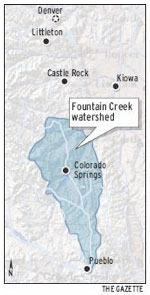
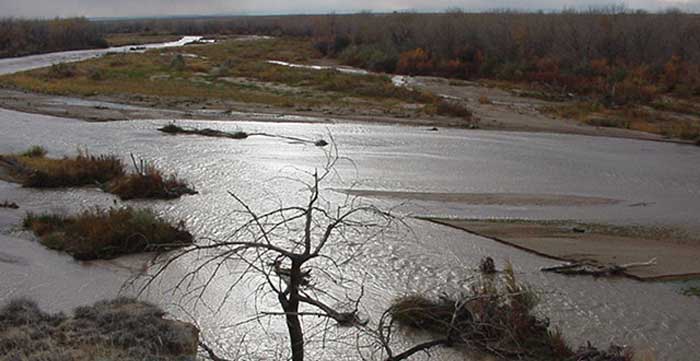
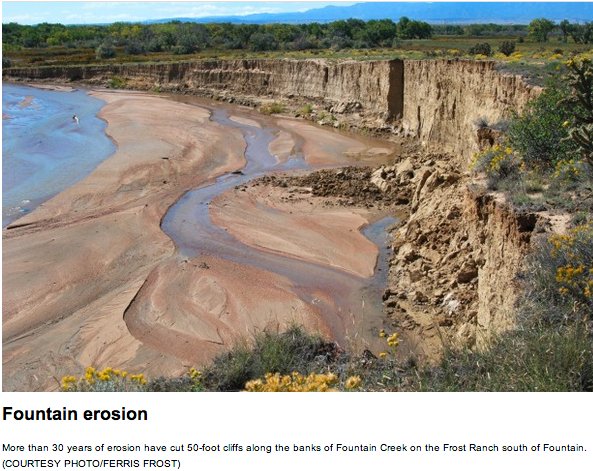
Next year’s budget in Colorado Springs includes $16 million for stormwater repairs. Colorado Springs Utilities will also spend $3 million. Much of those funds are likely to go toward improving the Fountain Creek Watershed, which runs through Colorado Springs and down into Pueblo; and the list of projects that need to be done along Fountain Creek is long and expensive.
The Fountain Creek Watershed Flood Control and Greenway District funds projects in watersheds in El Paso and Pueblo Counties. Executive director Larry Small holds up a building under construction near Monument Creek, which is part of the Fountain Creek watershed, as an example of damages that seem to go unchecked.
“That development has created runoff, comes down the slopes, carries with it sediment,” says Small. “It’s more pronounced down here in this cut bank where the stream gets higher, undercuts the bank and the bank collapses into the creek.”
Up until 2010, Colorado Springs had a stormwater fund that was used to pay for damage like this. But the fund was eliminated and projects stopped. Small says that’s created an enormous backlog.
“[The Monument Creek watershed] is the largest watershed in the Fountain Creek watershed… Many streams are tributaries to Monument Creek and each of these have issues.”
For the entire Fountain Creek watershed, the needed work compiled by the district has a price tag of about $1 billion. Small says about half of that is in Colorado Springs.
In front of a Colorado Springs Utilities wastewater treatment plant downstream are projects completed by the utility. Small says they’re the same sorts of projects that were completed before the stormwater fund was eliminated.
“They would put in rip-rap like this to stabilize the banks,” says Small. “So those were capital improvements they would make. They would also maintain areas that had been eroded, where they had facilities and they’ve been damaged – for instance sediment collection ponds may have been filled in need to be cleaned.”
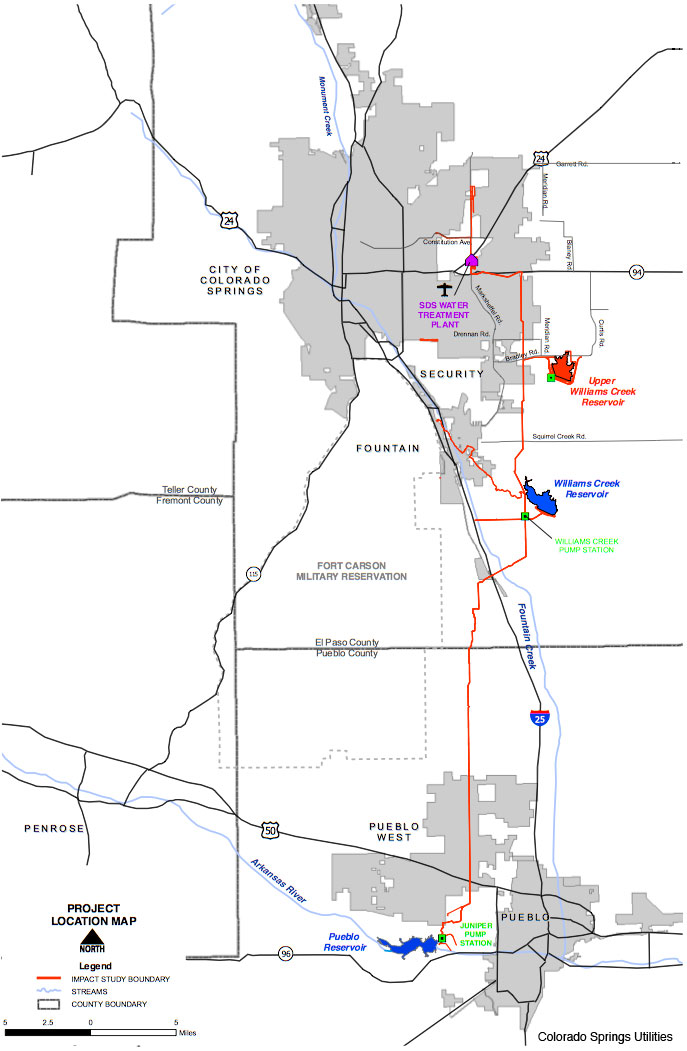
There is pressure on Colorado Springs to get back to work on these projects. The permit authorizing the Southern Delivery System, a pipeline carrying water north from Pueblo Reservoir, requires that Colorado Springs do more to control stormwater runoff before water deliveries begin. Pueblo County nearly voted to find the city in violation of that provision earlier this year, potentially closing down the whole pipeline. The Environmental Protection Agency and the state’s Department of Public Health and Environment will also review the city’s stormwater plans. The city faces a court injunction and fines.
Last section of pipe for Southern Delivery System photo via The Colorado Springs Gazette FromThe Pueblo Chieftain (Chris Woodka):
Plans for a federal lawsuit against Colorado Springs over Clean Water Act violations are being shelved until state and federal agencies show how stormwater violations will be handled.
But the Lower Arkansas Valley Water Conservancy District still intends to be active and urge the city and county of Pueblo to join in assuring that Colorado Springs controls stormwater pollution of Fountain Creek, possibly by blocking the startup of the Southern Delivery System — the $841 million water pipeline scheduled to go online next year.
“We can’t sue, because both the state and federal government are taking enforcement action,” attorney Peter Nichols told the Lower Ark board Tuesday in a work session. “They’re not going to go away. This is not going to be a slap on the wrist.”
The Environmental Protection Agency last month revealed Colorado Springs is in violation of its state permit to discharge stormwater into Fountain Creek. The EPA said Colorado Springs is not spending enough or enforcing its own policies when it comes to stormwater after an audit showed the city made no progress in a two-year period.
“It may be a coincidence, but the EPA did an audit and found everything we found and more. They have more resources,” Nichols said. “When you look at the appendices (to the audit), there’s some egregious [stuff] in there.”
Most likely, that will lead to a federal court case with compliance from Colorado Springs or the possibility of daily fines of up to $37,500 for each violation. It’s unusual for a city to be cited, said Nichols, who was once director of the Colorado Water Quality Control Commission, which enforces permits.
“There are aggressive and tight requirements of what a city has to do,” Nichols said. “The penalties are held in abeyance so long as the violator complies with them.”
Nichols provides a memorandum showing similarities between the Lower Ark’s findings, compiled over the past five years, and the EPA audit, which include lack of funding, maintenance and enforcement of basic stormwater measures.
“We were a voice in the wilderness several years ago, but when we filed an intent to sue, the EPA paid attention,” Nichols said.
“So we care about it, but the city and county of Pueblo don’t?” asked Lower Ark board Chairman Lynden Gill.
One of the provisions of Pueblo County’s 1041 agreement in 2009 with Colorado Springs for SDS requires compliance with all county, state and federal regulations. It’s also one of the provisions in a 2004 intergovernmental agreement (Article VI, No. 8) among Pueblo, Colorado Springs and the Pueblo Board of Water Works.
General Manager Jay Winner pointed out that the district’s criticism has fallen on deaf ears with federal agencies related to SDS as well.
Those include the Bureau of the Reclamation, which approved the use of Lake Pueblo for SDS. Winner wants to reopen the federal process, which was mostly completed prior to abolishment of the stormwater enterprise by Colorado Springs City Council in late 2009.
Reclamation approved a contract for SDS in 2010, even after objections were raised that there was no stormwater enterprise. The only remedy suggested in the documents related to the contract, such as the environmental impact statement, is a vague “adoptive management plan” that is supposed to kick in when violations for things such as water quality violations occur.
“We’ve seen these happening for a long time,” Winner said. “It seems to me the EIS is based on bad information.”
Nichols added the district also can remain involved in questioning whether the violations cited by the EPA could aect the Clean Water Act Section 401 and 404 federal permits issued for SDS.
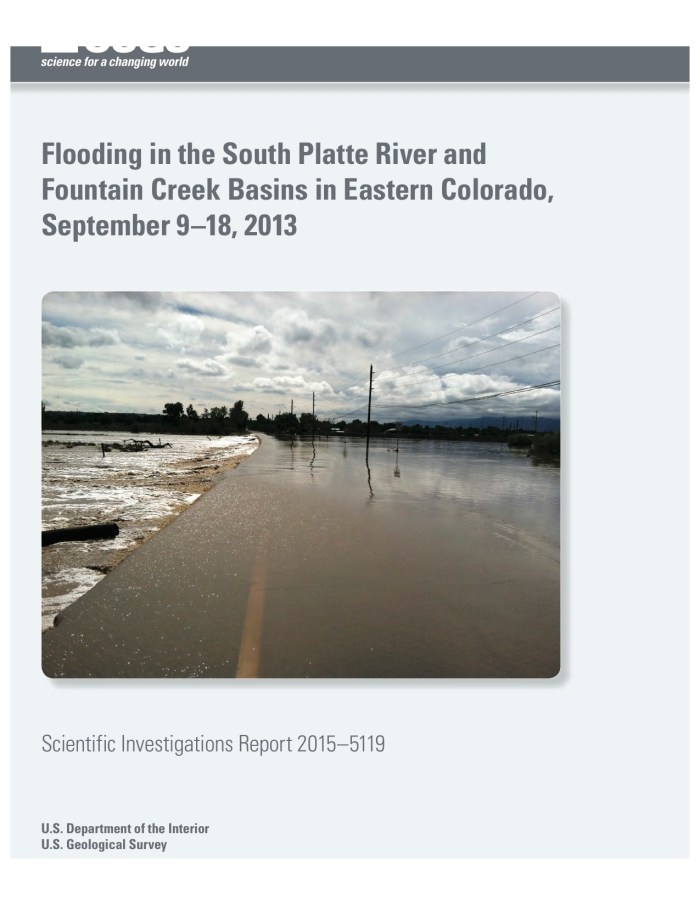
Here’s the abstract from the United States Geological Survey:
On September 9, 2013, rain began to fall in eastern Colorado as a large low-pressure system pulled plumes of tropical moisture northward from the Pacific Ocean and the Gulf of Mexico. By September 16, 2013, as much as 12 to 20 inches of rain had fallen in the foothills of the Front Range of the Southern Rocky Mountains and adjacent plains near Colorado Springs, Colorado, north to the Colorado-Wyoming border. The rain caused major flooding during September 9–18, 2013, in a large part of the South Platte River Basin and in the Fountain Creek Basin. The floods resulted in several fatalities, more than 31,000 damaged or destroyed structures, and an estimated 3 billion dollars in damages. The U.S. Geological Survey (USGS) documented peak stage, streamflow, or both from the flood event for 80 sites located on selected rivers and streams in the South Platte River and Fountain Creek Basins and on the Platte River in Nebraska. The majority of flood-peak streamflows occurred on September 12 or 13, 2013, coinciding with the period of maximum rainfall. The flood resulted in new record peak streamflows at 17 streamgages having at least 10 years of record; 13 in the South Platte River Basin and 4 in the Fountain Creek Basin.
Flooding in the South Platte River Basin was primarily contained to select streams in Aurora and the Denver metropolitan area, most of the mountain tributaries joining the main stem South Platte River from Denver to Greeley, and in the main stem South Platte River from Denver to the Colorado-Nebraska State line. In Aurora, where about 15 inches of rain fell, streamflow peaked at 5,470 cubic feet per second (ft3/s) in Toll Gate Creek, a tributary to Sand Creek. Downstream from Aurora near the confluence with the South Platte River, Sand Creek peaked at 14,900 ft3/s, which was the highest streamflow since at least 1992, but less than the peak of 25,500 ft3/s in 1957 that occurred 4 miles upstream from the mouth. Flood-peak streamflows in the Denver metropolitan area were generally below historic records. The peak of 3,930 ft3/s on September 12 at the State of Colorado streamgage South Platte River at Denver ranked 59 out of 116 peaks and was less than the 1965 peak of 40,300 ft3/s. Ten of the 13 streamgages in the South Platte River Basin with new record peak streamflows were located on the mountain tributaries; Bear Creek, Fourmile Creek, Boulder Creek, St. Vrain Creek, the Big Thompson River, and the Cache la Poudre River. A daily average streamflow of 8,910 ft3/s on September 13 in Boulder Creek at the confluence with St. Vrain Creek was more than twice the previous instantaneous peak of 4,410 ft3/s from 1938. The USGS calculated a peak streamflow of 23,800 ft3/s for the St. Vrain Creek at Lyons; the highest streamflow on record at this State of Colorado streamgage (122 years of record) is 10,500 ft3/s from 1941. A peak streamflow of 16,200 ft3/s was calculated for the Big Thompson River at mouth of canyon near Drake streamgage, which is the second highest peak in 90 years of record and about one-half the magnitude of the peak of 31,200 ft3/s from July 31, 1976. A streamflow of 60,000 ft3/s in the South Platte River at Fort Morgan (September 15, 2013) suggests that a new record streamflow occurred in the main stem in the Greeley area, about 45 miles upstream from Fort Morgan. The current peak of record at a State of Colorado streamgage at Kersey, about 6.5 miles downstream from Greeley, is 31,500 ft3/s from 1973. Given that there was minimal inflow between Kersey and Fort Morgan, the USGS estimates there was probably at least 60,000 ft3/s at Kersey, which would be almost double the peak streamflow of record from 1973.
Flooding in the Fountain Creek Basin was primarily contained to Fountain Creek from southern Colorado Springs to its confluence with the Arkansas River in Pueblo, in lower Monument Creek, and in several mountain tributaries. New record peak streamflows occurred at four mountain tributary streamgages having at least 10 years of record; Bear Creek, Cheyenne Creek, Rock Creek, and Little Fountain Creek. Five streamgages with at least 10 years of record in a 32-mile reach of Fountain Creek extending from Colorado Springs to Piñon had peak streamflows in the top five for the period of record. A peak of 15,300 ft3/s at Fountain Creek near Fountain was the highest streamflow recorded in the Fountain Creek Basin during the September 2013 event and ranks the third highest peak in 46 years. Near the mouth of the basin, a peak of 11,800 ft3/s in Pueblo was only the thirteenth highest annual peak in 74 years. A new Colorado record for daily rainfall of 11.85 inches was recorded at a USGS rain gage in the Little Fountain Creek Basin on September 12, 2013.
Recent revelations about deficiencies in stormwater control could snag Colorado Springs plans to expand its water system.
The Bureau of Reclamation and Pueblo County need to take a second look at the environmental impact statement that cleared the way to build the $841 million Southern Delivery System, and the newly constructed water pipeline from the Pueblo dam to El Paso County should not be turned on until the issue is settled, said Jay Winner, general manager of the Lower Arkansas Valley Water Conservancy District.
“We’ve been saying this for years,” Winner said. “We need to get past the talk from Colorado Springs and stop them from flushing all their crap down Fountain Creek. They need to walk the walk.”
Winner was reacting to an inspection report released this week by the Environmental Protection Agency that could be the basis for a federal lawsuit over inadequate stormwater control in Colorado Springs.
Among other things, the report says the city failed to correct problems identified two years earlier, that it knowingly violated the terms of its municipal separate storm sewer system permit and that it is not enforcing its own guidelines for new development.
Reclamation’s EIS was done in 2009, when Colorado Springs had a stormwater enterprise in place that generated millions of dollars annually to take care of the very problems outlined in the inspection. The assumption by Reclamation was that since it was in place, the only issue were future flows generated by new development related to SDS.
If that created problems, Reclamation relied on a vague “adaptive management” concept to rectify problems.
Reclamation failed to answer political calls to reopen the EIS in 2010 after Colorado Springs City Council torpedoed the stormwater enterprise on a split vote after a city election.
The EPA’s inspection report shows problems continue to worsen as Colorado Springs ignores its stormwater infrastructure. The Colorado Springs City Council and Mayor John Suthers have devised a plan to provide $19 million in funding toward complying with the MS4 permit and addressing a more than $500 million backlog in projects.
Winner said a more permanent funding source is needed, which the EPA concurs with in its inspection report. This needs to be a consideration for Pueblo County commissioners, who are negotiating with Colorado Springs over compliance on the stormwater issue as it relates to the 1041 permit for SDS.
“I think we’ve been hoodwinked long enough by their City Council,” Winner said. “I would hope the new (Pueblo) City Council will become more engaged and not put up with these shenanigans.”
One of the new Pueblo City Council members is Winner’s wife, Lori Winner.
Winner also is uneasy that the Arkansas Basin Roundtable this month endorsed a Colorado Springs Utilities employee, Mark Shea, for a seat on the Colorado Water Quality Control Commission. Winner, a member of the roundtable, urged caution at the meeting. Recently, another Utilities executive, Mark Pifher, (now a consultant for Utilities) served on the commission.
“The Water Quality Control Commission has ignored the problems,” Winner said. “It’s like asking the fox to guard the henhouse.”
More coverage from Chris Woodka writing for The Pueblo Chieftain:
Turns out the bare minimum that Colorado Springs said it was doing to prevent contaminated water from its streets flowing into Fountain Creek was not enough to satisfy the federal government.
The one constant that Colorado Springs officials had assured Pueblo County and the Lower Arkansas Valley Water Conservancy District was being met was the MS4 permit with the Environmental Protection Agency.
MS4 stands for municipal separate storm sewer system, and the existence of the permit itself has been held up for years in presentations by Colorado Springs as evidence that the city was doing basic work to regulate stormwater.
But according to an EPA report finalized in August, little progress has been made to rectify problems identified in a February 2013 audit. The inspection could be the basis for a federal lawsuit over Colorado Springs stormwater deficiencies.
In fact, city officials were aware of shortcomings, as the EPA stated: “During the inspection, city representatives stated they were fully aware of the lack of resources to adequately implement the MS4 program, and cited the termination of the city’s SWENT (stormwater enterprise) in 2009 and overall lack of political, managerial and community support for the city’s MS4 program as contributing factors.”
Photographs in the report show severe erosion, crumbled drop structures, vegetation growing in concrete ditches and cracked channels clogged by logs and trash throughout the city.
Colorado Springs also has assured Pueblo County and the Lower Ark that new development that benefits from the soon-to-be-completed Southern Delivery System would be regulated to avoid any additional impact on Fountain Creek.
There has also been a lot of talk about how the city has developed a design criteria manual to protect Fountain Creek.
The EPA inspection, however, notes that Colorado Springs is doing very little to make new development comply with regulations after looking at more than 600 plans reviewed by the city. The report stated: “It was unclear at the time of the inspection how the city would ensure submittal of appropriate design elements in the future. … The city did not ensure that public and private permanent BMPs (best management practices) were properly designed, approved and installed.”
Channel erosion Colorado Springs July 2012 via The Pueblo Chieftain FromThe Pueblo Chieftain (Chris Woodka):
Colorado Springs is facing another federal lawsuit over stormwater violations, this time from the federal government.
The Environmental Protection Agency is considering litigation over violation of the city’s federal permit for discharging storm sewer water into Fountain Creek.
An inspection of the city’s stormwater system Aug. 18-19 found failure to meet standards or perform remediation of problems identified in a state audit in February 2013.
“I have to look at the report, but I think this highlights what we have been saying for years,” said Jay Winner, general manager of the Lower Arkansas Valley Water Conservancy District. “Colorado Springs has failed to meet its obligations and continues to dump on Pueblo and its other downstream neighbors.”
The Lower Ark district has its own federal lawsuit ready to go, but is holding it back as it waits to see if the city’s new leadership follows through on a commitment to fund stormwater at $19 million per year.
Colorado Springs City Council in 2009 voted to dissolve its stormwater enterprise, after it had been listed as a building block for approval of the Southern Delivery System in permits with the Bureau of Reclamation and Pueblo County.
The move was first protested in early 2010 by state Rep. Sal Pace, now a Pueblo County commissioner, to the Bureau of Reclamation, Corps of Engineers and EPA. All three agencies indicated at the time Colorado Springs was in compliance with SDS conditions.
In early 2012, Colorado Springs’ city attorney informed then-Mayor Steve Bach and City Council that they were obligated to fund stormwater projects as a part of the SDS approval. That resulted in a stormwater task force that failed to gain voter approval for a regional drainage authority.
Also in 2012, the Lower Ark began talking with Reclamation about stormwater commitments Colorado Springs made in order to obtain approval for SDS.
“It was very disappointing that the Bureau of Reclamation did not step in at that time,” Winner said. “We went to Washington to talk to (Interior Secretary) Ken Salazar and Ann Castle (assistant secretary for water and science) and got nowhere.”
After failing to interest either the Pueblo City Council or Pueblo County commissioners in pursuing the issue in 2012, the Lower Ark’s legal staff began working on a federal lawsuit, embarking on a detailed analysis of how stormwater protection was failing. The lawsuit first targeted Reclamation, but later shifted to naming the city of Colorado Springs as the potential defendant, based on violations similar to those cited by the EPA in August.
“I think this action by the EPA shows that it is not just our district that thinks Colorado Springs has not measured up,” Winner said.
Under Bach, Colorado Springs’ interest in stormwater protection centered on dealing with damage from the Waldo Canyon and Black Forest fires, which combined claimed 832 homes and scarred more than 32,000 acres.
But Bach actively opposed the regional drainage district.
Former Colorado Attorney General John Suthers was elected Colorado Springs mayor in May, and immediately pledged to work for $19 million in annual stormwater funding, a move fully endorsed by Colorado Springs City Council.
“I think the new leadership in Colorado Springs is addressing the problem, and the voters endorsed the mayor’s and council’s plan in the last election,” said Steve Nawrocki, president of Pueblo City Council. He said more meetings on the stormwater issue should occur early next year. Nawrocki also acknowledged that pressure from the Lower Ark district helped press the issue.
“I think it helped by making the new leadership (in Colorado Springs) more proactive.”
Pueblo County is in negotiations with Colorado Springs over its 1041 permit for SDS, and is unsure of the impact potential litigation with the EPA would cause.
Colorado Springs notified the county of the impending lawsuit Monday and commissioners expect to discuss it at today’s meeting “It sounds like it vindicates us for what we in Pueblo have been alleging for more than a decade,” said Commissioner Terry Hart.
Suthers was quoted in Tuesday’s edition of The Gazette as saying: “We would rather spend money trying to solve the problem. We’re hoping both Pueblo and the EPA have some realization that we have a council and mayor that realize you can’t kick the can down the road any farther.”
Work is resuming on a dangerous portion of Fountain Creek through Pueblo.
The Army Corps of Engineers is overseeing a $750,000 project to install articulated concrete blocks — held together by cable in a mat and anchored to the ground — along the Fountain Creek bank near the 13th Street Exit on Interstate 25.
Work should be complete within three months and Pueblo contractor Pate Construction is doing the work while flows are low.
The project started in April, but was interrupted by heavy rains in May and June that increased flows on the Fountain to well above normal for more than six weeks. Waters only recently receded to the point where workers could get in the channel.
Fountain Creek will be temporarily rechanneled to the east of the area while work is underway, said Jeff Bailey, assistant city manager for stormwater.
The area had been secured by a gabion — wire-wrapped rock — which washed out during the September 2013 flood on Fountain Creek.
Fountain Creek hits the bank at a right angle at 13th Street, threatening railroad tracks and roadways in the area. While the Corps is responsible for the work and funds it, the city is the sponsoring agency and coordinates such things as local permits and access, Bailey explained.
There are several other projects still in the planning stages to repair damage from this spring’s flooding, Bailey said.
The city will be removing the debris such as large trees that were deposited at the Eighth Street bridge in the near future. “We need to get that clear so the water doesn’t start undermining the supports,” Bailey said.
The city is also working on restoring trails and repairing the berm at the flood detention pond behind the North Side Walmart.
Meanwhile, the Colorado Department of Transportation is working on projects to repair the Colorado 47 bridge and the trail in that immediate area, as well as clearing debris at the East Fourth Street bridge.
Click here to read the newsletter. Here’s an excerpt:
Second Annual Event A Huge Success
The numbers are in, and they are impressive.
1,550 citizens in 6 communities removed almost 9.5 tons of litter and debris from the Fountain Creek Watershed during Creek Week 2015 (September 26-October 4th).
This year’s event drew more than twice the participants and collected over 2 tons more than last year’s inaugural cleanup, thanks to new Steering Committee members, generous sponsors and hard working volunteers of all ages.
New this year was a fundraiser at Fieldhouse Brewing Company – they created a special “Creek Week IPA”, a promotion for volunteers at Navajo Hogan, insulated water bottles as prizes, heavy duty gloves and trash grabbers for volunteers to keep, a commercial and newspaper ads.
The goals of Creek Week are about fostering stewardship, raising awareness of our waterways, and making the area cleaner and safer for all to enjoy. Comments from participants about their experiences were very favorable – most indicated that they would like to see more cleanups throughout the year, that they were more aware of their impacts on our water, and that they would get involved again in the future.
The Steering Committee looks forward to continued growth and expansion of Creek Week in the coming years including increased participation, development of watershed education materials and resources for teachers, coupon books for volunteers, and in-water teams…
From the Colorado Springs Independent (Pam Zebeck):
The Southern Delivery System, due to become operational next year, hasn’t cost as much as predicted in 2010, which led to lower and fewer rate increases since that time. Originally, Colorado Springs Utilities planned to increase water rates by 12 percent per year for six years. Instead, rates went up by 12 percent each in 2011 and 2012 and 10 percent each in 2013 and 2014.
That said, revenue hasn’t generated as much money as CSU planned, according to a City Auditor’s Office assessment of water rates released this month.
When the costs of the pipeline from Pueblo Reservoir to Colorado Springs came in some $400 million less than originally projected, that meant the city had to borrow less, the audit reports…
In any event, Springs Utilities proposes to change gas, electric and water rates in 2016. The water rate increase would increase the typical residential bill from $57.07 a month this year to $59.62 next year, an increase of $2.55 per month, or 4.5 percent…
Rates changes will become effective January 1 if approved by City Council, which doubles as the Utilities Board.
The city of Manitou Springs plans to take advantage of a much-needed upgrade to an almost 120-year-old deteriorating pipeline and become a bit more environmentally and economically efficient.
A more than $3 million project to upgrade the iron pipe just entered its beginning stages. And city officials already plan to add a small hydroelectric generator to the line that brings water from French Creek on the eastern slopes of Pikes Peak and into the city’s water treatment plant.
The city began plans for the project after heavy rains in September 2013 eroded soil that covers the pipe, which was installed in 1897 and is hidden less than three feet below the Ute Pass Regional Trail.
The line was exposed in multiple places during the 2013 storms that pummeled the entire Front Range, causing roads to wash away, resulting in at least eight deaths, according to Colorado Office of Emergency Management, and leaving some people stranded for days. The pipe sprung a couple of leaks during the torrent. The city temporarily shut off its water main for repairs. And officials became urgently concerned about just how long the three-and-a-half mile pipe will last.
“If it were to fail, there is only a couple days-worth of reserves,” said Sara Hartley, a flood recovery project manager with Manitou Springs. “This is a very high priority project.”
As city council discussed the plans earlier this year, one council woman suggested piggy-backing the hydroelectric generator onto the project.
“Coreen (Toll) brought up the idea that if we were going to replace the pipe, we might as well look into hydro,” said city administrator Jason Wells.
Just last week Manitou Springs received word from the U.S. Department of Housing and Urban Development that it will receive a $3.3 million Community Development Block Grant for the pipeline project. Adding a bypass that will send water flowing through a 40-kilowatt water turbine and generate electricity is expected to add about $300,000 to the cost.
Kurt Johnson, a consultant at Telluride Energy LLC, said a pressure-reduction valve would be needed to ensure that water flowing into the treatment plant doesn’t cause damage to the facility and its controls. According to Johnson, the bypass and the water turbine will consume any extra water pressure and make good use of the energy that would otherwise be wasted.
By adding the turbine during the pipeline project, some of the costs for installing the hydro generator will be avoided, Wells said. He and Johnson also talked about potentially designing the new pipeline so it can accommodate multiple future turbines at low cost.
Hartley said that possibility has been discussed by Manitou officials. She said those details could be added to the plans in the design and construction phases of the project.
This isn’t the first time the city has explored potential benefits of hydropower. Manitou Springs did a feasibility analysis in 1990 to see if installation of a hydro generator at the treatment plant would be cost effective, Hartley said.
According to Johnson, it wasn’t until 2013 when the Hydropower Regulatory Efficiency Act was signed into law by President Barack Obama, that small hydro projects became economically feasible. Johnson said that prior to 2013, tens-of-thousands of dollars were going toward bureaucratic paperwork and trickling down to consumers. He said the bill passed overwhelmingly with bipartisan support and has led to “small hydro innovation,” more grant money for such projects and low-interest loan availability.
Manitou Springs plans to borrow money for the hydropower supplement to the pipeline project. The turbine is expected to generate about 237,000 kilowatt-hours of electricity each year. According to the U.S. Energy Information Administration, the average residential utility customer used just under 11,000 kilowatt-hours in 2014.
The next step for Manitou Springs is to compile preliminary plans and engineering designs and turn them over to the Colorado Department of Local Affairs for an environmental review. Upon completion, a “funding obligation date” will be determined. From that date, the block grant guidelines require Manitou Springs complete the pipeline project within 24 months.
Hartley said the city will submit a Request for Proposal next year and accept bids to choose a contractor. She estimates it will be at least 10 months before construction begins on the project.
In the meantime, Manitou Springs must simply wait and hope that the 188-year-old pipe holds up.
“It’s just long overdue,” said Kirk Greasby, the city’s water treatment plant operator.
Colorado Springs Utilities tried to assure a district that has threatened federal court action that it fully intends to fund stormwater control on Fountain Creek.
“We have been working with Pueblo County on an intergovernmental agreement that deals with one topic: stormwater,” Colorado Springs spokesman Mark Pifher told the Lower Arkansas Valley Water Conservancy District board Wednesday.
He said there have been three drafts of the IGA, which was initiated shortly after John Suthers was elected mayor.
“We’re meeting again next Tuesday, and hope to reach an understanding of what our commitments are,” Pifher said.
Colorado Springs had a stormwater enterprise in place in 2009 when Pueblo County approved a 1041 permit for the Southern Delivery System.
The enterprise was initiated in 2005 with the participation of the Lower Ark District. The district had a larger portfolio of water issues it wanted to address with Colorado Springs, but made headway only with Fountain Creek flood control issues.
Over the next few years, they spent a combined $1.2 million to develop a plan and keep the newly formed Fountain Creek Watershed Flood Control and Greenway District afloat.
After the Colorado Springs City Council voted to abolish the stormwater enterprise, the Lower Ark district began to prepare a federal lawsuit, first against the Bureau of Reclamation and now against Colorado Springs, claiming violation of the federal Clean Water Act.
For the last year, Colorado Springs has asked the Lower Ark to hold off on filing the suit, and with Suthers’ election, the district has returned to a wait-and-see mode.
Pifher presented documentation that Suthers supports a 10-year program to fully fund stormwater control and permitting at $19 million annually in his budget request to City Council. Council made a similar proposal last year that was shot down by the former mayor, Steve Bach.
The upcoming vote on a sales tax to fund street repairs will not affect stormwater funding, Pifher claimed.
“They’re two separate issues,” he said.
However, Americans for Prosperity, a group funded by the billionaire Koch Brothers, is challenging that position, saying that some of the bonds being eyed for flood control could be used for streets.
Colorado Springs is working with the EPA and Colorado Department of Public Health and Environment on the best places to spend the money. It also intends to start up SDS early next year, which would release $50 million in flood control payments over five years to the Fountain Creek district, Pifher noted.
Colorado Springs Utilities got a clean bill of health from Pueblo County’s weed manager Monday and answered questions raised at a Sept. 25 hearing about revegetation along the 17-mile route of the Southern Delivery System through Pueblo County.
Still, commissioners want more time to study documents submitted and continue a public hearing on SDS 1041 permit commitments to 9 a.m. on Dec. 8.
Utilities needs to fulfill conditions of Pueblo County’s 1041 permit for SDS in order to turn on its pipeline from Pueblo Dam to Colorado Springs next April. Revegetation compliance also would release $674,000 Pueblo County is holding under of the permit.
Utilities revealed it has spent more than $5.3 million on revegetation work already.
Colorado Springs provided point-by-point assurances on 17 issues raised on Sept. 25, when experts from both camps agreed Utilities had tackled the problem with state-of-the-art methods. Utilities also provided documentation from contractors that the work was done correctly, and that most landowners were satisfied with the work.
“We need to work through the (final) issues to protect the citizens of Pueblo County,” said Commissioner Terry Hart, who made a motion to take the comments under advisement and continue the hearing. “What we’re trying to do is look at the work in its totality.”
Hart, along with Commissioners Liane “Buffie” McFadyen and Sal Pace, had little criticism of Utilities’ report, which pledged further work with landowners as well as reviewing procedures already put in place to bring land disturbed by SDS construction back to its original condition or better.
“It’s light years ahead of other projects,” Hart said.
Bill Alt, who manages Pueblo County’s weed control program through the Turkey Creek Conservation District, agreed. Alt toured the pipeline route last week and said Colorado Springs has lived up to its responsibilities to reseed ground disturbed by SDS.
“The grass is up and doing well,” Alt said.
“Some of the tamarisk has been dug up by the roots and removed, and the topsoil has been replaced as in any mining operation.”
The problem is that the areas on either side of the 150-foot path of SDS are still susceptible to tumbleweeds (Russian knapweed) and tamarisk, which could still find their way back onto the treated area, particularly on the route north of U.S. 50, Alt said.
Some landowners have mowed or grazed the revegetated areas prematurely instead of allowing new grasses a chance to get established, he added.
“Everything is fine for what we looked at,” Alt said. “We did not go on Walker Ranches, although I would like to go because that’s where the erosion is.”
The Walker Ranches crossing is being handled under a $7.4 million settlement as a result of a jury verdict.
Colorado Springs also said it is working on a settlement with Dwain Maxwell, a Pueblo West resident who complained about the project at an earlier hearing. Utilities also has taken on a separate project to divert floodwater around a property just south of Walker Ranches in Pueblo West.
As part of the deal, the utility company had to repair the land after digging up 50 miles of dirt to bury the 66-inch pipe, restoring at least 90% of the vegetation that was in place before. CSU showed the county that they have gone above and beyond the requirements, but commissioners have not yet released them from the commitment.
“The work that we’ve got done so far is already light-years ahead of other projects,” admits commissioner Terry Hart. Pueblo County commissioners applauded CSU for its nearly $5.4 million efforts to re-seed and irrigate the lands it plowed through to plant the SDS pipeline.
Landowners agree, giving high praise in a report to the way workers left things better than before.
CSU’s SDS permitting and compliance manager Mark Pifher says, “We put in a very extensive irrigation system. If I had to guess, it’s probably the biggest irrigation system ever installed in Colorado.
Commissioners had lots of questions when they first met to review the re-vegetation process in September, many of which addressed future concerns over erosion and management of the property. Pifher says doing a good job is about more than protecting the pipeline; it is about respecting the landowners as well. “It’s important that you do it with a mindset that this is like your property,” says Pifher, “how would you like it restored and put back into its historic condition, if you will.”
Bill Alt has been working closely with the group to oversee the management of noxious weeds throughout the easements, which have been removed on the property in question, but remain nearby and are likely to spread. Alt suggests CSU send a notice to the owners about maintaining the landscaping moving forward. “It needs some tender, loving care,” says Alt, “and it’s good for your property because it keeps the property value up. It’s not something you’re ashamed to show a realtor or other people.”
Commissioners will meet with Colorado Springs Utilities again Dec. 8 to make sure no other questions arise before checking re-vegetation off the long SDS checklist. The only other big issue standing in the way of water flowing north is Colorado Springs’ stormwater management efforts.
To access all official documents on the SDS, including CSU’s latest report, click here.
$2 million in damage remains in Pueblo’s Fountain Creek after unrelenting flooding earlier this year. It will cost much more to repair. The rain fell throughout southern Colorado, but the southern part of the river has arguably the most visible effects…
The rushing water coursed its way wherever it could find a path, destroying cement trails and creating a vast wasteland of dead trees and silt. Those from farther north say they now understand why Pueblo is asking for millions of dollars to help fix it. Colorado Springs city council president Merv Bennett says, “This is important for us in Colorado Springs to come down and see this. They’ve come up to Colorado Springs. That’s what neighbors do. We come and share in this and share in a dialogue as to finding solutions.”
The Springs council members admit there is a difference between driving down I-25 and looking at the creek, and actually getting up close to see it firsthand. The add, however, that their lack of stormwater management is not totally to blame. “A lot of this damage, a lot of this water comes in above Colorado Springs, and some of it comes in below Colorado Springs, so this is a regional issue,” says Bennett.
What they took away from the tour is a sense of cooperation. Looking to the future, Colorado Springs and Pueblo plan to work together in finding and creating the best solutions to keep this from happening again.
“It was just good to have them down here so they could see firsthand the devastation and they reassured us about their commitment,” says Pueblo city council vice president Ed Brown.
Colorado Springs mayor John Suthers told Pueblo city council in July that he plans to restart the city’s stormwater management enterprise program, and dedicated $19 million a year for mitigation efforts in Fountain Creek.
An eort to advance flood control on Fountain Creek surged ahead Wednesday with the completion of a study of how water rights would be aected if a dam or side detention ponds were built.
The Fountain Creek Watershed Flood Control and Greenway District wrapped up the yearlong eort with a presentation to those most concerned about the project — the state of Kansas, the Amity Canal, junior water rights holders and even some Fountain Creek irrigators.
“This is the first step in what we originally wanted to accomplish,” said Larry Small, executive director of the district. “There are two things we need to accomplish, flood control and controlling sedimentation and erosion. We can’t do flood control until we get rid of the sedimentation and erosion.”
The district originally approached the Arkansas Basin Roundtable in July 2014 with a more detailed feasibility study, but was told to solve the water rights issue first.
It will go back to the roundtable in January with a proposal similar to the earlier draft, Small said.
Engineer Duane Helton determined that it would be possible to satisfy all downstream water rights if 10,000 cubic feet per second were allowed to flow down Fountain Creek during a flood event. Water would then be released as quickly as possible as flow levels dropped.
He modeled the September 2013 flood, and used actual diversions in the following two weeks to determine how and when water would be distributed.
“It could work with lower or higher thresholds,” Helton said.
There were questions about whether senior rights downstream would be satisfied as junior rights took water. Helton said they would, depending on how the Division of Water Resources administers the Arkansas River.
“That’s always going to be a challenge,” said Bill Tyner, assistant division engineer. “That’s not going to change with flood detention.”
There could be exceptions, such as when a canal is breached during the flood event and cannot divert water.
There have been at least 18 events where flows exceeded 10,000 cfs on Fountain Creek since 1948. In eight cases, the volume of water was so high that it triggered conservation storage in John Martin Reservoir — basically “free river” conditions.
Irrigators on Fountain Creek are interested in erosion issues.
“I had a 12-foot diversion that went 300 feet,” said Tracy Tolle of the Wood Valley Ditch at Pinon in Pueblo County. “From what I’ve seen on Fountain Creek this year, whatever you put in is going to get washed out. I’d like to see the plan to control erosion.”
Small replied that so far, the district has only $50 million in funding coming, but its purpose is for flood control that benefits Pueblo under Pueblo County’s 1041 permit for Southern Delivery System.
Comments are still being solicited on the study and will be incorporated into the final report.
Mayor Suthers released his proposed 2016 budget Monday. The big focus will be on storm water. A problem that’s plagued Colorado Springs for years.
“Several years ago, we had a storm water enterprise,” Suthers said. “With the demise of that, defunding of the storm water enterprise, for the most part we’ve been spending minimal amounts [of money] over the last several years in terms of storm water.”
The city is setting aside $16 million, with an additional $3 million from Springs Utilities for a total of $19 million.
That plan had some tax payers wondering why isn’t that money going toward the roads.
“There were times I felt like I was going to get pulled over for swerving so much even though it was just because of the pot holes,” Mackenzie Tennison said.
The mayor said through all their surveys, roads were the top priority for voters so he expects them to pass the proposed tax increase of 0.62 percent in November. That will give the city the money it needs to fix our roads.
“I don’t agree with, you know, us getting taxed more,” Leafner Tan said. “I’m pretty sure there’s enough money there, and I’m pretty sure there’s also money going somewhere we don’t need to spend money on.”
“You cannot do storm water and roads,” Suthers said. “Storm water is within reach because it’s a relatively less amount of money.”
Suthers added, that unlike previous years, he’s been working with city council on this budget and that nothing about it should surprise them.
There will be a meeting at City Hall on October 20 from 5-7:30 p.m.
The $268.1 million general fund budget is up $9.4 million, or 3.6 percent, but Suthers said that when adjusted for inflation, the city today spends $86 a year less on each resident than it did in 2000…
Suthers’ priority remains the city’s infamously atrocious roads, most of which need overlays or complete reconstruction. But the mayor is banking on passage of a Nov. 3 ballot issue to provide $50 million a year for five years through a 0.62 percent sales tax increase.
The other overriding need is stormwater projects to ameliorate Fountain Creek flooding effects on downstream Pueblo. Past city stormwater funds have been eliminated, and a federal lawsuit has been threatened by the Lower Arkansas Valley Water Conservancy District.
If the issue isn’t addressed, it also could threaten the 1041 permit Colorado Springs Utilities got for its $829 million Southern Delivery System, soon to pump water from Pueblo Reservoir to Colorado Springs, Pueblo West, Fountain and Security.
So Suthers is squeezing $16 million out of the budget, which would be augmented by $3 million from Utilities, for stormwater projects…
In order to make ends meet, staffing requests, raises and capital projects were left unfunded, Suthers said.
Click here to read the Mayor’s news release and letter to City Council — via Pam Zubeck and the Colorado Springs Independent.
Kansas has concerns that the effects of a large dam on Fountain Creek are not adequately modeled in a study of flood control and water rights that is nearing completion.
But comments from Kevin Salter of the Kansas Division of Water Resources indicate the modeling done by the Fountain Creek Watershed Flood Control and Greenway District is “reasonable” when it comes to side-detention ponds.
Kansas is an important player because its 1985 federal lawsuit over the Arkansas River Compact raised storage issues along with wells. The Supreme Court ruled in Colorado’s favor on the storage questions, but new dams would be untested waters.
“The methodology in this draft report appears reasonable to protect water rights below the confluence of Fountain Creek and the Arkansas River for the scenario involving side-detention facilities,” Salter said.
“As for the scenario to construct a multipurpose reservoir on Fountain Creek; Kansas is concerned.”
In an email to a committee looking at engineer Duane Helton’s draft report, Salter said more study is needed to look at the full impact of a 52,700 acre-foot reservoir that would include a 25,700 acre-foot pool for recreation and water supply and 27,000 acre-feet for temporary flood storage.
“Should the actual implementation of detained flood flows on Fountain Creek impact compact conservation storage Kansas would fully expect that those flows be restored,” Salter said.
Larry Small, executive director of the Fountain Creek district, said a more complete evaluation would be made of water rights if a large reservoir is pursued.
“The district will complete a full evaluation of alternatives and a feasibility study of the preferred alternative in the future before any decision is made on flood control facilities, to include multipurpose facilities,” Small said in an email reply.
Helton’s study shows there would be little impacts on water rights if flood control structures allowed a flow of 10,000 cubic feet per second to flow through Pueblo during large floods. Water would be released as quickly as possible following the peak flow.
The study discounted extremely high flows, such as the 1999 or 1965 floods, saying there would be little damage to water rights because the high volume would fill John Martin Reservoir, creating a free river.
Division Engineer Steve Witte said Kansas concerns must be treated carefully, so a new round of litigation isn’t triggered.
Witte would like the 2015 flooding to be studied. Flows on Fountain Creek exceeded the 10,000 cfs mark on three occasions during six weeks of elevated flows. John Martin Reservoir did not fill, so it would be an ideal opportunity to explore how flood storage could be administered, he said.
“I think we need to be careful in any scenario to make sure there isn’t some material depletion,” Witte said.
After the 1999 flood, when Kansas and Colorado were in litigation over the Arkansas River Compact, Kansas raised questions about how such large flows should be divided. Those issues have not been resolved, Witte said.
Another downstream party, Tri-State Generation and Transmission Association which owns half of the Amity Canal in Prowers County, said more study is needed to determine the damage if water is detained at lower flows and how water would be allocated after a flood.
The committee looking at the report, which includes some downstream farmers, Kansas, Colorado Springs Utilities, Tri-State and others, will meet again at 10 a.m. Oct. 14 at the Southeastern Colorado Water Conservancy District offices.
Sure, Fountain Creek is going to flood from time to time.
But one landowner says that’s inevitable, and a district formed to improve the creek should be looking at using conservation easements to build a trail system from Pueblo to Colorado Springs.
“You could create an easement to connect the two cities,” said Jerry Martin, a Pueblo West Metropolitan District board member who owns property on Fountain Creek about 5 miles north of Pueblo. “It doesn’t solve flooding, but it helps mitigate the damage.”
Martin spoke at Friday’s meeting of the Fountain Creek Watershed Flood Control and Greenway District board.
Martin’s idea is for the district to secure easements, either through donations such as he is willing to do or by purchasing them. Martin, who chose to live in Pueblo West after working in Colorado Springs, said state funding is more likely if Pueblo and Colorado Springs can pull together for a common goal.
“My whole point is that we have a sow’s ear, but you can make a silk purse,” Martin said.
The district was receptive, and in fact already on the case.
Already, the district has secured Great Outdoors Colorado funding for trails in both El Paso and Pueblo counties, as well as recreational activities such as the wheel park on Pueblo’s East Side, slated to open in November.
Executive Director Larry Small noted that recreation has always been a purpose of the district, and is included in the strategic plan and corridor master plan.
Board member Richard Skorman added that the district is working to include the Fountain Creek trail as part of Gov. John Hickenlooper’s recently announced $100 million critical connections program for hike and bike trails.
“The designation would help,” Skorman said.
The idea of connecting Pueblo to the Front Range Trail via Fountain Creek goes back to then-Sen. Ken Salazar’s “Crown Jewel” vision in 2006. Skorman was a staffer for Salazar at the time.
“What can I do?” Martin asked. “I know it’s not a new idea, but one that I hope gets to the top of the list.”
“We’ve always felt we’ve been a stepchild,” Skorman said. “Colorado Springs and Pueblo need to push together. If we could get that (critical connection) designation, it could go a long way. We’re on a roll here if we can get this to work.”
Pueblo County commissioners say the state should be a referee, rather than a sponsor, in future water projects and they want to emphasize local regulation.
“The county’s experience has been that federal and state regulations and enforcement alone have been inadequate to protect against local impacts of water projects,” the commissioners wrote in comments on the state water plan filed last week.
The deadline for comments was Thursday. Commissioners Liane “Buffie” McFadyen, Terry Hart and Sal Pace jointly signed the letter to Gov. John Hickenlooper and the Colorado Water Conservation Board, who are working to finish the plan by December.
The commissioners want to make sure that the state water plan does not undermine the authority of the state’s counties and cities to regulate water projects under laws such as HB1034 and HB1041, both passed in 1974 to provide local regulation of statewide activities, including water projects.
Pueblo County has used the 1041 process most notably in obtaining mitigation for the Southern Delivery System, an $840 million project that is designed to bring water from Pueblo Dam to Colorado Springs.
SDS is scheduled to go online in 2016, and under the 2009 permit for the project, Colorado Springs has been required to spend an additional $75 million to fortify sewer lines, $50 million for Fountain Creek flood control, $15 million for roads, $4 million for wetlands restoration and $2.2 million for Fountain Creek channel dredging, among other conditions.
“To avoid confusion as to the local government’s authority to deny a permit for a specific project, we recommend that the following sentence be added: ‘A permit may be denied for a specific water project that does not meet the standards or criteria of the local regulations,’ ” the commissioners wrote.
The county also wants the state to remain neutral in water projects.
“Pueblo County does not believe that it is appropriate for the state of Colorado to endorse or become a sponsor of a water project in most cases,” they said.
The board also wants to include stormwater control in the state definition for watershed protection. Most of the efforts in the last three years in watershed health have focused on mitigating the damage from large wildfires, but Pueblo County said equal attention has to be given to the effects on water quality from increased stormwater caused by development, such as what has occurred on Fountain Creek.
Stormwater has been a key issue in regulation of SDS as well. A recent study for the county by Wright Water Engineers found that 370,000 tons of sediment are deposited each year between Colorado and Pueblo, decreasing the effectiveness of Fountain Creek levees.
Finally, the county wants water reuse to get more emphasis in the state water plan.
“The benefits to Pueblo County of promoting reuse are twofold,” commissioners said. “First, municipal reuse would reduce the need for dry-up of agricultural lands and transfers of agricultural water rights to municipal use. Second, reuse in El Paso County would reduce and control damaging flows in Fountain Creek through Pueblo County.”
Colorado Springs Mayor John Suthers made a strong statement for stormwater funding in his state of the city speech Wednesday.
In doing so, he prominently highlighted the reason it is needed is to reduce the harmful impact to Pueblo from increased flows on Fountain Creek caused by growth in Colorado Springs. Spring rains caused millions of dollars in damage in both counties this spring.
“As recently as the late 1960s, our neighbor to the south, Pueblo, was larger than Colorado Springs. Since then Colorado Springs has grown to be about four times the size of Pueblo and that means considerably more impervious surfaces contributing to stormwater flow into Fountain Creek, with impacts on Pueblo,” Suthers said.
The mayor carefully reviewed the history of the stormwater enterprise approved by Colorado Springs City Council in 2005. It generated about $15 million per year until 2009, when council abolished the fee on a 5-4 vote in an interpretation of a public vote.
In the meantime, Colorado Springs negotiated a 1041 permit with PuebloCounty for the Southern Delivery System that included reliance on the stormwater enterprise.
“Pueblo contends that in issuing the permit they were relying on the fact Colorado Springs would continue funding a stormwater enterprise and is considering a lawsuit to revoke or amend the permit,” Suthers said. “I and members of the City Council, which also serves as the utility board, have been negotiating with Pueblo in an attempt to resolve the matter.”
Pueblo County has hired Wright Water Engineers to document the relationship of higher impact flows on Fountain Creek and growth in Colorado Springs.
“We would like to avoid litigation that would delay SDS from going online in 2016,” Suthers said.
Suthers and council are proposing a plan to provide $19 million annually for at least 10 years, and highlighted specific budget areas where the money would come from. He also referred to last year’s vote where Colorado Springs and El Paso County voters narrowly rejected a regional drainage authority.
“While Pikes Peak area voters declined to pass a stormwater proposal in November 2014, this is a complex problem that is not going away and needs to be addressed,” Suthers said. “And I emphasize that this is a public safety issue for the citizens of Colorado Springs as well as those of Pueblo.”
A $600,000 project to produce a flood restoration master plan for Monument Creek is in the works.
The Fountain Creek Watershed Flood Control and Greenway District at its August meeting agreed to manage the project, which will be funded by the Colorado Department of Local Affairs, Colorado Springs, El Paso County and the Air Force Academy.
A team headed by Matrix Design Group will identify areas of concern within the Monument Creek watershed that are at greater risk for flooding after the 2012 Waldo Canyon Fire and damage from heavy flooding in 2013.
“When we get this finished, this will completely develop a master plan for the entire Fountain Creek Watershed,” said Larry Small, executive director of the Fountain Creek district. “If all the plans are implemented, this will be a big benefit to lower Fountain Creek area as well.”
It will look at mitigating damage from the AFA, where tributaries were most heavily affected in the 2012 fire, to the confluence with Fountain Creek.
The Waldo Canyon Fire burned 346 homes in western Colorado Springs, leaving much of the 18,000 acres it destroyed susceptible to increased flooding and erosion. That has also created problems in Upper Fountain Creek watershed as well as Monument Creek.
Those two waterways join in Colorado Springs and flow to Pueblo through Fountain Creek.
A $437,500 study of Upper Fountain Creek and Cheyenne Creek restoration was launched last year and completed on June 30.
The Cheyenne Boulevard drainage improvement demonstration project, a $367,000 effort to reroute floodwater, has started as a result of the study. It will be managed by the district.
The master plan for Fountain Creek south of Colorado Springs was completed in 2011.
The Fountain Creek district was formed in 2009 to deal with problems throughout the entire 932-square-mile watershed. Pueblo and El Paso counties jointly form the district.
The master plan would attempt to identify areas of concern in the watershed that affect public health, safety, infrastructure or critical habitat for Preble’s meadow jumping mouse. It would develop a plan for restoration, including preliminary design and cost estimate.
The project is expected to be complete by the end of 2016.
Next year, the Fountain Creek Watershed Flood Control and Greenway District could receive the first of five $10 million annual payments.
But the district still may be forced to pass the hat among El Paso and Pueblo County governments to scrape together its operating revenue.
“We’ve limped along for years,” said Pueblo County Commissioner Terry Hart. “But the $50 million is not going to answer everything. We can’t use the $50 million to hold the district together, although it should pay its share.”
The $50 million is a commitment by Colorado Springs Utilities to Pueblo County under the 1041 permit for the Southern Delivery System, an $841 million pipeline from Pueblo Dam to Colorado Springs. The pipeline is scheduled to come online by early 2016, triggering the payment.
The money must be used for flood control projects on Fountain Creek that provide a “significant and not merely incidental” benefit to Pueblo.
On Friday, the board continued to contemplate its cash-flow problems.
Executive Director Larry Small has worked for just $2,500 monthly — half the salary of his predecessor — since 2011 has patched together the budget during that time. His own payment includes the use of project management fees as part of the austerity program.
Under the language of the 1041 permit, all of the $50 million is to be used for flood control to benefit Pueblo, so there is no cushion for general operations. The district intends to use that money to leverage other grants, which would be administered through its enterprise, not the general fund.
Meanwhile, the district has the ability to levee a 5-mill tax on El Paso and Pueblo counties. Each mill would raise more than $7 million, and voters in both counties would have to approve it.
The district put the brakes on its mill levy investigation in 2012 in order for El Paso County to consider forming a regional drainage authority. That failed to pass in a vote last November.
More coverage of the district from Chris Woodka writing for The Pueblo Chieftain:
Merely proving that water rights would be a relatively minor issue compared with the benefits of flood control on Fountain Creek is not enough.
“Negative comments will continue, but science is science,” Pueblo County Commissioner Terry Hart said Friday. “I think we will still have concerns regardless of what the science shows.”
The Fountain Creek Watershed Flood Control and Greenway District Friday briefly discussed the progress of its study to assess water rights impacts of dams or retention ponds built on Fountain Creek. The study by engineer Duane Helton was released for review last week.
It shows there would have been minor impacts if projects were designed to allow 10,000 cubic feet per second of water to flow during certain storm events. In larger storm events, there would be almost no impact to water rights because the river call would be John Martin Reservoir storage. The report also describes steps to mitigate water rights that are injured.
The bigger political problem is to reassure doubters that it can be done.
State Sen. Larry Crowder, R-Alamosa, earlier this month yanked his support for a dam on Fountain Creek after listening to opposition from some downstream farmers and counties.
The Arkansas Basin Roundtable last year refused to advance a state grant until water rights issues were resolved.
Even the state Legislature failed to include Fountain Creek in a bill that allowed floodwater storage for three-five days depending on the size of the event.
“It helps to continue the conversation that junior water rights can be protected, and that will help us with the design (of flood control projects),” Hart said.
Melissa Esquibel, a member of the Lower Arkansas Valley Water Conservancy District board, said the results of the study need to be presented to a wider audience at a future meeting of that board in Rocky Ford.
Executive Director Larry Small noted that representatives from downstream ditch companies have been attending the technical meetings that were part of the study.
“We need to be proactive in sharing the information,” Esquibel said. “We have people from Otero all the way down to Prowers County. It would be a slightly different turnout.”
There would be little impact on water rights if flood control structures on Fountain Creek were designed to allow 10,000 cubic feet per second of water to pass through Pueblo.
That’s the conclusion of a draft report by engineer Duane Helton commissioned by the Fountain Creek Watershed Flood Control and Greenway District, released this week.
The district is looking at the issue as part of its investigation into the feasibility of building either a large dam or series of detention ponds on Fountain Creek. A U.S. Geological Survey study shows those are the most effective way to stop high flows from inflicting more damage on the waterway through Pueblo.
A study for Pueblo County by Wright Water Engineering indicates those flows have been worsened by development in Colorado Springs for the past 35 years — from both more impervious surfaces and the introduction of imported water. About 363,000 tons of additional sediment each year are deposited between Colorado Springs and Pueblo.
Helton’s study, which is now under review by interested parties, indicates that water rights during extremely large floods would not be affected because water would be stored in John Martin Reservoir. That same situation occurred this year during six weeks of moderate, but prolonged flows on Fountain Creek.
“Although the owners of the ditches and reservoirs on the Arkansas River are appropriately concerned about the effects of the Fountain Creek flood remediation project on their diversions under the priority system, a conclusion from this analysis is that the operation of the Fountain Creek Flood Remediation Project will not have significant effects on the diversions into the ditches and reservoirs on the Arkansas River in at least some of the years,” Helton’s report states.
Helton analyzed data since 1921, with about 75 years of flow records for Fountain Creek. The records were unavailable for some years. There were 18 years where the peak flow exceeded 10,000 cfs.
He modeled floods in 1999 and 2011, concluding that about 5,291 acre-feet would have been impounded during the 1999 flood and 368 acre-feet in the 2011 event if flood control was managed for everything above 10,000 cfs. In the 1999 flood, there would have been little if any impact on downstream rights, since John Martin storage was active.
The report also concluded that a method could be developed to ensure downstream water users would get water they otherwise would have been entitled to receive.
Fountain Creek Watershed FromThe Pueblo Chieftain (Chris Woodka):
A state lawmaker who voiced support for a dam on Fountain Creek after this spring’s flooding says downstream opposition has changed his course.
“A dam on Fountain Creek was, still is, a good idea. But when I went down there to talk to people about it, there was opposition from three counties and several groups of farmers,” state Sen. Larry Crowder, R-Alamosa, said. “There’s a heavy mistrust of government.”
Crowder made waves in July when he voiced support for a flood-control dam on Fountain Creek in light of the constant erosion caused by heavy flooding in May and June.
On paper, having three dams in the Lower Arkansas Valley — Pueblo, John Martin and Fountain Creek — could allow for better water management to supply water to farmers, Crowder said Tuesday.
“I still believe having three dams would have extended water rights,” he said.
But commissioners in Otero, Prowers and Kiowa counties have voiced opposition, saying a dam on Fountain Creek would harm junior water rights.
Preliminary results from a study by the Fountain Creek Watershed Flood Control and Greenway District earlier this year show that damage would be relatively small and that slowing down water could actually prolong the time some junior rights are in priority.
“The way I see it, we are always playing defense,” Crowder said. “I thought a dam would be a good way to play But after several meetings and letters of opposition to a dam, Crowder said he is no longer interested in pushing for state support of a Fountain Creek dam. He was also dissuaded from supporting it by comments last week that made at a joint meeting of Pueblo and Colorado Springs city councils.
“It’s a quandary for me, but I have to go with what people in my district want,” Crowder said. “I can’t fight everybody.”
Fountain Creek FromThe Pueblo Chieftain (Chris Woodka):
It’s like adding insult to injury.
As if flooding on Fountain Creek weren’t bad enough, mountains of sand are stacking up north of Pueblo waiting to descend on the channel through the city.
Dealing with it will take cooperation from the north and decades to correct.
“It’s like a big anaconda eating an animal and moving it down,” said Ian Paton, part of the Wright Engineering team hired by Pueblo County commissioners to analyze the problem. Commissioners heard a status report on what will be an ongoing study on Friday.
The problem may be bigger than previously thought, Paton explained.
The net gain of sediment in Fountain Creek works out to about 370,000 tons a year between Fountain and Pueblo, causing the river to shift its flow in the channel as the increasing amount of material obstructs its path. It keeps piling up year after year as it eats away 20-foot cliffs.
And, it has become worse since 1980, when Colorado Springs started booming in population and major infusions of water from outside sources — Homestake, Blue River and the Fountain Valley Conduit — began putting more water into Fountain Creek.
Southern Delivery System, a 66-inch diameter pipeline from Pueblo Dam to Colorado Springs, could increase Fountain Creek flows 60-100 percent, while depleting the Arkansas River through Pueblo. Water quality will become an increasing concern as more sediment is churned up.
“Population is the driving factor,” said Andrew Earles, Wright’s top water resources engineer. “To have growth, you need water, and since the 1970s, you’ve been putting more and more water into Fountain Creek.”
Additional water has allowed more growth, and increased base flow threefold.
But the growth also has increased impervious surfaces — roofs, parking lots and streets — by 10 percent of the total watershed area upstream of Security, and caused base flows, high flows (the kind seen this spring) and big floods to become more intense at all times.
The Waldo Canyon and Black Forest fires of 2012 and 2013 have caused storms to generate up to 100 times the damage that would have occurred prior to Colorado Springs’ growth surge, Earles explained.
“We can’t turn back the clock. We can’t put it back to the way it was in the 1950s and ’60s,” Earles said. “We can put it in better shape for the future.”
A big part of that will be developing ways to deal with increased flows into Fountain Creek at the source.
That would include detention of floods, bank stabilization and control of tributaries in ways that reduce damage on the main stream.
Wright Engineers evaluated Colorado Springs and El Paso County estimates of 454 flood control projects that could cost $723 million to complete for their benefit to Pueblo County. About two-fifths of the projects totaling $537 million would reduce destruction to Pueblo.
Colorado Springs officials are proposing $19 million annually to bring stormwater control back to the level it was before its City Council abolished the stormwater enterprise in 2009.
“So far we agree with their list,” said engineer Wayne Lorenz.
Lorenz said a dam between Fountain and Pueblo is “worthy of consideration,” but cautioned that such a oneshot solution could fail.
“A dam is more of a treatment for a symptom rather than a cause,” Lorenz said. “We can’t put all our eggs in one basket with a dam because it might not happen.”
Commissioners are also concerned that projects be maintained.
In Pueblo, the Fountain Creek levees are in need of repair in order to provide the same protection they were designed to give 25 years ago.
“The levee is badly silted and vegetated, and it would take $2 (million)-$ 5 million to bring it back to standards,” said Ken Wright, head of the engineering firm.
“The annual maintenance of the levee has been neglected.”
The fear is new projects on Fountain Creek could sink in the same boat.
“We need to make sure we’re not just building projects, but have the money to maintain them,” said Pueblo County Commissioner Terry Hart.
Click here to read the newsletter. Here’s an excerpt:
Second Annual Creek Week Planned for September 2015
What do old tires, a water gun, rugs and shopping carts have in common? They are just a few of the nearly 7 tons of litter and debris collected during last year’s weeklong, watershed-wide litter cleanup event called Creek Week.
The District, along with numerous community organizations and individuals, will host this event for the second year. Creek Week is open to citizens in all 8 municipalities within the Fountain Creek watershed: Monument, Palmer Lake, Woodland Park, Green Mountain Falls, Manitou Springs, Colorado Springs, Fountain, and Pueblo. The goals of Creek Week are about fostering stewardship, raising awareness of our waterways, and making the area cleaner and safer for all to enjoy.
This year’s Creek Week will be held from Saturday, September 26th through Sunday, October 4. Organizers comment that just one week’s worth of collaborative cleanup can do much to beautify our watershed and community.
Creek Week is a perfect opportunity to form a Creek Crew and participate in your own cleanup or any of the public efforts happening in Teller, El Paso, and Pueblo Counties. Online registration for groups and individuals begins September 1. Click here for more information. Volunteer information and instruction packets will be sent along with your confirmation. Each participant is required to complete paperwork prior to starting work. Youth aged 17 and under may participate with at least one supervising adult 21 years+.
A City Council resolution approved Tuesday lets Mayor John Suthers start funneling city money to the Fountain Creek Watershed, Flood Control and Greenway District.
“It’s a big deal,” says district Executive Director Larry Small.
It’s a big deal because farmers and ranchers along Fountain Creek lose farmland with every storm. The Air Force Academy is being inundated, too.
Without stormwater mitigation upstream, a 100-year storm could overtop east Pueblo levees and flood neighborhoods there.
Downstream, the Arkansas Valley suffers when Fountain Creek flows too high, such as the 20,000 cubic feet per second it reached on June 15, and Pueblo Reservoir stops releasing water. Then Fountain Creek gushes into the Arkansas River.
Colorado Springs is the watershed’s biggest city with the most impervious area.
“So it generates a huge amount of runoff,” Small said. “Then when you have fire in Black Forest and Waldo Canyon – a two-year storm in that area is equivalent to a 100-year storm – it’s just creating huge flows in that creek.”[…]
The City of Colorado Springs will provide $150,000 toward creating a flood restoration master plan for Monument Creek, the third and last tributary in the watershed without such a plan.
Cheyenne and Upper Fountain creeks’ plans are done. But Monument Creek is the biggest part of the Fountain Creek Watershed and has the most tributaries.
Its plan, like the others, will prioritize projects, identify conceptual designs and estimate budgets.
“The next step will be finding a way to implement those projects and getting funding for those projects,” Small said.
That work is expected to restore the watershed after 2013 floods associated with the Waldo Canyon and Black Forest fires, as well as the May rains and high flows on June 15.
The flood district has built a coalition of El Paso and Teller counties, multiple cities, the Coalition for the Upper South Platte, Colorado Springs Utilities and the Air Force Academy, all working to obtain state grants to remedy the fire- and flood-caused damage.
In addition to the $150,000 Colorado Springs now can provide to match a $300,000 state grant, for example, the Monument Creek restoration plan will get $50,000 each from El Paso County, the Air Force Academy and Colorado Springs Utilities.
“I hope the relationships are going to get better between Pueblo and Colorado Springs with the initiatives John Suthers has proposed,” Small said.
That appears to be happening already. Pueblo threatened to sue Colorado Springs but rescinded that threat after repeated visits by the mayor and Council President Merv Bennett.
“We’re in negotiations with Pueblo County commissioners as to putting together an intergovernmental agreement that puts some teeth into this so they have confidence we’ll follow through with it,” he said.
Suthers has vowed that $19 million a year will be spent on stormwater problems: $8 million from retiring bonds in the Springs Community Improvement Program, $3 million from Colorado Springs Utilities and $8 million he says he’ll squeeze out of city coffers.
“The problem is, as you’ve seen, there’s about $500 million of need. So $20 million a year – you can do the math and see how many years it would take,” Small said.
Colorado Springs Utilities agreed in 2009 to spend $50 million on waterway improvement projects, $75 million to upgrade its own wastewater or water-reuse systems and $2 million to dredge the creek at Pueblo’s levees.
Those promises were made in conjunction with getting a 1041 permit from Pueblo County to build the Southern Delivery System to pump water from Pueblo Reservoir to residents of Colorado Springs, Fountain, Security and Pueblo West.
The $50 million comes when SDS starts operating in 2016. But $50 million “is just a drop in the bucket for taking care of the corridor from Colorado Springs to the Arkansas.”
Nonetheless, said Councilman Don Knight, “Any progress is a move in the right direction. … We’re all moving in the same direction. We don’t have a stormwater task force and mayor with different solutions. We realize we have to come together with one solution.”
A Fountain Creek landowner has filed a complaint in Pueblo water court saying he has a right to the Fountain Creek underflow, as well as surface water.
Ralph “Wil” Williams, trustee of the Greenview Trust, filed the complaint in June, saying the state has incorrectly administered the water right to the 313-acre farm as solely surface water.
The property, located 8 miles north of Pueblo on Fountain Creek is emblematic of man’s interaction with Fountain Creek throughout recorded history. It was first settled by “Uncle Dick” Wooten in 1862 and has always been in farmland.
In the 1990s, it began to experience severe erosion from growth upstream, particularly the development in Colorado Springs.
Problems with the ditch came to a head after the 1999 flood, leading the owners to sue Colorado Springs for dumping more water in the creek, only to be locked out when the Legislature granted governmental immunity for flood damages.
In the most recent floods of the past five years, the Greenview has continued to lose land, including about 10 acres of trees to the storms in May and June.
“We’re trying to conserve the farm,” Williams said. Pueblo County, through a program in conjunction with the Fountain Creek Watershed Flood Control and Greenway District, is interested in purchasing the property as a restoration project.
The water rights are crucial to determining land value, Pueblo County Commissioner Terry Hart said.
“We weren’t successful in a Great Outdoors Colorado grant this cycle, and one of the things we have to do is shore up the land and water value,” Hart said.
Williams contends that past owners always intended to use the underflow of Fountain Creek as an alternate source to irrigate 315 acres of the property. Fountain Creek had intermittent flows, so the underflow would have been used during dry times when surface water could not be diverted, he claims.
Other water users employed the strategy in the early 1900s, when well technology was more limited. Most famously, the Ball brothers — who found success in the canning jar and aerospace industries — used the underflow of Fountain Creek to fill reservoirs in hopes of selling the water to Puebloans. The quality was unsuitable for drinking, however.
In preparing for the water court case, Williams collected old plats that show the location of underflow structures, basically horizontal wells that draw water by gravity.
The Colorado Division of Water Resources does not recognize the dual water right, and says Greenview Trust needs a substitute water supply plan if it plans to irrigate with wells.
“It’s based on an old statement that was not picked up in the decree itself,” said Division 2 Engineer Steve Witte. “It appears to us that there never was the intention to have a well.”
Williams disagrees, saying he spent two years collecting information in state files that he was initially told did not exist. “For me to have to spend two years researching the archives is ridiculous,” Williams said. “We are decreed against the source and the underflow. It’s one natural stream.”
Fountain Creek erosion via The Pueblo Chieftain FromThe Pueblo Chieftain (Chris Woodka):
It may be time to pass the hat again for the district trying to fix Fountain Creek.
The Fountain Creek Watershed Flood Control and Greenway District Friday looked again at a dismal funding picture or a model for government austerity, depending on point of view.
The discussion came up as Cole Emmons, El Paso County’s assistant attorney, reviewed the formation and operation of the district for new board members. One key point was the district’s reliance on member governments to get things done. For example, Emmons’ time are legal fees donated by El Paso County.
But even in this administrative barter system, real cash is sometimes needed.
In 2013, a plan to collect $50,000 by Executive Director Larry Small worked fairly well. The largest members of the district — El Paso and Pueblo counties, Colorado Springs and Pueblo — each contributed $10,000. Fountain, a mid-sized city, chipped in $5,000. Four smaller incorporated communities in El Paso County contributed $1,400 of the $5,000 expected from them.
Prior to that, the district had been on life support under a master corridor agreement jointly funded by Colorado Springs and the Lower Arkansas Valley Water Conservancy District.
“These are anemic funds for the work we have to do,” Pueblo County Commissioner Terry Hart said.
The district is waiting for $50 million from Colorado Springs Utilities to begin arriving once the Southern Delivery System is turned on. But Hart pointed out that money is required to be spent on flood control projects that exclusively benefit Pueblo County.
“The real focus is taking on projects that are larger than the $50 million can fund,” Hart said. “We are in the sixth year, and we are doing the best we can. Sometimes we discount the work we’ve done. It’s been spectacular.”
The district has channeled $1.5 million in grants into Fountain Creek projects in the past two years, as well as cooperating with its members to line up other projects since being formed in 2009. But it has backed off its role in commenting on land-use decisions because it lacks qualified staff to review applications, Small said.
In its first year, the district held hearings on projects that could impact the flood plain of Fountain Creek. Small now reviews applications filed in either county, although most come from El Paso County.
The district could do more.
It has the authority to levy up to 5 mills in property taxes on all residents in El Paso and Pueblo counties, if voters approve the tax. Discussions on a strategy to obtain approval were shelved in 2012 as El Paso County moved toward an unsuccessful attempt to form a regional stormwater authority last year.
“At the last two meetings, we got an earful from landowners on Fountain Creek,” Hart said. “I’d like to take a realistic look at what we should be doing.”
In order to ensure stormwater control in Colorado Springs in the future, Colorado Springs Utilities needs to take over the job, or the city will face further legal action over the issue.
“Everything’s in place to do this,” said Jay Winner, general manager of the Lower Arkansas Valley Water Conservancy District. “If this were an enterprise of Utilities, the work would be brought up to speed immediately.” Utilities controls water, sewer, gas and electricity in Colorado Springs.
Winner is suggesting adding stormwater as a fifth utility. The idea has been discussed, but has not had a champion until now.
Attorneys for the Lower Ark are wrapping up the final draft for a federal district court complaint over alleged violations of the Clean Water Act by Colorado Springs. The lawsuit has been contemplated for two years, based on Colorado Springs’ inability to find a permanent stormwater funding source. A filing is expected within 60 days.
Making stormwater a fixture within Utilities might be a way of avoiding the lawsuit, Winner said.
Colorado Springs Mayor John Suthers and City Council President Merv Bennett on July 6 gave assurances to Pueblo City Council that the city would find ways to fund $18 million in stormwater control activities annually from its general fund.
Winner, who attended that meeting, was not convinced.
“They’re constantly telling us how they are doing these wonderful things,” Winner said. “But their political leaders can be recalled or choose not to run again. There is not consistent political leadership in Colorado Springs. One of the things Utilities is good at is leadership.”
Bennett also has made appeals to the Lower Ark board to hold off on the lawsuit while Colorado Springs gets its house in order. But Winner said there are no actions to back up the rhetoric.
“Merv Bennett turned it over to Colorado Springs staff. I’ve had no meaningful conversations with them in the last six months,” Winner said.
Colorado Springs voters last November turned down a regional stormwater fee concept that sprung from two years of political meetings in El Paso County.
Colorado Springs City Council eliminated its stormwater fee following a 2009 vote on a proposal launched by Doug Bruce, a tax activist who became an El Paso County commissioner and state lawmaker before he was convicted for tax evasion.
Funds totaling about $29.6 million for six Colorado Springs enterprises, and transfers from Utilities to the general fund, were to be phased out over eight years under Issue 300 on the 2009 Colorado Springs ballot. Before the election, council members had talked about making about $3.7 million in cuts annually until the total was reached. After the election, council has opted only to eliminate the stormwater enterprise, which would have generated about $15.4 million in 2010.
“Springs City Council made the wrong decision,” Winner said. “If there’s one thing that Utilities knows how to do, it’s make good decisions.
They would not have made that decision to eliminate the stormwater enterprise.”
Council in August 2010 made the determination that Colorado Springs could keep “surplus payments” from Utilities without violating Issue 300. Those payments have totaled more than $30 million annually since that time, according to a 2014 bond rating statement filed by Utilities.
“Seems like there would already be some funding available for stormwater,” Winner said. “Plus, Utilities has the engineering, equipment and experience to do the sorts of projects that need to be done.”
While council oversees Utilities, future members would be less likely to arbitrarily end stormwater funding, any more than they would remove water, sewer, gas or electric service, he added.
Here’s a report from Chris Woodka writing for The Pueblo Chieftain (Click through for the photo gallery):
On June 16, nearly 50 years to the date from its biggest wallop, Fountain Creek jarred Pueblo’s collective memory of just how destructive it can be.
The flood of 1965, which built in intensity from June 14-17, was the largest recorded storm event on Fountain Creek, although it ranks second to the 1921 Arkansas River flood in terms of the destruction it caused. While the response to the Arkansas River flood was almost immediate — levees and a barrier dam were complete within five years — relief for Fountain Creek languished for 24 years, until an $8.6 million levee system was completed in 1989. Even then, it was a half-measure. The U.S. Army Corps of Engineers in 1970 said the best protection from Fountain Creek for Pueblo would be a dam.
But then, Fountain Creek returned to its typical state — a meandering trickle in a sandy bed, largely hidden from view by a forest of vegetation. The city of Pueblo slowly removed development from the major flood plain. There were occasional alerts, but Fountain Creek behaved and stayed within its banks.
Until 1999, when a moderate flood nearly took out Pueblo’s Target store and conversations began about how much worse large-scale development in Colorado Springs would make the next flood on Fountain Creek.
Part of the answer to that question arrived this year, when six weeks of wet weather softened the banks and the river — after all, that’s what it became — punch through places it shouldn’t have. Things happen slowly on Fountain Creek, and the call for a dam hasn’t washed away.
Widespread, dangerous
Many Puebloans still remember driving over to Fountain Creek to view the roaring water 50 years ago. The Pueblo Chieftain reported that thousands flocked to high ground east of the “Fountain River” to view the flood. Pueblo police reported traffic problems, but were more concerned about people who did not realize they were in danger zones.
Precipitation was widespread, with heavy rainfall of up to 16 inches over the four days in both the South Platte and Arkansas River basins. No place in the eastern half of the state escaped. Pueblo, Lamar and Trinidad were all in the path of the storms. Up north, Denver, Greeley and Sterling all felt the effects of torrential rains.
Danger accompanied the drama, with 21 deaths statewide attributed to the 1965 floods, most by drowning.
Three who died were from Pueblo, including James Oznowitz, 22, a recent graduate of then-Southern Colorado State College and intern for The Chieftain, whose sports car plunged into Plum Creek between Monument and Castle Rock; Ralph Cooper, 40, whose truck was swept into Plum Creek as well; and Robert V. Reutter, 15, who was electrocuted while he helped clean a flooded feed yard on South La Crosse Avenue a few days after the flood.
Statewide, more than 2,500 homes were destroyed and 250,000 acres of farmland were inundated. The total damage was estimated to be more than $500 million.
Tension remains
Controversy on Fountain Creek, particularly the tension between Pueblo and El Paso counties, never really went away.
A plan to build a dam north of Pueblo failed in the early 1970s because of a lack of funding. The idea was never supported by Colorado Springs, whose officials said there could never be enough water to fill a recreational pool that was part of the benefits package.
Part of the planning for the dam included a commitment by the city of Pueblo to the Army Corps of Engineers to maintain the channel, first negotiated less than a month after the flood in exchange for levee repairs, renewed in 1969 when promise for a dam remained alive and continued forward when new levees were completed in 1989.
A water quality controversy began in the late 1970s and continues to this day. Repeated spills into Fountain Creek from Colorado Springs Utilities sewage treatment plants from 19992005 resulted in state penalties, remedial action and federal lawsuits. Steps to assure water quality were written into the federal contract for the Southern Delivery System in 2010, based on the environmental impact study.
Colorado Springs committed to spending $75 million to fortify its wastewater treatment system to prevent Fountain Creek spills in its 2009 1041 permit for SDS with Pueblo County.
The levee system on Fountain Creek took nearly the entire decade of the 1980s to complete. After it became clear that a dam would not be funded, the levees became Pueblo’s main push for congressional funding. Finally, in 1988 funding was approved.
Not ‘flood proof’
Local officials deemed Pueblo “flood proof” at the 1989 dedication, but by 2006, sedimentation from Fountain Creek flows that had increased fourfold since the 1960s threatened the effectiveness of the levees.
Subsequently, Colorado Springs agreed to dredge the Fountain Creek channel in Pueblo as part of its 1041 commitments for SDS, but later paid Pueblo County $2.2 million instead, at the request of the city of Pueblo, which sought the funds at the time to remove an obstructive railroad bridge.
Politically, the 1999 flood on Fountain Creek brought El Paso, Pueblo and Teller counties together to fix problems on Fountain Creek. Technical meetings continued through 2005, when most of the public officials who created the effort were not fully engaged.
That effort led to the Army Corps’ Fountain Creek Watershed Plan, which set priorities for projects on Fountain Creek. A dam got low scores, in favor of wetlands and bank stabilization projects, many of which proved ineffective in the 2015 flooding.
After a year of tension, the Fountain Creek Vision Task Force was formed in 2006, with Pueblo and El Paso county and municipal officials, along with private landowners.
At the same time, the Lower Arkansas Valley Water Conservancy District and Colorado Springs collaborated on creating a Fountain Creek Corridor Master Plan, which recommended smaller detentions up and down Fountain Creek.
In 2007, then-U.S. Sen. Ken Salazar, D-Colo., introduced the Fountain Creek Crown Jewel Project, which culminated in the introduction of legislation that would include multipurpose dams on Fountain Creek. The legislation failed to advance.
Finally, in 2009, the Colorado Legislature created the Fountain Creek Watershed Flood Control and Greenway District to fix Fountain Creek. The district is now studying how to protect downstream water rights if a dam or flood detention ponds are built. The district delayed its deliberations on developing property tax funding until El Paso County was able to have a vote on regional stormwater funding in 2014. The vote failed.
Subsequently, Colorado Springs officials have tried to assure Pueblo funding for stormwater control will be secured annually, even though its city council eliminated a stormwater fee in 2009.
The only source of major funding for flood control on the horizon is $50 million paid to the Fountain Creek district over five years once SDS begins delivering water in 2016. The district hopes to use that to leverage other money, but still must complete studies on the best method and location for dams, as well as deal with water rights issues.
After the most recent round of damaging floods, Pueblo and El Paso counties are seeking federal relief to the tune of $15 million, most of that in El Paso County.
Sources for this story included Chieftain archives, U.S. Army Corps of Engineers reports and U.S. Geological Survey data.
WORST FLOODS
Here is a list of the most intense floods in Pueblo on Fountain Creek:
June 17, 1965: 53 city blocks were inundated with water up to 8 feet deep, damaging 370 homes and 59 businesses. Damage estimated at $3.7 million. Peak flow of the flood was estimated at 47,000 cubic feet per second.
June 11, 1864: Flow of 45,000 cfs. Waters rose 20-30 feet, sweeping away Colorado City.
May 30, 1894: Flow of 40,000 cfs. Five lives lost and $2 million in property damage.
May 30, 1935: Flow of 35,000 cfs. Damages in Colorado Springs were $1.8 million, and four people died. In Pueblo, damages were $500,000.
June 3-4, 1921: Fountain Creek’s flows were 34,000 cfs, adding to the worst flood in Pueblo history on the Arkansas River, where flows were 110,000 cfs. After the flood, 78 bodies were recovered. More than 500 homes and 100 commercial buildings were destroyed. Damage was more than $10 million.
April 30, 1999: Peak flow of 18,900 cfs. A highway bridge at Pinon was swept away by the waters. Pueblo’s Target store was threatened. Damages in Pueblo and El Paso County totaled more than $30 million. Extensive damage in North La Junta as well. By comparison, the most recent flood on Fountain Creek peaked at 13,800 cfs in Pueblo on June 16.
Note: Damage amounts listed at the time of floods, not adjusted for current values.
Even though Fountain Creek has settled down a bit, flows are going to have to drop a whole lot more before repairs along the channel can be made.
And money will have to start flowing as well.
Oh, and other problems from the storm elsewhere in the city need to be addressed.
This week, flows in Fountain Creek are about 500 cubic feet per second, or about one-fifth of the intensity that ripped away banks and cut new channels in May and June. That’s still above normal, but not supposed to be damaging, according to experts who’ve talked about the situation over the past few years.
The receding water has revealed more dead trees, new sand bars and new alignments of Fountain Creek within the channel.
In numerous meetings on Fountain Creek, increased base flows have been presented by experts as somewhat innocuous in the grand scheme of things. It’s the big floods that scoop and scour, they say.
The problem is, those higher base flows still are creating problems as well as making it difficult to get into the creek even to see what needs to be done, said Jeff Bailey, Pueblo stormwater director.
“We won’t be able to get in until it gets lower,” Bailey said. “I don’t want to jeopardize our equipment.”
He explained that the piles of sand that showed up in Fountain Creek could easily collapse under the weight of heavy machinery, and right now there’s no way of knowing how deep the bottom of the channel is.
The city is most concerned about the bike trail on the northeast corner of the highway bridge at Colorado 47. Fountain Creek continues, even at lower flows, to eat away the bank under the concrete trail. “It’s undermined the area and now the trail is starting to tip,” Bailey said. “We notified CDOT (Colorado Department of Transportation) that it’s starting to undercut the riprap on the bridge abutment.”
A visual inspection of the area by The Pueblo Chieftain Tuesday confirmed that the sidewalk is literally on the brink, about 20 feet above a still-hungry river chopping at the bank. Directly across the creek lies the ravaged bank of a stormwater detention pond where a 10-foot tall, 15-foot wide roadway is gradually disappearing.
Higher water also will continue to delay the Army Corps of Engineers project to protect railroad tracks near the Interstate 25 interchange at 13th Street. It was started in April, but interrupted by the charging waters.
The city’s other priority is removing all the trees and logs which piled up against bridges in the city all along Fountain Creek during the continuous flooding.
“That’s money-oriented,” Bailey said.
The city did request disaster relief through the state and federal government, but the process takes a while, and the amount uncertain and not guaranteed. Grants for damage from 2013 floods in the South Platte River basin are still being processed two years later, and the latest round of requests by Colorado was made just last week.
Meanwhile, the city is scrambling to deal with other stormwater problems. There are hundreds of inlets throughout the city’s stormwater system that need to be checked, many of which have become clogged with debris because of recent storms or, in a few cases, negligent construction practices.
The heavy rains also created more demand for mowing the city’s stormwater basins and ditches. “We don’t have a lot of people, but we do our darndest,” Bailey said. “You have to tackle the biggest fire on your desk and just keep plugging away.”
Colorado Springs Utilities will have an easier time meeting conditions of its 1041 permit for the Southern Delivery System with Pueblo County as a result of a settlement agreement with Walker Ranches.
The $7.1 million settlement reached June 16 includes $5.78 million to pay a $4.75 million judgment awarded by a Pueblo jury in May plus interest dating back to 2011. Another $1.34 million covers the court costs and expenses incurred by Walker Ranches.
But the agreement does much more.
Pueblo County commissioners are making plans for a compliance hearing later this year on several conditions included in the 1041 permit, including Colorado Springs’ promises to revegetate the entire route of the SDS pipeline through Pueblo County and the provision that landowners would not pay out-of-pocket expenses.
But any issues concerning Walker Ranches are resolved, according to the settlement.
The Pueblo Chieftain obtained a copy of the confidential settlement agreement through a Colorado Open Records Act request after the document was alluded to at the June 26 meeting of the Fountain Creek Watershed Flood Control and Greenway District.
The agreement blocks Gary Walker, principal owner of the ranches, and Utilities from discussing its contents without mutual consent.
Walker had been vocal about damage to the ranchland before and after the jury trial.
The agreement specifies three conditions and accompanying mitigation appendices in the 1041 permit that pre-empt any complaints about compliance from Walker Ranches.
It still leaves open the question of Pueblo County determination of compliance regarding revegetation.
In return, Colorado Springs will address several of Walker’s concerns which it fought in court.
Those include fencing off the area being revegetated, paying Walker $300 per acre annually for the area that is being fenced, working with Walker on improving drainage and modifying the language in its easement if it interferes with future conservation easements.
Future construction activities on the easement are to be addressed separately, according to the settlement.
In addition to revegetation questions, the county is looking at whether Colorado Springs is complying with its commitment to control stormwater.
Colorado Springs Mayor John Suthers and City Council President Merv Bennett outlined plans for stormwater funding to Pueblo City Council this week. Suthers also has met individually with Commissioners Liane “Buffie” McFadyen, Terry Hart and Sal Pace.
Colorado Springs wants to include Pueblo County and other entities in a stormwater agreement that would provide input about whether stormwater improvements benefit Pueblo. Stormwater control is important because of the increased base flow in Fountain Creek as a result of more water coming through the SDS pipeline.
Colorado Springs Mayor John Suthers is asking for $19 million a year to mitigate the flow of Fountain Creek as it goes downstream. He told 11 News $8 million would come from bonds, $3 million from Springs Utilities and $3 million from the city’s general fund. That still leave $5 million for the plan to work, meaning there could be budget cuts…
“We’re prepared to make budget cuts and sacrifices as necessary to resolve this issue. We’ve got to get this issue behind us and move on with relations between Pueblo and Colorado Springs,” said Suthers.
He told 11 News cutting city employee salaries could be how they make up the rest of the money needed for the plan, although nothing is set in stone yet and there is a lot of work to be done before the plan is finalized.
Colorado Springs sent something other than rushing water, logs and mud Pueblo’s way Monday.
Springs Mayor John Suthers and City Council President Merv Bennett met with the Pueblo City Council at its work session to backfill trust that has been eroding when it comes to Fountain Creek.
“We are going to fund our stormwater requirements,” Bennett said. “We will resolve this. We owe it to all the people in the Arkansas Valley.”
Suthers said it was not fair to Pueblo and other communities downstream that Colorado Springs City Council yanked funding from its stormwater utility in 2010 on a split decision after a murky 2009 vote. That meant funding of about $16 million annually washed away.
“At one time Colorado Springs was committed to funding stormwater and then it went away,” Suthers said. “That was flat unfair to Pueblo.”
Colorado Springs voters last year again rejected a regional stormwater fee and Suthers doesn’t want to keep going back to the same well. Instead, he and the current council want to put a road tax to a vote and find the money for flood control in the Colorado Springs general fund.
“Selling roads to the voters is easier than stormwater,” Suthers said.
The plan is to shift funding to provide $19 million a year for stormwater, which Suthers said could strain other departments, but is necessary for Springs to uphold its commitments.
Pueblo Councilman Bob Schilling called the presentation “a breath of fresh air,” but reminded Suthers and Bennett that Colorado Springs also has a $50 million commitment to fund flood control on Fountain Creek when Southern Delivery System goes online early next year.
That money will be controlled by the Fountain Creek Watershed Flood Control and Greenway District, which has both El Paso and Pueblo counties members.
“The most important thing is that the $50 million cannot benefit Colorado Springs, and don’t split hairs,” said Schilling, the only council member who was serving in 2004 when intergovernmental agreements were signed to protect Arkansas River flows through Pueblo. “I hope you’re real serious and have a way to follow through.”
Bennett and Suthers gave assurances that Colorado Springs plans to incorporate the needs of downstream communities, including Pueblo County and the Lower Arkansas Valley Water Conservancy District, into planning, hinting that future agreements are in the works.
“This is an issue that needs to be dealt with, that needs to be put behind us,” Suthers said.
Pueblo Councilman Chris Nicoll said Springs appears to be more concerned with containing the flows off the Waldo Canyon burn scar than living up to past commitments on Fountain Creek.
“The water from the burn scar doesn’t stop at Colorado Springs,” Bennett said, but added the city must address downstream concerns. “We’ve been investing $20 million a year, and a lot of that is from grants. These dollars are not grant money, but coming out of our general fund.”
Mayor John Suthers presented a plan to fund a permanent storm water enterprise. He says with this plan he is committed to the people of Pueblo and solving the flood problems.
A shake of the hand. This is how City Council President Steve Nawrocki ended tonight’s presentation from Colorado Springs Major John Suthers.
“We have an obligation to the folks in Pueblo to do the best job we can to mitigate some of those impacts caused by Fountain Creek on Pueblo,” Suthers said…
Mayor Suthers presented an idea to Pueblo City Council that would use $19 million a year of Colorado Springs city revenue to mitigate the devastating flow of Fountain Creek into Pueblo.
“We’re prepared to make budget cuts and sacrifices that’s necessary to resolve this issue. We’ve got to get this issue behind us and move on,” he said.
News5 has been tracking much of the Fountain Creek flood damage as beds along this creek have been deteriorating for the past several weeks. And Suthers knows this problem needs immediate attention.
“That’s just part of being responsible and being a good neighbor,” Suthers said.
Pueblo City Councilman Bob Schilling asked Suthers for reassurance that Colorado Springs is on board.
“You’re going to have to stand tall and get your people to care enough about Pueblo to tax themselves on it. And that’s going to be a real project,” Schilling said.
But Schilling sees this as a step in the right direction.
“I truly believe that you all are, hopefully, what I see as a breath of fresh air as far as commitment,” he said.
This is far from a done deal. Suthers must also approach Pueblo County Commissions in hopes of avoiding legal action.
Moving forward, they must decide how to hold Colorado Springs accountable if the city doesn’t come up with the annual minimum payment to Pueblo and, how much input Pueblo will have on these mitigation efforts.
Large chunks of the bank plunked into Fountain Creek Wednesday evening as Pueblo County Commissioner Terry Hart got a close-up look at the damage to Overton Road.
Two large wooden utility poles floated in the muck below, as the river cut back from the west base of the old Pinon Bridge, which washed out in the 1999 flood. After it slammed back into the east bank, it ran along the channel into a clump of trees. By morning the trees and part of the road would be gone.
“This is unbelievable,” Hart said. “The engineers tell us that Fountain Creek acts like a firehose, the way it moves around.”
Neighbors soon gathered at the spot. One of them was Tony Faxon, bringing his two children home to his 90-acre farm on Overton Road. He was worried about his well, which he had fortified a few days earlier after the last round of floods.
“It looks like the Washington Monument now,” Faxon said on Friday.
He explained the well is now a pole sticking 30 feet into the air — about half of its total depth.
He’s lost a chunk of land 80 by 500 feet and 30 feet deep so far this year.
While the house is on higher ground, he’s now faced with putting in a new well.
The Faxons have lived on Overton Road for four years.
“It’s been an ongoing struggle, but this has been the worst year,” Faxon said. “We couldn’t have anticipated this would happen.”
He’s not alone.
‘We need help’
At Friday’s meeting of the Fountain Creek Watershed Flood Control and Greenway District, which Hart chaired, a litany of damage was recited.
“We need some sort of help,” said Tracy Tolle, who farms for Frank Masciantonio in Pueblo County and Clear Springs Ranch in El Paso County.
“That’s our livelihood.”
Tolle has fought Fountain Creek for years and has seen it through higher water than what was flowing last week.
But the sustained midrange flows for weeks on end and saturated ground are taking their toll.
From his perspective, the actions of one landowner to wall off water just moves the river to the other bank, where the damage is amplified.
John Browning, who has a place on the east side of Fountain Creek in El Paso County, agrees.
He said fortifications on the west bank have created 50-foot cliffs where children play on the other side.
“You need to take care of both sides of the creek,” Browning said.
“Something needs to be done several decades ago.”
Jane Rhodes, Masciantonio’s sister and a Fountain Creek board member, brought pictures and descriptions of damage at a dozen places along Fountain Creek in Pueblo and El Paso counties.
Irrigation headgates are gone, acres of pasture and fields have vanished and wells wiped out by the whipsaw motion off the water over the past few weeks. Water snaked around one end of the new Pinon Bridge, setting up the possibility of future erosion.
Down the drain?
Up in El Paso County, a demonstration project sponsored by the Fountain Creek district — a showpiece that would show landowners how to use natural materials to turn the current — is gone, landowner Ferris Frost said.
Barriers set up to protect an organic gardening spot are washing away.
“The main channel is cutting through our headgates,” Frost said.
“It’s huge and fast . . . really extreme.”
The Fountain Creek board had few answers for landowners seeking help.
The district has no money, as it is awaiting $50 million from Colorado Springs Utilities when Southern Delivery System goes online. Ironically, SDS has permit issues ahead related to Colorado Springs’ failure to provide a stable source of funding for stormwater control.
Three weeks of rain have also cast clouds over some of the district’s activities, not just the Frost Ranch demonstration project.
“There is debris everywhere,” Hart said, telling the Fountain Creek board he has been watching the damage daily. “There is a lot of destruction going on and this is just the beginning.”
The city of Pueblo was getting ready to fire up its sediment collector again before the rains hit. The collector, installed four years ago when Fountain Creek was behaving itself, ran for a few weeks before a big wave buried it. It’s now under about three feet of sediment.
“We wanted to see if we could make it work without having to build coffer dams,” said Jeff Bailey, stormwater superintendent for the city of
Pueblo. The district also pushed for a demonstration project behind the North Side Walmart, where a detention pond and wetlands was constructed. The pond’s embankment partially washed out in the 2013 flood — and is probably eroding this time around — it’s been difficult to check. The pond has not had an impact on really large flows through Pueblo.
“Right now, it’s a money pit for us,” Bailey said. The city has to augment water stored in the area as well as maintain the pond.
There have been some things that work on Fountain Creek.
Things that work
At Clear Springs Ranch, which is owned by Colorado Springs Utilities on the east side of Interstate 25 near the Ray Nixon Power Plant, a ditch diversion structure across Fountain Creek was built in the 1970s. It survived the 1999 flood, but posed a problem for small native fish. A million-dollar fish ramp was constructed to help the fish get through.
In Pueblo, the city built rock jetties several years ago behind the Target Store on the North Side after Fountain Creek cut perilously close to the area in 1999. Those have held up through high water events as well.
The district still is studying construction of a dam or series of detention ponds along Fountain Creek to hold back the water and release it at more opportune times, but that effort is mired in a study of how to satisfy downstream water rights. In the meantime, Fountain Creek is playing ping-pong with land along its banks. Shoring up one side sends the water to the other and new channels are constantly being cut. While cities and counties have applied for disaster aid as roads, parks, trails and homes are threatened, the farmers are losing ground they’ll never get back. There’s no clear path for financial aid to the property owners.
“There’s a domino effect,” Tolle said, saying he thinks a multimilliondollar project built by Colorado Springs at Clear Springs Ranch may have breached in recent flooding. “Those ponds are not going to work.
You’ve got to give us help or there won’t be any farms.”
Meanwhile, Colorado Springs is looking at changing building codes to help minimize runoff into Fountain Creek. Here’s a report from Chris Woodka writing for The Pueblo Chieftain:
After the recent stomping by Mother Nature, the Fountain Creek technical team dug out the playbook Wednesday.
Like any team, the group is focused more on future victories and overcoming challenges than dwelling on past mistakes.
The team in this case is the technical advisory committee of the Fountain Creek Watershed Flood Control and Greenway District. It includes planners and engineers from Pueblo and El Paso counties, including the cities of Pueblo and Colorado Springs.
A big part of reducing future damage from flooding on Fountain Creek will be requiring future development — whether it’s a new project or redeveloping areas — to make sure flooding is not intensified by new hard surfaces such as streets, parking lots, sidewalks and roofs that prevent water from soaking into the ground.
“So often the developers design the development and tell the engineers, ‘Here, make it work.’ But urbanization almost always spurs the need for channel stabilization,” Steve Gardner, of the Colorado Springs stormwater department, told the group.
Gardner was explaining a drainage criteria manual Colorado Springs has developed in response to years of meetings that have improved understanding of Fountain Creek’s destructive nature. The earlier versions of the drainage manual supported projects that dumped water as quickly as possible into the waterway from flooded streets.
The new approach is to mimic natural conditions with techniques that encourage infiltration, move water through wetlands where possible and build detention projects that will handle a full spectrum of floods, Gardner said.
But it’s difficult to make up for the mistakes of the past, when many of the hills in Colorado Springs were paved as the city grew. One of the tough realities is that stormwater detention projects require land. Apparently, the government will take ground so the water won’t.
“Land allocation is a critical component,” Gardner said. “To get the water to spread out, you need more land. Urbanization results in taller peaks.”
That was seen during the May floods on Fountain Creek, the most recent of events where the creek turned into a river that ate banks, ripped away roads and changed course. With the ground saturated by weeks of rain, there was no opportunity for infiltration.
In that case, the drainage criteria manual recommends detention ponds to hold back the water, which also require land. A series of smaller ponds on tributaries would cost less to build and require less maintenance, Gardner said.
Such a system would allow localized storms to be contained, while reducing the cumulative effect on the creek. Among options studied by the U.S. Geological Survey, that system does not provide as much protection to Pueblo as larger detention ponds or a big dam.
Like any game plan, it has to be executed well to work. Issues still remaining include incorporating the drainage criteria manual with site planning, floodplain management on a larger scale, project phasing to make sure each project fits with others and adopting the same criteria throughout the entire 932-square-mile Fountain Creek watershed. Colorado Springs also faces challenges for funding a backlog of more than $500 million in stormwater projects in a way that satisfies Pueblo County and the Lower Arkansas Valley Water Conservancy District.
But standards for future development are an important step. Gardner said some developers are talking with the city and finding that things like natural infiltration channels can become amenities that increase property values.
“A lot of folks are stuck in the old way of doing things,” Gardner said.
It’s going to take a lot of dough and some big projects to fix problems on Fountain Creek. Here’s a report from Chris Woodka writing for The Pueblo Chieftain:
It’s going to take big projects to tame Fountain Creek. Even a $4.2 million project by Colorado Springs Utilities to redirect Fountain Creek into a less damaging course suffered damage from the June 15 storm surge after holding up reasonably well during relentless rain in May.
But a series of smaller attempts to protect property by armoring it with piles of concrete or a living shield of plants were swept away in the raging waters.
And the district that was formed to find the best way to fix Fountain Creek has no money and unfinished plans on how to mend the monster.
“There’s good news and bad news,” said Pueblo County Commissioner Terry Hart. “The good news is that the district has the authority to handle the entire watershed. The bad news is that there’s a lot to study and we’re still trying to understand how this works.”
Even when the Fountain Creek Watershed Flood Control and Greenway District figures out the best way, there remains the question of money.
“There isn’t an unlimited source of money,” said Pueblo City Councilman Dennis Flores. “Our task is to find out what will work with the amount of resources we have.”
So far, not much is working, the Fountain Creek board learned from presentations Friday.
As part of its commitment to the Bureau of Reclamation and Pueblo County for the Southern Delivery System, Utilito ties is required to restore wetlands, and its $4.2 million Clear Springs Ranch project was the way to achieve that. In fact, the Army Corps of Engineers certified the work in January, said Allison Moser, an engineer for Utilities.
The project covered 6 acres, fixed a past erosion cut and routed Fountain Creek away from the bluff to the west, which it had been undercutting. Thousands of plants were just getting established after being planted last year. The spreading wetlands were designed to handle the overflow of Fountain Creek during high water without sacrificing ground.
But the May storms deposited silt over much of the area and began to damage the bank of a channel that had been reinforced with 2-foot boulders.
“We really saw a lot of sedimentation, but the wetlands were designed to handle sedimentation,” Moser said. “The intention was to have the plants fill in over 10-15 years, but it took it in just two weeks (of high water). It left a lot of debris.”
The June 15 storm, which caused peak flows of 20,000 cubic feet per second at Fountain the next day, ripped through the new bank and left the river in its old course and sent the main flow of Fountain Creek to the west bank again.
“There’s still some evidence the structures held,” Moser said. “We have not been able to get our guys back down there to look at it.”
Utilities has the kind of resources unavailable to most landowners to undertake such a large project, and from Moser’s description it may not be enough to keep Mother Nature under control.
“One of the things we learned is that you need a big footprint to make a difference,” Moser said.
That was borne out by comments from Ferris Frost, whose family’s ditches and a district demonstration project were destroyed in the May floods. The June flooding added more silt to injury.
She showed slides of the damage, as well as how concrete rip-rap installed by her neighbor Jane Green after the September 2011 flood was obliterated this year. Green had put in the bank armor after a 2011 flood cut through an old levee and added even more material when the 2013 flood took a second bite.
Some of the slides showed a large island with mature cottonwoods that had developed years ago from the constant erosion of a 50-foot bluff that Frost calls “The Great Wall.”
“This is terrible,” said Jane Rhodes, a Pueblo County landowner who sits on the Fountain Creek board. “It looks this way all down the creek.”
Pueblo County is still assessing the damage to see if disaster aid is available, Hart said in response to questions from Frank Masciantonio, Rhodes’ brother and one of the owners of land that has been severely eroded.
The district has master plans for Monument Creek and Fountain Creek south of Colorado Springs, and is in the process for developing another for Upper Fountain Creek, which has its own set of problems stemming from the 2012 Waldo Canyon Fire, General Manager Larry Small explained.
What it does not have is money. It will begin receiving $50 million in five annual installments in 2016 if SDS comes on line. That’s on schedule, but Pueblo County commissioners are lining meetings later this year to determine if Utilities is complying with all of its commitments under the county’s 1041 permit for SDS.
“What we’re trying to get our minds around are these two projects (Clear Springs Ranch and Frost Farms) and how well they survived or didn’t survive,” Hart said. “The question is whether we stabilize stream banks or do we need to look at the source of the water?”
A project classified as an emergency will take more time to complete.
There’s no clear timetable for fortifying the Fountain Creek embankment at the 13th Street interchange of Interstate 25, where the river is continuing to cut at the ground under a Union Pacific Railroad track.
“We’re still waiting for the water to go down,” said Corinne O’Hara, project manager of the U.S. Army Corps of Engineers. “The flow had been diverted to a diversion ditch to reduce the attack of the water on the slope.”
But the Corps won’t know how successful that move was until Fountain Creek settles down, which could be months from now. The creek has been running above average for more than a month, and more than 2,000 cubic feet per second — normal is 50-100 cfs — for the past week after briefly topping 10,000 cfs on May 19. It dropped to about 1,750 cfs Thursday.
The Corps checked it at the high point, O’Hara said.
“It was in no worse shape than before the work started, but we haven’t been back to look at the damages since the last rains,” she said.
The Corps began emergency repairs after a flood in September 2013 washed out a rock gabion that was installed in 2009. However, the work did not begin until this April. While a channel to divert the flow had been cut, the berm that contained the flows broke last week. That sent the main flow of Fountain Creek back toward the rails.
As of Thursday, some water was flowing down the channel that was cut for the construction project, but the greater flow seemed to be toward the railroad tracks on the west side of the channel.
Meanwhile, all of the large trees have collapsed in that part of the channel, and some are stacked up against the Eighth Street bridge.
There appears to be no damage to any local bridges across Fountain Creek, said Jeff Bailey, Pueblo stormwater supervisor.
Pueblo County is a step closer to calling for a hearing to decide whether to repeal or significantly alter the provisions of a 1041 permit allowing the Southern Delivery System to be built through the county.
On Monday, commissioners gave direction to staff to release a report to Colorado Springs detailing the progress of an investigation into whether that city’s lack of any specific funding for storm water permits constitutes a violation of the permit.
According to the report, staff’s recommendation is that, so far, the investigation shows there’s enough evidence to go forward with a show cause hearing on the 1041 document. But staff also asked for permission to hold off on issuing such an order until the first of August.
Waiting two months would give staff time to continue working with Colorado Springs, hire Denver-based Wright Water Engineering as a storm water consultant and give the new mayor and city council in Colorado Springs time to assess the issues for themselves.
“I am confident that there is some probability of success in coming up with some solutions to bring to the board, either as revised conditions or new amendments to the agreement,” said Ray Petros, water counsel to Pueblo County.
Petros said that it’s been six years since there was any dedicated funding in place for Colorado Springs’ storm water improvements and in that time, the number of infrastructure improvements that could help mitigate flows and improve water quality in the Fountain Creek have backlogged to the point that nearly $534 million worth of projects are awaiting completion.
Staff has been investigating the issue since April. Petros said it has been difficult to ascertain what high-priority projects have been completed or what kind of money has actually been spent on projects that would be beneficial to Pueblo County.
At the core of the investigation is the Springs’ decision to disband its storm water enterprise in 2009, along with the failure at the polls in 2014 of a measure to establish a new enterprise.
“Our issue has been from Day 1 that the 1041 permit requires some kind of dedicated funding,” said Commissioner Terry Hart. “No pun intended, but it’s been six years of water under the bridge and we’re painfully aware of that.”
Petros quoted a few passages within the 1041 permit that mentioned the funding source specifically, including the environmental impact statements attached to the permit.
The original staff report noted that the delay also gave Colorado Springs Utilities time to respond to information requests, but Hart said he felt Pueblo should set the timeline on that response.
Public Works Director Alf Randall said that the information requested by staff wasn’t complicated but understood if Colorado Springs staffers preferred to wait until the new mayor and council were sworn in.
Randall also said it would be good to have the information once Wright Water’s contract with Pueblo was finalized.
“I don’t understand what would be highly complex about providing staff a list of projects in 2015,” Randall said.
He said he thought it could be done by June 1.
The commissioners then directed that the June 1 deadline be included in the memo to Colorado Springs.
There are likely more investigations to follow. Commissioner Sal Pace asked staff to consider land purchases, reclamaneighbors. tion issues and potential impacts to Pueblo West homeowners in the investigation.
But the investigation came from a resolution focusing specifically on storm water issues.
All three commissioners said they would like to see future investigations into those other issues.
The commissioners also noted that the past week’s rainfall was a reminder of the urgency for the improvements, as runoff from Colorado Springs churned mud and debris in Fountain Creek and eroded property along Overton Road.
“We have a job to advocate for our constituents and I think the representatives from Colorado Springs, whether they like the process or not, would agree there’s been an impact to the community,” said Commission Chairwoman Liane “Buffie” McFadyen.
More Southern Delivery System coverage here and here.
Colorado Springs Utilities has filed notice that it intends to appeal a jury’s $4.6 million judgment in favor of rancher Gary Walker, who let Utilities build a 5.5-mile pipeline on his land for the Southern Delivery System.
Walker and Utilities had agreed that the easement was worth $82,900, and the pipeline was installed on his northern Pueblo County land in 2012 as a conduit for the Southern Delivery System, or SDS.
That regional project is designed to pump Arkansas River water from the Pueblo Reservoir to Colorado Springs, Fountain, Security and Pueblo West, delivering up to 96 million gallons a day to those communities. Water delivery was expected to begin in 2016.
At trial, Walker’s counsel said Walker was negotiating a conservation easement worth more than $30 million with the Nature Conservancy, but degradation of the utility easement destroyed those prospects.
Colorado Springs, which owns Utilities, “had no opportunity to prepare a rebuttal to this surprise, unprecedented argument,” said the notice of intent to appeal filed late Thursday.
The notice questions, among other things, how a property value can be agreed upon at $82,000 and then valued at more than $30 million before a jury, and whether it was appropriate to deny the jury an opportunity to view the property.
The Pueblo County District Court jury deliberated for nine days before rendering its verdict April 23.
Neither Walker and his attorneys nor the Nature Conservancy returned calls Friday.
But SDS spokeswoman Janet Rummel said storms on the land drained water onto the pipeline alignment, causing erosion after the easement had been restored.
“We’ve been working ever since to fully restore it,” Rummel said. “His attorney was claiming actually not as much about the reclamation, but really about his lack of ability to ensure future conservation easements on his property. We really saw no evidence presented that that was the case. That was changing the big concern at the 11th hour of this trial. We need to take into account the effects on our ratepayers.”
Utilities paid Walker about $720,000 to move his cattle and laid irrigation lines along the easement to ensure that plants for restoration would survive, she said.
“From our perspective, we’ve gone above and beyond to address the concerns raised.”
The Fountain Creek Watershed, Flood Control and Greenway District isn’t taking a position on the legal battle, said Executive Director Larry L. Small. But the district is supposed to receive $10 million every year for five years to mitigate the extra flow that Fountain Creek will experience.
“If this drags on, it could impact SDS from becoming operational – and our revenue. That wouldn’t be too good because we’re waiting for that money to begin doing the work we need to do.”
Rains along the Southern Delivery System pipeline scar through Walker Ranches is again causing flooding problems in northern Pueblo County.
“Prior to the SDS crossing Walker Ranches, we never had floods like these from that area,” said ranchver Gary Walker. “Mother Nature’s defenses took care of it.”
Walker is involved in litigation with Colorado Springs over the 5.5-mile stretch of buried 66-inch diameter pipeline. A jury in April awarded Walker $4.665 million in damages, which Colorado Springs is appealing.
On Friday, rains created a river of mud along the pipeline route, causing some flooding in adjacent areas. Walker supplied aerial photos to The Pueblo Chieftain that show water crossing and sheet off the pipeline scar, with several hundred feet of plastic irrigation pipe — used for revegetation — hanging above a chasm of rushing water.
Walker said this is a violation of Colorado Springs Utilities’ commitments under Pueblo County’s 1041 permit for SDS because the area has not been returned to pre-construction conditions.
He first raised the issue of the pipeline route, which crosses arroyos, in 2008. He wanted the pipeline to follow the route of the Fountain Valley Conduit, constructed in the 1980s, which he said would be less damaging to his ranchland.
“Now Walker Ranches will become part of the flooding problem to downstream residences of Fountain Creek and the Arkansas River,” Walker said. “These are not Biblical events. Our weather is just returning to normal and our drought is ending, as any ‘old-timer’ like me will tell you.
Colorado Springs Thursday appealed a $4.665 million jury award for damages to Walker Ranches by the Southern Delivery System water pipeline.
The appeal was made in Colorado Court of Appeals in Denver.
The city’s lawyers said the April 23 verdict was delivered after a nine-day trial without any other findings or calculations.
The city’s lawyers added they had no chance to rebut the closing argument of Walker Ranches’ lawyers that the SDS pipeline across 5 miles of the property had diminished the value of surrounding land and that testimony did not support the verdict.
They also claimed the basis for diminished value of the property was not revealed until opening arguments and the value itself only in closing arguments.
A court judgment on the $4.665 million award was entered Wednesday by Pueblo District Judge Jill Mattoon.
Gary Walker, whose family owns the land, said the Nature Conservancy was negotiating with him to buy conservation easements for $1,680 per acre on about 15,000 acres, about $25 million.
“The city had no opportunity to reply to this surprise, unprecedented argument,” Colorado Springs attorneys wrote in the appeal.
Neither side disputed the value of the $82,900 150-foot-wide utility easement for a buried 66-inch diameter pipeline which Colorado Springs offered $1,400 an acre.
Colorado Springs’ filing lists 14 points of law, as well as a catch-all “any other issues” that were not covered by crossappeal.
Among the points raised by Colorado Springs lawyers is whether conservation can be considered the highest and best use for property, a topic Walker elaborated on in an interview with The Pueblo Chieftain after the trial.
Walker explained that conservation is the main purpose for Walker Ranches and illustrated that by pointing out that the millions of dollars from previous conservation easements was used to purchase more land with the intent of preserving ranch land and open spaces for future generations.
Colorado Springs’ attorneys also raised the question of whether Mattoon erred by denying the jury an opportunity to view the property.
Several farmers and ranchers along the Lower Arkansas River remain opposed to a bill they say will harm their water rights, but proponents say [Senate Bill 212 (Storm Water Facilities Not Injure Water Rights)] is essential to protect the public from floods and contaminated water.
“It does harm rights, or it has the potential to harm rights,” said Don McBee, who made the long trek from his farm 10 miles north of Lamar to advocate for a change to the bill Wednesday when it was considered in the House Local Government Committee.
“We lost,” he said after an amendment he supported failed 8-3 and left him still opposing the bill.
The bill would do two things.
It would ensure flood mitigation and filtration systems constructed in response to wildfire burn scars can hold water without having to pay for the water rights of those downstream.
No one takes issue with that portion.
The second half of the bill deals with other water quality detention ponds that hold water to filter out sediments and prevent flooding. The bill stipulates those ponds cannot hold water for more than 72 hours unless it’s more than a five-year flood and then the water must be released within not more than 120 hours. But it also says that those facilities do not hurt downstream water rights and puts the onus of proving harm on water rights holders. In water court, it’s usually the opposite.
McBee said holding water in that way reduces the amount of water that comes during a peak flow, which will reduce the water that is available for junior water rights holders who can only get water when the flow of the Arkansas reaches a certain level.
Kevin Rein, deputy state engineer with the Division of Water Resources, said the farmers’ concerns are not unwarranted and water rights could be impacted by regional detention projects. But he said the bill is necessary.
“We definitely see the value in this bill giving us that codification in the statutes to say that yes, this detention is allowed,” Rein testified Wednesday. “It’s not the perfect bill, but what it does do is provide us that balance.”
McBee and others are particularly concerned about plans for flood restoration and mitigation projects along Fountain Creek, which flows from Colorado Springs to Pueblo where it joins the Arkansas.
Sen. Jerry Sonnenberg, R-Sterling, amended his bill in the Senate specifically to exempt Fountain Creek projects from protections under the bill.
McBee said that wasn’t enough.
Rep. Clarice Navarro-Ratzlaff, R-Pueblo, agreed the bill didn’t do enough to protect downstream water rights. She proposed an amendment that McBee said would have allowed him to support the bill about guaranteeing that peak flows were not injured by detention systems.
The amendment failed. The bill passed out of committee 10-1 with Navarro-Ratzlaff the only no vote. It now goes to the House floor for consideration. If it passes, it will have to go back to the Senate for consideration of a technical change made in the House.
Rep. Terri Carver, R-Colorado Springs, and Rep. Faith Winter, D-Westminster, sponsored the bill in the House.
A Pueblo jury late Thursday awarded rancher Gary Walker a $4.6 million judgment against Colorado Springs Utilities for the Southern Delivery System pipeline crossing Walker Ranches in Northern Pueblo County.
Walker contends the amount is far short of what the pipeline has cost him. During the trial, he contended that the conditions of the SDS easement have jeopardized a $25 million conservation easement he was negotiating with the Nature Conservation for $1,680 an acre on 15,000 acres.
Walker said the conditions of the utility easement through his property allow for access that negates the value of the conservation easement, and that soils from offsite that were used as fill are contaminated with seeds from invasive species. Rain storms already have caused erosion on the pipeline scar and the damage could be greater in the future.
He also said he is fearful that Colorado Springs will take action against him if normal ranch activities interfere with the SDS permanent easement that is 100 feet wide across 5.5 miles of Walker Ranches.
The jury awarded Walker $4.665 million in damages in addition to the $82,900 actual value of the easement. The actual value was part of Judge Jill Mattoon’s instructions to the jury.
“We stung Colorado Springs, but it will do little to protect the next little guy or rare environmental landscape that gets in their way,” Walker said in a written statement provided to The Pueblo Chieftain. “My attorneys were amazed at CSU’s response against one rancher. It was like using a tank to kill a fly.”
The rancher charged that Colorado Springs drove up litigation costs intentionally. In December, Walker won a Pueblo District Court decision on costs of about $500,000 to that point, but the state Supreme Court pushed the decision back until the trial concluded. In that case, Walker said Colorado Springs had needlessly delayed trial.
“Colorado Springs punished us a great deal both financially and emotionally but I am glad we did it and I would do it again even though we lost a lot more than we gained,” Walker said. “Our financial loss is minor when compared to the loss of another open space and protected wildlife habitat area.”
Walker plans to raise the issue of how he was treated by Colorado Springs to Pueblo County commissioners, who issued a 1041 permit for SDS in 2009.
“My hope is that Pueblo County stands their ground and protects everyone by holding the city of Colorado Springs and their utility company to the terms of the 1041 contract they signed in 2009,” Walker said.
Walker also indicated that he is nervous about whether he will actually be able to collect the $4.6 million, since he expects Colorado Springs to appeal.
Colorado Springs has not indicated if it will ap- peal the judgment.
“We are disappointed in the outcome and will be exploring our options to protect the interests of those residents who are helping to fund the SDS project and will be impacted by this outcome,” said Janet Rummel, SDS spokeswoman for Colorado Springs Utilities. “We do not believe the result was supported by the evidence presented.”
She contended that Colorado Springs has worked to address Walker’s concerns and to offer fair compensation for the easements, along with paying $720,000 to relocate cattle during construction.
“We will continue to work with Mr. Walker and all easement holders on the SDS alignment to complete successful restoration and revegetation, as well as to responsibly maintain the condition of our easements,” Rummel said.
A debate over water quality on Fountain Creek in Pueblo County bubbled over into last week’s meeting of a district formed to improve Fountain Creek.
Pueblo Wastewater Director Gene Michael told the Fountain Creek Watershed Flood Control and Greenway District that studies by the city show no clear link between increased development and increased amounts of selenium in the water supply.
He said information from some city studies was misinterpreted at a recent function of the Arkansas River Basin Water Forum and he wanted to clear the air for the Fountain Creek district.
“There’s no way to measure what the selenium was 100 years ago,” Michael said. He explained there simply was no technology to measure parts per billion at the time. “The levels in 1981, when it was first measured, were higher than today.”
Selenium is known to accumulate in the Pueblo area because of water flowing over the Pierre shale formations.
The arguments are crucial to a case Pueblo is trying to make with the Colorado Water Quality Control Commission that it should have a specific discharge variance. An April hearing on the issue was postponed.
Pueblo maintains that it removes some selenium from groundwater intercepted in its treatment plant under a temporary modification. The ambient concentration of selenium in Fountain Creek and the Arkansas River near Pueblo is more than three times the EPA’s numeric standard, 4.6 parts per billion, he said.
The discussion touched a political nerve with the Pueblo city and county representatives on the Fountain Creek board.
“This is an interesting discussion to have with the Water Quality Commission,” said County Commissioner Terry Hart. The commissioners have supported a numeric standard on Fountain Creek, largely because of dealings with Colorado Springs Utilities for increased releases related to the Southern Delivery System. “My feeling is that we study it, find out where it is coming from and take it out.”
“It’s important to discuss it,” said City Councilman Dennis Flores, who invited Michael to speak at Friday’s meeting. He noted that the Pueblo Area Council of Governments supported the city of Pueblo 9-2, with two county commissioners in opposition. “I feel strongly about this and think it’s important.”
Closing arguments are expected to wrap up sometime today in a jury trial to determine the value of the Southern Delivery System easement across Walker Ranches in Pueblo County.
Expert witnesses for Colorado Springs testified Tuesday, the seventh day of the trial.
Attorneys for both sides indicated the testimony would wrap up soon and they were preparing to present closing arguments today. After that, the jury will begin its deliberations.
Court records indicate Gary Walker was offered $100,000 for easements on a 150-foot wide strip 5.5 miles long through Walker Ranches in northern Pueblo County. Colorado Springs, which is building SDS, also paid Walker $720,000 to relocate cattle during three years of construction.
Construction on SDS began in 2011, and includes 50 miles of underground pipeline 66 inches in diameter in Pueblo and El Paso counties. The final phase of construction in Pueblo County is the Juniper Pump Station being built near Pueblo Dam.
Walker claims the choice of pipeline route has contributed to erosion and diminished the value of his land. His court records claim SDS has caused $25 million worth of impact on his ranches, which total 65,000 acres. He’s also claiming damages under Pueblo County’s 1041 permit for SDS, which protects landowners from out-of-pocket expenses and requires Colorado Springs to use eminent domain only as a last resort.
District Judge Jill Mattoon is presiding over the trial.
A bill that would allow flood water to be stored regardless of the impact on water rights would not affect a proposal to build flood control structures on Fountain Creek.
The Fountain Creek Watershed Flood Control and Greenway District board has taken a neutral position on the legislation, and would not interrupt its study of flood control and water rights even if SB212 passes, said Larry Small, executive director.
“We have no intention to infringe on water rights,” Small said Tuesday. “We live and operate in this basin, and whatever we do has to be mutually beneficial.”
Small was speaking to a technical committee Tuesday studying how water rights can be protected while constructing flood control structures on Fountain Creek.
The Denver Urban Drainage District and other water interests are pushing SB212, which is scheduled to be heard today in the Senate agriculture committee.
Farmers in the Lower Arkansas Valley are interested because of its impact on junior water rights. Several testified last week against the bill. The Lower Arkansas Valley Water Conservancy District offered amendments to the bill that would exempt Fountain Creek or the Arkansas River basin from the bill.
“Once again, it looks like the Legislature wants to put all the mitigation for these projects on the backs of farmers,” said Jay Winner, general manager of the Lower Ark district.
It also was suggested that fire mitigation basins, which are needed in areas such as Colorado Springs to deal with the aftermath of large wildfires, be allowed but to postpone action on flood control basins.
The state of Kansas also wrote an April 10 letter to Mike King, director of the Colorado Department of Natural Resources, and Dick Wolfe saying the [bill] could have a negative impact on the Arkansas River Compact. It said a proposed notification system is not sufficient to protect its interests.
Small said that it might not be possible to move the legislation this year, since it would face more of a challenge in the House and the Legislature is set to adjourn on May 6.
A contentious jury trial over the value of easements for the Southern Delivery System pipeline crossing Walker Ranches opened Monday in District Judge Jill Mattoon’s courtroom.
Colorado Springs Utilities offered about $100,000 for the easements, and has paid rancher Gary Walker $720,000 for moving cattle to alternate grazing pastures. Walker claims the value of SDS impacts on his land are $25 million, according to court documents. The 66-inch diameter pipeline has a 50-foot permanent easement and 100-foot temporary easement across 5.5 miles of Walker Ranches.
The total length of the SDS pipeline from Pueblo Dam to Colorado Springs is about 50 miles.
Walker spent about eight hours on the stand Monday and Tuesday testifying about the impact SDS has had on his cattle, violating existing conservation easements, introducing toxic materials and invasive species and other issues he has experienced since Colorado Springs constructed the underground pipeline in 2011. Water from the pipeline scar flooded other areas of the ranches and contributed to erosion, Walker said.
Walker stressed throughout that he does not believe he has been treated fairly in his dealings with Colorado Springs.
“After dealing with Colorado Springs since 2011, I’m worried about anything that occurs between you and I,” Walker pointedly told Colorado Springs attorneys during a testy cross-examination.
Colorado Springs in February won an appeal to the state Supreme Court to overturn a $500,000 judgment for court costs awarded by retired District Judge Victor Reyes in December. Walker had claimed Colorado Springs delayed the trial while he accrued costs for expert witnesses.
Colorado Springs is questioning Walker’s basis for damages, claiming conservation easements do not affect the parcels where the pipeline was built and that Pueblo County’s 1041 permit is an agreement between Colorado Springs and Pueblo County, not individual landowners. One of the conditions of the 1041 permit states that landowners should not have out of pocket expenses because of real estate transactions related to SDS.
Because of the large volume of documents in the case, the trial is expected to take about two weeks.
The Pueblo Board of County Commissioners got a first look at a resolution that will allow the board to retain legal counsel along with engineering consultants and other staff to evaluate whether Colorado Springs’ lack of any consistent stormwater funding is a deal-breaker for the Southern Delivery System.
The board took no official action on the measure, instead instructing attorneys Gary Raso and Ray Petros to fine-tune the resolution before it comes back for a vote.
The crux of the issue is the failure of a ballot measure in Colorado Springs in November that would have created a dedicated funding source for stormwater improvements in Colorado Springs that could mitigate the impact of runoff into the Fountain Creek.
The work that would be cleared by the resolution will allow staff to examine what’s been done so far and what still needs to be done for Colorado Springs to comply with the stormwater requirement in the SDS 1041 permit.
“We need to develop a factual basis for any action we take,” said Raso. “It would be the first time that Pueblo County would have an independently established set of facts about the stormwater flowing through the Fountain Creek.”
Petros told commissioners Monday that Colorado Springs has provided staff a summary of its stormwater expenditures.
Colorado Springs has indicated that it has budgeted $17 million this year for more improvements, but Petros said there’s yet to be any indication what those improvements are or if they’re among the 239 projects worth more than $534 million identified in 2013.
Commissioner Sal Pace said he wants a clear picture on what projects Colorado Springs has planned that directly mitigate impacts on the Fountain Creek and which ones are aimed at fixing the challenge of runoff from the various burn scars in the area.
It’s possible that building flood control projects for the burn scar will have an impact on the flooding in Fountain Creek. But Commission Chairwoman Liane “Buffie” McFadyen wondered whether the impacts of the Waldo Canyon Fire are accounted for under the current agreements over the SDS, since those were signed before the first spark of the catastrophic fire ever landed.
McFadyen also worried that the work set forth in the resolution may be at odds with the needs of the county’s own constituents in Pueblo West. The metro district ties into SDS.
“I don’t want to see Pueblo West used in a way that could be interpreted as gamesmanship in all of this,” she said.
Commissioner Terry Hart noted that the $50 million being paid to the Fountain Creek Watershed Flood Control and Greenway District likely won’t be enough to pay for the mitigation projects in Pueblo County and asked Petros and Raso to include a specific date in the resolution as to when the information will be ready.
Petros suggested the end of June, to give the newly elected mayor and City Council time to get sworn in after April 7 elections and for next month’s lawsuit over compensation by Colorado Springs to Walker Ranches to run its course.
However, Hart said he’d like to see it sooner.
“I didn’t create this problem,” he said. “What created this problem was the failure of the question in November.”
Big money for flood control on Fountain Creek would become available in January the year after Southern Delivery System begins delivering water.
But the district that will receive the $50 million in payments over five years wants to make sure the money is safe from Taxpayer’s Bill of Rights legislation that could erode the funds.
Most likely, the money would begin arriving in 2017, provided that Colorado Springs meets all conditions of its agreement with Pueblo County.
Last week, the Fountain Creek Watershed Flood Control and Greenway District board asked Pueblo County commissioners and Colorado Springs Utilities to amend the 1041 agreement on SDS to make payments to its newly created enterprise, rather than the district. The resolution passed 9-0.
“The money has to be redirected so we can comply with the TABOR spending limit,” Executive Director Larry Small explained.
The money has to be spent on flood control projects that directly benefit Pueblo County, and the district has studies in progress to determine what sort of projects it could be applied.
The Fountain Creek district is looking at a dam or detention ponds between Colorado Springs and Pueblo to reduce the damage from large floods. It is also tackling the questions of impacts of temporary storage on water rights raised by farmers downstream on the Arkansas River.
TABOR puts limits on how much spending can increase by publicly funded entities in Colorado, year over year. Small gave his board projections that showed the full $50 million would not be available. The district intends to use the money to leverage other sources of payment.
Conservancy districts, including Southeastern and the Lower Ark, have long used enterprises to deal with funds collected and spent on top of property taxes. Under state law, the Fountain Creek district can assess up to 5 mills in property tax with voter approval, but it has never approached voters in El Paso and Pueblo counties to initiate any tax.
Pueblo County is angling to become the owner of the most senior water rights on Fountain Creek.
The purchase would be aided by the Fountain Creek Watershed Flood Control and Greenway District, which voted Friday to line up financing for the deal, which is expected to complete by the end of the year.
“I see this as a fascinating project. This meets all the charges the district has: flood control, recreation, restoration and conservation,” Commissioner Terry Hart said. “I love history. I’m thrilled with it.”
The Greenview Trust property, located 8 miles north of Pueblo along Overton Road, is about 360 acres with water rights dating back to 1862. Like other farms on Fountain Creek, it has faced erosion issues for years, and the owners sued the city of Colorado Springs after the 1999 flood over the growth that increased the base flows in the waterway.
Negotiations are still underway for the purchase of the property and details cannot be discussed publicly, Hart said.
“We still have some due diligence issues,” Hart said.
The county has some other water rights, but the Fountain Creek purchase would give it more legal standing on water rights issues as projects develop along Fountain Creek.
The Fountain Creek district board voted 9-0 to line up some of the financing for the possibly $3.72 million project in open session Friday, since public grants and loans are involved.
Collateral for the $1 million loan from the CWCB would be the upcoming payments by Colorado Springs Utilities to the Fountain Creek district under the 1041 permit with Pueblo County. The first payment would come due in early 2017, if the Southern Delivery System goes online by 2016, as expected.
The property could be used for wetlands or for detention facilities that would aid flood control.
Pueblo County intends to put a conservation easement on the property as well because of its historic significance, Hart said.
“This is exactly what we want to be doing as a district,” said Richard Skorman, who sits on the Fountain Creek board.
“The Lower Ark is obviously excited about this,” said Melissa Esquibel, a Lower Ark board member who sits on the Fountain Creek board.
Board member Jane Rhodes, a Fountain Creek landowner, is related to the family which is selling the property.
The last 50-foot pipe of the 50-mile-long Southern Delivery System arrived at a construction site Wednesday, marking a key milestone for the project as it nears completion next year both on time and under budget.
“We put to rest a lot of doubters that we’d get this done,” said Lionel Rivera, Colorado Springs’ former mayor, who helped approve the project.
With Kool & The Gang’s “Celebration” playing in the background, a truck hauled the massive blue pipe to a site just south of Pikes Peak International Raceway. Crews will place it underground in the coming weeks, completing a system spanning from Pueblo Reservoir to a new water treatment facility in Colorado Springs, which is under construction.
More than 7,000 of the steel, 66-inch-diameter pipes were installed since in 2010. That included a mile-long stretch bored 85 feet below Interstate 25 – a tunnel that was $10 million cheaper than creating a surface trench, according to Colorado Springs Utilities.
Current and former elected officials from across southern Colorado, along with several contractors who have worked on the project, were among scores of people on hand to watch the pipe being delivered. Many signed their names on it.
“It’s great – we’ve been at this a long time,” said John Fredell, the Southern Delivery System’s program director. “It’s a wonderful, wonderful day to celebrate.”
Three pump stations and the treatment facility are expected to be completed this year, with the system up and running for customers in Colorado Springs by the first quarter of 2016, Fredell said.
The project is on track to cost $841 million, below Colorado Springs City Council’s approved budget of $880 million in 2009, which did not account for inflation or rising material costs. The council also serves as Utilities’ board. Those savings rise to about $150 million when factoring in the cost of inflation and increases in material costs, said Fredell, who credited design changes to the pipeline and water treatment facility for much of the savings.
One of the biggest water projects in the western U.S. will hit a major milestone this month, when the last piece of 50 miles of pipe is laid for the Southern Delivery System, the $841 million project to bring new water supplies to Colorado Springs and nearby communities.
The project includes 50 miles of pipeline, three pump stations and a water treatment plant. It will deliver water from the Pueblo Reservoir to Colorado Springs, Fountain, Security and Pueblo West.
More than 7,000 sections of blue-colored, welded, steel pipe 50 feet long and most of it 66 inches in diameter were installed on the project during the last 3 1/2 years of construction.
The project spent $204 million on pipe and installation, according to the Colorado Springs Utilities.
“The pipe is the main artery for this water project and we are extremely pleased with how the pipeline construction went,” said John Fredell, the program director for the Southern Delivery System project.
The project is in the final year of construction and Fredell said the costs are expected to be nearly $150 million under the original budget…
Northwest Pipe (Nasdaq: NWPX), based in Vancouver, Washington, manufactured the SDS pipe at its Denver plant.
Three contractors installed the pipe, Garney Construction, headquartered in Kansas City with an office in Littleton; ASI/HCP Contractors of Pueblo West; and the heavy civil division of Layne, a construction firm based in The Woodlands, Texas, which has four offices in Colorado.
Construction is continuing on other elements of the Southern Delivery System project, including a $125-million water treatment plant and pump station that will have the capacity to treat and pump 50 million gallons of water per day. Three pump stations will help move water uphill, about 1,500 feet in elevation, from the Pueblo Reservoir, also are under construction.
Construction on the remaining portions of the project are expected to be finished by the end of 2015.
Community leaders gathered Wednesday to celebrate the completion of pipeline construction for the Southern Delivery System (SDS). The project consists of more than 7,000 50-foot sections of steel pipe that have been installed over the last three and a half years. The pipe will transport water stored in the Pueblo Reservoir north to Pueblo West, Fountain, Security and Colorado Springs.
“It’s taken many years and it’s taken many city councils and it’s taken many leaders and many workers to accomplish this,” said Colorado Springs City Councilman Merv Bennett. “Our friends to the south, the Lord gave them the Arkansas River as their delivery system. To the north, Denver has the South Platte River as their delivery system. We have Fountain Creek and we ran out of that water in 1912.”
Proponents of the SDS argue the pipeline will ensure Colorado Springs and surrounding areas can continue to grow, especially toward eastern El Paso County. The region will have to worry less about drought and watering restrictions.
“Water is important. It’s the lifeline of a community,” said Lionel Rivera, former mayor of Colorado Springs. “It’s the way you grow and I think we’ve ensured the water supply for at least the next 50 years.”
Rivera was mayor from 2003 until 2011 and helped get the project rolling. He said Tuesday that it was one of the most rewarding things he did as mayor.
“It’s very exciting, a little bit emotional to see that pipe,” Rivera said. “It just made me think of all the stuff we had to go through to get this approved. We were told back when we started it that it couldn’t get done from a political standpoint, but we proved the doubters wrong.”
The project has had opponents over the years, many from Pueblo who are concerned over stormwater issues.
Though pipeline construction is complete, workers still need to build water treatment plants and pump stations. The first drop of water is expected to be delivered in spring 2016.
Construction crews are poised to lay the final pipeline link for Colorado’s biggest water project in decades — an $841 million uphill diversion from the Arkansas River to enable population growth in Colorado Springs and other semi-arid Front Range cities.
Eleven 2,000-plus horsepower pumps driven by coal-fired power plants will propel the water from a reservoir near Pueblo through a 50-mile pipeline with an elevation gain of 1,500 feet.
This is the first phase, moving up to 50 million gallons a day, for a Southern Delivery System that utility officials estimated will eventually cost $1.5 billion.
“It means we will have greater water security,” Colorado Springs utilities spokeswoman Janet Rummel said. “Businesses need water. Our communities need water to survive. It means we can continue to serve our population as it grows.”
Water challenges loom across Colorado, with state officials projecting a 163 billion-gallon shortfall. A few years ago, drought forced Colorado Springs to stop watering municipal parkways and gardens.
The diverted water can be used only within the Arkansas River Basin, officials said, ruling out sales to south Denver suburbs. And the river water, after treatment, must be returned to downstream farmers.
Colorado Springs residents have been paying for the project through water bills, which increased by 52 percent over four years. Utility officials spent $475 million from bonds.
The water will flow by next March, officials said. At full buildout, the system will store water in two new reservoirs east of Colorado Springs.
The new north outlet works at Pueblo Dam — Photo/MWH Global
The Southern Delivery System pipeline’s completion was marked by a contingent of El Paso County officials and a smattering of Pueblo County folks as well.
For John Bowen, president of ASI Constructors of Pueblo West, the SDS project has meant bread on the table as well as water in the pipes.
“It’s generated $50 million in contract values for our company,” Bowen said during a ceremony to mark completion of the SDS pipeline from Pueblo Dam to Colorado Springs. “We were able to grow as a business during a time when a lot of contractors were laying people off.”
ASI was the primary contractor for the connection at Pueblo Dam, as well as 12 miles of the 50-mile SDS pipeline route, and relied on 70 local businesses for support services. The SDS project generated $800,000 in wages for ASI workers.
More Southern Delivery System coverage here and here.
The Colorado Supreme Court vacated a Pueblo District Court order that would have required Colorado Springs to pay Pueblo County rancher Gary Walker more than $500,000 in costs in a legal dispute over Southern Delivery System.
The order, issued last week, throws out former District Judge Victor Reyes’ Dec. 4 decision to award Walker Ranches $387,000 plus 8 percent annual interest since 2011 for costs leading up to a trial that has been postponed several times. That amounted to about $509,000.
Reyes retired at the end of last year.
Reyes issued a supplemental order that the payment was binding because of Colorado Springs’ 1041 land-use agreement with Pueblo County that prevents “undue financial burdens” for Pueblo County residents affected by SDS.
The state Supreme Court directed Pueblo District Court to determine costs after a trial to determine the value of the easement for SDS across Walker Ranches. The trial is scheduled to begin in April.
Colorado Springs had argued legal costs should not be negotiated until after the trial concluded, while Walker’s lawyers said costs were incurred even as Colorado Springs sought delays for trial.
Walker has not made a request for payment under the 1041 agreement from Pueblo County commissioners, and the county is not a party to the dispute over payment, said Ray Petros, special counsel for Pueblo County.
Walker and Colorado Springs are miles apart on the value of the SDS pipeline easement. Colorado Springs contends it is worth $100,000, while Walker’s attorneys filed documents indicating damage to the ranches as a whole from the pipeline is $25 million.
FromThe Colorado Springs Gazette (Ryan Maye Handy):
The towns of Palmer Lake and Monument are in a gridlock over 21.8 million gallons of water, a bitter debate that could pit the towns against each other in court.
Palmer Lake residents, desperate to use the water to save their dry lake, thronged Monument’s Tuesday evening board of trustees meeting to plead for water.
Palmer Lake has been grappling with the state and other southern Colorado water districts since December 2013, when it asked to convert an old railroad water right into something that could save the lake.
The railroad water right has gone unused since the late 1950s, when Colorado’s railroads stopped running steam engines.
For the Town of Monument, losing 67 acre feet of water – an acre foot of water is enough to cover a football field in a foot of water – could have a serious impact on Monument Lake. The towns are working on a negotiation, but without a settlement their dispute will be take to court on Feb. 3.
Monument carefully monitors the lake, and even when it is down 1/100th, town administrators know, said Tom Tharnish, director of public works. Sixty-seven acre feet, or 21.8 million gallons a year, is about a month’s worth of drinking water for Monument.
“If you take 67 acre feet, there’s going to be an effect on Monument Lake,” he said.
While others have steadily dropped from the case, Monument has remained staunch about protecting the town’s water. But Tuesday’s meeting brought together residents from both towns, many of whom pleaded with the board of trustees to let Palmer Lake take the water.
Most argued that the towns are one community and should be invested in each other’s prosperity. Jodie Bliss, a Monument business owner, was one of a few Monument residents who spoke in favor of using the water right to fill the lake.
“I support filling Palmer Lake,” she told the trustees. “My point of view has to a lot to do with the fact that we are one community.”
Residents like Bliss packed the town hall and filled the parking lot. One man in the audience spoke out against Monument turning the water rights over to Palmer Lake. Other audience members joked that the famed “tri-lakes region” has only two lakes.
Jeff Hulsmann of Awake Palmer Lake, a group founded to help resuscitate the lake, was the last to speak on Tuesday. He echoed earlier pleas to encourage cooperation between the two closely connected towns.
“It’s incredible to me how many people came up here and said, ‘Well, I live in Palmer Lake but I used to live in Monument’,” he said. “I implore you, do something that works for all of us.”
FromThe Colorado Springs Gazette (Ryan Maye Handy):
When Palmer Lake resident Cynthia Graff took her seat in front of the Monument board of trustees last week, she was one in a long line of area residents who came to plead for a timeless Western right – water.
Water, specifically in Palmer Lake, is part of what drew Graff and others to the Tri-Lakes region. Even after development cut off the flow of runoff into the natural lake, Palmer Lake residents have fought for six decades to keep the iconic lake full. But now the town is fighting for the water against close competitors, the town of Monument and its lake, pitting the survival of one lake against another.
For some locals, the fight over an old railroad water right has one resolution – to fill Palmer Lake, which has been dry since 2012 and began losing water a decade ago.
“We just think this is our water,” Graff said at Tuesday’s meeting. “We deserve to have it back in our lake so we can deserve to be the Tri-Lakes area again.”
Although the meeting was thronged with Monument business owners, Palmer Lake residents and combinations of both advocating to fill the lake, the towns’ lawyers have yet to agree on the fate of 21.8 million gallons of water.
Palmer Lake has been unofficially tapping into the water, once used to fill steam engines on the Denver & Rio Grande Railroad, since the engines were pulled from the tracks in the late 1950s. But when the town filed in December 2013 to make that water use official, it met with state and local resistance – common in a state where water rights have always been carefully protected.
The town asked for 67 acre feet of water to fill the lake each year – an acre foot is enough to cover a football field in a foot of water.
One by one, objectors to Palmer Lake’s plan to fill the lake settled with the town, all except Monument. Using the water to fill Palmer Lake would lower levels in Monument Lake, which has been declining because of evaporation, said Tom Tharnish, Monument’s director of public works.
“If you take 67 acre feet, there’s going to be an effect on Monument Lake,” Tharnish said.
Unless the towns can settle on the fate of the water, the fight is headed to court Feb. 3. Jeff Hulsmann of Awake Palmer Lake, a nonprofit created to help restore the lake, believes the town stands a good chance to secure the water it needs.
“We have an awful lot of confidence that we will win in court,” he said.
Hulsmann has a complicated relationship with both towns – as do many people who live in one town but own a business in the other. Hulsmann knows that ultimately helping Palmer Lake could mean harming Monument Lake.
“I lose on both ends of this deal,” he said.
A rare body of water
As legend has it, when General William Jackson Palmer scouted southern Colorado for railroad routes, he believed Palmer Lake – the only natural lake for miles around – to be truly unique.
“He apparently said, ‘It was the only open body of water between Denver and El Paso, Texas,'” said Tom VanWormer, of the Palmer Lake Historical Society.
Palmer Lake became an essential part of southern Colorado life, supporting a resort town and providing water for steam engines and ice for refrigeration. Palmer wasn’t the first to discover it, however – Ute Indians lived nearby long before William Finley Thompson plotted the area in the 1880s and christened “Loch Katrine.”
Although Palmer eventually gave his name to the lake, it remained a contested source of water and recreational spot for railroads passing through, VanWormer said. Palmer’s Denver & Rio Grande railway later competed with the Atchison, Topeka and Santa Fe Railway for use of the lake’s water and shores.
“It was a great place to come and picnic, to row boats around,” VanWormer said. But to keep the rival railroad’s passengers from venturing to the lake, Palmer had an “8-foot tall barbed wire fence” built on the AT&SF side, VanWormer said.
Later, reservoirs and dams would add Monument and Woodmoor lakes – giving the Tri-Lakes region its name. None of lakes were used for drinking water. Instead, the towns relied on reservoirs and wells to put water in their taps and used creeks to fill their lakes. But when railroads retired steam engines, water in the Tri-Lakes area took on a new significance – supporting increasing populations and keeping the lakes, diminished without runoff, full.
‘It’s an emotional issue’
Thanks to a lease from the railroad, Palmer Lake had tacitly used the old railroad water right to fill its lake for half a century. But in 2002, a severe drought year, publicity about the lake’s ability to stay full brought scrutiny to that agreement, Hulsmann said.
“In 2002, the state comes down and says, ‘Hey, what are you guys doing?'” Hulsmann recalled. “So essentially the state says you can’t use the water right (because) it’s an industrial water right.” [ed. emphasis mine]
Palmer Lake purchased the leased water right in the 1980s, but in state records, the right was still marked for industrial use. According to Colorado’s water laws, it could not be used to fill the town’s lake. In December 2013, Palmer Lake filed to have the right declared a municipal one, fair game for lake-filling. But nothing is that simple in water court.
“So basically everybody downstream objects, and we expected that. If you don’t object then you get no information,” Hulsmann said.
To prove its right to use some of the water abandoned by the railroad, Palmer Lake hired expert witnesses to delve into decades of data on the railroad’s water use. Calculating the number of engines that passed by the lake per day between 1871 and 1955 – 20 to 30 – and factoring in tank size, the study determined that Palmer Lake could use 112 acre feet a year to fill the lake. The town settled for 67 acre feet, Hulsmann said.
The objectors – among them the Colorado Water Conservation Board and the city of Colorado Springs – eventually settled with Palmer Lake, but the town of Monument remained the sole objector, claiming that Palmer Lake abandoned the water and had no right to champion for its official use to fill the lake. Monument officials believe that Palmer Lake has yet to exhaust all ways to get water – for instance digging wells or purchasing another water right. Nonetheless, administrators from both towns say an agreement is in the works.
“There are still negotiations going on,” said Gary Shupp, the lawyer for the town of Monument. “Whether this case goes to trial or not still remains to be seen.”
Palmer’s days of railroad wars are long over, but the subject of water clearly remains a deeply personal one when it comes to Palmer Lake’s survival. At Tuesday’s trustees meeting, residents claimed all chairs and standing room. All but one person spoke up and asked the board to drop Monument’s objection to Palmer Lake’s water use request. Ultimately, Monument Mayor Rafael Dominguez had the last word.
“If we could all get together and try to figure this out without getting attorneys involved, I’m all for it,” he said. “We don’t want to harm Palmer Lake at all. But it’s a water rights issue. And water rights are a big issue in the state of Colorado.”
The residents absorbed his comments and then, one by one, got up and left the room.
Fountain Creek Watershed FromThe Pueblo Chieftain (Chris Woodka):
Pueblo city and county officials are at odds over water quality regulations that could add millions of dollars to city sewer expenses.
The rift was great enough that the Pueblo Area Council of Governments backed down from a vote Thursday to support a variance for selenium and sulfates the city is seeking from the Colorado Water Quality Control Commission.
PACOG delayed its vote one month, after putting it off in December as well, in order to allow Pueblo County Commissioner Terry Hart to participate in debate.
Hart, along with Commissioners Sal Pace and Liane “Buffie” McFadyen, raised concerns that the county’s ability to insist on standards from upstream communities in El Paso County under the 1041 permit for Southern Delivery System would be compromised if they agreed to support a variance for Pueblo.
“Commissioner Hart is not here, and he wants to have a say,” McFadyen said. “In our future, we will have water quality issues in this county and we need to be consistent.”
That means the city will have to go into a state pre-hearing on Feb. 4 without support from other local governments. The variance itself will be considered by the state in April.
Pueblo City Manager Sam Azad said sewer fees could double or triple if the city is forced to meet numeric standards.
The reach of the Arkansas River below the Pueblo wastewater treatment plant has naturally high levels of selenium and sulfates. If numeric standards are enforced, no additional releases would be allowed.
Pueblo would have to pay up to $92 million and $9 million annually to seal its wastewater lines from collecting groundwater and to treat water released from the plant to remove all traces of contaminants, said Wastewater Director Gene Michael.
Sealing the lines from collecting groundwater, $35 million of the total, would actually increase selenium because existing treatment removes some of it from water that’s released. The disposal of waste from reverse-osmosis treatment would compound environmental damage, Michael said.
“Let me be crystal clear, the county is not in favor of spending $92 million,” Pace said.
One of the conditions of the delay was to give environmental attorneys John Barth of the county and Gabe Racz of the city time to work out a way to gain county support for the resolution without jeopardizing future SDS deliberations.
While Pace said that agreement was close, the city disagreed.
“It’s unlikely John Barth and the city would agree to anything,” said Dan Kogovsek, city attorney.
After an hour of discussion, City Council President Steve Nawrocki agreed to back off a vote until the February meeting in hopes of getting unanimous support from PACOG before the April state rule-making hearing. Pace and McFadyen promised the vote would not be delayed again.
More water pollution coverage here. More Fountain Creek watershed coverage here. More wastewater coverage here. More stormwater coverage here. More Southern Delivery System coverage here.