Fountain Creek: “When they talk [Colorado Springs] to us about stormwater, all we get is fuzzy math” — Jay Winner

From The Pueblo Chieftain (Chris Woodka):

Colorado Springs is trying to talk its way out of its stormwater commitment, and the Lower Arkansas Valley Water Conservancy District is losing its patience.

“You can talk the talk, but you’ve got to walk the walk. That’s not what I’m hearing,” Jay Winner, Lower Ark manager, told his board Wednesday. “When they talk to us about stormwater, all we get is fuzzy math.”

The board will consider whether to proceed with the federal lawsuit next month.

Winner is frustrated because his discussions with Colorado Springs Utilities have been similar to 2005 and 2007, when he was assured by Utilities the city would live up to its commitments to control drainage into Fountain Creek caused by increased runoff from development. When enumerating stormwater projects, Colorado Springs points to street projects that Winner said have nothing to do with controlling the flow into Fountain Creek.

In November, the Lower Ark board voted to prepare a lawsuit under the federal Clean Water Act over violations of its stormwater permit. Since then, the district has hired a firm to sample water quality and has been moving toward a lawsuit.

“Everybody seems to say the right things,” Winner said. “But I keep getting told, ‘Nothing happens until we get a new mayor.’’’ In November, Colorado Springs Councilman Merv Bennett asked the Lower Ark to have patience just days after voters in El Paso County rejected a drainage authority that would have raised nearly $40 million annually to improve Fountain Creek stormwater issues.

Colorado Springs council has made no overtures since then to address Lower Ark’s concerns.

“I’m not hopeful we’ll get anywhere,” Winner said.

Colorado Springs had a stormwater utility in place in 2009, when Pueblo County commissioners approved a 1041 permit for the Southern Delivery System.

The Lower Ark district lobbied Colorado Springs City Council in 2005 for creation of a stormwater utility, specifically to address past stormwater issues on Fountain Creek.

Colorado Springs has a backlog of about $535 million in stormwater projects, according to its most recent accounting.

More Lower Arkansas Water Conservancy District coverage here.

Stormwater hangs up SDS request — The Pueblo Chieftain

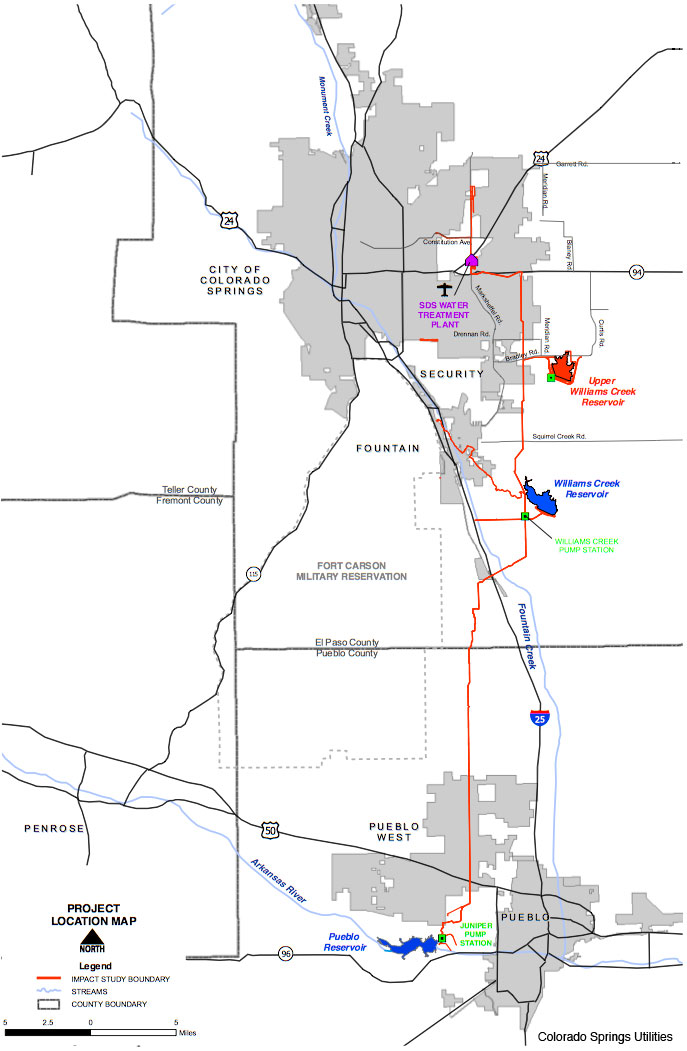
Southern Delivery System route map -- Graphic / Reclamation
Southern Delivery System route map — Graphic / Reclamation

From The Pueblo Chieftain (Chris Woodka):

Controlling stormwater on Fountain Creek has surfaced as a key issue for use of the Southern Delivery System in light of the rejection of the Pikes Peak Drainage Authority by El Paso County voters in November.

A proposal to use the SDS pipeline to deliver water to a system just north of Colorado Springs could be a test of Pueblo County’s 1041 regulations for SDS.

Donala Water and Sanitation District has asked for an exemption or finding of no significant impact from Pueblo County 1041 conditions on its plan to move water from rights it purchased in 2009 on the Willow Creek Ranch south of Leadville.

A Pueblo County analysis of votes in the Donala district shows its residents rejected stormwater control by a 60-40 margin.

“Serious concerns over compliance with (1041 conditions) are raised by the failed efforts in El Paso County, including within the city of Colorado Springs and Donala, at establishing, financing and maintaining stormwater controls,” Pueblo County Planner Joan Armstrong wrote in a letter to Donala last week.

“The recent failure of the November ballot pro­posal in El Paso County on stormwater fees only heightened those concerns.”

Donala plans to use excess capacity in the SDS pipeline from Pueblo Dam to Colorado Springs and a conveyance agreement with Colorado Springs Utilities to move an average of about 436 acre-feet (143 million gallons).

SDS is not expected to come on line until at least 2016, and Donala is not the only community interested in using it. Colorado Springs has the majority of capacity in the line, which won’t reach its full volume of 78 million gallons daily for several decades.

The move would provide about one-third of the water for 2,600 taps serving 8,000 people in the Donala district. It also would reduce Donala’s dependence on non-renewable groundwater from the Denver Basin aquifer.

Donala asked for the exemption because the amount of water falls short of the 500-acrefoot threshold that normally would trigger a 1041 permit review.

Armstrong asked Donala to address the question of whether larger amounts of water could be moved through the pipeline.

She also explained that the county also is interested in the maximum — not just the average — flows that could be moved to Donala through SDS, and in complying with certain conditions of the 1041 permit for SDS, including stormwater control.

The county asked Donala if it still intends to amend its service plan to control stormwater, as manager Kip Peterson indicated in a 2013 interview with The Pueblo Chieftain.

The county also wants to know which of the projects identified in the 2013 El Paso County Stormwater Needs Assessment by CH2MHill would serve Donala and whether the district intends to fund or construct any of those projects.

More Arkansas River Basin coverage here.

Southern Delivery System: “Stormwater is a terrific concern in Pueblo” — Nick Gradisar

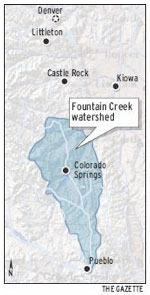
Fountain Creek Watershed

From The Pueblo Chieftain (Chris Woodka):

Pueblo water board members [Tuesday, December 16] made it clear to Colorado Springs Utilities that they expect full compliance with all permits for the Southern Delivery System.

SDS Project Director John Fredell made it clear that Utilities has been spending millions to make sure that happens.

After Fredell’s update of progress on the SDS pipeline, water board members had a couple of pointed questions about the details.

“Stormwater is a terrific concern in Pueblo,” said board member Nick Gradisar. “What I hear in the community is that Colorado Springs had a stormwater enterprise in place when the 1041 permit was granted. I would think county commissioners would say there should be at least the same amount of money before SDS is allowed to be turned on.”

Gradisar said he and City Council member Dennis Flores are among those discussing Pueblo community options following the failure of a vote in November to establish a drainage district.

Fredell agreed stormwater funding is needed, not only to satisfy Pueblo, but to benefit Colorado Springs. That said, he also pointed out that both Pueblo County and Utilities knew the enterprise could be threatened by voters during SDS negotiations.

“In 2008, Doug Bruce took his first run at the stormwater enterprise,” Fredell said. “We could not control the vote.”

So, the negotiations for the 1041 permit focused on achieving standards for new development that would not exacerbate flood conditions, Fredell said.

“It doesn’t matter how you do it, you just have to do it,” he added.

Water board member Tom Autobee expressed concern that Lake Pueblo will drop 6 feet when SDS reaches its full capacity.

Fredell said that would not be for many years. During its first year, probably starting in 2016, SDS will pump about 5 million gallons per day. At full tilt, it would pump 78 million gallons per day.

Fredell walked the board through a laundry list of multimillion dollar commitments and benefits to Pueblo County, Fountain Creek, Lake Pueblo and the Arkansas River that Colorado Springs is paying for as a result of SDS.

They total $400 million.

Included in the list are $150 million toward wastewater system improvements since 2000 to prevent sewer lines from breaking as they cross drainages. Colorado Springs had numerous breaks in its sewer system after the 1999 flood and faced state and federal fines. There have not been any breaks for several years.

Utilities has spent $37.5 million in additional sewer line fortification toward meeting a $75 million commitment to fortify more sewer lines by 2024.

Colorado Springs also is partially funding and providing technical support for a study of water rights protection if flood-control structures are built on Fountain Creek, Fredell said.

Meanwhile, Colorado Springs Utilities is appealing a judge’s ruling that would compensate the Walker Ranches with $500,000 for mitigation along the pipeline route. Here’s a report from Chris Woodka writing for The Pueblo Chieftain:

The city of Colorado Springs is appealing a decision by Pueblo District Judge Victor Reyes that would require it to pay Pueblo County rancher Gary Walker more than $500,000 in costs in a legal dispute over value of the Southern Delivery System easement across Walker Ranches.

Reyes issued an order last week that Colorado Springs pay costs of $387,000 dating back to May 2011, plus 8 percent annual interest.

Reyes on Thursday issued another order saying the first order is binding because Colorado Springs signed an intergovernmental agreement with Pueblo County that it would cover Walker’s costs.

A condition in the 1041 permit for the SDS pipeline tates: “Private property owners shall be treated fairly by (Colorado Springs) and the SDS project shall not create undue financial burdens on existing or future residents of Pueblo County. No landowner should have out-of-pocket expenses from the project.”

Reyes went on to cite Colorado Springs’ actions in paying for second appraisals for some Pueblo West homeowners affected by the pipeline showed that the 1041 permit is binding.

Walker’s attorneys asked for the payment because a condemnation trial on the value of the 5.5-mile SDS easement has been continued several times. The trial was supposed to begin in November, but has been pushed back to April.

According to court documents, Walker’s attorneys intend to prove at trial that the value of the 97 acres involved in the easement and the damage to the rest of Walker Ranches amounts to $25 million.

Colorado Springs appraisers valued the property at less than $100,000.

“By the time of trial, this case will have been pending for approximately four years. Given the extended duration of this case, and considering that the sheer size and scope of the taking has required numerous experts, Walker Ranches requests reimbursement for its reasonable costs incurred through September 2014,” Walker Ranch’s motion for costs says.

“Granting Walker Ranches its reasonable costs now would prevent (Colorado Springs) from gaining an unfair advantage through the granting of the trial continuance. (Colorado Springs) should not be allowed to bleed Walker Ranches dry by dragging this case out even further.”

In a petition filed Wednesday with the Colorado Supreme Court, Colorado Springs argued that the payment of costs was ordered without a hearing or specific findings. Interest was included for years before any actual costs were incurred, the appeal said. It also argues that court costs can’t be granted before a trial has started.

“(Reyes’) order has ignored the controlling law on costs in at least five substantial areas, and this court should protect the citizens and ratepayers of Colorado Springs from paying $509,713.52 based on such an exceptional and unjustified order,” the appeal stated.

More Southern Delivery System coverage here.

Southern Delivery System: 1 mile bore under I-25, Fountain Creek, and the railroad should be completed 1st quarter

Southern Delivery System route map -- Graphic / Reclamation
Southern Delivery System route map — Graphic / Reclamation

From The Colorado Springs Gazette (Monica Mendoza):

A giant teeth-gnashing machine is boring its way 85 feet under Interstate 25, two sets of railroad tracks and Fountain Creek. The machine is cutting a 1-mile long tunnel about 20 miles south of downtown Colorado Springs for a section of a massive pipeline project that will carry millions of gallons of water from the Pueblo Reservoir to Colorado Springs. It is the most complicated and dangerous part of the 50-mile stretch of the Southern Delivery System project, said Brian Whitehead, Colorado Springs Utilities project manager. If all goes as planned the tunnel should be completed in the first quarter of 2015.

“This is the last section of the pipe to be constructed and the most complex part,” Whitehead said. “There are risks – it’s not something anyone can do.”

Construction on the biggest Utilities project in its history began in 2010. The Southern Delivery System project was envisioned as the way for the city to handle future growth, said Jay Hardison, Colorado Springs Utilities water treatment plant project manager. It took years to plan and receive the proper permits from federal, state and county officials. The plan also was reviewed and approved by the Federal Aviation Administration because the new water treatment plant and holding tank off Colorado 94 are in the flight line near Colorado Springs Airport.

SDS cost, water rates

– Project cost: $841 million.

– Utilities customers’ water rate increased by 12 percent in 2011 and 2012 to cover cost of project.

– Utilities customers’ water rate increase by 10 percent in 2013 and 2014.

Southern delivery system timeline

2009: Final approvals and permits secured.

2010: Construction started.

2011: Construction began at Pueblo Dam and on the raw water pipeline.

2012: Pueblo Dam connection complete.

2014: Raw water pipeline construction complete.

2015: Raw water pump stations expected to be complete.

2016: Water treatment plant and finished water pump stations expected to be completed and SDS delivers water to Colorado Springs, Fountain, Security and Pueblo West.

2020-2025: Phase 2 could begin to expand capacity at the water treatment plant

Source: http://www.sdswater.org

More coverage from Monica Mendoza writing for The Colorado Springs Gazette:

At the start of the economic recession in 2008-09 work slowed at the Northwest Pipe company, which manufactures pipe in Denver. Then in 2010, the contracts for the massive $841 million Southern Delivery System project started dropping, said John Moore, Northwest Pipe operations manager. Colorado Springs Utilities was building a 50-mile pipeline from Pueblo Reservoir to Colorado Springs.

“When it dropped, we went from hanging on, hibernation mode, to Pueblo and production,” Moore said. “At the apex, we had 235 people employed working two shifts. For us it meant business was up.”

Utilities has hired 380 businesses in Colorado to plan and build the pipeline and water treatment plant, spending an estimated $489 million on contracts in the state. Of that, Northwest Pipe won $110 million in work.

The company made four to five pipes a day. In all it manufactured 7,000 pieces of pipe for the project. Beyond the direct contracts, there was a ripple effect, Moore said.

“Anytime you have a project this size, you are coordinating with suppliers and trucking companies,” Moore said. For example, during peak production, as many as 25 trucks a day left Northwest Pipe’s manufacturing facility. “We used local suppliers – the truck company was local.”

“The other thing that might be missed in the number is that most of the people who work on these crews putting the pipe in, there is a lot of inspection required, people making sure they are doing things right,” Moore said. “We have reps coming in, there is a huge travel industry associated with this project in rental cars, hotels and air travel.”

There is about one mile of pipeline left to complete in the project. Then Northwest Pipe will be done and moving on to water projects in Texas and other states, Moore said. The company has nine manufacturing plants across the country.

“Across the country, water infrastructure is getting old – water pipes are getting old,” Moore said.

More Southern Delivery System coverage here and here.

LAVWCD suing Colorado Springs — the Bent County Democrat

Fountain Creek Watershed

From the Bent County Democrat:

The Lower Arkansas Valley Water Conservancy Board ran out of patience with Colorado Springs at last Wednesday’s monthly public meeting. Merv Bennett, brother to the late Alan Bennett of La Junta, came to present the case for Colorado Springs. Although the Storm Water Enterprise did not pass, he expressed the hope that the 48 percent of the vote it gathered portends a change in the vote next fall. He said many storm control projects have been undertaken in the city, developing holding ponds to take out the ash from the forest fires and control future flooding. A measure has passed whereby all new subdivisions must add no runoff to the present conditions.

Attorney Melissa Esquibel led off the barrage of non-acceptance of Bennett’s reasoning that conciliatory methods would be much better than litigation. Regarding Bennett’s mention of the $50 million to support the Southern Deliver System might be harder to produce, Esquibel said, “$50 million is not enough to hold us hostage.”

Bennett’s argument that internal methods could accomplish flood control without a storm water enterprise was questioned by board members Leroy Mauch, Lynden Gill, Reeves Brown and Manager Jay Winner. The Board passed a motion to instruct Attorney Peter Nichols to send a letter of intent to sue Colorado Springs under the Clean Water Act. Many expressed the hope that Pueblo would follow suit. The letter of intent had already been prepared.

More Fountain Creek coverage here.

Officials: Bach’s Fountain Creek plan falls short — The Pueblo Chieftain

Fountain Creek Watershed

From The Pueblo Chieftain (Chris Woodka):

Colorado Springs Mayor Steve Bach’s solution for stormwater control falls far short of what Pueblo was promised in the years leading up to the approval of Southern Delivery System, local leaders say.

“I think it’s tragic and sad the city of Colorado Springs would treat its neighbors this way,” said Jay Winner, executive director of the Lower Arkansas Valley Water Conservancy District, which is planning to sue Colorado Springs following the defeat of a regional drainage fee in the Nov. 4 election.

Bach on Monday proposed an extension of tax revenue bonds that would provide $40 million for stormwater over five years. That’s short of the critical $160 million and total $535 million in stormwater needs identified by Colorado Springs.

“The regional drainage fee would have raised nearly $40 million in one year,” Winner said.

Pueblo County Commissioner Terry Hart agreed that the amount is not sufficient. Bach’s proposal just aggravates the situation, given the mayor’s opposition to the regional drainage question, he said.

“Under his proposal, stormwater is lumped in with other issues. Our critical needs get lost in the excitement of other projects,” Hart said.

The commissioners hold the fate of Colorado Springs’ 1041 permit for SDS in their hands. Those conditions, written in 2009, are predicated on the existence of a stormwater enterprise to address flows on Fountain Creek.

“It’s too little money,” Hart said. “The ballot question was too little for the amount of work that needs to be done, but it was a good compromise.” Both Winner and Hart said Pueblo City Council needs to get involved as well, given that it is a party in a 2004 intergovernmental agreement that obligated Colorado Springs to support Pueblo issues if SDS were built.

“Where is the city of Pueblo during this? They have the most to lose from the continued mismanagement of Fountain Creek,” Winner said.

Meanwhile, a district dedicated to protecting Fountain Creek likely will bring up the topic at its Dec. 12 meeting in Pueblo.

“I don’t even call it a plan. It’s not even touching the problem,” said Larry Small, a former Colorado Springs City Council member who now is the executive director of the Fountain Creek Watershed Flood Control and Greenway District. “The mayor’s proposal is absolutely irresponsible and does nothing to address the needs of the city.”

The district supported the regional drainage question and works with both Colorado Springs and Pueblo in flood control projects. The drainage fee was needed not only to meet the identified $700 million in backlogged projects, but new projects that are being identified on Monument Creek,” Small said.

“We’re still interested in a regional solution,” Small said. “The mayor’s proposal goes after non-needs, not prospective needs of the city.”

Last week, Colorado Springs City Council member Merv Bennett told the Lower Ark board that the council also is interested in reviving the regional approach.

Former Lower Ark board chairman John Singletary said Colorado Springs’ attempts to smooth the waters ring hollow. Singletary pushed the Colorado Springs Council in 2005 to institute a stormwater enterprise, then to fund it in 2007 and finally tried to urge the council not to abolish it in 2009.

“What their mayor’s talking about is a joke,” Singletary said. “It’s the same old problem. They need to be responsible and make sure the water quality is acceptable to Pueblo and everyone else downstream to the Kansas state line. This is just insulting to Pueblo.”

More stormwater coverage here.

Fountain Creek: Will potential Pueblo County stormwater lawsuit impact the Southern Delivery System?

Southern Delivery System route map -- Graphic / Reclamation
Southern Delivery System route map — Graphic / Reclamation

From the Colorado Springs Independent (John Hazlehurst):

Let’s consider the Southern Delivery System, which, according to a 2013 white paper from Colorado Springs Utilities, will cure our water worries.

“SDS is more than a pipeline,” wrote CEO Jerry Forte. “SDS will serve as an engine driving more efficiency, effectiveness and reliability in our system, while protecting water rights from future threats. SDS makes our entire water system more than the sum of its parts.”

And if SDS isn’t available? Forte predicted higher rates, permanent watering restrictions and, as other systems age, the risk of long-term outages.

“A future without SDS,” Forte concluded, “could jeopardize our ability to meet future water demand, the reliability of our system, our valuable permits and approvals, and our community’s economic stability.”

There’s a tiny little cloud on the horizon — the lawsuit Pueblo County may be preparing to file over Colorado Springs’ inability to fund reliable flood control in Fountain Creek. And that’s to say nothing of a similar lawsuit threat from the Lower Arkansas Valley Water Conservancy District, which isn’t related to SDS directly but still could imperil the project.

CSU has issued a harrumphing press release, claiming a lawsuit from Pueblo would be without merit. But is it possible that Pueblo, and/or its ally, could prevail?

I’m not a distinguished attorney (you’ve confused me with my daughter, Melanie Hazlehurst Gavisk). But although the law’s nuances may elude me, I’m not encouraged by CSU’s (or the city’s) track record in litigation…

So here we are again. What happens if we lose, and local voters refuse once again to fund stormwater infrastructure?

So far, we’ve spent about $600 million on SDS, most of it borrowed. We’ll still have to pay it back. Worst-case scenario: Drought intensifies in California and the entire Colorado River Basin, our existing sources of supply are threatened, and we have to fund a reuse/recycle system. Desirable as that may sound to some environmentalists, it’d be hugely expensive, and would drive water rates into the stratosphere. Lawns? Gardens? Trees? Forget ’em.

There’s a solution at hand, though. If Council agrees to refer to the ballot Mayor Steve Bach’s proposal to issue $160 million in capital improvement bonds to fund stormwater and other infrastructure for the next five years, and our flighty voters approve — problem solved for now.

More Southern Delivery System coverage here.

Colorado Springs voters might decide stormwater funding — The Colorado Springs Gazette

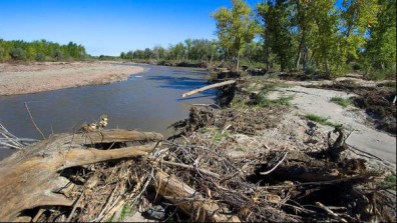
Channel erosion Colorado Springs July 2012 via The Pueblo Chieftain

From The Colorado Springs Gazette (Monica Mendoza):

Colorado Springs Chief of Staff Steve Cox presented a capital improvement and stormwater funding plan to the City Council on Monday that he’s hoping will go to voters in April.

He’s asking that the City Council put a question on the ballot seeking voter approval to issue $160 million in sales and use tax revenue bonds to pay for street improvement, parks, public safety and stormwater projects. The plan would not increase taxes or fees, he said. Instead, the bonds would be paid back from the city’s general fund.

“This bonding proposal will allow the city to accelerate spending on key capital improvement projects,” Cox said.

The plan would allow the city to spend $15 million a year to improve streets, $8 million a year on flood control projects, $4 million a year on public safety equipment and structures and $2 million a year on parks. The projects would be completed in five years and paid for over the next 20 years, city officials said.

Cox said it is a way to address the city’s highest priority needs.

“It’s not meant to solve the problem,” he said to the City Council. “But it is meant to make headway.”

The council will decide in December whether to put the question on the April ballot.

The council had endorsed a regional stormwater funding plan that went to voters Nov. 4 and would have created a partnership with El Paso County, Manitou Springs, Green Mountain Falls and Fountain to plan and fund flood control projects. It would have assessed a fee on every property owner in those four communities and most of El Paso County. Voters turned down the plan.

Cox said this bonding plan would provide $145 million and pay for about 70 capital improvement projects that have been on the high-priority list, including bridge rehabilitation on Fillmore over Monument Creek, citywide tree trimming, emergency generators, and improvement on the Fountain Creek channel.

“The executive branch sees this as an intermediate, half-decade action plan to get us moving on high-priority, backlogged CIP (capital improvement projects) in all four function areas,” Cox said.

Council member Jan Martin called the plan a temporary fix. The backlog of flood control projects has been estimated at $700 million.

“What is the longer-term solution?” she asked Cox.

Cox said the long-term plan is still to be developed. The city has identified a backlog of capital improvement projects that total $1.3 billion.

“The longer solution is obviously going to involve property tax increases or sales tax increases,” he said.

Council member Merv Bennett called the plan a step in the right direction. Bennett was on the hot seat this month when he faced the Lower Arkansas Valley Water Conservancy District board members, who accused the city of Colorado Springs of violating the Clean Water Act because of its lack of permanent stormwater and flood control programs. The board sent Colorado Springs a letter Nov. 19 of its intent to sue over the matter.

“I appreciate you putting these issues together,” Bennett told Cox. “But I hope everyone doesn’t believe this solves the problem.”

Cox would not comment on the potential lawsuit, but he said the city has been working on flood control issues beyond spending. It recently updated its drainage criteria manual, which has stricter, rules for developers issues that affect water quality and water flow.

In 1999, Colorado Springs voters approved the Springs Community Improvements Program, which was the sale of $88 million in municipal bonds to pay for 29 capital improvement projects. The projects were completed in 2004 and the debt, paid for from the general fund of about $7.9 million a year, is scheduled to be paid off in 2016.

“With the SCIP bonds retiring in 2015 and 2016, the cash flow currently dedicated to those bond payments can be re-purposed to the proposed bond payments,” a handout from Cox to the City Council said. Under the proposal, the city would spend $11 million a year out of the general fund to pay back the bonds – about $3 million more than the current bond payments.

Council member Don Knight said it’s a finance plan that raises concerns.

“This year’s (2015) budget includes $1.5 million from reserve to balance the budget,” he said. “Now this is another $3 million liability on us. We are increasing the debt payment by $3 million instead of staying at $7.9 million.”

The city would take the $3 million from its Capital Improvement Project fund, said Kara Skinner, the city’s CFO. “That would still leave $8.1 million in the general fund CIP budget for other pay-as-you-go CIP projects and emergency projects,” she said.

More Fountain Creek coverage here.

Fountain Creek: Mayor Bach outlines new proposal, no new taxes, no new fees, not enough dough

Flooding in Colorado Springs June 6, 2012

From The Pueblo Chieftain (Chris Woodka):

Colorado Springs Mayor Steve Bach Monday presented his proposal to City Council to address the backlog of high-priority, unfunded capital improvement projects including stormwater control.

Voters in El Paso County turned down a regional drainage district fee that would have raised $37 million annually to address a $700 million backlog in projects.

The issue of stormwater control on Fountain Creek has become central to a pending lawsuit by the Lower Arkansas Valley Water Conservancy District in federal court over Colorado Springs’ violations of the Clean Water Act.

Pueblo County commissioners are looking into whether Colorado Springs is in violation of its 1041 permit for the Southern Delivery System.

Bach wants to place a proposal on the April municipal ballot that would extend tax revenue bonds funded by sales and use taxes over the next five years. Voters would be asked to approve up to $160 million in Sales and Use Tax Revenue bonds to succeed the maturing Springs Community Improvement Program bonds. Bond proceeds will provide funding of $145 million to complete more than 70 capital improvement projects, which includes $75 million in neighborhood streets, $40 million for stormwater, $20 million for public safety and $10 million in parks. The balance of the proceeds would provide for the required bond reserve fund and the costs of issuance, according to a press release from Bach.

“This is a holistic approach to address all capital improvement needs in our community without raising taxes or imposing a new fee,” Bach said. “Specific projects are planned in each of the five years based on professional staff recommendations as well as input by the community and City Council.”

The $40 million over five years would address only about one-fourth of the $162 million in high-priority stormwater projects identified in a Colorado Springs study earlier this year. The city’s total backlog is $534 million.

At $8 million per year, the amount dedicated to stormwater would be just half of the estimated $17 million generated by a stormwater enterprise fee abolished by City Council in 2009.

More stormwater coverage here.

Fountain Creek: Working out the kinks — The Pueblo Chieftain

Fountain Creek Watershed

From The Pueblo Chieftain (Chris Woodka):

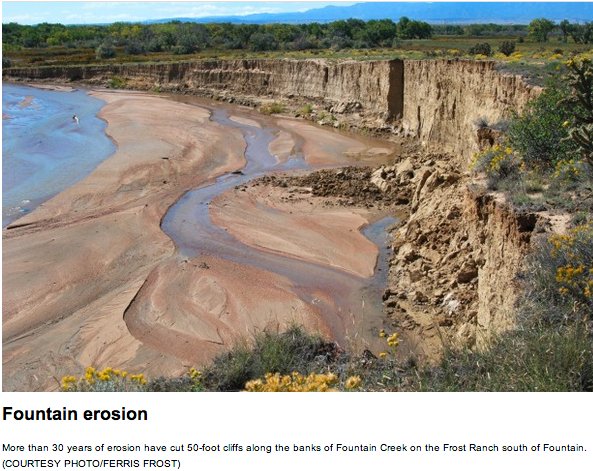
Fountain Creek for years ate away at its banks about 15 miles north of Pueblo on a site that never fully recovered from decades of raging floods.

“There were 15-foot drop-offs,” explained Mark Pifher, a consultant with Colorado Springs Utilities who coordinates Southern Delivery System permits. “That railroad bridge acted as a dam every time there was a flood.”

Utilities restored the 28-acre site on its Clear Springs Ranch property as one of the conditions of Pueblo County’s 1041 permit for SDS.

Tied into a trail system that could one day connect Pueblo with Colorado Springs, the site features an interpretive sign that explains the ecosystems of Fountain Creek. The project also created about 6 acres of wetlands designed to absorb some of the punch from future floods.

“In the 2013 floods, we lost a couple of acres of land here,” Pifher said. “Now, Fountain Creek has a more meandering bank. It’s cut down on the constant destruction we saw before construction and improved the habitat for numerous species.”

More than 27,000 rocks 2 feet or larger in diameter were installed under the wetlands, with a foundation of 6,500 larger than 3 feet in diameter. That prevents the bed of the creek from being chewed out by floodwaters.

“Most of the investment we made, you can’t see,” Pifher said. “In August, it held up well to a flow of about 8,400 cubic feet per second. It worked like it was supposed to.”

Keyway structures — basically ridges of rock — were added to guide the creek within its channels. The area is designed to hold up to a 15,000 cfs flood.

Crews hand-planted more than 50,000 plugs of plant species, 144,000 willow stakes and 5,000 cottonwood or ash poles on the grounds to help dampen storm effects.

The project was included in Pueblo County’s 1041 permit both to improve one of the worst sections on Fountain Creek and to demonstrate methods that might be used elsewhere.

It’s not the type of flood control structure that would protect Pueblo from a monster flood such as the one in 1965, but it does prevent smaller floods from causing even bigger problems downstream if left unchecked.

At a cost of more than $4 million, it’s not the type of project that could be easily replicated by other landowners along the creek, Pifher acknowledged. But it does provide an example of what can be done.

Utilities is committed to providing broader flood protection as well, Pifher said.

Another condition requires $50 million to be paid by Colorado Springs to the Fountain Creek Watershed Flood Control and Greenway District when SDS comes online. That money would help build the more significant flood-control structures that protect Pueblo. For that to occur, questions concerning whether holding back water could occur without injuring water rights have to be answered.

“We want to make that happen, and CSU is providing technical assistance to the district,” Pifher said.

More Fountain Creek coverage here and here.

Fountain Creek: “Our infrastructure is not just behind, it is decaying” — Merv Bennet

From The Pueblo Chieftain (Chris Woodka):

Colorado Springs is facing a lawsuit over the failure of voters to approve a drainage district in the Nov. 4 election. The Lower Arkansas Valley Water Conservancy District board voted to give Colorado Springs notice that it would file a federal lawsuit over violations of its stormwater permit under the Clean Water Act. The lawsuit could be filed in 60 days, although the district is willing to discuss “effective remedies” during that time.

The board also voted to ask Pueblo County commissioners to investigate whether Colorado Springs has violated its 1041 permit for the Southern Delivery System because it has not adequately funded stormwater protection for Fountain Creek.

“We’re frustrated about to our limit,” Lower Ark Chairman Lynden Gill told Colorado Springs Councilman Merv Bennett, utility board chairman, who spent an hour explaining how Colorado Springs intends to deal with the stormwater question after the failure of a regional drainage district in the election.

“We’re not going to give up. We’ll keep moving forward,” Bennett told the board.

Bennett argued that Colorado Springs is in compliance with the 1041 permit, but is obligated to fund stormwater as well. He was optimistic that voters eventually would approve a drainage district, acknowledging that a two-year effort with the support of political and business leaders had not been enough to convince voters this year.

He received a chilly reception.

“We had a meeting two years ago, and other than the dates, nothing has changed,” said Melissa Esquibel, a Lower Ark board member from Pueblo.

Esquibel asked Bennett if the city still has a $535 million backlog of projects without a stable source of funding. The total for El Paso County is $700 million.

Bennett said that $140 million-$160 million of that total is critical, but noted that the regional approach, which would have generated $40 million annually to deal with that. Other measures, including the Drainage Criteria Manual, have been taken as well, and the city is in compliance with its 1041 permit, he said.

Bennett pleaded for more time and cooperation.

“I don’t see us working together,” said Lower Ark General Manager Jay Winner. He said talks between the district and Colorado Springs on water issues ended shortly after SDS permits were issued.

“If there have been sins of the past, I’d like to correct them,” Bennett said. “Our infrastructure is not just behind, it is decaying.”

That failed to sway the Lower Ark board, which had been teeing up the lawsuit for nearly two years. The board did not revive an earlier approach to sue the Bureau of Reclamation for failure to enforce its permit, opting instead to go after Colorado Springs directly.

“This was the more productive approach,” said Peter Nichols, Lower Ark’s water attorney.

The notice to sue cites Colorado Springs’ reduction in stormwater funding, deterioration of infrastructure, failure to control structures, failure to reduce discharge of pollutants and failure to prevent discharges that could affect public health as bases for the lawsuit.

From The Colorado Springs Gazette (Monica Mendoza):

Colorado Springs City Councilman Merv Bennett threw himself on the mercy of the Lower Arkansas water board Wednesday asking for more time for the city to develop a permanent stormwater funding plan.

Colorado Springs has had plenty of time, said Melissa Esquibel, a board member of the Lower Arkansas Valley Water Conservancy District. It’s time to sue, she said.

The board voted unanimously to put Colorado Springs on notice for a lawsuit over its lack of a stormwater funding program.

Colorado Springs is violating its Municipal Stormwater National Pollutant Discharge Elimination System Permit, “as a result of its failure to provide adequate funding to support stormwater, to properly maintain its stormwater facilities and to reduce the discharge of pollutants from the MS4 (permit) to the maximum extent practicable,” says the Wednesday letter sent to Mayor Steve Bach, City Council President Keith King and City Attorney Wynetta Massey.

The violations adversely affect human health and the environment and are resulting in worsening water quality on Fountain Creek, the letter says.

“What it boils down to is we are frustrated,” said Lynden Gill, water district board chairman. “It’s about to our limit.”

The water district board, which includes Pueblo, Otero, Crowley, Bent and Prowers counties, had contemplated litigation two years ago. But Colorado Springs elected officials promised to find a permanent source of funding, instead of annually piecing together money from the general fund and federal grants, which are not guaranteed, to pay for flood control projects, said Jay Winner, the water district’s general manager.

The lawsuit talk was tabled, he said.

Folks in the Arkansas Valley were hopeful that El Paso County, Colorado Springs, Manitou Springs, Fountain and Green Mountain Falls voters would approve a 
20-year plan to fund a stormwater program. But the ballot measure, which included the creation of a governmental entity and the collection of a fee from all property owners, was defeated 53 percent to 46.7 percent this month.

Massey said through a city spokeswoman that she did not have time to review the letter of intent to file suit, which arrived late Wednesday afternoon.

King dismissed the threat of litigation and said it would be difficult to distinguish if pollutants in Fountain Creek originated from Colorado Springs or from Pueblo.

“I don’t think they have grounds,” King said.

Colorado Springs earmarked $18 million for stormwater projects in 2013 and $26 million in 2014, Bennett said. The bulk of that money is federal grants. For example, in the proposed 2015 budget, the city expects to spend $38 million on stormwater projects. Of that, $5 million is from the general fund. The rest is money carried over from the previous year and $18 million in grants.

Arkansas Valley water board members were not impressed with the numbers.

“A couple of years ago we had a meeting in Pueblo, and other than the date, nothing has changed,” Esquibel said. “I don’t see significant action.”

The issue with the Arkansas Valley water district is different from one raised by Pueblo County commissioners, who said Colorado Springs Utilities promised to make flood control improvements on Fountain Creek as part of an agreement to pump water out of the Pueblo Reservoir to Colorado Springs in the 
$1 billion water pipeline project called Southern Delivery System. When the permits for SDS were inked, Colorado Springs had a stormwater fee in place and a list of projects designed to head off floodwaters going south. But the fee ended in 2009 and left Pueblo officials wondering if the promised flood control projects would be built.

Bennett told the water board that Utilities has committed to spending $131 million to mitigate flooding and improve water quality on Fountain Creek, including $50 million scheduled to be paid to the Fountain Creek District to mitigate the impacts of SDS to Fountain Creek in Pueblo County.

“We are taking responsibility for improvements on Fountain Creek,” Bennett told the board.

He fears that litigation would hold up work on the SDS project and the $50 million payment to Fountain Creek District, he said.

Esquibel said the Arkansas Valley water board won’t be held hostage by the threat of holding up the $50 million payment. Instead, the board voted unanimously to urge Pueblo County commissioners to review its permits with Colorado Springs Utilities related to water flow in Fountain Creek and take its own legal action.

The letter of intent to sue puts Colorado Springs on notice of a possible lawsuit, said Peter Nichols, the attorney for the Arkansas Valley water board. The board has 120 days to decide if it wants to go forward with the suit.

“Maybe a notice of intent to sue will wake up the people in Colorado Springs,” board member Wayne Whittaker said.

From The Pueblo Chieftain (Chris Woodka):

Pueblo County commissioners are mulling their response to Colorado Springs in light of the Nov. 4 rejection of a regional drainage authority by El Paso County voters.

“What we’re doing is looking at all the legal options, including the 1041 permit,” said Terry Hart, chairman of the commission. “Our best approach is using the leadership of all the governments in Pueblo County to do the right thing. We want to do this as professionally and swiftly as possible.”

On Wednesday, the Lower Arkansas Valley Water Conservancy District board voted to sue Colorado Springs for violation of the federal Clean Water Act.

The board also voted to ask Pueblo County commissioners to look at whether Colorado Springs violated the conditions of its 1041 permit for Southern Delivery System. Among those conditions are adherence to a Bureau of Reclamation contract which was negotiated on the premise that a stormwater control authority and fee were in place. The stormwater authority would address flooding issues on Fountain Creek caused by development in Colorado Springs, which has an estimated $535 million in backlogged projects.

Colorado Springs City Council eliminated the authority in late 2009, based on its interpretation of a public vote, and in 2012 helped create a task force to look at a regional stormwater authority.

Voters in El Paso County rejected that by a 53-47 percent margin.

Last week, District Attorney Jeff Chostner, a former Pueblo County commissioner, threw his weight behind the county effort. Both Hart and Jay Winner, general manager of the Lower Ark district, say they would like Pueblo City Council to get involved as well.

Commissioners on Monday discussed options with their attorneys in executive session. In addition to the 1041 permit, the county is looking at the Clean Water Act, the Reclamation contract and the legal rights of downstream vs. upstream water users.

“We hunkered down with our lawyers to look at what options we have going forward,” Hart said.

Fountain Creek: “If the mayor would have gotten behind this, it would have passed” — Jeff Chostner

Fountain Creek Watershed

From The Pueblo Chieftain (Chris Woodka):

Funding for flood control projects on Fountain Creek that protect Pueblo has been jeopardized by last week’s rejection of a drainage district in El Paso County.

That’s the opinion of District Attorney Jeff Chostner, who worked diligently to advance funding opportunity for the Fountain Creek Watershed Flood Control and Greenway District while he was a Pueblo County commissioner.

“I had talked about the best way to get flood control passed would be to have a vote of the entire district (Pueblo and El Paso counties),” said Chostner. “Combined with Pueblo County, there would have been enough support.”

The Fountain Creek District is authorized by state law to collect up to a 5-mill tax, and the district’s board was seriously discussing how and when to approach voters. The district also had looked at forming a subdistrict within just the Fountain Creek watershed and charging a fee.

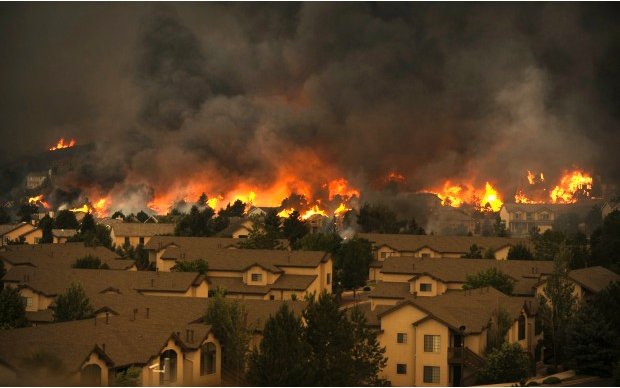
In June 2012, the Waldo Canyon Fire destroyed more than 18,000 acres and 347 homes. It also left behind ground baked hard as concrete, worsening the potential for floods.

That shifted the focus of public officials, who had already formed a stormwater task force, to looking at flood control projects to protect Colorado Springs and away from the obligation to protect Pueblo from increased development on Fountain Creek, Chostner said.

“As a former county commissioner, I’m disappointed that the stormwater measure did not pass. We counted on the goodwill of voters, and it failed,” Chostner said.

“I am looking to see if there’s a way the district attorney’s office can work with the Pueblo County commissioners and their attorneys.”

It would not be the first time the DA has gotten involved. Chostner’s predecessor, Bill Thiebaut, challenged Colorado Springs in federal and district courts on the issues of sanitary sewer spills and water quality. Chostner inherited and pursued the water quality case.

“I kept trying to expand it to Pueblo County,” Chostner said of his last year on the Fountain Creek board, where he served as chairman.

The downside of trying to sell the vote in Pueblo County would have been the perception that Pueblo would be paying to fix Fountain Creek problems mainly caused by rampant growth in El Paso County.

“I don’t blame El Paso County for concentrating on Waldo Canyon.

They chose to look inward, and this should have been a two-county vote,” Chostner. “I think people would understand these are problems we all share.”

Chostner puts a lot of the blame on Colorado Springs Mayor Steve Bach, who campaigned against the drainage district. Bach acknowledges Colorado Springs needs to do something about stormwater, but has tried to bundle it with other capital needs. Bach also wants Colorado Springs to take care of its own needs, rather than join in the regional effort promoted by the stormwater task force.

That grates at Chostner, who as a commissioner told the Colorado Springs City Council it had a “legal and moral obligation” to fund stormwater.

Bach was sitting just a few feet away and kept silent at that meeting.

“If the mayor would have gotten behind this, it would have passed,” Chostner said. “Now, Colorado Springs is the only major Front Range community without a source for stormwater funding. There’s no political courage in El Paso County.”

So when would be the best time for another vote?

“It should be at the earliest feasible time,” Chostner said.

More stormwater coverage here.

Whither El Paso County’s stormwater efforts now?

From the Colorado Springs Independent (J. Adrian Stanley):

Last week, voters turned down the Pikes Peak Regional Drainage Authority, to be funded by nearly $40 million a year in fees, despite a series of devastating floods in the area and concerns that a lack of stormwater maintenance could put Colorado Springs Utilities’ $841 million Southern Delivery System pipeline project in jeopardy.

“I wasn’t surprised,” Small says of the 53-percent-to-47-percent defeat. The public is resistant to taxes in general, he says, but there’s also the feeling that stormwater really shouldn’t be its problem, because developers should have installed adequate systems in the first place. And for most of the city, stormwater isn’t a problem. Floods tend to concentrate in certain neighborhoods.

“It’s all localized issues,” Small says, “and unless you experience those issues, you don’t relate to the need to manage that stormwater.”

The leading candidates in the April city mayoral election agree that stormwater will need to be addressed with new taxes or fees, and that the key will be communicating better with voters.

El Paso County Commissioner and mayoral candidate Amy Lathen says she sees no reason to throw away two years of work that went into the Authority proposal, including public input, engineering studies and project lists. Lathen was a key player in putting the Authority forward, and she stands by the proposal. But she says the ballot question was only approved a month before the election, leaving little time for a campaign, and misinformation was widespread.

Lathen wants to keep the task force that created the Authority proposal, but explain that proposal more clearly and tweak it to make it more palatable. She also says the task force needs to better explain that while stormwater may not flood your backyard, it can threaten the bridges you drive over daily, or even put access to clean water at risk.

Former mayor and current candidate Mary Lou Makepeace feels similarly. One difference: While Lathen says the plan and money must be regional, Makepeace is willing to consider setting aside city funds for stormwater, though she calls that option undesirable because it could mean cutting back on other city services. Like Lathen, she’d also like to try again for a regional solution, this time with better communication…

Outgoing Colorado Attorney General and mayoral candidate John Suthers, who also prefers a regional solution, says he feels a measure could pass if leaders explain to voters that stormwater infrastructure affects the economy. As attorney general, he says, he was contacted by representatives of major companies “that everyone would recognize” who said they had long considered expanding into the Springs but were dissuaded by political turmoil and poor infrastructure. He says Mayor Steve Bach should have been involved in the Authority early on, and then used his position to champion it. Not doing so, he says, echoing the other candidates, was a “failure of leadership.”

Bach, who has not yet said whether he will run again, has his own plans for stormwater. He hopes to pass a funding mechanism, perhaps a sales tax, that would pay for city infrastructure, including stormwater improvements.

Whether a stormwater program in the Springs is a requirement to operate the Southern Delivery System in early 2016 is debatable. John Fredell, SDS program director, says the permits for the projects only refer to containing additional water, which he says should be fully controlled by new drainage requirements the city set. He notes that Colorado Springs Utilities is committed to spending more than $100 million to repair and protect utility infrastructure from stormwater damage and flooding, and is on track to do so.

But Terry Hart, Pueblo County commissioner and the Pueblo County representative on the Fountain Creek District board, says stormwater work is a requirement of the permits. Pueblo County was meeting with lawyers on Monday, Hart says, to decide what legal action to pursue. That action could include suing to prevent the operation of SDS until a stormwater system is in place.

In a statement to the Independent, influential Pueblo Chieftain publisher Bob Rawlings said, “Colorado Springs and its voters have not been supportive of finding and funding solutions for flood control on Fountain Creek throughout the discussions about Southern Delivery System. It should not have been built and should not be turned on until those questions are answered.”

More stormwater coverage here.

Rejection of stormwater plan could mean lawsuit for Colorado Springs — Colorado Springs Gazette

From The Colorado Springs Gazette (Monica Mendoza):

A failed stormwater proposal could trigger legal action from Pueblo County and is expected to become a campaign issue in the race for Colorado Springs mayor. Voters rejected a proposal Tuesday to create a regional stormwater authority that would have collected annual fees from property owners to pay for flood control projects in Colorado Springs, Manitou Springs, Green Mountain Falls, Fountain and parts of El Paso County.

Now, the lack of a stormwater funding program has one Pueblo County commissioner wondering how promised flood control projects that affect his county will be paid for.

“It’s not an option not to address flooding and stormwater issues,” said Pueblo County Commissioner Sal Pace, who was re-elected to a four-year term Tuesday. “Colorado Springs owes us legally. I expect Colorado Springs to find the money somewhere else.”

Voters rejected a proposal that would have generated about $40 million a year for 20 years to pay for 114 flood control projects. Proponents ran a $200,000 campaign with billboard, television and radio advertisements. But it wasn’t enough to sway opponents, who said the proposal lacked a guarantee that the new money, collected in fees, would be in addition to what each city and the county already spend on stormwater projects, a provision called “maintenance of effort.”

“You give government more money to solve the problem and they spend the money on something else and the problem gets worse,” said Steve Durham, who runs the group Citizens for Cost Effective Government, which spent about $25,000 on radio advertisements opposing the measure. “There is a lack of confidence created by city of Colorado Springs when they ceased their maintenance of effort.”

Pace said by his estimation controlling the water flow in Fountain Creek was part of the deal Colorado Springs Utilities agreed to in 2009 when Pueblo signed off on permits needed for a projected $1 billion Southern Delivery System project to bring Arkansas River water stored in Pueblo Reservoir to Colorado Springs.

When the permits for SDS were inked, Colorado Springs had a stormwater fee in place and a list of projects designed to head off floodwaters going south, Pace said. But the fee ended in 2011 and left Pueblo officials wondering if the promised flood control projects would be built. He had hoped voters would approve the regional stormwater fee proposal.

Pace said he will consult the county’s attorney and look into legal action to ensure the agreements in the permits are followed.

“If Pueblo County believes that Colorado Springs has not lived up to its end of the bargain on the permit, we can take action to revoke the permit,” Pace said. [ed. emphasis mine]

Utilities officials said they are living up to the negotiated terms with Pueblo. They say the stormwater proposal that voters rejected this week was aimed at the backlog of flood control projects while the negotiated permits with Pueblo address future growth in the city.

City Councilman Merv Bennett, who chairs the Utilities Board, said Utilities has committed to spending $131 million to mitigate flooding and make improvements along Fountain Creek.

“We will continue to work closely with Pueblo County commissioners,” Bennett said. “I will call the commissioners and hear their concerns so we can work to address those.”

However, Bennett, who will be up for re-election in April in an at-large City Council seat, said he was disappointed the stormwater fee proposal failed. He hopes stormwater will be a 2015 campaign issue.

“It’s such a critical issue for our city and for our neighbors,” he said.

It may be too soon to start proposing alternative solutions, said Attorney General John Suthers, who announced in September that he intends to run for mayor of Colorado Springs.

“I think we have to be totally open-minded,” he said. “We need to come back. This has to be dealt with but we need to go back through the process of consensus building.”

Mayor Steve Bach issued a proclamation before the election detailing his opposition to the stormwater ballot proposal. Among his concerns were the number of Colorado Springs representatives on the stormwater authority board; whether Colorado Springs would get to spend the money its residents contributed; and whether the authority could make changes to projects and spending without public input. Bach did not return a phone call Wednesday seeking comment.

Suthers agreed that stormwater will become an election issue and expects it to be discussed.

He believes the stormwater proposal was rejected because there was “a failure of collaborative leadership.”

“You had a group of incredibly hard-working citizens that went to work on this for two years, and they had a lot of public hearings and they fashioned a proposal that took into account what they heard,” he said. “Then along comes the mayor, who had every opportunity to participate in this process, and he did not participate in a meaningful fashion.”

Suthers declined to comment on how the lack of a stormwater program affects Pueblo and the permits related to the SDS project.

“This might involve potential litigation that Colorado Springs might be involved in,” he said.

El Paso County Commissioner Amy Lathen, who was on the stormwater task force that brought the issue to the ballot, said the group will talk with voters about what they did not like in the proposal.

“Forty-six percent of the voters believed in our plan,” she said. “That’s a great place to start.”

Lathen was the first to announce her intention to run for Colorado Springs mayor, and said she expects stormwater to be a campaign issue.

“Now, we go back to the drawing board and figure out what is going to be successful,” she said.

“This is too important to let go.”

More stormwater coverage here.

Fountain Creek: “They’re selfish and the vote shows they don’t care about their neighbors downstream” — Jay Winner

From The Pueblo Chieftain (Chris Woodka):

Pueblo County officials are considering legal options after a two-year effort to form an El Paso County drainage authority for Fountain Creek went down the drain Tuesday. Particularly irritating for them was the decision by voters to approve keeping $2 million in tax money for parks while rejecting a plan to fund more than $700 million in flood control backlog.

“They may develop some nice parks, and hopefully they’ll have water to put on those parks,” said Jay Winner, general manager of the Lower Arkansas Valley Water Conservancy District. “They’re selfish and the vote shows they don’t care about their neighbors downstream. The vote on Tuesday was very divisive to Southern Colorado.”

“I’m angry and disappointed,” added Pueblo County Commission Chairman Terry Hart. “They’ve put the question to voters twice and stormwater has failed twice. With these votes, it’s clear the people in El Paso County value entertainment more than honoring their commitments.”

The vote could have repercussions for the Southern Delivery System, an $841 million water pipeline from Pueblo Dam to Colorado Springs.

“Colorado Springs and its voters have not been supportive of finding and funding solutions for flood control on Fountain Creek throughout the discussions about Southern Delivery System,” said Pueblo Chieftain Publisher and Editor Bob Rawlings. “It should not have been built and should not be turned on until those questions are answered.”

The Lower Ark District voted last year to sue the Bureau of Reclamation over its approval of the SDS contract despite the lack of a steady stream of funding for stormwater, which Colorado Springs had indicated was in place during a study. The district asked for a supplemental study monitoring SDS impacts without stormwater funding in place. The lawsuit was put on hold until after the election.

“We did not want to be blamed for the failure of the stormwater vote,” Winner said. “To me, this is not unexpected. I just don’t think they care.”

The Lower Ark board will consider its legal options at its Nov. 19 meeting.

Pueblo County also will huddle with lawyers on potential violations of its 1041 permit for SDS, which includes stormwater controls. Hart said the county also is concerned about the Reclamation permit for use of Lake Pueblo and a state water quality permit in light of Tuesday’s vote.

“Every conversation we’ve had with our friends to the north has been ‘be patient.’ We told them we would sit back and watch,” Hart said. “Our patience is at an end. In fact it may be gone.”

The other commissioners had similar views.

“They’re obligated legally and morally to control stormwater,” said Commissioner Sal Pace. “If they have to dry up some parks or not pave some streets, they need to figure it out.”

“I would share my dismay with Colorado Springs Council President Keith King (who was quoted on the radio Tuesday night),” said Commissioner Liane “Buffie” McFadyen. “They need to regroup and secure funding for flood control on Fountain Creek. I would add that it’s up to their leadership to inform the voters.”

From The Pueblo Chieftain (Chris Woodka):

A two-year effort to get El Paso County rowing in one direction on Fountain Creek flood control fell apart like a sandy bank falling into the stream Tuesday. But Colorado Springs officials have not given up on finding a way to fund flood control.

“I think that it’s unfortunate that the stormwater initiative didn’t pass here in El Paso County, particularly considering the storms, floods and issues we’ve had in the last couple of years,” said Larry Small, a former Colorado Springs council member who now manages the Fountain Creek Watershed Flood Control and Greenway District. “Hopefully the people will become more aware and reconsider the issue at some future point.”

A task force started by Colorado Springs council members and El Paso County commissioners in 2012 became a private organization promoting the Pikes Peak Drainage Authority in this year’s election. But its efforts to promote were counteracted by signs in Colorado Springs front yards that read: “No rain tax.”

Council voted 7-2 and commissioners 5-0 to put the measure on the ballot last summer.

But Colorado Springs Mayor Steve Bach in August issued a proclamation claiming the fee was too high and tied up money for 20 years. He has promoted other ways to fund stormwater control, bundling it with other capital needs. On the day after the election, Bach announced stormwater would be added to the topics at a series of community meetings that will begin next week. In any case, the soonest another election would be held is next April.

“Everything from Mayor Bach to date has grossly underfunded stormwater,” said Pueblo County Commissioner Terry Hart, who added that the county is looking at legal action as a result of the failed vote. “I need to see something concrete.”

Colorado Springs Utilities continues to take the position that the 1041 permit applies to future development, not the historic needs that were listed in the stormwater initiative, said Gary Bostrom, chief of water services. However, Utilities wants to see stormwater control succeed.

“We will remain focused on doing our part to support a longterm solution to fund stormwater infrastructure needs,” Bostrom said. “In addition to our many efforts underway to improve Fountain Creek, Colorado Springs Utilities will continue to work with community leaders to develop a stormwater solution that our residents can support.”

From KRCC:

In El Paso County, voters strongly supported issue 1A for a revenue retention to help fund county parks. Voters rejected a proposal to create a regional drainage authority to fund storm water repairs. In Manitou Springs, issue 2G, which would have prohibited marijuana sales, was soundly defeated.

More Fountain Creek coverage here and here.

“If I have 24 hours of floodwater on the Colorado Canal, I’m going to take it. I need it” — Matt Heimerich

Fountain Creek Watershed

From The Pueblo Chieftain (Chris Woodka):

A district formed to improve Fountain Creek last week made an appeal for those with water rights to get involved in the early stages of a study to build flood control structures.

“Water rights protection is something we should do before we get into any other aspect of flood control on Fountain Creek,” Larry Small, executive director of the Fountain Creek Watershed Flood Control and Greenway District told ditch company board members Friday.

Small spoke during the annual meeting of the winter water storage program, bringing experts in to talk about the issue of public safety vs. water rights.

“We’re not working in a vacuum,” said Mark Pifher, who represents the Arkansas River basin on the state Water Quality Control Commission.

Denver’s regional Urban Drainage Authority and the city of Aspen have raised questions with the Colorado Division of Water Resources over how floodwater detention rules work in the state, Pifher explained.

State Engineer Dick Wolfe has adopted policies that say that single-site developments can hold water for 72 hours, but that regional floodwater control projects must augment any water detained with equivalent releases under a substitute water supply plan. That same principle was applied to Fountain Creek when the city of Pueblo built a detention pond behind the North Side Walmart as part of a demonstration project. The city learned it needed an augmentation plan after the project was well underway. Urban Drainage and Aspen officials are not pleased with the policy and are looking at potential state legislation to force a change in that policy, Pifher said.

Short of a blanket change that would allow the 72-hour rule to apply, the Fountain Creek district wants to study whose rights would be affected by holding back a large flood.

A study by the U.S.

Geological Survey completed last year provided solid numbers about how much water dams or detention ponds would hold back at certain points on Fountain Creek. That in turn can be applied to the flows at the Avondale gauge on the Arkansas River, which is upstream from every major ditch except the Bessemer below Pueblo Dam.

Flood stage

After Pueblo Dam went into operation 40 years ago, it was determined that flood stage at Avondale was 6,000 cubic feet per second. Floods upstream of Pueblo Dam are contained by curtailing releases to that level.

The last time flood control protection from that type of event was in 1999. Flows on Fountain Creek are measured and Pueblo Dam can be cut back to prevent that flooding from affecting Avondale as well, said Bill Tyner, assistant division engineer.

“You can have those huge flashy flows on Fountain Creek and find ways to cut back at Pueblo Dam to protect downstream communities,” Tyner said.

Reservoirs on Fountain Creek would have to perform differently, because there would not be Bureau of Reclamation staff on hand to open or shut release gates, he said.

Quenching all thirst

Several storm events that occurred in the past four years caused the Avondale gauge to top 6,000 cfs for several hours.

“Those spot events did not satisfy everyone’s needs downstream,” Tyner said.

That doesn’t matter if you’re a farmer.

“If I have 24 hours of floodwater on the Colorado Canal, I’m going to take it. I need it,” said Matt Heimerich of Crowley County.

“Those floods are the only way we get water in storage,” said Donny Hansen, president of the Holbrook Canal.

The direct rights downstream from Avondale and above John Martin Reservoir can be met with about 4,115 cfs, but storage rights on the canals total 3,631 cfs, he explained. Water rights below John Martin require another 1,534 cfs to be met.

So, all water rights below Avondale on the Arkansas River total about 9,282 cfs.

The 6,000 cfs at Avondale might be enough to satisfy all those rights, since the return flows of one ditch are reused downstream, a factor of about 1.5 times, he said.

But the envisioned dams on Fountain Creek are aimed at stopping monster 100-year floods — the type where heavy rain falls for several days. In the USGS study, a large dam or series of dams upstream of the Fountain Creek confluence would cut in half the peak flow of a 100-year flood — 44,000 cfs, or five times the amount of water needed to fulfill all downstream water rights.

The 100-year flood flow at Avondale, coincidentally, is 44,000 cfs, according to the USGS.

Moving ahead

The Fountain Creek district is not the only agency working at flood control in the Pueblo area. The Pueblo Conservancy District, in the headlines recently for its plan to rebuild the Arkansas River levee through Pueblo, also is responsible for the flood plain from Pueblo to the Otero County line.

“The high flows on Fountain Creek are a source of erosion that affects the land in our district down below,” said Bud O’Hara, a retired water engineer who is on the Pueblo Conservancy District board.

O’Hara showed graphs that point out about a dozen smaller events this year that created the potential for minor erosion events.

Farmers, on the other hand, generally like the erosion on Fountain Creek because it is part of the process that carries sediment downstream to help seal ditches. Many still grumble about the “clear water” that resulted from the construction of Pueblo Dam. In effect, it meant the erosive properties of the river were transferred downstream as more erosion occurred within ditch systems.

Abby Ortega, an engineer for Colorado Springs Utilities working with the Fountain Creek district, asked the farmers to provide suggestions for consultants to study the issue.

“We’re looking at how to build structures and not injure water rights,” she said. “We’re asking for your input.”

“I think the model we should use is the irrigation efficiency rules that was hosted by Dick Wolfe,” Heimerich responded. In that process, farmers and others affected by proposed rules guiding ditch improvements met for 18 months and were able to give immediate feedback. “It’s just too important not to do it right.”

More Fountain Creek coverage here.

How will CSU’s $50 million for Fountain Creek mitigation be spent?

Southern Delivery System route map -- Graphic / Reclamation
Southern Delivery System route map — Graphic / Reclamation

From The Pueblo Chieftain (Chris Woodka):

While the decision of how to spend $50 million for flood control on Fountain Creek to benefit Pueblo will be made by the parties directly involved, other input will be needed.

“Anyone who wants to come to the table and says, ‘We want to find out where money for these projects will be available,’ is welcome,” Pueblo County Commissioner Terry Hart said.

Last week, Hart made a pitch to the Fountain Creek Watershed Flood Control and Greenway District to begin planning now for the arrival of $50 million in payments from Colorado Springs Utilities after Southern Delivery System goes online in 2016. That money is seen as seed money for projects that could amount to $150 million or more identified in a corridor master plan. The money was negotiated by Pueblo County under its 1041 agreement with Utilities in 2009 for the construction of the SDS water supply pipeline through the county. It is to be used for flood control projects on Fountain Creek that benefit Pueblo County. When the district was established later in 2009, it became the recipient of the money.

“At a minimum, Pueblo County, CSU and the Fountain Creek district need to be involved, and they will have the final say,” Hart said.

But the city of Pueblo and the Lower Arkansas Valley Water Conservancy District also should have input about how the money will be used, Hart said.

The greatest potential damage from Fountain Creek flooding is within the city of Pueblo and in the communities of the Lower Ark Valley downstream from Fountain Creek.

“The Lower Ark District was instrumental in developing the corridor plan, and we definitely need the technical input from the city of Pueblo,” Hart said.

The corridor plan, a joint effort of Utilities and the Lower Ark district, identifies projects between Fountain and Pueblo that could cost several times the $50 million that was earmarked under the 1041 agreement. Pueblo already has participated in pilot projects to demonstrate flood control techniques.

In addition to technical assistance, Pueblo County’s attorneys will have to be involved to determine whether projects meet the conditions of the 1041 permit. This will be important to avoid the kinds of dispute that developed when the Lower Ark raised objections about how its contributions to the district were being spent.

“I see this new committee working in concert with the steering committee (Utilities, Lower Ark and the Fountain Creek District),” Hart said.

More Fountain Creek coverage here.

Fountain Creek District: Good tour of Fountain Creek channel improvements by Colorado Springs Utilities at Clear Springs Ranch yesterday

The Fountain Creek District launches series of meetings to iron out rights protection with flood mitigation

Fountain Creek Watershed

From The Pueblo Chieftain (Chris Woodka):

The question of how flood control projects on Fountain Creek can be built without harming water rights will be taken up next month in the heart of farm country.

The Fountain Creek Watershed Flood Control and Greenway District will host the first of a series of meetings to discuss the issue during the winter water meeting set for Oct. 17 at Otero Junior College in La Junta.

The winter water meeting will be hosted by the Southeastern Colorado Water Conservancy District and will bring together some of the largest ditch companies east of Pueblo.

The group determines how a court-decreed program that allows farmers to store water in Lake Pueblo or ditch company reservoirs outside the growing season will operate.

That’s similar to the issue at hand on Fountain Creek, where flood control dams have been proposed, primarily to protect property in Pueblo.

At the July meeting of the Arkansas Basin Roundtable, a grant that proposed to look at the feasibility of Fountain Creek dams was rejected out of hand because several farmers objected to altering water rights to accommodate the dams.

They argued that junior water rights would be injured by such storage.

The timed release of water at more useful times in programs such as the winter water program could actually enhance water rights, however. Some have said this is possible with flood control dams.

In fact, the Denver Urban Drainage District is attempting to work through the same issue, Executive Director Larry Small told the board.

“We need to make it clear we have no intention of harming anyone’s water rights,” Pueblo County Commissioner Terry Hart said.

Several other meetings are planned by the Fountain Creek district to determine if flood control can be done in a way that keeps junior rights whole.

Meanwhile, the district is starting to prioritize spending prior to Colorado Springs’ $50 million payment as part of the Southern Delivery System. Here’s a report from Chris Woodka writing for The Pueblo Chieftain:

A district formed to improve Fountain Creek wants to start planning how it will use $50 million in funding that will begin arriving when the Southern Delivery System pipeline comes on line.

“We have to get an idea of what our priorities are before a dime arrives,” said Pueblo County Commissioner Terry Hart, a member of the Fountain Creek Watershed Flood Control and Greenway District board.

The $50 million will be paid to the district over five years by Colorado Springs Utilities as part of its 1041 agreement with Pueblo County. The money is for building flood control projects that primarily benefit Pueblo, such as a dam or series of dams.

SDS is projected to be fully permitted and online as soon as 2016, so the checks could begin coming in early 2017.

The district does not want to be put in a position of having to directly spend the money, but wants to use it to leverage funding from other sources.

“The projects identified so far exceed $100 million,” Hart said. “There could be even more as we branch out of the core area. We need to find the best ways to leverage other grants.”

Hart asked the board to form a committee specifically to look at how the money would be spent. It would include representatives from Pueblo County, the district and Utilities.

That conversation comes even as the district watches the progress of a stormwater vote in El Paso County this November and sets its budget for next year.

The vote will determine whether Colorado Springs and its neighbors will agree to fund stormwater improvements to the tune of $39 million annually beginning in 2016. That would satisfy other requirements of the 1041 agreement.

The district also is looking at whether its own budget could be paid with advance interest payments from Colorado Springs Utilities or if it’s time to pass the hat again among member governments.

At the meeting, Hart noted that the district is relying heavily on voluntary contributions and must start looking at its real operating costs if it is to become sustainable.

Finally, water quality is a concern and responsibility on Fountain Creek as well. Here’s a report from Chris Woodka writing for The Pueblo Chieftain:

While the focus lately has been on reining in water on Fountain Creek, the quality of that water is important too.

“We have a statutory duty to clean up the Fountain Creek watershed,” said Pueblo County Commissioner Terry Hart Friday at the meeting of the Fountain Creek Watershed Flood Control and Greenway District. “There are significant problems that we still don’t know enough about.”

So the board caught up on the science of water quality from Del Nimmo and Scott Herrmann, who have spent years studying water quality on Fountain Creek, the Arkansas River and Lake Pueblo.

The three are interconnected, Nimmo explained.

“We have tremendous resources and they are all connected,” Nimmo said. “They are tied to the reservoir.”

Lesson 1: Invasive species in Lake Pueblo will have more opportunity to spread to Fountain Creek and reservoirs in Pueblo County when the Southern Delivery System pipeline is completed, Herrmann explained.

Lesson 2: Mercury has accumulated in the water and fish in the headwater areas of Fountain Creek and Monument Creek, where the scientists did not expect to find it. Nimmo’s theory is that emissions from power plants or from former smelters in both Pueblo and El Paso counties contributed to this, but that’s not been proved. He suggested the district think in terms of an “airshed” as well as a watershed.

Lesson 3: The researchers have baseline data about water quality prior to the large, destructive Waldo Canyon and Black Forest fires. They also collected samples of the charcoal-laden water after the first big rainfall following the Waldo Canyon Fire in 2012.

“This study needs to be repeated about now, in the next year, to see what effect the fire had,” Herrmann said.

Nimmo and Herrmann have headed up numerous Fountain Creek studies at Colorado State University-Pueblo over the past decade. Herrmann has studied aquatic life in Lake Pueblo since its construction in the early 1970s. Nimmo was involved in other studies on the Upper Arkansas River near Leadville as well.

“We need to continue this type of study,” Hart said. “It should be a district project.”

More Fountain Creek coverage here.

Fountain Creek cleanup

Fountain Creek
Fountain Creek

From the Fountain Creek Watershed Flood Control and Greenway District via The Pueblo Chieftain:

HERE’S A chance for you to pitch in and get your hands dirty for the sake of cleanliness. Creek Week kicks off tomorrow and runs through Oct. 5 in Pueblo and El Paso counties. The coordinated event is intended to clean the banks along litter-clogged Fountain Creek.

So really, it’s another way to keep water — our most precious natural resource — clean.

That’s because trash that makes its way into the creek has been known to degrade water quality, harm wildlife, create safety hazards and clog irrigation and drainage structures.

The Fountain Creek Watershed Flood Control and Greenway District, along with more than 20 volunteer, governmental and nonprofit partners, is encouraging concerned residents to get involved. Volunteers of all ages are welcome, although the district website warns that children under the age of 18 must have at least one supervising adult with them.

For more information, or to register for a cleanup time, visit http://www.fountain-crk.org.

More Fountain Creek coverage here.

Fountain Creek “Creek Week” September 27 thru October 5

From The Pueblo Chieftain (Chris Woodka):

Plans are being made to clean up litter throughout the Fountain Creek watershed during Creek Week, Sept. 27-Oct. 5 in Pueblo and El Paso counties.

The event is sponsored by the Fountain Creek Watershed Flood Control and Greenway District, which was formed five years ago to improve the drainage.

At its last meeting, the Fountain Creek board learned more than 20 groups already have committed time, materials or money to the effort.

Trash that makes its way into Fountain Creek can degrade water quality, harm wildlife, create safety hazards and clog irrigation or drainage structures.

Businesses, churches, schools, nonprofits, neighborhood associations, youth groups, service clubs and individuals are encouraged to form work groups, pick a work date within the time frame, pick a location and pick it up.

Information about Creek Week and how to register a crew is available at http://fountain-crk.org.

More Fountain Creek coverage here.

Fountain Creek flood mitigation dam(s) and the issue of prior appropriation

Flood irrigation in the Arkansas Valley via Greg Hobbs

From The Pueblo Chieftain (Chris Woodka):

A discussion about water rights, the first step to looking at building dams or detention ponds on Fountain Creek, is moving ahead. The project is being coordinated by the Fountain Creek Watershed Flood Control and Greenway District, and would fit in with a larger study looking at flood control on Fountain Creek.

It’s a hot-button issue with farmers in the Lower Arkansas Valley, who see the capture of flood flows on Fountain Creek as a threat to junior water rights. At an Arkansas Basin Roundtable meeting last month, the need for a water rights study killed a proposal to look at the feasibility of building dams.

A $58,000 program by the Fountain Creek district will look at just the water rights issue. It will be funded by Colorado Springs Utilities, Pueblo West, Security, Fountain, the Pueblo Board of Water Works and the Southeastern Colorado Water Conservancy District, with in-kind support from Utilities and the Fountain Creek district. The process will bring together downstream water rights holders and state officials in a series of meetings to identify how water rights could be harmed by projects meant to provide public safety and what action could be taken to mitigate the damage.

All of the questions about how water moves throughout the Arkansas River basin would not be answered, but some ways to provide water through releases from Lake Pueblo or by timing releases from Fountain Creek structures would be explored, said Mark Shea, Fountain Creek point man for Utilities.

“There could be other beneficial uses, providing waterfowl or fish habitat, and allowing flood flows to be exchanged up Fountain Creek,” Shea said.

Melissa Esquibel, Pueblo board member of the Lower Arkansas Valley Water Conservancy District, said the Lower Ark also should be involved in the project.

“There is a lot mistrust and misinformation, so we need to take the right path,” she said. “There are legitimate concerns that arise from past issues.”

Pueblo County Commissioner Terry Hart agreed.

“If we are perceived as an 800-pound gorilla, we’ll get nowhere,” Hart said. “We’re talking about people and their livelihoods.”

Pueblo City Councilwoman Eva Montoya, who chairs the Fountain Creek board, said the dialogue is an opportunity to balance public safety and the need to protect water rights.

“We need to rebuild trust,” she said.

More prior appropriation coverage here.

“It’s a well thought out proposal that we’ve been working on for two years” — Dennis Hisey #COpolitics

Fountain Creek Watershed

From The Pueblo Chieftain (Chris Woodka):

El Paso County voters will decide in November whether to implement a fee to provide $39 million annually for stormwater protection by creating the Pikes Peaks Regional Drainage Authority. Commissioners Tuesday finalized an intergovernmental agreement and placed the issue on the ballot on a 5-0 vote.

“It’s a well thought out proposal that we’ve been working on for two years,” said Dennis Hisey, chairman of the commissioners. “It’s a vehicle that will put our stormwater protection on track with other communities throughout the state.”

The 11-member authority would include the mayor of Colorado Springs, five members appointed by Colorado Springs City Council, two members appointed by commissioners and one each from Fountain, Manitou Springs and Green Mountain Falls.

The authority would collect up to $39 million in 2016 through fees collected on property within the Fountain Creek watershed. The fee would be determined based on impervious surface area, density, land use and ownership, according to the IGA. Over the next 20 years, the money would go toward a $700 million list of projects, and after that, a smaller fee would pay for maintenance. The average homeowner would pay about $7.70 per month.

Mayor Steve Bach opposes the fee, which he calls a tax, and has suggested alternative ways to finance improvements Colorado Spring needs and is obligated to make under its permits for the Southern Delivery System. Colorado Springs City Council supported the IGA by a 7-2 vote.

“We’re expecting a robust campaign,” Hisey said. “Any time you ask for money, there’s a need to educate the voters and make your case.”

More stormwater coverage here.

Dam dilemma looms for planners — The Pueblo Chieftain

Fountain Creek Watershed

From The Pueblo Chieftain (Chris Woodka):

Building dams to slow down the pace of floodwater could save lives and reduce the destruction of property. But, it might also deprive a farmer of irrigation water or even deliver more to neighbors with more senior water rights. It could cause conflicts with neighboring states that have entered into compacts with Colorado.

Dams, detention ponds and even debris basins meant to trap sediment while allowing water to flow freely in areas ravaged by wildfire could be subject to state water rights administration. That’s the opinion of officials at the Colorado Division of Water Resources.

“I think we’ve clearly articulated how we view the law and there are not any gaps from an administrative standpoint,” said State Engineer Dick Wolfe.

But districts formed to control stormwater are discussing whether state water law could block efforts to stem the worst effects of floods. And they’re looking at changing the law to give more weight to arguments to detain water.

The Urban Drainage and Flood Control District, which was formed to assist Denver metro area counties with stormwater protection, has asked the state to clarify its position on whether flood control would have priority in any instance. Meanwhile, the Fountain Creek Flood Control and Greenway District is preparing a series of conversations with water rights holders on the same topic.

“If we as a district are going to be successful, we have to become involved,” Executive Director Larry Small told the Fountain Creek board at its August meeting.

The state’s position is that detaining water in a regional project could injure junior water rights.

In 2011, the state explained that its policy of allowing 72-hour detention of floodwater applies only to single-site projects, rather than regional detention ponds, said Kevin Rein, deputy state engineer. The rule has often been invoked in flood control discussions and usually misinterpreted. The Fountain Creek district found out about this firsthand when it constructed a demonstration project along Fountain Creek in Pueblo behind the North Side Walmart. It was required to file a substitute water supply plan.

But there are no hard and fast rules governing flood detention.

“We do not find a legal basis to make an absolute finding that diversions of stormwater into regional water quality detention are allowable, nor do we find a basis to determine that such diversions would cause no injury,” Rein concluded in his letter to the Urban Drainage district.

Even the debris basins built by Colorado Springs after the Waldo Canyon Fire have the potential to run afoul of state water law, said Steve Witte, Division 2 engineer. “If they encounter groundwater, they have to be augmented with a SWSP,” Witte said. “If it’s in a normally dry stream, it may qualify as an erosion control dam, which if it holds less than 2 acre-feet of water is statutorily exempt.”

So far, the state has looked at about 30 of those structures in the Colorado Springs area.

Flood control is not impossible. One of the stated benefits of Pueblo Dam under the Fryingpan-Arkansas Project is to provide protection from floods. The operating rules of the dam allow holding back water if the Arkansas River is above 6,000 cubic feet per second at the Avondale gauge — a level that satisfies most water rights downstream.

However, Fountain Creek officials know they could have a tough time trying to unravel the water rights questions that will accompany any dam or detention pond project.

“It’s going to be a tough fight, but the best way is to confront it,” said Pueblo County Commissioner Terry Hart. “We have to put an effort together to try to negotiate it up front. The only way to identify the issues is to speak to those who might be hurt downstream.”

More stormwater coverage here.

2014 Colorado November Election: Colorado Springs City Council approves IGA connected with stormwater enterprise ballot issue

Pikes Peak with Garden of the Gods in the foreground

From The Pueblo Chieftain (Chris Woodka):

Colorado Springs City Council Tuesday approved an intergovernmental agreement connected with a ballot issue to form the Pikes Peak Regional Drainage Authority. The vote was 7-2.

The issue is expected to be placed on the ballot by El Paso County commissioners at their meeting next week. It would establish the authority to include the county, Colorado Springs, Fountain, Green Mountain Falls and Manitou Springs. The authority would raise about $39 million annually through fees to address a $700 million backlog in stormwater projects.

Stormwater control on Fountain Creek was one of the premises Colorado Springs Utilities used to obtain permits from Pueblo County and the federal government in order to build the Southern Delivery System.

Colorado Mayor Steve Bach immediately opposed the measure. He said the average bill of $92.40 per year would be 77 percent higher than the fee for the former stormwater enterprise and roughly the same amount homeowners now pay (in property taxes) for all city services combined.

“I believe this IGA is not fair to the citizens of Colorado Springs,” Bach said in a statement.

More 2014 Colorado November election coverage here.

Woodland Park stormwater management

From the Colorado Springs Independent (J. Adrian Stanley):

These are the facts accepted by all parties: Last summer and this summer, Green Mountain Falls has seen destructive floods following unusually heavy rains. The town was not affected by the Waldo Canyon Fire. The floods are not the result of runoff from a burn scar. And Woodland Park, located up the pass, has added major developments in recent years, including some alongside Fountain Creek.

Public officials interviewed for this story said they weren’t ready to start playing the blame game. But some people in Green Mountain Falls, especially those who live or own businesses along the creek, are getting edgy. A few have seen bridges washed out multiple times. Mayor Lorrie Worthey says even her home, which is located on a hill, recently had a flooded mudroom.

“There is more water coming down from Woodland; Woodland has grown a lot,” Worthey says carefully. “With that, we are going to get more water.”

Bill Alspach, Woodland Park’s public works director and city engineer, also is cautious when speaking of the Green Mountain Falls flooding. “Woodland Park has strived to be a good steward of the headwaters,” he says.

Woodland Park development affects two watersheds, Fountain Creek and the South Platte. Since the 1990s, the Fountain Creek side has seen the building of Walmart and Safeway stores, each with sprawling parking lots. An apartment complex is also currently under construction.

Alspach says Green Mountain Falls shouldn’t be affected by such development because Woodland Park has had strict stormwater development requirements since 1994. Driving behind the Walmart, he points out two large, grassy retention ponds that slowly release runoff during storms. He’s checked those ponds during downpours, he says, and they’ve been doing their job.

The Safeway doesn’t have such ponds, but Alspach says that’s on purpose, because allowing the water to run off there was found to reduce peak flows in the creek. The apartment complex also has retention ponds, and sits next to a $2.1 million stormwater project that was recently completed by the city and the Federal Emergency Management Agency. Water flows in an underground box culvert, and is slowed by barricades before it hits a large channel.

He also points out private and public retention ponds that dot the town, especially in newer developments.

Woodland Park just forked over $100,000 for stormwater repairs needed after a damaging July storm, and is still paying off bonds from major stream work in 1998 and 1999. Alspach says he’s working his way west-to-east along Fountain Creek, doing upgrades. By the end of next year, he hopes to be close to finishing all the improvements in the city area, and to have a study in hand of what needs to be done on private and Teller County land that stretches between the eastern edge of the city and the Walmart.

All this work has been done, Alspach notes, with money from grants, Woodland Park’s limited general fund budget, a special streets fund and stormwater fees. It’s been done despite the fact that the town is too small to be bound by state permits for water quality.

“We have really endeavored to do the right thing for a long time,” he says.

More stormwater coverage here.

2014 Colorado November election: El Paso County Stormwater issue on November ballot #COpolitics

Fountain Creek Watershed

From The Colorado Springs Gazette (Monica Mendoza):

It’s the end of the third quarter in the proposed stormwater funding plan, and a group of residents who have been working on the issue for two years have their game faces on. They saw a contract approved by the El Paso County Board of Commissioners on Tuesday that outlines how a regional stormwater authority would work and be governed should voters approve it in November.

But as the task force members and their consultants huddled after the meeting, there was little time to feel cocky about the victory. It’s a milestone, said Dave Munger, co-chair of the regional stormwater task force, but the game isn’t finished – or won – yet.

“The fourth quarter will be the election,” he said.

Munger’s co-chair and consultant to the group Kevin Walker added: “Nov. 4 is when it will be over.”[…]

If the committee work was the first two quarters of the game, then the third quarter got rough and tumble in recent meetings as [Colorado Springs Mayor] Bach, council members and the rest of the task force hashed out the details of the stormwater contract, called an intergovernmental agreement. The council approved the contract, without most of Bach’s proposed changes.

Bach held a news conference Aug. 13, announcing that he would not support the proposed stormwater authority. The same day the task force held a news conference to tout its plan.

And now the campaign season, or the fourth quarter, begins, Walker said.

Voters will be asked to OK an annual stormwater fee, which would be roughly $92 a year for a home with 3,000 square feet of impervious surface. If approved, a regional authority expects to collect about $39.2 million a year for 20 years.

Most of the money would be spent on construction projects and maintenance and operations of existing flood control projects.

About 10 percent of the fees collected would be set aside for flooding emergencies.

More 2015 Colorado November election coverage here.

2014 Colorado November election: Pikes Peak Regional Drainage Authority issue to be on ballot, Mayor Bach balks

Pikes Peak with Garden of the Gods in the foreground

From The Pueblo Chieftain (Chris Woodka):

El Paso County commissioners Tuesday voted 4-0 to put an issue on November’s ballot that would create the Pikes Peak Regional Drainage Authority to pay for storm water control. Voting for the measure were Chairman Dennis Hisey, Amy Lathen, Darryl Glenn and Peggy Littleton. Commissioner Sallie Clark was absent.

The authority would raise $39.2 million annually to address a $700 million backlog in stormwater projects in the Fountain Creek watershed.

Stormwater control is one of the premises Colorado Springs Utilities used in gaining approval from the Bureau of Reclamation and Pueblo County to build the Southern Delivery System, a pipeline to ship water from Lake Pueblo to El Paso County.

“With this step, the hard part’s over,” Hisey said.

Last week, Colorado Springs City Council approved, on a 7-2 vote, an intergovernmental agreement with El Paso County and other cities in the Fountain Creek drainage.

The next day, Mayor Steve Bach said he opposed the authority. proposals for ways to fund stormwater control within Colorado Springs.

A list of projects, which will be attached to the ballot proposal has yet to be approved, and will probably be in place by the El Paso County commission’s Sept. 2 meeting, Hisey said.

That would give Colorado Springs City Council time to review the list.

From The Colorado Springs Gazette (Matt Steiner):

The approval is a huge step in “controlling stormwater,” said Commissioner Amy Lathen, who has played a major role in the regional stormwater task force that first met in August 2012. Dave Munger, co-chairman of the task force, was at Tuesday’s meeting and joined a small contingent who let out a smattering of applause after the commission’s vote.

Munger echoed Lathen about the need to solve stormwater issues regionally.

“Everyone, just about everyone, is aware of stormwater and its significance. Everyone agrees that it is a regional problem,” he said, noting that governments working together will create “a synergy that we’ve never realized.”

The decision appeared to be an easy one for the commissioners. But some debate arose after Colorado Springs Deputy City Attorney Tom Florczak gave the commissioners 18 projects the city insists be added to a list attached to the county’s 
resolution.

Florczak said the City Council did not include a project list in its resolution that passed on a 7-2 vote Aug. 12.

“The concern of the administration was that by having the list, it is limited,” Florczak said.

“It boils down to one word, flexibility,” said Steve Gardner, the Colorado Springs director of public works who was with Florczak on Tuesday.

After the City Council’s vote on the PPRDA, Mayor Steve Bach held a news conference announcing that he would not support the stormwater initiative.

More 2014 Colorado November election coverage here.

Fountain Creek erosion mitigation project results encouraging

Fountain Creek erosion via The Pueblo Chieftain

From The Pueblo Chieftain (Chris Woodka):

A project to restore a small portion of Fountain Creek could have benefits for longer reaches.

“There are 51 miles of bank on each side of the creek from Colorado Springs to Pueblo,” said Larry Small, executive director of the Fountain Creek Watershed Flood Control and Greenway District. “Now we know a method to use to control erosion.”

Small was giving a report to the Arkansas Basin Roundtable, which gave the green light to a $146,000 state grant toward the $189,000 project last year to undertake the project on Frost Ranch, located in El Paso County about 25 miles north of Pueblo.

The project restored the channel and fortified the bank along 480 feet of the Frost Ranch. Past floods had eaten away about 70 feet of the bank, including vegetation. Three tiers of dirt secured by netting rising about 4 feet were chosen as the way to restore this particular area. About 7,500 willow plants, along with grasses and other vegetation to hold the shore.

Work began in April and was completed in mid-May.

The first test of the work came on May 23, when the creek swelled to 3,000 cubic feet per second, rising nearly to the top of the newly constructed embankment, Small said. The work held, and the moisture spurred plant growth. About 75 percent of the plants survived.

A larger wave of water, 5,000 cfs, came on July 23. While some of the water overtopped the bank and deposited sand along the top, the bank stayed in place.

The roundtable applauded the district’s efforts.

“Frost Ranch has been an excellent neighbor to the creek,” said SeEtta Moss of Canon City, who was appointed to the roundtable to represent environmental interests. “I’m delighted to see what’s been done.”

More Fountain Creek coverage here.

Southern Delivery System: Pueblo county firms net $65 million in orders during construction

Southern Delivery System route map -- Graphic / Reclamation
Southern Delivery System route map — Graphic / Reclamation

From The Pueblo Chieftain (Chris Woodka):

The estimated construction cost of the Southern Delivery System, a water pipeline from Pueblo Dam to Colorado Springs, has been lowered to $841 million, about $145 million less than earlier estimates.

“It’s our responsibility to manage project costs as closely as possible to protect the investment being made by the SDS partner communities,” said Janet Rummel, spokeswoman for Colorado Springs Utilities.

The timing of SDS construction saved money primarily because of lower interest rates and lower pricing for materials and services, she said.

“Competitive bidding has allowed more than 100 Pueblo County-based businesses to benefit from $65 million in SDS spending so far,” Rummel said.

Although most of the benefit from SDS goes to Colorado Springs, Pueblo West, Security and Fountain also are SDS partners.

The pipeline has a capacity of 96 million gallons per day, with 78 mgd going to El Paso County.

Pueblo West will increase its capacity by 18 mgd through a connection to the newly constructed north outlet works.

Its current connection at the south outlet delivers 12 mgd — just above the metro district’s peak-day delivery. The outlet is shared by the Pueblo Board of Water Works and the Fountain Valley Authority. It also will be the hookup for the Arkansas Valley Conduit.

Pueblo West has paid $6.5 million for construction of its SDS connection, and estimates it will have paid a net price of $6.7 million — when all bills and refunds are totaled — by 2017.

The money came from reserves, said Jack Johnston, metro district manager.

“We have cash-funded the project out of reserves that were collected primarily during the growth years,” Johnston said. “They were fees that were set aside to help build the reserves to do capital projects.”

Pueblo West got some of the SDS savings, but just for the construction nearest the dam, where its 36-inch-diameter connection splits off from the 66-inch-diameter line that runs 50 miles north.

“Whatever savings were realized in building the north outlet works were passed on to us,” Johnston said.

Pueblo West had been negotiating an agreement to turn on SDS ahead of schedule, since its spur from the dam will be ready for use ahead of the rest of the project.

However, the board last month delayed action on a draft agreement that could allow early turn-on of SDS. If no agreement is reached, the startup would be whenever Colorado Springs gets the go-ahead from Pueblo County to turn on SDS, expected in 2016.

Colorado Springs must meet Pueblo County’s 1041 permit conditions in order to start SDS.

Those conditions include $50 million in payments, plus interest, to the Fountain Creek Watershed Flood Control and Greenway District; $15 million for road rehabilitation in Pueblo West; and $2.2 million for Fountain Creek dredging in Pueblo. All of those payments are included in the $841 million construction cost.

Colorado Springs also will pay $75 million for wastewater system improvements by 2024 within the city under the 1041 permit, but that cost is not included in the estimate.

More Southern Delivery System coverage here.

Stormwater: Camp Creek mitigation pond working

Camp Creek channel via City of Colorado Springs

From KRDO.com (Carl Winder):

The City of Colorado Springs has seen their flood project in Camp Creek go through hail, heavy rain and flash flooding. The good news is the water has stayed within the banks of the creek protecting people, but maintaining the flood project will not be cheap.

City Stormwater Engineer Tim Mitros said after the sediment and debris came down from last September’s floods, Camp Creek became a top priority for the city. A year later after the floods, Mother Nature put the flood project to the test. This time there is a pond to stop a majority of the debris, and a steady stream going through the Colorado Springs neighborhood near the creek…

He said if the sediment pond is full, about $100,000 will have to be spent to clean the pond, which will come from the city’s general fund.

Gary Rombeck lives in the neighborhood near Camp Creek. He said he took a look at the flood project saving his life, along with other people down stream; he said you can’t put a price on safety.

Mitros said the sediment removed from Camp Creek is put in North Douglas Creek, which is meant to slow down water during flooding.

The city wants to put another $4 million toward improving the Camp Creek flood project, but it’s waiting for the grant money.

More stormwater coverage here.

Fountain Creek: The Lower Ark and Fountain Creek districts are looking for common ground

Fountain Creek
Fountain Creek

From The Pueblo Chieftain (Chris Woodka):

The olive branch appears to be bobbing like a log caught in the flow of Fountain Creek on a rainy day. The Fountain Creek Watershed Flood Control and Greenway District Friday agreed to revive its nearly submerged intergovernmental agreement committee with the Lower Arkansas Valley Water Conservancy District and Colorado Springs Utilities after weeks of feuding.

The Lower Ark district has threatened legal action over what it considers to be misspent funds by the Fountain Creek district. Meanwhile, the Fountain Creek district is making the case that all of its actions have been done by the book.

The controversy revolves around $450,000 in expenditures that the Lower Ark says should have been entirely within the corridor, defined in state legislation as the flood plain between Fountain and Pueblo.

Larry Small, executive director of the Fountain Creek district, pointed out Friday that the corridor is defined as the area between Colorado Springs and Pueblo as indicated in the master plan developed by the Lower Ark district and Utilities. Projects funded by the district are, in fact, in the master corridor plan, he said. Small showed photos of progress on the projects, which aim at bank stabilization and erosion control.

Contentious issues should be resolved as the district moves forward, said Pueblo County Commissioner Terry Hart.

A meeting on July 18 among Hart, Pueblo City Councilwoman Eva Montoya (who also chairs the Fountain Creek board), Lower Ark General Manager Jay Winner and Mark Shea of Utilities began to heal the wounds, Hart said.

“We recognize how crucial the Lower Ark is to this district,” Hart said. “If the Lower Ark or anyone else has concerns, we need to take those seriously.”

Montoya said if there are problems with the way money is being spent, they should be brought up as decisions are being made, rather than after the fact in threatening legal letters.

“Raise the issue right away, rather than sit and get PO’d about it,” she said.

At one point in the meeting there was friction between Small and Melissa Esquibel, a member of the Lower Ark board who also sits on the Fountain Creek board.

Hart tried to smooth the waters, saying that the IGA committee should continue to meet and clear up the past issues. He also asked the Fountain Creek district board to look into forming a committee to begin looking at how to spend the $50 million that will be coming to the district after Southern Delivery System goes online in 2016.

From The Pueblo Chieftain (Chris Woodka):

Pueblo County’s representatives on a district formed to improve Fountain Creek appear to differ on the need for a dam.

County Commissioner Terry Hart said the district needs to urgently answer questions about water rights and other issues associated with controlling flood water on Fountain Creek.

Meanwhile, Jane Rhodes, who owns property on Fountain Creek and was chosen to represent landowners, questioned whether a dam should or could be built at a meeting Friday.

“We don’t need a dam on the river,” Rhodes said. “Where would you put it anyway?”

Hart took a different view, however.

“We can’t slow down. We have a mission and a need,” he said.

The central issue has become water rights vs. property damage.

Earlier this month, the Arkansas Basin Roundtable bowed to the opinion of downstream farmers that any dam on Fountain Creek would harm junior water rights. Later, Water Division 2 Engineer Steve Witte offered the opinion that the water from page 1A rights question must be answered before any flood control projects are built on Fountain Creek. On Friday, Hart said there could be ways that junior rights could benefit from storage on Fountain Creek, a prospect that Witte also outlined. But ditch companies are unwilling to discuss those possibilities, Hart said.

“It’s emotional for them, so they don’t even want to talk about it,” Hart said.

The issue could threaten any project that attempts to capture floodwaters, said Scott Hobson, Pueblo’s assistant city manager for community investment. He pointed to the difficulty Pueblo had in satisfying the state’s conditions for its 15-acre flood water detention demonstration project near the North Side Walmart.

“Who’s going to pay for the litigation that comes with these projects?” he asked after the meeting.

The Fountain Creek district is continuing to work with Colorado Springs Utilities to find other funding sources for its proposed study of dams.

“I get tired of coming up with an idea, then getting it shot down as weeks and months go by,” Hart said.

From The Pueblo Chieftain (Chris Woodka):

A stormwater task force is stepping up efforts in El Paso County to put a measure on the November ballot that would create a regional stormwater authority.

“They’re gearing up for a full-fledged regional campaign,” Executive Director Larry Small told the Fountain Creek Watershed Flood Control and Greenway District Friday.

That includes public meetings, billboards and other methods to promote a stormwater fee for Colorado Springs and other communities in El Paso County.

The task force is proposing a fee structure based on square footage of impervious surface — roofs, driveways and sidewalks — that would cost the average homeowner about $10 monthly. That would raise about $48 million annually to address a $700 million backlog in stormwater projects throughout the region. The proposal would create a 13-member board made up of elected officials and provide services proportionate to population.

Colorado Springs Mayor Steve Bach disagrees with the plan, favoring an approach that takes care of the city’s problems only.

The creation of a stormwater authority would help reduce stormwater runoff — flows from cloudbursts or snowmelt — into Fountain Creek.

As a condition of its 1041 permit for Southern Delivery System with Pueblo County, Colorado Springs indicated it would continue to control stormwater at the same level as in early 2009, and would make certain that future development would not increase Fountain Creek flows. However, Colorado Springs City Council abolished the stormwater enterprise in 2009, touching off a controversy over commitment to controlling floods on Fountain Creek.

More Fountain Creek watershed coverage here and here.

Colorado Springs City Council endorses regional stormwater plan — The Colorado Springs Gazette

From The Colorado Springs Gazette (Monica Mendoza):

The council voted Tuesday on a resolution, which was merely a public statement of endorsement. It now is up to the El Paso County Commissioners to put the stormwater issue on the November ballot. Commissioners will be asked by the stormwater task force to finalize the ballot language by Aug. 28.

The City Council still must consider, and will vote on, an intergovernmental agreement, which spells out the details of how an authority would operate. The proposed authority is modeled after the Pikes Peak Rural Transportation Authority and the Southeast Metro Stormwater Authority.

PPRTA, which was created in 2004 by voters in Colorado Springs, El Paso County, Manitou Springs and Green Mountain Falls. PPRTA collects 1 percent sales tax for transportation and transit improvements. Voters approved a list of projects when they approved the creation of the PPRTA.

The Southeast Metro Stormwater Authority includes Centennial, Arapahoe County, and three water districts. The authority sets and collects fees, has a staff and oversees the projects for the region.

Under the Pikes Peak stormwater task force proposal, voters will be asked to approve a stormwater fee based on their property’s impervious surface. The fee could be collected for 20 years. Organizers of the proposal say a typical Colorado Springs residential property owner would pay $9.14 a month, based on the average lot size with about 2,000 to 3,000 impervious surface.

Voters also would see a list of proposed flood control projects as part of the ballot question and a breakdown of what percentage of the collected funds would go toward new construction, maintenance and operations.

Task force leaders are hopeful that El Paso County, Manitou Springs, Green Mountain Falls and Fountain will join the authority and work on regional flood control projects together.

More stormwater coverage here.

SDS construction reaches Colorado Springs ahead of schedule and under budget — The Colorado Springs Gazette

Southern Delivery System route map -- Graphic / Reclamation
Southern Delivery System route map — Graphic / Reclamation

From The Colorado Springs Gazette (Emily Donovan):

Huge pipes being tunneled underground near the intersection of Powers Boulevard and Constitution Avenue is the first big sign after almost two decades of work to increase the water available to the Colorado Springs area by a third…

Pipeline construction at the busy intersection is ahead of schedule, expected to be complete in September rather than November, said SDS spokesperson Janet Rummel…

A $125 million facility that will be able to process 50 million gallons of water a day, the treatment plant on the east side of Colorado Springs is halfway constructed, also ahead of schedule. Construction began in March 2013 and will be finished in fall of 2015. The plant is expected to put out drinking water in April 2016…

SDS construction is estimated to cost $847 million – $147 million less than the original estimation in 2009.

Rummel said money was saved by asking engineers to make designs that would be cost-effective without damaging drinking water quality, like keeping every part of the water treatment plant under the same roof instead of separate buildings.

This means SDS will cause less of a utilities rate increase for CSU customers than originally expected in 2009…

“This is the future of Colorado Springs,” said Jay Hardison, CSU water treatment plant project manager.

More Southern Delivery System coverage here and here.

Fountain Creek: “It seems to me at some point there will be a balance between water rights and property rights” — Steve Witte

Fountain Creek flood debris May 2014 via The Pueblo Chieftain

From The Pueblo Chieftain (Chris Woodka):

Would a dam on Fountain Creek make a difference in a situation such as last week’s drainage along the Arkansas River?

“It is something we need to talk about,” Water Division 2 Engineer Steve Witte said Monday, looking back at a wild ride of a week on the river. “It’s a discussion that needs to take place. It seems to me at some point there will be a balance between water rights and property rights.”

The Arkansas Basin Roundtable earlier this month turned away a grant request from the Fountain Creek Flood Control and Greenway District to study the practical effects of building a dam or system of detention ponds on Fountain Creek.

Chief among objections: the damage to junior water rights. By changing the peak flow on Fountain Creek floods — delaying the time it takes water to reach points downstream — junior water rights might not come into priority.

On the other hand, the peak flows that came crashing off the prairie into already full canals caused three of them to blow out after storms early last week.

“We already have an example, Pueblo Dam, of how we can reduce flood damage,” Witte said. “On the South Platte, they already are using upstream, out-of-priority storage. They use the water where it exists and determines who gets it later.”

Answering the basic question of whether those types of programs might work on Fountain Creek — the largest single tributary to the Arkansas River in Colorado — needs to be explored. Otherwise the only option to catch floodwater below Lake Pueblo is John Martin Reservoir, Witte said.

“I hope they’ll come back with a revised request,” he said.

One of the problems with last week’s storms is that much of the water was flowing in from unmeasured creeks and gullies. There are no gauges on Chico Creek or Kramer Creek, both a few miles east of Pueblo. Chico Creek boosts flows past the Avondale gauge, but no one can be sure just how much is being contributed to the river. The break in the Colorado Canal was caused by heavy flows on Kramer Creek near Nepesta.

“We were just flying blind,” said Witte, who witnessed the flooding at Nepesta.

The water from several tributaries hit the Arkansas River at the same time, creating “waves” that peaked quickly and then subsided. Some falsely high readings caused unnecessary worries downstream, where no major flooding occurred.

While the system of satellite river gauges has grown in the past 25 years, and provide easy access to information on the Internet, some malfunctioned during last week’s storms. Division of Water Resources staff scrambled to find out what was happening.

“I think we’ve improved, but there is still an element of human judgment,” Witte said. “We need to have people on the ground to verify if our gauges are accurate.”

More Fountain Creek coverage here and here.

2014 Colorado November election: El Paso County voters to decide on stormwater enterprise? #COpolitics

Fountain Creek erosion via The Pueblo Chieftain

From The Colorado Springs Gazette (Emily Donovan):

The Pikes Peak Stormwater Task Force is trying to explain its stormwater prevention proposal so the public will understand why they might be asked to pay $10 a month.

The task force, a citizen’s group of engineers, business leaders, community activists and elected city and county officials formed in 2012, has been hosting a series of public meetings to explain its proposal and ask for public opinion. A December poll commissioned by the Task force found that 95 percent of El Paso County residents think stormwater is a significant problem, but there isn’t the same consensus on who should pay to address the problem.

It’s a complicated topic, but the task force says its solution makes sense. Here are the key points the task force has covered in its public meetings:

How serious is the stormwater issue?

Right now, the Colorado Springs area’s stormwater infrastructure would flunk out of class. The American Society of Civil Engineers gave Colorado Springs’s stormwater infrastructure a D-minus on its 2012 report card.

Stormwater runoff is rain and melted snow that flows over impervious surfaces – like parking lots, rooftops, driveways – and doesn’t get absorbed into the ground. It causes streets, bridges, houses and businesses to flood and damages water quality by washing debris down gutters and streets into storm drains.

Colorado Springs Utilities (CSU) has spent an estimated $100 million since 2000 rebuilding crumbling infrastructure near creeks that have been destroyed by runoff during floods, estimated Carol Baker, CSU stormwater engineer. Other utilities providers, businesses and homeowners also pay to repair stormwater damage.

People who live next to the banks of Fountain Creek have lost property as water levels raised, said Rachel Beck, the task force’s media contact. Water flows into the street, yards and driveways in neighborhoods that don’t have proper storm drains.

Colorado Springs is the only major city on the Front Range of the Rocky Mountains that does not have a stormwater management program, Beck said.

What’s the task force’s solution?

The task force wants to construct protection against stormwater runoff in the Fountain Creek watershed and the city of Falcon. Its proposal would create a regional authority – a board of 13 people who are already elected officials – that would make sure those projects happen.

There would be seven representatives from Colorado Springs, mostly city council members and either the mayor or the mayor’s chosen representative, two representatives from the El Paso County Commissioners, representatives from Manitou Springs, Fountain and Monument, and a shared representative for Green Mountain Falls and Palmer Lake.

An independent engineering firm created the project list to prioritize the most-needed projects. The list is public, meaning elected officials would be held accountable for getting projects done on time.

How would the projects be paid for?

The board would charge a fee on property owners based on how much impervious surface is on a property. The money would be collected monthly for the next 20 years and cost about the same as in other Front Range communities. For the average homeowner, this would cost $10 a month, said Dave Munger, task force co-chair.

A fee rather than a tax must be imposed because governments and nonprofits are tax-exempt but contribute significant impervious surface that contribute to stormwater runoff.

All of the money collected from this fee would be designated for stormwater prevention and management. Nine percent of the fee collected would be saved in case of emergency and 1 percent would fund administration.

Other projects recognized as high priority for Colorado Springs, like streets, parks, public safety buildings or information technology, could not be funded using money collected from this proposed fee.

Is this fair?

The proposal includes a system of checks and balances to make sure no one city is favored over another.

Colorado Springs would have more people on the board than other cities, but that’s because the city has 70.7 percent of the affected citizens and 70 percent of impervious surfaces, Beck said. Regardless, Colorado Springs could not make decisions without collaborating with other representatives, Munger said.

To pass a vote, the council requires a supermajority. Two-thirds of the board members, including at least four representatives from Colorado Springs, a representative from the County Commissioners, and representatives from the small communities, have to agree for a vote to count.

Additionally, money collected in each community would fund the projects in that community over a five-year rolling average.

Financial benefits

Good stormwater infrastructure is good for the economy, Beck said. According to an analysis by University of Colorado at Colorado Springs economics professors, the proposed stormwater infrastructure construction would create 360 jobs with annual labor income of $16.3 million, add $21 million to the local economy and increase gross domestic product by $50.1 million, all in the first year.

Today, the task force’s necessary capital improvements would cost $706 million. If the proposed projects had been started 25 years ago, the cost would have been a third of that, according to the UCCS economics analysis.

“If we keep delaying this, the price tag is going to continue to go up,” Beck said.

Playing politics

The next step is politics. The task force plans to have a ballot question by the end of August and to ask the El Paso County Commissioners to refer the proposal to the Nov. 4 ballot. Only the cities that would participate in the program would vote on the measure.The Colorado Springs City Council will discuss the task force’s proposal at its Monday work session. The council will consider supporting the proposal, but the proposal would still need voter approval. Mayor Steve Bach opposes the regional plan in favor of one that only deals with Colorado Springs. Other cities in the county, such as Manitou Springs, have not decided whether or not they will support the task force. And with one final meeting on Wednesday to get their point out to the public, the Task Force is quickly running out of time to get the stormwater issue on the November ballot.

Colorado Springs would be the first area in the country that the general public has voted on a stormwater management program, Beck said. She said city councils have taken care of it everywhere else.

The Lower Ark District alleges misallocation of Fountain Creek funds

Fountain Creek Watershed

From The Pueblo Chieftain (Chris Woodka):

A feud between two water districts over how Fountain Creek grant money is being spent deepened this week. The Lower Arkansas Valley Water Conservancy District Monday mailed letters to state and federal agencies claiming that the Fountain Creek Watershed Flood Control and Greenway District “illegally spent or committed” funds that were used as matching funds for grants.

Fountain Creek District Director Larry Small denied there is any wrongdoing.

“We have a record of all decisions and those making these charges were a part of the decision,” Small said. “Maybe they need their memories refreshed.”

Lower Ark board members said the money from their district and Colorado Springs Utilities, more than $450,000, is supposed to be used in the Fountain Creek corridor — defined in statute as the area in the flood plain south of Fountain and north of Pueblo.

Additionally, any money applied under Pueblo County’s 1041 permit toward Colorado Springs’ $50 million obligation for flood control must benefit Pueblo.

But grants for fire mitigation studies on Upper Fountain Creek and for trails in the Colorado Springs area have been pressed by the Fountain Creek district without proper consultation, the Lower Ark board said.

“It continues to anger me that these people in El Paso County continue to believe that the state line ends at southern El Paso County,” said Anthony Nunez, a former Pueblo County commissioner who represents Pueblo County on the Lower Ark board.

On Wednesday, he and other board members were fuming that Small had canceled a meeting in Rocky Ford to discuss the issues.

Small had notified the Lower Ark and other participants in the district by email that the July 25 meeting would be in Fountain, rather than Rocky Ford as planned at last month’s meeting.

The state statute does not allow meetings outside Fountain Creek district boundaries, which includes Pueblo and El Paso counties, Small explained.

That infuriated Nunez, who complained that the Upper Fountain grant includes Woodland Park, which is in Teller County.

Contacted after the meeting, Small said Woodland Park is paying its own way in that grant, and agreed with the Lower Ark board that no Fountain Creek district money can be spent outside its boundaries.

More Fountain Creek coverage here.

Fountain Creek: “Is there a way to balance the needs of flood control and water rights?” — Larry Small

Fountain Creek Watershed

From The Pueblo Chieftain (Chris Woodka):

Overshadowing the need to look at the technical details of a study for a dam or detention ponds on Fountain Creek is how it would be funded. As of this week, the study has been battered about with all the care of an uprooted tree bobbing in the water. Other water issues may be getting snagged on it.

In May, Colorado Springs City Council stonewalled funding the study.

This week, the Arkansas Basin Roundtable couldn’t get past the issue of water rights and shrugged off consideration of a state grant for $135,000 that would have been part of a $220,000, 2-year study to look at the consequences of a dam and the feasibility of building it.

Larry Small, executive director of the Fountain Creek Watershed Flood Control and Greenway District, was frustrated after the meeting. Small walked the roundtable through the years of studies that led up to the conclusion that the best way to protect Pueblo from stormwater runoff in Colorado Springs — much of it made worse by development in the last 40 years — is to stop the water upstream of Pueblo.

“Is there a way to balance the needs of flood control and water rights or do we just throw up our hands?” Small said at one point during the meeting. “It may not be possible, but we need to find out.”

After the meeting, he was clearly frustrated.

“This is such a small part of the overall costs,” he said, slapping his hand against a folder of supporting information for the study.

During the meeting, several roundtable members made the point that junior agricultural water rights could be harmed during a flood.

The Fountain Creek district has attempted to deal with that in the past, including a comprehensive workshop on the topic, attended by some farmers, in December 2011.

Some saw value in looking at the water rights question just to determine if the rest of the study could proceed.

“This at least gets the conversation on the table,” said Jay Winner, general manager of the Lower Arkansas Valley Water Conservancy District.

In the end, the water rights question became a deal stopper.

There also are side issues that play into the question, such as a simmering feud between the Fountain Creek and Lower Ark districts about how matching money for grants has been applied under an intergovernmental agreement among the districts and Colorado Springs.

“I would encourage the IGA partners to come together soon and resolve their differences,” said Alan Hamel, the basin’s representative on the Colorado Water Conservation Board.

Hamel was one of the few roundtable members who spoke in favor of the grant.

“I think this is a wakeup call for the Fountain Creek district,” Winner said. “You don’t just sit up in Fountain and pretend to rule the world. The district needs to realize it’s in the water business.”

More Fountain Creek watershed coverage here and here.

“I cannot imagine storage on Fountain Creek unless John Martin Reservoir were full” — said Jeris Danielson

Fountain Creek swollen by stormwater November 2011 via The Pueblo Chieftain

From The Pueblo Chieftain (Chris Woodka):

A study that could lead to building a flood-control dam on Fountain Creek stalled Wednesday over the question of how it might affect water rights. Determining if water rights could be protected would be the first task in the study, Fountain Creek Watershed Flood Control and Greenway District Director Larry Small explained to the Arkansas Basin Roundtable.

“The prime objective is to evaluate whether water rights could be protected if a dam is built,” Small said. “There would be regular meetings with water rights holders to resolve the conflicts.”

That didn’t sit well with several members of the roundtable, who argued that junior water rights could be harmed if floodwater were held.

“I cannot imagine storage on Fountain Creek unless John Martin Reservoir were full,” said Jeris Danielson, a former state engineer who now heads the Purgatoire River Water Conservancy District. “It could mean a great deal of water lost to junior water rights holders, and I have a problem with the roundtable providing something that could damage the Arkansas River Compact.”

Otero County farmers John Schweizer and Vernon John Proctor both made the point that the Fountain Creek district does not have water rights to hold back any water.

Several other members of the board suggested that no part of the Fountain Creek study should go forward until the water rights question is answered.

Alan Hamel, who represents the Arkansas River basin on the Colorado Water Conservation Board, said the farmers were ignoring the potential danger to agriculture from a flood on Fountain Creek.

“I support this grant application,” Hamel said. “You just have to look at all the ditch headgates that were lost in Northern Colorado last fall.”

The roundtable moves projects ahead only if there is consensus, so the application was denied. A revised application still could be considered.

The study would build on a U.S. Geological Survey study that determined either a large dam on Fountain Creek or a series of detention ponds south of Colorado Springs would be the best protection for Pueblo of a 100-year flood on Fountain Creek. The USGS study, however, did not identify where a dam would be built or determine other factors such as engineering obstacles or water rights. The Fountain Creek district is trying to answer those questions prior to the arrival of $50 million in funding from Colorado Springs. That money, dedicated to flood control projects that benefit Pueblo, is a condition of the Pueblo County 1041 permit for the Southern Delivery System.

The $220,000 study promoted at the roundtable included financial backing from Colorado Springs Utilities, the Pueblo Board of Water Works, Fountain, the Southeastern Colorado Water Conservancy District, Pueblo West and Security. It also had letters of support from city councils and county commissioners in El Paso and Pueblo counties.

More Fountain Creek coverage here and here.

#COWaterPlan Pueblo meeting recap: “I feel like I have a bull’s-eye on my back” — farmer Doug Wiley

Colorado Water Plan website screen shot November 1, 2013

From The Pueblo Chieftain (Chris Woodka):

The ideal state water plan: Don’t destroy the farms; keep the faucets flowing; be prepared for emergencies; leave some water in the river for fish; and teach future generations why water is so important. At least according to the crowd of 60 people who showed up Tuesday at Pueblo Community College for the final public outreach meeting of the Arkansas Valley Roundtable.

The most poignant moment of the evening came when farmer Doug Wiley spoke, quite eloquently, about the importance of agriculture to the Arkansas River basin: “My family has been putting water to good use near Avondale for 100 years, but I feel like I have a bull’s-eye on my back. . . . We call it a water plan, but it’s broader than that. It’s a free-for-all, but there’s not much farmland. We have to preserve it. . . . I think we should be talking about how we fallow parts of the cities in a drought.”

It was the one comment that drew applause from a group that grazed freely on a verdant field of topics.

A state water plan is being written by the Colorado Water Conservation Board on the order of Gov. John Hickenlooper. It’s due by the end of the year. The Arkansas Basin plank of that document is due by the end of this month. The primary purpose is dealing with a shortfall of water, which for the Arkansas Valley means supplying enough water each year by the year 2030 to serve a city the size of Pueblo. Most of that need will be in El Paso County. But filling that need means working with other needs.

Pueblo Chieftain Assistant Publisher Jane Rawlings and Pueblo City Councilwoman Eva Montoya talked about the need to control flooding on Fountain Creek caused by that growth.

Ben Wurster of the local Trout Unlimited chapter said water providers need to provide more water and operate Pueblo Dam more efficiently in order to preserve the Arkansas River fishery below the dam.

And perhaps most unexpectedly, Donna Stinchcomb, curator of the Buell Children’s Museum spoke on the need to reach out to the next generation in connection with an upcoming fall program on how artists view water: “We’re looking for children’s programs that connect them to water.”

Betty Konarski, the chairwoman of the roundtable, summed it up: “It’s a precious resource, the basis for life, and we have to make sure we will have enough.”

Meanwhile, here’s a report about the Colorado Water Plan from Marianne Goodland writing for The Fort Morgan Times. Here’s an excerpt:

The Colorado Water Plan draws upon a decade of work by the state’s eight basin roundtables, the Interbasin Compact Committee and the Colorado Water Conservation Board (CWCB). It also incorporates information from the 2010 Statewide Water Supply Initiative, which predicted the state will have a gap between water supply and demand of about 500,000 acre feet of water by 2050, with the largest gap projected for the South Platte River Basin.

During the past year, the basin roundtables and the CWCB have held dozens of town meetings on the water plan, seeking input from citizens and organizations interested in the state’s water future. Those meetings wrapped up in April, and then the basin roundtable members went to work to develop their basin implementation plans (BIPS), that will be submitted to the CWCB at the end of July. Those plans will be incorporated into the draft Colorado Water Plan, which is due to the Governor at the end of the year. The plan is to be finalized by December, 2015.

In addition to the basin implementation plans, the state water plan will include a “framework” document that outlines the issues to be addressed. The CWCB has already released eight draft chapters of this framework document this year, with four coming out in the last month. The most recent drafts covered water quality, conservation and re-use, and alternative agriculture to urban transfers. The drafts will be updated based on input from the BIPs.

The draft on agricultural transfers focused on alternative agricultural transfer methods (ATMS) and current efforts to develop more creative solutions to “buy and dry.” The draft noted several ATMs are already in place and more are on the way. These include deficit irrigation, water co-ops, water banks, water conservation easements; and flexible water markets, which was proposed in the 2014 legislative session but failed to clear the Senate. Another ATM, farrowing-leasing, which would allow for farrowing of irrigated farmland with temporary leasing of water to municipalities, is being studied under legislation passed in 2013.

More than 1,000 emails and documents have come in to the CWCB, addressing the draft chapters. Almost half of the responses came from stakeholders in the South Platte River and Metro Denver districts.

Most of the comments received by the CWCB have come either through emails to cowaterplan@state.co.us or through a webform on the water plan website, coloradowaterplan.com. CWCB staff responded to all of the comments, even those that might not be financially or technically feasible. One such comment said the state should cover its reservoirs with a thin membrane “similar to bubble wrap” to slow evaporation. Another suggested that the state halt all housing development along the Front Range.

A handful of comments addressed agricultural use, including responses that encourage more efficient irrigation systems and pointing out that agriculture is far and away the biggest user of water. But one commenter suggested a new form of “buy and dry.” Kristen Martinez of Metropolitan State University of Denver said the city of Denver could pay for businesses and residents to xeriscape their lawns, similar to a plan implemented by the city of Las Vegas. She also recommended the city of Denver invest in more efficient irrigation systems for farmers, as a trade-off for buying up agricultural water rights.

“…agriculture stands as the biggest water user, but farmers should not be the only ones to feel the pain of supply and demand,” Martinez wrote. “Most Denverites don’t give heed to the serious task of stewarding their water — not as a farmer must. Why aren’t local industries or municipal users being asked to sacrifice their lifestyle or adjust their operations?…can Colorado’s water plan please ask urban users to take ownership of their consumption, in addition to solving it by diverting farm water?”

Sean Cronin, director of the St. Vrain & Left Hand Water Conservancy District, chairs the South Platte River Basin roundtable, and pointed out that the South Platte and Metro Denver basin are collaborating on a joint BIP.

Cronin noted that although they are submitting a joint BIP, the two districts are quite diverse and one size will not fit all. “Water is very local!” he said recently. Feedback in the town meetings has been very different throughout the two districts. In Sterling, for example, he said the focus was on agriculture. In Longmont, people spoke about groundwater because of the well issues in the area. Denver’s focus was more on municipal conservation and recreational/environmental concerns.

So how will the two roundtables come up with one BIP, given the divergent views? Cronin said that they knew going into the process it would be difficult to address all of the different interests and cultures surrounding water. “It’s incredibly challenging to par it down to one solution that will make everyone happy,” he said. Cronin believes the draft BIP will instead reflect the diverse interests of the basin districts.

From KKTV (Gina Esposito):

Residents talked about flooding conditions around Fountain Creek and ways to store water during the hot and dry months. This includes ways to improve forest health and conditions after a wildfire. They also talked about they can improve the quality of delivering water to small towns.

“If we’re going to remain a vital community and economic secure, we are going to have to look how water impacts our water, our food,” the chair of the Arkansas Basin Roundtable, Betty Konarski, said.

Their input, as well as the input from similar meetings across the state, will help craft a state water plan that Governor Hickenlooper requested to improve water conditions. The governor issued an executive order last year to develop a statewide water plan. Each water basin in the state is in charge of creating a Basin Implementation Plan (BIP).

More Colorado Water Plan coverage here.

Give your input on regional stormwater management. Starting 7/1, a regional task force will hold public meetings

SDS: There is no Plan B — Colorado Springs Business Journal

The new north outlet works at Pueblo Dam -- Photo/MWH Global
The new north outlet works at Pueblo Dam — Photo/MWH Global

From The Colorado Springs Business Journal (John Hazlehurst):

CSU’s ongoing billion-dollar bet is the Southern Delivery System. Scheduled to go online in 2016, SDS will convey water from Pueblo Reservoir via a 66-inch-diameter underground pipeline to Colorado Springs. It will expand the city’s raw water delivery capacity by an eventual 55 million gallons per day (MGD), a nearly 50-percent increase in system capacity…

“What we’re hoping for is a record snowpack,” CSU Chief Financial Officer Bill Cherrier said in late March, “followed by a hot, dry summer.”

Cherrier said it with a smile, but he had neatly summarized CSU’s dilemma. Water in the reservoirs must both be replenished and sold. The sell side of the equation is driven by fixed costs, including system maintenance and replacement, energy costs and continuing capital investment. But buyers don’t care about CSU’s problems; they prefer to water their lawns with free water from the skies.

Per-capita water use has dropped sharply in the past 20 years, leading to corresponding reductions in the city’s long-term consumption estimates.

“The Base (i.e. revenue) forecast is for an estimated service area population (city, suburban, Green Mountain Falls, military) of about 608,552 and about 106,000 AF/yr for demand,” wrote CSU spokesperson Janet Rummel in an email. “The ‘hot and dry’ scenario uses the same service area population and estimates about 120,000 AF/yr demand. This particular ‘hot and dry’ scenario equates to an 80 percent confidence interval and adds about 13 percent to annual demands.”

That’s a precipitous drop from the high-side estimate of the 1996 water resources plan, which forecast a population in 2040 as high as 900,000 and water demand of 168,150 acre-feet. The base forecast, at 106,000 acre-feet annually, is only 1,800 acre-feet more than the community used in 2000, 40 years previously.

Does that mean CSU’s water managers dropped $841 million into a new water delivery system that we may not need until 2016? Does this prove that the project, originally conceived to furnish water for the Banning-Lewis Ranch development, is now entirely unnecessary?

Perhaps not…

“SDS is not a short-term solution,” Rummel said in a 2010 email. “The time to build a major water project is not when you have run short of water … [we need] to better prepare our community for drought, climate change and water supply uncertainty on the Colorado River.”

Many factors entered into the decision to build SDS. In 1996, there was no discussion of system redundancy, of having an additional water pipeline that could serve the city in case one of the existing conduits needed emergency repair. But 18 years later, the pipelines are that much more vulnerable to accident or malfunction.

In 1996, population growth and per capita water use were expected to continue indefinitely at historic levels. But they didn’t. Commercial and industrial use declined, and price-sensitive residents used less water. Indoor use declined as well as outdoor, thanks to restricted-flow shower heads and low-flush toilets.

SDS stayed on track. In the eyes of the water survivalists who conceived and created the project, the city’s rights on the Arkansas River had to be developed. They saw long, hot summers in the city and dry winters in the mountains. Opponents could make any arguments they liked, but these five words trumped them all.

Use it or lose it.

Undeveloped water rights are like $100 bills blowing down the street — someone will grab them and use them for their own benefit…

“This will be our last pipeline,” said CSU water resources manager Gary Bostrom. “We will never be able to develop a new water delivery system. When SDS is finished, that’s it.”

Bostrom’s peers in Las Vegas, Phoenix, San Diego and Los Angeles have reason to envy him. Colorado Springs has won the water wars. We’ve bought ourselves decades of time. Whether we save or squander this liquid bounty is up to us.

In 2040, the city may have 30,000 to 50,000 acre-feet a year of unneeded delivery capacity. That cushion will allow for decades of population growth and for the introduction of sophisticated irrigation techniques that will preserve our green city and minimize water use.

In years to come, members of the Colorado Springs City Council will decide how to preserve the city’s future. Will they heed Bostrom’s warning and encourage radical conservation? Will new developments be required to xeriscape, and preserve trees with drip irrigation devices?

More Southern Delivery System coverage here and here.

Cleanup of debris that washes down Fountain Creek a concern for Pueblo Councilor

Fountain Creek Watershed

From The Pueblo Chieftain (Chris Woodka):

Pueblo City Councilwoman Eva Montoya wants less talk and more action on removing logs and other debris from Fountain Creek.

“We need to talk about how we’re going to take care of it, and get a dialogue among the cities on Fountain Creek,” said Montoya, chairwoman of the Fountain Creek Watershed Flood Control and Greenway District.

She made her comments during the directors portion of Friday’s board meeting at Pueblo City Hall. The board has discussed the debris left from last fall’s flooding at several meetings, but most of the large trees, logs and debris have not been removed.

Officials fear another heavy flood will pick up the logs within Pueblo and upstream, potentially clogging structures such as bridges and creating worse flooding problems.

“There are a lot of senior citizens (on Pueblo’s East Side) in the pathway if it comes over the levee,” Montoya said. “We have to get something done. We can’t wait for a disaster. We need to be prepared.”

More Fountain Creek coverage here and here.

Southern Delivery System update: $359 million spent so far, >44 miles of pipe in the ground

Southern Delivery System route map -- Graphic / Reclamation
Southern Delivery System route map — Graphic / Reclamation

From The Pueblo Chieftain (Chris Woodka):

Tunneling under Fountain Creek is proving more difficult than expected for the Southern Delivery System. Some pipeline near Pueblo Dam has been laid in solid rock. And the temporary irrigation system to provide water for native vegetation over the pipeline scar through Pueblo County contains 50 miles of pipe (main line and laterals) and 15,000 sprinkler heads. Those were some of the highlights of a progress report by Mark Pifher, SDS permit manager, to the Lower Arkansas Valley Water Conservancy District Wednesday.

“The tunneling project was more difficult than we thought,” Pifher said. The work was being done just over the El Paso County line from the west side of Interstate 25, with a tunnel-boring machine 85 feet below ground.

Because of the difficulty, a second borer from the east side one mile away is being used.

“They had better meet in the middle,” Pifher joked.

More than 44 miles of the 50 miles of 66-inchdiameter pipeline from Pueblo Dam to Colorado Springs has been installed; a treatment plant and three pump stations are under construction; and a Fountain Creek improvement project has nearly been completed, he said. All of the pipeline in Pueblo County has been installed, and revegetation has begun on 323 acres that were disturbed in Pueblo West and on Walker Ranches. The irrigation system is so large that it has to run in round-the-clock cycles seven days a week, Pifher noted.

“It’s apparently the largest sprinkler system in the state,” he said.

Another 484 acres has been planted with native seed in El Paso County.

As of March, $359 million has been spent on SDS, with $209 million going to El Paso County firms, $65 million to Pueblo County companies, $900,000 to Fremont County contractors and $84 million to businesses in other parts of Colorado.

More Southern Delivery System coverage here.

Colorado Springs: North Douglas Creek detention designed to keep stormwater out of neighborhoods

pikespeak

From The Colorado Springs Gazette (Matt Steiner):

Tim Mitros, the stormwater manager for the City of Colorado Springs, showed off the latest flood mitigation project Wednesday, unveiling a large sediment detention basin along North Douglas Creek that should keep tons of water, mud and bigger debris from invading residential areas.

The basin will hold about 25,000 cubic yards of sediment and can be cleaned out after each torrential storm, Mitros said. The new pond replaces a series of five smaller basins that filled quickly in early September 2013 after torrential rains pounded the Waldo Canyon fire burn scar and the rest of the Front Range from El Paso County to the Wyoming border.

“It was supposed to be a 10-year fix,” Mitros said, noting that the city was surprised at how quickly the smaller basins filled and knew it had to come up with a Plan-B.

Now when water and debris come raging down North Douglas Creek the large pond should stop most of the flow. And an “alluvial fan” below the basin will likely slow the water and spread out the rest of the torrent before it reaches the city’s storm sewers, Mitros said.

Mitros and Flying W Ranch Foundation executive director Aaron Winter are relieved that the project has been completed before the 2014 monsoon season and potential heavy thunderstorms hit the burn scar. Storms in early July, mid-August and September of 2013 threatened North Douglas Creek and left Manitou Springs cleaning up after flash floods poured over U.S. Highway 24, out of Williams Canyon, destroyed multiple homes and flooded businesses along Manitou Avenue.

“There is a lot of debris that is staging in the upper parts of North Douglas Creek,” Mitros said. “We expect in larger storms that the debris will start to flush out.”

According to the city official, an estimated 60,000 to 100,000 cubic yards of mud and debris are sitting along the creek less than a mile above the new detention basin. He said it took just about 60,000 cubic yards to fill the five smaller ponds.

Winter said the work that the city has done, as well as other projects by volunteers with the Coalition for the Upper South Platte, have helped reassure the foundation that its neighbors to the east will be protected.

“Knowing that this basin is in place to protect the homes downstream is a big weight off our shoulders,” he said.

More stormwater coverage here.

The Lower Ark questions distribution of Fountain Creek funds

Fountain Creek Watershed

From The Pueblo Chieftain (Chris Woodka):

Money targeted for Fountain Creek projects to benefit Pueblo County is being spent in El Paso County out of compliance with an intergovernmental agreement, the Lower Arkansas Water Conservancy District charged Wednesday. The Lower Ark board instructed its attorney to send letters to the Fountain Creek Watershed Flood Control and Greenway District threatening legal action, and to agencies where the money has been used for matching funds.

The money was contributed to the district under an IGA that includes the Lower Ark district and Colorado Springs Utilities. The IGA says a steering committee of representatives from all three groups will meet to advise the Fountain Creek board how to spend the money.

The money came from the Lower Ark district and Utilities with the understanding that there would be a balance of projects in El Paso and Pueblo counties. Since Utilities’ share is being deducted from its payment under Pueblo County’s 1041 permit for Southern Delivery System, all of the projects should benefit Pueblo County, said Lower Ark General Manager Jay Winner.

“We fought for that money and it is to be used in Pueblo County,” said Anthony Nunez, a former Pueblo County commissioner who sits on the Lower Ark board. “It always seems Pueblo comes out on the short end with El Paso County. . . . It’s blatantly illegal what they’re doing.”

Some of the money has gone for grants to build trails or to fire-damaged areas in El Paso County, projects which Winner claims have no benefit to Pueblo County.

The steering committee has not met for more than a year, but the Fountain Creek district has designated $98,000 in matching funds for five grant requests since then, and at its May meeting redirected $25,000 from a grant that was denied to a dam study that is poised to move forward.

That’s illegal, because the IGA requires steering committee approval, Winner said.

The board voted to have attorney Peter Nichols write to the Fountain Creek district and the agencies, which awarded grants based on what it considers misappropriated matching funds.

“We’re the only policing agency for this malfunction,” added Reeves Brown, another Pueblo County member of the Lower Ark board.

Mark Pifher, permit manager for SDS, was at the meeting and argued that the dam study grant now being considered would entirely benefit Pueblo. He also made the point that Pueblo representatives sit on the Fountain Creek board that approved the grants.

Winner said that doesn’t matter because the IGA specifically instructs the district to move any expenditures through the steering committee first.

“I think Colorado Springs Utilities should be as outraged about this as we are,” Winner told Pifher. “I question whether the district is just a vehicle for Colorado Springs to avoid paying the $50 million it owes to Pueblo County.”

More Fountain Creek coverage here.

Pueblo West Utilities Board members and staff are trying to make sense of SDS MOU with Colorado Springs

Pueblo West
Pueblo West

From The Pueblo Chieftain (Chris Woodka):

Pueblo West is pondering whether it even needs to turn on Southern Delivery System early after the metro district board waded through the process that led up to a controversial memorandum of understanding that would allow that to happen. The MOU apparently represents years of complex negotiations between Colorado Springs attorneys.

Three board members, Chairman Lew Quigley, Mark Carmel and Judy Leonard, voted on May 27 to talk about the MOU in open session, rather than behind closed doors.

But at Tuesday’s metro board meeting — devoted solely to water issues — board members and staff wrangled over what the document means and how it should be drafted.

The MOU could pave the way for Pueblo West to begin using a new 36-inch pipeline from the north outlet on Pueblo Dam ahead of schedule. It’s needed because Pueblo West is reaching the limits of its current delivery line, and to provide redundancy if anything should happen to its sole supply source, said Manager Jack Johnston. Johnston said the MOU was merely conceptual, and the argued that details of it needed to be explained in executive session.

“This is really our bus to drive,” Johnston said.

Carmel countered that a more open discussion in public among Pueblo West, Colorado Springs needed.

Pueblo County commissioners and attorneys objected to details of the agreement which required Pueblo West to obtain approval of 1041 permit conditions, saying Colorado Springs is attempting to bully the metro district.

“This was presented to me as an ultimatum. … I suspect this new board will go back to the drawing board to give you a new direction,” Carmel said. He wanted to delay action until a full board could act — board member Jerry Martin was not at Tuesday’s meeting.

Quigley objected to discussing the agreement in executive said that a meeting behind closed doors was needed to explain how the agreement related to several other lawsuits in order to protect Pueblo West’s legal position.

Board member Barbara Bernard favored discussing such an agreement in executive session if necessary.

“Yes, I want to know how we got to this point,” she said. “I need as much counsel as we can have.”

From The Pueblo Chieftain (Chris Woodka):

Colorado Springs Utilities was trying to make sure the clock wouldn’t start ticking if Pueblo West got water early under a controversial agreement.

That’s how Mark Pifher, permit manager for Southern Delivery System, explained the situation Wednesday to the Lower Arkansas Valley Water Conservancy District during his update on SDS progress.

The agreement was to have been discussed in executive session on May 27 by the Pueblo West Metropolitan District, but newly elected board member Mark Carmel objected to talking about it behind closed doors, claiming the agreement would hold Pueblo West “hostage.”

The issue escalated when Pueblo County commissioners and attorneys claimed Colorado Springs was using bully tactics to pressure Pueblo West into gaining county approval of 1041 permit conditions from the county.

“Pueblo West wanted delivery of the water as soon as possible,” Pifher said. “The concern we had was that if the water is delivered to Pueblo West, will all the other conditions be expedited?”

Among those conditions is the beginning of $50 million payments to the Fountain Creek District and other Fountain Creek issues. Utilities and the Lower Ark have been in negotiations over Fountain Creek issues for the past nine years.

“What we’re asking is that Pueblo West go to the commissioners so those other conditions will not be triggered,” Pifher said.

The agreement also contained a provision that would require Pueblo West to stop using the new pipeline if Colorado Springs did not meet SDS conditions.

On Tuesday, the Pueblo West board discussed the agreement with Manager Jack Johnston and attorney Harley Gifford.

Carmel and board President Lew Quigley wanted an open discussion of the agreement. Johnston said it had been negotiated over several years by staff and attorneys. Gifford said it is tied to other legal issues that need to be discussed in executive session.

The 36-inch water line from the north outlet is nearly complete and would provide redundancy for the existing 24-inch line Pueblo West has connected to the south outlet. The new line would provide up to 18 million gallons per day in addition to the 12-million-gallon capacity of the existing line.

More Southern Delivery System coverage here and here.

Fountain Creek: Colorado Springs is looking at two competing stormwater proposals

Fountain Creek swollen by stormwater November 2011 via The Pueblo Chieftain

From The Pueblo Chieftain (Chris Woodka):

The Colorado Springs City Council is looking at competing proposals to deal with stormwater control. The action is important to Pueblo because of agreements related to Pueblo County’s 1041 permit for Southern Delivery System and the need to reduce flooding on Fountain Creek. Pueblo County officials have asked Colorado Springs to show how stormwater control will be funded since council abolished the city’s stormwater enterprise in 2009.

A study in February by CH2MHill found 282 projects totaling $687 million in Colorado Springs, and 268 projects totaling $102 million in areas out­ side of Colorado Springs in the Fountain Creek watershed. Of the total, 54 projects totalling $192 million are considered critical for public health and safety.

Council Monday heard proposals to form the Pikes Peak Regional Drainage Authority by a stormwater task force that has been meeting for two years and a counterproposal by Mayor Steve Bach and city staff that would roll stormwater funding into other capital projects.

The proposal for the regional authority would create an intergovernmental agreement among El Paso County, Colorado Springs, Manitou Springs, Fountain, Green Mountain Falls, Monument and Palmer Lake. The task force intends to introduce a ballot initiative forming the authority for the November general election ballot. Stormwater charges of $9 per month for homeowners could raise about $50 million annually for stormwater projects throughout the Fountain Creek watershed.

Bach’s proposal is to include Colorado Springs stormwater needs alongside other capital needs for technology, parks, public safety and public works. A report presented to council Monday by chief of staff Steve Cox concluded: “Stormwater is only part of the broader capital problem.”

It proposes funding $25.5 million annually for five years to catch up with stormwater needs through either refinancing bonds or imposing a sales tax of either three-quarters or one-cent sales tax.

More Fountain Creek coverage here.

“This proposed MOU is a heavy-handed tactic by [Colorado Springs Utilities]” — Ray Petros

Pueblo West
Pueblo West

From The Pueblo Chieftain (Chris Woodka):

Pueblo County officials believe Colorado Springs Utilities is trying to pressure Pueblo West for help in meeting 1041 permit requirements for the Southern Delivery System. After obtaining a copy of a draft memorandum of understanding that was to be considered by the Pueblo West metro board in executive session last month, two commissioners and the county’s water attorney say it’s the same type of coercion Utilities tried to exert on the county earlier.

“It’s bully tactics. I think it’s terrible and totally inappropriate,” said Terry Hart, chairman of the county commissioners. “This is the second time in a couple of months where Utilities is trying to negotiate approval of 1041 conditions. In this case, it pits Pueblo West against Pueblo County, when there’s no good reason to do it.”

Commissioner Sal Pace agreed: “Whether Pueblo West has access to its own water has nothing to do with conditions on Fountain Creek.”

Water attorney Ray Petros was equally blunt: “This proposed MOU is a heavy-handed tactic by Utilities to withhold water deliveries to Pueblo West as a lever against the county in the event the county had to consid­er suspending the SDS permit.”

Pueblo West has not approved the MOU, and Jack Johnston, the metro district manager, portrayed it as a working document “at the staff and attorney level.”

However, newly elected Pueblo West board member Mark Carmel objected at his first official meeting to considering the deal in executive session. He was backed by Chairman Lew Quigley and board member Judy Leonard.

Johnston said a document for public consideration would be ready for discussion in open session, probably in mid-June.

But the document provided to The Chieftain by Carmel, and shared with the county, asks Pueblo West to get the county to sign off on several conditions of the 1041 permit before Pueblo West can turn on SDS.

Among other things, the agreement instructs Pueblo West to obtain written confirmation from Pueblo County that four politically charged conditions of the county’s 1041 permit have been met or “will not be triggered . . . by use of SDS facilities.”

Those conditions include the payment of $50 million to a special district for Fountain Creek flood control, the Pueblo Arkansas River flow program, the adaptive management scenario for Fountain Creek and Colorado Springs stormwater management. Each of those has led to complicated political negotiations or even court cases for Colorado Springs. Pueblo West has been in court with Pueblo County over the flow program.

Pueblo County ran into the same tactics when it asked Utilities to release interest money from the $50 million early to fund dam studies on Fountain Creek, Hart and Pace noted.

“In any event, holding Pueblo West hostage casts Springs’ Utilities as a bully,” Petros said. “It’s certainly counterproductive to a cooperative approach for addressing environmental mitigation of the SDS Project.”

More Southern Delivery System coverage here and here.

Flooding likely off the Waldo Canyon burn scar #COflood

Waldo Canyon Fire
Waldo Canyon Fire

From The Pueblo Chieftain (Chris Woodka):

El Paso County can’t do everything it would like to do to prevent flooding from the 2012 Waldo Canyon burn scar. There isn’t enough money.

Rain that is likely to fall on the 18,000-acre burn scar west of Colorado Springs this year will again cause disproportionate flooding because of the lack of vegetation. But the county, in cooperation with the Coalition for the Upper South Platte, Colorado Springs, the Forest Service, Manitou Springs and other agencies has taken some steps to decrease the damage from flooding.

“There is always more that can be done,” John Chavez, stormwater coordinator for El Paso County told the Fountain Creek Watershed Flood Control and Greenway District Friday.

About $40 million has been spent in fire recovery so far, but there are challenges ahead.

One of those is Williams Canyon above the Cave of the Winds. The canyon just east of Waldo Canyon, where the fire started, is so steep that remediation efforts would be too costly and any water retention could flood caves in the area.

“It’s Swiss cheese,” Chavez said.

Colorado Springs, which began some of its fire remediation projects last year, found they were overwhelmed by the runoff from rains in September.

On top of that, large masses of sediment are still perched on rocky slopes north of U.S. 24 and Upper Fountain Creek.

“The sandy bed hasn’t moved yet,” said Mark Shea, who is coordinating fire remediation for Colorado Springs Utilities. “When it does, that’s going to change the game.”

More Fountain Creek coverage here.