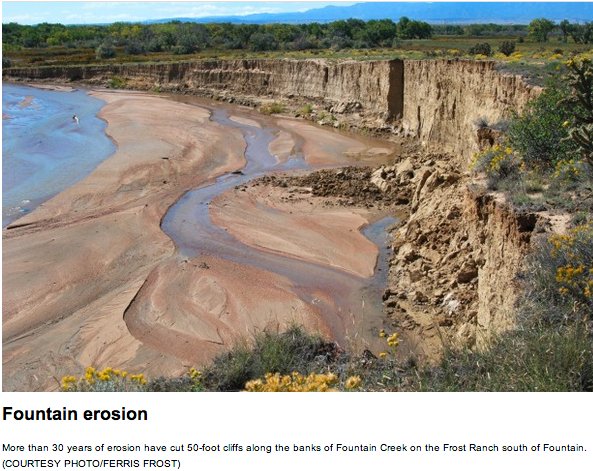
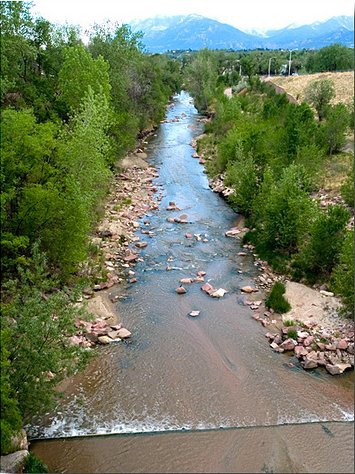
Faced with silence so far from Colorado Springs City Council, the Fountain Creek district will seek another direction on funding an evaluation of flood-control strategies. The Fountain Creek Watershed Flood Control and Greenway District board Friday voted to seek $135,000 in state funds to launch the $205,000 study.
Other funds would be: $30,000 from Colorado Springs Utilities and its partners in the Southern Delivery System; $25,000 in district money redirected from another grant; and $15,000 in in-kind engineering services from Utilities.
The board wants to look at whether it makes more sense to build a large dam on Fountain Creek or several detention ponds. The money being sought would be sufficient to both identify and evaluate sites along Fountain Creek where structures could be built.
“This gets us started, but one of the drawbacks is timing,” said Pueblo County Commissioner Terry Hart, a Fountain Creek board member.
The commissioners last month approved a resolution to use interest money from Colorado Springs’ upcoming $50 million payment to the district under Pueblo County’s 1041 agreement on SDS.
The commissioners sent a letter to Colorado Springs Council President Keith King, who has not brought up the issue with other council members.
“It’s council’s decision,” Hart said.
The state money could take longer to arrive because the $135,000 is being sought through the Water Supply Reserve Account. The application would be heard by the Arkansas Basin Roundtable as soon as June, then forwarded to the Colorado Water Conservation Board for consideration in September. After that, it could take several months to get a contract in place, meaning nothing will happen before the end of the year.
“I think Utilities is saying, ‘Try it this way,’ ” Hart said. “But we’ve lost all of 2014.”
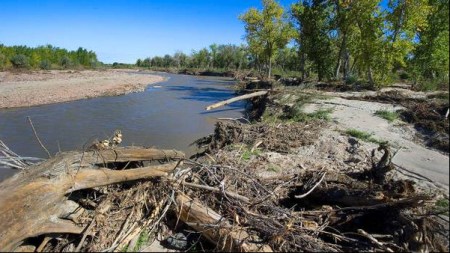
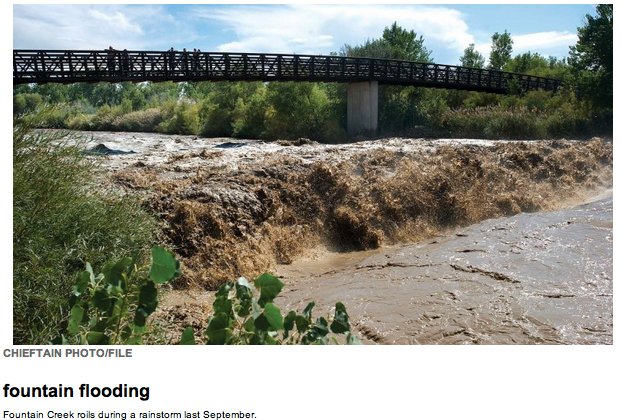
Fountain Creek is littered with logs, uprooted cottonwoods and debris from high flows in September. All aimed at Pueblo and the Lower Arkansas Valley. In fact, many are in Pueblo right now.
The Fountain Creek Watershed Flood Control and Greenway District Friday came to the realization that debris from the September downpour has not been removed from the creek, raising the possibility of increased damage if flooding occurs this year.
Unlike 2013, this summer could be wet. The Climate Prediction Center is calling for more moisture in Colorado; that could mean rain over large areas near Colorado Springs and the Black Forest that burned last year.
“Trees are staged everywhere,” said John Chavez, stormwater coordinator for El Paso County.
Removing the trees is expensive and there isn’t much money to do it. El Paso County is eligible for federal flood relief money, while Pueblo County is not.
Richard Skorman, a member of the Fountain Creek board, said people may not realize the danger that still exists.
“There was so much effort right after the fire,” he said.
Pueblo Councilwoman Eva Montoya, who chairs the Fountain Creek board, acknowledged there still are large trees in the Fountain Creek channel through Pueblo that could clog things during a big downpour.
Larry Small, the executive director of the district, said he observed many downed trees as well as erosion along Fountain Creek in northern Pueblo County.
Last month, he directed the Colorado Department of Transportation to remove trees it had stacked just downstream of the bridge at Fountain. The state has been slowly removing the trees.
“I think it’s important for people to realize the communities are working together, because this affects everybody,” she said.
Orders at the Northwest Pipe Co. plant in Denver were drying up in 2010 when bid requests started coming for a massive water project linking the Pueblo Reservoir and Colorado Springs called the Southern Delivery System.
“The start of the SDS project couldn’t have come at a better time,” Northwest’s vice president of sales Eric Stokes said.
At a cost of $841 million, the water project is the largest the region has seen in decades. Starting in 2016, it will pipe water held in the Pueblo Reservoir to consumers in Colorado Springs, Pueblo West, Security and Fountain.
“This is our water security for many years to come, 50 years into the future,” said John Fredell, program director of the water services division for SDS.
Northwest Pipe’s Denver plant won almost all the contracts to supply 50 miles of steel pipe, and the company celebrated the completion of the last piece Thursday afternoon. Northwest produced 7,000 pieces of the pipeline, each averaging 50 feet in length and 66 inches in diameter. The orders allowed Northwest’s employment in Denver to grow from 116 full-time workers to more than 231 at the peak of manufacturing.
Of about $500 million spent so far on the project, $359 million has gone to 333 Colorado businesses, including more than 75 based in metro Denver, Fredell said.
Northwest Pipe alone received about $110 million, including $23 million spent on payroll. Given that the next closest competitor was in California, Stokes said Northwest had a distinct advantage.
“Proximity was part of it,” Fredell said.
Back in 1997, Northwest Pipe, which is based in Vancouver, Wash., acquired Thompson Pipe & Steel Co., a manufacturer with Denver roots going back to the late 1800s. For decades, Thompson built pipes in the Curtis Park area that continue to help move water across much of the state. Thompson moved its plant to a 45-acre facility at 6030 Washington St., where workers continued to convert steel coil arriving by rail car into water pipes shipped out on trucks.
Once formed, the pipes are pumped full of water and pressure-tested to ensure there are no leaks. They are moved into a cavernous ⅛ – mile-long warehouse where they are rotated rapidly while concrete is poured inside to make a lining designed to last for decades. In a third building, the pipes are primed, painted and prepared for shipping.
“It is nice to know you have finished on time,” said Jason Cheng, a welder from Westminster who joined Northwest in October to work on the SDS order.
Cheng and other workers lined up to sign the last piece of pipe, undeterred as the rain poured down Thursday afternoon. Their signatures, in white ink, quickly smeared down the bright-blue pipe.
“We want the water on the inside of the pipe, not the outside,” one person commented.
Northwest Pipe, (Nasdaq: NWPX) is based in Vancouver, Washington. Its Denver manufacturing plant had a $110 million contract to build the project’s 50 miles of pipeline to carry the water. It was the biggest contract for materials under the project.
Northwest Pipe started making its 50-foot sections of pipe for the project, each section 66 inches in diameter, in 2011.
And the last pieces are now coming off the manufacturing line and awaiting a truck for transport to the project site.
“This is one of the largest programs that we’ve seen,” said John Moore, manager of Northwest Pipe’s manufacturing plant at 6030 N. Washington St. in north Denver.
During peak production, as many as 25 trucks a day left Northwest Pipe’s manufacturing facility.
Being in Denver meant trucking costs were less and Northwest Pipe could submit a more competitive bid for the project, Moore said.
And the project meant jobs for Northwest Pipe, which ramped up to 231 people during peak production, from a low of 116 people prior to work on the project, said John Moore, the plant manager. The company currently has 131 people on staff.
Northwest Pipe, which supplies pipes to carry water and waste water, has delivered pipes to other big water providers, including Denver Water and Aurora.
Selenium levels in the Arkansas River will be discussed during a tour and meeting next week in Rocky Ford. Selenium is a naturally occurring element that is necessary for life, but high concentrations threaten fish. Elevated levels of selenium on Fountain Creek and in the Arkansas River have caused concern for more than a decade.
A tour will begin at 2 p.m. May 29 at the Arkansas Valley Research Center east of Rocky Ford, followed by a free dinner at 5:30 p.m. and meeting from 6 to 8 p.m.
Two state water quality leaders, Dick Parachini of Colorado and Tom Stiles of Kansas, will talk about current water quality and discuss why selenium management is needed.
Tim Gates and Ryan Bailey of Colorado State University will present findings from 10 years of selenium-related studies and recommend best management practices.
Attendees then will be invited to discuss options and resources needed to implement the recommendations.
A series of community meetings on the development of a state water plan appears to be raising some lingering water issues. The Arkansas Basin Roundtable is sponsoring the meetings throughout the area in an effort to encourage more people to participate in a statewide water planning process.
Although the roundtable has met nearly every month since 2005, with ample opportunities to participate, there has been concern from the state Legislature that meetings have not been inclusive enough statewide. More than 20 non-members typically attend the Arkansas Basin Roundtable meetings.
In March, the roundtable redoubled its efforts to reach out, and already has held a dozen meetings, including the Arkansas River Basin Water Forum in April. At least six more meetings are planned, including one in Pueblo — no date or place have been set. Information can be found at the website, http://arkansasbasin.com.
Meetings so far have attracted anywhere from a handful to 60 people. The largest was at Primero during a snowstorm. Reactions have ranged from acceptance to resistance by some who believe the water plan will mean more regulations.
In Lamar, the biggest issue seemed to be the impact of a dam on Fountain Creek on downstream water rights, said Henry Schnabel, Prowers County commissioner. The dam is favored by some in Pueblo to contain increased flood flows caused by development in Colorado Springs. Farmers in the eastern part of the state fear that would change the timing of flows that reach the Arkansas River and reduce the amount of water they receive from Fountain Creek storms.
“A lot of times, we feel like we’re left out,” Schnabel said. “If you stop the water on Fountain Creek, we need to come up with a solution.”
Roundtable members were grateful for the turnout witnessed so far.
“It’s good to see the level of involvement, because we’ve reached out,” said Alan Hamel, former chairman of the roundtable and the basin’s representative on the Colorado Water Conservation Board.
Urban water conservation measures could be difficult to measure in the Arkansas River basin, where size and scope matter. The Arkansas Basin Roundtable confronted the issue Wednesday as it continues toward developing a basin implementation plan by July. The basin plan is part of a broader effort to develop a state water plan.
Most roundtable members resisted a preliminary approach by consultant Mark Shively that sought to create a “point system” that would identify best practices to save water.
The only part of the proposal that truly resonated was the statement: “One size does not fit all.”
“The conservation plan does not take into account things like our wise use campaign or economic forces within communities,” said Terry Book, executive director of the Pueblo Board of Water Works. “Demographics make a difference. I believe each community has the obligation to define good, better or best.”
Pueblo’s per capita water use has dropped as much as other Colorado communities with aggressive conservation campaigns since 2002. Some of that is because of the downturn in the economy, but a 2007 survey found customers’ habits have changed as well.
In Crowley County, the per capita use is higher because domestic water supplies overlap with water for horses or other livestock, said Rick Kidd, who represents the county on the roundtable.
Communities that already have lowered water use could be penalized under a point system, said Dave Taussig, who represents Lincoln County.
The danger of voluntary guidelines is that they could, over time, become mandatory, said Joe Kelley, superintendent of La Junta water.
“The first thing you know, everybody’s regulated,” Kelley said. “Then you have to spend money you don’t have to get money for grants.”
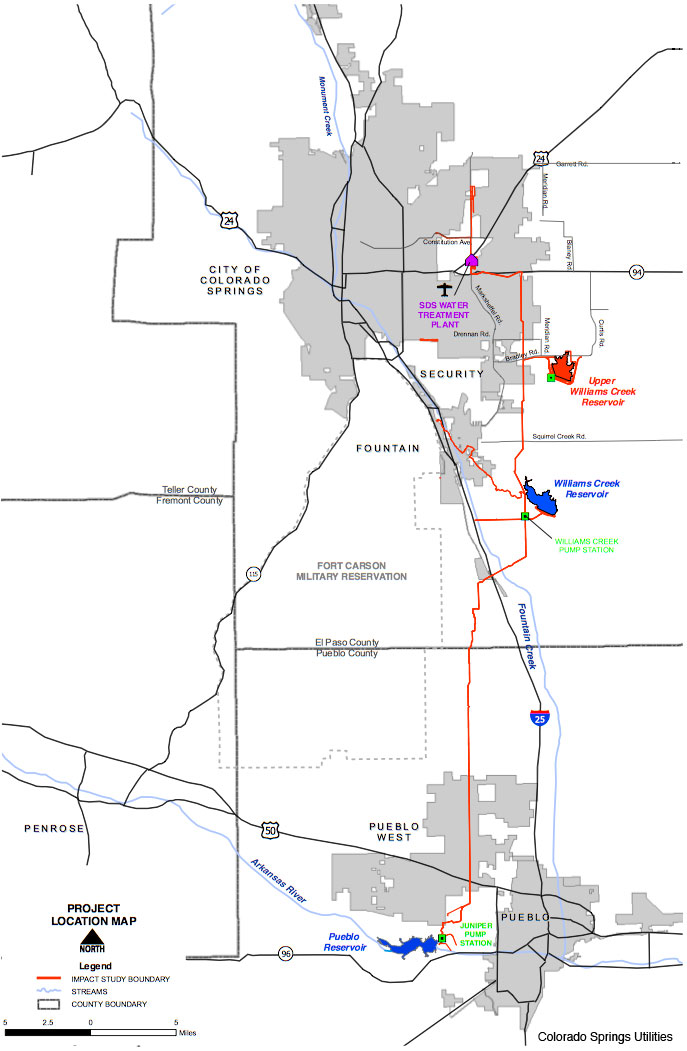
Southern Delivery System route map — Graphic / Reclamation
Here’s part one of an in-depth look at the Southern Delivery System from John Hazlehurst writing for the Colorado Springs Business Journal. Click through and read the whole article. Here’s an excerpt:
Contending that the denial [of Homestake II] had been arbitrary and capricious, the two cities [Aurora and Colorado Springs] appealed the decision to the courts. In a comprehensive description of the city’s water system and possible future sources of supply given to City Council in 1991, CSU managers said that “extensive litigation is expected to continue.”
Denied by the Colorado Court of Appeals and the Colorado Supreme Court, the cities appealed to the U.S. Supreme Court, which declined to hear the case.
City officials were stunned. They couldn’t believe that a coalition of Western Slope “enviros” and ski towns had prevented them from developing water to which the city had an undisputed right. They had believed the Environmental Protection Agency’s 1990 decision to scuttle Denver’s proposed Two Forks Dam near Deckers on the South Platte River was an outlier, not a sign of things to come…
Slow to recognize that mountain communities now had the power to kill their water development plans, Utilities officials looked at another alternative. Instead of taking water directly from the wilderness area, the city proposed to build a dam on the mainstem of the Arkansas at Elephant Rock, a few miles upstream of Buena Vista.
A grassroots rebellion against the project was soon evident, as hand-lettered signs appeared along U.S. Highway 24, which parallels the Arkansas. The signs carried a simple message: “Don’t Let Colorado Springs Dam this River!”
It soon became clear that Chaffee County commissioners would not issue a construction permit for any such project, dooming it before the first planning documents were created…
If trans-mountain diversions or dams on the Arkansas were no longer feasible, that left a single alternative for developing the city’s water rights. CSU would have to let its water flow down to Pueblo Reservoir, construct a diversion structure on the dam, and pump it uphill to Colorado Springs.
It would be, water managers believed, the easiest project to build and permit.
“It was just a pipeline,” said CSU water resources manager Gary Bostrom, who has worked 35 years for Utilities. “What could go wrong?”[…]
“We didn’t really understand the importance of partnering with and involving the public in decision-making,” said [Gary Bostrom], “until the Southern Water Project.”[…]
The plan for the Southern Delivery System was presented to City Council in 1992. Among the material submitted to councilmembers was a comprehensive description of the city’s existing water system. Water managers made sure Council was aware of the importance of the task before them.
“The massive scope of this project,” CSU staff noted, “requires a very long lead time to allow for complexities of numerous permitting processes, land acquisition, litigation, design, financing and construction.”
Of all the variables, CSU managers and elected officials gave the least weight to those that may have been the most significant…
“We weren’t worried about hydrology,” said Bostrom. “The years between 1980 and 2000 were some of the wettest years on record. The water was there for the taking. Shortages on the Colorado weren’t part of the discussion.
“We knew about the Colorado River Water Compact of 1922 (which allocated Colorado River water between Mexico and the upper and lower basin states), but it wasn’t something we worried about.”
Then as now, 70 percent of the city’s water supply came from the Colorado River. SDS would tap the city’s rights on the Arkansas, diversifying the portfolio.
“We have to plan for growth,” said Bostrom. “That’s what history tells us. We know that it will be expensive, but the cost of not building a system well in advance of need would be much greater. People complained about the cost of the Blue River (trans-mountain diversion) project in the 1950s, but we wouldn’t have a city without it — we wouldn’t have the Air Force Academy.”
But even as the project moved slowly forward, the comfortable assumptions of a wet, prosperous future began to unravel.
“Exactly 15 years ago today (April 29, 1999),” said Bostrom, “we were in the middle of a flood — remember? We didn’t know it, but that was the day the drought began.”
More Southern Delivery System coverage here and here.
The new north outlet works at Pueblo Dam — Photo/MWH Global
From the Colorado Springs Business Journal (Marija B. Vader):
Wayne Vanderschuere, general manager of the Colorado Springs Utilities water services division, said the Southern Delivery System will be completed on schedule and $150 million under the original budgeted amount.
More Southern Delivery System coverage here and here.
A plan to fund a study of either a dam or series of detention ponds on Fountain Creek is now in the hands of Colorado Springs City Council. Pueblo County commissioners Monday approved prepayment of $291,000 in interest payments by Colorado Springs Utilities to the Fountain Creek Watershed Flood Control and Greenway District. Part of that, about $60,000, would fund the next phase of a dam study on Fountain Creek. Last week, the district narrowed that effort to compare either a dam or series of detention ponds to reduce the impact of Fountain Creek floods on Pueblo. The money would be an advance payment on $50 million Utilities pledged to pay the district for Fountain Creek dam studies under its 1041 agreement with Pueblo County for its Southern Delivery System.
Colorado Springs already has prepaid $600,000 of that to the Fountain Creek district. If it agrees to pay another $291,000, Pueblo County will deduct that amount from the $50 million as well, under the resolution passed Monday.
“CSU staff was recommending not paying (the interest), because they said, ‘We don’t see what we’re getting,’ ” said Terry Hart, chairman of the commissioners. “We see an enormous benefit to the district in converting this drainage ditch into an amenity that everyone, including Colorado Springs, can enjoy.”
Utilities is controlled by the Colorado Springs City Council, however. Last week, Hart received assurances from Colorado Springs Councilman Val Snider that the payment would be examined.
“I’m astonished they have to ask what’s in it for them,” added Commissioner Liane “Buffie” McFadyen. “It’s imperative that they work with us.”
Utilities wanted to add language to the county’s resolution indicating it was in good standing when it came to the 1041 permit. The commissioners balked at that, and made it clear in the resolution that 1041 compliance is a separate issue. The board also put in a clause that requires the Fountain Creek District to provide an annual report of how the money is spent.
“Colorado Springs hasn’t always been a good neighbor to us,” said Commissioner Sal Pace. “I’m hopeful the $50 million will be enough to leverage hundreds of millions needed to build flood detention storage.”
Meanwhile Pueblo District Attorney Jeff Chostner is weighing his legal options in his water quality challenge to CSU’s 1041 permit from the county. Here’s a report from Chris Woodka writing for The Pueblo Chieftain:
Pueblo District Attorney Jeff Chostner is looking at legal options, including a possible federal lawsuit, after the state Supreme Court rejected his petition to reconsider water quality rulings for the Southern Delivery System. The Colorado Supreme Court Monday refused to reconsider an appeals court’s decision to overturn Pueblo District Judge Victor Reyes’ order for the Colorado Water Quality Control Commission to redo its assessment of SDS on Fountain Creek and the Arkansas River.
Chostner and the Rocky Mountain Environmental Labor Coalition wanted the high court to uphold Reyes’ 2012 ruling, which was reversed by a three-judge panel last July.
“I’m very disappointed in the outcome of the suit and we’re weighing our legal options,” Chostner said shortly after learning of the Supreme Court decision.
“Colorado Springs Utilities believed all along in the state’s approval of the SDS water quality certification and are pleased that today’s Supreme Court decision finally brings this issue to closure,” said John Fredell, SDS program director.
The original complaint was made by former DA Bill Thiebaut, and Reyes agreed with him that the state water quality board should have held Colorado Springs Utilities to a numerical standard, rather than relying on an adaptive management program.
The state ignored its own standards in approving a water quality certification for SDS, Reyes said.
Monday’s Supreme Court denial of the petition means the Colorado Court of Appeals July ruling stands and Colorado Springs Utilities can complete its work on the pipeline as planned.
“We believed all along in the state’s approval of the SDS water quality certification and are pleased that today’s Supreme Court decision finally brings this issue to closure,” said John Fredell, SDS program manager.
In July, the Colorado Court of Appeals said Colorado Springs Utilities had done all the necessary work to ensure that SDS would not wreck water quality in Fountain Creek. The court had reversed a Pueblo County judge’s ruling against a state water quality certification for Colorado Springs’ SDS pipeline project. The Water Quality Commission gave the SDS its stamp of approval after more than a year of study. The commission’s approval was challenged by former Pueblo District Attorney Bill Thiebaut and the Rocky Mountain Environment and Labor Coalition.
However, the appellate court cited a number of reports and analyses and found that all the proper tests were completed and that there was substantial evidence that showed SDS will not violate water quality standards in Fountain Creek.
In August, Chostner requested that the Colorado Supreme Court review the appeals court decision.
“Obviously I am very, very disappointed with it,” Chostner said of the Supreme Court denial. “We are taking a look at our legal options as to how we can respond to it.”
SDS has been embroiled in controversy, piles of federal, state and local regulations and litigation for years. The project was launched to bring more water to Colorado Springs, Fountain, Security Water District and Pueblo West for future population growth. The first stretch of pipe was built in 2010 and the pipeline is expected to be completed by 2016. Utilities officials say the estimated cost of the phase 1 of the project – 53 miles of pipeline, three pump stations and a new water treatment plant capable of delivering up to 50 million gallons of water per day – is $841 million, about $150 million less than projected.
From the Colorado Springs Independent (J. Adrian Stanley):
The Colorado Supreme Court denied an appeal today by the Pueblo County District Attorney that sought to derail Colorado Springs Utilities’ Southern Delivery System. The decision clears the last major potential roadblock for the $898 million pipeline from Pueblo Reservoir to Colorado Springs, which is already well under construction.
Pueblo County alleged that the state’s approval of permits for the project didn’t adequately consider water quality issues. Pueblo has long fought SDS, claiming that the return flow from the pipeline along Fountain Creek will exacerbate stormwater and water quality issues.
New polling shows voter support for a stormwater fee in El Paso County, and even more as voters become educated about the need. The fee is important to Pueblo County because it could raise $1 billion over the next 20 years to reduce the impacts of floods on Fountain Creek. Last November, 50 percent in El Paso County opposed the fee, while 44 percent were in favor. In March, 53 percent favored the fee, with only 35 percent opposed, said Dave Munger, co-chairman of a citizens task force on stormwater control.
“We’re very encouraged by that, especially because we have not gotten an educational program going,” Munger told the Fountain Creek Watershed Flood Control and Greenway District Friday.
The polling showed that by building certain provisions into the proposal, support could increase to more than 60 percent as the task force moves to convince El Paso County commissioners to put a stormwater proposal on the November ballot.
If the average homeowner paid $9 per month, the fee would raise $50 million per year in the Pikes Peak region. That’s three times the amount generated by a stormwater fee sunk by the Colorado Springs City Council in 2009.
That money would address projects envisioned in earlier stormwater studies as well as new concerns caused by the Waldo Canyon and Black Forest fires, Munger said.
The proposal would limit the administrative fee to just 1 percent — about $500,000 per year. It also would return the money to communities proportionately and include a 20-year sunset period for capital projects. A 13-member board weighted toward Colorado Springs would develop a master plan that would prioritize projects.
While the money would be redistributed on a pro rata basis, it still could be used for retention ponds or dams as envisioned by the Fountain Creek board.
“This will make El Paso County’s stormwater control efforts greater than it has ever been before,” Munger said.
Pueblo County Commissioner Terry Hart asked Munger to explain why the Fountain Creek district could not administer the plan.
“What I would like to know is if you see a role for the district,” Hart said. “A lot has gone into forming this district, including trying to navigate the politics and differences between the two counties.”
Munger replied that the proposal is built on agreements that would be signed by Colorado Springs, El Paso County, Fountain, Manitou Springs, Green Mountain Falls, Monument and Palmer Lake.
“We’re focused on getting voter approval,” he said.
Once the stormwater authority is formed, it could contract with the Fountain Creek district for projects. It might also accept new members, including Pueblo County, city of Pueblo and Teller County areas within the watershed.
“I don’t know why we couldn’t take advantage of this structure,” Munger said.
Recent estimates show a backlog of $740 million in El Paso County stormwater projects, but more could develop. At the end of 20 years, voters could be asked to renew the fee, Munger said.
A district formed to fix Fountain Creek is moving ahead with a road map to build flood control dams between Fountain and Pueblo. The entire process could take 3-12 years to complete, with the type of structures chosen and the availability of money the determining factors.
On Friday, Larry Small, executive director of the Fountain Creek Watershed Flood Control and Greenway District, broke down the process into bite-sized pieces for the board, which was formed five years ago by the state Legislature to resolve Fountain Creek differences between Pueblo and El Paso counties.
Phase 1 would be to compare three alternatives that were modeled in a U.S. Geological Survey study completed this year. It would cost $60,000 and take up to a year to complete. Those include a large dam, a series of about 10 smaller dams or several midsize dams that would capture about the same amount of water.
“Maybe building fewer and bigger dams may be better than 10 small dams,” Small said.
Small said other alternatives in the USGS study either provided only local protection on other parts of Fountain Creek, or no protection at all to Pueblo in the event of a large flood. The study would corroborate past studies and identify — but not solve — issues with each of the alternatives. It would also use the USGS study to provide a visualization of floods of varying intensity, Small said.
The next phase would then compare the options by looking at engineering, easements, permits, costbenefit analysis and other factors.
“We want to be in a position that will allow us to begin building when the money becomes available,” Small said.
That money will start coming when Colorado Springs begins payment of the bulk of $50 million that it agreed to pay the district under Pueblo County’s 1041 permit for Southern Delivery System. The funding for the study would come from prepayment of nearly $300,000 in interest on the $50 million under the terms of the 1041 permit.
Pueblo County Commissioners and Colorado Springs still are negotiating the details of the prepayment, said Commission Chairman Terry Hart.
“What we’re trying to do is pave the way for the money, so the project can move forward,” Hart said.
More Fountain Creek watershed coverage here and here.
Almost every chair was filled at the meeting hosted at Ute Pass Elementary on Tuesday evening. The Coalition of the Upper South Platte, El Paso County and Colorado Department of Transportation answered residents’ questions about flood season.
Last summer, people living along Ute Pass watched cars float down Highway 24 and debris take out homes during flash floods.
El Paso County has spent $3.3 million on flood mitigations along Ute Pass. The county’s storm water quality coordinator John Chavez said despite the work, he is still apprehensive about flood season. Based on questions raised during the meeting, he is not alone in his concerns.
“I think folks up here have really learned a lesson. Immediately after the fire, I think there was some denial relative to flooding but once the rains really started, they realized this was serious and they needed to take action,” said Chavez.
The city of Colorado Springs is also moving ahead on flood mitigation work in preparation for flood season. Workers are clearing sediment, vegetation and loose concrete along Camp Creek between Fontanero and Bijou Streets on 31st Street.
Camp Creek channel via City of Colorado Springs
If debris blocks culverts along Camp Creek, it will push water onto the road and homes along 31st Street. Resident Claudia Roldan said there were a lot of close calls last flood season.
An engineer with the City of Colorado Springs overseeing the project said it will improve conditions in Camp Creek this summer, but there is more work that needs to be done to keep homes safe in the area…
Temporary work on Camp Creek will wrap up at the end of May. City engineers have long-term plans to overhaul Camp Creek so it can withstand heavy rain in the future.
Here’s the abstract from the USGS (Michael S. Kohn/John W. Fulton/Cory A. Williams/Robert W. Stogner, Sr.)
The U.S. Geological Survey (USGS) in cooperation with the Fountain Creek Watershed, Flood Control and Greenway District assessed remediation scenarios to attenuate peak flows and reduce sediment loads in the Fountain Creek watershed. To evaluate these strategies, the U.S. Army Corps of Engineers Hydrologic Engineering Center (HEC) hydrologic and hydraulic models were employed.
The U.S. Army Corps of Engineers modeling system HEC-HMS (Hydrologic Modeling System) version 3.5 was used to simulate runoff in the Fountain Creek watershed, Colorado, associated with storms of varying magnitude and duration. Rain-gage precipitation data and radar-based precipitation data from the April 28–30, 1999, and September 14–15, 2011, storm events were used in the calibration process for the HEC-HMS model. The curve number and lag time for each subwatershed and Manning’s roughness coefficients for each channel reach were adjusted within an acceptable range so that the simulated and measured streamflow hydrographs for each of the 12 USGS streamgages approximated each other.
The U.S. Army Corps of Engineers modeling system HEC-RAS (River Analysis System) versions 4.1 and 4.2 were used to simulate streamflow and sediment transport, respectively, for the Fountain Creek watershed generated by a particular storm event. Data from 15 USGS streamgages were used for model calibration and 7 of those USGS streamgages were used for model validation. The calibration process consisted of comparing the simulated water-surface elevations and the cross-section-averaged velocities from the model with those surveyed in the field at the cross section at the corresponding 15 and 7 streamgages, respectively. The final Manning’s roughness coefficients were adjusted between –30 and 30 percent at the 15 calibration streamgages from the original left, right, and channel-averaged Manning’s roughness coefficients upon completion of calibration.
The U.S. Army Corps of Engineers modeling system HEC-RAS version 4.2 was used to simulate streamflow and sediment transport for the Fountain Creek watershed generated by a design-storm event. The Laursen-Copeland sediment-transport function was used in conjunction with the Exner 5 sorting method and the Ruby fall-velocity method to predict sediment transport. Six USGS streamgages equipped with suspended-sediment samplers were used to develop sediment-flow rating curves for the sediment-transport-model calibration. The critical Shields number in the Laursen-Copeland sediment-transport function and the volume of sediment available at a given cross section were adjusted during the HEC-RAS sediment-model calibration process.
HEC-RAS model simulations used to evaluate the 14 remediation scenarios were based on unsteady-state streamflows associated with a 24-hour, 1-percent annual exceedance probability (100-year) National Oceanic and Atmospheric Administration Type II precipitation event. Scenario 0 represents the baseline or current conditions in the watershed and was used to compare the remaining 13 scenarios. Scenarios 1–8 and 12 rely on side-detention facilities to reduce peak flows and sediment transport. Scenario 9 has a diversion channel, and scenario 10 has a reservoir. Scenarios 11 and 13 incorporate channel armoring and channel widening, respectively. Scenarios 8 and 10, the scenario with the most side-detention facilities, and the scenario with the reservoir, respectively, were the most effective at reducing sediment transport and peak flow at the Pueblo, Colorado, streamgage. Scenarios 8 and 10 altered the peak flow by –58.9 and –56.4 percent, respectively. In turn, scenarios 8 and 10 altered the sediment transport by –17.7 and –62.1 percent, respectively.
Colorado Springs has spent $26.6 million to acquire land for its $984 million Southern Delivery System. Most of the money was spent in El Paso County, although properties in Pueblo West and on Walker Ranches were purchased either permanently or for temporary easements.
Pipeline easements totaled $961,681 for 388 acres in Pueblo County, compared with $2.5 million for 486 acres in El Paso County.
Another $1 million was paid to buy homes in Pueblo West.
The big money was paid for other features of the project in El Paso County, a total of about $22 million.
“It would be misleading to simply do the math on the values above and conclude that more was paid for land in El Paso County than Pueblo County,” said Janet Rummel, spokesman for Colorado Springs Utilities, in an e-mail responding to a request from The Pueblo Chieftain.
Permanent easement prices ranged from 50-90 percent of fee value, while temporary easements are valued at 10 percent per year, varying from one to four years.
“The fee value of land depends primarily on location, but also is subject to size, shape, development entitlement and improvements, if any,” Rummel explained.
“Within the raw water pipeline alignments for SDS, fee values for easements and facilities ranged from $1,389 per acre to almost $20,000 per acre,” Rummel said. “Pueblo West properties were generally valued in the range between $10,900 to $13,000 per acre.”
At the high end of that scale were 6 homes on about 10 acres in Pueblo West purchased for $1.044 million.
But even below that scale were 103 acres, two-thirds in permanent easements, on Walker Ranches, which could be purchased for $82,900, or about $804 per acre. Utilities also paid Walker $600,000 to relocate cattle during construction, as required by Pueblo County’s 1041 permit.
Gary Walker will contest the amount of the easement payment in court this November, one of four cases still in dispute.
Walker also has raised complaints, most recently during a county public hearing, about erosion along the pipeline route. The bulk of the money, however, has gone for the treatment plant, pump station and reservoir sites in El Paso County.
Utilities paid $259,519 for 43 acres for the Bradley Pump Station; $2.4 million for 124 acres at the treatment plant and $19.3 million for a future reservoir site on Upper Williams Creek.
At the reservoir site, T-Cross Ranches, owned by the Norris family, received $9,500 per acre for 791 acres ($7.5 million), while the state land board received $10,500 per acre for 1,128 acres ($11.8 million).
SDS is a pipeline project that will deliver up to 96 million gallons of water daily from Lake Pueblo to Colorado Springs, Fountain, Security and Pueblo West.
The figures do not include money Utilities paid to purchase homes in Jimmy Camp Creek at a reservoir site that later was abandoned.
The type of storm that would creating the worst flooding on Fountain Creek and the Arkansas River east of Pueblo might just seem like another rainy day for much of the region. But the lessons of floods in 1965 and last September’s close call for Pueblo show that Fountain Creek can froth up in a hurry when rains hit El Paso County to the north. Putting a small dam here and there would not be the most effective way to stop the water.
A recent U.S. Geological Survey study of dams on Fountain Creek shows that an 85-foot tall dam north of Pueblo would be the single-most effective way to mellow out flood waters and trap sediment. The drawbacks of the dam are that highways, railroad crossings and utilities might have to be relocated. There would also be the chore of removing sediment after large storms.
Smaller detention ponds, with dams no higher than 10 feet, are touted by many as a better alternative. But as Colorado Springs and Pueblo already are discovering, smaller ponds also require high maintenance. Similar dams failed to hold stormwater in the South Platte during last September’s record rains. And the cost of flooding to utilities and roads was a major side effect of the 1965 flood.
A different study of flooding was done by the USGS in 1974, nine years after the disastrous 1965 flood. Unlike the current study, it largely eluded the spotlight and has not been widely cited during the 40 years since it was written. It looked at floods in the Arkansas River basin in three states, Colorado, Kansas and New Mexico and assessed the causes, effects and damage caused by heavy rains from June 13-20, 1965. The study chronicled $60 million of damage overall, with $40 million in Colorado. In today’s dollars, that would be about $300 million. Of that, 55 percent of the damage was to agriculture; 20 percent to roads and utilities; and 25 percent to cities and businesses, with about 85 percent of that amount in Pueblo.
The study also looked at peak flows within the basin during the 1965 flood and compared them to other major floods, particularly the 1921 flood on the Arkansas River. The flows were considerably less in 1965 than in 1921, mainly because storms were centered over tributaries that fed into the Arkansas River below Pueblo, rather than in the watershed upstream from Pueblo.
The study found a huge benefit to Lamar from John Martin Reservoir, which cut two-thirds of the peak flows raging from upstream. The Lamar area did not escape the wrath of the storm, however, because of large storm cells centered above Two Buttes and Holly. The Arkansas River stayed swollen for days after the rains.
The heaviest rainfall in the 1965 storm came from Colorado Springs and the Holly-Two Buttes area, where 12-18 inches fell over a four-day period. Pueblo saw only a couple of inches during that time. The ground already was saturated from rains the previous two months throughout the region. Flows on Fountain Creek reached 47,000 cubic feet per second at their peak, while neighboring Chico Creek hit 52,000 cfs.
The 2014 study by the USGS modeled a 100-year storm that would send about 37,000 cfs from Colorado Springs to Pueblo and then looked at hypothetical dams along the way.
“A dam at any location could be modeled,” said David Mau, head of the Pueblo USGS office.
The intensity of that storm would not be as great as the 1965 flood. In addition, Colorado Springs today has five times as many people and many more square miles of parking lots, roof tops and streets that shed water quickly and would make flooding that much worse for Pueblo.
Levees were built on Fountain Creek to protect Pueblo, but sediment has reduced their effectiveness. Some structures meant to protect Pueblo were damaged by the relatively small flow last September.
The attention in Colorado Springs is focused on the accelerated runoff from the Waldo Canyon and Black Forest fires. Structures are being built. Town meetings are preparing neighborhoods for flooding. A vote to create a regional stormwater fee is heading for the ballot in November.
Colorado Springs also made a commitment to Pueblo County in its permit process that new development from the Southern Delivery System won’t worsen the condition of Fountain Creek.
While the rains may hit Colorado Springs first and make flooding more intense because of the fires, the 1974 USGS study shows the bigger wallop would come to Pueblo and the Lower Arkansas Valley.
A crowd of more than 100 people echoed a mantra in unison that multiple Colorado Springs officials stressed at a flood preparedness meeting on Tuesday night.
“Up, not out,” the said loudly after being prompted by police Lt. Dave Edmondson…
City officials, including Emergency Manager Brett Waters and others talked about the 2013 floods that struck the city and El Paso County in July, August and September. Waters said his colleagues and the residents need to “take flood risk very seriously,” noting that flash floods coming out of the Waldo Canyon Fire burn scar are going to be an issue “for at least the next 10 years.”
Tim Mitros, the city’s development review and stormwater manager, showed slide after slide of the dangers that lie in the Camp Creek drainage in the hills to the west of Colorado Springs. The pictures illustrated barren, burnout out slopes that have already, and could, send tons of dirt rocks and other debris into the channel along Garden of the Gods Park. and into the Pleasant Valley neighborhood.
“We’ve got to keep the sediment up in the burn area,” Mitros said.
Mitros said city crews will begin building a large sediment detention pond on the east end of Garden of the Gods Park in the next month. At that time, workers will also begin doing repairs to the channel in the middle of 31st Street near Pleasant Valley. They will be adding a “protective layer of concrete” to badly damaged parts of the creek between West Fontanero Street and Echo Lane.
The work is the beginning stages of a $37 million project to rebuild the channel from Garden of the Gods Park to Colorado Avenue, Mitros said. The city already allotted $8.8 million to do work in Camp and Douglas creeks. MIiros said the final designs for the entire project will be unveiled at another Camp Creek watershed public meeting from 5 to 7:30 p.m. April 29 at Coronado High School.
National Weather Service meteorologist Jennifer Stark also talked about the dangers of debris in the Camp Creek and Douglas Creek areas. She said storms in September that ravaged the Front Range from El Paso County north to the Wyoming border left tons and tons of debris sitting just above the city.
“The next big rain event could bring that stuff down,” she said.
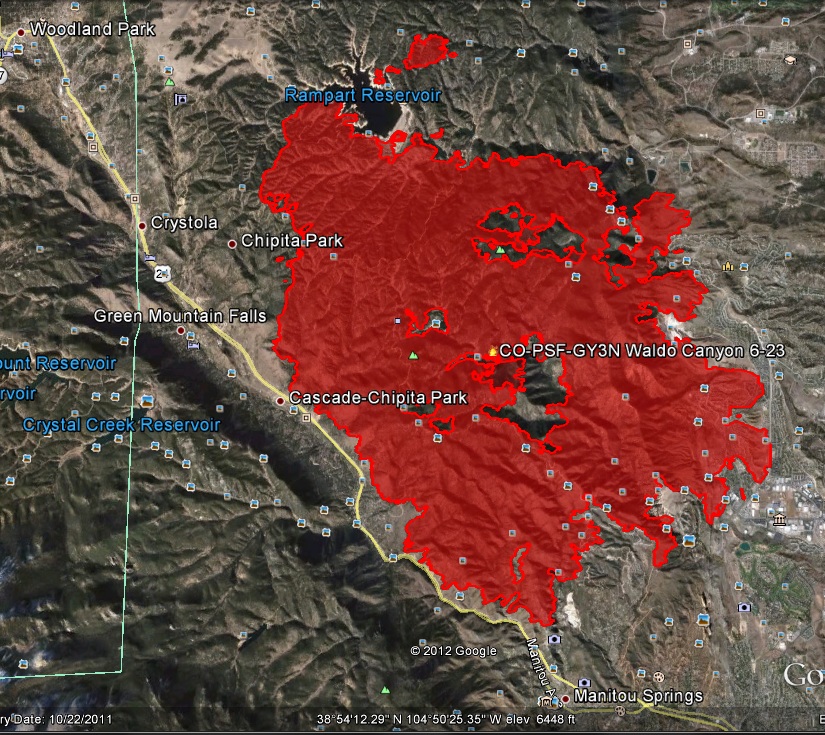
The images of a glowing sky that filled the air with choking smoke won’t soon fade, but the damage to forested hillsides charred by the Waldo Canyon Fire in 2012 will be more troublesome for years. Colorado Springs had a taste of things to come during last September’s torrential rains, but it will take millions of dollars and at least a decade to recover the damaged landscape.
“We built basins to collect sediment over a 10-year period, but they filled up during the flooding last September,” said Tim Mitros, Colorado Springs stormwater manager, during a media tour of projects Wednesday.
So now the city is building a series of ponds that will trap floodwater, along with making other drainage improvements on North Douglas Creek, South Douglas Creek, Queens Canyon, Cheyenne Creek and Camp Creek on the west side of Colorado Springs. Altogether the projects will cost $8.8 million in additional stormwater funding from federal, state and city sources.
The catch basins worked, but filled too quickly, Mitros explained during a tour of one on North Douglas Creek on the Flying W Ranch. The idea behind them was to allow new vegetation to sprout as they filled, but the storms left a bed of gravel that would just sheet off water in the next storm.
Jason Moore, director of land management for the Flying W, explained how downed trees are criss-crossed along the creek bed to slow down minor flows.
“They’re in a W shape, so we call them Flying W’s,” Moore joked.
The ponds are being constructed with the cooperation of landowners, but must be cleaned by city crews after each storm dumps its load of sediment. Mitros said the city is fortunate because it is working with only two large landowners, the Navigators and Flying W, and both have been cooperative.
“Without the ponds, the sediment will continue to fill the concrete channel below and put them in danger of being overtopped,” Mitros said.
That will continue to be a big job. Colorado Springs still is hauling 6,000 cubic yards of sediment — 600 truckloads — that washed into Garden of the Gods Park after last summer’s storms. There would be some benefit to Pueblo, because anything done high up in the watershed helps to slow down the water reaching Fountain Creek, Mitros said. Primarily, however, the projects are being undertaken to protect the homes and businesses in the Mountain Shadows neighborhood that was decimated when the Waldo Canyon Fire burned 347 homes. Those homes are being rebuilt, but now face a different threat. They lie below valleys that are normally dry, but which become running rivers when it rains. Because the fire burned off much of the vegetation, any flood becomes about 10 times as powerful, said Leon Kot, restoration coordinator for the Natural Resources Conservation Service.
Besides the new threat of runoff, Colorado Springs also is dealing with miles of concrete storm ditches, some more than 50 years old, that have fallen into disrepair. About 1,000 feet of 8-foot diameter pipeline buried near Eighth Street and Cheyenne Boulevard was overwhelmed by the September flooding and is being replaced in a $750,000 project.
Southern Delivery System route map — Graphic/Reclamation
From the Colorado Springs Independent (Pam Zubeck):
Outside of a handful of parcels tied up in eminent-domain court actions, the city has amassed the vast majority of land needed to complete the 66-inch-diameter line across Pueblo and El Paso counties. And as for those in court, Utilities has been granted possession; at issue is determination of their value.
Which leaves only one other property acquisition needed for the pipeline itself, and a couple dozen others for related projects. Overall, the land-acquisition project is on schedule, if significantly over budget.
“We are pleased to be nearly complete with acquiring the land needed for SDS,” says Utilities project manager John Fredell in a statement. “We have worked hard to be fair with property owners and appreciate their cooperation to advance this critical project for our community and partners.”[…]
The city’s initial foray into acquiring property for the project, in 2003 and 2004, caused an uproar, and a tightening of city real estate acquisition procedures. Utilities, in some cases without Utilities Board approval, had made offers for homes near Jimmy Camp Creek, northeast of the city, for up to three times the homes’ assessed values, plus six-figure moving costs — in one case, $340,000. The city paid $6.1 million for 14 properties and then allowed the former owners to rent for $300 a month indefinitely.
Within a few years, the city abandoned the Jimmy Camp area as a reservoir site due to archaeological values and other factors, and instead chose Upper Williams Creek near Bradley Road.
In 2009 and 2010, Utilities tangled with Pueblo West residents and left some hard feelings in its wake. The buried pipeline, which traverses the back portions of residential lots, can’t be built upon, which residents say renders their yards unusable.
Resident Dwain Maxwell, who’s forced Utilities into condemnation court, says he was paid $1,850 for land his appraisal said was worth $16,500. Meanwhile, he estimates Utilities has spent four times that amount on attorneys. “I feel like they’ve not been honest with us,” he says today.
Gary Walker of Pueblo County is also still in condemnation court with the city, and declined to be interviewed for this story. But he notes in an email that he’s been recognized repeatedly for his stewardship of the land at his ranch, and was the first to sign up for the reintroduction of the black-footed ferret under federal rules. “How do you put a price on the destruction of something so important as our environment?” he asks.
In 2012, Utilities went up against the Norris ranching family for a chunk of land for Upper Williams Creek Reservoir. After the Norrises moved to create their own reservoir, a deal was reached in which the city paid the family $7.5 million for 791 acres.
But the biggest single acquisition was land next to the Norris property owned by the State Land Board. The city paid more than $11.8 million for 1,128 acres, the highest per-acre price paid for pipeline property…
Utilities needs to acquire about 15 additional properties for the reservoir site, but the reservoir won’t be built until SDS’ second phase, from 2020 to 2025, as demand requires. The city also needs 11 more properties for a section of pipe for treated water, Rummel says.
So far, the city has spent $34.6 million on land for SDS. That’s about 38 percent more than the $25 million estimate in 2009 for 274 parcels in Phase 1 and reservoir land. If costs for surveys, appraisals, real estate fees and closings are added, the cost is $45 million, or 22 percent more than the 2009 “all-in” estimate of $37 million.
Water rates, meantime, haven’t increased as much as earlier predicted. Ratepayers saw 12 percent hikes in 2011 and 2012, and 10 percent increases in 2013 and 2014. A 5 percent hike is expected in 2015. Previously, 12 percent annual jumps were forecast from 2011 through 2017.
More Southern Delivery System coverage here and here.
Photo via The Pueblo Chieftain FromThe Pueblo Chieftain (Chris Woodka):
Three contracts totaling more than $600,000 were approved Friday by the Fountain Creek Watershed Flood Control and Greenway District board. The contracts are funded by state grants. They include two contracts for $502,000 for the Upper Fountain Creek and Cheyenne Creek restoration master plan, and another for $107,000 for the Frost Ranch restoration project. The three projects are among five projects the district is directly coordinating throughout the watershed. They also include a flood detention demonstration pond in Pueblo, located behind the North Side Walmart, and a project on Monument Creek.
In addition, the district has cooperated in obtaining other grants for communities along Fountain Creek.
Those efforts include a sediment collector in the city of Pueblo, which is being evaluated by the city, and a Great Outdoors Colorado grant that included funds for a wheel park, expanded park and beach area on the East Side just south of Eighth Street.
During discussion of flood control alternatives on Fountain Creek, Pueblo Councilwoman Eva Montoya said projects to the north are needed to control Pueblo flows.
“We have to have detention ponds there, so it doesn’t wash out what we are doing in Pueblo,” she said.
A district formed to fix Fountain Creek wants to begin looking more closely at the feasibility of flood control alternatives meant to protect Pueblo.
“This is a good start to beginning to understand the volume of water and the impact of dams, but we need to do an analysis to figure out cost options,” Pueblo County Commissioner Terry Hart said.
Hart is the county’s representative on the Fountain Creek Watershed Flood Control and Greenway District, which met Friday to receive the final report on a Fountain Creek dam study.
A computer simulation by the U.S. Geological Survey looked at 13 scenarios by centering a 100-year storm over Colorado Springs and measuring the impact on reducing flood waters in Pueblo by constructing dams at various points in the watershed.
“It did not look at property and water rights issues,” said David Mau, head of the Pueblo USGS office.
The most promising alternatives, in terms of protecting Pueblo, were to build a series of small dams south of Colorado Springs, or one large dam near Pinon, just north of Pueblo.
Hart asked Mau whether it would be possible to model a larger off-channel diversion near the Pueblo County line.
“You could look at that using the model,” Mau confirmed.
Mau said the alternatives presented in the study were those suggested by the district’s technical committee, and do not represent the only choices. The study focused on small dams because dams under 10 feet face less regulatory issues. An 85-foot-high dam 10 miles north of the confluence with the Arkansas River was modeled, but would not be the only alternative for a large dam, he said.
Dams in other areas of the watershed might have more localized benefits, Mau added.
“What’s important is the volume of water and where it is stored,” he said.
The district will not have any money to begin construction until Colorado Springs pays the remainder of the $50 million it agreed to provide the district under its 1041 agreement with Pueblo County.
It would need about $60,000 in grants to drill down to cost estimates on two or three of the alternatives, said Larry Small, executive director. A feasibility study would look at land acquisition, permits, construction issues and how long it would take, Small said.
“We need to get going as quickly as we can,” said Richard Skorman, a board member from Colorado Springs.
he Southern Delivery System is on course to begin operating in 2016.
“It will be complete for testing purposes in 2015,” SDS Permit Manager Mark Pifher told the Lower Arkansas Conservancy District in an impromptu update Wednesday.
SDS is a 50-mile pipeline from Pueblo Dam to Colorado Springs. When completed, it will serve Colorado Springs, Fountain, Security and Pueblo West. Nearly all of the pipeline is in the ground, and construction has begun at three pumping stations, including one near Pueblo Dam, Pifher said. While all parts of SDS will be complete by next year, the system will require months of testing before it is put into use.
“When it’s finished, the water won’t be delivered,” Pifher said. “It won’t be pushing water to customers until 2016.”
The Lower Ark district has been in negotiations for years with Colorado Springs on the impacts of SDS, particularly increased flows on Fountain Creek. Pifher updated the Lower Ark board on the progress of stormwater meetings in Colorado Springs.
A committee of El Paso County citizens is working toward putting a stormwater enterprise proposal on the November ballot. Fees would be about the same as under the former enterprise, which Colorado Springs City Council abolished in 2009, Pifher said.
The Lower Ark board also got a review of the U.S. Geological Survey of dams on Fountain Creek from USGS Pueblo office chief David Mau. Noting the study was funded by Colorado Springs (under its 1041 agreement with Pueblo County), Pifher said an alternative for 10 side detention ponds south of Fountain held the most promise for reducing flood impacts on Pueblo. Pifher also downplayed the immediate impacts of SDS on Fountain Creek.
“When we turn it on, it will carry 5 million-10 million gallons per day,” Pifher said.
Over 50 years, that will increase flows up to 96 million gallons per day.
“It will take some time to grow into demand on that system,” Pifher said.
More Southern Delivery System coverage here and here.
Gary Barber, who has chaired the Arkansas Basin Roundtable since 2007, is stepping down in order to concentrate on finishing the group’s contribution to a state water plan.
“I’ve always tried to do what’s best for the roundtable and for the basin,” Barber said.
Barber has been working on the Arkansas Basin plan that will be part of the state water plan, which comes out in draft form later this year. As chairman, Barber prepared many of the documents that will be used in the plan, but he is now a paid consultant.
“I needed to devote all of my time to the plan,” Barber said.
Vice chairman Betty Karnoski, a Monument real estate broker, will act as chairman of the roundtable.
Barber has been a central fixture in Arkansas Basin water issues for more than a decade.
As an agent for the El Paso County Water Authority, he contributed to the Colorado Water Conservation Board’s understanding of the Arkansas Valley’s municipal water gap in the 2004 Statewide Water Supply Initiative. He was a frequent critic of the Southern Delivery System, saying it did not have a wide enough regional focus, and an advocate for groundwater storage in El Paso County. Barber became a charter member of the roundtable in 2005, helping to organize the group from the beginning. He served as secretary until Alan Hamel stepped down as chairman in 2007.
In 2008, while working for El Paso County water interests, he made offers to buy farms for their water on the Bessemer Ditch, triggering a successful counteroffer by the Pueblo Board of Water Works.
In 2009, he helped to write state legislation that formed the Fountain Creek Watershed Flood Control and Greenway District after three years of meeting with the Fountain Creek Vision Task Force. Within a year, he was chosen as its first executive director.
In 2011, he went to work for Two Rivers Water Co., which has bought Pueblo County farms, and tried to expand its scope to include municipal consulting in El Paso County.
Last year, he joined WestWater Research, a Western U.S. water marketing firm, and secured a roundtable contract. He retained his position as chairman of the roundtable after an open discussion of whether the contract represented a conflict of interest.
Despite, or maybe because of, his forays into valley water activities, Barber commanded respect from other roundtable members because of his ability to sort through differences.
He nearly always ends discussions of complicated water issues with the statement: “We have consensus by the absence of dissension.”
He often interjects humor into those conversations as well. For instance, referring to Aurora’s water buys in the Arkansas Valley, he once said: “Aurora is the brother-in-law you wish your sister had never married. But he does the dishes at Thanksgiving, so you learn to live with him.”
Fountain Creek Watershed FromThe Colorado Springs Gazette (Matt Steiner):
Travelers using U.S. 24 west of Manitou Springs will face some severe delays over the next month as the Colorado Department of Transportation upgrades a culvert under the highway near the mouth of Waldo Canyon.
According to CDOT spokesman Bob Wilson, the $1.4 million flood mitigation work began Wednesday. Wilson said one lane in each direction will be closed until 6 p.m. daily through Friday. Crews will work full force beginning Saturday, when CDOT will shut down both eastbound lanes around the clock. The westbound side of the divided highway will have one lane open in each direction.
“People will have to add a little extra time for their travels,” Wilson said.
According to Wilson, the eastbound lanes will be closed for about two weeks. Once the culvert is installed under that side of the highway, the project will shift and the westbound lanes will be closed.
Wilson said CDOT will install a 24-foot wide and 10-foot high culvert that will be “10 times larger than the pipe that’s under the highway right now.” He said the current 72-inch pipe is a choke point when heavy rains hit the more than 18,000 acre Waldo Canyon burn area. The fire that began June 23, 2012, destroyed 347 homes in western Colorado Springs and killed two people.
CDOT estimates the culvert project will be finished by the end of April.
El Paso County is moving toward a regional stormwater authority that could be formed in an election this November. The Lower Arkansas Valley Water Conservancy District heard that news Wednesday from Mark Pifher, Colorado Springs Utilities permit manager for the Southern Delivery System.
“The stormwater task force is leaning toward a new regional authority that would be funded by a fee rather than a sales tax or property tax,” Pifher said.
The fee would be based on square footage of impervious surfaces, such as other cities throughout the state, including Pueblo. While no public vote is required for a fee, El Paso County officials recognize that a vote would be prudent to form the authority that would assess the fee, Pifher said.
The latest estimate of stormwater needs in El Paso County is at $724 million, with $192 million in critical needs. Of that, $534 million is needed for Colorado Springs, with $161 million in critical projects. An additional $40 million is estimated so far to deal with impacts from the Waldo Canyon and Black Forest fires.
The Lower Ark board still is looking at a possible federal lawsuit against the Bureau of Reclamation for its refusal to reopen an environmental impact study for SDS that calculates impacts without a stormwater system in place. The district is concerned that increased flows from SDS development will worsen conditions on Fountain Creek. Reclamation issued a record of decision for SDS in early 2009, which became the basis for contracts issued the following year. Later in 2009, the Colorado Springs City Council abolished the stormwater enterprise it had formed in 2005 based on its interpretation of a ballot question sponsored by Doug Bruce, who referred to the fee then in place as a “rain tax.”
The stormwater task force formed in 2012 in response to a city attorney’s opinion that the city was obligated to deal with stormwater in order to operate SDS.
With Southern Delivery System well under construction, Colorado Springs Utilities is cleaning up water court applications that dealt with alternatives that are now off the table. Specifically, a recent amendment to Colorado Springs’ water exchange rights on the Arkansas River removes Elephant Rock reservoir in Chaffee County and a diversion near Penrose in Fremont County as points of exchange.
“Clearly, with the North Outlet Works almost completed, we’re not going to be building a diversion at Highway 115 (near Penrose),” said Brett Gracely, water resources administrator for Utilities.
The plan for Elephant Rock reservoir near Buena Vista met with protests when it was first suggested in Colorado Springs water plans in the 1990s. Colorado Springs kept the plan on the table in several court filings over the years, but looked to Pueblo Dam to build SDS.
Signs that read, “Don’t dam this valley” remained in view of travelers on U.S. 285 for years.w
The signs were taken down after Colorado Springs officials formally declared the Elephant Rock plan dead during a 2012 ceremony in Salida, Gracely said.
The amended application, filed last month in Division 2 water court, allows Colorado Springs to return flows to the Arkansas River from SDS on Fountain Creek for out of priority storage in Lake Pueblo.
The proposed structures in Chaffee and Fremont counties will be removed as they come up for review in water court, Gracely said.
The first phase of SDS should be online in 2016.
More Southern Delivery System coverage here and here.
Fountain Creek FromThe Pueblo Chieftain (Chris Woodka):
If you wanted to make a really fun toy, you would first have to go through the relatively boring process of building a factory.
So, after a mundane afternoon of listening to all of the problems of how fixing Fountain Creek has to meet the needs of state water planning, funding challenges, water quality and flood control, the crowd of 40 elected officials and business people finally got to the fun stuff.
Jeff Shoemaker, executive director of the Greenway Foundation in Denver, told the group how to turn a $125 million investment over 40 years into $12 billion in economic development benefits.
Now that’s fun.
“We like to call it a 40-year overnight success,” Shoemaker told the group, assembled by the Southern Colorado Business Partnership at Pikes Peak International Raceway Wednesday. “A vision plan is only as valuable as its ability to be implemented.”
There are parallels between the current effort to fix Fountain Creek and the Greenway Foundation’s unceasing quest to improve the South Platte River through Denver.
In 1965, that reach of the South Platte was a miserable, forgotten waterway. Trash and sewage were dumped in it with little thought. That changed when Joe Shoemaker, Jeff’s father, convinced the state to create the Denver Urban Drainage District in 1974. The district provided the canvas for the Greenway Foundation — in partnership with government and the private sector — to paint the future of Lower Downtown Denver, now among Colorado’s most valuable real estate.
“And we’re just getting started,” Shoemaker said.
Fast forward to 2009.
A vision task force convinced the state to form the Fountain Creek Watershed Flood Control and Greenway District, which since has struggled simply to find a way to fund its own existence. The district is patterned after the Denver Urban Drainage District and encompasses Pueblo and El Paso counties. Other speakers throughout the afternoon had dwelt on the problems and challenges of fixing Fountain Creek, which periodically sends sheets of water Pueblo’s way compounded by development in Colorado Springs and the surrounding area.
They spoke about flood control, mitigation projects and the need to protect agriculture while serving growing municipal needs through projects like Southern Delivery System.
So far, it has been optimistic frustration.
“Fountain Creek has been an amenity for academics,” joked Larry Small, director of the Fountain Creek district, referring to the volumes of past studies, which largely gather dust on shelves.
Projects themselves — SDS, flood control and creek improvements — have brought several million dollars into the area, but much of it has been government-driven.
Meanwhile, the South Platte has grown rich on the back of flood control projects like Chatfield Dam, and draws thousands of people to the river through an ambitious network of parks and recreation activities, Shoemaker said.
“Everything we do has a water-quality component,” Shoemaker said.
That type of thinking can benefit Pueblo, said Eva Montoya, Fountain Creek board president and a Pueblo City Council member.
“We got many of our ideas from the Greenway Foundation,” she said, referring to a new wheel park that is being designed for Pueblo’s Historic East Side.
Pueblo County commissioners Monday studied whether nearly $300,000 in interest payments for Southern Delivery System could be used to provide interim funding for the Fountain Creek Watershed Flood Control and Greenway District. Interest of an estimated $291,000 is expected to be paid by Colorado Springs Utilities on the balance of $50 million it promised to the district upon completion of the Southern Delivery System.
Under terms of Pueblo County’s 1041 land-use regulations, the interest began accruing in 2012 and will continue to add up until 2016, when SDS is expected to go online. At that time, Colorado Springs will begin making $10 million annual payments to the district. The specific amount is being negotiated, since it was not clearly defined in the 1041 conditions. The money is scheduled to go toward flood control measures that benefit Pueblo, including the construction of a dam or series of dams on Fountain Creek.
Paying the interest in advance would allow the district to use that money to leverage more grants to start work on rehabilitating the creek, said Commissioner Terry Hart.
Right now the district, which includes all of El Paso and Pueblo counties, is out of money and is relying on passing the hat among governmental entities in both counties for operating costs.
Interest payments would be credited back to Colorado Springs Utilities in 2016 when the final fee payment is made.
The commissioners took no formal action, but instructed water lawyer Ray Petros to draft a resolution.
Pueblo City Councilwoman Eva Montoya was elected to chair the Fountain Creek Watershed Flood Control and Greenway District board last week. Colorado Springs Councilman Val Snider will serve as vice chairman. The board’s top job rotates between elected officials in El Paso and Pueblo counties annually. The board has nine members — four from each county and one from the citizens advisory group.
Other Pueblo County members are Commissioner Terry Hart; Melissa Esquibel of the Lower Arkansas Valley Water Conservancy District board; and Jane Rhodes, who owns land on Fountain Creek.
Other El Paso County members are Commissioner Dennis Hisey, Palmer Lake Trustee Michael Maddox, and Fountain Mayor Gabe Ortega.
Richard Skorman, of Colorado Springs, represents the CAG, which is made up of members from both counties. On Friday, the board also approved 14 appointments each to the CAG and its Technical Advisory Committee.
The board also renewed Executive Director Larry Small’s contract at $30,000 per year.
Meanwhile the district is keeping an eye out for project dough from Colorado Springs. Here’s a report from Chris Woodka writing for The Pueblo Chieftain:
Will the City for Champions drive to boost tourism in Colorado Springs detract from funds for flood control? The question was raised Friday by Pueblo County Commissioner Terry Hart at the Fountain Creek Watershed Flood Control and Greenway District, who heard the comment in a recent television report.
El Paso County members of the district immediately assured him the funding streams are separate and would not impair a drive to get some sort of stormwater fee or tax on this November’s ballot.
“If we see another major project competing, we sit up and take notice,” Hart said. “We’re looking for a dedicated revenue source for stormwater.”
The question of Colorado Springs stormwater funding has vexed Pueblo County officials since 2009, when City Council abolished a stormwater enterprise created four years earlier and funded for just three years. As part of conditions for a 1041 land use permit for Southern Delivery System, Colorado Springs pledged to keep its stormwater utility in place. The permit even requires other communities that tie onto SDS to have an enterprise like Colorado Springs had in place.
A regional task force began meeting in 2012, when Colorado Springs leadership admitted it should be funding $13 million-$15 million in stormwater projects annually. Two of the largest, most destructive fires in the state’s history have compounded the potential damage from flooding. Richard Skorman, a former Colorado Springs councilman who has worked with the stormwater task force, said it is moving toward a way to fund stormwater improvements on a more permanent basis and place a measure on the November ballot.
El Paso County Commissioner Dennis Hisey and Fountain Creek district Executive Director Larry Small, another former Springs councilman, said Mayor Steve Bach’s City for Champions proposal uses a sales tax incremental financing plan, rather than a direct tax or fee. City for Champions is a $250 million package to fund an Olympic museum, stadium, arena and other improvements designed to draw tourists to the Pikes Peak region. Meanwhile, El Paso County is faced with a backlog of about $750 million in stormwater projects. The city also has shortfalls in transportation and parks funding, Small said.
The Fountain Creek district has the ability to assess a 5-mill tax on property owners in El Paso and Pueblo County under the 2009 law that created it. Last year, the Fountain Creek board agreed to hold off on asking for any tax increase until Colorado Springs and El Paso County dealt with the stormwater issue.
While needed capital stormwater projects that benefit Fountain Creek top $750 million, El Paso County still is lagging in maintaining its current infrastructure. El Paso County needs to be spending at least $5 million a year more to maintain the stormwater structures it already has in place, County Engineer Andre Brackin told elected officials Thursday.
“There has been a lack of long-term maintenance and monitoring these structures over time,” Brackin said. “Once you have built a structure, you have to maintain it.”
In addition, many of the older structures in Fountain Creek are the wrong type because they move water faster to the stream rather than allowing it to infiltrate as it did before development, he said.
New structures have to be able to handle intermediate floods rather than the 100-year or 500year monsters that cause extensive damage. To do that, El Paso County has to put more emphasis on regional planning and time projects for the most benefit.
“We can’t move ahead without a master plan,” Brackin said.
Besides the gap in maintenance, the revised list of flood control projects for Colorado Springs and El Paso County, finalized this month, fails to fully take into account the mitigation that will be needed for the 2012 Waldo Canyon Fire.
Mayors from the incorporated cities in the county began the process of discussing how costs will be shared on Thursday.
Mayor Steve Bach acknowledged that Fountain Creek stormwater control is a regional issue, but said his job is to look after his own “sandbox.”
“We know it has to be a regional solution,” Bach told a gathering of El Paso County elected officials, including mayors from five other cities, Thursday. “But don’t expect me to sign off on a tax increase.”
That said, Bach said it would be the job of Colorado Springs City Council and El Paso County commissioners to determine the budget, but his responsibility is to make sure the money is spent wisely. He acknowledged that upstream users have an obligation to relieve downstream problems caused by development or deteriorating infrastructure.
Bach provided a list of stormwater projects in this year’s budget that total $24.8 million. The money will make a small dent in the city’s $534 million backlog of stormwater projects. The figure includes $11 million in new funds and $13.8 million in carryover funds from 2013 — money that was budgeted but never spent. It also includes wildfire mitigation funds that were not envisioned in 2009, when Colorado Springs made commitments on Fountain Creek flood control to downstream users in Pueblo County as part of its permit process for Southern Delivery System.
At the same time, El Paso County has a backlog of $189 million in stormwater projects, some of which overlap Colorado Springs boundaries. Meanwhile, Fountain has compiled its own list of $40 million in needed flood control projects.
Councilwoman Jan Martin repeated council’s concerns that a sustainable funding source is needed to meet SDS requirements and to protect Colorado Springs.
“I think the public is looking for us to come up with one solution, not multiple solutions,” Martin said. “We’re not that far apart.”
After the meeting, Council President Keith King said Pueblo needs to be included in regional discussions.
“I would hope that any regional solution includes Pueblo County and the city of Pueblo,” King said. “We need to look to the Fountain Creek watershed district for a solution.”
A regional task force that has been meeting for the past two years plans to make recommendations for a sustainable funding solution by the end of February, El Paso County Commissioner Amy Lathen said.
In the past, Bach has resisted any solution that would increase taxes.
Meanwhile here’s a report about a recent study of stormwater issues from Matt Steiner writing for The Colorado Springs Gazette. Here’s an excerpt:
Dave Munger, of the Pikes Peak Runoff and Flood Control Task Force, which is comprised of business leaders, city councilors, county commissioners, water district representatives and Colorado Springs Utilities representatives, presented the results of the November survey at the [El Paso County] commissioners regular meeting on Tuesday. The survey of 402 county voters showed most favor a regional solution with a steady stream of funding, but are adamant that the money shouldn’t come from added sales and property taxes or fees for El Paso County residents.
Hisey stressed that in order to find a long-term solution, however, new taxes and fees will likely be an inevitable reality…
Munger’s presentation Tuesday showed that flood coverage by media and several public meetings have kept awareness high since the first flash flood closed Highway 24 near Cascade on June 30, 2012, shortly after the Waldo Canyon Fire was contained.
While 61 percent of those surveyed said they had not been personally impacted by the flooding, 64 percent said flood control and storm runoff is “very important” to the entire Pikes Peak region.
The survey also took into consideration a series of mid-September floods that reached from southern El Paso County along the entire Front Range north to the Wyoming border. During those storms, thousands of people were displaced, roadways were washed out and 10 people were killed, including two in El Paso County.
Hisey said the next step in battling floods and regional stormwater issues is to “come up with some good ideas that might solve the problem” that will compliment several projects that have already been done by the county, the city of Colorado Springs, the U.S. Forest Service and Colorado Department of Transportation. He said the task force plans to heed the results of the survey and have solid recommendations by the end of February for the best possible long-term plan.
Larry Small of the Fountain Creek Watershed Flood Control and Greenway District announced plans Monday to sponsor a study to identify potential projects stemming from storms and floods that hit the Pikes Peak region in July, August and September. Much of the damage along Fountain Creek came during flash floods in early July and Aug. 9, while that near Cheyenne Creek happened during torrential rains that occurred in El Paso County north to the Wyoming border.
El Paso County’s John Chavez called the assessment a “fill in the gaps project” that will further point out post-Waldo Canyon fire weaknesses in the watersheds. The project is expected to run through the end of 2014, Small said at Monday’s monthly Waldo Canyon Fire Regional Recovery Group meeting. The fire ravaged the mountains west of Colorado Springs in June 2012, killing two people, burning more than 18,000 acres and destroying 347 homes.
The Upper Fountain Creek and Cheyenne Creek Flood Restoration Master Plan comes more than six months after two studies in the Waldo Canyon burn scar and area watersheds were completed.
Small said his organization was approved Friday for a $175,000 grant from Colorado Water Conservation Board. The entire assessment will cost $437,500, with the remainder of the money coming from the City of Colorado Springs, El Paso County, Colorado Springs Utilities and other area municipalities and organizations.
Officials with CDOT, who also were at Monday’s meeting, highlighted two more projects along Highway 24 that they hope will keep debris flow off the roadway and alert responders before large floods strand motorists.
CDOT plans video cameras, flow gauges, online monitoring and road closure gates.
One set of monitoring equipment was installed the week of Nov. 12 about 1.5 miles up Waldo Canyon. That project cost $100,000, and CDOT said Monday that it has $200,000 more to spend on two more sites. Dave Watt of CDOT said they are looking at Williams Canyon and areas above Cascade as potential candidates. The United States Geologic Survey is working with CDOT on the project.
Water rights and cost issues still must be decided, but a study of the effectiveness of dams in Fountain Creek should be finalized in January. The study’s release was delayed a month because of a federal government shutdown, but the results have been reported for months.
“There has been no study of costs and benefits,” David Mau, head of the Pueblo office of the U.S. Geological Survey told the Southeastern Colorado Water Conservancy District board Thursday. The USGS did the study in conjunction with the Fountain Creek Watershed Flood Control and Greenway District. The local share of funds for the $500,000 study was provided through $300,000 paid by Colorado Springs Utilities as part of its Pueblo County 1041 permit conditions for the Southern Delivery System.
The study looks at a 100-year storm centered over downtown Colorado Springs, and the effectiveness of dams or diversions at various locations along Fountain Creek. The most effective alternatives were a large dam on Fountain Creek or a series of detention ponds south of Colorado Springs. Mau said the number of ponds was not as important as the volume of water that could be stored.
There were some snickers in the room when Mau pointed out that roads and railroad tracks would have to be moved to build a large dam approximately 10 miles from the confluence of Fountain Creek. But it was pointed out that a large flood also could relocate roads, railroad tracks and utility lines, as was the case in Northern Colorado in September. Pueblo County lost the Pinon Bridge in the 1999 flood.
Mau said the amount of sediment trapped by a dam would amount to 2,500 truckloads, but said smaller ponds also would require extensive maintenance to remain effective.
Board member Vera Ortegon asked Mau which alternative he would recommend.
“We look at the science,” Mau said. “I could give you my personal opinion, but I won’t.”
Meanwhile property owners continue to chip away at the Fryingpn-Arkansas Project debt. Here’s a report from Chris Woodka writing for The Pueblo Chieftain:
Property owners in nine counties will continue to make a dent in the federal debt for the Fryingpan-Arkansas Project next year. The Southeastern Colorado Water Conservancy District, the agency in charge of repaying the debt, will collect another $6.5 million in property taxes next year, most of which goes toward reducing the debt. The board reviewed the budget Thursday and is expected to pass it on Dec. 5. The district began paying off $129 million in federal loans in 1982 on a 50-year loan. The amount represents the region’s share of the $585 million cost to build the Fryingpan- Arkansas Project. About $36 million of the debt will remain at the end of the year, Executive Director Jim Broderick told the board Thursday.
The district collects 0.944 mills in property taxes in parts of Bent, Chaffee, Crowley, El Paso, Fremont, Kiowa, Otero, Pueblo and Prowers counties. Of that, 0.9 mills goes toward federal repayment and the rest toward operating expenses.
It also will collect $5.3 million in pass-through revenues from El Paso County to repay the federal government for building the Fountain Valley Conduit.
The district also collects funds through sale of Fry-Ark water, fees and grants.
The district’s operating budget is $2.24 million next year, with an additional $1.07 million in capital projects planned.
The enterprise budget, paid mostly by user fees, totals $2.8 million, which includes $880,000 in capital projects.
The district is responsible for paying the Bureau of Reclamation to operate and maintain the project. The district also allocates water to cities and farms, and provides legal protection of FryArk water rights.
More Southeastern Colorado Water Conservancy District coverage here.
An El Paso County reservoir that has become heavily silted over the last century could get a new lease on life. The Arkansas Basin Roundtable this week passed a grant request of $100,000 for work that would double the capacity of the reservoir to the Colorado Water Conservation Board.
The CWCB still must approve the grant.
Local water providers will chip in $250,000.
The Big Johnson Reservoir, located southeast of Colorado Springs, was completed in 1910 to support agriculture on the Fountain Creek Mutual Irrigation Co. ditch, said Gary Barber, roundtable chairman.
Barber has worked as a consultant in the past for the water providers.
As Fountain, Security, Widefield and Stratmoor Hills began to grow, the municipal areas bought ditch shares. After the 1996 well rules, Big Johnson became important to well augmentation plans of the cities. Over the years, the reservoir has silted up, cutting its court-decreed capacity of 10,000 acre-feet in half. The failure of the dam also could result in flooding much of downtown Fountain, Barber added. The grant would slightly enlarge the dam, remove sediment and improve the outlet works. It also would enhance recreational opportunities on nearby trails and an open space area. The goal is to restore storage to its decreed capacity, making it more useful to area water providers.
“It’s a 100-year-old dam in need of a new outlet works,” Barber told the roundtable.
Meanwhile, the roundtable also approved $250,000 for the Huerfano County Water Conservancy District according to this report from Chris Woodka writing for The Pueblo Chieftain:
Sometimes, it can be expensive just to continue pumping water. The Arkansas Basin Roundtable this week approved $250,000 in state grants to accompany a $280,000 state loan for a project that would allow the Huerfano County Water Conservancy District to use water from a ranch it is buying to augment other water rights. The money will be matched by $50,000 of the district’s own money to build a small augmentation pond that will remove and return water to the Huerfano River at appropriate times to make up depletions from well pumping. The gravityflow system will run through 8-inch-diameter pipes.
The grant and loan follow a $2.2 million loan to the district last month by the Colorado Water Conservation Board.
The district will repay the loans using a property tax.
The district plans to purchase the Camp Ranch and Red Wing Reservoir water rights to support a regional augmentation plan for users on the Huerfano River, said Sandy White, a district board member.
“There are a flock of out-of-priority diversions that have operated for the past five years on substitute water supply plans,” White said, showing the general areas on a map. “Five years is the magic number. Now we need an augmentation plan.”
The area, generally southwest of Walsenburg, has many older communities that rely on wells drilled years ago. In recent years, many of the domestic wells were found to be out of compliance. White said the situation shows that not all pressure on water resources is caused by large cities. There has been some oil and gas exploration in the area.
“We don’t have municipal and industrial uses in the Huerfano River watershed. There are no large cities,” White said. “We have domestic and industrial uses.”
Other budget highlights include $44 million in payments and transfers to the city budget, which includes surplus payments; franchise fees from two water districts; payments to the city attorney office; and fees for permits and projects. This year, Utilities issued $130 million in bonds for the major capital projects with a 30-year payback. That puts Utilities’ total debt up to $2.4 billion compared to $4 billion in assets. It means that 16 percent of a customer’s utility bill goes strictly to paying down the debt.
The tentative budget also includes $6.6 million for stormwater-related projects, $5 million for regularly scheduled maintenance and $178 million for the Southern Delivery System project.
Colorado Springs City Council and Mayor Steve Bach continue to wrangle over how stormwater funding will be handled. Council president Keith King on Friday said council does not want to expand city government, after Bach chastised council earlier in the week.
Colorado Springs Utilities committed to mitigation of floodwater on Fountain Creek in 2009 as part of its conditions when it obtained a 1041 land-use permit from Pueblo County for Southern Delivery System.
“We’d like to clarify that council is not endorsing the creation of a physical department nor do we have plans to expand city government. We are advocating for the creation of a virtual department, or more accurately, a stormwater appropriations or dedicated funding source,” King said. “This virtual department is strictly an accounting mechanism to inform citizens of how much revenue we are allocating to stormwater and ensures that the funds are solely dedicated to stormwater.”
Council has proposed using $2 million from this year’s fund balance to begin work immediately.
Earlier this week, Bach told council he does not favor creating a new department after the council sent him a letter Oct. 14 saying it would propose a stormwater appropriation department. A “virtual” department would assure the public that stormwater needs are being considered, King said.
“We must commit money from of our general fund for operation and maintenance. We must show our citizens we are serious about addressing the stormwater drainage issues. We must show our friends in Pueblo that we are resolute about how much we are spending,” King said. “Most importantly, we must make sure, as council, that we can audit the numbers and prove our expenditures to the citizens.”
Bach claims $25 million for stormwater, including wildfire mitigation, is included in his budget proposal for next year. The mayor wants to extend current bonds to pay for $100 million in the most critical stormwater needs over five years. Colorado Springs stormwater needs are estimated at about $535 million.
Council is working with an El Paso County stormwater task force to develop a sustainable funding source for projects, as well as a regional approach.
Thursday, a couple dozen residents showed up to the first “Stormwater Solutions Town Hall” at the Conservation and Environment Center. Officials sat back and let residents pick through possible solutions to come up with what they believe is most feasible.
“The solution is a regional approach,” said homeowner Sharon Owen.
A regional approach and a willingness to invest in stormwater infrastructure were shared by those in attendance.
“This is what happens when you don’t invest,” said homeowner Bruce Fogarty. “It’s going to be expensive but it’s something that absolutely needs to be done.”
After nearly an hour of residents brainstorming and presenting their ideas, task force members say they plan on taking the ideas brought forward here and at two more town halls to come up with what they hope is a final solution.
“If you don’t plan it, if you don’t do it right you’re wasting your time and energy,” [El Paso County Commission Chairman Dennis Hisey] said.
“We don’t want to grow government,” Bach said in his remarks to City Council this week.
Bach was reacting to a letter the nine council members sent him earlier this month outlining their plan to create a Stormwater Department and take $2 million from the city’s 2013 rainy day fund to start it.
The idea, said council president Keith King, is to get moving immediately on stormwater projects. He said it would show residents that the city is spending money from its general fund on stormwater projects. And it could be viewed as a good faith commitment should the city council ask residents to approve a fee or tax to pay for stormwater projects, he said.
Bach said his plan to pay for stormwater projects does not require a new tax or fee.
“The prior city council imposed a fee,” Bach said. “It was well meaning, but it didn’t resonate well.”
A short-lived Stormwater Enterprise and its fee was rescinded four years ago and left the city without a dedicated funding source to pay for millions in stormwater and drainage needs, which has been the focus of nearly two years of meetings and discussions. Colorado Springs sits in the northern section of the Fountain Creek Watershed – a 927-square mile watershed that includes three counties and eight municipalities. Legally, the city is responsible to keep the community safe and move stormwater through the city to avoid flooding, keep a safe environment and ensure water quality.
Bach wants residents to extend the voter-approved Springs Community Improvement Program, which was the sale of $88 million in municipal bonds and paid for 29 capital improvement projects. The projects were completed in 2004 and the debt, paid for from the general fund, is scheduled to be paid off in 2016. If voters extended the bond program, the city could spend $175 million on projects in five years and pay back the debt in 20.
The money also could be spent on other city capital improvement projects that have been on hold, Bach said. Road improvement, bridge repair and building repair and renovations have gone untouched for years. Bach’s idea about renewing the SCIP bond program would spend $20 million a year for five years on stormwater projects, $11.5 million on roads and bridges and set aside $1 million a year for city park improvement, he said. And instead of a new city department, all of the projects would be handled by the city’s public works department.
But City Council said the mayor’s plan does not address regional stormwater concerns. A regional stormwater task force, for nearly two years, has described stormwater issues as regional saying that if money is spent north of the city, in the county limits, it benefits entities downstream. The taskforce envisioned a regional tax or fee that would be a permanent source of money for the stormwater and drainage projects, which by some estimates is nearly $700 million. This approach would be a pay-as-you-go method and a fee or tax also would cover the estimated $11 million in ongoing maintenance needs to keep the existing stormwater channels, drainage ponds and other systems in good shape.
“One of the things we need to look at is the entire watershed, from the top of El Paso County to Pueblo,” King said.
From the Colorado Springs Independent (Pam Zubeck):
The dust-up between City Council and Mayor Steve Bach over stormwater took another turn today when Council President Keith King issued a statement disputing remarks Bach has made in recent days.
As reported on the Independent’s blog on Oct. 16, Council issued a letter to Bach seeking more detail on the 2014 budget and declaring it wanted to create a stormwater department.
From the Colorado Springs Business Journal (Rebecca Tonn):
Earlier this year, the Regional Storm Water Task Force presented details of the area’s stormwater mitigation needs.
On Oct. 9, engineering firm CH2M Hill released its comprehensive City of Colorado Springs Stormwater Needs Assessment to Mayor Steve Bach and City Council. CH2M Hill was contracted by the city to give a third-party overview on the scope and depth of the task force’s stormwater assessment. The city released the report Tuesday, Oct. 15.
The full report can be viewed online at the city’s website.
Colorado Springs Mayor Steve Bach says his 2014 budget contains $25 million for stormwater projects. The amount breaks down to $9 million for new construction, $7.2 million in pending grants and $8.8 million in emergency funds related to fires. A list provided by city staff shows that $14.25 million would go to high-priority projects identified in the recent stormwater needs assessment by CH2MHill.
“The City of Colorado Springs is not standing idly by when it comes to our stormwater needs as we head into 2014. The $25 million we anticipate spending in the next year includes numerous projects identified as high priorities in the recent CH2MHill Stormwater Needs Assessment. We are finding efficiencies and repurposing dollars wherever possible to address this critical need in our city,” Bach said in a press release.
Bach is at odds with Colorado Springs City Council, El Paso County and communities on a regional task force over the approach to stormwater. The mayor wants to redirect existing funding to cover needs, while the task force wants a long-term, sustainable approach.
Pueblo County commissioners have asked Colorado Springs to identify projects that help protect Pueblo from flood impacts as part of an ongoing inquiry into conditions agreed to in a 1041 permit for the Southern Delivery System.
Meanwhile Colorado Springs Utilities is proposing rate hikes for 2014. Here’s a report from Abbie Burke writing for Fox21News.com. Here’s an excerpt:
…the rate hike for water was approved back in 2012.
“We already had approved a 10 percent increase for water services,” Bill Cherrier, Chief Planning and Finance Officer for CSU, said.
The water rate increase was approved to help pay for the Southern Delivery System.
“That is our new water system to provide more water supply and redundant water supply to the community,” Cherrier said…
“When we look at the residential bill it’s expected to go up about 4.75 percent in the next year,” Cherrier said.
For the average customer, with a $200 bill, that’s about $10. The rate increase will go before city council for approval at the end of November. A public rate hearing will be held November 12, which will be open for comments.
Businesses, not just government, want to see a higher level of commitment to stormwater funding in Colorado Springs. “We’re looking for an ongoing commitment, with a dedicated funding source that’s stable,” said John Cassiani, a real estate consultant who has served on El Paso County’s stormwater task force.
“When you look across the state and see that we are the largest city in Colorado without a stormwater fee, we need one,” Cassiani said. “We don’t think sustainable funds are there through a sales tax.”
The task force wants to base assessments on square footage of property creating either a separate authority or a stormwater district within the Fountain Creek Watershed Flood Control and Greenway District. The assessments would appear on property tax bills to avoid the kinds of non-payment issues associated with Colorado Springs’ stormwater enterprise when it collected fees from 2007-09. Communities would sign on, agreeing to maintain at least the current level of funding for maintenance. The money collected would be spent on critical projects that cross political boundaries, but returned to communities proportionately over time.
Colorado Springs City Council and El Paso County commissioners have voted to support the plan, and to gather public input prior to making a suggestion of how to proceed.
No set amounts for stormwater funding have been set, or a timetable developed for when projects would be constructed, City Council President Keith King said.
Mayor Steve Bach calls his plan to address flooding a “Storm Water Hybrid.” He proposes regional cooperation through an authority managed by Colorado Springs.
“We have the lion’s share of responsibility and I am not comfortable with the city delegating that to another entity,” Bach said.
Bach plans to use current funding levels on Springs Community Improvements Program bonds that were approved by voters in 1998-99.
While the number of Colorado Springs stormwater projects dropped, cost estimates rose for the remaining projects in an engineering report released Friday. The CH2MHill report was ordered by Mayor Steve Bach, who was alarmed that the city’s stormwater backlog costs apparently rose from $500 million in 2009 to almost $688 million in last year’s estimate by a stormwater task force. The new amount was about $535 million.
The engineers started by looking at a list of 282 projects within Colorado Springs, as well as reviewing stormwater documents going back 40 years, project manager Mark Rosser explained. Those projects were part of the task force’s larger study that identified $850 million in backlog for all of El Paso County, as well as nearly $11 million in operation and maintenance needs.
The consultants removed 44 projects that had been constructed, duplicated or that no longer existed. One of those was a $138 million project to replace all corrugated metal pipe drains in the city.
The remaining projects were rated according to urgency, and in some cases broken out into multiple projects.
“We were dealing with long reaches of streams,” Rosser said.
From that list of 239 projects, about 44 were given high priority, with a total cost of $162 million — more than twice the amount critical projects were estimated at in 2009.
The longer Colorado Springs waits to begin addressing projects, the worse things will get, he added.
“The work doesn’t consider what happened in September and October.”
CH2MHill is working on a similar estimate for El Paso County, expected to be completed in December.
Pueblo County commissioners Terry Hart and Sal Pace don’t want to wade into El Paso County politics, but would like to see tangible results on protecting Pueblo from the ravages of Fountain Creek.
“What are you doing today to protect us and how can we rectify that?” Hart asked El Paso County and Colorado Springs officials at a meeting this week.
The commissioners want to hold Colorado Springs to its commitment to help control stormwater made while seeking federal and county permits for the Southern Delivery System.
Pace, who represented Pueblo in the state House at the time, has always been critical of the decision by Colorado Springs City Council in 2009 to abolish the stormwater enterprise.
While most of council at that time — just one of the nine members sat on the board then — thought voters meant to end what tax crusader Doug Bruce called a “rain tax,” others found the message unclear. That does nothing to help Pueblo, which will spend about $200,000 to clean up after the latest downpour in September.
The city also must convince the Army Corps of Engineers to repair its damaged reinforcement of the bank at 13th Street, where a freeway interchange, railroad tracks and flooding are threatened.
Hart wants county staff to review which of the projects are designed to protect Pueblo as flows cross the county line.
“I’m concerned about the patience level of our community,” Hart said. “It is difficult, given what has occurred. The amount of funding over several years seems to have been drained.”
Pace also is concerned about how recent accounting of stormwater projects has changed in Colorado Springs after the large wildfires denuded huge swaths of landscape.
“The two fires create more of an issue, but it’s been an issue before,” Pace said. “We had large trees uprooted here, and smaller rain events are creating larger flood events. Whatever path is chosen, we have to know it will be successful. There is a lot of skepticism in Pueblo.”
A special district formed to improve Fountain Creek should be looking at what it would take to build a large flood control dam, officials from two counties agreed Thursday.
“I don’t think it’s too early to begin looking at a dam, when you look at the events up north,” Pueblo County Commissioner Sal Pace said during a workshop with El Paso County and Colorado Springs officials.
Smaller retention ponds in Boulder and Larimer counties were overrun by the force of water from 500-year storms, while larger dams in the Denver area held, Pace said.
“There is a lesson to be learned. Do we need a large flood control structure on Fountain Creek?” Pace asked.
“In my view, that has to be driven by science and the Fountain Creek district needs to be involved in it,” said Dennis Hisey, an El Paso County commissioner. “We certainly have to plan for more than a 10-20 year event.”
The cost of building and operating either type of system remains an unknown.
“I hope our next step (for the Fountain Creek district) is to look at the cost of each of the options,” said Terry Hart, chairman of the Pueblo County commission.
“If an event (like last month’s Northern Colorado storms) hit us next season, it would be incredibly devastating to all of our jurisdictions,” Hart said.
The Army Corps of Engineers is being asked to repair a project it completed just four years ago to stabilize a critical portion of bank along Fountain Creek in Pueblo. Repairs made in 2009 washed out during a Sept. 13 storm that also damaged other portions of Fountain Creek throughout the city of Pueblo. The Corps repairs would be in addition to an estimated $200,000 of work by the city in the Fountain Creek channel.
“I don’t know how long the process would be,” said Daryl Wood, Pueblo stormwater coordinator. “We’ll rely on the Corps to rebuild the embankment.”
The washout occurred on about 165 feet of a wire-wrapped levee at 13th Street. The area is critical, because the bank is just a few feet away from Union Pacific railroad tracks and a few yards from the 13th Street interchange of Interstate 25. The railroad has been notified.
While the Fountain Creek levee protects the Downtown area, washouts could affect its effectiveness at that point. Fountain Creek hits and departs the bank at a 90-degree angle under the current alignment. The Corps would have to decide if the alignment of the waterway could be changed through that section.
Prior to 1999, Fountain Creek flowed parallel to the area. Some large boulders set to protect the 13th Street area washed out in subsequent storms, and the wire-wrapped rip-rap that replaced them washed out this year.
The Eighth Street Bridge is located just downstream and several large trees were left strewn in the channel after the Sept. 13 storms, creating the potential for clogging the waterway as well.
“When the storm happened on Sept. 13, there were 2.8 inches of rain above Pueblo in a 24-hour period,” said Will Trujillo, levee safety program manager for the Corps. “In spot locations, there were 12-13 inches of rain.
When we receive that type of storm we notify any public sponsor in that section.”
The sponsor in this case is the city of Pueblo, which now has the job of detailing the damage to the project.
The Corps will schedule an inspection, determine the extent of damage and make any needed repairs, Trujillo said.
Key facts of an independent study requested by Colorado Springs Mayor, Steve Bach were presented Wednesday. The independent engineering firm CH2M Hill was called in for a second opinion after a local storm water task force came back with storm estimates showing a jump from 500 to around $800 million regionally.
The independent audit looks only at the Colorado Springs portion of the storm water needs. It shows there are over 225 projects that need to happen totaling nearly $535 million. That is $152 million decrease from the report earlier in the year, but it also shows there are $162 million in projects that need to be treated with urgency, which is an $80 million increase. It is a total that is down, but also a need for more cash to quickly get moving on repairs and improvements.
Ideas on how to pay for it are causing debate. Mayor Bach unexpectedly presented and idea to combine borrowed money from bonds with funds redirected from the city’s general fund. There are many other elected leaders from the region who want to hold town meetings and discuss with voters the possibility of asking for a storm water property fee or tax on the ballot.
Mayor Steve Bach’s proposal to roll stormwater into the city’s other capital needs got a cold shoulder Wednesday from members of a task force that has worked for more than a year — and from Pueblo County.
Bach laid out his plan for funding critical stormwater needs to City Council, county commissioners and nearby communities following the unveiling of a study that prioritizes projects. “We’ve already stubbed our toe once on stormwater,” Bach said. “The worst thing that can happen is that we get turned down again (by voters). We’ve got to get it right.”
He proposed spending $100 million over the next five years, lumping it into a $175 million plan that also would fund streets, roads, bridges, public safety vehicles and parks. It would take 20 years to pay off the bonds. While the bond issue would require a vote, there would not be a tax increase since payments would be similar to the current bond structure.
Bach also made an overture to create a regional stormwater authority, but said it should be funded through contributions from individual communities, funded proportionately and managed by Colorado Springs. He also said the city could review progress and determine if more funding would be needed at the end of the five-year period.
But other public officials criticized Bach’s plan for failing to address regional issues and providing a stable, sustainable source of funding. “I’m alarmed by the mayor’s proposal, which seems to be a stopgap way of funding the needs. It kicks the can down the road,” said Ray Petros, Pueblo County’s water attorney. He said it does not fulfill the promises of Colorado Springs Utilities to have a stormwater funding mechanism in place when it obtained a 1041 permit from Pueblo County for the Southern Delivery System.
“We are willing to listen to constituents and we want to hear from the community,” said Keith King, council president.
The council and El Paso County commissioners are planning three town hall meetings to discuss stormwater before finalizing funding plans. The intention is to allow county voters the chance to approve a tax, fee or some other way to fund stormwater by 2014.
But the task force members emphasized no method has been selected. No dollar figure or timetable for capital projects has been developed either. Commissioner Amy Lathen called Bach’s proposal “uninformed,” because the mayor has not been meeting with the task force.
Commissioner Dennis Hisey, who serves on the Fountain Creek Watershed Flood Control and Greenway District, said regional cooperation is needed rather than Bach’s approach. “Stormwater starts high in the watershed
A large dam on Fountain Creek is needed to prevent the kind of damage from flooding witnessed in Northern Colorado last week, a county commissioner says.
“When the big one comes, there will be added damage from growth in Colorado Springs and the burn scars of two large fires. The flooding will be worse than ever,” Commissioner Sal Pace said Thursday.
“We only have to look at the tragic events in Boulder and Larimer counties, in Lyons and Estes Park, to see what could happen.”
Floods, some rated as 500-year storms, overcame numerous small dams. Larger dams, such as Bear Creek and Cherry Creek reservoirs in the Denver Metro area, held up, he pointed out.
The Board of County Commissioners voted on the resolution Tuesday, passing it by a 3-2 vote. Lathen said Darryl Glenn and Peggy Littleton cast the dissenting votes, noting that they wanted to wait until an Oct. 9 presentation by Mayor Steve Bach and consulting firm CH2M Hill before they gave their OK.
The City Council approved the same resolution 7-1 on Sept. 24. Helen Collins opposed it and council member Andy Pico was absent.
Bach has opposed the resolutions while awaiting the consultant’s input.
The commissioners had voted unanimously to approve a resolution in February, but the City Council waited until April after Bach insisted that a private study needed to be done. The mayor also said in February that the decision needed to wait for the new council, which was seated in April.
The outgoing council defied the mayor’s request and passed a regional stormwater resolution as one of its last actions. Scott Hente, the outgoing council president, said after the April 9 vote, “Stormwater is not politics. Stormwater is floods coming into your home. This is something that’s important to the community,” he said.
Lathen echoed Hente’s statement Wednesday when asked why the city and county needed to pass the recent resolutions after both government bodies had already voted in the joint effort. The commissioner stressed that this time, City Council and the BOCC each endorsed the same plan.
“This one is the same resolution signed by both bodies, and we’re excited about that,” Lathen said.
From the Colorado Springs Independent (Pam Zubeck):
For more than a year, local officials have been trying to figure out what to do about drainage. The long-overdue debate has centered on whether it’s best for Colorado Springs to go its own way, as Mayor Steve Bach wishes, or whether all agencies in the watershed need to cooperate to tackle the problem, which by one estimate will cost nearly $1 billion.
Next week, things will come to a head when Bach unveils his long-awaited proposal, along with a report from consultant CH2MHill about whether the city’s projects list alone really totals some $700 million.
Apparently, Fountain Creek is a moving target when it comes to Bureau of Reclamation environmental impact studies. Buried in the documents regarding the Arkansas Valley Conduit and master storage contract for Lake Pueblo released in August is Reclamation’s response to a concern raised by Pueblo County last year.
In a Nov. 30, 2012, letter, Pueblo County’s water attorney Ray Petros asked about the discrepancy of flows on Fountain Creek between the EIS for Southern Delivery System and the conduit when it comes to Colorado Springs’ repeal of its stormwater enterprise in 2009.
Petros also asked if Reclamation intended to reopen the SDS environmental study in light of the stormwater repeal, especially looking at the cumulative impacts of both projects.
Reclamation responded that it would not open a new investigation of Fountain Creek flows because additional storage contracts for some El Paso County cities that are tied into the conduit EIS would have only negligible impact on Fountain Creek.
With regard to the discrepancy in flows on Fountain Creek — they are reduced by 12 percent in the conduit-master contract study — Reclamation responded that different time frames were used. The SDS study looked at 2006 and compared it to 2046 projections, while the conduit study looked at 2010 and compared it to 2070.
The lack of a Colorado Springs stormwater enterprise is of concern to Pueblo County commissioners because it was in existence when a previous board issued a 1041 land-use permit in 2009. Commissioners are evaluating Colorado Springs compliance with 1041 conditions.
The Lower Arkansas Valley Water Conservancy District is preparing a federal lawsuit against the Bureau of Reclamation over its lack of action on a request to reopen the EIS for SDS because of the stormwater issue.
Even before a drop of water flows through Southern Delivery System, other El Paso County communities are making plans to hook up to the pipeline.
Donala Water & Sanitation District, which serves 2,600 people north of Colorado Springs plans to begin an environmental impact statement process with Bureau of Reclamation within the next two weeks in order to obtain a long-term storage contract in Lake Pueblo.
Cherokee Metro District, serving about 18,000 people in a community surrounded by Colorado Springs, wants to hook up to SDS in the future.
Those communities will be held to the same environmental commitments, including federal environmental review and stormwater management, under Pueblo County’s 1041 permit.
Donala purchased a ranch south of Leadville for its water rights in 2009, but will need SDS to deliver about 280 acrefeet annually — about 25 percent of its needs. “We have been talking to the city for years,” said Kip Peterson, manager of the Donala District. Donala already has a temporary contract in place to use Colorado Springs water delivery systems to deliver water from the ranch.
Stormwater controls are problematic, because 95 percent of the land in Donala already has been developed, but the district is looking at how to amend its plan to address stormwater, Peterson said.
Like Donala, Cherokee has a contract to buy water from or have its water delivered by Colorado Springs Utilities. Cherokee has a two-year lease from the Pueblo Board of Water Works. Cherokee gets most of its water from wells, but needs additional sources to round out its supply. “Unlike Donala, we don’t yet own any water we could store in Lake Pueblo,” said Sean Chambers, Cherokee manager.
But Cherokee is interested in using SDS for the long-term. Like Colorado Springs, it has some water and wastewater lines that cross Sand Creek, a tributary of Fountain Creek. Those would be held to the same level of scrutiny as Colorado Springs lines.
More Southern Delivery System coverage here and here.
A major water pipeline through Pueblo County has moved quickly since construction began two years ago. A connection at Pueblo Dam is complete, all but a fraction of Southern Delivery System pipeline is in the ground and work will start soon on the Juniper Pump Station, Colorado Springs Utilities officials told Pueblo County Commissioners last week.
“There has been significant progress on construction in Pueblo County,” said John Fredell, SDS program director for Utilities. That includes more than 18 miles of pipeline through Pueblo West and the northern part of Pueblo County on Walker Ranches.
Under the 1041 permit, Colorado Springs also has committed to spend at least $145 million in mitigation. About $42 million of that has been spent so far.
Commissioners are reviewing Colorado Springs commitments made under the 2009 1041 permit. Terry Hart, Sal Pace and Liane “Buffie” McFadyen all joined the board this year, and were not on the board when the permit was issued. Friday’s meeting was an opportunity for them to evaluate SDS compliance.
SDS also benefits Pueblo West, by more than doubling its water supply capacity and giving it another way to deliver water from Pueblo Dam.
“On our own, it would have been difficult to accomplish this,” Pueblo West Manager Jack Johnston told commissioners. “It’s been a $6 million cost to Pueblo West of a $30 million project.” Pueblo West now has a line that delivers 12 million gallons per day from the South Outlet Works. When SDS is complete, it will have another 18 million-gallon line from the new North Outlet Works. “Everything they committed to has been exceeded,” Johnston said.
Pueblo County staff has received quarterly and annual updates on compliance with the 1041 regulations, said Keith Riley, deputy program director for SDS. During the four-hour hearing there were some complaints from Pueblo West landowners about the way they have been treated as the pipeline crossed their property. But Riley pointed out that condemnation of property was a last resort, and some of the purchases of houses along the route provided materials for Habitat for Humanity and training opportunities for firefighters. Any large project is bound to leave some people unhappy, he said. “My heart goes out to those who have been (adversely) affected,” Riley told commissioners. “Our staff does care about landowners and we plan to respond to each point.”
Hart, who chairs the commission, said the county plans to see that Colorado Springs lives up to its commitment. “We’ve directed staff to match the comments we heard today with the conditions in the 1041 agreement and see if we can settle the differences,” Hart said.
While Colorado Springs officials painted a serene picture of compliance with Pueblo County 1041 permit conditions, local landowners offered different viewpoints. After listening to a presentation addressing major points of the Southern Delivery System by Colorado Springs Utilities staff, several people took issue with the rosy outlook.
Dwain Maxwell plopped down a 6-inchthick stack of paper and explained how a team of Colorado Springs lawyers outflanked him in court over what he says is a low-ball property appraisal for an easement on his property in Pueblo West.
LaVetta Kay told about how her complaints of workers trespassing on her property were disregarded by SDS management.
Engineer Laurie Clark showed photos of how large areas of pipeline revegetation areas on Walker Ranches have been washed out by relatively light summer storms.
Jane Rhodes talked about how unchecked flows on Fountain Creek continue to wash acres of her ranch land downstream. “I only have two acres, but they’re just as important to me as Gary Walker’s thousands of acres,” Maxwell told the board.
A Pueblo district court jury awarded Maxwell only $1,850, rather than the $2,200 Colorado Springs Utilities first offered him or the $18,500 his own appraiser valued the property. Commission Chairman Terry Hart asked Keith Riley, assistant project director for SDS, why Utilities did not pay Maxwell the amount it originally offered. “What I worry about when I hear about this is that Mr. Maxwell was not properly represented,” Hart said.
“The court ordered us to pay $1,850,” Riley replied.
Maxwell said the construction led to dust and disruption. Revegetation has created 4-foot tall weeds due to overwatering, but little grass. “Their promises have not been followed,” Maxwell said. Construction has created problems for Kay as well.
“I get no communication,” she said. “There’s no accountability. They disrespect me and disregard my property.”
Clark’s photos countered Utilities slides that portrayed orderly green belts along the pipeline route. Instead, large ravines that cross the pipeline route were gouged out, ruining revegetation that had begun. Utilities is aware of the problems and is working with Walker to solve them, said Mark Pifher, permit manager.
Rhodes’ problems relate to stormwater control, a long-standing problem on Fountain Creek that she believes will be made worse by SDS. “With all of the water coming from the north, when SDS gets done and in full force, we possibly won’t have any farms on Fountain Creek,” Rhodes said.
Commissioners directed staff to compile complaints according to conditions Colorado Springs agreed to in the 1041 permit and determine if they can be resolved. “This gives us an opportunity to address any issues out there and see where we are headed,” Hart said.
Colorado Springs indicated it would work with Pueblo County in resolving issues. “We take our obligations seriously and are sure that we could meet every one of them,” Utilities CEO Jerry Forte told him.
The Southern Delivery System construction has provided a shot in the arm to Pueblo County’s economy, commissioners heard during a meeting last week on the progress of SDS. “There has been a positive economic benefit to Pueblo,” said John Bowen, president of ASI Constructors.
The Pueblo West company won a $50 million contract for construction of the North Outlet Works at Pueblo Dam and some of the pipeline associated with SDS. “We’ve added employees during the recession,” Bowen said. “We are part of balancing the public trust with environmental concerns.”
It is important to ASI and Pueblo County for SDS to stay on course for its 2016 completion, because that will speed up work on Fountain Creek. ASI would be among bidders for future dam projects, he said.
Sherri Weber of M&S Trucking in Boone also spoke of the economic benefits. The company has hauled materials to construction sites for nearly two years under its SDS contract.
Overall, Colorado Springs Utilities said it has spent $60 million with more than 100 Pueblo County contractors. The total spent through the end of July on SDS construction was $382 million.
Pueblo County commissioners Friday looked at a menu of issues ranging from economic benefits to environmental damage surrounding construction of the Southern Delivery System pipeline through the county. Hanging over the discussion like a storm cloud, however, was whether Colorado Springs is serious about reining in flood control, as its council once promised. “In light of the recent flooding in Colorado Springs, this is a timely meeting that brings up concerns that have been with us for a long time,” Commissioner Sal Pace said. “The low point was in 2009, with the elimination of the stormwater enterprise.”
It was a repeated theme throughout a four-hour meeting. Resolving Fountain Creek issues played a big role in years of discussions that led to Bureau of Reclamation approval of the $940 million SDS project.
The 1041 permit itself does not require any level of spending or even that a stormwater enterprise has to be in place. It only requires that return flows from SDS do not exacerbate flows, said Mark Pifher, SDS permit manager. That position is being contested by the Lower Arkansas Valley Water Conservancy District, which this week decided to sue the Bureau of Reclamation, which issued a favorable record of decision for SDS based on the existence of a stormwater enterprise.
At Friday’s meeting, Jay Winner, Lower Ark general manager, asked Colorado Springs officials why council chose to drop the stormwater enterprise in 2009 while ignoring the main goal of the 2009 Proposition 300, which was to eliminate Utilities transfers to the city’s general fund. The move came after Springs voters defeated a 2008 issue to make stormwater payments voluntary. “As elected officials, we felt there was a message from voters that the stormwater fee should be stopped,” said Colorado Springs Councilwoman Jan Martin, the only council member still serving who was on the board in 2009. She voted to repeal the enterprise.
Martin is working on a stormwater task force that plans to put a ballot issue for a stormwater fee or tax on the November 2014 ballot in Colorado Springs and El Paso County. What appears on the ballot depends in part on a prioritization of needs ordered by Colorado Springs Mayor Steve Bach, who has not cooperated with the task force.
Dorothy Butcher, a former state representative from Pueblo, questioned how much of current stormwater spending in Colorado Springs, reported at $46 million, is addressing the issue of reducing Pueblo flood impacts. “With your potential 2014 ballot initiative, if it’s turned down, what source of revenue will you use?”
Martin said the council would transfer money from other sources, as it is doing now, adding that she is confident voters will support a ballot issue that clearly outlines its purpose, such as last year’s ballot measure to continue a transportation tax.
More Southern Delivery System coverage here and here.
A federal decision on the Southern Delivery System is headed to court. The Lower Arkansas Valley Water Conservancy District is preparing a complaint to file in federal court over the Bureau of Reclamation’s refusal to reopen its record of decision on SDS. The central issue is the abolishment of the Colorado Springs stormwater enterprise in 2009, which was in place when Reclamation granted approval of a 40-year contract for storage, exchange and connection at Pueblo Dam for SDS.
“I’m asking our board to draft a legal complaint against the Bureau of Reclamation,” said Melissa Esquibel, a Pueblo County board member. “We’ve asked the Bureau of Reclamation to reopen the record of decision, and gotten no action. We need to direct staff to draft a lawsuit.”
Lower Ark board members say SDS should not be allowed to deliver water until the stormwater issue is resolved. “If there had not been a stormwater enterprise, SDS never would have gotten a 1041 permit,” said Anthony Nunez, a Lower Ark board member who was a Pueblo County commissioner in 2009.
Last year, the Lower Ark district sent letters to Reclamation asking to reopen the record of decision on the stormwater issue. Reclamation declined to take any action.
This will be the second lawsuit the Lower Ark district has filed against Reclamation, if the board approves it at its October meeting. In 2007, the Lower Ark sued Reclamation over a 40-year storage and exchange contract with Aurora, claiming it illegally allowed the Fryingpan-Arkansas Project to move water out of the Arkansas River basin. The lawsuit was settled in 2009, after Aurora and the Lower Ark signed an agreement for mitigation of some of the issues surrounding the contract.
Flood protection for the Lower Arkansas Valley should not be an afterthought. That message was delivered to Colorado Springs Wednesday during a presentation about regional stormwater efforts in El Paso County to the Lower Arkansas Valley Water Protection District. “We quibble about data. What I want to see is the problem fixed,” Lower Ark General Manager Jay Winner told Mark Pifher, point man for the Southern Delivery System.
Colorado Springs Utilities disputes the Lower Ark’s interpretation of state and federal data about water quality. The Lower Ark claims it shows higher flows have increased sedimentation and bacteria in Fountain Creek since Colorado Springs got rid of its stormwater enterprise in 2009. Pifher countered that’s just because of higher peak flows in the past three years. Fountain Creek monitoring has begun and safeguards are built into the Bureau of Reclamation’s contract through an adaptive management program if unexpected pollution occurs, he said. A stormwater task force and Mayor Steve Bach are close to coming to consensus and moving a stormwater issue to the 2014 ballot.
All of which served to aggravate Pueblo County members of the Lower Ark board:
“My heartburn is that the discussions center around the Black Forest and Waldo Canyon as far as Fountain Creek is concerned, but nothing for us” said Melissa Esquibel. “I don’t think anything substantive has happened.”
“It’s been a fractured thing up there since I was a commissioner. It almost doesn’t seem real. We’ve heard the same thing over and over and over,” said Anthony Nunez. “I have to say there is a small amount of trust.”
“We have to put limits on SDS until the stormwater issue is taken on,” said Reeves Brown.
Colorado Springs voters defeated a Doug Bruce measure in 2008 to make payment of stormwater fees voluntary by 30,000 votes, but City Council abolished the stormwater enterprise after a second ballot measure that did not even mention it by name passed in 2009, Winner said. While Bruce campaigned against a “rain tax,” the 2009 Proposition specifically tried to sever utility payments from the Colorado Springs general fund. Council has not ended Utilities payment in lieu of taxes, Pifher said in response to a question by Winner.
Pifher said stormwater fees would be collected again beginning as soon as 2015 if voters approve it in 2014. That didn’t do much to allay fears. “You got what you needed and the stormwater enterprise went away,” Winner said. “Do you see the pattern here?”
More Southern Delivery System coverage here and here.
After a week of rain, the time seems right. “People who have never thought about stormwater are thinking about it now,” Mark Pifher, Colorado Springs Utilities point man for the Southern Delivery System, told the Pueblo Board of Water Works Tuesday. Rainy days, coupled with mudslides off forest lands that burned in the 2012 Waldo Canyon Fire have made stormwater an in-your-face reality for El Paso County communities in the Fountain Creek watershed.
Meanwhile, there is a lingering concern about whether enough is being done from Pueblo’s point of view. “This is a vital concern to Pueblo and downstream communities,” said Mike Cafasso, chairman of the Pueblo water board.
“This community has been waiting,” added board member Tom Autobee. “It’s kind of come to a head with what we’ve seen in the last few days.”
A ballot issue asking for a stormwater tax or fee is headed for the 2014 ballot, Pifher told the water board. A final recommendation about the specifics of the proposal, form of payment and amount of funding is expected by January. “What happens if it doesn’t pass?” board member Nick Gradisar asked.
“There’s the possibility that some funds can be shifted,” Pifher said.
Colorado Springs has spent or pledged to spend more than $300 million on stormwaterrelated activities since 2000, including $173 million for sewer line fortification after damage from flooding in 1999 and more than $130 million for mitigation related to SDS.
Pifher detailed the progress of an El Paso County stormwater task force that formed last year, explaining that the Waldo Canyon and Black Forest fires have added to a backlog of projects that totals $900 million. He also touched on the internal politics between Colorado Springs Mayor Steve Bach, City Council and El Paso County commissioners. Bach chose not to participate in the task force.
Pifher disputed charges by the Lower Arkansas Valley Water Conservancy District that water quality in Fountain Creek has worsened and flows have increased because of inaction on stormwater. He plans to address those issues with the Lower Ark board today.
Colorado Springs is not required under SDS permits to spend a certain amount on stormwater or have an enterprise in place, although other communities seeking to use SDS are required to have stormwater controls similar to Colorado Springs in place, Pifher said.
He touted the city’s drainage criteria manual as a unifying document that should improve regional storm controls. “We know we need to address stormwater issues in order to make regional alliances,” Pifher said.
Fountain Creek connects Pueblo with Colorado Springs, and controlling it remains a key issue if the Southern Delivery System is to be turned on in three years. So there is bound to be a torrent of discussion on a stormwater enterprise, dams on Fountain Creek and water quality over the next few months.
Pueblo County commissioners set the stage last week for a Sept. 20 meeting to air issues surrounding the county’s 1041 permit for SDS. While there is a varied menu of issues that were hammered out over several months back in 2008-09, it’s clear that Fountain Creek is at the top of the agenda. “I don’t know if any of this works, because I’ve seen the power of the water,” Commissioner Liane “Buffie” McFadyen said last week after reviewing a federal study of dams on Fountain Creek. “What I would like to see is for Pueblo to stop being flooded and for people in north Pueblo County to keep from losing their land to these floods.”
The commissioners — none of whom were on the board when the 1041 permit was negotiated — also are working through the details of exactly how to handle $50 million, plus interest, that was pledged by Colorado Springs to protect Pueblo from flooding that will be made worse by SDS. Their lawyers are focusing the board on what it can do to keep Colorado Springs on track with the conditions agreed to in the 1041 permit.
But a different set of issues is swirling around the sides.
Chief among them is stormwater. It was taken for granted by the Bureau of Reclamation in the studies leading up to a 40-year contract for SDS to operate from Pueblo Dam. In the 1041 conditions, only the incremental flows directly caused by SDS are mentioned. “It’s a moral question and potentially a legal question,” Commissioner Sal Pace said.
In July, the Lower Arkansas Valley Water Conservancy District claimed flooding has worsened and water quality deteriorated after Colorado Springs City Council eliminated its stormwater enterprise fee in 2009. Commissioners want to hear that report, as well as the rebuttal from Colorado Springs Utilities.
Last week, public wrangling over the stormwater question broke out again in Colorado Springs. Mayor Steve Bach was quoted in the Gazette as favoring a city stormwater fee, while Council President Keith King argued for a regional approach — possibly extending to the confluence and including Pueblo.
The Colorado Springs Council plans hearings of its own in the next few months to sort out which approach voters would be most likely to favor.
A dispute over water quality is heading to the state Supreme Court. District Attorney Jeff Chostner today is asking the state Supreme Court to overturn a July 18 appeals court decision that Pueblo District Judge Victor Reyes erred in ordering the state to redo its assessment of impacts of the Southern Delivery System on Fountain Creek and the Arkansas River.
Reyes issued his decision last year, siding with former District Attorney Bill Thiebaut in finding that the Colorado Water Quality Control Commission ignored its own standards and accepted a “gut feeling” methodology in issuing a federal permit required for SDS.
Attorney John Barth of Hygiene, who has represented both Chostner and Thiebaut in the case, argued that a scientific methodology, including a numeric standard is needed. He argued increased flows on Fountain Creek and changes in the flows of the Arkansas River through Pueblo could increase pollutants like selenium and sediment.
Colorado Springs attorney David Robbins presented counterarguments that water quality issues would be addressed as they arose through an adaptive management plan outlined in the Bureau of Reclamation’s environmental impact statement for the project.
During a deposition for a December 2010 hearing, the state employee who performed the analysis for the SDS impacts said he relied on a “gut feeling” in his assessment of impacts.
In the brief that is being filed today, Barth argues that selenium levels through Pueblo will double or triple under SDS changes, yet the state determined there would be “no degradation.”
At the December 2010 hearing, Robbins and Colorado Springs Utilities officials made the case that impacts from SDS won’t show up for years, so numeric standards now would not be applicable.
Reyes ordered the commission to hold new hearings and develop a permit based on scientific standards. A panel of three appeals court judges rejected the Reyes decision, largely on procedural grounds because he did not do a “rigorous investigation” of claims.
Meanwhile, monsoon rains have caused a good deal of damage to Colorado Springs’ stormwater facilities. Here’s a report from Bill Folsom writing for KOAA.com:
Emergency repairs are necessary to the Colorado Springs storm water system following last weeks unusually heavy rain storm. Storm drains have been exposed, there is damage to detention ponds, and erosion has compromised infrastructure.
Storm water mangers have been running the numbers and calculate nearly four inches of rain fell in just hours on the far north side of the city. The amount equals what they call a 200 year storm. “We do not design for a 200 year storm. We’re up to 100 years,” said Colorado Springs Storm Water Manger, Tim Mitros, “So this was a rarity and our storm sewer system was just totally overwhelmed.” The price tag for the damage to the storm water system is approaching one million dollars.
It looks like Pueblo County is about to get back in court with Colorado Springs, this time over compliance with the 1041 permit for the Southern Delivery System (which is largely complete in the county). Here’s a report from Chris Woodka writing for The Pueblo Chieftain:
Stormwater, revegetation, roads and other details of a county permit for the Southern Delivery System will be discussed at a public meeting next month. The Pueblo County commissioners want to hear comments from the public and discuss the progress of the project with Colorado Springs Utilities, leaving open the possibility of 1041 permit compliance hearings at a later date. “What we envision is a chance for Colorado Springs to respond to questions,” said Terry Hart, chairman of the commission. “We definitely want the ability for public participation.”
The meeting is scheduled for 10 a.m. Sept. 20 in the commission meeting chambers at the Pueblo County Courthouse.
Commissioners Monday reviewed issues surrounding SDS that have surfaced in recent months. They include issues of revegetation on Walker Ranches in northern Pueblo County.
Also at issue is a dispute over the interpretation of Colorado Springs stormwater data by the Lower Arkansas Valley Water Conservancy District and Colorado Last month, water attorney Peter Nichols told the Lower Ark board storm flows have worsened and water quality deteriorated, while stormwater funding decreased from 2009-12. Mark Pifher, SDS permitting manager, responded that there is no correlation between the demise of the stormwater enterprise in 2009 and water quality or volume of flows. He disputed the trends that Nichols found.
Commissioners plan to get more information from Nichols in advance of the Sept. 20 meeting.
At Monday’s meeting, commissioners also looked at the possibility of prepayment on interest from the $50 million Colorado Springs pledged for Fountain Creek flood control.
They also want to review the U.S. Geological Survey study that shows the effectiveness of dams throughout the Fountain Creek watershed.
Colorado Springs Utilities’ plan to improve a portion of Fountain Creek as part of mitigation for the Southern Delivery System got unanimous approval Friday from a board formed to improve Fountain Creek. Meeting in Pueblo, the Fountain Creek Watershed Flood Control and Greenway District approved a new alignment for the creek and wetlands creation about 25 miles north of Pueblo near Pikes Peak International Raceway.
Allison Mosser, a Utilities engineer, explained the project, which was listed as the No. 5 priority in a U.S. Army Corps of Engineers study of projects that could improve Fountain Creek. The project also is among those listed in the district’s corridor master plan. The area is one of the worst on the creek in terms of erosion and sedimentation, she said.
The alignment would mean moving some structures and reinforcing other parts of the bank on the property, which is owned by Utilities. A small part of the creek on the Hanna Ranch also is included, but all costs would be paid by Colorado Springs. Some native willows would be planted for bank stabilization and wetlands would be created or improved. Water for initial seeding of the wetlands would use water from rights owned by Colorado Springs at Clear Springs Ranch, Mosser said.
The Bureau of Reclamation would have final authority over approval of the wetlands, because it holds the SDS permit.
Construction would begin in November and take three months, while planting the wetlands would be completed later in the year.
Monitoring the wetlands would continue for three to five years.
More coverage of the Fountain Creek district meeting from Chris Woodka writing for The Pueblo Chieftain:
A district formed to improve Fountain Creek will team with the U.S. Geological Survey to measure water quality changes caused by runoff from recent fires. The Fountain Creek Watershed Flood Control and Greenway District board Friday approved a contract that will measure the impacts of the 2012 Waldo Canyon Fire and this year’s Black Forest Fire.
The Black Forest Fire was the most destructive in Colorado history in terms of homes and vehicles destroyed, and could increase the concentration of certain elements.
The total contract will be $18,000, with $6,000 in federal funds, and the other $12,000 contributed by the district and several El Paso County sources.
Samples will be taken as storms occur. “We’ve already missed three or four opportunities,” said Larry Small, executive director of the district. Two sites on Monument Creek and four on Fountain Creek would be sampled. More than 100 constituents will be tested for contaminants like lead and E. coli.
The USGS indicated last month that it has baseline data. “I think this is an important first step. We’ve been talking about impacts since the Waldo Canyon Fire last year,” said Pueblo County Commissioner Terry Hart.
Melissa Esquibel, a board member from the Lower Arkansas Valley Water Conservancy District, questioned the value of the study, since it would not thoroughly identify sources and problems caused by subsequent storms.
Hart said this study would provide evidence for more detailed studies later.
Jane Rhodes said more studies are needed downstream to see if fires are impacting Pueblo County, because the study sites are in El Paso County.
“We need to find out what’s in the water to protect our population,” added Pueblo City Councilwoman Eva Montoya.
Colorado Springs Utilities disagrees with the Lower Arkansas Valley Water Conservancy District’s interpretation of the city’s stormwater discharge data.
Last month, Lower Ark attorney Peter Nichols said the data showed the volume of discharges had gone up and increased sedimentation and E. coli bacteria in Fountain Creek. Nichols said the data were taken from Colorado Springs state stormwater reports, and his comments were reported in a Chieftain story.
In response to the story, Colorado Springs Utilities looked at the same data and believes there is no correlation of flows or increased contamination due to the dissolution of the stormwater enterprise. Mark Pifher, Southern Delivery System permitting manager for Utilities, made the comments in an Aug. 14 letter to the Lower Ark district. If anything, there is evidence that there is a downward trend of flow, sedimentation and contamination based on reports from a continuous gauge at Security. “Springs Utilities would like to reiterate that it takes stormwater control and water quality within the Fountain Creek basin very seriously,” Pifher wrote in the letter.
He repeated the stance that Colorado Springs officials have taken that a stormwater enterprise or a certain level of funding for stormwater is not required by Pueblo County’s 1041 permit for SDS.
He added that a U.S. Geological Survey study shows there is more benefit to Pueblo from building stormwater retention ponds downstream from Colorado Springs than by building retention ponds within or upstream from Colorado Springs. Pifher said he wants to talk to the district about its conclusions.