Colorado lurched one more step towards resolving how to satisfy growing demands for water with stable-to-diminishing supplies when Governor Hickenlooper received the first complete draft of a statewide water plan on Dec. 10.
In compiling the plan, the Colorado Water Conservation Board (CWCB) provided the latest information on current and projected water supplies and defined some “no regrets” actions that would help no matter what the future holds. These include achieving at least low-to-medium levels of conservation, completing already planned projects, implementing water re-use projects, and preserving the option of taking more water out of the Colorado River and its tributaries to meet both West and East Slope needs.
The CWCB stopped short of endorsing (or vetoing) any particular projects to meet future needs or taking a hard stand on the role conservation and land-use restrictions should play in meeting future needs. The draft plan maps the landscape, but doesn’t define the route.
The identification of specific projects was left to roundtables of water providers and stakeholders in each of the state’s major river basins. As anticipated, those basin plans conflict on the issue of whether East Slope basins can continue to rely on additional West Slope water to meet their growing needs. Approximately 500,000 acre-feet per year already flows east across the Continental Divide through ditches and tunnels that siphon off a majority of the natural flows from many headwaters streams. One acre-foot can meet the needs of two to three households for a year under current usage rates.
Seven-point draft conceptual agreement framework for negotiations on a future transmountain diversion screen shot December 18, 2014 via Aspen Journalism
While the draft plan doesn’t say “yes” or “no” to additional transmountain diversions, it does incorporate a seven-point “draft conceptual agreement” on how to negotiate on future transmountain diversions. The draft discussion framework (there’s been a lot of push back on calling it an agreement) contains several new features in the many-decades-long debate between East and West Slope actors over transmountain diversions. It states that the East Slope is not looking for stable water deliveries each year from any such project, recognizing that it may only be able to divert in wet years and would have to use transmountain water in conjunction with non-West Slope sources, such as the Denver Basin aquifer and temporary transfers from agriculture.
The draft framework also notes the need for an “insurance policy” to protect against Colorado water users getting cut off in the event that we fail to let enough water flow beyond the state line to meet downstream obligations. Colorado and the other Upper Colorado River Basin states have never failed to meet their obligation to downstream states under the 1922 Colorado River Compact, but the margin by which we’ve exceeded it keeps diminishing. Additional use in Colorado, Utah, Wyoming and New Mexico, plus continued drought, could push us over that threshold.
While the draft framework is a tiny part of the draft Colorado Water Plan, it’s likely to be at the center of debate between water leaders from each of the state’s major river basins as the draft Colorado Water Plan becomes “final” over the coming year. In a meeting Dec. 18, members of the four West Slope basin roundtables met in Grand Junction to work towards a common negotiating position in those discussions.
The four roundtables share extreme skepticism about the wisdom of any transmountain diversion, no matter the caveats; they also share a concern that any “insurance policy” to protect existing uses from curtailment under the 1922 Colorado River Compact would ultimately result in water being transferred out of West Slope agriculture, even if the transfer is voluntary and lower-impact than the wholesale “buying and drying” of agricultural water rights that has already devastated some East Slope farming communities.
Where the West Slope roundtables begin to diverge is over how additional Colorado River Basin development on the West Slope figures into the picture. Given that any new uses raise the risk of failing to meet downstream obligations, should new West Slope water projects be looked on any more favorably than new projects to send water across the Continental Divide? Where is the right line in the trade-off between protecting existing Colorado River water users and making the fullest use possible of the resource? And what place should “nonconsumptive” uses of water for the health of the environment and recreation play into these decisions?
This already complicated dilemma is made more complicated by the fact that the Yampa and White river basins have fewer dams and diversions on their streams than the other West Slope river basins, and therefore have a greater interest in new projects to provide greater security for existing users, as well potentially irrigate even more land and/or meet the needs of increasing energy development. Is the Yampa Basin bearing an unfair share of the burden of meeting downstream obligations, or would it be even more unfair for existing users in other basins to have to cut back in order to subsidize Yampa Basin growth?
In the quest to find common ground on this issue, participants in the Dec. 18 meeting called for better hydrologic data in order to better understand how much additional risk is created by different levels of additional use.
I don’t know if that’s possible, given the current state of scientific understanding of our region’s climate and hydrology, particularly when it comes to forecasting. What may bear fruit is the search for the right “triggers,” in terms of reservoir and/or streamflow levels, to indicate when more development, on either side of the Continental Divide, can proceed without posing unacceptable risks to the whole system. Don’t expect this dilemma to be resolved any time soon, no matter what deadlines exist on paper.
This is part of a series of articles coordinated by the Water Center at Colorado Mesa University in cooperation with the Colorado and Gunnison Basin Roundtables to raise awareness about water needs, uses and policies in our region. To learn more about the basin roundtables and statewide water planning, and to let the roundtables know what you think, go to http://www.coloradomesa.edu/WaterCenter. You can also find the Water Center on Facebook at http://Facebook.com/WaterCenter.CMU or Twitter at http://Twitter.com/WaterCenterCMU.
With the release of the Colorado Water Plan’s first draft on Dec. 10, more than 150 residents and western Colorado water experts gathered in Grand Junction on Dec. 18 for a West Slope Basin Roundtable meeting. Members of the Colorado Water Conservation Board, of surrounding basin roundtables, and Interbasin Compact Committee members were present…
“It is focused on filling the projected gap for cities and towns due to a predicted increase in population to about 10 million by 2050,” said Hannah Holm, Colorado Mesa University’s Water Center coordinator.
At the West Slope Basin Roundtable meeting on Dec. 18, a variety of issues were discussed including agricultural water rights, municipal water rights and how to locate alternative water sources.
“We all need to be thinking about what’s next,” said Russell George, a representative of the Colorado River Basin on Interbasin Compact Committee.
The Interbasin Compact Committee “was formed to mediate differences between the state’s river basins on water policy issues,” Holm said. “George was also a major force behind the 2005 legislation that established the basin roundtables of water providers and stakeholders charged with bottom-up water planning in each of the state’s major river basins.”
Another focus of the gathering was to ensure the plan meets the needs of Colorado as a whole, along with downstream needs of the Western Slope.
“An ongoing point of contention is whether any new transmountain diversions from the West Slope will be used to meet growing demands in Front Range cities,” Holm said. “A recently developed framework document for how to discuss any such project was released this past summer.
“It’s a huge step that the Eastern Slope entities agreed they couldn’t expect to take a firm yield of water every year from any new project,” she added. “Nonetheless, West Slope parties remain very wary of such projects, and one of the purposes of the meeting in Grand Junction was to move towards developing a common West Slope negotiating position.” [ed. emphasis mine]
When it comes to Colorado’s water situation, Holm explained that once the water plan is finished, it will need to be regularly revised due to the state’s ever-changing landscape of yearly rainfall and population growth.
Further DISCUSSIONS
At last week’s meeting, Eric Kuhn, general manager of Colorado River District, noted the necessity of managing development within the state to prevent excess use of resources.
“The higher level of development, the chances of running into problems are greater,” he said.
Western Colorado representatives also believe there isn’t enough water to give to Colorado’s Eastern Slope for its increased water consumption due to obligations to downstream states, Holm noted. Representatives from the Yampa Basin are concerned about having access to water to meet their own growing needs “as well as statewide needs and downstream obligations.”
Despite conflicting needs, all representatives agreed that water conservation is a must, particularly in Front Range cities.
Another meeting to discuss the Colorado Water Plan is planned, but a date has not yet been set. Topics to be discussed include how to address future Western Slope water needs, conservation and reuse.
“This plan is a work in progress,” said Bruce Whitehead, an Interbasin Compact Committee member. “It’s open to changes and something the Interbasin Compact Committee agreed to. More future discussions need to take place.”
Colorado Water Plan website screen shot November 1, 2013 FromAspen Journalism (Brent Gardner-Smith) via the Glenwood Springs Post Independent:
Russell George, who represents the Colorado River basin on the Colorado Water Conservation Board, says interest has been high in the state water plan since it was submitted to the governor Dec. 10.
“Everyone wants to think about, ‘OK, now what? What’s next? What battle lines are we going to draw?’” George told a crowd of about 150 people gathered Thursday in the Ute Water Conservancy District’s conference room for a meeting of four Western Slope water-planning roundtables.
“The basic history of water in Colorado is ‘It’s mine, leave me alone,’” George told his audience, most of whom own or manage water rights on the Western Slope. “Of course, that never worked. And it doesn’t work today. And if you don’t know it, you must. It isn’t going to work in the future. It can’t be that way.”
A final version of the state water plan is due a year from now, and the state’s nine roundtables are working to sharpen basin-specific water supply plans, due to the CWCB in April. Those basin plans are supposed to inform the water plan, which currently lacks a list of specific projects endorsed by the state.
Meanwhile, the Interbasin Compact Committee, which includes two members from each of the basin roundtables, is also working on a framework for discussing a big potential transmountain diversion to help meet growing water demands in Front Range cities.
George, a former speaker of the Colorado House from Rifle whose leadership helped create the roundtables, said water interests on both sides of the Continental Divide are now working to better understand the other side’s perspective.
“We haven’t always done that,” he said. “The other side hasn’t always looked at our point of view and tried to put themselves in our place. And I doubt that we’ve done our duty in trying to put ourselves in their place.”
John Stulp, the head of the IBCC, sounded a similar theme Thursday before George took the podium.
“We really need to put ourselves in each other’s shoes as we look to the future with the water supply that we anticipate,” Stulp said.
And Stulp said he was encouraged by a meeting of the South Platte basin roundtable in Longmont on Dec. 9.
“I came away from that meeting with a positive feeling that there is going to be some intense, but some very fruitful and beneficial discussions, not only among the roundtables, but at the IBCC level,” Stulp said.
At the Dec. 9 meeting, Eric Wilkinson, the general manager of the Northern Colorado Water Conservancy District, and an IBCC member, told the South Platte roundtable members there is a growing understanding at the IBCC level of what Western Slope water interests want, and fear, regarding a transmountain diversion.
In part, they fear that a new transmountain diverter will come in and insist on their full legal right to divert water, Wilkinson explained.
Such an action could eventually help trigger a “compact call” by California and other states in the lower Colorado River basin. And a call could shut down diversions for all junior water rights holders on the Western Slope.
“When somebody said, ‘Well, what I understand you saying is that you want any new transbasin diversion to subordinate and be junior to any existing and future West Slope water development,’ it was like somebody just took the blanket off the elephant in the room, and the discussion started,” Wilkinson said.
And that understanding then led to the first of seven points in a “draft conceptual agreement,” which is now included in the draft Colorado Water Plan and refers to the East Slope accepting “hydraulic risk” as part of a new transmountain diversion.
Wilkinson said the draft conceptual agreement came about after “finally understanding what the West Slope was trying to say, and what their fears were.
“And the reality is, as much as we’d like to think it isn’t, you are not going to move a West Slope transbasin project forward without support on the West Slope,” Wilkinson said. “Trust me.“
In reaching the seven points in the draft conceptual agreement, Wilkinson also said he was “thoroughly convinced” that “the East Slope gave up far more to get these seven points than the West Slope did.”
“We tried to solve, practically, if we could, the fears and concerns of the West Slope, and we went a long way from the traditional East Slope position to do that, because that’s the new reality,” Wilkinson said.
Aspen Journalism, The Aspen Times and the Post Independent are collaborating on coverage of rivers and water. More at http://www.aspenjournalism.org.
A draft seven-point framework that lays out conditions for a potential new transmountain diversion in Colorado was explained Thursday in Grand Junction to the members of four Western Slope water-planning roundtables.
About 75 members of the four roundtables heard Bruce Whitehead, a member of the Interbasin Compact Committee, describe in relatively plain terms a “draft conceptual agreement” the committee reached in June on how to possibly move more water from the Western Slope to the Front Range.
“This is conceptual,” said Whitehead, who serves on the Southwest Basin roundtable. “We haven’t sold the ranch, and I don’t think, intend to. It was really to set up a dialogue about, yes, go ahead and say it, transmountain diversions. What are the pros? What are the cons? How do we meet Colorado’s gap in the future?”
Whitehead said the seven-point framework had moved the discussion about a new transmountain diversion past the water-planning euphemism “new supply.”
“The term ‘new supply’ had been used a lot,” Whitehead said. “And folks on the Western Slope, obviously, are a little sensitive about new supply. I’ve heard it stated that it might be new supply to somebody else but it’s not really a new supply.”
Sawyer Creek diversion via Aspen Journalism
The 7-Points, in the draft water plan
The 27-member Interbasin Compact Committee serves as something of an executive committee for the nine basin roundtables. Its mission includes developing new water storage and providing a framework for negotiations between the roundtables.
The Colorado Water Conservation Board, the state agency charged with planning for the state’s water needs, oversees both the committee and the roundtables.
On Dec. 10, the agency presented a draft Colorado water plan to Gov. John Hickenlooper. The plan includes the committee’s seven-point “draft conceptual agreement.”
Whitehead explained that the committee members were polled at a meeting in June using a clicker system, and all of them endorsed the statement, “I agree that the draft conceptual agreement is ready to go the water conservation board for consideration while we continue to get feedback from our roundtables and constituencies and the public.”
“So it is not a done deal,” Whitehead said. “And I know there’s even been some things in the newspaper here recently that agreements have been cut, that a deal’s been done, and that’s not the case.”
Members of both the Colorado River Basin and the Gunnison River Basin roundtables recently expressed dismay that a perception had been created that an agreement on a new transbasin has been reached.
“Our last roundtable meeting in November was a very emotional, heartfelt meeting where we discussed the seven points,” said Louis Meyer, a member of the Colorado roundtable. “We are the donor basin. There are currently 15 major transmountain diversions diverting between 450,000 and 600,000 acre-feet out of our basin.”
At their November meeting, the Colorado roundtable members unanimously adopted a motion stating that “it would be premature and inappropriate” to include the seven points in the Colorado water plan.
“We’re not saying they don’t belong in Colorado’s water plan; we’re saying they are not ready yet,” Meyer said at Thursday’s meeting, which also was attended by another 75 or so members of the public and Colorado’s professional water community. “They need a lot more discussion.”
The first and perhaps most significant of the seven points states that “the eastern slope is not looking for firm yield from a new transmountain diversion project and would accept hydrologic risk for that project.”
“I think the (Interbasin Compact Committee) has acknowledged that in high-water years, and at high levels of storage, there is probably some water left to develop in the Colorado River system,” Whitehead said of the first point. “In very low years, as in the previous 14 or 15 years we’ve just seen, there may not be.”
Whitehead said the third point, concerning “triggers” that might force a new transmountain diversion to divert less water, was about managing a potential “compact call” from California and other lower-basin states. Such a call could force junior water-rights owners in Colorado and other upper-basin states to stop diverting water.
“If it looks like we’re going to be headed toward compact curtailment of some kind, then they shouldn’t divert and increase that risk,” Whitehead said of a new diversion. “What those triggers are hasn’t been fully defined.”
The fourth point calls for an “insurance policy” for existing junior water rights, and raises the question of how much more water should be diverted from the state’s west-flowing rivers in the face of a looming compact call.
“Obviously, any development is going to increase the risk,” Whitehead said. “In my mind, 2 acres of irrigation on the Animas River that has a fairly small depletion is a bit of a different animal than a 100,000 acre-foot diversion. So how do we handle that? Is there a de minimus amount that we could agree to that would allow for some future uses on the Western Slope while trying to minimize that risk?”
Most of the basin roundtables are set to meet in January, and the Interbasin Compact Committee, which has not met since June, is slated to meet Jan. 28. A final version of the Colorado water-supply plan is due in December 2015.
Editor’s note: Aspen Journalism and The Aspen Times are collaborating on coverage of rivers and water. The Times published this story on Monday, Dec. 22, 2014.
Colorado transmountain diversions via the State Engineer’s office
Colorado transmountain diversions via the University of Colorado
Conceptual route for the Flaming Gorge Pipeline — Graphic via Earth Justice
FromThe Grand Junction Daily Sentinel (Dennis Webb):
Protecting Western Slope agriculture appears to be one area of agreement as the region looks for ways of speaking with one voice on Colorado water issues. That was one takeaway from what was effectively a Western Slope water summit held [December 18] in Grand Junction with the goal of presenting some consolidated messages on the state’s newly drafted water plan.
Members of four roundtable groups — representing the Gunnison and Colorado river basins, southwest Colorado and the Yampa, White and Green river basins — already have developed their own plans that were incorporated into the newly completed draft plan. Representatives from all those roundtables gathered Thursday to talk about common themes that have emerged that they can be jointly voicing to the rest of the state as a final plan is developed.
In the case of agriculture, Colorado roundtable basin chair Jim Pokrandt said it’s important that the state not engage in poor water planning that forces farmers and ranchers out of business.
Said state Rep. J. Paul Brown, R-Ignacio, who works in agriculture himself, “Our agriculture water is the low-hanging fruit. It’s the easy water to buy and that’s exactly what’s happened.”
He talked about a need for more Front Range storage of its own water and alternatives like bringing in water from the Missouri River “so you’re not buying that agricultural water.”
Jim Spehar, a former Mesa County commissioner and Grand Junction mayor, agreed about the importance of considering agriculture in state water planning.
“If this discussion isn’t done by and for agriculture I think it will be done to agriculture,” he said.
Thursday’s discussion also turned to other areas including municipal and agriculture conservation. Gunnison County rancher Ken Spann said one thing those in agriculture need to know is where any water they might free up from conservation would go. He’d like to see it help fill Lake Powell to help states in the Upper Colorado River basin meet interstate compact water obligations.
But he worries that instead it could just end up supplying another new subdivision, or perhaps simply being offset by new water use being sought in the Yampa basin, which would mean no net increase in Colorado River water reaching Powell.
“The trade-offs (from conservation efforts) have to be identified and we are now at the point where we have to do that or people won’t play,” he said.
Western Slope water interests plan to continue talking about seeking a unified voice on water, including by addressing issues such as a somewhat controversial proposed framework for discussing any possible new diversions of western Colorado water to the Front Range.
“This is just the start of the West Slope conversation,” said Moffat County rancher T. Wright Dickinson, who also sits on Colorado’s Interbasin Compact Committee, a statewide forum for discussing water issues.
Another piece of the Colorado River shortage puzzle has been put in place with the completion of a Blue Mesa Reservoir water bank study. The study was a joint effort by the Arkansas Basin Roundtable, Gunnison Basin Roundtable and Colorado Water Conservation Board. It looked at whether water could be stored in Blue Mesa Reservoir near Gunnison to be released during a drought when Colorado might owe water to downstream states.
“There are benefits to the environment during low-flow periods,” said Mark McCloskey, of CDM-Smith, consultants for the study, as he explained the study to the Arkansas Basin Roundtable this week.
Under the 1922 Colorado River Compact, upper basin states (Colorado, New Mexico, Utah and Wyoming) are required to deliver 75 million acre-feet to Lake Powell under a 10-year rolling average. If that fails to happen, downstream states (Arizona, California and Nevada) could issue a call on the river. Colorado’s share is 51.25 percent of the deficit.
Another 1.5 million acre-feet annually must be delivered to Mexico.
While there has never been a shortfall of deliveries, there are indications from tree-ring studies that decades-long dry spells are possible.
The study used the worst-case scenarios from the Bureau of Reclamation’s Colorado River Basin study — high demand in very dry years — to develop models of optimum timing and levels of storage in a water bank in Blue Mesa. It projected water that would be needed if levels fell to 80-98 percent of minimum levels. The study also determined how much water would be lost to evaporation or to stream banks along the way to Lake Powell.
Replacement water likely would be purchased by Front Range or statewide interests from ranchers, and it’s not known how those purchases would affect high-altitude hay meadows, McCloskey acknowledged.
It’s important to the Front Range, because a call on the Colorado River could mean curtailment of diversions across the Continental Divide.
A curtailment could mean less water for Pueblo, the Fryingpan- Arkansas Project, Colorado Springs, Denver, Aurora and the Colorado-Big Thompson Project.
All of those have water rights that were established after the 1922 compact.
The study showed the optimum time to store water would begin when deliveries fell to 85 million acre-feet in a 10-year period. The optimum amount to keep in storage would be about 300,000 acre-feet. Some benefit was also seen in deficit irrigation below Blue Mesa in dry years to preserve river flows.
The compact was drawn up by the states and approved by Congress because downstream development was already occurring in Arizona and California. While it was known that drought impacts the basin, most thought the average flows in the 1920s could be used as a yardstick.
The flows at that time actually were higher than they have been in the ensuing decades. Record low flows were recorded during the 2000s.
Wildfires can send irritating smoke into the air for days or even weeks, but the damage to water lingers much longer. So the Arkansas Basin Roundtable agreed this week to form a committee that will look at watershed health. Roundtable groups are open to all members who are interested in the topic.
Mark Shea, a Colorado Springs Utilities employee who has spearheaded recovery efforts for the Waldo Canyon and Black Forest fires, will head the committee.
“After the fires of 2012-13, watershed health popped up on everyone’s radar screen,” Shea said. “The reclamation of watersheds in the state has become a huge issue.”
Collaboration, one goal when the basin roundtables were formed in 2005, would have benefits leveraging federal money for watershed health projects.
“The future of competing for federal dollars is going to be dependent on the ability to show that all stakeholders are working together,” said Paul Crespin, ranger for the San Carlos district of the U.S. Forest Service.
Carol Ekarus, director of the Coalition for the Upper South Platte, reinforced that viewpoint. CUSP has stepped to help with efforts to stabilize the Waldo Canyon burn scar and other damage throughout the state.
“There are interests that stretch across an entire watershed,” she said.
The danger from large wildfires to water supplies comes from ashes, sediment and debris washing into reservoirs when rains return after the burn.
The damage was evident after the 2002 Hayman burn and large water suppliers like Denver, Aurora and Colorado Springs were sounding alarms even before the disastrous 2012-13 fire season.
Water providers already are working with the Forest Service and Bureau of Land Management to reduce the danger of fires in watersheds that have not burned as well as recovery in those that have.
More effort is needed.
“This has more to do with forest health,” Crespin said. “We feel the forest is in very poor condition.”
Jeris Danielson, a former state engineer who now runs the Purgatoire Conservancy District, pointedly asked Crespin if water rights issues are involved.
The Forest Service has tried in recent years to insinuate federal water rights in ski area contracts and it’s feared that ranching contracts also could contain such provisions if not checked.
“Water rights issues have to be resolved at the local level,” Crespin said, adding that he is not the Forest Service expert on water rights.
Others on the roundtable enthusiastically supported forming the committee, noting that Shea, who has been working with watershed health issues for the past two years, is the best choice to head it.
“I see it as a bigger umbrella than just fire prevention and restoration,” said Jay Winner, general manager of the Lower Arkansas Valley Water Conservancy District.
“Watershed protection, what more can you do to deal with water quality?” said Reeves Brown, a Beulah rancher.
“This is a good idea,” said Terry Scanga, general manager of the Upper Arkansas Water Conservancy District.
You will search in vain in the state’s new draft water plan, which was formally released Wednesday, for a specific action agenda to bridge the likely gap between water supplies and demand as Colorado’s population grows.
But that is not necessarily a fatal flaw — for now. The plan, which fleshes out broad strategies, remains a work in progress, and has another year before it must be finalized.
In order for the water plan to carry the weight it should, however, officials will need to bore in more precisely not only on what should be done, but also recommend laws to facilitate the work.
Conservation needs to be a high priority, involving much more than water-friendly appliances. Reuse and recycling are key, as is the sharing of agricultural water in ways that don’t dry up farmland. Landscaping should be addressed, too — particularly in new developments.
And yet barriers exist to sensible policies.
“It’s actually not that easy to develop a reuse, recycling conservation-oriented green strategy moving into the future given the intricacies of Colorado water law,” Denver Water CEO Jim Lochhead told us.
So, for example, the plan needs to chart a path toward reducing or eliminating regulatory and permitting obstacles.
Lochhead credits the draft water plan for being a “compelling vision of the opportunities.” And indeed, it offers a statement of Colorado values toward water that stakeholders across the political spectrum have embraced.
But disagreement exists as well.
“One of the problems we have with the draft is it holds the door open to potential transmountain diversions,” says Pete Maysmith of Conservation Colorado. “We don’t think that’s the way to go.” Such projects are too political, expensive and not good for the environment, he told us.
Other experts seek to preserve all options. But the disagreement may not be as fundamental as it sounds since additional transmountain diversions are unlikely unless done in partnership with West Slope interests. And they are not about to sign off on destructive megaprojects — or on any project in the absence of serious efforts to use water wisely on the Front Range.
As the draft plan notes, “In many cases, it may be more practical and efficient to reallocate or enlarge an existing dam and reservoir than to build a completely new structure.”
Gov. John Hickenlooper praised the draft as a major step toward tamping down discord and strife over water. That’s about right, but it’s not the final step.
On Wednesday, Dec. 10, Gov. John Hickenlooper publicly presented the draft of Colorado’s Water Plan, a first-of-its-kind guiding document for the state.
“It’s a historic moment,” said Jim Pokrandt, communications director of the Colorado River Conservation District and chair of the Colorado River Basin Roundtable. “Our economy is built on a healthy environment, and a healthy environment is built on water.”
Hickenlooper ordered the plan’s creation in May 2013, and on Wednesday, he praised the work of the hundreds of people who have helped build a collaborative approach for navigating water challenges.
The governor added that the draft strikes a balance among competing interests and upholds Colorado’s values of protecting the environment, strong cities and industries based on recreation.
“This plan represents hundreds of conversations and comments involving people in our cities, our rural communities, from both sides of the Continental Divide,” said James Eklund, director of the Colorado Water Conservation Board. “It benefited from the engagement of farmers, ranchers, environmentalists, utilities and water districts, industry and business, and the public at large.”
The 400-plus-page draft outlines concerns including the growing gap between supply and demand, critical environmental issues like at-risk fish species, climate change, inefficiencies and policies drying up farmlands.
Pokrandt said the draft identifies thorny issues without trying to solve them and outlines some future actions.
“It’s a great leap forward,” he said. Critics say the draft isn’t specific enough about conservation measures or a new transmountain diversion, but “at this time it’s a huge victory.”
CROSSING THE DIVIDE
While the draft marks a milestone in Colorado history, the document still has a long way to go.
Summit County Commissioner Karn Stiegelmeier said Thursday that she’s been frustrated by people referring to the draft as if it’s a final plan, when it’s a compilation of eight often conflicting plans created by the state’s river basin roundtables.
She said she hopes those conflicts can be resolved as the regional groups continue to refine their own plans and work together over the next year. The final plan is due to the governor in December 2015.
The hardest part of creating the final plan will be agreeing on statewide solutions and concrete future steps, which is likely why the section of the draft where legislative recommendations should be was left mostly blank.
The two most controversial issues are the construction of a new transmountain diversion, or a pipeline that would cross the Continental Divide to bring water from the West Slope to the Front Range, and different levels of commitment to conservation efforts.
PIPELINE POTENTIAL
Because the Front Range has more people and more political power, Summit County and West Slope interests have always been minority voices, Stiegelmeier said, which can be scary when considering the future of water.
“The Front Range entities still have transmountain diversions as a way to solve their gap, and the West Slope feels strongly that there isn’t more water to take,” she said. “A transmountain diversion is devastating to our West Slope economy.”
The Front Range folks should remember that they recreate in the mountains and the state’s economy is driven by tourism and recreation, she said.
“Taking water away from skiing and fishing and boating just so that people can have sprawling development with (Kentucky) bluegrass on the Front Range is not in anybody’s interest,” she said. “There’s so many great xeriscaping designs out there that can solve our problems.”
Summit County can find one source of comfort in Denver Water.
The utility, which takes 20 to 30 percent of Summit County’s water across the Divide, committed in the 2013 Colorado River Cooperative Agreement to working with 18 West Slope partners before developing a new supply project.
“We’re not doing any further water development without sitting down” with the West Slope, said Jim Lochhead, Denver Water CEO.
However, he added, the state should preserve the option of future water supply development. “It’s an option that we shouldn’t foreclose at this point and, frankly, that we should leave for future generations.”
WHO CONSERVES AND HOW
Conservation groups like Western Resource Advocates would like the final plan to set a specific target for conservation and strategies for meeting the target.
Reducing per-person consumption by an average of 1 percent per year would be an appropriate goal, said Bart Miller, Western Resource Advocates water program director.
Many cities have been doing that for the last decade or more, and some have been reducing annual use by 2 percent, he said, while the draft details conservation strategies that would equal a reduction of about 0.5 percent.
West Slope interests have called for committing to high levels of conservation, while Front Range groups talk about low- to medium-levels of conservation, Stiegelmeier said, calling the fear of commitment by Front Range folks absurd.
“If we simply reduce irrigation on the Front Range with future developments, then there is enough water,” she said. “We need to develop like we live in a desert, like we do.”
Some Front Range folks say they are focused on conservation.
Denver Water touts legislation the utility pushed along with environmental advocacy groups that mandated household water fixtures, like toilets, sold in the state be high-efficiency by 2016.
“At the same time, conservation isn’t the answer. It won’t solve all of our problems,” Lochhead said, adding that increasing conservation through a variety of methods is a “strategy to pursue across the state, and not just on the Front Range.”
Lochhead said Denver Water serves a quarter of the state’s people and a third of its economy but uses just 2 percent of its water.
About 90 percent is used by agriculture, he said, emphasizing the importance of preserving water for farming and creating solutions in that sector.
NEXT STEPS
Over the next year, the Colorado River Basin Roundtable will keep analyzing possible projects and other ways of meeting the projected water shortage locally.
Pokrandt said that includes an ongoing environmental remediation project on the Swan River a few miles northeast of Breckenridge that will improve water quality and habitat after decades of mining turned the river upside down.
The basin roundtables will also keep working on building consensus, which Miller called a necessary step toward drawing up more specific statewide policy recommendations.
“There’s a lot of good material in the plan. There’s a ton of good research and thinking,” he said. “It’s at the 50 yard line.”
Over the next year, officials will continue to accept public input on the draft, which has received more than 13,000 comments.
“It’s important for the public to weigh in on it,” Stiegelmeier said.
She encouraged people to make their voices heard, even if they don’t have historical knowledge or technical expertise.
Speaking for Denver Water, Lochhead emphasized the importance of eliminating “us versus them” attitudes and remembering how water makes everyone in the state, and the West, interdependent.
“We know how to collaborate. We have proven that, and the West Slope has proven that,” Lochhead said. “If we bring that same approach to the development of an action plan to implement the state water plan, then I have every confidence we’ll be successful.”
Gov. John Hickenlooper on Wednesday received a draft of a historic water plan that aims to offer a framework for how the state should grapple with shortfalls in the future.
Colorado’s Water Plan begins a conversation that is sure to intensify in the coming years. Overall, the plan outlines $20 billion worth of infrastructure projects to consider through 2050, according to James Eklund, director of the Colorado Water Conservation Board. That means that voters likely would need to approve a tax increase.
There also are legislative hurdles, with an aim to approach lawmakers for measures in the 2016 session. Fighting between rural and urban lawmakers could muddy the waters at the Capitol, especially if lawmakers start to push conservation mandates.
Policy officials would need to balance the interests of rural Colorado – where water is precious for agricultural needs – with the needs of the rapidly expanding Front Range and suburban communities.
The backdrop always has been private ownership of water rights. Colorado uses a so-called “prior appropriation” system. In this system, rights are granted to the first person to take water from an aquifer or river, despite residential proximity…
While the crafting of the Water Plan took about a year-and-a-half, conversations through eight regional basin roundtables have been going on for about 10 years, meaning stakeholders were able to hit the ground running.
The Southwest Basin Roundtable is more complicated than other basins in the state, flowing through two Native American reservations – the Ute Mountain Ute reservation and the Southern Ute Indian reservation. Also, the basin includes a series of nine sub-basins, eight of which flow out of state.
But Eklund is confident the roundtables can come together, and he said they already have. He said it is time to put to rest the old adage from Mark Twain, “Whiskey is for drinking; water is for fighting.”
“We challenge the statement that water is only for fighting. Colorado’s Water Plan suggests that water is too important for bickering and potential failure. Water demands collaboration and solutions,” Eklund said…
But the plan stops short of prescribing how the state should move forward. For example, it does not present mandates for transmountain water diversions for Front Range communities, a usually contentious subject.
It does, however, try to steer municipalities away from the practice of purchasing water rights from farmers when there is no diversion, leaving agricultural land dry.
Travis Smith, director of the Rio Grande Basin Roundtable, said he is optimistic about ending in agreement through a collaborative process.
“This plan, at no other time in history, recognizes the importance of agriculture and the environment and the recreation economy for Colorado, and it also recognizes that we’re going to have a vibrant economy on the Front Range,” Smith said.
Hickenlooper said he is not worried about legislative gridlock when the time comes to get more prescriptive.
“There are long histories of discord around water. To a lot of us outside of government, we looked at that as just illogically dysfunctional,” Hickenlooper said. “But what these guys have all done is built the foundation.”
Eklund said, “This isn’t lip service.”
“We’re actually doing this,” he said. “We’re taking this conversation out to Coloradans for a genuine conversation.”
Here’s the release from Governor Hickenlooper’s office:
Gov. John Hickenlooper today presented the first draft of Colorado’s Water Plan, praising the work of hundreds of participants across the state for their role in building a collaborative approach for navigating Colorado’s water challenges.
“The collaborative and comprehensive nature of this plan marks a new way to conduct our water business, said Hickenlooper. “We owe a great debt to the hundreds of volunteers who’ve dedicated enormous amounts of their time and energy to this process, and to the thousands from every corner of the state who provided their thoughtful comments to our basin roundtables and the Colorado Water Conservation Board.”
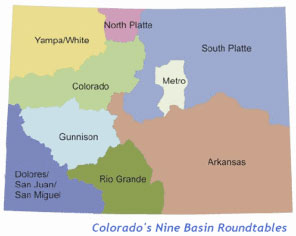
Basin roundtable boundaries
Gov. Hickenlooper issued an executive order in May of 2013 directing creation of Colorado’s Water Plan. The plan draws on nine years of unprecedented discussion and consensus-building from a wide cross-section of interests participating in roundtables within every river basin in Colorado, as well as through the Interbasin Compact Committee, a statewide group with participants from every basin roundtable.
“This plan represents hundreds of conversations and comments involving people in our cities, our rural communities, from both sides of the Continental Divide. It benefited from the engagement of farmers, ranchers, environmentalists, utilities and water districts, industry and business, and the public at large,” said James Eklund, director of the Colorado Water Conservation Board. “This extraordinary level of dialogue has helped every interest gain a greater understanding and appreciation for the values of fellow stakeholders and created an environment where all parties can work more productively together to develop solutions.”
The initial draft of the water plan aligns with the governor’s executive order in working to strike the right balance between many important and competing interests. At the same time, the plan upholds key Colorado water values that ensure water is available to support a strong economy, vibrant and sustainable cities, productive agriculture, a thriving natural environment and world-renown recreational opportunities.
“The completion of the draft plan represents not only the countless staff and roundtable hours invested in its development but also the beginning of a new process of review, refinement and ultimately implementation of the important concepts and challenges facing Colorado’s water future,” said Eric Kuhn, general manager of the Colorado River District. “Now is the time for all of those involved – to focus collectively and collaboratively on how to meet Colorado’s current and future water needs in a manner that works for all Coloradans.”
“With strong leadership and hard work, grand ideas can become reality, said Jim Lochhead, chief executive officer of Denver Water. “We know collaborative efforts can work because we’ve seen it first-hand through the Colorado River Cooperative Agreement. We look forward to working with the Governor’s Office and water interests across the state to chart a course for our water future.”
Colorado’s Water Plan reflects agreement from water interests statewide on broad, near-term actions needed to secure our water future. These include efforts to conserve and store water, additional re-use and recycling of water and providing more options to agriculture to avoid the permanent dry-up of our farm and ranch land.
“The release of the draft Colorado Water Plan is a great milestone in planning for the state’s future,” said Eric Wilkinson, general manager of the Northern Colorado Water Conservancy District. “It is imperative that the statewide collaboration, cooperation, compromise, and problem solving discussions represented by the draft Water Plan continue if Colorado is to find ways to best manage our available water resources for the benefit of the generations that follow.”
Colorado’s Water Plan doesn’t prescribe specific projects, but outlines how various interests across basins can attain locally driven, collaborative solutions, and how balanced approaches can garner the broad support needed to accelerate environmentally sound projects and shorten the federal regulatory process often associated with water-related actions in Colorado. The plan does not do anything to change the status of water rights as a property right, nor prevent the buying and selling of those rights. Nor does it affect Colorado’s longstanding Prior Appropriation Doctrine.
“This draft Colorado plan is a milestone in the mapping of alternatives to meet Colorado’s diverse current and future demands of our limited water resources within the framework of the prior appropriation system,” said Bruce Whitehead, executive director of the Southwestern Water Conservation District. “Multiple interests in southwest Colorado and throughout the state have participated in the development of the plan, resulting in a balanced and detailed draft that will continue to evolve as it is finalized by the partners in the process.”
Work on Colorado’s Water Plan will continue as the public and stakeholders are encouraged to comment upon the draft plan (comments can be submitted here) as revisions continue ahead of a finalized version to be submitted to the governor next year. The plan itself is not intended to be formally completed, however, as public priorities and evolving conditions continue to shape its future.
It’s a different kind of draft for the former brew pub owner.
Let’s hope there’s something good under all the froth.
A hefty draft of a state water plan landed on Gov. John Hickenlooper’s desk Wednesday — more than 400 pages that attempt to boil down more than a year of discussion into a comprehensive plan of attack.
Rather than conclusively saying what that plan of attack is, the plan will be given another year to ferment. At its heart, the plan advocates less fighting and more cooperation over future water moves.
“It’s an important step in securing Colorado’s water future,” Hickenlooper said. “This draft reflects a collaborative, statewide effort; the culmination of years of conversations across Colorado with basin roundtables and people of all backgrounds: urban and rural, Eastern Plains and Western Slope, environmentalists and industry, agricultural producers and municipal water interests.”
The goal of the plan is to head off the impending crisis caused by booming population growth and limited water resources.
In a preface to the plan, Colorado Water Conservation Board Director said five principles were used in crafting the draft plan:
Strengthening the prior appropriation doctrine, Colorado’s constitutional guarantee to protect senior water rights.
Identifying alternatives to the permanent dry-up of agricultural land to provide future supplies to cities.
Honoring interstate compacts with neighboring states.
Reducing the regulatory burden of water projects.
Using state policies to support values and objectives contained within the plan.
The plan itself recommends a variety of strategies, with few specific suggestions for implementation, including conservation, alternative agricultural transfer methods, developing more storage and projects to preserve the environment and recreation.
Passive and active urban conservation could reduce demand by up to 320,000 acre-feet (an acre-foot is 325,851 gallons) per year by 2050.
Alternative transfer methods, such as the Arkansas Valley Super Ditch, could provide 50,000 acre-feet annually to cities without taking the water permanently off farm ground.
In terms of future infrastructure projects, the plan includes wish lists developed by basin roundtables. The Arkansas River basin had about $2 million in 10 projects, with storage as a primary goal.
Other basins dreamed bigger.
For instance, the Gunnison River basin identified $414 million in 34 projects, with the primary goal to protect its existing uses.
Cost estimates also were associated with recreational and environmental projects, which create wetlands or preserve flows in streams. Arkansas basin projects totaled $445,000, with most other basins appearing ready to tap into millions, with the Gunnison basin again at the high end, $79 million.
The plan gives no assurances of when or if any of those projects would be funded, but sets criteria for cooperation and multiple purposes as guiding principles.
The release of the plan was marked with a celebration at the Governor’s Mansion in Denver Wednesday evening. It also elicited a flood of reaction from conservation, recreation and environmental groups across the state, asking for those values to be emphasized.
In Pueblo, the Arkansas Basin Roundtable continued to toil away at its basin implementation plan, part of the larger state water plan. Gary Barber, former chairman of the roundtable and now one of its consultants, mapped out how the basin plan will be finalized in the next four months.
Meanwhile, roundtable members learned that 33 projects totaling $5.87 million have been approved in the last 10 years through the roundtable, underscoring the importance of collaborative effort.
“This has got to be a living document, it should inspire people to work together,” said Jay Winner, general manager of the Lower Arkansas Valley Water Conservancy District.
FromAspen Journalism (Brent Gardner-Smith) via the Glenwood Springs Post Independent:
The first draft of Colorado’s first statewide water plan was handed to Gov. John Hickenlooper on Wednesday by James Eklund, the director of the Colorado Water Conservation Board, a state agency charged with water supply planning for the state.
“This is a historic day in Colorado history, for today we have our first draft of a strategic plan for water, arguably our state’s most precious resource,” Eklund said during a brief ceremony and press conference at Capitol in Denver.
“It’s a great, great starting place,” Hickenlooper said, holding a copy of the plan. “I think this first draft strikes a good balance between so many different interests and yet upholds our core values.”
A final version of the Colorado Water Plan is due to be turned in to the governor a year from now, and that final plan is to be informed by more detailed plans being finalized by groups — called roundtables — in each of the state’s major river basins.
A key question yet to be resolved in the plan, or in the state, is whether water providers can meet an increasing need for water on the Front Range without causing additional harm to rivers on the Western Slope, or by drying up the state’s ranches and farms.
“It’s a great, great starting place. I think this first draft strikes a good balance between so many different interests and yet upholds our core values.”
Gov. John Hickenlooper
Today 24 transmountain diversions carry about 500,000 acre-feet a year from the West Slope to the East Slope, Eklund said, and entities in the South Platte River basin, where Denver and Fort Collins are located, are eager to see more water flow east.
Eklund said the state is figuring out a way to meet its growing water needs, while also protecting and valuing watersheds and rivers, by working with entities on both sides of the Continental Divide.
“This plan stands on the back of that collaboration,” he said.
The governor concurred, but acknowledged, “We’re probably going to need some more storage somewhere.”
“That doesn’t necessarily mean that you need to divert more water,” Hickenlooper added, noting some climate prediction models suggest the state may get wetter.
Jim Lochhead, the CEO and manager of Denver Water, which provides 1.3 million people in and around Denver with water, said after the presentation of the water plan that he also believes future urban water needs can be met without damaging Western Slope rivers.
“Denver Water spent over six years working in a collaborative way with over 40 entities on the West Slope and the result, the Colorado River Cooperative Agreement, is a package of protections and enhancements that will allow us to enlarge Gross Reservoir and also make the Fraser River and the West Slope better off with the project than without the project,” Lochhead said. “So there are ways that everybody can benefit if you really sit down and work hard to negotiate and collaborate.”
A coalition of conservation groups, including American Rivers, Conservation Colorado and Western Resource Advocates, issued a press release Tuesday to coincide with the event at the state capital. While the groups praised the work done so far on the plan, they want to see the state prioritize solutions that avoid the need for another transmountain diversion.
“This plan needs common sense solutions; not more expensive water diversions,” said Theresa Conley of Conservation Colorado. “Conservation, reuse and increased sharing opportunities are flexible and cost-effective measures already available that can meet the vast majority of new water demands.”
Matt Rice, the director of programs for American Rivers in the Colorado River basin, said in the release, “The final water plan must help river basins assess river health and dedicate funding and other resources to protect our rivers for present and future generations.”
While the draft water plan does not include a list of potential future water projects, Eklund said there is an estimate in the plan that it will cost $20 billion to pay for necessary infrastructure projects between now and 2050, and that includes environmental projects.
“The reason people move to Colorado and they grow their businesses and their families here is because of the landscapes and the beauty of the eastern plains and the Western Slope, so we need to make sure that those are taken into account while we’re financing what we need to do to move forward with water infrastructure,” Eklund said.
Aspen Journalism and The Aspen Times, a sister paper of the Post Independent, are collaborating on coverage of rivers and water. More at http://www.aspenjournalism.org.
Anyone who attended meetings about the state water plan during the past year knows that the need to protect the environment and wildlife habitat were frequently discussed topics.
But there appears to be a rainbow of opinions among conservation groups about how those comments will be interpreted in the draft water plan, which is scheduled to be delivered to Gov. John Hickenlooper by the Colorado Water Conservation Board in Denver today. The final plan is still a year from completion.
The spectrum ranges from satisfaction that conservation voices have been heard to alarm that the plan will further hurt the state’s rivers.
The Nature Conservancy applauded the plan for opening the discussion of water development to environmental values and science.
“The current draft plan clearly articulates a shared commitment to protect our rivers,” said Tracey Stone of the Nature Conservancy. “We are developing a greater appreciation of water’s value to Colorado for all interests including cities, agriculture, industry, environment and recreation.”
In a recent interview with The Pueblo Chieftain, Bart Miller, water program director for Western Resource Advocates, said the plan needs stronger language to protect the environment, citing a poll in September that showed this is what Coloradans want.
“We heard loud and clear from the comments from people all over the state that conservation is needed,” Miller said.
Western Resource Advocates is among those that are active in the process and pushing a program that encourages stretching current supplies rather than developing new sources.
But some groups are charging they have been excluded from the process and say the plan will only encourage further destruction of rivers…
The draft plan pushes development of proposed projects that will further damage the rivers by increasing withdrawals and streamlines the regulatory process, Wockner said.
James Eklund, executive director of the CWCB, bristled at the suggestion that any environmental advocates were not heard during the process. Many of the 13,000 comments on the draft plan were aimed at preserving flows for the environment and wildlife habitat.
Here’s a in-depth look at James Eklund and the Colorado Water Plan written by Kate Siber that’s running in 5280 Magazine. Here’s an excerpt:
On summer mornings, young James Eklund would often wake before dawn. When daylight was just a suggestion on the horizon, the eight-year-old rode with the cattle from his family’s Flying Triangle Ranch to higher pastures in the mountains. Occasionally he would accompany his grandfather, Edwin Gunderson Jr., on the walk from the house to the irrigation ditch to bring water to the fields. He’d help his uncles fix fences, clean the ditch, and move cows on the Mesa County ranch near Collbran. These were the moments when Eklund first learned about water, the life-giving force, an inalienable right, and a critical ingredient to the business that sustained his family. He learned the water that flowed through the head gates from Plateau Creek was theirs to use because they had been in the area long before others upstream—ever since his great-great-grandfather arrived from Norway and homesteaded the land in 1888.
Gunderson believed ranchers were the original environmentalists. They cared for and made good use of the water, and no one should mess with that right—not the neighbors, not the town, and certainly not the state government. No one. To Gunderson, water was personal.
Three decades later, James Eklund, 39, resembles his grandfather—long-legged with a five o’clock shadow, neatly combed hair, and a pronounced brow—but he sits on the other side of the state, in a government office in Denver. His ranch-bred body seems restless, confined by these four white walls, despite the seventh-floor views that overlook south Denver, the giant cloudless sky, and, on a good day, the Rampart Range. But he has a mission, and it’s something he believes in—something that has made some of his family members anxious and that his grandfather would have looked upon with caution. Eklund is the director of the Colorado Water Conservation Board (CWCB),1 one of the state agencies that oversee water management and finance projects such as dams and stream-restoration programs, and he is in charge of overseeing Colorado’s first statewide water plan…
“We’re going to see that there’s just not enough water for the things everybody wants at the same time,” Eklund says. “Rather than pin our hopes on pipelines from the Mississippi River or icebergs being towed down from Alaska or these pie-in-the-sky schemes, we need to be solving our own problems with our own water.”
Everyone on the Colorado River has a legitimate argument that they’ve already sacrificed, and that they have a legal entitlement to what’s left. If everyone digs in their heels on these points, the system will crash. We need to be willing to share the pain. But (scroll to the bottom) there is hope on that front.
longer – The Unhopeful Part
In reading and interviews for my book, I frequently run across arguments of the form that “we” (usually a state, but also sometimes a smaller water-using entity) have already done “our” share for solving the Colorado River’s problems by (insert specific sacrifice already made here).
They all, of course, are right. Consider:
Arizona
With the 1968 approval of the Colorado River Basin Project Act, Arizona agreed to subordinate the bulk of its Colorado River water rights to California in return for the political supported needed to build the Central Arizona Project, which brings water to Phoenix, Tucson, farms and Native American communities in the central part of the state. As a result, Arizona currently shoulders (at least on paper) much of the risk in the face of shortfalls in the lower basin. Under the current law, all of Arizona’s CAP water would be cut off before California loses a drop. That was a major sacrifice.
California
But wait, didn’t California already lose a bunch of drops? Yup, in 2003 California was cut back from its historical use of in excess of 5 million acre feet per year to 4.4 million. That required major water conservation and supply shifts in metropolitan Southern California, and the fallowing of land in the Imperial Valley to free up enough to keep Southern California’s economic engine humming. So yeah, the next big cuts would hit Arizona if there’s a shortage, but that’s only because California already took a big hit.
Nevada
Nevada took its hit coming out of the starting gate. Its allocation of 300,000 acre feet, which goes to Vegas, is basically a rounding error if you’re rounding total Colorado River flow to the nearest million acre feet. Don’t look at Nevada for sacrifice (and even if you did, as I mentioned, sacrificing Nevada completely is just a rounding error on the Colorado River balance sheet).
Colorado, Wyoming, Utah and New Mexico
Under the Colorado River Compact, the four states of the Upper Basin are entitled to use 7.5 million acre feet of water per year. When they signed the deal in 1922, they knew it would be a long time before they would grow into their entitlements, but it was water in the bank to support future growth. In 2012, they only used 4.6 million acre feet, which is pretty typical. The Upper Basin states have clearly done their share.
This isn’t cheap sophistry. Each of the above arguments is a reasonably held, legitimate view. It’s most on display this week in the development of Colorado’s water plan:
Colorado wants to ensure its farms, wildlife and rapidly growing cities have enough water in the decades to come. It’s pledging to provide downstream states every gallon they’re legally entitled to, but not a drop more.
“If anybody thought we were going to roll over and say, ‘OK, California, you’re in a really bad drought, you get to use the water that we were going to use,’ they’re mistaken,” said James Eklund, director of the Colorado Water Conservation Board.
The governance boundary problem
There’s a core issue here that involves the boundaries we draw around our Colorado River water problems. Doug Kenney and his colleagues in the new Colorado River Research Group captured this nicely in one of their first white papers, on “Repairing the Colorado River’s Broken Water Budget” (pdf). Each state, operating within what it thinks are the legal boundaries around its “share” of the Colorado River, has put down on paper a menu of future water options that are wildly unrealistic given the hydrologic reality. There is less wet water in the river than paper water embodied in each user group’s lawyers’ arguments.
Is that realistic? “[I]t’s not, and those water managers that look at the numbers through a basin-wide lens know this,” Kenney and colleagues wrote. But while the Colorado River’s problems have to be solved at a basin scale, much of the water use decision making that matters happens at the state and local level, where the basin wide problems are less visible.
I see this in New Mexico water politics all the time, where there is an expectation that a full firm yield of 96,200 acre feet of water per year through the San Juan-Chama diversion project is our compact-given right. Our sacrifices have been to cleverly live within that allocation, maximizing its beneficial use. The notion that the Colorado Basin as a whole is over-allocated, and that we might have to take a haircut along with everyone else, is simply not part of the discussion.
The hopeful part
To be clear, there are a lot of people up and down the governance ladder, from federal and state to local levels, who aren’t talking this way. Matt Jenkins’ excellent High Country News article today about the Pilot Drought Response Actions program highlights a great example. Here you’ve got a bunch of lower basin water managers trying to find a way to route around this problem, building a couple of different types of institutional widgets to reduce water use locally, but in the context of a basin wide effort.
The PDRA (PDRAP?) attempts to overcome the problem Eklund is referring to (If I conserve, won’t it just end up in California?) by matching conservation commitments. The big metro water agencies in each of the lower basin states agrees to take a haircut and leave the saved water in Lake Mead. Arizona, which is clearly the state with the most to lose, pledges 345,000 acre feet by 2017 (the Central Arizona Project is the actor here); Southern California (Met) pledges 300,000 af; Vegas (Southern Nevada Water Authority) pledges 45,000 af and the Bureau of Reclamation agrees to throw in another 50,000 af. The water stays in Lake Mead, to prop up levels and forestall the risk of shortage.
Matt’s story suggests Arizona’s already nailed down a portion of its savings, in the form of ag agency commitments. This is hopeful stuff.
For months, 9NEWS has been reporting on a crucial turning point in the water use issues that define life and grown in Colorado. Wednesday afternoon, state officials will release the first draft for the Colorado Water Plan. Governor John Hickenlooper issued an executive order in May of 2013 to get a water plan in place. The effort has been nearly a decade in the making and it is not without controversy.
9NEWS looked at an earlier version of the plan, which runs hundreds of pages. It divides the state into seven major watersheds.
On the Front Range, the focus is on the South Platte Basin, where both the population– and the demand from agriculture– is the highest in the state. The draft identifies 42 water-related plans, just for the South Platte Basin alone. Some of the plans include storing more water — specifically in underground aquifers.
It also brings up the controversial idea of a trans-mountain diversion. That’s where water from the western slope would be physically moved to this side of the continental divide, to meet the needs of the growing population here.
The price tag for all of the projects would be at least $690 million, with no details about where the money would come from. The early version of the draft points out that many of those projects still don’t have a price tag attached to them, so they are not included in that amount.
The plan will be released Wednesday at 1:30 p.m. at the Capitol.
From the Associated Press (Dan Elliott) via ABCNews.com:
With demand increasing across the West, Colorado is drawing up a strategy to keep some of the trillions of gallons of water that gushes out of the Rocky Mountains every spring ? most of which flows downstream to drought-stricken California, Arizona, Nevada and Mexico.
Colorado wants to ensure its farms, wildlife and rapidly growing cities have enough water in the decades to come. It’s pledging to provide downstream states every gallon they’re legally entitled to, but not a drop more.
“If anybody thought we were going to roll over and say, ‘OK, California, you’re in a really bad drought, you get to use the water that we were going to use,’ they’re mistaken,” said James Eklund, director of the Colorado Water Conservation Board, which wrote the draft after a series of public meetings.
Eklund’s insistence on Colorado’s water rights drew diplomatic responses from his colleagues in other states on the eve of a Las Vegas meeting of water managers. The managers, from seven states, are working on ways to ensure 40 million people in the parched Colorado River basin don’t go thirsty.
“California has not sought any Colorado River water beyond its entitlement and has no intention of doing so,” said Jeff Kightlinger, general manager of the Metropolitan Water District of Southern California. He referred to the Colorado River Compact of 1922 that covers water allocations to Colorado, California, New Mexico, Wyoming, Utah, Arizona and Nevada.
“Arizona has the same interest” as Colorado in ensuring its supply is protected, said Michael J. Lacey, director of the Arizona Department of Water Resources. “I am not sure we will express it as pointedly as that,” Lacey said of Eklund’s remarks.
With drought making cooperation more important, members of the Colorado River Water Users Association deny there’s discord at their table.
The Colorado plan is being submitted to Gov. John Hickenlooper on Wednesday. A final version is expected in late 2015 and will propose legislation.
Nearly 4.6 trillion gallons of water originates in Colorado every year, mostly from prodigious snowstorms high in the Rockies. Two-thirds of it belongs to users in downstream states, including California, under a collection of interstate agreements and court rulings.
The other third is available to Colorado users under a system of water rights, which are considered property that can be bought and sold.
Colorado suffered through its own devastating drought in 2002-03, an event that prompted the state to take a close look at how its water is distributed and how it could be used better.
That process led to the new plan, which addresses several major issues. Colorado’s cities will need more water as the population grows from 5.5 million today to a projected 8 million to 9 million by 2050. Irrigated agricultural land is drying up at an alarming rate as cities buy out farmers to get their water. And the state’s key recreational economy and its environment need to water in streams and lakes to survive.
The 1922 compact and agreements with Mexico today promise about 16.5 million acre-feet of water annually from a river that has historically taken in about 15 million acre-feet from rainfall and snowmelt. That amount has diminished during drought. One acre-foot of water is about enough to serve two average households for a year.
Colorado’s plan takes no position on one of the state’s most historically contentious issues: The century-old practice of pumping water from west of the Continental Divide to the populous but drier eastern side. The 163 billion gallons shipped through the divide each year is a major source for the urban Front Range corridor, including Denver.
It does say conservation and recycling should be considered before any more giant pipeline projects.
“All of the easy projects, those that are anywhere near the Front Range, those are already built,” said Eric Kuhn, general manager of the Colorado River District, which guides Colorado River use in western Colorado. “My concern is we take a realistic look at the Colorado River as a new supply for the Front Range.”
Jim Lochhead, CEO and manager of Denver Water, the state’s largest municipal utility, said new transmountain projects shouldn’t be ruled out.
“It’s really going to have to be an all-of-the-above approach if we’re going to do that right,” he said.
Recently in Mancos, the Southwest Basin Water Roundtable met with 30 local residents about the plan.
Front Range water demand was a central topic. The Front Range’s water supply is augmented by 500,000 acre-feet per year of transmountain diversions from the Western Slope. (For comparison, McPhee Reservoir holds 380,000 acre feet.)
“The model we have now is not sustainable, so we’re here to find solutions,” said Ann Oliver, roundtable moderator.
The concern is that as urban areas grow, unallocated water from Gunnison’s Blue Mesa Reservoir and Flaming Gorge reservoir will be drawn into the transmountain tunnels to meet demand. That could put pressure on other basins to meet water and power obligations to lower basin states fed by Lake Powell and Lake Mead. Many say failure to control the situation threatens Western Slope agriculture.
“We depend on the water to grow the food, and the Front Range depends on us to put dinner on the table,” said one farmer.
The state is flirting with conservation mandates to save water, but has run into stiff political resistance from water districts in Denver, said roundtable chairman Mike Preston.
A recent bill by state Sen. Ellen Roberts, a Durango Republican, would have put water restrictions on the lawns for new Front Range housing development. But the bill was stripped of its teeth in the legislative process.
“It’s a Front Range-Western Slope standoff,” Preston said. “The bill would have been effective, but Denver water is saying they don’t need it.”
Another proposal is to adjust the 60/40 water-use model on residential development to a conservation-minded 70/30 model by 2030. The strategy divides residential water use this way: 70 percent for indoor use and 30 percent for lawn and garden. Reducing outdoor water use on lawns and gardens is seen as a solution because plants consume water, whereas household water is eventually flushed and drained back into the watershed beyond the sewer treatment plants. The proposed 70/30 rule for new development would also help offset the “buy and dry” trend currently happening on the Front Range.
“When municipalities buy up agricultural water for urban growth, that farmland is lost,” Preston said.
When Front Range housing developers tap water diverted from the Western Slope, they should be held to a higher water-conservation standard, he added.
J. Paul Brown, Colorado representative-elect, said Front Range water managers need to come up with options.
“The Front Range should develop their own water before thinking about ours,” he said. “They have water they could legally store on the South Platte River, but let it flow out of state instead.”
Drought and diminished water supply have spurred debate. And that’s a good thing, said John Porter, president of the Southwest Water Conservation board.
“This plan wold not take precedent on water compacts, private water rights, or prior appropriation law,” he said. “Rather this process is recognizing we have a problem and need to satisfy the doubling of our population.”
Public distaste for mandates on water conservation needs to be overcome, said Sam Carter, of the Dolores River Boating Advocates.
“It is up to the state, cities and counties to try and regulate use,” he said. “Why are there not stronger laws for conservation?”
Eric Janes took issue with the water plan for not considering recycling waste water as a conservation measure.
In Southwest Colorado, 55 projects totaling $7 million has been spent including water-management working groups, more efficient irrigation systems, water optimization studies, and drought-resilient agricultural practices and technology.
The final Colorado state water plan is due out next year.
Summary of Observed Wet & Dry Surface Water Hydrology via SCW
Here’s Part II of Bill Hudson’s essay on the Colorado Water Plan. Here’s an excerpt:
One thing becomes very clear when you start trying to understand the politics of water in Colorado. It’s a complicated mess of competing priorities. Like many states in the arid West, Colorado has historically rejected the riparian water rights law that governs most of the eastern U.S. According to riparian doctrine, the water in a river or stream belongs to the land owner who owns property adjoining that waterway. This doctrine copies elements of English and Spanish common law; ownership of the water rights are attached to the related property and usually cannot be sold except with the sale of the adjoining land.
But when American and European settlers began populating Colorado, the most profitable industry was mining, and unlike a farm — the basic economic unit for land private ownership prior to 1850 — a mine is very often established some distance from the nearest river. Some the lawyers and judges of Colorado came up with the “prior-appropriation doctrine.” That doctrine grants superior water rights to whichever water user made the earliest use of the water source, historically speaking. In Colorado, it doesn’t matter if your own property adjoining the river; it only matters that you made historical use of a water source.
A water user who began pulling one million gallons a year from the San Juan River in 1892, for example, has — in Colorado — the legal right to pull a full one million gallons out of the river each year, even if he leaves no water at all for anyone with a later (“junior”) water right.
And in Colorado, the owner of an 1892 water right, for example, can sell that water right without selling the land on which that water has been historically used. (Which makes no logical sense to me, but that’s how the Colorado courts have ruled.)
This is known as the Colorado doctrine, and it was adopted by many of the other states west of the Great Plains. It has worked reasonably well, apparently… so long as we had more water in the rivers than we needed each year.
But a couple of things have changed. Back when the Colorado doctrine was established, most people in Colorado made their living by farming, ranching or mining. They used water mainly to produce useful and necessary items. Today in Colorado, most of us use water to flush our toilets and water our lawns. Not exactly the production of useful items in the same sense. The Pagosa Daily Post, for example, uses not a drop of water in its production process (unless La Plata Electric Association happens to be buying hydro power.) We can certainly question whether any useful products are created.
The other thing that’s changed is the population of the West. In 1950, Colorado had about 1.3 million residents; the number today is 5.3 million.
If you take into account the seven Western states that signed the Colorado River Compact of 1922 — allocating each states’ water rights to the mighty Colorado River — we can see that the total population of the seven states in 1950 was about 14.5 million. (US Census.)
The total population today is 58.6 million.
The amount of water available to serve all these new residents has not increased. In fact, it may have decreased. Substantially.
As I mentioned, about two dozen people attended the Southwest Basin Roundtable presentation on November 17, and brought with them a range of concerns. Some were concerned about federal control or Colorado’s water. But mostly, I think, we talked about the pending water diversions by Colorado’s larger Front Range community’s — diversions that might draw water out of various West Slope watersheds and pipe it over the Continental Divide to water lawns and flush toilets in Denver and Colorado Springs. That’s a potent issue. The West Slope generates most of the water in Colorado, but most of the state’s population lives on the eastern side of the Rockies…
The users of Colorado’s water are varied, and their level of concern about water resources reflect the manner in which they use water. Families. Ranchers. Farmers. Industries. Fishermen. Boaters. These are the human users — the users that we normally include in water conversations. But we can also, if we so choose, consider other users of Colorado’s water: wild game animals, trees, grasses, fish, birds.
Mice. Earthworms. Ladybugs.
If we stop and consider, for a moment, how these other, non-human users interact with Colorado’s water resources, we can easily see a natural, conservative approach. Animals and trees use only what they need, and not a drop more.
In some places in the world, humans approach water in the same manner. They use only what they absolutely need and not a drop more. How much water, then, does a human social group need? Say, for example, a social group that grows food and operates industries and hosts tourists and raises families?
Colorado’s Water Plan sums up the primary challenges facing us, with this language:
“Colorado faces a financial gap in addressing future environmental, recreational, agricultural, and communal needs. Without adequate investment, Colorado cannot effectively address the above-listed challenges.”
Sometimes what appears to be a crisis is merely a lack of imagination, or an unreasonable attachment to an expectation.
According to a 2010 report by the The Food and Agriculture Organization of the United Nations, it requires about 1,122 gallons of water per day to supply the average American with his or her daily needs. This includes the water used to produce the food we eat, and the myriad other products we consume.
A person living in the Netherlands meets all his or her needs with about 465 gallons per day, less than half what we use here in America.
The same report notes that the average Israeli — living in a desert climate very similar to regions of the American West — meets his or her water needs with 204 gallons a day… less than one quarter the water used by a typical American.
If Colorado is truly facing water shortages of some kind — which is a story we hear regularly from people who run water districts and from people who profit from building massive water projects — how will we prioritize the use of our ever-more-precious water? Agricultural uses? Recreational uses? More suburban lawns?
Michael Whiting:
“If we’re going to use taxpayer money to store more water, then I think the taxpayers ought to get a say in what that water gets used for. I don’t want to save water on the West Slope so there’s more water to irrigate golf courses in Denver. So I think, if you’re going to use taxpayer money, you have an obligation to the taxpayers.
“And I don’t think the taxpayers are going to say, ‘Yes, more golf courses.’ The taxpayers might say, ‘More food,’ or they might say, ‘More jobs.’ I’m not suggesting that we change the [prior-appropriation doctrine]; private water is private water. I get that. But public money makes the water public.”
Good comment. If we are going to use taxpayer money to store more water, here in Archuleta County, how will that water be used?
We might even ask a more direct question. If we are going to use taxpayer money to someday build Dry Gulch Reservoir — one of the four projects currently listed in the draft Southwest Basin Implementation Plan — shouldn’t the taxpayers have some say in how the reservoir’s stored water gets utilized?
The voters of Archuleta County have expressed their desires pretty clearly over the past three years, regarding the Dry Gulch Reservoir. They have elected five anti-Dry Gulch candidates to the five-member Pagosa Area Water and Sanitation District (PAWSD) board of directors, and the board currently does not show any additional reservoirs in their 25-year Capital Improvement Plan.
So then… why is the Dry Gulch boondoggle currently part of Colorado’s Water Plan? I believe the answer is pretty simple. The voters do not elect the members of the San Juan Water Conservancy District (SJWCD); they are appointed by Judge Greg Lyman, the same judge who approved the original water rights for Dry Gulch back in 2004. And it’s the SJWCD board that has somehow inserted a glaringly unpopular water project into a statewide planning document.
The SJWCD owns only a 10 percent interest in the Running Iron Ranch property northeast of downtown Pagosa, but it might require years of legal wrangling to separate PAWSD’s 90 percent interest in the property from SJWCD’s interest. Another alternative for partitioning the two water districts’ ownership of the reservoir site was proposed last winter by SJWCD president Rod Proffitt.
Following a contentious meeting with the PAWSD board, the SJWCD board had voted to continue moving forward with building an 11,000 acre-foot reservoir: “to give the project a chance to succeed,” as Mr. Proffitt once put it. Mr. Proffitt began talking to the Colorado Water Conservation Board (CWCB) — the state board that had provided PAWSD and SJWCD with the $10 million to buy the Running Iron Ranch — about giving PAWSD “some breathing room” on their loan, so PAWSD wouldn’t press to sell the land to reduce its debt. (PAWSD has a lot of debt at the moment.)
Suspension of payments, debt forgiveness and lower interest rates were all discussed, with Mr. Proffitt pitching ideas to both CWCB and PAWSD. Mr. Proffitt also approached the Southern Ute Tribe about them buying out PAWSD’s interest and becoming partners in the project.
The PAWSD board’s lead negotiator, Allan Bunch, continued to stress ‘partition’ as the best solution to the problem of joint ownership — an action that would likely force the sale of the ranch and drive a final stake into the heart of the zombie reservoir. But Mr. Proffitt was able to get the PAWSD board to consider a trade: $4.6 million in loan forgiveness from CWCB — if PAWSD would assign its Dry Gulch ownership to CWCB.
Numerous twists and turns later, the CWCB came back with a rather different offer. They explained that, legally, CWCB can’t own reservoir sites, so trading loan forgiveness for a share of the Dry Gulch property was not feasible.
But CWCB might be willing, they said, to lower the interest rate on PAWSD’s $9 million loan — if PAWSD and SJWCD would hold onto the property for 20 years, and then consider whether to build a reservoir there. If they did not build the reservoir by 2035, PAWSD would have to pay the remaining $4.6 million, plus interest, in a nice big balloon payment.
SJWCD would assume management of the Dry Gulch project. We might note that SJWCD currently cannot afford to hire any paid staff; apparently CWCB is comfortable asking a board of well-meaning volunteers to manage a $100 million water project. (I am simplifying the actual proposal somewhat, to make this article more readable.
More Colorado Water Plan coverage here. More Dry Gulch Reservoir coverage here and here.
Now the hard work starts, said Eric Kuhn, the general manager of the Colorado River Water Conservation District, the Grand Junction-based public water agency that seeks to protect, use and develop the river’s water for the benefit of Colorado. The river starts in the state and winds downstream to California and Mexico.
The draft has another year, until December 2015, to be finished to comply with the executive order Hickenlooper issued in 2013.
The draft “is a good first step in moving to where we need to go,” said Denver Water CEO Jim Lochhead.
“It sets the foundation for what I’d hope to see: the development of an action plan that would lay out an implementation strategy for how we meet the challenges of the future,” Lochhead said. He added that he hopes to be able to say — a year from now — that the action plan is in place, and that a “good, collaborative process” led to the development of the plan…
The draft plan proposes closing the gap through five strategies: recycling water supplies, conservation, using groundwater, shifting agricultural water to municipal use in some years, and possibly shifting more water from the Western Slope to the Front Range, said James Eklund, the director of the Colorado Water Conservation Board, which is overseeing the plan.
Complicating the issue is how water supplies might change over time due to larger issues such as climate change, according to the draft plan.
The goal is to meet the water needs of the population, but to do so without harming the environment by taking too much water out of the streams used by wildlife and the recreation industry, and without drying up farm and ranch land, Eklund said.
Agriculture accounts for about 85 percent of the water used in Colorado every year.
Closing the gap is expected to require “some package of those five things, a balance of those, that doesn’t undermine the environmental and recreational attributes of the state,” Eklund said.
But the plan doesn’t touch Colorado’s existing water court system that deems water to be a property right, with the oldest rights considered superior to younger rights to water supplies, he said.
It does aim to smooth the historic tension in Colorado over water between the sparsely populated, but water rich, Western Slope, and the more populous, but water poor, Front Range by encouraging discussion and consensus building to reach “win-win” scenarios, Eklund said.
“The disputes haven’t gone away, but we’re well positioned to do a plan or process on how people on both sides of the Continental Divide can come to a consensus rather than fighting each other,” he said.
“The plan lays out a process, the state should encourage that and the state has a vested interest in making sure these things will move forward — so bring us in early and let us help broker this,” he said…
The coming year — as the plan moves from draft stage to a final stage — will be a key part of the process, the Colorado River District’s Kuhn said.
Western Slope advocates want to see the final plan focus on conserving water and reusing it across the state, he said.
“The big issue that won’t be settled is the question of a big, new diversion,” Kuhn said.
That’s a polarizing conversation, and there are questions about whether there’s any water in the Colorado River that’s available for big, new diversions to the Front Range, he said.
That’s where the focus on conservation and reuse come into play, he said.
“Unless you can show there’s a water supply out there, then a new project on the Colorado River is off the table,” he said.
Denver Water’s Lochhead said he hopes the final plan will address how to overcome barriers that exist to new technologies and techniques of using and reusing water, such as capturing rainwater, retaining stormwater, and treating and reusing water — things that are difficult to do under current laws and regulations.
“The are technologies out there to employ sustainable green practices and the marketplace wants to go in that direction,” Lochhead said.
“I hope there’s a process (in the plan) to have those discussions about the changes that need to happen,” he said.
Creating a statewide water plan could give also give Colorado leverage when it comes to dealing with the federal government which must sign off on infrastructure projects, and downstream states, which have claims on water that passes beyond Colorado’s borders, Eklund said.
“We want a water plan developed by Colorado, not one dictated by the federal government or by the…downstream states and the country of Mexico via the nine intergovernmental compacts we have to provide water,” Eklund said.
“If for some reasons drought impacts our water supplies, and they don’t get they water they believe they’re entitled to, they may try to intervene in Colorado,” he said.
Dust storms were raking the state when Gov. John Hickenlooper issued his executive order for a state water plan in May 2013. Huge wildfires broke out the next month — for the second straight year. Just four months later, he was surveying massive damage from the worst floods in decades.
How do you plan for something like that?
He’ll find out this week when the draft plan is unveiled. On Wednesday, there will be a ceremony at the governor’s mansion in Denver to mark 18 months of effort in getting to the draft plan. The final plan will come a year later.
The Colorado Water Conservation Board is developing the plan, trying to consolidate 13,000 suggestions into an understandable format. “What we’ve witnessed is that there’s a win-win here in the transactions that take place,” CWCB Executive Director James Eklund said last week.
It’s a change from past positions where water supplies were wrenched from reluctant communities under the force of law and intransigent stands of “not one more drop.”
Eklund acknowledged there are still those who are digging in their heels, but insisted the water plan is moving ahead.
The main objectives of the plan are to fill the gap between population growth and demand, stop the buy-and-dry of agricultural land and preserve the natural landscapes and wildlife habitat that make Colorado an attractive place to live.
For the Arkansas River basin, caught in the cross hairs of water wars for decades, the payoff could be big, Eklund said.
“The Arkansas basin has suffered the longest litigation over water ever seen in the state,” Eklund said, referring to a battle of more than a century with Kansas that culminated in a 24-year court case and 2009 U.S. Supreme Court decree. “That litigation demonstrates that we have to act together as a state or we run the risk of not having a unified voice.”
During the development of the plan, the state also came to realize the importance of watershed health after record wildfires scorched the land. One of the goals was to tie water quality to water quantity, and the ash and sediment coming off burn scars has illustrated the point, Eklund said.
“There has to be more emphasis on cleaning that stuff and making sure it’s usable,” he said.
New issues entered the limelight as well, including water for fracking, water for marijuana and the relationship between development and water planning. Conservation in all areas was stressed as important in all areas. The need to protect agriculture was re-emphasized. The need for water education was highlighted. Cities have begun to budge on the need to own resources, becoming more receptive to alternative supply strategies.
Most importantly, Eklund sees the water plan as a way to streamline future water projects.
“You’ve heard me say that it used to take three years and $3 million to get something done, and now it takes 10 years and $10 million,” Eklund said. “If we’re going to respond, we have to be more agile in order to make sure we’re not holding up the process.”
Water conservationists are calling on Colorado leaders to set a clear target in the state’s first water plan: reduce use by 1 percent a year through 2050. But state officials crafting the plan to address a 163 billion gallon projected shortfall are reluctant to commit — even though Gov. John Hickenlooper has called conservation a priority.
An aggressive water-saving goal, if it spurred action, could put Colorado on course to closing its growing gap between water supply and demand, which looms as a barrier to future economic and population growth. Conservation as a strategy also would ease degradation of Colorado’s Western Slope, where water in mountain streams increasingly is siphoned to sustain Front Range cities.
“We definitely can save more water,” Conservation Colorado director Pete Maysmith said. “The state needs to put into the plan a high conservation goal if we’re going to fill that gap. It’s not like everybody has to get to a certain number. It’s just that, overall, we’ve got to be cutting 1 percent a year.”
Other states have set targets: Utah committed to cutting water use by 25 percent before 2025. Texas aims for the same. California plans to cut use by 20 percent by 2020. Oklahoma plans to cap water use at today’s level through 2060.
Colorado not only has yet to set a target but also remains the last of the arid Western states to complete an official water plan.
However, Hickenlooper consistently has cast water conservation as essential. State planners’ efforts over the past year have embraced water-saving in principle — increased efficiency from low-flow toilets to smarter irrigation — to avoid massive projects that divert more mountain snowmelt out of rivers for people and industry.
“Conservation is definitely part of the package. But it is not the silver bullet,” said James Eklund, director of the Colorado Water Conservation Board, who is coordinating state planning.
A nearly completed draft of the Colorado Water Plan, to be unveiled next week, does not set a specific goal because “that doesn’t keep with what we are trying to do” in regional river basin discussions, Eklund said. “And each basin is unique.”
The state still may end up committed to a water-saving goal after further deliberation, he said. The plan is to be finalized next year.
Among the complications: Some areas are drier than others, requiring more water to sustain people. Climate change is affecting natural water flows. And residents in some cities who already have reduced water use could be hard-pressed to make further cuts.
The 1.3 million metro Denver residents served by Denver Water cut average daily use to 85 gallons a person, down from 104 gallons in 2002 — compared with an estimated 123 gallons a day in Parker and 111 in Grand Junction.
While comparisons can be difficult due to different counting methods, utility data showed Denver’s average daily use ranked less than water use in Salt Lake City (117 gallons), San Diego (136 gallons) and Los Angeles (123 gallons), but more than in Albuquerque (70 gallons).
Historically, Colorado has relied on massive federally funded engineering projects, dams and diversions that pump about 500,000 acre-feet a year west-to-east under the Continental Divide with devastating consequences for ecosystems.
Agriculture uses the largest share of water in Colorado, roughly 85 percent of developed supplies. But Colorado’s population of 5.2 million is expected to reach 10 million by 2050 and companies seek water for industry, including the oil and gas boom.
Denver Water was taking the same position as state planners on water-saving goals. The utility favors a “tailored approach” rather than a statewide water-saving target because some communities conserve more than others, spokeswoman Stacy Chesney said.
“Those who have not taken steps toward water conservation could more easily reduce their use than those who have already made significant strides in becoming efficient,” Chesney said.
“We believe a better approach would be if every water user — from municipalities to agriculture, industrial users and more — knows their current use and establishes goals, such as investing in new water-saving technologies and striving for more water-use efficiencies.”
Colorado transmountain diversions via the State Engineer’s office
FromAspen Journalism (Brent Gardner-Smith) via The Aspen Times:
The Colorado River Basin Roundtable last week pushed back against a perception that Western Slope interests have reached an agreement about a conceptual transmountain diversion, as indicated by a draft of the Colorado Water Plan and recent remarks by James Eklund, the director of the Colorado Water Conservation Board.
“It is important that nobody oversells this as a done deal and a clear-cut pathway to a new transmountain diversion,” said Jim Pokrandt, the chairman of the roundtable and the communications director at the Colorado River District. “It is a way to talk about it.”
Pokrandt was referencing a seven-point draft conceptual agreement put out in June by the Interbasin Compact Committee that is now included in the state water-plan draft. The 15-member committee includes representatives from the state’s nine basin roundtables and six other appointees.
The first of the committee’s seven points is that “the East Slope is not looking for firm yield from a new transmountain diversion project and would accept hydrologic risk for the project.”
Or, as Ken Ransford, the secretary of the Colorado roundtable, put it in the group’s October meeting, “This means that the East Slope will take less or perhaps no water in low-snow years instead of drying up a West Slope river.”
An article in The Denver Post on Nov. 11 fueled the perception, some roundtable members said Nov. 24, that an agreement on the concept had already been reached.
“The reality is the Western Slope is seeing available water in wet years for the Front Range to bring over,” Elklund told the Post. They are OK with that as long as there is mitigation or compensatory storage.”
Eklund also told the Post, “Most people I talk with, even in the intense water community, view themselves as Coloradans first and members of river basins second.”
Pokrandt called Eklund’s comments “unfortunate.”
Eklund’s remarks conflict with the view of the roundtable’s executive committee, which said in a recent draft memo that “there is no water remaining from the Colorado River than can reliably be developed for Front Range use without putting Western Slope agriculture and recreation at peril and risking the certainty of current water users.”
On Nov. 19, the Conservation Board’s board of directors, which oversees both the committee and the nine roundtables, unanimously approved the draft water plan, including the committee’s draft conceptual agreement.
And it did so in a chapter called “Interbasin Projects and Agreements.”
“Once finalized, these points of consensus may serve as the foundation for any new future transmountain diversion projects seeking state support,” the draft water plan says about the committee’s seven points.
But Louis Meyer, who represents Garfield County on the roundtable and is the CEO of the engineering firm SGM in Glenwood Springs, said Nov. 24 that it was too soon to roll out the committee’s seven points.
He said they did not have “public buy-in,” they were “exceptionally vague” and agreeing to the points “would result in unintended consequences.”
“How can we go back to all the folks we represent, our constituents, and tell them we support these seven points when we don’t know what it means?” Meyer said.
Eric Kuhn, who sits on the committee and also is director of the Colorado River District, said the seven points were “intentionally vague” and that in hindsight, he wished the committee had not called them a draft conceptual agreement.
“This is not an agreement,” Kuhn said. “It’s really a list of discussion topics.”
Stan Cazier, who represents the roundtable on the committee and supported the seven points being released, said the first point — where the Front Range accepts there may not always be water to divert — could actually be favorable to the Western Slope.
“This is the only thing that I understand is in the Colorado Water Plan, which basically doesn’t give a green light to the other basins to develop anything they want to,” Cazier said. “This kind of puts the brakes on, possibly, what they could do in the future.”
The committee’s draft conceptual agreement, or, if you prefer, its list of discussion topics,” will be on the agenda at a meeting in Grand Junction on Dec. 18, when the Colorado, Gunnison, Yampa/White and Southwest basin roundtables are slated to come together as the West Slope Roundtable.
Editor’s note: Aspen Journalism and The Aspen Times are collaborating on coverage of rivers and water. More at http://www.aspenjournalism.org.
The Colorado Farm Bureau gathered for its annual meeting and banquet last week at the Hyatt Regency Denver Tech Center. After four days of events with Colorado ranchers and farmers, CFB President Don Shawcroft discussed the issues he identified as most important for producers, including water and immigration policy.
Question — What were the main topics you heard producers discussing during the event?
Answer — There’s a lot of Colorado Farm Bureau producers that are worried about the statewide water plan and in particular that irrigated agriculture be recognized as valuable, and that the statewide water plan needs to recognize methods and means of keeping water in irrigated agriculture. The statewide water plan has been perceived to be a plan to supply municipal and industrial uses in the coming years through 2050. Statewide there is recognition that there are shortages given what supplies we have and identified and what projects we have identified, there is still shortage. Certainly the target is on agriculture to provide that water. … My concern is that Colorado citizens understand that this prior-appropriations system works. It’s reliable, in fact, for municipalities and for industrial uses. And certainly it’s reliable for agricultural uses.
Q — What does agriculture want to get out of the Colorado Water Plan?
A — We would certainly like to see more emphasis on storage of water. It’s very unfortunate that it is so difficult to store water in the state of Colorado. If we had built the Northern Integrated Supply Project (NISP) when it was proposed or shortly there after, when the first environmental studies had been concluded, that could have been filled several times, in fact. There were several opportunities to fill that project and that would have supplied water during years of drought we’ve had since then. That’s unfortunate. I’ve mentioned before that the greatest thing that could happen in the Colorado Water Plan would be a unification of all of the interests in Colorado to say we recognize this as a semi-arid environment. To be prudent, we must store water in times of plenty in order to have enough, not ample, but enough during times of drought.
Q — Is agriculture worried about water transfers to municipalities?
A — Certainly. Right now, many of those cities and municipalities have adequate supplies identified for the near term. Many of them recognize that if the growth occurs that we anticipate, that there will be shortages farther down the road. Even some of those supplies that have been identified now, if those plans become effective, there is water that is now being used in agriculture that will be moved to municipalities.
Q — What about reports of rising groundwater levels in Weld County?
A — I think one of the things that I recognize and other professionals, and ‘water buffaloes,’ if you will, recognize is that the current process does not allow a specific citing of those artificial recharge ponds. I think there is absolutely a need to recognize that the hydrology is not the same from the beginning of the South Platte, from the Greeley/Kersey area to Sterling. The hydrology changes. … We don’t support a wholesale change in water law. We recognize the Colorado water court, because of decisions made by the Colorado Supreme Court, has to be the venue for any change that goes through. That’s expensive, costly, challenging, but I think there is a call for something to be done and really to be studied and understood.
Q — Will these water issues likely be addressed by the next Legislature?
A — Certainly the state Legislature will take this on in some fashion. There will definitely be some legislation that’s introduced. The specifics of the language will determine what Colorado Farm Bureau policy is and what our position will be. We are very pleased that those who are talking about those concepts are talking to us, and we hope that will continue. We recognize it’s important to sit at the table and understand what the language intends and what it may not say but could in fact be interpreted as in it’s implementation. We recognize that in Colorado water law, and the way it has evolved over time, individual basins can have their own peculiar and particular water law, and that’s a good thing. Just as hydrology isn’t the same from the beginning of the South Platte to the end, the South Platte isn’t the same as the Arkansas, isn’t the same as the Rio Grande or the Colorado, not only in the way things happen in those rivers but also in interstate commerce.
Q — What about our relationship with neighboring states? Are we sending too much water across the state line?
A — Certainly those compacts regarding the Arkansas and South Platte rivers are what they are. There is no doubt that they were in fact agreed upon during what we know now was a period of wet hydrology. We didn’t know that then and those founders certainly did not have a clear vision of what was coming, but they recognized that there was a need for certainty. In spite of whether you disagree or like the compact, it does provide certainty. There is, in fact, more water leaving the state of Colorado and going to Nebraska than what we are obligated to deliver. In order to change that, you have to have storage. … It may seem like a tired song but it’s one we will keep singing. I would love through the state water plan that the state unifies and says we’ve got to have storage in Colorado. It’s an emergency.
Q — What is your reaction to the president’s executive action on immigration?
A — The announcement was disappointing. Beyond the constitutional scholars debating whether he had the authority to do that or not, it’s disappointing because we felt like we were approaching what we believe was a political opportunity to have meaningful reform of the immigration system to provide ample, adequate and legal workers in agriculture. To provide the labor that Americans in the United States are not willing to provide. I think what will happen in the end is undetermined. Will there be adequate workforce for agriculture because of that action? Time will tell. Depending on what Congress does; we have a different kind of Congress come January. What will be their response?; what will legal scholars on both sides of the aisle say can, should, could, ought to be done? It will be an interesting discussion. Our position has always been to have an adequate workforce. The H-2A program really needs to be changed. It needs to be improved. It needs to be such that it’s more accessible for employers to have employees when they need them, where they need them, for the length of time they need them.
Q — Is the H-2A program one of the major causes of labor shortages in agriculture?
A — The difficulty of the H-2A program has been a challenge. Folks have to go through so much red tape to get it done, if they choose to do it for themselves individually. If they hire someone to go through the red tape, then they are going to pay extra. I have a problem that it’s difficult to get done. Livestock producers are in a unique situation. They need someone to go with the sheep or the cattle in the middle of the summer perhaps, work long hours, isolated hours or they may work during calving or lambing season when the hours are long and the work is hard. It’s difficult to find someone who is willing to work, even at the prices they are paying to do that.
More 2015 Colorado legislation coverage here. More Colorado Water Plan coverage here.
Environmental groups see a new direction for Colorado water development based on comments on the state water plan in the past year.
“We heard loud and clear from the comments from people all over the state that conservation is needed,” said Bart Miller, water program director for Western Resource Advocates. “We’re hoping the plan will be even stronger on this point in the final form.”
Conservation groups are pushing a fourpronged program that embraces stretching current water supplies rather than developing new sources.
Keeping rivers healthy and flowing.
Increasing urban efficiency and conservation.
Modernizing agricultural and water sharing programs.
Avoiding new large transmountain diversions.
For years Western Resource Advocates and allied groups have rejected calls for new supply and more storage, saying wiser use of resources is needed. A statewide poll taken in September shows support among Colorado voters for those goals, with 88 percent saying cities should reduce water use by 10 percent by 2020. That mirrors many comments in the state water plan that say reducing urban usage of water is a key way to stretch resources.
“It ties in with the governor’s executive order that talked about smart urban growth,” Miller said. “There are some opportunities to encourage better development in the future.” The need for the water plan grew out of the realization during the drought of 2002 that state water providers needed to accommodate a growing population without the traditional buy-anddry of agricultural land.
There were also comments about the state water plan that urge caution in relying too heavily on urban conservation as a strategy. Those pointed out how cities already are using up to 20 percent less water per capita than a decade ago, and warn against “hardening” demand so that restrictions would be necessary in the next drought. There also would be problems with a statewide edict on how growth and water development occur, since those decisions are now primarily made at the local level.
“The state has the ability to help with technical resources and funding,” Miller said. “One of the things people want to see is more transparency on the part of large providers.”
Prospects are for the state’s population to double by 2050, while the state’s water supply does not increase – and it could even decrease with climate change.
That’s driving creation of the Colorado Water Plan, which was initiated in May 2013 by an executive order from Gov. John Hickenlooper. The draft plan is due in December, with the final plan in December 2015.
Eight drainage basin roundtables are creating their own implementation plans to be part of the statewide plan.
Members of the Southwest Basin Water Roundtable hosted a Nov. 19 meeting in Bayfield to give an update and take comments. They also hosted a meeting last week in Pagosa Springs. They will have meetings in Mancos on Dec. 1 and Placerville on Dec. 9.
The Southwest Basin has nine sub-basins, with eight rivers that flow out of state, including the Pine, Piedra, Animas, San Juan, and La Plata Rivers. They are all part of the multi-state Colorado River Basin…
“A significant part of the plan is to prevent buy and dry, to balance water needs around the state,” [Carrie Lile] said.
Roundtable member Bruce Whitehead said the state plan has focused on four things: water conservation (such as lawn watering); already identified projects and processes (IPPs) that could be completed (such as Front Range storage projects); “new supply,” which means more trans-mountain diversions; and buy and dry.
Whitehead said the Southwest Basin Roundtable and another entity called the Inter-Basin Compact Committee (IBCC) are pushing conservation and water projects to take pressure off ag and trans-mountain diversions. They also are adamant about preserving the state’s prior appropriation system and private water rights.
Whitehead cited consumptive use of water versus the preferred non-consumptive use where all or most of the water theoretically returns to the stream. From the West Slope perspective, trans-mountain diversions are 100 percent consumptive, he said. None of that water comes back.
“Our basin is more focussed on (the idea that) we can’t afford to continue to do business the way we have in the state,” Whitehead said.
Water infrastructure as sidewalk art Click here to read the newsletter. Here’s an excerpt:
Earlier this month, the Colorado Water Conservation Board approved a complete draft of Colorado’s Water Plan, which will be formally presented to Governor Hickenlooper on December 10. The draft will be finalized in December 2015.
The plan steers clear of endorsing controversial projects, such as any new transmountain diversion from the west slope to the east slope, but does outline key issues to be addressed for any such project to proceed. You can find current drafts of each chapter here. For journalist Allen Best’s report on the plan and the process, click here.
If nothing else, the push to create a state water plan has led to a lot of talk about water.
“It has been a great opportunity,” said Alan Hamel, who chaired the Colorado Water Conservation Board last year when the idea for the plan was hatched. “We have created a lot of interest. But there’s still a lot of work between the draft and the final version.”
The draft state water plan will be presented next month to Gov. John Hickenlooper, who issued the executive order for the plan.
Hamel and his colleagues on the CWCB got one last look at the draft document at last week’s meeting.
What’s most significant to Hamel is the volume of public responses to the plan. More than 13,000 unique comments were received, along with 11,800 pages of form letters from people who wanted to see their concerns represented in the state water plan.
“There was a lot of passion in those comments,” Hamel said.
Among the major themes:
– Protection of the prior appropriation doctrine in the Colorado Constitution and subsequent court decisions. It grants seniority to the earliest use of water in the same stream system.
– Urban conservation programs that reduce the need to bring water from other sources to serve growing populations along the Front Range.
– Protection of rivers and streams for environmental and recreational uses.
– Preservation of farmland in Colorado.
– Development of the Colorado River, either for or against.
Hamel believes the chief value of a state water plan will be in how limited resources will be used to fund water projects and in removing permitting barriers to worthwhile enterprises.
“I think if you can streamline the permit process, it’s going to be helpful for the state,” he said. “I think the plan will bring a good collaborative approach.”
Hamel was skeptical of the state’s ability to complete the draft in a little more than a year, but is now optimistic that the final version can be in place by December 2015. Part of the reason is the work that has been going on for more than a decade with the Statewide Water Supply Initiative, Interbasin Compact Committee and the nine basin roundtables.
“The timelines were extremely short. We had a new director at the CWCB. But the staff, roundtables and IBCC stepped up to complete the project,” he said.
Early last year, the state Legislature also included a separate process that got even more people involved in commenting on the plan.
Despite the number of comments, there are still areas where the public needs to be better informed about how water resources are managed, Hamel added.
“We still have a lot of education to do,” he said.
There may also be a few holes in the plan.
The issue of tying new growth to available water supplies remains in the hands of local authorities within Colorado and would be difficult to include in the final plan, Hamel said.
“But the state can encourage networking and ideas,” he said. “The plan would bring a more coordinated approach.”
Colorado transmountain diversions via the State Engineer’s office
FromThe Grand Junction Daily Sentinel (Gary Harmon):
Colorado’s first stab at a statewide water plan makes no direct call for a new transmountain diversion of West Slope water to the Front Range. That doesn’t mean West Slope water is off the table, though, said observers and a member of the Colorado Water Conservation Board. Far from it.
“I think it’s really in the crosshairs,” said Chris Treese, spokesman for the Colorado River Water Conservancy District, “where it has always been.”
To be certain, said Russ George, a former Western Slope legislator and current member of the water conservation board, the desires of Front Range developers remain undiminished. The board’s draft plan, which was approved last week in Berthoud, “will sharpen the debate that’s always lurking in the back room,” George said.
George proposed nearly a decade ago that water managers in each of the state’s river basins gather information about their water uses, supplies and other data. The process resulted in the “roundtable” process that is to yield a water plan a year from now.
That’s when Gov. John Hickenlooper is expected to complete the plan.
Don’t expect the final product to look much different than the draft submitted by the water conservation board to the governor, George said.
“We are the governor’s arm” on the issue, George said.
What Colorado has long needed is a framework of information about how much water the state has, where and how it’s put to use, and what, if any, is left over.
The water plan is “a very sensible intellectual effort to do that,” George said, adding that it has been an open process. “The general public has been a player and that has not always been the case.”
It also gives the Western Slope an equal voice in water discussions, “which is all we ever needed, or wanted,” George said.
Demand for more water on the east side of the state isn’t going to go away. The ability to build transmountain diversions should be protected, Denver Water said in its comments on the state plan.
“We owe it to future generations to leave options open to determine the best way to utilize the state’s water resources,” the purveyor of water to 1.3 million people said.
A more realistic assessment of the amount of water that runs down the Colorado is in order, though, said Max Schmidt, general manager of the Orchard Mesa Irrigation District.
“They (Front Range officials) say there’s a lot more water in the river than there is. It runs right outside my office and I’ve walked across it two times in my brief four years here.”
The reason the river runs dry? Transmountain diversions, Schmidt said.
Whether the water plan — which the authors say will always be a work in progress — will help resolve differences is also less than clear, Schmidt said.
It took a decade for the West Slope and Denver Water to reach the comprehensive agreement on managing the Colorado River and the statewide plan is all the more ambitious, Schmidt said.
“I’m watching it very closely,” Schmidt said. “Sooner or later it’s going to blow up.”
Reverse Osmosis Water Plant FromThe Denver Post (Bruce Finley):
Colorado water providers facing a shortfall…are turning to a long-ignored resource: wastewater.
They’re calculating that, if even the worst sewage could be cleaned to the point it is safe to drink — filtered through super-fine membranes or constructed wetlands, treated with chemicals, zapped with ultraviolet rays — then the state’s dwindling aquifers and rivers could be saved.
Colorado officials at work on the first statewide water plan to sustain population and industrial growth recognize reuse as an option.
“We need to go as far and as fast as we can on water-reuse projects,” Colorado Water Conservation Board director James Eklund said.
But there’s no statewide strategy to do this.
Other drought-prone states, led by Texas, are moving ahead on wastewater conversion to augment drinking-water supplies.
Several obstacles remain: huge costs of cleaning, legal obligations in Colorado to deliver water downstream, disposal of contaminants purged from wastewater, and safety.
Local water plans recently submitted by leaders in five of Colorado’s eight river basins all call for reuse, along with conservation and possibly capturing more snowmelt, to address the projected 2050 shortfall.
Front Range utilities will “push the practical limit” in reusing water, according to the plan for the South Platte River Basin, which includes metro Denver. The Arkansas River Basin plan relies on reuse “to the maximum potential.”
Western Slope authorities in the Gunnison, Yampa and Colorado river basins contend Front Range residents must reuse all available wastewater as a precondition before state officials consider new trans-mountain projects.
The emerging Colorado Water Plan, to be unveiled Dec. 10, remains a general guide, lacking details such as how much water is available. Nor does this 358-page draft plan specify how much of Colorado’s shortfall can be met by reuse.
Water industry leaders urge an aggressive approach. Colorado officials should determine how much water legally can be reused and analyze how this could boost supplies, WateReuse Association director Melissa Meeker said in a letter to the CWCB. Colorado’s strategy “should be crafted to encourage innovation and creativity in planning reuse projects.”
Cleaning up wastewater to the point it can be reused as drinking water long has been technically feasible. Water already is recycled widely in the sense that cities discharge effluent into rivers that becomes the water supply for downriver communities.
Cleaning systems
In 1968, utility operators in Windhoek, Namibia, a desert nation in Africa, began cleaning wastewater and pumping it into a drinking-water system serving 250,000 people.
Denver Water engineers in the 1980s pioneered a multiple-filter cleaning system at a federally funded demonstration plant. From 1985 to 1991, Denver Water used wastewater to produce 1 million gallons a day of drinking water, which proved to be as clean as drinking water delivered today.
Delegations of engineers from Europe and the Soviet Union visited.
“There was a sense we were ahead,” said Myron Nealey, a Denver Water engineer who worked on the project.
But utility leaders scrapped it, partly out of fear that customers would object to drinking water that a few hours earlier might have been flushed from a toilet. They also were struggling to dispose of thousands of gallons a day of purged contaminants — a super-concentrated salty mix that must be injected into deep wells or buried in landfills. [ed. emphasis mine]
So Denver Water has focused instead on recycling wastewater solely for irrigation, power-plant cooling towers and other nonpotable use. An expanding citywide network of separate pipelines distributes this treated wastewater — 30 million gallons a day.
“Reuse is definitely a way to maximize the use of the water we have,” said Jim Lochhead, manager of Denver Water and former natural resources director for the state.
“We’re in the exploration stage of trying to analyze what are the options for various types of reuse,” Lochhead said. “What’s the most effective? What’s the least costly? What’s the most secure?”
Meanwhile, drought and population growth in Texas have spurred construction of water-cleaning plants at Wichita Falls and Big Spring. Engineers have installed water-quality monitoring and testing systems sensitive enough to track the widening array of pathogens, suspended particles and hard-to-remove speciality chemicals found in wastewater.
A Texas state water plan calls for increasing reuse of wastewater eightfold by 2060. The New Mexico town of Cloudcroft is shifting to reuse as a solution to water scarcity. And California cities hurt by and vulnerable to drought, including San Diego, are considering wastewater conversion for drinking water.
Costs can be huge, depending on the level of treatment. Water industry leaders estimate fully converted wastewater costs at least $10,000 per acre-foot (325,851 gallons).
By comparison, increased conservation, or using less water, is seen as the cheapest path to making more water available to prevent shortages. The most costly solution is building new dams, reservoirs and pipelines that siphon more water from rivers.
Colorado also faces legal constraints. The first-come-first-serve system of allocating water rights obligates residents who rely on diverted water from rivers to return that water, partially cleaned, to the rivers to satisfy rights of downriver residents and farmers.
However, much of the Colorado River Basin water diverted through trans-mountain pipelines has been deemed available for reuse. Western Resource Advocates experts estimate more than 280,000 acre-feet may be available. In addition, water pumped from underground aquifers — the savings account that south Denver suburbs have been tapping for decades — is available for reuse.
Indirect reuse
While nobody in Colorado has embarked on direct reuse of treated wastewater, Aurora and other cities have begun a form of indirect reuse that involves filtering partially treated wastewater through river banks. This water then is treated again at Aurora’s state-of-the-art plant. Cleaned wastewater then is blended with water from rivers to augment municipal supplies.
The most delicate challenge has been dealing with safety — making sure engineered water-cleaning systems are good enough to replace nature’s slow-but-sure settling and filtration.
While industry marketers focus on semantics to try to make people feel more comfortable — rejecting phrases such as “toilet to tap” to describe reuse — engineers are honing the systems.
They envision early-detection and shut-off mechanisms that quickly could stop contaminants left in water from reaching people. They aim for filtration and other advanced treatment sufficient to remove the multiplying new contaminants found in urban wastewater. Cleaning water increasingly entails removal of plastic beads used in personal-care products; mutating viruses; resistent bacteria; synthetic chemicals such as herbicides; ibuprofen; birth control; anti-depressants; and caffeine.
“That’s the whole job of treatment and monitoring, to remove pathogens and other contaminants to where it is safe to drink,” said John Rehring of Carollo Engineers, a Denver-based expert on water reuse.
“It’s not a question of ‘Can we do it?’ We can do it,” he said. “And because of growing affordability and public acceptance, we’re starting to see it implemented.”
Russ George spoke with the pride of a new father, and in a sense he was. The Colorado Water Conservation Board, of which George is a member, had just heard comments on the statewide water plan.
Several speakers called for improvements. Conservation goals could be more ambitious. The effect of transmountain diversions on Colorado’s ability to comply with the Colorado River Compact could be spelled out better. Assessments of streams need to be planned to serve as baselines.
But most speakers stressed that by and large they were happy with the document, at least in its draft form, that was assembled in response to Gov. John Hickenlooper’s executive order of May 2013.
Board members themselves had relatively few comments. George, a former state legislator and state department head, then spoke. “What we have in front of us today is exactly what was conceived in 2003,” he said.
Colorado was trying to catch it breath after the severe drought of 2002 that had at least one municipal water manager wondering about the need to start rationing water for indoor use. A giant up-slope storm in March 2003 took the edge off Front Range communities. But snowpack in the Colorado River Basin, the source of 80 percent of Colorado’s water, weren’t much better for the next couple of years.
Basin roundtable boundaries
In September 2004, at a conference in Grand Junction, George laid out a vision of roundtables representing major river basin of the state, to begin dialogue about the state’s water future. A former water lawyer from the Western Slope, he was then the director of the Department of Natural Resources. In his remarks in Berthoud, he did not attempt to take personal credit for the idea.
In 2005, the Legislature approved the idea in H.B. 1177. And, as George recalled in his comments on Wednesday, basin roundtables have been meeting every since, sometimes several times a month. The state has been knitted together in ways it had not been, he said, and the dialogue has yielded the plan.
“We have done what we were asked to do,” he said, and moments later moved to accept the draft plan, with the intention of submitting it to Hickenlooper by Dec. 10, the governor’s deadline. The CWCB, Colorado’s leading water policy-making board, approved the motion without dissent or further comment.
Have water arguments ended in Colorado? Hardly. The issue of new transmountain diversions remains volatile.
“Western Colorado has no more water to give,” declared Mike Samson, a Garfield County commissioner. Additional diversions will mean “the quality of life will suffer greatly,” he added.
Hayfield message to President Obama 2011 via Protect the Flows
Information in state planning about effects on recreation and the environment “needs to catch up” with other parts of the planning process, said Kathy Chandler-Henry, an Eagle County commissioner.
Drew Beckwith, with Western Resource Advocates, cautiously criticized the draft plan as having conservation goals that really reflect nothing more than gains already being made.
He did, however, concede the possibility of “small” additional transmountain diversions but rejected any possibility of “large” transmountain diversions.
And what is small and large, he was asked.
“Small” would be 20,000 acre-feet of annual diversions, but 75,000 acre-feet would definitely be large—perhaps scooping up the last of Colorado’s allocation of the Colorado River, he responded.
The issue of new transmountain diversions has been sensitive. For many months, Eastern Slope representatives at the Interbasin Compact Committee, a kind of supergroup of the various basin roundtables, insisted upon calling transmountain diversions ”new supply.”
At another meeting of the IBCC in February, there was a comical moment when an understanding of Colorado’s limits on water was acknowledged. One member urged secrecy for the time being, so as not to upset the grassroots constituents who apparently want to believe in endless additional amounts of water.
And, of course, the discussions have become an alphabet soup. One easy example: TMD. (Transmountain diversions).
Assuming that Hickenlooper stays the course with his directive, it’s now up to the staff of the Colorado Water Conservation Board to fill in the gaps in this alphabet soup and polish what it already has. The talking is far from over. Hickenlooper’s deadline for the final production is December 2015.
After hearing an overview of the comprehensive plan that took a year-and-a-half to craft, the board voted unanimously to send it to the governor, sparking applause from an attentive audience. One board staff member cried upon its passage, highlighting the long, tedious journey of the plan.
Hickenlooper ordered the plan in May 2013; a final plan must be completed by Dec. 10, 2015.
Board members are careful to point out that the roadmap is a “living document” that can be changed over the years.
“We will take the direction that (the governor) has given … to you all and make sure we are all on the same page and moving forward together onward into 2015,” said James Eklund, director of the Colorado Water Conservation Board.
The municipal water supply gap is growing in Colorado, with shortfalls expected by 2050. The result could be agricultural dry-up and fish and wildlife extinction, not to mention increased demands and pressure on municipalities.
The Water Plan aims to provide a roadmap for the future while protecting private ownership of water rights. Colorado uses a so-called “prior appropriation” system. In this system, rights are granted to the first person to take water from a river or aquifer, despite residential proximity.
But the plan must navigate a maze of state, local and federal laws, as well as balance the needs of agricultural-heavy rural Colorado with the rapidly expanding urban-centered Front Range.
There has long been resistance from rural Colorado to transmountain water diversions for Front Range communities. Some municipalities end up purchasing water rights from farmers when there is no diversion, leaving ag land dry.
“We have no more water to give,” Mike Samson, a Garfield County commissioner, told the board during public testimony.
The Water Plan task is monumental. It will end in the first such comprehensive plan for Colorado.
“This is an unprecedented effort,” said April Montgomery, a member of the Water Conservation Board representing the San Miguel, Dolores, Animas and San Juan rivers in Southwest Colorado. “This is the first time we’ve had a grass-roots basin implementation plan.”
Included in the water plan are proposals from eight separate water basins, including a roadmap provided by the Southwest Basin Roundtable.
The basin is more complicated than other basins in the state, flowing through two Native American reservations, the Ute Mountain Ute Reservation and the Southern Ute Indian Reservation. Also the basin includes a series of nine sub-basins, eight of which flow out of state.
Other complications include agreements with the federal government, which owns large swaths of land in the region.
Montgomery said the Water Plan offers Southwest Colorado an opportunity to come together and develop a unified plan moving forward.
The goals of the Southwest include pursuing projects that meet the municipal water gap; providing safe drinking water; prioritizing conservation; and promoting water reuse strategies.
“It’s not a mandate,” Montgomery said. “It just gives us direction.”
Russ George, a member of the water board representing the Colorado River Mainstem, said many thought drafting a plan would be impossible.
“It’s been just an absolutely impossible task, but typical of this outfit, … we did it anyhow,” George said. “There’s no magic here, no promise around the corner, it’s all choice.”
FromAspen Journalism (Brent Gardner-Smith) via The Aspen Times:
The Colorado Water Conservation Board approved a draft Colorado water plan Wednesday and, after minor revisions, will send it to Gov. John Hickenlooper by Dec. 10.
“Now there is a product for Colorado to talk about, where we got it right, where we didn’t get it right,” said James Eklund, the director of the Water Conservation Board, which is a state agency charged with drought planning, water-supply planning and water-project financing.
The Water Conservation Board members present at the meeting in Berthoud, south of Fort Collins, unanimously approved the draft plan after offering limited comments to Eklund as he gave a light overview of the 11 chapters in the plan.
“I think the plan strikes a pretty good balance between the various interests,” said board member Patricia Wells, who is the general counsel for Denver Water. “You’ve walked a very fine line. There are clearly disagreements around the state as to what we should be doing or what other people should be doing.”
The board also took brief comments from members of the public, including Mike Sampson, a Garfield County commissioner who also was representing the Associated Governments of Northwestern Colorado, including Garfield, Routt, Moffat, Rio Blanco and Mesa counties.
“The Western Slope in Colorado has no more water to give,” Sampson said, reading from a letter sent to the Water Conservation Board. “We strongly urge you to oppose any transmountain diversion that will take more water from the Western Slope of Colorado as you develop the Colorado water plan.”
After his presentation, Drew Beckwith, the water policy manager for Western Resource Advocates, was asked a pointed question by Water Conservation Board member John McClow, who represents the Gunnison River Basin.
“Of the last four presenters, we’ve heard the cry to have no more transbasin diversions, but three of you said no more large transbasin diversions,” McClow said. “So what’s large, and why is that a qualifier? You said no more large transbasin diversions. Is a small one OK?”
Beckwith replied that Western Resouce Advocates has previously said relatively small-scale transbasin projects, from 20,000- to 40,000-acre-foot projects, might be acceptable.
“From our perspective, large-scale is 70,000 acre-feet and up,” Beckwith said.
Russell George, who represents the Colorado River Basin on the Water Conservation Board and is the architect of the basin roundtable process, made the motion to approve the draft Colorado water plan, noting that it was a historic day.
He said that when the Colorado Constitution was written in 1876, the framers knew Colorado was a state with “not enough water.”
George said many people, including those serving on the nine basin roundtables, have put a lot of time into the water plan, whether it has been by going to meetings or talking in coffee shops or on the phone.
“You know it, you can feel it, all across the state,” George said, “and they have tried to find today’s answer to this old question and have really helped move the marker forward.”
Colorado transmountain diversions via the State Engineer’s office
Proposed Flaming Gorge pipeline
New supply development concepts via the Front Range roundtables
Colorado Water Plan website screen shot November 1, 2013
FromAspen Journalism (Brent Gardner-Smith) via The Aspen Times:
A nearly final draft of the Colorado Water Plan, which cites demand for new water projects, is on the agenda Wednesday for approval by the Colorado Water Conservation Board at a meeting in Berthoud.
In May of 2013, Gov. Hickenlooper called for a draft statewide water supply plan to be his desk by Dec. 10, which is three weeks from Wednesday.
“The state faces the possibility of a significant water supply shortfall within the next few decades even with aggressive conservation and new water projects,” the draft plan states.
However, the 358-page draft plan does not include a list of specific water projects the state sees as necessary to meet a projected water supply gap in the year 2050. [ed. emphasis mine]
Instead, for project specifics it points to eight “basin implementation plans,” or BIPs, developed in the last year by members of the Conservation Board’s nine regional river basin roundtables and written with the help of professional water planners.
But the BIPs from each of the roundtables are not expected until April, as the roundtables are still fine-tuning their initial drafts, which were submitted to the Conservation Board staff in July with over 400 projects listed between them.
“In 2015, CWCB will review the BIPs to develop a list of priority projects,” the state plan says. “The criteria for a priority project include funding, if it is multiple-purpose, if it has multiple partners, or if it has shared uses.”
Meanwhile, the basin implementation plan submitted jointly by the South Platte and Metro river basin roundtables has put forward the clearest call for new water storage and diversion projects.
“A good Colorado plan needs a good South Platte plan,” is one key point cited in the draft South Platte/Metro basin plan.
In the short term, the South Platte plan calls for projects already in the works, such as the Windy Gap Firming Project, the Moffat Collection System Project, and the Eagle River MOU project, to be swiftly completed. Together, those three projects would add 58,000 acre-feet of water to the 400,000 acre-feet that already flows from the headwaters of the Colorado River to the South Platte River basin.
The South Platte/Metro basin plan also calls for a conceptual review of a 400-mile pipeline to move 150,000 acre-feet of water a year from Flaming Gorge Reservoir on the Green River for use on the Front Range.
Other conceptual projects mentioned in the plan include a 250-mile pipeline to move water from the Yampa River near Maybell, and an 81-mile pipeline to move water from Blue Mesa Reservoir on the Gunnison River to the east.
“A point has been reached in our state’s development where a state water project needs to be considered in order to minimize impacts of buy and dry,” the South Platte plan states. “This is the essential trade-off that Colorado’s Water Plan must recognize and address.” [ed. emphasis mine]
“Buy and dry,” or “agricultural transfer,” is when municipal water suppliers buy irrigated land – from willing sellers – so the irrigation water can be used for municipal purposes.
“The South Platte and Metro roundtables seek to develop solutions to use new Colorado River supply and agricultural transfer in a coordinated manner to reduce recreational, environmental and social impacts to equitably spread project benefits and impacts between the East and West slopes,” the South Platte/Metro plan states. “The roundtables are proposing the building of projects that develop dual sources of supply – from new Colorado River supply and agricultural transfers – rather than focusing on either as a single source.”
On Oct. 10, the Colorado River District sent comments to the Conservation Board about the forthcoming draft of the state water plan, voicing its concerns about using West Slope water to slow up the pace of dry-up of Front Range fields.
“It is clear from reviewing all of the draft BIPs that, at this stage, while they share many common goals, there are vital components that simply cannot be reconciled,’ the district told the Conservation Board. “The issue of a new transmountain diversion is of course paramount among those differences. [ed. emphasis mine]
“If a new transmountain diversion results in overdevelopment under the (Colorado River Compact), West Slope agriculture will be at risk of buy and dry,” the district said. “Thus, in attempting to solve one problem on the East Slope, the potential exists to create the same problem on the West Slope.”
The Conservation Board will get more feedback on its draft plan on Wednesday afternoon, when it is set to hear eight public presentations. The state agency has already received 13,000 comments to date on the draft water plan, which is online at http://www.coloradowaterplan.com.
Aspen Journalism is an independent, nonprofit news organization collaborating with The Aspen Times on coverage of rivers and water. More at http://www.aspenjournalism.org.
Colorado Water Plan website screen shot November 1, 2013
FromThe Grand Junction Daily Sentinel (Dennis Webb):
Colorado’s anticipated completion of a water plan in 2015 might be viewed as a starting point rather than an end point for its state water planning process. That’s one takeaway lesson that might be learned from similar efforts in nearby states, judging from presentations Wednesday at this week’s Upper Colorado River Basin Water Forum, hosted at Colorado Mesa University by CMU’s Water Center.
Representatives from New Mexico, Wyoming and Utah all described how existing plans in those states have been updated over time — in Wyoming’s case, every 10 years, to incorporate new data.
“It’s sort of an evolutionary process and never stays the same,” said Jodie Pavlica, an engineer with the Wyoming Water Development Office.
In Wyoming, basins currently are revising their plans in preparation for revision of the statewide framework.
“We’re always adding things to our plans. We don’t want them to become stagnant,” Pavlica said.
Colorado is one of the last states in the West to develop a state water plan, something designed to project future needs and how they can be addressed. New Mexico first completed a state plan in 2003, following completion of regional plans within the state, said Amy Haas, acting director of the New Mexico Interstate Stream Commission. The impetus for the plans was New Mexico’s battle with El Paso, Texas, over attempts to export New Mexico water, and a Supreme Court determination in a Nebraska case that exports can’t be banned outright but some restraints are appropriate if the state that’s home to the water shows a need for it.
Last year a comprehensive review found that New Mexico’s state plan and regional ones needed full-scale revisions, something now being undertaken.
“They are in dire need of updates,” Haas said.
Todd Adams, deputy director of the Utah Division of Water Resources, said the first Utah state plan he can find was published in 1990, but the state has been doing such planning since the 1960s. Its most recent plan was completed in 2001, and is being updated now, including to address issues such as climate change and tar sands and oil shale development.
James Eklund, director of the Colorado Water Conservation Board, said in an interview that New Mexico’s experience shows that Colorado will want to keep its plan from becoming stale and revise it regularly enough to avoid the need for massive overhauls.
“If the hydrology changes vastly or your population estimate changes up or down vastly then you have to recalculate the whole thing, figure out if you can get there from here” in terms of fulfilling anticipated water demand, he said.
John Hickenlooper, the recently re-elected (by a whisker) governor of Colorado, should be called the new “silver fox” for his work on water sharing, in memory of Delphus Carpenter, who earned that title back in 1922. That year, Carpenter cajoled seven Western states into signing the historic agreement that divvied up the Colorado River.
Delph Carpenter
Hickenlooper was certainly wily as a fox when he brokered a difficult deal this summer between the oil and gas industry and Colorado Democratic Rep. Jared Polis. Hickenlooper got Polis to back down from his campaign to put anti-fracking legislation on the ballot, and created a bipartisan commission to work out tougher fracking rules. Hickenlooper avoided a messy political battle while also spurring a fracking pact and developing a first-ever statewide water plan. It was the kind of thing Delphus Carpenter might have done.
Hickenlooper did something revolutionary when he signed a water plan for the entire state, and now, what he calls regional round tables are working hard to find ways to turn the plan into action. Early results show that some water providers east of the Rockies might agree to stop their destructive “buy up and dry up” programs on the state’s Western Slope. At the same time, stakeholders are working on water-conservation ideas, since we’re expecting a shortfall of a half-million acre-feet within the next decade.
This is not just a Colorado plan, because it offers relief to hard-pressed states downstream. That’s important, of course, because water in much of the West begins in Colorado. If we can put more water into rivers that feed into the Colorado River, neighbors as far away as the Sea of Cortez will benefit. It will certainly help states like California, now ravaged by terrible drought.
Upper Basin States vs. Lower Basin circa 1925 via CSU Water Resources Archives
When Delphus Carpenter, the first “silver fox of the Rockies,” got seven states to agree on how to share a river, he put a stop to legal water battles that were just beginning to get bitter and expensive. The compact wasn’t perfect, organized as it was during some of the wettest years in recent history. And increasing drought continues to dim and challenge its assumptions. Changing realities over time will also affect the new Colorado water plan, as well as the oil and gas pact.
Meanwhile, stakeholders have been asked to do something that is not in their natures. The oil and gas industry is seriously looking at ways to interfere less with local communities, which means that it’s talking beyond the mineral rights to which it’s entitled. The same is true with the water plan. Instead of trying to divert existing water for more supply in their own basin, the assembled landowners, water utilities and others are talking about ways to deal with shortages. They’re talking about how much water they can save and how to help the whole state have water. Interstate water compacts are at the table as well, because these obligations don’t go away.
Hickenlooper is responding to many obvious factors, such as the big drought of 2004-’05, and especially to the frightening predictions that Colorado, like the rest of the West, is soon going to be at “peak water” yield. Peak yield will happen when the water resource is giving us absolutely everything it can give. Hickenlooper’s also responding to the political facts about oil and gas development. Fracking may not be popular, but it’s also a $30 billion industry.
I’ve never served on an oil and gas commission, but I have served on one of those water roundtables. I’ve seen how hard it is to look beyond the immediate water needs of “our” basin. It’s also tough to preach moderation and quality of life to oil and gas drillers. How did this new “silver fox” do it?
Hickenlooper played what baseball managers call “little ball.” He didn’t hit for the fences, but made one little move at a time. He apparently aimed to be successful with just one person at a time. He is inclusive, he listens, and he’s persuasive: I still have the little silver water pin he once gave me.
Delphus Carpenter did the same thing. He urged representatives from the seven states that rely on the Colorado River to come together at Bishop’s Lodge near Santa Fe 92 years ago. The basic compact they signed back then still holds. Years ago, Carpenter gave all the credit for the deal to President Herbert Hoover. Hickenlooper does much the same thing with his “aw shucks, it wasn’t me” attitude. If that doesn’t sound like a Silver Fox, I don’t know what does.
More 2014 Colorado November election coverage here.
Four meetings on the Southwest Basin Implementation Plan, part of a statewide effort to resolve water shortages, to be unveiled next month, start next week.
Members of the public can learn about draft plans and offer opinions to water authorities.
The Southwest basin contains nine subbasins from the San Juan River to the Dolores and San Miguel rivers.
The meetings are scheduled from 6 to 8 p.m. on Nov. 17 at the Ross Aragon Community Center, 451 Hot Springs Blvd., in Pagosa Springs; Nov. 19 at the Pine River Senior Center, 111 West South St., in Bayfield; Dec. 1 at the Mancos Community Center, 117 N. Main St., in Mancos; and Dec. 9 at the Placerville School House, 400 Front St., in Placerville.
Further information is available from Ann Oliver at 903-9361 or Carrie Lile at 259-5322.
Colorado River Basin including out of basin demands — Graphic/USBR
FromThe Grand Junction Daily Sentinel (Dennis Webb):
Colorado’s anticipated completion of a water plan in 2015 might be viewed as a starting point rather than an end point for its state water planning process.
That’s one takeaway lesson that might be learned from similar efforts in nearby states, judging from presentations Wednesday at this week’s Upper Colorado River Basin Water Forum, hosted at Colorado Mesa University by CMU’s Water Center.
Representatives from New Mexico, Wyoming and Utah all described how existing plans in those states have been updated over time — in Wyoming’s case, every 10 years, to incorporate new data.
“It’s sort of an evolutionary process and never stays the same,” said Jodie Pavlica, an engineer with the Wyoming Water Development Office.
In Wyoming, basins currently are revising their plans in preparation for revision of the statewide framework.
“We’re always adding things to our plans. We don’t want them to become stagnant,” Pavlica said.
Colorado is one of the last states in the West to develop a state water plan, something designed to project future needs and how they can be addressed. New Mexico first completed a state plan in 2003, following completion of regional plans within the state, said Amy Haas, acting director of the New Mexico Interstate Stream Commission. The impetus for the plans was New Mexico’s battle with El Paso, Texas, over attempts to export New Mexico water, and a Supreme Court determination in a Nebraska case that exports can’t be banned outright but some restraints are appropriate if the state that’s home to the water shows a need for it.
Last year a comprehensive review found that New Mexico’s state plan and regional ones needed full-scale revisions, something now being undertaken.
“They are in dire need of updates,” Haas said.
Todd Adams, deputy director of the Utah Division of Water Resources, said the first Utah state plan he can find was published in 1990, but the state has been doing such planning since the 1960s. Its most recent plan was completed in 2001, and is being updated now, including to address issues such as climate change and tar sands and oil shale development.
James Eklund, director of the Colorado Water Conservation Board, said in an interview that New Mexico’s experience shows that Colorado will want to keep its plan from becoming stale and revise it regularly enough to avoid the need for massive overhauls.
“If the hydrology changes vastly or your population estimate changes up or down vastly then you have to recalculate the whole thing, figure out if you can get there from here” in terms of fulfilling anticipated water demand, he said.
FromThe Grand Junction Daily Sentinel (Gary Harmon):
Colorado River basin residents must prepare for the worst of events combining population growth, climate change and increasing demands, the former head of the Southern Nevada Water Authority said Wednesday in Grand Junction.
“Take nothing off the table,” Patricia Mulroy told more than 50 people at the 2014 Upper Colorado River Basin Water Forum at Colorado Mesa University. “All options have to be on the table.”
The year 2014 has so far been a wet one and there will be wet years in the future, but water managers — and individual residents — can ill afford to depend on nature to rescue them during dry years, Mulroy said.
Surviving in dry years will demand ingenuity and foresight, Mulroy said.
“The solutions won’t be found in nature,” she said. “They’ll be found in ourselves.”
The only option that’s unavailable is limiting growth, she said, adding that the key to making the most of the Colorado River is in how it’s used.
The overarching issue, however, is preparation for the most arid of times.
“We do not know how bad, “bad” is,” she said.
Mulroy, now the senior fellow for climate adaptation and environmental policy for Brookings Mountain West at the University of Nevada Las Vegas, said water managers will have to think several steps ahead to prepare for the inevitability of drought years and she urged states and water agencies to develop strategic partnerships.
Colorado River Basin issues have long been exacerbated by differences between the upper and lower basins on the river, not least of them the desire by many in the lower basin to see more water in Lake Mead, the main source of water for many in Arizona, California and Nevada.
The lower basin, however, has to bear that responsibility, Mulroy said.
At the same time, it’s up to the upper basin states, including Colorado, to make sure they meet their obligations, Mulroy said.
How the upper basin can do that is up to it, Mulroy said.
Colorado is looking for 163 billion gallons of water, and a long-awaited state plan for finding it calls for increased conservation, reusing treated wastewater and diverting more water from the Western Slope. The plan, ordered by Gov. John Hickenlooper to deal with a massive projected water shortfall, is about to be unveiled. Rising demand from population growth and industry, if continued through 2050, threatens to leave 2.5 million people parched.
But water suppliers east and west of the Continental Divide are clashing over details that the draft plan does not specify.
Those on the water-poor east side, where Colorado’s 5.3 million population is concentrated, prioritize diverting more western water under the mountains to sustain Front Range growth. Those on the west side oppose new diversions — and want this reflected in the plan.
“The state plan is silent on the issues the West Slope has raised,” said Colorado River District manager Eric Kuhn, a longtime advocate for western communities. “What good is a plan that does not build a consensus on the most difficult issues? What good is a plan if it does not encourage discussion and resolution of the most difficult issues?”
The core problem, Kuhn said, is that “all the water within 50 miles of the Continental Divide is already spoken for.”
If there’s nothing more to divert, said Eric Wilkinson, manager of the Northern Colorado Water Conservancy District, one of the major Front Range suppliers, then irrigated agriculture will suffer.
Considering the importance of agriculture and food production, surely there’s more water to be found, Wilkinson said — water that could be removed from the Colorado River Basin before it flows to California, Nevada and Arizona.
“It is smart to use the available resources that we have,” Wilkinson said. “If you don’t pursue all the alternatives, whatever you don’t procure from conservation … is going to come out of agriculture dry-up.”
For 18 months, state planners have been trying to meld visions from eight river basins into the state plan.
The draft plan that the Colorado Water Conservation Board is expected to unveil by Dec. 10 does not specify where Western Slope water would be found. Instead, it focuses on building consensus among people in different river basins and offsetting environmental harm.
“There’s going to have to be some quantum of water that comes from other basins,” said CWCB director James Eklund. “Our history has been clashing over the Divide. The reality is the Western Slope is seeing available water in wet years for the Front Range to bring over. They are OK with that as long as there is mitigation or compensatory storage.
“To say there’s no problem over water would be pretty myopic. But I definitely think this plan boiled down is about collaboration and balance. Most people I talk with, even in the intense water community, view themselves as Coloradans first and members of river basins second.”
Every other state in the water-scarce West has produced a state water plan.
Colorado also stands out because it is the starting point for rivers, which carry 16 million acre-feet of water a year — two-thirds of it designated under court-enforced agreements to leave the state. (An acre-foot of water is generally believed to be enough for two families of four for a year.)
When Hickenlooper ordered creation of the state plan to deal with the projected shortfall, he called further dry-up of irrigated farmland unacceptable.
State water planners project a shortfall by 2050 of 163 billion gallons (about 500,000 acre-feet), which is enough to fill two Dillon Reservoirs, or double the amount used by the 1.3 million residents served by Denver Water.
State planners also estimate that, if population growth and industrial development continue at today’s pace, the South Platte River Basin that contains metro Denver will lose up to 424,000 acres of irrigated farmland — 40 percent of the current agricultural base.
Colorado’s challenge has been dealing with a difficult imbalance: 80 percent of water resources are concentrated on the west side of the Continental Divide where fewer than 20 percent of the people reside. Front Range water suppliers have relied on massive engineering projects using 24 pipelines and ditches that move 500,000 acre-feet of water a year — the size of the whole projected shortfall — west to east under the mountains.
Whether to try to divert more water looms as the most difficult issue.
Denver Water has been working to move additional water it owns in the upper Colorado River Basin to an expanded reservoir west of Boulder. Beyond that project, utility officials “are not in the near future looking at any new trans-mountain diversion projects,” said Denver Water manager Jim Lochhead, who previously served as director of natural resources for the state.
Lochhead views Colorado’s projected shortfall in the context of climate-change impact on water around the West and legal obligations to deliver water to other states. An interstate agreement [Colorado River Compact splits 15 million acre-feet of water presumed to be in the Colorado River between upper basin and lower basin states of Arizona, California and Nevada.
“Our ability to develop additional water projects from the Colorado River is dependent on the security of that supply,” he said. “The problem is that we have an obligation to deliver to the lower basin a certain amount of water. So we get leftovers. And with climate change, the upper basin has to bear the hydrological risk of what is left over. We need a way to quantify that and work with the lower basin to provide security on how we are going to be sure we have that amount of water before we can move forward with any kind of big new project.”
State officials held public hearings as required by lawmakers on the draft plan. They say they will hold more before finalizing the plan by December 2015.
“Our need to do this is now. We’ve seen sustained and systemic drought and record flooding,” Eklund said. “We need to make sure we are as agile and forward-thinking as a state as we can be.”
Click here to read the newsletter. Here’s an excerpt:
Collaboration is Key for Water Solutions
by Kate Burchenal
Increasingly, water in Colorado (and around the West, for that matter) is becoming a fierce battleground with distinct lines drawn in the sand. We see environmentalists and recreationists squaring off against water suppliers; farmers duking it out with so-called “water grabbers”; and, unfortunately, the Front Range pitted against the Western Slope.
And it’s no wonder we see tension mounting with each passing year. We have a very finite amount of water at our disposal and seemingly innumerable ways in which we, as Coloradans, want to use that water. Drinking water, landscaping, agriculture, recreation, dust suppression, fire protection, industrial uses, snowmaking, power generation, environmental in-stream flows, and the list goes on. Each and every use is important in its own right, but finding the balance between these uses has proven to be extremely difficult.
Watersheds Conference
So one would think that when water professionals with various backgrounds get together in a room it would be all-out war, right? Wrong, actually. The Eagle River Watershed Council staff recently attended the Sustaining Colorado Watersheds Conference, an assemblage of water professionals from around the state, where that notion is shattered every year.
This was the ninth annual conference hosted by three nonprofit organizations: the Colorado Foundation for Water Education, the Colorado Riparian Association and the Colorado Watershed Assembly. Each of these organizations has a mission to better, in some way, the responsible use of water resources in the state of Colorado.
With nearly 55 speakers covering as many topics, there was no shortage of interesting subject matter to capture the attention of the 300 water professionals attending the conference. During the course of three days, we learned about groundwater, flood recovery, wildfires, resiliency, water quality, stream assessments and much more.
Collaborative Management
The session that most caught my attention was the one entitled “Collaborative Water Management.” Representatives from a municipality, a water utility and a nonprofit came together to speak about their experiences working with other entities to use water in non-traditional ways. One example was from the Front Range, others from the Western Slope, but the unifying factor was that these collaborations relied upon the strengths of various groups to use water in ways that benefited more than just the individual organizations.
Collaboration between entities, organizations and individuals on both sides of the Continental Divide is the answer to Colorado’s complex water issues. The conference highlighted this, perhaps unintentionally. People from around the state came together to learn from one another’s successes and failures, to network and to create partnerships that will help us to solve our problems, both locally and statewide.
Cooperative Agreement
There is always talk about the battle in the water world, but innovation and collaboration are abundant here, too, and it isn’t hard to find examples. Just look at the Colorado River Cooperative Agreement, which brought Denver Water together with 42 Western Slope groups to draft a historic agreement that benefits water quality, the environment, recreation and water supplies on the Front Range and the Western Slope.
Or, for example, the Minute 319 agreement in which the U.S. and Mexico came together in an effort to reconnect the Colorado River with the Gulf of California, where river waters hadn’t flowed since the 1990s. This experiment also paid for infrastructure maintenance and ecosystem restoration in the mighty delta of the Colorado River; a great example of wide-ranging benefits stemming from one bilateral agreement.
As the same folks that attended the conference continue to draft a state water plan that protects their own water interests, it is important to reflect on these past successes in collaboration. Solutions most often lie in collective effort rather than in disparate fighting.
Colorado transmountain diversions via the State Engineer’s office
FromThe Grand Junction Daily Sentinel (Dennis Webb):
A statewide panel’s conceptual agreement on a framework for negotiations on possible transmountain diversions was “a major victory” for the group, a Mesa County member of the panel says. But that Interbasin Compact Committee member, Carlyle Currier, acknowledges that the devil is in the details.
“Getting down in those weeds, in the details, I think is where the discussion is going to take us in the next year,” Currier told representatives of the Colorado Basin Roundtable at a meeting in Glenwood Springs this week.
That discussion ensued in earnest at that meeting, as roundtable members scrutinized aspects of the framework at length.
“It’s a Front Range plan with a couple things tossed in the bottom for the Western Slope,” groused roundtable member Mike McDill, deputy utilities director for the city of Aspen.
The Interbasin Compact Committee exists to facilitate conversations between basins and on statewide issues about water. It has proposed that its new, seven-point framework for diversion negotiations, which it finalized in June, be included in the new state water plan being drafted by the Colorado Water Conservation Board. That board is asking for input from the roundtables on the IBCC concept.
The first of the framework’s points is that the Eastern Slope “is not looking for firm yield” from a new transmountain diversion project “and would accept hydrologic risk for that project.”
The concept that is emerging for such diversions is that they would occur only in wet years and not in dry ones. But Louis Meyer, a Glenwood Springs engineer whose company has been assisting the Colorado Basin Roundtable in providing input on the state water plan, said he worries that that approach “puts the risk on people” relying on those water projects, rather than on big water suppliers.
Jacob Bornstein, a program manager with the CWCB, said that concern is addressed by another of the framework’s principles, which calls for any new diversion to be used conjunctively with backup resources such as the Denver Basin water aquifer and interruptible supplies for agriculture.
“It takes that risk of the citizens and puts it on the water provider, saying we have a redundant system here,” he said.
He acknowledged that such a dual system is expensive to build, but added, “The cheap and abundant water supplies are not there anymore … the choices are really expensive.”
A concern for roundtable member and conservationist Ken Neubecker is that taking water in wetter years will leave parts of the Western Slope subject to a permanent drought condition.
“How is that going to be dealt with and mitigated?” he wondered.
The IBCC framework also indicates that triggers will be needed to determine when new diversions occur.
“But what are those triggers?” Currier said. “Finding those triggers is going to be (subject to) a lot of discussion from here on out.”
Roundtable member and Pitkin County Commissioner Rachel Richards worried that diverting water in wetter years reduces Colorado’s ability “to build up extra credit” in the form of additional storage in Lake Powell, which helps it fulfill its water delivery obligations to states in the lower Colorado River Basin under an interstate compact.
The last four components of the seven-point framework include:
■ providing an insurance policy against involuntary curtailment of Colorado River water use in Colorado under that interstate compact should flows fall too low;
■ accommodating future West Slope needs as part of a new diversion;
■ continuing Colorado’s commitment to improving conservation and reuse;
■ addressing environmental resiliency and recreational needs both before, and in conjunction with, a new diversion.
Bornstein called that last provision “a bit of a breakthrough.” But the concern for some, including McDill, is the listed order of the seven points, which he worries seem to make things such as conservation less of a priority than a new diversion. Bornstein sought to assure that the list’s order wasn’t priority-based.
Bornstein also heard concerns about the sustainability of continued growth on the Front Range.
“It’s a good question,” but one the state water plan can’t solve, he said. Rather, it can only lay out scenarios for responding to varying amounts of growth, he said.
Some roundtable members wonder about the insistence of some on the Front Range that new homeowners should be entitled to have grass lawns rather than landscaping that reflects that Colorado is a dry state and keeps more water in streams. Richards finds it contradictory to hear the contention that a lot of growth is coming to Colorado because people want to live here, but at the same time property values will decline if they can’t grow lawns.
If people are going to move to the state because of its lifestyle, “then the new homes need to be created in a way that supports the Colorado lifestyle,” she said.
Bornstein said he thinks the desire for green grass in new Front Range developments reflects a desire to provide people with a “reasonable experience” that provides them access to parks and the ability to toss a ball in their yards, and that also reduces “the heat signatures of cities.”
For all the concerns voiced this week, Neubecker said he finds a lot of good intention in the seven-point framework.
“It’s a place you can start the discussion from. Hopefully it could be meaningful. … I would hope in the end that it doesn’t turn into a roadmap to hell,” he said.
Colorado Water Plan website screen shot November 1, 2013
FromThe Grand Junction Daily Sentinel (Dennis Webb):
A Western Slope water official wants to make sure that even if a draft state water plan doesn’t solve conflicts over Colorado River basin issues, it at least fully acknowledges their existence.
Dan Birch, deputy general manager of the Colorado River Water Conservation District, made the request in an Oct. 10 letter to the Colorado Water Conservation Board. He contended in the letter that in large part the draft plan language “is either silent or pays short shrift to the issues of paramount importance to the West Slope” as articulated in plans prepared by groups representing each river basin. The two largest of these are the related issues of a potential new transmountain diversion of Colorado River water to the Front Range, and the possible implications of such a diversion for complying with the Colorado River Compact, Birch wrote.
That compact governs allocation of the river’s water between its upper- and lower-basin states.
The CWCB is scheduled to act on the draft plan in November before passing the draft on to the governor’s office. Birch said about 80 percent of the draft language is complete and has been posted on the CWCB’s website.
In his letter, he wrote that the plan, “if it is to be true to the stated goal of being a ‘bottoms-up’ plan, needs to be true to the spirit and substance” of all the basin plans.
“The draft plan falls short of this goal, at least with respect to the West Slope basins,” he wrote.
In his letter, Birch wrote that at this stage, while all the draft basin plans around the state “share many common goals, there are vital components that simply cannot be reconciled. The issue of a new transmountain diversion is of course paramount among those differences. We believe that the plan must plainly and accurately recognize these conflicts.”
In an interview, Birch didn’t rule out the possibility that such conflicts might eventually be resolved, but said he just didn’t want them being “papered over.” “We might get there,” he said of a resolution, “but we’re not there now.”
Birch told the river district board at its meeting Tuesday that he thinks that his concerns have been well-received by the state and that some changes in the draft will be made by the time the CWCB takes action.
Colorado transmountain diversions via the State Engineer’s office
West portal Moffat Water Tunnel
Colorado transmountain diversions via the University of Colorado
Denver Water’s collection system via the USACE EIS
A map of the Fry-Ark system. Aspen, and Hunter Creek, are shown in the lower left. Fryingpan-Arkansas Project western and upper eastern slope facilities.
Map of the Colorado-Big Thompson Project via Northern Water
FromThe Grand Junction Daily Sentinel (Gary Harmon):
A poll aimed at influencing the drafting of the Colorado statewide water plan says residents oppose a new transmountain diversion and the plan should emphasize conservation. The poll was commissioned by WaterforColorado.org, which said the results were mirrored in more than 18,000 comments submitted for the drafting of a statewide water plan, the first draft of which is to be presented on Dec. 10.
The comment period on the plan ended a week ago and the Colorado Water Conservation Board is now factoring comments into its report.
“Our position is that any engagement is good engagement,” said James Eklund, director of the CWCB, who noted that the agency received 10,475 letters between Sept. 20, 2013, and Aug. 20, 2014.
“We’re still crunching the numbers,” Eklund said. “There’s been a spike” in comments since Aug. 20.
That total included 6,213 form letters marked “protect Colorado’s rivers,” as suggested by Water for Colorado, Eklund noted. Comments also included 730 unique emails and 92 unique submissions on web forms.
The poll, conducted by a bipartisan team, Keating Research and Public Opinion Strategies, found that 90 percent of respondents said the water plan should be to keep the state’s rivers healthy and flowing and that 78 percent of voters prefer using water conservation and recycling instead of diverting water from the Western Slope to the Front Range. It also found that 88 percent of respondents support a statewide goal of reducing water use in cities and towns by 10 percent by 2020.
WaterForColorado.org doesn’t identify its source of funding or staff members and notes on the website that it “shares insights and expertise from a variety of organizations that research and study water conservation and natural resource issues. WaterForColorado.org offers a solutions-based approach to Colorado’s water future, and opportunities for the general public to have a voice and take action.”
Other organizations have made similar findings.
“The interesting thing is that in this survey, the West Slope is at least being echoed in emphasizing conservation,” said Jim Pokrandt, spokesman for the Colorado River Water Conservation District.
The poll was conducted Sept. 5 to 8 of 500 voters across Colorado, including an oversample of 162 voters on the West Slope. Statewide, the margin of error is plus or minus 4.6 percent and plus or minus 7.7 percent on the West Slope.
Colorado transmountain diversions via the State Engineer’s office
West portal Moffat Water Tunnel
Colorado transmountain diversions via the University of Colorado
Proposed Flaming Gorge pipeline
Map of the Colorado-Big Thompson Project via Northern Water
Denver Water’s collection system via the USACE EIS
A map of the Fry-Ark system. Aspen, and Hunter Creek, are shown in the lower left. Fryingpan-Arkansas Project western and upper eastern slope facilities.
As the first draft of Colorado’s Water Plan nears completion (it’s due in December), many who have participated in its development remain anxious about what will and won’t be in it — particularly in relation to the potential for more West Slope water to be transported east to serve growing cities on the Front Range.
Colorado’s Water Plan, which was ordered by Governor Hickenlooper in May of 2013, is intended to close a projected gap between water needs and developed supplies in coming decades. “Basin Roundtables” of water providers and other water stakeholders in each of the state’s major river basins contributed key building blocks to the plan back in July, when they turned in plans for how to address needs within their own basins.
Now, Colorado Water Conservation Board staffers are scrambling to integrate information from each of the basin plans, as well as their own statewide analysis and public input, into a cohesive document. This would be a big task even if all of the basin plans agreed with each other — which they don’t.
The West Slope basin plans reflect an extremely dim view of additional diversions of West Slope water to the Front Range, citing damage to the environment and river-based recreation and the concern that failure to meet water delivery obligations to downstream states would put both West Slope and Front Range users of Colorado River water at risk. The South Platte basin plan, on the other hand, states that additional Colorado River imports will be needed to supply future urban growth and prevent the dry-up of irrigated land.
At a meeting on Oct. 6, Gunnison Basin Roundtable members asked how this conflict would be resolved in the statewide plan. The answer they got from the basin’s representative to the Colorado Water Conservation Board, John McClow, was that it wouldn’t. He said, as other CWCB representatives have also stated in previous meetings, that the plan will not endorse any particular type of transmountain diversion project. The individual basin plans will stand on their own, without any forced reconciliation.
An early draft chapter of the Colorado Water Plan, however, does contain a draft “conceptual agreement” on how to approach a potential future transmountain diversion. This agreement was hammered out between representatives from all the state’s roundtables and released for comment.
The draft conceptual agreement got a mixed reception at the Gunnison Basin Roundtable meeting. Members welcomed an acknowledgement by Front Range parties that any new transmountain diversion may only be able to take water in wet years, due to existing demands and downstream obligations.
Language about the need for an “insurance policy” to protect “existing uses and some increment of future development” was greeted with much more skepticism, however. There was concern that this meant that irrigated agriculture could be sacrificed to enable continued urban uses, although no one could say with certainty what it really meant. There was also concern that the agreement would go into the December draft of Colorado’s Water Plan without sufficient additional discussion.
Some comfort was provided by the fact that, once the complete draft of Colorado’s Water Plan is released in December, the current timeline allows a full year for additional discussion and public comment before the document is final. You can find all the documents developed to date at http://www.coloradowaterplan.com.
Agriculture has a $1.5 billion annual impact to the Arkansas Valley, but production hinges on the availability of water. So, the Arkansas Basin Roundtable is trying to turn the state’s thinking around from looking at the agricultural “water gap” as a shortage of irrigated acres to prevention of further economic erosion.
“When the state first looked at the agricultural water gap, it came down to the number of acres, but it really had to do more with the $1.5 billion impact of agriculture,” said Jay Winner, general manager of the Lower Arkansas Valley Water Conservancy District.
“What we have is an augmentation gap.”
A study for the Lower Ark district and the Super Ditch showed that the amount of water needed to fill agricultural augmentation plans — methods to replace loss of return flows from pumping or surface irrigation improvements — could be as high as 50,000 acre feet (16.3 billion gallons) annually by 2050.
At the same time, traditional sources for augmentation water such as Colorado Springs Utilities or Pueblo Board of Water Works leases will diminish as the cities grow into their water supplies.
“A lot of the sources for augmentation water were double-counted,” Winner said.
Agriculture is not the only area that will be shorted. Mountain subdivisions, industrial users and cities are finding themselves under-subscribed when it comes to replacement water, said Terry Scanga, general manager of the Upper Arkansas Water Conservancy District.
“If growth continues, whether it’s outside or inside the communities, we will continue to see a wider augmentation gap,” Scanga said. “More storage and better use of it can mean an increase in supply.”
The only other ways to find new water will be to continue to take it from farms, for many years the easiest target in the Arkansas River basin, or the much more difficult task of bringing more water across the Continental Divide, he said. But the quest to find more water must be tempered by protecting what is already in place.
In stating its preferences, the roundtable agreed to recommend language in the state water plan that encourages the state to: “Prevent future water supply gaps from increasing by protecting water rights and adhering to the prior appropriation doctrine.”
Meanwhile, the roundtable elected Jim Broderick to lead them for the next term. Here’s a report from Chris Woodka writing for The Pueblo Chieftain:
Jim Broderick, executive director of the Southeastern Colorado Water Conservancy District, was elected chairman of the Arkansas Basin Roundtable at its annual organizational meeting Wednesday. But the annual selection of the slate of officers, usually a routine formality, came with a minor ripple.
The roundtable also selected the proposed slate of officers on the executive committee, including vice-chairwomen SeEtta Moss and Betty Konarski, and Interbasin Compact Committee representatives Jay Winner and Jeris Danielson.
The lineup was challenged by Brett Gracely, water resources manager for Colorado Springs Utilities, who pointed out there were no agricultural or municipal representatives on the executive committee.
Three of them, Broderick, Winner and Danielson, are water conservancy district managers. Moss, of Canon City, represents environmental interests and Konarski, a real estate agent, is the El Paso County representative.
“They have been there for several years, and represent one viewpoint, but not all the viewpoints on the roundtable,” Gracely said.
“What action are you proposing?” Broderick replied.
Gracely nominated Mike Fink, Fountain water resources engineer, to serve on the IBCC instead of Winner, whose term ended.
Broderick checked the bylaws and announced that Fink was not eligible to serve on the executive committee because he was not a member of the roundtable.
Colorado Springs Utilities already has a member on the 27-member IBCC, Wayne Vanderschuere, who was appointed by the governor.
Broderick then explained that the same people wind up in the leadership roles because they have the time to attend numerous meetings and the resources to do the work involved.
Winner, who also chairs the needs assessment committee, which screens grants, offered to step down from that job if others were interested in taking on the task.
“It takes a lot of time,” he explained.
Broderick invited other roundtable members to become more active in committees.
It seems that every time someone considers land-use planning on a statewide basis it becomes radioactive quickly. Here’s a report from Chris Woodka writing for The Pueblo Chieftain:
It’s probably wise to expect a little pain when you grab the bull by the horns. So, the Arkansas Basin Roundtable this week wrestled the question of new development, land use policies and local control to the ground, only to find that it jumped back up to torment. The roundtable looked at a white-paper approach to explain the need for water planning in land use decisions by local authorities.
“The idea that we can build it and the water will come needs to be reversed,” said Reed Dils, a retired outfitter who served on the Colorado Water Conservation Board and the Southeastern Colorado Water Conservancy District in recent years.
In a continuation of a discussion that began at the September roundtable meeting, the group batted at the issue.
The group is leaning toward recommending that local land-use authorities receive more education about how water will be provided to developments they approve.
The spectrum of local control is broad however. Counties make frontend decisions based on the availability of water, but sometimes there is little follow-through on whether the plans were carried out. It can mean that a development with a supposedly firm water supply fails to develop at the proper pace and residents resort to hauling water. Several examples were cited during the meeting.
“Who ultimately has the responsibility for maintaining accountability after 20 years and 15 iterations of county commissioners?” said Brett Gracely, water resources manager for Colorado Springs Utilities.
“I think if you want local control, you’re going to have to figure out how they’re going to get water,” said SeEtta Moss, the roundtable’s environmental representative from Canon City.
Local planners also have the ability to stretch their water supplies with policies that encourage high-density or cluster development or landscape irrigation limits, said Dave Taussig, a water attorney from Lincoln County.
At the other end of the spectrum is a sort of veto power counties can use to shape projects through 1974 HB1041, which gives counties authority to regulate statewide projects.
That could needlessly hinder otherwise beneficial projects, some members said.
Some roundtable members thought the amendment to the water plan might be confusing. Terry Scanga, general manager of the Upper Arkansas Water Conservancy District, said well permits, water administration by the state and planning processes already in place provide protection for water rights.
“We’re back to Square One,” Scanga said.
“We’re looking at the question of do we have enough water for future growth.”
In the end, the roundtable delayed any action on this particular plank of the water plan.
A proposal to link local land use to state water planning through better education about water issues will be discussed at this week’s meeting of the Arkansas Basin Roundtable. The question often has been the elephant in the room during discussions in the past decade by roundtables and the state Interbasin Compact Committee. The groups were formed in 2005 to address an impending gap in municipal water supplies.
While strategies such as storage, water projects, conservation and sharing water supplies have been discussed, the interconnection of growth and water supply was seldom brought up. Until the September roundtable meeting, when several members openly wrestled with the question of “carrying capacity” for cities — similar to federal guidelines for the number of cattle allowed under grazing permits.
A draft paper prepared since then by consultants, sent in advance to members of the roundtable, outlines the relationship local control, land-use planning and water supply planning. It explores legal decisions that give cities the right to hold future supplies, but limit the time span and conditions water can be tied up. It also looks at measures ranging from proof of water ownership before allowing a development to enforcing conservation measures in new development. The paper could be incorporated into a basin implementation plan presented to the Colorado Water Conservation Board as part of the state water plan.
“Existing Colorado law empowers land-use authorities to weigh the adequacy of an applicant’s water supply when making land-use decisions. However, the effectiveness of such a statute requires a well-informed decision making body, with some depth of knowledge regarding the subtleties of an adequate water supply,” the paper states.
Recommendations are to incorporate water planning with land use at the local level at the earliest possible time, keeping in mind that one size does not fit all users.
Proposed state legislation takes the same tack by recommending promoting water conservation in land-use planning under a coordinated approach among state agencies.
FromThe Grand Junction Daily Sentinel (Dennis Webb):
The state of Colorado has signed an agreement to boost Front Range water storage, one of the things a growing chorus of Western Slope voices has been calling for to ease the demand for more transmountain diversions. Gov. John Hickenlooper on Friday announced the agreement between the state and the U.S. Army Corps of Engineers to provide for greater water storage at Chatfield Reservoir in Chatfield State Park. The action will result in an increase of up to 75 percent in storage for uses other than flood control.
It comes after Club 20’s board last month weighed in on an ongoing state water planning process by calling for measures including prioritizing “the storage of Front Range water on the Front Range.” That’s a position that also was endorsed earlier as part of a position paper on the state water plan that was signed by numerous headwaters counties, towns, water utilities and other entities. That paper specifically mentioned Chatfield as an example of such a project that could be undertaken.
The storage project announcement comes amid increasing Western Slope concern that the new state water plan will result in yet more transmountain diversion projects being pursued. In August, Associated Governments of Northwest Colorado sent Hickenlooper and Colorado Water Conservation Board director James Eklund a letter urging them to oppose any more diversions of water across the Continental Divide.
“The Western Slope in Colorado has no more water to give,” said the letter, signed by AGNC Chair Mike Samson, a Garfield County commissioner, and Vice Chair Jeff Eskelson, a Rio Blanco County commissioner.
It also was signed by former Western Slope state lawmakers Ron Teck and Jack Taylor, several local office holders in the region including Mesa County Commissioner John Justman, and ranching, energy and other business interests.
The AGNC refers to a letter from several Front Range water interests this spring calling for assurance that a new water project involving Colorado River water will be part of the state plan for meeting future needs.
“This would be too much of the same old story,” says the AGNC letter, which argues that for too long the thirst of the Front Range has been quenched “at the sacrifice of Western Slope communities.” It notes that western Colorado already provides more than 400,000 acre-feet of water a year to the Front Range.
Club 20 didn’t specifically oppose more diversions, but said the state plan should contain provisions including prioritizing municipal conservation, “including a statewide conservation goal and measurable outcome, and a higher goal for water providers that are using water supplies of statewide concern such as permanent dry-up of agricultural land and/or need a new transmountain diversion from the Colorado River basin.”
The idea of more Front Range storage of water originating there has received additional attention after last September’s Front Range flooding caused some to lament about water running downstream that might have been stored instead.
The Chatfield project has been in the planning and permitting stages for more than a decade, Hickenlooper’s office said in a news release.
“The Chatfield Reservoir Storage Reallocation Project will help farmers irrigate crops and assist communities working to replace limited groundwater with sustainable surface supplies. The project also has the benefit of storing more Front Range water and easing demand for water from the Western Slope. Importantly, as well, the project increases the capacity of an existing reservoir, reducing the impacts to the environment that could be associated with an entirely new reservoir site,” the news release said.
The state water plan principles endorsed by the headwaters jurisdictions don’t include outright opposition to more transmountain diversions, but lay out numerous conditions for more diversions occurring, including that existing diversion water first be “re-used to extinction to the extent allowed by law.”
When Governor Hickenlooper issued his executive order last year to create a state Water Plan, he charged the Colorado Water Conservation Board with the task and they, in turn, looked to the Basin Roundtables for their ideas about what the overall plan should include. The goal said, James Eklund, the Board’s Director, was to tackle Colorado’s water problems “as one unit.”
That’s the theory at least. But with the Roundtables dominated by municipal and agricultural interests, other groups are struggling to make their voices heard.
On September 10, a group of Colorado business leaders made their case for the “river-based economy” at the Colorado Water Conservation Board meeting in Glenwood Springs, where members of the public could comment on draft sections of the plan.
The setting was fitting: nearby, the rugged Glenwood Canyon runs alongside the busy I-70 corridor. A good portion of the town’s economy revolves around people coming to fish and raft on the Colorado River which carves through the canyon walls, but that river, like so many on the West Slope – where the majority of Colorado’s water lies – is shrinking. Every year, 180 billion gallons of water are sucked from rivers flowing west of the Continental Divide through a vast system of tunnels and pipes to thirsty farms and cities along the dry Front Range.
Now, faced with a growing gap between water supply and demand, they need more. In their draft plans, released in July, East Slope Basins like the South Platte emphasize the need “to consider new Colorado River supply options to meet future water demands” – which means keeping open the possibility of pulling more water from west to east through new transmountain diversions. But those plans, say members of Colorado’s outdoor recreation, real estate, and tourism industries, jeopardize a $9 billion dollar economy that hinges on healthy rivers – and supports more than 80,000 jobs in the state.
Graphic via the High Country News
A report commissioned by Protect The Flows found that if the Colorado River was a company, it would rank 155th on the 2011 Fortune 500 list (those numbers are based just off of the revenue and jobs provided by the outdoor recreation industry), ahead of General Mills and US airways. It would also be the 19th biggest employer on the list.
“It’s really pure economics for us,” says Dennis Saffell, a realtor from Grand County. Factoring in all the indirect beneficiaries of Colorado’s rivers means the true economic value is likely much greater, he added, citing a recent report that found declining river flows across the Southwest could significantly hurt home prices…
Protect Our Flows wants the statewide plan to place more emphasis on smart water management and remove the option of building new transmountain diversions. The group is pressing the Colorado Water Conservation Board to set concrete statewide conservation goals in the Water Plan, especially for towns and cities – something most other Western states have, but Colorado is lacking.
Both Mackey and Saffell noted that although most of the Basin Roundtables recognize the economic value of healthy rivers, far fewer have actually quantified those benefits – or included specific language to protect stream flows. Since each Basin’s recommendations lay the foundation for the statewide plan, it’s essential that all of them include concrete standards.
But the river advocates are up against some strong, well-entrenched political forces. They pointed to the big agriculture and municipal interests that drive a large chunk of Colorado’s economy – and hold much of the power at the Basin Roundtables.
In comparison, the recreation economy is “the new kid on the block,”, says Mackey, who grew up skiing on wood skis and cable bindings. “I’m a sixty year old man and Patagonia, The North Face, the Vail Ski Resort – these companies grew up in my lifetime,” he added. “So we really need to push our way into the conversation.”
And there’s another challenge: Colorado’s water laws. Most were written in the late 1800’s and though a few modifications have occurred over the years, the laws still reinforce a “use it or lose it” mentality, which makes it difficult to implement conservation strategies. Thanks to those laws, says Saffell, farmers and cities have a legal right to keep using more water.
Think of it this way, he added: if we had the same traffic laws as we did 150 years ago when the water laws were written, it would be utter chaos. Most laws change to accommodate new realities, says Saffell, “but for some reason our water laws are untouchable.”
Instead, “we need to get away from this concept that any water left in the river is wasted water because it’s not being put to beneficial use,” he said.
Laura Spann from the Southwestern Water Conservation District in Durango announced yesterday the release of The Southwest Basin Implementation Plan (BIP), which can be found under the “community” tab on the Colorado Water Plan website http://www.coloradowaterplan.com.
The local portion of the state plan can be accessed by clicking on “San Juan and Dolores River Basin” under the community tab. The resulting page states, “Residents and interested parties are encouraged to participate in the Basin Implementation Plan process. As the process moves forward, documents relating to the plan will be posted here.” There are currently two documents on the page available for download.
While the website allows for electronic comments to be made concerning the broader Colorado Water Plan, Spann asks that interested members of the public direct any comments specifically about the southwest portion of the plan to Carrie Lile via email at carrie@durangowater.com or phone, 259-5322…
The website goes on to explain, “The Southwest Basin is located in the southwest corner of Colorado and covers an area of approximately 10,169 square miles. The largest cities within the basin are Durango (pop. 15,213) and Cortez (pop. 8,328). The region also includes three ski areas: Telluride, Wolf Creek and Durango Mountain Resort.”
The website concludes, “The Southwest Basin is projected to increase in municipal and industrial (M&I) water demand between 17,000 acre feet (AF) and 27,000 AF by 2050 with passive conservation included.”
Colorado Water Plan website screen shot November 1, 2013 FromThe Greeley Tribune (Kayla Young):
By 2050, projections place Northern Colorado’s population at double its current level — a forecast that threatens to not only challenge but possibly tap out the region’s water resources. In the South Platte Water Basin, a 22,000-square mile district including Weld County, this population boom could equate to major water shortages in the not-so-distant future.
Concerns regarding population and water resource management fueled public questions at the Fort Collins Senior Center on Wednesday at the eighth of nine statewide meetings to gather public input on the Colorado Water Plan. The public discussion is the result of ongoing state legislative efforts, jump started by an executive order from Gov. John Hickenlooper in 2013 calling for input on a plan to tackle the looming water crisis.
As the district with the largest population and greatest need for irrigation water, the South Platte Water Basin has captured particular concern from policymakers looking to balance urban water needs with agriculture. Current consumption in the district has already neared maximum supply capacity, according to data provided by the South Platte Basin Roundtable.
While the district’s water supply capacity maxes out at 736,000 acre-feet per year, water needs for 2050 are estimated to reach over 1.1 million acre feet.
The opinions voiced at the meetings will contribute to a draft submission of a statewide water management plan to Hickenlooper in December. The final Colorado Water Plan is slated for final submission to the governor in December 2015.
Municipal vs. agricultural priorities
The South Platte meeting drew 100 people, the most of all public meetings to date. Attendees reflected the sharp disconnect between concerns of urban populations and those of agricultural communities.
While farmers at the meeting advocated for greater water storage capacity to ease pressure on agricultural allotments, Fort Collins residents expressed concern that tentative reservoir plans such as the Northern Integrated Supply Project would diminish the beauty and value of the Poudre River.
Rather than turn to major reservoir projects, community members like Gina Janette, a former member of the Fort Collins Water Board, proposed a greater focus on demand management. In Fort Collins, she said such efforts have been effective in reducing per capita water consumption.
Fort Morgan dairy farmer Chris Kraft appealed to city residents by reminding them that farmers keep food on our tables and rely on water resources to do so.
“This has no intention of hurting the Poudre River. If we could understand the priority system, this project would help rather than hurt the river. Our community of Fort Morgan would be one of the beneficiaries of the water storage project,” he said, encouraging policymakers in attendance to streamline water storage efforts.
The divide arises from community members who value greater green spaces versus farmers who prioritize the economic value brought from rivers and reservoirs, said Reagan M. Waskom III, director of CSU’s Colorado Water Institute.
“Here in Fort Collins, the community likes the river how it is and they don’t want to see any further depletions, so there is a great deal of opposition here to new reservoir projects,” Waskom said.
“What ag understands is that those projects are not going to create ag water but will take pressure off of them. Their thinking is that if Greeley, Eaton, Ault and Fort Morgan get water from NISP, it’s water that they don’t have to source from ag.”
Another part of the Colorado Water Plan proposal involves alternative transfer mechanisms, a system that would place greater control of water resources in the hands of agriculture to enable better management in drought years.
“Frankly, this is not going to solve very many of our big problems, but it might in some cases — especially in communities like Greeley. Places like Greeley are excellent for this kind of system, if the city wants to do it,” Woskom said.
Sustainability concerns for agriculture
Current projections place irrigated farming acreage on a downward slope in the South Platte River Basin, particularly west of Interstate 25.
While a reduction in farmland equates to better land prices for those who maintain their properties, it casts into doubt the long-term viability of crops like grain and alfalfa in the region.
There are currently 830,000 acres of irrigated farmland in the district, representing 24 percent of the state total, according to data provided at Wednesday’s meeting. By 2050, acreage could drop to as low as 596,000.
State officials will host a meeting in Fort Collins on Wednesday, Sept. 17, to discuss the Colorado Water Plan with residents of the South Platte River Basin, the massive watershed that encompasses Fort Collins and the entire northeast corner of the state.
The water plan is a statewide initiative to prepare for long-term water use in Colorado, where burgeoning populations along the Front Range will tax Western Slope reservoirs in years to come. Colorado’s Rocky Mountains are the headwaters for most major rivers in the West, and provide water to 18 other states. But next to Arizona, the state is one of the last in the West to develop a statewide plan for water use.
A final draft of the plan is due to Gov. John Hickenlooper by December. However, Nov. 1 is the deadline for gathering public comment on the water plan. The plan is divided into basins, and each basin will have its own plan.
The Fort Collins meeting will address plans and concerns for the South Platte River Basin, and all residents from Fairplay to Julesberg are welcome to come. The meeting will be from 1 to 4 p.m. at the Fort Collins Senior Center, 1200 Raintree Drive. There is another meeting in Denver on Oct. 1 for the South Platte basin.
The question is how to keep farming viable while covering a Front Range domestic supply gap expected to be between 350,000 and 500,000 acre-feet per year?
The state’s eight water basins are negotiating solutions that will culminate in a Colorado Water Plan for future management due out late next year.
Front Range metro suppliers say the solution is diverting more water from Western Slope rivers and reservoirs via the 22 transmountain diversions already in place.
But state water districts west of the Continental Divide are calling foul, and have calculated that if Front Range residents stop watering their thirsty Kentucky Bluegrass lawns it will be enough to make up the supply shortage.
“Ninety percent of domestic water use — your kitchen, bathroom, showers — makes it back to the river systems and reservoirs through return flows. It has less water-supply impact than watering lawns, which absorb 70-80 percent of it,” said Mike Preston, general manager for the Dolores Water Conservation District.
Preston is also chairman of the Southwest Water Roundtable, tasked with forming a local strategy for responsible water use and policy.
“The state proposes a 60-40 standard for domestic water consumption, 60 percent for in-home and 40 percent for outdoor lawns to better conserve water for ag production and population growth,” he said “But we’re getting a lot of pushback from Front Range water suppliers who are accustomed to the 50-50 ratio now.”
For domestic water obtained via transmountain diversions, the suggested ratio is 70 percent indoor use, and 30 percent outdoor use.
Furthermore, increasing transmountain diversions have far-reaching consequences. Siphoning off more Western Slope water to the Front Range threatens the state’s water-contract obligations for downstream states like Arizona, Nevada and California who depend on Colorado River basin water stored in Lake Powell and Lake Mead.
“They’re watching our water polices, more than we look at theirs,” Preston said. “Colorado is the headwaters for a lot of their supply.”
Meanwhile Western Slope water — especially the Blue Mesa Reservoir complex, near Gunnison, and Wyoming’s Flaming Gorge Reservoir — are looked at with envious eyes by Front Range water districts.
But the massive reservoirs are mainly designed to store water for contractual delivery to Lake Powell and Lake Mead relied on by Lower Basin states.
Colorado is entitled to 51 percent of Colorado River basin water above Lees Ferry, Ariz. Once it is diverted to the Front Range, it is lost to the Colorado River system, eventually draining east toward the Mississippi River.
To make a dent in unsustainable water demand in Fort Collins, Denver, and Colorado Springs, they should become more like Las Vegas, local water officials say.
The city’s successful lawn conservation program has vastly reduced water consumption, and includes strict drought-resistant landscaping regulations for future development…
“Front Range water district plans all include transmountain diversion as the solution,” Preston said. “We’re saying it won’t be considered until you get more aggressive about domestic conservation by limiting outdoor watering.”
More education is needed about the importance of responsible water management, said Bruce Whitehead, of the Southwest Water Conservation District.
“Many people don’t have a clue about the state water plan or the issues we’re facing,” he said. “We have a lot of work to do in our basin to educate the constituency.”
“Water is essential to Colorado’s quality of life and economy, but our ability to maintain those values will be challenged by a growing population, increasing demands for water, and limited supplies of this precious resource.”
These words appear on the Colorado Water Conservation Board’s website, describing the need for and purpose of the proposed Colorado Water Plan, which is to be drafted by the end of 2014 under an executive order signed by Gov. John Hickenlooper in May 2013.
Our goal for the water plan is to provide a path forward for providing Coloradans with the water we need in the future while seeking to maintain such divergent values as healthy watersheds and environment, robust recreation and tourism economies, vibrant and sustainable cities and viable and productive agriculture.
Colorado’s Water Plan will build on eight years of extremely valuable water supply planning work by the Statewide Water Supply Initiative, the Inter-Basin Compact Committee and the nine Basin Roundtables, one for each of the major watersheds in the state.
In 2014, the Colorado General Assembly passed Senate Bill 14-115, which also recognized the need to engage the general public in the water planning process by gathering input through a series of public meetings in all the major river basins of Colorado. SB-115 directs the legislature’s Interim Water Resources Review Committee to convene these meetings, gather public input and provide comment on the draft water plan by Nov. 1.
The next of these public meetings is scheduled for Tuesday from 9 a.m. to noon at the Bud Werner Memorial Library in Steamboat Springs. This meeting is for residents of the Yampa and White river basins. I invite and encourage all residents of Northwest Colorado, from Steamboat to Rangeley, to attend this important meeting.
The WRRC recognizes that water issues inherently involve competing values that cannot all be resolved through technological or technical fixes. Different groups bring different values to the conversation. There is no “right” way to balance these competing interests and values. Through SB-115, the WRRC is asking the public to help make Colorado’s Water Plan a better document that seeks to represent the values of all state residents.
The WRRC also recognizes that the Colorado Water Plan will identify difficult choices and tradeoffs that will need to be made to plan for and create a sustainable water future. SB-115 envisions a public process that lays out these choices and tradeoffs facing Colorado and seeks to find a way through public input to navigate the difficult issues that lie ahead.
By CRAIG COTTEN Division Engineer Colorado Division of Water Resources
This is the thirteenth article in the series from the Rio Grande Basin Roundtable regarding the formation and implementation of the Basin Water Plan. VALLEY For more than 140 years, Colorado has used a system of water allocation known as the prior appropriation system.
Prior appropriation refers to the concept that those that put water to use first are entitled to get their water first during periods of water shortage, or put more simply, “First in Time, First in Right.” The Colorado Division of Water Resources is the sole state agency that is empowered to administer surface and groundwater to ensure that the prior appropriation doctrine is enforced.
The administration of water has been occurring in this area since before Colorado became a state. During the gold rush days when Colorado was still a territory, miners established ‘miners’ courts’ to handle disputes. Many times these disputes centered around water and who was entitled to use the water when there was not enough for everyone. It was during this time that the concept of prior appropriation really came into being in Colorado. In 1876 when Colorado became a state, the idea of a water administration system based upon the prior appropriation doctrine was enshrined in its constitution .
With the establishment of the position of water commissioners in 1879, Colorado became the first state in the nation to provide for the distribution and administration of water by public officials. In 1881, the legislature established the Office of the State Irrigation Engineer, known today as the State Engineer’s Office or the Division of Water Resources. In 1887 the legislature created a position called the superintendent of irrigation for each of the seven main river basins, or divisions, in the state. This position is now known as the Division Engineer.
For the first nearly 90 years of water administration by the state, water administration was restricted mainly to surface water. This changed in 1969 with the passage of the Water Rights Determination and Administration Act. This act required that groundwater be integrated with surface water into the prior appropriation system, and allowed the State Engineer to develop Rules and Regulations to administer groundwater use. In 1972, the State Engineer issued a moratorium on new wells in most parts of the San Luis Valley, and in 1981 that moratorium was expanded to prohibit new wells in all parts of Division 3. In 1975 the State Engineer developed groundwater rules for Division 3, the drainage basin of the Rio Grande. These rules stated that well owners had to replace the depletions due to their well pumping or they would be shut down. Obviously this threat of shutting down many wells in the San Luis Valley did not please the well owners, and a period of nearly 10 years of litigation ensued. In 1985, with an agreement between the parties to the lawsuit, the rules were dismissed . In their place the water users agreed that the Closed Basin Project would be used to offset the depletions to the rivers caused by the wells. The agreement worked fairly well until the late 1990’s and the drought years of the early 2000’s , when it was apparent that more formal regulation of groundwater was needed in Division 3.
One of the hurdles to groundwater regulation in the San Luis Valley has always been the lack of a good understanding of the aquifers and their interaction with the rivers and streams. In 1998 the legislature passed legislation that directed the State Engineer to begin a study of the aquifers of Division 3. This study became known as the Rio Grande Decision Support System (RGDSS), and is an ongoing study that has shed a great deal of light on the aquifers. In that same year the legislature also directed the State Engineer to begin developing rules to govern new withdrawals of water from the confined aquifer based upon information gathered from the RGDSS study. These rules were formally adopted by the State Engineer in 2004 and prevented any increased withdrawals of groundwater from the confined aquifer. After a lengthy trial in Alamosa, the rules were approved by Judge Kuenhold in November 2006. The ruling was appealed to the Colorado Supreme Court, and in 2008 the Supreme Court upheld the rules.
As part of the need to get more data on groundwater usage, the State Engineer established the well measurement rules in 2005. These rules require all large capacity wells, and some smaller wells, in Division 3 to be equipped with flow meters . The meter readings are collected a minimum of once per year and are being used to get a detailed description of the water use by well, and the total groundwater usage in the San Luis Valley . This is very important for the RGDSS model as well as for the impending groundwater rules.
In 2008 the State Engineer established an Advisory Committee in order to assist him in developing new groundwater use rules for existing groundwater uses. It is anticipated that these rules will be finalized this fall. Once the rules are in place, they will require that most large capacity wells in Division 3 replace their depletions to the streams and ensure that the aquifers remain sustainable. Owners that do not replace the depletions from the use of their wells and take steps to bring the aquifers back into a sustainable situation will have their wells shut down.
As water becomes a more and more precious commodity , there is need for increased administration of that water. This is to ensure that the water is being used by the people entitled to use it, that it is being used for its intended purpose, and that there is no injury to someone else’s water rights due to actions by another water user.
From the Glenwood Springs Post Independent (John Stroud):
The importance of green lawns to maintain quality of life and urban home values was heard alongside that of maintaining river flows for the Western Slope’s recreation-based economy in comments to the Colorado Water Conservation Board Thursday.
“Back yards are our recreational amenity,” Mark Pifher of the Front Range Water Council said during testimony before the CWCB on the draft Colorado Water Plan in Glenwood Springs as part of a two-day meeting that continues today at the Hotel Colorado.
Pifher also took to task Winter Park real estate broker Dennis Saffell, who cited statistics from Grand County that suggest riverfront properties sell for 134 percent more than other types of residential property, and even properties with a view of a river are 24 percent more valuable.
“It’s really important to keep our rivers viable economically, not just for the recreational aspects but for the entire economy that supports our communities,” Saffell said. “Rivers create a lifestyle, attract tourists and attract the people that live here.”
But aggressive conservation measures aimed at limiting outdoor water use in Front Range cities can have the effect of lowering real estate values in those areas, countered Pifher, who pointed out that outdoor irrigation makes up only 4 percent of consumptive water use in the state, according to statistics referenced in the draft water plan.
Joe Stibrich, representing the city of Aurora Water Department, suggested that, just as anglers and whitewater enthusiasts expect the state’s water plan to preserve the recreation experience in the mountains, urban dwellers have a right to expect a “reasonable residential experience.”
That includes reasonably irrigated lawns, public parks and sports fields, and golf courses, he said.
Statewide conservation measures also need to be considered on equal footing with viable alternatives to meet Front Range water needs, including new supply development through future trans-mountain diversions, he said…
“Water utilities do recognize the importance of healthy rivers and ecosystems,” Stibrich said. “But it’s equally important to maintain an urban environment with healthy landscapes.”
The debate pointed up the difficult task before the CWCB to deliver on Gov. John Hickenlooper’s directive to present a statewide water plan by December that addresses the often divergent views between the Western Slope interests and those of Front Range communities.
The first-ever statewide water plan is intended to address a significant gap in the amount of water needed to meet growth projections, especially on the Front Range, and what’s now available through both in-basin and trans-basin diversions.
But a key goal is also to protect healthy river flows on the Western Slope, including in the Colorado River Basin where members of the basin roundtable have recommended a strong emphasis on conservation in the water plan, along with opposition to any new trans-mountain diversions.
At some point, “the line has to be drawn … enough is enough” when it comes to Front Range water diversions, said fishing guide Jack Bombardier, owner of Confluence Casting in Gypsum in his testimony before the water board.
Bombardier was part of a coalition of river recreation business owners and enthusiasts, along with conservation groups, who spoke during the Thursday session. The coalition cited a study that shows river-based recreation in Colorado generates $9 billion a year and is responsible for 80,000 jobs.
“We all have skin in the game,” Bombardier said. “But we’re approaching a crossroads. The whole western [Colorado] ecosystem and economy hinges on healthy rivers.”
Water Conservation Board member Patricia Wells, representing the city and county of Denver, said one of the state’s recreational amenities that is reliant on water is missing from the equation in reference to those statistics — golf courses.
She requested that golf be mentioned in the section of the water plan that addresses recreational and environmental projects.
Wells also challenged speaker Annie Henderson, representing the Upper Colorado Private Boaters Association in Glenwood Springs, when she made reference to “wasteful and irresponsible water use” in relation to the need for better conservation measures to help protect the Western Slope’s quality of life.
“Quality of life exists in urban areas too,” Wells said. “Different people use water in ways that are valuable to them.”
Big Wood Falls photo via American Whitewater (2011)
From the Public News Service (Tommy Hough/Chris Thomas):
Outdoor business leaders and conservationists are joining forces to urge Colorado to prioritize river-based recreation in the state’s upcoming water plan.
As the Colorado Water Conservation Board meets Friday [September 12, 2014] to discuss the first statewide water plan, the conservation and business coalition will press the state to rely on data collected around the Colorado River Basin to ensure enough water remains in rivers to sustain the region’s $12 billion recreation economy.
Nathan Fey, director of Colorado River stewardship programs at American Whitewater, said he thinks the draft plan fails to make some crucial connections.
“We’re not seeing the state water plan make that effort and really invest in improving our understanding of river health and recreational health,” he said.
Fey said he finds that missing connection odd, since the science on which his coalition bases its concerns isn’t anything new.
“There are nearly four decades of science that have been developed around how to define stream flows for recreation,” he said, “and to understand the relationship between flow and recreation quality.”
The state’s draft water plan currently includes major trans-mountain diversions, and a movement of water across the Rocky Mountains for the state’s thirsty Front Range cities such as Denver and Boulder. Fey predicted that moving water on a speculative basis would jeopardize the health of many of the state’s most beloved rivers without considering greater conservation measures as an option.
“We think that the water plan should prioritize conservation and other concepts like reuse and water sharing,” he said. “That is much more palatable than these new, large-scale projects that are divisive and really destroy our river systems.”
The same need to prioritize river health, Fey said, will be on the agenda for the regionwide Colorado River Basin Study, a major federal document that will impact western rivers for decades to come.
“What really needs to happen next, because it’s not just Colorado,” he said, “is our neighboring states in the basin make a concerted effort to identify how much water we need to keep in our rivers to sustain a recreation economy.”
According to Fey, outdoor recreation access and quality, along with overall environmental health, are among the top concerns of Colorado residents – and one of the key advantages for Front Range-area businesses in attracting new employees.
Big Wood Falls photo via American Whitewater (2011)
Eisenhower fishing “little boy falls” in 1955 in Maine.
Fishing the Fraser River
From the Glenwood Springs Post Independent (John Stroud):
River recreation business owners and enthusiasts are expected to be out in force today as the Colorado Water Conservation Board meets in Glenwood Springs at the Hotel Colorado.
The afternoon session will include conversation about the upcoming draft statewide water plan, which is due out later this year at the direction of Gov. John Hickenlooper.
The water plan is the main agenda item from 1-5 p.m. Starting at 3:45 p.m., the board will hear an update on public input received to date from the state’s nine river basins, including from the Colorado River Basin Roundtable. The meeting is open to the public and will include a time for comments.
Meanwhile, boaters, rafters, anglers and other outdoor enthusiasts are gathering in conjunction with the meeting to highlight the economic value of Colorado’s rivers, and to try to ensure river flows are protected from new large trans-mountain water diversions.
The Colorado and other western basin roundtables are urging against including any new Front Range diversion projects in the water plan.
A coalition of business and conservation groups said in a Wednesday press release that they will emphasize the economic importance of Colorado’s river-based economy, which they say is greater than $9 billion annually and supports more than 80,000 jobs in the state…
Geoff Olson, co-owner and operator of Blue Sky Adventures in Glenwood Springs, said in the release that commercial river rafting alone in Colorado last year was worth about $150 million.
“We want the governor and the state water board to make smart, long-term decisions to protect our rivers and our livelihoods, and this huge part of Colorado’s economy,” said Olson, who employs 35 people during the height of the summer whitewater season…
“Colorado’s cities can easily conserve more water, and that will preserve flows for the river-based recreation that is so important to so many Coloradans,” said Annie Henderson, co-founder of the Upper Colorado Private Boaters Association, an American Whitewater affiliate.
Whitewater businesses have also emphasized the need to secure recreational in-stream flows, which is also included in the draft Colorado River Basin Implementation Plan.
The CWCB will continue its meetings Friday, and this morning is scheduled to meet with the Colorado Parks and Wildlife Commission, also at the Hotel Colorado.
Hayfield message to President Obama 2011 via Protect the Flows
Here’s the release from Protect the flows (Belinda Griswold):
Businesses in Colorado, including boaters, rafters, anglers and other outdoor enthusiasts, will be in Glenwood Springs tomorrow to highlight the economic value of Colorado’s rivers and to ensure river flows are protected from new large trans-mountain water diversions. The river supporters will share their experiences with the Colorado Water Conservation Board (CWCB), which is holding a public board meeting Thursday and Friday at The Hotel Colorado.
At the executive order of Gov. John Hickenlooper, the CWCB is currently preparing the first-ever statewide water plan, which will determine how water is managed across Colorado now and for decades to come. Western Slope businesses – retailers, recreational outfitters and other outdoor-related companies – will emphasize the vast economic importance of Colorado’s river-based economy, which is greater than $9 billion annually and supports more than 80,000 jobs in the state. Water diversions, which are being debated during the CWCB board meeting, would significantly jeopardize this river economy.
“The economic impact of commercial river rafting in Colorado last year was about $150 million, and the Colorado River-based recreation industry as a whole added $9 billion to our state’s economy. For Blue Sky Adventures, we employ 35 people, all of whom depend on healthy rivers,” said Geoff Olson, co-owner and operator of Blue Sky Adventures in Glenwood Springs. “We want the governor and the state water board to make smart, long term decisions to protect our rivers and our livelihoods, and this huge part of Colorado’s economy.”
To protect Colorado’s $9 billion river economy, Colorado’s recreation-based leaders are encouraging the CWCB to ensure smart water management is included in the plan. In lieu of large, new trans-mountain diversions, these business want the CWCB to keep river flows at healthy levels by setting a statewide water conservation goal for the state’s cities and towns, something most other Western states have but Colorado is lacking.
“Colorado’s cities can easily conserve more water, and that will preserve flows for the river-based recreation that is so important to so many Coloradans,” said Annie Henderson, co-founder of the Upper Colorado Private Boaters Association, an American Whitewater affiliate. “If it’s going to be a Colorado water plan, it has to reflect Colorado values.”
Another way the CWCB can ensure ample water and support Colorado’s $9 billion river economy supply is by integrating the best recommendations for recreational flow, such as that proposed by the Colorado River Basin Implementation Plan, which called for a goal to protect water for recreational boating purposes.
“Our state’s recreation economy depends on healthy stream flows today,” said Nathan Fey, director of Colorado River Stewardship Program for American Whitewater. “These flows support existing businesses, jobs and local economies that rely on active outdoor recreation and tourism. Trans-mountain diversions are being proposed as a way to meet a future need – an unknown and speculative demand. The conversation about water supply at the state and local levels must be about the trade-offs between our needs today, and what our needs might be in the future.”
Adding to the direct economic boost rivers provide, Coloradans cherish their natural landscape including the rivers that provide opportunities for boating, rafting and fishing. Surveys of Colorado voters show that outdoor recreation is among the top values for residents. In addition, Front Range businesses report that outdoor recreation opportunities are key for attracting and retaining talented employees.
The supporters of healthy rivers plan to hold a press conference at Blue Sky Adventures’ offices (319 6th St, Glenwood Springs, CO 81601, at the Hotel Colorado) starting at approximately 12:00 p.m. on Thursday, Sept. 11. In addition, several supporters are scheduled to speak later in the day at the CWCB board meeting including:
Speakers at the event will include representatives from outdoor recreation businesses, Protect the Flows, American Whitewater, and many more.
Leaves are starting to change and work on the Water Plan is gearing up around the State. The Colorado Water Conservation Board (CWCB) will be visiting the Colorado Basin this week, holding their board meeting in Glenwood Springs on Sept. 11-12. Part of their discussion will be a review of many draft sections of the Water Plan, released to the public by way of their board meeting agenda. We are anxious to jump into a review of those draft sections—we are encouraged and impressed with the amount of data the CWCB staff have already sifted through to complete these draft sections! We will keep you posted as well learn more.
Meanwhile, QQ has been reviewing the Basin Implementation Plans submitting from Basins around the State over the past month. As one might expect, many Basins agree with some foundational QQ Principles for the Water Plan, while others conflict with some of our primary points. We’ll keep working on a summary document that can help guide those who don’t have time to read the 1000s of pages of information!
Over the next several months, the CWCB will wrap up the first complete draft of Colorado’s Water Plan! This fall marks a crucial time for public input on the draft sections released already, as once this draft is completed the Plan will move to revisions in the Governor’s office and away from the hands of the CWCB. As always, you can provide comment at http://www.coloradowaterplan.org.