First water over Cheesman back in the day via Denver Water
Denver Water’s collection system via the USACE EIS
9News.com reporter Maya Rodriguez has embarked on a series about the Colorado Water Plan and water issues in Colorado. The first installment deals with Cheesman Dam and Reservoir.
Correction: The original post attributed the article to *Mary* Rodriguez. Coyote Gulch blames autocorrect rather than the author and his propensity to post at the wee hours of the morning.
Here’s an excerpt from Ms. Rodriguez’s article:
It is something most of us take for granted: running water. Colorado is now beginning to grapple with how to keep the tap flowing, both now and in the future. As the state develops a water plan, set to be released in December, we are beginning a series of stories revolving around that precious resource…
Cheesman Reservoir and Dam
Nearly 7,000 feet above sea level, it’s a place of stillness and a quiet refuge. Yet, it’s also a place capable of wielding immense power.
Cheesman Reservoir is a major source of water for communities up and down the Front Range. It holds 25 billion gallons of water. That’s enough water to cover Sports Authority Field with a foot of water more than 79,000 times. All of it is held in place by the Cheesman Dam, which was built nearly 110 years ago.
“It was tremendous foresight that this reservoir has been pretty much unchanged in all that time,” documentary filmmaker Jim Havey of Havey Productions said.
The reservoir is just one of the places Havey is beginning to capture as part of an upcoming documentary called “The Great Divide.” The subject? Water.
“We looked at water, initially, as a great way to tell the story of Colorado,” he said.
Colorado’s water system is a complex combination of reservoirs, rivers and dams. As the state’s population has grown, though, there has been a greater need to come up with a water plan that can evolve with time.
“Really, it is all connected,” said Travis Thompson, spokesperson for Denver Water, which bought the Cheesman Reservoir nearly 100 years ago.
Denver Water– along with water municipalities and agencies across Colorado– is now working on a long-term plan for Colorado’s water. It includes, among other things, figuring out the best way to manage the state’s water as it flows between different river basins and whether or not to create more reservoirs.
“We’re not planning just for today, we’re planning for tomorrow– 25 years, 50 years down the road,” Thompson said. “And we have many challenges that we’re looking into, just like our forefathers had.”
Those challenges include how to provide enough water for people and industries in Colorado, as well as people in 18 other states– and even two states in Mexico– which also get their water from rivers that begin in Colorado.
“What the water plan is going to mean, I don’t think anybody knows yet,” Havey said.
Yet, it’s a plan that has a lot riding on it below the surface. The first draft of the state’s water plan is due in December and is expected to be presented to the state legislature next year. For more information about the water documentary, “The Great Divide,” go to http://bit.ly/1qDftUO.
More Denver Water coverage here. More South Platte River Basin coverage here. More Colorado Water Plan coverage here.
Colorado Corn board member and Colorado Agricultural Water Alliance (CAWA) president Charlie Bartlett recently voiced concerns about the Colorado Water Plan draft, stressing to officials that it focuses too much on alternative water transfer methods as the way to protect agriculture, and not enough on other avenues, like new water-storage projects.
“We disagree with the premise that ATMs will sustain a viable agriculture,” Bartlett, a Merino-area farmer, wrote in a letter to the Colorado Water Conservation Board. “CAWA believes that the Colorado Water Plan needs a much more significant analysis and treatment of how we can sustain our vibrant and critical industry though keeping water in agriculture.”
Colorado cities have long bought water rights from farmers and ranchers to help meet the needs of their growing populations, and, because of that and other factors, Colorado is on pace to see 500,000 to 700,000 acres of irrigated farm ground dry up by 2050, according to the Statewide Water Supply Initiative report.
To help with the problem, many in Colorado are exploring alternative transfer methods (ATMs), agreements that more easily allow the ag community and cities to use the same water supplies without the farmers and ranchers selling off their water rights altogether. The Colorado Water Plan draft includes language about further exploring ATMs to protect the state’s agriculture – an industry, that, in addition to supplying food, feed, fuel and fiber, has a $40 billion economic impact on Colorado.
However, all measures, including more water-storage projects, must also be part of the conversation in developing a Colorado Water Plan that will help ensure there’s enough to go around for agricultural, municipal and industrial needs down the road, Bartlett stressed in a letter to the Colorado Water Conservation Board.
“Certainly, ATMs are a part of that approach, but only one aspect,” Bartlett continued.
About the Colorado Water Plan
Gov. John Hickenlooper has put in charge the Colorado Water Conservation Board (CWCB) of developing a comprehensive, statewide water plan, in conjunction with other state water agencies. Roundtables of water experts from each of the eight major river basins in Colorado have already submitted drafted plans to the CWCB. The CWCB is now combining those eight draft plans, along with other input, into one that covers all of Colorado, which is due to the governor’s office in December. The final version Colorado Water Plan is to be completed by the end of 2015.
Draft chapters of the Colorado Water Plan and each of the eight basin’s draft plans are available online at http://www.coloradowaterplan.com/.
Those wanting to provide comments can do so at the same website.
Thanks to the La Junta Tribune-Democrat for the heads up.
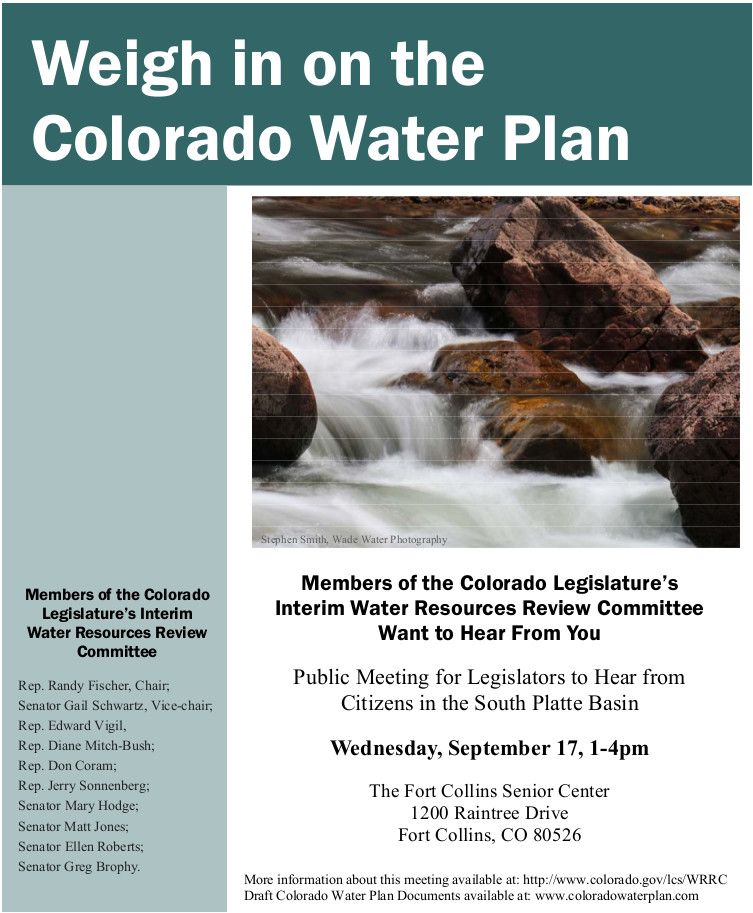
A group of legislators from around the state were in Durango on Aug. 27 to take comments on the Colorado Water Plan now being drafted, and the regional plan that will be part of it.
The legislators are members of an Interim Water Resources Review Committee who are following a bill passed in the spring requiring them to hold such meetings in each of nine major drainage basins around the state…
Many of the attendees said they didn’t know enough about what’s actually in the state plan or the Southwest Basin Roundtable Implementation Plan to ask questions or comment.
Several people worried that the federal government is trying to take control of all the water in the U.S. and take people’s property rights via recent updates to the Clean Water Act rules on what constitutes “waters of the U.S.” Speakers urged people to submit opposition comments before the comment deadline in October.
Another concern is federal agencies trying claim bypass flows and to require private water rights holders to turn over those rights as a condition to get or renew a use permit on federal land.
Southwest Water Conservation District Director Bruce Whitehead cited area Forest Service and BLM land management plans. “This isn’t a new issue,” he said. “These plans come up with things about bypass flows.” The state has opposed that, and memorandums of understanding “have encouraged federal agencies to use state (in-stream flow) programs instead of imposing bypass flow requirements.”
It’s also one of the concerns with federal special use permits, he said. State agencies have protested that. “These aren’t guidelines. They are standards in the Forest Plan. We see it as double dipping, using the state in-stream flow program but also wanting bypass flows… The feds say this will be a template throughout the state and maybe the West.”
Whitehead continued, “Few of our concerns have been addressed. That’s why we’re bringing it to this panel. So far, we’ve been unsuccessful in working with these federal agencies in a cooperative collaborative manner.”
Participants grouped around tables discussed water issues and picked one of their members to summarize their comments to the larger group.
There was strong support for water conservation as part of the plan, such as the large percentage of municipal use that goes for lawns; for more water storage, and for Colorado’s prior appropriation system of “first in time, first in right.”
Tom Morris, staff attorney for the legislature, commented, “To many people, that is the Colorado water plan.”
Several people supported elimination of the “use it or lose it” part of the prior appropriations system, because it discourages more efficient water use.
There was support for new water storage in Southwest Colorado to keep water the area is entitled to from flowing out of state. Another big point was that water users in each basin should fully develop their own water, including storage, before they seek diversions from other basins or buy up ag water for municipal use.
Summarizing comments from his table, La Plata/ Archuleta Water District board member Dan Lynn said, “One point we wanted to make is that every drop of water in the state starts on federal land, but every drop of water doesn’t belong to the federal government.” He noted he worked for 36 years for the Natural Resources Conservation Service and said, “Don’t let those people get your rights.”[…]
Ignacio area rancher and president of the American National Cattle Women Patti Buck urged people to send formal comments on the EPA rule change on what constitutes waters of the U.S. subject to regulation.
“When we bought our ranch, we paid extra for our water shares” compared to land with no water rights, she said. No water means no grass, which means no cattle, which means no food, she said.
One participant, Margaret Cozine, had a different concern. She wants the state to not only allow, but encourage, rain water harvesting from rooftops, and re-use of gray water, as several other states do. She wants it for her garden and argued it does not damage downstream water rights.
Water committee chair Randy Fischer urged people to send comments on the water plan. There will be another series of meetings around the state once the draft plan is released. “Please stay tuned,” he said.
Colorado Water Plan website screen shot November 1, 2013 From the Valley Courier (Ruth Heide):
As more people move to Colorado, the state is trying to make sure there will be enough water for them once they get here. Recognizing Colorado’s population will only continue to grow in future years, the state is developing a water plan encompassing all nine river basins including the Rio Grande Basin in the San Luis Valley. Last year the governor issued an executive order requiring the Colorado Water Conservation Board (CWCB) to complete a statewide water plan by December 2015.
About halfway through a statewide tour of the river basins, the state legislative committee heading up the water basin plan effort held a public meeting in Alamosa last week to see what local residents thought of the plan so far. There will be further public meetings in the future and the public may submit comments electronically at the web site: http://www.colorado.gov/lcs/WRRC
State Representative Randy Fischer, who is chairman of the legislative water resources review committee, encouraged comments to be made by October 1. He said the legislature does not have a role in formally adopting the water plan. The Colorado Water Conservation Board will adopt the plan in draft form by December of this year followed by the final water plan next year after additional public meetings.
CWCB Member Travis Smith said the drought of 2002 prompted the state legislature to really look at water supplies and future water needs.
“We have a water shortage issue and we have more people coming to Colorado,” he said. “We would like to preserve agriculture and Colorado’s values.”
One consensus developing from the basins around the state is that each basin wants to keep the water it has, and each basin has future needs of its own on top of the statewide needs to serve a growing populace.
“Export is a big deal here,” Water Educator Judy Lopez told the legislators as a mes- sage from the group for which she served as spokesperson . “We will rise and fight it.”
The Rio Grande Basin water plan is being developed under the jurisdiction of the Rio Grande Roundtable, which hired DiNatale Water Consultants to develop the basin plan. Members of the roundtable and other local residents have spent numerous hours compiling a draft plan that sets out specific goals for the basin and how they could be accomplished in the future.
Of the 14 specific goals of the plan, highlights include: protecting and restoring sustainability , watershed health and water quality; abiding by existing water rules such as the doctrine of prior appropriation , state water regulations and the interstate compacts; creating infrastructure such as storage for long-term water needs; sustaining the basin’s agricultural economy; developing projects with multiple benefits ; preserving wildlife habitats and wetlands; providing water-related recreational activities; and continuing to educate the public about water.
The proposed plan also provides a template for those wishing to submit water projects for funding in the future. The template sets up a matrix of basin plan goals so the applicant can see how the potential project meets and measures up to those goals.
During last week’s public meeting regarding the plan, participants shared their ideas of how they believed the plan could be improved and what they believed was important to consider in future water planning.
Rancher and Colorado Parks/Wildlife Commissioner Dale Pizel urged the group to use the plan once it is formulated and not leave it on a shelf. He said he hoped this would be a plan that would be dog-eared with use and marked up for future changes to make it better.
“I want the plan to be used, and I want it to change, and I want it to go on because it is necessary if we are going to deal with problems of Colorado population and loss of agriculture,” he said.
Rio Grande Roundtable Chairman Mike Gibson urged the legislative committee to be involved after the state plan is completed.
“Let this process continue. Present it to the governor. Then the legislature should step in. For the statewide plan to work we will need to be considering changing some of the constraints that are out there today that would prohibit it from being implemented ” like regulations about new infrastructure.”
Comments coming out of the group discussion process included:
• Be sure the plan recognizes and upholds the doctrine of prior appropriation.
• The plan calls for sustaining the confined and unconfined aquifers, but it should also call for restoring the aquifers.
• Using water for multiple benefits and diversified ways is critical and requires cooperation among water users and agencies.
• The plan should not only address future human needs but also the needs of wildlife and riparian habitat.
• Consider recreational and environmental water uses/ needs.
• Soil health is also connected to watershed health and should be considered.
• Perhaps the basin plans should address trans-mountain diversions, some of which are occurring already. However , there is concern about new diversions from this basin to the Front Range or elsewhere, and attempts to do so would meet with resistance. Perhaps the state should keep the status quo regarding current trans-mountain diversions.
• The Valley has many outdated water infrastructures requiring repair or replacement , and the basin water users hope the state plan and the Colorado Water Conservation Board will continue to financially support those needs.
• New and repaired reservoirs are crucial to meeting future water needs, and the state should be more flexible with its regulations to allow such facilities to be improved, expanded, replaced or newly constructed.
• There must be more storage in this basin. A reservoir at the state line would be beneficial , for example.
• It is important to find ways of making existing storage facilities more effective both in this basin and statewide.
• Give the water planning process sufficient time to develop sound, well-reasoned workable plans.
• Streamline the permitting process for water projects going before the state for funding.
• Accurate forecasts are crucial to this basin and the irrigators who are under constant call to meet Rio Grande Compact obligations, so it is vital to maintain technology and resources such as SNOTEL sites to provide as accurate forecasts as possible. Use technology to better measure water uses as well.
• If this basin uses its water more effectively and carefully it could help meet water needs in other parts of the state where the population is expected to increase in future years. However, if water is transferred from this basin to supply urban development, the water should be used effectively and not excessively in those developments.
• Consider the economic impact locally and statewide of increasingly more agricultural acreage being fallowed and take into account that some of that fallowing in this basin is an intentional means to restore the aquifer per state mandates.
• It is important to find ways to decrease water usage and conserve water, not just locally but throughout the state, so the existing supplies can be better utilized.
• Land use planning should be integrated into the water plan.
• Address climate change in the water plan.
• Maybe the state should look to outside water sources, such as the Mississippi River, for new water to meet increasing population demands.
• Consider the relationship of solar energy development to water, or the lack of it.
• Consider oil/gas development in the state water plan.
• It is important for this basin and its agricultural economy to prevent a “buy and dry” acquisition of farmland.
• The state water plan should acknowledge the unique characteristics of each basin and that each basin is different.
A state water plan probably won’t make anyone’s wildest dreams come true, but it could provide a framework to get things done.
“It’s a way for us to cross boundaries and work together,” said Alan Hamel, who represents the Arkansas River basin on the Colorado Water Conservation board. “We have worked with the Rio Grande and South Platte basins. We need to reach across the Continental Divide as well.”
Hamel’s comments were among many heard by the state Legislature’s interim water resources committee as part of a statewide listening tour on the water plan. The panel spent three hours at the Robert Hoag Rawlings Public Library, hearing strong messages about regulation, conservation and storage.
“We represent an extremely wide variety of water users and water issues,” said Betty Konarski, chairwoman of the Arkansas Basin Roundtable. The roundtable has met since 2005 to sort out water issues in the basin. “We are both a (water) importing and exporting basin, and we have the second-highest gap in the state. But it’s not uniform.”
Hamel and Konarski highlighted the need for the roundtables. There have been 22 public outreach meetings on the state water plan alone, generating hundreds of comments. Hamel lauded the $56 million in state Water Supply Reserve Account grants that, coupled with CWCB loans, have already gone a long way toward completing projects that will reduce the looming water gap.
The legislators participated in small-group discussions and heard testimony that generated a flood of water-related suggestions.
Some of the key points included:
Gary Bostrom, chief of water services for Colorado Springs Utilities, talked about a 50-year water plan now under development by Utilities that mirrors the state water plan. Future water projects must look at regional cooperation rather than just filling urban needs, he said.
“We need to support alternative water transfer methods,” Bostrom said. “They won’t be successful if the regulations are as difficult as permanent transfers.”
Marge Vorndam, of Trout Unlimited, said water for farms needs to be preserved because it supports flows in the upper reaches of the Arkansas River system.
“The state water plan should be addressing the limits of growth,” she added. “What is the maximum population that can be served?”
Kiera Hatton of Pueblo suggested that the state needs to be more proactive in supporting urban conservation measures such as graywater reuse and rainwater collection that could reduce the amount of water usage.
Bob Leach, a Pueblo developer, told the committee that local regulations should not be one-size-fits-all, and emphasized the need for local control of projects.
Sean Chambers, manager of the Cherokee Metro District near Colorado Springs, said the state should remove barriers to groundwater storage.
A draft state plan is scheduled to be completed in December, with adoption of a final plan scheduled one year later.
FromThe Grand Junction Daily Sentinel (Gary Harmon):
Western Slope water storage is “absolutely” a part of the Colorado water plan that is to be complete in just over a year, said the head of the Colorado Water Conservation Board. James Eklund, however, declined to offer specifics about any discussions.
U.S. Rep. Scott Tipton, R-Colo., this week told the editorial board of The Daily Sentinel that he and Gov. John Hickenlooper have discussed the possibility of high-elevation water storage to benefit the Western Slope. He was unable to offer specifics, but said the conversation began in late August at the Colorado Water Congress.
Eklund, who is in charge of drawing together the suggestions of water roundtables from the state’s basins to draft the statewide plan, said it recognizes the need for storage.
“Colorado’s water challenges require that we consider options that include both conservation and storage,” Eklund said in an email. “Conservation and storage go hand-in-hand in addressing our water-supply gap.”
The state water plan also contemplates the idea of a transmountain diversion, but no specific proposal has been made.
Hickenlooper’s office didn’t respond directly to inquiries about conversations with Tipton.
A Western Slope storage project, however, is “an intriguing idea,” said Bonnie Petersen, executive director of Club 20, the Western Slope advocacy district, noting that the idea has long been recognized as a need. Club 20, however, has no information about such a project, she said.
The Colorado River Water Conservation District, likewise, had no information about any such project, though spokesman Chris Treese said several projects are being pursued.
The Colorado River Cooperative Agreement with Denver Water, agreements affecting the Eagle River, rebuilding the old Dillon Reservoir and a variety of other projects are continuing.
Collectively, “There are 65,000 to 75,000 acre-feet on the table right now,” Treese said.
Chatter about transmountain diversions could prove to be of ultimate benefit to a Western Slope project, Treese said.
“We built Wolford Mountain (Reservoir) in the shadow of Two Forks,” Treese said, referring to a now-defunct proposal to divert Western Slope water to the South Platte River drainage to be stored behind Two Forks Dam.
Wolford Mountain Reservoir near Kremmling includes compensatory storage for the Western Slope as well as storage for the Front Range.
Water is a complicated and controversial issue in Southwest Colorado, and more than 100 people showed up Wednesday night to share their thoughts and concerns with the Colorado General Assembly’s Water Resources Review Committee. It’s holding meetings around the state to collect comments about the Colorado Water Plan now being developed
“There is no group of people who appreciate a drop of water more than the people of Southwest Colorado,” said Sen. Ellen Roberts, R-Durango, who sits on the Water Resources Committee. “If you ask people in Denver where they get their water, they’ll say their kitchen sink. Or they’ll say they get their food from the grocery store.”
Mike Preston is the chairman of the Southwest Basin Roundtable, which is putting together Southwest Colorado’s recommendations for this area’s section of the plan. He shared highlights and summaries from the group’s draft. And then attendees were off.
Among the most frequent comments:
Increasing storage is key because more of Colorado’s water is leaving the state than we are required to release based on compacts and agreements. Increasing storage on the Front Range as well as here was one suggested answer.
“But we have to balance storage with environmental concerns downriver,” said Jon Scott, who works with the Animas Watershed Partnership. “Fish don’t have water rights, so it’s easy to lose sight of their needs.”
Practicing conservation is essential for Coloradans and people in downriver states who use Colorado’s water.
“Individuals want to have nice green lawns,” said Jesse Lasater, who farms 500 acres in the Pine River Valley. “But it doesn’t make sense to take water away from the people who are putting food on the table for green lawns.”
Protecting water rights might be required. Water is a property right in Colorado. Pending federal regulations may threaten those rights. There were concerns that federal regulations and this new Colorado Water Plan might trump existing, and valuable, water rights.
As Colorado plans for a future with more people and less water, some in the world of water are turning to the problem of lawns.
In the 2014 legislative session, state senator Ellen Roberts (R-Durango) introduced a bill [.pdf] that would limit lawns in new developments if they took water from farms. Although the bill was changed dramatically before it passed, that proposal opened up a statewide conservation about how water from agriculture and the Western Slope is used – particularly when it is growing Front Range grass.
Roberts’ proposed bill set at 15 percent the amount lawn area in new developments, excluding parks and open space, said Steve Harris, the Durango water engineer who pitched her the idea.
“So essentially 15 percent kind of worked out to being that you could have grass in the backyard or front yard, one or the other, but not both,” said Harris.
The bill did not pass in its original form, and the issues it addressed were referred to a committee. Now, the conversation about using ag water to grow lawns has morphed into one about the ratio of indoor to outdoor water use, said Harris.
Indoor water is generally recycled, as water goes back into the system, whereas much of the water used for landscapes does not make it back into the water treatment system.
Statewide, that indoor/outdoor ratio is about half-and-half – numbers from Denver Water, which serves residential customers in the city and in many surrounding suburbs, match the state average. The city of Greeley uses a slightly higher percentage of its water for outdoor use, with 45 percent going to indoor uses and 55 percent outdoors.
Harris’s part of the state, though, is pushing for change. In its basin plan released July 31 as part of the state’s water planning process, the Southwest Region called for water providers to aim for a 60-40 ratio by the year 2030. For those taking new water from agriculture or the Western Slope, the standard would be even higher, with a ratio of 70 percent indoor to 30 percent outdoor use…
The idea of setting limits on that grass, though, is receiving pushback from Front Range water utilities and developers. Many utilities point to their existing leadership in conservation, and say a statewide limit takes control away from localities.
But many in rural Colorado are wary of drying up ag land for development. The Colorado Farm Bureau supports limits on farm water being used for turf.
“The rural areas are saying, wait a minute, we are not keen on taking out productive commercial agriculture that is producing something so that you can grow grass in your front yard,” said Harris.
Beckwith and Harris both see Colorado as a place where a discussion on indoor versus outdoor use is just beginning. At some point, said Harris, there will be limits on water use for lawns in Colorado. It’s just a matter of when.
Right now, there is little consensus between Colorado’s different basins on how water use for new lawns should be limited, or even if it should be. But, said Harris, based on the bill from last year’s session, at least there is now a conversation about it.
“If we wanted to create talk, we have created talk,” he said.
Pueblo photo via Sangres.com From the Bent County Democrat (Randy Fischer):
“Water is essential to Colorado’s quality of life and economy, but our ability to maintain those values will be challenged by a growing population, increasing demands for water, and limited supplies of this precious resource.”
These words appear on the Colorado Water Conservation Board’s website, describing the need for and purpose of the proposed Colorado Water Plan, which is to be drafted by the end of 2014 under an executive order signed by Gov. John Hickenlooper in May 2013.
Our goal for the Water Plan is to provide a path forward for providing Coloradans with the water we need in the future while seeking to maintain such divergent values as healthy watersheds and environment, robust recreation and tourism economies, vibrant and sustainable cities, and viable and productive agriculture.
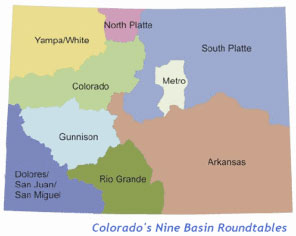
Colorado’s Water Plan will build on eight years of extremely valuable water supply planning work by the Statewide Water Supply Initiative, the Inter-Basin Compact Committee and the nine Basin Roundtables, one for each of the major watersheds in the state.
In 2014, the Colorado General Assembly passed Senate Bill 14-115, which also recognized the need to engage the general public in the water planning process by gathering input through a series of public meetings in all the major river basins of Colorado. SB-115 directs the legislature’s Interim Water Resources Review Committee (WRRC) to convene these meetings, gather public input, and provide comment on the draft Water Plan by Nov. 1.
The next of these public meetings is scheduled for Friday, Aug. 29, at 9 a.m. at the Rawlings Library, 100 East Abriendo Ave. in Pueblo. This hearing is for everyone who lives in the Arkansas River drainage, from Leadville to the Kansas border. I invite and encourage all residents of the Arkansas Basin to attend this important meeting.
The WRRC recognizes that water issues inherently involve competing values that cannot all be resolved through technological or technical fixes. Different groups bring different values to the conversation. There is no “right” way to balance these competing interests and values. Through SB-115, the WRRC is asking the public to help make Colorado’s Water Plan a better document that seeks to represent the values of all state residents.
The WRRC also recognizes that the Colorado Water Plan will identify difficult choices and tradeoffs that will need to be made to plan for and create a sustainable water future. SB-115 envisions a public process that lays out these choices and tradeoffs facing Colorado and seeks to find a way through public input to navigate the difficult issues that lie ahead.
Whatever else is in it, the biggest element of Colorado’s water plan will be cooperation.
“Water can either divide or unite us. In the end, it’s our choice,” Gov. John Hickenlooper told the Colorado Water Congress last week. “In this state, we work together, and we have to make sure it doesn’t divide us.”
When Hickenlooper called for a state water plan last year, it had a direct impact on most of the water professionals attending the summer workshop. Four months from the finishing line, the governor reiterated the importance of water to Colorado. The draft plan will be on the governor’s desk in December, whether or not Hickenlooper survives an election challenge from Republican Bob Beauprez. Beauprez addressed the Water Congress Friday.
Hickenlooper heaped praise on the work of basin roundtables, which have been meeting since 2005, and have spent the past year developing basin implementation plans.
“The roundtables, while not as glamorous and sexy as bare-knuckle water brawling in neighboring states and here in the past, have moved forward,” he said.
“It has not been just a small group of people in Denver directing how it will be used, but a broad group of people working together to write a plan.”
Hickenlooper highlighted the Arkansas Valley Conduit as an example of water projects that benefit the outlying areas of Colorado. Hickenlooper said he and Colorado Water Conservation Board Executive Director James Eklund talked with Mike Connor, deputy secretary of the Interior, earlier this year to ask him to move funds to provide more money for the conduit. Last week, the Bureau of Reclamation announced $2 million in funding for the conduit this year.
“That $2 million is a good first step for Southeastern Colorado, an area that has been in a drought for years,” he said.
Whether it’s putting in a new dam or pipeline, leasing water from farms or simply conserving water, municipal customers should be prepared to pay more for mitigation.
“With any project, we have to be prepared to look at the question: What are the underlying costs?” said Mark Pifher, permit manager for the Southern Delivery System being constructed by Colorado Springs Utilities.
Pifher led a panel of those who have worked on Colorado’s largest municipal water projects to explore the obvious and hidden add-on costs of water development. The event was part of the Colorado Water Congress summer convention.
In the case of SDS, an $840 million pipeline from Pueblo Dam to Colorado Springs, about $150 million in additional costs to meet permit requirements has been tacked on.
Aurora paid additional costs for its lease of High Line Canal water 10 years ago, with an additional $1.3 million on top of $10.8 million in direct payments to farmers and $1.4 million for a continued farming program now in its tenth year on the Rocky Ford Ditch.
In the Rocky Ford Ditch program, Aurora provides some of the water it purchased to allow farmers to stay in business.
“We’re thinking we’ll continue the program in the future,” said Tom Simpson, Aurora’s engineer in the Arkansas Valley. “One thing of concern is the availability of water in the Arkansas basin.”
New storage projects also come with a price tag for mitigation.
Travis Bray of Denver Water said the $360 million Gross Reservoir expansion project, designed to increase yield by 18,000 acre-feet, has cost an additional $30 million in mitigation so far, as it moves toward full permitting, projected to happen in 2015.
Jeff Drager of the Northern Colorado Water Conservancy District said its $300 million Windy Gap Project, designed to increase storage by 90,000 acre-feet, has cost $19 million in mitigation and 3,000 acre-feet of water.
Along with the money, agreements with affected communities cost time. Both projects are a decade behind schedule.
“I was a young guy when we started, and now my kids are out of college,” Drager said. “I’d just be happy to get this done by the end of my career.”
Even conservation has hidden costs, said Jason Mumm with MWH Global, a consultant on many municipal projects. He presented detailed analysis that showed how reduction of water use drives water rates up. As a result, customers may wind up paying the same amount of money or more after paying for appliances that reduce water use.
“Conservation is good, but we do need to understand that it comes with its own costs,” Mumm said.
More Colorado Water Plan coverage here. More conservation coverage here. More Windy Gap Firming Project coverage here and here. More Moffat Collection System Project coverage here and here. More Southern Delivery System coverage here and here.
Colorado transmountain diversions via the State Engineer’s office
Colorado transmountain diversions via the University of Colorado
FromAspen Journalism (Brent Gardner-Smith) via the Aspen Daily News:
Gov. John Hickenlooper told members of the Colorado Water Congress on Thursday that he thinks it’s “unlikely” that public opinion in the state has shifted in favor of a new major dam project being built in the state, even in the face of population growth and drought. He said he has found more support around the state for the idea of increasing the height of existing dams by 5 or 10 feet, which he said can dramatically increase the amount of water stored in a reservoir.
“I think we have a lot of opportunity in those projects, many of which are underway,” Hickenlooper said.
But, he added, “I’m not sure we have enough capacity just doing those projects for all the water we’re going to need.”
He also called for increased water conservation in both the state’s cities and its fields.
The governor spoke on the second day of the Colorado Water Congress’ annual summer convention, which is being held at the Westin hotel in Snowmass Village through today.
Former Congressman Bob Beauprez, who is running against Hickenlooper for governor, is slated to speak this morning at the water conference.
Hickenlooper had the full attention of the members of the water congress on Thursday, as his call for a draft Colorado Water Plan to address the state’s future water needs is supposed to be on his desk by Dec. 10, and the planning process has kept many in the state’s water community busy. The governor noted that the nine different river-basin roundtables have held over 850 meetings to discuss water policy and projects. The Colorado River Basin Roundtable meets monthly in Glenwood Springs, and its next meeting is Monday, Aug. 25 from noon until 4 p.m. Those individual basin plans are now being sifted and sorted to create the draft statewide plan, which Hickenlooper said was met with skepticism when he first proposed it.
“What we kept trying to say is, the most important part of this water plan is the process we use to create it,” Hickenlooper said. “It’s not going to be a small group of people in Denver trying to make decisions on how water should be allocated for the rest of the state. And I think what we’ve seen is that this plan is going to be created by a broad cross section of people from across the state.”
Hickenlooper also called for cooperation among often-warring factions in Colorado’s water world, be they Front Range water providers trying to deliver water to a growing urban population, Western Slope ranchers and farmers working to preserve their rural way of life and the future value of their private water rights, or river-lovers on both sides of the divide fighting to keep water in rivers for fishing, boating or nature’s sake.
“Water can either divide us, or unite us,” Hickenlooper said. “In the end, it’s our choice. I think in this state, we generally choose to collaborate and work together to try and find compromises and make sure that it doesn’t divide us.”
He said that by working together and taking a “calculated and conservative” approach to water planning, the state’s various water factions are, in fact, moving forward.
“While this collaboration isn’t as sexy or glamorous as the bare-knuckled water brawling that we see sometimes in our neighboring states, and sometimes here in the past, this cooperation is effective and I think very productive,” Hickenlooper said. “Collaboration can bear fruit that otherwise would be unobtainable.”
Jim Pokrandt, the director of communications at the Colorado River District in Glenwood Springs and the chair of the Colorado River Basin Roundtable, said it was hard to say if the roundtable members around the state had faith in the emerging water plan.
“Some won’t be happy unless it calls out a project,” Pokrandt said. “Others will always think it is a stalking horse for a project no matter how it handles that issue.”
Pokrandt said the draft plan will at least identify many local water projects and statewide needs. Then, he said, “the real work begins.”
A final water plan is to be complete by December 2015.
And it remains to be seen how well the governor and the Colorado Water Conservation Board, which is in charge of developing the draft water plan, will collaborate with the state legislature.
Last year, state Sen. Gail Schwartz, formerly of Snowmass Village and who now lives in Crested Butte, co-sponsored a bill that would require the Colorado Water Plan to be approved by the legislature, and not just the governor. However, the bill was watered down to require the state’s interim legislative committee on water to hold nine public hearings in the state on the plan this summer. The hearing in the Colorado River basin was held Thursday evening at the Glenwood Springs library, with 10 state legislators who sit on the interim water committee in attendance, along with over 50 citizens.
Pokrandt, as chair of the Colorado basin roundtable, gave an overview of the group’s draft plan. He said a key finding was that another transmountain diversion was not in the best interest of the state at this time, especially as pending projects are already likely to divert an additional 140,000 acre-feet of water from the Colorado basin to the Front Range.
Today, between 450,000 and 600,000 acre feet of water is sent from the basin to the east each year.
A chief finding of the basin’s plan is that “high conservation, (water) reuse and linking water supply to land use” are in the best options for the state.
One candidate evoked the strong connection of water to Colorado’s past and the need to preserve more of it for the future. The other talked about a coming global crisis and the need for America to become an international leader for water development. This particular stop on the campaign trail was the summer convention of the Colorado Water Congress. U.S. Sen. Mark Udall, a Democrat, is facing Republican challenger U.S. Rep. Cory Gardner in the November election. Both are perennial favorites of the state’s leading water group, but took different approaches to argue how they would best serve the state’s water interests.
“How are we going to meet the needs of our people, our farmers and our communities if we don’t build storage,” Gardner said.
The federal government impedes water development in Colorado and represents a danger to water rights within the state, Gardner said.
Gardner talked about his family’s five generations as store owners and implement dealers in Yuma, and said federal policies endanger that way of life.
“Will our children have the same type of opportunity if we don’t change the way we’re doing things?” he asked.
Udall countered that it’s not enough for Colorado or the United States to look after just its own needs. Instead, the country has the opportunity to provide global leadership in confronting future shortages.
“When it comes to water, we are living beyond our means and that is a dangerous situation,” Udall said.
Climate is changing because of human activities at the same time world population is increasing, creating new stress on water supplies. As shortages grow, stability in foreign governments diminishes, he said. While that’s a threat to U.S. interests, it’s also an opportunity for American companies to be innovative while reaching out to help solve the problem. In the process, there would be goodwill toward the U.S., Udall said.
Closer to home, he said Colorado must protect its interests on the Colorado River and to resist federal attempts to tie up state water rights.
“I’ve made it one of my top priorities to protect Colorado water,” Udall said. “We have to make sure liquid gold is always available.” cwoodka@chieftain.com Will our children have the same type of opportunity if we don’t change the way we’re doing things?
A bill that would allow water saved from farm efficiencies to support instream flows — vetoed this year by Gov. John Hickenlooper — could be resurrected in the next legislative session. The interim water resources review committee heard testimony Wednesday from some who opposed the measure and said a pilot program might be workable. There is still opposition to the bill, however.
“I think we got an idea of why they’re opposing the bill,” said state Sen. Gail Schwartz, D-Snowmass Village, after the hearing.
The bill, SB14-023, proposed allowing water savings from agricultural improvements to be donated on a temporary basis to the Colorado Water Conservation Board for instream flows, without diminishing the water rights of those who contribute water. It was an attempt to encourage conservation while not penalizing farmers under the state’s “use it or lose it” system. The law applied only to the Colorado River and its tributaries, but could affect junior water rights, including transmountain diversions, such as those used by the Pueblo Board of Water Works or Fryingpan-Arkansas Project.
John Stulp, Hickenlooper’s water adviser, said a scaled-back pilot program to see the impact of such donations of water rights is now being considered.
“Our concern is of possible damages to intervening diverters,” said Carlyle Currier, vice president of the Colorado Farm Bureau. “They could spend a lot of time and money trying to defend themselves in water court.” In overappropriated basins, such as the Arkansas and South Platte rivers, the concept would not work, but there are conditions where senior water rights would not be harmed and junior rights even improved in the Colorado River basin.
Terry Fankhauser, executive vice president of the Colorado Cattlemen’s Association, was more supportive of the bill, saying it is a tool that could help keep farmers and ranchers in business. The group’s membership is split over the costs of water court, but argued costs could be reduced if the CWCB picked up the tab for engineering costs.
“We believe the full range of issues was addressed in the bill,” said Doug Robotham, Colorado water project director for the Nature Conservancy. He also voiced support for the pilot program.
Montrose farmer Mark Catlin said he considers the bill a “jaundiced” attempt to change state water law. He disagreed with other speakers about whether farm efficiencies decrease consumptive use, because all water in a system is reused many times.
“A water right is how much water you can divert, and it’s dangerous to go into ag and change the way it works,” he said. “The calling right is at the headgate. Is the state of Colorado going to be a partner?”
US Forest Service skedded to discuss directives on ski areas and groundwater at @COWaterCongress conference this morning
From the Glenwood Springs Post Independent (John Stroud):
Protection of the river ecology and preservation of recreation and agricultural interests was the consistent message heard by a panel of Colorado legislators who convened here Thursday to gather public comments on the new state water plan.
And the best way to ensure that is through better statewide water conservation practices and no more trans-mountain water diversions from the Western Slope to the Front Range, those who testified before the state Legislature’s Interim Water Resources Review Committee concurred.
“What’s healthy for recreation is healthy for rivers and streams,” said Aimee Henderson, co-founder of the Upper Colorado Private Boaters, an affiliate of American Whitewater based in Glenwood Springs.
“Additional diversions are not an acceptable solution,” she said, adding there should be a statewide conservation agreement to decrease water consumption.
Pitkin County Commissioner Rachel Richards, who sits on the Colorado River Basin Roundtable, one of nine roundtables that is weighing in on the water plan, said it’s important to “truly acknowledge the value of the environmental and recreation economy in the state.”
Tourism promoters across the state, whether on the Front Range or the Western Slope, almost always showcase some type of high country water recreation in their attempt to attract visitors, Richards noted…
The Thursday meeting at the Glenwood Springs Branch Library attracted about 100 people, many of whom are members of the Colorado Basin Roundtable or have been involved in those discussions over the past several months.
The meeting was the second of nine sponsored by the 10-member legislative committee as it holds hearings within each of the major river basins as part of process to develop the state water plan…
The Glenwood Springs meeting focused on concerns within the main stem of the Colorado River, including the Roaring Fork, Eagle and Blue river valleys.
Many of the comments echoed those contained in the draft Colorado Basin Implementation Plan, which emphasizes a high conservation standard statewide and discourages further water diversions.
The draft basin plan concludes that any more water diversions would severely damage the state’s recreation-based economy, agriculture and the environment, and would jeopardize upper basin users should there be an interstate compact call by down-river water users.
It also includes specific recommendations, such as preserving the Shoshone water right for Western Slope needs rather than allowing it to be sold to Front Range water interests, and encouraging small water projects in western Colorado to meet agricultural needs…
[Ken Neubecker] summarized the comments of one of nine separate tables that engaged in small-group discussions with members of the legislative committee before the floor was opened up to general testimony.
“If you’re going to take a new supply for the Front Range, it’s going to come from someone else who is already using it,” Neubecker said.
Suggestion that any new diversions would come with an agreement that they occur only during peak runoff years “simply condemns the Western Slope to a permanent drought condition,” he said. “We need to educate everyone, especially the Front Range, about where their water comes from.”
Another concern expressed at the hearing included that the water plan is only intended to address water needs through 2050, even as growth pressures are likely to continue beyond that time. Others who spoke said it’s important to factor climate change models and predictions into the water plan.
The water committee has started its deep dive into conservation issues, especially as it relates to the transfer of water used in agricultural production to urban municipalities along the Front Range. This conversation was triggered by a controversial bill I carried last year. I’m determined that we’ll keep at this until we reach best practices that make sense and reflect the precious nature of water in our state.
I appreciate the active engagement of several of my constituents in bringing ideas and zeal to this topic and as I travel the state with the water committee as we hold hearings over the next two months on what should be in the state water plan, I’ll be sure that the topic of water conservation gets brought up and vetted in all areas of the state.
My principal concern with municipalities failing to do everything they can to conserve water is that the urban corridor on the Front Range, including, but certainly not limited to, Denver, seek to transfer more water from the Western Slope to satisfy their residents’ needs and desires. I don’t need to inform my constituents of the impacts this would have on our way of life, on our viable agricultural production, and on our environment.
Also breathing down our necks is the impact of a potential “call” on the Colorado River from downstream states legally entitled to a share of that water for their own uses. If such a call is made, we won’t be getting water shipped back from the Front Range to satisfy the call.
Climate change is globally impacting natural resources, particularly water supplies, and that can’t go unchecked, U.S. Sen. Mark Udall said Wednesday in Snowmass Village.
Managing water supply is clearly a critical issue in the West, but it is also an issue of national and international security, Udall said to a crowd gathered for the Colorado Water Congress Summer Conference at the Westin Snowmass Conference Center. Between now and 2040, the world’s water supply will not keep up with demand without better management, according to a recent assessment by the director of National Intelligence, Udall said.
“Water problems will hinder the ability of key countries to produce food and energy … hobbling economic growth here and around the world,” Udall said. “In turn, that will increase the risk of political instability, state failure and mounting regional tensions.”
Global water consumption has tripled in the past 50 years, and furthermore, the supply is diminishing due to climate change, he said.
“Our climate is changing, and the only thing constant and predictable on the subject is science, which shows we can’t ignore the problem,” Udall said. “Despite the mountains of proof, the volumes of scientific and peer-reviewed articles, some lawmakers and many talking heads still refuse to recognize that climate change even exists, much less that federal and state governments have a role to play alongside the private sector in solving it.”[…]
That stance is what sets him apart from his opponent in the upcoming Senate election, U.S. Rep. Cory Gardner, who also spoke to the Water Congress on Wednesday. Gardner doesn’t acknowledge that climate change is occurring, Udall said.
Without looking at the facts, legislators will not be working toward a solution that “maintains our special way of life” in Colorado, Udall said.
The Colorado River reaches 40 million people, and as the headwater state, Colorado has to fight to protect its interests from being overshadowed by those of downstream users, Udall said.
That is part of the role of Colorado’s representatives in Congress, by advocating to protect the state’s water rights as well as educating senators from parts of the country that are not faced with the same tight resources, Udall said.
FromAspen Journalism (Brent Gardner-Smith) via the Aspen Daily News:
Three members of Colorado’s Congressional delegation spoke on Wednesday in Snowmass Village at the annual summer convention of the Colorado Water Congress, which represents the interests of water providers and owners at the Colorado state house and in Washington, D.C.
Republican congressmen Cory Gardner and Scott Tipton spoke at lunch on the opening of the three-day water conference, while Sen. Mark Udall, a Democrat, spoke in an afternoon session. Also speaking in the afternoon was Abel Tapia, a Democrat from Pueblo who is challenging Tipton for his 3rd Congressional District seat.
Rep. Gardner, who is running against Udall for Senate, called for new water storage projects to be built in Colorado.
“I believe we have to focus on water storage, what we can do to move forward on common-sense, water-storage projects,” Gardner said. “If we were to build every water project on the books today and every one that’s under construction, we are still short of water into the future. And how are we going to meet the needs of industry and agriculture and our communities if we don’t store more water?”
Gardner called for simplifying the permitting process for water projects, including new dams and reservoirs, and said he wants to see federal, state and local partnerships formed to help pay for new projects.
And Gardner said he wanted to “stop and defeat” a new proposed rule from the EPA that would clarify the definition of “waters of the U.S.”
“Almost every molecule of water could come under the jurisdiction of that new rule the way it is currently written,” Gardner said.
The EPA, on its website about the proposed rule change, states that “the proposed rule does not protect any new types of waters that have not historically been covered under the Clean Water Act.” [ed. emphasis mine]
Rep. Scott Tipton also denounced the EPA’s proposed rule change.
“That’s going to have a regulatory impact and cost to us and it’s effectively going to be a taking,” Tipton said, “because if the EPA can step in this room and start to tell the state of Colorado, start to tell the western United States, how our water is going to be handled, we’re going to be stripping our farm and ranch community of the ability to be able to grow our crops, our communities to be able to grow and to be able to prosper and to be able to create jobs and certainty for our children to be able to have a prosperous future.”
After he spoke, Tipton was asked a question by Pitkin County commissioner Rachel Richards, who sits on the Colorado River Basin Roundtable, which is helping to shape the state’s forthcoming Colorado Water Plan.
“One of our big uncertainties is really water availability,” Richards said, noting that projections show that climate change could reduce water supplies in Colorado by 15 percent. “What is your position on climate change?”
“I always like to be able to say on climate change, I grew up in the shadow of some of the greatest climate change this nation’s ever seen — it’s called the Rocky Mountains,” Tipton answered lightly. “I guarantee you, the climate will change. And it will continue to do so. Unfortunately, we have some people that try and make this a political issue, for some reason.”
Sen. Udall had a different take on the subject.
“Our climate is changing, and the only thing constant or predictable on the subject is science that shows we can’t ignore the problem,” Udall said during his remarks to the crowd at the conference center in Snowmass.
“Rising temperatures and ongoing drought are only exacerbating the pressure on our river basins by contributing to insufficient rainfall and snowpack,” Udall said. “This has led to dwindling reservoir levels, leaving water managers in this room and across the state with difficult decisions on how to meet the water needs of cities, farmers and the environment.”
Just as the Colorado Water Congress kicked off its summer conference Wednesday, the political waters already were churning as the state’s U.S. Senate candidates traded jabs.
Democratic U.S. Sen. Mark Udall and Republican opponent U.S. Rep. Cory Gardner spoke at the premier summer conference on water issues.
Udall issued a news release at the start of the conference, attacking Gardner for supporting a 2008 ballot initiative when Gardner was a state representative that would have diverted millions from water projects to fund transportation. Amendment 52 would have redirected some gas and oil severance-tax revenues from water to highway projects.
The initiative was seen as a competing measure to another ballot question at the time, Amendment 58, that would have eliminated a state tax credit to increase severance-tax collection for college scholarships, among other areas.
Both ballot questions were rejected by voters.
“Senators have a duty to represent and protect the well-being of all Coloradans,” said former U.S. Sen. and Interior Secretary Ken Salazar in a news release issued by the Udall campaign.
Opponents of Amendment 52 pointed out at the time that three out-of-state energy companies contributed to the initiative.
“It is deeply disturbing that Congressman Gardner sided with out-of-state interests over the water needs of Colorado communities,” Salazar said. “Almost two-thirds of Colorado’s voters from every part of the state rejected Gardner’s scheme. Coloradans deserve better than Congressman Gardner.”
In a phone interview with The Durango Herald on Wednesday, as Gardner was driving to the Water Congress engagement, the congressman said Udall’s campaign was “running out of steam.”
“There’s a saying that I have for Mark Udall,” Gardner said. “Once again, Sen. Udall is missing the mark.”
Gardner turned the debate back on Udall, pointing out that the incumbent supported Amendment 58, which was viewed as being anti-energy industry. Gardner also said that Udall has shown no leadership on transportation, including easing congestion along Interstate 70.
“It’s a shame that Sen. Udall can’t even talk about how we need additional dollars for transportation and the water infrastructure in the state, he would rather resort to partisan attacks,” said Gardner.
The congressman said he would speak to the Water Congress about “federal intrusion,” including a proposed rule by the Environmental Protection Agency that would clarify regulatory authority under the Clean Water Act to protect streams and wetlands. Some farmers fear that the rule would allow the EPA to regulate small bodies of water, even ponds or puddles on their land.
Gardner also said he would discuss increased water-storage opportunities.
“I am passionate about water issues in Colorado I have been a leader at the state Legislature and U.S. Congress to protect Colorado water and Colorado water rights from intrusion,” Gardner said.
For his part, Udall was expected to speak to the Water Congress about how water is “the liquid gold that makes our lives possible.”
“Managing the supply and availability of our water is one of the most critical natural-resource issues facing the United States and the world,” Udall was expected to say, according to prepared remarks emailed to the Herald.
“The bottom line is, when it comes to water, we are living beyond our means,” Udall added. “And that’s a dangerous way to live.”
Udall used the opportunity to also highlight climate change, suggesting that the science is conclusive and Republicans continue to ignore concrete evidence.
“Yet, despite the mountains of proof, the volumes of scientific and peer-reviewed articles, some lawmakers and many talking heads still refuse to recognize that climate change even exists … much less that the federal and state governments have a role to play – alongside the private sector – in solving it,” Udall said. “Like you, I have made it one of my top priorities to protect our water and invest in our water infrastructure.”
Hundreds of people are helping to write and thousands more taking in interest in a state water plan, a legislative committee learned Wednesday.
“This really shows that we’ve gotten to the point where people are taking a real interest in the plan,” John Stulp, who advises Gov. John Hickenlooper on water issues, told the Legislature’s interim committee on water resources.
The committee was thrust in the middle of the state water debate by SB14-115 in the last legislative session. It is kicking off its own hearings tonight in Glenwood Springs and then will embark on seven more in each of the basins.
The Arkansas River basin hearing will be 9 a.m.-noon Aug. 29 at the Robert Hoag Rawlings Public Library.
More than 1,000 separate comments were received by basin roundtables at 120 outreach meetings in developing implementation plans that were submitted to the Colorado Water Conservation Board last month.
More than 160,000 unique hits have been recorded on the website for the plan (coloradowaterplan. com) with 2 million page views, he added.
By mid-September, those comments will be integrated into draft chapters for review by the CWCB.
The basins are in agreement on many issues, including the need to preserve agriculture, conserve water, protect recreation and preserve the environment.
The Arkansas River basin also has pushed ahead the need for watershed health to anticipate and counteract the ravages drought and wildfire have had in recent years.
Basins also agree that storage or other types of water projects should have multiple benefits, interstate compacts present challenges and more education of the public on water issues is needed, Stulp said.
“You’ve said the basins work together, but how do we resolve fundamental conflicts,” state Sen. Gail Schwartz, DSnowmass Village, asked Stulp.
“At this point, we recognize areas of agreement and will address conflicts as we move forward,” Stulp replied.
The Interbasin Compact Committee, established in 2005 along with the roundtables, is moving ahead on resolving conflicts, he added. Recently, it reached a “conceptual agreement” on transmountain diversions.
Diane Mitsch-Bush, DSteamboat Springs, said the amount of water for energy development has been a moving target for Western Colorado and also needs to be given priority in the state water plan.
The water needs for both oil shale and hydraulic fracturing of oil and gas wells are being accounted for in the ongoing Statewide Water Supply Initiative, due for revision in 2016.
The draft state water plan is scheduled to be presented to the governor in December.
“This is a historic document we’re working on, and many people have had a part in it,” Stulp said.
The Water Congress is an advocacy organization that gets involved with state and federal water issues, like water rights. The group’s annual summer conference brings together water managers, politicians and others involved in the resource. This week features candidates for a range of offices.
Weld County District Attorney Ken Buck was the first to speak. Regarding water, the republican says he’s developed a great pride for Northern Colorado.
“The pride is seeing people come together, work together and seeing people turn a desert into a very productive agricultural area. The frustration is seeing the government screw everything up.”[…]
Congressman Scott Tipton was up next. The republican touted his record including legislation signed into law last year that eliminates regulations on small-scale hydroelectric projects.
He spent much of his 10 minute talk criticizing regulations from the federal government. He highlighted the EPA’s “Waters of the U.S.” rulemaking, saying it gives the agency too much power.
“If the EPA can step in this room and start to tell the state of Colorado and the western United States how our water’s going to be handled, we’re going to be stripping our farming and ranching community of the ability to grow our crops,” he said.
The only question came from Pitkin County Commissioner Rachel Richards who asked Tipton about his position on climate change.
“I always like to be able to say with climate change, I grew up in the shadow of some of the greatest climate change this nation’s ever seen. It’s called the Rocky Mountains. I guarantee the climate will change, and it will continue to do so,” said Tipton.
Cory Gardner of Yuma began his talk by denigrating Congress, where he currently represents Colorado’s fourth congressional district.
“It’s always great to be at the Colorado Water Congress, a congress that has a much higher approval rating than other congress’ that we know of!”
Gardner is challenging Senator Mark Udall in a close and expensive race. He spent most of his time stumping – discussing not just water, but his so-called “Four Corner Plan,” that includes economic growth.
“What we are going to do to get this country’s economy growing again. Where does it start? I believe it starts with simple things like regulatory reform and getting government out of the way and letting America work,” he said.
Later in the day, democrat Abel Tapia stepped to the microphone. He is running against Congressman Tipton. The former engineer and Colorado state lottery director says he understands the challenges facing the Colorado River, which is over-utilized.
“I am committed to fighting to ensure that the Colorado and the Third Congressional District are protected, and get the water it deserves. I support a balanced water policy that takes into consideration the multiple users of our water – agriculture, municipalities and industrial.”
Calling water Colorado’s “liquid gold,” Senator Mark Udall was the last to speak. He pointed to the need for solving a projected water shortage on the Colorado River.
“Let’s have ongoing, tough and ongoing conversations within Colorado and between the Upper Colorado Commission and the lower basin states. If we don’t do that we risk losing site of our shared economic dependence.”
Climate change will exacerbate the problem of water shortages in Colorado and globally. He is concerned the majority of republicans in congress continue to deny climate science.
“Just last month, I tried to get a resolution passed that would put the senate on record acknowledging that climate change is a problem and poses a problem to the United States but enough members of the republican caucus objected and blocked it. But, Coloradoans know better,” said Udall.
More 2014 Colorado November election coverage here. More Colorado Water Plan coverage here.
Colorado transmountain diversions via the State Engineer’s office
West portal Moffat Water Tunnel
Colorado transmountain diversions via the University of Colorado
Denver Water’s collection system via the USACE EIS
Colorado-Big Thompson Project Map via Northern Water
Fryingpan-Arkansas Project via the Southeastern Colorado Water Conservancy District (Click to enlarge)
From the Glenwood Springs Post Independent (Lauren Glendenning):
Climate change might not be the end-all, be-all in the state’s water discussion, but Brad Udall knows it needs to at least be a part of it.
“The proper way to deal with climate change is to get out of the scientific battles and deal with it as a risk,” said Udall, who is the director and principal investigator of the University of Colorado-National Oceanic Atmospheric Administration Western Water Assessment.
While Colorado isn’t dealing with what Udall says is the biggest climate change impact, sea level rise, it is dealing with impacts of the overall water cycle. The West faces an unprecedented 14-year drought, resulting in low water levels at Lake Mead and Lake Powell, supply-demand gaps, power losses and threats to conservation.
As the atmosphere warms, it also holds more moisture, resulting in water cycle changes. Udall said the effects are already appearing as more rain and less snow, earlier runoff, higher water temperatures and more intense rain.
The higher water temperatures are something that water conservation folks throughout the Western Slope are concerned about. At a recent Colorado Basin Roundtable meeting, Holly Loff, executive director of the Eagle River Watershed Council, introduced to the group a recent assessment of the Upper Colorado River. The study shows that elevated water temperatures are occurring in the Upper Colorado that are above the known thermal tolerance of trout.
Loff said more transmountain diversions out of the basin to the Front Range would only further affect aquatic life, which goes beyond just fish and bugs.
“It impacts everything that uses the riparian area, which is every creature,” Loff said. “Temperature, that is huge. When you take the water out [of the streams for diversions], the water that’s left heats up more. Water temperatures rise, and it completely changes the fish that want to be in that water. Our fishermen are going to see that.”
Loff said she isn’t so quick to join in on the finger-pointing to the Front Range. The Front Range has cut back on wasteful bluegrass lawns, for example, and is doing a great job in terms of per-capita water use.
“They’re actually doing much better than we are” in per-capita water use, she said. “We are all going to have to make some changes.”[…]
[Martha Cochran] points out that agriculture efficiencies could help improve water supplies, but the use-it or lose-it concept hampers progress.
Use-it or lose-it means that a water user who fails to divert the maximum amount of water that their right allows loses some of their rights the next time they go to court to transfer those rights.
“Sprinkling systems for agriculture are more efficient and use less water, they’re easier to control, you can direct them better, they’re more specific about how and when,” Cochran said. “And that’s a good thing, but it’s not [a good thing] if it means you lose your water rights because you’re not using all the water you traditionally used.”[…]
As the state crafts the Colorado Water Plan, one development holds out hope that East and West Slope entities can work together. Just last year, the Colorado River Cooperative Agreement was signed between Denver Water and Western Slope water providers and municipalities. The agreement is a long-term partnership that aims to achieve better environmental health in the Colorado River Basin, as well as high-quality recreational use.
The agreement, which included 43 parties from Grand Junction to Denver, states that future water projects on the Colorado River will be accomplished through cooperation, not confrontation. It’s debatable whether that will happen, given the finger-pointing cropping up during the draft stages of the Colorado Water Plan process.
James Eklund, director of the Colorado Water Conservation Board and head of the development of the Colorado Water Plan, believes it can happen, but he admits it won’t be easy.
“The idea is to take that paradigm shift that occurred with the Cooperative Agreement and exploit that and replicate and scale that up to the entire state,” he said. “Doing that is going to require some work.”
But positions like Loff’s that are 100 percent against more transmountain diversion projects are widespread on this side of the Continental Divide, and it’s going to take more than some conversations and a few handshakes to find some middle ground.
“The biggest thing for us, and the entire basin, is that we want to make it perfectly clear that having another transmountain diversion over to the Front Range is really going to damage our recreation-based economy,” she said. “And that it’s going to have more impacts on the environment and on agriculture. They need to understand that we’re not saying we don’t want to share the water, it’s just that there isn’t any more water to share. We have obligations through the compact [to downstream states with legal rights], so more water leaving our basin — that water doesn’t ever come back.”[…]
So that will be part of the process in the coming months as each of the nine basins drafting implementation plans polish up their drafts before sending them off to the state. Two of the Front Range basins, Metro and South Platte, are combining theirs into one document, for a total of eight plans being rolled into the Colorado Water Plan.
It’s like a community development plan that lays out a vision and direction, but it will require execution, said Jim Pokrandt, communications and education director for the Colorado River District.
“Hopefully it will address how we can get down the path of efficiency and the land use discussion,” he said. “It’s a very painful discussion, but not as painful as the need to start digging a new transmountain diversion tomorrow.”
The soothing sound of the Colorado River as it meanders its way across Colorado’s Western Slope is the sound of a thriving economy, a fragile environment and also an impending crisis.
The state of water supplies in the arid West is volatile and forecasts are grim. Lake Powell and Lake Mead are at alarmingly low levels, while populations across the West are swelling past the capacities of current water supplies.
The Colorado River Basin is facing a battle of sorts as Colorado creates a statewide water plan. It’s a battle against time and against competing water needs, both here in Colorado and in lower basin states like Nevada and California.
Regionally, some view it as an Eastern Slope vs. Western Slope battle, although water officials are carefully shaping the public relations message as one of unity and collaboration. There’s a very real fear that exists west of the Continental Divide, though, that Colorado’s growing Front Range population is going to suck the Colorado River Basin dry. Some even say that has already happened…
“Population is still growing and there’s a need to find more water for municipal uses,” said Jim Pokrandt, chair of the Colorado Basin Roundtable and spokesman for the Colorado River Water Conservation District. “We don’t want to demonize the Front Range.”[…]
…the state’s water planning has really been going on for over a decade, said Brad Udall, a research faculty member at the University of Colorado’s Getches-Wilkinson Center for Natural Resources, Energy and Environment and former director of the Western Water Assessment.
Udall has written extensively about climate change issues as they relate to water resources but his passion for Western water began outside of books and classrooms. His mother took him down the Colorado River through the Grand Canyon in the early 1970s, paving the way for Udall’s future in guiding Grand Canyon river trips. After getting into environmental engineering at Stanford University and developing a passion for water issues, he also began working on climate change issues. That’s when he realized that climate change means water change. They’re one in the same, he said…
…none of the states want to go back and draft new laws based on the realistic flows, except for maybe California, [Glenn Porzak] said.
“If you go back and say, ‘We made a mistake when we negotiated, we thought there was 17 million acre feet.’ If you renegotiate, (Colorado’s) going to lose,” he said. “All water is political.”[…]
The major concern at Lake Powell is that it’s getting down to such a level that it will no longer be able to generate power, said Glenn Porzak, a water attorney based in Boulder who represents water entities and municipalities in both Summit and Eagle counties, as well as Vail Resorts.
“The cost of power is going to quadruple,” Porzak said of Lake Powell, should it drop below power generating levels. “Almost all of the Western Slope’s power comes from the power grid that’s generated off Colorado River storage projects. That hits the ski industry and every other industry if the cost of power goes up four times.”
It also hits the average citizen, who has been enjoying relatively cheap water at home, Udall said.
“You hear we’re running out of water and we gotta get more, but we’re running out of cheap water,” he said. “Water that people are putting on lawns, that shouldn’t just be free, it should come with significant costs. … One of the lessons here is that water is going to get more expensive in the municipal sector, and a little bit more in the (agriculture) sector.”
When prices are low, people over-use water, but when they’re high, conservation becomes a lot easier and more attractive. And conservation is a big theme in the first draft of the Colorado Basin Implementation Plan, which came out last month and will undergo several more revisions before it’s sent to the state later this year for incorporation into the state water plan.
From the Glenwood Springs Post Independent (Lauren Glendenning):
Nathan Fey’s passion for kayaking led him to a career in river conservation and water quality issues. As the Colorado stewardship director for the nonprofit American Whitewater, he’s watching carefully as the state progresses through its water planning process.
The state must address some major conflicts as it creates the Colorado Water Plan, he said.
“Sure, our population is focused on the Front Range, but the reason we all live here is because recreation is a way of life for us,” Fey said. “I think there’s a big disconnect for people in our urban areas about where their water comes from. They don’t understand that if they grow green grass, there’s less water in the river when they’re fishing.”[…]
Recreation along the Colorado River and its tributaries is a $9.6 billion industry, and that’s just within the state of Colorado. According to a 2012 study for Protect The Flows, done by the consulting firm Southwick Associates, which specializes in recreation economics, the Colorado River would rank as the 19th-largest employer on the 2011 Fortune 500 list based on the jobs it generates.
“People moved here for the environment — it underpins the economy,” said Jim Pokrandt, chair of the Colorado Basin Roundtable and the communications and education director for the Colorado River Water Conservation District. “Water in the streams is an economic driver in and of itself.”
The recreation-based economies in mountain resort towns depend on healthy streams for more than just the water-based activities. Indirectly, hikers, campers and mountain bikers, to name a few, also depend on healthy streams.
“That’s the value we’re hoping Colorado embraces, so the desire to push for another transmountain diversion is deferred for a long time, if not forever, in favor of using the water we already have to its highest and most efficient use,” Pokrandt said…
Pokrandt likens the process to economizing, just like any business would do during tough times. You look at internal expenses, in this case water uses, and you cut back…
With the Colorado Water Plan’s deadline more than a year away, the Colorado Basin Roundtable is polishing its plan to make sure it gets the point across that more transmountain diversions would be detrimental to tourism economies, the environment and agriculture…
In the mountains, many of the major water providers such as the town of Breckenridge, the Upper Eagle Regional Water Authority and the Eagle River Water and Sanitation District, have senior, or pre-compact, water rights. The same goes for the Grand Valley and Grand Junction areas, said water attorney Glenn Porzak, who represents those entities as well as Vail Resorts and other local municipalities.
“The water rights really affected the most (under a compact curtailment) are all of the transmountain diversions,” Porzak said. “Fifty percent of Denver’s supply comes from the Dillon and Moffat systems and are post-compact. All of the Northern Colorado Conservancy District comes from the Thompson project, also junior. All of Colorado Springs and Aurora diversions are junior to the compact.”
When 75 percent of the Front Range supply comes from junior diversions, Porzak said it’s clear what municipalities will do: They’ll buy up more senior agriculture rights for the Western Slope.
More Front Range municipalities buying Western Slope agriculture water rights depletes rivers. When the water is diverted over the Continental Divide, it never returns to the basin. That affects flows, which affect water quality, stream health and the economic powerhouse that is recreation-based tourism…
The ski industry is the pulse of Summit, Eagle and Pitkin counties during winter months. Water is the source of winter-based recreation, but the fact that it doesn’t always fall from the sky at the right times or in the right quantities means water must be taken from elsewhere.
Aspen Skiing Co. and Vail Resorts have bought and maintained important water rights since the beginning of each company’s existence…
Predictability like a start date for the season — something the company typically announces during the previous ski season — is crucial to lock in season pass sales. Without important water rights and water supplies, Hensler said opening for Thanksgiving might be impossible, and Christmas would even be a challenge…
Hensler points out that snowmaking is only about 20 percent consumptive.
“About 80 percent of the water we put on the mountain as snow melts and flows back into the streams — it’s a very sustainable use,” Hensler said.
Colorado transmountain diversions via the State Engineer’s office
Hayfield message to President Obama 2011 via Protect the Flows
Flood irrigation in the Arkansas Valley via Greg Hobbs
Crop circles — irrigated agriculture
Colorado River Basin including out of basin demands — Graphic/USBR
From the Glenwood Springs Post Independent (Laura Glendenning):
Gary Bumgarner doesn’t like to hear statistics that say irrigated agriculture makes up 85 percent of Colorado’s consumptive water use. It’s misleading, he says, and as a fourth-generation Grand County rancher with senior and junior water rights, he knows a thing or two about water.
Agriculture uses the same water more than once, he says, referring to return flows and downstream water uses. Transmountain diversions use water up and never return it. It’s known as consumptive use in the water world, meaning the use permanently removes the water from its natural stream system. Bumgarner and plenty of other ranchers and farmers argue that the agriculture industry’s share of the total consumptive use in Colorado is much less than 85 percent.
More than half the water in Grand County heads east to the Front Range through transmountain diversions, which has Bumgarner concerned about the current statewide water planning process, sure, but he’s more concerned about what has already happened to water in the Colorado River Basin.
Bumgarner, who is also a Grand County commissioner, remembers when his mother used to have to cross high water in a rowboat on her way up to Kremmling, he said.
“In my teens and 20s, there was so much water,” he said. “Now, it’s a pretty stark contrast.”
When a river is over-developed — meaning too much water is taken from it — danger lurks. The effects range from water quality issues to riparian habitat depletions to economic and recreational devastation.
The agriculture industry in Colorado has a bull’s-eye on it as the state creates its Water Plan. Municipalities want to buy up senior agriculture water rights to secure supplies that can meet the demands of population growth — it’s known as “buy and dry” — and being that the agriculture industry uses more water than any other, it has found itself at the center of the discussion.
At a recent Colorado River Basin Roundtable meeting, Bumgarner and others brought up the consumptive use point time and time again. The agriculture representatives at the roundtable want to be sure there’s more clarification in the Colorado Basin Implementation Plan before it’s sent off to the state.
Six themes have emerged from the first draft of the basin’s plan, one of which is to “sustain agriculture.”
That’s the million dollar question. Senior agriculture water rights are private property rights, meaning the owners can do whatever they want with their property — including buy, sell and transfer their water rights. If a Front Range municipality wants to come in a buy the rights, and the farmer or rancher wants to sell, there’s not much anyone can do to stop it.
“If you’re making money, it’s sustainable. If you’re not making money, it’s not sustainable,” Bumgarner said. “Do I want my neighbor to sell out? No. Do I want the ability to sell out? Yes.”
Bumgarner said the agriculture industry has to be nimble in order to sustain itself. His family has changed its operations around three times from a dairy farm to a sheep operation to its present day business of cattle and calves.
“(Agriculture) has to learn to adapt,” he said. “Just because I do it, doesn’t mean my kids or grandkids should be doing it. It’s no different than any job. What you’re doing today doesn’t mean you should be doing it in 120 years.”
Reducing the stress on the basin
The Colorado Basin Implementation Plan does include projects and policies that “provide incentives and protections necessary to support agriculture.”
It also calls for improved water laws that would allow the agriculture community the flexibility to implement efficient irrigation without the loss of water rights.
“An additional (transmountain diversion) that supports more bluegrass lawns on the Front Range while decreasing Colorado Basin irrigated agricultural lands and associated food supply is poor planning and not sustainable,” the draft reads.
But the level of conservation that irrigation efficiencies could create is debatable. Much of the water lost through irrigation inefficiencies returns to the river or groundwater system for use by downstream water diverters, according to a 2008 Colorado Agricultural Water Alliance study, “Meeting Colorado’s Future Water Supply Needs.”
“Increased agricultural water conservation could potentially result in a voluntary reduction in the diversion of water to the farm, creating benefits such as improved water quality, allowing more water to remain in the streams, reduced waterlogging of soils, and reducing energy costs for pumping, but may not result in water that can be legally transferred to other uses,” according to the study. “If the use of water conservation measures can improve water supply availability without causing injury to downstream users or the environment, then the result may be improved water supplies for agriculture and other uses.”
Irrigation for agriculture isn’t the only water use under conservation scrutiny. Homeowners with non-native landscaping such as Kentucky bluegrass lawns could also start to face regulations and consequences, or at the very least some dirty looks from the neighbors.
Talk to Western Slope water officials and conservationists, and you’ll hear a lot of criticism over bluegrass lawns along the Front Range, as well as in the High Country — and especially in resort towns where $20 million homes spare no expense for opulence.
Martha Cochran, executive director of the Aspen Valley Land Trust, thinks Coloradoans have to start thinking differently about water resources and personal responsibility. She thinks a new standard could emerge for home landscaping that shuns those with bluegrass lawns, but that day will never come if citizens don’t become more educated about water resources. It also might not happen without government regulation.
“I think we can do huge amounts to reduce what’s creating the stress on the basin,” she said. “There was a time when (bluegrass lawns and swimming pools) were kind of a symbol of prosperity. I think that some day it’s going to be looked upon as just tacky.”
Municipalities are teaching and encouraging xeriscaping, a practice in which native plants and grasses, mulch and other low-water landscaping replaces landscaping that wastes water such as bluegrass.
An informed citizenry is the best protection for Western Slope water, said Jim Pokrandt, chair of the Colorado Basin Roundtable and spokesman for the Colorado River Water Conservation District.
“If you turn on your faucet and water didn’t come out, you’d be interested real fast,” he said.
Values differ across the state
With more than a decade of persistent drought conditions, there’s a focus on conservation. The U.S. Department of the Interior and municipal water suppliers in Arizona, Colorado, California and Nevada signed a landmark water conservation agreement last month called the Colorado River System Conservation Program. The suppliers — which include Denver Water in Colorado — are contributing $11 million to fund pilot conservation projects on the Colorado River.
And municipalities across the Western Slope like Aspen, Winter Park and Snowmass are looking at both conservation efforts and also land use codes that limit growth based on water supplies.
The City of Aspen has also incorporated a Center for Resource Conservation Slow the Flow Sprinkler Inspection program for the past two years, and the Eagle River Water and Sanitation District offers a similar program through certified irrigation professionals.
These are all steps applauded by conservation groups like Western Resource Advocates. Water Program Director Bart Miller said if Colorado and the Colorado River Basin as a whole can do the right amount of urban conservation, water recycling, irrigation and energy efficiencies, the vast majority of future water needs should be met.
“I think the state Water Plan provides a really unique opportunity, the first ever opportunity for the state to embed, articulate and follow through on the broad range of values that folks across the state have,” he said.
While great opportunities exist, it’s also a safe bet to assume the state water plan won’t please all stakeholders — there will likely be some grumbling from each of the basins, but the hope is the plan can strike the right balance so it’s not about Eastern Slope versus Western Slope, said James Eklund, director of the Colorado Water Conservation Board and the state water plan’s development director.
“Doing that is going to require some work,” he said. “(Colorado’s Water Plan) won’t read exactly the way every stakeholder wants it to.”
Western Slope stakeholders like Bumgarner fear the worst for the Western Slope: More transmountain diversions.
“I don’t think there’s any doubt that they’re going to come get more water, and (agriculture) will be the loser — and the tourism industry,” he said. “You’re not going rafting on rocks if there’s no water. I’m very much anti-government getting into things, but at some point the state has to figure out how many people the state can contain. We’re not going to get more water, and we’re going to double the population, so they have to take it from existing users.”
Part three in this series will explore the relationships between water and Western Slope economies. It will appear in Tuesday’s PI.
Colorado Water Plan website screen shot November 1, 2013
Click through to listen to the radio show. FromKRCC (Sam Fuqua):
“Civilization in this part of the world,” Preston says, “is really based on capturing the runoff that comes out of the snowpack, storing it, and being able to deliver it when it’s needed. Without that, this reverts to desert.”
Preston also coordinates the Southwest Basin Roundtable, a regular gathering of agricultural, municipal, environmental, and recreational water users…
In the Southwest Basin, Preston says some of the roundtable’s conversations have centered around balancing agriculture and the environment.
“A lot of the challenge—and I think the roundtable’s done a very good job of it, because everybody gets along and tries to understand each other’s perspectives,” Preston says, “is how you reconcile or integrate the need for agricultural deliveries with the environmental values and keeping kind of adequate water in the streams.”
Trying to support healthy ecosystems and a healthy farm and ranching economy with limited water is a big challenge, but add to that the state’s projected population growth of 5.5 million now to over 10 million by 2050.
Then, says James Eklund, director of the Colorado Water Conservation Board, there’s drought.
“We’ve had it over our history,” says Eklund. “What makes it unique now, or different now, is that we are seeing patterns of extreme drought in more sustained periods than we’ve ever seen them in our history. The Colorado River basin has been in a 14-year period of drought that has not been equaled in human recorded history.”[…]
There’s broad agreement that one of the biggest issues for the Colorado Water Plan—both now and in the foreseeable future—is the question of transbasin diversions. That’s the technical term behind moving water from the Western Slope to growing cities on the Front Range. It’s always been a sensitive topic, and the Delores Water Conservancy District’s Mike Preston says his basin roundtable favors tougher limits on household water use, especially on lawns.
“People aren’t really interested in bringing the Colorado River across the Continental Divide and diminishing agricultural potential in order to grow bluegrass in front of suburban households.”
Colorado Water Conservation Board director James Eklund says he’s seeing more cooperation from Front Range cities looking for more West Slope water.
“They’re saying that kind of for the first time,” Eklund says. “Saying, ‘We understand that even though we have a legal right to go take that water because we secured those rights a long time ago, we’re not just going to go do it because it’s something that we can do and we’ll see you in water court.’”
Eklund says the state water plan will not supersede prior appropriation– Colorado’s seniority-based system of water laws. But, he says, prior appropriation may need to bend to reflect the changing times, just as it’s done for over a century.
“Prior appropriation has had to either adjust or flex in each one of those times,” Eklund says, referencing the growth of cities and the agriculture economy across the state, as well as environmental needs, and even the connection between surface and ground water.
The Yampa-White-Green Rivers Basin Roundtable gave preliminary approval to the first draft of their Basin Implementation Plan on July 23. The plan now will be submitted to the Colorado Water Conservation Board, which will consolidate plans from the nine Colorado water basins and develop a State Water Plan to be delivered to the governor by December 2015.
The BIP addresses our basins’ responsibilities to balance current and future needs of our water resources. Development of this document has been a labor of love and concern by countless volunteers and a culmination of years of professional studies commissioned by the roundtable.
Our roundtable identified eight primary basin goals for Northwest Colorado:
• Protect existing decreed and anticipated future water uses in the Yampa-White-Green basins.
• Protect and encourage agricultural uses of water in the basins within the context of private property rights.
• Improve agricultural water supplies to increase irrigation land and reduce shortages.
• Identify and address municipal and industrial water shortages.
• Quantify and protect non-consumptive water uses.
• Maintain and consider the existing natural range of water quality that is necessary for current and anticipated water uses.
• Restore, maintain and modernize water storage and distribution infrastructure.
• Develop an integrated system of water use, storage, administration and delivery to reduce water shortages and meet environmental and recreational need.
The roundtable acknowledges long-standing discussions of trans-mountain diversions of West Slope water to the East Slope and are taking a position that prior to any development of a new trans-mountain diversion, the Front Range first must integrate all other water supply solutions including conservation and reuse plus maximize use of its own native water resources and existing trans-mountain supplies.
The BIP also states: “Before it could be considered by the Yampa-White-Green Basin Roundtable, any proposed trans-mountain diversion out of the Colorado River Basin must undergo a full operational analysis to determine its impact on the entire river system. The analysis must recognize that, within the Colorado River system, the diversion of any ‘extra’ water available during wet years may occur under certain ‘trigger’ conditions of a full (or nearly full) supply in reservoirs designed to carry the Colorado River Basin through a drought. This analysis must be sufficient to determine that the risks of operating project(s) in a junior manner to identified Colorado River Basin needs are understood by all. Such a project should not be funded by the state of Colorado, but by interests, public and/or private, willing to accept such operational and financial risk.”
Future projects and agreements cannot impact existing legal compact obligations to provide water to downstream users…
The current BIP, as presented to Colorado Water Conservation Board, is a working document. The roundtable continually will update and refine it in response to the needs and demands of our region. It is available for public review on the Colorado Water Conservation Board website at http://www.colorado.gov/pacific/cowaterplan/yampa-white-green-river-basin.
Colorado Water Plan website screen shot November 1, 2013
FromThe Grand Junction Daily Sentinel (Mike Wiggins):
Efforts to forge a state water plan to bridge the anticipated gap between supply and demand should focus on enhanced conservation efforts on the Front Range and shun any new transmountain diversions, according to a group of primarily Western Slope residents.
In a meeting this week with The Daily Sentinel editorial board, Adventure Bound River Expeditions owner Tom Kleinschnitz, Silt Town Trustee Aron Diaz, Western Resource Advocates Program Director Bart Miller, Bruce Talbott of Talbott Farms, Mesa Park Vineyards co-owner Brooke Webb and Mesa County Commissioner Steve Acquafresca said they want to see river basins in other areas of the state call more for reducing water usage. Some of them also pitched the ideas of investing in improving existing infrastructure and building smaller storage projects at higher elevations.
“Conservation and cooperation is the new paradigm,” Acquafresca said.
Colorado’s population is expected to double by 2050, one of the reasons why Gov. John Hickenlooper issued an executive order calling for the development of a statewide water plan by 2015. The state’s eight largest river basins will present draft plans to the Colorado Water Conservation Board.
Western Slope water stakeholders say arguments that the majority of Colorado’s water should be used on the Front Range because the vast majority of the population resides there ignore usage of the river by the entire basin. The Colorado River Compact requires the Upper Basin states to deliver no less than 7.5 million acre-feet of water to the Lower Basin states during any 10-year period.
“My biggest fear is we will get a call (on the river) from the Lower Basin,” Talbott said.
Members of the group applauded Clark County, Nevada, and its county seat, Las Vegas, and organizations like Denver Water for their conservation efforts. Las Vegas has redesigned its golf courses to be more water-efficient and pays residents to rip out their lawns, while Denver Water has dramatically reduced municipal water usage over the last several years. As a result, Western Slope water users say they enjoy a good relationship with Denver Water. That relationship, though, doesn’t yet exist with entities like the Northern Colorado Water Conservancy District, Aurora Water and Colorado Springs Utilities, group members said.
Colorado River Basin including out of basin demands — Graphic/USBR
After a winter of happy news about the generous snowpack in Colorado’s mountains, summer brought reminders that our regional water situation is dire – or, at least, poised on the edge of direness.
Just as the ink was drying on mid-July headlines announcing that Lake Mead had dropped to its lowest level since filling 80 years ago, a new study found that groundwater loss in the Colorado River Basin has been even more dramatic. The study used satellite data to track changes in the amount of water in the basin from 2004 to 2013, and found that 75 percent of the nearly 53 million acre feet lost during that period was from groundwater depletions.
While it is easy to measure how much water is in reservoirs, it is much less clear how much groundwater remains in the region’s aquifers. Western Colorado doesn’t rely much on groundwater, but other states in the basin do.
Then, in early August, researchers at CU-Boulder released an updated report on Climate Change in Colorado. The report notes that higher temperatures are likely to put further pressure on the state’s water supplies, even if we get a bit more rain and snow, because plants will need more and more will evaporate.
An historic 14-year drought plus increasing demands are pushing the Colorado River system ever closer to the point where it could no longer be able to provide the services people rely on. And groundwater appears to be disappearing too fast to be much of a safety net.
The City of Las Vegas, Central Arizona farmers and power generation at Glen Canyon Dam are among the first in line to take a hit if water levels in Lakes Powell and Mead continue to drop.
However, disaster is not inevitable. The multi-state, bi-national agreement to send water back to the Colorado River Delta last spring, for the first time in 30 years, demonstrates that those who manage the river are capable of improbable feats.
Many of the same minds that negotiated the deal that provided water for the delta are working intensely to find ways to keep Mead and Powell functioning and to keep the region’s cities, farms and environment intact. There seems to be both a growing sense of urgency and an increasingly cooperative spirit to these efforts.
Not long ago, when I heard Colorado officials and water managers discuss the overuse of water in the Colorado River Basin, they made it clear that this was mostly a problem for California, Arizona and Nevada — and that Colorado was still intent on developing its full legal share. That tune hasn’t exactly changed, but more cooperative efforts have moved into the foreground.
Most recently, the Central Arizona Project, Denver Water, The Metropolitan Water District of Southern California and Southern Nevada Water Authority announced that they will team up with the U.S. Bureau of Reclamation to provide $11 million for pilot conservation projects to boost levels in Powell and Mead.
Cooperation is crossing constituencies as well as Upper – Lower basin divisions. The Grand Junction Daily Sentinel recently reported that Denver Water, the Colorado River District, the Colorado Cattlemen’s Association, the Colorado Farm Bureau, the Southwestern Water Conservation District, the Nature Conservancy and Trout Unlimited are working together to explore ways to use some of that $11 million to test “temporary, voluntary and fully compensated” conservation strategies.
Even within Colorado, some of the conflict between West Slopers and Front Rangers over additional transmountain diversions could be softening. A recent “conceptual agreement” released by Colorado’s Inter-basin Compact Committee, which includes representatives from all the state’s river basins, outlines how additional Colorado River water could be sent East “under the right circumstances.” Central to the draft agreement is the recognition by East Slope entities that a new transmountain diversion may not be able to deliver water every year and must be used along with non-West Slope sources of water.
These shifts in tone seem to indicate a coming-to-terms with the fact that Colorado River Basin water supplies are limited, and that everyone who relies on them has a stake in finding ways for all to live within those limits. What remains to be seen is whether we can adapt quickly enough to keep ahead of crisis. Don’t stop praying for snow just yet.
The nascent Colorado Water Plan has begun to materialize in the form of draft implementation plans for each of the state’s eight largest river basins. And Front Range interests are once again looking toward the Colorado River to cushion water demand in the face of rising populations and interstate water obligations on the other side of the divide…
Each roundtable released its draft plan last week, and the joint draft plan from the South Platte and Metro roundtables, which includes the Denver Metro Area, identifies new Colorado River water supplies as one of the “four legs of the stool” to address water needs in the South Platte River Basin.
The draft plan cites a growing population in the South Platte River Basin and obligations to send water to other states as major factors that justify additional trans-mountain diversion.
As of yet, the South Platte and Metro roundtables haven’t established just how much extra water it would need to divert from the Colorado River.
“There’s a lot of speculation out there from different folks, but I think the basin plan was very deliberate not to put a number to it because it really seemed to stall the conversation,” said Sean Cronin, the chair for the South Platte Roundtable. “It really felt like it was more prudent that we ought to be having a discussion about additional supplies, and we ought to be having a discussion about what those additional supplies would look like.”
The South Platte and Metro roundtables saw that the gap between water supplies and water demands on the West Slope left room for additional diversions, Cronin said. Additional diversions would also be limited to wet years, when more water is available.
“In the end, it really wasn’t a matter of how much water,” Cronin said. “It was simply a matter of do we want to pursue this idea for the greater good for Colorado.”
But the Colorado River Basin Roundtable’s draft plan doesn’t view its resources as expendable.
“We think that a new project should be the last thing that’s sought in that there still might not be enough resources or water to make that viable,” said Jim Pokrandt, chair of the Colorado River Basin Roundtable. “We base that on the fact that the we are already big donors of water to the Front Range.”[…]
But as Mark Koleber, chair of the Metro Roundtable, explained, Denver Water doesn’t supply all of the Denver-Metro area and outlying parts of the South Platte River Basin.
“The metro area is much larger than that outside of the Denver water system,” Kobeler said. “So what might be provided by the Moffat-Gross expansion wouldn’t necessarily go to areas outside of the Denver Water service area unless they have a contract for it.”
This means another entity could seek permitting for a transmountain diversion project from the Colorado River, which wouldn’t fall under the Colorado River Cooperative Agreement.
But Pokrandt said any additional diversions to the South Platte, in theory, would have to come from other basins like the Yampa or the Gunnison.
“Some new big transmountain diversion would probably have to go somewhere else,” Pokrandt said. “It would have to go somewhere else that’s not hard hit.”[…]
The draft basin implementation plan issued from the Colorado River Basin Roundtable has found that additional transmountain diversion would damage agriculture and degrade environmental conditions in the Colorado River basin.
“There’s already so much water taken out of the headwaters that we don’t think that there’s any more water to give without severe economic and environmental degradation,” Pokrandt said…
Each roundtable will submit its final plan to the Colorado Water Conservation Board in April 2015. The board will submit the final state water plan to the governor in December 2015.
Gunnison River Basin via the Colorado Geological Survey
From the Grand Junction Free Press (George Sibley):
In July, the Gunnison River Basin Roundtable completed a “Gunnison Basin Water Plan,” finishing a year of concentrated hard work. This basin plan went to the Colorado Water Conservation Board, along with eight other plans from other Colorado basin roundtables; and by the end of the year a single consolidated Colorado Water Plan will emerge to shepherd the use of the state’s water resources out to 2050.
Exactly what this consolidated Colorado Water Plan will look like is not yet known. So fear fills the knowledge gap: Metropolitan water users (~80 percent of the population) fear that the Plan will impose draconian conservation measures; East Slope farmers fear that it will either outright redirect their water to the cities or will hatch complex “water-sharing” schemes that will slowly erode their property in water; and West Slope inhabitants fear that it will direct more water from our side of the mountains to Front Range cities.
Realistically, the plan will probably fulfill all of those fears to some extent. The planning was initiated when Colorado’s water leaders realized that, by mid-century, Colorado will probably have another 3-5 million people, all needing water from a supply that is already stressed by people pressures. Most of the new people will congregate in Colorado’s Front Range cities.
How do we equitably distribute an already stressed but essential resource among maybe twice as many people – most of them concentrated in one water-short area? And since most of that resource is already being used to produce food – also something urban dwellers need – how do we share out the water without diminishing the food supply?
Complicating matters, all nine basins, except for Colorado’s small part of the North Platte River, have discovered that they themselves are likely to be short of water for their own anticipated population growth. But the four West Slope basins (Yampa-White, Colorado, Gunnison and San Juan-Dolores) and the Rio Grande basin found that through a combination of small water projects, conservation programs, and “willing seller” agricultural transfers, they should be able to resolve their communities’ projected shortages from within their own basins.
The two East Slope “natural” basins (South Platte and Arkansas) and the Metropolitan “Sink” (the non-basin encompassing Denver and its first and second ring of South Platte suburbs) found that they would need to find “new supply” from outside their basins. The annual metropolitan shortfall by mid-century is estimated at 200,000-600,000 acre-feet, depending on actual growth and the extent of conservation programs. An acre-foot of water serves roughly two homes (with yards) for a year under current usage.
All of the “natural” basins have also quantified agricultural shortages – the difference between the water available and the “ideal” amount of water that would maximize the productivity of their land; these shortages added up to 2 million acre-feet statewide. Some of that shortage could be reduced through irrigation infrastructure repair and efficiency and more small storage.
None of the eight natural basins have discovered a big pool of unused water to resolve the metropolitan gap. That will have to be addressed in the state plan.
Where will the “new” metro water come from? There is a tendency in the state’s rural areas to sing the old song: “It’s your misfortune and none of our own.” But that requires forgetting what we learned in 2006 when a December blizzard shut down the Front Range – and suddenly our supermarkets were out of food. Like it or not, we hinterlanders need the Front Range as much as the Front Range needs hinterland water.
It is unlikely that there will be a significant transmountain diversion from the Upper Gunnison Basin, especially since water rights were quantified for the Black Canyon National Park and downstream flow targets were set for recovering endangered fish. Still, every gallon of water that goes to the Front Range from any West Slope stream decreases our local options under the terms of the Colorado River Compact, which prevents us from holding onto water relied upon by downstream states.
The Gunnison Basin Water Plan addresses the statewide issue by stressing, first, the absence of any significant pool of water not already being used to the max within the basin; and second, the high risk and high cost of very junior transmountain diversions that would only get water in above-average water years.
The core of each basin plan is the list of projects for meeting its own needs and goals; the Gunnison Basin plan lists over 100. These will require some projects for physically moving water around, but the harder work will be moving our minds around to figure out how a twice as many people can reasonably and equitably share out an already mostly developed resource.
To see the Gunnison Basin Water Plan (or any other basin’s), go to http://www.coloradowaterplan.com, and click on “Community” in the top menu. There are tracks on that website for submitting your own input on the planning process – but you may also send it directly to Gunnison Basin Plan Chair Frank Kugel, fkugel@ugrwcd.org, or give this correspondent a call at 970-641-4340.
George Sibley is chairman of Gunnison Basin Roundtable Education Committee.
Colorado transmountain diversions via the State Engineer’s office Click here to read the newsletter. Here’s an excerpt:
“CONCEPTUAL AGREEMENT” ON FUTURE TRANSMOUNTAIN DIVERSIONS RELEASED
Colorado’s Inter-basin Compact Committee has released a draft conceptual agreement on how additional Colorado River water could be sent East “under the right circumstances.” Central to the draft agreement, which is being circulated for comment, is that the East Slope recognizes that a new transmountain diversion may not be able to deliver water every year and must be used along with back-up non-West Slope sources of water.
The document is available here, and includes an annotated bibliography that summarizes many of the studies, pilot projects and white papers that have been developed over years of debate over how to meet Colorado’s future water needs. Feedback can be submitted via the Colorado’s Water Plan website, which contains draft chapters and information on the individual basin plans that were due at the end of July. The CO legislature’s Water Resources Review Committee is also holding hearings on the plan around the state. See the schedule here.
Colorado Basin Roundtable boundaries via the Colorado Foundation for Water Education
Colorado transmountain diversions via the State Engineer’s office
West portal Moffat Water Tunnel
Denver Water’s collection system via the USACE EIS
A map of the Fry-Ark system. Aspen, and Hunter Creek, are shown in the lower left. Fryingpan-Arkansas Project western and upper eastern slope facilities.
Colorado-Big Thompson Project Map via Northern Water
Conceptual route for the Flaming Gorge Pipeline — Graphic via Earth Justice
…stakeholders from the state’s eight river basins plus the Denver metro area are tasked with articulating their needs and creating proposals for solutions to future water demand, in order to help create that plan. Today [July 31] marks the deadline for submitting those local concerns to the Colorado Water Conservation Board, the entity in charge of creating the statewide plan. The board will then synthesize the results from the local discussions, write a draft plan due this December, and complete the final version a year later. As each basin’s roundtable crafts their local recommendations, interest groups are jockeying to get fair representation in the final document.
The recent roundtables have been piggybacking on nine years’ worth of meetings, mandated under the Colorado Water for the 21st Century Act, which passed in 2005. With that foundation in place, Hickenlooper’s vision for a statewide plan had a head start in getting differing interests in each basin together. The biggest fights, however, aren’t necessarily within each roundtable, but between the basins themselves, particularly those separated by the Continental Divide…
The most contentious issue that the water plan must address is whether to allow new trans-mountain diversion projects, says Ken Neubecker, executive director for Western Rivers Institute, a river advocacy group, and the environmental representative for the Colorado River Basin Roundtable. The East Slope roundtables have been pushing to keep that option open, anticipating future water demands. But those in the western part of the state are firmly opposed, and some communities are pushing a “not one more drop” campaign.
Joe Frank, vice chair of the South Platte Basin roundtable, said that unlike past diversion projects, new proposals that appear in the draft plan are flexible arrangements under which water would be diverted east only during particularly wet years.
If the east-west divide is one major issue that the new plan must tackle, the other is unfolding on the fertile plains of the South Platte Basin, where the largest water shortages in the state are expected to occur. There, Gene Manuello’s cattle ranch sits near the town of Sterling. A third generation rancher, Manuello is the agricultural representative of his basin’s roundtable. He worries about the growing prevalence of “buy and dry” schemes in which thirsty cities buy up water rights from farmers and ranchers tired of trying to make a living in today’s unreliable agricultural market. That trend has been on the rise as cities grow more desperate for water, and is one that Manuello thinks will hollow out entire agricultural communities…
Driving this surge in demand for water is Colorado’s exploding population, concentrated in water-poor cities along the Front Range. If the state wants to deal with its water woes, it needs to get smart about growth, says Bob Streeter, who serves as the South Platte basin’s environmental representative. Streeter proposed that the government implement a policy to encourage only water-wise industries in the region. But that would mean discouraging profitable operations like dairy factories that contribute millions of dollars in jobs and salaries. The roundtable vetoed Streeter’s proposal. Other proposals include better land-use planning (saying goodbye to water hogging green lawns and suburbs) and making irrigation systems more efficient, like switching from flood to drip and replacing leaky canals.
One problem that’s surfaced during local discussions is that, while efficiency improvements are a sign of progress, they often spell trouble for downstream water users. Currently many downstream users rely on water that flows from leaking pipes and irrigation canals seeping back into rivers and groundwater supplies. The new efficiency practices therefore may impinge on downstream water rights.
Despite continued disagreements among users, roundtable organizers are optimistic that by the end of the year, the state conservation board will have a finished product to review.
“You get to know people,” Neubecker said about the recent years of local meetings. “After you work with these people for all these years, you get a good feel for how we’re all part of the same system.” Previous attempts at such a comprehensive water plan, like the one the Bureau of Reclamation proposed in 1974 were based on a top-down approach from the federal government, which died, according to Eklund, because Coloradans didn’t want bureaucrats from Washington telling them how to manage their water. The grass-roots nature of the current process seems to be the key to progress.
Not only that, said Eklund, like much of the American West, Colorado is growing thirstier. As drought, climate change and an exploding population push water resources to the brink,“there’s finally a sense that we have to tackle water problems as one unit.” If not, it won’t just be farms and lawns that take the hit. Municipal water rates will likely go up, and if too many streams turn to dust, the state’s vital tourist industry will suffer as well.
For Eklund, even an imperfect plan is better than no plan. “What I tell people is if we don’t do it, don’t think for a second it won’t get done for us,” he said, referring to the Bureau of Reclamation’s decision to take control of the Lower Basin States’ water supply when they couldn’t agree on how to share water amongst themselves. The lesson, he tells naysayers is this: “Would you rather us make a plan or the federal government do it for us?”
Colorado transmountain diversions via the State Engineer’s office FromKUNC (Stephanie Paige Ogburn):
Water managers are taking the next steps in formulating a statewide water plan, following a meeting where representatives from Colorado’s eight water basins met and presented drafts of their individual plans.
There have been longstanding tensions between the state’s Western side and the Front Range over water transfers, and those differences came through in some of the presentations.
“We are already a major donor of water to the Front Range of Colorado,” said Jim Pokrandt, a representative from the Colorado River District, which manages water for six counties in that basin on the Western Slope.
Sean Cronin, executive director of the St. Vrain and Left Hand Water Conservancy District, represents the South Platte and Metro interests in the state water plan discussions. In his presentation, Cronin pointed out the Front Range will likely need additional sources of water from the Colorado River.
“The South Platte Basin is in favor of further development of Colorado’s [Colorado River] entitlement,” Cronin said.
The difference between Pokrandt’s western perspective and Cronin’s eastern one has been in existence for decades, say water experts…
The Western Slope’s Pokrandt said that while he appreciates existing conservation efforts from certain entities like Denver Water, Aurora, and Colorado Springs, the Front Range could do a lot more overall to use its water more efficiently.
“That’s going to include addressing your urban conservation, how we landscape, appliances and things that we have in our house. And Colorado hasn’t totally embraced that,” he said.
From the metropolitan side, Cronin said he saw the South Platte as a “model throughout the state” from a conservation standpoint.
“We agree, we feel there can be more done in the way of conservation. Where it starts to get controversial is to what degree.”
Cronin said the Metro/South Platte roundtable favored the preservation of local control over water, shying away from any measures that might force municipalities to use water in certain ways.
Another big focus for the South Platte is keeping water in agriculture, rather than doing what is called “buy and dry,” allowing farmland to go dry while the water is used in cities.
On the flip side, the desire to keep water in agriculture in the state’s eastern side is part of what drives the need for more transfers from the west, noted Pokrandt.
The Greeley Tribune editorial staff weighs in on the Colorado Water Plan:
We know that readers’ eyes tend to gloss over when we write about water issues in northern Colorado. One almost needs to go through four years of law school, with an emphasis on water law, to truly understand the complicated system that provides water throughout our state.
But we would strongly suggest that readers should pay attention to the South Platte Basin Roundtable, which is a group of water officials and experts who meet regularly to address water issues and plan for the water future of northeastern Colorado.
We won’t blame you for being bored by the topic. But the truth is, the availability of water — or the lack thereof — probably will have more to do with the future of our region than any other issue.
The South Platte water plan is part of a statewide effort, coordinated by the Colorado Water Conservation Board, which is piecing together the South Platte Roundtables plans with seven other roundtables around the state, to create a comprehensive water plan by the end of 2015.
The South Platte Roundtable’s work outlines how agriculture, cities and industries can coexist in the future. The plan for northeastern Colorado is nearing completion, and probably will be released to the public by late July.
Once the draft plan is released, the Colorado Conservation Board wants the public’s input. That should be our cue to pay attention and participate.
The South Platte Basin includes six of the state’s 10 top ag-producing counties, including Weld County, which ranks ninth nationally for its value of production. Three of the other top 10 are also in northeast Colorado in the nearby Republican River Basin, which is impacted by South Platte basin functions.
Also, eight of the 10 largest cities in Colorado are in the South Platte basin, including Denver and Aurora. That’s why the South Platte and Metro roundtables are combining their implementation plans.
Because of that, and continued growth along the northern Front Range and in the metro Denver area, the South Platte basin faces the biggest expected water shortages in the state.
“With each basin having its own interests and each facing its respective challenges, it’s going to be a Herculean effort … to bring all of these together without something getting lost,” said Eric Wilkinson, general manager of the Northern Colorado Water Conservancy District in Berthoud, which oversees the largest water-delivery system in northern Colorado and is working to put in place more water-storage projects. “Each basin has put in a lot of time and thought into their plans, and to see something get lost along the way going forward would be tough for any of us.”
If you only pay attention to one water discussion this summer, make sure this is the one.
We must make sure our eyes are clear and are voices are loud to help shape the future of Greeley, Weld County and northern Colorado in a real and direct way.
Colorado River Basin including out of basin demands — Graphic/USBR
Flood irrigation — photo via the CSU Water Center
Crop circles — irrigated agriculture
Grand Valley Irrigation Ditch
Upper Basin States vs. Lower Basin circa 1925 via CSU Water Resources Archives
Colorado River Basin in Colorado via the Colorado Geological Survey
Drought affected Lake Mead via the Mountain Town News
Glen Canyon Dam June 2013 — Photo / Brad Udall
From the Glenwood Springs Post Independent (Jim Pokrandt):
It’s almost time for football training camps, so here’s a gridiron analogy for Colorado River water policy watchers: Western Colorado is defending two end zones. One is the Colorado River. The other is agriculture. The West Slope team has to make a big defensive play. If water planning errs on the side of overdeveloping the Colorado River, the river loses, the West Slope economy loses and West Slope agriculture could be on the way out.
This is how the Colorado River Basin Roundtable is viewing its contribution to the Colorado Water Plan ordered up by Gov. John Hickenlooper. A draft plan will be submitted this December and a final plan in December 2015. The Roundtable is assessing local water supply needs and environmental concerns for inclusion into the plan and there is plenty of work to consider in the region. But the big play may very well be the keeping of powerful forces from scoring on our two goal lines.
Here’s why: Colorado’s population is slated to double by 2050. Most of it will be on the Front Range, but our region is growing too. Mother Nature is not making any new water. We still depend on the same hydrological cycle that goes back to Day 1. So where is the “new” water going to come from? Right now, there seems to be two top targets, the Colorado River and agriculture (where 85 percent of state water use lies in irrigated fields). Colorado needs a better plan.
The Colorado Basin Roundtable represents Mesa, Garfield, Summit, Eagle, Grand and Pitkin counties. This region already sends between 450,000 and 600,000 acre feet of water annually across the Continental Divide through transmountain diversions (TMDs) to support the Front Range and the Arkansas River Basin.
That water is 100 percent gone. There are no return flows, such as there are with West Slope water users. On top of that, this region could see another 140,000 acre feet go east. A number of Roundtable constituents have long-standing or prospective agreements with Front Range interests wrapped around smaller TMDs. Existing infrastructure can still take some more water. That’s the scorecard right now. We assert another big TMD threatens streamflows and thus the recreational and agricultural economies that define Western Colorado, not to mention the environment.
In the bigger picture, the Colorado River Compact of 1922 requires Colorado to bypass about 70 percent of the river system to the state line to comply with legal limits on depletions so six other states can have their legal share of the water. Failure to do so, by overdeveloping the river, threatens compact curtailments and chaos nobody wants to see. For one thing, that kind of bad water planning could result in a rush to buy or condemn West Slope agricultural water rights.
The Roundtable has heard these concerns loudly and clearly from its own members across the six counties as well as from citizens who have given voice to our section of the water plan, known as the Basin Implementation Plan (BIP). A draft of the BIP can be viewed and comments offered by going online to http://coloradobip.sgm‐inc.com/. It is under the “Resources” tab.
Plans that detail the needs of water users in each of the state’s eight river basins and the Denver metro area will be studied today by the Colorado Water Conservation Board. The board, meeting in Rangely, will spend the entire day looking at the plans, beginning with the Arkansas River basin.
The CWCB also will look at the Interbasin Compact Committee’s Conceptual Agreement.
All of those reports feed into a state water plan that was ordered last year by Gov. John Hickenlooper. Hickenlooper has asked the CWCB to have a draft plan on the governor’s desk in December, whether he or Republican nominee Bob Beauprez is elected in November.
The Arkansas Basin Roundtable held about 20 meetings during the last three months soliciting comments. It looks at how to meet the urban gap in the Arkansas River basin while preserving agricultural, recreational and environmental water interests.
Most of the urban gap is driven by growth in El Paso County.
More meetings on the state water plan also are planned by the Legislature’s Interim Water Resources Committee. It will have its public outreach meeting in Pueblo from 9 a.m.-noon Aug. 29 at the Robert Hoag Rawlings Public Library.
Colorado transmountain diversions via the State Engineer’s office
Rachel Richards and Karn Stiegelmeier have penned a guest column that’s running in The Aspen Times. Click through and read the whole thing. Here’s an excerpt:
Colorado needs a State Water Plan for our water resources for many reasons. Colorado’s population is growing rapidly, with estimates that 4 million to 5 million more people will be living here by 2050. Not only do we need to ensure adequate amounts of drinking and municipal water in cities along the Front Range, but we also must maintain a secure supply for our state’s essential agricultural industry and the natural environment that our recreational and tourism economy depends upon, an industry that supports more than 80,000 Colorado jobs and contributes more than $9 billion to our economy.
Water experts agree the plan must include a serious commitment to conservation as a key strategy to ensure the future of Colorado’s economy and natural resources. In addition to being less harmful to our natural environment, conservation is cost-effective and proven to work.
With his pending State Water Plan, Hickenlooper has a chance to lead the entire Western region in implementing common-sense water conservation.
We also hope more Coloradans will to get involved in the development of the State Water Plan. This is our chance to design a blueprint for intelligent growth, thriving economies and healthy rivers that are fundamental to our Rocky Mountain lifestyle. Let’s all agree to put politics aside because the reality is that everyone in both rural and urban Colorado owns this issue. The health of our rivers and streams equals the health of our state.
Rachel Richards is a Pitkin County commissioner and former mayor of Aspen. Karn Stiegelmeier is a Summit County commissioner.
Meanwhile, in other West Slope Colorado Water Plan news, the fight to prevent another transmountain diversion to the peopled side of Colorado is front and center. Here’s a report from Kattey Ortiz writing for KREXTV.com. Here’s an excerpt:
According to the federal government, levels in Lake Mead are at their lowest since 1937. Lake Powell, a major source of hydro-power for a majority of the west, is less than half-empty.
“It’s huge. It affects everybody, not just for water, but for the price of power,” said Ute Water General Manager Larry Clever.
Clever is involved in a “roundtable” process for the Colorado Water Plan, specifically the Colorado River Basin, which serves Mesa County. The 9 roundtables of water basins throughout the state have approximately 30 members to represent the different aspects of their water use, including municipalities, recreational, agricultural and environmental.
“All that work will be put together as part of the state water plan to look at the state as a whole and say, ‘Where are the big gaps and needs as far as water goes in the state?’” said Grand Junction Water Services Manager Rick Brinkman.
The Front Range is asking for more water, and the Western Slope isn’t having it.
“They think that we can build a project where we’ll take water only in our really good years. The problem with that is, it’s the really good years that help us in Lake Powell,” said Clever…
Clever is also worried that since the west is already shipping enough water to the south, they won’t be able to meet their own needs for water if more is diverted to the east.
According to Brinkman, the Bureau of Reclamation also uses the money generated from hydro-power at Lake Powell to run other reservoirs, including managing and hiring staff. This too, could be at risk.
Still, there’s a chance the eastern half of Colorado will advocate for a trans-mountain diversion in the state water plan.
“It’s going to end up as a fight at some point,” Clever said. “They’re going to say, ‘We’re going to build it.’ And we’re going to be sitting there saying, ‘No.'”
Plans from all the basins will be submitted to the Water Conservation Board next week, and Governor Hickenlooper won’t see a plan on his desk until December of this year. Any sort of plan won’t be finalized until 2015, and permits to move forward with a trans-mountain diversion could take another 20-40 years.
…business owners should be concerned, say experts helping form the Colorado Water Plan, because how the state decides to manage its water has major economic consequences.
“Consider the value of water,” said Linn Brooks, general manager of the Eagle River Water & Sanitation District. “Guests come here to enjoy our pristine natural environment, and water is really the centerpiece of that environment.”[…]
As the experts explained, managing water in the West has always been a contentious topic. Before the past decade, there were no fruitful discussions on water policy, much less a consensus on future management, said James Eklund, of the Colorado Water Conservation Board.
He said that changed about a decade ago when groups began to come together to represent a wide array of interests and all of Colorado’s geographical areas. The goal is to address “the gap” — the amount of water needed by growing communities both in Colorado and the downstream states that depend on Colorado water, and the shortfall in how much water is actually available.
“The good news is that we’ve acknowledged that problem, and it’s a challenge we’re working on now,” said Chris Treese, of the Colorado River Water Conservation District. “(Our water sources are) not bankrupt. Our balance sheet is positive, but our income statement is bleeding red on an annual basis. We’re starting to look at solutions like reusing water. Other states have been doing this for awhile, but it’s still a new concept in Colorado.”
In addition to the fact that many tourism industries directly depend on a good water supply — think ski resorts, raft and fishing guides and events like the GoPro Mountain Games — the cost of any business could rise if water becomes scarce.
Treese explained that Colorado and the West has been in a 14-year drought (even with record snow years factored in). If Lake Powell and Lake Mead drop below certain levels, then the reservoirs will be unable to produce the same amount of hydropower. Also, the upper basins may have to cut its own water use in order to send the obligated amounts downstream to states such as California.
“The estimates are that one year after the reservoirs stop producing electricity, power rates will quintuple,” Treese said. “Nobody wants to see that happen to any of their factors in their businesses and in their homes. Another factor is if we have to curtail our use here to meet our obligations to the lower basin. Both would be economically disastrous to the state.”[…]
Some businesses are taking action by reducing their emissions and resources use across the board. Miller said that Alpine Bank was rated one of the “50 Greenest Businesses” in the state thanks to its energy reduction program. In 2006, the company aimed to reduce water use at its banks by 10 percent — to date, they’ve exceeded the goal and managed to reduce it by 30 percent.
Larry Cavanaugh, president of Centennial Bank in Vail, said his bank is in the process of streamlining its resource use as well. As part of the local Actively Green 2015 program, the business is planning to focus on sustainability, an effort that includes reducing water use.
“I think most people who live here recognize water as a limited resource, but I’m impressed that we appear to have a collaboration that recognizes a future problem. I’m glad we’re addressing this now instead of being reactionary. It bodes well for our state,” Cavanaugh said.
FromThe Grand Junction Daily Sentinel (Gary Harmon):
Colorado’s water plan should look outside Colorado’s borders to meet fast-growing demands within, the head of the largest water supplier on the West Slope and the mayor of Grand Junction said Thursday.
“There’s no water left to take to the Front Range,” said Larry Clever, general manager of the Ute Water Conservancy District, speaking at a discussion of the statewide water plan before an audience of about 30 people in the Grand Vista Hotel.
The plan should take into account more than diversions of water to the east from the top of the Rocky Mountains, Clever said. It also should consider options such as diverting water from states that have a surplus, such as from spring flooding in the Midwest to helping fund desalination plants in California that would lessen demand there for Colorado River water, Clever said.
The plan that Colorado Gov. John Hickenlooper wants to see completed by the end of 2015 is “short-sighted” in that it envisions planning to meet the demands of 2050, Clever said. It could take decades to establish the kinds of relationships necessary to import water from other basins, such as the Mississippi and Missouri rivers, Clever said.
“It’s going to take 30 years at least,” Clever said.
“There are other places to get water” than the West Slope, Grand Junction Mayor Phyllis Norris said.
“I think you need to look outside the box and try something else,” she said.
Clever and Norris spoke during a session on the plan sponsored by the Grand Junction, Rifle and Montrose chambers of commerce, as well as the Colorado Competitive Council and Accelerate Colorado, which represents business and local governments before federal agencies.
The plan as envisioned now doesn’t include importation of water or other efforts, which he referred to as “augmentation” of the state’s water supply, said James Eklund, who heads up the planning effort as director of the Colorado Water Conservation Board.
“We’re not going to get bailed out by some basin that has water,” so Colorado has to look to better manage its own supplies, Eklund said.
Colorado’s ability to manage its own water resources, however, is under pressure from other states dependent on the Colorado River, and the federal government.
Federal efforts to acquire water rights from ski areas, control of groundwater and the extension of the Clean Water Act all show that the federal government is angling for a bigger role in water management in Colorado, Eklund said.
“If we don’t have this conversation,” Eklund said, “then the feds or the lower-basin states are going to have it for us.”
Overshadowing the need to look at the technical details of a study for a dam or detention ponds on Fountain Creek is how it would be funded. As of this week, the study has been battered about with all the care of an uprooted tree bobbing in the water. Other water issues may be getting snagged on it.
In May, Colorado Springs City Council stonewalled funding the study.
This week, the Arkansas Basin Roundtable couldn’t get past the issue of water rights and shrugged off consideration of a state grant for $135,000 that would have been part of a $220,000, 2-year study to look at the consequences of a dam and the feasibility of building it.
Larry Small, executive director of the Fountain Creek Watershed Flood Control and Greenway District, was frustrated after the meeting. Small walked the roundtable through the years of studies that led up to the conclusion that the best way to protect Pueblo from stormwater runoff in Colorado Springs — much of it made worse by development in the last 40 years — is to stop the water upstream of Pueblo.
“Is there a way to balance the needs of flood control and water rights or do we just throw up our hands?” Small said at one point during the meeting. “It may not be possible, but we need to find out.”
After the meeting, he was clearly frustrated.
“This is such a small part of the overall costs,” he said, slapping his hand against a folder of supporting information for the study.
During the meeting, several roundtable members made the point that junior agricultural water rights could be harmed during a flood.
The Fountain Creek district has attempted to deal with that in the past, including a comprehensive workshop on the topic, attended by some farmers, in December 2011.
Some saw value in looking at the water rights question just to determine if the rest of the study could proceed.
“This at least gets the conversation on the table,” said Jay Winner, general manager of the Lower Arkansas Valley Water Conservancy District.
In the end, the water rights question became a deal stopper.
There also are side issues that play into the question, such as a simmering feud between the Fountain Creek and Lower Ark districts about how matching money for grants has been applied under an intergovernmental agreement among the districts and Colorado Springs.
“I would encourage the IGA partners to come together soon and resolve their differences,” said Alan Hamel, the basin’s representative on the Colorado Water Conservation Board.
Hamel was one of the few roundtable members who spoke in favor of the grant.
“I think this is a wakeup call for the Fountain Creek district,” Winner said. “You don’t just sit up in Fountain and pretend to rule the world. The district needs to realize it’s in the water business.”
More Fountain Creek watershed coverage here and here.
Colorado transmountain diversions via the State Engineer’s office From the Glenwood Springs Post Independent (John Stroud):
Though Colorado River Basin water users strongly urge against any new trans-mountain diversions to the East Slope as part of a draft plan for the basin released last week, a key part of the process to create a state water plan recognizes a need to eventually have that discussion. In addition to further refining the basin plan itself, the Colorado Basin Roundtable has been reviewing a conceptual inter-basin agreement that outlines parameters for negotiating new diversion projects.
“We do take the position that another big trans-mountain diversion would have a major impact on the Western Slope,” said Jim Pokrandt, chairman of the Colorado Basin Roundtable.
Skepticism about new diversions is shared by other Western Slope basin roundtables, he said. But the Colorado basin in particular has placed a strong emphasis on setting the bar high for water conservation and exhausting other resources within the eastern basins before new diversion projects are considered.
Last month, the Inter-basin Compact Committee, which includes representation from each of the state’s nine basin roundtables, finalized a draft conceptual agreement to submit to the Colorado Water Conservation Board for inclusion in the draft state water plan, due out by the end of this year.
Basin implementation plans from each of the roundtables are being submitted this month, all of which will go to create the comprehensive Colorado Water Plan that Gov. John Hickenlooper has requested be done by the end of 2015.
East Slope water interests have been adamant that, in addition to water conservation measures, protecting agriculture and looking at more water storage within basins east of the Continental Divide, the state plan must keep open the possibility of diverting more water from the Western Slope.
The draft agreement outlines seven “points of light,” as Pokrandt referred to them, that would have to be addressed collaboratively and agreed upon before a new diversion project could be OK’d. Those include concessions by eastern Colorado water users that they not seek a specific yield from a new trans-mountain diversion (TMD), and would accept hydrologic risk for any new projects.
Also, any new TMD project would have to come with an agreement that it be in conjunction with existing eastern basin supply agreements, aquifer resources, reuse and other non-West Slope water sources, and that specific triggers be set for when diversions can occur.
Future West Slope water needs, including for recreation and environmental protections, would have to be spelled out in the agreement.
“There are lots of questions about hydrology, environmental concerns and compact considerations that would need to be addressed,” Pokrandt said. “Nevertheless, this is a way to talk about a project among the different groups and all the questions that have to be answered.”
The state faces legal concerns to make sure compacts are fulfilled regarding how much water makes its way from the upper Colorado Basin to downstream users in other states, he emphasized.
Each of the roundtable groups is scheduled to give a presentation on its basin implementation plan at a Colorado Water Conservation Board meeting in Rangely on July 16.
Even after the draft basin plans are submitted, they are likely to be undergo further revisions as the process continues to draft the state plan, Pokrandt said.
“Compared to where we were four months ago, we have made a lot of progress,” he said of the Colorado Basin plan, which was prepared by engineering consultants with SGM in Glenwood Springs.
Gov. John Hickenlooper, during an interview with the Post Independent last week, said one of the main goals in asking for a state water plan was to get East Slope and West Slope interests talking.
“The most important thing that can come out of this is to establish relationships, and to get to know each other … and each other’s habits and behaviors,” the governor said.
In any case, conservation will be a key emphasis, Hickenlooper said.
“What we’ve always said is that any conversation in the state about water has to start with conservation,” he said. “We will have to work out some compromises, and there will be some ruckus, but we will work it out.”
The Colorado Basin Roundtable meets again from noon to 4 p.m. July 28 at the Glenwood Springs Community Center to further discuss and refine the basin implementation plan.
Also, the interim Water Resources Committee of the Colorado General Assembly is coming to Glenwood Springs on Aug. 21 to take testimony from citizens on the Colorado Water Plan process.
That meeting will take place from 5 to 7 p.m. at the Glenwood Springs Branch Library at 8th and Cooper.
Meanwhile, the South Platte and Metro Roundtables are ready to submit their basin implementation plan. Here’s a report from Eric Brown writing for The Greeley Tribune:
After years of discussion, the river basin that faces the “biggest challenges” is nearing completion of its first draft of a long-term water plan. That outline of how agriculture, cities and industries will coexist in the future — while minimizing expected water shortages — will be available to the public next week.
Sean Cronin, chairman of the South Platte Basin Roundtable, a group of water officials and experts who meet regularly to address water issues in northeast Colorado, said the combined draft plan from the South Platte and Metro roundtables is expected to be approved at a meeting Monday.
After that, it will go to the Colorado Water Conservation Board, which will begin piecing it together with the implementation plans of the seven other roundtables in the state, to create the comprehensive Colorado Water Plan that Gov. John Hickenlooper has requested be done by the end of 2015.
It’s been a long time coming, according to South Platte and Metro roundtable members, some of whom met Tuesday to finalize the language in its draft plan. The basin roundtables across Colorado have been meeting since 2005.
In the draft that will be completed soon are the major points northeast Colorado water officials and users have been driving home during the past nine years — protecting agriculture, water conservation, more water storage and keeping open the possibility of diverting more water from the West Slope, among other key points.
While the group has reached consensus on those issues, there remains some dispute on others, such as how groundwater management might be addressed in the plan, and how municipal land use — which has impacts on water functions — might factor in.
That’s why the South Platte and Metro roundtables want public input once the draft plan is available next week, possibly as early as Monday evening.
All basin implementation plans are due by July 16. The South Platte and Metro roundtables pushed the deadline, likely because of the complexity and unique challenges in the basin — perhaps the biggest “challenges in the state,” roundtable members say.
The South Platte Basin includes six of the state’s 10 top ag-producing counties, including Weld County, which ranks ninth in the nation for its value of production. Three of the other top 10 are also in northeast Colorado in the nearby Republican River Basin, which is impacted by South Platte basin functions.
Also, eight of the 10 largest cities in Colorado are in the South Platte basin, including Denver and Aurora (which is why the South Platte and Metro roundtables are combining their implementation plans).
Because of that and continued growth, the South Platte basin, which stretches across northeast Colorado from southwest of Denver to the Nebraska stateline, faces the biggest expected water shortages in the state. According to projections, there will be a municipal and industrial water-supply gap of as many as 190,000 acre feet (about 60 billion gallons) annually by 2050, with as many as 267,000 acres of irrigated farmground dried up by then.
How will it all fit together?
In addition to the challenges within the basin, members of the South Platte and Metro roundtables are concerned about how their plan will mesh with others and are worried that in trying to make all eight plans come together, some of the South Platte’s priorities could get lost.
“With each basin having its own interests and each facing its respective challenges, it’s going to be a Herculean effort … to bring all of these together without something getting lost,” said Eric Wilkinson, general manager of the Northern Colorado Water Conservancy District in Berthoud, which oversees the largest water-delivery system in northern Colorado and is working to put in place more water-storage projects. “Each basin has put in a lot of time and thought into their plans, and to see something get lost along the way going forward would be tough for any of us.”
South Platte Basin water officials have been particularly concerned all along that, because of its controversial nature, talks of bringing more West Slope water across the Continental Divide could take a backseat to other aspects of the Colorado Water Plan.
The disagreement over trans-mountain water diversions between East Slope and West Slope water officials and users goes way back.
About 80 percent of the state’s population lives on the East Slope ,but about 80 percent of the state’s water supplies — primarily snowmelt in the mountains — sits on the West Slope.
To meet the needs of the growing Front Range and northeast Colorado’s robust ag industry, East Slope water providers have long built projects that bring water across the Continental Divide. There are now more than 30 such projects bringing about 450,000 to 500,000 acre feet of water each year from the West Slope to the East Slope. Many have stressed that without more water going to the East Slope, the ag industry, which uses about 85 percent of the state’s water, will especially suffer.
But many on the West Slope have expressed concern and want the East Slope to stop diverting more of its water. The West Slope has its own water demands to meet, mainly its legal obligation to make sure several Western states downstream from Colorado receive certain amounts of water.
Meeting those needs, while also contributing to those of Colorado’s East Slope, is stretching the West Slope thin, water officials from that part of the state say.
A study that could lead to building a flood-control dam on Fountain Creek stalled Wednesday over the question of how it might affect water rights. Determining if water rights could be protected would be the first task in the study, Fountain Creek Watershed Flood Control and Greenway District Director Larry Small explained to the Arkansas Basin Roundtable.
“The prime objective is to evaluate whether water rights could be protected if a dam is built,” Small said. “There would be regular meetings with water rights holders to resolve the conflicts.”
That didn’t sit well with several members of the roundtable, who argued that junior water rights could be harmed if floodwater were held.
“I cannot imagine storage on Fountain Creek unless John Martin Reservoir were full,” said Jeris Danielson, a former state engineer who now heads the Purgatoire River Water Conservancy District. “It could mean a great deal of water lost to junior water rights holders, and I have a problem with the roundtable providing something that could damage the Arkansas River Compact.”
Otero County farmers John Schweizer and Vernon John Proctor both made the point that the Fountain Creek district does not have water rights to hold back any water.
Several other members of the board suggested that no part of the Fountain Creek study should go forward until the water rights question is answered.
Alan Hamel, who represents the Arkansas River basin on the Colorado Water Conservation Board, said the farmers were ignoring the potential danger to agriculture from a flood on Fountain Creek.
“I support this grant application,” Hamel said. “You just have to look at all the ditch headgates that were lost in Northern Colorado last fall.”
The roundtable moves projects ahead only if there is consensus, so the application was denied. A revised application still could be considered.
The study would build on a U.S. Geological Survey study that determined either a large dam on Fountain Creek or a series of detention ponds south of Colorado Springs would be the best protection for Pueblo of a 100-year flood on Fountain Creek. The USGS study, however, did not identify where a dam would be built or determine other factors such as engineering obstacles or water rights. The Fountain Creek district is trying to answer those questions prior to the arrival of $50 million in funding from Colorado Springs. That money, dedicated to flood control projects that benefit Pueblo, is a condition of the Pueblo County 1041 permit for the Southern Delivery System.
The $220,000 study promoted at the roundtable included financial backing from Colorado Springs Utilities, the Pueblo Board of Water Works, Fountain, the Southeastern Colorado Water Conservancy District, Pueblo West and Security. It also had letters of support from city councils and county commissioners in El Paso and Pueblo counties.
Per governor order, local water leaders and their professional consulting team are preparing to present a basin-wide water plan next week to the state agency that will compile plans from all of the basins into a statewide plan to address Colorado’s future water needs.
At the same time the Rio Grande Roundtable, which is taking the lead on the basin-wide plan, is reviewing potential requests for funding and potential water threats and challenges.
During its monthly meeting on Tuesday, the roundtable members, who represent various water interests throughout the San Luis Valley, reviewed the status of the local plan that will fit into the governor’s statewide plan; heard about a project that will come before the group for funding next month to study soil health practices in relationship to potential water savings; received a report on post-West Fork Complex Fire actions and heard a presentation on instream flows.
What the group did not do was take a position on a water export project, proposed by Saguache County rancher Gary Boyce, that recently came to light. Rio Grande Roundtable Chairman Mike Gibson said it was premature to take a position on the proposal at this point.
“It seems to be a balloon that’s been floated ,” he said. “Who knows if it will pop or land?”
He added, “If as a water community we need to mobilize , it’s been done before. We are in a better position to mobilize again if we have to.”
Travis Smith, who sits on the statewide Interbasin Compact Committee, said, “You are going to have projects like this that will show up in spite of all the work that’s gone on.”
He said water projects in the Valley should go through the roundtable and should fit within the water plan the Valley-wide roundtable has worked so hard to develop, but the plan does not prevent someone from going outside it. Tom Spezze with DiNatale Water Consultants, who is putting the Rio Grande Basin’s water plan together, told the roundtable members the plan would go to the Colorado Water Conservation Board next week during the CWCB’s meeting in Rangely. The water plan is currently 267 pages but is going through refinements and edits, Spezze said.
The short version that will be presented to the CWCB board next week will consist of about 25 “slides” outlining the process the plan went through, particularly the amount of public outreach and involvement, and highlighting the 14 goals of the local plan such as meeting agricultural, environmental, municipal and recreational needs. This basin’s plan will be compiled, along with plans from the other basins in the state, into a statewide plan to be presented to the governor.
Spezze also told the roundtable about the various activities of the Rio Grande Watershed Emergency Action Coordination Team that was set up after the fire in the western end of the Valley last summer. For example, the team is monitoring drainages with potential for flash flooding and has an audible alarm and evacuation plan in place for resorts and residences near the danger zones. Water quality is also being monitored, and Doppler Radar will be positioned again on Bristol Head from August to October so residents can be notified of storm events.
Kip Canty, from the Colorado Division of Water Resources Division 3 office, said the weather service’s three-month forecast for precipitation for this region shows better-than-average chance for above normal precipitation.
The roundtable did not The study would look at a variety of crops potato, barley and alfalfa encompassing a minimum of four growers of each crop. The study would include growers in different parts of the Valley because the soils vary across the Valley, Lopez explained.
“Farmers can only implement the things they can truly afford to do,” Lopez added.
That is why this will be a practical study of soil health practices farmers could afford to implement that would save them costs in the long run. Some of the money requested from the roundtable would offset producers’ costs to implement these practices, Lopez said. have any funding requests before it requiring action on Tuesday but heard an initial presentation from Judy Lopez regarding a request that will be formally presented to the roundtable next month. Lopez said the Rio Grande Watershed Conservation and Education Initiative will serve as the applicant requesting $25,000 for the first of a three-year soil health study and $40,000 each for two years afterwards. She explained that data is lacking on how different conservation practices affect water savings. It would take more than one year to see results, she added.
“It takes a while to establish soil health and see gains from that,” she said. Also on Tuesday the roundtable heard a presentation from Linda Bassi of CWCB on in-stream flows . She encouraged the roundtable to utilize the CWCB in-stream program. The legislature established the in-stream program in 1973 and gave the CWCB legal authority over it. These water rights are designed to preserve water in stream channels or lakes for purposes such as maintaining fisheries . These are junior water rights that can be appropriated or acquired, Bassi explained.
Typically the requests for in-stream water rights have come from entities such as the Colorado Parks & Wildlife, Bureau of Land Management and Trout Unlimited, Bassi added. She and her staff accept requests, review them and make recommendations to the CWCB, which may decide to file an in-stream application in court. Public input is part of the process.
CWCB will only pursue an in-stream application if the natural environment exists, water is available for appropriation and no material injury to water rights will occur if the in-stream right is granted, Bassi explained. In-stream flows exist around the state for fisheries , waterfowl habitat, glacial ponds, bird species and aquatic macroinvertebrates.
Ditch and Reservoir Company Alliance is involving ditch and reservoir companies in Colorado’s Water Plan by hosting four free workshops across Colorado during July.
Colorado’s Water Plan is a state driven effort to help find solutions to the ever increasing demand for water. With the vision of prosperous ditch companies, DARCA’s workshops will involve presentations on the state water plan and also ditch company planning. The workshops have the focus of soliciting input concerning the state water plan from ditch and reservoir companies and their farmer/rancher shareholders. The workshops also have the purpose of informing ditch companies on the importance of their own internal planning so that they can do well in an uncertain future.
Schedule of DARCA workshops
Brighton – July 12, Saturday, 8 a.m. to noon
Brighton Recreation Center
555 N. 11th Ave.
Brighton, CO 80601
Grand Junction, July 18, Friday, 8 a.m. to noon
Ute Water Conservancy District
2190 H.25 Rd.
Grand Junction, CO 81505
Durango – July 19, Saturday, 8 a.m. to noon
Florida Grange
656 Hwy 172
Durango, CO 81303
Pueblo – July 26, Saturday, 8 a.m. to noon
Southeastern Colorado Water Conservancy District
31717 United Avenue
Pueblo, CO 81001
The Ditch and Reservoir Company Alliance, a nonprofit organization, established in 2001, is dedicated to serving the needs of mutual ditch and reservoir companies, irrigation districts and lateral companies. DARCA’s efforts include advocacy, education, and networking.
The ideal state water plan: Don’t destroy the farms; keep the faucets flowing; be prepared for emergencies; leave some water in the river for fish; and teach future generations why water is so important. At least according to the crowd of 60 people who showed up Tuesday at Pueblo Community College for the final public outreach meeting of the Arkansas Valley Roundtable.
The most poignant moment of the evening came when farmer Doug Wiley spoke, quite eloquently, about the importance of agriculture to the Arkansas River basin: “My family has been putting water to good use near Avondale for 100 years, but I feel like I have a bull’s-eye on my back. . . . We call it a water plan, but it’s broader than that. It’s a free-for-all, but there’s not much farmland. We have to preserve it. . . . I think we should be talking about how we fallow parts of the cities in a drought.”
It was the one comment that drew applause from a group that grazed freely on a verdant field of topics.
A state water plan is being written by the Colorado Water Conservation Board on the order of Gov. John Hickenlooper. It’s due by the end of the year. The Arkansas Basin plank of that document is due by the end of this month. The primary purpose is dealing with a shortfall of water, which for the Arkansas Valley means supplying enough water each year by the year 2030 to serve a city the size of Pueblo. Most of that need will be in El Paso County. But filling that need means working with other needs.
Pueblo Chieftain Assistant Publisher Jane Rawlings and Pueblo City Councilwoman Eva Montoya talked about the need to control flooding on Fountain Creek caused by that growth.
Ben Wurster of the local Trout Unlimited chapter said water providers need to provide more water and operate Pueblo Dam more efficiently in order to preserve the Arkansas River fishery below the dam.
And perhaps most unexpectedly, Donna Stinchcomb, curator of the Buell Children’s Museum spoke on the need to reach out to the next generation in connection with an upcoming fall program on how artists view water: “We’re looking for children’s programs that connect them to water.”
Betty Konarski, the chairwoman of the roundtable, summed it up: “It’s a precious resource, the basis for life, and we have to make sure we will have enough.”
Meanwhile, here’s a report about the Colorado Water Plan from Marianne Goodland writing for The Fort Morgan Times. Here’s an excerpt:
The Colorado Water Plan draws upon a decade of work by the state’s eight basin roundtables, the Interbasin Compact Committee and the Colorado Water Conservation Board (CWCB). It also incorporates information from the 2010 Statewide Water Supply Initiative, which predicted the state will have a gap between water supply and demand of about 500,000 acre feet of water by 2050, with the largest gap projected for the South Platte River Basin.
During the past year, the basin roundtables and the CWCB have held dozens of town meetings on the water plan, seeking input from citizens and organizations interested in the state’s water future. Those meetings wrapped up in April, and then the basin roundtable members went to work to develop their basin implementation plans (BIPS), that will be submitted to the CWCB at the end of July. Those plans will be incorporated into the draft Colorado Water Plan, which is due to the Governor at the end of the year. The plan is to be finalized by December, 2015.
In addition to the basin implementation plans, the state water plan will include a “framework” document that outlines the issues to be addressed. The CWCB has already released eight draft chapters of this framework document this year, with four coming out in the last month. The most recent drafts covered water quality, conservation and re-use, and alternative agriculture to urban transfers. The drafts will be updated based on input from the BIPs.
The draft on agricultural transfers focused on alternative agricultural transfer methods (ATMS) and current efforts to develop more creative solutions to “buy and dry.” The draft noted several ATMs are already in place and more are on the way. These include deficit irrigation, water co-ops, water banks, water conservation easements; and flexible water markets, which was proposed in the 2014 legislative session but failed to clear the Senate. Another ATM, farrowing-leasing, which would allow for farrowing of irrigated farmland with temporary leasing of water to municipalities, is being studied under legislation passed in 2013.
More than 1,000 emails and documents have come in to the CWCB, addressing the draft chapters. Almost half of the responses came from stakeholders in the South Platte River and Metro Denver districts.
Most of the comments received by the CWCB have come either through emails to cowaterplan@state.co.us or through a webform on the water plan website, coloradowaterplan.com. CWCB staff responded to all of the comments, even those that might not be financially or technically feasible. One such comment said the state should cover its reservoirs with a thin membrane “similar to bubble wrap” to slow evaporation. Another suggested that the state halt all housing development along the Front Range.
A handful of comments addressed agricultural use, including responses that encourage more efficient irrigation systems and pointing out that agriculture is far and away the biggest user of water. But one commenter suggested a new form of “buy and dry.” Kristen Martinez of Metropolitan State University of Denver said the city of Denver could pay for businesses and residents to xeriscape their lawns, similar to a plan implemented by the city of Las Vegas. She also recommended the city of Denver invest in more efficient irrigation systems for farmers, as a trade-off for buying up agricultural water rights.
“…agriculture stands as the biggest water user, but farmers should not be the only ones to feel the pain of supply and demand,” Martinez wrote. “Most Denverites don’t give heed to the serious task of stewarding their water — not as a farmer must. Why aren’t local industries or municipal users being asked to sacrifice their lifestyle or adjust their operations?…can Colorado’s water plan please ask urban users to take ownership of their consumption, in addition to solving it by diverting farm water?”
Sean Cronin, director of the St. Vrain & Left Hand Water Conservancy District, chairs the South Platte River Basin roundtable, and pointed out that the South Platte and Metro Denver basin are collaborating on a joint BIP.
Cronin noted that although they are submitting a joint BIP, the two districts are quite diverse and one size will not fit all. “Water is very local!” he said recently. Feedback in the town meetings has been very different throughout the two districts. In Sterling, for example, he said the focus was on agriculture. In Longmont, people spoke about groundwater because of the well issues in the area. Denver’s focus was more on municipal conservation and recreational/environmental concerns.
So how will the two roundtables come up with one BIP, given the divergent views? Cronin said that they knew going into the process it would be difficult to address all of the different interests and cultures surrounding water. “It’s incredibly challenging to par it down to one solution that will make everyone happy,” he said. Cronin believes the draft BIP will instead reflect the diverse interests of the basin districts.
Residents talked about flooding conditions around Fountain Creek and ways to store water during the hot and dry months. This includes ways to improve forest health and conditions after a wildfire. They also talked about they can improve the quality of delivering water to small towns.
“If we’re going to remain a vital community and economic secure, we are going to have to look how water impacts our water, our food,” the chair of the Arkansas Basin Roundtable, Betty Konarski, said.
Their input, as well as the input from similar meetings across the state, will help craft a state water plan that Governor Hickenlooper requested to improve water conditions. The governor issued an executive order last year to develop a statewide water plan. Each water basin in the state is in charge of creating a Basin Implementation Plan (BIP).
Governor Hickenlooper, John Salazar and John Stulp at the 2012 Drought Conference
From the Glenwood Springs Post Independent (Will Grandbois):
Many talking points touched on the need for the rural mountain West to have a seat at the table, particularly on issues relating to public lands and the economy. Major talking points included regulations on gas and coal development, water usage and diversion, and the need to attract business on this side of the Continental Divide.
The scale of the conversation ranged from the hyper-local to the global. When the discussion touched on oil and gas development in the Thompson Divide, Hickenlooper, who has a geology background, expressed doubt about the area’s production potential, but acknowledged he wasn’t an expert.
When it came to global climate change, he was more vehement.
“Climate change is serious. Colorado has a lot at risk,” Hickenlooper asserted. “Half our water storage is in snowpack, and we don’t have clear places for reservoirs if we have to make up for that.”
The issue of water is a fraught one, with growing resentment for ongoing diversion of Western Slope water to the more populated Front Range. Hickenlooper was sympathetic, but challenged the idea that litigation is the best means of combatting further diversion.
“If you want to change a culture, you can’t just sit there and throw stones at each other,” he said. “Every discussion, whether it’s on the West Slope or the Front Range, needs to start at conservation.”[…]
In the end, nothing was decided at the meeting. The governor has little direct authority to implement programs that pull from the state coffers. Still, the assembled roundtable seemed gratified at the dialogue.
Rep. Coram even ventured a lighthearted comment before they adjourned.
“Empty your bladder before you go,” he quipped. “No water leaves the Western Slope.”
Governor Hickenlooper was receptive to finding solutions to the problems. He said he’s been working to combat federal control of lands, is a proponent of exploring energy development in the potential Bookcliff Coal Mine north of Fruita and will continue urging various water basins throughout the state to come together and hash out a sensible water plan.
“I think we’re all seeing that people of goodwill can sit down and listen to the other side and say ‘all right, let me think about how we can get you what you need’,” Hickenlooper said about a Colorado water plan.
During the third annual Protein Producer Summit, a joint summer business meeting of the Colorado Cattlemen’s Association and the Colorado Livestock Association, four panelists shared a wish list of items they think could improve the state’s ability to fully capture and utilize its water resources…
Last fall’s historic northern Colorado flood sent water surging downstream to Nebraska and Kansas, much of it technically Colorado’s water, although the state could neither capture it nor use it for credit toward meeting compact obligations.
Developing storage to bank that water isn’t as straightforward as it was a generation ago. Conflicting definitions and rules between multiple state and federal agencies have made it increasingly costly and time-consuming to build new reservoirs or refurbish old ones.
Eric Wilkinson, general manager of the Northern Colorado Water Conservancy District, has spent the last 14 years leading an effort to build two more reservoirs in Northern Colorado at a cost so far of at least $13 million. The Northern Integrated Supply Project has yet to move beyond the permitting stage. Wilkinson wants to see federal agencies grant permits on a parallel basis. He also said better communication is needed between federal agencies and between federal and state agencies.
Chris Treese, manager of external affairs for the Colorado River District — the oldest in the state — recalled that in the early 1980s a special division of state government existed solely to facilitate coordination between state and federal agencies.
“I think that was a real benefit,” he said. “I think that’s a role the state could assume again.”
Local entities can also derail projects more readily now than in the past. Several groups are currently gathering signatures for a local control ballot initiative that Wilkinson said would be like “1041 on steroids,” referring to the act passed in 1974 that gives local land use interests more say in the development of large-scale water projects. The ballot initiative is primarily targeted at oil and gas development but would likely stall future water projects as well, he said…
How to develop more water without overdeveloping is another issue. Joking that he hailed from the “wetter, better side of the mountains,” Treese said the recent compact calls along the Arkansas and Republican rivers had been a wake-up call for everyone. More water capture on the western slope would also lead to more demands on the system…
Farming directly downstream from 3 million hungry (and thirsty) consumers is both a blessing and a curse, said Robert Sakata, a produce farmer from Brighton who is active on water issues. Sakata is the only ag producer to serve on the Denver metro water roundtable but he called it a valuable experience at a time when farming’s long-term sustainability is pitted against the growth of municipalities.
Sakata said at one point he joked with Aurora officials that instead of buying his water, they should buy his farm and then hire him to farm it. That way the city could have locally grown produce with the option of growing less in dry years when the municipality needs more water. “I was only half-joking,” he said during the panel.
Better water conservation by cities won’t address shortages without causing new problems, he added. “As cities become more efficient, there’s less water downstream,” he said.
That puts pressure on water rights holders at the end of the line to sell now “while there’s still some value” in those rights, added Sakata, who is on the board of two ditch companies. His water rights only convey about a third of the water they once did.
Currier said he wrestled with whether it was possible to stem the “buy and dry” scenario that permanently transfers water from farms to cities without infringing on private property rights.
“Should we make it harder to sell ag water rights? Should there be incentives to keep water in agriculture?” he wondered aloud.
The Colorado Water Plan draws upon a decade of work by the state’s eight basin roundtables, the Interbasin Compact Committee and the Colorado Water Conservation Board (CWCB). It also incorporates information from the 2010 Statewide Water Supply Initiative, which predicted the state will have a gap between water supply and demand of about 500,000 acre feet of water by 2050, with the largest gap projected for the South Platte River Basin.
During the past year, the basin roundtables and the CWCB have held dozens of town meetings on the water plan, seeking input from citizens and organizations interested in the state’s water future. Those meetings wrapped up in April, and then the basin roundtable members went to work to develop their basin implementation plans (BIPS), that will be submitted to the CWCB at the end of July. Those plans will be incorporated into the draft Colorado Water Plan, which is due to the Governor at the end of the year. The plan is to be finalized by December, 2015.
In addition to the basin implementation plans, the state water plan will include a “framework” document that outlines the issues to be addressed. The CWCB has already released eight draft chapters of this framework document this year, with four coming out in the last month. The most recent drafts covered water quality, conservation and re-use, and alternative agriculture to urban transfers. The drafts will be updated based on input from the BIPs.
The draft on agricultural transfers focused on alternative agricultural transfer methods (ATMS) and current efforts to develop more creative solutions to “buy and dry.” The draft noted several ATMs are already in place and more are on the way. These include deficit irrigation, water co-ops, water banks, water conservation easements; and flexible water markets, which was proposed in the 2014 legislative session but failed to clear the Senate. Another ATM, farrowing-leasing, which would allow for farrowing of irrigated farmland with temporary leasing of water to municipalities, is being studied under legislation passed in 2013.
More than 1,000 emails and documents have come in to the CWCB, addressing the draft chapters. Almost half of the responses came from stakeholders in the South Platte River and Metro Denver districts.
Most of the comments received by the CWCB have come either through emails to cowaterplan@state.co.us or through a webform on the water plan website, coloradowaterplan.com. CWCB staff responded to all of the comments, even those that might not be financially or technically feasible. One such comment said the state should cover its reservoirs with a thin membrane “similar to bubble wrap” to slow evaporation. Another suggested that the state halt all housing development along the Front Range.
A handful of comments addressed agricultural use, including responses that encourage more efficient irrigation systems and pointing out that agriculture is far and away the biggest user of water. But one commenter suggested a new form of “buy and dry.” Kristen Martinez of Metropolitan State University of Denver said the city of Denver could pay for businesses and residents to xeriscape their lawns, similar to a plan implemented by the city of Las Vegas. She also recommended the city of Denver invest in more efficient irrigation systems for farmers, as a trade-off for buying up agricultural water rights.
“…agriculture stands as the biggest water user, but farmers should not be the only ones to feel the pain of supply and demand,” Martinez wrote. “Most Denverites don’t give heed to the serious task of stewarding their water — not as a farmer must. Why aren’t local industries or municipal users being asked to sacrifice their lifestyle or adjust their operations?…can Colorado’s water plan please ask urban users to take ownership of their consumption, in addition to solving it by diverting farm water?”
Sean Cronin, director of the St. Vrain & Left Hand Water Conservancy District, chairs the South Platte River Basin roundtable, and pointed out that the South Platte and Metro Denver basin are collaborating on a joint BIP.
Cronin noted that although they are submitting a joint BIP, the two districts are quite diverse and one size will not fit all. “Water is very local!” he said recently. Feedback in the town meetings has been very different throughout the two districts. In Sterling, for example, he said the focus was on agriculture. In Longmont, people spoke about groundwater because of the well issues in the area. Denver’s focus was more on municipal conservation and recreational/environmental concerns.
So how will the two roundtables come up with one BIP, given the divergent views? Cronin said that they knew going into the process it would be difficult to address all of the different interests and cultures surrounding water. “It’s incredibly challenging to par it down to one solution that will make everyone happy,” he said. Cronin believes the draft BIP will instead reflect the diverse interests of the basin districts…
A recent presentation on the BIP by the roundtable to Colorado Counties Inc. laid out the plan’s major premise: “You can’t have conservation without storage, and you can’t have storage without conservation.” Even with the “Identified Projects and Processes” already in discussion (which came out of the 2010 SWSI), the gap in the South Platte would at best be reduced to about 100,000 acre feet of water, and many of those solutions are years, and maybe decades, away.
And that raised red flags for environmental groups, with one warning Coloradans that the BIP will further endanger the rivers of the South Platte basin…
Cronin encourages people to continue to submit comments through the South Platte Basin Roundtable website (http://cwcb.state.co.us/water-management/basin-roundtables). Public comments also will be accepted on draft versions of the plan through September, 2015, and can be submitted through the Colorado Water Plan website noted earlier.
We live in a semi-arid environment, but we love to play in the water.
Take the massive wave park in Glenwood Springs. Surfers love it, but it hasn’t run like this for a few years, says Jim Pokrandt, communications and education director with the Colorado River District.
“The bigger the snowpack the bigger the runoff and the bigger the wave at Glenwood Springs. It gets this big when the river is running 20,000 cfs,” Pokrandt said, pointing to the picture with this story.
Pokrandt chairs the Colorado River Basin Roundtable. Every month, 50 to 60 people come together from Summit and Grand counties where the river begins, down to the state line below Grand Junction. The roundtable has been meeting for eight years.
Here’s what they know: There’s already not enough water to do everything that everyone wants to do, and some people want more.
“Coors and skiing commercials worked. People came and some of them stayed,” Pokrandt said.
They get together and have kids, and the population grows. By 2050 Colorado’s population could hit 10 million people, Pokrandt said. It’s around 5 million people right now…
Much of that growth will remain along the Front Range, where officials euphemistically talk about “new supply,” which basically means transmountain diversions, said John McClow, general counsel of the Upper Gunnison River Water Conservancy District and one of the West’s foremost water experts.
“How can that be when the river is so dangerously close to being overdeveloped?” McClow asked.
The Front Range already pulls 650,000 acre feet every year from the Colorado River, McClow said.
Another 150,000 acre foot diversion is already planned, Pokrandt said.
“We don’t think there’s enough water for another big diversion project,” Pokrandt said.
Transmountain diversions to the Front Range would be a junior water right. That means if there’s not enough water to go around, they’re the first to go without.
“Denver and Aurora are acutely aware of all that,” McClow said.
Douglas County, however, is a “black hole,” McClow said.
“They say water must be provided for farms and that it has to come from somewhere,” McClow said.
Pueblo-area residents will have the opportunity to offer their comments on the Arkansas River basin’s portion of the state water plan next week.
The Arkansas Basin Roundtable will host the meeting at 5 p.m. Tuesday in the Fortino Ballroom at Pueblo Community College. The roundtable has been discussing how to stretch limited water supplies for municipal, industrial, agricultural, recreational and environmental uses since 2005. Its primary purpose is to identify ways to meet the water resources gap identified in the Statewide Water Supply Initiative, which originally was completed in 2004, and updated in 2010.
Gov. John Hickenlooper has asked the Colorado Water Conservation Board to develop a draft state water plan by the end of 2014. As part of that, nine basin roundtables throughout Colorado are developing basin implementation plans.
To learn more about the plan and the process, go to the roundtable’s website (http://arkansasbasin.com).
Arkansas River Basin — Graphic via the Colorado Geological Survey
From the Cañon City Daily Record (Carie Canterbury):
Each of Colorado’s nine roundtables, including the Arkansas Basin Roundtable, is working to develop its own plan that identifies challenges to a secure water future, strategies to address those challenges and projects and methods the basin may implement to meet its water needs. The Basin Implementation Plans will be incorporated into the CWP.
The Arkansas Basin Roundtable is seeking public input to add to the Basin Implementation Plan .
Kyle Hamilton, principal project manager for CH2M HILL, consulting, design, and program management company, said one of the constraints on the water plan is the Colorado/Kansas Compact, which places constraints on moving water down the Arkansas River.
“The state of Colorado has to deliver to the State of Kansas at certain times, in certain volumes, based on this compact,” he said. “There are similar compacts for all the major rivers leaving Colorado.”
Hamilton said John Martin Reservoir was constructed to provide a pool of water to help Colorado comply with those compact requirements.
“As we develop the basin implementation plan, and those roll up to the state water plan, the plans will have to comply with all these compacts that we have with adjoining states,” he said. The compacts date back to the 1940s.
He said Colorado must work together to manage its water, because other states are trying to position to get their water, too.
“Colorado needs to protect its water as a a whole, against Arizona and New Mexico and others who are competing for that same water that comes down the Colorado River,” he said. “We take a lot of that water from the west slope to the east slope.”[…]
A draft plan is due to the CWCB on July 31 and to the governor’s office December 2014. The final is due December 2015, after public comment periods and input.
The Arkansas Basin Roundtable, formed in 2005, consists of about 40 active, voting members today. Each county has two representatives, plus conservancy and conservation districts as well as 10 at-large members from the fields of agriculture, recreation and environment, and industry and small municipal water providers. With the purpose or legislative charge of the Rountable to “propose projects and methods to meet the needs of the Arkansas Basin.” By executive order Colorado’s Water Plan draft is due to the governor Dec. 10, 2014, allowing for a final decision to be made by December 2015.
The Roundtable has been working on solutions, ideas and projects to include in the State Water Plan. Some identified include increased storage, imported water (transfer mountain diversions), aquifer storage, recharge ponds, conservation (to reduce municipal demand), lease/fallow, and conservation easements with municipal component. As the Arkansas Basin Roundtable has been working closely with Colorado Parks and Wildlife, they seem to have the same goals in mind. It is Colorado Parks and Wildlife’s goal is to be able to develop relationships and be a partner with other water users as there are things that can be accomplished better together. More importantly, however, is that the Roundtable is asking for “YOUR” suggestions and input.
“Where is the water going to come from if we do build more water storage?” “What plans do we have to stop municipality raids?” were a couple of the concerns brought forth by the citizens of Fowler, as well as that Fowler does have a gap including a water shortage, although not defined in the previous plan. Again, as the Colorado Water Plan is “our” plan, the Arkansas Basin Implementation Plan needs your input. They are asking you to contact your local representatives, visit http://www.coloradowaterplan.com, cowaterplan@state.co.us, http://www.dola.colorado.gov.lgis, and to complete an input form obtained from these websites.
The Arkansas Basin Roundtable is compiling a reservoir of ideas that could go into making the Colorado Water Plan. The main difficulty will be putting them all to beneficial use: First in the Arkansas River basin’s implementation plan, then translating those into the state plan — all under conditions that still appear to be changing.
“It does appear to be a flood,” quipped Alan Hamel, who represents the basin on the Colorado Water Conservation Board.
Last month, Gov. John Hickenlooper signed legislation (SB115) that instructs the CWCB to have hearings in each basin and for the draft plan to be presented to the Legislature’s interim committee on water resources.
Meanwhile, the roundtable has received 60 written comments, some with multiple suggestions, on what needs to be in its basin implementation plan. The group has no organized way of incorporating comments into the volumes of information already compiled. There has been little time for point-by-point discussions.
The CWCB will review basin plans in July.
And the state plan being developed is in a different format than the basin plan.
“How do we integrate all this?” asked Reed Dils, a retired Buena Vista outfitter and former CWCB member.
“The timeline was a tough, tight timeline even before the legislation,” Hamel added.
Hickenlooper ordered the CWCB to produce a draft plan by December. For the past few months, the roundtable has expanded its meeting time and talked extensively about its own basin plan, the product of nine years of meetings. Some of that time has been devoted to providing new members background on past actions of the roundtable.
“Dozens of people have presented information to us,” said Bud Elliott of Leadville, one of the original roundtable members. “The public has been well represented.”
Gary Barber, who chaired the roundtable for several years and is now under contract to help write the basin plan, said some findings of the roundtable have stalled.
“I tell you, five years later, we’re still beating our heads over rotational fallowing, based on the experience of Fowler,” he said at one point.
A deal by Super Ditch to supply water to Fowler under a state pilot program this year fell through when farmers pulled out. It’s the third year the group has tried, but failed, to demonstrate a new method for agricultural transfers that leaves ownership in the hands of farmers.
Colorado Water Plan website screen shot November 1, 2013
From the Glenwood Springs Post Independent (John Stroud):
The daunting task for members of the Colorado River Roundtable to reach some consensus in developing recommendations as part of a statewide water plan took a couple of key steps forward Monday.
The roundtable, made up of water users including municipalities, counties, conservation districts, ranchers and other representatives from a six-county area within the Colorado River Basin, decided at a meeting Monday to adopt a “high conservation standard” as part of its Basin Implementation Plan.
That means water conservation, both on the Western Slope and on the Front Range, to where a significant portion of the Colorado Basin’s water is being diverted, should be the primary emphasis in meeting the state’s water needs into the future, said Jim Pokrandt of the Colorado River District, who chairs the roundtable.
“Even if another transmountain diversion is possible, we’re saying that it has to be the last tool out of the box [to meet future water demands],” Pokrandt said. “And there are a lot of questions around whether it is possible.”[…]
Pitkin County Commissioner Rachel Richards also suggested that, if additional water storage to serve Front Range needs is necessary, more storage projects should be built on the Eastern Slope.
“Especially in years like this, they should be capturing some of these floodwaters and store it when they have that ability,” she said.
If additional Western Slope projects are built, they should be for Western Slope needs first, other members of the roundtable said.
Much of the debate around Gov. John Hickenlooper’s directive to develop a state water plan has centered on the potential need for new Front Range water diversions from the Western Slope to accommodate growth demands over the next 40 to 50 years.
Front Range water planners say those diversions will likely be needed regardless of successful conservation efforts, and that the water plan should contain assurances for new water projects in addition to ones already on the drawing board.
Also Monday, initial approval was given to the draft Colorado Basin Implementation Plan (BIP) being prepared for the roundtable’s consideration by a team of water planning consultants from SGM.
Monday was the deadline for the first round of comments on the basin plan, which is to be presented to the Colorado Water Conservation Board by mid-July to weigh alongside recommendations from other parts of the state.
“We still have a lot of work to do in the next 30 days to get all of your comments into the document,” said Louis Meyer, president and CEO of SGM, who is heading up the BIP project. “We realize there are a lot of holes and a lot of editing to be done before this is ready.”
The draft action plan covers six key themes, including specifics on how to:
• Cultivate healthy streams, rivers, lakes and riparian areas.
• Implement smart growth strategies while emphasizing local control.
• Assure dependable administration of water resources.
• Sustain agriculture.
• Secure safe drinking water.
• Encourage basinwide conservation.
Meyer gave a summary of the comments received by the Monday deadline, which will be incorporated into the basin plan.
Many of the comments followed the “not one more drop” mantra against new trans-mountain diversions. Although the basin plan does not use those specific words, it does emphasize the belief that there is not sufficient water left in the Colorado Basin to develop for Front Range needs without causing serious harm on the Western Slope and for downstream water users, Meyer said.
Other comments centered around coming up with better definitions for what constitutes a “healthy river” and “smart growth,” he said.
There’s also disagreement about whether the state water plan should guide local land-use decisions at all, including feedback from the Garfield County commissioners after a presentation of the BIP during their Monday meeting in Parachute, Meyer said…
Meyer said the commissioners also expressed support for improving the permitting process for water projects, protecting agricultural interests and protecting the Shoshone water right on the Colorado River.
Colorado’s water history also involves the development of reservoirs. It was quickly recognized by irrigators and municipal users that having the ability to capture and control available water during times of plenty for a reliable water supply during times of shortage was very important.
The Colorado high country provides the best natural reservoir storage in the form of snow pack. The state’s snow pack accumulates during late fall and continues thru early spring, waiting for warm temperatures . As the spring runoff begins, the available water supply to rivers and creeks continues to increase. Approximately 70 percent of the annual water supply runs off during May, June and early July. Irrigators quickly recognized that the water supply from the natural reservoir did not provide a reliable water supply in late summer, which is much needed to finish crops. Flooding and drought also became a concern in the arid west. The worst flood ever experienced in Alamosa took place in 1884, with approximately 20,000 CFS recorded. The Valley also endured a severe drought between 1890 and 1902.
The water development era in the San Luis Valley began in the late 1880’s to early 1990’s. Major canal systems had been developed and began diverting all available water. The Rio Grande was quickly over appropriated by the late 1880’s. The discussion began around approved suitable reservoir sites and the ability to finance a storage project caused much concern with Valley neighbors to the south, New Mexico and Texas. San Luis Valley water users were prevented from developing any further depletion to the Rio Grande by an order from the Secretary of the Interior in 1896. This Federal Embargo meant no reservoir construction in Colorado and was viewed as “arbitrary and unjust” (an excerpt from the valley water attorney George Corlett).
In the meantime, the people of New Mexico and Texas decided to build the Elephant Butte Dam. The Federal Embargo was partially lifted in 1907, which allowed storage projects on the upper Rio Grande. Reservoir sites had been selected and funding services were secured for Rio Grande Reservoir and Santa Maria Reservoir . With the construction of these reservoirs, the irrigators would have a late season water supply to finish crops. These reservoirs were primary used for agriculture, and at times for flood control. The Rio Grande Compact negotiations contemplated additional storage projects that never came to be due to a variety issues. Terrace and Sanchez reservoirs were also constructed around the same time period. Rio Grande Reservoir, also known as the Farmers Union Reservoir, was primarily built for irrigation use, but was used many times for flood control. In 1952, Platoro Reservoir on the Conejos River was completed.
The Colorado Water Conservation Board’s 2004 Statewide Water Initiative identified the need to rehabilitate existing reservoirs, and where possible investigate the opportunity for multi use or multipurpose reservoirs. This concept of multipurpose projects is developing for the San Luis Valley’s reservoirs. By rethinking, retiming and reoperation of the Valley’s reservoirs multiple needs could be met. By timing reservoir releases and storage when possible, wet water is available to the Rio Grande for irrigation, municipal augmentation , stream health, recreation and environmental uses. This multi use idea is built around cooperation and partnership opportunities that meet multiple wet water needs with the same amount of water.
The Rio Grande Cooperative Project is the model of the multi-use project concept. A public/private partnership with the rehabilitation of Beaver Park Reservoir, owned by Colorado Parks and Wildlife, and the Rio Grande Reservoir; the Cooperative Project’s primary objectives are to store and regulate water rights to better meet water demands in the San Luis Valley. The development of the Colorado Water Plan and Basin Water Plan encourage multiuse projects that address the needs of irrigation, municipal, management, augmentation, recreation, and environmental needs. The Colorado Water Plan and the Colorado Water Conservation’s strategic framework recognize the need for multiuse projects, policies and partnerships.
The Rio Grande Basin Water Plan is being developed by members of the Rio Grande Roundtable and other interested citizens. This basin plan supports the continued rehabilitation of the Valley’s reservoirs and encourages the multipurpose objective thru partnerships and cooperation. The Basin Water Plan also recognizes the need for groundwater regulation to manage and sustain the Valley’s aquifers and agriculture economy, as well as the tenet to remain compliant with the Rio Grande Compact. The Valley’s reservoirs offer a bucket in times of plenty and a source of water in times of need. San Luis Valley residents are encouraged to get involved in the water plan by attending the Rio Grande Basin Roundtable monthly meetings held the second Tuesday of each month at the San Luis Valley Water Conservancy District office at 623 Fourth Street in Alamosa. The lead consultant and local liaison from DiNatale Water Consultants is Tom Spezze. Tom can be contacted at tom@dinatalewater.com.