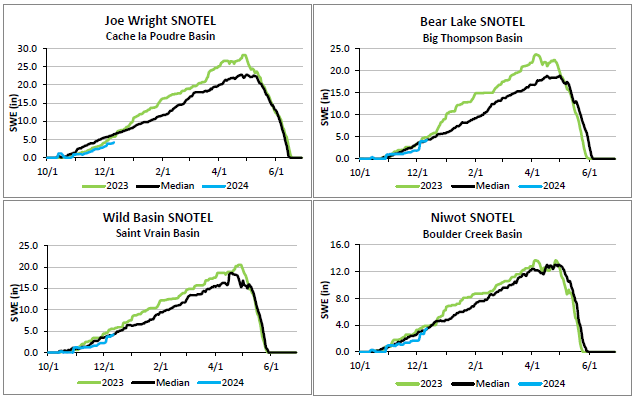
In response to a flash drought that has developed throughout the northern Front Range, the Board of Directors of the Northern Colorado Water Conservancy District has increased the quota allocation of the Colorado-Big Thompson Project by 10 percentage points.
In a unanimous vote, the Board on August 14, 2024, increased the quota from 70 percent to 80 percent, meaning an approximate 31,000 acre-feet of water will be made available to allottees of the Project.
According to the U.S. Drought Monitor, a large area of eastern Boulder and Larimer counties have entered severe drought status in July, and an area of drier conditions in the Longmont-Boulder area has worsened into extreme drought conditions, putting at risk the ability of farmers to finish production of their crops for 2024.
Water storage levels in the Project are adequate to meet the additional quota declaration.
Northern Water’s Board typically sets an initial quota in November and a supplemental quota in April, but there have been occasions in which additional quota has been allocated, including in 2020 and 2022. In April, the Board set the quota at 70 percent, which allowed project allottees to access seven-tenths of an acre-foot for each allotment contract unit they own.
From satellite view, the land north of the Arkansas River is a seemingly random checkerboard of vital green and desperate brown, quickly fading from a few thriving farm acres to the broad, water-drained desolation of northern Crowley County.
From the cab of Matt Heimerich’s pickup, each alternating square of emerald corn or desiccated knapweed is a decision by a distant big city — to either share Colorado resources responsibly or toss rural Arkansas River counties to the fate of the hot summer winds.
That square was reseeded with native grass after Aurora bought the water in the 1970s, Heimerich says. That plot, Colorado Springs dried up and it’s all weeds. That farm, Aurora wants to dry it up soon, but the water court referee wants a better reseeding plan.
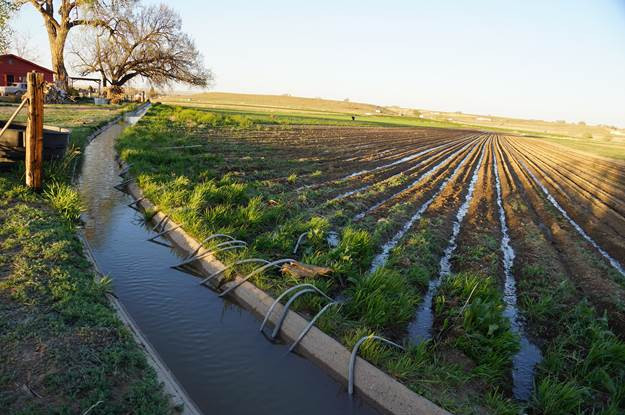
Heimerich’s family is one of the few farmers remaining in the 790 square miles of Crowley County after city water buy-ups shrank the county’s irrigated acres from more than 50,000 in the 1970s to just a few thousand this year. He jumps down from the pickup to clear invasive kochia weeds from a pipe opening gushing cool canal water down a 1,500-foot corn row.
Straight line diagram of the Lower Arkansas Valley ditches via Headwaters Magazine
Two miles away is downtown Olney Springs, population 310. Crowley County as a whole has only 5,600 residents, and more than a third of those are inmates at two prisons. The only retail operation left in Olney Springs is a soda vending machine against the wall of town hall.
As Heimerich clears his irrigation pipe, he pauses to jab a thumb over his shoulder 150 miles to the north at Aurora, where the population increased by more than 100,000 over 20 years. “When you build a new development, at the end of the day, you’re drying up a farm,” Heimerich said. “Where else is it going to come from?”
“Crowley is just the worst example of what can happen when nobody cares, and nobody pays attention,” he said. The tiny community serves as an enduring reminder of the cultural and economic ruin that occurs when big cities in Colorado and elsewhere purchase farms, dry up the land and move the water to urban areas. It gave rise to the term “buy and dry,” a practice now widely condemned.
The practice was supposed to end in the Lower Arkansas Valley in 2003 with a hard-fought federal court battle and settlement. Since then, state lawmakers and top water and farm agencies have changed laws and spent millions of dollars testing new protective methods for sharing water temporarily between rural and urban areas. They have also spent heavily to improve water quality for thousands of people living near the river who still don’t have clean water to drink.
The big cities insist they have learned their lessons from the Crowley County disaster.
“The results of what happened in Crowley County are unacceptable and widely recognized as a travesty,” said Colorado Springs Utilities spokesperson Jennifer Jordan. “We’ve taken those lessons to heart.”
Arkansas River Basin — Graphic via the Colorado Geological Survey
But outraged Lower Arkansas growers and water districts say new efforts to protect their farm water aren’t working. At the same time, the big cities say new laws making it easier to share farm water don’t provide enough reliable water to grow their communities.
The cities also say big changes in the future water picture, climate-driven reductions in stream flows and threats to their Colorado River supplies leave them little choice but to draw more farm water.
This year they did that, inking deals in the Lower Arkansas worth more than $100 million to buy and lease land and water, raising alarms among local growers and generating big questions about whether the state is doing enough to protect rural farm communities and the water that keeps them going.
Buy and dry light
The cities say a lot has changed in the past 20 years and that these new deals represent innovations in water sharing. But critics in the Lower Arkansas Valley say these same deals signal that no one is doing enough to prevent “buy and dry” or the latest tool in the water acquisition quiver, “lease and dry,” in which water is pulled from farmland periodically.
Aurora, for instance, spent $80 million in April to buy nearly 5,000 acres of farms in Otero County and the more than 6,500 acre-feet of water associated with that land. An acre-foot equals nearly 326,000 gallons of water, enough to irrigate half an acre of corn, or supply at least two urban homes for one year.
Aurora plans to use the water itself in three out of 10 years, leaving it on the farms the rest of the time. Some 4,000 acres of land will be dried up intermittently when Aurora is using the water, according to Karl Nyquist, a developer and grower who negotiated the deal with Aurora and who is operating the farms for Aurora under the lease agreement.
Colorado Springs has a different arrangement just downriver in Bent County, where it will permanently purchase up to 15,000 acre-feet of water from local farmers. Colorado Springs will also help pay local farmers to install modern center pivot irrigation systems that use less water, allowing the city to keep the saved water for its use.
In Crowley County. Photo: Brent Gardner-Smith/Aspen Journalism
In this deal, Colorado Springs and the farmers will be responsible for revegetating any dried-up land. It will use the water in five out of 10 years, and it has agreed to make a one-time, upfront payment of $2.5 million to Bent County plus payments each year based on how much water is taken off the fields. The money is in addition to payments to farmers.
“We wanted to make sure Bent County was kept whole,” said Scott Lorenz, a senior water projects manager with Colorado Springs Utilities.
Bessemer Ditch circa 1890 via WaterArchives.org
And in Pueblo County, perhaps the least controversial of the three deals, Pueblo Water agreed to purchase nearly one-third of the shares in the local historic Bessemer Ditch system for $56.2 million. Pueblo continues to lease the water back to the farmers for now. At the same time, the Palmer Land Conservancy has developed a sophisticated new framework that measures farm productivity on land watered by the Bessemer Ditch and will eventually help direct water to the most productive farms as Pueblo takes its water. The hope is that the new system will increase overall farm productivity on the ditch system and help make up for anything lost when the less productive lands are dried up, according to Dillon O’Hare, Palmer’s senior conservation manager.
Palmer is also working to analyze the impact of the deals on water quality downstream and how to prevent further damage, O’Hare said.
Irrigated farmland is evaporating
The three projects come as new data shows Colorado’s irrigated farmlands are shrinking. Since 1997, the state has lost 32% of these lands, with areas in the Lower Arkansas Valley seeing losses higher than that, according to an analysis of federal agricultural data by Fresh Water News.
Crowley County has lost 90% of its irrigated lands in that period. Pueblo has lost 60.2%, and Bent and Otero have lost 37.6% and 35.2%, respectively.
State agriculture and water officials are worried about the decline, but say they have few tools to prevent it because farmers are free to sell their water rights to whomever they want.
“Am I concerned? Definitely,” said Robert Sakata, a long-time vegetable grower near Brighton, and former member of the Colorado Water Conservation Board who now serves as the director of water policy for the Colorado Department of Agriculture. “We all talk about water being a limited resource, but prime farmland is also limited and it’s important to take that into consideration.”
Not all these losses are due to big city water prospecting. Climate change, market challenges and legal obligations to deliver water to downstream states are also fallowing Colorado farmlands.
Everyone is sympathetic. No one is in charge.
Still, more than 20 years after the intergovernmental peace accords, it wasn’t supposed to be this way.
The Lower Arkansas Valley region is part of the sprawling Arkansas River Basin. The river has its headwaters near Leadville and flows through Buena Vista, Salida, Cañon City, into Pueblo Reservoir and on over the state line east of Lamar.
Its counties were once a sweet spot in the basin’s agriculture economy. The river fed a bountiful chain of tomato, sugar beet and onion fields, as well as acres of luscious Rocky Ford melons, and chiles, corn and alfalfa.
Cities say these latest deals, which they call “water sharing” agreements, will bolster the agricultural economies and keep remaining water on farm fields forever. But the term “sharing” doesn’t sit well with some local farmers and water officials who have a deep distrust of the cities they blame for the region’s decline.
“I call it a charade,” said Mike Bartolo, a retired Colorado State University Extension research scientist who farms in Otero County near Rocky Ford. “You dry up an acre, you’re drying up land that was formerly irrigated. That’s buy and dry.”
While the state’s highly touted Water Plan cheers for the concept of cities helping rural areas thrive after water losses, there is no mechanism or state law or bureaucracy to watchdog new sales.
After the 2003 agreement in the Lower Arkansas Valley, state and local water leaders began testing new ways for cities and farmers to temporarily share water, something that had been almost impossible under older water law.
But Aurora and Colorado Springs say the early experimental programs didn’t provide enough water at reasonable prices to fulfill their fast-growing community needs permanently.
Lorenz, the Colorado Springs Utilities manager, said the city does lease some water in the valley, but it hasn’t been enough to ensure the stability of its long-term water supply.
“The major concern is that we would lease from a particular farmer, and then a different city would come out and buy those water rights and the farmer wouldn’t lease to us anymore,” he said.
And in fact that is what just happened in April, when Aurora purchased the Otero County farms, which had formerly leased water to Colorado Springs.
Colorado Springs Utilities formally opposes the latest Aurora water deal, as do the Southeastern Colorado Water Conservancy District based in Pueblo, and the Lower Arkansas Valley Water Conservancy District in Rocky Ford.
But their anger has so far been expressed by passing resolutions, not filing lawsuits.
How Aurora Water and other cities have treated Arkansas River counties like Crowley after past buy-ups leaves nothing but suspicion about newly announced deals, local leaders say.
Though Aurora says it is not attempting any more permanent dry-ups of local land, “I don’t think any of us believe them,” said Heimerich, Crowley County’s representative on the Southeastern Conservancy board. Heimerich also is a member of the board of Water Education Colorado, which is a sponsor of Fresh Water News. “They’ll do whatever they need to do and apologize later.”
Thornton, Larimer and Weld counties conducted a similar debate publicly — from the 1990s to this year — as Thornton bought up 17,000 acres of northern Colorado farms and their water rights and began drying up the land. County commissioners and other local officials brought their legal weight and bully pulpits to bear in demanding extensive concessions from Thornton. The Adams County city has been reseeding dried up land with native grass and backfilling lost property taxes, but gets mixed reviews from locals.
The latest Lower Arkansas water deals are also pitting Colorado’s big cities directly against each other in conflicts not seen for decades. When the board of Colorado Springs Utilities passed a resolution earlier this year condemning Aurora’s Otero County deal, it was a direct shot from leadership of a city of nearly 500,000 — the Colorado Springs City Council is the utility board.
“The idea is that there’s Denver, there’s a Denver metro complex and they’re going to just do whatever they want to do and the rest of the state has to go along with it,” City Councilman Brian Risley said.
But Alex Davis, a top Aurora Water official, said Colorado Springs’ ire is unwarranted.
“Aurora has worked in close partnership with Colorado Springs for decades and that will continue,” she said. “This is a case where we disagree.”
Peter Nichols, general counsel for the Lower Arkansas Water Conservancy District in La Junta, said he is deeply concerned by what cities are proposing now.
“We thought we were through with all of this. We thought we had it under control,” he said of the Aurora and Colorado Springs purchases.
Nichols is among those who have spent much of the past 20 years creating a system, now known as the super ditch, that allows seven local irrigation companies to negotiate leases with cities.
A map of the Fry-Ark system. Aspen, and Hunter Creek, are shown in the lower left. Fryingpan-Arkansas Project western and upper eastern slope facilities.
Importantly, it also won the legal right to move leased water stored in Pueblo Reservoir out of the valley, via the federal Fryingpan-Arkansas Project and the Otero Pipeline, removing what had been a key barrier to leasing.
Nichols said local growers and water districts have worked hard to find ways to share water so that it doesn’t permanently leave the valley. That the cities are now jumping the line with these new deals isn’t OK with him.
A farmer’s — and a county’s — greatest asset
Colorado Springs and the other thirsty Front Range cities want farmers like the young Caleb Wertz to be the new face of urban water agreements. On a recent 95-degree summer afternoon, Wertz high-tailed it across Bent County driving an ambulance to take an injured neighbor to the hospital. He had planned to be on his farm, but that’s life in the Lower Arkansas Valley.
The population is shrinking, and everyone has too many jobs to count. The local farmer is also a first responder. Your primary care provider is a farmer’s wife.
Arriving back at the farm just after 5 p.m., Wertz talks about what is perhaps the most controversial decision he has ever made: Selling a portion of his agricultural water to fuel housing growth in Colorado Springs.
The deal will pay him enough so that he can install modern irrigation systems, drying up portions of the fields, known as corners, that won’t be reached by the new, center pivot sprinklers, and allow Colorado Springs to buy the saved water.
He is also planting cotton alongside his traditional corn, and he believes he is the first in the state to do so. A new modern variety is supposed to use half the water, just one acre-foot per acre, rather than the two acre-feet of water that older types, such as those grown in Arizona, use.
For Wertz, the agreement will give him enough money to keep farming and enough new technology to make his remaining agricultural water go farther. He will become a rarity in the area: A young farmer with enough land and water to continue the business his family started in 1919 and to expand it.
“The water purchase makes it a lot more doable because we can farm those acres so much more with pivots,” Wertz said. “That’s the case even though we’re drying up the corners. … That has a bad connotation to it. But Colorado Springs is reimbursing the farmers to turn those corners into pasture land or to revegetate. … Even if it is not producing corn, it’s not just becoming wasteland.”
But to some of his neighbors in the valley, Wertz has entered a hostile no-man’s land, facilitating yet another dry-up of farmland in a region that has already lost too much water and land to urban thirst.
“I know people don’t like it and people are entitled to their opinions, but a lot of those are the older generation who don’t like seeing it because of what happened years before I was even born,” said Wertz, who is 23. “I was glad to see the Springs come in and ask questions about working with us.
“We were quite leery at first. But they have proved it to us. It is extending the water use for them and us, and allowing my brother and I to start taking over some of these acres that haven’t been farmed for a while because there isn’t enough manpower.”
But can the land come back after fallowing?
Another worry for Lower Arkansas growers is whether new methods that allow cities to take the water off the fields for one or more years and then return it at a later time, do more harm than good. They’re not sure farmland in the region is resilient enough to bounce back from cycles of city-caused drought.
Perry Cabot, a research scientist and specialist in farming practices and farm economies, has spent years studying the issue. He says that there is hope for fallowing, after years of experiments and tests, but only with crops such as alfalfa and other grasses and sometimes corn.
“The programs we have done saw alfalfa return almost with a vengeance,” Cabot said. “Grass hay is the second-best candidate.”
Nyquist, the developer and grower who is leasing back and farming the land he recently sold to Aurora, agreed, saying fallowing programs do work, but they are not good for small growers who don’t have the cash to buy the necessary new equipment and nutrients that are needed to help fully restore the crops once water returns.
Still, Jack Goble, general manager of the Lower Arkansas Valley Water Conservancy District in Rocky Ford is wary of plans that take water from parts of farm fields over long periods of time.
“And I haven’t found a farmer yet that believes that that’s a viable farming situation, ” he said. “It’s tough to bring that land back.”
Dan Hobbs irrigating from the Bessemer Ditch. Credit: Greg Hobbs
For years, valley water hasn’t been drinkable
Anger aimed west and north from Lower Arkansas Valley towns extends to water quality issues, not just water volume.
For many decades, groundwater wells and the river have been contaminated by farm runoff, mining operations and some naturally occurring pollutants.
The same federal Fryingpan-Arkansas Project that in 1962 created Pueblo Reservoir was also supposed to solve the drinking water problem for 40 communities downriver by building the 130-mile Arkansas Valley Conduit to move clean water from Pueblo Reservoir. But it wasn’t until 2023 that final funding for the $610 million pipeline arrived.
Some downstream leaders are galled that Aurora can start taking more fresh water out of the Arkansas before serious pipeline construction has begun to serve the 50,000 people in long-suffering downstream towns.
“My whole life has been under drinking water restrictions, not being able to attain safe drinking water except to go buy it or to go through extraordinary measures to treat it,” said Dallas May, whose family ranches 15,000 acres north of Lamar. May also is on the Southeastern Colorado Water Conservancy District board.
The Colorado Department of Public Health and Environment’s Water Quality Division, which tests Lower Arkansas water a few times a year, classifies most of the river below Pueblo Reservoir as not supporting drinking water or “aquatic life use.” The classification calls the Lower Arkansas suitable for “warm-water aquatic life” and recreation.
The state did not respond to requests for more detailed assessments of Lower Arkansas water health. Asked if state efforts were improving water quality on the Arkansas, a spokesperson said in an email, “Trend studies require extensive data over a significant period of time. The water quality in watersheds is influenced by a wide variety of factors, including precipitation and weather trends that can highly influence the water quality from year to year.”
Some Lower Arkansas farmers and officials are tired of waiting. They see the problem getting worse as, for instance, Aurora takes more water out of Otero County, “What happens is all of the bad things are concentrated into what is left,” May said, “and that is a huge problem.”
Silence at the state level?
The Colorado Water Conservation Board spent years writing the statewide Water Plan, convening forums and task forces, and conducting listening sessions on the tensions between city water needs and the survival of agricultural communities. They say they are concerned about new city water buys, but add they have no authority to influence any deals because water rights are private property rights and can be bought and sold at will.
The board declined an interview request about Aurora’s water purchase or the broader water use questions.
“The Colorado Water Plan sets a vision for meeting the state’s future water needs and was broadly supported by local communities,” Russ Sands, the board’s water supply planning chief, said in email responses to questions. “But the decisions that happen in local communities regarding their water purchases and planning are largely outside of the state’s control. Accountability for staying true to the vision of the Water Plan is a collective responsibility.”
The loss of irrigated farmland isn’t expected to slow anytime soon as climate change dries up streams and population growth drives cities to buy more. The Colorado Water Plan’s forecast shows the population of the Arkansas River Basin, which includes Colorado Springs and Pueblo, surging more than 60% by 2050, increasing the pressure to tap farm water.
Sakata, the state water policy advisor, who farms near Brighton, said protecting the state’s irrigated farmland will take more work. “We can’t just say lease the water for three out of 10 years. We need to have agreements so that water sharing will be really available.”
As an onion grower, Sakata can’t do interruptible water supply agreements because he has long-standing yearly agreements with suppliers that require him to deliver vegetables. If he fallows his land for a year, the money he would likely be paid wouldn’t be enough to compensate him for the loss of onion sales and the need to support his employees during the break.
Farm research scientist Cabot would like to see the state begin buying irrigated farms, using conservation easements to protect them from development or purchase, and then leasing that land and its water to young growers.
What else state leaders can do to preserve what’s left of Colorado’s irrigated land isn’t clear yet, but Alan Ward, a Pueblo native who is also director of water resources for the Pueblo Water, said the state needs to reexamine its policies and goals.
“There is only so much water available, and I don’t think it’s realistic for the state to continue to think that we can control our urban areas and grow them fast without impacting agriculture.” Clarifying that he was speaking as a private individual, rather than a water official, he said, “I’d rather have the farms continue and not have the urban growth, but I am probably in the minority on that.”
Where does the battle flow next?
Water veterans such as Cabot said the state is likely doing everything it can right now to protect irrigated ag lands. But like Sakata, he says more work needs to be done to shore up farm markets and to create easier, more lucrative water sharing arrangements.
“I don’t want to oversimplify this,” Cabot said, “but the simplest way for cities to get this water is to go to farmers and say ‘How much did you make last year?’ and then offer them 10% more. … These are not just fields. They are farm enterprises.”
Kate Greenberg, Colorado’s agriculture commissioner, is overseeing multimillion-dollar efforts to protect farmlands by improving soil health, solving market challenges and making farm water use more efficient. She says the people of Colorado are on board with her agency’s efforts.
“We did a study last year that showed over 98% of Coloradans believe agriculture is an integral part of our state. If we’re taking water out of agriculture, where are we putting it to beneficial use?
“Are we conserving it to grow urban developments and do we want to see that over preserving agriculture and biodiversity. We need to answer that question as a state.”
Bartolo, the retired CSU researcher, hopes the answer comes soon, before any more of the valley water is siphoned off for urban use.
As news of the deals spreads, Bartolo’s sense of deja vu is growing and his fears for the future of the valley’s irrigated ag lands is growing too. No one knows yet what will happen when Aurora’s contract to use the Fryingpan-Ark to deliver water expires in 2047.
“Having lived through it in my lifetime, I have seen the drastic changes,” Bartolo said.
What worries him, and other growers too, is “what happens if they come back after 2047? What happens then?”
In certain parts of the city, Denver residents face temperatures up to twelve degrees higher than they should be, according to the Urban Heat Island index released this month. The index from Climate Central estimates how much additional heat different areas experience based on their built environments. On average, Denver is 7.84 Fahrenheit degrees hotter than air temperatures just outside of the city, according to the index, with the temperature boosts ranging from as high as 12.5 degrees to as low as 4.9 degrees per census block group — more than a seven-degree difference. By neighborhood, the averages range from 10.95 to 5.50 degrees hotter. The index analyzes 65 major cities across the country, with Denver ranking 48th for overall average temperature increase. However, the Mile High City jumps to 17th place for most residents living in areas that are at least nine degrees warmer. Over 49,000 Denver residents live in such areas, according to the index…
All five of Denver’s hottest neighborhoods are located downtown and border one another. The top three coolest neighborhoods are all on the far northeastern edge of the city, nearing Aurora and Commerce City. The only centrally located neighborhood to crack the top-coolest list houses the 160-acre Washington Park. The Urban Heat Island index estimates that Denver’s temperature increases by census block groups. Westword combined the data for each of the city’s 78 neighborhoods, averaging the temperatures of the census block groups as they fall within neighborhood boundaries. Here are the top five hottest and coolest neighborhoods in Denver, so you know where to seek relief during the next heat wave:
Hottest Neighborhoods
5. Civic Center 9.13 degrees hotter Bounded by West Colfax Avenue to the north, Broadway to the east, and Speer Boulevard to the southwest. Includes the Denver Art Museum and part of Civic Center Park featuring the City and County Building.
4. North Capitol Hill 9.66 degrees hotter Bounded by East 20th Avenue to the north, Park Avenue and North Downing Street to the east, East Colfax Avenue to the south, and Broadway to the west. Includes the Fillmore Auditorium and the Cathedral Basilica of the Immaculate Conception.
3. Auraria 9.70 degrees hotter Bounded by Cherry Creek to the northeast, West Colfax Avenue to the south, and the South Platte River to the northwest. Includes the Auraria campus, housing the University of Colorado Denver, Community College of Denver and Metropolitan State University.
2. Central Business District 10.85 degrees hotter Bounded by 20th Street to the northeast, Broadway to the east, West Colfax Avenue to the south, Cherry Creek to the west, and Lawrence Street to the northwest. Includes the Colorado Convention Center and part of the 16th Street Mall.
1. Union Station 10.95 degrees hotter Bounded by 20th Street to the northeast, Lawrence Street to the southeast, Cherry Creek to the southwest, and the South Platte River to the northwest. Includes Union Station, Commons Park and part of the 16th Street Mall.
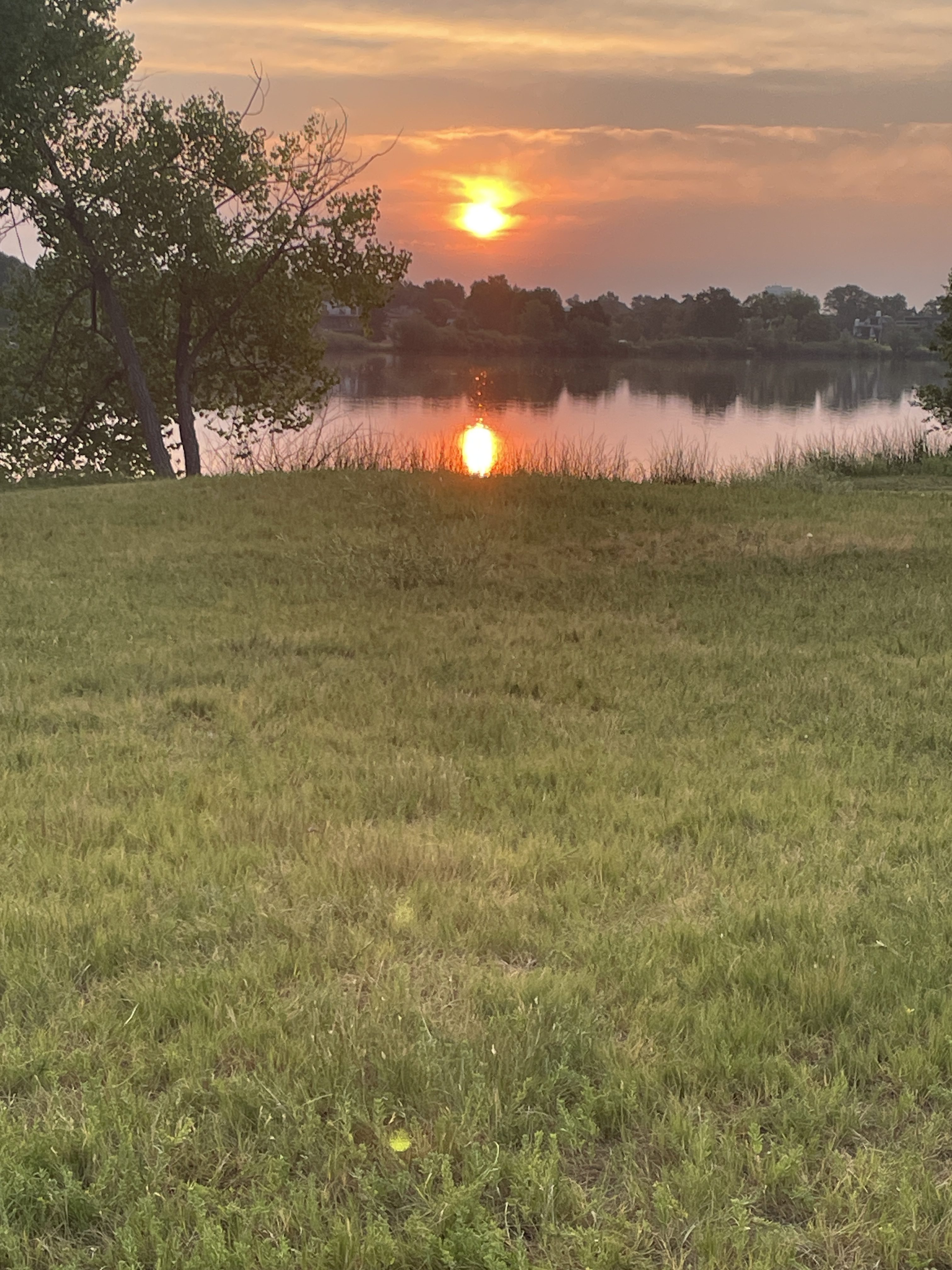
Sunrise over Sloan’s Lake in Denver July 27, 2024. Wildfire smoke creating the colors.
Denver Water on Tuesday celebrated the completion of its new treatment plant, the Northwater Treatment Plant, after nearly a decade of planning, design and construction.
The plant, built along Highway 93 north of Golden, can clean up to 75 million gallons of water per day and was designed to be expanded if needed. Over time, the new plant will replace the utility’s Moffat Treatment Plant, which was built in Lakewood in the 1930s.
“It was time to build a plant that could replace one of our older plants,” said Nicole Poncelet-Johnson, the head of the water quality and treatment group at Denver Water.
“This new plant will help us better meet the needs of a changing regulatory environment, the impacts of climate change and the need to be more sustainable in our operations,” she said.
The Northwater Treatment Plant began operations earlier this year and was completed under budget.
Denver Water also operates the Foothills Treatment Plant, located near Roxborough and completed in 1983. It’s Marston Treatment Plant, located in southwest Denver, started operations in 1924. Both plants have been updated over their decades of operation.
The Northwater plant incorporates new technology and lessons learned from other treatment plants. Its design also allows for upgrades to be added as needed.
“The designers and contractors have worked on other conventional treatment plants along the Front Range, and you can see in this plant that they brought the best designs and ideas here to Northwater,” Poncelet-Johnson said.
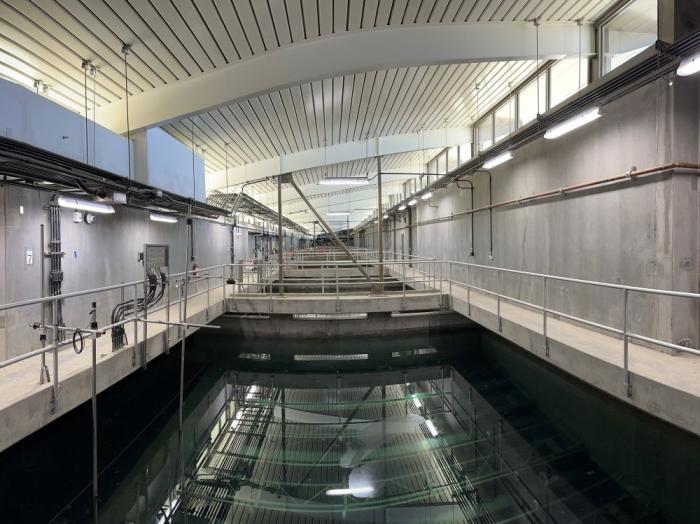
Unique elements at Northwater include deeper filter beds, which are used to filter out dirt particles in water. The deeper filters at the new plant can be operated for longer periods of time between cleanings, making them better suited for treating water affected by various aspects of climate change such as wildfires or floods.
The Northwater Treatment Plant’s filter beds remove dirt particles from the water as it flows through the treatment plant. Photo credit: Denver Water.
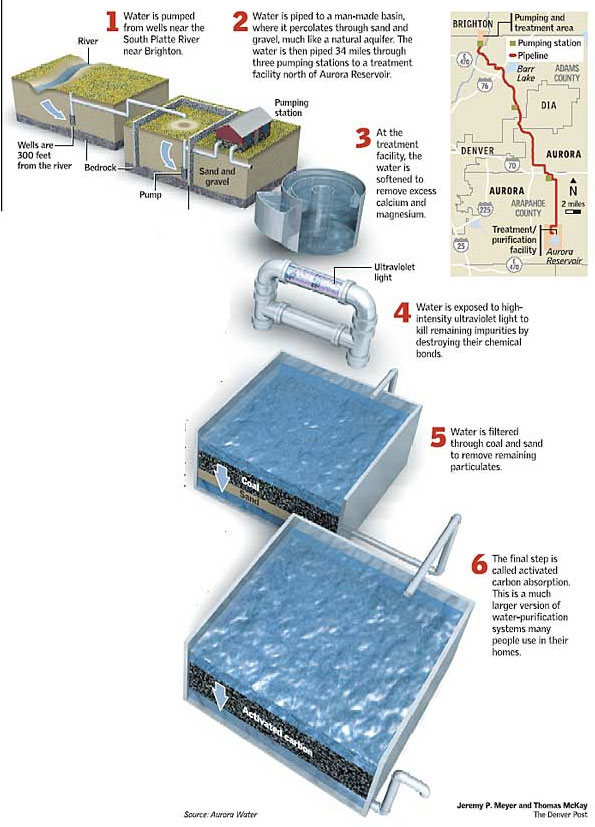
The plant uses ultraviolet technology to help clean the water, technology that reduces the time, space and chemicals needed to disinfect the water for delivery to customers.
And a generator that harnesses power from the water flowing into the plant, when combined with other energy efficiency improvements, is capable of producing more energy than it needs for operations.
“This plant helps us be ready for the next 100 years. It’s a great investment in the future for Denver Water and its customers,” Poncelet-Johnson said.
A look back at building the Northwater Treatment Plant
With the old Moffat Treatment Plant, which started operations in the 1930s, nearing its end life, Denver Water decided to build a new treatment plant along Highway 93 north of Golden, near its Ralston Reservoir.
The project requiredinstalling a new pipeline, more than 5 feet in diameter, to carry water more than 8 miles from the new treatment plant to the site of the old Moffat Treatment Plant in Lakewood. The new pipeline replaced one that dated from the 1930s. The Moffat plant also was modified as it will transition from cleaning water to primarily storing water following the completion of the Northwater plant.
The new plant, pipeline and modifications to the Moffat facility are known as the North System Renewal project.
Installing the new water pipeline required tunneling under two railroad lines and three major highways, including Interstate 70:
Denver Water is building a new $90 million water pipeline in Jefferson County, Colorado. The pipeline replaces two existing pipelines and is needed for Denver Water’s new water treatment plant.
Construction on the Northwater Treatment Plant started in September 2018.
In the spring of 2019, the new plant was the subject of a senior capstone project for graduating civil engineering students at the University of Colorado Boulder. The students, working in teams, presented their designs for the building that houses the filter systems at the plant to Denver Water’s leaders on the project.
How did the CU Boulder students do? Watch here:
For CU Boulder engineering students, their spring 2019 capstone project revolved around Denver Water’s new state-of-the-art water treatment plant.
How construction of Denver Water’s newest treatment plant stayed on schedule in 2020, despite the COVID-19 pandemic.
The summer of 2021 saw the beginning of the massive effort to place the thousands of yards of concrete that would make up two giant concrete water storage tanks, each capable of holding 10 million gallons of clean water. The tanks, now partially buried, are most visible aspects of the plant seen from Highway 93.
Pouring the concrete floor of the first of two 10-million-gallon water storage tanks at the new Northwater Treatment Plant started at 2:30 a.m. on Friday, May 14, 2021, and continued through noon that day. Photo credit: Denver Water.
By the end of 2021, the plant had officially passed the 50% complete milestone for construction while the people working on the project had collectively dedicated 1 million hours to the effort.
The Northwater Treatment Plant received several national awards during its years of construction. Photo credit: Denver Water.
In 2022, the project received an award from the American Water Works Association, the largest organization of water supply professionals in the world. The project was the recipient of the 2022 AWWA Innovation Award, given to utilities that have inspired or implemented an innovative idea, best practice, or solution to address a challenge facing the industry.
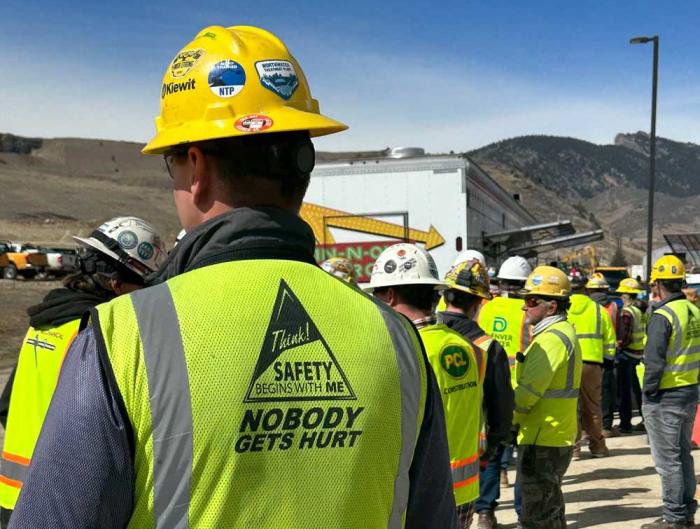
In 2023, construction of the Northwater plant received national recognition from the American Public Works Association for its commitment and accomplishments around safety, including protecting the health of hundreds of workers on the project during the COVID-19 pandemic.
Click the link to read the article on The Denver Post website (Lauren Penington). Here’s an excerpt:
Rocky Mountain Lake — located at 3301 West 46th Avenue in Denver — closed Thursday after recent testing found toxic levels of algae around the shoreline, the Denver Department of Public Health and Environment said in a statement on social media…Recent routine testing at Lake Arbor in Arvada also revealed blue-green algae was approaching toxic levels, forcing the city to close the lake indefinitely Thursday, Arvada officials said in a news release…
The number of algae blooms will increase as Colorado’s climate becomes warmer, according to previous reporting. The blue-green algae found in the lakes are naturally occurring and an important part of the ecosystem, but the blooms can produce toxins if they grow big enough. Harmful algae looks like thick pea soup or spilled paint with a green, red, gold or turquoise color. They also often have foam or scum.
Toxic-algae blooms appeared in Steamboat Lake summer of 2020. The lake shut down for two weeks after harmful levels of a toxin produced by the blue-green algae were found in the water. As climate change continues, toxic blooms and summer shutdowns of lakes are predicted to become more common. Photo credit: Julie Arington/Aspen Journalism
Save The Poudre is suing the city of Thornton and the Larimer County commissioners. The lawsuit, filed in Larimer County District Court, specifically names Commissioners John Kefalas, Jody Shadduck-McNally and Kristin Stephens. It asks the court to find that the board exceeded its jurisdiction and/or abused its discretion in granting permission for a 10-mile water pipeline that would convey Poudre River water to Thornton…
The lawsuit said Save The Poudre was denied due process rights because it and members of the public weren’t allowed to combine public comments into an extended group presentation exceeding three minutes, while the commissioners placed no time limits on Thornton’s presentations, “which lasted hours and allowed for group presentations.” It said the board erred in not requiring Thornton to present an alternative that would use the Poudre River itself to convey the water and not requiring presentations outlining alternative water diversion locations.
The lawsuit also cited several sections of the county’s land use code that it believes Thornton’s application did not meet. Save The Poudre alleges the project:
does not have “benefits, in terms of physical improvements, enhanced services, or environmental impacts, of the proposed project” that “outweigh the losses of any natural resources or reduction of productivity of agricultural lands.”
does not, “to the greatest extent possible,” mitigate impacts to the environment and natural resources.
will “exacerbate or worsen climate change.”
does not “mitigate impacts on rivers, streams and wetlands to the greatest extent possible.”
“will have a significant impact on natural resources of statewide importance.”
does not significantly mitigate and will have significantly adverse impacts on water quality and quantity in the Poudre River.
does not “implement the vision and policies of the Larimer County Comprehensive Plan.”
does not “regulate development in a manner consistent with legitimate environmental concerns.”
does not “reflect principles of resource stewardship and conservation.”
The lawsuit also states the board exceeded its jurisdiction and/or abused its discretion by not requiring “complete co-location of the Northern Integrated Supply Project (NISP) pipeline, a separate project also set to run through Larimer County. And it says the board was wrong in its finding that water diversion and water right are beyond the scope of the 1041 review.
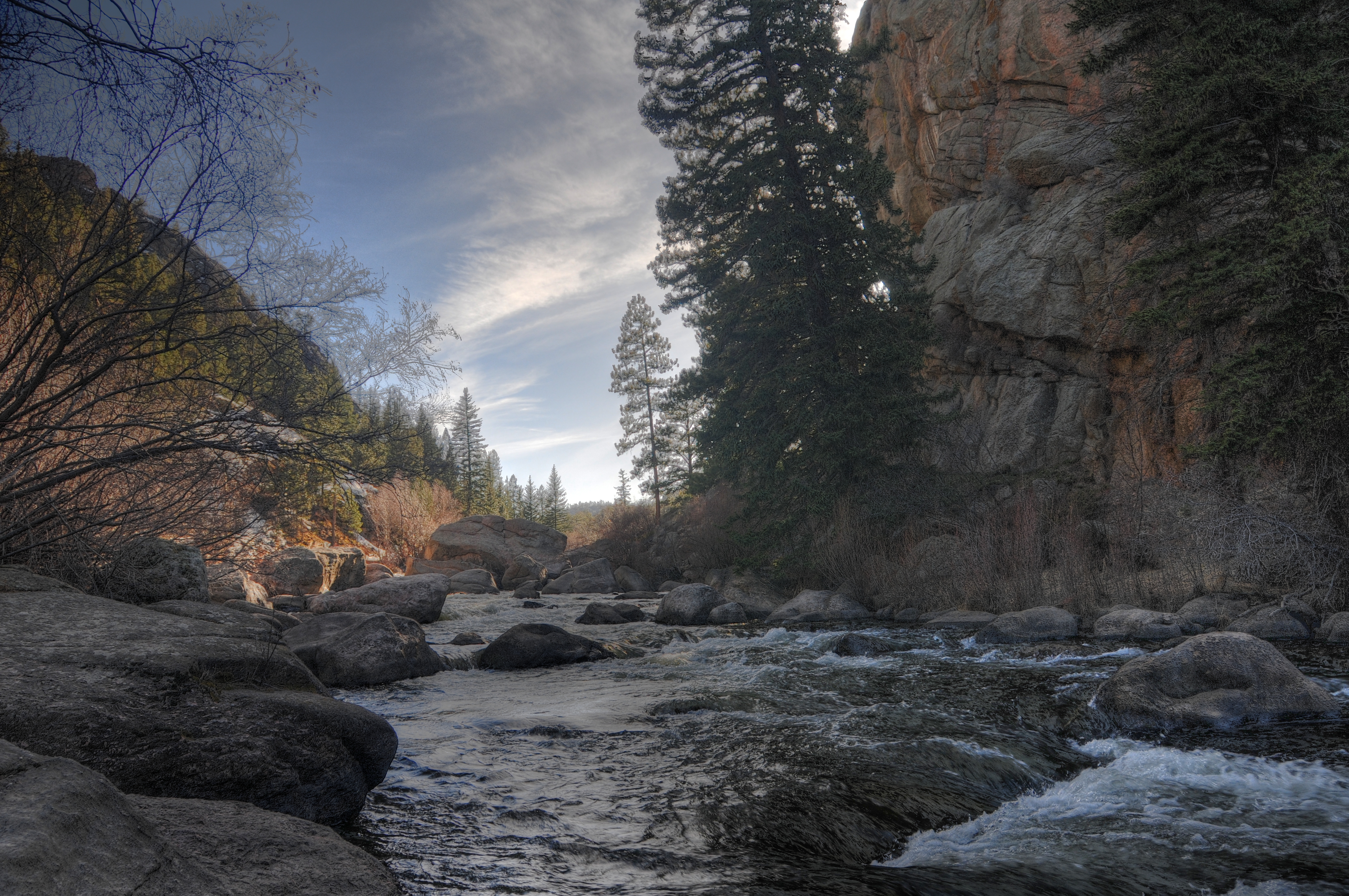
Rainbow and brown trout are free to move as they please through Eleven Mile Canyon once again, following the removal of an unused dam on the stretch of South Platte River near Lake George. The 1952 Colorado Springs Utilities diversion dam was removed last year as part of a $4.8 million project to unite 45 miles of river. The river and its surrounding ecosystems have already seen significant benefits, particularly for fish who make their home in the clear waters of the mountain canyon.
“We have photos of fish attempting to jump the dam when it was in place,” said Charles M. Shobe, a Research Geomorphologist with the Forest Service’s Rocky Mountain Research Station. “Now that they’re able to move upstream, they’re bringing their biomass upstream which provides a better distribution of nutrients throughout the watershed.”
[…]
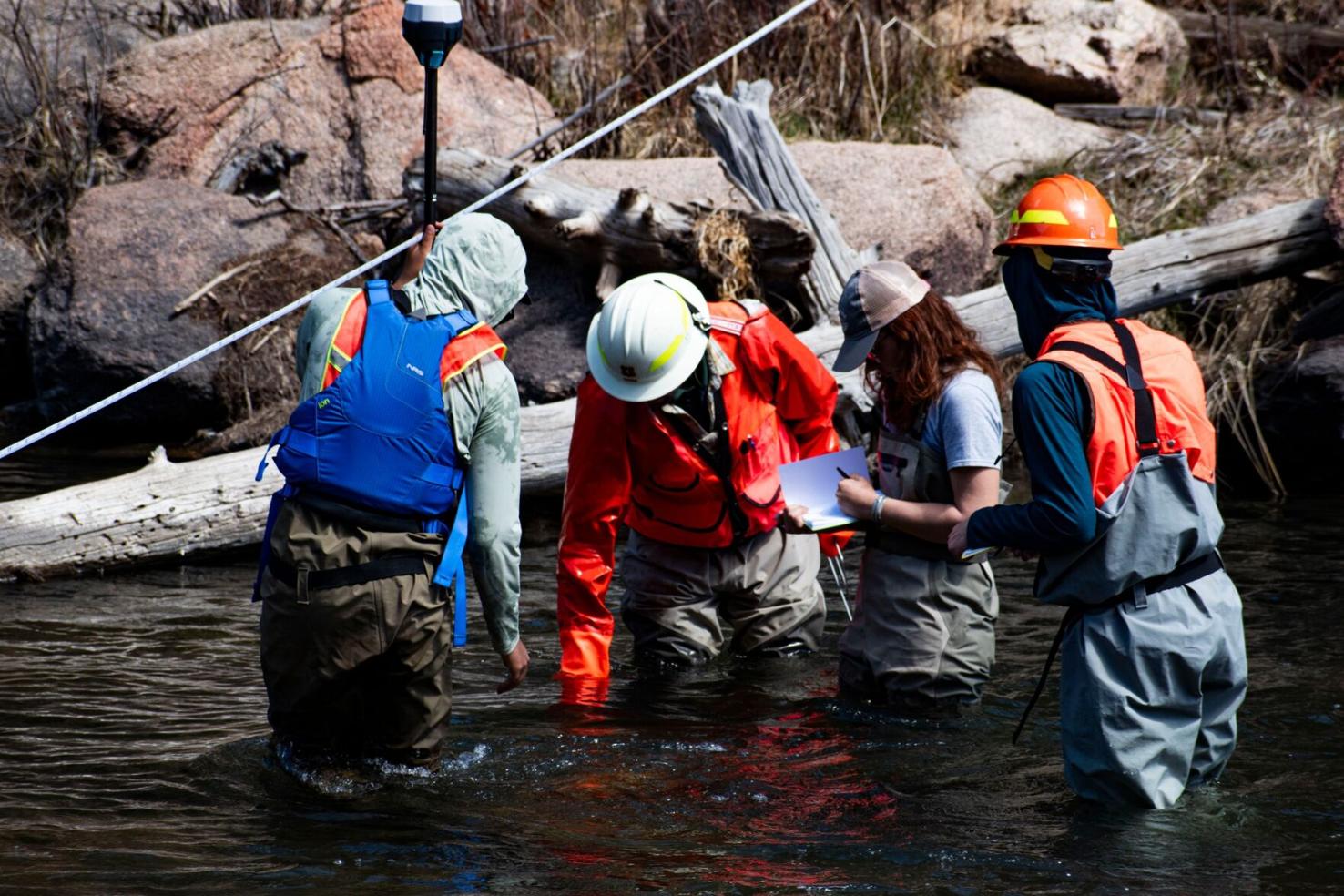
Scientists from the Rocky Mountain Research Station along with members of the South Park Ranger District conducted river sampling on April 25, mapping the bottom of the riverbed to get information on the shape of the river channel, collecting sediment samples to look at the aquatic habitat of the riverbed and bagging insect larvae to get a measure on who’s there. Measuring in April was essential for the team, Shobe explained, as it was after the dam’s disassembly but before the river that was diverted through a spillway while the dam was taken down, filled the canyon once again. Another sampling will be taken likely in June and then annually through 2027…
Returning the stretch of the South Platte to its pre-dam state will likely first improve habitat for the little insects that live in the stream bed, which in term will revitalize the whole system as fish feed on the insects, and bigger animals like eagles feed on the fish. While the research is still in the works, Shobe said they’ve observed anecdotally a change in the former pond area from finer sediment like mud and sand to coarser, larger sediments like gravel which will be a positive change for the aquatic organisms that swim in the stream as they tend to not do as well in a muddier environment. The buildup of sediment is a unique aspect of the Eleven Mile Canyon dam removal project as unlike other dams where removal of the river obstruction has flushed a wave of collected sediment downstream, a lot of the sediment was able to be dug out from behind the dam before removal. For that reason, downstream impacts aren’t expected, and the scope of the ongoing research will only include a couple 200 feet downstream of the former dam.
Because the town argues that Craft was not qualified to serve on the water provider’s board, the complaint says that legally, “a vacancy existed since his appointment in 2022 by the Town.” The Kiowa Board of Trustees — the equivalent of a town council — object to Craft’s activity on the water provider’s board, according to the suit.
“Mr. Craft has publicly stated an intent to unlawfully terminate a separate operating agreement between the Town and KWWA,” the complaint says. “Mr. Craft’s actions create a risk of irreparable harm to the Town of Kiowa and the Board of Trustees, because he is exercising authority and duties to which he has no lawful right.”
According to the complaint, in order to serve on the water provider’s board, a person must meet one of three criteria:
• They are a resident of the town who is registered to vote in Colorado;
• They own “real property” within the town boundaries;
• Or they are the person designated by the owner of real property within the boundaries of the town to be qualified to serve on the board by such owner. (The designation by an owner does not require that the person be appointed to the board.)
Craft’s designation to serve did not meet the third criteria, the complaint argues.
Take an animated tour of the unique construction process.
Raising the height of a dam involves many steps, literally and figuratively.
After two years of excavation and preparation work on the canyon around Gross Dam, workers in May began placing concrete, starting the three-year process of raising the height of the dam itself.
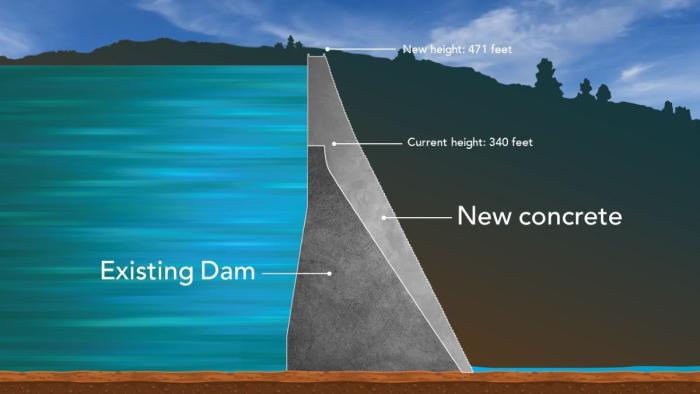
Denver Water is raising the height of Gross Dam by 131 feet as part of the Gross Reservoir Expansion Project. Once complete, the dam will be able to store nearly three times as much water in Gross Reservoir, which will add more resiliency and flexibility to Denver Water’s water storage system.
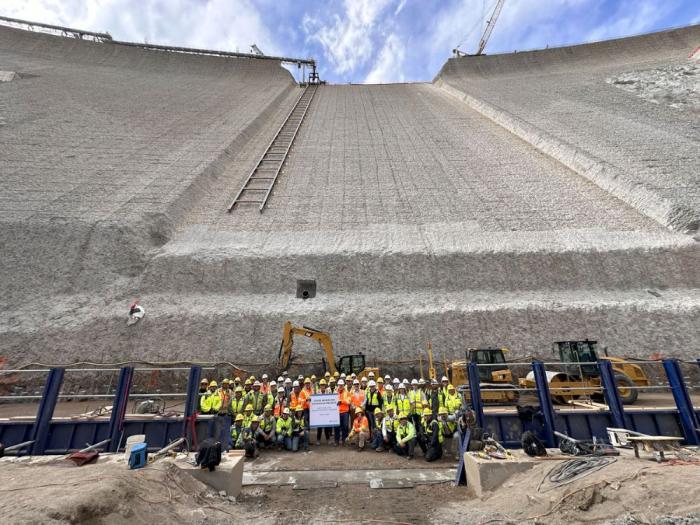
Workers from Denver Water and contractor Kiewit Barnard stand in front of Gross Dam in May to mark the start of the dam raise process. Photo credit: Denver Water.
Raising the dam is being done by building 118 steps made of roller-compacted concrete. Each step will be 4 feet wide with a 2-foot setback. The existing dam is 340 feet tall. The completed dam will be 471 feet tall.
Check out this animated video to see how the process works.
This animation shows how Denver Water plans to raise the height of Gross Dam in Boulder County, Colorado, as part of the Gross Reservoir Expansion Project. #grossreservoir#civilengineering#howtoraiseadam
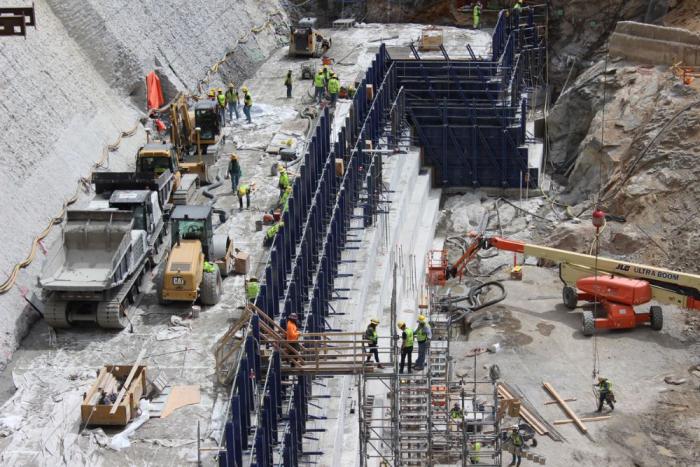
The construction site at the bottom of Gross Dam with equipment used to place concrete and build the new steps. Photo credit: Denver Water.
It will take roughly three years to complete all the steps, with a final completion date set for 2027.
The dam raise process begins at the bottom of the dam using roller-compacted concrete to build the new steps that will go up the face of the dam. Photo credit: Denver Water.
Planning and permitting for the Gross Reservoir Expansion Project began in 2002. Take a look at this video to learn about the process and major accomplishments.
Denver Water is raising the height of Gross Dam in Boulder County, Colorado as part of the Gross Reservoir Expansion Project. This video looks at the history of the project and the work being done to raise the dam.
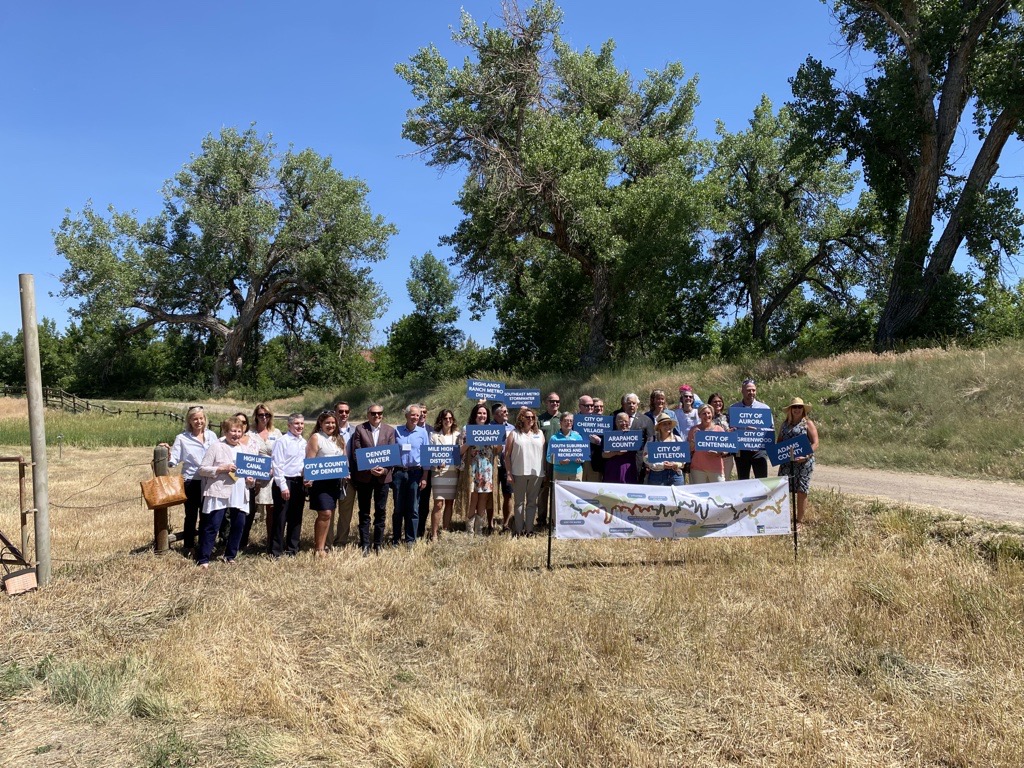
Left to Right: Harriet Crittenden LaMair (High Line Canal Conservancy), Paula Herzmark (High Line Canal Conservancy Board of Directors), Dessa Bokides (High Line Canal Conservancy Board of Directors), Amy Heidema (Denver Water), Mark Bernstein (Denver Parks and Recreation), Diana Romero Campbell (Denver City Council), Tom Roode (Denver Water), Alan Salazar (Denver Water), Jim Lochhead (High Line Canal Conservancy Board of Directors), Steve Coffin (High Line Canal Conservancy Board of Directors), Laura Kroeger (Mile High Flood District), Lora Thomas (Douglas County Commission), Evan Ela (High Line Canal Conservancy Board of Directors), Melissa Reese-Thacker (South Suburban Parks and Recreation), Dan Olsen (Southeast Metro Stormwater Authority), Pam Eller (South Suburban Parks and Recreation Board of Directors), Earl Hoellen (Cherry Hills Village City Council), Jeff Baker (Arapahoe County Commission), Leslie Summey (Arapahoe County Commission), Shannon Carter (Retired – Arapahoe County Open Spaces), Bill Holen (Arapahoe County Commission), Carrie Warren-Gully (Arapahoe County Commission), Gretchen Rydin (Littleton City Council), Gini Pingenot (Arapahoe County Open Spaces), Amy Wiedeman (City of Centennial), Suzanne Moore (City of Greenwood Village), Brian Green (Aurora Parks, Recreation and Open Space), Nicole Ankeney (Aurora Parks, Recreation and Open Space). Credit: High Line Canal Conservancy
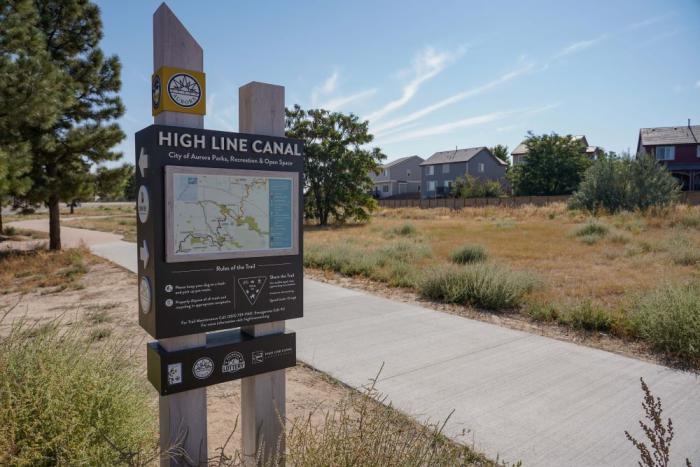
In a groundbreaking move to protect the historic 71-mile High Line Canal, one of the nation’s longest continuous urban trails, Denver Water announces the transfer of 45 miles of the beloved High Line Canal to Arapahoe County, and with it, a conservation easement that permanently protects the Canal as a natural open space for the region. This visionary action marks the end of a century-long stewardship by Denver Water and ushers in a new chapter for the historic water delivery system, now one of the region’s treasured urban trails meandering through 11 governmental jurisdictions.
Effective this month, the High Line Canal Conservancy will hold and manage a conservation easement for this 45-mile stretch, safeguarding it for future generations. This easement will ensure the Canal will forever be maintained as a public linear open space park and trail while protecting the Canal’s unique conservation values, including preserving the natural environmental beauty and public recreational benefits of this cherished greenway and preventing future development, while continuing stormwater management and public utility uses.
The collaborative agreement between Denver Water, Arapahoe County, and the High Line Canal Conservancy marks a significant advancement toward the community vision to honor, enhance and repurpose this landmark of our agricultural heritage, a 71-mile irrigation canal, into one of our region’s premier green spaces connecting neighborhoods, people and nature.
“This historic milestone represents a major step forward in the ongoing transformation of the High Line Canal,” said Tom Roode, Chief Operations and Maintenance Officer at Denver Water. “This very positive evolution of the Canal reflects Denver Water’s mission to advance public health and water conservation while ensuring the Canal is protected for generations to come.”
While Denver Water is transferring ownership of more than half of the Canal to Arapahoe County, the water provider will continue to own nearly 20 miles of the Canal during the transformation process. Maintenance of the corridor is a collaboration between Denver Water, the counties, local jurisdictions and the Conservancy.
“For decades, the High Line Canal has been an important and well used recreational asset for Arapahoe County residents, making this ownership transfer a natural fit for our open spaces, parks and trails portfolio,” said Arapahoe County Commissioner and Board Chair Carrie Warren-Gully. “Our work to preserve natural and legacy spaces will be greatly expanded through the conservation easement, ensuring the greenway remains a treasured asset for generations.”
Trail users will not see a dramatic difference from the ownership change; however, over time care for the natural resources will improve under county ownership. The Canal trail will always remain free to use the Canal for hiking, biking, horseback riding and enjoying the outdoors; and the Conservancy will continue to be a central point of contact for any inquiries.
“Denver Water’s protection of the Canal through a Conservation Easement demonstrates tremendous foresight and partnership. The easement is a lasting gift that will forever improve the quality of life in the Denver region for the hundreds of thousands of people who use the Canal today and for generations to come,” said Harriet Crittenden LaMair, CEO, High Line Canal Conservancy. “All of us at the High Line Canal Conservancy – our board, staff and volunteers – are so honored to accept this responsibility.”
The Conservancy, Denver Water, and Arapahoe County in collaboration with local governments spent years completing a comprehensive plan that recommends investments and management changes to support the long-term transition of the Canal from a water delivery function to a protected, regional open space and trail with multiple environmental and recreational benefits.
“Denverites already know the High Line Canal as one of the best places to run, hike, and bike. The work being done here will ensure future generations know it, as well,” said Mayor Mike Johnston. Jolon Clark, Executive Director of Denver Parks and Recreation also remarked, “With over a million users each year, the High Line Canal is a vital part of our parks and trail system within the City & County of Denver. For decades we have been deeply engaged and have invested in the preservation and enhancement of the High Line Canal. We look forward to fostering our partnerships to ensure that the High Line Canal remains a cherished recreational and natural resource for Denver residents.”
The long-term protection of the Canal will require ongoing public and private funding. The High Line Canal Conservancy is working toward that as they near the close of a transformational $33 million campaign, Great Lengths for the High Line, that is leveraging public funding for a total investment of $100 million in the Canal over 5 years.
“We are thrilled with the incredible support the Great Lengths campaign has received from across the region, including a generous $10 million investment from Denver Water and $7 million from Great Outdoors Colorado,” said Paula Herzmark, Board Chair of the High Line Canal Conservancy. “With the new ownership and conservation easement in place, Arapahoe County, the High Line Canal Conservancy, and Denver Water have collectively secured the Canal’s future. This ensures that it will be here as an essential natural open space, free and accessible to the public forever.”
Great Outdoors Colorado also provided funding to the Conservancy to support the creation of the conservation easement, including a present conditions report and the establishment of an endowment that will support ongoing monitoring and enforcement of the easement.
About Denver Water
Denver Water proudly serves high-quality water and promotes its efficient use to 1.5 million people in the city of Denver and many surrounding suburbs. Established in 1918, the utility is a public agency funded by water rates, new tap fees and the sale of hydropower, not taxes. It is Colorado’s oldest and largest water utility. Subscribe to TAP to hydrate your mind, and follow us on Facebook, Twitter and Instagram.
About Arapahoe County
Arapahoe County provides the best of everything Colorado has to offer. From babies to boomers and beyond, residents put down roots, raise families, start and run businesses, and embrace the endless opportunities and amenities that make the state unique. Arapahoe County spans 805 miles and features vibrant urban, suburban and rural communities, an unparalleled open space and trail system, major employment centers and a robust multimodal transportation network. Learn more at arapahoeco.gov.
About High Line Canal Conservancy
The High Line Canal Conservancy is a tax-exempt nonprofit formed in 2014 by a passionate coalition to provide leadership and harness the region’s commitment to enhancing and permanently protecting the High Line Canal. With support from each jurisdiction and in partnership with Denver Water, the Conservancy is leading a collaborative and region-wide effort to ensure the Canal is protected and enhanced for generations. Visit HighLineCanal.org for more information.
The rolling hills southwest of Denver offer spectacular views of the Pike National Forest, and the land is as rugged as it is beautiful.
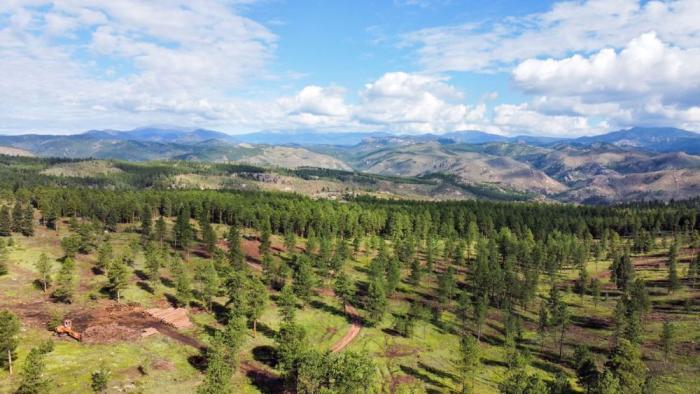
Tucked in among the ponderosa pines, hills and rock formations is Miller Gulch, a popular recreation area for bikers and hikers near Bailey, Colorado. To the casual observer, seeing a forest dense with trees looks healthy, but it’s actually cause for concern.
That’s why in 2022, the U.S. Department of Agriculture’s Forest Service and Denver Water launched a forest health project to thin 1,500 acres of ponderosa pine and Douglas fir trees in the area.
The goal was to help return the forest to its natural structure and composition. The project wrapped up in the spring of 2024.
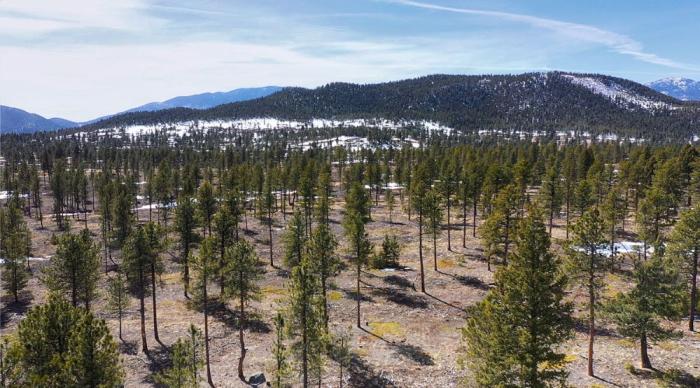
A look at the Miller Gulch area of the Pike National Forest after thinning work was completed. The spacing between the trees leads to a healthier forest that is less prone to large, catastrophic wildfires. Photo credit: Denver Water.
“While small fires are beneficial to the forest, large wildfires can be devastating,” said Ryan Kolling, a Forest Service Supervisory Forester. “Thinning the forest helps reduce the risk of large wildfires and helps the trees become more resilient to disease and insect infestation.”
Improving the health of the forest protects nearby homes and recreation trails from large fires. A healthier forest also offers better protection for an area that supplies water to Denver and several surrounding suburbs.
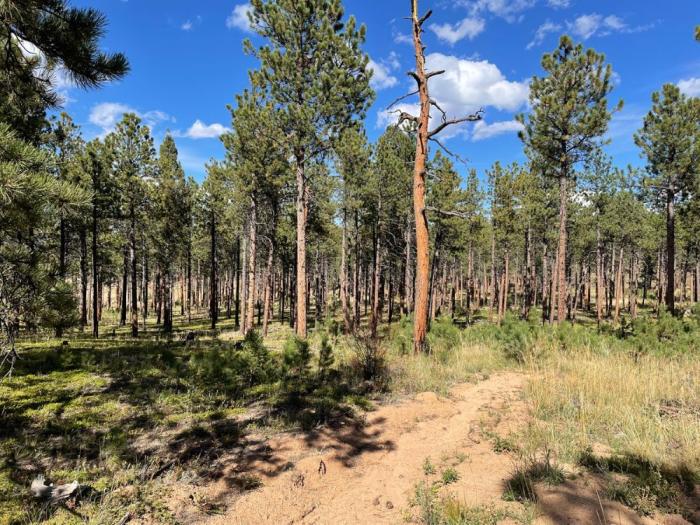
The Miller Gulch area before tree thinning shows the overly dense forest that is susceptible to large wildfires. Photo credit: Denver Water.
“Denver’s source water begins as the snow and rain that travels across the forests west of Denver,” said Madelene McDonald, a watershed scientist at Denver Water.
“As the water flows downhill into rivers and streams, the forest acts as a natural filter for what will eventually become our drinking water. That’s why forest health is critical to Denver Water and our customers.”
Forest treatments
Improving the health of the forest is done through “treatments” that reduce the amount of vegetation, or “fuels,” that could catch fire. Treatments range from using machines to remove trees and thin the forest to using prescribed fires to burn away debris on the forest floor.
Before any treatments began in the Miller Gulch area, the Forest Service conducted an analysis of the area and created a “prescription” that outlined which trees should be removed and which ones would stay. The agency partnered with the nonprofit Stewardship West to streamline the process and complete the work.
The treatment work involved a multistep process to thin the forest.
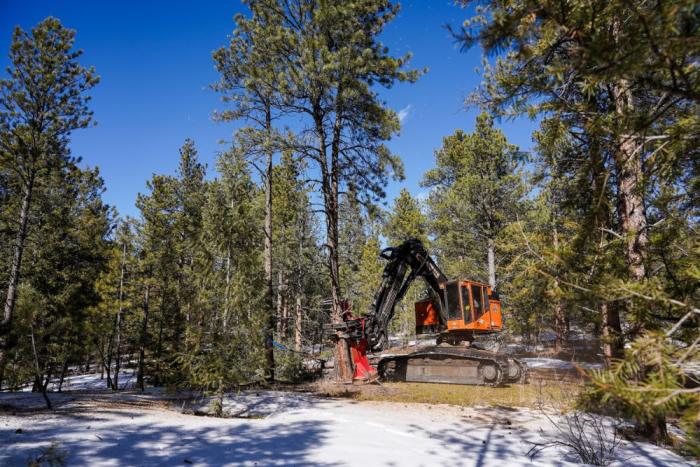
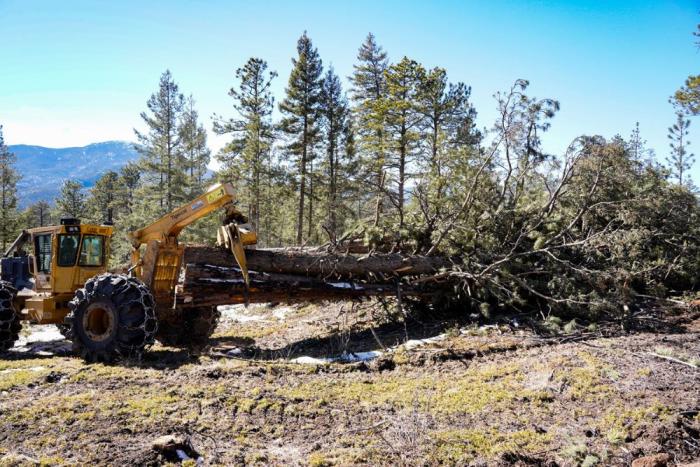
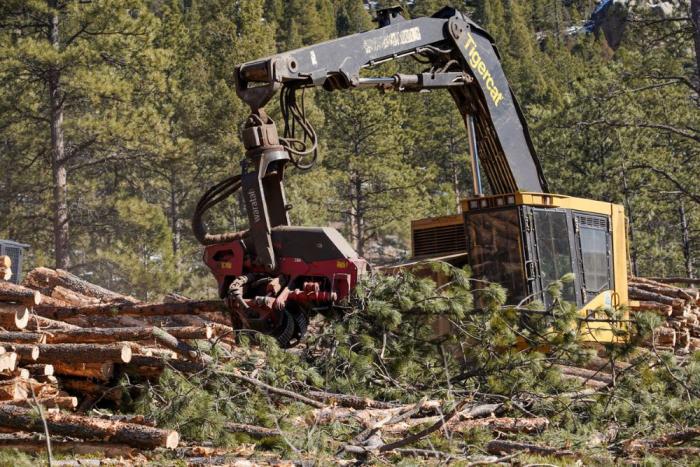
The first step involved removing selected trees with a large feller-buncher cutting machine equipped with two saws and a large “claw.”
After the trees were cut down, a machine called a “skidder” dragged them to a collection area, where another machine called a “dangle-head processor” removed the branches.
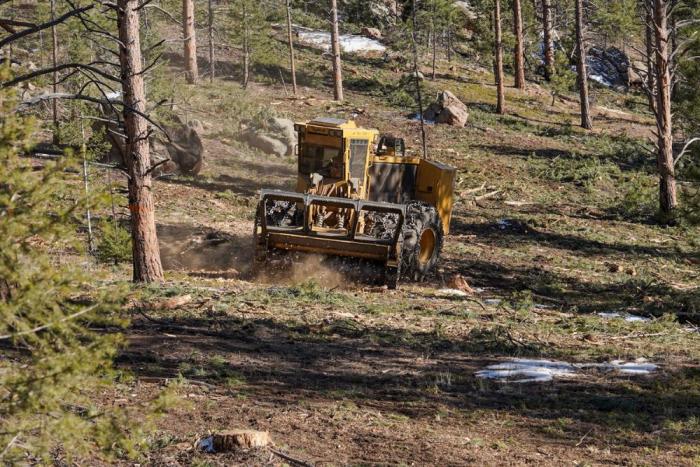
The last step involved a bulldozer-like machine called a “masticator” that works like a lawnmower, chopping up any remaining debris and spreading it across the ground.
A cutting machine, known as a feller-buncher, saws the bottom of a tree, lifts it and sets it aside on the ground for removal. Photo credit: Denver Water.
A “skidder” grabs the downed trees and drags them to a collection area. Photo credit: Denver Water.
A dangle-head processor removes branches from the downed trees and stacks the trees in piles. Photo credit: Denver Water.
A mastication machine drives around the area where trees have been removed like a lawnmower. The machine’s blades chop up debris and spread it across the forest floor. Photo credit: Denver Water.
After the treatment is complete, the forest will have openings and meadows between groups of trees, so if one tree is hit by lightning and catches fire, it will be harder for flames to jump to other trees and spread.
The area in the foreground shows the treated areas of Miller Gulch. There is more space between the trees and the forest is less dense compared to the untreated areas in the background. Photo credit: Stewardship West.
“The forest land recovers quickly after treatments. As an example, in areas around here where we’ve done treatments in the past, there are now grasses, new trees and wildflowers already coming back,” Kolling said.
“Thinning also helps stimulate new growth and gives the forest more diversity in terms of the age of trees as older ones are removed and new ones take root.”
Putting debris to good use
A key part of forest management is to make sure the removed trees are put to beneficial use.
In the Miller Gulch area, the cut trees were separated into large and small piles. The larger trees are taken to sawmills in Colorado where they’re turned into materials such as two-by-four boards and wood pallets.
Some tree piles are left on-site for the public to cut into smaller pieces for use as their own firewood. (A permit is required.)
Large trees on the left are taken to sawmills and turned into various wood products. The smaller branches and trees on the right are turned into firewood and mulch to be sold in the community. Photo credit: Denver Water.
The smaller trees and branches are used for firewood or turned into mulch and sold in the community. Other debris is scattered across the forest in areas where work was done to help the land recover.
“We’ve worked hard over the years to make sure we’re getting added benefit from our forest treatments, so these projects help the community in many ways,” Kolling said.
“The Buffalo Creek, Hayman and Hi Meadow fires were all high-intensity fires that burned on the Pike National Forest, which is in our South Platte watershed,” McDonald said.
“When these types of wildfires occur, the exposed landscape can experience significant erosion that degrades our water quality and fills up our reservoirs with sediment.”
Downed trees and debris from the 1996 Buffalo Creek fire ended up in Strontia Springs Reservoir after a flood hit the burn scar. Denver Water is trying to prevent future disasters from happening by investing in forest health to prevent major wildfires. Photo credit: Denver Water.
Denver Water has prioritized treatment in the Miller Gulch area because of its proximity to the North Fork of the South Platte River, which flows into Strontia Springs Reservoir. The reservoir is where 80% of the utility’s water passes through before heading to water treatment facilities.
“It’s very important to reduce the wildfire risk above Strontia Springs,” McDonald said.
“We’ve seen several big fires here in the past three decades that have caused significant problems to our water treatment operations and water delivery infrastructure.”
Federal help
The Pike National Forest is located in the Colorado Front Range Landscape, an area of 3.6 million acres recently identified in the Forest Service’s Wildfire Crisis Strategy as one of 21 landscapes at high risk for large wildfires. This is due to the area’s fire history, current vegetation conditions, number of homes and importance to the water supply for people across metro Denver.
The Wildfire Crisis Strategy is a 10-year plan developed by the Forest Service to dramatically increase the pace, scale and scope of forest health treatments across the Western U.S. The plan addresses wildfire risks to critical infrastructure, protecting communities and making forests more resilient.
The original From Forests to Faucets plan for Miller Gulch called for treating 419 acres. However, since the project was already in progress, it was selected for additional federal funding in 2022 and received $3.3 million from the Bipartisan Infrastructure Law and the Inflation Reduction Act. This additional funding allowed for the treatment of an additional 1,102 acres.
A section of Miller Gulch in 2023 shows how quickly the land recovers after treatment as grasses and wildflowers grow back. Photo credit: Denver Water.
“For years, Denver Water and the Forest Service have leveraged resources through the From Forests to Faucets partnership. And with support from the Wildfire Crisis Strategy, we are able to continue this proven approach and essentially triple the number of acres treated in Miller Gulch,” McDonald said.
“All of the work expands our efforts to reduce the wildfire risk in the area and helps protect our water supplies.”
Connecting landscapes
The Miller Gulch project is one of many forest health efforts that in recent years have been done in the Upper South Platte River Basin on the Pike National Forest. May of those projects are in the area of Bailey, Buffalo Creek and the Colorado Trail.
A prescribed fire along the Colorado Trail near Buffalo Creek in June 2023 is an example of other fuel reduction treatments in the Pike National Forest. Photo credit: Andrew Slack, Colorado Forest Restoration Institute.
“The goal is to connect the dots of forest treatments across the landscape,” Kolling said.
“We try to combine our treatment efforts with our partners and work with natural features like roads and rivers. This creates fuel breaks which will help us bring large-scale fires down to fighting size if one breaks out.”
Stewardship Agreements and partnerships
The Miller Gulch project is a prime example of what partnerships can accomplish by using Stewardship Agreements.
In 1999, Congress created the Stewardship Agreement tool, which gave the Forest Service the authority to work with partners collaboratively across shared landscapes. The goal is to accomplish impactful work and achieve mutually beneficial goals for the national forests.
For Miller Gulch, the Forest Service partnered with Stewardship West to speed up the treatment process and achieve shared forest health goals. Stewardship West is a nonprofit organization that is dedicated to improving forest health across the Western U.S.
“We are a boots-on-the-ground, action-focused organization with a mission of engineering heathy and resilient forests,” said Kevin Zeman, president and CEO of Stewardship West.
“The Forest Service gives us the treatment plan and we do the coordination and implementation to make the project happen. This has allowed us to treat 1,500 acres in just 2.5 years, which is really unheard of in terms of land management.”
Ryan Kolling (right), a Forest Service supervisory forester, meets with Stewardship West’s Jennifer Baker (left) and Kevin Zeman to discuss the forest treatments in Miller Gulch. Photo credit: Denver Water.
As a neighboring water provider with shared wildfire risks, Aurora Water joined forces with Denver Water and the Forest Service in 2022 to help fund the Miller Gulch project. Aurora Water works with Denver Water and also uses Strontia Springs Reservoir to deliver water to its customers.
Denver Water’s collection system spans more than 4,000 square miles of forest land, so working with other agencies is critical, according to McDonald.
“We rely on our regional, state and federal partners to help protect our watersheds,” McDonald said.
“It really is a team effort, and the Miller Gulch project is a great example of how we can ensure a reliable water supply and improve the forest health at the same time.”
The snow that piled up in Denver Water’s collection system brought good numbers and big surprises this spring.
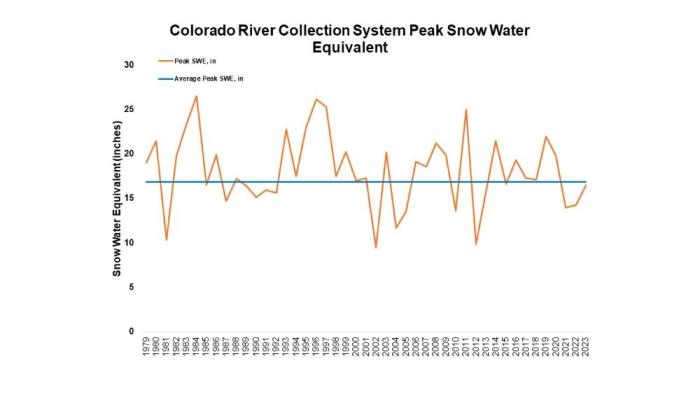
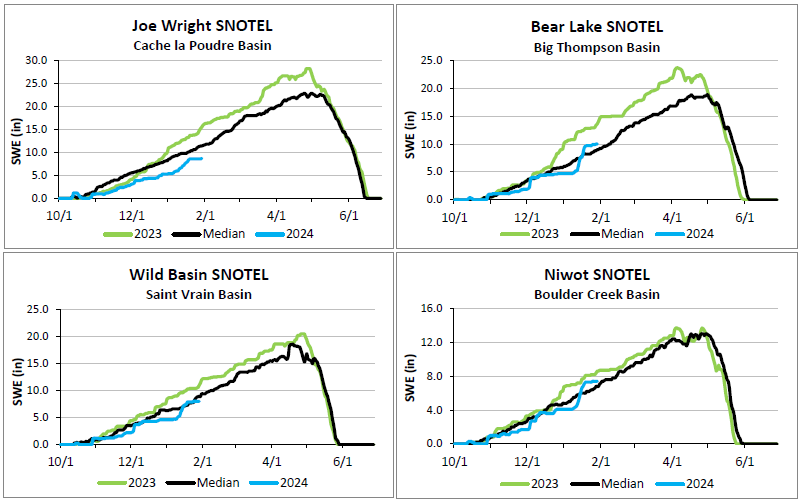
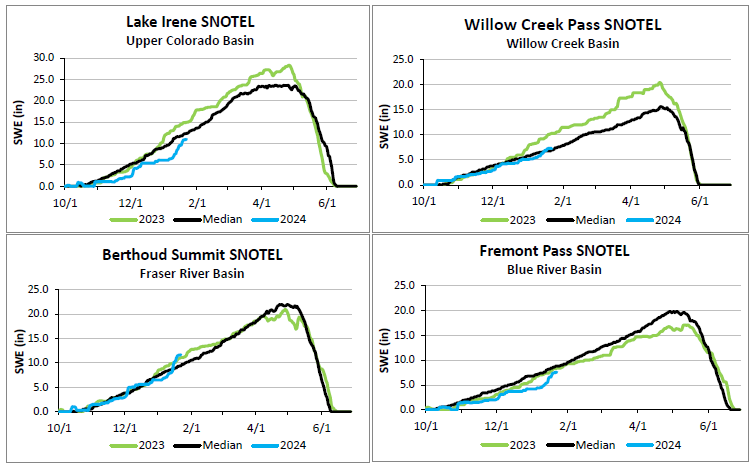
The numbers were strong: A peak at 100% of average in the South Platte River Basin and a peak at 124% in the Colorado River Basin.
The Continental Divide, shown here in Grand County, was buried in a wealth of snow this year (2024). Photo credit: Denver Water.
Those figures translate to a good snow year and a strong water supply for the warm months ahead.
The bigger surprise was how late into spring the snow stacked up.
In the portion of the Colorado River Basin where Denver Water collects its water, peak didn’t hit until May 15 — three weeks after the typical April 24 high point for snowpack.
Such a late peak is good news for water supplies.
Can you sing the summer watering rules? The Splashstreet Boys, with “I Water That Way.”
It means higher streamflows in the warmer months and reduces wildfire risk, among many other benefits. It often means a boost for recreation, too, with more water available for rafting season and elevated reservoirs deeper into the summer.
“Most importantly, it means water availability coincides with water demand,” said Nathan Elder, Denver Water’s manager of supply. “We don’t see big water demands from our customers in April and May, so if the snowpack peaks later and runs off later in June and July, it keeps our reservoirs stable, sustaining our savings account, so to speak.”
This year, May packed a big punch, delivering a whopping 10% of the snowpack in the Colorado River Basin portion of Denver Water’s system.
“That volume of May snowfall is rare,” Elder said. “We typically see snowpack losses in May and this year it gained.”
A good snowpack and a late runoff often boosts recreation on and downstream of storage reservoirs, like Dillon Reservoir above, during the summer months. Photo credit: Denver Water.
The season produced another quirk: snowpack peaked April 10 in Denver Water’s South Platte system, creating a 35-day stretch between peaks in the two basins.
That kind of gap has only occurred once in 44 years of data. That was in 1983, when the peaks were separated by 36 days (April 15/May 21).
Know before you go: Check denverwater.org/Recreation for updates and information about recreation on Denver Water reservoirs.
“This gap makes for a big deviation from the norm, which typically sees both basins hit peak within a couple of days of each other, in late April,” Elder said. “It’s another sign of how variable snowfall patterns can be in Colorado.”
Even so, both basins came in with strong snowpack numbers, bringing Denver Water a second straight year of healthy water supply.
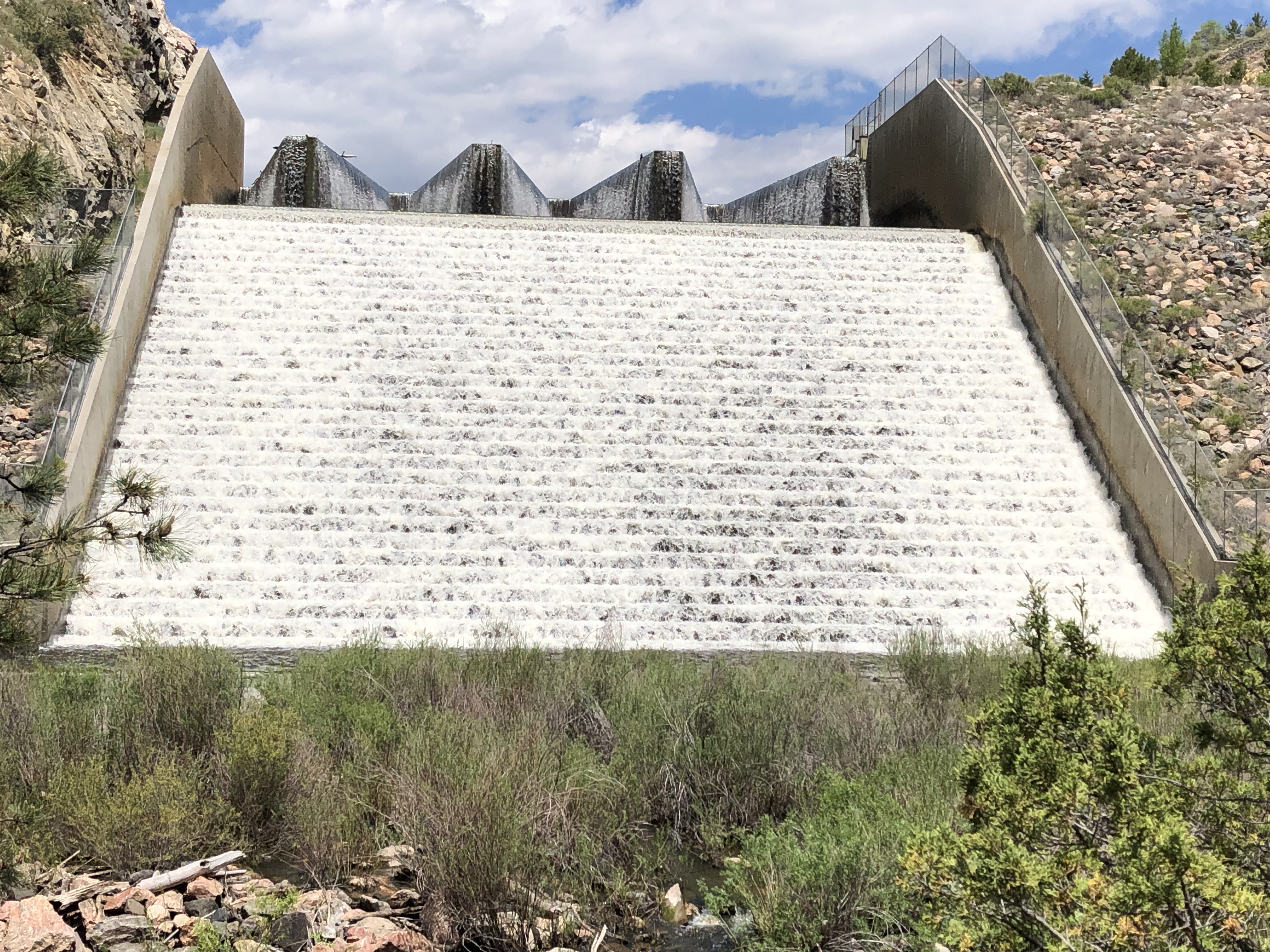
The wealth of snow also means Denver Water will need to spill water from some of its reservoirs, an uncommon situation. The utility prefers to keep water in storage if it can, but a big runoff can force it to release water downstream to make room for more snowmelt coming off the high country.
In some years, a big snowpack can lead to Denver Water spilling some water from its storage reservoirs, like Strontia Springs in Waterton Canyon, to make way for the spring runoff. Photo credit: Denver Water.
Strontia Springs, located about 6 miles up Waterton Canyon southwest of Denver, along with Cheesman Reservoir further up the South Platte, began spilling in mid-May.
The healthy winter also means average reservoir storage was at 88% in early May.
That translates to a big splash of additional water — 35,000 acre-feet, greater than the capacity of Chatfield Reservoir south of Denver — above what is typically stored in Denver Water’s reservoirs at this point in the year.
Finally, a cool and wet spring have helped reduce customer demand for water. That, in turn, helps keep water in reservoirs and streams for later use.
“Our customers continue to watch the weather and be smart with their irrigation practices,” Elder said. “They play a big part in the water supply picture.”
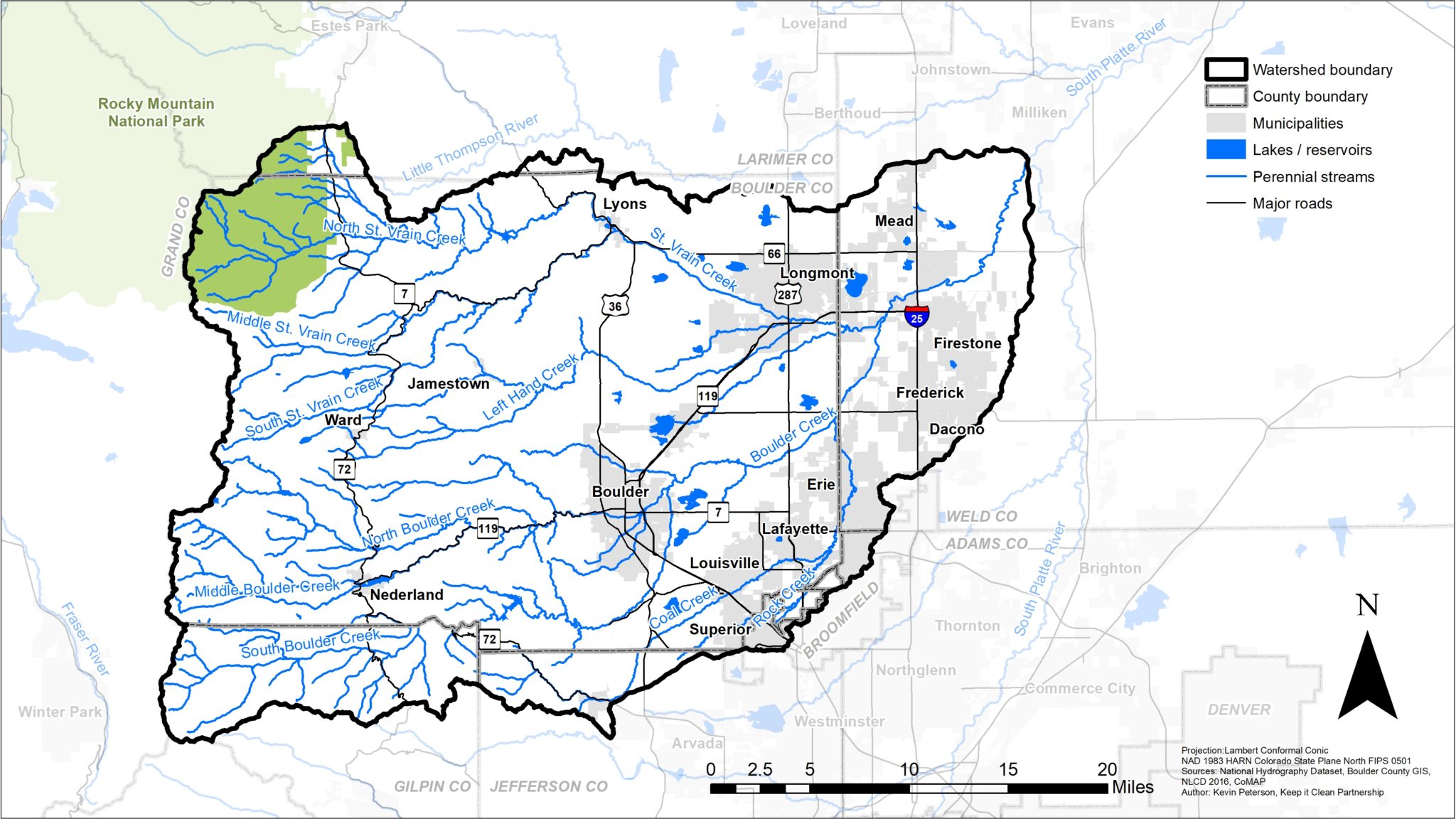
LONGMONT, COLO – A St. Vrain trans-basin diversion, which has been a cornerstone of Colorado’s water rights history for over 140 years while simultaneously drawing environmental concern because of impacts to the South St. Vrain Creek, is making history again.
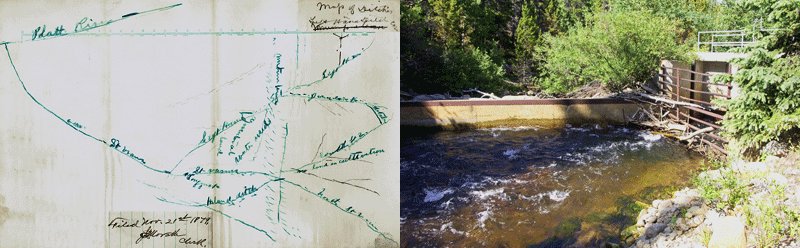
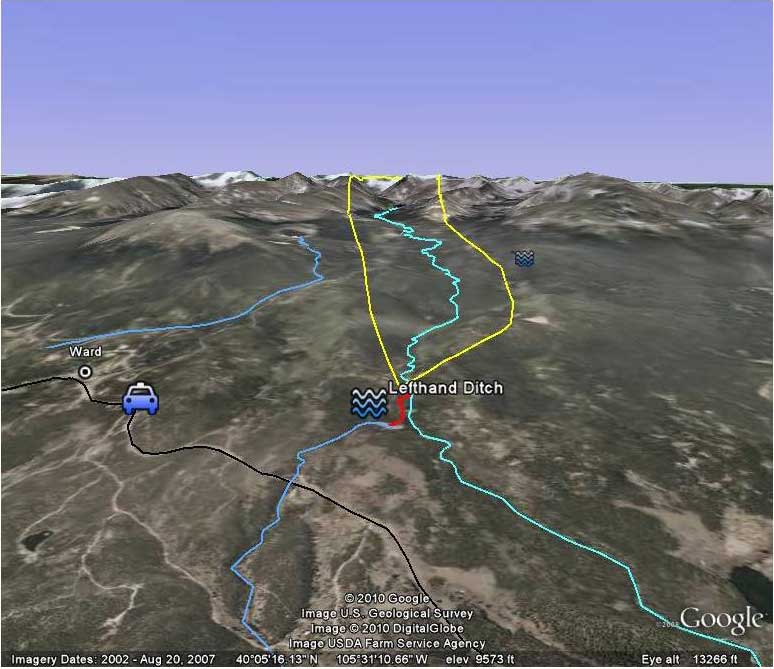
The South St. Vrain Diversion was at the center of the controversial 1882 Colorado Supreme Court water rights case Coffin v. Left Hand Ditch Company that set the precedent for water rights across the western United States for establishing the “first in time, first in right” doctrine. Now the diversion structure is the first in the St. Vrain basin to employ remote operations of the diversion.
Coffin vs. Left Hand Ditch location map via the Left Hand Watershed Center
A collaboration between the Left Hand Ditch Company, the Left Hand Water District and the St. Vrain and Left Hand Water Conservancy District authorized the installation of new technology last year that directs more precise stream flows and provides better monitoring and metering.
The ability to operate this diversion remotely through a mobile phone app enables rejuvenating flows into South St. Vrain Creek. The upcoming summer months may be among the first to see water flow down South St. Vrain Creek for the first time in over a century. Previously, operating this diversion required a three-hour drive from Niwot to above the Peak-to-Peak Highway when the mountain access point was accessible and then required manual operation of a century-old diversion wheel. In winter, the only option of reaching the diversion was often via snowshoes. The new diversion operations equipment is charged by solar and controlled by cellular data. Flows as low as 5 cubic feet per second (CFS) can make a big difference to the health of the stream.
The collaborative project came about when the Left Hand Ditch Company sought expertise and funding from the St. Vrain and Left Hand Water Conservancy District to implement the infrastructural advancements. Because it derives water supply from Left Hand Creek below the diversion and because it shares a similar interest in the health and the integrity of the watershed, the Left Hand Water District provided additional funding for a total of $24,000. This initiative signifies a shift in the relationship between historical water management practices and environmental values, which have sometimes been at odds. The project demonstrates Left Hand Ditch Company’s interest in enabling environmental flows and could set a precedent for collaborative conservation efforts in the future. As Terry Plummer, Superintendent of Left Hand Ditch Company, concluded, “We’ve got to grow and change with the times.”
“The collaboration between the three entities represents trust, partnership, and environmental dedication,” said Sean Cronin, Executive Director at the St. Vrain and Left Hand Water Conservancy District. “This project underscores our unwavering commitment to preserving Colorado’s waterways while ensuring sustainable agricultural practices.”
“As the primary water manager on Left Hand Creek, we use this water and want to contribute to its success,” said Christopher Smith, General Manager of Left Hand Water District.
For media inquiries, interviews, or further information, please contact Jenny McCarty at 303.772.4060 or jenny.mccarty@slvh.gov.
About the St. Vrain and Left Hand Water Conservancy District
The St. Vrain and Left Hand Water Conservancy District (“District” and “SVLHWCD”), created in 1971, is your trusted local government working to safeguard water resources for all. The District’s work is founded in the Water Plan five pillars: protect water quality and drinking water sources, safeguard and conserve water supplies, grow local food, store water for dry years, and maintain healthy rivers and creeks. Aligned with the Water Plan, the District is pleased to promote local partner water protection and management strategies through the Partner Funding Program.
As a local government, non-profit agency formed at the request of our community under state laws, the District serves Longmont and the surrounding land area or basin that drains into both the St. Vrain and Left Hand Creeks. Learn more at http://www.svlh.gov.
About the Left Hand Ditch Company
The Left Hand Ditch Company, based in Niwot, CO, was established in 1866 to irrigate 30K acres of land along Left Hand Creek. It is a unique ditch company in the west for many reasons, the first of which being that several individual ditches gave up their individual operations to come together and form the single ditch company to manage the entire Left Hand Creek system most efficiently.
Today, the Left Hand Ditch Company’s mission to manage and deliver water for all of its shareholders effectively is as strong as ever, and the Left Hand Ditch Company embraces new technology, like remote operation at the South St. Vrain Diversion, to accomplish this mission in modern times. Learn more at http://www.lefthandditchcompany.com.
About the Left Hand Water District
Left Hand Water District is a quasi-municipal corporation and a political subdivision of the State of Colorado, governed by Colorado Revised Statutes Title 32 Special Districts. The District has served customers in unincorporated areas of Boulder and Weld Counties since the early 1960’s. The Left Hand Water District’s service area is generally bounded by the City of Longmont on the north, the Cities of Boulder, Lafayette, and Erie on the south, I-25 on the east and the foothills on the west. Learn more at http://www.lefthandwater.gov.
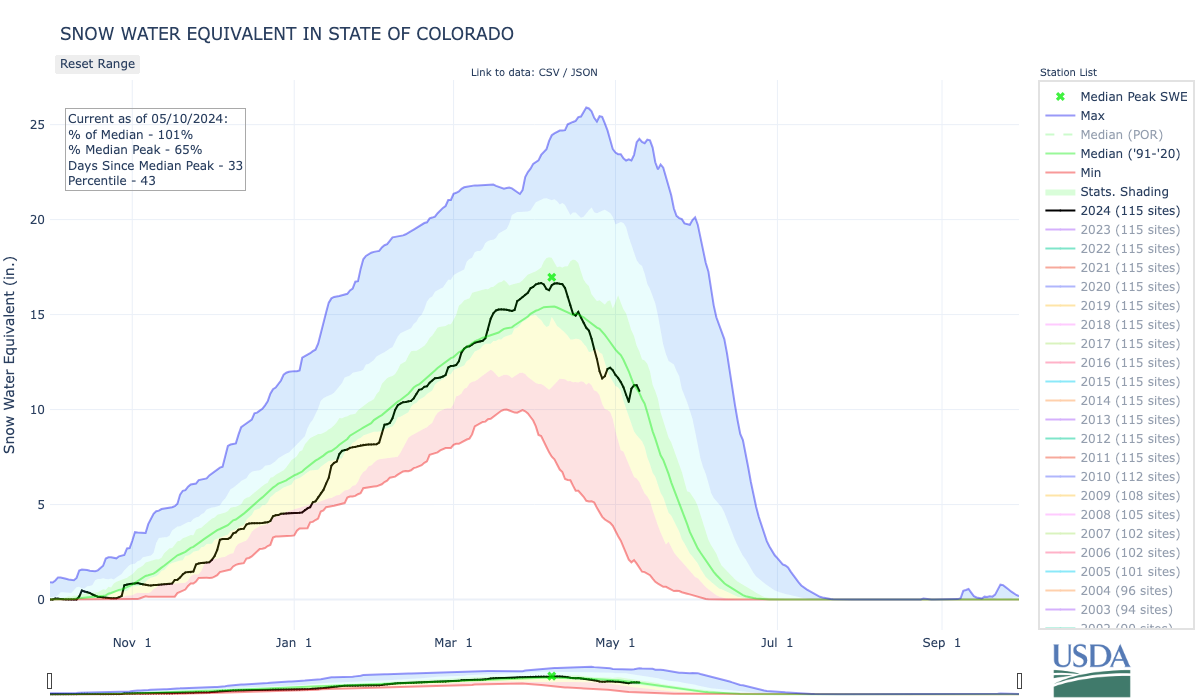
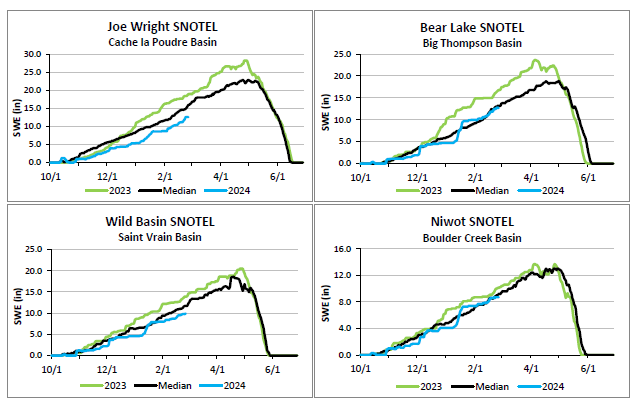
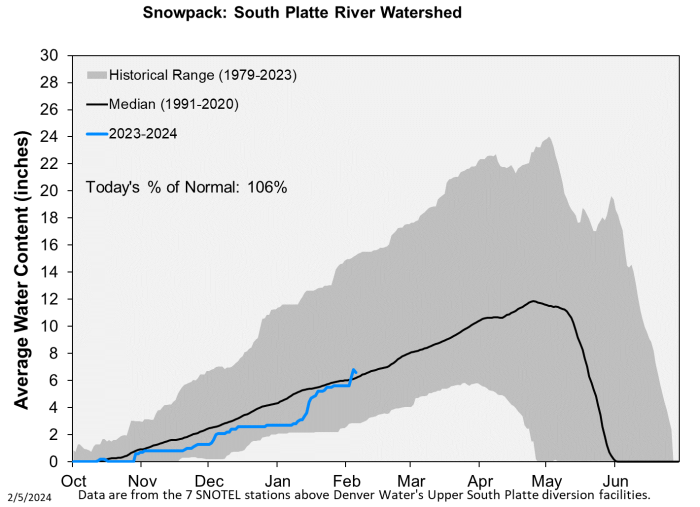
Statewide, Colorado is at around 90% of its median snowpack, as of May 3, with some variation across basins.
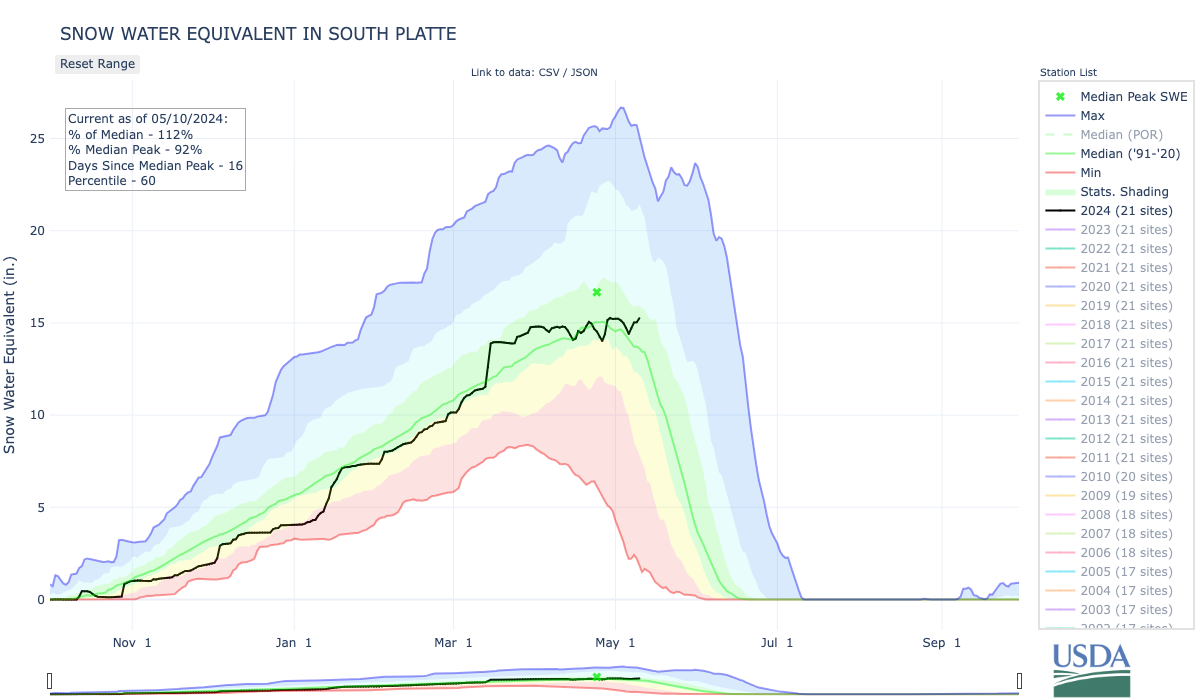
The South Platte, which covers Fort Collins, is at 103% of its median snowpack this season, according to USDA data. Two notable bumps on this year’s snowpack came from the heavy storms in January and March, which dumped feet of snow across the state…
According to CSU’s climate report, “Colorado’s snowpack serves as a huge seasonal reservoir that stores about 15 million acre-feet of water on average at the spring peak and then makes that water available later in the year when water demands for agricultural uses and outdoor watering are higher.”
Studies have shown that SWE has decreased in most places across the state, “though the percentage declines in SWE in Colorado were generally smaller than in most other regions of the West due to Colorado’s relatively high elevations and colder winter climate,” the report says.
Click the link to read the article on The Denver Post website (John Aguilar). Here’s an excerpt:
May 9, 2023
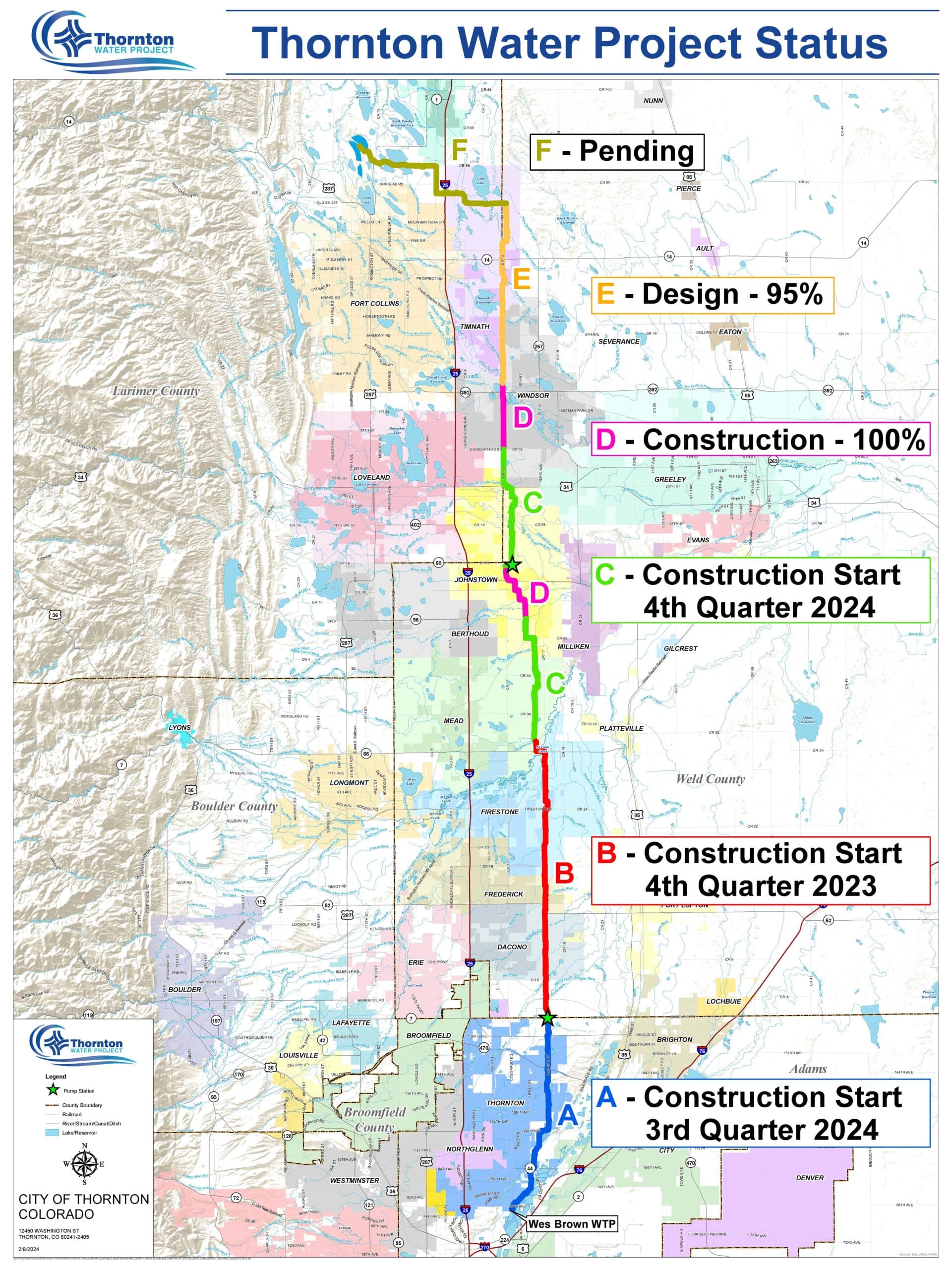
Thornton will be able to build a critical segment of a 70-mile pipe to bring water from the Cache la Poudre River to the fast-growing suburb north of Denver, after elected leaders in Larimer County unanimously — if begrudgingly — approved a permit for the northern segment of the pipe on Wednesday night…But a procession of county residents has spoken out against the proposed project at a series of public hearings held over the past couple of weeks, insisting that Thornton simply could allow its shares in the Poudre River — equaling 14,700 acre-feet a year — to flow through Fort Collins before taking the water out for municipal use. Doing so, they say, would increase flows and improve the river’s health. But just hours before Wednesday’s meeting, one of the opposition groups to the project — No Pipe Dream — said it sensed momentum had turned the city’s way, issuing a public statement that said “we’ll skip the torture of tonight’s hearing on our ‘good neighbor’ Thornton’s plans to win the water tap lottery and appease hungry developers.”
[…]
Before casting her yes vote Wednesday, Larimer County Commissioner Kristin Stephens said she wished Thornton would send its water down the Poudre “because that’s what the community wants.”
[…]
“We can’t do that,” she said, referring to a 2022 Court of Appeals decision that ruled that Larimer County cannot force Thornton to use the river as a conveyance…
The fight over Thornton’s water pipe has been going on for years, and a denial of a permit for the project by Larimer County’s commissioners more than five years ago set off a flurry of unsuccessful court challenges that ultimately prompted the city this year to resubmit its application — this time with a different route and 17 fewer miles of pipe within the county’s boundaries. The city also relocated a pump house from the original plan to a site that is not near any houses, and it agreed to 83 county land use conditions to move the project forward.
Click the link to read “Larimer County commissioners approve city of Thornton’s water pipeline application” on the Fort Collins Coloradoan website (Rebecca Powell). Here’s an excerpt:
May 9, 2024
Commissioners Kristin Stephens, Jody Shadduck-McNally and John Kefalas all said they believed the permit application, now with 83 conditions, met the criteria set by the county’s 1041 regulations that govern the permit process…[John Kefalas] said while advocates have suggested that Thornton’s 2023 application is no different than the one submitted a few years ago, “I must respectfully disagree, as the pipeline proposal and process have been different.”
[…]
Kefalas said the county legal counsel’s “prudent” interpretation of a 2002 Colorado Court of Appeals ruling, which sided with commissioners in their decision to reject but also said the county couldn’t require the water to be run through the Poudre, indicates what could be decided if the matter returns to the courts…
Thornton representatives have said that the water they are conveying is already being taken out of the river at a diversion point to the Larimer County canal. No additional diversions will be made after the project is complete, they’ve said. Shadduck-McNally said she looked thoroughly and critically at the 3,000-page application to make sure it complied with the criteria and believes the county’s higher standards did lead to a stronger application from Thornton.
“This is the system that we have in Colorado — the Colorado water system and the Colorado water court system — and I wish it was different, but it’s the system that I can’t change today. Water court and water decrees are serious business.”
LOVELAND, Colo. — The Bureau of Reclamation released a draft environmental assessment for the Upper Thompson Sanitation District Water Reclamation Facility and Lift Station Improvement Project. The project, located in the Estes Valley of Larimer County, Colorado, consists of construction, operation, and maintenance of a new wastewater treatment facility, two lift stations and connecting pipelines.
The project will allow the Upper Thompson Sanitation District to meet future wastewater flow estimates and applicable water quality standards and regulations. The replacement of aging and deficient infrastructure will also reduce long-term operation and maintenance costs for the district while allowing for future facility expansion.
“This project provides opportunities and partnerships to help meet the future wastewater treatment demands of Estes Park residents and visitors within the Upper Thompson Sanitation District,” said Reclamation’s Eastern Colorado Area Manager, Jeff Rieker.
The 2024 Upper Thompson Sanitation District Water Reclamation Facility and Lift Station Improvement Project Environmental Assessment has been prepared in compliance with the National Environmental Policy Act and is available for public review and comment at the Eastern Colorado Area Office Schedule of NEPA Actions. Please direct any questions to Matt Schultz at 970-461-5469 or mjschultz@usbr.gov. Please submit comments on the draft environmental assessment to Matt Schultz, Environmental Specialist at mjschultz@usbr.gov by June 3, 2024.
Fast-growing Aurora plans to develop a new 200-acre site high in scenic Park County to build the largest reservoir in its system.
The $600 million-plus Wild Horse Reservoir project would store 93,000 acre-feet of water and be nearly twice the size of the city’s existing Park County storage pond, Spinney Mountain Reservoir, which holds 53,651 acre-feet of water. An acre-foot equals nearly 326,000 gallons of water, enough to serve at least two to four urban households for one year.
The proposed reservoir is among the latest moves by the city to secure future water supplies to meet growth-driven demand as streams and rivers shrink because of climate change.
Aurora, the third largest city in Colorado, is home to nearly 400,000 people and is expected to add some 300,000 more by 2070, according to the city’s website.
Pre-permitting discussions on the project have begun, according to Aurora Water spokesperson Greg Baker, and the process is expected to take at least two years. The reservoir is part of a larger water supply strategy that includes a recent $80.4 million purchase of farm water in the Arkansas River Valley, a deal that is drawing opposition from the Pueblo-based Southeastern Colorado Water Conservancy District.
Park County Commissioner Amy Mitchell declined to comment on the Wild Horse proposal, citing the county commission’s legal responsibility to review it under what’s known as a 1041 permit review, a process that gives the county the ability to approve or reject construction projects. That review could happen as early as next year, she said.
Like other cities, Aurora officials say they need to move quickly now to ensure residents and industry will have enough water in the future.
“Are we moving fast? If the opportunity is there, yes, we are taking it. Water will only become more difficult and expensive to obtain,” Baker said.
Aurora raw water facilities. Credit: Aurora Water
Other major new storage projects are being planned by cities along the Front Range, with Parker Water and Sanitation District hoping to build a 72,000 acre-foot reservoir in northeastern Colorado as part of a new municipal farm-water collaboration known as the Platte Valley Water Partnership.
The Aurora and Platte Valley projects are expected to be completed in roughly 10 to 15 years.
For Aurora, the Wild Horse project will provide more opportunities to store water it already owns in the Upper Colorado, the Arkansas and South Platte river basins, and to move that water around, Baker said.
The city has a large-scale recycled water program known as Prairie Waters, which operates by claiming treated wastewater Aurora owns from the South Platte River on the Eastern Plains, filtering it through a series of gravel beds and then piping it back to Aurora’s water treatment facility where it is purified and mixed with fresh water and then delivered to residents and businesses.
But as the water is reused and becomes more concentrated, salinity levels rise, which means less water can be treated and reused. Wild Horse would allow more fresh water to be sent down the river, providing more “blend water” for Prairie Waters and expanding the amount of reused water Aurora Water can deliver to its customers, Baker said.
Water storage reservoirs have drawn fierce environmental opposition in the past 50 years, according to Ron Redd, manager of the Parker Water and Sanitation District.
In the past, water utilities would dam rivers, forever altering the ecosystem and harming water quality.
Parker and Aurora hope these new reservoirs will have fewer environmental impacts and won’t set off as many alarm bells because, in part, they won’t dam rivers or streams, Redd and Baker said. Instead, pipelines will be used to deliver water to the storage ponds.
The City of Greeley walked away from an expansion of its Milton Seaman Reservoir on the North Fork of the Cache La Poudre River in 2021, deciding instead to develop a groundwater and aquifer storage project beneath the Terry Bison Ranch, something the city believes will be easier to do and will give it more flexibility in managing its water supplies, according to Sean Chambers, director of Greeley’s Water and Sewer Department…
More by Jerd SmithJerd Smith is editor of Fresh Water News. She can be reached at 720-398-6474, via email at jerd@wateredco.org or @jerd_smith.
Click the link to read the article on The Denver Post website (John Aguilar). Here’s an excerpt:
May 2, 2024
Larimer County’s board of commissioners will decide the fate of the 70-mile, half-billion-dollar infrastructure project as soon as Monday [May 6, 2024]. As now proposed, the pipeline would follow an alignment that’s different from the one rejected in 2019…Ultimately, the commissioners will have to balance Thornton’s demands for water to support much-needed housing in the city of 145,000 against calls by county residents and environmentalists for an alternative that avoids putting the Poudre’s water in a pipe in the first place. They contend other outcomes would maintain the health of the river.
Colorado’s sixth most populous city wants to move 14,000 acre-feet of Poudre water to the city annually, via a 42-inch-diameter pipe.
It’s possible a final vote by the commissioners could be delayed until Wednesday, depending on how much more public comment there is Monday…
Carolynne White, an attorney representing Thornton, noted during the hearing that the city has owned its shares in the Poudre River for decades. It’s been diverting that portion of water into reservoirs northwest of Fort Collins, for use on farms in the area. Those water shares are the ones Thornton would send directly to the city through the pipe, rerouting water that does not flow through Fort Collins currently.
“This project does not reduce the river flows in the Poudre River,” White said.
Monday’s hearing started with a presentation from county staff, during which the Larimer County Planning Commission recommended approval of the project if proposed conditions were met. Thornton then gave another presentation to talk about how the city’s new application is different from the previous one. After that, the session was open to public comment, which will continue at the next hearing…
Planning Commission recommends approval
“With the proposed conditions of approval in place, this application meets the review criteria for a water transmission pipeline,” [John] Barnett said. “… Therefore, the development service team recommends approval of the Thornton water project.”
[…]
The public hearing session will resume at 6 p.m. May 6 via Zoom and in person in the First-Floor Hearing Room of the Larimer County Administrative Services Building, 200 W. Oak St. in Fort Collins. For more details on how to sign up for public comment and the 1041 regulations, visit www.larimer.gov/planning/1041-regulations. You can also track the progress on the permit and access related documents on this county portal.
April is a big month for water watchers. That’s when Colorado’s snowpack typically reaches its highest level before the big melt-out that follows.
The watchers call this moment “peak snowpack.” And it can be a useful measure to predict water supplies for the warm months to come.
The snow-covered Continental Divide, seen from Loveland Pass. Melted snow, captured and stored in mountain reservoirs, is the source of nearly all the water Denver Water provides to customers every day. Photo credit: Denver Water.
Peak moments that fall earlier on the calendar can mean a spring runoff that ends too soon and reservoirs that don’t fill. Conversely, late peaks can mean reservoirs spill and high-water flows that can overtop riverbanks.
Indeed, a closer look at “peak” numbers over the last several decades reveals some big surprises when the timing of the maximum snowpack falls outside the late April norm. Such off-rhythm peaks can lead to watering limits or, in the other extreme, raging runoff that can do damage to land and property.
For Denver Water, this year’s peak snowpack numbers look good.
A mid-to-late April high point appears likely, and a healthy amount of water in the snow supports the utility’s forecast for full reservoirs for the upcoming irrigation season.
In short, it’s what Denver’s water watchers might call “a typical year.”
In fact, though, the timing of the peak snowpack and how much frozen water the snow holds at that point is a highly variable condition and can leave water supply managers scrambling. This variability can be easy to forget when most years follow the script, or don’t veer far from it.
“As a water manager, if I only had one piece of data to determine how water supply was looking for a given year, it would be peak snowpack,” said Nathan Elder, who manages the tricky business of water supply for Denver Water.
“Snowpack peaks can be highly variable in quantity and timing, and those factors indicate what the runoff and water supply situation will look like.”
Take a look at the following graphs, which show the wide variability in the amount of water frozen in the snow at the point of “peak snowpack” over the past 45 years. The range in both the Colorado and South Platte river basins where Denver Water collects water can stretch from 10 inches to more than 25 inches of water in the snow.
The amount of water frozen in the snow at the moment of “peak snowpack” over the last 45 years in the Colorado River Basin, where Denver Water collects water. Image credit: Denver Water.
The amount of water frozen in the snow at the moment of “peak snowpack” over the past 45 years for the South Platte River Basin, where Denver Water collects water. Image credit: Denver Water.
Denver Water gets its water from parts of two major river basins — the South Platte and the Colorado. Both tend to hit peak snowpack in late April (the 23rd and the 25th respectively) and hit an average of about 12 and 17 inches of “snow-water equivalent,” or SWE, a fancy way of saying amount of water in the snowpack.
But some years Mother Nature has ignored those averages by frightening margins.
One of the scariest was 2012, when peak snowpack for Denver Water collection areas in both basins came not in mid-to-late April, but early March — March 5 in the South Platte and March 6 in the Colorado.
That was about seven weeks ahead of average and it forced Denver Water to implement outdoor restrictions as reservoirs failed to replenish.
Then there was the infamous spring of 2002, when snow-water totals for Denver Water collection areas at peak were a mere 50% of average in the South Platte Basin and 56% in the Colorado — another example, like 2012, of terrible numbers striking both of Denver Water’s collection basins in the same year.
The spring 2002 peak snowpack contained some of the lowest amount of water in the snow over the last 45 years of records.
My kids and their friends built a small terrain park in front of their house near Sloans Lake after the March 2003 St. Patrick’s Day blizzard.
That early 2000s drought hung on until the following spring in 2003, when it was busted — fantastically and famously — with a late March blizzard that dropped 7 feet of wet snow in the foothills, 3 feet of snow in the city and put an end to 19 months of below-average precipitation in Denver.
“Liquid Gold,” blared the banner headline of the now-closed Rocky Mountain News. Anyone living in Denver more than 20 years remembers the storm.
Peak snowpack has also offered surprises on the opposite end of the spectrum, bringing late peaks and a wealth of water.
In 2015, the peak snowpack date in both basins came a month later than normal, on May 23. That meant a more compressed runoff season and flooding challenges, particularly along the South Platte.
Watch this video about the epic spring runoff of 2015:
In 1997, the South Platte’s peak snowpack hit a stunning 203% of average. In all, that was 24 inches of water in the snow, twice the average level in a basin that fills four major reservoirs for Denver Water.
Another mark experts like to track is date of melt-out — the date when the last of the snow melts at various measuring spots in the high country. In both basins that typically happens in early June. But, like peak snowpack, melt-out dates can surprise too.
Way back in 1981, a terribly dry year, the South Platte basin saw melt-out April 27 — about the time when Denver Water would typically see peak snowpack! Scary stuff.
Alas, in 1995, the South Platte went to different extremes, with the final melt recorded July 4, an entire month later than average.
During the 1983 Colorado River flood, described by some as an example of a “black swan” event, sheets of plywood (visible just above the steel barrier) were installed to prevent Glen Canyon Dam from overflowing. Source: Bureau of Reclamation
In the Colorado River Basin, the latest such melt-out stretched to July 12, in 1983. That year is famous for the swollen river flows all the way to Lake Powell, where Glen Canyon Dam nearly overtopped.
That runoff season was memorialized in the “The Emerald Mile,” a remarkable book that chronicled attempts to take advantage of record river flows to set speed records boating through the Grand Canyon.
All of it is a reminder that average years are just another way nature leaves room for surprises.
So, let’s be satisfied this spring with an “average” peak and a solid water supply for 2024.
This USGS map shows the number of PFAS detected in tap water samples from select sites across the nation. The findings are based on a USGS study of samples taken between 2016 and 2021 from private and public supplies at 716 locations. The map does not represent the only locations in the U.S. with PFAS. Sources/Usage: Public Domain. Visit Media to see details.
From email from the EPA:
DENVER (April 23, 2024) — On Thursday, April 25, U.S. Environmental Protection Agency (EPA) Regional Administrator KC Becker will join U.S. Senator Michael Bennet on a visit to the South Adams County Water and Sanitation District (SACWSD) to break ground on a water treatment system that will allow SACWSD to deliver high-quality drinking water that meets all state and federal regulations, including EPA regulations for to treat PFAS chemical contamination by 2029.
WHO:
· U.S. Senator Michael Bennet
· EPA Regional Administrator KC Becker
· South Adams County Water and Sanitation District Board President Heidi McNeely
· South Adams County Water and Sanitation District Manager Abel Moreno
Additional representatives from South Adams County Water and Sanitation District will be in attendance, along with other key project partners from:
· Brown & Caldwell, engineering consultant
· PCL Construction, construction manager
· United States Environmental Protection Agency
· Colorado Department of Public Health and Environment
WHAT:
EPA and partners will break ground on the Klein Enhancement Project. The project, a partnership with Brown & Caldwell Engineering and PCL Construction, will construct an ion-exchange water treatment system that will allow SACWSD to deliver high-quality drinking water that meets all state and federal regulations, including EPA regulations required to treat for PFAS chemical contamination. SACWSD was recently awarded nearly $61 million in federal funding to complete the construction. The project is expected to be completed in late 2026.
Tours of existing treatment facilities and the enhancement project site will be available after speakers’ remarks.
WHEN:2 p.m., Thursday, April 25, 2024
WHERE: 7400 Quebec Street, Commerce City, Colorado
This investment leverages public funding for a total investment of $100 million in the canal over five years, breathing new life into the 71-mile High Line Canal and ensuring its preservation, protection and enhancement for generations to come.
A sign along the High Line Canal trail in Aurora installed in 2021 provides a map to help trail users navigate the corridor. Photo credit: Denver Water.
In a significant leap toward this goal, the nonprofit on March 15 announced a $7 million contribution from Great Outdoors Colorado, often referred to as GOCO.
The conservancy said the extraordinary award from GOCO adds to the significant philanthropic support from donors across Colorado to date, including $10 million from Denver Water, and leaves the conservancy with a remaining $1 million to raise.
Completion of the campaign will ensure that the community vision for the canal is realized through more than 30 prioritized trail projects. The GOCO grant brings the conservancy closer to its goal, but there is still a great deal of work to be done.
“For decades, the future of the historic High Line Canal has been in jeopardy. Today, with tremendous public and private investment, we can immediately begin fulfilling the community’s vision for the canal and, together with our many partners, ensure the High Line Canal will be improved and protected as a centerpiece of our region’s park system,” said Harriet Crittenden LaMair, CEO of the High Line Canal Conservancy.
The High Line Canal is an irrigation ditch built in the 1880s. Denver Water still uses the canal to deliver irrigation water to customers when conditions allow. Photo credit: Denver Water.
Formed in 2014 to revitalize Denver Water’s historic 71-mile irrigation delivery system into one of the nation’s longest continuous urban trails, the High Line Canal Conservancy aims to enhance trail users’ experience and improve the region’s environmental health.
“Denver Water has a century-old canal that has outlived its usefulness as an irrigation canal,” said Alan Salazar, CEO/Manager of Denver Water.
“We wanted to transform the canal into a recreational and environmental crown jewel for the region. And, after years of building partnerships with the help of our governmental partners and the leadership from the High Line Canal Conservancy, today, with GOCO’s investment, we celebrate a giant leap toward this vision. With $32 million in private funds raised by the conservancy and matching funding from local partners and Denver Water, we are thrilled to help make this vision a reality for our region,” Salazar said.
Are you on TAP? Get the free weekly email for water conservation tips, news and stories about the people who deliver the water.
In partnership with local jurisdictions and Denver Water, the Great Lengths campaign will support the conservancy’s work to improve safety, ecological sustainability, community vitality, and equitable access along the High Line Canal, which meanders continuously from Waterton Canyon in Littleton to the high plains near Denver International Airport.
Over the past seven years, the conservancy and its partners have engaged communities across the region to develop a comprehensive plan, “The Plan for the High Line Canal,” to protect and enhance the trail.
Today, as one of the most exciting and largest urban trail projects in the country, the transformation of the canal with enriched landscape, safer crossings, improved access, better signage, and areas for gathering, play and education is becoming a reality.
The High Line Canal Conservancy in March announced its “Great Lengths for the High Line,” a $33 million campaign aimed at reimagining the historic canal as one of the nation’s premier linear parks. Image credit: High Line Canal Conservancy.
“We owe our progress to the more than 10,000 community members across the region — countless volunteers, youth and leaders — that have participated and underscored the importance of safety, connectivity, access and comfort along the Canal,” said LaMair.
“Now we look forward to High Line Canal users joining our Great Lengths for the High Line fundraising campaign, so this great work continues for decades to come.”
Projects along the canal will be implemented in partnership with the local governments, including counties, cities and special districts. No donation is too small and can be made by logging on to highlinecanal.org/great-lengths.
“We are grateful for this much-needed investment and commitment to improving accessibility and quality of life for residents across our region,” says Arapahoe County Board Chair Carrie Warren-Gully.
“The county has long been a leading partner in efforts to enhance the High Line Canal corridor. This new investment reinforces the power of collaboration to ensure future generations can enjoy this treasured resource, especially along a stretch of the canal that has been historically underserved and underfunded. We are ready to roll up our sleeves and get the work done.”
From “Poem: I am not alone” — Greg Hobbs along the High Line Canal. Photo credit: Bobbi Hobbs
Serving more than 1 million trail users annually across 11 jurisdictions, the canal traverses some of the most diverse communities in the state. The 860-acre canal connects 24 schools, hundreds of neighborhoods, and millions of people to more than 8,000 acres of open space.
“Investing in the Great Lengths Campaign is a wonderful way to improve the canal not just in your own community — but across all communities. It’s an opportunity for individuals to leverage their philanthropic dollars in a public-private partnership to create a legacy for generations to come,” said Tom and Margie Gart, co-chairs of the Great Lengths Campaign Committee.
Excavation and foundation preparation at Gross Dam wrapped up in April. The far side of the photo shows the new footprint of the dam. Photo credit: Denver Water.
“Over the past two years we’ve excavated 260,000 cubic yards of rock and placed 27,000 cubic yards of concrete to get the existing dam and the rock around it ready for expansion,” said Doug Raitt, Denver Water’s construction project manager for the Gross Reservoir Expansion Project.
The next phase of the multiyear project begins in May, when crews will begin the process of building 118 new concrete “steps” that will create the higher dam. Construction on the expansion project began in April 2022 and is scheduled to wrap up in 2027.
Roller-compacted concrete will be placed on top of the existing dam to raise it to a new height of 471 feet. A total of 118 new steps will make up the new dam. Image credit: Denver Water.
The steps will be made of roller-compacted concrete and around 800,000 cubic yards of concrete will be needed to build them.
So, to prepare for raising the dam, a team from Kiewit Barnard is building a sophisticated concrete batch plant near the top of the dam. At the plant, cement, fly ash, sand and aggregates will be mixed together to make the specific type of concrete mixture used to build the steps.
The batch plant will produce roller-compacted concrete on-site using rock quarried from around Gross Reservoir. Photo credit: Denver Water.
“Producing the roller-compacted concrete on-site really makes for an efficient process so we don’t have to haul it in from off-site,” Raitt said. “We’re also crushing rock that we quarried on-site as well.”
Learn more about the Gross Reservoir Expansion Project at grossreservoir.org.
Crews are also building an elaborate conveyor system that will carry the concrete from the batch plant to the dam.
Workers are building a conveyor system that will move concrete from the batch plant to the dam. Photo credit: Denver Water.
Once conveyed over the top of the dam, the concrete will slide to the bottom via a chute system, which also will be built this spring.
At the bottom of the dam, workers are creating a flat surface that will be the base for the new roller-compacted concrete steps.
Workers are building the base of the dam that will serve as a platform for the roller-compacted concrete steps. Photo credit: Denver Water.
“It’s an exciting time as we get ready for the actual dam raise phase of the project,” Raitt said. “Once the roller-compacted concrete process begins, it will take about three years to complete the expansion.”
Colorado transmountain diversions via the State Engineer’s office
The budget, which is not yet finalized, includes funding for non-lethal wolf deterrence, water litigation and wildlife management. The six-member Joint Budget Committee, which writes the state budget, settled on a $40.6 billion budget that would take effect July 1…
Water
The proposed budget also includes about $300,000 for two additional full-time employees in the Department of Law to help secure the state’s water interests…Colorado is part of nine interstate water compacts, one international treaty, two U.S. Supreme Court decrees and one interstate agreement.
“As climate change and population growth continue to impact Colorado’s water obligations, the DOL’s defense of Colorado’s water rights is more critical than ever,” according to the document.
One of the new employees, a policy analyst, will monitor government regulations and neighboring states’ activities on water policy. The other position will “bolster the representation and litigation support of the DOL across the various river basins,” support the state’s efforts to negotiate Colorado’s water and compact positions and communicate with the state’s significant water interests.
A whistleblower and watchdog advocacy group used an EPA database of locations that may have handled PFAS materials or products to map the potential impact of PFAS throughout Colorado. They found about 21,000 Colorado locations in the EPA listings, which were uncovered through a freedom of information lawsuit. Locations are listed by industry category. (Source: Public Employees for Environmental Responsibility analysis of EPA database)
Nearly $86 million in federal funding to help small Colorado communities with the daunting task of removing so-called “forever chemicals” from their drinking water systems will begin flowing this spring, but whether it will go far enough to do all the cleanup work remains unclear.
Small Colorado communities are scrambling to find ways to remove the toxic PFAS compounds that wash into water from such things as Teflon, firefighting foam and waterproof cosmetics.
Thanks to the infusion of federal money this year, the Colorado Department of Public Health and Environment is offering what are known as small and disadvantaged community grants to help with cleanup costs.
Around the country, the EPA is racing to help communities that have historically been left out of national funding initiatives, according to Betsy Southerland, a scientist with the Environmental Protection Network, a nonprofit that advises communities nationwide on the scientific and technical issues inherent in treating water quality problems.
“This is a massive effort,” Southerland said, likening it to the nation’s $15 billion-plus effort under the Bipartisan Infrastructure Law to identify and remove aging lead pipes from drinking water delivery systems.
Hundreds of communities in Colorado, large and small, are monitoring for PFAS, and some are planning costly new treatment plants to address the issue.
Credit: City of Greeley
Greeley, which is eligible for the new grant program, has yet to detect PFAS contaminants in its treated water because much of its current water supply flows down from the headwaters of the Upper Colorado River and is relatively clean. But the fast-growing city is also planning to develop new groundwater supplies and is therefore planning a new treatment plant capable of addressing any future contamination should it occur, according to Michaela Jackson, Greeley’s water quality and regulatory compliance manager.
Colorado lawmakers are also working on new legislation to address the widespread contamination.
Still, word of the Emerging Contaminants in Small and Disadvantaged Communities Grant Program, as it is known, has been slow to spread, Colorado public health officials said, in part because the problem is still being understood and remedies are still being studied.
“Emerging contaminant funding is relatively new. Many communities are still determining if they have a project they may need to request funding for,” state health department spokesman John Michael said in an email.
Each year for the next five years, the state will offer two rounds of grants, with millions of dollars committed. Communities interested in applying can explore the program here. The next grant cycle opens in July, according to Michael.
This year, perhaps as soon as this month, the U.S. Environmental Protection Agency is expected to finalize the first PFAS drinking water treatment standard, which will require utilities to remove the contaminant at levels above 4 parts per trillion.
Prior to this, the federal oversight of the contaminants was advisory, meaning utilities were not technically required to remove it, according to state health officials. The advisory rule was set at 70 parts per trillion.
But for small communities lacking such resources, the costs and stakes are high.
Searching for millions of dollars more
The South Adams and Water Sanitation District, which serves Commerce City and unincorporated parts of Adams County, has been hard-hit by PFAS contamination in its groundwater wells. Where the toxins have come from isn’t entirely known, but could include firefighting foam used nearby at a firefighting academy owned by the City of Denver.
When PFAS was first detected in 2018, the Adams County district had to shut down its most contaminated wells, build an expensive system of filters, and buy water from Denver to dilute its water sources enough so that PFAS could no longer be detected.
It also built a cutting-edge testing lab, so that it can know within 24 hours whether its extensive treatment system is working and respond immediately if it is not.
But that isn’t enough. This year it will begin building a new $80 million treatment plant, $30 million of which will come from the new state grant program. It has also been approved for a special $30 million loan from the Colorado Water and Power Development Authority. It is still pursuing additional funding to minimize the amount it will have to seek from its customers to help cover the costs, according to Abel Moreno, the district’s manager.
“It’s absolutely critical that we find another source of funding because we don’t believe the contamination was caused by our rate payers, and we do not believe they should be asked to pay for it,” Moreno said.
And it’s not just initial construction costs for treatment systems that will need funding. Operating the systems and disposing of contaminated treatment equipment can cost millions of dollars as well, according to the American Water Works Association, which has been critical of the pending federal standard because it believes it will cost utilities and ratepayers too much money. It has advocated a lower treatment standard, of 10 parts per trillion.
The 4 parts per trillion standard will require “more than $40 billion of capital investment plus significant investment for operation and maintenance,” said Chris Moody, regulatory technical manager at the association, in an email. “The annual impact to communities and ratepayers is expected to exceed $3.8 billion, increasing household water rates by as much as $3,500 annually.”
But utilities such as the South Adams Water and Sanitation District believe there is no choice but to power ahead with the PFAS cleanup.
Rocky Mountain Arsenal back in the day
Decades of living near industrial producers and the Rocky Mountain Arsenal Superfund Site, and historic concern over the safety of its drinking water, have created a deep distrust among residents. Moreno says the district is working to rebuild faith in its water system.
“It is a priority of mine to change the trajectory of the district’s water image so the people we serve in this community have confidence in the work we’re doing and the water we are producing,” he said.
More by Jerd SmithJerd Smith is editor of Fresh Water News. She can be reached at 720-398-6474, via email at jerd@wateredco.org or @jerd_smith.
The South Platte River Basin is shaded in yellow. Source: Tom Cech, One World One Water Center, Metropolitan State University of Denver.
Governor Jared Polis signs non-functional turf law. Photo credit: Allen Best
Click the link to read the article on the Big Pivots website (Allen Best):
March 18, 2024
Bill signed into law on Friday makes thirsty imported grasses a no-no in new road medians and other public places that rarely see human feet. Native grasses OK.
The remarks in the office of Colorado Gov. Jared Polis on Friday afternoon were brief, befitting the bill that was soon to be signed into law, the state’s most aggressive effort yet to curb water allocated to urban landscaping.
“We want folks to be part of the solution around water and to reduce the water needs of their non-functional turf, ranging from Colorado-scaping and xeriscaping to lower-water solutions with different types of grasses that may require less water,” said Polis of SB24-005.
Taking the lectern, Sen. Dylan Roberts, a prime sponsor and a Democrat who represents much of northwestern Colorado, noted an irony. It had snowed hard the previous day along the northern Front Range, where about 75% of Coloradans live, and the snow was extremely wet, even for March.
“It’s funny, with all the snow right now, you might not think that we have to deal with a lot of water scarcity, but we do,” said Roberts, a Frisco resident.
“We know that in Colorado we face a historic drought and we need to put in place every single common-sense tool to save water that we can. And this is one of those.”
Colorado in 2022 began incentivizing removal of what is commonly called non-functional turf. The phrase means imported grass species with high water requirements that typically get almost no use. A legislative allocation of $2 million resulted in grants to about three-dozen communities across Colorado but especially in Front Range cities where 85% of the state’s residents live.
In September 2023, the Colorado Water Conservation Board awarded a $1.5 million grant to Boulder-based Resource Central. The nonprofit was formed in 1976 to encourage conservation. In 2023, it completed 604 lawn-replacement projects along the Front Range. Its marquee program, Garden In A Box, provides low-water plants and has partnerships with several dozen municipalities along the Front Range. The state grant will allow Resource Central to expand its programming to the Western Slope.
In October 2023 a year-round legislative water committee that is chaired by Roberts heard a proposal from Denver Water, Western Resource Advocates and others. That proposal was the basis for the new law.
Instead of incentives to change, the new law draws lines of restraint. Beginning in 2026, local governments can no longer allow the installation, planting or placement of non-functional turf, artificial turf, or invasive plant species. This applies to commercial, institutional, and industrial properties, but also common-interest community property. Read that as HOAs.
Also verboten will be planting of non-functional turf in street rights-of-way, parking lots, median or transportation corridors.
Non-functional turf planted with thirsty imported species will be banned from new road medians and other public and commercial places in Colordo that see few human feet beginning in 2026, a year earlier in projects of state government. Photo/Allen Best
The law applies to new or redeveloped state facilities beginning in 2025.
Imported species such as Kentucky bluegrass can use twice as much water as native grass. Native species such as buffalo and blue gamma or species hybridized for arid conditions will be allowed.
Several Colorado jurisdictions have gone further. Aurora and Castle Rock in 2022 both adopted limits to residential water use for landscaping. The state law does not touch water use at individual homes. The two municipalities both expect substantial population growth but have limited water portfolios for meeting new demand.
Other municipalities and water providers from Broomfield to Grand Junction have also adopted laws crowding out water-thirsty vegetation. Their motives vary but all are premised on Colorado’s tightening water supplies. Cities use only 7% of the state’s water, and roughly half of that goes to landscaping.
Yet developing new sources of water requires going farther afield, usually converting water from agriculture, and can become very expensive. Consider plans by Parker Water and Sanitation District and Castle Rock. They are planning a pipeline to the Sterling area in coming years with a new if smallish reservoir near Akron. In this case, the project has support from an irrigation district in the Sterling area, but all this new infrastructure comes at a great expense.
The bill faced no major opposition in the Legislature, although most House Republicans — nearly all from rural areas — voted against it.
During her time at the microphone, Rep. Karen McCormick, a Democrat from Longmont, emphasized the need to define what constitutes non-functional turf.
“Coming up with those terms of functional versus non-functional turf was really important so that the people of Colorado understand that the choices that we have in these spaces (can result in) beautiful, Western drought-tolerant grasses and bushes and flowers.” she said.
State Rep. Barbara McLachlan, a Democrat from Durango, emphasized cost savings as well as water savings. “If you’re not having a picnic on that little piece of turf or having a soccer game, you probably don’t need to be spending the water and money it takes to keep that alive.”
Sen. Cleave Simpson, a Republican from Alamosa who represents much of southwestern Colorado and the fourth prime sponsor, was not present for the bill-signing.
Rep. Karen McCormick of Longmont said that urban landscapes of great beauty can be created that need less water. Photo/Allen Best
Those present for the bill signing included Denver Water’s Alan Salazar, the chief executive, and Greg Fisher, the manager of demand planning.
A Denver Water staff member decades ago had invented the word “xeriscaping” but the agency had never put much muscle into curbing water use. After all, it had a flush water portfolio. The thinking as explained in Patty Limerick’s book about Denver Water, “A Ditch in Time,” was that if drought got bad enough, the agency could always squeeze residential use for water, as it did in the severe drought summer of 2002.
With new leadership and a worsening story in the Colorado River Basin, Denver had altered its thinking. The city – which provides water for about 1.6 million people, including many of the city’s suburbs – gets roughly half of its water from transmountain diversions. That statistic holds true for the Front Range altogether. Denver’s water rights are relatively senior, but they’re junior to the Colorado River Compact of 1922.
That compact assumed far more water in the river than occurred in most of the 20th century. Flows during the 21st century have diminished, at least in part due to intensifying heat. That heating – and drying – will very likely worsen in coming decades. While Colorado accurately claims that it has not used its full allocations under river compacts, there’s the underlying and shifting hydrology that argues against any certainty.
The city this year will partner with Resource Central, a first, to encourage transformation of front yards with high water demands into less-needy landscapes.
Lindsay Rogers, a water policy advisor for Western Resource Advocates, said the key work during the next couple of years will be to work with local jurisdictions to implement the new law.
“Not only that, they’ll need to figure out how they’re going to enforce their new landscaping standards. And if they do that well, this bill will be hugely impactful.”
She said this bill should be understood as being part of a “growing understanding that everyone needs to do their part to conserve. There are lots and lots of opportunities across the land-use development spectrum.”
At least some of those ideas can be found in a report by a state task force issued in late January. Polis had appointed the 21-member group a year before and gave it the job of examining what steps Colorado could take to reduce water devoted to urban landscaping.
After seven meetings, the task force issued a report in late January that concluded that “the time to rethink our landscapes is now.” It provided 10 recommendations.
Topping the recommendations was a statement in accord with the new law. The task force also called for continued support of turf replacement in existing development, promotion of irrigation efficiency and encouragement of pricing mechanism that steer decisions that promote water conservation.
Considering that it took well more than a century to install the existing urban landscapes, this shift will not be accomplished in a few short years. The climate could shift to produce more water for Colorado, but the warming atmosphere would almost certainly steal those gains.
In short, the water scarcity driving this new law is not going away.
See also this five-part series in 2023 published in collaboration with Aspen Journalism:
South Platte River at Goodrich, Colorado, Sunday, November 15, 2020. Photo credit: Allen Best
From email from the Colorado Water Conservation Board (Katie Weeman):
March 13, 2024 (Denver, CO) – The Colorado Water Conservation Board (CWCB) approved 52 Water Plan Grant applications today, which will distribute $17.4 million to fund critical projects to manage and conserve water, improve agriculture, spark collaborative partnerships, and much more. This funding cycle, CWCB received a record 70 applications requesting $25.6 million—$8.2 million more than is currently available.
“Water is on the top of many Coloradans’ minds. And the projects this program funds are critical to meet and mitigate our state’s most critical water challenges,” said Lauren Ris, CWCB Director. “We received significantly more applications than we had funding for this cycle of Water Plan Grants, showing just how much demand there is for this important funding, and how critical it is that we continue to fuel this effort.”
Every year, the Water Plan Grant Program provides millions of dollars of funding for projects in five key categories: Water Storage & Supply, Conservation & Land Use, Engagement & Innovation, Agricultural Projects, and Watershed Health & Recreation. Water Plan Grants support the Colorado Water Plan, and funded projects are wide-ranging and impactful to the state, focusing on enhancing water infrastructure, restoring ecosystems, supporting education and community collaboration, boosting water conservation and efficiency, guiding resilient land use planning, and more.
During this fiscal year, the CWCB awarded 83 grants totaling $25.2 million. CWCB’s Water Plan Grants run on two application cycles: the December application deadline receives final Board approval during the March Board Meeting, and the July deadline receives votes in September. On March 13, 2024, the Board voted to approve December’s 34-project cohort.
This cycle’s project applications are diverse in scope and location. A few examples include:
South Platte River Basin Salinity Study (Agricultural, $464,361): Colorado State University will conduct a comprehensive study on salinization across seven regions in the South Platte River Basin, to understand the severity and variability of salinity in water and land resources.
Denver One Water Plan Implementation Phase 2 (Conservation & Land Use, $200,000): Mile High Flood District will continue Phase 2 of Denver’s One Water Plan, which promotes coordination and collaboration among various city departments, organizations, and agencies in charge of managing all aspects of the urban water cycle.
Watershed PenPal Program (Engagement & Innovation, $136,947): Roaring Fork Conservancy will connect communities across the Roaring Fork Valley and Front Range, fostering understanding of water challenges through discussion, letter writing, and shared experiences.
Park Creek Reservoir Expansion (Water Storage & Supply, $1,750,000): The North Poudre Irrigation Company will expand the Park Creek Reservoir, increasing water storage capacity by 3,010 acre-feet to benefit agricultural use and water management.
South Boulder Creek Watershed Restoration Phase 3 (Watershed Health & Recreation, $1,000,000): Colorado Trout Unlimited will build upon previous phases of this project to support final design and permitting for multiple in-stream diversion structures in South Boulder Creek in Boulder, Colorado.
Looking forward, the CWCB hopes to continue and advance the Water Plan Grant program for decades to come. Projects funded and supported through this program address water-related challenges by harnessing the latest research, tapping into community engagement, and developing innovative solutions that allow water partners, agencies, and Coloradans to work together.
After years of dealing with contaminated groundwater and an unreliable water supply, officials in Fort Lupton say a single solar project could solve both issues for the foreseeable future.
The city has an aging diesel-powered generator that has a habit of going offline at times of high demand and power outages. Officials have also been working to reduce algae blooms in their 300-acre-foot reservoir that the water treatment plant turns into drinking water.
To address both these issues, the city partnered with Brighton-based power provider United Power and contractor Schneider Electric to replace the old generator with an 850-kilowatt solar array and a 1,147-kilowatt battery storage system that floats in the city’s water treatment plant.
The project could receive up to $6.1 million in federal funds from the U.S. Department of Energy as part of its $1 billion Energy Improvements in Rural or Remote Areas Program, which was created under the Bipartisan Infrastructure Law in 2021. However, the funding is not yet guaranteed, according to U.S. Rep. Yadira Caraveo (D-CO), who represents Fort Lupton and is pushing the project.
Fort Lupton City Administrator Chris Cross said he expects the project to increase power redundancy for the city, meaning it will have more than one power source to draw from. Cross also expects Fort Lupton residents to see roughly 9% savings on their average power bill.
Residents of Fort Lupton pay an average of $0.12 per kilowatt hour for residential power, which is about 5% greater than the statewide average, according to data from Electricity Local.
“Coupled with the floating panel benefits to the water storage, we are excited to see how high our overall savings will be from the project,” Cross said.
Fort Lupton, like many rural communities in Colorado, has faced challenges providing clean drinking water for decades. Data from the Colorado Department of Public Health and Environment shows the city has recorded 268 water quality incidents since 1995. That total is comparable to much larger cities that are fed by waters from Carter Lake like Superior, Louisville, and Broomfield even though Fort Lupton has the smallest population at just 8,500 residents.
One of the most memorable water quality incidents in Fort Lupton happened in March 2009 when residents reported that their tap water had become flammable. An investigation found that nearby natural gas wells were leaking into the city’s groundwater supply, the Greeley Tribune reported.
In November 2023, a water main break at the intersection of 9th St. and Lancaster Ave. in Fort Lupton caused a high concentration of chlorine to enter the water supply for the nearby neighborhoods. Officials with CDPHE’s water quality division told Fort Lupton staff that “there will be water quality complaints” resulting from the break and that residents should flush their ice makers and sinks, although “a mandatory advisory would not be necessary at this time,” according to emails contained in a November 2023 CDPHE water quality incident report.
The city’s most recent water quality report also shows that the city’s water treatment plant reported one health-based violation in 2023 for having an inadequate backflow prevention and cross-connection control program. This program, “Uncontrolled cross connections can lead to inadvertent contamination of the drinking water,” the report says. Fort Lupton has hired a contracting firm called Aqua Backflow to help improve its backflow issues, according to the city’s website.
Schneider Electric North America Microgrid President Jana Gerber said these are just a few of the issues that the project team wanted to address when they pitched the microgrid idea to Fort Lupton officials. Gerber added that the project could serve as a model for other microgrid partnerships in rural communities.
As part of the agreement, Schneider Electric is responsible for designing and building the microgrid. United Power would then become the owner and operator of the grid while Fort Lupton pays for maintenance. United Power also plans to partner with Aims Community College and the BUENO Center for Multicultural Education to provide contracting outreach, according to United Power CEO Mark Gabriel.
John Tracy, director of the Colorado Water Center at Colorado State University in Fort Collins, said the issues with Fort Lupton’s drinking water system are indicative of the city’s age. Fort Lupton was incorporated in 1889, and Tracy said the city’s existing water system likely dates back to the 1970s when the Clean Water Act provided billions in federal subsidies for water improvement projects.
But maintaining that infrastructure is a delicate dance that is difficult for rural communities to perform, Tracy added. Many rural towns like Fort Lupton collect enough water fees to operate their system, not improve it, Tracy said. Fort Lupton’s 2024 budget projects a 10.7% decrease in water sales tax collections and a more than 5% increase in expenditures from its water sales tax fund. The city also plans to spend more than $18 million on capital improvements for its water system over the next six years.
With all of the planned expenditures, Fort Lupton needs to find a place to cut its operating costs. That’s where the floating solar array comes in. Tracy said Other cities like San Antonio, Texas have come to the same conclusion that green technology can reduce their operating costs by reducing their dependence on fossil fuels, which are more expensive to acquire than electricity.
“Fossil fuel energy prices have been too variable and it’s difficult to blend that into a municipal budget and project what those costs are going to be two years from now,” Tracy said. “If you’re doing something like either wind or solar, you have much more predictability in the cost.”
LONGMONT: It is 10:16 a.m. on Valentine’s Day. More than 100 people are gathered in a sprawling room at the Boulder County Fairgrounds. Pencils, notebooks, calculators, auction catalogs and heart-shaped chocolates lie on tables as buyers begin bidding for some of the most sought-after and pricey water in Colorado.
In less than an hour, they will have spent some $4.7 million to buy shares of water in the Colorado-Big Thompson (C-BT) Project, a federal water system whose construction began after the Dust Bowl, which now serves more than 1 million people on the northern Front Range and which helps irrigate thousands of acres of farmland in the South Platte River Basin. It is operated by Northern Water.
This liquid, in some ways, is the Saks Fifth Avenue of water — high quality, clean, neatly packaged and easily delivered within the boundaries of Northern Water’s eight-county district. Another major attraction is that transactions involving C-BT shares don’t have to be approved by Colorado’s water courts, as most water sales do.
Under the contract between Northern Water and the U.S. Bureau of Reclamation, transfers of C-BT Project shares are instead approved by the Northern Water Board of Directors.
Some 90 shares were for sale on that morning, a tiny fraction of the 310,000 shares that comprise the entire project, according to Jeff Stahla, a spokesman for Northern Water, which operates the system for the U.S. Bureau of Reclamation.
And the sales prices were low, averaging just over $52,000 per share, well below the $70,000-plus the water has fetched in recent years, Stahla said.
Jim Docheff is a retired dairyman from Weld County. He sits in the front row, in a Western red felt jacket and tan cowboy hat, one of his sons by his side.
Ultimately he will buy six shares of the water. “It’s all I could afford,” he said, smiling.
How much water is conveyed in a share of the Colorado-Big Thompson system varies from year to year and is tied to how much water the system gathers from the headwaters of the Colorado River and how much irrigators need, Stahla said. Each spring, Northern’s board decides how much water will be allotted to its shares, which are designed to supplement native supplies in the South Platte River Basin.
Some years, the board sets a quota as high as 100% per share, which is one-acre foot. The lowest it has set is 50%. In a dry year, the board might set the quota higher to help growers, and in a wet year, it may be lower because less water is needed.
An acre-foot of water equals about 326,000 gallons.
This purchase will add water security to Docheff’s dairy operations for years to come, he said, as his sons continue the work the family has been doing for 89 years.
But the deal must be approved by Northern Water, which will certify that the water will stay in its district, that it will be put to beneficial use, and that it will serve as a supplemental rather than a sole source of water, a requirement under its federal operating rules.
Docheff and others were surprised by the numbers. “Honestly, I thought the prices were low,” Docheff said.
In recent years, Colorado-Big Thompson shares have topped $70,000. And in fact, one share did sell for $79,200 on Valentine’s Day, but most sold for less, trading in the $50,000 to $72,600 range, according to Scott Shuman of Hall and Hall Auctions, which ran the morning’s proceedings.
And that was good news for farmers, who dominated the bidding. They were able to afford to buy shares in a system in which fast-growing cities from Broomfield north to the Wyoming state line once dominated the sales, often pricing farmers out.
“I think it actually speaks to the fact that there is a robust market for agriculture and you have producers who are looking to firm up their [water] portfolios,” Stahla said.
The lower prices may also be tied to a softening in the housing market in northern Colorado, Shuman said.
“We had an auction in 2019 and we had tons of cities participating,” Shuman said. But not this time around.
“In 2019 there were new subdivisions being built everywhere and we’re not seeing that kind of building now,” he said.
Throughout the proceedings, Carol Yoakum and her family, the sellers of the C-BT shares, sat at the back of the room, watching bid prices post on a huge screen behind the auctioneer.
“I think it went just fine,” she said, after the bidding closed. “I hope it makes everybody happy.”
More by Jerd SmithJerd Smith is editor of Fresh Water News. She can be reached at 720-398-6474, via email at jerd@wateredco.org or @jerd_smith.
Colorado-Big Thompson Project map. Courtesy of Northern Water.
Auctioneer Scott Shuman, right, with Hall and Hall, helped sell 90 units of Colorado-Big Thompson Project water on Wednesday. Bidders had to be cleared to participate in the auction by the Northern Colorado Water Conservancy District, which manages and delivers the water to cities and farms on the Front Range. CREDIT: HEATHER SACKETT/ASPEN JOURNALISM
Longmont dairy farmer Jim Docheff has been in the dairy business for all of his 88 years, and his son Joe grows the corn and alfalfa for the dairy cows on the farm east of the city. On Wednesday, Docheff acquired six units of Colorado River water to use on his family farm by outbidding other would-be buyers in a water auction.
“I came with the idea of buying up to 10 units, but I only got so many dollars to spend,” Docheff said.
Colorado-Big Thompson Project map. Courtesy of Northern Water.
Docheff was one of 42 registered bidders who gathered at Barn A of the Boulder County Fairgrounds for a chance to buy some of the 90 units for sale of Colorado-Big Thompson Project water. The transmountain diversion project, built by the U.S. Bureau of Reclamation in the 1940s, takes water from the headwaters of the Colorado River in Grand County and transports it via a system of tunnels, pipes and canals to farms and cities in northeastern Colorado.
The first bid for one unit of C-BT water hit a high mark of $72,000, but prices soon stabilized at around $46,000 per unit. After a bidder won the round, they said how many units they wanted to buy, with some people scooping up two, five or 10 units. A buyer’s premium of 10% was added to the high bid to get the total purchase price, which averaged $52,488 per unit.
After all 90 units had a high bid, auctioneer Scott Shuman with auction company Hall and Hall offered the crowd a last chance to outbid their neighbors and reopen bidding on any of the units, or to buy the entire 90 shares.
“If you didn’t get as much water as you thought you would, here’s your opportunity to add something to it,” he said. “I do not want to say ‘sold’ and then have anybody meet me in the parking lot saying ‘I really wanted to get a couple of those units; I would have given you more for it.’”
But no bidders raised their hands.
“All right, happy Valentine’s Day, ladies and gentlemen, we sold all the water units,” Shuman told the crowd. “Give yourselves a hand, give the Yoakum family a hand.”
When all was said and done, the auction netted a total sale price of about $4.7 million for about 63 acre-feet of water. The seller was longtime Longmont farmer Carol Oswald Yoakum.
Credit: Laurine Lassalle/Aspen Journalism
C-BT water regulated
It’s common for shares of C-BT water to change hands, but a large-scale sale by auction like the one held on Wednesday is rare. The last one was in 2019.
But not just anyone can own C-BT water. It is highly regulated and there are rules about its use. To participate in the auction, would-be buyers had to meet criteria set by the Northern Colorado Water Conservancy District, which manages and delivers the water to users. Northern does not allow more than three acre-feet of C-BT water per irrigated acre, and it’s best if a bidder is an existing water user like an irrigator or municipality within Northern’s delivery area who already has water from a different source since C-BT water is only meant to be used as a supplemental supply. And out-of-state investors looking to speculate get turned down immediately.
First water through the Adams Tunnel. Photo credit Northern Water.
“If they don’t have a farm, if they don’t have a beneficial need for the water, then there’s a very high probability that (Northern) would not approve a contract for them,” said Sherri Rasmussen, contracts manager with Northern Water. “I’ve had calls from New York people wanting to buy C-BT and my first question is: What do you want C-BT for? And they’re like, ‘Well, for investment, what do you think?’ And it’s like no, you don’t qualify.”
The C-BT project provides supplemental water to farms and cities along the northern Front Range and eastward along the South Platte River. Northern delivers this water to 33 municipalities and 120 ditch, reservoir and irrigation companies, according to its website. The project diverts about 200,000 acre-feet a year from the Colorado River basin.
Each year in April, Northern Water’s board determines the amount of water that users will get for each unit depending on whether it’s a drought year and how much water is available. The board most commonly settles on 7/10 of an acre-foot. That means Wednesday’s buyers paid an average of $74,600 per acre foot to own the water in perpetuity. That’s up from an average of $36,300 per acre-foot buyers were paying for C-BT water in 2015, according to WestWater Research, a water market research firm.
According to Adam Jokerst, a regional director with WestWater, C-BT unit prices are simply a function of supply and demand.
“Population growth largely drives water prices on the Front Range and in areas with the fastest population growth in the northern Front Range, that’s where we see the highest water prices,” he said.
But not all the buyers Wednesday were cities looking to transfer water from agriculture to support their continued growth. According to Shuman, of the 15 buyers, six were farmers; four were dairies; two were developers; two were municipalities and one was a farm foundation.
According to Jeff Stahla, public information officer for Northern Water, dairy farming in the district has been growing in recent years.
“That’s one of the takeaways from today: A lot of this water is staying in agriculture,” he said.
Another water auction is set to take place on Feb. 28 in Ault, east of Fort Collins. The Carlson Family Trust will sell 96 units of C-BT water and 154 acres of land.
Through the years, [Carol Oswald] Yoakum acquired 900 acres of farmland north of Longmont…A couple hundred acres went for a 20-home subdivision, 575 acres were put into a conservation easement with Boulder County so the views [of Long’s Peak] she lived with for 57 years would always be protected. She retained 175 acres…Now 91, Yoakum sold Meadow Green Farm in March 2023. On Wednesday, the last links to the property — 90 shares of Colorado-Big Thompson water — were auctioned at Boulder County Fairgrounds in Longmont. Fifteen buyers paid an average of $52,481 per share, or $4.72 million, making the water that once nourished the farm as valuable as the land itself.
The relatively rare water auction within Northern Water boundaries was the first of two this month that will ultimately see 186 shares of Colorado-Big Thompson water transition to new hands and new uses. On Wednesday, Yoakum’s 90 shares went to ditch companies, developers, farmers, ranchers and one municipality that will use it to add to their water holdings, supply water to new subdivisions and irrigate some farmland…Michael Markel of Markel Homes bought five shares at $49,500 each (including a 10% seller’s fee that goes to the auction house) to help provide water to homes in a 420-unit subdivision in Lafayette. “This will just cover a fraction” of the project, Markel said. Although the price per share opened at a high of $72,000, most shares sold for $46,000, plus seller’s fee. Water was sold in one to five units but could be combined for more shares. The largest share of water, 12 units, sold for $46,000 per share plus fees…Sterling Zehnder, who farms about 110 acres near Kersey, bought four shares at $53,000 each for irrigation.
On Feb. 28, the Carlson Family Trust will auction its 154-acre family farm in Eaton and 96 shares of Colorado-Big Thompson water. Markel said he may be among the bidders at that sale, too.
To buy Colorado-Big Thompson water, which is owned by the U.S. Bureau of Reclamation and jointly operated and managed by Northern Water, a buyer has to represent a municipality or already own some shares; the water has to be used within district boundaries; and it can’t be the sole source of water. “C-BT is intended to supplement” an existing water supply, said Jeff Stahla, spokesperson for Northern Water.
Montgomery Reservoir, a source of water for Colorado Springs Utilities, can hold about 5,700 acre-feet of water. As the result of an agreement with West Slope opposers, Colorado Springs will be allowed to enlarge the reservoir to hold an additional 8,100 acre-feet without West Slope opposition. CREDIT: COLORADO SPRINGS UTILITIES
Colorado Springs has agreed to give up water rights tied to reservoirs in the Blue River basin in exchange for the ability to expand Montgomery Reservoir on the east side of the Continental Divide without opposition from Western Slope entities.
Colorado Springs Utilities had been fighting in water court since 2015 to hang on to conditional water rights originally decreed in 1952 and tied to three proposed reservoirs: Lower Blue Reservoir, on Monte Cristo Creek; Spruce Lake Reservoir, on Spruce Creek; and Mayflower Reservoir, which would also have been built on Spruce Creek. Lower Blue Reservoir was decreed for a 50-foot-tall dam and 1,006 acre-feet of water; Spruce Lake Reservoir was decreed for an 80- to 90-foot-tall dam and 1,542 acre-feet; and Mayflower Reservoir, was decreed for a 75- to 85-foot-tall dam and 618 acre-feet.
After negotiations with eight opposers, including the Colorado River Water Conservation District, Summit County and the town of Breckenridge, the parties are set to approve an agreement that would cancel the conditional water rights for Spruce Lake and Mayflower reservoirs. A third potential reservoir, Lower Blue, would keep its 70-year-old rights, but Colorado Springs would transfer the majority of the water stored to Breckenridge and Summit County, and would share the costs of building that reservoir, which would be owned and operated by Breckenridge and Summit County.
In exchange, the Western Slope parties will not oppose Colorado Springs’ plan to enlarge Montgomery Reservoir to hold an additional 8,100 acre-feet of water for a total capacity of about 13,800 acre-feet. That project is expected to enter the permitting phase in 2025. After the permitting and construction of the Montgomery Reservoir expansion, the conditional water rights for Spruce Lake and Mayflower reservoirs would be officially abandoned and the water rights for Lower Blue Reservoir transferred to Summit County and Breckenridge.
“These conditional rights we’re relinquishing in the agreement are for future reservoirs that would be difficult to permit and build for us,” Jennifer Jordan, senior public affairs specialist at Colorado Springs Utilities (CSU), said in an interview with Aspen Journalism. “And we can gain in average years that same yield and perhaps a little bit more by getting the Montgomery Dam enlargement completed.”
A 2015 evaluation of the conditional water rights and proposed reservoirs by Wilson Water Group found several potential environmental and permitting stumbling blocks, including the presence of endangered species and challenging high-Alpine road construction.
CSU also agreed to a volumetric limit of the amount it will be allowed to take through the Hoosier Tunnel after the Montgomery Reservoir expansion: 13,000 acre-feet per year over a 15-year rolling average. CSU currently takes about 8,500 acre-feet per year through the tunnel.
Montgomery Reservoir is part of CSU’s Continental Hoosier System, which takes water from the headwaters of the Blue River between Breckenridge and Alma to Colorado Springs via the Hoosier Tunnel, Montgomery Reservoir and Blue River Pipeline. It is the city’s oldest transmountain diversion project.
Each year, transmountain diversions take about 500,000 acre-feet from the Colorado River basin to the Front Range. Colorado Springs is a large water user that draws from this vast network of tunnels and conveyance systems that move water from the mountainous headwaters on the west side of the Continental Divide to the east side, where the state’s biggest cities are located. Colorado Springs’ largest source of Western Slope water is its Twin Lakes system, which draws from the headwaters of the Roaring Fork River above Aspen.
Proposed reservoirs on the Blue River
Map: Laurine Lassalle – Aspen Journalism Source: Colorado Springs Utilities Created with Datawrapper
CSU to support Shoshone
The Glenwood Springs-based River District was created in 1937 to combat these types of diversions and keep water on the Western Slope. It was one of the entities that opposed CSU’s conditional water rights in its nearly nine-year water court battle, which kicked off when the water provider filed a diligence application. That is the process in which a conditional water-right holder must demonstrate to the water court that it can and will eventually develop the water right, and that in the previous six years, it has done its diligence in seeing a project through.
On Jan. 16, the River District board approved the settlement agreement, which includes a commitment from Colorado Springs that the utility will support the River District’s efforts at securing the Shoshone water right.
The River District is working to purchase water rights from Xcel Energy associated with the Shoshone hydropower plant in Glenwood Canyon. The water rights date to 1902 and are nonconsumptive, meaning the water would stay in the river and flow downstream to the benefit of the environment, endangered fish and other water users on the Western Slope. The Colorado Water Conservation Board approved $20 million toward the $98.5 million purchase last week.
“The settlement provides additional local water supplies to the Blue River Valley and a commitment of support from Colorado Springs Utilities for the Shoshone Water Right Preservation effort, which provides substantial benefits to the health of the entire Colorado River, including important water security, economic and environmental benefits to the West Slope,” River District General Manager Andy Mueller said in a prepared statement. “In addition, the West Slope will benefit from clearly specified limits on the total amount of water Colorado Springs can divert through its Continental-Hoosier transmountain diversion tunnel.”
The agreement was also good news for Breckenridge, which will split the 600 acre-feet of water from Colorado Springs in a future Lower Blue Reservoir equally with Summit County. The reservoir was originally decreed for 1,006 acre-feet, but the agreement now limits the reservoir capacity to 600 acre-feet. Colorado Springs will retain the remaining amount, about 400 acre-feet, which can be stored in Montgomery Reservoir.
Breckenridge Mayor Pro Tem Kelly Owens said Breckenridge will be able to use the stored water in late summer, when flows in the Blue River are at their lowest.
“The way we see it is that we’ve now protected those waters, the snowmelt, and keeping it in the Blue River basin,” Owens said.
According to the agreement, Colorado Springs would pay 50% of the construction costs of a future Lower Blue Reservoir, and Breckenridge and Summit County would each pay 25%.
Colorado Springs City Council is expected to approve the agreement at its Feb. 13 meeting.
This story ran in the Feb. 5 edition of the Summit Daily.
Denver Water crews measure snow at 11 locations throughout the winter in Grand, Park and Summit Counties. Learn why these surveys are so important to Denver Water customers.
Storms that dumped several feet of snow in Park, Summit and Grand counties in January and February left behind great skiing conditions and a sorely needed boost to the mountain snowpack.
Entering 2024, the snowpack in the areas of the South Platte and Colorado river basins where Denver Water captures snow for its water supply were well below normal due to relatively dry weather in November and December 2023.
But storms in mid-January and early February boosted mountain snowpack in the two river basins to nearly normal for this point in the season.
A snowboarder enjoys the fresh snow at Copper Mountain on Jan. 19. Copper Mountain received 60” of snow in January. The resort is in Denver Water’s collection area, so snow that falls on the slopes flows into Dillon Reservoir. Photo credit: Denver Water.
As of Monday, Feb. 5, the snowpack in Denver Water’s collection areas stood at 106% of normal in the South Platte Basin and 98% of normal in the Colorado River Basin.
“January was great in terms of our water supply. In fact, the snowpack accumulation was nearly double the average for the month,” said Nathan Elder, water supply manager at Denver Water.
“We are right at normal for the season, and we’re hopeful the stormy weather pattern continues as we head into the snowier months of the year.”
The blue line on the charts below shows how a few big storms can quickly boost a very low snowpack (close to the bottom of the grey area) up to the black or “normal” line:
Image credit: Denver Water.
Image credit: Denver Water.
Monitoring the snow
Denver Water pays close attention to the snowfall in the mountains because snowmelt provides 90% of the water supply for 1.5 million people in its service area across metro Denver.
The utility monitors the snowpack in multiple ways through the season.
Once a month, January through April, Denver Water crews snowmobile and snowshoe through the snow to collect about a dozen samples of the snowpack along preestablished paths through the wilderness called “snow courses.”
Denver Water employees John King (left) and Conor Peters get ready to head out on a snow course to check the status of the snowpack in late January 2024. Photo credit: Denver Water.
Denver Water has snow courses at 11 locations in Grand, Park and Summit counties.
Capturing snow samples looks like spear-fishing. Crews jab a specially designed hollow pole into the snow until it hits the ground. The pole measures the snow depth and weight which is then used to determine the snow’s density.
This information is then used to calculate the snow water equivalent, or SWE. In simple terms, it’s the depth of water that would cover the ground if all the snow melted.
Denver Water crews measure mountain snowpack at 11 locations in Grand, Park and Summit counties from January through April. Photo credit: Denver Water.
“Ski areas love that champagne powder, but we like to see snow with lots of water inside,” said Rick Geise, a facility operator at Dillon Reservoir in Summit County. “The more water packed into the snow, the more water that flows into our reservoirs in the spring when all the snow melts.”
Denver Water shares the data collected from its snow courses with the National Resources Conservation Service, which puts out statewide snowpack and water supply information.
Donald McCreer, facility operator at Denver Water, checks the weight of the snow inside a special, hollow tube used to calculate snow density at a snow course on Vail Pass. Photo credit: Denver Water.
If approved by all seven subject parties, the agreement will settle about nine years of debate and allow Colorado Springs Utilities to expand its Montgomery Reservoir in Park County, between Alma and Hoosier Pass, to increase Colorado Springs’ water supply, officials with the city-owned utility told its board of directors in mid-January.
“The agreement gives more certainty in our Blue River water supply. For the general customer, it brings more reliability for how we go forward and what our future looks like” as Colorado Springs continues to grow, said Abby Ortega, Colorado Springs Utilities’ general manager of infrastructure resources and planning…
The deal too will advance plans to build a new water reservoir at the southern base of Quandary Peak for use by Summit County and the town of Breckenridge. All six Western Slope entities have approved the agreement — Breckenridge, Summit County, the Colorado River Water Conservation District, the Ute Water Conservancy District, the Orchard Mesa Irrigation District and the Grand Valley Water Users Association. The Colorado Springs City Council, which acts as the Utilities Board of Directors, will vote on the proposal Feb. 13.
Colorado Springs Collection System via Colorado College.
U.S. Highway 287 runs through the future site of Glade Reservoir. The Larimer county Board of County Commissioners approved the 1041 Land Use Permit for NISP in September, 2020. Photo credit: Northern Water
Environmental group Save The Poudre has filed a lawsuit to try and stop the Northern Integrated Supply Project from going forward to construct two reservoirs and supply water to 15 communities…In the lawsuit, filed Thursday, Save The Poudre says the diversion of water from the Poudre River would cause severe damage to the river, including its aquatic life, the Poudre River Whitewater Park in Fort Collins and the riparian corridor…The lawsuit also alleges that in approving the permit, the Army Corps violated both the National Environmental Policy Act and the Clean Water Act because it didn’t adequately consider alternatives and didn’t choose the least environmentally damaging alternative, respectively…
NISP would divert water from the Poudre and South Platte rivers to store in two new reservoirs: Glade Reservoir north of Fort Collins and the smaller Galeton Reservoir east of Ault. Communities that would be served by the project include the Fort Collins-Loveland Water District and others in Weld and Boulder counties.
Northern Integrated Supply Project (NISP) map July 27, 2016 via Northern Water.
The city of Greeley launched a multi-language survey to gather thoughts on designing a new water conservation program to fit everyone’s needs, according to a city news release. City officials will also host a pair of community workshops to engage with residents and bridge the gap between the city and its water users.
“We want our conservation programs to serve all water users in our growing and diverse community,” Water Conservation Specialist Rita Jokerst said in the release. “And we’re excited to use this survey to hear from as many residents as possible.”
Residents can enter to win one of three $100 gift cards by filling out the survey at greeleygov.com/LILAC or by attending one of the two come-and-go community workshops. The first will be hosted from 4-7 p.m. Jan. 23 at the Greeley Recreation Center, 651 10th Ave. The second will take place from 5:30-7:30 p.m.Feb. 21 at the LINC Library, 501 8th Ave. Greeley Water Efficiency Resource Coordinator Margarita Padilla said she is excited about the survey and looks forward to engaging with the community…
For more information on the survey or workshop details, go to greeleygov.com/LILAC.
On average, both the West Slope and East Slope stations are at 100 percent of median snowpack for January 23, 2024 — @Northern_WaterA live snow report is available on our website. View the dashboard at http://northernwater.org/snowpacksummary.
It is a bitterly cold December morning and I am tooling up Boulder Canyon to do some backcountry skiing above Nederland. As I slow down for a hairpin turn, the sun makes its way over the edge of the canyon and I notice some movement in the creek. It’s a little bird known as a Dipper, bobbing up and down on a rock in the creek—and now diving into a pool below a fallen tree. These incredible birds live year-round near flowing streams in the Rocky Mountains and elsewhere in the west. They dive underwater for their food—aquatic insects—and actually have an extra eyelid so they can see while they’re underwater! Dipper populations on a stream mean it has excellent water quality and low silt load—both characteristics of Boulder Creek in Boulder Canyon above the City of Boulder.
Excellent water quality for Dippers and other species that live in or around aquatic ecosystem starts—of course—with water in the stream. In Colorado, water use is controlled under the state’s “prior appropriation system”, which forms the legal framework for water distribution in the state. You may have heard the phrase “first in time is first in right” which simply means the more “senior” rights to use a quantity of water are associated with the earliest uses. In many parts of the state (for example the Cache La Poudre River near Fort Collins or the Rio Grande and its tributaries near Alamosa), many irrigation water rights pre-date statehood. And, while the act of putting water to use forms the basis of a water right, that right is only enforceable if confirmed by a district court or, since 1969, Colorado’s water courts.
The habitat of the American Dipper (Cinclus americana) is usually clear, rushing, boulder-strewn, mountain streams, within tall conifer forests. Photo via http://birdingisfun.com
In many, if not most streams in the state, the amount of water decreed far exceeds available water supplies. Such streams are “over-appropriated”, meaning that only in a very wet year will many of the more recent (“junior”) water rights get to divert water. In fact, Boulder Creek is over-appropriated at locations downstream of the City of Boulder. The Dippers are still safe in the canyon, where there are few actual diversions of water for consumptive use.
“Over-appropriated” as a concept gets a bad rap. At the time of European settlement, those turning the prairie and mountain valleys into farms and cities were focused on building new homes in an unfamiliar place. Whether we agree with these decisions today, at the time, claiming every drop of available water was an obvious start to settling in a place as arid as Colorado. But Colorado’s prior appropriation system also has flexibility that allows volumes of water to be assigned to “instream flow” uses—providing a means to leave water in the stream to benefit aquatic ecosystems, including our friend the Dipper.
The Colorado Water Trust is on the forefront of creative and thoughtful efforts to use flexibility in state water law to put water back into streams. The Trust works to identify both streams in need of additional flows and water rights owners who want to re-imagine the use of their consumptive water rights to improve stream health in their own neighborhood. Broadly, these tools fall into two categories: leases or loans, which are used by the Trust and water right owners who want to maintain ownership of their water rights; and purchase of water rights from owners who are interested in selling to the Colorado Water Trust.
An image of the Crystal River Valley from an EcoFlight mission in August 2022. The view is downvalley, toward Mount Sopris. A group is exploring a federal designation of wild and scenic for the Crystal River in Gunnison and Pitkin counties. Courtesy of Ecoflight
On the Crystal River, a tributary of the Colorado River, the Water Trust and Cold Mountain Ranch, a water user diverting from a critical reach of the Crystal River, entered into an agreement that compensates the Ranch for coordinating diversions in a manner that enhances stream flows. The result is two-fold: the Ranch coordinates its diversions during certain types of water years to benefit the stream flow, but maintains ownership of its valuable, senior irrigation rights for use when water is more plentiful; and the stream benefits in years in which the river reach would otherwise be dry.
The Trust has also, from time to time, purchased portions of water rights, including an interest in the McKinley Ditch which diverts from the Little Cimarron River near Gunnison. Historically, three miles of the Little Cimarron River near Gunnison ran dry during late summer, due to upstream water diversions. Working with the Trust’s frequent partner, the Colorado Water Conservation Board, the Trust obtained a change decree from the Division 4 Water Court. The change decree authorizes the Trust’s water, which would otherwise be limited to irrigation uses, to be left in the stream for the benefit of the aquatic ecosystem.
Sarah Klahn, Board Member, Colorado Water Trust, Shareholder, Somach Simmons & Dunn. Credit: Colorado Water Trust
The Dippers in Boulder Canyon are in good shape, given the water quality and flow regime in Boulder Creek below Barker Dam; any resident Dippers in the Cimarron or Crystal watersheds in the vicinity of the Water Trust’s projects are in better shape than they were before the Trust’s projects were initiated. And for other streams in Colorado that may experience extreme low flows (or dry up completely) during certain types of water years, the Water Trust is actively looking for opportunities to partner with senior water right owners and use available tools provided by the prior appropriation system to enhance stream flows and enhance and protect aquatic ecosystems.
Sarah Klahn is a member of the Water Trust Board of Directors and a shareholder in Somach Simmons & Dunn. Sarah represents farmers and ranchers, as well as institutional clients, on water rights matters in four western states.
Nebraska is moving quickly to build a major canal that will take water from the drought-strapped South Platte River on Colorado’s northeastern plains, and deliver it to new storage reservoirs in western Nebraska.
But after a tumultuous project announcement last year, with both states angrily declaring their thirst and concerns, the conflict has quieted, and talk of lawsuits, at least for now, has stopped. Water watchers liken this apparently calm work period with a similar period 100 years ago when early threats of legal battles gave way to an era of study and negotiation that preceded the signing by both states of the South Platte River Compact.
Governor Clarence J. Morley signing Colorado River compact and South Platte River compact bills, Delph Carpenter standing center. Unidentified photographer. Date 1925. Print from Denver Post. From the CSU Water Archives
“In my mind, it’s ‘what is there to fight over,’” said Jim Yahn, a fourth-generation rancher, and former member of the Colorado Water Conservation Board who runs the North Sterling Irrigation Company. “Under the 1923 South Platte River Compact, it is Colorado’s obligation to deliver. So now we’re going to start suing and fighting over it? We agreed to do this. I don’t think it’s worth losing sleep over.”
With $628 million in cash from its state legislature, Nebraska has begun early design work and is holding public meetings outlining potential routes for the canal and reservoirs, according to Jesse Bradley, assistant director of the Nebraska Department of Natural Resources. At least one Colorado land purchase has been made.
Nebraska intends to complete design and start construction bidding in three years, and finish the project seven to nine years later, Bradley said.
“We’re just trying to make sure we can protect the water we have under the compact,” Bradley said. “We don’t want to be any more intrusive than we need to be … and we believe there are opportunities for some win-wins,” he said, including stabilizing levels in the popular Lake McConaughy and ensuring there will always be enough water in the river to protect one of the nation’s most successful endangered species programs, the Platte River Recovery Implementation Program.
Engineering studies indicate the project could deliver 78,000 to 115,000 acre-feet of water annually, and perhaps just 30% of that in drought years, Bradley said. But that is still big water. If the top estimates hold, that’s enough water to irrigate more than 115,000 acres of corn, or supply water to more than 230,000 urban homes for one year.
At the state line, a difficult river
On the high prairie around Sterling and Julesberg, the solitude and silence mask a complicated water arena, with cities such as Parker and Castle Rock planning major projects themselves, and large- and small-scale cattle and corn producers watching every drop that flows.
Perkins County Canal Project Area. Credit: Nebraska Department of Natural Resources
“There is a lot going on up there,” said Ron Redd, Parker Water and Sanitation District’s general manager. “I think that there is a fear that the way [Nebraska] has it laid out is going to be difficult. But the tone has changed because people understand it better. When we look at the numbers, we think it’s not the end of the world.”
Colorado has a history of working with Nebraska on other water issues, including the successful negotiation of the South Platte River Compact and the settlement of a lawsuit involving the Republican River and Kansas.
Still, Colorado water regulators say they will carefully monitor the project and plan to meet regularly with Nebraska’s team.
“There are issues,” said Kevin Rein, the former director of Colorado’s Division of Water Resources who retired in December. “The canal’s location and the route it would follow is important. But more substantively, we want to ensure that the placement of the headgate [diversion structure] and the canal don’t create a burden on Colorado and its water users.”
Water projects inside Colorado are subject to in-depth reviews in special water courts, but the Perkins Canal Project, as it is known, is governed by the federal compact, and won’t necessarily be subject to that process, officials said.
Colorado growers with junior water rights on the Lower South Platte, who are only allowed to divert during the winter, will likely be the most affected, according to Mike Brownell, a Logan County commissioner and dryland farmer. Under the compact, Nebraska too has a winter diversion right. The success of the deal will likely come down to how well both states and their diverters manage the water that is flowing, often in difficult icy conditions, officials said.
Local meetings in Sedgwick and Logan counties have been ongoing. Brownell said some people in those meetings estimate that vulnerable growers could lose half the water they are typically able to divert.
“If that would come to pass, it would be pretty catastrophic,” Brownell said. “We’re really not certain yet, but if we go from having thousands of irrigated acres, to having thousands of dryland acres, it’s going to severely impact the property tax base in Logan and Sedgwick counties.”
Platte River Recovery Implementation Program target species (L to R), Piping plover, Least tern, Whooping crane, Pallid sturgeon
Also of concern is the health of the Platte River Recovery Implementation Program. Funded and overseen by Colorado, Wyoming, and Nebraska, and the federal government, the nearly 17-year-old program helps keep more water in the central Platte River and has dramatically boosted at-risk bird populations, including piping plovers and whooping cranes, and expanded their habitat. It has also allowed dozens of water projects in Colorado, Wyoming and Nebraska to comply with the federal Endangered Species Act and continue operating.
But that hard-won agreement took 10 years to negotiate. Don Ament, a Sterling-area rancher and former Colorado Commissioner of Agriculture who helped negotiate the deal, said he’s worried that political strife over the canal and any additional strain on the river’s supplies, could endanger the recovery program.
Still, with few details on canal location and actual water diversions available yet, it’s difficult to say what impact the Perkins Canal will have, according to Jason Farnsworth, executive director of the recovery program.
“We could see more water in the river, we could see less. We just don’t know yet,” he said.
Nebraska’s Bradley said he believes the recovery initiative will actually benefit from the canal, as his state seeks to gain control over its new winter water supply and deliver it to the main stem of the river, where it will benefit birds and fish.
“Though the recovery program is not the primary objective of the canal, we think we are aligned with its goals because we are trying to maintain the flows we have today without seeing them erode,” Bradley said.
The South Platte River Basin is shaded in yellow. Source: Tom Cech, One World One Water Center, Metropolitan State University of Denver.
The South Platte, like other Western rivers, is seeing flows shrink, thanks to climate change and growth farther west along Colorado’s Interstate 25 corridor.
Good water years, such as 2023 and 2013, still can dramatically boost flows on the Colorado/Nebraska state line. Water managers in Colorado believe careful management of the lower river and perhaps increased storage, could allow all the water users to coexist.
“There is a potential impact to (water) rights in the river, whether it’s for storage or for the recovery program. So what do we do about that? We administer according to the compact,” Rein said. “It sounds a little like we’re giving up, but the water users are pretty smart. They know how to legally, and in good form, develop strategies to mitigate the impacts.
“The current perspective of Colorado,” he added, “is that we need to recognize that there is an interstate compact that has been approved by the United States and we place a high regard on the need to comply with that compact.”
More by Jerd SmithJerd Smith is editor of Fresh Water News. She can be reached at 720-398-6474, via email at jerd@wateredco.org or @jerd_smith.
Systemic roadblocks in the U.S. legal system have thwarted efforts to advance the rights of nature movement. The Colorado advocates are testing a new approach.
A town in Colorado has appointed two legal guardians to act on behalf of nature—in this case, a section of Boulder Creek and its watershed situated within the town of Nederland.
Activists are hailing the move as the first time humans have been appointed to act as legal guardians for nature within the United States, where the so-called rights of nature movement has had a hard time advancing laws that recognized the rights of rivers, forests, animals and ecosystems.
Earlier this month, the Board of Trustees in Nederland, 45 miles northwest of Denver, authorized the appointment of two guardians to represent Boulder Creek and the watershed for purposes of preparing annual reports about the ecosystems’ health and to make recommendations on improving water quality, wildlife habitats and wetlands protection.
The board, the town’s legislative body, approved Nederland residents Alan Apt, an author and former board member, and Rich Orman, a retired lawyer, as the ecosystem’s first guardians.
Legal guardians are regularly appointed by courts to make decisions for, and represent the interests of, children, incapacitated adults and bankrupt organizations.
Importantly, the Nederland board did not give Apt and Orman authority to sue on behalf of the watersheds or to be sued. That exception was aimed at averting pushback from opponents, according to Gary Wockner, the Colorado-based executive director and founder of Save the World’s Rivers and a rights of nature advocate.
In Florida and Ohio, where communities have passed rights of nature laws, the agriculture industry has successfully pushed for the enactment of state-level legislation preempting the local ordinances, rendering them void.
Rights of nature laws generally provide higher levels of protection to ecosystems and species than conventional laws, worrying some industry groups who say the laws could be used to block development.
Overcoming such preemption legislation requires a state level law or constitutional change. Even before voters in Orange County, Florida, overwhelmingly approved a ballot referendum in 2020 recognizing the legal rights of five waterways to exist, the conservative Florida legislature passed a law prohibiting localities from enacting such measures.
With those lessons in mind, advocates, including Wockner, are using a different tactic in Colorado, where there currently is no rights of nature preemption law on the books.
“We chose to take a soft approach aimed at winning peoples’ hearts and minds,” Wockner said, adding that Nederland’s resolution is aimed in part at educating people about the shortcomings of existing environmental laws.
Those shortcomings, according to Wockner, include who has legal standing to go to court and enforce environmental protection laws. Typically, to meet standing requirements, plaintiffs must, among other things, show that they have been injured and that the court has the capacity to grant some sort of relief that would benefit them, which has generally required that they be human.
Rights of nature advocates say that the system is based on the flawed premise that nature—from individual species to whole ecosystems—is merely property that humans generally have the right to destroy. Typically, mainstream legal systems only consider the wellbeing of nature indirectly. For example, if land is illegally polluted, the owner of that land could ask a court to order a remedy for his economic, health or other damages. Generally, there is no way for the court to account for harm to the land in its own right.
That human-centered approach is criticized by advocates who argue that legal systems should be based on the reality that humans are part of nature and that, similar to humans, the natural world inherently possesses certain rights. They also point out that mainstream legal systems have long recognized that corporations, nation states and other non-human entities have legal rights and the ability, through guardians or other designated representatives, to go to court and enforce those rights.
Nature, too, advocates say, should have legal standing to assert its rights and request relief, such as for ecosystem restoration, even when there is no immediate human interest at stake.
In 2021, Nederland town took a step in that direction when it issued a nonbinding declaration recognizing that, within town limits, Boulder Creek and its watershed were “living” entities possessing “fundamental and inalienable rights,” such as to exist, to be restored and to provide an adequate habitat to native wildlife such as black bears, bobcats, brown trout and giant pine trees.
A previous attempt to advance the so-called rights of nature movement in Colorado was shut down in 2017. Attorney Jason Flores-Williams filed a lawsuit in federal court on behalf of the Colorado River Ecosystem and others, and against the state of Colorado, seeking judicial recognition of the ecosystems’ rights to exist, flourish, regenerate and naturally evolve.
Colorado’s then attorney general moved to dismiss the complaint, asserting that the suit contained various procedural deficiencies and threatened to sanction Flores-Williams, who, in response, withdrew the lawsuit.
Colorado Rivers. Credit: Geology.com
Since then, the town of Nederland and three other Colorado municipalities have enacted nonbinding resolutions recognizing the rights of the Uncompahgre River, Grand Lake and St. Vrain Creeks.
“We’re working within the confines of the Colorado and U.S. legal systems, and nibbling away at them,” said Wockner, the Fort Collins-based advocate. “It’s absolutely a long game, but there are a lot of people who think this way.”
The Whanganui is a major river on the North Island of New Zealand. The Whanganui River is a major river in the North Island of New Zealand. It is the country’s third-longest river, and has special status owing to its importance to the region’s Māori people. In March 2017 it became the world’s second natural resource (after Te Urewera) to be given its own legal identity, with the rights, duties and liabilities of a legal person. The Whanganui Treaty settlement brought the longest-running litigation in New Zealand history to an end. Dana Zartner, CC BY-ND via The Conversation
At least six countries—Ecuador, Bolivia, Panama, Uganda, New Zealand and Spain—as well as some Native American tribes, have some form of national law recognizing the rights of nature or legal personhood for ecosystems. Many more nations have some form of court recognition or local laws recognizing the rights of ecosystems or individual species.
Some of those laws strictly recognize that nature possesses particular rights, like the rights to exist and regenerate, while other laws recognize the legal personhood of an ecosystem, which generally implies that the ecosystem also bears duties.
The U.S. Supreme Court has in multiple cases recognized legal personhood for non-humans, most prominently in Citizens United v. Federal Elections Commission, where it recognized the legal personhood of corporations.
Rights of nature laws also vary in who can go to court on nature’s behalf. Some provide legal standing to any person, while others, like Nederland’s resolution, appoint specific guardians. In Colombia, where there is judicial recognition of the rights of the Atrato River, a court created a guardianship body, including members of riverine communities, to enforce the Atrato river’s rights.
Perkins County Canal Project Area. Credit: Nebraska Department of Natural Resources
Click the link to read the article on the KUNC website (Alex Hager). Here’s an excerpt:
January 11, 2024
Nebraska is moving forward with plans to build a canal that would redirect some South Platte River water out of Colorado. The state bought about 90 acres of land in Colorado as part of construction plans. The purchase marks an important step for the Perkins County canal project, since critics have questioned its feasibility from the start. The canal was first pitched in January 2022 by then-Governor Pete Ricketts as a way for Nebraska to protect its water supply against rapid development on Colorado’s Front Range. The plan would take advantage of a 1923 legal agreement about sharing the South Platte. The late-December land purchase is so far the only one Nebraska has made in conjunction with the canal project. The state spent about $90,000 on the parcel southeast of Julesburg. Jesse Bradley, the state’s deputy director of Natural Resources, said it could be used “in conjunction with construction activities” and may not contain the canal itself…
[Jim] Yahn detailed a few hurdles that could get in the way of the project’s completion. First, they might have trouble filling the canal with water in the first place. Some nearby Colorado reservoirs have legal priority over Nebraska water users, and because the bulk of the water would be moved during non-irrigation season, it could literally get frozen by wintertime temperatures on its way to Nebraska. Yahn, who formerly served as the Colorado Water Conservation Board’s director for the South Platte basin, also said Nebraska should be prepared to spend a lot of money in order to acquire land along the canal’s path.
The South Platte River Basin is shaded in yellow. Source: Tom Cech, One World One Water Center, Metropolitan State University of Denver.
Fort Collins had a very dry and warm December 2023
The city received no measurable snowfall in December, which is the first time that happened since 2002. Before 2002, it happened only three other times, the last of which was in 1935.
The city received 0.14 inches of precipitation, which fell as rain. It was the driest December since 2018.
The average temperature was 37.3 degrees, which was the warmest for December since 1980.
December reached above 60 degrees five times, including the high of 65 degrees on Dec. 6 and the last balmy day of 62 degrees on Dec. 21.
It never got colder than 15 degrees. That happened on Christmas night and was the highest minimum temperature for the month since the beginning of city weather record-keeping in 1889. Compare that to December 2022, when we dropped to minus 17 degrees, the coldest temperature recorded of any month since the 1990s.
Despite a dry December, 2023 was a wet one for Fort Collins
2023 was the fourth-wettest year on record, ending with 24.36 inches of precipitation, which was 153% of our 1991-2020 normal of 15.88 inches.
The last wetter year was in 1997, the year of the Spring Creek Flood, when we received 25.23 inches.
The city’s record for precipitation in a calendar year is 28.28 inches in 1961.
Guided by resident input, the award-winning 39th Avenue Greenway project at the edge of Denver’s RiverNorth neighborhood is an example of One Water in action. The project restored a discontinued rail corridor to improve the aesthetic, create an accessible recreational amenity, and provide stormwater conveyance and filtration as well as 100-year flood protection for the area. (Blake Gordon, Courtesy DHM Design)
Chemically, the water that nature creates is always H2O, regardless of whether it’s suspended in clouds, falling as droplets of rain, or coursing across the land in streams. It’s all one water that cycles through earth and atmosphere. People, however, tend to form water teams that focus on singular aspects of water’s role in our environment and communities.
Some managers oversee dams and reservoirs, while others treat water for drinking. Stormwater, flood control, distribution and piping, wastewater, watersheds and the environment, agricultural ditches and canals—all of these water sectors developed as specialties that don’t, necessarily, join forces or even communicate about overlapping projects and goals. That’s largely because each specialty has had to negotiate separate regulations and policies dictating the how’s and why’s of their water niche. Over time, siloes developed that hindered communities’ and water managers’ ability to take a holistic approach to water use and planning.
But by the early 2000s, a number of water professionals across the globe started to envision a new paradigm. “What if these systems could be collaborating and together break down the divides?” asks Scott Berry, director of policy and government affairs for the US Water Alliance, established in 2008 to facilitate communication and development of what have been coined “One Water” principles. The One Water movement was initiated with a utility-centric focus that sought to create dialogue between stormwater, wastewater and drinking water divisions. But the notion of One Water has since evolved to include a broader, more diverse tapestry of stakeholders, says Berry.
The goals of One Water often vary by site, but in most places, One Water initiatives link water and land planning. Whereas integrated water resource plans usually focus on water alone, a One Water ethic recognizes water’s integration with broader landscapes. Communities can then put that ethic into action by developing a formal One Water plan, which aims to have all of a watershed’s major players at the table in order to craft more sustainable water systems. This means that local governments; private businesses; developers; farmers and agricultural industries; transit authorities; nonprofit organizations; drinking water, wastewater, stormwater, flood and watershed managers; land use planners; environmentalists; and others can all collaborate to share needs and solutions that help finite water resources go farther and achieve multiple benefits for communities and environments.
This country’s largest cities have led the movement to attempt One Water frameworks, with Los Angeles creating its influential One Water plan in 2018. Other cities, such as New York, Seattle, Honolulu and Denver have followed. And now, surveys conducted by the US Water Alliance indicate that about 80 communities across the country are currently pursuing One Water plan development. Most, including Denver, are managing the interrelated aspects of their water systems in a more collaborative way to improve resiliency in the face of climate change and to stretch water resources to serve growing human populations.
“Collaboration can be unwieldy,” acknowledges Berry. But it can also avoid costly and wasteful inefficiencies in spending, and it may even help tackle social injustice. “One Water approaches can address the ways that different neighborhoods have historically received different treatment, and can propose durable solutions that are integrated and equitable,” says Berry.
It’s up to each community to identify a set of objectives that address local priorities: One city might emphasize stormwater reuse, while another might elevate water quality higher on its list.
Sunrise Denver skyline from Sloan’s Lake September 2, 2022.
Colorado Plans and Visions
In September 2021, Denver became the first Colorado entity to pursue integrated One Water strategies through the publication of its One Water plan.
Denver collaborators include those involved in water and land use on many levels: the city’s water and wastewater providers, urban drainage and flood control, various representatives from different departments within the city and county governments, the state, and those who are looking out for the river itself. And they prioritized action items that include promoting water reuse, encouraging overlap between land use and water planning, and developing water policies that support sustainable practices.
Work implementing Denver’s plan is just getting off the ground with monthly meetings among the plan’s collaborators who share ideas, outreach opportunities, and areas where their work overlaps.
For example, the 39th Avenue Greenway project in the Cole and Clayton neighborhoods of north Denver predates the city’s One Water plan (it was completed in 2020) but exemplifies the kind of multi-benefit project that the plan will prioritize. Flood control was the development’s marquee goal, but the design also installed pollutant-filtering green spaces to improve environmental health and playgrounds for families that had historically been underserved by city parks and recreational facilities.
Of course, One Water approaches don’t have to be all-encompassing, as Denver’s is. “You don’t have to do everything, everywhere, all at once,” explains Berry.
Colorado’s leaders are calling for sweeping visions at the state level but not necessarily looking to blanket the state with full-on One Water plans. In the 2023 update to the Colorado Water Plan, the authors urge communities across the state to follow in Denver’s footsteps by including water in “every city and county’s comprehensive plan in ways that embrace the One Water ethic and support inclusion in water and land use planning at the local level.”
“The local level is where the important planning decisions are made for a more sustainable and water-conscious future,” says Kevin Reidy, senior state water efficiency specialist for the Colorado Water Conservation Board (CWCB), the agency that led the development and update to the state water plan and supports water plan goals with project funding and direction. The new 2023 water plan specifically calls out the “One Water ethic” for all communities across the state – going beyond a goal in the initial 2015 Colorado Water Plan, which said that 75% of Coloradans would live in communities that had incorporated water-saving actions into land use planning. The state hasn’t yet conducted a formal survey to measure communities’ progress.
“With more One Water planning happening there can be a growing awareness, cataloging of best practices and tools that make adoption easier as well as documenting case studies that can help achieve a larger vision,” says Reidy. “Ultimately, that vision is strongest when it can integrate water conservation, land use and community values around water.”
One community that’s begun to yoke synergies is Fort Collins.
This northern Colorado city is unusual in that, in contrast to how things work in Denver, it owns and operates all three traditional water utilities: drinking water, stormwater and wastewater. But each had become siloed, to the point that various arms of the system often competed for funding and purpose. Two years ago, the city hired a consultant to conduct an assessment of the water system, and the resulting recommendation was to align the utilities under a One Water framework.
Jason Graham was hired a year and a half ago to oversee the transformation, and although his job title, executive director of water, doesn’t reference One Water, that movement nevertheless guides his efforts with Fort Collins’ water services at the management level and regionally. That means achieving more overlap between planning, engineering and operations—sectors that had been working in a vacuum, without awareness of what one another was doing. It also requires a landscape-level view of Fort Collins’ water system, upstream to downstream. “The goal is to develop One Water from Cameron Pass through Fort Collins to the South Platte,” says Graham.
The effort is still in its early stages. The leadership team and group structures are established, and now, those teams are about to start defining the city’s strategic principles and priorities for integration. “Given what we have planned, we’re leading the One Water movement certainly within Colorado, and we’re one of the national leaders that people haven’t yet heard about,” says Graham.
The potential overlaps extend far beyond the utilities, to include businesses, developers, neighborhoods, parks, golf courses, citizens, elected leaders and their equivalents in the adjacent county. “Promoting that engagement is a big part of One Water, because that’s what creates a balanced approach to addressing water issues,” says Graham, who has already begun dialogues with area agricultural providers and neighboring water providers.
Surrounding Fort Collins’ urban boundary is an area served by about 20 different water utilities that respond independently to their communities’ widely varying attitudes toward growth—and Graham plans to have conversations in order to explore potential collaborations with all of them.
“Whether our development code and our policies on xeriscaping can be supported by those other water providers, that’s very tricky,” Graham explains. Some citizens support growth while others oppose it—and that struggle links in topics such as affordable housing and social equity, Graham notes, because if you stifle housing creation in a locale that already experiences rising property values, you price out lower-income residents. So while limiting growth may look good from a water-use standpoint, it can also heighten social inequities.
“It can be daunting,” Graham acknowledges. He doesn’t yet know what the limits will be for local collaboration, or how big is too big when it comes to the number of stakeholders involved. “But regardless of whether we can leverage all that, there is a need to have these conversations,” he concludes. And the future benefits of pursuing integration seem worth the present uncertainty, whether surrounding communities work with Fort Collins or not.
He also expects to enjoy cost savings for rate-payers once formerly separate budgets and projects are aligned. “One area would conduct a study that no one else knew about, but now, that one study can do more by serving all buckets,” he explains.
Integration also promises to make Fort Collins more resilient in the face of regional water pressures. “Looking at the Colorado River Compact and the future of northern Colorado, we want to be strategic about the resources that we have,” Graham says. The time for inefficiency has passed. Says Graham, “The community is ready for this conversation to happen. We’re the stewards of this conversation and the protection of this resource.”
Roadmaps for Future One Water Communities
On the campus of Colorado State University, just a few miles from Jason Graham’s office, Mazdak Arabi, PhD, is putting the final touches on a report that’s likely to help many communities across the country understand and embark on One Water integration. The research was performed at Arabi’s One Water Solutions Institute, established within CSU to develop science-driven, evidence-based pathways to water integration. Marrying pure science with practical application is “extremely rewarding for me and the other folks in the One Water Solutions Institute,” says Arabi.
Dr. Mazdak Arabi Photo credit: Colorado State University
The report cites a ladder that they can climb to approach One Water ideals. “It’s a self-assessment framework, not a competitive comparison,” Arabi emphasizes. But, like similar rubrics used by Leadership for Energy and Environmental Design (LEED) to recognize sustainable construction, the forthcoming self-assessment describes three levels of One Water involvement: Onboarding, Progressing and Advancing. Each level describes specific actions that municipalities can follow to identify where they’re at and how to progress.
There is no ultimate state of One Water perfection. Even the most accomplished “level three” municipalities, those who have made the most One Water advances, will continue to self-monitor and engage their communities in pursuit of ongoing innovation. That quest promises dividends for entire communities, says Arabi.
“At the core of our research, we’re looking at ways to make a community more livable, more resilient to changes in population or climate or other pressures,” Arabi explains.
Fresh Water News is an independent, nonpartisan news initiative of Water Education Colorado. WEco is funded by multiple donors. Our editorial policy and donor list can be viewed at wateredco.org.
The 32-foot-tall sound erected at Northglenn’s Northwest Open Space is hiding a test drill. The city is testing pumping drinking water underground to store it at the site. Credit: Courtesy / City of Northglenn
“Normally what we do is pump our water from Berthound Pass into Standley Lake, but there are evaporative losses there,” said Northglenn Water Resource Administrator Silas Adams. “What we’re testing is storing this water in case we need it. You say you plan for a rainy day, but we’re trying to set some water aside in case we have a dry day — or an extended drought period.”
Crews were set to begin drilling into the aquifers at the city’s 2350 W. 112th Ave. water treatment facility in the Northwest Open Space during the first week of January. Drilling should be finished in April…Denver Water has tested underground storage, but Northglenn is the first northern metro community to try it. The plan is to test the water’s quality before pumping it underground, beginning in April. The tests will look for trace elements, minerals and potential pollutants. Then, water will be pumped out from the aquifer a year or more later and will be tested again…
Water stored in Colorado’s Denver Basin aquifers, which extend from Greeley to Colorado Springs, and from Golden to the Eastern Plains near Limon, does not naturally recharge from rain and snow and is therefore carefully regulated. Courtesy U.S. Geological Survey.
Colorado’s Front Range sits atop several aquifers, from Wyoming south to Colorado Springs — the Dawson, Denver, Arapahoe, Laramie/Fox Hills and the Pike Rampart aquifers. Adams said Northglenn’s goal is to pump water it gets from Berthoud Pass via Clear Creek into the Arapahoe and Laramie/Fox Hills aquifers. The Arapahoe aquifer covers some 4,700 square miles and is as deep as 1,700 feet below ground. More than 1,000 wells have been drilled into the aquifer, including several Colorado municipalities. The deeper Laramie/Fox Hills aquifer covers 6,700 square miles and is 2,400 feet below ground at its deepest points — the deepest of the Front Range aquifers. Adams said Northglenn crews will need to drill about 500 feet down to reach the Arapahoe aquifer and 1,400 feet to reach the Laramie/Fox Hills aquifer…Northglenn already has the rights to pump a limited amount of water from the aquifers, but Adams said there is no limit to how much water it can pump in and then pump back out.
Most Greeley residents’ average monthly utility bill for water, sewer and stormwater services will increase by about $7.84 starting Jan. 1.
The city’s Water and Sewer Board approved new water utility rates for 2024 to support ongoing investments needed to continue providing safe, reliable and great-tasting water, the city announced in a news release.
The city explained the increases with the following breakdown:
$2.53 for water, to support projects for water supply and storage and help fund the location and removal of water service lines that contain lead;
$2.80 for sewer, to ensure compliance with environmental regulations for wastewater treatment;
$2.51 for stormwater, to upgrade storm drains to prevent flooding and protect local rivers.
The estimated increase covers an average-sized house and yard. Factors affecting customers’ individual bills include weather, property size and type of watering.
Colorado’s health department is years behind in processing special Clean Water Act permits critical to protecting water quality in the state’s streams and rivers.
Right now, just 33% of the active discharge permits on file with the Colorado Department of Public Health and Environment’s Water Quality Control Division, are current, far below the agency’s 75% goal, according to the agency. Under the federal Clean Water Act, entities that discharge fluids into streams, including wastewater treatment plants and factories, must get approval from water quality regulators to ensure what they’re putting into the waterways does not harm them.
But it is a tough job, as pressure on streams rises due to the warming climate, populations grow, and new toxins, such as PFAS, emerge. PFAS make up a large class of chemicals used in everything from firefighting foam to Teflon. They are known as “forever chemicals” because they last decades in the environment and the human body. The EPA has just begun setting regulatory standards for them. “Colorado could be doing better and it should be doing better,” said John Rumpler, senior attorney and director of clean water at the Boston-based Environment America.
Lagging EPA standards
Permitting backlogs exist across the country, due in part to the EPA’s failure to update the standards the states work to enforce, he said.
“We’re tolerating more pollution in our waterways than the law should abide,” Rumpler said. “Old threats we have succeeded in reducing, but new ones emerge. Now we have PFAS in our waterways, urban runoff and new chemicals. We’re just not keeping up.”
In an email, EPA officials said they’re aware of the issue. “EPA currently is in the process of evaluating permitting data for all states, including backlogs, and will be posting that information on our website by the end of January,” said Rich Mylott, a spokesman for EPA’s Region 8 office in Denver.
Of the more than 10,129 active discharge permits in Colorado, 67% have been continued without a formal review. The state’s Water Quality Control Division has wrestled with the problem for several years as staffing shortages and budget shortfalls grip the agency.
Though holders of expired permits are legally allowed to discharge under the Clean Water Act, the special status means dischargers face major uncertainty about what future requirements may be and how much it will cost to meet them, said Nicole Rowan, director of Colorado’s Water Quality Control Division.
“What is challenging is when permits are backlogged and older, they aren’t current with environmental regulations,” Rowan said.
“And if a facility wants to expand or change something, we can’t do it because it is in that administrative state,” she said.
Metropolitan Wastewater Reclamation District Hite plant outfall via South Platte Coalition for Urban River Evaluation
Those facilities operating with expired permits include Metro Water Recovery in Denver, which processes wastewater for millions of metro area residents. It is Colorado’s largest wastewater treatment plant. The agency declined an interview request, but in a statement said that resolving the backlog would help everyone.
“Like many public agencies, Metro understands that the Colorado Department of Public Health and Environment is resource constrained. … Metro believes that it is in the best interest of all parties for permits to be renewed within a five-year cycle so that they are consistent with the current regulatory framework.”
The City of Aurora is also among those agencies operating with a expired permit, according to spokesman Greg Baker. Aurora’s permit expired in 2017. Baker declined to comment on the impact of the delay.
In response to the problem, state lawmakers agreed earlier this year to add $2.4 million temporarily to the division’s budget.
“What the General Assembly did was a really big step in providing us some stability,” Rowan said.
But funding lasts only until June 2025, at which point the agency must present a formal plan to lawmakers for keeping the permitting system current and adequately funded.
Rowan and others are hopeful the revamp of the system will dramatically improve the state’s ability to monitor and protect water quality. Anyone interested in participating and tracking the state’s process can do so by signing up here. The next meeting is Dec. 18.
Fresh Water News was launched in 2018 as an independent, nonpartisan news initiative of Water Education Colorado. Our editorial policy and donor list can be viewed at wateredco.org.
More by Jerd SmithJerd Smith is editor of Fresh Water News. She can be reached at 720-398-6474, via email at jerd@wateredco.org or @jerd_smith.
State Engineer Kevin Rein is retiring at year’s end and agreed to join The Valley Pod podcast for an interview with host Chris Lopez before he departs. We’re calling it an exit interview.
In it, Rein talks about the importance of bringing sustainability to the unconfined aquifer of the Rio Grande Basin, how the economic future of the San Luis Valley and its agricultural industry is at stake without a sustainable aquifer system, the unique nature of the Rio Grande compared to the Colorado River Basin and others, and the urgency of achieving sustainability in the face of prolonged drought and climate change.
“I wish there was enough water for everybody, but we developed agricultural and municipal uses in a state that is largely a desert and it often has an abundance for a couple months out of the year,” Rein said. “I think it’s good for us to at least feel comfortable that we have that structure in place. But the other thing we need to know, as I alluded to, is that that structure is going to cause us to make difficult decisions, especially as we see climate change, the effects of climate change reducing our water supply, and we see our demands grow.”
Here’s an edited version of the conversation. The full Valley Pod episode is here.
ALAMOSA CITIZEN: Thank you again for giving us some of your time as you exit. And again, congratulations on your retirement. Is the stress of the job starting to subside?
KEVIN REIN: No. The stress, if we can call it that, is not subsiding at all. This trepidation that I face with the idea of retirement and ending a job that I really love doing, weighs pretty heavily on me and wanting to get in every last bit of good work I can do. That’s weighing on me. Yes. Yeah, it’s very important for me to try to finish this. We’re doing as much as I can.
Rio Grande and Pecos River basins. Map credit: By Kmusser – Own work, Elevation data from SRTM, drainage basin from GTOPO [1], U.S. stream from the National Atlas [2], all other features from Vector Map., CC BY-SA 3.0, https://commons.wikimedia.org/w/index.php?curid=11218868
AC: We want to start with some local issues with you of the Rio Grande Basin and then stretch more into the role of the state engineer for Colorado, if you don’t mind. First, can you sum up the importance of the upcoming year 2024 and the influence upcoming water court trials will have on the Rio Grande Basin? And we’re thinking specifically of the water trial around Subdistrict 1 Plan of Water Management, the alternative plan for operating in that particular subdistrict with the Sustainable Water Augmentation Group court filing, and then the idea of the U.S. Supreme Court weighing in on a new settlement between Texas, New Mexico and Colorado when it comes to the Rio Grande Compact. 2024 seems like a significant year in water court.
REIN: It’s going to be very significant that affects the people in the Valley to greater or lesser degrees depending on those three items that you just mentioned. And so that is critical. And Chris, I’ll apologize to you and the listeners that I’m going to be very cautious about my comments on these because of the legal implications and the fact that it’s really active litigation in three areas and regarding the lawsuit on the Rio Grande Compact with Texas and New Mexico. And then as you mentioned the United States, I will probably not say much at all about that because the facts are there and I don’t want to step in front of our good legal staff and say something that is not quite true to the case in terms of the legal implications of what’s going on. But when it comes to SWAG and that case and the groundwater management plan containing the plan of water management for Subdistrict 1, those are very important issues. And I will admit that I’m going to be a little guarded in my comments about those two because pardon me, as you know, the SWAG case was dismissed, but they have re-filed and we may see that play out in a similar fashion. And without saying too much about that and the groundwater management plan for the subdistrict, from my perspective as a state engineer, there’s one critical aspect of that for both cases and that is the sustainability of the unconfined aquifer. As we know, that’s a difficult component of groundwater management in the Valley because we have a statutorily required sustainability objective. And that has found its way into the rules and into the groundwater management plan for the subdistrict. And I’ll speak to the existing groundwater management plan that’s in place right now that has a deadline of 2031 to meet the objectives, the sustainability objectives, that that very plan sets out. As we all know, and I’ve been on record through letters and public comments, that it’s going to be very difficult to meet that sustainability objective under that existing plan of water management. And I know that the subdistrict has worked hard toward an alternative in this current plan that I approved and is before the court and the way that plays out is going to be so important to the irrigators in the Valley under the rules under their annual replacement plans. And I look forward to seeing the resolution of that. Obviously I won’t be the state engineer at the time and I’m not certain to what extent I personally will stay involved in that, but it is critical to get resolution on that for the irrigators. And since we are under active litigation, if I can use that term for the groundwater management plan component of the plan of water management, I’ll stop right there, but I will mention that as we know, the SWAG applicants have also attempted to address sustainability, at least in their previous application they did. That was dismissed. And for this upcoming application, I’ll admit that I have not reviewed that in detail yet, but that will be also very important to properly review and respond to sustainability objectives in the upcoming SWAG case.
AC:Why is it important for the water court to be dealing with these particular issues now? Can you address the importance of the court doing its work in 2024 and what’s the best scenario in terms of how the court adjudicates these trials or deals with these cases?
REIN: The importance of the water court’s involvement now is because the issue is important now in 2024. The reason it’s important right now is because we’re currently working under the 2031 deadline, and that seems, it doesn’t just seem it is seven years away, it seems like a lot of time, but as we know, we’re under sustained drought in the valley and obviously the economic future is at stake. We can’t just shut down production. So we need to find that way to address sustainability now. And as I said, we’re under sustained drought. There’s no confidence I think from anyone in saying that that will turn around and end. You have to assume a difficult case scenario. And with that seven years is not a lot of time to make up the perhaps 1 million acre-foot gain that would be necessary to get to the sustainability standard. Therefore it is timely.
AC: Do you think groundwater users as a whole in Division Three are making good or reasonable enough progress in solving our water security challenges and what stands out for you there?
REIN: Yeah, so a broader water groundwater availability use challenges, and I need to break away from this sustainability discussion for a minute and just talk about the efforts of all the water users through seven subdistricts under the rules in the Rio Grande Basin. And as we know, the rules that became final in 2019 and are now completely applicable do hold the water users to a high standard. It’s a standard that we have statewide. It’s a standard that came out of our 1969 water right Determination and Administration Act that we need to administer groundwater in conjunction with surface water in the prior appropriation system. That’s what came upon the water users in the Rio Grande gradually over the last 10 to 15 years, but again, in 2019 and certainly a couple years later, finally hit them. And what they have done is developed very comprehensive, very complex annual replacement plans that allow them to pump and comply with the law. What is compliance with the law? Basically it means replacing depletions to the stream system in time, location and amount to prevent injury to senior surplus water rights, and obviously the stay of compliance with a compact. And let me just say quickly, we have a unique situation in Division Three, the Rio Grande Basin, that instead of replacing depletions, they can enter into forbearance agreements to just compensate financially for that. But that’s what they have done to respond to this groundwater challenge is they have developed these annual replacement plans, they have gotten their sources of replacement water, they operate according to the Rio Grande decision support system to ensure that their depletions are properly recognized at the time, location, and the amount so that they can be replaced. I think it’s very gratifying. I wish I could take more credit, but I think it’s very gratifying that the water users, excuse me of the basin, have responded as they’ve needed to, but responded in such a complete and detailed and verifiable way. And I really can’t say that without also addressing the division of water resources staff in our Alamosa office, Craig Cotton and his highly competent staff, they’ve just put in countless hours to analyze and verify and approve these annual replacement plans. Without those, the wells just simply are not pumping.
AC: I want to ask you one more question about 2024 and the Rio Grande Compact because there’s a lot of people scratching their heads around the federal government’s opposition to the negotiated agreement between Texas, New Mexico and Colorado is also a party, too. And I just wonder if you’ve figured out the federal government’s motivation in that case?
REIN: Chris, that’s a very good question and if you don’t mind, I’d like to just not answer that because of the legal implications and I leave those questions to our attorney general staff.
AC: No, I appreciate that. One of the issues or one of the programs right now is the Groundwater Compact Compliance Fund and the $60 million that was put into that fund through Senate Bill 28. What should be the overall outcome of that $60 million for both the Rio Grande Basin, the Republican River Basin as it’s spent? What’s the expectation and what is the advantage gained by spending that money on those two basins?
REIN:The ultimate outcome for both basins is similar but distinct and the mechanism by which those outcomes are realized is also pretty similar. But let me just start with the end game. The outcome for the Republican River Basin, first of all, is to assist in the retirement of irrigated acres to comply with a 2016 resolution entered into by the states of Kansas, Nebraska, and Colorado. And it’s tempting to get into great detail, but just let me say at a high level that part of compact compliance in the Republican River Basin is operating a compact compliance pipeline to deliver water at the state line to make up for overuse of Colorado’s allocation in the Republican River Basin. That works well except for a detail that not all the water is delivered exactly where it should be. And to deal with that, the three states entered into a resolution that among other things, allows a consideration that Colorado is meeting the compact. If Colorado retires 25,000 acres, this began in 2016, by the year initially 2027 but now 2029, with that background, how to retire 25,000 acres, it’s very difficult because people own land, they have water rights, they want to continue irrigating. So it’s through funding. The funding is difficult, you’re assessing fees, you are asking people to help fund this out of their economic development. Senate Bill 28 for the Republican (River Basin) then brought that $30 million in to help fund the irrigated acres, the reduction of irrigated acres, and it’s just purely economic incentive. People want to do the right thing, but it’s very helpful to have that economic incentive. So thank you for letting me go into some detail, but that is the outcome. The desirable outcome is to stay in compact compliance by tying that 25,000 acres in the south port and it’s working well. We’ve met an intermediate goal for the Rio Grande. It is a similar situation as you know, with great interest toward meeting sustainability obligations in the unconfined aquifer, but in general throughout the basin, reducing groundwater usage. And then to do that, and let me just go back specifically to our sustainability discussion in the unconfined aquifer. Subdistrict 1, reduce those irrigated acres. Their current plant of water management has a goal of reducing 40,000 irrigated acres. Reduce that and then you’re going to reduce groundwater consumption. That helps the water balance so that the aquifer can begin to, and they can meet their sustainability obligation. But we have to say that it’s not limited to Subdistrict 1 or the unconfined if we are reducing groundwater usage throughout the basin. The endgame again is to meet the sustainability obligations and also it makes it easier to comply with a compact if we do that, but reduce the pumping from the aquifers and reduce that groundwater usage.
AC: Does it look to you now that that money, all $60 million, $30 million for each basin will get appropriated at this point? Does it look like the conservation districts have put in place enough of the programs for that money to get spent?
REIN: I believe first of all on the Republican (River Basin) that since they had a structure in place and were already retiring acres in the south, just not at the pace they wanted, that with that structure in place, they are on a good pace to use that funding. For the Rio Grande, they did not have as much of a structure in place and have developed that. But with that development, I believe they have the interest, the applications, I can’t quantify that or go into detail on that, but they certainly will have the interest. And I believe that I would have to really check in with some of the district and subdistrict folks to see what their projection is. But certainly the need is there and the funding is there. So we would hope those come together to see the effective use of all that funding to accomplish the goals.
AC: When you think of the work that’s been done and being done both on the Rio Grande Basin and then Colorado River Basin, what lessons, if any, can be learned from those efforts as we work to bring sustainability to our water resource, our water supply? What are the lessons or what is the work that stands out for you now.
Map credit: AGU
REIN:My role as state engineer, I like to keep my eyes on a few different things just to ensure balance. And we need to look in both the Rio Grande Basin and the Colorado River Basin, first and foremost at the importance of agriculture and how important that is in the Rio Grande Basin. It’s the culture, it’s the economy, it’s a way of life. That’s what sustains that basin. And that’s also true in the Colorado River Basin, but in different ways for the Rio Grande. We just need to balance that attention to the importance of agriculture, to compliance with the law, balance those and balance the importance of agriculture with a compact. And that’s why we have to make these difficult decisions to reduce irrigated acreage because with drought and with demands, the water is just not there. We can’t achieve a water balance. And so that’s how we do that. And I can’t therefore go to the Rio Grande Basin and encourage as much beneficial use as they can possibly accomplish because that would run counter to this effort to comply with the Arps and to achieve sustainability in a slightly different way. I have to deliver a message to the Colorado River Basin that says, yes, our balance is important to the way we regard agriculture and it’s important. And my message to them is, if you have water available and you have a beneficial use and you have the right to water as your water administrator, I’m going to tell you to divert it. I don’t have a basis to tell you to try to conserve, to try to curtail because this is important. I deliver a message of beneficial use on the Colorado River Basin. Now that’s within their water right. And within our system of prior appropriation and in consideration of the fact that in the Colorado River Basin, those tributaries in Colorado and the other three upper basin states, we use less than our allocation under the compact. But there’s no basis to tell people as the state engineer, I want you to conserve. That might be a message from someone else, but not from me. And that’s the message I have to deliver there. But at the same time, we need to be mindful of what other obligations could be put on Colorado in the future. And perhaps you or others who’ve heard me talk about that in the Colorado River Basin right now, we are well in compliance with a compact 75 million acre-feet over every running 10 years. Well in compliance. I spoke to the task force about it just a couple days ago, and we have to be mindful of that number. And if we ever do drop below that number as four upper basin states, the next question is ‘Did we cause it?’ Which really goes to the language of the compact. So it’s very complex and it’s inquiry based. I can’t really project in the near future that we would be out of compliance with a compact. So that’s that different message. But still responsible water usage is the same.
AC: I want to switch to another general topic here, and that’s water for the state of Colorado and the Front Range communities as a whole. In your judgment, have Front Range communities secured enough water for their future or what has to happen for the Front Range to be able to maintain any of its population growth?
REIN: I’m going to give you some quick background as far as our role, and then I’ll be giving you a couple of thoughts on your question. But first of all, it’s good to understand that the role of the Division Water Resources from a statutory standpoint is somewhat limited. And certainly when there’s a development in an unincorporated area, we have a statutory responsibility to provide an opinion to the county, whether the water supply for that developing area is adequate and can be delivered without causing injury. So we do that and that really helps the developments incorporated areas take the steps to ensure that they don’t overextend themselves so that they don’t develop land that has no reliable water supply. When we look at the big municipal and quasi-municipal water providers along the Front Range, it’s a different approach because we don’t have that role or that authority to review their portfolio, review their developments, and ensure that they have enough water. And my observation, even though it’s not a statutory obligation, is that their approach is to develop their water supplies, look closely at their developments, and then they have their role, to things like water and restrictions or other steps. They might take incentives for turf removal, conservation measures, funding conservation measures, or encouraging conservation measures. And that’s how they, and by they I mean greater minds than mine, run municipal water systems. That’s how they keep that balance and ensure that they’re able to provide the water they need to, for their communities in the future.
AC: We’re used to associating you with the enforcement of groundwater rules in the San Luis Valley and Rio Grande Basin. But in reality, that’s just a portion of what the state engineer’s responsible for. Explain the larger role and where the majority of the focus is in the state engineers position.
REIN:The state engineer’s role is just so interesting, and I can’t help but go back about 140 years to 1881 when the position of the state hydraulic engineer was created. And that was created largely to major stream flows so that we could implement these tenets of our prior appropriation system and know the stakes of our 10 newly appointed water commissioners, how to administer water rights that called for the state hydraulic engineer. And over time some of those responsibilities developed to approving bridge design and highway design and reviewing county surveys. But it has both narrowed and expanded in the last 140 years and actually, beginning a hundred or more years ago, to administering these water rights in prior appropriations statewide and supporting our local staff that does that. And of course our dam safety and our water information program. But to answer your question more directly, it is that oversight and support of on-the-ground, bread-and-butter water administration. We have a hundred, 120 water commissioners on the ground that do this work and do it well. What do we need to do to support them? That’s often engineering and technical support. And that comes to a large degree through our involvement in water court, ensuring that we have decrees that are administrable that can be implemented through proper accounting. And then one other facet of that that is very significant, Chris, that I’d like to highlight is what I call or what are known as administrative approvals. And those administrative approvals substitute water supply plans or in the case of the Valley, annual replacement plans, or in the case of the Arkansas, replacement plans. And these are plans that allow water users to use water out of priority, which otherwise would just be disallowed, and recognize their efforts to quantify their impacts to the stream and mitigate those impacts usually through replacement water. This is a significant matter, particularly in the South Platte, the Arkansas and the Rio Grande Basin, and it’s much of what we talked about earlier.It is recognition that groundwater, our formal recognition in 1969, groundwater impacts surface water diversions and we need to account for that in prior appropriation. So since we talked about that in depth before, I will say that much of our staff is actively reviewing the engineering and the administration and the legal aspects of these plans to use groundwater out of priority with replacement to the stream to keep the stream and therefore the other water users whole.
AC: What should the general public know about water as a resource when you think of the years ahead?
REIN: First, I would say that we’re very fortunate in Colorado that we started 150, 160 years ago with a structure in the system called prior appropriation that although it can be very rigid and very harsh, gives us structure and order in what we do so that people have a reasonable ability to project how their water supply may or may not be affected by future conditions and how it might be administered. That structure is so important. I wish there was enough water for everybody, but we developed agricultural and municipal uses in a state that is largely a desert and it often has an abundance for a couple months out of the year. I think it’s good for us to at least feel comfortable that we have that structure in place. But the other thing we need to know, as I alluded to, is that that structure is going to cause us to make difficult decisions, especially as we see climate change, the effects of climate change, reducing our water supply, and we see our demands grow.Those two curves have unfortunately crossed and when they cross, we call it over-appropriation. So we’ve got to implement that. But I think people should also know that Coloradans are smart, they’re creative, they’re solution-oriented. So a lot of these areas where we do see that crossing of those curves, that conflict of the water balance between demand and supply, we’re trying to solve that in ways that address people’s needs. And that may be, or it is so well articulated in our Colorado water plan, but it also is what you see daily on the ground as people maybe seek new initiatives to the general assembly on ways to do things or just creative ways to share water with each other all within the legal structure of our prior appropriation system. Of course. And that’s what I see for the future of Colorado water. We’ve got a difficult balance to achieve, but people are being creative within the system to achieve it.
Water sustains the San Luis Valley’s working farms and ranches and is vital to the environment, economy and livelihoods, but we face many critical issues and uncertainties for our future water supply. (Photo by Rio de la Vista.)
AC: What is the effect of these drought periods and the warming temperatures that we definitely are feeling in the San Luis Valley and across Colorado?
REIN:Let me be very specific and then work my way out to a more geographically diverse answer to that. But let’s go back to the unconfined aquifer again. Why are we struggling? The fact is that with the prolonged at this point, 20-plus year drought, oh, we’ve had a couple of good years, but the trend is, it’s a 20-year drought that reduced inflows into the unconfined aquifer. There are sources that recharge either through import or through natural inflow. These sources recharge the unconfined aquifer and provide water for the wells to pump, plain and simple. When that inflow is reduced, there’s less water to pump. And that’s also made more difficult by the fact that under these drought conditions, higher temperatures, drier climate, then those crops are going to demand more water. So we get hit twice by that climate impact, and that’s just the unconfined aquifer. If we look at the Rio Grande Basin in general and the reduced snowpack and the San Juans and the Sangres, then we’re going to see less water in the rivers available for diversion. And of course, the compact is somewhat complex in the way that flows are indexed within the state and result in the need to deliver a certain amount to the state line. That’s of course more difficult because of the prolonged drought and the climate change. That’s the impact in the Rio Grande statewide, because we are this headwater state, because we rely so heavily on snowpack that occurs in our central mountains and flows out of the state, then that reduced snowpack is a big part of what’s going to impact us and we’ll get less runoff typically. And that reduced runoff also may occur later, earlier in the season, more likely earlier, and that changes the dynamics. But then the crops are going to demand irrigation at different timing. And again, like I said, for the Rio Grande, the crops have a higher demand if we have a hot or drier climate, so we get hit twice. Again, all in all, it’s that reduced supply generally from snow, excuse me, generally from snowpack that’s going to impact our water users. Now you’ve noticed my focus is really on agriculture because as most Coloradoans know around 85 percent of our diversions go toward agriculture. Now consumption is always a different, more complex matter, but at least 85 percent or so of our diversions go toward agriculture. The municipal supplies are being managed, but that’s where we see the big impact, our lion’s share of diversions.
AC: What is the most worrisome aspect you see when it comes to water as a natural resource?
REIN: I would say that the most worrisome aspect is, again, watching your irrigators. Let me say our irrigators in the Valley. I’ve spent enough time and I seem to know those folks and have a high regard for them. So hopefully they’ll let me say our irrigators in the Valley and the impacts it has on them as they try to deal with this reduced water supply. It’s happening in the Republican River Basin, it’s happening on the South Platte, all of our irrigators in their diversions in the Colorado River Basin. And when I say that, I mean all the tributaries from the YM of the white, the Colorado main stem, the Gunison, the San Juan Animas, La Plata, Dolores, all those areas on the west slope that contribute to the Colorado River. Their irrigation diversions are incredibly important to them. They’re necessary. It’s part of the economy on the west slope. So I spent a lot of time thinking about their need for solutions and strategies and initiatives. That’s an answer to your question of what is worrisome to me. But again, I need to go back to what I said earlier, it’s worrisome but then I also watch creative people with creative solutions. So maybe that takes away some of my worry.
AC: Are there improvements that have to happen so Colorado and the Division of Water Resources get a better at reading snowpack levels with what we’re seeing in the changes of the environment? Because you hear different things about the snowpack itself and is it really as strong as it appears?
REIN:I think that Colorado can benefit from more measurement. I won’t say that Colorado has to get better because Colorado does so many things so well, but I’ll be geographically specific and address the Rio Grande Basin. Due to the nature of the compact and the way Craig Cotton has to administer the compact, I know that he is uniquely interested in good snowpack data because he needs literally to forecast amounts of water so that he knows how much will need to be delivered to the state line on a year-to-year, sorry, maybe I should say on a month-to-month basis. And in order for him to do that, he is actively curtailing water rights again, just to ensure that he comes close to hitting that target and that target is so dynamic based on the types of flows that are occurring. So he has that unique interest in being able to see what’s up in the mountains early on and what could occur as runoff around the state in general, we do have an interest in that. It helps our water users, our municipalities, our producers, forecast what they’re going to see and maybe they can make their own economic decisions too. More data is always good, so I won’t deny that, but I’ll fall short of saying Colorado needs to do better.
AC: Fair enough. Again, we really appreciate all the time you’ve given us. Let me ask you, what’s the advice you leave for your successor when dealing with the Rio Grande Basin and Colorado River issues moving forward?
REIN:My advice for my successor in the Rio Grande and the Colorado River Basin probably applies statewide, but you are right on target that those are two very sensitive areas. And my advice is we really need to give our water users the assurance that the structure I described – prior appropriation, water court decrees – are in place and they’re there for a reason. They’re there for us to abide by them, but we also need to keep one eye on solutions that are based on flexibility, technical innovation that you described, new ways of looking at old problems and being very thoughtful and deliberative about those potential solutions. Can we, under our very rigid system, entertain those solutions? And of course, the answer should be yes, but it requires a character that is willing to say, let me look at that. Let me consider, even though I have concerns right now, let me consider whether there are ways that we can make that work and not injure other water users and not step outside of our very important legal tenants that we have to follow.
AC: What’s next for you?
REIN:Oh boy. I am so looking forward to doing more things with my wife, who, of course, she’s my bride all that time and love in my life, and I have kids and a grandson. And so to have so much of my time opened up to do that is important. Will I step away from water? That would be very hard to do. Do I have a specific plan? No, but I do intend to, either as an observer or something beyond a passive participant, I plan to stay mentally engaged in water.
“I can’t downplay the frequency of the ‘bad water years’ and the fact that persistent drought has impacted both surface water users and groundwater users; that impact is felt across the Basin.” – Kevin Rein, director of the Colorado Division of Water Resources. Photo credit: Alamosa CitizenKevin Rein, Colorado state water engineer, explains why Colorado needs stepped-up measuring of water diversions in the North Park and other rivers in Northwest Colorado while Erin Light, Division 6 engineer, looks on during a meeting in Walden on Oct. 22, 2021. Credit: Allen BestThe Colorado Water Conservation Board is hoping the nine basin roundtables adopt their code of conduct. From left, back row: Steve Anderson, Dan Gibbs, Kevin Rein, Jim Yahn, Heather Dutton, Russell George, Curran Trick, Greg Felt; front row: Jessica Brody, Gail Schwartz, Celene Hawkins, Jaclyn Brown, Becky Mitchell.
CREDIT: HEATHER SACKETT/ASPEN JOURNALISMKevin Rein. Photo credit: Aspen Journalism