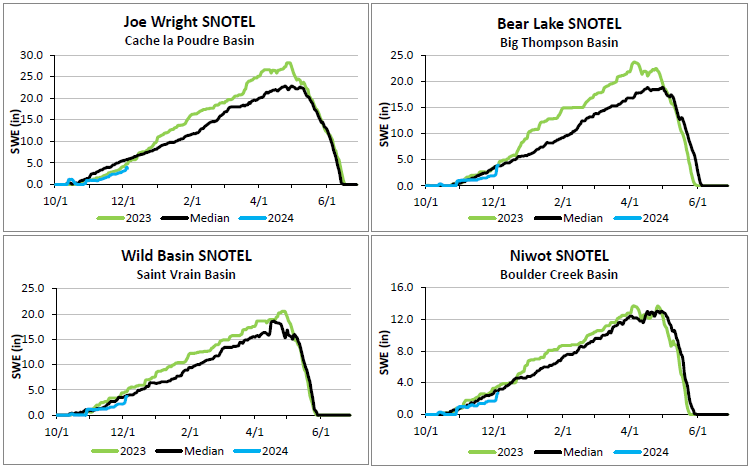
The total snow water equivalent at the Upper Colorado sites is on average 89% of median and the South Platte sites are at 87% of median.

The total snow water equivalent at the Upper Colorado sites is on average 89% of median and the South Platte sites are at 87% of median.

Click the link to read the article on the Northern Colorado Water Conservancy District website:
November 7, 2023: In what’s been described as “the largest aquatic habitat connectivity project ever undertaken in state history,” crews successfully tested the new Colorado River Connectivity Channel (CRCC) at the end of October. The new channel around Windy Gap Reservoir hydrologically and ecologically now reconnects two segments of the Colorado River for the first time in approximately 40 years.
Northern Water staff were joined by Grand County officials, Windy Gap Project Participant Representatives, Colorado Parks and Wildlife representatives and others to watch the first flows go through the long-awaited channel. This new video captures the historic day and includes comments from the project participants and stakeholders who were present to witness the occasion.
While water is now running through the new channel, there is still construction work to be done. Crews will continue putting the finishing touches on the project’s new dam embankment, diversion structure and other elements before winter weather brings activity to a stop in the upcoming weeks. Construction is expected to resume
next spring and wrap up later in 2024. Vegetation establishment along the channel will continue into 2025 and 2026, before the area is anticipated to open for public recreation in 2027.
The new channel will enable fish and other wildlife to move freely upstream and downstream around what is now a smaller Windy Gap Reservoir. Meanwhile, the reservoir will continue providing a diversion point on the Colorado River for the Windy Gap Project during the high flows of spring and early summer.
The CRCC is part of a package of environmental measures, valued at $90 million, associated with construction of Chimney Hollow Reservoir, which is ultimately where Windy Gap Project water will be stored once reservoir construction is completed.

Click the link to read the article on the Fort Collins Coloradoan website (Pat Ferrier). Here’s an excerpt:
On Tuesday, the town trustees approved a 5% annual rate hike for 2024-2028 that would cost the average ratepayer and extra $5.37 per month in winter and $12.45 in summer, when more water is used to water lawns. New rates will go into effect Jan. 1. Trustees also approved an increase in capital investment fees paid by developers from $10,437 for water and $9,742 for wastewater per single-family home to $10,959 and $10,229, respectively. The 2024 base water rate will go from $49.71 to $52.20 and the usage rate will go from $11.70 to $12.29 for the use of 4,000 to 7,000 gallons.
This is not a new problem for Wellington, which raised water rates and impact fees in 2020 to pay for an expansion of its water and wastewater treatment plants, imposed water restrictions and limited new residential building permits until the expansions are complete. Once the water and wastewater treatment plant expansions are completed, they should accommodate additional growth for 20 to 30 years, which would generate more building and tap fees, allowing the water and wastewater funds to show a profit.
Currently, however, the water fund will be in a $593,000 hole in 2026 and the sewer fund $700,000 short…Trustees also approved transferring the maximum amount from the general fund to the water and wastewater enterprise funds to reduce the impact to residents. Enterprise funds may only receive up to 10% of the revenue received in the fund from taxpayer transfers through the general fund under the Colorado Taxpayer’s Bill of Rights, known as TABOR. The total transfer will reduce the general fund by $935,000 in 2023 and an estimated $1.06 million in 2024.

What a great learning experience yesterday in Greeley at the 2023 South Platte River Forum. The panels were all excellent as were the speakers (even the presentation by Brent Young about crop insurance 😊).
Here’s the link to the forum Tweets.

Click the link to read the article on the Fort Collins Coloradoan website (Rebecca Powell). Here’s an excerpt:
The city says the new application is unique because Thornton asked community members about what was most important when it comes to site selection and used that information to determine the preferred route…The application is not yet available from the Larimer County Planning Division, but the city of Thornton has posted some information and a map of the preferred route on a project website. The city also sent the Coloradoan its executive summary for the application…
Thornton says the new proposed route through the county is about 10 miles long, 16 miles shorter than what was first proposed in 2018. A pump station would be moved two miles north of where it was proposed to land owned by Water Supply and Storage Company…The new proposed placement affects 20 outside property owners, according to Thornton, whereas the last project crossed 40 properties, according to Todd Barnes, communications director for Thornton…The plan incorporates other changes the city proposed after commissioners told the city to go back to the drawing board in late 2018, like locating the pipeline along County Road 56 instead of through Douglas Road and aligning part of it with the proposed pipeline for the Northern Integrated Supply Project, a separate water project…Thornton says the new application provides precise locations for the pipeline and its parts so residents “can have a clear understanding of potential impacts from the project.”
[…]
In the new application, Thornton contends any concerns about how the project affects river levels is an issue outside of the county’s authority and is under the jurisdiction of a water court. The city also asserts that because of the court ruling, Larimer County may not consider Thornton’s potential use of eminent domain and “may not require (or criticize Thornton for not including) inclusion of concept of putting water ‘down the river.’ “
Click the link to read the article on The Denver Post website (John Aguilar). Here’s an excerpt:
As Thornton filed its latest application for a water pipe permit with Larimer County on Monday, officials had hope that they would face less resistance this time…A no vote [from the Larimer County Commissioners] would jeopardize long-term growth plans in Thornton, Colorado’s sixth-largest city, for years to come by hampering the ability to access water it bought the rights for decades ago.
“Though it has been frustrating all these years, I firmly believe this is a better project with all the community feedback,” said Brett Henry, executive director of utilities and infrastructure for the city of Thornton. “It’s more clear about what to expect. There are less unknowns.”
[…]
Thornton says the pipe’s new proposed alignment through Larimer County holds several advantages over a route the county rejected in early 2019. It would take 16 fewer miles of pipe in the county than the original route called for, and the project’s western terminus would avoid a number of neighborhoods that had raised concerns around construction disruption. The city is also willing to move a proposed pump station well apart from homes. The station would be used to divert the water shares Thornton owns in the Poudre to a collection of reservoirs northwest of Fort Collins. The pipe would then traverse 22 properties in Larimer County before crossing into Weld County and turning south. City spokesman Todd Barnes said Thornton already has begun discussions with most of the landholders about obtaining easements for the pipe.

Click the link to read the article on the Big Pivots website (Allen Best):
The Western Slope delivers 70% of the Colorado River water. So why do Aspen, Vail and other places want to replace thirsty turf?
This story, a collaboration of Big Pivots and Aspen Journalism, is part of a series that examines the intersection of water and urban landscapes in Colorado.
If you’ve ever slipped and spun your way across Vail Pass through a wet, heavy snowstorm, you can be excused for wondering how Eagle River Valley communities could ever have too little water.
Vail and its neighbors do have that problem, though. It has become evident in the growing frequency of drought years in the 21st century.

First came 2002. Water officials, verging on panic, restricted outdoor water use. The drought was believed to be the most severe in 500 years. Fine, thought water officials as rain and snow resumed, we’re off the hook for at least our lifetimes.

In 2012 came another drought, one nearly identical in severity. More bad years followed in 2018 and 2021. The Eagle River normally chatters its way down the valley through Avon and to a confluence with the Colorado River near Glenwood Canyon. In those bad, bad drought years, it sulked. The shallow water was hot enough to endanger fish.

Colorado River flows have declined 20% since 2000. Having water rights is not enough. And the future looks even hotter and, because of that heat, drier. Brad Udall, a senior scientist and scholar at Colorado State University, warns of up to 20% additional flow loss by midcentury.
Average temperatures in the Colorado River Basin are projected by the U.S. Bureau of Reclamation to rise 5 to 6 degrees Fahrenheit during the 21st century. The agency projects slightly greater increases in Colorado and other upper basin states.
In Vail, managers of the Eagle River Water and Sanitation District have decided they need more storage. They plan a 1,200-acre-foot reservoir near Minturn called Bolts Lake. That compares with the 257,034-acre-foot storage of Dillon Reservoir. At that capacity, this new reservoir will be the most cost-effective way to ensure resilience as the climate becomes more variable. With the reservoir, they hope to capture water during high-runoff years for use in the district’s service territory from Vail through Edwards.
Demand reduction will be another tool of growing importance in a hotter, sometimes drier climate. Managers hope to reduce water demand in the district 5% by 2026 even as new housing, especially more affordable units, gets built. That’s 400 acre-feet per year.
The most productive place to wring these savings will be in water used for outdoor landscapes. Only 25% — or even less — of water applied to lawns returns to streams and rivers compared with 95% of water used indoors.
Siri Roman, the district’s general manager, said short-term change, such as restricted lawn watering in drought years, can be a strategy. But her district wants to effect permanent change.
“It’s not about drought years,” she said. “It’s about a drying climate. We have to get people to shift their attitudes, to know that water is getting to be more scarce.”
Roman’s district, like other water utilities in Colorado, is targeting nonfunctional turf. Precise definitions vary, but nonfunctional generally refers to grasses that require large volumes of water to irrigate but rarely see human feet except when mowed. It is also described as aesthetic turf.
Three years ago, Eagle River Water began offering rebates of $1 per square foot to customers willing to replace thirsty lawns with landscapes that use less water. Using state aid, the district this year bumped up the incentive to $2.
“We are not saying it needs to be stone and look like Arizona,” Roman said.
Directors of the district in October also agreed to new tiered rates that will discourage high-volume consumption.
Other Western Slope communities have also set out to discourage thirsty landscape choices. Motivations vary, but for many, there is also acknowledgement of the need to walk the talk of water conservation expected of Front Range communities. “That is something I hear a lot from communities I am working with,” said Marjo Curgus, a consultant.
‘Lawn Begone’ in Durango
Almost a decade ago, Steve Harris, a water engineer in Durango, summoned the local news media to his house to watch him remove sod from his front yard. He also had bumper stickers produced: “Lawn Gone.” In an editorial, the Durango Herald offered an alternative: “Lawn Begone.”
Harris believed that Colorado needed to make clear that decorative lawns had less value than agriculture. He worked with his state legislators to draft a bill that would have limited transfers of agricultural water to cities if that water went to lawns. As for his own lawn, Harris thought that he and others on the Western Slope couldn’t just pay lip service to this idea.
At the Colorado Capitol, the bill introduced in 2014 by then-Sen. Ellen Roberts and then-Rep. Don Coram was quickly shelved. Local governments objected. So did ag producers who thought state legislators had no business blocking their abilities to sell water rights.
Instead, the idea was directed to an interim committee for further study. Bills sometimes get sent there to die. In this case, the conversation continued, as Roberts had intended.
Since then, legislators have adopted several laws. A bill that passed in 2022, House Bill 22-1151, does not institute a prohibition but instead allocated $2 million to the Colorado Water Conservation Board, $1.5 million of which went to local jurisdictions to spur voluntary replacement of irrigated turf.
The law asserts that for every 100 acres of turf converted to water-wise landscaping, up to 200 acre-feet of water can be conserved. The act defines water-wise landscaping as a water- and plant-management practice that emphasizes using plants with lower water needs.
Whether that much water gets saved also depends upon whether irrigation systems are changed to match the lesser water needs of the new landscapes. Grass that needs 12 inches of supplemental water per year need not continue to get 25.
All that funding has now been allocated. On the Western Slope, the municipalities of Cortez, Glenwood Springs and Frisco were awarded funds as was the Eagle County Conservation District. The state agency said 25% of turf-replacement funds were for Western Slope entities.
Rep. Marc Catlin of Montrose and then-Rep. Dylan Roberts of Frisco, two of the four prime sponsors, are from the Western Slope. Another prime sponsor, Sen. Cleave Simpson of Alamosa, now has a district that encompasses southwest Colorado, while Roberts has become a senator.
Without state funding, Montrose County approved grants for seven turf-replacement projects.
“From the start, I thought this initial effort might have more value from an education and outreach perspective than actual water savings,” said Justin Musser, the county’s natural resources manager.
Projects were chosen based on various objectives. For example, do the new landscapes provide energy savings or wildlife benefits? “We are not overly prescriptive,” said Musser. “If you have a good plan that references standards from the Colorado State University Extension or another reputable source, the application gets a higher ranking.”
Why would Montrose County be interested in yanking sod to save water?
“It’s important that we look at these types of things across the Colorado River basin,” Musser said. “We would want people in California and Arizona and Nevada to be looking at these types of programs, too. I think it makes sense for a place like Montrose County to be conserving water as much as we can, too.”
But, he added, this is “one part of a very complex issue.”

Droughts versus aridification
The Western Slope of Colorado produces 70% of the water in the Colorado River, according to the Colorado River Water Conservation District. Some of that water stays in Colorado. About half of the water for Front Range cities comes from the Western Slope. Yet more of the Colorado River gets diverted to farms in the South Platte and Arkansas river valleys.
And, of course, water from the Western Slope flows downstream to farms and cities in Arizona, California and Nevada.
The Colorado River has infamously been falling short of meeting all demands. The river first failed to reach the Sea of Cortez in the 1960s and, as diversions in Arizona and elsewhere expanded, has ceased to reach the sea altogether since the 1990s — save for an especially engineered pulse in 2014.
In 1922, when delegates of the seven states met to negotiate the Colorado River Compact, they assumed that flows of the early 20th century would be the norm, delivering more than 20 million acre-feet. As Eric Kuhn and John Fleck explain in their book, “Science Be Dammed: How Ignoring Inconvenient Science Drained the Colorado River,” it had been a wet period.
It didn’t stay that wet, and in the 21st century it has been delivering far less water, an average 13.2 million acre-feet through 2022. Andy Mueller, general manager of the Glenwood Springs-based Colorado River District, and others have warned that continued warming could depress flows to 9 million acre-feet during coming decades. Or even less.

Grand Junction more recently adopted regulations curbing water needed for urban landscaping. The city has adopted sustainability goals, “and water plays a big part of that,” said Randi Kim, utilities director for the city of 69,000 people.
Cost savings enter into the city’s calculation as it prepares for a projected 91,000 residents by 2040. The municipal utility taps high-quality water from Kannah Creek, which originates on Grand Mesa. When that is insufficient to meet demands, as the city utility projects will be the case by 2040, the city will tap the Gunnison River but will need to pay more to treat the dirtier water.
Rising heat can also drive higher demand. Grand Junction in July reached 107 degrees, tying the record that had been set just two years before. The city’s 13 highest temperatures have occurred this century.
This is but one aspect of the changing and drying climate, a process that many — including Kim — describe as aridification. “I think people realize that we have to change the way we use and manage water, and it really affects every aspect of our lives,” she said.
Grand Junction’s new regulations apply to new developments. Turf that does not meet the city’s definition of “functional” cannot exceed 15% of landscaping. The new regulations also require low-water vegetation in traffic medians and some other common areas.
Steamboat Springs, although cooler and wetter than Grand Junction, faces similar challenges. It gets 24 inches of precipitation a year, compared with 10 inches for Grand Junction. Some years, the snow along streets of Steamboat gets piled higher than the head of a rim-rattling professional basketball player.
These prodigious snowfalls have not been yielding equally impressive runoffs in the Yampa River. Several times during the longer, hotter summers of the 21st century, the river slunk to such shallow depths that water officials decreed a temporary end to fishing. It almost happened again in July before temperatures cooled and rain arrived.
“We were one day from the river being shut down again,” said Madison Muxworthy of the Yampa Valley Sustainability Council, a nonprofit. “It was crazy.”
Muxworthy calls the Yampa River the “life beat of our community.” The description is apt. Kayakers paddle amid the waves during runoff months, and anglers drop lines every season. There are always people along the river banks.
In 2021, heeding local sentiment, the sustainability council launched a water-conservation program focused on outdoor use. Working with the city government and Mount Werner Water and Sanitation District, the group created a guidance document for landscapes called “Yampascaping.” Four educational workshops this year were well attended.
“Citizens are really interested in this because they see the impacts from climate change that we’re already having,” said Muxworthy, her organization’s soil moisture, water and snow program manager. “It’s really easy for them to make the connection and want to do something about it.”
The Mount Werner district, which serves the base of the city’s bigger ski area, offers rebates of $1 per square foot for turf removal.
Eighty miles south of Steamboat, at a 131-unit multifamily project along the Eagle River called The Reserve, turf-removal incentives of $2 per square foot have also helped the homeowners association replace a half-acre of thirsty grasses with native vegetation. The homeowners hope to replace another 60% of the more than 4 acres of common area.
Saving water is paramount in the mind of Deb Forsline, a director of the homeowners association. She sometimes lulls her grandchildren to sleep with the soothing sound at river’s edge and, at other times, accompanies her husband on fishing expeditions, knitting while he dangles lines. “It’s about saving water for the river, not the money,” she said of the efforts to reduce water for landscaping.

Diane Johnson, communications and public affairs manager at Eagle River Water and Sanitation District, concurs. The $2 per square foot “helps move the thinking of people who have already been thinking about it,” she said.
Roman, the district’s general manager, points to the innate connection that most of her district’s 31,000 consumers have with the outdoors. “A lot of people who live here year-round know that it is irresponsible to overuse.”
A steeper staircase of water rates
After the 2002 drought, the Eagle River district adopted an inclining block rate structure. The more you use, the more you pay. The district got inconsistent results. Larger homes and those with more expansive and water-intense landscaping dropped their use in smaller percentages than smaller homes. The rate structure had been flawed, allowing larger homes to pay less per 1,000 gallons than smaller homes for the same volume of water. Different rates were needed to snag the attention of high-volume consumers.
Aspen had the same problem. It adopted tiered water rates in 2005. Managers thought the rates would discourage high volumes of consumption. But even in drought years, some properties continued stubbornly high volumes.
In 2017, Aspen adopted a new approach. The regulations require reduced water use in the landscape and irrigation plans for new and redeveloped projects. Such caps are called budgets. Like Denver and Boulder, Aspen has almost no new development of raw land. The law imposes a hard cap of 7.5 gallons per square foot of landscape. That’s about a foot of water, or roughly half of the supplemental water required in Colorado for Kentucky bluegrass. The law also requires so-called “smart” irrigation systems and alternative plants but leaves some flexibility in how developers and their consultants stay within the water budgets.
So far, 110 to 120 projects in Aspen have been reviewed, but only 15 to 20 have been executed – still too soon to discern clear results in water savings for the city, said Rob Gregor, utilities permit coordinator. Still, the city has leveled its water use and hopes to achieve even greater efficiencies in water devoted to residential and commercial landscapes. That could leave more water in Castle Creek and the Roaring Fork River, one of the goals of the program.
Durango, with 19,000 people and a projected population of 25,000 by 2035, has considered using rates to nudge high-volume users to less demanding landscapes. Justin Elkins, utilities manager, said the city hopes to encourage voluntary reductions in water use by allowing water users to monitor the volume of their use and compare it to consumption by their neighbors.
The Ute Water Conservancy District has successfully used rates to encourage water conservation. The Grand Junction-based district delivers water to rural and exurban areas of the Grand Valley from Cameo to the Utah border. Customers tend to be more responsive “when it hits them in the pocketbook,” said Andrea Lopez, the district’s external affairs manager. “As they use more water and enter into tiers that become steeper with the more they use, we usually see a reduction in use.”
That’s what Eagle River Water has done. Like Aspen, the Vail Valley has some wealthy homeowners. Under the old tier system, somebody in a smaller home paid more per gallon than somebody in a larger home, if they both used the same large volume.
Beginning in January, Roman was on the agenda of everybody from Rotary clubs to Eagle County commissioners. “Really, this is targeting our excessive users,” she told the Vail Town Council at a June meeting. “They’re the ones that are going to feel this.”
District directors in October approved the new tiered rates that intend to discourage high-volume consumption.

In Wildridge, a neighborhood on the south-facing slopes of Avon, Linn Brooks has shown what is possible in landscape conversions. Fifteen years ago, before she started transitioning her landscape, her home used 15,000 to 25,000 gallons a month. Now, it uses, at most, 7,000 gallons a month and her landscape is commanding.
The takeaway, she said, is that communities can have vibrant landscapes and protect property values – and still use less water.
Next: How did bluegrass lawns in Colorado become the default? Some trace it to the castles of Europe. Half or more of Coloradans live in neighborhoods governed by homeowners associations. Some have started to curb thirsty bluegrass, but others needed a firm nudge this year from state legislators.
Allen Best, a longtime Colorado journalist, publishes Big Pivots, which tracks the energy and water transitions in Colorado and beyond. Aspen Journalism is a nonprofit, investigative news organization covering water, environment and community. This story is part of a five-part series produced in a collaboration between Big Pivots and Aspen Journalism. Find more at https://bigpivots.com and at https://aspenjournalism.org

Click the link to read the release on the City of Greeley website (Keri Fishlock):
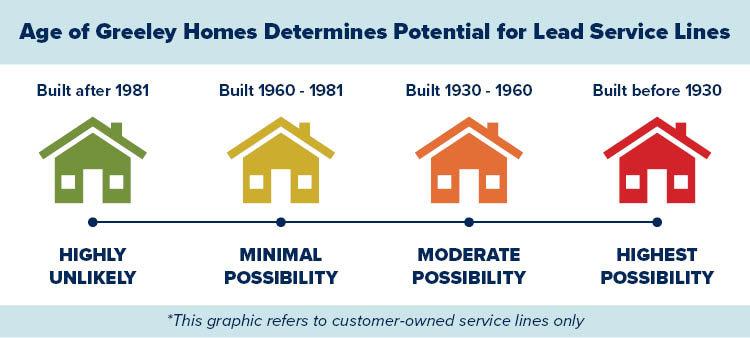
A $250,000 grant from the Colorado Water Quality Control Division will help Greeley Water identify and inventory water service lines that contain lead.
As it works to help customers reduce their risk of lead exposure, Greeley Water must create a mapped inventory of water service line materials by October 2024 to meet federal and state regulations. This process helps the city identify and replace any remaining customer-owned lead service lines at no cost to the homeowner.
Greeley Water plans to use grant funding for the following:
- Water service line inventory
- Lead or galvanized service line confirmations
- Geographic Information Systems (GIS) mapping and analysis
“This grant is great news for the City of Greeley. It helps speed up our inventory process. It directs more of our available funds toward replacing service lines that contain lead,” said Keri Fishlock, an engineer with Greeley’s Water and Sewer Department.
In recent years, there has been greater national awareness of the potential health risks of lead in drinking water. Water testing confirms that water leaving Greeley’s treatment facilities is treated to a high standard and is lead-free. Yet, lead may be present in older homes’ plumbing, faucets or service lines. Greeley Water is working with customers to identify and reduce those risks.
Go to www.greeleygov.com/leadsurvey to complete a short survey about your water service line. Participants can win one of three $100 gift cards awarded monthly.
Contact Greeley Water if you need help at leadprotection@greeleygov.com or 970-336-4273.

Click the link to read the article on The Greeley Tribune website (Trevor Reid). Here’s and excerpt:
The city recently completed a $35.5 million project expanding the treatment plant’s capacity and improving the quality of water the city discharges into the river. Though the city plans to rebuild and improve the front end of the process, the city’s Nitrification Project mostly expanded the capacity for biological treatment processes that remove nitrogen and phosphorous to meet state and federal regulations…Nitrogen and phosphorus support the growth of algae and aquatic plants, but too much causes algae to grow faster than ecosystems can handle, according to the Environmental Protection Agency. Algae blooms can severely reduce or eliminate oxygen in the water, harming fish populations and elevating toxins and bacterial growth in the water…
The city contracted with Garney Construction to complete the improvements at the plant, which took about 200,000 hours of work. Cadee Oakleaf, the project manager, said everyone involved had to plan carefully to prevent any interruptions in service to Greeley water customers. This included temporary piping throughout the plant and working overnight as wastewater collected in an empty basin when work required the plant to temporarily stop a step in the process.
“It was very meticulous planning, planning for months ahead of time at times,” Oakleaf said. “To bring on the new basins, we actually started talking about it a year in advance.”
Lab testing and real-time measurements at the plant have indicated the project was successful at further removing nitrogen and phosphorus, [Tyler] Eldridge said.
Click the link to read the article on the Fort Collins Coloradoan website (Rebecca Powell). Here’s an excerpt:
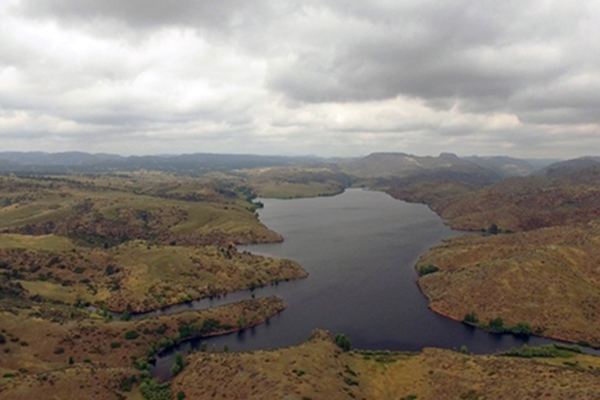
A final environmental impact statement for Fort Collins’ proposed Halligan Reservoir expansion is out, and now the public has about a month to weigh in on it. The Halligan Reservoir project north of Fort Collins would expand the reservoir from 6,400 acre-feet to 14,600 acre-feet to help the city meet its projected water demands through 2065. The reservoir stores water from the Poudre River, which makes up half of Fort Collins Utilities’ water supply.
“The project will provide added space to store Utilities’ water rights, enabling a more robust, resilient, and reliable water supply for Utilities’ current and future customers,” according to a news release from Fort Collins Utilities.
The project would require excavation and would discharge dredged or fill material into the North Fork of the Cache la Poudre River and adjacent wetlands, so it requires approval from the U.S. Army Corps of Engineers under the federal Clean Water Act. Since a draft environmental impact study, or EIS, came out in 2019, the city has modified its plans to address some challenges in meeting guidelines for dam safety and construction. Rather than raising the height of the current dam by about 25 feet, it now plans to build a replacement dam that is 26 feet higher than the current dam. It would be located about 200 feet downstream. The existing dam, which is more than 110 years old, would be either partially or fully removed.

Click the link to read the article on the Water Education Colorado website (Jerd Smith):
Coca-Cola, several Colorado nonprofits, as well as Denver Water, the Colorado River District, and a group of irrigators have launched a new instream flow effort to help keep the scenic headwaters of the Fraser River wetter in the fall, aiding fish and habitat in the stream near Winter Park.
The Colorado Water Trust is a nonprofit that works to match distressed streams with water right holders interested in selling, donating or leasing water that can be used to boost streamflows. It spearheaded the Fraser’s 10-year instream flow agreement. Participants also include Learning By Doing, an East Slope-West Slope partnership that works on local stream restoration projects
Coca-Cola Corporation, as well as one of its bottlers and distributors, Swire Coca-Cola, have pledged $24,000 annually to pay for the water and the restoration work, according to Tony LaGreca, Colorado Water Trust’s project manager for the Fraser program.
Erica Hansen, external communications manager for Swire, said the Coca-Cola companies have 35 environmental water projects across a 13-state region, including 10 in Colorado that are completed, underway or pending.
“We operate in several states that are high drought risk,” Hansen said. “Any drop we use we’re putting back into nature. The Fraser River project is one of the ways we do that.”
LaGreca said the new initiative represents an important step forward in restorative water management in Grand County and Colorado.
“There was a time,” he said, “when we did not have irrigation companies coming to us to find ways to put water into the river for fish. But more and more we are having successful partnerships to increase flows as part of a larger water management strategy.”


Grand County is home to the headwaters of the Colorado River and the Fraser River, one of its tributaries. Both waterways are heavily diverted to the Front Range to serve residents and farms from Denver up to Fort Collins and out to the Nebraska border.
Over the years, as droughts have become more common and climate change has sapped flows, Grand County’s rivers have become increasingly stressed.
To help solve the problems, two of the largest transmountain diverters, Denver Water and Northern Water, among others, signed on to the Colorado River Cooperative Agreement in 2013. The agreement gives the water agencies some leeway to develop new water supplies to which they have water rights, while also funding efforts to keep rivers and wetlands in the headwaters region healthier, and to ensure mountain tourist economies have enough water to thrive.
Mike Holmes is president of the Grand County Irrigated Land Company. As part of the restorative work underway, he and his shareholders agreed to sell a portion of their water stored in a small reservoir to benefit the river. Each year the program operates, the ranchers will deliver about 50 acre-feet of water. An acre-foot equals nearly 326,000 gallons of water, the amount used by two to three average households in a year. Holmes said the growers have been working to improve the efficiency of their irrigation systems, freeing up water for the river.
“This year, with the abundant snowpack, we had the water available, and so we worked with the water trust to execute a lease and then went through a review by the Colorado River District. It’s a pretty streamlined process,” Holmes said.
Though 50 acre-feet is not a lot of water, it should make a difference in the Upper Fraser, where Denver is allowed to divert even when the river’s fall flows are already shrinking, LaGreca said.
Denver Water’s role in the restoration effort is to allow the Colorado Water Trust to use the utility’s collection system to put water into distressed stream segments in the headwaters. In turn the irrigators give Denver Water access to water stored in Meadow Creek Reservoir, farther downstream, according to Nathan Elder, Denver Water’s water supply manager.
Work on the program for 2023 wrapped up earlier this month and will begin again next September.
Scott McCaulou is director of the corporate water stewardship program at Business for Water Stewardship. The Portland-based nonprofit is funded by the Bonneville Environmental Foundation and helps connects corporations to environmental water restoration initiatives.
“This first year of the agreement between the [irrigators] and the water trust is a small step but the hope is that it grows into a longer-term partnership and helps develop more flexible water management tools in the Upper Colorado,” McCaulou said. “We see it as a good contribution to something that could grow if it is successful this year.”


Click the link to read the article on the Colorado Community Media website (Ellis Arnold). Here’s an excerpt:
More than 50 people applied to serve on the Douglas County Water Commission, a new entity that is expected to help shape the future of water supply in a continually growing county. After county leaders narrowed the pool of applicants down to 12 whom they wanted to bring in for interviews, the applicants fielded questions, including ones about their connections and any conflicts of interest they might carry. The water commission is expected to help create a plan regarding water supply and conservation, among other aspects of water in the county. It’ll consist of unpaid volunteers, according to the county’s elected leaders.
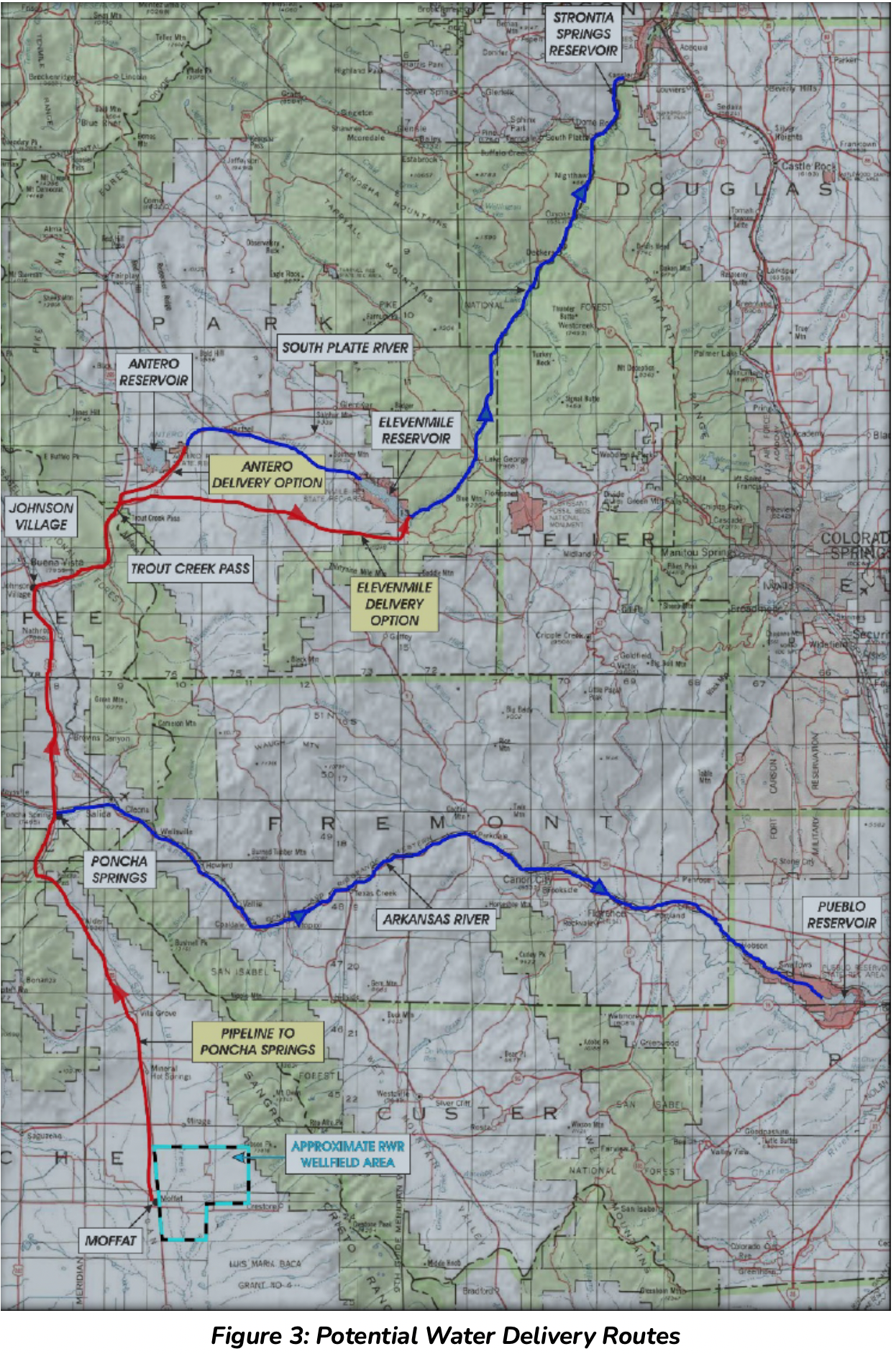
The forming of the new body comes against the backdrop of a controversial proposal to pump about 22,000 acre-feet of water per year to Douglas County from the San Luis Valley, a region of Southern Colorado. Renewable Water Resources is the private company that proposed the project. Last year, county leaders Laydon and Lora Thomas joined together in deciding not to move forward with that project, while county leader George Teal has continued to support it.

Click the link to read the article on The Greeley Tribune website (Chris Bolin). Here’s an excerpt:
The plant now meets all new and existing state and federal regulations, while also ensuring the continued protection of local rivers. The improvements — which started in 2019 — cost $35.5 million and took more than 200,000 work hours to complete, according to a release by the City of Greeley. Construction stayed on schedule and on budget, and the plant operated without any service disruptions throughout. The city also spread out the cost over several years to reduce the burden on ratepayers.

Click the link to read the article on the Denver Water website:
DENVER — Wednesday, Oct. 11, 2023 — The Denver Board of Water Commissioners on Wednesday, Oct. 11, adopted rate changes to help pay for important upgrades, projects and ongoing maintenance and repair work to keep its system operating efficiently while keeping rates as low as good service will allow.
The new rates take effect Jan. 1, 2024, and for typical single-family residential customers who receive a bill from Denver Water, if they use the same amount of water in 2024 as they did in 2023, the new rates will increase their monthly bill by an average of $1.60 to $2.30 over the course of the year, depending on where they live.
“Denver Water is at a pivot point. These are historic times and we’ll be affected, just as the communities we serve will be affected, by climate change, population growth, variability in the economy, inflation and supply chains,” said Alan Salazar, Denver Water’s CEO/Manager who joined the organization in August.
“Water is a crucial resource that supports all of us. You can’t have civilization without it. Continuing to maintain and invest in the system that supports our water supply will ensure we — Denver Water as well as our customers — are ready for what lies ahead, while keeping rates as low as good service will allow.”
Denver Water expects to invest $1.9 billion over the next 10 years in projects that will maintain, repair, protect and upgrade the system and make it more resilient and flexible in the future. The utility is committed to ensuring the system can reliably deliver safe, clean and affordable water to its customers while mitigating the effects of the economy, from inflation to supply chain issues, on its costs.
More details on the rate increase can be found at these links:
- Water rates to rise slightly in 2024 — Provides details on Denver Water’s rate structure and how the increase impacts customer bills, including an infographic visually highlighting the impacts to customers inside and outside of Denver.
- Major investment on tap — Highlights what water rates help pay for with an overview of some of the projects that make up the utility’s 10-year forecast for an estimated $1.9 billion investment into the system that supports about 25% of the state’s population, including Colorado’s capital city. The story includes a video highlighting some of the current projects including the expansion of Gross Reservoir, the Lead Reduction Program that is replacing customer-owned lead service lines at no direct cost to the customer, the new Northwater Treatment Plant under construction north of Golden and the new water quality laboratory now operational at the National Western Center near downtown. The investment forecast also includes improving and replacing aging water mains under the streets and improving the overall flexibility and resiliency of the system and our communities.
- Since January 2020, Denver Water has replaced more than 20,000 customer-owned lead service lines at no direct cost to the customers.
- The utility in 2022 signed a Memorandum of Understanding with several water utilities across the West to reduce the use of water-intensive Kentucky bluegrass in places where it’s purely decorative, such as traffic medians.
Click the link to read the article on the Denver Water website (Jay Adams):
It’s not often that a median in the middle of a street gets a lot of attention, and that makes it a perfect candidate for a landscape makeover.
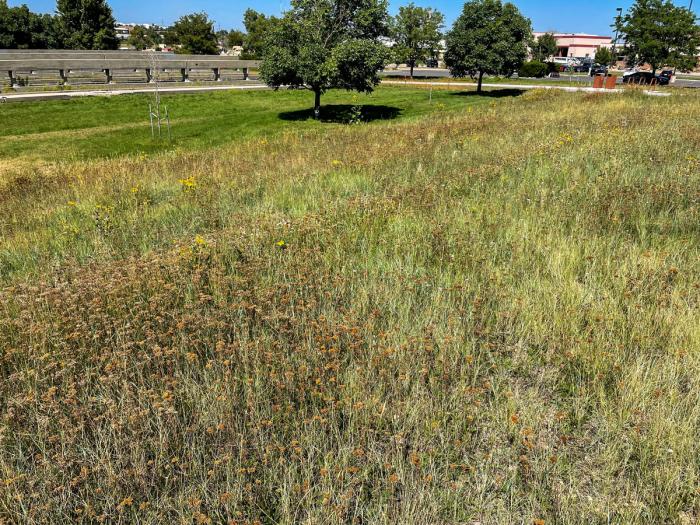
For decades, the four medians separating the north and southbound lanes of Quebec Street, just south of Interstate 70 between Smith Road and Martin Luther King Jr. Boulevard, have featured 10 acres of thirsty Kentucky bluegrass.
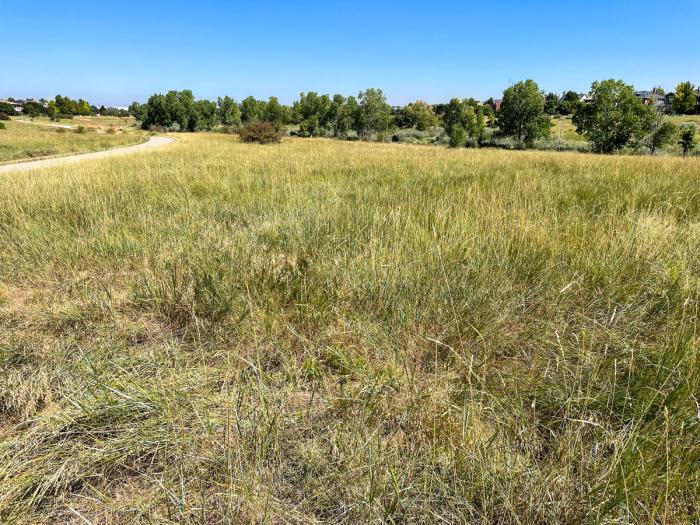
Now, the Denver Parks and Recreation department is transforming the grass fields into prairie grass meadows that will be home to a more appropriate type of ColoradoScape that needs significantly less water to thrive.
“The medians had what we call ‘nonfunctional grass,’ which means the grass was not being used for any type of activity. That made it a perfect location for landscape transformation,” said Ian Schillinger-Brokaw, a Denver Parks and Recreation urban ecology planner.
“We were using around 9 million gallons of water every year to keep grass green that no one used, so it was really not a good use of water.”

The landscape transformation project on the four medians is being done in partnership with Denver Water, which is helping to fund the work.
The project also received money from the Colorado Water Conservation Board’s Turf Replacement Program, which uses state funds to help transform water-intensive turf into a more natural ColoradoScaped environment.
What to expect
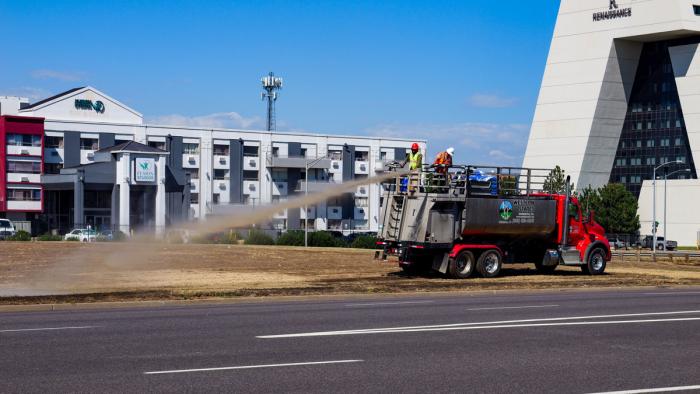
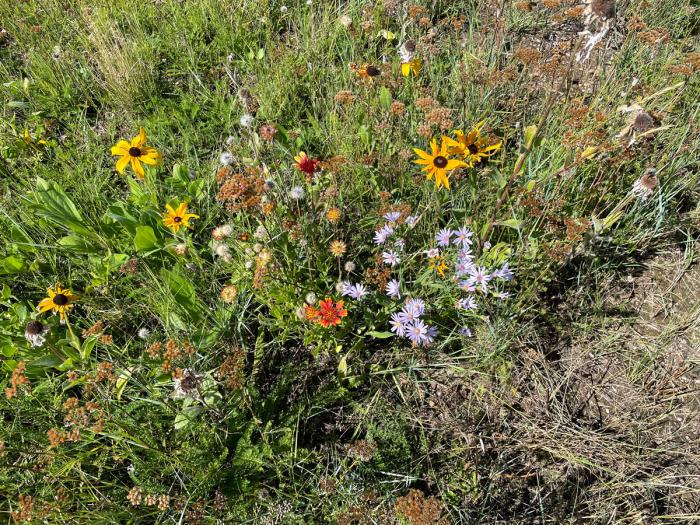
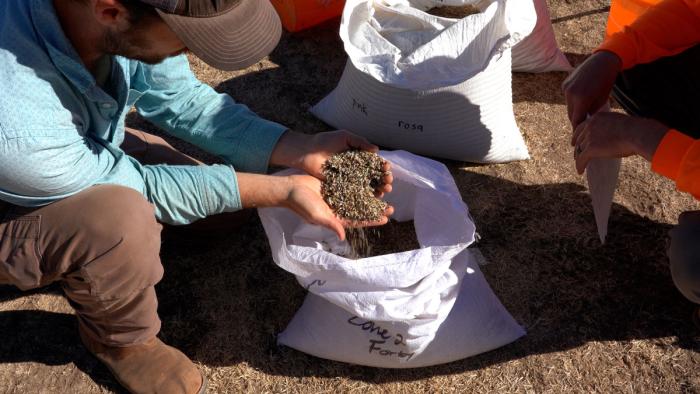
During summer 2023, the city shut off the sprinklers and let the bluegrass die. Then in September, landscape crews from Western States Reclamation planted more than 60 species of prairie grasses and wildflower seeds through the remains of the dead bluegrass.
Learn more about ColoradoScaping at denverwater.org/Conserve.
After the seeds were in the ground, workers sprayed the field with “hydromulch,” which is the process of spraying water mixed with small particles of wood fiber on top of the seeds, so they don’t blow away or get eaten by birds.
The field will be watered over the next two to three years to help the seeds grow. Depending on the weather, some grasses will sprout this fall, while others will begin to grow next spring and summer.
It will take roughly three years for the new plants to become established.

“The field will have a variety of grasses with different heights, colors and textures and the wildflowers will provide an added boost of color,” Schillinger-Brokaw said.
The wide variety of plants will help the new prairie meadows thrive in different weather conditions. For example, some grasses and flowers will do better in dry years, while others will grow better in wet years.
“By adding a variety of grass species, we’re ensuring that each season the field will have plants that are in good shape,” he said.
“The field will look very similar to some of our other parks and open spaces in the area, such as Westerly Creek and Prairie Meadows parks.”
Schillinger-Brokaw said the landscape will keep safety in mind by making sure plants around the corners of the medians will be shorter, so they won’t impact drivers’ ability to see other cars and make safe turns at the intersections.
Water savings
Before the landscape conversion, the field required roughly 9 million gallons of extra water every year to keep the Kentucky bluegrass green. By transitioning to a prairie meadow, the goal is to eventually stop watering the field and let Mother Nature provide all the moisture the plants need to survive, Shillinger-Brokaw explained.
The Denver Parks and Recreation department will continue to water the trees on the medians. However, by eliminating the extra irrigation that the bluegrass needed, the overall water use for the medians could be reduced by roughly 8.5 million gallons each year once the plants are established.
“Kentucky bluegrass has been used as the default form of landscaping for decades across many parts of Colorado, but it requires a lot of water,” said Austin Krcmarik, a water efficiency planner at Denver Water.
“With water being such a scarce resource across the West, it’s great to see Denver Parks and Recreation switching to landscaping that fits our climate.”
Additional benefits
The new medians full of prairie grasses and wildflowers are an example of ColoradoScaping, which is landscaping that features low-water-use plants that thrive in our state’s semi-arid climate.
Along with water savings, ColoradoScaping provides additional benefits for Denver’s parks, such as:
- Providing more resilient landscapes that can cope with extreme weather, such as drought.
- Adding biodiversity to the city with new habitats for pollinators such as birds and bees.
- Establishing areas that improve stormwater drainage and improve water quality.
- Eliminating the need for mowing the medians regularly throughout the summer.
- Saving money on water bills that can be used for other park improvements. (The water savings on the Quebec Street project will save Denver Parks and Recreation roughly $20,000 each year.)

Saving water across the West
Water-saving projects like the Quebec Street median turf conversion are critical because Denver Water gets half of its water supply from the Colorado River Basin, which has seen drought conditions over much of the last 23 years.
“Denver Water and other utilities across the West are actively promoting and working with cities and park districts to look for areas of nonfunctional Kentucky bluegrass and see if other types of landscaping is a better fit to help save water,” Krcmarik said.
It’s In Denver’s Nature
The transformation of the Quebec Street medians is an example of Denver Parks and Recreation implementing the Game Plan for a Healthy City.
The comprehensive plan serves as a roadmap to the future of Denver’s park system. A key aspect is investing in the fight against climate change through conserving water, transforming landscapes, growing the urban canopy and protecting habitats.
As part of the plan, in April 2023, Denver Parks and Recreation changed its policy of using thirsty turfgrass, like Kentucky bluegrass, as its primary landscaping groundcover in areas with no recreational value. The Quebec Street medians are an example of how the city is using drought-tolerant and ecosystem-friendly plants instead of turfgrass.
“We’re doing a lot across the city to reduce our water footprint and the Quebec Street medians project is one of the biggest landscape transformation projects we’ve done,” Shillinger-Brokaw said.
“We ask for patience as these new grasses grow, and we’re excited to see the new look coming soon to this part of the city.”
For more information about landscape transformation across the city, check out Denver Parks and Recreation’s It’s In Denver’s Nature campaign and denverwater.org/Conserve.
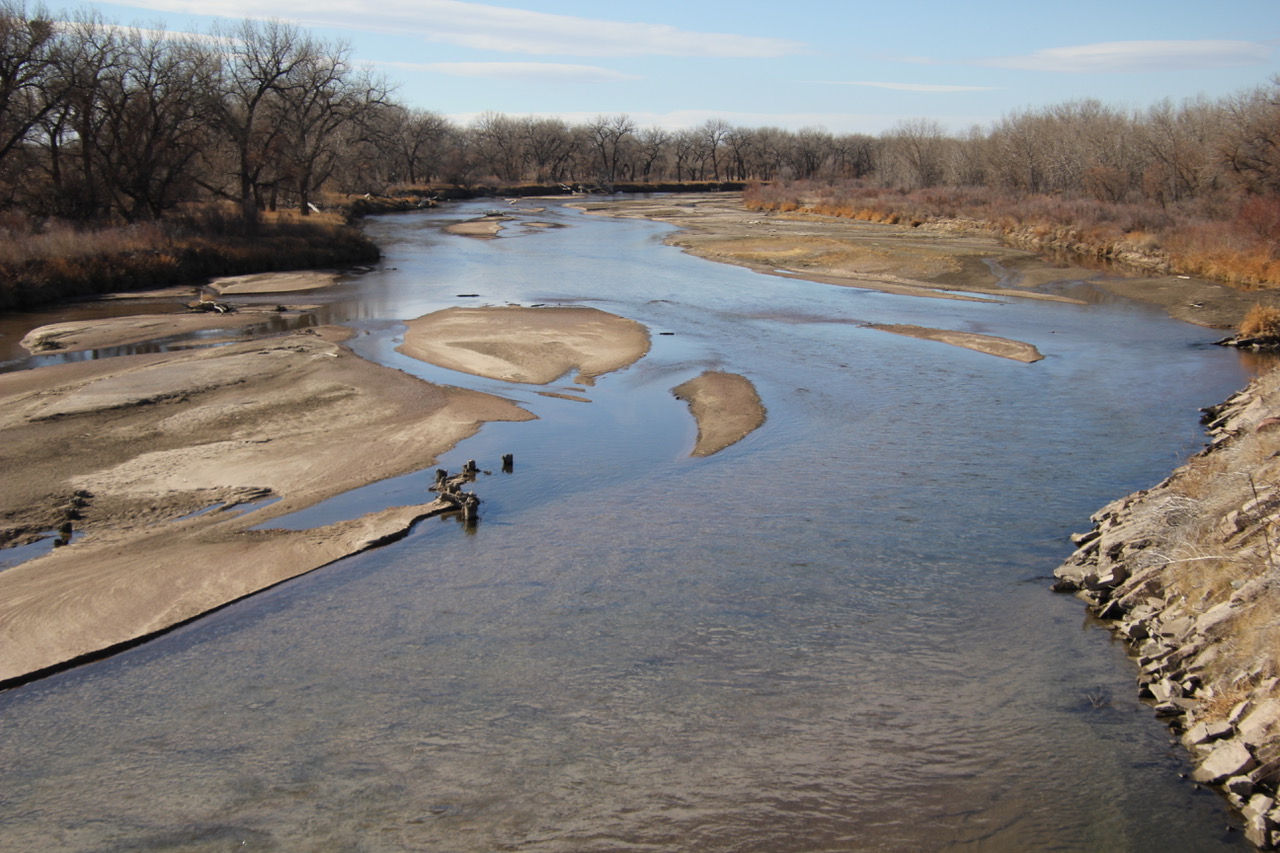
Click the link to read the article on the Nebraska Public Media website (Fred Knapp). Here’s an excerpt:
…at the beginning of last year. Speaking to the Nebraska Legislature, then-Gov. Pete Ricketts outlined a plan.
“To secure Nebraska’s water supply I am recommending $500 million to construct a canal and water reservoir system from the South Platte River. Access to this water enables our farmers and ranchers to produce. It provides for quality drinking water, and keeps electric generation costs manageable,” Ricketts said.
That $500 million proposal has now grown to $628 million. To put that in perspective, that’s nearly twice the cost of the new prison Nebraska is planning to build. In a news conference, Ricketts claimed Colorado was violating an interstate compact with Nebraska.
“During the non-irrigation season, Colorado has not been providing us the water that is called for under the Compact. Their near-term goals show that going down, and should all the long-term goals be effected, they would reduce the amount of water flows coming to the state of Nebraska by 90 percent,” he said.
Responding to Ricketts, Colorado Gov. Jared Polis insisted that state is fulfilling its obligations to Nebraska. Speaking to members of the Colorado General Assembly, he struck a defiant note, as reported by CBS News Colorado.
“Know this: We will continue to protect and aggressively assert Colorado’s water rights under all existing water compacts,” Polis said.
A Polis spokesman described the Perkins proposal as a “canal to nowhere” and a “boondoggle.” Whether the canal is a good idea or not, it’s one that’s been around for a long time. Perkins County farmers actually started digging an irrigation canal in Colorado in 1894, but gave up within a year after promoters ran out of money.

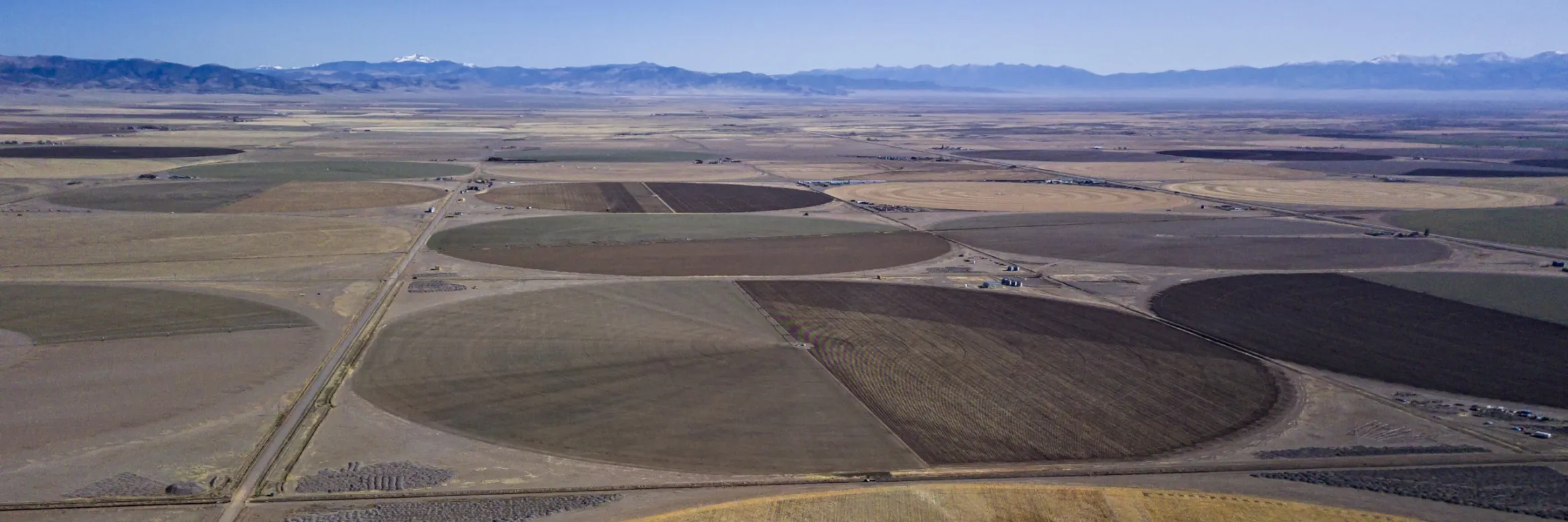
Click the link to read the article on the Alamosa Citizen website:
In response to claims by principals of Renewable Water Resources, officials this week with the Colorado Division of Water Resources reiterated that the Upper Rio Grande Basin is over-appropriated and has no surface or groundwater available for a new appropriation.
The reply from state water officials came in response to questions from Alamosa Citizen after the Douglas County Future Fund made a series of claims in a recent newsletter it publishes to influence decision-makers in Douglas County.
RWR principals, who include former Colorado Gov. Bill Owens and political strategist Sean Tonner, have been working to convince Douglas County commissioners that there is water available in Rio Grande Basin that Douglas County could own and pump into the Front Range bedroom community.
The search for a future water source by suburban communities like Douglas County is one of the pitched battles of the climate-influenced 21st century. The storyline goes like this: Sprawling suburban communities that blew up during the 1980s and ’90s and first decades of the 21st century are on the hunt for new water sources as periods of extreme drought and intensified changes to surface temperatures reduce the availability of water as a natural resource.
The agricultural corridors of America, meanwhile, are working to reduce their own consumption of water through technological advances and through reducing the amount of acreage used to grow crops.
It’s a classic new battle: population centers vs. rural regions, and there is no clearer example of the conflict than Renewable Water Resources and its efforts to export 22,000 acre-feet of water from the Upper Rio Grande Basin to Colorado’s Front Range on a perpetual basis.
“The San Luis Valley has 1.02 billion acres of unused water, because it sits over the second-largest aquifer in the United States,” is one of the claims RWR made in a Douglas County Future Fund newsletter in September.
Another claim it made as fact: “The RWR project proposes to use 22,000 acre-feet. This water would come from the confined aquifer in the San Luis Valley, which is fully renewable within five days of runoff from the San Luis Valley mountain ranges.”
Neither is the case and both claims fly in the face of state groundwater rules governing irrigators’ use of water in the Valley. The lack of recharge and dropping levels of the confined and unconfined aquifers of the Rio Grande Basin have pushed state water engineers to develop specific groundwater usage rules in an effort to restore the aquifers and save the Rio Grande Basin. Each irrigation season, the state curtails water usage along the Rio Grande Basin, which impacts farming and ranching production in the Valley as Colorado works to control the water availability and meet its own obligations to New Mexico and Texas under the Rio Grande Compact.
“At this time the Division of Water Resources is not going to comment on the specific details included in the newsletter produced by the Douglas County Future Fund. However, due to the over-appropriated nature of our water system, there is no surface or groundwater available for a new appropriation in Water Division 3, the Rio Grande Basin in Colorado,” said state water Division 3 Engineer Craig Cotten.
Douglas County recently created a 12-member water commission to advise it on water issues. The new committee includes Tonner, who uses the Douglas County Future Fund newsletter to make the case for Renewable Water Resources’ water exportation proposal.
The Douglas County water commission members include:
District 1
Merlin Klotz, James Myers, Donald LagleyDistrict 2
Clark Hammelman, James Maras, Roger HudsonDistrict 3
Frank Johns, Evan Ela, Kurt Walker, Harold SmethillisAt-large Seats
Sean Tonner, Tricia BernhardWater managers on the Rio Grande Basin continue to monitor the efforts in Douglas County. The county government in Douglas County is not set up to be a water provider and is dealing with its own conflicts.
The Douglas County commissioners have been advised by attorneys that the Renewable Water Resource concept is littered with problems and would have difficulty gaining traction in state district water court.
Any effort to export water from the San Luis Valley would get tied up for years in state water court. The six counties in the San Luis Valley also recently banded together to create local planning rules that local officials believe would block a water exportation plan from moving forward.

Click the link to read the article on the Colorado Politics website (Marianne Goodland). Here’s an excerpt:
A Douglas County commissioner recommended individuals who contributed to his campaign to sit on a new water commission that would be tasked with ensuring sufficient future water supply for the county. The individuals included two principals of a water development firm that has been trying to get buy-in for a proposal to pipe water from the San Luis Valley into Douglas County, a move that has been met with stiff opposition from governments in the valley.
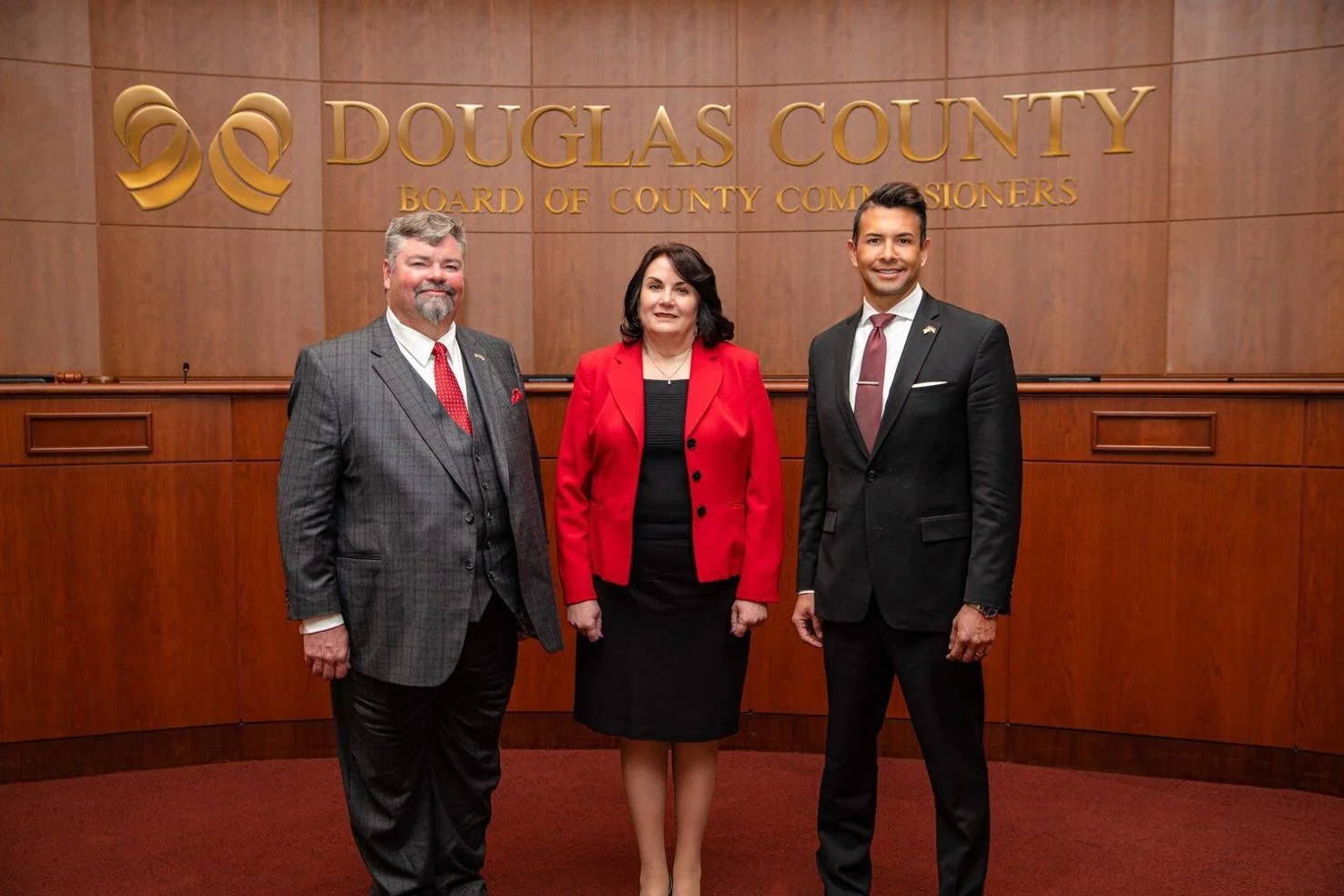
Douglas County’s commissioners met earlier this week to begin deciding who they would put on the new 11-member water commission, which will include three representatives of each district and two at-large members. The nominees were among those who submitted applications for the water commission, a list that has been kept confidential.
During Monday’s discussion, Commissioner George Teal announced his eight picks for members: Three for his district, three for another district, plus two at-large members. Five of his picks have made substantial contributions to his political campaigns, including two principals from Renewable Water Resources, the firm that pitched moving water from San Luis Valley’s groundwater to Douglas County…On Aug. 13, 2021, Renewable Water Resources principals, their spouses and friends contributed to pay down Teal’s 2020 campaign debt. The contributions totaled $16,000. Among the funders were Tonner and John Kim, both RWR principals, and Craig Broughton, an associate of Tonner’s. All three are on Teal’s list for the water commission. He also named Castle Pines City Councilman Roger Hudson, who is deputy chief of staff for the House Minority caucus at the state Capitol and who also made several contributions to Teal’s campaign for the 2020 election. Teal also recommended Harold Smethills, who doesn’t live in Douglas County but owns property in Sterling Ranch. Smethills has also contributed to Teal’s campaign. In a previous discussion, Teal had proposed allowing people who don’t live in the county but own property there to apply for the water commission.
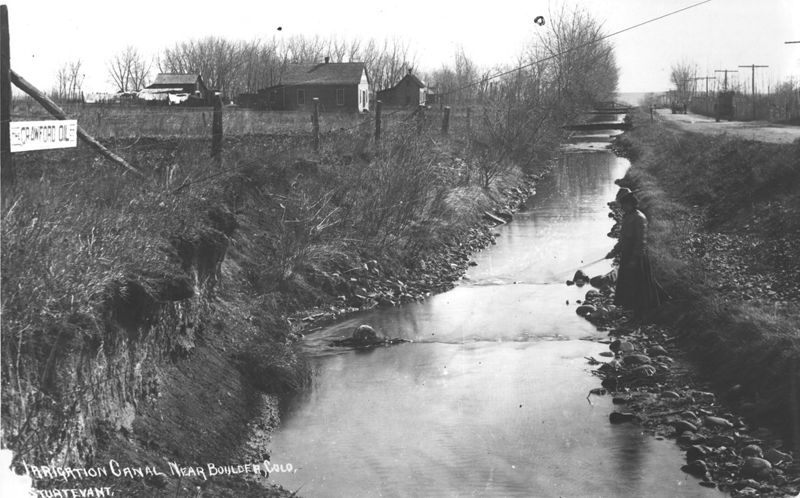
Click the link to go to The Ditch Project website:
In May of 2009, three concurrent venues each showed different artwork, photo essays and educational material about ditches.
Exhibits and featured events at the Boulder Public Library drew crowds of curious Coloradans, while visitors to the Dairy Center for the Arts enjoyed eclectic displays inspired by local water scenes. Various bits of sculpture lined Boulder Creek near the headgates of the Boulder and Left Hand Ditch.
Special programs included tours, storytelling, films, and a symposium of expert speakers. Here, you can revisit parts of the Ditch Project with our comprehensive archive of images, podcasts, and movie clips.
New content will be added here sporadically. Check back here for more updates.
Click the link to read the article on the Colorado Politics website (Marianne Goodland). Here’s an excerpt:
The U.S. Board on Geographic Names put a period on the dispute between two tribal groups on the new name for Colorado’s Mount Evans, selecting Mount Blue Sky on Friday. The vote was 15-1, with three abstentions. Last November, Colorado’s Geographic Naming Advisory Board unanimously recommended approving the change to Mount Blue Sky, a name supported by the Southern Cheyenne and Arapaho tribes of Oklahoma. The recommendation went to Gov. Jared Polis, who forwarded it to the federal naming board.
But a request from a tribal government for a “government-to-government consultation” regarding the renaming abruptly halted the federal board’s vote in March. The vote has been held up for the past six months because of objections from the Northern Cheyenne of Lame Deer, Montana, the only original Colorado tribe, which is vehemently against the Mount Blue Sky name. The phrase “blue sky” is part of the sacred Tribal Arrow Ceremony and, thus, the Northern Cheyenne believe it would be “sacrilegious” for it to be spoken in common language, the tribe argued. Northern Cheyenne tribal leaders have, instead, long advocated to rename Colorado’s most famous peak to “Mount Cheyenne-Arapaho.”
[…]
“This renaming was the result of a thoughtful process, led by local communities and Tribes, and I’m grateful to everyone who contributed,” added U.S. Sen. Michael Bennet. “As we work to address the wrongs done to the Cheyenne & Arapaho Tribes, and to Native people across the country, this is a strong first step.”

“Mount Soule” was the first name change submission, intended to honor Capt. Silas Soule, the whistleblower whose missives to Washington D.C. resulted in a federal investigation of the 1864 Sand Creek massacre, where 230 peaceful Cheyenne women, children and elders were slaughtered by Colorado troops under the command of Col. John Chivington.

Click the link to read the article on the Fort Collins Coloradoan website. Here’s an excerpt:
The historic 2013 flood in Colorado occurred over a week, Sept. 9-15, 2013, but the bulk of the more than 18 inches of rain in some locations occurred during a 30-hour period Sept. 11-12. An extremely moist, subtropical airmass ignited by a cold front parked over Colorado through much of the week, resulting in rainfall approaching totals that statistically would happen once every 500 to 1,000 years. Here’s a snapshot of one of Colorado’s most devastating natural disasters, including a lasting look at its impacts on Larimer County:
- Nine fatalities, including two in Larimer County.
- Around $4 billion in estimated damage (in 2023 dollars). Only the 1965 flood had higher damage estimates than the 2013 flood at around $5 billion (in 2023 dollars).
- 1,750 people rescued.
- 19,000 people evacuated.
- 2,006 homes destroyed.
- 26,000 homes damaged.
- 200 business destroyed.
- 750 businesses damaged.
- 200 miles of road damaged.
- 50 major bridges damaged.
- 15 counties included in a FEMA disaster declaration, from Larimer in the north to El Paso (Colorado Springs) in the south.
Rainfall records shattered during the 2013 flood
- The heaviest rainfall totals of 12 to 18 inches were widespread through much of central Boulder County, stretching from Boulder north and west toward Jamestown, Lyons and into central Larimer County, including the Estes Park area.
- The 24-hour state precipitation record was broken at the Fort Carson military base near Colorado Springs, with 11.85 inches of rain falling on Sept. 12.
- Boulder set a calendar day all-time rainfall record of 9.08 inches and monthly record of 18.16 inches.


Click the link to read the article on the Colorado Newsline website (Shannon Tyler):
Lyons and Estes Park community members reflect on damage and recovery from deadly natural disaster
In early September 2013, after a storm stalled over the Front Range, rivers rose out of their beds and rushed right through several Northern Colorado communities, resulting in one of the state’s worst floods.
Meteorologists classified it as the kind of flood that happens only once every 500 or more years.
From Sept. 9 until Sept. 16, the Front Range experienced uncharacteristically heavy rainfall, which flooded several communities, resulting in nine deaths, 11,000 people evacuated, 1,850 destroyed homes and about $4 billion in damages across the state, with 18 counties declared federal disaster areas, according to the Colorado Encyclopedia.
From the initial damage of the flood and the difficult recovery period to later commemorations, the 2013 flood has stayed with many people as a painful memory 10 years on. On this anniversary, communities are reflecting on lessons of the flood and its story of resilience amid tragedy.
A ‘biblical’ flood
Sitting at the intersection of the North St. Vrain and South St. Vrain creeks, the small mountain town of Lyons was one of the hardest hit communities.
Victoria Simonsen, the town administrator for Lyons, stepped into the role in 2013 prior to the flood and stayed in the position, helping the town recover ever since.
She said the whole town went to bed the night of Sept. 11, 2013, with the creeks at a normal level and no suspicion of the disaster that was to come.
“We were watching the creek, but we were not in any kind of panic mode at all,” Simonsen said.
It was in the late hours of that night, however, when the flooding started. At about 11 p.m. the water rose above the river beds, Simonsen said.
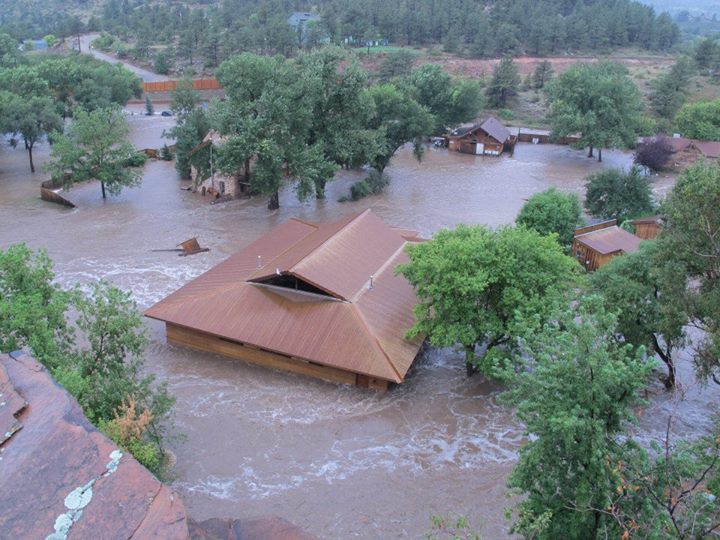
Usually local creeks hit low flooding levels when the water flows at 1,200 cubic feet per second, she said. By the end of the event, Lyons’ two creeks were flowing at 26,000 cubic feet per second. Simonsen said it was true flash flooding, and the water went from ankle deep to 12 feet deep very quickly.
“This was classified as between a 500 and 1,000 year event. The National Weather Service actually called it biblical in Lyons,” Simonsen said.
But it wasn’t until 2 a.m. that the town’s flood sirens actually went off, Simonsen said.
That was also when the water, which was rushing down from 14,000-foot mountains to the town at 5,300 feet, completely isolated neighborhoods and took out all three access points into town.
“The water came through the town at 2 a.m. and it literally divided our community into five islands,” Simonsen said.
The siren system sounded based on population, not location along the rivers, and when many residents woke to the sirens, Simonsen said she got calls from people saying the river was flowing in front of their homes, trapping them.
“We were stranded on our island for about 36 hours before we were able to get contact, and then the National Guard started arriving by helicopter and high water vehicles,” Simonsen said.
About 20 miles northwest, further into the Rocky Mountains, the Big Thompson River rushed through Estes Park and communities along the Big Thompson Canyon around the same time.
“It was the middle of the night I got a call saying it’s gonna be bad, so we opened up an emergency operations center,” Frank Lancaster, the Estes Park town administrator at the time and current trustee.
In the tourist town outside of Rocky Mountain National Park, two rivers and several creeks run through town, and one after another started flooding.
“We were dealing with one and then the other one came up and then basically all hell broke loose everywhere and couldn’t get in or out of town,” Lancaster said.
The only road in or out of Estes Park was Trail Ridge Road, a winding, small road that goes through the national park.

“Because the flooding was so widespread, the county was affected everywhere. So we really didn’t have much assistance from the county, because they couldn’t get up here and they were dealing with other places,” Lancaster said.
The National Park Service became their lifeline. Rangers helped sandbag the town to protect vital infrastructure and bring in materials.
Lancaster said the population in Estes Park is older, and when he went door-to-door to check on people he was surprised to find a lot of residents who were isolated and didn’t realize there was flooding.
Around Boulder County and Larimer County, communities large and small started calling for help.
Joe Pelle, then the Boulder County sheriff, said it was the first time in his career that deputies were unable to get to people in need.
He said during his tenure, he helped create a robust emergency management system and even went through several simulations of floods. None of these simulations could have prepared deputies for this kind of catastrophe, because almost all access to mountain communities was wiped out. In all of the simulations, Pelle said, first responders were able to create an alternate route.
“That night, one after another, all of the canyon roads failed or washed away in places and within a matter of a few hours,” Pelle said. “There was literally no access to our folks who live in the mountains.”
First responders couldn’t reach people in medical emergencies for a day and a half, Pelle said.
The unusual weather pattern, a prolonged rain storm in early September, that loomed over Northern Colorado was what experts call a cut-off low pressure system, according to Andreas Prein, a scientist with the National Center for Atmospheric Research in Boulder.
Prein said these systems can be dangerous, because whatever weather the system brings, it will last for days.
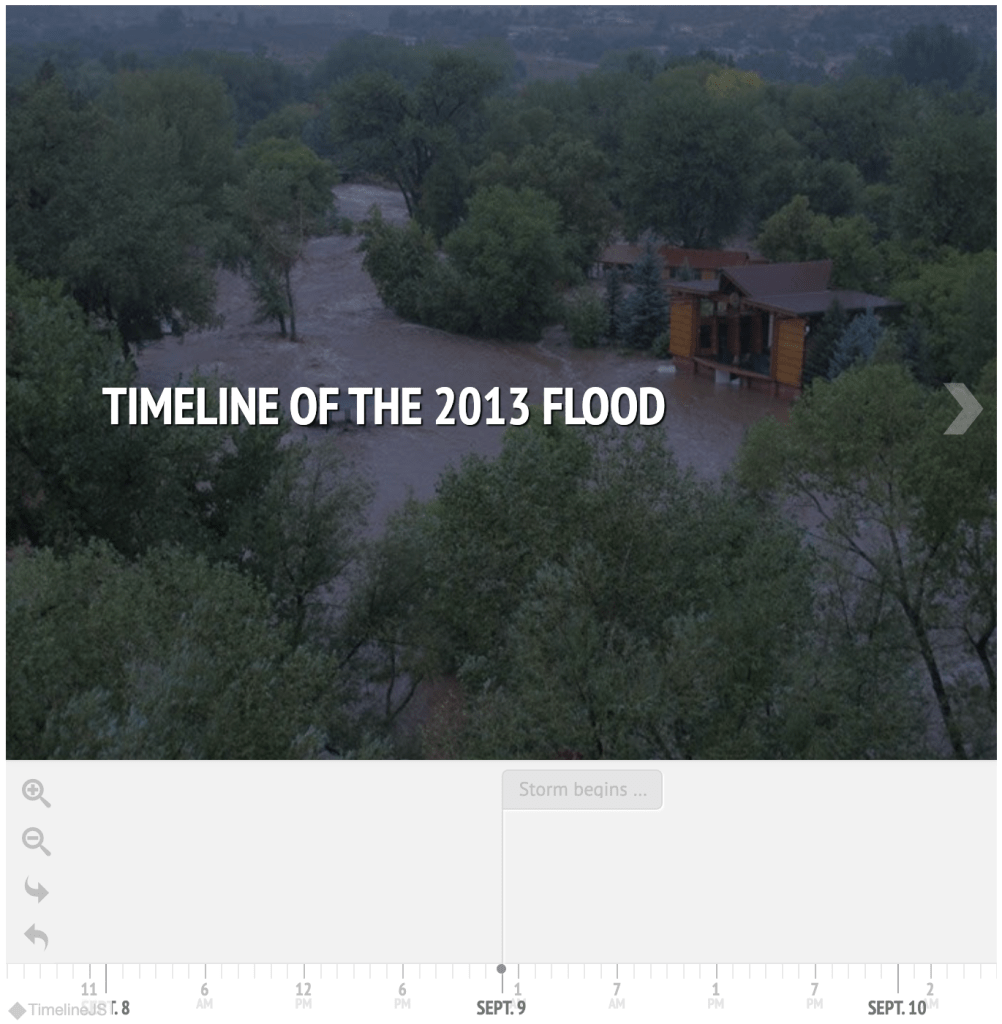
The storm lasted from Sept. 9 to Sept 16 with persistent rain throughout the seven days, accumulating into torrential rain Sept. 11 and 12.
At the end of the event, Boulder County recorded 18.1 inches of rain and Larimer County recorded 12.4 inches.
“That night, Sept. 11, when those two storms collided over the top of our county, the rain was something I’d never seen happen throughout my entire life. It was just torrential,” Pelle said.
Prein said there are two factors that created that much rainfall. The first was the cut-off low pressure system that didn’t move, and the second was the warm sea surface temperatures in the Pacific Ocean and the Gulf region, which contributed to the amount of moisture in the atmosphere and then the amount of rainfall over Colorado.
“It’s almost unimaginable how strong the force of nature is in these kinds of events and how fast this can evolve, because there was a heat wave and very warm temperatures before the event,” Prein said.
Communities coming together
Lesly Fajardo-Feaux and her family lived in downtown Lyons at the time of the flood. She had two children, and one of them was just two-and-a-half months old.
It was the noise that woke her up that night.
“I thought this is so weird, and I heard the sirens and I went to see it, and there was water all over,” Fajardo-Feaux said. “I couldn’t believe what was happening.”
The whole street had flooded, she said. The river rerouted itself in front of their house, which trapped them that night and early the next day. Her house sat on a hill, which she said made it difficult to get up to in the winters with icy roads, but she was thankful for the hill during the flood.
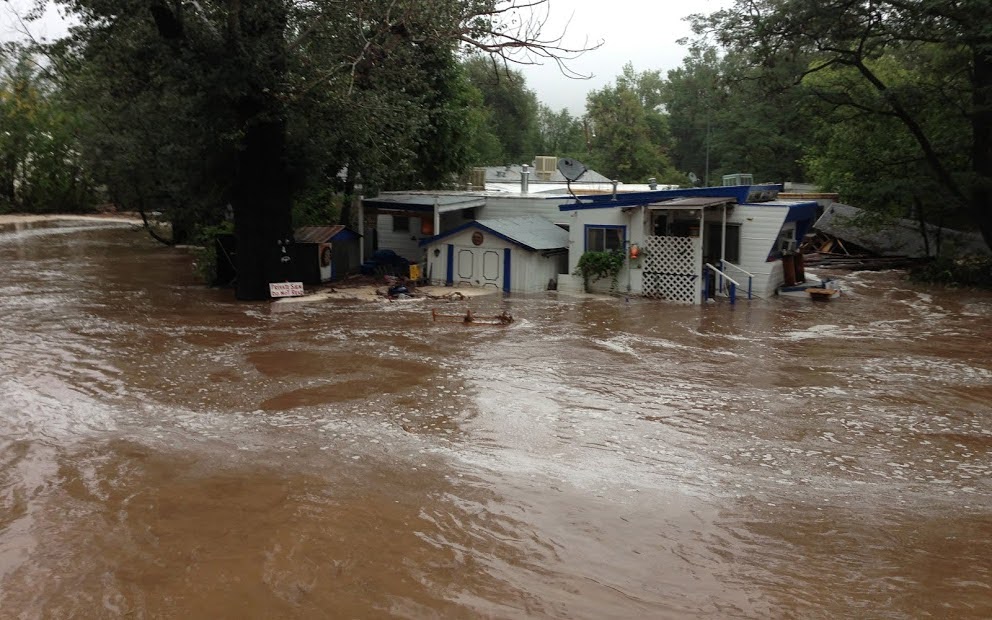
That night she watched the street flood and her neighbor’s furniture flow past her.
“We were seeing refrigerators coming down the street and sofas and people’s furniture and people’s lives floating by,” Farjardo-Feaux said.
By the next afternoon, they were able to leave their home, and she saw the aftermath of the flood in the daylight.
There was no running water, no electricity, no internet and no phone service. About 20% of the town’s housing was destroyed, Simonsen said.
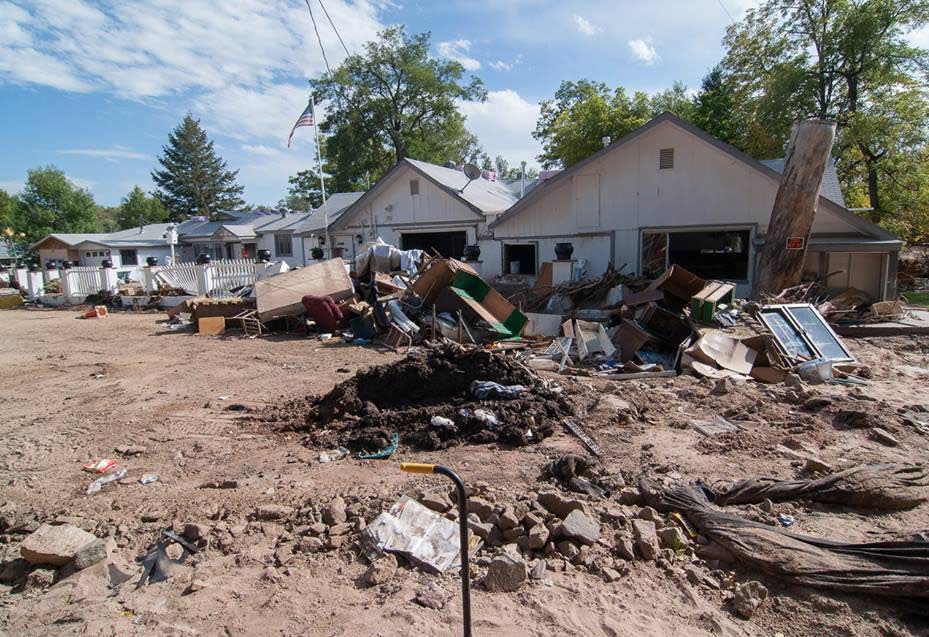
Although Lyons didn’t look like a town anymore, Farjardo-Feaux said the community really came together. There was even a community barbecue to use the food that would have gone bad.
“Lyons was a town where people are so happy all the time having music and people and all. There was a feeling that like, OK, everything is gonna be good, things are gonna be OK,” she said.
During those first couple of days, Simonsen said the community, which was already close-knit, came together to survive the isolation.
“When you’re facing actual life and death situations, you get pretty close, and our community really pulled together,” Simonsen said.
Pelle said he made it a priority to get a declaration of a federal disaster as soon as possible to get funds for what would be an expensive search, rescue and recovery operation.
An emotional sight he remembers was when the National Guard units were sent from Kansas and Utah. He couldn’t believe the size of the convoy and the amount of equipment they brought with them, he said.
“It was just incredible, and it was a couple of miles long with a military police escort, and it’s like the cavalry had arrived,” Pelle said. “Then within a matter of days or weeks all those roads that had been washed out were at least temporarily recovered.”
The National Guard coordinated one of the largest air lift evacuations since Hurricane Katrina to get people out of the mountains, according to Pelle.
For Fajardo-Feaux and everyone in town, that was just the beginning.
Fajardo-Feaux and her family cried as they drove down the mountain, unsure of where they would go and for how long. They spent the next few months couch-hopping and staying in hotels and rentals.
When Simonsen told residents they had to leave, she had no idea how long it would take to repair the damage and put in utilities. It ended up being about seven weeks, and Simonsen said families started coming back by Thanksgiving, and most were home by Christmas.
But for those whose homes were destroyed, coming back to Lyons wasn’t in their future.

Road to recovery
The process of repairing and recovery was another mountain of challenge the communities had to face.
Where to even start — that was the first obstacle. But Simonsen and her team created a comprehensive plan that she now sends to flood victims across the country as an example.
The Federal Emergency Management Agency showed up in Lyons in October, and the town got to work putting in temporary utilities.
Simonsen said it was a difficult process, because the flood in Boulder County was different than others FEMA had dealt with. Permits, permissions and impact studies stood in the way of recovery.
Lancaster experienced similar challenges with Estes Park’s recovery. He said FEMA understood flooding in the midwest and coastal areas, where water rose and went back down, not where water rushed through destroying anything in its path.
Both communities had to fight for recovery of recreational attractions that fueled much of their towns’ economies — white water rafting features, trees, wildlife habitats and parks. These were things FEMA didn’t originally cover.
During the early period of recovery from the flood, Simonsen set a goal of being back to normal in four years. But Simenson said FEMA agents told her it would take much longer.
“I said, ‘No way, we’re really close, we’ll get it done.’ And they said, ‘No, you’re not understanding the financial part, this will be a six to 10 year event.’ And it was nine years,” Simonsen said.
The small town of Lyons was able to leverage $75 million in federal funds to recover from the flood, according to Simonsen. At the time, its annual budget was $1.2 million with $4 million in reserves. The recovery funds, though, are all reimbursement-based, and it is still waiting for reimbursement from the federal government for some projects.
Simonsen said there were very positive moments throughout the recovery process, but the community went through many low points.
“You start this rebuilding phase and then you, of course, have setbacks. They say anniversaries are usually low points for people where they’re reflecting. But, you know, very gradually you make your way back up. But it’s a long, long process,” Simonsen said.
One of those low points was when neighbors realized some people weren’t going to come back.
“At some point, you have to move on with your life if you aren’t able to rebuild,” Simonsen said.
The issue of affordable housing haunts Lyons. The flood wiped out the town’s mobile home park, Riverbend, and 32 families lost their homes there.
For Craig Ferguson, founder and owner of Planet Bluegrass, which hosts beloved bluegrass and folk music festivals in Lyons, the flood was an attack on his home and business. He decided to stay when the whole town evacuated and started right away on the road to recovery.
“Once you clean it up,” Ferguson said of his house in Lyons, “it’s pretty comfortable. I’d rather live here. I’d rather camp in my house and take showers elsewhere than go live somewhere else.”
Ferguson didn’t wait to ask for permission before getting to work on his Planet Bluegrass property. He said he had a deadline in sight to be open for the next festival in the summer.
Before him was about $2 million in damages, mountains of flood-deposited sand and damaged utilities.
So, Ferguson said he bought one of the last available backhoes in the state and got to work.
“We fixed up our place pretty aggressively and we just had to do it that way in order to survive,” Ferguson said.
Ferguson put on the bluegrass festival that summer as usual.
“That was the biggest celebration you can imagine. You know to the bluegrass world this is a pretty special place,” Ferguson said. “No one thought it would happen during the first two months, seeing the pictures, even most of my partners (said) we couldn’t do it.”
Lancaster said during this period, people’s creativity really shined.
He said the Estes Park community also came together and during its annual Thanksgiving parade, when people decorated their neighborhood-assigned Porta Potties to bring some joy to the difficult times.
“You know, people could be really frustrated and angry instead, but they said my Porta Potty is prettier than your Porta Potty and they decorated them and some of them put them on wheels and brought them in the parade,” Lancaster said.
Estes Park took severe hits to its roads, especially up the Big Thompson Canyon, which was severely damaged during the flood of 1976, when the road was completely wiped out. It was rebuilt with a promise it was floodproof, but in 2013 it was again wiped out.
The water undermined the canyon walls and rockslides completely covered the roads in certain areas.
“There was a section down in the Big Thompson in the narrows where you couldn’t tell there was ever a road there,” Lancaster said. “It wasn’t like the road was missing or damaged, there was no road and there was no sign of it either.”
Lancaster said he remembers after the 1976 flood the road wasn’t back to normal for years, so he could not imagine the road being back up for a while after the 2013 flood. But crews got U.S. 34 repaired by the new year.
“They got it up, and they did it right this time, and that’s why they made so many changes. They worked a lot on making the road a lot more resilient,” Lancaster said.
He said resiliency was their priority. Everything was about how to repair and make infrastructure more resilient. Bridges, riverbeds and buildings all went through a process to ensure the community could last through more floods.
“There’s still some other things we really need to do. We need to deepen this channel (along the local riverwalk) and have it handle more water. There’s a couple more bridges we need to replace even 10 years later,” Lancaster said.
For Lyons, Simonsen said the last flood-recovery project wrapped up in October, but she is still waiting for reimbursements from the federal government.
With the end of the last recovery project, she said the town can finally move on.
“Now that the projects are actually all done, we can actually kind of close that chapter, but we will always be recovering in different ways,” Simonsen said.
The town plans to hold a commemoration and remembrance of the flood this year for the 10th anniversary.
Simonsen said, however, community members remember the flood in different ways. For some, every time it rains they get nervous. Others still hold a barbecue on the night of Sept. 11, like they did 10 years ago.
Simonsen said she knew she had to see the recovery through in Lyons during the last decade.
Now, she said the community can focus on other parts of town that need attention.
“Pretty much the rest of town was kind of neglected the last 10 years. So now we have lots of work to do on streets, sewer and water lines, where we simply did not have funds to put toward it the last 10 years,” Simonsen said.
The issue of affordable housing still looms over Lyons, which lost nearly all its affordable housing to the flood.
Many families couldn’t afford to come back to the community. With disagreements on how to achieve affordable housing, the town is just now starting to see less-expensive units come in.
Ferguson worked to provide affordable housing downtown at a property that used to be a bank. He worked with Habitat for Humanity to bring back people who lost their homes to the flood.
Recently, Simonsen said the town started on a project to get 40 units of affordable housing built on a property donated by someone who lives in Kansas and has land in Lyons. The first eight opened and more are due to open soon.
“The community thought there’s not going to be anyone left who wants to come back because people had to move, but I’m happy to say that over 30% were here 10 years ago,” Simonsen said.

Looking to the future
After the rebuilding and mitigation efforts, communities still consider what would happen if another event like the 2013 flood were to happen.
“It’s not a question of will this happen and will we be ready or even when it does happen again. Will it not be as devastating?” Lancaster said.
Prein, of NCAR, researches climate change’s effects on major weather events like the flood. He said if another low pressure system stalls over the Front Range, there is likely to be even more rainfall because of the effects of a warming climate.
“The answer will almost certainly be there will be way more rainfall, because it’s really this moisture that you get from the south from the Gulf. Moisture increases with warming,” he said.
Researchers are not certain about how climate change affects the likelihood of cut-off low pressure systems, he said. But, if one does happen again, it is likely to be more devastating.
Colorado authorities built bridges higher, moved buildings out of the floodplains, carved further into the mountains to lay roads, and completely rebuilt stream banks. Yet, Simonsen, Lancaster and Ferguson all said another flood will happen, and they can’t fully prepare for what it will bring.
“What you try to do is minimize the risk, but you can’t avoid the risk, there will always be risk, and you have to balance that with the other needs of the community,” Lancaster said.
Preparing for the damage that comes with flooding of that magnitude isn’t possible, but in the last 10 years communities focused on mitigating what risk they could.
“It’s been a wonderfully challenging 10 years, and I think my goal always as a city manager is you leave the community better than you found it, and I think we did,” Simonsen said.
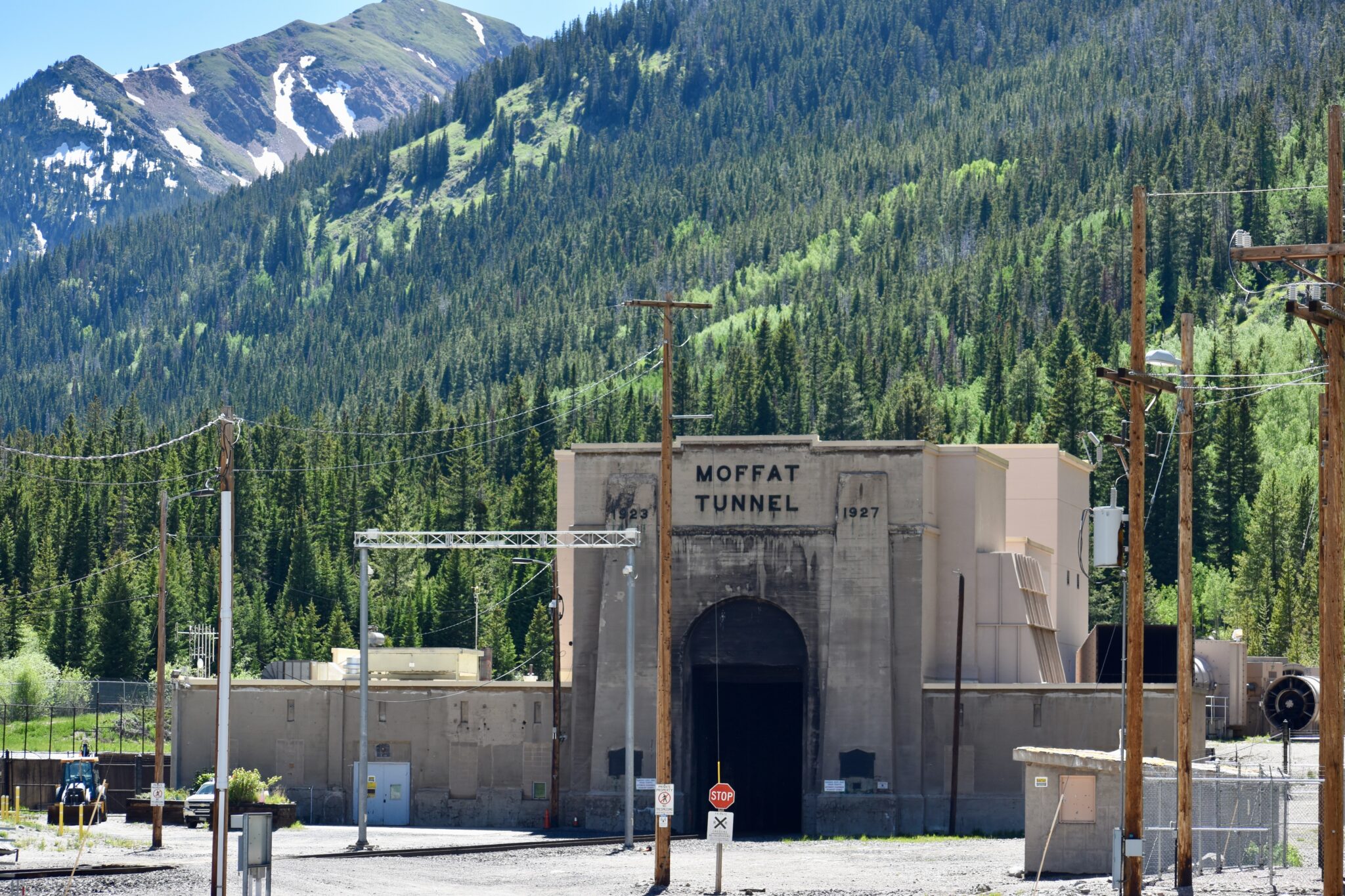
Click the link to read the article on the Colorado Newsline website (David O. Williams):
Uinta Basin rail project in Utah could result in dramatic increase of hazardous material on Union Pacific line through Colorado
State officials since last spring have quietly been reaching out to communities along Colorado’s main east-west rail line to gauge local sentiment as the state negotiates a new lease with rail giant Union Pacific, which pays $12,000 a year to send trains through the state-owned Moffat Tunnel.
Union Pacific’s 99-year lease to use the 6.2-mile Moffat Tunnel expires Jan. 6, 2025, and Kate McIntire, a regional manager for the Colorado Department of Local Affairs, has been tasked with “developing our list of concerns, potential opportunities, roles, responsibilities, and ways stakeholders would like to ensure they’re involved in the negotiation.”
McIntire, in conjunction with the Colorado Department of Transportation and the recently formed Public-Private Partnership (P3) Collaboration Unit of the Department of Personnel and Administration, will be ramping up outreach this fall and through 2024.
McIntire expects to hear more input from counties and towns along Union Pacific’s Central Corridor rail line between Denver and Grand Junction about the controversial 88-mile Uinta Basin Railway proposal in Utah. The project would send up to 350,000 additional barrels of oil per day along the route, which travels for about 100 miles along the headwaters of the endangered Colorado River.
“Yes, some of those comments came up and were addressed more directly to Union Pacific,” McIntire said of meetings the state has already held with Denver Water, which uses the Moffat Tunnel’s original 1922 bore hole for transmountain water diversions; Adams, Gilpin, Grand and Jefferson counties; and the cities of Arvada, Golden, Winter Park, Fraser and Kremmling.
Asked to characterize some of the comments she’s hearing on an oil train project that’s already been approved by the U.S. Surface Transportation Board and on the high end would more than quintuple the amount of freight rail traffic on Colorado’s Western Slope, McIntire offered this:
“I’ll just kind of draw back on the fact that we’re really early in a complex process with legal considerations, roles, responsibilities, and potential opportunities that may or may not be tied to the lease,” McIntire said. “But we’re definitely aware of those concerns, and we’ll continue to do everything we can to ensure stakeholders are engaged.”
The city of Denver estimates the Uinta Basin project will quadruple the amount of hazardous materials transported by rail through the metro area as up to five two-mile-long oil trains a day chug east through the Moffat Tunnel at the base of the city-owned Winter Park Resort ski area and then make their way down through Denver and toward Gulf Coast refineries.
Eagle County, where the Central Corridor rail line separates from Interstate 70 at Dotsero and follows the Colorado River through remote canyons northeast into Grand County, is suing the Surface Transportation Board to overturn or at least more comprehensively consider the down-the-line impacts of Uinta Basin trains from inevitable derailments, spills, wildfires and climate change.
Environmental groups have also filed suit, and Eagle County has the support of Glenwood Springs, Minturn, Avon, Red Cliff, Vail, Routt, Boulder, Chaffee, Lake and Pitkin counties.
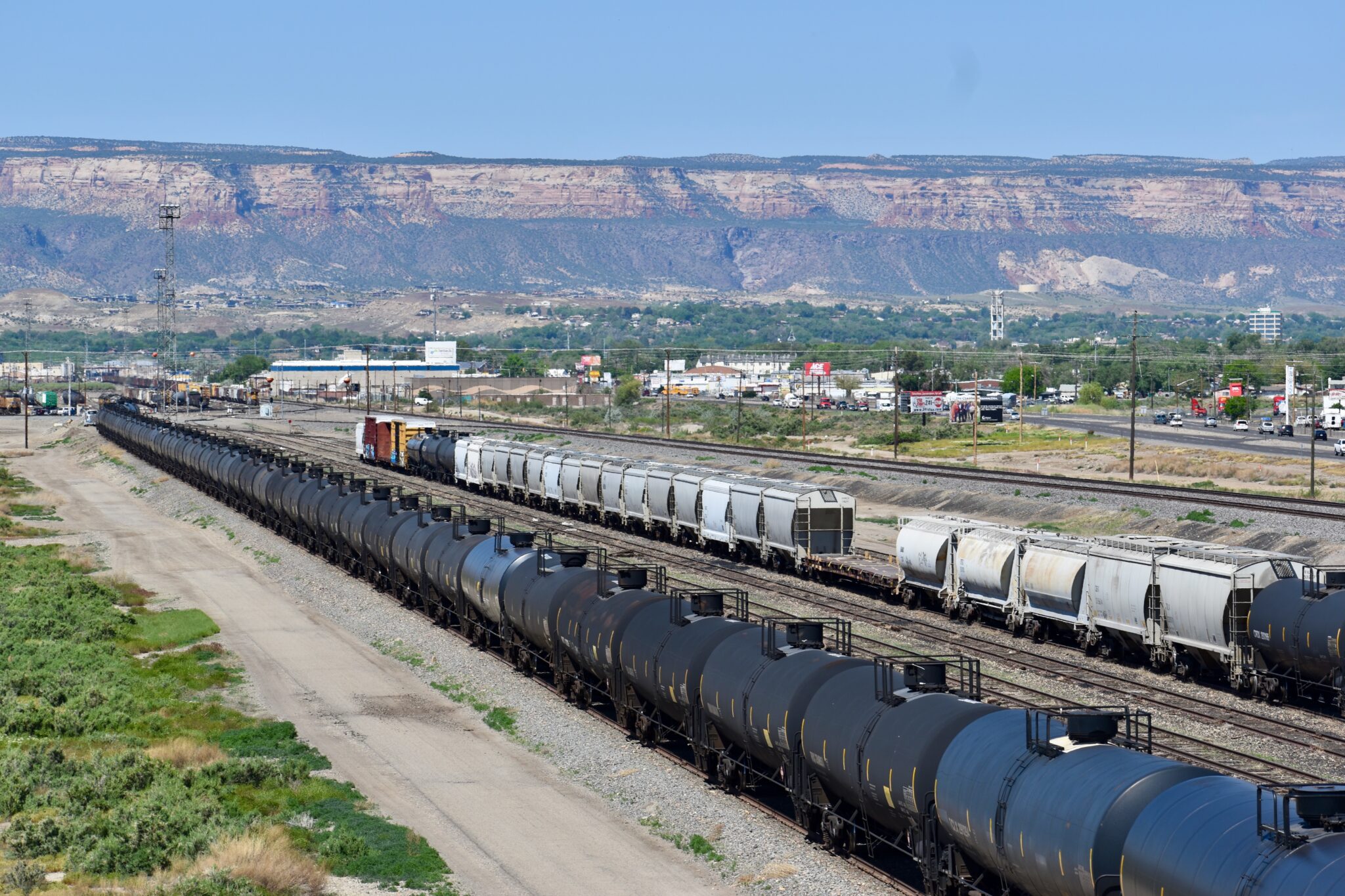
Seeking more state support
“Still conspicuously absent in these efforts is the state of Colorado,” Eagle County Attorney Bryan Treu wrote in an email. “Anything the state can do to get off the sidelines and participate would be appreciated. We would encourage the state to use all tools at its disposal, including any Moffat Tunnel lease negotiations, to protect every Colorado community along the rail corridor that will be forced to face very real risks of derailment, spills, water contamination and fires.”
Asked to characterize the comments the Nebraska-based railroad company is hearing on the Uinta Basin Railway and whether it’s appropriate for Colorado to consider opposition to the Utah project in its Moffat Tunnel lease negotiation, Union Pacific spokesperson Robynn Tysver responded: “Union Pacific is aware the Moffat Tunnel lease expires in 2025, and negotiations are underway,” Tysver wrote in an email. “Union Pacific is required by federal law to transport hazardous commodities that Americans use daily, including crude oil, fertilizer and chlorine, and 99.9% of the hazardous material shipped by rail reaches its destination safely.”
Union Pacific chief safety officer Rod Doerr on Monday told the Colorado General Assembly’s Transportation Legislation Review Committee the company hasn’t specifically analyzed the risks of increased oil-train traffic from the proposed Uinta Basin Railway project. The committee will meet again in August to consider potential legislation in the next session that starts in January.
Since the General Assembly first created the Moffat Tunnel Improvement District for taxing purposes in 1922 and still owns the tunnel and administers it via DOLA, the terms of the lease might logically be a topic of discussion.
“It’s crazy that Union Pacific pays Colorado far less rent for the Moffat Tunnel than the median price of a studio apartment in Denver,” said Ted Zukoski, attorney with the Center for Biological Diversity, which is suing to stop the oil trains. “This is a once-in-a-lifetime opportunity for (Gov. Jared Polis) to protect Colorado communities, our water, our rivers, and our public lands from hazardous materials spills from trains that travel through the Moffat Tunnel.”
Eagle County’s Treu, who said he’s yet to hear from the state on the Moffat lease, would like to see a lot more pushback from the state against federal approvals for the Utah oil-train partnership backing the project, which is still seeking funding via tax-exempt U.S. Department of Transportation bonds.
“We asked the (Colorado Attorney General’s) office to participate as an amicus party in our litigation against the Surface Transportation Board,” Treu said. “The state declined, leaving us to fend for ourselves. That response was surprising considering the crux of this litigation is STB’s complete failure to consider the downline impacts to the sensitive Colorado River corridor through all of Colorado. This isn’t just an Eagle County issue.”
The office of Colorado Attorney General Phil Weiser responded with the following statement:
“As the Attorney General said in his letter to the federal government, the Uinta Basin Railway proposal is as risky to our environment and communities as it is unsupported by Coloradans. It should not move forward. And it most definitely should not receive federal subsidies. The Attorney General’s Office has visited with advocates on the risks the UBR poses to our state, has collaborated with Colorado’s congressional delegation on options to prevent construction, and is committed to visiting with any group with ideas on how to protect Colorado’s environment from this risky venture.”
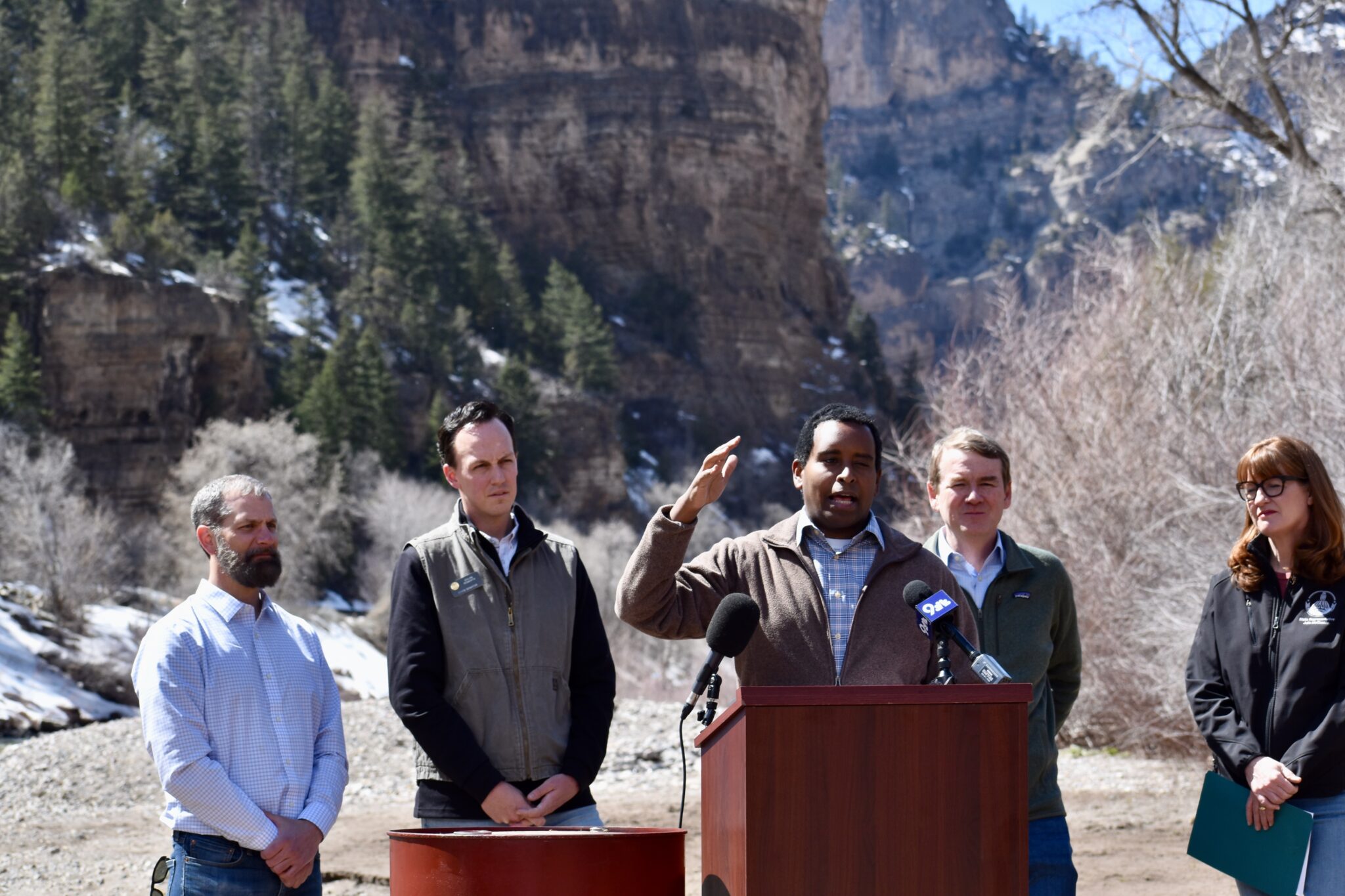
In various forms, both Colorado U.S. senators — Democrats Michael Bennet and John Hickenlooper — and a majority of the state’s U.S. House delegation, particularly Democratic Rep. Joe Neguse, have reached out to a variety of federal agencies to oppose the Uinta Basin Railway.
Jonathan Godes, a Glenwood Springs City Council member and former mayor whose term ended in April, said he has yet to be contacted by DOLA on the Moffat Tunnel lease, but he looks forward to hearing from McIntire, who is a former Grand County manager and former acting Jefferson County manager.
Godes says he doesn’t yet have enough information to comment on the Moffat Tunnel lease negotiations or possibly using them to restrict hazardous material transport through Glenwood.
“But I will say that I’m really glad that both of our senators, Congressman Neguse, commissioners in Eagle County, Grand County, and leaders in dozens of municipalities all agree that this is objectively and definitively a horrible idea for our communities, for the Western Slope, the mountain communities in the state of Colorado,” Godes said. “I’m looking forward to when the state decides to join up with our congressional delegation and our local leaders in solidarity against this abomination.”
Tennessee Pass Line
Terry Armistead, a Minturn Town Council member, mayor pro tem, and a member of the Minturn Railroad Committee, made it clear she was not speaking for the whole committee or the entire town council, but she acknowledged she has spoken to McIntire.
“In regards to the Tennessee Pass Line, I heard nothing in that short meeting of any substance, unfortunately. It was kind of anticlimactic,” Armistead said of a long-dormant Union Pacific rail line that connects to the Central Corridor at Dotsero and heads southeast along the Eagle and Arkansas rivers to Pueblo — a route that if revived would avoid the Moffat Tunnel and Denver altogether.
That is one of the fears Eagle County expressed in its litigation — added pressure to restart rail traffic on the Tennessee Pass Line through Avon and the former mining and railroad towns of Minturn and Red Cliff off the backside of Vail Mountain.
Armistead said she started calling Eagle County Commissioner Matt Scherr, who used to be mayor and still lives in Minturn, four years ago when the TPL revival idea first came up, telling him, “Minturn is too small a voice in the room, and we can’t do this alone; the county needs to speak for all of us.” She supports the county’s position regarding the Moffat Tunnel lease and would like to see Union Pacific be allowed to formally abandon the TPL for an outdoor recreation trail.
“I’m not going to mince words. I would love to see (the Tennessee Pass) rail ripped up,” Armistead said of the line that’s been dormant since 1997 — the year after a Union Pacific and Southern Pacific merger. “I would love to see them sell us, or sell somebody the land, and develop the rail yard in Minturn. I’ve been saying it for years.”
DOLA’s McIntire could not say if the status of the Tennessee Pass Line will be at all considered in the Moffat Tunnel lease negotiation, since it’s a separate and active Union Pacific rail line.
“We’re still very early in this process and we really haven’t determined whether that’s a separate issue or not,” McIntire said. “I don’t want to come out and say that that’s not going to be something that we’re going to address.”
For Union Pacific, which did try to formally abandon the TPL in the late 1990s after the merger — only to be snubbed on that front by the U.S. Surface Transportation Board — it’s somewhat of a moot point.
“We have no plans of reopening the Tennessee Pass,” Union Pacific’s Tysver said.
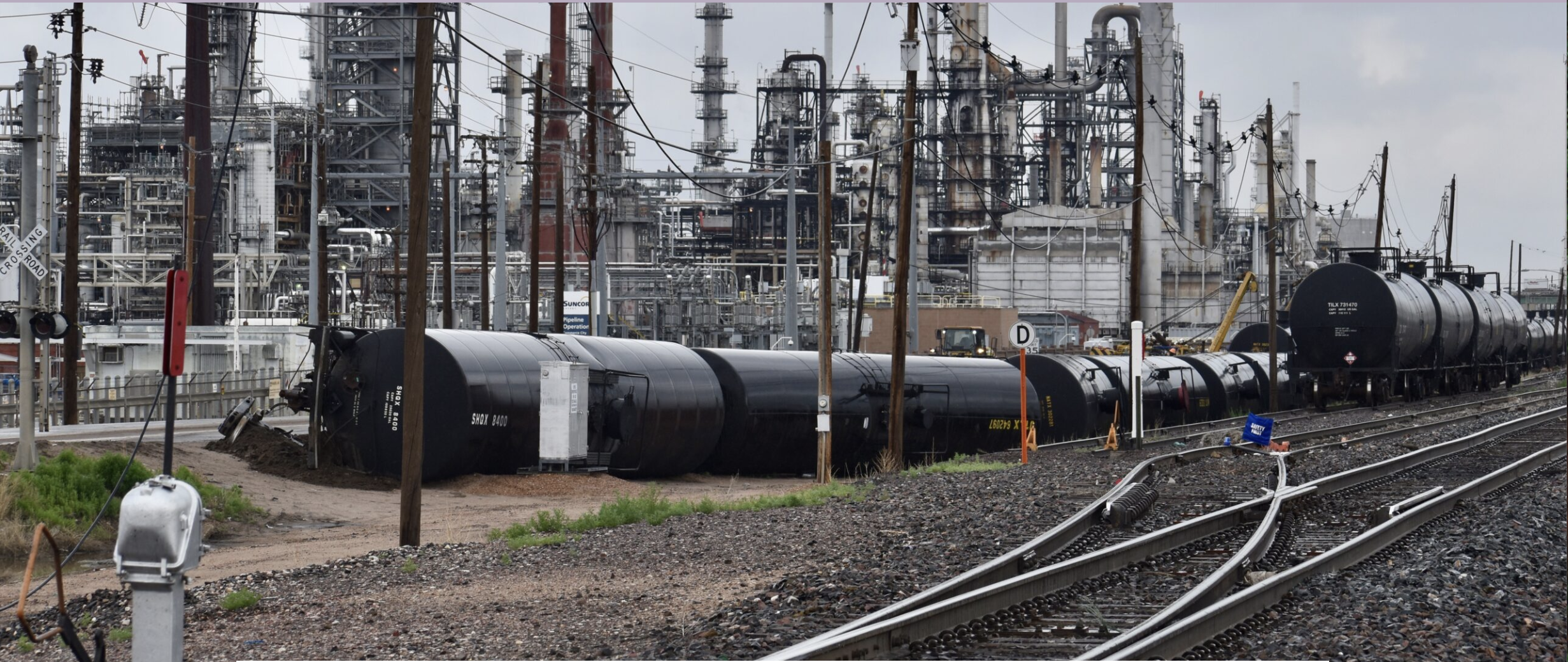
Click the link to read the article on the Colorado Newsline website (Chase Woodruff):
City Council kills rail-safety ordinance ahead of Uinta Basin Railway’s potential quadrupling of hazmat traffic
As trains heading east from the Moffat Tunnel take one last sharp turn along a ridge near Eldorado Canyon State Park in Boulder County, the scenery changes abruptly.
After traveling hundreds of miles east through narrow river gorges and rugged alpine forests, the Union Pacific’s Central Corridor through Colorado emerges at last onto a high ridgeline offering dramatic views of the Denver metro area and the vast, empty Eastern Plains stretching out into the distance.
Over the next 10 miles, the railroad drops roughly 1,000 feet in elevation, meaning this section of track approaches a 2% grade, near the practical limit for major freight lines. To accomplish the steep descent, trains complete a looping series of turns at a landmark known as Big Ten Curve, where a line of disused cement-filled rail cars buried to one side of the track serves as a windbreak, placed there in the 1960s after repeated derailments caused by high winds blowing across the foothills.
With one final turn, trains leave the mountains behind for good, passing just south of the site of the former Rocky Flats nuclear weapons plant and bearing down directly into the heart of Colorado’s largest population center.
Within just a few years, this could be the route traveled daily by as many as five fully-loaded, two-mile-long crude oil trains from the Uinta Basin in eastern Utah. The additional traffic from the proposed Uinta Basin Railway, backed by a public-private partnership and granted key approvals by President Joe Biden’s administration, could quadruple the amount of hazardous materials transported by rail through Denver, city officials estimate.
This week, three Denver-area members of Congress — U.S. Reps. Diana DeGette, Jason Crow and Brittany Pettersen, all Democrats — joined a chorus of Colorado elected officials who have come out in opposition to the railway project. Echoing objections made by U.S. Sen. Michael Bennet of Colorado and Rep. Joe Neguse of Lafayette, the lawmakers faulted the federal approval process for neglecting to fully evaluate the impact the railway could have on Colorado.
“We believe transporting crude oil along the Colorado River is a risk we cannot afford to take,” they wrote in a letter to U.S. Transportation Secretary Pete Buttigieg. “Were a train to derail, it would be frontline communities who bear the brunt of the damage, in the air they breathe and the water they drink.”
Buttigieg and the U.S. Department of Transportation could soon face a decision on whether to approve the Uinta Basin Railway’s application for $2 billion in tax-exempt private activity bonds. The Seven County Infrastructure Coalition, the group of Utah county governments that has led the project’s planning and permitting, said earlier this year that it would seek the bonds, which would save the railway tens of millions of dollars annually in financing costs.
Federal regulators estimated in a “downline analysis” that the increased traffic from the Uinta Basin Railway could cause roughly one train accident a year between Kyune, Utah and Denver. Accidents severe enough to cause a spill of up to 30,000 gallons of crude oil, they predicted, would occur roughly once every five years.
With the prospect of the railway’s construction looming, environmental advocates and communities along the downline route fear that those risks could be compounded by inaction at every level of government.
In the wake of a February derailment and chemical fire in East Palestine, Ohio, and other recent train accidents — including a bridge collapse that caused a hazmat spill into the Yellowstone River in Montana last week — a bipartisan group of lawmakers in Washington has taken up rail safety legislation, which is currently pending on the Senate floor. Prospects for the bill’s passage by the Republican-controlled House, however, are uncertain, and sponsors have already pared back some of its key provisions.
In Colorado, Gov. Jared Polis has largely remained on the sidelines of the Uinta Basin Railway issue, though a spokesperson said he opposes the project’s application for the tax-exempt bonds. State agencies like the Colorado Department of Transportation and the Public Utilities Commission have limited authority over the rail industry, though some General Assembly lawmakers want to see the state take a more active role.
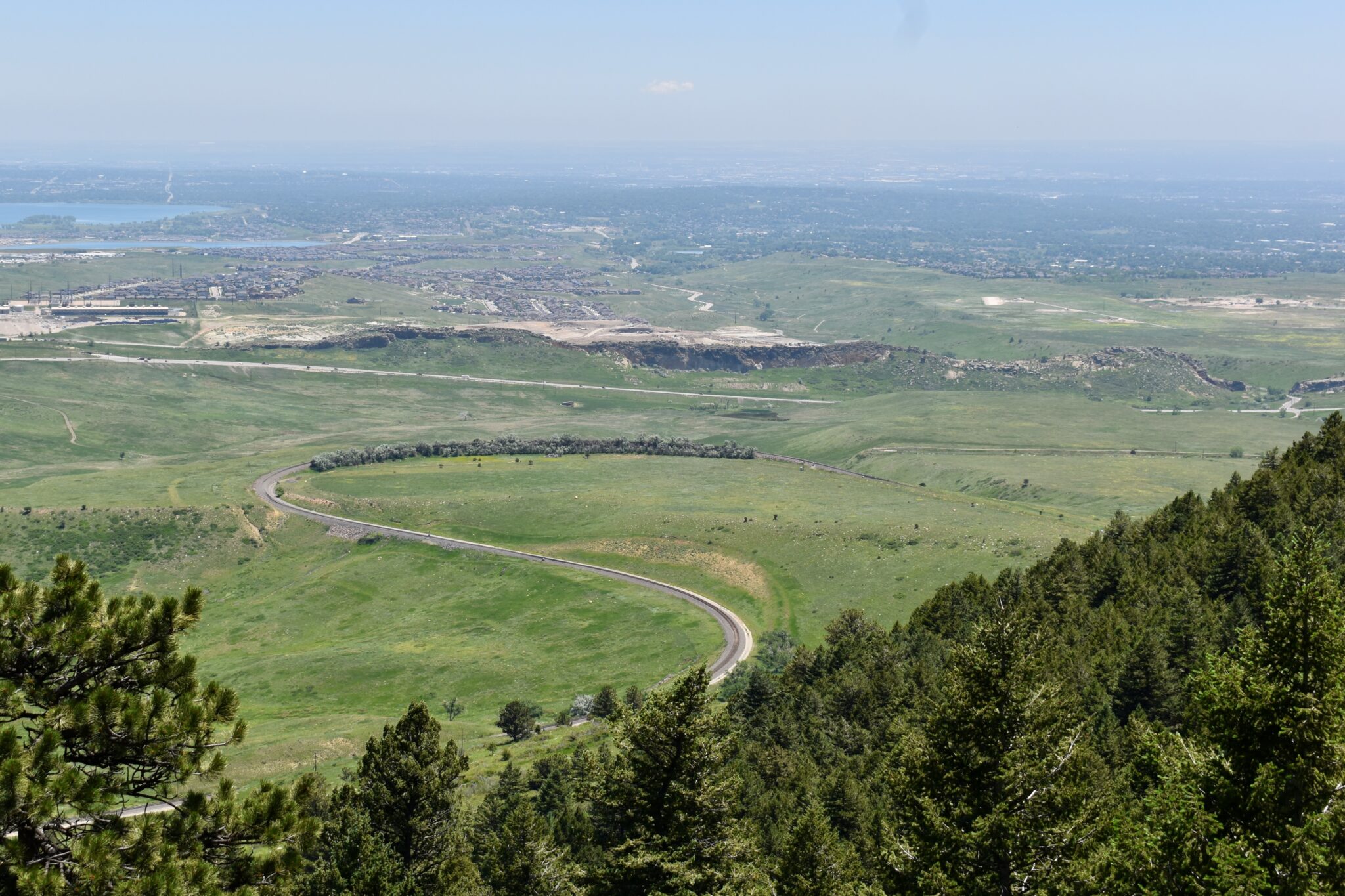
And at the local level, rail safety advocates were left bitterly disappointed this week when a majority of Denver City Council members voted to kill a proposed ordinance that would have more strictly regulated land use around freight rail corridors. The measure’s sponsor, longtime City Council Member-at-Large Debbie Ortega, accused outgoing Mayor Michael Hancock’s administration of a “strategic effort to completely undermine” a years-long process to develop the policy.
In the Denver metro area, the railway’s potential risks were underlined by an oil-train derailment earlier this month at the Suncor Energy refinery in Commerce City. A spokesperson for BNSF said that 16 of the 17 derailed tank cars were empty and “no hazardous materials were involved.”
“This is another reminder that derailments are far too common,” Bennet wrote on Twitter. “Had the train cars been full, this would have been a catastrophe. That’s why I’m pushing to stop Uinta (Basin) Railway oil trains from moving through our state.”
A ‘carbon bomb’
In the early summer, the broad, grassy slopes of the foothills beneath Coal Creek Canyon, green and full of blooming wildflowers, appear pristine and unspoiled — but looks can be deceiving.
To the north, the site of the Rocky Flats Plant, which manufactured plutonium pits for nuclear weapons until it was shut down in 1992, has been converted into a wildlife refuge, but longstanding fears about radioactive contamination persist. To the south, a landfill and a natural-gas-fired power plant operate next to residential developments built on the site of the former coal company town of Leyden.
Railroad tycoon David Moffat bought the Leyden Coal Mine in 1902, using it to supply coal both to his Denver, Northwestern & Pacific Railway over the mountains, better known as the Moffat Road, and to the Denver Tramway Company, which he owned jointly with other city grandees. Not unusually for the time, the Leyden mine experienced its share of deadly disasters, and workers there in 1908 likened it to a “penal colony.”
Denver Tramway ended its streetcar service in 1950, replacing its fleet with buses, and the Leyden mine was shuttered a year later. With the rise of the interstate highway system after World War II, “interurban” rail service was quickly disappearing in Colorado and across the country.
“It was a sad occasion to those who preferred the relatively smooth ride in an interurban car to the more confined jerkey ride in a bus with its accompanying exhaust fumes,” lamented the Colorado Transcript when the last passenger car left Golden for Denver on July 2, 1950.
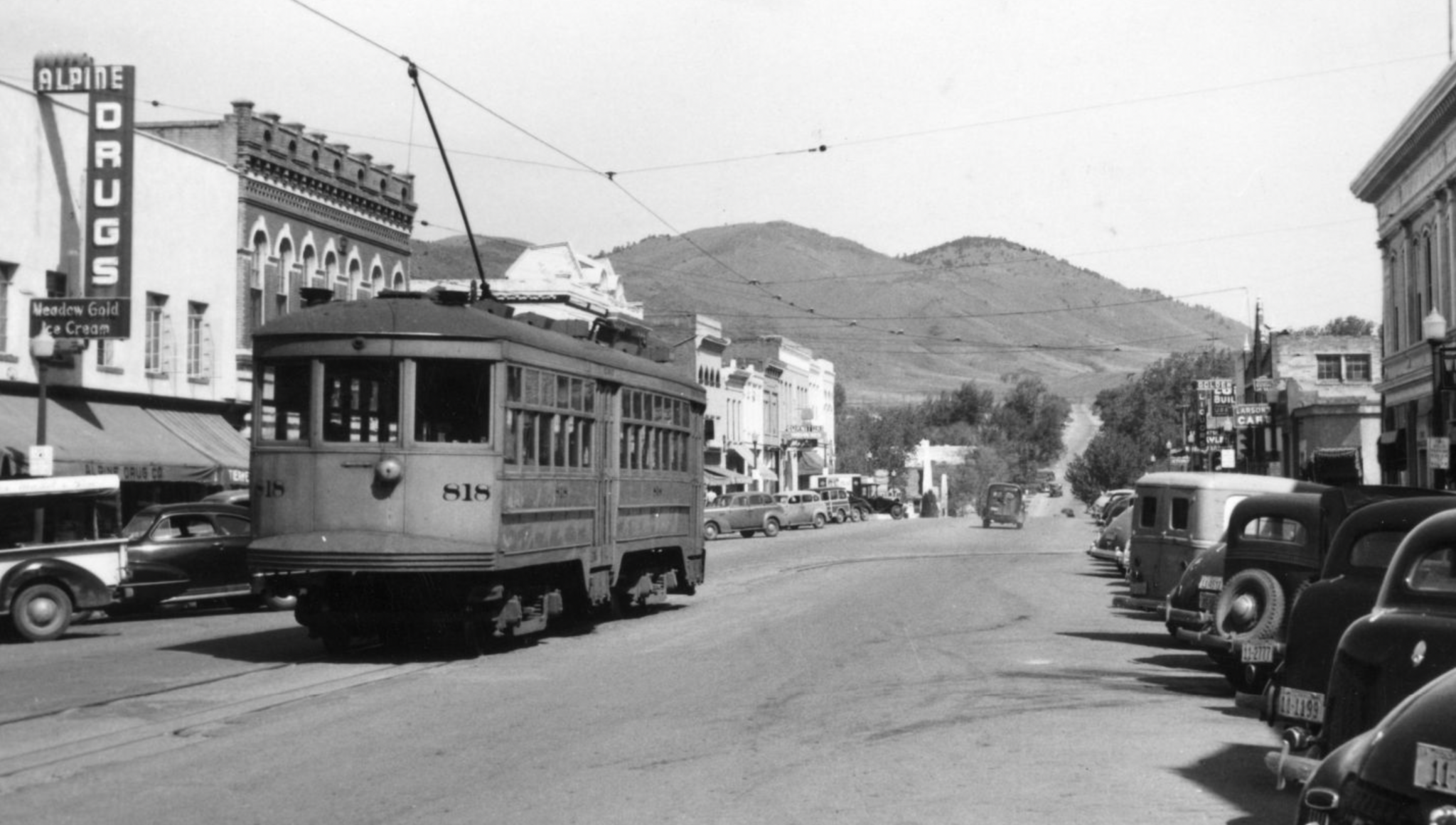
“It’s a natural progression that railroads fall out of favor, particularly for passengers,” said Paul Hammond, director of the Colorado Railroad Museum. “And of course, the growth of the interstate highway network creates an avenue for trucks to get around in ways that they had never been able to before.”
The car-centric, oil-dependent consumer economy that fueled U.S. growth in the postwar years had profound consequences, beginning with the supply shocks and geopolitical crises of the 1970s, and continuing in the boom-and-bust disruptions that impacted the Western Slope and Denver’s oil industry in the 1980s. But most profound of all is the impact the country’s dependency on oil has had on the Earth’s climate, with tailpipe emissions from cars, trucks and other forms of transportation now ranked as the leading source of U.S. greenhouse gas emissions.
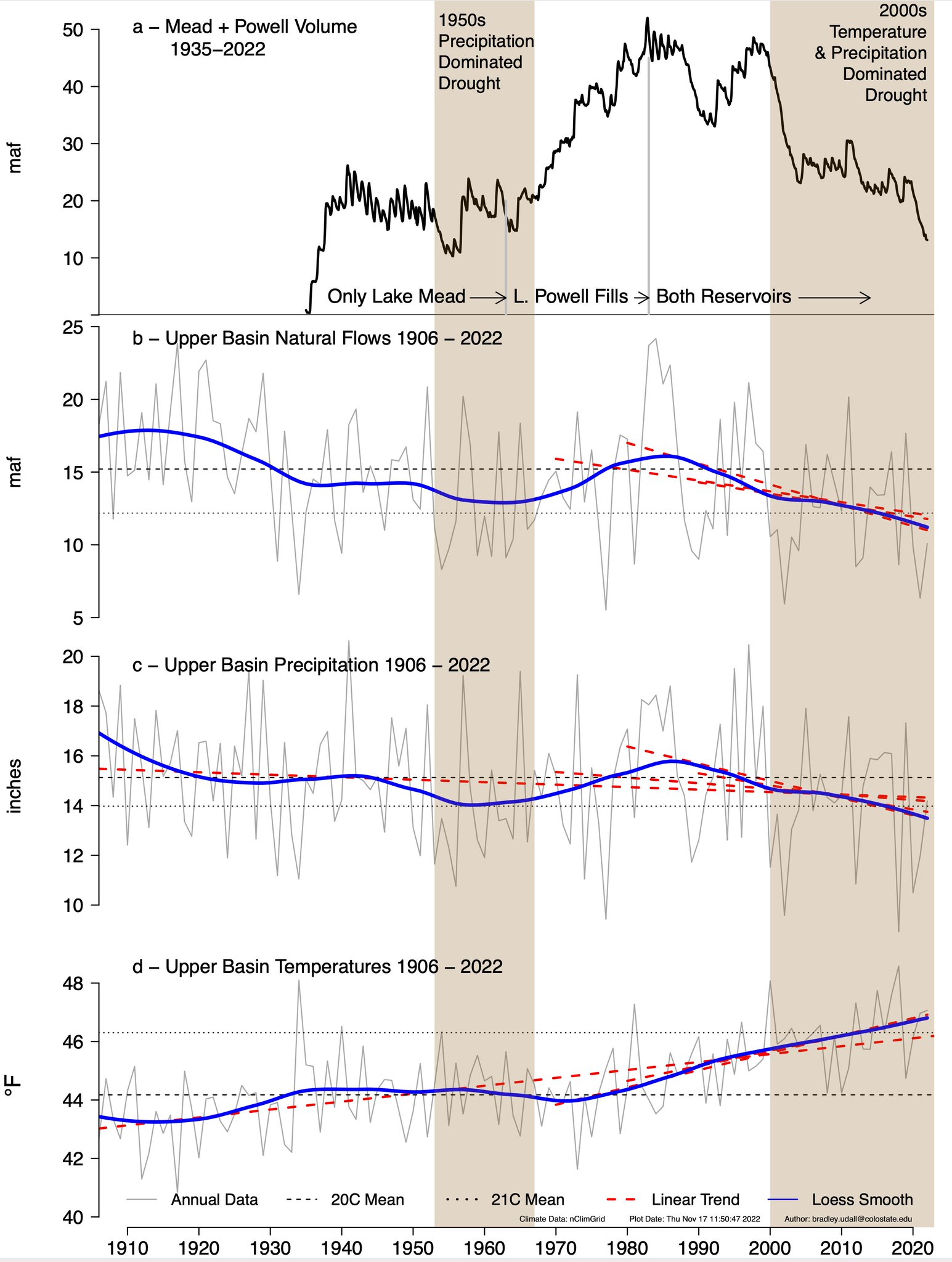
Climate change has hit particularly hard in the American West, where a relatively wet winter and spring haven’t changed long-term projections for aridification that will continue to stress water supplies and increase wildfire risk in the decades to come.
“We’re seeing with each day the climate emergency unfolding all around us,” said Deeda Seed, senior Utah campaigner for the Center for Biological Diversity, which has sued to block the railway project.
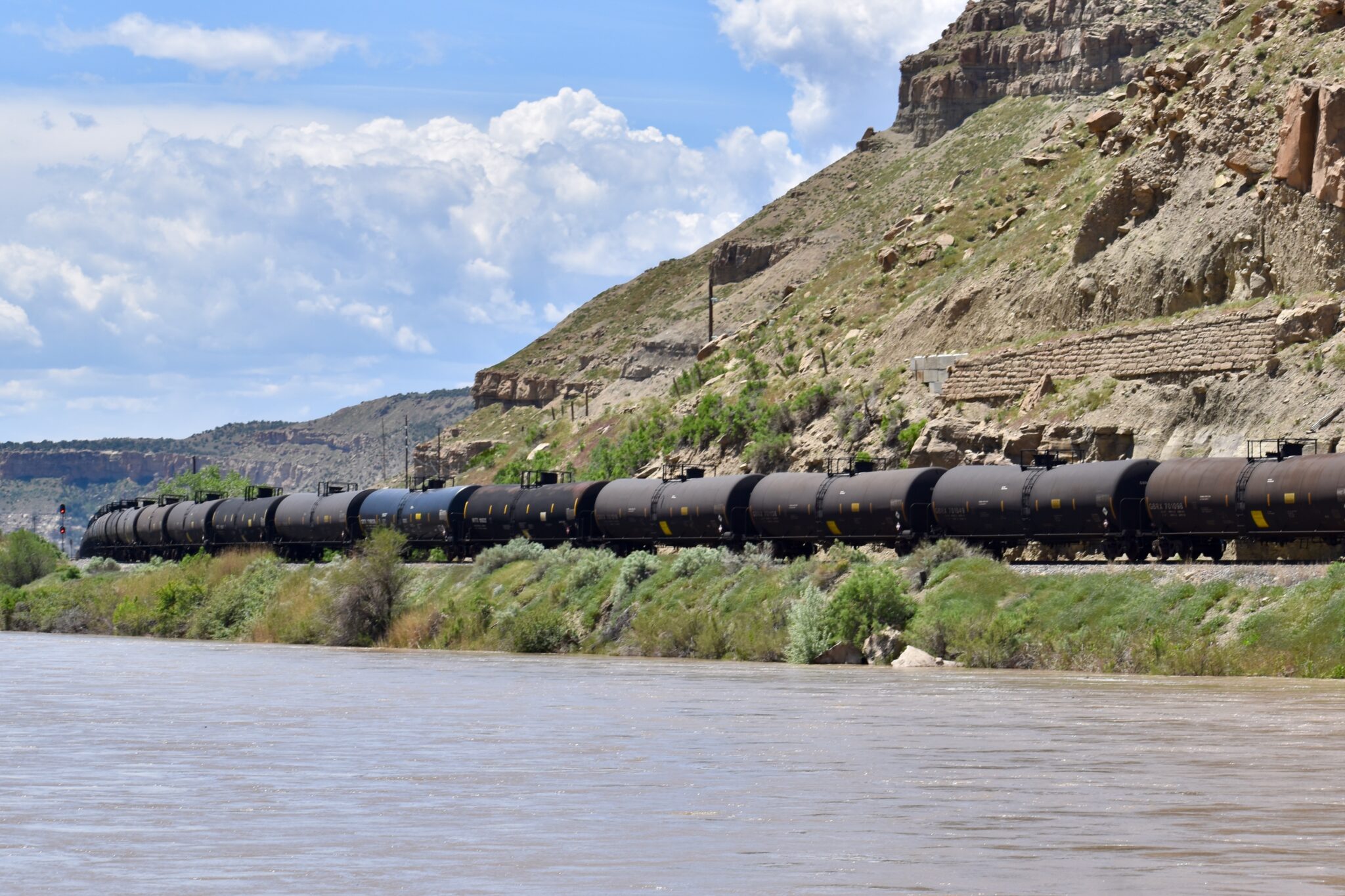
After a two-year environmental review process, the federal Surface Transportation Board voted 4-1 in December 2021 to approve the Uinta Basin Railway. The lone vote against the project’s approval was the board’s chairman, Martin Oberman, who wrote a blistering dissent faulting the STB’s decision for neglecting to consider “the harm caused to the environment by downstream combustion of increased oil production enabled by the Line’s construction.”
Oberman further called into question what global efforts to transition to clean energy meant for the railway’s financial viability, raising the possibility “that it would be the public — and not private investors — who would bear the cost of constructing an ultimately unprofitable rail project.”
Such concerns have led major players in Utah’s oil industry to attempt a rebrand of their signature product. Compared to other kinds of crude oil, more of the Uinta Basin’s “waxy” crude — named for its high degree of paraffin, or wax — can be used for lubricants and in other industrial applications.
Jim Finley, CEO of Finley Resources, the Uinta Basin’s largest oil producer, estimates that as much as 25% to 30% of its waxy crude can be put to “non-combustible” uses, compared to less than 10% for a typical crude.
“We have taken the word ‘crude oil’ out of our vocabulary,” Finley told board members of the Seven County Infrastructure Coalition in an October 2021 meeting. “We drill for wax, we produce wax, we ship wax on rail, and we support the wax railroad.”
That sales pitch isn’t winning over the railway’s environmentalist critics. The project’s own backers estimated that it could increase total production in the basin by 350,000 barrels of oil per day, an output that could add up to over a billion barrels over the course of a few decades, even if only 70% of its oil is combusted. The result would be a significantly greater emissions impact than even Biden’s approval earlier this year of the Willow Project in Alaska, denounced by critics like former Vice President Al Gore as “recklessly irresponsible” and “a recipe for climate chaos.”

“It’s just enormous,” said Kate Christensen, an activist with Stop the Uinta Basin Railway, a coalition of Utah and Colorado environmental groups. “The amount of oil they’re going to frack out of this basin if they can build this railway will be catastrophic. It’s absolutely a carbon bomb ready to go off.”
Colorado’s railroading future
For a two-mile stretch east of Olde Town Arvada, the Union Pacific’s Central Corridor runs in parallel with light-rail passenger trains on the Regional Transportation District’s G Line, opened in 2019 after years of delays.
The G Line was one of six new passenger lines envisioned by the RTD FasTracks program passed by area voters in 2004, but challenges have mounted for the transit agency in recent years. A persistent operator shortage has lowered service reliability and forestalled expansion plans. Ridership still hasn’t fully rebounded from a pandemic-era collapse, and the expiration of federal aid programs has clouded the agency’s financial future.
Climate activists and supporters of multimodal transportation have called on local and state officials to do more to pull RTD out of its tailspin, and to further expand transit options that reduce car dependency. It’s a vision that, in large part, centers on a modern-day revival of the regional and interurban passenger lines that connected Colorado communities to one another in the late 19th and early 20th centuries.
Plans for intercity passenger rail service throughout the Interstate 25 corridor took a major step forward in 2021, when Colorado lawmakers established the Front Range Passenger Rail District with a mandate to make the long-planned line from Pueblo as far north as Cheyenne, Wyoming, a reality. Other plans for short-line service have been put forward in mountain areas, including even more ambitious proposals like a new train corridor along Interstate 70 west of Denver, studied by the Colorado Department of Transportation in 2014.

Such plans could come with high price tags. But Hammond notes that no mode of transportation can exist without public subsidies, and how to allocate that funding is a “policy choice.”
“Who makes money off of the interstate highways?” Hammond said. “Airports are put together usually by counties. If the airlines had to finance every airport that they landed at, it would be a very different cost proposition.”
Freight rail, too, has a part to play in a clean-energy future, rail workers and environmental advocates say. So-called intermodal shipping, which involves moving containers of goods on flatbed freight cars over long distances before loading them onto shorter-range trucks, can be a more efficient and climate-friendly form of transport — especially if emerging technologies like battery-powered locomotives continue to mature.
“I don’t know that an electric semi is ever going to be able to haul a heavy load over Vail Pass,” said Carl Smith, the Colorado legislative director for the International Association of Sheet Metal, Air, Rail and Transportation Workers, or SMART. “But I know a freight train full of containers can get it to Grand Junction, can get it to Glenwood Springs, and then that electric truck only has to go 50 miles or less, with a much smaller load.”
But if new investments in intermodal shipping and revived passenger service make up one possible future for Colorado’s aging rail infrastructure and its dwindling rail workforce, the Uinta Basin Railway represents an entirely different vision. In effect, it would replace declining coal-train traffic on Colorado railroads with high volumes of another heavy-industrial commodity, in one of the largest sustained efforts to transport crude oil by rail ever undertaken in the U.S.
The railway’s projected traffic impacts — as many as five full oil trains eastbound through Denver each day, with five empty ones returning — have drawn widespread concerns that Uinta Basin trains would exceed the capacity of the Union Pacific’s Central Corridor through the Moffat Tunnel.
That would raise the possibility of the reopening of the defunct Tennessee Pass line between Leadville and Cañon City, which has been out of service since 1997. The segment’s steep grades, dismal safety record and deteriorated condition make it even more of a concern for many Coloradans than the Moffat Tunnel route. Rio Grande Pacific, the short-line railroad operator that plans to build the Uinta Basin Railway in partnership with the SCIC, is also involved with a proposal to restore tourism-focused passenger trains on Tennessee Pass, though it has assured officials in nearby communities that it doesn’t plan to transport oil on the route.
In an emailed statement, Union Pacific said it has “no plans of reopening the Tennessee Pass.”
“In the recent past, train traffic on the Utah to Denver corridor was nearly three times what it is today, in large part, because of a decline in coal trains,” the company said. “This line has the capacity to handle additional trains.”
But without additional specificity, or binding actions like the line’s formal abandonment, communities worried about the reopening of Tennessee Pass say these assurances don’t mean much.
“What they say, they may think now, but money is typically what drives decisions, no matter what anybody thinks right now,” said Matt Scherr, a commissioner in Eagle County, which has sued to overturn the Uinta Basin Railway’s approval. “We just don’t have any confidence that that’s a guarantee.”
Rail safety ordinance defeated
More than 300 miles after entering Colorado through the remote wilderness of Ruby Canyon, eastbound trains approach a point known historically as Utah Junction, in a dense industrial zone near the intersection of Interstates 70 and 25.
Beneath the dull roar of the highway viaducts to the south and east, Union Pacific and BNSF, the two companies that control virtually all of the state’s major rail routes, share the sprawling North Yard facility, which straddles the border between the City and County of Denver and unincorporated Adams County.
Denver would be the most populous city that many Uinta Basin oil trains would pass through en route to refineries in Louisiana or Oklahoma. But outside a dedicated community of climate and environmental activists, opposition to the Uinta Basin Railway in the Mile High City has been relatively muted.
“I wish that Denver was more activated about this, because our air quality is so bad,” Christensen said. “You don’t hear anything from Denver like you do the mountain communities.”
The lack of public outcry in Denver is in part, environmental-justice activists say, a function of which communities would be most affected by increased rail traffic.
Predominantly low-income and Latino neighborhoods on the city’s north side have long been in closest proximity to the rail yards and industrial spurs used heavily by Union Pacific and BNSF freight trains. A 2022 report by advocacy group GreenLatinos cited longstanding concerns like pollution from idling diesel locomotives, dust from coal trains and pedestrian safety risks, and it faulted the rail industry for a lack of publicly available freight-traffic data.
“Derailments happen on the mainline. They happen in Globeville. We’ve seen it,” said Ean Thomas Tafoya, GreenLatinos’ Colorado state director.
“We have legitimate alternatives to moving these goods,” he added. “We’re exporting oil for these multinational companies to pay out their dividends, and in the end, we take the harm.”
City officials have estimated that the Uinta Basin Railway could quadruple the amount of hazardous materials that travel daily through Denver within the next few years.
That looming increase, along with heightened fears following the East Palestine derailment and other recent train accidents, added new urgency to a decade-long push by Ortega, the City Council member, to more strictly regulate land use around railroad rights-of-way. Ortega’s proposed ordinance would have implemented a 100-foot setback between new buildings and railroad tracks, unless mitigation measures were implemented.
Ortega’s ordinance drew opposition from Hancock’s administration and real-estate development interests. In a letter to City Council, Rhys Duggan, the developer behind billionaire Stan Kroenke’s River Mile project in downtown Denver, faulted the proposed ordinance for seeking to “address a safety issue that seems to rank well behind other more pressing public safety concerns in the city, such as homelessness, addiction (and) violent crime.”
In a 7-5 vote on Monday, Denver City Council killed the measure.
“It’s not good policy,” Council member Amanda Sandoval said of Ortega’s ordinance prior to Monday’s vote. “I cannot be in favor of something where four major departments come out (against) it.”
In place of additional rail safety rules, emergency-management officials from Hancock’s administration told Council members they plan to request funding in next year’s budget to develop a mass evacuation plan for the city.
Ortega, who will soon leave office after serving on City Council in two separate stints for a total of 28 years, said the measure’s defeat after a years-long process to study the issue and develop recommendations was unlike anything she’d experienced in her time in office.
“To just have this letter that basically is sandbagging this whole process that we’ve been engaged in collectively, without any additional recommendations of how we can do this differently, it just befuddles me,” Ortega said. “I don’t know what really is behind the opposition.”
“I’m going to be going away, but this problem is not,” she added. “You have seen more and more of these derailments happening … and if we have the Uinta Basin shipments coming through here, that quadruples the amount of petroleum products that will come through our city on a daily basis.”
Across Civic Center Park, state lawmakers on the Transportation Legislation Review Committee plan to discuss rail safety in hearings this summer, the committee’s chair, Democratic state Rep. Meg Froelich of Greenwood Village, said earlier this month.
Smith said the SMART union wants to see lawmakers pass additional rail safety laws, including limits on train length and mandating the installation of railway sensors, like so-called hot-box detectors, which can warn operators before high temperatures from wheel friction cause equipment to fail.
Some opponents of the Uinta Basin Railway have been frustrated by a lack of state-level action on the issue. To date, while nearly every Democratic member of Colorado’s congressional delegation, along with Attorney General Phil Weiser, has lodged protests with federal officials over the railway, Polis hasn’t publicly been a part of any such effort.
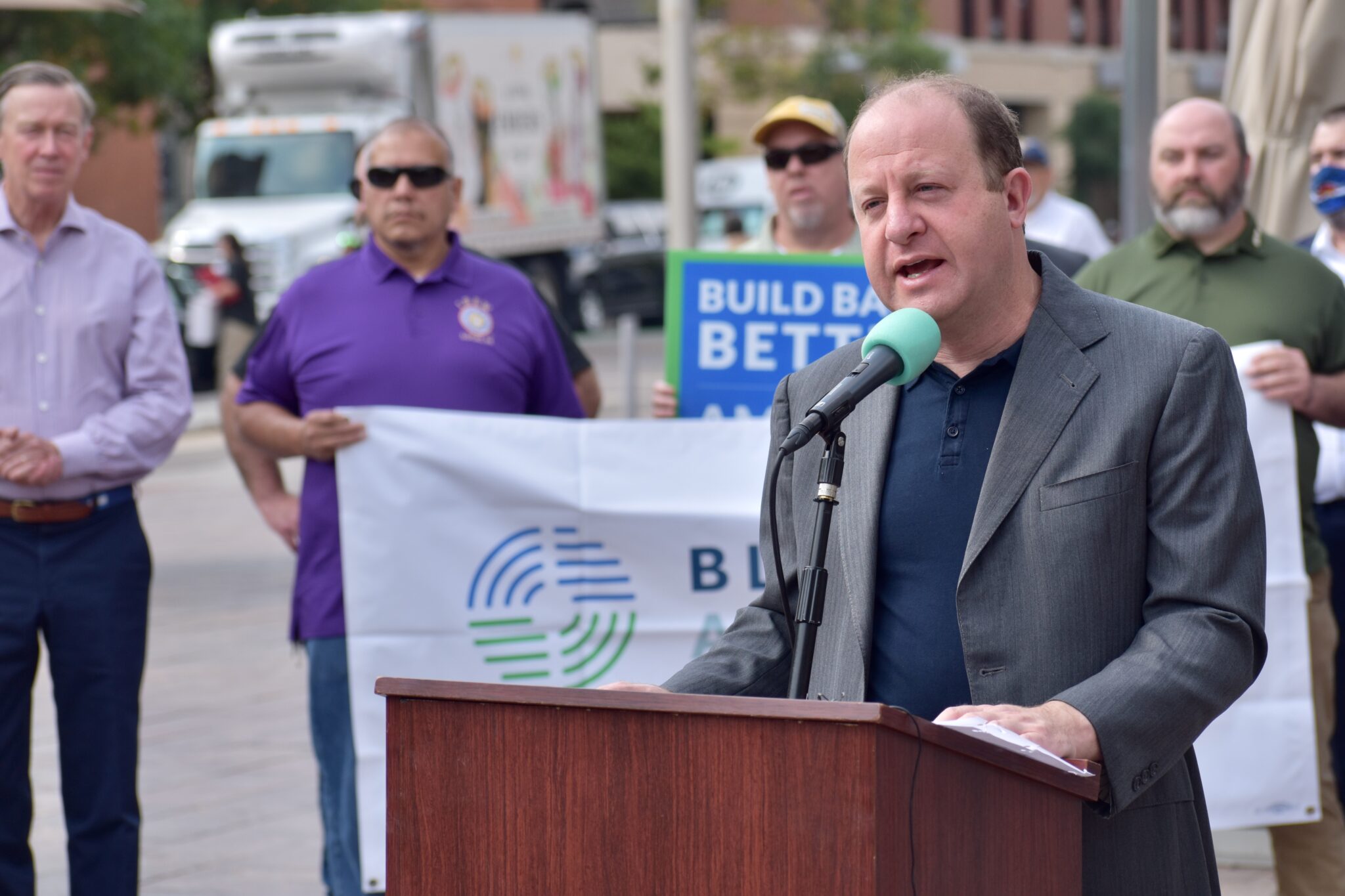
“We haven’t heard boo from Polis,” Christensen said. “He’s letting these small mountain communities take on the oil and gas industry on their own, and doesn’t seem to have their back.”
In an email, Polis spokesperson Katherine Jones said the governor “supports the state actively evaluating potential impacts to state equities through the opportunities that exist, and has made clear to agencies that they should make these evaluations and weigh in where appropriate.” She indicated that Polis opposes the issuance of federal private activity bonds to support the railway.
“We do not want funding being diverted from the state’s key transportation needs for projects that could have damaging impacts to our rail infrastructure, adjacent road infrastructure like I-70 or the state’s key recreation and outdoor resources,” Jones wrote.
Up and down the line
Before oil trains from the Uinta Basin reach Denver, they’ll have to travel 300 miles through western and central Colorado. Before that, they’ll have to travel more than 150 miles on the existing Union Pacific tracks in Utah. And before that, they’ll have to traverse 88 miles of remote desert and pine forest on the Uinta Basin Railway itself.
Although concerns about the railway have been most acutely felt in Colorado, opponents say the oil trains will pose risks along all 500 of those miles, all the way up the line to the Ashley National Forest and the Duchesne River watershed.
“This is 88 miles of new rail construction, and just that alone would create tremendous environmental harm — everything from negatively impacting water quality to destroying sage grouse habitat,” said Seed. “But then when you add into the mix the climate impacts of this, it gets even worse.”
After passing through Denver, most of the Uinta Basin oil trains would then head for refineries in Texas and Louisiana, federal regulators estimated, with a smaller percentage bound for Oklahoma. Using industry routing models, the STB’s downline analysis determined that most of the trains would travel north or northeast out of Denver, while a smaller amount of traffic would be routed south along the I-25 corridor, or east along I-70.
At a time when scientists have issued increasingly urgent warnings about the need to rapidly and dramatically lower greenhouse gas emissions, the Uinta Basin’s increased production could raise total annual U.S. emissions by nearly 1%, regulators estimated.
“Is the Line worth all of this given the activity it is intended to support?” Oberman, the STB’s chair, wrote in his 2021 dissent against the railway’s approval. “Without evidence that there is some particularized need for oil from the Basin, in the face of overwhelming evidence to the contrary, and given the irrefutable fact that this oil’s use will contribute to the global warming crisis, I cannot say that it is.”
The railway’s proponents, led by the Seven County Infrastructure Coalition, are adamant that the increased rail traffic will pose no undue risks to Colorado and other states on the downline route, writing in an op-ed earlier this month that though they “understand that project opponents feel the need to be heard,” the Uinta Basin’s toxic waxy crude “does not present an environmental concern if there were a derailment.”
“These things and far more are already going through their backyard every day,” Keith Heaton, the SCIC’s executive director, said in an interview. “The waxy crude, and the way we’re intending to do it, is probably one of the least of their worries in life … The logistics of all of this make it relatively speaking pretty safe and harmless.”
SCIC representatives said at the coalition’s June meeting that they plan to submit an application for the tax-exempt private activity bonds “in the near future,” setting up a potentially pivotal decision for Buttigieg and the DOT.
“We’re hopeful that the Biden administration will say no, because this sort of thing is so entirely contrary to their stated policies about addressing the climate crisis,” Seed said.
Members of Colorado’s congressional delegation wrote in a letter to Buttigieg this year that there is “no precedent” for the approval of private activity bonds to finance industrial fossil-fuel infrastructure, and opponents say that the railway’s decision to apply for them is a sign that the project is already on shaky financial ground.
“This is such a sketchy project. It’s highly speculative,” Seed said. “It seems like they’re having trouble raising the money.”
Led by Bennet and Neguse, Colorado officials have asked at least four different federal agencies to intervene to halt or re-analyze the project. Although the U.S. Forest Service last year said it would issue a key permit for a railroad right-of-way through a protected area, it has not yet issued a so-called record of decision under the National Environmental Policy Act, meaning that it could still choose to deny the permit.
Meanwhile, the lawsuit filed by Eagle County, the Center for Biological Diversity and other environmental groups is pending, after oral arguments were heard in May by the U.S. Court of Appeals in Washington, D.C. If the court finds fault with the STB’s decision, it could choose to overturn the decision entirely, though it’s more likely, several plaintiffs said, that it would remand the case back to the agency with instructions to more closely scrutinize downline impacts and potential mitigation measures.
For many people in Colorado, however, the risks of the Uinta Basin Railway will likely always be too great to shoulder, the worst-case scenarios too numerous to count. If the railway is built, Colorado communities could face decades of anxiety about the potentially catastrophic consequences it could one day bring to their doorsteps — a truck crash in Palisade, a fire in Dotsero, a spill in Fraser, an explosion in Globeville. History and the STB’s accident analysis leave no doubt: As the years pass, the likelihood that disaster will strike at some point, somewhere down the line, grows closer to a statistical certainty.
“What we’ve seen with all of these disasters is lots of assurances from both (industries) and the railroads themselves saying that things are safe. They’re clearly not — at least not to the extent that I think the public expects,” Scherr, the Eagle County commissioner, said. “There is an accepted rate of incident, because they have those formulas, and they expect them.”
“When we’ve seen all these disasters, the public is clearly not in agreement with what may be an acceptable level of risk,” he continued. “When you increase volume, you will increase incidents. And what those incidents look like are varied, including derailments, which in this case risks dumping that freight into the water supply for 40 million people downstream.”

Click the link to read the article on the Aurora Sentinel website (Max Levy). Here’s an excerpt:
Aurora lawmakers on Wednesday voted to scale down restrictions on residents watering their lawns in response to rebounding water levels at the city’s reservoirs. The council voted in February to limit residents to two days of lawn watering per week rather than three, reflecting the fact that the city had less than 30 months’ worth of water stored between its reservoirs and the snowpack at the time. But with the ample rain that has fallen since then, and the decision of residents not to irrigate outdoor landscaping, Aurora Water on Wednesday asked the council’s permission to ease the restrictions…
Brown said the city’s reservoirs were about 85% full as of Wednesday. Though opponents of the restrictions questioned whether the policy had any impact, Brown said the actions of Aurora Water customers meant outdoor water use had been below average and said the majority of single-family homes complied with the rules…
Mayor Mike Coffman also brought up how nearly half of the city’s water goes to outdoor irrigation, and the city doesn’t get that water back. He argued that man-made climate change was a reality and that the city needed to deal with the related problem of water scarcity by conserving. The council voted unanimously to roll back the enhanced restrictions on lawn watering to allow watering as often as three times per week. Residents will still be limited to watering outside the hours of 10 a.m. to 6 p.m. until Sept. 30.
Click the link to read the article on the Boulder Reporting Lab website (Tim Drugan):
This winter dropped a lot of snow on the mountains above Boulder. Our reservoirs are in good shape for now as Boulder Creek babbles. But that’s not our only water source.
Boulder and many other cities along the Front Range rely, at least in part, on water from the strained Colorado River. Younger cities with fewer senior rights for local water sources — like Superior and Erie — rely on it almost entirely.
Because every city is responsible for its own water portfolio, as the Colorado River becomes a potentially unreliable source, wholly dependent cities could be far worse off than others. This isn’t a far-fetched idea. A Colorado State University study shows that for every degree Fahrenheit of global warming, flows of the Colorado River decrease by 4%. And already, the Windy Gap Project — responsible for supplying a portion of Colorado River water to Front Range cities — sometimes doesn’t provide any water at all.
Yet for now, many municipalities in the Boulder County area seem reluctant to even discuss sharing water.
“Right now, we’re all trying to do the best job for our [own] residents and our customers,” said Melanie Asquith, the water resources manager for the City of Lafayette. “Everybody’s situation is different. Everybody’s storage is different. Everybody’s rights are different.”
Interviews with water managers across the county revealed potential stage-setting for a “Mad Max” situation. Each municipality is concerned only with securing water rights for its own residents. This means that unless the mindset in Colorado changes to one of greater collaboration, it’s safe to assume future droughts will hit some communities harder than others. And those hard-hit communities may be on their own.
“The citizens and businesses of Louisville are paying their water bills to ensure their supplies are covered — not necessarily Lafayette’s or Broomfield’s or anybody else in the region,” said Cory Peterson, the City of Louisville’s deputy director of utilities. “There’s not a regional or state presence that would do those types of activities. That’s just the way the system is set up.”
Where do Boulder County communities get their water from?

Peterson of Louisville said a foreshadowing of droughts’ impacts in Boulder County happened in 2001.
“You had some communities that were doing very aggressive water restrictions, had very low water supplies, and were really struggling to make it through,” Peterson said. “And you had other communities that had very light restrictions and had, I don’t want to say an easy time, but they were able to manage through those impacts.” (We saw a lesser instance of this last summer when Lafayette imposed year-round water restrictions while Boulder didn’t.)
This has led to water resource managers up and down the Front Range to chase water diversity to ensure they’re not the worst off. If one water source fails, it’s good to have another to lean on.
“Our biggest gift is our diversity, that we are not wholly dependent on the [Colorado River], that if we had to rely only on eastern water, we could do it,” Asquith of Lafayette said.
Age matters for water rights
Because of the way Colorado water rights work, it pays to be old. The “prior appropriation doctrine” — summed up as “first in time, first in right” — heavily favors cities that started getting water for their residents earlier. Being first has landed them “senior” water rights from local sources like Boulder Creek or St. Vrain Creek.
“Longmont is fortunate that a majority of the water rights in our water rights portfolio are very senior water rights,” said Wes Lowrie, a water resources analyst for the City of Longmont. “We feel very strong in our ability to meet our future demands for Longmont.”
Boulder, Louisville and Longmont have senior rights to local creeks, requiring them to get only a third of their water from the Colorado River. That insulates them from future uncertainty on the Colorado River and provides some resilience against climate change through diversification. Lafayette gets less than a quarter of its water from the Colorado River.
Pretty much all of Erie’s water, on the other hand, comes from the Colorado River. All of Superior’s does as well.
California, Nevada and Arizona recently reached an agreement to temper their use of water from the Colorado River. With federal assistance, the worst repercussions of overuse from the river will hopefully be avoided, for now. But Colorado wasn’t a part of the recent Colorado River agreement, because Colorado is part of the Upper Basin states: those using water above parched Lake Powell. Unlike the Lower Basin, Upper Basin states have thus far used less water than is available to them. But that could change as the river reduces more.

When a water source is diminishing, you want a senior right on that source to make sure you get your water before it runs out. Yet some of the water coming from the shrinking Colorado River to the Front Range isn’t even close to a senior right. The Windy Gap project, a water right that provides some cities with a considerable chunk of their water, only dates back to 1968 — very young by Colorado River standards.
“The Windy Gap water right is a very junior water right on the Colorado River,” said Jeff Stahla, a public information officer at Northern Water, which manages Windy Gap. “The Windy Gap Project in some years yields zero water.”
The project — which includes a diversion dam and reservoir on the Colorado River — is just one of the water rights allotting Colorado River water to eastern cities. Originally funded by Boulder, Estes Park, Fort Collins, Greeley, Longmont and Loveland to cope with booming populations, the project started delivering water across the Continental Divide in the 1980s.
Today, some Front Range municipalities are investing further in Windy Gap water. By building a new reservoir in southern Larimer County, the cities hope to store Windy Gap water from wet years to get them through the dry ones when Windy Gap may provide no water.

Called the Chimney Hollow Reservoir, the project broke ground in 2021 and is on track to cost upwards of $700 million. A dozen different water districts are funding the reservoir to add an additional fail-safe to their water supply. Involved cities include Louisville, Lafayette, Longmont, Erie and Superior. Broomfield is leaning especially heavily on the new reservoir, voting in 2021 to foot $176.4 million of the bill. (Boulder is not involved in the Chimney Hollow project.)
According to City of Broomfield staff, this investment will increase Broomfield’s reliance on Colorado River water from 60% of their source water to 70%. Broomfield’s water not delivered by Northern Water comes from Denver Water, which also gets a portion of its water from a tributary of the Colorado River. Piped through the Moffat Tunnel, water previously destined for the Colorado River is stored in Gross Reservoir that recently began a controversial expansion project.
Yet Windy Gap water isn’t the only water coming from the Colorado River. The Colorado-Big Thompson Project, or C-BT, has been pumping water east since 1947. With its right dating to the 1930s, that water “is much more guaranteed,” according to Stahla.
Almost all cities who get Windy Gap water also get a portion of C-BT water.
Pete Johnson, a water attorney for the town of Erie, said the town’s water comes from a mix of C-BT water and Windy Gap water with an investment in the Chimney Hollow project — all Colorado River water.
“The long term goal is to diversify the town’s portfolio,” Johnson said.
But C-BT water isn’t infallible either. “The CB-T water right, I don’t want to say it’s junior, junior,” Stahla said. “But certainly a 1930s water right is not senior in the state of Colorado.”

Setting up a Mad Max future
Robert Crifasi, a former City of Denver hydrologist and Boulder Open Space and Mountain Parks water resources administrator, and author of a new book “Western Water A to Z: the History, Nature and Culture of a Vanishing Resource,” said one of the most important steps to avoiding a Mad Max future is ensuring water availability before building new developments. Because of overzealous development companies, Crifasi said, some Denver suburbs are now reliant on nonrenewable Denver Basin groundwater. What will those communities do when the aquifer runs dry? Rely on the Colorado River?
“There is no magic bullet in any of this,” Crifasi said. “But I do think the most important action is to legislatively require vigorously integrated water and land-use planning.”
Kim Hutton, the City of Boulder’s water resources manager, said in addition to conservation and planning, there’s a need for collaboration and coordination among municipalities around water. As it currently stands, it’s every city for itself.
“Right now, with the water rights system, individual water users really are responsible for developing a supply to meet their needs,” she said.
Lowrie of Longmont, for instance, said that Longmont has always required that developers prove a reliable water source before moving forward into construction. “And that planning has served us well,” he said.
When asked if Longmont had talked about possibly sharing with other municipalities that might, in the future, not have enough water for their residents, he suggested that long-term aid would be viewed very differently than short-term aid.
“The decision to share water on an ongoing basis might be a different conversation than if there was an emergency situation, like if somebody’s water treatment plant went out,” he said. “That’s a different scenario than saying, ‘Hey, we didn’t plan as well as Longmont, and now we don’t have enough supply.’”
Boulder Reporting Lab is a nonprofit newsroom serving Boulder County. Sign up for their newsletter here.
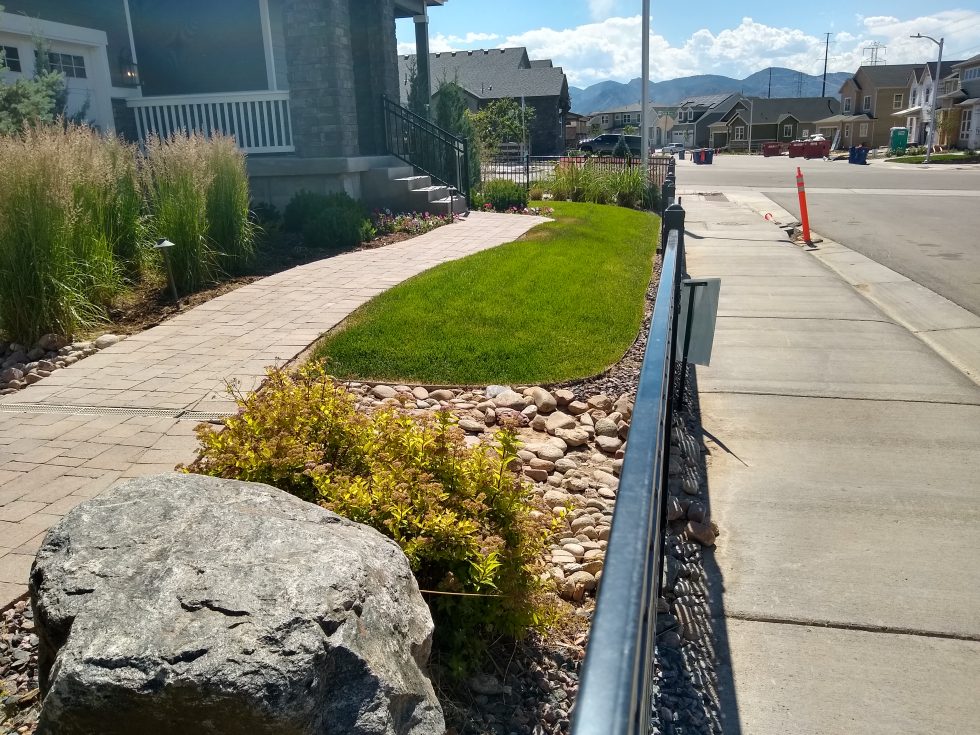
Click the link to read the article on The Denver Post website (Judith Kohler). Here’s an excerpt:
Across the Denver area, local governments, water utilities, homebuilders and developers are employing a number of strategies to meet the demands for housing, respond to growth and strive to ensure the long-term supply of the resource essential to a future in this semi-arid region: water. Agriculture consumes the lion’s share of Colorado’s water, about 90%, while municipal uses account for 7% of the total.
“When you start off with that number, I think it’s really easy for people to say, ‘Why does municipal water use even matter? Why are we even worried or focused on this?’ That’s a question I answer a lot,” said Lindsay Rogers, a water policy analyst with Western Resource Advocates.
One response is that state water planners say municipalities could face a shortfall of as much as 740,000 acre-feet of water by 2050…
Harold Smethills, Sterling Ranch co-founder and chairman, doesn’t want to see large portions of Colorado’s agricultural land dried up. Smethills, who has a ranch, leases land on the development south of Chatfield State Park to a cattle operation…No water-thirsty Kentucky bluegrass is allowed at Sterling Ranch, which has about 5,000 residents. The company worked with the Denver Botanic Gardens to identify roughly 155 different plants that use less water, many with the added bonus of attracting bees and other pollinators. The water meters in the homes tracks indoor and outdoor use and have revealed leaks when staff at the Dominion Water and Sanitation District noticed water use shoot up. Residents are also able to keep an eye on their water bills.
Click the link to read the article on The Greeley Tribune website (Trevor Reid). Here’s an excerpt:
Greeley residents can continue watering their lawns, gardens and outdoor landscapes under normal watering rules through Oct. 31, thanks to the declaration of an adequate water year by the city’s Water and Sewer Board this past month. Above-average snowpack and low temperatures in the high mountains have helped the mountains maintain the snowpack before it melts and feeds the rivers. Recent rainstorms have caused river flows to increase, according to a city news release. The city’s water resources confirmed the city’s reservoirs are either full or filling, with Cache la Poudre and Big Thompson runoff peaking in early June…
Given the adequate water year, the city will also continue its water rental program, renting excess water to farmers and ranchers. Excess water may be rented out so long as the target storage volume of 21,300 acre-feet is maintained. Depending on snowmelt and river conditions, the city may rent out additional water after the initial April allocation…The city averages 6.41 inches of precipitation each year through May 21, according to a city news release. As of earlier this week, the city received 8.03 inches of rainfall — 1.6 inches above average.

Click the link to read the article on the Big Pivots website (Allen Best):
Colorado will probe the pairing of solar panels with canals and reservoirs. Can solar integrated into agriculture help solve the San Luis Valley’s water woes?
Agrivoltaics—the marriage of solar photovoltaics and agriculture production— has been filtering into public consciousness, if still more as an abstraction than as a reality. In Colorado, other than Jack’s Solar Garden near Longmont, there’s little to see.
Aquavoltics? The idea of putting solar panels above water? Similarly thin. You have to travel to North Park to see the solar panels above the small water-treatment pond for Walden.
SB23-092, a bill passed on the final day of Colorado’s 2023 legislative session, [ed. Signed by Governor Polis May 18, 2023] orders study of both concepts. In the case of aquavoltaics, the bill headed toward the desk of Gov. Jared Polis authorizes the Colorado Water Conservation Board to study the feasibility of using solar panels over or floating on, irrigation canals or reservoirs. The bill also authorizes the state’s Department of Agriculture to award grants for new or ongoing agrivoltaics demonstration projects.
Still another section requires the Colorado Department of Agriculture, in consultation with related state agencies, to begin examining how farmers and ranchers can be integrated into carbon markets. The specific assignment is to “examine greenhouse gas sequestration opportunities in the agricultural sector, including the use of dry digesters, and the potential for creating and offering a certified greenhouse gas offset program and credit instruments.”
While Democrats and Republicans got angry with each other in some cases, in this case there was broad comity. The primary Democratic sponsors were from Denver and Boulder County, and the Republicans from the San Luis Valley and Delta. Votes were lopsided in favor.
The agrivoltaics idea was originally included in the 2022 session in a big suitcase of ideas sponsored by Sen. Chris Hansen, a Democrat from Denver. It fell just short of getting across the finish line.
This past summer, Sen. Cleve Simpson, a Republican from the San Luis Valley whose district now sprawls across southwestern Colorado, took keen interest—and for very good reason. A fourth-generation native of the San Luis Valley, his day job there is general manager of the Rio Grande Water Conservation District, whose farming members must cut back water use so that Colorado can comply with the Rio Grande Compact with New Mexico and Texas. It will be a tough challenge—and he’s trying to figure out how to leave his communities as economically whole as might be possible.

The aquavoltaics idea is new to this year’s bill, though.
Hansen, who grew up along the edge of the declining Ogallala Aquifer in Kansas, said his study of water conservation efforts around the world found that aquavoltaics was one of the most advantageous ways to reduce evaporation from canals and reservoirs. Doing so with solar panels, he said in an April interview, produces a “huge number of compounded value streams.”
Covering the water can reduce evaporation by 5% to 10%, he explained, while the cooler water can cause solar panels to produce electricity more efficiently, with a gain of 5% to 10%. Electricity can in turn be used to defray pumping costs.
Solar panels in cooler climates can actually produce electricity more efficiently, which is why solar developers have looked eagerly at potential of Colorado’s San Luis Valley. At more than 7,000 feet in elevation, the valley is high enough to be far cooler than the Arizona deserts but with almost as much sunshine.

Colorado already has limited deployment of aquavoltaics. Walden in 2018 became the state’s first location to deploy solar panels above a small pond used in conjunction water treatment. The 208 panels provide roughly half the electricity needed to operate the plant. The town of 600 people, which is located at an elevation of 8,100 feet in North Park, paid for half the $400,000 cost, with a state grant covering the other.
Other water and sewage treatment plants, including Fort Collins, Boulder and Steamboat Springs, also employ renewable generation, but not necessarily on top of water, as is done with aquavoltaics.
Hansen said he believes Colorado has significant potential for deploying floating solar panels on reservoirs or panels installed above irrigation canals. “There is significant opportunity in just the Denver Water reservoirs,” he said. “Plus you add some of the canals in the state, and there are hundreds of megawatts of opportunity here.”
Bighorn, Colorado’s largest solar project, has a 300-megawatt generating capacity on land in Pueblo adjacent to the Rocky Mountain Steel plant Comanche’s two remaining units have a combined capacity of 1,250 megawatts, although both are scheduled to be retired by 2031.
Why now and not a decade ago for aquavoltaics? Because, says Hansen, most of the best sites for solar were still available. Because aquavoltaics has an incremental cost, land-based solar was the low-hanging fruit.
Now, as land sites are taken, the economics look better, says Hansen, who has a degree in economics. Plus, with solar prices dropping 10% annually, the economics look even better. The Inflation Reduction Act passed by Congress in August 2022 delivers even more incentives. “I think there will be more and more aquavoltaic projects that will pencil out,” he said.
Arizona water providers have resisted aquavoltaics but are now taking a second look. The Gila River Indian Community announced last year that it is building a canal-covering pilot project south of Phoenix with aid of the U.S. Army Corps of Engineers. “This project will provide an example of new technology that can help the Southwest address the worst drought in over 1,200 years,” said Stephen Roe Lewis, governor of the tribe.
When completed, the canal-covered solar project will be the first in the United States. But both the Gila and a $20 million pilot project launched this year by California’s Turklock Irrigation District are preceded by examples in India.
Officials with the Central Arizona Project, the largest consumer of electricity in Arizona, responsible for delivering Colorado River water through 336 miles of canals to Phoenix and Tucson, will be following closely the new projects in Arizona and California, according to a report in the Arizona Republic.

In its final legislative committee hearing in late April, the bill got robust support. Both the Colorado Farm Bureau and the Rocky Mountain Farmers Union voiced support.
So did a Nature Conservancy representative. “If we want to solve the climate crisis while at the same time not exacerbating biodiversity and farmland loss, we have to think creatively,” testified Duncan Gilchrist.
“This bill has nothing but winners,” said Jan Rose, representing the Colorado Coalition for a Livable Climate.
The most probing questions were directed to Byron Kominek, the owner and manager of Jack’s Solar Garden. There for the last several summers, vegetable row crops have been grown in conjunction with dozens of solar arrays assembled on a portion of the 24-acre farm. He readily receives reporters and all others, casting the seeds of this idea across Colorado and beyond.
The questions were directed by State Sen. Rod Pelton, whose one district covers close to a quarter of all of Colorado’s landscape, the thinly populated southeast quadrant. A farmer and rancher from the Cheyenne Wells area, Pelton wondered how high off the ground the panels were and what kind of racking system was high enough to address the issue of cattle rubbing against them?
The question, though, jibes with what Mike Kruger, chief executive of the Colorado Solar and Storage Association, sees for agrivoltaics. “I don’t think it will ever be ‘amber waves of grain’ under panels,” he said in April. “It will more likely be cattle and sheep grazing.”
Hansen, in his wrap-up comments before the committee in April, talked about different places needing different approaches depending upon climate zones, topography, growing conditions and other factors. That, he said, was the intent of the studies: to figure out how to maximize potential, to get it right.


Click the link to read the article on the Fort Collins Coloradoan website (Sady Swanson). Here’s an excerpt:
Council members voted 6-1 to approve the proposed “1041 regulations” during their meeting on May 2. Council member Shirley Peel voted against adopting the regulations, which must pass a vote on Tuesday, May 16, to be implemented. Adopting these 1041 regulations gives “the city a tool in our toolbox to have a binding review of a certain set of major infrastructure projects,” Community Development and Neighborhood Services Director Paul Sizemore said during a City Council meeting in February. These projects include major new water or wastewater systems and new highway or interchange projects….Council placed a moratorium on these projects through June 30. The Northern Integrated Supply water delivery project is an example of a project that would be impacted by 1041 rules.
The city’s stated goals for the regulations include:
- Address deficiencies with the city’s Site Plan Advisory Review (SPAR) process, which is the current tool used for such projects.
- Establish predictability for applicants.
- Establish a meaningful public process.
- Incentivize project designs that avoid impacts to critical natural habitats and cultural resources.
Water providers and leadership from surrounding communities criticized the 1041 regulations for hindering regional collaboration on current and future water projects, while representatives from environmental groups asked council to adopt the regulations and continue to look at ways to further protect the city’s natural areas and resources.

Click the link to read the article on the Sterling Journal-Advocate website (Jeff Rice). Here’s an excerpt:
According to a statement issued by Logan County Emergency Management Officer Jerry Casebolt Monday afternoon, the river level at the Atwood Gauge had peaked at 7.45 feet, nearly two feet below any level requiring action.
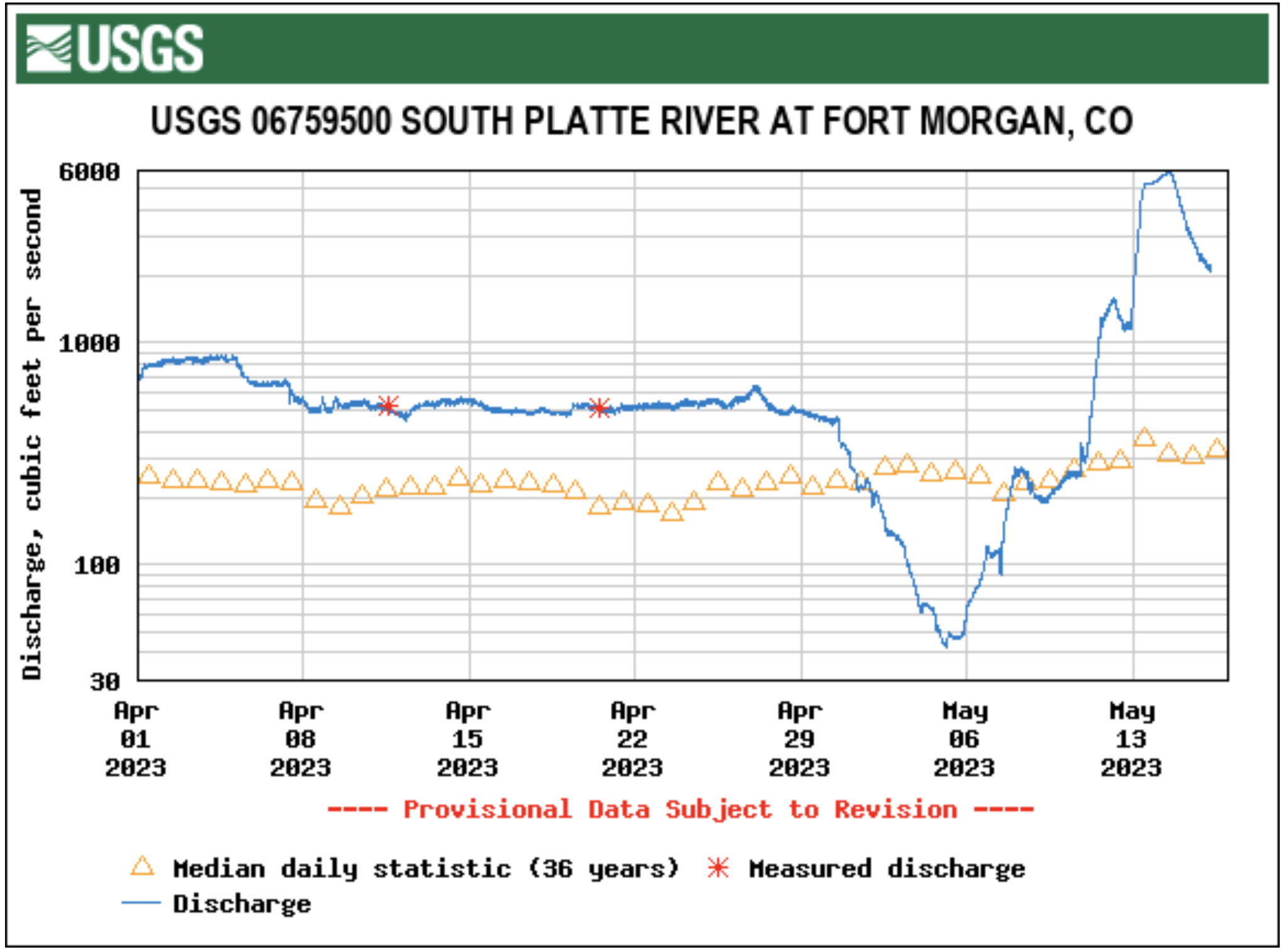
Casebolt said the high water had made it to the Crook bridge on County Road 55 early Monday, with river flow rising from 323 cubic feet per second on Sunday to 2,180 cfs on Monday. He said the Fort Morgan gauge was reporting 12.11 feet on Monday afternoon, down from 13.72 ft yesterday at this time. Meanwhile, the gauge at Kersey also had leveled off at 5.45 ft, which is down from its peak of 8.41 ft on Saturday morning. The high water was caused by nearly two days of continuous rain along the Front Range, The hardest rainfall seemed to occur in the central metro area, with Aurora recording 5.1 inches of rain between May 9 and May 12. In that same time period Denver reported 5 inches, Boulder 2.5 inches, Longmont 2.3 inches, Broomfield 3.5 inches, Loveland 2.4 inches, Fort Collins 2.25 inches and Greeley 4 inches.
While the runoff will subside over the next day or so, it will be followed by snowmelt as temperatures become warmer in the coming week. Daily highs along the Front Range should be in the upper 60s and upper 70s the rest of the week, with periods of possible thunderstorms at the end of the week.


From email from Northern Water (click to subscribe):
Strong winter snowpack has water managers optimistic
A parade of snowstorms through the American West this winter has water managers across the region cautiously optimistic about the near-term water supply.
According to data from the Natural Resources Conservation Service, the Upper Colorado River watershed is at about 113 percent of its annual average for precipitation. Further downstream in the Colorado River Basin, other tributaries such as the Gunnison River and San Juan River are showing even larger snowpack totals compared to historic averages. For communities throughout the basin, that is great news.
The above-average snowpack in the Upper Colorado River Basin means there is a strong chance that the Colorado-Big Thompson (C-BT) Project reservoirs will fill this summer, too. That’s good news for residents of Northern Colorado who depend on the supplemental water supply that it delivers, but it’s not as good for Windy Gap Project participants. They have an agreement with the U.S. Bureau of Reclamation that allows them to use available capacity in Lake Granby to store Windy Gap water for future delivery, but if Lake Granby is full of C-BT Project water, no storage capacity is available for Windy Gap water.
With the construction of Chimney Hollow Reservoir, Windy Gap Firming Project participants will have the opportunity to capture and store water for multiple-year deliveries with greater frequency and flexibility in years when Lake Granby would otherwise be full of C-BT Project water. The construction of reservoirs helps moderate the ups and downs of annual precipitation and has enabled Colorado’s population and food production systems to grow and prosper for more than a century.
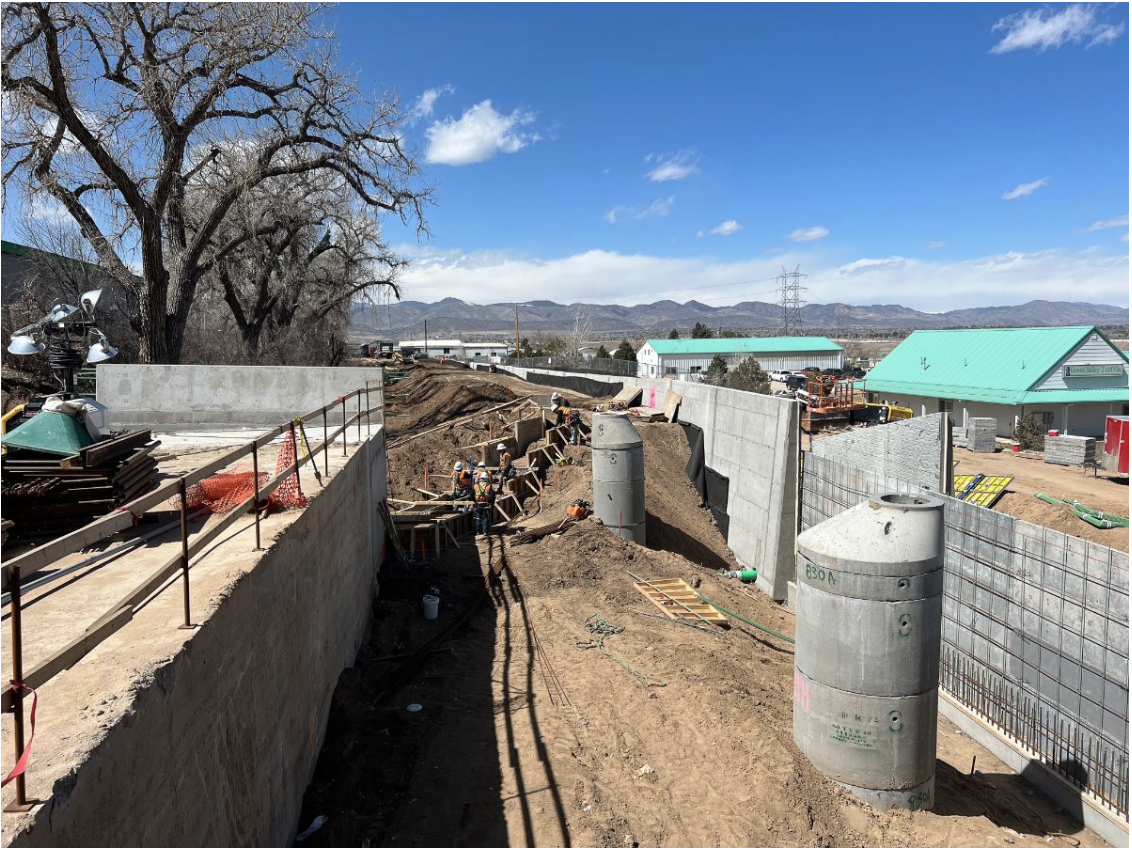
From the latest Highline Canal Conservancy Newsletter:
Construction of an underpass for the High Line Canal trail at US 85 (Santa Fe Drive) is underway! The underpass is a component of a CDOT & Douglas County project to widen US 85 from Highlands Ranch Parkway to C-470. A trail detour will be in place into 2024.
Click the link to go to the Douglas County Project webpage.
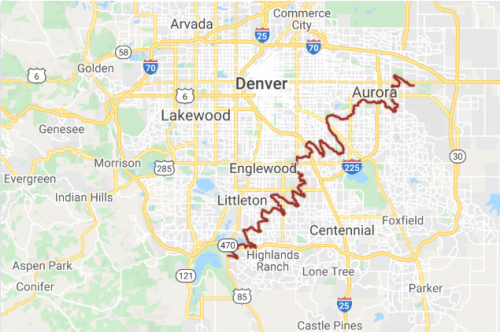

Click the link to read the article on the Water Education Colorado website (Jerd Smith):
On the hillsides that rise above James Creek in Jamestown, Colorado, west of Boulder, the yards of mountain homes and the forests that surround them are dotted with trees decorated with pink and blue ribbons.
It’s festive, but not in the usual sense.
Jamestown lies in the headwaters of Left Hand Creek, a tributary of the St. Vrain River. The pink trees will be kept, while those flagged in blue will be cut down in a careful thinning project designed to protect a watershed farther downstream that serves farmers and thousands of people in communities such as Lyons and Longmont.
The watershed is a critical part of the St. Vrain and Left Hand Water Conservancy District, an agency charged with overseeing and managing the St. Vrain River, a major system in the larger South Platte River Basin on Colorado’s Front Range.
The people of Jamestown have been working for years to find funding to protect their community from wildfire and to protect James Creek. Tree cutting is expensive, sometimes costing $1,000 just to remove one tree.

But thanks to a property tax increase the district’s voters approved in 2020, as well as an influx of COVID relief money to the state, and new federal funds for infrastructure and jobs, the people of Jamestown and the St. Vrain district now have access to the money they need to reshape and improve their water systems in ways that benefit supply, recreation, the environment and agriculture.
If state and federal funding proposals come through, and some already have, the district will have more than $240 million to work with. For perspective, that is 60 to 80 times the size of the district’s annual $3 million to $4 million operating budget.
Similar big federal funding opportunities exist for other water districts, and policy makers across the state are looking to the St. Vrain district to lead by example.
Alex Funk, senior counsel and director of water resources at the Theodore Roosevelt Conservation partnership is tracking the streams of new cash. He says the opportunities to modernize water systems and improve the state’s farms and rivers now are huge.
“It’s unprecedented in its scope and scale,” Funk said. “There has never been this amount of federal money available all at once. In that sense, we are in uncharted territory.”
That’s not lost on Sean Cronin, executive director of the St. Vrain and Left Hand Water Conservancy District.
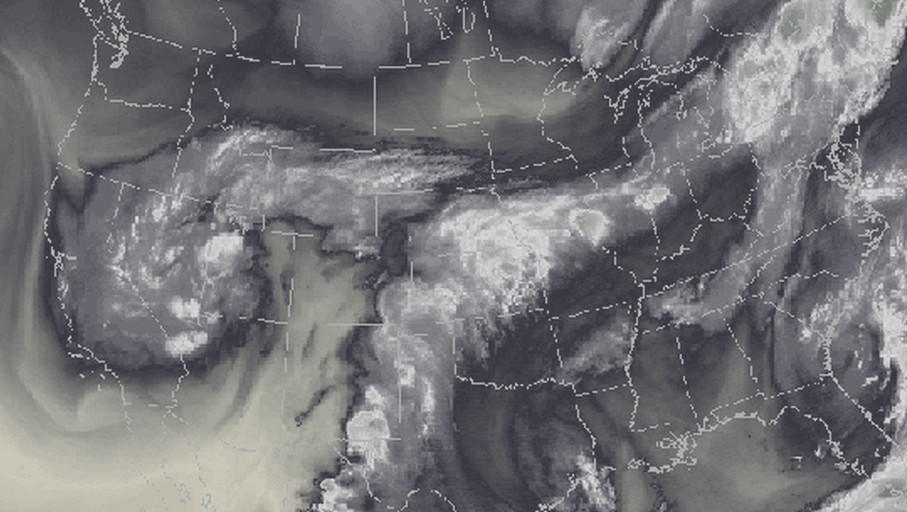
After the floods of 2013, the district saw its streams and water systems devastated. Desperate to rebuild, small communities, ditch companies and watershed groups, as well as the St. Vrain district, began banding together to apply for federal and state emergency assistance.
“The flood introduced us to new friends,” Cronin said.
From that grew a ballot initiative in 2020 that has raised millions of dollars in property taxes.
Though statewide water tax proposals have had little success among Colorado voters, St. Vrain’s was one of two local districts that year that succeeded. The Glenwood Springs-based Colorado River Water Conservation District also won approval to raise taxes to protect and improve the regions water sources.
“The fact that we had a plan that looked at all things regarding water and wasn’t specifically for a single water outcome is part of why we succeeded,” Cronin said. “People embrace looking at things holistically.”

Energized by the win, the district launched into planning and design on a range of modest projects.
And then the federal funding deluge began. Now the district is in the running for $240 million to improve infrastructure and restore streams, and improve agricultural irrigation systems, among other projects.
Todd Boldt oversees the federal Emergency Watershed Protection program in Colorado at the Natural Resources Conservation Service as well as other major grant-making programs that are now flush with cash.
He said one of his agency’s priorities is to get the word out about federal funding opportunities and to ensure even small water districts have the resources to do the planning, engineering and design work needed to begin the grant process.
He credits the St. Vrain district with being well-planned and well-organized at the starting line.
“This is complicated stuff,” Boldt said. “We’re at a critical juncture in time.”
If the St. Vrain and Left Hand team succeeds, its ditches, streams, wetlands, reservoirs and farm fields could look significantly different in seven to 10 years.
High in the mountains, for instance, a historic diversion system will be brought into the 21st century. More than 130 years old, the structure is difficult to access and maintain. Soon it will be rehabilitated so that it can be monitored and operated remotely to make sure water is accurately counted and properly diverted.
“We’re trying to squeeze every last drop out of our system,” Cronin said.
In fact, there are dozens of diversion structures in this sprawling district that includes prized recreational streams, thousands of acres of farms, rich wetlands, and cities.
Cronin and his team are reaching out to everyone, funneling the cash they’ve raised into matching grants and offering assistance to partners.
Another part of the district’s strategy is to grow water supplies where possible, and to do so in a way that doesn’t require the purchase of farm-tied water rights and the subsequent dry up of farm fields.
This year, for instance, the district began its own cloud-seeding program, which is forecast to increase water derived from annual snow storms by 5% to 10%.
Funk said the work in the St. Vrain and Left Hand district is encouraging.
“We need to see more of that. We want people to think creatively about these [federal] funds,” he said.
Back up in Jamestown, St. Vrain’s Jenny McCarty, a water resources specialist, has been monitoring the forest restoration work. She believes the initiative could serve as a template for other community-based, multi-property-owner watershed health projects.
In the mountains, while it’s helpful for one property owner to thin trees and remove slash, the impact is limited, McCarty said.
“These property owners like their privacy. Their contribution to the project has been to allow all those trees to be cut down,” she said. “It’s the collective effort that makes a difference.”
Jerd Smith is editor of Fresh Water News. She can be reached at 720-398-6474, via email at jerd@wateredco.org or @jerd_smith.
Click the link to read the article on the Denver Water website (Todd Hartman):
In the race to protect homes and communities ― and water supplies ― from the intensifying threat of wildfire, Front Range organizations spent urgent years hustling to thin dense and overgrown forests in scattered patches.
Cutting trees and clearing brush ideally would ease the risk of catastrophic fire by reducing what could burn and slowing a fire’s spread in a less crowded forest.

And that was true. But the approach, while well-meaning and understandable, also was disorganized and scattershot.
“Organizations were frantically out there working on their own,” explained Madelene McDonald, a watershed scientist at Denver Water focused on protecting water supplies from wildfire. “These were shotgun treatments, or what is sometimes called ‘random acts of restoration.’ It was 500 acres here, then 300 acres there.”
Things are changing ― for the better. And Denver Water is at the forefront.
Denver Water scientist earns rare slot on Congressional wildfire commission.
With greater coordination, more resources and a more strategic approach, agencies and communities are beginning to create larger, more connected swaths of thinned-out forests.
Experts believe these larger swaths can better prevent the kind of massive damage to waterways, reservoirs — and the forests themselves — that have marked the last quarter-century of epic wildfire in Colorado.
“We are recognizing that we can’t be working independently. We need to be collaborating and doing strategic cross-boundary planning. We can get far more done together,” McDonald said. “The risk is still there, but we are moving the needle.”
Focus on the Pike National Forest
One of the clearest examples of this strategic shift can be found in the South Platte Ranger District, in a region near Bailey located south and west of Denver.
Here, partnerships involving the U.S. Forest Service, Denver Water, the Colorado State Forest Service and other state and local organizations are driving landscape-scale work that will provide greater protection for forests and for Denver Water’s supplies in an era of a warming climate and hotter, larger, more damaging forest fires.
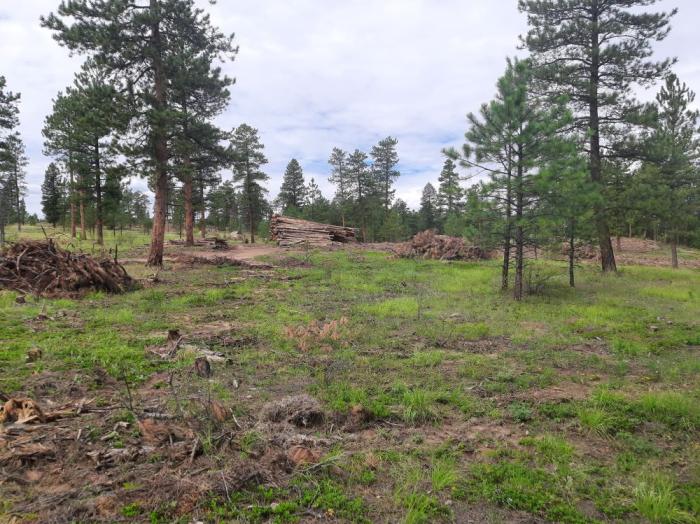
Much of the work is occurring under the banner of the Jerome Miller/Miller Gulch Project, an effort focused on an area of the Pike National Forest that lies between the North Fork and the South Platte rivers and upstream from where the two waterways merge near Strontia Springs Reservoir, a temporary pool for 80% of Denver Water’s supply.
The project is expanding a series of forest treatments in the region that collectively are designed to limit future fires ability to spread quickly and grow in intensity. That, in turn, should lessen wildfire impacts to the North Fork of the South Platte, a stretch that conveys critical supplies of water flowing from Dillon Reservoir to the metro area.
Parts of this general region in the South Platte River watershed were the epicenter of two major fires in 1996 and 2002 that together burned more than 150,000 acres, devastated landscapes and left reservoirs clogged with thousands of tons of sediment that poured from the scorched, treeless landscape left by the fires.
Those two fires, named the Buffalo Creek and Hayman, set Denver Water and other land management agencies on the course they are on today ― to collaborate on the ground to ease the risk of future catastrophic fires.
Examples of success
Already, the partnership’s work has resulted in tangible success stories.
In 2019, a fire broke out in an area called Payne Gulch in the Pike National Forest. As part of a series of forest management projects in the region, this area had been thinned in 2017.
“The fire could have blown up to be a pretty catastrophic fire, but wildland firefighters were able to access and suppress the fire effectively because of the thinning,” McDonald said. “That’s a shining example of where we’ve seen this work pay off. The connectivity between treated areas is increasing and attracting more and more work in that area.”
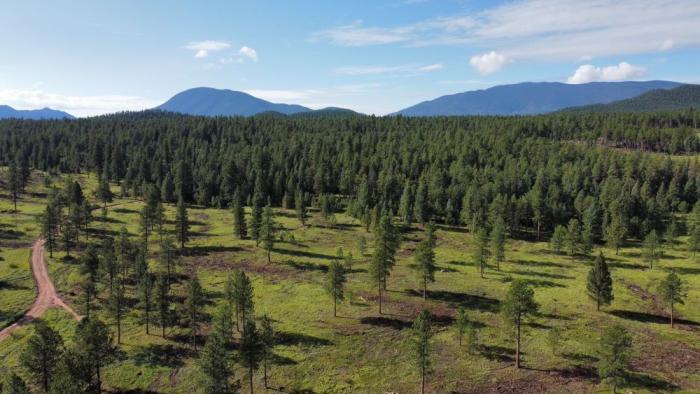
In perhaps the highest profile example, the partnership’s work to develop fuel breaks protected about 1,400 homes and as much as $1 billion in value in Silverthorne during the Buffalo Fire in Summit County in 2018. The work has also protected Denver Water’s Dillon Reservoir, Denver Water’s largest water storage facility.
Success has many fathers (as the saying goes), but there’s little question that Denver Water’s From Forests to Faucets partnership with the U.S. Forest Service, Natural Resources Conservation Service, Colorado State Forest Service and Colorado Forest Restoration Institute is a key part of the story driving greater investment and partnerships to get ahead of big fires in Colorado.
In 2020, the Williams Fork fire hit one source of Denver Water supply.
All told, partners have committed more than $96 million to the From Forests to Faucets partnership, from its inception in 2010 through work planned into 2027.
In total, Denver Water and partners have treated more than 120,000 acres of forested land since 2010, with nearly two-thirds of that within the South Platte Basin. Local organizations involved in the South Platte Basin work include Jefferson County Open Space, Jefferson Conservation District, Aurora Water and the Coalition for the Upper South Platte.
Feds point to Colorado
Federal officials gathered Feb. 9 for a news conference in Broomfield to highlight new congressional funding for forest work and called such partnerships in Colorado “a template for the nation.”
At that event, Homer Wilkes, the U.S. Department of Agriculture Undersecretary of Natural Resources and Environment, announced $37 million in federal money for priority landscapes along the Front Range in 2023, including areas in the South Platte watershed.
Last year, the region attracted $18 million in federal dollars. All of that money comes on top of recent funding at the state level of more than $80 million.
“Investing proactively in protecting forests and watersheds is a smart business decision. You can see our partners increasingly understand that as state and federal resources pour in to help reduce the impacts of, and potential for, big fires,” said Christina Burri, who has for years developed and strengthened Denver Water’s interagency collaboration.
Burri noted that with the new flow of state and federal money, Denver Water is seeing up to a tenfold return on the utility’s investment into From Forests to Faucets.
“It is amazing to see,” she said.
Outgoing Denver Water CEO/Manager Jim Lochhead said the big rise in funding to protect water supplies and communities is a tribute to Denver Water’s years of focus on the issue.
“It is just one more example of how a utility can achieve results by leaning into collaboration and partnerships, and by leading in innovation,” Lochhead said.
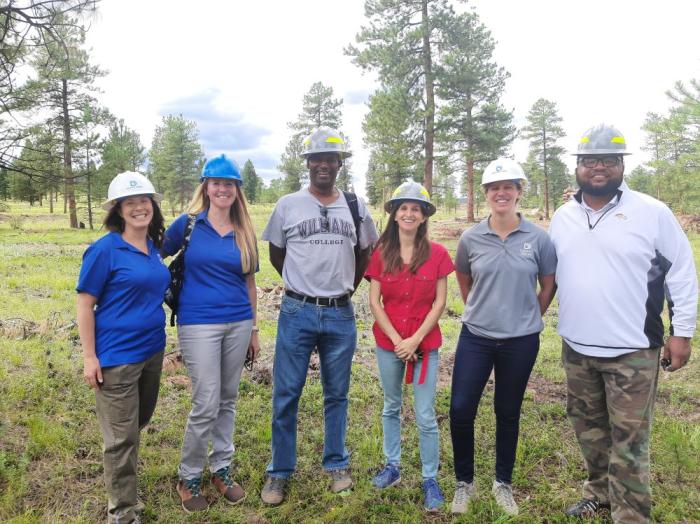
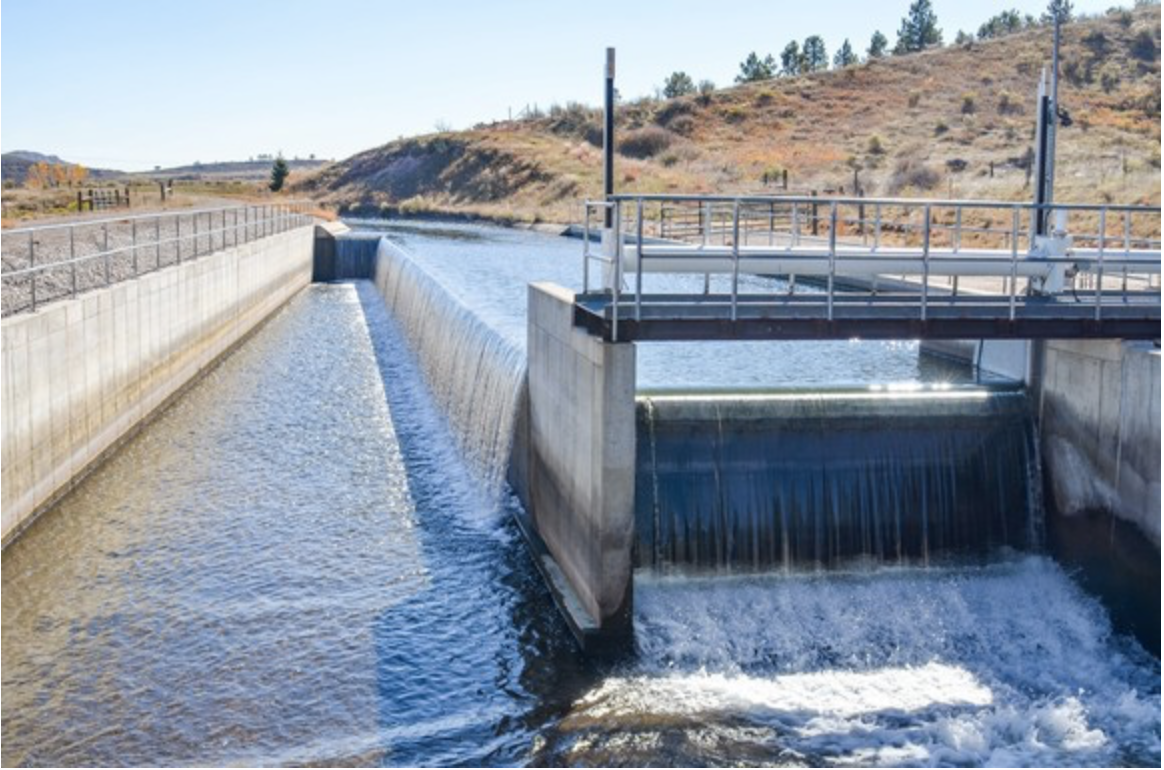
Here’s the release from Northern Water (Jeff Stahla):
The Northern Water Board of Directors voted Thursday to increase its 2023 quota allocation for the Colorado-Big Thompson Project to 70 percent. Members voted 8-4 to increase the allocation from the 40 percent initial quota set in October.
Board members discussed the combination of this year’s above-average snowpack and streamflow projections contrasted against the lowest East Slope non-C-BT reservoir levels since 2013 and below-average soil moisture readings throughout much of the district.
Luke Shawcross, manager of the Water Resources Department at Northern Water, outlined water modeling showing the predicted storage levels in the project through the end of 2023 and into 2024, and he also discussed the available water supplies in regional reservoirs. Water Resources Specialist Emily Carbone and Water Scheduling Department Assistant Manager Sarah Smith also provided Board members with current water supply and availability data.
Public input was also considered in the Board’s decision.
While current soil moisture conditions on Northeastern Colorado farmland prompted several Board members to ask for consideration of a higher quota, others cited the uncertainty of future hydrology to support their approach this year.
The Board has been setting C-BT quota since 1957 and 70 percent is the most common quota declared. It was also the quota set for the 2021 water delivery season. In 2022, the final quota was 80 percent. Quotas are expressed as a percentage of 310,000 acre-feet, the amount of water the C-BT Project was initially envisioned to deliver to project allottees each year. A 70 percent quota means that the Board is making 0.70 acre-feet of water available for each C-BT Project unit, or collectively, 217,000 acre-feet.
The quota increases available C-BT Project water supplies by 93,000 acre-feet from the initial 40 percent quota made available in November 2022. Water from the C-BT Project supplements other sources for 33 cities and towns, 120 agricultural irrigation companies, various industries and other water users within Northern Water’s 1.6 million-acre service area. According to recent census figures, more than 1 million residents now live inside Northern Water’s boundary. To learn more about Northern Water and the C-BT quota, visit www.northernwater.org.
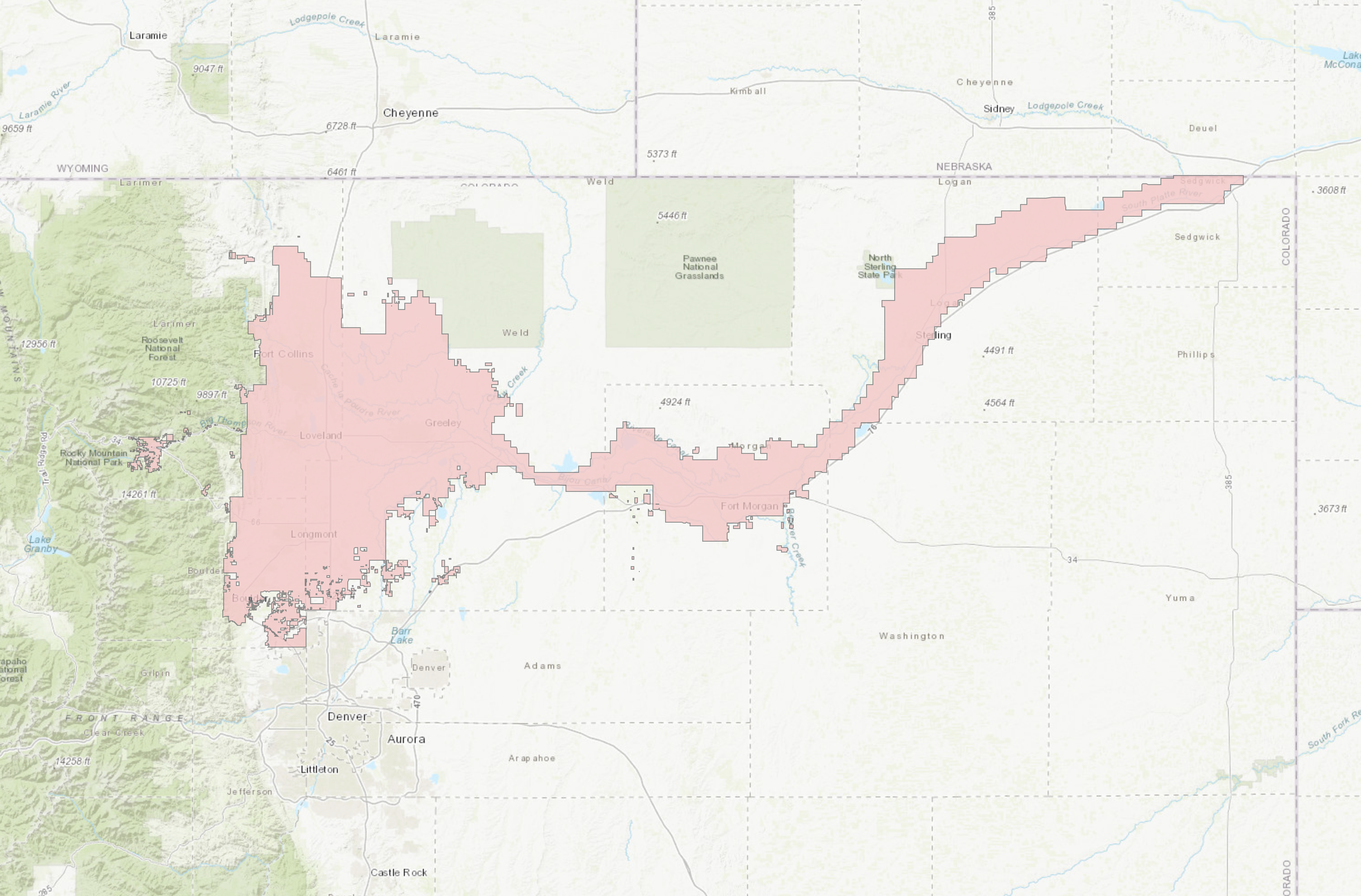

Click the link to read the article on the Fort Collins Coloradoan website (Molly Bohannon). Here’s an excerpt:
In a 6-1 vote Tuesday [April 4, 2023] night, Fort Collins City Council approved the addition of new oil and gas regulations to the city’s land use code that effectively ban new oil facilities from being built in city limits. The code changes came as part of a state bill that allows municipalities to have stricter requirements than the state with regard to where oil and gas facilities can go. If a municipality doesn’t have its own restrictions, applicants for facilities follow the Colorado Oil and Gas Conservation Commission rules.
The approved changes to the land use code include:
- Adding zone restrictions to oil and gas facilities.
- Adding development plan review procedures.
- Requiring a 2,000-foot setback from occupiable building, and an additional 1,000-foot buffer from Natural habitat features.
- Adding a list of prohibited facilities to development standards, including injection wells.
- Not allowing a modification of the setback standards.
- Adding basic development review procedures for plugging and abandoning.
[…]
When discussing the decision, council members felt it was better to adopt the proposed changes and add operational standards at a later date so that at least in the meantime there were some tighter regulations in place than the state’s. Operational standards would provide local enforcement and compliance criteria in addition to what the state has in place, which many have said is not sufficient or is poorly enforced. Previously, city staff told the Coloradoan they expected the creation of operational standards to take a couple of city employees working on that for an estimated six months, along with an additional council work session on the topic.
Click the link to read the article on the Denver Water website (Jay Adams):
When Denver’s early settlers built the High Line Canal back in the 1880s, little did they know what the future would hold for the 71-mile man-made waterway that stretches from Waterton Canyon southwest of Littleton all the way to Aurora.
The High Line Canal was originally designed to deliver irrigation water to farmers on the dry plains of Denver. While Denver Water still owns and uses the canal to deliver irrigation water to customers, the canal corridor also has grown into a recreational asset and an ecological resource for the metro area.
On the recreational side, each year around 500,000 people walk, run and ride the canal’s 71-mile maintenance road that also serves as a popular trail. As an ecological resource, some sections of the canal structure itself are now being used for stormwater management.

The evolution of the public’s use of the canal for recreation and stormwater management, along with its original role as a water delivery method, is one of the reasons why Denver Water and regional partners, including cities, counties, park and flood districts and stormwater management entities, have partnered with the High Line Canal Conservancy. The nonprofit organization’s mission is to preserve, protect and enhance the 71-mile canal in partnership with the public.
Denver Water plays an active role in the ongoing discussions about the canal’s future as it continues to serve its High Line customers. Because the canal has a junior water right and experiences high seepage and evaporation losses over large distances, Denver Water is looking for more reliable and efficient ways to deliver water to some of the High Line customers.
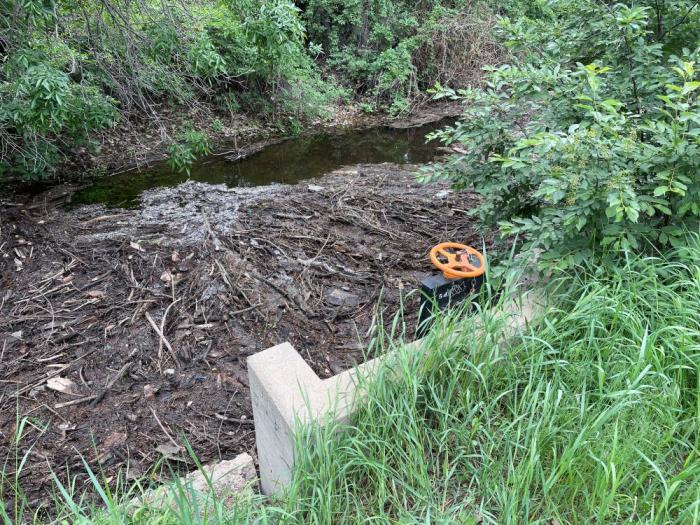
“As the canal’s role in the metro area evolves, Denver Water is committed to making sure it remains a beneficial asset to the community,” said Jeannine Shaw, Denver Water’s former government relations manager. “That’s why in 2020, the Denver Water Board of Commissioners approved an historic $10 million pledge to the High Line Canal Conservancy to invest in the long-term care and maintenance of the canal corridor.”
Included in the pledge is a piece of property and an office building located adjacent to the canal in Centennial for the Conservancy to use as its new headquarters.
As part of this evolution, the Conservancy, Denver Water and canal stakeholders are creating a new management structure called the Canal Collaborative to formally connect the regional partners as they guide the future of the canal.
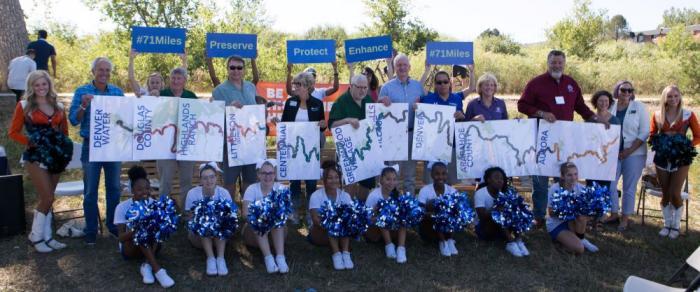
“The collaborative helps us do more together than any one entity can do alone,” said Suzanna Fry Jones, senior director of programs and partnerships for the High Line Canal Conservancy. “The collaborative management structure will ensure this treasured resource is preserved, protected and enhanced as a regional legacy for future generations.”
The formalized structure will benefit citizens and the environment along all 71 miles of the canal as it winds its way through Denver as well as Adams, Arapahoe and Douglas counties.
The Canal Collaborative includes the High Line Canal Conservancy, Denver Water, Arapahoe and Douglas counties, the cities of Aurora, Denver, Cherry Hills Village, Greenwood Village and Littleton, the Highlands Ranch Metro District, the Mile High Flood District, the Southeast Metro Stormwater Authority and South Suburban Parks and Recreation.
Read about the different canals that carry water through Denver Water’s complex system.
“The collaborative is important because we need to have a group that brings together all of the jurisdictions so we can hear from each one of those entities and their communities about what’s most important to them,” said Nancy Sharpe, Arapahoe County Commissioner for District 2, which includes Centennial, Greenwood Village, a portion of Aurora and unincorporated central Arapahoe County.
The Conservancy was formed in 2014 and has developed “The Plan for the High Line Canal,” which lays out guidance for repurposing the corridor along with over 100 recommendations for new projects.
Here’s a look at some of the developments along the canal in recent years.
Ecological resource
Under the new Stormwater Transformation and Enhancement Program, High Line Canal partners are looking at ways to allow and move stormwater through areas of the canal to improve water quality and manage local flooding in the South Platte River Basin. This is in addition to the canal’s existing irrigation delivery purposes.
Stormwater is any rain and snow that eventually flows off any impervious surface and into the canal.
Several structures have been built in or on the side of the canal to help manage the flow of stormwater through the channel.
The new structures that are located on the side of the canal help improve drainage on city streets and collect debris and trash before water enters the canal.
The structures being built inside the canal also help catch and stop debris and trash from flowing down the channel. They also temporarily slow down and detain water to filter out sediment.
These structures are designed to improve water quality before the water reaches receiving streams. Moving stormwater through the canal could provide an additional 100 days that the canal could be wet in some parts of the channel, which would benefit vegetation along the corridor while also enhancing the recreational user experience.
“Often times across the country, old utility and railroad corridors become degraded once their primary uses have been reduced, so we’re happy to see areas of the High Line Canal being maximized and transformed into green infrastructure,” Shaw said.
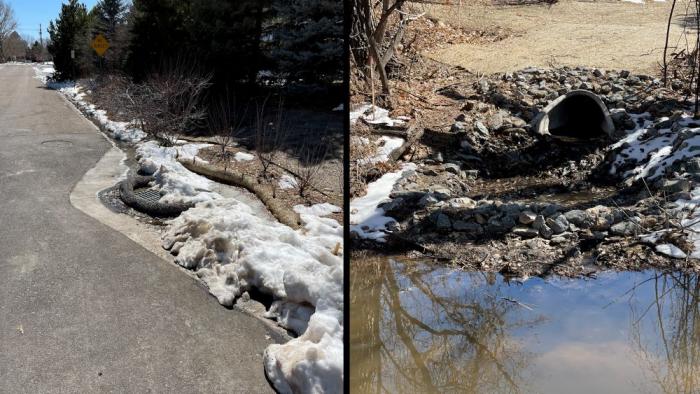
Along with Littleton and Denver, stormwater projects are also being implemented in Centennial, Douglas County and Greenwood Village with additional projects in progress. Learn more about the Stormwater Transformation and Enhancement Program in this video.
Denver Water and its regional partners also are exploring other opportunities to allow the canal structure to be used. In areas where it has adequate stormwater capacity the canal could provide additional benefits to the neighboring communities and their surrounding environment to improve water quality in the South Platte River basin.
“As we navigate the evolving future for the lands the High Line Canal irrigates, Denver Water is excited to further the work with our regional partners to find additional utility for this cherished resource,” Shaw said.
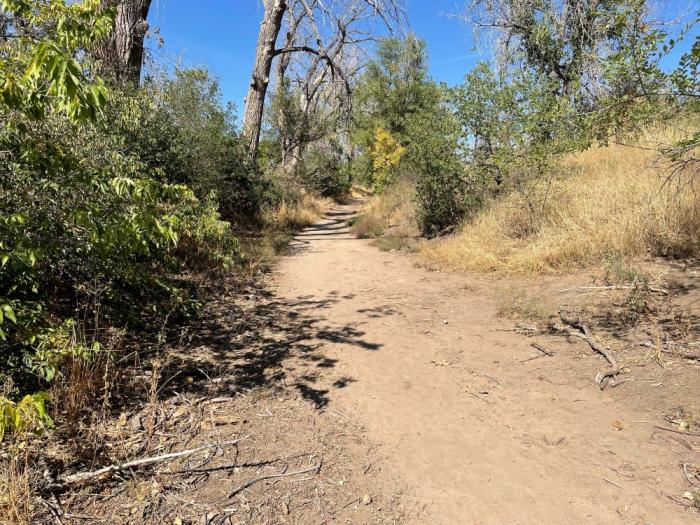
Tree canopy health
There are more than 23,000 mature trees along the High Line Canal, but many are at the end of their life span. The Conservancy is working with Denver Water and regional partners to remove dead trees and trim others to improve overall tree health and safety along the canal’s recreational trail.
To maintain the canal’s urban forest, the Conservancy’s Plan recommends planting 3,500 new trees by 2030. The species of trees being planted will be more drought tolerant than many of the old cottonwood trees currently along the canal.
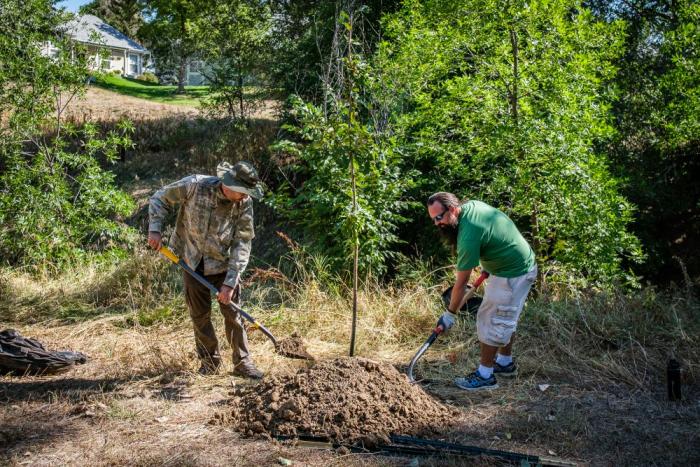
Trail improvements
A major goal of the Conservancy and the Canal Collaborative is to make it easier, safer and more fun to walk or ride on the canal’s recreational trail. The Conservancy is working with local jurisdictions to add new pedestrian bridges, trailheads, underpasses, mile markers and wayfinding signs.
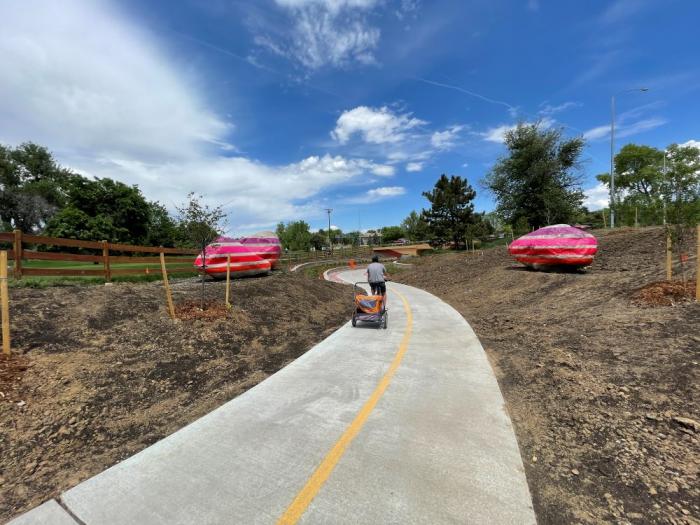
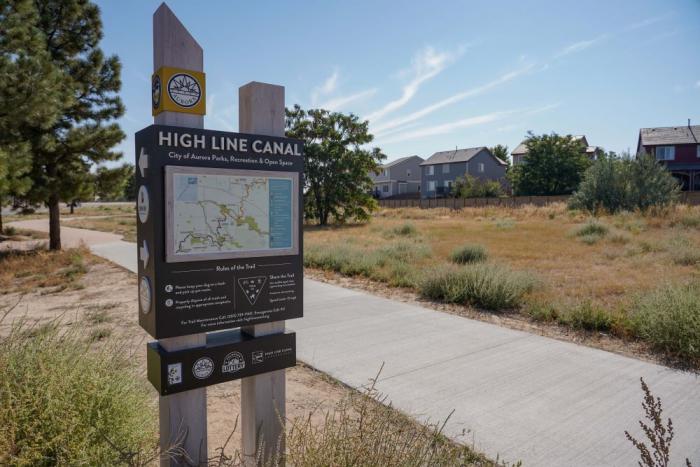
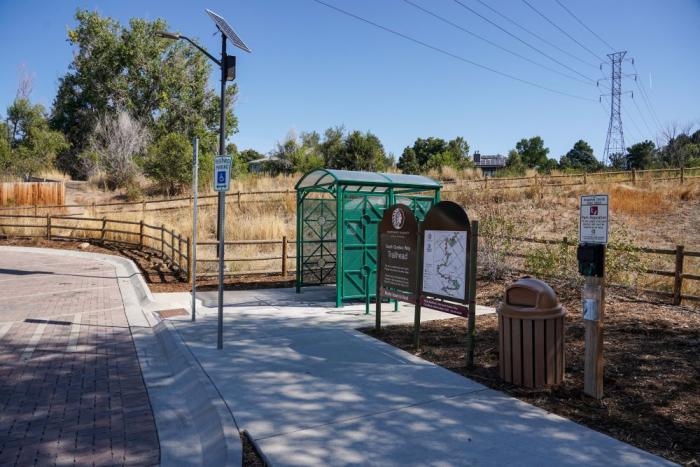
Canal Improvement Zones
Under The Plan, the Conservancy has worked with the community and jurisdictional partners to identify nine Canal Improvement Zones. These are locations where residents asked for trail enhancements to increase physical activity, foster community connections and create access points to nature.
Many of the sites are in diverse neighborhoods where the canal corridor has been historically under-utilized and lacked investment.
Enhancements may include pedestrian bridges, improved trail access, benches, signs, gathering spots and play areas.
The first location to see new projects is the Laredo Highline neighborhood in Aurora, thanks to a $180,000 grant from the Colorado Health Foundation and an additional $180,000 from Arapahoe County.

“I grew up in the Laredo Highline neighborhood and the canal has always helped bring the community together,” said Aurora resident Janak Garg. “We’re really looking forward to the new bridge and other improvements coming to the neighborhood.”

New mile markers
A very noticeable and welcome improvement to the trail is the addition of new mile markers. In the past, there were a variety of mile markers with different mileage from each jurisdiction, which made it confusing for hikers and bikers.
Now there are new Colorado red sandstone mile markers that line the trail from start to finish, paid for through donations by the Conservancy’s founding partners.
Most of the markers have a quote or message from the founding partners, like Al Galperin who lives near the South Quebec Way Trailhead, whose message reads: “Be the reason someone smiles today.”
“I hope it brings a little bit of extra joy to people on the trail,” Galperin said. “It’s nice to be able to help out and see all the new features coming to the canal.”
“It’s inspiring to see all these improvements and we’re excited for the future of the canal,” Shaw said. “The Conservancy and all of the partners are doing a great job leading the way and working with Denver Water and the community.”
Visit highlinecanal.org to sign up for monthly emails for information on events throughout the year. The website also provides information about history of the canal, new projects and volunteer opportunities.
Click the link to read the article on The Denver Post website (Conrad Swanson). Here’s an excerpt:
“We’ve known the answers for decades, it’s just a matter of political will for implementing them,” Jill Locantore, executive director of Denver Streets Partnership, said.
Perhaps the biggest piece of Denver’s air-quality problem would be solved by expanding the city’s public transit options, Jill Locantore, executive director of Denver Streets Partnership, said. Each piece overlaps with the others, Locantore, whose nonprofit works to reduce the city’s dependence on cars, said.
“The key is land use and transportation. Reduce vehicle miles traveled. Reduce land consumption. Reduce water consumption,” Locantore said. “We’ve known the answers for decades, it’s just a matter of political will for implementing them.”
[…]
Denver’s mayor could buy additional, dedicated service from RTD, like Boulder does, Danny Katz, executive director of the nonprofit Colorado Public Interest Research Group. Building new train lines would be expensive, time-consuming and would consume land that’s already occupied or needed for other things, Katz said. Better to increase service on existing train lines to start…
As for cars that can’t be eliminated from the city’s streets, like the thousands of vehicles that Denver owns, Katz said the next mayor could work to phase out gas-powered vehicles in favor of electric ones. Not only would that shift reduce emissions from thousands of vehicles but it also means the city would likely have to install charging stations around Denver, which could be used by residents also switching to electric vehicles…
Increasing the city’s density would mean more people live within walking distance of public transit and other amenities, Locantore said. The City Council holds sway over zoning and building codes and it could change the codes to encourage higher-density, multi-use projects and turn away others that don’t meet the criteria. The City Council is already working to cut emissions from Denver’s large commercial and multi-family buildings. New building codes approved in January will phase out gas furnaces and water heaters in new construction…The last step of that process, outgoing City Councilman Jolon Clark said, would likely be replacing gas furnaces and water heaters in existing buildings, particularly homes…
Other things the next mayor and City Council members could do to cut emissions, Katz added, would be to continue offering rebates for residents looking to buy electric bicycles. They could also work to limit or phase out the use of gas-powered leaf blowers and lawnmowers…
Lawns are likely another target to save water in the drying West. As the Colorado River provides less and less water, experts look to lawns as one of the best conservation tactics in urban areas.

Click the link to read the release on the Northern Water website:
An important tool for the management of water in Colorado has received a funding boost from Northern Water.
On Feb. 9, the Northern Water Board authorized spending $150,000 on the Airborne Snow Observatories program for flights over the watersheds that feed the Colorado-Big Thompson Project. Statewide, flights are planned across 11 river basins.
The program involves the use of a specialized airplane that flies over high-altitude watersheds and uses radar to measure the depth and density of snow across wide areas. The data acquired during flights in April and May will help water managers predict runoff and streamflow through the next few months.
This effort improves on the single-point snow observations that are part of the SNOTEL network and other data points that can have a larger amount of uncertainty based on localized conditions.
Agency partners for the work in the C-BT Project watersheds include the St. Vrain and Left Hand Water Conservancy District, Denver Water, Colorado Water Conservation Board and the Colorado River Water Conservation District. Other agencies are also looking to create a sustainable statewide program in future years.

Click the link to read the article on The Denver Post website (Saja Hindi). Here’s an excerpt:
Aurora residents will have to decrease their lawn watering use by one day starting May 1 because of low water storage levels — the city is likely the first in Colorado to make such a decision so far this year. The reservoir levels are projected to get to about 48% capacity by mid-April, triggering the city’s Stage 1 drought restrictions. The City Council passed a declaration to move to “Stage 1 Water Availability” at a meeting earlier this month. Members also voted on first reading, 9-1, to implement a surcharge on lawn watering. A final vote is expected Monday, and the plan has received little opposition from members.
Residents will receive letters from the city’s water department alerting them to which days they can water their lawns, down from three to two — even-numbered home addresses will have different days than odd numbers and the department will advise residents to water within certain hours. Any properties that have watering variance allowances for irrigation will also have to reduce their consumption. Multifamily and commercial properties without irrigation variances will need to restrict watering to twice a week as well. City officials say that residents’ water bills should remain the same as their bills from last summer (when they could water three times a week) even with the surcharge in effect as long as they stick to watering their lawns twice a week. If they go beyond that, they could see higher costs that will make their bills go up…
The goal is to reduce outdoor water use by 20% citywide — officials hope the surcharge will incentivize lower use — and these restrictions would remain in effect until the City Council approves a change. If water conditions improve, city staff says the restrictions will be lifted.
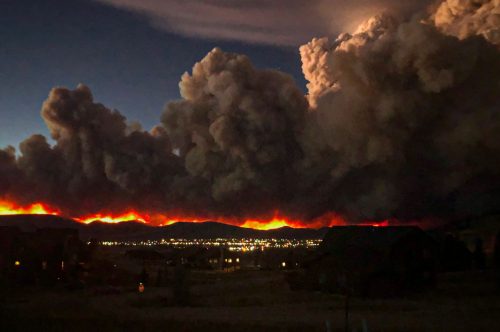
Click the link to read the article on the Water Education Colorado website (Jerd Smith):
To help watersheds recover quickly from catastrophic wildfires, federal and state funds need to be available continuously, rather than on an as-needed basis, and water districts and local governments need to be shielded from the liability that normally comes when working with federal wildfire recovery programs, according to a new report.
The draft report, 2020 Post-Fire Watershed Restoration: Lessons Learned, was presented two weeks ago at the annual convention of the Colorado Water Congress in Aurora. It focused on the post-fire recovery response to the East Troublesome and Cameron Peak fires in 2020. The fires are the largest in Colorado history and engulfed Northern Water’s system in Rocky Mountain National Park as well as water systems that serve Fort Collins, Larimer County and the city of Greeley. Those systems deliver water to more than 1 million people on the northern Front Range and help irrigate hundreds of thousands of acres of farmland.
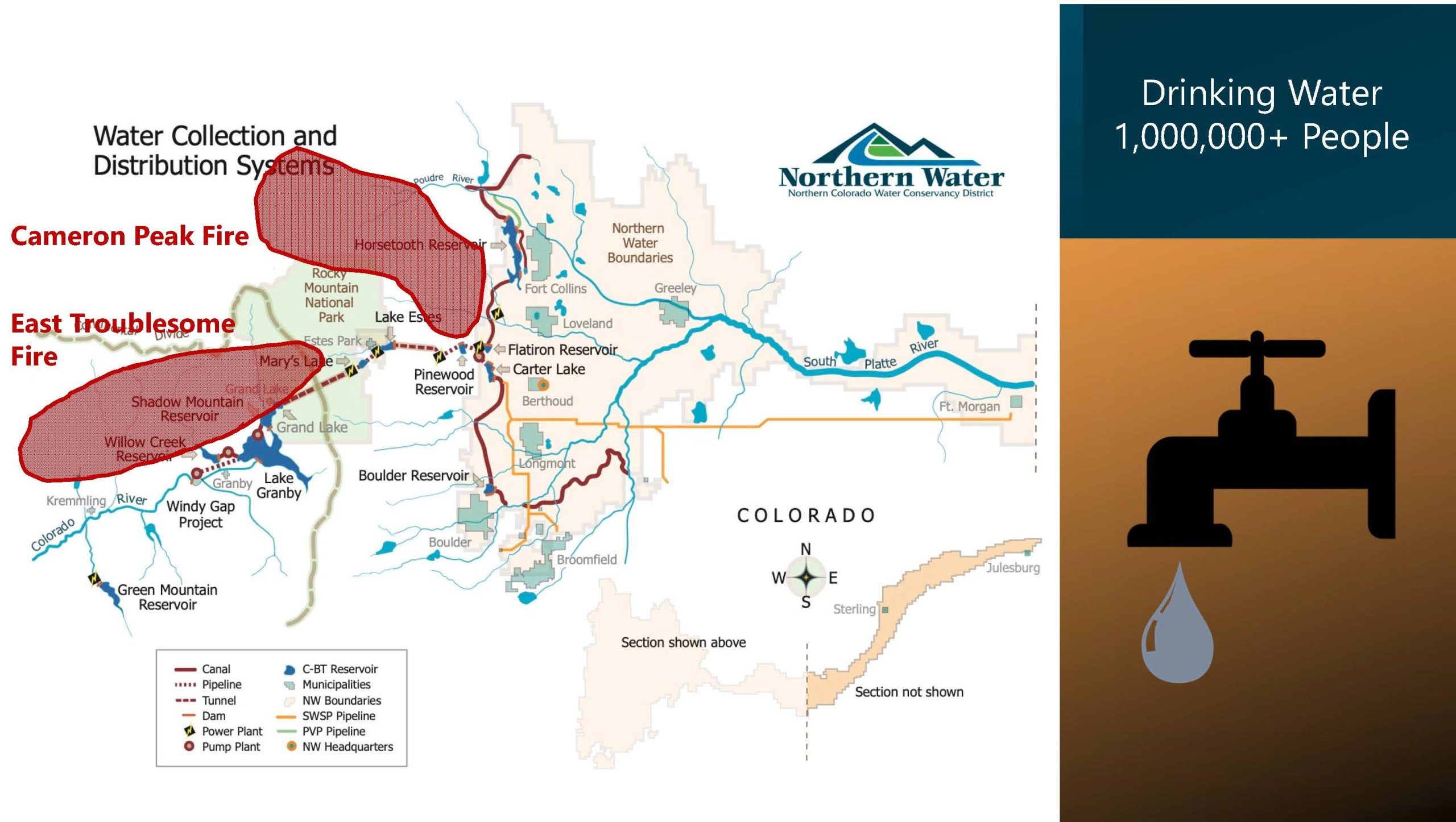
“Having predictable annual funding for wildfire recovery is urgent because these events are going to happen,” said Esther Vincent, who led the report team and who serves as director of environmental services at Northern Water.
After the two fires were contained, local communities and water districts began working quickly using funding from the U.S. Department of Agriculture’s Emergency Watershed Protection (EWP) Program. But that federal fund is replenished on an as-needed basis and is used by all 50 states when disasters occur. When it runs out, as it sometimes does, it can take years for Congress to approve more cash.
“Waiting until there is enough political will is an inefficient way to fund the EWP Program,” said Sean Chambers, who also served on the report team and who is the director of water and sewer utilities for the City of Greely. Greeley coordinated much of the recovery work on the Cameron Peak Fire.
“When we started recovering from Cameron Peak there was money available and we were able to start immediately addressing some high-risk slope stability issues on tributaries, around reservoirs, on private property. But then we ran out of money,” Chambers said.
More money was found in the EWP Program by asking other states to turn over unused funds, but it took months during a critical time window when the watershed restoration teams only had a few weeks to work before the burn scars were covered with snow and became inaccessible, Chambers said.
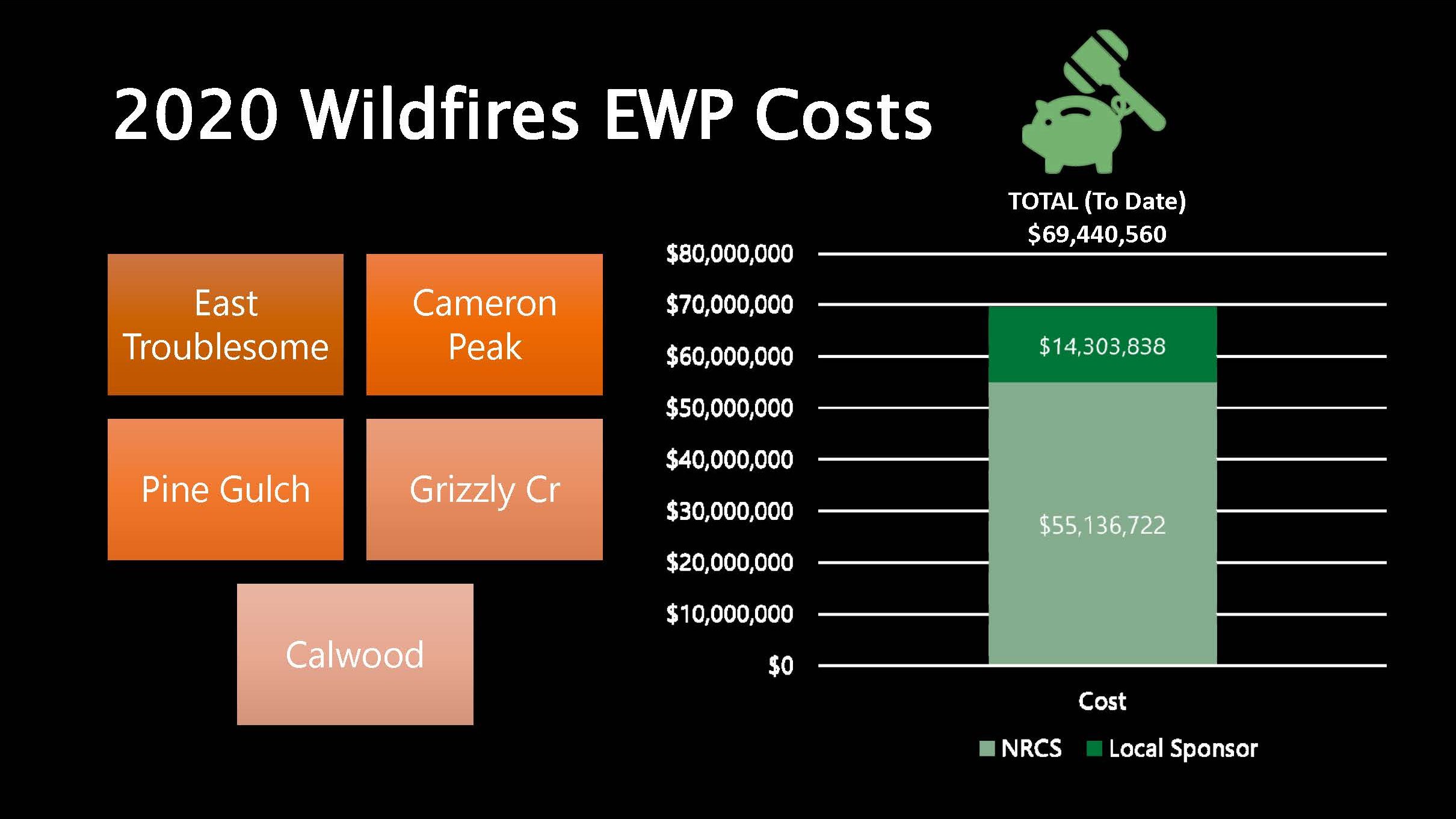
Another issue that hampered the immediate post-fire recovery effort is the liability that must be assumed by those who partner with key federal programs that provide funding, including the EWP Program.
Northern’s Vincent said the Northern Water Board was deeply concerned about assuming the liability, which requires local partners to assume full financial responsibility for the work, which can cost millions of dollars. But ultimately the board agreed to do so.
As a result, the report recommends that Congress remove the liability requirement from its disaster contracts and also suggests that a new insurance pool be created to limit the liability of restoration partners, according to Peggy Montaño, an attorney who serves as Northern’s legal counsel and who also served on the report team.
Todd Bolt is the state coordinator of the EWP Program and a member of the work group that wrote the report. He declined to comment on the federal funding and liability recommendations, but he said the report was “eye-opening.”
“It brought a lot of people together who have first-hand experience, state, federal, local. And it has opened everybody’s eyes that there are things we can do better with the post-fire effort in Colorado,” Bolt said.
Two additional recommendations that the report makes are to streamline data collection and modeling analyses and to refine them so that they can be used to make decisions faster. The second is to have “local navigators,” who are trained and ready to help immediately after a fire.
More than a half dozen agencies can be on the ground post-fire, gathering data and trying to understand what might happen with rain storms, sediment loads and debris flows. But agencies often use different parameters for collecting the data they use in their modeling. Some, for instance, might use only the burn area itself for modeling, when a broader watershed boundary is needed to understand what’s happening on streams above and below the burn scar.
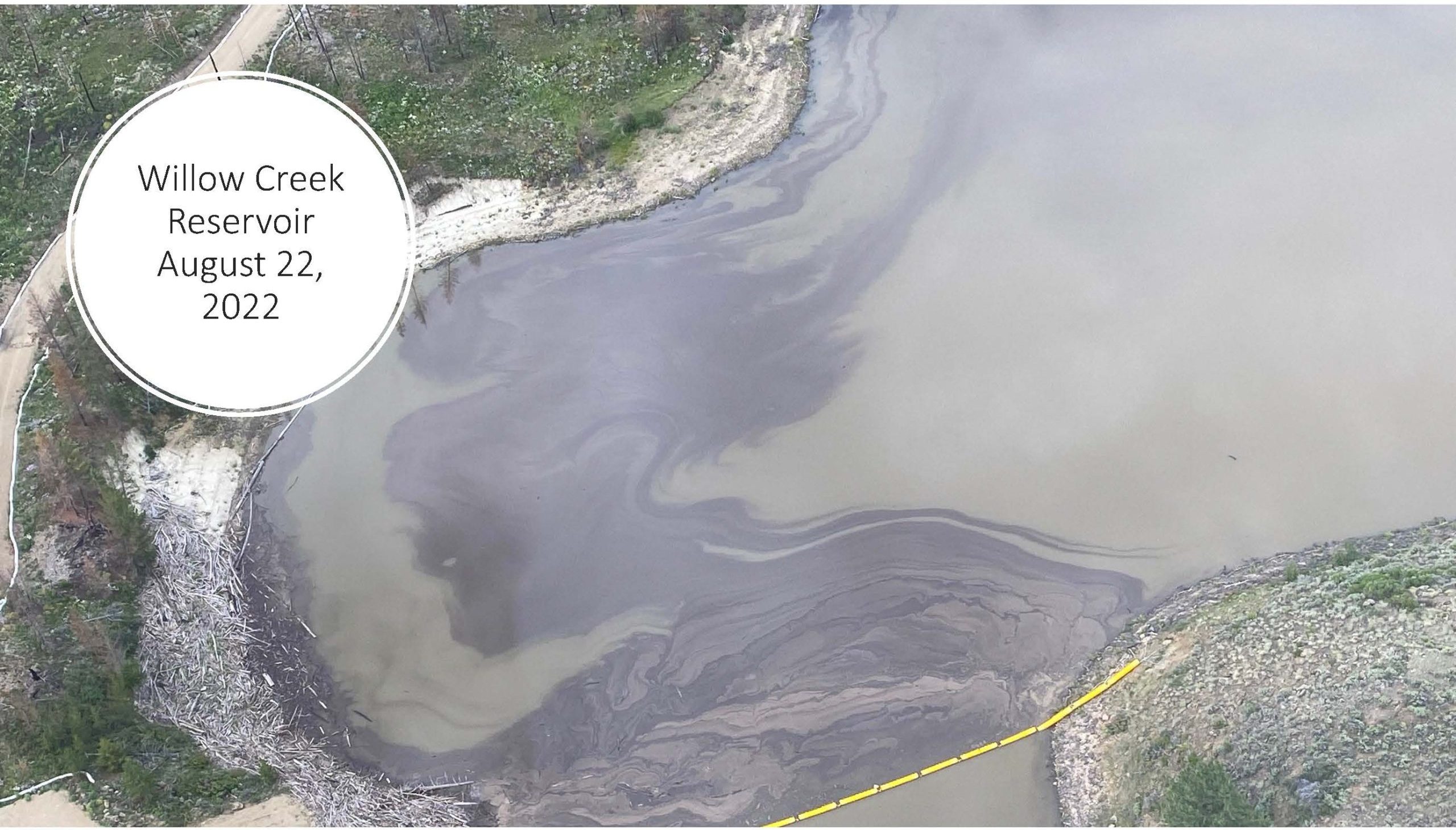
Northern’s Vincent said there were so many different modeling and data collection efforts underway that it made it difficult to know which would be the best to use.
“Bringing all of this information together and digesting it when you are the practitioner on the ground and you have to make decisions about what these models mean and what mitigation strategies are going to work is difficult. We were swimming in this downpour of modeling outputs, with little guidance and understanding of ‘OK this is where we have a problem. This is where we need to take action and do mitigation.’”
Bolt said that a “local navigator” program would specialize in connecting local residents and local governments with the resources they need to begin restoration work post-fire.
“Someone who could lead them through the process would be helpful,” he said.
Looking ahead, report authors plan to share their findings with lawmakers and others who are working on protecting Colorado from the wildfires they say are sure to come.
“No matter how successful we are with forest management and helping our watersheds be more resilient, it is going to take a long time to do the projects that need to occur at a landscape scale,” Vincent said. “We are still going to have devastating, large-scale megafires. We need to focus on paths to being prepared and getting better at the post-fire recovery process.”
Jerd Smith is editor of Fresh Water News. She can be reached at 720-398-6474, via email at jerd@wateredco.org or @jerd_smith.


Click the link to read the release on the Earth Justice Website (Perry Wheeler):
Groups call for CDPHE to issue strongest possible water discharge permit for refinery
DENVER, CO —
A new study conducted by Westwater Hydrology LLC connects PFAS pollution in Sand Creek and the South Platte River, as well as river water used by Commerce City, Brighton, Thornton, Aurora, and other municipal drinking water systems, to the Suncor refinery in Denver. The study found that Suncor’s 2021 discharges from just one outfall, 020, account for 16-47% of the total PFAS loading in Sand Creek and 3-18% of the total PFAS loading in the South Platte.
Municipalities, including Commerce City, Brighton, Thornton, and Aurora, utilize water intake wells along the South Platte downstream of Suncor. Due to the hydrology of the river and the underlying aquifer, any PFAS in the river gets drawn into the drinking water system when it enters these intake wells. The South Platte is also a major source of agricultural irrigation water; Suncor’s PFAS pollution is likely taken up by crops, creating another exposure point for the humans and animals that consume them.
“The communities surrounding the refinery have faced disproportionate health impacts and threats from Suncor for far too long,” said Caitlin Miller, senior associate attorney with Earthjustice’s Rocky Mountain office. “This facility continues to pollute the air that people breathe and the water that they drink with relative impunity. It is time for the Colorado Department of Public Health & Environment (CDPHE) to issue the strongest possible water discharge permit that prohibits Suncor from discharging any more PFAS.”
The PFAS levels studied at Outfall 020 do not account for additional pollution from Suncor’s other outfalls, including process water and stormwater outfalls, which only add to the overall impacts to Colorado’s waterways and drinking water.
CDPHE’s Water Quality Control Division has put forth a draft water permit that reduces the amount of PFAS that Suncor can discharge but fails to limit it to levels that are safe. Suncor installed a temporary treatment system in October 2021 to reduce its PFAS discharges at Outfall 020, but even with these measures in place, the pollution remains at toxic levels according to updated toxicity assessments from the Agency for Toxic Substances and Disease Registry (ATSDR) and the U.S. Environmental Protection Agency (EPA).
In its initial comments on the draft permit, Suncor requested that CDPHE dramatically weaken the pollution limits and monitoring requirements in its final permit for multiple pollutants, including PFAS.
“We have endured pollution to our sources of life through environmentally-racist policies in Commerce City for so long without restoration that even state and federal agencies have normalized trauma to our communities without protection or regulation from extractive industries,” said Renée Millard-Chacon, co-founder and executive director of Womxn from the Mountain, an Indigenous Womxn-led nonprofit based out of Commerce City. “However, we are all connected, and it is never okay to harm disproportionately impacted communities this way, including our future generations, without respecting our right to live and thrive without severe environmental degradation for an economic gain that has never benefited residents’ health.”
PFAS are toxic pollutants that persist in our bodies and the environment for decades. Drinking water is one of the most common routes of exposure to PFAS. Studies of the best-known PFAS have shown links between the chemicals and kidney and testicular cancer, as well as endocrine disruption in people.
The EPA recently objected to Suncor’s draft Title V air permit, finding that CDPHE failed to scrutinize changes to the company’s operations, including those that allow the company to emit even more harmful pollution into surrounding communities. EPA’s objection directs CDPHE to no longer rubberstamp proposed changes to the refinery’s operations.
Read the study: Surface Water PFAS Evaluation – Suncor Energy USA Inc., Commerce City Refinery, Colorado
Update: August 2, 2022
When it was released, the Westwater Hydrology report indicated that South Adams County Water and Sanitation District (SACWSD) had at least one intake well – Well 119 – impacted by Suncor’s PFAS discharges. It found that these PFAS discharges could therefore impact Commerce City drinking water. Since releasing the report, we have learned and verified that this well is not hooked up to SACWSD’s general municipal supply, but rather provides underground irrigation water for portions of Commerce City.
SACWSD has created a dual water system for its northern service area where one set of water infrastructure supplies potable drinking water and another separate system supplies non-potable underground irrigation water. Irrigation water, including irrigation water for domestic use, in the area north of 96th Avenue and east of Highway 2 is impacted by Well 119. This remains a concern if residents use the water for home vegetable or fruit gardens.
The new information about Well 119 does not change any of the other conclusions in the report.

Click the link to read the article on the High Line Canal website:
The final report from the Stormwater Study is available here. The draft report was presented to City Council at the Study Session on Sept. 20th for review, and the final report was accepted by City Council at their meeting on Dec. 14th, 2022.
For a summary of the study, please visit the project’s StoryMap here.
Background
In fall 2021, City Council directed staff to seek further analysis of the High Line Canal Stormwater Master Plan (Master Plan) as it pertains directly to the three-mile segment of the Canal within the Village, as well as craft short and long-term strategies for capital improvements and annual maintenance of this segment of the High Line Canal. The Master Plan explores the analysis associated with utilizing the Canal for stormwater purposes but cannot be construed as acceptance or approval of the drainages analyzed or improvements recommended. The City desires to know what additional considerations are necessary to transition the City’s segment of the irrigation Canal to a stormwater channel and how to address certain considerations to accomplish that goal.
Stormwater Capital Improvement and Operations Analysis
Icon Engineering, Inc. has been hired to complete the study in 2022 for a total cost of $59,000. The analysis will include modeling of High Line Canal areas beyond what was completed in the Master Plan to ensure safety, constructability, and ease of maintenance. Additionally, the City will receive a detailed cost model verifying the costs outlined in the Master Plan for the construction and maintenance of: (1) the proposed improvements; and (2) the entire High Line Canal conveyance channel, including the ditch and bank vegetation, within the municipal boundaries, as the City will become responsible for these costs if the stormwater improvements are constructed. Further, the analysis will give the City guidance on possible phasing and timing plans for the capital projects, based on prioritization determined during the analysis process.
Click the link to read the article on the Denver Water website (Jay Adams):
The winter of 2022-23 is off to a cold and snowy start across most of Colorado, which is good news for the state’s water supply.
So far, water watchers say we’ve had the best start for the statewide snowpack season since 2017.
However, while some parts of the state, like Steamboat Springs, are seeing the highest snowpack levels in over a decade, numbers in some parts of the state are lagging.
Snowpack is a measurement of the amount of water packed into the snow.
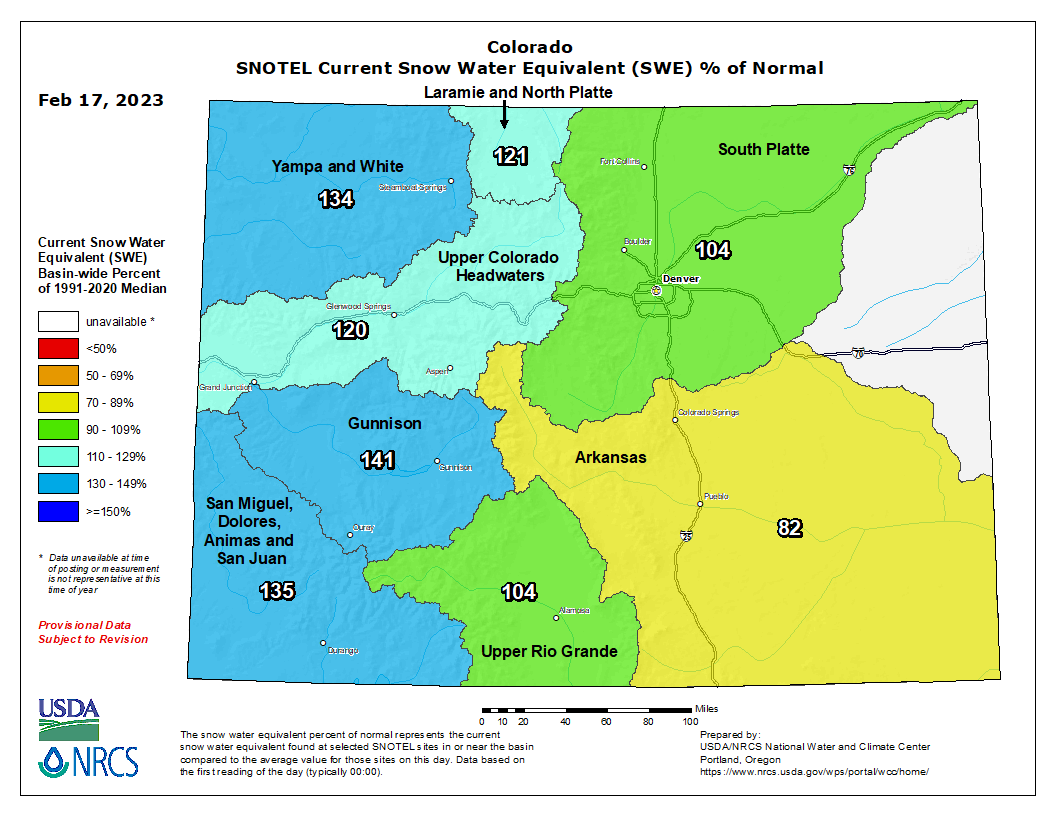
“Colorado is a big state and it’s not uncommon to see a wide range of snow totals across various regions,” said Nathan Elder, Denver Water’s manager of water supply.
For example, the snowpack in the northwest corner of Colorado sat at 151% of normal as of Jan. 31, but the southeastern corner was just at 83% of normal.
Sign up for our free, weekly TAP email to stay on top of this season’s snowpack. (Scroll down to put your email in the light blue sign-up bar.)
The amount of snow that falls in the mountains is critical in Colorado because that’s where most of the state’s water comes from each year.
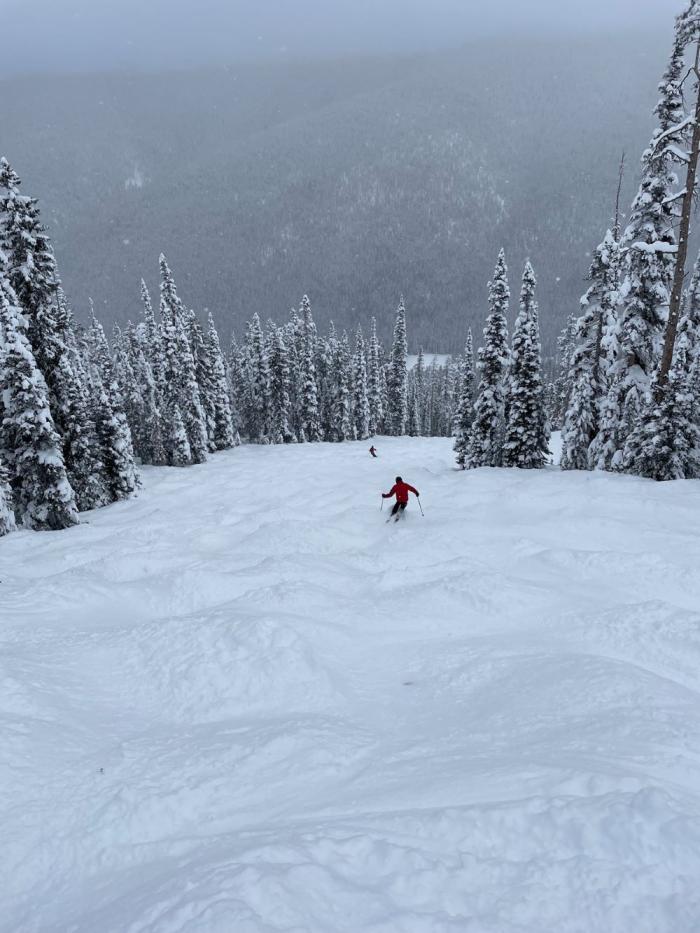
Denver Water provides water to 1.5 million people in Denver and several surrounding suburbs, and 90% of the utility’s water supply comes from snow. The utility collects water from roughly 4,000 square miles of terrain in the mountains and foothills west of Denver in the Upper Colorado and Upper South Platte river basins.
Denver Water collects roughly half of its water from the Colorado River Basin and half from the South Platte.
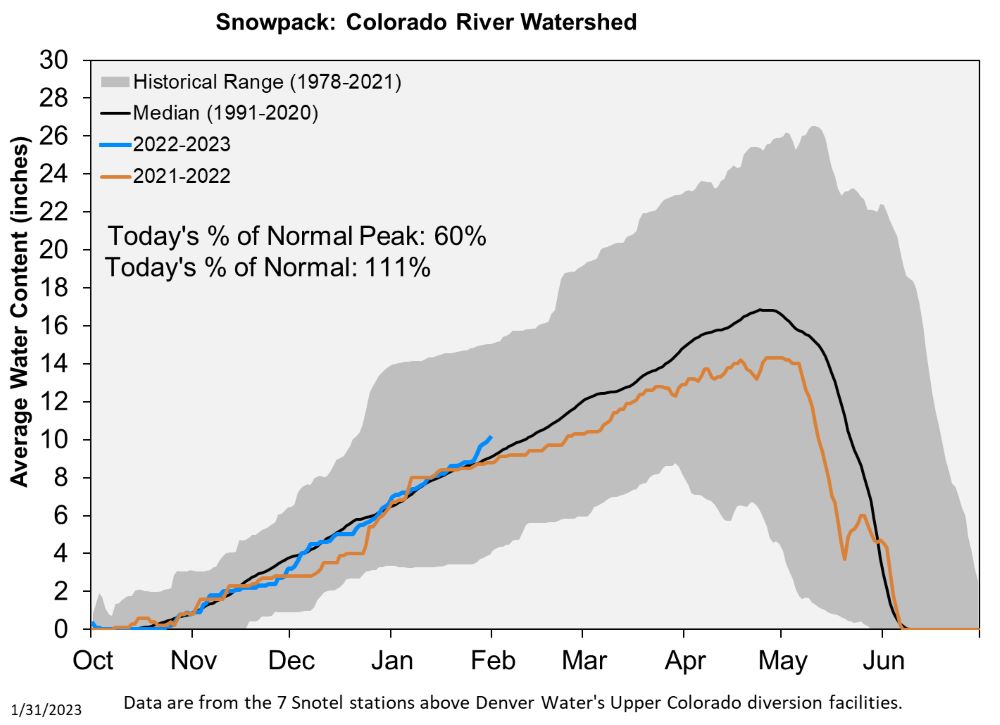
In the areas where Denver Water collects water, as of Jan. 31, the snowpack in the Upper Colorado River Basin stood at 111% of normal, while the Upper South Platte River Basin stood at 82% of normal.
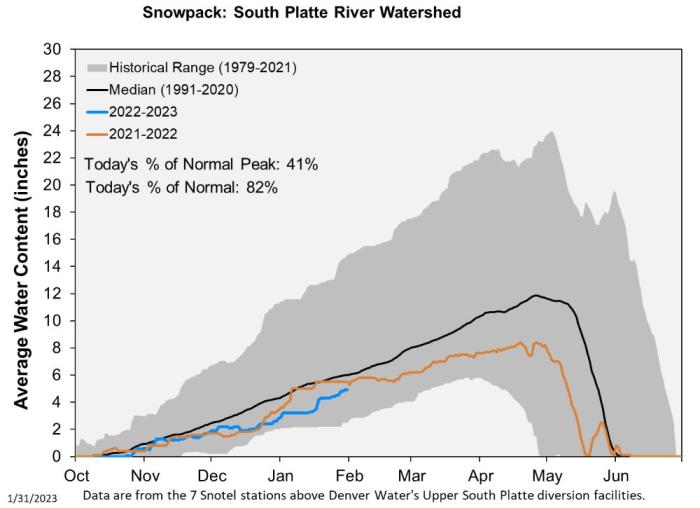
“The difference in snowpack is why Denver Water has built a large collection system spread across several counties. That way if one area is having a down year, hopefully things are better in another area. And that’s what we’re seeing so far this year,” Elder said.
Elder said this year the snowfall in the mountains has been steady since November 2022, compared with last winter, which will be remembered for having only a couple big storms that hit over the holiday season and ended up providing the bulk of the entire season’s total snowfall.
“As a water planner, it would be nice to have a steady, predictable snowpack season, but weather doesn’t work that way and each year plays out differently,” Elder said. “That’s why we constantly monitor the mountain snowpack and adjust our water planning accordingly.”
See how Denver Water monitors the snowpack from the air, on the ground and by using automated weather stations.
Denver Water’s reservoir storage stood at 82% full heading into February, which is average for this time of year. Elder said he’s cautiously optimistic the reservoirs will fill when the snow melts in the spring due to the snowpack so far.
He’s also encouraged by the fact that soil moisture for the state is the best it’s been in eight years.
“When the soil moisture is in good shape, it means more water will flow into rivers and streams instead of being absorbed by dry ground,” he said.
Denver Water monitors snowpack throughout the winter season, using monthly measurements gathered by crews on the ground and daily reports from automated weather stations. The utility also gets information about the snowpack from planes surveying its collection system using high-tech equipment.
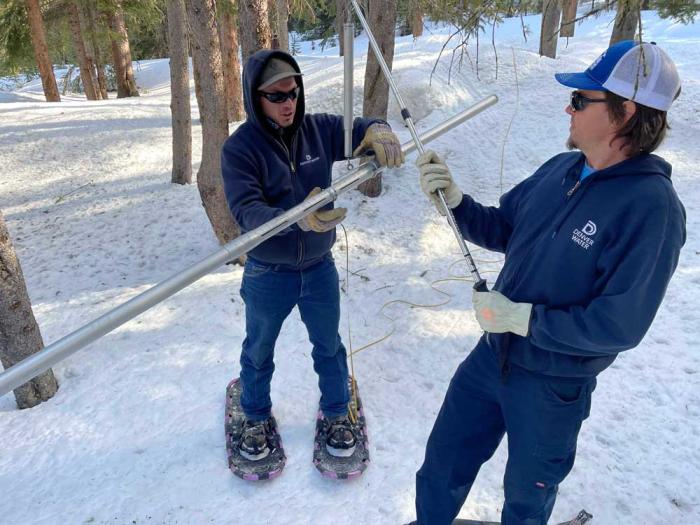
This year, planes will fly over forests in Summit and Grand counties where Denver Water collects water — and for the first time also will fly over the utilities’ South Platte and South Boulder Creek watersheds.
“We’ve got our snowiest months of the season coming up, and we’re hoping the snow will keep falling,” Elder said. “Snowpack typically peaks around the third week of April, so that’s the key snowpack measurement we’ll be watching.”
Elder said that even though water supply looks good now, the winter months are a great time to get your house into water-wise shape indoors by finding and fixing toilet leaks, installing low-flow aerators and replacing old showerheads with WaterSense-labeled fixtures.

Click the link to read the article on the Westminster Window website (Luke Zarecki). Here’s an excerpt:
After reevaluating an original layout for a new water treatment plant for over a year, Westminster City Council approved general plans for a new plant on Jan 23 – one that will cost $100 million less than originally planned…
According to Stephanie Bleiker, capital projects administrator, the improved plant will use existing infrastructure, can treat wildfire-contaminated water, is flexible for future replacement and has robust infrastructure. It’s estimated to cost $196 million, plus an additional $15 million for ozonation, though it may cost more with inflation. Ozonation is a process that injects pure oxygen into the water to kill a wide range of biological contaminants and to oxidize metals. The budget is supported by the current water rate structure, she said…
Concerns over water affordability stopped the project on Nov. 29, 2021. Over the past year, the plant’s capacity, locations and other supporting infrastructure have all been re-evaluated. That resulted in a call for less water treatment capacity at the new plant, from 60 million gallons of demand per day to 44 million. The location remained on Westminster Boulevard. Much of that lower demand is due to conservation measures for commercial and residential zones, said Bleiker…
Right now, Semper doesn’t have the ability to do ozonation, to handle solids easily, to do deep bed filtration or mechanical flocculation – a water treatment process where solids form larger clusters that are easier to filter out – or to treat emerging contaminants, such as so-called forever chemicals or PFAs. The new treatment plant would be able to do these things. Treating emerging contaminants comes down to having the space that will be provided with the new plant, she said. Bleiker mentioned some contaminants are known today, but more will come in the future that are not known. She said it’s the decision of the EPA and CDPHE to decide what’s regulated, and it’s not optional for the city to comply.

Click the link to read the article on The Denver Post website (Conrad Swanson). Here’s an excerpt:
Thornton filed a lawsuit Monday [January 30, 2023] in South Carolina District Court against dozens of companies and people that produce PFAS, or “forever chemicals”, claiming the toxic substances contaminated the city’s water supply. Not only is Thornton suing a slate of high-profile companies, like 3M, DuPont and Chemours, it’s also suing 20 unnamed “entities or persons” that might have “permitted, caused and/or contributed” to the contamination of the city’s water. For decades the companies understood that PFAS, or perfluoroalkyl and polyfluoroalkyl substances, do not degrade naturally and were accumulating in people’s bodies, according to the lawsuit’s complaint…
Thornton officials announced in July that its water supply exceeded the EPA’s new – sharply reduced – limits for PFAS by more than 1,000 times. The city supplies water to about 160,000 people. At the time, Thornton’s water treatment and quality manager said the source of the chemicals weren’t immediately clear but that the city had stopped using some wells from which they drew water and began treating other water sources with new chemicals to draw out the toxic substances. Now city officials believe the contamination comes from firefighting foam used across the area for training and for actual fires, the lawsuit says. Thornton hired a consultant to help understand how best to clean the contamination. Cleanup and damage is expected to haunt the city “for many years to come,” the lawsuit says. The city is looking for money from the companies for the damage done to its property and for the cost of “investigating, remediating, and monitoring” its drinking water. While Thornton appears to be the first city in Colorado to sue PFAS manufacturers, its legal action follows a similar lawsuit filed nearly a year ago by Attorney General Phil Weiser.
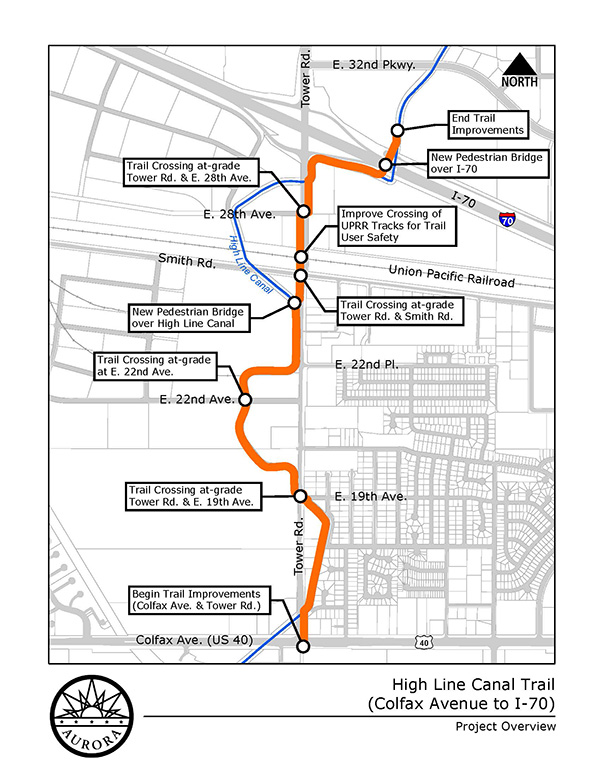
Click the read about the projection on the City of Aurora website:
Construction Project Overview
The city of Aurora, in collaboration with American Civil Constructors, will start work Jan. 30 on a multi-use trail to close the gap along the High Line Canal between Colfax Avenue and recent improvements constructed north of I-70.
The High Line Canal Trail construction project, which spans nearly two miles, will include:
- A continuous 8-foot-wide concrete trail
- Two pedestrian bridges (one to cross over the canal just south of Smith Road and one over I-70 just east of the Tower Road interchange)
- An upgraded railroad crossing to promote pedestrian and cyclist safety
- Access to the 71-mile High Line Canal Regional Trail within the metro area
Designed with community input, the new trail will provide close-to-home, accessible recreation opportunities within the community and serve a diverse population that may otherwise have limited opportunities to access natural areas. View additional details regarding the community input process, project files and more at EngageAurora.org/HLCT.
The city has been granted federal funds through the Denver Regional Council of Governments to help pay for the trail construction with city capital improvement funding used as a match amount. Additional funding partners consist of the Conservation Trust Fund, Adams County Open Space Grant, and the Adams County Open Space Tax Shareback.Construction Updates
American Civil Constructors will begin work on the project’s south end and between East Colfax and East 19th avenues on the east side of Tower Road and along the canal.
Vehicular and pedestrian travelers can expect intermittent delays in these areas for the first two months. Alternate routes are recommended when possible.
The contractor also plans to start working on the bridge abutment just south of I-70 when the project kicks off.
Traffic impacts will be posted on this page as the project progresses.Project Contact Information
Harlie Zehnder, JH Resources
720.460.0947 or highlinecanaltrail@gmail.com
Click the link to read the article on the Denver Water website (Todd Hartman):
Watershed scientist Madelene McDonald started at Denver Water as an intern while wrapping up graduate school in 2019.
Just four years later, she’s representing the agency — and utilities across the West — as one of just 18 primary nonfederal members appointed to a nationwide commission advising Congress on reducing the threat of wildfire to land, water and communities.
It’s a big role.
More than 500 people applied for the federal Wildland Fire Mitigation and Management Commission. Of those, 18, including McDonald, were chosen to team with 11 federal representatives on the commission, a product of the bipartisan Infrastructure Investment and Jobs Act passed by Congress in 2021.
McDonald is one of the 18 primary, nonfederal members. There also are an additional 18 members assigned as alternates should primary members be unavailable for a commission vote.
Their task: To spend a single year developing a list of recommendations for Congress to implement as it grapples with the increasing risk of wildfires amid rising temperatures and drought triggered by climate change.
Join people who are passionate about all things water, at denverwater.org/Careers.
The commission has been meeting virtually since late summer. This week, (Wednesday and Thursday) one of the commission’s three in-person meetings will be held at Denver Water’s Operations Complex.
The first in-person gathering was in Salt Lake City in September. McDonald has been leading organizational efforts for the gathering at Denver Water’s Three Stones building this week.
One big thing going for McDonald during the commission’s competitive application process: Denver Water has carved out a national reputation for its work protecting water resources from the impacts of wildfire via its From Forests to Faucets partnership. And McDonald also was one of very few utility specialists focused almost solely on addressing wildfire risks to water supplies.
Listen to Denver Water’s watershed scientist Christina Burri talk about why protecting forests protects our water supplies:
Asked her reaction when she learned she had been appointed to the commission, McDonald admitted: “I saved that voicemail for sure,” when she was phoned by federal officials last summer with the news.
She’s modest about the achievement, citing Denver Water’s long and high-profile experience with wildfire impacts as a key factor. She also credits her supervisor Christina Burri, who oversees Denver Water’s From Forests to Faucets partnership, with pushing her to apply for the commission and for Burri’s efforts to work across agencies to promote the importance of watershed protection.
McDonald said her appointment also suggests there’s a new, wider recognition of the threat wildfire poses to water supplies.
Protecting communities, property and people have long been at the forefront of wildfire risk planning. But Denver Water’s own experiences with fires that threatened water supplies on the South Platte River in the late 1990s and early 2000s, along with threats to water in New Mexico and Arizona, have expanded the thinking on reducing wildfire risk.
“The wildfire community does understand now that water needs to be at the table,” she said.
The commission faces a tall order in developing wide-ranging recommendations in just a year’s time.
But McDonald, who calls the commission’s work “a once-in-a-generation opportunity to reshape federal wildfire management policy,” is impressed with the resolve and work ethic of her colleagues.
“Starting with that first gathering in Salt Lake City, I don’t think I’ve ever walked out of a meeting more encouraged that a group of people could tackle such big challenges,” she said. “The collective expertise that’s been assembled is outstanding. I do think this group is probably our best shot at solving some of these systemic barriers to more efficient wildfire policies.”
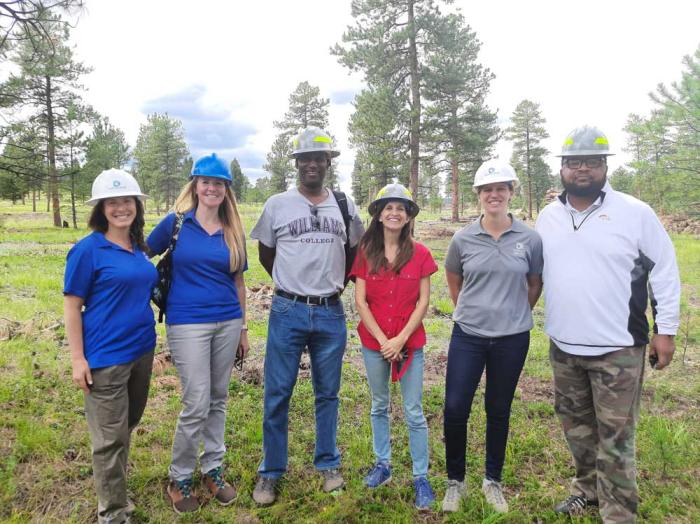
McDonald serves on three of the 10 work groups that the commission formed to divide up the workload and said those work groups are moving at a “breakneck pace.”
The commission’s focus, she said, is on “sweeping, impactful actions,” that would provide direction for future legislation out of Congress. The commission will issue its first report on its efforts Jan. 31, when it provides recommendations for improvements to aerial firefighting.
Did a friend forward this to you? Sign up for the free, weekly TAP email. (Scroll down to the light blue bar to add your email.)
McDonald, herself, is largely focused on recommendations that will take water supplies into greater account when considering federal approaches to fire prevention and post-fire rehabilitation work. She said even today, some federal policies focus solely on communities and property, without sufficient consideration to wildlife habitat, recreation, and reservoirs and the landscapes that impact them.
“Ensuring these recommendations take water supplies into greater account is one of my top priorities,” McDonald said.
With the commission nearing its halfway point, “I’ve got an Excel spreadsheet full of water-specific recommendations.”
Denver Water’s Three Stones building will host two major federal wildfire discussions the week of Jan. 23.
On Jan. 23-24, the Wildfire Resilience Interagency Working Group, a federal entity established by President Joe Biden in 2021, will meet for a workshop, along with federal, state and local partners from Colorado and New Mexico. The focus will be on learning from post-fire recovery work in Colorado and New Mexico
On Jan. 25-26, the federal Wildland Fire Mitigation and Management Commission, the group described in this TAP story, will hold one of its three in-person meetings slated for the commission’s 12-month project. The commission and its sub-groups meet virtually for most of its work but gather in person to take votes and have broader discussion.
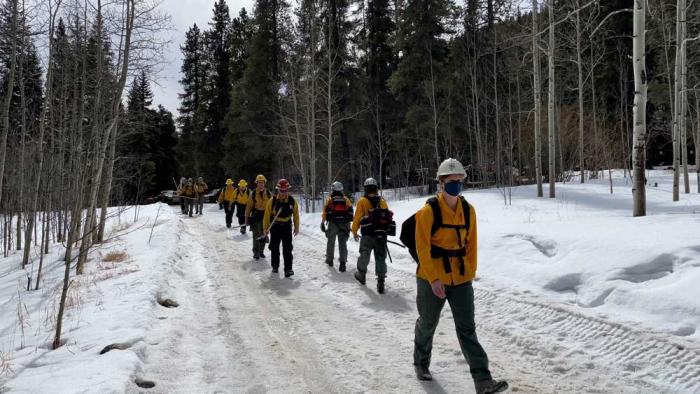
Click the link to read the release on the Colorado State Forest Service website:
There is a critical connection between clean drinking water and forests. For 80 percent of Coloradans, their water starts in the state’s forests before making its way downstream to their taps.
Given this connection, it is important for Colorado to protect its forested watersheds from the ever-present threat of wildfire to ensure residents and communities have water for drinking, agriculture and other uses. The Colorado Legislature recognizes this need and passed House Bill 22-1379 during the 2022 legislative session to fund projects that reduce wildfire fuels around high-priority watersheds and water infrastructure.
Today, the Colorado State Forest Service announces three projects funded through HB22-1379 that will reduce the risk wildfire poses to water supplies for more than a million Coloradans.
“We are excited to put these funds provided by the legislature to work in high-priority areas where an uncharacteristic wildfire could significantly impact water supplies and infrastructure,” said Weston Toll, watershed program specialist at the CSFS. “All three projects connect to prior fuels reduction work completed by the CSFS and our partners, so we can make an impact on a large scale in our forests.”
The CSFS received $3 million through HB22-1379 to fund forest management in critical watersheds and has allocated $1 million each to three projects in these locations:

Staunton State Park, Park and Jefferson counties
The project in Staunton State Park will build upon more than 800 acres of prior fuels treatments to reduce the impact a wildfire could have to water resources, communities, outdoor recreation areas and wildlife habitat. Creeks running through the park feed into the North Fork South Platte River, which flows into Strontia Springs Reservoir. Eighty percent of Denver Water’s water supply moves through Strontia Springs Reservoir.
This area, about 6 miles west of Conifer, is noted as a priority for action in assessments by the CSFS, Denver Water, Upper South Platte Partnership, Elk Creek Fire Protection District and in local Community Wildfire Protection Plans. It is also in a focus area for the Rocky Mountain Restoration Initiative.
“This project will allow us to get into areas of the park we haven’t been able to treat yet,” said Staunton State Park Manager Zach Taylor, “to reduce the risk of a wildfire spreading from the park to adjacent neighborhoods. The project also reduces wildfire risk to creeks in the park and the entirety of the drainage.”
Taylor said that the park has worked alongside neighbors in the area, including private landowners and the U.S. Forest Service, to address wildfire fuels since the park was acquired in the 1980s.
“Staunton State Park lies between all of these communities,” he said. “This project could set up the park for the next 5 to 10 years in helping us meet our goals for fuels reduction.”
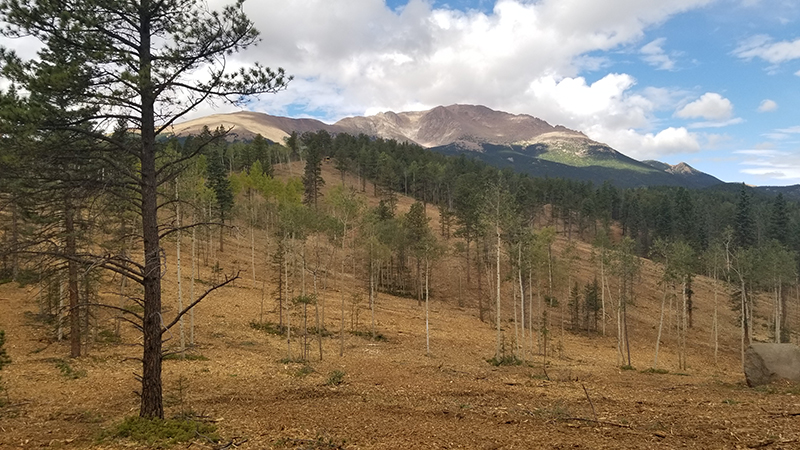
North Slope of Pikes Peak, Teller County
The project on the North Slope of Pikes Peak will help protect essential drinking water and water infrastructure for the City of Colorado Springs. Reservoirs on the North Slope provide about 15 percent of the city’s drinking water supply. Work there will add to more than 3,500 acres of prior fuels treatments on Colorado Springs Utilities’ municipal lands and fill an important gap in treated areas around North Catamount Reservoir and the headwaters of North Catamount Creek. It will also help protect infrastructure that conveys water from the utility’s Blue River collection system to the reservoir.
The Pikes Peak Watershed is noted as a high priority area in plans by the CSFS, U.S. Forest Service and Colorado Springs Utilities. It is also in a focus area for the Rocky Mountain Restoration Initiative.
“Colorado Springs Utilities’ 34-year-long partnership with the Colorado State Forest Service has enabled many beneficial forest management activities that reduce the risks and impacts of wildfire in and adjacent to our watersheds,” said Jeremy Taylor, forest program manager with Colorado Springs Utilities. “Through the Pikes Peak Good Neighbor Authority (GNA), we’ve expanded this collaboration to include the U.S. Forest Service for cross-boundary work, and we’re now embarking on the Big Blue project on the North Slope of Pikes Peak. It’s a valued partnership that prioritizes working together to improve forest health and protect our water resources, public lands and neighboring private lands.”

Fraser Valley, Grand County
The project in the Fraser Valley will lower the risk of wildfire to water supplies for Denver and the towns of Fraser and Winter Park by reducing fuels on U.S. Forest Service, Denver Water and private lands. It connects to several prior treatment areas to establish a connected, large-scale fuel break that could allow firefighters to engage a wildfire in the event of a fire. During the William’s Fork Fire in 2020, the project area was identified as where a wildfire could spread into the densely populated Fraser Valley.
The Grand County Wildfire Council identified the project area as a high priority through planning efforts by the CSFS, USFS, Bureau of Land Management, Denver Water, Grand County and local fire departments.
“These projects are critical for watershed health and source water protection for Denver Water and our 1.5 million customers. Healthy forests equal healthy watersheds,” said Christina Burri, watershed scientist with Denver Water. “Denver Water is so grateful for the partnerships and collaboration that make these projects possible.”
The CSFS expects work on these projects to begin in 2023 and will monitor the project work in future years to evaluate its impact and efficacy. All three projects allow the CSFS and its partners to achieve goals and enact strategies identified in the 2020 Colorado Forest Action Plan and are in areas identified as priorities in the plan.
“Governor Polis and the Colorado legislature have made tremendous investments to protect our watersheds from the increasing threat of wildfires and the Colorado State Forest Service is at the forefront in moving these projects forward”, said Dan Gibbs, executive director of the Colorado Department of Natural Resources. “The three projects announced today build on existing efforts to increase resiliency and make impactful investments in key watersheds to create healthier forests and reduce the threat of future wildfires.”
“Thank you to the Colorado Legislature for making the $3 million available for this important work and to our many partners for working alongside the Colorado State Forest Service on these projects,” Toll said. “Together, we are making a landscape-level impact and leveraging our collective resources toward the goal of lowering wildfire risk to water supplies and protecting one of our state’s most precious resources.”