Running for the open seats are Tammy Essmeier, Allen Dreher, Frank J. Johns, Neil L. Arney and Frank McNulty. Each candidate answered questions about themselves to provide Centennial Water voters with some information about their reason for seeking a seat on the board.
Arney is an attorney with knowledge of Colorado special districts who is new to Highlands Ranch and running to give back to his community.
Essmeier is a consultant on environmental regulations and laws, who has served as a volunteer with Centennial Water’s Citizen Engagement Committee.
Dreher, a former journalist, serves on the Highlands Ranch Metro District and is interested in joining the board to protect water sustainability.
Also a volunteer with the Citizen Engagement Committee, Johns is an engineer with previous experience operating water and wastewater facilities.
A former Colorado representative, McNulty owns Square State Strategy Group and previously served as the consulting attorney for the Colorado Department of Natural Resources.
Centennial Water users can vote in person from 7 a.m. to 7 p.m. May 3 at 92 Plaza Drive or drop an absentee ballot in the drop-box at the Douglas County Sheriff’s Office Highlands Ranch substation by 7 p.m. May 3.
Douglas County Commissioner Abe Laydon, right, with attorney Steve Leonhardt, who Douglas County has hired to help it work through RWR’s water exportation proposal. Photo credit: Alamosa Citizen
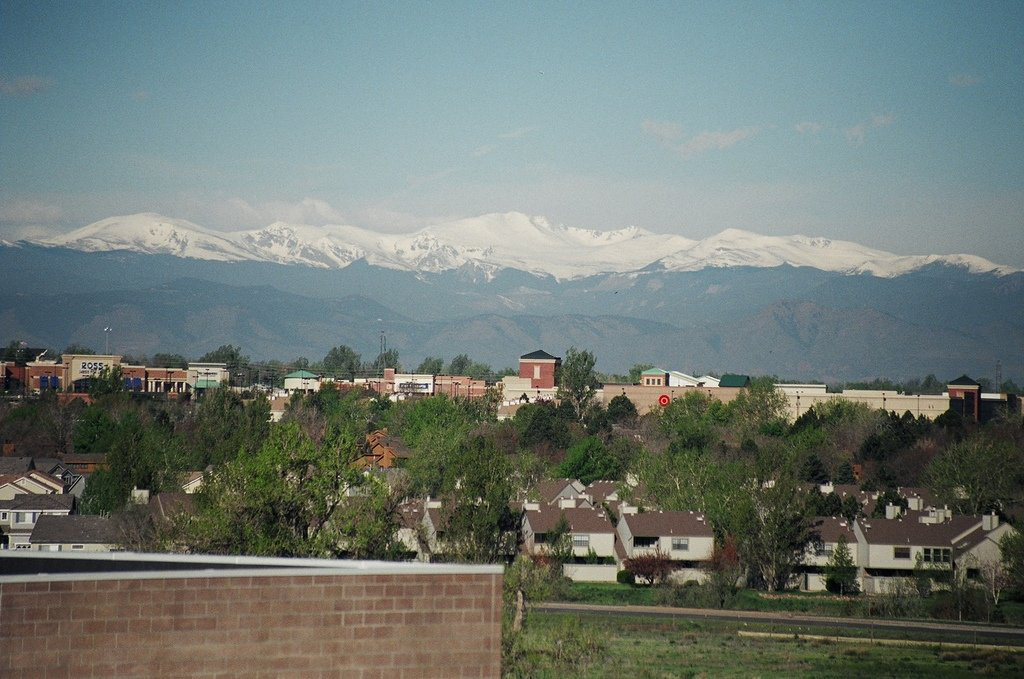
RIO Grande County Commissioner John Noffsker made Douglas County Commissioner Abe Laydon a counter-offer to the Renewable Water Resources exportation proposal: Douglas County gives the San Luis Valley its annual sales tax collections from Park Meadows Mall in exchange for some water.
Noffsker’s point? That the Valley has no more right to sales tax dollars collected by Douglas County than Douglas County has to water in the San Luis Valley aquifers.
Pleasantries were exchanged Saturday [April 23, 2022] between Laydon and a few mostly elected officials during a two-hour exchange at Nino’s Restaurant in Monte Vista. The conversation didn’t reveal anything new or anything Laydon and Douglas County haven’t heard over the past four months as Douglas County weighs whether to invest in the Renewable Water Resources water exportation plan.
“You’re the tip of the spear on this one,” Noffsker said in making Laydon aware that people watching Douglas County’s deliberations know Laydon holds the deciding vote on the three-member commission, with Commissioner Lora Thomas dead set against RWR and Commissioner George Teal in support.
“Once you start putting a straw in this body of water, there’s no end game,” Noffsker said.
“You’re basically saying to us, much as what happened to the Native Americans, that you have something we want and we can do more with it than you can, and that is wrong,” said Noffsker. “It’s morally wrong. When we have to sit here and defend how we use our water, we shouldn’t have to do that. This water belongs to the Valley. It should not be taken out of here to benefit somebody else.”
The meeting at Nino’s with Noffsker and other local elected officials was Laydon’s second of the day. Earlier Laydon and Special Counsel Steve Leonhardt met privately with farmers who Laydon said expressed a variety of concerns, from lack of knowing what’s going on in the subdistrict formations of the Rio Grande Water Conservation District to concerns about their small operations and whether small farms would survive the period of persistent drought and climate change.
With the local elected officials, which included Monte Vista Mayor Dale Becker and Alamosa Mayor Ty Coleman and Commissioner Lori Laske, Laydon raised the idea of a community fund that Renewable Water Resources has touted as part of its proposal. The Douglas County commissioner was told the community fund was a slap in the face to residents of the San Luis Valley.
“It’s not about money, it’s about keeping the (water) resource here,” said Alamosa City Councilman Mike Carson. Carson works at the Rio Grande Water Conservation District and is coordinating the Protect San Luis Valley campaign fighting the RWR exportation proposal.
Karla Shriver, president of the Rio Grande Water Conservation Subdistrict 2 board, said additional financial relief for Valley farmers is on the way through legislation currently moving through the state legislature. A bill sponsored by state Sen. Cleave Simpson would create a new compact compliance fund and would have around $30 million of American Rescue Plan Act money awarded to Colorado in it to help farmers in the San Luis Valley meet groundwater compliance targets set by the state. Read more about the legislation HERE.
Renewable Water Resources has voiced opposition to the legislation. It sees the bill as a government bailout for San Luis Valley farmers at a time when RWR is asking for money from Douglas County and dangling those tax dollars in front of Valley farmers to buy them out.
San Luis garden. Photo credit: The Alamosa Citizen
Noffsker said the RWR proposal is only about making a return on investment, while the Valley fights for its economic livelihood.
“I don’t mean any urban/rural fights,” said Noffsker. “But what’s happening is an urban area that apparently wants to grow more, wants to take from us to do it. If we do something like this, we are being dictated to by the Front Range on what our lives are going to be. That is not correct.”
Laydon, as he’s said in other meetings, told the group that Douglas County only wants to partner with communities that welcome Douglas County and that want to partner with it. He didn’t find that broad support on his weekend trip to the San Luis Valley, and he hasn’t heard any outpouring of support in the months he and his colleagues have been studying the Renewable Water Resources exportation plan.
Unless, of course, Douglas County wants to give up its retail sales tax revenues. Sacrificing a golf course or two might help as well.
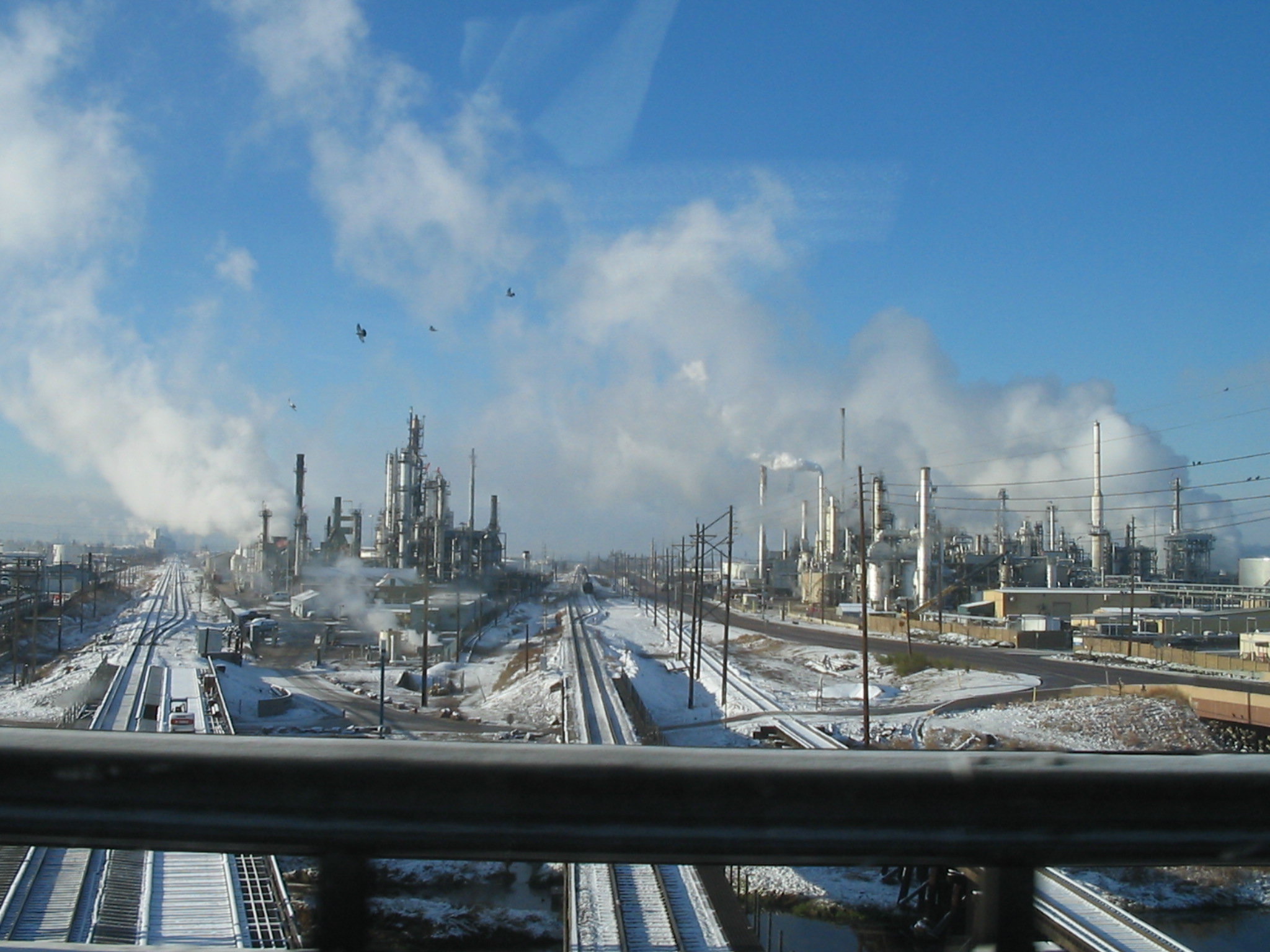
Suncor refinery Commerce City. Photo credit: Allen Best/Big Pivots
Click the link to read the article on the Big Pivots website (Allen Best):
San Miguel County and Boulder lawsuits against two oil companies will be heard in Colorado. That helps. But these cases will still have an uphill struggle to prove damages that might seem obvious.
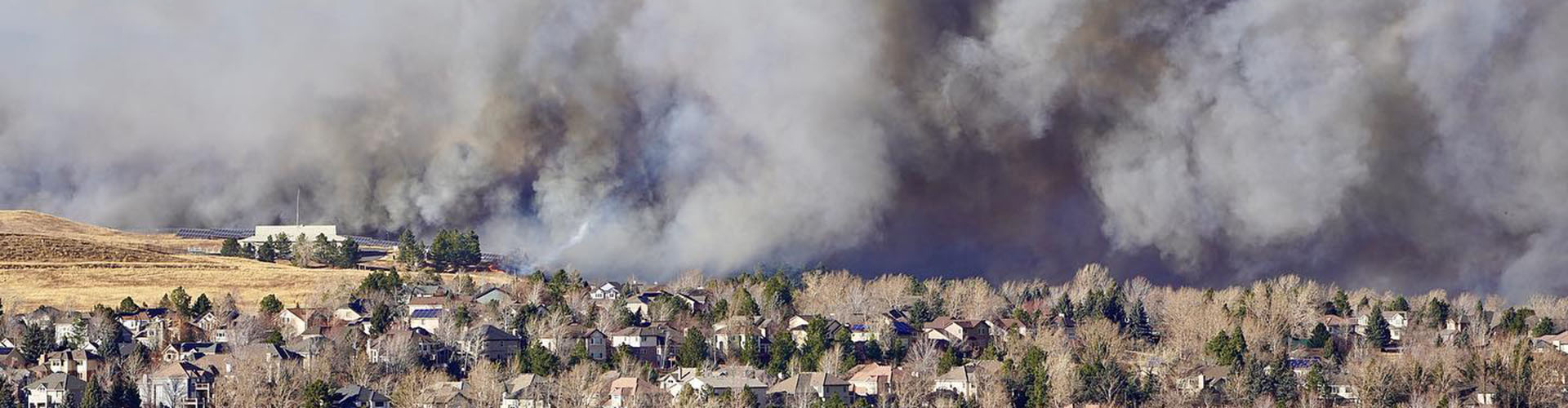
Colorado has abundant evidence of destruction caused by the warming, and more volatile, climate. Wildfires, ever larger and more destructive, now happen year-round, including the ghastly Marshall Fire of late December and the much smaller fires of recent weeks. Rising temperatures have robbed flows from the Colorado River, from which Boulder and Boulder County get substantial amounts of water. Air conditioning has become more necessity than luxury.
But can Boulder and other jurisdictions show harm from burning of fossil fuels — the primary cause of warming — in their climate liability lawsuits against oil companies?
Marshall Fire December 30, 2021. Photo credit: Boulder County
In 2018, Boulder (both the city and the county) as well as San Miguel County sued two oil giants, ExxonMobil and Suncor. These Colorado cases are among more than 20 climate lawsuits now in courts from Hawaii to Massachusetts. They’re the only cases from an inland state claiming actual damages from climate change — and after a recent legal victory, they could be among the first where substantive arguments are heard in court. (Only Honolulu’s case is on a faster track.)
Despite all the evidence of climate destruction, the legal case will be challenging, according to Pat Parenteau, a professor of environmental law at Vermont Law School.
“In a court of law, you have to prove by the preponderance of evidence and you have to convince the jury, all 12 of them,” says Parenteau, who has advised some parties who filed similar lawsuits, but is not currently involved directly in the litigation.
He points to the difficulty of pinning health impacts on tobacco companies in the 1990s. “Cigarettes kill people. Global warming, per se, kills people: Heat waves kill people. High tides kill people.”
Proving responsibility in a courtroom will be the tricky part. “There are multiple links in the causal change that you have to prove with climate change,” Parenteau says. “It was difficult enough to prove with tobacco. It never was proven [in court]. It was just settled. Just imagine how difficult it is for climate change.”
Suncor operates a refinery in Commerce City northeast of downtown Denver that processes 98,000 barrels of oil daily. “We purchase crude oil from the Denver-Julesburg Basin, process it in Commerce City, and sell nearly 95% of our products within the state,” Suncor’s website says.
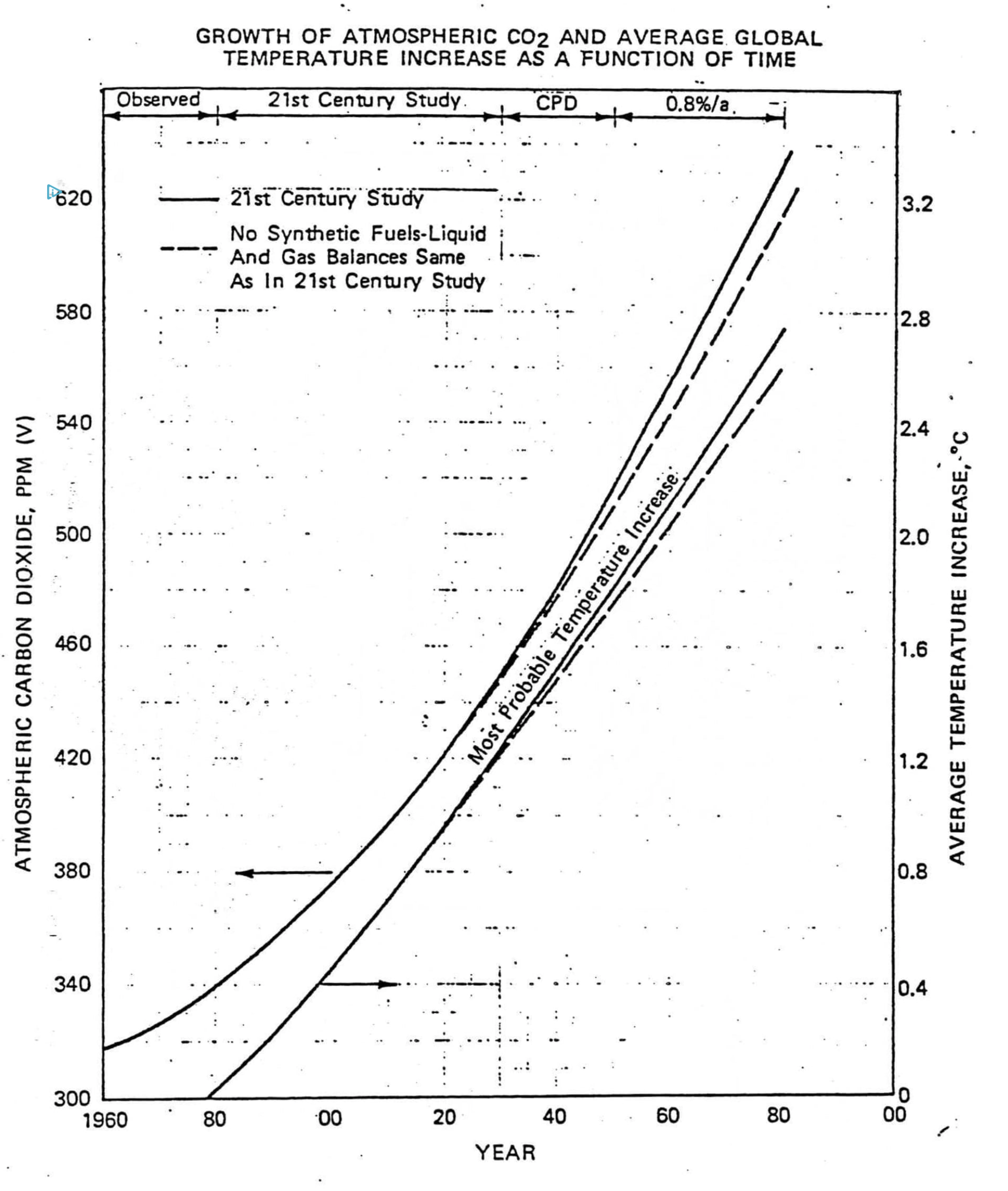
Exxon’s private prediction of the future growth of carbon dioxide levels (left axis) and global temperature relative to 1982 (right axis). Elsewhere in its report, Exxon noted that the most widely accepted science at the time indicated that doubling carbon dioxide levels would cause a global warming of 3°C. Illustration: 1982 Exxon internal briefing document
Exxon has no refinery in Colorado, but it does sell fuel in the state.
“They are the two most consequential oil companies in Colorado, given their local operations,” says Marco Simons, the lead attorney with EarthRights International, the organization representing the three jurisdictions in Colorado.
So far, the arguments in the Colorado cases (and others) have been about process, namely where the cases should be tried.
In legal cases, as in basketball, home court matters. This is likely why Exxon and Suncor wanted lawsuits filed against them by Boulder and San Miguel heard in federal courts instead of Colorado district courts.
“Basically, their argument was that you can’t let state law allow these people to seek remedy before climate change injury when federal law doesn’t provide that remedy,” Simons explains.
The oil companies lost that round. The U.S. Court of Appeals for the 10th Circuit ruled on Feb. 8 that the two lawsuits should be heard in Colorado. The court then ordered, on March 2, for that mandate to take effect.
“The court is basically saying there’s nothing wrong with using ordinary state law to hold oil companies accountable to their contribution to climate change,’” says Simons. “That does not in any way violate federal law. It’s not something inappropriate for states to do.”
arenteau agrees there is value to the climate cases being heard in state courts. The empirical evidence is clear: “Where do the states and cities find the best success? It’s in their own courts. The faster these cases get back to state courts from federal courts, the better.”
Colorado’s cases, originally filed as one, have been separated. San Miguel County’s case is to be heard in Denver District Court, and the Boulder and Boulder County case in Boulder County District Court.
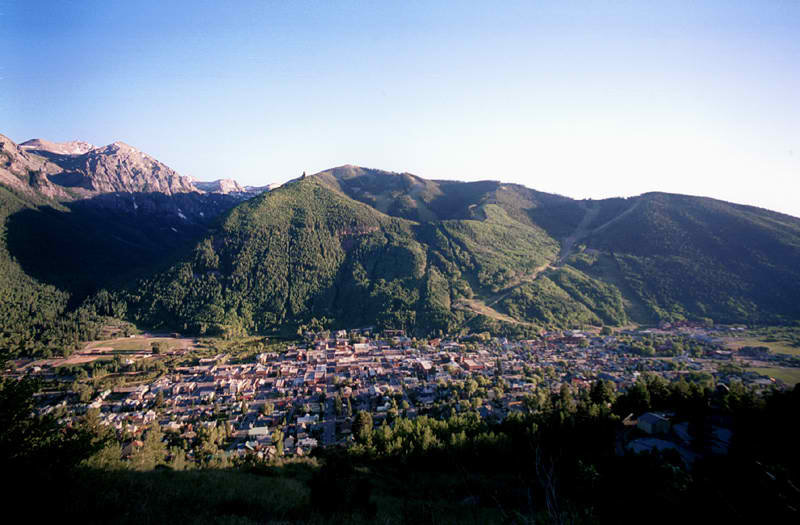
Telluride. San Miguel County alleges damages to its skiing economy at Telluride. The case will be heard in Denver District Court.
Home-court advantage goes only so far. Attorneys for EarthRights International must now prove that the fossil fuels sold by Suncor and ExxonMobil in Colorado have produced damages from a changing climate to the local jurisdictions.
While many legal analysts say that will be difficult to prove, some observers think the Colorado lawsuits could be successful, even short of total courtroom victories.
One of those making that case is Cara Horowitz, co-executive director of the Emmett Institute on Climate Change & the Environment, a program embedded in the law school at the University of California Los Angeles. She has coordinated with counsel for several jurisdictions in California that filed climate change lawsuits in 2017, but is no longer involved in those other climate liability cases.
“On an even more deep level, one goal that the plaintiffs have across the set of cases is undermining the social license of the corporations to do what they have been doing for decades,” says Horowitz. “They just need one good victory to hang their hats on.”
That could help supporters of these suits win verdicts in the court of public opinion.
Neither Suncor nor Exxon responded to requests for comment, but the premise of the fossil fuel companies is that they have been doing nothing wrong by peddling gasoline, diesel and other fossil fuel products.
Climate change-related lawsuits have been filed since the mid-1980s. Early lawsuits generally sought to force actions by state governments and federal agencies. The most notable such case is Massachusetts v. EPA, which resulted in the Supreme Court’s landmark 2007 decision that gave the U.S. Environmental Protection Agency authority to regulate carbon pollution under the Clean Air Act. Other lawsuits, such as Connecticut vs. American Electric Power in 2011, targeted energy companies. For complex legal reasons, these cases using federal courts have struggled to go forward.
Investigative reports in 2015 by Inside Climate News and independent work by the Los Angeles Times about ExxonMobil, the world’s largest oil and gas company, were important in triggering the wave of lawsuits of the last five years. The journalists showed that the oil giant misled the public about what it knew about climate change and the risks posed by fossil fuel emissions decades ago. The investigative series were based largely on the company’s internal records.
Since then have come a wave of lawsuits by state and local governments.
California jurisdictions — first Marin and San Mateo counties along with the city of Imperial Beach in July 2017, followed by Oakland and San Francisco that September — were at the forefront of suits by state and local governments. Currently pending are lawsuits filed by seven states and the District of Columbia and 19 by cities and counties, according to the Center for Climate Integrity.
These lawsuits fall into primarily two overlapping buckets. The two cases in Colorado fall into both.
In one bucket of lawsuits are claims of fraud and deception by oil companies, primarily by Exxon. The second bucket consists of suits alleging the oil companies have created “nuisances” that have caused damages. In the Colorado cases, local governments have suffered harm as a result, the lawsuits say.
“It’s about fundamental principles of tort law that basically boil down to, ‘If you harm someone, you have to pay for it,’” explains Simons, the EarthRights attorney.
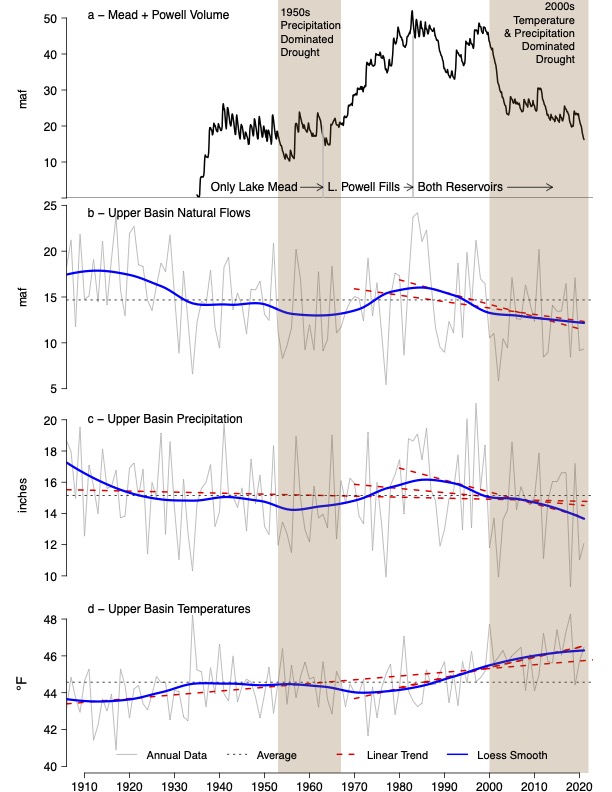
Brad Udall: Here’s the latest version of my 4-Panel plot thru Water Year (Oct-Sep) of 2021 of the Colorado River big reservoirs, natural flows, precipitation, and temperature. Data (PRISM) goes back or 1906 (or 1935 for reservoirs.) This updates previous work with @GreatLakesPeck.
The 2018 lawsuits for the Colorado jurisdictions cite many climate impacts from fossil fuels. Rising temperatures will affect water supplies. Emergency management services will have to be ramped up because of increased wildfires, heavy rainfall and other extreme weather events. Warmer temperatures will worsen the already problematic ground-level ozone in Boulder County.
This car in Superior was among the victims of the Marshall Fire in late December 2021 that burned 1,084 homes and caused 30,000 residents of Superior and Louisville to flee. Photo/Allen Best
Some increased costs have already occurred, the lawsuit filed by the three Colorado jurisdictions in 2018 says. It points to the West Nile virus spread by mosquitoes amid rising temperatures. Prior to 2002, Boulder had no mosquito control program. That was the year the virus first appeared in Colorado. After that, costs of mosquito abatement grew steadily. By 2018 mosquito management nicked the city budget roughly $250,000. In Boulder County, the cost approached $400,000.
Buildings will have to be modified, the lawsuit says. “Due to the expected continued heat rise in Boulder County, a place that historically rarely saw days above 95 degrees, Boulder County and the City of Boulder are expected to see increased public health heat risks, such as heat stroke, and their associated costs,” the lawsuit filed in 2018 says.
This increasing heat, the lawsuit continues, will drive up costs, such as that of cooling infrastructure for buildings. “Cooling centers that are available during heat waves, and/or assisting with home air-conditioning installation, could cost Boulder County and the City of Boulder millions of dollars by mid-century.”
The lawsuit cites the $37.7 million of a $575.5 school construction bond for the Boulder Valley School District used for air-conditioning and better ventilation.
How the Colorado cases are different
Colorado’s lawsuits were the first filed in an interior state. Even now, the only other states without coastlines to have filed climate change lawsuits against oil companies are Minnesota and Vermont. They claim fraud. That makes the Colorado cases the only ones claiming damages.
This duality, an inland state claiming actual damages from climate change, sets Colorado’s cases apart from all others.
“It’s easy to imagine a city like Miami or other coastal cities being imperiled by climate change,” says Horowitz, the UCLA law professor. “The Boulder case is helping to illustrate that even inland cities, cities in the middle of America, are being harmed by climate change.”
One long-sought goal of the litigation is getting to what in courts is called the discovery phase. That’s the stage where documents, emails, other correspondence and information related to the suits could reach the public and prove devastating to the company. (That is essentially what happened to the tobacco industry, with the release of memos and documents in discovery.)
Horowitz, the law professor in Los Angeles, expects the filings and rulings to accelerate. “You will start to get state court decisions sooner rather than later, by which I mean probably in the next year,” she says. Appeals will follow, but these Colorado cases — and those similarly proceeding in other states — will move along.
“I wouldn’t think it will take five to 10 years,” she says.
And the fact that Colorado has no beach-front property could spur other similar cases. Sea level rise is not imminently threatening Boulder the way it is in Imperial Beach, a city of 26,000 people near San Diego that has also filed a climate change lawsuit.
“I wouldn’t be surprised if more jurisdictions realize they will need help in funding climate change adaptation,” Horowitz says, “and the fossil fuel companies are logical places to look as sources for that funding.”
This story was prepared in collaboration with the Boulder Reporting Lab, whose editing and suggestions enormously improved the story.
People work on the Perkins County Canal in the 1890s. The project eventually was abandoned due to financial troubles. But remnants are still visible near Julesburg. Perkins County Historical Society
[Phil] Weiser was on a tour of northeast Colorado and met in Sterling with representatives of local government, law enforcement, education, mental health providers and others.
During the meeting, Weiser said he doubts the recently resurrected Perkins County Canal plan will ever see fruition. He said Nebraskans are as puzzled about Gov. Pete Rickett’s idea to complete the abandoned canal as Coloradans are.
“The Nebraska idea is not born of reasonable dialogue,” Weiser said. “We don’t know where it’s coming from, but it appears to be more (politically motivated) than any real need for water. We are going to work to protect our water.”
The AG said Coloradans shouldn’t be overly concerned about the Perkins project, calling it a “product of one moment in time.”
While water storage, conservation and creative allocation ideas are laudable, Weiser said, those ideas have to be good for everyone involved. He pointed to the plan to drill into the aquifer under the San Luis Valley and pipe water to Douglas County as the kind of “buy and dry” scheme that should be avoided.
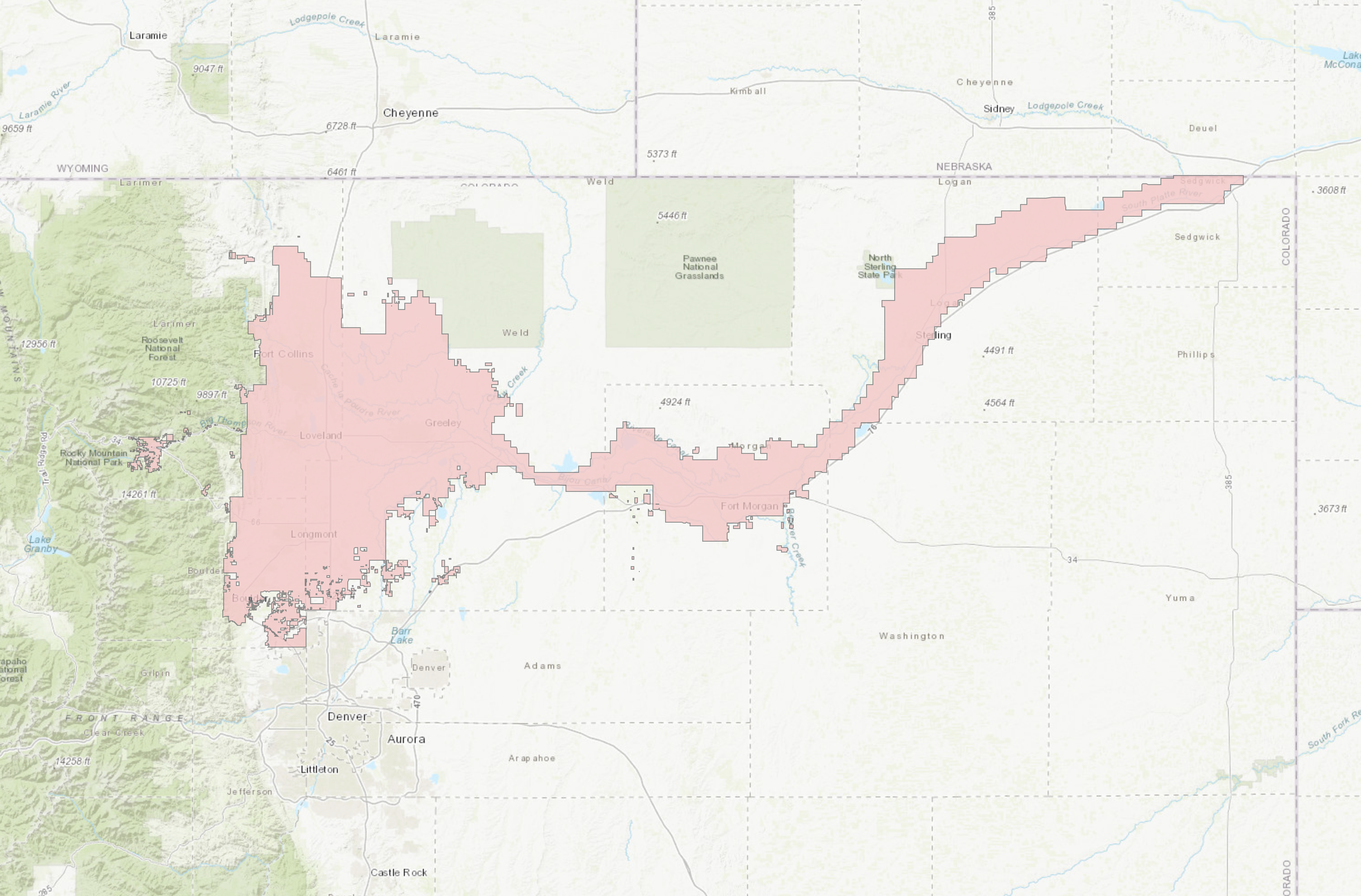
PFAS contamination in the U.S. via ewg.org. [Click the map to go to the website.]
Click the link to read the article on The Denver Post website (Conrad Swanson). Here’s an excerpt:
Discharges from one of Suncor’s drainage ports accounts for between 16% and 47% of the total PFAS pumped into Sand Creek in 2021, according to a report from Wheat Ridge’s Westwater Hydrology LLC. The creek dumps into the South Platte River and the refinery can be linked to 3% to 18% of the total PFAS found in that waterway. Analysts with Westwater Hydrology prepared their report for Earthjustice, a national environmental nonprofit…Chemicals found in Sand Creek and the South Platte River can be especially troubling because cities like Commerce City, Brighton, Thornton and Aurora take in water from the river downstream of Suncor, the report indicates…
Pollution measured in the study only accounts for a portion of the discharges from Suncor, Wheeler said. The refinery installed a temporary treatment system in October to reduce PFAS discharges “but even with these measures in place, the pollution remains at toxic levels” under limits set by the Environmental Protection Agency and the Agency for Toxic Substances and Disease Registry.
Governor Clarence J. Morley signing Colorado River compact and South Platte River compact bills, Delph Carpenter standing center. Unidentified photographer. Date 1925. Print from Denver Post. From the CSU Water Archives
Click the link to read the article on the Progressive Farmer website (Chris Clayton). Here’s an excerpt:
[Governor Pete] Ricketts signed legislation authorizing a $500 million canal meant to counter what Nebraska sees as attempts in Colorado to potentially hold back future water flows on the South Platte River. Nebraska will invoke a nearly 100-year-old clause in a water compact between the two states to dig out what is commonly called the Perkins County Canal. Nebraska lawmakers last week passed the bill, LB 1015, to back the canal project despite some concerns about its costs and possible legal battles ahead.
“Today, we enacted two key laws to strengthen Nebraska’s water resources,” Ricketts said in signing the bill. “LB 1015 helps protect the South Platte River water we depend on for drinking water, agricultural irrigation, and to nourish our natural environment.”
Ricketts also signed a separate bill, LB 1023, that will create a 3,600-acre lake in eastern Nebraska, as well as fund some other recreational projects.
Ricketts began championing the Perkins County Canal early in the year, cautioning against plans for water projects in Colorado totaling nearly $10 billion. Ricketts told lawmakers at a hearing in February, “Colorado is looking to take our water.” Ricketts said the canal is also a “hedge against drought” in western Nebraska as well.
Nebraska has a compact with Colorado that guarantees the state of Nebraska minimum flows of South Platte River water throughout the year…
Kent Miller, general manger of the Twin Platte Natural Resources District out of North Platte, Neb., told DTN he’s been urging Nebraska leaders for the last 25 years to invoke a clause in the South Platt River Compact to build the canal…
Nebraska officials said Monday it would likely take close to a decade before the Perkins County Canal can be built.
Click the link to read the article on the News on Tap website (Todd Hartman):
With the 2021-22 snow season winding down, Denver Water is getting a clearer look at water supplies approaching the irrigation, gardening and summer recreation season.
In fact, as 9News meteorologist Cory Reppenhagen has pointed out, much of Colorado likely hit its peak snowpack in late March, meaning we’ve started the process of spring runoff, when the snowpack begins to melt and flow into streams, rivers and reservoirs.
(Caption: Watch Denver Water crews weigh the snow to find out how much water it contains.)
In Denver Water’s collection system, which includes parts of the South Platte River and Colorado River basins, it’s not fully certain we’ve hit our peak — the point when snowpack reaches its highest point before melting off.
But we’re surely close, as snowpack in Denver Water’s collection system typically peaks around April 20.
What’s it all mean for our water supply? It’s a mixed picture.
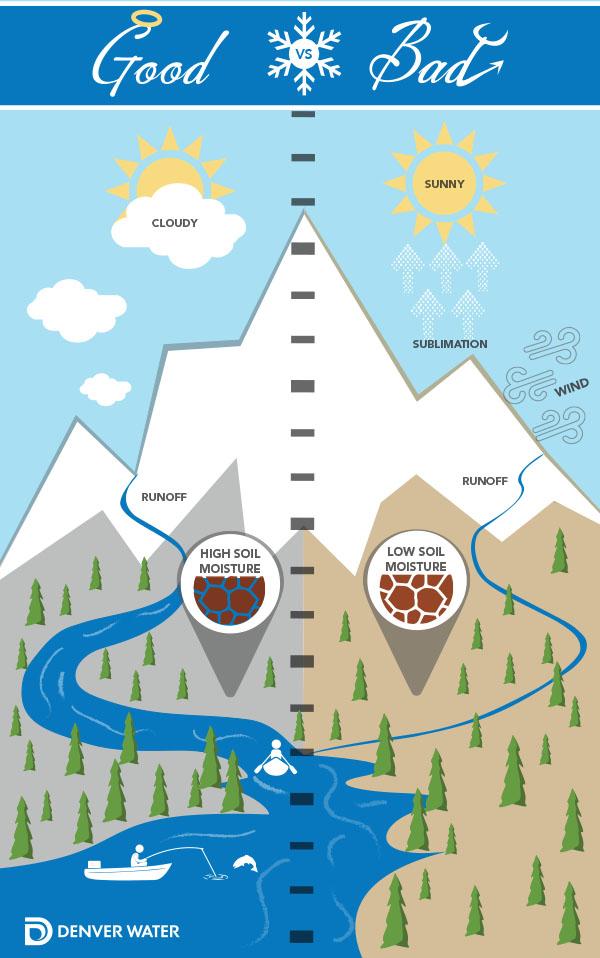
Snowpack is a bit below average, but soil moisture has improved compared to last year, meaning more melting snow will find its way to reservoirs and less will disappear into thirsty ground.
Denver Water’s reservoirs are 79% full, on average, which is normal for this period. And runoff is likely to push that number north of 90% when storage peaks midsummer.
A mid-April snowstorm delivered several inches of snow to Colorado’s high country. Photo credit: Denver Water.
“Overall, we’d like the numbers to be higher, but with better soil moisture we expect better runoff than in recent years with similar snowpack,” said Nathan Elder, manager of water supply for Denver Water.
“We have good carry-over storage going into the runoff season because of low winter water use,” he added. “That’s a reflection of good work from our customers in continuing to improve indoor efficiency and water use habits.”
It’s important those good habits extend into the watering season; customers with spring fever should try not to get ahead of things with outdoor irrigation.
Warning! April is too early to turn on hoses, sprinklers and irrigation systems.
A string of snowstorms this year has improved soil moisture in the Denver region. And more storms could still head our way in late April and early May. This time of year, the weather can be unpredictable, and you might think spring has sprung — only to have winter sweep back in for a last goodbye.
And planting ahead of Mother’s Day (May 8 this year) is always a gamble, as the potential overnight freezes still lurk into the early days of the month. Cold temperatures can put an early end to spring seedlings and damage irrigation systems if water inside the piping freezes.
As it stands in mid-April, snowpack is at 88% of average in Denver Water’s Colorado River collection system, and at 74% of average in its South Platte system, though that South Platte figure is affected by a single tracking location with poor snow that has pulled down the broader average; in the wider South Platte River basin, snowpack is currently 90% of normal.
Don’t turn on your sprinklers yet. Late spring snowstorms can easily damage irrigation systems. Photo credit: Denver Water.
And a big wet storm or two, still possible this time of year, would improve the outlook.
Additionally, planned Airborne Snow Observatories (ASO) flights, which measure high elevation snowpack with great precision, will bring additional insight into the snowpack, as well as adjustment to the runoff outlook.
In 2019, flights in the Blue River Basin above Dillon Reservoir revealed more snow than expected at elevations above traditional snow telemetry sites that provide most snowpack data.
“The ASO data gives us the most detailed and accurate insight into snowpack,” said Taylor Winchell, a climate change specialist at Denver Water. “We look forward to seeing what new information that tells us this spring and how it narrows the uncertainty of water supply forecasts.”
A “rooster tail” is formed by the water descending the Granby Dam spillway on July 19, 2019. Photo credit: Northern Water
Here’s the release from Northern Water (Jeff Stahla):
The Northern Water Board of Directors voted unanimously Thursday to increase its 2022 quota allocation for the Colorado-Big Thompson Project to 70 percent.
Board members expressed their desire to take a conservative approach that protects the ability of the C-BT Project to provide a water supply to its beneficiaries while considering the current water supply conditions in the Colorado River basin and the possibility that adverse conditions persist.
Luke Shawcross, manager of the Water Resources Department at Northern Water, outlined water modeling showing the projected outcomes of several quota declaration options, and he also discussed the available water supplies in regional reservoirs. Water resources specialist Emily Carbone also provided board members with current water availability data.
Public input was also considered in the board’s decision.
While current soil moisture conditions on Eastern Plains farmland prompted several board members to ask for consideration of a higher quota, others cited the uncertainty of future hydrology to support a more-conservative approach this year.
The Board has been setting C-BT quota since 1957, and 70 percent is the most common quota declared. It was also the quota set for the 2021 water delivery season. Quotas are expressed as a percentage of 310,000 acre-feet, the amount of water the C-BT Project was initially envisioned to deliver to allottees each year. A 70 percent quota means that the Board is making 0.70 acre-feet of water available for each C-BT Project unit.
The quota increases available C-BT Project water supplies by 62,000 acre-feet from the initial 50 percent quota made available in November. Water from the C-BT Project supplements other sources for 33 cities and towns, 120 agricultural irrigation companies, various industries and other water users within Northern Water’s 1.6 million-acre service area. According to recent census figures, more than 1 million residents now live inside Northern Water’s boundaries. To learn more about Northern Water and the C-BT quota, visit http://www.northernwater.org.
Colorado-Big Thompson Project Map via Northern Water
Click the link to read “Northern Water sets allocation at 70% for the season” on the Loveland Reporter-Herald website (Ken Amundson). Here’s an excerpt:
The allocation, which is the amount of water that the district will make available to owners of shares of the Colorado-Big Thompson project, means that of the 310,000 acre feet available at 100%, 217,000 acre feet will be made available to shareholders. An acre foot of water — essentially the amount of water that would cover an acre of land one-foot deep — is about 325,851 gallons of water. The board chose what has become the typical allocation. It has the option of increasing it later if conditions permit.
Board members expressed their desire to take a conservative approach that protects the ability of the C-BT Project to provide a water supply while considering the current water supply conditions in the Colorado River basin and the possibility that adverse conditions could persist. While current soil moisture conditions on eastern plains farmland prompted several board members to ask for consideration of a higher quota, others cited the uncertainty of weather conditions to come…
As reported by Northern Water staff Wednesday and again this morning at the board meeting, the district is in good shape on water already stored in the system’s reservoirs. A total of about 563,000 acre feet is stored in Lake Granby, Horsetooth Reservoir and Carter Lake before the runoff season gets fully underway. That’s about 32,000 acre feet above average. The storage levels have been above average for the past eight years, the staff reported.
As reported Wednesday, streamflow levels are predicted to be near average, and snowpack levels are about 90% of average. Uncertain is the amount of precipitation on the Western Slope or Eastern Slope yet this spring and early summer, and whether soil conditions will remain dry.
Interior Secretary Deb Haaland, at the microphone, speaks during a visit to Heil Valley Ranch in Boulder County on April 11, 2022. Sens. John Hickenlooper, left, and Michael Bennet, third from left, Rep. Joe Neguse, second from left, U.S. Forest Service Chief Randy Moore, second from right, and regional forester for the Rocky Mountain Region Frank Beum, right, also joined. (Sara Wilson/Colorado Newsline)
Colorado will receive over $18 million this fiscal year from the federal government to treat thousands of acres susceptible to increasingly damaging wildfires, part of a strategy leaders hope will emphasize lowering fire risk before disaster strikes.
The Colorado Front Range is one of 10 landscapes selected by the U.S. Department of Agriculture and U.S. Forest Service to benefit from an initial $131 million investment with funding from last year’s Bipartisan Infrastructure Law.
In Colorado, money will head to nine identified projects in the Arapaho and Roosevelt National Forests and four projects in the Pike and San Isabel National Forests. It will treat up to 10,000 acres this year.
GET THE MORNING HEADLINES DELIVERED TO YOUR INBOX
“At this point, there is no margin for error. We must and we will continue to stay coordinated, because the reality is that these days, as everyone has said, fire season is now fire years,” Interior Secretary Deb Haaland said during a visit to Heil Valley Ranch on Monday, with trees still blackened from the 2020 CalWood Fire on a hillside behind her.
“Climate change is making the fire seasons more intense, as our firefighters deal with hotter, drier conditions and more extreme fire behavior. The increased frequency in urban areas is impacting more homes, businesses and communities every year,” she said.
Colorado faced a record-year for wildfires in 2020 with the CalWood, East Troublesome and Pine Gulch fires. In December, the Marshall Fire burned over 6,000 acres and destroyed entire neighborhoods in Boulder County.
Colorado also faces harsh, ongoing drought.
“It is all the more reason and motivation for us to take wildfire mitigation and resiliency seriously,” Rep. Joe Neguse, a Democrat who represents the state’s 2nd Congressional District, said during the press conference with Haaland.
Climate change has increased the risk of dangerous wildfires in Colorado, and it has contributed to a drought in the Southwest that has lasted more than two decades. Rising concentrations of greenhouse gasses in the Earth’s atmosphere, largely due to human activity, have caused many parts of the state to warm by an average of more than 4 degrees Fahrenheit above pre-industrial levels.
Haaland said the financial investments enabled by last year’s bipartisan legislation will facilitate a “collaborative, multi-jurisdictional approach” to reducing wildfire risk. Wildfires, after all, do not discriminate between land managed by the county, private citizens, the Forest Service or the National Park Service, and experts say the best approach is informed by all land managers.
Those projects are about reducing the grasses, shrubs, trees, dead leaves and fallen pine needles that increase the chances of a catastrophic wildfire, forest supervisor for the Arapaho and Roosevelt National Forests Monte Williams said.
“It’s about fuel,” he said. “And not just the fuel that’s standing up, but about the fuel that is actually laying on the ground. For a long time, we thought all we needed to do was go thin the forest, and that would create a place where the fire would hit, slow down and stop because there would be nothing left to burn. The truth is we recognize it’s a lot more than that.”
In addition to forest thinning, Williams said prescribed burns are crucial in wildfire mitigation. It’s a similar strategy that he said prevented the 2020 Cameron Peak fire from spreading on two of its largest days. In that case, it was coordinated treatments on local, state and federal lands that stopped the fire in its tracks.
“The actual results of this have already been shown,” he said of the type of projects the incoming money will fund.
A view from the highway of the massive East Troublesome wildfire smoke cloud near Rocky Mountain National Park in Colorado on October 16, 2020. Photo credit: Inciweb
The beginning of a long process
U.S. Forest Service Chief Randy Moore said it is necessary to combat the scale of recent wildfires with an appropriately large response. A 10-year strategy from the Forest Service calls for the treatment of tens of millions of acres across the country. This fiscal year’s investment will begin the implementation of that ambitious strategy.
“This is an opportunity for us to come from a place of want into a place of have,” Moore said. “For a long time, we’ve known what to do, but we have not had the ability to do it at a scale that made a difference on the landscape.”
Sen. Michael Bennet said there’s still a chance Congress could pass a reconciliation bill — what was known as the Build Back Better Act — that has $27 billion in additional investments for wildfire risk reduction. That would be the largest investment into forestry in United States history. Build Back Better was stalled after holdout from Sen. Joe Manchin, D-W.Va.
“That may or may not pass now,” Bennet said. “But what we’ve been able to do this year, with the 5.6 (billion dollars) we’ve been able to put in the bipartisan bill, is demonstrate that the country, for the first time, really recognizes the scale of the challenge that we have.”
It will take much more money to implement the full 10-year plan, but Bennet said the financial puzzle is well worth it, comparing an estimated $50,000 per acre cost to fight a wildfire versus a $1,500 per acre to do mitigation work.
“I am optimistic that we will figure out how to do it over the long haul,” he said.
Sen. John Hickenlooper also attended the event.
Agriculture Secretary Tom Vilsack was slated to join the visit to Heil Valley Ranch with Haaland and members of the congressional delegation, but he is quarantining after testing positive for COVID-19.
The other regions that will benefit from this initial investment are in Arizona, California, Idaho, Montana, New Mexico, Oregon and Washington.
GET THE MORNING HEADLINES DELIVERED TO YOUR INBOX
Colorado Newsline is part of States Newsroom, a network of news bureaus supported by grants and a coalition of donors as a 501c(3) public charity. Colorado Newsline maintains editorial independence. Contact Editor Quentin Young for questions: info@coloradonewsline.com. Follow Colorado Newsline on Facebook and Twitter.
We write to you today, on behalf of our organizations and tens of thousands of supporters across the American West, to express extreme concern over Renewable Water Resources’ proposal to develop a groundwater pumping project in the San Luis Valley that would then export water to the Colorado Front Range. This project represents a serious threat to the water security of the San Luis Valley and to the plant, wildlife, and human communities that depend on this water source. As downstream neighbors we have grave concerns over the cascading effects of this project throughout the entire Rio Grande Basin, and we urge the Commission to reject this proposal.
The Rio Grande Basin cannot afford for any water to be exported out of the Valley.
This project would be the first pipeline built in the San Luis Valley with the intent to export water. But the idea of taking water out of the San Luis Valley for use in other basins is not new. Renewable Water Resources’ proposal is the most recent in a string of such schemes that began in the 1980s. Similar proposals have been decidedly shut down by Colorado courts, which have noted the adverse effects these proposals would have on the aquifer and to surface water rights. In fact, surface waters in the Valley have been recognized as over appropriated since the early 20th century, meaning every drop that flows through the Valley and more is promised to someone. It is incredibly clear that the San Luis Valley has no water to spare.
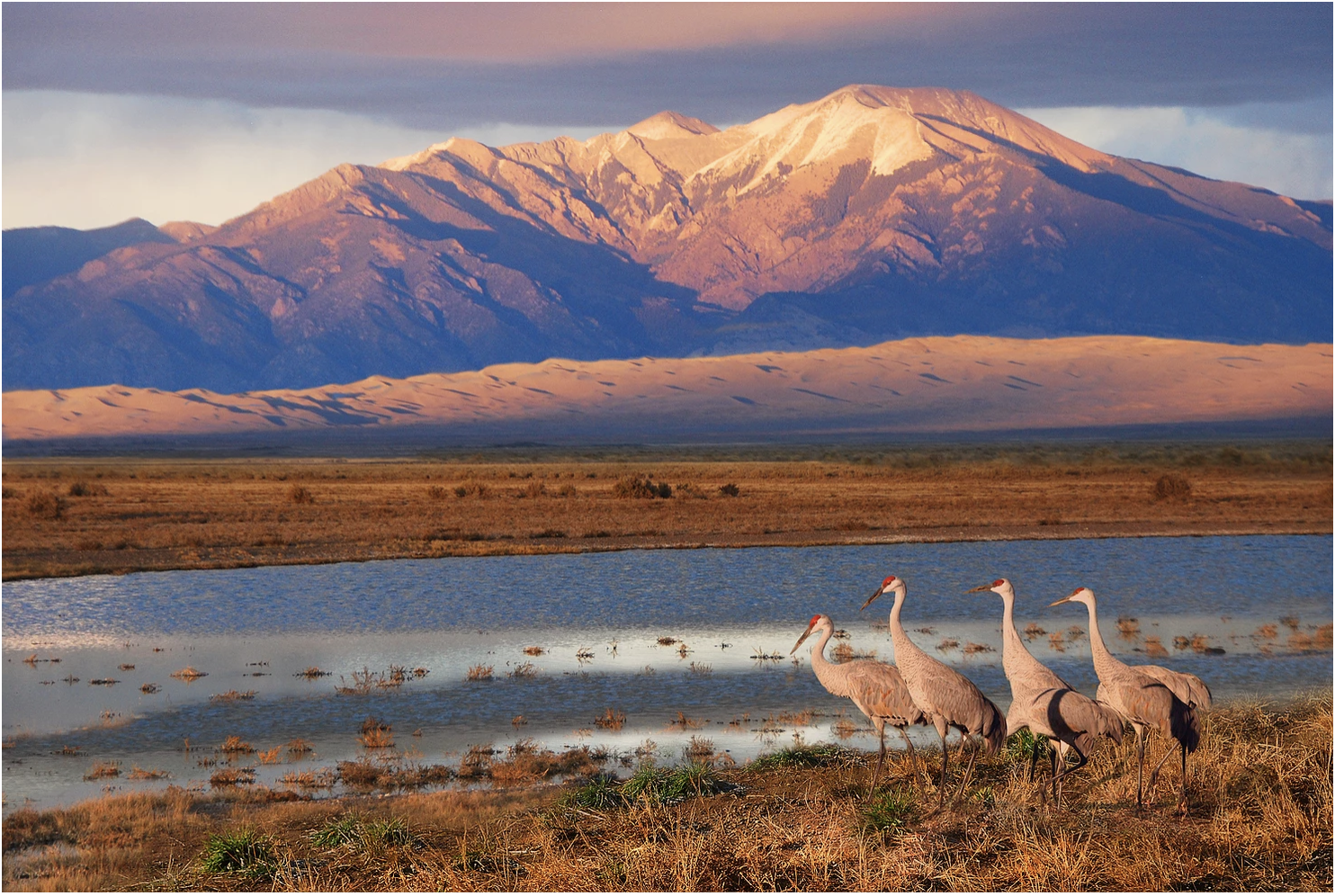
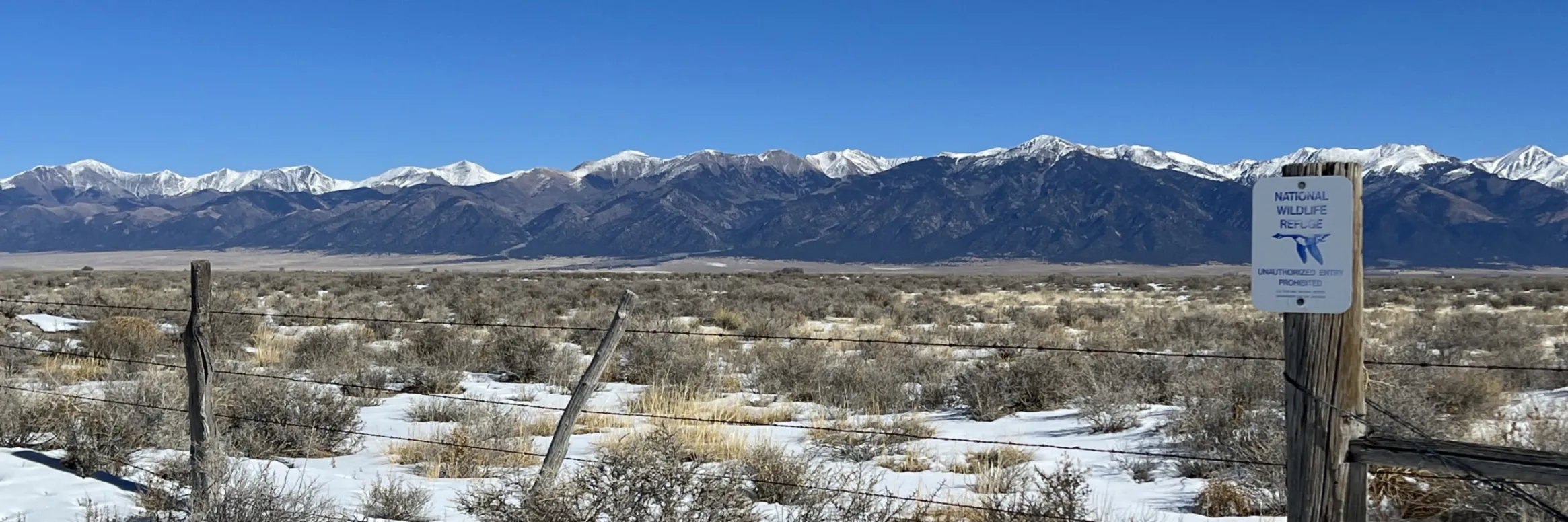
Sandhill Cranes West of Dunes by NPS/Patrick Myers
Exporting water from the San Luis Valley will threaten hope for a sustainable aquifer.
In addition to surface waters, groundwater is also over appropriated in the Valley. We have serious concerns over the effects of the proposed pumping on overall groundwater levels and their impacts to surrounding wetlands and streams. Of particular concern are potential effects to the Great Sand Dunes National Park and Preserve and the Baca National Wildlife Refuge. Farmers in the Valley are already working together and making sacrifices to reduce water demand through the sub-district project, which was created following decades of drought conditions. This voluntary project facilitates farmers within the Valley combining efforts to ensure groundwater levels are maintained. Renewable Water Resources’ proposal undermines years of this difficult work. The demands for water and challenges associated with allocating it equitably will only increase as the impacts of climate change continue to intensify, this proposal will make an already challenging situation worse and undo years of community-driven efforts to find solutions.
Rio Grande and Pecos River basins. Map credit: By Kmusser – Own work, Elevation data from SRTM, drainage basin from GTOPO [1], U.S. stream from the National Atlas [2], all other features from Vector Map., CC BY-SA 3.0, https://commons.wikimedia.org/w/index.php?curid=11218868
Exporting water from the San Luis Valley will have consequences for the entire Rio Grande Basin.
The concerns over this project expand beyond the San Luis Valley. The project also has the potential to threaten the downstream communities and the environment in the Rio Grande Basin for thousands of miles. The Rio Grande Compact and the 1944 treaty with Mexico define how much water must flow from the Rio Grande’s headwaters in Colorado to New Mexico, Texas and Mexico. As a headwaters state, Colorado has a significant responsibility to its neighbors and it is keenly felt downstream when those responsibilities are ignored. For example, during the twentieth century, Colorado consumed more water than it was allotted under the Compact and subsequently accrued a nearly one-million-acre-foot debt to downstream states. This overuse had consequences to downstream communities, agricultural production, and ecosystems. It resulted in lawsuits that ultimately ended with the U.S. Supreme Court requiring Colorado to repay this debt over time. Luckily for Colorado, a wet period of hydrology that filled downstream reservoirs triggered a provision of the Compact that forgave the prior debt and wiped the slate clean for better management going forward. With projected precipitation regime shifts under climate change, we are unlikely to see such a wet period again.
The water challenges we are facing within the Rio Grande Basin make it painfully obvious that a repeat of this situation would be catastrophic for water users across all three states and Mexico. We must think more holistically about the river systems on which we all depend. The San Luis Valley is an integral part of the Rio Grande Basin, a river that runs nearly 1,900 miles and sustains municipal and irrigation uses for more than six million people and two million acres of land across three states and two countries. We urge the Commission to not further complicate this situation by taking vital water from the San Luis Valley and threatening it and others’ water futures.
The communities of the San Luis Valley are working to address their water scarcity challenges in collaborative and inclusive ways. Although there is still much work to do to create a sustainable aquifer and healthy Rio Grande for people and the environment, Renewable Water Resources’ proposal flies in the face of these efforts. Please do the right thing for the communities within the San Luis Valley and those that depend on the water, also vital downstream, by rejecting this ill-advised project.
Here’s the release from the St. Vrain and Left Hand Water Conservancy District:
The Town of Jamestown will be at less risk from wildfire because of funding provided by residents and business property owners in the St. Vrain and Left Hand Creek Water Conservancy District. The Town and many local property owners agreed to work with over $127,000 of Water Conservancy District funding to begin planning a fire mitigation project that encompasses dozens of homes in the town limits. The area has been identified as a critical zone for wildfire mitigation treatments that will improve public safety across Jamestown as well as help protect the James Creek water supply in the event of a wildfire.
Many of the private property owners in the proposed area participated in an informational meeting on March 29 in Jamestown. Though property owners were not asked to fully commit to the proposal, many signed agreements allowing the project team access to their properties in order to assess conditions and develop a fire mitigation plan.
The Water Conservancy District provided the funding and sought the support of Left Hand Watershed Center to gather local experts to facilitate the work. This team is beginning work to assess the type of forest mitigation work necessary, and work with the landowners to achieve and implement a common vision. In addition to the District and the Watershed Center, the team includes the Boulder Valley and Longmont Conservation Districts, the Lefthand Fire Protection District, and the St. Vrain Forest Health Partnership (a larger collaborative seeking similar larger scale opportunities).
”The recent fires in Boulder County demonstrate the urgency we have to address community safety at this kind of scale,” said Allan Mueller, Town of Jamestown resident and project participant. “As a community that rests at the top of the watershed, we have a great appreciation for how our water resources connect us clear through Weld County.” “We are incredibly grateful to the St. Vrain and Left Hand Water Conservancy District, whose mission is for the entirety of the creek, for this funding”.
Lefthand Fire Protection District Chief Chris O’Brien, whose crews will do the forest mitigation work this summer, was thrilled to have this generous funding. “We have been working one small piece of the puzzle at a time to help decrease the wildfire risk to the community and all up and down our watershed. This funding allows us to get a lot done at one time, lowering the cost for each acre and making a bigger difference given the size of the wildfires we could potentially face. Thank you to the St. Vrain and Left Hand Water Conservancy District and the Jamestown community for stepping up to meet the wildfire challenge we all face.”
The Left Hand Watershed Center will be the lead coordinating entity for the project, and helped secure the funding from the Water Conservancy District. Jessie Olson, Executive Director, stated, “Our communities, water supplies and forests are at risk if we do not begin scaling up forest restoration in the County. This is why we formed the St. Vrain Forest Health Partnership with over 100 agencies and community members, to begin implementing landscape scale cross-boundary restoration. This Jamestown project was identified as a priority through the partnership, and the St. Vrain and Left Hand Water Conservancy District stepped up to spear head this important project. This is an exciting moment for the community of Jamestown and all downstream communities.”
“It is a great collaboration in the Boulder County Fireshed whereby we have partners that are willing to fund work upstream from where they reside and with others are coming together to get a significant and strategic needed project done,” said Boulder County Commissioner Matt Jones. “We all recognize that wildfires are getting worse and threaten our mountain residents and we have also learned the hard way since the Hayman Fire 20 years ago, that downstream water users can be impacted as well by wildfire. Our forest is the main source of our drinking water in Boulder County and catastrophic wildfire ruins its ability to provide us that resource while post fire flood debris can devastate water supply infrastructure.”
The St. Vrain and Left Hand Water Conservancy District encompasses some 500 square miles along the St. Vrain and Left Hand creeks in Boulder, Weld and Larimer counties. In 2020, voters in the Water Conservancy District agreed to a mill levy increase from 0.156 mills to 1.25 mills through 2030. This was the first property tax increase sought by the District in its 50 year history. The tax will generate an additional $3.4 million in 2022, up from the $416,000 collected in 2020. The 1.25 mill on a $500,000 residential property is equal to $4.47 per month, and $36.25 per month on a $1,000,000 non-residential property.
Sean Cronin, Executive Director of the Water Conservancy District stated, “For years, our constituents said they wanted holistic, sensible, and apolitical leadership across the watershed. In response, the Board of Directors asked the voters in November 2020 if they would approve funding to implement a holistic and sensible water plan. Part of that plan included investments in protecting forests and water quality.” “We are really excited to partner with the Left Hand Watershed Center, the Fire District, the Longmont and Boulder Valley Conservation Districts, and the community of Jamestown to help protect forests and water quality.”
If you are a Jamestown resident and/or you would like to learn more about the proposed project please contact the Watershed Center’s Forest Program Manager, Chiara Forrester at cforrester@watershed.center.
Sometimes, when you’re a small nonprofit, the high price of water is a good thing.
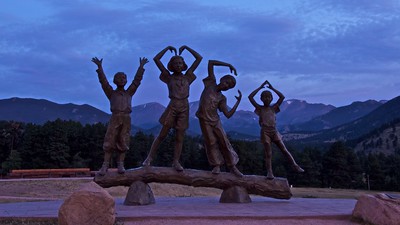
The YMCA of the Rockies, an historic Estes Park resort founded more than 100 years ago, has entered into a multimillion-dollar agreement with the Town of Estes Park in which it will transfer water rights valued at roughly $1.9 million to the town, in exchange for a perpetual water treatment contract.
Chris Jorgensen, the YMCA’s chief financial officer, said the agreement allows the resort to forego the high cost of building a modern water treatment plant and gives Estes Park a more robust water portfolio and delivery system that has better economies of scale.
“The cool thing about it is the collaborative nature of it,” Jorgensen said. “Our existing plant is within a mile of theirs. We’re going to go from operating two water plants to one. It speaks to good stewardship of our natural resources, and it benefits both of us.”
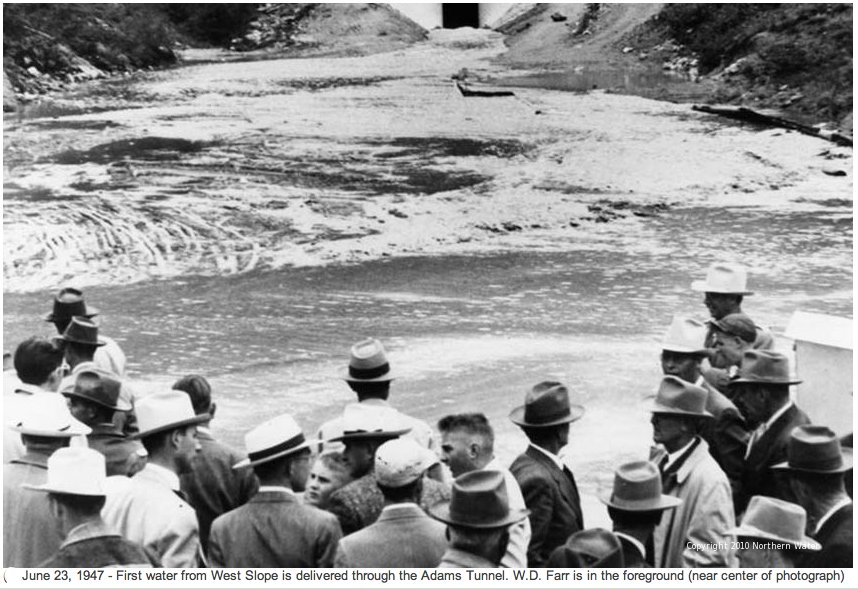
First water through the Adams Tunnel. Photo credit Northern Water.
The YMCA has 312 shares in the federally owned Colorado-Big Thompson (C-BT) Project water system, according to the Northern Colorado Water Conservancy District, which manages the C-BT Project. Flowing straight from the Alba B. Adams Tunnel under the Continental Divide from Grand Lake to the Front Range, the water is among the most highly valued in Colorado. Clean and easily delivered and traded, its value has skyrocketed in recent years.
Under the agreement, the YMCA is transferring 32 shares of its C-BT water to the Town of Estes Park. According to Northern Water, the value of the water varies, but recent sales have been priced at $60,000 to $65,000 per share. Just four years ago the price was closer to $30,000 per share.
That puts the water value of the deal at $1.9M with the YMCA also agreeing to pay the town $1 million over the next 10 years in system development charges.
Reuben Bergsten, Estes Park utilities director, said the town is making an effort to incorporate more small communities who lack modern water infrastructure into their treatment network.
“The town sees it as a civic duty,” Bergsten said.
What the YMCA plans to do with its remaining water rights isn’t clear yet. Jorgensen declined to comment on any other potential sales, but said the resort’s water portfolio is being used fully now to serve customers.
And Jorgensen said the value of the water isn’t the most important piece of the transaction.
“It’s a tremendous relief to be out of the water treatment business,” he said. “Now we can maximize the value of our business for our guests.”
Jerd Smith is editor of Fresh Water News. She can be reached at 720-398-6474, via email at jerd@wateredco.org or @jerd_smith.
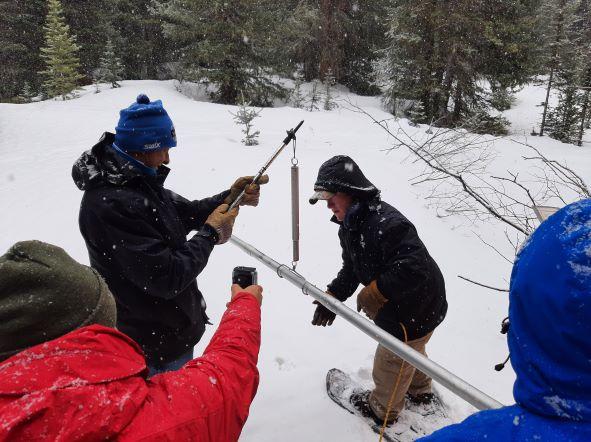
Denver Water field crews measure how much water is frozen in the snow near Winter Park on March 29. The utility’s teams take these kind of measurements at 13 sites every month during the winter and early spring. Photo credit: Denver Water.
Water news seems dreadful these days, with a megadrought in the Colorado River Basin, hydropower at risk in a fast-draining Lake Powell and a warming climate assuring these issues will only get worse.
So, amid these calamities, Denver Water wants to cite a small measure of good news: Soil moisture levels in parts of Colorado have improved.
Yes, this may only be a temporary blip on a downhill slide, but let’s celebrate what we can.
Soil moisture is a key indicator of drought conditions and has a big impact on water supplies. That’s because dry, thirsty soils can drink up a lot of the snowmelt that otherwise would flow into rivers and reservoirs.
Here’s an example from Denver Water’s own system: In 2021, snowpack above Dillon Reservoir peaked at 88% of normal. It wasn’t a banner year for snowpack, but it wasn’t terrible either. But dry soils made the lower snowpack levels far worse — runoff was only 57% of normal.
“The low soil moisture soaked up a lot of the melting snow before it reached rivers and reservoirs,” explained Nathan Elder, water supply manager for Denver Water.
The 2019-20 water year told a similar story, when snowpack peaked at 124% in the South Platte Basin but runoff came in at just 54% of average at one key measuring point.
Low soil moisture can soak up snow runoff, leaving less for rivers and reservoirs. Image credit: Denver Water.
This year, water forecasters expect a better scenario. That’s because a big monsoon season on the West Slope and in the mountains last summer brought soil moisture levels up. Snowstorms on the Front Range throughout the winter helped soils here, too.
“This year, with soil moisture better, we are expecting more runoff from the snowpack,” Elder said.
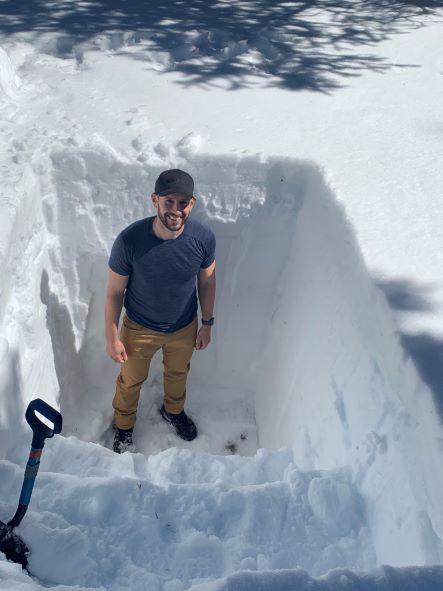
Nathan Elder, water supply manager for Denver Water, in April 2019, standing in a snowpit dug to gauge the snow’s temperature, depth,
Currently, snowpack above Dillon is 87% of normal and, because of greater moisture within the soil, streamflow forecasts are higher too — 82% of normal, a big improvement from last year.
Evidence of the improvement in soil moisture comes thanks to data from NOAA, the National Oceanic and Atmospheric Administration, a federal agency that closely tracks such matters.
The numbers can be complicated, but one way to understand the impact of the soil moisture is in what Denver Water’s water supply managers call “runoff efficiency.”
In a year when soil moisture numbers are just slightly below normal — such as this year — you can expect runoff volumes to be 10% to 15% less than the peak snowpack number.
In a year when soil moisture conditions are worse, as we’ve seen in several recent cases, the dry soils can reduce runoff efficiency by 15% to 20%. That can translate to a big cut in water supply.
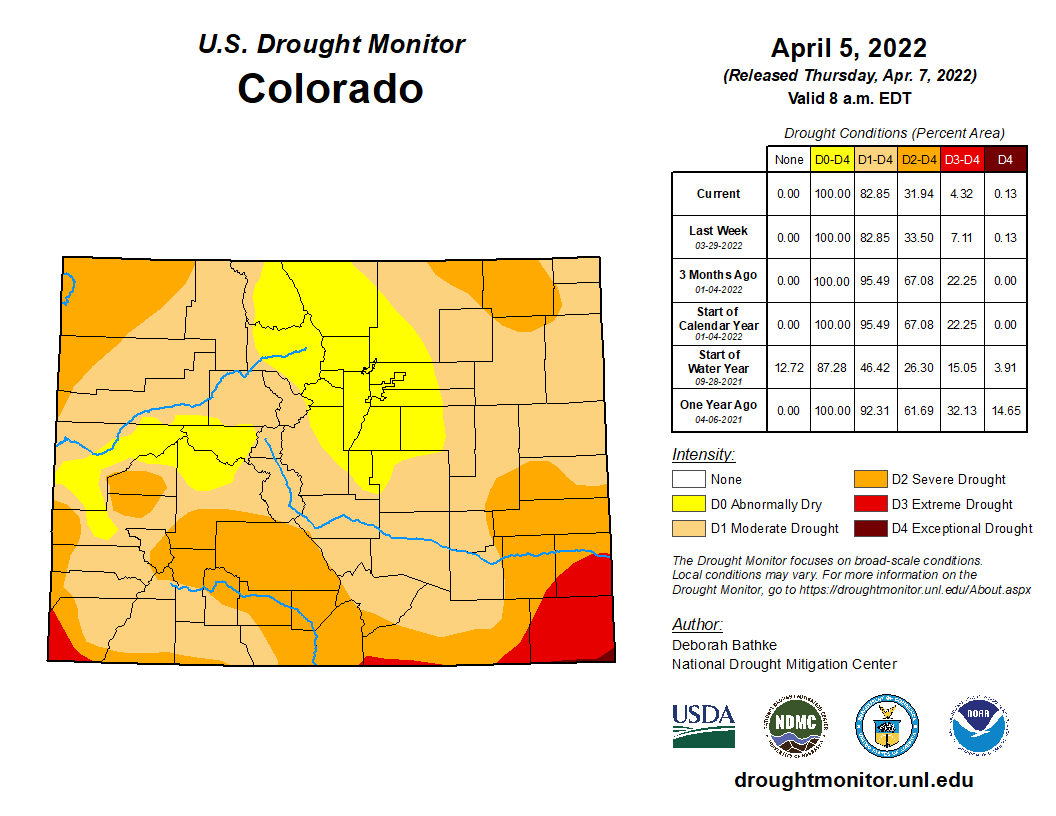
Colorado Drought Monitor map April 5, 2022.
Another key measure comes from the U.S. Drought Monitor map. That map shows the Denver metro area — as well as much of Denver Water’s collection area — in “abnormally dry” conditions. That may sound bad, but it is actually a marked improvement from recent months when much of the state was in various stages of drought.
A year ago, the region’s drought levels ranged from “moderate” to “extreme” drought.
Things can still change, of course.
Should we get a long spell of warm, dry weather this spring, the situation could become worse. But, at this point in early spring, things look a bit better than in recent years.
“We’ll obviously be watching our watersheds and the weather closely,” Elder said. “But we take the good news where we can get it and, at least for the moment, we’re happy to see these conditions.”
The Platte River is formed in western Nebraska east of the city of North Platte, Nebraska by the confluence of the North Platte and the South Platte Rivers, which both arise from snowmelt in the eastern Rockies east of the Continental Divide. Map via Wikimedia.
A proposal to build a canal that would divert South Platte River water from Colorado to Nebraska under a 1923 interstate compact advanced to the final round of debate March 29 after senators amended it to include conflict-of-interest provisions…
LB1015, introduced by Sen. Mike Hilgers of Lincoln, would authorize the state Department of Natural Resources to develop, construct, manage and operate the canal and its associated storage facilities, called the Perkins County Canal Project, under the terms of the compact.
Sen. Machaela Cavanaugh of Omaha introduced an amendment on select file that would prohibit the department’s director, employees and their immediate family members from having a direct or indirect financial interest in any entity that is party to a contract or from having a financial interest in the ownership or lease of any property relating to the development, construction, management or operation of the project. Senators voted 44-0 to adopt the amendment.
A second Cavanaugh amendment, adopted 44-0, would extend the conflict-of-interest provision to members of the Legislature and elected officials in the executive branch of state government…
After adopting the amendments, lawmakers advanced LB1015 to final reading by voice vote.
Construction workers build a single family home in Castle Rock. The community needs new surface water supplies to reduce its reliance on non-renewable groundwater. Credit: Jerd Smith
Castle Rock’s building boom has barely slowed over the past 20 years and its appetite for growth and need for water hasn’t slowed much either.
The city, which ranks No. 1 in the state for water conservation, will still need to at least double its water supplies in the next 40 years to cope with that growth. It uses roughly 9,800 acre-feet of water now and may need as much as 24,000 acre-feet when it reaches buildout.
With an eye on that growth and the ongoing need for more water, Douglas County commissioners are debating whether to spend $10 million in federal American Rescue Plan Act funding to help finance a controversial San Luis Valley farm water export proposal.
Thirteen Douglas County and South Metro regional water suppliers say they have no need or desire for that farm water, according to Lisa Darling, executive director of the South Metro Water Supply Authority. [Editor’s note: Lisa Darling is president of the board of Water Education Colorado, which is a sponsor of Fresh Water News]
“It is not part of our plan and it is not something we are interested in,” said Mark Marlowe, director of Castle Rock Water. “We have invested hundreds of millions of dollars in our long-term plan and we are pursuing the projects that are in that plan. The San Luis Valley is not in the plan.”
Renewable Water Resources, a development firm backed by former Colorado Gov. Bill Owens and Sean Tonner, has spent years acquiring agricultural water rights in the San Luis Valley. It hopes to sell that water to users in the south metro area, delivering it via a new pipeline. In December, RWR asked the Douglas County commissioners for $10 million to help finance the $400 million plus project.
Tonner did not respond to a request for comment for this article, but he has said previously that the water demands in south metro Denver will be so intense in the coming decades, that the San Luis Valley export proposal makes sense.
Opposition to the export plan stems in part from concern in the drought-strapped San Luis Valley about losing even a small amount of its water to the Front Range. But RWR has said the impact to local water supplies could be mitigated, and that the proposed pipeline could help fund new economic development initiatives in the valley.
Stakes for new water in Douglas County and the south metro area are high. In addition to demand fueled by growth, the region’s reliance on shrinking, non-renewable aquifers is putting additional pressure on the drive to develop new water sources.
Denver Basin Aquifer System graphic credit USGS.
Marlowe and other water utility directors in the region have been working for 20 years to wean themselves from the deep aquifers that once provided clean water, cheaply, to any developer who could drill a well. But once growth took off, and Douglas County communities super-charged their pumping, the aquifers began declining. Because these underground reservoirs are so deep, and because of the rock formations that lie over them, they don’t recharge from rain and snowfall, as some aquifers do.
At one point in the early 2000s the aquifers were declining at roughly 30 feet a year. Cities responded by drilling more, deeper wells and using costly electricity to pull water up from the deep rock formations.
Since then, thanks to a comprehensive effort to build recycled water plants and develop renewable supplies in nearby creeks and rivers, they’ve been able to take pressure off the aquifers, which are now declining at roughly 5 feet per year, according to the South Metro Water Supply Authority.
The goal among Douglas County communities is to wean themselves from the aquifers, using them only in times of severe drought.
Ron Redd is director of Parker Water and Sanitation District, which serves Parker and several other communities as well as some unincorporated parts of Douglas County.
Like Castle Rock, Parker needs to nearly double its water supplies in the coming decades. It now uses about 10,000 acre-feet annually and will likely need 20,000 acre-feet at buildout to keep up with growth.
Parker is developing a large-scale pipeline project that will bring renewable South Platte River water from the northeastern corner of the state and pipe it down to the south metro area. Castle Rock is also a partner in that project along with the Lower South Platte Water Conservancy District in Sterling.
Redd said the San Luis Valley export plan isn’t needed because of water projects, such as the South Platte Water Partnership, that are already in the works.
“For me to walk away from a project in which we already have water, and hope a third party can deliver the water, just doesn’t make sense,” Redd said.
The costs of building two major pipelines would also likely be prohibitive for Douglas County residents, Redd said.
“We would have to choose one. We could not do both.”
Steve Koster is Douglas County’s assistant planning director and oversees new developments, which must demonstrate an adequate supply of water to enter the county’s planning approval process.
Koster said small communities in unincorporated parts of the county reach out to his department routinely, looking for help in establishing sustainable water supplies.
He said the county provides grants for engineering and cost studies to small developments hoping to partner with an established water provider.
“All of them are working to diversify and strengthen their water systems so they are sustainable. Having a system that encourages those partnerships is what we’re looking at,” Koster said.
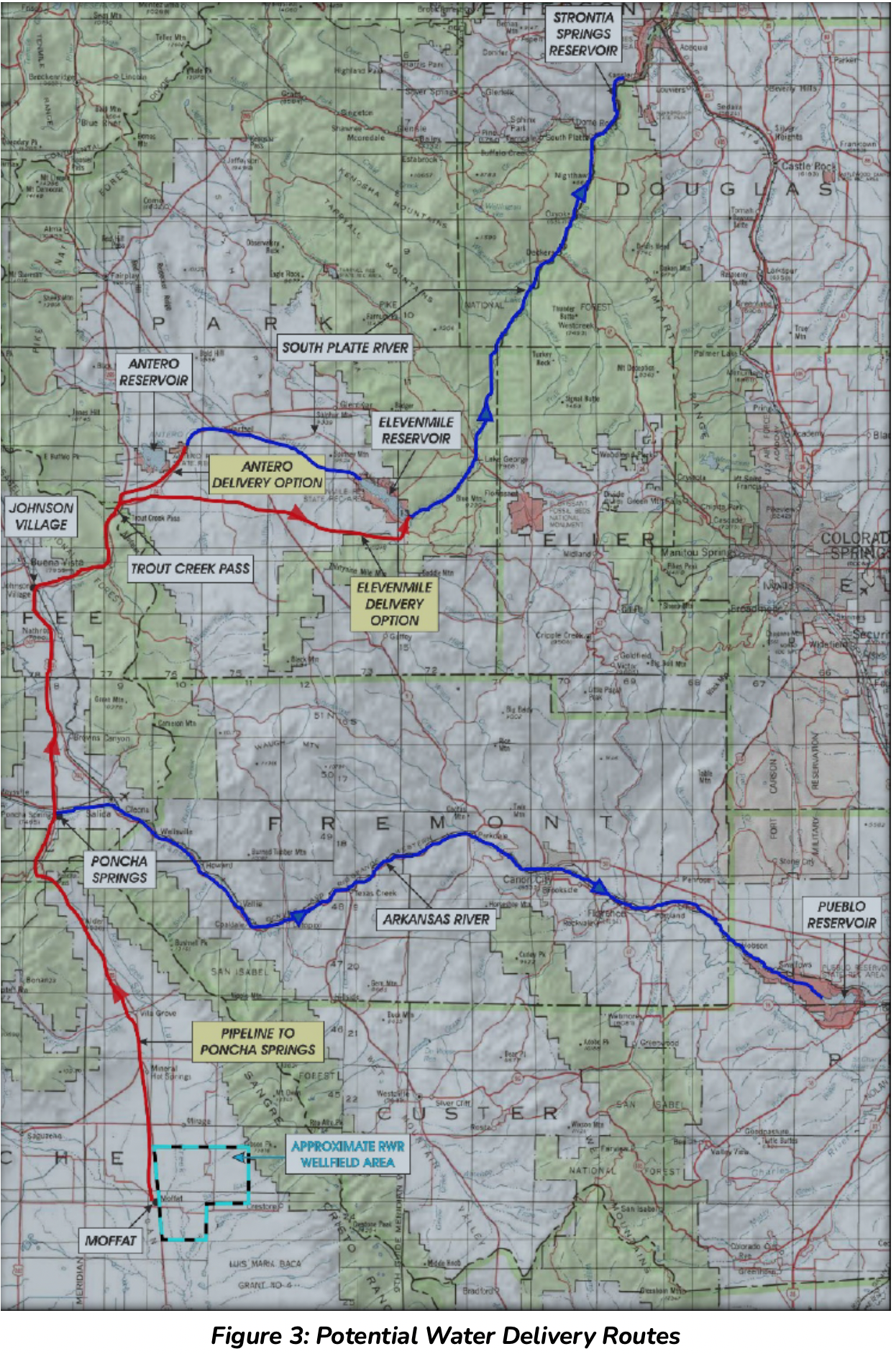
Potential Water Delivery Routes. Since this water will be exported from the San Luis Valley, the water will be fully reusable. In addition to being a renewable water supply, this is an important component of the RWR water supply and delivery plan. Reuse allows first-use water to be used to extinction, which means that this water, after first use, can be reused multiple times. Graphic credit: Renewable Water Resources
Whether an RWR pipeline will play a role in the water future of Douglas County and the south metro area isn’t clear yet.
Douglas County spokeswoman Wendy Holmes said commissioners are evaluating more than a dozen proposals from water districts, including RWR, and that the commission has not set a deadline for when it will decide who to fund.
Jerd Smith is editor of Fresh Water News. She can be reached at 720-398-6474, via email at jerd@wateredco.org or @jerd_smith.
View down Clear Creek from the Empire Trail 1873 via the USGS
Click the link to read the article on the Canyon Courier website (Corinne Westeman). Here’s an excerpt:
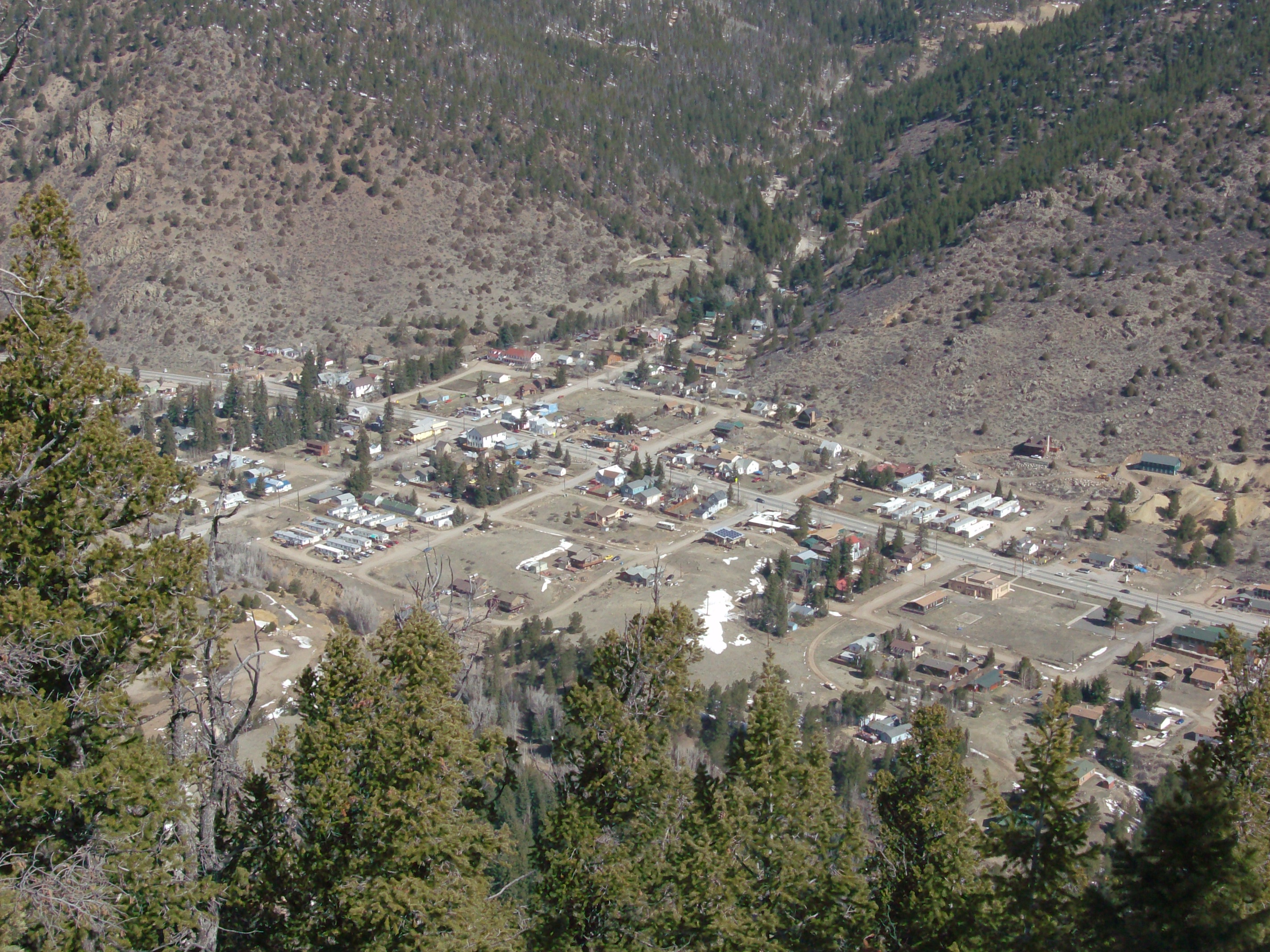
Empire has confirmed there’s a leaking water pipe on private property, and there’s another suspect area underneath U.S. Highway 40.
Police Chief John Stein stated on April 1 that, while the leak on private property was confirmed to be drinking water, it was relatively small compared to the town’s overall system. So, it cannot be the sole cause of Empire’s loss in water last month, he described.
The suspect area underneath U.S. 40, which Stein said could be a valve that isn’t shutting completely or a cracked pipe, requires further research. If it’s a valve that’s not closing completely, water might not be leaving the system in that location, he explained.
Stein said he couldn’t guarantee it, but Empire’s water woes could be from these two problems plus residents’ relatively high water use during last month’s cold spell.
It’s still possible, he continued, there is a larger issue with the water infrastructure that the town and its partners haven’t identified yet.
Brighton Village mobile home park next to a river. Multiple trailers are intersperses with bare deciduous trees on a riverbank. Photo credit: Aqua Talk
Click the link to read the article on the Aqua Talk website (Amy Schultz and Jorge Delgado):
The Brighton Village mobile home community (Park) is a 28-home community in Adams County that serves around 80 people and is a disproportionately impacted community, defined in HB21-1266 Environmental Justice Disproportionate Impacted Community. The department initially issued an Enforcement Order in 2003 due to high nitrate values and the Park’s failure to comply with the nitrate maximum contaminant levels. Infants below the age of six months who drink water containing nitrate above the MCL could become seriously ill and, if untreated, may die. Symptoms include shortness of breath and blue baby syndrome.
The 2003 enforcement order was closed in 2010. However, the department again issued an Enforcement Order in 2012 for nitrate violations and did so again in 2018. The Park had installed treatment but did not have the capabilities or the resources to operate the treatment appropriately to reliably achieve compliance. The long-term exposure to an acute contaminant created environmental injustices for this community.
From the EPA, environmental justice is “the fair treatment and meaningful involvement of all people regardless of race, color, national origin, or income, with respect to the development, implementation, and enforcement of environmental laws, regulations, and policies.” The Colorado Environmental Justice Act recognizes that all people have a right to drink clean water and live free of dangerous levels of toxic pollution, experience equal protection of environmental policies, and share the benefits of a prosperous and vibrant pollution-free economy.
The department facilitated meetings with the Park and the City of Brighton. The City of Brighton and the Park decided that the best way to serve safe drinking water to the public was to connect the park to the City’s municipal water supply. However, the Park was required to upgrade its water distribution system before the connections could be made. The department provided the Park with $16,000 in grants that allowed the Park to connect to the municipal water supply.
The Safe Drinking Water Program worked in partnership with both the Park and City of Brighton to ensure this disproportionately impacted community is being provided with access to a consistent and reliable source of safe drinking water. This is an Environmental Justice win for the residents of this community, the department, and Colorado.
Registration Full for Spring Water Users Meeting on April 13
The Northern Water Spring Water Users Meeting is now at capacity and accepting names for a waitlist. The annual meeting is from 8 a.m.-2 p.m. on April 13 at the Embassy Suites in Loveland.
The meeting includes time for water users throughout Northern Water boundaries to provide input regarding the 2022 quota level for the Colorado-Big Thompson Project. Information gathered at the meeting will be included in the data used by the Northern Water Board of Directors to set the quota at its monthly board meeting on April 14. If you would like to provide feedback regarding the quota via email, please email generaldelivery@northernwater.org by 5 p.m. on April 13.
In addition, the meeting will provide an opportunity to learn about the latest activities being carried out by Northern Water, such as the construction of Chimney Hollow Reservoir, the restoration of lands damaged by the 2020 Colorado wildfires and the future of our forested source watersheds.
To add your name to the wait list or if you have registered and are now unable to attend, please email events@northernwater.org.
A long-planned project to restore healthy ecosystems along the South Platte River and two other waterways in central Denver got a major boost from the federal government this week, in the form of $350 million in funding from the U.S. Army Corps of Engineers.
The funding for the South Platte River Project, spearheaded by Denver and Adams counties, will cover nearly two-thirds of the $550 million that civic leaders plan to spend restoring wetland habitats, improving recreation and mitigating flood risk along a 6.5-mile stretch of the river, along with Weir Gulch and Harvard Gulch.
The funds awarded Tuesday by the Biden administration are part of the $17 billion appropriated by a new federal infrastructure law to the Army Corps of Engineers to support flood mitigation projects across the country.
GET THE MORNING HEADLINES DELIVERED TO YOUR INBOX
“I’m delighted to welcome funding from the bipartisan infrastructure bill for the South Platte River and surrounding communities after years of urging Washington to support this project,” Sen. Michael Bennet said in a statement. “For decades, the neighborhoods bordering the South Platte River have experienced environmental hardship. This project is an important part of Denver’s efforts to protect communities and businesses from flooding, build resilient infrastructure, and help ensure that anyone who wants to live and work in Denver is able to.”
The Army Corps of Engineers finalized a feasibility and impact study on the project in 2019, concluding more than a decade of planning and environmental reviews. In addition to restoring aquatic, wetland and riparian wildlife habitats along the South Platte, supporters say the plan will create more than 7,000 jobs and protect hundreds of homes and other structures from flood risk.
In December, Denver Mayor Michael Hancock convened a coalition of two dozen interest groups that signed a memorandum of understanding on the project in order to secure federal funding. Signatories included the Colorado Water Conservation Board, Denver Water and multiple environmental and conservation organizations — as well as business and real-estate groups like the Denver Metro Chamber of Commerce and Revesco Properties.
Revesco is the developer behind the massive, multi-billion-dollar River Mile project, which aims to redevelop 62 acres along the Platte south of Confluence Park over the next 25 years, adding homes for new 15,000 residents and ultimately displacing the Elitch Gardens amusement park. The river restoration project, too, is likely to take decades to complete, with city officials estimating in 2018 that the project could be finished in 10 to 20 years.
“The restoration and conservation of the South Platte River ecosystem is a phenomenal opportunity,” Hancock said in a statement. “Infrastructure investments like this do more than just improve our waterways, they build lives, they build communities and they build futures.”
SUPPORT NEWS YOU TRUST.
Colorado Newsline is part of States Newsroom, a network of news bureaus supported by grants and a coalition of donors as a 501c(3) public charity. Colorado Newsline maintains editorial independence. Contact Editor Quentin Young for questions: info@coloradonewsline.com. Follow Colorado Newsline on Facebook and Twitter.
On an average day, 25 people move to Douglas County. Each one needs to drink, shower, water their lawn and wash their dishes. The full impact of that growth is difficult to see, but it’s easy to understand: more people need more water. And in a county where thousands of homes rely on a limited supply of underground aquifers, water providers are constantly working to shift to more sustainable resources before they run out.
Denver Basin Aquifer System graphic credit USGS.
Some aquifers buried under Douglas County have lost two to six feet in depth of water. Local water providers have noticed their supply wells aren’t producing like they once did.
“It’s like sucking water out of the bathtub with a straw,” said Rick McLoud, water resources manager for Centennial Water & Sanitation. “There’s only so much water in the bathtub and the sooner you suck it out with a straw, the sooner it will be gone.”
[…]
To meet those demands, water providers are planning a mix of conservation efforts, wastewater projects and new infrastructure for renewable resources of water. The county government is also looking at how to bring in more water and is considering spending a portion of their $68 million in federal funds from the American Rescue Plan Act on the issue.
‘Overreliance on groundwater’
As Douglas County’s development has surged since the 1990s, many of the largest communities such as Parker and Castle Rock have relied on groundwater to fill residents’ bathtubs and sinks, said State Engineer Kevin Rein…Groundwater from aquifers makes up about 65% of the water used by Parker Water and Sanitation, which is the provider for Parker and parts of Lone Tree and Castle Pines, and by Castle Rock Water. Centennial Water uses about 20% groundwater. Those ratios can change depending on drought conditions…
Douglas County sits on a layer of several aquifers, including the Arapahoe, Denver, Dawson and the Laramie-Fox Hills aquifers. Most major water providers use the water in the Arapahoe and Denver aquifers, which reach depths of 1,700 and 600 feet beneath the ground, respectively…
Under Douglas County’s guidelines for development in unincorporated areas, only the western part of the county is not allowed to rely on their groundwater for development, said Steve Koster, assistant director of planning services for the county. Those communities must provide either a renewable water source or use groundwater from the eastern part of the county. Koster said the county is not actively looking at requiring or incentivizing developers to instead look for renewable resources of water…
Parker Water and Sanitation is working on a project that will partner with a water conservancy district in Sterling, a town in eastern Colorado, to capture unused water during high runoff years from the South Platte River there and store it to pipe back to the town. The project won’t impact existing water rights and won’t allow buy-and-dry of nearby agriculture, Redd said. In order to meet Parker’s projected water demands, the project will need to be complete by 2040, Redd said. That project would get Parker Water to 75% renewable water and would provide water for more than 300,000 people in Douglas County, including in Parker, Castle Rock and portions of Castle Pines and Lone Tree, according to a project proposal. Castle Rock Water is a partner on that project.
Over the next 20 to 30 years, Castle Rock plans to invest about $500 million in renewable water projects including new pipelines, additional storage and water rights. Marlowe said the reason they spread out those projects over time is to keep rates for their customers down. By 2050, Castle Rock plans to move to 75% renewable and by 2065 have a 100% renewable system for wet or average years.
Dominion Water and Sanitation, which serves about 1,200 homes in Sterling Ranch, plans to be 90% renewable by 2040. Sterling Ranch is slated to add about 11,000 more homes to their community in that same time period at a rate of 450 homes per year. Dominion also plans to include about 700 other existing homes from smaller communities to their service area soon. Right now, Dominion is 100% renewable but is set to drill wells in the Cherokee Ranch area to blend some groundwater into their system, making it more drought-resistant, Cole said. They are also planning to build a river intake on the South Platte River and a wastewater treatment facility, which will provide at least 1,600 acre-feet of water per year to Sterling Ranch…
Castle Rock plans to incorporate programs in the coming years that encourage more efficient utilities and lawns that don’t require heavy irrigation. At the statewide level, a bill being considered by the legislature this session would pay residents up to $2 per square foot to rip out their irrigated turf and replace it with less thirsty alternatives. Sterling Ranch has focused on a program they call “demand management” that allows residents to have a live look at their water usage and bills…Their community also has banned the use of bluegrass, a type of turf that demands lots of water. Instead they offer a variety of drought-resistant plants for landscaping…
A view of public lands around the Sangre de Cristo Mountains and just south from the area Renewable Water Resources has proposed a wellfield for water exportation. Photo credit: Alamosa Citizen
As the commissioners consider how to approach the issue, $68 million in federal funds has the potential to aid in addressing the water demands of a growing community. One proposal for the money, which the commissioners have dedicated six two-hour meetings to discussing, would pump about 22,000 acre-feet of water per year to Douglas County from the San Luis Valley. Renewable Water Resources, the private company proposing the project, says that’s enough for 70,000 houses. The project has been met with ire from many in the valley, though, as multiple water conservation districts and elected officials there have said they don’t have enough water to spare and it would damage their agriculture-based economy…So far, all the major water providers in Douglas County have said they are not interested in using the water from the RWR proposal. Darling says that’s in part because many providers have already heavily invested in other projects…
Commissioners have also heard presentations from Parker Water, who asked them to consider using about $20 million of the federal funds to help their South Platte River project, and Dominion, who asked for help funding their regional wastewater plant in partnership with Castle Rock Water and the Plum Creek Reclamation Authority.
Click the link to read the article on The Greeley Tribune website (Jeff Rice, The Fort Morgan Times). Here’s an excerpt:
Collaboration will yield a lot more South Platte River water for Nebraska than trying to finish a ditch that’s been abandoned for more than a century. That was the consensus at a freewheeling panel discussion in Sterling Monday afternoon as Nebraska Sen. Theresa Thibodeau met with water experts from Colorado to learn more about the water that flows into her state across the state line near Julesburg.
Thibodeau is a candidate for the Republican nomination for governor in Nebraska. Her visit was prompted a proposal by incumbent Gov. Pete Ricketts to finish digging the Perkins County Canal from the South Platte River near Ovid to a reservoir somewhere in Nebraska. The canal is allowed under the terms of the South Platte River Compact of 1923, and can divert up to 500 cubic feet per second out of the river. But without the canal, Nebraska can’t exercise that water right…
The panel consisted of Thibodeau, Bruce Gerk, a member of the South Platte Roundtable, Jim Yahn, manager of the Prewitt and North Sterling reservoirs, Don Chapman, manager of Riverside Irrigation District near Sterling, and Joe Frank, general manager of the Lower South Platter Water Conservancy District. Among the dozen or so attendees were Colorado Sen. Jerry Sonnenberg of Sterling, former state senator and agriculture commissioner Don Ament, Gene Manuello, vice president of the LSPWCD, and Logan County Commissioner Byron Pelton. During Monday’s discussion, Thibodeau made it clear that Nebraskans will do whatever is necessary to protect the water they now get and that they have a right o in the 1923 compact…
Yahn. Chapman and Frank gave Thibodeau a short course on Colorado’s water reality. The most important point, and one they stressed repeatedly, is that return flow and seepage from irrigation in Colorado is what makes the South Platte the year-round river it is today. Sonnenberg pointedly asked the panel what would happen to the multitude of water augmentation projects that operate during the winter months along the lower Colorado reach of the river if Colorado had to try to deliver 500 cubic feet per second into the Perkins Canal. Chapman said it was “very likely” that those projects, which replace water drawn out by pumps during the irrigation season, would be harmed, leading to curtailment of pumping. It also would probably diminish the return flow that ends up in Nebraska. Manuello said one of the worst myths about the river is the amount of water that flows out of Colorado. He said that, while it’s true spring runoff and occasional flooding send large amounts of water downstream, those events are of short duration and probably wouldn’t be available for use in the Perkins Canal.
Most Empire residents and businesses are still without water, as of March 25, 2022 as town officials continue to search for a suspected large leak in the town’s water infrastructure. Anyone who does have water service is under a boil warning, which will remain in place until water service is restored to the entire town and it has been tested, Mayor Wendy Koch said. According to Koch and Police Chief John Stein, most of the town’s infrastructure has been pressurized with gas to locate the suspected leak. Those efforts didn’t yield any major leaks, but several smaller issues were noted and are now being addressed, Koch said. Now, Empire is restoring water service to different sections of the town to see if that helps to locate the suspected leak.
Stein said Empire will be hosting public updates at 10 a.m. March 28 and 6:30 p.m. March 29 at Town Hall. The latter will include an opportunity for public comment, but the former is an informational meeting only…
An emergency declaration has been made to assist with resources and seeking funding, Stein stated. Colorado’s Water/Wastewater Agency Response has been activated and is assisting, and volunteers were scheduled to deliver two cases of bottled water to every housing unit on March 25…
Stein said that, thankfully, several municipalities have offered to help fix whatever the problem is. However, the town is “still in detection mode,” he said. Another piece of good news, Koch detailed, is that surface water levels are back up thanks to the warmer weather. Additionally, Koch and Stein stated, Empire is adding a new filtration system to its old well. The state health department approved the design on March 24, and crews will start work on March 28.
If all goes according to plan, Koch said the town might have water service mostly restored by April 1. However, she stressed that she couldn’t guarantee it.
Commerce City: This is east of Denver, the industrial suburb of Denver. Photo credit: James from Boulder, USA
Click the link to read the article on The Denver Post website (Noelle Phillips). Here’s an excerpt:
The Colorado Department of Public Health and Environment, which submitted the 373-page permit for Suncor, has 90 days to respond to the EPA’s objections and then resubmit. The operating permit regulates the level of various toxic pollutants the refinery can release into the air. The EPA’s objections do not affect the Suncor refinery’s operations and they do not mean the agency will eventually deny the permit renewal.
The Suncor refinery in Commerce City is pictured on Sand Creek near where it meets the South Platte River. Both streams have highly challenged water quality, though many conservationists argue they can get still better. Photo credit: Suncor
The refinery has been operating under a permit that was issued in 2006. Those air-quality permits are supposed to be renewed every five years, but Suncor and the state have not applied for renewal since then, meaning the plant has been operating on an expired permit for 16 years.
The EPA’s objections focused on three sites at the refinery where Suncor uses flares to burn off excess chemicals. The state’s Air Pollution Control Division, which falls under the health department, wanted to exempt those flaring sources from regular monitoring requirements, according to a letter to the agency from KC Becker, the EPA’s regional administrator. The EPA is asking the state to do more analysis and better explain why it believes the flare sites don’t need additional monitoring. The EPA also expressed significant concern about the refinery’s environmental impact on people who live and work within a three-mile radius of the plant, and the federal agency suggested multiple steps the state can take to improve communication with the community when it comes to permitting for the plant and reporting on the pollution that comes from it, the letter said.
Click the link to read the article and view the video on the 9News.com website (Janet Oravetz and Courtney Yuen). Here’s an excerpt:
The city is considering a first of its kind ordinance that would restrict the use of cool weather turf in new developments and new golf courses beginning next year. According to the city, Aurora averages just 15 inches of precipitation each year, and said that cool weather turf typically requires “substantial watering” to survive. Outdoor usage accounts for roughly 50% of water usage annually in Aurora, according to the city…
Turf means any cool season species, variety or blend, including but not limited to Kentucky bluegrass and Fescue, according to the city. In general, it would include those with an annual irrigation water requirement greater than about 9.3 gallons per square foot.
The ordinance, if passed, would prohibit turf for aesthetic purposes only, but would allow it in new developments “in active or programmed recreation areas.” Those are defined as an area with a primary function of sport field but can also accommodate secondary functions, including but not limited to non-organized sporting events, cultural activities and organized social gatherings. The ordinance will prohibit turf in common areas, medians, curbside landscape and front yards. For backyards, turf would be restricted to 45% of the yard, or 500 square feet, whichever is smaller.
Vail has begun methodically removing grass from its parks from areas that serve little purpose, partly with the goal of saving water. Buffehr Creek Park after xeriscaping. Photo: Town of Vail
Click the link to read “Say ‘goodbye’ to grassy yards – [Aurora] may implement heavy restrictions on turf” usage on OutThereColorado.com (Spencer McKee). Here’s an excerpt:
According to Aurora Water, about half of the city’s outdoor water usage is due to people watering their ‘turf,’ with turf being defined as ‘cool weather’ grass species, such as Kentucky bluegrass. This ‘turf’ is the type of grass that is specifically addressed in the proposal, with the goal of the suggested change being to limit overall outdoor water usage amid the city’s continued growth…
The changes would take effect next year, if the proposal is approved.
THIS was supposed to be the week that the three Douglas County Commissioners, Lora Thomas, Abe Laydon and George Teal, visited the San Luis Valley to host a community meeting on Douglas County’s consideration of the Renewable Water Resources proposal to export water out of the Valley north.
There’s still an expectation that Laydon and Teal will find their way down, on their own, away from the public spotlight in their own pursuit of reasons to support or not the Renewable Water Resources plan.
For her part, Thomas has been opposed from the outset and prefers that Douglas County focus on a water project in its own backyard – the Platte Valley Water Project with Parker Water & Sanitation and Castle Rock Water.
She’s also been troubled by what she sees as conflicts of interest among her fellow commissioners for their public positioning of RWR and their perceived coziness with Republican moneyman Bill Owens, a former governor of Colorado, and his entourage at Renewable Water Resources.
It would have been those dynamics, a split and at times feuding Douglas County commission, that would have arrived at the Ski Hi Regional Events Complex in Monte Vista to hear from Valley residents. But after Teal made comments that there was nothing to gain from such a meeting since Valley residents didn’t seem interested in finding a deal with Douglas County and supporters of RWR felt threatened and silenced, the commissioners punted.
That doesn’t mean Douglas County – and Laydon and Teal, specifically – has lost interest in RWR. Quite the contrary. What’s puzzling is nobody outside RWR understands why, particularly since Douglas County is not a provider of water services and would find itself entangled in years of litigation at a minimum.
“I have zero ulterior motives, other than wanting to secure proactive win/win water solutions for both communities,” Laydon said to Alamosa Citizen. “I’m persuaded by facts, not noise or propaganda. We have engaged in a deep-dive water series and study with a hydrologist and water attorney who have yet to compile their findings into final recommendations.”
The three commissioners huddled in executive session for two hours Monday to hear from Stephen H. Leonhardt with the law firm Burns Figa & Will, and Tom Hatton from Applegate Group, Inc. Leonhardt and Burns Figa & Will have been retained as special counsel to help Douglas County understand the legal issues surrounding the Renewable Water Resources proposal, while Applegate Group, Inc., has been retained to consult on engineering and hydraulic aspects of the RWR plan, according to public files.
Both the special legal counsel and Applegate consultants had their contracts recently amended to include more money and more time on the RWR plan. Douglas County also this month issued a request for qualifications (RFQ) for additional water consultant services. The RFQ has an April 8 deadline.
Following Monday’s lengthy executive session, the commissioners will receive a confidential memo summarizing what they heard. Where they are with a decision on RWR is harder to determine. Since Thomas is opposed and Teal is in support of RWR, the past weeks have become the Abe Laydon show to see where he lands.
“I don’t know where we’re headed,” said State Sen. Cleave Simpson, who is also general manager of the Rio Grande Water Conservation District and is a farmer and rancher in the San Luis Valley.
San Luis Valley Groundwater
Like others who have made presentations to help Douglas County commissioners understand the ever-declining water conditions of the San Luis Valley aquifers – the unconfined and confined – and threats to the Valley’s ecosystem from 20 years of drought and loss of wetlands, Simpson is frustrated at the spectacle Douglas County has created.
“To make this thing work they have to change the rules and regulations that we all have lived under and crafted over the last 20 years,” he said of the Renewable Water Resources proposal.
It’s not simply Laydon casting the deciding vote to move the RWR proposal forward. If he were to take that gamble for Douglas County, RWR then would have to ask State Engineer Kevin Rein to change the rules governing water to meet the intent of their proposal, said Simpson.
“If I was Douglas County I’d say ‘I’m not going to give you a dime until you get the rules changed’ and the likelihood of them changing the rules here is nearly zero percent from my perspective,” Simpson said.
Coming out of Monday’s executive session with their special counsel and hydrologist consultant, Laydon said he was happy to hear the expertise and “objective facts” that were discussed. He and Teal have made it a point to say Valley representatives and residents they’ve heard from are not objective and instead overfilled with emotion.
“I very intentionally have taken the emotion out of my presentations and conversations with them,” said Simpson. “And honestly, even the folks at RWR from the very beginning, I said ‘I appreciate this is a business proposition from your perspective, I’m happy to sit down with you and let’s debate the pros and cons, but you can’t put out false information.’
“They claim we’re putting out false information and I can say with absolute certainty none of the stuff that I’ve presented or the meetings I’ve been in with them is false information. It’s all 100 percent accurate and quite the contrary from the other perspective. I can demonstrate without doubt that the information they’re getting is false.”
Rio Grande River basin drought monitor map March 22, 2022.
Simpson has sat with Laydon and extended invitations to bring in others like Ken Salazar, the U.S. ambassador to Mexico and one of Colorado’s foremost experts in water law, to help Laydon better grasp the drought conditions and over pumping situation in the Valley. Former Alamosa County Commissioner Darius Allen is another person Laydon has been invited to hear from.
For Laydon, he’s focused on the consultants that Douglas County has hired to help him make a decision. Presumably he heard some of what he’s looking for in Monday’s closed meeting. Following it he, Thomas and Teal sat through their first presentation on the Platte Valley Water Project.
About 20 people attended an in-person meeting to discuss the Colorado River Connectivity Channel last month in Granby. Another 30 attended via Zoom, with the group learning about the benefits of the Connectivity Channel and other impacts associated with the project. Water Resources Project Engineer and CRCC Project Manager Kevin Lock was joined by Director of Engineering Jeff Drager, Collections Systems Department Manager Craig Friar and Public Information Officer Jeff Stahla at the in-person meeting.
The meeting took place as part of a public comment period on the Draft Watershed Plan and Environmental Assessment (Plan-EA) for the Colorado River Headwaters Connectivity Project. The U.S. Department of Agriculture, Natural Resources Conservation Service (NRCS) and project sponsors (Grand County, Trout Unlimited and Northern Water) recently announced the availability of that draft plan.
The Connectivity Channel is one of the key elements of the Chimney Hollow Reservoir Project’s $90 million mitigation and enhancement package. Once complete, it will reconnect the Colorado River around Windy Gap Reservoir.
Members of the public took part in an in-person meeting on Feb. 22 in Granby to discuss the Colorado River Connectivity Channel.
Click the link to read the article on the News on Tap website (Steve Snyder):
The construction of Denver Water’s new Northwater Treatment Plant is on budget and on track to open in 2024, having overcome challenges during 2021 stemming from the COVID-19 pandemic that affected everything from staffing to the supply chain.
This aerial photo from late 2021 shows construction progress on several buildings at the Northwater Treatment Plant. Photo credit: Denver Water.
The Northwater plant, on Highway 93 north of Golden, will be the fourth drinking water treatment plant in Denver Water’s system.
When finished, the new plant will be capable of producing up to 75 million gallons of clean drinking water per day using state-of-the-art technology. The new plant, part of Denver Water’s North System Renewal work, supplements the utility’s aging Moffat Treatment Plant on West 20th Avenue in Lakewood, which was built in the 1930s.
The new plant is being built on 100 acres of Denver Water land next to the utility’s Ralston Reservoir. The site will include seven primary buildings and multiple auxiliary facilities including tanks, clearwells, pump stations and vaults.
Here are some of the highlights from the work done during 2021:
Passed 50% construction completion.
Passed 1 million hours worked.
Completed all the remaining excavation needed to build the structures that will be part of the plant.
Placed concrete base slabs for the two underground storage tanks. Called “clearwells,” these 10-million-gallon storage tanks will hold clean, treated drinking water from the plant until it is released into Denver Water’s distribution system.
The concrete base of a large, treated water storage tank, or “clearwell,” was placed during one night in June 2021, marking a major milestone for the project. Photo credit: Denver Water.
Dried in” the first building on-site, meaning the work was done to make the exterior surfaces of the Clearwell Influent Valve Vault building impermeable to rain and weather.
Installed the roof and windows and applied a stone veneer on the plant’s Operations Building and started installation of mechanical, electrical and plumbing works.
Completed most of the necessary connections with the Moffat Treatment Plant to enable Moffat to eventually store treated water piped from the Northwater Treatment Plant once the new facility is operational.
Earned the Envision Gold Award from the Institute for Sustainable Infrastructure. Envision Awards recognize leadership in building sustainable infrastructure around the world and encourage those involved to consider sustainable choices throughout the life of the project.
An artist’s rendering of what the site of the Northwater Treatment Plant will look like when completed in 2024, along with locations of the buildings on-site. Photo credit: Denver Water.
The town of Empire is warning residents of possible interruptions to their water service as its treatment plant struggles to meet demand. In a press release Saturday, town officials warned residents that they should prepare for intermittent loss of water and low pressure, with residents at higher elevations expected to see a greater loss of water pressure.
The Clear Creek County town’s water treatment facility is not able to produce enough clean water to meet demand and is at critically low levels, the release said. Officials said the facility’s water supply, Madd Creek, is too low because of freezing conditions and an ongoing suspected water leak, which crews are attempting to locate, is compounding problems. The town is working to increase the water intake at the source and supplement water into the plant.
Some residents and businesses Sunday morning were reporting no running water, which has forced businesses like Guenella Pass Brewery to close indefinitely.
Click the link to read the article on the 9News.com website (Wilson Beese). Here’s an excerpt:
The town said its water treatment facilities have been restored, and the system has been flushed through the distribution network after suffering damage during the wildfire…
Reservoir ash removal
The fire deposited ash on the town’s raw water storage at Terminal Reservoir. A firm has been contracted to remove ash from the banks of the reservoir, which will prevent deposited ash from going into the reservoir. The process should be completed in early April.
Chlorine dioxide
Superior installed chlorine dioxide within water treatment plant operations to assist with the oxidation and breakdown of compounds causing the taste and odor issues. Complaints from residents continued after the system was installed, and its use was discontinued.
Granular Activated Carbon (GAC)
The town ordered a GAC system to remove compounds causing the taste and odor issues. It will take four to six weeks for delivery and an additional two weeks for installation.
“This is a significant process revision and will require extensive modifications to the plant,” the town said in a release. “Our team is diligently working, including collaborating with other utilities, on procuring all the equipment required to bring this system online as fast as possible.”
Reservoir draining
Superior will soon begin releasing water from the reservoir into the parks irrigation system, which might help replenish the reservoir with water free of compounds causing the taste and odor issues.
Home filtration systems
The town said that home water filtration systems, especially those that use activated carbon, “may effectively remove” the compounds responsible for the taste and odor issues.
After the 2013 flood did massive damage in Loveland, the city led efforts to do repairs to public infrastructure, spending $37 million over the next six years. But city staff members, briefing the Loveland City Council on Tuesday on the Big Thompson River Financial Plan, said there’s much more that needs to be done to make the city resilient when future floods occur…Stormwater engineer Kevin Gingery said records of flooding on the Big Thompson River go back to 1906, and show historically the river has flooded on average every eight years — 12 damaging floods in a century…Since 1987, the river has flooded twice, in 1999 and the massive flood in 2013. Both of those floods and one in 1951 are considered of a 100-year magnitude or greater, according to the Federal Emergency Management Agency (FEMA) Flood Insurance Rate Study…
The new mapping effects future development of the 402 corridor, all bridge crossings of the river, and implementation of the Big Thompson River Corridor Master Plan, city officials said…Many of the bridges on the river are undersized, and sometimes silt builds up under them. The plan calls for removing the excess silt so more water can pass under the bridges.
Other problems include large trees that block river flow, and logs that fall into the river can create a safety hazard for river users.
Carlson pointed to the bridge on South Lincoln Avenue. Crews repaired damage there from the 2013 flood, but the bridge needs to be substantially bigger to withstand future floods, he said. Before the flood, the highest discharge recorded there was 19,000 cubic feet per second; the new 100-year discharge level is 20,429 cfs, so city staff wants to build a larger bridge that can handle a greater flow. Work also is needed in Fairgrounds Park and Barnes Park to better channel flood waters under the bridge, something that could help property owners in the floodplain in that area, Carlson said.
The Metro District Board is set to meet at 5 p.m. Monday, March 14, to vote on a possible extension of the temporary pause on permit sales until April 12. The board initially voted to pause the sales in January and had hoped to resume them this month…
According to a report from Alan Leak at RESPEC Engineering, Pueblo West could support the sale of 14,000 total water taps “without a significant reduction in water stored in Pueblo West’s accounts in Pueblo Reservoir and Twin Lakes over the next 5 years.”
Pueblo West currently has about 33,000 residents, so total growth could be about 47,000 people. The district’s 1972 service plan called for growth to 39,000 residents…The halt on water tap sales came after a standing- room-only crowd of residents urged the board to stop explosive growth at the Nov. 8 meeting, making it clear they don’t want to see skyrocketing water and sewer rates….
Data provided by the district’s consulting groups will be available for residents to review prior to Monday’s meeting at http://pueblowestmetro.com/waterstudy.
Women in Prescribed Fire Training Exchange participants practice different controlled burning ignition patterns. Photo courtesy Lenya Quinn-Davidson, Fire Adapted Communities Learning Network via USDA
Click the link to read the article on the Associated Press website (Brittany Peterson and Matthew Brown). Here’s an excerpt:
[Controlled burn] operations are a central piece of the Biden administration’s $50 billion plan to reduce the density of western forests that have been exploding into firestorms as climate change bakes the region. But the same warming trends that worsen wildfires will also challenge the administration’s attempts to guard against them. Increasingly erratic weather means snow is not always there when needed to safely burn off tall debris piles like those on Colorado’s Pike-San Isabel National Forest. And that seriously complicates the job of exhausted firefighters, now forced into service year-round…Western wildfires have become more volatile as climate change dries forests already thick with vegetation from years of intensive fire suppression. And the window for controlled burns is shrinking.
“It’s been a little bit harder just because of shorter winters,” said David Needham, a U.S. Forest Service ranger who led the Colorado burn operation in late February when the thermometer hovered around zero degrees Fahrenheit (minus 18 Celsius). Surrounding hillsides showed barren scars from past wildfires, including a 2002 blaze that destroyed 133 homes and at the time was the largest in state history.
Aerial view from the south of Hayman Fire June 30, 2002. Road traversing from left to right is U.S. Highway 24. Town of Manitou Springs is in lower part of photo, Colorado Springs to the right. Garden of the Gods park defined by three upright orange rock formations in right center just below smoke line. Creative Commons Attribution-Share Alike 4.0 International license.
Click the link to read the article on TheDenverChannel.com website (Via the Associated press: Grant Schulte). Here’s an excerpt:
State lawmakers gave initial approval to a bill that would allow Nebraska’s Department of Natural Resources to lay the groundwork for the estimated $500 million canal…The measure advanced, 36-3, through the first of three required votes in the Legislature despite skepticism from some lawmakers about whether the canal is necessary.
Potential Water Delivery Routes. Since this water will be exported from the San Luis Valley, the water will be fully reusable. In addition to being a renewable water supply, this is an important component of the RWR water supply and delivery plan. Reuse allows first-use water to be used to extinction, which means that this water, after first use, can be reused multiple times. Graphic credit: Renewable Water Resources
The decision to cancel the event came during a March 9 work session in which county staff told the commissioners they were expecting 300 to 400 people to attend and that it appeared a protest was planned to take place…
Commissioner George Teal, who has voiced his support for the project, said was in favor of canceling the meeting, adding that he had initially hoped to have “actual conversations” with residents and “get past the visceral, emotional aspects of this project.”
He said he’s heard from people in the valley who support the RWR project but feel they are being intimidated to remain quiet….Commissioner Abe Laydon, who has said he hasn’t yet decided if he supports the project, said he still wants to go to the valley but said the event had been “hijacked by a group of folks” and said he didn’t want to be part of it…Commissioner Lora Thomas, who has vocally opposed the plan, said she’s not interested in going to the valley…
When asked where the county learned of reports of intimidation, a county spokesperson referenced comments from a speaker during one of the commissioners work sessions on the topic — Jerry Berry, who is a farmer in the San Luis Valley and a representative for RWR…
In a Feb. 28 meeting, executive director of the South Metro Water Supply Authority Lisa Darling told the commissioners that none of the major water districts in Douglas County are interested in the water from RWR.
The South Adams County Water and Sanitation district is one of several water providers around the state now treating to remove PFAS from its drinking water supplies. Nov. 23, 2021. Credit: Jerd Smith
The Colorado health department is investigating a contaminated underground plume issuing from land next to the Denver Fire Training Academy to determine whether it is responsible for high levels of so-called “forever chemicals” in the raw water supply of an Adams County water district that serves more than 65,000 people in the north metro area.
Photo credit: Denver Fire Department
The contamination was discovered in 2018, and since then, officials said, the City of Denver’s fire training center has stopped using the fire-fighting foam containing hazardous PFAS, or poly- and per-fluoroalkyl substances. The compounds have long lifespans and have been linked to certain cancers. Contained in such common substances as Teflon and Scotchguard, they are also widely used to fight fires.
A spokesperson for the fire academy declined to comment on the investigation and referred media inquiries to the Denver Department of Public Health and Environment, which said via email that it was working with the state to address the problem. It declined an interview request.
Jennifer Talbert, a hazardous materials expert overseeing the investigation for the Colorado Department of Public Health and Environment (CDPHE), said she expects the investigation to be done later this year, at which time decisions on how to clean up the contaminants will be made.
“They did discover PFAS within a certain region of the [fire academy] site, but we need to do more sampling and investigation. We’re developing the plume boundary now,” Talbert said.
The four contaminated wells owned by the South Adams County Water and Sanitation District were shut down quickly in 2018 after testing showed extraordinarily high PFAS levels, 2400 parts per trillion (ppt), in the raw water, according to Kipp Scott, manager of water systems at the district.
The U.S. Environmental Protection Agency’s health advisory standard for PFAS says levels should be no higher than 70 ppt.
Since then the state and the Tri-County Health Department have issued alerts to private well owners in the area, notifying them not to drink the contaminated water. Other residents in the region are served by the South Adams County district, whose water is being treated to reduce PFAS levels to 35 ppt, a level that is considered safe under the existing voluntary federal guideline.
Anyone concerned about potential contaminants in their drinking water can have free testing done.
The CDPHE’s Talbert said it hasn’t determined who is responsible for the contamination and won’t be able to do so until its investigation is finished.
But Scott said no other PFAS sources within the district have been identified other than those found at the fire academy, whose site is less than a half mile from the contaminated wells.
“We infer that that is the largest source in the area that is affecting our groundwater supply,” Scott said. “There are no other sources identified.”
Little was known about the unregulated PFAS chemicals in Colorado until 2015 when national news began appearing about their links to cancer, their prevalence in fire-fighting foam used at military bases and fire-fighting centers, and their presence in groundwater.
Two years ago, as more testing revealed more contaminated sites, the CDPHE vowed to boost its oversight. Since then the Colorado Legislature has provided the health department with more authority and money to combat the problem. CDPHE’s approach has included conducting surveys to identify contaminated sites and affected drinking water systems, spending as much as $8 million to buy contaminated firefighting foam and store it, and helping communities whose water has been tainted by the compounds with testing support and grants to help cover treatment costs.
Dozens of fire departments, military facilities, water utilities, and commercial properties as diverse as hotels and apartment complexes are now monitoring and testing for the substances.
As Colorado ramped up its oversight, last year the EPA announced it would begin work on a regulation that will, for the first time, set an official limit on PFAS compounds in drinking water. It is set to be available for public review this fall and would be finalized by the fall of 2023.
In the meantime, Scott said the South Adams County Water and Sanitation District has spent $5 million to build a sophisticated testing and monitoring lab, and to strengthen its treatment program enough to comply with the 70 ppt federal health advisory limit.
But that won’t be enough long-term to ensure its customers have access to safe drinking water, Scott said, so the district is preparing to install an advanced $70 million treatment system to reduce PFAS levels even further. That price tag is almost three times the size of the district’s annual $26 million budget.
“If the health advisory number should go lower, and we think it will, we don’t have enough capacity to go to a lower number,” Scott said. “And we need that raw water from the wells we shut down to meet future demand.”
Who will pay to correct the situation isn’t clear yet, but Scott said the cost should not fall on his district. “We’ve spent around $5 million treating for this contaminant that is in our water supply, and we did not put it there. But that $5 million cost is being paid by each one of our residents through higher rates and fees.”
CDPHE’s Talbert said cleaning up the contamination near the fire training facility and other sites will likely be complicated because the chemicals have never been regulated and, as a result, methods and technologies for clean-up are still being developed. But she said most residents in the region have access to treated drinking water through their water utilities.
“The science is new,” Talbert said,” and we don’t know the extent of the contamination. If we find that people have an exposure we will get them on bottled water and/or a reverse osmosis system.”
Jerd Smith is editor of Fresh Water News. She can be reached at 720-398-6474, via email at jerd@wateredco.org or @jerd_smith.
Click the link to read the article on the Westminster Window website (Luke Zarzecki). Here’s an excerpt:
The Westminster city council voted 5-2 on February 28, 2022 to lower water rates starting June 1, 2022. Councilors Sarah Nurmela and Obi Ezeadi stood opposed.
Councilors voted to change both the bracket for water used and the pricing tiers. For the city’s lowest pricing tier, the price per gallon was reduced and the amount of water used increased by 2,000 gallons. Previously, customers paid $3.96 per 1,000 gallons of water used per month for the first 6,000 gallons. Beginning June 1, they’ll pay a lower $3.57 per 1,000 gallons used each month for the first 8,000 gallons, according to Westminster spokesman Andy Le. Councilors had already made the price per gallon the same for the middle and top tiers, $8.15 per 1,000 gallons used per month. Now, councilors are reducing the middle tier’s price to $6.52 per 1,000 gallons and expanding the top limit. Previously, the second tier covered customers that used between 6,001 gallons and 20,000 gallons. Now, that tier will include customers who use between 8,001 and 40,000 gallons, Le said. The price per gallon for the top tier remains at $8.15 per 1,000 gallons used per month. But while the amount for that tier covered customers who used more than 20,000 gallons per month before, it covers customers who uses more than 40,000 gallons per month beginning in June…
According to the agenda, the move will result in approximately $4,100,000 in reduced revenues.
The reduced rates comes after a year of debate surrounding water. Former Mayor Anita Seitz and former city councilors Kathryn Skulley and Jon Voelz survived recall efforts because of their support of the previous water rates and tiers.
A view of public lands around the Sangre de Cristo Mountains and just south from the area Renewable Water Resources has proposed a wellfield for water exportation. Photo credit: Alamosa Citizen
Click the link to read the article on the Crestone Eagle website (Lisa Cyriacks). Here’s an excerpt:
Polis has issued a statement that he is: “against any inter-basin transfer without local support of impacted communities. This is a proposed inter-basin transfer with deep concerns and opposition in the San Luis Valley and the governor is opposed.”
Polis joins Colorado Attorney General, Phil Weiser, who has already expressed strong opposition to the trans-basin export.
Last week, US Senators Michael Bennet and John Hickenlooper issued a statement opposing the RWR proposal and invoking Public Law 102-575, also known as the Wirth Amendment. The Amendment, named for former Colorado Senator Tim Wirth, provides for review by the Department of the Interior prior to approval of any export of water from the San Luis Valley.
Expanding the reservoir requires raising the dam 131 feet by placing new concrete on the existing structure. Image credit: Denver Water.
Click the link to read the article from Denver Water (Todd Hartman):
After nearly two decades of planning and permitting, Denver Water’s work to expand Gross Reservoir northwest of Denver is set to kick off.
Over the coming weeks, residents living near the reservoir may notice early signs of construction activity, including limited tree removal, more heavy equipment on roadways and shifts in recreation access to the reservoir.
“We want residents and visitors to the area to be aware and informed; we are taking the initial steps on the project, including mobilization of equipment, in the weeks to come,” said Jeff Martin, the program manager for the expansion project.
“We want to be transparent about the work underway and we want to share information proactively while continuing to address questions and respond to concerns our neighbors have shared. Most importantly, we want to ensure everyone’s safety on the roadways.”
A consistent place to get up-to-date information on the expansion project will be through the project website http://grossreservoir.org as well as via a Google My Map.
The public also can contact Denver Water through email, a phone hotline and virtual office hours, as well as by signing up for email updates and following the utility’s social media channels. Those contact details also are available on the project website and at http://denverwater.org.
Denver Water also held public outreach sessions in February for residents living in the vicinity of the project. About 80 neighbors attended to learn more about what to expect as construction ramps up.
Raising the existing Gross Dam and expanding the reservoir will improve water reliability for more than 1.5 million people. Image credit: Denver Water.
Here are some key things to expect in the coming weeks and months. In many cases, specific start dates for work are still being developed. Those will be shared at http://grossreservoir.org as details are finalized.
Improvements to Gross Dam Road. To protect the safety of all drivers, Denver Water is widening the road in various sections to address tight curves as well as improving the intersection at State Highway 72 and Gross Dam Road. Signage and traffic control will be in place to help drivers safely navigate the affected areas.
Improving the intersection of State Highway 72 and Gross Dam Road will improve safety for all drivers. Image credit: Denver Water.
Limited tree removal. Some trees will be removed in areas planned for site development on the south side of the dam, at the future quarry location, in areas along Gross Dam Road and other areas where various construction activities are planned.
Equipment mobilization. Trucks and other heavy equipment will be spotted more frequently on Highway 72 and nearby roads as contractors position materials for upcoming work on roads and near the base of the dam.
Denver Water is committed to ensuring materials are delivered safely to the project site. Image credit: Denver Water.
Recreation changes. Access to recreation areas on the south side of the dam, including Windy Point, Osprey Point and Miramonte Picnic Area, will be closed in mid-March. Public boat launch access will be relocated from Osprey Point to the North Shore peninsula. This Google My Map is a good place to check for up-to-date information on recreation and access.
Access to the North Shore of the reservoir will also be limited temporarily this spring for construction of a temporary parking lot to help accommodate recreation shifts during the expansion project.
Recreation access will change during the expansion project, this Google My Map is a good place to check for up-to-date information. Image credit: Denver Water.
Construction activities will increase as the weather warms.
By this summer, truck trips in the canyon are expected to increase to nearly 20 trips per day and the workforce will grow to roughly 300 people, though a ridesharing program will help reduce traffic impacts. That intensity will drop off again as the weather cools.
“We recognize this project will have disruptions to the community near the project and within Coal Creek Canyon,” Martin said. “We are committed to clear, two-way communication with the public and keeping people fully informed as we move forward on this critical project.”
Members of the Brush community got a chance to bring forward concerns and questions about the Watershed Protection Ordinance during a two-hour informational open house Wednesday, Feb. 23 with City of Brush staff and City Attorney Dan Krob.
City Administrator Monty Torres began the meeting with a presentation providing information like the historical context of the City’s water and goals of the ordinance. Torres listed the goals: protect water quality, protect water quantity, protect agricultural and historical uses, minimize impact to quality of life, ensure a streamlined permitting process and coordinating with other permitting entities as needed.
He also mentioned the Source Water Protection Plan, which was put together beginning in 2008 with the help of Morgan County Commissioners, Morgan County Quality Water and even some landowners…
City staff members are trying to fight to protect water from any potential contaminants on behalf of all Brush residents, but frustrated landowners spent much of the open house engaging in passionate discussions in opposition to the ordinance. Many argued that their families, who have lived in Brush for generations, have kept the water clean. Like the city, they do highly value clean drinking water. However, they do not want restrictions on their land and are opposed to potential permit application fees (though staff does already have the power to waive or refund application fees when they see fit).
Staff does understand that current owners have kept the water clean but are concerned about future owners who may not be as careful and courteous. Staff members are also trying to avoid major costs for the city, such as a water treatment plant that would cost millions.
A canal to bring in water from Colorado and a large lake between Omaha and Lincoln both inched one step closer to reality Friday, but both proposals remain awash in questions.
Gov. Pete Ricketts has backed the water-related initiatives. Lawmakers on the Legislature’s Natural Resources Committee voted to advance bills laying the groundwork for each of them on Friday, and the Appropriations Committee approved a fraction of the $500 million the governor requested to fund the canal project.
Legislative Bill 1015 would give the Department of Natural Resources the authority to build and maintain a canal and reservoir system to divert water from the South Platte River in Colorado for use in Nebraska. Under a compact that’s nearly a century old, the canal would allow the state to claim up to 500 cubic feet per second of water for irrigation between Oct. 15 and April 1.
The South Platte River Basin is shaded in yellow. Source: Tom Cech, One World One Water Center, Metropolitan State University of Denver.
Douglas County Commissioners should not move forward with Renewable Water Resources’ (RWR) request to utilize American Rescue Plan Act (ARPA) stimulus funds to export water from the northern San Luis Valley (SLV). The RWR proposal would significantly impact the economy, environment, and culture of the San Luis Valley, a unique region home to Great Sand Dunes National Park and Preserve and three national wildlife refuges, which collectively attract more than 600,000 visitors annually to the SLV. The SLV cities, farmers, and residents universally oppose the RWR proposal. The project would result in the “buy and dry” of agriculture, which has led to the devastation of other rural communities in Colorado.
As conservation organizations, we represent thousands of hunters and anglers in Colorado. Healthy wildlife habitats are necessary to sustain wildlife populations, and wetlands, riparian corridors, and mesic areas are critical in our arid state. The proposed RWR project would impact fish and wildlife habitats on multiple fronts. Groundwater and surface water resources in the SLV are connected, with aquifers sustaining streamflow, which supports habitat for cold-water fisheries. Therefore, removing water from the aquifers could negatively affect aquatic ecosystems important to the region. For example, the proposed wellfields of 22 to 25 groundwater pumping wells for the RWR project would neighbor the Baca National Wildlife Refuge, potentially impacting the wetland and aquatic ecosystems that support breeding and feeding grounds of migratory birds and waterfowl. Baca is also home to the state’s most viable population of Rio Grande Chub, a state species of concern. Other potentially affected species include the Rio Grande Cutthroat Trout and Gunnison Sage Grouse. The RWR proposal would also require the dry-up of 20,000 irrigated acres in the valley. Impacts to irrigated agriculture in the SLV resulting from the RWR project would also negatively affect fish and wildlife since most of the SLV’s wetlands occur on private property and are sustained through irrigation and water delivery.
Potential Water Delivery Routes. Since this water will be exported from the San Luis Valley, the water will be fully reusable. In addition to being a renewable water supply, this is an important component of the RWR water supply and delivery plan. Reuse allows first-use water to be used to extinction, which means that this water, after first use, can be reused multiple times. Graphic credit: Renewable Water Resources
The RWR plan runs contrary to the Colorado Water Plan. The plan, which guides state water planning and policy, establishes a conceptual framework for guiding negotiations around new transbasin diversion projects, including developing adequate measures to reduce socio-economic and environmental impacts on the basin of origin, which the RWR fails to accomplish meaningfully. The Colorado Water Plan also strongly condemns the practice of “buy and dry,” which has led to significant socio-economic and environmental impacts in rural communities and instead supports alternative approaches such as investments in conservation and smart land-use planning.
More cost-effective strategies exist, including investments in water conservation and water recycling/reuse. And there is no surplus water in the SLV to export. The SLV aquifers are over-appropriated and climatic trends point to less available water. Therefore, the RWR proposal presents a likely expensive, unpopular, and risky approach to meeting the growing water needs of Douglas County.
Denver Basin Aquifer System graphic credit USGS.
Our organizations recognize that Douglas County is growing and reliant on an unsustainable groundwater resource. We encourage Douglas County to use the federal funds to make needed investments to address water supply needs in a way that prioritizes local water supplies, promotes conservation, and creates jobs for the community rather than siphoning these funds to a speculative and costly water export proposal that will have significant impacts on rural Coloradans and the unique environment of the San Luis Valley.
Theodore Roosevelt Conservation Partnership
Trout Unlimited
National Wild Turkey Federation
Colorado Backcountry Hunters and Anglers
Colorado Wildlife Federation
Alexander Funk is the director of water resources and senior counsel at the Theodore Roosevelt Conservation Partnership.
Nebraskans know every drop of water is precious. Agriculture is our top industry. It makes up 20% of our economy, and it generates one in four jobs in our state. Access to water makes this possible. We have the most irrigated acres of cropland in the country. Three of eight acres of farmland in Nebraska are irrigated.
Fifty years ago, far-sighted Nebraskans set up a system of water management, including our Natural Resources Districts (NRDs), that has allowed us to manage our water based on river basin. This has allowed our state to maintain the Ogallala Aquifer within one foot of where it was in the 1950s.
The Ogallala aquifer, also referred to as the High Plains aquifer. Source: National Oceanic and Atmospheric Adminstration
By contrast, Colorado has mined their water. The Ogallala Aquifer under Colorado has dropped nearly 15 feet since the 1950s. Now, Colorado is aggressively planning new developments that threaten Nebraska’s water resources. Last year, Colorado released their South Platte Basin Implementation Plan. It was updated last month and now includes 282 total projects to meet their growing demands. Altogether, these projects cost an estimated $9.8 billion.
Governor Clarence J. Morley signing Colorado River compact and South Platte River compact bills, Delph Carpenter standing center. Unidentified photographer. Date 1925. Print from Denver Post. From the CSU Water Archives
Thankfully, 100 years ago Nebraskans negotiated an agreement with Colorado over the use of South Platte River water. The South Platte River Compact (Compact) was signed by Nebraska and Colorado in 1923 and ratified by Congress in 1926. It entitles Nebraska to 120 cubic feet per second (cfs) of water from April 1st through October 15th (irrigation season) and 500 cfs of water from October 16th through March 31st (non-irrigation season). Under the Compact, we can only claim our non-irrigation season water entitlement by building a canal and reservoir system—known as the Perkins County Canal—along the South Platte River. Until we build the canal, Colorado has no obligation to deliver the water.
South Platte River Storage Study Area. Illustration shows water availability, in blue circles, compared with demand at various places along the South Platte River. The yellow area is the study area. (Illustration by Stantec).
As Colorado’s desire for water grows, they’re acting as if Nebraska’s non-irrigation season water rights under the Compact don’t exist. In 2016, the Colorado Legislature passed HB16-1256, the South Platte Water Storage Study, into law. Its purpose was to identify water storage options along the lower South Platte River. Colorado wants to make sure no water “in excess of the minimum legally required amounts” gets to Nebraska. In the study’s final report, Colorado clearly assumes that Nebraska’s legal requirement is only the 120 cfs during irrigation season. Since we haven’t built the canal, Colorado is not planning to deliver any water to us during non-irrigation season. Zero.
The good news is that the Compact gives Nebraska undeniable authority to construct a canal to claim our non-irrigation water flow. It even gives us legal entitlement to land in Colorado to build it. Senator Dan Hughes, of District 44, has prioritized LB 1015, authorizing the Department of Natural Resources to design, construct, and operate the Perkins County Canal and reservoir system. My budget recommendation to the Legislature includes $500 million for the project. This is a bargain compared to the nearly $10 billion Colorado is preparing to spend on their water resources.
Our proposed canal has caused a stir in Colorado. In response to our plans, a legislator in Colorado introduced SB22-126 earlier this month to prioritize water storage projects in the South Platte Basin. Colorado’s leaders believe that “possession is nine-tenths of the law.” I am concerned that even though Nebraska has clear entitlements to South Platte River water under the terms of the Compact, it will be difficult for us to claim what we are owed once municipalities in Colorado become reliant on the water.
There’s no doubt that Colorado plans to take the 500 cfs of water guaranteed to Nebraska during non-irrigation season under the Compact. On February 7th, a coalition of water districts gave a presentation to the Colorado Legislature on ways to shore up South Platte River resources. The presentation indicates that Colorado only recognizes its 120 cfs delivery commitment to Nebraska during irrigation season. In other words, the presentation assumes Nebraska is not entitled to receive a single drop of South Platte River water for almost half the year.
We must take action now to protect this water from being taken. Our ag producers rely on it for irrigation. Communities along the Platte River use it for drinking water. The water is critical to power generation in Nebraska, and our natural habitats along the Platte depend on these water flows.
People have asked, “why not slow down and discuss reworking the terms of the compact?” Any renegotiation would take time to hammer out. It would require approval from the Colorado Legislature and Nebraska’s Unicameral. What are the odds of that happening anytime soon? Keep in mind: delays only benefit Colorado. Remember, Colorado is trying to accelerate their work along the South Platte River. Pausing our plans, while they move full steam ahead, would put us at risk. The longer we delay, the more we risk losing access to the water we’re due.
This month, I’ve held town halls across the state to inform Nebraskans about our water rights with Colorado. There has been overwhelming support for moving forward on the canal. People understand that the price of inaction is far higher than the funding needed to secure our water rights. I’ll encourage you to do what I asked of them: contact your state senator to let them know your thoughts on LB 1015. The passage of this bill is a necessary first step.
Fifty years from now, Nebraskans will look back on this generation. Will they say we had the foresight to secure our water resources? Or will they say this generation failed?
If you have questions about the proposed canal, write me at pete.ricketts@nebraska.gov or call 402-471-2244.
The law professor said even if there is enough water to fill the canal system, Nebraska’s rights over that water aren’t clear.
“I don’t know who’s going to have rights to that water. The 1921 priority date is for administration within Colorado, but that 1921 priority date doesn’t necessarily carry into Nebraska,” Schutz said.
This is where Nebraska could get thrown into the deep end if the canal is approved, permitted, and constructed.
“There are a lot of senior users in the basin who would basically be able to take the water, so I’m not even sure legally if this canal would really be able to appropriate water out of the South Platte,” Schutz told the committee…
“The big issue is going to be the federal Endangered Species Act and the Colorado version of it, because a lot of the South Platte River is what’s known as ‘critical habitat’ under the Endangered Species Act for the whooping crane,” Craig said.
Mrs. Gulch’s Blue gramma “Eyelash” patch August 28, 2021.
Click the link to read the article from Denver Water:
Arapahoe County is embarking on a water conservation project this winter at its Administration Building in Littleton to improve the county’s water efficiency.
The project will transform a 3-acre field of Kentucky bluegrass into a native, prairie grass field capable of surviving on the water Mother Nature provides in the semi-arid climate of Colorado’s eastern plains. The change will save the county 1.5 million gallons of water each year.
A 3-acre expanse of Kentucky bluegrass on the west side of the Arapahoe County Administration Building in Littleton will be converted into a field of prairie grass in 2022. Photo credit: Arapahoe County.
Click the link to read the article on the Fort Collins Coloradoan (Miles Blumhardt). Here’s an excerpt:
Fort Collins generally received 4 to 5 inches of snow, with one reporting station 5.4 miles west-southwest of the city’s main reporting station on the Colorado State University campus reporting 6.5 inches, according to the weather service and Community Collaborative Rain, Hail and Snow Network stations…
Colorado snowfall totals
Golden: (1.6 miles southwest): 10.4 inches
Boulder (3 miles northwest): 7.6 inches
Boulder (1.5 miles north-northwest): 6.8 inches
Fort Collins (5.4 miles west-southwest): 6.5 inches
Estes Park: 6.5. inches
Horsetooth Mountain (2 miles south-southeast): 5.5 inches
DIA: 5 inches
Fort Collins (2.1 miles southwest): 4.9 inches
Poudre Park: 4.8 inches
Fort Collins (2.8 miles west): 4.7 inches
Denver (2.1 miles east-southeast): 4.5 inches
Vail (2.6 miles east): 4.5 inches
Fort Collins (2.5 miles northwest): 4.3 inches
Fort Collins (0.7 miles south-southwest): 4.1 inches
Laporte (1.4 miles northwest): 4 inches
Loveland: (2.4 miles west): 4 inches
Timnath (2.1 miles east): 3.7 inches
Loveland: (4.8 miles southeast): 3.5 inches
Longmont: 3.5 inches
Greeley: (1 mile south): 2.6 inches
Severance: 2.6 inches
Fort Collins (4.6 miles north): 2.5 inches
Wellington: 2 inches
South Platte River Storage Study Area. Illustration shows water availability, in blue circles, compared with demand at various places along the South Platte River. The yellow area is the study area. (Illustration by Stantec).
Joe Frank, manager of the Lower South Platte Water Conservancy District based in Sterling, shared the bill with his board of directors during their regular meeting [February 8, 2022]. The board later voted to support the bill.
The bill specifically lists two intended purposes of the prioritization – to “(increase) the beneficial consumptive use of Colorado’s undeveloped waters to which Colorado is entitled under the South Platte River Compact,” and to “reduce reliance on transmountain diversions.”
According to the bill, the CWBC would create a construction fund into which any money appropriated by the General Assembly for water projects would be held. Interest on the investments from the fund would revert back into the fund, and unexpended funds would not be returned to the legislature at the end of the year.
In addition, when allocating money for water storage projects, CWBC would give projects in the South Platte Basin top priority.
Nebraska Rivers Shown on the Map: Beaver Creek, Big Blue River, Calamus River, Dismal River, Elkhorn River, Frenchman Creek, Little Blue River, Lodgepole Creek, Logan Creek, Loup River, Medicine Creek, Middle Loup River, Missouri River, Niobrara River, North Fork Big Nemaha River, North Loup River, North Platte River, Platte River, Republican River, Shell Creek, South Loup River, South Platte River, White River and Wood River. Nebraska Lakes Shown on the Map: Harlan County Lake, Hugh Butler Lake, Lake McConaughy, Lewis and Clark Lake and Merritt Reservoir. Map credit: Geology.com
Leaders from Nebraska’s irrigation and natural resources districts cast the plan as a crucial step to preserve as much of the state’s water supply as possible. Republican Gov. Pete Ricketts identified it as a top priority, arguing that not moving forward would eventually cost Nebraska billions as farms, cities and other water users struggle with shortages…
Tom Riley, director of the Nebraska Department of Natural Resources, said cutbacks on the river would force water regulators to release more water from Lake McConaughy, a major reservoir of the North Platte River, which converges with the South Platte River to form the Platte River.
Riley said the reduced flows would also affect power generation in the state, force farmers to retire productive farmland and hurt municipal water supplies within the river basin. Nebraska also relies on the river at some of its public power stations, including a coal-powered facility that uses water for cooling…
Elizabeth Elliott, director of Lincoln’s Transportation and Utilities agency, said Lincoln relies on the Platte River to supplement the water it draws from wells. She said water from the South Platte River provides about 7% of the city’s water…
The South Platte River Basin is shaded in yellow. Source: Tom Cech, One World One Water Center, Metropolitan State University of Denver.
John Winkler, general manager of the Omaha-based Papio-Missouri River Natural Resources District, said reducing the river flows would cut into the water supply in his area, which is a part the Platte River basin. Winkler said construction costs will rise quickly with inflation the longer the state waits to approve the project…
Speaker of the Legislature Mike Hilgers, who introduced the bill on the governor’s behalf, said forging ahead with the canal could help Nebraska “put the strongest foot forward” in any negotiations. But he said the canal proposal wasn’t intended as a bargaining chip and argued the state ought to move forward with the project.
Wellington residents and business owners will not be seeing an increase in water rates at this time. The Town has decided to maintain the current rates and tiers established in October of 2020 and January of 2021. They accomplished this through a General Fund transfer of $653,000 to the Water fund, through 2021 Water fund operational savings of $400,000, and through continuing to identify operational efficiencies and cost-saving opportunities. They also decided to use the available $2.6 million American Rescue Fund Act (ARPA) Tranche II funds towards the water fund…
Sewer base rates and usage rates have remained the same since 2016. That is $20.63 for up to 3,000 gallons and an additional $6.50 per thousand gallons over that. Starting in April of 2022, that base rate will go up to $31, with the additional usage rate of $10 per thousand gallons over 3,000 gallons. An example bill for an average resident using 4,000 gallons of water shows a change from $122.70 a month to $136.57 a month, including water, sewer, and storm fees.
The plan is for a stepped base and usage rate increase with a 5% annual increase to base and tier rates for the subsequent three years. In 2023 folks can expect another increase to $44 for the base rate and $13 for the amount per thousand gallons over 3,000. However, a utility rate study will happen before this Year 2 projection is finalized. This plan included a $390,000 General Fund transfer to the Sewer Fund, and there will be a shortfall in the Town fund balance reserve that will remedy with time and should be back above the red line in 2026.
Construction on the Wastewater plant will begin mid-2022. The goals for this project are that the capacity for the Wastewater treatment plant expansion must align with the Water Treatment Plant expansion, and the new Wastewater plant will meet the more stringent compliance standards. The project is set for completion in mid-2024 when the new plant should be ready for processing our sewage.
The next steps are for the Town is to engage in a comprehensive rate study happening in 2022. Water and Sewer usage rates, impact fees, and indirect costs will be evaluated. The goal is to ensure an equitable impact on residential and non-residential customers and plan annual reviews and updates into the future. In addition, the Town is continuing to support and promote the Hardship Utility Grant (HUG) and the Water Efficiency Program and is looking into other financial solutions…
The Rate study will look at regional trends and provide a holistic review of the water and wastewater rate needs and implications. It will answer the equity question of how to handle commercial vs. residential rates and share options on how best to proceed with future rate changes. It seems that the affordability of water and utilities is affecting Colorado in general, and it is a hot topic currently with the Colorado Municipal League. This discussion topic is far from over, so stay tuned for further details on the progression.
Click the link to read the article on The Greeley Tribune (Ken Amundson). Here’s the excerpt:
Beginning in April, Firestone will begin to produce treated water from its new water-treatment facility, dubbed the St. Vrain Water Treatment Plant.
The plant is one part of a multi-million dollar investment into diversifying the town’s water supply that includes the water plant, surface reservoirs, subsurface water in alluvial wells, conversion of irrigation water to municipal use and reuse of some water resources…
Firestone, like several growing communities along the northern Front Range, was largely dependent upon water from the Colorado-Big Thompson water project, which draws water from the Colorado River on the Western Slope and transports it to reservoirs and a network of supply lines in Northern Colorado…
All of Firestone’s water, prior to the opening of the new treatment plant, is treated at the Carter Lake Filter Plant, which is jointly operated by regional water districts. In Firestone’s case, the Central Weld County Water District is under contract to treat and deliver C-BT water for Firestone…
The investment has not been cheap. The town has spent $76 million so far.
It issued bonds to build the treatment plant and build a storage system. Those bonds will be repaid by tap fees, a storage and infrastructure fee, and the usual monthly water bill payments from residents…
Developers who own irrigation water now can dedicate it to the town in satisfaction of the town’s water requirements for new development. The treatment plant will process that native water and reduce the town’s reliance on C-BT, he said.
Insteading of drawing the water from the creek, the town will draw water from alluvial wells — wells that are replenished from surface water — and also inject water when available back into the wells for storage, Teneyck said. The alluvial wells are relatively shallow at about 35 feet and are located north of the historic coal mines in the Carbon Valley.
The town also is a partner in the Windy Gap Firming Project and the Northern Integrated Supply Project — NISP. A reservoir to hold Windy Gap water is under construction near Carter Lake. The NISP project will include two large reservoirs when it is built…
The treatment plant, which will be operated by the St. Vrain Water Authority, an entity jointly controlled by Firestone and the Little Thompson Water District, will initially treat 1.5 million gallons of water a day. Two expansions are planned, the first of which will expand capacity to 2.25 million gallons per day, and the second expansion will bring it to 5 million gallons per day by 2050. Firestone uses 2.23 million gallons of treated water per day today…
All of this is being paid for with fee schedules meant to recover the costs of growth. Developers will pay storage and infrastructure fees while homebuilders and commercial building contractors will pay tap fees that currently sit at $13,000 each for a residential tap.
South Platte River Basin via the Colorado Geological Survey