Aurora hopes to lease 10,000 acre-feet of water in 2013 via the Arkansas Valley Super Ditch Company #CODrought

arkbasinditchsystem.jpg

From The Pueblo Chieftain (Chris Woodka):

Two Rocky Ford­ area ditch company boards agreed Tuesday to work with the Arkansas Valley Super Ditch to lease water to Aurora next year. The boards of the High Line and Catlin canals cleared the way for the leases, which will be made through the Super Ditch.

“It’s a voluntary program, and shareholders can either agree to participate or not to participate,” said John Schweizer, president of both the Catlin Canal and Super Ditch boards. “How many choose to participate determines how much each person will get.”

Aurora has offered to buy up to 10,000 acre-­feet of water from the Super Ditch next year because its reservoir storage is below 60 percent of available capacity. That is a trigger for leasing in drought­ recovery years under the 2003 agreement with the Southeastern Colorado and Upper Arkansas water conservancy districts. Aurora initially offered $500 per acre­-foot, but that figure is under negotiation, Schweizer said. “The boards agreed that wouldn’t work at all,” Schweizer said.

Super Ditch attorney Peter Nichols will negotiate the rate with Aurora.

The $500 per acre-­foot figure was part of an agreement reached in 2010 with the Super Ditch and the Lower Arkansas Valley Water Conservancy District. Since then, the price of corn and hay — the major crops grown here — in the Arkansas Valley has nearly tripled during the drought.

“That was a different time,” Schweizer said.

Either an interruptible supply plan or substitute water supply plan would have to be filed with the Division of Water Resources for the lease to occur. That would require engineering and legal resources to meet a possible challenge from other water users in the valley. Schweizer said those costs also will be negotiated with Aurora.

More Aurora coverage here and here.

Storage news: Southeastern’s winter water storage program diversions are about half of normal #CODrought

puebloreservoir.jpg

From The Pueblo Chieftain (Chris Woodka):

No surprise: Winter water storage is at about half of last year’s levels, and less than 40 percent of average. The program, administered under a water court decree by the Southeastern Colorado Water Conservancy District, allows 11 Arkansas Valley ditches to store water from Nov. 15 to March 15. The water can be used either to start crops in a dry spring or finish them in a dry summer.

But in the midst of a drought, there is just not much to store.

The first accounting of storage this year, on Nov. 30, showed just 9,764 acrefeet had been stored. The 20­year average is 24,600 acre­feet. By the same time last year, 19,500 acre­feet had been stored.

That doesn’t bode well for the next few months if dry conditions don’t let up.

Last year, winter water netted 121,000 acre­feet, about 85 percent of average.

River flows on the Arkansas River continue to lag far behind normal levels. Snowpack in the Arkansas River basin, as well as the Upper Colorado River basin, which provides supplemental water to the valley, is at just 25 percent of average.

Rainfall in the Pueblo area is just 4.7 inches, about 40 percent of normal and the driest year since 2002.

Meanwhile, the Fryingpan-Arkansas Project Board is planning to pony up $18.8 million in 2013 for various costs including $1.8 million for to enhance streamflow in the Colorado River. Here’s a report from Chris Woodka Writing for The Pueblo Chieftain:

The Southeastern Colorado Water Conservancy District board Thursday approved the 2013 budget with $18.8 million in expenditures, most of which will go to the federal government to repay the Fryingpan­Arkansas Project.

The district also approved the expenditure of about $1.8 million toward a ranch to provide water for Colorado River flows. Southeastern is joining other water providers to buy the Red Top Ranch near Granby for water rights that will be used to protect endangered fish in the Colorado River. That includes some money budgeted this year, but not spent because of delays in contract negotiations.

Revenues to the district are expected to be about $16.2 million through a 0.935 mill levy in parts of nine counties, water sales, payments from enterprise members and investments.

Most of the money will go toward repaying federal contracts for the Fryingpan­Arkansas Project to the Bureau of Reclamation — $6.5 million to repay the agricultural share of the project and $5.3 million for the Fountain Valley Conduit (paid only in El Paso County).

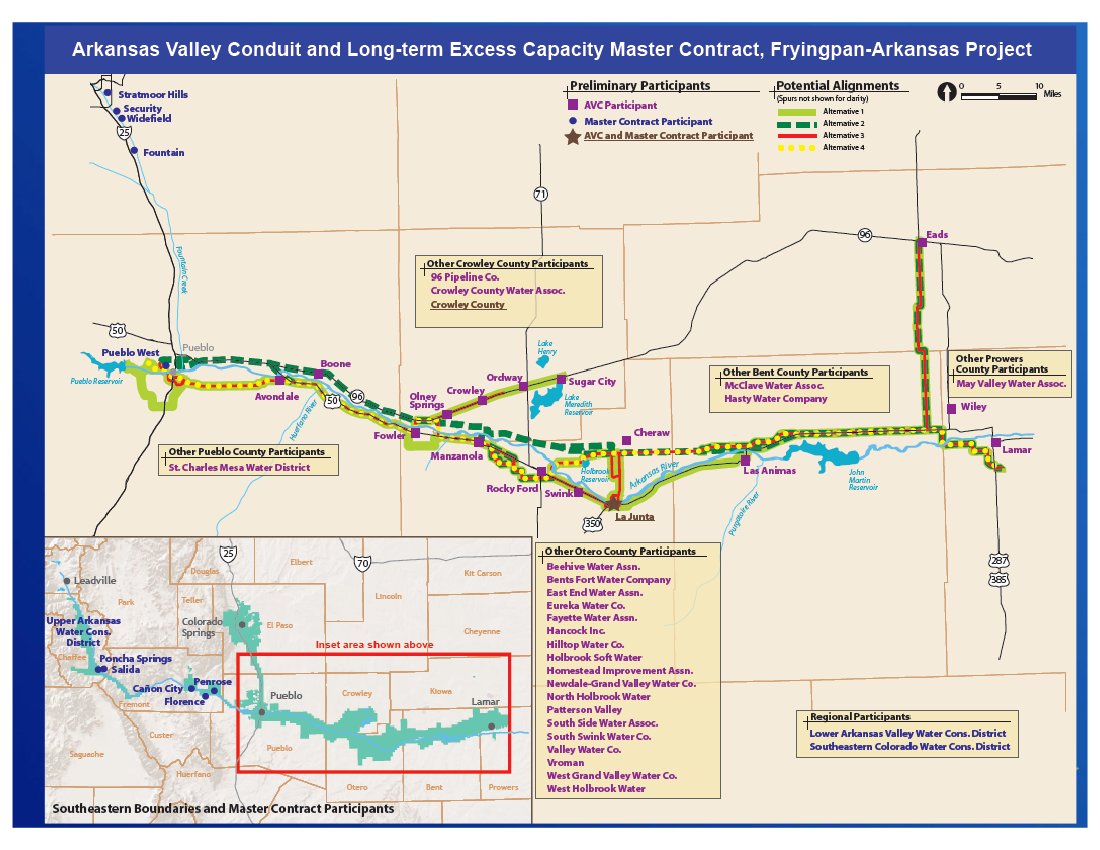
The budget also includes about $500,000 for continued work on the master lease contract, Arkansas Valley Conduit and outlet interconnection at Pueblo Dam.

More Arkansas River Basin coverage <a href="http://coyotegulch.blog/category/colorado-water/arkansas-basin/

The SECWD pulls applications for increased storage in Lake Pueblo and Turquoise Lake

turquoiselake.jpg

From The Pueblo Chieftain (Chris Woodka):

Two water court applications, filed in 2000, claiming storage rights in Lake Pueblo and Turquoise Lake are being pulled because federal legislation has stalled. “Because we don’t have the federal legislation on (dam) enlargement, we wouldn’t be able to meet the can­andwill provisions of state law,” said Jim Broderick, executive director of the Southeastern Colorado Water Conservancy District.

The district filed for the storage rights after its Preferred Storage Options Plan was completed. The plan identified enlargement of Lake Pueblo and Turquoise Lake as the best ways to increase storage in the Arkansas River basin. But after 12 years, PSOP looks increasingly unlikely.

The district sought federal legislation to study enlargement of the reservoirs, which were built as part of the Fryingpan­Arkansas Project, but hit its first snag when it opposed Aurora’s inclusion in storage plans. A revised version of PSOP included Aurora, which made certain concessions to the Southeastern district in 2003. New agreements were reached with the city of Pueblo in 2004 that would have allowed PSOP to progress.

Ken Salazar, D­Colo., attempted to broker a settlement among 11 entities that would have allowed PSOP to progress in 2007, but those efforts failed when the Lower Ark sued the Bureau of Reclamation over its storage contract with Aurora.

Since then, Aurora has dropped its insistence to be included in the legislation.

Meanwhile, the “reoperations” of Lake Pueblo — another part of PSOP that defines how nonproject water is stored — have moved ahead through long­term excess capacity contracts for the Pueblo Board of Water Works, Aurora and the Southern Delivery System. The Bureau of Reclamation also is considering a master contract sponsored by the Southeastern district. Southeastern continues to fund studies related to reservoir enlargement, with $132,000 included in next year’s proposed budget, to be adopted in December.

More Preferred Storage Option Plan coverage here and here.

The Southeastern Water Conservancy District board approves $18 million budget for 2013

coloradorivergranby.jpg

From The Pueblo Chieftain (Chris Woodka):

A move by Front Range water providers to protect fish in the Colorado River will add about $1 million to the Southeastern Colorado Water Conservancy District’s 2013 budget.

Finance manager Tina White walked the district’s board through the $18 million budget at a public hearing Thursday. The board will vote on adoption of the budget at its December meeting.

Southeastern is joining other water providers to buy the Red Top Ranch near Granby for water rights that will be used to protect endangered fish in the Colorado River. This year, it will cost the district $1.09 million. The district also will spend about $600,000 toward a plan to add hydroelectric generation at Pueblo Dam. Both are multiyear projects that involve other partners, and were financed through reserves.

The district expects to generate $16.2 million in revenues through its general fund and enterprise. The money comes from a 9.35­mill property tax over a nine­county area, enterprise fee collection and grants. Most of the money will go toward repaying federal contracts for the Fryingpan­Arkansas Project to the Bureau of Reclamation — $6.5 million to repay the agricultural share of the project and $5.3 million for the Fountain Valley Conduit (paid only in El Paso County). The municipalindustrial portion of the Fry­Ark Project was paid off first because it carried interest, while the agricultural share does not. About $42.4 million is still owed. The largest operating expenses in the budget are $2.2 million for human resource, personnel and overhead, and $1.2 million for outside services, studies or partnerships.

The budget also includes about $500,000 for continued work on the master lease contract, Arkansas Valley Conduit and outlet interconnection at Pueblo Dam.

More Southeastern Colorado Water Conservancy District coverage here.

Arkansas Valley Conduit update: Cost estimates drop to $400 million

arkansasvalleyconduitproposed.jpg

From The Pueblo Chieftain (Chris Woodka):

As the Arkansas Valley Conduit moves closer to reality, there has been some “nervousness” among participants.

“We have been meeting with some (smaller) communities to answer questions,” said Jim Broderick, executive
director of the Southeastern Colorado Water Conservancy District Thursday. “We have new people coming into
the discussion.”

While the cost of the conduit is estimated at $500 million in a draft environmental impact statement by the Bureau
of Reclamation, nearly half of that represents contingency costs that reflect a low level of engineering, Broderick
said.

“We think these numbers will drop,” Broderick said.

The district’s own engineering is further along, and indicates costs will be in line with earlier estimates in the $300
million to $400 million range.

Public meetings on the conduit were conducted last month and produced about seven comments, mostly in favor
of the conduit. A final EIS should be released sometime next year. The next step is to review the cost­benefit
analysis. “We are putting time into it in order to make sure the right details are in it when benefits are calculated,”
Broderick said.

The project has been seriously discussed for the past decade and would not be built for another decade, if federal
funding is in place. In the meantime, water providers large and small are dealing with increased water quality
requirements, particularly for radionuclides and salinity.

Communities may be uncertain of the process and actions they need to take in the meantime, Broderick said.
More frequent updates of the conduit’s progress are planned to keep them informed, he added.

More Arkansas Valley Conduit coverage here and here.

‘Water Wranglers’ is George Sibley’s new book about the Colorado River District #coriver

georgesibleyfromgardsibleyorg.jpg

waterwranglersgeorgesibley2012.jpg

Here’s the link to the web page where you can order a copy. Here’s the pitch:

Water Wranglers
The 75-Year History of the Colorado River District:
A Story About the Embattled Colorado River and the Growth of the West

The Colorado River is one of America’s wildest rivers in terms of terrain and natural attributes, but is actually modest in terms of water quantity – the Mississippi surpasses the Colorado’s annual flow in a matter of days. Yet the Colorado provides some or all of the domestic water for some 35 million Southwesterners, most of whom live outside of the river’s natural course in rapidly growing desert cities. It fully or partially irrigates four-million acres of desert land that produces much of America’s winter fruits and vegetables. It also provides hundreds of thousands of people with recreational opportunities. To put a relatively small river like the Colorado to work, however, has resulted in both miracles and messes: highly controlled use and distribution systems with multiplying problems and conflicts to work out, historically and into the future.

Water Wranglers is the story of the Colorado River District’s first seventy-five years, using imagination, political shrewdness, legal facility, and appeals to moral rightness beyond legal correctness to find balance among the various entities competing for the use of the river’s water. It is ultimately the story of a minority seeking equity, justice, and respect under democratic majority rule – and willing to give quite a lot to retain what it needs.

The Colorado River District was created in 1937 with a dual mission: to protect the interests of the state of Colorado in the river’s basin and to defend local water interests in Western Colorado – a region that produces 70 percent of the river’s total water but only contains 10 percent of the state’s population.

To order the book, visit the Wolverine Publishing website at http://wolverinepublishing.com/water-wranglers. It can also be found at the online bookseller Amazon.

More Colorado River District coverage here.

Arkansas Valley Conduit update: Source water quality problems would be improved by the conduit

radiumatom.jpg

From The Pueblo Chieftain (Chris Woodka):

Besides providing a reliable amount of water, the Arkansas Valley Conduit would improve water quality for the 40 communities that have indicated an interest in the project.

Salinity and radiation in local water supplies exceed federal drinking standards. The levels have created regulatory pressure from the Colorado Department of Public Health and Environment to find sources of better water, said Signe Snortland, who heads the Bureau of Reclamation team evaluating the conduit.

Meetings were held last week in Salida, Pueblo, La Junta and Lamar on the draft environmental impact statement.

Of the conduit participants, 14 are in violation of radiation standards.

Meanwhile, Reclamation has cut a contract with Vine Laboratories in Denver to do the geological work. Here’s a report from Chris Woodka writing for The Pueblo Chieftain:

The Bureau of Reclamation has awarded a $715,000 contract to Vine Laboratories of Denver to conduct geologic investigations, including drilling, testing and sampling of unconsolidated material and bedrock necessary for design of the proposed Arkansas Valley Conduit project. The contract will provide some preliminary data describing geological conditions and other variables.

More Arkansas Valley Conduit coverage here and here.

Fryingpan-Arkansas Project 50th anniversary: Ruedi Reservoir created for compensatory water storage for the Western Slope

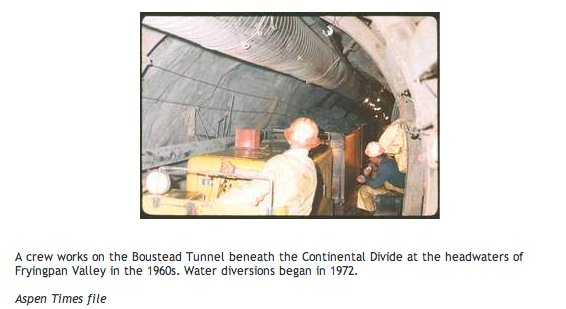
bousteadtunnelconstructionaspentimes.jpg

Here’s an in-depth look at the Fryingpan-Arkansas Project from Scott Condon writing for The Aspen Times. Click through and read the whole article. Here’s an excerpt:

The Fry-Ark water diversion plan was hatched shortly after World War II ended, when the cities and counties of Colorado’s Arkansas River Valley started looking for water to fuel growth aspirations. The initial plan was to divert 357,000 acre-feet of water annually from the Gunnison River and other tributaries of the Colorado River to the Arkansas Valley, according to the website of the Southeastern Colorado Water Conservancy District.

The proposal sparked a political battle in the 1950s between Western Slope residents who didn’t want “their” water taken and Arkansas Valley resident who saw the water as the key to their future. [Mark Fuller, executive director of the Ruedi Water and Power Authority] said residents of the West Slope of Colorado had an ingrained “mistrust” of the Front Range, which had more people, more money and more power…

The Roaring Fork River basin’s loss is the Arkansas Valley’s gain. Reclamation bureau spokeswoman Kara Lamb said Fry-Ark water irrigates 265,000 acres of some of the most productive farm land in Colorado. “This is Rocky Ford cantaloupes and the onions that the Arkansas Valley is so famous for,” she said.

In addition, 720,000 residents of the southeastern part of the state receive supplementary water from the project. They live from Salida in the west to Lamar in the east, and from Colorado Springs down to Pueblo…

The Fry-Ark system diverts an annual average of 54,000 acre feet. To put that amount in perspective, it’s a little more than half the total held by Ruedi Reservoir when full. Last year, when the snow kept piling up late into the spring, the system diverted its second highest amount of water ever at about 98,000 acre feet. This year, during the drought, it diverted only 14,000 acre feet…

Ruedi Reservoir — which now dominates the Fryingpan Valley’s identity — wasn’t in the initial plans for the diversion system. “It was a political solution,” Lamb said. The reservoir was created for compensatory water storage for the Western Slope. To a layman, the legal purpose of Ruedi is essentially a way for water attorneys to make the books balance. In a practical sense, the reservoir has created one of the biggest recreational draws in the Aspen area…

Aspen residents get a direct benefit from the Ruedi dam. The hydro-electric plant owned and operated by the city of Aspen produces 20 to 25 million kilowatt hours of power per year. That is the equivalent of 35 to 40 percent of Aspen’s annual demand, according to Fuller.

More Fryingpan-Arkansas Project coverage here and here.

Lake Pueblo: Fryingpan-Arkansas Project 50th anniversary celebration tomorrow

fryingpanarkansasprojectdistrictboundariesmapsecwd.jpg

From The Pueblo Chieftain:

U.S. Sen. Michael Bennet, U.S. Rep. Scott Tipton and others are scheduled to attend a 50th anniversary celebration at 9 a.m. Saturday at the Lake Pueblo State Park Visitors Center, 640 Pueblo Reservoir Road.
The Fryingpan-Arkansas project is a water diversion and storage project constructed to deliver water to families, producers and municipalities throughout the lower Arkansas Valley, as well as to provide supplemental irrigation water.

Slated to join Bennet and Tipton at the event are John Stulp, special policy adviser to the governor for water; Mike Collins, Bureau of Reclamation area manager for Eastern Colorado; Jennifer Gimbel, executive director, Colorado Water Conservation Board; John Singletary, chairman of the board, Parks and Wildlife Commission; and Angela Giron, state senator from Pueblo.

More Fryingpan-Arkansas Project coverage here and here.

50th anniversary celebration of the Fryingpan-Arkansas Project Saturday at Lake Pueblo

johnfkennedypuebloaugust171962chieftain.jpg

The project got its start with a visit to Pueblo from President Kennedy back in 1962. Here’s the first installment from Chris Woodka writing for The Pueblo Chieftain. Click through and read the whole article, Woodka is a terrific writer. Here’s an excerpt:

But on that day [August 17, 1962], work began to address the problem. Kennedy came to Pueblo to celebrate the signing of the Fryingpan-Arkansas Act the previous day. Local water leaders will celebrate the 50th anniversary of the Fry-Ark Project Saturday at Lake Pueblo…

The Twin Lakes Tunnel was constructed by the Colorado Canal Co. during the Great Depression, while the old Carlton railroad tunnel was used by the High Line Canal Co. to bring in water. In addition, Colorado Springs and Aurora were already building the Homestake Project, which would be intertwined with the Fry-Ark Project as both were built.

But the government project, a scaled-down version of an earlier, larger plan to bring water from the Gunnison River basin, represented a larger cooperative effort between farmers and municipal leaders in nine counties.

Since the first water was brought over in 1972, about 2.1 million acre-feet of water has been brought into the Arkansas River basin for irrigation and municipal use. The project also generates electric power at the Mount Elbert Power Plant.

fryingpanarkansasprojectdistrictboundariesmapsecwd.jpg

Woodka details some of the early water history along the Arkansas River mainstem in this report running in today’s Chieftain. Here’s an excerpt:

The Water Development Association of Southeastern Colorado was incorporated in 1946. Pueblo business leaders worked with valley water interests to investigate a Gunnison-Arkansas Project. By 1953, the project was scaled back to the Fryingpan-Arkansas Project, and the first hearings began in Congress.

During the congressional hearings in subsequent years, the project evolved from one primarily serving agriculture to one that included municipal, hydroelectric power, flood control and recreation as well.

The Southeastern Colorado Water Conservancy District formed in 1958.

The U.S. House passed the Fry-Ark Act on June 13, 1962; the U.S. Senate, Aug. 6, 1962. President John F. Kennedy signed it into law on Aug. 16, 1962.

Here’s a short look at Jay Winner, current general manager of the Lower Arkansas Water Conservancy District, from Chris Woodka Writing for The Pueblo Chieftain. From the article:

Back in the 1960s, his father Ralph Winner was the construction superintendent for Ruedi Reservoir, the first part of the Fry-Ark Project to be constructed and his family lived on the job site. His father came back in the late 1970s to supervise construction of one of the last parts of the collection system to be built, the Carter-Norman siphon. The siphon draws water across a steep canyon.

For three summers, Winner, then a college student, worked on the latter project. “It was the most fun I ever had,” he laughed. “I got to play with dynamite.”

From The Pueblo Chieftain (Chris Woodka):

A retired outfitter, [Reed Dils] is now a Southeastern Colorado Water Conservancy District board member and a former representative from the Arkansas River basin on the Colorado Water Conservation Board. “Initially, the flows got worse,” Dils said. “They (the Southeastern district and the Bureau of Reclamation) had chosen to run water in the winter…

“It became apparent to everyone there was another way to run the river,” Dils said. “Why the Fry-Ark act was passed, recreation mainly meant flatwater recreation. Over time, they learned there are other types of recreation.”

Here’s the release from Reclamation (Kara Lamb):

Reclamation and the Southeastern Colorado Water Conservancy District invite the public to celebrate the Fryingpan-Arkansas Project’s 50th Anniversary at Lake Pueblo State Park on Sat., Aug. 18. The event is located at Lake Pueblo State Park Visitor’s Center from 9 a.m.to 2 p.m.

Reclamation, the District and Colorado State Parks and Wildlife are offering free pontoon boat tours around Pueblo Reservoir and free tours of the fish hatchery located below Pueblo Dam. There will also be historical displays and several guest speakers.

Signed into law by President John F. Kennedy in 1962, the Fryingpan-Arkansas Project is a multipurpose trans-basin water diversion and delivery project serving southeastern Colorado.

The Fryingpan-Arkansas Project provides:

– Water for more than 720,000 people
– Irrigation for 265,000 acres
– The largest hydro-electric power plant in the state
– World renowned recreation opportunities from the Fryingpan River to the Arkansas River.

For more information the 50th Anniversary Celebration – and to see a teaser of the upcoming film! – visit our website at www.usbr.gov/gp/ecao.

More Fryingpan-Arkansas Project coverage here and here.

alanhamelcsu.jpg

Meanwhile, Alan Hamel is retiring from the Pueblo Board of Water Works this month:

From The Pueblo Chieftain (Chris Woodka):

“Little did I know how important the Fryingpan-Arkansas Project would be as I was watching the president’s car traveling down Abriendo Avenue that day,” Hamel said. “Look at all that it has done for our basin and what it will do in the future.”

Hamel became executive director of the water board in 1982, and was president of the Southeastern Colorado Water Conservancy District, the local agency that oversees the Fry-Ark Project, from 2002-04. He is currently serving on the Colorado Water Conservation Board.

More Pueblo Board of Water Works coverage here.

Colorado Water 2012: ‘Water truly is the lifeblood of a community’ — Jean Van Pelt

coloradowater2012.jpg

Here’s the latest installment in The Pueblo Chieftain’s series for Colorado Water 2012. Jean Van Pelt describes the Fryingpan-Arkansas Project. Here’s an excerpt:

…the Fryingpan-Arkansas Project has provided Southeastern Colorado with 50 golden years of benefits. The Fryingpan-Arkansas Project is a transmountain diversion that supplies Southeastern Colorado with supplemental water for irrigation, municipal and industrial uses, hydroelectric power, and recreational opportunities. The project also provides flood control and is designed to maintain or improve fish and wildlife habitats. The project acquired its name from the fact that it collects about 54,800 acre-feet of water each year from the Fryingpan River basin on the Western Slope of the Continental Divide and delivers it via the Arkansas River to the water-short Eastern Slope…

The North and South Side Collection System and Ruedi Dam and Reservoir are located on the Western Slope in the Fryingpan River basin. Sugar Loaf Dam and Turquoise Lake; Mount Elbert Conduit, Forebay Dam, Reservoir and Power Plant; Halfmoon Diversion Dam; Twin Lakes Dam and Reservoir; and Pueblo Dam and Reservoir are all located on the Eastern Slope in the Arkansas River basin.

More Colorado Water 2012 coverage here.

Fry-Ark fiftieth birthday party August 18

fryingpanarkansasproject.jpg

Here’s the release from Reclamation (Kara Lamb):

Reclamation and the Southeastern Colorado Water Conservancy District invite the public to celebrate the Fryingpan-Arkansas Project’s 50th Anniversary at Lake Pueblo State Park on Sat., Aug. 18. The event is located at Lake Pueblo State Park Visitor’s Center from 9 a.m.to 2 p.m.

Reclamation, the District and Colorado State Parks and Wildlife are offering free pontoon boat tours around Pueblo Reservoir and free tours of the fish hatchery located below Pueblo Dam. There will also be historical displays and several guest speakers.

Signed into law by President John F. Kennedy in 1962, the Fryingpan-Arkansas Project is a multipurpose trans-basin water diversion and delivery project serving southeastern Colorado.

The Fryingpan-Arkansas Project provides:

– Water for more than 720,000 people
– Irrigation for 265,000 acres
– The largest hydro-electric power plant in the state
– World renowned recreation opportunities from the Fryingpan River to the Arkansas River

For more information on the Fryingpan-Arkansas Project and the 50th Anniversary Celebration, visit our website at http://www.usbr.gov/gp/ecao/pueblo/pueblo.html.

More Fryingpan-Arkansas Project coverage here.

‘Oil shale development would involve intensive use of water’ — Alan Hamel

oilshaledepositscowyutblmostseis.jpg

From The Pueblo Chieftain (Chris Woodka):

“We have to protect the water we have, as well as provide water for endangered species,” said Alan Hamel, executive director of the Pueblo Board of Water Works and a member of the Colorado Water Conservation Board. “Oil shale development would involve intensive use of water, particularly for use in power generation.” Last month, the Pueblo water board and other members of the Front Range Water Council weighed in on the Bureau of Reclamation’s environmental impact statement for oil shale and tar sands…

The Front Range Water Council includes the major organizations that import water from the Colorado River: Denver Water, the Northern and Southeastern Colorado water conservancy districts, Aurora Water, Colorado Springs Utilities, Twin Lakes Reservoir and Canal Co. and the Pueblo water board. Collectively, they provide water to 4 million people, 82 percent of the population in Colorado.

More Front Range Water Council coverage here and here.

Fryingpan-Arkansas Project update: The Southeastern board and other agencies are implementing plans to bolster flows in the Arkansas mainstem over the summer

fryingpanarkansasproject.jpg

From The Pueblo Chieftain (Chris Woodka):

The Southeastern Colorado Water Conservancy District is operating its exchange right to move some of the water in Lake Pueblo up to Turquoise and Twin Lakes in order to boost flows through the summer. “To my knowledge, this is the first time the exchange has been used, since it’s a fairly junior water right,” said Jim Broderick, the district. Rafting companies are encouraged by the move, hoping it will keep flows stable in the river stable during July and early August…

The upper reservoirs in Lake County were drawn down during winter months with the expectation downriver in the spring. Colorado Parks and Wildlife will provide about 900 acre-feet of water to cover evaporation and transit loss, said Division Engineer Steve Witte. Water will be released at key times during the summer in blocks up to 100 cubic feet per second, Witte said.

Meanwhile, here’s a profile of three Southeastern board members with family roots on the board, from Chris Woodka writing for The Pueblo Chieftain. From the article:

…three members of the Southeastern Colorado Water Conservancy District are following in their father’s footsteps more than 50 years after the district was formed.

“People think I have the same knowledge about water as my father, but there’s no way I could ever start to wear his boots,” said Tom Goodwin, choking with emotion. Goodwin also is on the board of the Upper Arkansas Water Conservancy District, which his father, Denzel Goodwin, helped launch in 1979. Denzel Goodwin, who died last year, was a firebrand for Fremont County cattle and water issues from the 1950s, and Tom says he would come home from every meeting and discuss everything with his wife, Marcheta…

Two of Goodwin’s peers now on the Southeastern board also had fathers on the board: David Simpson, whose father, Lee Simpson, served from 1981-2009; and Ann Nichols, whose father, Sid Nichols, was a charter member from 1958 until his death in 1973…

[Nichols] also followed in her father’s footsteps professionally, working in the financial end of the water business for Colorado Springs during the purchase of Foxley Farms assets in Crowley County. She retired after working for 25 years as finance director for Colorado Springs. Now a financial consultant, she is treasurer of the Southeastern board and a member of the Colorado Water Resources and Power Development Authority board…

Simpson learned water working side-by-side with his father for 37 years in forming and running the St. Charles Mesa Water District east of Pueblo. When his father retired in 1999, Simpson became manager of the district.

More Southeastern Colorado Water Conservancy District coverage here.

Colorado Springs Utilities’ Steve Berry: ‘In looking at the numbers in this executive summary, it does not appear that many of our comments were considered’

transmountaindiversionscoloradostateengineer2011

Last week, the day before the Statewide Roundtable Summit, Western Resource Advocates, et. al., released a report titled, “Meeting Future Water Needs in the Arkansas Basin.” Colorado Springs and Pueblo are taking a hard look at the report, according to this article from Chris Woodka writing for The Pueblo Chieftain. Here’s an excerpt:

There may be a question whether water providers accept the figures used in the reports. “Colorado Springs Utilities was asked to peer review the draft version, and made extensive and substantial comments on it. In looking at the numbers in this executive summary, it does not appear that many of our comments were considered, and many of our suggested changes or corrections were not made,” said Steve Berry, spokesman for Utilities. The largest amounts of water, and presumably the largest conservation and reuse savings, come from Colorado Springs.

The Pueblo Board of Water Works is also reviewing the final report for accuracy, said Alan Ward, water resources manager…

The environmental groups say a combination of projects already on the books — conservation, reuse and temporary ag-urban transfers — could provide as much as 140,000 acre-feet, more than enough to meet the needs. Those numbers are being examined by urban water planners, who say the savings might not be attainable. “In general, we were unable to verify or recreate most of the numbers cited in their report, and their estimates for conservation and reuse are significantly greater than what our water conservation experts have calculated as realistic,” Berry said…

When asked how conservation savings would be applied to new supplies, a practice cities find risky, Jorge Figueroa, water policy analyst for Western Resource Advocates, said they could be put into “savings accounts” for future use. When asked where the water would be stored, he cited the T-Cross reservoir site on Williams Creek in El Paso County that is part of the Southern Delivery System plan…

Drew Peternell, director of Trout Unlimited’s Colorado Water Project, said the group supports [the Southern Delivery System]. Because the project already is under way, the groups look at SDS as a key way to fill the gap. The report also supports programs like Super Ditch as ways to temporarily transfer agricultural water to cities without permanently drying up farmland.

Meanwhile, here’s a look at a report from the Northwest Council of Governments, “Water and Its Relationship to the Economies of the Headwaters Counties,” from Bob Berwyn writing for the Summit County Citizens Voice. From the article:

The report, released in January at a Denver water conference, takes a fresh look at the critical importance to the economy of water in West Slope rivers, and why Colorado leaders may want to take careful thought before making future transmountain diversion policy decisions. Visit the NWCCOG website for the full 95-page report.

“This report makes an important contribution to the on-going dialogue about adverse economic impacts associated with losing water by focusing attention on Eagle, Grand, Gunnison, Pitkin, Routt and Summit counties,” said Jean Coley Townsend, the author of the report. “This has never been done before. The report provides an important counterbalance to earlier studies that show economic impacts of losing water from the Eastern Plains.”

Balancing the supply and demand of water could be the State’s most pressing issue. The report does not take issue with Front Range municipal or Eastern Plains agricultural water users — all parties have important and worthy concerns and points of view — but is meant as a thorough review of water as an economic driver of headwaters economic development.

The report provides a balance to the existing solid body of work that measures the potential economic effects of less water on the Front Range and the Eastern Plains and the loss of agriculture in those parts of the state.

“If we … are going to solve our Statewide water supply shortage challenges there must first be statewide mutual respect and true understanding of each other’s water supply challenges,” said Zach Margolis, Town of Silverthorne Utility Manager. “The report is a remarkable compilation of the West Slope’s water obligations and limitations as well as the statewide economic value of water in the headwater counties of Colorado.”

More transmountain/transbasin diversions coverage here.

Pueblo Dam: The proposal for a hydroelectric generation facility at the north outlet works is moving through the bureaucracy

puebloreservoir.jpg

From The Pueblo Chieftain (Chris Woodka):

The Bureau of Reclamation in December accepted a lease of power privilege proposal by the Southeastern Colorado Water Conservancy District, Colorado Springs and the Pueblo Board of Water Works. “This is a big deal that will give us broader options for power in the Arkansas River basin,” said Jim Broderick, executive director of the Southeastern District.

The next step is for the partners to sign an agreement and gain approval from Reclamation for its plan to build hydropower at Pueblo Dam. The generation facilities would be built in the next 10 years, Broderick said. The cost estimates and timeline for the agreement are slated to be discussed by the Southeastern board in February.

More hydroelectric coverage here and here.

Southeastern Board Meeting recap: Reclamation stands to get $3 million for Arkansas Valley Conduit EIS

arkansasvalleyconduitproposed.jpg

From The Pueblo Chieftain (Chris Woodka):

The Bureau of Reclamation is working on an environmental impact statement for the conduit that will identify the preferred option for the conduit. It will be allocated nearly $3 million to complete the study in the next year, said Christine Arbogast, a lobbyist for the Southeastern Colorado Water Conservancy District…

In the 2013 fiscal year, relatively little funding would be needed as the EIS is completed, but in the following year the district will have to push for federal funds to begin building the conduit.

More coverage from Chris Woodka Writing for The Pueblo Chieftain. From the article:

Colorado has accrued 44,000 acre-feet of credits under an accounting system of deliveries of Arkansas River water to Kansas. There are two reasons for the surplus, Witte explained:

– The Lower Arkansas Water Management Association has been delivering about 8,000 acre-feet annually for six years from the Kessee Ditch below John Martin Reservoir.

– The state has been using a presumptive depletion factor of 39 percent, rather than 30 percent as required by the compact lawsuit.

The Division of Water Resources will re-evaluate the depletion factor in June, and it likely will be lowered to some midpoint between the two extremes, Witte said. That means well owners would be required to replace less water on an annual basis, but the change would not go into effect until April 2013 at the earliest.

More coverage from Chris Woodka writing for The Pueblo Chieftain. From the article:

“The Arkansas Basin Roundtable is overseeing this pilot program [for the Arkansas Valley Super Ditch] as well as the Lower district,” Jay Winner, general manager of the Lower Arkansas Valley Water Conservancy District, told the Southeastern Colorado Water Conservancy District board Thursday. “We’re trying to be as transparent as we can.”

Winner and engineer Heath Kuntz reviewed Super Ditch plans at the board’s monthly meeting. The information was the same as longer presentations to a group of about 200 people earlier this month in Rocky Ford. That meeting was held at the suggestion of State Engineer Dick Wolfe to give those who could be affected by Super Ditch the opportunity to look at the potential impacts of a pilot program. The Rocky Ford meeting led to a technical meeting in Colorado Springs Thursday to work out issues raised at the first meeting. The Lower Ark district will file its substitute water supply plan for the pilot program after attempting to settle those issues, Winner said.

More Southeastern Colorado Water Conservancy District coverage here.

The Southeastern Colorado Water Conservancy District board approves a $17.2 million budget for 2012

arkansasvalleywateruse2011

From The Pueblo Chieftain (Chris Woodka):

The major portion of the budget, $11.8 million, goes to repay federal costs of constructing the Fry-Ark Project, which includes the Fountain pipeline. Another $270,000 is revenue from state and federal grants.

The operating budget for the district is $5.1 million, with about 60 percent in the general fund, and 40 percent in the enterprise fund.

Of the $3 million district fund, $1.36 million goes toward personnel.

The budget also includes a capital expenditure of $850,000 as the district’s share for purchase of the Red Top Ranch near Lake Granby. That cost will total $1.7 million over two years. The ranch purchase is part of a plan by Front Range water users, including Aurora, Colorado Springs, Denver, Pueblo and the Northern Colorado Water Conservancy District, to provide flows for endangered fish species in the Colorado River. Participation in the program is a condition for importing Fry-Ark water each year.

The major project in the $2.1 million enterprise fund will be the Arkansas Valley Conduit. The U.S. Bureau of Reclamation is preparing an environmental impact statement for the conduit.

More Southeastern Colorado Water Conservancy District coverage here.

Mark Pifher (Aurora water): ‘We don’t plan to buy or lease any more water in Arkansas basin in the near future’

arkansasriverbasin.jpg

From The Pueblo Chieftain (Chris Woodka):

Aurora’s water rights include nearly all of the Rocky Ford Ditch in Otero County, about one-third of the Colorado Canal in Crowley County and water from 1,750 acres of ranches in Lake County. Those rights provide an average yield of 22,800 acre-feet per year — the equivalent of 80 percent of the potable water used by Pueblo each year.

– Aurora also uses the Homestake Project, Twin Lakes, Busk-Ivanhoe diversion and the Columbine Ditch to bring water from the Western Slope through the Arkansas River basin and into the South Platte basin. The average yield of those water rights is about 21,500 acre-feet annually.

– The city can reuse its Arkansas and Colorado basin water imports, and has built the $650 million Prairie Waters Project to directly recapture flows, rather than exchange them.

– Aurora’s South Platte water rights include wells, ranches, ditches and direct flow from the South Platte. They total about 46,000 acre-feet annually.

– Aurora has an agreement to trade 5,000 acre-feet of water a year with Pueblo West from Lake Pueblo to Twin Lakes beginning next year. It will replace a similar agreement with the Pueblo Board of Water Works that expires this year.

– The Pueblo water board sells Aurora 5,000 acre-feet of water each year.

– Aurora has a contract with the Bureau of Reclamation to store 10,000 acre-feet of water in Lake Pueblo and to move the same amount to Twin Lakes by paper trade.

– The water is moved from Twin Lakes to Spinney Mountain Reservoir through the Homestake pipeline system…

“We don’t have any current plans beyond what we’re already doing,” said Mark Pifher, director of Aurora water. “We don’t plan to buy or lease any more water in Arkansas basin in the near future.”

Instead, the city will continue developing Prairie Waters, a reuse project that pumps sewer return flows through a filtration and purification system, only at about 20 percent capacity so far. Aurora calculates that its average yield from its Arkansas River basin water rights is about 22,800 acre-feet annually. That’s roughly one-fourth of its total yield from its entire system, which includes South Platte and Colorado River basin rights. From a practical standpoint, Aurora does not move all of its water out of the Arkansas River basin each year.

More Aurora coverage here and here.

The Preferred Options Storage Plan surfaces again after dismissal of lawsuit over Aurora’s excess capacity contract with Reclamation

puebloreservoir.jpg

In the late 20th century the Southeastern Colorado Water Conservancy Board floated the idea of expanding Pueblo Reseroir since new mainstem reservoirs are nearly impossible to permit nowadays and more storage is identified as one of Colorado’s big needs going forward. Aurora’s insistence on being part of the authorization legislation stalled the project. They are out now so expansion of storage in Lake Pueblo is back on the table. Here’s report from Chris Woodka writing for The Pueblo Chieftain. From the article:

“This allows us in the basin to concentrate on storage and move the PSOP process ahead,” said Alan Hamel, executive director of the Pueblo Board of Water Works.

PSOP stands for the Preferred Storage Option Plan, developed by the Southeastern Colorado Water Conservancy district in the late 1990s, when Hamel was president of the Southeastern board.

Aurora remained at the table during PSOP discussions through 2007, when talks organized by U.S. Sen. Ken Salazar broke off when the Lower Ark district sued the Bureau of Reclamation over an Aurora storage contract. In the newest agreement, reached as part of the conditions of a motion to dismiss a federal lawsuit, Aurora has dropped its claim to be included in PSOP legislation, while agreeing to support the 2001 PSOP implementation report.

Here’s a look at the settlement that led to the dismissal, from Chris Woodka writing for The Pueblo Chieftain. From the article:

A joint motion filed by all parties in the case asks federal District Judge Philip Brimmer to dismiss the case with prejudice, meaning it cannot be reopened. Stipulations attached to the case require Aurora to abide by an intergovernmental agreement reached with the Lower Arkansas Valley Water Conservancy District in 2009.

“It means the lawsuit is completely over,” said Jay Winner, general manager of the Lower Ark district. “I think this puts the final part of the fence around Aurora. Our agreement restricts them from putting any more infrastructure into the valley to move more water out of here.”

The agreement also reinforces past agreements Aurora has made to limit the amount of water it can move from the valley and defines the service area in which water from the Arkansas River basin can be used. Aurora also has agreed to withdraw its claims from any future legislation to study the enlargement of Lake Pueblo.

Aurora, a city of 300,000 east of Denver, owns water rights in Otero, Crowley and Lake counties and pumps it from Twin Lakes into the South Platte River basin through the Homestake Project, which is operated jointly with Colorado Springs…

One year ago, the case was administratively closed by Brimmer, but Aurora and the Lower Ark initially continued to work for federal legislation to study the enlargement of Lake Pueblo, a condition of the 2009 IGA…

As part of the final IGA, Aurora agreed to withdraw its insistence for a clause allowing it to use the Fry-Ark Project in any legislation to enlarge Lake Pueblo. That has been a sticking point for 10 years, and was one reason for the 2003 agreement. Aurora will unconditionally support a federal study of the enlargement of Lake Pueblo. Aurora also has agreed to fully support projects backed by the Lower Ark District, including Fountain Creek improvements, the Arkansas Valley Super Ditch and the Arkansas Valley Conduit. The city will contribute $2 million over 10 years to such projects. It will also continue funding and support of water quality projects in the Arkansas River basin. The agreement also strengthens Aurora’s commitment to continue revegetation of farmland it dried up with the purchase of water from Crowley County.

More Preferred Options Storage Plan coverage here and here. More Aurora coverage here and here

The Bureau of Reclamation is evaluating alternatives for the Arkansas Valley Conduit, the draft EIS should be out in 2012

arkansasvalleyconduitproposed.jpg

From The Pueblo Chieftain (Chris Woodka):

“This is a big step, and I’m thankful we’ve made it to this point,” said Bill Long, president of the Southeastern Colorado Water Conservancy District, sponsors of the conduit. “I’m optimistic that we’ll be able to meet the timelines.” Those timelines include completion of the draft EIS by next fall and construction of the 235-mile pipeline within a decade…

Wednesday’s session dug down into how the EIS will be developed and explained over the next year. Reclamation is attempting to make the process more understandable to the general public. “We’re trying to make it a much more readable document for the general public,” said Jerry Gibbens, a consultant for MWH Engineering.

The conduit will move about 10,000 acre-feet of water annually, and will be associated with a master contract for about 26,900 acre-feet of storage in Lake Pueblo. Together the projects involve about 20 percent of the municipal water supply, and 7 percent of the total water supply, Gibbens said. The impact throughout the Arkansas River basin, and particularly downstream from Pueblo Dam, will be studied. To help the public get a better idea, photographs of how the river looks at various stages along different reaches of the rivers will be included along with the traditional hygrograph in the online version of the draft EIS, once it is completed, Gibbens said.

More Arkansas Valley Conduit coverage here and here.

The need for more storage in the Arkansas River basin was a discussion point at last week’s meeting of the UAWCD

upperarkansasvalley.jpg

From The Mountain Mail (Joe Stone):

District Manager Terry Scanga said his counterparts Jim Broderick, Southeastern Colorado Water Conservancy District, and Jay Winner, Lower Arkansas Valley Water Conservancy District, attended the meeting, as did Alan Hamel, executive director with Pueblo Board of Water Works.

Scanga said the men agreed that more storage in the Arkansas basin is crucial for meeting future municipal and industrial water demand as identified by the Statewide Water Supply Initiative, which projects a significant supply shortfall by 2050.

Scanga also said new storage capacity would be needed if more Western Slope water were to be diverted into the Arkansas Basin and additional storage is needed to support effective environmental conservation along basin waterways.

The Multi-Use Project recently proposed by the Upper Arkansas district would increase basin storage capacity and has generated interest among other conservancy districts and municipal water providers, Scanga said.

More Arkansas River basin coverage here.

Results of a $42,000 study of Upper Arkansas River streamflows show the need for increased communication and more storage

upperarkansasvalley.jpg

From The Pueblo Chieftain (Chris Woodka):

Those conclusions are the result of a $42,000 study of the Upper Arkansas River by Paul Flack, a former hydrologist for the Arkansas Headwaters Recreation area, who was contracted last year under a grant sponsored by the Southeastern Colorado and Upper Arkansas water conservancy districts. Flack shared some conclusions of his study Wednesday with the Arkansas Basin Roundtable, saying there is a need for all of the users who are concerned about flows in the upper basin to get together to reach solutions. In addition, about 20,000 acre-feet of new reservoir storage is needed to meet all the needs.

The Upper Arkansas has, for years, become a complicated operation as water users have tried to balance releases from Turquoise and Twin Lakes and levels in Lake Pueblo with flows for recreation and fish.

Flows also have to be kept in check below Turquoise in the Lake Fork watershed to avoid disturbing old mine tailings that could leach heavy metals into the Arkansas River…

Chaffee County recreational in-channel diversion rights, which support boat courses in Buena Vista and Salida, are problematic because they depend on other river operations…

Flows in the river to meet the needs of fish, a component of a 20-year-old voluntary flow agreement among several agencies, could be a potential source of conflict. “The fishing flow can be in opposition to the needs of the Fryingpan-Arkansas Project,” Flack said.

At Lake Pueblo, Flack looked at the possibility of changing the timing of spring releases for if-and-when or winter water storage accounts. “There could be significant water savings, up to thousands of acre-feet,” he said. “But, there would be a ripple effect upstream.”[…]

Adding 20,000 acre-feet of storage is needed to smoothly operate the increasingly complex river system. Planning should involve those affected, and not just with phone calls to Reclamation in an emergency, Flack said.

More Arkansas River basin coverage here.

Energy policy — hydroelectric: The Southeastern Colorado Water Conservation District is spearheading a hydroelectric generation plant just downstream of Pueblo Dam

microhydroelectricplant.jpg

I’m a big proponent of hydroelectric power, possibly because I love technology, but also because of the low-carbon nature of hydropower. Of course, the effects on streamflow and aquatic and riparian life when a stream is harnessed, dammed, channeled, etc. are well known so I tend to favor retrofits in a stream system that has already been affected, rather than the taking of another stream life for humankind.

Here’s a report from Chris Woodka writing for The Pueblo Chieftain. From the article:

The Southeastern Colorado Water Conservancy District, Colorado Springs, Pueblo Board of Water Works and Fountain are planning on making a bid for a hydropower plant just downstream of the dam. All of the partners are Southeastern district members and other partners could be added. “We’re putting together a partnership to try to win the award,” said Jim Broderick, executive director of the Southeastern district told the district’s board Thursday. “I think this is an opportunity for the district.”

The plant would require an environmental review. It is not decided what organizational structure the group would use to build the hydropower plant. A preliminary report shows the group would make a profit on a plant generating anywhere from 4 to 8.6 megawatts of power. The cost of building the plant would be $11 million to $18.7 million, and state loans, government incentives and grants would be available to pay much of the cost, said Lindsay George of the Applegate Group…

The plant would hook onto the North Outlet Works river connection that is now being built as part of SDS. The connection includes one pipeline that goes to the Juniper Pump Station and another that would serve as the primary feed for the Arkansas River. The feed to the hydropower plant would use direct flows to spin turbines…

The hydropower plant would only be able to run from about April to September, when river releases are high enough to run turbines.

More hydroelectric coverage here and here.

The Southeastern Colorado Water Conservancy District board voted 13-1 against expansion of federal wilderness areas in the Arkansas River basin

arkansasriverleadville

From The Pueblo Chieftain (Chris Woodka):

At issue is a bill by Diana DeGette, D-Colo., to create additional Colorado wilderness areas, as well as wild lands and wilderness study designations approved by Secretary of Interior Ken Salazar. The federal legislation has been reintroduced several times without success.

The [Upper Arkansas Water Conservancy District] believes any of those actions could prevent water development. “Development of storage or enlargement of existing storage and other beneficial uses of water on streams that are included in these wilderness designations, such as Grape, Badger or Beaver Creeks, will be precluded as a consequence,” Upper Ark chairman Glenn Everett said.

The Southeastern District still has conditional decrees for canals that could serve hydroelectric power generation. The canals haven’t been built, but could be in the future, explained Bob Hamilton, engineering supervisor for the district.

Most board members agreed, except for Reed Dils. “In my mind, considering what’s going to happen to the legislation, we should do nothing at all,” Dils said. “I support wilderness legislation.”

More Southeastern Colorado Water Conservancy District coverage here.

Arkansas Valley Conduit: $3 million funding study should be included in this year’s omnibus funding bill from the U.S. Congress

arkansasvalleyconduitproposed

From The Pueblo Chieftain (Chris Woodka):

The study’s nearly $3 million in funding for next year received support in committee, and should be part of an anticipated omnibus funding bill later this year, lobbyist Christine Arbogast told the Southeastern Colorado Water Conservancy District on Thursday. “We should receive just under $3 million unless there are across-the-board cuts,” Arbogast said…

The Southeastern board is the primary sponsor of the conduit, and has combined the EIS for the conduit with a master storage contract in Lake Pueblo on behalf of both conduit participants and other members of the Southeastern district.

More Arkansas Valley Conduit coverage here and here.

A June agreement between the Lower Arkansas Valley Water Conservancy District and Aurora may pave the way for the expansion of Pueblo Reservoir

puebloreservoir.jpg

From The Pueblo Chieftain (Chris Woodka):

“I think this [June agreement] has opened the door for success in the Arkansas basin,” Jay Winner, general manager of the Lower Arkansas Valley Water Conservancy District, told the Southeastern Colorado Water Conservancy District board on Thursday. Aurora would not be included in any federal legislation to enlarge Lake Pueblo under its agreement with the Lower Ark in June meant to settle the Lower Ark’s 2007 federal lawsuit against the Bureau of Reclamation over a 40-year contract that allows Aurora to store and ex- change water in the Fryingpan-Arkansas Project…

Now that Aurora has removed its demand to be included in the federal legislation, the district could move ahead in seeking the legislation. No new PSOP bill has been introduced. While there are 27 intergovernmental agreements that “put a fence” on Aurora’s future activities in the Arkansas Valley, the new Lower Ark agreement does other things to prevent Aurora from taking even more water from the Arkansas River basin, Winner said. One of those is stopping Aurora’s ability to build new infrastructure to move water out of the valley. “It’s cheaper to build infrastructure in 2011 than 40 years from now,” Winner said. “This stops Aurora.”[…]

“I think this agreement can open the door for more storage in Pueblo Reservoir, which this basin needs,” Winner said. “It is very protective of the Arkansas basin.”

More Arkansas River basin coverage here.

Arkansas River basin: Water year 2011 has yielded the second largest import of water through the Boustead Tunnel since project water started moving in the 1970s

fillingjugswithwateratbousteaddedicationchieftain.jpg

From The Pueblo Chieftain (Chris Woodka):

The Fry-Ark Project has brought over 98,640 acre-feet of water this year, about 4,500 more acre-feet than was projected in May, when allocations were made…

Fort Lyon Canal, the largest ditch in the valley, will get an additional 1,700 acre-feet. The water comes on top of nearly 60,000 acre-feet already being delivered to farmers through the Fry-Ark Project. Late runoff and a heavy snowpack contributed to the second-largest import of Fry-Ark water since diversions through the Boustead Tunnel began in the 1970s…

Because Arkansas River flows stayed above 700 cubic feet per second through Aug. 15, no Fry-Ark water was needed to maintain the Upper Arkansas voluntary flow program, Vaughan added…

Basinwide, more than 200,000 acre-feet of water has been imported this year through transmountain tunnels and ditches, well above the average of about 136,000 acre-feet, said Pat Edelmann, of the U.S. Geological Survey. Twin Lakes has imported about 62,000 acre-feet and continues to move water. The Homestake Project has brought over 32,000 acre-feet.

More Arkansas River basin coverage here.

The Front Range Water Council plans to spend $600,000 to study Colorado River basin supplies

coloradoriverbasincgs.jpg

From The Pueblo Chieftain (Chris Woodka):

The Front Range Water Council is planning to hire Grand River Consulting Corp. for $600,000 over two years to work on Colorado River issues that affect the state’s largest water providers. The Pueblo water board’s share will be $36,000 each year, or $72,000 total. The board approved the contract at its Tuesday meeting.

The council represents Denver, Aurora, Colorado Springs, Pueblo, Twin Lakes Reservoir & Canal Co., the Northern Water Conservancy District and Southeastern Colorado Water Conservancy District. Denver and Northern — the largest water providers — would pay 20 percent of the costs of the contract, while the others each have a 12 percent share. Combined, the groups provide municipal and industrial water to 80 percent of the state’s population, using about 6 percent of the total water supply. Agriculture still uses most of the water in Colorado…

Up until now, the council members have been relying on their own staff to provide input to state planning on Colorado River issues, but the tasks have grown so much that full-time staff is needed to work on the issues, said Alan Hamel, executive director of the Pueblo water board…

Among the projects of the group are:

Day-to-day management of a technical work group among the members of the council.

A water bank study to look at how to prevent curtailment of municipal diversions in the event of a Colorado River call.

Input into nonconsumptive needs studies of the Colorado River, which are primarily driven by the state roundtable process.

Working with the Bureau of Reclamation on its Colorado River basin supply and demand study. The study is looking at water availability in all seven states.

A strategic plan for the Front Range Water Council.

Coordinating work with the CWCB, including the state’s ongoing Colorado River water availability study and compact compliance study.

More Colorado River basin coverage here.

Arkansas Valley Conduit: Most communities have signed on the bottom line for the project environmental impact study

A picture named arkansasvalleyconduitproposed.jpg

From The Pueblo Chieftain (Chris Woodka):

Nearly all potential water users in the Arkansas Valley Conduit project have signed memorandums of understanding to participate in the Environmental Impact Study for the project…

Two of the communities, Valley Water and Lamar, have yet to sign agreements, but are expected to do so at future meetings, said Phil Reynolds, project manager. The agreements define how local matching costs of the EIS will be shared, based on projected use of the conduit…

The EIS also includes an excess-capacity master contract that would allow long-term temporary storage in Lake Pueblo for some of the conduit participants and 12 other water providers in the Arkansas River basin. All of the excess-capacity MOUs have been signed.

More Arkansas Valley Conduit coverage here and here.

Arkansas Valley Super Ditch: The IBCC and CWCB are watching closely to see if alternative ag transfers can be a model for the South Platte Basin as well

A picture named arkbasinditchsystem.jpg

From The Pueblo Chieftain (Chris Woodka):

John Stulp, Gov. John Hickenlooper’s water adviser, said a proposed trial lease by the Super Ditch to El Paso County water users next year is a better way to test the proposal than state legislation proposed this year. “HB1068 was shot down in short order, and for good reason because it wasn’t well vetted,” Stulp said. “The sponsors have thought of a way to do it without going to the Legislature.”

“The rest of the state is looking to this part of the state to see how the lease-fallowing program works,” Stulp said. Stulp, along with Colorado Water Conservation Board Executive Director Jennifer Gimbel, addressed the Southeastern Colorado Water Conservancy District board at its monthly meeting Thursday…

He praised the Arkansas Basin Roundtable, one of nine set up in 2005 when the IBCC was formed, for showing leadership at the state level. Among its accomplishments was the formation of a Flaming Gorge pipeline task force in conjunction with the Metro Roundtable. The task force will meet June 29 to decide how the state should proceed on two proposals to build a Flaming Gorge pipeline. The pipeline is the brainchild of Fort Collins entrepreneur Aaron Million. A Colorado-Wyoming Coalition, led by Parker Water and the South Metro Water Supply Authority is doing its own study about whether to pursue a Flaming Gorge pipeline. “We’ll look at the pros and the cons, but it’s an appropriate time to get that started,” Stulp said.

More Arkansas Valley Super Ditch coverage here.

Arkansas Valley Conduit update: The communities east of Pueblo are starting to plan for the project

A picture named arkansasvalleyconduitproposed.jpg

From The Pueblo Chieftain (Chris Woodka):

The Southeastern Colorado Water Conservancy District is forging ahead with the 40 communities east of Pueblo that will be part of the conduit — a 130-mile line that will provide clean drinking water to 50,000 people. “Some of what we are figuring out is making sure everyone is in the game,” said Jim Broderick, executive director of the Southeastern district. “People are asking valid questions, and we don’t have all the answers. The biggest issue is sitting down to communicate. It’s hard to get people to understand what occurs 50 years in the future.”[…]

The district spent the last few weeks working out agreements with conduit participants to pay the local costs of an environmental impact study being developed by the U.S. Bureau of Reclamation. To gain time to find some answers to questions that were raised, the district postponed a meeting that was to be Tuesday until sometime in June. The $4.6 million study also is looking at a master excess-capacity storage contract for Lake Pueblo that includes some conduit participants and 12 other participants who are not part of the conduit. The study will determine the best route for the conduit, as well as identify impacts to the Arkansas River.

More Arkansas Valley Conduit coverage here and here.

Storage update: The Southeastern Colorado Water Conservancy District allocation to agriculture is 60,000 acre-feet

A picture named puebloreservoir.jpg

From The Pueblo Chieftain (Chris Woodka):

The Southeastern Colorado Water Conservancy District allocated nearly 60,000 acre-feet of water to agriculture at its meeting Thursday. The water will supplement flows on 150,000 acres of farmland and could save crops later in the season. Much of the Lower Arkansas Valley remains in a drought that began 9 months ago. The board also allocated almost 18,000 acre-feet of agricultural return flows, which mostly will be used for well augmentation. The water comes with a caution: The snowpack may melt too fast to capture the anticipated water. So, only 80 percent will be allocated, with the rest arriving in midsummer, when the picture becomes clearer…

With municipal water storage accounts near the brim, however, the cities have asked for only about 60 percent of the water they could have. The Pueblo Board of Water Works did not take a Fry-Ark allocation this year, and is actually leasing some of the water it has to farmers. Colorado Springs also is passing on some of the water it could claim. Even in the Lower Arkansas Valley, one of the driest parts of the state, municipal and domestic water providers only requested about two-thirds of the water to which they are entitled.

More Southeastern Colorado Water Conservancy District coverage here.

Lake Pueblo excess capacity contracts require Corps of Engineers waiver in order to avoid spilling non-project water

A picture named puebloreservoir.jpg

From The Pueblo Chieftain (Chris Woodka):

for the second consecutive year the problem has been avoided by a waiver by the Army Corps of Engineers to leave water in the reservoir a little longer, rather than vacating the flood pool by April 15. “This isn’t a blanket to do this every year, and the mode we’re running in is spilling,” Jim Broderick, executive director, told the Southeastern Colorado Water Conservancy District last month. “The way we’re managing reservoirs has shifted. In my opinion, we’ve been fortunate to get the two waivers.”

After dealing with the question of scarcity for years, the Southeastern district is bumping up against the limits of storage contemplated in its 1990s studies that led to the controversial Preferred Storage Options Plan.

“The 2002 drought provided a wake-up call for all of us in the valley, and in particular the Pueblo Board of Water Works,” said Alan Hamel, executive director of the board. “It pointed out that relying on historical records was not sufficient, and we had to triple the amount of water we had in storage to work between the wet and the dry years.”

More Fryingpan-Arkansas Project coverage here.

Fryingpan-Arkansas Project: Lake Pueblo master storage contract update

A picture named puebloreservoir.jpg

Here’s an in-depth look at what it’s going to take to get a contract in place, including an environmental impact statement, from Chris Woodka writing for The Pueblo Chieftain. Click through and read the whole thing. Here’s an excerpt:

The EIS will study the cumulative impacts of storing non-project water in Fry-Ark reservoirs, which could total close to 100,000 acre-feet in the next 50 years. A 2006 Reclamation study determined there is about 130,000 acre-feet of storage space available annually. Current contracts account for about 50,000 acre-feet of storage annually, and Southern Delivery System contracts now under final review would amount to 40,000 acre-feet. Security, Fountain and Pueblo West are in both the SDS and Arkansas Valley Conduit contract processes. Many other current users who rely on one-year contracts are in the Southeastern’s master contract proposal.

Thursday’s meeting was primarily about the cost of the EIS to each participant, and there was some wrangling about how some participants had reduced the amount requested, thus increasing bills for smaller districts…

Joe Kelley, La Junta water superintendent, asked if communities could expect to see as much or more of the water they signed up for in determining their share of the EIS cost. [Southeastern Colorado Water Conservancy District general manager Jim Broderick] and [Southeastern attorney Lee Miller] said the numbers used for the EIS are most likely a minimum that communities can expect to receive if they participate in the later phases of building and operating the conduit. Some communities may drop out, and the final decision will be made by future Southeastern boards. “We have spent four to five years in this process to determine use,” said Bill Long, president of the Southeastern board. “It’s not likely that the board would make changes.”

More Lake Pueblo coverage from Chris Woodka writing for The Pueblo Chieftain. From the article:

Under operating guidelines, an estimated 12,800 acre-feet of water would have to be released from the dam beginning April 15 to maintain flood storage capacity in the reservoir. But the Corps has agreed to allow 25,000 acre-feet of the flood control pool to be used to store water until May 1, and 12,500 acre-feet until May 15, said Roy Vaughan, U.S. Bureau of Reclamation manager of the Fryingpan-Arkansas Project. “Unless something unusual happens, we shouldn’t have to release anyone’s water,” Vaughan told the Southeastern Colorado Water Conservancy District board Thursday.

Here’s a look at the Arkansas Valley’s winter water program from Chris Woodka writing for The Pueblo Chieftain. From the article:

The winter water program was first envisioned in the 1930s, and began after completion of Pueblo Dam in 1975. It was formalized in a Water Court decree in 1987. It allows irrigators to store water from Nov. 15 to March 15. “One of the multiple purposes of the Fryingpan-Arkansas Project was to store . . . irrigation water for summer use,” attorney Alix Joseph told the Southeastern Colorado Water Conservancy District board Thursday. The southeastern district oversees the operation of the program, which benefits most of the major ditches between Pueblo and John Martin Reservoir, as well as the Amity Canal. The glaring exception is the Rocky Ford Ditch, which is now almost largely owned and controlled by Aurora. Rocky Ford always had the opportunity to join the winter water program, but Aurora’s decrees have changed how it uses the water.

The use of winter water, or Fry-Ark water, is frequently referenced in Water Court applications, which is always a red flag for southeastern district lawyers. When water changes from agricultural to urban uses, the accounting becomes complicated. “Any decree that uses winter water for purposes other than agriculture cannot store in Pueblo Reservoir,” Joseph said. That provision relates to the repayment of the Fry-Ark Project.

More Fryingpan-Arkansas Project coverage here.

Arkansas Valley Super Ditch: The Southeastern Colorado Water Conservancy District board agrees to form a committee to look at how winter water fits in the project

A picture named arkbasinditchsystem.jpg

From The Pueblo Chieftain (Chris Woodka):

The Southeastern Colorado Water Conservancy District agreed to coordinate formation of the committee at its meeting Thursday, as part of a $225,000 grant request for the Lower Arkansas Valley Water Conservancy District on behalf of the Super Ditch. The grant was approved last week by the Arkansas Basin Roundtable, which forwarded it to the Colorado Water Conservation Board. It will be accompanied by a letter of dissent from roundtable member Dan Henrichs, superintendent of the High Line Canal.

Henrichs and some others on the roundtable objected to the grant because the Super Ditch exchange application is in Water Court and the information could be used in the case. Jay Winner, general manager of the Lower Ark district, said the information would be available for anyone to use, and most roundtable members agreed that it is better to know how agricultural water can be quantified for exchange, storage and transfer.

Winter water is just one piece of the grant. The program was established by a court decree to allow irrigators to store water from Nov. 15 to March 15 each year. Water can be used later in the growing season, when flows are typically diminished…

[Southeastern Executive Director Jim Broderick] said the Division of Water Resources, Southeastern, the Bureau of Reclamation and winter water participants need to meet to see how using winter water in programs like Super Ditch that sell water through lease agreements. Henrichs was on hand to make sure winter water interests are included. “We have to work out winter water before it’s put out before the whole world and becomes a battle,” Broderick said. “We want the process to be inclusive.”

More Arkansas Valley Super Ditch coverage here and here.

Arkansas River basin: Storage update

A picture named puebloreservoir.jpg

From The Pueblo Chieftain (Chris Woodka):

At the heart of the area’s storage system is Lake Pueblo, built in the early 1970s as part of the Fryingpan-Arkansas Project. It was the last large reservoir to be built in the Arkansas River basin. Lake Pueblo not only provides storage, but flood control and recreation as well. A full reservoir is good for recreation, but too much water would diminish its value for flood control. Storage remains the core purpose, however, and space is getting tighter…

Since 2003, municipal storage in Lake Pueblo has tripled, and half of the water in the reservoir is in temporary accounts that mainly serve cities. Pueblo, Colorado Springs, Aurora and other cities have sought long-term contracts for storage to replace the one-year contracts to provide better long-term planning. More municipal storage will be needed when the Arkansas Valley Conduit is built to serve communities east of Pueblo. “The reality of this is that it reduces the yearly available storage space in Pueblo Reservoir,” [Roy Vaughan, manager of the Fry-Ark Project] said. “This has resulted in water managers re-evaluating the need for additional water storage in the basin.”[…]

The Southeastern Colorado Water Conservancy District has led efforts for more than 10 years to study enlargement of Lake Pueblo. The Preferred Storage Options Plan looked at enlargement of Lake Pueblo and Turquoise Lake as the best ways to gain needed storage space, and agreements among the largest municipal water users to open the study were reached in 2004. Attempts to ramrod legislation through Congress were abandoned in 2005, and new rounds of talks began that brought other interests to the table. In 2007, former Sen. Ken Salazar hosted public sessions that were making progress until the Lower Arkansas Valley Water Conservancy District sued the Bureau of Reclamation in federal court for its decision to issue Aurora a long-term storage contract. The Lower Ark and Aurora reached a settlement in 2009 that could revive the PSOP legislation, although serious discussions among the as many as 12 different interests have not resumed…

It’s unlikely that any new reservoir would be built on the Arkansas River mainstem — as witnessed by the public outrage at Colorado Springs proposal to build a dam near Buena Vista in the early 1990s. Colorado Springs plans two large reservoirs on Williams Creek, a tributary of Fountain Creek, as part of its Southern Delivery System second phase. There are several gravel pits along Fountain Creek and the Arkansas River that could be converted to storage reservoirs in the future. There is abundant space in reservoirs east of Pueblo, such as John Martin in Bent County and the Plains Reservoirs in Kiowa County, but they are located downstream of the population centers to directly use them.

Click through for Mr. Woodka’s short bio of Ray Vaughan.

More Arkansas River basin coverage here.

Arkansas Valley Conduit update

A picture named arkansasvalleyconduitproposed.jpg

From The Pueblo Chieftain (Chris Woodka):

“If we don’t get the conduit, the Fryingpan-Arkansas Project will be the worst thing we’ve ever done. The Fry-Ark will be used to dry up this valley. We will have had a benefit for a short time with the ag water and the storage, but it will have done the damage,” said Bill Long, a member of the Southeastern Colorado Water Conservancy District board in 2006.

This year, Congress for the first time approved funding for the conduit, finally launching a long-awaited study. Corresponding legislation also opened the door to using other revenues from the Fry-Ark Project to pay for the conduit.

That’s important to Long, a Las Animas businessman who now is president of the Southeastern district.
“This is an opportunity to put forth a very valuable project that will be repaid,” Long said. “We will be contributing to the funding stream ourselves as we store more water.”

Click through for Mr. Woodka’s short bio of Bill Long.

More Arkansas Valley Conduit coverage here and here.

Fryingpan-Arkansas Project: Senator Udall is seeking consensus from Colorado’s congressional delegation for Aurora’s use of project facilities to move water out of basin

A picture named puebloreservoir.jpg

From The Pueblo Chieftain (Chris Woodka):

“It’s not fair to suggest that I’ve put my thumb on the scales toward Aurora or the Arkansas Valley,” Udall said. “The role I was playing was in assuring the court that if the parties would agree, then I would be a mediator in the process.” Udall also said there would have to be consensus from the entire congressional delegation, including newly elected Republicans Scott Tipton and Cory Gardner, who will be in the U.S. House.

The Lower Arkansas Valley Water Conservancy District is suing the Bureau of Reclamation in the Denver federal court over a 40-year contract awarded to Aurora by Reclamation in 2007. The Lower Ark contended the contract violated the 1962 legislation authorizing the Fryingpan-Arkansas Project, but signed a 2009 agreement with Aurora to stay the case for two years. Part of the agreement was to seek federal legislation that legitimizes use of the Fry-Ark Project by Aurora.

Udall looks at the possibility of such legislation as “one last attempt” to avoid costly court battles over the issue in the future. “If the parties reach agreement, then I would help them vet it,” Udall said. “If there’s not an agreement, then I’m not going to introduce legislation.”[…]

“I’m relying on the parties who come to the table to keep the valley whole, if those parties can come to an agreement,” Udall said. “If the parties don’t agree, I’m doing nothing.”

More Fryingpan-Arkansas coverage here and here.

Senator Udall intends to sponsor legislation next year authorizing Aurora to use Fryingpan-Arkansas facilities to move water out of the Arkansas Basin

From The Pueblo Chieftain (Chris Woodka):

The information was included in a report by attorneys for Aurora and the Lower Arkansas Valley Water Conservancy District filed late Friday in the Denver U.S. District Court. The report says Udall has agreed to circulate draft legislation along the lines of past attempts to change federal law to allow Aurora to use Fry-Ark storage and exchange contracts to move water from farms dried up in Lake, Crowley and Otero counties into its South Platte collection system. “Senator Udall indicated that he intends to circulate draft legislation in the next Congress so that the congressional delegation can reach consensus on language that will implement the settlement agreement,” wrote attorneys Stuart Somach, for Aurora, and Peter Nichols, for the Lower Ark, in the joint filing.

The legislation is expected to be much the same as language included in earlier versions of the Preferred Storage Options Plan, a provision of a 2003 agreement with the Southeastern Colorado Water Conservancy District, and in the 2004 intergovernmental agreement among Pueblo, the Pueblo water board, Colorado Springs, Fountain, the Southeastern district and Aurora…

The report indicates that if Congress has not enacted legislation by May 13, 2011 — the two-year anniversary of the settlement agreement [In 2009, the Lower Ark and Aurora reached a settlement that included additional concessions by Aurora and placed a stay on the case for two years. Among the provisions was new federal legislation that cleared Aurora to use the Fry-Ark project.] — Aurora and the Lower Ark will provide an amended settlement agreement recommending administrative closure of the case that preserves the right to reopen the case. Periodic status reports also would be included.

More Fryingpan-Arkansas Project coverage here and here.

Southeastern Colorado Water Conservancy District board meeting recap

A picture named puebloreservoir.jpg

From The Pueblo Chieftain (Chris Woodka):

The Bureau of Reclamation determined there was a need to improve the safety at Pueblo Dam, even though it posed no imminent danger, in 1997. After design work in 1998, a 20-foot concrete “doorstop” was put in the stilling basin in front of the dam. Rock bolts were also drilled to prevent possible slippage of the concrete buttresses that make up the central portion of the dam. There were restrictions on the level of water in the dam in 1998-99 while work was in progress. The project was completed in 1999…

In other action, the board:

– Set budget hearings for its 2011 budget at its Nov. 18 meeting.

– Voted to recommend revenues from Fry-Ark Project excess-capacity contracts be applied to repayment of the South Outlet Works at Pueblo Dam and the Fountain Valley Conduit until payments start on the future Arkansas Valley Conduit. Federal legislation this year allows revenues to be applied to debts owed by the Southeastern district. Reclamation makes the decision.

– Approved a proposal to put 100 percent of water designated for the Arkansas Valley Conduit into the proposed conduit when it is built. At a conduit committee meeting, the recommendation was made as an equitable way to pay costs, even if some communities deciding on using water outside the conduit for purposes such as augmentation.

– Heard a presentation from Todd Doherty of the Colorado Water Conservation Board on a statewide water needs assessment which is entering its final phase. The CWCB will discuss ways to address potential gaps in water supply at its November meeting in preparation for adopting the assessment next year.

More Southeastern Colorado Water Conservancy District coverage here.

Arkansas Valley Conduit update

A picture named pipeline.jpg

From The Pueblo Chieftain (Chris Woodka):

The conduit could serve more than 40 communities from Pueblo to Lamar. The largest eight are St. Charles Mesa Water District, La Junta, Lamar, Las Animas, Rocky Ford, May Valley, Fowler and Crowley County. They will meet today with the Southeastern district to discuss the next steps in the project…

[Jim Broderick, executive director of the Southeastern Colorado Water Conservancy District] said the local communities are enthusiastic about moving the project ahead, and are concerned about costs, but realize there are possibilities for partnerships. “The cost factor is a surprise,” Broderick said. “When you combine all of the things that are involved, the costs are favorable to getting this accomplished.” The estimated cost of the conduit several years ago was $300 million, and a state loan of $60 million was obtained for 20 percent of the cost. The federal legislation signed by President Barack Obama provides a 65-35 federal split, with revenues from excess-capacity contracts with Reclamation — such as Southern Delivery System, Aurora storage and the Southeastern district’s proposed master contract — paying part of the costs. One of the purposes of today’s meeting is to go over cost estimates and ranges, Broderick said.

While preliminary studies of the conduit indicate there would be a gap between current supplies and future needs, they do not identify how additional supplies would be acquired. [Dale Mauch, a farmer who supports the Arkansas Valley Super Ditch] said that could be an opportunity for farmers. “People ask me why I’m on this bandwagon to support the Super Ditch when I don’t want to lease my water. It’s just that I don’t like the circumstances now, but those circumstances can change if we get drier. It could change in a hurry,” Mauch said. “It’s amazing how everything is all tied together, and it all revolves around water.” Mauch pointed out that some of those who farm in the Lower Arkansas Valley also are served by water districts that provide domestic water and could benefit from the conduit.

More Arkansas Valley Conduit coverage here and here.

Southern Delivery System: Colorado Springs Utilities plans a trip to the bond market this week to the tune of $180 million

A picture named sdspreferredalternative.jpg

From the Colorado Springs Independent (Pam Zubeck):

Colorado Springs Utilities plans to market $180 million in bonds this week to help fund the Southern Delivery System pipeline, the New York Times reported. That’s part of the roughly $800 million project cost, which, when financing costs are added over the project’s 40-year life, will cost ratepayers $2.3 billion.

More Southern Delivery System coverage here and here.

Southern Delivery System: Colorado Springs Utilities and Reclamation reach accord on Lake Pueblo storage

A picture named sdspreferredalternative.jpg

Update: From The Colorado Springs Gazette (Eileen Welsome):

After a 12-hour session Tuesday, the two sides returned to the bargaining table Wednesday morning and agreed on a price of $36 dollar per acre foot to store, convey and exchange water through the federally owned Pueblo Reservoir. That means that SDS and its partners, which include Pueblo West, Fountain and Security, will pay about $70 million over a 38-year period, or approximately one-fifth of the bureau’s opening offer of roughly $350 million. “The contracts are another significant milestone for the project,” said John Fredell, SDS project director and chief negotiator. “This ensures a reliable supply of water for our community well into the century.”[…]

Once the terms of the contracts have been finalized, the public will have 60 days to comment, [Mike Collins, the bureau’s area manager and chief negotiator] said.

The price of the water contracts negotiated by Utilities was within its projected budget and won’t affect already projected water rates, said Janet Rummel, a Utilities spokewoman. If Reclamation had held out for the higher number, it “definitely” would have affected rates, Rummel said. To help pay for the SDS pipeline, the Utilities plans to increase rates by 12 percent a year through 2016.

In a major concession, the bureau offered to give Utilities a $5 million credit for construction of an outlet in the dam for the pipeline. That’s nearly 20 times more than an earlier offer of $287,500. The North Outlet Works, as it’s called, will cost Utilities $31 million to construct and will be available to other water users…

The SDS partners have been seeking contracts to store, convey and transport roughly 42,000 acre feet of water through Pueblo Reservoir…Three types of contracts are involved. One will allow the SDS partners to store nonproject water in the reservoir if and when space is available. A second will enable pipeline participants to convey water through the reservoir. A third will allow Utilities to move water, through paper transfers, to other reservoirs in the Fry-Ark system.

From The Pueblo Chieftain (Chris Woodka):

“Let’s split the difference,” SDS Program Manager John Fredell said Wednesday, after recapping a marathon session the previous day that left the two sides $2 apart. Colorado Springs, Fountain, Security and Pueblo West will pay $36 per acre-foot annually for excess-capacity storage under the SDS contract beginning next year. The rate will increase 1.79 percent annually, and Colorado Springs will get an additional credit of $5 million over five years for sizing the North Outlet Works to allow more capacity than SDS requires. Colorado Springs also will pay the same rate for paper trades of water from Pueblo to Twin Lakes up to 10,000 acre-feet each year…

Throughout the rest of the day in Pueblo West, the two sides ironed out the contract line by line and concluded negotiations…

Currently, there are 24 contracts for nearly 62,000 acre-feet of excess-capacity space in Lake Pueblo, said Roy Vaughan, Fryingpan-Arkansas Project manager. Excess-capacity space is available only when there is not enough Fry-Ark water to fill Lake Pueblo. If the lake’s conservation pool fills, the excess-capacity accounts spill. About 25 percent of the space in Lake Pueblo is set aside for flood control. Only two of the contracts are long-term, Pueblo‘s for 6,000 acre-feet and Aurora’s for 10,000 acre-feet. Aurora’s water would be the first to spill if Fry-Ark water and other accounts begin filling Lake Pueblo. Pueblo’s water is relatively protected from spilling.

Next year, the SDS partners are planning to begin using accounts under the new contract totaling nearly 28,000 acre-feet, meaning revenues of more than $1 million that could be applied to the Fryingpan-Arkansas Project. In 2011, Colorado Springs plans to store 18,000 acre-feet; Pueblo West, 9,000 acre-feet; Fountain 400 acre-feet; and Security, 250 acre-feet, according to water managers from each community. By 2050, Colorado Springs would ramp up to 28,000 acre-feet; Pueblo West, 10,000 acre-feet; Fountain, 2,500 acre-feet; and Security, 1,500 acre-feet. They would ramp up, over a period of several years, to 42,000 acre feet. A master contract by the Southeastern Colorado Water Conservancy District for 28,200 acre-feet is also being considered, and Pueblo’s contract will ramp up to 15,000 acre-feet by 2025. Many of the smaller entities now using one-year excess-capacity contracts would be part of the Southeastern master contract.

Meanwhile, State Representative Sal Pace is concerned that the contract will be used to move water out of the Arkansas Basin, according to a report from Chris Woodka writing for The Pueblo Chieftain. From the article:

The Pueblo Democrat also repeated his contention that the demise of the Colorado
Springs stormwater enterprise renders the SDS Environmental Impact Statement invalid, and he wants a new EIS “from scratch.” “It is imperative that Reclamation halt all negotiations immediately and restart the National Environmental and Policy Act process,” Pace wrote in a letter Tuesday to the Bureau of Reclamation and to Interior Secretary Ken Salazar. Pace said there have been substantial alterations to SDS from both the end of the stormwater enterprise and the potential sale of water to other communities in El Paso County that are not in the Southeastern Colorado Water Conservancy District.

Woodmoor Water and Sanitation District, which straddles the Palmer Divide between the Arkansas and South Platte river basins in northern El Paso County, is among communities interested in working with Colorado Springs to obtain water or carriage of water in the future.
Colorado Springs has made no deals, and is not in active negotiations with any communities other than its SDS partners at this time.

Also, Bob Norris, who owns the T-Cross Ranch, which has been identified as the site for storage reservoirs for both SDS and Aaron Million’s Flaming Gorge Pipeline, was at Tuesday’s negotiations looking for information, according to a report from Chris Woodka writing for The Pueblo Chieftain. From the article:

“It’s a little strange that they haven’t nailed down where they’re going to put the water,” said Bob Norris, owner of the T-Cross Ranches in El Paso and Pueblo counties. “They’ve bought and paid for rights of way, but not the reservoir site.”[…]

While Million has offered a letter of intent for the site, Colorado Springs Utilities has not fully shared its plan, Norris said…

The first phase of SDS is scheduled to be completed in 2016, but the terminal storage reservoir is more than a decade away. The first phase of the project will cost $880 million, with $2.3 billion in financing.

Colorado Springs Utilities has not finalized a cost for the second phase, which includes two 30,000 acre-foot reservoirs on Williams Creek. The upper reservoir would be built first and used for terminal storage, while the lower one would regulate flows on Fountain Creek. The upper reservoir is at the site identified in both Million’s plan and SDS. Originally, a site further north on Jimmy Camp Creek was identified for terminal storage, but the Williams Creek option was deemed the least environmentally damaging by the U.S. Army Corps of Engineers, resulting in the supplemental report.

More Southern Delivery System coverage here and here.

Arkansas Valley Conduit: New report says that the project may end up serving 80,000 customers and cost $400 million

A picture named pipeline.jpg

From The Pueblo Chieftain (Chris Woodka):

Updated figures were presented Thursday to the Southeastern Colorado Water Conservancy District, sponsors of the conduit. The district received the final report produced in preparation for the National Environmental Policy Act review now being conducted by the U.S. Bureau of Reclamation…

The 500-page report also revises cost estimates of four alternatives for the 135-mile conduit. Construction costs range from $330 million to $396 million — up from $300 million in 2006 — depending on the alignment of the conduit, said Kevin Meador of Black and Veatch Engineering…

In addition to the population increase, the amount of water needed for the conduit on average each year would increase to 14,000 acre-feet — or 12.3 million gallons per day from current levels of about 10,000 acre-feet, the report revealed. While there could be 42 communities in the project, the nine largest participants would use 80 percent of the water, Meador said.

More Arkansas Valley Conduit coverage here and here.

Lower Arkansas Valley Water Conservancy District board meeting recap

A picture named lowerarkansasriver.jpg

From The Pueblo Chieftain (Chris Woodka):

“In 2002, everyone changed their thought patterns, and more people are holding onto their water,” Jim Broderick, executive director of the Southeastern Colorado Water Conservancy District told the Lower Arkansas Valley Water Conservancy District board Wednesday. “This means you will see a full Pueblo Reservoir more of the time.” Broderick explained the timing of a request for a master storage contract by the Southeastern district coincides with an application to build the Arkansas Valley Conduit in an effort to save money on both projects. Because they both use parts of the Fryingpan-Arkansas Project, authorized by Congress in 1962, both require environmental impact statements…

By combining the two studies, the costs of the master contract EIS could be reduced to $500,000 from an estimated $2 million in 2001, Broderick said. The master contract would allow long-term storage at a locked-in rate, which particularly helps cities within the Southeastern district plan for the future, Broderick said…

Colorado Springs dropped out of the master contract process, but the remaining SDS partners have continued. Pueblo West, not in the original group, is in the current master contract. The Lower Ark district, which was formed by a 2002 vote, is among newcomers to the master contract as well, and indicated a need for 15,000 acre-feet of storage…

The Southeastern district also is requesting space not in the original plan, 5,000 acre-feet, primarily for future use in the conduit. Conduit participants La Junta and Crowley County both want space through the master contract, but Lamar dropped its request. Salida, Florence, Canon City and the Upper Arkansas Water Conservancy District remain in the contact and were among the original users. Other new users include Poncha Springs, Penrose, Widefield and Stratmoor Hills, which joined at various times in the past decade. In all, the contract totals 28,200 acre-feet of storage.

More Arkansas Basin coverage here.

Southeastern Colorado Water Conservancy District board meeting recap

A picture named arkansasbasinalluvialaquifersubregions

From The Pueblo Chieftain (Chris Woodka):

The board approved its share of a $282,000 effort to look at a variety of water quality concerns stemming from water supply and land use decisions throughout the entire basin.

The work began last year with a review of past studies in an attempt to identify areas that need further investigation by the U.S. Geological Survey. It grew out of concerns from the Regional Resource Planning Group, which was formed in 2003 under the Southeastern’s agreement with Aurora. The studies also could help shape a decision support system being developed for the Arkansas River basin by the Colorado Water Conservation Board.

Under the funding agreement, USGS will contribute $122,000, and local partners $160,000. Aurora and the Lower Arkansas Valley Water Conservancy District, through an agreement reached last year, will jointly contribute $75,000. The Pueblo Board of Water Works, Southeastern and Colorado Springs will each chip in $25,000. The Upper Arkansas Water Conservancy District will add $10,000…

The Southeastern board also approved a $42,000 program to assess how water releases in the Fryingpan-Arkansas Project affect recreation, agricultural and municipal activities in the Upper Arkansas River. The program will be funded through a $33,600 CWCB grant approved by the Arkansas Basin Roundtable earlier in May, and $8,400 in local contributions.

The study will be conducted by Paul Flack, of Resource Based International, who was formerly a hydrologist for Colorado State Parks.
It will look at optimal water releases that could be made within the constraints of water rights law during wet, average and dry years in an attempt to reduce tensions over how releases have been made in the past.

More Arkansas Basin coverage here.

Runoff news: A look ahead at operating the Arkansas River Voluntary Flow Program this summer

A picture named arkansasriverleadville

From The Pueblo Chieftain (Chris Woodka):

“At some point this summer, we are going to ask to exceed the releases of 10,000 acre-feet,” Tony Keenan of the Arkansas River Outfitters Association told the Southeastern Colorado Water Conservancy District Thursday.

The releases are made under a 1990 voluntary flow management program among several local, state and federal agencies. It allows Fryingpan-Arkansas Project water and other supplies from Turquoise and Twin lakes to be released into the Arkansas River at strategic times to maintain flows for recreation through mid-August and for fish and wildlife during the winter months.

This year, flows surged in late May and early June and temperatures rose and began to melt snow in the mountains. Already, the flows are dropping. “We have about half of what we had in the river 10 days ago,” said Steve Witte, Water Division 2 engineer. The Upper Arkansas River was flowing at about 2,300 cubic feet per second this week, down from more than 5,000 cfs earlier. The flow program calls for a target level of 700 cfs through Aug. 15.

While the program is capped at 10,000 acre-feet of releases, more has been released in the past, if the timing can benefit the Fry-Ark Project, or the needs of big water users like Pueblo, Colorado Springs and Aurora. “I think the water is going to be plentiful, it’s space that concerns us,” said Roy Vaughan, manager of the Fry-Ark Project for the Bureau of Reclamation. For the past two years, space in Lake Pueblo has been tight in the spring, meaning water stored by some users could spill. About one-third of the water in Lake Pueblo now is either excess-capacity or winter water. The lake level is about 131 percent of average. “We could be looking at the same problem next year,” Vaughan said, citing graphs that show Lake Pueblo inflows are running ahead of last year’s supplies.

At the same time, Reclamation is trying to make enough space in Turquoise and Twin lakes to contain water being brought in through the Fry-Ark Project. Projections for water this year are at about 56,000 acre-feet, slightly above average. So far, about 41,000 acre-feet have come over. “We’ve already lost some yield because of the hard runoff,” Vaughan said. When the Boustead Tunnel was carrying its maximum of 945 cfs of water, about 800 cfs was flowing into the Roaring Fork River at the tunnel’s diversion point on the other side of the mountains.

More Arkansas River Basin coverage here.

From The Grand Junction Daily Sentinel:

[White River National Forest] engineers said the agency may not know for several weeks just how much damage occurred as a result of recent accelerated snowmelt that resulted from high temperatures. Meanwhile, the public is being urged to be careful when approaching bridges, especially those having significant accumulation of debris on piers and footings. Such accumulation has been spotted on several bridges and may have caused structural damage requiring significant repairs. People also are asked to report any damage to the Forest Service as soon as possible. The forest’s supervisor, Scott Fitzwilliams, said in a news release, “Flood-damaged infrastructure will be costly to repair but we are committed to doing so as funding becomes available.” Officials got their first idea of the possible damages sustained on the forest when a hiker reported last week that the Lower Cross Creek Bridge in the Holy Cross Wilderness Area near Vail had been washed out.

Arkansas Valley Conduit update

A picture named pipeline.jpg

From The Pueblo Chieftain (Chris Woodka):

“We need to get this group back together (in June) to talk about the cost estimates before the district goes to each city and water utility,” Southeastern Colorado Water Conservancy District President Bill Long told the conduit advisory committee Tuesday. The committee has met for years discussing the engineering, route and benefits of the conduit. Now, with $5 million in federal funding this year, the project is finally approaching reality. Southeastern is trying to secure $8 million from Congress to continue work next year.

Revised cost estimates are expected next month, and cities or districts east of Pueblo will be formally asked to sign funding agreements later this year. The local share of funding for construction would be offset by federal legislation that allows payment from excess-capacity contracts to defray those costs. Area water suppliers would still have to fund operation and maintenance, said Phil Reynolds, project director. The conduit could be built as soon as 2018, if the environmental review process is not drawn out, if Congress fully funds it and if no major snags develop, said Kevin Meador of Black & Veatch, the lead consultants. With any luck, the National Environmental Policy Act review — most likely an Environmental Impact Statement — by the Bureau of Reclamation will take about 2 years, Meador said…

Four alternatives have been identified either along U.S. 50 or north of the Arkansas River. More than 200 miles of pipeline, a treatment plant to filter the water, storage tanks and pumping stations are part of the plans…

Making its way through Pueblo, the conduit’s route would either cut through the city in a more-or-less straight shot from the Whitlock plant on the north-of-the-river route, or follow the Bessemer Ditch to the St. Charles Mesa, hooking up with U.S. 50 near Avondale…

East of Las Animas, the routes to Lamar and Eads are fairly well determined…

The Southeastern District has determined there are 41 water providers serving 57,655 people who are still interested in participating in the conduit, said Hal Simpson, a former state engineer who is working as a water resources consultant on the conduit. By 2050, the population is projected to increase to between 76,000-82,000. Because some cities are projecting mixing their current supplies with the conduit water, the projected demand from the conduit would be about 9.3 million gallons per day now, increasing to 12.3 million gallons per day by 2050. The pipeline would be sized to deliver for the peak day. Fryingpan-Arkansas Project supplies, on average, would amount to about three-fifths of the water delivered through the conduit. The rest would come from already identified sources, with some potential gaps that could mean the purchase of agricultural water rights, Simpson said.

More Arkanasas Valley Conduit coverage here and here.

Fryingpan-Arkansas Project: Lower Ark and Southeastern working to get Aurora federal legislative approval to use the project

A picture named puebloreservoir.jpg

From The Pueblo Chieftain (Chris Woodka):

The Lower Arkansas Valley Water Conservancy District sued the Bureau of Reclamation in federal court over a 2007 contract that allows Aurora to store and exchange water at Lake Pueblo. As part of a settlement last year, the Lower Ark and Aurora agreed to try to persuade Congress to adopt legislation that officially lets Aurora into the Fry-Ark project. The federal court case was put on hold for two years. Thursday, the South- eastern Colorado Water Conservancy District board was given a progress report on how that legislation is developing. “It all will depend on whether Rep. (John) Salazar is ready to move or not,” Executive Director Jim Broderick said. Reps. Salazar, Betsy Markey and Ed Perlmutter — all Colorado Democrats — hosted meetings about the possibility of legislation and other water issues in Rocky Ford and Lamar last year. By the end of the year, no legislation had been introduced. The Southeastern district has supported the Aurora legislation since 2003, as part of its own agreement with the suburban Denver city of 300,000…

Meanwhile, the two districts took slightly different tacks this week in dealing with two water court filings by Aurora. Aurora is seeking a change of use for water in the Busk-Ivanhoe Ditch, which it shares with the Pueblo Board of Water Works. The ditch was once agricultural and owned by the High Line Canal. Pueblo already has a decree for uses other than agriculture. Aurora and Climax Molybdenum have formed the Fremont Pass Ditch Co. after buying the Columbine Ditch from the Pueblo Board of Water Works last year. They are seeking a change of use related to their own operations. Both are transmountain diversions, and identical water court cases have been filed in Water Divisions 1, 2 and 5.

The Lower Ark board Wednesday voted to enter the cases in order to monitor them and to protect the interests of their own transmountain diversion, the Larkspur Ditch. Lower Ark is buying Larkspur, which imports water from the Gunnison River basin, from the Catlin Canal. The Southeastern board voted to file a statement of opposition in the Busk-Ivanhoe case because the diversion for that tunnel is above the Fry-Ark collection system on the Western Slope.

More Fryingpan-Arkansas Project coverage here and here.