More South Platte River Basin coverage here and here.
Category: Stormwater
Grand Junction city councillors pass resolution asking for stormwater mitigation on federal land

From The Grand Junction Daily Sentinel (Amy Hamilton):
Grand Junction city councilors are going with the flow when it comes to asking the federal government to pay for problems caused by stormwater runoff on public lands. Every other municipality in the Grand Valley already has or is planning to sign on with a similar resolution. Major storms lately that caused infrastructure damages have prompted the request.
In Grand Junction’s presentation during Wednesday night’s council meeting, Greg Trainor, Grand Junction’s public works and utility director, referred to a photograph of U.S. Highway 50 under several feet of standing water after a July downpour.
“The gist of the resolution is to ask the federal government for maintenance and repairs,” Trainor said.
Councilors should talk more about initiating stormwater mitigation projects, which could create local jobs, Councilor Jim Doody said.
“Knowing this resolution is going to Washington, D.C., it’s not going to get much, but it’s great that we’re doing it,” he said of the resolution.
About three quarters of the land in the Grand Valley is federally owned so the U.S. government should be held responsible when stormwater from those lands damages local infrastructure, Councilor Duncan McArthur said.
“Basically we’re just asking the federal government to obey the law they passed,” he said. “There should be some assistance there.”
More stormwater coverage here.
“Are you willing to really face up to the responsibilities of those water rights? — Jack Flobeck

Here’s a guest column about the east-west chasm in water planning in Colorado, from Jack Flobeck writing for The Colorado Springs Gazette. Here’s an excerpt:
OK, so it’s your water, but the $64 million question is: Are you willing to really face up to the responsibilities of those water rights, and what do we mean by responsibilities? We were taught years ago that if you were a citizen, you had rights, but also responsibilities.
Solomon said, “There’s nothing new under the sun,” and wouldn’t you know, someone thought this problem through, over 4,000 years ago. I am indebted to local law historian, David Griffith, for suggesting my research into this subject.
The Code of Hammurabi was written in stone on an 8-foot black diorite column in what is now Baghdad and contains several concepts worth considering in 21st-century America. Consider:
No. 53 – If any one be too lazy to keep his dam in proper condition, and does not so keep it, if then the dam break and all the fields be flooded, then shall he in whose dam the break occurred be sold for money, and the money, and the money shall be paid to replace the corn which he has caused to be ruined.
No. 54 – If he be not able to replace the corn, then he and his possessions shall be divided among the farmers whose corn he has flooded.
No. 55 – If anyone open his ditches to water his crop, but is careless, and the water flood the field of his neighbor, then he must pay his neighbor corn for his loss.
No. 56 – If a man let in the water, and the water overflow the plantation of his neighbor, he shall pay ten gur of corn for every ten gan of land.”
Did Hammurabi nail responsibility; and are our irrigators with ‘first in time and first in right,’ ready to accept the consequences, which follow from most favored ownership? Is it now time, with imminent water shortages; to open the debate to include discussion of private, public, or combined public/private efforts to construct catch basins, rain harvesting culverts, and efficient localized storage for drought relief as well as for fire mitigation.
Colorado Springs: Stormwater, the need is there, opposing ideas about financing models

From The Colorado Springs Gazette (Monica Mendoza):
Colorado Springs City Council says Mayor Steve Bach may have jumped the gun calling his stormwater plan “the most sensible.”
Hold on, Council says in a letter sent to the mayor. The task force has not solidified its proposal and likely won’t do so until after the New Year. It’s too early to say which solution is the most sensible, said Val Snider, council member and task force member.
“It’s important to note that the Regional Stormwater Task Force has not made a recommendation about the best structure for governance or funding of the program, and does not anticipate making that decision for at least a couple of months,” the task force said in a Dec. 10 letter to Bach.
The Pikes Peak Regional Stormwater Task Force still is doing research on the laws and finances of various scenarios, Snider said.
Bach issued a press release Dec. 9 outlining his proposal on how to pay for the millions in backlogged drainage and flood control projects. He was reacting to a community survey the task force had done to gauge public interest in stormwater issues and funding. Respondents of the survey said they favored a regional approach, a dedicated funding source and they wanted some say in the list of projects to be built.
The task force may not have settled on a proposal, but it has narrowed down its discussion to two options: one models the Pike Peak Rural Transportation Authority, created by voters in Colorado Springs, El Paso County, Manitou Springs and Green Mountain Falls and collects 1 percent sales tax for transportation and transit improvements.
The other option is modeled after the Southeast Metro Stormwater Authority, which includes Centennial, Arapahoe County, and three water districts. The authority sets and collects fees, has a staff and oversees the projects for the region.
More stormwater coverage here.
Pikes Peak Regional Stormwater Task Force releases poll results

From KRDO (Emily Allen):
The task force conducted it’s first ever official poll to help brainstorm solutions for the region’s stormwater problems.
“We wanted to have some good, solid data on what citizens are thinking,” said Rachel Beck with the Pikes Peak Regional Stormwater Task Force. “We wanted to have some good solid data and not just be guessing.”
It worked with an independent group to survey 400 people in the Pikes Peak region.
Ninety-five percent say flood control is important. Ninety-five percent say stormwater has had a serious impact on the community. Some 59 percent say the current stormwater system is in poor or not so good condition. “This is much stronger support than we would have expected,” said Beck…
Beck said the poll is insightful, but there is still disagreement about how to solve the problem.
“As you drill down to who manages the program and how we pay for it and the real specific things, there is less agreement on that and that’s where we are going to have to have a lot more conversation,” said Beck.
Al Brody said he sat on a stormwater task force between 2005 and 2006. He is no longer on the task force, but he still wants the community’s stormwater issues resolved. He said tackling new projects is not the solution.
“Emergency management becomes the key factor and not building and building and building bigger infrastructure to get the water out because 99.9 percent of the time you don’t need it, you need it for that one flash flood and it’s devastating but it will be devastating to people and property no matter what,” said Brody.
The task force will use results from the poll to come up with solutions. Beck said any solution will be approved by voters before moving forward.
The Fountain Creek Watershed Flood Control and Greenway District scores $175,000 from the CWCB

From The Colorado Springs Gazette (Matt Steiner):
Larry Small of the Fountain Creek Watershed Flood Control and Greenway District announced plans Monday to sponsor a study to identify potential projects stemming from storms and floods that hit the Pikes Peak region in July, August and September. Much of the damage along Fountain Creek came during flash floods in early July and Aug. 9, while that near Cheyenne Creek happened during torrential rains that occurred in El Paso County north to the Wyoming border.
El Paso County’s John Chavez called the assessment a “fill in the gaps project” that will further point out post-Waldo Canyon fire weaknesses in the watersheds. The project is expected to run through the end of 2014, Small said at Monday’s monthly Waldo Canyon Fire Regional Recovery Group meeting. The fire ravaged the mountains west of Colorado Springs in June 2012, killing two people, burning more than 18,000 acres and destroying 347 homes.
The Upper Fountain Creek and Cheyenne Creek Flood Restoration Master Plan comes more than six months after two studies in the Waldo Canyon burn scar and area watersheds were completed.
Small said his organization was approved Friday for a $175,000 grant from Colorado Water Conservation Board. The entire assessment will cost $437,500, with the remainder of the money coming from the City of Colorado Springs, El Paso County, Colorado Springs Utilities and other area municipalities and organizations.
Officials with CDOT, who also were at Monday’s meeting, highlighted two more projects along Highway 24 that they hope will keep debris flow off the roadway and alert responders before large floods strand motorists.
CDOT plans video cameras, flow gauges, online monitoring and road closure gates.
One set of monitoring equipment was installed the week of Nov. 12 about 1.5 miles up Waldo Canyon. That project cost $100,000, and CDOT said Monday that it has $200,000 more to spend on two more sites. Dave Watt of CDOT said they are looking at Williams Canyon and areas above Cascade as potential candidates. The United States Geologic Survey is working with CDOT on the project.
#ColoradoRiver District: 2014 Water Resources Grant Program

From email from the Colorado River District (Martha Moore):
Effective immediately, the Colorado River District is accepting grant applications for projects that protect, enhance or develop water resources within its 15-county region. (district map)
Projects eligible for the grant program must achieve one or more of the following objectives:
• develop a new water supply
• improve an existing system
• improve instream water quality
• increase water use efficiency
• reduce sediment loading
• implement a watershed management action
• control invasive riparian vegetation
• protect pre-Colorado River Compact water rights (those in use before 1929)Previous successfully grant-funded projects have included the construction of new water storage, the enlargement of existing water storage or diversion facilities, rehabilitation of nonfunctioning or restricted water storage / delivery / diversion structures, implementation of water efficiency improvements and watershed enhancements.
Successful grantees can receive up to a maximum of $150,000 (or approximately 25% of the total project cost; in the case of smaller projects, this percentage may be slightly higher) for their project. The total amount available for the 2014 competitive grant program is $250,000. The application deadline is Jan. 31, 2014.
To access the Water Resources Grant Program application, instructions, guidelines, policies, and other details please visit http://www.ColoradoRiverDistrict.org/page_193.
More information can be obtained by contacting Dave Kanzer or Alesha Frederick at 970-945-8522 or by e-mail to grantinfo@crwcd.org.
More Colorado River District coverage here.
Southeastern Colorado Water Conservancy District board meeting recap

From The Pueblo Chieftain (Chris Woodka):
Water rights and cost issues still must be decided, but a study of the effectiveness of dams in Fountain Creek should be finalized in January. The study’s release was delayed a month because of a federal government shutdown, but the results have been reported for months.
“There has been no study of costs and benefits,” David Mau, head of the Pueblo office of the U.S. Geological Survey told the Southeastern Colorado Water Conservancy District board Thursday. The USGS did the study in conjunction with the Fountain Creek Watershed Flood Control and Greenway District. The local share of funds for the $500,000 study was provided through $300,000 paid by Colorado Springs Utilities as part of its Pueblo County 1041 permit conditions for the Southern Delivery System.
The study looks at a 100-year storm centered over downtown Colorado Springs, and the effectiveness of dams or diversions at various locations along Fountain Creek. The most effective alternatives were a large dam on Fountain Creek or a series of detention ponds south of Colorado Springs. Mau said the number of ponds was not as important as the volume of water that could be stored.
There were some snickers in the room when Mau pointed out that roads and railroad tracks would have to be moved to build a large dam approximately 10 miles from the confluence of Fountain Creek. But it was pointed out that a large flood also could relocate roads, railroad tracks and utility lines, as was the case in Northern Colorado in September. Pueblo County lost the Pinon Bridge in the 1999 flood.
Mau said the amount of sediment trapped by a dam would amount to 2,500 truckloads, but said smaller ponds also would require extensive maintenance to remain effective.
Board member Vera Ortegon asked Mau which alternative he would recommend.
“We look at the science,” Mau said. “I could give you my personal opinion, but I won’t.”
Meanwhile property owners continue to chip away at the Fryingpn-Arkansas Project debt. Here’s a report from Chris Woodka writing for The Pueblo Chieftain:
Property owners in nine counties will continue to make a dent in the federal debt for the Fryingpan-Arkansas Project next year. The Southeastern Colorado Water Conservancy District, the agency in charge of repaying the debt, will collect another $6.5 million in property taxes next year, most of which goes toward reducing the debt. The board reviewed the budget Thursday and is expected to pass it on Dec. 5. The district began paying off $129 million in federal loans in 1982 on a 50-year loan. The amount represents the region’s share of the $585 million cost to build the Fryingpan- Arkansas Project. About $36 million of the debt will remain at the end of the year, Executive Director Jim Broderick told the board Thursday.
The district collects 0.944 mills in property taxes in parts of Bent, Chaffee, Crowley, El Paso, Fremont, Kiowa, Otero, Pueblo and Prowers counties. Of that, 0.9 mills goes toward federal repayment and the rest toward operating expenses.
It also will collect $5.3 million in pass-through revenues from El Paso County to repay the federal government for building the Fountain Valley Conduit.
The district also collects funds through sale of Fry-Ark water, fees and grants.
The district’s operating budget is $2.24 million next year, with an additional $1.07 million in capital projects planned.
The enterprise budget, paid mostly by user fees, totals $2.8 million, which includes $880,000 in capital projects.
The district is responsible for paying the Bureau of Reclamation to operate and maintain the project. The district also allocates water to cities and farms, and provides legal protection of FryArk water rights.
More Southeastern Colorado Water Conservancy District coverage here.
Fountain Creek: Public prefers regional stormwater solution

From the Colorado Springs Business Journal (Marija B. Vader):
The 50 people who attended a public stormwater meeting Thursday unequivocally endorsed a regional–not city-wide–approach to the stormwater problem in El Paso County…
The next two public meetings will be held: Nov. 6, from 6:30-8:30 p.m. at Cheyenne Mountain High School Cafeteria, 1200 Cresta Road, and Nov. 19, from 6:30-8:30 p.m. at the Leon Young Service Center, 1521 S. Hancock Expressway.
The meetings include a focus-group discussion led by a moderator to ensure accurate and in-depth data from attendees. Representatives of all three city and county groups will be in attendance.
More stormwater coverage here.
September flooding changed the Cache la Poudre and Big Thompson River channels #COflood

Here’s an in-depth look at the Cache la Poudre and Big Thompson Rivers in the aftermath of the September floods, from Ryan Maye Handy writing for the Fort Collins Coloradoan. Click through and read the whole article: Here’s an excerpt:
Record water levels churned the river’s bottom, washing a year’s worth of ash from its banks and stream bed. Residents of Fort Collins and Poudre Canyon say the iconic river looks “magnificent,” a stark contrast to the black sludge that choked it after the 2012 High Park Fire…
The flood also changed the Big Thompson’s course through Loveland, swallowing golf courses, bike paths and front yards. In many places, the river chose its natural path, from which it was diverted a century ago. This presents a struggle for city officials: Do they change the river, again, or let it run its chosen course?
Letting rivers be rivers is best, whether they are the pristine Poudre or the fetid Big Thompson, said professor Ellen Wohl, a geomorphologist at Colorado State University. While the September floods were devastating for cities along the Front Range, their high waters can reset a river’s cycle, encouraging everything from new trout habitat to new cottonwood saplings.
“There is no question that they are really good for rivers,” Wohl said of catastrophic floods.
Although Whol said there’s value in letting the rivers pick their own courses, Colorado residents are too dependent on the rivers’ dammed and diverted waters. In some places, both rivers will be rerouted to spare costly sewage and utilities systems that their new courses threaten…
Poudre Canyon resident Bill Sears has marveled at the river’s transformation since the floods. After 28 years of watching the river, he had never seen anything like the black water that coursed in it after the High Park Fire.
“It was like a slug,” he said of the river’s movement through the canyon. “It was more like asphalt — fresh black stuff. It coated everything.”
But after several days of September rains, the churning water — so powerful that it gnawed away roads and consumed bridges — scrubbed the river cleaner than it had ever been in Sears’ memory.
“In the long run, the flood is probably a pretty good thing,” said John Stokes with the Fort Collins Natural Resources Department. “It tends to turn the riverbed over, which cleans the river up. The bottom of the river is quite stable. It takes a big flood to turn rocks around.”[…]
On Sept. 11, the Big Thompson was not an idyllic trickle winding groggily through the hill country west of Loveland. Normally, the Big Thompson runs at 15 cubic feet per second (cfs) — like watching 15 basketballs float by every second. During the flood it pushed 19,000 cfs of water down the Big Thompson Canyon, more than the Poudre at its highest peak.
The river ruptured 6 miles of sewage lines in Estes Park, leaving about 2,000 residents without sewer service, Gunderson said. Since September, when Gunderson last sampled the river water, human waste has been dumped into the river, giving it high levels of E. coli.
Carlson’s Big Thompson “trickle” erupted in Loveland during the flood, flowing over 11 bridges and covering some of the city’s most important sewer pipes.
The river also dramatically changed its course.
Loveland Water Utilities Manager Chris Matkins had spent many years working along the Big Thompson and said he knew it as well as anyone could know a landscape. But when he saw the swollen river crash through Home Supply Dam, near the water treatment plant on County Road 29, he recognized nothing…
“It’s really unbelievable. I couldn’t get my bearing where I was,” he said. “I was standing in these river corridors, and it was like standing on the moon.”
The quiet creeklike trickle became a Poudre-sized river. It tore away rock cliffs and cracked portions of the nearby highway into splinters. Carlson remembered listening to the surging water and hearing a grinding, the sound of boulders rolling on the river bottom.
Worst of all, Loveland’s three main sewer lines were now stuck beneath the river’s new course — one had survived intact, two others were destroyed. The river had to be moved.
“You can’t just move a river,” Carlson said. “You have to train the river to move.”
The old channel had been all but obliterated, filled with “so much sediment you couldn’t even tell there was an old channel,” Carlson said. Using 18-inch pink limestone boulders — called “riprap” — city officials coaxed the river back to its former channel, nearly 300 feet away.
It was a colossal effort that cost $700,000. And it’s not something the city will do for the numerous other spots where the river left its old course. All told, Matkins thinks it will cost Loveland about $2.5 million to repair all the damages to its water treatment facilities.

Fountain Creek: CH2M’s stormwater assessment ready

From the Colorado Springs Business Journal (Rebecca Tonn):
Earlier this year, the Regional Storm Water Task Force presented details of the area’s stormwater mitigation needs.
On Oct. 9, engineering firm CH2M Hill released its comprehensive City of Colorado Springs Stormwater Needs Assessment to Mayor Steve Bach and City Council. CH2M Hill was contracted by the city to give a third-party overview on the scope and depth of the task force’s stormwater assessment. The city released the report Tuesday, Oct. 15.
The full report can be viewed online at the city’s website.
More stormwater coverage here.
Springs’ City Council hopes to kickstart a stormwater department, public meetings planned by El Paso County

From the Colorado Springs Independent (Pam Zubeck):
In a letter to Mayor Steve Bach, City Council asserts its budgetary authority under the City Charter and code, saying, “It is what the Charter expects us to do and what the citizens of our city have elected us to do.”
In the past City Attorney Chris Melcher, hired by Bach and approved by Council, has said Council has very limited power to override a mayoral veto involving the budget.
Besides asking Bach to produce more detail for his proposed 2014 budget, the three-page letter, signed by all nine members of Council, also states two major changes that Council plans to introduce:
— Council will be proposing a Stormwater appropriation department dedicated to stormwater operations and maintenance.
— Council will be proposing a supplemental budget appropriation ordinance out of the 2013 fund balance of $2 million dollars to the Stormwater appropriation department to begin work during this fiscal year on some of the stormwater issues from the 2013 summer flood.Council also asserts its authority to adopt specific line items, which Melcher has said isn’t allowed unless they pertain to “major legislative budget determinations.”
Meanwhile the El Paso County stormwater task force is holding public meetings about the stormwater issue. Here’s a report from Pam Zubeck writing for the Colorado Springs Independent:
Three public meetings are being hosted by the Stormwater Task Force, a regional panel, that’s been meeting for more than a year on the topic. The meetings, in collaboration with the Colorado Springs City Council and the El Paso County Board of Commissioners, will seek feedback on stormwater management and discuss recent management proposals.
The format for the meetings will be oriented toward group discussion, the task force says in a news release, to try to get as much input as possible.
The meeting schedule:
Thursday, Oct. 24, 6:30-8:30 p.m.
Conservation and Environment Center, 2855 Mesa RoadWednesday, Oct. 30, 6:30-8:30 p.m.
Leon Young Service Center, 1521 S. Hancock ExpresswayWednesday, Nov. 6, 6:30-8:30 p.m.
Cheyenne Mountain High School, 1200 W. Cheyenne Road
More coverage from J. Adrian Stanley writing for the Colorado Springs Independent. Here’s an excerpt:
Many area leaders and volunteers gathered at City Hall following the meeting to lambaste the mayor’s plan. Among the gripes were that it: would create debt; wasn’t vetted through a public process; wouldn’t fund stormwater regionally; and would only address the problem in the short-term. Proponents of the regional plan stressed that stormwater should be treated differently than other capital needs because “water knows no boundaries.”
“We don’t have any desire in the county to take power away from the city,” County Commissioner Amy Lathen said.
Following the meeting, though, Bach explained to the Independent that he was concerned with more than power. He believed his plan would more holistically address the city’s capital needs, since his proposed bonds would also help beautify parks, fix roads and bridges, and replace police cars. And, he noted, it would do so without a tax increase.
“To me that’s the last resort,” he said. “We may get there, [but] I believe we can bridge this over the next half-decade and demonstrate that we can be efficient and effective redeploying existing dollars so that then, if we need to ask for a tax, we’ve got the confidence of the public.”
Lathen countered that Bach was being unrealistic.
“I don’t want [a tax or fee], either,” she said. ” … We’ll look at absolutely any possibility out there, including what [Bach] has proposed. But we have to be honest about what we’re looking at, and we have to be honest about the scope of this problem and our responsibilities. … We have identified over a half billion dollars in issues, in this case, in the city alone. We don’t have that in our budgets. We don’t have it.”
Colorado Springs’ Mayor Bach includes $25 million for stormwater projects in his 2014 budget

From The Pueblo Chieftain (Chris Woodka):
Colorado Springs Mayor Steve Bach says his 2014 budget contains $25 million for stormwater projects. The amount breaks down to $9 million for new construction, $7.2 million in pending grants and $8.8 million in emergency funds related to fires. A list provided by city staff shows that $14.25 million would go to high-priority projects identified in the recent stormwater needs assessment by CH2MHill.
“The City of Colorado Springs is not standing idly by when it comes to our stormwater needs as we head into 2014. The $25 million we anticipate spending in the next year includes numerous projects identified as high priorities in the recent CH2MHill Stormwater Needs Assessment. We are finding efficiencies and repurposing dollars wherever possible to address this critical need in our city,” Bach said in a press release.
Bach is at odds with Colorado Springs City Council, El Paso County and communities on a regional task force over the approach to stormwater. The mayor wants to redirect existing funding to cover needs, while the task force wants a long-term, sustainable approach.
Pueblo County commissioners have asked Colorado Springs to identify projects that help protect Pueblo from flood impacts as part of an ongoing inquiry into conditions agreed to in a 1041 permit for the Southern Delivery System.
Meanwhile Colorado Springs Utilities is proposing rate hikes for 2014. Here’s a report from Abbie Burke writing for Fox21News.com. Here’s an excerpt:
…the rate hike for water was approved back in 2012.
“We already had approved a 10 percent increase for water services,” Bill Cherrier, Chief Planning and Finance Officer for CSU, said.
The water rate increase was approved to help pay for the Southern Delivery System.
“That is our new water system to provide more water supply and redundant water supply to the community,” Cherrier said…
“When we look at the residential bill it’s expected to go up about 4.75 percent in the next year,” Cherrier said.
For the average customer, with a $200 bill, that’s about $10. The rate increase will go before city council for approval at the end of November. A public rate hearing will be held November 12, which will be open for comments.
More stormwater coverage here.
Greeley to hike stormwater rates 7% for 2014 for additional manpower

From The Greeley Tribune (Analisa Romano):
Greeley residents will pay an average of 39 cents more per month in stormwater fees next year, thanks to a 7 percent hike that must be approved by the city council each year.
Even so, the city is about $50.4 million behind in stormwater projects that need attention, said Joel Hemesath, director of Greeley Public Works. Part of the backlog is because the city didn’t implement a stormwater fee until 2002, so stormwater for a time was competing for funding against other infrastructure needs.
When the city began the stormwater fee, officials intended to raise rates by 7 percent each year, but rates were frozen in 2010 and ’11 because of the recession, Hemesath said.
The average fee for residential customers next year will rise from about $5.61 per month to $6 per month. The average for commercial users will rise by $10.95 to $167.06 per month, and industrial users will pay $8.63 more, at $131.94 per month.
The increase brings Greeley’s residential stormwater rates on par with Adams County, with the city roughly in the middle when comparing what residents pay other governments, according to Public Works data.
Residents in Pueblo pay an average of $6.25 per month, and Loveland residents pay about $10.39 per month. Arvada residents pay about $4.30 per month, and residents of Littleton pay about $2.50 per month.
The increase will garner an additional $263,000 to help pay for a second crew of stormwater workers to be hired by the city next year, an additional stormwater engineer and the cost of the maintenance work they will do on detention ponds and stormwater pipes, Hemesath said.
He said the salaries of the new employees are also helped by a bolstered 2014 budget, which Greeley officials increased due to an expected rise in revenue.
The additional crew will be available to work on the $800,000 worth of projects budgeted in the stormwater fund next year. They will work to design a project to upsize existing stormwater pipes from Sanborn Park down to the Poudre River, install a stormwater pipe before crews begin construction on East 20th Street, and install some filters that clean collected stormwater before it’s released back into the river.
Ten projects, scheduled for 2015-22, are budgeted at $15.7 million, with the actual construction of the Sanborn Park to Poudre project at a cost of $9.6 million. That doesn’t count the 14 unfunded projects that total $50.4 million, bringing Greeley’s total future capital improvement needs in coming years to $75.9 million.
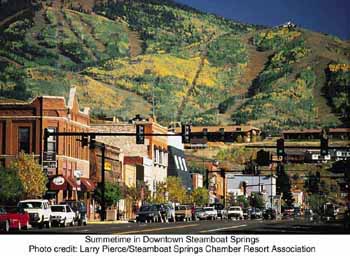
Steamboat Springs: Stormwater enterprise not in the cards

From Steamboat Today (John F. Russell):
A task force created this year to study the stormwater needs in Steamboat has concluded a new fee or utility shouldn’t be created at this time to help cover the cost of maintenance and upgrades.
Instead, the task force is recommending that for the time being, the city’s stormwater upgrades can be covered out of its own budget by hiring more personnel and dedicating more equipment and materials to maintain the infrastructure…
The demand for the millions of dollars worth of stormwater improvements in Steamboat was the result of the city never having a comprehensive plan to keep up and expand its current system, City Manager Deb Hinsvark said as the task force was being created in January.
Last year, the city tapped Short Elliott Hendrickson, a firm of engineers, architects, planners and scientists based in St. Paul, Minn., to perform a $180,000 infrastructure study of Steamboat’s bridges, culverts and dams.
The firm recommended that the city invest at least $17 million in new capital projects to upgrade its stormwater system and help manage future flooding.
The consultant also found Steamboat’s stormwater infrastructure included “aging drainage infrastructure, much of which is in need of replacement immediately or within 5 to 10 years.”
The task force of 13 community members and five representatives from the city staff was created to help the city plan for the future.
Since February, they usually met once every two weeks and became experts in the city’s stormwater master plan.
“They deserve tremendous kudos for all the time they put into it,” Beall said about the task force, adding the discussion was robust and technical at times.
Fountain Creek: ‘We don’t think sustainable funds are there through a sales tax’ — John Cassiani

From The Pueblo Chieftain (Chris Woodka):
Businesses, not just government, want to see a higher level of commitment to stormwater funding in Colorado Springs. “We’re looking for an ongoing commitment, with a dedicated funding source that’s stable,” said John Cassiani, a real estate consultant who has served on El Paso County’s stormwater task force.
“When you look across the state and see that we are the largest city in Colorado without a stormwater fee, we need one,” Cassiani said. “We don’t think sustainable funds are there through a sales tax.”
The task force wants to base assessments on square footage of property creating either a separate authority or a stormwater district within the Fountain Creek Watershed Flood Control and Greenway District. The assessments would appear on property tax bills to avoid the kinds of non-payment issues associated with Colorado Springs’ stormwater enterprise when it collected fees from 2007-09. Communities would sign on, agreeing to maintain at least the current level of funding for maintenance. The money collected would be spent on critical projects that cross political boundaries, but returned to communities proportionately over time.
Colorado Springs City Council and El Paso County commissioners have voted to support the plan, and to gather public input prior to making a suggestion of how to proceed.
No set amounts for stormwater funding have been set, or a timetable developed for when projects would be constructed, City Council President Keith King said.
From The Pueblo Chieftain (Chris Woodka):
Mayor Steve Bach calls his plan to address flooding a “Storm Water Hybrid.” He proposes regional cooperation through an authority managed by Colorado Springs.
“We have the lion’s share of responsibility and I am not comfortable with the city delegating that to another entity,” Bach said.
Bach plans to use current funding levels on Springs Community Improvements Program bonds that were approved by voters in 1998-99.
From The Pueblo Chieftain (Chris Woodka):
While the number of Colorado Springs stormwater projects dropped, cost estimates rose for the remaining projects in an engineering report released Friday. The CH2MHill report was ordered by Mayor Steve Bach, who was alarmed that the city’s stormwater backlog costs apparently rose from $500 million in 2009 to almost $688 million in last year’s estimate by a stormwater task force. The new amount was about $535 million.
The engineers started by looking at a list of 282 projects within Colorado Springs, as well as reviewing stormwater documents going back 40 years, project manager Mark Rosser explained. Those projects were part of the task force’s larger study that identified $850 million in backlog for all of El Paso County, as well as nearly $11 million in operation and maintenance needs.
The consultants removed 44 projects that had been constructed, duplicated or that no longer existed. One of those was a $138 million project to replace all corrugated metal pipe drains in the city.
The remaining projects were rated according to urgency, and in some cases broken out into multiple projects.
“We were dealing with long reaches of streams,” Rosser said.
From that list of 239 projects, about 44 were given high priority, with a total cost of $162 million — more than twice the amount critical projects were estimated at in 2009.
The longer Colorado Springs waits to begin addressing projects, the worse things will get, he added.
“The work doesn’t consider what happened in September and October.”
CH2MHill is working on a similar estimate for El Paso County, expected to be completed in December.
From The Pueblo Chieftain (Chris Woodka):
Pueblo County commissioners Terry Hart and Sal Pace don’t want to wade into El Paso County politics, but would like to see tangible results on protecting Pueblo from the ravages of Fountain Creek.
“What are you doing today to protect us and how can we rectify that?” Hart asked El Paso County and Colorado Springs officials at a meeting this week.
The commissioners want to hold Colorado Springs to its commitment to help control stormwater made while seeking federal and county permits for the Southern Delivery System.
Pace, who represented Pueblo in the state House at the time, has always been critical of the decision by Colorado Springs City Council in 2009 to abolish the stormwater enterprise.
While most of council at that time — just one of the nine members sat on the board then — thought voters meant to end what tax crusader Doug Bruce called a “rain tax,” others found the message unclear. That does nothing to help Pueblo, which will spend about $200,000 to clean up after the latest downpour in September.
The city also must convince the Army Corps of Engineers to repair its damaged reinforcement of the bank at 13th Street, where a freeway interchange, railroad tracks and flooding are threatened.
Hart wants county staff to review which of the projects are designed to protect Pueblo as flows cross the county line.
“I’m concerned about the patience level of our community,” Hart said. “It is difficult, given what has occurred. The amount of funding over several years seems to have been drained.”
Pace also is concerned about how recent accounting of stormwater projects has changed in Colorado Springs after the large wildfires denuded huge swaths of landscape.
“The two fires create more of an issue, but it’s been an issue before,” Pace said. “We had large trees uprooted here, and smaller rain events are creating larger flood events. Whatever path is chosen, we have to know it will be successful. There is a lot of skepticism in Pueblo.”
Fountain Creek: ‘We certainly have to plan for more than a 10-20 year event’ — Dennis Hisey

From The Pueblo Chieftain (Chris Woodka):
A special district formed to improve Fountain Creek should be looking at what it would take to build a large flood control dam, officials from two counties agreed Thursday.
“I don’t think it’s too early to begin looking at a dam, when you look at the events up north,” Pueblo County Commissioner Sal Pace said during a workshop with El Paso County and Colorado Springs officials.
Smaller retention ponds in Boulder and Larimer counties were overrun by the force of water from 500-year storms, while larger dams in the Denver area held, Pace said.
“There is a lesson to be learned. Do we need a large flood control structure on Fountain Creek?” Pace asked.
“In my view, that has to be driven by science and the Fountain Creek district needs to be involved in it,” said Dennis Hisey, an El Paso County commissioner. “We certainly have to plan for more than a 10-20 year event.”
The U.S. Geological Survey is completing a study for the Fountain Creek Watershed Flood Control and Greenway District that shows a large dam is equally effective as 44 small retention ponds.
The cost of building and operating either type of system remains an unknown.
“I hope our next step (for the Fountain Creek district) is to look at the cost of each of the options,” said Terry Hart, chairman of the Pueblo County commission.
“If an event (like last month’s Northern Colorado storms) hit us next season, it would be incredibly devastating to all of our jurisdictions,” Hart said.
From The Pueblo Chieftain (Chris Woodka):
The Army Corps of Engineers is being asked to repair a project it completed just four years ago to stabilize a critical portion of bank along Fountain Creek in Pueblo. Repairs made in 2009 washed out during a Sept. 13 storm that also damaged other portions of Fountain Creek throughout the city of Pueblo. The Corps repairs would be in addition to an estimated $200,000 of work by the city in the Fountain Creek channel.
“I don’t know how long the process would be,” said Daryl Wood, Pueblo stormwater coordinator. “We’ll rely on the Corps to rebuild the embankment.”
The washout occurred on about 165 feet of a wire-wrapped levee at 13th Street. The area is critical, because the bank is just a few feet away from Union Pacific railroad tracks and a few yards from the 13th Street interchange of Interstate 25. The railroad has been notified.
While the Fountain Creek levee protects the Downtown area, washouts could affect its effectiveness at that point. Fountain Creek hits and departs the bank at a 90-degree angle under the current alignment. The Corps would have to decide if the alignment of the waterway could be changed through that section.
Prior to 1999, Fountain Creek flowed parallel to the area. Some large boulders set to protect the 13th Street area washed out in subsequent storms, and the wire-wrapped rip-rap that replaced them washed out this year.
The Eighth Street Bridge is located just downstream and several large trees were left strewn in the channel after the Sept. 13 storms, creating the potential for clogging the waterway as well.
“When the storm happened on Sept. 13, there were 2.8 inches of rain above Pueblo in a 24-hour period,” said Will Trujillo, levee safety program manager for the Corps. “In spot locations, there were 12-13 inches of rain.
When we receive that type of storm we notify any public sponsor in that section.”
The sponsor in this case is the city of Pueblo, which now has the job of detailing the damage to the project.
The Corps will schedule an inspection, determine the extent of damage and make any needed repairs, Trujillo said.
Stormwater: Springs’ Mayor Bach has proposed a combination of debt and redirected general fund cash to fund needs

From KOAA.com (Steve Folsom):
Key facts of an independent study requested by Colorado Springs Mayor, Steve Bach were presented Wednesday. The independent engineering firm CH2M Hill was called in for a second opinion after a local storm water task force came back with storm estimates showing a jump from 500 to around $800 million regionally.
The independent audit looks only at the Colorado Springs portion of the storm water needs. It shows there are over 225 projects that need to happen totaling nearly $535 million. That is $152 million decrease from the report earlier in the year, but it also shows there are $162 million in projects that need to be treated with urgency, which is an $80 million increase. It is a total that is down, but also a need for more cash to quickly get moving on repairs and improvements.
Ideas on how to pay for it are causing debate. Mayor Bach unexpectedly presented and idea to combine borrowed money from bonds with funds redirected from the city’s general fund. There are many other elected leaders from the region who want to hold town meetings and discuss with voters the possibility of asking for a storm water property fee or tax on the ballot.
From The Pueblo Chieftain (Chris Woodka):
Mayor Steve Bach’s proposal to roll stormwater into the city’s other capital needs got a cold shoulder Wednesday from members of a task force that has worked for more than a year — and from Pueblo County.
Bach laid out his plan for funding critical stormwater needs to City Council, county commissioners and nearby communities following the unveiling of a study that prioritizes projects. “We’ve already stubbed our toe once on stormwater,” Bach said. “The worst thing that can happen is that we get turned down again (by voters). We’ve got to get it right.”
He proposed spending $100 million over the next five years, lumping it into a $175 million plan that also would fund streets, roads, bridges, public safety vehicles and parks. It would take 20 years to pay off the bonds. While the bond issue would require a vote, there would not be a tax increase since payments would be similar to the current bond structure.
Bach also made an overture to create a regional stormwater authority, but said it should be funded through contributions from individual communities, funded proportionately and managed by Colorado Springs. He also said the city could review progress and determine if more funding would be needed at the end of the five-year period.
But other public officials criticized Bach’s plan for failing to address regional issues and providing a stable, sustainable source of funding. “I’m alarmed by the mayor’s proposal, which seems to be a stopgap way of funding the needs. It kicks the can down the road,” said Ray Petros, Pueblo County’s water attorney. He said it does not fulfill the promises of Colorado Springs Utilities to have a stormwater funding mechanism in place when it obtained a 1041 permit from Pueblo County for the Southern Delivery System.
“We are willing to listen to constituents and we want to hear from the community,” said Keith King, council president.
The council and El Paso County commissioners are planning three town hall meetings to discuss stormwater before finalizing funding plans. The intention is to allow county voters the chance to approve a tax, fee or some other way to fund stormwater by 2014.
But the task force members emphasized no method has been selected. No dollar figure or timetable for capital projects has been developed either. Commissioner Amy Lathen called Bach’s proposal “uninformed,” because the mayor has not been meeting with the task force.
Commissioner Dennis Hisey, who serves on the Fountain Creek Watershed Flood Control and Greenway District, said regional cooperation is needed rather than Bach’s approach. “Stormwater starts high in the watershed
September floods leave reaches of the pre-flood St. Vrain channel high and dry #COflood

From the Longmont Times-Call (Scott Rochat):
When the St. Vrain flooded in mid-September, it not only devastated communities, it redrew its own lines. West of town. East of town. Even at spots inside Longmont. It even brought out the eraser from time to time, not just drawing a new course but wiping out the old one.
“Behind Harvest Junction, the old channel actually filled in,” said Longmont public works director Dale Rademacher, noting the shopping center in southeastern Longmont.
Putting it back won’t be so easy. The city estimates that would take $80 million, but that’s still a fluid number, so to speak. A lot depends not just on the difficulty of the project, but the will of federal authorities, including the Army Corps of Engineers and the Federal Emergency Management Agency.
FEMA already has said it will look at the river section by section when deciding which restoration plans should get funding. The Corps, meanwhile, is in talks with Longmont to decide which pieces of the river truly need to be restored. Rivers do move, after all.
“If we think we can get the river back into its channel with a reasonable amount of effort, and the Corps says it makes sense, we’ll do that,” Rademacher said. “If the Corps says ‘Sorry, folks, that looks like a reasonably safe channel,’ we’ll start planning around that, too.”[…]
The diversions and flooding along the whole western stretch — aided by dam breaches and old gravel pits — have made this area a priority in Longmont’s discussions with the Army Corps of Engineers. Near Lyons, there are pipelines that need to be inspected and put back into service. The new riverway not only cuts off several irrigation ditches, it also puts several neighborhoods further downstream into a new flood plain — most notably The Greens and Champion Greens near Airport Road and the Village near Golden Ponds.
“Our need and our ability (to restore the river) varies from point to point in the course of the channel,” Rademacher said. “West of Longmont, where it’s undermining pipelines and threatening neighborhoods, it’s pretty important.”
From The Pueblo Chieftain:
Pueblo will spend about $200,000 over the next three months cleaning up the mess left on Fountain Creek from storms to the north in El Paso County last month. Damage to an embankment on the city’s side detention pond and dangerous trees in the channel are the biggest problems, said Earl Wilkinson, public works director.
From The Greeley Tribune (Jim Rydbom):
Bit by bit, the bundles of flood debris spread across yards and streets in Weld County are getting picked up. But it will be a while before a cluster of tree limbs isn’t found twisted into a fence somewhere.
Trevor Jiricek, director of Weld County Environmental Health and General Services, said the county has handed out about 3,200 vouchers for residents to take debris to the landfill. The vouchers are unlimited and good for one pickup truck full of debris each. Jiricek said the county worked out deals with 10 different facilities, including A1 Organics and two places to dispose of tires.
Jiricek said he’s received positive feedback for the vouchers, which are available through the Weld County planning department and at the FEMA Disaster Recovery Centers in Greeley and Milliken.
Farmers and ranchers with damaged and debris-filled properties are running into frustrations with the government shutdown, as they could be eligible for financial help through federal disaster loan options or the Emergency Conservation Program. The bulk of those programs, though, require consulting with the Farm Service Agency office before doing repairs, and the FSA is a federal office.
Jiricek said the county doesn’t have the resources to clean up everyone’s private property, but officials are in the process of contracting a company to clean up the county’s right-of-ways. When that happens, he said the county will notify residents affected by the flood who are near those right-of-ways, and they can put debris out to be collected.
Jiricek said it’s important only those affected by the flood take advantage of that service, as the county depends on reimbursement from FEMA for flood-related debris only, and the costs of removing debris could go up astronomically if people start using it as a way to get rid of trash.
Immediately after the flood, Jiricek said more than a half-dozen county employees worked to talk to residents about their needs and disseminate the vouchers.
“I feel like they’ve gotten out there,” he said of the vouchers.
‘In my experience, you don’t ever get a perfect solution’ — Diane Mitsch Bush #COflood

From Colorado Public News (David O. Williams):
Colorado state Rep. Diane Mitsch Bush says she plans to take up the issue of water contamination and greater setbacks for oil and gas wells from waterways in the wake of this month’s devastating flooding. Mitsch Bush, a Democrat representing Routt and Eagle counties on the Western Slope, told Colorado Public News new rules need to be considered for keeping drilling away from rivers and streams. The approach is similar to the state’s new setback rules for homes and public buildings, which went into effect Aug. 1. Current rules prohibit drilling within 300 feet of streams that provides municipal drinking water – extending five miles upstream of the water intake – but that setback doesn’t apply to bodies of water in general…
Rivers across northeastern Colorado – including the South Platte and St. Vrain – have been inundated with a variety of contaminants from flooding that started Sept. 11. Mitsch Bush said she is concerned about potential health impacts of the 890 barrels of oil that regulators confirmed have spilled in the flood zone.
“Any oil, any condensate, has the BTEX [benzene, toluene, ethylbenzene, and xylene] component and many others,” said Mitsch Bush. “All of those are very contaminating in a water body in relatively small portions. I think it’s really important that we don’t minimize what’s in there, but at the same time that we don’t have a huge overreaction either.”[…]
Asked about the potential for new setback laws or rules as a result of the floods, a spokesman for the Colorado Oil and Gas Association, an industry trade group, said their continued focus is on recovery, safety and getting production back online.
“Once flooding began, over 1,900 wells were shut in,” the group’s Director of Policy and External Affairs Doug Flanders said in an email, referring to the organization’s website for shut-in procedures. “To date, this has resulted in less than 1 percent of the wells having any isolated incidents due to debris-filled flood waters…
“In my experience, you don’t ever get a perfect solution,” she said, “but you get a better, a good, a sufficient solution if you can work with all the groups and sit down, talk about it, work together and see what you can come up with.”
‘When the big one [flood] comes, there will be added damage from growth in Colorado Springs’ — Sal Pace

From The Pueblo Chieftain (Chris Woodka):
A large dam on Fountain Creek is needed to prevent the kind of damage from flooding witnessed in Northern Colorado last week, a county commissioner says.
“When the big one comes, there will be added damage from growth in Colorado Springs and the burn scars of two large fires. The flooding will be worse than ever,” Commissioner Sal Pace said Thursday.
“We only have to look at the tragic events in Boulder and Larimer counties, in Lyons and Estes Park, to see what could happen.”
Floods, some rated as 500-year storms, overcame numerous small dams. Larger dams, such as Bear Creek and Cherry Creek reservoirs in the Denver Metro area, held up, he pointed out.
Fountain Creek: The El Paso County Board of Commissioners approve stormwater regional solution resolution

From The Colorado Springs Gazette (Matt Steiner):
The Board of County Commissioners voted on the resolution Tuesday, passing it by a 3-2 vote. Lathen said Darryl Glenn and Peggy Littleton cast the dissenting votes, noting that they wanted to wait until an Oct. 9 presentation by Mayor Steve Bach and consulting firm CH2M Hill before they gave their OK.
The City Council approved the same resolution 7-1 on Sept. 24. Helen Collins opposed it and council member Andy Pico was absent.
Bach has opposed the resolutions while awaiting the consultant’s input.
The commissioners had voted unanimously to approve a resolution in February, but the City Council waited until April after Bach insisted that a private study needed to be done. The mayor also said in February that the decision needed to wait for the new council, which was seated in April.
The outgoing council defied the mayor’s request and passed a regional stormwater resolution as one of its last actions. Scott Hente, the outgoing council president, said after the April 9 vote, “Stormwater is not politics. Stormwater is floods coming into your home. This is something that’s important to the community,” he said.
Lathen echoed Hente’s statement Wednesday when asked why the city and county needed to pass the recent resolutions after both government bodies had already voted in the joint effort. The commissioner stressed that this time, City Council and the BOCC each endorsed the same plan.
“This one is the same resolution signed by both bodies, and we’re excited about that,” Lathen said.
From the Colorado Springs Independent (Pam Zubeck):
For more than a year, local officials have been trying to figure out what to do about drainage. The long-overdue debate has centered on whether it’s best for Colorado Springs to go its own way, as Mayor Steve Bach wishes, or whether all agencies in the watershed need to cooperate to tackle the problem, which by one estimate will cost nearly $1 billion.
Next week, things will come to a head when Bach unveils his long-awaited proposal, along with a report from consultant CH2MHill about whether the city’s projects list alone really totals some $700 million.
From The Pueblo Chieftain (Chris Woodka):
Apparently, Fountain Creek is a moving target when it comes to Bureau of Reclamation environmental impact studies. Buried in the documents regarding the Arkansas Valley Conduit and master storage contract for Lake Pueblo released in August is Reclamation’s response to a concern raised by Pueblo County last year.
In a Nov. 30, 2012, letter, Pueblo County’s water attorney Ray Petros asked about the discrepancy of flows on Fountain Creek between the EIS for Southern Delivery System and the conduit when it comes to Colorado Springs’ repeal of its stormwater enterprise in 2009.
Petros also asked if Reclamation intended to reopen the SDS environmental study in light of the stormwater repeal, especially looking at the cumulative impacts of both projects.
Reclamation responded that it would not open a new investigation of Fountain Creek flows because additional storage contracts for some El Paso County cities that are tied into the conduit EIS would have only negligible impact on Fountain Creek.
With regard to the discrepancy in flows on Fountain Creek — they are reduced by 12 percent in the conduit-master contract study — Reclamation responded that different time frames were used. The SDS study looked at 2006 and compared it to 2046 projections, while the conduit study looked at 2010 and compared it to 2070.
The lack of a Colorado Springs stormwater enterprise is of concern to Pueblo County commissioners because it was in existence when a previous board issued a 1041 land-use permit in 2009. Commissioners are evaluating Colorado Springs compliance with 1041 conditions.
The Lower Arkansas Valley Water Conservancy District is preparing a federal lawsuit against the Bureau of Reclamation over its lack of action on a request to reopen the EIS for SDS because of the stormwater issue.
Colorado Springs: ‘We could spend billions, but we can’t stop the flooding’ — Paul Kleinschmidt

From The Pueblo Chieftain (Chris Woodka):
A rift between Colorado Springs City Council and Mayor Steve Bach widened Tuesday over the issue of stormwater funding. Colorado Springs City Council voted Tuesday to spend $35,000 to support a stormwater task force, matching $35,000 each from Colorado Springs Utilities and El Paso County, for a total of $105,000. Council also voted to hire its own legal counsel for stormwater issues.
There has been pressure from Pueblo County and the Lower Arkansas Valley Water Conservancy District to fund stormwater projects as part of Colorado Springs’ environmental commitments relating to the Southern Delivery System.
The move comes as the task force is moving toward putting a stormwater tax on the November 2014 ballot as a way of addressing a $900 million backlog in stormwater needs through a regional approach. It also reflects dissatisfaction with Bach, who has refused to participate in stormwater task force meetings.
City Attorney Chris Melcher angrily contested the move, claiming that his office has attorneys with expertise in stormwater, but had never been asked to advise council on stormwater. He said the city charter does not allow conflicting legal opinions and he questioned the expenditure both by council and Utilities.
Several council members rebuked Melcher, asking why no one from his office has attended high-profile task force meetings, and why he has favored Bach on matters related to stormwater. “I understand you’re hired by the mayor, but that’s not my issue,” Council President Keith King told Melcher, adding that if it were possible, council would fire him. “We have not been given the kind of service that we need.”
“If you pass this resolution and decide to act, it is in violation of the charter,” Melcher said.
Council has worked with El Paso County for more than a year to develop a regional approach to stormwater, but now fears that it would again be underfunded as the mayor moves ahead with a separate approach to lump infrastructure needs into one funding scheme. “I’m concerned that stormwater would be folded into all the other infrastructure needs,” said Councilman Joel Miller.
Larry Small, a former councilman who is the executive director of the Fountain Creek Watershed Flood Control and Greenway District, urged council to continue the regional approach, saying it has worked well on other issues such as transportation in the Pikes Peak area.
Doug Bruce, a former county commissioner, state representative and convicted tax evader, contested council’s move, saying it is a waste of money that doesn’t solve anything. Bruce said the money would be better spent cutting down trees that have been allowed to grow in Fountain Creek.
Paul Kleinschmidt, of Taxpayers for Budget Reform, opposed spending money on the task force as well. “We could spend billions, but we can’t stop the flooding,” he said.
The Lower Ark District is moving to file a complaint against Reclamation over SDS Record of Decision

From The Pueblo Chieftain (Chris Woodka):
A federal decision on the Southern Delivery System is headed to court. The Lower Arkansas Valley Water Conservancy District is preparing a complaint to file in federal court over the Bureau of Reclamation’s refusal to reopen its record of decision on SDS. The central issue is the abolishment of the Colorado Springs stormwater enterprise in 2009, which was in place when Reclamation granted approval of a 40-year contract for storage, exchange and connection at Pueblo Dam for SDS.
“I’m asking our board to draft a legal complaint against the Bureau of Reclamation,” said Melissa Esquibel, a Pueblo County board member. “We’ve asked the Bureau of Reclamation to reopen the record of decision, and gotten no action. We need to direct staff to draft a lawsuit.”
Lower Ark board members say SDS should not be allowed to deliver water until the stormwater issue is resolved. “If there had not been a stormwater enterprise, SDS never would have gotten a 1041 permit,” said Anthony Nunez, a Lower Ark board member who was a Pueblo County commissioner in 2009.
Last year, the Lower Ark district sent letters to Reclamation asking to reopen the record of decision on the stormwater issue. Reclamation declined to take any action.
This will be the second lawsuit the Lower Ark district has filed against Reclamation, if the board approves it at its October meeting. In 2007, the Lower Ark sued Reclamation over a 40-year storage and exchange contract with Aurora, claiming it illegally allowed the Fryingpan-Arkansas Project to move water out of the Arkansas River basin. The lawsuit was settled in 2009, after Aurora and the Lower Ark signed an agreement for mitigation of some of the issues surrounding the contract.
From The Pueblo Chieftain (Chris Woodka):
Flood protection for the Lower Arkansas Valley should not be an afterthought. That message was delivered to Colorado Springs Wednesday during a presentation about regional stormwater efforts in El Paso County to the Lower Arkansas Valley Water Protection District. “We quibble about data. What I want to see is the problem fixed,” Lower Ark General Manager Jay Winner told Mark Pifher, point man for the Southern Delivery System.
Colorado Springs Utilities disputes the Lower Ark’s interpretation of state and federal data about water quality. The Lower Ark claims it shows higher flows have increased sedimentation and bacteria in Fountain Creek since Colorado Springs got rid of its stormwater enterprise in 2009. Pifher countered that’s just because of higher peak flows in the past three years. Fountain Creek monitoring has begun and safeguards are built into the Bureau of Reclamation’s contract through an adaptive management program if unexpected pollution occurs, he said. A stormwater task force and Mayor Steve Bach are close to coming to consensus and moving a stormwater issue to the 2014 ballot.
All of which served to aggravate Pueblo County members of the Lower Ark board:
“My heartburn is that the discussions center around the Black Forest and Waldo Canyon as far as Fountain Creek is concerned, but nothing for us” said Melissa Esquibel. “I don’t think anything substantive has happened.”
“It’s been a fractured thing up there since I was a commissioner. It almost doesn’t seem real. We’ve heard the same thing over and over and over,” said Anthony Nunez. “I have to say there is a small amount of trust.”
“We have to put limits on SDS until the stormwater issue is taken on,” said Reeves Brown.
Colorado Springs voters defeated a Doug Bruce measure in 2008 to make payment of stormwater fees voluntary by 30,000 votes, but City Council abolished the stormwater enterprise after a second ballot measure that did not even mention it by name passed in 2009, Winner said. While Bruce campaigned against a “rain tax,” the 2009 Proposition specifically tried to sever utility payments from the Colorado Springs general fund. Council has not ended Utilities payment in lieu of taxes, Pifher said in response to a question by Winner.
Pifher said stormwater fees would be collected again beginning as soon as 2015 if voters approve it in 2014. That didn’t do much to allay fears. “You got what you needed and the stormwater enterprise went away,” Winner said. “Do you see the pattern here?”
Fountain Creek: ‘People who have never thought about stormwater are thinking about it now’ — Mark Pifher
From The Pueblo Chieftain (Chris Woodka):
After a week of rain, the time seems right. “People who have never thought about stormwater are thinking about it now,” Mark Pifher, Colorado Springs Utilities point man for the Southern Delivery System, told the Pueblo Board of Water Works Tuesday. Rainy days, coupled with mudslides off forest lands that burned in the 2012 Waldo Canyon Fire have made stormwater an in-your-face reality for El Paso County communities in the Fountain Creek watershed.
Meanwhile, there is a lingering concern about whether enough is being done from Pueblo’s point of view. “This is a vital concern to Pueblo and downstream communities,” said Mike Cafasso, chairman of the Pueblo water board.
“This community has been waiting,” added board member Tom Autobee. “It’s kind of come to a head with what we’ve seen in the last few days.”
A ballot issue asking for a stormwater tax or fee is headed for the 2014 ballot, Pifher told the water board. A final recommendation about the specifics of the proposal, form of payment and amount of funding is expected by January. “What happens if it doesn’t pass?” board member Nick Gradisar asked.
“There’s the possibility that some funds can be shifted,” Pifher said.
Colorado Springs has spent or pledged to spend more than $300 million on stormwaterrelated activities since 2000, including $173 million for sewer line fortification after damage from flooding in 1999 and more than $130 million for mitigation related to SDS.
Pifher detailed the progress of an El Paso County stormwater task force that formed last year, explaining that the Waldo Canyon and Black Forest fires have added to a backlog of projects that totals $900 million. He also touched on the internal politics between Colorado Springs Mayor Steve Bach, City Council and El Paso County commissioners. Bach chose not to participate in the task force.
Pifher disputed charges by the Lower Arkansas Valley Water Conservancy District that water quality in Fountain Creek has worsened and flows have increased because of inaction on stormwater. He plans to address those issues with the Lower Ark board today.
Colorado Springs is not required under SDS permits to spend a certain amount on stormwater or have an enterprise in place, although other communities seeking to use SDS are required to have stormwater controls similar to Colorado Springs in place, Pifher said.
He touted the city’s drainage criteria manual as a unifying document that should improve regional storm controls. “We know we need to address stormwater issues in order to make regional alliances,” Pifher said.
Fountain Creek: ‘What I would like to see is for Pueblo to stop being flooded’ — Buffie McFayden
From The Pueblo Chieftain (Chris Woodka):
Fountain Creek connects Pueblo with Colorado Springs, and controlling it remains a key issue if the Southern Delivery System is to be turned on in three years. So there is bound to be a torrent of discussion on a stormwater enterprise, dams on Fountain Creek and water quality over the next few months.
Pueblo County commissioners set the stage last week for a Sept. 20 meeting to air issues surrounding the county’s 1041 permit for SDS. While there is a varied menu of issues that were hammered out over several months back in 2008-09, it’s clear that Fountain Creek is at the top of the agenda. “I don’t know if any of this works, because I’ve seen the power of the water,” Commissioner Liane “Buffie” McFadyen said last week after reviewing a federal study of dams on Fountain Creek. “What I would like to see is for Pueblo to stop being flooded and for people in north Pueblo County to keep from losing their land to these floods.”
The commissioners — none of whom were on the board when the 1041 permit was negotiated — also are working through the details of exactly how to handle $50 million, plus interest, that was pledged by Colorado Springs to protect Pueblo from flooding that will be made worse by SDS. Their lawyers are focusing the board on what it can do to keep Colorado Springs on track with the conditions agreed to in the 1041 permit.
But a different set of issues is swirling around the sides.
Chief among them is stormwater. It was taken for granted by the Bureau of Reclamation in the studies leading up to a 40-year contract for SDS to operate from Pueblo Dam. In the 1041 conditions, only the incremental flows directly caused by SDS are mentioned. “It’s a moral question and potentially a legal question,” Commissioner Sal Pace said.
In July, the Lower Arkansas Valley Water Conservancy District claimed flooding has worsened and water quality deteriorated after Colorado Springs City Council eliminated its stormwater enterprise fee in 2009. Commissioners want to hear that report, as well as the rebuttal from Colorado Springs Utilities.
Last week, public wrangling over the stormwater question broke out again in Colorado Springs. Mayor Steve Bach was quoted in the Gazette as favoring a city stormwater fee, while Council President Keith King argued for a regional approach — possibly extending to the confluence and including Pueblo.
The Colorado Springs Council plans hearings of its own in the next few months to sort out which approach voters would be most likely to favor.
Fountain Creek: Pueblo County DA asking the state Supreme Court to overturn the July appeals court decision
From The Pueblo Chieftain (Chris Woodka):
A dispute over water quality is heading to the state Supreme Court. District Attorney Jeff Chostner today is asking the state Supreme Court to overturn a July 18 appeals court decision that Pueblo District Judge Victor Reyes erred in ordering the state to redo its assessment of impacts of the Southern Delivery System on Fountain Creek and the Arkansas River.
Reyes issued his decision last year, siding with former District Attorney Bill Thiebaut in finding that the Colorado Water Quality Control Commission ignored its own standards and accepted a “gut feeling” methodology in issuing a federal permit required for SDS.
Attorney John Barth of Hygiene, who has represented both Chostner and Thiebaut in the case, argued that a scientific methodology, including a numeric standard is needed. He argued increased flows on Fountain Creek and changes in the flows of the Arkansas River through Pueblo could increase pollutants like selenium and sediment.
Colorado Springs attorney David Robbins presented counterarguments that water quality issues would be addressed as they arose through an adaptive management plan outlined in the Bureau of Reclamation’s environmental impact statement for the project.
During a deposition for a December 2010 hearing, the state employee who performed the analysis for the SDS impacts said he relied on a “gut feeling” in his assessment of impacts.
In the brief that is being filed today, Barth argues that selenium levels through Pueblo will double or triple under SDS changes, yet the state determined there would be “no degradation.”
At the December 2010 hearing, Robbins and Colorado Springs Utilities officials made the case that impacts from SDS won’t show up for years, so numeric standards now would not be applicable.
Reyes ordered the commission to hold new hearings and develop a permit based on scientific standards. A panel of three appeals court judges rejected the Reyes decision, largely on procedural grounds because he did not do a “rigorous investigation” of claims.
Meanwhile, monsoon rains have caused a good deal of damage to Colorado Springs’ stormwater facilities. Here’s a report from Bill Folsom writing for KOAA.com:
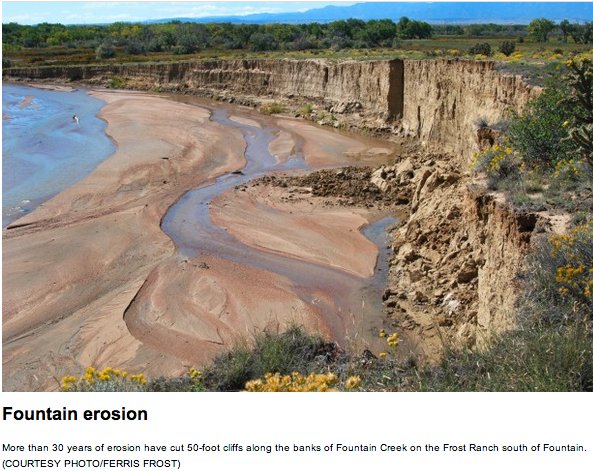
Emergency repairs are necessary to the Colorado Springs storm water system following last weeks unusually heavy rain storm. Storm drains have been exposed, there is damage to detention ponds, and erosion has compromised infrastructure.
Storm water mangers have been running the numbers and calculate nearly four inches of rain fell in just hours on the far north side of the city. The amount equals what they call a 200 year storm. “We do not design for a 200 year storm. We’re up to 100 years,” said Colorado Springs Storm Water Manger, Tim Mitros, “So this was a rarity and our storm sewer system was just totally overwhelmed.” The price tag for the damage to the storm water system is approaching one million dollars.
Southern Delivery System: Pueblo County is setting the stage for 1041 hearings
It looks like Pueblo County is about to get back in court with Colorado Springs, this time over compliance with the 1041 permit for the Southern Delivery System (which is largely complete in the county). Here’s a report from Chris Woodka writing for The Pueblo Chieftain:
Stormwater, revegetation, roads and other details of a county permit for the Southern Delivery System will be discussed at a public meeting next month. The Pueblo County commissioners want to hear comments from the public and discuss the progress of the project with Colorado Springs Utilities, leaving open the possibility of 1041 permit compliance hearings at a later date. “What we envision is a chance for Colorado Springs to respond to questions,” said Terry Hart, chairman of the commission. “We definitely want the ability for public participation.”
The meeting is scheduled for 10 a.m. Sept. 20 in the commission meeting chambers at the Pueblo County Courthouse.
Commissioners Monday reviewed issues surrounding SDS that have surfaced in recent months. They include issues of revegetation on Walker Ranches in northern Pueblo County.
Also at issue is a dispute over the interpretation of Colorado Springs stormwater data by the Lower Arkansas Valley Water Conservancy District and Colorado Last month, water attorney Peter Nichols told the Lower Ark board storm flows have worsened and water quality deteriorated, while stormwater funding decreased from 2009-12. Mark Pifher, SDS permitting manager, responded that there is no correlation between the demise of the stormwater enterprise in 2009 and water quality or volume of flows. He disputed the trends that Nichols found.
Commissioners plan to get more information from Nichols in advance of the Sept. 20 meeting.
At Monday’s meeting, commissioners also looked at the possibility of prepayment on interest from the $50 million Colorado Springs pledged for Fountain Creek flood control.
They also want to review the U.S. Geological Survey study that shows the effectiveness of dams throughout the Fountain Creek watershed.
The Fountain Creek district approved a Colorado Springs Utilities’ SDS mitigation wetlands project on Friday
From The Pueblo Chieftain (Chris Woodka):
Colorado Springs Utilities’ plan to improve a portion of Fountain Creek as part of mitigation for the Southern Delivery System got unanimous approval Friday from a board formed to improve Fountain Creek. Meeting in Pueblo, the Fountain Creek Watershed Flood Control and Greenway District approved a new alignment for the creek and wetlands creation about 25 miles north of Pueblo near Pikes Peak International Raceway.
Allison Mosser, a Utilities engineer, explained the project, which was listed as the No. 5 priority in a U.S. Army Corps of Engineers study of projects that could improve Fountain Creek. The project also is among those listed in the district’s corridor master plan. The area is one of the worst on the creek in terms of erosion and sedimentation, she said.
The alignment would mean moving some structures and reinforcing other parts of the bank on the property, which is owned by Utilities. A small part of the creek on the Hanna Ranch also is included, but all costs would be paid by Colorado Springs. Some native willows would be planted for bank stabilization and wetlands would be created or improved. Water for initial seeding of the wetlands would use water from rights owned by Colorado Springs at Clear Springs Ranch, Mosser said.
The Bureau of Reclamation would have final authority over approval of the wetlands, because it holds the SDS permit.
Construction would begin in November and take three months, while planting the wetlands would be completed later in the year.
Monitoring the wetlands would continue for three to five years.
More coverage of the Fountain Creek district meeting from Chris Woodka writing for The Pueblo Chieftain:
A district formed to improve Fountain Creek will team with the U.S. Geological Survey to measure water quality changes caused by runoff from recent fires. The Fountain Creek Watershed Flood Control and Greenway District board Friday approved a contract that will measure the impacts of the 2012 Waldo Canyon Fire and this year’s Black Forest Fire.
The Black Forest Fire was the most destructive in Colorado history in terms of homes and vehicles destroyed, and could increase the concentration of certain elements.
The total contract will be $18,000, with $6,000 in federal funds, and the other $12,000 contributed by the district and several El Paso County sources.
Samples will be taken as storms occur. “We’ve already missed three or four opportunities,” said Larry Small, executive director of the district. Two sites on Monument Creek and four on Fountain Creek would be sampled. More than 100 constituents will be tested for contaminants like lead and E. coli.
The USGS indicated last month that it has baseline data. “I think this is an important first step. We’ve been talking about impacts since the Waldo Canyon Fire last year,” said Pueblo County Commissioner Terry Hart.
Melissa Esquibel, a board member from the Lower Arkansas Valley Water Conservancy District, questioned the value of the study, since it would not thoroughly identify sources and problems caused by subsequent storms.
Hart said this study would provide evidence for more detailed studies later.
Jane Rhodes said more studies are needed downstream to see if fires are impacting Pueblo County, because the study sites are in El Paso County.
“We need to find out what’s in the water to protect our population,” added Pueblo City Councilwoman Eva Montoya.
Colorado Springs Utilities and the Lower Ark District are still scuffling over stormwater and Fountain Creek
From The Pueblo Chieftain (Chris Woodka):
Colorado Springs Utilities disagrees with the Lower Arkansas Valley Water Conservancy District’s interpretation of the city’s stormwater discharge data.
Last month, Lower Ark attorney Peter Nichols said the data showed the volume of discharges had gone up and increased sedimentation and E. coli bacteria in Fountain Creek. Nichols said the data were taken from Colorado Springs state stormwater reports, and his comments were reported in a Chieftain story.
In response to the story, Colorado Springs Utilities looked at the same data and believes there is no correlation of flows or increased contamination due to the dissolution of the stormwater enterprise. Mark Pifher, Southern Delivery System permitting manager for Utilities, made the comments in an Aug. 14 letter to the Lower Ark district. If anything, there is evidence that there is a downward trend of flow, sedimentation and contamination based on reports from a continuous gauge at Security. “Springs Utilities would like to reiterate that it takes stormwater control and water quality within the Fountain Creek basin very seriously,” Pifher wrote in the letter.
He repeated the stance that Colorado Springs officials have taken that a stormwater enterprise or a certain level of funding for stormwater is not required by Pueblo County’s 1041 permit for SDS.
He added that a U.S. Geological Survey study shows there is more benefit to Pueblo from building stormwater retention ponds downstream from Colorado Springs than by building retention ponds within or upstream from Colorado Springs. Pifher said he wants to talk to the district about its conclusions.
Fountain Creek: Colorado Springs’ city council is looking at resurrecting their stormwater agency
From The Colorado Springs Gazette (Monica Mendoza):
Across the state, municipalities have created enterprise programs that collect fees for stormwater and drainage projects without first seeking voter approval, which is legal. Colorado Springs did, too, implementing a stormwater enterprise fee in 2005 without asking voters if they were willing to pay for such projects as channels, detention ponds and maintaining pipes and water basins.
The program ended in 2009 after Colorado Springs voters approved Issue 300, which precluded enterprises from giving money to the city’s general fund.
The city won’t do that again, council members said.
Council members and commissioners met Wednesday to discuss stormwater funding. They agreed to “scrub” the city and county budgets to find money to pay for a backlog of stormwater projects estimated to cost more than $700 million.
But operations and maintenance would cost $11 million a year, and they doubted the city and county budgets could come up with that kind of cash.
Elected officials are sure they are headed toward a ballot question, but they don’t know what the question will be or who will be in charge of managing a stormwater program – the city, the county or a regional authority.
The Pikes Peak Regional Stormwater Task Force has presented two funding options – an authority that collects fees or an authority that collects taxes – but the elected officials are not ready to commit to either option.
“All options need to remain on the table and we shouldn’t be jumping to conclusions,” said Councilman Merv Bennett…
Additionally, Pueblo County commissioners are growing impatient over the absence of a plan by El Paso County and Colorado Springs to address stormwater projects, the Pueblo Chieftain newspaper reported earlier this week.
Pueblo County commissioners have argued that Colorado Springs must complete some mitigation projects connected to the Southern Delivery System by 2016 to ensure that flows in Fountain Creek don’t exceed levels of 2009.
However, there is strain between the counties, city and utilities over what the mitigation projects should be and who has ultimate authority under the existing permits…
[Pam Maier] believes residents are ready to tax themselves to pay for the stormwater projects. “This town supports saving residents from suffering from floods and other disasters that occur when you don’t have a stormwater program in place,” she said.
Fountain Creek: ‘At some point, this board is going to lose its patience’ — Buffie McFadyen
From The Pueblo Chieftain (Chris Woodka):
Pueblo County commissioners are more than happy to throw some money into the hat to keep a Fountain Creek district afloat. At the same time, patience is wearing thin for El Paso County to come to grips with stormwater funding. “At some point, this board is going to lose its patience with the largest city in the state without a stormwater fee,” said Commissioner Liane “Buffie” McFadyen. “I feel like we’re standing knee-deep in water and not going anywhere.”
Larry Small, executive director of the Fountain Creek Watershed Flood Control and Greenway District, asked commissioners Monday to consider the district’s plan to patch funding until 2016. The district is nearly out of funds, and is asking county and city governments to come up with $50,000 to meet administrative needs in 2014. Pueblo County’s share would be $10,000.
If Southern Delivery System comes online in 2016, as projected, the district would begin receiving payments from Colorado Springs toward the $50 million negotiated in the Pueblo County 1041 process. That money is earmarked for Fountain Creek flood control projects that protect Pueblo. Interest from the $50 million could be used as soon as next year to begin planning flood-control projects that could benefit Pueblo. But commissioners still are sore that Colorado Springs City Council eliminated its stormwater enterprise in 2009 and has not replaced it.
Colorado Springs City Council is seeking a regional solution to meet $900 million in identified projects in El Paso County. Nearly 80 percent of those are in Colorado Springs. Mayor Steve Bach is pursuing a separate course to prioritize projects. While that discussion continues, the Fountain Creek district has put its own plans for a mill levy election — the district can assess up to 5 mills of property tax — on hold just in case there is an El Paso County stormwater fee election in 2014. “The longer (the Fountain Creek district) goes without passing a mill levy, it limits the time you’re able to do projects,” said Commissioner Sal Pace.
Small pointed to a U.S. Geological Survey study that showed 10 retention ponds south of Fountain would provide protection for Pueblo by cutting 46 percent of the peak flow off a 100-year flood. The SDS money would all go toward those types of projects, or a large dam, an option that is unlikely. But commissioners want results sooner. “If we put the district in mothballs for too long, we defeat the statutory mandate,” said Chairman Terry Hart.
Fountain Creek: Mayor Bach takes position that Pueblo County’s 1041 permit is non-specific with respect to projects
From the Colorado Springs Independent (Pam Zubeck):
After Mayor Steve Bach and Council President Keith King sent a June 6 letter to Pueblo County misstating the facts about Colorado Springs Utilities’ permit to build the Southern Delivery System (“Storm brewing,” News, July 17), they corrected the record with a new letter sent July 19.
In the June 6 version, the city said a Stormwater Enterprise projects list was submitted “as part of” the 1041 construction permit process for the water pipeline from Pueblo Reservoir. There was no such project list or dollar figure submitted by the city as part of the 1041 permit itself, records show, meaning the city made no concrete pledges to spend a certain amount of money on stormwater or to do certain projects.
Rather, the permit, issued in April 2009, simply requires the city to ensure that Fountain Creek peak flows that result from new development served by the water pipeline are no greater than prior peak flows.
Although City Attorney Chris Melcher said in a statement to the Indy on July 15 that the June 6 letter “was accurate,” Bach and King wrote a new letter on July 19 “to clarify any potential misunderstanding of our letter of June 6, 2013.”
This letter also said that while there were “conversations” about stormwater projects, “it is clear that the 1041 Permit itself does not require or adopt any specific list of capital projects that must be implemented … [n]or does the 1041 Permit require a specific dollar amount to be allocated.”
The July 19 letter prompted Pueblo County Commissioner Sal Pace to tell the Pueblo Chieftain he was “furious” and “confused.”
Fountain Creek: Study of dams for flood control a big project for the USGS
From The Pueblo Chieftain (Chris Woodka):
It was a massive task. The question was simple: What are the impacts of building dams at various points on Fountain Creek? To do that, the U.S. Geological Survey broke the 932-square-mile drainage area into 72 subbasins, looked at 1,900 cross-sections and relied on historic information from more than a dozen stream gauges. “We used the information that was available, but engineers always want more information,” David Mau, head of the Pueblo USGS office, told the Fountain Creek Watershed Flood Control and Greenway District last week.
He was careful to point out that funding, property acquisition and water rights questions were not addressed by the study.
Mau released preliminary findings that show Pueblo would get equal protection from flooding by building one large dam or a series of 44 retention ponds along the creek. Most surprising was the relatively strong protection provided by just 10 detention ponds south of Colorado Springs. But the $570,000 study, expected to be finalized later this year, is just the beginning of protection for Pueblo from the highly variable and sometimes destructive flows of Fountain Creek. The political battles over stormwater still are being waged and the costs of alternatives largely unknown, but it is clear that building a series of smaller structures rather than a large earthen dam would cost less.
The district also must determine in the next few years how to spend $50 million coming to it from Colorado Springs as a condition of its 1041 land-use permit with [Pueblo County].
FOUR CHOICES
Four potential scenarios are among 14 modeled by the U.S. Geological Survey:
1. Build 44 detention ponds from the Air Force Academy to the confluence of Fountain Creek at the Arkansas River. Reduction of peak flows: 59%. Reduction of sediment: 18%.
2. Build an 85-foot earthen dam north of the confluence: Peak flows: 56%; sediment: 62%.
3. Build 10 detention ponds between Colorado Springs and Pueblo: Peak flows: 47%; sediment: 8%. 4. Build a diversion channel at the El Paso-Pueblo County line to channel flows into Chico Creek: Peak flows: 42.5%; sediment: 8.4%.
Numbers are based on a 100-year storm centered over downtown Colorado Springs. Peak discharge without any dams is 37,500 cubic feet per second, measured at Pueblo. Sediment load without any dams is 104,000 tons.
Fountain Creek: Detention ponds can accomplish nearly as much as a flood control dam, according to USGS

From The Pueblo Chieftain (Chris Woodka):
A series of detention ponds south of Colorado Springs to Pueblo could do nearly as much to reduce the impacts of a severe flood on Fountain Creek as one large dam. That’s the preliminary finding of a three-year study by the U.S. Geological Survey which will be completed later this year. The results were shared last week by David Mau, head of the Pueblo USGS office. “The report does not address water rights, transit loss or funding issues, just the hydrology and hydraulics,” Mau cautioned the Fountain Creek Watershed district board Friday.
The most effective means of reducing the impacts of a big flood for everyone along the creek would be to construct 44 detention ponds — water holding areas behind 10-foot berms that would not fall under the state’s classification of dams — up and down the creek to the confluence with the Arkansas River. It would include ponds on Monument Creek, the Upper Fountain and major tributaries. Combined, they would retain about 30,350 acre-feet of water and reduce the peak flow of a 100year flood by 59 percent, while reducing sediment by 18 percent.
Ponds would require regular maintenance.
An 85-foot tall dam 10 miles north of the confluence would provide nearly the same protection, reducing peak flows by 56 percent. It would retain far more sediment, reducing it by 62 percent, Mau said. That creates its own problems, however. About 64,000 tons of sediment — 2,500 truckloads of sand — plus trees and other debris would need to be cleared after a 100-year flood. The dam would have a permanent pool of 25,700 acre-feet and capture 25,000 acre-feet of flood water, as modeled in the study. It would also require moving railroad tracks and gas pipelines in Fountain Creek, as well as building a levee to protect Interstate 25.
Ultimately, the reservoir would help Pueblo, but would do little to protect El Paso County communities from flooding. It would cost hundreds of million dollars. Cost estimates have not been done in more than 40 years. Another option, however, would protect Pueblo almost as well, again with little benefit to El Paso County.
It would involve building just 10 detention ponds from Jimmy Camp Creek to Pueblo, and would have the potential of cutting the peak flows by 47 percent. The ponds would also trap less sediment, presumably requiring less maintenance and generating fewer complaints from downstream farmers who rely on flows of sediment. The ponds would have the effect of reducing a 1965-type flood to a less-damaging 1999-type flood. “When we get the $50 million from Colorado Springs, it may be a quicker fix,” said Richard Skorman, a Colorado Springs businessman and former councilman who is a member of the El Paso County stormwater task force. Skorman speculated that it would allow more time for the northern communities to solve internal stormwater problems while giving Pueblo and the Lower Arkansas Valley more peace of mind.
The detention areas could cost up to $1 million each, based on the demonstration project already in place on Pueblo’s North Side. But land acquisition costs could be higher, since the city of Pueblo already owned the land in the pilot project.
ABOUT THE STUDY
A study of dam sites on Fountain Creek by the U.S. Geological Survey won’t be finalized until later this year.
The $570,000 study included $300,000 funding from Colorado Springs as part of Pueblo County’s 1041 permit conditions for the Southern Delivery System.
It looked at 14 scenarios ranging from a few detention ponds on Monument Creek to a big dam on Fountain Creek itself.
Engineers used available records to assess how much the peak flow and sedimentation would be reduced as a result of projects at varying points along Fountain Creek.
Meanwhile the board is holding firm on their authority to review the Southern Delivery System’s potential impacts to Fountain Creek streamflow and water quality. Here’s a report from Chris Woodka writing for The Pueblo Chieftain:
The Southern Delivery System should still be subject to review by a district formed to protect Fountain Creek, the district’s board decided Friday. Colorado Springs Utilities plans to cross Fountain Creek with its pipeline under the SDS plan. The Fountain Creek district was given primary land-use authority in the flood plain between Fountain and Pueblo, but last month El Paso County claimed that authority for utility projects.
The board plans to tell El Paso County commissioners that the county’s newly adopted 1041 regulations do not supersede the authority of the Fountain Creek Watershed Flood Control and Greenway District under powers given to it by the state Legislature in 2009. A 1974 law, HB1041, allows counties to regulate projects with statewide impacts. “Why were we established?” board member Jane Rhodes asked in frustration.
“These tools on land use are tools we can use, and powers given to us by statutory right,” Pueblo County Commissioner Terry Hart said, adding that the nearly broke district cannot afford its own legal counsel to protect that power.
Other Fountain Creek board members agreed and directed Executive Director Larry Small to relay their concerns to El Paso County commissioners at an Aug. 6 meeting. Even Dennis Hisey, an El Paso County commissioner, was taken aback by his board’s stance. “I don’t see how it would take our right away from this board,” he said, adding that although he directed the action, he was not among those who drafted language in the 1041.
Hart said Pueblo County has interpreted its own 1041 regulations as a layer of authority, not an absolute power. “I think our position is that any design still has to be approved by the district,” Small said.
Fountain Creek: Will Mayor Bach get on board with the pending El Paso County stormwater study?
From The Pueblo Chieftain (Chris Woodka):
A district formed to fix Fountain Creek is anxious to see how Colorado Springs Mayor Steve Bach will react to findings of an El Paso County stormwater task force. The question was raised at Friday’s meeting of the Fountain Creek Watershed Flood Control and Greenway District by Pueblo County Commissioner Terry Hart. “The district has a statutory function to tackle flood control,” Hart said. “We have a major role.”
While most of the participants in the stormwater task force are also represented on the Fountain Creek board, Pueblo County’s interests can be incorporated through the district.
But Hart questioned El Paso County and Colorado Springs representatives about Bach’s willingness to allow the stormwater study and funding recommendations to move forward. Bach balked at the task force findings in January that Colorado Springs has a backlog of $680 million in stormwater projects. He ordered up a separate study to verify those needs.
The task force is wrapping up phase II of its study and will issue another report in October. “Hopefully, when the report comes out, (Bach) will jump in,” said Gabe Ortega, Fountain mayor pro-tem, who chairs the Fountain Creek board. “The majority of the region is on-board and ready to move forward.”
Richard Skorman, a former Colorado Springs councilman who lost to Bach in the 2011 election, said the task force is sorting out the possibilities of how funds to address stormwater could be raised — through a fee based on area or sales tax, for instance — and has not reached a recommendation.
Whichever method of funding is chosen, a public vote is likely to be required, and officials are aiming for a 2014 election date.
“I think the mayor is willing to sit down and look at a regional meeting, but he’s not embracing the task force,” Skorman said.
Why it matters
Pueblo officials have sought protection from floods on Fountain Creek while Colorado Springs worked to expand its water system to accommodate the rapid growth that has occurred in the past four decades by providing redundancy in water supply and to meet the needs of future growth.
Having a stormwater enterprise in place was listed as a given in Colorado Springs Utilities permits for its $940 million Southern Delivery System.
Last week, Bach and City Council President Keith King told Pueblo County Commissioner Sal Pace that the city is not required to have an enterprise in place or fund stormwater projects at a specific level.
Pace disputed that, but Pueblo County commissioners would have to hold a formal hearing to determine if Colorado Springs has violated the conditions of its 1041 permit for SDS.
The Lower Arkansas Valley Water Conservancy District has asked the Bureau of Reclamation to prepare a supplemental environmental impact statement for SDS because stormwater control has deteriorated since 2009, when Colorado Springs City Council abolished the stormwater enterprise, based on its interpretation of a municipal ballot question.
The Pueblo County D.A. will appeal reversal of Judge Reyes’ order for a CWQCC redo for certification of SDS
From The Pueblo Chieftain (Chris Woodka):
Pueblo District Attorney Jeff Chostner will ask the Colorado Supreme Court to overturn an appeals court ruling on Fountain Creek.
Last week, a three-judge appellate panel overturned District Judge Victor Reyes’ order for the Colorado Water Quality Control Commission to redo its certification of Colorado Springs’ mitigation plan for Fountain Creek and the Arkansas River. The case was originally filed by former District Attorney Bill Thiebaut. “I think there are contradictions within the opinion about what Judge Reyes could and couldn’t do,” Chostner said Tuesday. “They were also wrong on the facts and in saying that he acted in a capricious way.”
One of the major criticisms in last week’s reversal of Reyes’ order was that he chose to adopt Thiebaut’s complaint almost in its entirety. “It’s not unusual for a judge to pick one side over the other,” Chostner said. A petition for a writ of certiorari will be filed with the Supreme Court by the Aug. 29 deadline, Chostner said.
John Barth, a Hygiene water attorney hired by Thiebaut, and Chostner’s staff will work on the appeal.
Reyes issued the order last year for the commission to re-evaluate its certification for Colorado Springs Utilities’ plan for mitigation of impacts from the Southern Delivery System on Fountain Creek and the reach of the Arkansas River from Pueblo Dam to Avondale.
Thiebaut and the Rocky Mountain Environmental Labor Coalition opposed the plan, mainly because it relies on an adaptive management program that was spawned in the Bureau of Reclamation’s environmental impact statement for SDS. The opponents argued for a numerical standard instead.
The state certification is necessary for Army Corps of Engineers’ approval to work in Fountain Creek under the federal Clean Water Act.
Western Water Workshop — Planning for the new normal — recap
From the Glenwood Springs Post Independent (Hannah Holm):
Attendees of the Colorado Water Workshop in Gunnison July 17-19 heard sobering news about the long-term, devastating impacts expected from the West Fork Fire complex east of Alamosa in the San Juan and Rio Grande national forests.
The fires are burning in an area hard hit by beetle kill, with many dead trees. Despite previous scientific disagreements about how beetle kill would affect wildfire behavior, anecdotal evidence suggests that areas with extensive beetle kill burn with much greater thoroughness and intensity than areas with healthy trees. This appears to be the case with the West Fork Fire complex.
The 100,000+ acres the complex has burned so far encompass the headwaters of the Rio Grande River, in a basin even harder hit by drought in recent years than the rest of Colorado.
And now the monsoon rains are here: Good for putting out fires, but problematic in other ways. Hard rain hitting burned over ground can create tremendous destruction: Land slides and loads of sediment and debris choking streams, reservoirs and other water infrastructure on which downstream communities depend.
More education coverage here.
‘They [Colorado Springs] disguise their intentions and do nothing’ — Jay Winner
From The Pueblo Chieftain (Chris Woodka):
Colorado Springs leaders have told Pueblo County commissioners the city is not required to address specific stormwater projects or spend a set amount under its Southern Delivery System 1041 permit. It’s infuriated Commissioner Sal Pace, because the position apparently contradicts an June 6 letter in which Colorado Springs pledged to address the needs identified in the permitting process for SDS, a pipeline that will deliver water from Pueblo Dam to El Paso County. “I don’t know if I’m more furious or confused,” Pace said. “All one has to do is read the SDS environmental impact statement and see that the stormwater enterprise is mentioned over and over. In the June 6 letter, they indicated they were committed to addressing their stormwater needs. Now, in one simple letter, the city has reversed all that.”
As a state lawmaker, Pace challenged the elimination of the stormwater enterprise and continues to question the decision as a commissioner.
Pueblo County commissioners are seeking a meeting with Colorado Springs officials to discuss SDS compliance, but no date has been set. Violations of the 1041 permit would have to be addressed at a formal compliance hearing, and are not subject to the individual opinions of commissioners. Apparently, Colorado Springs is taking the position that it is only required to pay $50 million to a Fountain Creek improvement district, spend $75 million on bolstering sewer lines and ensure that SDS does not increase flows under the county permit for its $940 million water supply project. “It is clear the 1041 permit itself does not require or adopt any specific list of capital projects that must be implemented to address Fountain Creek peak flows, run-off volumes or other flood hazards,” Colorado Springs Mayor Steve Bach and Council President Keith King wrote in a letter to Pace last week. ‘’Nor does the 1041 permit require a specific dollar amount to be allocated toward stormwater projects.”
Comments in March 2012 by City Attorney Chris Melcher that Colorado Springs should be spending at least $13 million annually on stormwater touched off a flurry of stormwater activity three years after council abolished the city’s stormwater enterprise.
An El Paso County task force identified $900 million in capital projects, $686 million in Colorado Springs. Bach launched an independent review of Colorado Springs’ share.
During that time, the Lower Arkansas Valley Water Conservancy District asked the Bureau of Reclamation to reopen its environmental analysis of SDS because it originally assumed the stormwater enterprise was in effect. Last week, the district released figures showing the city’s expenditures on stormwater dwindled to nearly nothing in 2012.
Colorado Springs is spending $46 million on stormwater projects this year, with more than half going toward dealing with impacts from the Waldo Canyon Fire.
From The Pueblo Chieftain (Chris Woodka):
The burden of meeting water quality standards will increasingly fall on farmers in the Lower Arkansas Valley as a result of inaction on stormwater in Colorado Springs. “It’s outrageous that they do not want to take the responsibility for stormwater,” said Jay Winner, general manager of the Lower Arkansas Valley Water Conservancy District. “Pueblo and the Lower Ark district have tried to cooperate, but it seems that every The federal Food Modernization and Safety Act passed last year puts increased responsibility for water quality on farmers who irrigate and market raw food, Winner said. Lower Ark district studies show that water quality on Fountain Creek has continued to decline since Colorado Springs abolished its stormwater enterprise.
Winner was reacting to news reported in The Chieftain Tuesday that Colorado Springs Mayor Steve Bach and Council President Keith King say their city is not obligated to do any specific projects or fund stormwater at any certain levels under Pueblo County permits for the Southern Delivery System.
Bach and King made that clear in a letter to Pueblo County Commissioner Sal Pace last week.
That’s a slap in the face to Winner, who received assurances stormwater would be funded at Colorado Springs City Council meetings in 2005, when the stormwater enterprise was formed, and in 2009, when it was dissolved. But a recent analysis by the Lower Ark district shows funding dropped to almost nothing in 2012. It has increased to $46 million this year, largely because of concerns about funding levels for SDS permits raised by Colorado Springs attorney Chris Melcher last year and the after-effects of the Waldo Canyon Fire. “The enterprise was supposed to fund the backlog of projects,” Winner said. That backlog now is estimated to be $686 million, a figure Bach questions. “They disguise their intentions and do nothing.”
Winner said the stormwater enterprise was listed as reasonably foreseeable in the 2009 environmental impact statement for SDS by the Bureau of Reclamation. “It has to be in place before one drop of water moves through SDS,” Winner said.
Conversely, Reclamation says a stormwater enterprise in Colorado Springs or El Paso County is not reasonably foreseeable in its current evaluation of the Arkansas Valley Conduit. But Reclamation has not reopened the EIS for SDS, despite a Lower Ark request last year.
Winner also questions whether the Fountain Creek Watershed Flood Control and Greenway District is weighted too heavily in favor of El Paso County. He is critical of the district for focusing on impacts of Waldo Canyon near Colorado Springs rather than downstream impacts. The district was formed in part to satisfy how $50 million in payments from Colorado Springs to improve Fountain Creek would be handled under Pueblo County’s 1041 permit for SDS. The district played a role in the current discussion over stormwater in El Paso County, backing a study that showed Colorado Springs’ stormwater funding lagged far behind other Front Range communities.
However, Colorado Springs leadership has at times ignored the district. For six months in 2011 no representative from Colorado Springs attended Fountain Creek meetings, as reported in the Sept. 24, 2011, Pueblo Chieftain. “I don’t recall that Mayor Bach ever has attended a Fountain Creek board meeting,” Winner added.
It turns out the Colorado Springs did need a stormwater enterprise after all, Fountain Creek water quality has declined
From The Pueblo Chieftain (Chris Woodka):
Stormwater flows, sedimentation and E. coli counts on Fountain Creek increased after Colorado Springs eliminated its stormwater enterprise in 2009. That’s not idle speculation, but an analysis provided by Colorado Springs to the Colorado Water Quality Control Division.
Preliminary results of the analysis were given to the Lower Arkansas Valley Water Conservancy District board Wednesday by Peter Nichols, the district’s water attorney. “At the same time, staffing and budgets have decreased, despite what they say their plans are,” Nichols told the board. “Funding has declined and bottomed out in 2012.”
Water quality data from Colorado Springs Utilities required by the state for the city’s stormwater permit from 2008-12 was used in the study by Nichols, a former director of the state water quality agency.
Flows on Fountain Creek increased from an average of 149 cubic feet per second in 2009 to 419 cfs in 2012 at Security, despite drier overall conditions in 2011-12. Similar increases were seen elsewhere in Colorado Springs.
At the same time, E. coli levels and sediment loads increased. Staffing for stormwater by Colorado Springs dropped from 47 in 2007, the first year of the stormwater enterprise to just 9 by 2012. Spending declined from $16.7 million in 2007 to just $1.8 million in 2012.
From the Colorado Springs Independent (Pam Zubeck):
Mayor Steve Bach seems hellbent on forcing Colorado Springs Utilities to fund the city’s stormwater needs, and he’s made yet another maneuver that could harm the city’s $1 billion Southern Delivery System pipeline project from Pueblo Reservoir.
Bach and City Council President Keith King, who is against a tax increase for stormwater, wrote a letter last month to Pueblo County Commission Chairman Sal Pace saying that Utilities had promised years ago to spend $17.6 million annually on stormwater mitigation to secure a construction permit from Pueblo County. Written as a follow-up to a meeting Bach had with Pueblo County officials May 3, it states the city has made “excellent progress” on the stormwater issue.
The city this week confirmed that the letter’s $17.6 million claim is accurate. But according to records and sources, it’s not — which would represent the second time in less than a year that Bach’s administration has used inaccurate statements while trying to foist stormwater funding onto Utilities…
This time around, on June 6, Bach and King sent Pace a letter saying the city submitted a five-year funding and project-priority plan “as part of” the 1041 process. “Colorado Springs and CSU submitted a five year funding and project priority plan for our stormwater capital projects during the review of the 1041 permit,” the letter states. “This plan contemplated spending approximately $88 million over the court of five years, for an average of $17.6 million per year. We have attached a copy of that funding summary for your review.”
But the attached list of Stormwater Enterprise projects is dated January 2010, which is eight months after the 1041 permit was issued. In addition, no such list shows up in the filings made as part of the 1041 process. The permit itself mentions the Stormwater Enterprise, but fails to state dollar figures or outline projects tied to SDS. Instead, the permit says the city “shall maintain stormwater controls and other regulations intended to ensure that Fountain Creek peak flows resulting from new development served by the SDS project within the Fountain Creek basin are no greater than existing conditions.” (Emphasis added.) In other words, as SDS project manager John Fredell says in a statement: “The SDS permit requirements related to stormwater are intended to mitigate the actual impacts of the project, not pre-existing conditions.”[…]
Neither Bach nor King consulted Utilities before writing the June 6 letter, according to Utilities spokeswoman Janet Rummel. King says the mayor’s office asked him to sign it, but he’s now “working with” Utilities officials “about an explanation of that particular letter, to make sure everything is copacetic on this.”
In response to a request for a comment from Bach, Melcher, the city attorney, writes the following via email: “The City confirmed that the June 6, 2013 letter to Pueblo County was accurate, and that early and later drafts of the attachment to that letter (a draft list of proposed Stormwater Projects, totaling $88 million) were communicated to Pueblo County by City and Stormwater Enterprise staff during the 1041 Permit process. The Mayor and City Council will continue to coordinate efforts to address Stormwater, and to communicate those efforts to our neighbors to the south in Pueblo County.”
It’s worth mentioning that Council, not Bach, has authority over Utilities.
Meanwhile Colorado Springs is hosting a public meeting about Fountain Creek Flooding in the wake of the Waldo Canyon Fire. Here’s a report from J. Adrian Stanley writing for the Colorado Springs Independent. Click through for the information for the meeting. Here’s an excerpt:
If you live along Fountain Creek, you’re probably worried about flash flooding. And you should be. The mud, water and debris that came roaring out of Williams Canyon on July 1 and claimed three homes, could have just as well come racing down Fountain Creek. And, in that scenario, who knows how many structures it would have claimed.
Where and when a flash flood happens is a matter of chance — it all depends on which area a storm decides to dump on, how much it rains, and how quickly the rain comes. Thus, the city of Colorado Springs is offering a meeting to help Fountain Creek residents prepare for the worst.
From the Colorado Springs Independent (J. Adrian Stanley):
For months now, the Stormwater Task Force has managed to be two things: (1) a group of interested citizens and government workers striving to fully identify the region’s stormwater problems and identify a funding solution, and (2) an enduring focal point for angst between El Paso County and Colorado Springs Mayor Steve Bach.
At a July 15 meeting of the Task Force, El Paso County Commissioner Amy Lathen said Springs City Attorney Chris Melcher had met with her weeks ago and stated unequivocally that the city would not work with the task force. But at the same meeting, task force member John Cassiani said he’d been talking with the executive department of the city and hoped that a meeting would be possible toward the end of the year.
Lathen said she hoped the meeting would happen, though she doubts it will. “The message that you just gave us is very different than the one we were given just a few weeks ago,” she told Cassiani.
Given that the area has as much as $906 million in stormwater capital needs, plus an estimated $11.5 million in annual stormwater maintenance needs, the ongoing political squabble is no small problem. The mayor believes that the city should solve its stormwater problems independently, and that the scope of the problems is exaggerated. He’s hired Englewood-based firm CH2M HILL to identify the city’s most pressing needs. It could report back as early as October.
Meanwhile, the Stormwater Task Force has been moving forward without the help of the city or its staff. At the July 15 meeting, leaders said they hoped to ask voters to fund a stormwater remedy in the fall 2014 election. What voters would be asked to approve is not yet clear — the task force has not decided whether to pursue a tax, or create a special enterprise that would charge a fee.
AWRA Colorado Section: AWRA Summer field trip of the Southern Delivery System — Friday, August 16
Click here to go to the AWRA Colorado Section website for the pitch and to register.
Federal money for wildfire mitigation lands in Colorado
From The Greeley Tribune (Analisa Romano):
Greeley has been reimbursed another $350,000 in federal dollars for mitigation following last year’s High Park and Hewlett Gulch fires, bumping up the city’s total reimbursement to $576,000. It brings the final count for the city’s out-of-pocket expenses to clear Greeley’s water supply of soot and ash to $1.2 million. Eric Reckentine, Greeley’s deputy director of water resources, said that’s the last Greeley will pay. Following Congress’ passage of a bill this spring to fund the protection of threatened water sources in Colorado, the remainder of mitigation will be fully funded by federal dollars, he said.
Last fall, stakeholders in the Poudre Canyon — Greeley, the city of Fort Collins and the tri-districts (North Weld County, Fort Collins-Loveland and East Larimer County water districts) — agreed to share the cost of keeping water supply in the Poudre River clean. They paid a combined $4 million to treat the most-damaged areas, covering about half of what was needed.
This year, the rest of the tab — at a cost of about $7.3 million — will be picked up by the federal government, with Greeley’s $1.2 million used as matching funds for federal grant money, Reckentine said.
Fort Collins and the tri-districts also have been reimbursed by National Resources Conservation Services.
In the mitigation process, mulch and straw is dumped from helicopters to keep soot, ash and debris from slipping off of hills and into the water supply. Reckentine said Greeley will still be responsible for managing some of the mitigation. He said the city hopes to see work on burn areas start in mid-August.
From KUNC (Erin OToole):
Last fall, the three water districts in Weld and Larimer counties, and the cities of Greeley and Fort Collins agreed to share the cost of keeping water in the Poudre River clean. Stakeholders paid a combined total of $4 million to treat the most damaged areas – only about half of what was needed.
This year the rest of the tab – about $7 million – will be picked up by the federal government. Fort Collins and the tri-districts are also being reimbursed.
Fountain Creek: ‘What’s the point of having this district?’ — Jay Winner
From The Pueblo Chieftain (Chris Woodka):
The Fountain Creek district board is weighted 5-4 in favor of El Paso County, its attorney also represents El Paso County, its manager is a former Colorado Springs City Council member and now El Paso County has claimed some of the land use authority granted to the district by the state Legislature.
“El Paso County has been disingenuous to the other intergovernmental agreement partners on Fountain Creek,” said Jay Winner, general manager of the Lower Arkansas Valley Water Conservancy District. “It seems to me we are outnumbered. They’ve taken control of 80 percent of the watershed this district was supposed to address. What’s the point of having this district?”
The district was formed in 2009 after nearly three years of meetings of a Vision Task Force sparked by flooding in 1999, and a flurry of lawsuits over spills of raw sewage by Colorado Springs Utilities into Fountain Creek.
But Colorado Springs yanked the rug out from under Pueblo County and the Lower Ark district when it abolished its stormwater enterprise in late 2009, and Winner has become distrustful of anything happening north of the county line.
“What’s going to go away next?” Winner asked.
At a meeting last week, there were a few sharp exchanges between Winner, District Executive Director Larry Small and attorney Cole Emmons, who is on loan from El Paso County.
After the meeting, Winner said the Fountain Creek district board had no notice that El Paso County was claiming some of its authority.
Dennis Hisey, chairman of the El Paso County commission, said Emmons notified Small of the land use changes. Aside from that, he said the district’s board, made up of elected representatives and citizens from both counties, did not discuss the new land-use rules until a retreat last month, after the changes had occurred.
But Hisey believes the board is working together in good faith.
“For Jay to say that we’ve wrested power, that’s a stretch,” Hisey said. “I’m not so sure the district wasn’t asserting more authority than it actually has.”
From The Pueblo Chieftain (Chris Woodka):
New regulations in El Paso County erode the authority of a district that was formed in 2009 to protect Fountain Creek.
“I believe El Paso County has wrested authority from Pueblo County and the Lower Ark district,” said Jay Winner, general manager of the Lower Arkansas Valley Water Conservancy District. “Does it put the Fountain Creek district in a position where it has to go through the 1041 process if it wants to do a project?”
El Paso County has adopted regulations under 1974’s HB1041 that gives counties authority over projects of statewide impact. The regulations were used in 2009 by Pueblo County to obtain conditions for the construction of Southern Delivery System.
The Fountain Creek Watershed Flood Control and Greenway District was created by the state Legislature in 2009, and given land-use authority over the Fountain Creek flood plain from Fountain to Pueblo.
But in the new 1041 regulations, El Paso County is claiming control over utility projects, including SDS, that are built anywhere in the county, including the Fountain Creek flood plain.
“It changes the district’s authority on the aspect location of utilities,” said Dennis Hisey, chairman of the El Paso County commissioners, who also sits on the Fountain Creek board.
In the past, the Fountain Creek district has made decisions on everything from gas plants to gravel pits to motorcycle parks. It still would have authority on any nonutility projects.
But there could be a gray area on the district’s own projects.
“I’m not sure this discussion is over yet,” Hisey said, adding that he still is in discussion with attorneys for El Paso County. “Speaking as a Fountain Creek board member who has been there from the beginning, it doesn’t seem quite right.”
From The Pueblo Chieftain (Chris Woodka):
Commissioner Terry Hart doesn’t think Pueblo County is getting steamrolled by El Paso County in its dealings on Fountain Creek.
In particular, he believes there are sufficient safeguards in the legislation that set up the Fountain Creek Watershed Flood Control and Greenway District.
“There is a requirement for supermajority (seven of nine members) approval that hasn’t been tested,” said Hart, who represents Pueblo County on the Fountain Creek board. “My No. 1 mission is to make sure Pueblo County is protected.”
That said, he doesn’t think it should come down to a test of wills. Pueblo can gain more by cooperation rather than continued fighting, he said.
From The Pueblo Chieftain (Chris Woodka):
A new foundation is vying for the attention of the district formed to fix Fountain Creek.
“There’s a tremendous opportunity for people to come back to the creek,” said Gary Barber, representing the Fountain Creek Watershed Greenway Fund.
The foundation would be the second devoted to helping the Fountain Creek Watershed Flood Control and Greenway District get private support to implement Fountain Creek improvement projects. So far it has raised about $15,000, Barber said.
The Fountain Creek Foundation, headed by David Struthers of Denver, has been active in community education through activities and video production; identifying projects that would benefit Pueblo’s East Side; and in promoting a wildlife viewing project near Pinon that is included in the Fountain Creek corridor master plan.
The Fountain Creek Watershed Greenway Fund is taking a different approach, connecting the Colorado Springs business community with youth.
“We’re still about the whole watershed,” Barber said. “But we’ve decided it’s time to get people on our end of the watershed engaged.”
Barber, a Colorado Springs realtor and water consultant, chairs the Arkansas Basin Roundtable. He was the first interim executive director of the Fountain Creek district and helped write the legislation that formed the district.
Part of the concept for the district is patterned after the Denver Urban Drainage and Flood Control District’s relationship to the Greenway Foundation, which have worked hand-in-hand to improve the South Platte River and Cherry Creek since the 1965 flood.
After hearing Barber’s presentation Friday, some members of the Fountain Creek board recalled the Fountain Creek Foundation, which has not been in contact with the district recently.
Southern Delivery System: Colorado Springs Utilities has spent $58 million in Pueblo County so far
From The Pueblo Chieftain (Chris Woodka):
About $58 million of the $337.8 million spent on Southern Delivery System so far has gone to contractors in Pueblo County, according to the latest accounting of the project. Now estimated to cost about $940 million, SDS would build a 50-mile raw water pipeline from Pueblo Dam to El Paso County. There are three pump stations along the way and a new water treatment plant in northeast Colorado Springs. The project benefits Colorado Springs, Security, Fountain and Pueblo West.
Allison Moser, a Colorado Springs Utilities engineer, gave the Fountain Creek Watershed Flood Control and Greenway District an update on SDS Friday.
So far, 38 of the 50 miles of underground pipeline — most of it 66 inches in diameter — have been placed. The North Outlet Works at Pueblo Dam has been completed and construction work on the Juniper Pump Station below the dam will begin this fall. The treatment plant in Colorado Springs is under construction, and contracts have been awarded for all three pump stations.
Most of the money for the project has been spent within Colorado, with $165 million in El Paso County, $800,000 in Fremont County and $48 million in the rest of the state. Another $66 million has been spent outside the state, mostly for specialized equipment not manufactured in Colorado, Moser said.
The Fountain Creek district has authority of some parts of SDS that cross the flood plain in El Paso County. That will change, however, because of new 1041 regulation in El Paso County that give county commissioners authority over all utility projects under a 1974 law. The major portion of Fountain Creek affected by SDS is the underground crossing of the pipeline several miles south of Fountain, which would be about 40 feet below the surface. That portion has been redesigned to avoid any disturbance of wetlands, Moser said.
The Fountain Creek Watershed Flood Control and Greenway District votes to ask members to pony up dough for solvency
From The Pueblo Chieftain (Chris Woodka):
A district formed to protect Fountain Creek is asking its members to contribute $50,000 in 2014 to keep itself afloat. The Fountain Creek Watershed Flood Control and Greenway District voted Friday to seek contributions from El Paso and Pueblo County, as well as incorporated cities in the two counties in order to stay solvent. The district will run out of money at the end of this year and has no prospect of reliable revenue until 2017, when Southern Delivery System is scheduled to go online. “We’re trying to figure out ways and perspectives about how we can hold the district together for the next few years,” said Pueblo County Commissioner Terry Hart. “We have to have a short-term plan for the ability to fund projects.”
The Fountain Creek board also voted to ask Pueblo County and Colorado Springs Utilities to pay off an estimated $2.2 million in index funds early in another attempt at funding. The index funds are a form of interest that accrues on the $50 million Colorado Springs pledged to pay the district under Pueblo County 1041 conditions for the Southern Delivery System. Under the March 2009 1041 agreement, Colorado Springs would begin accruing the interest on any payments not made during the first 42 months.
Mark Pifher, a Utilities executive, said Colorado Springs and Pueblo County are still negotiating the formula, and timing for payments and the district’s request could unravel some of those talks.
“Nowhere do we say we’ll take the money right now,” said Fountain Mayor Pro-Tem Gabe Ortega, who chairs the Fountain Creek board.
Jay Winner, general manager of the Lower Arkansas Valley Water Conservancy District, criticized the plan, saying the district had failed to take full advantage of grant management fees and other potential sources of revenue. He said the Lower Ark has helped fund the district in the past and offered payments from its 2009 court settlement with Aurora that have been underutilized Larry Small, executive director of the Fountain Creek district, dismissed Winner’s comments, saying those options were explored but not adequate to fund the routine operations of the district.
From The Pueblo Chieftain (Chris Woodka):
A district formed to fix Fountain Creek likely will wait several years before asking voters for property tax revenues. That’s partly because of an effort in El Paso County to address stormwater that may lead to a 2014 election to fund a solution. Other reasons include a lingering weak economy and the need to show voters accomplishments in the form of successful projects.
The Fountain Creek Watershed Flood Control and Greenway District last week evaluated its long-term strategy following a retreat earlier in the month. “It’s likely the stormwater task force will ask for money in 2014,” said Larry Small, executive director, in his review of the retreat. “We have to look at what’s needed until 2017.” That’s the year the district will begin receiving payments totaling $50 million over a five-year period from Colorado Springs Utilities under its 2009 agreement on 1041 permit conditions with Pueblo County.
The district’s interim strategy is to pass the hat among its member governments to collect $50,000 for administration next year. It also wants an agreement between Pueblo County and Utilities to allow it to collect an estimated $2.2 million in index payments — essentially interest on the $50 million — early from Colorado Springs.
Under the 2009 state law that formed the Fountain Creek District, it can collect up to 5 mills in property tax if voters approve it in Pueblo and El Paso counties. Each mill would generate about $8 million annually in the two counties.
Colorado Springs briefs the Lower Ark about their stormwater program in 2013
From The Pueblo Chieftain (Chris Woodka):
Colorado Springs is moving on multiple fronts to address how Fountain Creek will be protected from damaging floods and how water quality will be improved. Some feel more could have been done all along, however.
Mark Pifher, an executive with Colorado Springs Utilities, updated the Lower Arkansas Valley Water Conservancy District last week on the efforts to address stormwater needs. A regional stormwater task force will finish its second phase this fall. The group determined there are $900 million in stormwater needs in El Paso County, with $680 million of that in Colorado Springs. The next phase will determine how much funding is available and what strategies are needed to secure funds for the remainder. “We have been busy in the last few months, looking at Waldo Canyon and now the Black Forest Fire,” Pifher said. “We will be looking at a longterm solution in Phase 2.”
The task force is looking at different structures for funding, including property tax assessments and a regional authority of a fifth utility — on top of gas, electric, water and wastewater — to fund stormwater projects.
There are other efforts:
Colorado Springs Mayor Steve Bach also has hired a consultant to review and prioritize stormwater needs.
El Paso County has adopted its own 1041 regulations that address stormwater control in new development.
Colorado Springs is nearing completion of a drainage criteria manual that regulates new construction.
“Whatever happens, there will be a need for an election, even if there is a fee,” Pifher said.
The Lower Ark District has been critical of Colorado Springs for eliminating its stormwater enterprise in 2009. The enterprise would have provided a steady stream of funding toward stormwater projects that would protect Fountain Creek. “I applaud your efforts, but it’s two or three years too long,” said Reeves Brown, a Pueblo County board member.
Sens. Bennet and Udall and Rep. Tipton are on board with Pueblo County’s application for Fountain Creek funds
From The Pueblo Chieftain (Chris Woodka):
Plans for flood risk management on Fountain Creek through Pueblo have gained more federal support. U.S. Sens. Mark Udall and Michael Bennet, both Democrats, and Rep. Scott Tipton, R-Colo., sent a letter to the Army Corps of Engineers last week to support any federal efforts to remediate levee conditions on Fountain Creek through the East Side. The letter supports the Pueblo County commissioners’ request for a $3.5 million Army Corps project that could be applied to the levee for strengthening banks, planting native vegetation, improving wetlands and creating riparian buffer zones.
The project would stretch from Eighth Street to the confluence of Fountain Creek.
“Ironically, where we had a fire a few days ago could be turned into a beautiful riverside community park,” said Commissioner Sal Pace. “It’s about time Pueblo got its fair share.”
Vegetation on Fountain Creek near the East Fourth Street bridge caught fire Tuesday. The lower section of Fountain Creek is occasionally subject to flooding as well when rainfall upstream in the watershed is heavy.
The project was given high priority in a Corps study of Fountain Creek needs in 2009.
In January, commissioners requested congressional support for the project, also mentioning projects in El Paso County that could benefit Pueblo County as well. The letter highlighted cooperative efforts of the two counties through the Fountain Creek Watershed Flood Control and Greenway District.
A local match of 35 percent would be required for the project. Local money for the project is $1.225 million, which would come out of the remaining $1.9 million Colorado Springs Utilities paid to Pueblo County for dredging Fountain Creek under the 1041 permit for Southern Delivery System. Another $300,000 of those funds was spent earlier on a Fountain Creek demonstration project for side detention ponds and in-stream dredging.
More Fountain Creek coverage here.
Stormwater: It turns out that Colorado Springs did need a stormwater enterprise after all
From The Pueblo Chieftain (Chris Woodka):
Colorado Springs has spent about $24 million toward $88 million in critical stormwater projects that would reduce the impact of Fountain Creek floods — those that were identified in 2005. Had its City Council not eliminated the stormwater enterprise in 2009, the full amount would have been nearly covered by now, Pueblo County Commissioner Sal Pace said. Although the city’s priorities have shifted toward new projects, it will continue working on the stormwater needs previously identified, Mayor Steve Bach and City Council President Keith King told Pace in a letter this week.
“Colorado Springs and its enterprises will continue to make substantial progress in high priority stormwater projects in the coming years, and (are) working diligently to design and implement a sustainable funding source and stormwater management structure to complete all the appropriate work,” they wrote. The city is concerned because the sufficiency of stormwater efforts required under Pueblo County’s 1041 permit for Southern Delivery System that have been raised by Pace, along with Commissioners Terry Hart and Liane “Buffie” McFadyen.
Colorado Springs plans to spend $46 million on stormwater projects this year, but much of that is for mitigation of damage caused by the 2012 Waldo Canyon Fire, airport drainage and Pikes Peak Highway projects that were not anticipated in 2005. The stormwater enterprise would have spent $17.6 million annually over five years to address the $88 million in critical projects that would reduce the impacts of flooding on Fountain Creek. Two of the projects were completed and $24 million was spent before the stormwater enterprise was dismantled by Council in 2009. Colorado Springs is reviewing its critical needs, and plans to address them, Bach and King said.
Pace plans to meet Monday with Colorado Springs City Council, with eight of the nine members newly elected since council’s decision to discontinue the stormwater enterprise. “They have spent about half of what was intended. Had they not eliminated the stormwater enterprise, they would have spent more,” Pace said. “The letter is positive, because it shows they recognize their obligation.”
From The Colorado Springs Gazette (Monica Mendoza):
The Pikes Peak Regional Stormwater Task Force set out this year to find a way to pay for the $900 million in regional drainage projects detailed in a report released in December. The group of business leaders, city councilors, county commissioners, water district representatives and Colorado Springs Utilities representatives has shortened its list to two funding options: a voter-approved tax or property fees. The task force expects to bring a final recommendation to the Colorado Springs City Council and El Paso County Commissioners in July.
[John Cassiani], who headed up a committee that examined several funding models, is pushing an option modeled after a stormwater authority in Arapahoe County that was formed in 2006 and includes the city, county and area water districts. The group, Southeast Metro Stormwater Authority, sets and collects stormwater fees to pay for construction, operation and maintenance of drainage projects. “The authority is a one-stop shop and responsible for taking care of all the issues,” said Cassiani, owner of RealTech Development. “It manages the programs and hires and contracts.”
In El Paso County, any mention of fees or taxes is risky business. The task force members know the political climate and voters’ reluctance to approve new taxes. In 2009, the Colorado Springs City Council ended a stormwater enterprise fund after voters approved Issue 300, which required the city to phase out payments from city-owned enterprises. But Cassiani thinks it’s time to try again. “We can’t be afraid of certain people in this community,” Cassiani said.[…]
The other model is the Southeast Metro Stormwater Authority, which includes Centennial, Arapahoe County and three water districts. The authority sets and collects fees, has a staff and oversees the projects for the region. Under that model, El Paso County voters would be asked to approve the creation a stormwater authority that has permission to set and collect fees. It’s a model that has more liabilities than the PPRTA model, said County Commissioner Amy Lathen. It would put a great deal of power in the hands of the authority, which would issue permits and be responsible for water quality, development and program management. Attorneys still are reviewing the legal issues of such an organization, she said.
Adams County stormwater fees: ‘We just want a chance to be heard’ — Gloria Rudden
From The Denver Post (Yesenia Robles):
The 20-person task force — which includes representatives from municipalities where the fee does not apply — will be asked to deliver recommendations to the commissioners by Oct. 1.
Members of the task force said Tuesday they are anxious to learn more about the program and voice their opinions. “We just want a chance to be heard,” said member Gloria Rudden, a resident of unincorporated Adams County. “This wasn’t well thought out and so I’m hoping to try to work on something that’s feasible.”[…]
The fee, assessed based how much of a property doesn’t allow stormwater to soak into soil, was estimated at an average of $62.64 per year for a single-family home. Some residents, however, reported bills as high as $900. The county hired an outside consultant to review the bills and by the end of February, found a 34 percent error rate. Commissioners responded by temporarily capping the fee and creating the task force.
While the task force prepares its recommendations, projects that were expected to be funded by the fee this year are on hold.
Deputy county administrator Todd Leopold on Tuesday said that instead of collecting about $5 million this year, as was projected, the stormwater fee will bring in about $2.2 million. About $1 million is intended to fund a portion of the Utah-Junction-Clay Street outfall project near West 60th Avenue under Interstate 76. Bidding is still going on for that project…Andrew Been, another task force member, said he would like to see a plan to reduce or end the fee when projects are complete, but also wants a better explanation of why the fee was needed in the first place.
El Paso County Commissioners approve a regional stormwater approach for mitigation and management
From the Colorado Springs Independent (J. Adrian Stanley):
On Tuesday, the soon-to-be-overhauled City Council approved a resolution to support a regional approach to stormwater management on a 6-2 vote. In the past, such a move may have been considered little more than ceremonial — most experts have long agreed that stormwater is best approached regionally. But Mayor Steve Bach has lately turned the issue into a political football…
Many believe the mayor is afraid that a regional approach will suggest a new tax to solve the area’s dangerous backlog of needed infrastructure projects, estimated to exceed $900 million. The mayor signed a pledge saying he would oppose any new tax, no matter how vital. But Bach’s long reach may not be able to control this process. With assistance from El Paso County, a Regional Stormwater Steering Committee, made up of dozens of citizen volunteers, is already studying how best to approach the problem.