Longread: On wolves, wildness, and hope in trying times: How Ol Big Foot’s story restored a shard of optimism — Jonathan P. Thompson (LandDesk.org)

Click the link to read the article on The Land Desk website (Jonathan P. Thompson):

April 30, 2025

๐Ÿฆซ Wildlife Watch ๐Ÿฆ…

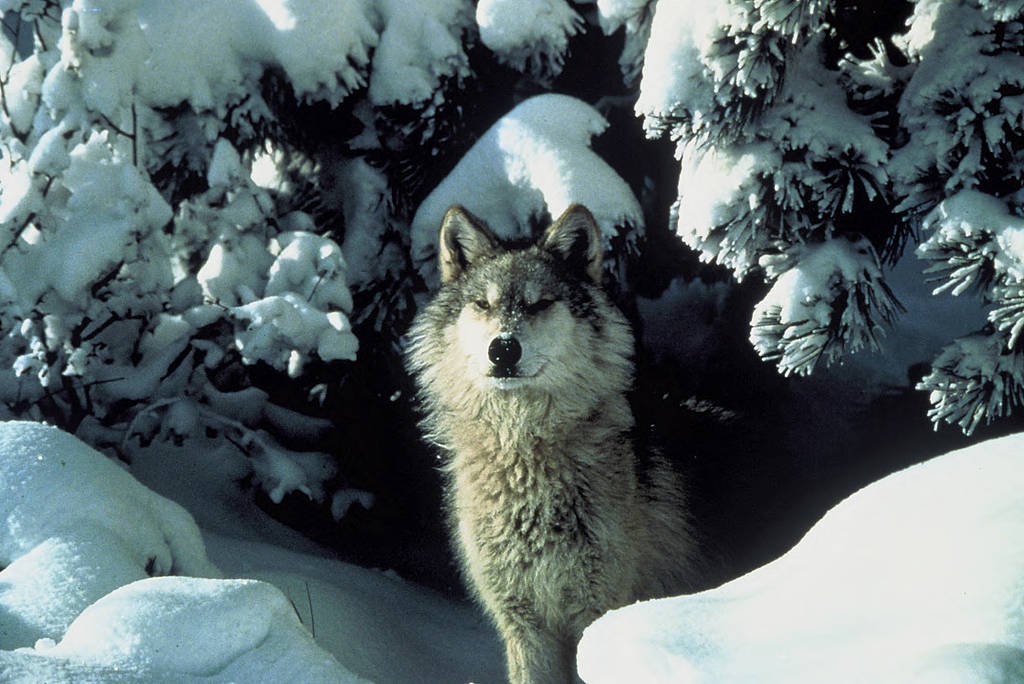
During the 1910s, a large gray wolf โ€” christened Olโ€™ Big Foot by his human admirers and adversaries โ€” roamed from one end of what is now Bears Ears National Monument to the other, from the sinuous White Canyon to Clay Hills, from the ponderosa-studded glades of Elk Ridge to the gorge-etched Slickhorn Country to the Colorado River where it tumbles through Cataract Canyon.

Big Foot was one of the last remnants of the pre-settler colonial era, a vestige of a time when the landscape โ€” and the people who lived with it โ€” existed in a more harmonious and balanced way. Iโ€™ve been thinking alot about this wolf, and its counterparts in other parts of the region in the years prior to the speciesโ€™ extirpation, amid the news that Mexican gray wolves are making their way north from southern New Mexico and Arizona, and gray wolves reintroduced in northern Colorado are moving southward. Though it ended tragically, Big Footโ€™s story gives me an inkling of hope during hopeless times.

By the time Big Foot had established dominion over a big chunk of southeastern Utah, the Hole-in-the-Rock settlers had been in the region for a few decades, hunting the deer, elk, and bighorn sheep nearly to extinction, while livestock operators such as J.A. Scorup, the โ€œMormon Cowboy,โ€ were also covering the vast swaths of un-roaded public domain with thousands of head of cattle and sheep. In other words, they were robbing the wolves, cougars, coyotes, foxes, bears, and lynx of their natural prey, and replacing it with another fatter and slower food source, with a predictable outcome.

Olโ€™ Big Foot was rumored to be the most efficient livestock culler around, and was constantly trailed by a pack of coyotes looking to scavenge his many kills. The big canine allegedly took down 150 calves in one fell swoop โ€” although that figure is almost certainly exaggerated to provide further justification for slaughtering predators. Not that the invaders needed an excuse: Killing wildlife, especially charismatic megafauna, was part and parcel of the white settler colonial project, even in areas where livestock predation wasnโ€™t an issue. The goal was not just to settle on the land, but to โ€œsettle,โ€ or tame, the land itself; to rob the wilderness of its wildness.

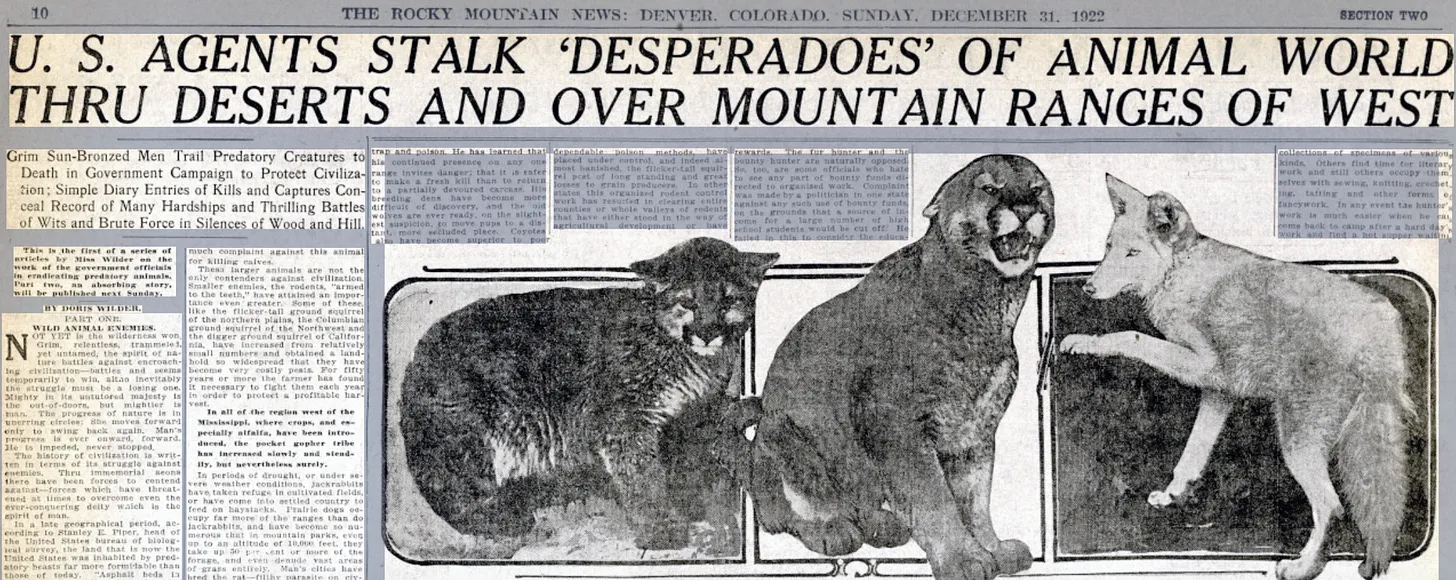
Ranchers and their cowboy hands were no match for the predators so, as is often the case, the fiercely independent Western individualists pleaded for government aid. Federal and county agencies paid cash for evidence of predator kills. La Plata County, Coloradoโ€™s โ€œscalp recordsโ€ from the late 1800s record payouts for some 300 hawk heads (at 25 cents apiece), 200 bear pelts, two-dozen mountain lion hides, and a handful of wolf skins. The mercenary killing spree took a heartrending toll, but it wasnโ€™t enough for the ranchers. So in 1915 the federal government tasked the U.S. Biological Survey with the extermination of every predator in the West, by whatever means necessary, including rifles, traps, and poisons. The resulting systematic slaughter was popularly dubbed โ€œUncle Samโ€™s War on Varmints,โ€ thusly described in a 1927 wire service story:

As twisted as it may be, the sentiment in the last phrase โ€” that killing wild predators was actually preserving wildlife and saving other animals from extinction โ€” was a commonly held belief. And the bizarre notion persists among many of those who oppose bringing the wolf back, saying they would compete with human hunters for wild game.

Clippings from Colorado newspapers from the 1890s through the 1920s. Source: Colorado Historic Newspapers.

The death toll from the โ€œwar,โ€ or attempted speciecide, is stunning. In 1924, for example, the government hunters reported killing 2,000 animals in Colorado, alone, including more than 1,700 coyotes, 153 bobcats, 50 lynx, 8 wolves, 6 mountain lions, 4 bears, and 2 wild dogs. The toll for wolves, cougars, and bears is relatively low because by that point, those speciesโ€™ populations had plummeted. In 1919 the Biological Survey predicted the West would be wolf-free within five years, and estimated only 100 remained in Utah.

As the wolf populations declined hunters and newspaper reporters started focusing on individual animals, ascribing them with personalities and even christening them. The descriptions often read like those of human outlaws: a mix of fear, condemnation, and veneration.

โ€œLobo, a great gray wolf who was the king of the pack at Currumpaw, a vast cattle range in New Mexico, was a thinker as well as a ruler,โ€ Ernest Thompson Seton told a newspaper reporter in 1905, after he had killed the wolf by using his dead mate as a decoy. Avintaquint, of the Vernal, Utah, area, was the โ€œcrafty leader of one of the wiliest brand of pillagers of the cattle range that ever roamed the west.โ€ Two Toes feasted on lambs in the Laramie River region; another Big Foot led a pack in the Unaweep area of western Colorado; Big Lefty was known to be one of the largest and most cunning wolves in the Crested Butte area, even though he had lost a leg to a trap; and Big Tooth Ben loped about Valencia County, New Mexico.
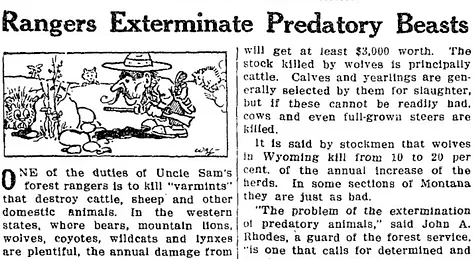
More clippings from the 1910s and 1920s. Hopefully the third one doesn’t give Interior Secretary Doug Burgum any ideas.

Old Three-Toes was known not just for preying on livestock, but also for seducing domesticated ranch dogs, which she was forced to settle for since most of the males of her species had been slaughtered. She lived in southern Pueblo County in Colorado and, according to news accounts, would sidle up to a ranch house in the dark, โ€œmaking her coming known by a peculiar howl. And when she left, the family dog often went with her. Several ranch dogs have paid the death penalty to trapper or hunter when found fraternizing with this vicious destroyer of ranch property.โ€

In 1923, government hunters trapped some of Three Toesโ€™ pups and lured the matriarch in for the kill. It was an especially deadly time for the other famous wolves, all of whom were captured and killed, to much fanfare, via cruel methods in the early and mid-twenties. Many were poisoned, one dragged a trap for miles before being shot, and at least one was captured alive and used as a decoy to lure others into traps or shooting range.

The Salt Lake Telegram ran a piece on Old Easyfoot, โ€œthe celebrated wolf of eastern Kane county,โ€ noting that the huge animal โ€œbattled six dogs into submission on Oct. 6, 1928, and gave up the fight only when he had been drilled through and through by the high powered rifles of the biological survey hunters.โ€ Easyfootโ€™s stuffed carcass was later installed in the state capitol building.

Dr. A.K. Fisher, the Biological Surveyโ€™s Director, predicted in 1926 that โ€œwithin a year Colorado would be a sportsmanโ€™s paradise because of the elimination of the wolf and the mountain lion.โ€ He said only six wolves remained in the entire state: one north of Eagle; one north of Fruita; two near Mancos; and two that ranged into Colorado from New Mexico. โ€œCoyotes are our greatest trouble at this time,โ€ Fisher added. โ€œBut the elimination of the wolf has given us more funds to concentrate on coyote work and progress is being made against them.โ€

You might think that folks with the Biological Survey would know that killing all of the predators would lead to their prey, i.e. rodents, running rampant. Duh!

Fisher was a bit premature in his forecast โ€” Coloradoโ€™s last wolf was killed in 1940, and they never got close to wiping out the coyote. Nor did he mention that even as the predator-killing campaign garnered success, the agency found itself putting more and more resources into exterminating prairie dogs, rats, squirrels, and rabbits. Go figure! But his assessment was correct: The wolf of the Western U.S. (outside of Alaska) was doomed, aside from a few specimens that traveled over the border from Canada or Mexico.

The war was not without its critics. In 1931, the American Society of Mammalogists called the biological survey โ€œthe most destructive organized agency which ever threatened the native fauna of the United States.โ€ Not that it seemed to sway the agency from its mission, and by then it was too late for the wolf anyway.

In 1929, Arthur H. Carhart and Stanley P. Young wrote Last Stand of the Pack, a non-fiction account of the lives and deaths of the โ€œlast nine renegade wolves.โ€ A passage from the Carhartโ€™s introduction illustrates the sometimes contorted, sometimes conflicted, often bizarre attitudes towards wolves โ€” which he refers to as cruel โ€œwilderness killers.โ€

***

I grew up in southwestern Colorado in the 1970s and โ€˜80s. Our family vacations were camping trips โ€” itโ€™s what we could afford โ€” and I started backpacking with friends up Junction Creek when I was 12. I donโ€™t remember ever seeing a bear, a mountain lion, or even a bobcat. We knew they were out there, sure, but even black bears were rare enough that we didnโ€™t think about securing our food in camp. My friends and I often prowled around under the light of a full moon without a single worry that we might make a tasty mountain lion meal.

Not only were the grizzlies and wolves long gone by then, but I donโ€™t think I would have believed that at one time they were so plentiful in the San Juan Mountains that members of the 1874 Hayden Survey came to see them as unavoidable pests, encountering grizzlies nearly everywhere they ventured, even on 13,000-foot peaks. I lived right next to, and often ventured into the Weminuche Wilderness, a vast and rugged and untrammeled region, and yet wildness of the kind that flourished in pre-settler-colonial times remained a myth to me, something that may have existed but that was ungraspable, even to my active and sometimes zany imagination.

The idea that wolves or grizzlies would ever return to the region? Inconceivable.

After all, the march of โ€œcivilizationโ€ and โ€œprogressโ€ is linear, the human population and the resources it consumes and the space it occupies and the impacts it has is a runaway train barreling toward inevitable collapse. The climate will continue to heat up, the skies will grow smoggier, the forests will burn, the mighty saguaro will topple, wilderness and solitude will become increasingly commodified, even the coyoteโ€™s nocturnal yips will become a thing of the past. Or so it seems, especially in times like these, when greedโ€™s toll becomes more and more apparent, when a huge bloc of the U.S. citizenry puts more value on the price at the pump than they do on the survival of the planet, when the people allow fear to override compassion and leaders cherish wealth and power over humanity and justice.

And yet. In my hometown of Durango, black bears roam freely and plentifully, purloining apples and pears and garbage. Herds of deer graze front lawns up in Tupperware Heights. Mountain lion sightings on the Test Tracks trails on the edge of town are frequent. Up in Silverton, moose-sightings are common, bighorn sheep lick the salt off the roads on Red Mountain Pass, and a lucky few catch a glimpse of Canada lynx. The wildlife, so rare in my youth, has returned, bringing a bit of wildness with it.

Nearly a century after Canis lupus was extirpated from the Southwest, there is a spark of hope, an inkling of possibility that the wolf will return to the Bears Ears country. In March, a Mexican gray wolf named Ella by local school children, was spotted north of Interstate 40 near Mount Taylor. It was killed by still undisclosed means, but it was an indication that the reintroduced wolf population in the southern part of the state is looking to broaden its horizons. And just last week, Colorado Parks & Wildlife published a map showing where radio-collared gray wolves, reintroduced in the northern part of the state, had roamed. One traveled some 1,200 miles, making it as far south as the Uncompahgre River watershed.
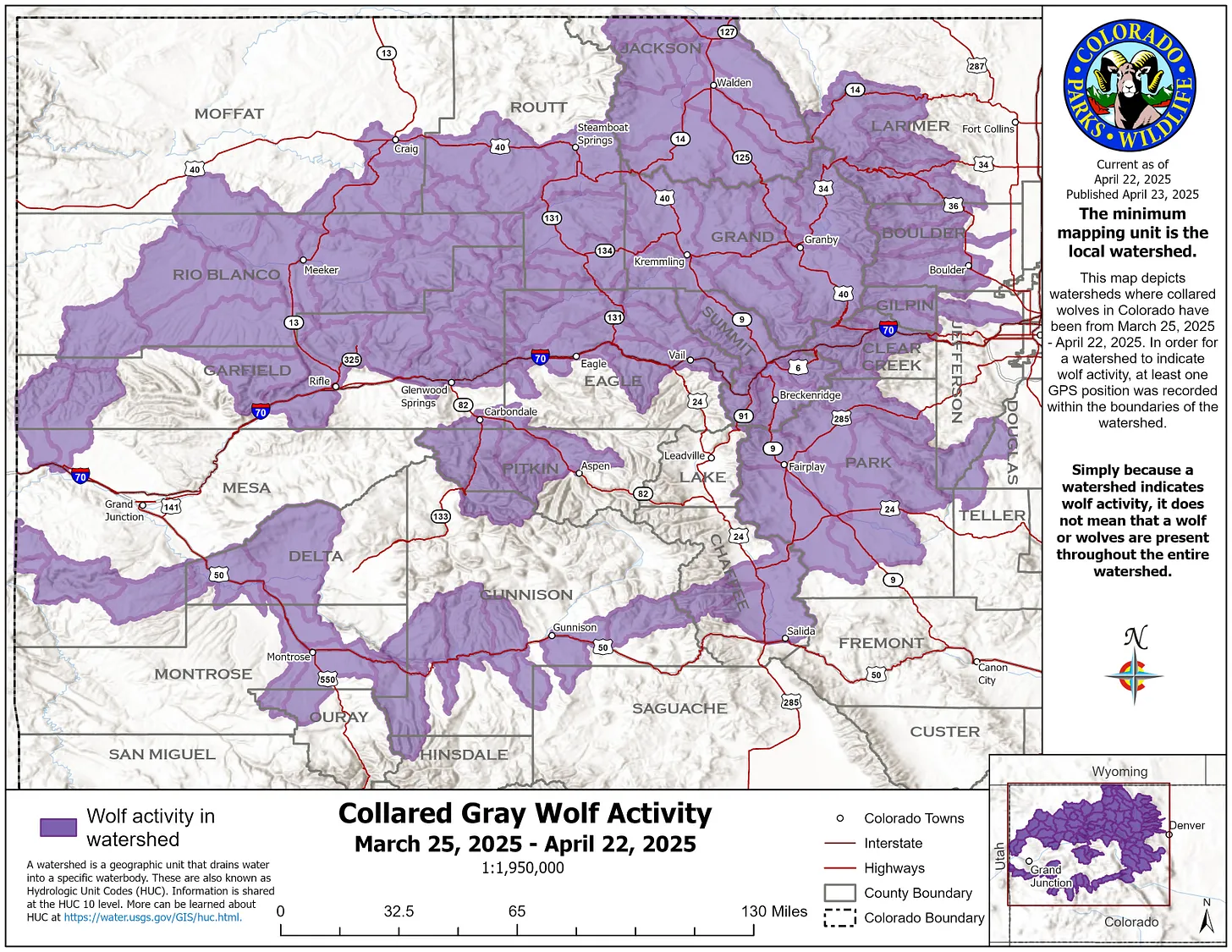
The wolves are inching ever closer to the San Juan Mountains. Source: Colorado Parks & Wildlife.

Some might argue that there is no longer a place in Colorado or southern Utah for the solitary wolf. There are too many people, too much development, far too many highways, too many public lands ranchers who refuse to learn non-lethal ways to deter predators, and too many right-wing politicians who despise the wolf and all it symbolizes. Maybe theyโ€™re right. Government hunters with Wildlife Services continue the work of their Biological Survey predecessors: Last year, they killed 58,000 coyotes and 317 wolves nationwide, adding to the toll taken by private hunters (hunting wolves is legal in the Northern Rockies, where the population has somewhat recovered), cars, and other causes.

Still, for every human that yearns for the wolfโ€™s demise, there are ten filled with awe and wonder for what the species, and its return, represents. As old Big Footโ€™s story illustrates, the wolf is resilient. In the spring of 1920, a trap set by bounty hunter Roy Musselman out on Cedar Mesa a few miles east of Grand Gulch finally ensnared Big Foot, doing โ€œwhat a dozen or more trappers are trying to do,โ€ according to an account by A.R. Lyman following Big Footโ€™s death.

Lyman wrote that the twelve-year old, eight-foot long wolf had been tormenting ranchers for a decade at least, and had killed thousands of dollars worth of cattle. Big Foot foiled countless hunters and cowboys over the years, driving his bounty up to $1,000, and even Musselman had been on its trail for four years, catching seven other wolves during that time, including Big Footโ€™s mate. He had a distinctive howl that could be distinguished five miles away, Lyman wrote, โ€œand he has led many an interesting race with white men and Indians, always making safe his escape by his speed and his knowledge of the country.โ€

His country is one of the few places in the U.S. that hasnโ€™t changed all that much in the last 100 years. Another Big Foot would find plenty of landscape for roaming and many a nook and cranny for hiding out in. And now there are more deer and elk to eat (along with some slow-moving elk, if you know what I mean). Iโ€™ll leave you with Lymanโ€™s words from April 1920:

Gray wolves are currently protected under the Endangered Species Act. Photo credit: Tracy Brooks, U.S. Fish and Wildlife Service via Aspen Journalism

Real #Climate Solutions Are Beneath Us: Itโ€™s time to accept that durable subsurface carbon storage, along with emissions reductions, must be part of the plan to mitigate the effects of #ClimateChangeโ€”and geoscience must play a central role — EOS #ActOnClimate
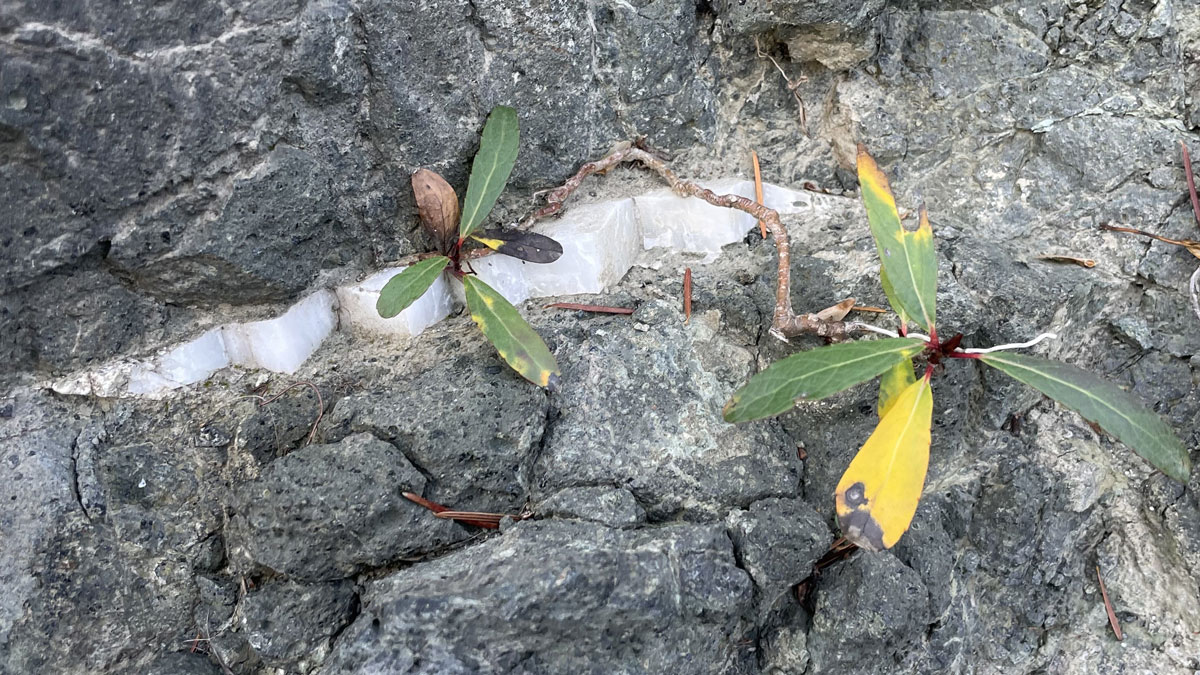
Calcite precipitated in basaltic bedrock, as seen here in Fort George Canyon, British Columbia, stores carbon durably. Credit: Peter Reiners

Click the link to read the article on the EOS website (Peter Reiners). Here’s an excerpt:

May 2, 2025

As the world blows pastย 1.5ยฐC of anthropogenic warmingย and looks increasingly likely to hit 2.6ยฐCโ€“3.1ยฐC byย the end of the century, plenty of controversy still exists, even among geoscientists, about how to slow, stop, or reverse the rapid climate change we are causing. As so many studies have documented, such warming will causeย inundation of many coastal cities,ย trillions of dollarsย in damage fromย extreme weather, widespreadย species extinctions, and unrelentingย heat waves. It will also fundamentally threatenย financial sectors and economiesย at all scales. One thing is clear: To mitigate these outcomes, humanityโ€™s first priority should be to drastically reduce its annual emissions of roughly 40 gigatons (billion metric tons) of carbon dioxide (CO2), the greenhouse gas most responsible for driving warming. Without this reduction, other measures will be only modestly effective at best. But unfortunately, at this point, theย scale of mitigationย needed toย keep warming to below 2ยฐCโ€“3ยฐCย goes beyond reducing annual emissions. We must also remove and store carbon that has accumulated in the atmosphere…

Not only has focusing on annual emissions over the past few decades failed to reduce them, but itโ€™s also not our annual emissions today (and into the future) that are causing theย 1.55ยฐC of warmingย weโ€™re witnessing. Itโ€™s how muchย CO2ย we have already emitted. Ourย cumulative emissionsย of 1.8 trillion tons (1,800 gigatons) of CO2ย from energy and industryโ€”heavier than the combined massย of all living things on Earthโ€”taken from geologic reservoirs and dumped into the atmosphere, will stay there (and in the ocean) for thousands of years. Even on that happy day when we finally start reducing emissions, we will be theย farthest we have ever beenย from solving the problem, and in fact, we will still be adding to it…

The biggest opportunityโ€”and perhaps the biggest responsibilityโ€”forย geoscientists to contributeย toย mitigationย is through facilitating durableย carbon dioxide removalย (CDR). Concerns are sometimes raised about CDR as a form ofย climate intervention, or geoengineering, yet it is far less risky than the centuries-long geoengineering experiment of using the atmosphere as a sewer. Indeed,ย removing gigatons of CO2ย per yearย is essential to net zero strategies and avoiding disastrous amounts of warming, as unequivocally stated by theย Intergovernmental Panel on Climate Change,ย Energy Transitions Commission, andย American Physical Society. Three principlesย are generally considered fundamental to CDR. First, CO2ย already in the atmosphere must be taken out. This principleย distinguishes itย from point sourceย carbon capture and storageย (CCS), which simply reduces new CO2ย emissions from fossil fuel energy and industry sources while competing with clean energy…Many approaches to CDR exist.ย Direct air captureย (DAC), for example, is aย rapidly growingย method in which CO2ย is pulled straight from the atmosphere.ย Biomass carbon removal and storageย (BiCRS) methods capture a fraction of theย 480 gigatons of CO2ย that plants naturally absorb each year and prevent it from cycling back to the atmosphere by converting biomass to forms that can be isolated and stored. Other CDR approaches focus on managing ecosystems to stimulate more CO2ย removal than would occur naturally, the second of the three principles of CDR. Examples include various strategies forย enhanced rock weatheringย inย croplandsย orย forestsย and forย marine CDR, such as usingย nutrients to promote biomass growthย andย raising the alkalinityย of seawater so it pulls more CO2ย from the air. Third, and most important, is the fact that however CO2ย is removed, it must beย stored durably, with minimal likelihood it can return to the atmosphere for a long time. Using captured carbon to createย marketable stuffย like fertilizer and chemicals may seem economically savvy, but itโ€™s not a durable approach. The entire global industrial demand for CO2ย is less than 1% of our annual emissions, and much of this carbon goes right back to the atmosphere or is used for enhanced oil recovery (EOR) to extract more petroleum.

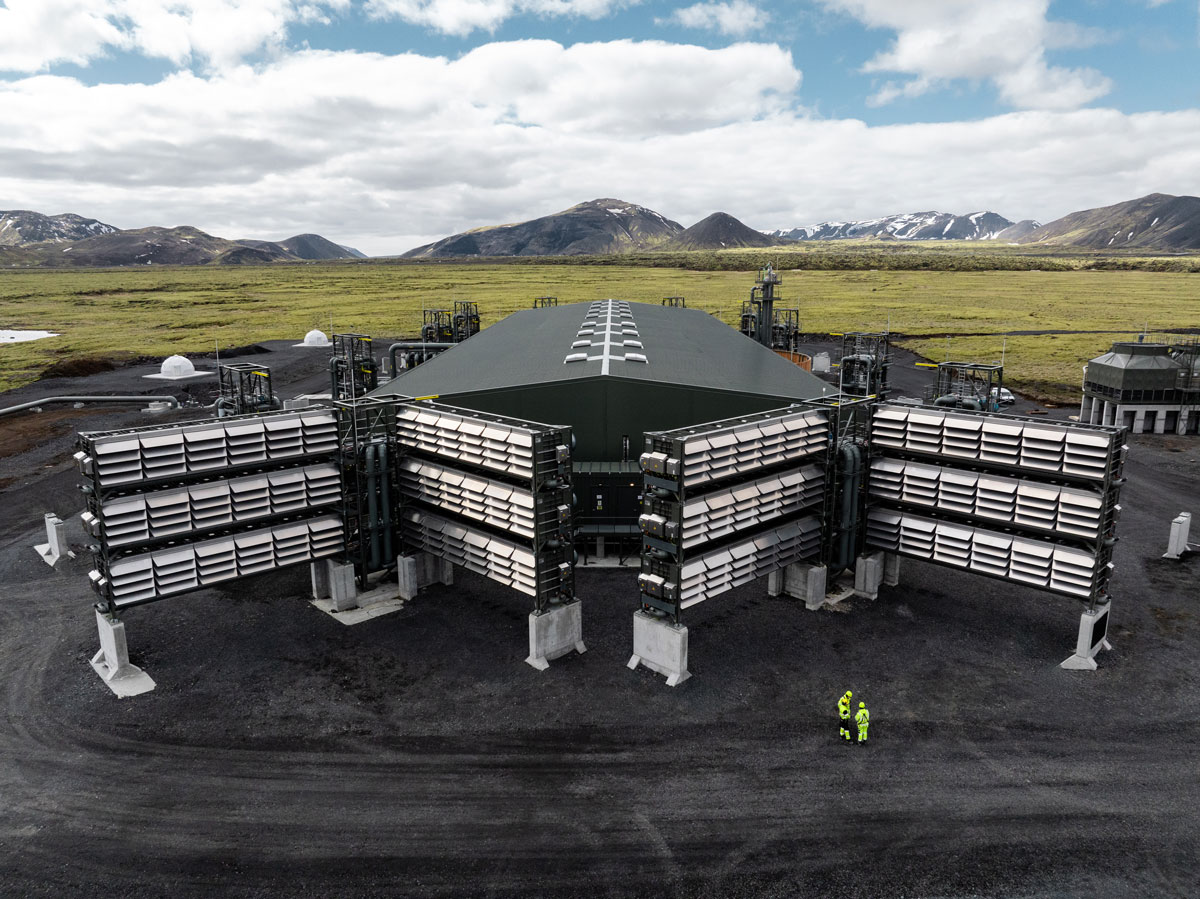
The Mammoth direct air capture facility in Iceland, operated by Climeworks, began pulling carbon dioxide from the air in 2024. Credit: ยฉClimeworks

Renewables dominate new power-plant construction

Early #runoff, short boating season predicted: Upper #RioGrande water managers expect continued warm, dry weather with possible late summer monsoon — Heather Dutton and Daniel Boyes (AlamosaCitizen.com)

Photo Credit: The Citizen

Click the link to read the article on the Alamosa Citizen website (Heather Dutton and Daniel Boyes):

May 2, 2025

San Luis Valley water managers have reviewed streamflow forecasts, available water stored in reservoirs, and anticipated reservoir operations for the 2025 spring, summer, and fall seasons, and determined that 2025 will likely be a year with early runoff, low flows in streams and rivers, and a short boating season.

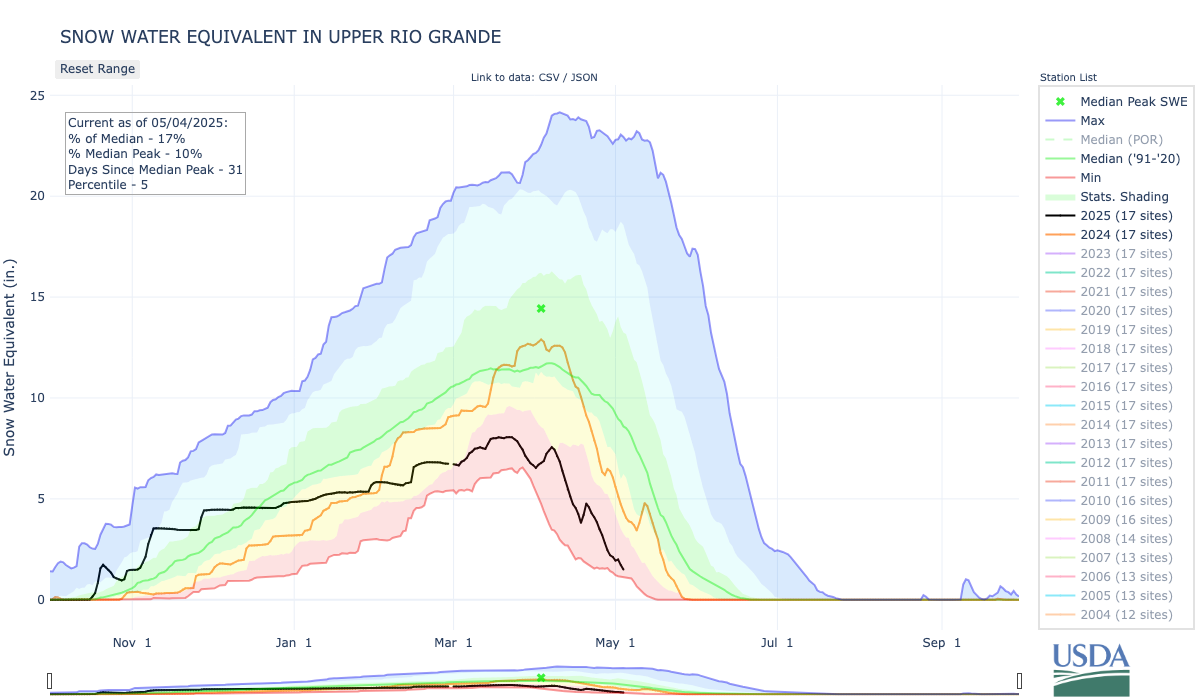
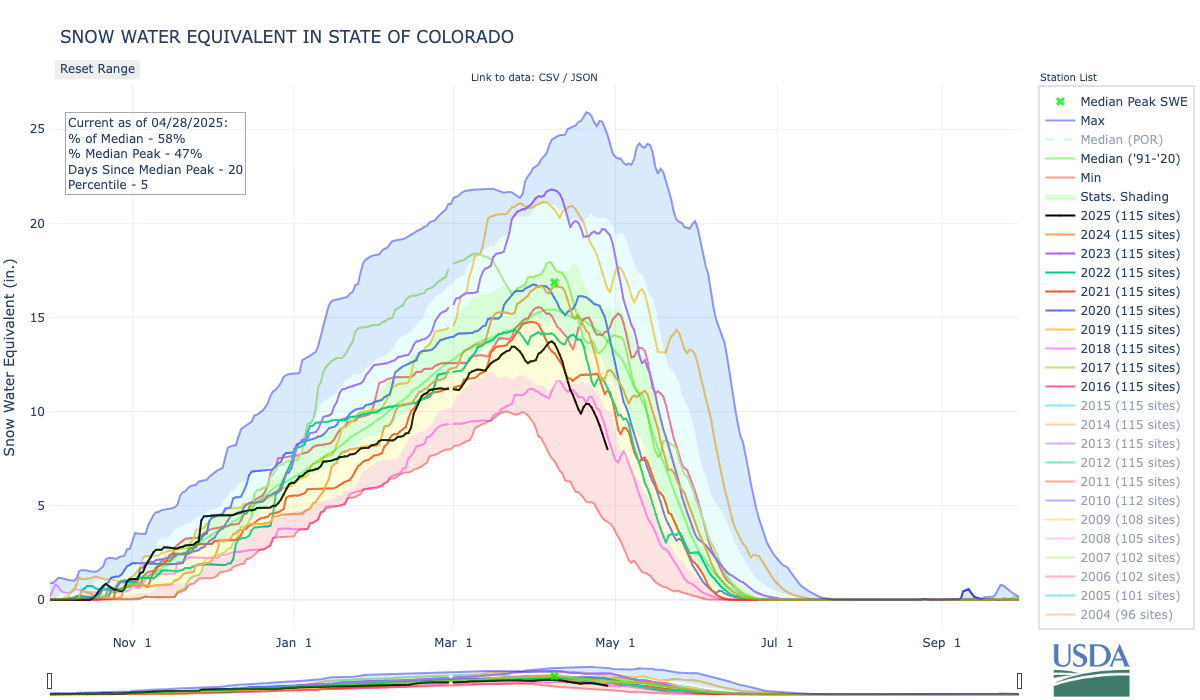
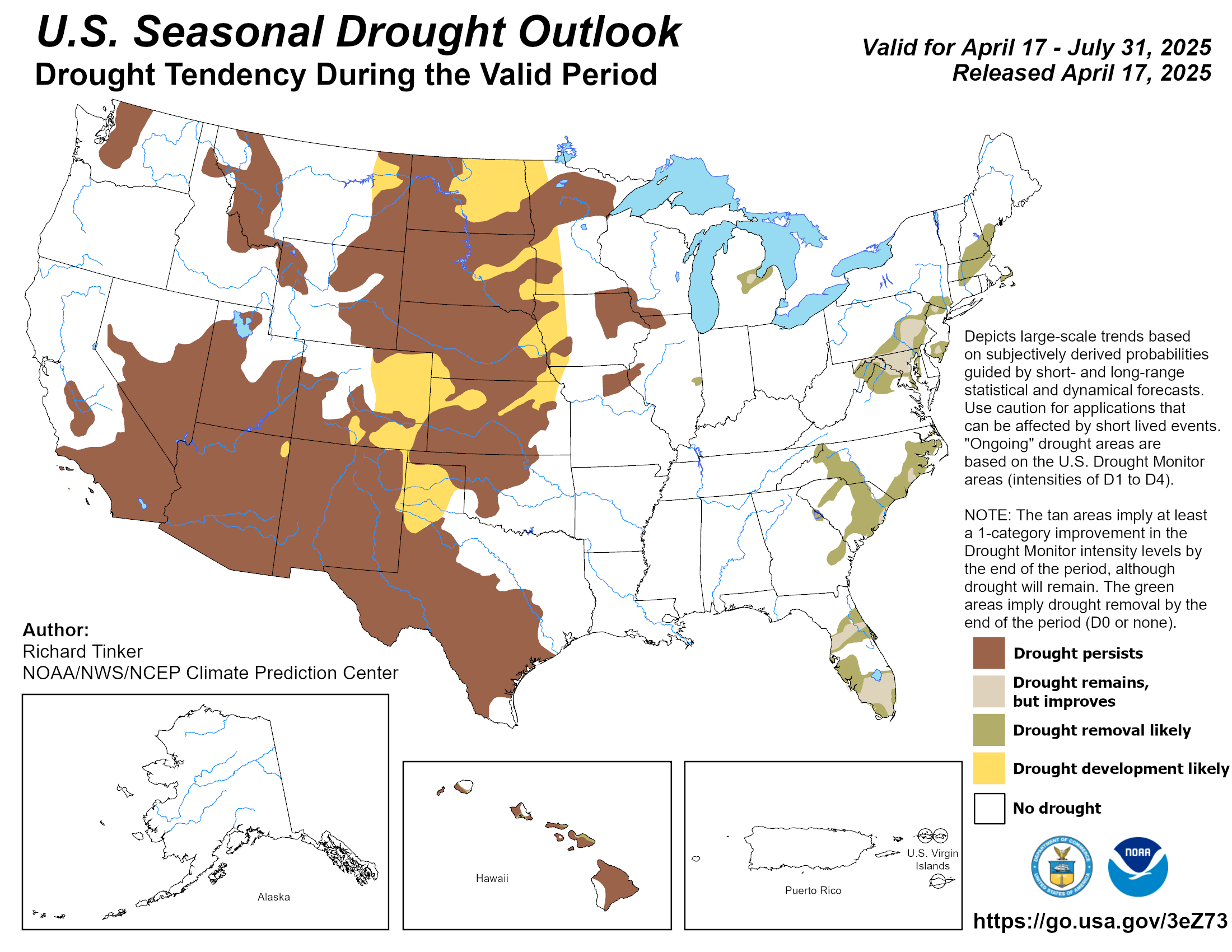
The Colorado Division of Water Resources Division 3 Engineerโ€™s March 31 10-day report forecasted the total annual flow at the Del Norte gage will be 390,000 acre-feet. For reference, the flows in 2020 totaled 377,000 acre-feet. The National Weather Service is forecasting hot and dry conditions into July, with chances of a normal monsoon season in late summer. The snow water equivalent for the Upper Rio Grande Basin was 25 percent of the median for the 1991-2020 time period on April 28, 2025. The irrigation season began on April 1 on the Rio Grande. As such, on-stream reservoirs are required to pass all inflows to satisfy the needs of downstream senior water rights holders.

Given the low amount of snow remaining in the mountains and the anticipated summer drought conditions, it is likely that local rivers and streams will reach their peak runoff in May. The reservoir operators at Rio Grande, Santa Maria, and Continental Reservoirs will begin releasing stored irrigation water to downstream farmers after the river peaks. The San Luis Valley Irrigation District (SLVID) will release water from Rio Grande Reservoir to the Farmers Union Canal as soon as their first direct flow priorities come into priority on the Rio Grande at anticipated rates of 150-400 cubic feet per second for up to 15 days. 

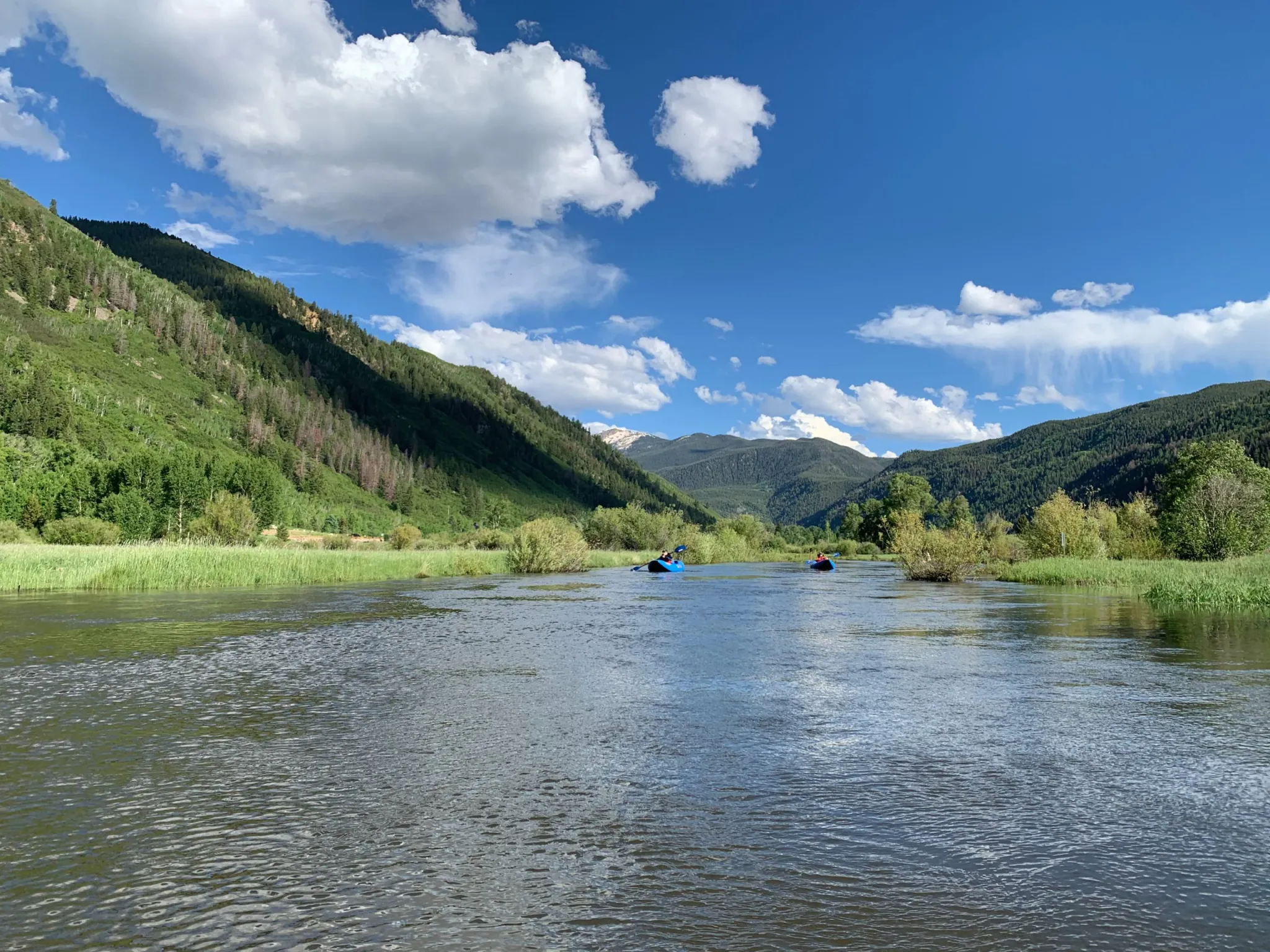
Rio Grande. Photo Credit: The Citizen

This schedule will be updated through May as river conditions change. 

The Santa Maria Reservoir Company anticipates beginning releases from Santa Maria and Continental Reservoirs to the Rio Grande Canal and Monte Vista Canal in late May or early June. The timing of the releases of water will depend on flow rates in the canals and when farmers order water. The natural river flows and releases of irrigation water will provide the highest rates of flow during the summer season. As such, boatable flows on the Rio Grande may diminish as early as mid to late June.

Entities including Colorado Parks and Wildlife (CPW), the San Luis Valley Water Conservancy District (SLVWCD), and the Rio Grande Water Conservation District (RGWCD) store water in reservoirs in the Upper Rio Grande Basin and call for releases for their operations in accordance with their water rights decrees. Where possible, releases by these organizations will be prioritized during hot periods to supplement the natural flow of the Rio Grande helping to reduce high water temperatures and low river flows, thereby protecting the health of fish. Generally, when water temperatures reach 68 degrees, fish become very stressed and voluntary fishing restrictions are enacted at 72 degrees. Stakeholders will watch temperatures on the Rio Grande and the South Fork of the Rio Grande carefully and take action to release water where possible.

The water managers and reservoir operators in the Rio Grande Basin are working in partnership to manage water in order to meet multiple needs. These efforts build off of many years of collaboration amongst water users on the Rio Grande. In order to better inform the local communities of water management operations, additional information will be compiled and shared via news outlets, social media, and email as reservoir releases are planned and executed.

President Trump’s administration push to privatize US public lands: In its first 100 days, Trump 2.0 has waged war on the lands, waters, and wildlife we all own — Chris D’Angelo (Grist.org)

Click the link to read the article on the Grist website (Chris D’Angelo):

April 29, 2025

This story is part of a Grist package examining how President Trump’s first 100 days in office have reshaped climate and environmental policy in the U.S.

Americaโ€™s federal public lands are truly unique, part of our birthright as citizens. No other country in the world has such a system. 

This map shows land owned by different federal government agencies. By National Atlas of the United States – http://nationalatlas.gov/printable/fedlands.html, “All Federal and Indian Lands”, Public Domain, https://commons.wikimedia.org/w/index.php?curid=32180954

More than 640 million acres, including national parks, forests, and wildlife refuges, as well as lands open to drilling, mining, logging, and a variety of other uses, are managed by the federal government โ€” but owned collectively by all American citizens. Together, these parcels make up more than a quarter of all land in the nation. 

Congressman John Garamendi, a Democrat representing California, has called them โ€œone of the greatest benefits of being an American.โ€ 

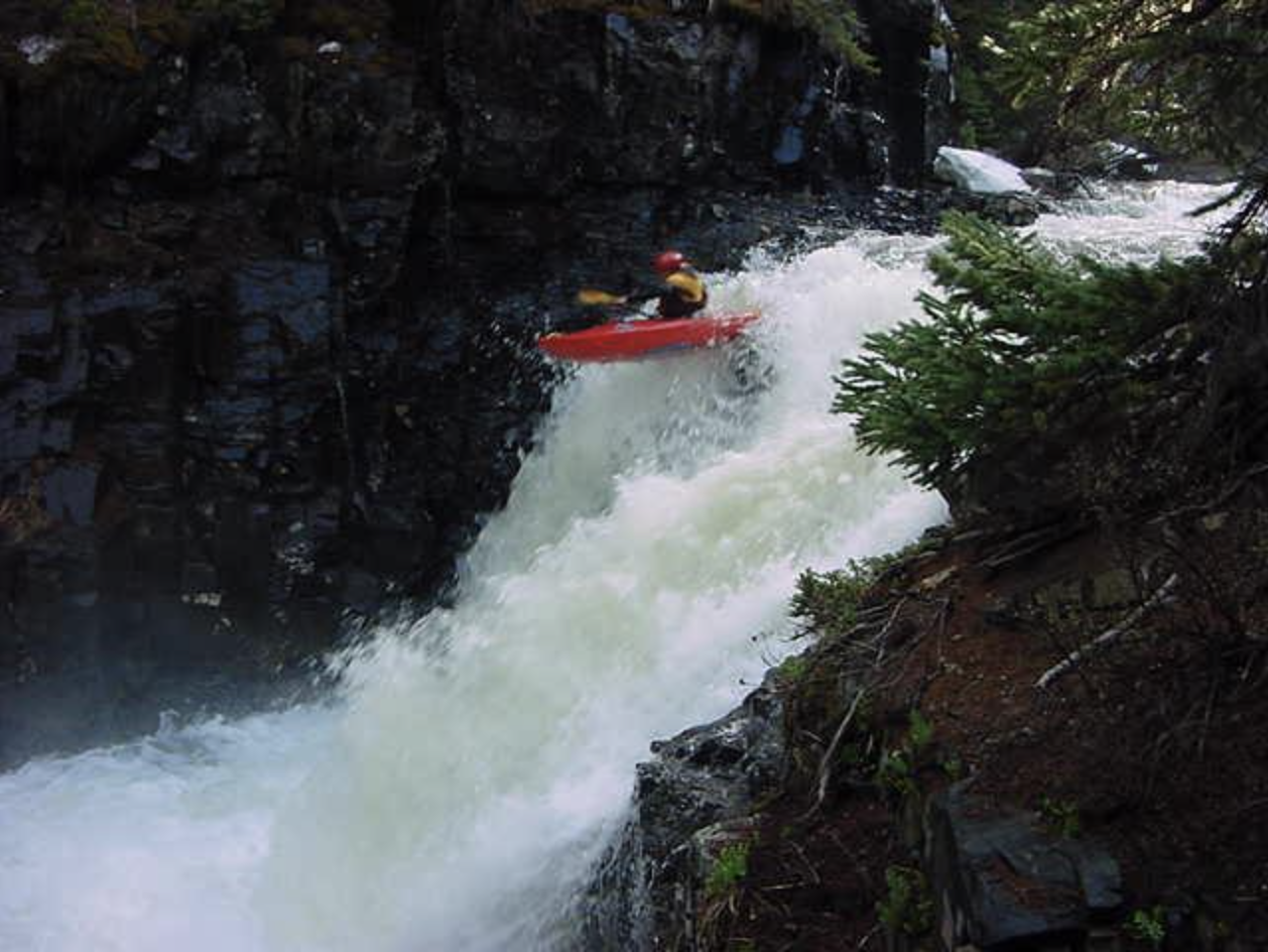
Heart Attack on Oh Be Joyful Creek. The creek has become the most popular Class V creek run in all of Colorado. The sickening gradient slides down generally smooth flat slate resulting in surprisingly easy lines. Don’t take it too lightly though, the swims are few but there is potential for epic carnage. The creek has taken on the nickname “Oh Be Careful”. This run gets dramatically easier the more times you’ve run it. After the 2nd or 3rd time down most competent Class V boaters can bomb it in less than 10 minutes without breaking a sweat. Photo credit: American Whitewater

โ€œEven if you donโ€™t own a house or the latest computer on the market, you own Yosemite, Yellowstone, the Grand Canyon, Golden Gate National Recreation Area, and many other natural treasures,โ€ he wrote in 2011.

Despite broad, bipartisan public support for protecting public lands, these shared landscapes have come under relentless attack during the first 100 days of President Donald Trumpโ€™s second term. The administration and its allies in Congress are working feverishly to tilt the scale away from natural resource protection and toward extraction, threatening a pillar of the nationโ€™s identity and tradition of democratic governance. 

โ€œThereโ€™s no larger concentration of unappropriated wealth on this globe than exists in this country on our public lands,โ€ said Jesse Deubel, executive director of the New Mexico Wildlife Federation, a conservation nonprofit. โ€œThe fact that there are interests that would like to monetize that, theyโ€™d like to liquidate it and turn it into cash money, is no surprise.โ€

Landscape protections and bedrock conservation laws are on the chopping block, as Trump and his team look to boost and fast-track drilling, mining, and logging across the federal estate. The administration and the GOP-controlled Congress are eyeing selling off federal lands, both for housing development and to help offset Trumpโ€™s tax and spending cuts. And the newly formed Department of Government Efficiency, or DOGE, led by billionaire Elon Musk, is wreaking havoc within federal land management agencies, pushing out thousands of civil servants. That purge will leave Americaโ€™s natural heritage more vulnerable to the myriad threats these lands already face, including growing visitor numbers, climate change, wildfires, and invasive species.

The Republican campaign to undermine land management agencies and wrest control of public lands from the federal government is nothing new, dating back to the Sagebrush Rebellion movement of the 1970s and โ€™80s, when support for privatizing or transferring federal lands to state control exploded across the West. But the speed and scope of the current attack, along with its disregard for the publicโ€™s support for safeguarding public lands, makes it more worrisome than previous iterations, several public land advocates and legal experts told Grist. 

This is โ€œprobably the most significant moment since the Reagan administration in terms of privatization,โ€ said Steven Davis, a political science professor at Edgewood College and the author of the 2018 book In Defense of Public Lands: The Case Against Privatization and Transfer. President Ronald Reagan was a self-proclaimed sagebrush rebel. 

A ranger in Grand Teton National Park. (NPS/Bonney)

Deubel said the conservation community knew Trumpโ€™s return would trigger another drawn out fight for the future of public lands, but nothing could have prepared him for this level of chaos, particularly the effort to rid agencies of thousands of staffers.

The country is โ€œin a much more pro-public lands position than weโ€™ve been before,โ€ Deubel said. โ€œBut I think weโ€™re at greater risk than weโ€™ve ever been before โ€” not because the time is right in the eyes of the American people, but because we have an administration who could give two shits about what the American people want. Thatโ€™s whatโ€™s got me scared.โ€ 

The Interior Department and the White House did not respond to Gristโ€™s requests for comment.


In an article posted to the White House website on Earth Day, the Trump administration touted several โ€œkey actionsโ€ it has taken on the environment, including โ€œprotecting public landsโ€ by opening more acres to energy development, โ€œprotecting wildlifeโ€ by pausing wind energy projects, and safeguarding forests by expanding logging. The accomplishments list received widespread condemnation from environmental, climate, and public land advocacy groups. 

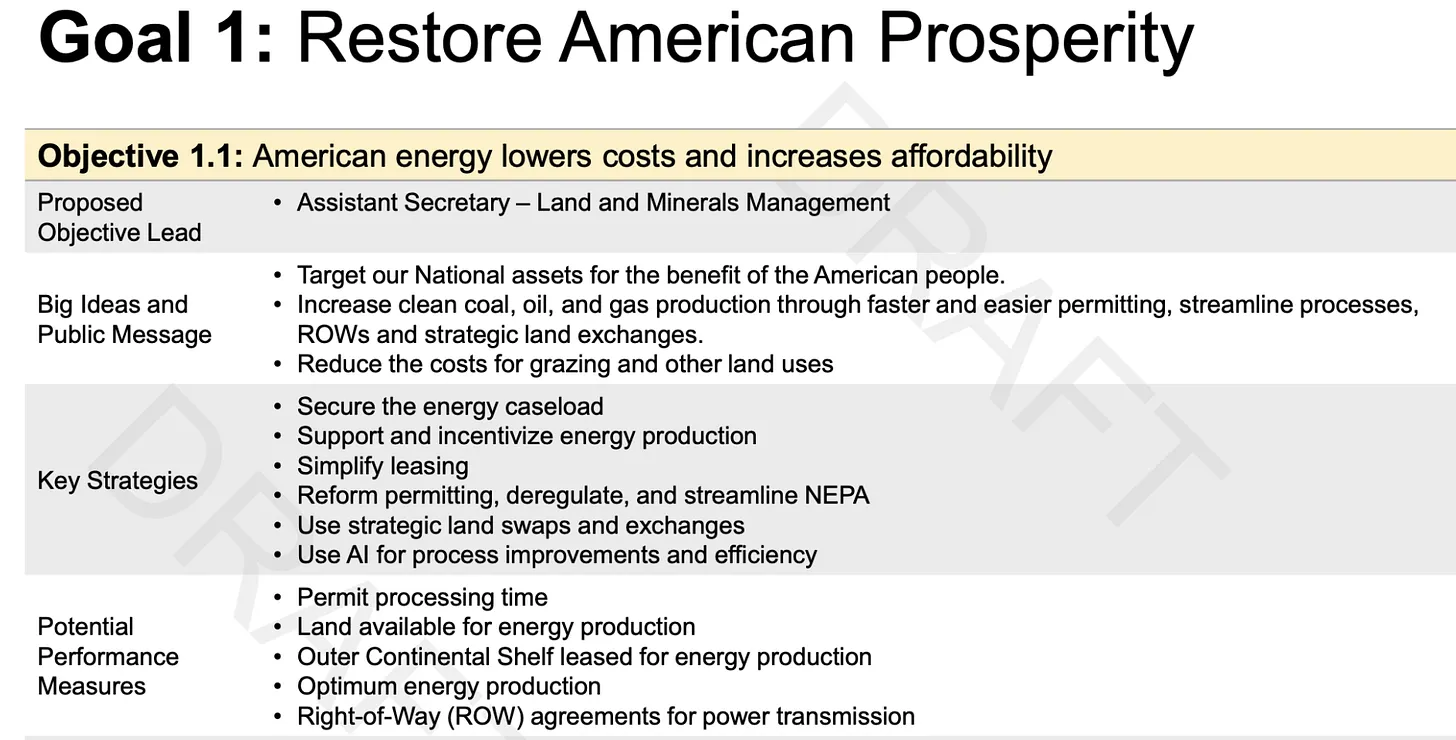
That same day, a leaked draft strategic plan revealed the Interior Departmentโ€™s four-year vision for opening new federal lands to drilling and other extractive development, reducing the amount of federal land it manages by selling some for housing development and transferring other acres to state control, rolling back the boundaries of protected national monuments, and weakening bedrock environmental laws like the Endangered Species Act.

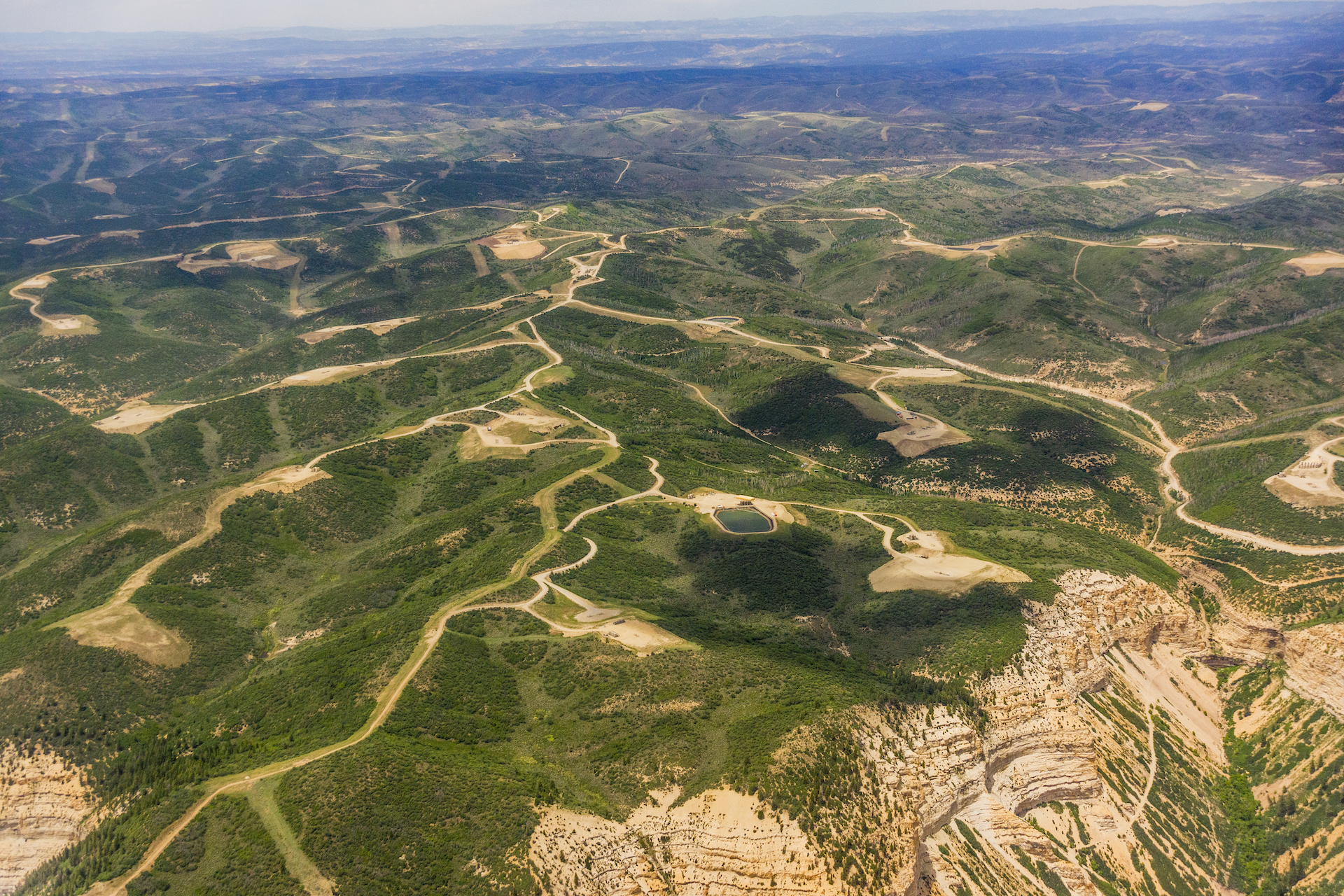
Oil and gas infrastructure is seen on the Roan Plateau in far western Colorado. (Courtesy of EcoFlight)

Meanwhile, Trumpโ€™s DOGE is in the process of cutting thousands of scientists and other staff from the various agencies that manage and protect public lands, including the National Park Service and the Bureau of Land Management, or BLM. Nearly every Republican senator went on the record this month in support of selling off federal lands to reduce the federal deficit, voting down a measure that would have blocked such sales. And Utah has promised to continue its legal fight aimed at stripping more than 18 million acres of BLM lands within the stateโ€™s border from the federal government. Utahโ€™s lawsuit, which the Supreme Court declined to hear in January, had the support of numerous Republican-led states, including North Dakota while current Interior Secretary Doug Burgum was still governor. 

To advance its agenda, the Trump administration is citing a series of โ€œemergenciesโ€ that close observers say are at best exaggerated, and at worst manufactured.  [ed. emphasis mine]

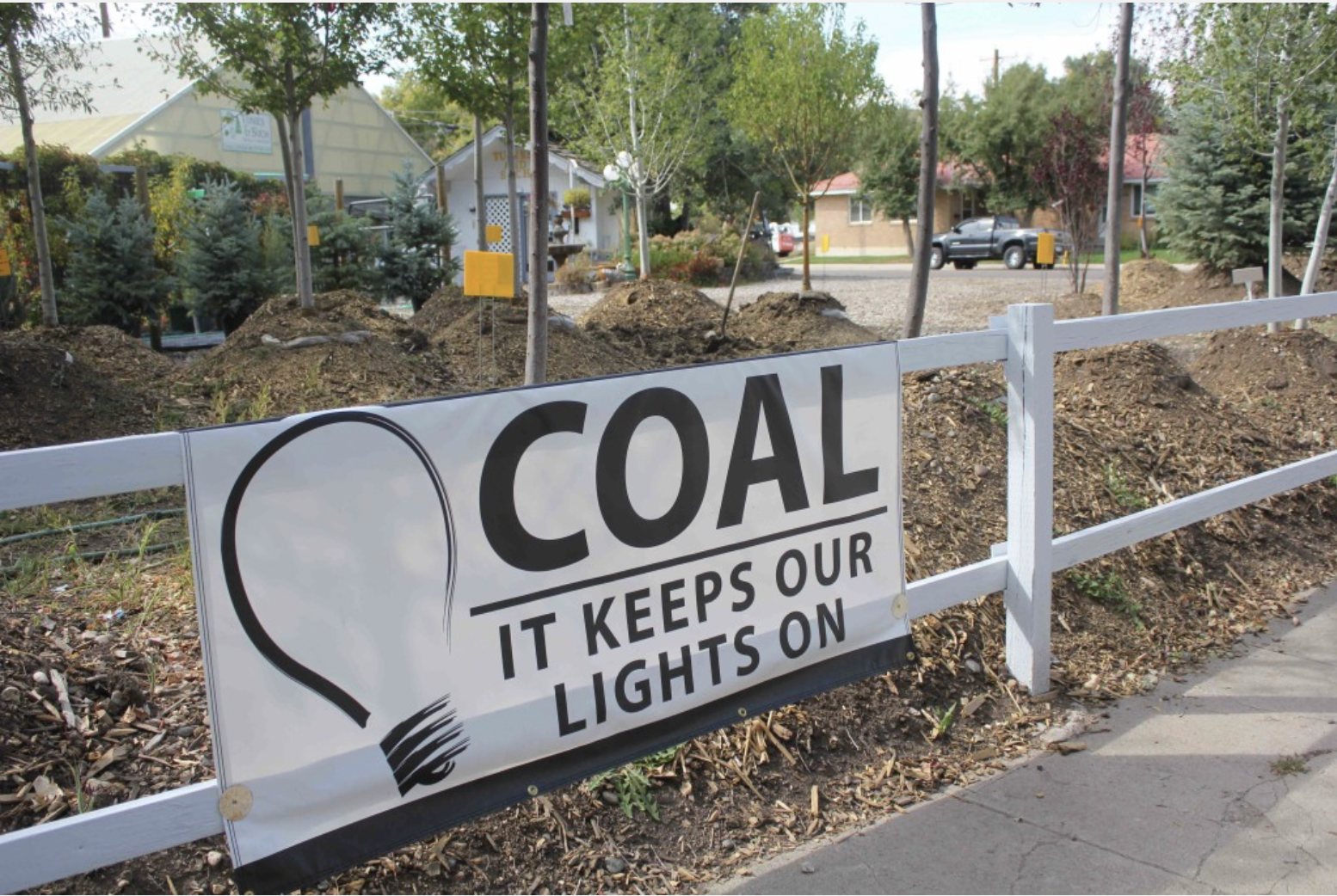
A purported โ€œenergy emergency,โ€ which Trump declared in an executive order just hours after being inaugurated, has been the impetus for the administration attempting to throw long-standing federal permitting processes, public comment periods, and environmental safeguards to the wind. The action aims to boost fossil fuel extraction across federal lands and waters โ€” despite domestic oil and gas production being at record highs โ€” while simultaneously working to thwart renewable energy projects. Trump relied on that same โ€œemergencyโ€ earlier this month when he ordered federal agencies to prop up Americaโ€™s dwindling, polluting coal industry, which the president and his cabinet have insisted is โ€œbeautifulโ€ and โ€œclean.โ€ In reality, coal is among the most polluting forms of energy.

โ€œThis whole idea of an emergency is ridiculous,โ€ said Mark Squillace, a professor of natural resources law at the University of Colorado, Boulder. โ€œAnd now this push to reinvigorate the coal industry seems absolutely crazy to me. Why would you try to reinvigorate a moribund industry that has been declining for the last decade or more? Makes no sense, itโ€™s not going to happen.โ€ 

Coal consumption in the U.S. has declined more than 50 percent since peaking in 2005, according to the U.S. Energy Information Administration, largely due to market forces, including the availability of cheaper natural gas and Americaโ€™s growing renewable energy sector. Meanwhile, Trumpโ€™s tariff war threatens to undermine his own push to expand mining and fossil fuel drilling.

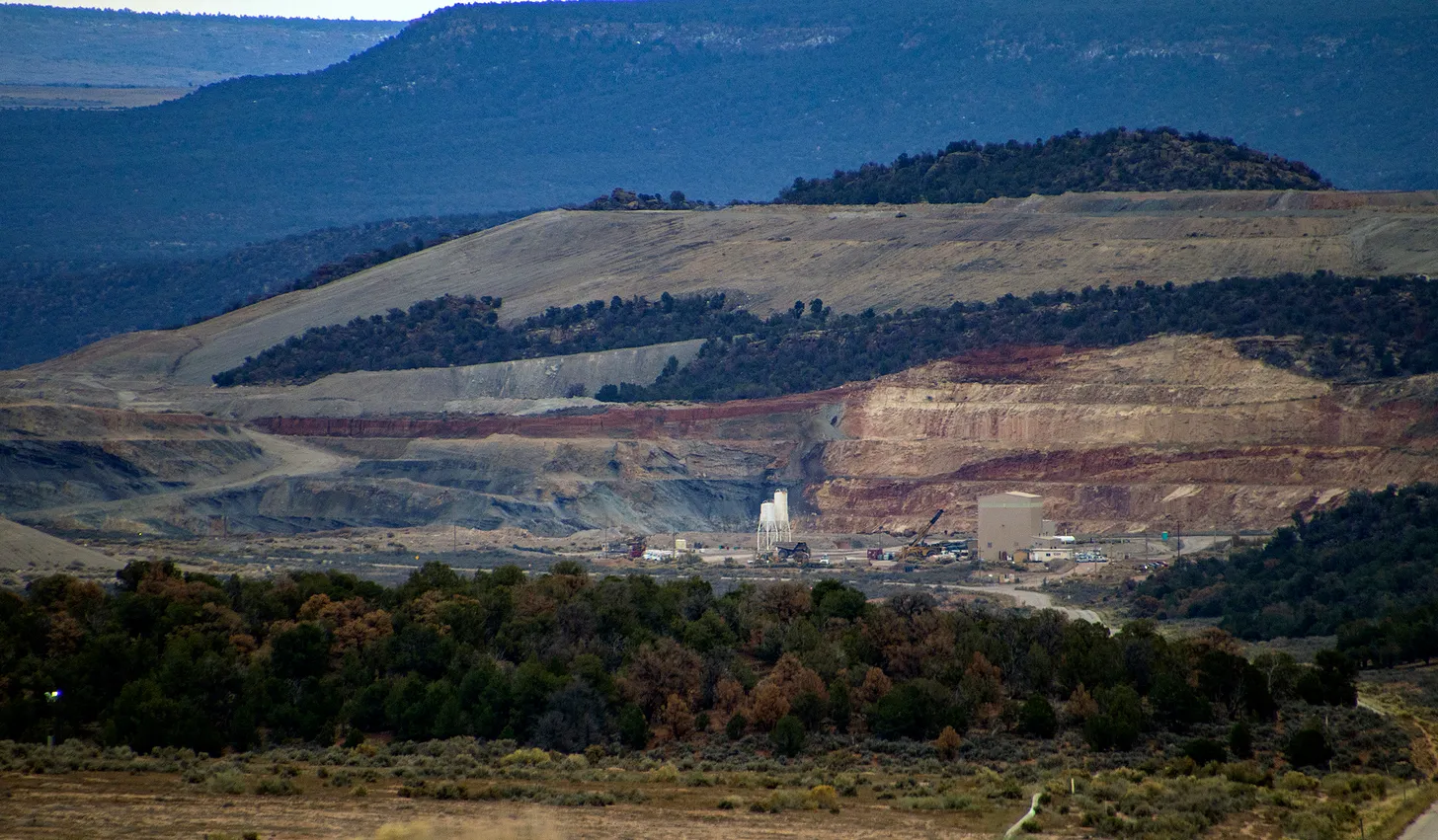
Okay, it isnโ€™t the Powder River Basin, but it is a coal mine: The West Elk near Somerset, Colorado. Jonathan P. Thompson photo.

The threat of extreme wildfire โ€” an actual crisis driven by a complex set of factors, including climate change, its role in intensifying droughts and pest outbreaks, and decades of fire suppression โ€” is being cited to justify slashing environmental reviews to ramp up logging on public lands. Following up on a Trump executive order to increase domestic timber production, Secretary of Agriculture Brooke Rollins signed a memo declaring a forest health โ€œemergencyโ€ that would open nearly 60 percent of national forest lands, more than 110 million acres, to aggressive logging. 

Then thereโ€™s Americaโ€™s โ€œhousing affordability crisis,โ€ which the Trump administration, dozens of Republicans, and even a handful of Democrats are pointing to in a growing push to open federal lands to housing development, either by selling land to private interests or transferring control to states. The Trump administration recently established a task force to identify what it calls โ€œunderutilized lands.โ€ In an op-ed announcing that effort, Burgum and Scott Turner, secretary of Housing and Urban Development, wrote that โ€œmuch ofโ€ the 500 million acres Interior oversees is โ€œsuitable for residential use.โ€ Some of the most high-profile members of the anti-public lands movement, including William Perry Pendley, who served as acting director of the Bureau of Land Management during Trumpโ€™s first term, are championing the idea.

Without guardrails, critics argue the sale of public lands to build housing will lead to sprawl in remote, sensitive landscapes and do little, if anything, to address home affordability, as the issue is driven by several factors, including migration trends, stagnant wages, and higher construction costs. Notably, Trumpโ€™s tariff policies are expected to raise the average price of a new home by nearly $11,000

Chris Hill, CEO of the Conservation Lands Foundation, a Colorado-based nonprofit working to protect BLM-managed lands, said the lack of affordable housing is a serious issue, but โ€œwe shouldnโ€™t be fooled that the idea to sell off public lands is a solution.โ€ 

โ€œThe vast majority of public lands are just not suitable for any sort of housing development due to their remote locations, lack of access, and necessary infrastructure,โ€ she said.

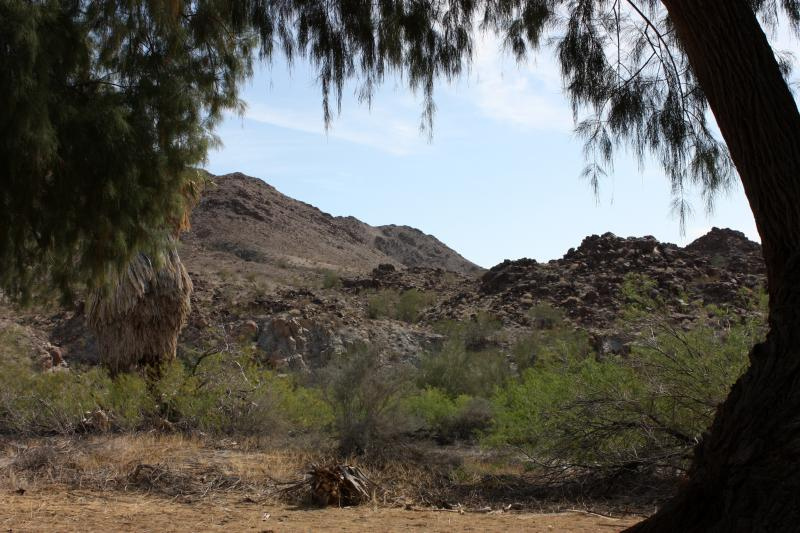
Corn Springs, Chuckwalla Mountains, California. President Trump rescinded the areaโ€™s monument status on March 15, 2025. By Michael Dorausch from Venice, USA – Corn Springs CA, CC BY-SA 2.0, https://commons.wikimedia.org/w/index.php?curid=41004589

David Hayes, who served as deputy Interior secretary during the administrations of Barack Obama and Bill Clinton and as a senior climate adviser to President Joe Biden, told Grist that Trumpโ€™s broad use of executive power sets the current privatization push apart from previous efforts. 

โ€œNot only do you have the rhetoric and the intentionality around managing public lands in an aggressive way, but you have to couple that with what youโ€™re seeing,โ€ he said. โ€œThis administration is going farther than any other ever has to push the limits of executive power.โ€ 

Aaron Weiss, deputy director of the Center for Western Priorities, a Colorado-based conservation group, said Trump and his team are doing everything they can to circumvent normal environmental rules and safeguards in order to advance their agenda, with no regard for the law or public opinion. 

โ€œEverything is an imagined crisis,โ€ Weiss said. 

Oil, gas, and coal jobs. Mining jobs. Timber jobs. Farming and ranching. Gas-powered cars and kitchen appliances. Even the water pressure in your shower. Ask the White House and the Republican Party and theyโ€™ll tell you Biden waged a war against all of it, and that voters gave Trump a mandate to reverse course.


During Trumpโ€™s first term in office, Interior Secretary Ryan Zinke repeatedly boasted that the administrationโ€™s conservation legacy would rival that of his personal hero and Americaโ€™s conservationist president, Theodore Roosevelt โ€” only to have the late presidentโ€™s great-grandson, Theodore Roosevelt IV, and the conservation community bemoan his record at the helm of the massive federal agency. 

Like Zinke, Burgum invoked Roosevelt in pitching himself for the job.

Interior Secretary Doug Burgum tours a fracking site in Washington County, Pennsylvania on April 3, where he discussed President Trumpโ€™s recent executive orders to boost domestic fossil fuel production. Department of the Interior

โ€œIn our time, President Trumpโ€™s energy dominance can be Americaโ€™s big stick that will be leveraged to achieve historic prosperity and world peace,โ€ Burgum said during his confirmation hearing in January, referencing a 1900 letter in which the 26th president said to โ€œspeak softly and carry a big stick.โ€

The Senate confirmed him to the post in January on a bipartisan 79-18 vote. Some public land advocates initially viewed Burgum, now the chief steward of the federal lands, waters, and wildlife we all own, as a palatable nominee in a sea of problematic potential picks. A billionaire software entrepreneur and former North Dakota governor, Burgum has talked at length about his fondness for Rooseveltโ€™s conservation legacy and the outdoors.

Whatever honeymoon there was didnโ€™t last long. One hundred days in, Burgum and the rest of Trumpโ€™s team have taken not a stick, but a wrecking ball to Americaโ€™s public lands, waters, and wildlife. Earlier this month, the new CEO of REI said the outdoor retailer made โ€œa mistakeโ€ in endorsing Burgum for the job and that the administrationโ€™s actions on public lands โ€œare completely at odds with the longstanding values of REI.โ€

At an April 9 all-hands meeting of Interior employees, Burgum showed off pictures of himself touring oil and gas facilities, celebrated โ€œclean coal,โ€ and condemned burdensome government regulation. Burgum has repeatedly described federal lands as โ€œAmericaโ€™s balance sheetโ€ โ€” โ€œassetsโ€ that he estimates could be worth $100 trillion but that he argues Americans are getting a โ€œlow returnโ€ on.

โ€œOn the worldโ€™s largest balance sheet last year, the revenue that we pulled in was about $18 billion,โ€ he said at the staffwide meeting, referring to money the government brings from lease fees and royalties from grazing, drilling, and logging on federal lands, as well as national park entrance fees. โ€œEighteen billion might seem like a big number. Itโ€™s not a big number if weโ€™re managing $100 trillion in assets.โ€

In May 2022, a couple paused at once had been the bottom of the boat put-in ramp in Antelope Canyon to look down on the receding waters of Lake Powell. The reservoir at that point was 22% full. Public lands are the foundation of a $1 trillion outdoor recreation economy in the U.S. Photo/Allen Best

In focusing solely on revenues generated from energy and other resource extraction, Burgum disregards that public lands are the foundation of a $1 trillion outdoor recreation economy, nevermind the numerous climate, environmental, cultural, and public health benefits.

Davis, the author of In Defense of Public Lands: The Case Against Privatization and Transfer, dismissed Burgumโ€™s โ€œbalance sheetโ€ argument as โ€œshriveledโ€ and โ€œwrong.โ€

โ€œYou have to willfully be ignorant and ignore everything of value about those lands except their marketable commodity value to come up with that conclusion,โ€ he said. When you add all their myriad values together, public lands โ€œare the biggest bargain you can possibly imagine.โ€ 

Davis likes to compare public lands to libraries, schools, or the Department of Defense. 

โ€œThere are certain things we as a society decide are important and we pay for it,โ€ he said. โ€œWe call that public goods.โ€


The last time conservatives ventured down the public land privatization path, it didnโ€™t go well. 

Shortly after Trumpโ€™s first inauguration in 2017, then-Congressman Jason Chaffetz, a Republican representing Utah, introduced legislation to sell off 3.3 million acres of public land in 10 Western states that he said had โ€œbeen deemed to serve no purpose for taxpayers.โ€

Public backlash was fierce. Chaffetz pulled the bill just two weeks later, citing concerns from his constituents. The episode, while brief, largely forced the anti-federal land movement back into the shadows. The first Trump administration continued to weaken safeguards for 35 million acres of federal lands โ€” more than any other administration in history โ€” and offered up millions more for oil and gas development, but stopped short of trying sell off or transfer large areas of the public domain.

Theodore Roosevelt and John Muir at Glacier Point. By Underwood & Underwood – This image is available from the United States Library of Congress’s Prints and Photographs division under the digital ID cph.3g04698. See Commons:Licensing for more information., Public Domain, https://commons.wikimedia.org/w/index.php?curid=3517191

Yet as the last few months have shown, the anti-public lands movement is alive and well. 

Public land advocates are hopeful that the current push will flounder. They expect courts to strike down many of Trumpโ€™s environmental rollbacks, as they did during his first term. In recent weeks, crowds have rallied at numerous national parks and state capitol buildings to support keeping public lands in public hands. Democratic Senator Martin Heinrich of New Mexico, who voted to confirm Burgum to his post and serves as the ranking Democrat on the Senate Energy and Natural Resources Committee, has taken to social media to warn about the growing Republican effort to undermine, transfer, and sell off public lands.

โ€œI continue to be encouraged that people are going to be loud. They already are,โ€ said Deubel, the executive director of the New Mexico Wildlife Federation. โ€œWeโ€™re mobilizing. Weโ€™ve got business and industries. Weโ€™ve got Republicans, weโ€™ve got Democrats. Weโ€™ve got hunters and weโ€™ve got non-hunters. Weโ€™ve got everybody speaking out about this.โ€ 

In a time of extreme polarization on seemingly every issue, public lands enjoy broad bipartisan support. The 15th annual โ€œConservation in the Westโ€ poll found that 72 percent of voters in eight Western states support public lands conservation over increased energy development โ€” the highest level of support in the pollโ€™s history; 65 percent oppose giving states control over federal public lands, up from 56 percent in 2017; and 89 percent oppose shrinking or removing protections for national monuments, up from 80 percent in 2017. Even in Utah, where leaders have spent millions of taxpayer dollars promoting the stateโ€™s anti-federal lands lawsuit, support for protecting public lands remains high. 

โ€œEven in all these made up crises, the American public doesnโ€™t want this,โ€ Hill said. โ€œThe American people want and love their public lands.โ€ 

At his recent staffwide meeting, Burgum said Rooseveltโ€™s legacy should guide Interior staff in the mission to manage and protect federal public lands. Those two things, management and protection, โ€œmust be held in balance,โ€ Burgum stressed. 

Yet in social media posts and friendly interviews with conservative media, Burgum has left little doubt about where his priorities lie, repeatedly rolling out what Breitbart dubbed the โ€œfour babiesโ€ of Trumpโ€™s energy dominance agenda: โ€œDrill, Baby, Drill! Map, Baby, Map! Mine, Baby, Mine! Build, Baby, Build!โ€ 

โ€œProtect, baby, protect,โ€ โ€œconserve, baby, conserve,โ€ and โ€œsteward, baby, stewardโ€ have yet to make it into Burgumโ€™s lexicon. 

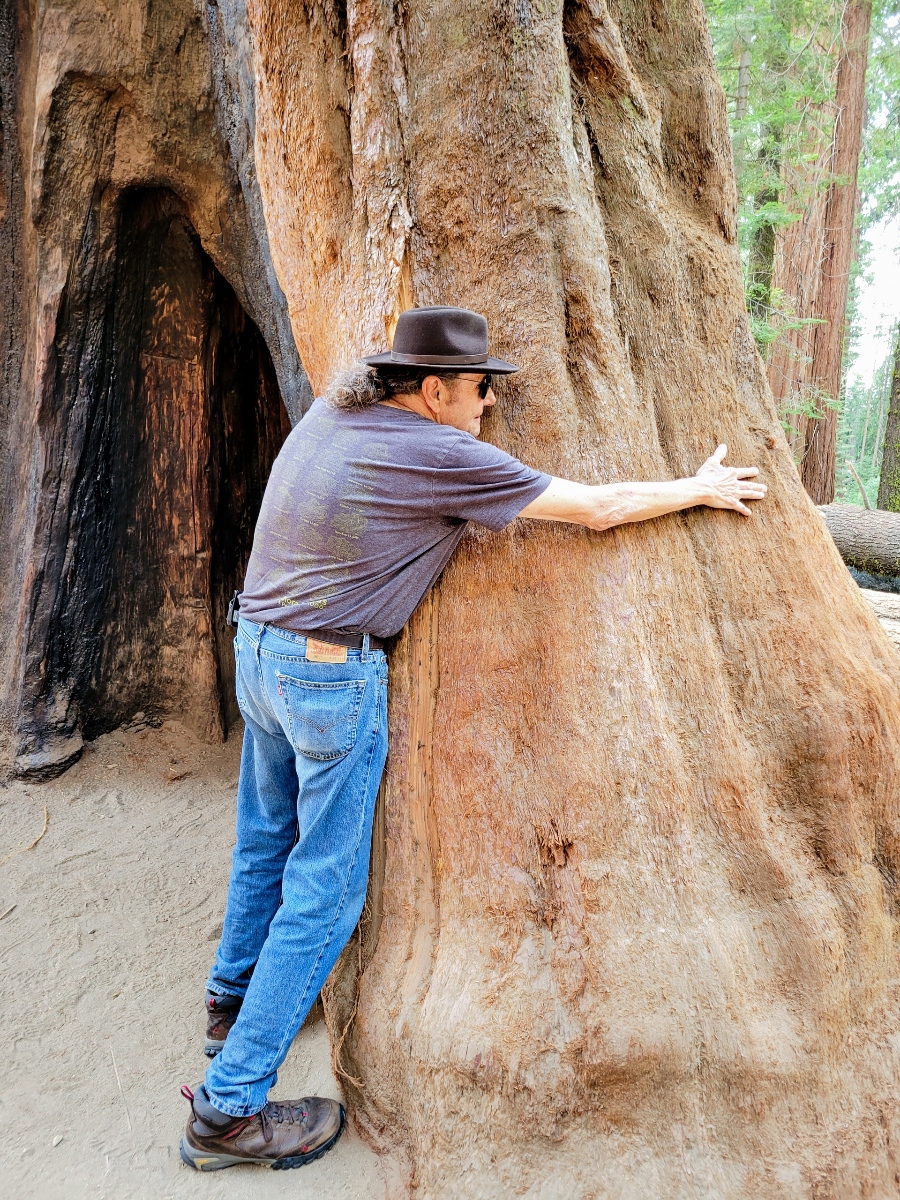
Coyote Gulch attempting to hug a Sequoia near the General Sherman tree August 1, 2022. Photo credit: Mrs. Gulch

The #ColoradoRiver needs some ‘shared pain’ to break a deadlock, water experts say — Alex Hager (KUNC.org) #COriver #aridification

Dusk falls on Lake Powell near Bullfrog Marina on July 15, 2024. A new letter from water policy experts gives negotiators some recommendations on how to sustainably manage the Colorado River in the future. Alex Hager/KUNC

Click the link to read the article on the KUNC website (Alex Hager):

May 3, 2025

This story is part of ongoing coverage of the Colorado River, produced by KUNC in Colorado and supported by the Walton Family Foundation. KUNC is solely responsible for its editorial coverage.

The seven states that use the Colorado River are deadlocked about how to share it in the future. The current rules for dividing its shrinking supplies expire in 2026. State leaders are under pressure to propose a new sharing agreement urgently, so they can finish environmental paperwork before that deadline.

Right now, they donโ€™t appear close to an agreement, so a group of prominent Colorado River experts co-signed a letter outlining seven things they want to see in the next set of rules.

The letter gives a clear, concise list of recommendations for ways to keep taps flowing while protecting tribes and the environment. Whether the states will listen is another matter entirely.

โ€˜Shared painโ€™

The letter, written by a group of academics and retired policymakers, makes no bones about it: states need to find a collective solution to their collective problem. And some of them might not be happy.

State leaders have been reluctant to volunteer cutbacks, and have largely stayed divided along a decades-old fault line. On one side, the Upper Basin โ€“ which consists of Colorado, Utah, Wyoming and New Mexico. The other side, the Lower Basin, is made up of California, Arizona and Nevada.

The recent letter is interesting in part because itโ€™s co-authored by people from both sides of the Colorado River debate. Eric Kuhn led an agency that defends Western Coloradoโ€™s water. Kathryn Sorensen led Phoenixโ€™s water department.

The letter was also written by Anne Castle, who has worked in federal water policy positions, and Jack Schmidt, a water researcher at Utah State University. Co-authors John Fleck and Katherine Tara research water policy at the University of New Mexico.

The authors write that states need to engage in some level of โ€œshared pain,โ€ meaning cutbacks to the amount of water that flows to farms, homes, and businesses.

โ€œโ€˜Sharedโ€™,โ€ the letter writes, โ€œDoes not mean equal, either in amount, triggers, or duration.โ€

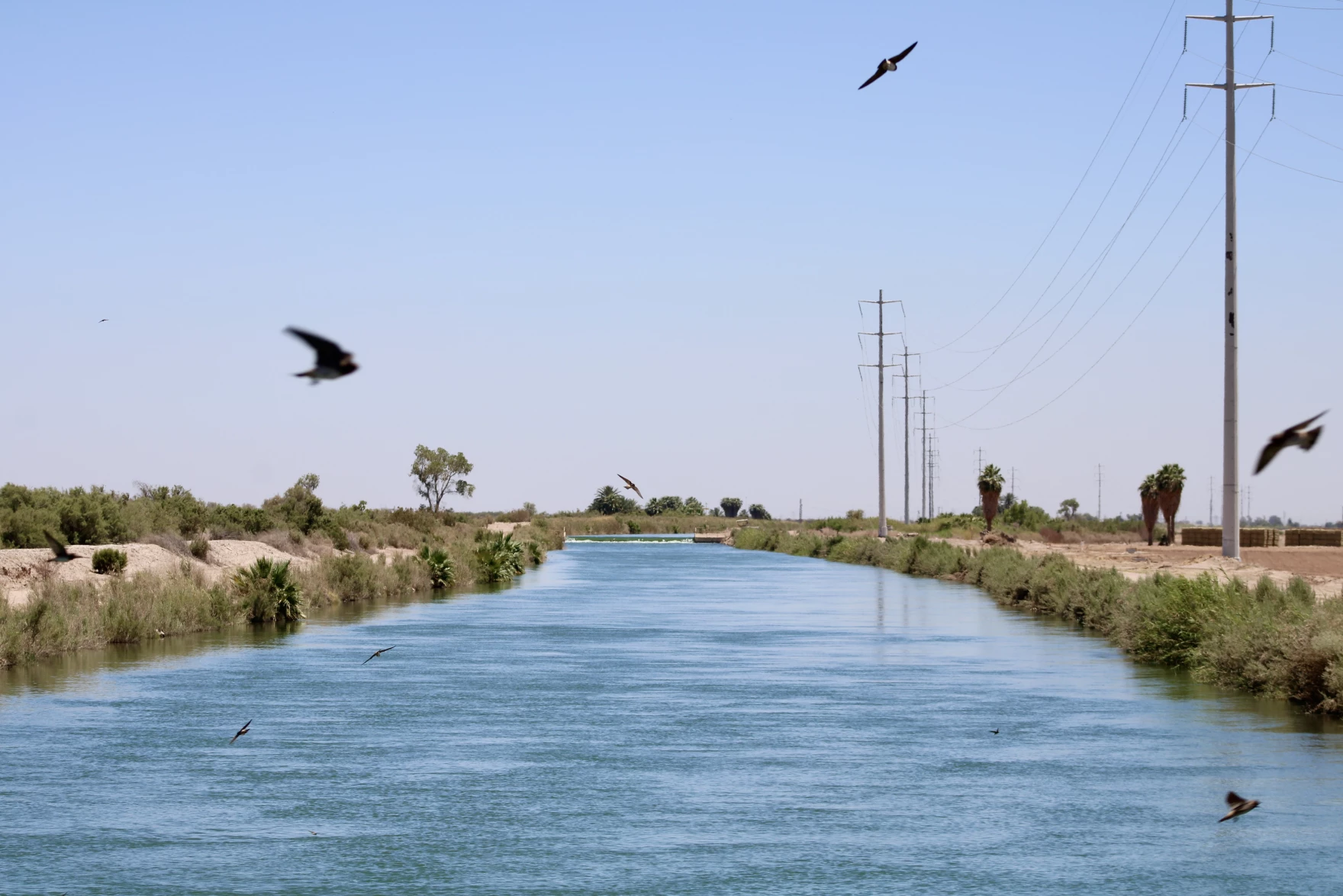
Water from the Colorado River flows through the East Highline Canal on its way to farms in the Imperial Valley on June 20, 2023. The Colorado River’s single largest user has taken federal money through incentive programs to cut back on water use. Alex Hager/KUNC

The Lower Basin states have already proposed relatively modest cutbacks, and the Upper Basin seems to be digging in its heels on the idea that they should not have to give up any water at all.

This letter pushes back on that stance.

โ€œThere’s lots of wonderful legal arguments about why it shouldn’t be me that needs to use less water,โ€ Anne Castle, one of the letterโ€™s authors, told KUNC. โ€œBut in order to have a viable and politically viable agreement, everybody has to do a share.โ€

Other recommendations

In addition to calling for states to put their heads together, the authors also warned against leaning too hard on federal checks as a way to conserve water. Money from the federal government has been a key part of avoiding catastrophe on the Colorado River in recent years. Hundreds of millions of dollars have gone to big water users, often farmers, as an incentive to use less water.

Those funds have come under threat during President Donald Trumpโ€™s second term. The letter says new rules for the Colorado River โ€œcannot assume that federal taxpayers will reimburse Western water users over the long term to forgo the use of water that does not exist.โ€

The letter goes on to advocate for groups that can sometimes be an afterthought in Western water policy. It essentially re-ups an earlier call from a group of tribes in the Colorado River basin, which are asking for a bigger seat at the table after more than a century of exclusion. It also pushes for new rules to be more flexible, which would make it easier to protect river ecosystems. That mirrors similar comments from a group of nonprofits.

The shortest and final recommendation in the letter says that any new Colorado River rules have to make sure thereโ€™s enough water to keep people safe and healthy.

โ€œThere must be absolute protection of domestic water deliveries for public health and safety,โ€ it reads.

In short, itโ€™s asking to make sure that a worst-case-scenario doesnโ€™t see drinking water reserves go dry, while agriculture and other industries keep their faucets flowing.

โ€œI don’t think that would happen,โ€ Castle said. โ€œI think the market would intervene and take care of this situation.โ€

The reaction

KUNC reached out to top water negotiators in Arizona and Colorado for this story. Their answers fell in line with oft-repeated talking points from each basin.

A spokesman for the Arizona Department of Water Resources wrote that its director, Tom Buschatzke, โ€œagreed with the authors that โ€˜every state and sector of the economy must contribute to the solution to this imbalance.โ€™โ€


Water policymakers from (left to right) Utah, New Mexico, Colorado and Wyoming speak on a panel at the Colorado River Water Users Association conference in Las Vegas on December 5, 2024. The Upper Basin states have been reluctant to volunteer cutbacks ahead of the next set of river-sharing rules. Alex Hager/KUNC

Coloradoโ€™s top water official, Becky Mitchell, wrote that the recommendations overlooked climate changeโ€™s impact on Upper Basin water supplies, and that states already take โ€œmandatory and uncompensatedโ€ cuts.

โ€œColorado water users do not enjoy a guaranteed delivery of the full amount of their water rights each year,โ€ she wrote.

Jennifer Gimbel, Coloradoโ€™s former top water official, did not contribute to the letter and also took issue with the suggestion that both basins could afford to make cutbacks.

โ€œAre the authors of the paper thinking that federal law should be enacted to override state law?โ€ Gimbel wrote to KUNC in an email. โ€œAre they thinking that users in the Upper Basin, who they say should not rely on federal compensation, should just give up their livelihoods voluntarily or be compensated by the state legislatures? I donโ€™t know because they donโ€™t say.โ€

Forests taking longer to recover from severe โ€˜megafiresโ€™ since 2010 — Carbon Brief #ActOnClimate

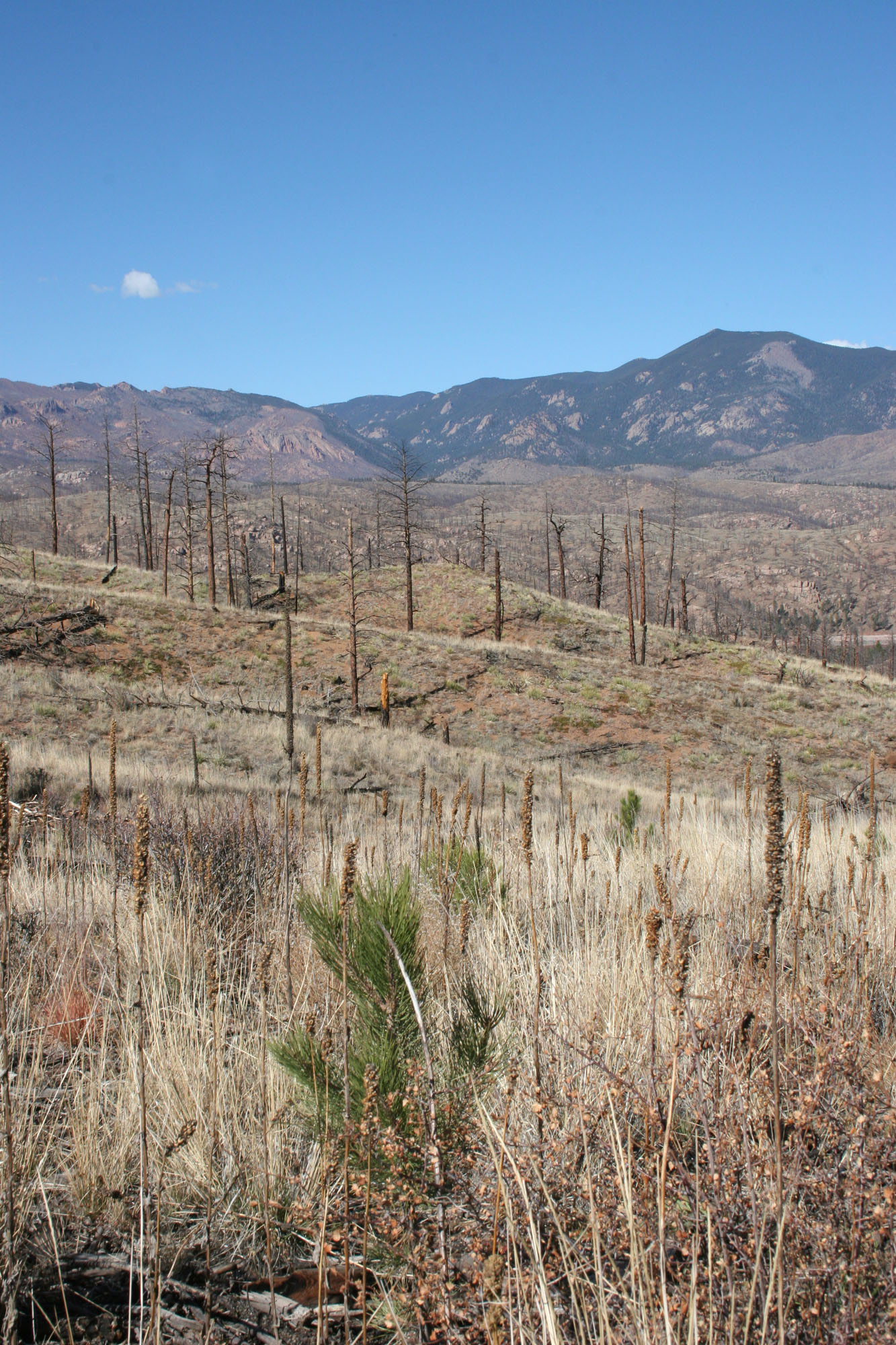
A ponderosa pine seedling peeks out of the Hayman-Fire scarred landscape near Cheesman Reservoir. After the fire, Denver Water spent more than 10 years working with volunteers and Colorado State Forest Service crews to plant about 25,000 trees per year on the 7,500 acres of Denver Water property destroyed by Hayman. Photo credit: Denver Water

Click the link to read the article on the Carbon Brief website (Orla Dwyer). Here’s an excerpt:

May 2, 2025

Forests around the world are taking longer to recover from severe wildfires โ€“ potentially indicating forest decline, according to a new study.ย 

The research, published inย Nature Ecology & Evolution, finds a โ€œsignificant increaseโ€ in the severity of forest fires from 2001-10 to 2010-21 โ€“ especially in western North America, parts of Siberia and south-eastern Australia. It also finds that recovery from large fires has become โ€œmore difficultโ€ for forests in recent years, particularly in theย boreal forestsย of the far-northern latitudes. Furthermore, fewer than one-third of all forests studied recovered successfully within seven years of a โ€œmegafireโ€ โ€“ a broadย termย used to refer to extreme fires. A โ€œsurprising discoveryโ€ was that fire severity had the largest impact on forest recovery โ€“ even more than climate change, one of the study authors tells Carbon Brief.ย 

A modest #ColoradoRiver proposal — John Fleck (InkStain.net) #COriver #aridification

Udall/Overpeck 4-panel Figure Colorado River temperature/precipitation/natural flows with trend. Lake Mead and Lake Powell storage. Updated through Water Year 2024. Credit: Brad Udall

Click the link to read the article on the InkStain website (John Fleck):

April 25, 2025

A group* of my Colorado River collaborators has put together what we hope can be a useful set of foundational principles as the basin states and federal leadership search for a path toward a negotiated agreement for post-2026 Colorado River management. Theyโ€™re based on a number of key premises:

  • The Colorado River Compact will remain the foundation of the riverโ€™s management, but we have to find a way past the deep disagreement between Upper and Lower basin states on what the Compact actually says.
  • Colorado River Basin tribes must be essential partners in crafting the next set of guidelines, including through compensation for foregone water use.
  • Shared pain is essential. The path toward a sustainable river system requires everyone to contribute to the solution to the problem of the river we all share.

Thereโ€™s more. I encourage you to read the whole thing. (Itโ€™s short!)

* In alphabetical order: Anne Castle, John Fleck, Eric Kuhn, Jack Schmidt, Kathryn Sorensen, Katherine Tara.

Whatever happened to caring about future generations? Selling off public land and canceling #climate research are crimes against our descendants — Jennifer Sahn (High Country News)

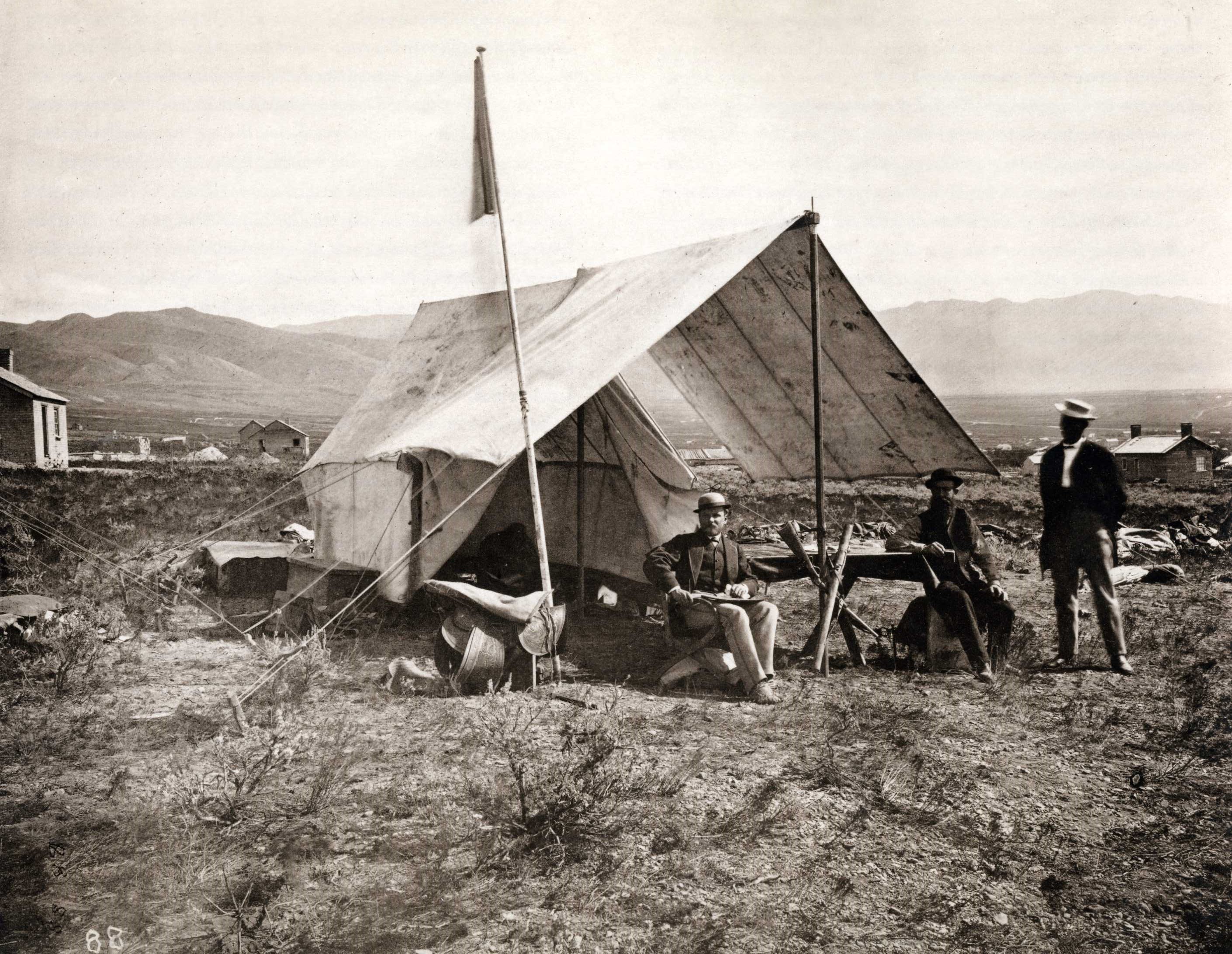
Clarence King; Camp near Salt Lake City, Utah. The exploration of the Survey of the Fortieth Parallel. Photo by Timothy H. O’Sullivan, October 1868. By Timothy H. O’Sullivan – Davis, Keith F., Timothy H. O'Sullivan, Jane Lee Aspinwall, Franรงois Brunet, John P. Herron, Mark Klett, and Juliรกn Zugazagoitia. Timothy H. O'Sullivan: The King Survey Photographs. Yale University Press Mass. Published:2011., Public Domain, https://commons.wikimedia.org/w/index.php?curid=56679730

Click the link to read the article on the High Country News website (Jennifer Sahn):

May 1, 2025

For several years I served on the board of a rural school district, and every year, when our draft budget was presented at our monthly public meeting, the audience would fill with people concerned about higher taxes. Seniors on fixed incomes spoke about the precarity of their budgets, while people of significantly greater means railed against โ€œirresponsibleโ€ spending. As a board, we were trying to keep class sizes small enough for good learning outcomes and to avoid having to cut art and music and Spanish classes. I typically let the more senior board members handle the tough questions, but one year, as a young mom, I felt compelled to speak on behalf of the intergenerational social contract: the idea that when we were in school, we benefited from the investment of the generations before us, and it is therefore our moral obligation as adults today to invest in schools for the generations coming after us.

The intergenerational social contract is an old idea, far older than the U.S. government, Social Security and Medicare. It is not about entitlement. Itโ€™s about intergenerational caretaking โ€” the recognition that there are no isolated moments of history, that we are obliged to pass on a world of hope and possibility to future generations. Indigenous communities have always understood this, which is why traditional ecological knowledge is increasingly being looked to for ways of managing the land for long-term health and sustainability. Itโ€™s a line of thinking that respects, and assumes a responsibility to, future inhabitants of Earth. 

The intergenerational social contract also applies to public lands. Land-management agencies in the U.S., including the Bureau of Land Management, Department of the Interior and the Forest Service, have a legal responsibility to manage lands and resources with the future in mind. The words โ€œto the benefit of present and future generationsโ€ are all over the charters and laws governing these agencies. Current proposals to sell off public land are not only a blatant violation of the social contract, but a violation of the very idea of public land. Transferring a public good into private hands is a crime against future generations. 

The reckless actions of the Department of Government Efficiency (DOGE), as charted by Jonathan Thompson in this issue, are another blatant assault on the public good, slashing budgets for public land and firing its caretakers. Cutting funds for cancer and climate research is an assault on present and future generations, as is defanging the Endangered Species Act and the National Environmental Policy Act. This activity should be considered un-American: enriching the wealthiest while stealing from the everyday Americans of today, tomorrow and as long as our republic shall stand.

Despite Supreme Court setback, childrenโ€™s lawsuits against climate changeย continue

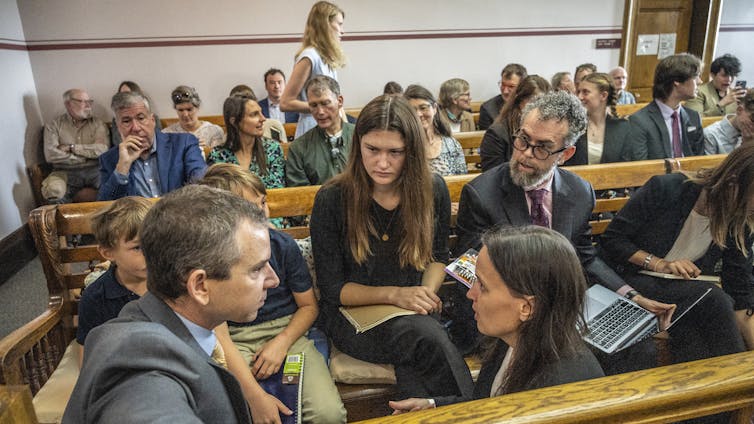
Young Montanans, including Rikki Held, center, sued their state government and won a key ruling forcing the state government to consider greenhouse gas emissions when reviewing proposed development projects. William Campbell/Getty Images

Alexandra Klass, University of Michigan

An ancient legal principle has become a key strategy of American children seeking to reduce the effects of climate change in the 21st century. A defeat at the U.S. Supreme Court in March 2025 has not stopped the effort, which has several legal actions continuing in the courts.

The legal basis for these cases is called the โ€œpublic trust doctrine,โ€ the principle that certain natural resources โ€“ historically, navigable waters such as lakes, rivers and streams and the lands under them โ€“ must be maintained in government ownership and held in trust for present and future generations of the public.

Although the origins of the doctrine remain in some dispute, most scholars cite its first mention in ancient Roman law. Over the centuries the principle made its way to England and later to the United States.

For the past decade, a nonprofit called Our Childrenโ€™s Trust has argued for a 21st-century interpretation of the public trust doctrine to support lawsuits against state and federal agencies and officials, seeking to force them to take specific actions to fight climate change. Our Childrenโ€™s Trust has focused on children, saying they are particularly vulnerable to the effects of climate change because their futures, which the public trust doctrine protects, will be lived in an unsafe and unhealthy climate unless governments take action. Children around the world have filed similar lawsuits against their governments on alternate legal grounds, including claims of constitutional and human rights violations.

Initial uses of the public trust doctrine in the US

The U.S. Supreme Court first endorsed the public trust doctrine in 1892, when it ruled that the doctrine prevented the Illinois legislature from selling virtually the entire Chicago harbor in Lake Michigan to a private railroad company. In the 20th century, state courts have ruled that the doctrine bars states and local governments from selling off lakefront property or harbors to private owners and protects public access to beaches, lakes and oceans.

The public trust doctrine had little to do with environmental protection until the 1970s, however, after law professor Joseph Sax wrote an influential article arguing that the doctrine could form the basis for lawsuits to protect water and other natural resources from pollution, destruction and other threats.

Over the past five decades, some statesโ€™ courts have expanded the public trust doctrineโ€™s application beyond access to water-based resources, ruling it can also require governments to protect parks and wildlife from development. And Montana, Minnesota and several other states followed Saxโ€™s recommendation to pass laws or amend their state constitutions to impose broader obligations on states to protect natural resources.

A group of young people march together, holding their fists in the air.
Young people have taken part in many protests seeking action to prevent or reduce the effects of climate change, including this 2017 rally in Colorado. Helen H. Richardson/The Denver Post via Getty Images

A new approach

In 2011, Our Childrenโ€™s Trust argued for the first time that governments had a legal obligation to protect the atmosphere as a public trust resource. The group filed lawsuits in all 50 states on behalf of children. Most state courts dismissed the lawsuits quickly, holding that there were no court decisions in their states that supported extending the public trust doctrine to claims involving the climate or the atmosphere.

In 2015 the group filed a similar lawsuit in federal court in Oregon, this time against the federal government. That lawsuit, Juliana v. United States, alleged that the federal governmentโ€™s inaction to address climate change violated the public trust doctrine as well as the 21 young plaintiffsโ€™ rights to life, liberty and property under the U.S. Constitution.

The plaintiffs asked the court to order the federal government to prepare an inventory of U.S. carbon dioxide emissions and to implement a national plan to phase out fossil fuels to โ€œstabilize the climate system and protect the vital resources on which Plaintiffs now and in the future will depend.โ€

The federal lawsuit survived an early effort from the government to dismiss the case but never reached a full trial. In 2016 an Oregon federal judge ruled that the U.S. government had an obligation to protect the climate under both the public trust doctrine and the U.S. Constitution. However, this ruling was reversed on appeal. After years of back-and-forth in the court system, the U.S. Supreme Court upheld the caseโ€™s dismissal in March 2025. https://www.youtube.com/embed/1L6ufLmmyS0?wmode=transparent&start=20 A talk with one of the plaintiffs in a lawsuit against the U.S. government seeking to force regulatory action to reduce the effects of climate change.

An updated strategy

Since the initial wave of litigation, Our Childrenโ€™s Trust has continued to file lawsuits to force governments to address climate change. These newer ones are more narrowly tailored to state-specific constitutional and statutory provisions that protect environmental and public trust resources. And, so far, they have been more successful.

In a 2020 Montana lawsuit, for example, the plaintiffs relied on a 1972 amendment to the state constitution declaring that the state and every person โ€œshall maintain and improve a clean and healthful environment in Montana for present and future generationsโ€ and that the legislature shall โ€œprovide adequate remedies to prevent unreasonable depletion and degradation of natural resources.โ€ Montana Supreme Court decisions prior to the 2020 lawsuit had held that the framers of the 1972 amendment had intended it to contain โ€œthe strongest environmental protection provision found in any state constitution.โ€

Relying on these court decisions, the Montana plaintiffs argued that a state law preventing state agencies from considering the effects of greenhouse gases in issuing permit applications for projects such as power plants or mines violated the state constitution.

The plaintiffs won at trial, and in a landmark opinion in 2024 the Montana Supreme Court upheld the trial courtโ€™s finding that greenhouse gases were harmful to the stateโ€™s โ€œclimate, rivers, lakes, groundwater, atmospheric waters, forests, glaciers, fish, wildlife, air quality, and ecosystem.โ€ The court similarly found that โ€œa stable climate system โ€ฆ is clearly within the object and true principlesโ€ of the stateโ€™s constitution.

Children in Hawaii filed a similar lawsuit in 2022 against the state Department of Transportation, alleging that its failure to reduce transportation emissions in the state violated the state public trust doctrine and the stateโ€™s constitution. The lawsuit relied on Hawaii courtsโ€™ previous rulings that the stateโ€™s public trust doctrine and state constitution broadly protect natural resources for present and future generations. In 2024, days before trial was to begin, the parties reached a landmark settlement in which the state agreed to take concrete actions to significantly reduce greenhouse gas emissions from the transportation sector. https://www.youtube.com/embed/VjHqeNB89L0?wmode=transparent&start=0 In the Montana lawsuit, a U.S. court ruled that the government had failed to protect the rights of children by failing to take action to reduce or prevent climate change.

The road ahead

Looking back, it was perhaps not surprising that a one-size-fits-all nationwide legal strategy based on a doctrine that varies widely state by state would face long odds. But the public trust doctrine itself has been historically incremental, expanding and contracting as society and the needs of its citizens change over time. And Our Childrenโ€™s Trust has several cases still pending, including in Alaska and Utah state courts, and in a federal court in California.

The campaignโ€™s successes broke new legal ground: Montana courts held the first trial in the United States that examined evidence of the effects of climate change and statesโ€™ obligations to address them. The Hawaii settlement set concrete benchmarks and included provisions for continued feedback on state policies by the youth plaintiffs.

More broadly, Our Childrenโ€™s Trustโ€™s campaign demonstrates that a combination of legal advocacy and nationwide publicity over the plight of young people in a rapidly changing climate have the potential to result in real change, both in the law and in public perception of the importance of addressing climate change.

Alexandra Klass, James G. Degnan Professor of Law, University of Michigan

This article is republished from The Conversation under a Creative Commons license. Read the original article.

Bureau of Land Management restores significant water right north of Silverton: Mineral Point Ditch once diverted 11 cubic feet per second from #AnimasRiver — The #Durango Herald

The โ€œBonita Peak Mining Districtโ€ superfund site. Map via the Environmental Protection Agency

Click the link to read the article on The Durango Herald website (Reuben M. Schafir) Here’s an excerpt:

April 29, 2025

The Bureau of Land Management is restoring up to 11 cubic feet per second of water previously diverted to the Uncompahgre River Basin back to the headwaters of the Animas River north of Silverton. Thatโ€™s a win for fish, other aquatic wildlife and mining remediation, said Trout Unlimitedโ€™s Mining Coordinator Ty Churchwell, because the water will dilute heavy metals to less toxic concentrations. Both the national organization of Trout Unlimited and the local Five Rivers chapter provided financial assistance with the acquisition. The 11-cubic-foot diversion is aboutย 10% of the riverโ€™s total current flowsย in Silverton before the confluence with Cement Creek…

The previous owner held the rights to divert the water through the Mineral Point Ditch โ€“ before it entered Burrows Creek โ€“ over into the Uncompahgre Basin for agricultural use. This resulted in a 100% depletion of that water from the Animas River…The BLM paid $297,000 โ€“ fair market value โ€“ to buy the water right from a willing seller, agency spokeswoman Katie Palubicki said in an email to The Durango Herald, using funding from the Land and Water Conservation Fund and the agencyโ€™s Abandoned Mine Lands program to acquire the right.

Local Motion: Protecting and Conserving West Slope Water — KVNF #GunnisonRiver #UncompahgreRiver #ColoradoRiver #COriver #aridification

Map of the Gunnison River drainage basin in Colorado, USA. Made using public domain USGS data. By Shannon1 – Own work, CC BY-SA 4.0, https://commons.wikimedia.org/w/index.php?curid=69257550

Click the link to read the article on the KVNF website (Brody Wilson):

April 29, 2025

The Colorado River is the lifeblood of the American Southwest. Forty million people depend on it โ€” not just here in Colorado, but in cities like Phoenix, Las Vegas, and Los Angeles.

Here on the Western Slope, we donโ€™t always feel directly connected to the Colorado River. After all, we live in the Gunnison Basin โ€” a different watershed, right?

Not quite. The Gunnison River contributes about 17% of the Colorado Riverโ€™s total annual flow. So any decision made about the Colorado Riverโ€™s future directly affects us โ€” how much water we can use, when, and for what purpose. For decades, the river has been in a slow-moving crisis. Climate change, explosive population growth, and overallocation have pushed the system to the brink. In 2022, the riverโ€™s two main reservoirs โ€” Lake Powell and Lake Mead โ€” reached such low levels that hydropower turbines at Glen Canyon Dam were nearly shut down and dam operators were near “dead-pool” where water would no longer be able to pass through the dam. But today, nearly three years later, the system isnโ€™t bouncing back. Andy Mueller, General Manager of the Colorado River District, has a blunt message: the Colorado River is carrying less water than it used to, and if we donโ€™t change course, the future of agriculture, recreation, and the our way of life across the Western Slope could be at risk.

โ€œThe average temperature in March has gone up 4.2 degrees Fahrenheit,โ€ Mueller told the crowd in Ridgway. โ€œAnd for every 1 degree of warming, streamflow drops by 3 to 5 percent. Weโ€™re looking at a 20% decline right here in the Uncompahgre Valley over the last 125 years.โ€

These trends are part of a long-term warming and drying pattern. Less snow is falling, and what does fall melts earlier. That means less water reaches our rivers โ€” and more of it is lost to evaporation or absorbed by plants growing in longer, hotter seasons.

In 1922, Federal and State representatives met for the Colorado River Compact Commission in Santa Fe, New Mexico. Among the attendees were Arthur P. Davis, Director of Reclamation Service, and Herbert Hoover, who at the time, was the Secretary of Commerce. Photo taken November 24, 1922. USBR photo.

To understand whatโ€™s happening now, you have to go back to 1922. Thatโ€™s when the seven states in the Colorado River Basin signed a compact to divide the riverโ€™s water. Colorado, New Mexico, Utah, and Wyoming became the โ€œUpper Basin.โ€ California, Arizona, and Nevada formed the โ€œLower Basin.โ€ Each side was promised 7.5 million acre-feet of water per year. But there was a problem: the river wasnโ€™t carrying that much water โ€” and certainly doesnโ€™t now. For decades, this over-allocation was masked by big reservoirs like Lake Powell and Lake Mead. But as the drought continues, those buffers have disappeared. In 2007, the states and federal government adopted a temporary fix: interim guidelines to manage the system during dry years. Those guidelines are set to expire in 2026. New rules must be negotiated now โ€” and the clock is ticking.

โ€œThereโ€™s a lot of confusion out there,โ€ Mueller said. โ€œPeople talk about renegotiating the Compact โ€” but thatโ€™s not whatโ€™s happening. The Compact isnโ€™t being touched. Whatโ€™s being negotiated are the guidelines for how Powell and Mead are operated โ€” especially in times of shortage.โ€

Enduring Solutions on the #ColoradoRiver Part II: Floating Pools and GrandBargains — Kathryn Sorensen, Sarah Porter, Eric Kuhn, and Cynthia Campbell (Kyl Center for Water Policy) #COriver #aridification

Click the link to read the paper on the InkStain.net website (Kathryn Sorensen, Sarah Porter, Eric Kuhn, and Cynthia Campbell). Here’s an excerpt:

April 18, 2025

Conserving water now in reservoir savings banks, as a hedge against future risks associated with drought and declining flows, has emerged as one of the central tools for managing the Colorado River. The Lower Basin “Intentionally Created Surplus” program, created in the 2007 Interim Guidelines, has shown the idea’s promise and given the basin nearly two decades to learn the strengths and weaknesses of the approach. With tweaks to allow similar efforts in the Upper Basin and other modifications based on what we have learned about the current ICS approach, such “Floating Pools” are one of the key tools being considered as negotiators try to thread the needle of a seven-state agreement for post-2026 Colorado River management. Done properly, they have the potential to finesse the states’ disagreement over the terms of the 1922 Colorado River Compact in a way that could avoid potentially disruptive litigation. But getting the details right will be crucial to the development of an enduring bargain that can help the basin avoid the risk of interstate litigation.

Context

Negotiations over post-2026 operating rules for Lakes Powell and Mead are a proxy battle over whether the 1922 Compact acts as a limitation on yet-to-be used water in the Upper Division States or as a cut to existing water uses in the Lower Division States. Much of the conflict focuses on Article III(d) of the Colorado Compact, which states, โ€œThe states of the Upper Division will not cause the flow of the river at Lee Ferry to be depleted below an aggregate of 75,000,000 acre-feet for any period of ten consecutive years. . .โ€

The Upper Division States have a fundamentally different interpretation of their Compact obligations at Lee Ferry than the Lower Division States. Clearly, the best-case scenario for the Lower Division States, especially in Central Arizona, is a court decision that confirms the Upper Division States have a compact obligation to not deplete the flow of the river below 75 million acre-feet every ten years plus ยฝ of the annual delivery to Mexico under the 1944 Treaty, approximately 82 million acre-feet every ten years. This outcome would mostly stabilize the water supply available to the Lower Division States and likely limit consumptive uses in the Upper Division States to about the same or a little less water than they are currently using, approximately 4 million acre-feet per year. If the high court rules instead that the Upper Division States have a non-depletion obligation, and that consumptive uses in the Upper Division States are not the โ€œcauseโ€ of inadequate flows needed to deliver 8.23 million acre-feet to the Lower Division States and Mexico, the result in a declining river system is a cut, potentially even to zero, for water delivered via the Central Arizona Project (CAP) into the Sun Corridor from Phoenix to Tucson and potential cuts to water-right holders in Western Arizona, Southern California and Nevada who are next on the chopping block.

Distilled to its core, here is the question before us: in a declining river system and in the absence of an agreement among the Divisions, does the operation of Article III(d) of the Compact result in a limitation on future new uses in the Upper Division States or an elimination to existing ones in the Lower Division States?

Map of the Colorado River drainage basin, created using USGS data. By Shannon1 Creative Commons Attribution-Share Alike 4.0

On the #ColoradoRiver, doing the accounting with care — John Fleck (InkStain.net) #COriver #aridfication

Udall/Overpeck 4-panel Figure Colorado River temperature/precipitation/natural flows with trend. Lake Mead and Lake Powell storage. Updated through Water Year 2024. Credit: Brad Udall

Click the link to read the article on the InkStain.net website (John Fleck):

April 21, 2025

Itโ€™s easy to take for granted the accounting innovations in the Colorado River governance regimeโ€™s 2007 guidelines, which have governed river management and the upstream-downstream relationships between the upper and lower basins. โ€œIntentionally Created Surplusโ€ (ICS) is now part of the lexicon, and the idea behind it shows enough promise that itโ€™s at the heart of the current negotiations over the post-โ€™07 guidelines management of the river.

But we need to be careful about the lessons that we learn, and the details of how we implement the successor to ICS. How should the successor to ICS related to action levels for reservoir management? How do we ensure that water in ICS-like accounting pools is really conserved water, part of a sincere effort to reduce basin consumptive use?

Those questions are at the heart of the argument in Floating Pools & Grand Bargains, a new white paper by Kathryn Sorensen from Arizona State University and a group of colleagues, including Eric Kuhn:

Highly Recommended.

Federal hearing in Denver Tuesday, May 6, 2025, on Gross Dam expansion case — Jerd Smith (Fresh Water News) #ColoradoRiver #COriver #SouthPlatteRiver #aridification

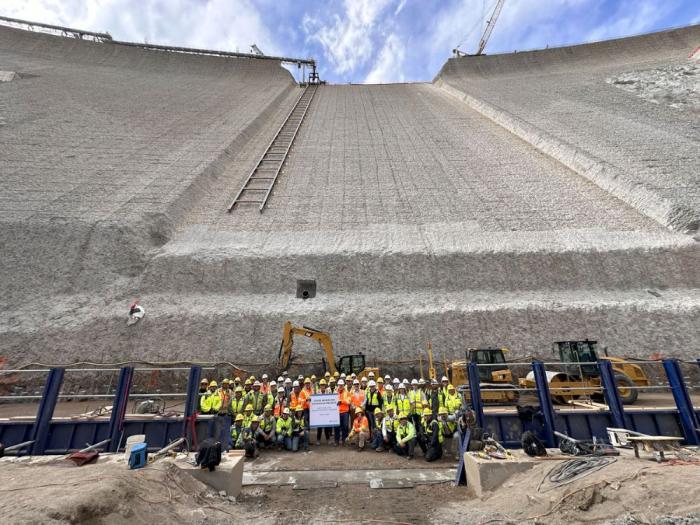
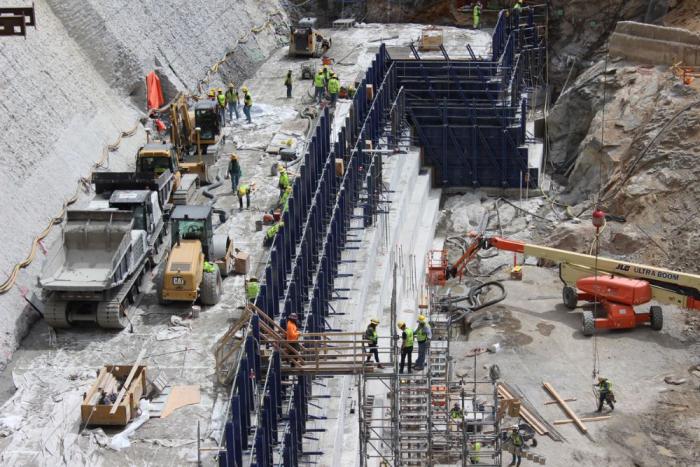
The construction site at the bottom of Gross Dam with equipment used to place concrete and build the new steps. Photo credit: Denver Water.

Click the link to read the article on the Water Education Colorado website (Jerd Smith):

May 1, 2025

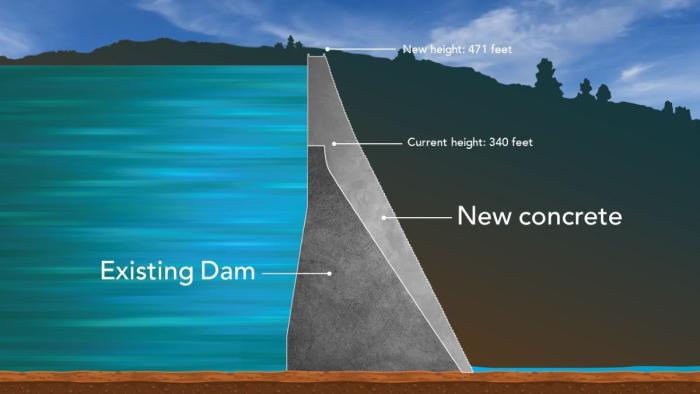
As Save the Colorado and Denver Water prepare to face off in a federal courtroom Tuesday, water officials across the state are watching the Gross Dam expansion case closely for its environmental impact and its affect on water projects across the West.

Kirk Klancke, a long-time Grand County environmentalist and president of the Colorado River Headwaters Chapter of Trout Unlimited, said a decision that shuts down the $531 million water project, could also shut down 12 years of work on the Fraser River and its tributaries.

Denver Water is one of 18 partners who signed the Colorado River Cooperative Agreement in 2013, ushering in a new era of cooperation between the utility and West Slope stakeholders, all with the vested interest in protecting watersheds in the Colorado River Basin. As part of that agreement, a process called โ€œLearning by Doingโ€ was created, which has helped the utility stay better connected on river conditions in Grand County. The partnership is a collection of East and West Slope water stakeholders who help identify and find solutions to water issues in Grand County. โ€œDenver Water has been part of Grand County for over 100 years, and we understand the impact our diversions have on the rivers and streams,โ€ said Rachel Badger, environmental planning manager at Denver Water. โ€œOur goal is to manage our water resources as efficiently as possible and be good stewards of the water โ€” and Learning By Doing helps us do that.โ€

Hereโ€™s why: Denver Water owns much of the Fraser with water rights dating back more than 100 years. And it is that water that has historically been piped through the Moffat Tunnel near Rollinsville to fill the existing Gross Reservoir. The new water for the expanded reservoir will come largely from that river as well.

After whatโ€™s known as the 2013 Colorado River Cooperative Agreement was signed, Denver Water agreed to conduct extensive restoration work on the river in exchange for being able to raise Gross Dam and bring more water from the Fraser River over to the Front Range.

Klancke said the heavily diverted, scenic waterway would suffer if the deal falls apart. โ€œTo dissolve that partnership will be the death of the Fraser River,โ€ he said.

Under the terms of the Colorado River Cooperative Agreement, the work on the Fraser River can only be finalized if the Gross Dam expansion proceeds.

On the upside though, Klancke said, if a new environmental settlement were reached, it could mean more money and more work to restore South Boulder Creek on the other side of the Continental Divide. The creek carries that Fraser River water from the reservoir to Denver Waterโ€™s northern storage system.

โ€œI would love to see Denver put a whole bunch of money into South Boulder Creek,โ€ Klancke said.

Gary Wockner, the head of Save The Colorado, disputes the notion that the case could harm environmental work already underway in Grand County.

โ€œWe are not causing environmental damage,โ€ he said. โ€œIf Denver Water chooses to stop, thatโ€™s their choice. Thatโ€™s on their shoulders. Not ours.โ€

For its part, Denver says it hopes to continue the Grand County work, but that the terms of the Fraser River agreement are all based on the successful completion of the Gross Dam expansion.

The agency also says it has already set aside $30 million to help offset any environmental harm caused by the massive construction project, including providing 5,000 acre-feet of water to improve streamflows along a 17-mile stretch of South Boulder Creek. An acre-foot of water equals nearly 326,000 gallons, enough water to serve two to four urban households for one year.

Roller-compacted concrete will be placed on top of the existing dam to raise it to a new height of 471 feet. A total of 118 new steps will make up the new dam. Image credit: Denver Water.

Denver Water first moved to raise Gross Dam more than 20 years ago when it began designing the expansion and seeking the necessary federal and state permits.

After years of engineering, studies and federal and state analyses, construction began in 2022. It has involved taking apart a portion of the original dam, built in the 1950s, and raising its height by 131 feet to nearly triple the reservoirโ€™s storage capacity to 119,000 acre-feet from 42,000 acre-feet. 

Save The Colorado has launched several unsuccessful challenges to the project, but in 2022 it won an appeal that put the legal battle back in play. Despite months of settlement talks, no agreement was reached.

Then the case took center stage again April 3, when Senior U.S. District Court Judge Christine Arguello put a temporary halt to construction of the higher dam, at Save The Coloradoโ€™s request.

Almost immediately, Denver Water filed for temporary relief from the order, saying, in part, that it would be unsafe to stop work as the incomplete concrete walls towered above Gross Reservoir. 

Arguello granted that request, too, allowing Denver to continue working on the dam.

Gross Dam case spurred $100 million settlement in a different lawsuit

What happens next is anyoneโ€™s guess. Jennifer Gimbel, a water policy scholar at Colorado State University who also serves on Northern Waterโ€™s board of directors, said the case has already had an impact on a $2 billion water project to deliver water to residents of fast-growing northern Colorado. The Northern Integrated Supply Project, as it is known, also faced a legal challenge from Save The Colorado, and ultimately the water agency opted to settle the case for $100 million. The cash will help restore the Cache la Poudre River with new diversion agreements and improved streamflows, among other benefits.

Gimbel said the Gross Reservoir case was a key factor in that settlement. โ€œBecause of Denverโ€™s troubles with Save the Colorado, Northern Water decided to resolve their lawsuit because they were worried about their own permit getting stale and because as you delay construction costs increase.โ€

The Gross Dam case is also noteworthy because it has stopped a major construction project already underway and may significantly change it. Judge Arguello has ordered the U.S. Corps of Engineers, the major permitting agency, to redo its original permitting work.

Denver Water General Manager Alan Salazar has said his agency would take the case to the U.S. Supreme Court, if they lose in the lower courts.

As both sides prepare for Tuesdayโ€™s hearing, the 10th Circuit Court of Appeals panel has said it will wait to see what information emerges from the Tuesday hearing before it rules on Denver Waterโ€™s appeal before the 10th Circuit, according to Denver Water General Counsel Jessica Brody. That action seeks to permanently protect what Denver believes is its right to raise Gross Dam.

Denver Water has also raised national security concerns in the case because Save The Colorado has asked and been granted the right to review construction documents on the dam project, documents that would normally be kept from public view.

In response, the judge has told participants to expect the court to be closed periodically during the hearing to address those security concerns.

More by Jerd Smith

The confluence of the Fraser River and the Colorado River near Granby, Colorado. By Jeffrey Beall – Own work, CC BY 4.0, https://commons.wikimedia.org/w/index.php?curid=50012193

#Drought news May 1, 2025: The dry week led to deterioration across southwestern #Kansas, southeastern #Colorado, and much of the central tier of Colorado, the rest of the West Region was dry this past week

Click on a thumbnail graphic to view a gallery of drought data from the US Drought Monitor website.

Click the link to go the US Drought Monitor website. Here’s an excerpt:

This Week’s Drought Summary

Strong thunderstorms and heavy precipitation again affected parts of the central and eastern Contiguous United States, although coverage was spotty in all but a few areas. Heavy to excessive rains (at least 2 inches) doused portions of the Plains, Mississippi Valley, Upper Southeast, and scattered to isolated sections of the northern and western Great Lakes, Ohio Valley, Carolinas, Northeast, and northern Rockies. In several sizeable areas of the Plains where there was relatively solid coverage of heavy precipitation, conditions improved significantly. Meanwhile, rainfall was negligible (several tenths of an inch at best) in most areas from the Rockies westward and in a few areas farther to the east, including much of southern and western Texas, the Oklahoma Panhandle, southeastern Kansas, central and western Nebraska, central and western North Dakota, a band from parts of the middle Mississippi Valley through the southern and eastern Great Lakes region, much of the immediate Gulf Coast, central North Carolina, central and eastern Virginia, and most of Florida and adjacent southeastern Alabama and southern Georgia. This led to another week with significant dryness and drought expansion and deterioration in the latter areas of the Southeast…

High Plains

Precipitation totals varied significantly across this region this week, but more areas were hit by heavy rains and improving conditions than dryness and deterioration. The dry week led to deterioration across southwestern Kansas, southeastern Colorado, and much of the central tier of Colorado. Farther north and east, however, widespread heavy rains were noted in several swaths of the Plains and Wyoming, leading to reductions in the intensity and extent of dryness and drought. Improvements were most widespread across central and northwestern Kansas, and most of the state of South Dakota, where heavy rains were most widespread. Still, despite the improvement in many areas, 60-day precipitation totals were under 25 percent of normal in southwestern Kansas and southeastern Colorado, with less than half of normal reported in adjacent areas plus parts of central Kansas, central and northeastern Nebraska, and a few other scattered areas…

Colorado Drought Monitor one week change map ending April 29, 2025.

West

A band of moderate to heavy precipitation (1 to 3 inches) fell across southeastern and south-central Montana, plus isolated spots in eastern Idaho. The rest of the West Region was dry this past week, outside a narrow corridor of heavy rain in east-central New Mexico. As a result, dryness and drought eased its grip in these areas. In addition, some limited improvement was brought into northern and western Washington, and small parts of northern Montana, based on a re-assessment of conditions. Most observed changes, however, were for the worse. Conditions were broadly downgraded across interior northern Montana, and increasing moisture deficits led to the expansion of D0 (abnormal dryness) into southwestern Washington and much of northwestern Oregon. In addition, surface moisture depletion has become increasingly obvious across several areas in New Mexico, leading to a significant increase in D3 (extreme drought) coverage there. The dryness was more climatologically seasonable across Arizona, Nevada, and California, where conditions were unchanged this week…

South

The heaviest rain in the Contiguous United States fell on a band from central Oklahoma southwestward across the Red River (south) into part of northwestern Texas. An area covering several counties recorded 4 to locally 8 inches of rain. Lesser but still heavy amounts (over 2 inches) fell on many areas across the rest of northern, central, and eastern Texas, portions of Louisiana and Mississippi, part of southern Tennessee, and a few scattered locations across Arkansas. Rainfall during the current and past few weeks led to large areas of improvement across the central, northern, and eastern portions of the Texas dryness and drought coverage, in addition to north-central Oklahoma and the western portions of the state outside the Panhandle. Dryness and drought remains widespread across most of Texas outside the northeast and over western portions of Oklahoma, with some deterioration to D2 (severe drought) noted in the Oklahoma Panhandle, which missed the weekโ€™s heavy rains. A broad area of exceptional drought (D4) remained entrenched across a large swath in central and western Texas, though there was some erosion of its eastward extent. East of this area of solid drought coverage, most areas are free of dryness and drought, and locally heavy rains reduced the coverage even further in part of southeastern Mississippi. Small, isolated areas of abnormal dryness (D0) elsewhere were limited to northwestern Mississippi and eastern Tennessee. Arkansas is entirely free of any dryness or drought…

Looking Ahead

During May 1-5, 2025, heavy rain (2 to locally 5 inches) is forecast for central and northeastern Texas, northern Louisiana, and southern Arkansas. Moderate to locally heavy totals (1 to 2.5 inches) are expected over much of Mississippi and Alabama, the central and southern Appalachians, the middle and upper Ohio Valley, Pennsylvania and adjacent New York and New Jersey, and a small portion of the central Great Lakes. Light to moderate totals (a few tenths to locally over an inch) is expected across the remainder of the eastern Contiguous United States, with the lowest amounts expected across coastal South Carolina, most of Georgia, and the northern and western sections of the Florida Peninsula. Several tenths to an inch are also forecast from the central and southern Plains westward through much of the Rockies, Nevada, and most of California, with locally higher amounts in some higher elevations of the Sierra Nevada and Great Basin. Little or none is forecast across the northern tier from the upper Mississippi Valley westward to the Pacific Coast, and in some climatologically drier parts of the Southwest. Warmer than normal weather is expected from the western Great Lakes through the northern Rockies and Intermountain West, with daily highs averaging 10 to 13 deg. F above normal in the northern Plains and adjacent areas. Meanwhile, cooler than normal conditions are anticipated from central and southern California through the Great Basin, southern Rockies, and central and western Texas. Highs are expected to average 8 to 10 deg. F below normal from western Texas through portions of the Great Basin and central through southern California.

The Climate Prediction Centerโ€™s 6-10 day outlook valid May 6-10, 2025 favors subnormal precipitation across the Great Lakes, middle and upper Mississippi Valley, the Ohio Valley, the interior Southeast, the mid-Atlantic region, the lower Northeast, and western New England. In contrast, enhanced chances for wetter than normal conditions cover Florida and the immediate southern Atlantic Coast, the Gulf Coast, the lower Mississippi Valley, the central and southern Plains and Rockies, most of the Great Basin, the Southwest, southeastern portions of Alaska, and Hawaii. Higher than normal temperatures are favored across roughly the northern two-thirds of the Contiguous United States, with odds exceeding 70 percent in the northern Plains and adjacent Mississippi Valley. Enhanced chances for warmer than normal weather also extend across Hawaii, especially central and western parts of the island chain. Increased odds for subnormal temperatures cover Florida, central and western Texas, the central and southern Four Corners region, and southeastern Alaska. Chances for significantly cooler than normal conditions exceed 50 percent across central and southern New Mexico.

US Drought Monitor one week change map ending April 29, 2025.

This morning, state leaders gathered to launch #Coloradoโ€™s Outdoors Strategy โšก๏ธ Coloradoโ€™s first ever collaborative vision for #conservation, outdoor recreation and #climate resilience — The Nature Conservancy in Colorado

Mrs. Gulch’s landscape April 30, 2025

Mrs. Gulch’s Hawthorn pair April 30, 2025.
Close up of Mrs. Gulch’s Hawthorn April 30, 2025.

And just for grins guess what Coyote Gulch was doing on April 30, 2019?

Farmers Highline Canal near the Tuck Ditch Headgate April 30, 2019. Day 30 of the #30daysofbiking challenge.

Fate of #Littletonโ€™s historic flumes uncertain as City Ditch piping looms: The city grapples with #Englewoodโ€™s plan to pipe the โ€˜oldest working thingโ€™ in Denver — #Colorado Community Media

Smith Ditch Washington Park, Denver

Click the link to read the article on the Colorado Community Media website (Isabel Guzman). Here’s an excerpt:

April 24, 2025

Whatโ€™s 4-feet deep, 6-feet wide and 26-miles long? The original City Ditch โ€” one of Coloradoโ€™s earliest and most influential irrigation canals, constructed between 1864 and 1867 by the Capitol Hydraulic Company to bring much-needed water to the dry, dusty lands of the Denver metropolitan area. This hand-dug canal, also known as Smithโ€™s Ditch, was engineered by Richard S. Little and financed by businessman John W. Smith, according toย local historian Larry Borger. It stretched from its headgate near present-day Chatfield Reservoir, above Littleton, and ran roughly 26-to-27 miles northeast to Capitol Hill in Denver, relying solely on a 100-foot drop in elevation to move water without pumps. When it opened in 1867, the ditch enabled the growth of trees, sugar beet crops and neighborhoods, providing Denver with its primary irrigation source for more than 25 years. The ditch also supported a network of more than 1,000 lateral ditches, greening up city parks and supplying water to offshoots that irrigated cropland and street trees. Its construction and operation were so significant that the ditch is often called the โ€œoldest working thingโ€ in Denver, predating paved streets and railroads. Today, the City Ditch is mostly hidden from view. About 2.5 miles of the ditch remain open-channel, while the rest is mostly piped and buried. In Littleton, the portion of the ditch that runs along Santa Fe Drive from Slaughterhouse Gulch Park to the C-470 highway is owned by the City of Englewood. Englewoodย plansย to convert the remaining open channel between Chatfield Reservoir and the Charles Allen Water Treatment Plant into a buried pipe, a move that would end the historic open flow through the area.

The City of Englewoodโ€™s City Ditch Piping Project map. Courtesy of the City of Englewood.

Englewood is giving Littleton a chance to save the historic flume structures โ€” man-made, open channels designed to carry water, usually sloping downward and with raised sides above the surrounding ground โ€” at Lee Gulch and Slaughterhouse Gulch Park. Ryan Germeroth and Brent Soderlin, deputy director and director of Public Works & Utilities presented Littleton City Council with options for the Slaughterhouse Gulch Flume โ€” which Englewood would start construction on first this summer โ€” at theย study sessionย on April 22.

#Colorado wildfire outlook ‘normal’ โ€” but normal has new meaning in wildfire-prone state: A ‘normal season means about 6,000 wildfires that burn roughly 160,000 acres — Colorado Politics

West Fork Fire June 20, 2013 photo the Pike Hot Shots Wildfire Today

Click the link to read the article on the Colorado Politics website (Kyle Pearce). Here’s an excerpt:

April 28, 2025

Colorado’s fire risk for the upcoming season is average, Gov. Jared Polis said at a news conference Thursday. But average means there will be many wildfires in the state and they will likely be large, fire officials emphasized.

“Today, it’s more a question of when, not if, a fire will affect our community,” Polis said. 

In the short term, there’s heightened wildfire risk in southeast Colorado, then later in the summer, heightened risk in southwest Colorado, fire officials said. Stan Hilkey, the executive director of the Colorado Department of Public Safety, said the “normal” fire outlook should be taken cautiously.

“I want to be cautious by what I mean by normal,” he said. “That means that we’ve had fires and we’re going to continue to have fires. Some will be big and we’re going to be busy, and that’s what normal looks like in Colorado anymore.”

Colorado Division of Fire Prevention and Control Director Mike Morgan added that fire season in Colorado has changed over the years.

“We used to look at fire season as about a four month period and that’s no longer the case,” Morgan said. “We have fire disasters every month of the year in the state of Colorado and we can’t afford to let our guard down.”

Colorado Drought Monitor map April 22, 2205.

Mexico and U.S. reach deal on #RioGrande water sharing — The Associated Press

Rio Grande and Pecos River basins. Map credit: By Kmusser – Own work, Elevation data from SRTM, drainage basin from GTOPO [1], U.S. stream from the National Atlas [2], all other features from Vector Map., CC BY-SA 3.0, https://commons.wikimedia.org/w/index.php?curid=11218868

Click the link to read the article on the Associated Press website. Here’s an excerpt:

April 28, 2025

Mexico and the United States said Monday they had reached an agreement that involves Mexico immediately sending more water from their shared Rio Grande basin to Texas farmers after U.S. President Donald Trump threatened tariffs and sanctions earlier this month.

โ€œMexico has committed to make an immediate transfer of water from international reservoirs and increase the U.S. share of the flow in six of Mexicoโ€™s Rio Grande tributaries through the end of the current five-year water cycle,โ€ U.S. State Department spokesperson Tammy Bruce said in a statement.

Bruce thankedย Mexico President Claudia Sheinbaumย for her involvement in facilitating cross-border cooperation…The countriesโ€™ joint statement Monday, while lacking specific details of the agreement, said both countries had agreed that the 1944 treaty regulating how the water is shared was still beneficial for both countries and not in need of renegotiation. Under the treaty, Mexico must deliver 1,750,000 acre-feet of water to the U.S. from six tributaries every five years, or an average of 350,000 every year. An acre-foot is the amount of water needed to cover 1 acre of land to a depth of 1 foot.

โ€˜The West will leadโ€™: #Utah, #Idaho, #Wyoming team up on nuclear energy development — Katie McKellar (UtahNewsDispatch.com)

Utah leaders and Idaho National Laboratory Director John Wagner sign a memorandum of understanding at the Governorโ€™s Mansion in Salt Lake City on April 28, 2025. (Courtesy of the Utah Senate)

Click the link to read the article on the Utah News Dispatch website (Katie McKellar):

April 29, 2025

Utah state leaders are taking the next steps in their efforts to make Utah a major nuclear energy development hub and a โ€œnational leaderโ€ in developing next-generation energy technology, reaching beyond state lines to do it.

It starts with Utah signing two memorandums of understanding with Idaho and Wyoming as part of a strategy to fire up innovation and collaboration in the region.

As part of Gov. Spencer Coxโ€™s โ€œBuilt Here: Nuclear Energy Summit,โ€ which his office said brought together leaders from across the nuclear energy industry on Tuesday, Cox joined Idaho Gov. Brad Little and Wyoming Gov. Mark Gordon in signing an MOU that calls for the three states to work together coordinating nuclear infrastructure, accelerating nuclear development, and advocating for โ€œcommonsense federal policies.โ€

โ€œThe West will lead the next chapter of energy abundance and American prosperity,โ€ Cox said in a statement announcing the alliance. โ€œToday, we brought together industry leaders, investors, and policymakers to chart the course for nuclear energy. Our new compact strengthens our shared commitment to aggressively pursue more affordable, reliable energy across state lines.โ€

According to Coxโ€™s office, the states agreed in the MOU to collaborate on:

  • Aligning energy policies to support innovation and private investment.
  • Coordinating the development of critical energy infrastructure.
  • Jointly navigating regulatory and environmental challenges.
  • Advocating for federal support of regional energy priorities.
  • Enhancing energy resilience and grid reliability.
  • Expanding workforce development efforts to support the growing energy sector.
  • Ensuring continued delivery of affordable energy to residents.ย 

The tri-state agreement comes the day after Utah officials and the Idaho National Laboratory โ€” one of 17 national labs in the U.S. Department of Energy complex thatโ€™s focused on nuclear research โ€” signed a memorandum of understanding Monday evening after ceremoniously signing a slate of energy bills Utah lawmakers passed earlier this year. 

The MOU between Utah leaders and the Idaho National Laboratory establishes a โ€œformal, long-term collaboration on advanced energy research, workforce development and technology deployment โ€” particularly on nuclear innovation,โ€ according to the governorโ€™s office. 

โ€œThis partnership will accelerate Utahโ€™s efforts to become the nationโ€™s nuclear hub,โ€ Gov. Spencer Cox said in a prepared statement issued Monday evening. โ€œBy linking our universities, labs, and industry partners with the expertise of Idaho National Laboratory, we are strengthening our ability to serve Utahns with reliable and affordable energy.โ€

Idaho National Laboratory Director John Wagner, who signed the MOU, said he and other lab officials are โ€œexcited to partner with Utah to address urgent energy needs by focusing on advanced nuclear and energy innovation.โ€ 

โ€œThis partnership establishes a cooperative framework for scientific, technological and workforce development to help Utah realize an abundant, secure, resilient and competitive energy future,โ€ he said. 

The MOU, according to the governorโ€™s office, creates a โ€œstructural, interdisciplinary allianceโ€ between Utah and the Idaho National Laboratory. It envisions Utah as establishing a new institute called the Advanced Nuclear Energy Institute as a โ€œkey coordinating hubโ€ between the Idaho National Laboratory, Utahโ€™s system of higher education, the Utah Office of Energy Development, and the Utah San Rafael Energy Lab. 

โ€œBy linking the capabilities of INL with the talent and resources of Utahโ€™s higher education institutions, this partnership positions Utah as a national leader in developing the next generation of clean, secure and resilient energy technologies,โ€ the governorโ€™s office said in Mondayโ€™s news release. 

This new institute, state officials say, will enable Utahโ€™s universities to collaborate with other organizations to pursue federal research grants. 

โ€œBeyond academic research, the focus is on applied innovation โ€” ensuring resources are used effectively to develop commercially viable, scalable technologies,โ€ the governorโ€™s office said. โ€œThis approach will accelerate the deployment of real-world energy solutions and help build a broader, more robust nuclear energy ecosystem in Utah and the surrounding region.โ€

Through the MOU, state leaders say Utah and the Idaho National Laboratory will work together to:ย 

  • Accelerate development of โ€œnext-generationโ€ nuclear technologies.
  • Enhance scientific research in energy sectors.
  • Strengthen cybersecurity and physical security for energy infrastructure.
  • Build up the workforce needed to meet demands of a future energy economy.

The Utah Legislatureโ€™s top Republican leaders both applauded the move as crucial for Utahโ€™s future. 

โ€œAffordable, reliable energy is the driving force behind Utahโ€™s prosperity โ€” powering everything from the lights in Utahns homes to the unstoppable growth of the stateโ€™s vibrant economy,โ€ Senate President Stuart Adams, R-Layton, said in a prepared statement. โ€œAs energy demands increase and technologies rapidly evolve, we as a state are committed to staying ahead of the curve through strategic partnership that ensures both innovation and stability.โ€

House Speaker Mike Schultz, R-Hooper, said Utah โ€œis leading the way with smart, strategic investments in our energy future.โ€ 

โ€œThis partnership drives innovation and keeps energy reliable and affordable for Utah families and businesses,โ€ Schultz said. โ€œItโ€™s about long-term solutions that protect our economy and strengthen our position as a national energy leader.โ€

Lots going on in #Kiowa these days: Well project advances — #Colorado Community Media

Kiowa Creek. Photo credit: The Town of Kiowa

Click the link to read the article on the Colorado Community Media website (Nicky Quinby). Here’s an excerpt:

April 29, 2025

The Town of Kiowa has good news to report, including a new Main Street Board and progress towards funding the Water Well Redundancy Project…After some starts and stops, theย Kiowa Water and Wastewater Authorityย is making headway on its Water Well Redundancy Project, thanks in part toย Congresswoman Lauren Boebert. On March 20, Boebert visited with Town of Kiowa staff and town trustees…Boebert pledged to write letters supporting road improvement and parks projects, and also agreed to write Kiowa Water and Wastewater Authority a congressional letter of support for the Well Redundancy Project, [Kim] Boyd said. Boyd further explained that the Town of Kiowa currently relies on a single 66-foot alluvial groundwater well to meet the communityโ€™s water needs.

โ€œThis infrastructure is insufficient for current demands and poses a significant risk in the event of mechanical failure or environmental stress,โ€ she shared. โ€œIt limits the townโ€™s ability to grow and sustain essential services, including domestic water supply and fire protection.โ€

The Colorado Department of Public Health and Environment (CDPHE) mandates that municipal water systems maintain at least two wells to ensure redundancy and protect public health.

#DeBeque seeking federal funding to help secure secondary water source — The #GrandJunction Daily Sentinel

Minter Avenue in De Beque, March 2013. By Jeffrey Beall – Own work, CC BY 3.0, https://commons.wikimedia.org/w/index.php?curid=25467639

Click the link to read the article on the Grand Junction Daily Sentinel website (Dan West). Here’s an excerpt:

April 27, 2025

The town of De Beque is seeking Congressionally directed spending to help it secure a secondary water source, as it currently relies solely on the Colorado River to supply water to the community. De Beque Town Treasurer Katherine Boozell said the town is looking at drilling a well near the townโ€™s Water Treatment Plant. According to Boozell, the well could cost in excess of $400,000 to drill.

โ€œAt present, the Town of De Beque relies solely on the Colorado River as its drinking water source,โ€ Boozell wrote in an email. โ€œThis dependence leaves the community vulnerable during periods of high turbidity, which occur frequently due to mudslides from wildfire burn scars upstream or sediment disruption caused by storms. When turbidity levels spike, we are forced to shut down intake to our treatment plant because the water is too muddy to process.โ€

The town does have a tank where it can store treated water, but that is a temporary solution, she said. When the tank is dry, the town is unable to provide treated water until the riverโ€™s water conditions improve. This poses a public health risk, she said, making a secondary water source an urgent need…According to a fact sheet about the proposal, a new well would not only improve reliance for the townโ€™s water but also improve the water quality as well.

Why does the #ColoradoRiver seem to vanish at a certain point in Glenwood Canyon?ย — #Colorado Public Radio

The Shoshone hydro plant in Glenwood Canyon, captured here in June 2018, uses water diverted from the Colorado River to make power, and it controls a key water right on the Western Slope. Photo credit: Brent Gardner-Smith/Aspen Journalism

Click the link to read the article on the Colorado Public Radio website (Tom Hesse). Here’s an excerpt:

April 28, 2025

James Heath, division engineer for the Colorado River Basin for the Colorado Division of Water Resources, says [Avi] Stopper most likely witnessed a roughly two-mile stretch where up to 1,400 cubic feet per second of water takes the scenic route through Xcel Energyโ€™s Shoshone Hydro Electric Generating Plant. If that diversion is happening during high-water months like May, passersby would probably miss it entirely. But in the dead of winter, when river flows can be below 1,000 CFS, the difference can be seen by drivers heading east.

โ€œAt certain times of the year, the power plant can divert every single drop of water that’s in the Colorado River and other times a year the stream flow is significant and it’s hardly noticeable what the power plant’s actually diverting off the stream system,โ€ Heath said.

The water rights are considered โ€œnonconsumptive,โ€ which means thereโ€™s no water lost in the process. Thatโ€™s also why the river disappeared and reappeared a short time later on Aviโ€™s drive. Water leaves the river at a diversion dam near the Hanging Lake Tunnel and then reenters the river at the Shoshone plant. Heath said itโ€™s about a 2-mile stretch and thereโ€™s little entering the stream during that period. 

โ€œThere’s a little bit of gate leakage there at the diversion dam. There are a couple small minor tributaries that come in between the diversion dam and the returns from the powerhouse, but it’s a small trickle at times during the year,โ€ Heath said.

#NewCastle, #Parachute, #DeBeque pitch in on effort to buy Shoshone water rights — The #GrandJunction Daily Sentinel

View of Shoshone Hydroelectric Plant construction in Glenwood Canyon (Garfield County) Colorado; shows the Colorado River, the dam, sheds, a footbridge, and the workmen’s camp. Creator: McClure, Louis Charles, 1867-1957. Credit: Denver Public Library Digital Collections

Click the link to read the article on the Grand Junction Daily Sentinel website (Dennis Webb). Here’s an excerpt:

April 27, 2025

The town of New Castle has agreed to contribute $100,000 to the Western Slopeโ€™s efforts to buy the historic Shoshone hydroelectric power plant water rights, while the towns of Parachute and De Beque also have agreed to kick in smaller amounts…Parachute will be contributing $25,000 and De Beque, $5,000. The De Beque Plateau Valley Soil Conservation District also is kicking in $5,000…Combined, more than 30 Western Slope local governments, water entities and regional partners have committed over $17 million toward the $99 million purchase. The river district and state of Colorado also have committed $20 million apiece, and the federal Bureau of Reclamation committed $40 million in the final days of the Biden administration. That funding has been frozen by the Trump administration but the river district remains hopeful of eventually receiving it.

Notice of Administrative & Legal Committee Special meeting — #ArkansasRiver Compact Administration virtual meeting Thursday May 8, 2025

Map of the Arkansas River drainage basin. Created using USGS National Map and NASA SRTM data. By Shannon1 – Own work, CC BY-SA 4.0, https://commons.wikimedia.org/w/index.php?curid=79039596

From email from the Arkansas River Compact Administration (Kevin Salter):

April 28, 2025

The Arkansas River Compact Administration (โ€œARCAโ€) Administration & Legal Committee will meet at the time noted above via virtual and phone conference call to consider a modified Joint Funding Agreement (JFA) between ARCA and United States Geological Survey (USGS) that will cover the Operations and Maintenance (O&M) for cameras to be installed on the Arkansas River at Las Animas, CO USGS gage.  USGS will cover the installation costs and the O&M for the remainder of the year in which they are installed.  O&M costs beyond the installation year will be ARCAโ€™s responsibility.  The O&M costs would have been $4000 for the current year.  Attached are three documents from USGS related to modifying the JFA.

ADMINISTRATIVE & LEGAL COMMITTEE AGENDA

1.  Approval of agenda………………………………………… Lauren Ris

2.  Modified ARCA-USGS JFA…………………………….. Kevin Salter

3.  ARCA budget considerations………………………. Andrew Rickert

4.  Recommendation on modified ARCA-USGS JFA….. Lauren Ris

5.  Adjournment…………………………………………………. Lauren Ris

Following the Administration & Legal Committee meeting, the Arkansas River Compact Administration will have a Special Meeting to consider the same matter.

ARCA SPECIAL MEETING AGENDA

1.  Call to order & roll call …………………………………… Jim Rizzuto

2.  Approval of agenda……………………………………….. Jim Rizzuto

3.  Consider Administration & Legal Committee recommendations

ย ย ย ย ย ย ย  on a modified ARCA-USGS JFA…………………… Jim Risotto

4.ย ย Adjournment………………………………………………… Jim Rizzuto

Virtual meeting connection information below

Meetings of the Administration are open to the public and operated in compliance with the Federal Americans with Disabilities Act. If you wish to participate in the Special Meeting you may do so by using the link and/or one of the phone numbers listed below:

1.      Use Zoom information below to access both meetings, online via this link (ARCA Special Meeting will be recorded):

https://kansasag.zoom.us/j/84109597210?pwd=vpkOwwSdPEHFuraBBlnpvHzco8r85R.1

โ€˜State of the River:โ€™ Could be better, but โ€ฆ — Gunnison Country Times #GunnisonRiver

Click the link to read the article on the Gunnison Country Times website (George Sibley). Here’s an excerpt:

April 23, 2025

The fickle โ€œchildren of the Pacific Ocean,โ€ El Niรฑo and La Niรฑa, have again dealt the Gunnison River Basin a bad hand. A weak La Niรฑa winter sent the storm-bearing jet streams over the northwestern United States and southern Canada, leaving the Southwest, and southern half of Colorado, relatively dry for 2025, according to Bob Hurford, Coloradoโ€™s Division 4 (Gunnison Basin) Engineer. Hurford visited Gunnison on April 17 for an annual โ€œState of the Riverโ€ program, along with Andy Mueller, general manager of the Colorado River Water Conservation District, known as the โ€œRiver District,โ€ the programโ€™s sponsor. Sonja Chavez, manager of the Upper Gunnison River Water Conservancy District, and Jesse Kruthaupt, Gunnison agent for Trout Unlimitedโ€™s Colorado Restoration Program spoke on the state of the Upper Gunnison River.

Hurford led with a discussion of what is unfolding locally in water year 2025 (Oct. 1, 2024 through Sept. 30, 2025). The Upper Gunnison Basinโ€™s April 1 snowpack (usually at or near the maximum depth for the winter) contains only 59% of the 30-year average water content. It is projected at this point to yield through July about 540,000 acre-feet of runoff or less for the river โ€” probably not enough to fill Blue Mesa Reservoir after downstream water rights are filled. An acre-foot of water is the amount it would take to cover the playing area of a football field to the depth of one foot. As the changing climate warms the planet, March is becoming the โ€œnew April.โ€ This yearโ€™s snowpack peaked in mid-March. With the big melt usually beginning sooner nowadays, spring-like weather is causing trees and other plants to also begin โ€œdrinkingโ€ sooner…Increasing evaporation and plant transpiration also come with the changing climate. According to Mueller, for every additional degree Fahrenheit in the ambient temperatures, another 3-5% of water on the surface and in plants disappears as water vapor. These are changes to be anticipated for as long as we continue to warm the planetโ€™s climate. Hurford concluded his presentation with a chart indicating that the decade beginning with 2020 is on track at this point to be the driest decade on record, including the droughts of the 1930s and 2000s.

Map of the Gunnison River drainage basin in Colorado, USA. Made using public domain USGS data. By Shannon1 – Own work, CC BY-SA 4.0, https://commons.wikimedia.org/w/index.php?curid=69257550

Interior eviscerates public land protections, fast-tracks mining, drilling: Plus: National monument shrinkage appears imminent — Jonathan P. Thompson (LandDesk.org)

An oil and gas drilling operation in the Chaco region checkerboard of northwestern New Mexico. Jonathan P. Thompson photo.

Click the link to read the article on The Land Desk website (Jonathan P. Thompson):

April 25, 2025

๐Ÿคฏ Trump Ticker ๐Ÿ˜ฑ

For the past three months and change, the Trump administration, in a series of executive orders, has been working to dismantle the administrative state, or the framework of agencies, rules, and regulations designed to protect the nation and its citizens. For the most part, however, the Interior Department โ€” the sprawling agency that oversees much of the nationโ€™s public lands โ€” has been relatively (and suspiciously) quiet, refraining from big actions beyond merely repeating some of Trumpโ€™s orders.

That has rapidly changed in recent days as Interior Secretary Doug Burgum โ€” or perhaps Tyler Hassan, the DOGE minion Elon Musk appointed to reorganize Interior โ€” set off a figurative bomb that could demolish protections for public lands.

The most alarming move, so far, is the departmentโ€™s implementation of โ€œemergency permitting proceduresโ€ for oil and gas, uranium, coal, biofuels, and critical mineral projects on federal lands. Under this order, the department will compress the entire environmental review for these projects down to 28 days or less โ€” even for a full environmental impact statement.

โ€œBy reducing a multi-year permitting process down to just 28 days,โ€ Burgum said in a press release, โ€œthe Department will lead with urgency, resolve, and a clear focus on strengthening the nationโ€™s energy independence.โ€

If youโ€™ve ever skimmed through an EIS, you know how insane this concept is.

The Bureau of Land Management will be packing the entire process mandated by the National Environmental Policy Act, Endangered Species Act, National Historic Preservation Act, and other rules and regulations into an impossibly short timeframe.

By impossibly short, I mean that it is virtually impossible to comply with these laws and requirements โ€” which include tribal consultation, archaeological surveys and mitigation, environmental and endangered species reviews, socioeconomic impact analyses, and public comment periods โ€” in four weeks or less. So by radically compressing the timeline, Burgum is essentially telling his staff to skirt the requirements, i.e. violate the law.

Burgum uses President Trumpโ€™s claim that the U.S. is experiencing an โ€œenergy emergency,โ€ to justify the destructive rubber-stamping, and says fast-tracking project approvals is necessary to address that emergency.

Iโ€™ve said it many times, but I will say it again: There is no energy emergency. The U.S. is pumping more crude oil than ever before from the Permian Basin and other fields, it is the largest petroleum producer in the world, it is a net exporter of petroleum products, and liquefied natural gas exports are at an all-time high. The U.S. market is glutted with natural gas and the coal supply has been outpacing demand for nearly two decades. Lithium โ€” for electric vehicle batteries and grid-scale energy storage โ€” is so plentiful that prices have plummeted nearly 90% since 2022. Uranium shortage? Nope.

One could certainly argue that the power grid in the West is outdated, its operation balkanized, and that it is not up to the challenges posed by growing data center electricity demand. But aside from geothermal and hydropower (solar, wind, and transmission projects are not included), none of the categories of projects on the fast-track list would do anything to fix the grid. Even if they were, it would not justify truncating environmental reviews so severely โ€” or at all.

Environmental reviews can take a maddeningly long time, especially for big projects. But the way to speed things up is not to throw the laws and protections in the the trash bin. That will only lead to lawsuits, which likely will delay the projects even more. The only way to truly streamline permitting, while still safeguarding human health and the environment, is to beef up staffing, resources, and expertise. And thatโ€™s exactly the opposite of what Trump and Musk and Burgum are doing.

Pages from the Interior Departmentโ€™s 2026-2030 Strategic Plan Draft Framework acquired and published by Public Domain. Note that one objective is to โ€œrelease federal holdingsโ€ for housing. And that in the top one they want to โ€œreduce the costs for grazingโ€ on public land (can it go any lower?), while in the bottom one they want to โ€œincrease revenues from grazing โ€ฆ .โ€ Uh โ€ฆ okay?

But wait. It gets worse.

We might take some comfort in the fact that national monuments are off-limits to the extractive industries and Trumpโ€™s energy dominance agenda, right? Maybe not for long.

Earlier this week, the folks at Public Domain acquired a copy of the Interior Departmentโ€™s 2026-2030 Strategic Plan Draft Framework. The plan aims to, among other things: โ€œrestore American prosperity,โ€ โ€œassess and right-size monuments,โ€ and โ€œreturn heritage lands and sites to the states.โ€

The Washington Post, however, is reporting that Burgum is not necessarily waiting until next year to โ€œright-size,โ€ or shrink, national monuments. From the Post:

If they go through with the shrinkage of any or all of these national monuments, it would open up additional lands to oil and gas leasing and new mining claims, which would then be subject to the fast-tracked permitting.

Baaj Nwaavjo Iโ€™tah Kukveni-Ancestral Footprints of the Grand Canyon is especially rich in high-grade uranium deposits, and the White Canyon area in Bears Ears might also be targeted for uranium if the monument were shrunk. Grand Staircase-Escalante includes a large coal deposit on the Kaipairowitz Plateau, but itโ€™s exceedingly unlikely that anyone would be interested in mining it given the faulty economics of coal.

One thing you can be sure of is that none of this will go unchallenged. The tribal nations that proposed the designation of Bears Ears and other national monuments will sue to keep them intact, and advocacy groups and land and water protectors will support them and take the administration to court over its flouting of environmental laws.

A look across Glen Canyon National Recreation Area and into Bears Ears National Monument from the Little Rockies. Jonathan P. Thompson photo.

๐ŸŒต Public Lands ๐ŸŒฒ

For many people, the mention of Glen Canyon National Recreation Area evokes images of Lake Powell and all that entails: boats plying the blue-sky-reflecting waters and the sandstone cliffs and formations that rise up from the murky depths. That makes sense, given that the national park unit was established because the reservoir was there in 1972.

Yet the reservoir makes up just 13% of the 1.25 million-acre recreation area. The remaining 87% contains some of the more remote and spectacular country in the lower 48, shares borders with a half-dozen other national parks and monuments, and makes up the core of the Moab to Mojave Conservation Corridor.

So, the manner in which the area is managed matters โ€” a lot. And for five decades after the recreation areaโ€™s establishment, off-road vehicle travel went virtually unmanaged, allowing for a destructive free-for-all along shorelines and in remote parts of the recreation area. In 2018, the Park Service released a plan that more or less codified the pre-plan anarchy. Environmentalists sued and forced the Park Service back to the drawing board.

This January the Park Service finally issued an amended rule celebrated by conservationists for adding protections to some of GCNRAโ€™s more sensitive areas from motorized vehicle travel (this does not affect boating, by the way). It bars OHV-riding yahoos from roaring around the lakeโ€™s shore unheeded, and restricts motorized travel in the Orange Cliffs area on the north end of the recreation area adjacent to the Maze in Canyonlands.

The off-road vehicle lobby, however, was unhappy with the added restrictions, and they took their victim-complex grievances to the Utah congressional delegation, all of whom appear to have a fetish for fossil-fueled combustion-engines. Now the plan and the recreation area are being put in jeopardy by โ€” you guessed it โ€” those same Utah politicians. Sens. John Curtis and Mike Lee, along with Rep. Celeste Maloy, are asking Congress to revoke the rule under the Congressional Review Act and to prohibit the Park Service from implementing similar protections in the future.

๐Ÿ—บ๏ธ Messing with Maps ๐Ÿงญ

The National Parks Conservation Association created a nifty map showing active mining claims and mines near national parks and national monuments. It gives a good sense of how vulnerable some areas might be to new mining claims and projects if the Trump administration goes ahead with shrinking the aforementioned national monuments. You can look at the interactive version here.

One note of caution: An active mining claim โ‰  a valid mining claim. An active claim simply means it has been located and filed, and that the claimant has paid their annual maintenance fee. The validity of a claim, on the other hand, depends on the discovery of a valuable mineral deposit there, which must be demonstrated. Rights to mine are only attached to valid claims.


Parting Poem

Hereโ€™s another one from Richard Sheltonโ€™s Selected Poems, 1969-1981.

Colorado #snowpack at lowest point in 10 years as mixed winter season nears its end — The Summit Daily

Click the link to read the article on the Summit Daily website. Here’s an excerpt:

April 26, 2025

As of Friday, April 25, statewide snowpack measurements stood at 66% of the 30-year median,ย according to data from the Natural Resources Conservation Service.ย Thatโ€™s the lowest point for this time of year since the 2014-15 water year. For every major river basin that reports snowpack data, levels are significantly below normal.ย 

โ€œIt was a little bit of a warmer year and just not quite the amount of snow and storms youโ€™d like to see for the state as a whole,โ€ said National Weather Service meteorologist Aldis Strautins.

Unlike the southwestern part of the state, the National Oceanic and Atmospheric Administrationโ€™s latest drought projection shows northern and central mountain areas are largelyย expected to be drought-free
ย through the end of July.

Opinion: Billions of dollars later, #Arizona is almost out of water, time and options: The #ColoradoRiver’s supply and demand problems are solvable, but the window to fix them before major calamity occurs is rapidly closing — AZCentral.com #COriver #aridification

The Colorado River near Black Canyon before Hoover Dam. Photo via InkStain.

Click the link to read the opinion column on the AZCentral.com website (Joanna Allhands). Here’s an excerpt:

April 24, 2025

  • The agreements propping up Lake Mead and Lake Powell expire in 2026, and negotiations for new agreements have stalled.
  • The Trump administration’s lack of clear direction and delay in appointing a Reclamation commissioner are exacerbating the crisis.
  • Arizona will face significant water cuts, potentially deeper than any previous shortages. It needs time to process them.

Many of us have seen this train wreck coming for years, the slow buildup of chronic overuse, coupled with a river that no longer produces as much water as it used to, that is draining Lake Mead and Lake Powell, the nationโ€™s two largest water savings accounts. And if things donโ€™t change soon, 40 million people who rely on this river are about to suddenly realize that decisionmakers squandered every dollar spent on buying time to fix this fundamental problem…The mismatch between supply and demand began emerging around 2000, and by 2007, the feds had created the first set of shortage guidelines, hoping those mandatory cuts would be enough to stave off crisis. But we now know that they werenโ€™t nearly enough to reduce the drag on the lakes. Deeper cuts were made. Billions of dollars were set aside to pay people to temporarily not use water. And weโ€™ve stabilized Lake Mead and Lake Powell, for now.

But those rules and agreements expire at the end of 2026…The Trump administration hasnโ€™t said anything about those alternatives. And after dropping an executive order toย nix a longstanding review process, itโ€™s unclear how the feds will evaluate or collect public input, presuming that said alternatives are still on the table…Itโ€™s telling that while state negotiators continue to meet (and make no real progress), no one from the Bureau of Reclamation โ€” the federal agency tasked with operating Lake Mead and Lake Powell โ€” has attended those negotiation sessions since the Trump administration took office. In fact, Reclamation stillย doesnโ€™t even have a commissioner. The administration has been dragging its feet on getting the leadership in place to finally break this logjam…Now is not the time to be hands-off. The Trump administration must prioritize naming a Reclamation director who can offer firm, clear and fair direction โ€” and who isnโ€™t afraid to bust a few heads if state negotiators refuse to budge.

Colorado River “Beginnings”. Photo: Brent Gardner-Smith/Aspen Journalism

The Price of Conserving Water — Elizabeth Miller (Headwaters Magazine)

Lake Powell at Wahweap Marina as seen in December 2021. Dwindling streamflows and falling reservoir levels have made it more likely that what some experts call a Colorado River Compact โ€œtripwireโ€ will be hit in 2027. Credit: Heather Sackett/Aspen Journalism

Click the link to read the article on the Water Education Colorado website (Elizabeth Miller):

April 9, 2025

When Colorado convened a working group on water speculation, its members shared stories of times in which theyโ€™d seen or thought they might have seen investment water speculation occurring โ€” when water rights are purchased with a primary purpose of profiting from the future sale or lease of that water as demand drives up its price. On the list was the notion that buyers with no real interest in agriculture would buy agricultural land and water rights with the primary intention of enrolling in a program that pays water rights holders not to use that water.

The concern, essentially, was that programs that compensate farmers for fallowing fields like the Upper Colorado River Basinโ€™s System Conservation Pilot Program, and nonprofits that fundraise to keep water in streams werenโ€™t sufficiently guarded against abuse, particularly when it comes to an increasingly constrained Colorado River system.

โ€œThe impacts of drought and the risks that drought causes in the Colorado River Basin, just by way of example, attract money to the concept that money can be made from taking water out of production โ€” conservation,โ€ says Peter Fleming, general counsel for the Colorado River District.

โ€œWhere do you draw the line in that?โ€ Fleming asks. โ€œWhich one is a good, socially recognized benefit that the state as a whole should support versus which one is bad because it encourages speculation in water resources, and it makes things more difficult for others, and it has adverse secondary impacts in the local economies when you take water out of production?โ€

A few guardrails exist to make real conservation efforts โ€” those that serve the common good โ€” clear. But questions remain on whether those protections can really stop investment water speculation before speculation occurs.

Little Cimarron Ranch, where a first-of-its-kind agreement allows water rights to go to irrigation in the spring and summer, and to instream flows to support river health in the summer and fall. Photo courtesy of Mirr Ranch Group

Streamflows for the Public Good

In 1973, Colorado lawmakers legally recognized instream flows, in which water is allocated to the river to maintain flows and habitat as a โ€œbeneficial useโ€ in parallel with industries, cities and agriculture. That 1973 legislation tried to prevent speculators from prospectively appropriating instream flows and locking up the stateโ€™s water by taking measures like limiting who can operate instream flows to a single state agency, the Colorado Water Conservation Board.

โ€œThere is government oversight for specifically this reason โ€” to prevent speculation,โ€ says Josh Boissevain, staff attorney with the Colorado Water Trust, a nonprofit that works to secure water for streams. โ€œInstream flow is a decreed use, so using that water for instream flow is not speculation at all, even though itโ€™s left in the river.โ€

When water rights owners work with the water trust to use their water to restore flows, it takes a lot of paperwork and a close look at the web of other users affected. The process can be tedious and time-consuming, and the profits marginal.

โ€œNobody is doing that for the money,โ€ Boissevain says. โ€œThey do it because they care.โ€

Some loopholes have been closed. For example, a 1994 change to Coloradoโ€™s water law prevents conditional water rights holders, who hold onto water rights for unbuilt projects or potential future uses, from transferring those rights to instream flows. That law blocks speculators from selling conditional water rights to the CWCB for a profit.

Shoshone Hydroelectric Plant back in the days before I-70 via Aspen Journalism

Having a perfected water right โ€” one that is fully established and has been put to beneficial use โ€” converted to instream flows is fine, Fleming says. The Colorado River District participates in those programs and is working to buy a water right currently used to generate 15 megawatts at Xcel Energyโ€™s aging Shoshone hydroelectric power plant. The River District aims to convert that hydropower right to an instream flow right to ensure that this water continues to flow from the headwaters down through boating hotspots in Glenwood Canyon, regardless of the 115-year-old power plantโ€™s future.

But Fleming, who worked on a 2021 report that reviewed Coloradoโ€™s legal sideboards on speculation, remains concerned that the lines are not clearly enough drawn between those recognizable benefits to the state and local economies, and the place where speculators could start counting on those efforts and โ€œconservingโ€ to make a profit. At a certain scale, the effects of taking water off farm fields could ripple out beyond bare fields to farm supply stores and gas stations, as well as the local job market in rural communities.

Perhaps the most frightening possibility that could result from profiteering is that water rights bought and steered from use in Colorado will somehow be sold to thirsty fields or towns in Arizona or Nevada. But even if both buyer and seller are willing, specific language in interstate compacts and existing law complicates the likelihood of selling water from one state to a buyer in a different state.

Meanwhile, conservation groups are also concerned about speculators cornering them out of the increasingly expensive water rights market, Boissevain says. To adapt to the current water market, the Colorado Water Trust is exploring a new acquisition model with Qualified Ventures, a consulting company based in Washington, D.C. Through this new approach, the water trust would buy land with water rights through financing from lenders. A conservation easement would protect the land as agricultural, and the tax rebate from that status would partially repay the loan. The water trust would reassess how to profitably farm that land while sharing the water rights between agriculture and environmental flows. Then the land could be sold, potentially at a reduced price, perhaps to a first-generation farmer.

โ€œItโ€™s another way to keep ag in production and keep water on the land,โ€ Boissevain says. โ€œItโ€™s another step up in the competition against people that might try and buy [irrigated farms] for speculation or maybe even development.โ€

Confluence of the Cimmaron and Gunnison rivers. Photo: Brent Gardner-Smith/Aspen Journalism

The results might resemble a project on the Little Cimmaron River near Gunnison, where the Colorado Water Trust purchased 5.8 cubic feet per second of flow in the McKinley Ditch to return water to a river that was nearly dry in late summer months. The water trust partnered with a land trust to buy the water rights and land, put a conservation easement on the land, then sell the land and water rights to a private landowner. In a first-of-its-kind agreement, the water rights can go to irrigation in the spring and summer, and to the CWCB for instream flow in the late summer and fall when the river needs it most. In a very dry year, all of the water can be left in the stream protected, and in a wet year, all of it can be diverted for agriculture.

This map shows the 15-mile reach of the Colorado River near Grand Junction, home to four species of endangered fish. Map credit: CWCB

Environmental groups contend that for the environment to thrive, the entire river system needs this kind of adaptability, particularly as Colorado River Basin states renegotiate operations for Lake Powell and Lake Mead ahead of the current guidelinesโ€™ expiration in 2026.

โ€œWe want to see better, more realistic management of the Colorado River that accounts for climate change and โ€ฆ drastic shifts in hydrology,โ€ says Matt Rice, Southwest regional director with American Rivers. โ€œItโ€™s all about creating, from our perspective, more flexibility in the system to avoid emergency action after emergency action because weโ€™re collectively afraid to make hard decisions when we need to.โ€

With an eye on the prospect of a compact call or other crisis, WaterCard, a Colorado-based company, aims to leverage private market dynamics to promote water conservation in the Colorado River system. It also provides an avenue for companies and individuals to offset their water footprint.

It works like this: A person can buy a WaterCard, which gives them conservation credits linked to a quantifiable amount of water conserved on a Colorado farm or ranch. Itโ€™s like an offset. The WaterCard buyer also receives an NFT digital token as proof of purchase.

In the field, WaterCard funds are used to compensate farmers and ranchers who sign up for the program and voluntarily reduce water usage by fallowing fields for a season, decreasing irrigation, or transitioning to drought-resistant crops.

To demonstrate the concept, WaterCard founder James Eklund, who is also a working water attorney and rancher, is fallowing 66 acres of grass-alfalfa hay at his family ranch in western Coloradoโ€™s Plateau Valley. Introducing a market-based mechanism for water conservation in a headwaters state does not equate to speculation, Eklund says, because buyers are only purchasing credits tied to conserved water, not the underlying water rights themselves.

โ€œThis approach aligns fully with the anti-speculation doctrine, which I strongly support. That doctrine prohibits buying a water right, leaving it unused, and flipping it for profit โ€” thatโ€™s speculation,โ€ he says.

WaterCardโ€™s model is designed to work within the Upper Colorado River Commissionโ€™s System Conservation Pilot Program (SCPP) and, Eklund hopes, eventually within a demand management framework. SCPP was designed to explore solutions to low flows in the Upper Colorado River Basin by granting funding to irrigators who voluntarily apply to conserve water for the season. If a demand management program is developed, conserved water could serve as a โ€œsavings accountโ€ in Lake Powell, helping Colorado meet future obligations to send water to downstream states under the Colorado River Compact.

By piggybacking off of the SCPP, WaterCard benefits from the SCPPโ€™s efforts to verify conservation efforts. Therefore, producers enrolled in WaterCard must also have a project enrolled in the SCPP. WaterCard will simply boost the amount of funding those irrigators receive for conservation efforts, making SCPP participation more appealing. As of early 2025, however, itโ€™s unclear whether the SCPP will continue. Eklund argues that this model allows private entities and individuals to play a meaningful role in preventing water crises, one $3.50 WaterCard โ€” representing 500 gallons of water saved โ€” at a time.

Farmers and ranchers who participate can diversify revenue sources while continuing to farm and ranch. Eklund contends that current SCPP payments are insufficient and rejects the notion that fair compensation would cause agricultural producers to abandon their livelihoods.

โ€œThat idea is insulting,โ€ he says. However, if farmers and ranchers can derive a higher dollar value for conserved water through a market-based system, he says, thatโ€™s not speculation, thatโ€™s โ€œmarket-based capitalism.โ€

Independent journalist Elizabeth Miller has written about environmental issues around the American West for publications including The Washington Post, Scientific American, Outside, Backpacker and The Drake.

Map of the Colorado River drainage basin, created using USGS data. By Shannon1 Creative Commons Attribution-Share Alike 4.0

A Grim Signal: Atmospheric CO2 Soared in 2024 — Bob Berwyn (InsideClimateNews.org)

Jรคnschwalde Power Station in 2004. Note two 300 meter chimneys, which have since been demolished. By Ra Boe – Own work DigiCam C2100UZ, CC BY-SA 2.5, https://commons.wikimedia.org/w/index.php?curid=307842

Click the link to read the article on the Inside Climate News website (Bob Berwyn):

April 24, 2025

Scientists are worried because they canโ€™t fully explain the big jump, but they think it might mean that carbon absorption by forests, fields and wetlands is slowing downโ€”a major problem for the world.

The latest anomaly in the climate system that canโ€™t be fully explained by researchers is a record annual jump in the global mean concentration of carbon dioxide in the atmosphere measured in 2024.

The concentration, measured in parts per million, has been increasing rapidly since human civilizations started burning coal and oil in the mid-1800s from the pre-industrial level of 280 ppm. 

In recent decades, the increase has often been in annual increments of 1 to 2 ppm. But last year, the increase measured by the National Oceanic and Atmospheric Administrationโ€™s Global Monitoring Laboratory was 3.75 ppm, according to the labโ€™s early April update of atmospheric greenhouse gas concentrations.

That brings the annual mean global concentration close to 430 ppm, about 40 percent more than the pre-industrial level, and enough to heat the planet by about 2.7 degrees Fahrenheit (1.5 degrees Celsius). Climate researchers have noted that the continuing increase of global CO2 emissions means the world will probably not be able to reach the Paris Agreement target of limiting warming to 2.7 degrees Fahrenheit above the pre-industrial level.

โ€œItโ€™s definitely worrying to see such a large jump in 2024,โ€ said Berkeley Earth climate researcher Zeke Hausfather. โ€œWhile itโ€™s not surprising to set new records given global emissions have yet to peak, and there are generally higher ppm increases in El Niรฑo years, 2024 was still anomalous for just how large it was.โ€

El Niรฑo refers to the warm phase of a tropical Pacific Ocean cycle thatโ€™s formally called the El Niรฑo Southern Oscillation. During other recent El Niรฑo phases, like in 1998 and 2016, the annual CO2 increase was about 3 ppm, Hausfather said.

โ€œBecause we know the magnitude of emissions and the ocean sink does not vary that much year to year, this has to reflect a weakening of the land sink,โ€ he said, referring to the amount of carbon absorbed by terrestrial ecosystems like forests and wetlands. Those ecosystems did still take up some carbon last year, he noted, but the land sink was the weakest since 1998, when it touched zero, and 1987, when it was a net emitter of CO2.

Even if the growth rate slows again in 2025, he said, โ€œthe worry is that this yearโ€™s jump might include [non-El Niรฑo] factors like temperature responses from soils and vegetation that might persist or intensify as the Earth warms.โ€

The unprecedented increase of atmospheric CO2 is just one of several red lights flashing on the climate dashboard. 

This graph shows the annual mean growth rates of carbon dioxide, with decadal averages shown as horizontal lines across the bars. The largest spike shown in 2024, represents an annual increase of 3.75 parts per million of carbon dioxide in the air. It is the largest yearly increase since measurements started in the 1950s. Credit: NOAA

Others include the 2023-2024 spike of the global average surface temperature, which has also not been fully explained, and the fact that Earthโ€™s average temperature has stayed above a 2.7 degree Fahrenheit temperature target set by the Paris Agreement for 20 of the last 21 months. Additionally, the combined sea ice extent in both polar regions has dropped to record or near-record lows the last few years, which means Earth is losing some of its biggest heat shields.

In recent years, NOAA publicized the annual updates to the global greenhouse gas index with press releases and explanatory articles on its website, and the agency was set to do the same this year, said Tom Di Liberto, a former NOAA public affairs specialist who was fired by the Trump administration in late February along with hundreds of other NOAA staffers.

โ€œThat article was written, and then it was taken down by the current political communications leader of NOAA because it would not make the administration happy,โ€ he said. โ€œNOAA is likely to still be doing the work internally, but itโ€™s very unlikely you will see stuff coming out of NOAA like you had in the past.โ€

NOAA did not provide answers to Inside Climate Newsโ€™ questions about this yearโ€™s increase.

Climate scientist Michael Mann, director of the Center for Science, Sustainability & the Media at the University of Pennsylvania, said the CO2 spike may reflect the post-COVID emissions bounce as economies restarted after lockdowns, but he said the general expectation is that emissions will start to plateau this year, largely driven by decarbonization by China and other countries. 

โ€œIโ€™ve seen the claim made that decreased uptake by natural sinks and wildfire emissions might have played a role,โ€ he said. โ€œBut my view is that this may be a misinterpretation of the fleeting impacts of extended, major El Niรฑo events like 2023-2024.โ€

James Hansen, an adjunct professor at Columbia Universityโ€™s Earth Institute and director of the Program on Climate Science, Awareness and Solutions, said the 2024 CO2 increase is not surprising, given continued record-high emissions from fossil fuels, as well as the record-warm oceans.

โ€œSimilar increases have occurred with lesser emissions, but stronger El Niรฑos,โ€ he said. โ€œItโ€™s not all gloom and doom. The airborne fraction of emissions has actually trended downward over the past several decades, so once we begin to reduce emissions, we should be able to get the growth rate of CO2 to decline.โ€

#Arvada Historical Society plans โ€˜History Speaks: The Ditches of Arvadaโ€™ informative talk: First in planned series of historical forums to focus on Juchem Ditch and Farmers Highline Canal — The Arvada Press

Juchem Ditch Arvada. Photo credit: Arvada Historical Society

Click the link to read the article on the Arvada Press website (Rylee Dunn). Here’s an excerpt:

April 24, 2025

The discussion will focus on the Juchem Ditch and the Farmers Highline Canal and review how early settlers dug ditches by hand to support mining and agriculture. The event is free to the public and is scheduled for 10:30 a.m. to noon on May 17 at the Arvada Elks Lodge in Olde Town, at 5700 Yukon St. Panelists will include local historians Ed Rothschild, Tom Fletcher and Bob Krugmire. The event will be moderated by Arvada City Councilmember Sharon Davis. Arvada Historical Society President Judith Denham said the idea for the first History Speaks lecture โ€” which will potentially be part of a larger series of talks โ€” came when the organization was planning last yearโ€™s Cemetery Tour, which centered on the early pioneers who built the cityโ€™s ditches.

โ€œWe thought it would be a great idea to expand on this story and find a way to talk more about this crucial part of Arvadaโ€™s history,โ€ Denham said. โ€œI think people are going to really enjoy hearing about this large piece of Arvadaโ€™s history. Itโ€™s a panel and weโ€™ve invited water experts and ditch company representatives to talk about how water influenced Arvadaโ€™s early history.

โ€œTheyโ€™re going to tell us the fascinating stories about how early settlers Wadsworth, Swadley and Jochem dug ditches with hand tools and mules so they could provide water for their farms,โ€ Denham continued. โ€œAnd add in the stories about the early conflicts over water usage and how that whole complicated system of water rights and water law started.โ€

Registration for the event can be completed atย historyarvada.org. The Arvada Press and Colorado Community Media are partnering with the Arvada Historical Society for this project.

Farmers Highline Canal near the Tuck Ditch Headgate April 30, 2019. Day 30 of the #30daysofbiking challenge.

โ€˜Trainwreckโ€™ of NOAA funding cuts could derail #Colorado research on wildfires, earthquakes and storms: President Trump’s administration budget cuts would hamstring institutes at CU, CSU — The #Denver Post

OAA scientist Chris Cox checks an Atmospheric Surface Flux Station, designed and built by PSL and CIRES to collect data that measures all aspects of the exchange of energy between land and atmosphere. By analyzing these measurements, researchers can gain insight into both local and regional weather and climate systems. This unit is sitting on top of two stacked picnic tables buried under the snow. Credit: Janet Intrieri, NOAA Physical Sciences Laboratory

Click the link to read the article on The Denver Post website (Elise Schmelzer). Here’s an excerpt:

April 25, 2025

Already, the two institutes โ€” theย Cooperative Institute for Research in Environmental Sciencesย at the University of Colorado Boulder and theย Cooperative Institute for Research in the Atmosphereย at Colorado State University โ€” are preparing for potential layoffs should money held up in new federal approval processes not materialize in the coming weeks…Both institutes for decades have partnered with the federalย National Oceanic and Atmospheric Administration, which provides the majority of the budget for both facilities. The federal agencyโ€™s weather prediction and air and ocean monitoring impact nearly every industry and provide critical severe weather tracking,ย including through the National Weather Service. Its work is advanced by research from a network of 16 cooperative institutes, like those in Fort Collins and Boulder.

Aย memo by the White House Office of Management and Budgetย for the 2026 fiscal year โ€” which begins Oct. 1 โ€” proposes reducing funding for NOAA by 27%, effectively eliminating the agencyโ€™s research arm and ending support for the cooperative institutes. The budget reductions are part of a wide-ranging effort by the Trump administration to slash the size of government. Project 2025 โ€” a conservative think tankโ€™s outline for Trumpโ€™s second presidency โ€” called for the dismantling of NOAA and for its functions to be privatized. The policy document identified the agency as โ€œone of the main drivers of the climate change alarm industry and, as such, (it) is harmful to future U.S. prosperity.โ€ The White House plan prompted three of Coloradoโ€™s Democratic congressional leaders โ€” Rep. Joe Neguse and Sens. John Hickenlooper and Michael Bennet โ€” on Wednesday to send a letter to Commerce Secretary Howard Lutnick to urge him not to cut cooperative institutesโ€™ funding.

โ€œCIs are home to experienced researchers and long-standing data collection programs with major impacts on human societies, (and) moreover they are instrumental in training future generations of workers who continue to contribute to societal needs,โ€ the letter states. โ€œIt is our fear that if sweeping cuts are made, the damage will be irreversible. Even short-term interruptions in their research could threaten the safety and economies of the communities that CIs serve across the nation.โ€

Congress would have to approve the White Houseโ€™s plan for the next fiscal year, but cooperative institute leaders also worry about more immediate funding problems. The memo directs NOAA to align its spending through fiscal year 2025 with the priorities in the document. The administration could strangle funding to the cooperative institutes even before the 2026 budget is set, said Waleed Abdalati, the director of CIRES at CU Boulder. Already, institutes are struggling to get money previously approved for research projects.

As President Trump pushes public land sales, advocates rally: Broad support for public lands in the West is forcing some Republicans to break with the White House — Zoรซ Rom (High Country News)

Juan Bautista de Anza National Historic Trail goes through lands managed by the Bureau of Land Management in Arizona. Bob Wick/BLM

Click the link to read the article on the High Country News website (Zoรซ Rom):

April 23, 2025

Selling off federal public lands, once a fringe idea, is now gaining traction among Republicans in Congress, the courts and in the White House. President Donald Trump has proposed using the money from such sales to offset the cost of extending his 2017 tax cuts, which would massively increase the federal budget.

In March, the U.S. Senate narrowly voted down an amendment that would have banned selling public land to balance the federal budget. Around the same time, the House adopted new rules that, opponents say, quietly lowered the bar for disposing of such lands.

โ€œRepublicansโ€™ plans to sell off our public lands to pay for tax handouts for their billionaire donors is an outrageous slap in the face to all of us,โ€ New Mexico Sen. Martin Heinrich, D, who sponsored the amendment blocking those sales, told High Country News in a statement.

Under the revised rules, legislation authorizing the sale of land managed by agencies such as the U.S. Forest Service, Bureau of Land Management and National Park Service would no longer require assigning a dollar value to the property first โ€” a change that would make it much easier for lawmakers to introduce and pass such bills without triggering fiscal scrutiny. All this comes at a time when recent mass layoffs have further destabilized the agencies tasked with managing public lands.

โ€œThe threats have never been higher,โ€ said Land Tawney, executive director of American Hunters and Anglers, a nonpartisan network of public-lands advocates. โ€œPoliticians are saying things out loud about divesting our public lands with more vigor and publicly. The threats are real.โ€

Canyons surrounding the Owyhee River, Oregon, on BLM land. Bob Wick/BLM

But even as these ideas gain traction in the GOP, most Americans, regardless of their political belief remain largely united in their love for the nationโ€™s public lands, especially in the Western U.S. This has forced some Republicans to break with the national party on the issue, setting the stage for what could become an unusual political alliance.

THE ATTACKS ON public lands began immediately after Trump took office in January. Staffing cuts implemented by the Department of Government Efficiency (DOGE) have disproportionately impacted land-management agencies. Critics say these staffing reductions are part of a deliberate strategy to undermine the agenciesโ€™ ability to manage their lands effectively, thereby paving the way for privatization.

โ€œIโ€™m really concerned about what I see as a deliberate effort to set federal land management agencies up to fail. Once they fail, itโ€™s not such a stretch to say, โ€˜Well, someone else could do a better job,โ€™โ€ said Susan Brown, a lawyer at Silvix Resources, a nonprofit legal group that focuses on public lands and environmental governance. [ed. emphasis mine]

The Trump administration โ€” working with Interior Secretary Doug Burgum and Housing and Urban Development Secretary Scott Turner โ€” has launched a joint task force to identify โ€œunderutilizedโ€ federal lands suitable for residential development, arguing that selling off these acres could help solve the nationwide housing shortage.

Critics argue that this idea is simply an excuse to open the door to privatization, as well as being a poor solution to the housing crisis. A new report from the Center for American Progress found that in the 10 Western states with the most BLM-managed land, less than 1% of that land is located within 10 miles of a population center, and much of it is unlikely to be suitable for sale or development.

Opponents also note thatย the Republican-led effortsย risk alienating a bipartisan base that supports public lands. Recent polling from Colorado College shows that 72% of Westerners prioritize conservation over development regardless of political affiliation. Public opinion has been consistent on this for years.

Over 70% of Republicans and more than 90% of Democrats agree that public lands are essential for their stateโ€™s economy, according to the same poll. Even in conservative-leaning states like Wyoming and Utah, strong majorities oppose the idea of selling public lands or reducing their protections. Another recent poll, this one from YouGov, found that 74% of Americans oppose the sale of public lands, including 61% of the Trump voters polled.

Portrait of Congressman Mike Simpson. By Mike Simpson U.S. House Office – Public Domain

The knowledge that so many of their constituents favor keeping public lands public has put Western Republicans at odds with the administration and the national party. In March, Montanaโ€™s Republican Sens. Steve Daines and Tim Sheehy voted with the Democratic minority in the unsuccessful attempt to block sales of federal land. Around the same time, Idaho Rep. Mike Simpson, a Republican, introduced the Public Lands in Public Hands Act, a bill that would prevent the Department of the Interior from selling or transferring public lands. His co-sponsors included Montana Republican Ryan Zinke as well as New Mexico Democrat Gabe Vasquezโ€‹.

This isnโ€™t Zinkeโ€™s first defection on the issue. In 2016, the former Interior secretary withdrew as a delegate to the Republican National Convention, citing his objection to the partyโ€™s platform, which proposed transferring federal public lands to state control.

Colorado Republican Lauren Boebert of Colorado told HCN that she is trying to strike a balance on the issue. โ€œI stand with the far majority of Coloradans who see and believe in the value of protecting our public lands,โ€ she said in a statement provided by her office. At the same time, Boebert added that she rejected โ€œthe idea that these public lands must be completely locked up from reasonable economic development and responsible energy exploration.โ€ Utah Sen. Mike Lee, chairman of the Energy and Natural Resources Committee, did not respond to HCNโ€™s requests for comment.

Across the West, Democrats and conservation advocates have used the threat of public land transfers to galvanize support. Protests against potential sales have erupted in various state capitols, including Idaho and Colorado, as well as at Arches National Park. Meanwhile, major outdoor brands are trying to rally recreationists around the issue. Earlier this month, more than 70 businesses launched an initiative called Brands for Public Lands, headlined by Patagonia and Black Diamond. The group is helping people contact their congressional representatives and urge them to oppose public land sales.

โ€œThe overwhelming majority (of Americans) want to keep public lands in public hands. Itโ€™s where we hunt, fish, gather berries, mountain bike, hike, float and just go escape,โ€ said Tawney. โ€œItโ€™s all of our backyards, and I have confidence that the people will stand united.โ€โ€‹

This map shows land owned by different federal government agencies. By National Atlas of the United States – http://nationalatlas.gov/printable/fedlands.html, “All Federal and Indian Lands”, Public Domain, https://commons.wikimedia.org/w/index.php?curid=32180954

Can President Trump bring back โ€˜clean, beautiful #coalโ€™? — Jonathan P. Thompson (High Country News)

Welcome to the Landline, a monthly newsletter from High Country News about land, water, wildlife, climate and conservation in the Western United States. Sign up to get it in your inbox. Screenshot from the High Country News website.

Click the link to read the article on the High Country News website (Jonathan P. Thompson):

April 24, 2025

Eight years ago, just a few weeks after President Donald Trump began his first term in the White House, the Salt River Project โ€” one of Arizonaโ€™s largest utilities โ€” announced its plans to shutter the coal-fired Navajo Generating Station some 25 years ahead of schedule. Shortly afterward, Public Service Company of New Mexico indicated that it, too, would be closing its San Juan coal plant earlier than previously planned.

In some ways, Trump couldnโ€™t have asked for a better occasion to rally the troops and re-enter the great โ€œwar on coalโ€ โ€” to swoop in and snatch victory from the jaws of defeat, freeing the plant owners from regulatory burdens, saving hundreds of relatively high-wage jobs and preserving millions in tax, lease and royalty dollars for the local communities and the Navajo Nation and Hopi Tribe. He already had a battlefield advantage: The federal government owned 25% of the Navajo plant.

But all the presidentโ€™s policies and all his Cabinet men couldnโ€™t put King Coal back on the throne again.

A bend in Glen Canyon of the Colorado River, Grand Canyon, c. 1898. By George Wharton James, 1858โ€”1923 – http://digitallibrary.usc.edu/cdm/ref/collection/p15799coll65/id/17037, Public Domain, https://commons.wikimedia.org/w/index.php?curid=30894893

The Navajo plant stopped spewing sulfur dioxide, mercury and smog over the sandstone expanse around Glen Canyon in December 2019, and San Juan burned its last ton of coal in 2022. Both facilities were eventually demolished, and Trumpโ€™s first term saw a steeper decline in U.S. electric power coal consumption than any other president before or since.

The Navajo Generating Station seen before it was demolished in 2021. Photo credit: EcoFlight

So this April, early in his second term, when Trump signed four executive orders aimed at โ€œReinvigorating Americaโ€™s Beautiful Clean Coal Industryโ€ to shore up the power grid and feed energy-greedy data centers, it felt more than a bit like dรฉjร  vu. It also demonstrated that Trump is not only a lousy economist, he canโ€™t even remember the failures of his own first term. Once again, he is trying to โ€œrescueโ€ the industry from โ€œregulatory burdens.โ€ And once again he is likely to fail, primarily because he has never understood the reasons behind coalโ€™s downfall.

For the signing, Trump invited a troop of burly, hardhat-wearing coal miners โ€” all part of his fossil fuel-fetish circus โ€” along with Navajo Nation President Buu Nygren, who lauded the executive orders as a โ€œpivotal moment for energy policy.โ€ Nygrenโ€™s attendance may seem unusual, considering the coal industryโ€™s legacy of exploitation and pollution in the Southwest, especially since most of the revenue-producing coal plants and mines on the nation have already closed. But the tribally owned Navajo Transitional Energy Company (NTEC) is the nationโ€™s third-largest coal producer, with mines in the Powder River Basin and northwest New Mexico, and it also owns a share of the Four Corners Power Plant, one of the last big coal plants on the Colorado Plateau. And NTEC is banking on a Trump boost.

The orders are broken into two categories, those looking to boost coal mining and those dealing with coal burning. The main provisions include:

  • Rescinding the Biden-era ban on new federal coal leases in the Powder River Basin and designating coal a โ€œcritical mineral,โ€ thereby potentially giving mines more regulatory relief.
  • Ordering Cabinet secretaries to identify coal resources on federal lands and propose policies to โ€œenable the mining of such coal resources by either private or public actors.โ€
  • Exempting facilities from the Environmental Protection Agencyโ€™s strengthened mercury and air toxics emissions rule for two years โ€” while the administration hastens to rescind that rule altogether โ€” including facilities in Montana, Wyoming, Arizona and Alaska.
  • Directing agencies to identify regions where โ€œcoal-powered infrastructure is available and suitable for supporting AI data centers and assess โ€ฆ the potential for expanding coal-based infrastructure to power data centers.โ€
  • Directing agencies to prevent large power sources โ€œfrom leaving the bulk-power system or converting the source of fuel of such generation resource if such conversion would result in a net reduction in accredited generating capacity.โ€

Dinรฉ water and land protectors roundlyย condemnedย the orders, along with Nygrenโ€™s endorsement of them. In aย statement, Tรณ Nizhรณnรญ รnรญ Executive Director Nicole Horseherder said that coal โ€œhas been disastrous for our health and planetโ€ and that Trumpโ€™s efforts to rescue โ€œfailing coal plants and minesโ€ could harm nearby communities. She also pointed out that Trump was ignorant of the financial barriers standing in the way of a coal industry revival.

Trumpโ€™s approach is inherently flawed in that he operates under the assumption that utilities are simply aching to burn more coal, while the mining companies canโ€™t wait to extract even more of it, if only the big bad federal government would get out of the way. So all Trump has to do is โ€œunleashโ€ the companies from those pesky regulations and remove โ€œimpediments,โ€ and the utilities will swiftly rebuild all the demolished plants, while Peabody, Arch and NTEC will send out an army of draglines and restore domestic coal mining to its 1 billion-tons-a-year glory days.

But that is simply not the case. There are virtually no impediments now to mining more coal, period. Corporations already have access to and leases on billions of tons of coal on federal lands, and no one is stopping them from going after it. Bidenโ€™s moratorium on new leasing sounds significant, but in reality, it wouldnโ€™t have any effect for years to come, because existing leases wonโ€™t be depleted for another four decades or so.

The domestic coal mining industry peaked in 2007, when it churned out about 1 billion tons of fuel for the electric power sector, along with a fraction more for export and metallurgical uses. It has been in a free fall ever since, producing just 500 million tons of coal last year. This is due not to regulations, but to market forces that clearly prefer other generation sources.

Fracking freed up massive deposits of previously unrecoverable natural gas, glutting the market, depressing prices and dethroning coal from its long domination of the U.S. energy mix. Wind, solar and other renewable sources are increasingly cost-competitive, and increasing battery storage is helping to smooth out renewablesโ€™ intermittency and bolstering the grid. Tech giants are looking to a new generation of nuclear reactors, geothermal energy and natural gas to power their data centers. None of them have expressed any interest in building a new coal plant, and itโ€™s likely none ever will, given the economics.

In 2015, signs supporting coal were abundant in Craig, Colo. Photo/Allen Best

Trumpโ€™s orders, combined with AI-processing data centersโ€™ growing hunger for electricity, may help keep existing coal plants alive for a while longer. Take the Colstrip plant in Montana: Its owners, Talen and NorthWestern, want to keep the plant running, but have told federal regulators that the Biden administrationโ€™s moves to bolster the Mercury and Air Toxics Rule would force them either to install prohibitively expensive pollution controls or shut down. Trumpโ€™s exemption will allow them to keep running the plant and to keep spewing health-harming pollutants into the Montana air. Even before the orders, PacifiCorp backed off on plans to shutter some Wyoming plants early, citing growing demand and Trumpโ€™s fossil fuel-friendliness.

Others, however, appear to have simply fallen out of love with coal. Tri-State Generation and Transmission, for example, is moving forward with plans to retire the coal-fired Craig Station in northwestern Colorado and replace it with a natural gas plant and battery storage.

And then thereโ€™s the Cholla plant in Joseph City, Arizona. During the signing ceremony, Trump mentioned it by name, saying he was directing Energy Secretary Chris Wright to โ€œsaveโ€ the plant. โ€œWeโ€™re going to keep those coal miners on the job,โ€ he said. โ€œCan you tell them to just remain calm, because weโ€™re going to have that plant opening and burning the clean coal, beautiful clean coal, in a very short period of time. โ€ฆ Plants that have been closed are going to be opened if theyโ€™re modern enough, or theyโ€™ll be ripped down and brand new ones will be built.โ€

Thereโ€™s just one problem: Arizona Public Service had stopped operating the plant weeks before Trump signed the orders, citing โ€œincreasing costsโ€ that rendered the plant โ€œuneconomical.โ€ APS told the Arizona Republic: โ€œAt this time, APS has already procured reliable and cost-effective generation that will replace the energy previously generated by Cholla Power Plant.โ€ King Coal appears increasingly ready to retire, and no amount of speechifying appears likely to change that, no matter how many burly miners are crammed into the room.

Federal judge tells Denver Water to share construction details with challengers of Gross Dam Enlargement project — #Colorado Politics

Workers from Denver Water and contractor Kiewit Barnard stand in front of Gross Dam in May 2024 to mark the start of the dam raise process. Photo credit: Denver Water.

Click the link to read the article on the Colorado Politics website (Michael Karlik). Here’s an excerpt:

April 23, 2025

A federal judge on Tuesday ordered Denver Water to share information with the environmental groups who successfully challenged a reservoir expansion project in Boulder County, as both sides prepare for a hearing to determine how much additional construction is necessary to stabilize the structure…Days later, Arguelloย allowed for necessary constructionย to temporarily resume, and the U.S. Court of Appeals for the 10th Circuitย has since extended that windowย while it reviews Arguello’s order. However, last Wednesday, the groups that challenged the project’s legality asked Arguello to intervene on another issue related to the upcoming hearing about how much stabilizing work is warranted…In response to the groups’ questions about risk management plans, spillway capacity and failure modesย โ€” plus a request for project documentsย โ€” Denver Water told the petitioners that disclosure “poses Dam security risks.”

“The fact remains that Denver Water is the only party that currently has available to it extensive documentation that bears directly on the specific safety issues that this Court orderedย allย parties to address at the hearing,” the environmental groups added in their court filing.

Pitkin County pledges $1 million to Shoshone water rights purchase: County may still oppose #Colorado River District in water court case — Heather Sackett (AspenJournalism.org) #COriver #aridification

The Shoshone hydro plant in Glenwood Canyon. The River District has made a deal with Xcel Energy to buy the water rights associated with the plant to keep water flowing on the Western Slope. Credit: Heather Sackett/Aspen Journalism

Click the link to read the article on the Aspen Journalism website (Heather Sackett):

April 23, 2025

Pitkin County on Wednesday joined 29 other Western Slope counties, cities and towns, irrigation districts and water providers in financially backing a plan to buy a critical Colorado River water right.

Pitkin County commissioners unanimously approved a resolution supporting the Shoshone Permanency Project and pledging $1 million toward the campaign to keep the water rights associated with the Shoshone hydropower plant in Glenwood Canyon on the Western Slope. Pitkin Countyโ€™s Healthy Rivers Board recommended the $1 million contribution from its fund at its regular meeting April 17. 

The Colorado River Water Conservation District plans to purchase the water rights from Xcel Energy for nearly $100 million. The water rights are some of the biggest and oldest non-consumptive water rights on the mainstem of the Colorado River, and ensure water keeps flowing west to the benefit of downstream cities, farms, recreation and the environment. 

โ€œFrom our perspective we view this as an opportunity to really create and enhance a partnership that should be incredibly functional in the future,โ€ River District General Manager Andy Mueller told commissioners on Wednesday. โ€œWeโ€™re committed to working with you to keep the upper Roaring Fork healthy and figuring out creating solutions to bring water into the watershed at the right times of year.โ€

About 40% of the headwaters of the Roaring Fork River is diverted across the Continental Divide for use in the Arkansas River basin. Itโ€™s long been Pitkin Countyโ€™s goal to mitigate the effects this has on the health of the Roaring Fork.

In exchange for support of the Shoshone project, Pitkin County will be able to use some water from Grizzly Reservoir, owned by the city of Aspen and the River District, to boost flows in the upper Roaring Fork River. 

โ€œOne of the most productive things to come out of this, in addition to the benefits youโ€™ve already discussed with the Shoshone project itself โ€ฆ is going to be that the River District has agreed that Pitkin County can now have a voice in working with Aspen and the River District on that Grizzly water,โ€ said Jennifer DiLalla, an attorney with Moses, Wittemyer, Harrison and Woodruff. DiLalla is the countyโ€™s outside counsel who works on water issues. โ€œThat is one of the only sources of water available upstream of you. Itโ€™s not going to be there all that often, but when it is, itโ€™s a really great benefit for the upper Fork.โ€

The $1 million pledge may help the county and the River District repair their rocky relationship after years of being at odds over certain water issues. Pitkin County didnโ€™t initially support the Shoshone campaign because of the complex interaction of the water rights with another big set of downstream irrigation water rights in the Grand Valley known as the Cameo call. 

โ€œWeโ€™ve come a long way because it used to be not too long ago that we were just going to oppose this, period,โ€ said Pitkin County Commissioner and River District representative Francie Jacober. โ€œI would say that we are on the road to a new era of cooperation with the River District.โ€

Pitkin Countyโ€™s concern was that with Shoshone under new ownership โ€” and the proposed addition of an instream flow use for the water along with hydropower โ€” the call for the water through Glenwood Canyon might delay or reduce the need for the Cameo call. Aspenites like to see the Cameo call come on because it forces the Twin Lakes diversion to shut off, which means more water flowing down the Roaring Fork, typically during a time of year in late summer and early fall when streamflows are running low and river health is suffering.

North Star Nature Preserve on the Roaring Fork River just upstream of Aspen experienced high water in June of 2023. Pitkin County is supporting the River Districtโ€™s campaign to buy the Shoshone water rights in exchange for help boosting flows in the upper Roaring Fork. Credit: Heather Sackett/Aspen Journalism

Some of the mistrust between the two local governments can be traced to water rights owned by the River District that would have kept alive huge reservoirs on the Crystal River near Redstone. The district eventually abandoned those rights, but not without first being challenged in water court by Pitkin County. Pitkin County also opposed the widely supported River District 2020 tax increase โ€” ballot measure 7a โ€” which funds water projects across the districtโ€™s 15-county area.

To secure the Shoshone water rights โ€” which comprise a 1902 right for 1,250 cubic feet per second and another from 1929 for 158 cfs โ€” the River District must add an instream flow use to the water rights in addition to their current use for hydropower. That requires working with the Colorado Water Conservation Board, which is the only entity in the state allowed to hold instream flow rights which preserve the environment, as well as getting a new water court decree to allow the change in use.

Despite the support and $1 million pledge, Pitkin County still may oppose the change case in water court. The county hired Golden-based engineering firm Martin and Wood Water Consultants to do an analysis of the Shoshone and Cameo call interaction to see if the Roaring Fork could be harmed. According to Tara Meininger, an engineer with Martin and Wood, there could potentially be an annual impact of 26 acre-feet on average to the upper Roaring Fork.

But a final report is still not complete, said Pitkin County Attorney Richard Neiley, which is why the county reserved the right to oppose the River District in water court.

โ€œItโ€™s an important goal to make sure that change does not result in injury to the Roaring Fork forever,โ€ Neiley said. โ€œWe havenโ€™t given anything away with respect to being able to argue or oppose the change case on that basis.โ€

With Pitkin Countyโ€™s $1 million contribution, the River District has now raised $57 million from local and regional partners. In addition, the project was awarded $40 million in the final days of the Biden administration, but that funding has since been frozen, though River District officials are hopeful that the federal funding will still be realized.

The River District plans to present an agreement on the instream flow water rights to the Colorado Water Conservation Board at its regular meeting in May.

โ€œWeโ€™re about to enter into a process with the Colorado Water Conservation Board where your support will be essential to a successful experience there and then on into water court,โ€ Mueller told commissioners. โ€œSo we just want to say thank you very much.โ€

Colorado transmountain diversions via the State Engineer’s office

Pitkin County, #NewCastle, #Parachute and #DeBeque Join Effort to Secure Shoshone Water Rights — Colorado River District, Lindsay DeFrates (ColoradoRiverDistrict.org) #COriver #aridification

Photo: 1950 โ€œPublic Service Damโ€ (Shoshone Dam) in Colorado River near Glenwood Springs Colorado.

Click the link to read the release on the Colorado River District website (Lindsay DeFrates):

April 24, 2025

GLENWOOD SPRINGS, Colo. โ€” The effort to permanently protect the Shoshone Hydroelectric Power Plantโ€™s water rights gained additional momentum this week as Pitkin County committed $1 million toward the Colorado River Districtโ€™s $99 million purchase agreement with Xcel Energy. This contribution is bolstered by additional funding from middle Colorado River communities, including the Town of New Castle ($100,000), Town of Parachute ($25,000), Town of De Beque ($5,000), and the De Beque Plateau Valley Soil Conservation District ($5,000), which are committed to safeguarding flows vital to the regionโ€™s economy and way of life. Reliable flows in the Colorado River are essential to the health and future of these interconnected communities. By supporting Shoshone, they join a broader coalition of Western Slope entities committed to long-term water security for the region.

โ€œThe Shoshone water rights are essential to the health of our rivers, ecosystems, and communities across the Western Slope,โ€ said Francie Jacober, Pitkin County Commissioner and Colorado River District Board Member. โ€œThis isnโ€™t just a smart investment, itโ€™s a legacy decision. Pitkin County proudly stands with our neighbors to protect this lifeline for future generations.โ€

โ€œThe Town of New Castle recognizes the critical importance of protecting Colorado River water rights on the Western Slope and proudly supports the long-term preservation of non-consumptive flows,โ€ said New Castle Town Administrator David Reynolds. โ€œThese rights are vital to a strong recreational economy, improved water quality, sustainable agriculture, and consistent stream flows in the upper Colorado River Wild and Scenic Management areas. New Castle fully supports the work of the Colorado River District and the Shoshone Water Rights Preservation Coalition to safeguard the riverโ€™s health and sustainability.โ€

The Shoshone Water Rights Preservation Project, led by the Colorado River District, now includes 30 local governments, water entities, and regional partners across the Western Slope. Together, they have committed over $17 million toward the $99 million purchase price. Along with the $20 million pledged by the State of Colorado through the CWCB Projects Bill (HB24-1435) and $20 million from the River Districtโ€™s Community Funding Partnership, more than $57 million has been committed to date.

โ€œFrom headwaters counties like Pitkin to towns along the Colorado River, the West Slope is demonstrating what true collaboration looks like,โ€ said Andy Mueller, General Manager of the Colorado River District. โ€œThe momentum behind Shoshone Permanency reflects a powerful and unified vision where agricultural producers, recreation economies, and rural communities stand shoulder to shoulder to protect the water resource that sustains us all. This is a once-in-a-generation opportunity, and our region is rising to meet it.โ€

The Shoshone hydroelectric plant, located in Glenwood Canyon, holds nonconsumptive senior water rights that date back to 1902. These rights are essential for supporting flows in the Colorado River, benefiting agriculture, recreation, rural economies, and water users across the West Slope.

In December 2023, the Colorado River District entered a purchase and sale agreement with Xcel Energy to acquire and permanently protect the water rights, with plans to negotiate an instream flow agreement with the Colorado Water Conservation Board. This agreement would safeguard the flows into the future, regardless of the operational status of the Shoshone plant itself.

In January 2025, the Bureau of Reclamation awarded $40 million in federal funding through a program authorized by the Inflation Reduction Act. The River District continues to work with the Bureau of Reclamation and remains optimistic that the projectโ€™s broad support and clear public benefit will secure the federal dollars needed to complete this once-in-a-generation investment.

Learn more about the Shoshone Water Rights Preservation Project & Coalition at KeepShoshoneFlowing.org.

Dust is speeding up snowmelt in the #ColoradoRiver, University of #Utah study finds — Kyle Dunphey (UtahNewsDispatch.com) #COriver #aridification

The Colorado River is pictured near Moab on Sunday, Feb. 18, 2024. (Photo by Spenser Heaps for Utah News Dispatch)

Click the link to read the article on the Utah News Dispatch website (Kyle Dunphey):

April 22, 2025

Researchers at the University of Utah recently published a first-of-its-kind study that measures the impact dust has on melting snow in the Colorado River basin.

Dust has long been credited to accelerating snowmelt in the Intermountain West. Blowing from arid regions and settling in the mountains, the dust darkens the snow, lowering its albedo โ€” essentially, darker snow doesnโ€™t reflect the sunlight as well, leading to more heat absorption and speeding up the melting process. 

Itโ€™s particularly prevalent in the Colorado River basin, with large mountain ranges like the San Juans, La Sals and Maroon Bells pushed up against dry expanses of desert. As drought continues to impact the region, dust events have worsened, depleting the snowpack at faster rates and complicating an already precarious situation for the Colorado River and the 40 million people who get their drinking water from it. 

And while previous papers have recorded the impact dust has on snowmelt, University of Utah researchers are the first to study an area as large as the Colorado River headwaters, which spans multiple states. According to the university, there are no snowmelt models โ€” streamflow forecasts in mountain basins essential for areas that rely on snowpack for water โ€” that take dust into account. 

โ€œThe degree of darkening caused by dust has been related to water forecasting errors. The water comes earlier than expected, and this can have real world impacts โ€” for example if the ground is still frozen itโ€™s too early for farmers to use. A reservoir manager can store early snowmelt, but they need the information to plan for that,โ€ said McKenzie Skiles, associate professor at the universityโ€™s School of Environment, Society and Sustainability. โ€œIf we can start to build dust into the snowmelt forecast models, it will make water management decision-making more informed.โ€

Stiles is a co-lead author of the study, which was published in the scientific journal Geophysical Research Letters in March. 

Stiles and other researchers analyzed 23 years of satellite images, from 2021 to 2023, to observe snow darkened by dust in the spring months. They found that dust accelerated snowmelt in the Colorado River Basin every spring, even during less-dusty years.

During runoff season, typically between April and May, the snowpack melts about 10 to 15 millimeters each day. According to the study, dust deposition can accelerate snowmelt by 1 millimeter per hour during peak sunlight โ€” during a โ€œhigh-dustโ€ year, that can factor out to about 10 extra millimeters each day. 

โ€œItโ€™s not just how much dust gets deposited over a season, but also the timing of dust deposition that matters,โ€ said Patrick Naple, doctoral candidate of geography at the University of Utah and lead author of the study. โ€œDust is very effective at speeding up melt because itโ€™s most frequently deposited in the spring when days are getting longer and the sun more intense. Even an extra millimeter per hour can make the snowpack disappear several weeks earlier than without dust deposition.โ€

One of the most comprehensive analyses of dust and snowmelt yet, the university says this research could improve water forecasting and allocation for communities that rely on the Colorado River.

The western boundary of Senator Beck Basin is pictured May 12, 2009, after a dust event. That year was an exceptionally dusty one, with 12 dust events. The basin has experienced five dust events so far this year. CREDIT: COURTESY PHOTO BY THE CENTER FOR SNOW AND AVALANCHE STUDIES

The Land Desk Predict the Peak Super-Contest: Plus: President Trump expedites big mining projects — Jonathan P. Thompson (LandDesk.org)

The Lisbon Valley copper mine in southeastern Utah is looking to expand, and now the Trump administration has moved to expedite its permits. Jonathan P. Thompson photo.

Click the link to read the article on The Land Desk website (Jonathan P. Thompson):

April 22, 2025

โ›๏ธ Mining Monitor โ›๏ธ

A little while back I wrote about Trumpโ€™s executive order aimed at making it easier to mine on federal landsNow itโ€™s becoming a little clearer how that might play out on the ground. The U.S. Permitting Council last week released a list of the first wave of mining projects the administration plans to fast track through the permitting process.

The projects include a few that the Land Desk has covered or mentioned in the past, such as:

The announcement promised there are โ€œmany more projects on the wayโ€ to the expedited list, though it does not elaborate on what fast-tracking might look like, exactly. The council says it will publish permitting timetables for the projects by May 2. Stay tuned to the Land Desk for updates.


๐Ÿ˜€ Good News Corner ๐Ÿ˜Ž

Prizes, folks. There are prizes for the winners of the Land Deskโ€™s Predict the (spring) Peak Super Contest! Why super? Because itโ€™s not just for one stream, but for five. And that means there could be five winners, and each gets to choose one of these prizes from our merch selection.

Is that enticing, or what? But there is a bit of a catch: Only paid Land Desk subscribers will be eligible to enter the contest, meaning only they can win the prizes. But donโ€™t fear: Sign up now and get 20% off the regular annual subscription price, and get the privilege of entering the Predict the Peak contest.

The idea is to accurately predict the spring runoff peak streamflow (in cubic feet per second) and the date of the peak for any or all of these five stream gages:

So an entry for the Animas might look like this: Animas River, May 17, 2,950 cubic-feet per-second. The winning entry would be the closest streamflow reading to the actual peak, with the date being a tie-breaker if needed. So if someone gets the cfs right, but the date wrong, they would beat out someone with the right date but wrong flow.

Entries will only be eligible if they are entered into the comment section below this post. Donโ€™t email me your entries! They wonโ€™t count! (If you are a paid subscriber but are having problems commenting, let me know at landdesk@substack.com). And they must be entered before Friday, May 16, to be eligible. Winners will be determined after spring runoff has peaked on all of the rivers, which will likely be in late June or early July (or perhaps earlier if spring remains warm).

Iโ€™ve prepared the following graphs to help you out. They show this yearโ€™s April 22 snowpack level, along with the snowpack curve and peak flows and dates for 2021 and 2023. Good luck!

Streamflow readings are for the Animas River gage in Durango. Source: NRCS, USGS.

Streamflow readings are for the North Fork gage in Lazear. Source: NRCS, USGS.

Streamflow readings are for the Rio Grande gage at Otowi Bridge. Source: NRCS, USGS.
Streamflow readings are for the San Miguel River gage at Uravan. Source: NRCS, USGS.

Streamflow readings are for the Colorado River gage at the Utah-Colorado state line. Source: NRCS, USGS.

Streamflow readings are for the Colorado River gage at the Utah-Colorado state line. Source: NRCS, USGS.

20% Off Spring Runoff Special

#Utah Governor Cox issues drought executive order, urges Utahns to conserve water — Katie McKellar (UtahNewsDispatch.com)

Glen Canyon Dam holds back the waters of Lake Powell near Page, Arizona on Sunday, Feb. 2, 2025. Photo credit: Spenser Heaps/Utah News Dispatch

Click the link to read the article on the Utah News-Dispatch website (Katie McKellar):

April 24, 2025

With Utah facing a drier year, Gov. Spencer Cox issued an executive order declaring a state of emergency in 17 counties due to drought conditions. 

The counties covered by the order include southern and rural areas of Washington, Iron, San Juan, Kane, Juab, Emery, Grand, Beaver, Garfield, Piute, Millard, Tooele, Uintah, Carbon, Sevier, Sanpete and Wayne counties. 

West Drought Monitor map April 22, 2205.

The governorโ€™s executive order comes after the Drought Response Committee recently recommended he act due to drought conditions. 

โ€œWeโ€™ve been monitoring drought conditions closely, and unfortunately, our streamflow forecasts are low, particularly in southern Utah,โ€ Cox said in a prepared statement. โ€œI urge all Utahns to be extremely mindful of their water use and find every possible way to conserve. Water conservation is critical for Utahโ€™s future.โ€

Coxโ€™s emergency declaration also comes after he told reporters last week he was working on issuing one due to worsening drought conditions in southern Utah, which has seen a weak snowpack this winter. 

Though the governor said last week itโ€™s been a โ€œpretty normal year for most of the state,โ€ there are some areas that are worse off than others. 

Currently, severe drought covers 42% of the state, and 4% is in extreme drought, according to the stateโ€™s website

This year, Utahโ€™s snowpack peaked at 14.3 inches on March 23, which is equal to the stateโ€™s typical annual peak, according to state officials. However, southwestern Utahโ€™s snowpack was only about 44% of normal. Plus, winter temperatures were 2 degrees Fahrenheit higher than normal. 

The stateโ€™s reservoir storage levels are at 84% of capacity, โ€œwhich will help the state weather drought,โ€ the governorโ€™s office said in a news release. โ€œHowever, drought is unpredictable, and taking proactive measures to prepare is critical.โ€

Coxโ€™s order reflects the U.S. Department of Agricultureโ€™s disaster classifications, which are informed by the U.S. Drought Monitor and NRCSโ€™s water supply report.

โ€œThe state partners closely with federal agencies to share critical water supply and drought updates,โ€ Joel Ferry, executive director for the Utah Department of Natural Resources, said in a  statement. โ€œProactive planning is essential. We ask all Utahns across all sectors to use less water to help stretch the water supply.โ€

Itโ€™s been almost exactly three years since the governor declared a drought declaration. The last time he did so was April 22, 2022, when 65% of the state was in extreme drought, and more than 99% of the state was experiencing at least severe drought conditions. 

As part of his order, Cox urged Utahns to watch their water use, both inside and outside their homes. 

Water-saving tips listed by SlowTheFlow.org include: 

  • Wait to water your lawn until temperatures are in the mid-70s for several consecutive days, and check theย Weekly Lawn Watering Guideย for other tips on how to optimize water use.
  • Fix leaks.
  • Run full loads for dishwashers and washing machines.
  • Turn off the faucet while brushing your teeth, shaving, soaping up, doing dishes or rinsing vegetables.
  • Shorten your shower time by at least one minute.
  • Participate inย water-saving programsย like water-smart landscaping, toilet replacement, and smart sprinkler controllers.
Utah Rivers map via Geology.com

Out to dry: Water managers brace for lean supply in Southwest #Colorado — The #Durango Herald

Westwide SNOTEL basin-filled map April 24, 2025 via the NRCS.

Click the link to read the article on The Durango Herald website (Reuben M. Schafir). Here’s an excerpt:

April 9, 2025

Vallecito Reservoir expected to fill, but low snowpack means short irrigation season

[Ken Curtis] expects users will receive no more than 50% of their allocated water and could get as little as 25%. Ken Beck, superintendent of the Pine River Irrigation District, which manages Vallecito Reservoir, said heโ€™s optimistic the reservoir will fill to its 123,500-acre-foot capacity. He needs another 31,000 acre-feet of water to get there. Beck thinks heโ€™ll get it โ€“ but probably not much more…Snowpack water supply in the northern part of the state is at or above 30-year median levels, but those numbers decline the farther south one goes. The Upper San Juan Basin, which contains Vallecito and Navajo Lake, has 67% of the median snow-water equivalent for this time of year. The Animas basin sits at 76%; the basin containing the Mancos and La Plata rivers is at 65%; and the Dolores basin, which feeds McPhee Reservoir, is at 72%…Water accumulation in the San Miguel-Dolores-Animas-San Juan subbasin, which spans much of the southwest corner of the state, typically peaks around April 2. This year, however, it appeared toย peak more than a week early, on March 23. Snow-water equivalent dipped at the end of March but perked up with early April storms.

Vallecito Lake via Vallecito Chamber

Denver Water vows to take Gross Reservoir Dam expansion fight to the U.S. Supreme Court — Jerd Smith (Fresh Water News)

The dam raise process begins at the bottom of the dam using roller-compacted concrete to build the new steps that will go up the face of the dam. Photo credit: Denver Water.

Click the link to read the article on the Water Education Colorado website (Jerd Smith):

April 24, 2025

Denver Water vowed this week to take the high-stakes battle over a partially built dam in Boulder County to the U.S. Supreme Court if necessary to defend what it sees as its well-established right to continue construction and deliver water to its 1.5 million metro-area customers.

โ€œIt would be irresponsible not to do that,โ€ Denver Waterโ€™s General Manager Alan Salazar said in an interview Tuesday as a tense month of legal maneuvering continued.

Senior U.S. District Court Judge Christine Arguello on April 3 put a halt to construction of the $531 million Gross Reservoir Dam raise nearly four months after Denver Water and the river-defending nonprofit Save the Colorado failed to negotiate a settlement that would add new environmental protections to the project. When settlement talks stalled, Save the Colorado asked for and was granted an injunction.

Almost immediately, Denver Water filed for temporary relief from the injunction, saying, in part, that it would be unsafe to stop work as the incomplete concrete walls towered above Gross Reservoir in western Boulder County.

Arguello granted that request, too.

Now the water agency, the largest utility in the Intermountain West, has filed an emergency request with the federal appeals court, seeking to permanently protect its right to continue construction as the legal battle continues.

A decision could come as early as this week as a 10th Circuit Court of Appeals panel considers Denver Waterโ€™s emergency request, according to environmental advocate Gary Wockner. Wockner leads Save The Colorado, a group that has financed and led litigation against Denver Water and many other agencies seeking new dams or river diversions. Wockner said he is ready to continue the fight as well.

โ€œWe are prepared to defend the district courtโ€™s decision,โ€ Wockner said, referring to the construction halt.

Alan Salazar, who became Denver Water CEO/Manager in August 2023 Photo credit: Denver Water

The high-profile dispute erupted in Denver just weeks after Northern Water agreed to a $100 million settlement with Save The Colorado and its sister group, Save The Poudre, to allow construction of the Northern Integrated Supply Project, or NISP, to proceed.

The money will be used to help restore the Cache la Poudre River, including moving diversion points and crafting new agreements with diverters that will ultimately leave more water in the river. Northern Water, which operates the federally owned Colorado-Big Thompson Project for the U.S. Bureau of Reclamation, is overseeing the permitting and construction of NISP.

But two years of talks and negotiations between Save The Colorado and Denver Water failed to yield a similar environmental settlement over the Gross Reservoir Dam expansion project. It was after the talks failed that Federal District Court Judge Arguello agreed to halt construction on the dam.

Whether a new environmental deal will be forthcoming now isnโ€™t clear. Both sides declined to comment on whether settlement talks had resumed.

Salazar also declined to discuss whether a deal similar to the $100 million NISP settlement would emerge over the Gross Reservoir lawsuit.

โ€œI donโ€™t want to get into the cost of a settlement,โ€ Salazar said. โ€œBut the impact on ratepayers would beย significant.โ€

Case sets the stage for future water projects in Colorado

Across the state, water officials are closely watching the case play out.

For fast-growing Parker Water and Sanitation, the preliminary injunction to stop construction, though temporary, is worrisome.

Its general manager, Ron Redd, said he wasnโ€™t sure how his small district, which is planning a major new water project in northeastern Colorado, would cope with a similar injunction or a U.S. Supreme Court battle.

โ€œIn everything permitting-wise you need consistency in how you move projects forward,โ€ Redd said. โ€œTo have that disrupted causes concern. Is this going to be the new normal going forward? That bothers me.โ€

Denver Water first moved to raise Gross Dam more than 20 years ago when it began designing the expansion and seeking the federal and state permits required by most water projects.

After years of engineering, studies and federal and state analyses, construction began in 2022. It has involved taking part of the original dam, built in the 1950s, and raising its height by 131 feet to nearly triple the reservoirโ€™s storage capacity to 119,000 acre-feet from 42,000 acre-feet. An acre-foot of water equals 326,000 gallons, enough to serve up to four urban households each year.

The giant utility has said it needs the additional storage to secure future water supplies as climate change threatens stream flows in its water system, a key part of which lies in the Fraser River, a tributary to the Upper Colorado River in Grand County. The expansion was also necessary to strengthen its ability to distribute water from the northern end of its system, especially if problems emerged elsewhere in the southern part of its distribution area, as occurred during the 2002 drought.

And the judge agreed climate change is a factor but she said itโ€™s not clear the water would ever even materialize as flows shrink. She overturned Denver Waterโ€™s permits because she said the Army Corps had not factored in Colorado River flow losses from climate change, and whether Denver would ever actually see the water it plans to store in an expanded Gross. Arguello also ruled the Army Corps had not spent enough time analyzing alternatives to the Gross Reservoir expansion.

Wockner said forcing Denver Water and the U.S. Army Corps of Engineers to re-analyze water projections under new climate change scenarios, as his group has asked, is critical to helping protect the broader Colorado River and stopping destructive dam projects.

Whether the questions the case raises about permitting and environmental protections ultimately make their way to the U.S. Supreme Court isnโ€™t clear yet.

But James Eklund, a water attorney and former director of the Colorado Water Conservation Board, the stateโ€™s lead agency on water planning and funding, said Denver Water has the expertise and financial muscle to take it there.

โ€œThey have really sharp people over there,โ€ he said. โ€œI would say they are not only willing, they would have the facts to present a case they believe would be successful.โ€

[…]

More by Jerd Smith

The Gross Reservoir Expansion Project involves raising the height of the existing dam by 131 feet. The dam will be built out and will have โ€œstepsโ€ made of roller-compacted concrete to reach the new height. Image credit: Denver Water

Despite DOGE at Interior, Yellowstone staffing โ€˜higher than last yearโ€™ — Angus M. Thuermer Jr. (WyoFile.com)

Yellowstone park workers help search for a lost hiker on Eagle Peak in 2024. (Cam Sholly/Yellowstone National Park)

Click the link to read the article on the WyoFile.com website (Angus M. Thuermer Jr.):

April 22, 2025

Oilfield executive takes charge of consolidating workforce of 70,000 at national parks, BLM, Fish and Wildlife Service.

Five days into the Trump administrationโ€™s DOGE takeover of the Department of Interiorโ€™s policy, management and budget, Yellowstone National Park staffing is โ€œhigher than last year,โ€ an Interior Department spokesperson in Washington, D.C. said Monday.

โ€‹โ€‹Yellowstone Park confirmed the increase. โ€œGoing into this year, we should have a total of 769 NPS employees,โ€ park spokeswoman Linda Veress said in an email, up from 748 last year. During the parkโ€™s record year for visitation in 2021, the parkโ€™s workforce numbered 693 permanent and seasonal workers.

โ€œWe had an outstanding opening weekend, and it was great to see everyone enjoying the park,โ€ Yellowstone Park Superintendent Cam Sholly said in an email Monday. โ€œThe plow crews are working hard to clear the remainder of the parkโ€™s roads from snow, and we are on schedule for our normal sequenced opening in the upcoming weeks, including the Beartooth Highway.โ€

After personally greeting the seasonโ€™s first visitors at the West Entrance on Friday, Sholly reported the opening weekend drew 8,324 vehicles from there and the North Entrance at Mammoth, the only two entrances that have opened so far. Thatโ€™s an increase of more than 11% from last year and put the weekend rush, unofficially Sholly said, at 21,642.

The staffing and opening weekend updates came as Secretary of the Interior Doug Burgum put an oilfield executive in charge of โ€œconsolidation, unification and optimization of administrative functionsโ€ at the 70,000-person agency last week. Burgum, earlier this year, named Tyler Hassen as assistant secretary for policy, management and budget. Now Hassen will oversee Burgumโ€™s consolidation order as the Trump administrationโ€™s DOGE plan to shrink the size of the federal government advances.

Burgumโ€™s appointment of Hassen and the consolidation order sparked worries in the conservation community, including at the Center for Western Priorities. The Denver-based nonpartisan conservation and advocacy organization accused the secretary of abdicating his responsibilities by not reserving any authority over firings or requiring any reporting by Hassen.

โ€œIf Doug Burgum doesnโ€™t want this job, he should quit now,โ€ said Jennifer Rokala, executive director of Western Priorities. โ€œInstead, it looks like Burgum plans to sit by the fire eating warm cookies while Elon Muskโ€™s lackeys dismantle our national parks and public lands,โ€ she said in a statement.

โ€œWarm cookiesโ€ refers to a report in The Atlantic that Burgumโ€™s chief of staff told political appointees to learn to bake cookies for their boss.

But potential visitors to the worldโ€™s first national park need not worry, said J. Elizabeth Peace, a spokesperson at Burgumโ€™s office.

โ€œVisitors can expect the same great service they had in years past,โ€ Peace wrote in an email Monday. โ€œ[I]n some National Parks, like at Yellowstone National Park, staffing numbers are higher than last year.โ€

Peace made her reassurances as regional business owners fret over the upcoming tourism season in Yellowstone, at neighboring Grand Teton and across Wyoming. Overseas traveler numbers to the U.S. dropped 11.6% in March after Trump tariffs, tariff threats, indiscriminate DOGE firings, resignations and economic turmoil battered expectations.

Oilman

The order Burgum issued Thursday gives Hassen, now an assistant secretary, authority over the departmentโ€™s Working Capital Fund, an office that in 2023 provided $119 million for department functions. Hassen will be able to rewrite manuals outlining employee responsibilities and may transfer funds, programs, records and property, according to the order.

Burgumโ€™s order described his actions as furthering Trumpโ€™s February initiative for โ€œimplementing the presidentโ€™s โ€˜Department of Government Efficiencyโ€™ workforce optimization.โ€

In addition to great service at national parks, Bureau of Land Management lands in Wyoming remain welcoming, Peace wrote. โ€œVisitors to BLM-managed public lands can expect continued access and service across recreation sites, trails and campgrounds,โ€ her email reads. โ€œWe are implementing necessary reforms to ensure fiscal responsibility, operational efficiency and government accountability.โ€

Burgum and DOGEโ€™s โ€œunification effortโ€ will accelerate technology, enhance the mission to preserve parks and historic sites, serve Native American tribes and manage department holdings in Wyoming, Burgumโ€™s order states. All told, the Department of the Interior manages 2.34 million acres of national park system lands, 18.4 million acres of BLM property and 70,000 acres of Fish and Wildlife Service reserves in the state. 

In Wyoming, Interior-managed land accounts for a third of the stateโ€™s area or about 21 million acres.

Hassen, a Deerfield Academy prep and Princeton grad, was CEO of Basin Energy, a Houston-based international oilfield services company, according to his LinkedIn profile. Before that, he worked for Wenzel Downhole Tools, Basin Power, and served as chairman of the associate board of the nonprofit Cancer Research Institute in New York. He was an associate involved in global energy investment banking at Morgan Stanley in New York and London from 2005-2008, according to his profile.

He emerged on the DOGE scene after the Los Angeles fires in January when President Trump said California Gov. Gavin Newsom compounded the firefighting problem by not diverting water to southern California. Critics said DOGE conflated agricultural diversions, needs of the endangered Sacramento-San Joaquin Estuary delta smelt and firefighting. 

Unqualified?

Western Priorities said DOGE efforts assign inexpert people to inappropriate positions.

โ€œSince Elon Musk is now effectively in charge of Americaโ€™s public lands, itโ€™s up to Congress and the American people to stand up and demand oversight,โ€ Rokalaโ€™s statement reads. โ€œDOGEโ€™s unelected bureaucrats in Washington have no idea how to staff a park, a wildlife refuge, or a campground. They have no idea how to manage a forest or prepare for fires in the wildland-urban interface. But Doug Burgum just gave DOGE free rein over all of that.โ€

This map shows land owned by different federal government agencies. By National Atlas of the United States – http://nationalatlas.gov/printable/fedlands.html, “All Federal and Indian Lands”, Public Domain, https://commons.wikimedia.org/w/index.php?curid=32180954

Snowcats arenโ€™t just for ski areas: When Denver Water crews head for snowy, remote locations, they call the โ€™cat #snowpack

Click the link to read the article on the Denver Water website (Jay Adams):

April 19, 2025

On a picture perfect, late-March bluebird day in the Colorado mountains, Rob Krueger and Jay Joslyn gear up for a unique job at Denver Water โ€” venturing into the wilderness to measure snowpack.

Boots? Check. Gloves? Check. Hats? Check. Jackets? Check. Very special metal tube and a scale? Check, check. All of it is loaded into their winter travel vehicle, a snowcat.

Denver Water owns a snowcat that is used to access facilities and remote locations during the winter months in Grand County. Photo credit: Denver Water.

โ€œWeโ€™re heading up to Vasquez Creek to one of our snow courses,โ€ Krueger says as he fires up the Tucker 2000XL and starts rolling. โ€œItโ€™s around 10 miles up to our destination, and it takes about 30-40 minutes in the snowcat.โ€ 

The journey starts at Denver Waterโ€™s Grand County office just west of Fraser and heads into the Arapaho National Forest.

โ€œThe snowcat is kind of like a truck with tank-like tracks on it,โ€ Krueger said. โ€œWe use it throughout the winter to reach our remote buildings and dams and to get to our snow courses.โ€ 

The journey would be impossible in a regular car or truck. But the snowcat, designed to tackle this type of terrain, easily powers over the snow.

โ€œWeโ€™re a 24/7 operation so we need a vehicle like this in the winter,โ€ he said. โ€œWhether itโ€™s snowing, sleeting, raining or we have 60-mile-per-hour winds and it’s negative 6 degrees out, we still have to get around. So thatโ€™s what makes the snowcat such an important piece of equipment for us.โ€

Rob Krueger drives the snowcat through a snow-covered road near Winter Park. Photo credit: Denver Water.

Krueger drives the snowcat through the trees on a snow-covered U.S. Forest Service road and into Denver Waterโ€™s collection system. 

The collection system is the area where Denver Water captures melting snow during the spring runoff. The water then flows through creeks, canals, tunnels and reservoirs to treatment facilities on the Front Range where itโ€™s cleaned for delivery to 1.5 million people in metro Denver.

After reaching their destination, Krueger and Joslyn get ready for their task of measuring the snowpack.


See how scientists take to the skies to measure the snow below.


Snowshoes are strapped on and equipment, including a snow measuring tube, is assembled for the trek across Vasquez Creek to reach a โ€œsnow course.โ€

โ€œA snow course is basically a preset path where we take samples to measure the snowpack,โ€ Joslyn said. โ€œWe do these same courses four times over the winter.โ€

The courses are set up across Coloradoโ€™s mountains and managed by the U.S. Department of Agricultureโ€™s National Resources Conservation Service, also known as the NRCS, to monitor snowpack. The data from these courses are used by cities, farmers, ranchers, water utilities and recreationists to help predict the amount of water that will flow down the mountains during the spring runoff.

Joslyn and Krueger snowshoe across Vasquez Creek to reach the snow course. Photo credit: Denver Water.

Denver Water partners with the NRCS to do snow courses in Grand, Park and Summit counties where the utility collects its water.

In Grand County, there are five locations where Denver Water samples snow. 

The Vasquez snow course starts a few feet from the creek and is surrounded by a canopy of spruce and fir trees. On this trip, the snow on the course ranged from 4 to 5 feet deep.

Joslyn stabs the snow with the measuring tube to collect a snow sample. Photo credit: Denver Water.

Joslyn carries the measuring tube [Federal Snow Sampler], then stabs it into the snow and checks the reading. He calls out โ€œ53,โ€ which is the depth of the snow in inches. Then he takes a closer look at the slots on the tube and calls out a second number; this one is the length of the snow core captured inside.

Next up, Joslyn uses a handheld scale to weigh the tube with the snow inside. โ€œ42,โ€ he calls out. This time referring to the weight in ounces. 

Krueger records this number, then subtracts the weight of the empty tube from the total, which gives the water content in inches of the snow core sample. They also calculate the density of the snow. 

Joslyn weighs the tube with the snow inside. The process is used to determine the water content and density of the snowpack. Photo credit: Denver Water.

The pair does the same process 10 times at 25-foot intervals on the course. On this trip, the snowpack was in good shape, coming in at 118% of normal for the end of March 2025.

โ€œDenver Water has a long history in this valley, and weโ€™ve been doing snow courses in Grand County dating back to 1939,โ€ Krueger said. โ€œWith decades worth of data, we can get a really good idea of how much water weโ€™ll see during the spring runoff.โ€

The data is sent to Denver Waterโ€™s planning department and the NRCS. Planners combine the snow course information with data from SNOTEL sites and high-tech flights over the mountains to predict how much water will flow into the utilityโ€™s reservoirs where water is stored for customers.

โ€œThe information from the snow courses is critical to our planning, as it gives us boots-on-the-ground information about the snowpack,โ€ said Nathan Elder, water supply manager at Denver Water. โ€œOur crews in the mountains often have to brave a lot of harsh weather to get the data we need, so weโ€™re thankful for their hard work.โ€

Working for Denver Water in Grand County involves a variety of jobs that change throughout the seasons, with the snow courses being one of the most unique.

โ€œThe snow courses are interesting and of course being out in the snow and driving the snowcat is pretty fun,โ€ Krueger said. โ€œOur work feels valuable to Denver Water as a whole to understand what kind of water resource we have to send to the city.โ€ 

Denver Water’s entire collection system. Image credit: Denver Water.

#Drought news April 24, 2025: Moderate to locally heavy precipitation (over 0.5 inch, with isolated amounts topping 2 inches) fell on some of the higher elevations of #Colorado and #Wyoming

Click on a thumbnail graphic to view a gallery of drought data from the US Drought Monitor website.

Click the link to go to the US Drought Monitor website. Here’s an excerpt:

This Week’s Drought Summary

Last week, heavy rain again fell on parts of the Nationโ€™s Midsection along a strong quasi-stationary front. A swath of heavy amounts (over 2 inches) extended from central Texas northeastward through eastern Oklahoma, southeastern Kansas, northwestern Arkansas, much of Missouri, and southern Illinois. The largest amounts (4 to locally 8 inches) covered a band from the Middle Red River (south) Valley into central Missouri. Farther north, 2 to 4 inches also soaked much of southeastern Nebraska, eastern Iowa, and central through southwestern Wisconsin. More widely scattered amounts of 2 to 4 inches affected southeastern Texas, northern Louisiana, and the northern half of Alabama. Existing dryness and drought improved in most areas affected by heavy precipitation, in addition to portions of the central Rockies where less robust precipitation compounded frequently above-normal totals during the past several weeks. Meanwhile, subnormal amounts propelled intensifying drought and dryness along parts of the East Coast, scattered portions of the Southeast. East-central and southern Texas, parts of the central and northern Plains, and both the northern and southern tiers of the Rockies and adjacent lower elevations. In many areas that observed worsening conditions, unusually warm weather (temperatures generally 3 to 6 deg. F. above normal) have prevailed for the past 4 weeks, particularly across the southern half of the Great Plains, the Southeast, and the southern and middle Atlantic States…

High Plains

Moderate to locally heavy precipitation (over 0.5 inch, with isolated amounts topping 2 inches) fell on some of the higher elevations of Colorado and Wyoming. On the other side of the Region, heavy rains, amounting to several inches in some places, doused southeastern Kansas. Elsewhere, amounts exceeded 0.5 inch in several scattered areas mostly in the High Plains and central Kansas, but most other locales recorded a few tenths at best. Dryness and drought broadly improved by one category across a broad section of southeastern Kansas, and more localized improvement was noted in some of the wetter areas of the higher elevations. Conditions were mostly unchanged across the rest of the High Plains, but a few localized areas worsened enough to increase one category on the map. Extreme drought (D3) continued to affect much of southeastern Colorado and portions of adjacent southwestern South Dakota and western Nebraska. Less than half of normal rainfall was reported over the past 90 days in some areas of west-central and north-central South Dakota, northeastern and southeastern Nebraska, and central through southern Kansas…

Colorado Drought Monitor one week change map ending April 22, 2025.

West

Moderate to locally heavy rain (generally 1 to 2.5 inches) fell on south-central Montana, but only scattered to isolated moderate amounts approaching an inch were noted elsewhere in the state. In other locations, several tenths of an inch of precipitation fell on and near some of the higher elevations, but most places reported little or none. Despite the moisture observed in part of the state, the eastern and western sections of Montana saw some D0 and D1 expansion, though the more severely affected areas (D2 to D3) were unchanged. Along the southern tier of the region, expansion of the broad-scale severe to extreme drought was noted in parts of New Mexico, southern Utah, and adjacent Arizona. The most intense levels of drought (D3 and D4) now cover a broad area from southeastern California, southern Nevada, and southwestern Utah through much of Arizona, southern and western New Mexico, and the Texas Big Bend into south-central parts of the state…

South

A few small patches of dryness cropped up in Tennessee and the Lower Mississippi Valley, but widespread, entrenched drought is limited to areas from east-central Texas and central Oklahoma westward, despite heavy precipitation in a narrow band from the Middle Red River Valley into west-central Texas. Significant eastward expansion of dryness and drought was prominent across east-central Texas, with smaller areas of deterioration noted elsewhere. For the past 90 days, precipitation totals have been 4 to 7 inches below normal across a broad area from south-central through east-central Texas (specifically, from Walker, Grimes, and Brazos Counties southwestward through Lavaca County and some adjacent areas)…

Looking Ahead

During April 23-28, 2025, substantial portions of the contiguous United States are expecting at least moderate precipitation (several tenths), with scattered heavy amounts over 2 inches. This includes a swath from northwestern Wyoming across southern Montana and most of the Dakotas, the Upper Mississippi Valley, through much of the Great Lakes and New England. Heavy amounts could be most widespread in the Red River (south) Valley, central Oklahoma, and from the central Plains into Iowa. In addition, most of the central and southern Great Plains should receive several tenths of an inch to near 2 inches, along with the Lower Mississippi Valley, southern and central Appalachians, and the interior Southeast. Elsewhere, several tenths of an inch are expected in the Middle Mississippi Valley, the lower Great Lakes, and from the South Atlantic States into southern New England. In the West, a few tenths to about 1.5 inches of precipitation are forecast for southern Oregon, northern and eastern California, the northern Great Basin, and the swath of higher elevations from central Utah through western Montana and adjacent Idaho. Meanwhile, little or no precipitation is forecast for most of the Four Corners Region, southern sections of the Great Basin and California, southern Texas, the immediate Gulf Coast, most of Florida, and southeastern Georgia. Temperatures are expected to average below normal in the Southwest and California, but above normal over most other portions of the contiguous United States. Daily high temperatures are expected to average 8 to 10 deg. F. above normal over the Northeast and mid-Atlantic Region, parts of the Lower Mississippi Valley and adjacent areas, and many locations in and around South Dakota.

The Climate Prediction Centerโ€™s 6-10 day outlook valid April 29 โ€“ May 3, 2025 favors wetter than normal conditions southeastern Rockies eastward through the Middle and Lower Mississippi Valley, and most of the Eastern States outside eastern New England and southern Florida. Meanwhile, subnormal precipitation is most likely across the northern Plains, central and western Rockies, the Intermountain West, and California. Wet weather is slightly favored in the remaining dry areas in southeastern Alaska and Hawaii. Warm weather should prevail across the contiguous United States outside the southern High Plains and adjacent Rockies. The greatest odds for warmth extend from California and the Great Basin through the northern Rockies and Intermountain West, plus across the lower Mississippi Valley and the Eastern States. Warmth is also significantly favored across Hawaii. Subnormal temperatures are expected to be limited to Alaska.

US Drought Monitor one week change map ending April 22, 2025.

#ColoradoRiver Basin states have just weeks left to agree on plan: Sen. John Hickenlooper said heโ€™s frustrated at slow pace of negotiations — Heather Sackett (AspenJournalism.org) #COriver #aridification

U.S. Sen. John Hickenlooper, D-Colo. stopped in Glenwood Springs on the bank of the Colorado River on April 15 for a roundtable with Western Slope water users. Many who spoke were promised federal funding for projects to address environmental and drought issues, which has now been frozen by the Trump administration. Credit: Heather Sackett/Aspen Journalism

Click the link to read the article on the Aspen Journalism website (Heather Sackett):

April 22, 2025

During a tour of the Western Slope last week, U.S. Sen. John Hickenlooper, D-Colo., said he was frustrated with the pace of negotiations that could determine how the Colorado River is shared in the future and that the Upper Basin states may be pushing back too hard.

A deal should have been reached last summer, he said.

โ€œColorado should have a right to keep the water that we have been using the way weโ€™ve been using it, and I donโ€™t think we should compromise that,โ€ Hickenlooper said. โ€œBut there are a lot of things we could do to give a little to be part of the solution to the Lower Basin and get to a collaborative solution. Again, Iโ€™m frustrated by our lack of progress.โ€

The remarks came during a Q&A with reporters April 15 after a roundtable in Glenwood Springs with Western Slope water managers, many of whom spoke about their projects that were promised funding through the Inflation Reduction Act, which was earmarked for environmental and drought issues. That funding has since been frozen by the Trump administration.

Hickenlooper added that Colorado River management decisions should not be coming from Washington and that the only path forward is an agreement among the seven states that comprise the two basins. Hickenlooper has supported conservation efforts in the Upper Basin (Colorado, New Mexico, Utah and Wyoming), including the System Conservation Pilot Program, which paid water users to cut back in 2023 and 2024.

The seven states that use water from the Colorado River โ€“ Arizona, California and Nevada comprise the Lower Basin โ€“ have just over a month left to agree on how the nationโ€™s two largest reservoirs would be operated and cuts shared in the future before the federal government may decide for them.

โ€œItโ€™s our understanding from Reclamation that they are going to start the impacts analysis in early June, so they are seeking a consensus alternative by the end of May,โ€ said Chuck Cullom, executive director of the Upper Colorado River Commission.

The current guidelines for the management of the Colorado River expire at the end of 2026, and new ones need to be in place by that August, when reservoir operations for the next water year are set. That means the clock is ticking on the National Environmental Policy Act (NEPA) process that will develop and adopt new guidelines. Without an agreement between the basins, the U.S. Bureau of Reclamation will move forward with its own management plan.

โ€œ[Reclamation] is targeting a record of decision in the summer of 2026 so that it is implementable on Oct. 1, 2026, when the next new water year starts,โ€ Cullom said.

From left, J.B. Hamby, chair of the Colorado River Board of California, Tom Buschatzke, Arizona Department of Water Resources; Becky Mitchell, Colorado representative to the Upper Colorado River Commission. From left, Colorado River negotiator for California JB Hamby, Arizonaโ€™s Tom Buschatzke and Coloradoโ€™s Becky Mitchell. Water managers from all seven Colorado River Basin states have just over a month left to reach a consensus on how the river will be shared in the future.Credit:ย Tom Yulsman/The Water Desk

Although water managers say coming to an agreement that all seven states can live with is better than the federal government imposing its own rules, the Upper Basin and the Lower Basin remain divided. Talks ground to a halt at the end of last year, but they have since resumed, according to Colorado officials.

Lead negotiator for Colorado Becky Mitchell said in a written statement that Colorado is focused on working with the basin states towards a consensus approach for the post-2026 operations of Lake Powell and Lake Mead that would fit within Reclamationโ€™s timeline for the NEPA process.

โ€œThe basin states share common goals: we want to avoid litigation, and we want a sustainable solution for reservoir operations,โ€ Mitchell said. โ€œIn light of these goals, I see the basin states working towards sustainable, supply-driven operations of Lakes Powell and Mead that are resilient across a range of hydrologic conditions experienced in the basin.โ€

In March 2024, each basin submitted competing proposals to federal officials. In January, the bureau released an alternatives analysis, which outlined five potential paths forward. It did not include either basinโ€™s proposal as an option and instead looked at a โ€œbasin hybridโ€ option, with elements from each basinโ€™s proposal.

A major sticking point that has not yet been resolved is that Lower Basin water managers say the Upper Basin states must share cuts under the driest conditions. Upper Basin officials maintain they already suffer annual shortages of about 1.3 million acre-feet because they are squeezed by climate change and shouldnโ€™t have to share additional cuts because their states have never used the entire 7.5 million-acre-foot apportionment given to them by the Colorado River Compact. Upper Basin officials, however, have offered to voluntarily conserve up to 200,000 acre-feet of water a year.

โ€œA lot of the difference in the two proposals is that the Lower Basin seems much more comfortable running the system at a lower volume of water in the reservoirs, and we view that as leading to crisis management,โ€ Andy Mueller, general manager of the Glenwood Springs-based Colorado River Water Conservation District, said at the districtโ€™s regular board meeting April 15. โ€œSo if you keep the system in a constant state of crisis, then itโ€™s one emergency after another, which should feel familiar to anybody whoโ€™s been following the Colorado River for the last 20 years, because thatโ€™s what has been happening.โ€

This 2023 diagram shows the tubes through which Lake Powell’s fish can pass through to the section of the Colorado River that flows through the Grand Canyon. Credit: USGS and Reclamation 2023

Of the five potential options in the bureauโ€™s analysis, the โ€œfederal authoritiesโ€ alternative may be the most likely way forward if a consensus between the two basins is not reached. That alternative includes up to 3.5 million acre-feet of cuts in the Lower Basin, no Upper Basin conservation and a focus on upstream reservoir releases to keep Lake Powell full enough to make hydropower at Glen Canyon Dam.

โ€œWe have to remember that creating your own solution for the consensus is always better than allowing somebody else to create it for you, so we are hopeful that will happen,โ€ Mueller said.

Adding to the urgency of finding agreement on future river operations is a rapidly diminishing snowpack and spring-runoff forecast that could once again drive reservoirs to crisis levels. Hot and dry conditions have pushed snowpack across the Upper Basin down to 74% of average โ€” a 27% loss in the past two weeks. Conditions may be beginning to resemble 2021 and 2022, when Lake Powell fell to its lowest point ever, threatening the ability to make hydropower and triggering emergency upstream reservoir releases and calls from federal officials for 2 million to 4 million acre-feet in conservation from the states.

โ€œItโ€™s the opposite of good,โ€ Cullom said of this yearโ€™s runoff forecast. โ€œNow through the first week of May, either weโ€™ll get some replenishment or the snowpack will collapse. My moneyโ€™s on collapsing, unfortunately, similar to 2021.โ€

Map of the Colorado River drainage basin, created using USGS data. By Shannon1 Creative Commons Attribution-Share Alike 4.0

With future funding of #Coloradoโ€™s water projects uncertain, lawmakers begin to hunt for solutions — The #GlenwoodSprings Post Independent

A view of the popular Pumphouse campground, boat put-in and the upper Colorado River. Photo credit: Brent Gardner-Smith/Aspen Journalism

Click the link to read the article on the Glenwood Springs Post Independent website (Robert Tann). Here’s an excerpt:

April 21, 2025

With a critical source of funding for Coloradoโ€™s water projects facing an uncertain future, lawmakers want to task a group of experts with providing recommendations for solutions.ย  Severance taxes, which are imposed on nonrenewable energy extraction like oil drilling and coal mining, have long served as a key source of revenue for water-related initiatives. The funding stream, however, is also one of the stateโ€™s most volatile due to extreme swings in the energy market. Over the past two decades, tax revenue hasย gone from skyrocketing one year to plummetingย the next. The issue has compounded in recent years due to state budget writers siphoning some of the money to help balance the stateโ€™s spending plan. In response, a bipartisan group of lawmakers is advancing legislation that would commission a study on the future of severance tax revenue and ways the state can better fund its water needs. Senate Bill 40ย [SB25-040] would create a nine-member task force within the Department of Natural Resources to find answers to the question. The measure is sponsored by Sens. Dylan Roberts, D-Frisco, and Cleave Simpson, R-Alamosa, as well as Reps. Karen McCormick, D-Longmont, and Matthew Martinez, D-Monte Vista.ย Roberts said the group will consider any and all ideas,ย not just around severance taxes, for how to make Coloradoโ€™s water funding more stable. The task force would then submit a final report in July 2026 to help create potential bills or recommendations for the Joint Budget Committee in future legislative sessions.ย