
From The Pueblo Chieftain (Chris Woodka):
The IBCC is looking at how much of the state’s municipal water gap could be met by conservation and how the state should be involved in achieving conservation as part of a plan it hopes to complete in December. A subcommittee of the IBCC recommended stepping up state efforts to promote water conservation. Last year’s HB1051 required domestic water providers who supply more than 2,000 acre-feet — more than 100 are in that category — to report on water conservation…
Recommendations also included reducing water use by state agencies and adopting statewide efficiency standards that are tougher than federal rules for appliances in building codes in the short term.
In the long-term, the subcommittee wanted to look at more storage of conserved water and to see if more efficient agricultural irrigation could be a source of supply for municipal water.Some IBCC members thought more mandatory conservation measures should be required, while others said that was too big a step that undermined local control and could put low-income homeowners at a disadvantage. “A lot of smaller communities would welcome the help because they see what happens when the cities buy and dry agriculture,” said Jay Winner, general manager of the Lower Arkansas Valley Water Conservancy District. “This is the lowest hanging fruit. Either we adopt this or stop meeting.”[…]
Several members of the IBCC disputed the idea that a reduction of water use on agricultural systems could be used to improve municipal supplies. Any savings would be passed on to the next junior water right, said Eric Wilkinson, executive director of the Northern Colorado Water Conservancy District. Wilkinson also pointed out that passive savings, the expected natural consequence of higher rate structures, updated appliances through market forces or public consciousness, would reduce demand, as staff of the Colorado Water Conservation Board projects. “It’s reduced demand that increases your supply. It just never shows up,” he said…
A savings of about 150,000 acre-feet annually is projected by the year 2050 through passive measures.
More active measures — the mandated building codes or landscape requirements — could save another 500,000 acre-feet annually by 2050. However, the water saved could either serve as security against drought or a future supply. “Since 2002, the Front Range has added 800,000 people and no water,” said Rod Kuharich, executive director of the South Metro Water Authority. “Conservation has gone to provide supply.”
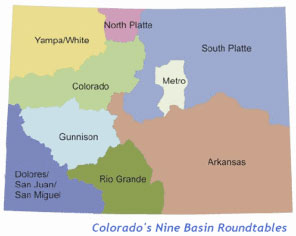
More conservation coverage here. More IBCC — basin roundtables coverage here.