
From The Telluride Watch (Peter Shelton):
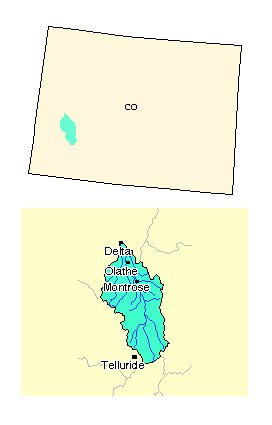
Mike Berry controls the valves to a lot of the drinking water in the Uncompahgre Valley. He’s the general manager of the Tri-County Water Conservation District. He’s a numbers guy. “We’re a local government entity, not a utility,” Berry told the crowd at the Holiday Inn Express conference room. TCW has a 15-member, state court-appointed board, and taxes property at 1.502 mils, generating $1.3 million annually. “We were born in 1957 to sponsor the Dallas Creek Project. Congress authorized us in 1968; 1978 was the groundbreaking for the [Ridgway] dam. In 1990 the reservoir was full, and Tri-County took over. “The lake receives 100,000 acre-feet of water every year. We exchange a 28,000 AF ‘pool’ of water in the reservoir one-for-one for Gunnison canal water, which goes into our distribution system. “The distribution system currently has 7500 taps, 610 miles of pipeline, 43 pumps and 21 tanks over a service area of 350 square miles. We sell 800 million gallons of water per year.”[…]
“We’re water rich,” he said. But he did talk about limits. We’re using only about half of the water available in the reservoir. But the population of the three downstream counties, Ouray, Montrose and Delta, is expected to double to about 150,000 by 2035. “And climate change, if that means hotter and dryer, can’t be a good thing on a water supply,” Berry said. But, he concluded, “Unlike Las Vegas, or anywhere south and west of us, I don’t think many people here go to sleep worrying about their water.”
Maybe they should, said State Senator Bruce Whitehead, himself a water engineer for 25 years with the Colorado Division of Water Resources. Whitehead wanted to talk about a bigger, more complex picture, the Colorado River Compact, and how increasing demand might change a lot of things. This year for the first time Colorado River water consumed (by agriculture, industry, and by 30 million people in seven states) exceeded the annual flow. The Southwest has been in a protracted drought – 11 years and counting. Lake Mead has shrunk to 40 percent capacity, an all-time low. Bad news, yes, for Nevada and California. But how does this affect Colorado, at the top of the water chain? Colorado’s share of the compact is 3.88 million acre-feet of water. We have, Whitehead said, perhaps half a million AF unused now. That’s enough to supply at least a couple million more people in the state. But here’s the problem: Colorado is linked to the water levels in Lake Mead and Lake Powell. If the Lower Basin states of California, Arizona and Nevada cannot get their allocated water from the reservoirs, the Upper Basin states of Colorado, Utah, Wyoming and New Mexico are obligated to curtail use until the Lower Basin allocation is met. This was the deal struck in 1922. This is the potential “call” on Colorado’s water. This, Whitehead said, is the dreaded “compact curtailment.”