

From Steamboat Today (Tom Ross):
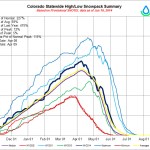
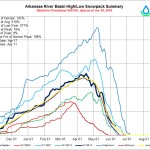
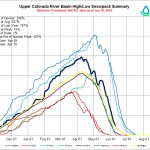
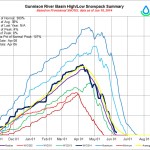
Steamboat Springs — Residents of the Yampa Valley, where the meadows are lush and snow still lingers on the peaks, easily could conclude that this is a year of water abundance. But in terms of the water produced by the entire Colorado River Basin, the summer of 2014 won’t be outstanding.
Eric Kuhn, of the Colorado River Water Conservation District, told an audience of about 50 state legislators, water managers and educators at the Sheraton Steamboat Thursday the abundance of snowmelt in the upper Colorado, Yampa and Green rivers early this summer isn’t indicative of the entire Colorado Basin.
“We have wet years, we have dry years but the bottom line for Lake Powell this year is that it’s going to be right about average,” Kuhn said…
“Currently, Lake Mead (below the Grand Canyon) and Lake Powell (just above the Grand Canyon) are 42 percent full,” Kuhn said. “Does that make us nervous? Yeah that makes us very nervous.”[…]
Water storage in Flaming Gorge Reservoir on the Green River just upstream from its Colorado stretch is expected to be 140 percent of average, and Blue Mesa Reservoir on the Gunnison River is expected to be 126 percent of average, Kuhn told his audience. But 25-mile-long Navajo Reservoir, straddling the Colorado and New Mexico state line and capturing flows from the San Juan River, will be just about 67 percent of average. It’s the southernmost reaches of the upper basin that are below par.
Kuhn and his audience had gathered in Steamboat Springs Thursday to begin a tour of the Yampa River Basin sponsored by the nonprofit Colorado Foundation for Water Education. CFWE program manager Kristin Maharg told the gathering that the purpose of the tour is to explore the compatibility of consumptive water uses (agriculture and power plants) and non-consumptive uses (recreation and habitat conservation) along the length of the Yampa in Routt and Moffat counties.
“The Yampa is no longer a valley too far, and we want to look at some of the demands this basin is facing,” Maharg said. “This is a very cooperative basin in terms of resource management and conservation.”
Thursday’s audience included more than a half dozen state legislators, members of their technical support staff, including an economist and an attorney who work on water bills, a Pitkin County commissioner and an Eagle County water district official, as well as college educators from Colorado State University, the University of Colorado Denver and Colorado Mesa University.
If there is some good news for the Colorado Basin and the people who depend on Lake Powell this summer, it’s that the abundance in the Green River basin will give the reservoir a boost this summer. Flaming Gorge Reservoir, about 30 miles upstream from the point where the Green makes a dog leg into Colorado on the way to its confluence with the Yampa, is currently releasing large amounts of water. That’s being done to mimic the spring floods that occurred before the dam was built in order to support the ecosystem that evolved around those floods. When the river is restored to its baseline sumer flow, it will be at double the flows seen in the last few years, or about 1,600 cubic feet per second. The net result of those additional flows should boost Lake Powell to 50 percent full by the end of July, Kuhn confirmed.
From Steamboat Today (Tom Ross):
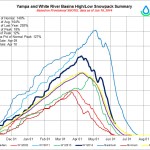
The Natural Resources Conservation Service in Denver predicted Monday that the total volume of flows in the Yampa in Steamboat Springs in June and July will be 118 percent of average, and maybe more if precipitation is abundant. And flows in the Elk, one of the Yampa’s biggest tributaries, could be at 145 percent of average during the heart of the summer.
The streamflow projections issued by the NRCS shouldn’t be interpreted as meaning the flows in the Yampa consistently will be at 118 percent of average, Mage Hultstrand cautioned. She is the assistant snow survey supervisor with the NRCS in Denver. Hultstrand explained that the streamflow projection anticipates the total volume of water that will flow under the Fifth Street Bridge from June through July.
“It’s based on current (snowpack) conditions and weather patterns in the area the past few months,” Hultstrand said.
The weather in terms of temperature and precipitation will have much to say about streamflow from week to week.
The Yampa at Steamboat peaked for the season May 30 at 4,850 cubic feet per second, Brenda Alcorn, senior hydrologist with the Colorado Basin River Forecast Center in Salt Lake City, Utah, said Wednesday. The Elk peaked at 6,300 cfs also on May 30. The Yampa came close to going higher June 2, but fell just short, Alcorn said. Flows in the Yampa were in decline this week, but the snowpack still has a kick in it; the Forecast Center expects the Yampa to rally Thursday and Friday, jumping from Wednesday morning’s flow of 2,300 cfs to perhaps 3,400 cfs by Friday. The median flow for June 11 is 2010 cfs. Temperatures are expected to reach the mid-70s under clear skies Thursday and Friday.
The streamflow projection issued by the NRCS really is intended to inform reservoir managers and help them understand how full their reservoirs will be and how much water they can release.
It’s safe to say the upper Yampa will be carrying more water than average for much of the next seven or eight weeks, but the streamflow forecast doesn’t guarantee there will be above average water in the river for irrigating hay fields or providing thrills for tubers during the last week in July, for example, Hultstrand said.
More Green River Basin coverage here.