
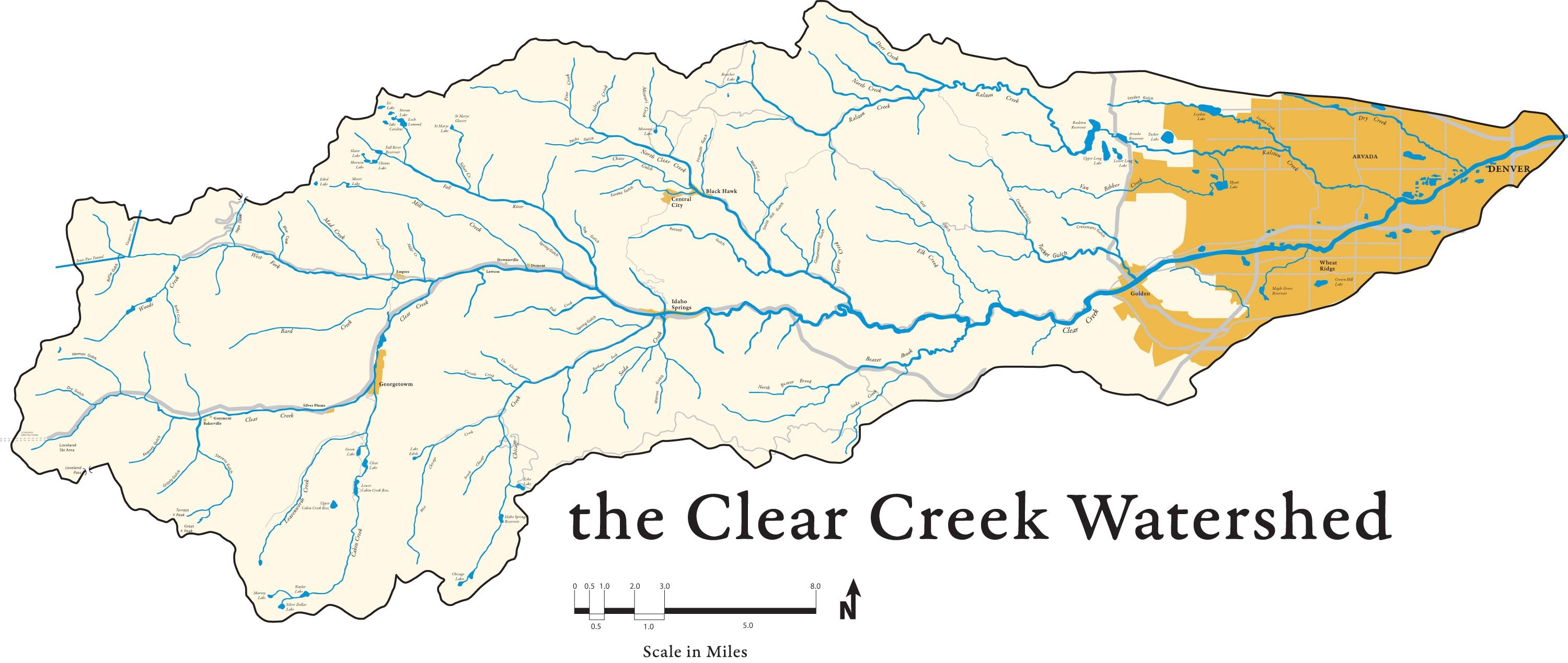
Check out Ian Neligh’s retrospective about Clear Creek and the heydays of mining and logging (The Clear Creek Courant). Click through and read the whole thing. Here’s an excerpt:
Editor’s note:This is the first installment of a three-part series examining the past, present and future of Clear Creek…
Gold
There’s a monument in Idaho Springs hidden away in the parking lot of the former middle school. The giant boulder pays tribute to George Jackson, an adventurer and fortune hunter, who discovered gold in Clear Creek 155 years ago.
According to Don Allan, vice president of the Idaho Springs Historical Society, Jackson’s curiosity to follow the creek west into the mountains with only a couple of dogs by his side led to the country’s second largest gold rush.
Like a row of dominoes, Jackson’s discovery led to an onslaught of pioneers and ultimately in 1876 to the formation of a state.
“(Jackson) decided to go over and take a look down at the crick, and his curiosity brought him here to the confluence of Chicago Creek and Clear Creek,” Allan said. “When I talk with people about our community and how we got here, it was because of one man’s very good curiosity and a piece of gold.”
Jackson discovered gold in January, and by June, more than 400 people had settled in the area.
Natural hot springs drew more people into the area. Allan said in the Idaho Springs museum’s photography collection, there’s a photo of more than 50 employees standing in front of the hot springs.
“Once the stream was panned out, they panned all the gold out of the crick. Then they had to dig and make mining mills,” Allan said. “And this crick was integral to the milling of all the gold and silver in this area.”
The creek was used to support the mining industry such as the Mixel Dam in Idaho Springs, which was formed to help power mining mills and to create electricity. In 1864, silver was discovered to be the main mining mineral in Georgetown, and by 1877, the railroad reached Idaho Springs.
According to “A History of Clear Creek County,” the area at one point had 48 different towns with names such as Red Elephant, Freeland and Hill City. It is estimated that several thousand mines crisscrossed the mountains around Clear Creek as people sought their fortunes first along its banks and then in its mountains.
Those unlucky in gold sometimes found their way into the county’s second largest industry: logging. Early photos of the surrounding hillsides show them stripped of trees. But in time, the mining and logging industry waned, the frenzy slowed and the towns disappeared until there were only four municipalities left: Idaho Springs, Georgetown, Empire and Silver Plume. By World War II, the county’s mining industry has come almost to a complete halt.
But the stream once called Cannonball Creek, Vasquez Fork and lastly Clear Creek remained.
More Clear Creek watershed coverage here.