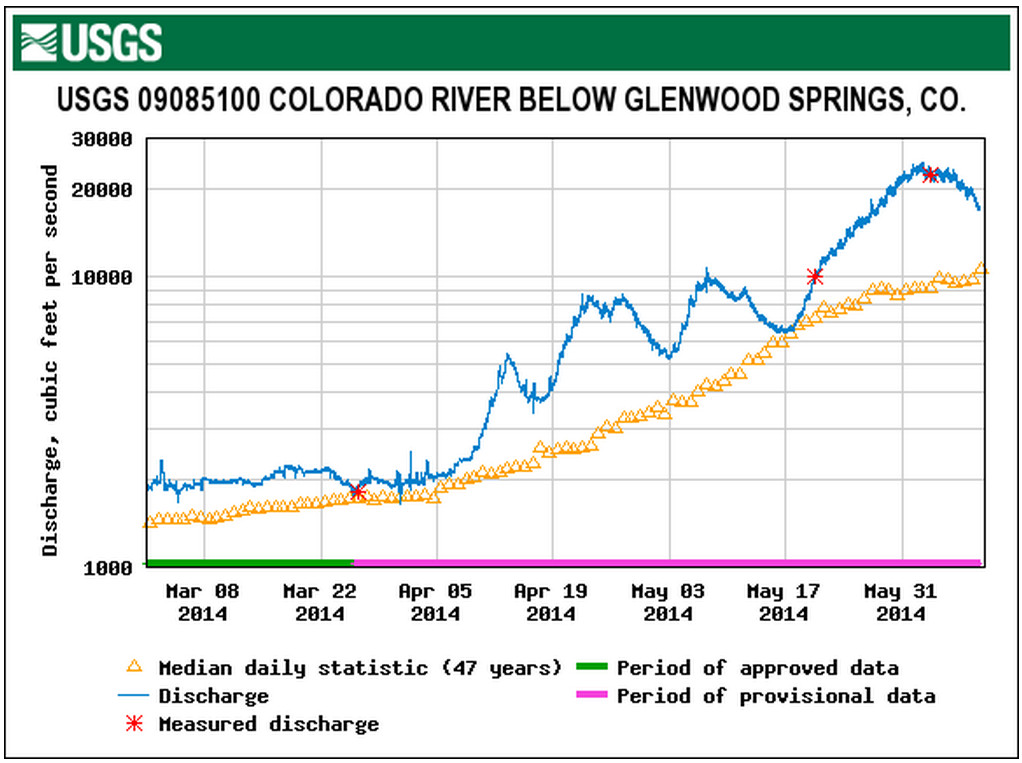
Snowpack/runoff news: 16,000 cfs in the Shoshone reach

coloradoriverbelowglenwoodsprings05092014

From KUNC (Marci Krinoven):

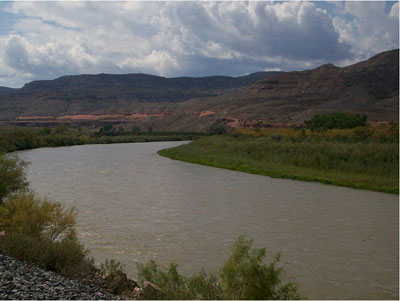
This time of year the commercial rafting company Whitewater Rafting, LLC takes between 25 to 50 people out on the river each weekday. As the summer progresses, that number increases to up to 300 people in July. Normally, the Glenwood Springs company runs a stretch of the Colorado River through Glenwood Canyon but, because the river’s so swollen, owner Erik Larsson says they’ve changed their route.

“We’re going from as far up as Carbondale all the way down to New Castle for full day trips and that’s quite a bit of mileage and way more than we usually do.”

Because of high water, the company is choosing safer routes that are longer. Still, Larsson says the big water makes some people nervous.

“Some of our rafting guests are little scared about it, for sure. We’ve had a few calls asking whether its safe. And, if anything, right now our trips are a little more mild than they will be in July and August. The river’s bigger, the waves are bigger but it’s not very technical paddling.”

The flows may cause rafter anxiety but overall, they’re a good thing for an industry that typically brings well over $100 million to the state each year. David Costlow is Executive Director of the Colorado River Outfitters Association.

“This year, I think many people anticipate the rafting will be great, and it will be. That’s because of all the snowpack, and we’ve had sufficient rains on the prairie to wet the soils, etc. so less gets absorbed into the ground so less gets absorbed into the ground and more comes down and through rivers,” he says.

He says the heavy spring runoff happening now is earlier than normal, which is good because tourism season hasn’t fully ramped up.

“So, we’d like to take the highs off the river and get down to exciting flows and have those maybe by June 10th, so when the tourism season kicks in, we’re ready to go.”

A slow, steady runoff is preferred by rafters because it ensures good flows late in the summer.

Hermosa bill up in the air — The Durango Herald

Proposed Hermosa Creek watershed protection area via The Durango Herald

Here’s an in-depth look at the resource and proposed legislation for Hermosa Creek and it’s environs from John Peel writing for The Durango Herald. Click through and read the whole thing. Here’s an excerpt:

U.S. Rep. Scott Tipton and U.S. Sen. Michael Bennet are among those with the final say, and the good news is they’re pulling hard for it. Both have introduced the act into their respective chambers of Congress.

But here’s the frustration: Even they haven’t been able to push through a bill that nobody on record has yet opposed…

In 2008 a steering committee formed, and in the next 22 months, it painstakingly, delicately, hammered out a balanced plan. Fishermen, hunters, mountain bikers, equestrians, motorcyclists, wilderness lovers, ranchers and water districts, to name a few, kept at it.

“Everyone was reasonable,” Churchwell says. But then he qualifies that, “Not in the beginning.

“Every one of us gave up something to get something. … It was an incredible experience. It really was.”

In all, it took nearly four years to craft legislation, says Widen, who is the Wilderness Society’s senior public lands representative.

“It was a long and tedious process, but that’s really what brought everyone together,” Widen says. “I think the way the Hermosa Creek group worked is just a stellar example of how it should work.”

Bennet and Tipton took the efforts of the Hermosa Creek Workgroup and created bills. The Senate took the first step last year by holding a subcommittee hearing, and the House did the same this year.

Next is for the bill to go to the Senate Energy and Natural Resources Committee and House Natural Resources Committee for “mark-up” – a process where committee members can make changes. If those committees pass the bill, it goes to the full chambers for votes.

“We are very hopeful it will get out of committee in the next 30 days and possibly a floor vote before August recess,” says Darlene Marcus, Tipton’s Durango-based representative. “It is a priority of the congressman and his staff.”

The House’s Natural Resources chairman is Doc Hastings, R-Wash.; Widen said Natural Resources member Rob Bishop, R-Utah, has indicated he wants to move the bill. In the Senate, it’s unclear how soon new Energy and Natural Resources chair, Mary Landrieu, D-La., will bring it up. It may help that Sen. Mark Udall, D-Colo., is a senior member of that committee and a bill co-sponsor.

Bennet, through his Denver office, said Sunday that the bill “recognizes the diverse set of people who use the space, ranging from ATVers to fisherman to hikers.” He called Hermosa Creek “one of Colorado’s crown jewels.”

“This is one of our most pressing priorities, and we’re hopeful that we can successfully move it through Congress by the end of this session,” Bennet said.

So what does the act do? For starters, it protects wildlife, much of the current trail use and water quality.

Zink, a Durango native, says he actually got involved stemming from his role as secretary of the Animas Consolidated Ditch Co. The hunter, cyclist and horseman dons so many hats “it wears my hair out.”

He likes the plan because it basically keeps land use the way it is now – and that’s what the community’s been asking for during the last half-century of studies and forest plans.

From the air, the 107,886-acre area, which comprises nearly the entire Hermosa watershed, is an uneven green carpet of trees, with a few brown streaks of forest roads north of the East Fork and the snow-capped peaks of Hermosa and Grayrock on the northern border.

The bill would create 37,236 acres of wilderness in the western portion. There would be a 68,289-acre “special management area,” with the northern chunk to be left as is, dirt roads and all. The eastern part (43,000 acres) would be protected as a roadless area but still allow mountain bikes and motorcycles.

Arkansas River Headwaters Recreation Area — a linear recreation area that follows the Arkansas River for 150 miles

Arkansas River Basin -- Graphic via the Colorado Geological Survey
Arkansas River Basin — Graphic via the Colorado Geological Survey

Here’s an in-depth look at the Arkansas River Headwaters Recreation Area from Tracy Harmon writing for The Pueblo Chieftain:

It seems warring is a history that repeats itself in the Upper Arkansas River Valley.

In 1879 railroad companies were going to battle over who would be the first to lay track through the Royal Gorge canyon. It became so heated that shots were exchanged among the opposing camps.

Later, it would be the rafters and the fishermen who would butt heads like bighorn rams vying for dominance. At issue in the early 1990s was the flow of water in the Arkansas River.

Rafters wanted to have extra water for the late-season boating and fishermen felt the higher water flow was a detriment for the fish just when trout needed to catch a break from fighting the summer waves.

Eventually, the feud was settled. Rafters get their extra water until Aug. 15 each year and anglers get water releases in the winter months should the level drop to dangerous lows endangering fish.

At the tenuous center of the boat and hook controversy was an unlikely group of government regulators who dreamed it was possible that someday everyone would get along. After all, rafting can bring a neat $60 million chunk of change to the valley coffers and anglers spend plenty as well.

When the Arkansas Headwaters Recreation Area was officially formed 25 years ago this coming October, work was just beginning. Countless public meetings and lawsuits pushed patience on both sides, yet the recreation area endures as one of the few federal and state partnerships in existence nationwide.

The partners have made the first 150-mile stretch of the Arkansas River corridor not only the most rafted river in the nation, but a gold medal fishing ground.

Besides the breathtaking views and some of Mother Nature’s finest canyon rock wall work, the recreation area has grown to include the kind of amenities that make people want to stop and take it all in.

From Leadville to Lake Pueblo, the recreation area spans four counties. Colorado Parks and Wildlife has teamed up with the U.S. Bureau of Land Management and Forest Service to offer a boatload of improvements from campgrounds and boating ramps to restrooms and picnic grounds.

All totaled there are 42 sites along the corridor, according to Rob White, Arkansas Headwaters manager for CPW.

“One of the greatest accomplishments to date regarding the creation of the Arkansas Headwaters Recreation Area has been the acquisition and development of recreation sites along the Arkansas River corridor that provide invaluable public access for both whitewater boating and angling,” White said. “We try to strike a balance in the development of our recreation sites and with the management of the natural resources, including water, so that whitewater boaters, anglers and all of our visitors can enjoy the recreation area.”

The balance between man and nature is evident. Each recreation site is so well cared for a visitor would be hard pressed to find a gum wrapper littering the ground.

“We continue to work on improvements to the natural resources found throughout the river corridor and the riparian areas are in better condition then they have been in a long time,” said John Nahomenuk, River Manager for the BLM. “We are an integral tie that brings together and helps strengthen the communities in the river valley.”

White and Nahomenuk work together, often identifying potential land acquisitions with willing sellers and then find the money to buy the land.

The Colorado Lottery has been instrumental in making many of the improvements a reality by awarding grants that have helped convert private property parcels into public playgrounds.

Boaters and anglers are not the park’s only users.

Gold panning, riverside picnics and climbing are among the reasons people make it a destination.

Many visitors come to the Bighorn Sheep Canyon between Salida and Canon City in hopes of spotting the state animal. The sheep are so expertly camouflaged it takes movement or a flash of their white rear ends to actually spot them.

White and Nahomenuk often run ideas by the citizen’s task force to get input from a variety of the park’s stewards from boaters and anglers to ranchers and environmentalists.

It’s nice when everyone can agree. Just don’t bring up New York artist Christo’s Over the River artwork planned for a two-week display along the stretch of river between Salida and Canon City or you could see the warring start to brew all over again.

More Arkansas River Basin coverage here.

Colorado Water Workshop: The People's Water, June 18-20, 2014, Western State Colorado University, Gunnison, Colorado

Check out the events calendar at the AWRA – Colorado Section website for more events.

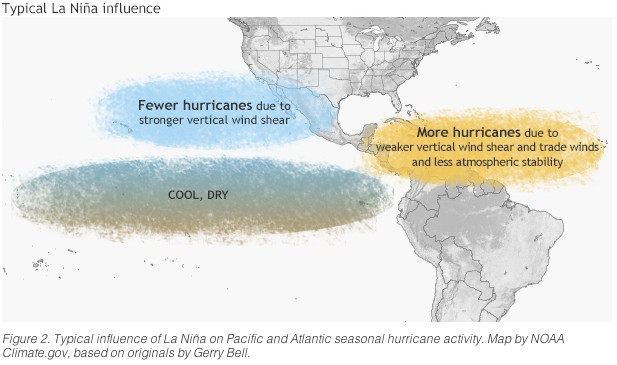
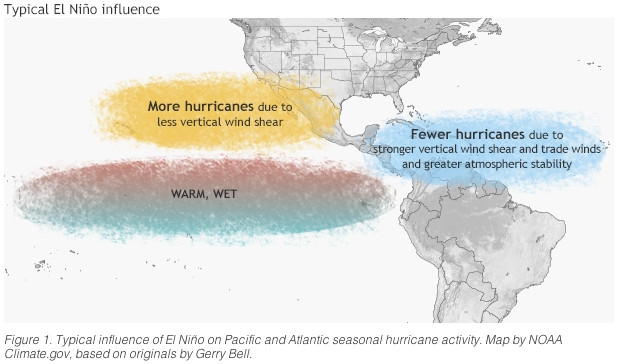
NOAA: Impacts of El Niño and La Niña on the hurricane season

typicallaninainfluencenoaa062014

typicalelniinoinfluencenoaa052014

Click here for all the inside skinny about ENSO.

From NOAA:

Today, the Climate Prediction Center (CPC) released the June ENSO Diagnostic Discussion. Chances that an El Niño will occur by summer are above 70%, and reach 80% by the fall. Sea-surface temperature anomalies increased across all the Niño index regions in May; the latest weekly value of the Niño3.4 index is now above +0.5°C. Tropical rainfall across Indonesia and the Pacific remain close to average, but forecasters are confident that the atmosphere will begin to respond to the ocean and El Niño will develop, likely in the next few months.

Recently, there’s been a lot of speculation about how strong this El Niño will be, especially considering the strong westerly wind bursts in late winter, and the large subsurface temperatures in early spring. The subsurface temperatures in March, which was a record for the month going back to 1979, inspired comparisons to the early stages of the 1997/98 El Niño, the largest on record (ONI maximum of 2.4). That event also developed in the spring, like this one. However, right now, forecasters are not favoring a strong event (while not at all ruling it out) and believe a moderate event (ONI 1.0 – 1.5) is slightly more likely, sometime during the fall/winter. So what’s going on?

The latest ENSO diagnostic discussion is hot off the presses #COdrought

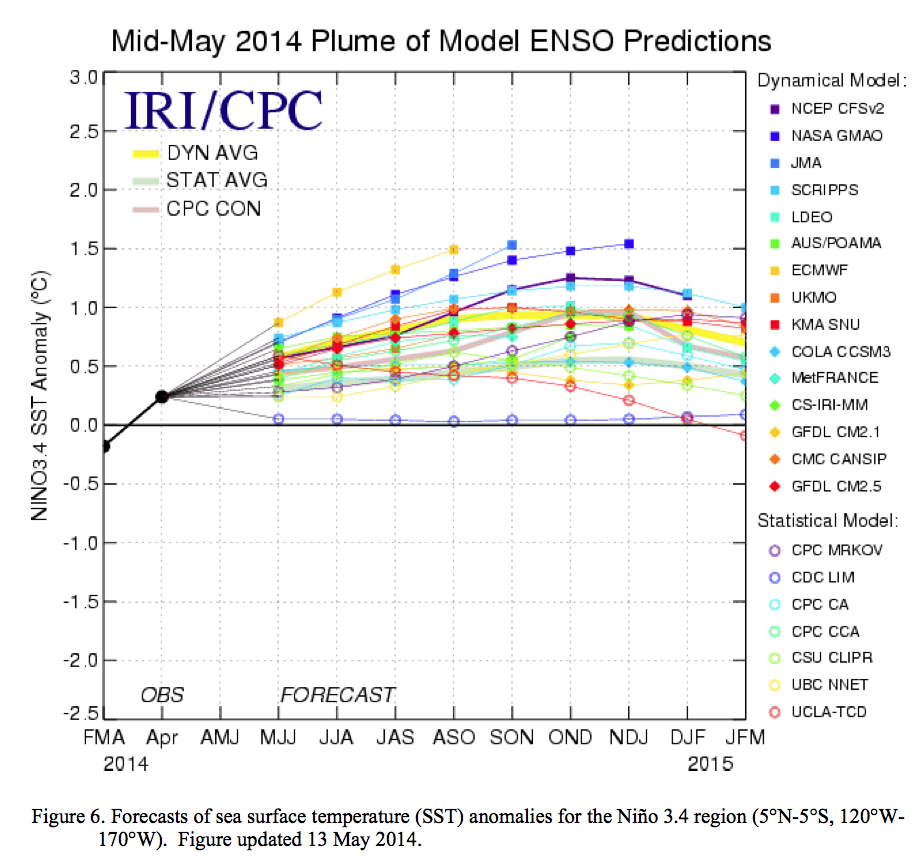
Mid-May 2014 Plume of Model ENSO Predictions

Synopsis: The chance of El Niño is 70% during the Northern Hemisphere summer and reaches 80% during the fall and winter.

Above-average sea surface temperatures (SST) expanded over the equatorial Pacific Ocean during May 2014, though the collective atmospheric and oceanic state continued to reflect ENSO-neutral. All of the Niño indices increased during the month, with the latest weekly values between 0.6°C and 1.6°C. In contrast, subsurface temperature anomalies decreased over the last two months, but still reflect a large pool of above-average temperatures at depth. The low-level winds over the tropical Pacific remain near average, except for westerly anomalies over the eastern Pacific. At upper-levels, anomalous easterly winds have predominated over most of the equatorial Pacific. Unlike the previous month, convection was near average across most of the tropics. The lack of a clear atmospheric response to the positive SSTs indicates ENSO-neutral, though the tropical Pacific continues to evolve toward El Niño.

Over the last month, the chance of El Niño and its ultimate strength weakened slightly in the models. Regardless, the forecasters remain just as confident that El Niño is likely to emerge. If El Niño forms, the forecasters and most dynamical models, such as NCEP CFSv2, slightly favor a moderate-strength event during the Northern Hemisphere fall or winter (3-month values of the Niño-3.4 index between 1.0°C and 1.4°C). However, significant uncertainty accompanies this prediction, which remains inclusive of a weaker or stronger event due to the spread of the models and their skill at these lead times. Overall, the chance of El Niño is 70% during the Northern Hemisphere summer and reaches 80% during the fall and winter (click CPC/IRI consensus forecast for the chance of each outcome).

A historic course change on the #ColoradoRiver — David Festa and John Entsminger

Colorado River pulse flow (Minute 319) reaches the Sea of Cortez for the first time since 1998 on May 15, 2014 via the Sonoran Institute

From the Las Vegas Review-Journal (David Festa and John Entsminger):

Today, there is water flowing in the Colorado River Delta — where water has not flowed regularly for half a century — all because water managers, conservation organizations and policymakers in both the United States and Mexico were able to find common ground. When this common ground is intersected by an international border, you know you’ve surmounted an obstacle previously considered insurmountable.

Someone cue music heralding the “new era of Western water management.” That’s what some have dubbed this recent breakthrough. While the description might be sensational, it isn’t hyperbolic. We are in the midst of what appears to be a paradigm shift in the way we manage one of Earth’s most precious yet over-allocated natural resources, at least in this unique corner of the planet that we call home — the Colorado River Basin.

For those who wonder why it took so long to reach this point, it’s important to consider the context. Historically, Western water law focused on prioritization among users, with tenets such as “first in time, first in right” and “use it or lose it.” The philosophy behind this structure was to have an explicit understanding of each entity’s limited water rights. Little consideration was given to other stakeholders or even the river system itself. However, it appears as though we’ve found ways to respect the rights of stakeholders while identifying innovative and creative ways to work together. In other words, we believe we’ve finally cracked the code.

Like most change, this newfound spirit of cooperation was born of necessity rather than magnanimity. There now exists a mutual understanding that all Colorado River water users will suffer if even one sector experiences a catastrophic shortage. Delta communities in Mexico watched the river run dry long ago, but the entire system now faces longer periods of drought and the increasingly acute side effects of climate change. Las Vegans, dependent upon the Colorado for 90 percent of their water supply, are watching Lake Mead’s shoreline recede. It’s unsettling, but from this crisis is arising a new and better way of managing the river.

At a signing ceremony held in late 2012, officials from the United States and Mexico quietly changed the trajectory of the Colorado River, which represents the lifeblood of 40 million people and a region representing the world’s fifth-largest economy. Adopted by the U.S. and Mexican sections of the International Boundary and Water Commission, Minute 319 to the 1944 Treaty with Mexico stands as one of the most significant water policy shifts of this era.

In the ultimate example of a “win-win” scenario, everyone involved in the accord saw benefits.

■ The seven states that share the Colorado River gained increased certainty regarding Mexico’s participation in potential reductions, increased reservoir storage in Lake Mead to help stave off that eventuality, and an unprecedented opportunity to make infrastructure investments in Mexico that will provide needed water to communities in both Mexico and the United States.

■ Delta residents rejoiced along with river lovers from around the world in seeing water once again flow all the way to the Colorado River Delta — if only for the duration of the pulse flow.

■ For its part, Mexico gained the ability to temporarily defer water deliveries while saving that water for the future.

Perhaps even more important than the individual benefits derived, however, was the realization that this type of multilateral cooperation was possible and in fact advantageous. Minute 319 represents a carefully calibrated set of balanced benefits for both countries that charts a course toward greater cooperation and partnership.

As the pulse flow to the Colorado River Delta comes to an end this month, we should all celebrate the success of a unique international experiment. The limited nature of the pulse flow does not diminish the progress we have made. Just as Minute 319 was built upon the successes of previous agreements, the next great leap forward in cooperative Colorado River management will have as its foundation this historic accord.

More Colorado River Basin coverage here.

Collbran mudslide update

Grand Mesa mudslide before and after via The Denver Post

From The Denver Post (Nancy Lofholm):

Trash trucks are once again picking up the garbage on West Salt Creek Road near Collbran — one of the best signs, residents say, that some sense of normalcy is returning to those living under the threat of more movement from a giant mudslide.

“We feel very comfortable now. We feel like there is so much intelligence coming in now and that they are really watching that mountain,” said Celia Eklund, who lives along lower West Salt Creek Road.

The residents there are still on alert from the Mesa County Sheriff’s Office since the mountain above them slid on May 25 and buried three local men who had gone up to check on a smaller slide that occurred earlier that day.

There is a second public meeting Thursday in Collbran to update residents about the latest findings. The meeting is 6 p.m. at the Plateau Valley High School.

Dozens of experts from local, state and federal agencies have studied the slide that is now being called a “debris avalanche” or a “rapid earthflow” by geologists. They have used high-tech aerial imaging, GPS and water flow meters and have installed monitors that can detect even slight movements in the slide.

They now have a more accurate size on the slide, which is smaller than originally estimated.

The latest information from the U.S. Geological Survey shows that the slide stretches for 2.5 miles and covers 550 acres. The slide contains 40 million acres of material.

The slide contains a pool of water at the top behind a large block of earth that broke off from the Grand Mesa where the slide originated. Geologists now estimate that pool will hold about 245 acre feet of water before it could reach an outlet and spill over. A gauge has been installed by the USGS Colorado Water Science Center just below the toe of the landslide to measure any flow from the slide.

Heather Benjamin with the Mesa County Sheriff’s Office said the Army Corps of Engineers joined the geologists from the USGS and the Colorado Geological Survey this week. The entire group of geologists and emergency management personnel from the Colorado Department of Public Safety have been holding nightly briefings since the slide occurred.

Colorado River District Applauds Governor’s Veto #COleg #ColoradoRiver

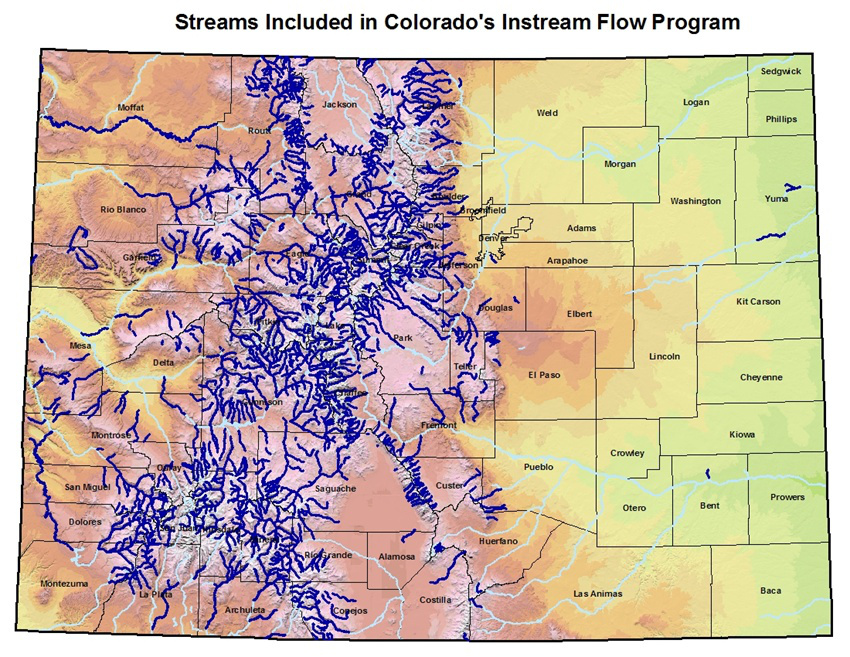
Colorado instream flow program map via the Colorado Water Conservation Board

Here’s the release from the Colorado River District (Chris Treese):

The Colorado River District applauds Governor Hickenlooper’s decision on June 5 to veto Senate Bill 14-023. As noted in the Governor’s veto message, we are certain it was a close and difficult decision. The River District, along with many other parties, requested a veto.

But the issue is not dead. With the veto, the challenge remains for supporters and opponents alike to reconvene to develop new alternatives that provide genuine incentives for irrigation efficiency while avoiding the unintended and adverse consequences of SB023. The River District is committed to this challenge.

The River District worked with Senator Schwartz and others for two years developing legislation to create irrigation efficiency incentives. We succeeded in addressing an important part of the issue in 2013 with the passage of Senate Bill 13-019, which addressed voluntary, consumptive water use savings. We continued our efforts over the summer last year and throughout the legislative session this winter to address the more complex issue of non-consumptive water savings. In the end, we opposed the final approach taken in SB023 as too costly and likely ineffective. The River District, however, is committed to addressing the challenge of providing meaningful incentives for efficient irrigation. The Governor’s proposal in his veto message to try one or more pilot projects may be one viable approach.

More 2014 Colorado legislation coverage here.

Weld County earthquake: “Just drill new wells and increase recycling” — Ken Carlson

Deep injection well
Deep injection well

From The Greeley Tribune (Sharon Dunn):

The answer to Greeley’s first earthquake in at least 40 years may be sitting 10,000 feet below the surface in a deep-water trash can that might be overfilling.

The oil and gas boom has put added stress on the industry’s resources, more specifically in deep wastewater injection wells that cut two miles below the surface. But some say the answer may be as simple as water management.

Wastewater injection wells — which take in produced water from fracking jobs — may now go under increasing scrutiny in Colorado, as scientists have found strong connections between them and a spate of small earthquakes across the country in recent years.

Still, most injection wells are not linked to any earthquakes; it’s only a tiny fraction of injection wells that have specifically been cited as the cause of a minor quake. It’s a puzzle that continues to grow for seismologists looking for answers.

Researchers from the University of Colorado at Boulder put out seismographic equipment throughout Weld County last week, hoping to cull the earth’s secrets into a database of answers. If injection wells are found to be the common denominator in further quake activity, they’ll capture it.

But in the absence of answers, some would say solutions are not that difficult.

“There are ways to fix this,” said Ken Carlson, an associate professor of civil and environmental engineering at Colorado State University. “This is sort of a byproduct of too much water being disposed of, but it’s not like we should shut it down. That’s what the activists will say. It just means we need to improve our water management. So if you say this is probably related to disposal wells, it isn’t that hard to change our practices and really fix this. Just drill new wells and increase recycling.”

WHAT ARE INJECTION WELLS

Injection wells have long been handy tools for oil and gas companies to dispose of wastewater in an environmentally friendly way. The water is pumped two miles beneath the surface into porous rock, through which the water disperses — allowing more water to be pumped in. The process is highly regulated by the Environmental Protection Agency and state oil and gas regulators. Operators must adhere to disposing of water at tested rates and volumes, so as not to overwhelm the well, and they are subjected to annual inspection and well integrity testing every five years, state officials say.

“In a natural system like that, you can do projections. But until you push it to the limit, you can’t really prove it,” Carlson said, noting that he was clearly guessing. “Maybe it’s never been pushed that high.”

For Anadarko Petroleum Corp., which is working to manage its water resources by using municipal effluents, recycling and piping water into sites rather than trucking, officials say they may be coming close to a “limit” on its injections wells, and have been working toward better management to dispose of less.

“The wells are definitely a cause of concern with induced seismicity,” said Korby Bracken, environmental health and safety manager for Anadarko. “We think they’ll continue to be used but it’s something we’re studying quite a bit. There have been multiple studies in Ohio and Oklahoma and other areas where the injection of produced water from oil and gas had the potential to cause induced seismicity. It’s definitely something we’re taking a look at.”

The puzzling part to seismologists is that some areas rife with injection wells for years have no earthquake activity; still others start quaking the minute the well is drilled. There were two injection wells in proximity to the perceived epicenter of the Greeley quake — one was two years old, and the other was 20.

“There are a lot of variables,” said Justin Rubinstein, a seismologist out of Menlo Park, Calif., who is chief of the Induced Seismicity Project, which studies man-made earthquakes. “Maybe this earthquake relieved everything that was available to be relieved or maybe it didn’t and there will be more. Maybe the operator said I might be causing earthquakes, I need to stop injection or slow injections. Generally, when you slow or stop injections, earthquakes slow down.”

The idea of drilling more injection wells to relieve the pressure on existing wells is favored in the exploration community.

Carlson said the water could get dispersed a bit more evenly, reducing pressure with the oil and gas boom going on in Weld.

“It’s not a bucket,” Carlson explained of the rock in which the water is pumped. “It’s more like a sponge. You put the water in and it gets absorbed, then it diffuses through the formation. But you can’t just put in an unlimited rate and keep raising the pressure. Then something would give, and that something might be a fault. With the growth in fracking and unconventional oil and gas in the DJ, there’s certainly greater demand on some of these water disposal sites.”

Rubinstein said he wasn’t so sure drilling more injection wells is the answer.

“In a different perspective, now you’re covering more areas with injections wells, so maybe you’re increasing the probability of finding an area that has a fault,” Rubinstein said. “There are so many variables out there.”

Rubinstein suggested creating mid-volume wells, alleviating pressure that way. “But I don’t know if it gets you out of the problem,” he said.

Anadarko has a permit pending for an injection well. The company has three in Colorado now, all that are running at capacity.

“That being said, we’re looking at other and alternative ways to recycle the fluids that come from the well bore,” Bracken said. “So we don’t have to rely as much on those saltwater injection wells.”

Water, water everywhere

A typical frack job will use 3 million to 4 million gallons of water, but not all of it comes back once the rock is stimulated 7,000 feet below ground. Typically, about 20 percent of the water comes back to the surface during a frack job.

Companies will take that flowback, treat the water on site to take out harmful bacteria from beneath the ground, and truck or pipe it out for recycling or injection. The rest of the water comes out with the oil and gas over time.

Recent years have shown the technology is available to clean up used fracking water, enough to be reused, much like a municipal wastewater treatment system.

“Some operations are pushing ahead with more recycling,” Carlson said. “The more you recycle, the less you’re disposing of and that’s a good thing.”

Anadarko and Noble are big customers of High Sierra Water Services, which operates two recycling facilities in Weld County. Two of their facilities together can recycle about 20,000 barrels a day (840,000 gallons). Both companies have worked on both ends to recycle water.

Anadarko, for example, takes effluent from the city of Aurora’s wastewater treatment plant for most of its fracking operations, then reuses the water over and over.

“If you put down 10 units of something and only get two back, you have to make up eight units for the next well,” Bracken explained. “We’ll recycle what comes back, add make-up water, put it downhole, recycle what comes back and, eventually, you’re recycling the same molecule of water over and over again.”

Both companies are piping recycled water to and from recycling facilities.

But not all water can be recycled. Sometimes it’s too salty. That’s where injection is most necessary.

“Some of the water is very saline,” Rubinstein said. “Some of the water they’re producing in Oklahoma is … 15 percent salt. Salt is highly corrosive. They really can’t reuse it.”

Though reusing the water is the ideal, there’s simply not enough storage out there to hold the water.

“I guess I’d say there is the ability to now recycle probably 15 to 20 percent of the 100,000 barrels a day coming out of the DJ,” said Josh Patterson, operations director for High Sierra. A third recycling center is in the planning stages.

“Logistically speaking, there wouldn’t be a reservoir large enough to store every barrel (of wastewater) for it to be re-used,” Patterson said.

Costs of recycling are high, but so are trucking costs. If companies can eliminate trucking in new water, and recycle existing water, that takes trucks off the road and reduces those expenses.

Patterson said the demand for water recycling continues to grow, however, with both of High Sierra’s facilities contracted out for the next five years.

From the Associated Press via the Fort Collins Coloradoan:

The Greeley Tribune reported Friday that [geophysicist] Anne Sheehan and a team of graduate students have been deploying seismographs to study the magnitude 3.4 quake. The U.S. Geological Survey determined the epicenter of the quake was believed to be 5 miles beneath the surface about 4 miles northeast of Greeley.

The suspected epicenter is near two injection wells. The May 31 earthquake caused no damage.

“If we find out something useful about whether injection causes earthquakes, it might be something that the industry can use to do a better job of injecting, if that turns out to be a problem,” Sheehan said.

Weld County has 28 injection wells for oil and gas waste, or “Class II” disposal wells.

State drilling regulators said earlier this week they were skeptical that the wells caused the earthquake.

The epicenter is difficult to determine, said Justin Rubinstein, a seismologist in Menlo Park, California, who has studied the increasing phenomenon of man-induced earthquakes for the past three years.
More oil and gas coverage here.

Video: Ridgway Dam hydro project commissioned — Telluride Daily Planet

Ridgway Dam
Ridgway Dam

From the Telluride Daily Planet (Heather Sackett):

On Friday, the Tri-County Water Conservancy District officially commissioned a new hydropower project at the Ridgway Dam.

The celebratory event included refreshments, tours of the powerhouse and a history of the project. The 8-megawatt, two-turbine, two-generator plant will produce about 24,000 megawatt-hours of electricity in an average water year, enough to power 2,500 homes a year with all their electricity needs. Construction on the Uncompahgre River project began in November 2012.

The City of Aspen and Tri-State Generation and Transmission are purchasing the power and Aspen is also buying the Renewable Energy Credits created by the project during the winter months. The Town of Telluride won a bid to purchase the RECs for June through September for $48,000. RECs are market-based instruments that convey the environmental value of renewable energy between buyers and sellers. Each REC provides proof that 1 megawatt-hour of renewable energy has been generated.

Buying the RECs was a step toward achieving the Telluride Renewed Challenge, an attempt to reduce greenhouse gas emissions to 20 percent below 2005 levels by 2020 and for 100 percent of the community’s electricity to come from renewable sources by 2020. Telluride Mayor Stu Fraser says though those aims might now prove too lofty, the town still likes to lead by example…

According to a press release from the Colorado Small Hydro Association, the emissions reduction benefit from the new plant is equivalent to removing approximately 50 million pounds of carbon dioxide from the atmosphere or about 4,400 cars from the road each year. Colorado Small Hydro Association President Kurt Johnson, of Ophir, said the Ridgway Dam hydro project is a great example of new hydro power on an existing dam.

“Only about 3 percent of the nation’s dams currently include hydropower,” Johnson said in a press release. “There is an enormous untapped opportunity to generate new clean energy using existing infrastructure.”

General Manager of the Tri-County Water Conservancy District Mike Berry said he is excited the project is complete and that it provided many local jobs during its construction.

“I’m glad we are coming to the end of it and the generator will be spinning for the rest of my life I hope,” Berry said.

More hydroelectric coverage here.

Conservation: Telluride may impose permanent restrictions

Photo via TellurideValleyFloor.org

From The Watch (Seth Cagin):

With greatly expanded supplies of treated municipal water coming online at the end of this year when the Pandora Water Treatment Plant is scheduled to open, the Town of Telluride is considering the implementation of new water conservation measures.

While it may seem counterintuitive that a greater supply of water dictates the wisdom of more conservation, Town Manager Greg Clifton told the Telluride Town Council on Tuesday that “it is a matter of good stewardship of a natural resource,” especially incumbent, he suggested, on a “headwaters community.”

The biggest proposed new regulation, if council approves it, would not be not dramatic: restricting spray irrigation in town to nighttime hours, thus minimizing water losses to evaporation.

Greater awareness of the value of permanent water conservation measures has come about during the last two years, when there were water shortages and emergency conservation measures were imposed, Clifton said. In addition, he told council, it is a stipulation of a comprehensive settlement agreement with the Idarado Mining Co. that is close to completion that the town implement water conservation measures.

Water efficiency in Telluride also leaves more water in the San Miguel River, Karen Guglielmone, project manager for the town’s public works department told council, to the benefit not only of downstream water users, but also the local environment.

On a related note, reductions in water use also provide the benefit of putting less pressure on the town’s wastewater treatment plant. The town currently experiences more water consumption than the wastewater treatment plant can accommodate in the morning hours in the summer during large festivals. The town will attempt to encourage residents and visitors at those times to try to spread their water use out over the course of the day.

More conservation coverage here.

Animas River Days Saturday recap

Design for the whitewater park at Smelter Rapids via the City of Durango

From The Durango Herald (Brandon Mathis):

“That’s our goal, to make it bigger,” festival coordinator Kasey Ford said Saturday.

She said between 1,500 and 2,000 spectators came to Whitewater Park at Santa Rita Park to check out everything from dual-slalom kayak races and boatercross races to stand-up paddle boards and river boards. A beer garden and food are being offered all weekend, along with live music from a stage on the water’s edge.

Ford said the plan next year is to have an official grand opening for the whitewater park after the waterfront landscaping is complete.

She hopes the new park with help expand the festival.

“We want to get more people involved and keep growing,” she said. “It used to be huge, and then it tapered off. We’re trying to get it back.”

Ford said there’s an overhead between $10,000 and $15,000. Organizers network and gain support from donations and sponsors.

“We scrape it all together,” she said. “We want more people to get interested in the river and conservation of the river.”[…]

Longtime festival organizer and competitor John Brennan called the rapids among the best in the West.

“It’s like jumping on a freight train going by at 50 mph,” he said. “Right now, the top wave at Smelter is probably one of he best waves in the western U.S.”

He said the same about River Days, which is in its 32nd year. Brennan has been there since Day 1. He called it the best water festival in Colorado.

“I’ve been to all of them, and this blows them all away,” he said.

While you would expect to see rafts bending over walls of water and kayakers darting through foam, Anna Fischer of Surf the San Juans baffled the crowd as she navigated the entire whitewater park on a stand-up paddle board.

“Rafts are having a hard time staying upright,” Fischer said, “so it’s definitely challenging on a board.”

Mike Wegoyn of Bayfield was getting some odd looks as he walked the river banks in flippers, gloves and a full-body wet suit, hood helmet and all. He doesn’t raft or kayak. He river boards. He surfs the waves head first, lying on a board two-thirds as tall as he is.

“This is the only river sport I do,” he said before entering the water. “When it was over (5,000 cubic feet per second) it was pretty rough, now it just feels like the ocean.”

More whitewater coverage here.

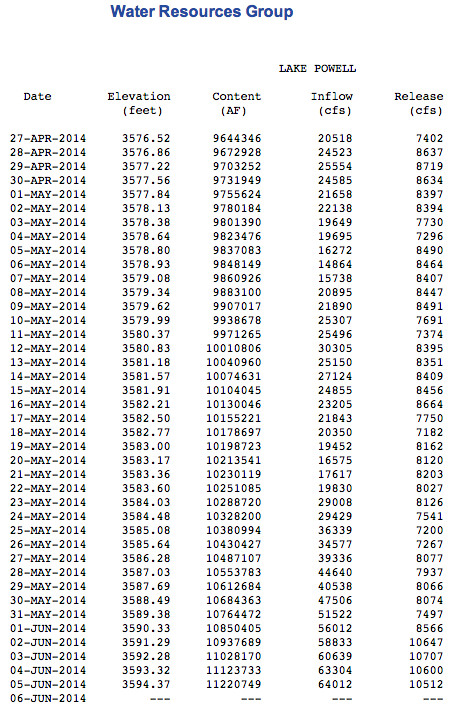
Runoff/snowpack news: Lake Powell is rising a foot a day right now #ColoradoRiver

Lake Powell elevation, inflows, outflows, thru June 5, 2014

Click on the thumbnail graphic to view a table of data for Lake Powell via the US Bureau of Reclamation.

Here’s a report from (Amy Joi O’Donoghue) writing for the Deseret News. Here’s an excerpt:

Brian McInerney, a hydrologist with the National Weather Service in Salt Lake City, said snowpack numbers can look crazy this time of year because the melt is well underway, but the snow that remains in northern Colorado and Wyoming is a big boost for the Colorado River and its tributaries.

“Basically the high pressure that was parked over the western United States (over much of the winter) ended at the Utah/Colorado border,” he said, adding that Colorado was pounded with storms while Utah was left wanting. “That is the benefit of this whole thing, what is going on with the upper Colorado River and the Green River now.”

Runoff into Lake Powell that began in mid-May reached 60,000 cubic feet per second. The U.S. Bureau of Reclamation reports that lake levels will continue to climb a foot a day into late June, hitting a peak elevation of 3,616 feet.

The rising water opened the Castle Rock Cut near Wahweap Marina and three concrete launch ramps — Wahweap, State Line and Antelope Point — are now open.

“The above average snowpack is helping,” said bureau spokeswoman Lisa Iams. “We are kind of at the mercy of Mother Nature. Who knows what we will see in the future, but we are glad that we have it.”

The bureau projects that by Oct. 1, the start of the next water year, Lake Powell will likely be at an elevation of 3,610 feet, 26 feet below its 50-year average for the date.

“Lake Powell is still half full, but that speaks to the value it has provided. Without that bank account of water storage, the implications of consecutive years of drought would be far more catastrophic. It is operating exactly as it was designed to do.” Iams said…

A monthly climate and water supply report put out by the Natural Resources Conservation Service said Utah continued its dry pattern into May, which saw precipitation across the state at just 73 percent of average.

Reservoir storage in general is down 4 percent from where it was last year and most streams and rivers have already reached their peak runoff.

From The Greeley Tribune (Eric Brown):

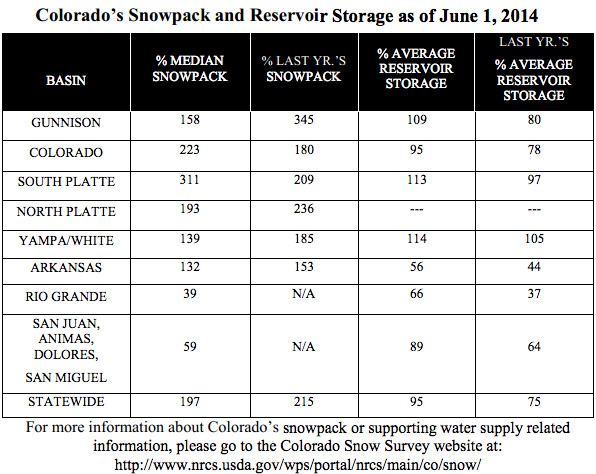
A new report shows that snowpack in the South Platte on June 1 was at 311 percent of its historic average for that date, narrowly putting it behind the mark set in 2011, which is widely referred to as one of the best-ever snowpack years for the area.

On June 1, 2011, snowpack was at 313 percent of historic average — farther ahead of normal than any other date on record in the South Platte basin.

The Natural Resources Conservation Service’s snowpack data — consisting of reports that collect data for the first day of winter and spring months — date back to 1968, although its Jan. 1 reports for the South Platte Basin only go back to 1985, and its June 1 reports only date back to 1986.

While data is somewhat limited, there’s no doubting there’s a lot of snow in the mountains right now.

Because of that large snowpack, along with recent heavy rains, there’s been some flooding in the area, particularly along the Poudre River.

As far as the potential for more flooding, water experts say river flows in the area are trending down, doing so earlier than normal, and if there is any more flooding, it will be caused by rains — not necessarily by how much melting snow is coming down from the mountains.

Dave Nettles, the Colorado Division of Water Resources Division 1 engineer, based in Greeley, explained that, in general, this year’s apparent peak runoff for snowmelt up in the mountains came about May 31 — roughly 10 days earlier than normal.

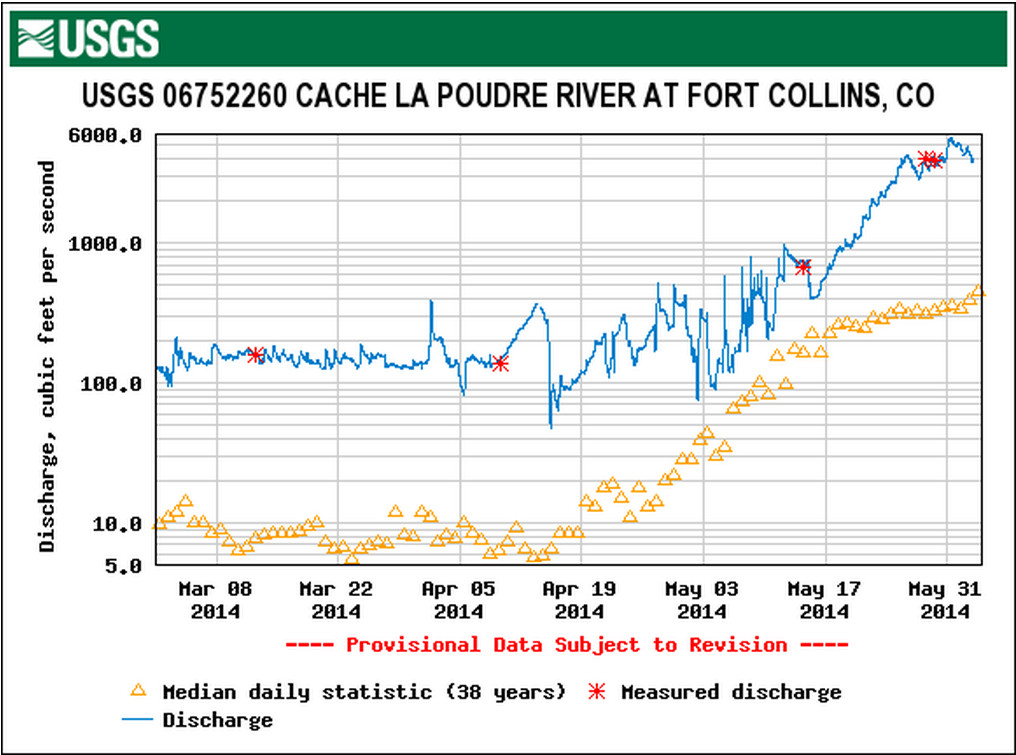
Flows in the Poudre River peaked on May 31, flowing at about 6,000 cubic feet per second (the historic average is about 1,600 cfs for that date), and had fallen to about 4,300 cfs by Thursday afternoon (the historic average for June 5 is about 1,800 cfs).

Similar to the Poudre, the Big Thompson River above Lake Estes peaked on May 31 as well, flowing at about 1,350 cfs (the historic average for that date is about 440 cfs), and had fallen to 815 cfs by Thursday afternoon (the historic average for June 5 is about 520 cfs).

“Depending on what the weather does, we may have seen the rivers get as high as they’re going to get,” Nettles said. “But as full as the rivers already are … and as saturated as the ground is … it won’t take much rain to make them rise again.”

In addition to large snowpack, reservoirs in the South Platte Basin remain full.

Reservoir levels in the South Platte basin on June 1 were collectively at 113 percent of the historic average for that date, up slightly from the May 1 report this year, when they were 110 percent of historic average.

Minus the flooding in some areas, it’s continued good news for water users in the region.

Snowpack and reservoir measures have been at normal levels, or better, all year.

A healthy water supply is vital for Colorado’s agriculture industry which, according to the Colorado Division of Water Resources, uses about 85 percent of the state’s water.

And it’s especially critical for Weld County, where the ag industry makes about a $1.86 billion economic impact annually and ranks ninth nationally.

In addition to being good for northeast Colorado, the NRCS report showed that water supplies are in good shape across much of the state.

The Colorado River Basin — which flows in the opposite direction of Greeley and Weld County but still supplies a large chunk of the region’s water needs through transmountain tunnels that cross the Continental Divide — had similar numbers to those of the South Platte basin.

Snowpack for the Colorado basin stood at 223 percent of average on May 1, while reservoir levels were at 95 percent of average.

Statewide, snowpack is at 197 percent of normal, and reservoirs are filled at 95 percent of normal.

“What it really means is the seep ditches can come into priority” — Steve Witte #ArkansasRiver

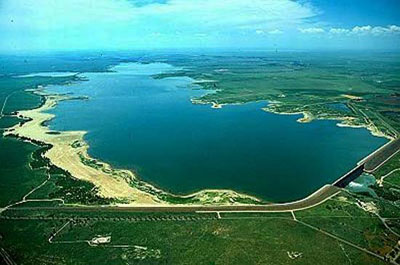
John Martin Reservoir back in the day

From The Pueblo Chieftain (Chris Woodka):

High flows in the Arkansas River are satisfying more water rights than have been met in 14 years.
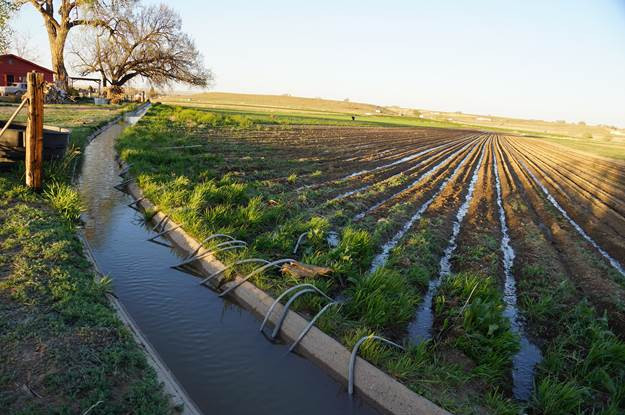
Colorado’s water rights system gives priority to water rights based on the earliest dates that water was put to a beneficial use. A call is placed on the river according to the most junior right entitled to water.

For the Arkansas River below John Martin Dam, that call sat at 1949, the year of the Arkansas River Compact, for the first time since 2000.

“That means we can put water in John Martin Reservoir, which is then divided between Colorado and Kansas,” said Steve Witte, Water Division 2 engineer.

Throughout the year, flood events briefly raise Arkansas River levels high enough to allow storage in John Martin Reservoir. But the prolonged levels above 4,000 cubic feet per second have allowed storage to continue for days, rather than a few hours, as typically happens in a flood.

Actually, the river had a split call Wednesday, with water above John Martin flowing into the Great Plains Reservoirs (via the Fort Lyon Canal).

Water below is going toward the 1949 compact. That satisfies all but a few water rights in Colorado.

“It’s being fed by return flows. What it really means is the seep ditches can come into priority,” Witte said.

The state four years ago shut down seep ditches, because they captured return flows that should have been going to Kansas, under the state engineer’s interpretation.

Witte expects the river conditions to continue for the next few days.

Meanwhile, about 23,000 acre-feet of Fryingpan-Arkansas Project water has been imported through the Boustead Tunnel into Twin Lakes.

More Arkansas River Basin coverage here and here.

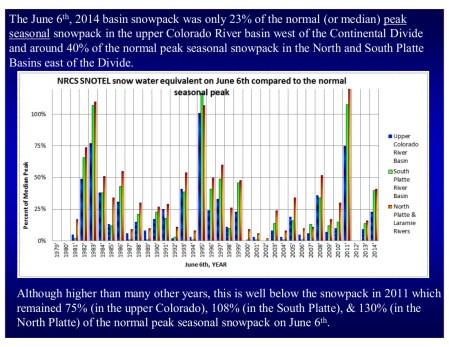
NOAA: Mountain Snowpack Runoff in North Central Colorado June 6th, 2014

percentofnormal06062014

Click here to view the slides.

Will The #ColoradoRiver Be Restored To Its Former Glory? — Jon Waterman

Jonathan Waterman paddling the ooze in the Colorado River Delta

Here’s an in-depth look at the current state of the Colorado River Basin from Jon Waterman writing for Elevation Outdoors Magazine. Click through and read the whole thing. Here’s an excerpt:

In the arid Southwest we put a lot of faith into a century-old agreement. Created by skillful lawmakers in 1922, it’s called the Colorado River Compact and it has little bearing on the reality of the river in 2014, or most years as it turns out. The boosters of growth who wrote the 2,000 page document had no inkling that the two decades before 1922 were much wetter than the fossil record. They relied upon a single gauge to calculate the River’s past and future volume. And so the Colorado River Compact charted the future by mandating who could take how much water from the lifeline of the Southwest—and began the process of diverting it dry.

It’s impossible to understand the current state of the river witout looking at these actions of the past. Seven states blithely divided up the river and began planning dams as if the Colorado’s water would spring eternal. The Colorado River Compact became the foundation for legislation—collectively known as the Law of the River—that would extensively store and divert water partly to various industry and cities, but mostly to farms (eventually using 78 percent of the river).

Ecology, let alone science, was overruled when it came to taming the disruptive Colorado River—which was prone to unpredictable floods, reddened moods, and maddening droughts. The Law of the River, along with sorting out rights, would help control this unruly Force of Nature.

Central to this mindset was the prevailing Prior Appropriations Doctrine, defined as “use it or lose it,” which assigned highest priority water rights to the earliest users. It all began with miners who didn’t necessarily own land alongside rivers but were putting the water to what became known as “beneficial use.” The new doctrine first appeared in a Colorado court in 1872, then was adopted by other western states, citing that arid climates could not abide by the old Riparian Doctrine, which actually prevented river diversions that jeopardized downstream users.

Few foresaw that the population served by the Colorado River would grow to 36 million…

Among many well-regulated spigots controlled by the Law of the River was a 1944 treaty with Mexico. Our southern neighbors had no choice but to accept ten percent of the annual Colorado River flow, paving the way for large portions of the Mexican Delta to turn as dry and hard as the concrete slabs holding up thousands of well-plumbed Southwestern U.S. subdivisions. Not so across the border. As most of the world now works double-time to conserve and recycle, present-day water buffalos in the Southwest continue to sprinkle non-native lawns, revere cows (sustained by hay, drinking more river water than any other crop) and cling to outdated principles likely to remain on the books. Unless the West adopts more progressive policies, they will continue to use the river as if it were 1922.

The problem is this increasingly intricate plumbing system—to the chagrin of Earth Firsters everywhere—performed as planned, with the exception of a wet spell in 1983 that nearly popped the Glen Canyon Dam, penultimate cork of the Colorado River. Meanwhile, those who cared about the River, let alone those Mexican communities whose livelihood depended upon tourists and coastal fishing, were devastated…

When Mexico’s Morales Dam opened its river gates on March 23, 2014, a crowd cheered. Further downstream, the San Luis Rio Colorado community of Mexico spent weeks barbecuing and playing music out on the once dry river banks to celebrate, at long last, the Colorado River running past their town. From here, it flushed a soup of bottles and foam down into the Delta, a Rhode Island sized sprawl of ancient grains washed out of the Rockies and carved from the Grand Canyon. Even if the river can’t be restored to its “PreDambrian” glory, regularly flooding to the sea, regular pulses of water into the mid delta could at least support riparian shrubbery, small forests and habitat for various fauna, including 380 species of birds…

There is also hope to be found in Colorado River Basin states, where water trusts are being established to allow senior water rights holders to donate water back to the river, without losing their future water rights. If a basin-wide water trust could be established, along with healthier minimum stream flows that would assure the future of the river, America’s most renowned scenic wonder will have a fighting chance.

More Colorado River Basin coverage here and here.

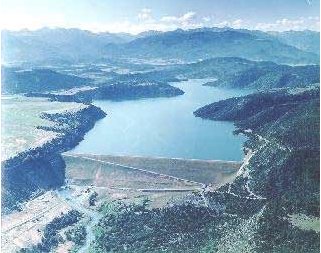
Hermosa Creek Watershed Protection Act is still alive and kicking — John Peel

Hermosa Park
Hermosa Park

From The Durango Herald (John Peel):

It’s not exactly screaming through Congress, but the Hermosa Creek Watershed Protection Act is still alive and kicking, backers and aides to two key congressional leaders say.

“It’s moving at a snail’s pace, but it is moving,” says Ty Churchwell, backcountry coordinator for Trout Unlimited and one of the movers and shakers of the plan.

The problem is congressional gridlock, some would say dysfunction. Senators and congressmen just aren’t in the mood to do anything that might help the opposing party, particularly with mid-term elections looming.

“If Hermosa doesn’t pass, it won’t be because of substance,” says Jeff Widen of the Wilderness Society. “It’ll be because of politics.”

An aide to Rep. Scott Tipton, R-Colo., said this week that Tipton hopes to get the bill to a floor vote by August recess.

More Hermosa Creek watershed coverage here and here.

CU research team studying earthquake activity near Greeley — The Greeley Tribune

Deep injection well
Deep injection well

From The Greeley Tribune (Sharon Dunn):

A small team of Boulder graduate students and their professor hope to soon put an end to the mystery of what created a small magnitude earthquake on Saturday northeast of Greeley.

While the quake measured 3.4 in magnitude — barely enough to be felt and not enough to cause damage to structures — the coincidence of its proximity to wastewater injection wells has researchers pondering the potential of an oil and gas role.

Yes, it could be natural, scientists say. It’s not altogether impossible the Greeley area could have a natural earthquake — though there hasn’t been any such activity in a good 30 years.

A temblor of that size could happen anywhere in the country, seismologists say.

But recent years have proven throughout drilling fields in Ohio, Oklahoma and Texas that the connection between quakes and oil and gas wastewater disposal wells is rather strong.

That’s where University of Colorado at Boulder geophysics professor Anne Sheehan and her small team of graduate students come in. They spent the last several days deploying seismographs in and around what the U.S. Geological Survey determined was the epicenter of the quake believed to have originated five miles beneath the surface about four miles northeast of Greeley.

They “believe” only because the closest station to record tectonic activity is in Idaho Springs, 70 miles away.

The epicenter of the quake was a bit of an educated guess, as well as the depth. But based on what are called “felt reports,” in which area residents reported what they felt at the time of the earthquake, Sheehan has been able to zero in a little better on the area to get the best readings.

Having seismographs closer in the suspected area — which is near two injection wells — will help scientists get a better fix on the cause.

“I guess we wouldn’t have done this if we didn’t think there would be some small follow-up earthquakes,” Sheehan said. “It’s possible we won’t record anything of interest. One would hope there would not be any more earthquakes. But if there are, we will study them.”

In fact, just two hours after Saturday’s quake, there were three smaller tremors that followed, Sheehan said. One was 2.0 and the other two were 1.4 in magnitude. Those aren’t recorded at the USGS in Golden, which only tracks quakes of 2.5 magnitude and above.

Wastewater disposal wells take in produced water from fracking and drilling operations, a practice that has been going on for several years and which is practiced by a variety of industries.

There are about 150,000 injection wells across the country — 40,000 of which are for oil and gas waste, or “Class II” disposal wells. Weld County has 28 of them.

There were two injection wells in proximity to the epicenter of Saturday’s quake, one dug more than 8,700 feet deep and the other 10,700 feet. One is 20 years old, the other just two years old.

Colorado Oil and Gas Conservation Commission officials earlier this week said they were skeptical that the wells caused the quake because they believe the three historic well-related quake instances recorded in Colorado all shared one common characteristic: the point of injection was the epicenter of the quake.

They said that wasn’t the case in Greeley.

But even that is difficult to measure, given the inexact measuring from 70 miles way, said Justin Rubinstein, a seismologist in Menlo Park, Calif., who has studied the increasing phenomenon of man-induced earthquakes for the last three years.
“As long as there is a pathway for the fluids to transfer, it doesn’t matter where you’re injecting,” Rubinstein said of the misconception on locations. “Faults are an incredible transmitter of fluids and fluid pressures. Just because earthquakes are occurring deeper than where injections are, there’s no reason to say they can’t be related.”

But, he said, there’s little proof of any cause at present, and he wouldn’t rule out a natural quake.

An injection well is dug 10,000 feet below the surface into very porous rock. The rate and volume of the water that is pumped in is governed by state and federal regulations.

Once pumped into the porous rock, the water disperses through that formation, allowing more water to be pumped in.

Sometimes the pressure of the water is such that it causes earthquakes in the existing faults.

The injection wells in question were those of High Sierra Water Services, which manages injections wells throughout Weld County and also recycles produced water for companies.

High Sierra also recycles produced water in an ever-growing amount, shipping it back out to the field for further use in drilling.

“We looked at our charts and we’re operating within the parameters of the well and it’s been operational for quite some time,” said Josh Patterson, operations manager for the company.

Sheehan said by studying whether any subsequent quakes are a result of injection wells potentially being drilled into faults, or the wrong rocks, or were simply overvalued in terms of volume and rate capacities, will help bring about better practices in the field.

“If we find out something useful about whether injection causes earthquakes, it might be something that the industry can use to do a better job of injecting, if that turns out to be a problem,” Sheehan said. “So maybe if they inject at lower volumes or spread it out more, it could be that there are things that we’ll learn that can help inform some sort of best practices.”

More oil and gas coverage here.

Video: Nuestro Rio, The Colorado River

More Colorado River Basin coverage here.

Montrose: Gov. Hickenlooper signs HB14-1030 (Hydroelectric Generation Incentive)

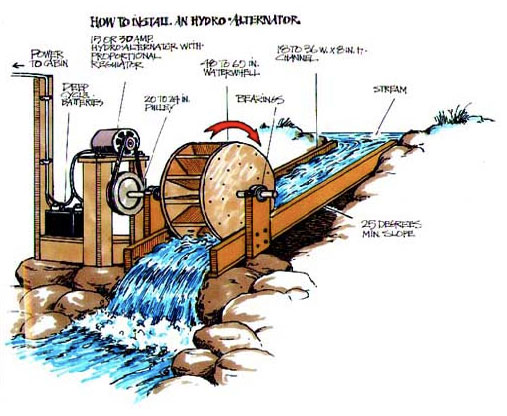
microhydroelectricplant

From The Watch (William Woody):

Colorado Gov. John Hickenlooper signed House Bill 1030 into law Saturday, near the rushing waters of the South Canal, east of Montrose, where new hydroelectric generation facilities are creating megawatts of power.

The law directs the Colorado Energy Office to work in conjunction with federal agencies to streamline its review of new hydroelectric projects, decrease waiting periods and allow applications to clear federal and state review in as little as 60 days (without violating state environmental regulations).

Republican State House District 58 Rep. Don Coram (R-Montrose), who introduced the legislation along with Rep. Diana Mitsch Bush (D-Steamboat Springs), said he first brainstormed about the idea over coffee with U.S. Rep. Scott Tipton (R-Cortez) at the Coffee Trader in Montrose last fall. The law mirrors the federal Hydropower Regulatory Efficiency Act approved by Congress last year (in conjunction with the Rural Jobs Act introduced by Tipton) and signed by President Barack Obama in August.

Hickenlooper said that although Democrats and Republicans “do not see eye to eye on everything,” this law is a great example of both sides working together to create jobs and boost the state’s renewable energy portfolio.

“This is an obvious opportunity to do something significant right now that has much more potential over the next five to ten years with these small hydro projects,” Hickenlooper said Saturday.

The law allows farmers and ranchers to offset energy consumption by adding hydroelectric generation to their existing irrigation infrastructure, which can take up more than 70 percent of their seasonal operating budget, said Ron Carleton, deputy commissioner of the Colorado Department of Agriculture.

Coram said he and fellow lawmakers were acting as “advocates for agriculture” during the law’s development, and that the partnership between the Delta-Montrose Electric Association and the Uncompahgre Valley Water Users Association is a model for other projects, moving forward.

UVWUA Board President George Etchart said water from the 105-year-old, 5.8-mile long Gunnison Tunnel now has dual roles – both producing electricity and feeding the crops of the Uncompahgre Valley. “The water in this valley is the lifeblood of the this valley,” he said…

A pair of generation stations created onto the South Canal last year by the Delta-Montrose Electric Association are currently generating about five-and-a-half megawatts of electricity, capable of powering about 3,000 homes in the Uncompahgre Valley. At Saturday’s bill-signing, water from the 105-year-old Gunnison Tunnel was moving at about 950 cubic feet per second. Peak flows both plants are expected to produce between seven and seven-and-a-half megawatts. Last year DMEA produced about 16,000 megawatt hours of electricity from the South Canal project…

The Gunnison brings water every year from the Gunnison river through the Black Canyon of the Gunnison to an expansive canal system that feeds 76,000 acres of farmland throughout the Uncompahgre Valley.

The South Canal projects are estimated to remove 270,000 tons of carbon from the environment and produce about 27 million kilowatt hours of electricity. Along with the 3,000 homes powered, the DMEA reports the cost savings from the hydro power drops about $2 million back into the local economy through annual savings.

More 2014 Colorado legislation coverage here.

2014 Colorado legislation: Governor Hickenlooper wields veto pen, SB14-023 is history #COleg #COWaterPlan

Colorado instream flow program map via the Colorado Water Conservation Board

Here’s the release from Governor Hickenlooper’s office:

Gov. John Hickenlooper today vetoed Senate Bill 14-023 because of unresolved concerns about its potential impact to water rights. At the same time, the Governor voiced support for a targeted pilot program that would encourage conservation of water resources and keep more water in streams and rivers for water quality purposes.

“This decision was not easy; it was a close call,” the governor wrote in a letter to the Colorado Senate. “That is because the bill’s goals are important for our water future and we appreciate and honor the thousands of hours that went into crafting this legislation. Despite these efforts, there was a breakdown in consensus toward the end of the legislative session that divided the water community and, in our view, would make implementation of the policy more difficult.”

The governor told lawmakers his veto is not designed to stop this legislation from ever becoming law; rather, it allows more time to work with stakeholders to address concerns and build broader consensus for experimentation involving the instream flow program.

“This bill already has a good cross section of support from various interests, including sportsmen, conservationists, and some in the agricultural community,” the governor wrote. “Unfortunately, and despite the best efforts of the bill’s sponsors, important questions remain about how best to expand the state’s instream flow program without creating injury or cost to downstream users, principally in agriculture.”

The governor directed the Colorado Department of Natural Resources and the Colorado Water Conservation Board to work with lawmakers on a pilot concept in preparation for the next legislative session that addresses concerns raised by opponents of SB 14-023.

“Making the topic of this legislation an administration priority next year would give us an opportunity to re-engage stakeholders who have concerns about SB 14-023, and build a broader base of support for passage next year,” the governor wrote. “If I am re-elected by Colorado’s voters to a second term, my administration will be committed to pursuing bipartisan resolution of this important issue.”

Click here to read a copy of the governor’s veto letter.

From the Summit County Citizens Voice (Bob Berwyn):

Bowing to pressure from agricultural users, Gov. John Hickenlooper this week vetoed a bill that would have encouraged voluntary conservation measures and given incentives for private investment in conservation.

Hickenlooper tried to downplay the veto by saying that he would pursue similar legislation if re-elected, but that’s not nearly enough in a state that is now in a perpetual struggle to find enough water to sustain the economy and a healthy environment. As usual, the environment got the short end of the stick.

From Conservation Colorado:

Governor Hickenlooper today vetoed Senate Bill 14-023 (SB 23), an important water conservation bill crafted over the course of a year in close partnership with diverse water interests, including the Governor’s own water policy experts. SB 23 had support from many rural Coloradans, major water providers, Colorado’s leading conservation organizations and Colorado Water Congress, the state’s leading voice for water policy.

The bill was designed to bring investment to rural western Colorado to incentivize the implementation of irrigation efficiency improvements that would ultimately benefit agricultural operations and Colorado’s rivers and streams. Under the bill’s provisions, ranchers, farmers and other agricultural water users in western Colorado could voluntarily implement irrigation and water efficiency measures and ensure that water they save can benefit Colorado’s rivers without risking abandonment of their water rights or harming other users. The result would have been increased private investment in upgrades to and modernization of irrigation infrastructure, healthier rivers and streams, and more resilient farms and ranches.

“SB 23 was a chance for Colorado to demonstrate leadership among all western states struggling with a limited water supply and the balance between all-important human uses of water and the needs of our rivers and streams,” said Russ Schnitzer, agriculture policy adviser, Trout Unlimited. “This sends a signal that despite the Governor’s expressed commitment to water conservation, he is willing to bow to those who oppose change in any form. With this veto, innovative, common sense water efficiency solutions benefitting Colorado farms and ranches have been cast aside in favor of perpetuating the status quo locked in 19th management concepts. As an organization, we are committed to forging win-win solutions for agriculture and conservation, and SB 23 was just that. For the Governor to veto such a tool after his own water policy experts testified in support and following passage by the General Assembly is baffling and disappointing.”

According to a 2013 Colorado College poll, the vast majority of Coloradans agree that using the state’s existing water resources more efficiently is a priority. In fact, low water levels in rivers is a major concern of Coloradans, second only to unemployment. In addition, water managers agree that Colorado’s growing population is driving an imbalance between water supply and demand, which is jeopardizing the $9 billion recreational economy and Colorado’s natural mountain environment.

“Faced with a dry future and growing water use, Colorado needs innovative, collaborative policies to reverse the imbalance between water supply and demand and the increasing strain on our rivers and streams,” said Pete Maysmith, executive director, Conservation Colorado. “This legislation is precisely the type of collaborative innovative policy Colorado century water needs, so the Governor’s action today is a disappointing set back. Given the opportunity to lead on conservation, the Governor instead chose to enforce the status quo. This flies in the face of his stated commitment to water conservation and ensuring water resources for Colorado’s fish, wildlife and outdoor recreation are protected in the developing state water plan.”

More 2014 Colorado legislation coverage here.

Runoff/snowpack news

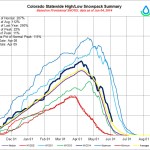
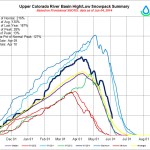
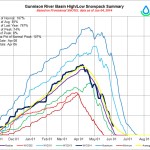
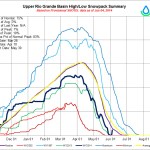
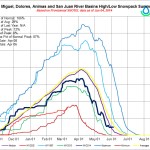
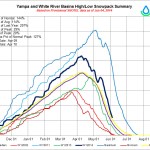
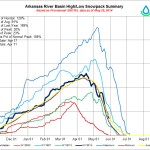
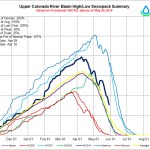
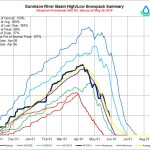
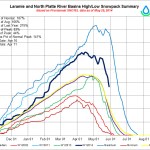
Click on a thumbnail graphic to view a gallery of snowpack data from the Natural Resources Conservation Service.

From email from Reclamation (Erik Knight):

Aspinall Unit releases were increased this afternoon [June 5] by 1,200 cfs. This release should bring flows in the Gunnison River through the Black Canyon up to around 9,500 cfs. Flows in the Gunnison River at Delta are expected to enter the 13,000 cfs to 13,500 cfs range by tomorrow morning.

From email from Reclamation (Kara Lamb):

Flow in the Big Thompson River has been rather steady the last two days. Inflow peaked this morning around 1090 to Lake Estes. As a result, outflow through Olympus Dam to the canyon stayed closer to 500 cfs.

Today [June 5], it decreased some more, dropping to around 350 cfs. Our models are showing inflows to Lake Estes staying around 1000 cfs through tonight. Consequently, we are anticipating the 350 cfs to stay in place through morning.

From The Denver Post (Corrie Sahling):

Colorado’s wet spring and winter are paying big dividends for the state’s snow pack and reservoirs in northern parts of the state, but southern areas are still below normal, federal officials said Thursday.

The statewide snow pack is almost double that of normal conditions for this time of year — and more than triple in the South Platte basin. Reservoirs are at 95 percent of normal — up from 75 percent last year at this time — and are at about 62 percent of capacity.

Southern river basins, including the San Juan and Upper Rio Grande, are nearly snow-free and have reservoirs that are far below their capacity, according to a news release from the U.S. Department of Agriculture’s Natural Resources Conservation Service.

“Normally at this time of year, most of the snow is melted. But we still have a pretty decent snow pack,” said Mage Hulstrand, a USDA hydrologist.

The latest snow pack measurements from the USDA show there is still 20 to 40 percent of the total snowpack remaining in the higher elevations of the Colorado , Yampa , North Platte and South Platte basins.

“If the current wet weather patterns persist into June, the chances for continued high water levels in the streams in these basins are quite good,” the news release said.

The South Platte basin is where the largest percent of snow pack is left — this area includes the Cache la Poudre River, Boulder Creek and the Big Thompson River — where there has already been high water levels and flooding.

The South Platte basin measures at 311 percent of the median snow pack, which is up from 209 percent at this time last year, the release said.

Reservoirs in the South Platte basin are at 113 percent of normal, 114 percent of normal in the Yampa/White basin and 109 percent of normal in the Gunnison basin.

Snow pack is just 39 percent of the median in the Rio Grande basin and is at 59 percent in the San Juan, Animas, Dolores and San Miguel basin, the USDA said. The Arkansas basin is at 132 percent of normal, but reservoirs are at 56 percent of normal. Reservoirs are at 66 percent of normal in the Rio Grande basin.

Colorado: Wrangling continues over Denver Water’s proposed new transmountain diversion, reservoir enlargement

Northern Water sets rates for 2015

From the Fort Collins Coloradoan (Ryan Maye Handy):

While the district’s board of directors opted to wait until July to resolve the debate of how to change long-term water rates, the short-term rates for 2015 were fixed. At its monthly meeting, the board voted to raise the cost of water 9 percent for all its customers — from irrigators to cities to industrial users.

Nearly three months ago, the district announced that it needs to change its water rates, or else it will continue to borrow from its financial reserves to stay afloat. It hired Denver-based CH2MHill consulting firm to come up with three suggested changes to its rate structure.

The water in question comes from the Colorado-Big Thompson Project, or C-BT, a network of reservoirs on the Western Slope that provides water to Northern Colorado. Like many cities, Fort Collins gets much of its water from the project. The city is equally dependent on water from the C-BT and from the Poudre River.

Northern Water charges for water by the acre foot. Fort Collins Utilities, for instance, owns 18,855 units of project water, 12,803 units of which go for about $28 per acre foot. That cost will likely double when Northern Water rates increase in 2016.

In addition to setting the rates for 2015, the board did agree that the rate structure should shift from being based on users’ ability to a model based on the cost of service. The board was divided, however, on how quickly the rates need to change.

CH2MHill gave the board two options: one is for a gradual increase, the other for a rapid increase that would help the district quickly recover lost revenue. The gradual increase would bump rates by 20 percent and 41 percent for cities and irrigators, respectively. The sharp increase would bump rates by a respective 61 percent and 92 percent.

More Northern Colorado Water Conservancy District coverage here.

#COdrought news

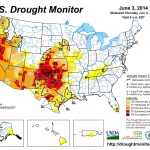
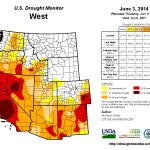
Click on a thumbnail graphic to view a gallery of drought data from the US Drought Monitor. Click here to go to the US Drought Monitor website. Here’s an excerpt:

Central and south-central Plains

In the dry swath from South Dakota and Minnesota southward through Oklahoma, fairly widespread moderate to heavy rain fell on southeastern, central, and northern sections, Amounts generally topped 2 inches, with patches of 4 to 7 inch totals reported in southeast South Dakota and adjacent Minnesota, from east-central through northeastern Oklahoma and adjacent Kansas, and on the eastern tier of the Nebraska Peninsula. Spotty amounts over 2 inches were also reported in the Oklahoma Panhandle and southwestern Kansas, but otherwise, light precipitation at best fell from western Kansas and southeastern Colorado southeastward through roughly the southwestern half of Oklahoma, including most areas along the Red River.

The broken pattern of precipitation made it difficult to justify large-scale improvements, but dryness in several areas eased up one category, specifically most of the areas that received over 4 inches of rain, and parts of the region from southeastern Nebraska southward into northwestern Kansas.

In contrast, light precipitation of late in central and most of southern Oklahoma, including less than half of normal for the last 30 days in central and south-central Oklahoma, has pushed 90-day moisture deficits into the 4 to 8 inch range, prompting a significant eastward expansion of D1 to D3 conditions, most notably right along the Red River.

Winter wheat continued to suffer in the region, and prospects for improvement look bleak. NASS reported 62% of the crop in Kansas and 78% in Oklahoma was in poor or very poor condition. Nationally, 44% of the crop in the primary growing areas are in poor or very poor condition. Both the topsoil and subsoil are substantially short of moisture in many areas across the central Plains. Deficient topsoil moisture covers 55% of Nebraska, 60% of Kansas, and 68% of Oklahoma. Insufficient subsoil moisture is even more widespread, covering 75%, 75%, and 84% of these states, respectively.

In parts of the central and south-central Plains, the impact designation was changed to “L” (primarily long-term) from “SL” (both long- and short-term). As a basic rule, areas with surpluses going as far back as 90 days were designated “L.”

Texas and adjacent southern Plains

It was a wet week across eastern Texas and the northeastern half of the Texas Gulf Coast and adjacent Louisiana. Rainfall totals exceeded 2 inches throughout this region, and were much greater in some areas. Totals of 4 to locally over 8 inches were measured in a large part of southwestern Louisiana away from the immediate coast, and amounts of 3 to 7 inches, with isolated higher amounts, were common along the immediate Texas Gulf Coast. The Drought Monitor classification was improved in most areas receiving over 3 inches of rain, with small areas of 2-category improvement introduced where the heaviest rains fell in southwestern Louisiana.

In stark contrast, most of the central and western two-thirds of Texas was dry, with only scattered reports of a few tenths of an inch of rain at best. However, significant rainfall deficits on the 90-day time scale are limited to parts of western and northern Texas due to the heavy rain that fell on a large part of the interior last week. Fairly broad swaths of Texas were reclassified as “L” rather than “SL” as a result.

There were some new assessment tools available for Texas this week, and based on a substantial amount of added information, almost the entire state was redrawn, though Drought Monitor change was limited to 1 category in most of the state. Exceptions included some of the wet areas in the east, and a re-evaluated area in west-central Texas which has received significantly more relief than has been previously indicated.

Despite recent rains in some areas, crops continue to struggle and soil moisture shortages cover a large proportion of the state, subsoil moisture more so than topsoil. Last week, 64% of Texas winter wheat was in poor or very poor conditions, as were 33% of Texas oats. Deficient topsoil covers more than half the state (53%), and short subsoil moisture is even more widespread (62%).

The New Mexico Rockies, Intermountain West, and West Coast

In the dry areas from the eastern Rockies westward to the Pacific Ocean, measurable rain was limited to parts of the southeastern Rockies, western Oregon, and western and northern Washington. However, normal precipitation is relatively low in most of this region, thus deficits grow slowly, and drought intensifies in like fashion. The dry week kept short-term precipitation amounts low through most of the region (though not markedly below normal in many areas), with 30-day totals under 0.25 inch reported in much of central and east Washington and Oregon, and from southern Idaho and the Oregon/California border southeastward through the desert Southwest, the lower elevations of Utah, Arizona, and the western half of New Mexico.

Light precipitation and low normals mean little change moisture shortages and , analogously, in the Drought Monitor. D0 was pulled away from part of central Colorado where 1.5 to 3.5 inches of rain fell in the last 30 days, and there was D1 elimination and some D0 reduction in northwestern most Oregon and adjacent Washington.

Looking Ahead

Moderate to very heavy rain is expected across large parts of the dry areas in the central and south-central Plains, the Tennessee Valley, and the southern Appalachians during June 5 – 9, 2014. Generally 1.5 to 3.5 inches are forecast across the entire dry area from north Mississippi and west Tennessee eastward through the southern Appalachians. Farther west, precipitation may be heavier and even more widespread. Amounts near or over 2 inches are anticipated from western Nebraska, Kansas, southern Iowa, Missouri, and western Illinois southward through the northern half of Arkansas, almost all of Oklahoma, and the north-central and eastern Panhandle portions of Texas. The heaviest amounts, ranging from 3.0 to 5.5 inches, are expected in the southwestern half of Missouri, central and eastern Kansas, central and northeastern Oklahoma, and adjacent Arkansas. Elsewhere, the forecast is for 0.5 to 1.5 inch of rain in south Florida and south-central Virginia, plus most of the High Plains, northern Great Plains, upper Midwest, southern Arkansas, central and northeast Texas, and the west half of the Texas Panhandle. South of this area, anywhere from a few hundredths of an inch to near 0.5 inch is forecast in west-central, southern, and eastern Texas as well as Louisiana and southern Mississippi, with amounts expected to decrease going southward to the Gulf of Mexico and Mexico. In sharp contrast, areas from the eastern Rockies westward to the Pacific Ocean are likely to get no measurable rainfall.

The ensuing 5 days (June 10 – 14, 2014) features enhanced chances for above-normal rainfall across the dry area in the southern Appalachians, Tennessee Valley, and upper Southeast once again. The odds also favor surplus rainfall in the lower Mississippi Valley, east Texas, and from eastern Nebraska and most of Iowa northward through the dry areas in the northern Plains. On the other hand, most of the High Plains, the southwestern Great Plains, the eastern tier of the Rockies, central and northern Utah, the northern half of the Intermountain West, central and northern California, and all but the northernmost tier of the Pacific Northwest seem more likely to end up drier than normal for the period. Across the D0 area in Alaska, the odds don’t favor unusually wet or dry weather along the south-central coast, but odds lean toward above-normal precipitation in the rest of that region.

NRCS: Snowmelt in Full Swing across the State

snowpackandreservoirstoragenrcs06012014

Here’s the release from the Natural Resources Conservation Service (Mage Hultstrand):

According to the latest snowpack measurements conducted by the USDA – Natural Resources Conservation Service (NRCS), the statewide snowpack is melting rapidly thanks to recent warm temperatures. The southern river basins, the Upper Rio Grande, and the combined San Juan, Animas, Dolores & San Miguel, are very close to being snow free. The snowpack in the remaining basins is becoming surface runoff very quickly as well. But with large amounts of snow accumulated this winter in basins such as, the Colorado, the Yampa, the North Platte and the South Platte, 20 to 40 percent of the total snowpack remains in the higher elevations. If the current wet weather patterns persist into June, the chances for continued high water levels in the streams in these basins are quite good.

Reservoir storage in the state is currently at 95 percent of normal and 62 percent of capacity. Again the southern basins report the lowest storage totals statewide while the northern basins are reporting near to above normal totals. The northern basins will have every opportunity this spring and summer to add significantly to their reservoir storage…

Runoff/snowpack news: The snowpack is melting out fast

Click on a thumbnail graphic above to view a gallery of snowpack data from the Natural Resources Conservation Service. Things are really melting out fast. Note the uptick in the Rio Grande Basin.

From The Durango Herald (Brandon Mathis):

The Animas River measured at 4,910 cfs Sunday morning, enough to keep some professional guides searching for smoother sailing.

The reports are flooding in: a newly designed Smelter Rapid has been flipping full boats all weekend, making excitement for some with Animas River Days approaching but striking fear in the hearts of others.

Miles north of Smelter, two teenage boys became stranded on an island near Bakers Bridge, unable to swim to shore because of the Sunday afternoon’s sweeping current.

La Plata County Search and Rescue crews employed swift-water rescue experts to make contact the teenagers, who apparently were stranded after trying to help a friend out of the current. They were found unharmed and were rescued by boat, said Sgt. Brandon Tisher of La Plata County Sheriff’s Office.

Sunday morning, far form the Animas River, a boat carrying four passengers capsized on Vallecito Reservoir. All were saved by a nearby vessel and later treated for hypothermia, Tisher said.

While adventurous spirits rolled the dice with the high water, some seasoned outfitters are waiting it out.

Molly Mickel, owner of Mild to Wild, said they adjust their trips to the river conditions, simply avoiding the chances of someone getting hurt, often opting to put their raft trips in the river below Smelter Rapid.

“All of our rivers are really elevated right now,” she said. “Safety is always our biggest concern.”

From The Pueblo Chieftain (Chris Woodka):

A high-water advisory has been issued for the Arkansas River below Pueblo Dam. The river has been running very high after gaining momentum over the weekend and has been dangerous in places and led to one man being swept away in the current Monday.

On Wednesday, Colorado Parks and Wildlife, the Pueblo County Sheriff’s Office and Pueblo Fire Department issued the advisory while flows continue to be high.

All along the river, from Pueblo to Leadville, flows are twice average for this time of year as spiking temperatures and heavy snowpack have led to a heavy runoff.

Apparently there is more to come, although temperatures cooled down a bit Wednesday.

“The Arkansas River runs through our park and our city and when it is flowing this high, it becomes a safety concern for all of us,” said Monique Mullis, Lake Pueblo State Park manager. “You must use caution any time you are around the river to recreate, but that’s even more important right now.”

The flows aren’t the only concern.

“When water levels are like this, we see other hazards increase like debris in the water that people can get caught up in; as well as colder water temperatures that put people at risk for hypothermia,” said Pueblo County Sheriff Kirk Taylor. “Even ankle-deep water can sweep someone downstream in an instant and getting to shore isn’t always possible and definitely not easy.”

Snowpack above the timberline is still ample, based on observations by Division of Water Resources staff, and more hot weather will come in the next few weeks. A fast, early runoff was forecast at the end of April, but more precipitation and cooler weather set the stage for a June peak.

The Arkansas River gauge at Wellsville has been at 4,000-4,200 cubic feet per second for days, while it has climbed to about 4,500 cfs at Parkdale.

There are advisories for rafters through the Arkansas River canyon on certain stretches of the river.

Levels below Pueblo Dam topped out at 4,800 cfs on Monday, and were falling after releases from the dam were cut back to 3,800 cfs over the next two days.

From email from Reclamation (Erik Knight):

Aspinall Unit releases were increased this afternoon by 1000 cfs via opening of the spillway gates at Blue Mesa and Morrow Pt dams. This release should bring flows in the Gunnison River through the Black Canyon up to around 9,000 cfs. Flows in the Gunnison River at Delta are expected to enter the 12,500 cfs to 13,000 cfs range by tomorrow morning.

From email from Reclamation (Kara Lamb):

Looks like we will see the pattern continue tonight [June 4]. Inflows to Lake Estes are forecast to be around 1000 cfs. Outflow through Olympus Dam to the canyon will likely bump up to about 550 cfs. We will continue taking around 500 cfs through Olympus Tunnel. A portion of that is being returned at the mouth of the canyon.

From The Greeley Tribune:

The Poudre River is receding slightly in the Greeley area, although it remains above flood level and the decline is probably not enough to provide relief for Weld County residents who are experiencing floodwaters.

At 6:30 a.m. Wednesday morning, the gauge on the Poudre in east Greeley was at 9.02 feet. That’s good news after it reached 9.17 feet Tuesday afternoon.

The National Weather Service is forecasting the Greeley river gauge to stay at about 9 feet for the next 24 hours before falling into the upper 8’s by midday Thursday.

The gauge on the Poudre River near Fort Collins was at 8.39 feet this morning, although that is up from 7.8 feet at 9:45 p.m. last night. Flood stage on the Poudre near Fort Collins is 10.5 feet, and in the Greeley area it is 8 feet.

The South Platte River near Kersey is at 9.7 feet this morning; flood stage is 10 feet.

USGS: Bristlecone pine trees can live thousands of years. This one has seen more than half a million sunrises & sunsets.
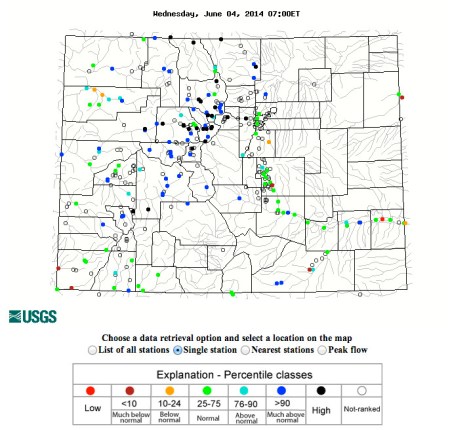
Colorado: Spring flood cuts off road to Montezuma

Durango whitewater park is open for business after recent improvements

Design for the whitewater park at Smelter Rapids via the City of Durango

From The Durango Herald (Taylor Ferraro):

Change is full of peril and opportunity and a little bit of fun as kayakers and rafters discovered this weekend as they attempted to negotiate the newly redesigned Whitewater Park. Smelter Rapid, as many discovered, has sharpened fangs, and more than a few river runners were bitten.

“We are seeing more rafts flip at higher flows,” said Andy Corra, one of the owners of 4Corners Riversports. “It just takes time to figure out the new rapids.”

This is an exciting prospect for all boaters, both commercial and private, said Jesse Mueller, a raft guide for Mountain Waters.
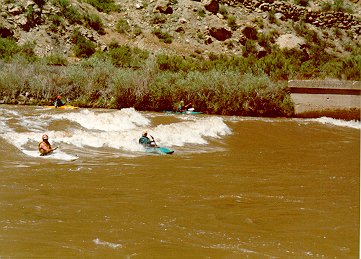
Devoted paddlers and rafters now have 12 new rapid features to maneuver in Whitewater Park at Santa Rita Park, which is now open for runs after completion of in-stream features.

Changes made to the Whitewater Park can alter the rating of the rapids depending on the river levels, Corra said. At its lowest point, Smelter Rapid is considered a Class 3 rapid. At its highest point, it is considered a Class 4, a big-water rapid.

With current river levels surpassing 5,080 cfs, some of the holes, especially for rafters are more challenging.
These changes have modernized the Whitewater Park, said Scott Shipley, Olympic paddler and designer of Durango’s Whitewater Park…

In 2003, [Scott Shipley] returned to Durango to help create a design to revamp the play features of the Whitewater Park, making it more enjoyable for boaters. After creating conceptual and preliminary designs, Shipley helped the city file for a recreational in-channel diversion water right for the Animas River. In order to officially claim the water right, the water had to be captured in a structure, [Andy Corra] said…

Before the changes were implemented, the Whitewater Park was more of a slalom course with flat waves. Now, it’s more freestyle-oriented, and that likely will draw in more boaters, said Kyle Stewart, a raft guide at Mild to Wild.

These changes will make the rapids more consistent throughout the year, said Drew Kensinger, avid boater and Mild to Wild raft guide.

“The idea was to turn Durango back into the whitewater mecca that it used to be,” [Jesse Mueller] said. “That was pretty well achieved. All of the kayakers and rafters really appreciate it and are quite excited about it.”

More whitewater coverage here.

Water Resources Reform and Development Act approved by US Senate by a 91-7 margin, now heading to Pres. Obama

Flood irrigation in the Arkansas Valley via Greg Hobbs

From The Greeley Tribune:

Passage of comprehensive water bill drawing wide praise

Lawmakers and a variety of agriculture groups have been in near unanimous praise of the Water Resources Reform and Development Act since the Senate recently approved it by a 91-7 vote, sending it to President Barack Obama’s desk for signature.

The Water Resources Reform and Development Act (WRRDA) will spend $12.3 billion and authorizes 34 water resources projects across the country that have cleared technical reviews by the Army Corps of Engineers.

WRRDA also eliminates as much as $18 billion in planned projects by the Army Corps of Engineers that have never gotten off the ground. It also is expected to accelerate project planning and development times that have stretched to longer than 15 years in some cases. The Corps would have three years to do feasibility studies and have a $3 million cap.

A number of ag groups — such as the National Corn Growers Association, National Cattlemen’s Beef Association and others — have stressed the measure improves the inland waterways system, which is needed by U.S. farmers and businesses, who rely upon such transportation channels to create economic opportunities at home and supply markets abroad.

Runoff/snowpack news: “It’s [Wellsville gage] been flat as a string” — Steve Witte

Colorado Water Watch (USGS) statewide streamflow map June 4, 2014

Click on the map above to peruse the USGS’ Water Watch interactive map for Colorado. The dark dots represent higher flows.

From The Pueblo Chieftain (Chris Woodka):

There’s some debate about whether the Arkansas River has seen its peak runoff yet. The river has been running very high after gaining momentum over the weekend and has been dangerous in places. All along the river, from Pueblo to Leadville, flows are twice average for this time of year as spiking temperatures and heavy snowpack have led to a heavy runoff.

Temperatures Tuesday reached 97 degrees, about 3 degrees shy of the record 100 degrees in 2006.

Apparently there is more to come.

“It is kind of surprising for this time of year,” said Steve Witte, Water Division 2 engineer. “I suppose what we’re seeing is the result of a cool May.”

Snowpack above the timberline is still ample, based on observations by Division of Water Resources staff, and more hot weather’s on the way. A fast, early runoff was forecast at the end of April, but more precipitation and cooler weather set the stage for a June peak.

The Arkansas River gauge at Wellsville has been at 4,000-4,200 cubic feet per second for days.

“It’s been flat as a string,” Witte said.

There are advisories for rafters through the Arkansas River canyon on certain stretches of the river.

Levels below Pueblo Dam topped out at 4,800 cfs on Monday, and were falling Tuesday after releases from the dam were cut back slightly.

Meanwhile, about 23,000 acre-feet of Fryingpan-Arkansas Project water has been imported through the Boustead Tunnel into Twin Lakes. More than 60,000 acre-feet is projected this year.

“It’s been about what we would expect at this point,” said Roy Vaughan, Fry-Ark manager for the Bureau of Reclamation.

So far, nothing is at flood stage and the river has been higher on this day in history — June 3, 1921, was the date of the deadliest flood recorded here.

From the Associated Press via the Fort Collins Coloradoan:

Some streets and fields remain flooded in Greeley as the spring runoff continued to push the Poudre River over its banks on Tuesday.

The water reached 9.16 feet, more than a foot above flood stage, around midday. That’s just above the previous crest record for the river set in 2010, the National Weather Service said.

The flooding was making it harder to drive around the city, although some drivers disregarded warnings to stay off closed roads.

Two homes were flooded this week, forcing those residents to evacuate, Greeley street superintendent Jerry Pickett said. Across the flooded street, other residents sat on the porch of a home surrounded by sandbags.

Nearby, Tony Stansbury and Robert Villa waded through waist-deep water with a canoe to recover records from DBE Manufacturing & Supply.

The Greeley Tribune reported Greeley City Councilman Charlie Archibeque caught a 10-pound carp in the driveway of his home, which was surrounded by water.

The water has been high along the Poudre for a week and levels of waterways around the state are expected to remain high for another two weeks or so as the plentiful mountain snowpack melts and fills reservoirs.

“The good news is there’s water to be had, but it could be a nuisance for another few weeks,” National Weather Service forecaster Kyle Fredin said.

The South Platte Basin, which includes the Poudre, was listed as being nearly 300 percent of its average level as of last week.

In western Colorado, the spring runoff was creating a wave known as “Big Sur” in the Colorado River, drawing kayakers and paddle boarders to DeBeque Canyon.

The Daily Sentinel reported that the wave develops when water flows over a submerged bridge reach at least 20,000 cubic feet per second. The last time the wave appeared was in 2011.

Things are much drier in the state’s southeastern and southwestern corners, where fire and blowing dust warnings were posted Tuesday.

From the Vail Daily (Raymond A. Bleesz):

John Comer, of McCoy, knows about calamity regarding his beloved water wheel at his Wagon Wheel Ranch. Last month, the high waters of the Colorado River partially destroyed his water wheel for the third time in its 92 years of history.

The Brooks-Dixson water wheel was initially constructed in 1922 by the two entrepreneurial ranchers, Earl Brooks and Wyman Dixson, as they needed water to irrigate their pasture — water, hay and cattle are the focal cornerstone elements for a successful livelihood in ranching. The water wheel was put together with no plans other than using their imagination. The engineering feat, the material and lumber the two ranchers mustered for themselves was a significant feat using approximately 3,570 board feet of lumber. It showed determination and a frontier can-do attitude. The purpose of the wheel was to raise water from the river bottom to the top of the wheel in constructed wooden buckets, as the wheel rotated on its axle to the height of approximately 46 feet and for the water to then flow into a catching wooden flume and into the irrigation ditches of the pasture land. This ingenious device was perhaps the largest one in the state of Colorado and certainly in Eagle County.

From KWGN.com (Sara Morris):

Portions of southeast Greeley remain under water Tuesday night and Greeley’s Emergency Manager believes the flooding isn’t over yet. That concerns many like Erica Nevarez and her family who are trying everything to keep the high water away from their home. So far they have installed four pumps to get the water out of their back yard and horse stalls, funneling it into a nearby ditch. They also had to evacuate all of their animals.

“We had to take all of our horses we put them up here down the street,” said Erica Nevarez.

Building a giant dirt barrier around her property wasn’t enough, so she started making sandbags.

“More than a hundred that’s for sure,” Nevarez said.

And so far their efforts seem to be working because at one point the water was several feet deep.

With two kids and a neice and nephew to watch, Erica said it’s been a stressful couple of days.

“We haven’t slept at all. Just to be watching this water,” said Nevarez.

Unfortunately this may be just the beginning of the flooding in Greeley.

“I think the biggest concern is the longevity of the event. How long will it last and that’s difficult to predict,” said Pete Morgan, the City of Greeley Emergency Manager.

In the meantime voluntary evacuations continue to be in effect in portions of southeast Greeley.

Many including the Nevarez’s are opting to stay because they want to protect their home from future flooding.

Big Sur wave near DeBeque

From KJCT8.com (Lindsey Pallares):

A water phenomenon of the Grand Valley has made its appearance once again, but it’s not here for long.

Big Sur returns to give rivergoers the adventure of a lifetime.

It’s unlike anything most surfers and kayakers have seen on the river.

“In the ocean, the water moves, or stays the same and the wave stays the same, on the river the wave stays put and the water moves past you,” says Pete Atkinson of Whitewater West.

It’s become one of the most sought after standing waves in the West, emerging from the depths of the Colorado River only when river conditions are just right.

“Big Sur is kind of like a novelty wave, it only comes in upwards at like 20,000 or so CFS is when it starts getting good, which we haven’t had for like three years,” says surfer, Brittany Parker.

If you’ve got good balance and stamina you can ride this wave for hours on a kayak, paddle boat, or surfboard.
Last time the wave came to De Beque in 2011 it was here for nearly three weeks, one of its longest recorded stays in river history.

Continued spring runoff determines how long the wave will be around before it subsides.

At this time, experts don’t have a clear of estimate of just how long water enthusiasts will be able to ride the wave.

The wave is rarely here and oftentimes hard to find.

From the Estes Park Trail-Gazette (David Persons):

According to information published by the Colorado Division of Water Resources, the weekend’s top inflow into Lake Estes was at 3 a.m. Saturday when 1,370 cubic feet of water was flowing into Lake Estes. Likewise, the top outflow into the Big Thompson River below Olympus Dam was 1,020 cubic feet per second. An additional 500-550 cfs was also diverted into the Olympus Tunnel.

“That’s right, the peak on the Big Thompson may have been Friday night,” said Kara Lamb, the public information officer for the Bureau of Reclamation’s Eastern Colorado Office in Loveland. The bureau owns both Lake Estes and Olympus Dam.

Lamb pointed out that the water levels have been so high the past week that it’s been necessary to release between 500-550 cfs through Olympus Tunnel. That water generally has been going to Horsetooth Reservoir. However, that reservoir reached capacity at times. When that happened, it was necessary to re-release that water back into the Big Thompson River at the mouth of the canyon.

Lamb said while no one is exactly sure if the spring runoff peak has occurred, it is certain that the Big Thompson River – and others along the Front Range – will run high in the coming weeks as snowpack in the mountains continues to melt.

Despite the fact that the remaining snowpack in the mountains to the west is about 200 percent of average, Lamb said residents shouldn’t be too concerned about that.

“There’s really not a connection between feet of snow on the ground and the amount of snowpack on this day in history,” Lamb said. “But, if it rains up there and the snow melts quickly, then we could have some problems.”

From The Denver Post (Noelle Phillips):

Six roads in Weld County were closed Monday as two rivers reached flood stage.

County officials were keeping a close watch on the Cache la Poudre and South Platte rivers as waters rose from heavy snowmelt and recent rain.

The National Weather Service reported the Poudre was at 9.15 feet Monday afternoon. Flood stage is 8 feet.

The water was expected to recede by Tuesday, the Weather Service reported.

“It’s holding steady right now,” said Joel Hemesath, the county public works director. “They’re not rising, but they’re not receding like we’d like.”

With 59th Avenue, Eighth Avenue and U.S. 85 the only north-south roads coming into Greeley, the city warned motorists to expect congestion and delays.

Two voluntary evacuation notices were issued for Greeley neighborhoods.

Residents in at least one Greeley subdivision were filling sandbags, said Sgt. Sean Standridge of the Weld County Sheriff’s Office. The Spanish Colony neighborhood along 25th Avenue and O Street is along the Poudre River, he said.

A couple of residents in Greeley reported water inside their homes, Hemesath said.

The county’s public works department had employees monitoring bridges across the county. There are concerns about the rising rivers splitting the county in half and cutting the north and south sides off from each other, Standridge said.

Deputies also were watching flooded roads and warning residents not to get too close to rising water, he said. They will issue tickets to anyone trying to cross high water.

“We’ve got a lot of ‘Lookie Lous,’ ” Standridge said. “We are reminding people for their safety to stay out of the water.”

NIDIS: Weekly Climate, Water and Drought Assessment of the Upper #ColoradoRiver Basin

From The Pueblo Chieftain (Chris Woodka):

wyutcoprecipitationaspercentofaverage052014

Click here to read the current assessment. Click here to go to the NIDIS website hosted by the Colorado Climate Center.

More Colorado River Basin coverage here.

2014 Boulder County Water Tour 6/7/14

Did fracking fluid cause Greeley quake? — 9 News

Deep injection well
Deep injection well

From 9News.com (Laurie Cipriano and Brandon Rittiman):

Scientists are investigating whether a rare 3.4 magnitude earthquake near Greeley, Colorado this weekend may have been caused by the disposal of fracking fluid.

The quake was centered in an area of Weld County located near four underground injection sites, in which used fracking fluid is forced deep underground as a method of disposal…

“I think we have a good reason to suspect there may be a link,” said Shemin Ge, a hydrologist with the University of Colorado. “We’re still looking into it.”

Ge says there are several injection wells very close to the epicenter of the earthquake.

“One of them is relatively high volume,” Ge said.

Ge is part of a team of scientists that are responding to the Greeley quake by placing a series of seismometers in the area to get more detailed data.

A team from the University of Colorado at Boulder was sent out to scout locations for the measurement devices on Monday.

Colorado Takes Steps to Expand Geothermal Development — Energy.gov

Geothermal Electrical Generation concept -- via the British Geological Survey
Geothermal Electrical Generation concept — via the British Geological Survey

Here’s the release from Energy.gov:

Colorado Governor John Hickenlooper signed a geothermal bond bill May 30, providing $1.98 million in state funding and matching the Energy Department’s investment in geothermal energy exploration at Pagosa Springs. The project, which demonstrates Colorado’s strong support for geothermal energy development, leverages a $3.8 million award from the Department for evaluating and exploring the geothermal resource potential at Pagosa Springs.

Pagosa Springs has long been recognized as a potential target for geothermal energy development, based on surface evidence and assessments such as geophysical exploration conducted by the Colorado School of Mines. The Pagosa Verde project proposes a cost-effective, phased approach for locating and evaluating the viability of geothermal resources in the southern end of the Pagosa Springs area. The project will assess the potential for power production as well as direct use applications for residential, industrial and other purposes.

The collaborative framework at Pagosa Verde provides a replicable model of public-private partnership and grassroots support. The company has engaged the local community to garner support and promote future geothermal development that could create jobs and generate clean, renewable energy for the region. Landowners, city and county officials, utilities, and private investors worked with the Colorado School of Mines and the Colorado Energy Office to demonstrate the value of this project and its vital role in bringing geothermal energy development to the state.

Learn more about how geothermal energy systems work through this new Energy 101 video.

More geothermal coverage here and here.

Runoff/snowpack news: High water in the Cache la Poudre leads to road closures

cachelapoudreatfortcollins06032014
From the Fort Collins Coloradoan (Erin Udell):

Windsor Police Chief John Michaels said officers will be watching the river all week, monitoring its flow and hoping to see it go down a bit.

It’s not uncommon for Weld County roads 13 and 17 to be closed periodically as spring runoff causes the river to come across the roads, Michaels said. But with added rain, other roads — like Colorado Highway 257 — see closures as well. Amid the rising water, sections of WCR 13, WCR 17 and Colorado 257 remained closed Monday.

“(Closing Colorado 257) doesn’t happen every year, but it happened in September and it’s happening now,” Michaels said, adding that CDOT closed the road around 12:30 a.m. Sunday.

From Steamboat Today (Tom Ross) via Craig Daily Press:

The Elk River west of Steamboat Springs is under a flood warning, likely continuing through Wednesday when there are preliminary signs the rivers in Northwest Colorado will peak for the season. The National Weather Service posted the warning at 7:37 p.m. Sunday saying that the Elk’s flows could be expected to rebound from the weekend when cool, cloudy weather kept the river below flood stage. The Elk was expected to go back above flood stage Monday night into Tuesday morning for the second time this season.

The Yampa River in Steamboat Springs is expected to follow a similar trend but will remain well below flood stage…

The Weather Service said the river still could go higher in the next few days. It was predicting the Elk could reach nearly 7.8 feet early Wednesday morning with “additional rises possible thereafter. At 7.9 feet elevation, backwater flooding is possible due to any debris blocking culverts under U.S. Highway 40 at the East Fork of the Elk.”[…]

A tentative projection by the Colorado Basin River Forecast Center in Salt Lake City, Utah, suggests both the Yampa and the Elk will reach their final peaks of the season later this week, possibly Wednesday night for the Elk and Thursday night for the Yampa in Steamboat. Beyond Thursday, projections show both rivers gradually falling below bank-full.

The Yampa could fall to 3,200 cubic feet per second at Fifth Street by June 9 or 10. It was flowing at 4,770 cfs at Fifth Street at midnight Sunday and well above 5,000 cfs eight blocks downstream below Soda Creek…

Walton Creek was running almost a foot deep Monday morning on a section of concrete public trail that links Chinook Lane to the vicinity of Whistler Park with the help of two pedestrian bridges over the creek. The water rose to within about 20 feet of several single-family homes between Meadowood Court and Meadowood Lane.

From The Greeley Tribune:

Greeley officials have issued a second voluntary evacuation notice.

The boundaries are 5th Street on the north (includes addresses on both sides of the street), 7th Street on the south (includes addresses on both sides of the street), 6th Avenue on the west (includes addresses on both sides of the street), and the Poudre River on the east.

Greeley Public Works Director Joel Hemesath said reports are coming in that the water is recedeing in west Greeley. It should be several hours before east Greeley sees anything similar, Hemesath said.

From CBS Denver:

A breach along the Cache la Poudre River sent rushing flood waters into Greeley on Monday and prompted voluntary evacuations into the evening. Officials don’t consider the flooding to be life-threatening and said they expect the water in Greeley to recede Monday evening. Two homes and a contractor supply business near 5th Street suffered some of the worst damage.

From the Chaffee County Times (Maisie Ramsay):

The closure of a 2-mile section of the Arkansas River south of Buena Vista does not apply to all users, Colorado Parks and Wildlife clarified Monday. CPW and the Arkansas Headwaters Recreation Area announced May 30 that a stretch of river near the Silver Bullet rapid had been closed because of safety concerns. On June 2, CPW explained that the closure did not apply to whitewater canoes or kayaks under Colorado law. However, the closure does apply to individual rafters and rafting outfitters, CPW public information officer Abbie Walls said. Walls noted that regardless of the legalities involved, paddlers are strongly advised against boating that section of the Arkansas River.

“We still are highly recommending people avoid that area,” Walls said.

A reconstruction project at the Silver Bullet rapid completed last winter is resulting in problematic hydraulics that can cause boats to capsize, AHRA park manager Rob White said.

“For whatever reason, it’s causing a massive recirculating wave that’s tending to hold boats and potentially cause a flip,” White said.

White said reopening the river would depend largely upon receding water flows.

The U.S. Geological Survey reported the Arkansas River was running at nearly 3,600 cfs at the gage below Granite as of Monday afternoon.

High water advisories are in effect for the Pine Creek Rapid, the Numbers and the Royal Gorge.

The advisories do not bar boaters, but it is standard practice for commercial outfitters to stop running river sections with high water advisories in place, Arkansas River Outfitters Association president Mike Kissack said.

Meanwhile, outfitters report that other sections of the Arkansas River are prime for rafting at high water levels, especially Browns Canyon and Big Horn Sheep Canyon.

Audit: Division of Water Resources needs to step up pace of dam inspections

Barker Reservoir
Barker Reservoir

From The Denver Post (Joey Bunch):

State engineers should move faster on inspecting Colorado’s largest and most critical dams, according to an audit made public Monday. Despite the tardiness, however, the dams in question weathered last September’s record floods in good shape, according to the report. Auditors reviewed paperwork on 213 high-hazard dams and found that the Division of Water Resources failed to inspect 27 during the 2012 “water year,” measured as Nov. 1 to Oct. 31. Twelve others were at least six months past their annual inspection dates, auditors found.

“Regular inspections help ensure that dams operate safely and identify when a dam’s water level should be restricted for safe operation,” the Office of State Auditors said in a statement about the review.

Only 27 of the more than 1,800 dams under the state’s authority were affected by the rainfall and flooding, resulting in an estimated $5 million for repairs related to cracking, erosion and collected debris.

Auditors and representatives of the state engineer’s office agreed on the findings and recommendations for improvement during a hearing before the legislature’s audit committee Monday morning.

“So the public knows, what we’ve found here is we don’t have an issue regarding public safety for our dams, but we can work on our process, our paper trail, to make sure we have them inspected in a timely manner,” said Rep. Jerry Sonnenberg, R-Sterling.

Inspectors also need to pick up the pace on reviewing dams that could be reclassified for their hazard risks. The review completed last July that elevated Droz Creek Dam in Chaffee County from low risk to significant risk, for example, took 14 years to complete, auditors found.

“Delays in reclassifying dams to a higher hazard rating could pose a risk to public safety,” auditors stated.

And although state regulations require dam owners to update emergency action plans annually, those on file with the division are, on average, 7½ years old, and one had not been updated in 31 years, according to the auditors.

The agency also has not updated some of its fees for dam design review since 1990, so taxpayers pick up about 80 percent of the cost. Auditors recommended that the agency work with legislators to find a solution.

More Division of Water Resources coverage here.

“This proposed MOU is a heavy-handed tactic by [Colorado Springs Utilities]” — Ray Petros

Pueblo West
Pueblo West

From The Pueblo Chieftain (Chris Woodka):

Pueblo County officials believe Colorado Springs Utilities is trying to pressure Pueblo West for help in meeting 1041 permit requirements for the Southern Delivery System. After obtaining a copy of a draft memorandum of understanding that was to be considered by the Pueblo West metro board in executive session last month, two commissioners and the county’s water attorney say it’s the same type of coercion Utilities tried to exert on the county earlier.

“It’s bully tactics. I think it’s terrible and totally inappropriate,” said Terry Hart, chairman of the county commissioners. “This is the second time in a couple of months where Utilities is trying to negotiate approval of 1041 conditions. In this case, it pits Pueblo West against Pueblo County, when there’s no good reason to do it.”

Commissioner Sal Pace agreed: “Whether Pueblo West has access to its own water has nothing to do with conditions on Fountain Creek.”

Water attorney Ray Petros was equally blunt: “This proposed MOU is a heavy-handed tactic by Utilities to withhold water deliveries to Pueblo West as a lever against the county in the event the county had to consid­er suspending the SDS permit.”

Pueblo West has not approved the MOU, and Jack Johnston, the metro district manager, portrayed it as a working document “at the staff and attorney level.”

However, newly elected Pueblo West board member Mark Carmel objected at his first official meeting to considering the deal in executive session. He was backed by Chairman Lew Quigley and board member Judy Leonard.

Johnston said a document for public consideration would be ready for discussion in open session, probably in mid-June.

But the document provided to The Chieftain by Carmel, and shared with the county, asks Pueblo West to get the county to sign off on several conditions of the 1041 permit before Pueblo West can turn on SDS.

Among other things, the agreement instructs Pueblo West to obtain written confirmation from Pueblo County that four politically charged conditions of the county’s 1041 permit have been met or “will not be triggered . . . by use of SDS facilities.”

Those conditions include the payment of $50 million to a special district for Fountain Creek flood control, the Pueblo Arkansas River flow program, the adaptive management scenario for Fountain Creek and Colorado Springs stormwater management. Each of those has led to complicated political negotiations or even court cases for Colorado Springs. Pueblo West has been in court with Pueblo County over the flow program.

Pueblo County ran into the same tactics when it asked Utilities to release interest money from the $50 million early to fund dam studies on Fountain Creek, Hart and Pace noted.

“In any event, holding Pueblo West hostage casts Springs’ Utilities as a bully,” Petros said. “It’s certainly counterproductive to a cooperative approach for addressing environmental mitigation of the SDS Project.”

More Southern Delivery System coverage here and here.

Castle Rock hopes to get 75% of water supply from renewable sources by 2050

castlerock
From The Denver Post (Clayton Woullard):

After one year of operation, the Plum Creek Water Purification Facility has exceeded Castle Rock’s expectations in terms of efficiency as it plays an important role in the town’s long-term renewable water projects. The $22.6-million-dollar plant went online in April 2013, specifically to treat more ground water, as well as renewable surface water from Plum Creek. The facility is part of an effort by Castle Rock to have 75 percent of its water come from renewable sources by 2050, when the town projects it will be built out at 100,000 people. The town’s population is at about 53,000 now.

Other parts of the project are a renewable water agreement through the Water, Infrastructure and Supply Efficiency partnership (WISE) with Denver Water and Aurora Water, as well as storage of 8,000 acre feet of water in Rueter-Hess Reservoir in Parker. Castle Rock Utilities Director Mark Marlowe said the plant’s operating costs, along with the WISE partnerships, are coming in under budget.

“If we don’t do these things, we continue to be reliant on our deep water supplies,” Marlowe said.

That’s something the town and other Douglas County jurisdictions can’t afford, because well water continues to be depleted.

The WISE partnership agreement is almost complete, Marlowe said and will eventually bring about 7,225 acre feet of renewable water and 1,000 acre feet in the short term to Castle Rock. Marlowe said two contingencies must be finished by next year to get WISE water flowing: the $4 million purchase of a pipeline that will get water from Denver and Aurora to Castle Rock; and a new pipeline the town will need to allow it to begin receiving renewable water.

Marlowe said the water supply from WISE is interruptible, unlike the supply coming through the treatment facility.

The Plum Creek Purification Facility captures water from East and West Plum Creek and lawn irrigation return flows. The plant treats more than 4 million gallons of water per day but has the capability to treat up to 12 million gallons when it is eventually expanded. The plant has the capacity to bring the town 35 percent renewable water; now it’s between 12 and 20 percent renewable, depending on demand.

“It is exciting for our community that we get to use this resource,” said Karen McGrath, spokeswoman for the town.

Because the plant also treats surface water, it has different processes, including a series of racks or tubes of thousands of very thin, vertical membranes that filter the water and require regular maintenance and cleaning. Marlowe said surface water requires more treatment than ground water and necessitated the facility.

Most of the plant’s processes run automatically, so the plant only requires about two workers at any time. The system is set up with alarms and auto-correcting mechanisms.

Level 4 plant operator Ken Timm said it’s the most advanced water treatment plant he’s worked at.

“The only challenge is if something breaks,” Timm said, “and how fast can we get it repaired and what caused it.”

More Denver Basin Aquifer System coverage here.

Epicenter of Saturday earthquake in Greeley was near oil, gas wastewater injection wells — The Greeley Tribune

Deep injection well
Deep injection well

From The Greeley Tribune (Trenton Sperry):

As the annual number of earthquakes in the United States has increased, some have pointed to the oil and gas industry as a cause. But while scientists say there is evidence to suggest wastewater injection wells used by the industry could be linked to the increase, there is little or no evidence to suggest a similar link for fracking operations.

“Hydraulic fracturing almost never causes true earthquakes,” University of Texas seismologist Cliff Frohlich told the Associated Press in September during a gathering at West Virginia University for a National Research Council workshop. “It is the disposal of fluids that is a concern.”

Frohlich was referring to the disposal of wastewater, a byproduct of oil and natural gas production from tight shale formations and coal beds, according to the U.S. Department of the Interior’s website. Wastewater produced from many oil and gas production wells within a field may be injected through a single or just a few disposal wells, according to the website.

The question of whether oil and gas operations cause earthquakes was on the minds of Weld County residents Sunday after a 3.4-magnitude earthquake struck 4.8 miles northeast of Greeley about 9:35 p.m. Saturday night, according to the U.S. Geological Survey. The epicenter was near Weld County roads 66 and 43, which is about 3 miles northeast of Greeley.

The epicenter of the quake was about 1.5 miles from two oil and gas wastewater injection wells, both operated by High Sierra Water Services LLC of Denver, according to data from the Colorado Oil and Gas Conservation Commission. They are the only injection wells in at least a 5-mile radius of the quake’s epicenter.

Injection wells provide one of the most economical ways to dispose of wastewater, according to the USGS website, forcing the wastewater deep below aquifers that provide drinking water.

The USGS website also notes, however, wastewater injection increases the underground pore pressure, which may, in effect, lubricate nearby faults, thereby weakening them. If the pore pressure increases enough, the weakened fault will slip, releasing stored tectonic stress in the form of an earthquake. Even faults that have not moved in millions of years can be made to slip and cause an earthquake if conditions underground are appropriate, according to the USGS website.

USGS scientists have found the increase in seismicity in some locations coincides with a significant increase in the injection of wastewater into disposal wells, mostly in Colorado, Texas, Arkansas, Oklahoma and Ohio, according to the Department of the Interior’s website.

Saturday night’s quake near Greeley provided minor shaking that was felt as far south as Longmont and as far north as Fort Collins, according to the USGS website.

The 10,800-foot injection wells near the epicenter were last inspected by the Weld County Department of Public Health and Environment in October 2013, according to COGCC records. State inspectors last checked the wells in August 2012, about four months before one of the wells was completed as a wastewater injection well, according to COGCC records.

Representatives of High Sierra Water Services and the COGCC did not immediately respond to requests for comment Sunday.

The vast majority of wastewater injection wells do not cause earthquakes. According to the Department of the Interior’s website, of approximately 150,000 Class II injection wells in the United States — including roughly 40,000 wastewater disposal wells for oil and gas operations — only a tiny fraction have induced earthquakes large enough to be of concern to the public.

However, injection wells in Colorado causing earthquakes would not be without precedent. In 1961, a 12,000-foot well was drilled at the Rocky Mountain Arsenal, northeast of Denver, for disposing of waste fluids from Arsenal operations, according to the USGS. Injection began in March 1962, and an unusual series of earthquakes erupted in the area shortly after. The U.S. Army ceased use of the injection well in 1966, and in 1990 a solid link was established between the injection of fluids and the subsequent rash of earthquakes.

But Paul Earle, a seismologist with the USGS, said there’s still plenty to consider to determine if the Greeley earthquake was natural or man-made.

“Just because there are injection wells near there doesn’t necessarily mean they caused the earthquake,” Earle said. “There are a number of things you have to address to make that determination. But it’s certainly something we need to look at and will look at.”

More oil and gas coverage here.

Tamarisk Coalition “Raft the River” event, June 29 #ColoradoRiver

Colorado River -- photo via Wikipedia
Colorado River — photo via Wikipedia

Click here for the inside skinny.

Longmont plans to replace every bridge from Main to Hover. Flood bond ballots in mail today.

Continued Northern Water water rate meeting June 5

Carter Lake via Northern Water

From email from Northern Water:

Northern Water’s water rate hearing has been continued to June 5, 2014 at 1 p.m. at Northern Water’s headquarters in Berthoud, 220 Water Ave. The first part of the rate hearing was held in Berthoud on May 1.

Draft Cost of Service Rate Study Available
The Draft Cost of Service Rate Study Report is now available. The Cost of Service Rate Study provides data and information to allottees and provides the Northern Water Board of Directors information to make a fair and equitable decision regarding future water assessments at Northern Water. The study has developed a range of possible financial futures and associated rate design options.

For more information or to submit written comments, please contact Jerry Gibbens at 970-622-2299 or RateStudy@northernwater.org.

Rate Study Documents
Draft Cost of Service Rate Study Report
Rate Study Summary
Rate Study Summary Update

More Northern Colorado Water Conservancy District coverage here.

Runoff/snowpack news: Cache la Poudre a foot above flood stage (Sun.) in Greeley

Click on a thumbnail graphic for a gallery of snowpack data from last Thursday. There has been a lot of melting since then.

From The Greeley Tribune:

The Poudre River flowed at approximately 9 feet high in the Greeley area Sunday, about a foot higher than flood stage but not any higher than Saturday’s levels.

Joel Hemesath, director of public works in Greeley, said the city is still monitoring the roads, but there are no condition changes since Saturday night. He said the river hit 9 feet Sunday morning and held steady there throughout the afternoon. Several areas are close to flooding, and it wouldn’t take much to push them over.

County spokeswoman Jennifer Finch said at 3:30 p.m. Sunday she had received word of three additional closures in the area. County Road 3 is closed between county roads 36 and 8, Fern Avenue in Greeley is closed between 8th and 16th streets and County Road 13 is closed from County Road 68 1/2 to Colo. 392.

Flooding on the river closed another major road early Sunday. About 12:30 a.m. Sunday, the Colorado Department of Transportation announced that Colo. 257 on the southeast side of Windsor was closed. It has been closed between Crossroads Boulevard and Eastman Park Drive because of water over the highway, and there is no estimated time of reopening.

From The Denver Post (Eric Gorski):

Another band of storms brought minor flooding and nickel-sized hail Saturday to parts of the Front Range, but the next few days are expected to be warm and dry, providing relief to flood-prone areas.

More than a dozen Colorado counties were under flood warnings or advisories Saturday because of the threat of heavy rain combined with the peak of the high-country snowmelt.

The Cache la Poudre River was the main point of concern, with two flood warnings issued near Greeley and west of Fort Collins.

Minor flooding was reported on eight to 10 houses on McConnell and Green Ridge drives along the river in Laporte. Nick Christensen of the Larimer County Sheriff’s Office said no evacuations had been ordered.

The Cache la Poudre was a foot above its 7.5-foot flood stage Saturday afternoon, is expected to crest at 8.4 feet Sunday morning and likely won’t dip below flood stage until Monday afternoon, the National Weather Service said.

Downstream in Greeley, Weld County officials were surprised Saturday morning when the stream-flow readings on the Cache la Poudre in the city suddenly dropped from more than 3,300 cubic feet per second to a comparative trickle — 120 cfs.

Investigators from the city of Greeley Water Department and Weld County Emergency Management discovered the river had breached the Varra Gravel Pit east of Greeley.

The water was flowing into the pit, and once filled was expected to flow across a field and back into the riverbed, officials said in a release.

There was no threat to homes, they said.

In El Paso County, a fast-moving storm dumped hail and caused minor street flooding in Colorado Springs.

A small stream and river flood advisory will remain in effect until 9:15 a.m. Monday for Jackson and Grand counties

Jim Kalina, a Boulder-based meteorologist with the National Weather Service, said a dry southwestern flow should push the moist air east out of Colorado starting Sunday.

In metro Denver, expect temperatures in the 80s and little chance of precipitation through Tuesday, he said. There is a slight chance of showers and thunderstorms Thursday and Friday with forecast highs in the mid-70s.

From the Cañon City Daily Record (Brandon Hopper):

The Arkansas River water levels continue to soar past over the 3,200 cubic feet per second mark. As I type, they’ve just met 4,000 cfs. This means commercial rafting companies are advised by the Arkansas Headwaters Recreation Area not to boat the Royal Gorge section of the river…

The highest the water has been in the last 59 years of data on May 30 was in 1984 when it reached 4,260. That (probably) won’t happen in the next five hours. The May 31, 1984, mark was 4,540. In June 1984, the first eight days of readings went like this: 4,650; 4,820; 4,430; 4,190; 3,880; 3,480; 3,290; 2,750. My hypothesis is that we’ll break at least one of those days’ records.

World verging on ‘sixth great extinction,’ study says — Washington Post

Habitat loss via Steve Greenberg

From the Washington Post (Terrance McCoy):

The story of the buffy-tufted-ear marmoset is part of the story of a great extinction, according to a study published Thursday in the journal Science. Species of plants and animals are dying out at least 1,000 times faster than before the advent of the human species, and if things don’t turn around, it may get a whole lot worse, researchers said.

“We are on the verge of the sixth great extinction,” Stuart Pimm, a professor at Duke University who lead a team of nine international scientists, told the Associated Press. ”Whether we avoid it or not will depend on our actions.”

Previous mass extinctions are often associated with a meteor strike, one of which likely killed off the dinosaurs 66 million years ago. Another extinction, called the Great Dying, offed 90 percent of the world’s species 250 million years ago — though as The Washington Post’s Fred Barbash pointed out, that one may have been caused by a microbe.

This study focused on contemporary rates of extinction and used databases such as the Red List of Threatened Species. Researchers compared today’s rates with those before humans arrived. And today’s, according to the AP, are 10 times faster than scientists had earlier believed.

“Recent studies clarify where the most vulnerable species live, where and how humanity changes the planet, and how that drives extinctions,’ the study said. ”We assess key statistics about species, their distribution, and their status.” Many land-based species are distributed across terrains smaller than the state of Delaware, Pimm said in this Duke University press release.

Such species are “geographically concentrated and are disproportionately likely to be threatened or already extinct,” the study said. “Future rates depend on many factors and are poised to increase. Although there has been rapid progress in developing protected areas, such efforts are not ecologically representative, nor do they optimally protect biodiversity.”

The number one threat to the world’s many species: habitat loss. It is becoming increasingly difficult, researchers said, to find any speck of planet that hasn’t been either altered or built upon by humans. Complicating efforts: There are so many species no one knows of. “Most species remain unknown to science, and they likely face greater threats than the ones we do know,” Pimm said in the press release.

The latest newsletter from the Water Center at CMU is hot off the presses #ColoradoRiver

Upper Colorado River Endangered Fish Recovery Program

Click here to read the newsletter. Here’s an excerpt:

GOOD SNOWPACK ENABLES FISH FLOWS

A good snowpack will allow coordinated reservoir operations and releases to benefit endangered fish in critical habitat in the Grand Valley and Lower Gunnison, as well as on the Green River. To see a presentation on snowpack and reservoir operations presented by Erik Knight of the Bureau of Reclamation (BOR) at the Mesa County State of the Rivers meeting May 15

More education coverage here.