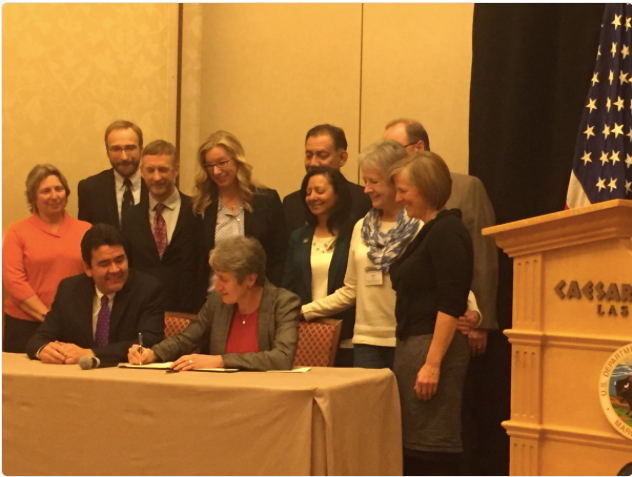
Sally Jewell signs the Glen Canyon Dam Long Term Experimental and Management Plan Record of Decision

Sally Jewell signing the Long Term Experimental and Management Plan Record of Decision for Glen Canyon Dam December 15, 2016.
Sally Jewell signing the Long Term and Experimental Management Plan Record of Decision for Glen Canyon Dam December 15, 2016.

From the Associated Press (Ken Ritter) via The Washington Post:

The federal government is committing to at least another 20 years of use of a huge Colorado River dam that officials call crucial to states in the West, but that critics say is unstable and should be removed.

“Politics belong out of this, because water is life,” said U.S. Interior Secretary Sally Jewell at a conference of key water managers in Las Vegas. She signed an agreement that allows the federal Bureau of Reclamation to manage Glen Canyon Dam and the Lake Powell reservoir in Arizona through 2036.

The agreement “provides certainty and predictability to those that use water and power from the dam,” Jewell said, while also providing environmental protection for fish and wildlife in the Grand Canyon, through which the dam sends water to Lake Mead and Hoover Dam near Las Vegas…

Jewell told reporters the agreement received five years of study about economic, technical, social and environmental factors, and was supported by states, the National Parks Conservation Association, Western Area Power Administration, the Navajo Nation and six other tribes, Grand Canyon river rafting groups and the public…

She said the so-called Long-term Experimental and Management Plan won’t change water allocations for the basin states — Arizona, California, Colorado, Nevada, New Mexico, Utah and Wyoming — or Mexico.

But drought might. Jewell spoke several times of a 50-50 chance that a drought declaration will be made next August, forcing cuts in water deliveries beginning in January 2018 to Arizona and Nevada.

Under various treaties, regulations, statutes and agreements including the Colorado River Compact of 1922, seven states are promised a share of about 15 million acre-feet of water the river was projected to take in annually from rainfall and snowmelt. Drought has cut that figure, and officials acknowledge the available supply today falls short of promised amounts.

Anne Castle, a former assistant Interior Department Interior secretary who spent years working on Colorado River issues and now heads a research program at the University of Colorado, called the decision that Jewell signed important for the West. She said revenue from power produced at the dam pay for endangered species, environmental management and reclamation programs.

IID stands firm for fix for Salton Sea supply

Southern Pacific passenger train crosses to Salton Sea, August 1906. Photo via USBR.

From The Desert Sun (Ian James):

Several months ago, managers of water agencies in California, Arizona and Nevada were expressing optimism they could finalize a deal to use less water from the dwindling Colorado River before the end of the Obama administration.

Now that Jan. 20 deadline no longer seems achievable and parties to the talks acknowledge they likely won’t be able to finish an agreement until at least several months into President-elect Donald Trump’s administration.

With Lake Mead’s water level hovering near record low levels, representatives of the three states, water agencies and the federal government say they’ve made progress in negotiating the so-called Drought Contingency Plan, which would involve temporarily drawing less water from the reservoir near Las Vegas to avert a more severe shortage. The deal is being held up by complications, though, and one of the major sticking points is the Salton Sea.

Managers of the Imperial Valley’s water district, which is the largest single user of Colorado River water, are demanding California officials first present a detailed plan for addressing the Salton Sea’s accelerating decline. They say they want to see a credible “road map” for dealing with the thousands of acres of lakebed that will be left exposed in the coming years and that could turn their valley into a dust bowl, posing a serious public health hazard.

So far, they say they’re still far from satisfied.

“There has got to be a going-forward plan we can believe in at the Salton Sea,” said Kevin Kelley, general manager of the Imperial Irrigation District. “We remain willing, but we’ve got to be able to answer this open question at the Salton Sea.”

Kelley has been voicing that stance for months, and he reiterated his concerns on Thursday in Las Vegas, where he and other managers of water districts from across the West were attending the annual conference of the Colorado River Water Users Association.

“We’ve had more progress at the Salton Sea in the last 14 months than we’ve had in the last 14 years,” Kelley said in a telephone interview. “So we’re closer than we’ve ever been to a breakthrough that the region could believe in. But that isn’t going to be enough. We need to cross the finish line together. And it may be that time’s run out with the current administration and that it extends into the next one.”

After substantial progress in negotiations on the proposed Colorado River drought plan, “the outline of a deal is there,” Kelley said, and IID would like to participate by temporarily storing some of its water in Lake Mead. “But we have this problem at the Salton Sea, that we’ve got to have a clear path forward on in order to participate.”

His district’s unresolved concerns reflect the complexity of the negotiations on the over-allocated and drought-stricken Colorado River. Recalibrating water flows to keep more water in Lake Mead and boost its levels will inevitably lead to less farm runoff flowing into the Salton Sea, which will further accelerate its decline at a time when the Imperial Valley is already transferring increasing quantities of water to cities in San Diego County and the Coachella Valley.

Last month, Kelley laid down a deadline and called for the state to present a plan for the Salton Sea by Dec. 31.

A week ago, the Imperial Irrigation District received an internal draft of the state’s 10-year plan. Kelley said it’s too soon to pass judgment on the unfinished document, but based on his initial review, “it still lacks the specificity that we called for.”

The document, which was obtained by The Desert Sun, summarizes the state’s proposals for a “smaller but sustainable lake” and lays out broad goals for building new wetlands along the lake’s receding shores to cover up stretches of exposed lake bottom and provide habitat for birds.

The document says an estimated 50,000 acres of “playa” will be left dry and exposed around the lake by 2028. The construction of “water backbone infrastructure” is to begin with ponds where water from the lake’s tributaries will be routed to create new wetlands. According to the 24-page document, which describes the Salton Sea Management Program, initial construction will start on exposed lakebed west of the mouth of the New River “to take advantage of existing permits.”

The draft says that in addition to building wetlands, the state also will use “waterless dust suppression” techniques in some areas. Those approaches can include using tractors to plow stretches of lakebed to create dust-catching furrows, or even laying down bales of hay on the exposed lake bottom as barriers to block windblown dust.

Kelley said the document lacks key details on funding and timing. He pointed out that it also doesn’t mention the proposed Colorado River Drought Contingency Plan, or DCP.

“The milestones are, I think, still ambiguous and certainly not enforceable,” Kelley said. “As it stands today, based on what we’ve seen in this response from the state, we cannot participate in a DCP.”

Bruce Wilcox, who was appointed last year by Gov. Jerry Brown to lead the state’s efforts at the Salton Sea, said he expects more details will be added to the plan before it’s publicly released later this month. He pointed out that the plan does include a schedule for the construction of projects, with the aim of keeping up with the rate at which the lakeshore recedes.

“I’m sure IID wants more. It’s difficult to give them more,” Wilcox said. “The next level of detail is where you actually start construction drawings.”

After years of delays, state officials budgeted more than $80 million this year to start building canals and wetlands at the Salton Sea. The federal government announced $30 million this year to support projects at the sea, and newly passed federal water legislation includes an additional $30 million. The state’s 10-year plan will likely cost much more, and it’s not clear where the money will come from.

Wilcox said state officials will prepare an analysis of the costs and funding in the next several weeks.

The Salton Sea was accidentally created between 1905 and 1907, when Colorado River water broke through irrigation canals in the Imperial Valley and flooded into the basin. Since then, the lake has been sustained largely by runoff from the Imperial Valley’s farms, which produce hay, wheat and vegetables like carrots and Brussels sprouts.

A 2003 water transfer deal is sending increasing amounts of water out of the Imperial Valley, and flows of “mitigation water” to the sea will also be cut off after 2017, accelerating the lake’s decline.

Kelley said the state’s plan, as it stands now, seems too ambiguous at a time when the lake is about to shrink so dramatically. The Imperial Valley is already struggling with high asthma rates, and the sea’s decline threatens to release more dust laden with salt, heavy metals and pesticides.

“This is about an existential threat to the public health of the region that we all live in,” Kelley said. “It is unsustainable, untenable that we continue to transfer these large volumes of water outside the region at the same time that we lack any coherent plan – or have any confidence in the clear obligation that we see the state having at the Salton Sea.”

Interior Secretary Sally Jewell also attended the conference, where she met with representatives of states across the Colorado River basin. She expressed optimism that the states will keep making progress toward a deal, and that the U.S. and Mexico are close to finalizing an agreement to replace a Colorado River water accord that expires in 2017.

“We have an agreement that is pending with Mexico that we need to get across the finish line in order to address our water needs between the two countries and a balancing of that, and that has to take first priority,” Jewell told reporters. As for the negotiations between the states, she said, “we want to get as far as we possibly can, and that’s what we’re going to be urging everybody to do.”

Jewell signed a new 20-year framework for managing Glen Canyon Dam and touted government programs that have produced significant water-savings across the Colorado River basin in recent years.

The latest E-Waternews is hot off the presses from Northern Water

Click here to read the newsletter. Here’s an excerpt:

Storage Continues Above Average

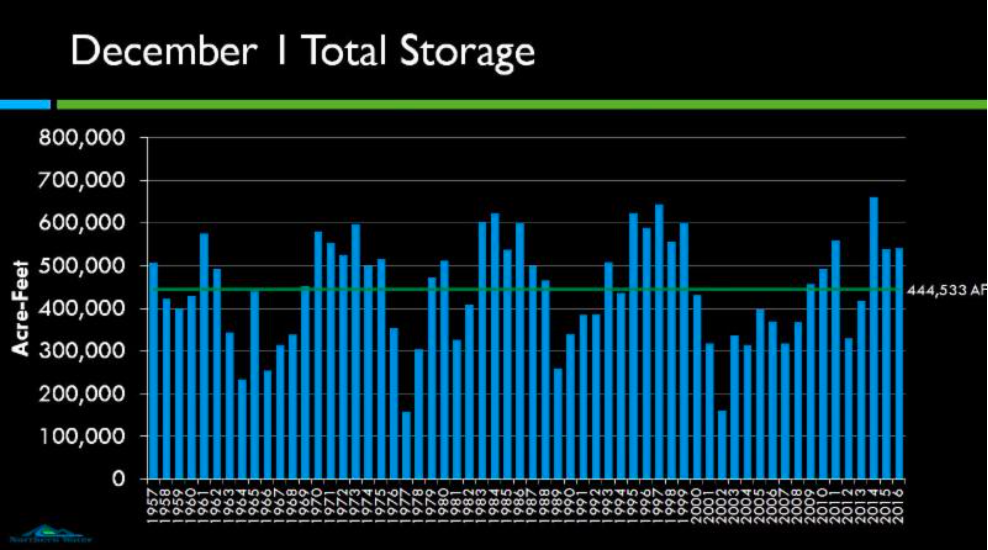
December 1 water storage levels in the Colorado Big-Thompson Project remain above average, with total C-BT Project storage at 540,028 acre-feet (Dec 1 average is 444,533 AF). With statewide snowpack slightly below normal, above-average C-BT storage is good news.

cbttotalstoragede122016

#Snowpack news: A beautiful snowfall blankets Colorado

Here is the Westwide basin-filled SNOTEL map for December 17, 2016 from the NRCS.

Westwide SNOTEL basin-filled map December 17, 2016 via the NRCS.

Click on a thumbnail graphic to view a gallery of snowpack data from the NRCS.

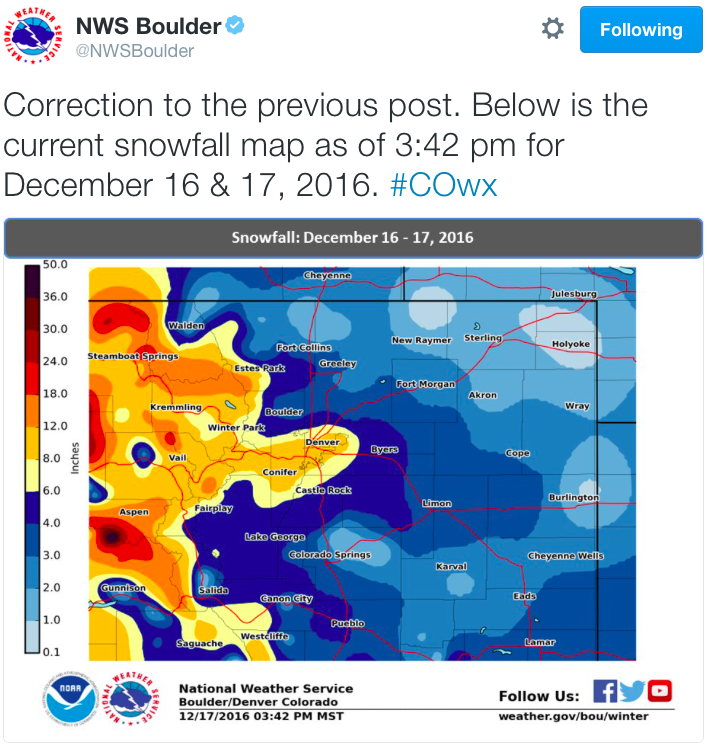
And here’s the snowfall map for the Northern and Central mountains and the eastern plains of Colorado thru December 27, 2016 via NWS Boulder.

snowfall1216thru12172016nwsboulder

U.S. and Mexico push to extend accord on Colorado River — San Diego Union-Tribune

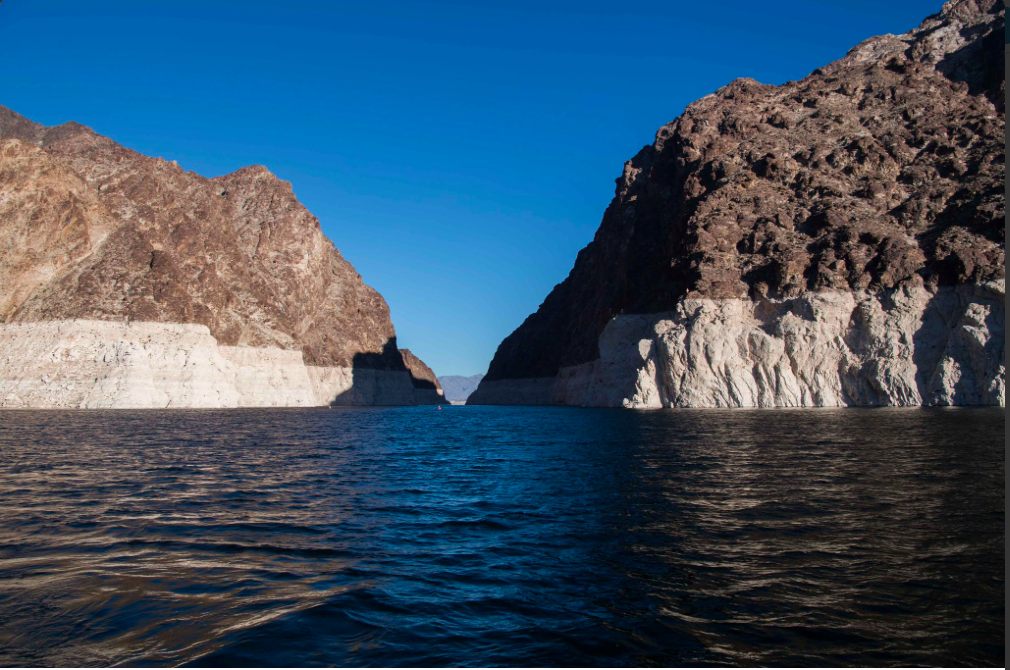
lakemead112016at1078feetviareclamation

From The San Diego Union-Tribune (Sandra Dibble):

WWith the prospect of reduced Colorado River deliveries as early as 2018, U.S. and Mexican negotiators have been in a race against the clock to forge an agreement that involves sharing any future shortages — and are hoping for a signing before President-elect Donald Trump takes office on January 20th.

Water managers on both sides of the border say the accord will be crucial in spelling out how the United States and Mexico would take cuts when a shortage is declared on the river, a lifeline for some 40 million people in both countries.

The draft also contains provisions for continuing the restoration of wetlands in the Colorado River delta and extending agricultural water conservation programs in the Mexicali Valley, as well as allowing Mexico to continue storing water in Lake Mead.

The proposed agreement, known as a “minute” is an extension of the 1944 U.S.-Mexico water treaty on the Colorado River that allots Mexico 1.5 million acre-feet annually — enough for up to 3 million households. The agreement would succeed an existing bilateral agreement, Minute 319, that is set to expire at the end of 2017.

“We’re trying to build on the trust that we had in Minute 319,” said Edward Drusina, who as head of the U.S. International Boundary and Water Commission (IBWC) is the chief U.S. negotiator. The proposed minute “is good for the United States and good for Mexico, and we will do what we can to move it forward,” Drusina said in remarks delivered in Las Vegas on Friday at a conference organized by the Colorado River Water Users Association.

Because many of the key players at the federal level are expected to leave office next month, there is rising uncertainty over how much support for such an agreement can be expected under future Trump appointees. Beyond that, some are fearful that the collaboration between the United States and Mexico on the issue could be tainted by the politically heated rhetoric that the new administration has brought to other bilateral issues with Mexico such as trade and immigration.

“This great example of binational cooperation should not be derailed by unrelated political issues,” said Anne Castle, a former assistant secretary in the U.S. Department of Interior, and now a senior scholar at the Getches-Wilkinson Center for Natural Resources, Energy and the Environment at the University of Colorado.

“The collaboration between the U.S. and Mexico on binational management of this river that we share is extraordinary, and that is something to be celebrated and continued and supported,” Castle said.

While a shortage has never been declared on the river, water managers say that this could happen as early as 2018 if the levels in Lake Mead continue to drop. Earlier this year, the reservoir fell to its lowest level since the construction of the Hoover Dam in the 1930s.

“These are two countries that badly need each other at a time of water shortage on the Colorado,” said Stephen Mumme, a political science professor at Colorado State University and an expert on water and environmental issues on the U.S.-Mexico border. With treaty rights to its water, “Mexico has a pretty good hand to play, but it wants to cooperate with the United States, and it needs the storage upstream,” Mumme said.

The talks between the United States and Mexico, which have been taking place since 2015, are being led by the IBWC and its Mexican counterpart, Comisión Internacional de Límites y Aguas (CILA). “The minute will have the same basic sections as Minute 319 but will be updated appropriately,” said Sally Spener, foreign affairs officer for the IBWC.

Signed in 2012 in Coronado, Minute 319 involved unprecedented binational cooperation on the Colorado River and for the first time in the treaty’s history recognition of the environment as a water user. Its provisions included a “pulse flow” of a large volume of Colorado River water during an eight-week period in 2014 delivered to wetlands in Mexico that have been getting little water due to diversion upstream for urban and agricultural users.

Another component of Minute 319 involved a collaboration among three U.S. water agencies — the Metropolitan Water District of Southern California, the Central Arizona Project and the Southern Nevada Water Authority — and the U.S. Bureau of Reclamation to pay $18 million for water conservation projects in Mexico. In exchange, they were to receive 124,000 acre-feet of Mexican water being stored at Lake Mead.

“The value of working with Mexico is key,” said Bill Hasencamp, Colorado River Resources manager for the Metropolitan Water District. “If we’re not done by January, that doesn’t mean we still don’t have an agreement with Mexico. We want to make sure it’s done right rather than done fast.”

Approving the agreement before the end of January “is going to be a challenge, because we’re running up against the clock,” said Tina Shields, the water department manager of of the Imperial Irrigation District. “Obviously people are moving very quickly now.”

The outcome of the talks is being followed with equally intense interest by the San Diego County Water Authority, which imports two-thirds of the region’s supply from the Colorado River.

The lower Colorado basin states of California, Arizona and Nevada are working on their own drought contingency plan which must be approved before the water scarcity provisions in the binational agreement can be made effective.

The states’ agreement would parallel the binational water scarcity provision with Mexico under the new accord, so that if the lower basin states take cuts under their contingency plan, so would Mexico, said Tanya Trujillo, who is representing California in the bilateral talks.

Trujillo, who is executive director of the Colorado River Board of California, was doubtful Friday that all the different provisions would be worked out before January. “There’s still a lot of us working on a lot different components.”

The IBWC’s Spener said “we think there is a path forward that would not require the drought contingency plan” among the lower basin states to be adopted before the binational agreement can be signed.

Spener could not say whether the work on the agreement will be concluded by the time Trump takes office. “We don’t have a specific timeline, but we continue to work,” Spener said. “Commissioner Drusina has instructed his staff to continue to work, and that’s what we’re continuing to do.”