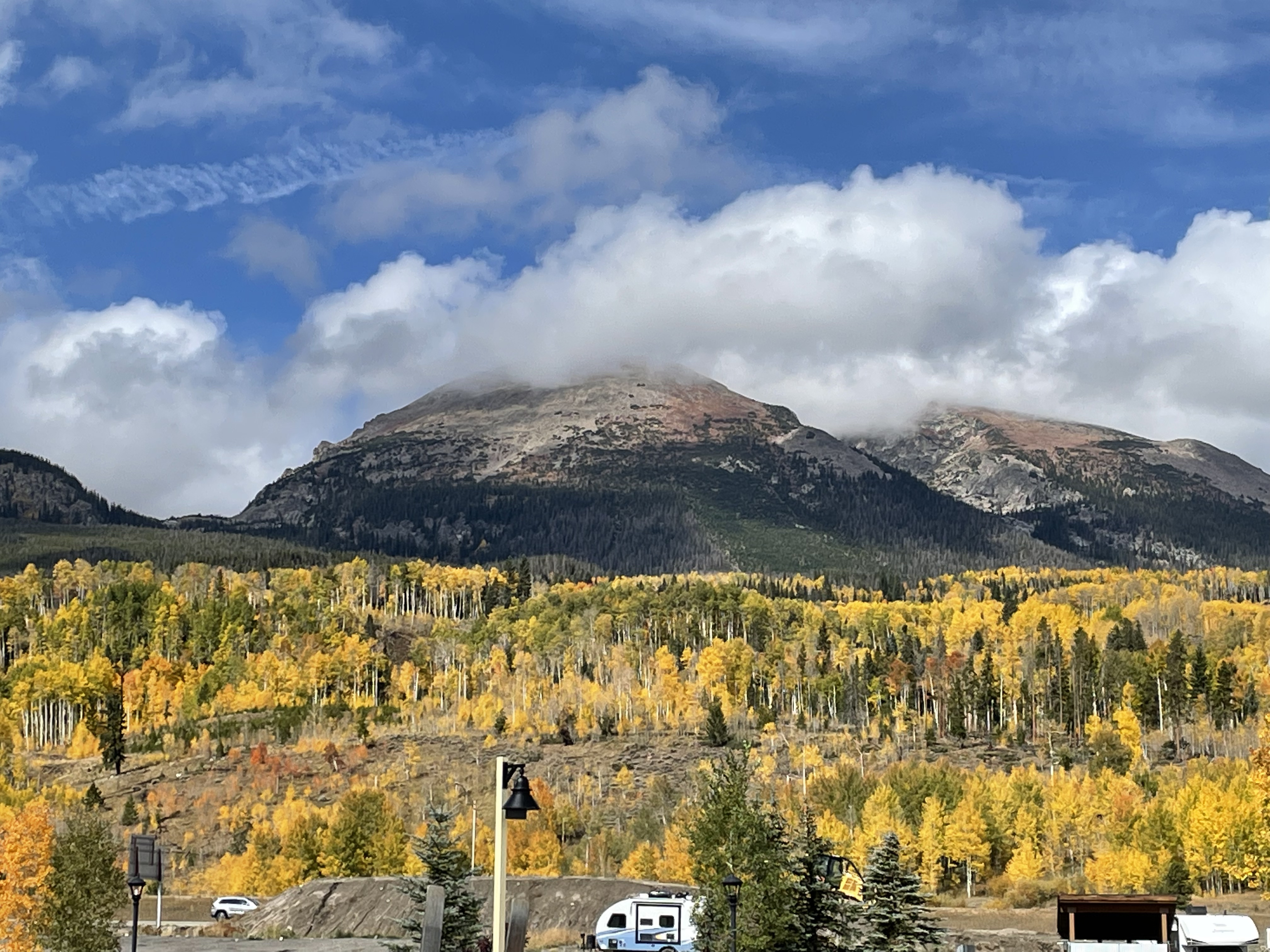
Buffalo Mountain from the Frisco Town Center September 30, 2021.
I left Grand Junction with a full charge after a short wait using the DC Fast charger at the Stop and Shop on Horizon Drive. I decided to use Old Highway US-6 when I could to conserve charge avoiding the 65 m.p.h. and 75 m.p.h. speed limit on I-70. That turned out to be a great decision.
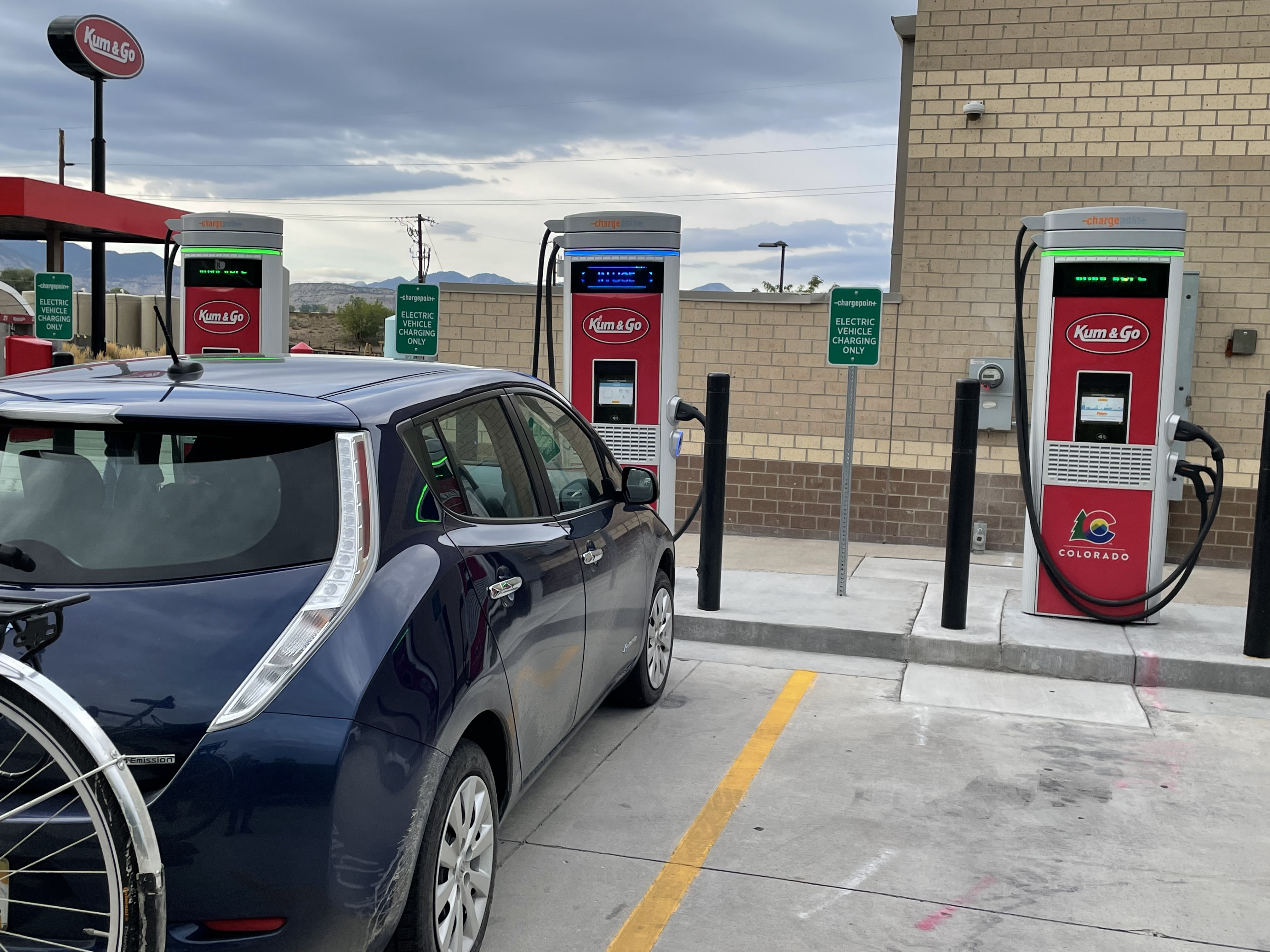
The first leg was from the free Level 2 charger at the DeBeque Fire District facility to the next charge in Rifle where there are multiple DC Fast Chargers at the Kum & Go. US-6 parallels the interstate pretty much until Rifle and from there to just before Glenwood Springs. I missed getting back on US-6 at Dotsero but rejoined it at Gypsum.
There are multiple DC Fast charging facilities from Gypsum to Vail where I charged for the climb over Vail Pass to Frisco and you can stay on US-6 until just before Vail.
Charging in Frisco and Silverthorne is only Level 2 for EVs that have a CHAdeMO connector. You’re okay at Walmart if you have a CCS/SAE connector but the Electrify America’s CHAdeMO was out of service (The Glenwood Springs Electrify America CHAdeMO was also out of service.). The best setup is at the Frisco Town Center with five free Level 2 charging stations, where a Volvo and Tesla were also charging. The facility is convenient to a retail shopping area.
There is a lot of extra time added to a drive like this looking for charging facilities and charging. Level 2 charging takes more time. The battery in my Leaf is not representative of EVs on the market today and it is nearly five years old so my range is more limited and that equals more time spent at the charger. During charges I incorporate stuff that I would be spending time on anyway like doom-scrolling through Twitter, processing my email, or getting a meal.
The ride up US-6 along the Colorado River and the Eagle River was great, irrigation infrastructure, hay fields, cool old farmhouses and town buildings. The fall foliage display this year is pretty amazing.
The two-lane US-6 six route had an extra bonus — Loveland Pass with a dusting of snow. It was worrisome when I used 40% of my charge to get to the top of the pass, but thanks to the regenerative breaking system I only used 10% more charge all the way home to Denver on I-70 and US-6 along Clear Creek. EV car owners love downhill stretches and much as bicyclists do.
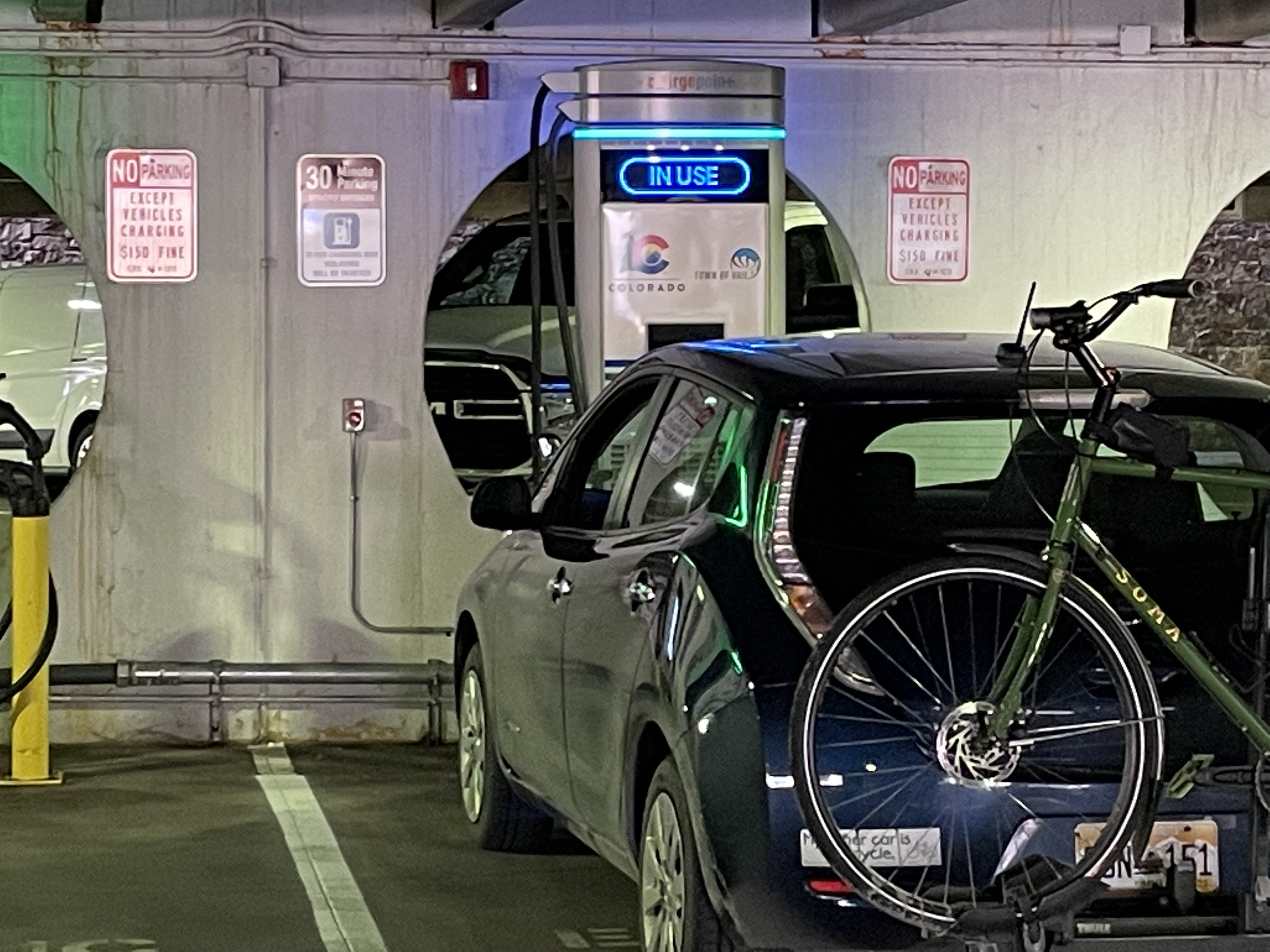
Leaf charging at the Lionshead parking facility in Vail September 30, 2021.
Lees Ferry streamgage and cableway downstream on the Colorado River, Arizona. (Public domain.)
FromThe Grand Junction Daily Sentinel (Dennis Webb):
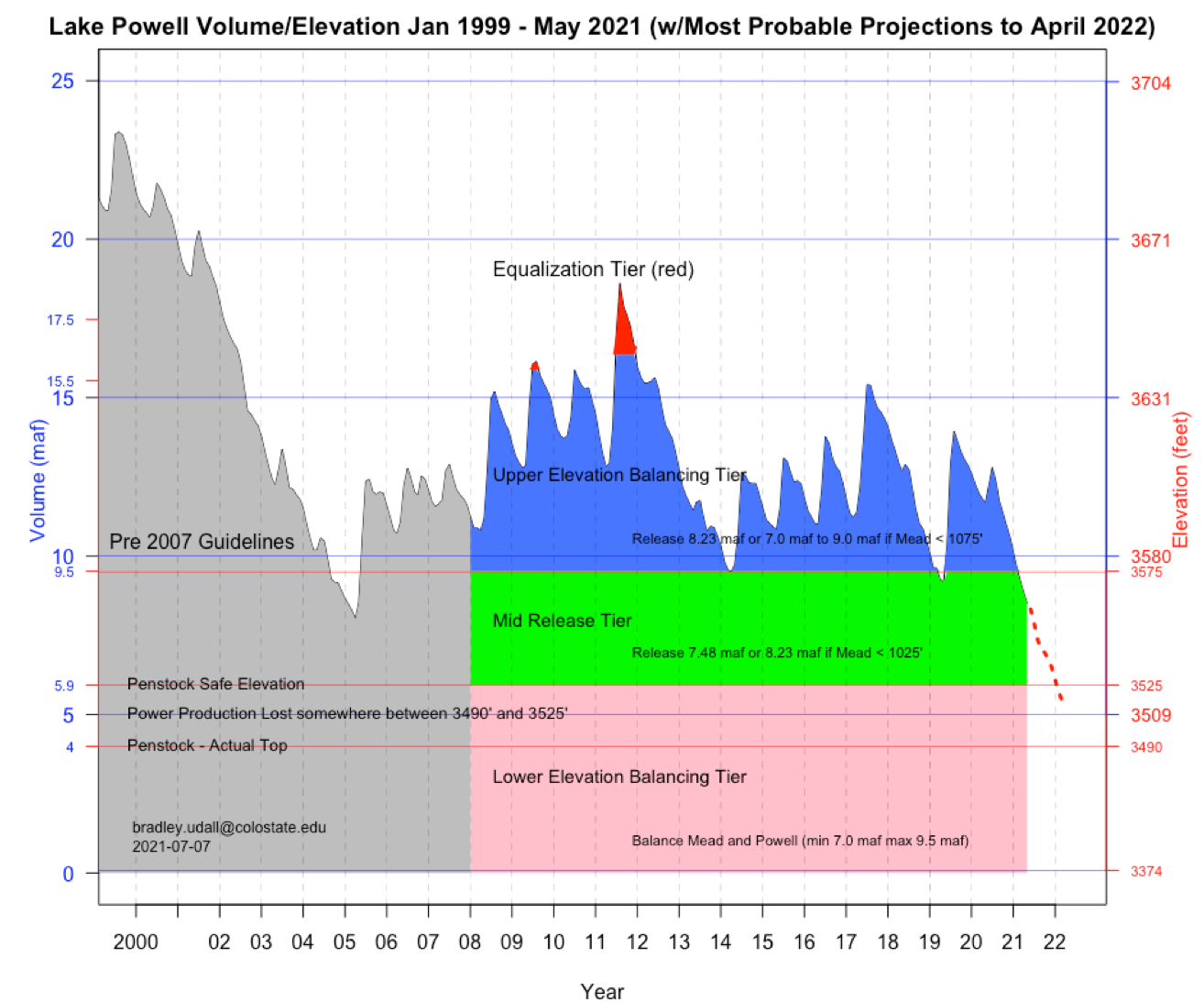
An Interior Department official speaking Friday at a local forum voiced concern about continuing falling Lake Powell water levels that now pose the possibility of threatening hydroelectric power production at Glen Canyon Dam as early as next year.
Tanya Trujillo, Interior assistant secretary for water and science, addressed the topic during the Colorado River District’s annual water seminar, which was held at Colorado Mesa University and also in a virtual format. Some of the events involved simulcast presentations with the Getches-Wilkinson Center at the Natural Resources, Energy, and the Environment at the University of Colorado Law School, which also was holding its own water conference this week.
Trujillo noted that last week, the Bureau of Reclamation indicated the potential of water levels at Lake Powell falling below the minimum power pool level of 3,490 feet above sea level as early as next July if the current streak of extremely dry hydrology continues into next year.
Beyond next year, Reclamation says there’s a 25-35% chance of Powell falling below that level over the next few years. Trujillo also noted that there is about a 90% chance that Powell’s water level over the next year will fall below the 3,525-foot elevation established to provide a protective buffer above the minimum power pool amount needed to produce electricity.
Trujillo called that prediction “very concerning” and said she’s particularly nervous about concerns related to the operational integrity at the dam due to low water levels.
“The engineers use words like cavitation and that gets my attention,” she said.
Cavitation can occur when oxygen mixes with water as levels drop, posing a threat of damage to power turbines. Lost power production also would result in lost revenue that pays for programs like salinity control and endangered-fish recovery in the Colorado River Basin. Also, if water could be released only through the dam’s bypass tubes and not through the power plant, that could threaten the ability of water to be delivered to downstream states at volumes required by a 1922 [Colorado River Compact].
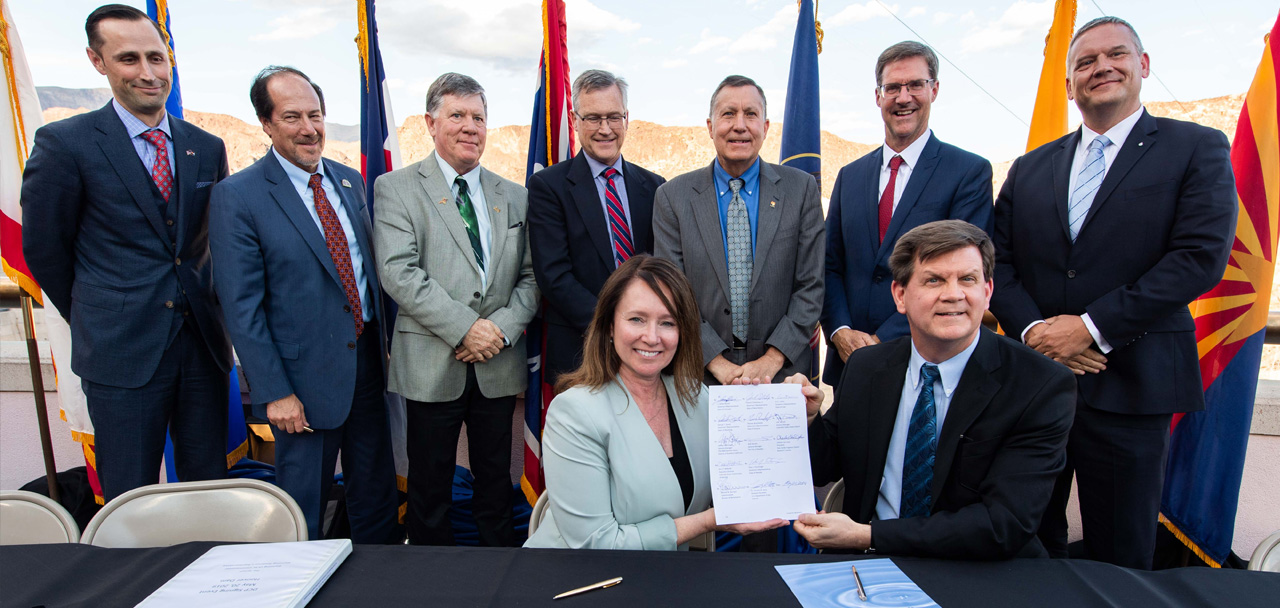
Signing ceremony for the Colorado River upper and lower basin Drought Contingency Plans. Back Row Left to Right: James Eklund (CO), John D’Antonio (NM), Pat Tyrell (WY), Eric Melis (UT), Tom Buschatzke (AZ), Peter Nelson (CA), John Entsminger (NV), Front Row: Brenda Burman (US), and from DOI – Assistant Secretary of Water and Science Tim Petty. Photo credit: Colorado River Water Users Association
Under provisions of a 2019 agreement, the Bureau of Reclamation began releasing water from Flaming Gorge, Blue Mesa and Navajo reservoirs with the goal of providing up to 181,000 acre-feet of water to Powell by the end of this year. Trujillo said she’s happy that talks continue among Colorado and other states in the Upper Colorado River Basin regarding additional drought-response measures…
Below-average precipitation last winter was aggravated this year by factors such as warmer temperatures and dry soil conditions that resulted in even worse runoff levels. Gigi Richard, director of the Four Corners Water Center and an instructor at Fort Lewis College, said at Friday’s forum that the region is starting to experience novel forms of drought, such as ones where, due to higher temperatures, drought conditions prevail after a normal amount of seasonal snowpack accumulation.
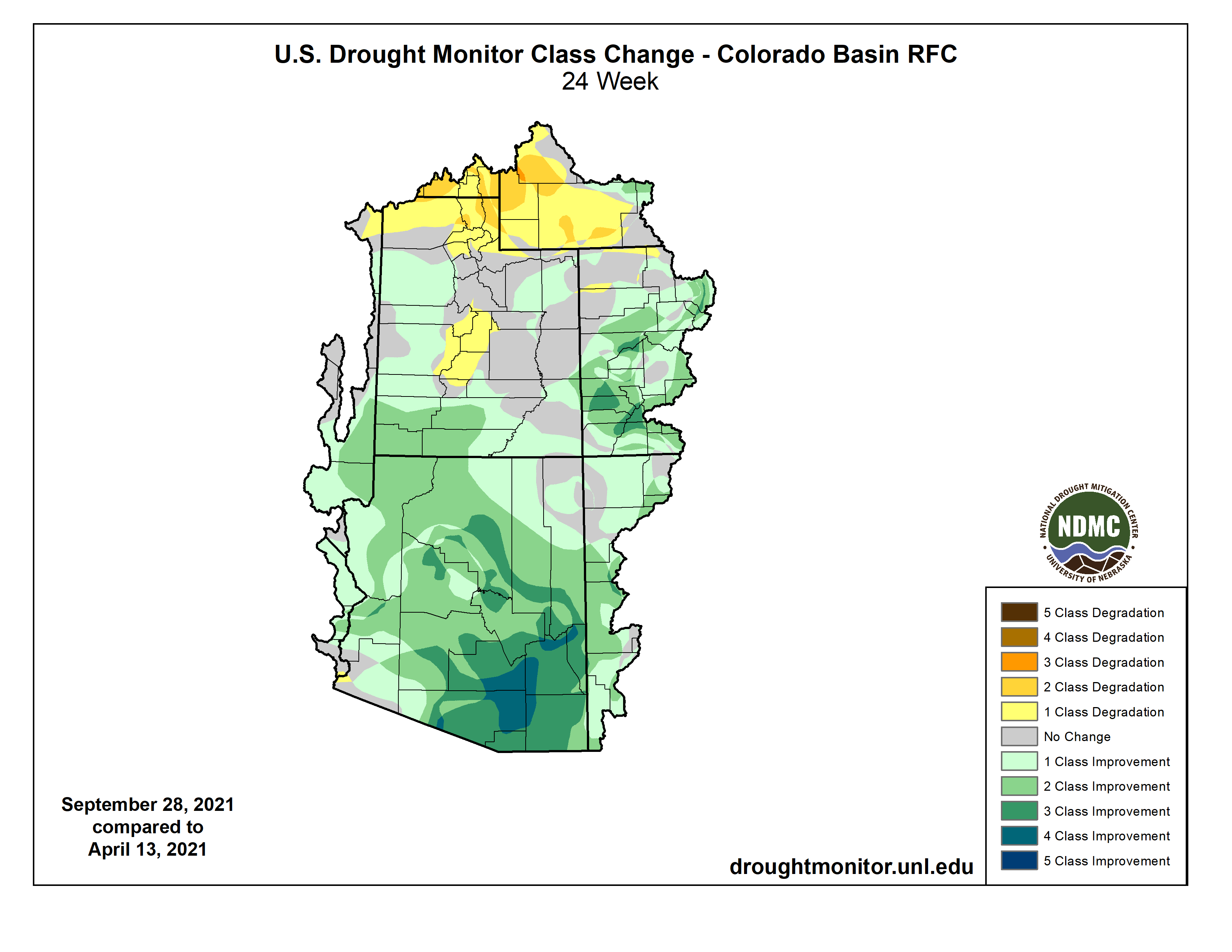
Colorado Basin River Forecast Center Drought Monitor 24 week change map ending September 27, 2021.
Thankfully, she said, monsoonal moisture this summer relieved drought conditions in the region somewhat.
A La Niña climatological pattern that is setting up for this winter could result in storms tracking further north, which Richard said might mean less precipitation in Colorado, but she said individual storms still can result in a significant amount of moisture in a given year.
Graphic credit: Brad Udall via InkStain
Brad Udall, senior water and climate research scientist/scholar at Colorado State University, said reductions in annual precipitation in the months of March and April are aggravating the increased aridification occurring in the region, setting up a process of further drying out land in the summer when there are higher temperatures and reduced precipitation.
He’s also concerned by what he sees as a general trend of more aggravated declines in average streamflows in more southern river basins in the region during this century when compared to the period of 1906-1999. Flows in the San Juan River at Bluff, Utah, have fallen 30%, and flows of the Dolores River near Cisco, Utah, have fallen 21%.
Flows for the mainstem of the Colorado River are down around 5%, he said…
Trujillo said the federal government will be advocating for water conservation in all sectors, with opportunities ranging from more water reuse/recycling to irrigation efficiency…
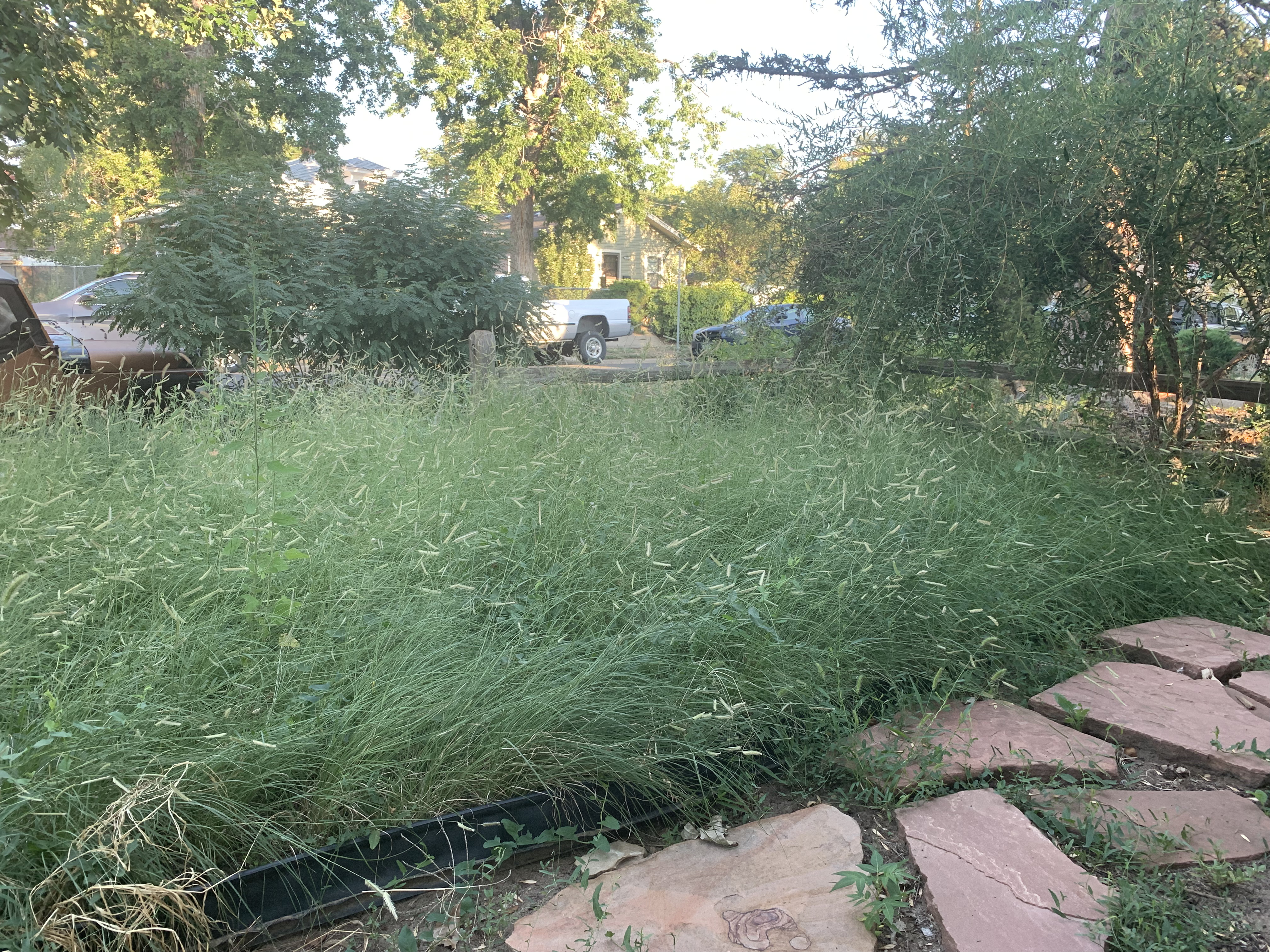
Mrs. Gulch’s Blue gramma “Eyelash” patch August 28, 2021.
Andy Mueller, general manager of the river district, mentioned conservation opportunities ranging from replacing Kentucky bluegrass lawns with native vegetation, to farmers and ranchers potentially being willing to remove irrigation from marginal lands.
He called on various interests not to turn against each other as sometimes happens in societies when a resource gets scarce.
There’s 30% less water in the Colorado River than in the 1920’s and that trend is expected to continue according to the Colorado River District. General Manager for the CRD, Andy Mueller says, “We face a moment in time here that presents unprecedented challenges on the Colorado River.”
Record breaking temperatures, extreme drought conditions, and lowered streamflow were just some of the impacts discussed at the annual water seminar called, Wake-up Call on the Colorado River. “We’ve all got to work together to reduce our consumptive use to preserve the quality of life here in Western Colorado,” said Mueller.
72% of voters passed the river district tax hike generating $4.2 million dollars to fund projects to protect Western Slope water, but the best solution may simply be conservation. Mueller says, “Not necessarily how much you take from the river, but how much you take and never return.”
[…]
This unique water seminar comes at the end of a peculiar water year, but in order to adapt to a new future it’s going to take teamwork. State Representative Soper says, “I think it’s very important that we look at everything and that we try and protect as much of water here on the Western Slope as possible. Because if there’s one thing we’re caught between, it’s greedy front range interests and greedy downstream interests who would all like to use more than their fair share.”
In 1979 the Upper Arkansas Water Conservancy District was formed. Since that time innumerable benefits have been provided to the citizens of the district.
The primary goal of the district is protection of water rights within the Upper Arkansas. Continuous monitoring and involvement in legislative measures that impact water rights, involvement in water court cases that have the potential to negatively impact Upper Basin water rights and operating umbrella augmentation plans that prevent injury to water rights by making weekly water replacements to affected rivers and streams by out-of-priority uses are the major areas of work.
Other areas include conducting water studies such as ground water monitoring, water balance studies with the U.S. Geologic Survey, identification of and development of alluvial water storage, watershed health activities such as spearheading the Monarch Pass Steep Slope Timber Harvesting Project and water education programs. The benefits of these programs are not always recognized by citizens of the district.
Water resource development is essential to an effective water right protection program. The most obvious and direct benefit of this is the district’s umbrella augmentation plan program. Augmentation is a little understood water resource concept that was developed in 1969 when Colorado fully recognized in legislation the connection between tributary ground water and surface water. With this recognition all ground water production was brought under and regulated by the prior appropriation system.
Basically, this meant that the right to extract ground water for use would be governed by the date of first use. In an arid country such as Colorado, and in particular eastern Colorado, there is never enough water to satisfy all legal claims. Thus, priority of use is controlled by the established date of first use or “First in Time Is First in Right.” This legislation prevented most well use except when a “fully consumable” water source was used to replace the amount of water used up by the well. In other words, the well use would have to be augmented with a court-decreed “Plan of Augmentation.”
The full impact of this was not completely felt until the decision of the Kansas-Colorado Compact lawsuit and the adoption by Colorado in 1995 of the “Amended Rules and Regulation on Tributary Ground Water Use in the Arkansas Basin.”
Fortuitously, the district had filed in 1992 and obtained an umbrella augmentation plan in 1994. The benefits have been enormous for citizens within district boundaries of its decreed augmentation areas needing augmentation to use their wells, surface diversion or ponds.
The value of being able to enroll into the district’s augmentation plan and continue to use one’s well is best quantified by cost savings. Typical residential well augmentation requires a source of fully consumable water, storage, an engineering plan and a water court decree. The typical current cost for such a plan ranges from a low of $80,000 to $150,000 per residence. The cost per residence with the district’s plan is less than $4,500, a savings per residence of $75,000 to more than $145,000.
Presently the district provides augmentation to over 2,000 wells. The vast majority of these are for residential use. This savings expressed in dollars would represent a cost savings to district citizens of as much as $290 million.
The additional and as important benefit is to rivers and streams in the district. Annually more than 700-acre feet of water is released to our streams and available to support water rights and protect them from injury.
Further benefits are the water infrastructure that is maintained and constructed that supports recreation and the environment. Many of the area lakes and reservoirs are filled with district owned and controlled water rights, such as O’Haver Lake.
The studies and watershed health projects the district has undertaken in its 35 years of existence provide a wealth of knowledge and data for present and future understanding of our water resource and a roadmap to future water development.
Ralph “Terry” Scanga is general manager of the Upper Arkansas Water Conservancy District.
Buffalo Mountain from the Frisco Town Center September 30, 2021.
I’m in Fruita this morning. I’ll be heading for a nice bicycle ride along the Riverfront Trail to Colorado Mesa University for the Colorado River District’s seminar today, “Wake up Call on the Colorado River.”
I drove the EV over to check out the charging infrastructure available for my Leaf and its nearly 5-year old battery. The addition of DC Fast charging made the trip much more convenient than it would have been. The pull over the Continental Divide of the Americas from Idaho Springs was a concern but I pulled into Silverthorne with charge to spare thanks to the regenerative braking system in the Leaf. The only DC Fast charger in Frisco was down (Electrify America) so I was using the Level 2 chargers at the Frisco Town Center (Chargepoint).
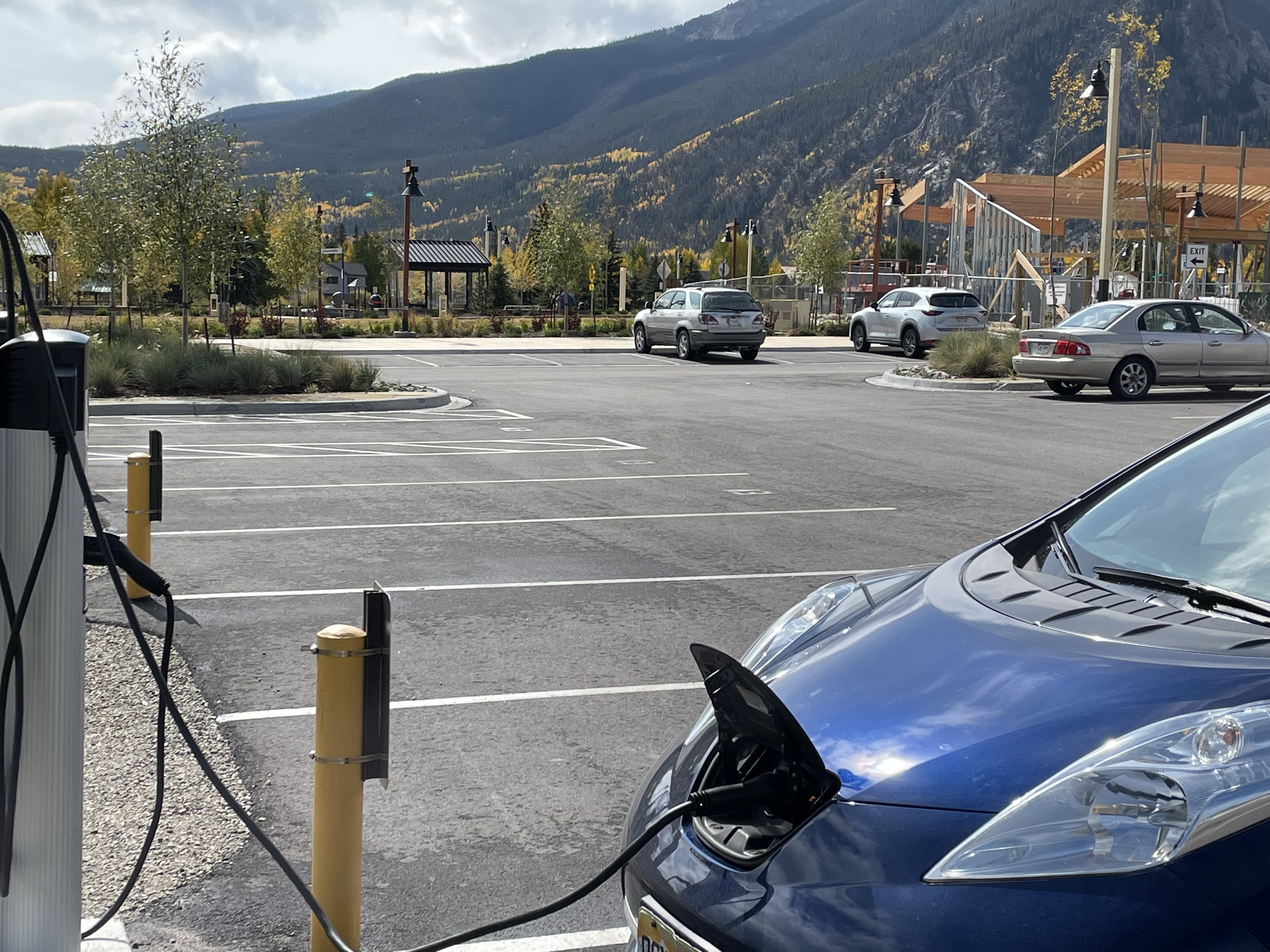
Leaf charging in Frisco September 30, 2021.
Vail has DC fast chargers at the Lion’s Head Parking facility, also Chargepoint.
Leaf charging at the Lionshead parking facility in Vail September 30, 2021.
I bumped the charge at the DC fast charger (Chargepoint) in Edwards for the longish run to Rifle.
Leaf charging in Edwards September 30, 2021.
The Rifle Chargepoint installation is sweet and very fast. The run from there into Grand Junction went well.
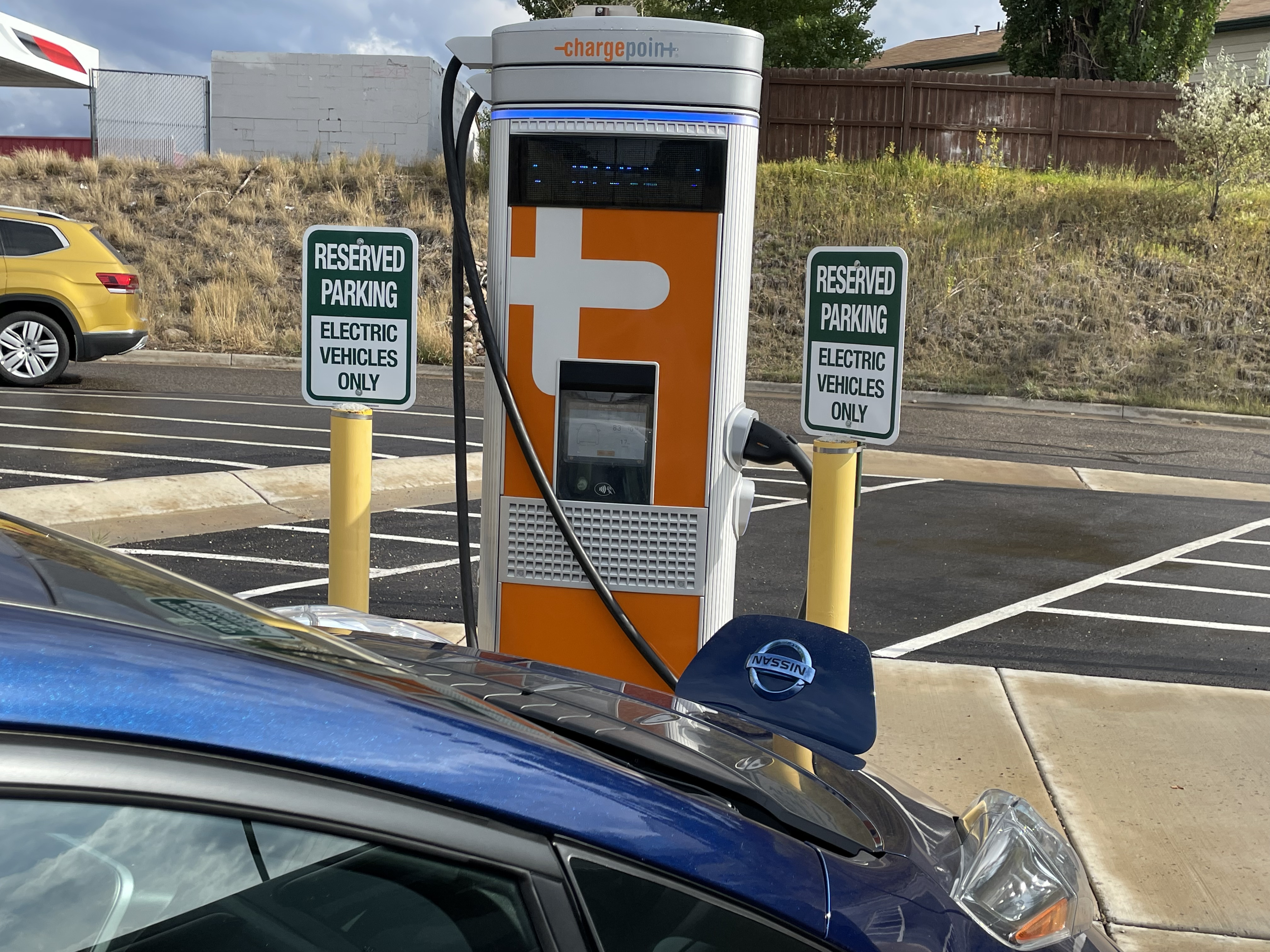
Leaf charging in Rifle September 30, 2021.
I did check out the charger at the Debeque Fire District (Level 2) where it started raining. The beautiful rain continued all the way to Fruita. The final charge was on Horizon Drive in Grand Junction but I didn’t get a photo since it was dark and raining.
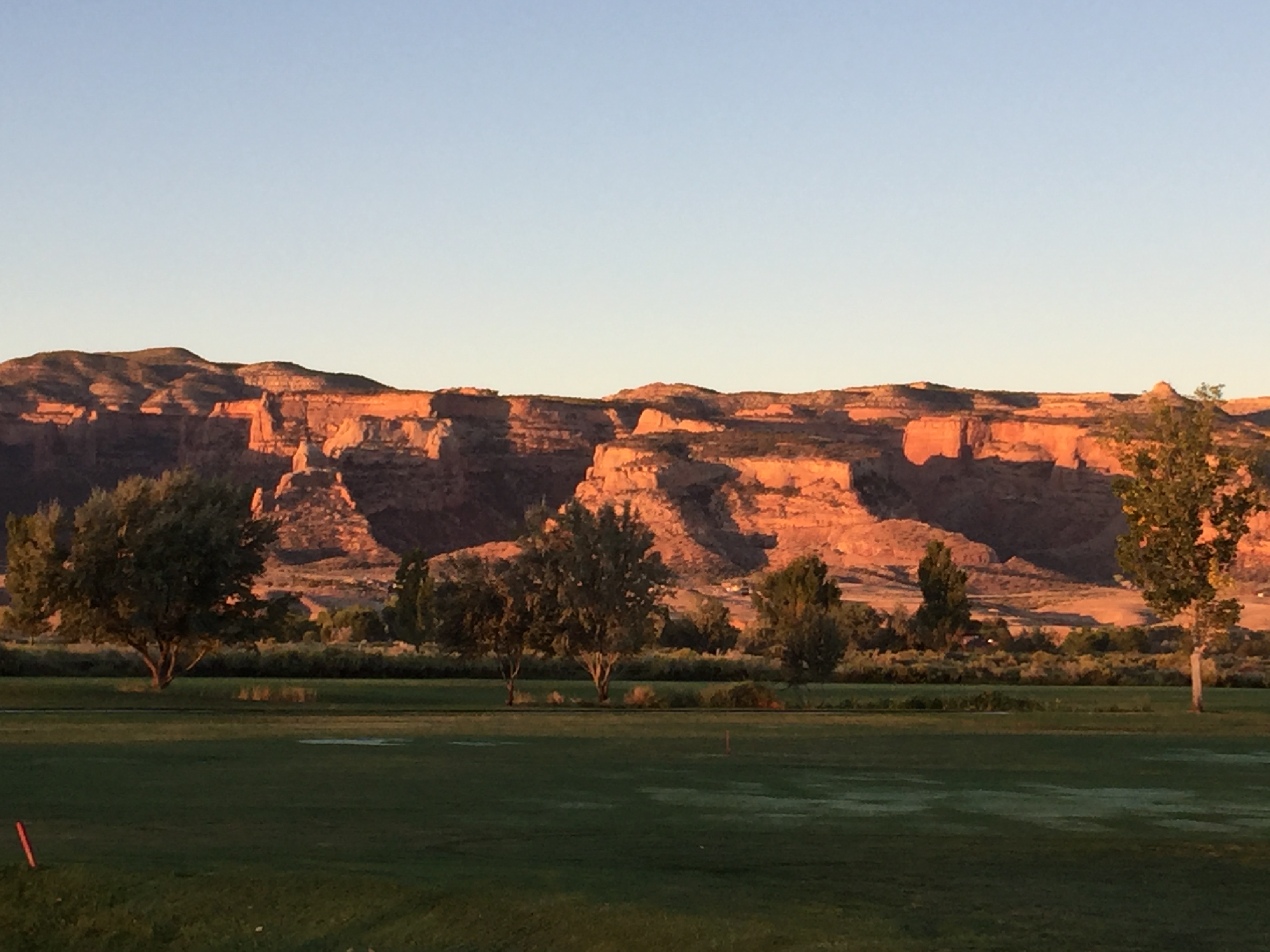
Colorado National Monument from the Riverfront Trail near Fruita September 2018.