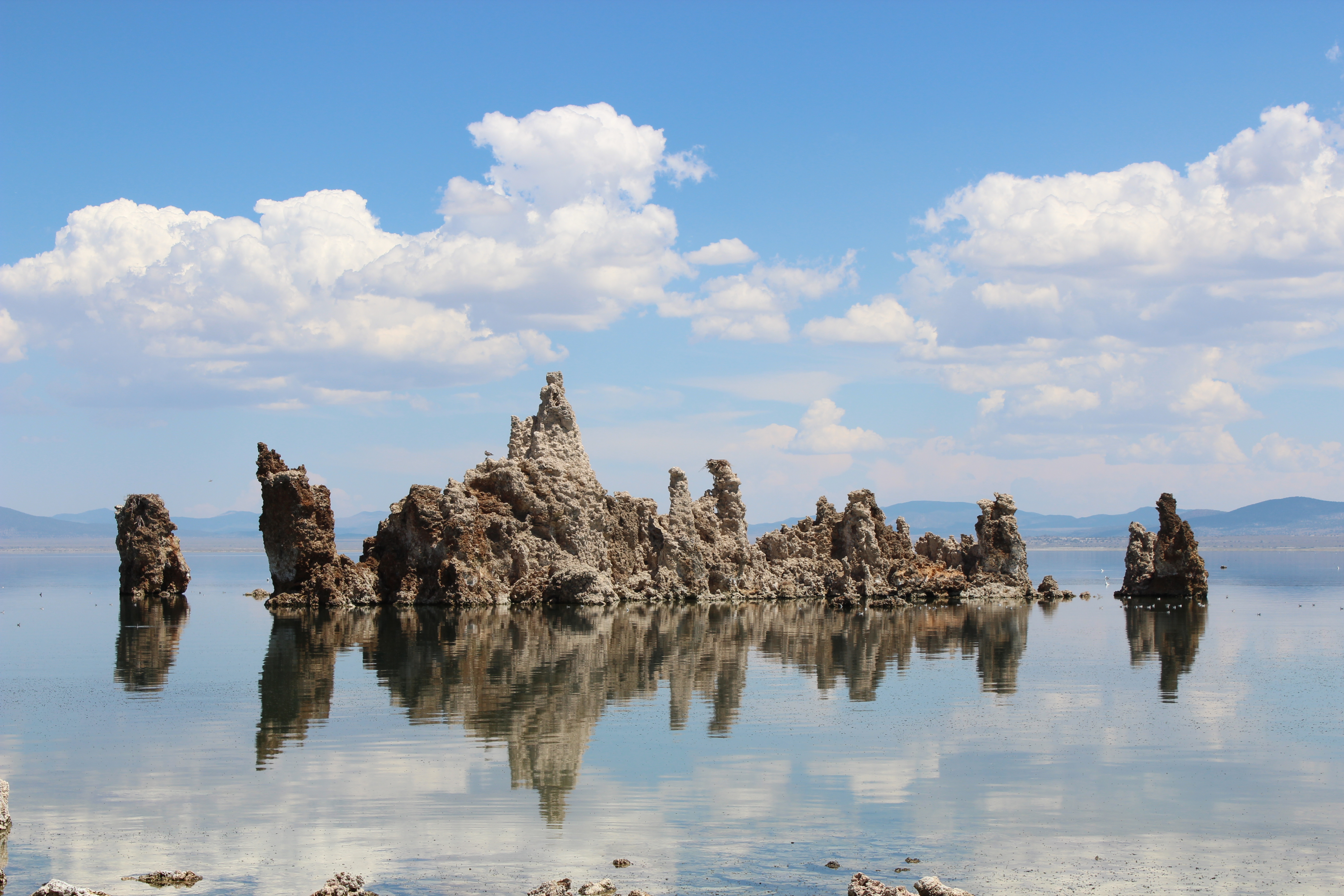
Click the link to read the article from The Salt Lake Tribune on the KSL website (Leia Larsen). Here’s an excerpt:
Owens Lake was one of the first cautionary tales about a salty lake with no outlet when it dried completely from human water consumption in Los Angeles. Lake Urmia in Iran and the Aral Sea in Central Asia followed, drained by scaled-up agriculture. All have since become sites of major dust storms. The Great Salt Lake finds itself heading down a similar path, overtapped by agriculture, cities and industry. But Mono (pronounced “moan-oh”) Lake has emerged as a success story of sorts. Alarmed by the lake’s decline when its tributary rivers were diverted away to L.A., environmental advocates fought back.
“We basically said, ‘Hey, the state is in charge of water rights and you gave [away] these water rights,” said Geoff McQuilkin, executive director of the Mono Lake Committee. “What we see [as a result] is Mono Lake being destroyed. That doesn’t meet the public trust obligation of the state to protect resources for future generations.”
They took their case all the way to the California Supreme Court in the 1980s using that public trust doctrine argument. And it worked. The concept of a public trust has its roots in English law, and may date as far back as the Roman Empire. Various courts in various states have applied the doctrine throughout U.S. history, mostly to settle issues of water access. The Mono Lake decision was the first time the public trust argument secured a lake’s right to exist. Now L.A.’s water utility has to scale back its diversions until Mono Lake reaches a sustainable level. So could someone apply the public trust doctrine in Utah to save the Great Salt Lake?
Some Utahns formed FRIENDS of Great Salt Lake in the 1990s after drawing inspiration from the Mono Lake Committee’s efforts. The group has a similar mission to educate and engage Utahns, helping them understand that the Great Salt Lake isn’t just a dead, empty sea. While the public trust doctrine hasn’t been applied to the Great Salt Lake so far, “certainly, the lake is deserving of this kind of justice,” said Lynn de Freitas, executive director of FRIENDS.
One complication is how, exactly, the public trust doctrine would solve the Great Salt Lake’s problems. At Mono Lake, the culprit depleting the lake was clear: a single utility in L.A. that could be obliged to reduce its consumption. In Utah, a patchwork of cities, towns, agricultural fields and industries across the watershed have dropped the Great Salt Lake by as much as 11 feet, according to a Utah State University analysis.
“So who do you target [in] a public trust challenge?” de Freitas wondered. “… I’m not quite sure.”