
Dust on snow seems to be increasing the chances of #RioGrande drying this year through #Albuquerque — John Fleck (InkStain) #aridification

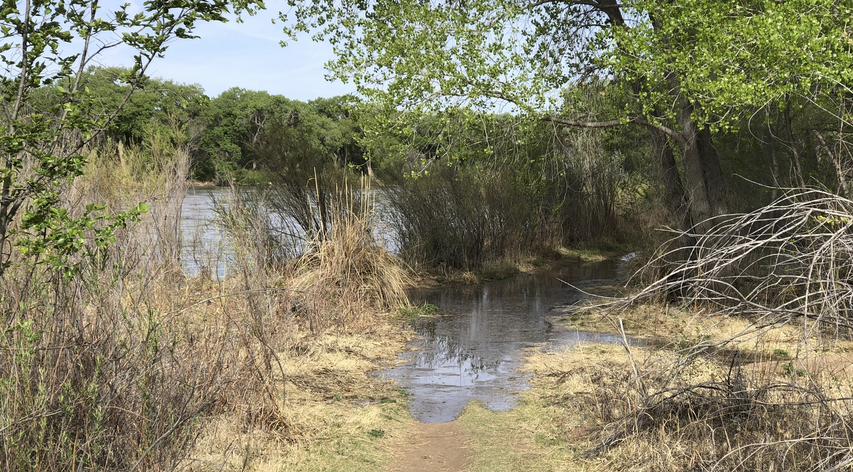
Rio Grande overbanking May 3, 2023 finally topped my little bike trail north of Albuquerque’s Central Avenue Bridge. ~4k cubic feet per second. Photo credit: John Fleck/InkStain

Click the link to read the article on the InkStain website (John Fleck):

We have a chance this year to watch a fascinating intersection of climate-change driven changes in the Rio Grande through Albuquerque as filtered through both physical infrastructure and what we call the “institutional hydrograph”.

THE TL;DR

Dust on snow is likely to accelerate Rio Grande headwaters snowmelt, meaning all that stored water comes off earlier. With nowhere to store it (see below, it’s an issue of both rules and physical infrastructure problems), we’ll be operating this year in a run-of-the-river situation on the middle Rio Grande through Albuquerque. Even though there’s still a lot of snow right now, once it comes off we’ll be down to base flow on the Rio Grande. Absent good summer rains, the river could dry through Albuquerque again this year.

DUST ON SNOW

The driver is a phenomenon researchers have identified in the past two decades called “dust on snow“. It’s when dry spring winds sweep across the arid uplands of, in our case, the Colorado Plateau, kicking up a layer or layers of dust that is then deposited atop the mountain snows in the high country. You can get multiple dust  layers, and when the melt reaches them, the snow warms up and melts quicker. There’s a climate change connection to all of this, as hotter, drier springs seem to lead to more dust (which makes intuitive sense, and is discussed in Painter, Thomas H. et al. “Response of Colorado River runoff to dust radiative forcing in snow.” Proceedings of the National Academy of Sciences 107 (2010): 17125 – 17130.

We’ve got that going on this year in the Rio Grande headwaters. From this morning’s Downtown Albuquerque News:

THE PHYSICAL PLUMBING: EL VADO DAM

In the “before times” (before the creation of the Middle Rio Grande Conservancy District in the early 20th century, which led to the construction of El Vado Dam) communities in New Mexico’s Middle Rio Grande depended on the run of the river. When the runoff dwindled in the summer, they couldn’t irrigate. (This is part of the reasoning behind our argument in the new book that claims that there once were ~125,000 acres irrigated in the Middle Valley are not credible.) Construction of El Vado allowed communities to do the classic “dams move water in time” thing – store some of the big spring peak and stretch it out through summer.

El Vado Dam and Reservoir. Photo credit: USBR

El Vado is busted, though, unusable while it undergoes repairs. As Dani Prokop reported last month, the repairs are dragging:

That means no storage (other than a little bit in Abiquiu Reservoir for Native American communities) for irrigators, which means that once the snow is melted, the river will dwindle.

THE INSTITUTIONAL PLUMBING: ARTICLE VI

Even if El Vado wasn’t broken, though, we’d sorta be in the same bind thanks to Article VI of the Rio Grande compact, which says….

New Mexico’s compact debt to Texas – the net we’ve underdelivered in recent years – is 93,000 acre feet. So even if El Vado wasn’t broken, any water we were able to store up to 93,000 acre feet would have to stay there. (This is why the Middle Rio Grande Conservancy District has reduced its diversions this year to 80 percent of what the district otherwise be sending down its canals – to get more of that water to Elephant Butte Reservoir, to try to reduce compact debt, so they can usefully store water once El Vado is fixed. This is a whole other blog post, because the discourse around this has been fascinating as I do the “embedded writer” thing at MRGCD for my book research.)

HYDROLOGY IN THE 21ST CENTURY: UNDERSTANDING THE RULES

I was down at the Rio Grande yesterday morning to record an interview about western water stuff with a crew from Italian public television. (The were neat! It was fun!) A bosque walker asked what we were doing and Luca, the TV guy, explained that they were interviewing the professor (pointing to me). The woman asked if I was a hydrologist. No, I replied, I do water policy.

That’s the thing. To understand the flow in the river we were standing next to, you need to understand the physical science – climate, hydrology, and such. But then, crucially, you needs to think about how the actual wet water is filter through the system’s human-built physical plumbing, which then requires understanding who it all is filtered through the rules.

A NOTE ON SOURCES, METHODS, AND BUSINESS MODELS

At this point in a post like this, I often drop in a thanks to my supporters, who make this work possible, including the Utton Center and Inkstain’s contributors. But I’d also point you to the linked information sources above – Downtown Albuquerque News is subscription-supported and one of my favorite local news reads, and Source NM (Dani Prokop’s employer – she’s doing great water stuff, invaluable to the community). Information is a public good, and as my economist friends like to point out, because of the free rider problem, public goods are under-provided.
Mountain lion kill sites give vegetation a boost, new study shows: Researchers examined soil samples and plant growth at hundreds of carcass sites to find connections with landscape health — @WyoFile

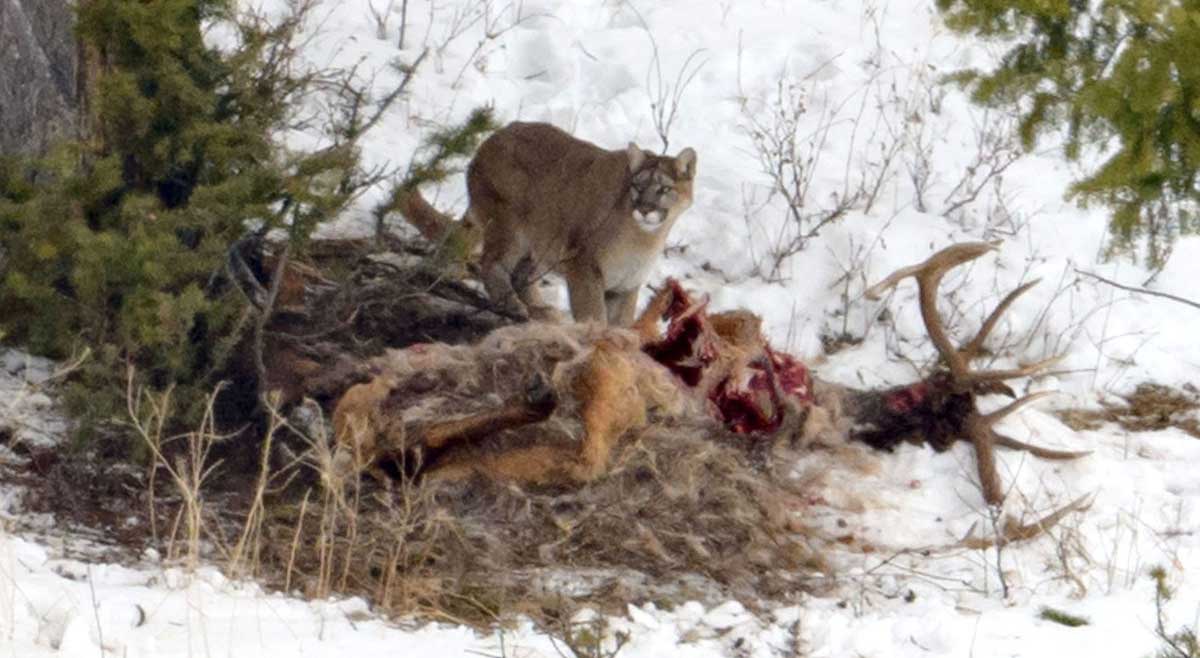
A mountain lion feasting on a bull elk on the National Elk Refuge. Photo credit: Rocky Mountain Elk Foundation

Click the link to read the article on the WyoFile website (Christine Peterson):

One day about a decade ago, professional tracker and cougar researcher Michelle Peziol took a group of graduate students from Teton Science School on a walk through an aspen grove near Jackson. GPS in hand, Peziol led the class to an area where a collared mountain lion had been spending time. 

As the bright sun illuminated the early summer grass at the site, Peziol noticed an almost perfect circle of darker-green grass. She looked around. Nothing obvious would have caused the grass in that precise location to be richer and more robust. Then she remembered: A lion had killed a deer in that spot the prior year. Could the remains of that deer kill have fertilized the soil? 

Ten years later, Peziol and four other researchers published the answer: Yes, it could. 

A new paper in the journal Springer Nature outlines how mountain lions in the Tetons create areas with more protein-rich grasses that nourish big game when the leftovers of carcasses they kill and consume decompose. Lion researcher Mark Elbroch calls it a version of “gardening to hunt,” but to Wyoming Game and Fish large carnivore section supervisor, Dan Thompson, the results further illustrate just how connected every species — from lions to deer to beetles to grass — are to one another. 

“As far as mountain lion management, [this research] reinforces their role in the ecosystem,” Thompson said. “It’s important because we’re one of the few places in North America where it’s still occurring like it used to.” 

As hunters and outfitters fret about predators killing big game like mule deer after a particularly harsh winter, researchers say projects like this highlight how much more there is to learn from the role each species — predators included — play on the landscape. 

Killing, eating and stealing

Each of Wyoming’s large carnivores come with a buffet of preconceived notions about how it kills, what it eats and its role on the mountains and plains of Wyoming. Some generalities prove true: Wolves tend to kill in packs while mountain lions and grizzly bears, for example, are solo hunters. But while many assume the large predators kill and eat only live, big game, science is increasingly proving otherwise. 

Groups like the Interagency Grizzly Bear Study Team show grizzly bears eat more than 260 species within four animal kingdoms, including ants, moths, elk, bison, 175 types of plants and one species of algae. Wolves, meanwhile, eat primarily elk, deer, a whole host of small animals like rabbits and beaver and sometimes even berries. Mountain lions, often viewed as the most likely to stalk and kill a deer or elk wandering through the woods, will just as readily stalk a raccoon, a goose or a skunk. And depending on the area, up to 20% of a mountain lion’s diet consists of already-dead critters they happened upon, Thompson said.  

Of the meals that lions kill, they share (often not willingly) with hundreds of other species on the landscape. 

“Everything from weird things like flying squirrels and mice to the usual suspects, like bears and eagles and turkey vultures,” said Elbroch, one of the paper’s co-authors and the Puma Program director for Panthera, a global wild cat conservation organization. “What that really speaks to is how energy moves in the system and how it strengthens an ecosystem by creating all these new links and food webs.”

This doesn’t mean cougars kill game and simply move along, Thompson said. Lions will eat as much as they can. 

“There’s no evolutionary benefit of killing for fun,” Thompson said. “There’s no benefit in wasting food.”

But the research shows that even goopy bits of carcasses that seep into the earth before they are consumed can produce surprising results years later. After years of mapping GPS location data and collecting soil samples, Peziol’s team began to piece together a picture of how those carcasses influence the quality of the soil itself. 

Connections from the ground up

Finding answers to big ecological questions requires more than a field season or two, Peziol said. It takes years of collecting information from the same locations and, in the case of this study, returning to the University of Washington with a U-Haul full of dirt. 

Once Peziol and Elbroch decided to investigate the connections between lions and vegetation, Peziol began the long process of collecting thousands of samples from the Wyoming mountains. 

The work began with lion collars, which sent location points to a satellite every one to two hours. If a lion stayed in a location for more than four hours, it could mean it was eating or napping. So Peziol started trekking to those locations to find out. If it had killed and cached an animal, Peziol took soil samples from directly underneath the carcass as well as 10 feet away in areas with the same conditions like sunlight and slope. 

She repeated the process every three months for a year, then twice a year for three years. When vegetation began to grow at the carcass site, she plucked samples of those plants and samples from the same nearby species, again growing in similar conditions. 

A U-Haul of dirt, thousands of individual samples and 13 undergraduate students analyzing soil and plant quality later, she could prove that plants growing where carcasses decomposed had higher quantities of protein. 

While the same benefits may arrive from species hunted by humans — if the carcasses remain in the woods and aren’t schlepped to a landfill — the lion affected areas tended to be located in certain zones where mountain lions preferred to hunt. 

That means pockets of better-quality vegetation proliferate in select areas on the landscape, Elbroch said, potentially drawing even more big game to those areas. 

“To use trendy science language, we were able to definitively show that mountain lions were ecosystem engineers, and that they were creating habitat for other species,” Elbroch said.

However, knowing if, in fact, deer and elk return to those areas because of the better vegetation would entail more research not of lions, but of deer and elk themselves. 

The study results remind Thompson of migrating salmon and how their decomposing bodies change water pH and add to soil nutrients, which then boosts vegetation growth that attracts more grazing animals that then bring more predators. 

“It’s more than lions killing deer,” Thompson said. “It’s very easy to try to simplify the reality of what’s happening on the landscape, and by doing so we don’t give credit to these very intricately woven natural occurrences happening around us.”Tagged:WyoFile App

Christine Peterson has covered science, the environment and outdoor recreation in Wyoming for more than a decade for various publications including the Casper Star-Tribune, National Geographic and Outdoor… More by Christine Peterson