
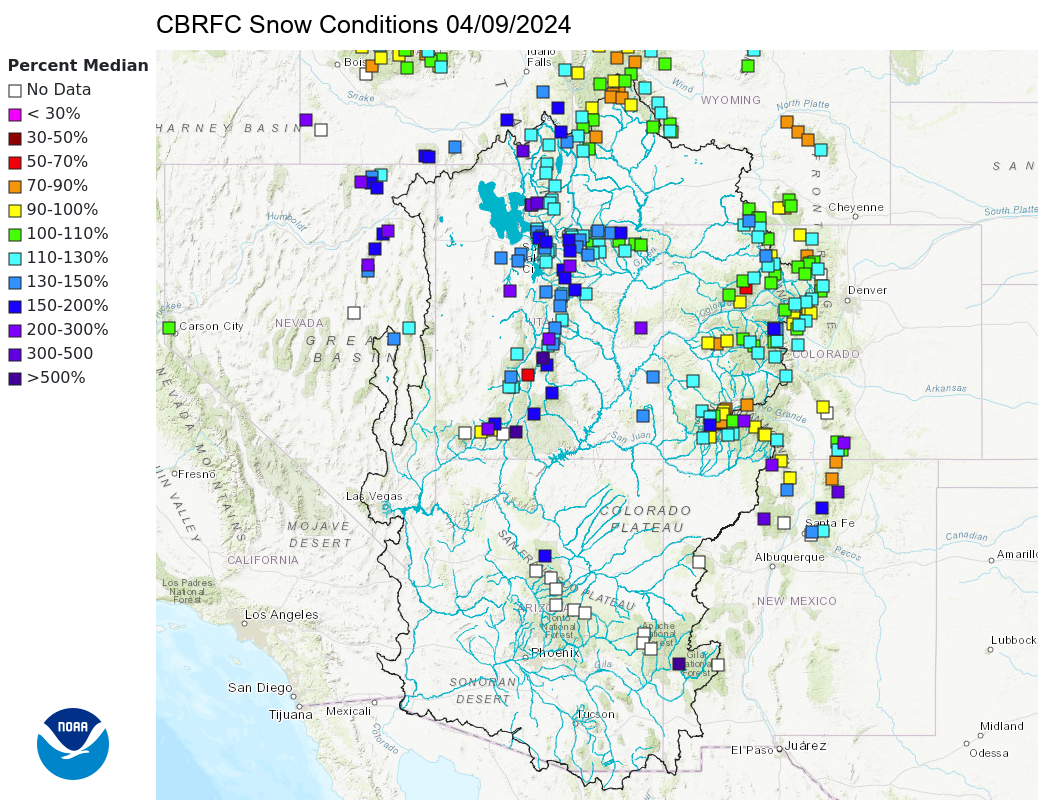
Click the link to read the article on The Salt Lake Tribune website (Anastasia Hufham). Here’s an excerpt:
April 8, 2024
The National Weather Service Colorado Basin River Forecast Center on Friday estimated that Lake Powell will receive 5.7 million acre-feet of water between April and July as snow melts off the mountains…That volume is 89% of the normal runoff for that time period recorded between 1991 and 2020…
Three factors determine how much water ends up in Lake Powell: the amount of snowpack on Western mountains, spring temperatures (warmer weather can cause snow to melt faster) and soil moisture (dry soil absorbs melting snow, leaving less water for reservoirs)…Snowpack jumped in March throughout the Upper Colorado River Basin, the portion of the river basin that lies above Lake Powell and includes Colorado, New Mexico, Utah and Wyoming…

Last month, the Upper Basin saw 130% of average precipitation, bringing precipitation above Lake Powell to 102% of average for October 2023 through March 2024. But an above-average year for snow doesn’t guarantee an above-average runoff, given the forecast of warm spring temperatures and dry soil conditions. Right now, forecasters say, soil moisture across the entire Colorado River Basin — which includes Arizona, California and Nevada as the Lower Basin — is close to below normal. Soil moisture is better in the Upper Basin than in the Lower Basin. When forecasting how much water Lake Powell will get, hydrologists release three possible scenarios. On Friday, forecasters reported that there is a 10% chance that the reservoir could receive as much as 8.3 million acre-feet of water or more from April through July. In a drier scenario, there is a 10% chance that runoff could drop to 4.4 million acre-feet of water or below. The most likely case is that Lake Powell sees about 5.7 million acre-feet of water.