For the last couple of decades, water managers in southern Nevada have promoted a plethora of conservation measures, from fixing leaks in the vast system of pipes snaking beneath Las Vegas to encouraging reduced-flow faucets to banning ornamental turf. Golf courses are irrigated with treated wastewater, and water-gulping swamp coolers are discouraged. All this has helped Nevada stay within tight limits on how much it can draw from the Colorado River, bringing per capita consumption down to just over 100 gallons per day — about one-fourth of what it was in 1991.
But the sacrifices aren’t shared equally. A few miles off the Las Vegas Strip, for example, on the far edge of a golf course and residential development, sits a cluster of red-tile-roofed buildings. With its athletic club, tennis court, pool, lawns and grandiose structures, you might mistake it for a small private college or exclusive resort. In fact, this complex is a single-family residence that belonged to the Sultan of Brunei until November of last year, when a company associated with tech-company founder Jeffrey Berns paid $25 million for it. The home, if you can call it that, is also Las Vegas’ largest water user, guzzling 13 million gallons in 2022 — more than 300 times what the average resident consumes. Run down the list of the Las Vegas Valley Water District’s top 100 users, and you’ll see more of the same: While most residents are increasingly thrifty with their water, a select few — often associated with multimilliondollar homes — are binging on the stuff.
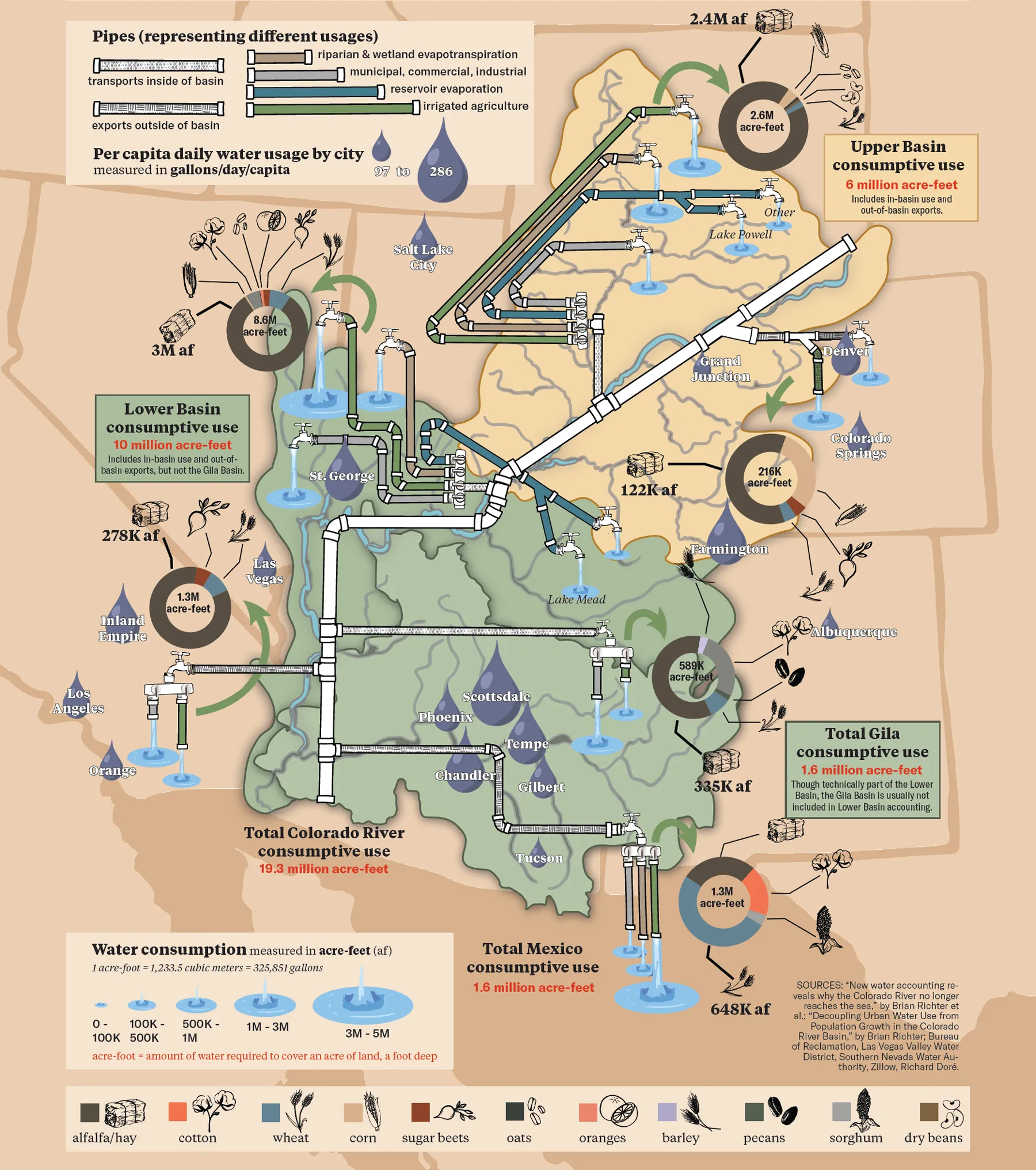
Call it water inequality, or the growing disparity in water consumption across the Colorado River Basin. Agriculture uses far more water than cities, and some crops are thirstier than others; Scottsdale’s per capita consumption is nine times that of Tucson’s; California’s Imperial Irrigation District pulls about 10 times more water from the river than all of Nevada; and the Sultan of Brunei’s Las Vegas estate sucks up 35,000 gallons each day. Meanwhile, nearly one-third of the Navajo Nation’s households lack running water altogether, and residents there use as little as 10 gallons daily.
This article appeared in the June 2024 print edition of the magazine with the headline “Water inequality on the Colorado River.”
Rebecca Mitchell, John Entsminger, Estevan Lopez, Gene Shawcroft, JB Hamby, Tom Buschatzke at the Getches-Wilkinson Center/Water and Tribes Initiative Conference June 6, 2024. Photo credit: Rebecca Mitchell
Click the link to read the article on the Colorado Politics website (Marianne Goodland). Here’s an excerpt:
June 7, 2024
An unprecedented public appearance by six of the seven commissioners who are negotiating the future of the Colorado River revealed how divided they are on solutions, and just as importantly, where they agree. The commissioners and state representatives spoke at Thursday’s 2024 Getches-Wilkinson conference on the Colorado River at University of Colorado Boulder’s law school. The commissioners showed up together at a critical juncture — they are in the thick of the talks to come up with an agreement that would manage allocations and ensure that America’s two largest reservoirs, both located in the Southwest, don’t fall below critical water levels. In addition, the negotiations are geared toward protecting the health of the river, which 40 million residents across several states rely on for drinking water. That agreement is supposed to be in place starting in 2027.
One of their more striking differences is in just what defines the health of the Colorado River system. The proposal submitted to the Bureau of Reclamation in March by the Lower Basin states wants to judge that health based on seven reservoirs in the system. In addition to Lake Powell and Lake Mead, that also includes Flaming Gorge in Utah, Blue Mesa in Colorado, and Navajo, which straddles the Colorado-New Mexico borders. The Upper Basin states of Colorado, Wyoming, New Mexico and Utah want that health judged only on the two largest reservoirs — Powell and Mead, both directly on the Colorado River.
Climate change is a real bummer for mountain streams — it depletes the groundwater that feed creeks and rivers and makes them dirtier, besides. That’s the grim conclusion one reaches after reading two recently published papers. Let’s take them one at a time:
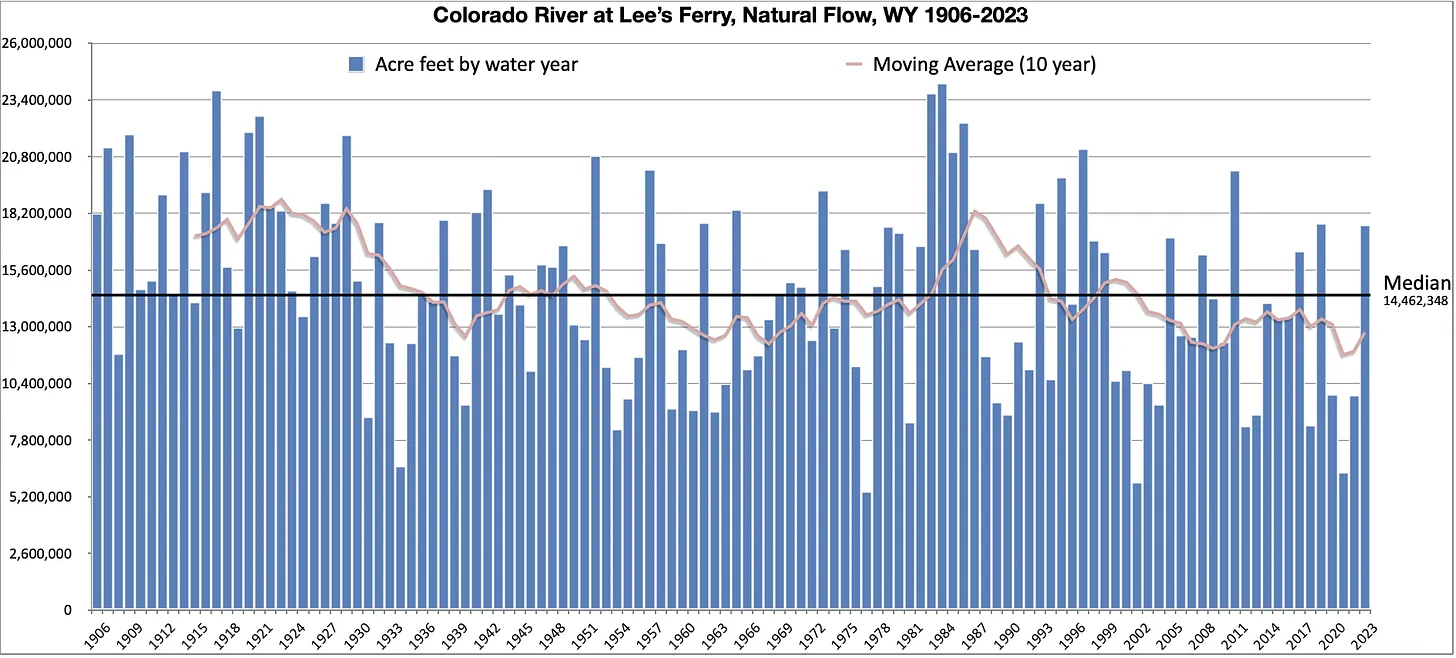
The Colorado River region is in the grips of the most severe, multi-decadal drought in over a millennium. The most obvious signs of this are declining streamflows across the region. But these declines, the authors of the paper point out, “cannot be explained solely by lower precipitation.” In 2021, for example, the Upper Colorado River Basin received about 80% of the normal snowfall. But the river’s unregulated flow into Lake Powell was just 30% of normal — indicating that some of that snow was going missing somewhere along the line.
Some of the vanishing act can be attributed to sublimation, or the direct conversion of snow to water vapor, skipping the in-between liquid state (so the snow evaporates into the atmosphere rather than into streams). Climate change-exacerbated warming temperatures and dust-on-snow (and the resulting decrease in albedo) can increase sublimation. But researchers suspected something else was also at play here, namely changes in groundwater storage.
Scientists have long assumed that groundwater didn’t play a significant role in streamflows in mountainous regions because the geology didn’t support large underground storage. But newer research suggests that networks of fractures in crystalline and metamorphic rock can store more water at greater depths than previously believed. Perhaps that was what was stealing the water?
The researchers focused their investigation on the drainage of the East River, a stream that flows from the mountains above Crested Butte, Colorado, and on whose banks the Rocky Mountain Biological Laboratory sits. They used a high-resolution hydrological model that maps what’s going on 400 meters underground.
The East River Valley, northwest of the historic town of Gothic, home to the Rocky Mountain Biological Laboratory. The mountain with the pointed peak in the distance is Mount Crested Butte. Photo credit: Mark Stone/University of Washington
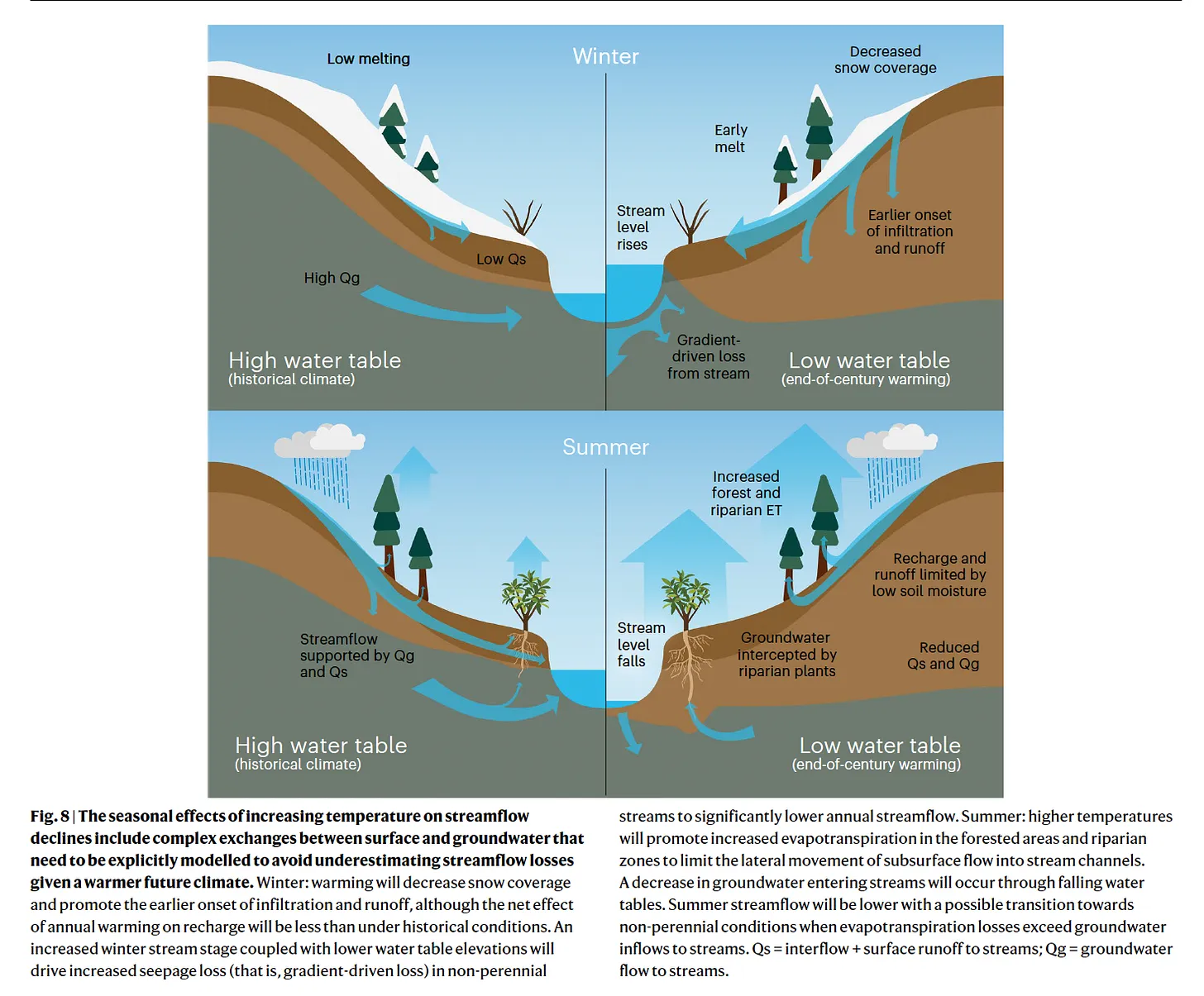
They found that, normally, groundwater storage can help stabilize streamflows during fluctuations between wet and dry years. Big snow recharges the aquifer, and the aquifer bolsters stream flows during droughts. But modeling shows that after just one extremely dry year, the groundwater storage does not recover, even after subsequent wet years. Higher temperatures, meanwhile, increase vegetation’s evapotranspiration — or consumption of groundwater — which further diminishes groundwater storage recharge. Wintertime snowmelt actually increases groundwater recharge during the winter and early spring, but in doing so, steals water that would otherwise go to streamflow.
So, yeah, not only does global warming diminish the snowpack, it also depletes groundwater storage, which ultimately leads to reduced Colorado River flows and more tension and conflict over how to divide up what little water — that could be contaminated with metals (see below) — remains. I’d recommend reading the whole paper, since my summary really doesn’t do it justice. It has interesting insights into how mountain hydrology works. Here’s a diagram from the paper giving a good overview of the phenomenon:
As if that wasn’t bad enough, now we learn that those depleted streams are also getting dirtier. That is, concentrations of potentially toxic metals are increasing in mountain streams. And, yes, it’s thanks to human-caused climate change (though the metal-loading itself isn’t necessarily human-caused).
It’s important to note that this paper focuses on acid rock drainage as opposed to acid mine drainage. Both phenomena work the same: Water and oxygen react with sulfide minerals, usually pyrite, to form sulfuric acid. The acid then dissolves other minerals and “loads” the water with those metals, such as lead, copper, aluminum, arsenic, cadmium, and zinc — each of which can harm aquatic life in high concentrations. Acid rock drainage is the more overarching term, but generally refers to this reaction occurring naturally. Acid mine drainage is when mining catalyzes or exacerbates the phenomenon by introducing subterranean minerals to oxygen and water.
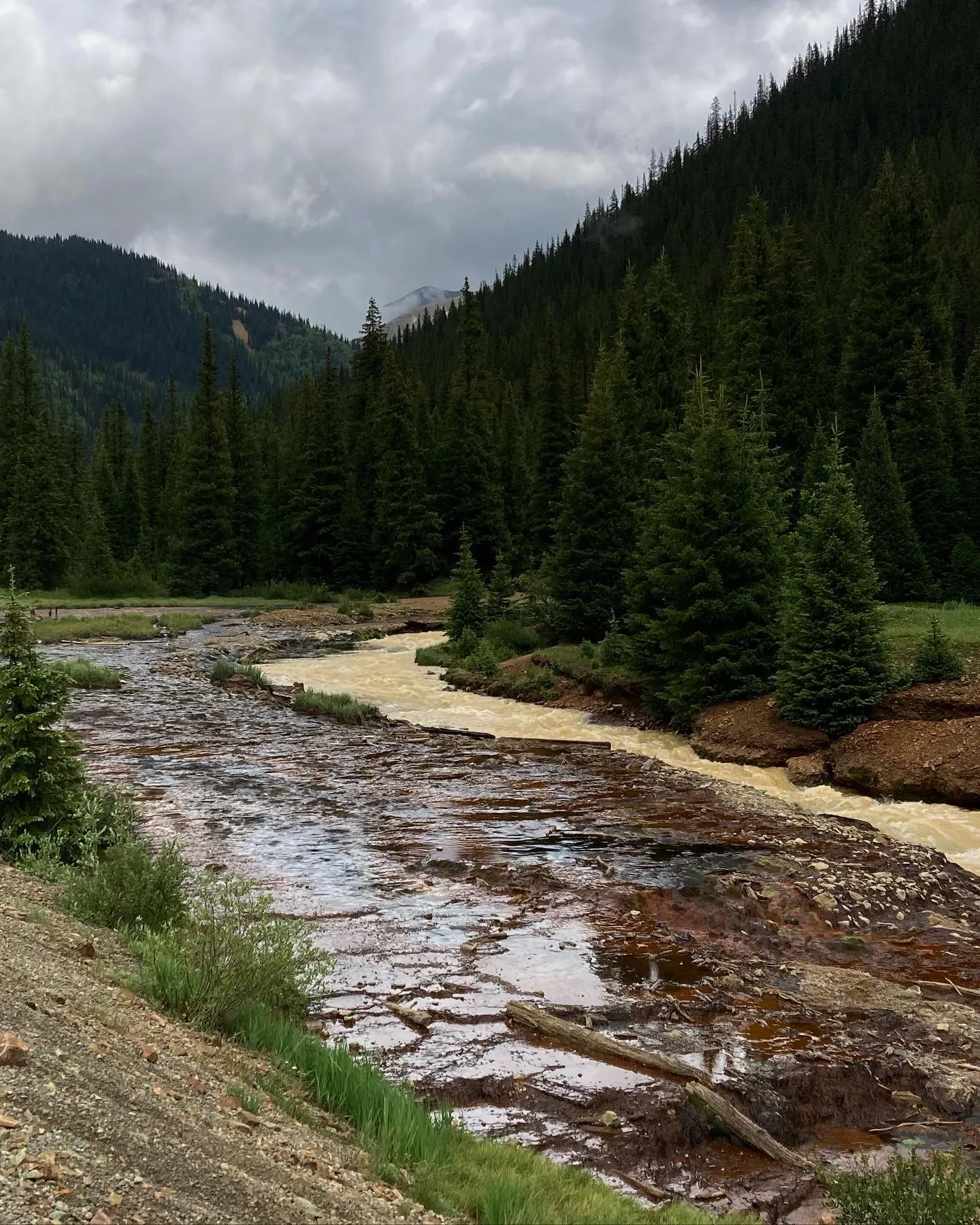
Cement Creek and an iron fen above Silverton, Colorado. Cement Creek is affected by both natural acid rock drainage and human-caused acid mine drainage. Jonathan P. Thompson photo.
An analysis of 40 years of water chemistry from 22 mineralized watersheds across Colorado found that sulfate, zinc, and copper concentrations were increasing by about 2% per year average — and have nearly doubled over the last 30 years. Some of this may be due to declining streamflows, which carry less water to dilute the metals. But the researchers found that load — or the amount of metals in the water — is also increasing, and is on average “at least an equal contributor” as the dilution effect. They also found that loads began climbing more dramatically beginning in 2000, when the current mega-drought kicked in.
And there appears to be a correlation between the mean annual air temperature, or MAAT, and the acid mine drainage load and concentration. This led researchers to theorize that warming temperatures are melting previously frozen ground, opening up new pathways for oxygenated groundwater flow (in the same way that mining does), which in turn leads to more formation of acid rock drainage. Similarly, declining groundwater storage could lower water tables, exposing more subterranean sulfides and minerals to oxygen, thus increasing groundwater acidity and metal loading.
The authors conclude: “Our correlation analysis therefore points to accelerating sulfide weathering rates from melting of frozen ground as perhaps the most important driving mechanism for observed regional increases in concentration and load at acidic sites.”
📖 Reading Room 🧐
In my teens and early twenties, I made a nearly annual springtime pilgrimage from Durango or Santa Fe to the Tucson area for some sunshine and desert time. One of my favorite things to do while there was to hike up Mt. Wrightson. The trailhead is at around 5,000 feet in elevation in the lush, jungle-like Madera Canyon, itself a stark contrast to the blazing cacti and scrub-smattered lowlands nearby. The well-worn trail takes you through a variety of eco-zones before topping out on the 9,456-foot summit where, inevitably, there would be snow. And, yes, I know that it’s weird to hike back to the high country climate while on an escape from the same, but it’s different when at the end of the day I’d be sitting in an open air cafe under a brilliant bougainvillea.
Wrightson is in the Santa Rita Mountains, one of dozens of Madrean Sky Islands, or wildly biodiverse mountain ranges in southern Arizona and northern Mexico. The Arizona Republic’s Brandon Loomis has a good and heartbreaking story about how the Sky Islands are threatened by climate change, development, and a new mining boom — especially to extract so-called “green metals” such as manganese, which is used in electric vehicle batteries.
⛏️ Mining Monitor ⛏️
Defunct uranium mines and waste rock above the San Miguel River near the former townsite of Uravan in western Colorado. Jonathan P. Thompson photo.
Maybe uranium’s too hot to handle? In March we reported that Sassy Gold was set to acquire 345 uranium mining claims on 8,206 acres in La Sal Creek, the Lisbon Valley, the Uravan Mineral Belt, and on the San Rafael Swell from Kimmerle Mining and its associated firm, Three Step Partnership, both of Moab. Now Sassy is retracting its offer, saying it “identified a number of material political, environmental and technical risks associated with the properties” that “fundamentally altered the value of the proposed transaction.” You don’t say?
***
Congress continues to push legislation that would “reform” the 1872 General Mining Law. Good news, right? Wrong. These lawmakers — which include both Democrats and Republicans from mining-heavy states — are looking to codify an older interpretation of the law allowing mining companies to dump waste rock or mill tailings on federal mining claims that are not valid, i.e. they don’t contain minerals of proven value. The bill passed the House and is now working its way through the Senate. Inside Climate News has more on that.
Meanwhile, efforts to actuallyreform the 152-year-old law to make it less of a giveaway to corporations appear to be at a standstill.