One year ago, the Supreme Court issued its sweeping decision in the case Sackett v. EPA, which invalidated federal Clean Water Act protections for most streams and wetlands in the United States. Since then, the fight for clean water protections has been at the state level. This report outlines the state of clean water protections one year out from the Sackett decision and why federal protections for our critical waters is vital in the face of worsening climate change and other threats.
In the year since the Supreme Court ruling, two states passed or introduced legislation to create new permitting programs to fill the gap in federal protections and eight states passed or introduced stronger laws and policies to strengthen state protections. Two states passed legislation weakening state-level protections, while efforts to weaken state protections failed in four other states.
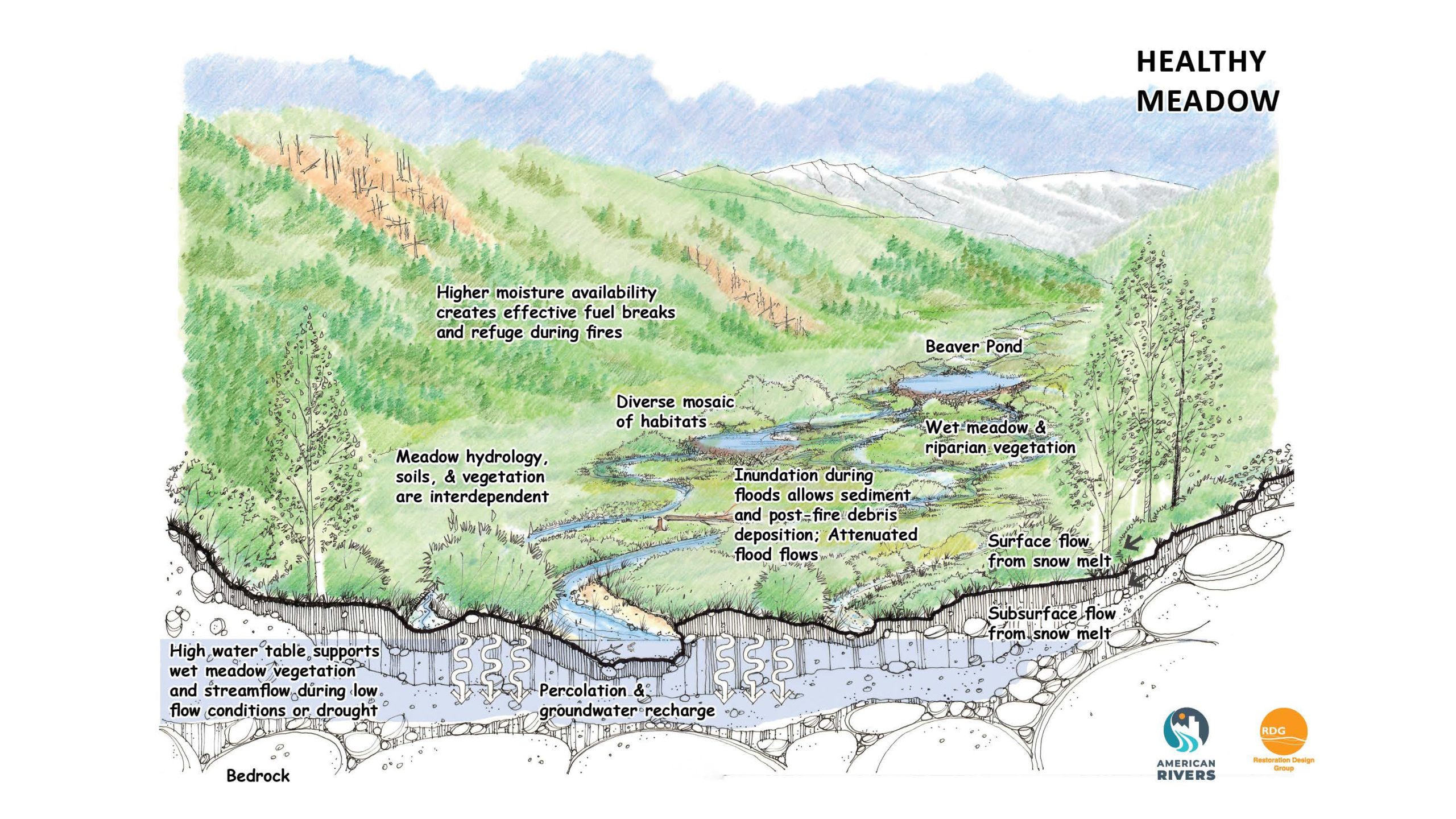
Healthy mountain meadows and wetlands are characteristic of healthy headwater systems and provide a variety of ecosystem services, or benefits that humans, wildlife, rivers and surrounding ecosystems rely on. The complex of wetlands and connected floodplains found in intact headwater systems can slow runoff and attenuate flood flows, creating better downstream conditions, trapping sediment to improve downstream water quality, and allowing groundwater recharge. These systems can also serve as a fire break and refuge during wildfire, can sequester carbon in the floodplain, and provide essential habitat for wildlife. Graphic by Restoration Design Group, courtesy of American Rivers
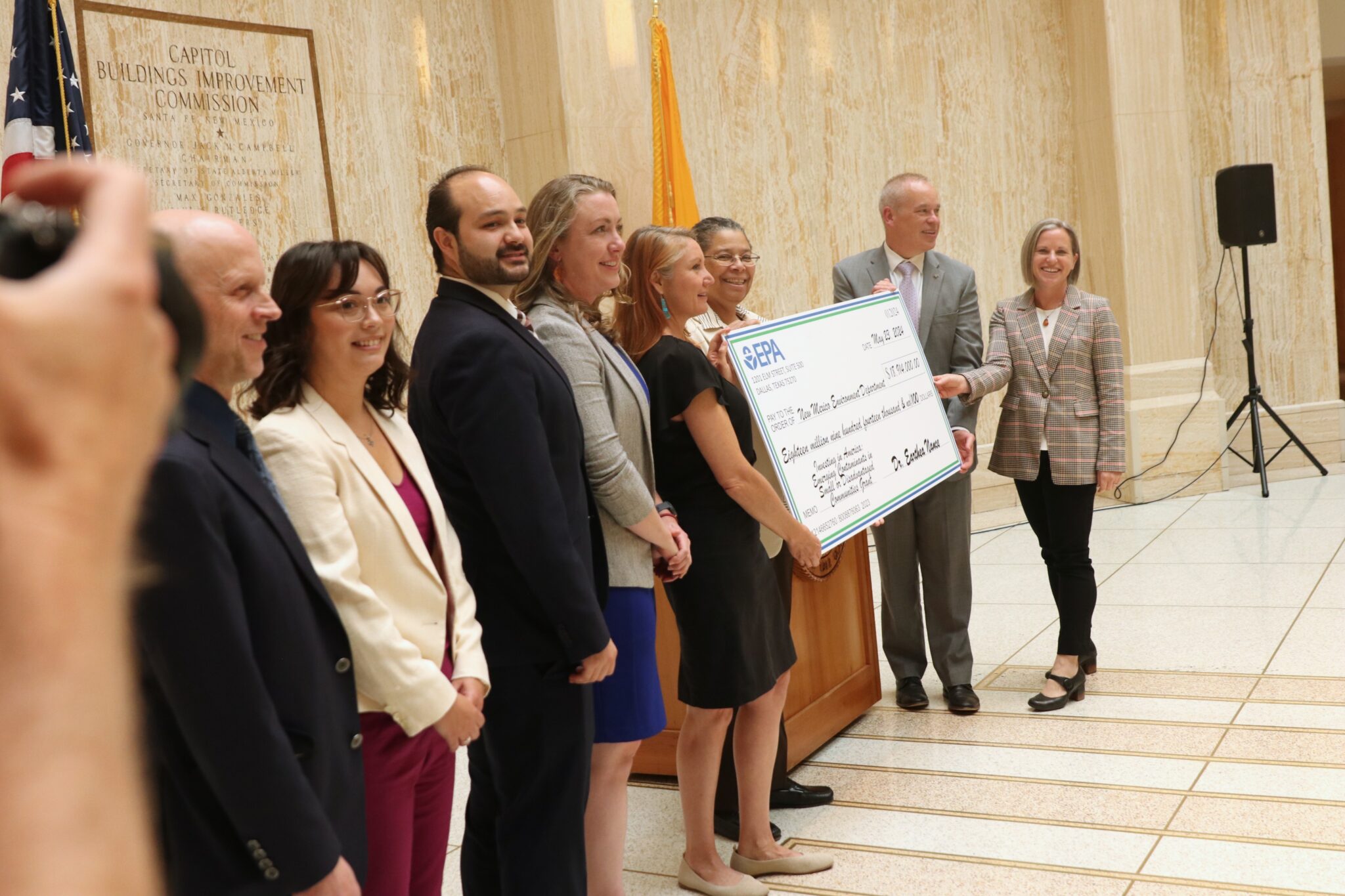
Staff from New Mexico’s Congressional Delegation, Rep. Melanie Stansbury, and U.S. Environmental Protection Agency Region 6 Director Earthea Nance present New Mexico Environment Department Secretary James Kenney, and Rebecca Roose, the infrastructure advisor to the governor, with an $18.9 million dollar check for ‘forever chemical’ detection on Thursday, May 23, 2024 at the Roundhouse rotunda. (Danielle Prokop / Source NM)
Federal grant is authorized in two-year chunks, NM Environment Department aims to pull more than $47M for PFAS detection and clean-up over the next five years.
Big check energy at the Roundhouse.
National and state environmental officials celebrated a $18.9 million federal grant for most of New Mexico’s water systems to use over the next two years to detect “forever chemicals,” in the state’s drinking water.
State officials say they hope to pull down a total of $47.2 million in the next five years in additional rounds of federal grants. The first two years will focus on detection and subsequent phases will address removal of Per-and polyfluoroalkyl substance (PFAS for short) in drinking water.
More than 496 systems serving 231,000 New Mexicans are eligible for the funding, state officials said.
A check of this size will help the state “fund its way” out of pollution, said New Mexico Environment Secretary James Kenney from the Roundhouse Rotunda.
“These forever chemicals will not be a forever legacy. We will address these chemicals and New Mexico will be the leader in the way we do that,” he said.
What are PFAS?
This class of synthetic chemicals are ubiquitous, present in the blood of most people in the U.S. They are toxic and extremely hard to break down. There are nearly 15,000 types of these chemicals, according to the U.S. Environmental Protection Agency.
Their resistance to breaking down in sunlight, water, oil and fire over time makes them useful in fabrics, nonstick cookware, food packaging, in our carpets, clothes and firefighting foam. It also means they build up in our bodies, linked to cancer, heart and liver problems, developmental damage, vaccine resistance and other health issues.
Despite decades of rising concern about the dangers of these chemicals, the EPA only implemented drinking water limits for only the five most-common, releasing the final rule in April 2024.
These drinking water limits for the two most-studied and common chemicals – PFOA and PFOS – is 4 parts per trillion, the lowest limit the EPA believes to be technologically possible. The new rule requires water systems to be compliant by 2029.
The size of the problem will require billions of dollars in spending, with an estimated cost of $1.5 billion to implement the drinking water rules.
And that’s just the low estimate. The U.S. military estimated PFAS clean-up just on military bases and surrounding communities to be at least $31 billion.
New Mexico context
As the nation grapples with the reality of these contaminants’ omnipresence – in rainwater, in our bodies, in animals – New Mexico water systems are already struggling.
In 2021, the environment department found PFAS in at least 15 water systems in New Mexico, according to tests performed with federal assistance.
The most impacted communities are in Curry County and Otero County, according to that data. That’s also where PFAS plumes from firefighting foam infiltrated the groundwater for decades next to military bases. The state tested more than three dozen cities and water systems for 28 compounds. Only five compounds are subject to the proposed limits.
Firefighting foam containing PFAS chemicals is responsible for contamination in Fountain Valley. Photo via USAF Air Combat Command
A Clovis dairy had to euthanize more than 3,600 cows after Cannon Air Force base contaminated water sources infiltrated wells on the dairy.
Rep. Melanie Stansbury described hearing about the moment, saying that the disaster made PFAS not just an economic issue, but a personal one for New Mexico.”
“It’s a big day for New Mexico. it’s a big day for families, it’s a big day for ranchers, and it’s a big day in our fight to really tackle the chemical contaminants that affect our communities,” Stansbury said.
Rebecca Roose, acting as the infrastructure czar in the governor’s office said addressing PFAS is part of a larger plan to address water scarcity in the arid state.
“When we talk about our water being polluted and contaminated and not safe, there’s few things we take more seriously than that,” Roose said. “Perhaps right up there with it is protecting the water so that it never becomes polluted, contaminated or unsafe, because there is not a drop of water to spare.”
The federal grant is funded from the 2021 Bipartisan Infrastructure Act, which contained at least $9 billion earmarked for addressing PFAS contamination.
This is the first grant of its kind in the region, said Earthea Nance, who oversees EPA Region 6, which includes Texas, Louisiana, Oklahoma and New Mexico.
Nance said there are no set plans for enforcement for holding PFAS polluters accountable in Region 6, but said that could change with more information.
“I don’t want to say no, because we mean, tomorrow, we could start putting a plan together,” she said.
Nance said the EPA Region 6 office is relying on state officials to help determine how large the enforcement response will be.
“Because we’re giving this money to the state of (New) Mexico, some of that will fall on them in terms of assessing the situation so that we can then figure out how to identify enforcement issues,” Nance said.
EPA R6 Director Earthea Nance, right, sits with NMED Secretary James Kenney at Thursday, May 23, 2024 event in the rotunda. (Danielle Prokop / Source NM)
How does the program work?
The grant has the unwieldy name; Emerging Contaminants in Small or Disadvantaged Communities Program (EC-SDC). Name aside, it will allow for New Mexico’s environment leaders to spend up to $18.9 million over the next two years.
The program’s first phase will oversee water sampling, creating a statewide database and outreach to water systems, according to environment department officials.
Public water systems with 10,000 or fewer connections, or communities where the median household income falls between $56,828 – $75,770 are eligible to opt in, using this form.
“The great thing about this grant is we will be hiring and controlling a lot of the contract work and actually implementing it, which does take a little bit of a relief off the water systems,” said Kelsey Rader, the deputy division director for Water Protection with the state.
Rader said further federal money, two years from now, would offer more than testing, but also water treatment.
“That’s what’s really special about this grant is that it covers everything from the testing, from the design to the actual remediation, in paying for the necessary upgrades,” she said.
When asked if the $18.9 million is close to addressing the scope of PFAS in New Mexican’s water systems, Rader said the department doesn’t have a date set on when they’ll be able to test every New Mexico system.
“It’s difficult to say when that’s going to happen,” she said.
More work to do
Kenney said the state is still working to address current contamination, noting the environment department recently sent a letter asking for the federal government to commit to clean up water surrounding the Cannon Air Force base, not just beneath it.
A contentious court fight continues on, as the New Mexico Environment Department is still attempting to require the U.S. Air Force to follow state testing and treatment protocols over contamination at Cannon Air Force base. The case has stretched on for years in federal district court and now is in the 10th Circuit Appeals Courts.
The state is currently in mediation with the U.S. Air Force over the litigation and has been for over a year, said Bruce Baizel, the compliance and enforcement director for the environment department. The parties just extended that mediation period through late June.
The $18.9 million for clean-up would go farther, if people’s contact with PFAS in everyday items were reduced, said Kenney.
“In our legislative session, I’d like to see a bill introduced that bans PFAS but for essential uses, like medical devices,” he said. “But if given the choice of having a toxic chemical in your house that then becomes a toxic chemical in your body, I would choose not to have it in my house, or my body.”
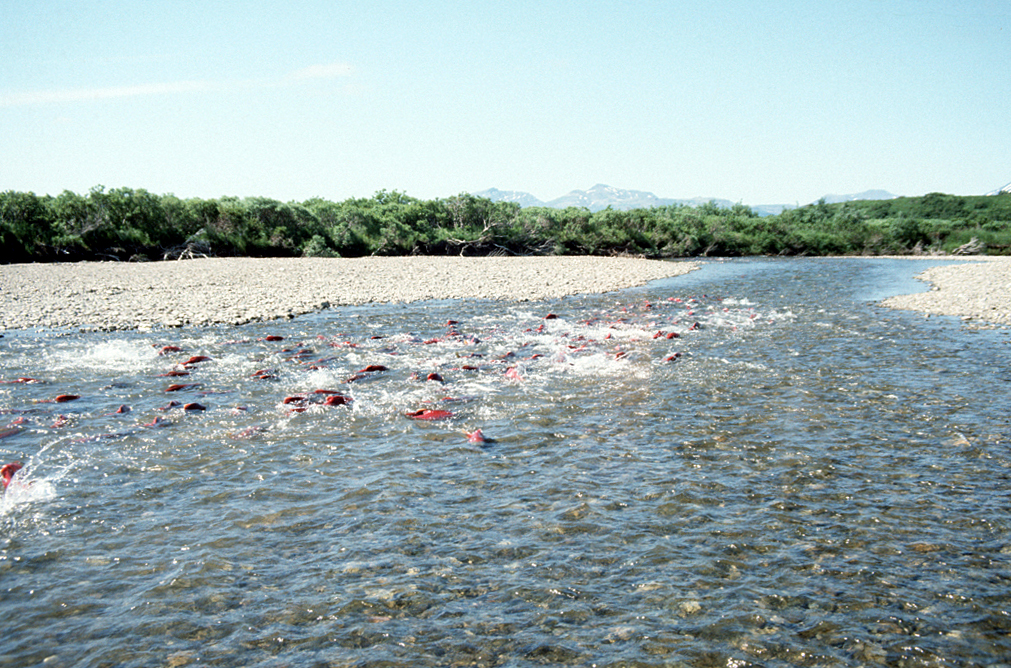
Spawning Salmon in Becharof Stream within the Becharof Wilderness in southern Alaska, USA. By U.S. Fish and Wildlife Service – US Fish & Wildlife Service – [1], Public Domain, https://commons.wikimedia.org/w/index.php?curid=3525119
Migratory fish populations have crashed by more than 80% since 1970, new findings show. Populations are declining in all regions of the world, but it is happening fastest in South America and the Caribbean, where abundance of these species has dropped by 91% over the past 50 years. This region has the world’s largest freshwater migrations, but dams, mining and humans diverting water are destroying river ecosystems. In Europe, populations of migratory freshwater fishes have fallen by 75%, according to the latest update to the Living Planet Index.
Migratory freshwater fish partially or exclusively rely on freshwater systems – some are born at sea and migrate back into fresh water, or vice versa. They can in some cases swim the width of entire continents and then return to the stream in which they were born. They form the basis for the diets and livelihoods of millions of people globally. Many rivers, however, are no longer flowing freely due to the construction of dams and other barriers, which block species’ migrations. There are an estimated 1.2m barriers across European rivers. Other causes of decline include pollution from urban and industrial wastewater, and runoff from roads and farming. Climate breakdown is also changing habitats and the availability of freshwater. Unsustainable fishing is another threat.
Herman Wanningen, founder of the World Fish Migration Foundation, one of the organisations involved in the study, said: “The catastrophic decline in migratory fish populations is a deafening wake-up call for the world. We must act now to save these keystone species and their rivers.
“Migratory fish are central to the cultures of many Indigenous peoples, nourish millions of people across the globe, and sustain a vast web of species and ecosystems. We cannot continue to let them slip silently away.”
Workers for Pate Construction Company install 30-inch PVC pipe on Colorado Highway 96 as part of the Arkansas Valley Conduit Project. Photo credit: Southeastern Colorado Water Conservancy District
Here’s the release from the Southeastern Colorado Water Conservancy District (Chris Woodka):
May 30, 2024
The Arkansas Valley Conduit received another $90 million in federal funding as construction continues on the drinking water line that will serve 39 water systems east of Pueblo.
“This is great news for the AVC and the people of Southeastern Colorado. Funding at this level is needed to keep the AVC moving forward, and we really appreciate the hard work that our congressional delegation and Reclamation officials at all levels have put into the AVC project,” said Bill
Long, President of the Southeastern Colorado Water Conservancy District. “The Southeastern District is looking forward to the day when we can fulfill the promise to bring clean drinking water to the people of the Lower Arkansas Valley.”
The Department of Interior announced the funding from the Bipartisan Infrastructure Law, along with other Western water projects. The AVC received the largest amount of BIL funding for any of the projects included in this year’s funding.
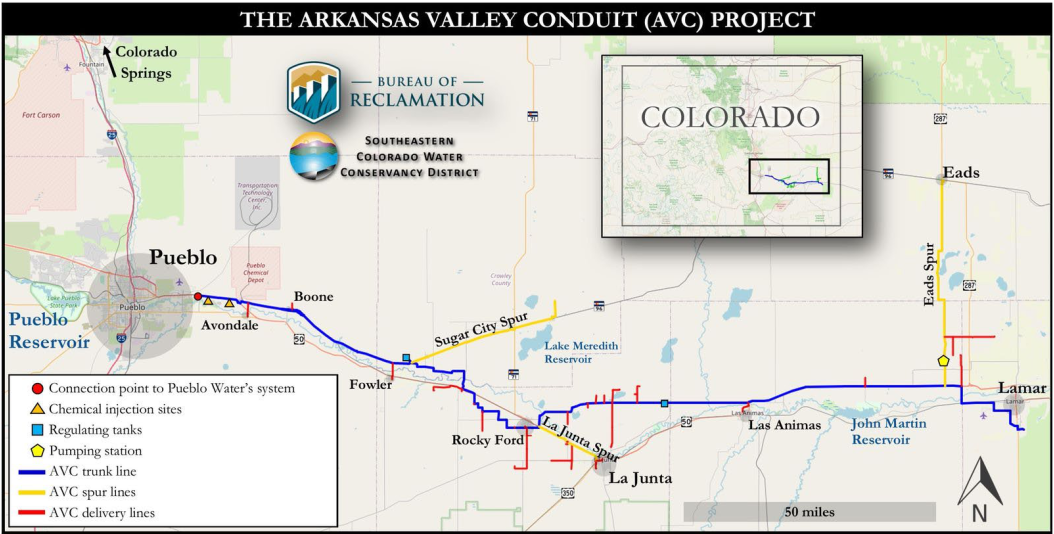
Arkansas Valley Conduit map via the Southeastern Colorado Water Conservancy District (Chris Woodka) June 2021.
The AVC is being built by the U.S. Bureau of Reclamation and the Southeastern Colorado Water Conservancy District. The 130-mile pipeline will serve 50,000 people when completed. To date, federal appropriations total more than $321 million, with state loans and grants of up to $120 million pledged. Local governments have contributed about $10 million, including American Rescue Plan Act funds.
Construction began on the AVC in 2023, with Reclamation constructing the Trunk Line from its connection with the Pueblo Water system at 36th Lane and U.S. Highway 50. So far, three federal contracts totaling almost $100 million have been issued for the AVC to date. In addition, $22 million has been paid to Pueblo Water for conveyance, treatment and transmission of AVC water from Pueblo Reservoir.
The District, through its Water Activity Enterprise, has built delivery lines to Avondale and Boone,using $1.2 million contributed by the Pueblo County Commissioners through American Rescue Plan Act (ARPA) funding.
Pueblo Dam. Photo courtesy of Colorado Parks and Wildlife