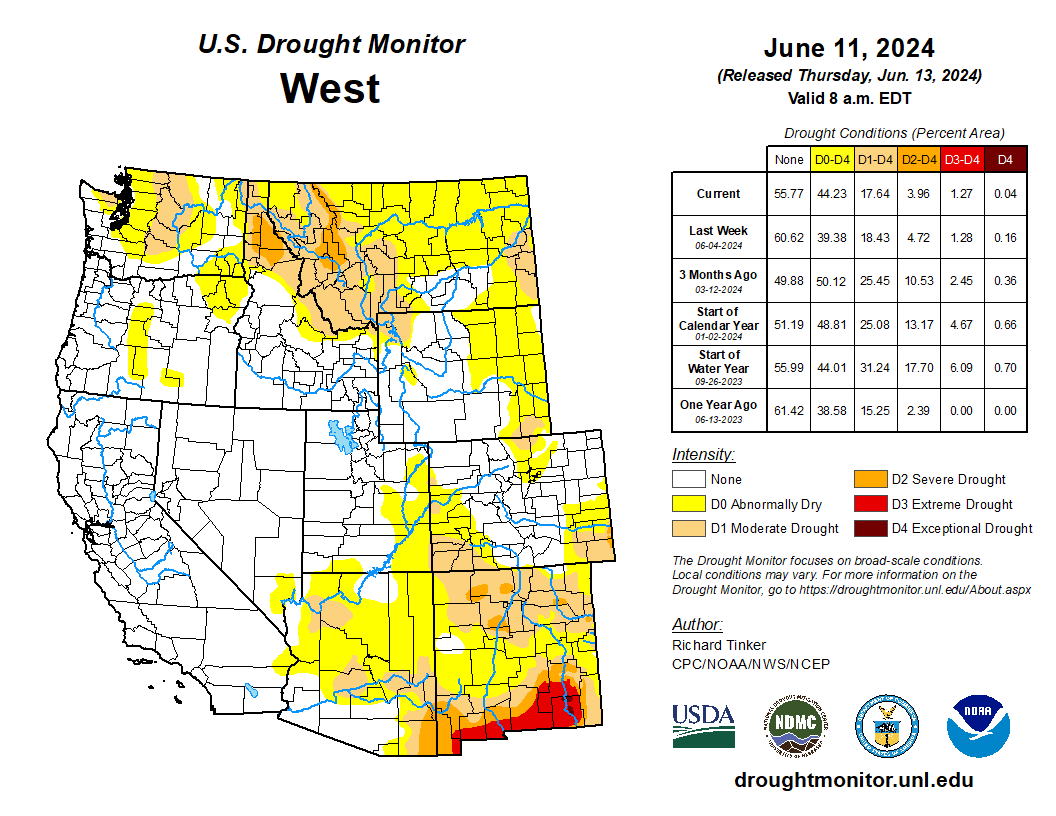
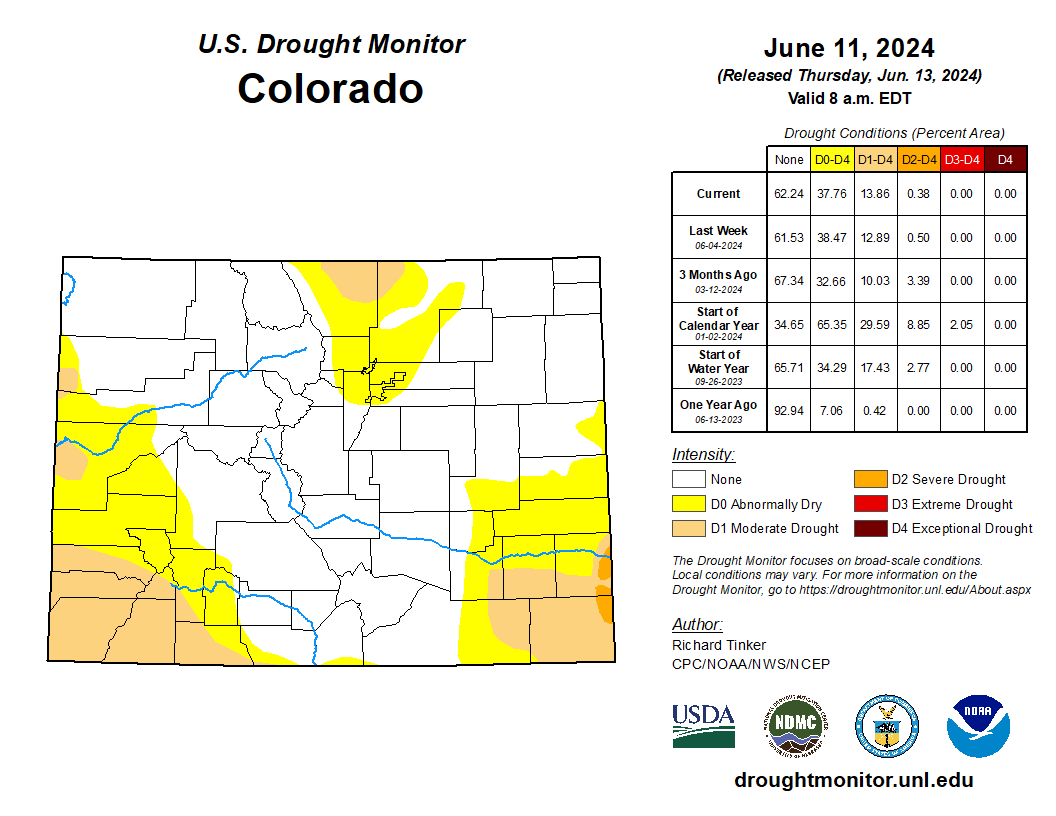
#Drought news June 13, 2024: Some D0 [Abnormally Dry] expansion was introduced in north-central #Colorado, a dry week also allowed conditions to deteriorate in part of S.W. Colorado, with moderate drought (D1) expanding northward into west-central Colorado

Click on a thumbnail graphic to view a gallery of drought data from the US Drought Monitor website.
Click the link to go to the US Drought Monitor website. Here’s an excerpt:

This Week’s Drought Summary

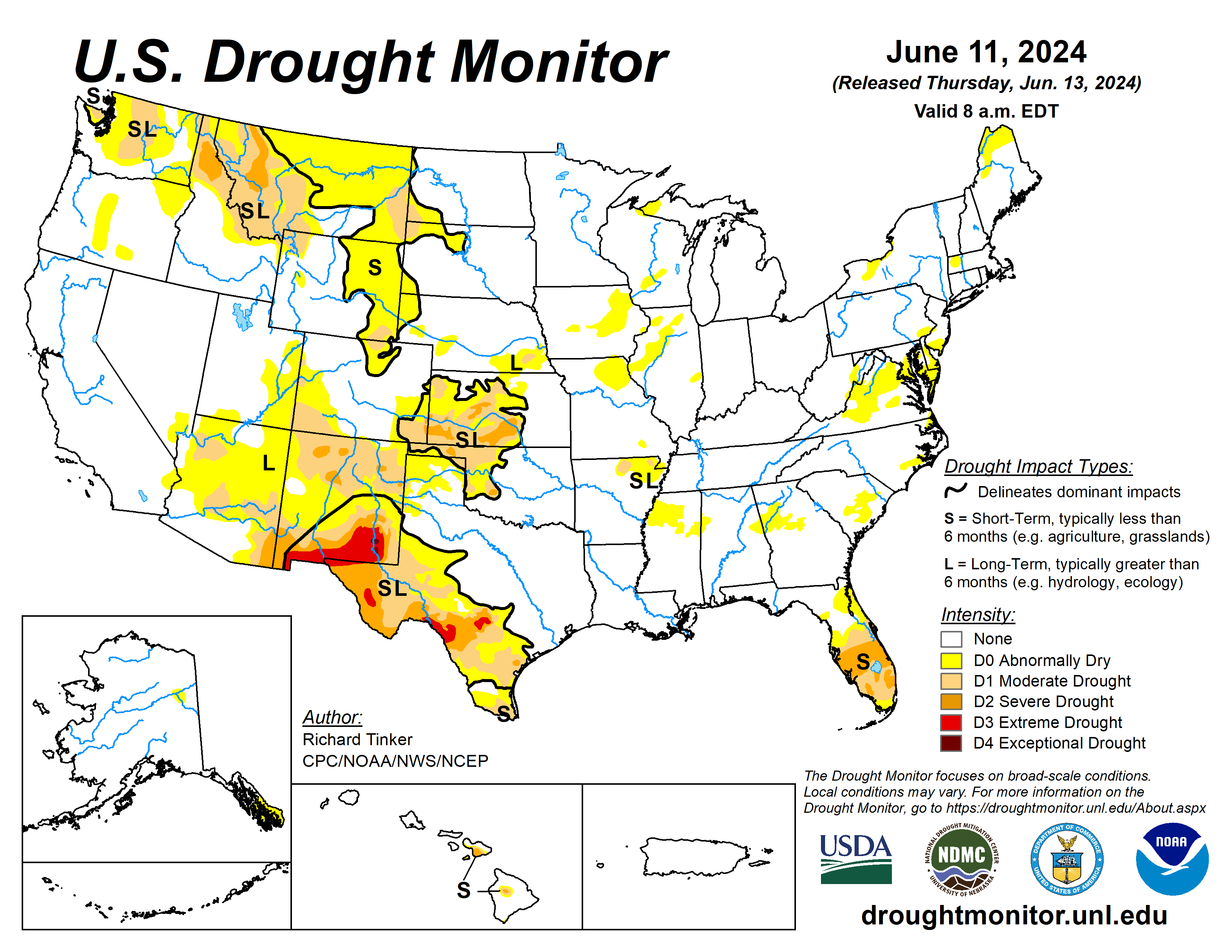
A highly variable precipitation pattern was noted across the contiguous 48 states this past week, resulting in a significant number of changes in the Drought Monitor depiction. Another week of heavy rain June 4-11 continued to ease drought and abnormal dryness in parts of the central and southern Plains, with excessive amounts resulting in 2-category improvements in portions of central Kansas. Moderate to heavy rainfall also brought improvements to portions of the middle and upper Mississippi Valley, the Northeast, the Washington Cascades, and southernmost Florida. Meanwhile, deficient rainfall caused abnormal dryness and drought to expand or intensify in parts of southern New England, the mid-Atlantic region, the interior Southeast, the central and northern Florida Peninsula, a few scattered areas across Texas, part of the central Rockies, the northern High Plains, some sections of interior Washington and Oregon, and a small region in northeastern Alaska. Other areas were unchanged, including Hawaii and Puerto Rico…

High Plains

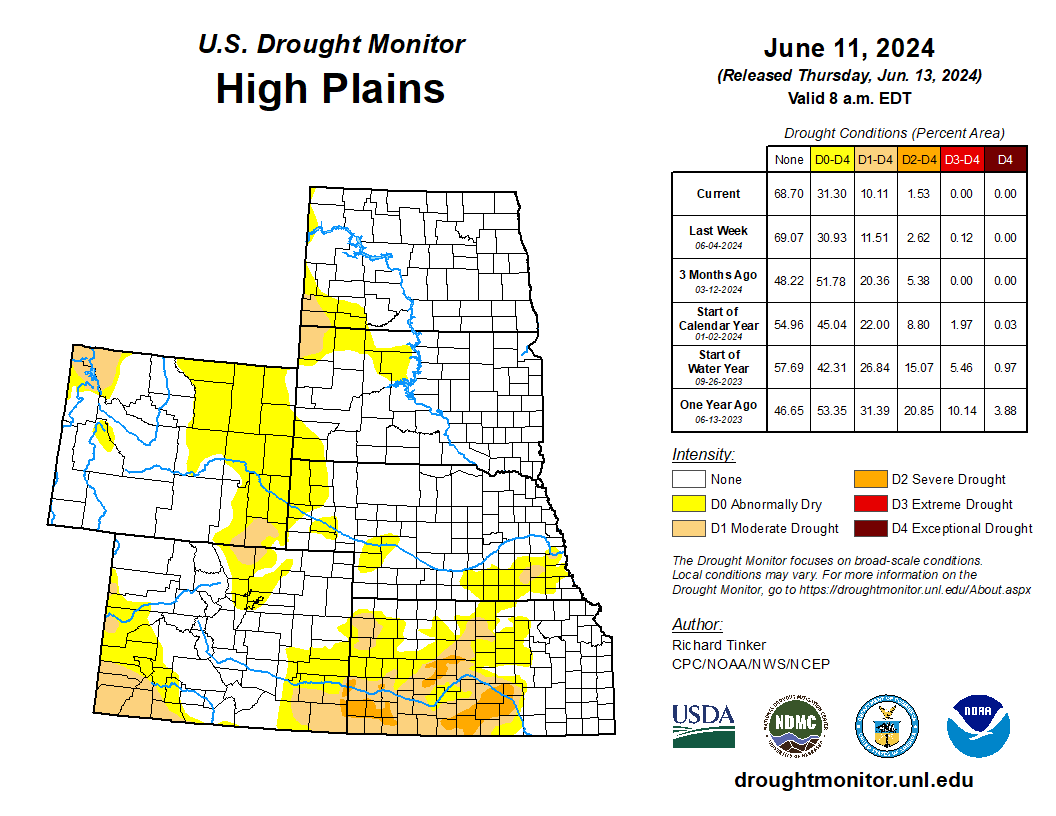
Parts of the southern High Plains Region were hit by heavy to excessive rains, bringing widespread improvement to the entrenched dryness and drought affecting much of Kansas and eastern Colorado. The heaviest amounts soaked a swath across central Kansas, with more scattered heavy rains observed farther north in Kansas and across eastern Colorado. Between 5 and 8 inches fell on central Rice, eastern McPherson, central Marion, and much of Chase Counties in central Kansas, prompting some 2-category improvements there. D3 conditions were eliminated from the High Plains Region, and severe drought (D2) is now limited to a few several-county south and west of the band where the heaviest rains fell last week. Moderate rains (over 1.5 inch) reached into southern Nebraska as well, improving conditions in southeastern Nebraska. Farther north and west, conditions were considerably drier, and most sites recorded several tenths of an inch of rain at best. This kept conditions essentially unchanged in most areas, although some D0 expansion was introduced in north-central Colorado, western Nebraska and adjacent South Dakota, and north-central South Dakota. A dry week also allowed conditions to deteriorate in part of southwestern Colorado, with moderate drought (D1) expanding northward into west-central Colorado. There was an additional, small area of improvement in part of Laramie County in southeastern Wyoming, where a mesoscale heavy rain event (2.0 to 4.5 inches) eased D0 to D1 conditions…
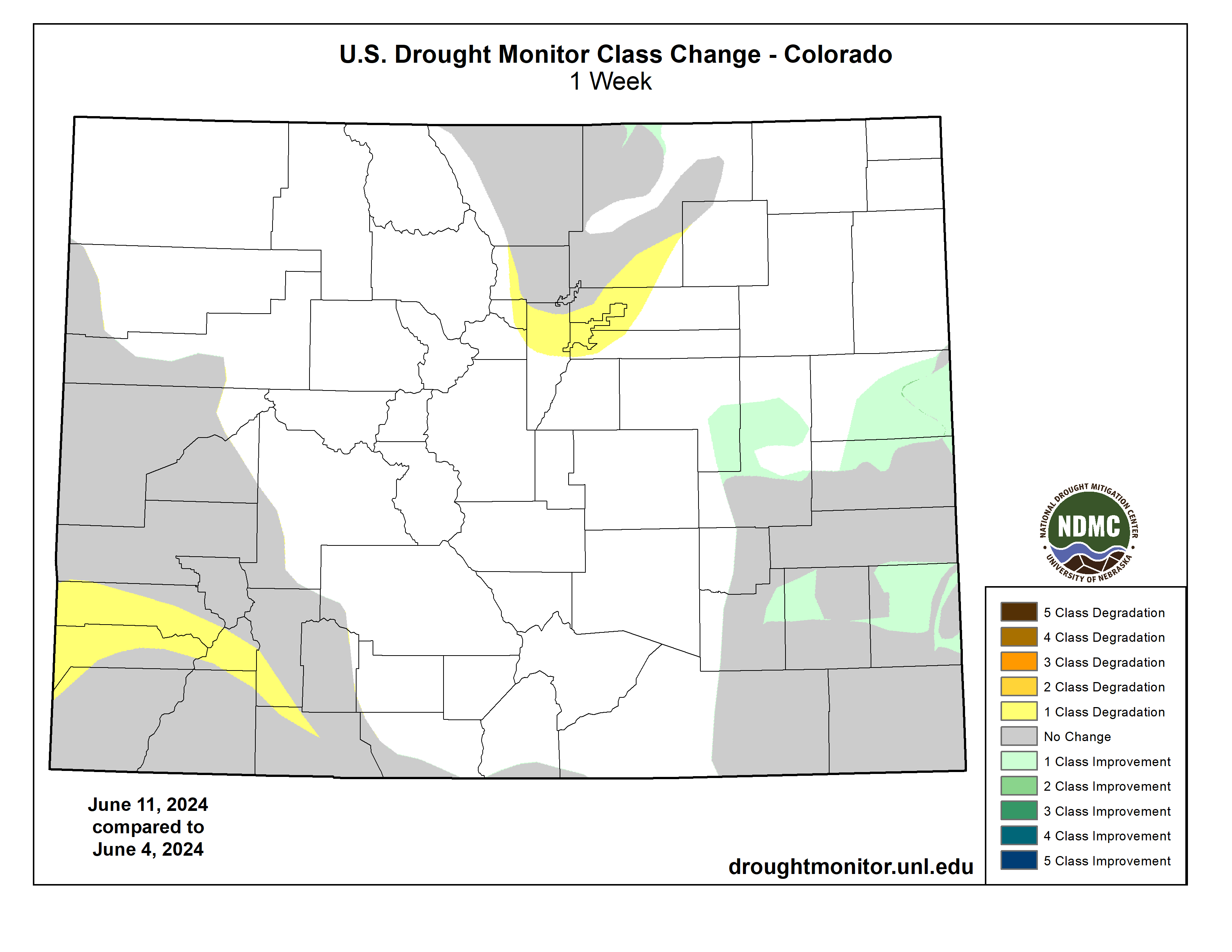
Colorado Drought Monitor one week change map ending June 11, 2024.

West

Similar to western Texas, moderate to heavy precipitation also doused much of eastern New Mexico last week, inducing widespread 1-category improvement. The heaviest amounts (4.5 to locally 8.0 inches) fell on southern and west-central Guadalupe County, but most of the eastern half of the state reported at least 0.5 inch. Another area that experienced some drought relief was the higher elevations of the Cascades in Washington. During the past 30 days, 8 to 15 inches of precipitation has fallen on the peaks, with the largest totals observed in Snohomish County. Another 0.5 to 2.0 inches fell along and just east of the highest elevations last week. As a result, moderate drought was reduced to abnormal dryness there. However, across the northern tier of the region to the south and east of the Washington Cascades, persistently below-normal precipitation in many areas led to the expansion of abnormal dryness (D0) and moderate drought (D1) in a few areas, in particular the north-central Oregon Cascades, part of interior southeastern Oregon, part of the central and eastern Washington plains, and a broad area of northern and central Montana from east of the Rockies to near North Dakota. Soil moisture and some streamflows have begun to reflect the past few weeks of subnormal rainfall across portions of central and eastern Montana…

South

Widespread dryness and drought continued to cover western Oklahoma, the western Texas Panhandle, and most other areas across southern and western Texas. Rainfall totals were generally unremarkable across western Oklahoma, keeping D0 to D2 conditions generally unchanged, save for a couple of small patches near the central part of the state. In contrast, rainfall was highly variable in the areas of Texas that have been affected by dryness and drought (D0 to D3) recently, leading to sizeable areas that felt both deterioration and improvement. Most of the dry areas in the Texas Panhandle received at least moderate rain last week (1.5 inches or more), with several patches soaked by 3 to 5 inches of rain. As a result, improvement was introduced in many locations across this region. Farther south, moderate to locally heavy rains were observed in portions of the southern Edwards Plateau and southward through parts of Bandera, Medina, and Bexar Counties. Totals of 1-2 inches were fairly common in this region, although a few swaths received more, up to 4 inches at a few isolated locations. Improvement was also introduced in significant parts of this region, although less broadly than farther north since heavier totals were not as widespread. In sharp contrast, dry and hot weather across Deep South Texas and western parts of the Edwards Plateau led to broad-scale deterioration in these regions. Agricultural interests in the western Edwards Plateau report slowed planting due to quickly depleting surface moisture, resulting in blowing sand and dirt with little or no soil moisture. Over the past 90 days, a broad area from the southern Big Bend southward along the Rio Grande Valley into Maverick County recorded only 10 to 50 percent of normal rainfall, with similar amounts reported across portions of the western Edwards Plateau. The remainder of the South region is nearly free of notable dryness. Moderate drought is restricted to a couple of patches in northeastern Arkansas, with abnormal dryness covering the remainder of northeastern Arkansas and a large part of northern Mississippi. Moderate rains brought limited improvement to portions of northeastern Arkansas this past week, but only light rains fell across northern Mississippi, increasing short-term moisture deficits and prompting an increase in D0 coverage. Northwestern Mississippi has recorded near or just over one-half of normal rainfall since mid-April…

Looking Ahead

During the next five days (June 13-17, 2024), tropical moisture is expected to interact with mid-level low pressure across southern Florida, resulting in heavy rain. Flood watches are currently in effect, and 3 to 5 inches of rain are expected before precipitation tapers off later in the period. Tropical moisture from the Gulf of Mexico may also push into the central Gulf Coast region, bringing 1.5 to 2.5 inches of rain to the Louisiana Bayou and southern Mississippi. Farther north, thunderstorms along a frontal boundary are expected to drop 1.5 to 3.5 inches of rain on parts of the northeastern Great Plains and Upper Mississippi Valley. Moderate precipitation is expected in other parts of the northern Great Plains, upper and middle Mississippi Valley, western Great Lakes region, eastern New England, northern Florida Peninsula, southern lower Mississippi Valley, and higher elevations of the northern Rockies and Cascades. Meanwhile, the summer’s first extended period of excessive heat is forecast to develop toward the end of the period in the central Great Plains, expanding eastward across the middle and upper Mississippi Valley, the Ohio Valley, the mid-Atlantic region, and the Northeast by the end of the period. Highs well into the 90s should be widespread by the end of the period, and warm nighttime lows are expected, providing little relief. Subnormal temperatures are forecast to be limited to the Pacific Northwest.

The Climate Prediction Center’s 6-10 day outlook (valid June 18-22, 2024) favors above-normal temperatures from the southern Rockies and most of the Plains eastward to the Atlantic Ocean, with the most prohibitive odds (over 80 percent) across the Northeast and New England away from the immediate Atlantic Coast. There is a good chance that excessive heat will continue through at least part of the period across central and northern parts of the U.S. from the Mississippi Valley eastward. Farther west, subnormal temperatures are favored in many areas, but only slightly, with odds remaining below 40 percent (climatological odds are 33 percent). Below-normal precipitation is favored across the mid-Atlantic region, the Carolinas, the upper Southeast, and the Ohio Valley, as well as southeastern Alaska. However, odds tilt toward above-normal precipitation over a larger area encompassing the Gulf Coast region, the northern and southern Great Plains, the High Plains, the Great Lakes Region, the southern Rockies, the northern tier of the contiguous U.S. from the northern Rockies to the Pacific Coast, northeastern Alaska, and Hawaii. The best chances for surplus rainfall (50 to 70 percent) cover southern Texas.
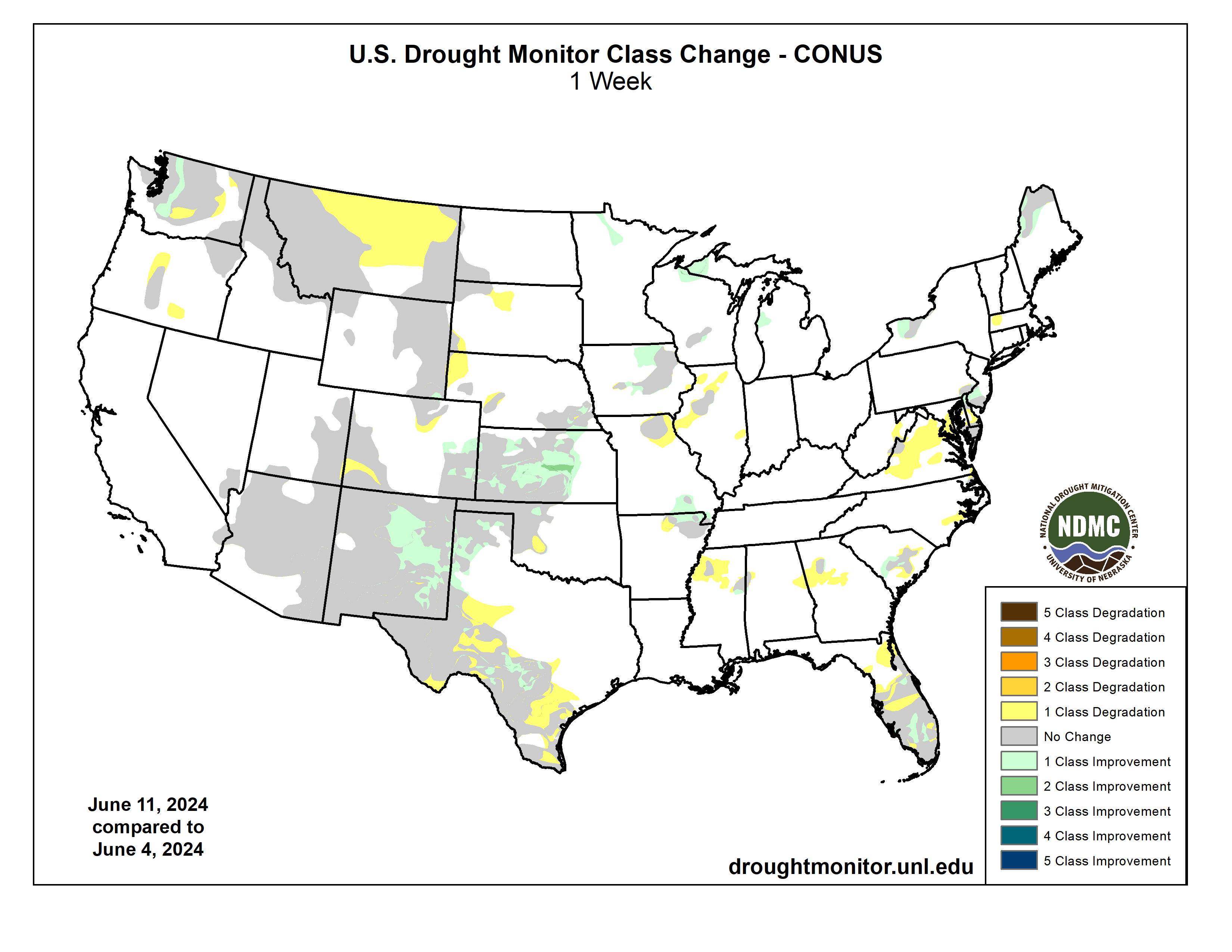
US Drought Monitor one week change map ending June 11, 2024.

Warming #climate intensifies flash droughts worldwide — American Geophysical Union

Click the link to read the release on the AGU website (Liza Lester and Maheshwari Neelam):

May 21, 2024

Sudden onset of drying is a rising problem, particularly acute in South America and southern Africa. but in high mountain regions of central asia, climate change has instead brought more moisture

Sudden, severe dry spells known as flash droughts are rising in intensity around the world, with a notable exception in mountainous Central Asia, where flash drought extent is shrinking, according to new research. Heat and changes to precipitation patterns caused by a warming climate are driving these trends, the study found.

Flash droughts arrive suddenly, within weeks, hitting communities that are often not prepared and causing lasting impact. They are an emerging concern for water and food security. The new study is the first to apply a systematic, quantitative approach to the global incidence of flash drought, mapping hotspots and regions of rapid increases in recent decades.

ā€œFor many parts of the world, we saw flash droughts extending over larger areas, for longer time, with faster onset speed,ā€ said Maheshwari Neelam, a climate scientist at NASA’s Marshall Space Flight Center and the Universities Space Research Association. She is the lead author of the study, published in Geophysical Research LettersAGU’s journal for high-impact, short-format reports with immediate implications spanning all Earth and space sciences.

The study defined and tracked three critical measures of drought severity: speed of onset, duration and geographic extent. It analyzed 40 years of NASA’s MERRA-2 climate data, from 1980 to 2019, drawn from weather observations, satellite imagery and modeled root-zone soil moisture, with the aim of improving prediction and disaster preparedness.

ā€œFor example, in watersheds in South America, onset is getting faster by about 0.12 days per year, so over a decade they are developing a day earlier. Extent is increasing by 1 to 3% per year,ā€ Neelam said. ā€œThe metrics can be used by early warning systems to incorporate rates of change in flash drought characteristics in risk assessment and disaster preparedness.ā€

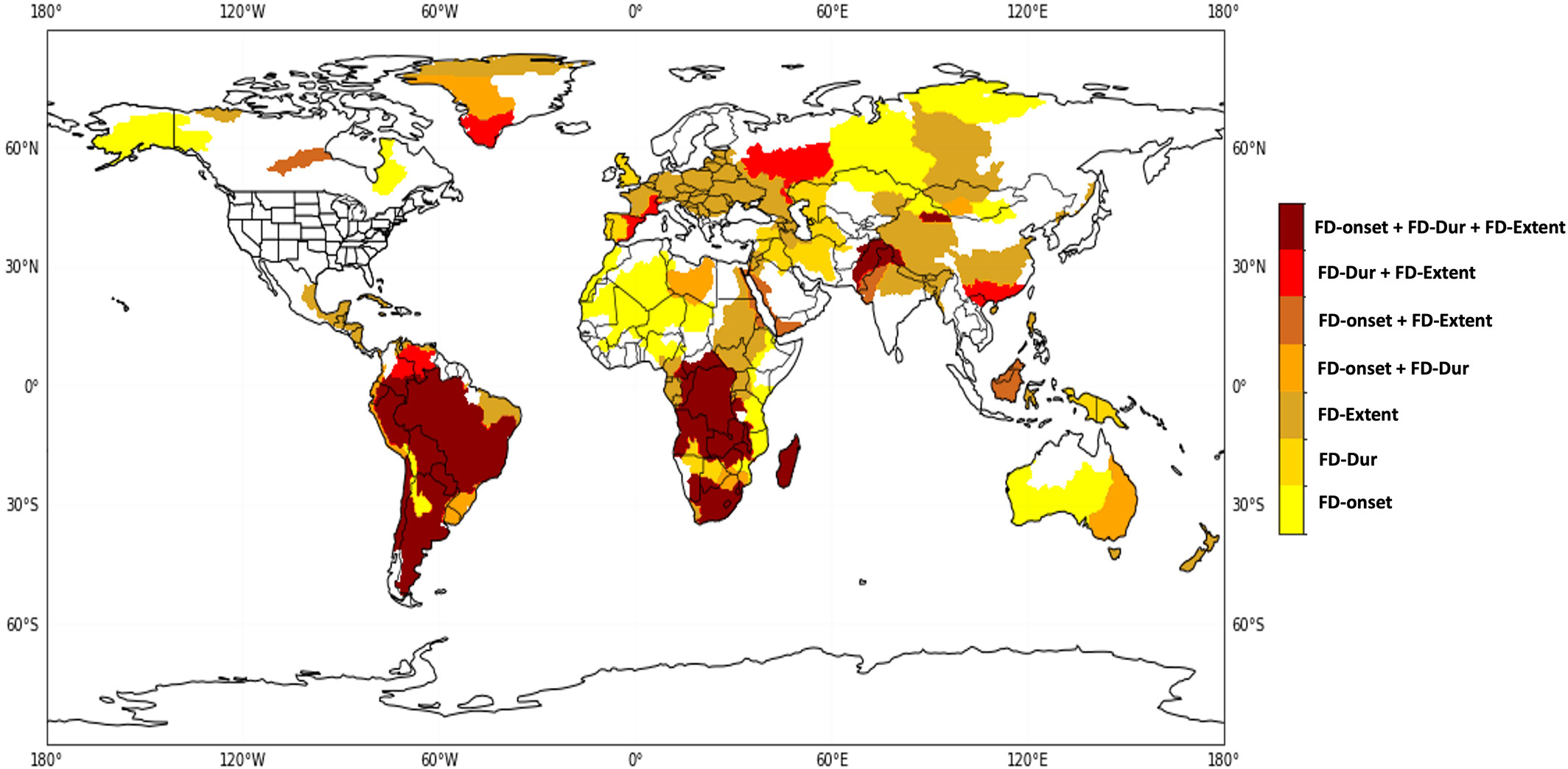
South America and southern Africa are hotspots vulnerability (brown), where flash droughts are setting in faster, staying longer and affecting wider areas. Other regions are experiencing rising trends in one or two of these flash drought dimensions. Credit: Neelim and Hain (2024) Geophysical Research Letters https://doi.org/10.1029/2024GL109657 CC BY.

South America, particularly southern Brazil and the Amazon, is experiencing strong intensification in all three dimensions of flash drought, aligning with deforestation patterns in the region, high temperatures and less rain. Congo, Angola, Zambia, Zimbabwe, South Africa, Lesotho, and Madagascar are also hotspots. High temperatures were found to be more important than declining precipitation in the African watersheds.

Land cover is also important to flash drought vulnerability. Savanna and grasslands are more susceptible to flash droughts than other ecotypes, particularly in humid and semi-humid climates, the study found.

In Central Asian watersheds, centered on high mountains, including the Himalaya Karakoram, Tianshan and Hindu Kush, flash drought extent shrank over the study period, bucking the worldwide trend. Climate-driven changes in precipitation, melting snowpack and a shift from snow to rain in the mountains have kept soils moist. These changes can cause an increase in flash floods, which have been observed in the region, Neelam said.

Neelam emphasized the importance of understanding landscapes’ response to disasters on a watershed scale for assessing water budgets and water management, transcending geopolitical boundaries.

ā€œNatural hazards have no political values,ā€ Neelam said. ā€œThis is why we looked at watersheds and not countries.ā€

[…]

This study was published in Geophysical Research Letters, an open-access AGU journal. Neither the study nor this press release is under embargo. View and download a pdf of the study here.

Article: #Drought Assessment in a Changing #Climate: A Review of Climate Normals for Drought Indices — American Association of State Climatologists

Click the link to read the article on the American Association of State Climatologists website (Joel Lisonbee, John Nielsen-Gammon, Blair Trewin, Gretel Follingstad, Britt Parker). Here’s the abstract:

May 30, 2024

Should drought be considered an extreme dry period based on the entire record of available data? Or, should drought be considered a low in precipitation variability within the context of a present, contemporary climate? The two most common reference periods are the full period of record (all observed data or as much as possible) and a 30-year reference climatology. However, climate non stationarity may render the “all-data” approach an inaccurate or obsolete comparison unless a trend is factored in. The aim of this review is to explore the literature for approaches to addressing these issues. The World Meteorological Organization (WMO) has recommended a 30-year reference period for most climatological applications since 1935, but for drought assessments and drought indices the modus operandi has been to use as much data as possible. However, in the literature, the ā€œall dataā€ approach has been challenged by evident impacts from climate change-induced non-stationarity. Over the past several years, as potential errors in drought assessments became more apparent due to a stationarity assumption when applying drought indices, several studies have adopted shorter reference periods, with 30-years being the most common. Furthermore, several recent papers have recommended using short reference periods with more frequent data updates for drought assessments to be representative of a contemporary climate. Additionally, at least 18 non-stationary drought indices have been proposed in efforts to retain long datasets and account for non-stationarity in the climate system.

Read: Stationarity is dead: Whither water management?

The Other Border Dispute Is Over an 80-Year-Old Water Treaty — Inside #Climate News

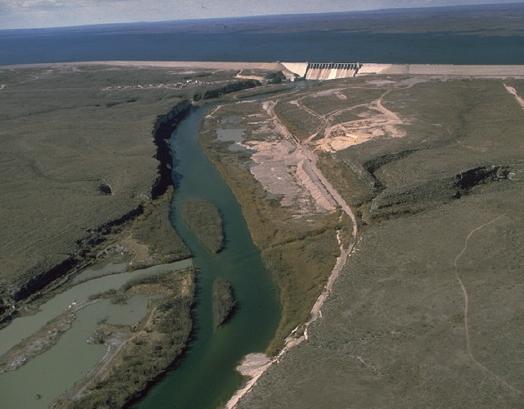
Amistad National Recreation Area, Rio Grande River, Amistad Reservoir, and Amistad Dam in Val Verde County, Texas and Coahuila, MĆ©xico. Dam coordinates: 29°27′0″N 101°3′30″W. By National Park Service – http://photo.itc.nps.gov/storage/images/amis/amis-ImageF.00004.jpeg, Public Domain, https://commons.wikimedia.org/w/index.php?curid=719857

Click the link to read the article on the Inside Climate News website (Martha Pskowski):

May 28, 2024

With another hot summer looming, Mexico is behind on its water deliveries to the United States, leading to water cutbacks in South Texas. A little-known federal agency has hit a roadblock in its efforts to get Mexico to comply.

NOTE: According to Robert Salmon Mexico is not behind in deliveries. He is a former Commissioner of the International Boudary Waters Commission and was speaking at last week’s Getches-Wilkinson/Water and Tribes Initiative Colorado River Conference in Boulder, Colorado.

Lea este artĆ­culo en espaƱol.

This story was reported with a grant from The Water Desk at the University of Colorado Boulder.

EL PASO—Maria-Elena Giner faced a room full of farmers, irrigation managers and residents in the Rio Grande Valley of Texas on April 2. 

The local agricultural community was reeling. Reservoirs on the Rio Grande were near record lows and the state had already warned that water cutbacks would be necessary. The last sugar mill in the region closed in February, citing the lack of water.

But Mexico still wasn’t sending water to the U.S. from its Rio Grande tributaries, as a 1944 treaty requires the country to do in five-year intervals. 

ā€œWe haven’t gotten any rains or significant inflows,ā€ said Giner, the commissioner of the International Boundary and Water Commission. ā€œIt’s not looking good.ā€ 

The IBWC, based in El Paso, implements the boundary and water treaties between the two countries. Giner’s team had spent 2023 working to reach an agreement with Mexico to ensure more reliable water deliveries on the Rio Grande. In December, she was confident the U.S. and Mexico would sign a new agreement, known as a minute. But at the final hour Mexico declined to sign. 

The impasse left farmers and communities in the Rio Grande Valley facing down another hot summer with limited water supplies. The state of Texas and members of Congress joined the supplications to Mexico: Start sending the water you owe. But with the political opposition in Mexico calling for the water treaty to be renegotiated—and presidential elections approaching in June—Mexican officials waited.

Immigration, trade and drug trafficking dominate much of the U.S. diplomatic agenda with Mexico. But in recent months water has become a more urgent topic, rising to the ā€œupper echelons of the Department of State,ā€ in Giner’s words. The 1944 treaty between the U.S. and Mexico governs water distribution on both the Rio Grande and Colorado River. Drought, climate change and politics are increasing tensions over treaty compliance. 

As of May 20, United States ownership of water at the Falcon and Amistad Reservoirs was at 20.1 percent of normal conservation capacity. South Texas farmers and municipalities are figuring out how to make do with less this summer.

Texas Republican Senators John Cornyn and Ted Cruz and members of both parties in the House are pushing for the State Department to withhold funds for Mexico. 

Giner, who herself grew up between the two countries in Ciudad JuĆ”rez and El Paso, remains convinced the neighboring nations can work out their differences over an 80-year-old treaty to manage shared rivers. 

ā€œ[This minute is] the tool that we have at the IBWC,ā€ Giner said during the April meeting. ā€œMexico is a sovereign country. And our tool is influence.ā€

Rio Grande and Pecos River basins. Map credit: By Kmusser – Own work, Elevation data from SRTM, drainage basin from GTOPO [1], U.S. stream from the National Atlas [2], all other features from Vector Map., CC BY-SA 3.0, https://commons.wikimedia.org/w/index.php?curid=11218868

Rio Grande Valley Farmers Fear More Losses

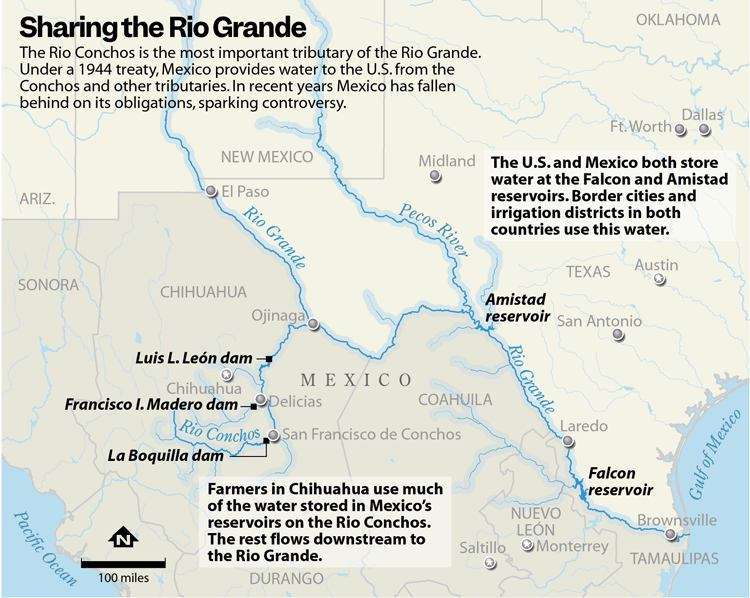
The Rio Grande starts its 1,900-mile journey to the Gulf of Mexico high in the mountains of southwestern Colorado. But the water that flows through the Texas Rio Grande Valley mostly originates in tributaries in Mexico. The most important is the Rio Conchos that flows from the Sierra Tarahumara through the agricultural heart of Chihuahua before joining the Rio Grande at Presidio, Texas.

The 1944 water treaty commits the U.S. to send Mexico 1.5 million acre-feet of water from the Colorado River each year. On the Rio Grande, Mexico is expected to send an average of 350,000 acre-feet of water from the Mexican tributaries each year over a five-year cycle for a total of 1.75 million acre-feet. This water flows to the Falcon and Amistad Reservoirs, which store water for the farms and communities of the Rio Grande Valley and the downstream Mexican states of Tamaulipas and Nuevo León. 

The last five-year cycle ended in conflict in 2020, with farmers in Chihuahua protesting water deliveries to the U.S. In a last-minute deal, known as minute 325, Mexico agreed to transfer water stored at the international reservoirs to the U.S. to end the cycle without a deficit.

The current cycle ends on October 25, 2025. Well into the fourth year, Mexico has sent less than 400,000 acre feet of water. At this rate it is unlikely that Mexico can meet its obligations.The main reservoirs on the Rio Conchos are at low levels, with La Boquilla at 28 percent capacity and Francisco Madero at 25.8 percent, as of May 16. The entire state of Chihuahua is currently in a drought.

With irregular water deliveries hampering agricultural production, the last sugar mill in Texas, the Rio Grande Valley Sugar Growers, closed for good in February. 

ā€œI just don’t see a means by which sufficient water could be delivered right now in time to save the agricultural production for this year,ā€ said Carlos Rubinstein, a former Texas Commission on Environmental Quality Rio Grande watermaster and consultant. ā€œSo the water is going to have to come from Mother Nature this year, which is a bad spot to be in.ā€

Towns and cities in the Rio Grande Valley that rely on the river for their water could also face shortages this year. Municipalities may be forced to buy additional water or speed up plans to develop alternative water supplies, like desalination. 

The Delta Lake Irrigation District diverts water to municipalities including Raymondville and Lyford. Water for these communities is conveyed through irrigation canals; if there is no irrigation water the municipal water can’t move through the canals.

ā€œWe’re at a point where within the next 60 days if we don’t get substantial rainfall or Mexico releases some water… I don’t know what my municipalities that I deliver water to are going to have to do,ā€ said general manager Troy Allen in early May.

ā€œWe’ve already lost the sugar industry in the Rio Grande Valley,ā€ Allen said. He worries the citrus industry will be next. ā€œThat’s my big fear.ā€

Negotiations Advance Then Falter in 2023

State and federal officials tried to avoid this. 

Minute 325, signed by the U.S. and Mexico in October 2020, set the goal of signing a new minute by December 2023 to increase ā€œreliability and predictabilityā€ in Rio Grande water deliveries.

The Rio Grande Minute Working Group formed in 2022 with representatives from IBWC, the TCEQ, the Department of State, Mexico’s IBWC, known as CILA, and Mexico’s National Water Commission, known as CONAGUA.

In Mexico, water is federal property. But once that same water is delivered to the U.S. in the international reservoirs, it falls under the purview of the state of Texas. TCEQ’s Rio Grande Watermaster then manages deliveries to irrigation districts and other users. While IBWC handles direct negotiations with Mexico, the agency must work closely with TCEQ. 

Giner wrote to TCEQ Commissioner Bobby Janecka, a member of the working group, in January 2023. She wrote in an email, provided by TCEQ in a records request, that she looked forward to ā€œachieving a minute signing that will lead to predictability and reliability in the Rio Grande.ā€

TCEQ has urged IWBC to do more, and political tensions on the border have bled into the water dispute. ā€œIBWC must hold Mexico accountable,ā€ wrote the director of the agency’s Office of Water at the end of January 2023.

In late June 2023, IBWC took issue when Texas Governor Gregg Abbott ordered floating buoys designed to stop migrants to be installed in the Rio Grande near Eagle Pass. IBWC denounced the move, saying they were not consulted and the buoys could violate treaty agreements. Tensions with Mexico flared; Mexico’s top diplomatĀ lodged a complaintĀ with the U.S. government, warning the buoys violated the 1944 treaty and were possibly in Mexican territory. The U.S. Department of Justice later sued Texas. (That case is now in the Fifth Circuit Court of Appeals.Ā 

On July 18, 2023 IBWC foreign affairs officer Sally Spener notified TCEQ that Mexican officials had postponed a meeting because of the incident, according to emails obtained by Inside Climate News. 

ā€œWe were able to continue our negotiations through all of that last year,ā€ Spener said in a May 2024 interview, referring to the buoy controversy. ā€œBut it was a distraction.ā€

Spener said by the second half of 2023, the working group put ā€œconcepts on paperā€ and drafted a minute laying out what the two countries agreed on.

On December 5, the IBWC presented details of the draft minute to stakeholders in the Rio Grande Valley. Irrigation districts and farmers in the valley don’t always agree with the federal government’s approach to working with Mexico, so their buy-in was important. Commissioner Giner explained how key points in the minute would resolve long-standing disagreements about the treaty.

Some irrigation districts and politicians in Chihuahua argue that Mexico should only allocate ā€œwild water,ā€ or water that overflows the country’s domestic dams, to fulfill the treaty. The draft minute would reinforce the importance of Mexico releasing water from its domestic reservoirs, settling that debate. 

Mexico’s San Juan and Alamo Rivers have previously been used to supplement the five tributaries named in the treaty. The draft minute affirmed that, when the U.S. agrees, Mexico could allot water from these rivers to meet its obligations.

The draft also included a new ā€œprojectsā€ working group that would focus on increasing water conservation in the drought-impacted watershed. A separate ā€œenvironmentā€ working group would focus on the Big Bend and increasing water flow in an area that runs dry much of the year. 

ā€œThere was some of it that we didn’t agree with, but it was a start,ā€ said Troy Allen of the Delta Lake Irrigation District of the draft minute. ā€œ[Commissioner Giner] is very transparent and I think she is really trying her best to help us out.ā€

IBWC was poised to sign the minute in December. Suddenly Mexican federal officials backtracked, saying they needed to ā€œundertake additional domestic consultations,ā€ according to Spener. Until those consultations were complete, Mexico wouldn’t sign the minute.

Not everyone in Mexico wanted the new agreement. The heart of that opposition lies in Chihuahua.

Mexican Opposition Politicians Protest Water Deliveries

Mexican presidential candidate Xóchitl GÔlvez took the stage in Camargo, Chihuahua, on April 14. She spoke just a few miles from La Boquilla, where Mexican farmers protested water deliveries to the United States in 2020.

Those same farmers were out in force for GĆ”lvez, who is backed by Mexico’s three main opposition parties, the PAN, PRI and PRD. Her opponent from the MORENA party, Claudia Sheinbaum, is the successor to incumbent president AndrĆ©s Manuel López Obrador. 

In 2020, López Obrador sent the National Guard to the La Boquilla reservoir in anticipation of opening the floodgates to send water north. Protesters pushed out the National Guard and a protester was killed in the confrontations. 

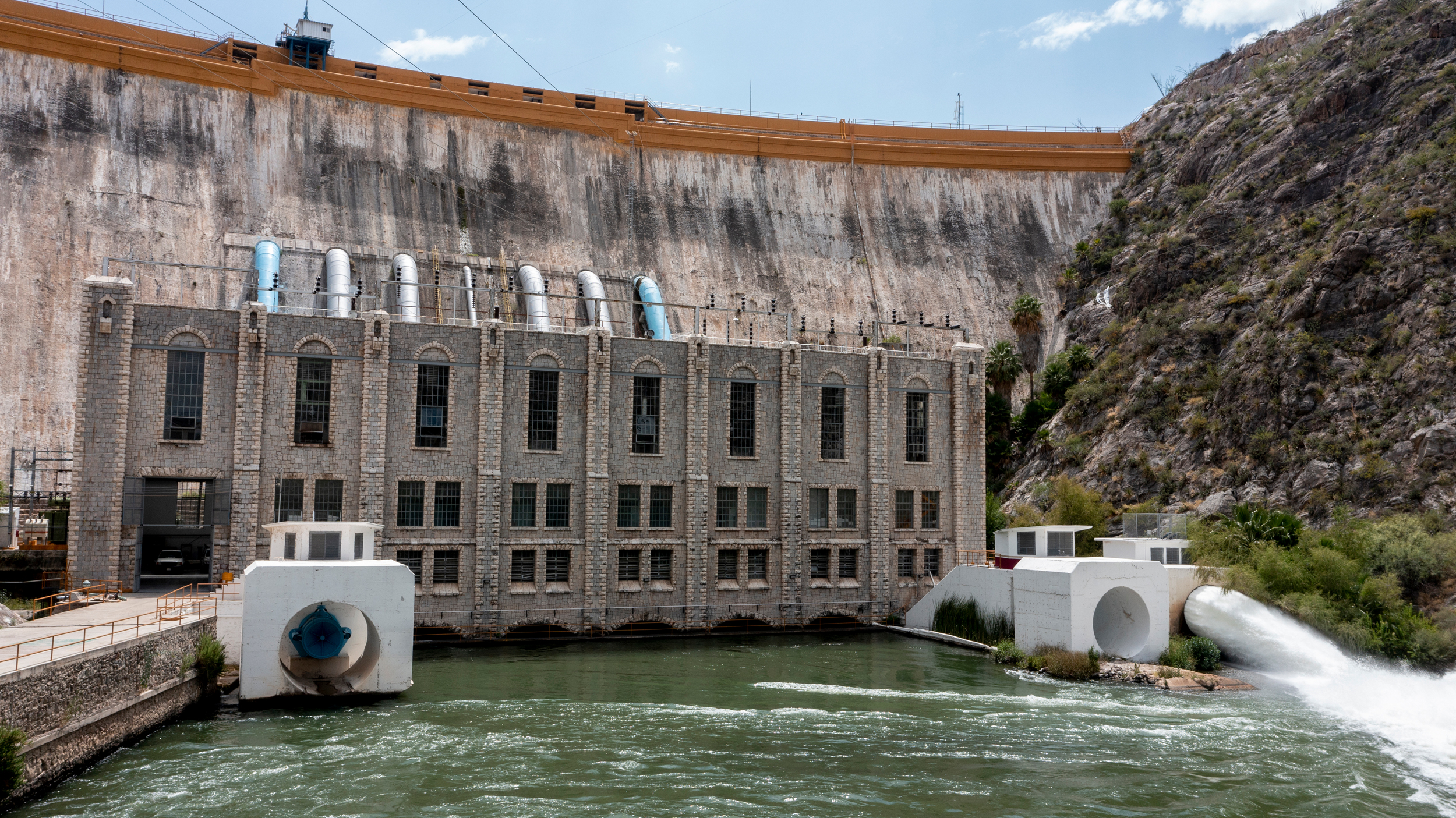
The Boquilla Dam in Boquilla, Chihuahua is photographed with a drone in September 2023. The dam was built at the beginning of the twentieth century. A view of the La Boquilla Dam along the Rio Conchos in Chihuahua, Mexico. Credit: Omar Ornelas

GĆ”lvez opened her speech this spring discussing water. ā€œWe are in the worst drought in many years,ā€ she said, before launching into criticisms of MORENA’s agricultural policies.

ā€œThe treaty payment to the United States in 2025 has to be renegotiated,ā€ she said to cheers. ā€œI promise I will defend the water of Chihuahua.ā€

Chihuahua governor Marƭa Eugenia Campos GalvƔn also opposes water deliveries. Representing the PAN, Campos GalvƔn is one of the few opposition governors in Mexico. For her, defending the water of Chihuahua means challenging the federal officials who send water to the United States.

Chihuahua Congressman Salvador AlcƔntar, also of the PAN, was instrumental in the 2020 protests. He is steadfast that the water stored at the reservoirs along the Rio Conchos should not be sent to the United States.

ā€œWe are in an extreme drought in Mexico. Right now it will be difficult to comply with the commitments in the treaty,ā€ he said in an interview in Spanish. ā€œNo one is obligated to give what they don’t have.ā€

Texas and IBWC officials acknowledge that Mexico’s upcoming presidential election on June 2 cast a shadow over the minute negotiations. Sheinbaum is heavily favored to win. But the federal government is not expected to take action on the treaty or water deliveries in the interim.

NOTE: Claudia Sheinbaum is the President-Elect of Mexico as of June 12, 2024.]

ā€œWe continue to push for the minute,ā€ said IBWC’s Spener. ā€œAnd even without the minute [Mexico] can make water deliveries.ā€

CONAGUA, which manages water allocations on the Rio Conchos, did not respond to questions from Inside Climate News. 

Bad Weather and Bad Politics

Mexico alone doesn’t shoulder the blame for water shortages this year. A prolonged drought and climate change are pummeling the Rio Grande watershed and Mexican tributaries alike. Extreme heat is already taking a toll on agriculture in the Rio Grande Valley. These trends are only expected to continue.

Temperatures throughout the Rio Grande basin are projected to increase by four to 10 degrees Fahrenheit this century, according to theĀ Bureau of Reclamation. Higher temperatures decrease snow accumulation and snow melt. More water evaporates from reservoirs as temperatures warm.

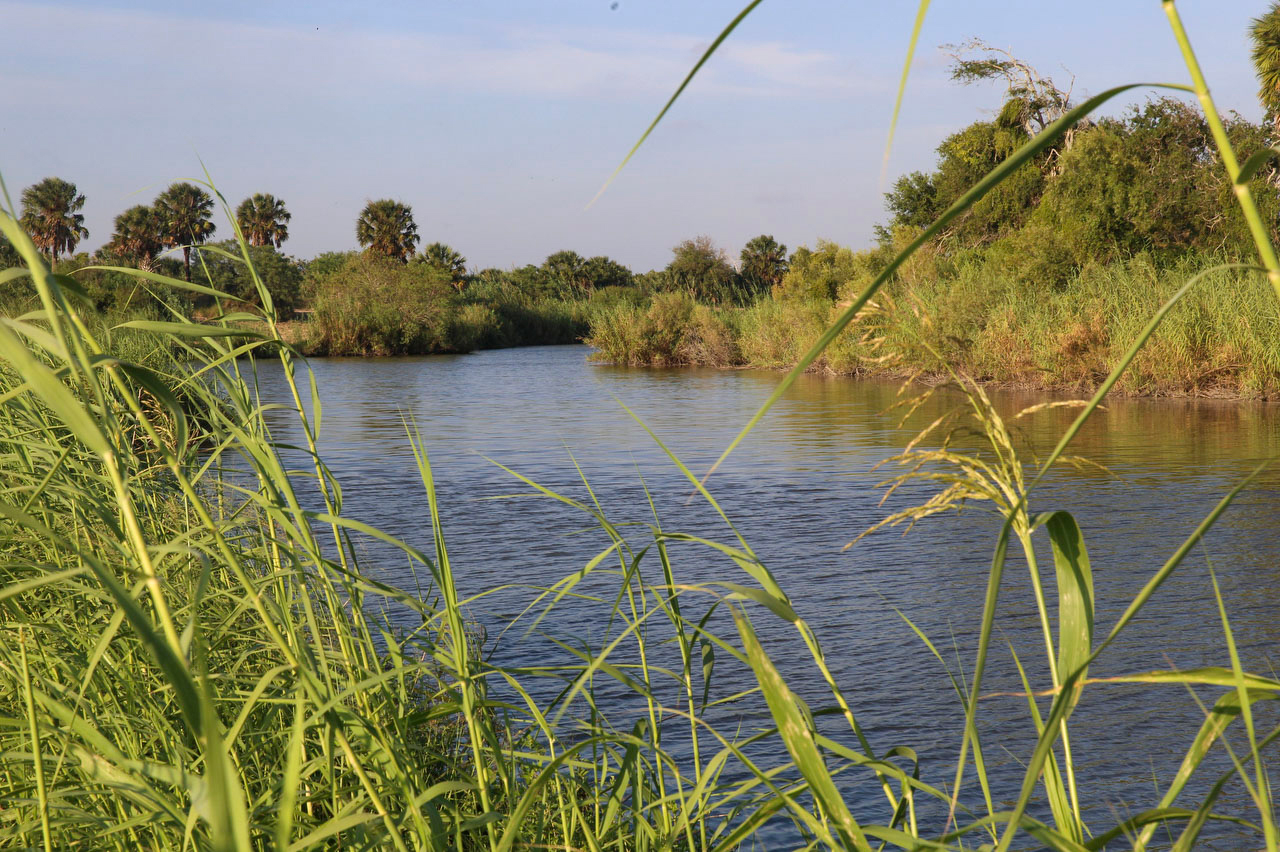
The Rio Grande meanders through a balmy former wetland in Cameron County, Texas, as it nears the Gulf of Mexico, pictured in July 2022. Credit: Dylan Baddour/Inside Climate News

Drought and rising temperatures are also impacting the Conchos basin in Mexico. Annual runoff in the Conchos basin could decline by up to 25 percent by 2050 because of changes in precipitation and higher temperatures, according to the 2015 Mexico Water Vulnerability Atlas. A study in the Journal of Climate this year projected that Chihuahua is likely to ā€œexperience strong drying during the spring and summer monthsā€ this century. 

Texas politicians are pressuring the Biden administration to take more decisive action to help the state’s farmers. On May 10, Sens. John Cornyn and Ted Cruz, along with eight representatives, including Republicans Monica De La Cruz and Tony Gonzales and Democrats Vicente Gonzalez and Henry Cuellar, sent a letter urging the both the House and Senate Appropriations Subcommittees on State and Foreign Operations to withhold designated funds from Mexico until the country ā€œmeets its obligations to resolve the ongoing water dispute.ā€ 

López Obrador spoke to the treaty on May 15 during his daily press conference. He said Mexico does not have a date to make a decision. ā€œWe support this compact,ā€ he said. ā€œWe agree it shouldn’t be modified and we have a very good relationship [with the United States]. But as the weather gets hot and there are elections coming up, all these issues come to light.ā€

The Department of State referred questions about the treaty negotiations to IBWC. 

Spener of the IBWC said they continue to encourage Mexico to deliver water. The minute working group held its most recent meeting in April in El Paso. 

TCEQ Commissioner Bobby Janecka wrote to Commissioner Giner on April 26, concerned that Mexico continued to allocate water to its irrigation districts without planning how to send water to Texas. He also opposed Mexico arguing that extraordinary drought prevented the country from complying with the treaty. ā€œWe are deeply concerned about these claims,ā€ he wrote.

Irrigation districts in the Rio Grande Valley worry about trade-offs when the U.S. agrees to alternative measures—beyond the five tributaries named in the treaty—for Mexico to deliver the water it owes. Anthony Stambaugh, general manager of the Hidalgo County Irrigation District No. 2., said Mexico ā€œneeds to be caught up first,ā€ before the U.S. offers more concessions.

When the treaty clock runs out on October 25, 2025, both the U.S. and Mexico will have entered new presidential administrations. The incoming U.S. president will also appoint the IBWC commissioner. The tone of binational negotiations could change dramatically.

Mexicans go to the polls on June 2. Water issues, from Chihuahua to Mexico City, have taken on greater importance during the campaign. Water shortages are spreading to more neighborhoods in Mexico City as supplies dip. Frontrunner Sheinbaum is largely expected to continue her predecessor’s policies if elected. She has committed to making water management a priority and would consider a revision of the National Water Law. Meanwhile, her opponent GĆ”lvez has said, if elected, she would modernize agriculture to make more efficient use of water.

Six months later, the United States will hold its presidential election. Water and the 1944 treaty are hardly top campaign issues north of the border. But, if elected, Republican candidate Donald Trump would likely take a more confrontational approach in his dealings with Mexico. Meanwhile, the Biden administration has invested heavily in water conservation in Western states, including in the Colorado River Basin and the Rio Grande. These investments, through the Inflation Reduction Act and the Bipartisan Infrastructure Law, would likely continue if Biden is re-elected.

In the Rio Grande Valley, the immediate concern is how to get through a dry, hot summer with less water to go around. As water supplies dwindle—and the political divide widens—the immediate needs to secure water will take precedent.

Carlos Rubinstein, the former TCEQ watermaster, said resolving the root issues of water supplies on the Rio Grande requires continuous work, not just during the bad years.

ā€œIt’s bad weather and it’s bad politics,ā€ he said. ā€œSo that’s a really tough place to be.ā€

This story was produced by Inside Climate News, in partnership with The Water Desk, an independent initiative of the University of Colorado Boulder’s Center for Environmental Journalism.