Winter #snowpack recedes earlier than usual in southern #Colorado after rare, sudden and large melt — Fresh Water News

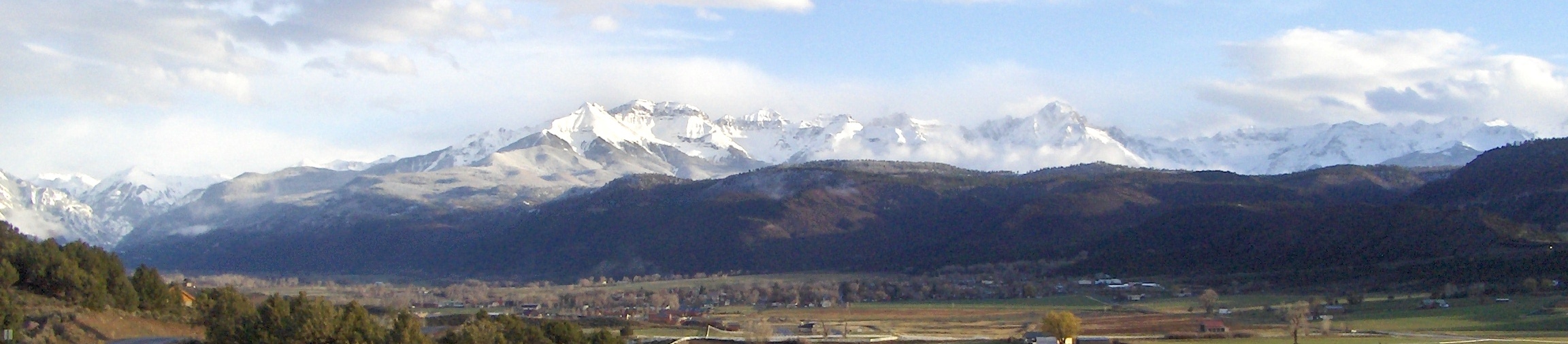
Sneffels Range Ridgeway in foreground. Photo credit: SkiVillage – Own work, CC BY-SA 3.0, https://commons.wikimedia.org/w/index.php?curid=15028209 via Wikiemedia

Click the link to read the article on the Water Education Colorado website (Shannon Mullane):

May 30, 2024

Southwestern Colorado is left with 6% of its peak snowpack earlier than usual this season in part because of a rare, sudden and large melt in late April.

Snow that gathers in Colorado’s mountains is a key water source for the state, and a fast, early spring runoff can mean less water for farmers, ranchers, ecosystems and others in late summer. While the snow in northern Colorado is just starting to melt, southern river basins saw their largest, early snowpack drop-off this season, compared to historical data.

For Ken Curtis, the only reason irrigators in Dolores and Montezuma counties haven’t been short on water for their farms and ranches is because the area’s reservoir, McPhee Reservoir, had water supplies left over from the above-average year in 2023.

“Because of the carryover, the impacts aren’t quite that crazy bad,” said Curtis, general manager of the Dolores Water Conservancy District. “If we hadn’t had that carryover, it would have been a terrible year.”

A terrible year like 2021, he added, when many irrigators who depend on water from McPhee only received 10% of their normal water supply.
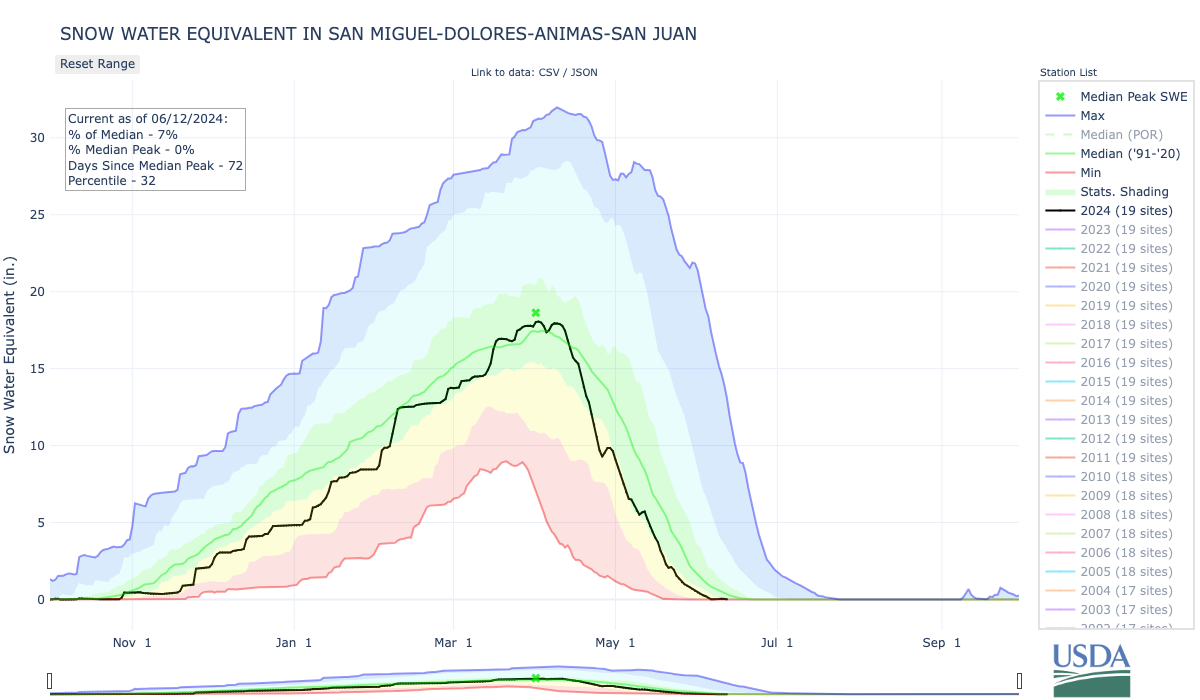
The snowpack in the southwestern San Miguel-Dolores-Animas-San Juan combined basin peaked at about 18 inches April 2, then plummeted by 8 inches during the last half of April. It was the largest 14-day loss of snowpack before the end of April in this basin since the start of data collection in the 1980s, according to the Colorado Climate Center at Colorado State University.

The basin still held onto 1.1 inches of snow-water equivalent, the amount of liquid water in snow, as of Wednesday. Typically, the snowpack is about twice as high in late May, according to the Natural Resources Conservation Service.

“The Rio Grande and the southwest basins, the snow is pretty much gone, and it’s going to be gone within days to a week at this point,” said Russ Schumacher, the state climatologist and CSU professor.

The Upper Rio Grande Basin, which spans the central-southern part of the state including the San Luis Valley, had 0.1 inch of snow-water equivalent as of Wednesday, much less than its norm for late May, which is about 1.5 inches.

Eastern and northern basins, like the South Platte Basin which includes parts of Denver, have held onto their snowpack for slightly longer than usual. These basins have above-average snowpack for late May, ranging from 119% to 162% of the historic norm, as of Wednesday [May 29, 2024].

The April decline in the southwest was caused by warm and dry conditions and sublimation, when snow and ice change into water vapor in the atmosphere without first melting into liquid water. Dust that darkens snow and speeds snowmelt also played a role, Schumacher said.

The spring runoff is a little faster than usual in the southern basins, but it’s within the realm of normal, said Brian Domonkos, snow survey supervisor for the Natural Resources Conservation Service, which manages snow-measurement stations around the state.

“What we’re seeing right now is not something that I would be alarmed about,” Domonkos said.

Spring snowfall, storms and cooler temperatures have slowed the speed of snowmelt in some areas as well, he said.

In Durango, the Animas River’s flows were around 2,000 cubic feet per second Wednesday, lower than the late-May norm of 2,990 cfs.

When it comes to recreation, the lower flows might actually be a boon, said Ashleigh Tucker, who is planning a river sports event, Animas River Days, scheduled for June 1 and 2. Some races require participants to pass through hanging gates, moving both upstream and downstream through a whitewater park, she said.

“If the water’s super high, it makes it a lot harder to do. So as far as our events go, it’s a good level,” she said. “But there’s not much snow left, so that means we won’t really have much left for the rest of the year, which is kind of a bummer.”

She doesn’t expect the river’s slightly lower flows to impact attendance either: Only years with really low flows, about 1,000 cfs, have discouraged people from floating the Animas, she said.

Warm and dry conditions are likely to continue through June, then weather watchers will turn their gaze to the sky in July to watch for the monsoon season.

In the meantime, Curtis is watching inflow forecasts for McPhee Reservoir. The runoff has been lower than average so far, even after an average snowpack season, he said.

That means there might not be as much water left to carry over into 2025.

“The monsoons will have the next impact,” he said. “If you see everyone going on fire restrictions, you know the monsoons haven’t shown up.”

More by Shannon Mullane

Topsoil Moisture % short/very short (s/vs) by @usda_oce

17% of the Lower 48 is short/very short; a 2% increase since last week. The East Coast saw a mix of improvement & degradation, with quick drying soils in ME, VT, & MA. In the West, all but CO & CA dried since last week.

Aspinall Unit Operations update June 11, 2024 #GunnisonRiver #ColoradoRiver #COriver #aridification

Aspinall Unit dams

From email from Reclamation (Erik Knight):

It’s a perfect storm for fire insurance — Writers on the Range #ActOnClimate

House in Douglas County, CO, courtesy Lena Deravianko, Unsplash

Click the link to read the article on the Writers on the Range website (David Marston):

June 10, 2024

Westerners have begun looking at their homes differently these days. Are those trees too close? Should I move all that firewood stacked up next to the deck?

Meanwhile, in California, some fire insurers have lost so much money they’ve pulled out of the state. Overall, fire insurance is becoming as expensive and unpredictable as the natural disasters—not just wildfires but also hail and windstorms—that are driving up rate increases. In some places, increases are as much as 1,000% for houses and condos nestled close to trees.

In Colorado, Tiffany Lockwood said she was dropped twice by fire insurance carriers over the 10 years she’s lived in Evergreen, a heavily forested exurb of Denver.

A former Florida resident, Lockwood, 59, only has one way out in case of a wildfire—and even then she’ll have little warning. “When I lived in Florida,” she said, “we knew four days ahead when a hurricane was coming. Here we get 40 minutes.”

Lockwood thinks insurance companies are running scared and giving impossible directives. One insurer asked her to remove all the shrubs and trees within 30 feet of the house. But the plan meant taking down a lot of her neighbor’s trees, too.

Evergreen’s attraction is that residents live amidst towering conifer trees. But red zones on fire maps are being expanded all over Colorado after several recent large forest fires and the wind-driven Marshall grassfire outside of Boulder, in December 2021. It destroyed more than 1,000 suburban homes and was the state’s most expensive fire yet. Formerly “safe” places are now described as at-risk.

Jeff Geslin lives in high and dry La Plata County, in southwestern Colorado, surrounded by 35 acres of piñon and juniper trees. He and his wife Lorna are used to remediation plans, he said, and when their insurance increases, “I just pay it, no questions asked.”

But they were shocked when their condo association in Summit County, governing their second home, lost its insurance policy.

“It might be because we’re close to Forest Service land,” Geslin said, “which must be more risk.” Geslin was assessed $6,772 extra for the new policy the Homeowners Association managed to find—an increase of 1,000%.

Colorado State Senator Dylan Roberts is working on legislation to insure larger structures. “I’ve gotten calls about insurance for the last year if not two years,” he said. “The single-family upset has quieted down, but the big thing I hear about is HOA and condo buildings.”

The state already has what is called the Fair Access to Insurance Requirements (FAIR) Plan in place for smaller buildings when insurance companies refuse to underwrite traditional coverage. It’s backed by private insurers and administered by an appointed board of insurance professionals.

“We hope to insure no one,” said FAIR Plan board member Carole Walker. She’s the executive director of an insurance trade group covering, New Mexico, Colorado, Wyoming and Utah.

“This is insurance of last resort,” she said, “as we don’t want to compete with private insurers. They’re  struggling after 10 straight years of unprofitability in property insurance.”

The FAIR Plan board, which plans to sell policies late next year, hired industry veteran Kelly Campbell as executive director this May. It will offer bare-bones coverage with high deductibles and low maximum amounts. The plan would offer coverage of $5 million per commercial structure and $750,000 per house.

“Everything has escalated,” said Walker. “Colorado is in that perfect storm of catastrophes. The number of claims and the cost to pay those claims is at a record pace. Add in the escalating number of events like hail and wildfire, and it’s the hardest insurance market in a generation.”

Walker says Colorado established a resiliency code board via state law in 2023, with a mandate of hardening structures with fire-resistant siding, metal roofs and landscaping. “We need confidence back in the marketplace,” she said about the board. “Ultimately, this is a life-safety issue because wildfire knows no boundaries. You’re dependent on your neighbor.”

David Marston. Photo credit: Writers on the Range

Kevin Parks, a State Farm insurer in Western Colorado, has some advice for Western homeowners: “Widen your driveway and road to 20 feet, install a turnaround big enough for fire vehicles, remove shrubs and trees close to your house, and add a perimeter of gravel all around your structure. Finally, hope you live where two roads lead to your house.”

In this new age of longer and meaner fire seasons, Parks added, “The fire is coming—now it’s a question of being ready.”

Dave Marston is the publisher of Writers on the Range, writersontherange.org, an independent nonprofit dedicated to spurring lively conversation about the West.

States need to keep #PFAS ’forever chemicals’ out of the water. It won’t be cheap — #Utah News Dispatch

Click the link to read the article on the Utah News Dispatch website (Alex Brown):

May 26, 2024

In recent years, Michigan has spent tens of millions of dollars to limit residents’ exposure to the harmful “forever chemicals” called PFAS. And some cities there have spent millions of their own to filter contaminated drinking water or connect to new, less-polluted sources.

“We’ve made significant investments to get up to speed,” said Abigail Hendershott, executive director of the Michigan PFAS Action Response Team, which serves as a coordinating group for the state’s testing, cleanup and public education efforts. “There’s still a good chunk of the country that hasn’t taken on anything.”

That’s about to change.

The U.S. Environmental Protection Agency issued new standards last month for PFAS levels in drinking water, giving water systems three years to conduct testing, and another two years to install treatment systems if contaminants are detected. State officials and utilities say it’s going to be difficult and costly to meet the requirements.

“This is going to take a lot more investment at the state level,” said Alan Roberson, executive director of the Association of State Drinking Water Administrators, a group that convenes leaders in state health and environmental agencies. “It creates a big workload for everybody.”

PFAS chemicals are widespread, found in a host of everyday products and industrial uses, and they don’t break down naturally, meaning they stay in human bodies and the environment indefinitely. Exposure has been shown to increase the risk of cancer, decrease fertility, cause metabolic disorders and damage the immune system.

To date, 11 states have set limits for PFAS, or perfluoroalkyl and polyfluoroalkyl substances, in drinking water. Several others have pending rules or levels that require public notice. While the federal rule builds on those efforts, it also sets limits that are stricter than the state-issued rules.

“We really have looked to the states as leaders in setting standards and doing some of the foundational science,” said Zach Schafer, director of policy and special projects for the EPA’s Office of Water. “The state agencies are the ones who will be playing the point role [in implementing the national rule].”

Schafer said the agency estimates that 6% to 10% of water systems nationwide will need to take steps to reduce PFAS contamination, at a cost averaging $1.5 billion per year over an 80-year span.

Public health advocates say the EPA’s rule is an important step to ensure all Americans have access to safe water. They say state actions show that such efforts can work.

But some state regulators and water suppliers — even in states that already have their own rules — say the strict thresholds and timelines imposed by the feds will be difficult for many utilities to achieve. While the Biden administration has dedicated billions in funding to help clean up water supplies, experts say the costs will far exceed the available money.

“It’s going to have a significant impact nationally on water rates and affordability of water,” said Chris Moody, regulatory technical manager with the American Water Works Association, a group that includes more than 4,000 utilities.

An estimate, conducted on behalf of the association, pegs the national cost of cleaning up contaminated water at nearly $4 billion each year. The report found that some households could face thousands of dollars in increased rates to cover the costs of treatment.

‘There’s a lot of concern’

New Jersey in 2018 became the first state to issue standards for PFAS in drinking water. While the state’s regulations given New Jersey a head start, officials say they still have a difficult task ahead to meet the stricter thresholds.

“When we bring in the EPA number, the number of noncompliant systems goes up dramatically,” said Shawn LaTourette, the state’s commissioner of environmental protection. “There’s a lot of concern about cost and implementation.”

LaTourette said state leaders are working to analyze which water systems may fall out of compliance when the federal thresholds take effect. And he’s calling on lawmakers to provide more money to communities that can’t afford the upgrades.

In Washington state, utilities have begun testing for PFAS under state standards passed by regulators in 2021. Officials say that roughly 2% of the water systems tested so far aren’t in compliance, but that number would jump to 10% when factoring in the stricter federal limits. State leaders say they’ll be able to grandfather in the data they’ve been collecting to meet EPA’s testing requirements.

The agency may ask state lawmakers for a “substantial” increase in staffing to implement the new rules, said Mike Means, capacity development and policy manager with the Washington State Department of Health.

Michigan has had its drinking water standards for PFAS since 2020. Hendershott said state officials are well prepared to incorporate the EPA’s thresholds. But the strict new limits could quadruple the number of water systems that fall out of compliance.

Sarah Doll, national director of Safer States, an alliance of environmental health groups focused on toxic chemicals, said state efforts were key to bringing about the federal rule.

“They created the urgency for the feds to bring these standards,” she said. “States that already have regulatory standards absolutely are in a better position.”

‘It’s very expensive’

While many states have not enacted their own standards, some have conducted testing or taken other steps to address residents’ exposure.

Missouri has been testing water systems for PFAS for more than a decade and created maps to notify residents of potential exposure. Of the 400 systems it’s sampled, 11 may have trouble complying with the EPA rule, said Eric Medlock, an environmental specialist with the state Department of Natural Resources. The agency aims to bring on a chemist and laboratory equipment to conduct more testing in-house.

Medlock expressed concern that the federal limits are so strict that they’re near the threshold of what can be detected.

“When you get down to these really low detection levels that are right at the regulatory limit, that poses a problem,” he said. “We’re going to have to enforce and regulate what EPA proposed. It is going to be an issue.”

Medlock and others noted that states will face longer-term issues with the storage of the waste products filtered from the water,  which carry their own PFAS contamination risk.

The infrastructure bill passed by Congress in 2021 includes $5 billion over five years to help communities treat PFAS and other emerging contaminants.

More funding for cleanup may come from state lawsuits filed against chemical manufacturers. Thirty attorneys general have filed litigation against polluters, and Minnesota settled its case against 3M Company for $850 million. But leaders say such settlements aren’t a predictable funding source.

In addition to the upfront cost of installing treatment systems, utilities face ongoing expenses, such as replacing filters and disposing of waste, that are less likely to benefit from federal grants and loans. Meanwhile, some water system leaders say the federal compliance timelines may not be long enough.

“It takes time to design and build a major capital project,” said Erica Brown, chief policy and strategy officer for the Association of Metropolitan Water Agencies, a policy group that advocates for public water utilities. “It’s not one of those things that you say, ‘You have to do this, and next year,’ and you can just turn it on.”

And some officials fear the drinking water limits could lead to more state regulations on wastewater plants and other entities whose discharges may affect drinking water sources.

“It seems like it’s going to be problematic, because [treatment] is very expensive,” said Sharon Green, manager of legislative and regulatory programs with the Los Angeles County Sanitation Districts, an agency whose members operate 11 wastewater treatment plants.

Both state regulators and regulated utilities say state leaders need a broader approach to the PFAS problem than just treating the water that comes out of the tap. Officials need to stop pollution at the source, regulate industrial operations and limit products that contain the chemicals.

“If we keep it out of the river in the first place, … [the utility] doesn’t have to spend millions of dollars for treatment,” said Jean Zhuang, senior attorney with the Southern Environmental Law Center, an advocacy group focused on the South.

While Southern states have not adopted drinking water standards for PFAS, Zhuang said South Carolina’s requirement that polluters disclose their discharges of PFAS is a good model to begin cutting off contamination sources.

As states face down the expenses of fixing the PFAS problem, some advocates also want them to remember the public health costs of inaction.

“People will ultimately be consuming less of these chemicals and getting sick less often,” said Melanie Benesh, vice president of government affairs at the Environmental Working Group, a public health advocacy nonprofit.

Stateline is part of States Newsroom, a nonprofit news network supported by grants and a coalition of donors as a 501c(3) public charity. Stateline maintains editorial independence. Contact Editor Scott S. Greenberger for questions: info@stateline.org. Follow Stateline on Facebook and Twitter.