Can It Be Flushed? The Answer is Likely, NO!

Click the link to read the blog post on the Water — Use it wisely website (Amy Peterson):

May 6, 2024

This blog was originally featured on Water – Use It Wisely and was written by Amy Peterson, an Environmental & Water Resource Manager at the City of Surprise

THIS IS GOING TO “Be GROSS” It’s time to talk about something unpleasant, folks, because what you flush matters, and I’ll tell you why. Hold onto your seats while I take you through a guided tour of a typical wastewater treatment plant.

SOCKS, BASEBALLS, AND RUBBER DUCKIES. OH MY.

On any given day, wastewater treatment operators encounter a staggering variety of strange objects while operating and maintaining the equipment at their treatment plants. If it is small enough to fit through a typical household pipe, we’ve seen it. While at my job, I personally have encountered baby wipes, sanitary wipes, floss, hair, socks, miscellaneous clothing, a rubber ducky, thousands of feminine products, latex products (you know what I mean), a car key fob, ID badges, bandages, fruit stickers, candy wrappers, a regulation-sized baseball, and a twenty-dollar bill. Some of my colleagues in sewer collections have even claimed to find jewelry from time-to-time while emptying out their vacuum trucks at the landfill. While these “treasures” make for funny anecdotes, they can actually create major problems in the sewer pipes as well as the treatment plants.
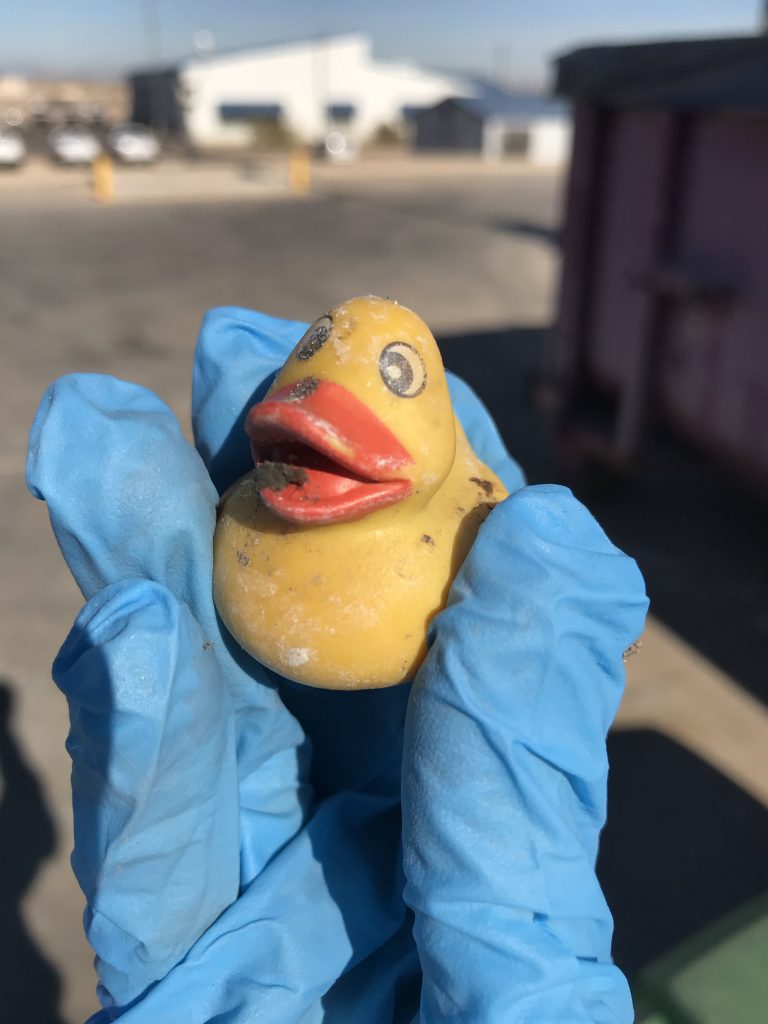
It’s hard to believe that this duck is still smiling after what it’s been through. Photo credit: Water Use it Wisely

The simple truth is that napkins, paper towels, “flushable” wipes (they’re not really flushable), and other paper products should NOT go down the toilet. Period. Let alone any of the other oddities I mentioned previously.

BREAK IT DOWN FOR ME.

Toilet paper has been specifically engineered as a one-time-use product that is durable enough to “do the job” but breaks down fairly quickly when submerged and subjected to the scouring forces of the sewer or wastewater system. Other paper products, while biodegradable in the long run, do not break down quickly enough to be processed at a wastewater treatment plant. In fact, if they do make it through the miles of sewer pipe without accumulating and causing a blockage, they will have to be physically removed at the inlet end of the plant for the treatment process to continue effectively. Why is that? Traditional wastewater treatment is engineered and designed to stabilize organic waste. In other words, the main process used to treat municipal waste is the same biological process of decomposition that happens in nature—but done at an industrial scale. In order to process the millions of gallons (sometimes hundreds of millions at larger plants) of municipal waste that we receive every day, the raw waste must be entirely broken down by the time it gets to our bioreactors. (Note: a bioreactor is a large tank where the biological processes of wastewater treatment occur. It is the heart—or rather the stomach—of a wastewater treatment plant.)

While treatment plants are designed with an initial trash-removal step that we call “headworks,” the system is not foolproof, and solid debris often does make it past the initial removal phase, causing problems with downstream equipment.
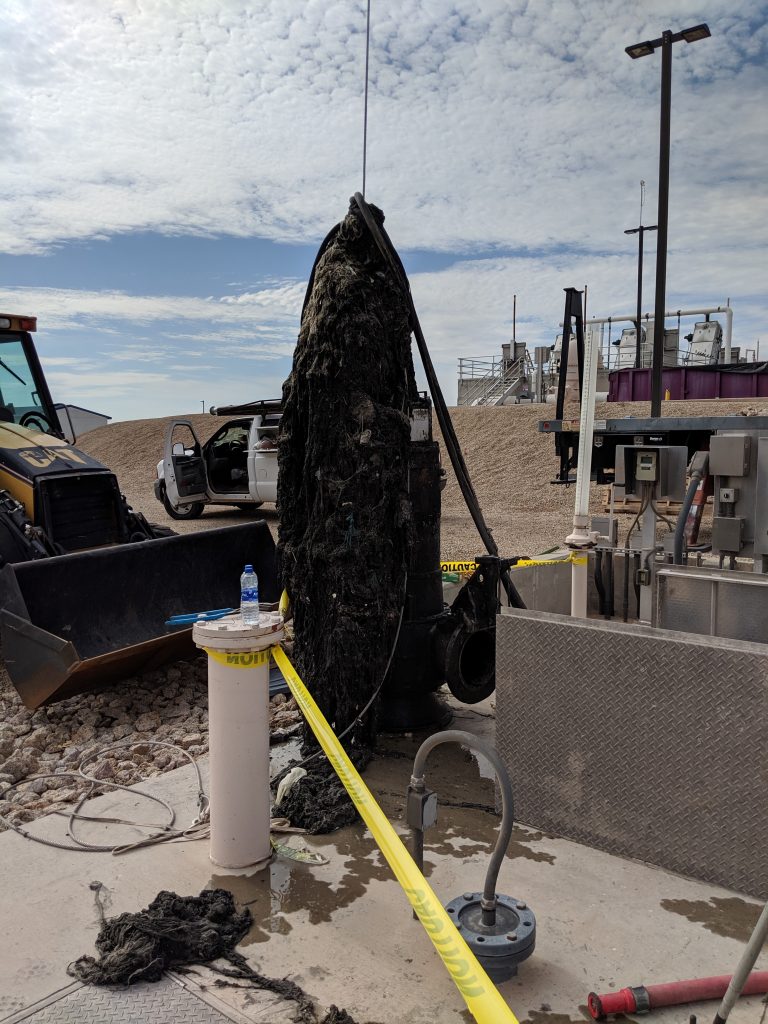
Found Cousin It! Rags that get caught in the system can include flushable wipes, tampons, napkins, Kleenex, hair, floss, water bottles, towels and clothing, or candy wrappers. Photo credit: Water Use it Wisely

SHOW AND TELL.

The images shown throughout this blog are examples of the various types of equipment that operate submerged and are downstream from the plant’s headworks and therefore tend to accumulate solid debris to a point of failure. About once a year, the bioreactors or oxidation ditches are individually emptied for maintenance and for repairs to the equipment housed in them. What is drained gets sent back to the start of the plant to be reprocessed. What is left after draining is a lot of solid garbage that should not enter that part of the plant in the first place. It tends to accumulate in the ditch, catching onto equipment and creating long strands of what we in the industry call “rags.” Rags are just a catch-all term for anything solid that doesn’t break down in the sewer system before reaching the plant: flushable wipes, tampons, napkins, Kleenex, hair, floss, water bottles, towels and clothing, candy wrappers, etc. The smaller non-biodegradable materials (eggshells, dirt, sand, orange peels, basically anything that people put into their garbage disposal), settle on the bottom of the ditch and create sand bar formations of what we call “grit.”

Clogged mud valve. Photo credit: Water Use it Wisely

About once a year, operators climb down into the empty ditches to physically remove tangled rags from equipment and shovel piles of grit out of the bottom of the ditch. It is a very labor-intensive process and can be particularly unpleasant on a hot summer day.

THIS IS PREVENTABLE.

While the cleaning of the ditches is a preventative maintenance task that every wastewater utility conducts, it is worth noting that the accumulation of rags on equipment can and does eventually lead to failure of the equipment. Rotors and mixers can eventually experience motor failure due to working against the resistance of a heavy load from a giant rag ball. Mud valves and gate stems get stuck with rag balls while trying to close them, thus preventing us from fully isolating a piece of equipment. A new rotor can cost up to $65,000 and a mixer can cost up to $25,000.

The utility’s goal is to protect the environment while keeping costs to the rate-payers (our customers) as low as possible. The more we all take responsible flushing seriously, the longer our equipment can last for the benefit of the environment and public health.
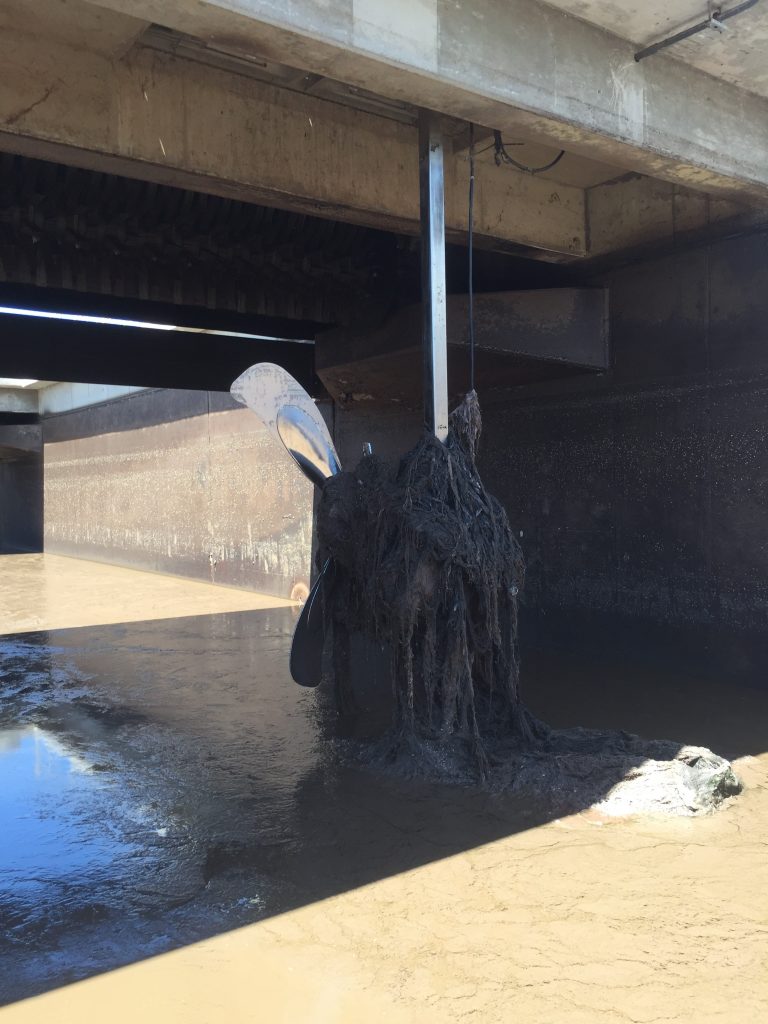
Mixer with a giant rag ball. Photo credit: Water Use it Wisely

So, can it be flushed? The simple answer is that unless it is one of the three P’s — pee, poo, paper (toilet paper) – then NO!

(OK, a fourth P can happen due to the flu or too much drinking).

Be G.R.O.S.S.

The City of Surprise Water Resource Management Department created a campaign in 2017 to help spread the word about what should and should not go down your pipes: Be G.R.O.S.S. stands for “Be Guardians Regarding our Sewer System.” If you’re interested in learning more about wastewater treatment and the ways you can help protect your local sewer, feel free to visit surpriseaz.gov/begross or follow our Instagram page @SurpriseBeGross for more icky photos. Lastly, we hope you take a minute to enjoy our fictional movie trailer that stars some of our local wastewater heroes:
If you enjoyed this blog and the video above you may enjoy The Case of the Missing Sign! Seriously, this is a great story having something to do with Winnie the Pooh (no pun intended… OK, maybe it was)!

Reclamation announces $3.7M in WaterSMART Small-Scale Water Efficiency grants for 41 projects: The funding is used along with local and state funding to support water efficiency projects in 14 states

Click the link to read the release on the Reclamation website (Peter Soeth):

May 23, 2024

The Bureau of Reclamation announced 41 projects selected to receive $3.7 million to improve water efficiency in the Western United States. Projects receiving funding through the Small-Scale Water Efficiency Projects include the installation of flow measurement or automation in a specific part of a water delivery system, lining of a section of a canal to address seepage, or other similar projects that are limited in scope. 

“As leaders, we must recognize the pivotal role water plays in sustaining our communities and ecosystems,” said Bureau of Reclamation Chief Engineer David Raff. “Through strategic investments like these, we pave the way for a more resilient future, ensuring that every drop counts and every project, no matter how small in scale, contributes to the greater goal of water efficiency and sustainability in the Western United States.” 

This announcement is for the first application period of this year’s Small-Scale Water Efficiency Projects Funding Opportunity. The funding opportunity for application period two is open and Reclamation is accepting applications through July 9, 2024.  

To apply for application period two funding, visit grants.gov/search-results-detail/350845 

For more details on a project in your area, please visit the program website

The projects selected are: 

Arizona:  

  • Joshua Valley Utility Company, Phase II: Upgrade 400 Meters to Advanced Meter Reading Technology: $100,000 

California: 

  • Alhambra, Improving Water Efficiency with Advanced Metering Infrastructure: $100,000  
  • Long Beach, Long Beach Utilities Department High Efficiency Indoor Fixtures Program: $100,000 
  • El Dorado Irrigation District, Wholesale Water Replacement: A Municipal Metering Upgrade Project: $100,000 
  • Hallwood Irrigation Company, Flow Control Automation Upgrades Phase 1: $100,000 
  • Monte Vista Water District, Advanced Meter Infrastructure Installation – Phase 3: $90,000 
  • San Benito County Water District, Turf Removal Program: $100,000 
  • South Coast Water District, Water Efficiency Incentive Program: $100,000 
  • Western Municipal Water District of Riverside County: SCADA Master Plan – Control Systems Upgrade Phase 2 for Water Efficiency: $100,000 
  • Utica Water and Power Authority, The Utica Canal Lining Project: $77,640 

Colorado 

  • Eureka Water Company, Improving Water Efficiency for the Eureka Water Company by Updating Water Meters: $100,000 
  • Fruitland Irrigation Company SCADA Improvement Project: $97,790 
  • Orchard Mesa Irrigation District, Orchard Mesa Irrigation District Check Channel Measurement and Automation Project: $100,000 
  • Town of Erie, Lawrence A. Wurl Service Center Turf Replacement Project: $69,443 
  • Town of Vilas, Water System Improvements: $79,000  

Idaho 

  • Black Canyon Irrigation District, Black Canyon Main Canal Metering Project: $99,998 
  • Bilbrey Ditch Company, Limited, Bilbrey Ditch Company, Limited Canal Automation Project: $68,532 
  • Boise Project Board of Control, Automation of the Waldvogel Canal and Waldvogel Wasteway: $43,552 
  • City of Nampa, City of Nampa’s “2C WaterWise” Program: Turf Replacement and Efficiency Systems Irrigation Rebate Program for Residents: $100,000  
  • Fremont Madison Irrigation District Grassy Lake Automation and SCADA Project: $30,694  
  • Greenferry Water and Sewer District, Greenferry Water and Sewer District Water Meter Upgrade Project: $100,000 
  • Henrys Fork Groundwater District, Henrys Fork Groundwater District Flow Meter Telemetry Project: $72,500 
  • Parks and Lewisville Irrigation Company, SCADA Installation Project: Phase II: $100,000  
  • Southeast Idaho Canal Company, Inc., Crosscut Canal Check Structure Automation Project: $40,425 
  • Teton Irrigating and Manufacturing Co, Piping of Earthen Canal along 3000 N Lateral: $87,400 
  • Salmon River Canal Co Limited: Salmon River Canal Company Piping Lateral 1723 and Lateral 12 Automation: $100,000 

Kansas 

  • City of Sharon Springs, Improving Water Efficiency Through Smart Water Meters: $100,000   
  • Kansas Bostwick Irrigation District 2, Converting the Courtland 5th – 48.8 Lateral to a Buried Pipe System: $100,000  

Montana 

  • Blue Water Task Force, Big Sky Water Conservation Program: $100,000 

Nebraska 

  • Central Platte Natural Resources District, Central Platte Natural Resources District, and 30-Mile Irrigation District: 30-Mile Flow: $95,542  
  • Lincoln, Lincoln WaterWise Sustainable Landscapes Cost Share Program: $100,000   
  • Little Blue Natural Resources District, Well Meter Upgrade and Water Us Efficiency Project: $100,000  

New Mexico 

  • Carlsbad Irrigation District, Carlsbad Irrigation District: Prioritized Small-scale Main Canal Lining: $91,818  

Nevada 

  • Moapa Valley Water District, Water Meter and Data Collection System Upgrade: $100,000  

Oregon 

  • North Unit Irrigation District, Improve Water Management & Conservation Through Spill Reduction at 58-11 Pipeline: $51,285  

Texas 

  • City of Universal City, City of Universal City Advanced Metering Infrastructure: $100,000  

Utah 

  • Ogden River Water Users Association, Ogden River Water Users Association SCADA Project: $100,000   

Washington 

  • Chelan County Natural Resources, Wenatchee Water Smart Gardens Program: $77,405  
  • Columbia Irrigation District, Columbia Irrigation District Cox Spillway Liner Project: $88,721  
  • Quincy Columbia Basin Irrigation District, Automation of W39.9 Lateral Turnout of the West Canal: $78,360  

Wyoming 

  • City of Cheyenne, Measurement and Canal Efficiency Project: $100,000  

Reclamation provides cost share funding the Small-Scale Water Efficiency Projects to irrigation and water districts, Tribes, states and other entities with water or power delivery authority for small water efficiency improvements that have been identified through previous planning efforts. 

Small-Scale Water Efficiency Projects are part of the WaterSMART Program. It aims to improve water conservation and sustainability, helping water resource managers make sound decisions about water use. The WaterSMART Program identifies strategies to ensure this generation and future ones will have enough clean water for drinking, economic activities, recreation and ecosystem health. To learn more, please visit www.usbr.gov/watersmart.