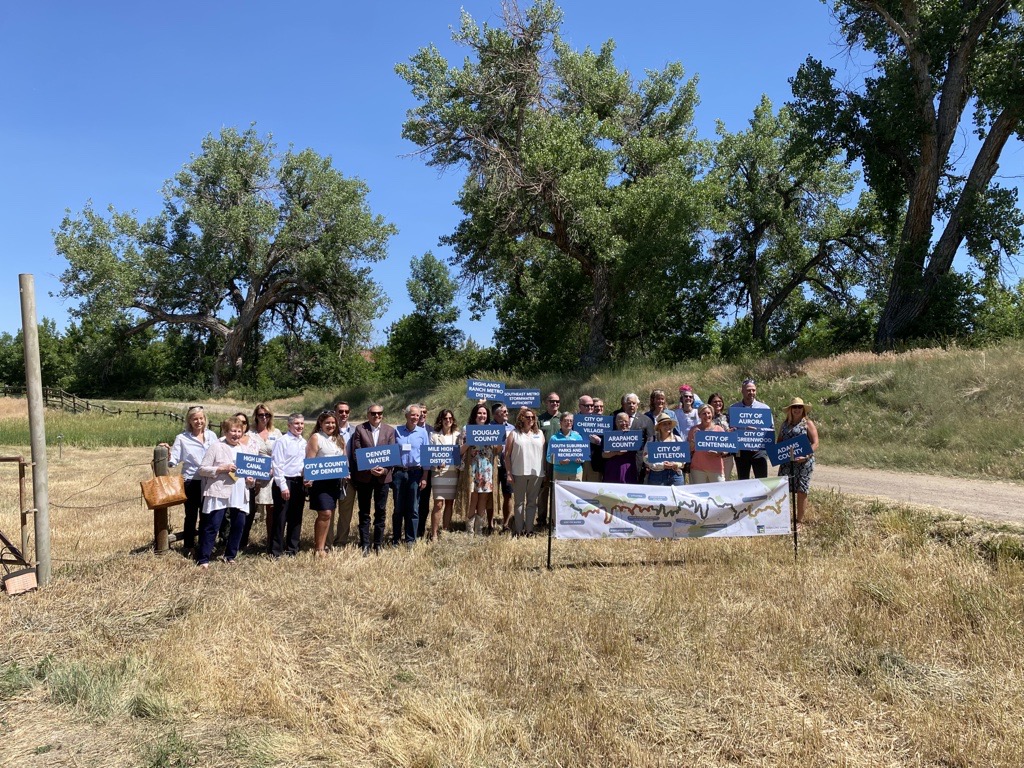
Historic milestone secures future of the high line canal: #Denver Water transfers 45 miles of iconic high line canal to Arapahoe County, securing its future with conservation easement held by the High Line Canal Conservancy

Left to Right: Harriet Crittenden LaMair (High Line Canal Conservancy), Paula Herzmark (High Line Canal Conservancy Board of Directors), Dessa Bokides (High Line Canal Conservancy Board of Directors), Amy Heidema (Denver Water), Mark Bernstein (Denver Parks and Recreation), Diana Romero Campbell (Denver City Council), Tom Roode (Denver Water), Alan Salazar (Denver Water), Jim Lochhead (High Line Canal Conservancy Board of Directors), Steve Coffin (High Line Canal Conservancy Board of Directors), Laura Kroeger (Mile High Flood District), Lora Thomas (Douglas County Commission), Evan Ela (High Line Canal Conservancy Board of Directors), Melissa Reese-Thacker (South Suburban Parks and Recreation), Dan Olsen (Southeast Metro Stormwater Authority), Pam Eller (South Suburban Parks and Recreation Board of Directors), Earl Hoellen (Cherry Hills Village City Council), Jeff Baker (Arapahoe County Commission), Leslie Summey (Arapahoe County Commission), Shannon Carter (Retired – Arapahoe County Open Spaces), Bill Holen (Arapahoe County Commission), Carrie Warren-Gully (Arapahoe County Commission), Gretchen Rydin (Littleton City Council), Gini Pingenot (Arapahoe County Open Spaces), Amy Wiedeman (City of Centennial), Suzanne Moore (City of Greenwood Village), Brian Green (Aurora Parks, Recreation and Open Space), Nicole Ankeney (Aurora Parks, Recreation and Open Space). Credit: High Line Canal Conservancy

Click the link to read the release on the High Line Canal Conservancy website (Jordan Callahan):

June 20, 2024

In a groundbreaking move to protect the historic 71-mile High Line Canal, one of the nation’s longest continuous urban trails, Denver Water announces the transfer of 45 miles of the beloved High Line Canal to Arapahoe County, and with it, a conservation easement that permanently protects the Canal as a natural open space for the region. This visionary action marks the end of a century-long stewardship by Denver Water and ushers in a new chapter for the historic water delivery system, now one of the region’s treasured urban trails meandering through 11 governmental jurisdictions. 

Effective this month, the High Line Canal Conservancy will hold and manage a conservation easement for this 45-mile stretch, safeguarding it for future generations. This easement will ensure the Canal will forever be maintained as a public linear open space park and trail while protecting the Canal’s unique conservation values, including preserving the natural environmental beauty and public recreational benefits of this cherished greenway and preventing future development, while continuing stormwater management and public utility uses. 

The collaborative agreement between Denver Water, Arapahoe County, and the High Line Canal Conservancy marks a significant advancement toward the community vision to honor, enhance and repurpose this landmark of our agricultural heritage, a 71-mile irrigation canal, into one of our region’s premier green spaces connecting neighborhoods, people and nature.

“This historic milestone represents a major step forward in the ongoing transformation of the High Line Canal,” said Tom Roode, Chief Operations and Maintenance Officer at Denver Water. “This very positive evolution of the Canal reflects Denver Water’s mission to advance public health and water conservation while ensuring the Canal is protected for generations to come.”

While Denver Water is transferring ownership of more than half of the Canal to Arapahoe County, the water provider will continue to own nearly 20 miles of the Canal during the transformation process. Maintenance of the corridor is a collaboration between Denver Water, the counties, local jurisdictions and the Conservancy.

“For decades, the High Line Canal has been an important and well used recreational asset for Arapahoe County residents, making this ownership transfer a natural fit for our open spaces, parks and trails portfolio,” said Arapahoe County Commissioner and Board Chair Carrie Warren-Gully. “Our work to preserve natural and legacy spaces will be greatly expanded through the conservation easement, ensuring the greenway remains a treasured asset for generations.” 

Trail users will not see a dramatic difference from the ownership change; however, over time care for the natural resources will improve under county ownership. The Canal trail will always remain free to use the Canal for hiking, biking, horseback riding and enjoying the outdoors; and the Conservancy will continue to be a central point of contact for any inquiries. 

“Denver Water’s protection of the Canal through a Conservation Easement demonstrates tremendous foresight and partnership. The easement is a lasting gift that will forever improve the quality of life in the Denver region for the hundreds of thousands of people who use the Canal today and for generations to come,” said Harriet Crittenden LaMair, CEO, High Line Canal Conservancy. “All of us at the High Line Canal Conservancy – our board, staff and volunteers – are so honored to accept this responsibility.” 

The Conservancy, Denver Water, and Arapahoe County in collaboration with local governments spent years completing a comprehensive plan that recommends investments and management changes to support the long-term transition of the Canal from a water delivery function to a protected, regional open space and trail with multiple environmental and recreational benefits. 

“Denverites already know the High Line Canal as one of the best places to run, hike, and bike. The work being done here will ensure future generations know it, as well,” said Mayor Mike Johnston. Jolon Clark, Executive Director of Denver Parks and Recreation also remarked, “With over a million users each year, the High Line Canal is a vital part of our parks and trail system within the City & County of Denver. For decades we have been deeply engaged and have invested in the preservation and enhancement of the High Line Canal. We look forward to fostering our partnerships to ensure that the High Line Canal remains a cherished recreational and natural resource for Denver residents.”

The long-term protection of the Canal will require ongoing public and private funding. The High Line Canal Conservancy is working toward that as they near the close of a transformational $33 million campaign, Great Lengths for the High Line, that is leveraging public funding for a total investment of $100 million in the Canal over 5 years. 

“We are thrilled with the incredible support the Great Lengths campaign has received from across the region, including a generous $10 million investment from Denver Water and $7 million from Great Outdoors Colorado,” said Paula Herzmark, Board Chair of the High Line Canal Conservancy. “With the new ownership and conservation easement in place, Arapahoe County, the High Line Canal Conservancy, and Denver Water have collectively secured the Canal’s future. This ensures that it will be here as an essential natural open space, free and accessible to the public forever.” 

Great Outdoors Colorado also provided funding to the Conservancy to support the creation of the conservation easement, including a present conditions report and the establishment of an endowment that will support ongoing monitoring and enforcement of the easement.

About Denver Water

Denver Water proudly serves high-quality water and promotes its efficient use to 1.5 million people in the city of Denver and many surrounding suburbs. Established in 1918, the utility is a public agency funded by water rates, new tap fees and the sale of hydropower, not taxes. It is Colorado’s oldest and largest water utility. Subscribe to TAP to hydrate your mind, and follow us on Facebook, Twitter and Instagram.

About Arapahoe County 

Arapahoe County provides the best of everything Colorado has to offer. From babies to boomers and beyond, residents put down roots, raise families, start and run businesses, and embrace the endless opportunities and amenities that make the state unique. Arapahoe County spans 805 miles and features vibrant urban, suburban and rural communities, an unparalleled open space and trail system, major employment centers and a robust multimodal transportation network. Learn more at arapahoeco.gov

About High Line Canal Conservancy

The High Line Canal Conservancy is a tax-exempt nonprofit formed in 2014 by a passionate coalition to provide leadership and harness the region’s commitment to enhancing and permanently protecting the High Line Canal. With support from each jurisdiction and in partnership with Denver Water, the Conservancy is leading a collaborative and region-wide effort to ensure the Canal is protected and enhanced for generations. Visit HighLineCanal.org for more information.

‘Climate stripes’ graphics show U.S. trends by state and county — NOAA

Click the link to read the article on the NOAA website (Rebecca Lindsey and Jared Rennie):

June 20, 2023

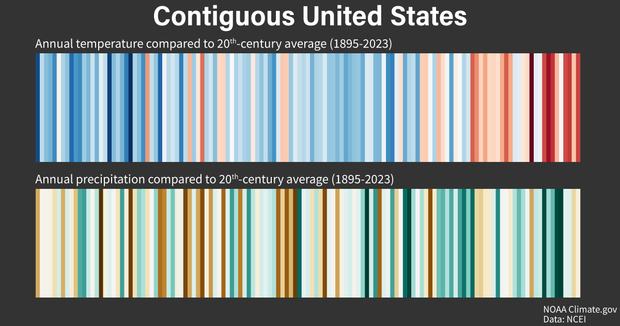
Climate scientist Ed Hawkins put the idea “a picture is worth a thousand words” into practice back in 2018 when he created the graphics that have become known as “Climate Stripes.” These bar-code-like images turn a location’s annual climate data into rows of colored stripes that show yearly temperature and precipitation compared to the long-term average—red bars for warm years, and blue for cool ones; green for wet years, and brown for dry ones. The darker the color, the bigger the difference from average.

Inspired by Hawkins’ images, our collection of Climate Stripes images is based on the NOAA climate record for U.S. states; counties; Washington, D.C.; and selected stations in Hawaii.

  • Access the collection through the interactive embedded below.
  • Some of the interactive features work within the web page, but for best experience, open the Story Map in a new window. Then use the scroll bar to access the maps.

National stripes

Below are the climate stripes for the contiguous United States. (Alaska and Hawaii aren’t included because their climate records do not go as far back in time as the “Lower 48” states.) According to NOAA National Centers for Environmental Information, the annual average temperature of the United States has warmed at a rate of 0.16 degrees Fahrenheit per decade between 1895 and 2023. The darkest red bar that appears near the right side of the temperature image is the current warmest year on record for the country—2012, when the annual average temperature was 55.28 degrees Fahrenheit, 3.26 degrees warmer than the 20th-century average of 52.02 degrees Fahrenheit.

Annual temperature (top) and precipitation (bottom) in the contiguous United States from 1895-2023 arranged from left to right. Each line shows a given year’s temperature or precipitation compared to the 20th-century average. The darker the red or blue, the warmer or cooler the year. The darker the green or brown, the wetter or drier the year. Red bars dominate the right end of the temperature image, showing the influence of human-caused global warming on U.S. average temperature. The precipitation stripes image also shows a pattern of more green than brown in recent decades. Although there is a lot of variability from place to place, the U.S. average precipitation is increasing. NOAA Climate.gov images, based on data from NOAA National Centers for Environmental Information and analysis by Jared Rennie.

Friends of the Yampa helps designate 278 miles of #YampaRiver Watershed tributaries as Outstanding Waters: The designation will preserve clean water, local economies and outdoor recreation  #GreenRiver #ColoradoRiver #aridifcation

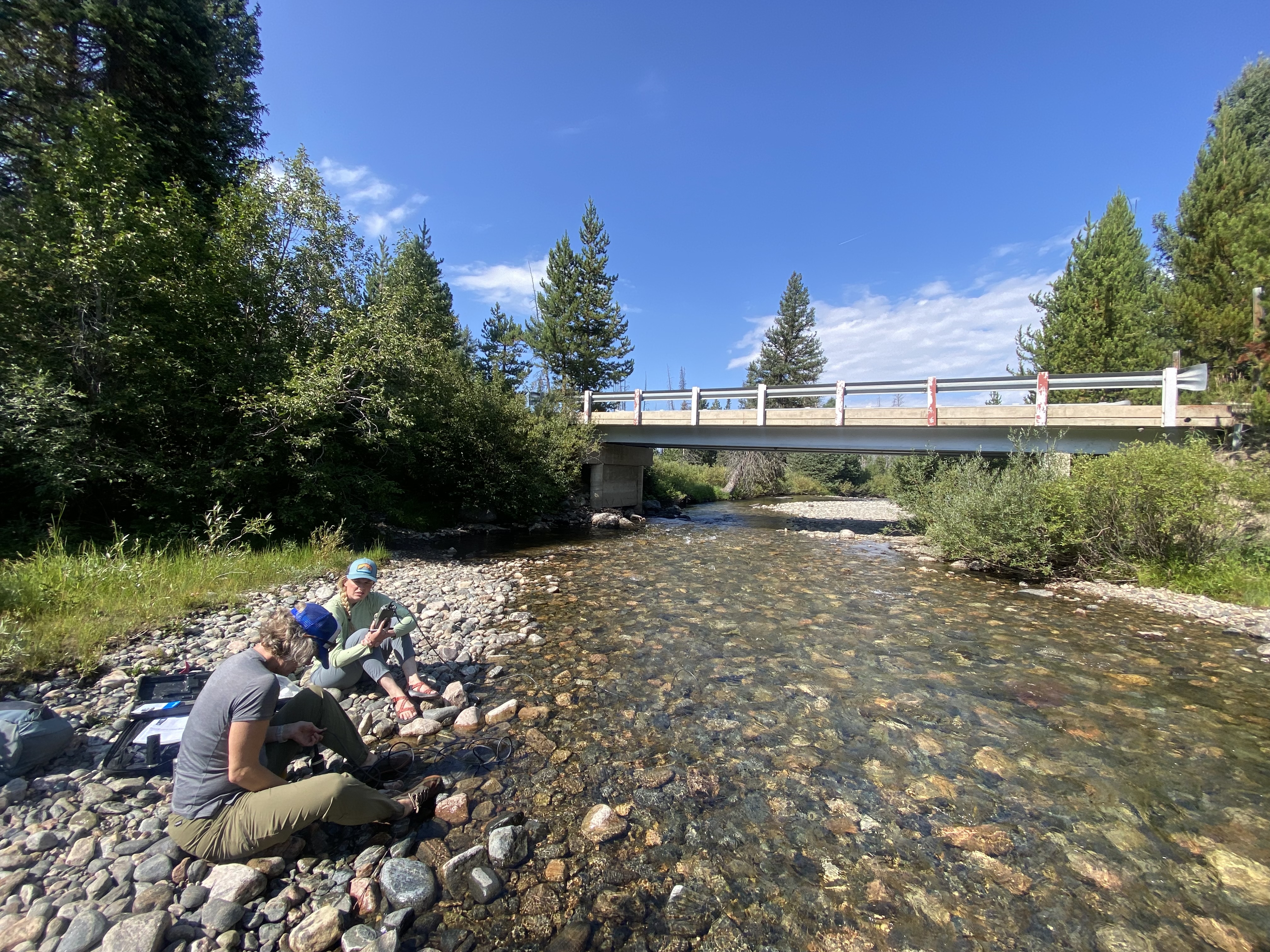
Volunteers Jeremy Bailey and Brad Luth pose near King Solomon Creek during winter sampling efforts in North Routt County.

From email from Katie Berning:

On June 11, 2024, the Colorado Water Quality Control Commission (WQCC) unanimously voted to approve a proposal to designate approximately 385 miles across 15 rivers and streams in the Upper and Lower Colorado, Eagle, Yampa and Roaring Fork River basins as Outstanding Waters (OW). Approximately 278 of those stream miles are along tributaries of the Yampa River.  The designation protects streams with existing excellent water quality for their benefit to the environment, wildlife and recreation, and safeguards those streams from future degradation, including pollution from development, mining, oil and gas extraction, and other uses.  

Friends of the Yampa is honored to be a part of the Colorado River Basin Outstanding Waters Coalition (CRBOWC). For two years, advocates from the coalition and within these communities worked extensively across the state, gaining broad support for the designation, by conducting outreach to local, state and federal government entities; water rights holders; water districts; water providers and interests; businesses; land managers; and landowners.  

In the Yampa Basin, this work could not have happened without countless hours donated from dedicated volunteers. The full-day missions took place about each season and were accomplished by foot, raft, snowmobile, ski, bicycle and off-road vehicle. Environmental program manager Jennifer Frithsen headed up all logistics including collecting samples then delivering samples in a full spectrum  weather events to ACZ in Steamboat and to Eagle County for testing.

Friends of the Yampa extends a heartfelt thank you — on behalf of the mighty Yampa River — to the following volunteers: Jeremy Bailey, Marla Bailey, Ben Beall, Angus Frithsen, Brad Luth, Maggie Mitchell, Mike Robertson, Jojo Vertrees and Sophie Vertrees.  Special thanks to Jeremy Bailey and Brad Luth. Your willingness to snowmobile during the winter of 2022-23 and 2023-24 to remote parts of Routt County to dig out streams and collect water samples in record snowfall and challenging weather helped make this possible. We love you guys! 

The timing of the OW designation is apt with June being National Rivers Month (and Yampa River Month). It is expected that the designation will become final when the WQCC approves the rulemaking documents in August 2024.  

“Clean water is essential to a thriving Yampa River Basin. Our community values these streams for their beauty, the habitat they provide for fish and other organisms, and the clean water they provide to the Yampa, where residents and visitors alike flock to fish, paddle, tube or just recharge. The Outstanding Waters designation is an extra layer of protection for these pristine streams in the face of climate uncertainty and development pressure.”  said Jenny Frithsen, Friends of the Yampa environmental program manager. 

About The Colorado River Basin Outstanding Waters Coalition  

The Colorado River Basin Outstanding Waters Coalition is composed of American Rivers, American Whitewater, Audubon Rockies, Colorado Trout Unlimited, Eagle River Coalition (previously Eagle River Watershed Council), Friends of the Yampa, The Pew Charitable Trusts, Roaring Fork Conservancy, Trout Unlimited, Western Resource Advocates, and Wilderness Workshop, which have a common goal of safeguarding clean water in Colorado. The CRBOWC proposed Outstanding Water designations to protect the outstanding waters of the Upper and Lower Colorado, Roaring Fork, Eagle, and Yampa river basins. 

Environmental program manager Jenny Frithsen and conservation program manager Emily Burke collect samples in North Routt County for analysis for the Outstand Waters project.

Getches-Wilkinson Centers’s 2024 #ColoradoRiver Conference Shatters Attendance Records #COriver #aridification

Click the link to read the article on the Getches-Wilkinson website (Chris Miller):

June 20, 2024

The Getches-Wilkinson Center just wrapped up the 44th Annual Colorado Law Conference on Natural Resources, which has held at the law school on June 6-7, 2024. This year, the conference once again focused on management of the Colorado River watershed, and GWC was honored to co-convene this important conversation with the Water & Tribes Initiative for the second year in a row.

The conference was billed as “Next Chapters on the Colorado River: Short-Term Coping, Post-2026 Operations, and Beyond.” The seven basin states are in the midst of sensitive negotiations over the long-term guidelines for operation of the reservoirs – Lake Mead and Lake Powell. The final decision on those operating guidelines will be made by the Bureau of Reclamation and will address critical issues including the structural deficit in the system, i.e., the imbalance in water use and water supplies. As the states continue to negotiate, the stakes are high, and all eyes are watching to see whether a consensus agreement emerges. Meanwhile, the 30 Tribes across the Colorado River basin find themselves in a familiar position – outside of the formal negotiation process looking in.

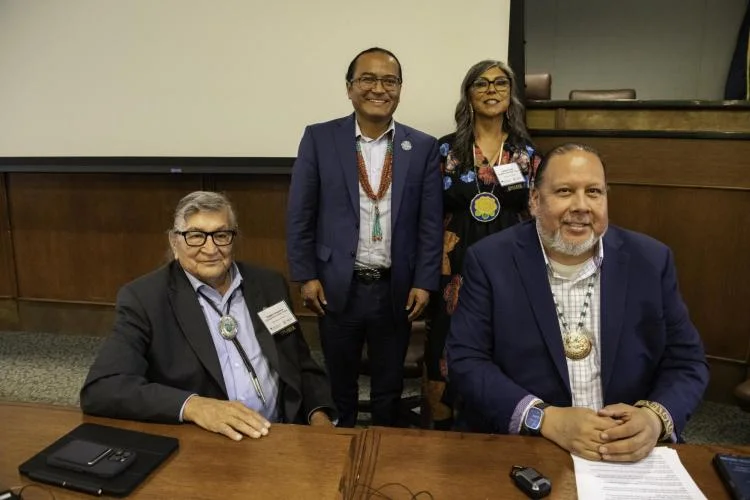
At the Colorado River Conference, however, Tribal representatives had an opportunity to share their views on an equal footing with the other sovereigns. On Day 1, Daryl Vigil of the WTI moderated a panel of Tribal leaders representing the Southern Ute Indian Tribe, the Gila River Indian Reservation, the Colorado River Indian Tribes, and the Navajo Nation. They all conveyed that Tribes had been historically excluded from these important conversations about the future of the River, and that they were now demanding a seat at the table. Tribes across the Basin are working together to ensure fair treatment in allocation of Colorado River water, and they are also making strides on formal structures like the Memorandum of Understanding that was recently announced by the Upper Basin Tribes and the Upper Colorado River Commission.

The room was also abuzz with news of the recent settlement agreement involving the Navajo Nation, the Hopi Tribe, and the San Juan Southern Paiute Tribe, involving Northeastern Arizona water rights. The historic settlement agreement was approved by all three tribes shortly before the conference and will now require approval by Congress and $5 billion in funding. The settlement was celebrated as a product of self-determination and a sign of hope for future progress; however, the ultimate outcome is uncertain and subject to the political dynamics of Washington, DC. The Conference provided a unique opportunity for everyone working on Colorado River issues to learn about the settlement from the Tribes who drove the process and will be most impacted by the outcome.

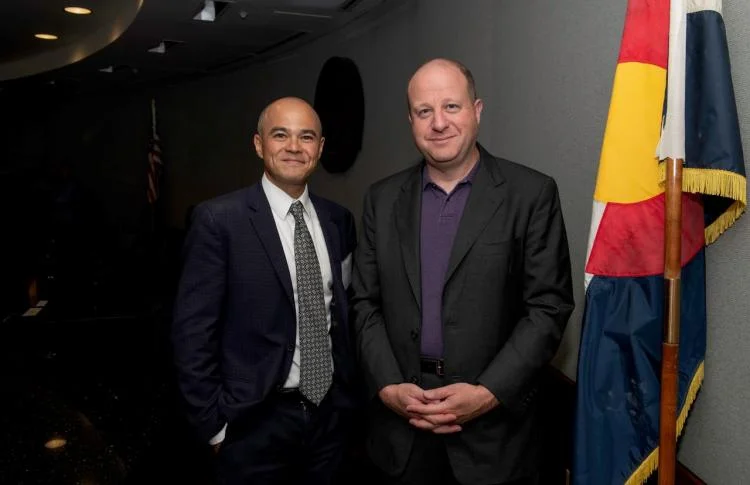
From everyone here at GWC, we’d like to thank WTI, all the Tribal leaders who spoke, Governor Polis, Commissioner Touton, the state representatives, our sponsors, and all the other speakers and attendees for making this a memorable and impactful event. The show of community over those two days inspires us with hope that we can find solutions to these very challenging issues.