
Bike to Work Day 2024


Click the link to read the release on the Audubon Rockies websiite (Abby Burk):
On May 29, 2024, Colorado Governor Jared Polis stated “Water is life in Colorado and today I was proud to protect our water resources that are essential for our agriculture, our economy, and our way of life.” That day, he signed HB24-1379 Regulate Dredge & Fill Activities in State Waters, making Colorado the first state in the nation to pass legislation that addresses the stream and wetlands protection gap created by the May 2023 Sackett vs. Environmental Protection Agency (EPA) decision. It took a lot of hard work, long days, collaboration, substantive and technical outreach, leaning into complex topics, working through misinformation, and dealing with a competing bill. We had to make some compromises, but ultimately, we came together in the “Colorado way” on a new law that works for Colorado’s unique intermountain waterways and protects wetlands and streams that were put at risk of losing protection by the Sackett decision.
Audubon convened and facilitated conversations to support consensus around a good solution and worked to depoliticize wetland and stream protections. After all, they support all of us. Audubon celebrates our network who submitted 2,248 comments to legislators in support of creating a robust Colorado Dredge and Fill Program that covers all streams and wetlands. Audubon members also made more than 60 contributions to the “What’s Your Wetland?” storymap in support of HB24-1379. Audubon celebrates our critical partnerships with the Protect Colorado Waters Coalition and the Colorado Healthy Headwaters Working Group as we worked together to preserve our critical needs through a storied and challenging process.
The new law—led by Speaker of the House Julie McCluskie (D-Dillon), Senator Dylan Roberts (D-Frisco), Representative Karen McCormick (D-Longmont), and Colorado Department of Public Health and Environment’s (CDPHE) Director of the Water Quality Control Division, Nicole Rowan—is excellent news for Colorado’s birds and communities that critically depend upon clean water. It helps lead the way for other states in their pursuit of wetland and stream protections in the post-Sackett landscape.
House Bill 24-1379 was one of two proposed bills that sought to address the regulatory gap created by the Sackett decision. Senate Bill 24-127, sponsored by Senator Barbara Kirkmeyer (R-Brighton), was the second. Due to the two competing approaches of the two bills, consensus was found after a wild ride of public engagement, testimonies, intense negotiations, and 29 amendments. Notably, Senator Kirkmeyer became a co-sponsor to the amended and final HB24-1379 within the last week of the legislative session, winning bipartisan backing.
Why Was a “Colorado Program” Necessary to Protect Wetlands and Streams?
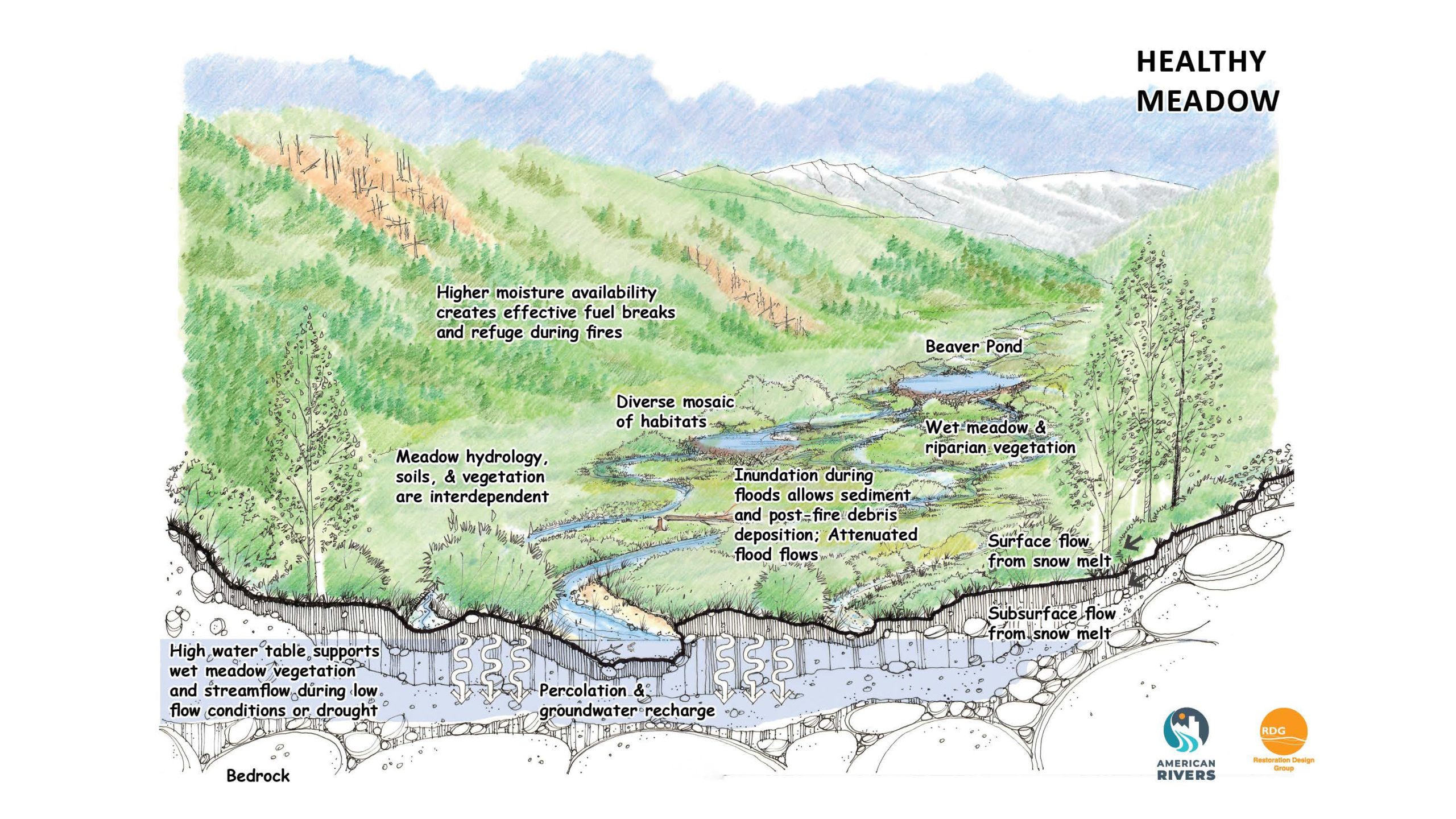
Wetlands and stream systems are essential for birds and provide ecosystem services such as water purification, wildlife habitat, and flood, wildfire, and drought mitigation. Colorado has lost about 50 percent of its wetlands due to development since statehood, so protecting what remains is imperative.
The Clean Water Act provides authorities for the EPA and the U.S. Army Corps of Engineers (USACE) to define and regulate different types of water bodies. This includes the 404 Permit Program, which determines which wetlands must be regulated and which kinds of dredge-and-fill activities must be permitted for specific waterways. The U.S. Supreme Court decision in Sackett v. EPA dramatically narrowed the scope of these regulations and undercut waters subject to federal regulation and placed an estimated 60 percent of Colorado wetlands at risk of losing protections. Moreover, all ephemeral streams and a significant portion of intermittent streams in every area of the state would have lost protection if a new state program was not adopted. The United States Geological Survey’s National Hydrography Dataset* (as reported in Colorado’s 2022 Sackett Amicus Brief) estimates that 24 percent of Colorado’s streams are ephemeral and 45 percent are intermittent** meaning over two-thirds of Colorado’s waters are temporary and lack year-round flow.
The Sackett decision opened the doors for development to occur next to and on top of wetlands on private land, so long as there is no surface water connection between them and flowing waterways. House Bill 24-1379 was drafted to moderate the pendulum swings in federal wetland and stream protection levels in Colorado by creating a predictable State permitting and protections program that would work for Colorado’s intermountain semi-arid waterways.
What Does the New Law do for Colorado’s Wetlands, Streams, and Restoration Projects?
The new state Dredge and Fill Permit Program created by HB24-1379 contains many details established in statute, and there are areas where more time and attention is needed to determine outcomes through a rulemaking process. Although the new law contains all of the federal 404 agricultural exemptions and some new exemptions tailored to Colorado needs on irrigation ditches, and much more, the below list pertains to Audubon and the Colorado Healthy Headwater Working Group’s direct work in protecting wetlands and streams and restoration project capabilities.
- The new regulatory protections program, with its broad application to Colorado ‘State Waters,’ surpasses the scope of the federal ‘Waters of the United States.’
- “State Waters” C.R.S. 25-8-103(19) means any and all surface and subsurface waters which are contained in or flow in or through this state, but does not include waters in sewage systems, waters in treatment works of disposal systems, waters in potable water distribution systems, and all water withdrawn for use until use and treatment have been completed.“
- The new permitting program is structured to prioritize avoidance of adverse impacts to State Waters, followed by minimization and, finally, compensatory mitigation of the unavoidable impacts.
- Federal 404 guidelines are the floor and not the ceiling for any state rules, allowing Colorado to customize regulations that work for intermountain semi-arid waterways.
- The existing Water Quality Control Commission (WQCC) will draft the new rules and review and issue individual permits so that no new regulatory commission will be formed, and reports will be generated detailing the functionality of the new permitting approach.
- The new law creates a new definition in the statute of “ecological lift,” which “means an improvement in the biological health, as well as the chemical, geomorphic or hydrologic health of an area that has been damaged, degraded for destroyed.”
- This new definition is used as one of several criteria for when certain restoration projects will not be required to obtain a state dredge and fill permit: For ephemeral streams, the WQCC must promulgate rules that include: “An exemption for voluntary stream restoration efforts in ephemeral streams that do not require compensatory mitigation and are designed solely to provide ecological lift where the activity is taking place.” This was one of the provisions that Audubon pressed hard for to maintain the status quo that restoration of rangeland ephemeral drainages to stop erosional headcuts from destroying critical mesic areas could continue to take place without having to obtain a dredge and fill permit (as these areas have always fallen outside of the federal 404 permit jurisdiction). These mesic area restoration projects have been happening for about 10 years in Colorado with great success.
- For perennial and intermittent streams, if your restoration project requires a federal USACE 404 Nationwide Permit 27 or other general permit, provided those activities result in net increases in aquatic resource functions and services, then a project proponent will not need a separate permit from the Water Quality Control Division.
What Are the Next Steps?
CDPHE will initiate the rulemaking process starting September 2024 through December 2025 to fully form the regulatory program put in place by HB24-1379. All voices will play a role in both the design and implementation of HB24-1379’s regulatory program, helping to set up Colorado for long-term success. Watch for additional information and engagement from Audubon. Sign up for notifications and learn more here!
Conclusion
Water connects us all, and rivers do not stop flowing at state lines. More must be done to restore federal protections for interstate river health while adequately supporting state wetland and stream protection programs. As a headwater state, Colorado must continue to lead the way for the rest of the West and the nation in terms of what can be accomplished with collaboration and shared vision. HB24-1379 does that and puts Colorado on a path to protect its waterways for future generations. At Audubon, we know the value and connectivity of our watersheds, wetlands, streams, and rivers; these are waterways we all depend upon—birds and people. We also know the value of bringing people together for durable solutions and we cannot do this work without you. Together, we can protect our most precious natural resource, water, and the health of our waterways and continue the Colorado way of coming together to address our most pressing issues.
Thank you for helping us pass this historic legislation.

From email from Western Resource Advocates (Erin Overturf):
June 28, 2024
STATEMENT FROM WESTERN RESOURCE ADVOCATES
This morning, the Supreme Court ruled to overturn Chevron v. NRDC, one of the most cited cases in American law.
This is just the latest in a series of SCOTUS decisions designed to undermine the effectiveness of federal administrative agencies like the Environmental Protection Agency.
Today’s far-reaching ruling overturns a 40-year legal framework, marking the culmination of a decades-long effort to undermine federal agencies’ efforts to protect our health and our environment. Overturning Chevron v. NRDC will exacerbate existing dysfunction in federal policymaking, inviting litigation and making it increasingly challenging to secure public health and safety standards – including solutions addressing climate change – at the federal level.
Administrative agencies are the workhorses of our modern system of government. The issues confronting our day-to-day lives are too numerous and too nuanced for the three main branches of government to address alone, but agencies have the technical expertise and flexibility to fill in the gaps.
This decision will make it harder for federal agencies to take action to protect our health and our environment, allowing unelected federal judges with lifetime appointments to reject the policy judgements of agencies with more expertise and replace those agency judgments with their own policy preferences.
“This ruling makes the work we do before state utility regulators and legislatures all the more important. Given the challenging new landscape for federal agencies created by today’s decision, state-level policy on climate action and environmental protection is more critical than ever. The feds will not be able to solve this problem for us. It is time for leadership at the state level.”
In light of this decision, advocacy within our states to protect our health, our environment, and our climate has never been more important. States can and should set their own standards to reduce pollution, conserve water, and protect wildlife.
WRA is committed to continuing to leverage our expertise driving state-level policies that protect our health and fight climate change and its impacts in the Interior West.

Click the link to read the release on the Reclamation website (Mike Boyles):
Jun 28, 2024
BOULDER CITY, Nev. – The Bureau of Reclamation is seeking public comments on a draft environmental assessment analyzing potential impacts of a System Conservation Implementation Agreement between Reclamation and the Imperial Irrigation District. The agreement, administered through the Lower Colorado River Basin System Conservation and Efficiency Program and funded in part by the Inflation Reduction Act, supports voluntary system conservation to protect Colorado River reservoir storage volumes amid persistent drought conditions driven by climate change.
As analyzed in the draft environmental assessment, the Imperial Irrigation District has proposed to conserve a volume up to a maximum of 300,000 acre-feet of Colorado River water each year from 2024 through 2026 which will remain in Lake Mead to benefit the Colorado River System and its users.
The draft environmental assessment considers potential impacts from actions taken to implement water conservation, thereby reducing water diversions from the Colorado River at Imperial Dam.
The draft environmental assessment is available at Lower Colorado Region | Bureau of Reclamation (usbr.gov). The public comment period will end July 28, 2024.
Comments should be directed to Reclamation via email to prj-lcr-nepa@usbr.gov or to the mailing address below.
Bureau of Reclamation, Lower Colorado Regional Office
Attn: Resource Management Office Chief (LC-2000)
P.O. Box 61470
Boulder City, NV 89006
Mailed comments on this notice must be postmarked by July 27, 2024. In your response, please refer to the above public notice title and date. Should no response be received by the above expiration date, a “no comment” response will be assumed.

Click the link to read the commentary on The Los Angeles Times website (Sammy Roth). Here’s an excerpt:
June 27, 2024
Two-thirds of the way through Thursday night’s presidential debate, CNN journalist Dana Bash finally asked the candidates how they would tackle a challenge that scientists say poses an existential threat to human civilization: climate change. Perhaps unsurprisingly, former President Trump made a series of false claims about his first-term track record. After he spent most of his two-minute response time returning to a previous debate topic, Bash prompted him to say something about global warming. Trump responded that he wants “absolutely immaculate clean water” and “absolutely clean air.”
“We were using all forms of energy, all forms — everything,” he said, referring to his first term. “And yet, during my four years, I had the best environmental numbers ever, and my top environmental people gave me that statistic.”
Although planet-warming carbon emissions fell sharply during the final year of Trump’s first term, due to an economy slowed by the COVID-19 pandemic, they rose slightly from 2016 to 2019. And if Trump could have helped it, emissions would have risen even more. He glorified coal, oil and gas even as they polluted the air and water he claimed to love; bashed solar and wind energy with bogus talking points; and pulled the United States out of the international Paris climate accord. At Thursday’s debate, Trump claimed the Paris accord — which Biden ultimately rejoined — would cost the country $1 trillion. He didn’t cite a source for that number. And he didn’t come close to acknowledging that the heat waves, wildfires, floods, storms, droughts, migrant flows and crop failures already being exacerbated by rising temperatures will cost the U.S. far more than the price of transitioning from fossil fuels to renewable energy, in the view of climate and economic experts. Trump also claimed that the Paris agreement will cost China, Russia and India “nothing.” Another lie. All three nations, like every other Paris signatory, have pledged to do what’s necessary to try to keep global temperatures from rising more than 1.5 degrees Celsius above preindustrial levels — which scientists say involves slashing carbon emissions 43% by 2030 — a tall order.
In total, the candidates spent about two and a half minutes discussing the climate crisis during Thursday’s debate before the moderators moved on to other topics.
Click the link to read the release on the Colorado Attorney General’s website:
June 28, 2024
Attorney General Phil Weiser released the following statement regarding today’s U.S. Supreme Court decision overruling 40 years of regulatory law precedent:
“Under 40 years of precedent known as the Chevron doctrine, the Supreme Court has given reasonable deference to federal agencies to implement statutes passed by Congress, notably, when a statute is unclear. As the court has consistently acknowledged, it is impossible for Congress to legislate every detail needed to carry out and enforce complex laws.
“With today’s opinion in Loper Bright Enterprises v. Raimondo, the Supreme Court appoints itself as the super regulator. The court says that it knows better than highly trained experts when it comes to protections for the air we breathe, the water we drink, public lands, worker safety, food and drug safety, public safety, disaster relief, public benefits, or any other regulation that affects American lives. [ed. emphasis mine] The court’s decision in this case threatens to create regulatory uncertainty for businesses, government agencies, and everyday Americans. As a result, it promises not only confusion, but also higher costs and greater harms. Rather than clarifying the scope of the Chevron doctrine, the court chose to sow chaos and uncertainty.
“Today’s decision does not impact state regulations promulgated under Colorado state law. The Department of Law will continue to work with state agency partners to implement and enforce state regulations.”
Colorado was part of a coalition of state attorneys general that filed a court brief defending the Chevron doctrine in Loper Bright Enterprises v. Raimondo.
Click the link to read the article on the Inside Climate News website (Marianne Lavelle):
June 28, 2024
This article originally appeared on Inside Climate News (hyperlink to the original story), a nonprofit, independent news organization that covers climate, energy and the environment. It is republished with permission. Sign up for their newsletter here.
The high court sweeps away a ‘Goliath’ of modern law, weakening agencies’ legal authority as courts weigh Biden’s policies to cut greenhouse gases.
Just as federal regulators move forward with a climate change policy rooted in dozens of complex provisions of law, the Supreme Court on Friday overturned the principle that has guided U.S. regulatory law for the past 40 years.
That principle held that a federal agency’s interpretation of the law should be honored, as long as it is reasonable, in cases where there is any question about the law’s meaning.
Now, the so-called Chevron doctrine has been swept aside by a 6-3 court split along ideological lines. Chief Justice John Roberts, who two years ago authored a major opinion limiting the Environmental Protection Agency’s authority to regulate greenhouse gases, wrote the majority opinion, reining in the power of all federal agencies. The court “gravely erred” in 1984 when it gave the regulators deference to decide what the laws they implement mean, he wrote.
“Chevron’s presumption is misguided because agencies have no special competence in resolving statutory ambiguities,” Roberts wrote. “Courts do.”
In response to the argument by the Biden administration that resolving such ambiguities involves policymaking that is best left to political actors, not to unelected judges, Roberts said Congress—itself a political branch—expects courts to decide the meaning of the law. And Congress can always change the law, he said.
“To the extent that Congress and the Executive Branch may disagree with how the courts have performed that job in a particular case, they are of course always free to act by revising the statute,” Roberts wrote.
But Congress has backed away in recent decades from substantive stand-alone bills like the Clean Air Act, and has included much of its recent health and environmental decision-making in must-pass budget legislation that can leave lawmakers’ intent subject to interpretation. Experts say the end result of the decision to overturn Chevron will be increased power for the courts and less for the executive branch.
The decision to overturn Chevron fulfills a long-held wish of conservative groups that seek a smaller role for the federal government. They are led by a network funded by the Koch family, which made its billions in the petrochemical industry. Although small fishing operations brought the case against federal regulators, they were represented by a titan of conservative law, former U.S. Solicitor General Paul Clement, and lawyers for the Cause of Action Institute, which shares an address and personnel with the Koch-funded organization Americans for Prosperity.
Ironically, the 1984 case articulating the deference principle, Chevron v. Natural Resources Defense Council, was an anti-regulatory decision. In that case, a unanimous court upheld a Reagan administration air pollution regulation that environmentalists challenged as too weak.
That rule was issued by an Environmental Protection Agency then led by the late Anne Gorsuch, a fierce opponent of regulation. Her son, Supreme Court Associate Justice Neil Gorsuch, today wrote a lengthy concurring opinion affirming the wisdom of sweeping away the Chevron precedent, finding the reason in the roots of common law, from ancient Roman law to the efforts of King George to control the American colonies.
“Today, the Court places a tombstone on Chevron no one can miss,” Gorsuch wrote. “In doing so, the Court returns judges to interpretive rules that have guided federal courts since the Nation’s founding.”
In the years since Chevron was decided, courts invoked the doctrine repeatedly to uphold regulations that industries chafed at, making the case one of the most-cited in administrative law (it appears in more than 41,000 cases, according to Google Scholar.) Advocates of unfettered industry began to view the legal principle as a tool of government overreach, and called for the courts to abandon it.
No one articulated that view more memorably than Gorsuch when he was a federal appeals court judge, just months before he was hand-picked by the conservative Federalist Society to be President Donald Trump’s first addition to the Supreme Court.
“What would happen in a world without Chevron? If this Goliath of modern administrative law were to fall?” Gorsuch wrote in a 2016 immigration case. Congress would write laws, agencies would “offer guidance on how they intend to enforce those statutes,” and judges would “exercise their independent judgment” on those laws, not bound by what agencies said they meant, he wrote. “It seems to me that in a world without Chevron very little would change—except perhaps the most important things.”
Chevron’s Climate Stakes
When it comes to President Joe Biden’s effort to put a national climate policy in place, the most important things may well be the outcomes of a slew of lawsuits filed against the Environmental Protection Agency and other federal agencies in the past year.
These lawsuits, most of them in the names of Republican-led states that have been joined by fossil fuel industries, essentially accuse the agencies of overstepping their legal authority with regulations to curb greenhouse gas emissions or otherwise address climate change.
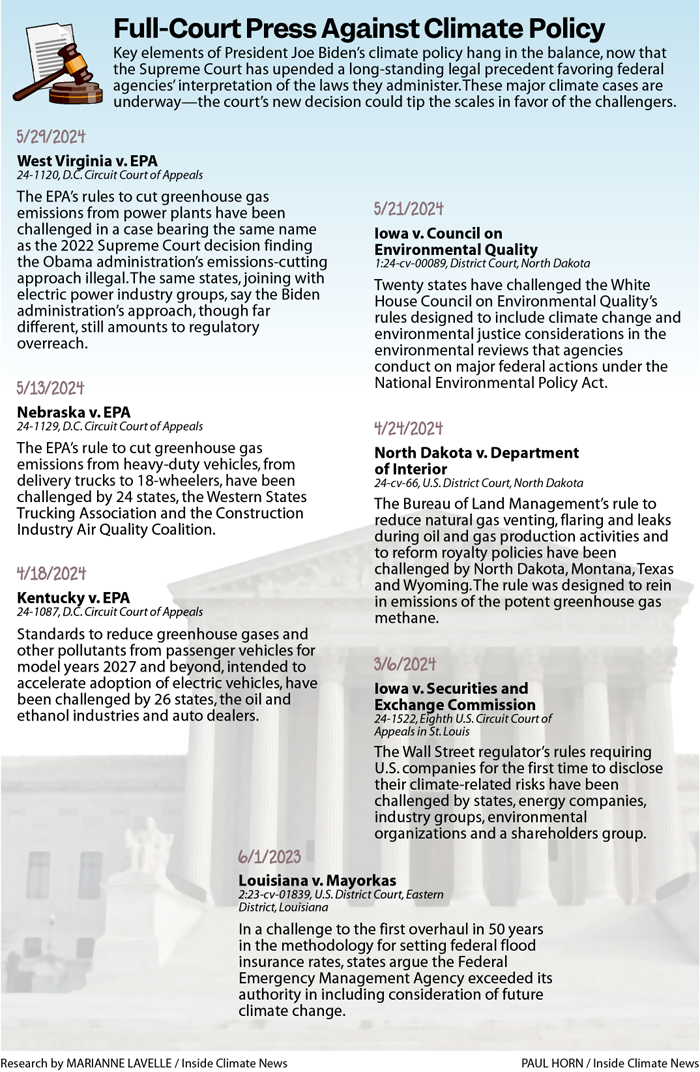
The agencies in most cases are applying broad legal authority Congress gave them years before the dangers of climate change were fully recognized or even contemplated. The EPA’s regulations to cut carbon pollution from the nation’s two leading sources—vehicles and power plants—are based on the Clean Air Act, passed in 1970 and amended in 1990. The Securities and Exchange Commission is seeking to standardize corporate disclosure of climate risks by relying on Great Depression-era laws that require publicly traded companies to fully inform investors of factors that could affect their financial conditions.
In some cases agencies have more explicit direction from Congress than others—for example, the Clean Air Act provisions on vehicles are more specific than those governing power plants. But in virtually all pending challenges to Biden policy, foes have identified what they see as legal ambiguities, or faults in agencies’ interpretation of the law.
“It’s very hard to write statutes in technical, controversial areas and not have a shred of ambiguity,” said Lisa Heinzerling, a professor at Georgetown Law School, in an interview prior to the decision. “Even if someone is really trying to be careful, people with enough money and enough lawyers can, after the fact, really bring ambiguity out of something that was intended to be clear.”
Now that Chevron has been overturned, the Supreme Court has placed the onus squarely on judges to interpret regulatory law, which typically involves application of science and knowledge of the latest technological advances.
In a scathing dissent, Associate Justice Elena Kagan said the court had removed “a cornerstone of administrative law,” upending the structure that supported much of the federal government’s functions.
The Chevron doctrine “has become part of the warp and woof of modern government, supporting regulatory efforts of all kinds—to name a few, keeping air and water clean, food and drugs safe, and financial markets honest.”
Contrary to Roberts’ view, Kagan said that Congress has assigned federal agencies to address interpreting the law in regulatory areas, which often involve scientific or technical subject matter. “Agencies have expertise in those areas,” Kagan wrote. “Courts do not.” Now she said such decisions will be made by courts that have no political accountability and no proper basis for making policy.
“A rule of judicial humility gives way to a rule of judicial hubris,” she wrote.
A Move Long Coming
But the Supreme Court for years has been moving in the direction of giving less authority to federal agencies; the trend accelerated after Trump gave conservatives a commanding 6-3 majority with his three appointees. Although the lower courts still invoked Chevron often, the high court has not relied on the doctrine in any case since 2016. And without mentioning Chevron, the Court recently has displayed little deference for agencies’ reading of the law.
Two weeks ago, for example, the Supreme Court struck down the federal ban on “bump stocks,” rejecting the Bureau of Alcohol, Tobacco and Firearms’ technical and legal analysis that the rapid-fire gun accessories convert rifles to machine guns, long banned by federal law. Associate Justice Clarence Thomas wrote that a converted rifle wasn’t a machine gun, in an opinion accompanied by a highly unusual set of trigger mechanism illustrations.
“What that opinion looks like is pretty much the court figuring out on its own how guns work,” Heinzerling said. “That decision is a sign of things to come.”
On Thursday, in a 5-4 opinion by Gorsuch, the Supreme Court put a hold on the EPA’s effort to address the difficult problem of smog-forming pollutants that drift across state lines, saying the agency had not adequately explained how it would address the cost-effectiveness of the “Good Neighbor” program over time. (Associate Justice Amy Coney Barrett broke from other conservatives in a dissenting opinion, warning the court was downplaying the EPA’s role under the Clean Air Act and leaving “large swaths of upwind States free to keep contributing significantly to their downwind neighbors’ ozone problems for the next several years.”)
Especially relevant to climate law was the court’s 2022 decision in West Virginia v. EPA case, written by Roberts and also settled 6-3 with Republican-appointed justices in the majority. In that case, the Supreme Court set a new standard of skepticism for federal agency authority on “major questions” of national importance, throwing out the Obama administration’s approach for cutting carbon emissions from power plants.
That case, and now the loss of Chevron deference, could well tip the balance against climate policy in the courts, experts say. A case in point is the litigation (Loper Bright Enterprises v. Raimondo, and Relentless, Inc. v. Department of Commerce) that was before the court, brought by fishing operations against the agency charged with enforcing fishing law in U.S. waters, the National Marine Fisheries Service, or NMFS.
For three decades, NMFS has had a program of putting scientific observers on board fishing vessels to prevent overfishing and ensure compliance with other federal laws, like those to protect endangered species. Lack of observer coverage has been a chronic problem in the underfunded program and in 2020, to increase coverage to address strain on the important Atlantic herring fishery, in part due to climate change, NMFS set new rules requiring that the fishing operations pay the cost of the observers.
The fishing operations ended up being reimbursed for 100 percent of their costs (about $30,000), but the Supreme Court did not focus on such details. Instead, it focused on what it viewed as the correct roles of agencies, Congress and the courts. Roberts wrote that it was an error for courts to give the executive agencies the benefit of the doubt whenever there was a question of the law’s meaning.
“By forcing courts to instead pretend that ambiguities are necessarily delegations, Chevron prevents judges from judging,” Roberts wrote.
Tara Brock, Pacific legal director and senior counsel for the advocacy group Oceana, said the result would be less monitoring of the industry at a time when more is needed.
“Things are changing in fisheries,” Brock said. “Suddenly somebody in Alaska is catching species that they historically haven’t. Well, what does that mean for fisheries management? Observers being present and being able to document what we are seeing on the water and having that really critical data is going to become even more valuable as climate change continues to change our oceans.”
But lawyers representing the fishing operations that brought the challenge said that the Supreme Court has restored balance to decision making about federal regulation.

Click the link to read the article on the AZCentral.com website (Arlyssa D. Becenti). Here’s an excerpt:
June 5, 2024
In June 2018, Virginia Beyale and her brother set out to retrace the steps their ancestors took from Fort Sumner in New Mexico back to Diné Bikéyah, the Navajo Reservation. It was there the people were released after Diné leaders on June 1, 1868, signed what is now referred to as the Treaty of 1868 with the U.S. government. The siblings were dropped off at Fort Sumner (Hwéeldi) to begin the over 300-mile journey that about 8,000 surviving Diné undertook to get home 150 years before. On this arduous trek, known today as the Long Walk, about 2,600 Navajos died. The forced march to Fort Sumner was a horrific four-year ordeal, one of many genocidal and ethnic cleansing campaigns that took place against the Indigenous peoples at that time.
“The reason we did it was not only to commemorate the 150 years, but to do a lot of healing and understand how it felt,” Beyale said. “There was a lot of reflecting of understanding on what our people went through.”
[…]
“The Long Walk and 1863 to 1868 is a watershed in Diné history because that is the point where we lost our freedom and our independence,” Jennifer Nez Denetdale said. “That is when we became another occupation of the American colonial government. We are still under their control and under their authority.”
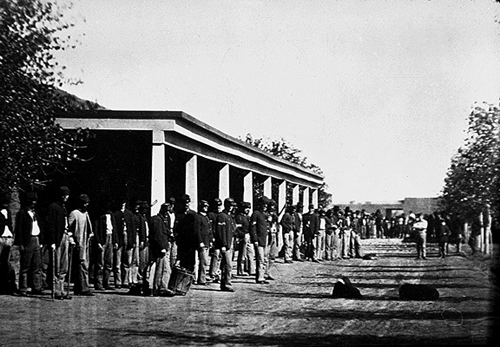
Nearly 10,000 Navajo men, women and children were forcibly marched to Bosque Redondo. Approximately 200 died of starvation and exposure during the walk, Charles said.
“Nearly a quarter of our people died in the conditions at Bosque Redondo,” [Mark] Charles said. “The government called Bosque Redondo a reservation but it wasn’t a reservation, it was a death camp. A death camp that was approved by Abraham Lincoln on Jan. 15, 1864.”
[…]
One notable aspect of Navajo stories is that they often contradict American historical narratives, Denetdale said. These narratives claim that the Navajo returned from Fort Sumner as a better people, having learned to get along with others, mastered silversmithing and understood government.
“This is what I had to read when I was in graduate school and I said, ‘no,’” Denetdale said. “This is not how I am going to read this, and I am not going to agree with you. So you go to oral history and to your own people’s stories.”
She sought out her own grandparents to hear their stories about this period. One story from her book, which she discussed during her presentation on the Long Walk and the Treaty of 1868, highlighted that the treaty included an agreement by Navajo leaders that Navajo children would receive an American education.
“They call it assimilation, I call it genocide and ethnic cleansing,” Denetdale said. “They never lived up to that article of 1868.”

Click the link to read the article on the Colorado Newsline website (Jacob Fischler):
June 28, 2024
The U.S. Supreme Court struck down a precedent Friday that had for decades limited judicial power to strike executive branch regulations, in a decision immediately criticized for potentially undermining decisions by scientists and agency experts.
The 6-3 and 6-2 decisions in two cases brought by fishing operators in New Jersey and Rhode Island challenged a National Oceanic and Atmospheric Administration rule and overturned the principle known as Chevron deference.
That precedent gave federal agencies broad discretion to use their judgment to resolve any ambiguity Congress left in a federal statute.
The court’s six conservatives reasoned that courts “routinely confront statutory ambiguities” that have nothing to do with the authority of regulatory agencies, Chief Justice John Roberts wrote in the majority opinion.
“Of course, when faced with a statutory ambiguity in such a case, the ambiguity is not a delegation to anybody, and a court is not somehow relieved of its obligation to independently interpret the statute,” Roberts wrote.
Under the 40-year-old precedent, courts gave up their interpretive role and deferred to agencies, Roberts wrote.
But they shouldn’t, he added. Judges should apply their own legal reasoning to reach a sound decision.
“Courts instead understand that such statutes, no matter how impenetrable, do — in fact, must — have a single, best meaning.”
1984 ruling overturned
The decision overturned Chevron v. Natural Resources Defense Council, a 1984 Supreme Court ruling that said courts must defer to federal agencies’ expertise when considering legal challenges to a rule. The 1984 ruling significantly raised the bar for overturning an agency rule.
The precedent strengthened the executive branch under presidential administrations of both parties, but experts worry its reversal will strip agencies of the power to enact regulatory safeguards across a broad spectrum of issues including clean air and public health.
In a dissenting opinion, the court’s three liberals — not including Justice Ketanji Brown Jackson in one of the cases, after she recused herself because she’d heard the case as an appeals court judge before joining the Supreme Court — said the majority erred by misunderstanding the roles of three branches of government.
Congress knows it cannot “write perfectly complete regulatory statutes,” Justice Elena Kagan wrote in a dissent. Interpretation of those statutes is a given, and Congress usually prefers a “responsible agency” instead of a court.
Agencies are more politically accountable and have greater technical expertise in a given issue than courts, she wrote.
“Put all that together and deference to the agency is the almost obvious choice,” Kagan wrote.
Kagan went on to criticize the decision as a power grab by the judiciary at the expense of agency experts.
“A rule of judicial humility gives way to a rule of judicial hubris,” she wrote. “In one fell swoop, the majority today gives itself exclusive power over every open issue — no matter how expertise-driven or policy-laden — involving the meaning of regulatory law.”
Liberals see a weakening of safeguards
Liberal groups and elected Democrats worried the reversal will strip agencies of the power to enact strong regulatory safeguards across a broad spectrum of issues, especially climate and environmental regulations.
“It weakens our government’s ability to protect us from the climate crisis, threats to worker safety, public health, clean air and water, safe medicines and food, a sound financial system, and more,” Manish Bapna, president of the environmental group NRDC Action Fund, wrote in a statement.
“Today’s reckless but unsurprising decision from this far-right court is a triumph for corporate polluters that seek to dismantle common-sense regulations protecting clean air, clean water and a livable climate future,” Wenonah Hauter, the executive director of the advocacy group Food & Water Watch, said in a statement.
Rachel Weintraub, the executive director of the Coalition for Sensible Safeguards, a group that advocates for strong federal regulations, said in an interview before the decision was released that Chevron deference has allowed a host of regulations affecting consumer safety, labor, environmental protections and other issues.
“The important role that government plays in ensuring the health and safety of our families and the fairness of our markets could be undermined here,” she said.
The ruling takes power away from the experts on a particular subject of a federal regulation — traffic engineers at the Department of Transportation, disease experts at the Food and Drug Administration or scientists at the Environmental Protection Agency, for example — and gives it to the federal judiciary, Weintraub said.
U.S. Rep. Raúl Grijalva, an Arizona Democrat who is the ranking member on the U.S. House Natural Resources Committee, called the ruling a gift to polluters and the fossil fuel industry.
“For 40 years, Congress has passed laws with the understanding that the interpretation of those laws is for the courts, but the implementation laid in the hands of the scientific and policy career experts at our federal agencies,” Grijalva said in a statement.
“But now, thanks to this extremist power-grab, our most fundamental protections will be at the whim of individual judges — many of whom are far-right ideologues — regardless of their lack of expertise or political agenda.”
Conservatives applaud rollback
Republicans in Congress and conservative activists praised the decision for weakening the administrative state, saying it would return power to the legislative branch.
“The Constitution vests Congress with the sole authority to make law,” Senate Republican Leader Mitch McConnell of Kentucky said in a statement. “After forty years of Chevron deference, the Supreme Court made it clear today that our system of government leaves no room for an unelected bureaucracy to co-opt this authority for itself.”
Rep. Bruce Westerman, an Arkansas Republican who chairs the House Natural Resources Committee, said Friday’s ruling should spur Congress to write more prescriptive laws.
“Congress has sidestepped our legal duties for far too long and today’s ruling puts us back in the driver’s seat when it comes to rulemaking and regulatory authority,” Westerman said in a written statement. “We’re no longer going to let federal agencies fill in the details when it comes to the policies we enact.”
Roman Martinez, an attorney who argued on behalf of the Rhode Island fishing operators, called the ruling a “win for individual liberty and the Constitution.”
“The Court has taken a major step to shut down unlawful power grabs by federal agencies and to preserve the separation of powers,” Martinez said in a statement distributed by the conservative public relations firm CRC Advisors. “Going forward, judges will be charged with interpreting the law faithfully, impartially, and independently, without deference to the government.”
No plans to reopen old cases
In the majority opinion, Roberts said the court did not plan to reopen cases that had been decided by Chevron “despite our change in interpretive methodology.”
Even prior to Friday’s decision, the court had used Chevron less often. During the oral argument, Roberts cited a study that the court had relied on the precedent sparingly over the past 14 years.
The court’s conservative majority has shown a willingness to move away from deference to agency decision-making, demanding more explicit congressional instruction.
In West Virginia v. EPA in 2022, for example, the court ruled that the EPA lacked the authority under the Clean Air Act to regulate greenhouse gas emissions.
Daniel Wolff, an administrative law attorney at the law firm Crowell & Moring, downplayed the effect the ruling would have on the administrative state.
Congress at times explicitly directs agencies to craft regulations, and those rules will still be subject to the same standard that they were written reasonably, Wolff said in an interview prior to the decision.
Rules with solid legal and statutory foundations would survive under either standard, he said.
“Rolling back Chevron is simply going to mean agencies don’t get the benefit of the doubt in the case of a tie,” Wolff said. “They have to come into the court and persuade the court that they have the better reading of the statute.”
The cases decided Friday was brought by herring fishing operators from New Jersey and Rhode Island who challenged a NOAA rule requiring the operators to pay for the federal monitors who regularly join fishing boats to ensure compliance with federal regulations.
The fishing operators said the rule forced them to hand over up to 20% of their profits.
After a lower court relied on Chevron deference to rule in favor of NOAA, oral arguments at the Supreme Court in January focused almost entirely on Chevron.