Synopsis: ENSO-neutral is most likely through the late Northern Hemisphere summer
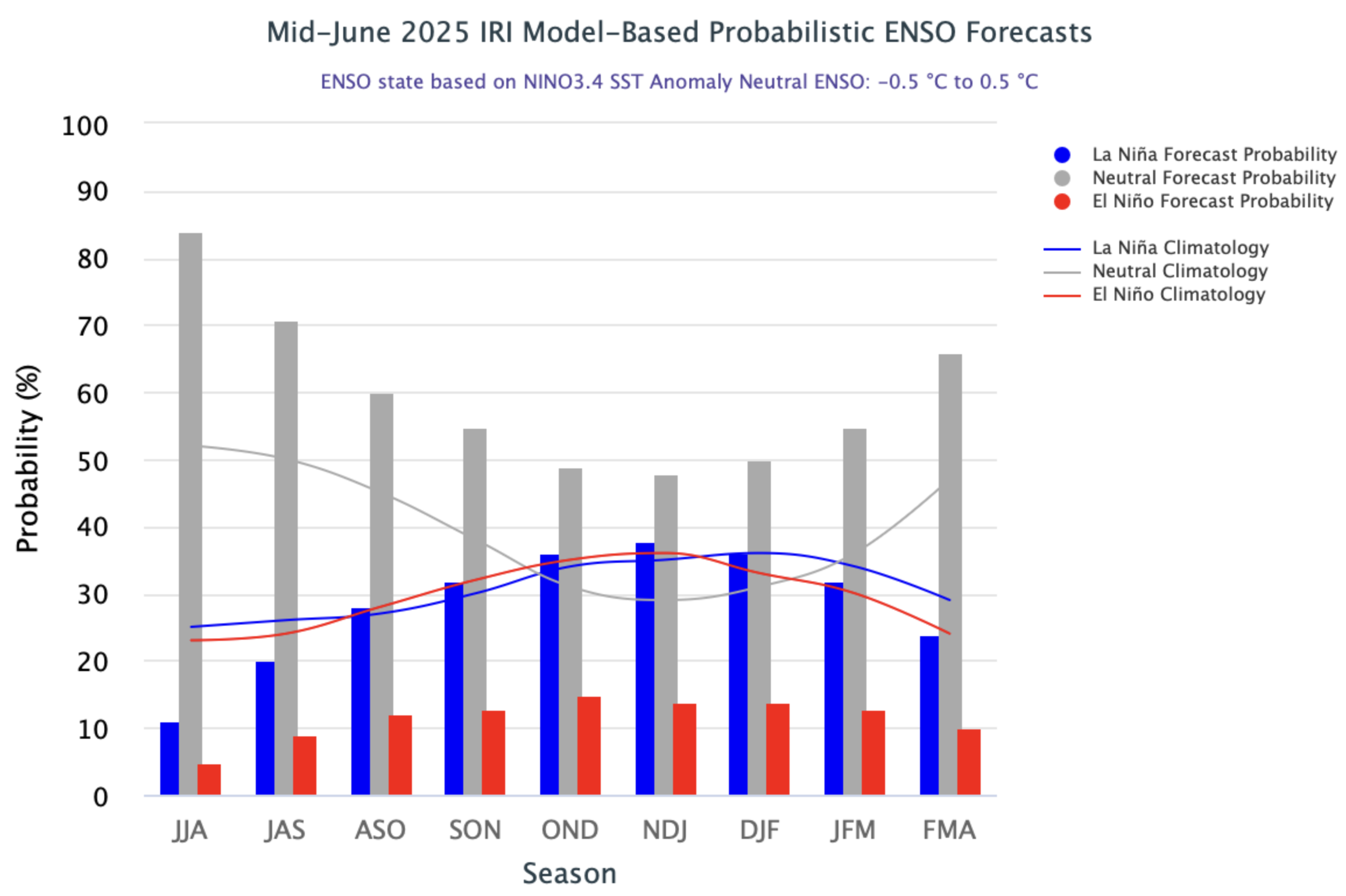
2025 (56% chance in August-October). Thereafter, chances of La Niña conditions increaseinto the fall and winter 2025-26, but remain comparable to ENSO-neutral.
During June 2025, ENSO-neutral continued, with near-average sea surface temperatures (SSTs) prevailing across most of the equatorial Pacific Ocean. The latest weekly Niño SST index values ranged from 0.°C to +0.4°C. Subsurface temperature anomalies were weakly positive and nearly unchanged from last month, with mostly above-average temperatures established along the thermocline. Over the east-central and eastern equatorial Pacific Ocean, low-level wind anomalies were easterly and upper-level wind anomalies were westerly. Convection remained enhanced over Indonesia. Collectively, the coupled ocean-atmosphere system in the tropical Pacific reflected ENSO-neutral.
The IRI predictions indicate ENSO-neutral is most likely through the Northern Hemisphere winter 2025-26. In contrast, the North American Multi-Model Ensemble favors the onset of La Niña conditions during the Northern Hemisphere fall, though lasting a shorter duration than NOAA’s requirement of five consecutive overlapping 3-month seasons. While the subsurface equatorial Pacific remains above average, easterly trade winds are predicted to strengthen in the coming month, which could portend cooler conditions. In summary, ENSO-neutral is most likely through the late Northern Hemisphere summer 2025 (56% chance in August-October). Thereafter, chances of La Niña conditions increase into the fall and winter 2025-26, but remain nearly equal to ENSO-neutral.
Millions of dollars in federal funding has been released to continue restoring lands and streams in the fire-scarred Upper Colorado River Basin watershed in and around Grand Lake and Rocky Mountain National Park.
The roughly $4 million was frozen in February and released in April, according to Northern Water, a major Colorado water provider and one of the agencies that coordinates with the federal government and agencies such as the U.S. Forest Service to conduct the work.
Esther Vincent, Northern Water’s director of environmental services, said the federal government gave no reason for the freeze and release of funds.
The amounts and timing of the freeze and release are being reported here for the first time.
U.S. Congressman Joe Neguse, who represents Grand County, did not respond to a request for comment regarding the funds.
The news comes as tens of millions of dollars in federal grants and budget allocations are being cut in Colorado and across the country as part of the Trump administration’s reorganization of federal agencies and associated budget cuts.
In June, Gov. Jared Polis’ office released an accounting of federal money that has flowed to state agencies. That analysis showed the agencies were able to retain $282 million in funding, but that $76 million had been lost, and another $56 million is at risk.
It’s unclear how much funding that flows through federal agencies to other Colorado entities and nonprofits such as those in the Upper Colorado River Basin, has been lost.
The U.S. Forest Service did not respond to a request for comment. The U.S. Bureau of Reclamation declined to comment on the funding actions.
In Grand County, $761,000 has been released from the U.S. Bureau of Reclamation to help move forward on a broad-based effort by the Kawuneeche Valley Restoration Collaborative, according to Northern Water. The valley has been damaged by drought, failing irrigation systems and overgrazing by wildlife and is a critical piece of the Colorado River’s upper watershed. The collaborative, established in 2020, is a major partnership of seven entities, including Northern Water, Grand County, the Nature Conservancy and Rocky Mountain National Park.
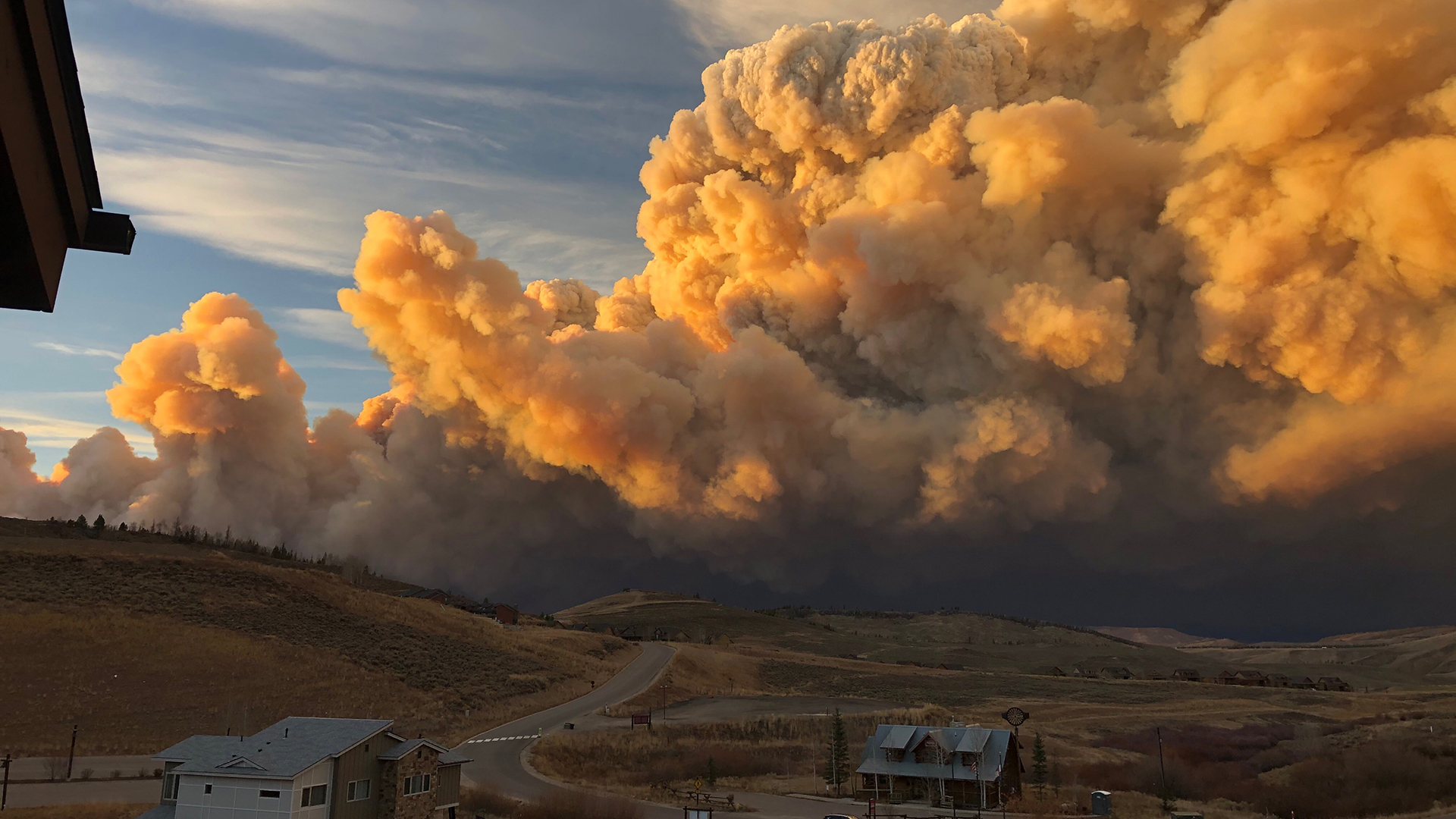
East Troublesome Fire. Photo credit: Northern Water
The $3.3 million in East Troublesome fire funding that has been released through the U.S. Forest Service will help restore the watershed around Grand Lake and land in Rocky Mountain National Park. The fire began in October 2020 and burned nearly 200,000 acres, making it the second largest fire in Colorado history.
The fire burned land that constitutes a sprawling water collection area for Northern Water, a major water provider that pipes Colorado River water from Grand County, under the Continental Divide and east to the Front Range, where it serves roughly 1 million residents of northern Colorado and hundreds of farms.
Steve Kudron, former mayor of Grand Lake who now serves as its town manager, said restoration work in both projects is critical to the economy and health of the historic tourist town, which lies at the western edge of Rocky Mountain National Park.
“The biggest concerns that we had were closing parts of the forest because there hasn’t been sufficient cleanup. Some mountainsides are unstable,” he said. “It’s the funding that makes it safe for the public to go into those areas. That’s why it was important to get the funding back.”
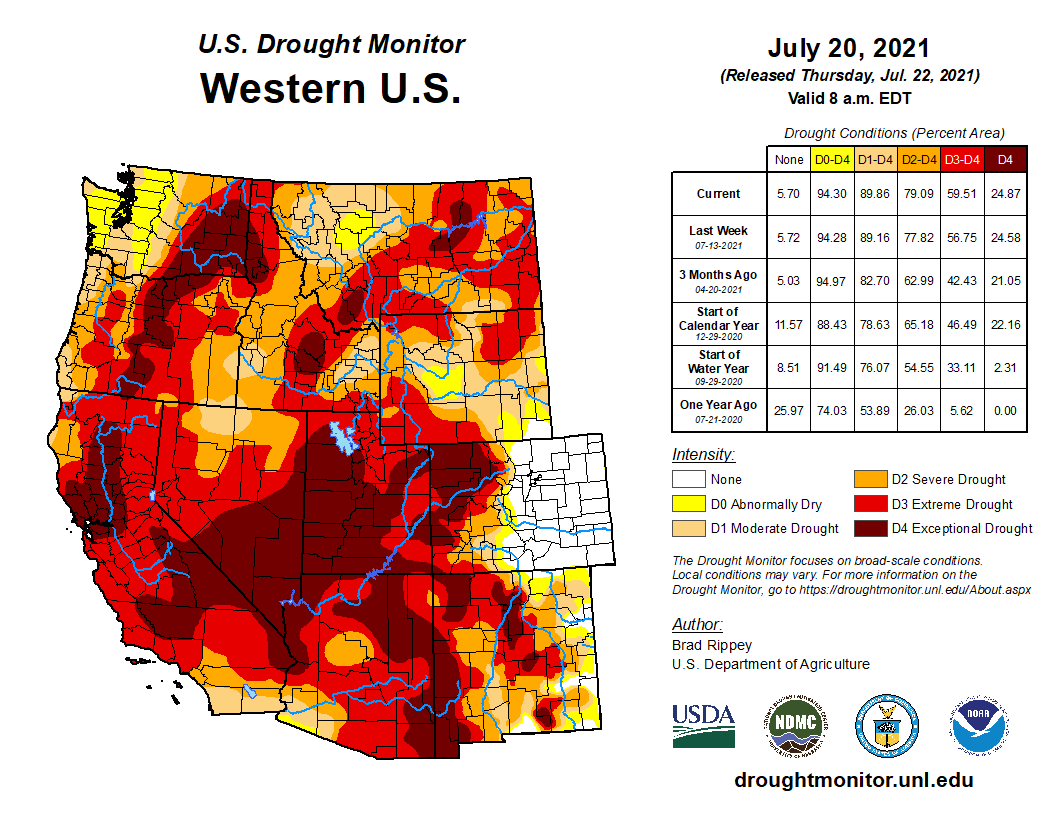
In summer 2021, 90% of the western United States (WUS) experienced drought, with over half of the region facing extreme or exceptional conditions, leading to water scarcity, crop loss, ecological degradation, and significant socio-economic consequences. Beyond the established influence of oceanic forcing and internal atmospheric variability, this study highlights the importance of land-surface conditions in the development of the 2020–2021 WUS drought, using observational data analysis and novel numerical simulations. Our results demonstrate that the soil moisture state preceding a meteorological drought, due to its intrinsic memory, is a critical factor in the development of soil droughts. Specifically, wet soil conditions can delay the transition from meteorological to soil droughts by several months or even nullify the effects of La Niña-driven meteorological droughts, while drier conditions can exacerbate these impacts, leading to more severe soil droughts. For the same reason, soil droughts can persist well beyond the end of meteorological droughts. Our numerical experiments suggest a relatively weak soil moisture-precipitation coupling during this drought period, corroborating the primary contributions of the ocean and atmosphere to this meteorological drought. Additionally, drought-induced vegetation losses can mitigate soil droughts by reducing evapotranspiration and slowing the depletion of soil moisture. This study highlights the importance of soil moisture and vegetation conditions in seasonal-to-interannual drought predictions. Findings from this study have implications for regions like the WUS, which are experiencing anthropogenically-driven soil aridification and vegetation greening, suggesting that future soil droughts in these areas may develop more rapidly, become more severe, and persist longer.
Key Points
Initial soil moisture conditions strongly impacted the meteorological to soil drought transition in the western United States in 2020–2021
Drought-induced vegetation feedbacks can influence the evolution of soil droughts in the western United States
Future soil droughts in the western United States are likely to become more severe, develop more rapidly, and persist longer
Plain Language Summary
In summer 2021, nearly all the western United States (WUS) experienced drought, leading to water shortages and agricultural losses. While previous studies have predominantly focused on oceanic and atmospheric drivers of droughts in the WUS, our study explores how land-surface conditions contributed to the evolution of this real-world drought. We find that the initial moisture level in the soil is crucial for the transition of precipitation deficits into more impactful soil droughts. Moist soils can delay the onset of soil droughts when precipitation is lacking, whereas drier soils can quickly result in more severe and long-lasting soil droughts. Low soil moisture levels can maintain soil droughts for several months, even after meteorological conditions improve. The vegetation degradation during droughts can lessen the rate of soil drying by reducing the amount of moisture that plants transfer to the atmosphere, which may help reduce the severity of soil droughts. Our findings emphasize the importance of accounting for land-surface conditions, such as soil moisture and vegetation conditions, in seasonal-to-interannual drought predictions. Moreover, our work suggests that as the WUS becomes drier and vegetation condition change due to climate change, future soil droughts in the region might become more severe, develop faster, and persist longer.
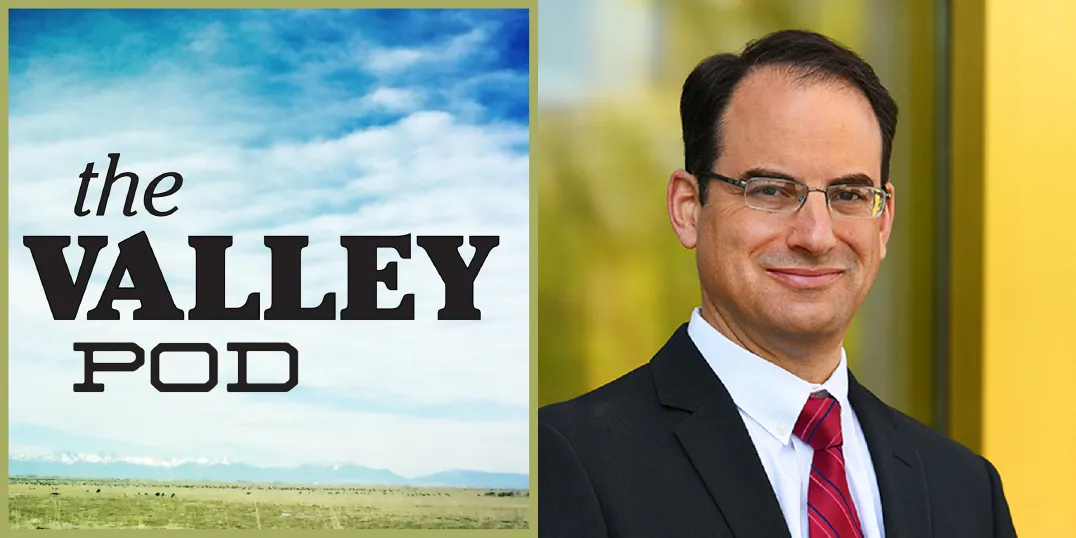
Click the link to read the article and listen to the Valley Pod on the Alamosa Citizen website:
July 9, 2025
A draft agreement settling the long-running Rio Grande Compact lawsuit dealing with New Mexico’s delivery of water to the Texas border is on the one-yard line and should be pushed across the goal line come fall, says Colorado Attorney General Phil Weiser.
Weiser was on a two-day tour of the San Luis Valley this week when he gave an update on the lawsuit to members of the Rio Grande Basin Roundtable. All three compact states – Colorado, New Mexico and Texas will be party to the settlement.
Earlier this week, Special Master D. Brooks Smith scheduled a hearing for the week of Sept. 29 on the parties motions toward a settlement.
The states had worked out a previous agreement to the 2013 case, only to have the federal government object when the proposed settlement was presented to the U.S. Supreme Court. This time, said Weiser, the federal government’s role has been addressed.
“We’re on track,” Weiser said during a recording of The Valley Pod. “We have a settlement that properly has the federal government in its place and resolves the concerns which were mostly between New Mexico and Texas.”
Listen here to the full Valley Pod episode with AG Phil Weiser.
Colorado has nine interstate water compact agreements, including the Colorado River Compact which dominates the headlines. At the Rio Grande Basin Roundtable meeting, Conejos Water Conservancy District Manager Nathan Coombs asked Weiser how the state and local water users could collaborate on more “creative ways” in administering the river compacts.
“We all agree with keeping our compacts whole. But I would ask what are some of the processes we could go through to make them more vehicles for the water users within the state as we see this drying?” Coombs said.
On The Valley Pod, Weiser addressed the Valley’s efforts to recover the Upper Rio Grande Basin’s confined and unconfined aquifers.
“We will have to continue looking at this situation of groundwater and have to keep asking ‘How do we best manage this precious resource?’ I don’t have any immediate views on what to do in the face of the challenging hydrology. I do believe we have to keep thinking hard about a series of strategies that include ‘How are we most smartly storing water, how are we re-using water, and how are we conserving water?’”
Weiser, a two-term attorney general, is a candidate for governor, seeking the Democratic Party nomination in 2026. In The Valley Pod episode he talks more about his candidacy as well as the 27 different lawsuits Colorado has been party to in the past six months in challenging the Trump Administration.
“This is an extraordinary moment unlike any in history,” Weiser said.
Rio Grande and Pecos River basins. Map credit: By Kmusser – Own work, Elevation data from SRTM, drainage basin from GTOPO [1], U.S. stream from the National Atlas [2], all other features from Vector Map., CC BY-SA 3.0, https://commons.wikimedia.org/w/index.php?curid=11218868
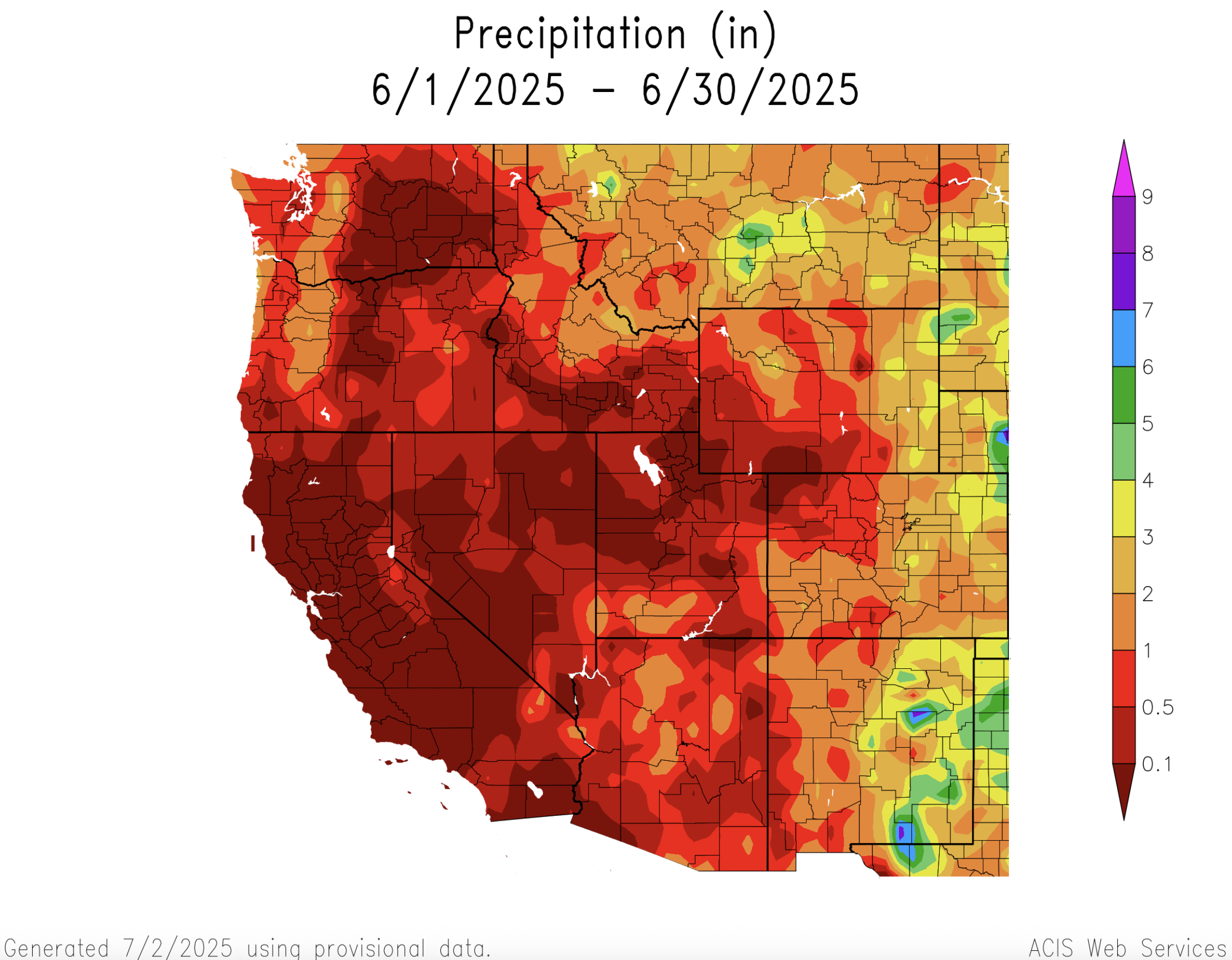
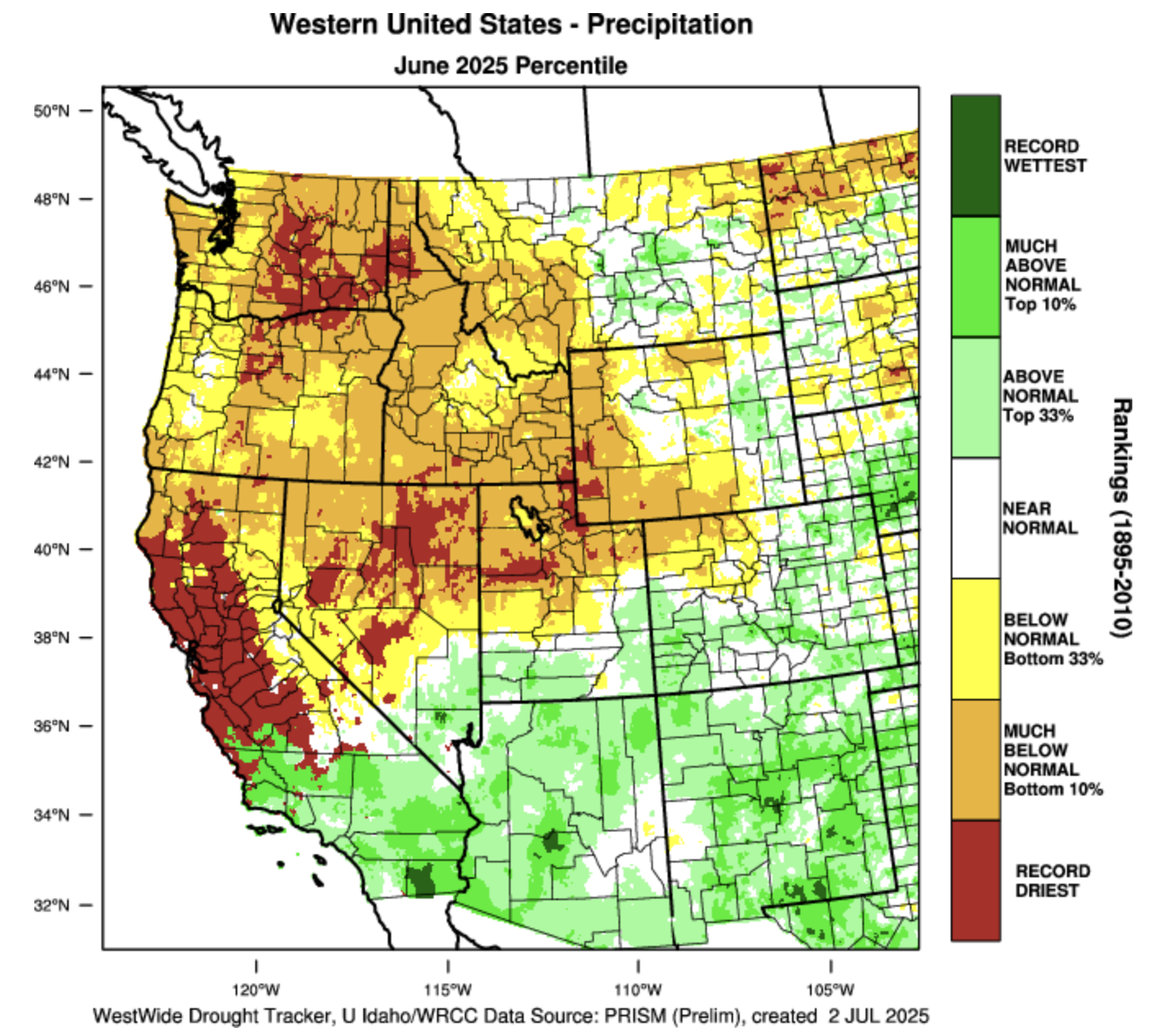
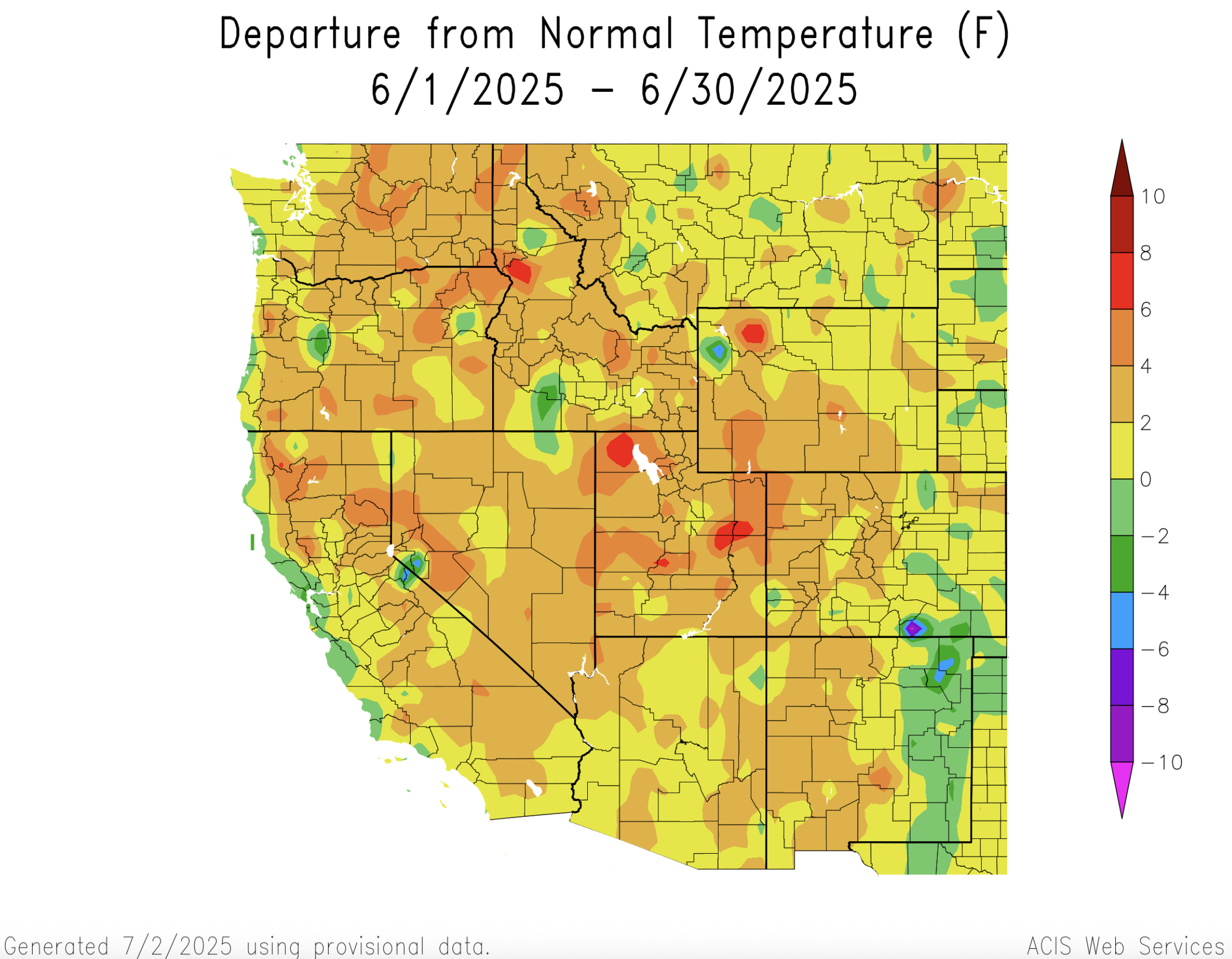
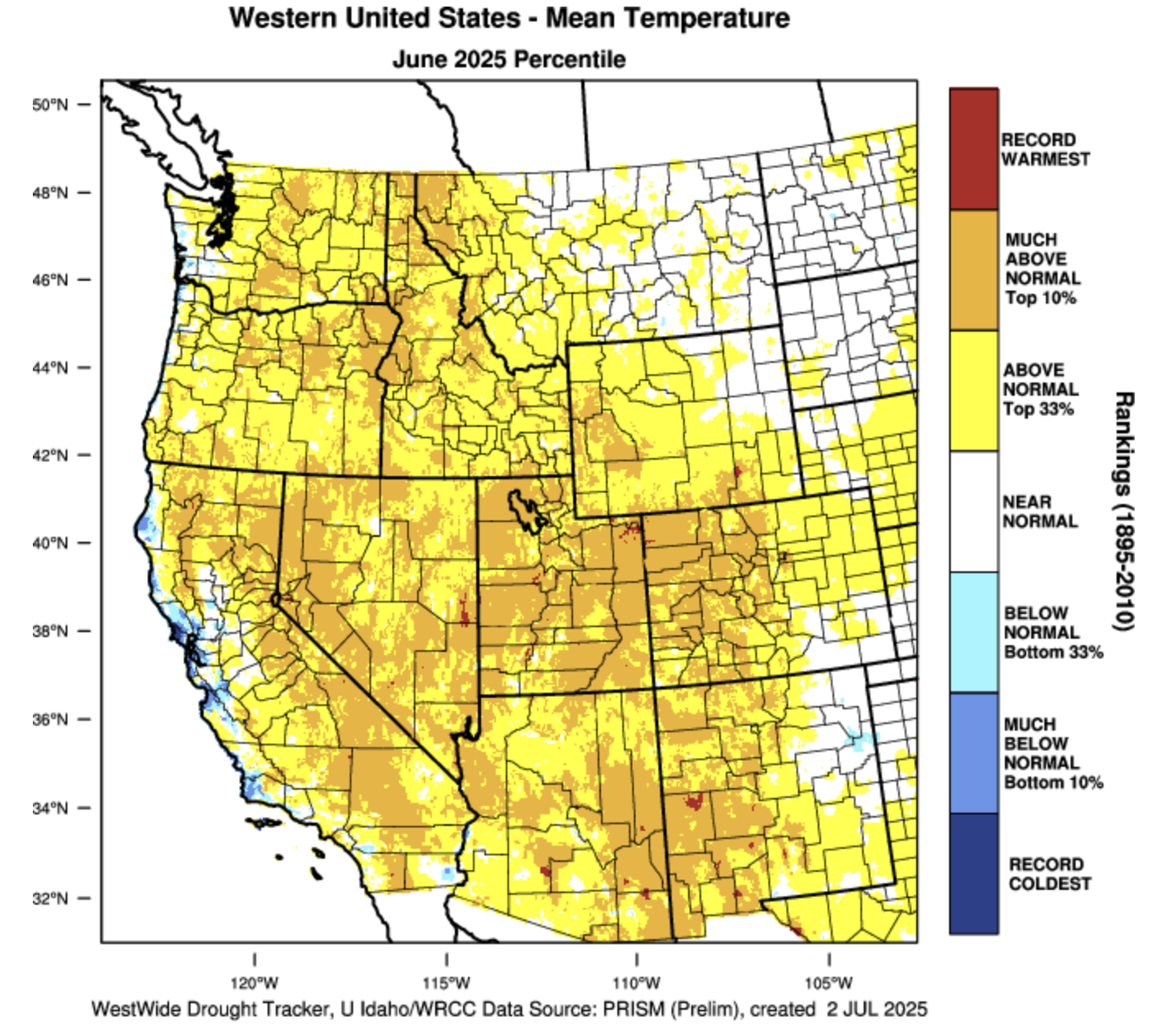
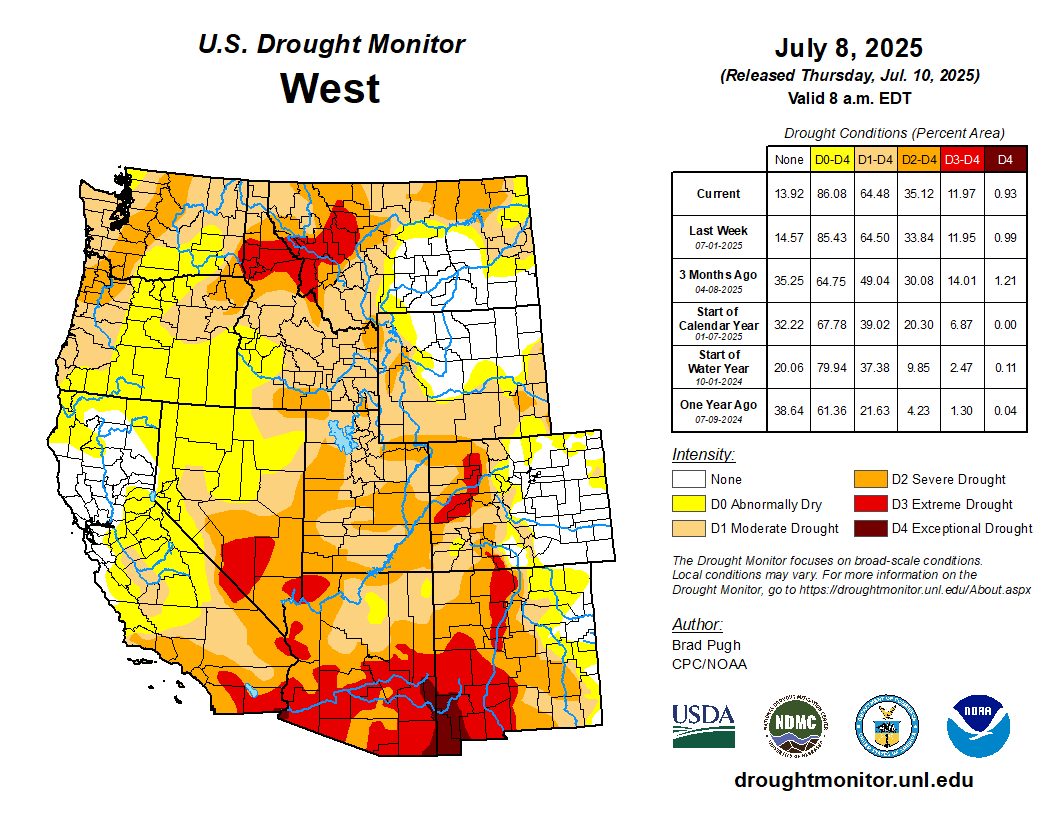
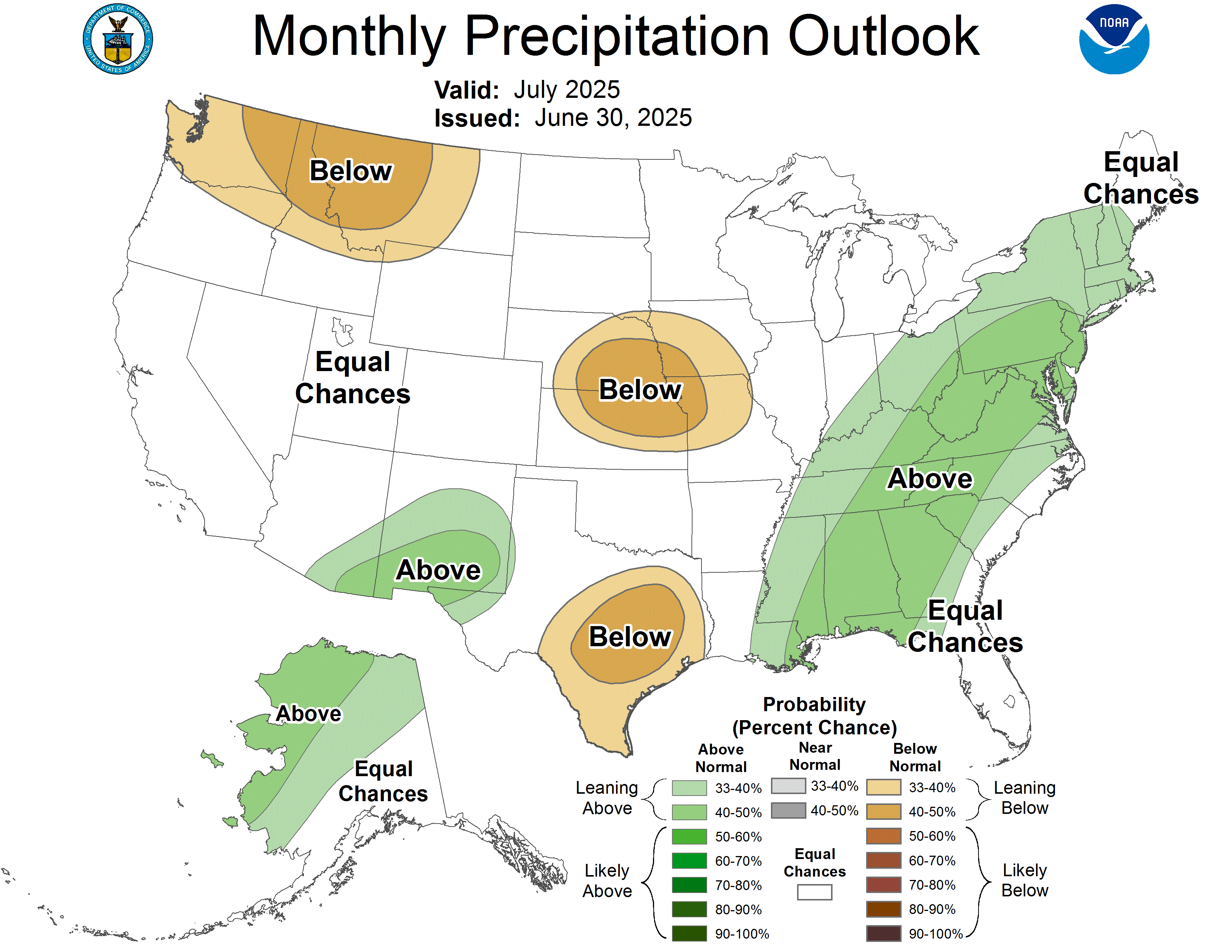
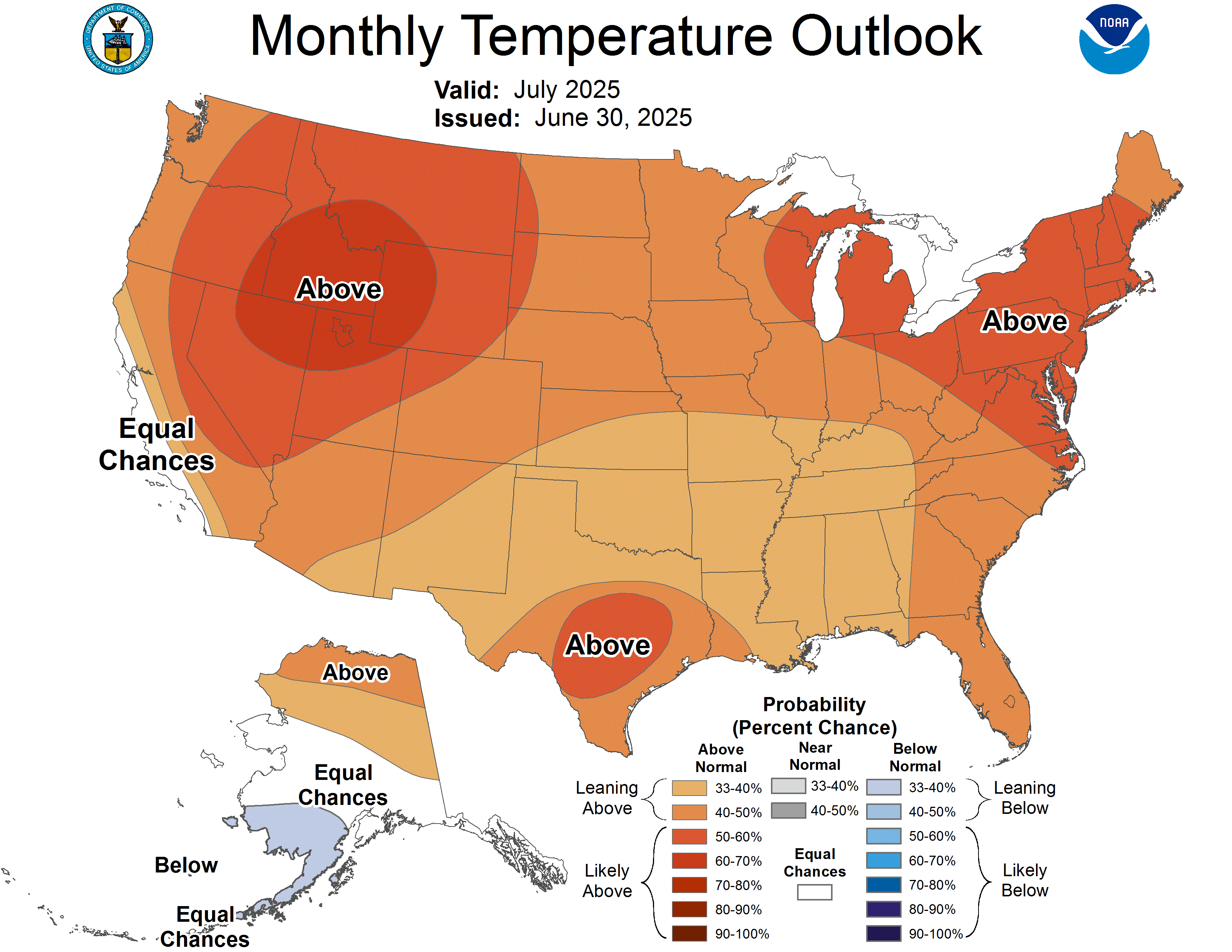
During June, much of the region experienced above average temperatures and below average precipitation. Record low precipitation fell across parts of northern Utah and southwestern Wyoming while much above average precipitation was observed in southern Utah and southwestern Colorado. As of July 1, seasonal snowmelt was completed with many mountain locations melting out 1-2 weeks earlier than average. Seasonal streamflow volume forecasts remained below to much below normal with the inflow to Lake Powell forecasted to be 42% of average. Regional coverage of drought expanded significantly from 53% in early June to 63% on July 1, driven largely by expansion of drought in Utah. Drought conditions are likely to persist or worsen as NOAA seasonal forecasts suggest above average regional temperatures and below average precipitation for Wyoming during July to September.
Above average June precipitation was observed in southern Utah, eastern Wyoming and the majority of Colorado. Much of Utah and Wyoming and northwestern Colorado received below average precipitation during June. Parts of southern Colorado and southern Utah received twice the average June rainfall while some locations in northern Utah and southwestern Wyoming observed record low June rainfall totals. Average June rainfall is typically low in the Intermountain West and areas of southern Utah and southwestern Colorado with 150-400% of average June rainfall observed total rainfall amounts of 1-2 inches.
June temperatures were above average for much of Colorado, Utah and Wyoming, except for eastern Colorado and Wyoming where temperatures were up to two degrees below average. The warmest temperatures were observed in Utah, northwestern Colorado, and western Wyoming where June average temperatures were in the top 10% of all observations since 1895.
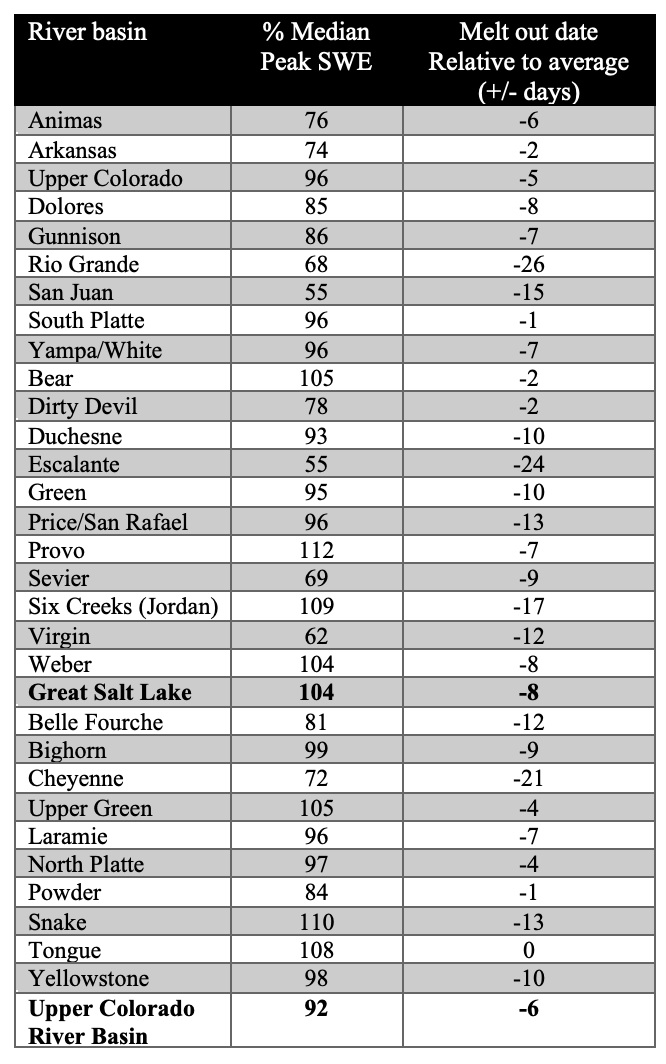
As of July 1st, snowpack was melted out across the region and snowmelt occurred earlier than average across all basins except the Tongue River Basin in northern Wyoming. In Colorado, snowmelt occurred only a few days early in the Arkansas and South Platte River Basins, around a week early in the Animas, Colorado Headwaters, Dolores, Gunnison and Yampa River Basins, two weeks early in the San Juan River Basin and nearly four weeks early in the Rio Grande River Basin. In Utah, snowmelt was only a few days early in the Bear River Basin, 1-2 weeks early in the northern Utah, Price, Sevier and Virgin River Basins and 24 days early in the Escalante River Basin. In Wyoming, snowmelt occurred earlier than average in all basins except the Tongue River Basin, with the Belle Fouche, Cheyenne and Snake River Basins melting out 2-3 weeks early.
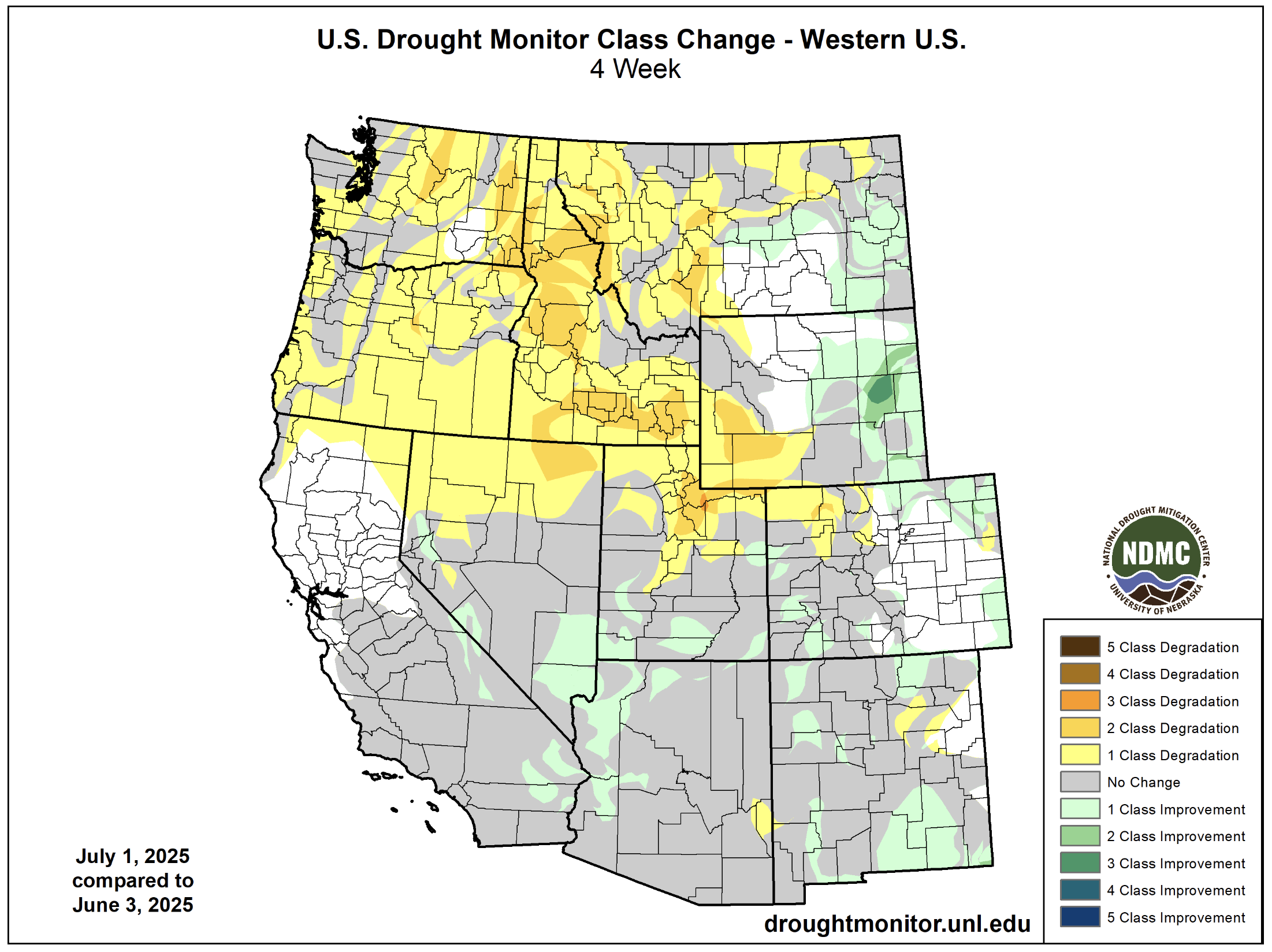
Regional drought coverage expanded from 53% in early June to 63% as of July 1 with all of Utah and about half of Colorado and Wyoming experiencing drought. Extreme (D3) drought conditions expanded in western Colorado but were removed from southwestern Utah and southeastern Wyoming where above average June precipitation was observed. Drought worsened by one to two classes in northern Utah and southwestern Wyoming, but drought conditions improved in portions of eastern and southern Colorado and southern Utah. In eastern Wyoming, drought conditions improved by one to three drought classes.
West Drought Monitor map July 8, 2025.
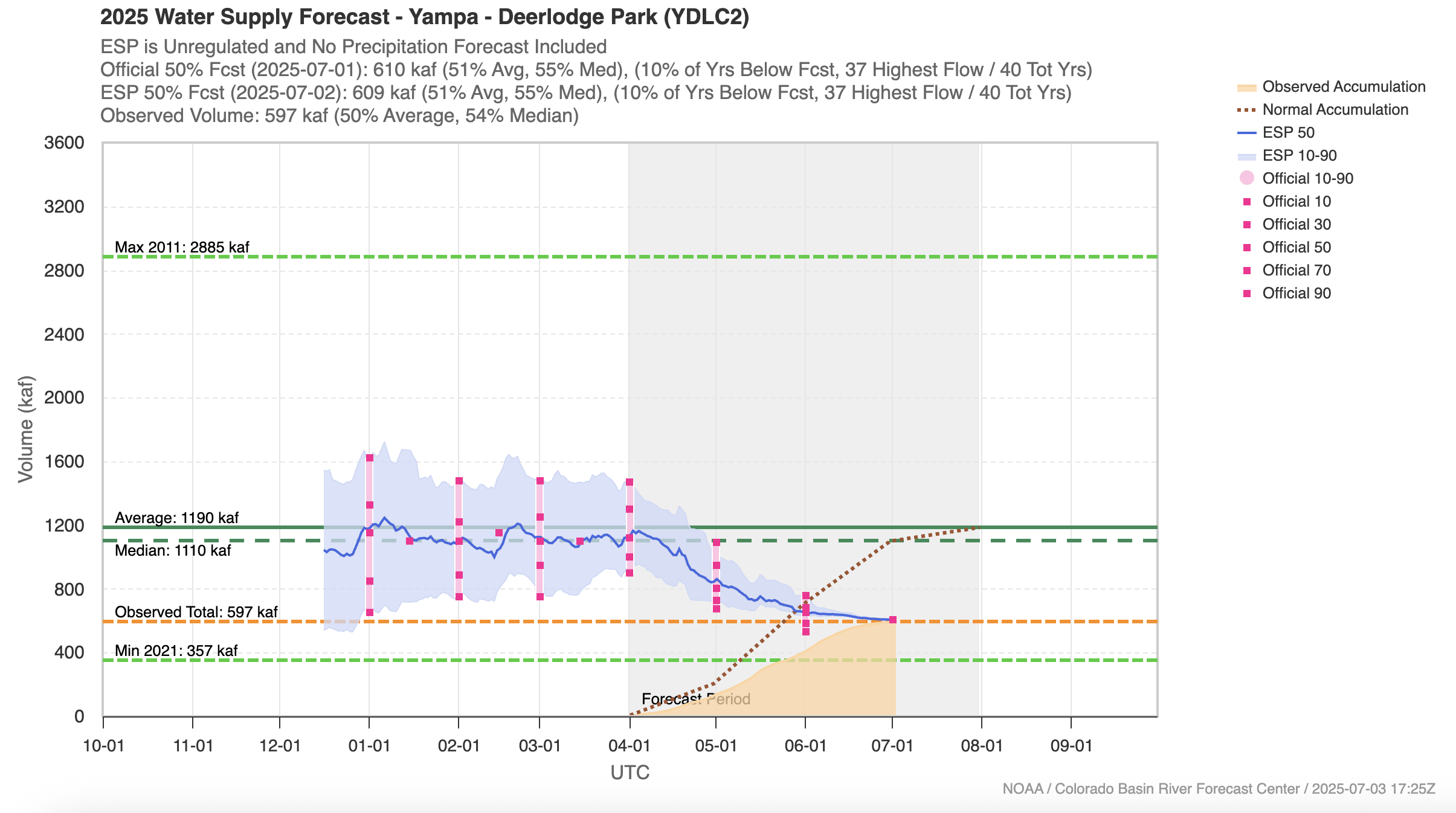
Seasonal streamflow volume forecasts remained below to much below average with the final forecasts of the year ranging from 33% of average for Utah’s Bear and Virgin River Basins to 86% of average in Wyoming’s Shoshone and Yellowstone River Basins. For nearly all regional river basins, streamflow volume forecasts significantly decreased from April 1 to June or July 1. The evolution of the Yampa River seasonal streamflow forecast exemplifies a pattern seen across the Intermountain West. After a near average winter snowpack, the April 1 forecast indicated an average seasonal streamflow volume, but by July 1, the Yampa River forecast declined to only 51% of average. Much below streamflow volume forecasts (<60% of average) were issued for the Colorado Headwaters, Dolores, San Juan and Yampa River Basins in Colorado, the Bear, Duchesne, Green, San Juan, Sevier, Virgin and Weber River Basins in Utah, and the Green, North Platte and Powder River Basins in Wyoming. The inflow forecast for Lake Powell was a paltry 42% of average on July 1.
ENSO neutral conditions currently exist in the eastern Pacific Ocean and remain most likely throughout the forecast period. The NOAA seasonal precipitation forecast for July-September suggests an increased probability of below average precipitation for Wyoming and northeastern Colorado. The seasonal temperature forecast suggests a high probability of above average temperatures for the entire region.