
Click the link to access the article on the AGU website (Yelin Jiang, Jason E. Smerdon, Richard Seager, Guiling Wang, Benjamin I. Cook, Cheng Zheng, Justin S. Mankin, A. Park Williams). Here’s the abstract:
May 19, 2025
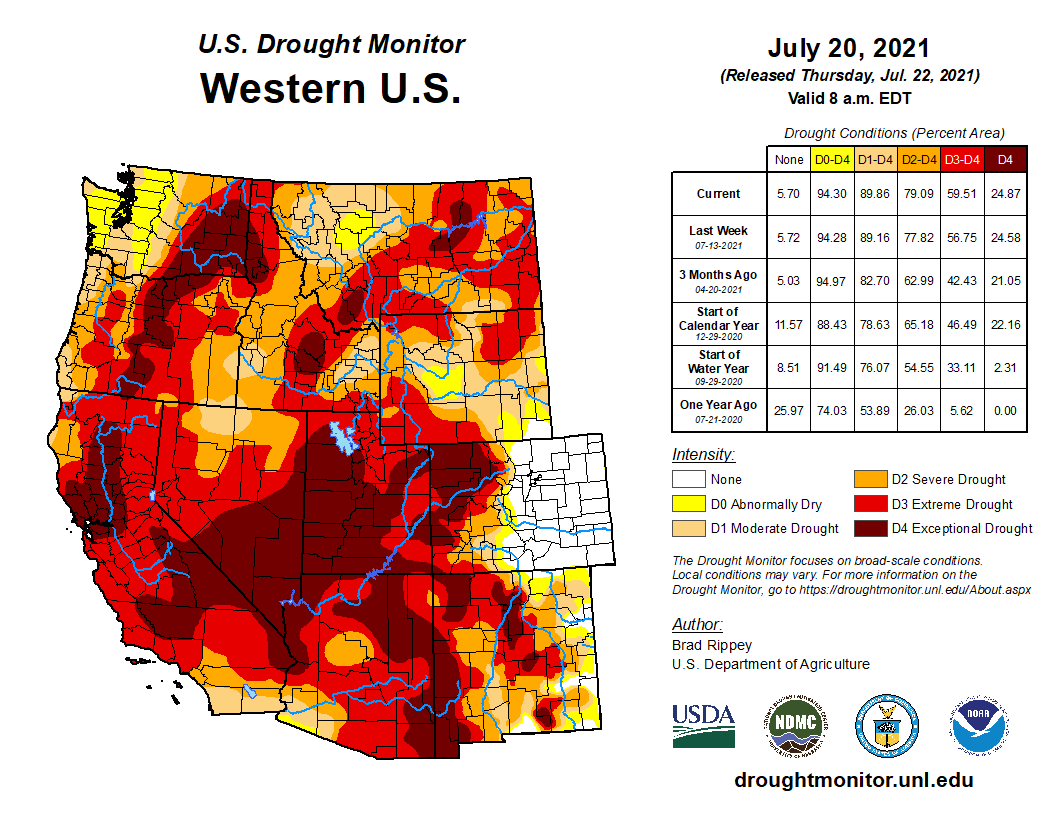
In summer 2021, 90% of the western United States (WUS) experienced drought, with over half of the region facing extreme or exceptional conditions, leading to water scarcity, crop loss, ecological degradation, and significant socio-economic consequences. Beyond the established influence of oceanic forcing and internal atmospheric variability, this study highlights the importance of land-surface conditions in the development of the 2020–2021 WUS drought, using observational data analysis and novel numerical simulations. Our results demonstrate that the soil moisture state preceding a meteorological drought, due to its intrinsic memory, is a critical factor in the development of soil droughts. Specifically, wet soil conditions can delay the transition from meteorological to soil droughts by several months or even nullify the effects of La Niña-driven meteorological droughts, while drier conditions can exacerbate these impacts, leading to more severe soil droughts. For the same reason, soil droughts can persist well beyond the end of meteorological droughts. Our numerical experiments suggest a relatively weak soil moisture-precipitation coupling during this drought period, corroborating the primary contributions of the ocean and atmosphere to this meteorological drought. Additionally, drought-induced vegetation losses can mitigate soil droughts by reducing evapotranspiration and slowing the depletion of soil moisture. This study highlights the importance of soil moisture and vegetation conditions in seasonal-to-interannual drought predictions. Findings from this study have implications for regions like the WUS, which are experiencing anthropogenically-driven soil aridification and vegetation greening, suggesting that future soil droughts in these areas may develop more rapidly, become more severe, and persist longer.
Key Points
- Initial soil moisture conditions strongly impacted the meteorological to soil drought transition in the western United States in 2020–2021
- Drought-induced vegetation feedbacks can influence the evolution of soil droughts in the western United States
- Future soil droughts in the western United States are likely to become more severe, develop more rapidly, and persist longer
Plain Language Summary
In summer 2021, nearly all the western United States (WUS) experienced drought, leading to water shortages and agricultural losses. While previous studies have predominantly focused on oceanic and atmospheric drivers of droughts in the WUS, our study explores how land-surface conditions contributed to the evolution of this real-world drought. We find that the initial moisture level in the soil is crucial for the transition of precipitation deficits into more impactful soil droughts. Moist soils can delay the onset of soil droughts when precipitation is lacking, whereas drier soils can quickly result in more severe and long-lasting soil droughts. Low soil moisture levels can maintain soil droughts for several months, even after meteorological conditions improve. The vegetation degradation during droughts can lessen the rate of soil drying by reducing the amount of moisture that plants transfer to the atmosphere, which may help reduce the severity of soil droughts. Our findings emphasize the importance of accounting for land-surface conditions, such as soil moisture and vegetation conditions, in seasonal-to-interannual drought predictions. Moreover, our work suggests that as the WUS becomes drier and vegetation condition change due to climate change, future soil droughts in the region might become more severe, develop faster, and persist longer.