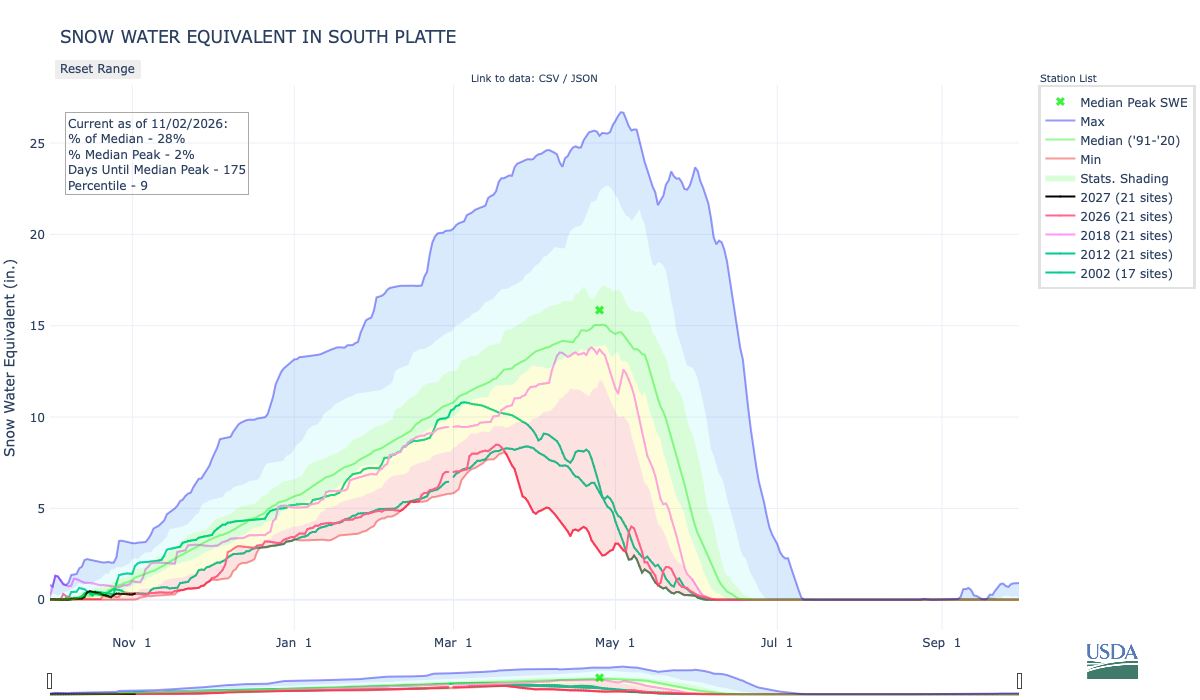
Below is the Snow Water Equivalent in South Platte graph from the NRCS for November 2, 2026. Snowpack is 28% of the median (down 16% one week, wild swings this time of the accumulation season) and 2% of the median peak (down 2% one week). There are 175 days until the median peak. I’ve added the lines for 2026, 2018, 2012, and 2002 since the statewide drought is still very pronounced.
Below is the Precipitation Accumulation in South Platte graph from the NRCS for November 2, 2026. This morning precipitation, at the SNOTEL stations, is at 68% of the median (down 11% one week), and 6% of the water year median (up 1% one week), There are 333 days left in the water year. I’ve added the lines for 2026, 2018, 2012, and 2002 since the statewide drought is still very pronounced.

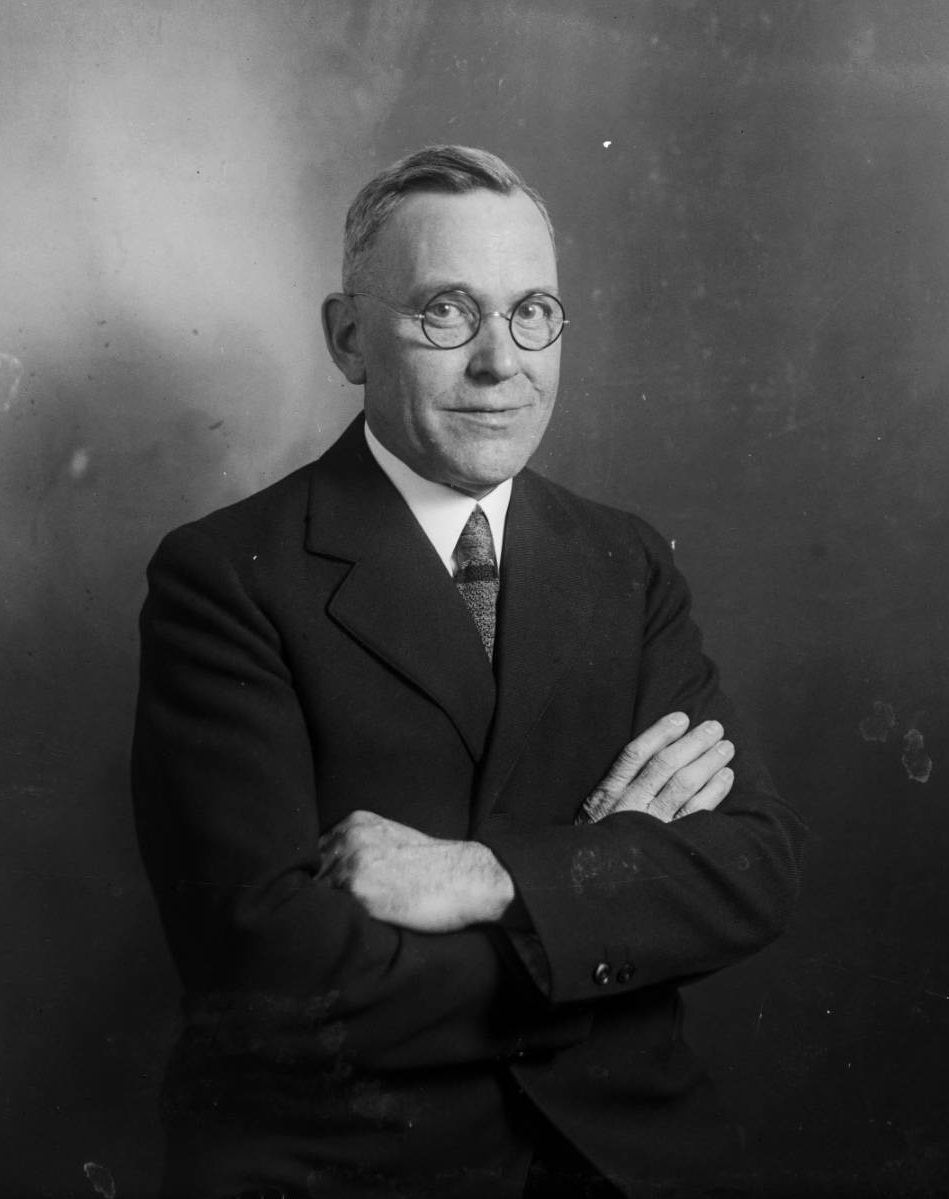
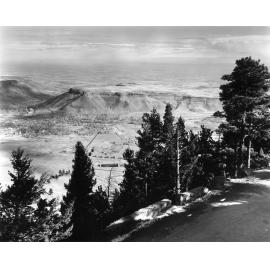
There is a chance for snow showers today, and snow showers are likely Wednesday, in the central mountains. Rain/snow is likely today, with a chance for rain/snow Wednesday, in the northern mountains. Showers are likely today, with a chance for showers Wednesday, down here about 13 miles from South Table Mountain, where Ku Klux Klansmen burned crosses to celebrate Denver Mayor Ben Stapleton surviving a recall election in August 1924. From Wikipedia:
As chronicled by Robert Alan Goldberg in his book Hooded Empire : The Ku Klux Klan in Colorado, Stapleton was the Klan candidate for mayor of Denver in 1923 and won the election with Klan support. When Stapleton declared his candidacy for mayor in March 1923, he was Klan member number 1,128 and a close friend of the Colorado Klan Grand Dragon, John Galen Locke. Rumors of Stapleton’s Klan membership circulated during the mayoral campaign. Stapleton responded by denying that he was a Klan member and condemning the Klan, “to appease his Jewish and Catholic supporters.” Stapleton declared, “True Americanism needs no mask or disguise. Any attempt to stir up racial prejudices or religious intolerance is contrary to our constitution and is therefore un-American.” The voters believed Stapleton’s denial and he was elected, defeating an unpopular incumbent, Dewey Bailey. Stapleton then appointed fellow Klansmen to multiple positions in Denver government, though he initially resisted Klan pressure to appoint a Klansman as chief of police.
An anti-Stapleton backlash developed due to the Klan’s infiltration of Denver government. The anti-Stapleton coalition began the process of petitioning for a recall election. Stapleton knew that to survive the recall he would need Klan support. He capitulated to the Klan demand that he appoint a Klansman as police chief, with the result that the police department became in effect a Klan organization. This galvanized the anti-Stapleton forces and they succeeded in forcing a recall election of Stapleton in August 1924.
According to Goldberg’s description of the recall election, “[t]he Klan dominated the Stapleton campaign, contributing more than $15,000 and scores of election workers.” “On July 14, 1924, Mayor Stapleton addressed a Klan gathering on South Table Mountain and reaffirmed his commitment: ‘I have little to say, except that I will work with the Klan and for the Klan in the coming election, heart and soul. And if I am reelected, I shall give the Klan the kind of administration it wants.'” The anti-Stapleton coalition had run a poor candidate against Stapleton in the recall election (Dewey Bailey, the incumbent mayor Stapleton defeated in 1923), and Stapleton won the recall election by a landslide. On the night of the election, Denver Klansmen burned crosses on South Table Mountain to signify their victory.
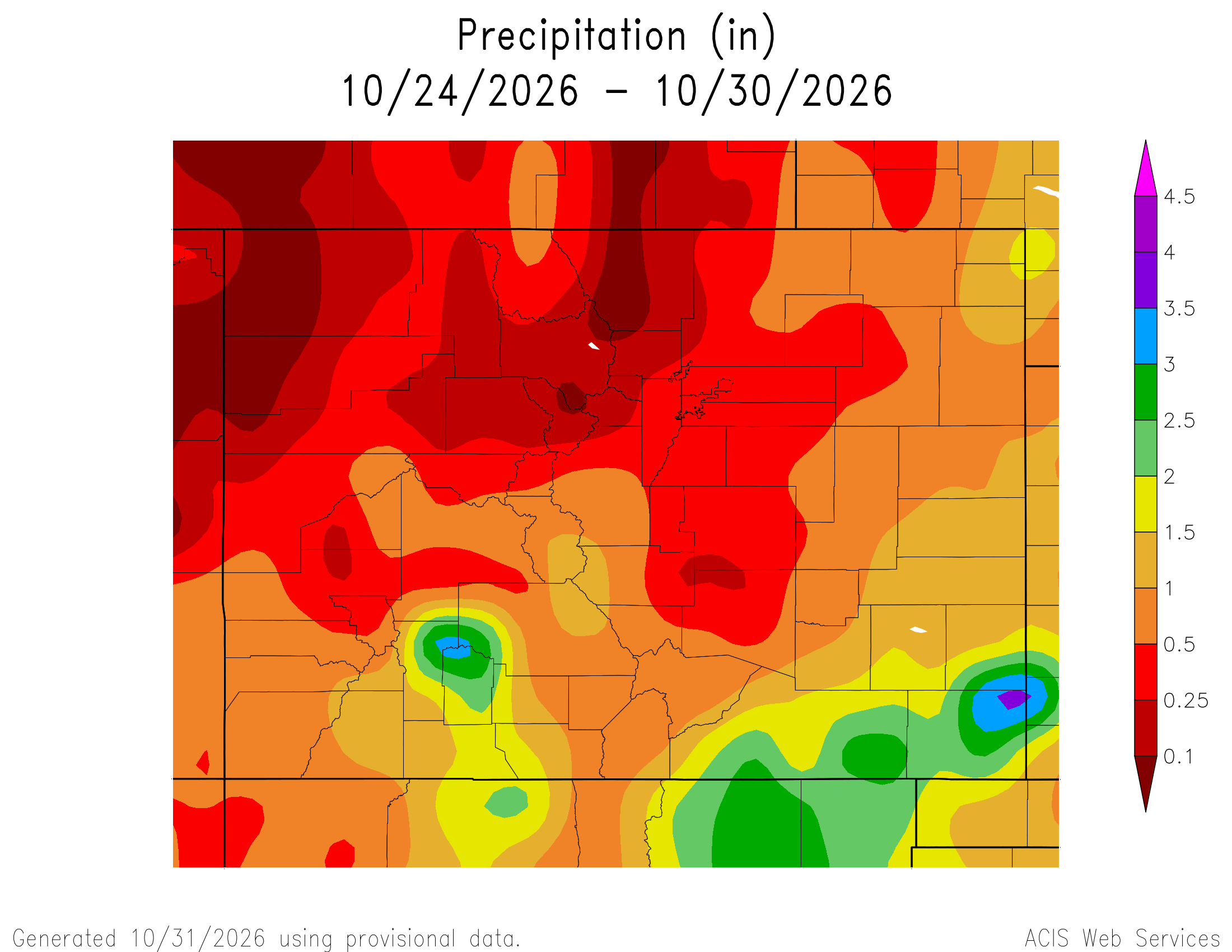
Here’s a look at the Colorado 7-Day precipitation map through October 30, 2026 from the High Plains Regional Climate Center. Precipitation in the South Platte Basin along the Continental Divide of the Americas ranged from 0.00” to 1.50″.
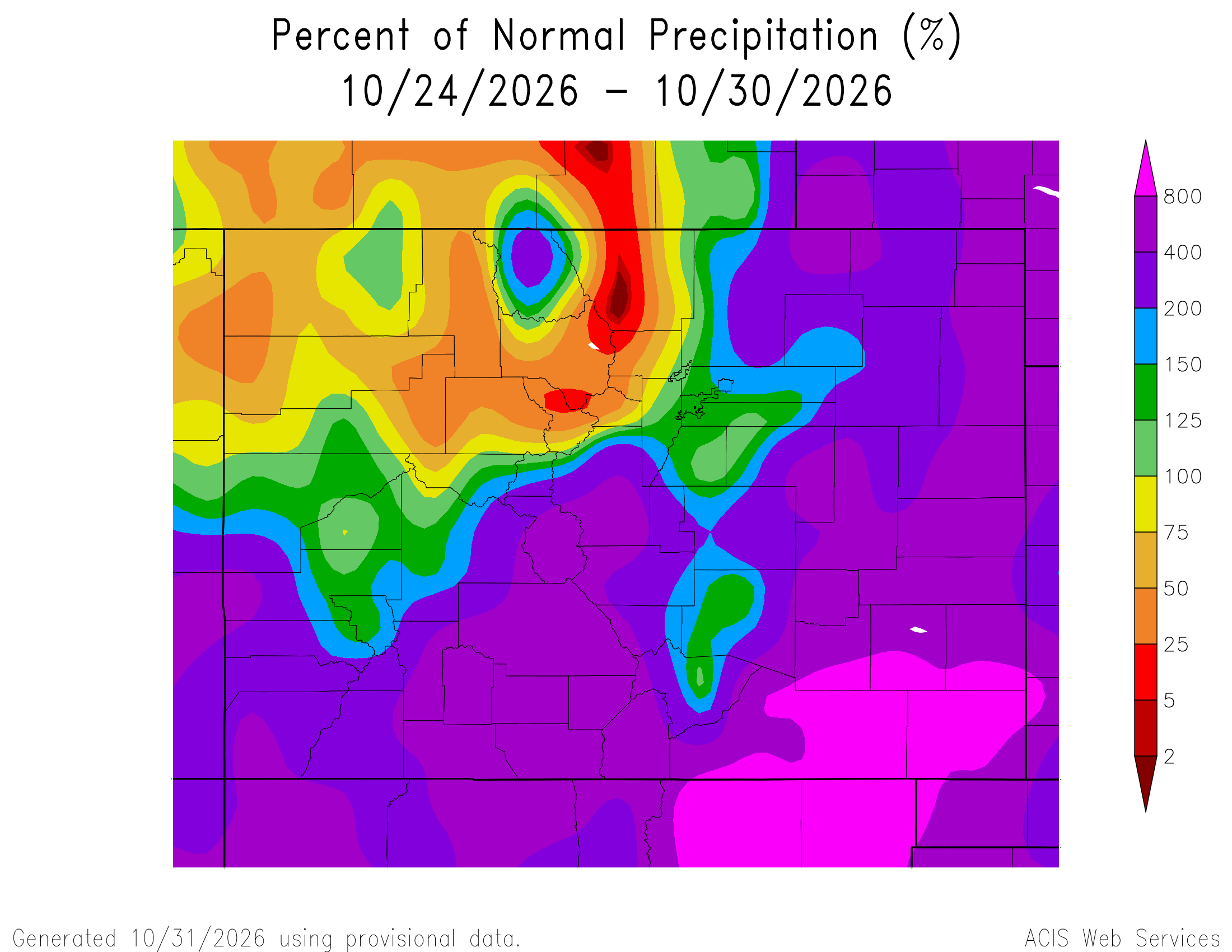
Here’s the Colorado 7-Day percent of normal precipitation map through October 30, 2026 from the High Plains Regional Climate Center. Precipitation in the South Platte River Basin along the Continental Divide of the Americas ranged from 0% to 800% of normal.
Here’s the most recent 7-Day Departure from Normal Temperature (F) for Colorado through October 30, 2026 from the High Plains Regional Climate Center.

Below is the 7-day Quantitative Precipitation Forecast for the week of November 2, 2026. Precipitation is anticipated for the mountains of the South Platte River Basin and may total up to 0.25″

Below are the 8-14 day outlooks from the Climate Prediction Center, issued November 1, 2026, for temperature and precipitation, for the week starting November 9, 2026. The CPC expects above normal temperatures and near normal precipitation for the mountains of the South Platte River Basin.


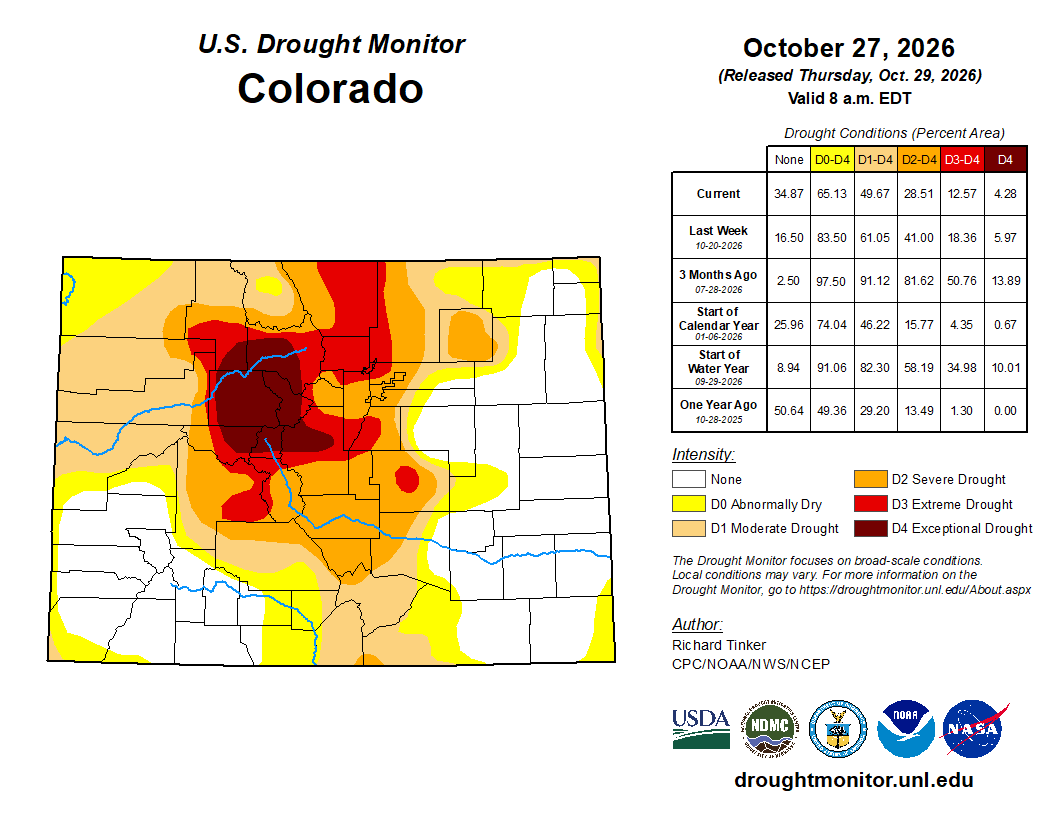
Below is the Colorado Drought Monitor map from October 27, 2026. There were one category improvements in Weld, Adams, Denver, Arapahoe, Douglas, Elbert, Logan, and Sedgwick counties in the South Platte River Basin. There were one category degradations in Morgan, Weld, Larimer, Boulder, Adams, Park, and Logan counties. There were two and 3 category degradations in Morgan County. Drought and abnormal dryness covers 65.13% of Colorado. The South Platte Basin is experiencing Abnormally Dry, Moderate, Severe, Extreme, and Exceptional drought conditions.
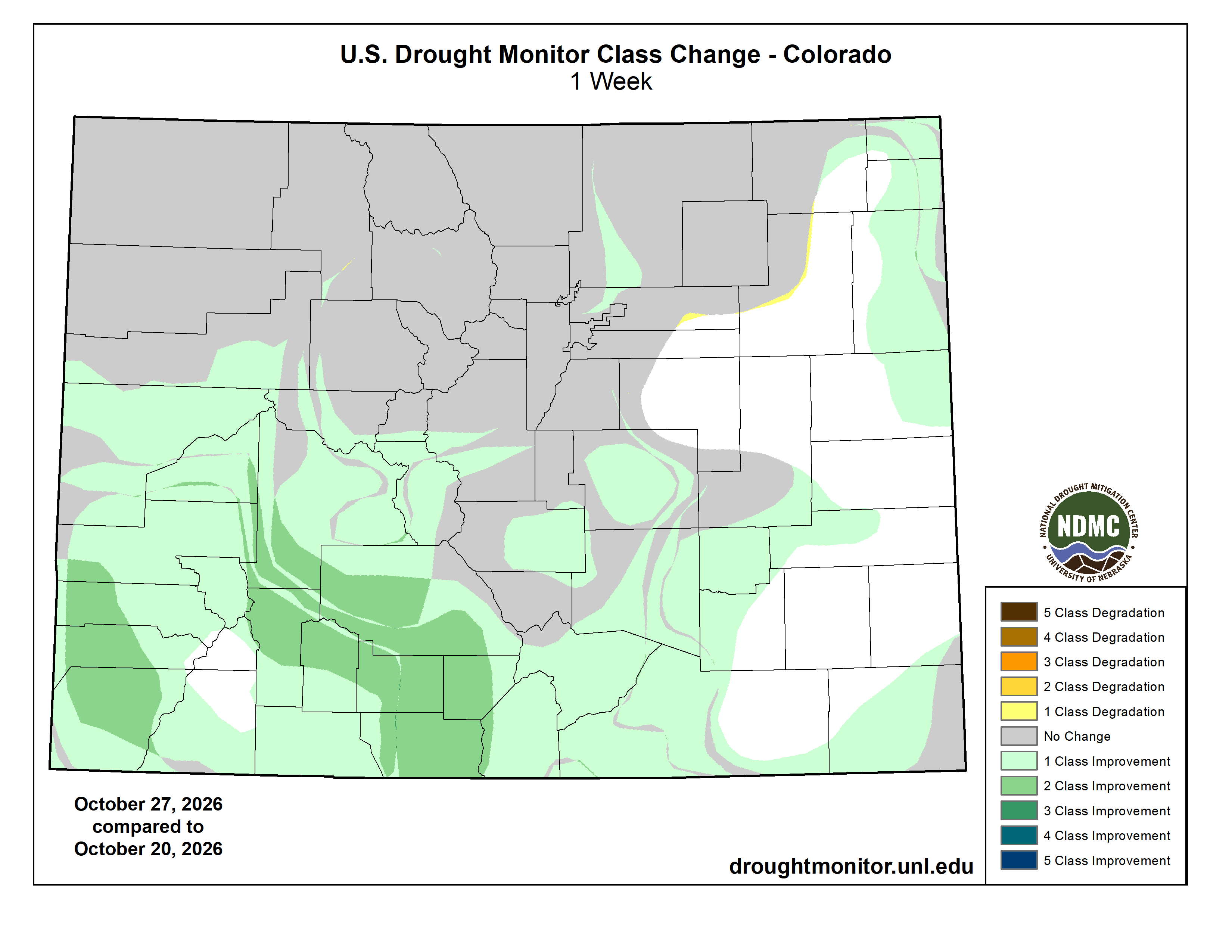
Below is the Colorado Drought Monitor one week change map ending October 27, 2026.
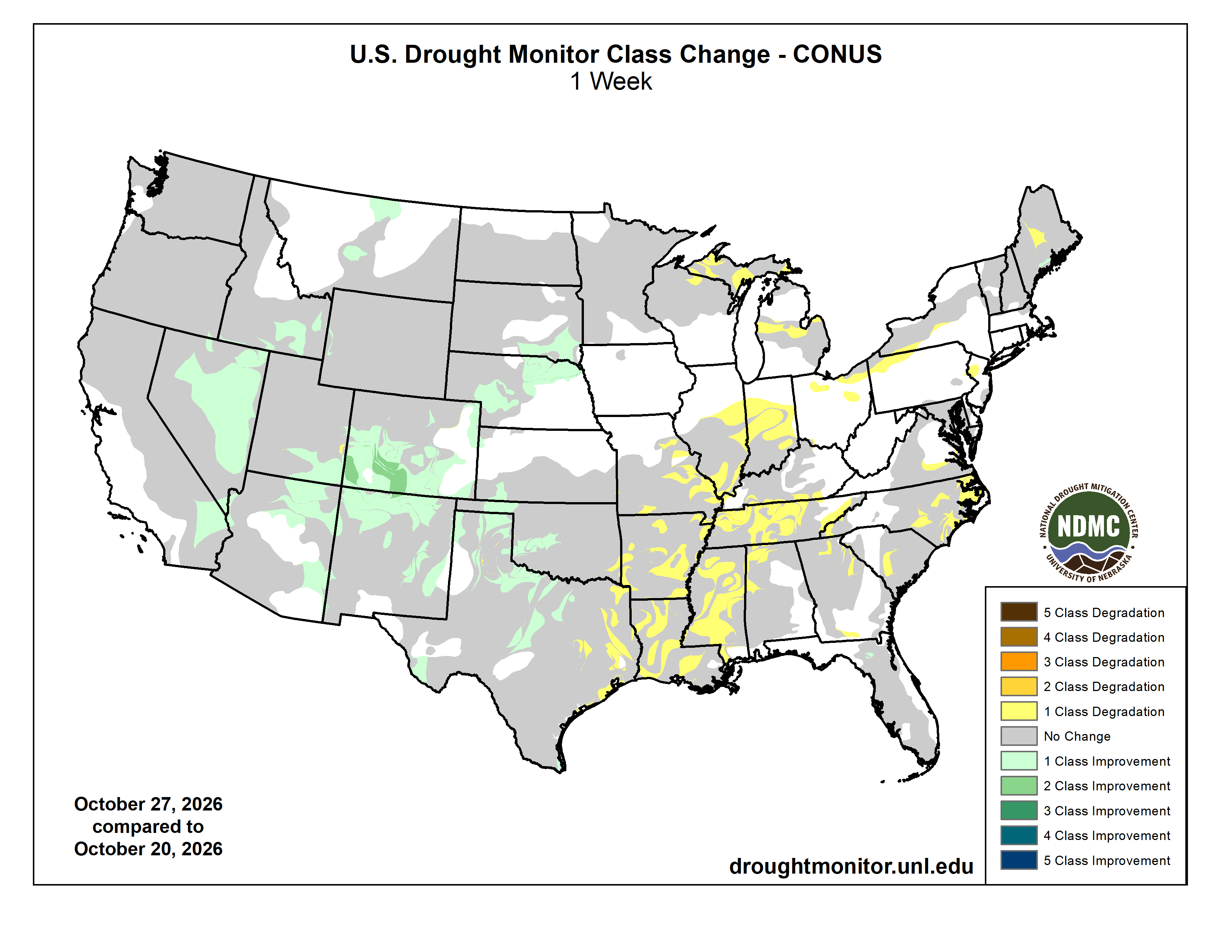
Here’s the US Drought Monitor Map from last week along with the one week U.S. change map.

Finally, Russ Schumacher Colorado’s State Climatologist, posted about the the rains and floods in southwest Colorado last week and there was this tidbit about El Niño:
Where does El Niño fit in to this story, and what’s coming next?
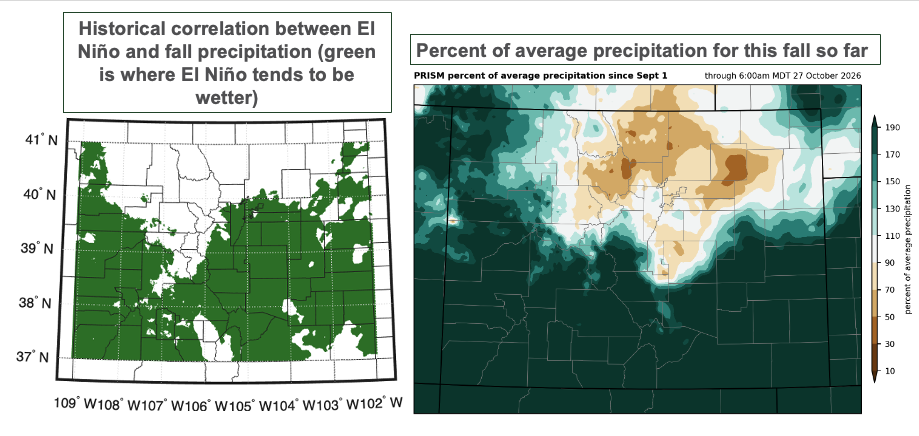
As Peter [Goble] outlined in this post, the fall season is when we see some of the most robust connections between El Niño and precipitation in Colorado, with falls tending to be wetter than average in southern Colorado during El Niño. It is quite remarkable how closely this fall’s precipitation patterns thus far match the historical correlations: on the figure below, look at how similar the green shading in the map on the left is to the areas that have seen above-average precipitation this fall!