Fountain Creek Watershed Flood Control and Greenway District board meeting recap

A picture named fountaincreek

From The Pueblo Chieftain (Chris Woodka):

The Fountain Creek Watershed Flood Control and Greenway District board Friday considered its strategy in seeking funding for 2012, and possibly may ask some entities like El Paso and Pueblo counties, as well as cities that signed a 2009 intergovernmental agreement to form the district, for money in next year’s budget.

The district is now funded for $100,000 annually by Colorado Springs Utilities and the Lower Arkansas Valley Water Conservancy District as part of an agreement they reached in 2007 to complete a Fountain Creek Corridor Master Plan. The budget pays the salary of Executive Director Gary Barber and other administrative expenses. That agreement continues in 2011, but nothing is in place for 2012. The board earlier this year agreed that it will not be in a position to ask voters for a mill levy until 2012 at the earliest, so the district would face a gap in funding.

More Fountain Creek coverage here and here.

Lower Arkansas Valley Water Conservancy District board meeting recap

A picture named arkansasriverbasin

From the La Junta Tribune (Bette McFarren):

The Lower Arkansas Valley Water Conservancy District Board met in regular session at Rocky Ford on Wednesday. Appearing before the Board were two special reports: Update on Fountain Creek and Innovative Water Technologies…

Speaking on behalf of THK Design Associates, Kevin Shanks reported that the Fountain Creek projects have now expanded from four to seven, with a reassuring compliance with the Overall Master Plan Goals, which are as follows:

* Improve watershed health by reducing erosion, sedimentation and flooding and improving water quality.
* Create stable riparian and wetland ecosystems to attract and support native wildlife and vegetation.
* Sustain productive agricultural lands along corridor.
* Lay-out trail from Colorado Springs to Pueblo with recreational and educational opportunities.
* Gain public and private support through partnerships to facilitate future funding

One of the more interesting projects is the Clear Spring Ranch Fish Passage. A type of native three-inch fish was found to be unable to negotiate some of the fish diversions on the creek. New diversion gates are being designed, as economically as possible, and water levels will be controlled to permit the fish to remain mobile through the habitat…

The most popular project at present is the Fountain Creek Greenway, which has secured a GOCO grant.
Wetlands and diversions are important in flood prevention between Colorado Springs and Pueblo, and consequently on down the river in the Arkansas Valley.

Another important factor in flood prevention is the removal of sediment, the main job of the Pueblo Side Detention and Sediment Removal Project. This is a Sediment Collector Demonstration Project. The sediment is being collected at the rate of 17 or 18 truckloads a day from under the old railroad bridge in Pueblo. This sediment has value as fill and can be used as leverage for grants as well as mixed with sewer sludge to make organic planting medium. It is funded by a $485K Federal appropriation through NRCS, $75K City of Pueblo Stormwater, $225K Colorado Water Conservation Board, $250K Environmental Protection Agency 319 Grant. Another benefit is 25 acres of new wetlands.

More Fountain Creek coverage here and here.

Fountain Creek master plan update

A picture named fountaincreek

From The Pueblo Chieftain (Chris Woodka):

There are eight active projects along Fountain Creek, partly as a result of a partnership started three years ago between the Lower Ark district and Colorado Springs Utilities, said consultant Kevin Shanks.

A Fountain Creek Corridor Master Plan is being developed as a result of an agreement that is funded by $150,000 annually from both the Lower Ark and Colorado Springs. The groups agreed to fund the Fountain Creek Watershed Flood Control and Greenway director’s salary, $100,000 per year this year and next as well.

The Fountain Creek district, formed last year, signed on as a partner in the projects this year. All told, the partners will spend $1.2 million by the end of next year on the Fountain Creek project. That money has leveraged between $3 million and $6 million in other funds, depending on whether some pending applications are approved…

The most dramatic community effort has been the Fountain Creek Greenway project at the confluence with the Arkansas River. Under a Great Outdoors Colorado planning grant, the city of Pueblo is working to increase recreation and access to Fountain Creek. “It’s become the No. 1 project in Pueblo, and is inspired by the efforts to improve the South Platte in Denver,” Shanks said…

Extension of the trail system along Fountain Creek, eventually to the Pinon Bridge is being planned.

There also is nearly $1 million available for a side detention and sediment removal project in Fountain Creek through Pueblo. The side detention pond will be at the North Side Walmart to decrease the intensity of small floods. When it is not flooded, it will create a wetlands area that will help wildlife and improve water quality, Shanks said.

The other large piece moving ahead are improvements at Clear Springs Ranch, south of Fountain. The property is owned by Colorado Springs, and will include a fish passage, wetlands, bank improvements and improved sinuosity. The project, which is required for the Southern Delivery System under Pueblo County’s 1041 permit, will help reduce flood damage downstream, erosion and sedimentation. “Without the agreement, Colorado Springs could have done Clear Springs Ranch and checked off the box,” Shanks said. “It would not have been done up to the standards of the master plan, however.”[…]

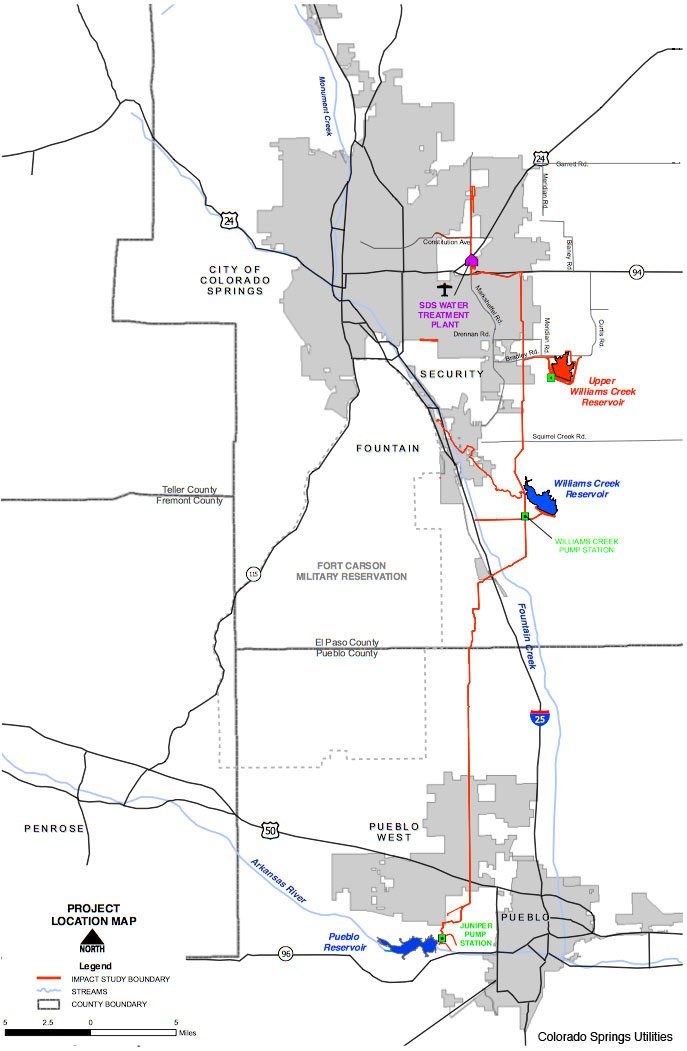
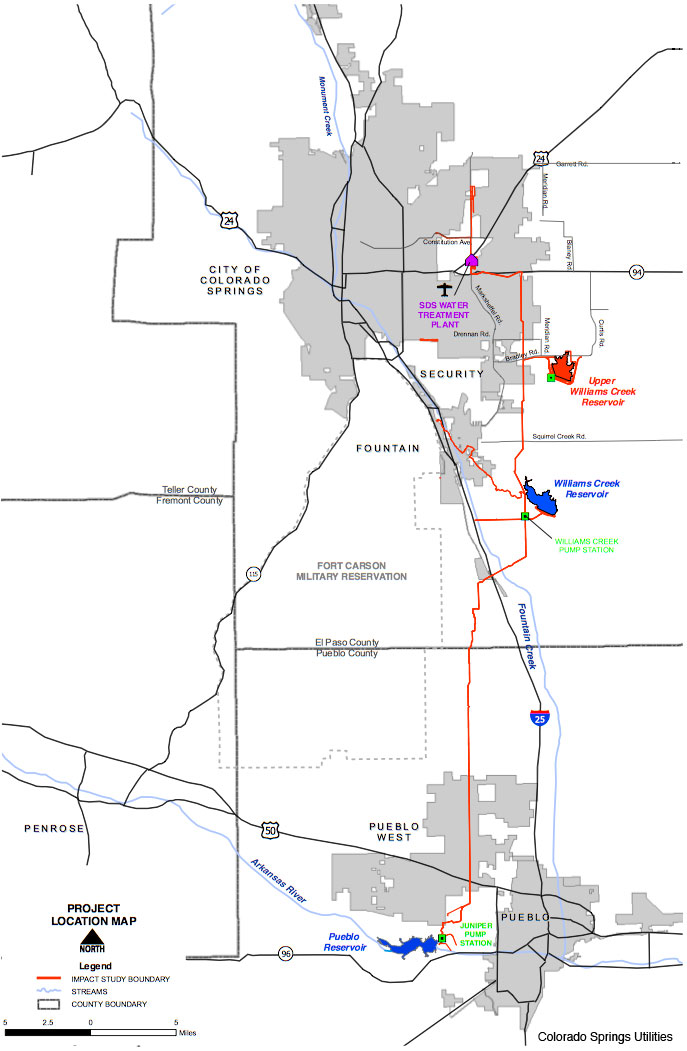
Here are active or planned projects along Fountain Creek that have been developed through the Fountain Creek Corridor Master Plan:

Eco-Fit Park: A park on the southern edge of Colorado Springs would stress youth fitness and environmental values. No cost has been specified, and the project has stalled in a slow economy.

City of Fountain Trailhead: The 8.5-acre site on the Toby Wells property has historic interest because of a Sears mail-order house in good condition. It would provide a trailhead, creek crossing for a trail along the creek and a community center.

Clear Spring Ranch: Part of the old Hanna Ranch, the property is owned by Colorado Springs. It would provide some flood control, wetlands restoration, creek improvements and a fish ladder. Pueblo County is requiring the improvements at the site south of Fountain under its 1041 permit for Southern Delivery System. An estimated $3.7 million is planned from various agencies.

Environmental Stewardship Center: An educational park and wildlife viewing area would be built on land being donated by a developer of a large subdivision near Pinon in Pueblo County.

Front Range Trail: A trail project would extend the existing trail system in Pueblo to the Pinon Bridge.

Side Detention and Sediment Removal: A $1 million project in Pueblo will begin this year to create a side detention pond behind the North Side Walmart, and to demonstrate how the Streamside Systems sediment collector will remove particles from water as it flows, improving water quality.

The Fountain Creek Greenway: Planning efforts for the Pueblo greenway project are being coordinated with improvements on the Historic East Side. In addition to improving access and recreation opportunities, it will improve wildlife habitat and increase the effectiveness of the levee system.

Midland Greenway Trail: A project just getting started on Colorado Springs’ West Side would connect Fountain Creek to existing trails on Upper Fountain Creek along U.S. 24, near Gold Hill Mesa.

More Fountain Creek coverage here and here.

Southern Delivery System: Negotiations between Colorado Springs Utilities and Reclamation hit cost snag

A picture named sdspreferredalternative

From The Pueblo Chieftain (Chris Woodka):

“The proposal you provided to us is unacceptable. It sounds arbitrary and capricious,” John Fredell, SDS project director, told Reclamation’s negotiating team. “Clearly you did not recognize that as in-basin users, we want to be treated fairly.”[…]

One of those [Colorado Springs Utilities] ratepayers, Walter Lawson, chided Reclamation for not revealing the whole cost to Colorado Springs, and said Reclamation is trying to “extort” money from Colorado Springs…

The morning session of negotiations centered on contract terms, as Reclamation rejected about 25 proposed changes. Most of those centered on Colorado Springs’ intention to wheel water through SDS to other El Paso County communities and to sell excess capacity in the oversized pipeline at the base of Pueblo Dam. The two sides staged frequent caucuses to discuss the finer points of the contract, but made little progress.

Late in the day, Reclamation Area Manager Michael Collins presented a proposal that would have allowed SDS participants to build an oversized pipeline from a new North Outlet Works to the point where Pueblo West would tap into it. The capacity of the line needed by SDS, 96 million gallons per day, would be retained by participants, while Reclamation would discount its rate for combined storage and conveyance by the amount of excess capacity it could sell in the North Outlet Works. Reclamation proposed a $75 per acre-foot fee for storage and conveyance — $25 less than the previous combined offer — plus the unspecified discount. It also stuck with its offer of $50 per acre-foot for exchange. The rates would increase by 3.08 percent annually…

At a May negotiating session, Colorado Springs proposed to sell the excess capacity in the line to future users as a way to pay for it. Colorado Springs also wants to pay just $17.35 per acre-foot, the same rate as the Pueblo Board of Water Works pays under a 25-year contract signed in 2000, with an annual increase of 1.79 percent. “At the next meeting, we’d like to hear why our proposal is unreasonable,” Fredell said.

Colorado Springs hired Joe Hall, a former Bureau of Reclamation area manager, to analyze some documents which Reclamation provided to justify its $50 per acre-foot rates. Hall said the basis for the rates is “confusing and inconsistent,” since it deals with some policies that are almost 30 years old and which apply to sales of former agricultural water to cities, rather than use of in-basin water rights. “I’m not saying your studies and analyses are bunk,” Hall said. “They are just not appropriate to what we’re trying to do here.”

Collins explained that federal laws give Secretary of Interior Ken Salazar broad concessions to set rates, and did not attempt to argue the basis with the Colorado Springs team. “We have some concerns about what’s been said,” he said. Reclamation will continue to control the excess capacity of the Fryingpan-Arkansas Project, Collins added.

The next session was set for July 15-16 in Fountain.

More SDS coverage from Chris Woodka writing for The Pueblo Chieftain. From the article:

Reclamation area Manager Micheal Collins made it clear at the beginning of Tuesday’s negotiating session that the record of decision, along with the EIS, would not be reopened. “We will not explore the record of decision conditions or the commitments that are tied to SDS,” Collins said in his opening remarks…

“Our belief is that there are important effects of the SDS project that have not been adequately addressed in the EIS or various other permits,” Jane Rawlings, assistant publisher of The Chieftain, told Reclamation during SDS contract negotiations on Tuesday. “These include water quantity, flooding, sedimentation issues and water quality issues including biological and mineral levels.”[…]

Rawlings said some of the impacts which have not been measured include lower levels at Lake Pueblo because of heightened use of SDS, the removal of the stormwater enterprise by the Colorado Springs City Council and the concept of selling excess capacity in the SDS pipeline. “Today, I challenge you, the Bureau of Reclamation, to use this negotiation process to think outside the box and consider the citizens — the people — who pay your salaries in Southeastern Colorado,” Rawlings said. “We believe you need a supplemental EIS to adequately address these vitally important issues.”

More Southern Delivery System coverage here and here.

Southern Delivery System: The EPA and the U.S. Army Corps of Engineers are not planning a new EIS now that Colorado Springs’ stormwater enterprise is kaput

A picture named sdspreferredalternative

From The Pueblo Chieftain (Chris Woodka):

The Army Corps of Engineers and Environmental Protection Agency told state Rep. Sal Pace, D-Pueblo, that the EIS is sufficient and no further study for SDS is needed. Pace is disappointed with the response. “These federal agencies put no effort into their responses,” Pace said. Pace wrote to the federal agencies, including the Bureau of Reclamation, in April and requested additional environmental studies of how Fountain Creek will be protected without a stormwater enterprise…

Both the Corps and EPA said Colorado Springs has made commitments to protect water quality through Reclamation and Pueblo County 1041 processes. “The loss of the stormwater enterprise adds to Colorado Springs Utilities’ challenge in meeting relevant conditions of the various authorizations for SDS, but does not preclude it,” said Lt. Col. Kimberly Colloton, Corps district commander.

“EPA does not believe that the revocation of Colorado Springs’ stormwater enterprise in December 2009 affects these commitments made by the SDS participants to protect water quality,” said Larry Svoboda, NEPA compliance director for Region 8 of the EPA.

“They both sent one-page letters,” Pace said. “I was surprised how they didn’t address any of the numerous points I made. I would have expected a more thorough response from the agencies charged with protecting the waters of the nation and enforcing the National Environmental Policy Act.

More Southern Delivery System coverage here and here.

Colorado Foundation for Water Education is hosting a tour of Fountain Creek on June 22

A picture named fountaincreek

Here’s the release from CFWE (Kristin Maharg):

Fountain Creek drains an urban watershed serving 1/2 million people from north of Colorado Springs down to Pueblo. Changes in the watershed have increased flooding and erosion, accelerated farmland and habitat loss, and destroyed the foundations of roads and homes. However, there is an exciting, collaborative initiative to restore the ecosystem’s health, integrity and sustainability.

Attend this fun all-day watershed tour on Tuesday, June 22 to learn how municipal districts, non-profits and state government are working together to create a vital amenity for the communities through which Fountain Creek flows. Participants will also be provided with hands-on education tools in related content areas. Secondary teachers receive 1/2 credit hour from Colorado School of Mines for attending the tour.

More Fountain Creek coverage here and here.

Southern Delivery System: Contract negotiations between Colorado Springs Utilities and Reclamation to continue Tuesday

A picture named sdspreferredalternative

From The Pueblo Chieftain (Chris Woodka):

Colorado Springs, Security and Fountain are seeking contracts for excess-capacity storage in Lake Pueblo and conveyance through the dam. Colorado Springs also wants a contract to exchange water, through a paper trade, from Pueblo to Turquoise or Twin Lakes.

More Southern Delivery System coverage here and here.

Pueblo: City Fountain Creek greenway project tour recap

A picture named fountaincreek

From The Pueblo Chieftain (Chris Woodka):

“We want everyone to know what’s happening on Fountain Creek,” Montoya told about 30 people who showed up to see for themselves. “This is not just for the East Side, but for all of Pueblo. . . . You need to get out and see it. Touch it. You have to walk the talk.” What planners have in mind are improvements along the creek from Eighth Street to Fountain Creek’s confluence with the Arkansas River. On Friday, people walked, biked or rode in carts along the trail, getting a glimpse of possibilities and problems that for many have just been spots on a map up until now. “The question we’re trying to answer is ‘What can we do to provide better connectivity?’ ” said Scott Hobson, assistant city manager.

Several projects are in the works along Fountain Creek, including the trail improvements, an urban redevelopment project and a sediment removal demonstration project. There are also some nearly 20-year-old plans to improve Runyon Lake that could be woven into the other projects. A trail through the area could incorporate ideas from each, while building on existing areas along Fountain Creek and adding new features like a skate park, water play parks and fields, Hobson said. “We have to look at what improvements will occur and in what sequence,” Hobson said.

The city task force will attempt to settle on an alternative for the first phase of the project in July, under a Great Outdoors Colorado planning grant. Possibilities include closing some streets, creating new recreation areas or simply building on fixtures already in place like Plaza Verde Park and El Centro del Quinto Sol. There could be a new bike and pedestrian bridge at First Street and even riverfront housing, Hobson said. At one point along the trail, Hobson explained how sediment removed from the river could be used on the banks to provide a more inviting slope as people approach the creek.

More Fountain Creek coverage here and here.

Colorado Springs City Council and Springs’ Issue 300 supporters are arguing about how to draw down the $1.4 million enterprise fund escrow

A picture named pikespeak

From The Colorado Springs Gazette (Eileen Welsome):

Rivera argues that the City Charter, not Issue 300, is the guiding document that determines where CSU’s surpluses go. And the charter states that any surplus from CSU can be appropriated to the city’s general fund. “The charter overrules Issue 300,” Rivera said in an interview Tuesday, adding that payments to the city from other enterprises, such as the airport, are being phased out as required by the new ordinance. The City Council is expected to vote on what to do with Utilities’ $1.4 million later this month.

Issue 300, sponsored by anti-tax advocate Douglas Bruce, instructed the city to phase out payments in lieu of taxes to the city’s general fund from its enterprises over an eight-year period starting in 2010. As a consequence, Utilities was instructed to hold back one-eighth, or nearly $4 million, of the estimated $31.7 million in funds scheduled to flow into the general fund in 2010 and place it in an escrow account. As of the end of April, the money in the escrow account amounted to $1.4 million, said Terri Velasquez, the city’s chief financial officer.

More stormwater coverage here.

Southern Delivery System: What are the impacts from sharing project facilities with providers that were not included in the Reclamation evaluation?

A picture named sdspreferredalternative

From The Pueblo Chieftain (Chris Woodka):

…at contract negotiations last week, Colorado Springs worked very hard to insert provisions that would allow the use of excess capacity of SDS, partly to help pay for the expense. “We need to be clear that there are plans on the part of several SDS participants to serve others through the project,” Colorado Springs water attorney David Robbins told the Bureau of Reclamation at the negotiations in Pueblo. While Colorado Springs and its SDS partners intend to stay within the limit of taking a maximum of 78 million gallons of water a day from Lake Pueblo into El Paso County, more water could be wheeled through the pipeline than was envisioned in Reclamation’s environmental impact study. Colorado Springs wants to build in the ability to use the project for neighboring communities in El Paso County, asking for changes in Reclamation’s proposed contract to allow for “excess-capacity” users.

That point was raised two years ago by Pueblo County water attorney Ray Petros during the EIS comment period.

Petros pointed out environmental impacts were modeled on moving an average of 52,900 acre-feet of water delivered annually through the pipeline, with a firm yield of 42,400 acre-feet. That is only about 60 percent of the capacity of the pipeline and pumping stations to move 87,000 acre-feet per year. “Any approval should condition the use of the project on the use of only existing water rights without further environmental study and review,” Petros told Reclamation in June 2008. At the time, he also advised against allowing additional users on the pipeline. “The draft EIS does not consider the impacts associated with Colorado Springs supplying raw water or substantial amounts of treated water outside its city boundaries. Such water contracts could increase the amount of water projected to be delivered through the pipeline,” Petros said. “Additional taps to the pipeline could mean unplanned growth and impacts along the pipeline.”

Reclamation responded to Petros’ comments by saying the final EIS would have commitments that require Colorado Springs to stay within the limits modeled. “A commitment not to contract or operate the preferred alternative in a manner that differs substantively from that evaluated in the final EIS, except under emergency conditions, has been included,” Reclamation replied. “Because of this commitment only the water supplies analyzed in this final EIS could be delivered through SDS facilities without NEPA analysis.” Petros brought up the concerns again when Pueblo County’s hearings began for a 1041 permit in December 2008. Throughout the hearings, the concern never went away, and it led to a procedure to deal with new water rights added to SDS or third-party users. Under one condition, Pueblo County can reopen 1041 hearings if new water rights are added. Third-party contracts would require support for the Fountain Creek Watershed Flood Control and Greenway District, a commitment not to serve customers outside the Arkansas River basin, adoption of stormwater controls similar to the now-defunct stormwater enterprise in Colorado Springs, cooperation in the Pueblo flow program, participation in water-quality monitoring and support of studies for a flood control dams on Fountain Creek…

During last week’s negotiations, Reclamation asked Colorado Springs to provide an inventory of the water rights that were used to develop the EIS during discussions about excess capacity. In its statement of purpose and need for SDS, Colorado Springs said it was needed to meet future needs of participants, provide redundant systems and develop existing water rights. Nothing was mentioned about supplying the water needs of neighboring communities in the statement…

“If Colorado Springs Utilities doesn’t become the regional water supplier, someone else will step in and do it,” Tony Elia, chairman of the Utilities Policy Advisory Council, told Colorado Springs City Council last July, on the day it decided to delay SDS completion until 2016. The council pushed back SDS to provide breathing room for ratepayers, who nevertheless will be looking at a doubling in water rates by the time SDS is projected to go online.

More Southern Delivery System coverage here and here.

Southern Delivery System: Sierra club official pans environmental protections in proposed SDS contract with Reclamation

A picture named arkansasfountainconverge

From The Pueblo Chieftain (Chris Woodka):

“They appear to me to be very weak,” said Ross Vincent, president of the local Sierra Club chapter. “My impression is that they fall far short of the protection that is needed. The language is fuzzy and does not require much of anything.” The Sierra Club and the Rocky Mountain Environmental Labor Coalition have continued to question the Bureau of Reclamation’s environmental impact statement’s adequacy and to raise questions about the impact SDS will have on Fountain Creek…

The problem, as Vincent sees it, is that water-quality conditions spelled out in Reclamation’s proposed contract require a determination by the Colorado Department of Public HealthandEnvironment that SDS is causing “significant adverse effects” before any action is taken. The requirements talk about “elevated concentrations” of selenium, E. coli and sulfates attributed to SDS. “What triggers it?” Vincent said. “We all know there are elevated concentrations now, so any increase at all would be a violation. My guess is the CDPHE would not reach a formal determination, so in effect there is no procedure.”

Vincent disagrees with Reclamation’s adaptive management plan as the way to handle unexpected changes in water quality or quantity due to SDS. “The Bureau of Reclamation is passing the buck to other agencies for its responsibility to protect water quality,” Vincent said.

More Southern Delivery System coverage here and here.

Southern Delivery System: State Representative Sal Pace says that the effects on the project from the demise of Colorado Springs’ stormwater enterprise are still up in the air

A picture named arkansasfountainconverge

From The Pueblo Chieftain (Chris Woodka):

“The Bureau of Reclamation must not award any contract without first demanding that the stormwater enterprise be re-instituted,” state Rep. Sal Pace, D-Pueblo, said. “We in Pueblo must have that assurance before SDS is given a contract in Lake Pueblo.” In April, Pace called for a new environmental analysis of SDS in light of Colorado Springs City Council’s decision to abolish the stormwater enterprise last year. Pace was unable to attend the first negotiating session for SDS this week because of a family emergency, but said his stance has not changed. “If the stormwater enterprise was deemed so important in these environmental studies by Reclamation and Colorado Springs officials when promoting SDS, then there must be serious consequences upon its demise,” Pace wrote in the letter.

Colorado Springs attempted to head off controversy over the issue in the opening round of negotiations for federal SDS contracts, even though the issue wasn’t raised by the Bureau of Reclamation. “Colorado Springs’ stormwater-control measures for new development are totally independent from the stormwater enterprise and will remain unchanged,” SDS Project Director John Fredell said. Reclamation’s environmental impact statement concluded that SDS return flows would have a small impact on storm flows, Fredell said…

Pueblo County, in its comments on the environmental impact statement by attorney Ray Petros, told Reclamation additional environmental studies would be needed if Colorado Springs eliminated its stormwater enterprise. Reclamation answered Pueblo county’s concerns with the environmental impact statement by saying the stormwater enterprise appeared to be a reasonably foreseeable action, so was included as part of the cumulative effects analysis. “Implementation of the Colorado Springs stormwater enterprise has purposes that are independent of the SDS Project and is not considered a mitigation measure,” Reclamation stated in the reply.

More Southern Delivery System coverage here and here.

Southern Delivery System: Details of Colorado Springs Utilities’ plans for the Pueblo Dam north outlet works include others in the service area

A picture named sdspreferredalternative

From The Pueblo Chieftain (Chris Woodka):

Colorado Springs Utilities water attorney David Robbins took pains to explain that excess capacity in the North Outlet Works, pumping station and pipeline would be different than the concept currently used by Reclamation. “We need to be clear that there are plans on the part of several SDS participants to serve others through the project,” Robbins said.

In fact, contracts being sought by Colorado Springs, Security, Fountain and Pueblo West would use excess capacity of the Fryingpan-Arkansas Project in Lake Pueblo. Colorado Springs wants to apply the same concept to the North Outlet Works, which it would build at its own expense and deed to the Bureau of Reclamation. While a maximum of 96 million gallons a day could be diverted through the new structure Colorado Springs intends to build at the base of Pueblo Dam, not all of it would be needed immediately, and over time the full amount would not be needed every day. Of the capacity, up to 78 million gallons daily would go to El Paso County, and up to 18 million gallons daily to Pueblo West. Colorado Springs City Council has discussed the possibility of allowing El Paso County water users other than Security and Fountain to use the pipeline, but would stay within the 78 million gallon per day limit, Fredell said.

Colorado Springs also wants to build a pipeline from the dam to its connection with Pueblo West’s intake larger than it needs to be to serve the needs of SDS. During negotiations, Colorado Springs revealed it intends to recoup costs for building the North Outlet Works by selling the excess capacity for hydroelectric projects or future connections to the line. The first portion of the pipeline would be 90 inches in diameter, narrowing to 66 inches in diameter as it heads north through Pueblo West. Only about 25 percent of the maximum capacity would be used, said Keith Riley, SDS project manager. The cost for that part of SDS would be about $30 million. “It would be a multiuse pipeline with the potential for others to tie on,” Riley said. “The SDS participants wouldrecapture revenue from it.”[…]

Colorado Springs also asked for changes in the contract that would allow it to use water from any source, rather than just native Arkansas River flows as the contract originally stated. Fredell said water from any source could be used in the pipeline, and those uses might be for augmentation as well as municipal needs. Reclamation officials asked Colorado Springs to review all of the water rights that would be used in SDS at the next negotiating session to verify what was studied in the EIS.

More Southern Delivery System coverage here and here.

Pueblo: Fountain Creek foundation public meeting recap

A picture named fountaincreek.jpg

From The Pueblo Chieftain (Chris Woodka):

The meeting attracted about 40 people, even a few children and teens, to discuss how recreational opportunities could be expanded. Under a $75,000 Great Outdoors Colorado grant, Pueblo and numerous other partners are developing the plan with the guidance of the Fountain Creek Foundation and THK Associates, consultants for the project.

More Fountain Creek coverage here and here.

Fountain Creek update

A picture named fountaincreek.jpg

From The Pueblo Chieftain (Chris Woodka):

Under a Great Outdoors Colorado grant, the City of Pueblo, along with several partners, is developing a master plan for redevelopment of the Historic East Side that ties in parks, recreation, community activities, connections to Downtown Pueblo and improvement of Fountain Creek.

More coverage from Chris Woodka writing for The Pueblo Chieftain. From the article:

Pueblo County will consider buying an abandoned railroad bridge on Fountain Creek as an alternative to dredging as a way for Colorado Springs to comply with its permit conditions for the Southern Delivery System. In a work session Wednesday, commissioners heard a proposal recommended by the city of Pueblo and Colorado Springs Utilities to buy and remove the bridge as a more effective way to restore flood capacity to Fountain Creek than dredging. “Every- body ought to realize dredging is a one-time operation that can be short-lived,” said Dennis Maroney, Pueblo stormwater consultant. “After a storm event, you may have to go back and do it over again.”

More coverage from Chris Woodka writing for The Pueblo Chieftain. From the article:

At least eight projects are contemplated along the Fountain in Pueblo County alone, creating both challenges and opportunities, [Gary Barber, interim director of the Fountain Creek Watershed Flood Control and Greenway District] said. Four identified projects are bringing in more than $2 million to Fountain Creek, which others are just taking shape. “I see our role as a district to coordinate activity on Fountain Creek and move things along,” Barber told Pueblo County commissioners this week, as the county tried to sort out who’s doing what along the waterway.

The county is looking at a proposal by Colorado Springs Utilities and the city of Pueblo to buy and remove an abandoned railroad bridge, rather than have Colorado Springs dredge Fountain Creek. Removal of the bridge is seen as a more permanent solution than dredging, which would have to be done periodically after each flood deposits more sediment in the approaches leading to the bridge. That particular project is the main interest for the commissioners, who required the dredging as a condition for allowing Colorado Springs to build part of the $2.3 billion Southern Delivery System in Pueblo County…

A $500,000 sediment-removal demonstration project using technology developed by Streamside Systems is scheduled to be conducted near the railroad bridge. A 20-foot collector will be placed in Fountain Creek to remove bedload sediment — the particles that are carried along by day-to-day flows in Fountain Creek. The Colorado Water Conservation Board contributed $225,000 toward operation of the 90-day trial, which will be matched by $75,000 from the Pueblo stormwater fee, as well as in-kind work by the city. The outcome could help the city of Pueblo deal with sediments in the reach between Fourth and Eighth streets, where five storm-drain culverts frequently plug up, requiring constant maintenance. The project also will involve analysis of the sediments by the Colorado Department of Public Health and Environment, which is contributing $250,000 to projects on Fountain Creek.

Part of the state health money also will look at results from a side detention pond being built on the north end of Pueblo, which will create wetlands while reducing the severity of small floods. It would be built behind the North Side Walmart. The $700,000 project includes a $485,000 contribution from the Natural Resources Conservation Service, as well as analysis of water-quality indicators by Colorado State University-Pueblo.

Those projects are an outgrowth of a $1-million partnership between Colorado Springs Utilities and the Lower Arkansas Valley Water Conservancy District, which jointly are spending four years to develop the Corridor Master Plan, which covers Fountain Creek south of Colorado Springs. The master plan is the result of a 2007 agreement in which each contributed $150,000 a year toward the effort. The Fountain Creek District, formed in 2009, joined as a partner this year after Colorado Springs and the Lower Ark district agreed to contribute $100,000 annually toward funding the district.

Colorado Springs, as part of its agreement with Pueblo County, also is paying $300,000 over three years for study of a dam on Fountain Creek. The Fountain District has made no plans for how to spend that money. If SDS is completed in 2016, Colorado Springs would contribute another $49.4 million over five years to the Fountain Creek district, under its agreement with Pueblo County.

Another effort, by the city of Pueblo and the Fountain Creek Foundation is using a $75,000 Great Outdoors Colorado planning grant to develop a greenway park from Eighth Street to the Fountain Creek confluence at the Arkansas River. The project ties into a business-district redevelopment project on the Historic East Side.

More Fountain Creek coverage here and here.

Southern Delivery System: Colorado Springs city council approves water rate hikes

A picture named pikespeak.jpg

From The Pueblo Chieftain (Chris Woodka):

Colorado Springs City Council voted 8-1 Tuesday to increase water rates 12 percent in 2011 and 2012, largely to pay for the costs of the Southern Delivery System. Councilman Tom Gallagher was the lone vote in opposition to the rate increase…

Colorado Springs Utilities officials say similar increases will be needed each year until the project is completed in 2016. That will double rates, which are now at the midpoint for cities on the Front Range. The increase also is needed for maintenance on an aging infrastructure, such as a break on the Homestake Pipeline last month when a boulder fell on it. The line is still being repaired. The rate increase will amount to about $5 per month each year for the average home in Colorado Springs

More coverage from Eileen Welsome writing for The Colorado Springs Gazette. From the article:

The city-owned utility plans to seek a 3 percent rate increase in 2017, no increase in 2018 and a 2 percent rate increase in 2019, the forecast shows. Utilities spokesman Dave Grossman emphasized that the proposed increases are based on assumptions that could change dramatically in coming years. “A dry or wet summer can change the amount of revenue by millions of dollars,” he said. The increases will come on top of six planned 12 percent rate hikes scheduled for 2011 through 2016. The six increases come after a 40.6 percent rate hike that went into effect in 2009 and a 6.2 percent increase that went into effect on Jan. 1. In sum, that means that water bills for CSU customers could more than triple from 2008 to 2019, with the typical residential bill going from $24.67 to $76.37. Utilities officials have said the bulk of the rate hikes will pay for SDS, while the rest will be used for repairs and upgrades on existing facilities.

More SDS coverage from Charlotte Burroughs writing for the Cañon City Daily Record. From the article:

The workshop provided information on the opportunities for businesses regarding work related to the new Southern Delivery System. “We’re really excited to be moving out of the permitting phase that we’ve been in for seven years and move into the implementation phase to get rolling with construction here,” said SDS Project Director John Fredell. “That’s a huge step forward for the project.” He stressed there are real regional opportunities and benefits in terms of employment for the businesses in Fremont County. Available jobs include carpentry, civil contractors, job site trailers, electrical, equipment, insulation, gravel, landscaping, welding, truck drivers, rebar and more. “We’re already seeing that come to fruition,” Fredell said. “One of the first pieces of work we’re going to do is the dam connection to Pueblo Reservoir.”

Fredell estimated the major permits would be completed by the end of the year. It also has its record of decision from the Bureau of Land Reclamation and is nearing 30 percent of the initial components from the Army Corps of Engineering. “We only need about 100 permits to actually build everything for the projects,” Fredell said. But the company also needs to attain about 300 land acquisitions before it begins construction. “We’ll be ready to start up in 2015 or 2016,” he said. “In 2010, we plan to complete the dam connection. We also have to put in some pipe on the other end of the pipeline at Mark Sheffield Road.”[…]

SDS will be completed in two phases, which include the Juniper Valley, Williams Creek and Bradley pump stations then 62 miles of underground pipeline and a water treatment plant, which initially will treat 50 million gallons and then be expandable to more than 100 million gallons. “The first piece of the dam will connect to the north outlet works, which will begin later this summer or early fall,” Fredell said…

Phase 2 is roughly between 2020 and 2025, which will expand the pump stations, the water treatment plant and building Williams Creek Reservoir and Upper Williams Creek Reservoir. “We won’t build phase 2 all at once,” Fredell said. “We’ll start with Upper Williams Creek first, expanding the treatment facility then Williams Creek last.”[…]

When asked how to bid on the projects, Fredell said it would post a general list of jobs to bid on every week. To stay in touch with the program, register for the e-newsletter or e-mail sdsinfo@csu.org or http://www.sdswater.org.

More Southern Delivery System coverage here and here.

Southern Delivery System: Cost update

A picture named sdspreferredalternative.jpg

From the Colorado Springs Independent (Pam Zubeck):

At the contractor meeting, Utilities CEO Jerry Forte and Colorado Springs Mayor Lionel Rivera call SDS’ pipeline, pump stations and water treatment plant a shot in the arm for the local economy, one that will grease the way for growth. “There is no question this is the most important project in the region,” Rivera says. He and Utilities officials dangle $550 million in construction projects in front of the hungry contractors. They note that during the six-year construction period, up to 700 workers (at peak employment in 2014) will share in a $160 million payroll.

What they don’t say is how much it will cost all of us. Estimates for Phase 1, which includes construction of the pipeline, pump stations, dam hookup and a water treatment plant, have changed through the years due to inflation and growing construction costs, Utilities officials explain. The estimate has gone from $490 million in 2002 to $631 million in 2007 to $880 million in 2009. After the city’s partners — Fountain, Security and Pueblo West — pay their shares, Utilities’ cost now will be $838 million. But wait. Inflation will add another $140 million during the construction period, according to Utilities, as estimated using the Construction Cost Index, an industry standard for project pricing. And then there’s borrowing costs spanning 40 years of $1.33 billion, for a grand total of $2.3 billion.

And that doesn’t include Phase 2, which would expand the treatment plant and pumping capability and build two reservoirs. Those components are now termed “not essential” — however, $22 million to buy land for the reservoirs is included in Phase 1, so the reservoirs apparently are essential. In fact, Phase 2 gives the project its biggest selling point: redundancy.

In a 2008 permit application submitted to Pueblo County, Utilities wrote, “The SDS project will allow the Applicant [Utilities] to develop water storage, delivery, and treatment capacity to provide critical system redundancy.” But Phase 1 includes no water storage facility. Phase 2, to be built from 2020 to 2025 at the earliest, would range from $387 million to $744 million, not including financing costs. “It’s so far out in the future, you’re fooling yourself if you say you have a grasp on it,” Utilities chief water services officer Bruce McCormick says. He notes too many unknowns — reservoir size, dam type, treatment regulations — preclude a more exact estimate. And with a slow economy, Phase 2 could move “way, way out” into the future.

Councilor Tom Gallagher says ratepayers haven’t seen the half of it, because considerable costs, starting with power, aren’t included in the SDS estimates. “I’m not opposed to bringing the water to this community,” he says. “It just needs to be done in a way we can afford. … We are following the defense contractor model, which produces $2,000 hammers, $10,000 toilet seats and $18,000 coffee pots.”

More Southern Delivery System coverage here and here.

Southern Delivery System: Colorado Springs city council approves water rate hikes

A picture named sdspreferredalternative.jpg

From The Colorado Springs Gazette (Eileen Welsome):

“We recognize the sacrifice that our citizen-owners are making, but we also recognize that SDS is the very best cost alternative for our future,” he said in a brief interview after the vote.

Councilor Tom Gallagher and several witnesses who spoke during the hearing urged councilmembers to postpone a vote until further information could be obtained.

But William Cherrier, the utility’s chief planning and finance officer, told council members that up to $49 million — or $1 million a year — could be saved over the life of the project if the utility was able to take advantage now of historically low interest rates and special bonds available through the American Reinvestment and Recovery Act.

More coverage from KKTV.com. From the article:

At Tuesday’s city council meeting, Tom Gallagher was the only vote in opposition to the hike. He asked council to postpone the vote to do more research on the project. “There will be no second chance and I believe we have just gone down a road that future generations will look back and curse this council,” said Gallagher.

More coverage from Fox21 (Rachel Welte). From the article:

“I think it is the right thing to do for our community, it is going to secure our water supply for at least 40 years,” Mayor Lionel Rivera said. Mayor Rivera said the city has done numerous studies dating back to 1997 on the project. He said in the long run it is going to benefit more than just the residents of Colorado Springs. “We are going to be developing regional partnerships to provide water for some of our neighbors who rely on ground water,” Rivera said.

More Southern Delivery System coverage here and here.

Southern Delivery System: Contractors meet with the project management team

A picture named sdspreferredalternative.jpg

From The Pueblo Chieftain (Chris Woodka):

SDS will provide an average of 380 jobs annually, with a peak of 700 jobs in 2014, said Dan Higgins, construction manager for Colorado Springs Utilities. “Utilities will not be doing the main hires, that will be done by the primes and subs,” Higgins told a crowd of about 60 local contractors.

The purpose of Monday’s workshop, along with one last week in Colorado Springs and another planned for Thursday in Canon City, is to guide contractors through a procurement process that can be daunting. SDS has been broken down into several project segments that will give local firms the opportunity to meet bonding requirements, rather than running the whole project under one large contractor. That also includes a wide array of jobs ranging from carpenters, landscapers, fencing, stucco and welding to sign-making, security and traffic control. Colorado Springs has hired MWH, the same engineering firm that completed the Environmental Impact Statement, to manage construction, but is keeping CH2MHill on board to bring design up to 30 percent levels…

“We’re really excited at this point to stop planning and permitting and begin constructing,” said John Fredell, SDS project manager. “This is truly a regional project, situated well for Pueblo and El Paso counties. The regional economic benefits are going to be huge.”[…]

A second phase of the project is planned to construct two reservoirs on Williams Creek, probably sometime after 2020.

More Southern Delivery System coverage here and here.

Colorado Springs: Council poised to raise water rates May 11

A picture named pikespeak.jpg

From The Colorado Springs Gazette (Eileen Welsome):

The rate hikes are the first of six planned increases through 2016, documents submitted to the City Clerk’s Office show. If approved, water bills will more than double.

More Southern Delivery System coverage here and here.

The Woodmoor Water and Sanitation District is buying a reservoir site at Stonewall Springs Ranch

A picture named stonewallspringsproject.jpg

From The Tri-Lakes Tribune:

The Board of Directors of the Woodmoor Water and Sanitation District No. 1 approved on May 6 contracts for an additional water right along the Lower Arkansas River and a portion of the Stonewall Springs Storage site near Pueblo. The district’s board approved one contract for 6.6 shares of Rocky Ford Highline, representing approximately 100 acre feet of water in an average year. This will be added to the 40 shares of Rocky Ford Highline that were put under contract by the board on April 8. Additionally, Woodmoor contracted for a portion of the Stonewall Springs Storage site. Woodmoor is purchasing just over 300 acres downstream of Pueblo along the Arkansas River. Once constructed, this reservoir will allow the district to release stored water rights into the Arkansas River in exchange for diversions out of Pueblo Reservoir or off Fountain Creek near the City of Fountain. The Stonewall Springs site also includes 771 shares of Excelsior Ditch water rights — about 326 acre feet per average year— to augment other water sources. Woodmoor continues to fill in the pieces of its Renewable Water Plan to move the district away from dependence on Denver Basin aquifer water.

More Arkansas Basin coverage here.

Southern Delivery System: SDS partners starting negotiations with Reclamation for excess capacity contracts in Lake Pueblo

A picture named sdspreferredalternative.jpg

From The Pueblo Chieftain (Chris Woodka):

The first negotiation session is planned for 9 a.m. May 25 in the third floor boardroom of the Helen T. White building at the Sangre de Cristo Arts and Conference Center, 210 N. Santa Fe. The second session is set for 9 a.m. June 15 in the Max Kade Theater in the Armstrong Building at Colorado College, 14 E. Cache La Poudre St., Colorado Springs. Colorado Springs and its SDS partners are asking the Bureau of Reclamation for federal excess-capacity contracts to store water, connect a pipeline to Pueblo Dam and to exchange water as part of SDS, a $1 billion-plus project that would build a pipeline through Pueblo and El Paso counties…

The hearings are open to the public, and will include public comments at the end of each negotiating session, said Kara Lamb, spokeswoman for Reclamation. “Written comments also may be submitted on the draft contract,” Lamb said…

Colorado Springs Utilities intends to begin construction later this year, and has identified ASI Constructors of Pueblo West as the lead contractor on building the North Outlet Works at Pueblo Dam. Utilities also hosted its first workshop for contractors Thursday in Colorado Springs. Other workshops are planned for 3:30 p.m. Monday at El Pueblo History Museum, 301 N. Union Ave., and 3:30 p.m. Thursday at the Fremont Campus of Pueblo Community College at 51320 W. U.S. 50, Canon City. The first phase of SDS will cost about $880 million, with $550 million going toward construction. The rest goes toward planning, legal and permit costs. An average of 380 workers is anticipated with a labor costs of $160 million by the time the project is completed in 2016. During that time, Colorado Springs ratepayers could see their rates double, if Colorado Springs City Council implements 12 percent rate increases Utilities is seeking.

From email from Reclamation (Kara Lamb):

The Bureau of Reclamation invites the public to attend two contract negotiation sessions on May 25 and June 15. Reclamation is negotiating with the cities of Colorado Springs and Fountain, the Security Water District, and the Pueblo West Metropolitan District for the proposed excess capacity contracts related to the Southern Delivery System Project. The first contract negotiation session will be held May 25 at the Sangre de Cristo Arts and Conference Center in the 3rd Floor Board Room at 210 N. Santa Fe Avenue in Pueblo, Colo. The second negotiation session will be held June 15 in the Max Kade Theater at Colorado College, 14 East Cache la Poudre Street in Colorado Springs, Colo. Each session will begin at 9 a.m. There will be a designated time in each session for public comments to be heard. Reclamation is also accepting written comments on the draft contract.

For more information, to obtain a copy of the draft contract, or to submit written comments, please contact Kara Lamb at (970) 962-4326 or klamb@usbr.gov.

More Southern Delivery System coverage here and here.

Southern Delivery System update

A picture named sdspreferredalternative.jpg

From The Pueblo Chieftain (Chris Woodka):

Colorado Springs City Council last week approved closing on one home and 24 easements in Pueblo West for more than $250,000. That was added to 18 properties at more than $750,000 earlier this year. Colorado Springs, as part of Pueblo County 1041 negotiations, agreed to use eminent domain only as a last resort…

Colorado Springs plans to begin building the $1 billion-plus SDS later this year, but must first begin contract negotiations with the Bureau of Reclamation. A date for negotiations has not been set. Pueblo West would benefit from SDS by tapping into the line near Pueblo Dam. A Pueblo West company, ASI Constructors, has been chosen to build the North Outlet Works as one of the initial SDS projects. A workshop for SDS contractors is planned for 3:30 to 6:30 p.m. Monday at El Pueblo History Museum, 301 N., Union Ave.

Meanwhile, Colorado Springs Utilities will have to raise rates 12% to pay for the pipeline and increasing maintenance costs. Here’s a report from Chris Woodka writing for The Pueblo Chieftain. From the article:

Colorado Springs City Council Tuesday will consider approving water rate hikes of 12 percent for 2011 and 2012. Similar increases are foreseen for 2013-16, according to testimony last week at a public hearing on the rate hikes. The hikes are needed not only to pay for the bonds to finance SDS, but increasing maintenance costs. In April, for instance, a boulder damaged part of the Homestake Pipeline that brings water to Colorado Springs from Twin Lakes. Currently, the residential water bill in Colorado Springs is near the average among Front Range utilities, about $37 per month. Cities on rivers, like Pueblo and Denver, have the lowest rates, while cities with complicated water systems like Aurora, Palmer Lake and Woodmoor, are at the upper end of the scale. If the 12 percent increases are approved, that would jump to about $41 a month in 2011 and $46 a month in 2012. If the 12 percent rate hikes continue through 2016, the Colorado Springs average would be about $71.

More Southern Delivery System coverage here and here.

Southern Delivery System: Colorado Springs Utilities pitches rate hike to city council

A picture named sdspreferredalternative.jpg

From The Colorado Springs Gazette (Eileen Welsome):

Colorado Springs Utilities presented a formal rate case to the City Council Tuesday, asking for two consecutive rate hikes of 12 percent each that would go into effect in 2011 and 2012 and would be used to begin construction on the $1.2 billion Southern Delivery System. Jerry Forte, chief executive officer of the municipal utility, said the pipeline is needed not only to ensure a water supply for future customers, but also to create hundreds of jobs. “It’ll be an economic boost to the region,” he said.

Meanwhile Colorado Springs Utilities is spreading the word about the jobs side of the project to El Paso, Pueblo and Fremont counties. Here’s a report from Pam Zubeck writing for the Colorado Springs Independent. From the article:

And Utilities wants contractors and businesses to know how to get a piece of the action, compliments of its ratepayers, which will see rates swell by 12 percent per year from 2011 through 2016. So, the city has set up workshops in El Paso, Pueblo and Fremont counties to spread information about how to bid on the massive pipeline project that will bring about 70 million gallons a day to Colorado Springs, increasing the city’s water supply by a third…

All meetings are from 3:30 to 6:30 p.m. Dates and locations:

Colorado Springs: May 6, Leon Young Service Center, 1521 Hancock Expressway, Pikes Peak Room

Pueblo: May 10, El Pueblo History Museum, 301 N. Union Ave.

Canon City: May 13, Pueblo Community College, Fremont Campus – 51320 W. Hwy 50

More Southern Delivery System coverage here and here.

Colorado Public Radio to feature Fountain Creek

A picture named fountaincreek.jpg

From The Pueblo Chieftain (Chris Woodka):

A documentary television series looking at how Fountain Creek has changed over 300 years, told through the viewpoint of a 10-year-old child, is being planned and could begin airing as soon as next month on Rocky Mountain PBS. The outline of the series was shared at the Fountain Creek Watershed Flood Control and Greenway District meeting Friday by Glenn Ballantyne, who is working with the Fountain Creek Foundation to produce the show…

Called “Fourteen to Four” — a reflection of the change in elevation in thousands of feet in the Fountain Creek Watershed from the top of Pikes Peak to the confluence with the Arkansas River in Pueblo — the series will be 10 segments of 30 minutes apiece. Each segment will cover 30 years of history.

More Fountain Creek coverage here and here.

Southern Delivery System: Fountain Creek Watershed Flood Control and Greenway Board approves project

A picture named sdspreferredalternative.jpg

From The Pueblo Chieftain (Chris Woodka):

The Fountain Creek Watershed Flood Control and Greenway District board voted unanimously to approve the $1.4 billion water delivery project, and to recommend approval to the El Paso County Commissioners, one of the final agencies that must approve the project before contract negotiations with the Bureau of Reclamation begin…

SDS requires contracts with Reclamation to use Fryingpan-Arkansas Project facilities. Reclamation approved the project in a record of decision last year, but has not set a date to begin contract talks. “We can begin contract negotiations without those approvals, but we can’t sign a contract until everything else is done,” said Kara Lamb, Reclamation public information officer.

The Fountain Creek board approval came with a couple of new conditions, approved by the board in January. Its approval signifies that the project is in compliance with the district’s visions and goals and serves the best interests of health safety and welfare in the district, according to the resolution passed by the board. The district includes all of Pueblo and El Paso counties.

On the advice of its technical advisory committee and citizens advisory group, the board requested detailed site development plans for the parts of the project that are in the Fountain Creek floodplain between Fountain and Pueblo. The district was given land-use authority in the corridor when the state Legislature created it last year. The district also requested that it be included in the integrated adaptive management plan, which is a requirement of Reclamation approval. The process reviews water quality and quantity issues periodically to determine if further mitigation is needed. The district also included Pueblo County’s permit condition that requires stormwater controls to ensure that SDS does not increase flooding potential beyond current conditions.

Meanwhile, Chris Woodka (The Pueblo Chieftain) sat down recently with Gary Barber, the interim director of the district, to look at what’s happened so far and what the board looks to do in the future. From the article:

The board has had eight months of intense on-the-job training, cooperating with Fountain to permit a new subdivision and recommending against locating a gravel mine near Pikes Peak International Raceway between Interstate 25 and Fountain Creek. The El Paso County Commissioners later approved the gravel pit, contrary to the recommendations of the district and its own planning commission. While all of the members of the district board are experienced public officials, they were in new territory, acting on the advice of attorneys from both counties.

Now, they have an administrator to work on some sticky issues. Barber has plunged into his role, and stresses the “interim” nature of it. Without more funding, the district itself could be interim, he told the board Friday at its monthly meeting. The district only has $100,000 funding this year and a like amount in 2011, thanks to an agreement with the Lower Arkansas Valley Water Conservancy District and Colorado Springs. It is also cooperating in a two-year, $400,000 effort with Lower Ark and Colorado Springs to complete a corridor master plan. Additionally, Colorado Springs is paying the district $300,000 over three years to study flood-control options on Fountain Creek.

The board also adopted a fee schedule for evaluating land-use proposals and agreed to administer Pueblo grants on Fountain Creek Friday…

The big payday for the district would come in 2016, when the Southern Delivery System is scheduled to be completed. Under Pueblo County’s 1041 agreement, the district would get $49.4 million more over five years from Colorado Springs…

Showing a map with three stars identifying two ongoing projects in Pueblo — a side retention at the North Side Walmart and the Fountain Creek confluence park — and Colorado Springs’ Clear Springs Ranch, Barber said more should be added. “I call it ‘the string of pearls offense.’ I would like to see a dozen projects up and down the creek,” Barber said. He told the board the next year should be spent planning the projects, and the district should launch them in 2011. Without other sources of funding in sight, 2012 could be the year to ask voters to chip in with a tax, he said.

Finally, the district is in line to manage $1 million in grants that Pueblo County garnered for Fountain Creek, according to a report from Chris Woodka writing for The Pueblo Chieftain. From the article:

“The city is not saying we can’t do these grants,” Scott Hobson, assistant city manager for community development, told the board. “We applied for these grants prior to the formation of the district. We would have partnered with the district.” The grants are for demonstration of a streamside sediment removal system, work toward creating a greenway park on Fountain Creek from Eighth Street to the Arkansas River confluence and for a side retention pond near the North Side Walmart. The district is in a better position to organize the projects, because the city is involved with other projects as well. The city would have to use contractors to coordinate the projects anyway, Hobson said. “It’s difficult for us to move forward aggressively,” he said.

Gary Barber, the interim executive director of the Fountain Creek district, said it is a natural fit for him to get involved with the active management of the Pueblo projects. “I’m going to do the job anyway, spend my time doing this,” Barber said, saying he has already attended about a half dozen planning meetings.

More Southern Delivery System coverage here and here.

Southern Delivery System: Colorado Springs weighing the synergies of allowing northern El Paso County water providers to use project for raw water transport

A picture named sdspreferredalternative.jpg

From the Colorado Springs Independent (Pam Zubeck):

All concerned say that cooperation would help water districts that rely on dwindling groundwater supplies, while stemming sharp rate hikes for Utilities’ customers in coming years. From now until 2016, when water is first delivered, rates will increase 12 percent a year. And that’s just for half the project; the other half, which includes a reservoir, will be built later. If other communities pay to piggy-back onto the pipeline, say some city officials, everybody wins. “That’s the whole goal, is to use that pipeline to its maximum capacity to reduce the impact of SDS on ratepayers,” Vice Mayor Larry Small says…

…recent analysis shows the SDS pipeline won’t be fully used year round, says Gary Bostrom, with Utilities’ water services division. Between November and April, when water demand is low, consumers will use 10 million to 20 million gallons a day from Pueblo Reservoir. That leaves plenty of room for more water to be pumped into storage, whether for pipeline customers or others, to be used during summer months, Bostrom says. “There is ample space in Southern Delivery for regional purposes,” he says…

Bostrom insists the city doesn’t intend to sell its water rights, only to deliver water for others. But even that might bring a squall of costs and red tape. First, city codes restrict water service to within the city limits or to subdivisions agreeing to be annexed. To accommodate outlying partnerships requires changes to the code, and perhaps the City Charter. Second, Pueblo Reservoir storage contracts are available only for those entities located within the Southeastern Colorado Water Conservancy District, a multi-county area that’s been taxed for years to build and maintain the reservoir. Some subdivisions interested in SDS don’t lie within the district, Utilities officials say. Then there’s return flows. Fountain Creek is subject to government protection against pollution and erosion. Lastly, the Bureau of Reclamation, which runs Pueblo Reservoir and permits water projects, might need a say-so about new partners’ plans, such as Petersen’s idea to enlarge Upper Williams Creek reservoir. That would take time and money. Colorado Springs’ arduous application process, which included a National Environmental Policy Act study, took nearly six years and cost $19 million. Bostrom says the city will try to recoup a portion of that from any future partners, and Utilities spokeswoman Janet Rummel says SDS construction costs also could become part of any partnership deal…

A fly in the ointment is a recent analysis showing that if [Colorado Springs’] 200 square miles are built out in 30 to 40 years, the city will need 17 million gallons more water than SDS can deliver. The city’s federal application predicted SDS would satisfy needs through 2046. That leads Wayne Vanderschuere with Utilities’ water services division to warn, “I would be concerned about making promises that we may not be able to keep.”

More Southern Delivery System coverage here and here.

Southern Delivery System: Colorado Springs Utilities briefs CDOW about potential fish and wildlife impacts

A picture named arkansasdarter.jpg

From The Pueblo Chieftain (Chris Woodka):

The draft plan was presented Thursday at a Colorado Wildlife Commission workshop. It includes aquatic wildlife research and monitoring throughout the life of SDS and working with the Division of Wildlife to improve habitat and expand fish stocking operations during the second phase of SDS, when reservoirs in El Paso County would be created. The plan also incorporates mitigation measures that have been included as conditions for other permits that would benefit wildlife.

Colorado Springs has been in discussions with Division of Wildlife staff for years in developing its fish and wildlife mitigation plan, said Tim Monahan, attorney for the state agency. In the past year, the details of the plan have been worked out and were presented to the public for the first time. During the next month, the plan will be finalized, and the public will have the opportunity to comment on it in the next month, Monahan said. Colorado Springs is asking the Colorado Wildlife Commission to approve the plan at its March meeting. The plan would then be referred to the Colorado Water Conservation Board and Gov. Bill Ritter for final approval, Monahan said…

The most important parts of the mitigation, in the state’s view, would be the impacts on the fishery at Lake Pueblo once Colorado Springs begins storing water in its proposed Upper Williams Creek reservoir, said Greg Gerlich, aquatic section manager for the DOW. “We spent a considerable amount of time looking at the littoral zone, the shallow water in Lake Pueblo,” Gerlich said. “Also the Upper Williams Creek reservoir would be highly productive as it comes on line.”[…]

A few examples:

– Wetlands are minimally affected because the original terminal site at Jimmy Camp Creek was scrapped in favor of Upper Williams Creek.
– Construction will be broken into segments that allow for wildlife corridors.
– A new district on Fountain Creek would get $50 million in funding from Colorado Springs, which could be used to improve habitat.
– Work at Clear Springs Ranch, south of Fountain, will create wetlands and improve river health.

In addition, there would be fishing and recreation activities at the Upper Williams Creek reservoir. Colorado Springs Utilities plans to post the draft plan on its SDS Web site today.

More Southern Delivery System coverage here and here.

Fountain Creek: Environmental groups, Pueblo County Commissioner Jeff Chostner and Pueblo Councilor Larry Atencio pushing for stricter state standards

A picture named fountaincreek.jpg

From The Pueblo Chieftain (Chris Woodka):

The [Colorado Water Quality Control Commission] voted to keep Fountain Creek impaired for selenium from Colorado 47 to its confluence with the Arkansas River and added a seasonal impairment, from May to October, for E. coli. The portion of Fountain Creek from the Monument Creek confluence to Colorado 47 was deemed impaired year-round for E. coli, but received no designation for selenium. “There just wasn’t enough data in order to list selenium on the upper reach,” said John Klomp, a member of the commission from Pueblo.

The decision represents a partial victory for environmental groups that argued for impairment of both reaches for E. coli and selenium, based on data that show Fountain Creek is nearing annual limits. After meetings with various parties, the Colorado Water Quality Control Division revised its initial recommendations to make the standards tougher for E. coli north of Pueblo and to retain selenium as a listed contaminant. “We heard a lot of testimony at the hearing and I feel comfortable with the decision we made,” Klomp said. “In particular, I’m glad we decided to continue listing E. coli annually with the problems we’ve seen downstream in Pueblo.”[…]

Colorado Springs Utilities supported the initial recommendations of Colorado Water Quality Control Division staff to list E. coli as a seasonal impairment for just six months and to not list selenium on both stretches. E. coli is an indicator of the presence of bacteria in the water, and some studies have shown the major causes may be from nonpoint sources other than sewer plants. For instance, a study by the U.S. Geological Survey completed on Upper Fountain Creek (above the Monument Creek confluence) concluded pigeons in Manitou Springs were the most probable source of bacteria in the way. Source studies have not been completed on the reaches of Fountain Creek affected by Monday’s decision, however. Data compiled by the state and other agencies show the levels of E. coli are highest in warmer months when there is more water in the creek. Selenium is an element essential to life but toxic in high concentrations. Studies show it probably loads as water passes over Pierre shale formations that are found throughout the Pueblo area.

From The Pueblo Chieftain (Chris Woodka):

The Colorado Water Quality Control Commission on Monday heard arguments about a state proposal to list Fountain Creek from its confluence with Monument Creek to the Arkansas River as only seasonally impaired for E. coli and not impaired for selenium.

The Rocky Mountain Environmental Labor Coalition, Sierra Club and Pueblo District Attorney Bill Thiebaut are challenging the proposal, saying the creek should be listed as impaired for E. coli, an indicator of potentially harmful bacteria, and selenium, a necessary element for living things that is harmful or deadly in elevated concentrations. Their arguments center on the potential for future limits on wastewater discharges to increase. Atencio and Chostner, both members of the newly formed Fountain Creek Watershed Flood Control and Greenway District board, point to plans that would increase future recreational use of Fountain Creek in Pueblo and urged the Water Quality Commission to adopt the stricter standards.

The city is working with Colorado Springs and the Lower Arkansas Valley Water Conservancy District to develop a park at the confluence of Fountain Creek and the Arkansas River. They said this will lead to year-round use, not just the May-October recreation season Colorado Springs attorney Richard Griffith argued for in a Jan. 27 statement. “Contrary to the statements made by Colorado Springs Utilities . . . we envision that, in the near future, Confluence Park will support recreational activities such as kayaking and canoeing, fishing, wading or just leisurely enjoy(ing) a walk by the creek,” Chostner and Atencio wrote in a joint letter last week to the commission. They also alluded to two recent decisions that “call into question El Paso County’s commitment to water quality on Fountain Creek” — the demise of Colorado Springs stormwater enterprise and the decision by El Paso County commissioners to allow a gravel pit opposed by the Fountain Creek district. “Water quality standards cannot be relaxed,” Chostner and Atencio told the water quality board. “Your action is vital in improving water quality in Fountain Creek, given the recent indifference shown by upstream users.”

Colorado Springs also answered charges by the environmental groups, in a motion last week from Kenneth Burgess, deputy city attorney for Utilities. Burgess took issue with the environmental groups’ interpretation of how discharge permits would be applied, saying the issue has been subject to differing federal court opinions, which have not been resolved by the U.S. Supreme Court. Courts reached vastly different opinions on how total maximum daily limits, or TMDLs, are applied in cases from Arizona, Arkansas and Minnesota. In some cases, courts ruled pollution, as measured by TMDLs, could be offset by reductions of nonpoint sources, while others prohibit adding more of a pollutant to an impaired stream. Burgess said the issues would apply statewide if the Water Quality Control Commission chose to act on it, and others have not been given adequate notice. “These issues are not within the scope of this proceeding, and in addition were raised too late in this proceeding and should be stricken,” Burgess said…

Colorado Springs Utilities also took issue with published statements by local Sierra Club Chairman Ross Vincent last week saying the change in seasonal levels for standards would allow for elevated discharges in winter months once the Southern Delivery System is built. Colorado Springs and other sewer plants on Fountain Creek would still be limited to TMDLs, under the Clean Water Act, said Keith Riley, SDS planning manager.

More Fountain Creek coverage here and here.

Colorado Springs’ sewer improvements as part of its commitment to Pueblo County in 2009 total $9 million

A picture named fountainpavementdrawing.jpg

From The Pueblo Chieftain (Chris Woodka):

The largest expenditure reported by Colorado Springs was $7.7 million to inspect and rehabilitate sanitary sewer pipes less than 10 inches in diameter. About 20.5 miles of pipe were repaired or rehabilitated under this year’s program.

Other expenditures included:

Repair of 131 manholes at a cost of $413,000.
Repair or enlargement of 3,741 feet of pipelines greater than 10 inches in diameter.

The inspections and repairs reduce the risk of sewer spills or overflows, the report states.

Meanwhile the Colorado Water Quality Control Commission is stirring up controversy with their plans to possibly list Fountain Creek as only seasonally impaired for E.coli and delist it for selenium, according to Chris Woodka writing for The Pueblo Chieftain. From the article:

If approved, that would remove some limits on effluent put into Fountain Creek and further harm water quality, say groups opposing the move. “Their position is that the waterway will always accept more effluent,” said Joe Santarella, attorney for the Rocky Mountain Environmental Labor Coalition and Sierra Club. “There is no incentive for dischargers to meet TMDL limits.”

TMDL — total maximum daily load — on any pollutant is a standard adapted under Section 303(d) of the federal Clean Water Act to ensure that levels in an impaired stream do not become worse. The state’s action would relax the need for sewer dischargers to meet such levels, Santarella said. “State regulation has rendered the 303(d) process meaningless,” he said.

Pueblo District Attorney Bill Thiebaut is joining the environmental groups in opposing the state Division of Water Quality Control recommendations on Fountain Creek.

The Water Quality Control Commission will have a hearing on recommendations on streams statewide beginning at 9:30 a.m. Monday at state Department of Public Health and Environment offices, 4300 Cherry Creek Drive South, Denver…

The data used to make the determination show that overall, Fountain Creek E. coli is just below year-round levels for E. coli impairment, but reaches double the acceptable level from May to October. After challenges to the methodology, the division revised the seasonal limits to January to October on the reach above Pueblo instead. “The WQCD fails to explain what would be accomplished by eliminating two months (November and December) from the current annual impairment listing. In fact, nothing beneficial would be accomplished. Instead, the WQCD’s proposal would only confuse the general public and pose a risk to public health,” John Barth, Thiebaut’s attorney, noted in comments to the commission.

Colorado Springs Utilities attorney Richard Griffith supports the initial state recommendations, arguing recreation is not likely to occur during the winter months. “Utilities supports the seasonal listing methodology because recreation is most likely to occur during the warmer months of the year and impairment evaluation of E. coli data limited to those months can reveal impairment which may not be evident when calculated on an annual basis,” Griffith said.

In its comments, the Environmental Protection Agency supports seasonal limits, but warned against increases of flow. “EPA believes that it would be unwise to allow any new or increased discharges outside of the seasonal window (whatever season that is determined to be) that would result in the attainment in the E. coli standard,” said Karl Hermann, of the Region 8 water quality unit…

The state also is ignoring a Colorado State University-Pueblo study of how living plants along Fountain Creek absorb pollutants because it is still in progress. That could be the crux of future water quality problems on Fountain Creek, Vincent said.

More Southern Delivery System coverage here and here. More Fountain Creek coverage here and here.
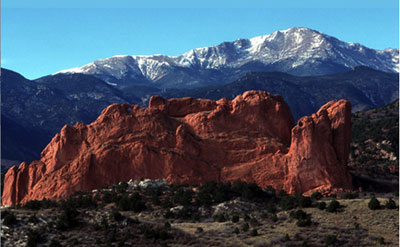
Nebraska ponies up $8.8 million for habitat for the 3 state Platte River Recovery Implementation Program

A picture named whoopingcranes.jpg

From the Kearney Hub (Lori Porter):

More than $8.8 million has been committed so far for land in Dawson and Buffalo counties that will be managed as wildlife habitat under the three-state Platte River Recovery Implementation Program. Program Land Committee member and Central Platte Natural Resources District Biologist Mark Czaplewski gave an update at Thursday’s CPNRD board meeting in Grand Island on progress made toward the first 13-year increment goal to protect 10,000 acres of habitat in the Central Platte Valley. The program’s overall goal is to enhance river flows and protected habitat used by threatened and endangered species — least terns, piping plovers and whooping cranes in the Central Platte — and allow projects in Colorado, Wyoming and Nebraska with federal permits or funding to comply with the Endangered Species Act.

Whooping Cranes were seen dancing in the streets to the music of The Piping Plovers. More endangered species coverage here.

Pueblo: Fountain Creek greenway park in the planning stages

A picture named fountaincreek.jpg

From The Pueblo Chieftain (Chris Woodka):

[A] project is under way to create a greenway park from the confluence of Fountain Creek and the Arkansas River to Eighth Street. “The access to the greenway is the biggest thing,” Atencio said. “How do we get people from other parts of town to access the greenway from their neighborhoods?”[…]

The other side of the coin is making Fountain Creek a place people want to be, rather than a public nuisance with signs warning people to stay away from the water. The greenway is adjacent to the urban renewal zone. Shanks, whose planning team has been working on the Fountain Creek Corridor Master Plan for two years, has been hired by the City of Pueblo for planning the greenway park. “There is a momentum now that was not there in the past on Fountain Creek to push to improve, restore and protect Fountain Creek,” Shanks said.

While $600,000 has been spent on the corridor project, and another $400,000 is planned in the next two years, the real effect of the effort so far has been to identify $7.8 million in resources to work on Fountain Creek erosion and water quality issues, Shanks said. The planning dollars have come through an intergovernmental agreement among Colorado Springs Utilities, the Lower Arkansas Valley Water Conservancy District and the Fountain Creek Watershed Flood Control and Greenway District. More fund-raising efforts have been undertaken by the Fountain Creek Fountain, led by Pueblo native David Struthers, a Denver lawyer. Through Saturday’s meeting, and others like it in months to come, Shanks wants to form a vision for the greenway park in Pueblo that combines safety, creating a gathering place for the community, trails, picnic grounds, wildlife viewing and more.

More Fountain Creek coverage here and here.

Southern Delivery System: Fountain Creek Watershed Flood Control and Greenway District green lights project

A picture named sdspreferredalternative.jpg

From The Pueblo Chieftain (Chris Woodka):

The approval by the Fountain Creek Watershed Flood Control and Greenway District came after two hours of discussion by the board on the adequacy of stormwater controls in Colorado Springs after a city council decision last month to disband the stormwater enterprise. “I would be embarrassed to be in a city of your size to let a politician or two misinform the public,” said Pueblo County Commissioner Jeff Chostner, who was elected chairman of the district board Friday. “You’re letting a few people in the community drive you in the wrong direction.” Chostner was referring to Doug Bruce, sponsor of Issue 300 — a November ballot proposal that led to the demise of the stormwater enterprise…

Richard Skorman, a former Colorado Springs City Councilman and an aide to former Sen. Ken Salazar when the Fountain Creek Crown Jewel project was launched, was even more blunt. “I want to apologize to Pueblo and our neighbors in Southern Colorado. I’m ashamed of what we’ve done,” Skorman said. “If it was June of 1999 (immediately after a large flood), the vote would have been 2-1 in favor of the stormwater enterprise.”

The Fountain Creek board voted unanimously to approve five separate requests from Colorado Springs Utilities, attaching conditions from its advisory committees. The technical advisory committee asked for detailed site development plans for the parts of the project that will be built in the Fountain Creek flood plain. The committee also wants the district to monitor the adaptive management plan required for the project by the Bureau of Reclamation. Colorado Springs plans to tunnel up to 30 feet deep under Interstate 25, railroad tracks and Fountain Creek when it crosses the creek with its pipeline just south of Pikes Peak International Raceway, said Keith Riley, permits manager for SDS. The citizens advisory committee also asked the board to include Condition 23 of the Pueblo County 1041 permit, which requires stormwater management in Colorado Springs. Utilities officials pledged to abide by the condition, but questioned why the district wants to duplicate Pueblo County’s effort. “Serving two masters is problematic,” said John Fredell, SDS project director.

More Southern Delivery System coverage here and here.

Colorado Springs stormwater strategy update

A picture named stormwateroutlet.jpg

Even with the demise of the Colorado Springs stormwater enterprise the city is still planning to implement promises they made regarding the Fountain Creek watershed. Here’s a report from Chris Woodka writing for The Pueblo Chieftain. From the article:

A project started in 2009 is looking at revising policies for construction within the watershed to develop methods that will reduce erosion and sedimentation, the risk of flooding and improve water quality and aesthetics on Fountain Creek. It would build on previous efforts by the Army Corps of Engineers and the Vision Task Force, and the results could be applied to other communities throughout the watershed. “Other communities are looking at it, and we’ve invited them into the discussion,” said Dan Bare, a senior civil engineer assigned to the task. “The goal is to establish a standard we can all live with.”

Former Pueblo Stormwater Director Dennis Maroney, now a Pueblo consultant, called the development of the standards the most important step Colorado Springs could take toward improving Fountain Creek. The first phase of the effort, gathering information, has been completed. The political turmoil has stalled the next two phases, analyzing data and writing new policies, Bare said. “The plan has remained the same, but the schedule has been delayed due to the budget uncertainties the city has been experiencing,” Bare said…

Bare is in the process of setting up work groups that will begin looking at different sets of issues in order to determine the best policies or practices for minimizing damage to Fountain Creek. Writing and implementing the manual could take up to two years, Bare said. Documents posted on the Web site identify population growth, increased impervious surfaces, more water use, more runoff, floodplain encroachment and increased pollutant loading in Colorado Springs as the main contributors to problems on Fountain Creek. The effects include damage to property and infrastructure like highway bridges or pipelines. Public health, safety and welfare issues, loss of habitat and water quality issues also are listed as effects.

More stormwater coverage here.

Pueblo: Meeting January 23 to discuss Fountain Creek through the East Side

A picture named fountaincreek.jpg

From The Pueblo Chieftain (Peter Roper):

Great Outdoors Colorado has awarded a planning grant [for turning Fountain Creek into a community asset that could help revitalize the East Side] to a partnership between Pueblo city government, Colorado Springs Utilities, Fountain Creek Foundation and the Lower Arkansas Valley Water Conservation District. The resulting design – called the Fountain Greenway Master Plan – will focus on Fountain Creek between Eighth Street and the confluence with the Arkansas River, but it can include parks, recreation programs, trails or whatever residents envision for Fountain Creek and the adjoining neighborhoods. “This meeting will be about what the community wants,” said Kevin Shanks, the project manager for THK and Associates, the planning firm that will develop the master plan. “The whole idea behind this partnership is to look at what can be done to make Fountain Creek into a true amenity.” The plan, of course, is the just beginning. Shanks said the partnership is also committed to making sure there is a strategy for getting the pieces of the plan built in the future. For example, the steering committee for the master plan includes city planners, officials from the Historic Arkansas Riverwalk of Pueblo and others.

More Fountain Creek coverage here and here.

Gary Barber: ‘[SDS] infrastructure to deliver water needs to support a regional solution’

A picture named sdspreferredalternative.jpg

From The Pueblo Chieftain (Chris Woodka):

“The infrastructure to deliver water needs to support a regional solution and the funding must be equitable,” Gary Barber, chairman of the roundtable, said in comments accompanying an official report to the state. “Otherwise, the Arkansas Basin may not be able to meet the gap, and the consequences will be felt beyond the borders of El Paso County.”

The largest portion of a statewide gap in future water supply is 22,600 acre-feet needed to supply communities outside Colorado Springs in El Paso County, according to the needs assessment included in the report. About 40 percent of that will be new demand, while 60 percent is loss of existing water supplies as pumping increases in the Denver Basin aquifers. As roundtable president, Barber pushed for completion of the reports, “Projects and Methods to Meet the Needs of the Arkansas Basin.” The document includes consumptive and nonconsumptive needs studies and represents the consensus of the roundtable’s first four years of meetings. It also begins to rate the relative importance of projects in meeting the state “gap” in water supply identified in 2004 by the Colorado Water Conservation board. It places the highest priority on sustainable projects. The ideas included in the report are rated on three questions: Is it viable? Is it equitable? Is is bearable?…

Every member of the roundtable represents a constituency – special interests – and Barber’s are his clients in El Paso County, which include two water authorities whose members are hunting for future water supplies. Three of them have purchased ranches for water rights in the past three years, one is trying to buy rights on two valley canals and collectively, they unsuccessfully tried to buy control of the Bessemer Ditch in 2008…

Barber’s comments about SDS reflect years of frustration over including other areas of El Paso County besides Colorado Springs, Security and Fountain in the $1 billion-plus project. He has frequently been outspoken on the need for regionalism…

A study by the Pikes Peak Regional Water Authority concluded it would cost at least $1 billion to build its own pipeline from the lower Arkansas Valley…

Colorado Springs City Council, sitting as the utilities board, has discussed including other El Paso County users as customers of SDS and the possibility of using it as a regional delivery system. No formal decisions on that concept have been made, however.

More Southern Delivery System coverage here and here.

Pueblo West: Southern Delivery System route to cost the Springs’ $740,000 for six properties

A picture named sdspreferredalternative.jpg

From The Pueblo Chieftain (Chris Woodka):

An agenda item at today’s Colorado Springs City Council meeting would authorize Colorado Springs Utilities to close contracts on the six properties. Four homes and two vacant lots in Pueblo County are included in a list of 14 properties in a resolution to be presented to council today. The other eight properties are in El Paso County…

Colorado Springs indicated during the county hearings that it would work to obtain easements on most of the Pueblo West properties it crosses, but was forced to purchase some outright because of their location. The city also must reach agreement with rancher Gary Walker on the part of the 14-mile route that crosses his family’s land. The agreements reached represent a small part of the impact of SDS on Pueblo West. There are 26 homes touched by the route, and more than 500 properties within 500 feet of the construction, according to Pueblo County documents.

More Southern Delivery System coverage here and here.

Fountain Creek: Colorado Springs’ stormwater efforts are under the magnifying glass

A picture named arkansasfountainconverge.jpg

From The Pueblo Chieftain (Chris Woodka):

In addition to paying the district $50 million and spending $75 million to fortify wastewater structures if SDS is built – conditions imposed by Pueblo County in its 1041 permit – Colorado Springs would be required to use an adaptive management program to monitor and evaluate changes on Fountain Creek over time. The program would be part of its federal contract with the Bureau of Reclamation. Colorado Springs has requested contract negotiations on behalf of its partners in Security, Fountain and Pueblo West, but no timetable has been set. No one can be certain of exactly what the program would require until SDS is built, however. “The (program) will allow changes to be tracked over time, judging whether these changes are likely caused by operation of the SDS project and addressing actual effects in a systematic manner,” the application states. “The combination of these two projectwide commitments ensures that there are data available to make informed decisions on the impacts of the SDS project, and that there is money available to address impacts to Fountain Creek different than those anticipated.”

In an interview this week, the district’s interim Director Gary Barber called the federal requirement a more powerful motivator to improve Fountain Creek than the defunct stormwater district…

The city has committed to dredging the channel of Fountain Creek through Pueblo to restore levees to 100-year flood capacity. It will also restore 4 miles of creek and wetlands at its Clear Springs Ranch south of Fountain and 3 miles near the Sand Creek confluence.

More Fountain Creek coverage here and here.

Fountain Creek: CWQCC weighing removing impairment status on two sections

A picture named fountaincreek.jpg

From The Pueblo Chieftain (Chris Woodka):

The Colorado Water Quality Control Commission will consider recommendations by the state Water Quality Control Division to remove impairment status on two sections of Fountain Creek for selenium and arsenic. The division also is recommending E. coli impairment designation only during summer months.

“We’re convinced that if the commission simply accepts the division’s proposed changes in the impairment rules – the likely path of least resistance for the commission – our collective efforts to achieve clean water in Fountain Creek will suffer a serious setback,” said Ross Vincent, of the Sangre de Cristo chapter of the Sierra Club. The Sierra Club and the Rocky Mountain Environmental Labor Coalition filed a joint pre-hearing statement Tuesday asking the commission not to remove the designations.

A similar statement opposing the changes was filed Wednesday by Pueblo District Attorney Bill Thiebaut, supporting the environmental group’s position and adding that there is no “statement of basis” for removing the stricter designations from Fountain Creek.

The impairment designation creates a higher standard for discharging treated effluent into Fountain Creek under Section 303(d) of the federal Clean Water Act. Currently, sewer plants in El Paso County are permitted to discharge nearly 100 million gallons per day into the Fountain Creek watershed – a number that could increase by 60 percent in the next 40 years.

More Fountain Creek coverage here and here.

Fountain Creek Watershed Flood Control and Greenway District director will use regional approach to managing the watershed

A picture named fountaincreekwatershed.jpg

From The Pueblo Chieftain (Chris Woodka):

“Not just locally, but in the West, people are recognizing that the watershed is an integral unit,” Barber said Tuesday. “I’ve been chasing this longer than a lot of folks realize. . . . This job is about being in the community and listening to the concerns people have.”Barber, 55, will become the director of the Fountain Creek Watershed Flood Control and Greenway District later this month. The district board that approved his hiring in December is expected to finalize contract details at its Jan. 22 meeting.

Barber is a Colorado Springs real estate and water rights broker who has plunged neck-deep into Arkansas Valley water issues in the past decade. As an agent for El Paso County water interests, he participated in discussions that identified future needs as part of the Colorado Water Conservation Board’s Statewide Water Supply Initiative. Barber was instrumental in helping to form the district as part of the Vision Task Force. He chairs the Arkansas Basin Roundtable, formed in 2005 to hash out disputes. Barber has been a staunch promoter of studying how storing water underground can offset the depletion of the Denver Basin aquifers. He was also part of the Colorado Springs task force that led to the formation of a stormwater enterprise in 2005, which was discontinued late last year after voters approved Doug Bruce’s Issue 300.

His efforts are not always regionally focused. In 2008, he unsuccessfully tried to corner more than half of the shares of the Bessemer Ditch on behalf of his El Paso County clients. Those same interests funded a study of pipelines that would move water from the Lower Arkansas Valley to El Paso County…

Back in 2006, Barber said: “If we don’t use water efficiently, we have no business asking for more water.” He still stands by that and he’ll include flood control and water quality in the list of things that need to be done on Fountain Creek as well…

…the flood of 1999 – where he remembers 9 inches of rain falling in Manitou Springs in three days – that led to the current effort to improve Fountain Creek. The ’99 spring storm led to a cooperative effort of communities along the creek and the Army Corps of Engineers developing a watershed study, completed just last year. That effort, along with the Vision Task Force and an agreement between Colorado Springs and the Lower Arkansas Valley Water Conservancy District, became the base for information the Fountain Creek district will use as it tries to improve the waterway. “The best strategy I’ve heard is to get some demonstration projects on the ground, like the confluence park in Pueblo, to show what it looks like to aggressively improve Fountain Creek,” Barber said. “A lot depends on what we do in the last two years…

He sees mutual benefit for El Paso County and its neighbors – Pueblo, Canon City, the Lower Ark Valley and even Pinon Canyon – in working together on projects of common interest in the future. “I hope we wind up a community of interest, especially as an economic base,” Barber said. “For our own quality of life, we need to see ourselves as all being in it together. More awareness of that will be more effective than having the stormwater police come around.”

More Fountain Creek watershed coverage here and here.

Colorado Springs: Stormwater enterprise demise leaves $82 million worth of projects to compete for general fund dough

A picture named arkansasfountainconverge.jpg

From the Colorado Springs Independent (J. Adrian Stanley and Pam Zubeck):

Stormwater Enterprise manager Ken Sampley unfolds a large budget graph labeled “DRAFT” in big gray letters. He circles one total: $66,145,000. That was the estimated cost in 2006 of completing Stormwater’s 26 top-priority drainage projects. He circles another number: $82,790,676. The estimated cost for completing the same 26 projects in 2009 dollars.

Stormwater began work in 2007, with a backlog of more than $300 million in projects. So far, Stormwater hasn’t put much of a dent in that. “We never got to the point where we even got close to our $60 million,” Sampley says. “If we can’t get close to the $60 million, why even worry about the next couple hundred million?” On average, Stormwater collected $16 million a year in fees, and spent about $8 million annually on capital projects, leveraging the money where possible. The rest went to other needs: In 2009, over $4 million was spent on maintenance and another $1.7 million to maintain mandated federal water quality standards. The rest was sucked up by engineering, planning studies and administrative costs. Over three years, fees produced just $22.5 million for projects. Stormwater leveraged that to nearly $30 million but still finished less than a third of those top-priority projects.

One project that Stormwater won’t complete has certain consequences. The Federal Emergency Management Agency has said it will declare a northeast section as a 100-year floodplain if repairs and updates aren’t made to the Templeton Gap levee. The floodplain area contains more than 3,000 properties and 5,000 structures. With no Stormwater funds, the Templeton Gap project, which could cost up to $6 million, won’t get done, and most lenders will require property owners within the plain to buy flood insurance. While Stormwater fees cost a single family home $25.80 to $163.80 a year, flood insurance will cost many times that amount. Councilor Scott Hente has fought hard to keep his constituents from paying those big insurance premiums. After 300 passed, he wanted to keep Stormwater fees for at least two years, so Templeton Gap could be completed. But he was in the minority. And his fighting spirit on the issue was tempered when he found out a majority of the floodplain residents voted for 300. “You’re saving yourself a few bucks a year,” Hente says with astonishment, “to incur the luxury of spending $1,000 a year on flood insurance.”[…]

With no fees, the city will have to fork over money for emergency stormwater repairs. It’ll also have to pay for a federally mandated basic stormwater program costing about $1.75 million a year. If the city doesn’t pay, it could face fines of up to $27,500 per day for each water quality-degrading “incident” from the Environmental Protection Agency, plus an additional $10,000 in daily civil fines from the state. If an incident isn’t properly reported or is deliberate, the state can also levy criminal fines of up to $25,000 a day. But the death of Stormwater grieves none so much as Utilities. It loses a crucial partner in controlling rainwater runoff, which eventually makes its way to Fountain Creek — the lightning rod in the city gaining approval for its Southern Delivery System.

More stormwater coverage here.

Colorado Springs city council approves $1.11 billion budget for Colorado Springs Utilities

A picture named pikespeak.jpg

From the Colorado Springs Independent:

In approving Colorado Springs Utilities’ $1.11 billion budget, City Council this week allowed the city-owned agency to use water rate money to fund $75.8 million in projects over 10 years. The projects will satisfy regulations imposed on the Southern Delivery System pipeline that will bring water from Pueblo Reservoir. Money for those projects is included in the rate base starting in January, although roughly $64 million in work won’t begin until after 2010. The idea is to spread the cost over 10 years, rather than coming up with all the money now, says Councilman Randy Purvis, adding that amortizing payments spreads the cost to future ratepayers. Projects include dredging Fountain Creek, developing wetlands and erosion control. The largest sum, $49.7 million, comprises five annual cash payments to the Fountain Valley Watershed Flood Control and Greenway District formed this year to improve and preserve the corridor. The Utilities budget contains rate increases that will raise the typical residential bill by about $1.90 a month, which would have been larger but for reductions in gas charges due to falling fuel costs.

More Southern Delivery System coverage here.

Colorado Springs: Stormwater utility spent $1.6 million on equipment

A picture named arkansasfountainconverge.jpg

From The Colorado Springs Gazette (Daniel Chacón):

The soon-to-be-annihilated Colorado Springs Stormwater Enterprise has spent more than $1.6 million on trucks, trailers, mowers and other pieces of equipment since it was created in 2005, according to documents obtained under an open-records request…

With the looming demise of the enterprise, there have been questions about the fate of the enterprise-owned equipment. “These vehicles will be used in 2010 during the phase out of the program,” Scott said recently. “We will be doing a reduced maintenance program so we will be using the equipment required to perform the maintenance, we will also be working on the in-progress and pending (capital improvement) projects, etc. We have not yet identified what will happen with the vehicles in late 2010.”

More stormwater coverage here.

Southern Delivery System: Colorado Springs Utilities submits application to Fountain Creek Watershed Flood Control and Greenway District

A picture named fountaincreekwatershed.jpg

From The Pueblo Chieftain (Chris Woodka):

“We’re very proud that we have reduced the wetlands impacts to one-quarter acre, and that we will add 12 new acres of wetlands on Clear Springs Ranch,” said Keith Riley, SDS planning and permit manager. “This is an environmentally responsible project. The citizens advisory committee of the district reviewed the proposal Friday. Last week, the technical advisory committee looked at the same presentation. The district board will consider it in January…

The Fountain Creek district has authority over part of the pipeline’s path where it crosses Fountain Creek and will make recommendations to El Paso County commissioners…

There have been discussions, however, that other El Paso County water users might use it to move water uphill from the Arkansas River. “Do you see it as a regional opportunity?” asked Jay Winner, general manager of the Lower Arkansas Valley Water Conservancy District and a representative from the Arkansas Basin Roundtable to the Interbasin Compact Committee. “Not beyond Monument Hill,” Riley quickly replied…

Ross Vincent of the Sierra Club asked about the adaptive management plan, which is mentioned in Reclamation’s environmental impact statement as a way to mitigate potential impacts on Fountain Creek. “That will be wrapped up in the contract negotiations,” Riley said. “It would be helpful to have that in hand,” Vincent said.

More coverage of Friday’s meeting from Chris Woodka writing for The Pueblo Chieftain. From the article:

Water quality and standards for development on Fountain Creek are important issues that cannot be abandoned, a committee dedicated to improvement of the creek told Southern Delivery System officials Friday. “The discussions have focused on water volume, but no one’s talking about water quality,” said Ross Vincent of the Sierra Club. “The demise of the stormwater enterprise re-raises the question.”[…]

Vincent also was concerned about the opportunity for public comment on Colorado Springs plans to dredge Fountain Creek through Pueblo. “Is there a public process for review?” Vincent asked Keith Riley, SDS planning and permit manager. Riley said SDS officials will be meeting with Dennis Maroney, Pueblo stormwater director, next week to review the dredging program. “We’ll be identifying high spots to determine where dredging will occur,” Riley said. “We want to be sure we’re doing the right project.” Pueblo has partnered with Colorado Springs, the Lower Arkansas Valley Water Conservancy District and various state and federal agencies to use a continuous flow dredging collector to remove bedload sediment from the channel through Pueblo. The project also will analyze the material being removed and consider alternative means of dredging the channel, Riley said.

Maroney had his own questions about whether the city would complete the drainage criteria manual now that the stormwater enterprise is ending. The manual would provide standards for new development in terms of impacts to Fountain Creek and its tributaries. Holding developers to those standards is part of Pueblo County conditions for SDS. “You need the drainage criteria manual,” Maroney said. “If you don’t have it, it’s like going bear hunting with a 30.06 and only having the ammunition for a .22.” Colorado Springs developer Kevin Walker, another member of the committee, said developers have a keen interest in seeing the manual developed and noted that Fountain already has bought into the concept of using it as a regional tool. “The development community and the building industry know that the manual has to be completed,” Walker said. “The political and business interests (of Colorado Springs) are obliged to get to the finish line.”[…]

…another $500,000 grant to develop a mini-dam, wetlands and detention pond near Pueblo’s North Side Kmart is part of this year’s Natural Resources Conservation Service budget, Jay Winner, general manager of the Lower Ark District, reported at the meeting. The project was first envisioned by Maroney following a flood of a nearby area and a breach of an old railroad berm as a way to siphon off flows in small floods. It was approved in the same package of federal legislation that will grant the Arkansas Valley Conduit $5 million this year.

More Fountain Creek coverage here and here.

Colorado Springs City Council abolishes stormwater enterprise with 5-4 vote

A picture named arkansasfountainconverge.jpg

From The Colorado Springs Gazette (Daniel Chaćon):

The council had voted 5-4 to phase the enterprise out over two years after the Nov. 3 passage of ballot issue 300, but Councilman Bernie Herpin changed his mind. The city-owned agency is getting ready to mail the final batch of bills for the last quarter of 2009, and city officials are expecting property owners to pay whatever they owe. “For those who have not paid, the city will pursue collections, whether that’s through liens on property or through collections agencies,” Mayor Lionel Rivera said. “The $1.7 million that’s still owed the city, we’re not just going to wave our hands and say it’s going to go away.”

More stormwater coverage here.

Fountain Creek Watershed Flood Control and Greenway District board meeting recap

A picture named fountaincreek.jpg

From The Pueblo Chieftain (Chris Woodka):

Colorado Springs Utilities and the Lower Ark already have committed $200,000 toward district expenses for the next two years. The district also will receive $300,000 over its first three years from Colorado Springs for a study of dams for flood control on Fountain Creek, a condition of the Pueblo County permit. Lower Ark and Colorado Springs also are spending $400,000 to complete the corridor study. Costs are shared equally. But the seed money has the potential to bring in other funding, including a possible $8 million legacy grant from Great Outdoors Colorado, Winner said. The master plan already has raised $1.5 million from other sources, said Carol Baker, Fountain Creek specialist for Colorado Springs Utilities.

More Fountain Creek coverage here and here.

Southern Delivery System: Colorado Springs Utilities requests Reclamation move forward on contract talks

A picture named sdspreferredalternative.jpg

From The Pueblo Chieftain (Chris Woodka):

“To maintain our current schedule to begin construction on the Pueblo Dam connection in early 2010, we have requested that Reclamation move forward with the contracting process as soon as possible,” said John Fredell, project director…

The contract negotiations will provide an additional opportunity for public comment on SDS, a $1 billion-plus pipeline project on track to be completed by 2016…

Colorado Springs Utilities also is seeking permits in El Paso County, and expects to present its case to the El Paso County Planning Commission in February, Fredell said. The city also has scheduled meetings with the Fountain Creek Watershed Flood Control and Greenway District, its technical advisory committee and its citizens advisory group during December and January.

More Southern Delivery System coverage here and here.

Colorado Springs: Which stormwater efforts will be funded now that the enterprise fund is kaput?

A picture named fountaincreekwatershed.jpg

From The Pueblo Chieftain (Chris Woodka):

a vote on Tuesday confirmed the [Colorado Springs city] council’s position to phase out the stormwater enterprise within two years. Unless another funding mechanism is found, Colorado Springs will absorb only the minimal funding for federal requirements, maintenance, health, safety and emergencies in its general fund beginning in 2012. Colorado Springs council adopted the new policy in response to Doug Bruce’s Issue 300, which implies the voters chose to end the stormwater enterprise, without actually saying so. Bruce campaigned for the issue as an end to what he and others called a “rain tax” and celebrated by tearing up his stormwater bill on television.

Council also agreed to include a $4.24 million-$6.7 million project to upgrade the Templeton Gap levee, which protects thousands of homes, was not on the critical projects list. In all, about $9 million of work on projects from the critical list are likely to be completed under the two-year phase-out.

Council members did not come up with an alternative for funding the remainder of critical projects on the list, although some talked about developing a regional approach with other El Paso County communities or putting a stormwater question on a future municipal ballot.

At the same time, Colorado Springs is planning on spending $46.2 million on SDS in the coming year, according to its published 2010 annual operating plan. The city has issued bonds for the project.

Colorado Springs also will spend almost more than $27 million for maintenance, repair, inspection and replacement of sanitary sewer lines in the city, including $7.5 million for ultraviolet treatment at its Las Vegas Street treatment plant, $7 million for sewer line upgrades and $6 million to fortify stream crossings, according to the operating plan. The city committed to spend at least $75 million in sanitary sewer upgrades, which are costs paid by customers and have nothing to do with the stormwater enterprise.

The city is obligated to make some of the repairs to its sanitary sewer system under state compliance orders, which are also a factor in a federal lawsuit won by the Sierra Club.

More stormwater coverage here.

Colorado Springs: City council approves dismantling of stormwater enterprise

A picture named fountaincreekwatershed.jpg

From The Pueblo Chieftain (Chris Woodka):

The phase-out [over two years] will give the city time to finish some projects already under way, allow it to repair a levee that protects thousands of homes and meet unfunded federal mandates. It will mean the city won’t be able to start several projects that are needed or to respond to citizen requests regarding stormwater. Colorado Springs also intends to fulfill its commitments on Fountain Creek related to Southern Delivery System despite ending the stormwater enterprise, and several on council voiced support for a regional solution in El Paso County that could include a vote to create a stormwater enterprise in the future. “The two-year phaseout will give us time to work on a regional solution, allow us to complete our projects and come up with a regional stormwater plan,” said Bernie Herpin, one of five council members supporting the phase-out…

The Templeton Gap Levee is the only Army Corps of Engineers levee in Colorado Springs, said stormwater director Ken Sampley. The levee, built in the late 1940s, needs between $4.24 million and $6.74 million in work to protect up to 3,000 homes and 300 businesses. If the work is not done, they would be required to obtain flood insurance.

Under the two-year phaseout, Templeton Gap will be completed, but more than 20 other projects won’t begin as scheduled. When the stormwater enterprise was created, there was a $300 million backlog in projects, with $60 million in critical needs. Sampley showed slides of bridge supports beginning to wash out and areas that were eroding because there has been only funding for piecemeal work…

In addition to Templeton Gap, there are $2.3 million of projects that have been started remaining in the pipeline, and four projects on Sand Creek totalling about $2.4 million. Sampley also recommended maintaining minimum funding for regulatory requirements, emergency operations, health and safety, which together total almost $5 million. By 2012, all those costs will be paid for from the general fund under the plan reviewed by council Monday…

The city also is prepared to meet its obligations of $125 million of spending on Fountain Creek through the financing of SDS, a $1 billion-plus water supply project that includes a pipeline from Pueblo Dam. Colorado Springs ratepayers will bear that expense. Colorado Springs also has included funds for improvements at Clear Springs Ranch south of Fountain and dredging the Fountain Creek channel in Pueblo as part of next year’s budget.

More coverage from The Colorado Springs Gazette (Daniel Chaćon):

A split Colorado Springs City Council decided Monday to phase out the enterprise over two years, allowing the city-owned business to finish projects under construction and also reconstruct a decades-old drainage channel that’s been deemed “minimally acceptable.” Council members Tom Gallagher, Darryl Glenn, Jan Martin and Randy Purvis called for an immediate end of the enterprise…

Enterprise Manager Ken Sampley said the council’s decision could hamper the enterprise’s ability to collect fees over the next two years, even from people who have been paying them. “I’d like to think that everybody paid them (in the past) because they were good citizens and wanted to pay their Stormwater Enterprise fee,” he said. “That may not be the case. I think it’s reasonable to believe that if there is no provision for certifying (delinquent accounts) to the treasurer, we will be collecting, definitely, a lower percentage.”[…]

The initiative requires an immediate end to the enterprise, said [Douglas Bruce sponsor of Issue 300 passed by Colorado Springs voters November 3], who is threatening to start a petition drive for a permanent property tax cut if the city doesn’t get rid of the enterprise right away. “I don’t make threats,” Bruce said Monday night. “I’m just advising them that there’s going to be adverse consequences if they don’t give the people what they want.”

More stormwater coverage here.

Arkansas River: Streamflow below Lake Pueblo

A picture named puebloreservoir.jpg

From The Pueblo Chieftaian (Chris Woodka):

Flows from the dam were cut from about 350 cubic feet per second Saturday to 70 cfs on Sunday, as irrigators began a program that allows them to store winter flows for use later in the year. The winter water program was started by ditch companies under an agreement with the Southeastern Colorado Water Conservancy District in 1975, after Pueblo Dam was completed. It became a decreed water program in 1984. Water is stored in Lake Pueblo, as well as several downstream reservoirs, from Nov. 15 to March 15 of the following year…

Under a recovery of yield program, created by an intergovernmental agreement in 2004, a minimum flow of 100 cfs below Pueblo Dam is maintained throughout the winter months. The flow is calculated at the river gauge above Pueblo, with flows through the state fish hatchery added. This week, flows above Pueblo have been between 60-65 cfs, while fish hatchery flows have been between 30-40 cfs. “What we’ve agreed to is that the flow won’t go under 100 cfs, with retroactive curtailment of exchanges after March 15,” said Alan Ward, water resources administrator with the Pueblo Board of Water Works. Ward supervises the recovery of yield program. That decision was made last year, after flows in the Arkansas River dropped to nearly nothing in 2005 and were in danger of running low again in 2007. The IGA among Pueblo, the Pueblo water board, Colorado Springs, Aurora, Fountain and the Southeastern district calls for curtailment of exchanges when the river drops below 100 cfs…

In practice, Colorado Springs is the only IGA participant that exchanges in the winter months, storing water out of priority in Lake Pueblo in exchange for return flows, mostly from treated sewage, down Fountain Creek.

More Arkansas River Basin coverage here.