From the Middle Colorado Watershed Council (Dan Ben-Horin) via The Glenwood Springs Post Independent:
It may be difficult to think of water conservation now as we look out our windows at rivers and creeks swollen with spring runoff, but we need to remind ourselves of where we live. Here in the Colorado River Basin, we live with a constant threat of a looming drought.
As Eric Kuhn wrote in his May 12 article in the Grand Junction Daily Sentinel, “we cannot be fooled by talk of a continuing drought. Instead, we need to be diligent and prepared for the next drought.” Our current reality includes an increasing population and a decreasing water supply, and it is now time for us to realize how far conservation measures can improve our water use efficiency.
As part of the recently published Colorado Water Plan, one of the Colorado River Basin’s themes is to encourage a high level of conservation. Statewide, we have done a remarkable job of reducing water use, with per-capita use dropping by almost 20 percent over the past decade. Some municipalities have even cut water use by as much as 30 percent during this time period. Incredible work has been done thus far, and we can now build upon what we learned statewide.
Many entities in the state are now required to have a specific water conservation plan approved by the Colorado Water Conservation Board. Locally, the Roaring Fork Conservancy partnered with the Community Office for Resource Efficiency, Ruedi Water and Power Authority and local municipalities in the Roaring Fork Watershed to develop a water efficiency plan. The plan consists of water efficiency plans for Aspen, Snowmass Village, Basalt, Carbondale and Glenwood Springs, as well as a regional plan that applies the common elements of the five individual plans to the watershed.
Plans such as this outline actions steps for reaching conservation goals by identifying best practices such as landscape efficiencies, water loss management features and variable rate structures. A successful conservation strategy must look beyond past accomplishments and create a specific action plan to meet conservation goals.
The water saving benefits resulting from water efficiency projects are tremendous. Reductions in water demands allow providers to save money on annual operations and maintenance. Further reductions in municipal water use would provide increased longevity on facilities right here in our communities.
In addition to these water supply benefits, we can achieve other benefits, such as an improved environment. Reduced wastewater discharges through indoor water savings can improve water quality and aquatic habitat in our lakes, rivers and streams.
Conservation also acts as a management tool to buffer against drought. Water providers can store water in a drought reserve as a long-term water conservation effort, and use those reserves during periods of shortages. As Mr. Kuhn pointed out in his May 12 article, when we entered the drought period of 2000-04, both Lake Powell and Lake Mead were completely full. Having reserves allowed us to mitigate the potentially devastating consequences of those dry years. With those lakes currently sitting at approximately 40 percent of capacity, what would happen if we were to enter into a period of prolonged drought today?
We cannot allow ourselves to become shortsighted when water is plentiful. It is time to build upon the conservation measures and efficiency savings we have already achieved. By adopting a variety of strong, permanent tools, we can fulfill our ongoing obligation to conserve water resources. The reality of climate change is that hotter, drier weather will become the new normal in the West, so conservation of our precious resource should become the new normal as well. As we learn and adapt to living in this semi-arid climate, we can make conservation become the new water reality.
Dan Ben-Horin is a watershed specialist for the Middle Colorado Watershed Council, which works to evaluate, protect and enhance the health of the Middle Colorado River Watershed through the cooperative effort of watershed stakeholders. To learn more, go to http://www.midcowatershed.org.
Meanwhile here’s a report about conservation in the water sector in California from Joshua Emerson Smith writing in The Los Angeles Times:
…a new study finds that reductions in urban water use have saved significant amounts of electricity and reduced greenhouse gas emissions.
The analysis, published by UC Davis, capitalized on the unique circumstances created by California’s drought. It culled statistics that electric utilities and water districts statewide were required to submit because of Gov. Jerry Brown’s unprecedented order for residents and businesses to lower water consumption by an average of 25%.
During Brown’s initial emergency conservation program that stretched from June 2015 through February, energy savings from water conservation totaled 922,543 megawatt-hours — enough to power 135,000 homes for a year, according to the data project…
The electricity saved from less water consumption was substantial enough that during peak summer months last year, savings equaled the effect of all energy efficiency programs offered by major investor-owned utilities in the state combined — and at less than a third of the cost.
“We were quite surprised when we looked at the numbers,” said Frank Loge, director of the UC Davis Center for Water-Energy Efficiency, which produced the new analysis.
“I think people have known this intuitively for a couple of years, but our analysis highlighted it,” he added.
The findings come as environmental groups and water managers have sometimes differed on how much conservation is needed, especially as new supply sources — including desalination plants, expanded reservoirs and water recycling programs — come online.
Water planners are looking at potentially leaner times for grants that fund projects, particularly for smaller water districts, towns or farms.
The funding crunch is coming because of an April opinion of the Colorado Supreme Court in BP America v. Colorado Department of Revenue, in which the oil giant prevailed in its arguments of which types of activities are exempt from mineral severance taxes. The impact could mean a repayment of up to $125 million and reduced future revenues.
Those taxes are the source of funding for Water Supply Reserve Account grants that are funded through the state’s basin roundtable process. Those grants are approved by the Colorado Water Conservation Board.
“Moving forward, revenues will be down 12.5 percent,” Brent Newman of the CWCB told the Arkansas Basin Roundtable executive committee Wednesday. “With the implementation of the Colorado Water Plan, we have to make sure grant programs meet standards.”
After last month’s meeting of the Interbasin Compact Committee, CWCB staff is preparing a new plan of action to fund water projects that does not rely on the up-and-down revenues of mineral severance taxes.
That pot of money is now split among local governments, the Department of Local Affairs and agencies within the Department of Natural Resources, including the CWCB. The problem is that when oil, gas and mining activity drops or prices decrease, so do tax revenues. The state Legislature raided the revenues to meet budget shortfalls during the 2008-09 recession, showing they are unreliable.
The court decision will decrease the size of the fund pool. Newman stressed that carry-over funds are still in place, although roundtables already are starting to rein in their requests. The Arkansas Basin Roundtable hopes to move as much as $500,000 in grants ahead this year.
The state water plan calls for adding $100 million funding annually for water projects beginning in 2020, and the IBCC and CWCB have kicked around ideas — such as a container tax for water and soft drinks or a statewide tap fee — to provide that money.
But in the short term, CWCB staff is proposing using its own banked funds to provide a stable source for water projects for the next five years. The proposal includes establishing a $50 million loan fund that would be repaid, $10 million annual funding to the WSRA, $5 million annually for watershed restoration and $10 million annually for grants.
“Not everybody agrees with me, but I think it’s going to be a lot more restrictive,” said Jay Winner, general manager of the Lower Arkansas Valley Water Conservancy District and a member of the IBCC. “Under the water plan, in every basin, the gaps can’t get any bigger, but it could mean the large municipalities will take ag out of production.”
Small communities could also be in trouble as funds tighten, said Jim Broderick, executive director of the Southeastern Water Conservancy District. Many of the participants in the Arkansas Valley Conduit project will depend on small grants to fund internal projects to connect to the new waterline when it is completed.
The plan is to put a funding system in place for 2017 through the water projects bill, but time is short, since the CWCB usually finalizes the list by November, and it meets just three times. The IBCC only has one meeting, in August, scheduled to discuss the idea, and typically has required months or years to work out differences among regions in the state.
“If we don’t have an agreement, this isn’t going to happen,” Winner said.
A screenshot from the website for Colorado’s Water Plan.
Here’s a guest column from Nita Gonzales and Al Gurule that is running in The Colorado Springs Gazette:
Colorado’s large Latino population relies on our rivers for drinking water, jobs, outdoor recreation and crop irrigation. Our voices and values are similar to the vast majority of Coloradans. But for Latinos, the river and the land it nurtures is also a very personal matter. For centuries, the river provides our culture with a collective sense of “querencia,” a place in which we know exactly who we are, the place from which we speak our deepest beliefs.
When the Colorado Legislature ended its session there was a flurry of action but, sadly, little progress to protect our rivers. The subject of water was barely covered, and perhaps most remarkably, taking action on Colorado’s first state water plan – the blueprint for how water will be managed in Colorado for the foreseeable future – was limited to a small, generic “projects” appropriation.
The landmark water plan, released last year, addresses many water challenges facing our state including: a looming water supply and demand gap, the effects of persistent drought, protecting Colorado’s interstate water rights, and other challenges that could adversely affect the lives of Coloradans.
Gov. John Hickenlooper’s plan includes an unprecedented emphasis on sound conservation measures and directs attention to keeping the Colorado River healthy and flowing. Latinos in Colorado pay close attention to the protection of the Colorado River system, the primary source of water for Colorado and the southwestern U.S. and a significant part of southwestern Latino culture. For Latinos living in the Southwest, protecting this river is more than just smart water management; it is honoring part of a rich cultural heritage.
The lack of engagement on the water plan by the state assembly is surprising and unfortunate. After all, a great deal of care and thoroughness went into our state plan, including input from 30,000 Coloradans. It’s been rightly hailed as a huge step for Colorado’s future water management.
The final plan includes key priorities directly in line with western Latino values for water management:
– A productive economy that supports agriculture, recreation and tourism;
– An efficient and effective water infrastructure; and
– Healthy watersheds, rivers, streams, and wildlife.
The plan includes strong recommendations for funding to preserve and restore the state’s rivers and streams that play an important role in Latino history and daily life. It contains a directive that Colorado invest in unprecedented stream protection and restoration in the form of “stream management plans” for our rivers.
The only real obstacle, at this point it seems, is lack of leadership and action and letting the plan languish, and that is what appears to be happening.
To ensure that the conservation values included in the plan move forward – protecting healthy river flows, our outdoor recreation industry, agricultural heritage, businesses and thriving cities – we must get started now. Gov. Hickenlooper and the Colorado Water Conservation Board should begin working with local leaders to find innovative ways to meet the plan’s ambitious – but attainable – conservation goals. In the latest Colorado College poll, 77% of Coloradans say that we should use existing water resources more efficiently through conservation and reuse.
Nuestro Rio and other Latinos in Colorado are ready to work with Hickenlooper and state leaders to implement the conservation values laid out in the plan. We want to help ensure the protection of our rivers, outdoor recreation, agriculture, industry and our cities.
We ask the governor and the Colorado Water Conservation Board to take meaningful action to implement the plan without additional delays. The time is now to ensure Colorado’s water, our economy and our culture is sustainable for generations to come. We are depending on it.
–
Nita Gonzales is the director of Nuestro Rio, an organization representing Latinos living in Arizona, California, Colorado, New Mexico and Nevada working to educate elected officials and Latino youths about the many ways Latinos are connected to the Colorado River. Al Gurule is a former Pueblo District 2 councilman and a well-known Latino activist in Colorado since the late 1960s.
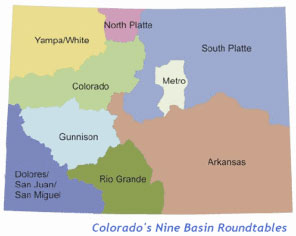
The Interbasin Compact Committee continued its ongoing discussion about Colorado water rights and river basins at a meeting Tuesday in Salida.
The IBCC was founded through the Colorado Water for the 21st Century Act to lead conversations and address issues about Colorado’s water.
The Upper Arkansas Water Conservancy District hosted the event and kicked off the meeting with a presentation by the Arkansas River Basin PEPO (Public Education, Participation and Outreach) Workgroup, led by Chelsey Nutter and Jean Van Pelt.
They explained four tasks they are working on, including participation and partnership building, focusing specifically on the Arkansas Basin area for education.
Their second task is to develop a Water 101 presentation for education, and they are currently working on a documentary about water and the Arkansas Basin.
Their third task is to help facilitate communication among the Arkansas Basin Roundtable, the Colorado Water Conservancy Board, the IBCC and the public, by integrating the information gathered into public outreach forums.
Finally, they are working to market the Arkansas Basin by designing a mission, logo and online resources, including a website and a Facebook presence.
Bob Randell, an attorney with the IBCC, discussed the Colorado Supreme Court decision earlier this month, in which BP America Production Co. will be refunded millions in oil and gas severance taxes.
Randell explained that the refunded taxes will have a direct effect on Colorado general funds and Department of Local Affairs grants, which will not be adding any additional money to 2016 and 2017 Tier 2 programs.
Sean Cronin, the South Platte River Basin representative, spoke about how that will affect the Water Supply Reserve Account.
“With demand outpacing supply, we will have to maximize our limited dollars,” Cronin said. “We want to provide folks with confidence that we are using WSRA funds as effectively as possible.”
Cronin said some of the options they have been looking at to help the program include:
• Looking at other grant deed programs for ideas.
• Considering how money is spent to hire contractors.
• Looking at financial need analysis for applicants, with a sliding scale depending on financial stability.
• Encouraging match requirements.
• Considering holding back a percentage of funds until progress reports on projects have been turned in and reviewed.
During the Lean Process update, Eric Kuhn, an appointee to the IBCC by the governor, raised a point about the difficulty with working with different parties on a project.
“Sometimes we miss the biggest concern,” Kuhn said, “trying to do something with a complex project. When you have two major entities with a lack of consensus, you hope it works out, because the permitting process only works as long as people agree on it.”
Becky Mitchell with the IBCC responded, saying, “What we came up with out of the Lean Process is that the state won’t jump into those kinds of situations.”
Cronin also said he had heard it wasn’t so much a problem in other parts of the country, only Colorado.
“I did hear that Colorado has had special circumstances, but that it is common among Western states, but we’re not the worst,” Mitchell said.
The committee also debated an idea of placing a tax on drinking liquid containers, from children’s juice boxes to cans of soda, as a possible source for the additional funding.
No decisions on the tax were made, but it was jokingly said that Colorado would need a drought for a tax like that to go through.
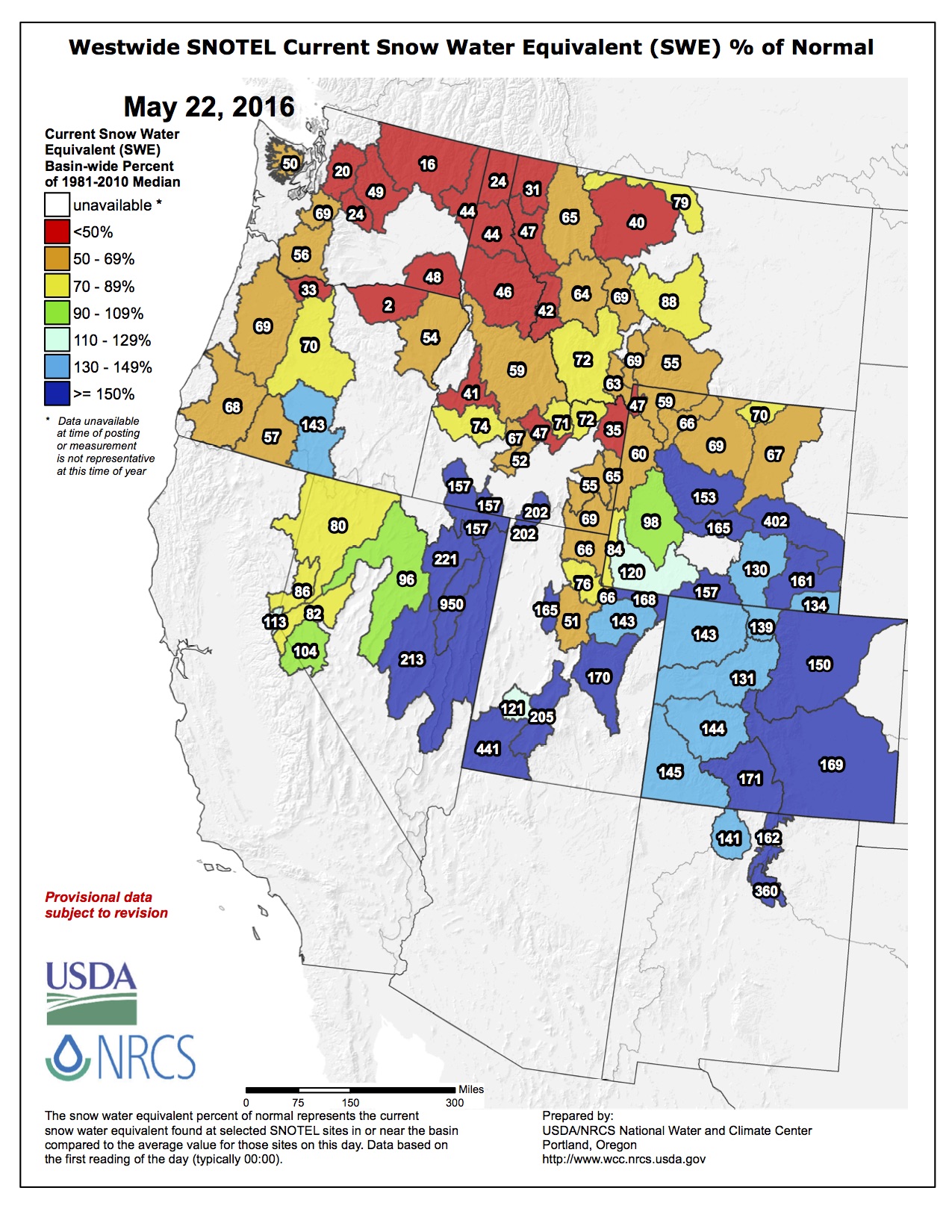
Thanks to spring snowfalls and cooler temperatures keeping the snow in the mountains a bit longer, the Rio Grande Basin’s snowpack is now above normal.
In fact in the northern part of the basin the threat of flooding conditions now exists, Colorado Division of Water Resources Division 3 Assistant Division Engineer James Heath told water leaders at the Rio Grande Roundtable on Tuesday afternoon in Alamosa.
He said as of [May 16], the basin snowpack was 104 percent of normal.
“We exceeded last year’s peak, which is good,” he said. “We are looking at a pretty good runoff. The northern part of the Valley is looking at flooding conditions already.”
He said La Garita and Carnero Creeks are already running at about 100 cubic feet per second (cfs). They typically peak at 50-60 cfs.
“They will get higher over the next week,” he said.
He said Saguache Creek is running at 175 cfs and is steadily climbing.
Heath said the Division of Water Resources is reviewing three forecasts to help determine what the annual flow of the Rio Grande and Conejos River systems will be this year, but the three forecasts vary quite a bit. Traditionally the water office has relied on the Natural Resources Conservation Service (NRCS) but is also now reviewing forecasts from the National Weather Service and WRF-Hydro, a modeling system developed by the National Center for Atmospheric Research.
On the Rio Grande, the National Weather Service has the highest forecast of 659,000 acre feet for the April-September time period , WRF-Hydro the next highest at 542,100 acre feet with NRCS at 445,000 acre feet for April-September . Division Engineer Craig Cotten decided to use a figure of 540,000 acre feet for the April-September time period and 660,000 acre feet for the calendar year.
“That’s above average on the Rio Grande system,” Heath said.
Thanks to return flows, the water division is going to maintain curtailment levels at 13 percent on the Rio Grande.
Curtailments on the Conejos River system have gone up, however, Heath explained. Curtailments were at 22 percent when the irrigation season started and now are at 26 percent.
The total anticipated flow of the Conejos River system this year is 300,000 acre feet, which is about average, Heath said, with 267,500 acre feet anticipated April-September. The forecasts between NRCS, the National Weather Service and WRF-Hydro were not as disparate on the Conejos system, with NRCS estimating 208,500 acre feet April-September, the National Weather Service predicting 327,000 acre feet and WRF-Hydro anticipating 297,700 acre feet.
It also causes the snowpack to melt sooner, which affects runoff into the San Luis Valley’s rivers, creeks and irrigation ditches.
The only place in Colorado to do so, the Center for Snow & Avalanche Studies (CSAS) monitors and measures dust-on-snow events at 11 mountainous locations including two affecting the San Luis Valley, Wolf Creek Pass and Spring Creek Pass.
CSAS Director Jeff Derry talked about the center’s work and made a preview presentation for financial support to the Rio Grande Roundtable on [May 17] in Alamosa. The water group will consider the formal request during its next meeting.
Derry said the data the dust-onsnow studies provide helps improve snowmelt forecasts.
“We collect a lot of data that SNOTEL does not,” he said.
The monitoring sites are at higher elevations than most SNOTEL measurement sites, he said.
Colorado’s recently completed water plan acknowledges dust on snow as a problem, Derry said. Simply put, when the snow is dirty, it melts faster because it does not reflect off the sun as well, Derry explained.
He said there could be several dust-on-snow events through a winter, which create layers of dust between snowfall layers in the snowpack, and in the spring when the snow begins to melt off the mountain, when the snowpack reaches those dust layers, it melts at a higher rate. This can explain erratic peaks in runoff, he said.
“Dust can be a major error in forecasting because they don’t know where dust might be in the snowpack so they can’t account for it,” Derry said. He said the biggest source of dust is from the Southern Colorado Plateau. The only way to know how many layers of dust there are in the snowpack is to dig snow pits, Derry said. “There’s just no substitute for going out and digging a snow pit.” He said this year on average there were about six dust events, with most of those being moderate events. Last winter there were three. “We usually see about eight events a year,” Derry said. There have been as many as 12-13 dust events in a year, however.
Rio Grande Roundtable Chairman Nathan Coombs said this type of information could be valuable for water management in the basin.
“This is a very big decision-making tool,” he said.
“Any kind of forecasting tool is very important to us,” added Roundtable member Travis Smith.
Derry will be asking for financial assistance from each of the basin roundtables . His first request was to the Rio Grande Basin roundtable.
He is asking for $25,000, but that could be split over more than one year, he said.
Colorado snowpack reached 104 percent of median by May 1, the Natural Resources Conservation Service reported Friday in a news release.
Conditions have shown the first improvement over the previous month since Jan. 1.
Mountain precipitation across the state during April was the best in 2016 at 110 percent of normal. Water year-to-date is at 100 percent of normal.
Colorado’s current snowpack and precipitation levels are right where they should be this time of year, Brian Domonkos, Colorado snow survey supervisor, said.
Elsewhere in the West seasonal snowpack has succumbed to early spring warming and has not recovered as Colorado did from recent storms, he said.
“In the Pacific Northwest, low precipitation and high temperatures led to a dramatic reduction in snowpack,” said NRCS hydrologist Cara McCarthy. “In this area, peak streamflow is arriving weeks earlier than normal this year.”
Not all areas have low snowpack. “Parts of Wyoming and Colorado have seen much above-average precipitation in recent weeks, causing concerns about potential flooding in the North Platte,” said McCarthy.
Snowpack for the North Platte River basin is 114 of median, 177 percent of last year.
The South Platte River basin is 114 percent of median, 117 percent of last year.
The seven major mountain watersheds in Colorado all received 90 percent of normal April precipitation or better. Special mention is warranted in the Arkansas, Upper Rio Grande and combined Yampa, White and North Platte basins because these areas received 120 percent of normal or better precipitation.
Rio Grande River Basin snowpack reached 77 percent of median and 269 percent of last year’s snowpack.
Yampa/White river basins are sitting at 106 percent of median, 224 percent of last year’s snowpack.
The seven major watersheds also have 90 percent of normal or better water year-to-date precipitation.
Arkansas River Basin snowpack reached 110 percent of median, 122 percent of last year’s snowpack.
Snowpack metrics indicate that the North and South Platte river basins have the best snowpack in the state at 114 percent of normal.
The Arkansas River saw the greatest improvement in April, while the Upper Rio Grande and combined San Miguel, Dolores, Animas and San Juan basins saw little change. Snowpack there is now 77 and 85 percent of normal, respectively.
Although not reflected in snowpack values, the NRCS noted it is also fortunate that rain was abundant most particularly in the Upper Rio Grande, which added to the greater water budget.
Statewide reservoir totals increased 1 percent since April 1, ending the month at 112 percent of normal, with declines occurring in the Rio Grande, Arkansas and combined Yampa, White and North Platte watersheds.
Governor John Hickenlooper at the Colorado Foundation for Water Education’s Diane Hoppe Leadership Award Reception, May 20, 2016.
The administration of water rights is serious business. Governor Hickenlooper recognized the need for a Colorado Water Plan and then issued an executive order to produce one. Some said that he was asking them to, “Do the impossible,” that is, bring the varied entrenched water interests in Colorado together.
The Colorado Foundation for Water Education presented the Governor with their first Dianne Hoppe Leadership Award yesterday evening. Eric Hecox, board president, cited Hickenlooper’s leadership, dedication to wise governance, and faith in the power of listening to all sides in an issue to find common ground.
The governor credited everyone involved with the Water Plan. He singled out the IBCC and roundtables for their 10 years of effort working the grass roots across Colorado.
Heather Dutton received the Emerging Leader Award. Greg Hobbs’ introduction on Your Colorado Water Blog says, “[Heather Dutton] the newest manager of the San Luis Valley Water Conservancy District, glories in the heritage of the Rio Grande River. She’s a fifth-generation daughter of the Valley’s farming and ranching community, like her father Doug, who farms in the center of the Valley.”
Ms. Dutton thanked her family for their support and also cited the collaboration and mentoring from friends and colleagues.
Nicole Seltzer and the CFWE staff are getting pretty good at throwing these shindigs. I thought it was a great tribute. to change the President’s Award name to the Diane Hoppe Leadership Award. She was instrumental in passing the legislation that established the Colorado Foundation for Water Education. Diane passed this year but leaves a deep legacy.
Here’s a gallery of photos from the event:
Greg Hobbs and Ken Wright
Jamie Alvarez at the Diane Hoppe Leadership Award Celebration (CFWE) May 20, 2016.
Colorado’s Water Plan was crafted with hundreds of meetings and thousands of comments on a grand public scale with the type of unbridled enthusiasm usually reserved for a Broncos game.
Well, OK. Maybe a Rockies game.
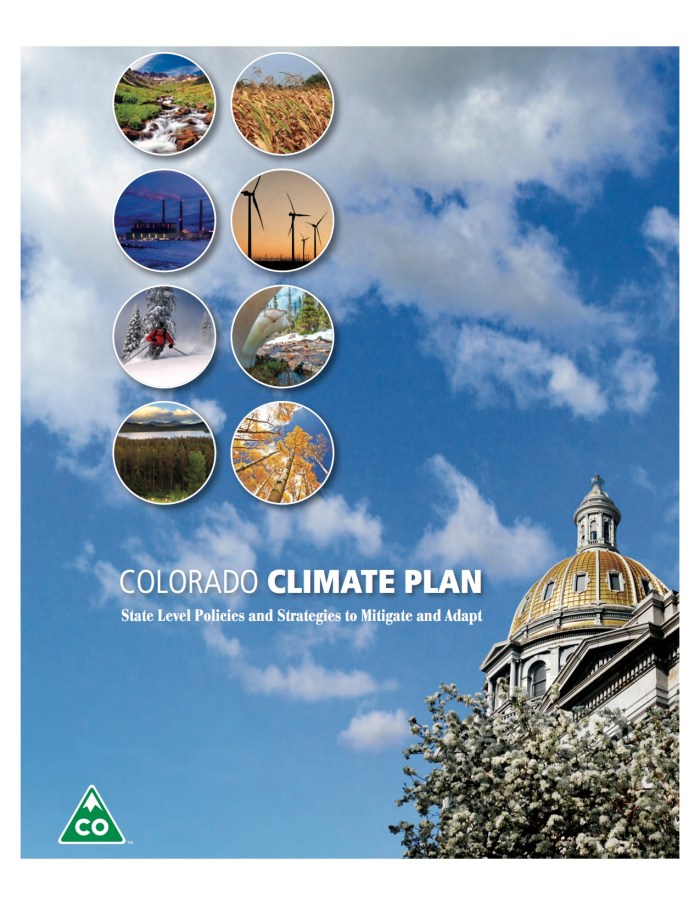
By contrast, the Colorado Climate Plan was like an after-school pickup game for scientists, attempting to lay some sort of public policy groundwork for a series of unpredictable events. Even so, water is still the star.
“Water is one of the most vulnerable sectors,” Taryn Finnessey, of the Colorado Department of Natural Resources, told the Arkansas Basin Roundtable last week. “Streamflow decreases and the peak runoff shifts. The frostfree season is longer and there are more frequent wildfires. We are seeing these things already.”
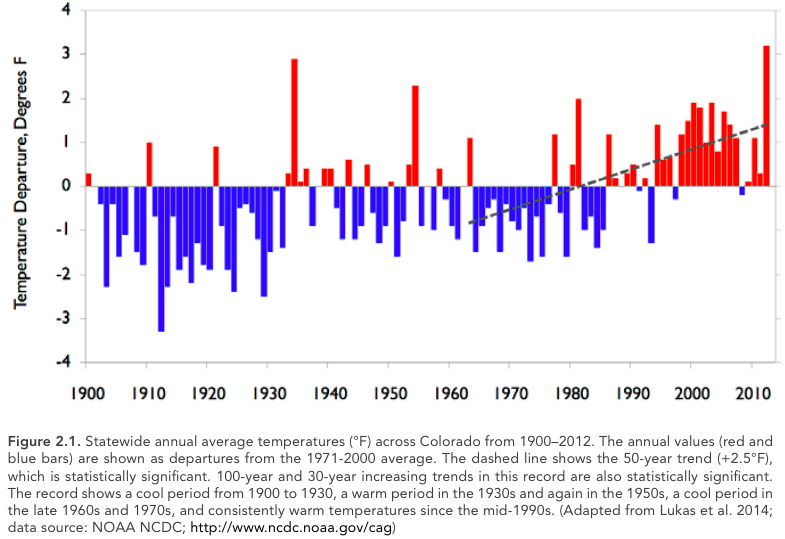
She presented the evidence of warming: Colorado’s average temperature has increased 2 degrees (Fahrenheit) in the last 30 years; 2.5 degrees in the last 50. The average temperature will increase 2.5-5 degrees by 2050. A 2-degree increase would make Denver more like Pueblo; 4 degrees more like Lamar; and 6 degrees more like Albuquerque.
“After 2050, we can’t predict,” she said.
Future precipitation is uncertain. Colorado is an inland area, with mountains and at mid-latitude — the trifecta for uncertainty. Less snow? More rain? No one can tell. But both extreme floods and droughts already are becoming more common.
The historic record — you don’t need to consider man-made consequences to review it — can be determined by tree-ring data. It goes back 1,000 years in the Colorado River basin, and 500-700 years in the South Platte, Arkansas and Rio Grande basins.
There have been, in every basin, decades-long droughts that occasionally have chased away civilizations.
Armed with the facts, the roundtable members were asked, by Jay Winner, general manager of the Lower Arkansas Valley Water Conservancy District, if they believed climate change was real and posed a threat. About 75 percent of the people in the room raised their hands.
“So, we’ve still got some work to do,” Winner said.
That’s true statewide as well. Only 19 percent of the state’s population does not believe global warming is happening, according to recent polls.
Just 60 percent say it is a threat to the state.
Beyond water, there are other sectors of the state that are preparing for climate change.
The Colorado Climate Plan, directed by the state Legislature in 2013, deals with public health, energy, agriculture, tourism and recreation as areas that could be affected in one way or another by markedly warmer or drier weather. And one surprising area: Transportation.
The plan outlines how wear and tear on roads, runways and other transportation structures is expected to increase as temperatures warm and storm events become more severe. Colorado witnessed this already in the 2013 floods in the South Platte basin, where road replacement became the major cost after the floodwaters receded.
Those types of impacts are expected to become more common.
There are also the on-the-ground impacts of more severe snowstorms, rain events and dust.
For instance, during the 2010-13 drought in the Arkansas Valley, the National Weather Service added dust storms to their roster of weather warnings. While Colorado’s Water Plan sets specific targets or goals to manage water use, the Colorado Climate Plan deals in broader “policies and strategies to mitigate and adapt.”
The report acknowledges that Colorado, by itself, could do little to curb global effects of emissions from power plants or automobiles, but should help cut those emissions.
Sort of like a fan in the stands cheering for the home team?
But the plan does point the way for Colorado to get in the ballpark.
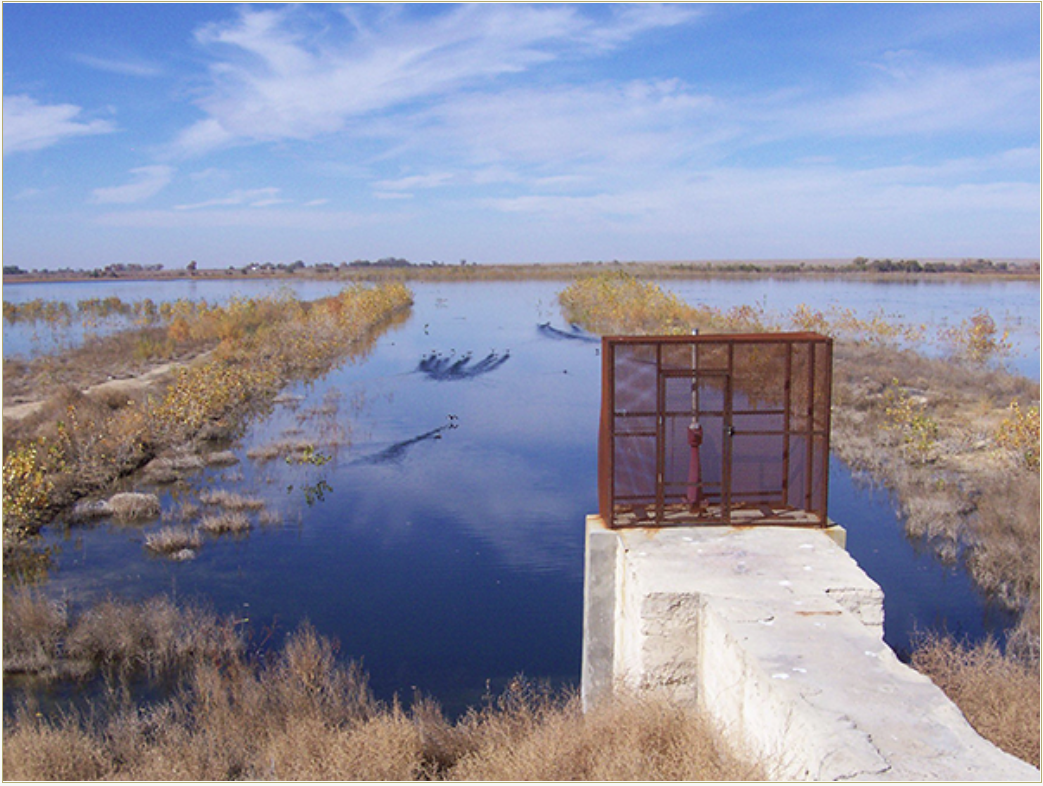
Holbrook Reservoir is in a broad shallow basin formed in overburden soils overlying the Smokey Hill Member of the Niobrara Formation. Photo via Deere & Ault Consultants.
A project to upgrade the outlet flow measurement at Holbrook Reservoir near La Junta was approved by the Arkansas Basin Roundtable Wednesday.
“We’ll be better able to use the storage there,” said Nick Koch, a roundtable member from Cheraw.
The work would construct a new concrete weir at the outlet and armor the channel immediately downstream to reduce erosion. The project will allow flows to be measured in the 1-14 cubic feet per second range, a requirement by the Colorado Division of Water Resources.
It also will lower the outlet by 1 foot to allow better access to water in the reservoir, Koch said.
The reservoir holds about 6,250 acre-feet of water, which benefits farmers on the Holbrook Canal. The canal also leases space to the Recovery of Yield group (Colorado Springs, Aurora and Pueblo), as part of the program that maintains Arkansas River flows through Pueblo. Space is leased in the reservoir by the cities, so water can be exchanged or leased later.
It also provides fishing and boating opportunities, Koch said.
The project would cost $40,150 and would be completed during the Oct. 1-Dec. 15 time frame.
The Holbrook Canal is seeking a $30,000 grant from the Water Supply Reserve Account, which is funded by mineral severance taxes. The grant still must be approved by the Colorado Water Conservation Board, but the roundtable’s blessing is a crucial first step.
The Recovery of Yield Group would supply $8,150, and Holbrook would contribute $2,000.
Straight line diagram of the Lower Arkansas Valley ditches via Headwaters
The major water bodies around Summit County and throughout most of the state are in strong shape after a slightly above-average winter season. However, the region is far from out of the woods on the matter of water in the West.
That was the thrust of speakers at Summit’s 23rd annual State of the River meeting on Wednesday evening, May 4 at the Silverthorne Pavilion — the first of six such meetings along the Colorado River Basin. With the Western Slope encompassing an average of 28 percent of the state’s water and spanning 15 counties, including Summit, this meeting of water wonks often sets the tone on consumption strategy and planning for rest of the year.
“There are no passengers on Spaceship Earth,” Troy Wineland, Summit County’s water commissioner, told the congested room, “there are only crewmembers. We’re all in this together.”
Wineland stressed that despite snowpack totals currently at about 115 percent of average above Dillon Reservoir — and with peak flows still to come around the first or second week of June once meltoff takes hold — circumstances are not as favorable. Other states in the country that also primarily rely on the Colorado River remain at near-critical shortages.
“While things are nice and rosy and wet and looking great here in the county,” he said, “you look throughout the entire Colorado river basin … not quite as rosy. The Lower Basin states right now are facing some very serious problems with access to water and need.”
[…]
WATER WAYS
Both Wineland and Denver Water’s Bob Steger were sure to discuss the present levels at Lake Powell during their respective presentations. Each noted how vital the resource is to every state along the Colorado Basin, even though water has already passed by many of them to arrive to Powell.
Aside from Powell functioning as the chief water supply for drinking, crop irrigation and recreation for 30-to-40 million residents in the region, the Glen Canyon Dam there also provides hydroelectric power. Besides contractual obligations of an annual average of 7.5 million acre-feet at Powell through that basin compact, of course, when water there gets below necessary levels, that has an impact back up to the Upper Basin states with increased electrical bills…
“(Lake Powell) is our bank account against accounts payable to the Lower Basin states,” re-iterated Wineland. “We’re probably within 20 feet of the critical threshold, at which point, Arizona and Nevada are going to have to make some hard decisions and really cut back on their water use.”
CHAMPIONING CONSERVATION
Despite the challenges even in what seems a healthy water year locally, all hope is not lost. The overall tenor of the meeting was mostly positive, with emphasis on how collaborative efforts across Colorado, as well as through such multi-state interdependence and agreements, proper attention on this limited resource is increasing.
Steger, Denver Water’s manager of raw water supply, brought encouraging news that the water from snowpack averages just a couple days ago are not only well above both the 20-year average on Dillon Reservoir (14.6 inches), but also ahead of 2015 (16.5 inches) as well. Current measures are 19.5 inches from this winter’s snowfalls.
On top of that, snowpacks on the South Platte River are also above normal for this time of year. That means Denver Water can most likely avoid pulling much water from Dillon Reservoir through one of its primary transmountain water diversion, Roberts Tunnel, this season for the South Platte and Denver’s consumption needs.
In fact, if that happens, that will continue a beneficial trend where 2014 and 2015 were actually the two lowest years within a 50-plus-year span for how much water has had to be removed from Dillon Reservoir through Roberts for the Platte and North Fork rivers.
“I attribute that partly to Mother Nature,” explained Steger to the audience, “because we’ve had good water supplies on the South Platte, but also our customers are doing a better and better job every year I think of conserving water. When our Eastern Slope supplies are good, that means we don’t have to take as much water from the Western Slope to the other side of the divide. That indirectly helps Lake Powell.”
Wineland also discussed how momentous the unveiling of Colorado’s statewide water plan — years in the making — in November is for the general conservation movement. To boot, regional endeavors like the recent $32,000 Colorado Water Conservation Board grant awarded to the Frisco-based High Country Conservation Center (HC3) for development and execution of a countywide water efficiency program are additional steps in the right direction. His parting words were of encouragement and optimism for the Colorado River Basin’s future.
“I just want to bring it back to the bigger picture,” he said. “We have leaders who are putting forth all this legislation and these cooperative efforts. But what we’re lacking are champions, and those champions, really, are you and I — everyone in this room. We need to take this legislation and work to the next level and implement these changes.”
Would you be willing to pay an extra penny or two on every beverage container you purchase for the next 30 years or so, if it could assure Colorado will meet its future water needs?
John Stulp, Gov. John Hickenlooper’s special advisor on water policy and director of the state’s Interbasin Compact Committee, put that question to an audience of more than 50 people in Steamboat Springs on Monday, and he was surprised at how many hands shot up.
Now that Colorado has its new statewide water plan in place, Stulp said it’s time to begin thinking about where the state will get the billions of dollars needed to close the water supply gap the state faces to support another estimated 5 million residents.
“The governor believes every conversation about water should start with conservation,” Stulp said. “I’ve always said, ‘You can have as much fun as you can afford.’ The state’s role might be something to the tune of $3 billion,” suggesting the residents of the state need to plan to raise about $100 million annually.
And that’s a lot of beverage containers…
Stulp, who comes from a cattle ranching/wheat growing background in southeastern Colorado, thinks our futures are bound together by the urgent need for more water supply.
“I say it pulls us and ties us together,” he said, “and we’re all tied to the Colorado River, because if anything happens there, it happens to all of us.”
Denver Water, which supplies water to 25 percent of the taps in the state, is doing more than many might realize, Stulp pointed out. The biggest water provider in Colorado is serving many thousands more users than it did 30 years ago but is using the same amount of water, thanks to conservation measures including the re-use of water.
After all, Denver Waster’s customers want to enjoy the rivers of the Western Slope, too, Stulp said.
There has been a paradigm shift in the way the Front Range looks at water, Stulp continued. Former Department of Natural Resources Chief Mike King, who is the new director of future water supply for Denver Water, grew up on the Western Slope in Montrose and understands the water outlook from this side of the Continental Divide.
But the agency also knows if the lower basin states ever made a call on the Colorado, demanding their share of water, it would hurt the Front Range more than the Western Slope, Stulp said. In part, because every acre-foot of water that wasn’t diverted to the eastern side would be felt doubly, because the water is used more than once.
Asked by Routt County Commissioner Doug Monger, who also serves on the Upper Yampa Water Conservancy District board of directors, if Gov. Hickenlooper is putting pressure on governors in the lower basin states such as California, Arizona and Nevada to use their water more wisely, Stulp replied, “Yes.” But he quickly added that diplomacy in the form of the relationships Colorado Water Conservation Board Director James Eklund has built with his counterparts is essential to Colorado’s relations with other Western states.
Marsha Daughenbaugh, executive director of the Community Agriculture Alliance, asked Stulp for his reaction to the fact that 40 percent of food produced in the U.S., much of it with the help of irrigation, is wasted.
“It goes to show you how cheap food is in this country and how cheap water is,” he concluded.
LOVELAND – Mike King, the new director of planning for Denver Water, said at a recent meeting that beyond additional transmountain diversions through the Moffatt Tunnel into an expanded Gross Reservoir near Boulder, Denver Water doesn’t have other Western Slope projects on its radar.
King served as executive director of Colorado’s Department of Natural Resources from 2010 until January of this year, when he took the planning director job with Denver Water.
After speaking to a luncheon crowd of close to 200 at the Northern Water Conservancy District’s spring water users meeting in Loveland on April 13, King was asked from the audience “How much more water does Denver Water need from the Western Slope?”
“I think if we get Gross Reservoir approved, the answer is for the foreseeable future, you know, we need to do that first,” King said.
King is a native of Montrose, son of a water attorney, and has a journalism degree from CU Boulder, a law degree from the University of Denver, a master’s in public administration from CU Denver and 23 years of state government experience.
“And I can tell you that the reality is, whether it is from a permitting perspective or a regulatory perspective, the West Slope is going to be a very difficult place,” King continued. “If there is water available, it is going to be a last resort. And I so think that the answer is, that won’t be on our radar.”
Denver Water is seeking federal approval to raise the dam that forms Gross Reservoir, in the mountains west of Boulder, by 131 feet. That would store an additional 77,000 acre-feet of water and bring the reservoir capacity to 118,811 acre-feet. Ruedi Reservoir, by comparison, holds 102,373 acre-feet.
The $360 million project would provide 18,000 acre-feet of firm yield to Denver Water’s system and result in an additional 15,000 acre-feet of water being diverted from the West Slope each year. On average, Denver Water’s 1.3 million customers use about 125,000 acre-feet of West Slope water each year.
The water to fill an expanded Gross Reservoir would mainly come from tributaries of the Fraser and Williams Fork rivers, via the Moffat Tunnel, near Winter Park.
Beyond the Gross Reservoir project, King explained that any future Denver Water projects on the West Slope would need to fit within the confines of the Colorado River Cooperative Agreement, signed by Denver Water and 17 West Slope entities in 2013.
The CRCA, says that “if there is more water, it only comes after the West Slope says they agree with it and it makes sense,” King said. “That sets the bar so incredibly high and gives them the ultimate ability to say, ‘This is good for the West Slope.’
“And so I just don’t think Denver Water is going to be looking to the West Slope,” King continued. “I think anybody who manages natural resources, and water in particular, will never say ‘never’ to anything, but I think it is certainly not on our radar.”
Not on Denver Water’s radar, perhaps, but it is worth noting that Denver Water is the only major Front Range water provider to have signed the cooperative agreement with the West Slope.
When asked what he thought of King’s remarks about West Slope water, Eric Kuhn, the general manager of the Colorado River District said he thought the comments reflect “the concept that if Denver takes more water from the West Slope it could undermine the security/reliability of what they already take.”
Kuhn’s comment relates to the possibility that if Denver Water diverts too much water from the Western Slope, it could help trigger a compact call from the lower basin states, which could pinch Denver’s transmountain supply of water.
Editor’s note: Above is a recording of Mike King, the director of planning for Denver Water, speaking after lunch in front of about 200 people at Northern Water’s spring water users meeting, a public meeting held at The Ranch event center in Loveland on Wednesday, April 13, 2016. The recording, made by Aspen Journalism, begins shortly after King had begun his remarks. It is 26:34 in length. At 8:20, King discusses the development of the Colorado Water Plan. At 22:40, King answers a question about the governor’s endorsement of the Windy Gap project and another phrased as “How much more water does Denver Water need from the Western Slope?”)
A buoyant crowd
Earlier in the meeting engineers from Northern Water — which supplies water to cities and farms from Broomfield to Fort Collins — told the mix of water providers and water users from northeastern Colorado that they could expect an average spring runoff this year, both from the South Platte and the Colorado Rivers.
They were also told that Northern Water was making progress on its two biggest projects: the Windy Gap Firming Project, which includes construction of Chimney Hollow Reservoir near Berthoud; and NISP, the Northern Integrated Supply Project.
NISP includes two new reservoirs, Glade and Galeton, to be filled with East Slope water from the Cache La Poudre River, which runs through Fort Collins and into the South Platte River.
Just before lunch, John Stulp, the special policy advisor on water to Gov. John Hickenlooper, read a surprise letter from the governor endorsing the Windy Gap project, which would divert an additional 9,000 acre-feet of water each year, on average, from the upper Colorado River and send it through a tunnel toward Chimney Hollow.
Windy Gap is part of the Colorado-Big Thompson Project, which diverts on average 260,000 acre-feet a year from the Western Slope.
The Windy Gap project does include environmental mitigation measures for the sake of the Colorado River, and has approval from the required state agencies and Grand County, but it still needs a permit from the U.S. Army Corps of Engineers.
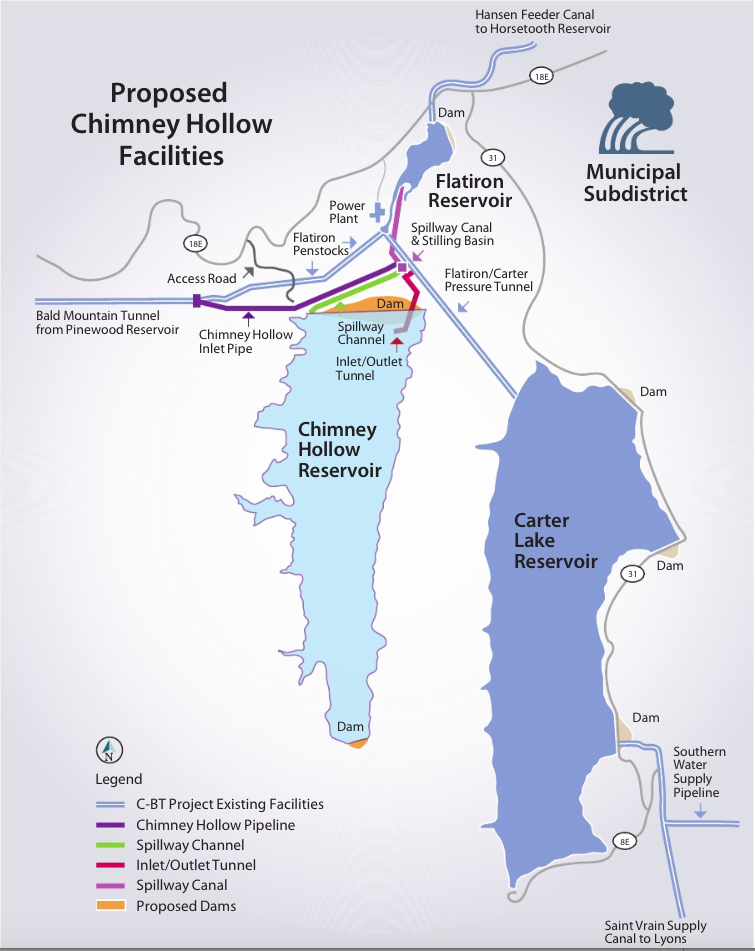
Looking east toward the Chimney Hollow Reservoir site, which is just this side of the red ridge. On the other side is Carter Lake Reservoir and beyond that, the Loveland area.A graphic from Northern Water showing the lay out of Windy Gap Firming Project.
A political risk
After lunch, King shared some insights from his old job as head of the state’s department of natural resources.
“I think it’s important that you understand what the development of the state water plan looked like from the governor’s perspective and the state’s perspective,” King told his audience.
As head of DNR, King had oversight over the Colorado Water Conservation Board, which was specifically tasked by the governor in late 2013 to produce the state’s first-ever water plan, and to do so in just two years.
King said that he, Stulp and the governor knew that a water plan in Colorado could be “the place where political careers went to die.”
“So the thing we had to make sure that came out of this, knowing that we weren’t going to solve the state’s water issues in two years, was that we had to do this in a manner that politically, this was viewed as a big win, and that future governors and future elected officials would say, ‘We need to do this again and we need to continue this discussion,’” King said.
“Not because the governor needed a political win,” King added, “but because to have the next stage of the water plan, to have the discussion in five years, you can’t have an albatross around this, and I think we were able to do that, and so we’re very proud of that.
“If we had a political mushroom cloud, no one would have ever touched the Colorado Water Plan again,” King continued. “That meant we aimed a little bit lower than maybe we would have liked, and I’ve gotten this at Denver Water, talking about lost opportunities in the Colorado Water Plan. Maybe we did aim just a little bit lower than we should have.”
King said the state was not able to “reconcile the inherent conflicts” in the various basin implementation plans, or BIPs, that were put together by regional basin roundtables as part of the water planning process.
And he acknowledged that the plan has been criticized for not including a specific list of water projects supported by the state, and for reading more like a statement of problems and values than a working plan.
“One of things that has been driven home to me time and time again in the two months that I’ve been at Denver Water is that planning is not something you do every five or six years,” King said. “Planning is a continuous process.”
King also said that there were some “tremendous successes” in the water plan, including the basin implantation plans, or BIPs, even though they sometimes conflicted.
“We got BIPs from every single basin,” King said. “The basins turned over their cards and said ‘This is what we need.’ So now we have a major step forward.”
Other plan elements
King said other successes in the Colorado Water Plan include the stated goal of conserving 400,000 acre-feet of water by 2050 and a nod to changing land use planning in Colorado.
King said tying land use to water availability “was something we never discussed in Colorado because it infringed on local control and it was just kind of a boogieman in the room.”
But he pointed out that “the vast majority of the basin implementation plans said, expressly, ‘We need to have this discussion’ and ‘We need to start tying land use to water availability,’” King said. “That’s a good thing. That’s a major step forward.”
When it comes to land use and Denver Water, King said driving down the per capita use remained a high priority and that if Denver proper grows, it is going to grow up through taller buildings, not by sprawling outward.
King also said Denver Water was working to manage, and plan for, the already apparent effects of climate change, especially as spring runoff is now coming earlier than it used to.
“We know that the flows are coming earlier, we know that the runoff is coming earlier,” King said, noting that reality is causing Denver Water to plan for different scenarios and ask questions about storage and late summer deliveries of water.
“For us, the most immediate thing is, is that we know it’s getting warmer,” King said. “In the last 20 years we’ve seen that, the way the [run offs] are coming earlier. We know we’ve had catastrophic events that are incredibly difficult for us to manage. And so we’re trying to work through that.”
Editor’s note: Aspen Journalism, the Aspen Daily News and Coyote Gulch are collaborating on coverage of rivers and water. The Daily News published this story on Wednesday, April 20, 2016.
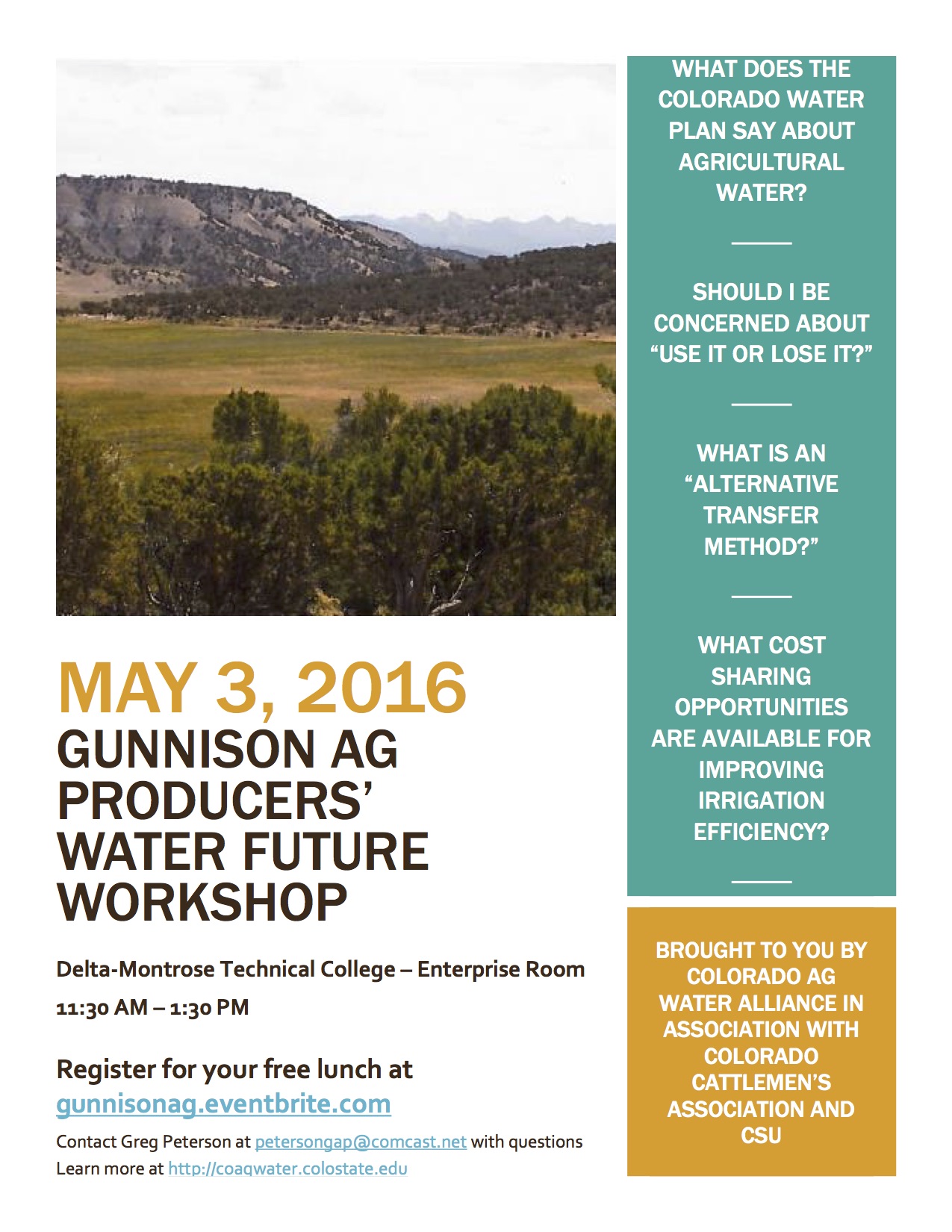
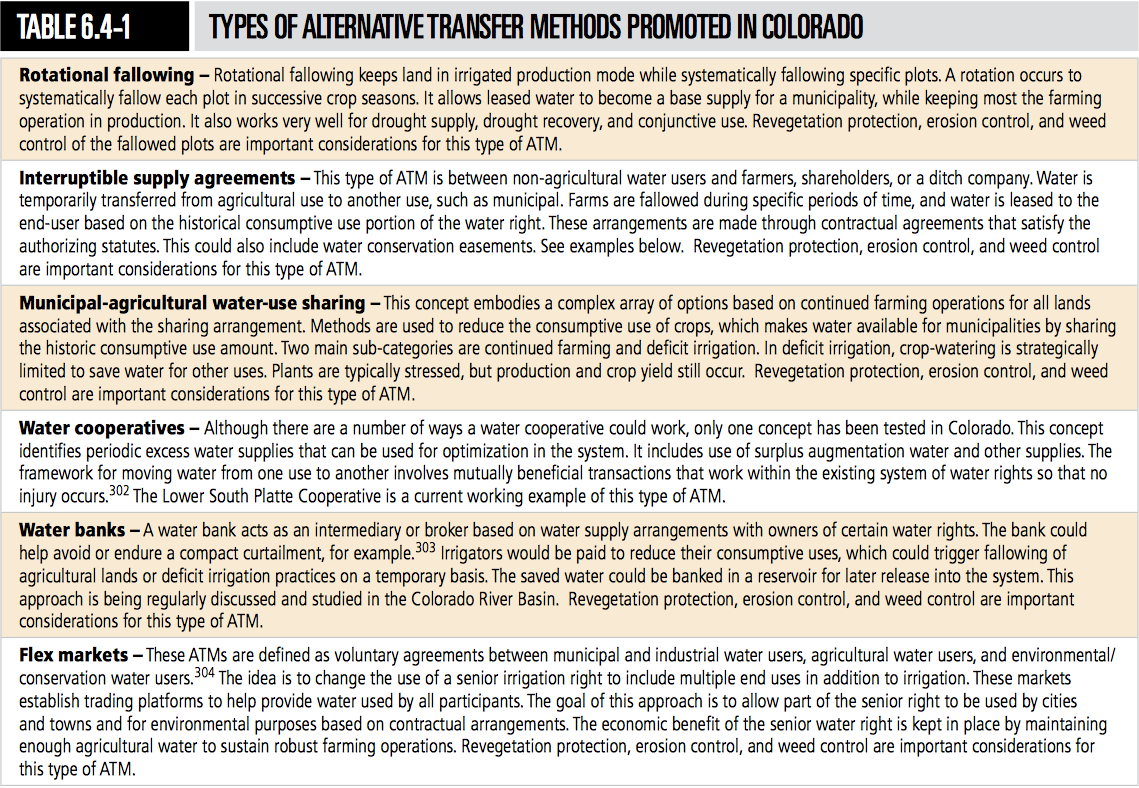
A Gunnison Basin Ag Producers’ Water Future Workshop will take place on Tuesday, May 3, 2016 from 11:30 a.m. to 1:30 p.m. at Delta-Montrose Technical College in the Enterprise Room. The Colorado Water Plan encourages the use of “alternative transfer methods” to keep water in agriculture while addressing the anticipated gap in future water supply given projected population growth. What does this mean for agricultural water users in the Gunnison Basin? Irrigators will hear about opportunities for cost sharing of efficiency improvements, water leasing programs, and concerns about “use it or lose it” at this workshop sponsored by the Colorado Ag Water Alliance with assistance from Colorado Cattlemen’s Association and CSU’s Colorado Water Institute.
Brief presentations will be followed by dialogue in which agricultural producers will have a chance to discuss challenges and barriers to these opportunities. Those presenting include Carlyle Currier from the Colorado Ag Water Alliance, Frank Kugel from the Gunnison Basin Roundtable, State Engineer Dick Wolfe, Perry Cabot from Colorado State University Extension, Aaron Derwingson from The Nature Conservancy, Phil Brink from Colorado Cattlemen’s Association, and MaryLou Smith from CSU’s Colorado Water Institute.
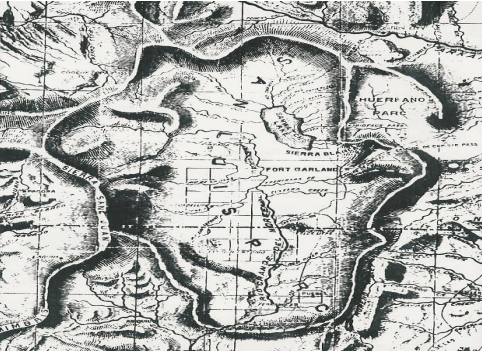
1869 Map of San Luis Parc of Colorado and Northern New Mexico. “Sawatch Lake” at the east of the San Luis Valley is in the closed basin. The Blanca Wetlands are at the south end of the lake, via Wikipedia.
Finding out where the San Luis Valley’s wetlands and irrigated acreage used to be could help determine where they should be in the future.
Chronicling that history to chart a future course is one of the focuses of a proposed watershed assessment project that Wetland Dynamics is seeking funding for. How those wetlands relate to wildlife habitat is another big component.
Cary Aloia and Jenny Nehring of Wetland Dynamics made an initial presentation and request for $37,000 to the Rio Grande Roundtable this week. The formal presentation and decision will be made next month. The project total is $164,000.
Although no one objected to the project, it sparked discussion about whether or not the roundtable should fund a project through an individual business, rather than a nonprofit organization, as previous funding requests have been made.
Aloia and Nehring said they were simply cutting out the middleman, and the costs for the project would probably increase $4,000-10 ,000 if it had to go through a nonprofit, which would take its portion and then contract with Wetland Dynamics to perform the work.
Colorado Water Conservation Board (CWCB) Program Manager Craig Godbout said individuals and businesses are not eligible for statewide account funds, but individual roundtables have discretion with regard to basin-allocated funds.
“There are no restrictions that I am aware of on what type of entity can be awarded basin accounts,” Godbout said.
Wetland Dynamics is seeking funds allocated to the Rio Grande Basin.
Funding for water projects around the state through CWCB and the basin roundtables is derived from severance tax revenues.
Nehring said this project will provide a Valleywide perspective about how drought and other changes have affected the wetlands that provide habitat to a variety of wildlife. She said several agencies and groups are monitoring their portion of the picture, but this would encompass the entire Valley and bring those agencies and groups together.
Aloia added that this project meets many of the environmental , recreational, agricultural and water administration goals of the roundtable.
She explained that this project will be completed by two entities: Intermountain West Joint Venture, which already has funding in place to provide historic and current wetland and agricultural uses in the Valley through its GIS model (and has completed similar projects in other parts of the western U.S.); and Wetland Dynamics, which will coordinate the project and bring everyone together to identify priority species, future water delivery projects and the best way to use water and land to benefit habitat.
“We are working cooperatively and collaboratively,” Aloia said.
Nehring said historical information is available as far back as the 1870’s through General Land Office surveys, which can be coupled with imagery captured from 1984 to the present. She said this information will show how wet areas in the Valley have ebbed and flowed through the years.
This information will help determine where habitats still exist and areas that can be targeted for conservation.
Nehring said Intermountain West Joint Venture will begin its work next month and will complete its part of the project in 18-24 months. Wetland Dynamics plans to complete its portion next year and will spread the $37,000 over a two-year period.
Aloia said there is a great deal of information, but it is in different places and with different agencies.
“We need to compile all of that,” she said.
Then priority species lists will be compiled and habitat areas identified for those species. All of the groups will then be able to cooperatively manage their water better to serve those habits, Aloia explained.
Brian Sullivan, wetlands program coordinator for Colorado Parks and Wildlife, said the department sees many benefits for this project and is firmly behind it. For example, it will provide information on the quantity and quality of wetlands for wildlife habitat and will help justify financial investments in the basin, he said.
Sullivan said Colorado Parks and Wildlife has pledged $46,000 towards this project, and he urged the roundtable to also support it. He said this project would be a great tool, “and you can’t have too many tools in the tool box.”
Kevin Terry, Rio Grande project coordinator for Trout Unlimited, added his endorsement of the project. One of the benefits , he said, would be consolidation of data in one place where it would be accessible to the different agencies.
Aloia said another outgrowth of the project will be identification of knowledge gaps, which can be the basis for future projects.
“It will highlight things we still don’t know,” she said. “It’s really a stepping stone for future projects.”
It will identify, for example , places where there could be restoration projects in the future to help bring back water resources that were present historically but are no longer present, she explained.
The information gathering and assessment will encompass the Valley floor up to 8,500 feet. Roundtable member Ed Nielsen said this sounds like a good project, but he believed it needed to encompass the mountains and headwaters too. He said it seems fragmented at this point.
Nehring said this a joint venture, and Intermountain West Joint Venture is setting the scope of this project. Aloia added that agricultural use, which is a key component of this project, is centered on the Valley floor.
Sullivan explained that the focus is on the irrigated landscape, which is where the biggest changes in wetlands have occurred.
Former Rio Grande Roundtable Board Chairman Mike Gibson said he personally had a problem with the roundtable funding an individual entity, because requests in the past have come through nonprofit organizations or state agencies. He said it had nothing to do with Wetland Dynamics, but he was concerned about the roundtable losing control over how money is administered and spent if the roundtable starts funding individual entities. He said he believed the roundtable had more oversight over projects going through nonprofit groups.
“I have a real concern,” he said.
Roundtable member Travis Smith said this is a worthy project, but it sounded like the roundtable needed to clarify some protocol issues.
“This application is about shared partnerships and getting agencies to talk to each other about water resources,” Smith said.
Roundtable member Dale Pizel said this seemed like a good project and he would hate for it not to be conducted simply because the roundtable had never funded projects through individual businesses before.
“If we need to have that discussion, let’s have it,” he said.
Roundtable member Judy Lopez agreed the discussion needed to be held. She also agreed this was a good project but was taking the roundtable into uncharted territory.
She asked if Billy Bob’s Excavating came in with a request for river restoration funding, would the roundtable fund it?
Pizel said if it fit with the roundtable’s goals, he did not have a problem funding “Billy Bob.” He said every project needs to have oversight to make sure it is performed correctly and fiscally responsibly.
Lopez said she did not think anyone had a doubt about how fiscally responsible Wetland Dynamics would be, but the roundtable needed to determine if it wanted to open this door and decide who could go through it. She said Aloia and Nehring are people of integrity, and this project meets many of the roundtable’s goals.
Godbout said his office requires reports and specific information, and he reviews that information carefully. He said he makes sure that the invoices match the work completed.
Roundtable member Rio de la Vista said, “So there is some oversight I think we can feel good about.”
Roundtable member Ron Brink said he was apprehensive about opening the gates to this type of funding.
Roundtable Chairman Nathan Coombs said, “The door can be opened. Just because it has not been opened doesn’t mean we shouldn’t. We should look at the project on its merits, if it accomplishes our goals.”
Well associations have boosted the amount of water they intend to use, and a program to augment on-farm irrigation improvements is growing.
“We remain the only basin in Colorado that has regulated irrigation efficiencies,” [Steve] Witte said. “But in the years we have had it, we have increased the acreage in sprinklers and drip irrigation.”
Witte outlined enforcement actions in the Arkansas River basin, noting that violations of well regulations and breaching unsafe or illegal dams occupied his staff’s time last year. In addition, the Division of Water Resources is taking more of a consulting role in water court cases and filing statements of opposition “only if necessary.”
Last year, in 97 cases, the state filed just one statement of opposition, while settling 21 or 50 pending cases it was active in within Division 2, Witte said.
He also reviewed cannabis — hemp or marijuana — requests, noting that 69 growers, mostly in Pueblo County, had filed plans for water through his office.
About the only thing he wasn’t prepared to talk about: New rain barrel legislation that passed the Legislature this year.
Here’s the release from Governor Hickenlooper’s office:
Gov. John Hickenlooper today formally endorsed the Windy Gap Firming Project, a water project that will serve cities and farmers on the northern Front Range as well as provide environmental benefits on the Western Slope.
The project expands the existing Windy Gap system built in the 1980s and includes the planned Chimney Hollow Reservoir southwest of Loveland to ensure more reliable supplies for the Northern Colorado Water Conservancy District and other project participants. It also includes several protective measures for fish and waterways on the Western Slope.
“Northern Water and its many project partners have worked diligently, transparently and exhaustively in a collaborative public process that could stand as a model for a project of this nature,” Hickenlooper said. “This is precisely the kind of cooperative effort envisioned for a project to earn a state endorsement in Colorado’s Water Plan.”
The Windy Gap Firming Project has been in the process of obtaining federal, state and local permits and certifications since 2003, including the required Fish and Wildlife Mitigation Plan approved by Colorado Parks and Wildlife, the Colorado Water Conservation Board and, most recently, the Section 401 Water Quality Certification from the Colorado Department of Public Health and Environment.
“Colorado moves the needle today with endorsement of a project that makes gains for the environment and water supply together,” said James Eklund, director of the Colorado Water Conservation Board, the agency that facilitated development of Colorado’s Water Plan. “Grand County, environmental stakeholders, and Northern Water set an excellent example of the collaboration necessary to achieve the bold measurable objectives of Colorado’s Water Plan and the Colorado and South Platte Basin Implementation Plans.”
“Northern Water worked closely with state biologists to ensure that impacts on streams and rivers – and the fish and wildlife that depend on them – were identified and addressed through mitigation for the benefit of the environment, wildlife and recreation,” said Bob Broscheid, director of Colorado Parks and Wildlife. “This was a thorough and unified process and shows what we can accomplish when we work together to reach shared goals.”
With necessary permits and certifications for the project in hand, Hickenlooper also today directed his staff to work with the U.S. Army Corps of Engineers in the federal agency’s issuance of a Section 404 Permit, the final federal regulatory step for the project.
Here’s the release from the Northern Colorado Water Conservancy District (Brian Werner):
Chimney Hollow Reservoir close to reality
Today the State of Colorado officially endorsed the Windy Gap Firming Project and Chimney Hollow Reservoir.
John Stulp, Governor John Hickenlooper’s Water Policy Advisor, made the announcement at Northern Water’s Spring Water Users meeting in Loveland. Reading a letter signed by Gov. Hickenlooper, Stulp told the 200 attendees that this is the state of Colorado’s first endorsement of a water project under the Colorado Water Plan, which was finalized last November.
“Further, the WGFP aligns with the key elements of the Colorado Water Plan…” Hickenlooper wrote.
Hickenlooper continued, “Northern Water and its many project partners have worked diligently, transparently and exhaustively in a collaborative public process that could stand as a model for assessing, reviewing and developing a project of this nature.”
Northern Water’s Municipal Subdistrict President Dennis Yanchunas spoke for the project’s participants in saying, “It’s really exciting to have that endorsement, the first ever by the state.” [ed. emphasis mine] Colorado’s endorsement came on the heels of state water quality certification in late March.
The Colorado Department of Public Health and Environment issued its 401 water quality certification for the Windy Gap Firming Project on March 25, bringing the project permitting process nearer to completion.
“This is the next to the last step in getting the project permitted,” said Project Manager Jeff Drager.
“The final step is the federal 404 wetlands permit from the U.S. Army Corps of Engineers, which we believe will be forthcoming in the next few months.”
The state’s endorsement of the WGFP culminates 13 years of diligent effort and lengthy negotiations to permit and authorize a project that will assure a reliable water supply for more than 500,000 northern Front Range residents.
The federal permitting process began in 2003 under the National Environmental Policy Act. The U.S. Bureau of Reclamation served as the lead federal agency and issued a final Environmental Impact Statement in 2011 and a Record of Decision in 2014 for Chimney Hollow Reservoir.
In addition, the Colorado Parks and Wildlife Commission and Colorado Water Conservation Board approved a fish and wildlife mitigation plan in 2011. The following year the Grand County Commissioners issued a 1041 permit and reached an agreement with Northern Water’s Municipal Subdistrict on a mitigation and enhancement package.
A wide variety of organizations, including Trout Unlimited, support the CDPHE’s long-awaited ruling.
“This permit is another step toward fulfilling the Windy Gap Firming Project’s potential to be part of a balanced water supply strategy for Colorado Front Range,” said Drew Peternell, director of TU’s Colorado Water and Habitat Project.
“Through a balanced portfolio – including responsible supply projects like WGFP – along with stronger conservation and reuse programs and ag-urban water sharing — Colorado can meet its diverse water needs…” Peternell added.
The Windy Gap Firming Project is a collaboration of 12 Northern Front Range water providers and the Platte River Power Authority to improve the reliability of their Windy Gap water supplies. Windy Gap began delivering water in 1985.
The participants include 10 municipalities: Broomfield, Erie, Evans, Fort Lupton, Greeley, Lafayette, Longmont, Louisville, Loveland and Superior; two water districts: Central Weld County and Little Thompson; and one power provider: Platte River. They currently provide water to 500,000 people.
The current cost estimate for WGFP is $400 million. To date the participants have spent $15 million on associated permitting costs.
The Windy Gap Firming Project is one step closer to being more than just big dreams and big dollar signs. The project, which would allow for the construction of the Chimney Hollow Reservoir southwest of Loveland, received the first endorsement a water project has ever gotten from the state of Colorado.
Governor Hickenlooper, John Salazar and John Stulp at the 2012 Drought Conference
John Stulp, special policy adviser for water to Gov. John Hickenlooper, read a letter from the governor at the Northern Water Spring Water Users meeting Wednesday at the Ranch in Loveland. In the letter, Hickenlooper applauded Northern Water for the Windy Gap Firming Project’s ability to bring communities together, protect fish and wildlife, and make Colorado’s water more sustainable, along with other ideals outlined in the Colorado Water Plan, which was adopted last November.
“Northern Water and its many project partners have worked diligently, transparently and exhaustively in a collaborative public process that could stand as a model for a project of this nature,” Hickenlooper said in a news release from his office. “This is precisely the kind of cooperative effort envisioned for a project to earn a state endorsement in Colorado’s Water Plan.”
While the endorsement from the state doesn’t advance the plan in earnest, it does give it credibility in the next and final step to getting its building permit completed.
“This is the next to the last step in getting the project permitted,” said Windy Gap Firming Project manager Jeff Drager in a release from Northern Water. “The final step is the federal 404 wetlands permit from the U.S. Army Corps of Engineers, which we believe will be forthcoming in the next few months.”
When the U.S. Army Corps of Engineers considers the project for the permit, it will want to know if the state approves of it. Now, with an official recommendation from the governor, the path should be smoother for the Windy Gap Firming Project and the Chimney Hollow Reservoir, Stulp said.
“I think this (project) is being done right,” Stulp said. “Now, we have the state’s endorsement and I think that will inform the fed agencies, the Corps at this point, that this has got strong support in Colorado.”
The city of Greeley was one of the original six cities to invest in the existing Windy Gap Reservoir. Now, the city is a participant in the Windy Gap Firming Project. Once the Chimney Hollow reservoir is built, Greeley will receive 4,400 acre-feet of water per year. An acre-foot of water is roughly the equivalent of one football field filled with a foot of water — that’s almost 326,000 gallons of water, or more than 8,000 bathtubs full.
Evans, Fort Lupton and the Central Weld County Water District are also participants in the Windy Gap Firming Project.
The project is estimated to cost about $400 million and participants have thus far spent $15 million, according to the Northern Water release. The reservoir will store 90,000 acre-feet of water and will be located near Carter Lake and parts of Northern Water’s Colorado-Big Thompson Project.
The Windy Gap Firming Project’s participants are primarily municipalities, but also include two water districts and one power company. The purpose of the project is to create an alternative water source for cities and companies to purchase water from instead of resorting to tactics like buy-and-dry or competing with agricultural land for water resources.
During his presentation at the Northern Water Spring Water Users Meeting, Metropolitan State University of Denver professor Tom Cech talked population growth. He said right now, Colorado is home to more than 5 million people. By 2030, that number’s projected to rise to more than 7 million after having already grown about 30 percent since 1990. In the South Platte Basin alone, that kind of population growth will equal a shortage of about 410,000 acre-feet of water, or about 134 billion gallons. Between 133,000 and 226,000 acres of irrigated land in the South Platte River Basin are expected to dry up by 2030.
With the rapid population expansion and resulting urban sprawl happening in Colorado, projects like these are more important than ever, said Eric Wilkinson, Northern Water’s general manager.
“People need water and we’re going to grow. Obviously people like this area, people move to this area and people will continue to come and we have to find ways to provide that water supply,” Wilkinson said. “This is a good way of doing it.”
Gov. John Hickenlooper on Wednesday weighed in formally backing the long-delayed and controversial $400 million Windy Gap project to divert more water from the Colorado River to the booming Front Range.
Hickenlooper ordered state officials to work with the U.S. Army Corps of Engineers to obtain a final federal wetlands permit needed for work to begin. His endorsement is expected to aid that effort.
Northern Water would expand its existing river diversion system built in 1985 by installing a new reservoir southwest of Loveland to hold diverted Colorado River water. That 29 billion-gallon Chimney Hollow Reservoir would supply farmers and growing cities.
“This is the first time he has endorsed this project. We were certainly hoping for it. We were pleasantly surprised,” Northern Water spokesman Brian Werner said.
“This means that construction, starting in 2019, is a reality.”
Northern Water has been planning the project, working with state and federal officials on permits, since 2003. A mitigation plan, approved by Colorado Parks and Wildlife and the Colorado Water Conservation Board, lays out measures to protect fish and off-set environmental harm including altered river flows.
Colorado Department of Public Health and Environment officials, responsible for ensuring water quality, signed off on March 25.
“Northern Water and its many project partners have worked diligently, transparently and exhaustively in a collaborative public process that could stand as a model for a project of this nature,” Hickenlooper said. “This is precisely the kind of cooperative effort envisioned for a project to earn a state endorsement in Colorado’s Water Plan.”
Front Range users would would siphon additional west-flowing water — up to 8.4 billion gallons a year — out of the Colorado River and pump it back eastward under the Continental Divide. That water, stored in the new reservoir, is expected to meet needs of 500,000 residents around Broomfield, Longmont, Loveland and Greeley.
Environment groups on Wednesday reacted with fury.
“This project will further drain and destroy the Colorado River and imperil endangered fish,” said Gary Wockner, director of Save the Colorado River. “We’ve registered 23 complaints with the Army Corps of Engineers. The federal government should deny the permit. This project is reckless.”
Colorado officials endorsed a long-sought water storage project that would include construction of Chimney Hollow Reservoir southwest of Loveland.
Gov. John Hickenlooper on Wednesday voiced his support for the Windy Gap Firming Project, which would divert water from the Western Slope to the Front Range to shore up supplies for municipalities and farmers…
Participants in the water-storage project include Loveland, Longmont, Greeley, Broomfield, Platte River Power Authority and two water districts.
The project recently received a key water quality certification from the Colorado Department of Public Health and Environment. The certification is needed to receive a final permit from the U.S. Army Corps of Engineers to build the project…
Map from Northern Water via the Fort Collins Coloradoan.
If the expected permits come through, final design on Chimney Hollow Reservoir would begin later this year with construction beginning in 2018-19, Werner said.
Chimney Hollow Reservoir would hold up to 90,000 acre feet of water. An acre foot is enough water to meet the annual needs of three to four urban households.
Larimer County would build and operate recreational facilities at the reservoir, which would be built west of Carter Lake. Carter Lake holds up to 112,000 acre feet of water.
The Windy Gap Firming Project has been under federal, state and local review since 2003. It has been challenged by environmentalists over the years because of its impact on the Colorado River’s ecosystem through increased water diversions.
In a recent email to the Coloradoan, the group Save the Colorado stated it would scrutinize the 404 permit decision from the Corps to ensure the project adheres to the National Environmental Policy Act, the Clean Water Act and the Endangered Species Act.
Supporters say the Windy Gap Firming includes measures that would mitigate its environmental impacts and protect fish, streams and water quality in Grand Lake and the Colorado River.
The project — formally called the Windy Gap Firming Project — calls for the construction of a new reservoir, called Chimney Hollow Reservoir southwest of Loveland. The reservoir will be designed to hold up to 90,000 acre feet of water, and reliably deliver about 30,000 acre feet of water every year, enough to support the needs of 60,000 families of four people.
It’s an expansion of the existing Windy Gap system built in the 1980s to divert water from the Colorado River to the Front Range. But the construction of a new reservoir is crucial, said Brian Werner, a spokesman for the Northern Colorado Water Conservancy District, the lead agency on the project.
Because of the Windy Gap project’s relatively junior water rights, water cannot be diverted in years when the snow pack is low. And during wet years, there’s not enough storage space in Lake Granby to store the Windy Gap water, which means it runs down the river.
“Windy Gap right now doesn’t have any firm yield,” Werner said, meaning that the system can’t be counted on to have water available for customers every single year.
“In wet years there’s no where to put it [the water], and in dry years there’s nothing to pump,” Werner said.
About 500,000 people live in the water districts that would be served by the Windy Gap Firming Project, including Broomfield, Lafayette, Louisville, Loveland, Erie and Evans. To date, the cost of planning and permitting the project has risen to $15 million, according to the Northern Colorado Water Conservancy District.
And with population numbers expected to jump in coming years, this project and others will be needed to ensure there’s enough water for the communities to grow, Werner said.
The project’s leaders have worked on agreements to mitigate environmental impacts to protect fish, ensure stream protection and reduce water quality impacts to Grand Lake and the Colorado River.
Last month, the Colorado Department of Public Health and Environment this week released its final “401 water quality certification,” meaning that the state had signed off on the plans to mitigate the environmental impact of the project on the Upper Colorado River.
Trout Unlimited, said the conditions imposed by the state health department put the “threatened river and fishery on road to recovery.
“We firmly believe these permit conditions establish a strong health insurance policy for the Upper Colorado River,” said Mely Whiting, counsel for Trout Unlimited, in a statement.
It took a long time to get here. Click here to take a trip back in time through the Coyote Gulch “Windy Gap” category. Click here for posts from the older Coyote Gulch blog.
Moffat Collection System Project/Windy Gap Firming Project via the Boulder Daily Camera
Windy Gap and C-BT Granby area facilities
Windy Gap Reservoir
Windy Gap Reservoir
Site of proposed Chimney Hollow Reservoir — Windy Gap Firming Project via the Longmont Times-Call
Chimney Hollow Reservoir site
Chimney Hollow Reservoir site via the Bureau of Reclamation
Here’s a column George Sibley writing for the The High Country News. Click through and read the whole thing. Here’s an excerpt:
The self-styled sensible people today seem to take it for granted that Americans have lost any capacity for working through difficult problems, especially where cultural differences are concerned. That attitude has certainly surfaced in response to Colorado’s water planning process. Given the absence of additional unappropriated water, the sensibles say, more water for one group means less water for other groups, an unacceptable zero-sum situation, especially across Colorado’s transmountain and rural-urban “divides.”
Colorado historian Patricia Limerick lent credence to that zero-sum thinking in her contribution to a “Citizen’s Guide to Colorado’s Transbasin Diversions,” published by the state’s Foundation for Water Education. “There is no moral algebra,” she said, “for calculating whether retaining water to support commercial development on the Western Slope is better or worse than transporting water to support commercial development on the Front Range.”
Her statement reflects the first-come-first-served approach of metropolitan Denver toward West Slope water until late in the 20th century. It is a legal approach under the longstanding “prior appropriation” doctrine (first in time, first in right), but one of questionable morality. Colorado’s big federal transmountain diversions in that same period – the Colorado-Big Thompson and Fryingpan-Arkansas projects – transcended the letter of the law and carefully worked through a more just process that resulted in compensatory storage and maintenance of “live streams.”
The goal was to ensure that future development of the Western Slope would not be sacrificed, however legally, to the thirsty and more populated Front Range.
If water were the only factor in the equations between Colorado’s “divides,” then zero-sum skepticism might be warranted. But it is never just about water. All uses of water, from irrigated fields to municipal utilities to float trips, also involve the application of money and ideas to water. So when water is moved from Colorado’s rural Western Slope to the Front Range, Front Range money to implement ideas for how to make up that loss should be moved back across the Continental Divide to maintain the equation.
This is already happening to a greater extent than the water-war stories in the press suggest. The Colorado Water Plan that skeptics question coincided with two successful transmountain negotiations that anticipated most of the “conceptual framework” for diversions in the new Water Plan: the Moffat Tunnel Firming Project negotiated between Denver Water and the Colorado River District, acting on behalf of 37 West Slope partners; and the Windy Gap Firming Project between Grand County on the West Slope and Northern Water’s Municipal Subdistrict (the Longmont-Fort Collins urban corridor).
A screenshot from the website for Colorado’s Water Plan.
Since John Hickenlooper’s administration finalized Colorado’s first-ever statewide water plan in November, watchdogs have been wondering when — and if — state officials might start putting the document into action.
Some had feared the issue, which is likely to irk at least some of the state’s many competing water interests, might be put off until after the November election. But, alas, there’s at least some forward movement this election year.
This week, state lawmakers are taking a first look at an annual water projects bill that includes at least three items that might trigger some water planning momentum.
The largest? A $5 million yearly transfer to the Colorado Water Conservation Board construction fund “to implement the state water plan.” That money would come from a severance tax “perpetual base” account that had $350 million in the bank as of June.
But what would that $5 million be spent on? The measure, Senate Bill 16-174, doesn’t exactly say, other than it could be “studies, programs or projects.”
Rep. Ed Vigil of Fort Garland, the Democratic chair of the House Agriculture, Livestock and Natural Resources Committee, is the House sponsor on the bill, which was introduced Monday. Asked Tuesday what the state would get for taxpayers’ $5 million investment, he said that was a question he intends to ask the Water Board when the bill hits his committee.
The Water Board, which is part of the state’s Department of Natural Resources, is responsible for implementing the water plan — a pet plan of Hickenlooper, who has said that warding against a massive, mid-century water shortage is a key goal of his second term.
The state water plan, finalized November after two years and more than 24,000 public comments from throughout the state, lacks specifics on what legislation should be proposed or even which specific projects would help Colorado solve a looming water shortage of some one-million acre-feet by 2050.
An acre-foot of water is the amount of water it would take to cover Sports Authority field at Mile High from endzone to endzone with one foot of water. A family of four uses about one acre-foot of water per year, or about 326,000 gallons, according to the U.S. Bureau of Reclamation.
“It’s a step in the right direction, but there’s still not much there in there,” water lawyer Peter Nichols, one of Hickenlooper’s water appointees, told The Colorado Independent as the water plan was being drafted last summer. “There are a lot of platitudes and clichés and nice words like ‘foster,’ ‘develop,’ ‘encourage,’ and ‘coordinate’ in this draft. But those aren’t action words. Those words won’t carry us. They’re not going to meet our water needs for 2050.”
This week’s water projects bill does propose some specifics — albeit relatively small ones in the $20 billion context of the statewide water plan’s projected price tag.
One provision in the measure seeks $200,000 from the Conservation Board’s construction fund to study underground storage, such as refilling aquifers, “along the front range [sic].” That provision matches up neatly with a bill awaiting action from the House Appropriations Committee.
House Bill 16-1256, sponsored by Rep. J. Paul Brown of Ignacio, got a glowing vote of support from the House Agriculture Committee last month. Brown’s bill would task the water conservation board with studying storage possibilities along the South Platte River between Greeley and Julesburg. But if that measure fails to survive the full House, the study could still move forward under the projects bill being proposed this week.
The second specific item tied to the water plan is $1 million to update the Statewide Water Supply Initiative, also known as SWSI (pronounced SWA-sea). That 2010 study, commissioned by the Conservation Board, identified the one million acre-foot water shortage that became the driving force behind creating the state water plan.
But many believe the SWSI figure is too low, perhaps by as much as another one million acre-feet. During the water plan development process, officials on the Conservation Board stated the SWSI study would be updated in the next year or two to more accurately estimate the water shortage Coloradans will face in the future.
The bill is on the calendar for its first hearing in the Senate Agriculture, Natural Resources and Energy Committee on Thursday.
Still gazing at the ripples cast by Colorado’s Water Plan, the Colorado Water Conservation Board is getting ready to dive into another wave of the future.
The board is preparing to update the Statewide Water Supply Initiative, which first outlined projected water needs of the state in 2004 and was updated in 2010.
The document now serves as the technical basis for the state water plan as well as basin implementation plans adopted by each of the nine basin roundtables.
The Arkansas Basin Roundtable got its first notification of the coming update at its [recent] meeting.
The first version of SWSI in 2004 predicted a shortfall of water for growing Front Range communities and helped launch legislation to form the Interbasin Compact Committee and basin roundtables in 2005.
The 2010 version identified strategies and refined estimates of shortfalls of water. It also better reflected the state’s need to preserve agricultural water and nurture local projects. It provided the groundwork for the state water plan.
The 2016 update will include new areas including strategies to deal with scenario planning, climate change and hydrologic variability. Gaps in water supply for agriculture, environment and wildlife will be addressed. It will also incorporate basin implementation plans and the economic value of water.
The IBCC this month looked at ways to fund the additional $100 million annually in water projects called for in the state water plan beginning in 2020. Jay Winner reported some ideas included a 25-cent statewide tap fee, container tax or lottery tickets, but no decisions were made…
In other moves, the roundtable approved a letter of support for the Arkansas River Watershed Collaborative for a five-year $650,000 grant from the U.S. Endowment for Forestry and Communities. The collaborative is working on improving forest health throughout the Arkansas River basin in order to protect watersheds.
How much water reaches the Westwater stretch of the Colorado River, and then Lake Powell, is taking on increasing importance to Colorado water officials. A new study is underway to look at much more water is available to develop on the Western Slope, and it’s caught the attention of east slope water officials. Photo: Brent Gardner-Smith/Aspen Journalism
PUEBLO – A big question in Colorado is how much water is left to divert and use from the Colorado River before levels drop too low in Lake Powell to make hydropower and deliver water downstream. The answer to that question is of interest not only to water-planning roundtables on the west slope, but on the east slope as well.
Last week, three east slope roundtables, the South Platte, Metro and Arkansas, chose members to sit on a technical advisory committee that is preparing a study on how much water is left to develop on the Western Slope while still keeping the Glen Canyon Dam functioning as it does today.
The roundtable members from the east slope are all senior officials at major water providers including Denver Water, Aurora Water, Colorado Springs Utilities and Pueblo Board of Water Works.
The level of officials eager to join in on what started as a west slope study of the issue is an indication of how important is the question, and the potential answers.
The west slope water study, known as the “risk study,” was originally conceived in December 2014 at a meeting of the four west slope roundtables, which include the Colorado, Yampa, Gunnison, and Dolores, San Miguel and San Juan (or Southwest) roundtables.
The west slope roundtables, especially the Yampa and the Gunnison, found they were not in agreement about future water development on the Western Slope, but they did agree on the need for more information.
“They needed to have a better understanding of what’s going on, on the river,” said Eric Kuhn, the general manager of the Colorado River District, during a Feb. 23 meeting of the Interbasin Compact Committee in Broomfield.
The IBCC includes representatives from each of the state’s nine basin roundtables and serves as a statewide water policy advisory board.
Upon recently learning of the west slope study, the three east slope roundtables asked to be included, which the west slope then agreed to.
“We always intended that this would be open and transparent, and open to the east slope roundtables,” Kuhn told the IBCC members, explaining that the original plan was to invite the three non-voting out-of-basin members serving on the Colorado and Gunnison roundtables to participate in the study.
But those out-of-basin seats, originally set up in 2005, have fallen out of use on the roundtables, so it was agreed to ask the east slope roundtables to choose their own committee members.
And the South Platte, Metro and Arkansas roundtables each met last week and did just that.
The Colorado River in Cataract Canyon, just above Lake Powell, where water officials are keeping a close eye on water levels. Photo: Brent Gardner-Smith/Aspen Journalism
Committee members
The South Platte roundtable assigned three people: Kevin Lusk, a senior engineer from Colorado Springs Utilities and the president of the Twin Lakes Reservoir and Canal Co.; Jim Yahn, the manager of the North Sterling Irrigation District and a South Platte representative on the IBCC; and Jerry Gibbens, a project manager and water resource engineer at Northern Water.
The Arkansas roundtable also selected three members: James Broderick, executive director of Southeastern Colorado Water Conservancy District; Brett Gracely, manager of Colorado Springs Utilities; and Terry Book, executive director of Pueblo Board of Water Works.
And the Metro roundtable assigned four members: Mark Waage, manager of water resources planning at Denver Water, who is also an IBCC member; Joe Stribrich, planning director at Aurora Water and an IBCC member; Eric Hecox, executive director of the South Metro Water Supply Authority and Kerry Sundeen, a principal engineer and consultant at Wilson Water.
At the IBCC meeting on Feb. 23, Waage thanked the west slope roundtables for allowing east slope participation in the study.
“I think there just was a period of ‘what are they doing, what’s going on,” Waage said. “And the fact that you guys are open to including us is really helpful.
“We would really like to deal with this issue on a statewide basin if we can and in concert with the four other upper basin states,” Waage added. “The east slope feels pretty strongly that that’s our best position. And we ought to always seek that approach rather than a east versus west kind of thing.”
The Colorado River District is managing the study and is seeking state funding on behalf of the participants to help pay for it.
The four west slope roundtables each have approved $8,000 in state funding from their basin accounts, totaling $32,000.
The River District and the Southwest Water Conservancy District have each agreed to put in $10,000, for a total study cost of $52,000.
The Colorado Water Conservation Board is expected to approve the $32,000 in state funding at its next regular meeting on March 16 in La Junta.
A flow map of Colorado’s river helps illustrate why so much attention is paid to the Colorado River.
Tied to framework
The main question the study will seek to answer is, “What is the likelihood of the elevation of Lake Powell going below 3,525 feet under selected water supply and water demand scenarios?”
The cited level of 3,525 feet in elevation is just above the “minimum power pool” level in Lake Powell of 3,490 feet.
If water levels fall below that, then the upper basin states will have trouble delivering enough water to lower basin states to meet their collective obligation under the Colorado River compact.
And a “curtailment” call could then come up the river and some of the biggest water providers on the east slope could be forced to stop diverting west slope water.
“We need to keep in mind that 20 to 25 percent of our consumptive use of Colorado River water is on the east slope,” Waage said. “The majority of those post-compact rights that would be curtailed are on the east slope.”
And that’s why the study is called the “risk study,” as in what’s the risk of triggering a compact call by taking more water out of the Colorado River?
Kuhn said the study is tied to point number four in the conceptual framework, which was developed last year by the IBCC to guide negotiations over a potential new transmountain diversion project.
Point four, as cited in the Colorado Water Plan, says that “a collaborative program that protects against involuntary curtailment is needed for existing uses and some reasonable increment of future development in the Colorado River System, but it will not cover a new TMD.”
In other words, before the state’s water sector builds a new transmountain diversion, it should figure out how it’s going to keep enough water in Lake Powell.
“Those are lots of variables here, so this isn’t a simple effort,” Kuhn told the IBCC about the risk study. “There’s hydrology, demand levels, what’s happening in other states. So you’ve got four or five different variables and there are lots of permutations of different outcomes.”
Kuhn said the study would build on information gathered as part of several other ongoing exploratory efforts.
One effort is a water banking investigation, now 10 years in the making, that is looking at ways ranchers and water providers could use less water in a drought.
An offshoot of that effort is an ongoing two-year “system conservation” pilot program to pay Western Slope ranchers and others to leave water in the upper Colorado River system to flow toward Lake Powell.
Kuhn said the exploratory efforts are important because “at some point in order to maintain reservoir levels in Lake Powell, in order to maintain the system, in order to accomplish framework point number four, which is to avoid a curtailment, we’re going to have to reduce our demands,” Kuhn said.
A third ongoing effort is “contingency planning,” which is studying how to use water released from federal upstream reservoirs, including Flaming Gorge and Blue Mesa, to keep Lake Powell at a certain level.
“What this four-basin roundtable study will do is collect what we’ve done, and educate people on what it is we’re doing, and what the trade-offs are,” Kuhn said.
Jeris Danielson, the manager of the Purgatoire Water Conservancy District and an Arkansas roundtable member, asked Kuhn if the west slope intended to postpone discussion at the IBCC level of a new TMD until the risk study was complete.
Kuhn said the study should be finished by the end of the summer, and that it made sense to develop a common understanding about how the Colorado River works before talking about a new TMD.
“You’ve got to bring the experts, the people who work in this business, up to a common level of understanding before they can have a common platform to help educate everyone else,” he said.
Editor’s note: Aspen journalism and the Aspen Daily News are collaborating on coverage of rivers and water in Colorado. The Daily News published this story on Monday, March 14, 2016.
Colorado unveiled a statewide water plan this past November to better prepare for an estimated doubling of its population by the year 2050, from about 5 million to an estimated 10.5 million. In the meantime, both intra- and interstate interests are presently at work attempting to gobble up every ounce of the Colorado River before it flows to the next.
Between four separate proposed diversion projects across Colorado, Utah and Wyoming — three states that make up the Upper Basin section of the Colorado River — about another 250,000 acre-feet of water would be pulled from these vital headwaters…
Specific to Colorado, those projects are the Moffat Collection System Project (A Denver Water enterprise that would remove 18,000 acre-feet), and the Windy Gap Firming Project (A Northern Water undertaking to obtain 30,000 acre-feet). And then Wyoming is in the initial stages of the Fontenelle Dam Re-engineering proposal, which would claim the largest amount of water at 123,000 acre-feet, and finally Utah’s Lake Powell Pipeline, which would require 86,000 acre-feet.
The idea is, basically, to stockpile water for each individual community before it can get downstream. The impediment standing in the way though — aside from their respective project approval processes, of course — is senior rights to the water source, as per the Colorado River Compact of 1922, from the states of the Lower Basin: California, Nevada and Arizona…
TAPPING OUT
All of these advancing claims on the Colorado River, on top of another plan suggested by Wyoming concerning 10 new Green River reservoirs over the next 10 years, several others in Colorado, as well as a small diversion project in New Mexico, are fast tapping the source out. The state’s water plan, produced through the Colorado Water Conservation Board (CWCB), was designed in part to help offset such concerns. But even this program is already running into its own set of troubles.
The director of the CWCB, James Eklund, recently scheduled a stakeholders meeting to discuss permitting of water diversions and additional storage but did not invite any of the counties and other entities associated with these headwaters. After learning of the meeting after the fact, the counties of Summit, Pitkin, Grand and Eagle (and joined by Gunnison and Park counties) sent a letter to Eklund stating that holding such meetings without this group was improper.
“We expressed our extreme disappointment,” said Summit County Commissioner Karn Stiegelmeier, “and this was not in the spirit of the letter of the Colorado Water Plan. “It was great frustration that right after this was passed, and we think we have good understand, and there have been so many hours and hours of meetings about how we should move forward and not leave local government out, and there was this meeting.”
[…]
A headwaters local government representative will now attend the next such meeting. The letter’s message was clear, said Stiegelmeier, who is also the vice chair of the Colorado Basin Roundtable.
“You may figure out how to comply with the EPA and all of the different federal agencies,” she said, “but if you’re not looking at local authorities and regulations, then you may be spinning your wheels and missing the boat. If you don’t include the local governments, you’re basically wasting time, and then it puts us on the defensive.”
DOWN THE RIVER
The water plan, which is not law but merely a consensus agreement, has now moved toward the next stages. No longer are the proposals to secure more water throughout the state, in particular for its most populous cities, a theory, but it’s transitioned to figuring out how to pay for all of it, with estimates coming it at $100 million a year.
Statewide tap fees and taxes are two funding sources currently be investigated by the CWCB. In the meantime, these other water diversion plans from within Colorado, in addition to those of neighboring states, move forward.
Decisions on the next steps for the two Colorado projects are due some time in 2016, while the Lake Powell Pipeline is on a federal fast-track plan and could be executed as early as the next two or so years. The Wyoming projects are still in the early phases of development.
The Colorado River Basin is divided into upper and lower portions. It provides water to the Colorado River, a water source that serves 40 million people over seven states in the southwestern United States. Colorado River Commission of Nevada
Moffat Collection System Project/Windy Gap Firming Project via the Boulder Daily Camera
James Eklund and Governor Hickenlooper roll out the Colorado Water Plan, Thursday, November 19, 2015 via The Colorado Independent
A screenshot from the website for Colorado’s Water Plan.
FromThe Grand Junction Daily Sentinel (Selina Heintz):
After nearly three years in development and 30,000 public comments, Gov. John Hickenlooper in November announced the first-ever Colorado state water plan. The plan prioritizes conservation measures by setting impressive statewide water conservation targets for cities and industry, and proposes annual funding for healthy rivers, creating ongoing unprecedented financial support for river assessments and restoration.
As the plan was being developed, the Routt County Conservation District decided to talk with farmers and ranchers on the West Slope about what water means to their families and communities. With an aim to increase awareness for people during the Colorado water planning process, the interviews were made into videos that vividly tell the stories of several agricultural families whose livelihoods depend directly on the availability of clean water to grow crops and feed livestock. Our hope was to educate Coloradans and provide real context about agricultural water use.
While talking to farmers and ranchers, we heard the same messages over and over.
For example, all are proud to be part of Colorado’s agricultural community, and proud that agriculture is integral to our entire state and a big piece of Colorado economy, history and heritage. And in that heritage and heartbeat, water is everything. Without water, a Colorado way of life is lost.
The biggest cautionary message from Western Slope farmers and ranchers: taking water from the West Slope could devastate the region’s farms and ranches and, as a result, the entire state economy. This would not be a viable answer to the state’s water challenges.
The reality is that Colorado’s population is increasing and as drought conditions mean less water, there is a looming shortage that must be addressed with smarter solutions to ensure a sustainable future for Colorado. Whether for domestic or agricultural purposes, we can all use water better. A recent poll found that most of us are willing to reduce our use and find other ways to protect our water supply.
Farmers and ranchers have already made some changes to help conserve water through methods like grazing plans and storage, where many farming and ranching families are ensuring that existing water is maximized and can be re-used downstream.
Education also becomes pivotal in the conservation process to help urban residents understand the multiple uses of water in the state. When someone turns the faucet on, it helps to know that their water came through a tunnel from a source on the other side of the mountains. That knowledge promotes awareness of our connectedness and sharing.
Should we forget that, we risk hitting a “tipping point” where we take so much water from agricultural use that we impact the economy of the entire state. We must implement conservation measures and use water wisely first. Drying up valleys is not what works best for the state as a whole. Once that’s done there is no going back to what makes our state beautiful.
While the new plan is far from perfection, we see some value for West Slope agriculture.
The plan includes a goal that would help shift from the so-called buy-and-dry of agricultural water rights toward greater efficiency and flexible ways to share water with cities and streams. And the plan, while not categorically ruling out transmountain water diversions, makes it much less likely that we will experience new, costly and controversial large trans-mountain diversions, which would harm rivers and diminish the water supply for farms and ranches.
In the coming months and years, the Colorado Water Plan will require that people from all corners of the state work together. We each have a role to play to meet challenging water demands and the demands of our entire economy. If we work together, and with the conservation goals and smart thinking included in the Colorado Water Plan, we should able to meet our water needs and keep our farms and ranches a key part of the Colorado landscape and economy.
Selina Heintz joined the Routt County Conservation District as a supervisor in 2014 and currently serves as treasurer. She is a fourth-generation rancher in northwest Colorado and has a bachelor’s degree in animal science from Kansas State University.
Colorado Water Plan website screen shot November 1, 2013
From the Community Agriculture Alliance via The Rio Blanco Herald-Times:
Living at the headwaters of the Yampa and White rivers and many of their tributaries makes it very easy for us to take water for granted. We turn on the faucets and water flows. We open our headgates and water rushes through. We put our boats into the rapids and water takes us downstream. We toss a line into a high mountain lake and a fish attaches itself to the hook.
But things may change. The population in Colorado is predicted to double by 2050. Drought, wildfire, flooding or climate change could create circumstances we cannot currently imagine. Existing municipal and agriculture infrastructure will age and the costs of replacement are rising. Our demands will grow while the supplies dwindle.
So who is watching out for Northwest Colorado? Who cares if we have enough water to meet our needs? Who is taking the challenge to guarantee that our water will continue to flow?
Many individuals and groups are working tirelessly on water issues. And the group that funnels everyone together is the Yampa-White-Green Rivers Basin Round Table (YWG RT). Since being formed by a gubernatorial order in 2010, our basin roundtable has met hundreds of times spending thousands of hours to assure that Northwest Colorado is ready for the future.
The board of YWG RT is comprised of 32 positions representing a variety of water stakeholders and interests in Routt, Moffat and Rio Blanco counties. Members are elected and/or appointed to their positions per the requirements of the statute and the roster is filled with people who have a passion for preserving the water in our region. Their officers are elected annually and must represent the Yampa and White river basins.
Currently, YWG RT is has two vacancies on its board and is seeking applicants to fill these at-large positions. An at-large position may represent environmental, agriculture, recreation, domestic water provider, industrial or community interests. The applicant must reside in the geographical area defined by the Yampa, White and Green river basins. It is not mandatory to own or represent water right holdings to be eligible to serve in this position. Applications for these positions must be submitted by Wednesday March 1 and will be reviewed at the Round Table meeting in Craig on March 9.
After years of analysis and base-line studies, development of the Basin Implementation Plan and collaboration with regional and state groups, the YWG RT is now ready to promote “on-the-ground” projects. They have grant funds available to assist with the cost of projects that focus on actions that can help Northwest Colorado meet immediate challenges or adapt to changing conditions that face our water supply and demand.
There are things to be done to preserve the quantity and quality of the waters we treasure. Don’t let the issues flood by. Become educated and take an active role in determining which way our water will flow.
The next Yampa-White-Green Round Table is Wednesday March 9 at the American Legion Shadow Mountain Clubhouse, 1055 County Road 7 in Craig starting at 6:15 p.m. The meeting is open to the public and attendance is encouraged.
For information about applying for a roundtable position or grant funding, contact Mary Brown, Round Table Chair at 970-361-0068 or marytaylorbrown@gmail.com
Marsha Daughenbaugh is the Executive Director of the Community Agriculture Alliance, Inc.
FromThe Grand Junction Daily Sentinel (Gary Harmon):
Colorado’s water plan overlooks an important element: forest health, especially in the headwaters areas, a Club 20 committee said Thursday.
A supplement to the next phase in the water plan should discuss wildfires and their effects on water quality and forest health, the committee said during winter meetings in Grand Junction.
The committee recommended the full board consider the resolution when it meets in April in Grand Junction. It also is to be considered today by Club 20’s public-lands committee.
Wildfires around the West have pushed the issue of water quality to the forefront, said Chris Treese, co-chairman of the committee and spokesman for the Colorado River Water Conservation District.
In addition to recommending that the water plan consider forest health, the resolution also suggests that Club 20 urge the federal government to stop taking money from land-planning and forest-health projects to refill quickly depleted wildfire-suppression accounts.
Projects such as one being considered by the Grand Mesa Uncompahgre and Gunnison national forests to deal with a spruce-beetle infestation and aspen decline should be fully funded, the resolution said.
Club 20 is a lobbying and promotional organization representing the Western Slope in Denver and Washington, D.C.
Committee meetings continue today at Ute Water Conservancy District, 2190 H 1/4 Road.
Pueblo Reservoir, where much of the water diverted from the Roaring Fork and Fryingpan river winds up, at least for awhile.
By Brent Gardner-Smith, Aspen Journalism
PUEBLO — Two members of a committee dedicated to the “equitable division of the state’s waters” from the Arkansas basin want to talk about moving more water from Western Slope rivers to thirsty towns and farms east of the Continental Divide.
“I think the discussion needs to be pushed,” said Jeris Danielson, who is director of the Purgatoire River Water Conservancy District in Trinidad and a former Colorado state water engineer.
Danielson is one of two representatives from the Arkansas basin roundtable on the 27-member Interbasin Compact Committee, set up by the Legislature in 2005 (HB 05-1177) to bring together stakeholders representing all the state’s river basins to talk about the “equitable division” of water in Colorado.
Jay Winner, the other Arkansas roundtable member on the IBCC, also spoke about his desire to keep transmountain diversions on the table when the committee meets next.
“I think it’s time we have that hard conversation,” said Winner, who is the director of the Lower Arkansas Water Conservancy District.
Winner and Danielson made their comments at an Arkansas roundtable meeting in Pueblo on Feb. 10.
After the meeting, Winner said the IBCC was set up to talk about transbasin and transmountain diversions— where water is collected in one drainage and sent underneath a ridge of mountains to another — and should use its recently drafted “conceptual framework” to do just that.
The framework spells out the conditions a new transmountain diversion would have to meet to gain support on the Western Slope, including not increasing the risk of a compact call from states on the lower Colorado River.
“My take on the IBCC was that it was to have those difficult conversations for the benefit of Colorado,” Winner said. “And it seems the IBCC at times has turned into a coffee and donuts club. We sit around, talk about a lot of warm and fuzzy stuff. But the IBCC is about that adult conversation.”
Many IBCC members may feel they just had the “adult conversation” as they spent the last two years talking about transmountain diversions while developing the conceptual framework. (See related story).
But Winner is not fazed.
“We’re supposed to be talking about water, we’re not the finance guys,” said Winner. He was referring to the fact that the next IBCC meeting, in Broomfield on Feb. 23, is slated to focus on funding options for new water projects in Colorado.
The IBCC includes two members from each of the state’s nine basin roundtables, plus six governor’s appointees, two legislative representatives and one director of compact negotiations, also appointed by the governor.
Water to the east
When two IBCC members from the Arkansas roundtable say they want to talk about transmountain diversions, it’s worth listening, especially for the Roaring Fork River watershed.
Each year an average of 57,000 acre-feet of water is taken out of streams in the Hunter Creek and upper Fryingpan River basins via 16 diversion structures. The water is collected and sent east through the Boustead Tunnel, the core of the Fry-Ark project, to Turquoise Reservoir near Leadville.
And an average of 41,000 acre-feet of water from the headwaters of the Roaring Fork is sent each year through a tunnel under Independence Pass, to Twin Lakes Reservoir and beyond.
An increasing amount of the water from the Fork and Pan is owned by and used in cities, including Aurora, Colorado Springs, Pueblo and Pueblo West. But most of it is still used on fields stretching east of Pueblo on either side of the Arkansas River.
On the way down the Arkansas, the water also helps float the basin’s rafting and fishing economy.
The 2015 Arkansas basin implementation plan makes it clear that “new transbasin diversions” are on the table.
“The unmet demands for both municipal and agricultural future demands will have to be met from better management of existing supplies including reuse of transbasin water supplies to the maximum potential along with consideration of new transbasin diversions from an IBCC approved project,” the Arkansas plan states.
The Twin Lakes Reservoir in Twin Lakes, Colorado plays a key role in moving water from the Roaring Fork and Fryingpan rivers to cities on the Eastern Slope.
Checking with Southeastern
Jeris and Winner, during their brief IBCC committee reports at the Arkansas roundtable meeting, did not go into specifics about what they wanted to discuss.
And James Broderick, who sits on the Arkansas roundtable executive committee with Jeris and Winner, said he wasn’t sure what the two IBCC members were referring to.
“My guess is they are referring to transmountain diversions globally, not specifically,” said Broderick, who is also the executive director of Southeastern Colorado Water Conservancy District, which controls the water rights tied to the Fry-Ark project.
Southeastern holds conditional water rights in the upper Fryingpan basin on Lime and Last Chance creeks, in what the district called in a 2010 plan the “unbuilt portions of the Northside Collection System.”
Asked if Southeastern was working on developing those conditional water rights, Broderick said, “We’re looking at our conditional water rights, as we do all the time. Those are pieces that were originally negotiated and are still viable.”
Southeastern’s strategic plan for 2010 to 2015 does include as objectives “maximize Fry-Ark diversions to the limit of Southeastern’s water rights” and “ensure conditional water rights are absolute.”
A plan with a man
The Arkansas roundtable is now the first of the nine basin roundtables to secure a state grant to hire a professional water manager for a year.
It received the $98,000 grant from the Colorado Water Conservation Board in September and asked Gary Barber, an experienced Arkansas basin water developer and manager, to work on projects included in the 2015 Arkansas basin implementation plan.
An appendix to the plan includes 576 possible project description sheets, but the plan itself refers to “over 200 projects. “
It also declares that “new, interbasin supplies are a potential alternative to long-term agricultural dry-up” and that “new storage vessels are needed to meet all demands.”
But Winner said that Barber has not been directed to work on new transbasin projects.
“He’s not working on any transmountain diversion,” Winner said. “He is just working on what’s in the basin implementation plan and trying to get these smaller projects put together.”
“We have a lot of these aging infrastructure projects,” he added. “They could help meet the gap if they could actually fix their problems. Our big problem is finding the dollars to fix problems.”
Holding water. The Ruedi spillway and dam on the Fryingpan River above Basalt.
So, uh, TMD?
Asked if he had a specific new transbasin diversion project in mind that he wants to discuss with the IBCC, Winner said, in a bit of curveball, “I do not believe there will ever be another transmountain diversion.”
“I remember Fryingpan-Arkansas,” said Winner. “I remember the protesting going on back then, in the ‘70s. It was ugly. What would it be like today if you tried to do a transmountain diversion? But I do believe the IBCC can start looking at projects.”
Winner suggests, for example, that a new dam on the lower South Platte River to store East Slope water would be beneficial to the state.
“I don’t think we need a transbasin diversion, but I think we need to better utilize what we have running into the state of Nebraska,” Winner said. “So I’d like to see the IBCC put their minds together and figure out a big project that could possibly solve problems that we have here in the state of Colorado.”
Winner also said he understands the West Slope’s perspective on transmountain diversions.
He went to high school in Kremmling and worked for three summers laboring to build Ruedi Reservoir, as his father was a manager on the Fry-Ark project, which was built between 1964 and 1981.
“I lived in Aspen when Aspen was nothing but a hippie town,” Winner said. “I understand what happened on the Western Slope. Not that long ago, the East Slope came to the West Slope and ran everybody over. We need to get past that. And we need to look at what’s going to be the best benefit for the state of Colorado.”
“And although the West Slope would love to say, ‘We got ours, leave us alone,’ the West Slope still needs the East Slope,” Winner added. “A lot of the dollars come from the East Slope.“
And even before Winner lived in Aspen, that sentiment was heard in the community.
In an editorial on June 9, 1961, The Aspen Times came out in support of the Fry-Ark project, after railing against it for years.
This was at a stage in the project when a large compensatory West Slope reservoir was to be built on the Fork just east of Aspen, not up on the Fryingpan as Ruedi Reservoir is today.
“We in Aspen are not living in a vacuum,” concluded the editorial, which was either written by Bil Dunaway as editor or George Madsen as assistant editor. “We enjoy the benefits of many government projects. We are also sensitive to the welfare of the state as a whole. It would be selfish to oppose the Fry-Ark project because it results in more benefits to others than it does to us. But we feel the benefits to us, both direct and indirect, would be considerable.”
Editor’s note: Aspen Journalism, the Aspen Daily News and Coyote Gulch are collaborating on coverage of water and rivers in Colorado. The Daily News published this story on Tuesday, Feb. 16, 2016, as did Aspen Journalism.
A way to beat plowshares into databases has been found.
A lease fallowing tool, developed by the Upper Arkansas Water Conservancy District using a state grant, was explained to the Arkansas Basin Roundtable last week.
The tool is designed to streamline and standardize the evaluation of historic use of irrigation water and return flows to streams.
“It’s conservative, so a water rights holder can be assured their rights are not being injured,” said Terry Scanga, executive director of the Upper Ark district. “It’s a streamlined process, but conservative to make sure we don’t hurt the river.”
Determining the consumptive use and depletion factors when water rights are changed can be an expensive and time-consuming process. Usually it requires a trip to water court to face objectors who will argue to the last drop. The combination of those factors determines how much water can be moved out of a system without injuring water rights.
By using formulas that have been applied in other cases, such as the Hydrologic Institute model and Irrigation System Analysis Model, and maximizing presumptions about variables, a common platform for water transfers can be reached, said Ivan Walter, the lead engineer for the tool.
Water users are still responsible for ensuring the data are accurate.
Water users would still be free to hire their own engineers if they did not want to use the tool. The tool requires the user to fill in information including the location, type of crop and weather conditions. It can also be modified depending on how the information will be used.
The math in the model already has been applied to the Super Ditch pilot program last year, which dried up parts of six farms on the Catlin Canal to lease water to Fowler, Fountain and Security.
The lease is a pilot project under HB13-1248.
A working version of the model, which can be adapted to the South Platte and Rio Grande watersheds as well, is available online at the Colorado Division of Water Resources, Department of Natural Resources decision support system or Colorado Water Conservation Board websites.
As the new chair of the Yampa-White-Green Rivers Basin Round Table, I’m writing today to give an update on some of the water issues being addressed both in Northwest Colorado and throughout the state…
Members are elected and/or appointed to their positions per the requirements of the statute, and the roster is filled with people who have a passion for preserving the water in our region. Officers are elected annually and must represent the Yampa and White river basins.
Jackie Brown and Alden Vanden Brink, from Routt and Moffat counties respectively, now serve as the vice-chairs. Jon Hill from Rio Blanco is the immediate past-chair. We have met consistently since our formation to identify, quantify and address challenges of water quantity and quality for the Yampa, White and Green rivers.
The Yampa-White-Green Rivers Basin Round Table one of nine basin round tables in Colorado. During 2014 and 2015 our Round Table was engaged fully with the development of our basin implementation plan. We have authorized studies that help us understand the agricultural, industrial and municipal, environmental and recreation needs of Northwest Colorado.
Many of our members serve on state and regional committees, task forces and modeling crews. All have attended countless meetings and volunteered incalculable hours to produce the basin implementation plan, which was used in the development of the Colorado Water Plan.
With assurances Denver would not be coming after San Luis Valley water in the near future, the Rio Grande Roundtable this week approved $10,000 to support a south metro Denver area water project.
The decision was not unanimous, however, with opposing votes coming from Juanita Martinez, who represents Costilla County water groups, Ron Brink, who is an Alamosa County representative on the roundtable, and Gene Farish, attorney for multiple municipalities in the Valley.
Sixteen other members of the roundtable voted to support the WISE (Water, Infrastructure and Supply Efficiency) Project with $10,000 from the funds allocated to the Rio Grande Basin. The other basin roundtable boards throughout the state have financially supported the project, which will recycle water from the Denver and Aurora water systems to south metro water providers and their customers.
The treatment plant for the project will cost about $6.5 million. The south metro water providers have already purchased pipeline to transport water from the Denver and Aurora systems to southern metro areas like Highlands Ranch and Castle Rock.
Eric Hecox, executive director of the South Metro Water Supply Authority, made the initial presentation for the $10,000 request to the roundtable in January and made the formal request to the board this week. He said this project would reduce the draw on nonrenewable groundwater resources that have traditionally supplied the southern metro communities.
He said the project would also reduce the metro areas’ need to look to agricultural transfers or other basins for water supplies.
Hecox stressed that the water providers he represented were not after Valley water, and if they did look to other water sources outside of Denver, it would be the Colorado River system or South Platte, not the Rio Grande system.
It’s been proposed to move San Luis Valley water in the past,” he said. “There’s water projects proposed . We have not had any discussions with them. Our members have not had any discussions with them. The planning work we are doing is looking at basin solutions in the South Platte Basin or other partnerships with has support from throughout the state.
She said even though the basin might only be providing $10,000, “what you are getting is a lot more good will for yourselves “you are getting a good standing.”
She explained to Hecox that irrigating in the area she represents is still accomplished through shovels and opening irrigation ditches, and although she was fascinated by this project , which would use “left over discarded water,” she was skeptical about it.
She said she was opposed to the motion for funding, and everyone she spoke to in her county told her to not even consider it. She pointed to the Arkansas Valley where farmland has been dried up so people in the Denver area can have nice lawns and golf courses.
“It’s almost like a ghost town driving through there. It’s sad and it breaks everybody’s heart,” she said. “It’s even hard to talk about.”
Brink, who also voted against the funding, said the Denver area does not even recognize the Valley “except when they want some money or water.”
He added, “I am totally against this.”
Hecox said the project was not asking much money from the basin roundtables across the state, but one of the reasons for seeking some support from them Denver.”
Martinez said if the metro water group had no interest in the Valley’s water, then it must water “our good name” to show that it was to show cross-basin cooperation. He added that the metro water providers were trying to find solutions that would use renewable supplies, such as those from Denver and Aurora, rather than continuing to deplete nonrenewable supplies. He said the communities served by the south metro providers have also implemented significant amounts of conservation programs.
“That will go on and continue to reduce outside irrigation in south metro,” he said.
He said conservation efforts have reduced per capita water use by 30 percent over the last 10-15 years.
Rio Grande Water Conservation District Manager Steve Vandiver said he had raised concerns about supporting this project when it was initially presented, and the concern about “completing the loop” that would make it easier to export Valley water to the Denver area was still a concern of his.
However, he said after speaking further with Hecox, he believed the metro water authority had the Valley’s best interest in mind.
“They have convinced me that the project as it exists today is going to delay the need for outside supplies outside of the South Platte Basin,” he said.
Roundtable member Dale Pizel said, “There’s obviously some distrust between the San Luis Valley and the Front Range, for good reason, because we have been beaten up pretty good and had to fight off some pretty serious battles, but if we don’t solve Denver’s water problem, it’s going to keep coming back, “They are going to keep coming after our water.”
He said the Valley water leaders needed to put their distrust aside and help Denver and the Front Range solve their water problems so they don’t come after the Valley’s water.
Roundtable member Judy Lopez agreed. She commended the Denver area water providers for working together to address their water needs among themselves .
Vandiver said this project would be built whether or not it receives the Valley’s support. He wanted the minutes to reflect that the Valley supported the project with some reservation and concerns.
“We do this with some trepidation but want to support these efficiencies and conservation efforts on the Front Range to try to keep the monkey off our back as long as we can,” he said.
Rio Grande River Basin via the Colorado Geologic Survey
Denver Water is seeking approvals from the U.S. Army Corps of Engineers, the U.S. Fish and Wildlife Service, and the state of Colorado to expand Gross Reservoir, which is southwest of Boulder. The 77,000 acre-foot expansion would help forestall shortages in Denver Water’s water system and offer flood and drought protection, according to Denver Water.
With the recently released Colorado Water Plan calling for 400,000 acre feet of new water storage facilities, many of the state’s water providers and users are eager to get an estimated $13 to $14 billion worth of projects underway.
But just which projects, built with exactly what money, is not yet clear.
“Welcome to the Super Bowl of water,” said James Eklund, the director of the Colorado Water Conservation Board, which produced the water plan, in a Jan. 27 address to the members of the Colorado Water Congress in Denver. “To this one you all have a ticket. And you all bleed for our team, as we’re all Coloradoans.”
The water plan, put together in two years by the staff of the CWCB with the input of nine river-basin roundtables, does not include a prioritized list of projects, or, one could say, a detailed game plan.
Such a to-do list may emerge relatively soon, however, as the roundtables are now being asked by the CWCB to update their “basin implementation plans” and to identify, screen and recommend locally prioritized projects.
The roundtables have also now been tasked to work on a $1 million update of the 2010 Statewide Water Supply Initiative, or SWSI (“swahzi.”). It’s a more technical document than the Colorado Water Plan, which was weighted toward policy and process.
“Yes, the light at the end of the water plan tunnel turned out to be the oncoming SWSI train,” said Brent Newman, a program manager in the water supply planning division at CWCB.
In addition to sharpening its physical plans, the CWCB and the Interbasin Compact Committee, which includes members from each roundtable, are developing a funding plan.
“We know that the $14 to $16 billion of projects that we need, the state’s not going to pay for all that, water providers will find ways to finance that, but in order to provide a ten percent guarantee loan for those, we need to $1.4 to $1.6 billion between now and 2050,” Jacob Bornstein, a progam manager in CWCB’s water supply planning department, told the members of the Water Congress on Jan. 29. (Bornstein has since taken a position at the Spark Policy Institute in Denver).
And the real state funding need, adding in the cost of environmental restoration and public education programs, may be closer to $3 billion.
“So that’s really what we’re talking about,” he told the Water Congress. “It will probably take some type of initiative, or something like that,” Bornstein said, suggesting a statewide ballot initiative.
And so a current option being explored is to put a statewide funding question in front of voters that would raise $100 million a year, or $3 billion, by 2050.
The state then envisions creating a 10-percent guaranteed-loan fund of $1.3 to $1.4 billion to help spark projects ranging from piping irrigation ditches to building large dams.
“In order for us to achieve the goals of the water plan, which are the goals of the population of the state over the next 20 to 50 years, it’s going to take a lot of money,” Russ George, a member of the CWCB board of directors, said during a January meeting. “And there isn’t any other source of money. The federal government is not in the water business in the same way it had been in the last century. So it’s the state that has to take the lead, and lead always means we have to bring some money to the table.”
The Colorado Water Conservation Board, after unveiling the Colorado Water Plan in Denver in November 2015. The board includes eight voting members from river basins in Colorado and one voting member from the city and county of Denver. Russ George, far left, represents the Colorado River basin.
Project funding drops
The CWCB’s approach of using the basin roundtables to prioritize and promote projects, and help develop state plans, can be cumbersome and time-consuming. The Colorado River basin roundtable, for example, has 50 members with diverse views and meets every other month in Glenwood Springs for four hours.
And some roundtable members around the state were disheartened to find out in January, fresh off a frantic push to finish the Colorado Water Plan by December, that state funding for basin-specific project grants was going to drop sharply due to the downward swing in severance tax revenue.
The last two years the CWCB has received $10 million in revenue from taxes levied on oil and gas extraction, which is shared between a statewide account and nine basin roundtable accounts.
But the recent downturn in the gas patch, combined with a lagged property-tax deduction for gas producers, has state officials facing a 25 to 50 percent drop in funding for water projects over the next two years, at least.
“So while normally in January the Arkansas roundtable would get $120,000 in their basin account, it may be closer to between $60,000 and $100,000,” said Newman, during a presentation in January to the Arkansas roundtable in Pueblo.
Roundtable grants usually cover only a portion of the cost of a water project, but they are a stamp of approval and a recommendation to the CWCB for statewide funding.
“You better expect less money,” said Diane Hoppe, the chair of the CWCB board, told the Arkansas roundtable members on Jan. 13.
The day before, she told the South Platte basin roundtable, which meets in Longmont, “Be cautious about what you’re going to spend money on.”
And George, her fellow CWCB board member, re-emphasized that point during the CWCB board meeting on Jan. 25 in Denver, just as the board was in the process of approving a series of roundtable-recommended water project grants.
“We have put in a tremendous effort to create a window into Colorado’s water future, that proposes solutions instead of fighting,” George said, referring to the Colorado Water Plan. “And just as we launch it, we are told ‘Oh, and by the way, never mind, there is nothing to use to pay for anything.”
George, from Rifle, has been the director of both the state’s Department of Natural Resources and Department of Transportation, and he served as speaker of the Colorado House of Representatives.
“In all the years I’ve been in state government, what we heard today (at a finance committee meeting) is the worst it has ever been,” he said. “And so here we are, with our hands absolutely shackled. The ground has shifted under us for awhile, and it will cause us to be a little creative about how we do these things, but everybody’s budget is going to be less.”
The grate in place on Sawyer Creek, a headwaters stream in the upper Fryingpan River basin, that captures water and sends it under the Continental Divide through the Fry-Ark project. There are several streams in the upper Fryingpan basin that could still be diverted via Fry-Ark.
Less money, less pressure?
For some stakeholders in the Roaring Fork River watershed, uncertainty about statewide funding resources might be a relief.
Most of the new or expanded reservoirs and new underground storage facilities envisioned east of the Continental Divide will be able to store Western Slope water.
And more Front Range storage capacity is expected to increase the pressure on the Roaring Fork and the Fryingpan rivers, which already have about 40 percent of their headwaters sent east through existing tunnels. And the heavily used Colorado River is under constant stress.
“The acceptance of the final Water Plan should not be the precipitating event in a race to see who can establish the biggest entitlements and take the last drop of available or theoretically available water out of the Colorado watershed leaving the West Slope to be whipsawed between Front Range dependence and Colorado compact obligations,” Pitkin County told the CWCB in a Sept. 17 letter.
And the county’s Health Rivers and Streams Board offered the state a similar sentiment.
“It is unacceptable for the growing population of the Front Range to look to the Colorado basin or our drainage as a resource to be exploited rather than a resource to be preserved,” the rivers board wrote in a Sept. 17 letter.
On the other hand, the state’s water plan does include goals that could benefit Western Slope rivers and streams.
For example, it calls for “stream management plans” to be developed for 80 percent of the state’s rivers. Those plans, to be developed locally, could show how current diversions are affecting rivers and lead to alternative approaches.
The plan calls for a collaborative “multi-purpose” approach to water projects that could bring benefits to water-starved streams and rivers, albeit benefits tied to new water-management infrastructure.
And it sets goals of finding 400,000 acre-feet of municipal water conservation savings by 2050 and developing effective alternatives to the ongoing “buying and drying” of farm land.
From left, Russ George, a CWCB board member, Andrew Gorgey, then Garfield County manager, Peter Fleming, general counsel for the Colorado River District, and James Eklund, director of the CWCB, talking about the potential for new transmountain diversions outside of the Garfield County building in Glenwood Springs in 2015.
Is there the will?
An outstanding question facing the Colorado water industry is whether it can develop the “political will” to gain funding for, and approval of, big water projects.
And it was the topic of a high-level panel discussion at the Water Congress meeting called “The Political Will To Get Things Done,” moderated by Jim Lochhead, head of Denver Water.
“I really want to see the state step up,” said Mike Applegate, the president of the board of Northern Water and the CEO of Applegate Group, an engineering firm specializing in water projects.
“I would ask the governor to take this document (the water plan) that he asked us to put together and take it on the road. He needs to talk to all of the federal agencies that get involved in our projects. This is going to be purely political, but hand it to them and say, ‘This is our road map to the future, we really think this is a good idea, we like what’s in here, you guys to need to help us make it happen,’” he said.
Northern has been working for years to gain federal approval for its NISP project, which stands for Northern Integrated Supply Project. It includes two new reservoirs near Fort Collins, Glade and Galeton, which would hold 170,000 and 45,000 acre feet of water, respectively.
Northern also wants to build Chimney Hollow Reservoir, as part of the Windy Gap Firming Project, to add 90,000 acre-feet of storage near Loveland.
Meanwhile, Denver Water is working to enlarge Gross Reservoir, southwest of Boulder, to hold 77,000 more acre-feet of water, as part of the Moffat Collection System.
“A lot of times we’ve been asked by some of the federal agencies, ‘Where does the state stand on these things,’” Applegate said. “And the answer we’ve gotten in the past is that the state can’t take a position yet, because they need to see what the outcome of the federal documents are, the studies. I think we’re past that. I think we really need to get some leadership here to stand up and say, ‘This is a good idea, let’s start doing this.”
That drew a response from Dave Merritt, an engineer who sits on the board of the Colorado River District and is a former Glenwood Springs city councilor.
“From a West Slope perspective, I never thought I’d be in situation where I felt sorry for Denver and Northern,” Merritt said. “But I do. I feel that we are long past the decision process in both Moffat and Windy Gap. The governor needs to make a statement. Are you going to support it? Or are you not going to support at it at this point?
“When you are in a political leadership position, you are not an agency making a determination, you are the governor of the state of Colorado,” Merritt added. “As a state, we’ve done enormous amount of work on those projects, and I think that we need to more forward on them.”
The majority of the members of the Colorado basin roundtable, however, do not share Merritt’s view.
In its September comment letter on the water plan, the roundtable’s position was that it is “adamantly opposed to the concept of state endorsement of a project … before the completion of the final federal EIS.
“The sole purpose of this endorsement is to apply political pressure on federal permitting agencies. The state should not assume a role as a proponent of a water project until the state regulatory process has been completed and the project has been agreed to by the impacted counties, conservancy districts and conservation districts in the area which would be impacted by the project,” the roundtable stated.
James Eklund, the director of the CWCB, hails from a Western Slope ranching family. He often works to add a touch of levity to otherwise serious-minded state-level water meetings.
Get a little plan, Stan
In the face of still-uneasy Front Range-West Slope relations, Eklund, the head of CWCB, tried to bring a little levity to the Water Congress convention, which brings together water owners, developers and managers from all the basins in the state.
“Storage, as I said, needs 400,000 acre-feet more/where and how much, that’s our chore,” he rhymed, moving from his earlier Super Bowl analogies.
“Now these things cost money above our existing abilities/but the low hanging fruit is ground water storage and existing facilities.
“Governor Hickenlooper gave ag a shout-out in the state of the state/buy and dry is happening at too high a rate.
“For us to get 50,000 acre-feet in alternatives by 2030/we water lawyers and community have to get out hands dirty.
“The doctrine of prior appropriation is only as strong as we make it/so if we stop innovating I’m afraid they, public trust, will take it.”
The last line is a reference to two citizen initiatives that have been submitted for possible inclusion on the November ballot which would weaken Colorado’s “first in time, first in right” water laws and move the state’s approach to water administration toward a “public trust” system.
It’s fair to say the Colorado water industry sees the questions, and the threat of a public trust doctrine, as the equivalent of nuclear bombs. Or fourth-quarter interceptions run back for touchdowns.
And the Colorado Water Congress is working to tackle the questions before they reach the ballot in the first place, or to defeat them if they get put in front of voters.
In other words, welcome to the big game.
Editor’s note: Aspen Journalism is collaborating with the Aspen Daily News and Coyote Gulch on water and rivers in Colorado and the West. The Daily News published this story on Super Bowl Sunday, Feb. 7, 2015.
Some folks were a bit wary of a request this week from a Denver metro group for financial assistance with a water project that local water leaders were concerned might facilitate water exportation from the San Luis Valley to the Front Range.
Eric Hecox, executive director of the South Metro Water Supply Authority, asked members of the Rio Grande Basin Roundtable water group this week for $10,000 from the roundtable’s basinallocated funds for the WISE (Water, Infrastructure and Supply Efficiency) Project.
Hecox made his initial presentation this week and will return next month with the formal funding request. He told local roundtable members he had already visited the other eight basin roundtable groups throughout the state and they had been supportive of putting $10,000 each into this project in an effort to show cross-basin cooperation and support for local projects.
Hecox said the basin support would help leverage money from other sources and serve as a cash match. He said while most of the basin roundtables committed to $10,000 each, the metro basin committed $40,000 and the South Platte roundtable $15,000 towards the WISE project.
Hecox explained that the South Metro Water Supply Authority is made up of 13 independent water providers that serve areas like Highlands Ranch, Parker and Castle Rock.
What brought these groups together, Hecox explained, was their common issue of having non-tributary nonrenewable groundwater as their water supply. The group has been working together towards a better water source solution since the 1960’s and 1970’s , Hecox said, and had participated in the Two Forks Project, a dam project that never materialized . “Two Forks going away didn’t change the need for storage,” he said. To roundtable member Charlie Spielman’s comment that Two Forks was being built one gravel pit at a time, Hecox said rather than one big bucket, there are lots of smaller buckets filling that same need, and there are a lot of gravel pits being used for water storage.
“That’s not a component of our project,” he said. The authority has tried to reduce water use through significant conservation efforts , he added, and the per capita water use in their communities has decreased by 30 percent since the 2000’s .
The latest idea prompting the WISE project is to partner with Denver and Aurora water providers, which do have renewable supplies, to reuse their municipal effluent , Hecox explained. The WISE project will encompass a treatment facility that will treat that water so it can be distributed to participating communities through existing pipelines. The authority purchased the pipeline for $34 million, Hecox said, which is being changed from its original use to be used for this project.
The authority will pay Denver and Aurora $5.50 per thousand gallons to use their water supplies, pipe the water, treat it and distribute it to about two million people in the South Metro Water Supply Authority area.
Groundwater and surface water will be comingled in the pipeline, Hecox explained . He said the funding being requested from roundtables as a local match will help build a treatment plant for the groundwater, which will cost about $6.4 million.
The authority is combining $5.4 million in matching funds and will submit a grant request for $915,000, according to Hecox.
Hecox said the Rio Grande Roundtable should support this project because it addresses the statewide gap between supply and demand and because it would support the new approach of regional partnerships to address water issues throughout the state.
Hecox said that the communities in the South Metro authority have, much like many water users in the Rio Grande Basin (San Luis Valley), relied on groundwater resources, so they are trying to become mores sustainable, and the option of reusing Denver/Aurora effluent is one method of accomplishing that. The WISE project will allow area water resources to be reused multiple times, Hecox explained.
The water that the authority will be buying from Denver and Aurora was previously going down the South Platte, Hecox said.
“This will use water that was going downstream,” he said.
He added that Aurora had a few short-term leases on its water previously, but this would be a permanent one.
The authority is guaranteed supplies from Denver and Aurora until 2030, he said.
Roundtable member Steve Vandiver, general manager of the Rio Grande Water Conservation District, said this seemed to be opening up a new distribution system for the entire metro area that would make it easier to import water from other parts of the state, such as the Valley. He added that there is an export project currently proposed in the northern part of the San Luis Valley, and there have been continuous overtures over time from water speculators wishing to benefit from exporting water out of the Valley. It would seem that the WISE project would fit right into their plans, he said.
Hecox admitted the WISE project would not meet all of the metro water needs in the future, and the authority is looking at other water sources such as a cooperative project with Denver and the West Slope as well as an alternative agriculture transfer program in the South Platte Basin.
He said when the authority began the WISE project it was looking at a need for 60,000 acre feet of reusable supplies. With the WISE project, the authority is now looking in the 15,000-30 ,000-acre-foot range “above and beyond this,” he said.
He said some of Aurora’s water supply is coming from the Arkansas Basin “but none from the San Luis Valley/Rio Grande Basin.”
He said, “To my knowledge Aurora is not looking at any supplies in the Valley or the Rio Grande.”
Vandiver said the likely plumbing for any export from the San Luis Valley would be through the Arkansas Basin.
The plan we have seen would come out of here to the Arkansas,” Vandiver said. “This completes the pipeline from us to south metro ” The concern for us is that’s not necessarily a good thing for the Valley.”
Hecox said when this project began, Denver water leaders were concerned their water would be used for additional growth in Douglas County, and there are areas that are zoned, platted and designated for development, but the houses have not yet been built. He added that developers in Douglas County had not yet approached the metro water authority or its members to use the WISE project water.
He said the purpose of the WISE project would be to reuse existing water supplies for existing communities.
The roundtable took no action on Hecox’s request this week but may do so next month.
After a decade of service as chairman of one of the San Luis Valley’s leading water groups, Mike Gibson handed the “gavel” over to Nathan Coombs on Tuesday.
Gibson, of Alamosa, has led the Rio Grande Basin Roundtable for the past 10 years while also working full-time as director of the San Luis Valley Water Conservancy District, where he has served for 14 years. He retired from the district and as chairman of the roundtable board. The board, which is comprised of representatives from throughout the basin, elected Coombs from Conejos County as the new chairman.
Vice Chairman is Heather Dutton, who followed Gibson as director of the SLV Water Conservancy District and has been active in the roundtable for some time, and board secretary is Cindy Medina of Conejos County, who has held that office in the past. The roundtable administers a pot of local funds allocated by the state from severance tax funds. State legislation set up the roundtables in each basin in the state and provided for funding on a local and statewide level for water projects ranging from feasibility studies to ditch canal repairs. The Rio Grande Basin has been highly successful in the past decade in drawing funds for local water projects.
Board members recognized Gibson for his leadership during his final meeting as chairman on Tuesday in Alamosa . U.S. Representative Scott Tipton’s San Luis Valley aide Brenda Felmlee also shared the tribute Tipton had read into the congressional record in Washington D.C. honoring Gibson for his leadership with the conservancy district, roundtable , water congress and other water organizations, effective management and multiple awards. Tipton also recognized Gibson for his willingness to cooperate with others for the success of the basin.
Tipton said Gibson was “among the very best of the water managers in the 3rd Congressional District” and thanked him for his valuable work.
“I could not have done what I have done without the support especially of my board of directors,” Gibson said. The board allowed him to serve in the voluntary position as chairman of the roundtable in addition to his full-time job with the conservancy district, Gibson said, because his board recognized the importance of the water issues the roundtable was handling.
“They were very kind and supportive of letting me pursue those other interests, and hopefully I have made a contribution,” Gibson said.
Gibson also acknowledged his wife Gigi for her support. Gibson said he took early retirement from the mining company in Craig where he was working and when he learned there was an opening with the Nature Conservancy at their newly acquired Medano Ranch in the Valley, he applied for and obtained the job, with Gigi’s support.
“She said ‘it’s going to be an adventure’ .”
From the Nature Conservancy Gibson became involved in water projects and the conservancy district.
In addition to recognizing Gibson’s efforts, the roundtable acknowledged the leadership of Vice Chairman Rio de la Vista and Secretary Cindy Medina who have volunteered countless hours on water committees in addition to the roundtable meetings themselves. For example, they were involved in developing the Rio Grande Basin water plan, which was included in the statewide water plan recently approved by Governor John Hickenlooper .
Travis Smith of Rio Grande County, a local and statewide water leader, said all of those who have been part of this water effort should be recognized for what they have been able to do by working together over the past 10 years.
Smith said these positions in leadership on the roundtable have been voluntary and not without criticism.
“It’s a unique experiment,” he said.
Smith also encouraged the young people who are now taking leadership roles on water issues.
“We want to raise up water leaders,” he said.
Craig Godbout, staff member with the Colorado Water Conservation Board, which oversees the statewide and roundtable-level funding, gave the group an update on what it can expect for revenues in the near future. He said since oil and gas prices “have tanked,” severance tax revenues for water projects will likely be reduced this year by 20-30 percent compared to last year’s funding . Usually the statewide fund receives about $3 million from severance taxes in January, Godbout said, but it will probably receive $1.5-2 .5 million this year, and the basin roundtables that usually receive $120,000 infusion of funds in January will probably see $60,000-100 ,000.
Currently the Rio Grande Basin Roundtable has a balance of $318,000 in its local fund with about $110,000 in pending requests for funding , which would bring the balance down to $208,000, Godbout explained. Many of those who request locally allocated funds also request statewide funds, and the Colorado Water Conservation Board gives the final approval to both.
On Tuesday the roundtable approved, with board member Charlie Spielman dissenting, a $100,000 funding request from the Rio Grande Headwaters Land Trust (RiGHT) to assist with a conservation easement on the Nash Ranch near Del Norte. Of the $100,000 request, $10,000 will come from basin allocated funds and $90,000 from the statewide pool, if approved by the state water board this spring.
Matching funds will come from the Gates Family Foundation , Great Outdoors Colorado and the landowner, RiGHT Executive Director Nancy Butler told the roundtable members.
The easement will preserve about 200 acres, which includes hay production, cattle grazing and wetlands. RiGHT Stewardship Director Allen Law said this property is especially crucial in providing habitat for the endangered Southwestern Willow Flycatcher . Other benefits of the conservation easement are protection for wetlands and against development encroachment. Butler said RiGHT has received letters of support from the Town of Del Norte, Rio Grande County, Rio Grande Water Users and Colorado Division of Water Resources.
Spielman said he opposed funding this request because he did not believe it was the most effective use of funds to deal with the basin’s primary problem of imbalance between agricultural water use and supply.
“Implementation of this conservation easement will not have a significant positive effect dealing with the main problem,” he said. He also said if one of the goals was to prevent residential development on the property, he did not see that this property would be marketable for much more than a couple of 40-acre tracts if it were developed.
Wetland biologist Cary Aloia said if the property was developed, however, the lost southwestern willow flycatcher habitat would have to be mitigated elsewhere.
Rio Grande County Commissioner Karla Shriver said another consequence of development could be artifi- cial dams caused by property being built up for roads and homes. Division of Water Resources Division 3 Engineer Craig Cotten agreed that building up roads for even small developments along the river could create dams and cause problems with flooding.
Aside from Spielman’s “no” vote, the funding request was approved on Tuesday.
The roundtable board on Tuesday also heard the preliminary request, with a final request expected next month, from Judy Lopez for outreach and education. The request is for $30,000 from the basin funds for three years for a total of $90,000.
Arkansas River Basin — Graphic via the Colorado Geological Survey FromThe Pueblo Chieftain (Chris Woodka):
Can a water project be all things to all people?
The Upper Arkansas Water Conservancy District wants to find out.
The Arkansas Basin Roundtable approved a $194,000 grant last week to determine if irrigated agriculture, environmental, recreation, municipal supply, hydropower and aquifer storage can be satisfied in one project.
The Colorado Water Conservation Board will consider final approval of the grant at its March meeting.
The project involves the 200-acre Lake Ranch near Salida, which the district owns.
Right now, the property is irrigated by a center- pivot sprinkler, but the plan is to expand the types of uses to include a hydropower system on the Cameron Ditch above the property, recharge ponds and wetlands on two corners of the field which are not being used and research on another corner. Farm structures occupy the remaining corner of the field.
In addition, a leasefallowing program would provide water to nearby cities, and results would be used in educational programs.
“This is the smaller program, to see if some of these ideas work,” said Terry Scanga, general manager of the Upper Ark district.
If they do, a much larger project on Trout Creek that would cover 1,800 acres and could provide an additional 20,000 acre-feet in storage would be attempted.
That would be a boon to the Upper Ark district, which formed in 1979 to improve water use for numerous smaller entities in Chaffee, Custer and Fremont counties. Past studies have looked at improving how water supply is measured, the availability of underground storage and developing a leasefallowing tool to measure consumptive use when transfers occur.
“Multiple purpose projects are necessary for providing additional needed water supplies in the 21st century,” the district noted in its grant application.
Several ditches along the Purgatoire River are in line to get a much-needed $271,000 makeover through a state grant approved last week by the Arkansas Basin Roundtable.
The roundtable approved a $90,000 grant request to improve structures on six ditch companies that have deteriorated through erosion. The ditches, along with the Purgatoire Conservancy District, will contribute $121,000 and apply for a $60,000 loan from the Colorado Water Conservation Board.
The CWCB still must act on the grant and loan at its March meeting.
“All of the ditches are in the Trinidad Project,” said Jeris Danielson, manager of the Purgatoire district. “We estimated we could lose 10 percent of the water.”
The ditch companies include Picketwire, Enlarged Southside Irrigation, Chilili, Baca, New John Flood and El Moro. All are located in the Trinidad area of Las Animas County.
The project will rebuild headgates, flumes and culverts at various locations. As part of the project, about 1,000 feet of bank along the Purgatoire River will be restored and stabilized.
The Trinidad Project is a federal project that relies on water stored in Trinidad Reservoir. Over the last 20 years, it has averaged only 40 percent of its full supply. The improvements will restore about 5,000 acre-feet (1.6 billion gallons) annually toward basin water needs, according to the application.
Tamarisk
Finally, here’s a report about efforts to mitigate flooding in La Junta from Chris Woodka writing for The Pueblo Chieftain:
An $85,000 plan to remove a “pinch point” in the Arkansas River that has caused flooding in North La Junta got the blessing of the Arkansas Basin Roundtable this week.
The roundtable approved a $25,000 grant toward the project by the North La Junta Water Conservancy District to deal with a problem that has persisted since a flood in the spring of 1999. Other funding is being provided by the Lower Arkansas Valley Water Conservancy District, Otero County and La Junta.
The grant will take out several islands of tamarisk, or saltcedar, using a drag line and reconfigure dikes that apparently only aggravated flooding through the area. Combined, the projects will increase the channel capacity of the Arkansas River through North La Junta.
“This is one of my favorite projects because we did it with one engineer and no lawyers in the room,” quipped Jay Winner, general manager of the Lower Ark district.
The 1999 flood did serious damage to North La Junta, and the district has worked steadily since then to improve channel capacity through the area. Floods in recent years have renewed fears that past efforts were not as effective as hoped.
In another move, the roundtable approved a $48,000 grant toward a $54,800 project to replace a domestic water supply pipeline that serves about 175 families in the McClave area. The grant helps hold down water rates for customers in an area that eventually will be served by the Arkansas Valley Conduit.
The Colorado Water Conservation Board will consider final approval of the grants at its March meeting.
Current funds not certain, but state plan calls for more
With funding for current water projects drying up, Arkansas Basin Roundtable members are curious about where the flood of future money will come from.
By 2020, the Colorado Water Plan calls for investigating options to provide $100 million annually for water projects over a 30-year period. Several members questioned how that could be done, but others were worried about more immediate funding.
The roundtable studied the state water plan at its monthly meeting Wednesday.
“The Legislature always wants to take water funding from the Colorado Water Conservation Board,” said Jay Winner, general manager of the Lower Arkansas Valley Water Conservancy District. “It’s easy if we don’t say anything.”
The Water Supply Reserve Account, which funds roundtable projects, is expected to receive less money this year because it is funded through mineral severance taxes. The falling price of oil and gas is expected to reduce those revenues by 25-30 percent in Colorado this year, Brent Newman of the CWCB staff said.
“At the state level, they can take the whole ball of wax,” warned Don Ament, a former lawmaker and state commissioner of agriculture, who is now a consultant. He said past raids on CWCB funding have been slow to be repaid.
Lawmakers in past years have raided the CWCB’s funds to meet shortfalls in other budget areas. That could happen again if budget pressures tighten.
Alan Hamel, the Arkansas River basin’s representative to the CWCB, said the board intends to implement the state water plan by requiring all funding requests for water projects to be tied to some part of the plan.
“We want to know where it fits into the Colorado Water Plan,” Hamel said.
Funding is slowly being deposited in an effort to determine the best way to stop flooding on Fountain Creek.
The Arkansas Basin Roundtable this week approved $41,800 for the next phase of the Fountain Creek Watershed Flood Control and Greenway District’s investigation into flood control.
The Colorado Water Conservation Board must still approve the request at its March meeting.
“We proved that water rights would not be injured,” Larry Small, the executive director of the district told the roundtable Wednesday.
In 2014, Small ran into flak from the roundtable when he proposed a large project to investigate what type of flood control project — either a dam or series of detention ponds — would be most effective.
Although water rights protection was one of the tasks of that grant request, the roundtable insisted answering the question of whether flood storage would injure downstream users.
The district hired engineer Duane Helton last year and completed a study showing it was possible to measure the amount of water temporarily impounded and replace it with water stored elsewhere.
The next phase of the project will prepare graphics to visualize the effects of implementing flood control measures for 10-, 50-. 100- and 500-year floods, Small said. That will allow more evaluation of alternatives than the earlier conceptual study of a 100-year flood by the U.S. Geological Survey.
There are still a series of other steps that must be completed before construction of flood control facilities can begin. The Fountain Creek district wants to fully evaluate the effective-ness of structures before deciding which course to pursue.
There is also the matter of funding.
Under Pueblo County’s 1041 permit for Southern Delivery System, Colorado Springs Utilities is obligated to make $50 million in payments for flood control over five years when water is delivered through the pipeline from Pueblo Dam to Colorado Springs.
Those payments should begin this year, Small believes. However, Utilities has taken the position that water must be delivered to customers before payments begin.
Colorado Springs did not make the payment Friday, so the district will determine at its meeting next Friday which course of action to pursue, Small said.
The Yampa River flows through the Carpenter Ranch. Photo courtesy of John Fielder from his new book, “Colorado’s Yampa River: Free Flowing & Wild from the Flat Tops to the Green.” — via The Mountain Town News
FromThe Colorado Springs Gazette (Ryan Maye Handy):
For many westerners, concerns over the future of water are as important as the economy and unemployment, according to results from Colorado College’s 2016 Conservation in the West poll.
The sixth annual State of the Rockies Project poll of thousands of residents in seven western states shows many people fear for the future of water in the West. The sentiment might come from a change in national economics and a rash of news about drought, said Eric Perramond, the director of CC’s State of the Rockies.
“I would say that the concerns for water use now equal and just barely exceed concern about unemployment. And that’s not unexpected given the economic recovery,” Perramond said. “(And) like most Americans, we tend to pay more attention when something is in our face.”
Conducted through phone calls to 2,800 people, the poll also gauged public opinion on federal public lands, another hot topic in the West where a Sagebrush-style rebellion in Oregon broke out in protest of federal ownership. The poll indicated public opinion seems to favor certain public lands remaining under federal oversight.
The State of the Rockies poll tends to cut through the political rhetoric, said Brendan Boepple, the project’s assistant director. When it comes to public lands and resources, people seem to be more willing to cooperate than political agendas would lead them to believe, he said.
“I think our polling shows that a lot of people want to come together on these issues,” Boepple said.
More than 80 percent – and in some cases 90 percent – of those polled in southwest states rated low river level as having high importance.
While concerns from Colorado residents weren’t as high as those of New Mexicans, Colorado recently completed its first statewide water plan, an answer to concerns that Colorado is unprepared to meet a future with more people and less water. Coloradans are also more willing to reduce water consumption than residents of other states, the poll found.
The Colorado water plan, released in December, offered many solutions to state water shortages – among them building more storage, taking water from agriculture and conservation. But if anything, the poll suggests that the days of public support for dams are over. Those polled staunchly favored conservation as the best way to handle shortage, and were opposed to diversions and reservoirs.
“That should be encouraging, at least to state water planners,” Perramond said. “In some ways it echoes what we have seen in the past 30 to 40 years. Any new facilities are hugely controversial and really difficult to get any support for.”
This year the poll expanded its scope. It added Nevada and new questions, including those about federal ownership of public lands. Republican pollster Lori Weigel of Public Opinion Strategies and Democratic pollster Dave Metz of Fairbank, Maslin, Maullin, Metz & Associates conducted the poll. The poll typically costs $150,000 to $200,000 to conduct, Boepple said.
The years of poll data will provide fodder for undergraduate researchers at CC, Perramond said.
“It’s a great set of data for anybody out there who wants to actually understand how westerners think about public lands and natural resources,” he said.
A Colorado College poll released Monday indicates a majority of Westerners don’t support the mission championed by the Oregon militia led by Ammon Bundy, said Ken Salazar, the former U.S. senator for Colorado who served four years as President Obama’s interior secretary.
The State of the Rockies Project’s Conservation in the West Poll of voters in seven Mountain West states indicated 58 percent oppose turning over lands currently under federal control to state governments, and 60 percent oppose selling pieces of public lands to reduce the federal budget deficit.
In the Bundy family’s home state of Nevada, only 30 percent of respondents said they supported the family’s mission to have the federal government cede authority to states. Ammon Bundy is leading the Oregon protesters who are occupying government buildings at a remote wildlife reserve. His father, Cliven Bundy, led a standoff in Nevada with federal agents over the Bundys unpaid grazing fees with federal authorities in April 2014.
“This research couldn’t come at a more important time, when the nation’s eyes are focused on the West,” Salazar said Monday of the new poll and the Bundy-led protest.
Colorado is among the states where some Republicans have explored the idea of state and local governments taking control of federal lands. An unsuccessful bill in last legislative session would have set up a Colorado committee of local officials to study the possibility.
“This shows us the Bundy family and the politicians who side with them are out of step with Westerners’ views,” Salazar said in a conference call with reporters about the Colorado College poll.
Just 33 percent of registered voters in seven states favored states taking over management of federal lands, compared with 58 percent opposed. The split was 31 percent in favor and 59 percent opposed in Montana. Arizona, Colorado, Nevada, New Mexico and Wyoming respondents all preferred retaining federal management of public lands by at least 52 percent. Utah voters split with 41 percent in favor of state control and 47 percent opposed.
“The bottom line is that Montanans are adamantly opposed to any efforts to weaken our public lands,” Business for Montana’s Outdoors director Marne Hayes said of the results. “Our public land and water in Montana, and our access to them, is a powerful economic advantage. We are proud of the results of this poll, which suggest that any plan to transfer control of our public lands or sell them off is a non-starter.”
Overall, the poll found that 73 percent of voters believed having federal public lands helped the local economy, while 19 percent thought it had little economic impact and 6 percent said federal lands hurt the economy.
In state-specific questions, the poll found that 77 percent of Montanans support presidential authority for designating national monuments, with 58 percent of them saying the Upper Missouri Breaks National Monument has been a “good thing” (11 percent said it was a “bad thing”). The seven-state average in favor of presidential monument authority was 80 percent. Utah voters had the lowest support, at 66 percent in favor of monument authority.
Looking ahead to the upcoming elections, 84 percent of Latinos consider issues involving public lands, waters, and wildlife as an important factor as other issues like the economy, health care and education when deciding whether to support an elected public official. Even so, 61 percent of Latinos think that most presidential candidates don’t understand issues involving public lands, waters and wildlife. Comparatively, 56 percent of Latinos think Congressional candidates are just as uninformed.
“Hispanics view the protection of our public lands as a moral obligation. It’s natural that this community would be drawn to candidates who support conservation,” said Maite Arce, president and CEO of the Hispanic Access Foundation. “With the tremendous growth of the Latino voter bloc, especially in the Western states, we’re going to see engagement in environmental policy and advocacy for our public lands at levels we’ve never seen before.”
Former Interior Secretary Ken Salazar said the Bundys, who are at the center of a 10-day siege of a national wildlife refuge in Oregon, don’t represent the views of Western residents and are merely jockeying for attention.
“The Bundys and those who sympathize with them are far out of touch with most folks living in the West. By and large Westerners do not agree with the policies or sentiments being advocated in Oregon,” Salazar said in a Monday teleconference. “Bundy and his ilk are just squeaky wheels getting the grease.”
[…]
“What Westerners are actually concerned about is drought and water scarcity, our dependence on foreign oil, climate change and the outdoor recreation economy. Westerners want our public lands to stay public,” he said. “We may not all agree precisely on how to strike the right balance between conservation and development, but anyone who tells us we should hand our American lands over to private owners and to the states are telling us a story that will not stand the test of time.”
Interestingly, Utah residents — more than those in any other state involved in the poll — are likely to disagree with Salazar on that point.
When asked if they support or oppose turning national public lands over to the control of the state, only a slight plurality of Utahns said they opposed the move, 47 percent to the 41 percent who said they were in favor of the transfer. The poll has a margin of error of plus or minus 4.9 percent and involved 400 residents who were close to evenly split among those who identified themselves as Republican and those who said they were “Independent.” Fourteen percent said they were Democrat…
Utah residents, specifically, said they are in favor of the creation of the Bears Ears National Monument, with 66 percent who signed off on the idea.
Of those residents who took part in the poll, a significant majority said they lived in a big city or the suburbs — 63 percent — compared with 12 percent of those who said they lived in a rural area.
Poll results also indicate that the angst over the 1996 designation of the Grand Staircase-Escalante National Monument has tempered, with only 25 percent of Utah residents who insist it was a “bad thing,” in contrast to 45 percent who say it was a good thing. Another 30 percent remain undecided.
Mark Ward, senior policy analyst with the Utah Association of Counties, said rural voters and urban voters differ distinctly when it comes public lands, something that should be kept in mind with this poll’s findings.
“If you don’t live in rural Utah you are prone to think of public lands as totally iconic, these vertical up and down, spectacular-every-acre view,” he said. “But the reality is while all of Utah is beautiful, the vast majority of the acreage is quite ordinary by everyday standards. It is rangeland, it is desert and it is slopes.”
They survey also shows that the majority of Western voters, 52 percent, indicate they support continued oil and natural gas production on public lands, but want stronger safeguards to protect water and the land.
Water, in fact, resonated with Utah voters, with 88 percent of those polled indicating drought is a serious issue and 75 percent who felt conservation should have higher priority than diversion of water of water from rivers in less populated areas.
Another 56 percent of Utah voters said they would be “very willing” to make changes in their household use of water to reduce water by 20 percent, while 35 percent said they would be somewhat willing.
The Shavano Conservation District will provide an opportunity for area residents to slake their thirst for information about the Colorado Water Plan and water management.
The Irrigation and Water Efficiency Conference will address the recently adopted plan as well as management methods, Colorado water law, funding for irrigation improvements and wildlife habitat, according to a press release. Shavano Conservation District President Ken Lipton said information about the future of water use in Colorado is applicable to those whose interest is agricultural, environmental or otherwise.
“It’s important that every citizen understands the Colorado Water Plan,” Lipton said. “It’ll affect everyone.”
One of the areas the conference will cover will be small acreage management, which, according to Lipton, is growing in popularity in Montrose and Ouray counties.
John Rizza, a Small Acreage Management Specialist, is one of the speakers at the event. Water rotation among small farms and crops able to withstand drought are among the subjects he will address.
Oftentimes small acreage farms are formed by dividing land from a larger farm. In terms of water, this means a source is being used by multiple people for the first time, according to Rizza. Communication with other landowners is necessary to ensure a water source isn’t compromised through multiple people watering their fields on the same day. This is especially important in areas prone to droughts.
Another method of small acreage water management comes in the form of the perennial farm system. Perennial crops, such as the feed crops of Needle and Thread, Blue Grama, Indiana Rice Grass and Wheatgrass, are able to adapt to waterless conditions by hibernating. What results is a crop that is able to thrive until precipitation returns to an area.
“They can handle a little bit of drought and still produce a well for landowners,” Rizza said…
Other speakers include Special Policy Advisor to the Governor for Water John Stulp and former Division Four Water Court Referee Aaron Clay.
The conference is sponsored by the Bureau of Reclamation, the Colorado Department of Agriculture, the Natural Resource Conservation Service in addition to the Shavano Conservation District…
The event will be 2 p.m. Wednesday Jan. 20 at the 4-H Event Center in Ridgway. Attendees are encouraged to RSVP by calling (970) 249-8407, or emailing mendystewart@co.nacdnet.net
John Stulp, former State Agriculture Secretary, Prowers County Commissioner and current Special Policy Advisor to Governor Hickenlooper for Water issues, was one of eight speakers at the January 6th Crop Production Clinic held at Lamar Community College.
Stulp provided an update on the Governor’s State Water Plan which was presented to Hickenlooper last month. The ten year study provides information on current and future water needs for Colorado and how those needs will impact such areas as population growth, adequate water storage plans, conservation and environment, agricultural needs and non-consumptive uses. The information was compiled as a result of numerous Interbasin Water Committee and roundtable meetings conducted throughout the state for several years.
Stulp laid out some general statistics for the gathering, which began with a produced video detailing the aims of the study. He added, “Our future water uses are being determined by several factors including climate change, population growth, recent state forest fires and agricultural demands, all of which will impact our supplies.” Stulp commented on water distribution, adding that although most of our water flows on the western side of the Continental Divide, 80% of the population is on the east. The Western Slope population is at 562,000 with 918,000 irrigated acres and the eastern side of the state has a population count of 4,490,000 with 2,548,000 irrigated acres. Even with that amount, Stulp noted that only 5% of state surface land is irrigated. One graph showed the amount of water leaving the state from our river systems, with the Arkansas River’s estimate at 164,000 acre/feet per year.
“There will have to be some conservation efforts,” he said, noting that the state’ s projected population growth will take us to double the current 5,000,000 residents by 2050, half from the birth rate and the balance from an influx from the rest of the country. “Colorado is still one of the destination states for future growth and we need to take that into account,” he stated. Stulp told the audience that even with an additional 350,000 residents into the Denver area over the past several years; conservation efforts reduced water usage by 20%.
As southeast Colorado’s economy is heavily dependent on farming and ranching, Stulp noted that our agricultural growth will need to keep pace with state, national and global demands which will call for innovative ideas for water use, storage and conservation. Some ideas put forth from the study indicated a need for rotational fallowing, interruptible water supply, deficit irrigation, water coops and banks and water conservation easements. He noted that storage will play an important part in future water supplies, with thought being given to underground storage to reduce evaporation loss.
Palmer Land Trust: Pueblo County, Lower Ark Valley at risk
Keeping farms and ranches productive is more than just a quaint notion for the Palmer Land Trust, which sees agriculture as the thread that holds together the fabric of the Lower Arkansas Valley.
And Pueblo County should be on guard.
“This doesn’t work unless the larger community makes an investment and says, ‘We want to save this,’ ” said Matt Heimerich, coordinator for Palmer’s initiative in the Lower Arkansas Valley.
Heimerich and Executive Director Rebecca Jewett met Wednesday with The Pueblo Chieftain editorial board to discuss progress with a two-pronged program to keep irrigation water on farms and to improve sustainable ranching methods.
“We’re at the front end of our initiative to protect farmland in the Arkansas Valley,” Jewett said. “This is just a starting point.”
Two projects last year moved the effort ahead:
Palmer is working with the Nature Conservancy on turning around the 25,000-acre BX Ranch in eastern Pueblo County. A conservation easement and a trial program to better manage grasslands aim at eventually finding a buyer for one of the region’s oldest ranches.
Palmer also is helping to preserve farms on the High Line Canal near Rocky Ford in a demonstration project the trust believes can be used as a model for other ditches, including the Bessemer Ditch in Pueblo County.
“The Bessemer is closer to Pueblo and the prices of farms increase dramatically. The water rights and soil are good, and we want to work there before it’s too late,” Jewett said.
It’s not an easy process, mainly because conservation values for water rights typically reflect actual value rather the potential for future sales to cities.
Heimerich knows all too well the potential side of the equation. As a Crowley County farmer and former commissioner, he has seen the devastating effect of dewatering thousands of acres of productive farm ground when the water was sold to Pueblo, Colorado Springs and Aurora.
He’s optimistic that cities won’t be able to practice the same sort of buy-and-dry tactics of the past, but said Pueblo County is not immune and should be doing everything it can to protect agriculture.
“Think of Pueblo Chiles, that’s a great start. There’s no reason Pueblo can’t be thought of in the same way as Sonoma or Bourdeaux,” Heimerich said. “Look at what they did with Rocky Ford melons.”
In addition to branding, Heimerich wants to encourage food-processing industries to locate here in order to increase the value of local products, another area Palmer is pushing communities to act.
Finally, he thinks the newly adopted Colorado Water Plan will provide a barrier for cities to carry out the sorts of water raids which decimated Crowley County.
“Crowley County in the 1960s had the highest percentage of people who claimed agriculture as their primary source of income. I think that’s what got me interested in the land trust,” Heimerich said.
“The municipalities need water, but know that under the state water plan it will be an uphill political fight. The Palmer Land Trust is part of a way to manage water so that farmers can continue to farm.”
From email from the Western Rivers Action Network:
You’re Invited: January Lunchtime Webinar Series
Noon January 6
The final Colorado Water Plan, released November 2015, is an important step forward for Colorado on future water management. The plan reflects many Coloradan’s values and water priorities. The plan shows important progress by setting water conservation goals, proposing funding for healthy rivers, and making a large new trans-mountain diversion less likely. But, what does the plan say about funding, storage, permitting, or criteria for state water project support?
Abby Burk, host and Western Rivers Outreach Specialist for Audubon Rockies, will discuss stream management plans and environmental resilience.
Aaron Citron, Water Program Manager for Environmental Defense Fund, will present on agricultural efficiencies and alternative transfer methods.
Drew Beckwith, Water Policy Manager for Western Resource Advocates, will report on the first statewide water conservation goal, and storage plans.
Melinda Kassen, Interbasin Compact Committee member, will present on the Conceptual Framework, criteria for state supported projects, and funding for the water plan.
Theresa Conley, Water Advocate for Conservation Colorado, will discuss legislative possibilities and next steps to taking the plan from paper to on the ground work.
We will follow up these must see presentations with opportunities for Q&A. Don’t miss out! Our rivers and all they support depend upon our next steps structured by the Water Plan. Register today.
A screenshot from the website for Colorado’s Water Plan.
Here’s a column from Jack Bombardier writing in The Grand Junction Daily Sentinel:
On Nov. 19, the final draft of the Colorado Water Plan was delivered to Gov. John Hickenlooper. In the future, this might be looked back upon as a watershed moment for Colorado (pun intended).
Since our fair state was first settled, water disputes have been a constant source of controversy. And now, after 14 years of drought and a never-ending flow of people wanting to live here, the challenge to supply enough water to keep everyone happy has never been more urgent.
The governor was smart to understand that water drives Colorado’s economy and our quality of life more than anything else, including 200,000 sustainable jobs in our tourism and recreation economy. His emphasis on ensuring that the recreation and tourism economy tied to healthy rivers is taken into account in the plan is welcomed by the Colorado business community and environmental stakeholders alike.
As I see it, there are two main water issues underlying all of the others. The first is supply and demand; drought is chipping away at the supply and more folks moving here all the time are increasing demand. The second is the fact that 89 percent of Colorado’s population lives on the Front Range, and 84 percent of our water flows west. These realities make it impossible for everyone to get everything they want. However, the new water plan represents a good first step toward reaching that ideal.
I live beside the Colorado River, and with only a slight turn of my head I can see it flowing past my window as I write this. For most of the year, I run a float fishing business called Confluence Casting and take people from all over the world down the river. From my perspective, I see a precious resource, one that not only provides me with income but that helps people connect to the natural world in a very deep and almost spiritual way. River corridors like the Colorado and others are why people come here to live or visit in the first place. Quality of life is a hard value to define, but you know when you have it, and when you don’t. And here in Colorado, we definitely do.
As much work as it took to get the water plan completed, now is when the heavy lifting begins. The plan outlines the main issues we face, and a number of different methods that we might use to help ensure our water supplies for the next 50 years or longer. But there is nothing in the plan that is really mandated. It’s sort of an “all of the above” wish list of things. Since all of the state’s Basin Roundtables and other varied stakeholders were involved in crafting the plan, it includes elements that everyone both likes and dislikes. That’s the nature of compromise.
Colorado transmountain diversions via the State Engineer’s office
From my narrow perch, I don’t want to see any more trans-basin diversions or dams, and not a drop more water going east. But even if we consider diverting water to the Front Range, let’s first consider smarter solutions that maximize water that is already available. For sure, available water could be managed a lot better than it is now, whether by reducing waste at the municipal or agricultural level, or by amending outdated water law. Colorado water rights have a “use it or lose it” provision that discourages landowners from keeping water in the rivers when they don’t need to take it. It can also be in a farmer’s short-term interest to sell their water rights to a city. Why not make it easier to lease it instead?
I’m as pleased as everyone else that the Colorado Water Plan is now a real, living document. It is heartening to see the governor has placed conservation values at the center. The most cost effective and easily implementable way to ensure our businesses and communities have enough water to thrive is to improve urban and agricultural water conservation.
The Colorado Water Plan may only be a first step, but every great journey begins with that. Now the plan needs to be implemented. The positive momentum we’ve created must be continued with robust and detailed criteria for project selection and adequate funding to protect our rivers, outdoor recreation industry, agricultural heritage, businesses and thriving cities. May we all look back in the coming years and say that Colorado’s great and successful journey towards a comprehensive water policy began on Nov. 19, 2015.
Jack Bombardier is the owner of Confluence Casting, based in Gypsum, Colorado.
Conservation groups are gearing up to make sure their voices are heard as Colorado’s Water Plan heads into the implementation phase in the new year.
Nathan Fey, Colorado stewardship director for American Whitewater, said the last 100 years of water development have been focused on meeting demands at the tap along the Front Range and for agriculture, but added that he’s encouraged the state is embracing new priorities.
“We’re recognizing now, for the first time in Colorado, that recreation and river health is one of our primary values,” he said. “This plan has called out kind of a new ethic, and that is: we’ve got to protect our rivers. Because it supports this very robust recreation industry.”
Fey said river recreation in Colorado pumps $29 billion into the state’s economy, and the Colorado River basin accounts for $9 billion alone. He said people who care about rivers shouldn’t just leave the plan’s rollout to the state and utility companies, adding that American Whitewater will urge its members to join upcoming roundtables to make sure the plan’s stream and headwater protections go into effect.
Colorado’s Water Conservation Board projects that the state’s population, which surpassed 5 million people in 2008, will reach 10 million by 2050 – and most growth will occur in cities on the Front Range.
Fey said it’s important for residents to know that water used for golf courses, lawns and showers comes from the Western Slope. Conservation efforts, which feature prominently in the water plan, will be critical for its success, he said.
“We need to conserve water to support what we like today, to make sure that it sticks around into the future,” he said. “The more water we conserve now, the less it means we have to take water from somewhere else in the future – whether it’s out of the river or it’s from our food producers.”
If the collaboration, flexibility and innovation that helped produce the plan is carried forward into implementation, Fey said, he’s confident Colorado’s homes, agriculture and the birds and wildlife that depend upon healthy rivers for survival can all get the water they need. The water plan is online at http://coloradowaterplan.com.
Clear Creek rafting via MyColoradoLife.com
Bald Eagle
Whooping Cranes
Piping plover
Southwestern Willow flycatcher
Mallard
Crop circles — irrigated agriculture
Flood irrigation in the Arkansas Valley via Greg Hobbs
Grand Valley Irrigation Ditch
Cutthroat Trout
Rainbow Trout
Eisenhower fishing “little boy falls” in 1955 in Maine.
Big Wood Falls photo via American Whitewater (2011)
FromThe Grand Junction Daily Sentinel (Charles Ashby):
After nearly six years on the job, Mike King is leaving the Colorado Department of Natural Resources.
The Montrose native who has headed the department since Gov. John Hickenlooper came into office in 2010 announced Thursday that he was trading in that job for one some Western Slope folks might find, well, somewhat interesting.
He’s to be the new director of planning at Denver Water.
In his new job, King is to oversee Denver Water’s long-range planning for treated and raw water supplies, demand and supply management, water rights, environmental compliance, watershed management and climate change preparations.
“As the son of a West Slope water lawyer and a Wayne Aspinall Democrat, this is a new time and Denver Water is a different organization than back in the day,” King said. “They’ve been moving in the right direction, and I look forward to helping them get there. They’re about as progressive as any agency I can imagine, so it’s all good.”
King added, however, that people should watch what he does and hold him accountable for it.
Hickenlooper, who said he’s still looking for a replacement, praised King for all the work he’s done during his administration, including helping to devise a statewide water plan and working on compromises on oil and gas drilling practices.
During his time on the job, King also helped Hickenlooper merge the department’s parks and wildlife divisions, and helped devise Colorado’s roadless rule with the U.S. Forest Service.
“Mike brokered the oil and gas task force, helped create the state’s first-ever water plan and recently launched Colorado Beautiful, the most ambitious trails and recreation expansion in a decade,” Hickenlooper said. “His ability to balance industry and conservation concerns is unparalleled.”
Several groups have praised King for the job he’s done leading the department.
“During that time, he oversaw important natural resource projects,” said Pete Maysmith, executive director of Conservation Colorado. “We have appreciated Mike’s sophisticated understanding of these very complex issues and support on environmental priorities, such as protection of the Roan Plateau, negotiation of a strong sage grouse plan and advocacy on behalf of the in-stream flow program.”
King, who has worked at the department for about a decade under several executive directors before becoming one himself, said he was pleased with what he’s accomplished, but that it was time to move on.
“I put my heart and soul into it and moved the ball,” he said. “We’ve done incredible things with the water plan, the Rio Grande cooperative agreement, and watched Denver Water reach agreement with the Colorado River cooperative, so we’ve made some incredible progress on water.”
On the surface, the Colorado Water Plan approved Nov. 19 by Gov. Hickenlooper is an ambitious road map for managing, conserving and protecting this vital resource.
But still waters run deep, and if you look closely, you’ll see the plan is designed to help Colorado face climate change, population boom, protect wildlife, keep agriculture vibrant and support economic growth.
All while preserving our quality of life.
“Our water picture has changed over the last 10 to 15 years; it’s no longer good enough to just have water law managing our water,” said James Eklund, director of the Colorado Water Conservation Board, which wrote the plan.
“We’ve had record fires, flooding and historic drought — the worst we’ve ever measured. We’re warmer by 2 degrees; our summers are going to be hotter and our growing season extended.”
[…]
“With water being recognized as a major factor for the state’s long-term growth, now comes the tough discussions and decisions needed to implement a state water plan that works and delivers the quality of life we all treasure,” said Kristen Fefes, a board member for GreenCO, which is an alliance of seven landscape-related associations.
Landscape water use accounts for 3 percent of state water, which might seem like a drop in the bucket. But a study commissioned by GreenCO suggests that homeowners reducing over-irrigation by 10-20 percent can save 86,500 acre-feet of water over 40 years.
“Because landscape water use is so visible, it is often the main target — and main solution — for saving water. But it’s not the only solution,” Fefes said. “There’s no silver bullet; it’s going to take work on a lot of fronts to conserve water. We believe that xeriscape and other sustainable landscape practices will continue to gain popularity with Colorado consumers. They’re already a business model for us.”
Education might be the biggest challenge and an area where Fefes hopes the state and local policy makers lean on the green industry.
“Landscape water use is complicated and how much to use depends on a variety of factors — soil, sun, slope,” Fefes said. “There’s no one answer to ‘how much water does landscape use?’ Industry members have technical knowledge to give customized answers to homeowners. We can be a big asset for state and local policy makers in education, outreach, and implementation.”
Eklund and Fefes agree that urban landscapes are integral to our quality of life and not expendable. Its value to mitigating heat islands and reducing pollutant runoff is just as important to sustainability as water conservation.
“The knee-jerk reaction is that we can conserve our way out of this, but we’re looking at all the tentacles into lives that could trip us up,” Eklund said. “The heat island effect could mean that a person keeps their air conditioning on. If a person stops watering their lawn and it dies, when it does rain we get all that dirt and pollutants washing off and into the wastewater system where we all pay money to treat it.”
Eklund adds: “We must create a conservation culture, use efficient irrigation, teach our kids that we live in a high desert and water is limited. People moving here need to know that, too, and not plan for the lush landscapes they might have had back east.”
The green industry is committed to being partners with the CWCB in closing the water gap, Fefes said. Find tips for how you can conserve by signing up for the ALCC Tip of the Week at http://lcc.com. Find the Colorado Water Plan at http://coloradowaterplan.com.
Hickenlooper speaks at Ag Water Summit in Loveland
Gov. John Hickenlooper took his speaking engagement Tuesday at the Ag Water Summit in Loveland as an opportunity to celebrate the recently completed Colorado’s Water Plan and to urge its full implementation…
“We have for a long time known we have sustainability issues around water,” Hickenlooper said to the farmers, ranchers and ag businesspeople and officials at The Ranch in Loveland. “This was a can that had been kicked down the road for a long time.”
A statewide consensus developed that it was time to do something, he said, “to guarantee that there would be peaches from Palisade, cantaloupes from Rocky Ford into the next century.”
[…]
“Buy-and-dry is not sustainable; it’s not acceptable,” Hickenlooper said. “It’s a bad deal for Colorado, and it’s a bad deal for agriculture.”
The plan suggests “alternative transfer methods” of water, such as allowing farmers and rancher to lease water to other users but retain ownership…
Although the water plan emphasizes conservation, it also acknowledges that Colorado will have to build and expand its storage facilities.
Hickenlooper said the infrastructure projects that typically make headlines these days are roads and high-speed Internet, “but water and storage projects are probably just as critical if not more critical to the overall long-term viability of the state.”
“The water plan knows that we’re going to have to make some fairly large investments. The state is going to have to step up,” he said.
The water plan calls for $100 million annual funding over 30 years, starting in 2020, he said, to pay for 400,000 acre-feet of new storage capacity. Not all of that funding will come from the state, he added…
“Water is one of the places where I think we can win,” he said. “We can actually deliver on what we’ve planned … and put it in place to make sure we do have enough water for the generations ahead.”
The governor’s speech came during the morning session of the daylong Ag Water Summit sponsored by the Colorado Ag Water Alliance.
The agenda included topics such as the future of food production in Colorado, water court issues and lessons learned from the California drought.
Colorado will be hard-pressed to fund the goals laid out in its historic water plan without involvement from the state legislature, Gov. John Hickenlooper said in a Tuesday morning speech at the 2015 Colorado Ag Water Summit in Loveland.
Officials estimate implementation of the recently released Colorado Water Plan will require $100 million in annual funding between 2020 and 2050. That money will have to come from a variety of sources, including loans, federal and state grants and public-private partnerships, Hickenlooper said, because Colorado’s Department of Natural Resources receives little money to pay for water projects.
The governor made a “brief plug” for reclassification of the state’s hospital provider fee, charged to hospitals and used to provide matching funds for federal Medicaid money and increase provider payments for indigent care. The fee currently counts against state revenue limits imposed by the Taxpayer Bill of Rights, or TABOR. If the legislature passed a law reclassifying it as an enterprise fund, the move could free up hundreds of millions of dollars to spend on things like water infrastructure.
“If the legislature won’t agree to recategorize (the hospital provider fee), to be honest, we’re going to have to try to figure out some way to go to the public and ask for more resources for this kind of infrastructure,” Hickenlooper said. “But based on every poll, that’s going to be a very difficult hill to climb.”
Speaking at an annual gathering of agricultural water users from across the state, Hickenlooper emphasized the importance of agriculture as a driving force for Colorado’s economy and a means to feed the state’s growing population.
He applauded the cumulative efforts that led to Colorado’s first statewide attempt to confront a projected water supply shortage of 560,000 acre feet — enough to fill Horsetooth Reservoir three and a half times — by 2050. Stakeholders took a “bottom-up” approach to crafting the plan, which initially consisted of individual river basin plans that were later joined and prioritized for the final draft…
The plan’s goals include:
Reducing the projected 2050 municipal and industrial water gap to zero acre feet by 2030.
Achieving 400,000 acre feet of municipal and industrial water conservation by 2050.
Ensuring that, by 2025, three-fourths of Coloradans live in communities that have incorporated water-saving actions into land-use planning.
Attaining 400,000 acre feet of additional water storage by 2050.
Covering 80 percent of locally prioritized rivers with stream management plans and 80 percent of critical watersheds with watershed protection plans by 2030.
Investigating ways to raise $100 million annually for plan objectives starting in 2020.
Significantly improve public awareness of water issues statewide by 2020, determined by water awareness surveys.
Hickenlooper said his priorities for the upcoming legislative session will include water storage projects and alternative transfer methods – ways to meet growing municipal water demand without resorting to buy and dry, which is what happens when a municipality buys land from a farmer for the water rights and lets the land go dry.
The state needs to identify a variety of alternative transfer methods that conform to water law and provide security for water users, Hickenlooper said.
The legislature may not pass any laws directly related to storage projects or alternative transfer methods this session, but “now is the time to start looking at it,” the governor said.
“Buy and dry is not sustainable,” he said. “It’s not acceptable. It’s a bad deal for Colorado, and it’s a bad deal for agriculture. People in the urban and suburban parts of the state need to understand that.”
Here’s an opinion piece from Kerry Donovan via The Aspen Times:
Recent weeks marked a moment in Colorado’s water history by charting a path to the future with a comprehensive water plan being released to the public. The Colorado Water Plan was delivered to Gov. John Hickenlooper and, with it, the thoughts and goals of months of work by the basin roundtables. Senate District 5 is home to the Colorado, Gunnison and Arkansas rivers. All three rivers are part of our identity in the high country, our lifestyle out west and making sure that we’re building an economy that gives everyone a fair shot at getting ahead. From rafting Brown’s Canyon to fishing the upper reaches of the Gunnison to turning on head gates on the Colorado, we know our rivers.
We also know that in order to maintain healthy and free-flowing rivers, we must keep the water in the basin it was born in. The Western Slope even bears the burden of delivering water across the border to the downstream states. The Upper Arkansas is burdened with downstream demands. We cannot also be expected to support population growth in arid areas with additional diversion that sends our water to the Front Range. We value agriculture, outdoor recreation and healthy streams that support a diverse ecology, but these values are challenged when anything but a whole-state approach is used to make water-policy decisions.
Unfortunately, too many of my colleagues in the state Legislature only think of the metro area when drafting bills dealing with the state’s water. When I was first running for the office of state senator, I promised to be a strong voice for the Gunnison, the Colorado and the Upper Arkansas. We have much that needs protecting…
Conservation has taken a front seat in the Colorado Water Plan, as has avoiding any new, large transmountain diversions. By emphasizing restoration of our rivers and implementing a serious plan to conserve our water, future generations have a chance at enjoying the rivers and streams that we do, and the Front Range will use less even while population booms in our metro areas.
To honor the work done to create the Colorado Water Plan, we in the state Legislature should honor the work of Colorado residents by not taking parts of the plan out of context to justify a pet project in a metro area. Through state water projects and increasing storage capacity of our water, and ensuring that conservation doesn’t negatively impact access to water for our farmers and ranchers, I will be a fierce advocate for making sure that our Western priorities are represented in any legislation related to the plan.
Much of our way of life is tied to the rivers, creeks and streams that cascade down our mountains or meander through our valleys. It’s time for Colorado to have a water plan that reflects our values and makes sure that we delicately balance conservation with protecting our water rights and fighting for our water to stay where it belongs — with us.
The plan presents nearly 500 pages of solutions for more water that include improving the permitting process, funding more storage and reducing the state’s projected 2050 municipal water demands by 400,000 acre-feet through conservation. That equates to a nearly 1-percent annual reduction in water use for the state’s cities and towns, according to the advocacy groups Conservation Colorado and Western Resource Advocates.
Aurora Water officials say they are disappointed with that goal because it could overly burden Front Range cities.
“I view the plan as a good starting point,” said Marshall Brown, director of Aurora Water. “To address this gap is going to require cooperation across all water users in the state. It’s not just addressed by focusing on the municipal sector.”
Brown said municipal and industrial use accounts for less than eight percent of the state’s water use, while agricultural use makes up the lion’s share…
Aurora has proven a leader in Colorado when it comes to water conservation with its innovative Prairie Waters Project, which developed in response to the 2003 drought.
The $653-million project increased Aurora’s water supply by 20 percent when it was completed, and today provides the city with an additional 3.3 billion gallons of water per year.
“It’s going to be difficult to come up with new savings when we already have a lot of the suggestions in place,” Brown said of the water plan.
Aurora water officials also said they are concerned about the plan’s discouragement for more water diversions, stating Colorado watersheds and ecosystems cannot handle any more of them.
“In fact, new diversions and storage will be needed to develop collaborative, regional projects,” said Joe Stibrich, a water resources policy manager with the city, in October.
Advocates of the plan have touted that the plan makes large, new river diversions from the Western Slope to the Front Range highly unlikely.
“A framework presented in the plan about how to make decisions on these projects will help ensure the expense, time and alternative approaches are thoroughly considered,” wrote Bart Miller, director of the Healthy Rivers Program for Western Resources Advocates, in a column for the Aurora Sentinel. “There are cheaper, faster and better ways to meet our water needs than piping water west to east over the Rockies.”
[…]
The plan does not yet have any legislation to enact its recommendations. That will be the role of state and local governments in coming months.
“This is a moment for Coloradans to be proud,” said James Eklund, director of the Colorado Water Conservation Board, in a statement. “For 150 years water has been a source of conflict in our state. More recently, that story is changing, and Colorado’s Water Plan — a product of literally thousands of meetings and conversations across our state — is the best evidence yet for a new way of doing our water business.”
Sean Cronin and John McClow at the 2014 CFWE President’s Award Reception
FromThe Business Times of Western Colorado (Kelly Sloan):
“We need a chance for legislators to digest this,” said John McClow, a representative of the Gunnison-Uncompaghre River District on the Colorado Water Conservation Board. “We need to get the big picture and make sure that everyone’s interests are represented in the conversations. We don’t want to be helter-skelter on this.”
[…]
While it’s non-binding and therefore lacks legal force, the plan outlines proposals to address a projected shortfall between future water needs and supplies in Colorado. Conservation is a priority and sets a goal that by 2025, 75 percent of residents will live in communities that have incorporated water conservation measures into land-use planning. The plan also calls for more water storage projects in the state.
“The plan calls for 400,000 acre-feet of conservation as well as 400,000 acre-feet of storage,” Ecklund said…
Officials said key components of the water plan protect water rights and prevent transmountain divisions.
Prior to the rollout of the water plan, a group of Western Colorado state legislators sent a letter to Hickenlooper calling for the plan to protect West Slope interests, including a rejection of any additional transmountain divisions and to set priorities for efficiency and conservation and promote water-sharing agreements.
Hickenlooper said he believed the water plan addresses those concerns.
“They’re very worried about transmountain diversions, and that’s what I addressed up there … that the whole point of the water plan was that you try to make those superfluous,” Hickenlooper said. “We can’t take people’s property away, but we can make a system that provides alternatives that are beneficial to everyone.”
Most West Slope officials said that they needed time review the plan and examine the details.
Mesa County Commissioner Scott McInnis took a pragmatic view. “It’s a planning tool, so from that perspective it is positive.”
But the plan doesn’t serve as the final word on water issues, McInnis added. “The courts will still have significant future involvement.”
State Rep. Yeulin Willett, a Republican from Grand Junction, said he would like to see the state’s executive branch consider such big issues as development and water use in a more inclusive manner.
“Rather than spending billions of dollars on further transmountain diversions and billions more on expansions of I-25 and I-70, why shouldn’t the state and private industry look to expand and start up on the West Slope, where we have plenty of water together with open roads and other transportation?” Willett asked. “Let’s collectively view the state more as a whole.”
Eklund said the plan would require state legislative action to implement its various parts, indicating that funding would be a key issue given the constraints on state budget.
He also pointed to a law passed two years ago that regulates the use of high-efficiency indoor water fixtures and suggested a similar law mandating the use of similar outdoor fixtures could be a possibility.
Gail Schwartz, a former state senator, agreed with McClow that the Legislature must proceed thoughtfully. Calling the water plan a “working document,” she said “the General Assembly needs to be careful how it weighs in.”
On the funding issue, Schwartz said severance tax should be a part of the conversation and funds should be put into water infrastructure. “We need to protect severance tax, especially as we see it diminish.”
Colorado Water Plan website screen shot November 1, 2013
Colorado transmountain diversions via the State Engineer’s office
Basin roundtable boundaries
Gail Schwartz
James Eklund and Governor Hickenlooper roll out the Colorado Water Plan, Thursday, November 19, 2015 via The Colorado Independent
Chris Treese, Katie Melander, Coyote Gulch, Colorado Water Congress, January 2014
Orr Manufacturing Vertical Impact Sprinkler circa 1928 via the Irrigation Museum
From the Colorado Cattleman’s Association via Ag Journal:
Governor Hickenlooper recently released the long-awaited Colorado Water Plan. Colorado Cattlemen’s Association took an active role in working to shape the portion of the plan regarding agricultural water use. The organization’s leadership and Water Committee are currently reviewing the plan and will provide further input and action items at a later date.
The creation of this statewide plan has been a two-year process with wide engagement from all of Colorado’s agriculture community. The plan addresses the importance of agriculture to the state, as well as rural communities. Colorado contains approximately 66.3 million acres of land, of which 10.6 million acres are cropland. Much of the water used to meet the ever-growing demand of municipalities was obtained by the buy-and-dry method which the newly-released plan acknowledges is not in the best interest of our state. Without changes, the Statewide Water Supply Initiative predicts that Colorado may lose 500,000 to 700,000 acres of currently-irrigated farmland to meet the municipal growth demands.
The agricultural portion of the plan contains three core elements and six action items:
Maintain Agricultural Viability: Maintain Colorado’s agricultural productivity, support of rural economies, and food security (through meaningful incentives and grassroots efforts). Facilitate Alternative Transfer Methods: Respect property rights and contributions of the agricultural industry by establishing alternative options that compete with, if not out-perform, traditional “buy-and-dry” transactions in the water market. Support Agricultural Conservation and Efficiency: Support Colorado’s agricultural industry to make it more efficient, resilient, and able to reduce water consumption without impacting agricultural productivity.
Critical Agricultural Actions: Establish an education and assistance program for farmers and ranchers to help realize more market-competitive transactions that promote implementation of ATMs, and enable Coloradans to enter the agriculture industry.
Encourage ditch-wide and regional planning to explore system-wide conservation and efficiency opportunities and tradeoffs, the potential for water sharing, and long-term infrastructure maintenance needs.
Provide grants, loans, and technical support to update and improve Colorado’s aging agricultural infrastructure, especially where improvements provide multiple benefits.
Develop model voluntary flow agreement language, facilitation, and technical support to encourage the use of these agreements when paired with irrigation efficiency practices.
Explore the development of administrative means to track and administer agricultural-conserved water for the purposes of marketing these waters. Explore expanded grant funding that supports implementation of ATM projects, related infrastructure, or entities that would help facilitate alternative transfer methods.
Water experts from across the state are set to convene for the 2015 Colorado Ag Water Summit, taking place Dec. 15 from 7:30 a.m. to 7:30 p.m., at the First National Bank Building at The Ranch in Loveland (5280 Arena Circle).
The event is hosted by the Colorado Agricultural Water Alliance—a group of leaders from the state’s ag industry, whose goal is to empower agriculture stakeholders to make the most informed and viable decisions regarding Colorado’s water.
This year’s summit is titled, “We have the Colorado Water Plan … Now what is the future of Colorado agriculture?” During the day, topics will include the Colorado Water Plan, the loss of ag water due to growing demands elsewhere, the future of food production in the state, lessons learned from the California drought, Colorado’s “use it or lose it” water laws, and the future of water regulation in the state, among other topics.
The approximately two dozen water experts and state officials slated to speak at the summit include:
Colorado Gov. John Hickenlooper;
Gregory J. Hobbs Jr., former Colorado Supreme Court justice;
John Stulp, special adviser on water to Colorado Gov. Hickenlooper;
Dick Wolfe, state engineer and director of the Colorado Division of Water Resources;
Ajay Menon, dean of the College of Agricultural Sciences at Colorado State University;
Amy Beatie, Colorado Water Trust executive director;
A.G. Kawamura, former secretary of the California Department of Food and Agriculture;
Charlie Bartlett, Colorado Agricultural Water Alliance president, Colorado Corn Growers Association vice president and Colorado Corn Administrative Committee board member; and
Several others.
“Colorado’s water challenges no doubt demand our utmost attention and a united focus,” said CAWA President Charlie Bartlett, who farms near Merino, Colorado.
In 2010, the Statewide Water Supply Initiative study showed that Colorado would need between 600,000 and 1 million acre-feet per year of additional water by 2050 to meet its municipal and industrial needs. That same study showed that water being diverted from farms and ranches to meet Colorado’s projected municipal and industrial shortfalls could result in as many as 500,000 to 700,000 acres of irrigated farmground drying up by 2050.
“Agriculture in Colorado faces big challenges when it comes to water,” Bartlett continued. “The discussions at this year’s summit will be aimed at finding the right balance in meeting Colorado’s diverse water needs, and also examining how we can do that while honoring Colorado’s water law and protecting our state’s $40 billion-plus agriculture industry—a top two or three contributor to Colorado’s economy each year. The task at hand is a difficult one, and progress can’t be made without having conversations like the ones we’ll have at this year’s water summit.”