Where now with Alternative Transfer Methods in CO?
This special report, released by the Colorado Water Institute, summarizes the discussions, conclusions, and recommendations from three meetings held in the fall of 2016 to address Colorado’s Water Plan’s measurable objective to provide at least 50,000 acre-feet of agricultural water to municipal water providers through voluntary, compensated Alternative Transfer Methods (ATMs) by 2030. These meetings convened water stakeholders from across the state, representing the interests of diverse sectors of the water community – agricultural, urban, and environmental. The report is intended to provide a foundation on which further progress toward meeting Colorado’s Water Plan’s ATM goal can be built. The report was co-authored by Anne Castle, MaryLou Smith, John Stulp, Brad Udall, and Reagan Waskom and is available on Colorado’s Water Plan website under Implementation.
From the Rio Grande Basin Roundtable (Helen Smith) via The Valley Courier:
Water is the glue that holds the San Luis Valley together. It is vital to the people, the economy, lifestyle and even the physical landscape of the Valley itself.
There are two aquifers that lie beneath the Valley floor. One is the confined aquifer that is trapped below a series of clay lenses deep beneath the Valley floor. The other is the unconfined aquifer that is generally found within the first 100 feet of the surface. Without the water from these aquifers, the San Luis Valley would very likely not be the agricultural workhorse that we know today.
There are also unique geological structures such as Rio Grande Rift that contributes to when and where water travels throughout the Valley subsurface. Aquifers are key, particularly the unconfined. The water of the unconfined aquifer functions very much like surface water. The recharge of this important commodity comes from the mountains and the snow that brings down their runoff. The unconfined aquifer supplies 85 percent of agricultural well water. The largest concentration of these wells lies within Sub-district #1.
The confined aquifer lies beneath the unconfined aquifer. There are clay layers that separate the aquifers. Historic Alamosa Lake is likely responsible for the formation of these layers. The water that lies beneath the surface is heavily relied upon by the agricultural community. There are also differences in how each of the aquifers react. In addition, any well in the San Luis Valley inevitably impacts the river flow at some point.
As a Valley native from Saguache, Allen Davey of Davis Engineering Services has studied the San Luis Valley aquifer system extensively. He also has a great deal of background on the Valley’s water issues. Davey points out that the aquifers and well levels have been monitored since 1970, when accurate measurements were first available. Since that time, there have been notable trends in the increase and decrease of the aquifer and well levels. The water table itself has seen a significant and steady decline partly due to the sheer number of wells that have been drilled. More water has been taken than replaced. The worst decrease was the extreme drought that began in 2002. Historically speaking, demand has simply outweighed supply. Because of these factors, there are now big implications for the future.
Davey also explained that the aquifers are situated very much like a bowl of water. This means that there is pressure that pushes the water upward from beneath the clay and downward pressure from the surface. The result is wells in the confined aquifer have high amounts of pressure, the result of which is artesian flow. Both confined and unconfined wells are heavily relied upon especially for agriculture irrigation. This has resulted in a widening gap between the aquifer waters and the surface.
Because this gap between the water and the surface has increased, it is now not impossible that there is potential for the Valley floor to begin sinking if the aquifer is not replenished. Rebuilding the aquifer system has now become even more necessary than many once thought. It has now become imperative that this issue be addressed. It is also critical that the recharge process is working properly.
The effort to replace the depletions and rebuild the aquifer is another piece to this puzzle. This is where sub-districts, the Rio Grande Water Conservation District and the pending well rules and regulations for Division 3 come in. The pending regulations for Division 3 require well users to replace their depletions. There is also a slow gain in the northern portions of the aquifer system being seen though studies and reports that Davis Engineering Services provides to the Rio Grande Water Conservation District. Because the well owners of Sub-district #1 have been replacing their depletions, Davey believes that the aquifer is headed in the right direction because of monitoring and reduced pumping. Replacing depletions will only help agriculture as well as Colorado’s obligation to the Rio Grande Compact.
The well rules for Division 3 and the replacement efforts are still a work in progress. However, it would appear that these measures are producing some results. The trial to finalize the rules for Division 3 is set for January of 2018. If and when these rules are approved, a great deal of change will arrive. Arguably, it is necessary change.
The future remains to be seen. There is certainly a great deal of importance in this matter when considering the agriculture, the people and the future of the San Luis Valley. This is a unique situation that will require a unique solution.
Helen Smith is the Outreach Specialist for the Rio Grande Basin Roundtable.
The Rio Grande Basin Roundtable meets the second Tuesday of every month. Meetings are located at the San Luis Valley Water Conservancy District office at 623 4th St. Alamosa. For more information visit http://www.RGBRT.org.
Although there are currently no cloud seeding operations in the San Luis Valley, some folks believe this might be a good place for it.
Joe Busto, who oversees weather modification permits for the Colorado Water Conservation Board, gave the Rio Grande Roundtable group a crash course on cloud seeding during its Tuesday meeting. The Valley-wide water group funds many water related projects in the Rio Grande Basin from ditch repair to reservoir rehab. The group was not asked for funding at this time.
Busto said that another form of weather modification, hail cannons, previously operated in the San Luis Valley under a permit with Southern Colorado Farms, but the agricultural operation discontinued the practice.
Cloud seeding occurs all around the region from Texas to North Dakota, Busto stated.
Many of the cloud seeding operations in Colorado are associated with ski areas such as Vail, Crested Butte and Breckenridge, Busto explained. Others are connected to water districts. There are currently 110 machines in the state. He described the primary catalysts as either silver iodide, which is expensive but effective (and not harmful to the environment), or propane, which is cheaper.
Before setting up a machine, plume dispersion tests are conducted to determine how the winds are blowing and from what direction so the cloud seeding operation can be set up to provide the most good.
Operations are also the most effective when machines are set up at higher elevations, Busto explained.
Roundtable member Travis Smith asked, “Is the Rio Grande ready to start participating in a winter time cloud seeding program?”
Roundtable member Charlie Spielman said he saw this as a solution to the imbalance between water supply and demand.
“Cloud seeding is the best opportunity within our reach of making a real dent in that supply/demand gap,” he said.
He encouraged “getting a program going here … Let’s put something into this because I think this is our best chance.”
Busto said he believed a lean cloud seeding operation could be put in place for about $60,000 a year. He said he believed there could be many benefits to this area as well as downstream.
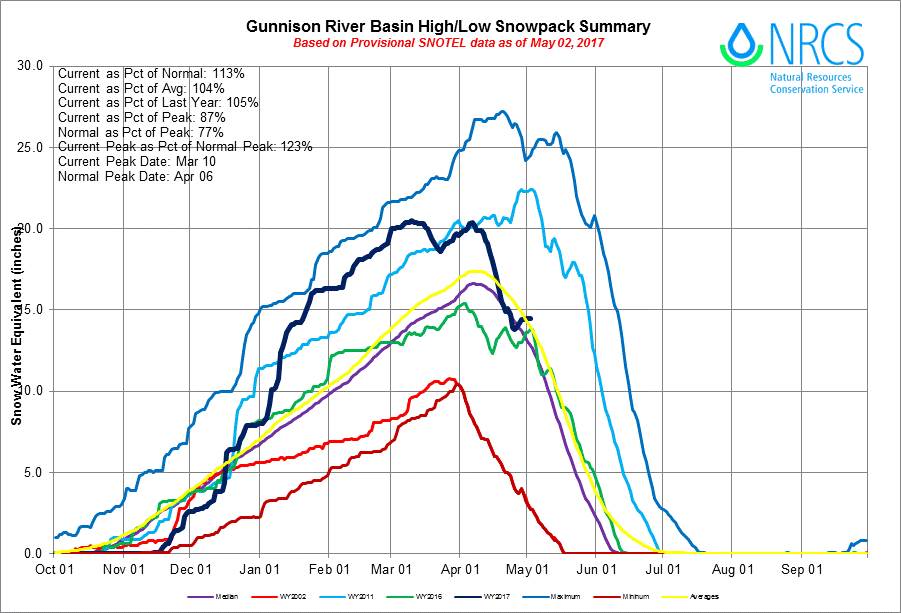
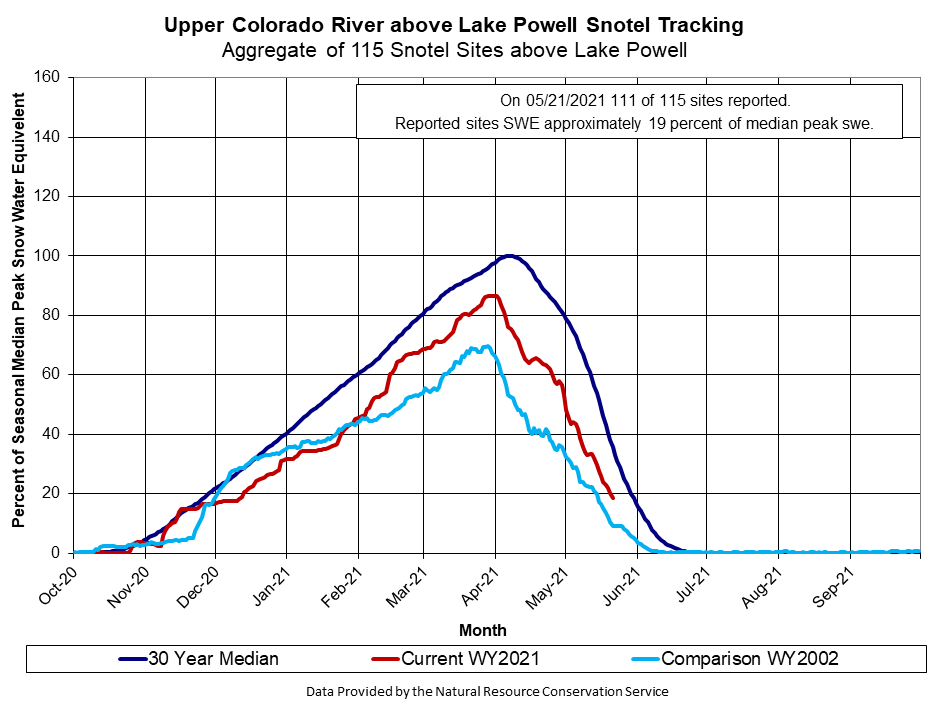
Gunnison River Basin High/Low graph May 2, 2017 via the NRCS.
Click here to read the newsletter from the Gunnison Basin Roundtable. Here’s an excerpt:
Introduction
This newsletter is a project of the Gunnison Basin Roundtable to serve all water stakeholders in the basin. Since we all depend on water, that means everyone! The newsletter operates in conjunction with the http://GunnisonRiverBasin.Org website, which is still under construction but already has some good information. Please send your feedback on the newsletter and the website, as well as announcements of events you would like to have featured in future newsletters, to info@gunnisonriverbasin.com.
News
COLORADO REACHES A SECOND PEAK AFTER A WARM SPELL
After a very dry start to the winter, the snowpack in the mountains of the Gunnison Basin started piling up in December and hit a first peak in early March, about a month earlier than average. Unseasonably warm temperatures brought significant melting, but storms at the end of March increased accumulations again, at least at higher elevations.
Here’s the release from the Arkansas River Basin Water Forum (Jean Van-Peldt):
Denver Water lawyer to share message of cooperation
Water agreements are always tricky, a matter of give and take.
Most importantly, they require cooperation.
That’s the message Patricia Wells, general counsel for Denver Water, will bring to the Arkansas River Basin Water Forum when she kicks off the second day of the forum on April 27 at Hotel Elegante, 2886 S. Circle Drive, Colorado Springs. The two-day forum will feature panels and tours to discuss water issues of concern to the Arkansas River basin, and El Paso County in particular.
“We’ll be talking about examples of how, when you’re dealing with the supply gap, you need to deal with others,” said Wells, who is also a member of the Colorado Water Conservation Board. “Multiple parties can accomplish more.”
Wells has represented Denver Water since 1991, coming on board just after the EPA veto of Two Forks. It changed how the state’s largest water provider dealt with the growth of its system, as well as the way it treated its neighbors. Wells came superbly prepared for the job, with her background as Denver City Attorney and as a staff attorney for the Environmental Defense Fund.
“The Two Forks veto came as a result of the environmental laws in the 1970s and ‘80s and was a paradigm shift,” Wells said. “Most large water organizations have gone through a metamorphosis in the last 30 years.”
In the case of Denver Water, that has meant two of the most far-reaching agreements in the history of Colorado Water, both occurring during Wells’ tenure at the legal helm. They were very different types of negotiations.
The first was the Colorado River Cooperative Agreement, which brought together 40 parties, primarily on the Western Slope, which had fought for decades over Denver’s appropriation of Colorado River water. Denver sought the support, or at least lack of opposition, from the communities in order to enlarge Gross Reservoir, a key supply for Denver Water located in Boulder County.
“We did all the right things,” Wells said. “But we’re still in the 13th year of permitting on Gross Reservoir. If we can’t get Gross Reservoir done then water projects can’t be done in Colorado.”
The second was the WISE (Water Infrastructure and Supply Efficiency), which looked at how Denver, Aurora and water providers in the South Metro Water Supply Authority could pool resources.
They were far different negotiations, but the common thread was the need to work together for common interests and to overcome operational hurdles.
“The state Water Plan talks about CRCA and WISE as how projects should be developed,” Wells said. “But I don’t think there’s a single way to do things.”
The Upper Arkansas River Voluntary Flow Management Program, which will be discussed in one of the workshops at the forum, is an example of multiple parties working together in the Arkansas River basin. That program has been in effect since 1991.
“These agreements take a lot of time to put together and a long time to get organized,” Wells said. “It’s about how you work with other people and why you work with other people.”
Registrations and information about this year’s forum are available at http://www.ARBWF.org.
Arkansas River Basin — Graphic via the Colorado Geological Survey
Seven Western Slope Republican lawmakers have sent Gov. John Hickenlooper a message: No more water for the Front Range until it better uses what it already has.
The message, delivered through a Feb. 4 letter obtained by The Colorado Independent, is directed mostly at just one area of the state: Denver and the northern Front Range.
For the past 100 years, as the Front Range population and the state’s Eastern Plains agricultural economy have grown, water from the Western Slope has been diverted to the Front Range through a series of tunnels built through the mountains, known as transmountain diversions. But Western Slope water watchers are getting increasingly nervous about the potential for more of those diversions, pointing to a growing need for water in their area for agriculture and recreation and to fulfill multi-state contracts that require Colorado to send Western Slope water to other states, such as California, Arizona and Nevada.
The Front Range must do a better job of storage and conservation before turning to more diversions, the lawmakers wrote. To that end, they implored the governor to make sure any water projects that receive state funds match criteria outlined in the Colorado water plan. The plan calls for the state to conserve at least 400,000 acre-feet of water and to build storage, without specific projects identified, for another 400,000 acre-feet of water. One acre-foot of water is 326,000 gallons, the amount of water used by two families of four per year.
“We would ask for the consistent – and transparent – use of those criteria” when looking at new water projects that would divert water from the Western Slope to the Eastern Slope, they wrote.
The letter is a follow-up to one sent in November 2015, just before the water plan was finalized. That four-page document said the water plan “cannot place Front Range development interests over the autonomy, heritage and economy of Western Slope communities. Nor can the Plan allow the protection of agriculture in one area of state [sic] to come at the expense of agriculture in other areas of the state.”
The water plan is intended to address a looming water shortage of one million acre-feet of water by 2050, when the state’s population is expected to nearly double from about 5 million to more than 10 million people.* The lawmakers worked with the Northwest Colorado Council of Governments’ water committee on both letters, said Torie Jarvis, the staff person to the committee. She said the letters are primarily directed at the South Platte Basin, which covers most of the northern Front Range, the northern half of the Eastern Plains and the Denver metro area.
Jarvis said the letter is not about current water projects underway in the region that also plan to use water from the Western Slope, most notably two reservoir projects under the control of the Northern Colorado Water Conservancy District.
“We have good agreements in place” on those projects, Jarvis told The Colorado Independent.
The issue also is the water plan itself. “It imagines what a new diversion would look like,” Jarvis said, which means a focus on development and growth rather than on conservation.
The 2015 letter was signed by eight Republican lawmakers, six of whom are on the 2017 version (two of the 2015 signees are no longer in the legislature). The five Democratic lawmakers who also represent the Western Slope were not included. Also not included: Rep. Diane Mitsch-Bush of Steamboat Springs, a member of an interim water resources review committee that led a statewide review of the water plan. Mitsch-Bush said she had not been asked to sign it but would have, based on its description. Jarvis said the Republican lawmakers decided who should sign the letter, adding that she believes all of the Western Slope Democrats would have signed it.
James Eklund, executive director of the Colorado Water Conservation Board, which authored the water plan, said this week that the letter “underscores the importance of Colorado’s Water Plan and demonstrates that implementation will be a collaborative effort.”
He also noted that an annual water projects bill that was introduced in the state House last week would focus on implementing key parts of the state water plan and would address water needs in every part of the state.
*Correction: to note that Colorado’s population in 2050 is expected to be more than 10 million people.
Yampa/White/Green/North Platte river basins via the Colorado Geological Survey
From the Colorado Ag Water Alliance (Marsha Daughenbaugh) via Steamboat Today:
If you have an agriculture water right, then the Colorado Ag Water Alliance workshop is for you. If you are concerned about the future of Colorado’s water, then the CAWA workshop will be of interest to you. If you want to learn more about water, you might attend the CAWA workshop.
The Colorado Ag Water Alliance is composed of representatives from all the major ranching and farming organizations in the state. The organization’s goal is to preserve Colorado’s irrigated agriculture through education and constructive dialogue. Its role is to provide the best information to Colorado’s agricultural water users and increase the understanding of water rights to help balance the gap between limited water supplies, population growth and the deficit in the Colorado River Basin.
CAWA engages with a variety of entities to address environmental and economic concerns. Currently, CAWA is hosting a series of meetings throughout Colorado to allow and encourage agricultural producers to take an active role in the implementation of the Colorado Water Plan.
A workshop for the Yampa-White-Green River Basins will be held from noon to 4 p.m. March 22 at the Steamboat Springs Community Center, 1605 Lincoln Ave. The workshop is free, and lunch, featuring locally produced food, will be served.
Discussion topics will include the Colorado Water Plan, status of the Colorado River Basin, alternative transfer methods, water leasing, water banking, “use it or lose it” policies, water efficiency and waste, challenges of ditch renovations, collaboration opportunities and research results.
Speakers from CAWA, Colorado Water Institute, Colorado Cattlemen’s Association, Colorado River Water Conservation District, Colorado Division of Water Resources, Colorado Water Trust, Trout Unlimited, The Nature Conservancy and the Maybell Ditch Company will give spirited, quick presentations explaining different parts of Colorado’s complex water issues. Attendees will be encouraged to ask questions and provide feedback throughout the afternoon.
Colorado’s population is predicted to double to 10 million people by 2050, bringing with it a water shortage of more than 500,000 acre-feet per year. Agricultural water rights are being scrutinized as a potential solution to the deficit.
Ideas take time and multiple discussions before anything becomes reality. This workshop is part of a much larger conversation, and it is critical that agricultural producers provide their invaluable knowledge and voices to the deliberations. If not you, then who will speak up? This is a close-to-home opportunity for Northwest Colorado agriculture to participate.
Those planning to attend are encouraged to RSVP to yampaag.eventbrite.com for a lunch count.
This workshop hosted by CAWA, Community Agriculture Alliance and the Yampa-White-Green Basins Roundtable. Other sponsors include CSU Routt County Extension, Colorado Cattlemen’s Association, CSU’s Colorado Water Institute, Colorado Water Conservation Board, Colorado Corn and Rocky Mountain Farmer’s Union.
Marsha Daughenbaugh is the executive director of the Community Agriculture Alliance and a member of the Routt County CattleWomen.
A screenshot from the website for Colorado’s Water Plan.
From the Colorado Ag Water Alliance via The Ag Journal:
The next Colorado Ag Water Alliance (CAWA) Ag Producers’ Water Workshop will be held Wednesday, March 22, at the Steamboat Springs Community Center, 1605 Lincoln Ave., Steamboat Springs, Colorado, from 12 p.m. to 4 p.m. The event is free, and the organizers hope to have a good turnout of producers in the region.
The Colorado Water Plan aims to address the water needs of cities, agriculture and the environment in light of projected shortages. Agriculture is a focus.
What are alternative transfer methods? What’s the motivation for farmers and ranchers to participate in leasing or to improve irrigation efficiency? What are the barriers?
Brief, highly-focused presentations and panel dialogue will cover the basics, followed by opportunity for ag producers to ask questions and engage in dialogue about what they see as opportunities and barriers—and how those barriers and opportunities might best be addressed.
In January the Colorado Water Conservation Board granted the Upper Gunnison River Water Conservancy District (UGRWCD) and partners $175,000 to begin local watershed management planning efforts. The funding will support the gathering of baseline information, initial stakeholder outreach, and future needs assessments in three Upper Gunnison tributary basins from 2017 to 2020.
The goals of the Upper Gunnison Basin Watershed Management Plan are to protect existing water uses and water quality, and improve relationships between different water users. The plan also seeks to understand whether there are gaps between available water and future uses, and how to best manage that water moving forward. Water experts predict that the Colorado population will rise exponentially, putting more stress on the Front Range’s limited water supply and thus the Western Slope, and changing temperatures will reduce water availability.
The planning framework developed by the UGRWCD includes needs identified in the Colorado Water Plan, but also focuses on agricultural and municipal uses. Irrigated hay and pasture meadows have rights to approximately 95 percent of the basin’s water resources. “Our planning process distinguishes between ‘watershed management’ and ‘stream management,’” explained UGRWCD board member and outreach coordinator George Sibley.
“’Stream management’ in the Colorado Water Plan focuses almost entirely on environmental and recreational needs. Watershed management covers our interactions with all of the water resources in the entire watershed, including groundwater, and water removed from streams for human purposes,” said Sibley…
Gunnison River watersheds encompass over 8,000 square miles of western Colorado and are critical headwaters of the Colorado River. “The Upper Gunnison River Basin is a headwaters basin, which means it is not yet really a river, but many flows of water becoming a river. Most of those streams organize themselves into seven main watersheds, each unique in its natural and human cultural geography,” said Sibley…
Locally, the assessments will begin with the Ohio Creek, East River and Lake Fork watersheds, providing a framework for the other four watersheds over the next four years.
Each watershed study begins with a needs assessment inventory of known and anticipated needs stretching out to mid-century from industry, recreation, agriculture, and human settlements in general—while subsequently identifying areas with significant environmental concerns.
The studies will seek to understand ecosystem function needs, river flows, infrastructure in need of improvement, water quality impairment issues, and ensuing legal frameworks. This first phase will also address information gaps and develop pilot projects to demonstrate best management practices. Pilot studies and demonstration projects in each watershed will look at options to reconcile instream and diversion needs. Potential demonstration projects include ditch repair, stream channel reconfiguration, wetland enhancements, coordination irrigation or other conservation practices.
The UGRWCD will be the coordinating agency for the watershed management planning processes, working with other water-related agencies and organizations within the Upper Gunnison Basin, including but not limited to the Gunnison County Stockgrowers Association, the seven municipal/domestic water suppliers in the Upper Gunnison Basin, Trout Unlimited, High Country Conservation Advocates, the Coal Creek Watershed Coalition, the Lake Fork Conservancy, recreational organizations, and federal and state land management agencies.
Colorado River headwaters tributary in Rocky Mountain National Park photo via Greg Hobbs.
Here’s a guest column from Paul Bruchez that is running in Steamboat Today:
A few years ago, I saw an opportunity to fix the irrigation problems while also improving river and wildlife habitat. My family’s ranch is in one of the most intact traditional agricultural communities remaining in Colorado. Like most ranchers, we’re independent folks — but in a pinch, we know we can count on each other.
Our neighbors came together and agreed on the need for action. Our group of 11 private ranches and the Bureau of Land Management, the irrigators of lands in the vicinity of Kremmling, received a couple of grants for a pilot project to restore a riffle/pool structure on a stretch of the river. It was an exciting start.
But I quickly realized that, given the scale of the problems, we needed to think bigger.
We worked with a variety of partners — Trout Unlimited, American Rivers, the Colorado Basin Roundtable, the Colorado Water Conservation Board, Grand County government, Northern Water, Denver Water, Colorado Parks and Wildlife, the Upper Colorado River Alliance, the Colorado River District and other river stakeholders — to put together an ambitious proposal for restoring a significant stretch of the Upper Colorado River.
In December, the U.S. Department of Agriculture’s Natural Resources Conservation Service recognized that big vision, awarding ILVK and our partners $7.75 million under the Regional Conservation Partnership Program to improve irrigation systems and reverse the decline in water quality and fish habitat in the headwaters of the Colorado River.
This funding is an amazing win for all Coloradans, because a healthy Colorado River sustains all our lives.
The Colorado River Headwaters Project will install several innovative instream structures designed to improve water levels for irrigation, while enhancing critical river habitat by rebuilding riffles and pool structure. A crucial piece will be restoring approximately one mile of the Colorado River’s former channel, currently inundated by Windy Gap Reservoir. This ambitious bypass project will reconnect the river — for the first time in decades — and improve river habitat in the headwaters area.
When fully implemented, the Headwaters Project will directly benefit more than 30 miles of the Colorado River and 4,500 acres of irrigated lands and make available up to 11,000 acre-feet of water to improve the river during low-flow conditions.
What have I learned from this project? That the interests of agriculture producers can align with the interests of conservation groups, state agencies, water providers and other river users. It’s not just the waters of the Colorado River that are connected — so are the people who depend on it.
The Colorado River flows through all of our lives. By working together, we can find smart, creative solutions that keep the Colorado healthy and working for all of us.
Paul Bruchez is a rancher who lives near Kremling.
Engaging with the Colorado River Basin States
CWCB Director James Eklund represents the State of Colorado in water-related discussions with the other six Colorado River Basin states and the federal government. Most recently, he has been working with Colorado’s fellow seven Basin States on drought contingency planning. Efforts within the Upper Basin include negotiation with the Department of the Interior on reservoir optimization to protect critical elevations at Lake Powell, exploring the feasibility and opportunities for demand management through voluntary conservation such as the System Conservation Pilot Program, and encouraging additional supply augmentation through weather modification and phreatophyte removal.
In addition, Director Eklund has played an active role in negotiations regarding “Minute 32X,” a sub-agreement to the 1944 treaty between the U.S. and Mexico regarding the waters of the Colorado River. The U.S. and Mexico are seeking a Minute that will extend the environmental protections and infrastructure-maximizing provisions of Minute 319, with new drought response measures that help share the burden of stressed supplies. Discussions will continue through the end of 2017 with Colorado engaged and active at the negotiating table.
James Eklund and Governor Hickenlooper roll out the Colorado Water Plan, Thursday, November 19, 2015 via The Colorado Independent
Here’s a guest column from Crisanta Duran that’s running in The Pueblo Chieftain:
In the American West, nothing is more vital or sacred than water.
Colorado has a rich and complicated history with the resource, one that is colored by some successes, but also many conflicts and challenges. But because of the work of thousands of Coloradans on our state’s first-ever comprehensive water plan, our water future could be very bright indeed. That bright future, however, will require a lot more hard work.
A little more than one year ago, Gov. John Hickenlooper announced the completion of Colorado’s water plan, developed by the Colorado Water Conservation Board after two years of meetings across the state, input from the state’s eight basin roundtables, and the considered comments of more than 30,000 Coloradans from across the spectrum, including Colorado’s ranchers and farmers. It is a landmark policy document that will drive decisions about Colorado’s water for decades into the future.
The plan itself is ambitious, but implementing its component parts, though challenging, will be critical to our state’s future. Smart growth of our state requires tackling looming threats to our water supply, and the plan sets out a clear guide path to do just that.
There is both a conservation and economic imperative for implementing the Colorado Water Plan. We absolutely must have healthy rivers to power Colorado’s thriving recreation and tourism economies while also defending our agricultural community’s needs. In 2014, 71.3 million visitors came to Colorado and spent $18.6 billion, much of it on activities in Colorado’s great outdoors. We must ensure our rivers remain healthy so that future generations can continue to enjoy all the benefits our waterways provide.
The Colorado Water Plan set unprecedented statewide water conservation targets in cities and towns, prioritizing conservation as never before.
The conservation goal for towns and cities equates to nearly 1 percent per year water use reduction by 2050, which, while ambitious, is absolutely achievable
If met, the conservation goals and flexibility envisioned for users enshrined in the Colorado Water Plan will help both towns and cities meet their needs and keep our farms and ranches a key part of the Colorado landscape and economy.
For example, the CWP provides more flexibility for ranchers and farmers to share water with towns and cities, and to keep water in streams without jeopardizing future access to their water rights.
The plan also creates frameworks for much more comprehensive evaluations of new water projects to avoid costly diversions, helps keep Western Slope rivers flowing, and provides for comprehensive management plans for Colorado’s rivers. In short, if it continues to be implemented, the plan will preserve our water supply for ranchers and farmers, help to foster our outdoor recreation economy, and protect our quality of life now and into the future.
Creating a sustainable water future for Colorado is not only vital economics — it is vital to our local communities and our history as a state, including Latina and Latino communities whose long history in Colorado is intrinsically linked to Colorado’s waterways.
For centuries, Colorado’s rivers and streams have been integral to Colorado’s rich culture and way of life. Our rivers provide us with a collective sense of “querencia,” a place in which we know exactly who we are, the place from which we speak our deepest beliefs.
Protecting the Colorado and other rivers is not just smart water management for our state; it builds upon our tradition of responsible use and conservation for the benefit of future generations. Colorado’s rapid growth only compounds the need for urgent and continued action.
Crisanta Duran is speaker-designate of the Colorado House of Representatives. Lucia Guzman is minority leader of the Colorado Senate. Both are Denver Democrats.
Here’s a guest column from Bart Miller that’s running in The Grand Junction Daily Sentinel:
Water is the lifeblood of Colorado, and yet demands for water to support population growth, agriculture, and businesses are increasing while available water supplies are not.
Climate change is also having a growing impact in an already water-scarce region, and Colorado’s population is predicted to double by 2050. Not surprisingly, water scarcity was found to be one of the top concerns of state residents in the latest State of the Rockies Poll Project while 77 percent of Coloradoans support more conservation and water reuse as opposed to only 15 percent who support diverting water from rivers and streams. The good news is that we’ve had a sound first year implementing the state’s new water plan and now we need our state Legislature to help.
One year ago, Colorado’s water plan established goals for ensuring enough water for vibrant cities, viable agriculture, and healthy rivers that sustain wildlife, recreation and local economies. For West Slope communities like Grand Junction, the plan contains a number of provisions to safeguard West Slope interests every bit as much as those of the Front Range.
The Colorado Water Conservation Board recently approved a new budget of $25 million annually over the next few years for implementation. This budget includes funding for water conservation to help reach our state goal of saving 400,000 acre-feet of water, which would reduce water use by approximately 1 percent per year. The budget advances cost-effective measures to help communities make the most of every drop, like fixing leaky infrastructure and increasing water reuse technologies. Also included: $5 million annually for stream management and watershed restoration plans — essential for both healthy ecosystems and our thriving recreational economy.
The plan’s criteria “checklist” for evaluating what water projects receive public funds also started to gain steam by being embedded in the grant process for local river basin roundtables. The common-sense checklist evaluates whether projects have community support, prevent environmental degradation, are feasible, and meet real water needs. Ensuring local community support is essential for protecting West Slope resources.
We’ve run a good first lap, but there are miles to go to meet new water demands and protect Colorado’s rivers. In the coming year, we need development of alternative agricultural water agreements that support agriculture rather than “buy and dry” scenarios where cities buy up water rights that never return to agricultural producers. We need urban water conservation embedded into land use decisions so new development is water-smart from the start, reducing pressure to divert water from the West Slope to the Front Range. We need funds so local stakeholders can assess river health and create local stream management plans.
Most immediately, we need the Legislature to approve the $25 million plan budget developed by the Colorado Water Conservation Board. The plan’s proposals have the support of the vast majority of Coloradans. Ultimately, the water plan’s long-term success requires collaboration among diverse stakeholders to ensure we help all local economies that rely upon Colorado’s rivers. Please join us in asking our state representatives to help by putting the water plan and our communities first.
Bart Miller leads Western Resource Advocates’ program protecting healthy rivers; improving water efficiency; and drawing the connection between water, energy, and climate change.
Flood irrigation in the Arkansas Valley via Greg Hobbs
Here’s a guest column from James Eklund and Russ George that’s running in the The Grand Junction Daily Sentinel:
One year ago, Gov. Hickenlooper presented Colorado’s Water Plan, the result of unprecedented statewide collaboration over 2½ years to ensure sufficient water supplies to keep our cities, farms and environment thriving even as Colorado is expected to add millions of people in coming decades.
Since that time, the Colorado Water Conservation Board and its many partners have started the work of implementing the plan, a process that will unfold over years and be carried forward by all those involved in our water future: ranchers, farmers, cities, water utilities, environmentalists, anglers, developers and many more who care deeply about water’s central place in our beautiful state.
Colorado’s Water Plan includes a series of actions, processes and metrics that put the state and its eight major river basins on a more collaborative path to manage our water in the face of constrained supplies and rising population. These include criteria to guide new storage projects, goals to more smartly share water between farms and cities without the dry-up of agricultural lands, steps to improve degraded streamways and methods and benchmarks for water conservation.
The public has been a full participant in the development of Colorado’s Water Plan, with more than 30,000 comments helping shape the document. Direction from nine basin roundtables representing local interests within each river basin formed the backbone of the document. With such deep public involvement to craft the plan, it’s important Coloradans stay engaged in the work so many are doing to implement it. Through a website, http://www.colorado.gov/pacific/cowaterplan, and updates like this one we are devoted to sharing progress on the plan. Among our many steps forward:
Storage: CWCB is financially supporting a variety of water storage innovations, including a study of options in the South Platte Basin, exploring groundwater storage technology and a spillway analysis to identify places where existing storage could be expanded; water representatives across jurisdictions began work to streamline federal permitting while maintaining strong environmental protections.
Agriculture: The CWCB and other stakeholders are continuing to explore creative ways to support the temporary transfer of agricultural water that protects farming and meets the water plan goal of sharing 50,000 acre of water by 2050. Workshops and conferences geared toward this end continue and a pilot project in the Arkansas River Basin is in its second year with favorable results.
Environment and recreation: CWCB is securing $5 million for work with basin roundtables and other groups to develop watershed restoration and stream management plans to improve waterways and water quality. The CWCB, in partnership with Colorado Parks and Wildlife, Denver Water and The Greenway Foundation, is funding a large “environmental pool” at Chatfield Reservoir to improve flows and fisheries in the South Platte River through the metro area.
Supply and Demand Planning: The update for the latest Statewide Water Supply Initiative began this year and will refresh Colorado’s baseline information on water supplies, data critical to work outlined in the water plan. CWCB and the Interbasin Compact Committee are revising Water Supply Reserve Fund criteria to ensure funding requests for water-related projects meet a standard that aligns with water plan goals and measurable outcomes.
These examples serve as only a sampling of the work launching in 2016 to implement Colorado’s Water Plan. Other activities across the state, including major storage projects that won the state of Colorado’s seal of approval using water plan criteria and a near-term funding plan to support storage, education, conservation, reuse and agricultural actions called for in the plan, also signal initial implementation steps.
The CWCB is moving on many fronts to ensure Colorado’s Water Plan unfolds in a way that assures we manage our precious water supplies to preserve the best of Colorado while allowing cities, farms and our environment to flourish amid continued growth. In the same way the CWCB, General Assembly, water providers, agricultural organizations, environmental groups, local governments, business and the public at large collaborated to build Colorado’s Water Plan, we look forward to our continued work together to put the plan to work.
James Eklund is the director of the Colorado Water Conservation Board. Russ George is chairman of the 15-member board governing CWCB staff.
A Colorado Water Conservation Board proposal, sent to state lawmakers last week, recommends the stream-saving action to meet state environmental and economic goals. It remains unclear who would enforce the community watershed plans.
But there’s little doubt streams statewide are strained by thirsts of a growing population expected to double by 2060, according to state officials. And a Denver Post look at the latest water quality data found that 12,975 miles of streams across Colorado (14 percent of all stream miles) are classified as “impaired” with pollutants exceeding limits set by state regulators.
Creating local watershed plans to save streams is essential, said James Eklund, the CWCB director and architect of the year-old Colorado Water Plan. Eklund pointed to low-snow winters and drought in California’s Sierra Nevada, where 2015 snowpack at 5 percent of average forced a declaration of a state of emergency requiring 25 cuts in urban water use.
“When our Colorado mountain snowpack drops below 60 percent of average, we get nervous. If it happens in the Sierras, it can happen in the Rockies,” he said. “We need to protect certain streams before a crisis. We have got to get on this quickly.”
No single agency oversees waterway health. State natural resources officials monitor flow levels in streams and rivers. They run a program aimed at ensuring sufficient “in-stream flow” so that, even during drought, streams don’t die.
Meanwhile, the Colorado Department of Public Health and Environment sets standards on maximum levels of pollutants that people and companies are allowed to discharge into waterways. In 2015, only 51.6 percent total stream and river miles in Colorado met quality standards, and 30.1 percent of lake surface acres met standards, according to a CDPHE planning document.
“If stream flows are low, there is less dilution in the stream to handle the addition of pollutants through permitted discharges,” CDPHE water quality director Pat Pfaltzgraff said in responses sent by agency spokesman Mark Salley.
Yet CDPHE officials do not make recommendations to natural resources officials about water flows necessary to improve stream health.
The health department has made separate “watershed plans.” CDPHE officials “are considering broadening the division’s watershed plans to include ecosystem health that might be more consistent with stream management plans.”
Pfaltzgraff declined to discuss stream health…
CWCB chairman Russ George supported the push to create local watershed plans, to include detailed maps covering every stream.
“Every stream and tributary needs to be inventoried. … It should have been done a long time ago,” George said in an interview last week.
“We have kind of hit the population and demand place where we have to do it. We didn’t have to do it for the first part of history because the population was small and there wasn’t the impact of all the issues we are getting into now,” he said.
The CWCB voted unanimously last month to ask lawmakers to approve $5 million a year for up to five years to launch local stream planning.
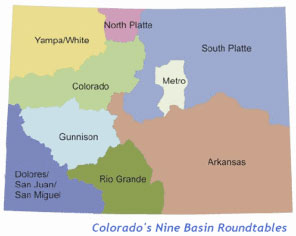
Basin roundtable boundaries
The plans are to be developed within the eight river basin “roundtable” forums that Colorado has relied on for addressing water challenges. These groups draw in residents with interests in stream health who helped hash out the Colorado Water Plan, which was finalized last year and calls for statewide cuts in per person water use by about 1 percent a year.
Conditions along Colorado streams vary, said Bart Miller, healthy rivers program director for Boulder-based Western Resource Advocates. “There are plenty of streams that have problems.”
While state natural resources officials run the program aimed at keeping at least some water in heavily tapped streams, survival in a competitive environment is complex. Leaving water in streams for environmental purposes often depends on timing, when the mountain snowpack that serves as a time-release water tower for the West melts, the amount of snowpack, and needs of cities, pastures and farms.
Collaborative local forums to find flexibility to revive streams “is a great approach.” However, state officials eventually may have to play a central role converting plans into action, Miller said.
“The state should help both in funding the planning but also in implementing the plans,” he said. “We have a lot of work to do. This matters because this is about ‘the Colorado brand.’ Everyone depends on healthy rivers.”
The roundtable forums in communities draw in diverse stakeholders from cattlemen to anglers.
Irrigators and other water users west of Aspen already have created a “stream management plan,” for the Crystal River, seen as a model local effort. Their planning included an assessment of watershed health that found significant degradation above the confluence with the Roaring Fork River. They set a goal of reducing the estimated 433 cubic feet per second of water diverted from the river by adding 10 to 25 cfs during dry times. They’re developing “nondiversion agreements” that would pay irrigators to reduce water use when possible without hurting agriculture, combined with improving ditches and installation of sprinkler systems designed to apply water to crops more efficiently.
Enforcement of plans hasn’t been decided. “We’d like to see more enforcement” of measures to improve stream health, Rocky Mountain Sierra Club director Jim Alexee said. “We definitely think there’s room to do more. We also want to be respectful of the governor’s watershed process.”
Colorado has no history of relying on a central agency to enforce water and land use, CWCB chairman George pointed out.
“When you have a system designed to have everybody at the table, what you’re doing is recognizing there is a finite resource that is shared by everybody. And impacts are shared by everybody statewide. In order to keep from having some force dominate in ways that would not account for all statewide impacts, you need to diffuse the conversation into all areas. That is what roundtables do,” he said.
“When you do that, you’re going to get a better statewide result over time. … It is a process that is designed to get as many interests into the decision-making as you can. … It gets harder, of course, as the supply-demand makes pinches. For the rest of our lives, it is going to be that way.”
Colorado Water Plan website screen shot November 1, 2013
Click here to read the newsletter. Here’s an excerpt:
Colorado’s Water Plan turned one year old in November.
This CWCB Confluence issue is dedicated to celebrating the work of Coloradans across the state to implement the plan and ensure that the state’s most valuable resource is protected and available for generations to come.
Efforts continue throughout Colorado with implementation of the one-year-old state water plan, and Summit County is trying to do its part.
A countywide push led by the town of Frisco and the High County Conservation Center (HC3) recently garnered a $94,000 grant from the Colorado Water Conservation Board (CWCB) to move forward with a comprehensive Blue River watershed efficiency-planning project. The regional venture, scheduled to start in January 2017, has a total budget of $162,500, and matching cash and in-kind labor contributions from each of the county’s major municipal water providers make up the difference…
The Blue River itself acts as a source for drinking water and agricultural irrigation to Summit’s 29,000 year-round population, not to mention the countless visitors who spend time on the water body each year for recreation. Projections suggest the local population will increase by at least 5 percent over the next decade, meaning the need to conserve and discover additional efficiencies is one of the more painless ways to get ready for the additional ask.
“Water doesn’t recognize geopolitical boundaries, so it’s important we work as a watershed to accomplish some really good water conservation goals,” said Frisco Councilwoman Jessica Burley, who is also HC3’s community programs manager. “The state has set some interesting water goals, and it’s our job to go forth and conquer from a regional perspective. With these initiatives and this plan, hopefully we will make an impact on the Colorado River basin.”
[…]
The statewide plan calls for 400,000 acre-feet of new storage and that same total in conservation from urban areas. An acre-foot is the U.S. standard measurement for water bodies and equates to about 326,000 gallons. Sharing 50,000 acre-feet of water possessed by agriculture based on senior rights through alternative methods is another facet of the state plan.
Thus far, the execution of much of the lofty benchmarks has been sluggish, in part due to a lack of funding. It’s why obtaining dollars from the state for such municipal projects is so important. Not only does it provide capital at present while the research is done, but the initial approval also offers eligibility for future grants and loans. Without an CWCB-endorsed efficiency plan in place, funds are otherwise not available.
Mimicking a model previously created by the Roaring Fork Valley, Summit’s Blue River planning enterprise is backed by Breckenridge, Frisco, Copper Mountain Metro, Dillon, Silverthorne, as well as Summit County government — “So we all have a little skin in the game, so to speak,” said Burley — with the primary objective of reducing water consumption by a measurable amount in the next few years. The consortium anticipates a 14-month investigation and review process, followed by some potential actionable items, such as leak detection and repairs, education and outdoor watering mandates, as soon as a year after that.
“This is the first step into bringing the Colorado Water Plan to fruition,” explained Jim Pokrandt of the Colorado River District, a public policy agency in charge of protecting the named basin. “Part of being more water efficient is finding those leaks and stopping them. That’s efficiency at a systematic level, then it drills down to the retail level with things like lawn irrigation, efficient appliances and efficient spigots and showerheads.”
If it’s to be successful, putting the ambitious state plan into practice will ultimately fall more on the shoulders of each local community and watershed, he added, rather than through commands dictated at the state level. And that’s a summons Summit County leadership recognizes and is attempting to embrace one year later.
In the year since Gov. John Hickenlooper and the Colorado Water Conservation Board released a much-ballyhooed plan to grapple with a looming water shortage, a critical question remains: How to come up with the estimated $20 billion to pay for it?
“Money is a key part of making this work,” said Bart Miller, Healthy Rivers Program Director for the conservation group Western Resource Advocates.
The state’s share is expected to be about $3 billion, or about $100 million per year, beginning in 2020. The rest will come from local and regional water providers, who will pass on the costs to you through higher rates.
The water plan, adopted last November, seeks to head off the looming water shortage created by Colorado’s population boom. In 2050, the state’s population is expected to hit roughly 11 million, double what it is now. The water conservation board projects that demand will outstrip supply by about one million acre-feet of water per year, or enough water to satisfy four million families in Denver.
When Hickenlooper ordered the plan in 2013, he said “every conversation about water needs to start with conservation.” That’s among the two biggest goals of the plan: to ask Coloradans to conserve about 400,000 acre-feet of water per year. The second lofty goal is about storage – either above-ground reservoirs or refilling aquifers, especially in the Front Range – and that goal is also 400,000 acre-feet of water per year. An acre-foot is the amount of water it would take to cover Mile High Stadium from endzone to endzone with one foot of water.
The plan also aims to align water conservation with land-use planning, and calls for sharing of agricultural water and greater protection of watersheds.
The $20-billion cost of the plan is its biggest hurdle. In the plan’s first year, the state was able to invest about one-tenth of one percent of that, about $18 million, in various projects. The state also loaned $90 million to help a water storage project get off the ground near Loveland.
But, it’s not at all clear whether the state will be able to continue to raise even that much money in the short-term future. The General Assembly is tapping severance taxes to cover costs of projects related to the water plan, and that money stream, too, has gone from a stream to a trickle due to the slump in oil and gas, coal and mineral industries.
With the oil and gas industry struggling, it’s difficult for the water conservation board to figure out how to keep the water plan going “at high gear,” former Speaker of the House Russ George of Rifle and water conservation board chair told The Colorado Independent. What’s needed most is a predictable forecast of revenues in order to plan the projects that will solve the problems, he said. That’s just not something that’s possible right now with severance tax revenues and that makes paying for the water plan “risky these days,” he said.
The magnitude of the shortage predicted for Colorado has repercussions across the state, from cities to farms and ranches. The Colorado River, the state’s signature waterway, is already over-tapped. More water is needed from it than it produces annually.
In the year since the plan was adopted, the General Assembly passed an $8 million grant program that will, among other things, pay for a water supply study of the Bear Creek Reservoir, dredge state reservoirs to provide more water storage; and improve watersheds, the swaths of lands that drain all streams and rainfall to a common outlet. One million of the $8 million was earmarked for an update to a water conservation board study that projected the gap between supply and demand would hit one million acre-feet shortage a year by 2050. Water experts now say the shortage is likely to be greater.
The state Legislature also kicked in another $5 million as part of an annual water projects bill. The projects include watershed-level flood and drought planning; funding for water forecasting and measuring, money to update re-use regulations and a training program on water loss.
Basin roundtable boundaries
And nine statewide groups, known as roundtables, spent another $7.1 million in state funds for dozens of projects including a study of storage along the South Platte River, repairs to ditch infrastructure in the Arkansas Basin, community forums and education plans in several communities, creek restoration. The state water plan, which took two years to draw up, relied on the work of the roundtables, which are tied to eight of the state’s major rivers, plus another group for the Denver metro area. The nine groups include representatives of municipal water providers, environmental groups, recreational water users, industry and agriculture.
One of the major collaborations in the first year has been among the four western roundtables (Yampa/White River, Colorado, North Platte and the Southwest) and the Colorado Water Conservation Board on the first phase of a $52,000 study to examine the possibility of a “call” on the Colorado River. Seven states downstream of Colorado would exercise their rights under contracts made with the state to draw more water out of the river that originates here. Such a “call,” has become increasingly probable because both Lake Powell on the Utah-Arizona border and Lake Mead on the Nevada-Arizona border are reaching levels so low the lack of supply could jeopardize the generation of hydroelectricity that supplies the Western power grid.
The chance that the states will issue a call, a situation that could create havoc among them — as well as in Mexico, which also relies on Colorado River water — is on the horizon, but not imminent, said Chris Treese of the Colorado River District.
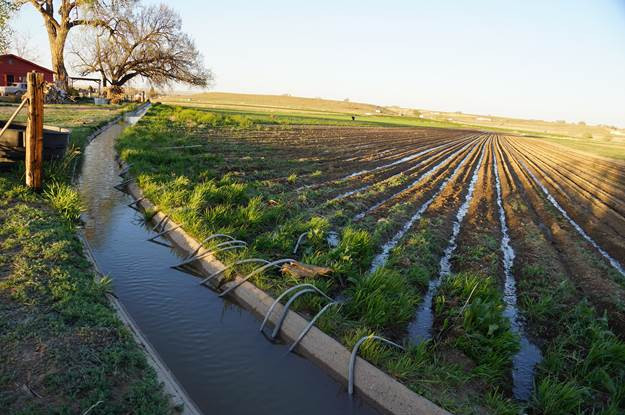
Colorado agriculture also faces a supply-and-demand gap, and the conservation board teamed up with the Department of Agriculture to devise ways to save water and preserve rural Colorado’s farming and ranching communities and their cultures. The hope is to avoid “buy and dry,” the practice employed by municipal water providers to buy farm and ranch land for its water rights, leaving the land unsuitable for farming. Alternative transfer methods, or ATMs for short, allow farmers and ranchers to lease water rights, rather than sell off their land and the water rights that go with it. ATMs also encourage farmers and ranchers to plant crops with shorter growing seasons.
Colorado transmountain diversions via the State Engineer’s office
Farming and ranching use 89 percent of the state’s “consumed” water –meaning water that is used and doesn’t return to a waterway or ditch. Most of that agricultural water comes from the Western Slope and is funneled to the ag-rich eastern part of the state through tunnels built through the mountains during the 20th century.
The water plan’s goal is to use ATMs to conserve 50,000 acre-feet of water a year. The two ATMs currently in place are saving only a fraction of that – 2,500 acre-feet annually, said water conservation board Director James Eklund. “We’ve got a long way to go,” he told the board last week.
In addition to state funding, the success of the water plan relies upon local water providers and municipalities to continue to pay for much of the infrastructure needed to stave off a water shortage.
The Northern Colorado Water Conservancy District, based in Berthoud, is into the 12th year of a project to add 40,000 acre-feet of water (enough water to supply 160,000 families in 15 northern Front Range communities) to two reservoirs near Fort Collins and Greeley. A third project, to build the Chimney Hollow reservoir west of Carter Lake in Loveland, will add another 30,000 acre-feet of water. Total cost for the three projects: around $1.2 billion. Chimney Hollow is expected to break ground in about two to three years. The U.S. Army Corps of Engineers must give final approval for the Glade and Galeton reservoirs. That is not expected until 2018.
Denver Water also is working on a storage solution: the expansion of Gross Reservoir, west of Boulder. That expansion will add 77,000 acre-feet of water, almost all of it for Denver Water customers along the Front Range at a cost of $380 million. That, too, counts toward the $20 billion cost of the water plan.
As implementation of the water plan began last year, some conservationists complained of a slow start. But, a year in, groups including Conservation Colorado, Western Resource Advocates and American Rivers collectively deemed this year’s efforts to be “a good first lap,” according to a statement issued by the groups last week.
As the 2017 legislative session approaches, Hickenlooper’s administration is preparing to ask lawmakers to approve a three-to-five-year $55 million funding plan that would provide grants and loans for water projects. The money would come from a reserve fund controlled by the Department of Natural Resources. Of that $55 million, $10 million would go directly to fund projects tied to the water plan. Those projects are currently in the application process and have not yet been identified.
The $55 million also includes a $30 million loan guarantee fund for water providers that they can then use to obtain large loans in the financial markets. The CWCB estimates project participants could obtain up to $300 to $400 million in the finance market through this loan fund.
Board director Eklund echoed water conservation board chair George’s concern that severance tax and federal mineral lease revenues aren’t consistent and reliable forms of funding. So, too, did Miller of Western Resource Advocates, who also said it’s critical that the $55 million plan be adopted and the projects launched. The water conservation board is looking for other revenue sources that would provide more stable funding, although George and Eklund declined to identify what those sources might be.
However, The Nature Conservancy recently commissioned a study on various ways the state could generate the money needed to cover that $3 billion state obligation on the water plan. The study came up with nine ideas that could bring in between $10 million and $86 million per year. Those ideas included peak water use fees, a tourism fee; and fees on marijuana grow operations, paid for by consumers or the industry. Summit Economics, which conducted the study, said they would not make a specific recommendation, citing the need for more analysis based on water plan criteria. As a next step, the economists suggested the state gauge public opinion on the top two or three options.
Aaron Citron of the Nature Conservancy said the organization is primarily interested in the environmental goals of the plan, but acknowledged that the funds will support other goals as well.
The water plan wasn’t a high priority in the 2016 session; lawmakers were much more concerned about finding a way to fund transportation infrastructure and K-12 education.
Whether the $55 million ask in the coming session gets approved may depend on the selling job by the water conservation board and supporters of the water plan, including the governor. In the past several sessions, rural lawmakers have been loathe to touch severance tax revenue for anything other than its major intended purpose: to mitigate impacts of oil and gas or other mining activities in local communities. Many of those communities have have been hard hit by declines in oil and gas production and mining, but still have to deal with the impacts of those activities.
Republican Sen. Jerry Sonnenberg of Sterling says he doesn’t have much confidence in the way the water conservation board is proceeding with the water plan. Sonnenberg is most interested in seeing progress on building or expanding water storage, particularly along the South Platte River.
Sonnenberg, who chairs the Senate Agriculture, Natural Resources and Energy Committee, also is not wild about the water conservation board tapping a reserve to cover the $55 million request in 2017. The state, he said, should pay back the severance tax money it has been “stealing” for the last several years, which has often used to balance the budget or pay for other priorities. The water conservation board also ought to do a better job of prioritizing its projects, he said. It may result in a slower pace for the water plan, but the state has to figure out how to allocate the severance tax dollars it has, Sonnenberg said.
Democratic Sen. Pat Steadman of Denver, who sits on the Joint Budget Committee, said the administration’s $55 million request is reasonable and believes that severance tax revenues should cover it. But he also said this might not be the best time to make that request, given a recent court case involving oil giant BP.
Last spring, the Colorado Supreme Court ruled in favor of BP and against the Colorado Department of Revenue in a lawsuit over tax refunds. Energy companies are allowed to deduct transportation, manufacturing and processing costs from revenue when they value oil and gas for severance tax purposes. The Court ruled the energy companies could also include the cost of capital for transportation, manufacturing and processing, and the Court made the ruling retroactive to 2012.
The legislature, concerned that lots of other companies and individuals would seek similar refunds, put the state’s main revenue source, the general fund, on the hook to cover those refunds, estimated in August at about $51.4 million.
Hickenlooper has proposed clearing out several severance tax accounts to reimburse the general fund for those refunds, Steadman noted. And that’s going to cut back on what’s available to the water conservation board for its projects.
The public needs to be weighing in on this, George said, because the infrastructure that people want government to provide has to be paid for somehow. “Growth and demand are outpacing revenue available to modernize our infrastructure,” he said, adding,“that’s a political conversation that persists without solution. The state water plan will be held back if we can’t get over that hump of political decision-making.”
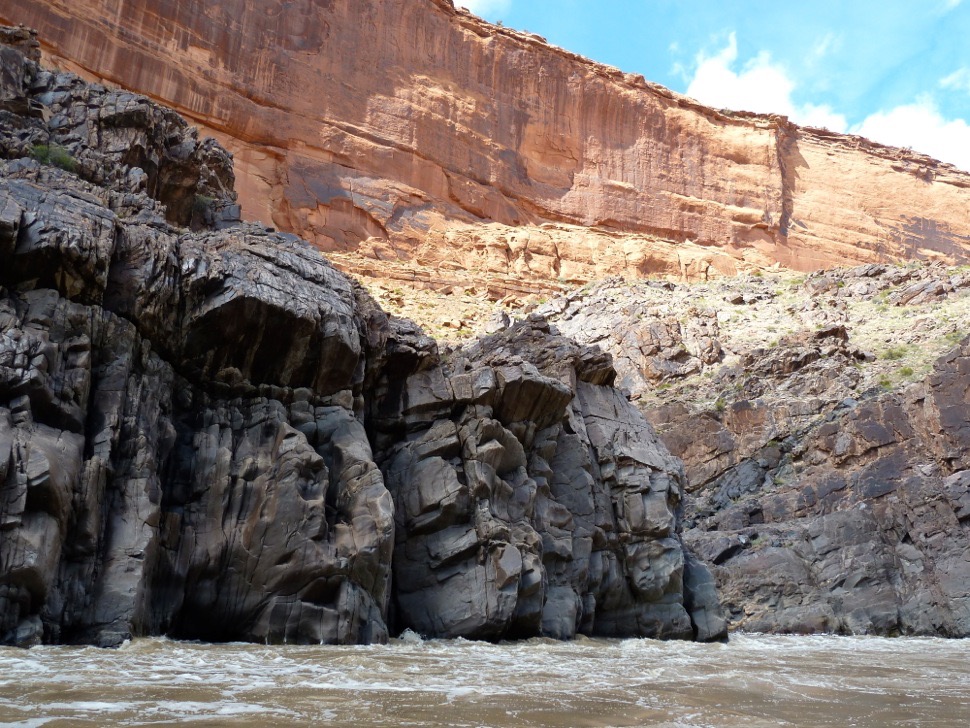
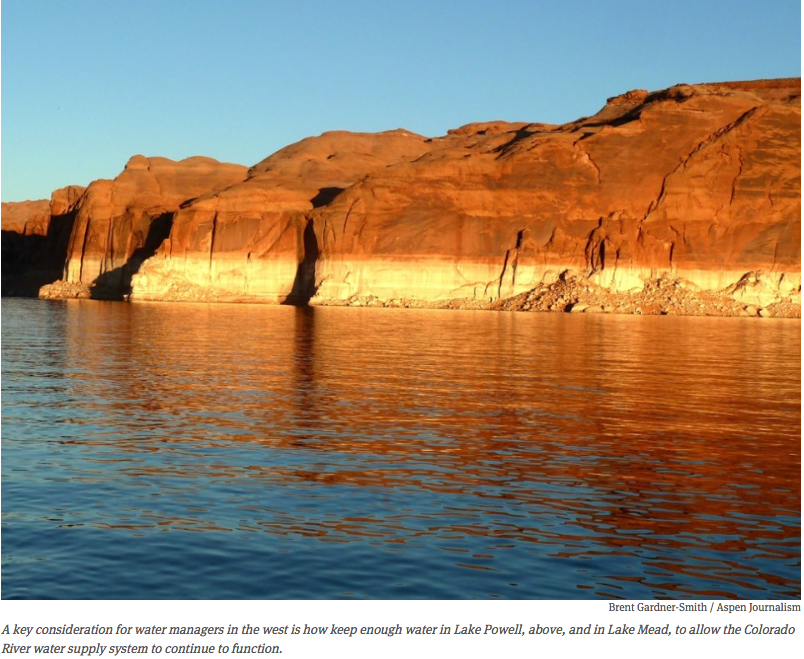
How much water reaches the Westwater stretch of the Colorado River, and then Lake Powell, is taking on increasing importance to Colorado water officials. A new study is underway to look at much more water is available to develop on the Western Slope, and it’s caught the attention of east slope water officials. Photo: Brent Gardner-Smith/Aspen Journalism
At the Colorado Water Conservation Board meeting the board pledged to secure $55 million in funds for implementation, a big win for year two!
Water is deeply intertwined in Colorado’s way of life. The water we drink, the businesses supporting our economy and the recreation we enjoy depends on clean water and flowing rivers. Until last year, Colorado was one of the few states in the west without a plan for managing our water.
In 2013, Governor Hickenlooper recognized the state needed a long-term water plan and through executive order directed the Colorado Water Conservation Board (CWCB) to work with stakeholders across the state to develop a comprehensive water management plan. Last year, important conversations between farmers and ranchers, environmental groups, water suppliers, recreation advocates and concerned citizens at public meetings, at the grocery store, and on the river paid off. In November 2015, Governor Hickenlooper signed the Colorado Water Plan committing our state to coordinated and sustainable water management for the next 35 years.
Photo via Brent Gardner-Smith/Aspen journalism
Colorado is a headwaters state for the Colorado River basin. The Colorado River not only matters to the state and its economy, but it also downstream to the six other states and Mexico that also depend on snowpack that originates here. How and why we manage our water not only affects us, but also our neighbors downstream.
Healthy, flowing rivers support our thriving economies like agriculture and recreation, and our growing cities. Clean water, and enough of it, are essential to support our growing region. Colorado’s heritage and culture is built upon our natural resources and rivers are at the heart of it all. With an abnormally dry fall, it is clear how critical it is to protect and restore our rivers and solidify our commitment to water conservation. Drought volatility varies from year to year across the southwest, and the continuation of this 15-year drought across the basin in the coming years is not out of the realm of possibilities.
November 16, 2016 marked the first anniversary of signing of the Colorado Water Plan. To celebrate the work that has been done across the state, Governor Hickenlooper proclaimed this date as Colorado Water Plan Implementation Day. This proclamation applauds efforts over the past year, and further supports the important work that must continue to move forward goals and objectives contained within the Colorado Water Plan. While this milestone is something to celebrate, implementation thus far has been slower than anticipated. However, at a recent CWCB meeting, new energy was breathed into the plan’s implantation when the CWCB pledged to secure funds for implementation. The CWCB voted to:
Direct the first $30 million of this request towards the creation of a loan guarantee fund
Focus the other $25 million towards funding other important objectives of the Plan, including: $10 million in supplemental funding for the Water Supply Reserve Fund to fund water supply projects; $5 million directed to the Watershed Restoration Program; $10 million towards Water Plan Implementation Funding that will fund non reimbursable investments
How does this funding help support healthy rivers and streams here in Colorado?
American Rivers, along with environmental partners and other stakeholders are gearing up to begin work on stream management plans on rivers statewide. These plans are a part of the Watershed Restoration Program, which focuses on developing methods to help manage important rivers and streams in Colorado to keep them healthy for both nature and people. As a part of the budget allocation, the CWCB pledged $5 million to help with the planning and development of Stream Management Plans.
The Colorado Water Plan can only be as successful as its implementation. We congratulate the CWCB and the Hickenlooper Administration for restating their dedication in this first year of the Plan. The Colorado State Legislature has an opportunity to continue the progress of the state’s first water plan by supporting the funding for water conservation measures and stream management plans as they approve the state budget. We must keep the pressure on to ensure future funding and support needed to protect our rivers for communities, agriculture, business, and wildlife. Our state’s future, and the health of an entire region, depends on it.
A screenshot from the website for Colorado’s Water Plan.
FromThe Grand Junction Daily Sentinel (Dennis Webb):
Colorado’s water plan hit its first birthday this month, prompting state water officials and some water activists to offer an assessment of how implementation has been going in addressing the state’s future water needs.
“I’d say that there have been quite a few activities done this past year,” said Bart Miller, Healthy Rivers Program director for the conservation group Western Resource Advocates.
But he and some others would like to see the state pick up the pace when it comes to work on the plan, which was an initiative of Gov. John Hickenlooper.
“We don’t want to see the plan sit on a shelf and gather dust,” said Craig Mackey, co-director of Protect the Flows, which represents more than 1,100 businesses that support protecting the Colorado River system.
James Eklund, director of the Colorado Water Conservation Board, a state agency, responded to such concerns during the board’s meeting last week, saying that “we are moving forward aggressively and I don’t think slowly at all.”
The plan sets out to eliminate, through a mix of conservation, new water projects and other means, what otherwise could be a 560,000-acre-foot gap between municipal and industrial water demand and supply in the state by 2050.
Miller credits the state for a number of recent actions it has taken to start carrying out the water plan. In September, the Board adopted new criteria for evaluating applications for loans and grants from its water supply reserve fund, which pays for projects that must be approved by the applicable local river basin roundtable. The new criteria are intended to match up with water plan goals, helping address identified water gaps, ensuring collaboration and local involvement, and avoiding or mitigating environmental and other impacts.
Miller also points to the $55 million in funding the Board approved last week related to the water plan. That includes $10 million in supplemental money for the reserve fund, the same amount for water plan implementation, $5 million for stream and watershed conservation, and $30 million in loan guarantee money.
The spending will require approval by the legislature in order to go forward.
Miller said while there’s still a long ways to go in carrying out the water plan, the approval of the spending is a good-faith show of progress.
“They’ve, I think, run a good first lap in this race and there’s quite a few laps to go,” he said.
But Mackey pointed to the billions of dollars the plan is expected to require to implement, and said educating the public about the plan and water in general is crucial.
“Our view is we’ve got a lot of work to do,” he said, as he called on everyone from Hickenlooper, to lawmakers, the business community and others to come together and show leadership in selling key components of the plan.
Part of Board’s meeting last week was devoted to reviewing educational efforts the agency is undertaking to show what work it has been doing on various elements of the plan. Among the achievements it cites are initiatives in areas such as integrating water considerations into land-use planning, working with other state agencies to address water-related concerns related to climate change, and exploring ways to divert agricultural water for other uses without altogether buying out, and drying out, farmland.
Hayfield message to President Obama 2011 via Protect the Flows
Colorado Water Plan website screen shot November 1, 2013
FromThe Glenwood Springs Post Independent (Kevin Fixler):
Even proponents for the first-of-its kind strategy — a non-binding set of goals and guidelines that prepares for the year 2050, when Colorado’s population is anticipated to more than double to 10.5 million — acknowledge it’s gotten off to a slow start. But after all of the excitement, and with it some friction, surrounding the water plan’s unveiling last November, the biggest steps to come revolve around its actual execution…
The water plan calls for some lofty objectives on that 35-year timeline. They include achieving an additional 400,000 acre-feet of urban conservation, attaining that same amount in new storage, and using alternative methods to share 50,000 more acre-feet of water designated for agricultural needs. Such techniques entail approaches like long-term rotational fallowing and short-term leasing and supply agreements to keep the water with farmers and ranchers as needed to continue raising the crops we all eat, but through procedures that also provide for the Front Range’s growing populations as available…
“The ability to lessen the pressure on rivers, and also give agricultural and recreational economies certainty, is some of the biggest value that the water plan provides,” said Sinjin Eberle, communications director of the Intermountain West chapter of water advocacy group American Rivers. “The river connects all of us all across the Southwest. All that water comes from up here, and how we manage it up here sets the tone all the way down the basin.”
ONGOING STRUGGLES
Colorado’s water year in 2016 was about average, which experts see as a strong season. Year to year, there can be serious volatility, with the Upper Colorado River Basin — made up of Colorado, Wyoming and parts of Arizona, New Mexico and Utah — seeing record lows over the past 15 years in 2002 and both 2012 and 2013 for water available to the Lower Basin of California and Nevada, as well as the other portions of Arizona, New Mexico and Utah. The inflow into northern Arizona’s Lake Powell, where the Colorado River runs before terminating at Mexico’s Gulf of California, is the ultimate determining factor.
Those totals for the past year mean almost nothing for the one upcoming, however, with drought always a possibility in the Southwest. It’s another reason why settling on a comprehensive state plan that satisfies all of its needs, including the recreation and wildlife economies of places like Summit County and throughout the Western Slope, is so pivotal.
“All the reasons we created the water plan a year ago are still prevalent in Colorado,” said Beckwith. “The underlying issue is if we don’t act and we don’t change, we end up drying up our rivers, we don’t provide a sustainable water supply to our cities and we leave agriculture in the dust.”
At present, the biggest strides for the plan have been made with the Colorado Water Conservation Board (CWCB) producing proposals for the allocation of grant money from its annual Water Supply Reserve Fund. The account, created from legislation passed by the state’s General Assembly in 2006, is spread across various water projects that theoretically align with those goals of the water plan. To date, the fund has provided more than $27.5 million for projects spanning the nine water basins.
The focus of late for how to spend those dollars consists of funding stream management plans and forthcoming water efficiency programs. At its bimonthly meeting in September, the CWCB also updated its eligibility criteria for what qualifies recipients to receive those funds based on a checklist. The focus of this month’s meeting, scheduled for Nov. 16 and 17, will now be on how to carry on financially supporting projects at levels of the past given momentous shortfall in revenues that fund the account.
The Water Supply Reserve is supported by severance taxes produced from energy purchases. With a weighty drop off in production of gas, oil and coal, on top of unremarkable sales, the CWCB will need to come up with a way to backfill millions of dollars in losses in the interim, while also finding a solution for the future, if it hopes to hit some of those targets in the state water plan along the named time frame.
“The funding has just been hammered by low energy prices and cutbacks in productions,” explained the Colorado River District’s Jim Pokrandt. “That’s in the short term. And in the long term, the CWCB will need to come up with a funding stream dedicated to these water projects. Because even with full funding, the fund wouldn’t begin to scratch the surface of some of the work that needs to be done.”
FINDING SOLUTIONS
A proposal to help allevaite investment strains includes a loan guarantee fund that would back regional project requests with state dollars to ensure cash advances are obtainable to complete water ventures moving forward. Sales and container taxes, mill levies and water tap fees are other mechanisms the CWCB will explore — all of which would either need to come through possible legislation with the General Assembly or from future voter approval — to come up with the assets needed to resume with the implementation phase of the overall plan. But with both education and infrastructure accounts also impacted by the severance tax downturn and competing for the same funding, no easy answers currently exist.
It’s only after new dollars are discovered that further implementation of the water plan can occur. According to the state water roadmap, that means bolstering those stream management plans and applying additional scrutiny to potential large-scale water developments down the road, if deemed necessary. More emphasis on conservation and increased water efficiency will also be a large part of purported success.
The one thing that is certain, though, is that those who contributed to helping shape the framework of the water plan will keep at it given the promise the state spawned with its release. Holding decision-makers accountable and ensuring the plan does eventually have real impact across Colorado persists as their focus.
“The water plan really does create this full-on recognition that the environment and healthy, flowing rivers are important to Colorado’s brand, to our economy, to us as a state,” said Beckwith. “So many people spent a lot of time working on this plan that no one wants it to just sit on the shelf.”
The Colorado Water Conservation Board voted last week to seek the funding in next year’s budget to get going on the $20 billion statewide water plan unveiled a year ago…
At the heart of the plan is the idea of urging state water consumers to wean themselves from about 1 percent of their usage per year.
If all goes well, it’s still a tall order…
Of the $55 million requested for next year, $30 million would go into a loan fund to help cities finance repairs and other projects to help save water, and $25 million would kick-start other parts of the plan.
The budget legislators will consider next session, however, is projected at $28.5 billion, which envisions $500 million in cuts and delayed spending for such programs as transportation, health care and education.
The governor’s budget proposal also calls for the state to hang on to an estimated $32 million in severance taxes from mineral extraction that usually would go to local governments to pay for such projects as water conservation.
Severance taxes have been eyed as a way to pay for a part of the components of the water plan, including replacing leaky pipes, raising the height of dams to expand reservoirs, restoring watersheds and allowing water deals between rural and urban areas to still help preserve agriculture.
The 1 percent statewide water-saving target would represent 130 billion gallons a year, according to the plan. The savings target could eventually accommodate more than 1.1 million additional households, the plan envisions.
The $20 billion price tag includes water projects and river restoration programs across the state by 2050, with most of the money coming from local governments that benefit from individual projects, federal sources, private enterprise and environmental foundations. Statewide, taxpayers are expected to pony up about $3 billion over the next 34 years.
“In my view it’s a really important conclusion that after the first year we have a lot of objectives; we have a good first year of figuring out what we need to do, and now we have a commitment, at least by the board, to start spending resources to implement the plan,” said Bart Miller, Healthy Rivers program director for Boulder-based Western Resource Advocates…
“In the world of water, much of the issue is and should be bipartisan,” he said. “If you’re talking about water in the West it feels to me that that’s an issue that transcends individual people or individual parties. It’s kind of a basic thing we all need to work together on.”
Miller and other conservation leaders used the one-year anniversary of the plan’s unveiling to urge leaders to continue to progress, despite short-term budget hurdles.
In addition to the fast expanding state population, climate projections show hotter and drier conditions in the American Southwest, including Colorado, which could lead to more drought.
Abby Burk, Western Rivers Program lead for Audubon Rockies, said that while implementing the plan would not be easy, the issues are pressing.
“Now more than ever, Coloradans must continue to work together for implementation of the plan and reach for smart bold actions now in order to secure our water future for people and the environment,” she said.
Matt Rice, Colorado Basin director with American Rivers, called the sweeping conservation effort “an example of people across Colorado, and across a wide array of interests, coming together to forge this important plan for our state’s water future.
“But any good plan is only as good as its implementation, and now we must urge our leaders to continue working toward fully implementing the principles developed in the final plan.”
Even proponents for the first-of-its kind strategy — a non-binding set of goals and guidelines that prepares for the year 2050, when Colorado’s population is anticipated to more than double to 10.5 million — acknowledge it’s gotten off to a slow start. But after all of the excitement, and with it some friction, surrounding the water plan’s unveiling last November, the biggest steps to come revolve around its actual execution.
“The plan is only as good as its on-the-ground implementation,” said Drew Beckwith, water policy manager with Boulder-based conservation nonprofit Western Resource Advocates. “If we really do want to secure our water future for communities and agriculture and business and wildlife and rivers, we’ve got to put some of these things into action.”
The water plan calls for some lofty objectives on that 35-year timeline. They include achieving an additional 400,000 acre-feet of urban conservation, attaining that same amount in new storage, and using alternative methods to share 50,000 more acre-feet of water designated for agricultural needs. Such techniques entail approaches like long-term rotational fallowing and short-term leasing and supply agreements to keep the water with farmers and ranchers as needed to continue raising the crops we all eat, but through procedures that also provide for the Front Range’s growing populations as available.
[…]
“The ability to lessen the pressure on rivers, and also give agricultural and recreational economies certainty, is some of the biggest value that the water plan provides,” said Sinjin Eberle, communications director of the Intermountain West chapter of water advocacy group American Rivers. “The river connects all of us all across the Southwest. All that water comes from up here, and how we manage it up here sets the tone all the way down the basin.”
ONGOING STRUGGLES
Colorado’s water year in 2016 was about average, which experts see as a strong season. Year to year, there can be serious volatility, with the Upper Colorado River Basin — made up of Colorado, Wyoming and parts of Arizona, New Mexico and Utah — seeing record lows over the past 15 years in 2002 and both 2012 and 2013 for water available to the Lower Basin of California and Nevada, as well as the other portions of Arizona, New Mexico and Utah. The inflow into northern Arizona’s Lake Powell, where the Colorado River runs before terminating at Mexico’s Gulf of California, is the ultimate determining factor.
Those totals for the past year mean almost nothing for the one upcoming, however, with drought always a possibility in the Southwest. It’s another reason why settling on a comprehensive state plan that satisfies all of its needs, including the recreation and wildlife economies of places like Summit County and throughout the Western Slope, is so pivotal.
“All the reasons we created the water plan a year ago are still prevalent in Colorado,” said Beckwith. “The underlying issue is if we don’t act and we don’t change, we end up drying up our rivers, we don’t provide a sustainable water supply to our cities and we leave agriculture in the dust.”
At present, the biggest strides for the plan have been made with the Colorado Water Conservation Board (CWCB) producing proposals for the allocation of grant money from its annual Water Supply Reserve Fund. The account, created from legislation passed by the state’s General Assembly in 2006, is spread across various water projects that theoretically align with those goals of the water plan. To date, the fund has provided more than $27.5 million for projects spanning the nine water basins.
The focus of late for how to spend those dollars consists of funding stream management plans and forthcoming water efficiency programs. At its bimonthly meeting in September, the CWCB also updated its eligibility criteria for what qualifies recipients to receive those funds based on a checklist. The focus of this month’s meeting, scheduled for Nov. 16 and 17, will now be on how to carry on financially supporting projects at levels of the past given momentous shortfall in revenues that fund the account.
The Water Supply Reserve is supported by severance taxes produced from energy purchases. With a weighty drop off in production of gas, oil and coal, on top of unremarkable sales, the CWCB will need to come up with a way to backfill millions of dollars in losses in the interim, while also finding a solution for the future, if it hopes to hit some of those targets in the state water plan along the named time frame. [ed. emphasis mine]
“The funding has just been hammered by low energy prices and cutbacks in productions,” explained the Colorado River District’s Jim Pokrandt. “That’s in the short term. And in the long term, the CWCB will need to come up with a funding stream dedicated to these water projects. Because even with full funding, the fund wouldn’t begin to scratch the surface of some of the work that needs to be done.”
FINDING SOLUTIONS
A proposal to help allevaite investment strains includes a loan guarantee fund that would back regional project requests with state dollars to ensure cash advances are obtainable to complete water ventures moving forward. Sales and container taxes, mill levies and water tap fees are other mechanisms the CWCB will explore — all of which would either need to come through possible legislation with the General Assembly or from future voter approval — to come up with the assets needed to resume with the implementation phase of the overall plan. But with both education and infrastructure accounts also impacted by the severance tax downturn and competing for the same funding, no easy answers currently exist.
It’s only after new dollars are discovered that further implementation of the water plan can occur. According to the state water roadmap, that means bolstering those stream management plans and applying additional scrutiny to potential large-scale water developments down the road, if deemed necessary. More emphasis on conservation and increased water efficiency will also be a large part of purported success.
The one thing that is certain, though, is that those who contributed to helping shape the framework of the water plan will keep at it given the promise the state spawned with its release. Holding decision-makers accountable and ensuring the plan does eventually have real impact across Colorado persists as their focus.
“The water plan really does create this full-on recognition that the environment and healthy, flowing rivers are important to Colorado’s brand, to our economy, to us as a state,” said Beckwith. “So many people spent a lot of time working on this plan that no one wants it to just sit on the shelf.”
A view from where a dam would stand to form the potential Maroon Creek Reservoir.
ASPEN – The city of Aspen filed two applications Monday in Division 5 Water Court for “finding of reasonable diligence” on the conditional water rights it has maintained since 1965 for the potential storage reservoirs on upper Castle and Maroon creeks.
The city told the court it has “steadily applied effort to complete the appropriation” of the conditional water rights for both of the reservoirs over the last six years, and that it has done so “in a reasonably expedient and efficient manner under all facts and circumstances.”
It then asks the court to issue conditional decrees for both reservoirs for six more years.
The “appropriation” of the current conditional water rights would mean completing the construction of the dams and the storage of water as described in the decrees, which call for a 170-foot-tall dam on upper Castle Creek to hold 9,062 acre-feet of water and a 155-foot-tall dam on upper Maroon Creek to hold 4,567 acre-feet.
The city did not cite any specific actions it has taken in the last six years in regard to investigating, designing, constructing, or financing the actual dams and reservoirs, outside of reaching agreement with two landowners in the Castle Creek Valley not to flood their property if the Castle Creek Reservoir is built.
Instead, both applications filed Monday say the reservoirs are “part of Aspen’s integrated water supply system” and are “part of Aspen’s long-range plan to maintain a water supply to meet current and future demand.”
The city’s diligence applications say it spent in excess of $6 million on its water system since 2010 and point to Colorado’s Water Right Determination and Administration Act of 1969 as to how that can help its case.
The law states that “when a project or integrated system is comprised of several features, work on one feature of the project or system shall be considered in finding that reasonable diligence has been shown in the development of water rights for all features of the entire project or system.”
The same law also says, however, that “the measure of reasonable diligence is the steady application of effort to complete the appropriation in a reasonably expedient and efficient manner under all the facts and circumstance.”
A wetland in the upper Castle Creek valley that would be flooded by a potential Maroon Creek Reservoir, which would be formed by a 170-foot-tall dam.
Directed to file
Aspen City Council unanimously passed a resolution on Oct. 10 directing staff to file the diligence applications, which were due on Oct. 31.
The last diligence decree was awarded on Oct. 11, 2010, which set the clock ticking on the last six-year diligence period.
In all previous filings, the city has filed one application covering both reservoirs, but on Monday it filed separate applications for each potential reservoir.
By Tuesday afternoon, both of the applications from the city had been processed by the water court clerk. The case number for the Maroon Creek Reservoir application is 16CW3128. The case number for the Castle Creek Reservoir application is 16CW3129.
The city has filed diligence applications for the reservoirs eight prior times, in 1972, 1977, 1981, 1985, 1989, 1995, 2002 and 2009, and each time has been awarded a new diligence decree for the conditional rights.
The required time between diligence filings changed from every four years to every six years in 1990, which accounts for the differing time spans between filings before and after that date.
When a water rights application is filed in water court, interested parties have two months to file a statement of opposition in the case.
And with the filing date for both of the city’s applications coming on Halloween, the deadline for statements of opposition to be filed has been set for New Year’s Eve, Dec. 31, 2016.
Any citizen, regardless of whether they own water rights, or might be injured by a water right claim, is allowed to file a statement of opposition in water court, although the court requires opposers to honor the court’s process, which can be time-consuming.
A group of local residents listen as Will Roush, the conservation director for Wilderness Workshop of Carbondale, describes the location, and potential impacts of, the city of Aspen’s proposed Maroon Creek dam and reservoir. The 155-foot-tall dam would be built across Maroon Creek and across the wedding meadow, just behind where Roush is standing.
The opposition to come
The U.S. Forest Service informed the city in October it intends to file a statement of opposition, especially as the Maroon Creek Reservoir is wholly on U.S.F.S. land and would inundate portions of the Maroon Bells–Snowmass Wilderness.
Matt Rice, director of the Colorado River Basin Program for American Rivers, confirmed Tuesday that the national nonprofit organization also still intends to oppose the city’s diligence applications.
“We don’t believe that new water storage dams on Castle Creek and Maroon Creek are appropriate now or anytime in the future,” Rice said.
In a press release issued Tuesday by American Rivers, Rice said, “Constructing these dams would likely cost hundreds of millions of dollars, but the price would pale in comparison to the massive environmental impacts. American Rivers and our members urge the Aspen City Council to reconsider this decision.”
Rice said that Trout Unlimited, Western Resource Advocates, Wilderness Workshop and several private landowners are “seriously considering” filing statements of opposition.
Will Roush, conservation director for Wilderness Workshop, said Tuesday his organization has yet to decide if it will oppose the city in water court.
Wilderness Workshop sent out a press release on Tuesday, however, with a quote from Roush.
“The city of Aspen’s pursuit of dams on Castle and Maroon creeks could not be more out of step with the community’s values,” he said in the release. “These two iconic creeks, universally treasured by our community, have far too many social and ecological values to build unneeded reservoirs on them.”
And the Pitkin County Healthy Rivers and Streams Board unanimously agreed on Oct. 20 to direct staff to prepare a letter or resolution urging the Pitkin County commissioners to file a statement of opposition in the diligence cases.
“We’ve always felt that reservoirs were against the mission of the Healthy Rivers and Streams Board,” said Bill Jochems of Redstone, who has served on the river board for the last seven years.
He said reservoirs deprive rivers of necessary high spring runoff and “have highly undesirable aspects from an aesthetic point of view.”
Mayor proud to file
Steve Skadron, the mayor of Aspen, sent a letter to the editor Tuesday saying he was “proud” of the city for filing the diligence applications.
“Without knowing more about viable alternatives for water storage, it simply would not be prudent water management on our part to give up these water rights,” Skadron wrote. “After all, climate and other changes in this region are uncertain and what our needs will look like in 2066 is not something we are poised to gamble away by letting this storage right go.”
Aspen’s applications say “the city continues to investigate and develop more refined tools for planning its future water needs.”
Skadron also pointed out that the council directed staff on Oct. 10 to “undertake a collaborative effort to work with the community and stakeholders to find other water storage solutions.”
A map showing the location of the potential Castle Creek Reservoir. The extent of the reservoir has been slightly modified to flood a smaller portion of private property owned by adjacent neighbors.
Reservoir size to be ‘revised’
The size of the Castle Creek Reservoir is expected to be reduced after agreements the city reached with Mark and Karen Hedstrom in May of 2010 and with Simon Pinniger sometime after mid-2012. Both the Hedtroms and Pinniger own land at the upper edge of the potential reservoir.
However, the city did not cite the size of the potentially reduced Castle Creek Reservoir in its diligence application.
“It is expected that this commitment by Aspen will result in a reduction in the volume and surface area of the Castle Creek Reservoir, and Aspen has contracted for a preliminary investigation of the anticipated revised size and volume of the Castle Creek Reservoir,” the city’s application states.
David Hornbacher, the city’s director of utilities and environmental initiatives, said on Tuesday that the city contracted for that “preliminary investigation” on Oct. 18, 2016.
The applications also include a sentence that seems to overstate how the reservoirs are referenced in the 2015 Colorado Water Plan.
“The city also participated in the development of Colorado’s State Water Plan, which resulted in the Colorado River Basin Implementation Plan, which identified the continued due diligence for the preservation of the Castle Creek and Maroon Creek storage rights as important projects for securing safe drinking water,” the city stated.
However, the two reservoirs were not identified in the basin implementation plan as “important projects” and they were specifically rejected from being included among the top three priority projects in the Roaring Fork River basin by roundtable members.
Instead, they are referenced in a broader context of “identified projects” in a chart under the theme of “secure safe drinking water.”
Under “methods,” the chart says, “Investigate the development of storage reservoirs on both Maroon and Castle creeks if no better alternative is discovered.”
And under “identified projects,” it states “Continue due diligence for the preservation of the 1972 storage rights on Maroon and Castle creeks by giving true consideration to all other potential options.”
(The rights were originally filed for in 1965 and decreed in 1971, not 1972.)
In both applications the city submitted Monday, it also says “the significant cost of permitting, design and construction” for both reservoirs “dictates that other long range plans be implemented first.”
The city did not provide estimates of costs for the dams and reservoirs in its applications.
It did say, however, that the city has spent $600,000 on water attorney fees since 2010, primarily to defend its water rights, and that expenditure should be considered as part of a finding of reasonable diligence. Those expenditures are included in the city’s overall spending figure of “in excess of $6 million” that it has spent on its water supply system in the last six years.
Editor’s note: Aspen Journalism and the Aspen Daily News are collaborating on coverage of rivers and water. The Daily News published this story on Wednesday, Nov. 2, 2016.
A joint meeting of the South Platte Basin and Metro water roundtables Thursday served to generate much-needed optimism that projected water needs can be met by mid-century…
Most of the meeting time was taken up with updates on the six water projects that are under way in Colorado already, and an update on the South Platte Basin study that is supposed to identify even more water storage and conservation measures.
Joe Frank, manager of the Lower South Platte Water Conservancy District headquartered in Sterling, co-chaired the meeting. He opened with the information that a contractor for the South Platte Basin Study will be named on Friday. That study was mandated by the state legislature during its 2016 session and is scheduled to begin next month. It should take about a year to complete.
After the updates came comment from those attending, most of which were requests for clarification or details on the project updates. But there were also words of encouragement and recognition that attitudes have changed from the days of bitter water fights.
Marc Wagge, manager of water resources planning for Denver Water, told the group he’s encouraged by the fact that the metro and agricultural interests are not just talking to each other, but planning and developing projects to their mutual benefit.
“I want to stress again that the best thing that came out of the (statewide) water plan is this right here, the (South Platte) basin study and these two roundtables working together,” Wagge said. He referred to population growth projections for Colorado between now and 2050 and said, “We all recognize that 78 percent of that growth is going to happen right here (on the northern Front Range) and here we are, working together toward a common goal for that.”
Joe Frank echoed those words later, saying that success with the projects already identified and being actively worked on, called Identified Projects and Processes, or IPPs, gives hope that the water shortfall projected by 2050 can be eliminated.
“You saw tonight, that we already have IPP success rates of 88 percent for the metro projects and 65 percent for the lower South Platte,” Frank said. “If we can see that high a success rate with those IPPs, we can see some real progress.”
According to the Colorado Water Plan, by 2050 water demand in the South Platte River watershed, which includes everything north of the Palmer Divide and east of the Continental Divide, to the Nebraska state line, will outstrip supply by 300,000 acre feet per year, or almost 97 billion gallons a year. The existing IPPs could yield up to 98,000 acre feet, leaving more than 200,000 acre feet that has to be found somewhere in the basin.
Jim Yahn, manager of the North Sterling and Prewitt reservoirs, and a member of the Lower South Platte roundtable, said he, too, is encouraged by the cooperative attitudes expressed during the meeting.
“In the end, we’re a lot like-minded in the South Platte basin, as a group,” Yahn said.
But Yahn did sound a word of caution about water studies that seem to be “fast-tracked” on the Western Slope, possibly with the intent of showing that there’s no more water available.
“We have as big or bigger stake in those studies as anyone has,” Yahn said. “I want us to work together to find solutions that will benefit both sides.”
Denver Water and irrigators in the Thompson River and South Platte River valleys all depend heavily on water diverted from the snow-laden Western Slope to the arid Eastern Plains. The Colorado-Big Thompson system diverts up to 310,000 acre feet of water a year to cities and towns northeast of Denver while the Moffat/South Platte system diverts another 284,000 acre feet of water from the Western Slope to the Denver Metro area.
Don Ament, former Colorado Agriculture Commissioner and state senator, was in Loveland for other water-related meetings and sat in on the joint meeting for a time. He said later that Yahn’s concern is a valid one and that, for all of the optimism voiced at Thursday’s meeting, he’s still worried about future water supplies.
“If this (Colorado Water Plan) doesn’t come to fruition, ag water is still vulberable, and I’m worried about that,” Ament said. “When a project takes 13 years and we still don’t have a resolution, that worries me. I just think there’s a lot of risk out there.”
Still, he said there’s hope as long as disparate water users are talking amicably among each other.
“As a group, the lower South Platte and the metro area are working to find solutions together,” he said. “Now we’re talking to each other. And that’s a good thing.”
More coverage from Jeff Rice writing for the Sterling Journal-Advocate:
Most of the meeting time during the joint roundtable meeting in Loveland Thursday night was taken up with updates on the six water projects that are under way in Colorado already. Here is a rundown of those six projects, or IPPs:
• The NISP/Glade project — The Northern Integrated Supply Project is a proposed water storage and distribution project that will supply 15 Northern Front Range water partners with 40,000 acre-feet of new, reliable water supplies.
• Chimney Hollow Reservoir — A 360-foot high dam that will hold 90,000 acre feet to help supply the thirsty Thompson Valley urban area. The water will come from the Windy Gap Project, a diversion dam and pumping station completed in 1985 to provide extra irrigation and municipal water out of the Colorado River. The water originally was stored in Grand Lake, but when that is full, the water cannot be stored. Chimney Hollow, also known as the Windy Gap Firming Project, solves that problem.
• Halligan reservoir enlargements — Halligan Reservoir near Fort Collins is about 100 years old. Its capacity is about 6,400 acre feet of water and the City of Fort Collins wants to add 8,125 acre feet to the reservoir by raising its dam about 25 feet.
• Milton Seaman Reservoir enlargement — Greeley originally had wanted to expand Seaman Reservoir in conjunction with Halligan, but because of diverging goals Greeley withdrew from the joint project. The expansion of Seamon now is targeted for design in 2028 and construction by 2030.
• Gross Reservoir enlargement — Gross Reservoir is one of 11 reservoirs supplying water to the City of Denver and surrounding urban areas. It is on the city’s Moffat System, which diverts water from the Western Slope to the metro area. Denver Water has proposed raising the dam height by 131 feet, which will allow the capacity of the reservoir to increase by 77,000 acre feet.
• Chatfield Reallocation Plan — The U.S. Army Corps of Engineers has determined that Chatfield Reservoir, built primarily for flood control after the 1965 South Platte River flood, can accommodate an additional 20,600 acre feet of water storage for water supply without compromising its flood control function. This additional storage space will be used by municipal and agricultural water providers to help meet the diverse needs of the state. No actual construction is required, but the legal, environmental, and engineering concerns of allowing the reservoir to hold more water all have to be satisfied.
Reservoirs NW of Fort Collins
Northern Integrated Supply Project (NISP) map July 27, 2016 via Northern Water.
Gross Dam enlargement concept graphic via Denver Water
Map from Northern Water via the Fort Collins Coloradan.
FromThe Craig Daily Press (Randy Baumgardner and Bob Rankin):
Our main takeaway from the meeting and subsequent tour was that the proposed Wolf Creek Reservoir project is a gem in the making for Colorado. In light of the governor’s water plan for the state, and his recent announcement that he wants to ensure that the we improve efficiencies and streamline the regulatory process for completing water projects in Colorado, it was highly encouraging to us to see a plan and a project like this in the works. Following our visit, we are confident that the Wolf Creek Reservoir can be an example and set the standard for how such projects can work, and we also both feel strongly that, for this reason, the Wolf Creek Reservoir should be made a priority within the state’s water plan.
More specifically, this project will bring a number of important regional benefits: it will provide the Town of Rangely with the quality and quantity of water necessary to serve their needs and address the growing water crisis that they are facing; it will assist in conservation efforts, providing possible opportunities for enhancing endangered fish species recovery; and, crucially, it will provide diversification to the local and regional economy through the tremendous recreational options it affords — offering growth and economic opportunity to an area that has been hit hard due to the drop in oil and gas prices, and other external and political factors that have ravaged the local energy industry. We will, of course, continue to work together at the state Capitol to address some of the political issues facing our energy sector; but in the meantime, seeing a project of this magnitude and importance begin to spring to life in this part of our state is extremely encouraging to us, as we are sure it is to the residents of Rangely and the whole area.
This project has great potential to offer incredible returns to both Rio Blanco and Moffat counties. The recreational opportunities alone will certainly enhance the quality of life for the region as well as diversify the local economy, as it will draw people not only from around the region and the rest of the state, but from neighboring states as well.
We both believe that it is time for the state and the various stakeholders involved to get behind making this project a reality. This is a perfect example of how the state can prioritize helping western Colorado. In particular, we would ask the governor to put his support behind it, and to use this as an opportunity to prove his commitment to speeding up the permitting process…
Sen. Randy Baumgardner and Rep. Bob Rankin composed this Op-Ed.
The release of the Colorado Water Plan ushers in a new era in our water management, where environmental and recreational values are given the same sense of urgency as traditional water development. As communities look for ways to get involved in Water Plan implementation at the local
level, Stream Management Plans (SMPs) are an excellent place to get started.

The concept of the SMPs is still new, with only a few communities having completed or in the process of working on their plans. So, there is plenty for everyone to learn, and the existing plans that are featured in this issue of Colorado Water provide inspiring models for how the plans can
go beyond previous efforts and help to bring communities together.
The Colorado Water Plan highlighted the need for SMPs as a tool to protect watershed health, the environment, and recreation in Colorado. It stated an ambitious goal to “cover 80 percent of the locally prioritized lists of rivers with SMPs by…2030.” SMPs are stakeholder-driven management plans that shepherd environmental and recreational goals and values into actionable projects aimed at “maintaining or improving flow regimes and other physical conditions,” for localized environmental and recreational water uses. Per the Water Plan, SMPs “can provide a framework [to basin roundtables, local stakeholders, and decision makers] for decision making and project implementation.” This special issue of the Colorado Water newsletter is intended to serve as an initial resource guide with topics including an overview of what SMPs are, the steps of the process, available tools, and shared lessons learned from select case studies around the state. The case studies here, alongside others we were unable to include, provide a foundation of water management collaborations that have involved professionals and committed staff who are working on similar issues in every major river basin. Special thanks goes to CSU alumna Claudia Browne from Biohabitats for spearheading.
Two workshops supported by the Colorado Water Conservation Board provided forums for many of the contributors to gather and share these resources in August and October 2016. Workshop presenters included: representatives from the Colorado Water Conservation Board, the Colorado Water Trust, Trout Unlimited, The Nature Conservancy, Open Water Foundation, American Rivers, CSU, the City of Steamboat, and consultants, among others. Bridging the gap between academia and practitioners, CSU students, faculty, alumni, and partners are bringing integrated science, engineering, and social tools to the table. The process should yield better outcomes for Colorado’s streams and rivers as SMPs are implemented.
SMPs are one part of the many approaches outlined in the Colorado Water Plan to secure future water supplies while protecting the environmental, social, and economic values held by Colorado citizens. The academic and research community has an important role in bringing objective science and education to the implementation process for the Water Plan. As the SMP process evolves, there will be room for many more creative minds and voices to help shape the future of wise water management for both humans and the environment.
The Interbasin Compact Committee (IBCC) and Colorado Agriculture Water Alliance (CAWA) will be holding an Agriculture Water Summit in Golden, Colorado. The price is free to attend, we will be sending out an agenda and link to the registration site in the coming weeks.
Date: Tuesday, November 29, 2016
Time: 9:15 a.m. – 5:00p.m.
Location: Jefferson County Fairgrounds, 15200 W. 6th Ave. Frontage Road, Golden, CO.
Room: Exhibit Hall
Flood irrigation in the Arkansas Valley via Greg Hobbs
Colorado Water Plan website screen shot November 1, 2013 Click here to read the document:
Colorado’s Water Plan sets forth the measurable objectives, goals, and critical actions needed to ensure that Colorado can maintain our state’s values into the future. This is an update on implementation progress.
SUPPLY DEMAND GAP
Reducing the supply and demand gap is ultimately tied to actions in conservation, storage, land use, and ATMs. Updating the Statewide Water Supply Initiative (SWSI) to provide accurate and current technical information for many of these efforts is fundamental to success. The SWSI update process kicked off July 2016.
The CWCB and the IBCC are working to revise the Water Supply Reserve Fund criteria and guidelines to explicitly link funding requests to the goals and measureable outcomes identified in the Basin Implementation Plans and Colorado’s Water Plan. This will ensure that our funding decisions are congruent with the goals of Colorado’s Water Plan. Draft criteria and guidelines were presented to the CWCB Board in July and the IBCC in August. Final criteria and guidelines will be presented to the CWCB Board for approval in November.
STORAGE
The CWCB is financially supporting a variety of storage efforts and innovations, including a study of storage options in the South Platte (required under HB 16- 1256), exploring groundwater storage technology, and conducting a spillway analysis to identify existing storage that could be expanded.
Earlier this year, state and federal partners, as well as community stakeholders, completed a Lean event on the water project permitting process. The Lean team is focused on implementing its recommendations to streamline the permitting process while maintaining rigorous environmental protection.
CONSERVATION AND LAND USE
The CWCB is developing a variety of trainings that will be held over the next couple of years for local governments, utilities, and land use planners to increase water-saving actions and the integration of land use and water planning. The first of the trainings focused on “Breaking Down Silos: Integrating Water into Land Use Planning Webinar Series” was held on September 13th. There were over 100 participants in the webinar. There will be two other webinars and a train-the- trainer session over the next few months.
For the Colorado Water and Growth Dialogue, the second exploratory scenario planning workshop was held in July 2016. The Keystone Policy center is working with Denver Water, Aurora Water, and the Denver Regional Council of Governments (DRCOG) to model the data to quantify the future scenarios.
The CWCB is looking at lessons learned from the legislation on indoor watersense fixtures to inform the legislation on outdoor watersense requirements called for in the plan.
AGRICULTURE
The CWCB and IBCC are hosting an Ag Viability Summit in partnership with the Colorado Ag Water Alliance (CAWA) on November 29. The agenda will include discussions about how to encourage regional planning for system-wide conservation and fleshing out the needs for an ag viability grant program.
The CWCB is participating in a workshop at CU on meeting the Alternative Ag Transfer Mechanisms (ATM) goal in Colorado’s Water Plan on October 7th. Discussions will include creative ways to support and facilitate ATM projects. CAWA, the Ditch & Reservoir Company Association, and Colorado Cattlemen’s Association have also been working on ATM education and development.
The Arkansas Basin pilot water sharing project with Catlin Canal is in its second year with favorable results that suggest statutory changes aimed at incenting alternatives to buy-and-dry transactions.
WATERSHED HEALTH, ENVIRONMENT & RECREATION
We are looking at providing an additional $5 million (through the CWCB funding plan) to the Watershed Restoration Program to work with roundtables and stakeholder groups to develop watershed restoration and stream management plans and projects for the priority streams identified in Basin Implementation Plans (BIPs) and other watershed planning documents.
The CWCB helped put on workshops at the Colorado Water Congress summer conference in August 2016 on Stream Management Plans: what they are and how to develop one. Another workshop will be hosted on Tuesday, October 11th at the Sustaining Colorado Watersheds conference.
The CWCB will be including climate change impacts in the SWSI update.
EDUCATION
The CWCB is working with the Colorado Foundation for Water Education and the One World One Water Center at Metro State University of Denver to develop a proposal for a Water Education Assessment to improve long-term water education program evaluation, identify gaps in water education, and develop case studies of successful programs and best practices to share statewide. The assessment will help align funding with educational priorities statewide.
The CWCB created an e-newsletter to update stakeholders on Colorado’s Water Plan implementation and the work of the CWCB Board and staff, IBCC, basin roundtables, and local communities. The next issue will go out the first week of October.
INNOVATION
The CWCB is working to connect with and create partnerships with the innovation community, including the Colorado Innovation Network (COIN) and Something Independent, to create pathways for the private sector and the water community to work together to tackle the state’s water challenges and focus on innovating with water data.
FUNDING
Funding is critical to many of our implementation efforts. The CWCB will continue to align funding decisions with Colorado’s Water Plan. We are developing a 3-5 year funding plan that will create a repayment guarantee fund, bolster the WSRF program, and support several education, conservation, reuse, and agricultural viability actions called for in the plan. The following funding plan is being developed by the CWCB staff, which will seek approvals from the CWCB Board and the legislature through the annual project’s bill, to kick-start water funding for plan implementation:
o a one-time investment of up to $50 million (as available) into a repayment guarantee fund;
o an annual transfer of $10 million for the Water Supply Reserve Fund;
o an annual transfer of $5 million for the Watershed Restoration Program;
o and an annual transfer of $10 million for additional non-reimbursable CWCB programming to implement Colorado’s Water Plan.
USE OF $5 MILLION FROM 2016 PROJECTS BILL
Of the $5 million transferred in the 2016 Projects Bill to assist in the implementation of Colorado’s Water Plan, staff is recommending the following approximate amounts to the Board for appropriation in 2017:
$1 million will support efforts with watershed-level flood and drought planning and response;
$.5 million for grants to provide technical assistance to irrigators for assistance with federal cost-sharing improvement programs;
$1.2 million for water forecasting and measuring efforts;
$1.3 million to update reuse regulations as well as to fund a training program for local water providers to better understand AWWA’s methodology for water loss control; and
$1 million to support the Alternative Agricultural Water Transfer Methods Grant Program.
The Colorado Water Conservation Board, after unveiling the Colorado Water Plan in Denver in November 2015. The board includes eight voting members from river basins in Colorado and one voting member from the city and county of Denver. Russ George, far left, represents the Colorado River basin.
From the Glenwood Springs Post Independent (John Stroud):
Nine months after the much-heralded release of the Colorado Water Plan, conservation groups are watching closely to see that the plan’s water conservation goals are being adequately funded and implemented.
“The plan is only as good as how it gets put into place and gets applied throughout the different basins,” Bart Miller, Healthy Rivers Program director for Western Resource Advocates, said in a recent interview with the Post Independent.
A key step in that process comes this week as the Colorado Water Conservation Board holds its bimonthly meeting in Edwards at the Lodge and Spa at Cordillera.
Today, the Board Finance Committee meets to take a look at the finances for CWCB activities over the coming year, including implementation of the various elements of the water plan through the remainder of this year. Board members will also be taking a tour of Deep Creek near Dotsero, which has been deemed suitable for federal Wild and Scenic designation.
On the agenda for the regular board meeting Wednesday and Thursday will be a range of topics including a strategic planning session, reports from the directors of the nine river basins and, to start things off at 8:30 a.m. Thursday, a progress report on the steps taken since last November when the water plan was first presented to the CWCB. Included as part of that discussion will be an update on the “vision, timeline and status” of the Statewide Water Supply Initiative, which is a key aspect of the water plan.
“The urgency for having this plan in place for Colorado is every bit as strong as when the plan was written,” Miller said of the multi-year planning effort that led to the release of the water plan by Gov. John Hickenlooper last December.
Already, the state population has grown by another 100,000 people over the past year and is expected to double to nearly 10 million people by 2050, Miller noted.
“Drought remains an issue in Colorado and around the west, and some of the very reasons for the plan coming into being are even more pronounced,” he said.
Among the key conservation provisions in the plan was to achieve a savings in Front Range urban water usage of 400,000 acre feet of water and establishing stream management plans for most of the priority rivers in the state.
“In particular streams, the objective was to identify what the problems are with that stream, and to lay out options,” Miller said. “That’s an important first step in figuring out what the rivers need for long-term health.”
Theresa Conley of Conservation Colorado said it comes down to securing implementation funding for those stream management plans to be developed.
Initial funding for the water plan was the “darling bill” of the last state legislative session, but it was just the beginning, Conley said.
The state Legislature earlier this year allocated $5 million for plan implementation in 2016. But it’s estimated some $175 million will be needed over the next five years to truly implement different aspects of the water plan, she emphasized. Especially as drought conditions worsen in the Colorado River Basin downstream from Colorado, the conservation measures built into the water plan intended to stave off more Front Range water diversion projects become even more critical, Conley said.
“There has been some progress with implementation, but there’s not a lot happening yet with the conservation goals,” Conley said. “It has not moved forward with the gusto that we would like to see.
“The more we plan now, the better off we will be able to respond to crises,” she said.
Local measures such as water sharing between different types of users and water recycling projects go a long way toward that effort, she added.
Miller also added that much work still needs to be done regarding the conceptual framework for new transmountain diversion projects that was a big part of the water plan.
“There needs to be a lot more scrutiny for those types of proposals, and criteria for when the state would fund any project proposals,” he said. “A lot of this will be decided very soon, and it could end up being a very good year for the plan next year if the budget gets approved, and if certain criteria get applied to that funding.”
A screenshot from the website for Colorado’s Water Plan.
FromThe Grand Junction Daily Sentinel (Gary Harmon):
If Colorado’s state water plan is to keep the headwaters state in control of its lifeblood, the plan will require a new spring of cash to replace one that is running dry, officials said Friday.
Where the money will come from — and ideas run from mill levies to sales taxes to tap fees to usage fees — isn’t clear, state Rep. Don Coram, R-Montrose, said at the Colorado River Water Conservation District’s annual seminar at Two Rivers Convention Center.
The state’s severance tax was anticipated to be a major source of revenue for the water plan, which was drafted to encourage water conservation as well as pay for water storage.
Severance taxes, however, have shrunk as oil and gas revenues have fallen in the face of dropping prices and as coal production has slipped.
The plan has twin goals of conserving 400,000 acre-feet of water while also storing an equal amount by 2030, when the state would otherwise come 560,000 acre-feet short of the expected demands of residents and businesses…
Coram said he floated the idea of charging 25 cents per 1,000 gallons of water on delivery to homes and businesses, to get people talking.
“I don’t know what the answer is, but I know doing nothing is not going to get things done,” Coram said.
Early projections called for the state severance tax to account for $3 billion, but that reservoir of cash is unlikely to refill soon, said James Eklund, executive director of the Colorado Water Conservation Board, which drafted the water plan and is charged with carrying it out.
It could take two to four years to determine how best to fund the plan, Coram said.
“We’re moving forward as aggressively as possible to implement this plan,” Eklund said.
Among the water plan priorities for the coming year are establishing a repayment guarantee fund with $50 million as needed to underwrite water projects; $10 million for the water supply reserve fund; $10 million for programming for the water plan and $5 million for the watershed restoration program.
From the Glenwood Springs Post Independent (Ryan Summerlin):
The common denominator among speakers at the Colorado River District’s annual seminar Friday was that stakeholders have an uphill battle to protect the river. The effects of climate change coupled with demand outpacing supply are continuing to leave water rights holders in a pickle — draining every drop of water before the Colorado reaches its mouth.
The Colorado River Basin is in its 16th year of drought, which ultimately hampers water supply, hydroelectric power, recreation and the basin’s ecology.
Jeff Lukas, an research integration specialist with Western Water Assessment, outlined the growing impacts of climate change on the Upper Colorado River Basin, comparing the basin’s temperatures, precipitation and runoff during other periods of record heat. Some of the key climate change risks for Colorado are reduced annual runoff, earlier runoff, degraded water quality, greater water demand and more frequent droughts, according to Lukas.
Many people are seeing a decrease in runoff for a given amount of precipitation, which Lukas links to warmer temperatures.
About 75 percent of precipitation goes back into the atmosphere, and the bulk of streamflow happens during a narrow window of time, about 80 percent occurring between April and July, he said. Rising temperatures indicate that this trend of decreased streamflow will continue.
Record warm years earlier in the 20th century were also very dry, but now the basin is seeing record heat in wet years as well, said Lukas. And the Colorado River Basin is more sensitive to warming than other basins.
Warming also leads to earlier snowmelt and runoff, less snow accumulation and declines in runoff, said Lukas.
Lukas expects rising temperatures to result in increased water consumption and stress on the water supply and rights holders.
Other speakers representing the Colorado River District, farmers and lower basin entities that manage river water distribution presented various efforts to combat anticipated shortfalls.
Click here to read the summary. Here’s an excerpt:
Background
The Colorado Cattlemen’s Association (CCA) and Partners for Western Conservation (PWC) initiated the Ag Water Network in late 2015 with the objective of helping to ‘keep ag water connected with ag land.’ The Ag Water Network is partially funded by a Walton Family Foundation grant.
The state water plan, released in November, 2015, estimated Colorado’s population could swell to 10 million people by 2050, nearly doubling our current population of 5.4 million. The plan projects that the demand for water driven by the increasing population could result in a municipal and industrial water supply gap of 560,000 acre-feet. Statewide, this could result in the loss of 700,000 irrigated acres by 2050 through the purchase and transfer of water rights from irrigated agriculture to urban areas. Such large-scale dry-up of irrigated agriculture would have permanent adverse economic, environmental and food security impacts.
The water plan acknowledges the economic, environmental and cultural value of Colorado’s agriculture industry. To minimize ‘buy and dry’ of irrigated farmland, the plan emphasizes water conservation, increased storage, and alternative agricultural transfer methods (ag water leases) as the primary means for closing the projected water supply-demand gap.
Rotational fallowing, deficit irrigation, and planting lower consumptive use crops are the main practices being used and/or tested for “creating” consumptive use water that would otherwise have been used by crops. Consumptive use (CU) water is water retained by the growing plant plus the amount lost through evapotranspiration.
The consumptive use (CU) water can be leased to municipal, industrial, recreational, environmental or agricultural interests provided the lease complies with state water law. All alternative ag transfers, or “ag water sharing” agreements must be voluntary, temporary and compensated. A variety of state laws have been passed over the last decade to ensure that a participating landowner’s water right(s) are not negatively impacted as long as the terms of the lease agreement comply with state law. Ag water leasing represents a sustainable approach that enables irrigated land to stay in production, albeit at a reduced output level, while helping supply water for other uses.
Ag water leasing is a new concept to most Colorado ag producers. The purpose of the ag water survey was to assess the level of knowledge of ag water right holders throughout the state regarding water leasing terms and concepts, and determine ag water right holder perspectives, concerns and interest related to leasing.
The survey was initiated February 26th, 2016 and closed on July 15, 2016, and received more than 300 responses. The first question – “do you own or lease ag water rights?” – was answered “no” by 51 respondents, leaving 266 respondents that said they own or lease agricultural water rights. The survey contained 25 background and water-related questions as well as a section at the conclusion which allowed respondents to leave comments or ask questions. All 25 survey questions are listed in the Appendix .
The state’s population is growing. Its water supply is not.
This reality is the driving force behind the Colorado Water Plan, which aims to conserve what we have against a 560,000 acre-feet gap between supply and demand projected by 2030.
“That’s water that has to come from somewhere else,” John Stulp, director of the Inter Basin Compact Commission, said Thursday. “ … most likely, from agriculture and the Western Slope. We’re trying to avoid that.”
Stulp, who is also a special advisor to Gov. John Hickenlooper and a rancher, was in Montrose for the Uncompahgre Valley Water Forum, hosted by the Shavano Conservation District.
Stulp addressed how agriculture fits into the Colorado Water Plan. Agriculture “has the preponderance” of first use of water in the state — about 80 percent of Colorado water use begins in agriculture, he said.
The plan’s measurable outcomes address the projected supply-demand gap by 2030, plus the conservation goal of 400,00 acre-feet per year by 2050. Colorado is expected to add 5 million people in the coming decades, a number that includes native-born residents.
Conservation must be done on all levels, not just in agriculture, Stulp said, but also industrial and municipal.
“That, in itself, can provide a lot of water,” he said. Denver Water, for example, is using the same amount of water as it did 30 years ago, despite serving 350,000 more people now.
Storage is another factor. “That’s what made the West,” Stulp said. “We need more storage as we have more people coming.”
Agricultural objectives include the need to keep pace with national and global demand for food in the face of declining agricultural land worldwide, as well as finding alternatives to “buy and dry.”
Buy and dry refers to the selling or transfer of agricultural land and the water rights that may come with it, which can take both the land and the water out of ag. production.
The state has already lost between 500,000 and 700,000 irrigated acres to buy and dry, which the Colorado Water Plan does not prevent.
The state must guard against dry years by developing alternatives, Stulp said, citing both the 2012 drought in Colorado and the recent, crippling drought in California.
The former resulted in a $700 million loss; the latter loss is estimated at $9 billion.
“Drought can be devastating,” Stulp said.
Rotational fallowing, interruptive supply, deficit irrigation, water cooperatives and water conservation easements have all been presented as alternatives to buy and dry, as have alternate transfer methods.
Pilot projects are taking place in the state and elsewhere, along with discussions about irrigation technology needs.
“Alternate transfer methods are designed to be able to transfer water from agriculture to municipal (use) on a temporary basis,” Stulp said.
That can be mutually beneficial, and also contributes to resiliency. In times of drought, farmers “need to be able to squeeze every drop,” Stulp said.
The concept of water banking also ties into conserving water, but the challenge lies in making it happen basin-wide, said Montrose County Water Rights Development Coordinator Marc Catlin.
Catlin also sits on the Colorado River Water Conservation Board and the Gunnison Basin Roundtable.
Water banking would also encourage some fallowing of ground on a rotational basis.
“Right now, we’re studying water banking,” Catlin said. Water banking would depend in part on the ability to move unused irrigation water to places where it is needed, past diversion structures.
This could require adjustments to the Colorado River Compact.
The 1922 compact is a multi-state agreement for the use of Colorado River water. It requires 7.5 million acre-feet of water each year to be transferred to upper basin states.
With Mexico’s interests factored in, 8.2 million acre-feet of water flows across Lee’s Ferry each year to meet the compact requirements, a feat made possible by Lake Powell — “our insurance policy,” Catlin said.
If the compact provisions are not met, the upper basin states can place a call for curtailment; Lake Powell makes it possible to make sure the required amount of water is always going to be available. Drought is currently affecting the lake and hydropower generation from it.
Catlin said he has concerns with water banking, among these, “urban cousins” selling permanent water taps based on a temporary water supply.
“It’s going to take everybody” to decide what conservation looks like, Catlin said. “It’s a limited supply.”
Said Stulp: “The water plan is going to be as good as we implement it.”
Colorado’s Water Plan envisions spending $100 million annually on water projects, but existing sources of funding are drying up.
The Legislature’s interim water resources review committee heard some of the reasons for that, as well as recent poll results that indicate the state’s voters might be ready to back a large-scale funding approach.
Revenues from the state’s mineral severance tax, which are used in part to fund water project loans, will drop significantly this year as a result of a state Supreme Court decision and depressed oil and gas prices, said Bill Levine, budget director for the Department of Natural Resources.
The court decision agrees with BP Petroleum’s assertion that Colorado had been overtaxing companies by including production costs that should have been deductible. State revenues took a double hit, both from the lower present value — about half of the price two years ago — and complicated tax code provisions that factor in losses from prior years.
“We’ve hit the cliff and gone over the cliff,” Levine said.
As a result, revenues that totaled $271 million in 2014 dropped to $57 million this year. In addition, the state is looking at repaying potentially $20 million to BP and other companies based on the court case.
Sen. Jerry Sonnenberg, R-Sterling, took issue at blaming the Supreme Court for the predicament.
“This is the cost of the Department of Revenue making poor decisions 10-15 years ago. The Supreme Court is not to blame,” he told Levine.
On the bright side, for water interests, state voters are supportive of spending money for planning, conservation, enhancement of river habitat, new water supplies and new storage projects, Denver pollster Floyd Ciruli told the committee. Those concepts have an 80-90 percent approval rating.
He cautioned the committee that sometimes those rosy numbers change by the time an actual measure is proposed, such as in 2003, when Referendum A was defeated in every Colorado county.
The $2 billion measure, which newspaper editorials branded a “blank check” showed early support among voters.
“A small passion against (a proposal) can grow to defeat,” Ciruli said.
Other polling results showed that attention has shifted to water quality from results of similar questions in 2013, when storage was more important because of an ongoing drought.
The survey also showed voters put more trust in local government than state, and far less in federal solutions.
“But the public is ready for implementation (of water projects),” he stressed.
Click here for all the inside skinny. From the website:
The 11th Annual
SUSTAINING COLORADO WATERSHEDS CONFERENCE
is just around the corner!
When: October 11–13, 2016
Where: Westin Riverfront Resort, Avon, Colorado
This years 2nd plenary session is focused on
MOVING FROM PLAN INTO ACTION.
Plenary moderator Anne Castle, former Interior Department Assistant Secretary for Water and Science, now Senior Fellow with the Getches-Wilkinson Center for Natural Resources, Energy, and the Environment, will lead this discussion on implementation of the Colorado Water Plan. John Stulp, Governor’s Water Policy Advisor, will be participating in this panel along with industry experts Ted Kowalski, Peter Nichols, and Julio Iturreria. Topics include integrated land and water planning, alternative transfer methods and water banks, creative funding schemes and philanthropic roles in statewide water projects.
Our annual conference expands cooperation and collaboration throughout Colorado in natural resource conservation, protection, and enhancement by informing participants about new issues and innovative projects. In 2016, the conference will focus on what is needed to help ensure long-term sustainability for river health, public education, and organizational management.
To learn more and to register go to the Colorado Watershed Assembly Website.
I have noticed a lot of chatter lately about the situation at Lake Mead. Dramatic overuse, prolonged drought, and the effects of increased temperatures have led to a historically low volume of water stored in the largest reservoir on the Colorado River. One of the most critical components of water in the west is less than 40% full. Yet while some people scramble for a quick fix or point fingers, others see the long game and note the optimism that working together for smart, sustainable solutions can bring. There is hope, there is a roadmap, and together we have the knowledge, skill, and foresight to make it happen.
Lake Mead behind Hoover Dam December 2015 via Greg Hobbs.
The Discovery Channel recently produced a new documentary, Killing the Colorado, a made-for-TV version of the lengthy ProPublica series of the same name. The show is excellent, comprehensive, and features a number of voices that you may not expect to be featured in a film about the environment. Imperial valley agricultural producers, water managers, a red-state Senator and a blue-state Governor – all identifying problems facing the basin, and most putting forth an optimistic view that a human-caused predicament can be solved with human-inspired ingenuity.
One quote in particular is poignant – there is a scene with Colorado Governor John Hickenlooper in his office flipping through a binder full of historic water compacts. Upon his observance of the generations of water agreements, he remarks “The thing you realize when you go through these [water] compacts, is that everyone is in this together.” Given the situation facing Lake Mead, a growing chorus of voices around Lake Powell, the birth of the Colorado Water Plan, and a recognition that heathy rivers support healthy agriculture and sustainable economies, we truly are all rowing the same boat together in the Colorado Basin.
Lake Powell via Aspen Journalism
But, how can Lake Mead affect Colorado from a thousand miles downstream? Well, due to the Colorado River Compact of 1922, headwaters states like Colorado must send a certain amount of water to the Southwestern states of Arizona, Nevada, and California – it’s the law of the river, and the law of the land. And since when the Compact was developed, California was a fast growing destination, it has priority and can “call” for water if needed. For years, California has had the luxury to get much of the surplus of water that Colorado and Wyoming have sent downstream to be stored in Lake Powell and Lake Mead. But now with prolonged drought, a fast-growing population across the entire Southwest, and a substantial agricultural economy (especially in the Imperial Valley), the era of surplus water is over. As such, Lake Mead is directly connected to Colorado, whether we like it or not, and that connection is the Colorado River.
Killing the Colorado does a fantastic job over nearly an hour-and-a-half of highlighting a variety of colorful characters who have recognized that shortage and a lack of water will change everything in the future – that future is now. But while both the show and the written article are excellent at highlighting the situation, they don’t delve deeply into what I think is most important – that real solutions do exist, and we know how to implement them, it simply takes our collective will to get them moving. Solutions like urban and agricultural conservation and efficiency, like reuse and recycling, like innovative water banking and flexible management practices, like continuing the shift towards renewable energy (solar and wind don’t devour cooling water like natural gas and coal plants require). But while these efforts all seem daunting and out of an individual’s control, there are actions that each of us can take every day that together, make a huge difference. Like buying and installing your own rain barrel for your outside plants and flowers, like supporting your local farmer at the farmer’s market – small things that have a great impact, especially when we all do them together.
Solutions do exist, and as Arizona Senator Jeff Flake said “The drought over the past couple of years has awakened all of us to the future we have if we don’t do better planning. There are many things that are out of our control…Planning is so important. Conserving. Recharging. Water banking. Water markets. These are all important things that have to take place.”
Let’s get started!
The Yampa River flows through the Carpenter Ranch. Photo courtesy of John Fielder from his new book, “Colorado’s Yampa River: Free Flowing & Wild from the Flat Tops to the Green.” — via The Mountain Town News
If Colorado hopes to reach its goal of conserving at least 130 billion gallons of water a year by 2050, some of the state’s water utilities will have to step up their evaluation and repairs on aging or corroded water lines.
Colorado water experts anticipate that by 2050, the state will need at least one million acre-feet of water more than it will have, an estimate that many believe is conservative. (An acre-foot of water is 326,000 gallons, or the amount of water it would take to cover Mile High Stadium from end zone to end zone with one foot of water.)
That means every sector of water use — recreational, agricultural, industrial, municipal and environmental — can anticipate shortages. Much of the shortfall is tied to Colorado’s population boom. The state’s population is projected to nearly double from about 5.3 million to at least 8.7 million people, perhaps reaching as high as 10.3 million, by 2050.
On Tuesday, a state legislative interim committee met to discuss, among other things, how to save more water by stopping “water loss.”
Water providers lose 25 billion gallons of water a year through leaking water lines and hundreds of water main breaks, according to estimates in the Colorado Water Plan.
For water providers and utilities, that loss comes at the cost of extracting water and treating it, only to lose some of it before it reaches the user. In Colorado, water experts put the cost of that loss at about $50 million a year. In addition to actual water loss, there are also costs associated with incorrectly-operating water meters or other discrepancies.
Bottom line: Those financial losses mean utilities have less to spend on maintaining their systems. And the bottom, bottom line? Guess who helps make up the difference?
Utilities pass on the costs of water loss to consumers, says Teresa Conley of Conservation Colorado. Utilities have fixed costs and revenue that fluctuates based on how much water is used throughout the year. Water loss impacts water providers’ bottom line, she said, and that means consumers end up paying for water that gets lost in the system.
Fix these problems and that could save about 77,000 acre-feet of water a year — or about 20 percent of the state’s conservation goal. The focus on repairing leaking pipes comes at a time when national and local attention is being paid to lead in water supplies, largely due to corroded water lines in Flint, Michigan but found in Colorado, as well.
The Colorado Water Conservation Board, part of the state’s Department of Natural Resources,and author of the state’s water plan, would like to see a uniform way of measuring water loss. It has developed a tool for utilities that would track water loss statewide. But the utilities aren’t all that enthusiastic about using it, pointing out that their own efforts are producing the desired results.
John Thornhill, chief engineer at Greeley Water and Sewer, told the committee this week that pipes installed in the 1950s were the biggest problem for Greeley because the linings in them were susceptible to corrosion. The utility recently finished replacing those corroded pipes, which were part of a network of 640 miles of water lines.
Offering a well-worn pun in the industry, he said: “We’re getting the lead out.”
Early warning of floods coming off wildfire scars to more accurately estimating runoff from snowpack could be improved with drones, the Arkansas Basin Roundtable learned this week.
“It’s another tool to validate Snotel data to focus on the timing and volume of water,” said John Fulton, a hydraulic engineer with the U.S. Geological Survey.
Drones, along with new technology that uses groundbased portable radar equipment to measure water levels and velocity, can detect in advance when debris flows come off burn scars such as Waldo Canyon, a 2012 fire near Colorado Springs, or this year’s Hayden Pass Fire still smoldering in Fremont County. The drones are able to map steep terrain that otherwise would be inaccessible, Fulton said.
“We use the drones along with ground-based imagery to gauge the probability of debris flows,” he said.
Fulton explained the practical applications of drones in the Arkansas Valley along with Jeff Sloan, who heads the national Unmanned Aircraft Systems project for the USGS. They brought a couple of samples to the roundtable meeting at Pueblo Community College Wednesday, a fixed-wing model and a four-rotor hovercraft.
“I’m disappointed you didn’t fly one around the room,” laughed Sandy White, the roundtable chairman.
The technology has improved tremendously since the USGS started its drone program in 2008, Sloan said. The USGS started using the Honeywell T-Hawk, an Army surplus model. Now, equipment runs more silently and some of it is easy to learn to fly.
“It sounded like a flying lawn mower, so it wasn’t very good for observing wildlife,” Sloan laughed.
The Department of Interior began looking into the program to improve mapping vast tracts of federal land with better accuracy. Smaller drones are able to fill a gap with sharper images — down to 4 square centimeters — than higher flying drones, aircraft or satellites provide.
And cheaper.
Showing side-by-side images, Sloan pointed out that a $400 digital camera mounted on a small drone at low altitude produced a clearer image than a $1 million imaging system on a satellite.
Besides cameras, drones can provide images using thermal, multispectral, hyperspectral, Lidar (light radar) and magnetometry equipment.
Using GPS, it is possible to create multilayer maps of areas relatively cheaply.
Drones also allow better real-time monitoring, such as the landslide-prone DeBeque Canyon in Western Colorado, Sloan said.
The Arkansas Basin Roundtable Public Education, Participation and Outreach workgroup will present the inaugural Salida Water Festival from 11 a.m. to 4 p.m. Saturday at Riverside Park in downtown Salida.
The free, family-focused festival will feature fun activities, educational exhibits, food vendors and funky live music by Mo’Champipple and the Miso Horns.
Geography, climate and history converge in Colorado to produce unique water resource challenges that underscore the importance of water education.
Geographically, Colorado is a headwaters state. Essentially, all water in Colorado flows downstream to other states. As a result, Colorado water management is framed by interstate compacts that dictate how much water Colorado must leave in its rivers for downstream states.
Colorado’s arid to semi-arid climate also affects water use and management. Climate conditions also deliver 80 percent of Colorado’s water to the Western Slope while 80 percent of the state population lives east of the Continental Divide.
Historically, the first European immigrants to Colorado arrived from Spain; then, Colorado became U.S. territory before achieving statehood. So Colorado water law includes vestiges of Spanish water traditions and U.S. territorial law as well as Colorado state law.
These factors combine to produce a system of water management that has been characterized as complex, byzantine and archaic.
Nevertheless, Colorado’s system of water management, based on the Doctrine of Prior Appropriation, has worked for more than a century in spite of significant changes in water usage patterns and population density.
The Salida Water Festival will help clarify the complexity of water resource management in Colorado with exhibits that provide demonstrations, information and some fun along the way.
Water activities and games like the squirt-gun rain-gauge race, the sponge race, the dunk tank and Salida Fire Department’s water brigade will keep kids entertained and make learning about water a lot less daunting.
Water storage is key to successful water management, and Upper Arkansas Water Conservancy District representatives will discuss underground aquifer storage, a key component in the district’s multiuse projects.
Water quality also affects water resource management, and San Isabel Land Protection Trust staff will provide a hands-on demonstration of the importance of irrigated agriculture and crop cover to watershed health.
The Public Education, Participation and Outreach workgroup will welcome festival attendees and provide information on Colorado’s Water Plan, the Basin Implementation Plan and other Arkansas Basin Roundtable activities.
The PEPO booth will also have information about the Colorado Water Conservation Board, the Colorado Division of Water Resources, the Interbasin Compact Committee, water conservancy districts and more.
Greater Arkansas River Nature Association representatives will facilitate demonstrations of water usage by invasive plant species such as Russian olive trees. GARNA demonstrations will also show how native plants improve stream-water quality by removing nitrates and phosphates.
Arkansas Headwaters Recreation Area staff will provide a three-dimensional, interactive model of the Arkansas River Valley including the Fryingpan-Arkansas Project.
At the 4-H booth, festival attendees can learn about watersheds by creating a watershed, identifying their watershed on a topographical map and discovering ways to keep watersheds healthy.
Colorado Department of Public Health & Environment, the town of Buena Vista and the city of Cañon City will be on hand to provide information about source water protection plans and other programs that protect water resources.
Land Trust of the Upper Arkansas staff will focus on river restoration, explaining the types of environmental restoration required to achieve Gold Medal standards in the Arkansas River.
Chaffee County Public Health officials will discuss levels of fluoride in wells across Chaffee County and provide free well testing kits.
Local firefighters will discuss the importance of water for firefighting and bring a fire truck to the festival to demonstrate how firefighting equipment works.
Local engineer Lindsay George will talk about the use of small-scale hydroelectric power generation and demonstrate hydropower with a model turbine.
Festival attendees will also have the opportunity to join the Colorado Community Rain, Hail and Snow Network that helps track water resource data across the nation.
Attendees will receive free promotional products after visiting all festival exhibits, demonstrations and displays. For more information visit http://pepoarkbasin.com.
Conservation easements have figured prominently in the Arkansas River Basin as a way to offer landowners incentives to retain water rights rather than selling them off the land.
They also underpin Colorado’s Water Plan, mainly through statements in several of the basin implementation plans which fed into the final product.
Conservation, as a term in the water plan, is often described as reducing water demand, either for urban or agricultural use, in order to protect stream flows.
But the continued use of water on farms is an important element of the water plan in maintaining the environmental and recreational landscape that makes the state so attractive. Preserving agricultural water requires incentives to prevent it from being sold for uses that, on the surface, appear more lucrative. That’s how conservation easements fit in.
The Lower Arkansas Valley Water Conservancy District, formed in 2002 to protect water in the Arkansas River basin, considers conservation easements one of its most valuable tools in preventing water from permanently leaving the land.
But it’s taken a while for groups that promote conservation easements to come to the roundtables.
The Pueblo Chieftain asked Ben Lenth, executive director of the San Isabel Land Trust, and Matt Heimerich, conservation director for the Palmer Land Trust’s Lower Arkansas Valley programs, to reflect on how their organizations will connect with Colorado’s Water Plan.
How do we fill the gap in the Arkansas River Basin within the Colorado Water Plan and Basin Implementation Plan?
Lenth:
1. Financially incentivize temporary and intermittent water sharing and leasing agreements for landowners with water rights.
2. Incentivize efficiency improvements for irrigation without penalizing the water rights holder.
3. Prioritize water projects that have multiuse functions to benefit as many water users as possible.
4. Continue to incentivize and/or regulate water conservation measures by municipalities and industry.
Heimerich:
It is important to consider that the Colorado Water Plan recognizes the importance of balancing the water needs of municipalities, agricultural and non-consumptive uses, such as recreation, and watershed health.
As a regional organization, Palmer Land Trust is committed to preserving open spaces, outdoor recreation, and working farms and ranches. Our goals as a land trust are well-aligned with the working tenets of the Colorado Water Plan.
Past solutions to solving water supply problems at the expense of working farms and ranches and the environment are no longer acceptable. As the state’s largest basin, it is imperative that the identified water supply gap in the Arkansas not create winners and losers over the equitable distribution of this precious resource.
What projects do you plan to fill the gap?
Lenth:
1. Planning and implementing land and water conservation projects to have maximum flexibility for leasing/ sharing water over time.
2. Water reallocation projects which benefit agriculture, municipalities, recreation and wildlife habitat.
Heimerich:
After an in-depth study, Palmer Land Trust made the decision to open an office in Rocky Ford with the purpose of exploring economic-based alternatives to large-scale water transfers from irrigated agricultural to municipalities. Palmer’s conservation easements use language that, in addition to tying the water rights to the land in perpetuity, allow for short-term leasing opportunities when an extended drought threatens the viability of municipal water providers.
Palmer Land Trust is also an active participant in a coalition of farmers, water providers, locally elected officials and research institutions examining strategies on how to ensure the long-term sustainability of farming under the Bessemer Ditch as farmers face increasing competition for land and water in eastern Pueblo County.
How do we keep the gaps for agriculture and municipalities from becoming bigger?
Lenth:
Integrate landuse planning and water planning. Do not allow subdivisions to be permitted without proven sources of water.
Heimerich:
Palmer believes that one of the ways to avert conflicts between municipalities and agriculture is to engage the urban/suburban citizen in a dialogue regarding the importance of irrigated farming to the region’s economy and cultural identity. The demand for locally-grown foods is increasing at a rapid pace.
Drying up farms along the Arkansas River is counterproductive on many levels. Our visibility in the greater Pikes Peak Region affords Palmer a unique opportunity to help close this gap between agriculture and municipalities.
Eric Kuhn paints a big picture of changing realities in the Southwest
rom his office in Glenwood Springs overlooking the Colorado River, Eric Kuhn has become one of the West’s most prominent thinkers about the intersection of water, climate change, and allocations for farms, factories and cities, including ski towns.
He joined the Colorado River Water Conservation District as an engineer after working in the private sector as a nuclear engineer. He has been manager of the water district since 1996. The district encompasses all of the Colorado River drainage in Colorado upstream from Fruita. As such, the district is a primary source of water not just for the bulk of Colorado ski towns and Front Range cities but also downstream farms and cities, including Phoenix, Los Angeles, and San Diego.
Mountain Town News collaborated with Kuhn on a reader-friendly Q&A to probe the growing evidence that warming temperatures have started upsetting the apple cart of Colorado River operations.
Eric Kuhn along the banks of the Colorado River in Glenwood Springs, general manager of the Colorado River District. Photo via the Grand Junction Daily Sentinel.
Was it a good snow year in the upper Colorado River Basin? It varied, of course, but generally it was average to a little above average in the Gunnison, Yampa, Green and other basins of the upper Colorado River.
Does that mean the reservoirs in the Colorado River Basin are filling? We’ve been hearing a lot about declining levels of Lake Powell and Lake Mead, the two giant reservoirs on the Colorado River. Water runoff is a more complicated story than snowpack. This year, for example, the runoff reached about 94 percent of average. So, average or above-average snowpack but below-average runoff.
The best way to understand snowmelt is to study the inflow into Lake Powell. You can call this reservoir the savings account for the Upper Colorado River Basin. It is this savings account that allows the upper division states of Colorado, Utah, Wyoming and New Mexico to consistently meet water supply obligations to the Lower Basin at Lake Mead as spelled out by the Colorado River Compact of 1922. The lower division states are California, Nevada, and Arizona.
There is no such thing as an average snow year—nowhere, no place. Snowpack varies wildly from year to year. That said, in an average water year, about 10.7 million acre-feet flows into Powell. Three-fourths of that occurs during April through July.
Colorado River Basin, USBR May 2015
Average snowpack but below-average runoff? That poses an obvious question. But first, would you explain this savings account more? The 1922 compact requires the upper division states to not deplete the flows downstream to Lake Mead below a certain volume. Powell most often releases 8.23 to 9 million acre-feet, as required by the 2007 interim agreement among the seven basin states and the federal government, a side agreement to the compact. But ordinarily, because of evaporation, that means the effective demand on Powell is 8.6 to 9.4 million acre-feet.
What this means is that in any year with an 85 percent of average runoff, Lake Powell just about breaks even. In other words, water levels are not gaining but neither are they declining.
For local supply reservoirs in most of Colorado, we can get by with an 85 percent or better inflow year without too many concerns.
So nothing to worry about in the upper basin?We’re meeting our obligations, end of story? We are OK for now and probably for the immediate future, but if the current conditions transition into a drought over the next several years, as happened after the 1998 El Niño event, we could be in serious trouble because unlike in 1998-99 when system reservoirs were plumb full, today they’re only about half full.
How much of the water in Lake Powell and Lake Mead comes from upstream of Grand Junction (or Moab)? And how much of that originates as snow in places like Steamboat Springs, the Eagle Valley, and the San Juan Mountains? Most of the run-off in the upper basin originates from about 20 percent of the land: those watersheds above about 9,000 feet in elevation, where snowpack accumulates and sticks through the snow season.
The Green River drainage contributes 36 percent of the flow into Lake Powell, the Colorado mainstream 36 percent, the San Juan 24 percent, and the others 4 percent, according to the U.S. Bureau of Reclamation. This is the long-term average.
We’ve heard a lot about drought in the 21st century. Are we still in drought? Colorado as a whole is definitely not in a drought. From the entire Colorado River Basin perspective, it depends on the period one looks at. From 1906 through 2015, the mean annual flow at Lee’s Ferry (between Lake Powell and the Grand Canyon was 14.8 million acre-feet (maf). From 1930 forward, it’s been less, 13.9 maf, according to the National Flow Data Base kept by the U.S. Bureau of Reclamation (available on its website)
For the period of 2000 though 2015, the mean natural flow was 12.4 maf. That’s well below average. During the first part of the century, from 2000 through 2004, it was even less, just 9.4 maf.
Bottom line here: Nearly all the water in the Colorado River comes from upstream of the Grand Canyon, and the average in the 21st century has lagged below the longer-term averages of the 20th century.
Why are Lake Powell and Lake Mead continuing to decline? The recent declines in Mead have been caused by annual demand levels that exceed supply. By the end of 2016, I expect that total storage in Lake Powell and Lake Mead will be close to what it was at the end of 2005. Keep in mind that the major decline in runoff and hence storage was from 2000 through 2004.
Lake Powell via Aspen Journalism
That’s scary. Some decent snow years in the Rocky Mountains, where most of the Colorado River water comes from, but yet the storage in Mead is declining. Why the decline in Lake Powell?Lake Powell has actually gained a little bit of storage since 2013 and is well above the low point it reached in the winter of 2005. But because of obligations to deliver a little extra water to Lake Mead and because of OK-but-not-great inflows of 90 to 95 percent, the storage is not going up as rapidly as the snowfall in the Rocky Mountains suggests it should.
People talk about a “structural deficit.” What do they mean by that? The structural deficit is the difference between inflow to Lake Mead and demands at Lake Mead when Lake Powell is delivering a “normal” 8.23 maf/year. The math works this way: 8.23 maf from Powell plus native inflow between Powell and Mead of about 700,000 acre feet gives a total inflow of about 9 maf. Demands are 7.5 maf for the three Lower Basin states plus 1.5 maf for Mexico plus about 1.2 maf of evaporation and system losses for a total of 10.2 maf. Thus, the structural deficit is about 1.2 maf. Evaporation varies based on Lake Mead levels. When Lake Mead is fuller, evaporation plus system losses can be as high as 1.5-1.6 maf.
In a recent paper, you cited evidence that warming regional temperatures have turned above-average or abundant precipitation into just average runoff, kind of a reverse alchemy. How can this happen, turning more into less? Temperature is a major variable in the hydrologic cycle. As temperatures go up, evaporation goes up, crops and native vegetation consume more water (transpiration), and the runoff occurs earlier, which exposes native vegetation earlier. The net result is lower stream flows for the same precipitation levels. Brad Udall suggests that about one-half of the reduction in flows we’ve seen since 2000 in the Colorado may be due to temperature alone.
Good snow years means so-so water years in the Colorado River? Wow, that seems to have a lot of so-what! What do you think are the most important so-whats? For water supply purposes, it’s more than a so-what. If temperatures continue their upward trajectory (with year to year variability, of course), we may be in for a new normal. That normal may not have a ground floor.
I like statistics. Does one statistic leap to mind that illustrates what’s going on in the Colorado River Basin? Yes, the number is 1.2 million acre-feet, the amount that the Lower Basin (and Mexico) must reduce their demands if they are to stabilize levels in Lake Mead—at least for the moment. If temperatures continue to warm, they may have to reduce their demands even more.
Spray irrigation on a field in the Imperial Valley in southern California. This type of irrigation is a lot better than the extremely water inefficient type of flood irrigation that is popular in this region. Still, in the high temperatures of this desert region a lot of the water evaporates, leaving the salts, that are dissolved in the Colorado River water that is used, on the soil.
Why do California, Arizona and Nevada have to cut back—and we in the headwaters area don’t. The 1922 Colorado River Compact gave the upper basin states 7.5 million acre-feet, and the lower-basin states 8.5 maf. It was always assumed that California, in particular, but also Arizona would develop more rapidly, and they did, while the upper-basin states would be slower to put their allocated water to use. But, by the 1970s California was using far more than its 4.4 million acre-foot allocation. Since then, they have been reducing their diversions, but they remain above their allocation.
What are the implications for the headwaters in Colorado and Wyoming? We could continue to see good snow years and decent regional water supply conditions, but due to increasing regional temperatures and system-wide demands that exceed supplies, the Colorado as a whole may continue to be in crisis. There is an old saying that water flows uphill toward money. My biggest concern is that the continuing supply deficit may trigger efforts that will impact our quality of life, especially upper basin agriculture, which may be seen as the “low-hanging fruit.”
In your recent paper, you issue a warning. What is that warning—and is more than just one exclamation mark justified? My warning is that often, but not always, after we’ve had big El Niño years, in the next year, or two (or even three), we end up with drought in Colorado. 1997-98 and 1957-58 are good examples.
In Colorado, we need to quit talking about continuing drought and acknowledge that conditions in much of the state since the fall of 2013 have been wet (the Southwest and Rio Grande have not been as lucky). This means we need to be prepared for the NEXT drought. As (Colorado Water Conservation Board director) James Eklund says “wishing for the drought to end is not a successful strategy.”
For the basin as a whole, we need to be prepared to survive another 2000-2004 period. The difference is that in 1999 reservoirs were full to the brim. Now, they’re at levels of 40 to 50 percent of capacity.
It sounds like we will really need to rethink our use of water from Colorado and Wyoming to Arizona and California. Who’s in charge of this Plan B? The good news is that many entities are actively engaged in seeking solutions. The State of Colorado has just issued a water plan, for the first time ever. The lower division states appear to be on track to implement significant additional water savings if Mead levels continue to decline. Nobody is really in charge. The U.S. Secretary of the Interior has a significant role because of her authority over the operation of the major projects, but the states, affected water users, environmental groups, and the Native American tribes are all at the table.
Gov. John Hickenlooper’s administration vastly miscalculated the cost of Colorado’s first statewide water plan.
Earlier this month, the Colorado Department of Natural Resources provided The Colorado Independent with the total cost of the state water plan: nearly $6 million. But that number turned out to be more $2 million too high. State officials confirmed this week that the true cost of the water plan is actually $3,885,951, not including staff costs.
So what caused such an egregious error? The Department of Natural Resources says that almost $1 million of the discrepancy came from a simple miscalculation. A staff member accidentally double-counted the cost of the joint implementation plan submitted by metro Denver and South Platte River water stakeholders, one of eight regional implementation plans throughout the state.
These implementation plans are developed by nine regional stakeholder groups, known as basin roundtables, which are made up of representatives of water providers, plus environmental, recreational, industrial and agricultural water users. Each of the nine basin roundtables oversees a major river basin in the state, including the North Platte, the South Platte, the Arkansas, the Colorado, the Gunnison, the Yampa and the Rio Grande. Except for the Denver and South Platte roundtables, which worked jointly, each developed its own plan.
The implementation plans developed by these nine roundtables form the heart of the Colorado Water Plan. But they also include water projects, which aren’t listed in the state water plan itself, that are aimed at finding at least another 1 million acre-feet of water by 2050. One acre-foot is equal to the amount of water it would take to cover the field at Mile High Stadium, from endzone to endzone, with one foot of water – about 326,000 gallons. It’s about enough to quench the needs of four families per year. Multiply that by a million and you get the state’s projected water shortage for 2050, which many water experts say is a lowball estimate.
The rest of the error came from counting grant money that was ultimately not used. DNR spokesman Todd Hartman told The Independent that the original, nearly-$6 million figure included about $1.2 million in grant money, approved by the basin roundtables, that was not actually used to develop the plans. That means the roundtables spent about $3.6 million developing their plans, not the $5.6 million originally reported.
The department also shelled out $287,263 to write up and print the plan and to roll it out in a public presentation at History Colorado last November. That brings the total to $3,885,951.
So what did the basin roundtables spend that $3.6 million on? Most of the money went to pay consultants and project personnel to put together the basin implementation plans.
For example: the Colorado River basin roundtable spent $350,000 in two phases to compile its document. The funding came from a severance tax on revenues that oil and gas and mining companies pay to extract minerals in the state.
There’s one other cost tied to the water plan: more than $30,000 spent by lawmakers and nonpartisan staff who traveled around the state last year to hear from stakeholders about the water plan’s draft versions.
Lawmakers on the interim Water Resources Review Committee were tasked with holding forums in the nine basin areas, which took place between July and October of 2015.
These forums were authorized by legislation passed in 2014, with a two-year appropriation of $28,872. Of that, $25,572 was allocated for lawmaker and staff travel; the last $3,300 was for advertising the forums.
But the travel costs, at $32,481.52, exceeded the appropriation by nearly $7,000.
With those travel costs added in, the water plan’s tab is at $3,918.432.52. That doesn’t include the cost of hours for CWCB staff during the project’s two-year development, including the cost of travel and time for presentations made by Colorado Water Conservation Board chief James Eklund; nor does it include the cost of hours for Legislative Council staff who traveled with lawmakers a year ago.
What did taxpayers get for their nearly $4 million investment?
Not much, critics of the water plan say. Last year, Sen. Ellen Roberts, a Durango Republican who chairs the interim water committee, told the Colorado Water Conservation Board that the public input the committee gathered showed Coloradans wanted more more specifics in the plan to explain how the state will implement solutions. In a September 30 letter to the CWCB, Roberts said the plan should address how the state will come up with the estimated $20 billion required to pay for the water needed to make up for the projected shortfall.
Russ George is a former Speaker of the House from Rifle and former executive director of the Department of Natural Resources under then-Gov. Bill Owens. He sits on the water conservation board, and said of the plan’s roll-out last November that while the plan lacked actionable solutions, it was more of a “scientific document” than a political one. The plan is a “foundation to begin having the political conversation,” he told The Independent.
There has been some preliminary action on the plan since then. During the 2016 session, lawmakers adopted an annual projects bill for the water conservation board that includes $5 million for water plan implementation. That annual appropriation, according to the bill’s fiscal analysis, is to continue indefinitely, and is to be used for “studies, programs and projects” that will help implement the plan.
The projects bill also includes $1 million to continue work on an ongoing initiative to identify and track the state’s water shortage; $200,000 to fund the planning and construction of the Windy Gap Firming Project, one of the identified projects in the South Platte/Denver implementation plan; and $1 million for a reservoir dredging project, to be developed and jointly paid for with a water provider.
While a specific project isn’t identified in the bill, there are several reservoirs around the state that need dredging to clean out silt. Those are mentioned in basin implementation plans, according to Eklund, but not in the state plan.
Flood control alternatives for Fountain Creek would be studied under a grant approved this week by the Arkansas Basin Roundtable.
“It will look at storage alternatives and determine a preferred alternative for future needs,” said Larry Small, executive director of the Fountain Creek Watershed Flood Control and Greenway District.
The district is seeking $93,000 in Water Supply Reserve Account grants through the Colorado Water Conservation Board. The board will vote on the application in September. The district will add $40,000 in local funds to the study.
The U.S. Geological Survey completed a study in December 2013 of 13 alternatives that would reduce the impact of a major flood on Pueblo, determining either a dam or series of detention ponds along Fountain Creek between Pueblo and Colorado Springs would be the best solution.
Last year, it completed a study that showed agricultural water rights downstream could be met through augmentation. Fountain Creek is the only drainage in the state not covered by a 72-hour store-andrelease law (SB212) passed last year by the state Legislature, Small explained.
Small assured some roundtable members that the protection of ag water rights would remain prominent, saying farmers have been invited to participate in past studies.
“We would keep the dialog open through the entire flood control study,” Small said.
Among the factors to be considered are the cost of projects and their ability to contain floods of four different magnitudes: 10-, 50-, 100- and 500-year floods.
The study also will evaluate where flood control structures should be located, what sort of property would need to be acquired and which permits are needed. It would evaluate the costs and benefits as well.
There would also be the opportunity to see if other storage needs, as identified in Colorado’s Water Plan and the basin implementation plan, could be filled. Those include municipal, agricultural and wildlife habitat purposes.
During the Colorado Ag Water Alliance workshop in Brush on Wednesday, speakers encouraged eastern plains farmers to think outside the box when using water.
MaryLou Smith, a Colorado State University professor and member of the university’s Colorado Water Institute, gave a talk about why farmers should think about using their water differently in order to prevent shortages. Several other speakers spoke about practical ways to do that, as well as some projects that have already begun. Part of the workshop’s goal was to introduce producers to the opportunities for alternative transfer methods under the new Colorado Water Plan.
The Plan encourages farmers to conserve water, but Smith said that’s only part of the equation.
“We recognize that ag water conservation can mean a lot of different things to a lot of different people,” she said. “So we actually talk more about, ‘How might ag producers use their water differently?'”
She said Colorado often faces water shortages between agricultural and urban uses, and urban policy makers often blame ag producers for not conserving enough water. Her organization works with farmers to find a solution to these problems, although she said “there is no easy answer.” A few problem-solving steps she put forward included improving irrigation efficiency, using updated equipment like soil moisture sensors and trying new farming methods like split-season fallowing. These methods, Smith said, might help “take the target off farmers’ backs” when it comes to disputes about water shortages.
Dick Wolfe, [State Engineer] for the Colorado Division of Water Resources, addressed the “use it or lose it” mentality farmers often have toward their water rights, saying they should focus on finding beneficial uses for water instead of just using it up at any cost.
“How much water do you need to put to beneficial use for that crop, if you need to do it without waste?” Wolfe asked farmers.
Like many speakers throughout the day, he said he wanted to encourage dialogue between his organization and the producers who have to deal with water regulations on the ground.
At the end of the workshop, a panel of producers presented water-saving projects that are already underway. Chris Kraft, a Morgan County dairy farmer and member of the Fort Morgan Ditch Company, spoke about the longstanding ag and energy lease that exists between Fort Morgan farmers and the Pawnee Power Plant (now Xcel Energy). Agricultural producers have found a way to share water with the power plant instead of instituting a “buy and dry,” by selling all their water rights.
[…]
The other panelists mentioned several similar ongoing projects. Greg Kernohan, from the company Ducks Unlimited, talked about the Colorado Ag Water Protection Act, which he helped promote; Todd Doherty, of Western Water Partnerships, presented the South Platte Ag/Urban Pilot Project, an attempt to share water between farmers and the city; and Gerry Knapp, of the City of Aurora, talked about ag and urban partnership concepts as well.
Here’s part one of a recap of the meeting in Brush yesterday from Stephanie Alderton writing for The Fort Morgan Times:
The Colorado Ag Water Alliance, along with the Colorado Cattlemen’s Association and the Colorado Water Institute, hosted a three-hour workshop for producers to help explain the new Water Plan’s application to agriculture. Speakers with various roles in water and agriculture talked about the new state plan’s emphasis on alternative transfer methods (ATMs) to conserve water, how the plan will be implemented in the South Platte Basin in particular and how farmers can increase water efficiency. People came from all over the state to hear and discuss details in the plan.
“A good Colorado plan needs a good South Platte plan,” Joe Frank, of the South Platte Basin Roundtable, said. “Nine out of the top 10 ag producing counties are in this basin.”
During his talk, the first of the day, he explained that the area has an increasing water supply gap as the population grows, which the Water Plan seeks to address. Frank’s group is in charge of implementing the plan in South Platte by coming up with a balanced, pragmatic program for farmers that is consistent with Colorado law. He said that program will focus on maximizing the use of existing water, encouraging farmers and other organizations to use ATMs in order to share water more effectively and promoting multi-purpose water storage projects, among other things.
Mike Applegate, of the Northern Water Board, talked about the status of current storage projects all over the state, while MaryLou Smith of Colorado State University gave a list of reasons why producers should want to use their water differently in an effort to conserve more. Phil Brink, of the CCA, reported the results of a survey on farmers’ opinions of ag water leasing, while Dick Wolfe, an engineer with the Colorado Division of Water Resources, explained the problems with the “use it or lose it” mentality farmers tend to have toward their water rights. John Schweizer, a producer from the Arkansas Basin, talked about the success of the Super Ditch near his hometown, an ATM project that recently started seeing results. After a final panel made up of people involved in various ATM projects, including Morgan County dairy farmer Chris Kraft, the audience spent more than an hour trading questions and comments with the speakers.
The purpose of the workshop, according to a CAWA press release put out beforehand, was to bring people together to discuss the “opportunities and barriers” the Water Plan presents. The speakers in the second half of the day presented many opportunities in the form of ATMs and other projects. For example, Schweizer said the Super Ditch, though it’s taken many years to be completed, has the potential to help many farmers conserve water without new legislation or complicated water rights battles.
“We’ve had a lot of people say this wouldn’t work,” he said. “We’re starting to prove them wrong…I see nothing but a glorious future for this project.”
But it was clear that many people at the workshop saw many remaining obstacles to water efficiency. During the question and answer session at the end, several people pointed out that, while ATMs can make it easier for farmers and other organizations to share water, they can’t solve the problem of water shortages by themselves.
“We are concerned that the state Water Plan talks so much about these ATMs, and a lot of policy makers around the state are counting on them,” Smith said while moderating the discussion. “Part of what we want to do is get the message of what you guys are saying back to some of those policy makers.”
Members and staffers of the Lower South Platte Water Conservancy District’s board of directors have questioned figures published last weekend that put the cost of the Colorado Water Plan at nearly $6 million…
Joe Frank, LSPWCD executive director, said he questions the accuracy of the figures because of a conversation he’s had with Brent Newman, a program director with the Colorado Water Conservation Board, which produced the CWP. According to Hartman’s figures the roundtable groups for the Denver metro area and the South Platte Basin, which collaborated on a joint Basin Implementation Plan, spent $2.2 million on that plan. But Frank said his conversation with Newman put the number at $1.3 million, or a little more than half of the amount estimated by Hartman.
Several board members said this morning that even if the $6 million figure is accurate, it’s not out of line for the work that was done, and the results have been well worth the money.
“I don’t know if you can put a value on the relationships that have grown out of this,” said Brad Stromberger, a board member from Iliff. “The amazing thing was that people who might’ve never talked to each other before, and certainly never talked to this extent, actually sat down and worked out a plan they all can agree on. I just don’t think you can put a value on that.”
The board members also answered criticism that little has happened since the plan was unveiled in November, and that there aren’t specific project recommendations in the plan. They pointed out that the Colorado Water Plan wasn’t meant to promote specific water storage projects or conservation strategies, and that some movement is being seen.
“It’s meant to be a blueprint,” said Gene Manuello of Sterling. “But you can’t make recommendations for a specific project in a statewide plan. A water storage project is going to affect someone upstream or downstream, and you have to work those things out.”
Frank said the plan does, in fact, specify how much water will have to be found over the next 30 to 50 years, and it lays out a process for identifying and developing projects. The board members pointed to House Bill 16-1256, which is aimed at better identifying and recommending water storage possibilities in the South Platte Basin, as one of the results of the CWP. In fact, Section 1 of the bill even mentions the CWP as a reason for the South Platte study to be done.
Frank said even that legislation, which Sen. Jerry Sonnenberg, R-Sterling, helped sponsor, addresses two competing needs in the search for adequate water. The bill was introduced by Sen. Paul Brown, R-Ignacio, with the intent of finding ways to make more trans-mountain water diversion projects unnecessary. Frank pointed out that a study that identifies water storage opportunities in the South Platte Basin helps water users on both sides of the Continental Divide.
As for the apparent time lag between the plan’s introduction last year and work actually being done, Frank said, “There’s real time and then there’s water time. Sometimes a lot of talking has to be done to make sure everybody’s on board with a project.”
Colorado’s Water Plan was ordered by Gov. John Hickenlooper in 2013, and completed last year by the Colorado Water Conservation Board.
It built on 10 years of efforts by nine basin roundtables and the Interbasin Compact Committee, a 26-member panel representing diverse political and geographic areas across the state.
One hiccup in the plan came in 2014, when some members of the state Legislature demanded a more active role, perhaps ignoring that the engine driving the train was conceived and constructed by lawmakers in 2005. In the end, most lawmakers have concrete ideas on how to move the plan ahead in years to come in a cooperative way.
In the final plan, the emphasis is on both state and local responses to water needs, it calls for new revenue — $3 billion by 2050 — which will certainly require cooperation from the Legislature. Sprinkled throughout the plan are recommended regulatory changes as well, all of concern to lawmakers.
The Pueblo Chieftain, working with the Arkansas Basin Roundtable, reached out to state lawmakers from the Pueblo area to get their ideas on how the water plan will be implemented. Responding were Sen. Leroy Garcia, D-Pueblo; Sen. Larry Crowder, R-Alamosa; Rep. Clarice Navarro, RPueblo; and Rep. Daneya Esgar, DPueblo.
How do we fill the gap in the Arkansas River Basin within the Colorado Water Plan and Basin Implementation Plan?
Garcia:
“It depends on the basin, because each one is different.
“As I talk to my colleagues, everyone has a unique perspective in the state Legislature. I think there’s a lot to be celebrated. The state has put forward a good plan, but it’s a challenge because each basin is different.”
Crowder:
“With a projected population of 10 million people in 2050, Colorado’s Water Plan attempts to study and prepare for the future. Since agriculture uses 86 percent of the state’s water, the pressure for transfer will increase. A 560,000 acre-foot shortage is predicted by 2030 for municipal and industrial uses. Conservation, storage, transfers, and other issues are an ongoing discussion.
Recreation in this state is estimated at $7 billion-8 billion per year on nonconsumptive use of our water. . . .
“There are issues in which need continuing monitoring such as, in 2013 alone, more than 13,500 acre-feet of water was lost in Denver, Aurora and Colorado Springs due to faulty infrastructure. Broken water mains, leakage, malfunctioning meters and waste caused nearly 4 billion gallons of water to be lost before it ever reached these cities’ 2.1 million residents. . . .
Therefore, it is my strong belief that upgrading the metro areas’ antique water delivery systems is the better way to ensure urban residents have an adequate water supply.”
Navarro:
“The water plan talks about three main objectives which will all help meet the gap between our current water supply and our projected need. Efficiency is one of those components and we, indeed, need to get better at efficiency.
Conservation is another component which would help. Everyone needs to be aware of how to better use their water.
“For example, when people are watering their yards or businesses we shouldn’t see water running down pavement.
The third component is storage. We can become more efficient, and we can conserve, but if we have no place to keep that water for future needs, we have done it all in vain. Although new storage is an option, so is expanding existing storage and we should not forget about underground storage. All three are key to meet our future water needs.”
Esgar:
“I’m not sure that we will ever ‘fill’ the gap in the Arkansas River Basin. The water in the basin is already spoken for and appropriated, and the population of Colorado just continues to climb. I’m not convinced that we will ever be able to fill the supply of water that we need to sustain this growing population, so we must find ways to keep the water we do have, and to keep the gap from spreading even more.
“We need to be creative and diligent when it comes to the Arkansas River Basin. We need to be able to find innovative ways to conserve, store and repurpose the water we do have in our basin.
“One of the ways I’ve heard to accomplish this goal is to really look at responsible storage and flow for the entire area.
Agriculture depends on the water for farms and livestock, consumers depend on the water for their gardens and lawns, and our economy and Colorado lifestyles depend on the water for recreation throughout the entire Arkansas River Basin.”
What projects do you plan to fill the gap?
Garcia:
“Every approach will depend on the basin, and I don’t have any specific projects in mind. It will take a robust conversation.
In general, I would say we need to look at fixing the gap when it’s smaller, because that’s easier than watching it grow.
“I was talking to someone about the evaporative losses in Lake Pueblo. I’m a big fan of the reservoir and it’s no secret I use it to go fishing and boating with my boys and wife.
Lake Pueblo is a unique community gem that’s a destination for the entire state of Colorado.
“People take for granted the valuable resource we have and we need to be prepared so we don’t lose it to other uses. I think increasing storage could be a huge economic benefit.”
Crowder:
“It may easier to expand existing storage capabilities than creating new storage, and this is being looked at under the plan. I would like to see how the mitigation of Fountain Creek by Colorado Springs is going to prevent the devastation to the Arkansas River.
“Transferring water out of the basin is certainly not in the area’s best interest. A continuation of funding in water conservation districts is imperative under the circumstances.
Navarro:
“There are a number of opportunities for efficiency and conservation projects that can, and should be used by residents as well as businesses. Those would not only help with the water shortages, but it would also save money.
Many people are already realizing the benefits of xeriscaping and droughtresistant lawns, and as others see the results, the trend will be to do the same.
“When it comes to projects regarding storage, there are a number of small projects that have been talked about for years. Our basin roundtable is already talking about which options may be best to try and move forward on, and as to how to incentivize efficiencies and conservation. They are the experts and I will listen to them on how to best prioritize our water gap.
Esgar:
“As a state representative, I plan to work closely with the experts on water in Colorado, farmers, ranchers, and the conservation community to find the right projects to help stop the gap from getting bigger for the Arkansas River Basin. We have to have honest conversations and collaboration to keep the water in our basin.”
How do we keep the gaps for agriculture and municipalities from becoming bigger?
Garcia:
“Agriculture has a big target on its back, and I don’t think people appreciate the benefit it has to downstream users. We need a regional approach that involves the entire basin.
Crowder:
“Snowpack is always the predominate issue. “1. Municipalities need to make sure that their replacement decrees are in place to adequately serve their purposes. Inhouse water will always be available, but domestic use may not “2. Technology and advanced water practices for consumptive use should be studied and implemented.
“3. The conduit should be promoted for better quality water needs and conservation.
“4. The number one water right should be protected and that is the interstate compact.
“5. The prior appropriation rule of law for Colorado users should be adhered to.
“6. Updating canal by-laws is a very useful tool in protecting water transfers.”
Navarro:
“The water plan outlined those problems and those three main ideas are important for both agriculture and municipalities. Water storage needs to be that leveling factor to help us keep the water that we are entitled to use. When the river runs high, we need to keep that water so that we can use it when the river is limited.
It makes absolutely no sense to send extra water to Kansas when we have needs here.
“While agriculture has led the charge in becoming more efficient, they will need to find ways to produce more with less.
Incidentally, agriculture has done that very well over the last century.
Municipalities have also done a good job at creating incentives and finding ways to be more efficient. However, both will need to do even more in the future to meet the growing demands.”
Esgar:
”We need to depend on science to help us better use water that is allocated to Colorado’s important agricultural needs. As water shortages across America continue, there will be new and innovative ways to water crops and livestock. Colorado needs to be sure that we really look and see if these new methods could work here.
“When it comes to municipalities, we need to do a better job of educating consumers when it comes to conservation.
Folks didn’t completely understand why the rain barrel bill was so important to me. The simple tool of a 55-gallon barrel that collects rain that would have ran directly to the gutter, helps people understand how much water they may actually be consuming. Also, we need to be innovative when it comes to landscaping. I know that Coloradoans love their lawns, I do, too, but we have to have real conversations about more water-conscious ways to landscape our beautiful neighborhoods.”
Colorado Water Plan website screen shot November 1, 2013
From the Colorado Independent (Marianne Goodland):
Colorado taxpayers have spent at least $6 million on the state’s water plan, an eight-month-old document that has led to little, if any, real water policy action.
“That’s more than I expected,” said Republican state Sen. Jerry Sonnenberg of Sterling, a member of a legislative water committee that took public comment on the state water plan a year ago.
According to information obtained by The Colorado Independent, the price tag for the state’s first water plan is at least $5,964,227.
That amount doesn’t include hundreds, if not thousands of work-hours state employees at the Colorado Water Conservation Board spent combing through and responding to more than 30,000 public comments about early draft of the plan, which was finalized in November.
Nor does it include travel costs for CWCB employees. The board’s director, James Eklund, made more than 100 presentations on the water plan over the course of two years.
It also doesn’t include the travel or per diem costs for the 10-member legislative committee that visited nine communities throughout Colorado last year to gather public input on the plan.
According to Todd Hartman, spokesman for the state Department of Natural Resources, “It is difficult to tease out [travel] costs related to plan due to the typically statewide and water-related nature of the CWCB’s work” and the interim water committee since in most cases the water plan would have been discussed as part of other discussions and conversations around water-related matters.
Some $287,263 in tax dollars paid for project management fees, layout, design, photography, printing and video production, as well as a rental fees for meeting spaces and an event at the Colorado History Center for the plan’s official roll-out last November.
According to the CWCB, $5,659,364 was spent by the state’s nine basin roundtables to develop the “implementation plans” that are the basis of the state water plan. These plans detail ways each region of the state would help to solve a potential one million acre-foot water storage projected by 2050.
An acre-foot of water is the amount of water it would take to cover Mile High Stadium from end zone to the other with a foot of water.
The basin roundtables are groups of water providers, as well as representatives of agricultural, environmental, recreational and other water users. The basins refer to eight major waterways in the state, plus a separate roundtable convened for the Denver metropolitan area.
Eight implementation plans were developed. The Denver and the South Platte roundtables collaborated on their plan, for a total cost of $2.2 million. But just how those dollars were spent is still unknown.
The other six roundtables collectively spent about $3.4 million to develop their plans.
Sen. Pat Steadman, a Democrat on the Joint Budget Committee, was taken back when informed about the costs, especially for the amounts tied to the basin roundtables.
“Where did they get the money?” he asked.
Gov. John Hickenlooper ordered Colorado’s first statewide water plan to ward against an impending water shortfall. By 2050, Colorado needs as much new water as it takes to serve about 2 million people.
They say the revised, 416-page document still is less of a plan than a water study — a detailed account of the struggles faced by water users throughout the state, painstakingly compiled by an administration more interested in making everyone feel heard than in making tough decisions.
Critics say the plan still lacks priorities and actionable specifics and that it fails to address the most practical question – how to pay for solutions. They’re also disappointed that it sets no clear expectations for how much, statewide, all of Colorado’s water users should be conserving.
James Eklund and Governor Hickenlooper roll out the Colorado Water Plan, Thursday, November 19, 2015 via The Colorado Independent
FromThe Denver Post (Jim Lochhead, Jon Goldin-Dubois):
The big question now is, what steps do we need to take to secure Colorado’s water future? The answer lies in Chapter 10: the “Critical Action Plan” that includes important, measurable objectives, goals and actions.
This chapter calls for reducing the future gap between water supply and demand by continuing water conservation and reuse efforts, incorporating water-saving actions into land-use planning, working to preserve agricultural economies while increasing flexibility and efficiency, creating stream and watershed protection plans, and increasing education and outreach.
These ideas are well thought out, reasoned and critical to implement. And the legislature took a few baby steps on some of these earlier this year. It legalized capturing rainwater through residential rain barrels, and it increased the ability of Front Range agricultural water users to retain their water rights but share some of their water with other users in times of need. The legislature also allocated $5 million to the CWCB to begin implementing the water plan.
However, now is not the time to claim success or, conversely, to throw in the towel. Now is the time to use the collective attention, work and energy of the tens of thousands of citizens who helped shape the plan and those who work daily on water issues in the state to push through critical parts of the plan to ensure a secure water future for Colorado.
Fortunately, we don’t have to reinvent the wheel to get this done. We have proven examples on how to kick-start, incubate, and work cooperatively to implement the water plan’s suggested actions.
For instance, the Colorado River Cooperative Agreement between Denver Water and West Slope local governments, water providers and ski areas will enhance the health of streams in the Colorado River Basin while allowing Denver Water to strengthen its system against drought and climate change by enlarging Gross Reservoir. As a result, the project actually benefits both sides of the Great Divide. Future projects like the expansion of Gross Reservoir that include appropriate mitigation are part of the solution. They should receive state support and funding because they can align with the state’s water values and the plan’s well-articulated criteria for being sustainable, collaborative and cost-effective. Indeed, the plan’s criteria should be applied to all project proposals — including the $5 million noted above — to ensure public funds are spent wisely.
Most importantly, we can take simple, immediate actions to increase water-use efficiency. The governor can accelerate reuse, graywater, and green infrastructure by funding the Colorado Department of Public Health and Environment to update its regulations. He can work to remove barriers to water reuse and green stormwater management and use. He can improve river health by setting a time frame for the CWCB and basin roundtables to establish priority lists of rivers that should have local stream management plans done. And, he can support water banks — to better facilitate sharing water for a multitude of purposes — in key river basins…
Jon Goldin-Dubois is president of Western Resource Advocates. Jim Lochhead was appointed Denver Water’s CEO and manager in 2010.
With less money from severance taxes flowing into the pools that fund water projects in the San Luis Valley and around the state, those fishing for funds may have to string some pretty good bait from now on.
In the 10 years the Rio Grande Roundtable has been in operation, it has funded thousands of dollars worth of projects from studies and assessments to ditch and river repairs.
Colorado Water Conservation Board Program Manager Craig Godbout reported to the roundtable board on Tuesday that the local group still has more than $300,000 in its basin fund but needs to keep in mind it may not see any more funding until July of next year. In addition to basin-allocated funds, there is a statewide fund from which requests may be made.
In light of the tighter funding outlook, Godbout said the state water conservation board was asking for affirmation from the local board regarding its earlier approval of $67,000 towards an Upper Rio Grande assessment. The state board has to sign off on projects and is fine with the assessment project but wanted to make sure the local board was still willing to commit to it, in light of funding challenges.
Rio Grande Roundtable Chairman Nathan Coombs said there was no question about the value of the project.
“We are just re-evaluating that we want money from our basin still going to this project,” he said.
Roundtable member Charlie Spielman had been opposed to the original approval of the Upper Rio Grande Assessment because he believed it was outside the primary scope of the roundtable, and he voted against it again on Tuesday, but the rest of the board affirmed their support of it.
Before Tuesday’s meeting, the Rio Grande Roundtable had $345,156 in its account, according to Godbout. The group on Tuesday approved $39,000 towards a $228,000 wetland wildlife assessment project that will take the basin’s fund balance down to $306,156.
The SLV chapter of Trout Unlimited is the fiscal sponsor and Wetland Dynamics the contractor for the assessment , which will gather and compile species, habitat and water information from public land agencies such as the U.S. Fish and Wildlife Service, Bureau of Land Management and Colorado Parks & Wildlife, develop conservation goals and identify potential projects. Wetland Dynamics principals Jenny Nehring and Cary Aloia explained that this project will help the separate entities better coordinate their efforts in providing wildlife habitat, specifically regarding water resources.
The project will be completed by January 2019. Other pending or acquired funding sources include the SLV Conservation Connection Initiative and the Bird Conservancy of the Rockies.
No one opposed the wetlands /wildlife project, and funding for it was approved unanimously, but a couple of the roundtable members said they had a problem funding something that benefitted government agencies but was not being funded by those government agencies.
Other roundtable members said this project, like the SLV Habitat Conservation Plan and similar projects, would help protect private lands for traditional uses such as farming by identifying ways for public lands and water resources to be used more efficiently for wildlife habitat.
“You do anything for any species, you are benefitting lots of species,” added Rick Basagoitia, area wildlife manager for Colorado Parks and Wildlife in the San Luis Valley.
In improving habitat, projects like this also keep species from becoming listed as endangered, he said.
The news that funds might be tighter did not deter the board from approving funds for the wetland wildlife project or a subsequent $2,500 request from Center for Snow and Avalanche Studies Executive Director Jeff Derry for help with dust-on-snow monitoring. The information about dust storm events and their effects on snowpack are helpful in determining how fast snowmelt might occur. Derry will be seeking funds from other basin roundtables as well as the state water fund.
Coombs said less money did not mean the roundtable board should panic. He said there is nothing wrong with tightening up requirements for funding and making sure “t’s” have been crossed and “i’s” dotted.
“We have good projects,” he said.
Mike Gibson, who served as the chairman of the roundtable until retiring from the SLV Water Conservancy District, was voted back on as a board member on Tuesday following the group’s vote through a bylaw change to increase its at-large board representation.
Gibson said the roundtable board should not be secondguessing itself about whether or not to fund worthwhile projects because a better one might come along later and the roundtable wouldn’t have the money for it.
“I think it’s irrelevant because in the past we have said if money’s available and it’s a worthwhile project, we should approve it,” he said. “Speculating or considering what may come forward we may wish we had the money for at that time is irrelevant. What this roundtable has done all along if the money is available and it’s a good project we have approved it and moved forward.”
Gibson added that while the group still has $300,000 “which is an amazing amount of money available to us” “if there’s a worthwhile project out there, it needs to be brought forward while the money’s available.”
Cleave Simpson, who represents the Rio Grande Roundtable on the Interbasin Compact Committee (IBCC), said he is now serving on a guidelines/criteria subcommittee that is working on tightening up criteria that projects must meet to receive funding, since funds are tighter. Projects will have to more closely align with the legislature’s intent when it approved the roundtable structure and severance tax funding. Projects will also need to align with basin plans and the Colorado Water Plan, which was recently developed and approved by the governor.
Simpson said the IBCC also discussed other funding sources for water projects, such as instituting a container fee on human-consumed liquid beverages in containers . That is at an initial discussion stage, he added.
Travis Smith, who represents this basin on the Colorado Water Conservation Board, said there is a real shift from when the roundtables began 10 years ago to more stringent requirements and closer scrutiny before approving projects now.
“Funding is tighter, but good projects still get funded,” he said.
Jay Winner, who was visiting from the Arkansas Valley Roundtable, said, “The message is they are going to tighten it up ” The last 10 years were a lot of fun. The next 10 years are going to be a little bit different.”
In a side note during Tuesday’s meeting, Smith pointed out that the River Valley Group, which had been the recipient of a large roundtable request in the past, had filed a Colorado Open Records Act request for information on projects the roundtable has approved and communication between roundtable members and state water board members. Steve Massey from the River Valley Group was present at the Tuesday meeting. The group states its purpose is “too match the needs of wildlife, agriculture, and human beings in a coexistent environment while enhancing opportunities for all, both for current and future generations.”
During the Colorado Cattlemen’s Association annual convention last week in Colorado Springs, ranchers, business owners and ag officials discussed the ways the state’s cattlemen can make a difference in water conservation and why the beef industry needs to have a role in the conversation. Many ranchers grow feed crops for their animals, like hay or grains, rather than purchasing them. Nearly all have to worry about water when it comes to the quality of their pasture and rangeland. Even for those that rely on purchased feed or who graze on federal lands, Fankhauser pointed out that the ag industry is all interconnected.
Fankhauser asked the group: If corn dries up, what will cattle eat? If farmers start to go out of business in an area, feedlots move out, then packing plants move out, Fankhauser said. When ranchers can’t keep the water on their land to sustain their pastures, they have to sell off their cattle herd, as they did in the 2012 drought.
Bill McKee, a rancher who lives in Carbondale but runs cattle in both Carbondale and Platteville, said if the beef industry does nothing else, it needs to make an effort to stop buy-and-dry, a practice in which agricultural land is bought up for its water rights and taken out of production…
Through water leasing, farmers would maintain ownership of their water, but only use a portion of it and be paid for the rest, which would be used by someone else, like a municipality…
There are a few different ways this could look, but according to a survey done by the Ag Water NetWORK, an organization formed by the Colorado Cattlemen’s Association and the Partners for Western Conservation, the most popular of them is for a certain portion of water to be leased, then the producer would receive reduced delivery of water over the rest of the season. About two-thirds of the respondents to the survey expressed some sort of interest in leasing their water…
T. Wright Dickinson, former president of the Colorado Cattlemen’s Association who serves on the state’s Inter-basin Compact Committee, said ag water leasing is only part of the solution. Continued development of the reservoir storage system is necessary, too, but ranchers need to realize their role and the opportunities they have to manage their water in a way that protects ag’s viability.
“If we do it right, conservation goes a long way into solving some of this gap,” said Dickinson, a Moffat County rancher. “If we do it wrong, the state won’t look the same.”
At the convention, Carbondale and Platteville rancher McKee talked with representatives from conservation group Trout Unlimited, which works with farmers and ranchers on water management to benefit fish populations. He was looking into options to better handle water on his property, something he said he needs to do soon, because changes are coming to Colorado, and they’re coming faster than anyone is prepared for.
“It’s time to have an intelligent discussion,” he said. “Everybody should be looking at these issues.”
Stephanie Scott, outreach coordinator with Trout Unlimited, said she sees the conversation around water and other natural resource issues changing in the ag community every time she attends a convention like the Colorado Cattlemen’s Association’s. At first, ranchers hesitate when they see the Trout Unlimited booth. It’s nestled next to the trade show mainstays, like merchandise, livestock products and ag tech. Scott said she can see the questions in their eyes — the ones they’re afraid to ask a conservation organization.
Trout Unlimited want to help them better manage their water because it helps both the farmer and the organization accomplish their goals, Scott said. Once farmers and ranchers realize that, the conversation about conservation really gets going.
And as population grows and the pressure on water mounts, more people in the ag community — the whole ag community, not just traditional crop growers — are willing to try new things, Scott said.
Since the governor’s water plan is new and fresh on the minds of legislators, McKee said now is the time for ag to have a bigger part in water conversations.
“Ag has to be on equal footing with municipal and industrial and environmental concerns,” he said. “We have to be at the head of the table, not at the end of the table.
One of the fears when the state Legislature created the Interbasin Compact Committee and basin roundtables in 2005 was that the jaded “water buffaloes” would take over the process.
One of the hopes was that fresh, new voices would join in a conversation about how to deal with Colorado’s water problems.
One of those fresh new voices was Jay Winner, who had just six months under his belt as the general manager of the Lower Arkansas Valley Water Conservancy District, which formed in 2002 to keep water from being siphoned off of farmland.
Somewhere along the line, Winner believes, he must have sprouted horns and hooves, taking on the shaggy countenance of a water buffalo himself.
Next month, Winner, now 58, will step down after 11 years of chairing the Arkansas Basin Roundtable needs assessment committee, the clearinghouse for water project funding through the Water Supply Reserve Account. He’ll also be leaving the IBCC after nine years this fall, hoping for fresh blood.
“We need new people,” Winner said. “It’s the only way you’ll create a change. You need new people with new ideas.”
Winner hasn’t done a bad job. The roundtable has secured $34.28 million with 76 grants and 15 loans since 2005, when the WSRA was created.
That’s roughly 15 percent of the state total for nine roundtables, so an above-average showing for the basin. All of those projects came through the needs assessment committee before gaining roundtable approval.
Most were massaged in the process to iron out wrinkles, and a few ideas never saw the light of day.
By the time the roundtable sees a project, the road to acceptance has been paved with adjustments and compromises.
Some projects that broke out of the committee without consensus led to ugly battles within roundtable meetings.
Winner broke onto the Arkansas Valley water scene in memorable ways, trying to apply a lifetime of management experience — he essentially ran a Kremmling gas station for its owners at the age of 13 and has been running things ever since — to a basin divided by water worries. The drought of 2002 had spawned the Lower Ark district and from the first day at its helm, Winner began ruffling feathers. Maybe even throwing rocks at cozy nests.
He sent a message to Congress in late 2004 that stopped a water storage bill which everyone else had assumed was a lock. He spoke before a congressional committee visiting Pueblo the next year to torpedo a different version of the Preferred Storage Options Plan. The Lower Ark district filed a federal lawsuit in 2007 that derailed yet another rollout of the PSOP plan.
He mixed it up with Aurora in 2009 to get some concessions about future withdrawals of water from the Arkansas River basin. And, as he likes to point out, the Lower Ark district is the only government entity in Pueblo County that hasn’t signed off on Colorado Springs stormwater projects.
That’s the Jay Winner that makes headlines most often.
When the roundtables formed, Winner jumped in as the chairman of the needs assessment committee, heading a loose collection of people with diverse interests from throughout the 22-county basin.
“When I got into it, no one else wanted to be chair,” Winner said. “As I worked on it, I began to see it was such a good opportunity to bring dollars into the basin.”
Winner doesn’t claim credit for thinking up the projects that the roundtable approved. In his familiar cryptic corporatespeak, he calls himself a “B-to-Y man.”
“A lot of people are A and Z people,” Winner said, stretching his hands to frame his point. “I provide the B, C, D and all the way to Y that you need to get the job done.
We (the Lower Ark district) pay people to write grants for projects. A lot of people know the problem, and the answer, but don’t know how to get from one to the other.”
Winner often pulls out little lessons like this in front of a room full of adults in a way that usually makes them feel like schoolchildren and even bristle. Despite that, Winner always makes them listen — and sometimes even agree with him.
One of his high points was a $275,000 grant from the CWCB that paired up with a $2.8 million loan to provide a water line to the Ordway Cattle Feeders, the largest agriculture- related business in Crowley County.
“That helped out the county so much,” Winner said.
On the other hand, he rejected a proposal by Pete and Nancy Moore for a gray-water line in Ordway because it had no local buy-in.
“They were nice people, but someone had to say no,” Winner said.
Oh yeah, and Pete Moore chaired the Lower Ark board, so was Winner’s boss at the time. Nancy Moore was the mayor of Ordway.
Another attempt was made to get funds that basically would have sent a girl to a beauty pageant, which was easier to reject.
“People ask for all sorts of things,” Winner said.
“Those that wouldn’t succeed, we kicked back.” Winner is stepping down at a time when he believes the criteria for grants will begin to tighten. Funds are more restricted following a state Supreme Court decision on mineral severance taxes that fund the WSRA. Projects also will need to line up with Colorado’s Water Plan and have multiple purposes and funding sources.
Winner said he plans to stay on the committee, but he’s running out of time and energy to continue leading the charge.
“I’ve got an RV trailer that I’ve used once,” said Winner, who plans to take his wife Lori, a Pueblo City Council member, on a vacation soon. “It’s time for someone younger to step in.”
PUEBLO – To counter a sudden and sharp reduction in severance tax revenue from the oil and gas sector, the Colorado Water Conservation Board (CWCB) has proposed a five-year, $175 million funding plan for water-supply and river-restoration projects.
If approved by the state Legislature next year, the agency’s plan would bolster the amount of money that regional basin roundtables, and the CWCB board, have on hand to give out as grants in support of water projects and proposals.
Such funding has helped complete a number of projects within or near the Roaring Fork River watershed since 2006, including $40,000 for a feasibility study of a potential 18,000-acre-foot Kendig Reservoir south of Silt, $60,000 for repairs to the East Mesa Ditch irrigation system in the Crystal River watershed, and $100,000 to help the Snowmass Water and Sanitation District improve its water-metering program.
The Colorado basin roundtable, which meets every other month in Glenwood Springs, has approved an average of $820,000 a year in water-project grants through the state’s Water Supply Reserve Account (WSRA), which has been funded with severance tax revenues. In all, the roundtable has approved $8.2 million worth of grants since 2006.
The WSRA program as a whole has approved about $75 million in grants over the past 10 years, and has been funded at about $8 million annually with severance tax revenue. That stream of revenue has come from oil and gas companies in Colorado, but is subject to large year-to-year swings from both the cyclical nature of the industry and how companies choose to take advantage of tax deductions.
One factor in the severance tax equation — tax deductions — changed this spring when the Colorado Supreme Court ruled that oil and gas companies can, in fact, deduct certain expenses that the Department of Revenue had previously ruled against. The ruling means the state has to rebate $125 million, or more, to the industry.
The court ruling came when severance tax revenues were already expected to drop.
The CWCB had been ratcheting down the amount of severance tax revenue it expects to see flow into the WSRA accounts this year, which are divided between the nine basin roundtables and a statewide account administered by the CWCB board.
In January, the roundtables were advised to expect a 25 to 50 percent drop in severance revenues this year. And as of this month, they’ve been told to expect zero money from severance tax dollars next year.
“For this year, ‘16-’17, we’re not looking at any money coming into the WSRA accounts, statewide or basin,” said Brent Newman, a program manager at CWCB who works in a support role with several roundtables.
With the drying up of severance tax revenue, the amounts available to the roundtables for grants are restricted to the money they now have on hand.
The Colorado basin roundtable has $473,327 to spend between now and July 1, 2017, which is when CWCB is hoping its new funding plan will come to fruition.
At its meeting in May, the Colorado basin roundtable members tightened their belts and denied one application for funding and approved three other projects, but only granted half of the requested amounts in each case.
OLYMPUS DIGITAL CAMERA
Four buckets of money
The funding plan put forth by the CWCB includes four types, or buckets, of funding.
One $50 million bucket consists of $10 million a year over five years to fund the WSRA program at the level it generally has been funded since 2006.
“We’re trying to make up the deficit in severance tax revenue,” Newman said.
But if severance tax revenues do return to prior levels, the money would still go into the WSRA accounts, along with the newly designated funds. This means funding for the WSRA program as a whole could rise as high as $20 million a year, which would be a dramatic reversal of fortune for the regional roundtables and the CWCB.
A second $50 million bucket — filled at the rate of $10 million a year for five years — would allow the CWCB board to directly make grants to support programs and initiatives described in the 2015 Colorado Water Plan, such as water-efficiency programs and education and outreach efforts.
A third $50 million bucket would consist of a one-time cash infusion into a loan repayment guarantee fund. This money would be used to fund future water-supply projects that have a number of municipal and governmental entities behind them.
The credit ratings of many smaller cities and districts are lower than those of large water providers and cities, and that can increase risk to lenders and make it harder to get big loans for projects. But if the state guarantees that the loans will be repaid, it should make it easier to get new projects built.
Newman said funds from this proposed bucket could help proposals such as the Windy Gap Firming Project, which would allow additional diversions from the West Slope to be stored in a new East Slope reservoir.
There are 13 different entities on the northern Front Range that are supporting the Windy Gap project.
“Some have an awful credit rating, some have a great credit rating,” Newman said, speaking in general terms about water projects with various entities involved. “By guaranteeing these bonds from a state fund, it brings everyone up to the same credit rating, and makes it a lot easier for multiple partners to work together on a project. And it actually cuts out millions of dollars in costs.”
Alan Hamel, a CWCB board member representing the Arkansas River basin, supports the proposed funding plan, including the loan repayment guarantee fund.
“It will really help smaller communities with their projects,” he said.
Newman and Hamel made their remarks on June 8 in Pueblo at a meeting of the Arkansas roundtable’s executive committee. That roundtable is especially interested in CWCB’s funding proposal because it only has $185,000 in its account for the next 12 months, and it has approved an average of $1.2 million a year in water projects and plans over the past decade.
The fourth bucket in the CWCB’s funding plan includes $25 million, at $5 million a year for five years, to fund projects and plans designed to improve the environment, and recreational values, of the state’s rivers and streams.
This funding, up from about $1.5 million a year over the past two years, will go to help fund river management and restoration efforts, such as the recently completed Crystal River management plan and the forthcoming Roaring Fork River management plan.
In all, it adds up to $175 million being put forth over five years to move forward on the projects and ideas described in the Colorado Water Plan.
“All of this is very conceptual,” Newman said. “The [CWCB] is going to be beating this up for the next couple of months before we have a final funding plan in place.”
Gears on the top of the dam that forms Lost Man Reservoir, part of the diversion system on the upper Roaring Fork River headwaters.
Money in hand
The money for the project is coming from the CWCB itself, which has been loaning money to various entities to build water projects for years. As those loans have been repaid over the years, the CWCB has kept the money in a fund. Now it plans to tap that pool of money to fill the four buckets described above.
Newman said the CWCB was in a unique position of having funds to work with “because of the good stewardship of our loan funds over the past several decades.”
“We’re in this position of having, and it’s weird to say this in public, too much money to loan out,” Newman said in Pueblo. “We have a really healthy loan program, and it’s not just dependent on severance tax. We’ve given out some really big loans that are starting to be paid back in installments every year now. So we have these perpetual funds that are cycling back.”
Since it has the funds on hand, and is watching severance tax revenue dry up, CWCB board members in May asked staff to put a plan together that would help implement the ideas in the Colorado Water Plan and in the various regional basin plans developed over the past two years.
The authorization to spend the money in CWCB’s proposed funding plan has to come from the state Legislature as part of its annual review and approval of the CWCB’s “projects bill.”
If the Legislature approves the funding plan, the funds would not be available until July 2017, at the start of the state’s next fiscal year, which means many of the nine basin roundtables are looking at a lean 12 months ahead.
Between now and the end of the year, the CWCB staff and board will continue to discuss and fine-tune the conceptual $175 million plan. The CWCB will next discuss the plan at its July meeting in Steamboat.
Editor’s note: Aspen Journalism, the Aspen Daily News, and Coyote Gulch are collaborating on coverage of rivers and water in Colorado. The Daily News published this story on Wednesday, June 15, 2016.