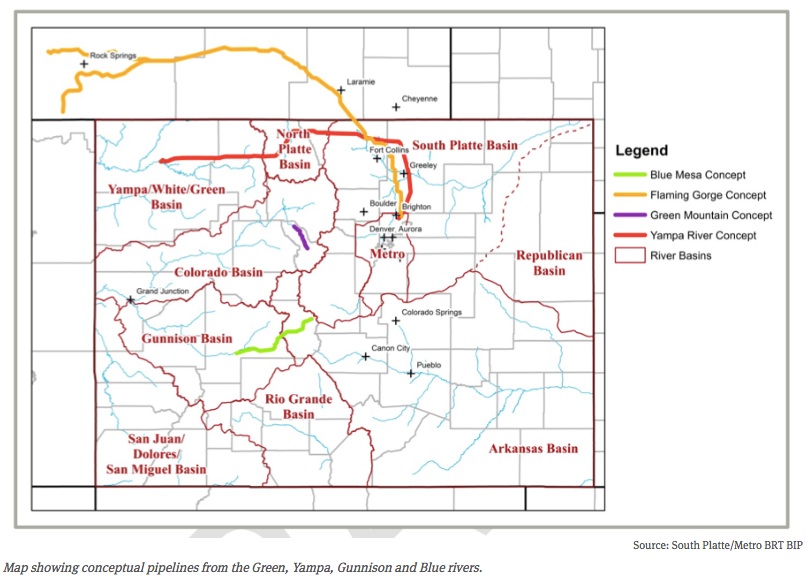
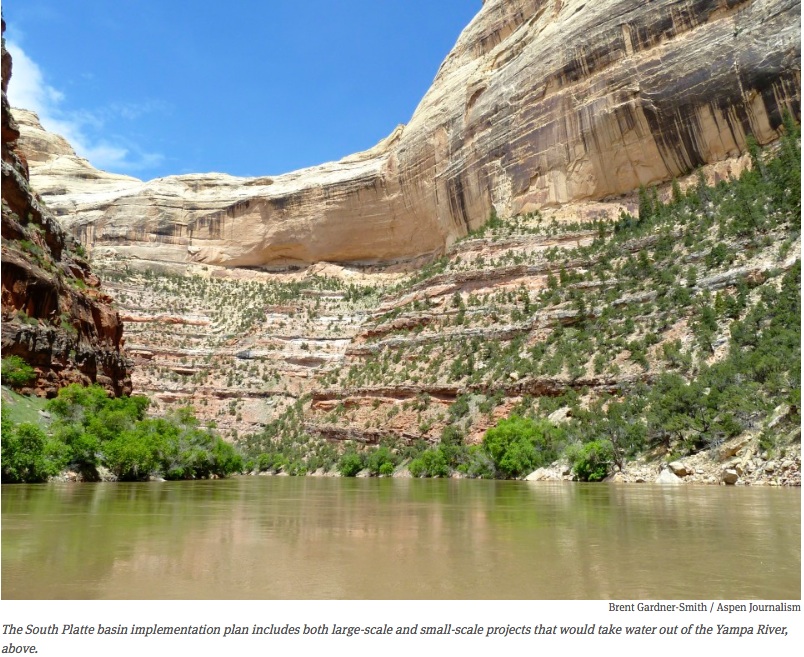
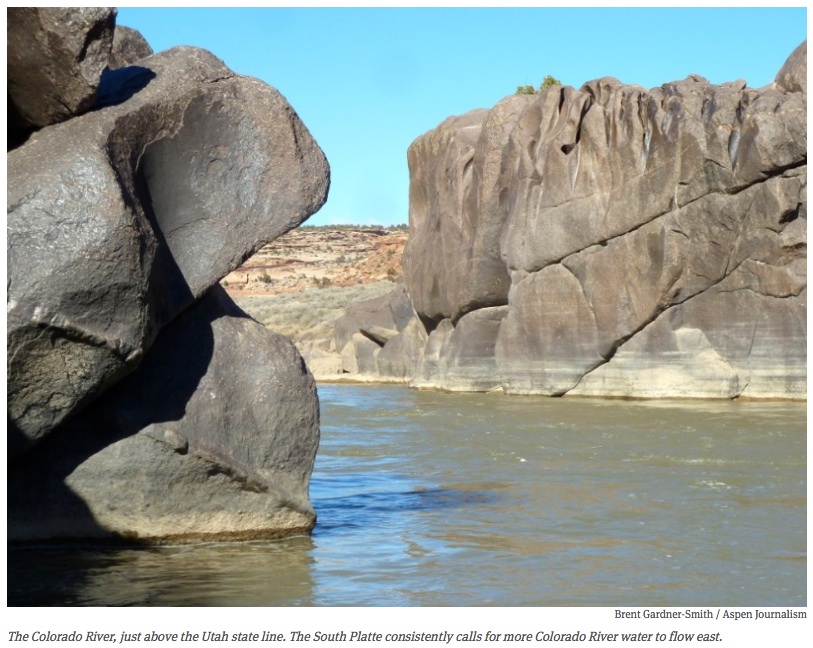
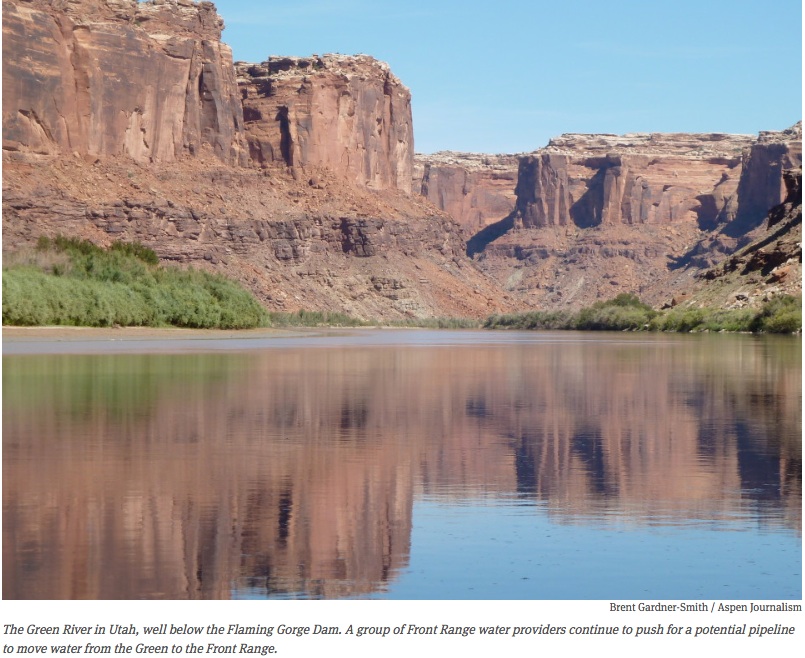
Pueblo County commissioners say the state should be a referee, rather than a sponsor, in future water projects and they want to emphasize local regulation.
“The county’s experience has been that federal and state regulations and enforcement alone have been inadequate to protect against local impacts of water projects,” the commissioners wrote in comments on the state water plan filed last week.
The deadline for comments was Thursday. Commissioners Liane “Buffie” McFadyen, Terry Hart and Sal Pace jointly signed the letter to Gov. John Hickenlooper and the Colorado Water Conservation Board, who are working to finish the plan by December.
The commissioners want to make sure that the state water plan does not undermine the authority of the state’s counties and cities to regulate water projects under laws such as HB1034 and HB1041, both passed in 1974 to provide local regulation of statewide activities, including water projects.
Pueblo County has used the 1041 process most notably in obtaining mitigation for the Southern Delivery System, an $840 million project that is designed to bring water from Pueblo Dam to Colorado Springs.
SDS is scheduled to go online in 2016, and under the 2009 permit for the project, Colorado Springs has been required to spend an additional $75 million to fortify sewer lines, $50 million for Fountain Creek flood control, $15 million for roads, $4 million for wetlands restoration and $2.2 million for Fountain Creek channel dredging, among other conditions.
“To avoid confusion as to the local government’s authority to deny a permit for a specific project, we recommend that the following sentence be added: ‘A permit may be denied for a specific water project that does not meet the standards or criteria of the local regulations,’ ” the commissioners wrote.
The county also wants the state to remain neutral in water projects.
“Pueblo County does not believe that it is appropriate for the state of Colorado to endorse or become a sponsor of a water project in most cases,” they said.
The board also wants to include stormwater control in the state definition for watershed protection. Most of the efforts in the last three years in watershed health have focused on mitigating the damage from large wildfires, but Pueblo County said equal attention has to be given to the effects on water quality from increased stormwater caused by development, such as what has occurred on Fountain Creek.
Stormwater has been a key issue in regulation of SDS as well. A recent study for the county by Wright Water Engineers found that 370,000 tons of sediment are deposited each year between Colorado and Pueblo, decreasing the effectiveness of Fountain Creek levees.
Finally, the county wants water reuse to get more emphasis in the state water plan.
“The benefits to Pueblo County of promoting reuse are twofold,” commissioners said. “First, municipal reuse would reduce the need for dry-up of agricultural lands and transfers of agricultural water rights to municipal use. Second, reuse in El Paso County would reduce and control damaging flows in Fountain Creek through Pueblo County.”
Here’s a report from Marianne Goodland writing for The Colorado Statesman. Click through and read the whole article. Here’s an excerpt:
It’s [The need for more storage] a message the interim Water Resources Review Committee heard and acknowledged during the hearings, held Monday in Greeley and Tuesday in Aurora.
Representatives of the Denver South Platte River area basin roundtables hammered on that desire, as did members of the public who spoke to the committee.
The hearings solicited public input on the statewide water plan, now in its second draft. A final version is expected to be delivered to Gov. John Hickenlooper by Dec. 10…
Much of the water shortage anticipated in the next three decades is likely to occur in the South Platte region, said Joe Frank, chair of the South Platte roundtable. He told the committee his roundtable needs a better understanding of those numbers and how much of the 400,000 acre-feet applies to the gap.
Most of the South Platte gap will come from municipal and industrial needs, Frank said, and there’s also a gap for the agricultural sector, which dominates the eastern part of the state. Frank wound up on the hot seat with several West Slope lawmakers when he said his roundtable wants to preserve its “rights” to Colorado River water. It’s a sore subject for West Slope residents who fear the East Slope will seek more water from the Colorado River, which advocates claim is already over-appropriated. In response to several questions from state Sen. Ellen Roberts, R-Durango and state Rep. Don Coram, R-Montrose, Frank said he didn’t believe taking more Colorado River water would dry up West Slope agriculture, and that he didn’t anticipate this would have to happen “tomorrow.”
But storage is the major need for the South Platte and Denver Metro area, Frank told the committee. The basin already has a 300,000 acre-foot shortage for agriculture, reflected by wells that have been shut down all over the area. Without new storage, half the farmland that relies on irrigation could dry up. More than half of the identified projects in the South Platte/Denver basin plan are for storage, he noted.
Coram also pointed out that 1 million acre-feet went out of state this spring to Nebraska, an amount that exceeded the legal contracts between Colorado and Nebraska. Everyone wants to keep that water, Frank replied, but they have no way to store it.
Storage needs to become a much higher priority in the statewide plan, said state Rep. J. Paul Brown, R-Ignacio, who isn’t on the committee but attended many of the hearings.
But storage has always been a controversial topic in Colorado. Several storage projects have been killed because of opposition from environmental groups, including the Two Forks Dam, proposed in the late 1980s for the South Platte near Deckers. Environmental groups also are fighting a storage project on the Cache La Poudre River near Fort Collins — the Northern Integrated Supply Project, or NISP — which would put two reservoirs on the river.
“We need to get past the controversy,” Frank said.
A $6.4 million project to blend water in a 21.5-mile pipeline in the South Metro area won state approval this week.
The Colorado Water Conservation Board approved a $905,000 grant toward the project which connects Aurora’s $800 million Prairie Waters Project with a $120 million pipeline that serves 14 water providers who are members of the South Metro Water Authority.
The Water Infrastructure and Supply Efficiency partnership, which includes Denver Water, Aurora and South Metro members, says the new connection paves the way for recovering up to 10,000 acre-feet (325.8 million gallons) of water annually. The project does this by providing Prairie Waters flows balance water quality from Denver Aquifer wells and other sources.
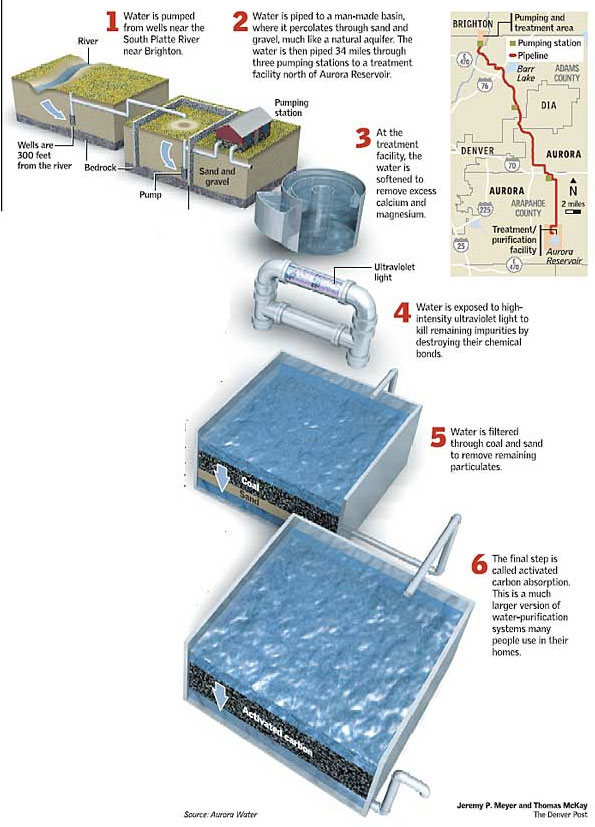
Prairie Waters captures sewered flows downstream and treats the water for reuse at a plant near Aurora reservoir. The East Cherry Creek Village pipeline can redistribute the water among other users.
At a July meeting of the Arkansas Basin Roundtable, South Metro Executive Director Eric Hecox claimed it would relieve pressure on taking water from farms, including those in the Arkansas River basin.
Three conservancy districts which have agreements with Aurora — the Lower Arkansas, Upper Arkansas and Southeastern — were skeptical that Aurora might use the WISE arrangement to manipulate storage levels in order to trigger more withdrawals from the Arkansas River basin.
Aurora provided assurances that would not happen, gaining approval from the roundtable in August.
“What’s significant is that six other roundtables joined to fund this project,” said Alan Hamel, who represents the Arkansas River basin on the CWCB.
Roundtables have funds in basin accounts, and contributed $105,000 to the grant, of which the Arkansas Basin chipped in $10,000. A statewide fund provided the remaining $800,000.
FromThe Grand Junction Daily Sentinel (Gary Harmon):
[Scott McInnis] joined with commissioners Rose Pugliese and John Justman in approving a resolution of support for a provision of the proposed Colorado water plan calling for all affected counties to participate in proposals to send water to the Front Range.
The resolution was approved in time to meet a Thursday deadline to comment on the statewide plan, which is to be complete in December.
Several provisions in the resolution mirror others adopted by West Slope counties such as Routt, Ouray and Garfield, in calling for support of the framework for consideration of transmountain diversions.
Among those provisions is one warning that “it would be unrealistic to look for any significant new supplies of water for the East Slope from the Colorado River as a primary source. Any further depletion of water from the Colorado River increases the risk of a compact curtailment.”
Diversions of water in Colorado could be reduced or prohibited at the demand of downstream states should they not get their allotted water supplies from the river under a 1922 compact governing the operation of the river.
The East Slope, which diverts as much as 600,000 acre-feet of water per year from the West Slope, should share in any reduction of diversions, West Slope officials and water managers have said…
Steve Acquafresca, a former Mesa County commissioner and fruitgrower in Grand Junction, urged the commission to support the resolution saying the West Slope should take advantage of the willingness of the East Slope to agree to the provisions protecting the West Slope.
Colorado transmountain diversions via the State Engineer’s office
Legislators from across the state agreed the Colorado Water Plan is dependent on all parts of the state working together, but Weld County residents had a few concerns with the proposed plan.
Weld residents and representatives raised concerns of prior appropriation, which includes property and water rights, and of the need to add water storage to the South Platte Basin.
State senators and representatives who are part of the water resources review committee gathered Monday evening at Island Grove to discuss the state water plan and hear public comment on it.
“We are a state that needs to work together,” Rep. J. Paul Brown said.
Weld is in the South Platte Basin, which includes much of northern and eastern Colorado as well as the Denver metro area. The area is expected to grow by 2.5 million people by 2050, pushing water demand higher than supply.
Joe Frank, chairman of the South Platte Basin Roundtable, agreed with the need to work together, saying, “We need the Western Slope, (and) they need us. We’re all one state. The problem is here, but ultimately it is a statewide problem.”
But Frank also recognized the importance of the South Platte Basin in the water plan.
Frank outlined the South Platte Basin Implementation Plan, which included four overarching themes. The themes considered were a good Colorado plan needs a good South Platte plan; solutions must be pragmatic, balanced and consistent with Colorado law and property rights; the South Platte River Basin will continue its leadership role in efficient use and management of water; and a balanced program is needed to plan and preserve Colorado river basin options.
Many in Weld see a need to extend the state’s storage, while others think conservation is the answer to future water issues.
Frank said the South Platte Roundtable Basin strongly believes storage needs to be a high priority in the water plan.
“We really strongly advocate for the development of additional above-ground storage,” he said. “That’s one thing that we really highlight in every section.”
Additional storage was a hot topic.
Weld County Commissioner Sean Conway said he has been involved in the process of writing the water plan and it’s been extremely grueling but healthy.
“Although we have differences and we will continue to have differences, the process has been a very collaborative one,” Conway said.
He said at the first meeting he attended about the water plan, someone said something that has stuck with him since.
“The days of folks simply folding our arms and saying ‘no’ are over,” Conway quoted.
He said the goal now is to find a water plan to benefit everyone and to benefit future Coloradans.
“I’m here to encourage water storage,” Conway said.
He said thousands of acres of land have dried up over the years, and it’s been devastating to agriculture in Weld County and eastern Colorado.
But Conway is worried that conservation is not enough to rectify these situations.
“Conservation should be a big part of this,” he said, “but the bottom line is, folks, we can’t conserve ourselves out of this.
Conservation is a very important part of this, but water storage is too.”
Jim Hall, representing Northern Water and the South Platte and Metro Roundtable Basins, said development of a water plan is an incredible undertaking. He encouraged legislators to recognize the wisdom of locals.
“While the plan currently points out that there has been a lack of additional storage over the last few years,” it needs to address it more immediately.
“It needs to include more storage now,” Hall said.
A local resident, Peter Bridgeman, said he was at the meeting out of concern for the future of his grandchildren.
“Water conservation will not solve our impending water crisis,” he said. “Our demands are much larger than our supply.”
Most importantly, those in attendance agreed that everyone needs to work together for solutions to the ever-present problems of water.
“We all drink it, we all use it,” said Bruce Johnson, a resident with 12,000 acres of irrigated land in Weld. “We need to be thinking about that for our offspring and the people who are coming down the pipeline.”
Arkansas River Basin — Graphic via the Colorado Geological Survey FromThe Pueblo Chieftain (Chris Woodka):
More than $1.3 billion in water projects for the Arkansas Valley are queued, although how they will be funded is unknown.
That’s the conclusion of the Arkansas Basin Roundtable, which finalized its comments on the state water plan Wednesday.
The roundtable again voiced its overriding concern that water for agriculture be protected.
“At some point, agricultural use may be more valuable (than urban use),” said Joe Kelley, La Junta water superintendent. “In some years, the cities may not have the demand. It’s best not to buy and dry, to take the water away permanently.”
The roundtable also agreed to eight challenges that were identified by Gary Barber, who chaired the roundtable for several years before becoming a consultant on the basin implementation plan. That plan is finished, but it feeds into the state water plan by identifying projects and goals for the Arkansas River basin.
A list of projects included rough cost estimates that still need revision. The most expensive included $400 million for future Colorado Springs development, $400 million for the Arkansas Valley Conduit, $277 million for the Pikes Peak Regional Water Authority and at least $100 million for Fountain Creek projects.
Another $100 million or so is needed for an Upper Arkansas multiuse project, a fledgling watershed protection effort and support for the Arkansas Valley Super Ditch.
Finally, there are 135 smaller projects that total about $65 million.
As far as challenges, the roundtable agreed to eight points Barber developed from 10 years of discussion. The most daunting is the need to find 30,000-50,000 acre-feet for new uses, both agricultural and municipal, that will occur because all of the Arkansas basin’s water is appropriated.
One particular concern noted that although needs have been identified, no solutions have emerged to fill those needs.
Other challenges include replacing nonrenewable Denver Basin groundwater, finding collaborative solutions, protecting recreational flows, maintaining water quality on Fountain Creek and in the Lower Arkansas Valley, renovating aging reservoirs and finding regional solutions.
Comments to the final draft of the state water plan are due by Thursday.
The plan and information about how to comment may be found at coloradowaterplan.com.
The final version of the Colorado Water Plan will be submitted by the Colorado Water Conservation Board to Gov. John Hickenlooper by Dec. 10.
Colorado needs a mother lode of water by 2050 – as much, in fact, as it takes to serve about 2 million people.
As our climate changes and population keeps soaring, the future looks scary dry.
That’s why Gov. John Hickenlooper wants the state’s first-ever statewide water plan in place by December.
In question is where to glean more water, who would pay for it, and how to avoid an all-out water war in a state where the Continental Divide isn’t just a hydrological contour, but also a battle line.
When The Colorado Independent last reported on the making of the plan in July, the first draft offered no specific answers. Now there’s a second draft that puts forth a litany of concepts state officials are touting as “win-win solutions.”
“Assembling such a plan, one that outlines numerous feasible steps the state, water providers and water users can take, is unprecedented in Colorado and represents a major step forward for our state,” Hickenlooper’s spokeswoman Kathy Green wrote in an email this week.
Several key water experts are unimpressed, lobbing the same criticisms about the second draft as they did about the first.
They say the revised, 416-page document still is less of a plan than a water study — a detailed account of the struggles faced by water users throughout the state, painstakingly compiled by an administration more interested in making everyone feel heard than in making tough decisions.
With 13 days [September 17] left for the public to comment, critics say the plan still lacks priorities and actionable specifics and that it fails to address the most practical question – how to pay for solutions. They’re also disappointed that it sets no clear expectations for how much, statewide, all of Colorado’s water users should be conserving.
“It’s a step in the right direction, but there’s still not much there in there,” said water lawyer Peter Nichols, one of Hickenlooper’s appointees to Colorado’s Interbasin Compact Committee, a statewide water working group.
“There are a lot of platitudes and clichés and nice words like ‘foster,’ ‘develop,’ ‘encourage,’ and ‘coordinate’ in this draft. But those aren’t action words. Those words won’t carry us. They’re not going to meet our water needs for 2050.”
A “back-of-the-napkin analysis”?
If, as the old adage goes, water runs uphill to money, the slope is especially steep in Colorado. Maintaining current water storage and delivery systems and keeping up with climate change and continued growth will, according to the state, cost $20 billion over the next 35 years.
The problem with that amount isn’t just that it’s ginormous. It’s unclear what the $20 billion would buy.
Colorado Water Conservation Board director James Eklund mentions the figure often in meetings and public appearances. Yet, when pressed for specifics, he says it’s just “a back-of-the-napkin analysis.”
According to the water plan, the $20 billion would pay for projects that have been deemed necessary in each of the state’s eight river basins. Yet, the costs for nearly half those projects are still listed on the plan as “forthcoming.”
“It’s all very much a work in progress,” Eklund said.
Colorado’s water chief is a tall, carefully coiffed and nattily dressed Stanford graduate who comes from a family of Western Slope cattle operators. He’s well versed in the practicalities and legalities of western water use, and seemingly at ease with the plodding pace of policy reform. He served as Hickenlooper’s senior deputy legal counsel before being appointed to lead the state on water.
Eklund lauds his boss for “spending the political capitol” to order Colorado’s first statewide water plan rather than, like other governors, taking a pass on one of the state’s most touchy issues.
“There are people in the water community that said you say the word(s) ‘state water plan’ and that’s toxic, that’s a third rail, you can’t touch that,” he said.
“(Hickenlooper) said I need the white paper on water. We all looked at each other and said we don’t have one of those. He said you’ve got to be kidding me. You’ve got a business with an input as critical as water is to the bottom line of that business — you know as water is to the bottom line the state of Colorado. You would say that was unacceptable to the CEO and the board of directors. So go do it.”
Since Hickenlooper’s executive order in December, Eklund’s staff has written and rewritten two drafts of the water plan. They’ve attended months of hearings and meetings asking what Coloradans want in their water future. And they’ve reviewed public comments from throughout the state – including, Eklund likes to note, the input of 26 high schoolers from Dolores.
“That kind of response is something we could have only dreamed of,” he said.
Eklund is especially proud that his staff has responded to all 25,869 public comments.
“We’re looking really hard at each one as it comes in,” he said.
As he tells it, the water planning process is an acme of civic engagement.
Having amassed 25,869 public comments isn’t, in itself, a vision for how to solve the state’s water woes, seasoned water-policy makers say.
“(They) need to sort through it, pull out what the priorities are. It’s not going to define itself,” said Denver Water chief Jim Lochhead. “A process is not a plan.”
The need for specificity
More details are key for Front Range business owners, Western Slope farmers and ranchers, environmentalists, water agency bosses and politicians who, like Eklund says of the Governor, also have their eyes on the bottom line. Although most agree on the need for a water plan, they differ – sometimes bitterly — about which water uses should take priority and who should bear responsibility for the projected shortfall. Without price tags, they say, there can be no meaningful discussion about funding strategies. And without funding strategies, there can be no hard look at what’s even possible.
Several close followers of the process tell The Independent that, as much as they want to show support, they’re finding it tough to buy into a plan that serves up little more than broad concepts.
“The plan, in fairness, offers lots of interesting information about what’s happening with water in Colorado. But it’s a water study, not a water policy and not a water plan. And that’s an important difference,” said Harris Sherman, who ran the Colorado Department of Natural Resources under Govs. Dick Lamm and Bill Ritter and recently stepped down as a top Obama appointee to the U.S. Department of Agriculture.
Eklund aims to have tackled a good portion of the state’s water solutions by the time Hickenlooper is term-limited in three years. Still, he balks when asked about upcoming agendas for water. Should Coloradans expect water bills in the legislative 2016 session? It’s too early to tell, he told The Independent. Should voters expect executive action while Hickenlooper is in office? “It’s premature for me to know,” he said.
“You have to crawl before you can walk.”
Hickenlooper’s office also defends the water plan, saying it’s not the point to chart a specific list of water projects or their costs.
“…To set up that straw man is misleading,” Green wrote.
In fact, she asserted, specifics could mess up the grassroots water planning approach Hickenlooper is committed to.
“The state does not have the authority to determine which projects go where and, should it attempt to do so, the collaboration and cooperation upon which the water plan was so respectfully built would collapse under the weight of such top-down action,” she said. “All parties would return to their traditional corners to fight it out, as they have for decades, with the same kind of infighting that prevents the very kind of holistic approach the water plan seeks to achieve.”
Critics counter that, in a time of climate change and rampant growth, a 416-page articulation of water goals without key financial details and actionable solutions isn’t holistic. It’s naive.
“There’s money involved in most of the ideas set forth in there…, but you wouldn’t know it. Without clear metrics, priorities, deadlines and a sense of who’s going to do what – without all the things I’d characterize as a real plan — there’s no path forward,” Lochhead said. “There are a lot of things on that list – including the funding – that, in my view, are unrealistic.”
“What can we actually do in three years?” state Water Conservation Board member John McClow asked at the July meeting. “The list needs to be more realistic.”
Who should pay? And how?
Eklund’s team has topped its list of “Potential Future Funding Opportunities” with the following: “A federal/state partnership similar to the Central Arizona Project” and “A federal/state partnership similar to the California State Water Project.”
Both are vast water delivery systems launched during the late- and mid- Cold War era, respectively, when the federal government used to pay for dams, pipelines and other projects that made Western deserts bloom.
Emulating those partnerships is unlikely now that the Bureau of Reclamation and Army Corps of Engineers no longer have the budgets or mandates for projects that would be as legally risky and expensive as they are politically divisive. The feds aren’t in the business of building massive water projects any more.
“Maybe Colorado didn’t get the memo,” said Pat Mulroy, a Nevada-based water expert with the Brookings Institution.
Funding is more likely to come from the private sector — whose resources can be limited – and from the state and municipal public sectors, mainly though tax or water rate increases.
In an effort to “identify and determine a path to develop a new viable public source of funding,” the water plan cites ways to glean $10 million here and $40 million there through various grant projects and government partnerships. The plan also suggests a container fee ballot measure that could generate about $100 million a year.
But, in the $20 billion scheme of things, that’s chump change.
Besides, counting on voter-backed funding can be risky. In 2000, Coloradans resoundingly rejected Referendum A, an effort to raise $2 billion for water projects. More recently, they’ve chewed up and spit out measures to raise taxes for transportation and education – both issues that poll higher than water among most Coloradans.
Even if voters could be persuaded to back a water tax, policy constraints such as the Taxpayer Bill of Rights (TABOR) could stand in the way. The current water plan overlooks Colorado’s knot of fiscal caps – an issue planners say they’ll be adding to the final draft.
Water utilities point out that because their customers already pay for water projects through monthly water rates, they’d be paying double through a tax increase.
“A statewide funding initiative, in my assessment, it’s not doable,” Lochhead said. “People aren’t likely to support paying twice.
Lochhead said Denver Water’s board would be willing to consider asking its 1.3 million customers to fund more delivery systems, reuse projects and conservation efforts to help stave off a shortfall. Problem is, he pointed out, he hasn’t been approached by state officials about the prospect of making such an ask. Neither had two other water agency bosses interviewed for this story.
As the gatekeepers of the most promising source of money in the state, water bosses wonder whom if not them the administration is so intent on collaborating with.
East v. West
The tension underpinning Colorado’s water situation is largely between urban and agricultural users. Although, by virtue of their populations, cities and suburbs have more money and political clout, agricultural communities generally have the upper hand because their water rights are usually older, giving them higher priority for Colorado’s dwindling water supplies.
Farming and ranching communities – especially those on the Western Slope with rights to Colorado River water – long have fought efforts by city folk to grab their water, pump it east through the mountains and fuel growth along the Front Range. More recently, environmentalists hoping to keep more water from being siphoned out of the at-risk river have echoed the Western Slope battle cry — “Not one more drop!”
That leaves sprawling Front Range cities and suburbs straining to live within their means. The well known “Use only what you need” campaign by Denver Water, the state’s biggest municipal water supplier, is one of many efforts that has been able to slash municipal water use.
It comes as no surprise that the water plan, in its second draft released in July, is calling for city dwellers and businesses to conserve water in hopes of saving 400,000 acre-feet per year. (An acre-foot is enough to serve two to three households per year at current water use rates.) The plan calls for “medium-level conservation” – meaning, presumably, saving more water than residents and businesses currently are conserving, but not so much that it hurts. Eklund’s team calls it a “stretch goal,” which is financial-speak for a way of challenging people to reconsider what they thought was possible.
The conservation plan is a goal, not a requirement. It’s voluntary.
Nobody seems to question cities’ need to keep conserving more water. Several water insiders do, however, question whether 400,000 acre-feet could actually be gleaned by urging city dwellers and suburbanites to cut back their laundry loads and backyard sprinkling. They also question whether the conservation policy is fair.
Even though municipalities serve about 86 percent of Coloradans, they only consume about 2 percent of the state’s water. Agriculture uses between 85 and 90 percent.
The water plan doesn’t set clear expectations for farmers and ranchers to conserve. Their water rights allow them to tap however much water they can put to what’s called “beneficial use.” If they use less, the water goes to the next user – and so on. So, as things stand, there’s a legal disincentive for agricultural users to cut back.
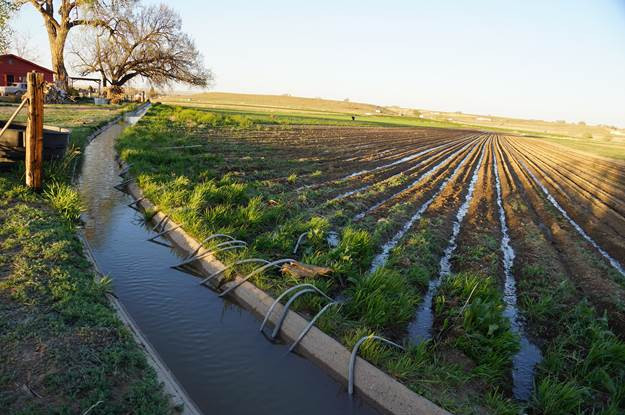
This doesn’t sit right with many city folks, especially knowing how much water goes wasted by inefficient techniques such as the use of unlined dirt irrigation ditches and canals.
“There’s no question that in other parts of the world, agriculture uses much less water,” Sherman said. “Things can be done. Improvements can be made.”
After reading the plan, Patricia Wells, the Colorado Water Conservation Board member representing Denver, said, “I was struck by the disparity of how we treat agriculture and how we treat the people of Colorado.”
“The only mandates in this plan are all about people.”
Calls for broader conservation are coming from unlikely players – the business community rather than from environmentalists.
At the state board’s July meeting about the plan in Ignacio, representatives from environmental groups praised the conservation goals as is and commended the plan’s commitment to keeping water in rivers to protect environmental and recreational flows.
“I’m here with two messages – that of appreciation and encouragement,” Bart Miller, a river expert with Western Resources Advocates, told Eklund and his board. “As it progresses, we’re seeing more details, really good things…”
The Denver Metro Chamber of Commerce, in the meantime, is strongly urging that conservation goals apply statewide — including to agriculture—rather than just to certain sectors.
“We want to make sure that all sides are giving,” said Mizraim Cordero, the Chamber’s vice president of public affairs. “I think there’s still room for more discussion about what goals are achievable by agriculture.”
Eklund notes that there’s a big difference between residential and agricultural conservation because water rights are property rights in Colorado.
“They’re running businesses in agriculture. They’re not doing it because it’s fun… They’re doing it to make money. If you’re telling them they’ve got to add a line item to their balance sheet that they didn’t otherwise anticipate, they’re going to ask you who’s paying for that. And right now, we’re not doing that,” he said.
Given the vastly disproportionate amount of water used by farms and ranches, Colorado isn’t likely to overcome its shortfall without arrangements between agriculture and utilities.
All too often, those arrangements have meant farmers selling off their land and water rights to cities. That practice, known as “buying and drying,” has left wide swaths of the state deserted. Crowley County, for example, once had more than 50,000 irrigated acres and now has only 5,000.
Hickenlooper has made it clear that preserving Colorado’s agricultural tradition needs to be a keystone of the water plan.
The easiest way forward would be if farmers and ranchers could directly market some of their water to utilities. But the “consumptive use” doctrine underlying water law blocks such deals because they put agricultural water rights in jeopardy. If farmers aren’t directly using their water, they risk losing it.
Several top water officials and political leaders have been urging Hickenlooper, in his plan, to enable a market-based system that removes legal barriers. The idea behind so-called “alternative transfer mechanisms” is that farms would step up conservation if cities, through innovative funding, could subsidize efficiency efforts and glean the water savings on a short-term basis. Farmers, in turn, would be assured protection from losing their long-term water rights.
It would be tricky. But it’s doable. Similar deals have been struck in California, which is under crisis with a severe drought. The point in Colorado is to avert a crisis before our next dry spell hits.
“If Hickenlooper wants to make this a priority of this administration, he has limited time to start getting things done,” Lochhead said.
“We’re waiting with bated breath and open ears. We’re all ears,” Eklund said.
Russell George, former speaker of Colorado’s House and Gov. Bill Owens’ natural resources chief who’s vice chair of the water board, said there’s “a beauty in itself” in the outpouring of civic participation.
But, given the looming shortfall, stakeholders are, indeed, “hung up” — and making sure to speak out while the administration is listening.
Environmental groups and their members are urging the administration to hone criteria for which of the 81 currently proposed “critical actions” are truly critical and should take priority. “Our thought is that it doesn’t really give enough detail such that you could take a giant list of projects and push them through,” Miller said.
Several water experts are pressing Hickenlooper hard to end the stalemate between the Front Range and Western Slope over using extra Colorado River water when it’s available. The water plan proposes a conceptual framework for how negotiations between the two sides should go. But it offers no concrete solutions.
“That’s where the plan falls short and where the state needs to get creative and ambitious and take a leadership role in actually brokering a deal,” said Nichols who, as a member of the committee that oversees compacts between Colorado’s distrusting river basins, has seen deal after deal blow up. “There are discussions going on about putting more meat on the bones before December and how to implement a meaningful plan, maybe by changing some laws.”
The business community is trying to galvanize its members to read the plan and chime in. The Denver Metro Chamber of Commerce is pressing for specifics about costs and what, if anything, Hickenlooper will do to prod agriculture to measurably cut back.
“We commend that the Governor has made water a major priority and has moved the ball. But we definitely encourage him and other leaders to continue (giving) specificity to help carry things out,” said the Chamber’s Cordero.
Is he confident that’ll happen by final draft in December?
EcoFlight’s Flight Across America program dynamically engages college students about environmental issues, using a broad range of perspectives, both aerial and on the ground, to bring attention to pressing conservation issues. Students learn how such issues impact their lives and the world around them, and how to personally participate in advocacy work. Through the aerial perspective and discussions with diverse stakeholders and experts on the ground, EcoFlight offers a tangible educational experience, engaging students in the complexities of environmental issues throughout the West. It is our hope that by offering students the opportunity to delve deeply into issues central to the West, they become better prepared to participate in meaningful discussions public lands and advocate for their beliefs, as the next generation of leaders.
Flight Across America 2015 will focus on water conservation concerns in the West, emphasizing the crucial role water plays in sustaining life, and the mega drought happening in many states across the West. The program provides an excellent learning environment for students, combining the aerial perspective of the role of water in the health of ecosystems and how watersheds connect landscapes, with on-the-ground discussions of the impact of energy development, urban planning, recreation and agriculture on our water resources. The Colorado River Basin is in its 14th year of drought, and water is a top concern for population centers and agriculture. We will discuss the coping mechanisms of multiple states in the West, as they plan for the future in an attempt to balance an already over-allocated water supply with growing domestic demand. Climate models are predicting an even drier future, with sustained periods of sparse precipitation and significant loss of soil moisture that span generations, about 10 times as long as a normal three-year drought. In the face of these “mega-droughts” it is imperative that we begin thinking in terms of the future and not just the present for water management in the West.
In a five-day tour of four states, FLAA 2015 will engage college students with diverse conservation concerns of water in the West. EcoFlight will provide aerial tours of water storage and diversion projects, over energy development (both fossil fuel and renewable), over agriculture, and wild landscapes, and watersheds that are vulnerable to drought and water-loss. On the ground students will meet with diverse stakeholders – planners, public officials, conservation groups, sportsmen, energy industry representatives, Native Americans, recreationists and journalists to discuss the different and often competing interests in water and water conservation.
Colorado River Basin including Mexico, USBR May 2015
According to a panel of water and land-use experts at last week’s Colorado Water Congress, Coloradans might have to learn to live with smaller lawns, smaller parks and other landscaping changes to help conserve water.
The state water plan outlines a “stretch goal” for municipalities to conserve 400,000 acre-feet of water annually over the next couple of decades. That goal was based on a host of suggestions from municipalities across the state and merged into one conservation goal. It’s a lofty goal — hence the term “stretch.”[…]
Matthew Mulica of the Keystone Policy Center said his organization is spearheading a “Colorado Water and Growth Dialogue.” The effort, now in its second year, looks at the potential benefits of integrating land and water planning and increasing housing density. The conversation brought to the table water providers, land-use planners and developers, public officials, and others with a stake in the matter. The group is first looking at Denver and Aurora water-service areas, and Mulica said they hope the findings will apply to the rest of the state.
They’re examining land and water planning that allows water to play a more prominent role in land-use choices; how to increase “densification” and decrease landscaping, while still maintaining the lifestyle that Coloradans enjoy; and which land-use patterns hold the greatest promise for cutting water use.
It’s not necessarily conservation, Mulica told the audience at the Aug. 20 session. When old homes are torn down and new ones built, there should be ways to change landscaping to reduce water use, he said, or to build houses that make water conservation a priority…
Marc Waage of Denver Water said the group wants to develop a “toolbox of options” for land-use planners that would include conservation-minded land-use patterns.
One model looks at the benefits of increasing residential density, including small single-family homes, changing single-family units to multi-family units, and increasing the density of multi-family housing. That’s where the comparison with Denver’s Stapleton and Highlands neighborhoods arises.
But landscaping is where the greatest opportunity for conservation lies, said Brenda O’Brien of Green Industries of Colorado, a company also known as GreenCO.
O’Brien pointed out that most of the action items in the state water plan relate to outdoor water use. The idea, she said, is to put together best-management practices in land and water-use planning. Making sure these practices are enacted will likely take state laws and local ordinances, she added.
The General Assembly will have to take another stab at changing the state’s construction defects law, according to Scott Smith of the Colorado Association of Home Builders.
Smith wasn’t as gung-ho about changing landscaping for individual homes. His industry has to anticipate what the market will look like in five to 10 years, he said, which means identifying development properties, coming up with financial partners, and making sure a project is profitable.
“Housing and community development comes from the private market, and economics drive the process,” Smith said. “Landscaping is the red-headed stepchild in the economics and financing of housing.”
But landscaping isn’t always up to the developer — it’s often left to the homeowner, Smith said. In addition, housing developments are required to provide open spaces and parks, and that tends to be even more important in high-density developments.
Smith also hinted that homeowners need to take a more active role in water conservation. The state and local building codes now require low-flow water fixtures, but he suspects residents game the system by flushing toilets multiple times or simply taking longer showers.
Then there are expectations about what parks should look like. Smith cited Colorado Springs as an example: the water utility directly bills the parks department for its water use, a rarity among municipalities. Because it has been stuck with the cost, the parks department has had to take a hard look at its water use and is going through an extensive process to redevelop parks, converting some heavily-irrigated areas to native plants.
Another area for conservation could be soccer fields, Smith said, converting grass to artificial turf. “You can’t water those fields enough,” he said. Commercial and industrial users should also play a part, he added.
“We do live in a desert. It’s hard to see that because we have made it this,” said Jim Havey, director of a new documentary called “The Great Divide.”
It explores how Colorado settlers, from early Native Americans to 20th century civil engineers, used water to create the state we call home today. 9NEWS is also broadcasting documentary film “The Great Divide” on Monday, Aug. 31, at 7 p.m. on KTVD-TV, Channel 20…
The film looks forward as well, specifically at the Colorado Water Plan. It’s the first ever comprehensive plan, attempting to guide the state towards a future where more water will be needed to deal with a predicted doubling of the population: 10 million people by 2050.
“We’ve got multiple sectors all across this state that depend on water and making sure that water is delivered with some certainty to them and reliably,” said James Eklund, director of the Colorado Water Conservation Board, which is shaping the water plan.
The pressure for more water could potentially put a strain on the state’s agriculture sector, where farmers and ranchers – who have senior water rights – could sell those rights to growing urban areas.
“Those farmers and ranchers who made an economic decision to move that water from their land and move it to a municipal use—that’s where the balance comes about,” said Colorado Farm Bureau President Don Shawcroft…
We want to make sure that as we move forward with a strategic plan, we’re able to deal with drought, flooding, wildfire – all the things that have been thrown at this state over the course of the last several years — in a strategic manner,” Eklund said.
The final draft of the Colorado Water is set to be finished by Dec. 10. The state is still taking public comment on it, but that will end on Sept. 17. To add your voice to the plan, go to http://coloradowaterplan.com.
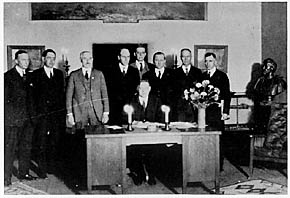
Herbert Hoover presides over the signing of the Colorado River Compact in November 1922. (Courtesy U.S. Department of Interior, Bureau of Reclamation)
Here’s the release from the Colorado River Water Conservancy District via Jim Pokrandt:
Two of the most important women in Western water leadership will be addressing the Colorado River District’s popular Annual Water Seminar in Grand Junction, Colo., that takes place Thursday, Sept. 10, 2015, from 9 a.m. to 3:30 p.m. at the Two Rivers Convention Center.
Headlining the event are Jennifer Gimbel, the Assistant Secretary for Water and Science, the U.S. Department of the Interior; and Pat Mulroy, Senior Fellow for Climate Adaptation and Environmental Policy at the University of Nevada-Las Vegas’ Brookings Mountain West, as well as a senior fellow in the Brookings Institution’s Metropolitan Policy Program in Washington, D.C. She retired in 2014 as General Manager of the Southern Nevada Water Authority.
Ms. Gimbel is well known in Colorado for her work as director at the Colorado Water Conservation Board before she moved to federal positions with the Department of the Interior that culminated with her ascendency to the post that oversees the Bureau of Reclamation, the U.S. Geological Survey and Colorado River administration. Ms. Mulroy oversaw the Southern Nevada Water Authority for 21 years where she got results as well as headlines in positioning Las Vegas for growth in the face of limited water supply.
The theme of the seminar is: “Will What’s Happening in California Stay in California?” Cost of the seminar, which includes lunch, is $30 if pre-registered by Friday, Sept. 4, $40 at the door. Register at the River District’s website: http://www.ColoradoRiverDistrict.org. Call Meredith Spyker at 970-945-8522 to pay by credit card.
The day’s speakers will draw an arc of water supply and policy concern from the Pacific to Colorado, looking at the basics of climate and weather generated by the Pacific, dire drought in California and what that means to the interior West, the still-on-the-horizon planning to deal with low reservoir levels at Lakes Powell and Mead, and finally, an analysis of Colorado’s Water Plan, still in draft form.
Klaus Wolter, a pre-eminent analyst of El Nino-La Nina conditions in the Pacific will preview the growing El Nino conditions and what they will mean for snowpack this winter. He is a research scientist at the NOAA Earth System Research Laboratory’s Physical Sciences Division in Boulder and world renowned in his field.
Also at the seminar, Colorado River District staff will speak to its policy initiative that new paradigm in Colorado Water Planning is how to protect existing uses, especially irrigated agriculture in Western Colorado, in the face of diminishing supplies and potential demand management necessities. Issues of planning for new transmountain diversion (TMD) remains a big focal point in Colorado’s Water Plan, but it is drought and reservoir levels that will command the system before a TMD can be honestly contemplated.
Other speakers will address irrigated agriculture’s role in water planning, efficiency and conservation planning and financing and more.
An agricultural impact statement for water transfers might become a state tool as the result of a state water plan that’s expected to be finished later this year.
“When I’ve talked about it with the agricultural community, they see it like NEPA (National Environmental Policy Act) and more red tape,” said James Eklund, executive director of the Colorado Water Conservation Board. “But really, it’s just making sure all information about impact is disseminated.”
Eklund and John Stulp, the governor’s water policy adviser, visited with The Pueblo Chieftain editorial board Thursday.
Eklund threw out the idea of an ag impact statement as one way to evaluate how taking water from a community could change it down the road. Like many other parts of the water plan, however, it remains more of a suggestion than a directive.
The CWCB is writing the water plan on orders from Gov. John Hickenlooper, and it is due by Dec. 10. Nearly two years and dozens of meetings and hearings have gone into the document. More than 26,000 comments have been received in a process that Eklund called “unprecedented” for including public comment.
An ag impact statement would help ensure that taking water permanently out of agriculture is a last resort, but there is no way the state can ban the practice, Eklund said.
“If how development occurs becomes a Colorado question, it takes us out of being a local control state,” he said.
Instead, the water plan provides a wealth of options about alternative transfer methods that do not permanently dry up agriculture.
“Where agriculture will keep water, it will buy time,” Stulp said. “If alternative transfers are voluntary, they have options.”
It’s not possible to ban future transfers, because of the nature of water rights in Colorado, Eklund said.
But the flexibility or agility to use water rights in different ways is important. Eklund insisted the water plan does not condone flex water rights that have failed to become law in the last two legislative sessions.
“When we talk to the ag community, you can get nervous looks, and they ask ‘What’s that going to mean to us?’ We can’t say your property right is the subject of our investigation,” Eklund said. “But stopping buy-and-dry, that’s going to take agility or flexibility.” The water plan won’t supersede state water law, but could expand or introduce concepts in much the same way as recent changes like instream flows, recreational in-channel diversions and storage as a beneficial use.
“We’ve done things as pilots like HB1248 (a 2013 bill allowing long-term leasing), and the danger is they become permanent,” Stulp said. “But the purpose is to give generational changes a chance temporarily.”
“We’re looking for that sweet spot where we can keep producers in agriculture,” Eklund added.
A milestone in state water planning was reached Tuesday as members of the state’s Interbasin Compact Committee unanimously endorsed the latest version of a “conceptual framework” to guide discussions between East and West Slope interests about any new transmountain diversion.
“It’s not perfect, but I think we’re in general agreement this is a good starting point, and if ever there is a transmountain diversion, there will be, no doubt, additional negotiations,” said John Stulp, chairman of the IBCC.
Today in Colorado, between 450,000 and 600,000 acre-feet of water is diverted each year from the West Slope to the more populous East Slope.
The latest draft of the framework, tweaked Tuesday regarding statewide water conservation goals, will now be forwarded to the Colorado Water Conservation Board for inclusion in the final Colorado Water Plan, which is to be delivered to Gov. John Hickenlooper by Dec. 10.
“I would be surprised if it would change significantly from where we’re at today,” Stulp said of the conceptual framework.
To help satisfy the concerns of some members of the IBCC, staff from the Colorado Water Conservation Board drafted an additional introductory paragraph – during a break in the meeting – about the conceptual framework to be included in the water plan.
“The intent of the conceptual framework is to represent the evolving concepts that need to be addressed in the context of a new transmountain diversion as well as the progress made to date in addressing those concepts,” the new introductory paragraph states. “The conceptual framework refers to several topics, including conservation, storage, agricultural transfers, alternative transfer methods, environment resiliency, a collaborative program to address system shortages, already identified projects and processes (IPPs), additional Western Slope uses, and other topics that are not exclusively linked to a new TMD, but are related to Colorado’s water future. The conceptual framework, like the rest of the Colorado Water Plan, is a living document and is an integrated component of the plan. Many of these topics are further discussed in more detail in other sections of Colorado’s Water Plan.”
The IBCC is made up of two members from each of the state’s nine basin roundtables, six governors’ appointees and two members of the Legislature.
Since 2013, the committee has been working on the seven core principles in the framework, which spells out under what terms a new transmountain diversion might be acceptable to the West Slope.
For example, a new project should not increase the likelihood of a call from California for more water under the Colorado Compact, or preclude future growth on the West Slope.
And it “should avoid, minimize or mitigate adverse environmental impacts where possible” and address the concept of “environmental resiliency.”
“Nothing is perfect, but I think adding environmental resiliency into the water plan – which happened because we got it into the conceptual framework and now it’s also in the body of the plan in chapter six – I think that’s a big step forward,” said Melinda Kassen, who represents environmental interests on the IBCC, and was speaking during a break in the meeting.
“And I like the fact that it’s also combined and we have a much more robust commitment and description of what we need to do in regard to compact compliance,” Kassen said. “So I think there are a lot of things in the conceptual framework that we have to work on – triggers, collaborative water management program, environmental resiliency, conservation – those are the action steps for moving forward. I think we need to move on, but I think the conceptual framework is a pretty good deal and we should take it and move on. And not just in terms of the conceptual framework, but in terms of the whole water plan. It’s a plan, and now we have to ‘do.’”
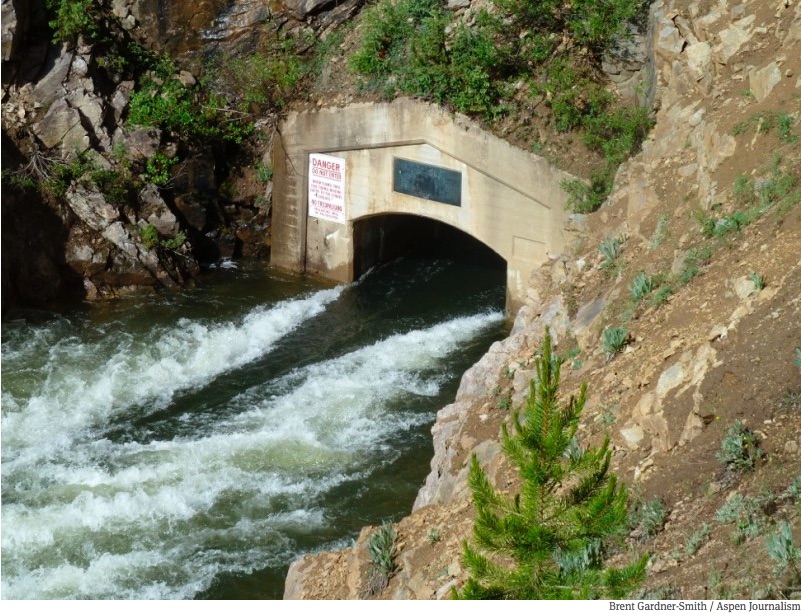
The east end of the Independence Pass tunnel, bringing water from the headwaters of the Roaring Fork River to the East Slope
“A bunch of hoops”
Bill Trampe, a rancher in Gunnison County and a member of the Gunnison River Basin Roundtable, also supports the framework.
“For future transmountain diversions to occur, according to the framework, the proponent is going to have to go through a bunch of hoops,” Trampe said. “If the proponent is willing to take the gamble that there is enough water to merit the expense of the project, then go for it.”
Trampe’s suggested that if a project proponent takes a hard look at a potential new transmountain diversion, and does so through the lens of the conceptual framework, they may find that there just isn’t enough water to make a project viable.
Principle three of the framework deals with “triggers,” or the amount of water available in the larger Colorado River system, that may or may not allow water to be diverted to the East Slope.
“Triggers are operating parameters that determine when and how much water a potential new TMD could divert, based upon predetermined conditions within the Colorado River System,” a recent draft of the framework states. “Such parameters include, but are not limited to, specific storage elevations in one or more Colorado River System reservoirs, projected inflows at key Colorado River System locations, actual reservoir inflows over specific defined periods, snowpack levels, predictive models – or combinations of these – which would trigger certain actions and prevent others.”
In a brief interview after the meeting, Trampe said the water trends do not favor a new transmountain diversion.
“If hydrology does not improve, then the issues on the Colorado River are going to become worse,” Trampe said. “Mead and Powell continue to go down. They are not stabilized. They are not rising. They continue to go down. So if a proponent of a project looks at all of that, and still thinks there is water available, I guess there is not much we can do about it, except go through step four, the collaborative process, where we identify the risks and the ways we go about alleviating those risks to the various parties, particularly on the West Slope.”
Step, or principle, four in the framework discusses a proposed collaborative program to manage water in the Colorado River basin, and points out such a program is needed regardless of whether a new diversion is built or not.
“The collaborative program should provide a programmatic approach to managing Upper Division consumptive uses, thus avoiding a Compact deficit and insuring that system reservoir storage remains above critical levels, such as the minimum storage level necessary to produce hydroelectric power reliably at Glen Canyon Dam (minimum power pool),” the draft framework states. “A goal of the collaborative program is that it would be voluntary and compensated, like a water bank, to protect Colorado River system water users, projects and flows. Such protection would NOT cover uses associated with a new TMD.”
Trampe also pointed out that the conceptual framework is only a first screen for a potential new transmountain diversion, as any project would still have to go through existing regulatory reviews at, potentially, the federal, state and county level.
“Even if you think you can get through this process, you still have to go through the normal legal channels and permitting that is in existence today,” Trampe said. “You’re still going to have the traditional things to go through, particularly if you’ve not adopted the principles within the framework.”
The conceptual framework is not legally binding, as Colorado water law still allows for a water provider to propose a new transmountain diversion without referencing the conceptual framework. But it is seen as a way for Western Slope communities to review a proposed diversion against publicly adopted parameters.
The conceptual framework has been discussed at various other roundtable meetings around the state in recent weeks.
“I think that this gives us protections that otherwise we don’t have,” said Karn Stiegelmeier, a Summit County commissioner, during a July 27 meeting of the Colorado River Basin Roundtable, shortly before that roundtable endorsed the conceptual framework.
But during the same meeting, Ken Ransford, who represents recreational interests on the Colorado Roundtable, voted against the framework.
“This agreement doesn’t have teeth,” Ransford said. “It’s not enforceable. It gives us no legal rights. And the Front Range has said they are still willing to come over here and purchase agricultural water rights as necessary to protect their existing diversions. So I keep asking myself, what are we getting out of this?”
However Ken Neubecker, the associate director of the Colorado River Basin Program for American Rivers, and the environmental representative on the Colorado River Basin Roundtable, supported the conceptual framework, arguing it gives the Western Slope more protection.
“They could come over for a new transmountain diversion and ignore all of this right now, that’s just the way Colorado water law is,” Neubecker told the roundtable. “What this does do, along with the water plan, is set a high bar that they really are going to have to look at and try and comply with if they want to have a smoother road rather than a rougher road toward that end. They still have to go through permitting processes with the local counties and with the state, and the counties and the state can all look at it and say, ‘Well, where are you with complying with this? Where is your plan with point number four, point number three, whatever?’ It does give us that element of a condition, while not legally required, is something that politically would be a good thing to pay attention to.”
After the August 25th meeting in Keystone, Eric Kuhn, the general manager of the Colorado River District, which represents 15 West Slope counties, said the framework — if deployed correctly — could help protect West Slope interests.
“The West Slope is better off under the conceptual framework if, and it’s a big if, we follow through and have the discussions that are contemplated by the framework,” Kuhn said. “If it just sits on the shelf, it’s worthless for us.”
The first of the seven principles in the framework states “East Slope water providers are not looking for firm yield from a new transmountain diversion, and the project proponent would accept hydrologic risk for that project.”
That means that a Front Range water provider who proposes a new transmountain diversion must understand that there may not be water to divert every year, depending on snowpack, weather and the amount of water stored in Lake Powell and Lake Mead, the latter because of legal minimum water guarantees for downstream states.
“It’s not just, is there enough water, it is whether there is enough reliable water,” Kuhn said of the core principle. “If you are a community, and you are providing water to people, it’s not good enough to have water three out of four years. People want water four out of four years.”
Which may mean, Kuhn said, that a big new diversion project is not worth pursuing.
After the meeting, Kuhn wrote a memo to the River District’s board of directors, in which he spelled out the divide evident at the Keystone meeting over the appropriate levels of water conservation that should be expected of municipal water providers.
“The IBCC met on Tuesday August 25th in Keystone,” Kuhn wrote. “The primary area of discussion (and conflict) was conservation. A separate IBCC committee on conservation developed what we now refer to as the stretch goal. Under the most simplified explanation, the ‘stretch goal’ is stretching the medium goal of 280,000 acre-feet of statewide conservation savings to 400,000 acre-feet. The goal timeline is 35 years, from now to 2050.
“The framework committee tried to incorporate this into the seven point framework in principle 6, but we did so in an awkward way,” Kuhn wrote. “The bottom line is that the South Platte and Metro roundtables are having second thoughts about the stretch goal. I heard three concerns: First, they could become part of the federal permitting process. Second, they’re not really attainable at this time. And third, they will undermine the ability to finance and operate new projects. The more our customers conserve, the less money they pay.
“We ultimately agreed to ‘soften’ the language, but the underlying tensions remain,” Kuhn wrote. “The West Slope roundtables remained united behind achieving the stretch goals, but expressed concern about smaller entities (which under the rules are not covered if they use less than 2,000 acre-feet per year).”
Clamoring for water
But to water interests on the Front Range, a new transmountain diversion is seen as an important tool to meet growing water demands, and getting the conceptual framework into the Colorado Water Plan is seen as a victory.
“It seems to me we’ve got a tremendous opportunity,” said Sean Cronin, the executive director of the St. Vrain & Left Hand Water Conservancy District in Longmont, during an Aug. 11 meeting of the South Platte Basin Roundtable in which he urged the roundtable members to endorse the conceptual framework.
“We have been clamoring for a transmountain diversion since the very first day of the roundtable,” Cronin said. “We now have a transmountain diversion framework sitting in a statewide water plan that’s nearly to the point of being approved and adopted.”
After Tuesday’s meeting in Keystone, IBCC member Wayne Vanderschuere, who oversees water planning for Colorado Springs Utilities, said a new transmountain diversion “needs to be in the cards,” especially to slow the practice of buying water from agricultural operations to meet growing municipal demands.
“The Colorado River has its own unique challenges irrespective of transmountain diversions, that everyone needs to take ownership of,” Vanderschuere said, referring to the state’s obligations under the Colorado Compact. “So we need to address that. But we also have an obligation to responsibly develop our portion of the compact entitlement, and to the extent we can do that, we should pursue that.”
Vanderschuere also praised the state’s existing array of transmountain diversions.
“The current transbasin diversions and the associated storage with them have done more to booster the economic, environmental, and environmental resiliency of Colorado than any other thing I can think of,” he said. “The storage, the flatwater recreation, the whitewater recreation, the environmental habitat, the economic benefits of having that water available, east and west, for recreation, for municipal and industrial – huge. Colorado would not be where it is today without those transbasin diversions that are currently in place. So we have to acknowledge that that’s been a huge success on all fronts.”
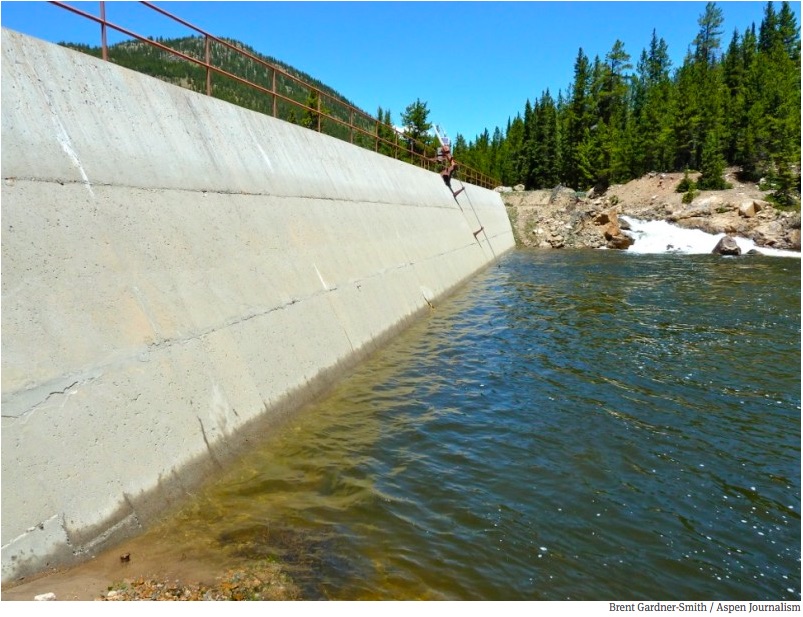
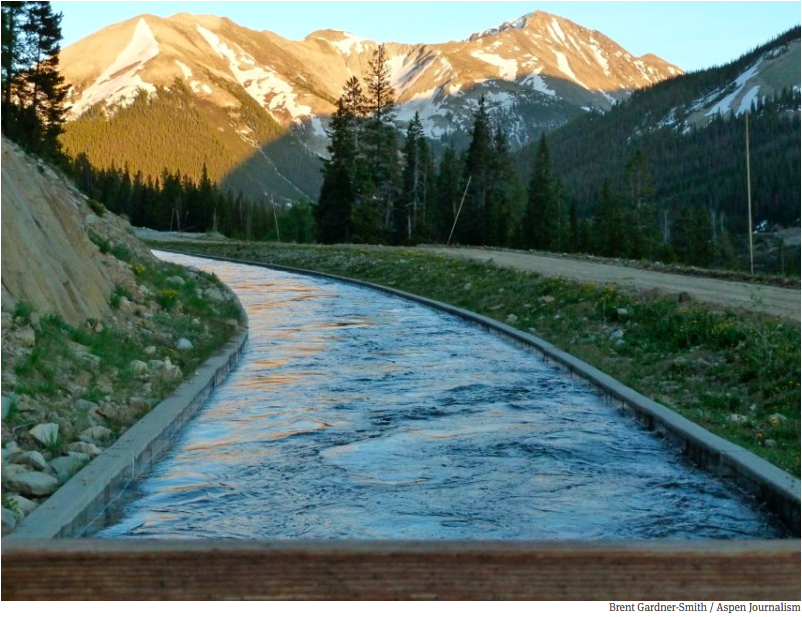
The ditch that moves water from Lost Man Reservoir to Grizzly Reservoir and then under the Divide to the South Fork of Lake Creek and the Arkansas River.
View from the CWCB
At a meeting on Aug. 21 in Vail of the Colorado Water Congress, John McClow, the general counsel of the Upper Gunnison Water Conservancy District, and a board member of the Colorado Water Conservation Board, described the conceptual framework, and the “historic conflict” in Colorado over transmountain diversions, for a ballroom full of members of the state’s professional water community.
“The most pressing question I’ve heard throughout the Western Slope is ‘What are we going to do about new transmountain diversion?’ All of the Western Slope roundtables addressed it to some extent in their basin implementation plans,” McClow said. “The South Platte Roundtable, the Metro Roundtable, talked about it in their plans. But those collective comments still reflected what I believe was conflict on the issue. It is a historic conflict – east versus west – and it’s been going on before Colorado was a state. What I’m happy to report is that the IBCC took it upon themselves to try and find a solution to that conflict.
“That group worked for over a year putting together seven principles that would create a framework around which a new transmountain diversion could be developed. It is not an agreement, it is not a regulation, it is not mandatory, but it confronts reality on every aspect of what will be necessary to consider in the event that a proponent wishes to pursue a new transmountain diversion. It’s couched in terms of seven principles, and each of them addresses one element of it. Some go a little bit beyond the strict interpretation of a transmountain diversion.
“What’s most important to remember is that it is not a rule,” McClow said. “What it does is set forth the obstacles that would occur in the event that a proponent were considering one, that it is to say, the physical and legal availability of water in the basin of origin, which is addressed by Colorado water law. But it reaches beyond that to say that if the new development occurs within the Colorado River system, which is what we’ve always identified as our source of new supply, we have to look beyond the state boundary and look at the big river system because of our obligations to other states on the Colorado River.
“We have to be careful that in developing that additional water, we don’t overdraft our entitlement under the Colorado River Compact and Upper Colorado River Compact. This framework provides a process to address those issues. And further, to say we have to have some means of evaluating the possibility of diversions by this new project through triggers. And without defining the triggers, its says there are places you need to look to figure out when and how much water could be diverted by a new transmountain diversion.
“The principles go beyond that and look at issues such as West Slope – East Slope collaborative benefits from a single project, it talks about conservation standards for the proponent of a new transmountain diversion, it talks about environmental and recreational sustainability within the state.
“I hope that we, the conservation board, will adopt this framework and incorporate it into the water plan so that we can remove this controversy because Colorado can’t move forward in conflict, we’ve got to move forward with consensus,” McClow said. “And this is a burning issue, Front Range and West Slope, and I’m hoping that for once in our history we can sit down and say ‘We’ve agreed on how this can actually happen, should it be possible, as long as it is done reasonably and responsibly and reflects the reality of our circumstances at the time.'”
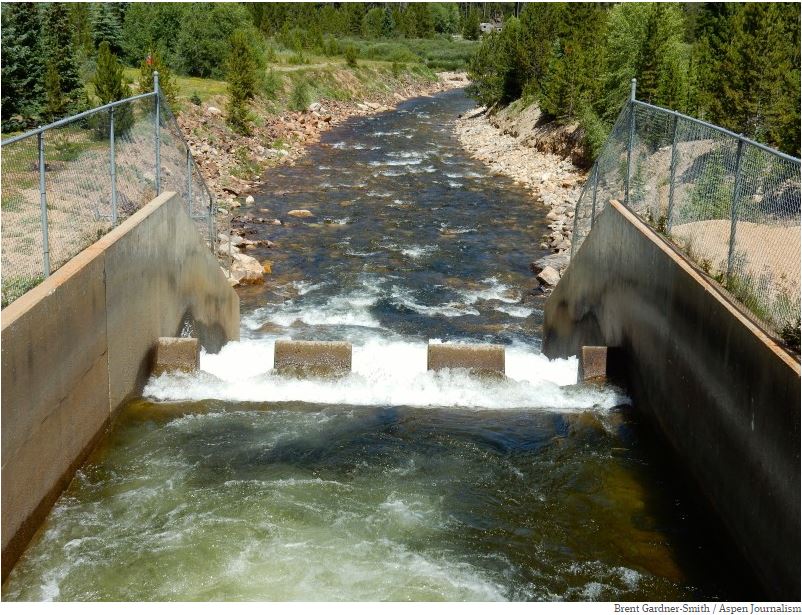
The outfall of the Bousted Tunnel, which delivers water from the Roaring Fork and Fryingpan rivers to the East Slope.
The seven principles b the draft conceptual framework:
1. East Slope water providers are not looking for firm yield from a new transmountain diversion (TMD) and the project proponent would accept hydrologic risk for that project.
2. A new TMD would be used conjunctively with East Slope supplies, such as interruptible supply agreements, Denver basin aquifer resources, carry-over storage, terminal storage, drought restriction savings, and other non-West Slope water sources.
3. In order to manage when a new TMD would be able to divert, triggers are needed.
4. A collaborative program that protects against involuntary curtailment is needed for existing uses and some reasonable increment of future development in the Colorado River System, but it will not cover a new TMD.
5. Future West Slope needs should be accommodated as part of a new TMD project.
6. Colorado will continue its commitment to improve conservation and reuse.
7. Environmental resiliency and recreational needs must be addressed both before and conjunctively with a new TMD.
Editor’s note: Aspen Journalism is collaborating with The Aspen Times and the Glenwood Springs Post Independent on coverage of water and rivers. The Times published a shorter version of this story on Wednesday, Aug. 26, 2015, as did the Post.
Not long ago, mentions of growth control as a tool to reduce water demands tended to be written off by Colorado water insiders as too complicated, outside the control of water providers and anti-economic development.
However, as the state’s water leaders have continued to debate how to meet the water needs of a growing population, the problems associated with getting more water from farms and West Slope streams have loomed larger, while the barriers to addressing water demand through land use strategies appear to have shrunk.
The link between water demand and land-use patterns occupied prime space on the agenda at last week’s summer meeting of the Colorado Water Congress, an entire issue of the Summer 2015 issue of Headwaters magazine, and its own subsection (6.3.3) in the July 2015 draft of the Colorado Water Plan. And House Bill 008, passed in 2015, requires land use strategies to be included in the water conservation plans that are required for large water providers to get financial assistance from the state.
While it’s been obvious for many years that big, green lawns require more water than apartment patios and rock gardens, the socially and politically acceptable tools for guiding growth in a less thirsty direction have been much less evident. Now, local governments and water providers with urgent water supply concerns are taking the lead in developing and implementing these tools in Colorado.
Communities south of Denver have been tapping groundwater faster than it can be replenished and are scrambling to get on a more sustainable water supply path. Eric Hecox, executive director of the South Metro Water Supply Authority, reported to the Water Congress crowd that in addition to re-using their groundwater supplies and participating in a regional water re-use project with Denver and Aurora, South Metro communities are beginning to address water demand in the land development process.
Douglas County has a water section in its Master Plan, which promotes infill development and the preservation of rural and open space. Castle Rock is offering lower tap fees to developers that limit turf areas and install other water-efficiency measures in new developments and is seeking to reduce water demands in existing homes by paying residents to rip out grass. Residents of Castle Rock and Highlands Ranch face higher water rates if they exceed a customized “water budget,” and Parker requires rain sensors on irrigation systems.
A long-standing barrier to relying on conservation as a “new” water supply is the perception that people’s behavior is too fickle to be relied upon for future planning. Building conservation measures into land development through measures such as increasing density and establishing low water-use landscaping from the beginning can take away some of that uncertainty.
Better data on exactly how much water use comes with each style of development can also help. The Keystone Policy Center is working with Denver, Aurora and other local governments through the Colorado Water and Growth Dialogue to combine existing water use data with modeling tools to better quantify the water demand changes that could come with different land use patterns.
The fact that increased population does not necessarily lead to proportional increases in water use is already clear. As Allen Best points out in the summer Headwaters issue, Denver Water’s total water use has decreased by 5 percent since 1990, despite the fact that the population it serves has increased by more than 30 percent during the same period.
As our understanding of the link between water use and different land use patterns, pricing strategies and landscaping requirements becomes more precise, it may be possible to further de-couple population growth from increasing water use. This, in turn, could significantly reduce the need for irrigated agriculture and West Slope streams to supply more water for urban growth, without the need to erect any fences at the border.
To learn more about efforts to integrate water and land use planning in Colorado, see:
Hannah Holm is coordinator of the Water Center at Colorado Mesa University. This article is part of a series coordinated by the Water Center in cooperation with the Colorado and Gunnison Basin Roundtables to raise awareness about water needs, uses and policies in our region. To learn more, go to http://www.coloradomesa.edu/WaterCenter.
Seven-point draft conceptual agreement framework for negotiations on a future transmountain diversion screen shot December 18, 2014 via Aspen Journalism
Some might think the upcoming state water plan is a recipe book for an elegant 10-course dinner.
Turns out something else is on the menu.
Stone soup.
You know, that old tale where a boiling rock becomes a tasty, fulfilling and nutritious dish as everyone adds a little something to the mix.
That’s the upshot of a three-day meeting of the Colorado Water Congress where the water plan served as the centerpiece of discussion. Gov. John Hickenlooper ordered up the water plan in 2013, a tumultuous weather year that featured drought, huge wildfires and floods. The document is expected to be completed in December, but even then will serve more as a cookbook than rule book or guidebook.
“The early discussion was, is this a textbook or a novel?” said Travis Smith, a Rio Grande basin member of the Colorado Water Conservation Board that is writing the state water plan.”We provided the textbook. I was interested in the novel that told the stories (of water).”
The plan has to be digested one bite at a time, Smith said. He advised Water Congress members to pick a chapter that interested them and read it, then add their own comments to the stew.
John McClow, who represents the Gunnison River basin on the CWCB, picked the section that discusses a collaborative framework for interbasin transfers — an idea that few from the Gunnison basin would have discussed 10 years ago.
The Interbasin Compact Committee still is seasoning that portion of the plan, so the current set of instructions already is outdated, he said. When it’s done, it will remain only a suggestion.
“We’re close to finding consensus about how a transfer could occur,” McClow said. “But it’s not a rule. It spells out the obstacles.”
Those obstacles are finding the balance among municipal water needs, protecting the Western Slope environment and satisfying Colorado River Compact needs with downstream states.
Patti Wells, representing Denver on the CWCB, dug through the ingredients already tossed in the pot and didn’t really like the taste.
While most of the people in Colorado have chosen to live in cities, their use of water — particularly for outdoor watering — has been described in terms of a problem, rather than a benefit, Wells said.
She pointed out that lawns and gardens reduce urban heat islands, improve water quality, increase property value and provide a place to play.
“That’s not to say we can’t use water wisely, but there is a value to people using water for outside uses,” she said.
By couching everything as a problem, it could be tougher to find solutions.
“Instead of trying to avoid the train wreck, we’re trying to figure out where to build the field hospitals,” she said.
Once the state water plan is delivered to Gov. John Hickenlooper, no one from the Arkansas Basin Roundtable will be ready to say “mission accomplished.”
On [August 12], the roundtable contemplated its future in light of the expected wrap-up of the water plan in December.
Public comments, which already number in the thousands, are due by Sept. 17.
The state Legislature’s interim Water Resources Review Committee heard another round of comments from the Arkansas Valley [August 11] in Salida.
And staffers from the Colorado Water Conservation Board, which is preparing the plan, gave roundtable members a few tips on finding the highlights among the verbiage of the 500-page document.
The plan generally promotes multipurpose projects with multiple funding partners and broad agreement about mitigation. It favors continuation of realistic conservation strategies. It addresses statewide concerns about municipal supply, agricultural needs, recreation uses and environmental preservation.
Its critical action plan, Chapter 10, outlines in broad strokes how projects will be prioritized, funded and possibly streamlined in the future. During the process, hundreds of projects bobbed up during dozens of meetings.
There are, however, few mandates. Words like “seek, create and encourage” are used, rather than “shall, will or must.”
“Chapter 10 is the guts of the state water plan,” Jeris Danielson said, summing up a similar presentation to the Interbasin Compact Committee a few weeks ago.
The IBCC, formed at the same time as the roundtables 10 years ago, had some angst about its future mission, but realized it will be needed to follow through on plans now in the works, Danielson said.
Jay Winner, the roundtable’s other IBCC member, said the plan is unfinished business, noting that roundtables throughout the state continue to vacillate on a framework for future transbasin transfers.
“If we don’t have a transmountain diversion, we don’t have a plan,” Winner said.
Alan Hamel, who represents the basin on the CWCB, said the roundtables will continue to have a role in the future, implementing basin plans that also were created in the two-year process to create a state water plan.
Jim Broderick, roundtable chairman, told members, who come from all parts of the sprawling Arkansas River basin, that it will be up to them in the future to see that basin plans are moved forward.
“Is this the last opportunity for comment?” Broderick asked Jacob Bornstein, a CWCB staffer.
“This is the last round of comment on the plan itself,” Bornstein replied. “But it is a living document that can change.”
“I used to be a orthodox card-carrying humanities academic with contempt for the manipulations of nature that engineers perpetrated. And then, I realized how much a beneficiary I was of those perpetrations.” — Patty Limerick (The Great Divide)
This is an important film and Ms. Limerick hits the nail on the head with her statement. When folks understand the history of Colorado and how water has shaped that history, when they learn about the disease and hardship that goes hand in hand with scarcity of water here in the arid west, when they witness the bounty from plains farms and the western valleys and the economic drivers associated with Colorado’s cities, when they take time to sit down to talk and learn from neighbors and others, opinions can change, understanding can grow, problems can be solved, and opportunities can be realized.
Jim Havey and the filmmakers set out an ambitious goal, that is, the telling of Colorado’s water story, without advocacy and without pointing fingers. The Great Divide accomplishes the telling using a superb screenplay written by Stephen Grace, the stunning footage by Jim Havey, along with the old photographs and maps of Colorado (and the Colorado River Basin).
Prior appropriation and anti-speculation are big ideas that form the foundation of Colorado water law. Article XVI of the Colorado Constitution includes detail about the preferred uses and the rights of diverters to cross private land to put the public’s water to beneficial use. All water in Colorado belongs to the citizens but diverters gain a property right allowing them to use the water.
The filmmakers manage to explain these details well during the film. The film describes the law, the compacts between states, river administration, and the 21st Century world of water. They emphasize the work and pioneering efforts needed to get Colorado where it is today.
San Luis People’s Ditch via The Pueblo Chieftain
Starting with the San Luis People’s ditch (the oldest water right in continuous use in Colorado — 1852) Coloradans have built out many projects large and small to put the water to beneficial use. The Great Divide describes many of these projects including the big US Bureau of Reclamation projects, Colorado-Big Thompson, Fryingpan-Arkansas, the Aspinall Unit, and what many think will be USBR’s last big project, Aninas-La Plata.
According to the film an early project, Cheesman Dam on the South Platte River, enabled delivery of high quality water to the City of Denver which had been plagued by outbreaks of cholera and other waterborne diseases.
These projects have gotten Colorado to this point with over 5 million residents and a diversified economy. However, in the documentary the head of Denver Water Jim Lochhead states, “If we grow the next 5 million people the way we’ve grown the last 5 million — that may not be sustainable.”
There is a tension between environmentalists and water developers in today’s Colorado, highlighted by the film. The Great Divide explores the historical roots of the environmental movement starting with the Sierra Club effort to save Echo Park on the Yampa River, up through the legislation allowing the Colorado Water Conservation Board to hold and establish instream flow rights, the successful efforts to block groundwater withdrawals in the San Luis Valley for Front Range growth, and the mammoth decision to not permit the Two Forks Reservoir on the the South Platte River.
The City of Denver and many of the suburbs were counting on that project for future needs. It is interesting to note that the loss of Two Forks led to increased groundwater withdrawals from the Denver Basin Aquifer System and an increase in purchases of agricultural rights by municipal systems. Both of these alternatives are unsustainable but have led to recharge projects, water reuse projects by Denver Water and Aurora Water, along with serious efforts to allow alternative transfer methods for agricultural water that would protect farmers and keep the water with the land. The Great Divide touches on these newer more sustainable solutions.
Drought is a constant possibility in Colorado. The film shows how the drought of the 1930s spurred northeastern Colorado to line up behind the Colorado-Big Thompson Project for new supplies and storage.
US Drought Monitor August 6, 2002
When things turned around after the drought of 2002 The Great Divide informs us that municipalities had to rethink conservation efforts and that pumpers with insufficient augmentation water were shut down. Denver Water managed to cut per capita consumption by 20% below pre-2002 levels and other utilities noted similar savings.
The film examines the aftermath of the 2002 drought and the efforts by the Colorado legislature which passed the Colorado Water for the 21st Century Act. It established the Interbasin Compact Committee (IBCC) and the nine basin roundtables. The roundtables and the IBCC were formed as a forum to share needs but most importantly share values. One of the outcomes of the effort has been the realization, stated in the film by Travis Smith that, “We are more connected than we’d like to admit.”
Colorado Water Plan website screen shot November 1, 2013
This connectedness, along with the need to solve looming wide-ranging supply gaps were the motivation for Governor Hickenlooper to issue an executive order to the Colorado Water Conservation Board to create Colorado’s first ever water plan. The Governor has an opportunity to present his view of the need for the plan in the film. He touches on the fact that however the plan turns out it will be built by the grass roots.
During his introduction of the film Justice Gregory Hobbs advised us to listen to the words along with viewing the images. He was right, the narrative by Peter Coyote engages and informs. You cannot listen to Mr. Grace’s words without learning at the same time. And that’s the point right? Educate and inform with an accurate representation of Colorado water issues and history.
The film will air on 9NEWS, KTVD-Channel 20, from 7 to 9 p.m. on Monday, Aug. 31. There is a film tour planned (click here for details).
All proceeds from the premier went to an effort to get the film into schools across Colorado. I think that is a great idea.
The film is a stellar vehicle for educating and generating conversation. Go see it when you can, buy the book, and then start talking and teaching.
Are you concerned about how Colorado will balance the water needs of cities, farms and the environment in coming decades? If so, you have an opportunity to make your voice heard by state water leaders.
A second draft of Colorado’s first comprehensive statewide water plan was released last month, and the Colorado Water Conservation Board is seeking public input. Comments on this draft must be submitted by Sept. 17 in order to be considered in the development of the final plan, which is due to be submitted to Governor Hickenlooper on Dec. 10, 2015.
This draft follows years of debate between Front Range and West Slope water providers, environmental advocates, river recreationists, farmers and ranchers over how to meet a projected gap between available water supplies and demands, particularly in growing Front Range cities. There are three main sources to turn to: transferring water from agriculture, pulling more water from West Slope streams across the Continental Divide, and significantly ramping up water re-use and conservation.
Like the original draft released in December 2014, the new draft dodges controversy and lays out a toolbox of actions alongside detailed information about current water supplies, demands and climate change projections. Particular project proposals are found in the “basin implementation plans” developed by roundtables of water providers and stakeholders in each of the state’s major river basins.
The new draft does, however, contain significantly more nuts and bolts on how to move forward on measures such as promoting conservation, improving the efficiency of the project permitting process, and developing new funding mechanisms. The concept of environmental resiliency is also incorporated more fully into this draft of the plan.
In addition, the new draft includes a revised framework for discussing the perpetually hot topic of the potential for a new project to divert more water from the West Slope to the Front Range. The framework sets out “realities and issues proponents for a new transmountain diversion should expect to address,” including the fact that water would likely not be available to divert in some years, due to existing uses and downstream obligations.
In the realm of urban conservation, the second draft of the plan contains beefed up sections on increasing the re-use of municipal water and integrating land-use and water planning, since large-lot subdivisions consume more water than denser development with less turf.
In relation to agricultural water, the second draft discusses measures to increase efficiency and conservation — while noting that the two are not equivalent. Increasing efficiency involves getting better at delivering water directly to where plants need it and nowhere else, which can actually make crops grow more vigorously and thus consume more water. Conservation, on the other hand, involves reducing the consumption of water, which can be accomplished through planting less thirsty plants, giving crops less water than needed for maximum growth, planting less acreage, or getting rid of water-sucking weeds.
While efficiency can have water quality benefits and improve stream flows between the point of diversion and the point where unconsumed water trickles back to the stream, only reduced consumption can make additional water available for other uses.
The draft plan also dedicates considerable ink to “alternative transfer mechanisms” that allow farmers to provide a portion of their water to cities on a temporary basis instead of permanently selling the water rights and drying up their land. Using such mechanisms could be less damaging to rural communities than “buy and dry” practices, but they are more complicated to implement.
Permitting process proposals include ensuring that all agencies with a say on a project are involved early on. Funding proposals include establishing a guaranteed repayment fund to facilitate multi-party projects and green bonds for environmental and recreational projects.
One message that comes through in reading the draft plan is that no one big project or mandate will provide the answer to meeting all of Colorado’s future water needs. The needs are diverse and dispersed, and a diverse and dispersed set of tools are needed to address them. And each tool comes with its own set of technical, legal and financial challenges. The draft plan attempts to chart the course for resolving those challenges, in the hope that the results will add up to a water future for Colorado that matches Coloradans’ values.
You can decide for yourself whether you think the right tools have been identified and the strategies proposed are adequate by going to http://www.ColoradoWaterPlan.com. You can find the complete text of the plan under the “Resources” tab by clicking on “2015 Second Draft of Colorado’s Water Plan.” Clicking on “General Information” under the “Resources” tab will give you access to a webinar and a July 2015 update that outline changes incorporated into the new draft. The “Get Involved” tab provides several options for submitting input.
This is part of a series of articles coordinated by the Water Center at Colorado Mesa University in cooperation with the Colorado and Gunnison Basin Roundtables to raise awareness about water needs, uses and policies in our region. To learn more about the basin roundtables and statewide water planning, and to let the roundtables know what you think, go to http://www.coloradomesa.edu/WaterCenter. You can also find the Water Center at http://www.Facebook.com/WaterCenter.CMU or http://www.Twitter.com/WaterCenterCMU.
In Otero County, the corn is knee-high, the famous Rocky Ford cantaloupes are almost ready to pick and the onions, tomatoes, sugar beets and wheat are thriving in the fields.
But on the north side of the Arkansas River, over in nearby Crowley County, the landscape looks very different. The only bumper crops are “noxious and obnoxious weeds,” according to a county commissioner. This is what happens when a county sells its water rights.
As did many communities this year, the southeastern Colorado county had what locals are calling a “Miracle May.” Rainfall in that single month was just a couple inches shy of what the county gets, in total, most years. For the first time in recent years, Lake Meredith will have enough water for fish to survive and maybe even generate a little tourism from anglers.
Still, it wasn’t enough to resuscitate the once-thriving agricultural industry nor to save the county’s last remaining feedlot, which is scheduled to go up for bankruptcy auction later this month.
Water experts say Crowley is a parable for how bad things can get when cities and industry dry up farmland to buy rural water — a controversial practice known as “buy and dry” deals.
But the county’s dry landscape could change if, as proposed by a group of water users representing the Arkansas River basin, the state’s water plan includes a blueprint for bringing water back to the county.
How Crowley County dried up
Water, and the agriculture industry that followed, didn’t come naturally to Crowley County.
The county was formed in 1911 out of a portion of northern Otero County – named in honor of state Sen. John H. Crowley, who represented the area at that time. The county is bordered on the south by the Arkansas River.
But the river wasn’t enough to irrigate local farms. The first irrigation systems came in through the Colorado Canal in the 1890s. In the 1920s, the state built a tunnel through the mountains to deliver water from the Roaring Fork River on the Western Slope and into a new reservoir at Twin Lakes, near Leadville. Crowley County farmers paid for the reservoir.
The county had its agricultural heyday before the dustbowl of the 1930s, but even after that farmers prospered.
Attached to Sweetness, a history of the county’s tiny town Sugar City, published in the 1980s, states “water created a Garden of Eden.”
The county easily rivaled its neighbors on crop production. It was known for tomatoes, onions, corn and wheat. It had two major feedlots for native Colorado cattle, and a sugar factory for processing sugar beets. And it was famous for cantaloupe. The juicy melons, known as Sugar City nuggets, were a “pink beauty,” according to Attached to Sweetness.
In the 1970s, more than 50,000 acres were irrigated in Crowley County.
But Crowley’s shares in the Twin Lakes reservoir earned it attention from thirsty Front Range cities.
In the late 1960s, with crops and cattle prices in decline, farmers and ranchers in Crowley County started thinking about selling their water rights. Some wanted to get out of agriculture. Others were ready to retire, and farmland was their 401(k).
In 1972, the Foxley Cattle Company bought water rights from farmers and ranchers all over the county. For a couple of years, that land stayed in agriculture and continued to be irrigated.
Then came the Crowley County Land and Development Company, which bought more water rights — both from Foxley and directly from farmers and ranchers willing to sell at the right price. CLADCO sold those water rights to Pueblo, Colorado Springs, Pueblo West and Aurora to quench those communities’ sprawl.
According to the Colorado Foundation for Water Education, municipal and industrial users now own 90 percent of the water stored in Twin Lakes.
The terms of the water sales included a requirement that municipalities revegetate the fallowed farms and ranches to restore the county’s natural prairie grasslands. But several current and former residents say the contractors did a poor job of re-seeding the prairie grass, and it quickly died.
A county that once had more than 50,000 irrigated acres now has only about 5,000. In the drought of 2012, the number dropped to 2,500.
Even the few remaining farmers with water rights are not guaranteed water in a year when there is not enough to go around.
Asked if Crowley is still an agricultural county, County Commissioner Frank Grant paused, and then said, “Yes. We still have cattle.”
But according to one lifelong resident, it’s mostly dairy stock, not valuable cattle that can be sold for beef.
The prisons of Crowley County
With dwindling agriculture, the county had to find another industry for its economic base. It turned to prisons.
There are two in Crowley County: the state-run Arkansas Valley Correctional Center, just outside the town of Crowley; and a private prison operated by Corrections Corporations of America near Olney Springs.
The county’s most recent property tax revenues totalled about $1.6 million – more than half of which came from the private prison.
The most recent census in 2012 counted more than 5,823 “residents” in Crowley County, but 46 percent of them are prison inmates.
Crowley County Commissioner Tobe Allumbaugh said that outside of the prison numbers, the county’s population has declined at about the same rate as its neighboring counties – about 1 percent per year.
The prisons have brought jobs, but not necessarily to Crowley County. Most of the prisons’ workers live in nearby counties or in Pueblo or Colorado Springs.
Commissioners Grant and Allumbaugh attribute the lack of interest in living in the county to a housing shortage. Most of the homes are small, old and asbestos-laden. It’s too expensive to tear the houses down because they would need asbestos mitigation. No one is showing any interest in building homes in the county, either, they said.
While the CCA taxes contribute to the county coffers, prisons haven’t helped businesses survive in Ordway and other communities.
Ordway, the county seat, has a population of just over 1,000. There are a few businesses on the town’s Main Street – mostly county and town government offices – an insurance company, grocery store, pharmacy, the reservoir and canal company offices, a couple of medical facilities and Chubbuck Motor, the local Ford dealer. The nearest farm tractor dealer, John Deere, is in Otero County.
Mostly, buildings along Main Street are for sale or appear to be abandoned.
Darla Wyeno, clerk for the town of Crowley, was one of those who sold water rights to the big cities. She and her husband have 120 acres on which they used to grow onions, tomatoes and melons. Today, they graze cattle on their land. She says life might have been different if the cities that bought their water had done a better job of re-seeding their land with prairie grass.
The loss of water hasn’t been all bad, she said. Their son went to college on the earnings they made from the water deal. He’s now a successful banker in Colorado Springs. Her husband has an off-farm job, and both their careers mean two steady paychecks every month instead of one uncertain one at the end of the year when they cashed in their crops.
Still, Wyeno adds, “When we sold our water, we sold our future.”
Local residents now fight the rampant dust every day, never realizing that would be the impact of losing their water. Bees won’t come to Crowley; it’s too far a flight. The hay fields today have to be pollinated with bees rented from outside the county.
State water plan may hold promise for the county
The state water plan, ordered by Gov. John Hickenlooper two years ago, incorporates suggestions made by roundtable groups in each of Colorado’s nine river basins. The roundtables include representatives from agriculture, municipal water providers, industrial users, environmental and recreational interests and those who own water rights.
Under Colorado’s complex web of water laws, once water has been removed from the land through the purchase of a water right, it cannot be returned. It’s gone for good.
But that isn’t stopping the Arkansas Basin roundtable from trying to find ways to get water flowing back into Crowley County.
The roundtable suggests that the county should acquire water rights to maintain permanent water levels in its two major lakes: Lake Meredith and Lake Henry. Inconsistent levels have resulted in loss of fish, blowing dust and bad odors in both lakes, according to the basin’s recommendations.
Allumbaugh says replenishing the lakes could help the county become a tourist destination, although getting the water to a stable level is just one part of the solution.
Two more recommendations seek water rights for municipal, industrial and agricultural needs.
The roundtable’s recommendations don’t specify where that water will come from.
Engineer Rick Kidd represents Crowley County on the Arkansas basin roundtable. He says the group firmly supports any efforts to get and keep water rights in the Arkansas River valley.
Grant says what has gone down in Crowley County – which he has called home for the last 36 years – is pretty typical of rural communities all across the state.
“It just happened here sooner,” he says. “The water sales got us.”
Subsurface irrigation via NETAFIM FromThe Denver Post (Bruce Finley):
Producers brace as water crunch turns eyes to agriculture’s 85 percent share
Agriculture across Colorado and the West continues to use 85 percent of total water supplies. But growing numbers of farmers are shifting toward greater efficiency, replacing ditch-and-flood irrigation with center-pivot sprinklers and tubes that emit tiny drops…
State water planners anticipate farmers will be able to transfer more of their huge share of water to meet intensifying demands of Front Range industry and housing developers.
“Basically, we’re going to ask the agricultural community to do what the municipal community has already done: Let technology work for you,” said James Eklund, director of the Colorado Water Conservation Board.
Greater efficiency irrigating crops means farmers could grow more and make more water available to companies and cities, Eklund said.
“You can do right by your business and attract new people,” he said, “and at the same time you can be freeing up water that otherwise would have been lost.”[…]
In the South Platte River Basin, state data show loss of water reduced 1.1 million acres of agricultural land during the past three decades to 813,000 acres. That decrease of nearly 300,000 acres adds to large losses in southeastern Colorado after sales by farmers to cities in the 1970s shifted 14.6 billion to 19.5 billion gallons of water…
In southeastern Weld County, traditionally one of the nation’s biggest agricultural producers due to heavy irrigation, farmers said one-third of water rights have been sold since 2009.
Some went to companies involved in the oil and gas boom. Others went to expanding cities.
Gov. John Hickenlooper has declared “buy and dry” must end. Hickenlooper’s senior water adviser, John Stulp, said in a recent interview that, given food and environmental benefits of agriculture, the notion that agriculture’s 85 percent share of water should shrink is unrealistic.
Yet Colorado will encourage Alternative Transfer Mechanisms for shifting water to cities — with farmers leasing water temporarily while retaining ownership — aiming to move 16.2 billion gallons a year. Stulp said any ATM deals will be voluntary.
“There is no mandate to agriculture,” he said. “No one is asking growers to give up ownership of that water.”
“Should we be planting cities in desert areas? Who should go — the farmers or the city dwellers?” said Paul Kehmeier, who grows alfalfa, oats and other crops 50 miles southeast of Grand Junction in western Colorado.
To do that, he diverts water from a river into ditches, managing a homestead his great-grandfather started 120 years ago on land where Ute Indians once thrived.
“Certainly, our farm needs to be irrigated. Otherwise, it would be sagebrush and desert,” Kehmeier said…
Arnusch said he’s wary of even leasing any water back to cities.
Every year for more than a decade, Arnusch has had to leave about 250 of his 2,500 acres fallow for lack of water to irrigate. Farmers here since his grandfather began irrigating in 1952 have accepted limits of nature and, in dry years, planted less, Arnusch said.
The problem with cities is they build based only on market economics, disregarding water, he said.
“Buy-and-dry is happening, and it will continue to happen. But as our nonagriculture water needs increase, what is that going to mean?” Arnusch said. “The urban areas should be like farmers, only using exactly as much as they need. If I don’t have a sufficient water source, how am I supposed to produce?”
Colorado’s statewide water plan has been criticized for failing to make tough decisions about the state’s biggest water issues: how new growth uses water, a new transmountain diversion from the Western Slope, and how to balance urban needs for water with a desire to preserve agriculture, which uses the majority of the state’s water.
In response, those involved with the plan say that’s not the point. The plan, by gathering input from across the state, is bringing together people with very different perspectives on water. By getting them to discuss the biggest issues around water in the state, it lays the foundation for better water management.
“It’s kind of like building a house,” said James Eklund, the director of the Colorado Water Conservation Board and head of the water plan process.
“You have to have the right tools and this plan sets out our tools, and where we are lacking, and how we can make them stronger. And really it’s a blueprint for how we want to build Colorado moving forward.”
On the other side, some of those watching the plan call it less a blueprint and more of a list. Susan Greene, a longtime water reporter and editor of The Colorado Independent, published an in-depth article on the plan where she interviewed Brookings Institution water expert Pat Mulroy. According to Greene, Mulroy was not impressed with Colorado’s plan.
“Essentially she was just saying this is more of a values statement, or almost an encyclopedia or compendium of the water issues Colorado faces than a plan,” Greene said.
Others quoted in the article had similar criticisms.
The Water Board’s Eklund dismissed this critique, essentially saying Mulroy is stuck in the past, where, as the saying goes, “whiskey is for drinking; water is for fighting.” That’s not Colorado’s way, or the way of the future, he insisted.
“Up here, collaboration and cooperation are our motto, and that’s our drive,” said Eklund…
Others involved in the water planning process say that growth and reducing water use with that new growth is the real issue. Jim Pokrandt, with the Colorado River District, said he is glad the state water plan at least talks about land use, growth, and landscaping as an important component of water use.
“How can we grow more smartly is the million dollar question that we need to start dealing with tomorrow,” said Pokrandt.
Flood irrigation in the Arkansas Valley via Greg Hobbs FromThe Colorado Springs Gazette (Ryan Maye Handy):
The battle between cities and agriculture for water was the theme for a Monday gathering of water experts from around the West who came to Colorado State University for the institution’s first Western Water Symposium. The all day discussions were timely, as Colorado is in the last few months of approving its first statewide water plan, which is due on Gov. John Hickenlooper’s desk by early December.
The plan, broken up by basins, seeks to prepare for a future with more Colorado residents and less water. The plan’s default solution is that the water will come from Colorado’s agriculture, said Supreme Court Justice Greg Hobbs, who directed the symposium.
“The Colorado Water Plan, it’s really a plan about agriculture, how do we get water for the cities and not destroy agriculture,” he said. “And we’ve got a short water supply, and the farmers can be on the short stick of this if we don’t look out for their water rights.”
While the experts spent much of Monday discussing the future of water in the Rockies, they also reminisced about how the West got here, with its water needs exceeding its resources.
It began in the mid-19th century, when three acts passed under President Abraham Lincoln, the Homestead, Land Grant College and the Pacific Railway Acts, opened the West for settlement.
But what settlers found was not the water-rich land and easily accessed gold mines depicted in popular maps of the day, said Susan Schulten, a professor of history at University of Denver. Instead, they found a sort of “American desert,” an arid plains landscape that needed water to sustain the kind of livelihoods people were accustomed to on the East Coast.
What followed was more than a century of work, building dams and reservoirs, and legal wrangling that transformed Colorado into a place that had enough water for gold miners, farmers and growing cities along the Front Range.
In the 21st century, agriculture in Colorado spans both sides of the Continental Divide, and most of it relies on water coming from the mountains. About 70 percent of the Colorado River allocations to Colorado go to agriculture, which is about average, said Reagan Waskom, the director of CSU’s Colorado Water Institute.
But water headed to Colorado’s farms isn’t the only share being eyed in the negotiations to bolster Colorado’s dwindling water supply. In 2012, the Bureau of Reclamation completed a study of the Colorado River, which has its head waters in Rocky Mountain National Park and is the lifeline for much of the arid states to the west of Colorado. To help preserve the river, the study suggested that agriculture and urban users cut back on their flows by one million acre feet…
But it was hard to figure out how to take from agriculture, which has been plagued by drought, and expanding urban areas, said Waskom, who sat on the agriculture committee.
“This big report I don’t think really got us to the future,” Waskom added.
The report suggested that much of the reduction in agriculture’s water reserves be done through fallowing, or letting farmers’ fields go dry. But that solution comes at too high a cost for Colorado’s farmers, Waskom said.
“The way you are going to get ag water is by reducing consumptive use,” he said. “How can you reduce it in such a way and that you can get water and not hurt a farming operation? There really aren’t too many ways that you can reduce consumptive use other than fallowing. If you are paid enough for that water when you fallow, maybe you come out ahead and go golfing.”
Both legislators and members from the Colorado Water Conservation Board appointed by Gov. John Hickenlooper visited Craig on Wednesday to present information on the plan and listen to public input.
Northwest Coloradans have a major stake in the plan, which could allow for the eventual diversion of water from the Yampa River to the Eastern Slope to quench the thirsty lawns of a rapidly growing urban and suburban population.
Several local leaders from the water, agriculture and conservation arenas voiced their opposition to a trans-mountain diversion of Yampa waters.
“The state water plan has probably caused as much angst and apprehension as anything that’s happened in my lifetime,” said Ken Brenner, member of the Upper Yampa Water Conservancy District board of directors and also part of a third-generation ranch family in Routt County. “I am opposed to any new trans-mountain diversion. I don’t believe the water supply exists, and we are certainly having enough trouble meeting our compact obligations.”[…]
The Upper Yampa Water Conservancy District board, which includes Brenner and eight other members, issued a letter Wednesday to the CWCB asking for “an equitable apportionment of the native flow within the Yampa,” relative to native flows used by other basins in the state that empty into the Colorado River.
The concern is that, because Colorado is only allowed to use a certain portion of its river flows, and because Northwest Coloradans have junior water rights relative to regions that developed earlier, the state may limit local use of water in the Yampa/White/Green Basin in order to meet its obligations downstream.
State water planners are seeking public comments on the plan through Sept. 17. The legislative Water Resource Review Committee is also currently juggling how to weigh in on the plan. Committee-sponsored bills are due in October, two months prior to the deadline for the final water plan’s completion.
“As legislators, myself included, we feel very strongly that the water plan will only be successful if we have widespread public input,” said Committee Chair, Sen. Ellen Roberts, R-Durango, District 6.
Roberts, who is one of a four-person Western Slope majority on the committee, hopes the visit to Craig and other locations will help better inform legislative water policy in the future.
“Getting them over here, driving our roads, seeing our forests and seeing that agriculture really is strong and viable. … They’re not necessarily aware of that if they live in the urban corridor,” Roberts said. “I think part of the value of the water plan … is to make urban dwellers more conscious of the tradeoffs that have occurred and that we live in a high altitude, arid environment.”
Even in the face of climate change and a growing population, Colorado can have enough water in the future. That’s according to three water managers from around the state. But abundance won’t happen by accident; the state will have to steward the water it has and plan its growth smartly.
Jim Lochhead, CEO of Denver Water; Eric Hecox, executive director of the South Metro Water Supply Authority; and Eric Kuhn, general manager of the Colorado River District in Glenwood Springs spoke with Colorado Matters host Ryan Warner. They talked about the second draft of the state’s first water plan, which is available now. It will be finalized in December…
Jim Lochhead on the “action plan” included in the water plan’s second draft
“At this point I would characterize it as a compendium of ideas. It doesn’t set out priorities, it doesn’t set out timelines, it doesn’t set who will do what by when… For example, right now the plan speaks to municipalities saving 400,000 acre feet of water. I think that we need a statewide water efficiency goal that applies across the state, across all sectors. Whether it’s agriculture, industry or municipalities, we all need to be sharing in achieving greater efficiency. Right now it’s simply targeted at municipalities.”
Eric Kuhn on “the big issue” on the Colorado River
“Every drop of water today is used. Except for manmade exports of water that was saved in Mexico due to the accident of an earthquake, no water has gotten to the gulf of Baja California since 1999. So, if a city is going to use new water supplies from the Colorado River, somebody else in the Colorado River system is going to use less…
[But] look at some of the success stories in the Colorado River Basin. Las Vegas is serving 2.1 million today with two thirds of the water that they were using 10 years ago and serving 500,000 or 600,000 people less…
We have enough water in the system, even if climate change reduces our supplies. But we have to use it in a much smarter way.”
Eric Hecox on what South Metro communities have done to reduce water use
“We have historically had an over-reliance on non-renewable groundwater, which is essentially groundwater in wells. Our access to that water supply has been diminishing… for all intents and purposes, they’re drying up.
“[Out of necessity], our members have reduced collectively in the area water use by about 30 percent… We have two members, that are two of only a few in the state, that put individual customers on water budgets. We have a number of members that are paying current customers to transform their outdoor landscaping. We have members that are really pushing the boundaries of what they can do with new development, and giving significant incentives to new developers to put in place development that uses less water. In addition to that our members, for all intents and purposes, are reusing their supplies.”
The dam that forms Homestake Reservoir on Homestake Creek, a tributary of the Eagle River. An agreement allows for more water to be developed as part of this transmountain diversion project.
James Eklund, the director of the Colorado Water Conservation Board, invoked his Western Slope heritage at a “Summit on the Colorado Water Plan” hosted Saturday in Rifle by the Garfield County commissioners.
“The mantra I grew up with in Plateau Valley was not one more drop of water will be moved from this side of the state to the other,” said Eklund, whose mother’s family has been ranching in the Plateau Creek valley near Collbran since the 1880s.
Eklund was speaking to a room of about 50 people, including representatives from 14 Western Slope counties, all of whom had been invited by the Garfield County commissioners for a four-hour meeting.
The commissioners’ stated goal for the meeting was to develop a unified voice from the Western Slope stating that “no more water” be diverted to the Front Range.
“That argument had been made, probably by my great-grandparents, my grandparents and my parents,” Eklund said. “And I know there are a lot of people who still want to make that argument today, and I get that. But it has not done us well on the Western Slope.
“That argument has gotten us to were we are now, 500,000 to 600,000 acre feet of water moving from the west to the east. So I guess the status quo is not West Slope-friendly. We need something different. We need a different path. And these seven points provides that different path.”
The “seven points” form the basis of a “draft conceptual framework” for future negotiations regarding a potential transmountain diversion in Colorado.
The framework is the result of the ongoing statewide water-supply planning process that Eklund is overseeing in his role at the CWCB.
Eklund took the helm two years ago at the CWCB after serving as Gov. John Hickenlooper’s senior deputy legal counsel, and he’s been leading the effort to produce the state’s first water plan, which is due on the governor’s desk in December.
The second draft of the plan includes the seven points, even though the Colorado River Basin Roundtable, which meets monthly in Glenwood Springs under the auspices of the CWCB, is still on the record as opposing their inclusion in the water plan. That could change after its meeting on Monday.
The outflow of the Bousted Tunnel just above Turquoise Reservoir near Leadville. The tunnel moves water from tributaries of the Roaring Fork and Fryingpan rivers under the Continental Divide for use by Front Range cities, and Pitkin County officials have concerns that more water will someday be sent through it.
Not legally binding
The “seven points” seeks to define the issues the Western Slope likely has with more water flowing east under the Continental Divide, and especially how a new transmountain diversion could hasten a demand from California for Colorado’s water under the 1922 Colorado River Compact.
“The seven points are uniquely helpful to Western Slope interests because if you tick through them, they are statements that the Front Range doesn’t necessarily have to make,” Eklund said in response to a question. “If these were legally binding, the Western Slope would benefit.”
Under Colorado water law a Front Range water provider, say, can file for a right to move water to the east, and a local county or water district might have little recourse other than perhaps to fight the effort through a permitting process.
But Eklund said the points in the “conceptual framework” could be invoked by the broader Western Slope when negotiating a new transmountain diversion.
As such, a diverter might at least have to acknowledge that water may not be available in dry years, that the diversion shouldn’t exacerbate efforts to forestall a compact call, that other water options on the Front Range, including increased conservation, should be developed first, that a new transmountain diversion shouldn’t preclude future growth on the Western Slope, and that the environmental resiliency of the donor river would need to be addressed.
“We’re just better off with them than without them,” Eklund said of the seven points.
The downstream face of the dam that forms Homestake Reservoir on Homestake Creek, a tributary of the upper Eagle River. A tunnel moves water from Homestake Reservoir to Turquoise Reservoir, near Leadville.
A cap on the Colorado?
Eric Kuhn, the general manager of the Colorado River District, which is based in Glenwood Springs and represents 15 Western Slope counties, told the attendees that three existing agreements effectively cap how much more water can be diverted from the upper Colorado River and its tributaries above Glenwood Springs.
The Colorado Water Cooperative Agreement, which was signed in 2013 by 18 entities, allows Denver Water to develop another 18,000 acre-feet from the Fraser River as part of the Moffat, or Gross Reservoir, project, but it also includes a provision that would restrict other participating Front Range water providers from developing water from the upper Colorado River.
A second agreement will allow Northern Water to move another 30,000 acre feet of water out of the Colorado River through its Windy Gap facilities, but Northern has agreed that if it develops future projects, it will have to do so in a cooperative manner with West Slope interests.
And a third agreement known as the Eagle River Memorandum of Understanding will allow Aurora and Colorado Springs to develop another 20,000 acre feet of water as part of the Homestake project in the Eagle River basin, but will also provide 10,000 acre feet for Western Slope use.
“So effectively these three agreements, in effect, cap what you’re going to see above Glenwood Springs,” Kuhn said.
The Moffat, Windy Gap and Eagle River projects are not subject to the “seven points” in the conceptual agreement, and neither is the water that could be taken by the full use of these and other existing transmountain projects.
“So when you add all that up, there is an additional 100,000 to 150,000 acre-feet of consumptive use already in existing projects,” Kuhn said.
But beyond that, Kuhn said Front Range water providers desire security and want to avoid a compact call, just as the Western Slope does.
“We’ve been cussing and discussing transmountain diversions for 85 years,” Kuhn added, noting that the Colorado Constitution does not allow the Western Slope to simply say “no” to Front Range water developers.
“So, the framework is an agenda,” Kuhn said, referring to the “seven points.” “It’s not the law, but it is a good agenda to keep us on track. It includes important new concepts, like avoiding over development and protecting existing uses.”
rquoise Reservoir, which stores water brought under the Continental Divide from the Eagle, Fryingpan and Roaring Fork river headwaters.
Vet other projects too?
Rachel Richards, a Pitkin County commissioner, told the attendees that she would like to see more water projects than just new transmountain diversions be subject to the seven points.
As part of the state’s water-supply planning efforts, state officials have designated a list of projects as already “identified projects and processes,” or IPPs, which are not subject to the seven points.
“We would like to see the same environmental standards, and community buy-in standards, applied to increasing existing transmountain diversions or IPPs,” Richards said, noting that the “IPPs” seem to be wearing a halo.
“They need to go through just as much vetting for concern of the communities as a new transmountain diversion would, and we’re probably going to see a lot more of them first,” she said.
At the end of the four-hour summit on the statewide water plan, Garfield County Commissioner Mike Sampson said he still had “real concerns” about the long-term viability of Western Slope agriculture and industry in the face of growth on the Front Range, but he offered some support for the seven points.
“I think the seven points is probably a good starting position,” Sampson said.
He also said Garfield County would make some edits to a draft position paper it hopes will be adopted by other Western Slope counties.
On Saturday, the draft paper said “the elected county commissioners on the Western Slope of Colorado stand united in opposing any more major, transmountain diversions or major changes in operation of existing projects unless agreed to by all of the county(s) from which water would be diverted.”
But Sampson was advised, and agreed, that it might be productive to reframe that key statement to articulate what the Western Slope would support, not what it would oppose.
Editor’s note: Aspen Journalism is collaborating with the Glenwood Springs Post Independent and The Aspen Times on coverage of rivers and water. The Post published this story online on July 25, 2015.
Colorado Water Plan website screen shot November 1, 2013
FromThe Grand Junction Daily Sentinel (Gary Harmon):
A West Slope attitude that not one more drop of water should be diverted to the East Slope is an approach that’s likely to fail at the worst of times, several speakers said Saturday at a West Slope water summit.
Representatives from 15 of 22 West Slope counties attended the summit at Colorado Mountain College, which focused on a framework of principles contained in the second draft of the Colorado water plan, set to be complete by the end of the year.
Organizers suggested that the West Slope counties and cities sign letters outlining a common position on the water plan and the potential for transmountain diversions.
Much of the framework outlines the conditions under which a new transmountain diversion could be discussed, though proponents of the framework acknowledge that the framework doesn’t have the force of law.
Still, the not-one-more-drop approach “has gotten us where we are today, where 500,000 to 600,00 acre-feet of water go from the West Slope to the East Slope,” said James Eklund, director of the Colorado Water Conservation Board, which is responsible for drafting the water plan.
The West Slope is better off with the framework contained in the water plan than without the framework, Eklund said.
The final version is to be complete by the end of the year and comments are due to the agency by Sept. 17.
The framework is “probably a good starting position,” for discussions with the Front Range about water management, said Garfield County Commissioner Mike Samson, who said the west side of the Continental Divide needs protection.
“If they take water for people who live on the East Slope versus water to raise crops, when it comes to a curtailment, who’s going to lose that battle? Ag will dry up.”
The water plan should recognize the existing conservation and water-quality improvements that the West Slope already has undertaken, Mesa County Commissioner John Justman said.
One principle in the framework calls for the East Slope to assume the “hydrologic risk” of a new diversion, meaning that East Slope water users would be affected by a call on the river as West Slope residents would be.
The West Slope has to take into account the needs of the rest of the state, however, said Dave Merritt of Garfield County.
“We are all part of one state,” Merritt said. “We need a healthy Front Range economy. These seven points (in the framework) make a very strong statement as to what needs to be addressed.”
Colorado transmountain diversions via the State Engineer’s office
Colorado transmountain diversions via the University of Colorado
Conceptual vision of potential transmountain diversions from the South Platte Roundtable Basin Implementation Plan
Seven-point draft conceptual agreement framework for negotiations on a future transmountain diversion screen shot December 18, 2014 via Aspen Journalism
The latest draft of the plan sets strict guidelines for approving new diversions over the Rocky Mountains.
Underneath the surface of Colorado’s new water plan is an unspoken acknowledgment: the days of moving large amounts of water up and over the Rockies are probably done.
On July 7, the second draft of the statewide plan was released, the latest step in a decade-long process that will direct how Colorado’s water should be managed for years to come. The new draft sets a statewide water conservation target of 400,000 acre-feet and incorporates input from Colorado’s nine Basin Roundtables, groups of citizens and experts tasked with thinking about their region’s water needs. But the biggest addition is a revised set of guidelines for making decisions about new supply projects that could spell the end of any new big water transfers over the Continental Divide.
The guidelines acknowledge what for years seemed unthinkable to many Coloradans: there may not be any water left to develop, without cutting into the water rights already in use.
That admission represents a huge shift in what the state publicly acknowledges about Colorado’s water supply, says Eric Kuhn, the general manager of the Colorado River District and one of the people who helped draft the guidelines. “Just a few years ago no one was questioning whether there was more Colorado River water to develop,” he says…
That new mindset, encapsulated in the guidelines, challenges a long-held assumption that the state can and should develop its full allotment of water from the Colorado River under the 1922 Compact. The law requires that the Upper Basin states send 7.5 million acre-feet annually to the Lower Basin plus an additional 750,000 acre-feet for Mexico before splitting the remainder among themselves. According to the most recent study by the Colorado Water Conservation Board on the availability of supplies in the Colorado River Basin, Colorado has anywhere from one million to zero acre feet left to develop — depending on which climate model plays out.
On the West Slope, home to 84 percent of Colorado’s water supply, that possibility is driving calls for “not one more drop” of water diverted to the Front Range. Even Denver Water, the largest municipal water utility in the state with 1.3 million customers, acknowledges that protecting existing supplies is paramount. Their comments on the second draft state: “Denver Water receives about 50 percent of its total supply from the Colorado River. Therefore avoiding a ‘Colorado River Compact Call’ is critical to our ability to meet our obligations to our customers.”
But the lingering uncertainty over just how dry or wet Colorado’s future will be means Denver Water is covering both bases. Another section in its comment letter maintains that “the ability to develop new projects should be protected.”
…some wonder if rural Colorado is over-accommodating metro areas with the plan. State water officials – with input from eight regional water basins – outlined an estimated $20 billion in projects related to a municipal water-supply gap, which is growing largely because of Front Range expansion.
A second draft of Colorado’s Water Plan was made available to the public earlier this month. State lawmakers and water officials held a legislative meeting in Durango on Monday evening to present the plan and allow for input.
“We know the state is not going to be able to handle the burden, so we’re going to need to think outside the box,” said James Eklund, director of the Colorado Water Conservation Board.
In a change from the plan’s first draft, the second draft includes an elaborate “critical action plan,” which includes proposals for legislation and Colorado Water Conservation Board policy.
The plan focuses heavily on funding, proposing ideas that run the gamut, including a possible ballot initiative that would ask voters to approve a fee on beverage containers. Voters have rejected past tax hikes for water issues.
Other ideas include creating a tax credit for homeowners who install efficient outdoor landscapes and irrigation, and exploring public-private partnerships to implement projects…
“Colorado can no longer be all things to all people,” commented Dick Ray, representing the Archuleta County Farm Bureau.
Sen. Ellen Roberts, R-Durango, pointed out that state officials must delicately balance population-dense Colorado with agricultural areas.
“We hear the desire to limit the number of people coming into the state of Colorado, but I don’t know how you do that,” Roberts said. “I don’t know how you close the door.”
Gunnison River Basin via the Colorado Geological Survey FromThe Crested Butte News (Alissa Johnson):
The plan has been getting a lot of attention for addressing potential transmountain water diversion projects that would carry water from the Western Slope to the Front Range, including the Gunnison River. But local water experts say that’s one small part of a comprehensive document.
“One thing that’s interesting is the amount of attention that transmountain diversion has gotten in the Colorado Water Plan. That’s really just a page or two out of about 500 pages, but it has gotten more attention than the rest of the document combined,” said Frank Kugel, general manager for the Upper Gunnison River Water Conservancy District.
In fact, the plan doesn’t address specific project proposals for transmountain diversion. It provides a conceptual framework to guide the consideration of any future proposals—what Kugel calls sideboards for future discussions—including protection for local communities.
“There will be strict principles applied to any future transmountain diversion projects. The diverter has to accept the risk of that project and understand that if there is no water available, they are the first ones to be shut off,” Kugel said.
The full plan considers many other aspects of water management. As Kugel explained, “We’re facing the risk of having twice as many people [in Colorado] by the year 2050 and some 10 to 15 percent less water supply due to climate change. Those two paths are going in opposite directions, so we need to figure out how to serve more people with less.”
To do that, all nine of Colorado’s Water Basin Roundtables, the Interbasin Compact Committee (IBCC) and the Colorado Water Conservation Board have been providing input to the plan.
As the Water Plan website states, “The 27 members of the IBCC, representing every water basin and water interest in Colorado, have agreed that unless action is taken, we will face an undesirable future for Colorado with unacceptable consequences.”
The process has attracted a lot of attention from the public. Julie Nania, water director for High Country Conservation Advocates (HCCA), says that more than 24,000 public comments were submitted on the first draft of the plan.
“As a plan itself it’s important, but it also facilitates a conversation, taking a closer look at the difficult water issues in Colorado… and how to move forward and protect natural resources while ensuring that communities have the water they need to thrive,” Nania said.
After an initial review of the second draft, Nania is encouraged by the progress that has been made: there are strong urban conservation goals; emphasis has been placed on the importance of healthy rivers, watersheds and watershed planning (including a recognition of the $2 billion to $3 billion needed to keep them healthy); and stringent principles have been developed to vet any future transmountain diversions projects.
“Two things HCCA will look at as we move forward are funding… and more robust criteria for projects before the state decides to fund them,” Nania said. While the plan acknowledges the cost of maintaining healthy rivers and watersheds, there is no funding mechanism identified for other types of projects.
“And we would always like to see stronger language against new transmountain diversions,” Nania continued.
Dolores River watershed
FromThe Durango Herald (Peter Marcus) via the Cortez Journal:
The July 2 release of the plan marks a critical juncture for Colorado’s Water Plan, which has been hailed by Gov. John Hickenlooper as one of the most important pieces of policy facing the state. The draft was actually released about two weeks early…
Local and state water officials will hold a meeting July 20 at the Holiday Inn & Suites in Durango, where state Sen. Ellen Roberts, R-Durango; James Eklund, director of the Water Conservation Board; and Mike Preston, chairman of the Southwest Basin Roundtable, are expected to give an overview.
Preston said the plan represents an opportunity to frame the future of water in Southwest Colorado and throughout the state for the next 50 years…
Policymakers must balance the interests of rural Colorado – where water is precious for agricultural needs – with the needs of the rapidly expanding Front Range and suburban communities. One sticking point could be transmountain water diversions for Front Range communities. Front Range plans call for more transmountain water, but Preston questions the viability of such a strategy.
Officials must also preserve the state’s “prior appropriation” system, in which rights are granted to the first person to take water from an aquifer or river, despite residential proximity. Water rights often dominate policy conversations.
The Southwest Basin is complicated, flowing through two Native American reservations and including a series of nine sub-basins, eight of which flow out of state. Complexities exist with agreements with the federal government, which owns large swaths of land in the region…
Preston said he has a team currently combing through the second draft of the plan to determine what changes occurred from the first draft. He was not immediately able to comment on any updates to the plan.
“We’ve got a lot of substance, really a 50-year strategy in the plan, and then a bunch of unresolved issues on a statewide level,” Preston said. “So, we’re really going to press for broader community education and engagement from here forward.
“This is a living document,” Preston said. “We’re pretty serious about what’s in it, both in terms of trying to develop our own supplies for the future and how we need to participate in the statewide exercise.”
Conceptual vision of potential transmountain diversions from the South Platte Roundtable Basin Implementation Plan
FromThe Pine River Times (Carole McWilliams) via The Durango Herald:
The Colorado Water Conservation Board (CWCB) is drafting the plan. Meeting at the casino Wednesday, the board voted unanimously to include the conceptual framework in the water plan. The board was scheduled to continue meeting Thursday.
CWCB member John Stulp called the conceptual framework “a guidance document for future negotiations.” The guidance notes that future TMDs will avoid increasing the risk of a compact deficit, the amount of water Upper Colorado River Basin states are obligated to deliver to Lower Basin states as measured at Lee’s Ferry in the Grand Canyon. Declaration of a compact deficit could have serious impacts to Western Slope water users.
Board member John McClow added, “On the West Slope, TMD is the number one issue in the water plan. I think this framework addresses that very well. It’s a concern on the Front Range, as well.”
Several CWCB members and other speakers said the conceptual framework and the state plan is a big step forward.
Durango water engineer Steve Harris agreed, but he objected that the plan doesn’t include a cost versus water-yield comparison of TMDs with alternative water sources.
“We think it’s very important that (it) be included,” he said. “I understand it’s not included, and it should be.”
Southwest Water Conservation District Director Bruce Whitehead called the framework “an elegant balance that was achieved. If it strays too far in any direction, we may lose that delicate balance.”
The water plan includes Basin Implementation Plans created by nine water basin roundtables around the state. Whitehead said the Southwest Basin Roundtable “supports first the development of resources (such as storage projects) in the basins that have the biggest supply gaps.”
He agreed with Harris that alternative supplies versus TMDs should be considered in the state water plan, not just in the Southwest Basin Implementation Plan.
Seven-point draft conceptual agreement framework for negotiations on a future transmountain diversion screen shot December 18, 2014 via Aspen Journalism
Sloans Lake FromThe Pueblo Chieftain (Chris Woodka):
Maybe because it was nearing lunchtime, the conversation about the state water plan turned to food Wednesday as the Colorado Water Conservation Board digested the final draft of the document at its meeting in Ignacio.
“I think you may have bitten off more than you can chew,” John Mc-Clow, a board member from Gunnison told the board’s staff.
“We haven’t opened our mouth,” CWCB Executive Director James Eklund replied. “This is the menu. We should be hearing more through the public comment process.”
Although saying changes from the first draft of the plan showed progress, McClow noted there were 83 funding actions listed in the plan and more focus was needed.
The board was divided about how much detail the plan should mention about specific projects and the ways to fund those projects, outlined in Chapter 10 of the newly released Colorado Water Plan. The board had looked at 181 “critical” projects during a June 23 work session, but differed on whether the projects were endorsed or simply identified.
“I would like to have a little more time to look at the list again,” said Alan Hamel, who represents the Arkansas River basin on the board.
Board members April Montgomery (Southwestern Colorado) and Travis Smith (Rio Grande basin) wanted more detail in Chapter 10, but were also concerned that the plan promote recreation, forest health and agricultural values. Montgomery wanted more clarity about whether a project’s chances of being funded depended on it being listed as “critical.” Smith said there was little in the plan about how projects would be prioritized.
Board member Patricia Wells, Denver Water’s general counsel, disagreed on the need for more detail in the 500-page plan, saying no one would read a long, detailed list of projects. She was also critical that the plan put so much emphasis on urban conservation, rather than promoting the value of people living in cities.
“Eighty-six percent of the people live in urban areas…they are the economy,” Wells said. “The only mandate in here is that the people use less water…Residential outdoor water is 2 percent of the water use in Colorado, but it contributes to the quality of life…People are the Rodney Dangerfield of water use. I think we should give them a break.”
Her comments were largely offset by conservation groups that addressed the board. Western Resource Advocates, Trout Unlimited and American Rivers speakers all praised the plan.
“Our impression is favorable,” said Drew Peternell of Trout Unlimited. He singled out stream management plans, which are cited as a way to meet environmental and recreational needs. “This will give us tools to identify what are the flow regimes we need to support nonconsumptive needs.”
Comments on the plan will be accepted through Sept. 17, and the final version of the plan will be submitted to Gov. John Hickenlooper in December.
The entire plan can be viewed at coloradowaterplan. com. Past documents and instructions for submitting comments also can be found on the site.
More CWCB coverage here. More Colorado Water Plan coverage here.
Click here to read the latest iteration of John Fleck’s Water News. Here’s an excerpt:
Bruce Finley’s story last Friday in the Denver Post about Colorado’s latest water plan iteration shows, if you had any doubt, how the Cadillac Desert era is over. Or in Bruce’s words and example, “the era of moving water across mountains may be over.” Mythologies die hard, and in this decade of drought and water supply stress, Marc Reisner’s wonderful but outdated take on our problems is rearing its head, continuing to dominate public discourse by the power of Reisner’s prose. But Finley’s piece is great case study in what the post-Cadillac Desert landscape looks like, a landscape of more efforts at collaborative problem solving and less political and economic muscle pouring more concrete.
Colorado’s leading conservation and recreation organizations, including American Rivers, American Whitewater, Audubon Rockies, Conservation Colorado and Western Resource Advocates pointed to how the second draft of the Colorado Water Plan was improved by setting a common-sense goal for water conservation, creating a strong framework for scrutinizing large trans-mountain diversions and acknowledging the need for significant funding for river protection plans.
The groups also pointed out that to achieve real change, the final plan needs to:
1. Ensure an inclusive implementation process, similar to how the State has engaged and been responsive to public input during the planning process thus far;
2. Provide adequate funding for stream management planning, river restoration and urban water conservation;
3. Provide specific screening criteria so that projects move forward only if they benefit our communities, rivers and agriculture; and
4. Avoid large new trans-mountain diversions that would drain water from Western Slope rivers.
Specifically, the plan calls for a reasonable statewide urban conservation goal of saving 400,000 acre-feet of water by 2050. This equates to an almost one percent per year reduction in water use in Colorado cities and towns. However, the plan needs to include the incentives, funding and technical support to get that done.
The plan underscores the importance of healthy rivers and streams in Colorado and acknowledges that $2-3 billion is needed to protect them, but doesn’t yet commit funding to carry out that protection.
The Colorado Water Conservation Board has received more than 24,000 public comments and has been responsive to public input. It’s key that decisions about plan implementation stay visible to an engaged public and don’t fast track water project permitting to the detriment of public review and involvement.
Here’s what leading conservation groups are saying:
“We’re encouraged that the State assembled a second draft plan that weaves together a wide range of interests and public input. The boat is definitely pointed in the right direction. Strong rowing from the State is still needed if it’s going to reach its destination. Specifically, the Governor and Water Conservation Board must ensure plan implementation is inclusive and expands funding for protecting our rivers.” – Bart Miller, Healthy Rivers Program Director, Western Resource Advocates
“We are pleased to see the plan includes many of the priorities Coloradans have expressed in more than 24,000 public comments – including underscoring the importance of healthy rivers, a strong statewide urban conservation goal, and tougher scrutiny for large new trans-mountain diversions. Over the next few months, we urge the Water Conservation Board and the Hickenlooper Administration to make the final plan a detailed and workable blueprint that will protect our rivers, the multi-billion dollar outdoor recreation industry, agricultural heritage, and thriving cities.” – Becky Long, Advocacy Director, Conservation Colorado
“The second draft of Colorado’s Water Plan has taken good steps forward. To reach the finish line, the plan needs to greatly expand its funding commitment to healthy flowing rivers – a major factor in our $9 billion-a-year outdoor recreation industry. Those who value Colorado’s recreational opportunities, and related economy require further assurances Colorado rivers will be protected in the final plan.” – Nathan Fey, Colorado Stewardship Director, American Whitewater
“The second draft of Colorado’s Water Plan shows progress. More work must still be done to assess, protect, and restore dynamic flows for our rivers and increase funding for stream management plans and their implementation. Suggestions of resilient river systems, stream management plans, and strong urban water conservation goals are positive steps forward, echoed by public input, and critical for the health of our rivers.” – Abby Burk, Western Rivers Specialist, Audubon Rockies
Seven-point draft conceptual agreement framework for negotiations on a future transmountain diversion screen shot December 18, 2014 via Aspen Journalism
FromAspen Journalism (Brent Gardner-Smith) via The Aspen Times:
A recently revised framework on how to evaluate a future potential transmountain diversion in Colorado was endorsed by most of the members of a statewide water-supply planning committee on Monday.
Known informally as the “seven points,” and officially as the “draft conceptual framework,” the revised document was reviewed by the Interbasin Compact Committee – which was created to negotiate agreements between various river basins in the state – and then sent on to the Colorado Water Conservation Board, or CWCB, which oversees statewide water planning.
In turn, the CWCB’s directors are expected on Wednesday to add “the seven points” to the second draft of the Colorado Water Plan, which was released on July 7.
The seven points, or now, the seven “principles,” are also expected to be the main topic at a “Summit on the Colorado Water Plan” called by the Garfield County commissioners for Saturday, July 25 in Rifle.
The commissioners have invited all the county commissioners from 22 Western Slope counties to attend.
“Of particular interest to Garfield County is the proposed, draft conceptual framework for transmountain diversions and the seven principles for negotiating a future transmountain diversion in Ch. 8 of the draft plan,” says an invitation to the water summit. “Garfield County’s desire is that the end result would (be) a unified voice from the Western Slope that no more water is diverted.”
The seven principles, according to the revised document, are “to guide future negotiations between proponents of a new transmountain diversion and those communities who may be affected were it built.”
For example, one principle is that a new diversion of water under the Continental Divide to meet the needs of growing Front Range cities shouldn’t exacerbate the potential for California, Arizona and Nevada, which rely on water from the Colorado River, to demand that more water be sent downstream. As such, a new diversion may have to stop diverting in low-water years.
And, for example, a new transmountain diversion shouldn’t be applied for by a city or other entity that has not yet adopted aggressive water conservation efforts. And, any new diversion project would have to address the ecological needs of the river it seeks to divert, which has not typically been the case.
On Monday, the members of the Interbasin Compact Committee, or IBCC, reviewed, and tweaked slightly, the work done by a sub-committee over the last few months to better explain the seven principles.
Most of the IBCC members, most of whom represent one of nine regional water-supply planning groups, or “basin roundtables,” voted on Monday to accept the revised “draft conceptual framework,” which was first adopted last year by the IBCC.
But the effort by the IBCC to send on the revised document with a unanimous endorsement failed when the representative from the Metro roundtable, which meets in Denver, abstained from voting because the members of that roundtable do not support the levels of conservation as currently defined in the document.
And the revised seven principles failed to gain positive votes from the two members of the IBCC who represent the Colorado River Basin roundtable, Stan Cazier and Carlyle Currier.
Cazier and Currier voted against endorsing the document because the Colorado roundtable has not had a chance to review the revised document, and because the that roundtable to date has taken the position that the seven principles should not even be included in the draft Colorado Water Plan.
However, both men said they thought the document had in fact been improved by the subcommittee’s work.
“It presents a lot of requirements for someone to do any kind of transmountain diversion,” Currier said. “So I think it’s beneficial for the West Slope to have it in there.”
Editor’s note: Aspen Journalism is collaborating with The Aspen Times and the Glenwood Springs Post Independent on coverage of rivers and water. More at http://www.aspenjournalism.org.
It looks like the ultimate water fix: Build a huge reservoir by Dinosaur National Monument and divert much of the Yampa River, then pump back 97 billion gallons a year through a 250-mile pipeline across the Continental Divide to Colorado’s increasingly thirsty Front Range.
This plan for the Yampa — one of the last free-flowing rivers in the overtapped Colorado River Basin — is designed to defray Colorado’s projected 2050 water shortfall of 163 billion gallons.
The Yampa Pumpback exemplifies the state’s traditional approach to enabling a growing population: Since the 1930s, Colorado has built at least 30 trans-mountain diversions using more than 100 miles of tunnels to move Pacific-bound water back eastward to where people are concentrated.
But the era of moving water across mountains may be over.
An impasse over trans-mountain projects such as the Yampa Pumpback remains the most difficult obstacle as Gov. John Hickenlooper’s administration negotiates a Colorado Water Plan.
A second 479-page draft plan unveiled this week after 18 months — rather than drive action to meet needs — is emerging as a plan for more planning.
The July 2 release of the plan marks a critical juncture for Colorado’s Water Plan, which has been hailed by Gov. John Hickenlooper as one of the most important pieces of policy facing Colorado. The draft was actually released about two weeks early…
Local and state water officials will hold a meeting in Durango on July 20 at the Holiday Inn and Suites, where state Sen. Ellen Roberts, R-Durango, James Eklund, director of the Water Conservation Board and Mike Preston, chairman of the Southwest Basin Roundtable, are expected to give an overview.
Preston said the plan represents an opportunity to frame the future of water in Southwest Colorado and throughout the state for the next 50 years.
Included in the water plan are proposals from eight separate water basins, including a roadmap provided by the Southwest Basin Roundtable. Conversations between those roundtables have been taking place for 10 years.
Policy-makers must balance the interests of rural Colorado – where water is precious for agricultural needs – with the needs of the rapidly expanding Front Range and suburban communities. One sticking point could be transmountain water diversions for Front Range communities. Front Range plans call for more trans-mountain water, but Preston questions the viability of such a strategy.
Officials must also preserve the state’s “prior appropriation” system, in which rights are granted to the first person to take water from an aquifer or river, despite residential proximity. Water rights often dominate policy conversations.
The Southwest Basin is complicated, flowing through two Native American reservations and including a series of nine sub-basins, eight of which flow out of state. Complexities exist with agreements with the federal government, which owns large swaths of land in the region.
Goals outlined by the roundtable for Southwest Colorado include pursuing projects that meet the municipal water gap; providing safe drinking water; prioritizing conservation; and promoting water reuse strategies. For example, one strategy outlined would reduce lawn watering. The plan also calls for evaluating storage options.
Overall, the statewide plan outlines $20 billion worth of infrastructure projects to consider through 2050. The Southwest plan includes about 120 projects aimed at addressing agricultural, municipal, industrial, recreational and environmental water supply gaps, according to Preston. Multi-purpose projects are a priority, he said.
Preston said he has a team currently combing through the second draft of the plan to determine what changes occurred from the first draft. He was not immediately able to comment on any updates to the plan.
“We’ve got a lot of substance, really a 50-year strategy in the plan, and then a bunch of unresolved issues on a statewide level,” Preston said. “So, we’re really going to press for broader community education and engagement from here forward.
“This is a living document,” Preston added. “We’re pretty serious about what’s in it, both in terms of trying to develop our own supplies for the future, and how we need to participate in the statewide exercise.”
It didn’t quite amount to paying northern cities to stay out of the Arkansas River basin…but it could help.
The Arkansas Basin Roundtable Wednesday agreed to chip in $10,000 to a multimillion-dollar project by the Water Infrastructure and Supply Efficiency partnership, but only if Aurora promises not to use it to create an artificial trigger for more leases from the Arkansas River basin.
The money is just a show of support for a $6.4 million component that would get the right mix of water into a pipeline that connects Aurora’s $800 million Prairie Waters Project with a $120 million pipeline south of Denver to meet the future needs of 14 water providers who are members of the South Metro Water Authority.
Seven of the state’s nine roundtables, including the Colorado River basin, have contributed $85,000 to the project. Two roundtables are set to act on requests for $20,000 in the next two months, and another $800,000 is being sought from a state fund. WISE is ponying up $5.5 million.
The Colorado Water Conservation Board will be asked to approve the grants in September.
WISE would deliver up to 10,000 acre-feet annually of reused water primarily brought into the South Platte River basin by Denver and Aurora. Its backbone would be nearly $1 billion in existing infrastructure.
The $6.4 million would be for a treatment plant that would blend Prairie Waters and well water in the East Cherry Creek Village pipeline. That would relieve demand on Denver Aquifer groundwater and the need for cities to buy farm water — including Arkansas Valley water — said Eric Hecox, executive director of the South Metro group.
“In the big scheme of things, this is important because it meets a need in a big gap area,” Hecox said.
The proposal caused unease for water conservancy districts which have agreements with Aurora, however.
“The city of Aurora transfers water out of the Arkansas basin,” said Terry Scanga, general manager of the Upper Arkansas Water Conservancy District. “This project increases demand on Aurora’s supplies. I’m not OK with this unless there is some sort of amendment that says if (a storage shortfall) is triggered, they won’t come back into the basin.”
Aurora signed agreements with the Upper Ark, Southeastern and Lower Ark districts over the past 12 years that limit new leases from the Arkansas Valley. There are numerous requirements of how Aurora uses and stores water that factor into a complex equation.
The roundtable agreed that the benefits of reducing demand on the Denver Basin aquifer in northern El Paso County would help the Arkansas Valley. The WISE project would also slow, but not necessarily stop, future water raids in the Arkansas Valley.
Jay Winner, general manager of the Lower Ark district, asked Hecox about South Metro’s 2006 master plan that included future Arkansas River projects as options. Hecox said a new master plan is being developed that does not contain those projects.
“So you can come into the Arkansas basin?” Winner asked.
“Legally, yes,” Hecox replied. “But we have no plans to.”
In the end, the roundtable endorsed the $10,000 token support, but only on the condition that Aurora formally assures the three districts and the roundtable that WISE won’t be used as an excuse to take more Arkansas River water.
The second draft of the Colorado Water Plan has been released, but instead of listing specific potential projects, the statewide plan still points to eight regional “basin implementation plans” developed by water-supply planning “roundtables.”
And one such regional plan is considered by powerful water interests in the Denver metro area and South Platte River basin to be the necessary water plan for the state, and it includes moving more water from the West Slope to the East Slope.
At the core of the South Platte plan are potential new transmountain diversion or pumpback projects on the Green, Gunnison, Yampa, Colorado, Blue and Eagle rivers.
The plan also highlights conceptual dam projects on the main stem of the Colorado River west of Rifle and at Wolcott, which would store water pumped up from the Eagle River.
“Investigating, preserving and developing additional supplies from the Colorado River Basin is critical to effectively plan for future water supplies,” states the “South Platte Basin Implementation Plan.”
The dry-up of “hundreds of thousands of acres of agricultural land” is “the default option if decision makers do not exercise the political will to preserve and promote opportunities to develop Colorado River Basin supply for use along the urban Front Range,” the plan says.
The South Platte plan was prepared by consultants at HDR Engineering and West Sage working under guidance from the members of the South Platte and Metro roundtables. It was submitted to the CWCB in mid-April, as were seven other basin implementation plans from other roundtables.
The South Platte and Metro roundtables include representatives from Denver Water, Aurora Water, Northern Water, the South Metro Water Supply Authority, Weld County, Arapahoe County, and the cities of Thornton, Greeley and Loveland, among many other entities.
Water providers in the South Platte River basin now import 400,000 acre-feet of water from the Colorado River basin and another 100,000 acre feet from the Arkansas, North Platte and Laramie river basins.
By comparison, Ruedi Reservoir holds about 100,000 acre-feet of water.
And Front Range water providers see the need for another 195,000 acre feet of water for growing cities and 260,000 acre feet more for irrigation, even though the amount of irrigated land is expected to shrink from 831,000 acres to 635,000 acres.
The South Platte plan calls for minimizing the amount of “buy and dry” occurring on the Front Range by increasing the amount of new water supplies from the variety of rivers that make up the Colorado River basin within the state of Colorado.
“Agricultural water transfers can be reduced if other solutions including the development of Colorado River supplies are more successful,” the plan states.
It’s a concept found throughout the South Platte plan – the more Western Slope water made available to the Front Range, the less ag land will be dried up by expanding cities.
“The South Platte and Metro Roundtables have expressed in many documents and venues that all the available options for water supply development must be pursued simultaneously not sequentially,” the plan says under the heading of “potential future actions.”
“This approach can provide the greatest assuredness that Colorado River Basin water supply may be available for use, thereby reducing the need for East Slope providers to implement large-scale traditional agricultural to water urban water transfers,” the plans also says.
Large-scale concepts
The South Platte plan identifies a range of projects that could deliver new Colorado River water supply to the Front Range and divides them into “large-scale concepts” and “smaller-scale and incremental concepts.”
Under large-scale concepts, there are four “Colorado River transbasin concepts” listed in the plan, and they are on the Gunnison, Green, Yampa and Blue rivers.
The projects have likely all been studied and described in the past in various documents, but they are only briefly described in the South Platte plan.
A potential pipeline from Flaming Gorge Reservoir on the Green River to the Front Range is more fully explored than others, however, in both the main plan and in Appendix F.
The Flaming Gorge pipeline concept has also been studied in-depth by the South Metro Water Supply Authority, which represents 14 water providers in Arapahoe and Douglas counties.
All four of the “large-scale” projects would require new water storage facilities, including, perhaps, underground aquifers on the East Slope.
The Flaming Gorge project involves contracting with the Bureau of Reclamation for 150,000 acre-feet of water from Flaming Gorge Reservoir. It requires a 355-to-442 mile pipeline and pumps to move water 1,400 feet to 3,100 feet up and over the Continental Divide to the Front Range.
“Diversions would likely vary significantly from year-to-year depending on many factors potentially including hydrologic conditions, current storage levels in federal reservoirs (Colorado River Storage Project and Lake Mead), status of compact compliance monitoring, environmental and recreational needs and management strategies as well as Front Range water demands and storage levels,” the South Platte plan says of the Flaming Gorge pipeline.
The South Platte plan also says that Flaming Gorge concept was put forward by the South Metro Water Supply Authority, which “stressed that the concept is now worthy of serious consideration” and “recommends further investigation as a practical and viable means to manage Colorado’s statewide water resources and that the concept be vigorously pursued in subsequent stages of the developing Colorado’s Water Plan.”
The Blue Mesa Reservoir project also would require a water contract with Reclamation, in this case to move water from the Gunnison River through an 81-mile pipeline into the Arkansas River basin, from where the water would then be pumped into the South Platte basin. This requires pumping the water 3,400 feet in elevation.
The Yampa River project would require a 250-mile pipeline and the need to pump water up 5,000 feet in elevation over at least two mountain passes. The project would divert or pump water out of the Yampa near Maybell into a large reservoir.
The South Platte basin implementation plan says that with “large-scale” projects, there may be ways “to help offset the regional impacts of the projects, maximize and distribute statewide benefits, and ensure continued viability of the West Slope’s economy.”
Or, in other words, provide benefits to the West Slope river basins where the water originates.
For example, in turn for taking water out of the Yampa and White rivers, the South Platte plan finds that more infrastructure could be built as part of the transmountain water project to irrigate more land in Moffat Count, and provide more water to Steamboat Springs.
In the Gunnison basin, a new transmountain project could create more storage in the upper Gunnison River basin and help with water quality problems in the lower Gunnison basin.
The South Platte plan also notes that by building new transmountain diversion projects on the Gunnison, Yampa or Green rivers, it might be possible to leave move water in the already seriously depleted headwaters of the Colorado River.
Smaller-scale concepts
The plan also identifies a series of smaller-scale projects, including ways to leave more water in Green Mountain Reservoir – on the Blue River in Summit County – for eventual use by the Front Range.
The Wolcott Reservoir would be perched on a cliff above the hamlet of Wolcott, where traffic destined for Steamboat Springs leaves I-70.
It would be an “off-channel” dam and reservoir that would store water pumped uphill from the Eagle River.
Once in a new Wolcott Reservoir, the water could be released downstream – which would free up water in Green Mountain Reservoir for Front Range use – or pumped up over Vail Pass and into the Front Range’s existing water diversion systems.
The South Platte plan also describes a pumpback system that could be installed on the Colorado River below its confluence with the Gunnison River in Grand Junction.
Otherwise free-flowing water, destined for Lake Powell, would be pumped from below the confluence back upstream 16 miles so it could either be diverted into the Government Highline Canal.
Or it could be sent back downstream to help a regularly de-watered section of river below the canal, where native fish species are struggling to survive.
In satisfying the senior water rights on the Highline Canal, and helping to keep fish alive – and the federal government at bay – the lower Colorado River pumpback project could also let water stored in Green Mountain and Ruedi reservoirs be used for other purposes.
“A pumpback project on this stretch could provide water for the senior calling rights, therefore reducing the amount of Green Mountain Reservoir water that would need to be released for West Slope beneficiaries,” the South Platte plan notes.
The Webster Hill Reservoir is described in the plan. It’s a dam and reservoir on the main stem of the Colorado River downstream from the city of Rifle where the river bends away from I-70.
“This concept would include a regulating reservoir on the mainstem of the Colorado River with a volume of 30,000 to 40,000 acre feet,” the South Platte says.
The plan also describes two potential “small-scale” projects on the Yampa River.
One is called the “middle Yampa pumpback” and would take from a tributary of the Yampa, the Elk River, and send it through a tunnel under the Continental Divide and the Mt. Zirkel Wilderness Area to the headwaters of the Poudre River basin.
A second is called the “mini Yampa pumpback,” which would take water from the headwaters of the Yampa, including Morrison and Service creeks, to Granby Reservoir and on to the Front Range.
Then there is the Taylor Reservoir pumpback, which requires pumping water from Blue Mesa Reservoir up to Taylor Reservoir, and then sending it under the Continental Divide.
“The water court has previously stated that the yield from this concept would be around 50,000 to 60,000 acre feet,” the South Platte plan notes.
Power and water
The South Platte water-supply plan suggests that the South Platte basin is the most important, and powerful, part of Colorado.
“Considering the various conversations with South Platte basin stakeholders, it seems that one of the key overarching messages that should be conveyed is that a good Colorado plan needs a good South Platte plan,” the plan itself proclaims.
It also says, “Colorado lacks a cohesive plan to meet growing Front Range municipal water needs.”
Today, 80 percent of the state’s population lives in the South Platte River basin, which includes the Front Range cities of Aurora, Denver, Boulder and Fort Collins, and many other smaller, but steadily growing cities. Population in the basin, now 3.5 million, is expected to climb to six million by 2050.
According to the South Platte plan, “the single biggest driver of the need for additional water supplies is population growth” and the future water-supply gap in the South Platte basin accounts for 75 percent of the state’s forecasted water gap.
And yet today “agriculture is the dominant water use in the basin, accounting for 85 percent of total water diversions.”
The plan also sounds a “one Colorado” theme.
“There are many factors that support a broad statewide approach to solving South Platte basin water supply issues,” the plan says, including that “regional affiliations are increasingly fluid with offspring of West Slope residents increasingly finding employment and raising families in new South Platte river basin communities.”
Uphill to money
The South Platte plan includes, as Appendix F, a “concept for discussion” put forward by the South Metro Water Supply Authority, which includes a review of how to compensate the Western Slope for the loss of its water.
The Authority’s concept paper finds that “generally, the most useful form of compensation would be unrestricted monetary compensation to be used by the West Slope to compensate unprotected parties and for whatever other purposes its citizenry prefers.”
Rather than committing a certain amount of money for specific projects, the South Platte plan appendix suggests “a development fund” be established “for future water needs or other economic development on the West Slope.”
Front Range money could also be used, the appendix suggests, to try and repair the environmental damage already caused to headwater streams of the Colorado River by Front Range diversions.
Which as the plan put it, could serve as “an early milestone in the process, bringing environmental benefits to the headwaters on the way to project permitting.”
And the paper suggests that the “primary base of funding” for any new transmountain diversion would be “use rates and tap fees,” as “this connects the customers with what they are paying for.”
Two other funding mechanisms are also explored, including a “water” mill levy in nine Front Range counties or a statewide “container fee” on beverage containers, both of which the plan says could generate about $100 million annually for new water projects.
In the analysis of the water mill levy, or property tax, the plan suggests that half of the $107 million raised each year – $54 million – could pay for a new water project and the other half “could help provide water and economic development for the West Slope.”
The plan also notes, as a “point of comparison,” that Gunnison County in 2009 only saw $10 million in general fund revenue.
Finding such funding, and building a new transmountain diversion, would mean, according to the South Platte plan, that “transfers of East Slope agriculture would no longer be the dominant strategy for meeting Front Range water needs.”
A state water project?
However, the plan notes that there are “some important factors affect our ability to implement large statewide projects.
“First, smaller water providers on the Front Range, who will likely bear the largest part of the municipal and industrial gap, do not necessarily have the capability to develop new Colorado River Basin supplies on their own and will likely rely on conservation, reuse, and incremental agricultural transfers leading to a large loss of irrigated land in the South Platte Basin.
“Secondly, it cannot be assumed that cities or private investors will be able to build the Colorado River Basin supply projects needed to avoid a large loss of South Platte agriculture.
“A point has been reached in our state’s development where a state water project needs to be considered in order to minimize impacts of buy-and-dry,” the plan states. “This is the essential trade-off that Colorado’s Water Plan must recognize and address.”
Editor’s note: Aspen Journalism is collaborating with The Aspen Times and the Glenwood Springs Post Independent on coverage of rivers and water. The Times published this story online on Tuesday, July 7, 2015.
Over the course of the process, the state’s nine roundtables, representing eight different water basins (the Metro and South Platte roundtables are in the same basin), have outlined their ideas for state water use. As usual, the Front Range water districts are calling for more water from the Western Slope, with predictable outcry from those on the west side of the mountains.
It’s the failure to make firm decisions on this sort of contentious issue that has led to criticism of the plan, which does not have binding authority and has not required participants to iron out where future water will come from.
The participants in the process acknowledge the document lacks teeth, but Joe Frank, chair of the South Platte Basin Roundtable, said that’s deliberate.
“It is a planning document, it’s not a law, it’s not a mandate, but these are more recommendations that hopefully people can actually follow up on and really start to do some real things,” said Frank.
Yet those outside the process, including famed water expert Pat Mulroy — who led the desert city of Las Vegas’ water planning for decades, spurring the city to unprecedented levels of conservation while also shoring up its water supplies — told the Colorado Independent that a plan that doesn’t force anyone to make tough decisions isn’t much of a plan.
The public can comment on the plan until Sept. 17, 2015. The final draft will be submitted to Governor Hickenlooper in December of the same year.
We had come to the canyon that the Yampa carved through ancient Weber sandstone on a raft trip, to talk about the future of wild rivers, and rivers in general. Advocacy groups Friends of the Yampa and American Rivers decided that the best way to talk about water issues was on the water. So they pulled together 20 people who have been making decisions about water in Colorado, and in the West, for the past 30 years—the head of Denver Water, former Deputy Secretaries of the Interior, ranchers, power plant managers and environmentalists—and a few journalists like myself. They tempted them with the idea of running an untapped river, and then stuck everyone in boats for five days so they had to talk to each other.
The Yampa flows from the high country near Routt National Forest, past power plants and ranchlands, into Dinosaur National Monument where it joins the Green River at Echo Park. It hits the main stem of the Colorado just over the border in Utah. Even though it’s not dammed anywhere, it’s used by almost all the major groups who depend on river flows: farms, fish, cities, industry, recreation and power. The coal-fired Craig Power Plant is its major consumptive user. Endangered fish like the Colorado pikeminnow depend on its flow. Along the way it irrigates pasture lands and provides flows for kayakers. And, if it continues to run free—hence the flow-dependent bathtub ring—it can be a model for fish habitat and smart agricultural use…
On the river, as we floated through the folded geology of the canyon and stopped to scout rapids, we talked about those questions. At night, people pulled up chairs around the fire, cracked beers and tried to explain their priorities. We talked about risk management and sharing the burden of drought. The most heated topic was transmountain diversions of water across the Continental Divide, and how to avoid them.
The Yampa, and with it the state of Colorado, is a microcosm of river management. Colorado has to send almost half of the water that falls in the state downstream. To complicate things, the state’s water law is legally layered and hard to change. This spring, a bill that would allow Colorado residents to collect rainwater failed to pass, because it was argued that it could injure downstream water rights.
“It’s just like balancing a checkbook,” says Eric Kuhn, the general manager of the Colorado River Water Conservation District. “Based on the last 16 years, nature has provided a flow of about 13 million acre feet of water at Lee’s Ferry [just below Glen Canyon Dam], and our estimate is that we’re using about 15 million. Since then, we’ve overused the system by 30 to 32 million acre feet, which we know because we’ve drawn down storage by that amount. We started with 50 million in the bank, now we have about 18. The system is heading for zero.”[…]
Water rights are also based on a use-it-or-lose-it principle of beneficial use. In theory, or maybe in the 1920s, that sounds good, because it implies that if you’re using a lot you must need a lot. But now it means that senior rights holders—corporations, irrigation districts, water departments and others with earlier and higher priority rights that get their share of water first—are unlikely to use less water than they’re allotted, for fear they’ll never get it back. It makes conservation unappealing, because by using less, you could be selling your security blanket down the river.
“Everybody is trying to pressure dreams from the past,” says Jay Gallagher, from the Colorado Water Conservation Board, after the boats were pulled up on the beach one day. “They want security for today and something left over for tomorrow. That’s the root of the emotion around water, the fear of losing it.”
That’s particularly true on the Yampa, which feels like the last of a dying breed. The Colorado itself has been so allocated that it no longer flows to the Pacific, and other western rivers, like the Dolores, in southern Colorado, are considered dead, because only a trickle flows past the dam. The Yampa is the only one that has remained untouched despite proposals to siphon off or dam up its flow.
Conservation across all facets of the water system, from farming to lawn watering, could stanch the bleeding, but it’s tricky to ask people who have a legal right to a certain amount of water to give it up. To change both perspective and use patterns, you have to make the greater good also good for the individual. Kuhn says that basically comes down to money—you have to make it financially smart for water users to conserve…
Kuhn is trying to outline the clearest ways to make conservation financially appealing. There is talk of setting up a water market, where willing sellers and buyers can trade water rights. “Those plans are moving at a snail’s pace, but the conversations are happening,” he says. People on the trip are also working together on smaller, creative projects. Blakeslee is fallowing parts of the ranch he manages to try to conserve, while American Rivers is working with ranchers to create manmade riffles—small rapids where fish can find food—on streams to build trout habitats without diverting any water.
On the Yampa, despite the disparate intentions, there was more teamwork than infighting. “Overall the average amount of water we recieve each year is still below our needs,” Kuhn says. “What we need to figure out how to do is live within our means.”
One evening on the banks of the river, Matt Rice, the director of American Rivers’ Colorado River Basin Program, brought out a bottle of beer he’d been saving. “It’s called ‘Collaboration Not Litigation,’” he said. “And I think we should all have some.”
By 2050, Colorado’s population is expected to jump from 4.5 million to approximately six to eight million people. Meanwhile, Colorado’s water supply isn’t growing.
“Everybody woke up to the fact that if we’re going to grow our state, we have to take a serious look at water supply,” said Jim Pokrandt, Chair of the Colorado River Basin Roundtable.
Through a series of roundtable meetings in each of Colorado’s nine water basins, officials are attempting to formulate a plan that meets the needs of several entities – Municipal, environmental, recreational, and agricultural.
Historically, when Colorado’s water supply has fallen short, the state will buy the water rights from local farmers to fill the void. The problem is this “Buy and Dry” strategy has devastated Eastern Plains communities in the past. On top of that, global warming is requiring farmers to use more water than they have ever had to use before.
“Under hotter temperatures, all plants take more water,” said Holm.
Ultimately, water leaders want to avoid this strategy.
“It doesn’t paint a pretty picture for Colorado, whether it’s fruit security or other things agriculture provides like wildlife habitat and environmental benefits,” said Carlyle Currier, Colorado River Basin Representative on the Inter-Basin Compact Committee.
Another option being considered is adding even more water to the 500,000 acre feet sent from our side of the state to the Front Range.
Even though most of Colorado’s river water is on the Western Slope, additional diversions would put a lot of stress on the Colorado River Basin, an area that is already obligated to divert water to other western states.
“Our obligation is to let at least 75 million acre feet flow downstream from Lake Powell over each ten year period,” said Holm.
If the Eastern Slope ends up taking more water, it will be tougher for the Colorado River Basin to meet these obligations.
“That water will have to come from somewhere, and if we take more from the river we will have to add more back to the river primarily by drying agriculture,” said Pokrandt.
Even in this hotly-debated topic, the one constant among the majority of Western Slope leaders is the focus on conservation.
“They would like to see the Front Range cities do as much as possible on the conservation and reuse front as they can before they come looking to the West Slope for water,” said Holm.
Other solutions being tossed around range from cloud seeding to proper forest management to reducing city water use.
The public comment period on the first draft of the plan ended at the beginning of May, but the public will have the opportunity to place further comments once the second draft is released on July 15th.
The final Colorado Water Plan will be submitted to the Governor on December 10th.
A final draft of Colorado’s Water Plan will be released next week, triggering a few more months of activity before reaching its completed form in December.
The plan is moving toward its final version after Gov. John Hickenlooper ordered it in 2013. The first draft was completed last year by the Colorado Water Conservation Board. The state’s nine roundtables also have completed basin implementation plans that will become a part of the completed plan.
The draft of the final plan is scheduled to be released on July 15, with public comments accepted through Sept. 17.
The plan seeks to ease the strain increased urban population will put on the state’s water resources, with particular emphasis on preserving agricultural and the environment. It has been driven by public comments through numerous meetings over the past two years.
“We don’t want to get in the same situation where California is in,” said John Stulp, Hickenlooper’s top water adviser. “We want a plan in place before there is another drought.”
The plan will have more concrete solutions to state water needs than the draft submitted to the governor last year, Stulp said.
There is, for instance, a target for municipal conservation savings — 400,000 acre-feet as a “stretch goal” — along with some steps that could be taken to get there.
“There are no ‘thou shalts’ in it. For one thing, we don’t as a state have that authority. It’s more about education and timing,” Stulp said.
“The municipalities have done a great job since 2002-03, with about 20 percent less use. That’s been done through incentives and education.”
The plan also talks about how future water projects could be financed, again without committing state funds to any project.
“It talks about general concepts, and publicprivate partnerships,” Stulp said. “It gives wider latitude to the CWCB for drinking water projects and to the Colorado Water Power and Development Authority for other types of projects.”
The two agencies are the major public lenders for water projects, but their roles have become stratified.
“We want to work more cohesively so folks won’t have to be shopping for loans,” Stulp said.
The plan also will talk about removing state and federal bureaucratic hurdles that have slowed down the construction of water projects.
“There will be more emphasis on multipurpose projects, and groups working with each other rather than trying to gain leverage,” Stulp said.
“We’re hoping we can get state agencies involved early on and address concerns earlier in the process.”
There are also suggestions for policy changes and future legislation, based on the activities of the past 10 years among roundtables and the state’s Interbasin Compact Committee. Among those are demonstration projects, such as the Arkansas Valley Super Ditch, which seek to create ways to share agricultural and municipal water. The legislative interim water resources review committee, co-chaired by Rep. Ed Vigil, D-Fort Garland, and Sen. Ellen Roberts, R-Durango, is planning a series of hearings in each basin to hear comments on the plan. The Arkansas basin hearing will be 6-8 p.m. Aug. 11 at the Salida Community Center, while the Rio Grande basin meeting will be 6-8 p.m. Aug. 10 at the Inn of the Rio Grande in Alamosa.
Specific projects are well represented in the basin implementation plans.
The Arkansas River basin plan alone has about 500 projects listed, with roughly 50 of those in Pueblo County. Not all of the projects will be funded or built, but are included for future consideration as the state meets future water challenges.
Horizontal water wells via LifeWater.org FromThe Pueblo Chieftain (Chris Woodka):
The Arkansas Basin Roundtable Wednesday approved four area water projects totalling about $1 million.
The roundtable’s decisions clear the way for the Colorado Water Conservation Board to consider funding the projects through its Water Supply Reserve Account. The account is funded through mineral severance taxes.
The Fort Lyon Canal is seeking $500,000 to replace the Horse Creek flume, a 392-foot-long, 10-foot diameter steel pipe constructed in 1938 that is at risk of failing after years of repairs.
The pipe is designed to carry the full volume of the Fort Lyon Canal, up to 1,800 cubic feet per second, over Horse Creek.
If it failed, hundreds of people’s homes could be flooded.
The full project would cost $2.2 million and is expected to be complete by next April.
The Box Springs Canal Co. in Crowley County, mostly members of the Markus family, is seeking $200,000 to restore a system of wells built in the early 1900s to support research by the D.V. Burrell Seed Co. and later companies looking at plant genetics.
There are five reservoirs in the system that now irrigates 240 acres, compared with 6,000 acres originally.
Garrett Markus, a water engineer, explained three horizontal wells are needed to replace 15 vertical wells that failed or are not producing.
Lamar is seeking $160,000 to redevelop two wells that were taken out of use. The new purpose of the wells would be for nonpotable water that could be used to irrigate Lamar’s cemetery and golf course. The total cost is about $400,000.
A $250,000 study would look at a study of collaborative storage in the Cucharas River basin. While there are numerous reservoirs in the basin, many are under state restrictions, Sandy White of the Huerfano Conservancy District explained.
It has taken 12 years, 344 pages and input from tens of thousands of people to put together what officials are touting as Colorado’s first statewide water plan.
Yet, as Gov. John Hickenlooper’s Natural Resources Department finishes its long-awaited second draft in the coming week, both critics and supporters doubt it’ll put forth many durable solutions to Colorado’s snowballing water shortages.
The plan’s first draft has a gaping hole. The heart of it, Chapter 10 – entitled “Legislative Recommendations” – is where the proposed fixes are supposed to be. So far, it has been left blank.
The administration promises to write the second draft “as an action plan that will include legislative recommendations as well as a variety of administration actions” the agency can take on its own.
But “action” can be a subjective term.
The plan is expected to list conceptual goals rather than requirements. It’s likely, for example, to recommend cutting water usage by 400,000 acre-feet a year – roughly enough for about 800,000 families – through conservation. But there would be no teeth if, as expected, it doesn’t specify how and among which water users such ambitious conservation would be gleaned
John Stulp, the Governor’s water policy advisor, says the non-prescriptive approach is consistent with Hickenlooper’s style of governing.
“Colorado’s very big on local control. Mandates just don’t do very well in this state,” he said this week from his wheat field near Lamar. “The Governor isn’t going to say ‘Do this. Do that.’ He likes to develop consensus about concepts amongst folks who haven’t gotten along so well in the past.”
In the meantime, several water experts say the plan is shaping up to be less of a plan than hoped.
Committing only to theoretical frameworks and so-called “no and low regret actions” in the short-term, some say, won’t solve shortages that will increase with long-term population growth and climate change. The state’s shortfall is expected to spike to 500,000 acre-feet – the amount of water it would take to supply more than 2 million people – by 2050. If there’s no pain now, some warn, there won’t be much gain moving forward, and Colorado runs the risk of a water crisis like California’s, or bigger.
“I’d say the word ‘plan‘ is misused here,” said Pat Mulroy, a Nevada-based water expert with the Brookings Institution, after reading the first draft.
“It’s a nice compendium of issues and subject matters of all things water in Colorado, but it’s not an action plan,” added Jim Lochhead, head of Denver Water, the big water-rights holder on the Front Range.
“It doesn’t set an agenda for what Colorado needs to do in order to meet the challenges facing the state.”
Russ George, former speaker of Colorado’s House and Gov. Bill Owens’ natural resources chief, defends the grassroots statewide planning process he has helped lead for more than a decade. But, he says, if you’re looking for specifics on how to make up for water shortfalls, you won’t find them in the state water plan.
“Would we have liked all of this work and information to have produced really fantastic solutions? Yes. But nothing like that is going to occur,” he told The Independent..
“You’ve got to realize that sometimes the plan is the process. I don’t feel the need for any of us to get hung up on the plan piece of this thing.”
* * *
George, 69, grew up on his family’s farm near Rifle. A water lawyer by trade, he says he has been in the business since age 10 when his dad taught him how to irrigate their 160 acres of barley.
A longtime critic of the havoc Colorado’s “first-in-time, first-in-right” water laws can play on water policy, George has championed a collaborative approach that brings together senior and junior water-rights holders to discuss how to live within the state’s dwindling groundwater and river supplies.
After the drought of 2002 and 2003, he set up a series of roundtable discussions in each of Colorado’s nine river basins. The urgency water interests felt about those years’ dustbowl conditions convinced them to try a new form of conversation.
“There’s a recognition in the water community that when things are done in desperation you come up with very bad solutions that could be much worse than if you had planned to begin with,” said Denver water lawyer Alan Curtis. “You can’t kick the can down the road because suddenly there’s a wall waiting and they’re going to start taking water away from people who are going to sue.”
From the start of the roundtable talks, George asked all participants to come up with two lists: what they need, and what they’re willing to give up so somebody else can have what they need.
“We tried to move the decision-making away from the old places of ‘I have the money and the right and the power, so I can do what I want,’ to, ‘We all need to be at the table together’,” he said.
A decade and hundreds of roundtable meetings later, the approach has succeeded in garnering grassroots involvement in one of the state’s most pressing public policy issues. It also has managed to bring together adversaries within river basins who used to communicate with each other only in water court.
In the Colorado River basin, for example, cattle people, irrigators, municipal planners, anglers and conservationists have for years now been meeting once a month on Mondays, mid-day, at the recreation center in Glenwood Springs. Players in the Yampa/White basin meet quarterly on Wednesdays in a community center in Craig.
It’s a measure of the roundtables’ success that, despite participants’ competing views on water use, they sometimes share donuts, coffee and pictures of their grandkids before or after meetings.
But the approach has a key flaw: Participants have been far more amenable to answering the first part of George’s question – what water they need – than the second part – what they’re willing to give up. It’s no surprise. Water wars and an ethos of “not one more drop” date back to before statehood when the “Colorado doctrine” of prior appropriation was set in the 1860s. The doctrine holds that the first person to use or divert water for a “beneficial” use gets first rights to it.
State planners are scrambling to pull together input from ten years of roundtable discussions, plus scores of emails and letters from the general public, before releasing the second draft of the water plan next week. It’s a lofty task, given that most input has been heavy on problems and light on solutions.
“So far, the plan is more of a description of what is rather than what will be,” said Colorado Water Congress chief Doug Kemper.
The issue of what Chapter 10 will and won’t include is a touchy one.
Kemper paused when asked if he expects it to list any meaty solutions.
“I don’t have an expectation about that. I just don’t have an expectation about that,” he said.
Later, he elaborated.
“Look, I don’t think it’s a realistic expectation to come up with a grandiose water plan that’s a blueprint that everybody’s going to follow,” he said. “As a member of the public, what I would want to know is that the document reflects public input and values, and that the state took that into account.”
Putting forth solutions amounts to political fire juggling in a state whose Western Slope has 70 percent of the surface water and 11 percent of the population, while the Front Range makes up 75 percent of the state’s economy. Colorado is split geographically, demographically and politically when it comes to water. Any way you cut it, a plan dictating major reforms is likely, in legal and political terms, to be a losing proposition.
“Which politician is going to feel like they have sufficient public cover to adopt it?” Brookings’ Mulroy said. “Let’s face it. If there were a real plan, people would be loading their guns about now.
This (plan) is probably as good as you’re going to get unless you’re in a crisis mode like California.”
* * *
Hickenlooper made a shrewd choice of who would lead the water planning process.
James Eklund had worked as one of his legal counsels and as a natural resources lawyer for the Attorney General’s office before the Governor picked him to direct the Colorado Water Conservation Board. It helps that Eklund is what Hickenlooper isn’t – a fifth generation Coloradan who grew up not only on the Western Slope, but also in a farming family.
It also helps that Eklund knows a bit about politics, having studied the subject at Stanford and later worked as a driver to Ken Salazar, the AG turned U.S. senator turned U.S. interior secretary. He shares with Salazar the unique ability to navigate as well on cattle ranches he does in the conference rooms of 17th Street white-shoe law firms.
As Eklund tells it, the water plan already is a huge accomplishment, at least from the perspective of how many people have become involved. Through May, it had generated more than 24,000 public comments touching on every aspect of water use in the state. His staff has responded to every one.
“The process is a success in itself,” Eklund says.
But how will the state measure the success of the content rather than just the process? That’s a little tougher to define.
Eklund told The Independent last week that progress is being made on the more detailed elements of the plan, which will look at regional suggestions submitted by the basin roundtables and put forth reasonable outcomes – at least in concept. He says the plan and process need to be able to adapt and morph as circumstances such as growth, drought and climate change shape the future. There’s also a need for “agility” in state water law and federal regulatory processes in order for the plan to be successful, he added.
All in all, he downplays expectations for Chapter 10.
“No one solution is a silver bullet,” Eklund noted. “We have to have a package solution that includes storage and conservation. We can’t conserve our way out of this.”
The issue of water storage – dams, reservoirs and other systems linked with massive delivery systems known as “trans-mountain diversions” – is the third rail of Colorado water policy.
The Front Range wants more storage facilities, or at least the option to build them, so it can shore up supplies to keep up with population growth. The Western Slope agricultural community, intent on keeping its water west of the continental divide, says no way. Environmentalists and sports-folks want cities and farmers to conserve more to ensure enough river flow to protect outdoor recreation, plants and critters.
Two polls that came out last year showed 90 percent of Colorado voters want to keep our rivers healthy and flowing.
“We want this plan to include funding to protect rivers across the state. It should be a river plan, not just a water plan,” says Bart Miller, Western Resource Advocates’ water program director.
WRA and other environmental groups are pushing for aggressive urban conservation goals like ones passed in other states seeking to cut usage 20 percent over 20 years.
On the issues of conservation targets and more storage projects, water interests have dug in their feet.
George, who serves as vice chair of the Water Conservation Board, said he always expected by this point in the roundtable process to be able to answer the puzzle of how to ease the blow of projected shortfalls.
“That question just gets more intense the farther we move along. So the question here at the 11th hour is whether there’s water anywhere in Colorado that can be moved from where it is to greater use to more people, the Front Range,” he said. “Underlying all of this is great fear: Are we just going to take the water from agriculture to the cities for domestic use? Because that’s what happens if we do nothing.”
It’s in this context of political pressure and fear that Eklund and his staff have struggled to come up with actionable solutions. Scrambling to fill in the glaring blankness of the much-anticipated Chapter 10, they last week put before a state-formed water committee 160 questions about possible fixes.
Some sources say those talks fell apart because of a hesitancy to propose legislation, regulation or change.
As George tells it, the suggestions are “still lingering.”
“You have to understand that the staff doesn’t want to make policy decisions. Those are political judgment calls. So it’s hard slogging.”
* * *
Herein lies the downside of the grassroots approach.
Water users within each of the river basins have made progress discussing their regional needs. But now there’s distrust among the water basins – especially Western Slope versus Front Range – whose participants perceive the process has pitted their basins against others.
No matter how many basin roundtable meetings the state holds, no matter how many public comments it solicits, and no matter how many public-comment emails planners respond to, devising the fix-it part of the plan calls for exactly what the administration hoped to avoid. It requires top-down decisions that either manage to bring all the basins together or, more practically, show a willingness, if needed, to uphold certain political interests above others.
Factors such as cost come into play: Without help from the feds, like Colorado used to receive for new water projects, can the state afford such massive expenditures?
And there are economic repercussions to weigh: Will new businesses and families keep moving to Colorado if, like lately in drought-savaged California, the plan would require them to cut back on watering their lawns or filling their hot tubs?
And there are political calculations to make: Do lawmakers – already bitterly divided with a split legislature, tensions between urban and rural concerns, and pressures of an election year – have the fortitude to pass any meaningful water use bills? And what would Hickenlooper’s legacy be if, uncharacteristically, he tried to dictate aggressive water use reform?
“You have tens of thousands of comments here. Somebody needs to decide which input is valid or invalid. Someone needs to make sense out of the chaos. That’s a subjective process,” Mulroy said.
And it’s a process that by definition is far from grassroots. It takes expertise about the legal and political complexities of water policy.
“You have people who aren’t in the water business who are expressing their views. Can tens of thousand of individual comments produce some vision?” said Denver Water’s Lochhead. “At the end of the day, there needs to be some leadership to produce action.
“Someone needs to step up and move forward.”
It’s not enough, Lochhead says, for the plan to assert broad value statements such as the needs to protect Colorado’s farms and ranches, preserve future options for undeveloped water and conserve. As he puts it, those are just platitudes.
Lochhead has lists of specific, measurable solutions that include enforcing conservation through the state’s permitting processes, offering incentives for more green architecture, allowing Coloradans to capture rainwater, encouraging use of more recycled or “gray water” and increasing efficiency in irrigation systems.
He also has asked the administration to set ground-rules for water negotiations, “defining what needs to be done and who are the parties that are going to get together by date-certain to develop a solution.”
In other words, he wants a Chapter 10 with details and deadlines, and a commitment to pushing all parties beyond their own interests. Even his water district’s own.
“There’s still a very real opportunity both in Chapter 10 and throughout the plan to articulate a path forward and a plan for meeting our needs, saving our rivers and setting goals that citizens around the state can rise up and achieve,” Miller said.
The administration had calculated that if Chapter 10 is too robust, Hickenlooper could face the stigma of messing with water users’ property rights á la California Gov. Jerry Brown. But if Chapter 10 turns out to be just conceptual, proposing no meaningful action items, Hickenlooper could face the perception of weakness and the dubious distinction of having championed a water plan without a plan.
For the water plan to succeed, it requires a delicate balance between political pragmatism and leadership. If it swings too far either way, it likely will be mothballed in some library’s Western history section, as was Colorado’s first statewide plan – from 1974.
“Yes, that’s right. It’ll come as news to a lot of people that this isn’t in fact our first state water plan,” Kemper said. “The reason nobody’s heard of the first plan is because it had no impact.”
That’s how several letters to the Colorado Water Conservation Board in response to the state water plan begin. The statement may be valid, but it’s not going to solve a predicted water shortage over the next 35 years or contribute much to a state water plan, ordered by Gov. John Hickenlooper, intended to address the looming crisis.
According to a 2010 study, Colorado may be short as much as 500,000 acre-feet of water per year by 2050, due largely to an expected doubling of the state’s population. That’s about 1.6 trillion gallons of water.
The water conservation board has been seeking public input both into the development of the plan and on its first draft, which was released last December.
A second draft is expected in the next few weeks. A third draft will likely be released in September, with more public comment solicited. The plan is to be finalized and sent to the governor in December.
Coloradans flooded the CWCB with more than 24,000 emails and letters in the past 18 months, beginning when Hickenlooper mandated the plan’s development.
The CWCB staff is responding to every comment – no small feat for less than 50 people.
Many thousands of comments were easy-to-dismiss form letters and form emails. But thousands of Coloradans wrote to the CWCB to express concerns about the status of Colorado’s water and what should be done to improve it.
The vast majority of the comments were thoughtful, well-informed and came from Coloradans from every walk of life, including school teachers, college students, farmers, ranchers, elected officials at every level and retirees.
While many are long-time Colorado residents, with some whose families go back four generations, one person who commented said that she’d just moved to Colorado a year ago.
All of the input showed what CWCB Director James Eklund called “strong public engagement” with the issue.
The comments touched on every aspect of the water plan, although water conservation was the dominant theme.
“As far as I can tell, there is little emphasis on education about water conservation. In our household, our water usage is about half that of other households because we make an effort to conserve,” wrote one Coloradan.
But another person, who also called for more education about water conservation, complained that he witnesses a guy at the local YMCA who takes showers that are way too long.
And then there were those with some seemingly off-beat ideas about how to save Colorado water. Gary Hausler suggested importing water from east of Colorado, including from the Missouri and Mississippi rivers.
It’s not the first time somebody has proposed pumping in water from the Midwest. Two lawmakers during the 2015 session proposed studying the feasibility of extending a Kansas pipeline that brings in Missouri River water to the Eastern Plains. That bill, House Bill 15-1167, won approval from the House Agriculture, Livestock and Natural Resources Committee but later died in the House Appropriations Committee.
Hausler is a proponent of piping in water from the Mississippi, south of Cairo, Illinois, to add one million acre-feet of water to Colorado.
“The Mississippi represents an immense source of unused water that meets Colorado’s future needs and eliminates the need for ag dry-up and additional trans-mountain diversions,” he wrote. (In Colorado, 80 percent of the water for the Eastern Plains comes through a system of 24 tunnels that travel through the Continental Divide from the Western Slope and its major rivers, including the Roaring Fork and Colorado.)
But Hausler said the proposal has been ignored and derided for years for political reasons, and he was careful to add that he has no financial interest in the proposal.
The CWCB staff replied that importing water from the Midwest has been studied and is not believed to be feasible for many reasons. However, the idea has been discussed by the various basin roundtable groups, the staff replied.
Colorado has eight major river basins. Each river basin has a roundtable group, plus a ninth, representing the Denver Metro area. The groups are made up of local governments, water districts and other representatives. Each basin roundtable developed its own recommendations for the state water plan.
Hausler’s suggestion was similar to one made months earlier by Brenda Miller, who called transferring water from the Western Slope to the Eastern Slope “futile” and a reflection of Denver’s “urban sociopathology.”
Look to a place with surplus, Miller suggested, such as the Missouri River, an “easy 400 to 500 miles from Denver.”
Another commenter wanted to offer his high-tech ag services to solve the predicted water shortage: “I have invented a growing system that uses less than half the water and produces more end product than conventional methods. It will save more water than I can claim,” said Larry Smith, who did not elaborate on his system.
Many letters dealt with a particular water use that writers believed ought to be curtailed: hydraulic fracking.
Sally Hempy wrote: “The biggest impact we can make in our Colorado waters is to outlaw the fossil fuel industry. You can’t protect one county that is free of fracking while the neighboring county mines, fracks and pollutes our acrifers (Note: aquifers).”
She also complained about runoff from agriculture and animal feedlots. “Let’s protect what we have!”
The CWCB staff said fracking doesn’t need a lot of water compared to other uses, such as power plants, and that the plan does not make a “value judgment” on any specific water use.
At least two letters suggested another ban: the livestock industry.
Jerry Daidian suggested eliminating “production of livestock feed as a beneficial use…The disproportionate use of Colorado’s [river] water by the livestock industry lies at the core of the problem.”
Other writers suggested Colorado close its borders and stop shipping water to other states.
Mary Ratz wrote that the state’s precipitation “is ours to use. We should not have to let ANY of it flow to other states and should not have to prove we own that water and that we need all of it. This is a state RIGHT, not for the federal government’s to decide.”
She also noted the Colorado River “is all ours” and shouldn’t be watering lawns in Las Vegas or any of the lower Colorado River basin states (Nevada, Arizona, California and New Mexico).
CWCB staff responded, trying to explain interstate compacts, Congressionally-approved agreements between states that govern just how much water goes from a headwater state, like Colorado, to its downriver states.
But by this spring, the CWCB staff had a different suggestion: The writer should read the “Citizen’s Guide to Interstate Compacts,” produced by the Colorado Foundation for Water Education.
Then there was the comment from Jeremy Davis: “Please lay-off. We are not merely cannon fodder. We are people with lives, dreams, and families. Leave our water alone. Allow us the opportunity to be.”
It’s hard to imagine, in the midst of flooded fields and basements, the possibility that Colorado could face a major water shortage sometime in the next several decades.
But Colorado this year is just now coming out of its latest drought, and another is never far away. And Colorado officials expect the state’s population to grow by almost double in the next few decades. That means more water will be needed than Mother Nature can provide.
That’s one of the reasons the state is putting together its first comprehensive water plan, to manage future droughts and future population increases.
In the next several weeks, the Colorado Water Conservation Board will release the next draft of the statewide water plan. It’s been in the works officially for two years, although basin roundtable and other groups have been looking at the state’s water situation since just after the 2002 drought…
James Eklund, director of the CWCB, said it’s easier to plan for the state’s water future when Colorado isn’t in a drought, as opposed to California, which is imposing emergency restrictions. California is in the fourth year of its drought, and that state’s emergency restrictions recently began extending to agriculture…
The heart of the plan is proposals submitted by the state’s nine basin roundtables. The state has eight major basins, so there’s a roundtable for each, made up of representatives from agriculture, recreation, local and domestic water providers, industrial and environmental interests. Five additional members must hold water rights or have a contract for federal water. A ninth roundtable represents the Denver Metro area.
Each basin roundtable submitted what’s called a Basin Implementation Plan (BIP). Denver and the South Platte River Basin Roundtable submitted a joint plan. Suggestions on how to manage Colorado’s water future come from those BIPs.
The draft state plan explains that one of the most controversial issues around water is the diversion of water from the Western Slope to the Eastern part of the state. The South Platte/Denver roundtable BIP said the groups believe in preservation of the state’s ability to use water from the Colorado River. That water is governed by a series of compacts with four “lower basin” states: California, Arizona, Nevada and New Mexico. One of the concerns is that a “compact call” could require the state send more water to those lower basin states, which would put agriculture more at risk in Colorado. Eklund says a compact call is not likely anytime in the next ten years.
The South Platte/Denver BIP notes that the basin is a key economic driver that includes seven of the top ten agricultural-producing counties in Colorado. The BIP estimates the water gap in the South Platte/Denver basin by 20950 at 428,000 acre-feet for municipal and industrial use, and 422,000 acre-feet for irrigated agriculture. Morgan County’s projected gap is the largest in northeastern Colorado, at more than 12,000 acre-feet.
The South Platte/Denver basin faces significant challenges in the lifespan of the plan. That includes competition for water, continued transfers of agricultural water rights to municipalities and industrial water users, and a significant need for more storage. Lack of storage is forcing the area to rely on groundwater, which is water that resides below ground, often in aquifers.
The South Platte/Denver BIP presents a number of solutions for the area and for cooperation with the state’s other basins.
Currently, the area’s growing water demands are met largely by agricultural transfers: selling water rights to other users, mostly municipal and industrial, such as oil and gas. It’s a touchy subject, according to state water czar John Stulp: how to preserve agricultural water rights and at the same time recognize that those rights are private property. The BIP notes this, calling for a system where farmers can “decide for themselves how to manage those water rights while maintaining their right to use or sell” them. That system, at the same time, must include new ways to conduct those transfers to minimize the impact on the rest of the area. Those impacts are frequently economic: once water rights are permanently transferred, the community can suffer through loss of economic activity.
People often point to Crowley County, in southeastern Colorado, as what that looks like. Most of the water rights in Crowley County were sold off in the 1970s to municipal water providers; farming is nearly non-existent and the land has reverted to prairie grassland. The county now relies on a private prison as its major economic engine; fully 45 percent of the county’s population are prison inmates.
While the state has already taken steps to minimize the impact of “buy and dry” for agricultural water rights, the BIP suggests much more can be done. The BIP calls for additional water from the Colorado River, a suggestion that makes Western Slope residents nervous; and additional storage, either in reservoirs or in below ground aquifers.
The BIP also calls for new multi-purpose water storage in the basin area and to look for ways to more effectively use groundwater.
But storage costs money. A lot of money. The statewide water plan estimates a cost of $18 to $20 billion to fully implement the plan. That’s not all going to be paid for by the state: the plan lists more than a dozen financing options, including bonding and public/private partnerships.
The next draft of the statewide plan, due in July, will include legislative recommendations, although Stulp recently said they hope to avoid asking for a lot of new laws to implement parts of the plan. Another draft is likely in September; the final plan is due to the governor in December.
In the meantime, watch for another round of public hearings on the statewide water plan. The legislature’s interim water resources review committee will be part of a statewide tour that will visit each basin area. For the South Platte, that meeting is scheduled for 6 to 8 p.m. Sept. 14 at the Island Grove Event Center in Greeley. The Denver Metro hearing will be from 6 to 8 p.m. Sept. 15 in the Aurora City Council Chambers.