The future of fire is female: Training event brings together women interested in wildland firefighting — USFS

The Women in Wildland Fire Crew led in line by Ashlynn Buschschulte, Apache-Sitgreaves National Forests, 2023. (USDA Forest Service photo by Julianne Nikirk)

Click the link to read the article on the USFS website (Julianne Nikirk):

January 5, 2024

Last summer, when a wildfire started near her hometown, McClane Moody saw groups of scruffy men running around in dirty yellow shirts, green pants and muddy boots. They were wildland firefighters working to control the blaze. Moody was intrigued. She wanted to help her community when it faced emergencies, too, but wasnโ€™t exactly sure how. It never occurred to her that women also serve as wildland firefighters.  

This would all change when she came across a wildland firefighter training program specifically for women in the rolling mountains of Alpine, Arizona where she, herself, got a taste of the physical and mental challenges that come with being a wildland firefighter. And learned that she could do it.

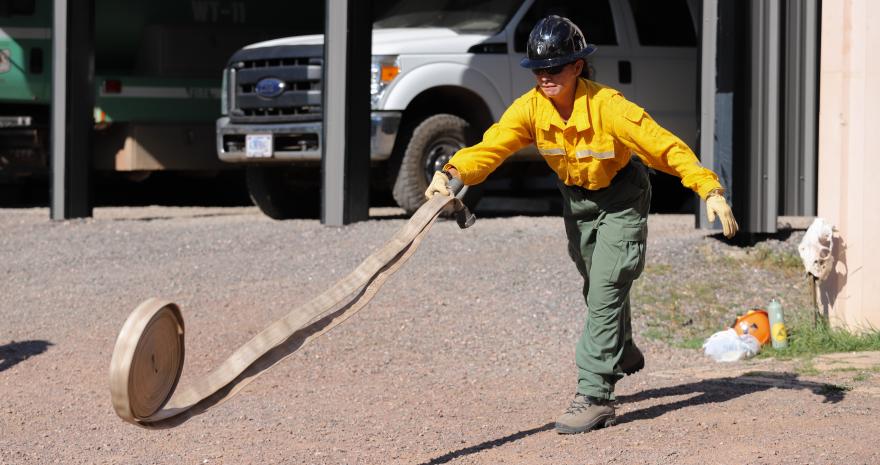
A Women in Wildland Fire cadet practices hoselays during Women in Wildfire Training, 2023. (USDA Forest Service photo by Julianne Nikirk)

โ€œI didnโ€™t even know this was a career field up until this past summer. I am definitely going to apply for a job in the field,โ€ Moody said after completing the week-long intensive program that introduces wildland firefighting to women. 

With under 15% of wildland fire employees identifying as women, the Women in Wildfire Training Program aims to overcome barriers to equity that are still very much present in the industry. For participants, the intentional inclusion of women signals a โ€œsafe spaceโ€ to learn and be among peers, encouraging people to explore a career in wildland fire management. In fact, many program participants, called cadets, would not have applied for the program if it was not geared specifically towards women.

โ€œRepresentation matters. When you see yourself represented, you feel more welcome inherently and know youโ€™ll learn how to overcome some of those obstacles together,โ€ said Aubrey Hoskins, a recent program cadet.

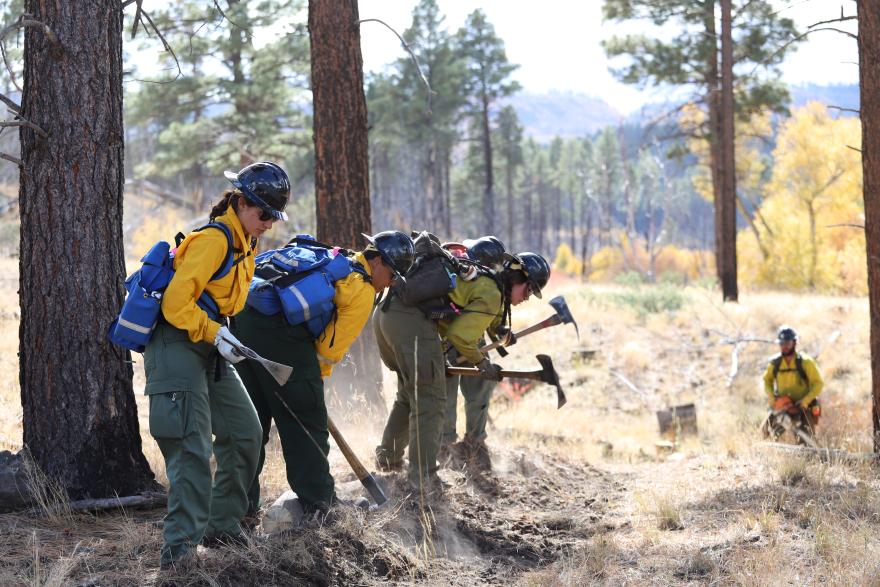
Women in Wildland Fire cadets construct fireline during a training exercise, Apache-Sitgreaves National Forests, 2023. (USDA Forest Service photo by Julianne Nikirk.)

The obstacles Hoskins refers to include hours of digging handline, pushing through exhaustion while managing stress and demonstrating personal responsibility โ€“ all skills needed for the job. The program forms women into firefighting crews to give them an โ€œauthentic experienceโ€ of working on a real wildfire incident. Even in this simulated emergency environment, by design, the mental and physical fortitude required is very real.

According to the training organizers, known as the cadre, this is all part of the โ€œtype two fun,โ€ a reference to the entry-level firefighter (type 2) qualifications the cadets are seeking. After successfully completing the program, these women leave with certifications that allow them to apply for wildland firefighter jobs. They also connect with an ever-expanding network of like-minded people and strong support structures.

โ€œIt was great to learn together and not have gender be a barrier,โ€ recalled Cheyenne Lopez, a program cadet. โ€œEveryone was super open to making connections and building relationships. I hope to see these people again someday.โ€

And she very well may. Many of the people that organize the training were once standing in the cadetsโ€™ boots. Over several years the program has hosted 65 students, half of whom gained employment in the Forest Service wildland fire program immediately upon completion. Now these same firefighters are sharpening their own leadership skills while giving back to the women following in their footsteps.

Ashlynn Buschschulte, a former cadet, now Squad Boss Trainee and member of the training cadre, shared her reflections.  

โ€œThe transition from cadet to cadre has been an opportunity to find a leader in myself and that capability of being able to make sure what Iโ€™m doing is safe and effective for my crew. I have a better sense of responsibility for my crew. Itโ€™s made me more confident in my choices and the way I think about fighting fire,โ€ she said.

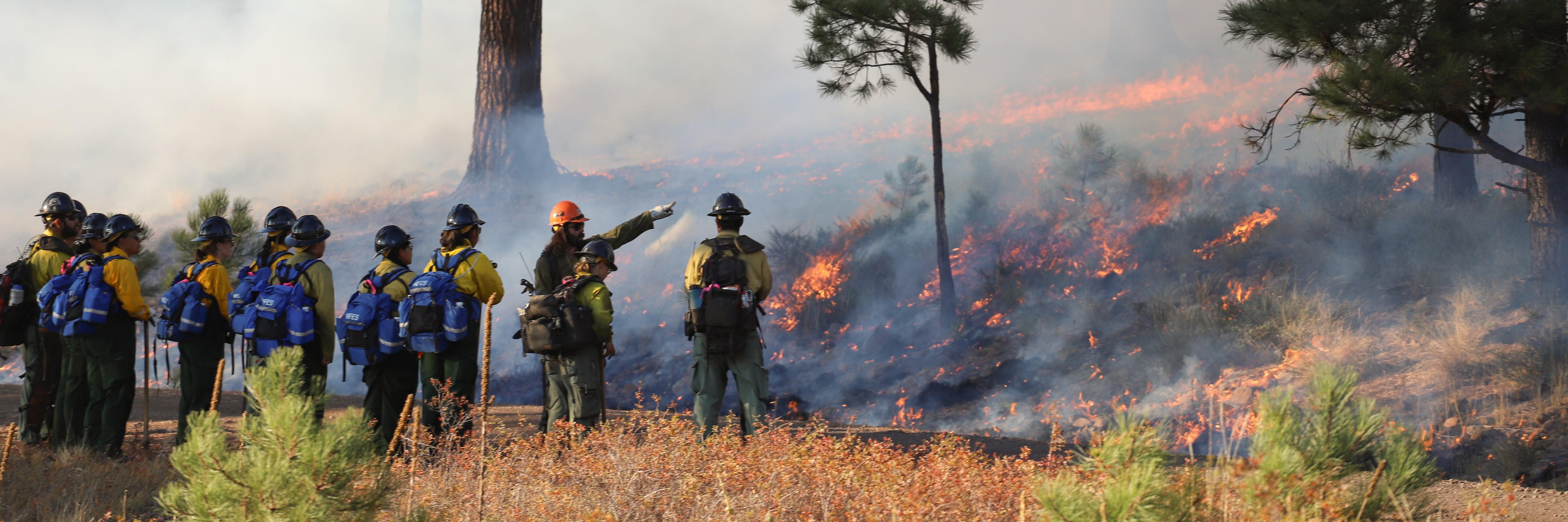
Women in Wildland Fire cadets observe fire behavior on a prescribed burn, 2023. (USDA Forest Service photo by Julianne Nikirk)

While getting accepted into the program is competitive due to the limited number of cadet spots, the Apache-Sitgreaves National Forests, which hosts the training, is working to keep up with the growing applicant pool. Placing new recruits in wildland fire jobs across the country is critical to addressing the nationโ€™s wildfire crisis. And with the U.S. Forest Service employing more than 11,000 firefighters each year, the need is never-ending.

As Jasper Lanning, a training cadre member, explained, โ€œTo get people that are passionate and actually want to be involved in this line of work takes time to build those experiences and give them a taste of what theyโ€™re getting into.โ€

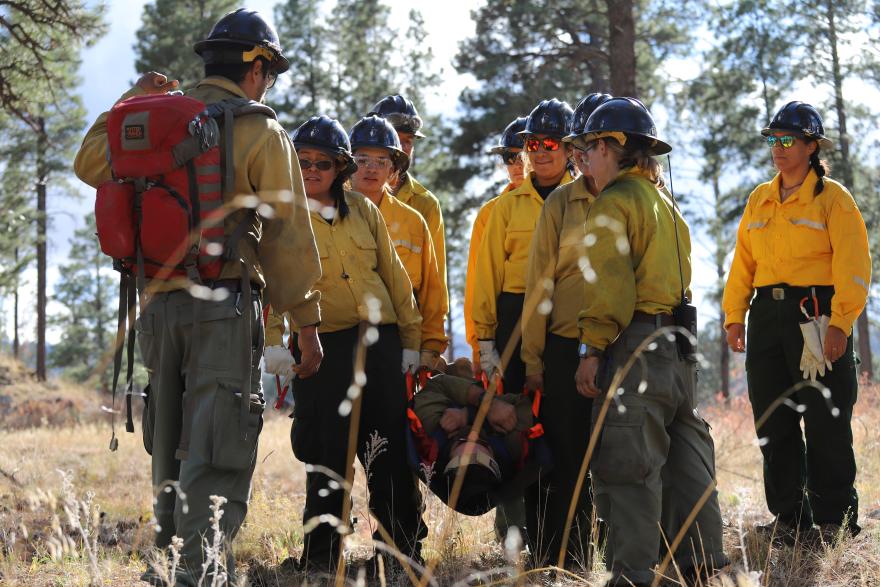
Women in Wildland Fire cadets practice medical evacuation procedures, 2023. (USDA Forest Service photo by Julianne Nikirk)

The hope is investments like this will pay off by building a more inclusive future in an industry dominated by men. For the women who seek the challenge of the Women in Wildfire program they come away ready to help their communities by doing one of the most difficult jobs โ€“ a calling that, regardless of gender, comes from deep inside.ย Colville National Forest,ย Employee Resources,ย Fire,ย Fire Prevention,ย Firefighters, employees,ย employment,ย women,ย women firefighters

Native tribes are getting a slice of their land back โ€” under the condition that they preserve it — The Los Angeles Times

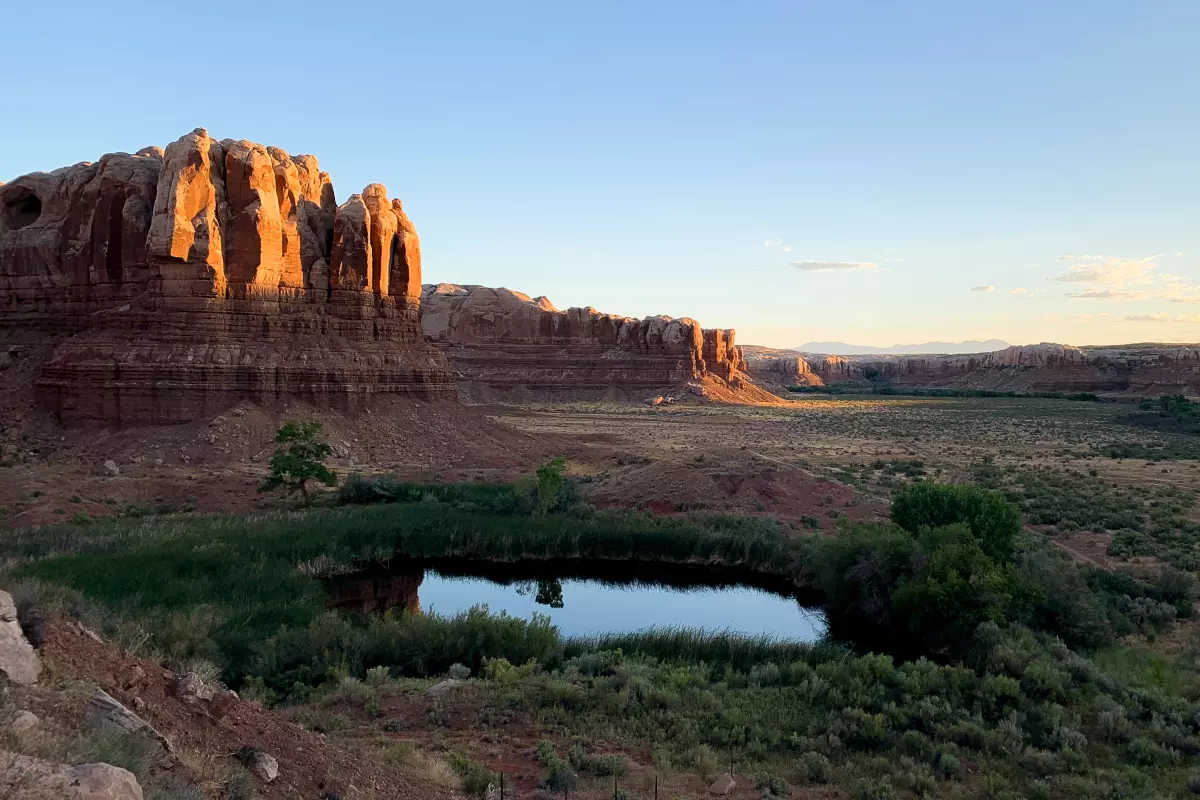
A spring-fed pond near the existing trail on the Cottonwood Wash property. (Frazier Haney / Wildlands Conservancy)

Click the link to read the article on The Los Angeles Times website (Jack Herrera). Here’s an excerpt:

January 3, 2024

In February 2020, Dave Herrero drove into the canyon country here in southeastern Utah to visit a slice of land that was up for sale โ€” a 320-acre ranch that stretched deep into the red-rock canyon near the small town of Bluff…In July, his California-based employer, the nonprofitย Wildlands Conservancy, purchased the ranch for $2.5 million from the family that owned it and began writing a deed that it hopes will become a model for working with tribes to protect wilderness in the American West from real estate developers, mining companies and oil drillers. In what would be a novel arrangement, the deed is expected to include a coalition of five tribes as co-owners and managers with Wildlands โ€” an effort to acknowledge the history of the land, which the conservation group named Cottonwood Wash.

โ€œThere are once tribes that lived in these areas that were forcibly removed,โ€ said Davina Smith, a member of the Dinรฉ, or Navajo, who has worked with different organizations to protect land in the Four Corners region. โ€œWe have to recognize that.โ€

[…]

The traditional model of conservation in the West has long followed the lead of environmentalists such as John Muirโ€” the โ€œfather of the national parksโ€ โ€” who saw untracked wilderness as a sort of Eden that would fall to corruption under manโ€™s influence. His model of conservation was simple: Keep people out…That school of thought feels foreign to Natives such as [Davina] Smith, 49.ย 

โ€œYou have all these prominent writers writing about the West, but they focus on the landscape,โ€ she said. โ€œThey donโ€™t think about the Native tribes who have always actually been living in this landscape.โ€

[…]

In 2015, a coalition of five tribes โ€” Hopi, Navajo, Uintah and Ouray Ute, Ute Mountain Ute and Zuni โ€” sent a letter to then-President Obama proposing the creation of the Bears Ears National Monument in Utah on land known as the Colorado Plateau. Under a novel co-management scheme, the tribes would have direct say in ecological stewardship and how to regulate economic activity and recreation…Less than a year after Obama issued a presidential proclamation creating the monument on Dec. 28, 2016,ย then-President Trump undid itย at the urging of the Utah state government, which wanted to leave the land open to uranium mining, oil drilling and cattle grazing. When President Biden took office in 2021, one of his first acts was reestablishing Bears Ears…The Cottonwood Wash lies within the boundaries of the Bears Ears Monument, but because itโ€™s private property, it wasnโ€™t included as part of the monument. That gave Wildlands a playbook. In 2022, its leaders approached the Bears Ears Inter-Tribal Coalition, the official alliance of the five tribes, to say they were considering buying the Cottonwood Wash and were interested in joint ownership and management. As part of their push, Herrero and Haney drove to four reservations to meet with tribal leaders. Some were suspicious at first. Anthony Sanchez, the head councilman for the Pueblo of Zuni, explained that non-Native groups will sometimes use supposed ties to tribes to boost their own PR.

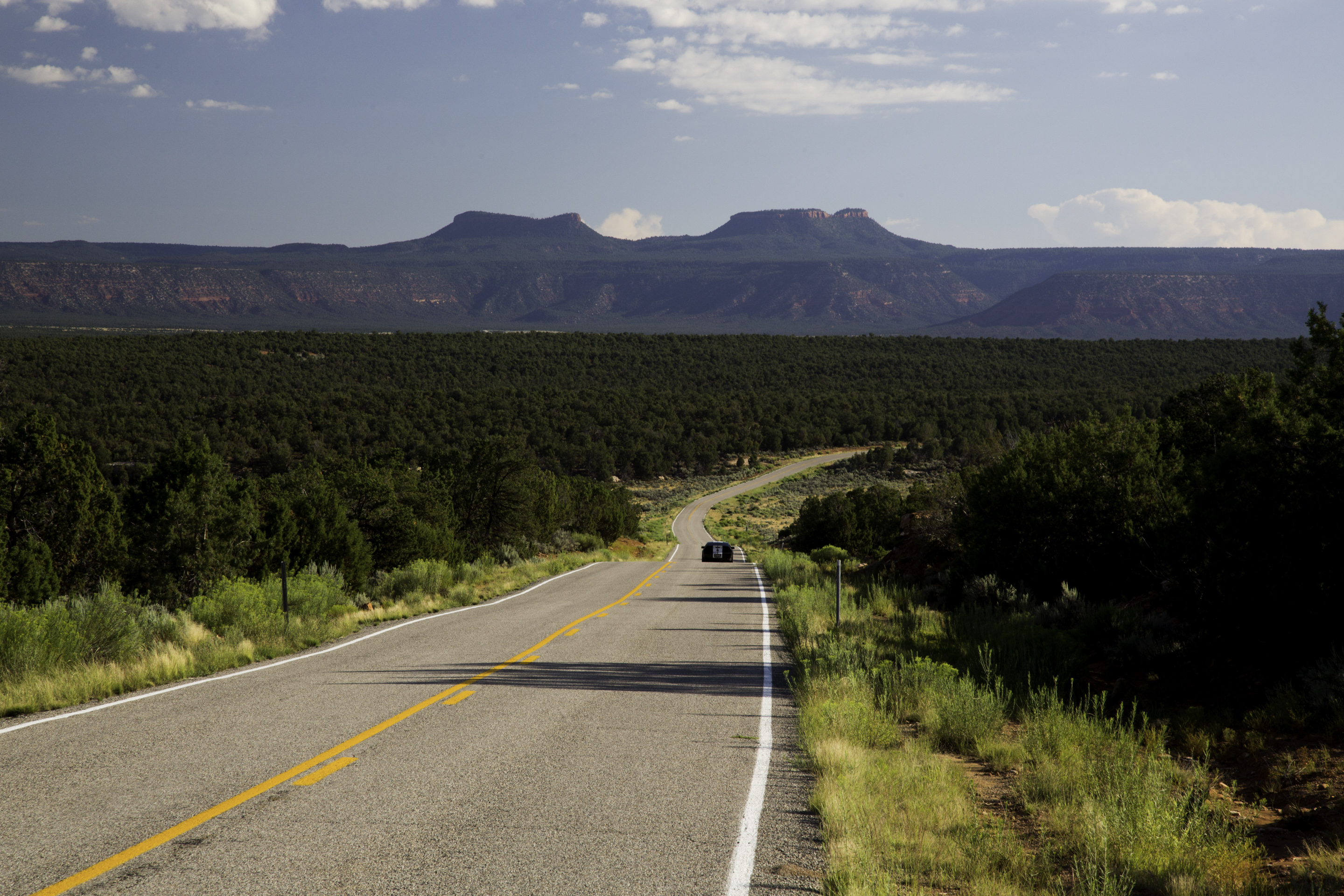
Bears Ears National Monument in Utah. By Bob Wick – By the Bureau of Land Management published on Flickr under a CC licence., CC BY-SA 4.0, https://en.wikipedia.org/w/index.php?curid=52982968

The arrogance of the off-road vehicle lobby — Jonathan P. Thompson (@Land_Desk)

The AI intern made this. Not terrible, I guess. Credit: The Land Desk

Click the link to read the article on The Land Desk website (Jonathan P. Thompson):

In a rather predictable โ€” but still maddening โ€” move, the off-road-vehicle lobby is suing the Bureau of Land Management over the agencyโ€™s Labyrinth Canyon and Gemini Bridges travel plan for off-highway vehicle use.

The BlueRibbon Coaltion, Colorado Off-Road Trail Defenders, and Patrick McKay are challenging the โ€œillegal and arbitraryโ€ closure of 317 miles of motorized routes on about 468 square miles of public land north and west of Moab between the Green River and Highway 191. The off-road coalition was already shot down once by the Interior Board of Land Appeals; now theyโ€™re taking their gripes to federal court, using theย same spurious arguments.ย 

Of course, these groups have every right to challenge federal agenciesโ€™ decisions; environmentalists do it all the time. But whatโ€™s maddening about these motorized-access groups is their intransigence โ€” even arrogance โ€” and stubborn unwillingness to compromise. They promise to โ€œFight for Every Inchโ€ of motorized access to public lands, not for any real reason but as an end in itself, damn the consequences to the environment, the public, and wildlife. 

The kerfuffle over the Labyrinth/Gemini plan is a perfect example. 

Over the last couple of decades, vehicle traffic โ€” and the impacts โ€” have burgeoned on some 1,100 miles of motorized routes in the management planโ€™s area. The type of traffic has changed, too, shifting from the relatively slow-going and quiet jeeps and SUVs to the dune-buggyesque side-by-sides that have become increasingly popular in recent years. They go faster, are noisier, and kick up more dust than other vehicles. They also carry more people into the backcountry than a motorcycle or old-school ATV, thus multiplying the adverse effects.ย 

For years, river runners, public lands advocates, and local residents and elected officials have been pushing the agency to get a handle on the traffic on the 300,000-acre slickrock expanse. Last year, the BLM came up with four alternatives, ranging from keeping the status quo to closing up to 437 miles of trails. Yes, the strictest alternative would have closed less than half of the routes to vehicles, leaving almost 700 miles open to some form of motorized travel. In other words it was a compromise that favored the motorized crowd.

But even that went too far for the BLM, which ultimately shut down just 317 miles of motorized routes, while limiting motorized travel (to motorcycles or smaller ATVs, for example) on 98 miles. In other words, you can still burn gasoline and spew exhaust on more than 800 miles of routes on this one relatively small swath of public land. Meanwhile motorized travel remains mostly unrestricted on more than 10,000 miles of roads, two-tracks, and old trails in southeastern Utah.

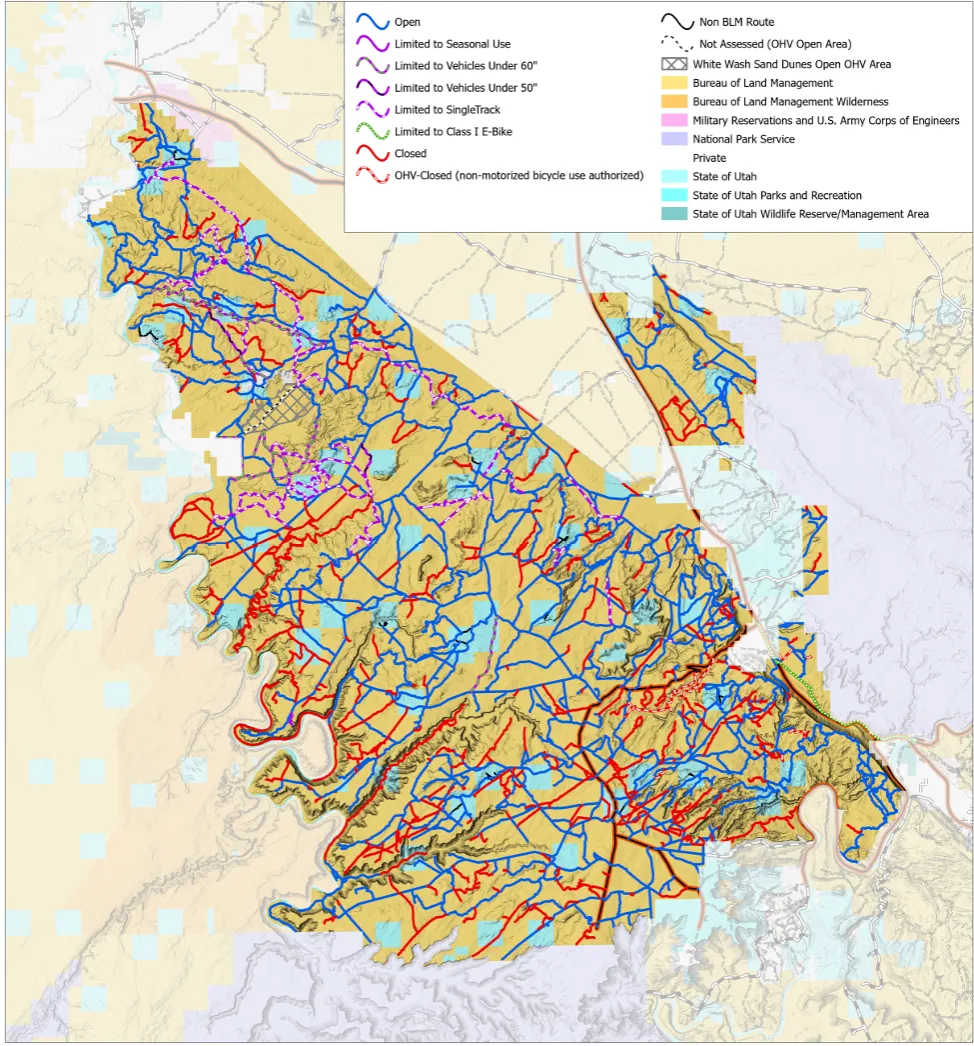
There are still a lot of roads open under the new travel plan. Credit: The Land Desk

Thatโ€™s not enough for the BlueRibbon Coalition and friends, however; itโ€™s never enough for them. They are ideologically opposed to decommissioning even the most insignificant road spur, and they and their allies in local and state government will squander millions of taxpayer dollars to fight the closures. Their reasoning? Because OHV recreation is, in the words of the lawsuit, โ€œa way of life in the American West.โ€ 

Really? I mean, itโ€™s the same trope rolled out whenever someone tries to get a coal plant to stop belching pollution all over folks or a mine to stop defiling the streams. In those instances it may have some validity: The move could affect the minersโ€™ or the coal plant workersโ€™ livelihoods, and therefore their way of life. But these folks will still be able to ride their noisy machines around on hundreds of miles of roads. Believe me: Nothing about this plan will affect their way of life.

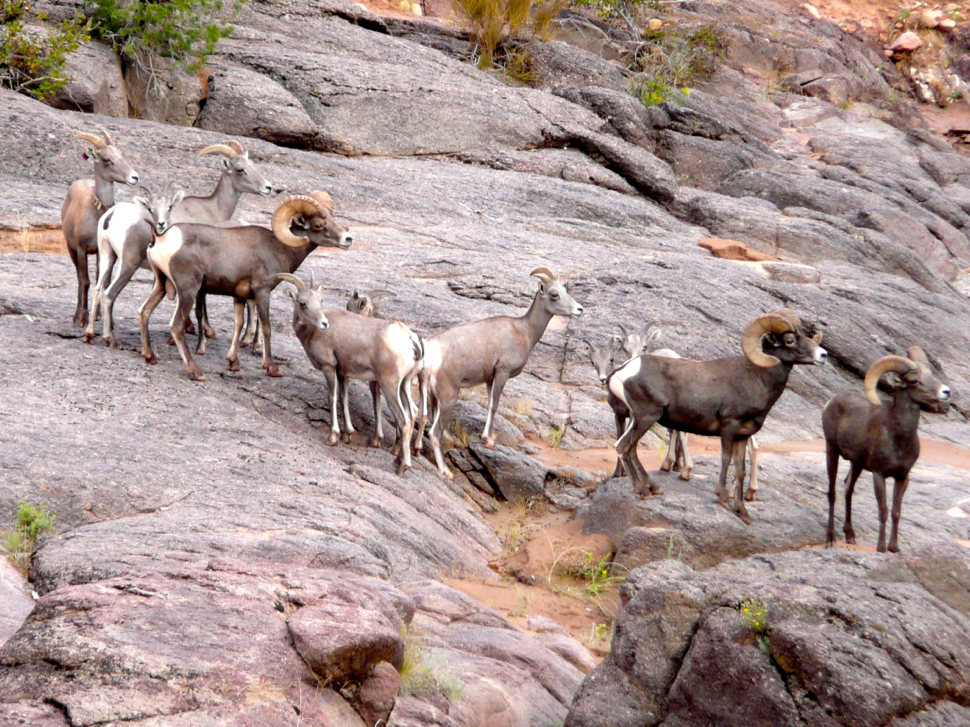
I highly doubt the motorized coalition will prevail; even the most conservative judges are unlikely to fall for their faulty legal reasoning. And so, the plan likely will remain in place, as it should. Itโ€™s a compromise, and an admittedly crappy one for those of us who would like to see a lot fewer vehicles โ€” and people โ€” trampling the landscape. After all, it still leaves the sprawling road network mostly intact. But maybe itโ€™s the best we can expect, and at least it doesย something. And it will make it just a little easier for the quiet users, the bighorn sheep, the coyotes, and the silence to find a bit of refuge from the incessant whirr of combustible engines and the humans driving them.

Bighorns, along the Colorado River. Photo: Brent Gardner-Smith/Aspen Journalism

Coyote Gulch scores a new cycling water bottle

Maiden run for my spiffy new Bivo cycling bottle December 28, 2023. It worked like a charm this morning but it wasn’t cold enough to test freezing.

What should we call that 14er above #Crestone? — @BigPivots

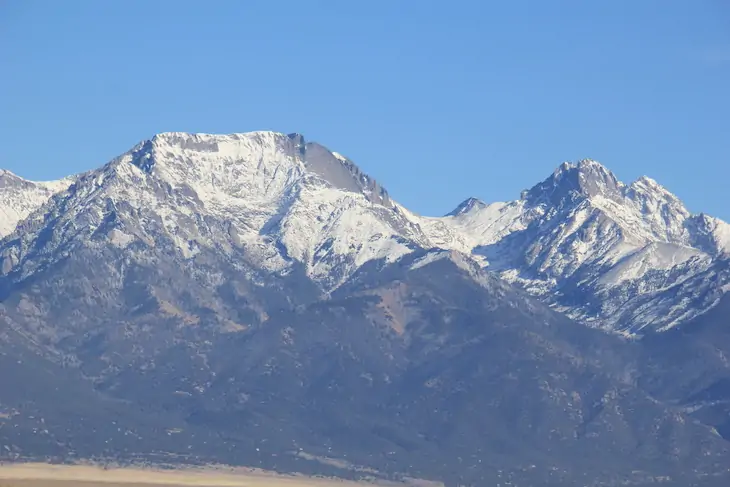
Kit Carson Peak, right, and Challenger, also a 14,000-foot peak, as seen from the area near Moffat, in the San Luis Valley. Photo/Allen Best

Click the link to read the article on the Big Pivots website (Allen Best):

December 24, 2023

Itโ€™s called Kit Carson, but a state advisory board in January will review alternatives more acceptable to the Dinรฉ and others

My hike up Kit Carson Peak in June 2000 began with great ambition and ended with confusion. Confusion remains now, almost 24 years later, if in a different way. Weโ€™re not sure what to call the 14,167-foot summit in the Sangre de Cristo Range.

My 12 hours above treeline that day left me hypoxic, my brain suffering from too little oxygen. I insisted that the route down took us the west side of Willow Lake, but my companions knew better.

Now I contemplate what to call Kit Carson from the floor of the San Luis Valley. A proposal before the Colorado Geographic Naming Advisory Board would have us call it Frustum Peak. A frustum is a flat-topped cone or pyramid.

Still others prefer Crestone, as was considered โ€” but rejected โ€” by a federal board in 2011. Two other 14,000-foot peaks, Crestone Peak and Crestone Needle, lie a short distance away. Three 14ers named Crestone? One stone too many. Other names may yet be considered.

Colorado also has a town and a county named Kit Carson, but neither is up for change as they are not on federal land.

The state advisory board members will resume their discussion on Jan. 24. They will also review alternatives to Garfield Countyโ€™s Dead Mexican Gulch, Jefferson Countyโ€™s Redskin Creek and Redskin Mountain, and Montezuma Countyโ€™s Negro Draw.

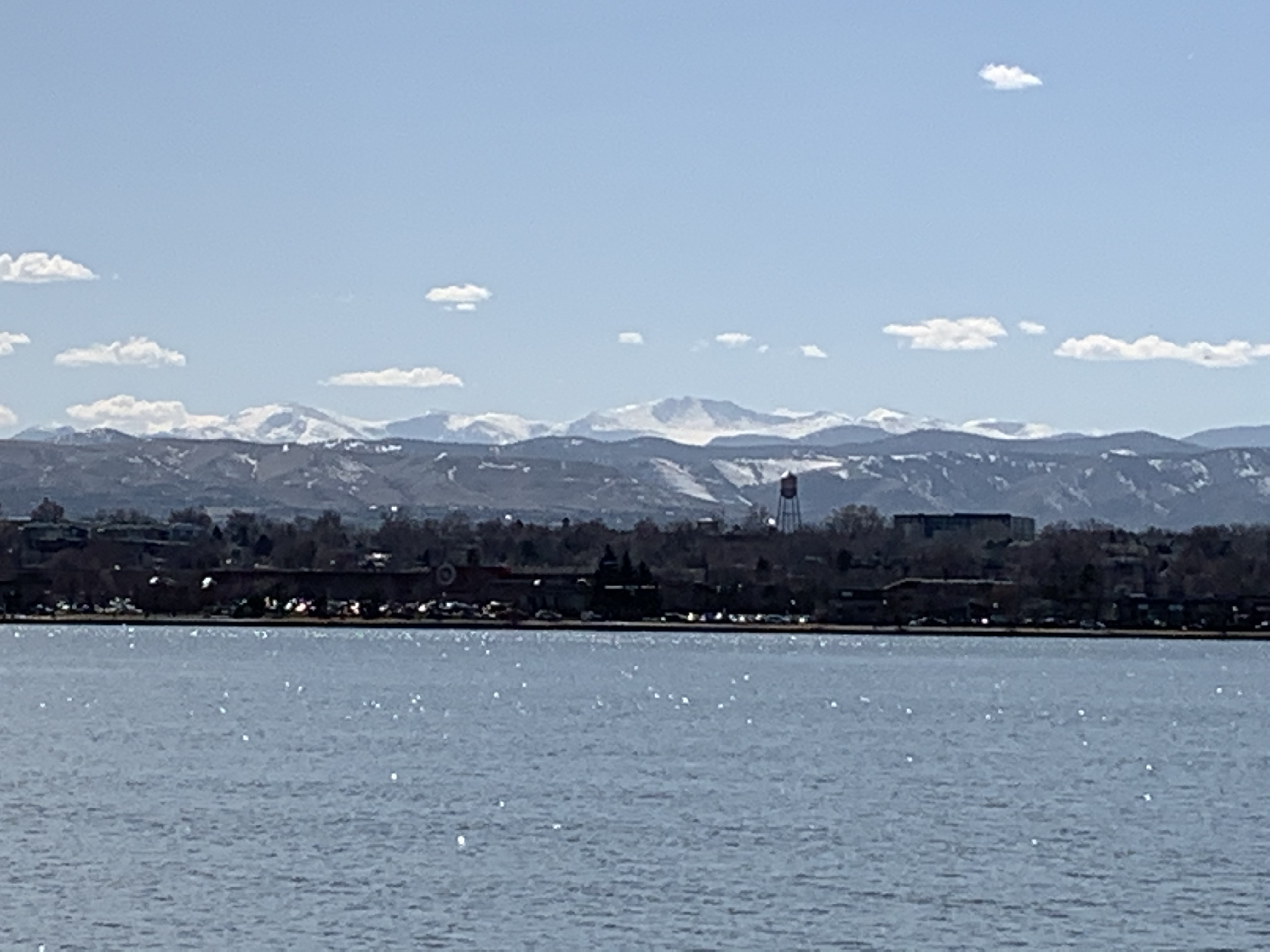
Sloans Lake with Mount Blue Sky in the background April 2, 2021.

Whatever they recommend will be just that. The U.S. Board of Geographic Names has final authority for names on federal lands as Colorado seeks to cleanse its geographic drawers of names with tawdry historical footnotes. Earlier this year, the 14er west of Denver gained a new name, Blue Sky. It had been called Evans, after the territorial governor in 1864 who seemingly turned a blind eye to the Sand Creek Massacre.

Christopher Houston โ€œKitโ€ Carson has a more confused and interesting story. Born in Kentucky, reared in Missouri, he fled an apprenticeship in leathermaking for western adventures. As a fur trapper, he was quite successful. He survived.

Like other trappers, he found friends โ€“ and foes โ€“ among the native Americans, taking two of them as spouses. One called it quits, putting his belongings outside their teepee, as was the custom.

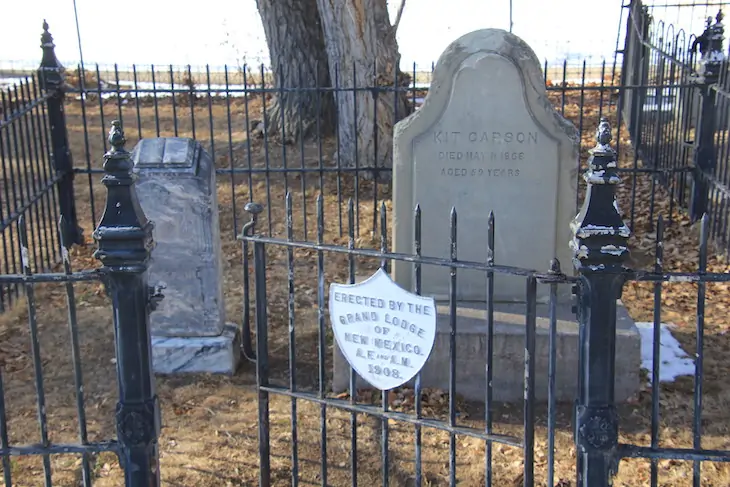
Taos was his favored home. His remains are buried there along with those of Josefa, his final wife. They both died in southeastern Colorado, at Boggsville, near todayโ€™s Las Animas. By then, he was General Carson in the U.S. Army.

Kit Carson and his third wife, Josefa, both died in southeastern Colorado but are buried in Taos, which he considered home. Photo credit: Allen Best/Big Pivots

Consult  โ€œBlood and Thunder,โ€ by Hampton Sides, for an immensely rewarding read about Carson. Sides acknowledges the complexities of Carson and other frontiersmen. โ€œThe mountain men lived with Indians, fought alongside and against them, loved them, married them, buried them, gambled and smoked with them,โ€ he writes.

Trappers unwittingly left a more damning legacy.

โ€œAs the forerunners of Western civilization, creeping up the river valleys and across the mountain passes, the trappers brought small pox and typhoid, they brought guns and whiskey and venereal disease, they brought the puzzlement of money and the gleam of steel. And on their liquored breath they whispered the coming of an unimaginable force, of a gathering shadow on the eastern horizon, gorging itself on the continent as it pressed steadily this way.โ€

That is the conundrum of Carson. Itโ€˜s also the question many of us ask ourselves. Will we leave the world a better place โ€“ or worse? Or both?

While in the U.S. Army, Carson was responsible for corralling the recalcitrant Navajo, who had long been feared by Spanish, Hispanic and Anglo settlers because of their persistent raiding and sometimes killing. He complained to superiors about the lack of provisions for the Navajo as he marched them to an encampment in eastern New Mexico. Once there, a third died.

Afterward, although gravely ill, Carson accompanied Ute leaders to Washington D.C. at their request to represent them in meetings with President Ulysses Grant and others.

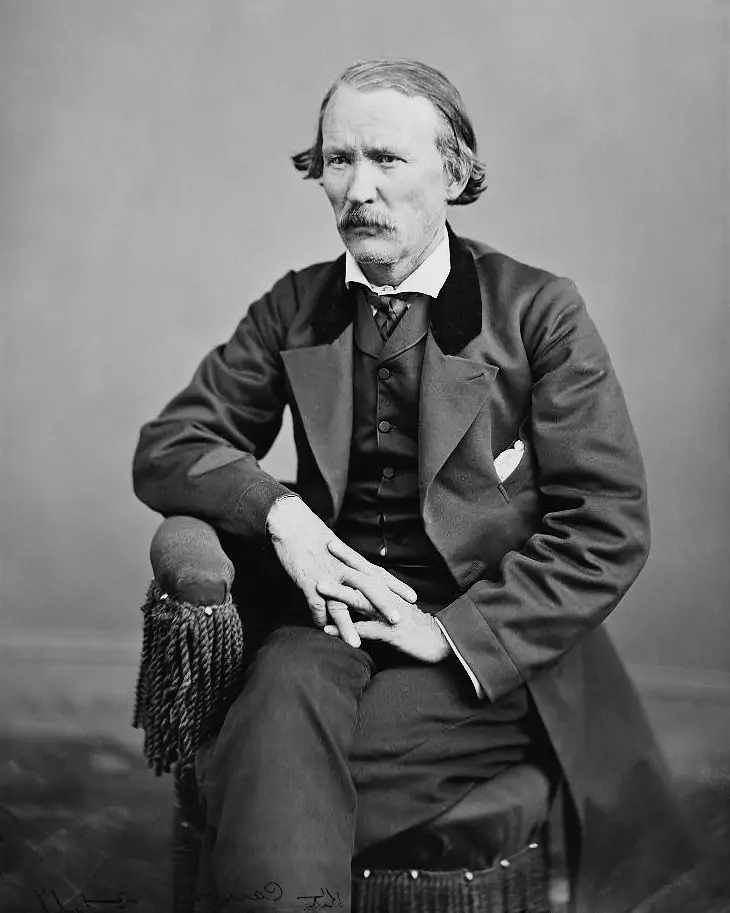
Kit Carson was photographed in 1868 in Washington D.C., shortly before his death in southeastern Colorado at the age of 59. Photo/Wikipedia

His story was complicated.

Carson was mythologized in his own time. Today, we tend to idealize Native Americans even while we fail, in some important ways, to pay them their due, such as their water rights in the Colorado River Basin.

A former newspaper columnist in Colorado Springs responded to my ruminations on Facebook with this: โ€œIn our re-naming craze, we should not name anything after humans any more. It turns out that all humans put their pants on one leg at a time.โ€

Conquerors generally name things in their own honor. Sometimes, we do honor the vanquished. To honor Utes, among Coloradoโ€™s 14ers we also have Antero, Shavano, and Tabeguache. We have none to honor Navajos, who call themselves Dinรฉ. If they emphatically dislike Kit Carson, so far they have not proposed an replacement.

We already have a Conundrum Peak, near Aspen.

I suggest Complicated Peak.

Mount Confusion could work, too.

Emily Ransdell, One Finch Singing

A male American Goldfinch in summer plumage in Michigan, USA. By Rodney Campbell – Goldfinch Uploaded by snowmanradio, CC BY 2.0, https://commons.wikimedia.org/w/index.php?curid=20388809

From Emily Ransdell’s new book of the same name, “One Finch Singing”

From the poet’s website:

One Finch Singing

Some days I want to fill my pockets
with everything Iโ€™m afraid of losing.
How much milkweed to save
the monarch? How many foil blankets
to keep an ancient redwood alive?

I worry about finches. Smaller
than a fist, wingspan no bigger
than an open hand. I keep thinking
of what it took for them to get here, flying
all those miles up to Oregon. I keep thinking
of heat. Cities hitting triple digits. London
for god sake. Italy on fire.

Thereโ€™s smoke again in Ashland,
like the time Kay and I went for a getaway.
All we had were bandanas, useless
against that stench and ash. We walked
the streets like grandmotherly bandits,
drank gin with the Airbnb windows shut.
By then I knew she was terminal.
Still, it felt impossible she could die.

I worry about beetle kill and rivers
missing their fish, the dry tinder of California
as creeks in Kentucky rage.
I read that finches can live on thistles, as if
to say, Thereโ€™s hope. The ancients thought
finches carried souls to the afterlife, and the sound
of one finch singing meant an end to grief.

Last week a brush fire ignited within sight
of my porch โ€” just like that โ€” flames leapt
from slash and grass to standing firs.
Two thousand acres burned.
Where did the birds go then?

I miss my friend.
I want to know those finches are somewhere.
Safe and singing. From meadow rush
and ditch shrubs, calling
to their kind.

Welcome to the Polar Vortex Blog! — NOAA

Click the link to read the post on the NOAA website (Amy Butler and Laura Cisato):

We are excited to announce that NOAA Climate.gov, home of the highly popular ENSO Blog, is venturing into a colder, darker, and windier corner of the atmosphere with the new Polar Vortex Blog. We plan to explore various facets of the winds, climate, and chemistry within the fascinating region of the atmosphere known as the polar stratosphere, and explain how this region can sometimes drive big changes in our weather patterns!

While ENSO may be the seasoned celebrity in the seasonal forecasting world, in recent years the stratospheric polar vortex has become a rising star: constantly making headlines and being stalked by the paparazzi, but often misunderstood or misrepresented. We hope to clear up misconceptions, highlight new research, and discuss what the polar vortex is up to and how it may affect our winterโ€™s weather. We expect there to be 1-2 posts per month between December and March, with the initial focus on the Northern Hemisphere polar vortex (yep, thereโ€™s one down south, too!).

So whoโ€™s on the team?

  • Amy Butler is a research scientist at the NOAA Chemical Sciences Laboratory and an expert on the stratosphere and its influence on weather;
  • Laura Ciasto is a meteorologist at the NOAA Climate Prediction Center. She leads the development of stratospheric and teleconnection forecast products, but is also a Week 3-4 forecaster (NOAAโ€™s description for forecasts of weather conditions 3-4 weeks in the future);
  • The Climate.gov graphics and data visualization team and managing editor, Rebecca Lindsey, with the NOAA Climate Program Office.

While we [Amy & Laura] are the lead editors of the blog, we hope to have guest contributors who can share their own perspectives and research on the polar vortex and related topics. And of course, this blog will not succeed without active engagement from you, our readers. We are happy to hear your constructive feedback and suggestions, and are excited to engage with you on this topic!

After reading this introduction, the first question you might have is likely: What is the polar vortex? And so, thatโ€™s where weโ€™ll begin!!

What is the stratospheric polar vortex?

In recent years, most people have heard the phrase โ€œthe polar vortexโ€, which has made regular appearances in media headlines, often with an exciting, albeit sometimes ominous โ€œDay after Tomorrowโ€, flavor:

  • โ€œGet ready: here comes the polar vortexโ€
  • “Northeast U.S. latest to experience polar vortex temperaturesโ€
  • โ€œPolar vortex invades central U.S.โ€ 
  • โ€œPolar vortex breaks record-low temps, snaps steel, empties citiesโ€

But the โ€œpolar vortexโ€ is not actually a synonym for โ€œcold snapโ€; rather, itโ€™s a well-known feature of Earthโ€™s atmosphere that describes the high-altitude winds that blow around the pole every winter, miles above us in a region called the stratosphere.

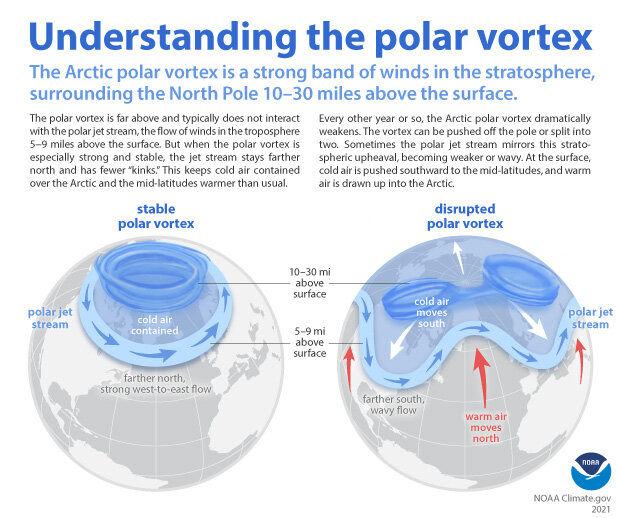
The polar vortex is in the polar stratosphere, above the layer of the atmosphere (the troposphere) where most weather, including the jet stream, occurs. NOAA Climate.gov graphic.

The stratospheric polar vortex forms in the winter hemisphere when the Earthโ€™s pole is pointed away from the sun. The polar stratosphere enters darkness and becomes cold relative to the tropical stratosphere [footnote 1]. The temperature contrast makes for strong winds in the stratosphere that blow from west to east. This wintertime stratospheric wind is what we call the Arctic polar vortex [footnote 2].

An atmosphere dance party: whoโ€™s the wallflower, and whoโ€™s the extrovert?

If we were at a dance party, your first impression might be that the stratospheric polar vortex is the wallflower standing alone on the upstairs balcony, while the tropospheric jet stream is showing off on the dance floor with its flamboyant troughs, ridges, and cut-off lows. But as is so often true, first impressions are not always correct: while the polar vortex often doesnโ€™t mind doing its own thing, it is not a passive watcher of the atmospheric dance down below. With some encouragement, polar vortex can actually become one of the most dynamic dancers there.

Making an impression

Why does the polar vortex matter to us, given it is so high and far away in the polar atmosphere? Thatโ€™s one of the things we hope to explore in much more detail on this blog. But one of the main reasons is because the vortex does not always sit quietly by itself. Though it might (literally) need a little push from the troposphere to get its groove on, it can really break down with a move called a โ€œsudden stratospheric warmingโ€.

In this move, the polar vortex may wobble, swing far from its normal position over the pole, or stretch itself way out, sometimes even splitting in two (doing the โ€œsplitsโ€? We can hear the groans from hereโ€ฆ). And when this happens, the chances of cold weather across many populated regions can increase for many weeks afterwards.

When the Arctic polar vortex is especially strong and stable (left globe), it encourages the polar jet stream, down in the troposphere, to shift northward. The coldest polar air stays in the Arctic. When the vortex weakens, shifts, or splits (right globe), the polar jet stream often becomes extremely wavy, allowing warm air to flood into the Arctic and polar air to sink down into the mid-latitudes. NOAA Climate.gov graphic, adapted from original by NOAA.gov.

Alternatively, sometimes the vortex does another extreme move where it becomes super fast and stable, encouraging the cold air at the surface to stay over the pole, which increases the chances of winter heat extremes in some regions. We will be getting into all the details of these events and their influence on our weather in future blog posts.

Polar vortex groupies

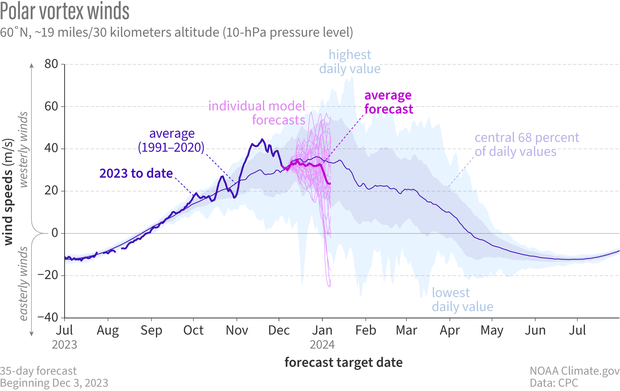
Itโ€™s hard to not be fascinated by the strong silent type that suddenly wows you with its awesome dance moves, particularly when those moves can cause extreme weather impacts, so scientists and forecasters have increasingly appreciated the need to monitor what the polar vortex is doing. We usually start by looking at the zonal (east-west) winds at 60N (the latitudes near Anchorage, AK or Oslo, Norway) at around 19 miles (30 kilometers) in altitude, where the air is so thin that the pressure is only 10 millibars (10 hectoPascals). By looking at a time series of these zonal winds we can get an idea of whether the polar vortex is really strong and stable, or weakening and ready to bust into its sudden stratospheric warming moves.ย 

In early December 2023, NOAA’s Global Ensemble Forecasting System (GEFS for short) began hinting that the winds of the Northern Hemisphere polar vortex might be about weaken. The spread of the individual forecasts is still pretty wide (thin pinkish-purple lines), but the average (heavier, bright purple line) predicts that winds will be weaker than average (royal blue line) in December. Climatology of highest and lowest daily values is from Climate Forecast System Reanalysis. NOAA Climate.gov graph, adapted from original by Laura Ciasto.

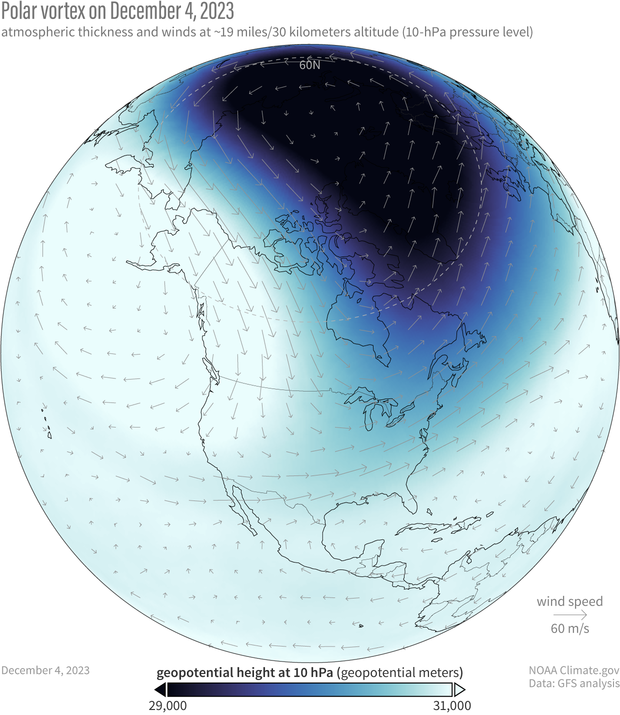
In addition to the strength of the vortex, we often want to know more about its shape. A great way to do this is by simply looking at a map of the thickness of the atmosphere. Throughout the winter, the polar vortex can shift, stretch, or just wobble from its usual spot over the pole, kind of like dancing in place. During strong events or sudden stratospheric warmings, these moves become much more distinct. Seeing the shape shows us which areas are poised to feel the biggest impacts of any unusual polar vortex behavior. There are other cool ways to see what the polar vortex is up to and whether itโ€™s interested in tangoing with the troposphere but weโ€™ll leave that for another post.

The polar vortex on December 4, 2023. Because the air within the polar vortex is generally much colder than the air outside of it, the polar vortex shows up on maps of atmospheric thickness (“geopotential height”) as a region of low thickness. The 10-hectoPascal geopotential height is the altitude at which the pressure is 10 hectoPascals. NOAA Climate.gov image, based on Global Forecasting System (GFS) data from Laura Ciasto.

So whatโ€™s the polar vortex doing now? For the last few weeks itโ€™s been embracing its wallflower persona as it sits over the polar region with stronger than average westerly winds. However, it does look like the stratosphere is at least thinking about joining the winter dance. If we look at the average of all the model forecasts from NOAAโ€™s operational forecasting system (known as the Global Ensemble Forecasting System, or GEFS), it predicts that the zonal winds will weaken through the start of the new year.

The real question is whether the polar vortex just wants to dance in place (like it often does) or really show its steps. If we look at the individual forecasts that make up the average, some indicate that those polar vortex westerlies will not only weaken but change direction to blow from east to west [footnote 3], which is how we define a sudden stratospheric warming. In addition, the leading forecast system for Europe (the ECMWF model, short for European Centre for Medium-range Weather Forecasting) shows an even higher likelihood that the vortex will be weaker than normal during December. These hints of a shift towards a weaker polar vortex means we will keep a close eye on whether the polar vortex wants to join an early winter party or sit this one out.

Further Reading

If you canโ€™t wait for the next post to learn more about the polar vortex, our friends at the ENSO blog and at Climate.gov have posted several primers on the polar vortex and some of its most recent disruptions.

Other good references on the polar vortex:

Footnotes

  1. Now, you might be thinking, โ€œBut isnโ€™t the stratosphere always colder at the poles than it is at the equator? No! In the summer, itโ€™s actually warmer. Weโ€™ll cover this in a future post.
  2. Most of our descriptions in this post are talking about the Arctic polar vortex, but there is also an Antarctic polar vortex at 60S. It has some of the same features as its Arctic counterpart, but the Antarctic polar vortex is also unique, often dancing to the beat of a different song. Weโ€™ll delve into that more in future posts.
  3. When the winds blow from west to east, as is typically the case with the stratospheric polar vortex, this is said to be โ€œwesterlyโ€ flow, and is marked by zonal wind speeds that are positive in sign. When the winds blow from east to west, which is what happens when a sudden stratospheric warming occurs, the flow is instead called โ€œeasterlyโ€ and is denoted by zonal wind speeds that are negative in sign.

In America, national parks are more than scenic โˆ’ theyโ€™re sacred. But they were created at a cost to Nativeย Americans

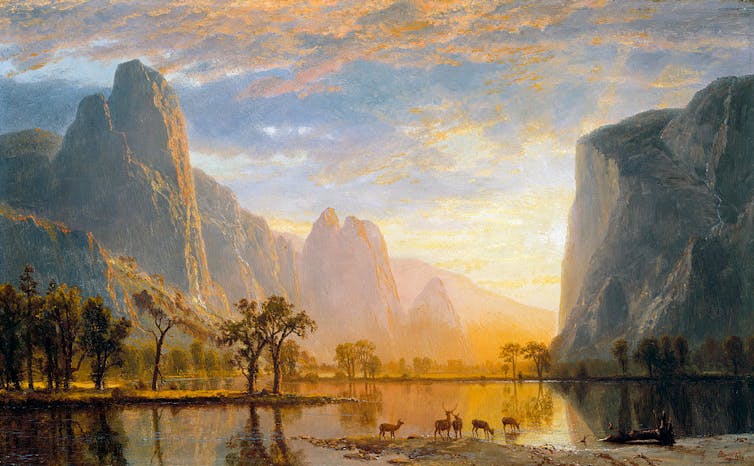
โ€˜Valley of the Yosemiteโ€™ by the 19th-century artist Albert Bierstadt, owned by the Museum of Fine Arts, Boston. VCG Wilson/Corbis via Getty Images

Thomas S. Bremer, Rhodes College

Abraham Lincoln has an almost saintly place in U.S. history: the โ€œGreat Emancipatorโ€ whose leadership during the Civil War preserved the Union and abolished slavery.

Often overlooked among his achievements is legislation he signed June 30, 1864, during the thick of the war โ€“ but only marginally related to the conflict. The Yosemite Valley Grant Act preserved the Yosemite Valley and Mariposa Grove in California as a park โ€œheld for public use, resort, and recreation โ€ฆ for all time.โ€

It was the first time the federal government had set aside land for its scenic value, and it created a model for U.S. national parks, which are themselves hallowed sites in American culture. Originally granted to the state of California, Yosemite formally became the third U.S. national park in 1890, joining a system of picturesque lands that hold spiritual and patriotic significance for millions of Americans.

At the same time, however, the establishment of national parks had severe consequences for Native American peoples across the continent. My research on the religious history of U.S. national parks illustrates how religious justifications for establishing parks contributed to the persecution of Indigenous tribes, a reality that the National Park Service has begun to redress in recent decades.

US civil religion

With more than 300 million annual visitors, the U.S. National Park System is a much-valued treasure. It encompasses stupendous scenery, opportunities for encounters with wildlife, outdoor recreation and commemoration of important places and events.

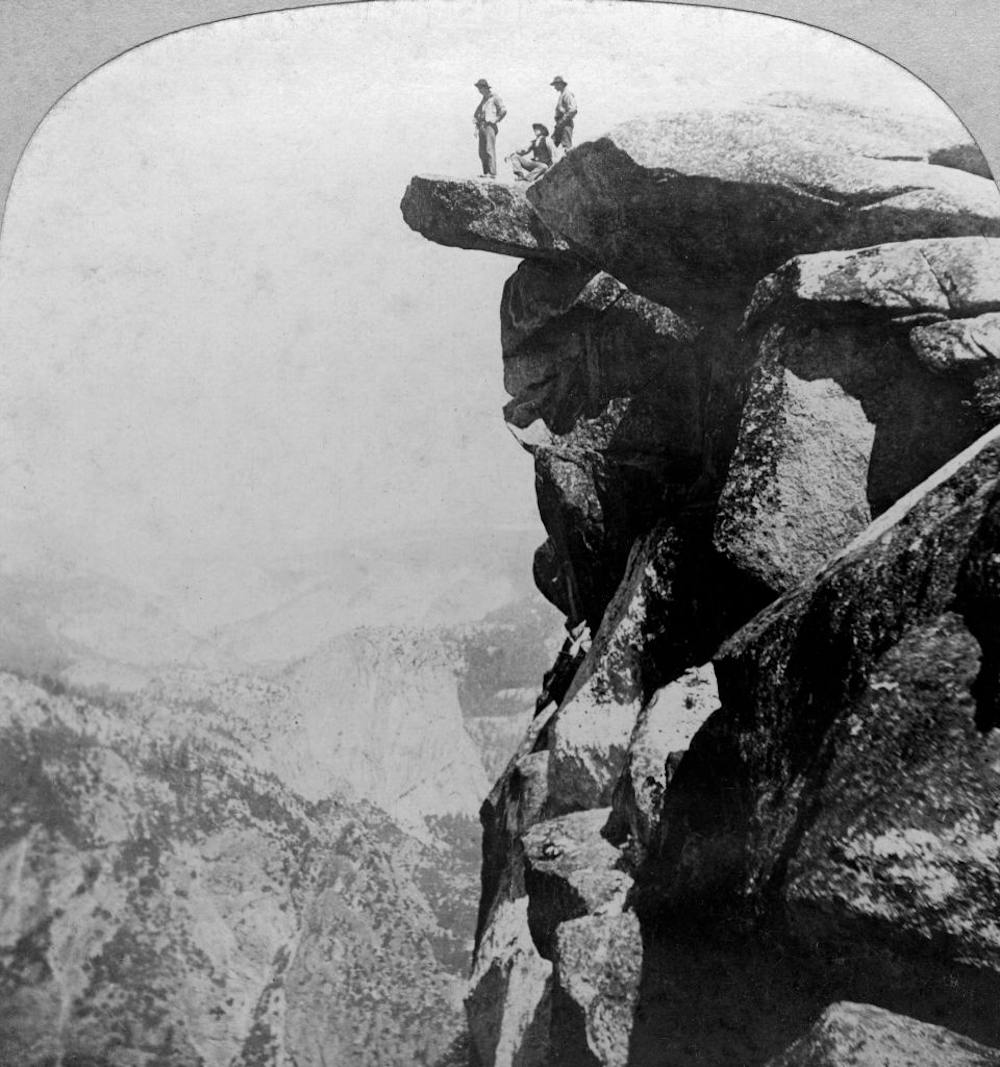
A black and white photo shows two men standing on a tiny ledge above a deep valley.
The scenery of Glacier Point in Yosemite Valley has awed visitors for centuries. The Print Collector/Print Collector/Getty Images

But the parksโ€™ significance goes beyond this. The national parks, historic sites, battlefields and other sites of the National Park Service are sacred places in U.S. civil religion: the symbols, practices and traditions that make the idea of a nation into something sacred, seemingly blessed by a higher power.

First brought attention by sociologist Robert Bellah, civil religion flourishes alongside conventional religious traditions, like Christianity or Buddhism, with its own sacred figures, sites and rituals. In the U.S., these include George Washington and Martin Luther King Jr., the U.S. flag and Pledge of Allegiance, and national holidays such as Independence Day.

I have observed that many of the most sacred places of the nationโ€™s civil religion are found in sites cared for by the National Park Service, from Independence Hall in Philadelphia and the Statue of Liberty in New York to Mount Rushmore in South Dakota.

In addition, the National Park System is a testament to Manifest Destiny, a prominent feature of U.S. civil religion. This 19th-century notion held that Americans had divine blessing to expand the borders of the nation. As historian Anders Stephanson writes in his book about Manifest Destiny, it became โ€œa catchword for the idea of a providentially or historically sanctioned right to continental expansionism.โ€

This westward expansion came at the expense of Native Americans and other groups that previously inhabited the territory. For many Protestant Christian Americans, the superlative scenery of natural sites like Yosemite and Yellowstone affirmed their belief that God intended for them to conquer and settle the American West in the decades following the Civil War โ€“ as I write about in my forthcoming book.

Products of Manifest Destiny

The earliest national parks were established as products of Manifest Destiny, amid the national push to bring land from the Mississippi to the Pacific into the United States, which many white Americans viewed as a mission to expand settled Christian society.

Beginning with Yellowstone in 1872, followed by Sequoia, Yosemite and Mount Rainier, the early parks created in the 19th century had symbolic significance for U.S. civil religion. In many Americansโ€™ eyes, the sitesโ€™ beauty affirmed their belief that the U.S. was exceptional and divinely favored.

A small wooden church with a steeple stands against trees, with tall mountains in the background.
The chapel in Yosemite, photographed in 1987. Tripelon-Jarry/Gamma-Rapho via Getty Images

Westward expansion had severe consequences for American Indian nations, and the earliest national parks played a role in forcing their removal, as historian Mark David Spence has documented. Transforming lands into national parks for visitorsโ€™ enjoyment meant dispossessing communities whose ancestors had valued those places for generations.

Following the creation of Yellowstone, the worldโ€™s first national park, a band of Shoshone people who had been there for generations โ€“ the Tukudika, or Sheep Eater โ€“ were relocated to a reservation in Wyoming. A similar situation involved the Nitsitapii, or Blackfeet people, whose treaty rights were abrogated with the establishment of Glacier National Park in 1910.

In contrast, the Yosemite Indians of California, who were mainly a band of Miwok people known as the Ahwahneechee, remained in Yosemite long after it became a national park. By 1969, though, they had been eliminated from the park through decades of onerous regulations, economic pressures and attrition.

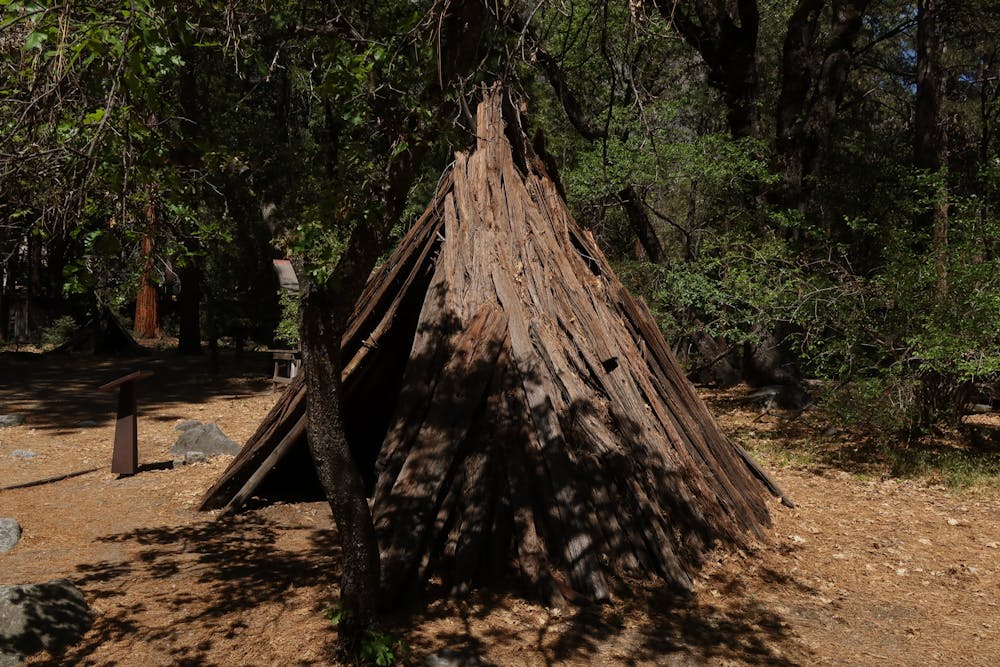
A small lean-to structure made out of sticks sits in front of a glade of trees.
The site of a former Miwok village in Yosemite Valley is now an outdoor museum display of traditional shelters. Thomas S. Bremer, CC BY-ND

A new era

Over the past few decades, the National Park Service has made progress in acknowledging Native American connections to parklands, beginning to address the history of Manifest Destiny and Indigenous peoplesโ€™ exclusion.

The agency is a key contributor to the Interior Departmentโ€™s recent initiative to facilitate tribal co-management of federal lands. Though much still needs to be done, national park managers are increasingly consulting and cooperating with tribal authorities on a range of issues.

Deb Haaland, the first Native American in U.S. history to hold a cabinet position, initiated a process to review and replace derogatory names on federal lands โ€“ one of her earliest actions as secretary of the interior. For example, she specifically identified the term โ€œsquawโ€ โ€“ a slur often directed at Indigenous women โ€“ as offensive, declaring that โ€œracist terms have no place in our vernacular or on our federal lands.โ€ Within a year of her directive, 24 places in the National Park System had new names.

Other issues on which the park service is collaborating with tribal communities include adopting Native American strategies of using deliberate fires to maintain healthy, thriving ecosystems. These Indigenous traditions have become a regular part of fire prevention and management efforts throughout the park system.

Several teepees stand in a row as the sun rises over a prairie.
Teepees included in the โ€˜Yellowstone Revealedโ€™ project by the north entrance to Yellowstone National Park. National Park Service/Jacob W. Frank via Flickr

Tribes have also cooperated with a variety of national parks to restore bison herds. Historically, these animals were central for many tribes not only as a source of food and materials for tools, clothing and blankets but also in traditional spirituality. The Interior Departmentโ€™s 2020 Bison Conservation Initiative and partnerships with the InterTribal Buffalo Council have helped begin to restore herds on Native American lands with bison from national parks, including Yellowstone, Badlands and Grand Canyon.

Perhaps the most noticeable initiative, from visitorsโ€™ perspective, are the stories of Native American culture and history in displays, ranger talks, roadside exhibits and the National Park Service website, amplifying Native voices in the parks. These programs have begun the process of reconciliation and healing โ€“ working to make a more inclusive and democratic civil religion.

Thomas S. Bremer, Associate Professor of Religious Studies, American Religious History, Rhodes College

This article is republished from The Conversation under a Creative Commons license. Read the original article.

Happy Thanksgiving Day 2023

Mrs. Gulch’s moon garden May 14, 2023.

I am most thankful today for all the folks (particularly my children) that have and are helping me to work through a most difficult year of losses. Thank you from the bottom of my heart.

#ClimateChange is turning swaths of #Californiaโ€™s mountains into โ€˜zombie forestsโ€™ — The Los Angeles Times #ActOnClimate

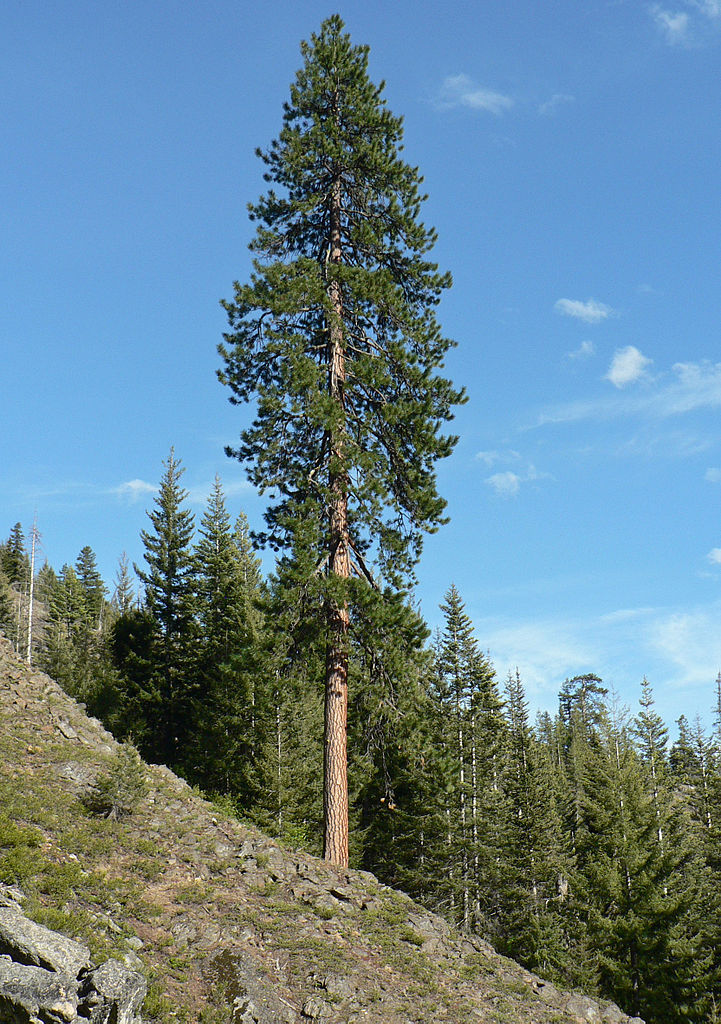
Pinus ponderosa subsp. ponderosa. Photo credit Wikimedia.

Click the link to read the article on The Los Angeles Times website (Alex Wigglesworth and Ian James). Here’s an excerpt:

The expanse of Sierra National Forest near Shaver Lake is a relic of the climate before global warming. Scientists believe that the conifers wonโ€™t be able to survive the current conditions. Researchers at Stanford University found inย a recent studyย that roughly one-fifth of all conifer forests in the Sierra are mismatched with the warmer climate and have become โ€œzombie forests.โ€

[…]

The findings indicate that these lower-elevation Sierra conifer forests, which include ponderosa pine, sugar pine and Douglas fir, are no longer able to successfully reproduce. Conditions have become too warm and dry to support conifer saplings, whose shallow roots require plenty of water if they are to survive into adulthood, Hill said. Giant sequoias also grow in lower-elevation areas of the Sierra Nevada, but the researchers didnโ€™t analyze the risks specific to those trees.

When these forests burn in high-severity wildfires โ€” or are wiped out by drought, disease or pests โ€” they will likely be replaced by other types of trees and brush, the scientists said. That could dramatically slash how much carbon the region can store; provide a habitat for invasive species; and displace plants and animals that call the forests home.

Report: Chemical Recycling: A Dangerous Deception — Beyond Plastics

Click the link to access the report from the Beyond Plastics website:

October 2023 | Beyond Plastics & International Pollutants Elimination Network (IPEN)

Chemical recycling โ€” or what the industry likes to call โ€œadvanced recyclingโ€ โ€” is increasingly touted as a solution to the plastic waste problem, but a landmark new report from Beyond Plastics and IPEN shows this technology hasnโ€™t worked for decades, itโ€™s still failing, and it threatens the environment, the climate, human health, and environmental justice. This comprehensive report features an investigation of all 11 constructed chemical recycling facilities in the United States, their output, their financial backing, and their contribution to environmental pollution.

The petrochemical and plastics industries have been aggressively working across America to pass state laws that reclassify chemical recycling facilities as manufacturing rather than waste facilities, which reduces regulation of these polluting plants and allows the companies to grab more public subsidies. As of this reportโ€™s release, 24 states have passed such laws. Just like mechanical recycling, chemical recycling is an industry marketing tactic to distract from the real solution to the plastic problem: reducing how much plastic is produced in the first place. 

Deregulating and incentivizing chemical recycling is a dangerous trend with environmental and human health repercussions, though itโ€™s not surprising when you consider how little information is publicly available about what chemical recycling actually does, how it does it, who it affects, how little plastic it removes from the waste stream, and how little product is actually produced.ย 

This report unmasks chemical recyclingโ€™s history of failure, its lack of viability, and its harms so that others, especially lawmakers and regulators, can see this pseudo-solution for what it is: smoke and mirrors.

New 2023 Four Panel Figure for the #ColoradoRiver Basin — Brad Udall #COriver #aridification

New plot using the nClimGrid data, which is a better source than PRISM for long-term trends. Of course, the combined reservoir contents increase from last year, but the increase is less than 2011 and looks puny compared to the โ€˜holeโ€™ in the reservoirs. The blue Loess lines subtly change. Last year those lines ended pointing downwards. This year they end flat-ish. 2023 temps were still above the 20th century average, although close. Another interesting aspect is that the 20C Mean and 21C Mean lines on the individual plots really donโ€™t change much. Finally, the 2023 Natural Flows are almost exactly equal to 2019. (17.678 maf vs 17.672 maf). For all the hoopla about how this was record-setting year, the fact is that this year was significantly less than 2011 (20.159 maf) and no different than 2019.

Also from Brad in email:

“You asked about Social Media. Iโ€™m disgusted with Elon and have been completely quiet on Twitter. It is only a matter of time before I delete my account for good. ย I have both BlueSky and Threads accounts but both have only about 10 followers as I have not posted. ย Mostly the world gets me down these days and I have a hard time thinking Social Media is a force for the good. Feel free to post this.”

Sagebrush is suffering, even in #Wyoming. Saving whatโ€™s left is complicated — @WyoFile

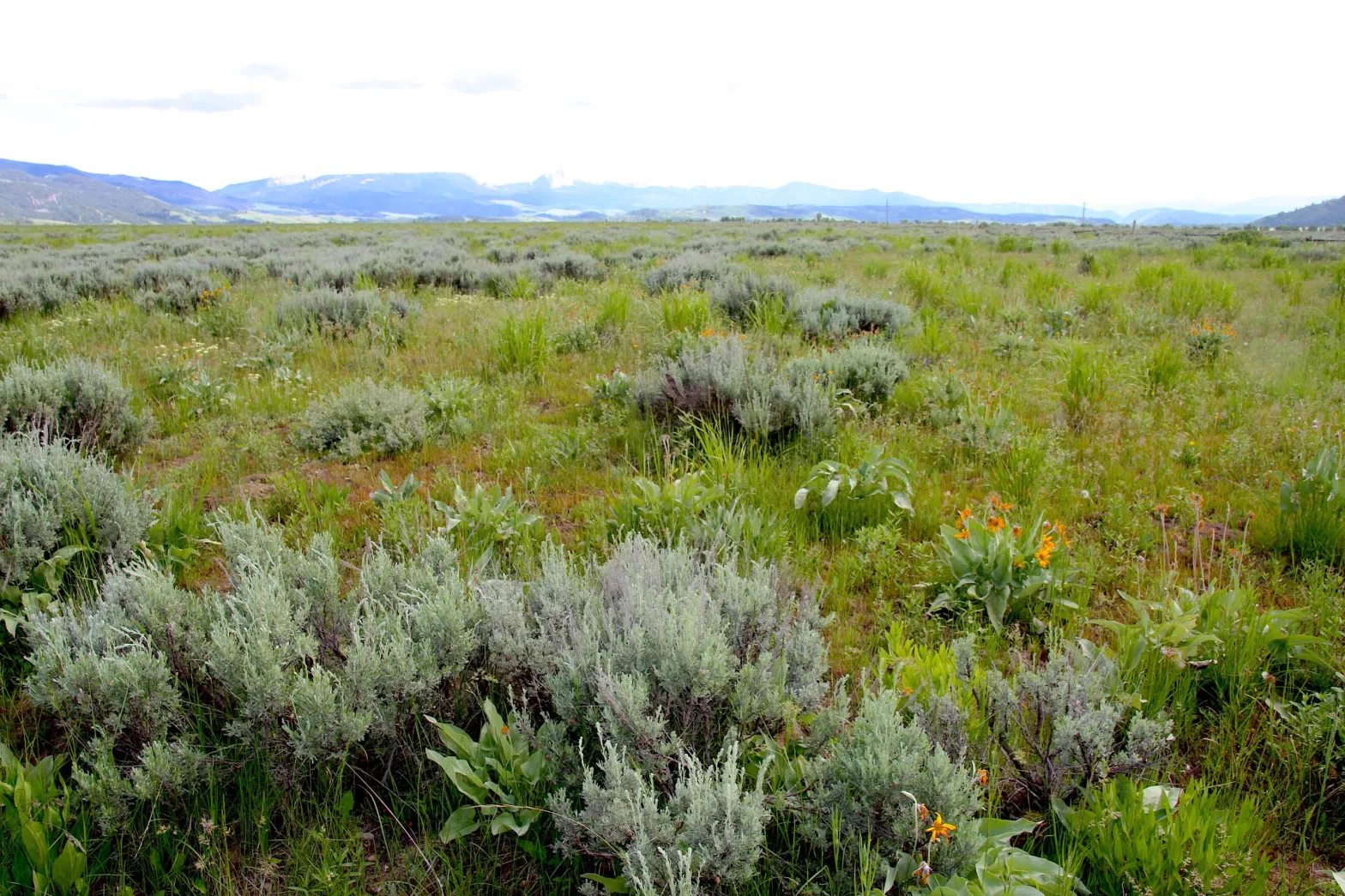
Brome grass, treated with a herbicide, stands dead in the Kelly hayfields region of Grand Teton National Park. Next year, the land will be tilled and reseeded with a mix of native species that includes sagebrush. (Mike Koshmrl/WyoFile)

Click the link to read the article on the WyoFile website (Mike Koshmrl):

Sagebrush-steppe โ€” the ecological backbone for iconic species like pronghorn and sage grouse โ€” is in decline. How to restore it depends on where you are and who you ask.

GRAND TETON NATIONAL PARKโ€”Laura Jones spoke from the grassy flats at the base of Blacktail Butte, a place where Mormon settlers made a go at homesteading the 6,600-foot-high heart of Jackson Hole nearly a century and a half ago. 

A vegetation ecologist for the National Park Service, Jones was showcasing Teton Parkโ€™s long-running effort to do away with one undesired relic of the homesteading era: non-native smooth brome grasses planted by the cattle-raising newcomers who plowed up this slice of the valley. Park managers are trying to go back to what was, reestablishing the natural sagebrush-steppe plant community that elk, bison and other native species evolved alongside over millennia.

Laura Jones, Grand Teton National Park vegetation ecologist, guides Second Gentleman Doug Emhoff through native sagebrush habitat in Grand Teton National Park in August 2023. (Angus M. Thuermer Jr./WyoFile)

Their task isnโ€™t straightforward or easy. 

โ€œThereโ€™s no blueprint,โ€ Jones told the Park Serviceโ€™s regional director, Kate Hammond, and a host of others for a Wyldlife for Tomorrow promotional field trip in late June. โ€œWhat works? We donโ€™t really know that. Some say, โ€˜Itโ€™s not rocket science โ€” itโ€™s harder.โ€™โ€ 

Weeks later, members of Wyomingโ€™s Sage Grouse Implementation Team, who met 70 miles away in Pinedale, spoke confidently about developing a โ€œwhite paper roadmapโ€ for successful sagebrush restoration. The process, team leader Bob Budd said, starts with ensuring healthy soils, reestablishing perennial flowers and grasses and then waiting patiently for sagebrush and other native shrubs to reemerge.ย 

Bob Budd, who chairs Wyomingโ€™s Sage Grouse Implementation Team, addresses a Sublette County audience during a July 2023 meeting to gather public feedback on sage grouse core area revisions. (Mike Koshmrl/WyoFile)

โ€œThat will be a game-changer for us, because now weโ€™re looking at areas of the state where we can go in and do restoration,โ€ Budd told residents who gathered for a sage grouse-focused meeting. โ€œI think [the blueprint] is going to be a big step forward for us as far as reclamation and restoration.โ€ 

Which is it? Harder than rocket science or a simple process that requires patience? WyoFile asked around and found that land managers in Wyoming have had markedly different experiences attempting to bring back sagebrush-steppe where the embattled ecosystem has been degraded or lost, whether it was from a historic cattle pasture or expansive natural gas fields. 

In the uninterrupted sagebrush sea of the Green River Basin, which remains dominated by native species, reviving tracts of sage lost to well pads and other industrial activity has come somewhat easier than it has in Teton Park, where millions of annual visitors potentially fling nonnative seeds from mud caked to their tires. Regardless, itโ€™s unlikely that sagebrush restoration is the silver bullet solution to holding the line of a biome thatโ€™s in decline,ย along with its inhabitants.

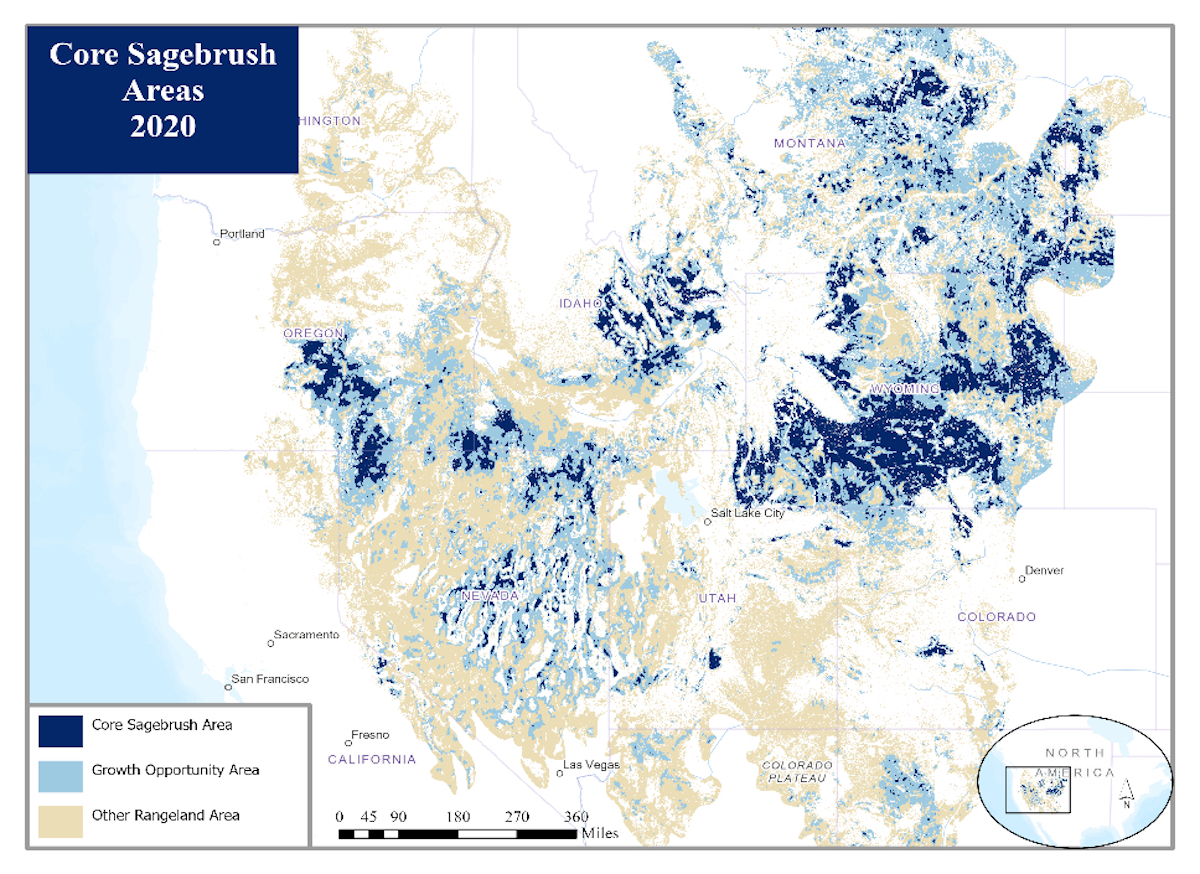
Sagebrush-steppe within 13 western states is disappearing and degrading at a rate of 1.3 million acres a year, recent research has found. Thereโ€™s no better place to preserve whatโ€™s left than Wyoming.

โ€œThe core of the biome is Wyoming,โ€ said Matt Cahill, who directs The Nature Conservancyโ€™s sagebrush sea program. โ€œIt has the largest, most intact, least disturbed expanse of productive, resilient sagebrush sea, period.โ€ย 

Sagebrush-dominated landscapes, home to 350 species of conservation concern, are declining in the West at a rate of 1.3 million acres per year. Wyoming is a stronghold for remaining sagebrush. (U.S. Fish and Wildlife Service)

Wyomingโ€™s prized, still-uncompromised sagebrush expanse could benefit from more โ€œpreventative restoration,โ€ he said. That includes measures like controlling the spread of cheatgrass. โ€œWeโ€™ve got to get comfortable with the uncomfortable story of using chemicals to protect biodiversity,โ€ Cahill said. 

But Cahill was less convinced that โ€œintensive traditional restorationโ€ โ€” putting seeds in the ground โ€” is so important today in Wyoming on the landscape level. โ€œThere isnโ€™t a huge footprint in Wyoming right now that needs those kinds of tools,โ€ he said, โ€œbecause there arenโ€™t big expanses that are fully degraded.โ€ 

Saving unsullied sweeps of sagebrush from development and forces like wildfire is the cornerstone of a widely accepted conservation strategy for the biome, dubbed โ€œDefend the core, grow the core.โ€

The Teton experience

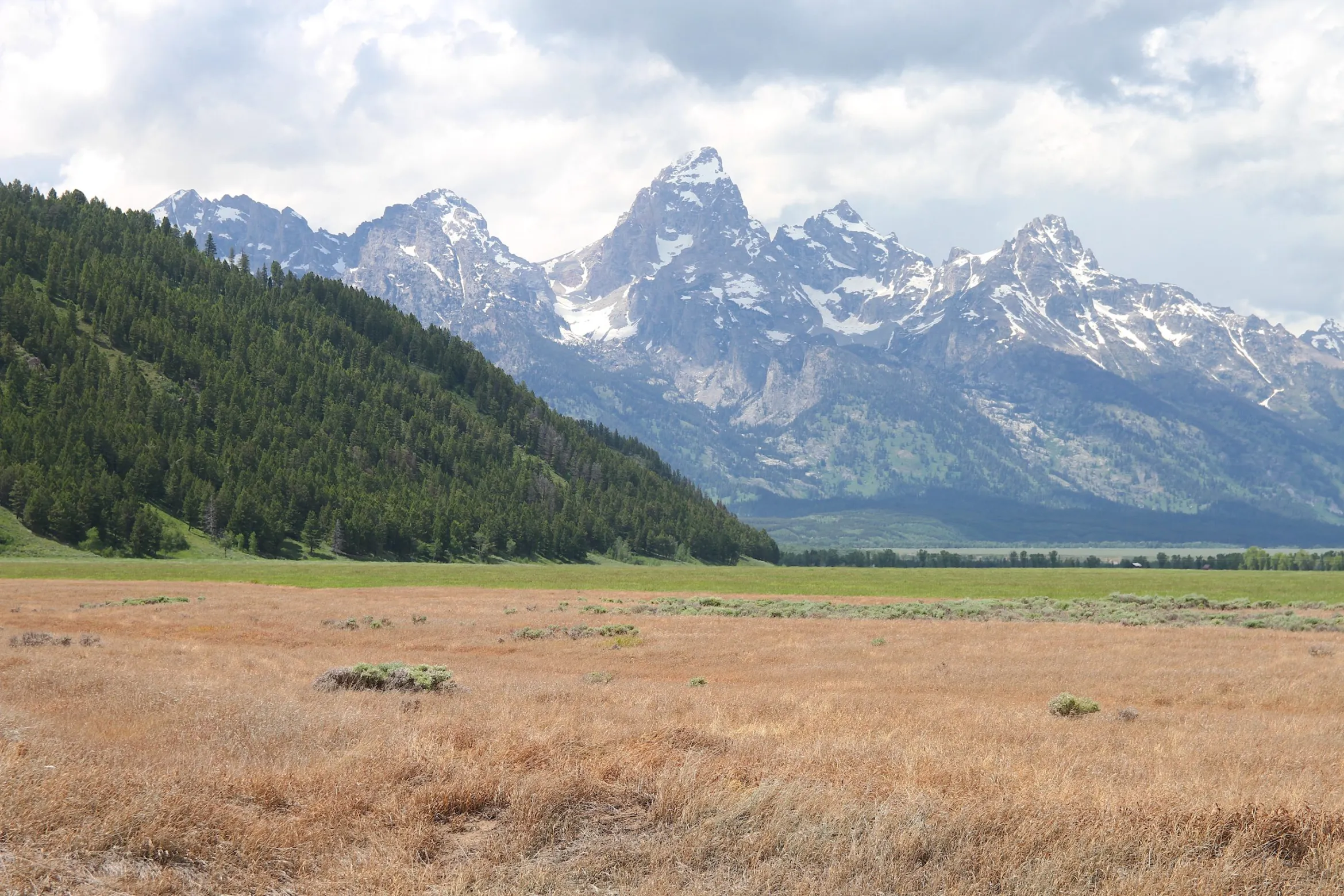
While Wyomingโ€™s sagebrush range is impressively intact, there are places where the biome was decimated or retreated, like in Grand Teton National Park. Along the eastern edge of the park, roughly 4,500 acres โ€” about 7 square miles โ€” of sagebrush was eliminated and replaced with non-native pasture grass a century or so ago. 

Teton Park ecologists have made progress scrubbing out brome and other exotic plants from the Kelly hayfields, as that part of the park is known. But the process has proven costly, long-lasting, labor-intensive and full of ecological wrinkles. Since making hayfield restoration a goal in aย 2007 bison and elk management plan, roughly 1,400 acres have been reseeded. That means about a third of the project has been completed some 16 years into the effort, putting it on pace for a half-century completion time.

The fence line separating sagebrush and historic pastureland marks the north end of of the state of Wyomingโ€™s school trust parcel in Grand Teton National Park, a tract known as the Kelly Parcel. (Mike Koshmrl/WyoFile)

Thereโ€™s no one reason why Teton Parkโ€™s sagebrush restoration efforts have been so slow going. Typically, between 50 and 100 acres are being restored annually. But one constraining factor is the availability of native seeds. Thereโ€™s no commercial market for buying native forb, grass and shrub seeds, and even if there was, Jones isnโ€™t convinced itโ€™d be wise to bring in seedstock from outside the region.

โ€œWe take our seeds, we hand collect it, we grow it out just for us,โ€ Jones said. โ€œItโ€™s expensive.โ€

Grand Teton National Park harvests by hand the native seed mix used to replant pastureland thatโ€™s being slowly converted to native sagebrush-steppe. (Mike Koshmrl/WyoFile)

Teton Park does get outside help on the costs. The Wyldife for Tomorrow program โ€” which lets businesses chip in to support environmental causes โ€” has chipped in about $25,000, according to its website. And the Grand Teton National Park Foundation has been a steady supporter, partnering on the project since 2016 and providing  nearly $1 million to date, communications manager Maddy Johnson said.

Still, the most recent annual budget for the restoration program eclipsed $350,000, meaning itโ€™s running tens of thousands of dollars per acre to bring sagebrush back in Grand Teton Park. 

However slowly, the remnant pastureland is gaining more semblance to what would have otherwise grown there, if not for the cattle-rearing residents of the parkโ€™s ghost town, once called Grosvont.

โ€œItโ€™s really difficult to do, but at the same time these fields of brome arenโ€™t going to replace themselves,โ€ said University of Wyoming botany professor Dan Laughlin, whoโ€™s experimenting with tilling and other techniques to try to get more sagebrush established.ย 

Where Jones and Laughlin stood at the parkโ€™s โ€œSlough South 1โ€ restoration site, brome had been killed off with a herbicide, the ground tilled and the soil subsequently reseeded with the parkโ€™s native seed mix.

Oftentimes the first plants that emerge from treated, plowed and seeded hayfields in Grand Teton National Park arenโ€™t the desired species. Instead, non-native plants like prickly lettuce and pennycress can dominate during the early years of sagebrush restoration. (Mike Koshmrl/WyoFile)

In places the native species were indeed coming back, but mostly the bare ground was sprouting with non-native plants that werenโ€™t in the Park Serviceโ€™s seed mix, like prickly lettuce and pennycress. Those โ€œlow priorityโ€ species arenโ€™t particularly noxious, and theyโ€™re largely left to live and even dominate plots in the early years of restoration.

โ€œTheyโ€™re so interspersed that youโ€™d be hard pressed to treat them,โ€ Jones said. โ€œThat would be expected โ€” that youโ€™re going to have these โ€˜first arrivers.โ€™โ€

Meanwhile in gas country

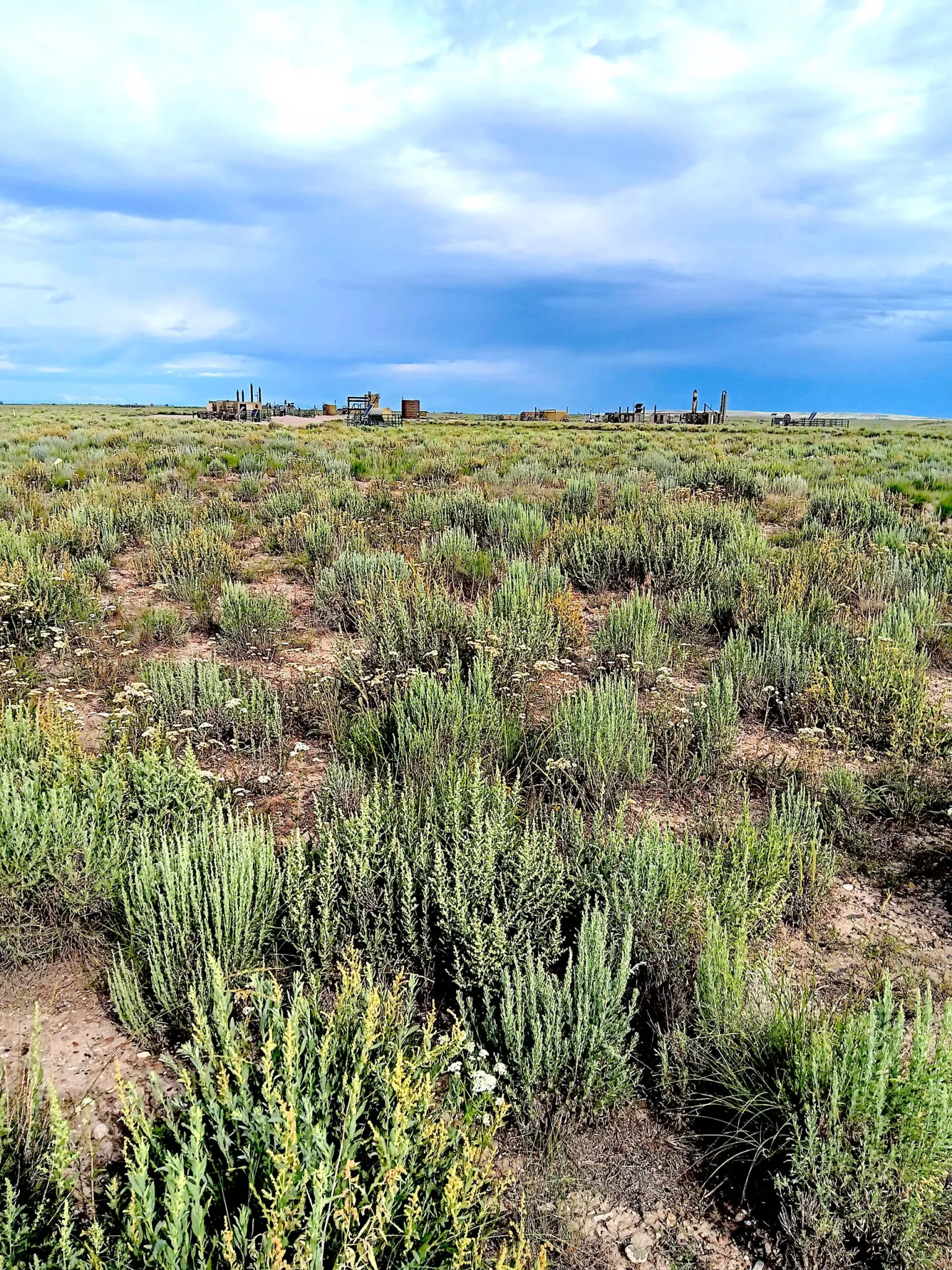
The spread of unwanted plants that arenโ€™t in the seed mix has been less of a factor in the Green River basin, a sagebrush sea stronghold where restoration goes hand-in-hand with natural gas extraction. 

โ€œWeโ€™ve been very successful in the Sublette County gas fields at getting sagebrush reestablished,โ€ said Mike Curran, an ecologist whoโ€™s worked with Jonah Energy and other companies on restoration research. โ€œThe good thing there is we donโ€™t really have a lot of non-natives in that system to begin with.โ€

Reclamation teams have had success reestablishing sagebrush on gas pads in the Green River basin, like this site pictured. (Mike Curran)

Curran, whoโ€™s studied how insect communities have responded to reclaimed gas pads, said that industry reclamation teams have found success steering early successional plant communities, especially with one native flower called Rocky Mountain bee plant. Those flowers, which thrive in disturbed soil, fade as sagebrush sprouts and matures โ€” which has happened relatively rapidly in places like the Jonah Fieldโ€™s reclaimed pads, he said.

โ€œWeโ€™ll see sagebrush come up in year one, year two, but itโ€™s year three, four, five when you actually see it put on height and mass,โ€ Curran said. โ€œBy year seven, eight, we have pretty good stands.โ€ 

About 91% of the plant cover in reclaimed swaths of the Jonah Field is taken up by native species, Curran said. Another 8% are non-natives that arenโ€™t particularly concerning, like Russian thistle, he said, and the remaining percent or so are โ€œinvasive weeds.โ€ย 

โ€œSo thatโ€™s pretty darn good, I think,โ€ Curran said.ย 

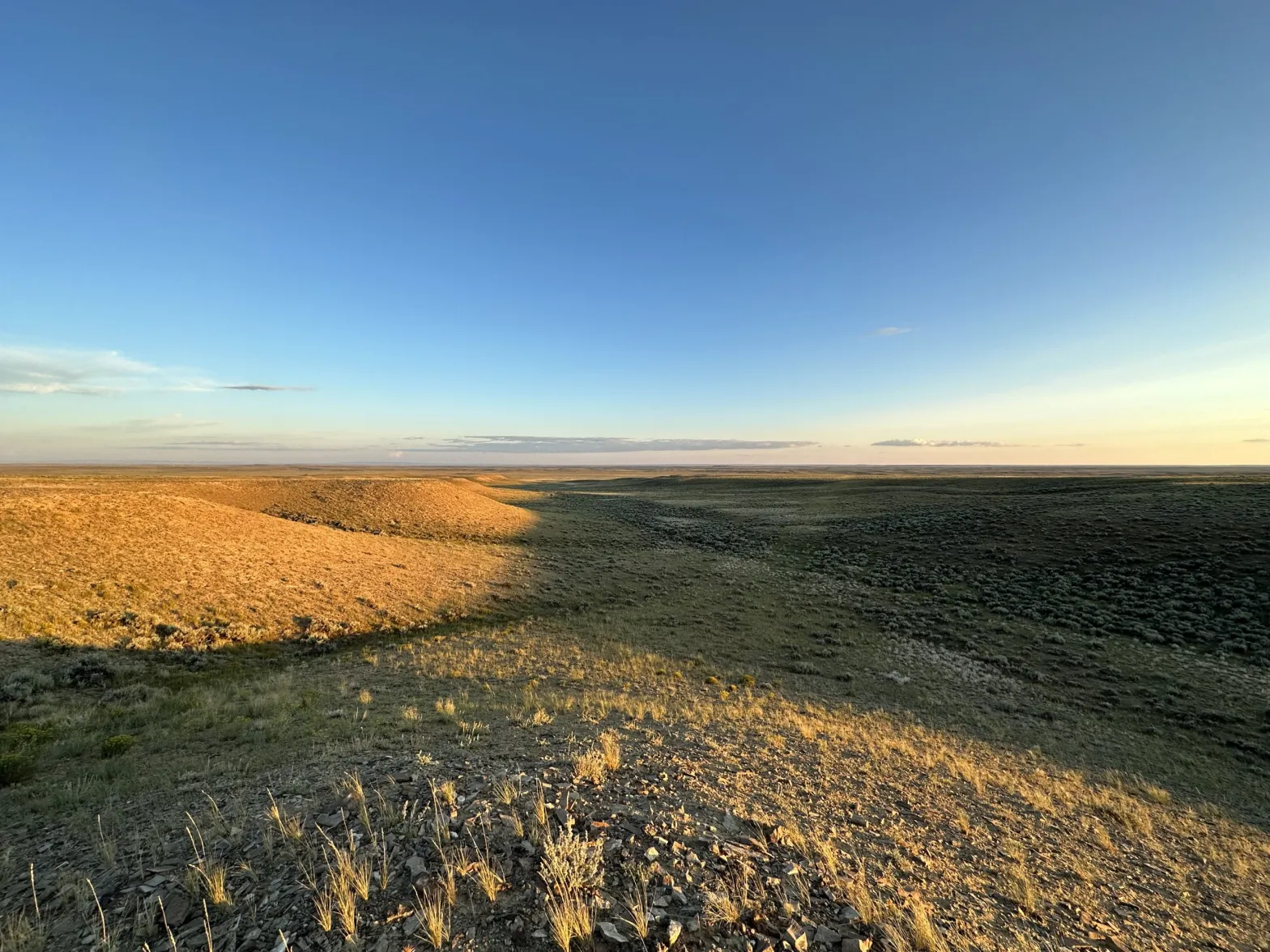
Tracts of unbroken sagebrush in the Green River basin, pictured, are part of the core of the biome. Restoration efforts have gone relatively smoothly in areas like Sublette County where non-native species havenโ€™t gained major ground. (Mike Koshmrl/WyoFile)

Curran, whoโ€™s spearheading the in-the-works restoration white paper for the Wyoming Sage Grouse Implementation Team, is optimistic that sagebrush restoration is a tool that can be deployed widely to help hold the line of a declining ecosystem. About half of the shrubland biome has been eliminated from North America since the European settlement era, and roughly 14 million acres of what remains has been lost in the last quarter century, according to a 2022 multi-agency research report

โ€œThe Green River basin, that is one of the harshest environments in the Lower 48,โ€ Curran said. โ€œWeโ€™re getting less than 50 frost-free days a year and 4 to 7 inches of precip on average down in the Jonah [Field]. If weโ€™re able to do it there, I feel like it should be easier to do it in places like Colorado and Nevada, which are at a lower latitude and have longer growing seasons.โ€ 

Room for improvement

Wyoming has also been the setting for ongoing experiments intended to optimize sagebrush restoration. Maggie Eshleman, a restoration scientist for The Nature Conservancyโ€™s Wyoming office, has spent years working with the Wyoming Department of Environmental Quality and Bureau of Land Management on seed technologies and habitat modifications to improve sagebrush establishment. 

โ€œThereโ€™s a bunch of areas throughout Wyoming that have been reclaimed, and generally speaking grass comes back pretty well, and sagebrush hasnโ€™t,โ€ Eshleman said. โ€œAre there ways we can make grass less competitive in those areas so that we can get sagebrush to establish?โ€ย 

Sagebrush seeds are โ€œsuper small, really weak, and love to fail,โ€ said Cahill, Eshlemanโ€™s Nature Conservancy colleague. 

And what Eshleman and others are trying to do is give sagebrush seeds a leg up in the race to establish amid grasses and weeds in soils with limited water and nutrients. They are experimenting with packaging small amounts of fertilizer with small amounts of seeds, ideally so that the added nutrients benefit the sagebrush plant and its root systems without stimulating weeds. It worked in the lab, but less so in their field sites: reclaimed mine land in the Gas Hills east of Riverton.

The trouble has been getting sagebrush seeds to emerge from their fertilizer-based pellet encasement: โ€œSagebrush needs light to germinate, and when they do germinate, they donโ€™t have a lot of push-power to break out of anything,โ€ Eshleman said. 

Sagebrush seeds germinated better when seeds were bathed in a thin fertilizer film, she said, but that method couldnโ€™t really deliver enough nutrients to stimulate germination and emergence.ย 

Sagebrush has succesfully matured in one of Grand Teton National Parkโ€™s oldest reclamation sites, pictured. (Mike Koshmrl/WyoFile)

The latest method being tested uses โ€œfertilizer balls.โ€ Seeds are essentially painted onto the outside, so they donโ€™t have to break out of anything and have access to light. Results are pending: the sagebrush seed-coated balls are going into the soil this fall. 

โ€œWeโ€™ll have some results next summer when we go on our hands and knees and look at tiny sagebrush seedlings that could be there or not,โ€ Eshleman said. โ€œBut it could be that next spring and summer there is a horrible drought and then you donโ€™t have seedlings.โ€ 

Then theyโ€™ll have to try again.

Whatever Eshleman and her partners devise could someday help improve restoration outcomes in Grand Teton National Park or any number of places in Wyoming. Although Cahill is emphasizing preservation and โ€œpreventative restorationโ€ to ensure the persistence of Wyoming sagebrush โ€” the โ€œcore of the biomeโ€ โ€” he said there are places where more intensive, traditional restoration could play an important role. Sagebrush resources in the Bighorn Basin, for example, are in rough shape and under siege by cheatgrass. 

โ€œIt looks like Nevada,โ€ Cahill said. โ€œPeople arenโ€™t necessarily thinking proactively about what is the risk to the rest of the state? What is the risk to Pinedale, or the Bear River valley?ย 

Itโ€™s worthwhile, Cahill said, to think about putting seeds in the ground in the โ€œconnecting corridorsโ€ that bridge and buffer compromised areas like the Bighorn Basin from the sagebrush-steppe biomeโ€™s intact core. Potential areas to consider, he said, include the Atlantic Rim and the Owl Creek Mountains. 

โ€œYouโ€™re going to put a ton of money on a few acres,โ€ Cahill said. โ€œSo make sure that those [restoration] acres are just absolutely critical to a much bigger landscape strategy. I think Wyoming has those options in spades.โ€

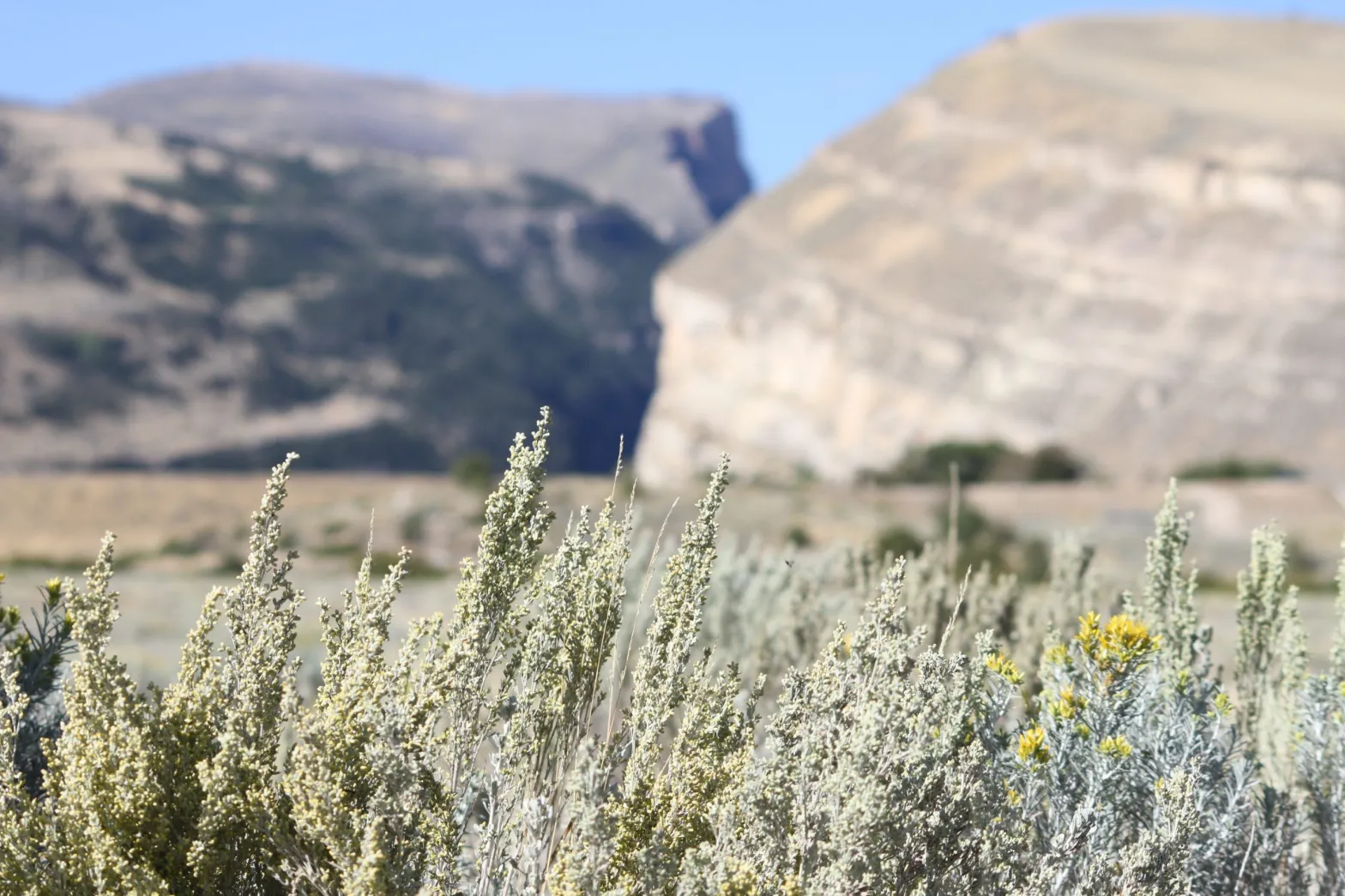
Leaders sprout from a sagebrush plant on the flats east of Washakie Reservoir on the Wind River Indian Reservation. (Mike Koshmrl/WyoFile)

Full sequence of the annular solar eclipse at Shiprock, New Mexico — Alex Spahn @spahn711

A bit of help for #Yampa in moving on from #coal dollars — Allen Best (@BigPivots) #ActOnClimate

Photo credit: Allen Best/Big Pivots

Click the link to read the article on the Big Pivots website (Allen “You got the story right, without going too long” Best):

Coloradoโ€™s Just Transition legislation intends to help coal-dependent communities like this one ease into an economy after coal

Yampa, the town of 400 near the headwaters of the river of the same name in northwest Colorado, recently got a small grant from the stateโ€™s Just Transition program designed for coal-reliant communities.

You wonโ€™t immediately see the presence of coal in Yampa. You will quickly recognize that for hunters, wilderness hikers, and anglers, itโ€™s a gateway to the Flat Top mountains with all of their wilds and mysteries plus the reservoirs that store their melted snow. At the head of one of the creeks is a narrow bridge of land above timberline called the Devilโ€™s Causeway. Those with acrophobia need not cross.

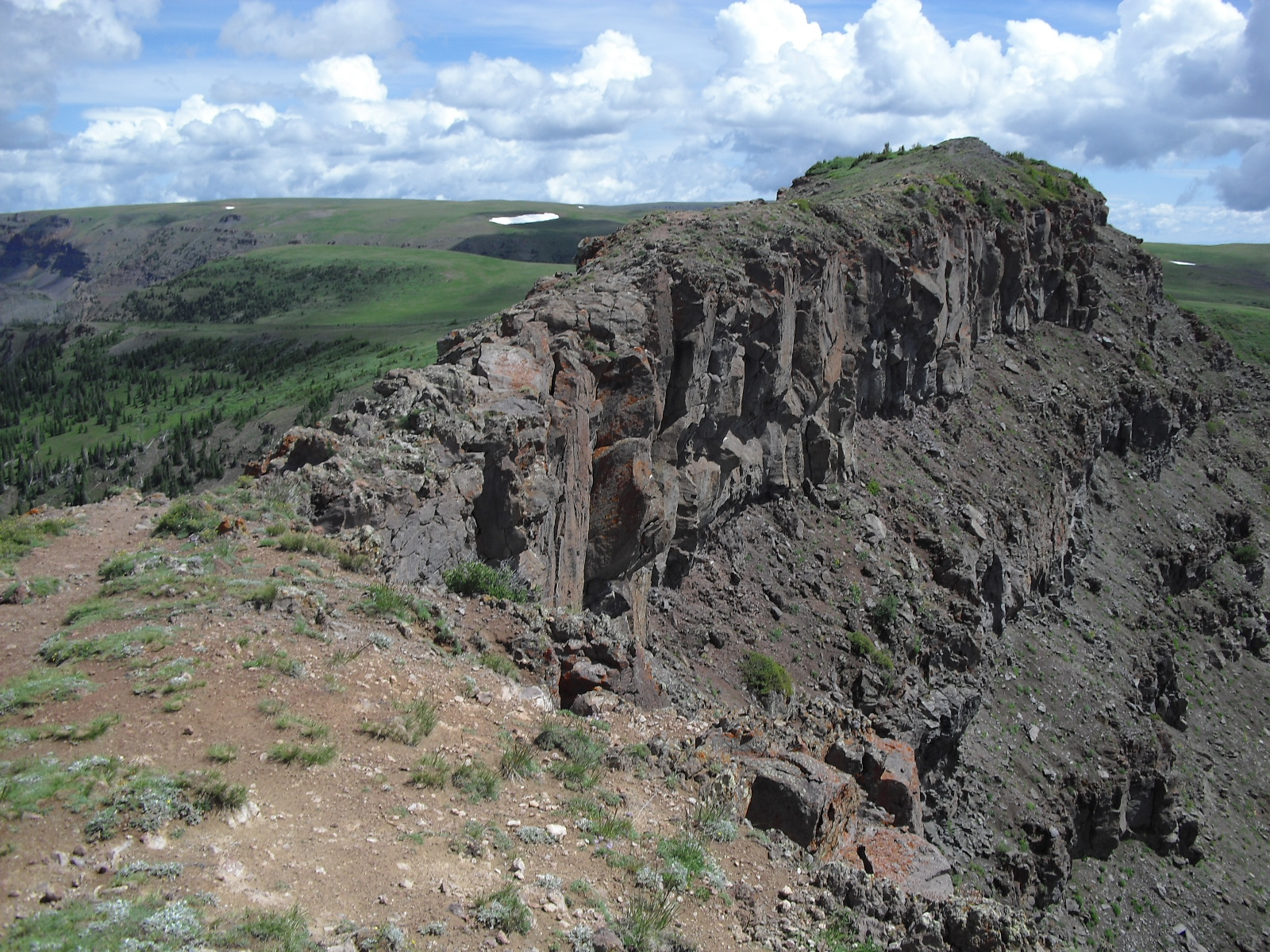
The Devil’s Causeway is a unique geological feature and popular hiking destination in the Flat Tops Wilderness. By Lvaughn7 – Own work, CC BY-SA 4.0, https://commons.wikimedia.org/w/index.php?curid=100048517

Yampa also lies amid a valley of hay ranches, emerald in some seasons but always comforting in their relative emptiness. This is a valley that to some is best described as โ€œColorado as it used to be.โ€ Itโ€™s not crowded, nor is there a rush. Not surprisingly, Yampa is on a Colorado Scenic and Historic Byway.

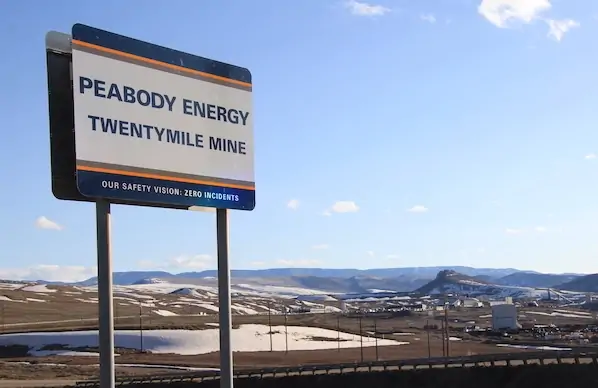
The coal is less obvious. The closest active mine, Twentymile, Coloradoโ€™s fourth largest, is actually about 50 minutes to the north along sometimes winding roads choked by oak brush.

Yampaโ€™s economy is intertwined closely with that of coal extraction at Twentymile. Some coal miners and others directly associated with the mine live in Yampa. Others work on the railroad. Thereโ€™s even a motel for railroaders built in the 1990s and a cafรฉ, Pennyโ€™s Diner, created specifically to ensure that railroaders can get a square meal at all hours of the day.

The coal economy of northwest Colorado is on the decline. Most of the coal mined at Twentymile travels only a short distance, to be burned at the two units at Hayden operated  by Xcel Energy. The same is true for mines in Moffat and Rio Blanco counties, whose coal mostly if not entirely gets burned at the three units of the Craig Generating Station. That plant is operated by Tri-State Generation and Transmission.

All five coal-burning units are scheduled to cease operations from 2025 to 2030.

Will the coal mines continue operations? Thatโ€™s unclear. Peabody Energy, the owner of Twentymile, has not said for certain what it plans.

Without reservation it can be said that the shipments of coal from Routt County through Yampa and to markets elsewhere have significantly declined in the last 20 years. The official evidence is scant. Coal companies donโ€™t release such reports. But the anecdotal evidenceโ€”what locals can report about the frequency of passing trains โ€”is abundant.

In recognition of this impact, Colorado has awarded Yampa a $105,000 grant for implementation of a business support program. The money is to be used for purchase of new and upgraded equipment for local businesses.

Some of the money will also be used to install signs along Highway 131, which passes on the edge of town. Many travelers use the highway to get between Steamboat Springs and the I-70 corridor.

Colorado also awarded a $600,000 grant to the Pioneers Medical Center in Meeker for implementation of a new electronic medical health record system. That was identified as the first step to expand healthcare services and long-term plans to develop medical tourism. See: โ€œMedical tourism in a land of fishing poles & orange vestsโ€

Both grants come from state funding allocated to smooth the transition of coal-dependent communities during the energy pivot underway in Colorado.

New jobs will be the end result of the grants, according to a press release issued by Gov. Jared Polisโ€™s administration.

โ€œAs the economy moves away from the high cost of coal power, Colorado is helping local communities diversify their economies and creating new opportunities for their residents to be successful,โ€ said Polis.

Yampa, the town, lies at the head of the Yampa River drainage on the eastern flanks of the Flat Tops. Top, Twentymile Mine in 2022 was Coloradoโ€™s four largest coal producer Photos/Allen Best

Paul Bonnifield, a resident, rejects the characterization of the new grant for Yampa as being a โ€œnod of the hat.โ€ In the context of Yampaโ€™s municipal government, โ€œitโ€™s a pretty danged big chunk of money,โ€ he said when asked for his on-the-ground observations.

As a history professor at a college in Oklahoma, he had several books to his credit, including โ€œDust Bowl: Men, Dirt and Depression,โ€ which was published in 1979.

While never completely abandoning his interest in history, Bonnifield decided to pursue a life of railroading on Coloradoโ€™s Western Slope. He was based in the nearby railroad community of Phippsburg for 25 years while working as a conductor on trains from Grand Junction to Denver before retiring in 2002. This writer became familiar with him when we met during the early 1990s at the Turntable, a railroad restaurant located adjacent to newspaper offices of The Vail Trail in Minturn. Both of us were regulars there for awhile.

At one time, far more trains traveled through Yampa, he said. A train from northwest Colorado, for example, delivered coal to a plant along the South Platte River near downtown Denver. That plant, Arapahoe Station, ceased electrical production in 2014. Trains also delivered coal from northwest Colorado to Texas.

Now, maybe one train a month exports coal out of the Yampa Valley. One train a week may travel through the town ferrying wheat and other goods from northwestern Colorado and delivering pipes and other supplies.

But the valley no longer has a maintenance crew and other railroad employees like it once did. As for the diner for railroad employees, it has had trouble finding enough local help to maintain reliable hours.

At the same time, local governments will enormously suffer from the eroded tax base if the mine closes.

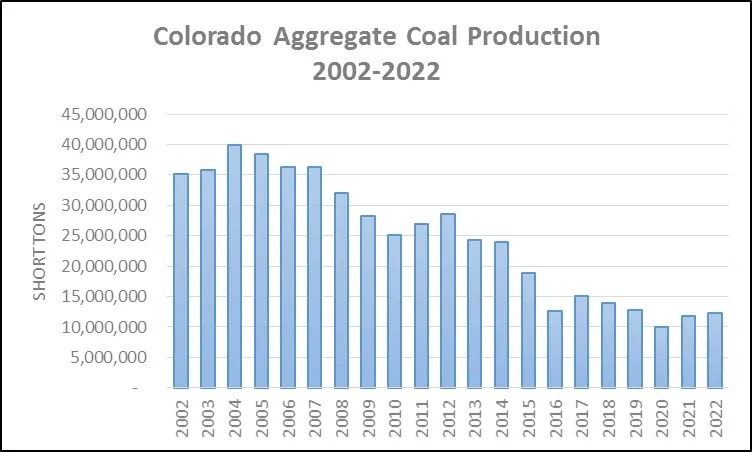
These grants are an expression of Coloradoโ€™s commitment to ease coal-dependent communities economically as the era of coal, now more than 125 years old in Colorado, ebbs even more rapidly through the end of this decade. By 2031, the stateโ€™s remaining last eight coal-fired electricity-generating plants will be closed, casting doubt on the viability of Coloradoโ€™s six remaining coal mines.

The legislative roots were in 2019, when Colorado adopted what was then seen as ambitiousโ€”too ambitious, in the minds of at least some Republican legislatorsโ€”decarbonization goals: 50% economy-wide decarbonization by 2030 and 90% by 2050, both compared to 2005 levels. The law was HB 19-1261.

In HB 19-1314, Colorado legislators declared that they did not want to throw coal workers in the mines, power plants, or on the railroad under the energy transition bus. Colorado had been mindful of impacts, the law said, and state government had a role in helping provide a transition for those people and their communities.

The state, Coloradoโ€™s law declared, had a โ€œmoral commitment to assist the workers and communities that have powered Colorado for generationsโ€ by supporting a โ€œjust and inclusive transitionโ€ away from coal.

It also noted that resources existed at neither the state nor federal levels sufficient to assist workers and communities impacted by the transition. That included the absence of coordinated leadership within Coloradoโ€™s state government.

The law appropriated a thin sum for staffing, not quite $157,000, with the understanding that more would come. Wade Buchanan, a veteran of several state positions, was hired to run the new Office of Just Transition.

Meetings in early March 2020 were held in Craig and Hayden. I attended all three. In Craig that first evening, I heard anguish and dismay about the announcement two months before by Tri-State Generation and Transmission that the three coal units it operated there would all be closed by 2030. Only one had been announced previously.

The third day, the governor arrived in Craig. First he toured a small shop, Good Vibes, that produces gear for river boaters. It was just the governor by himself with the two co-owners and me the observer.

That afternoon, he sat in the Hayden Town Hall listening to testimony when the news arrived. One coal miner from Twentymile pleaded with the governor to see a future that included coal. Polis seemed to be listening, but likely he had been told just a few hours before that Colorado had its first case of covid. Surely, he was thinking many thoughts.

Colorado put together a 20-page action plan by the end of 2020 that outlined 13 strategies for communities, workers, and funding. It also gained state funding.

Between the Office of Just Transition and its parent agency, the Office of Economic Development & International Trade, $9.62 million in funding in the form of coal transition community grants had been issued. They were:

  • Yampa Valley, $5,152,538
  • West end of Montrose County (Nucla and Naturita), $3,058,192
  • Pueblo County, $471,423
  • Morgan County, $471,423
  • $471,423 for Delta, El Paso, Gunnison, La Plata and Larimer counties collectively

So, money is getting distributed, lots and lots of meetings are being held now, and the Office of Just Transition is no longer a one-man office, as it was for the first year.

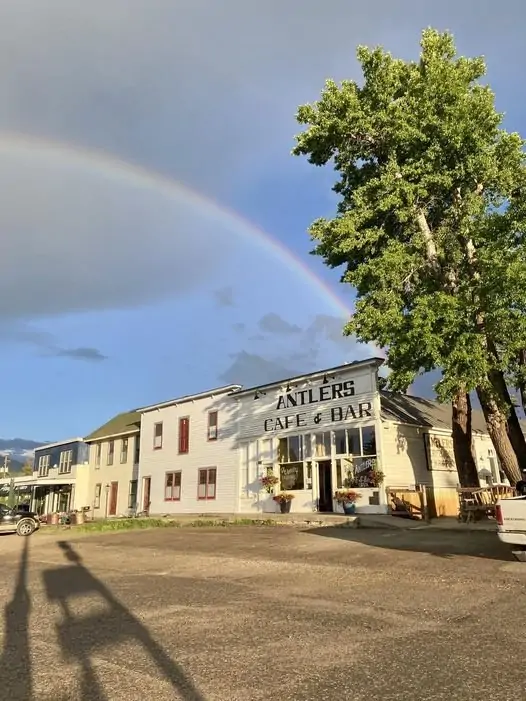
Antlers began operating in 1904, shortly before the rails of what many called the Moffat Road arrived. The principle figure in the railroad was David Moffat, whose name lingers on the tunnel through the Continental Divide, the county in northwest Colorado โ€” and the street on which this business is located. Photo credit: Allen Best/Big Pivots

Yampaโ€™s main street, Moffat Avenue, is wide and still largely without pavement. It has never had a large population, hovering between 300 and 400 in recent decades. None of the busyness of Steamboat Springs 40 miles to the north, or the Vail Valley communities, 40 miles to the south, can be found in Yampa. To most locals, thatโ€™s fine.

Still, a little more activity would also suit the locals, and that is how the town intends to use the money, to bolster business activity. Part of that plan is to ensure that the community has a restaurant open to the public on a year-round, not just seasonal basis.

Yampa has had a very fine restaurant called Antlers. The business was established in 1904, just before the rails arrived from Denver through the Moffat Tunnel on their way to Moffat County, and has been in operation continuously since then with the exception of 2005-2009.

The restaurant has now returned to operating hours  year-round with some help from the town government.

The opening of Yampa Garage Eatery is another bright spot in the townโ€™s economic story. The money will also help expand the space and variety of goods at the local grocery store and mercantile.

But 90% of the townโ€™s workers leave to work elsewhere, points out Mary Alice Page-Allen, the town planner and treasurer.

The goal of her work, she said, is to โ€œretain what we have, but also to expand and attract.โ€ The town core lies just a block off the highway, but for many travelers, there may be no particular reason to pause on their journeys.

Oak Creek, a one-time coal-mining town 10 miles to the north, which Page-Allen formerly managed, has had some success in creating more buzz in its commercial district. It even has a parking problem a couple days a week.

Thatโ€™s a hard problem to imagine for Yampa, but a few more cars on that big, broad street would be welcome.

For even deeper dives:

The first of a two-part primer on Coloradoโ€™s nation-leading effort.

Aug. 7, 2020

Aug 14, 2020

April 30, 2021

Also of possible interest

Coloradoโ€™s biggest and smallest coal mines

February 18, 2023

Yampa River Basin via Wikimedia.

Americaโ€™s farmers are getting older, and young people arenโ€™t rushing to joinย them

Seeking greenhorns with green thumbs. Steve Smith/Tetra Images via Getty Images

David R. Buys, Mississippi State University; John J. Green, Mississippi State University, and Mary Nelson Robertson, Mississippi State University

CC BY-ND

On Oct. 12, National Farmersโ€™ Day, Americans honor the hardworking people who keep the world fed and clothed.

But the farming labor force has a problem: Itโ€™s aging rapidly.

The average American farmer is 57 and a half years old, according to the most recent data from the U.S. Department of Agriculture. Thatโ€™s up sharply from 1978, when the figure was just a smidge over 50.

As researchers who study well-being in rural areas, we wanted to understand this trend and its implications. So we dug into the data.

Amber waves of graying

We found that the average age of farmers was fairly consistent across the country, even though the general populationโ€™s age varies quite a bit from place to place.

For example, the average Maine farmer is just a few months older than the average farmer in Utah, even though the average Maine resident is more than a decade older than the average Utahn.

To be fair, we did find some local differences. For example, in New York County โ€“ better known as Manhattan โ€“ the average farmer is just north of 31. Next door in Hudson County, New Jersey, the average farmer is more than 72.

On the whole, though, Americaโ€™s farming workforce is getting older. If the country doesnโ€™t recruit new farmers or adapt to having fewer, older ones, it could put the nationโ€™s food supply at risk. Before panicking, though, itโ€™s worth asking: Why is this happening?

A tough field to break into

To start, there are real barriers to entry for young people โ€“ at least those who werenโ€™t born into multigenerational farming families. It takes money to buy the land, equipment and other stuff you need to run a farm, and younger people have less wealth than older ones.

Young people born into family farms may have fewer opportunities to take them over due to consolidation in agriculture. And those who do have the chance may not seize it, since they often report that rural life is more challenging than living in a city or suburb.

The overall stress of the agriculture industry is also a concern: Farmers are often at the mercy of weather, supply shortages, volatile markets and other factors entirely out of their control. https://player.vimeo.com/video/693568425 The ups and downs of farm life take center stage in โ€œOn the Farm,โ€ a docuseries produced by Mississippi State University.

In addition to understanding why fewer younger people want to go into agriculture, itโ€™s important to consider aging farmersโ€™ needs. Without younger people to leave the work to, farmers are left with intense labor โ€” physically and mentally โ€“ to accomplish, on top of the ordinary challenges of aging.

In other words, the U.S. needs to increase opportunities for younger farmers while also supporting farmers as they age.

Opportunities to help

The USDA already has programs to aid new farmers, as well as farmers of color and female farmers, and those who operate small farms. Expanding these programsโ€™ reach and impact could help bring new talent into the field.

Congress could do just that when it reauthorizes the farm bill โ€“ a package of laws covering a wide range of food โ€“ and agriculture-related programs that get passed roughly every five years.

The farm bill also includes nutrition aid and funds telehealth and training and educational outreach for farmers, all of which could help meet the needs of young and aging farmers alike. Notably, the Cooperative Extension Service offers programs that range from 4-H and youth development, including introduction to agriculture, to providing on-site technical help.

Congress was supposed to reauthorize the farm bill by Sept. 30, 2023, but it missed that deadline. It now faces a new deadline of Dec. 31, but due to dysfunction in the House of Representatives, many expect the process to drag on into 2024.

Also in 2024, the USDA will release its next Census of Agriculture, giving researchers new insight into Americaโ€™s farming workforce. We expect it will show that the average age of U.S. farmers has reached a new all-time high.

If you believe otherwise โ€“ well, we wouldnโ€™t bet the farm.

David R. Buys, Associate Professor of Health, Mississippi State University; John J. Green, Director of the Southern Rural Development Center & Professor of Agricultural Economics, Mississippi State University, and Mary Nelson Robertson, Assistant Professor of Human Development and Family Science, Mississippi State University

This article is republished from The Conversation under a Creative Commons license. Read the original article.

Commentary: Voices on the wind: the uncomfortable history of #Kansas and First Peoples of the plains — The Kansas Reflector #IndigenousPeoplesDay

Members of the Comanche nation travel to the Medicine Lodge Treaty site in October 1867, as depicted in an engraving in โ€œLeslieโ€™s Illustrated.โ€ (Library of Congress)

Click the link to read the article on The Kansas Reflector website (Max McCoy):

Often have I stood on the plains of western Kansas and heard the voices of the past come to me on the incessant wind, whispers of lives that were spent between the great bowl of the sky and the unforgiving earth. They arenโ€™t real voices, of course, but a product of my mind, a kind of auditory hallucination informed by history and sharpened by the vastness of the prairie.

Nowhere have I had this sensation stronger than at Fort Larned National Historic Site, along the old Santa Fe Trail in Pawnee County.

Iโ€™ve never stayed long at the fort because those voices give me the chills. The fort is a fine national historic site with excellent interpretive material, but my autonomous nervous system goes on alert. On this Indigenous Peoplesโ€™ Day weekend, I canโ€™t help but think of the role the fort played in the pageant of brutality that was the West. It is a story of bad faith and broken treaties.

I donโ€™t presume to speak for the actors in these events, whether they were First Peoples or white soldiers, nor do I condone the brutality practiced by either side, but the facts remind me of how uncomfortable it is sometimes to be an American.

And discomfort is useful in studying the past if we are to learn from it.

The Third U.S. Infantry photographed in 1867 at Fort Larned, Kansas. Image: National Park Service.

Stanleyโ€™s dispatches

The national historic site, six miles west of the city of Larned, has nine restored sandstone buildings, including barracks and arsenal, and is among the best-preserved forts of the period.  At its peak, Fort Larned housed about 500 troops and provided administrative and material support to the Medicine Lodge Treaty of October 1867.

The fortโ€™s link to the Medicine Lodge Treaty (which was actually three treaties) was made clear by a correspondent for the Missouri Democrat, a young reporter named Henry Morton Stanley who would later be remembered for uttering, โ€œDr. Livingstone, I presume?โ€ He was dispatched to the fort and points south along with the seven-member Indian Peace Commission, and from the dispatches he left I suspect he may have heard voices, too.

โ€œGenerations after generations have been swept away,โ€ Stanley wrote in one story, โ€œmingling their dust with the common mother, and leaving to their successors their traditions and usages, as well as their darkness and barbarism. The Indians of the present day hunt the buffalo and the antelope over this lone and level land, as freely as their ancestors, except where the white man has erected a fort.โ€

Silas Soule, who commanded a company of the Colorado volunteers that attacked the peaceful encampment near todayโ€™s town of Eads, in southeastern Colorado (Sand Creek Massacre). Soule withheld his soldiers from the attack and later testified against John Chivington, the commanding officer. Soule was assassinated in Denver the following April. Photo credit: Allen Best

Stanleyโ€™s remarks about โ€œdarkness and barbarismโ€ are a reflection of the bias of his time, but he could have said the same about the military and government officials in whose company he traveled. In 1864, the U.S. Army (over the objections and refusal of some officers and men to participate) had massacred 160 women and children at a Cheyenne and Arapaho encampment at Sand Creek in Colorado Territory. Before the slaughter, Chief Black Kettle had been flying an American flag from his tipi.

โ€œAfter Sand Creek the Indians were at war everywhere, mostly on the Platte,โ€ Stanley told his readers. Gen. Winfield S. Hancock, a hero of Gettysburg, attempted to force the plains nations into submission. On Hancockโ€™s orders, George Armstrong Custer burned a Cheyenne-Lakota village west of Fort Larned.

A series of fights followed, including one in which an entire detachment of cavalry was killed near present-day Goodland. By the end of the summer of 1867, Hancock was transferred to another command and a new plan came from Washington โ€” diplomacy, because the fighting in the west was growing too expensive.

The Medicine Lodge treaties that followed were held at a sacred spot for the Kiowa and Cheyenne, on the Medicine Lodge River near the mouth of Elm Creek, about 100 miles south of Larned. The fort supplied the provisions for the council, including food for all of the former combatants.

It may have been one of the largest assemblies of First Peoples on the plains, with contemporary estimates ranging up to 15,000 individuals. The nations represented included the Cheyenne, Arapaho, Kiowa, Comanche and Apache. Probably the most famous โ€” and most feared by the whites โ€” among the native people was Satanta, a Kiowa chief known for both his fighting skills and his soaring oratory.

The Indian Peace Commission was escorted to Medicine Lodge by 500 troops of the Seventh Cavalry, but George Armstrong Custer wasnโ€™t among them โ€” he had been court-martialed for being absent without leave and for ordering the shooting of deserters. His punishment was a yearโ€™s suspension without pay.

โ€œWe hope now that a better time has come,โ€ Satanta said through an interpreter, according to a 1938 magazine piece recounting the event. โ€œIf all would talk and then do as they talk, the sun of peace would forever shine. We have warred against the white man, but never because it gave us pleasure. Before the day of apprehension came, no white man came to our village and went away hungry.โ€

Satanta said he was ready for peace.

The 1938 piece may be apocryphal, as I cannot readily find another source for it. There is nothing similar in Stanleyโ€™s dispatches. But it matches the spirit of what Satanta likely believed. In an earlier speech, before the peace council, Stanley had reported that the chief was done with fighting. โ€œThere are no longer any buffaloes around here,โ€ Satanta said, โ€œnor anything we can kill to live on; but I am striving for peace now.

Henry Morton Stanley was a correspondent for the Missouri Democrat aduring the Medicine Lodge Treaty of October 1867. Photo: National Library of Wales

From the plains to the reservations

From Oct. 21 to 29, 1867, three separate treaties were signed at Medicine Lodge that collectively reduced the area set aside for the plains nations by 60,000 square miles. In exchange, the First Peoples nations were given reservations in the southwestern corner of Oklahoma and allowances for food, clothing and other provisions.

The Indian Peace Commission would continue through 1868, negotiating other treaties with northern plains nations, and in time would deliver a report to a Congress that was still struggling to define its relationship to Americaโ€™s indigenous peoples. It took until July 1868 for the Senate to ratify the treaties, and some details that were understood during the October meetings were dropped in legislation, including a promise there would be sufficient buffalo on the new reservations.

Also, the U.S. government misunderstood the collective nature of political power among the plains tribes. While a chief might affix a signature to a treaty, it was not understood as necessarily binding all members of his nation to the document. While the treaties called for three-quarters of the males of a tribe to ratify them, that does not appear to have happened.

Not long after the peace commissionโ€™s gifts of beads, buttons, knives, cloth and pistols had been taken home, discontent was again brewing among the plains nations. Reservation life, restricted geographically and tied to government allotments of food and supplies, was an unsatisfactory substitute for the nomadic culture the plains nations had previously known.

Brutal raids into the old hunting grounds of western Kansas resumed.

By 1871, Satanta was attacking wagon trains in Texas, was eventually captured, and became among the first Native American leaders to be tried in a U.S. court. After serving a couple of years in prison, he was released but violated his parole by being present at the Second Battle of Adobe Walls. He was captured and sentenced to life in prison at Huntsville, Texas. He died at age 62 of a fall from a high window of the prisonโ€™s hospital on Oct. 11, 1878.

Sa-tan-ta, celebrated Chief of the Kiowas (pencil notation reads “Wm. S. Soule”). By William S. Soule – U.S. National Archives and Records Administration, Public Domain, https://commons.wikimedia.org/w/index.php?curid=17068906

Another broken treaty

The peace commission was the U.S. governmentโ€™s last attempt to negotiate a peaceful settlement with the First Peoples, according to the National Archives. While the goal was peace, the result was the opposite. In its final report, the commission recommended that the Bureau of Indian Affairs should be transferred from the Interior Department to the Department of War.

By 1868, Custer had served his punishment and had been summoned to active duty to participate in a new campaign against the plains nations. In November he attacked a Southern Cheyenne camp on the banks of the Washita River in Oklahoma, and killed 50, including Chief Black Kettle, who had been at Sand Creek and was a signatory at Medicine Lodge. Fifty-three women and children were taken prisoner by the Seventh Cavalry.

In 1874, Custer led an Army expedition to the Black Hills, in which gold was found. Faced with an influx of fortune hunters onto land that had been given to the Sioux, the government violated the 1868 Fort Laramie Treaty, a deal that had been brokered by the same Indian Peace Commission that had been at Medicine Lodge. Settlers poured in, and the northern plains nations resisted.

Custer would meet his end at the Battle of the Greasy Grass in the Little Bighorn Valley of Montana Territory. On June 25, 1867, he led five companies of the Seventh Cavalry against a village he had badly underestimated the size of. Custer and 267 of his command would be killed by the combined forces of thousands of Lakota, Dakota, Northern Cheyenne and Arapaho warriors.

Troops under the command of George Armstrong Custer burn a Native American village west of Fort Larned in 1867, as depicted in this engraving in “Leslie’s Illustrated.” Image: National Park Service

โ€˜An ignorant and dependent raceโ€™

Despite winning the biggest battle against a celebrated enemy, the plains nations could not withstand increased pressure from the U.S. military and white settlement. The decades-long conflict ended Dec. 29, 1890, at Wounded Knee, Dakota Territory, where 300 Lakota people were massacred by the U.S. Army in a campaign to suppress the Ghost Dance religion. Based on the visions of a Paiute holy man called Wovoka, followers believed the buffalo and the ghosts of ancestors would return to earth โ€” and the whites would be swallowed up โ€” by ritual dancing.

While the fighting had ended with Wounded Knee, the battle over the Medicine Lodge and other treaties continued in the courts. From the reservation in Oklahoma, Kiowa leader Lone Wolf sued Secretary of the Interior E.A. Hitchcock in a case which boiled down to a single question: Could Congress unilaterally break treaties? The answer from the Supreme Court, in 1903, was a unanimous yes.

โ€œThese Indian tribes are wards of the nations,โ€ the decision said, consisting of weak and helpless communities wholly dependent on the federal government. The court presumed that Congress would be guided in its treatment of โ€œan ignorant and dependent raceโ€ by Christian values.

Lone Wolf v. Hitchcock was the rule of law for most of the Twentieth Century. It granted Congress plenary power over the plains nations, meaning that its power was absolute, with no review or limitations. Although reversed in large part by United States v. Sioux Nation of Indians in 1980, the shadow of Lone Wolf continues to leave a foul taste in our collective mouths, a bad decision that has been compared by historians to the Dred Scott decision.

โ€œThe young Plains culture of the Kiowas withered and died like grass that is burned in the prairie wind,โ€ wrote N. Scott Momaday in his 1969 book, โ€œThe Way to Rainy Mountain.โ€ Momaday is a Kiowa author and a descendant of Lone Wolf, and his novel is about his ancestorsโ€™ path to the reservation. โ€œThere came a day like destiny; in every direction, as far as the eye could see, carrion lay out in the land.โ€

It is time for Kansas to adopt Indigenous Peoplesโ€™ Day as a state holiday. About a dozen states have already done so, including Oklahoma. Both the cities of Wichita and Lawrence celebrate it, although the Kansas Legislature was unmoved after hearings in 2019 and 2021. But considering our stateโ€™s pivotal role in the war against the plains nations, and the many contributions of Kansans of indigenous heritage, it would be a small but corrective move toward celebrating a culture we nearly destroyed.

Listen to the voices on the wind.

Max McCoy is an award-winning author and journalist.ย Through its opinion section, the Kansas Reflector works to amplify the voices of people who are affected by public policies or excluded from public debate. Find information, including how to submit your own commentary,ย here.

Native land loss 1776 to 1930. Credit: Alvin Chang/Ranjani Chakraborty

Joni Mitchell in 1970: “I really don’t know life at all”

Mrs. Gulch’s Maximilian sunflowers September 24, 2023. Helianthus maximiliani is a North American species of sunflower known by the common name Maximilian sunflower. Helianthus maximiliani is native to the Great Plains in central North America, and naturalized in the eastern and western parts of the continent. It is now found from British Columbia to Maine, south to the Carolinas, Chihuahua, and California. The plant thrives in a number of ecosystems, particularly across the plains in central Canada and the United States. It is also cultivated as an ornamental

Please enjoy Joni Mitchell performing “Both Sides Now”.

Study finds human-driven mass extinction is eliminating entire branches of the tree of life — Stanford University #ActOnClimate

Illustration of Thylacinus cynocephalus from John Gouldโ€™s The Mammals of Australia. This genus, also known as the Tasmanian tiger, was hunted to extinction by humans. (Image credit: Henry Constantine Richter and John Gould/Public domain)

Click the link to read the release on the Stanford University website (Sean Cummings):

A new analysis of mass extinction at the genus level, from researchers at Stanford and the National Autonomous University of Mexico, finds a โ€œmutilation of the tree of lifeโ€ with massive potential harms to human society.

The passenger pigeon. The Tasmanian tiger. The Baiji, or Yangtze river dolphin. These rank among the best-known recent victims of what many scientists have declared the sixth mass extinction, as human actions are wiping out vertebrate animal species hundreds of times faster than they would otherwise disappear.

Yet, a recent analysis from Stanford University and the National Autonomous University of Mexico, published this week in the Proceedings of the National Academy of Sciences, shows the crisis may run even deeper. Each of the three species above was also the last member of its genus, the higher category into which taxonomists sort species. And they arenโ€™t alone.

Up to now, public and scientific interest has focused on extinctions of species. But in their new study, Gerardo Ceballos, senior researcher at the Institute of Ecology at the National Autonomous University of Mexico, and Paul Ehrlich, Bing Professor of Population Studies, Emeritus, in the Stanford School of Humanities and Sciences, have found that entire genera (the plural of โ€œgenusโ€) are vanishing as well, in what they call a โ€œmutilation of the tree of life.โ€

โ€œIn the long term, weโ€™re putting a big dent in the evolution of life on the planet,โ€ Ceballos said. โ€œBut also, in this century, what weโ€™re doing to the tree of life will cause a lot of suffering for humanity.โ€

โ€œWhat weโ€™re losing are our only known living companions in the entire universe,โ€ said Ehrlich, who is also a senior fellow, emeritus, by courtesy, at the Stanford Woods Institute for the Environment.

A โ€˜biological annihilationโ€™

Information on speciesโ€™ conservation statuses from the International Union for the Conservation of NatureBirdlife International, and other databases has improved in recent years, which allowed Ceballos and Ehrlich to assess extinction at the genus level. Drawing from those sources, the duo examined 5,400 genera of land-dwelling vertebrate animals, encompassing 34,600 species.

Seventy-three genera of land-dwelling vertebrates, Ceballos and Ehrlich found, have gone extinct since 1500 AD. Birds suffered the heaviest losses with 44 genus extinctions, followed in order by mammals, amphibians, and reptiles.

Based on the historic genus extinction rate among mammals โ€“ estimated for the authors by Anthony Barnosky, professor emeritus of integrative biology at UC Berkeley โ€“ the current rate of vertebrate genus extinction exceeds that of the last million years by 35 times. This means that, without human influence, Earth would likely have lost only two genera during that time. In five centuries, human actions have triggered a surge of genus extinctions that would otherwise have taken 18,000 years to accumulate โ€“ what the paper calls a โ€œbiological annihilation.โ€

โ€œAs scientists, we have to be careful not to be alarmist,โ€ Ceballos acknowledged โ€“ but the gravity of the findings in this case, he explained, called for more powerful language than usual. โ€œWe would be unethical not to explain the magnitude of the problem, since we and other scientists are alarmed.โ€

Next-level loss, next-level consequences

On many levels, genus extinctions hit harder than species extinctions.

When a species dies out, Ceballos explained, other species in its genus can often fill at least part of its role in the ecosystem. And because those species carry much of their extinct cousinโ€™s genetic material, they also retain much of its evolutionary potential. Pictured in terms of the tree of life, if a single โ€œtwigโ€ (a species) falls off, nearby twigs can branch out relatively quickly, filling the gap much as the original twig would have. In this case, the diversity of species on the planet remains more or less stable.

But when entire โ€œbranchesโ€ (genera) fall off, it leaves a huge hole in the canopy โ€“ a loss of biodiversity that can take tens of millions of years to โ€œregrowโ€ through the evolutionary process of speciation. Humanity cannot wait that long for its life-support systems to recover, Ceballos said, given how much the stability of our civilization hinges on the services Earthโ€™s biodiversity provides.

Take the increasing prevalence of Lyme disease: white-footed mice, the primary carriers of the disease, used to compete with passenger pigeons for foods, like acorns. With the pigeons gone and predators like wolves and cougars on the decline, mouse populations have boomed โ€“ and with them, human cases of Lyme disease.

This example involves the disappearance of just one genus. A mass extinction of genera could mean a proportional explosion of disasters for humanity.

It also means a loss of knowledge. Ceballos and Ehrlich point to the gastric brooding frog, also the final member of an extinct genus. Females would swallow their own fertilized eggs and raise tadpoles in their stomachs, while โ€œturning offโ€ their stomach acid. These frogs might have provided a model for studying human diseases like acid reflux, which can raise the risk of esophageal cancer โ€“ but now theyโ€™re gone.

Loss of genera could also exacerbate the worsening climate crisis. โ€œClimate disruption is accelerating extinction, and extinction is interacting with the climate, because the nature of the plants, animals, and microbes on the planet is one of the big determinants of what kind of climate we have,โ€ Ehrlich pointed out.

A crucial, and still absent, response

To prevent further extinctions and resulting societal crises, Ceballos and Ehrlich are calling for immediate political, economic, and social action on unprecedented scales.

Increased conservation efforts should prioritize the tropics, they noted, since tropical regions have the highest concentration of both genus extinctions and genera with only one remaining species. The pair also called for increased public awareness of the extinction crisis, especially given how deeply it intersects with the more-publicized climate crisis.

โ€œThe size and growth of the human population, the increasing scale of its consumption, and the fact that the consumption is very inequitable are all major parts of the problem,โ€ the authors said.

โ€œThe idea that you can continue those things and save biodiversity is insane,โ€ Ehrlich added. โ€œItโ€™s like sitting on a limb and sawing it off at the same time.โ€

Paul Ehrlich is also president of the Center for Conservation Biology at Stanford.

Mount Evans renamed Mount Blue Sky: Federal geographic naming board makes it official — #Colorado Politics

Mount Blue Sky September 17, 2023 from Denver.

Click the link to read the article on the Colorado Politics website (Marianne Goodland). Here’s an excerpt:

The U.S. Board on Geographic Names put a period on the dispute between two tribal groups on the new name for Colorado’s Mount Evans, selecting Mount Blue Sky on Friday. The vote was 15-1, with three abstentions. Last November, Colorado’s Geographic Naming Advisory Board unanimously recommended approving the change to Mount Blue Sky, a name supported by the Southern Cheyenne and Arapaho tribes of Oklahoma. The recommendation went to Gov. Jared Polis, who forwarded it to the federal naming board.

But a request from a tribal government for a “government-to-government consultationโ€ regarding the renaming abruptly halted the federal board’s vote in March. The vote has been held up for the past six months because of objections from the Northern Cheyenne of Lame Deer, Montana, the only original Colorado tribe, which is vehemently against the Mount Blue Sky name. The phrase “blue sky” is part of the sacred Tribal Arrow Ceremony and, thus, the Northern Cheyenne believe it would be “sacrilegious” for it to be spoken in common language, the tribe argued.ย ย Northern Cheyenne tribal leaders have, instead, long advocated to rename Colorado’s most famous peak to “Mount Cheyenne-Arapaho.”

[…]

โ€œThis renaming was the result of a thoughtful process, led by local communities and Tribes, and Iโ€™m grateful to everyone who contributed,โ€ added U.S. Sen. Michael Bennet. โ€œAs we work to address the wrongs done to the Cheyenne & Arapaho Tribes, and to Native people across the country, this is a strong first step.โ€

At considerable risk, Arapaho and Cheyenne Indians traveled to Denver in September 1864 to seek an understanding of peace. Front row, on left, John Wynkoop, the commander at Fort Lyon, in southeastern Colorado, and Silas Soule. Behind Wynkoop was Black Kettle. Photo via The Mountain Town News

“Mount Soule” was the first name change submission, intended to honor Capt. Silas Soule, the whistleblower whose missives to Washington D.C. resulted in a federal investigation of the 1864 Sand Creek massacre, where 230 peaceful Cheyenne women, children and elders were slaughtered by Colorado troops under the command of Col. John Chivington.

Mrs. Gulch’s landscape September 14, 2023

Mrs. Gulch’s landscape September 14, 2023.

R.I.P. Jimmy Buffett: “Remember that night in Montana, when we said there’d be no room for doubt?”

Jimmy Buffett performing in January 2008. By Chief Mass Communication Specialist Michael W. Pendergrass – This file was derived from: US Navy 080128-N-3235P-221 Recording artists Jimmy Buffett, right, and Mac Macnally, a member of the.jpg, Public Domain, https://commons.wikimedia.org/w/index.php?curid=3899111

Click the link to read the obit on The Los Angeles Times website (Stephen Thomas Erlewine). Here’s an excerpt:

[Jerry Jeff] Walker introduced Buffett to the music community in Miami, then did the same for him in Key West. Buffett said discovering the Florida Keys โ€œchanged my life.โ€ Settling into Key West, he worked as second mate on a fishing charter while playing barrooms at night. Buffett soaked up stories from dope dealers, smugglers, hippies and hustlers who all acted as a collective muse for the singer-songwriter, planting the seeds for a singular music career and business empire based on living a white-sand-and-margarita-filled version of the American dream…

A storyteller who specialized in tales of beach bums, burnouts and small-time hustlers, Buffett chronicled coastal life with a light touch and an affectionate sense of humor. Developing a sun-bleached spin on country-rock that heโ€™d wryly dub โ€œgulf and western,โ€ he first drifted into the mainstream with the easy-rolling โ€œCome Mondayโ€ in 1974 but it was 1977โ€™s โ€œMargaritaville,โ€ his lone Top 10 hit, that provided the foundation for the rest of his career…

Born in Pascagoula, Miss., on Christmas Day 1946, James William Buffett had wanderlust in his blood. His grandfather James Delaney Buffett captained a steamship, and his father served in the Army Corps of Engineers before raising his family in the gulf town of Mobile, Ala. Enamored of his grandfatherโ€™s stories of the sea, Buffett spent his childhood buried in books; his love of the sea and books remained lifelong. His love of music arrived later, when he learned how to play guitar while attending Auburn University. He hoped the instrument would help him meet girls…

โ€œMargaritavilleโ€ entered the National Recording Registry in 2023. When asked by Rolling Stone in 2019 how heโ€™d like to be remembered, he replied, โ€œโ€˜He had a good time and made a lot of people happyโ€™ would be good.โ€

Farm bill timeline in flux as a messy September for Congress nears: Omnibus spending package last passed in 2018 expires on September 30, 2023 — #Colorado Newsline

Bill Fales cutting hay near Carbondale August 2020. The summerโ€™s drought led to a 40% smaller crop than what he would normally harvest at the first cutting of the season. โ€œIโ€™m going to have to sell cows because I just donโ€™t have enough hay and itโ€™s too expensive to buy to feed to cattle,โ€ he says. Photo credit: Laurine Lassalle / Aspen Journalism

Click the link to read the article on the Colorado News line website (Ashley Murray):

The roundtables, listening sessions and appearances at farm shows have largely wrapped up and lawmakers tasked with reauthorizing the nationโ€™s agriculture and nutrition programs are comparing notes and beginning to draft the massive, multi-year farm bill.

The 2018 version expires Sept. 30, just as many urgent priorities compete for floor time in Congress โ€” namely the government funding bills that, if not passed by Oct. 1, could mean a partial government shutdown.

The expansive agricultural and food policy bill covers farmer safety net programs, conservation and sustainability incentives, international trade, rural area development, and food and nutrition programs for low-income earners โ€” the last of which by far accounts for the largest portion of the bill. The legislation is one of Congressโ€™ omnibus packages, meaning itโ€™s made up of numerous provisions from many lawmakers.

Staff working on the respective House and Senate agriculture committees expect a roughly $1.5 trillion price tag over the next decade, according to the Congressional Budget Office baseline scores for SNAP and mandatory farm programs.

Both parties have rallied around ways to make the government safety net more reliable for farmers facing rising production costs. Differences surface when discussing the Supplemental Nutrition Assistance Program, commonly known as SNAP, or food stamps, and how to spend conservation and climate dollars earmarked in last yearโ€™s Inflation Reduction Act.

While the outlook for when the farm bill reaches the floor is โ€œmurky,โ€ committee leadership โ€œhas committed to bipartisanship,โ€ said a Republican House aide knowledgeable about Rep. Glenn โ€œGTโ€ Thompsonโ€™s negotiations. The aide did not want to be identified because of ongoing discussions.

Thompson, of Pennsylvania, chairs the House Committee on Agriculture.

Some worry that despite Thompsonโ€™s goal for bipartisanship, the omnibus to continue Americaโ€™s farm and food programs will become another battleground for far-right lawmakers.

If Congress does not pass a final farm bill by the end of September, lawmakers will likely will enact program extensions as they have in the past. Aides say the situation becomes more worrisome if lawmakers cannot finish the omnibus by the end of the calendar year.

โ€œOnce it leaves his committee itโ€™s at the mercy of the Rules Committee and right now the Freedom Caucus is โ€” not just with the farm bill, and not just with the agriculture appropriations โ€” but pretty much every bill going through, (they have) some of their unrealistic demands on required amendments,โ€ said Chandler Goule, CEO of the National Association of Wheat Growers.

โ€œIโ€™m worried itโ€™s going to not only stall the farm bill, but itโ€™s also going to make the farm bill a partisan bill, which is not good for anyone in agriculture,โ€ he said.

Food assistance

Nutrition initiatives were added to the farm bill in the early 1970s, expanding the scope of the legislation that previously focused on support for certain commodities, including corn, wheat, soybeans, cotton, dairy and others.

Nutrition programs areย projectedย to comprise 84% of the 2023 farm bill, compared to the 76% in the Agriculture Improvement Act of 2018, the official name of the most recent omnibus. The increase reflects pandemic-related spending and an adjustment to benefits meant to better reflect grocery store prices.

While the farm bill authorizes policy, a separate agriculture appropriations process greenlights the dollars for farmers and SNAP, as well as the Food and Drug Administration. Talks to advance the funding bill collapsed before lawmakers left for August recess as far-right conservatives pushed to ban the availability of mifepristone, the abortion pill.

Cutting SNAP funding in the agriculture appropriations bill is also a target for the GOP-led House.

Among the Republican proposals are โ€œright-sizingโ€ funding to reflect pre-pandemic levels and adjusting the administrationโ€™sย Thrifty Food Plan, which increased benefits to match healthy food prices.

Another proposal Democrats are criticizing is limiting state waivers that allow certain adults to be exempt from work requirements because of labor market conditions. Currently 13 states, the District of Columbia and two territories have statewide waivers.

They include: Alaska, Arizona, California, Connecticut, District of Columbia, Guam, Hawaii, Illinois, Louisiana, Michigan, Nevada, New Jersey, New Mexico, New York, Pennsylvania and the U.S. Virgin Islands.

Another 16 states have partial waivers in certain areas.

The GOP already moved the needle this year on SNAP work requirements when House Leader Kevin McCarthy of California won a provision in the debt ceiling deal to increase the work rules age ceiling from 49 to 55 for adults without dependents.

As for the farm bill debate, โ€œMr. Thompson has been clear: he is not interested in further debate of the age of someone participating in a work requirement,โ€ the GOP aide said.

Democrats are warning McCarthy and GOP leadership that inserting the SNAP debate into the farm bill process could hamper progress.

โ€œThe continued threat of making additional changes to SNAP eligibility and benefits is not helpful and even undermines Chairman Thompson as he works with his Democratic and Republican membership to bring a bipartisan farm bill out of the Agriculture Committee,โ€ wrote the committeeโ€™s ranking member, David Scott of Georgia, in an Aug. 7 letter co-signed by two dozen Democratic colleagues.

Aside from work rules, the GOP would like to see some policy changes in the farm billโ€™s SNAP title, including more resources directed toward fraud prevention and โ€œhealth and wellbeing,โ€ or restricting what people can buy with SNAP benefits, according to the Agriculture Committee.

The United Council on Welfare Fraud, a group representing state and county investigators, met with GOP lawmakers multiple times this year ahead of farm bill negotiations to push for more robust prevention of underground SNAP benefits trading and complex retail skimming schemes that strip benefits from recipientsโ€™ EBT cards.

โ€œYou have legitimate people who go to buy milk and groceries for their children and they have a zero balance on their card,โ€ said Dawn Royal, the groupโ€™s director and past president.

โ€œIn recognizing that there are legitimate victims, the government decided to reissue benefits on those cards to the victims up to twice and thatโ€™s great, right. So now mom can buy milk for her children and thatโ€™s great, but they (the government) did nothing to prevent it,โ€ she said.

The USDA spends less than 1% on fraud prevention and prosecution, according to the group.

Farmer safety net

Another major area of concern for the farm bill among GOP leaders is updating guidelines that trigger risk protection programs for several commodities, including wheat, corn, soybeans, rice, peanuts, sugar and dairy.

Farmers and lawmakers maintain the prices โ€” referred to as reference prices โ€” are outdated. Despite market fluctuations, severe drought or natural disasters, the protections arenโ€™t set in motion until crop prices drop to a certain level.

Irrigation in the San Luis Valley in August 2022. Photo/Allen Best

โ€œEverything weโ€™re doing on the farm now costs a whole lot more money when it comes to planting the crop. But the reference prices for when some type of disaster program would kick in havenโ€™t changed. So itโ€™s much more costly to put a crop in and to protect that crop,โ€ said Josh Gackle, a North Dakota soybean farmer and vice president of the American Soybean Association.

Prices have to dip to $8.50 per bushel before government coverage begins. Gackle says in North Dakota it costs him $12 per bushel to produce the crop.

โ€œThe data that was used (for reference prices) goes back to 2012. The world is very different now than it was in 2012,โ€ Sen. John Boozman told Agri-Pulse in an April interview.

โ€œSo I can tell you, there is not going to be a farm bill that I vote for that doesnโ€™t take care of the safety nets,โ€ continued the Arkansas Republican who is the ranking member of the Senate Committee on Agriculture, Nutrition and Forestry.

Boozman is also eyeing โ€œproducer focusedโ€ policies in the trade title of the bill, said Patrick Creamer, the committeeโ€™s communications director for the minority.

The senator wants to focus on โ€œthings that really impact farmers, whether itโ€™s market access overseas or research to help increase their crop yields,โ€ Creamer said.

One of the Colorado Orange apples collected from an ancient tree in Fremont County, Colorado. (Provided by Montezuma Orchard Restoration Project)

Democrats agree that farmer safety net programs are falling short. However, they want expanded protection for crops โ€” like apples, for example โ€” that are outside of the major commodities.

โ€œBoth program crops and specialty crops have to have some kind of safety net and access to whether itโ€™s (for) conservation research, anything that will make those farmers profitable and able to stay in business,โ€ said a Democratic House aide who did not want to be identified because of ongoing negotiations.

The Senate returns Sept. 5. The House returns Sept. 12.

The First People, Part 2: The Reservations — Sibley’s Rivers #ColoradoRiver #COriver

Click the link to read the article on the Sibley’s Rivers website (George Sibley):

The last post here began an exploration of tribal issues in the Colorado River region, where 30 โ€˜First Peopleโ€™ nations have been put on reservations throughout the region. We looked at some of the precolumbian history in the Southwest, to emphasize the human diversity that existed in the region when European peoples invaded the continent beginning 500 years ago. โ€˜The Second People,โ€™ I guess we could call the invaders โ€“ a single people instead of many like the more than 700 distinctive First Peoples; most of our ancestors seemed willing to let go of their Old World identities and assimilate to a common โ€˜American dreamโ€™ in the New World, e pluribus unum. This does not mean, I hasten to add, that we consistently act as โ€˜one people.โ€™ But our differences today are โ€˜New World conflicts,โ€™ not those stemming from โ€˜Old Worldโ€™ distinctions between English, French, Italian, Spanish, Slavic, and the other hereditary European national stocks.

From the beginning till now, the relationships between the First and Second Peoples have been mostly ambiguous at best. Until the 20thย century CE, their interactions almost always devolved into conflict and warfare, conflicts the native people always eventually lost, despite occasional battle victories, to the sheer mass of the invaders and their superior firepower, not to mention their virulent diseases unknown in the New World.

Native land loss 1776 to 1930. Credit: Alvin Chang/Ranjani Chakraborty

The conflicts were eventually settled with treaties in which the First Peoples, one by one, yielded most or all of their old hunter-forager territories to the invaders in exchange for much smaller โ€˜reservationsโ€™ managed through a โ€˜trustโ€™ relationship with the United States government. In the best resolutions, the First People got the least desirable part of their former homeland as their reservation; in the worst resolutions, they were forcibly moved to strange and generally undesirable places beyond the settled area. Out of sight, out of mind.

In its broadest terms, a โ€˜trustโ€™ is a legal arrangement between a benefactor and a beneficiary that is administered by a trustee. Given that the reservation trust arrangement had the First People giving up most of the land they had inhabited for many generations, in exchange for a small piece of that land and freedom from further invasive pressure, one wonders who should be called the benefactor and who the beneficiary.

But the trust arrangement between the First and Second Peoples was defined in 1831 by Supreme Court Chief Justice John Marshall, in deciding a suit filed by the southeastern Creek Nation against the State of Georgia. The Creek People were one of the โ€˜Five Civilized Tribesโ€™ in the southern states who had tried hard to fully assimilate to European ways: taking up farming, speaking English, even dressing European โ€“ and being civilized enough to know they needed to lawyer-up in civil situations like loss of their land. But they were still โ€˜Indians,โ€™ and therefore subject to the Indian Removal Act of 1830, to free up more land for white settlers.

When that suit went to the Supreme Court in 1831, Chief Justice Marshall โ€“ probably the first real โ€˜activist justiceโ€™ โ€“ declared that all situations involving the First Peoples should be negotiated and resolved as between nations, not within state jurisdictions. But it would not be nation-to-nation negotiations between equals. The First Peoples he declared to be โ€˜domestic dependent nationsโ€™ whose โ€˜relation to the United States resembles that of a ward to his guardian. They look to our government for protection; rely upon its kindness and its power; appeal to it for relief to their wants; and address the President as their Great Father.โ€™

There is a sad irony to the fact that this articulation of a guardian-ward relationship concluded with the โ€˜Five Civilized Tribes,โ€™ who had tried to follow the ways of their โ€˜guardianโ€™ nation, removed from their homes and force-marched on the โ€˜Trail of Tearsโ€™ to strange lands across the Mississippi. More power than kindness.

An Office of Indian Affairs was created to administer the reservation trust model; the nature of the trust relationship is indicated by the fact that OIA was in the War Department. In 1849 the Interior Department was created, and the Bureau of Indian Affairs was moved into that.

Devastated as the First Peoples were at that time by European diseases, continual conflict and retreat before the waves of โ€˜unsettlersโ€™ swarming over the continent, the โ€˜guardian-wardโ€™ foster-parent relationship was probably an accurate enough description of the reservation life imposed on the First Peoples: a relationship historically marked at best by what could only be described generously as tough love, too often by blatant exploitation, and most often by indifference and negligence. That they survived at all with so much of their spiritual life and heritage still burning within is a measure of the cohesive strength possible in small tight societies that mass societies can never really achieve.

Through time, the undercurrent of vengeance leached out of the trust relationship, but a full legal definition of the trust remained somewhat ambiguous, and the treaties on which the trusts were based had varying degrees of legal explication. And until well into the 20thย century, the reservation trust relationship was rooted in a belief โ€“ a benefactor belief, of course โ€“ that the best resolution for all concerned was total cultural assimilation of the First Peoples โ€“ essentially, elimination of them as distinct peoples: it was no longer โ€˜kill the Indians,โ€™ but โ€˜kill whatโ€™s Indian to save the people.โ€™ This included measures like the 1887 Dawes Act that โ€˜subdividedโ€™ the reservations into individual plots to make the Peoples understand the blessings of private property, and laws that moved children from their families to boarding schools where they were given haircuts, immersed in industrial culture, and punished for speaking their own language. This was all done with a virtuous sense of Christian duty to the heathen.

The 20th century also saw some of the worthless land the First People had been relocated to turn out to have valuable deposits of oil and gas, uranium, and other basic industrial resources. The Peoples were of course judged to be unable to develop and manage these resources themselves, so that was done under the trust by the BIA and other Interior agencies, with all the revenues supposed to go to the Peoples of the reservation exploited: some into tribal funds, and some into individual funds where the reservation had been successfully subdivided โ€“ funds to be kept separate from other expenditures and revenues associated with regular reservation activity.

This was a daunting accounting challenge, but the BIA seemed to go above and beyond the challenge in messing it up. By the 1990s, it was obvious that this was a complete mess,ย ย and aย $100 billionย class action suit was filed in the mid-1990s on behalf of all the tribes and half a million individuals who should have been getting resource revenue, but werenโ€™t. Investigation showed an array of misdirection of funds, malfeasance on the part of some of the private contractors holding back funds, some money just going into the general treasury funds, but mostly it was just terrible non-management of the trusts.

The judge who evaluated the $100 billion suit came up with a figure of only $455 million. Faced with the probability of a court appeal, keepng a truly embarrassing situation in the public mind longer, Interior offered a settlement of $1.4 billion in direct payments, plus $2 billion to try to unsnarl some of the Dawes Act reservation fragmentation, and a $60 million scholarship fund to educate reservation youth.

But โ€“ meanwhile, what about the most important western resource for the reservations: water? (You knew Iโ€™d eventually get around to it.) In 1908, the U.S. Supreme Court rendered a seminal decision on water for reservations, to resolve a Montana water situation, that was really the first government action showing empathy for a First People trying to make a life in circumstances made difficult both by antipathy from the larger society around them and by the always ambiguous trust relationship with the government.

Early in the 20thย century, Montana settlers had began using water from the Milk River above the Fort Belknap Indian Reservation (north of the Missouri River, primarily Gros Ventre People). The settlers were told to stop because it was taking water needed by the First People in their own efforts to become โ€˜civilizedโ€™ farmers. The settlers โ€“ faced with the possible loss of their own land, worthless [without] the water โ€“ sued,ย Winters v. the United States;ย and the case went to the Supreme Court.

The Court affirmed that the water the settlers was using belonged with the reservation, even though the Indians were not using all of the water yet, and had filed no appropriation claim on it. When the federal government reserved land for some purpose, the Court declared, such as the settling and โ€˜civilizingโ€™ of a People,ย the reservation of a sufficient quantity of water to carry out that purpose was implicit in the reservation of land.ย The water thus reserved, with creation of the reservation, was to be exempt from appropriation under the laws of the state in which the reservation was located; and the appropriation date for thatreservedwater would be the date of creation of the reservation, whether the water was yet being used or not. Given that most reservations were created before their former land was opened to settlers, these became very senior water rights โ€“ and the right didnโ€™t even require the water to immediately be put to beneficial economic use; it was to be there whenever the reservation People were ready to learn to use it.

One can imagine the shockwave this sent through the arid West where appropriation law was foundational to practically all development โ€“ first come, first served for the use of water, so long as the claim was properly filed and adjudicated. Now the federal government, which still owned most of the Interior West and Southwest, was being given, by the highest court in the land, the prerogative of elbowing its way to the front of the line by reserving land for specific purposes thar required a quantity of water.

The Supreme Court that issued the Winters decision may have engaged in a little judicial activism โ€“ taking upon itself something that would have been more properly addressed by Congress. But the Court essentially argued that its decisionย wasย obviously implicit in the Congresssional ratification of each reservation: Congress would surely not โ€˜take from [a First People] the means of continuing their old habits, yet not leave them the power to change to new onesโ€™; therefore the reservation of the water along with the land was surely presumed by Congress. This may be a more idealized view of the rationality and integrity of Congress than many people then or now have, especially where the First People were concerned, but so the Court decreed. It was basically a majority of justices making a judgment call on behalf of equity, fairness and decency: howย couldย the nation take away the free-ranging hunter-forager way of life from the people of another nation, andย notย give them the wherewithal to forge a new, more โ€˜civilizedโ€™ way of life?

The Winters decree did leave the First Peoples with a couple of difficult challenges, however, and no instruction on how to address them. They had to get their water rights quantified, in order to begin planning their development โ€“ and how much water did it take in the desert to convert a whole people to agricultural and industrial civilization? Then they had to figure out how to finance the development of their rights. And they had to do both of these things in a larger water-culture environment less than happy with the whole Winters decision.

This is where the โ€˜trustโ€™ relationship with the federal government, through the Bureau of Indian Affairs, should have worked better than it in fact has. Next post, we will look at some of the trials and tribulations the First Peoples in the Colorado River region have experienced in working through those two challenges โ€“ a struggle most recently manifested in June this year, with a new Supreme Court decision declaring that, the Winters decision notwithstanding, nothing else  about the trust relationship can be considered implicit in the fumbling-forward effort to work out the whole relationship of the First Peoples and the Second People. If something like assisting in determining a Peopleโ€™s basic rights isnโ€™t explicit in the century-old establishing treaties, then no trust responsibility for that exists.

R.I.P. John Fielder

John Fielder

Here’s the release from Governor Polis’ office:

โ€œI am saddened by the loss of John Fielder, who captured Coloradoโ€™s iconic beauty during his 50 years as a nature photographer. His unique talent and work allowed him to showcase our state to millions across the world and he will be dearly missed,โ€ย said Governor Polis.ย โ€œMy condolences to his family and friends. I hope that we can all follow his example to appreciate and preserve our outdoor lands.โ€

โ€œI last saw John two weeks ago at the opening of the โ€˜REVEALED: John Fielderโ€™s Favorite Placeโ€™ exhibition at History Colorado. On behalf of the state, I thanked him for donating his life works to History Colorado.โ€

More of Fielder’s photos that have made into the Coyote Gulch archives from one direction or another.

R.I.P. Robbie Robertson: “Who else is gonna bring you a bottle of rain”

Bob Dylan and the Band performing at theย Chicago Stadiumย inย Chicago, Illinois, on the 1974 reunion tour, Robbie Robertson is second from the left. By Jim Summaria – Wikipedia:Contact us/Photo submission, CC BY-SA 3.0, https://commons.wikimedia.org/w/index.php?curid=5626785

Click the link to read the obit on The New York Times website (Jim Farber). Here’s an excerpt:

Robbie Robertson, the chief composer and lead guitarist for the Band, whose work offered a rustic vision of America that seemed at once mythic and authentic, in the process helping to inspire the genre that came to be known as Americana, died on Wednesday in Los Angeles. He was 80…

The songs that Mr. Robertson, a Canadian, wrote for the Band used enigmatic lyrics to evoke a hard and colorful America of yore, a feat coming from someone not born in the United States. With uncommon conviction, they conjured a wild place, often centered in the South, peopled by rough-hewed characters, from the defeated Confederate soldier inย โ€œThe Night They Drove Old Dixie Downโ€ย to the tough union worker ofย โ€œKing Harvest Has Surely Comeโ€ย to the shady creatures inย โ€œLife Is a Carnival.โ€ The music he matched to his passionate yarns mined the roots of every essential American genre, including folk, country, blues and gospel. Yet when his history-minded compositions first appeared on albums by the Band in the late 1960s, they felt vital as well as vintage.

Marveling over where life had taken him, Mr. Robertson once told Classic Rock magazine: โ€œPeople used to say to me, โ€˜Youโ€™re just a dreamer. Youโ€™re gonna end up working down the street, just like me.โ€™ Part of that was crushing, and the other part is, โ€˜Oh yeah? Iโ€™m on a mission. Iโ€™m moving on. And if you look for me, thereโ€™s only going to be dust.โ€™โ€

R.I.P Randy Meisner: “You can check out any time you like. But you can never leave”

Click the link to read the article on The New York Times website (Livia Albeck-Ripkaย andย Orlando Mayorquin). Here’s an excerpt:

Randy Meisner, a founding member of the Eagles whose broad vocal range on songs like โ€œTake It to the Limitโ€ helped catapult the rock band to international fame, died on Wednesday at a hospital in Los Angeles. He was 77. Mr. Meisner, the bandโ€™s original bass player, helped form the Eagles in 1971 along with Glenn Frey, Don Henley and Bernie Leadon. He was with the band when they recorded the albums โ€œEagles,โ€ โ€œDesperado,โ€ โ€œOn the Border,โ€ โ€œOne of These Nightsโ€ and โ€œHotel California.โ€

โ€œHotel California,โ€ with its mysterious, allegorical lyrics, became among the bandโ€™s best-known recordings. It topped theย Billboard Hot 100ย in 1977 andย won a Grammy Awardย for record of the year in 1978…

He left the band in September 1977 but was inducted with the Eagles into theย Rock & Roll Hall of Fameย in 1998. An essay by Parke Puterbaugh, published by the Hall of Fame for the event,ย described the bandย as โ€œwide-eyed innocents with a country-rock pedigreeโ€ who later became โ€œpurveyors of grandiose, dark-themed albums chronicling a world of excess and seduction that had begun spinning seriously out of control.โ€ The Eagles sold more records than any other band in the 1970s and had four consecutive No. 1 albums and five No. 1 singles, according to the Hall of Fame. Its โ€œGreatest Hits 1971-1975โ€ album alone sold upward of 26 million copies. Before joining the Eagles, Mr. Meisner was briefly the bassist for Poco, another Los Angeles country-rock band, formed in 1968. He left that band shortly afterward and joined Rick Nelsonโ€™s Stone Canyon Band.

R.I.P. Sinead O’Connor: “I said nothing can take away these blues”

Sinead O’Connor, Cambridge Folk Festival 50th Anniversary. By Bryan Ledgard – https://www.flickr.com/photos/ledgard/14828633401/, CC BY 2.0, https://commons.wikimedia.org/w/index.php?curid=135032178

Click the link to read the obituary on The New York Times website (Joe Coscarelliย andย Ben Sisario). Here’s an excerpt:

Sinead Oโ€™Connor, the outspoken Irish singer-songwriter best known for her powerful, evocative voice, as showcased on her biggest hit, a breathtaking rendition of Princeโ€™s โ€œNothing Compares 2 U,โ€ and for her political provocations onstage and off, has died. She was 56…Recognizable by her shaved head and by wide eyes that could appear pained or full of rage, Ms. Oโ€™Connor released 10 studio albums, beginning with the alternative hitย โ€œThe Lion and the Cobraโ€ย in 1987. She went on to sell millions of albums worldwide, breaking out with โ€œI Do Not Want What I Havenโ€™t Gotโ€ in 1990. That album, featuringย โ€œNothing Compares 2 U,โ€ย a No. 1 hit and MTV staple, won a Grammy Award in 1991 for best alternative music performance โ€” although Ms. Oโ€™Connor boycotted the ceremony over what she called the showโ€™s excessive commercialism…

At 15, at a wedding, she sang โ€œEvergreenโ€ โ€” the love theme from โ€œA Star Is Born,โ€ made famous by Barbra Streisand โ€” and was discovered by Paul Byrne, a drummer who had an affiliation with the superstar Irish band U2. She left boarding school at 16 and began her career.

Last night we released a major study mapping radioactive fallout from U.S. #Nuclear Weapon Tests, beginning with the July 16, 1945 Trinity Test — Sรฉbastien Philippe @seb6philippe

I remember my grandmother cautioning me against drinking rainwater here in Denver during that time.

Gertie and Frank Turner on their wedding day.

Backcountry heroes always try to bring us back — Writers on the Range

The Tetons in Wyoming, a great place to get lost, photo by Mike

Click the link to read the article on the Writers on the Range website (Molly Absolon):

When I was leading groups into the Wyoming wilderness in the 1990s, once we left a trailhead we were on our own.

If somebody got hurt, we could walk or carry the injured person out or send runners to the road to call for support. In the case of a life- or limb-threatening emergency, we could use a transponder to try to send a coded message to a passing aircraft, pleading for help.

Things have definitely changed.

โ€œPeople expect to be rescued,โ€ said Tod Schimelfenig, who has been on the search and rescue team for Fremont County, Wyoming, since the 1970s. โ€œMaybe itโ€™s that a whole generation has grown up with instant communication, and that drives what they do when they go into the wilderness.โ€

What they do, according to Schimelfenig, is go farther and attempt more difficult objectives, which means demands on search and rescue teams have increased sharply over the last decade.

The United States has a patchwork of search and rescue organizations charged with responding to backcountry emergencies. Who comes to your aid depends on where you are and what land management agency is responsible. Most have volunteer teams that report to a local law enforcement officer, although some national parks, like Yosemite or Grand Teton, have paid crews on call.

In the 1930s, The Mountaineers, a Seattle-based climbing group, came up with what they called the Ten Essentials to help prepare people for outdoor emergencies. The checklist became ubiquitous. But itโ€™s longer now, says Maura Longden, a member of the Teton County Idaho Search and Rescue, who trains teams across the country.

In addition to practical things like water, food, a map and layers of clothing, the essentials list now includes cellphones, personal locating beacons and GPS devices. Communication is critical.

Carol Viau, whoโ€™s been with Teton County, Wyoming, Search and Rescue for 23 years, says that many people choose climbing routes, ski descents and remote peaks just by surfing the Internet.

This past winter Viau helped rescue a skier whoโ€™d been injured in a fall while deep in the Tetons โ€”a place heโ€™d chosen online. He used his phone to call for assistance, and Teton Countyโ€™s SAR team brought him out.

Jim Webster has been involved in search and rescue since the 1970s and leads the Grand County, Utah, SAR team. He says todayโ€™s outdoor recreationalists arenโ€™t as self-sufficient as they used to be.

This spring, Websterโ€™s team helped rescue a canyoneer who realized โ€” midway down a rappel into a slot canyon โ€” that her rope failed to reach the ground. She hung suspended in the air until rescuers were able to find her and haul her back out of the canyon.

Another spring rescue involved a solo boater who decided he wanted out from descending a flood-stage river. He couldnโ€™t โ€” or wouldnโ€™t โ€” go farther. Webster said he called for help and a rescue boat went to his aid.

Both of those calls had happy endings. But Websterโ€™s team has experienced the opposite, including recovering the body of a BASE jumper last fall.

Webster says his team of 30 to 35 people responds to around 120 calls per year, an average of two a week. But teams often get two or three calls in a single day. Most teams are made up of volunteers, though in the case of Grand County, volunteers get paid when theyโ€™re on a call. Many have to take time off from work to respond.

This past winter in Wyoming, Viau says she was called out every day for a week โ€” usually just as she was getting off her job as a guide at Jackson Hole Mountain Resort. That stretched her eight-hour days into 12-plus-hour days. Sheโ€™s so busy, she says, she doesnโ€™t think she should own a dog.

Itโ€™s undeniable that the volunteer search and rescue system is feeling the strain. Last October, Christopher Boyer, executive director of the National Search and Rescue Association, told the PBS NewsHour the current system was โ€œbroke.โ€

Whatโ€™s the solution? In Colorado, you can buy an inexpensive SAR card that reimburses a county for the cost of your rescue. Or what about diverting some tax revenue to equip and pay teams?

For now, these unsung heroes keep bringing a victim back alive. They do it even when the desperate caller has gone somewhere they probably shouldnโ€™t have โ€” somewhere they couldnโ€™t leave without help.

Molly Absolon is a contributor to Writers on the Range, writersontherange.org, an independent nonprofit dedicated to spurring lively conversation about the West. She writes in Idaho

Lowering backpack at Crack-In-The-Wall

The legal loopholes that threaten farmworkersโ€™ health and safety: As summer #heatwaves loom and farmworkers take to the fields, an in-depth report highlights massive gaps in regulations, especially around #pesticide use and exposure — Grist

Field workers harvesting strawberries. Photo credit: Public Policy Institute of California

Click the link to read the article on the Grist website:

An estimated 2.4 million people work on farms in the United States. Though their work is critical to agriculture and the economy alike, pesticide exposure continues to be a major occupational riskโ€”and the effects ripple out into society and the food we eat.

Pesticides can easily drift onto farmworkersโ€”and the schools and neighborhoods near fields. Current pesticide regulations arenโ€™t consistently enforced, and vulnerable workers arenโ€™t always able to seek help when there are violations. 

Exposures may continue around the clock, especially on farms where workers and their families live, says Olivia Guarna, lead author of a recent report, โ€œExposed and at Risk: Opportunities to Strengthen Enforcement of Pesticide Regulations for Farmworker Safety,โ€ by the Center for Agriculture and Food Systems at Vermont Law and Graduate School, in partnership with the nonprofit advocacy group Farmworker Justice. This is one of a series of reports addressing needed policy reforms and federal oversight of programs impacting farmworkers. 

Alongside faculty and staff in the Center for Agriculture and Food Systems, Guarna, a honors summer intern with a background in environmental issues, spent 10 weeks interviewing attorneys, officials, administrators, legal advisors, and farmworker advocates, researching how pesticide use is regulated and enforced in Washington, California, Illinois, and Florida. What Guarna didnโ€™t expect was just how complicated the regulatory scheme is. The federal Environmental Protection Agency technically has oversight over pesticide use, yet in practice receives little data from states, whose enforcement is spotty at best. โ€œThere are a lot more protections on paper than I think are actually being implemented to protect farmworkers,โ€ she says.

One of the biggest issues, according to Laurie Beyranevand, Director of the Center for Agriculture and Food Systems and one of the authors of the report, is that unlike other environmental laws administered by the EPA, the agency doesnโ€™t adequately gather data from the states, making enforcement of existing standards more difficult. 

In Florida, the report found, inspections are virtually never a surprise. โ€œFarmworkers report that when inspectors come to the farms, growers know they are coming, and they get to prepare,โ€ says Mayra Reiter, project director of occupational safety and health for Farmworker Justice. โ€œInspectors donโ€™t get to see what goes on day-to-day in those workplaces.โ€

Washington is considered one of the more progressive states in terms of farmworker protections. Yet between 2015 and 2019, Guarna discovered the average violation rate there was 418%, meaning that multiple violations were found on every inspection performed. 

In California, when violations are found, fines are often not levied, the report concluded. Even when penalties are issued, theyโ€™re often for amounts like $250 โ€” token fines that growers consider to be part of the cost of doing business. Only a single case reported in California between 2019 and 2021 involved a grower being fined the more significant sum of $12,000.

Still, California is one of the few states that makes information readily available to the public about what chemicals are being applied where. Elsewhere, itโ€™s virtually unknown. Washington, Florida, and Illinois do not require pesticide use reporting at all. 

โ€œYou have the farmworkers being directly exposed, and thereโ€™s so little transparency on whatโ€™s in our food,โ€ Guarna says. โ€œItโ€™s not just farmworkers who are affected โ€” drift is a big problem when itโ€™s close to schools and neighborhoods. Thereโ€™s just so little we know. A lot of the health effects happen years down the road.

In some instances, toxic exposure has become quickly and tragically evident when babies are born with birth defects. Within a span of seven weeks in 2004 and 2005, for example, three pregnant farmworkers who worked for the same tomato grower, Ag-Mart, in North Carolina and Florida, gave birth to babies with serious birth defects, like being born without arms or legs. Floridaโ€™s Department of Agriculture and Consumer Services issued two complaints against Ag-Mart in 2005, alleging 88 separate violations of pesticide use laws altogether. Ultimately, 75 of those violations were dismissed. Ag-Mart was fined a total of $11,400.

Yet thousands of poisonings continue to happen each year, Farmworker Justice says. In August 2019, for example, a field of farmworkers in central Illinois was sprayed with pesticides when the plane of a neighboring pesticide applicator flew directly overhead, the report noted. Several workers turned up at local emergency rooms with symptoms of chemical exposure. 

Despite these incidents, Illinois does not mandate that medical providers report suspected cases of exposure. Only because a medical provider at the hospital personally knew someone in the local public health departmentโ€”who in turn contacted connections at the Illinois Migrant Council and Legal Aid Chicagoโ€”did the exposure result in legal action.

Workers often live on the farms where they work, exposing them to chemicals virtually round-the-clock, Reiter adds. โ€œWe know from farmworker testimonies that when they return to their homes, they can smell the pesticides, and it lingers for days after they return,โ€ she says.

Vulnerable legal status can make it difficult for farmworkers to report exposures. Millions of farmworkers hail from Mexico, Guatemala, and elsewhere in Central America, according to Farmworker Justice, although significant numbers also come from countries like Jamaica and South Africa. An estimated half of farmworkers in the U.S. are undocumented

Millions of others come on H2-A guest-worker visas that allow them to come to the country for seasonal jobs of up to 10 months. These temporary visas are tied to specific employers, so workers fear being deported or otherwise retaliated against if they raise complaints about safety violations.

โ€œBecause [workers] are looked at as expendable, theyโ€™re regularly exposed to neurotoxic pesticides that can be carried into their home settings,โ€ says agricultural policy expert Robert Martin, who recently retired from John Hopkins Center for a Livable Future. โ€œTheyโ€™re largely immigrants, and they donโ€™t have a lot of legal protections. The advocates they do have, like Farmworker Justice, are terrific, but theyโ€™re really taken advantage of by the system because of their legal status.โ€

Inherent conflicts of interest also present legal loopholes. The state agencies charged with enforcing federal and state pesticide safety laws, like state Departments of Agriculture, are often the same agencies that promote the economic interests of the ag industry. And farmworkers know it. โ€œThat sort of cultural conflict is a big issue,โ€ Guarna says. โ€œFarmworkers have become deeply skeptical of departments of agriculture, and skeptical that they have farmworkersโ€™ interests at heart. They fear their complaints are going to fall on deaf ears.โ€

While the EPA is legally required to maintain oversight over state agencies, in practice, they only require states to report about federally funded workโ€”and the vast majority of state programs are funded by state budgets. Mandatory and universal standards for inspections and responses to violations would help tremendously, the report concludes. โ€œOne of our recommendations is that there should be whole-of-program reporting where states, tribes, and territories have to report all their activities,โ€ Guarna says. โ€œThere are some very discrete fixes that can be made that would have a huge impact, so I am hopeful about that.โ€

Among the reportโ€™s 17 policy recommendations is to ensure that enforcement of pesticide safety gets delegated to an agency that is specifically tasked with protecting the health of workers. This could include transferring enforcement to state departments of labor or health, or even creating a new authority specifically dedicated to pesticide regulation.

โ€œExposed and At Riskโ€ follows aย previous reportย from the Center for Agriculture and Food Systems that focused on the two major threats facing farmworkersโ€”heat stress and pesticide exposure. It focused on opportunities for states to take action to better protect farmworkers, and was written in collaboration with the Johns Hopkins Center for a Livable Future. That collaboration also led to aย third report, called โ€œEssential and in Crisis: A Review of the Public Health Threats Facing Farmworkers in the U.S.,โ€ which recently explored the public health and environmental impacts of industrial agriculture. Martin, who co-authored these findings, explains that the concentrated power and wealth of large agribusiness companies has consequences for both worker safety and the environment.ย 

Following corporate consolidation since the 1980s, โ€œthere are fewer meat, seed, pesticide companies, and their combined economic power really keeps the status quo in place,โ€ Martin says. โ€There are some pretty direct public health threats of these operations.โ€

As โ€œExposed and at Risk,โ€ notes, the regulatory system should be structured in a way that works to protect farmworkers. But currently, federal regulators lack sufficient data to even identify the tremendous gaps in enforcement. Requiring states to develop comprehensive reporting systems would be a small step toward protecting the foundation of American agriculture.


Vermont Law and Graduate School, a private, independent institution, is home to a Law School that offers both residential and online hybrid JD programs and a Graduate School that offers masterโ€™s degrees and certificates in multiple disciplines, including programs offered by the School for the Environment, the Center for Justice Reform, and other graduate-level programs emphasizing the intersection of environmental justice, social justice and public policy. Both the Law and Graduate Schools strongly feature experiential clinical and field work learning. For more information, visit vermontlaw.edu, Facebook, Twitter and Instagram.

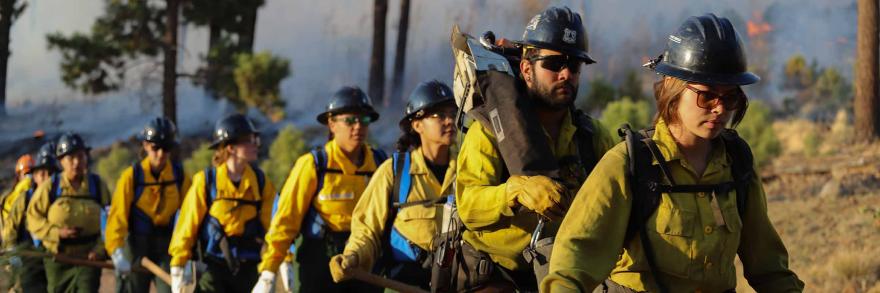
#Corn percent good to excellent as of June 18, 2023 — @DroughtDenise

#Denver Adds 137 Miles of New Bikeways Since 2018 — Denver North Star

Click the link to read the article on the Denver North Star website (Allen Cowgill):

At a recent small ceremony on the side of West 46th Avenue next to Rocky Mountain Lake Park, Mayor Michael Hancock unveiled a sign marking 125 new miles of bikeways for the Denver bike network.

The sign marks a major milestone for the Denver Department of Transportation and Infrastructure (DOTI), with an aggressive buildout of bikeways throughout Denver, though some residents feel the new bikeways donโ€™t go far enough for comfort and safety.

The goal of 125 new miles of bike lanes was set in 2018 by the mayor with the goal of bringing high-comfort bike facilities within a quarter mile of where more Denverites live โ€œto connect riders of all abilities to the places they want to go.โ€

At the event, Hancock said that โ€œthis is not a victory lap, we are proud of the milestone we have reached, but weโ€™ve got to keep going.โ€

When asked about Denver being a growing city and the importance of providing numerous options for people traveling, the mayor said, โ€œItโ€™s the only option. The old single-mode transportation system in Denver no longer applies. We have grown exponentially over the last decade.โ€

โ€œWe have to be a more multimodal city, and we have to have the infrastructure that supports it,โ€ Hancock continued. โ€œThe various types of bike lanes we have โ€ฆ are extremely important for folks to feel safe in riding bikes and using different modes around the city whether they are on scooters (or bikes), we have to continue to invest in transit. We donโ€™t have any other option.โ€

DOTI actually exceeded the mayorโ€™s goal, building out 137 miles of bikeways since 2018. Though technically the original goal was for bike lanes, it has since been expanded to include neighborhood bikeways, or bike facilities that are not actual bike lanes, but routes that share the road with drivers on low-volume streets.

Levi Wall bikes home to Lakewood up the West 23rd Avenue protected bike lane, part of the 137 new miles of bikeways since 2018. Photo by Allen Cowgill via Denver North Star

They use sharrows, traffic circles, diverters, and paint and post bulb-outs to calm traffic for people who bike, and have been a popular option for planners in north Denver. Of those new bikeway miles, 24 miles were painted bike lanes, 45 miles were buffered bike lanes (bike lanes with a painted space between the bike lane and vehicle travel lane), 23 miles were protected bike lanes, 34 miles were neighborhood bike lanes, and 11 miles were shared-use paths and trails.

โ€œAs we continue to build out our bike and multimodal network, we are creating a more sustainable alternative to driving thatโ€™s safer, enjoyable and better for our health and our environment,โ€ DOTI Executive Director Adam Phipps said.

Layton Hill, a resident of the Highland neighborhood in North Denver, has lived in Denver for 10 years and has noticed a change in the types of people riding bikes in Denver.

โ€œI used to see a lot more people out primarily for fitness, and now my most common bike trip is to daycare, and Iโ€™m seeing lots and lots of other families with children on their bicycles going about their day,โ€ Hill said.

Hill said the new bike lanes arenโ€™t perfect, but they do make it easier for him to get around. Most of the time, the streets are comfortable for him, but 10% of the time, there will be a driver that will get too close to him while he has his daughter on the back of his bike.

โ€œThey have made it better to get around,โ€ Hill said. โ€œI would like to see more truly prioritized lanes for people not in cars. I think having more diverters in place on just the few streets that are designated as bike lanes would be good. It would still allow neighbors to access their houses of course, and small businesses to receive deliveries. Everyone retains access to their curb, but it would just make those streets just a little bit less highly trafficked, and make them a little more comfortable for people not in cars.โ€

The diverters that Hill referenced are modal filters that allow bikes and pedestrians to go through an intersection, but force drivers of cars to turn, limiting the amount of vehicle traffic on the street.

Currently in North Denver there are only two diverters: West 35th Avenue and Irving Street, and West 41st Avenue and Pecos Street. The protected bike lanes that have been installed in places like West 23rd Avenue and West 17th Avenue have been impactful in generating increased bike and scooter traffic. Recent research from Ride Report, an organization that has been working with the city to collect data, shows that the West 17th Avenue protected bike lane had a nearly eightfold increase in shared bike and scooter ridership between 2019 and 2023 after the protected bike lanes and new painted bike lanes were installed.

Over 57,000 trips using shared bikes and scooters have been taken on West 17th Avenue alone since the new bike lanes were completed.

Allen Cowgill is the City Council District 1 Appointee for the Denver DOTI Advisory Board.

Juneteenth 2023

Here’s the Wikipedia entry for Juneteenth:

Juneteenthย (officiallyย Juneteenth National Independence Day) is aย federal holiday in the United Statesย commemorating the emancipation ofย enslaved African Americans. Deriving its name fromย combining Juneย andย nineteenth, it is celebrated on the anniversary of theย orderย by Major Generalย Gordon Grangerย proclaiming freedom for enslaved people inย Texasย on June 19, 1865 (two and a half years after theย Emancipation Proclamationย was issued).[7]ย Originating inย Galveston, Juneteenth has since been observed annually in various parts of the United States, often broadly celebratingย African-American culture. The day was first recognized as a federal holiday in 2021, when Presidentย Joe Bidenย signed theย Juneteenth National Independence Day Actย into law.

U.S. Supreme Court Upholds Native American Adoption Law — Navajo Nation President Jonathan Nez

R.I.P. Tina Turner: “If you come down to the river I bet you gonna find some people who live”

Turner during her 50th Anniversary Tour in 2009. By Philip Spittle – IMG_1645, CC BY 2.0, https://commons.wikimedia.org/w/index.php?curid=52830315

Click the link to read the obit on The New York Times website (William Grimes). Here’s an excerpt:

Tina Turner, the earthshaking singer whose rasping vocals, sexual magnetism and explosive energy made her an unforgettable live performer and one of the most successful recording artists of all time, died on Wednesday at her home in Kรผsnacht, Switzerland, near Zurich. She was 83…Ms. Turner embarked on her half-century career in the late 1950s, while still attending high school, when she began singing with Ike Turner and his band, theย Kings of Rhythm. At first she was only an occasional performer, but she soon became the groupโ€™s star attraction โ€” and Mr. Turnerโ€™s wife. With her potent, bluesy voice and her frenetic dancing style, she made an instant impression. Their ensemble, soon renamedย the Ike and Tina Turner Revue, became one of the premier touring soul acts in Black venues on the so-called chitlinโ€™ circuit. After the Rolling Stones invited the groupย to open for them, first on a British tour in 1966 and then on an American tour in 1969, white listeners in both countries began paying attention…Ms. Turner, who insisted on adding rock songs by the Beatles and the Stones to her repertoire, reached an enormous new audience, giving the Ike and Tina Turner Revue its first Top 10 hit with her version of the Creedence Clearwater Revival songย โ€œProud Maryโ€ย in 1971 and a Grammy Award for best R&B vocal performance by a group…
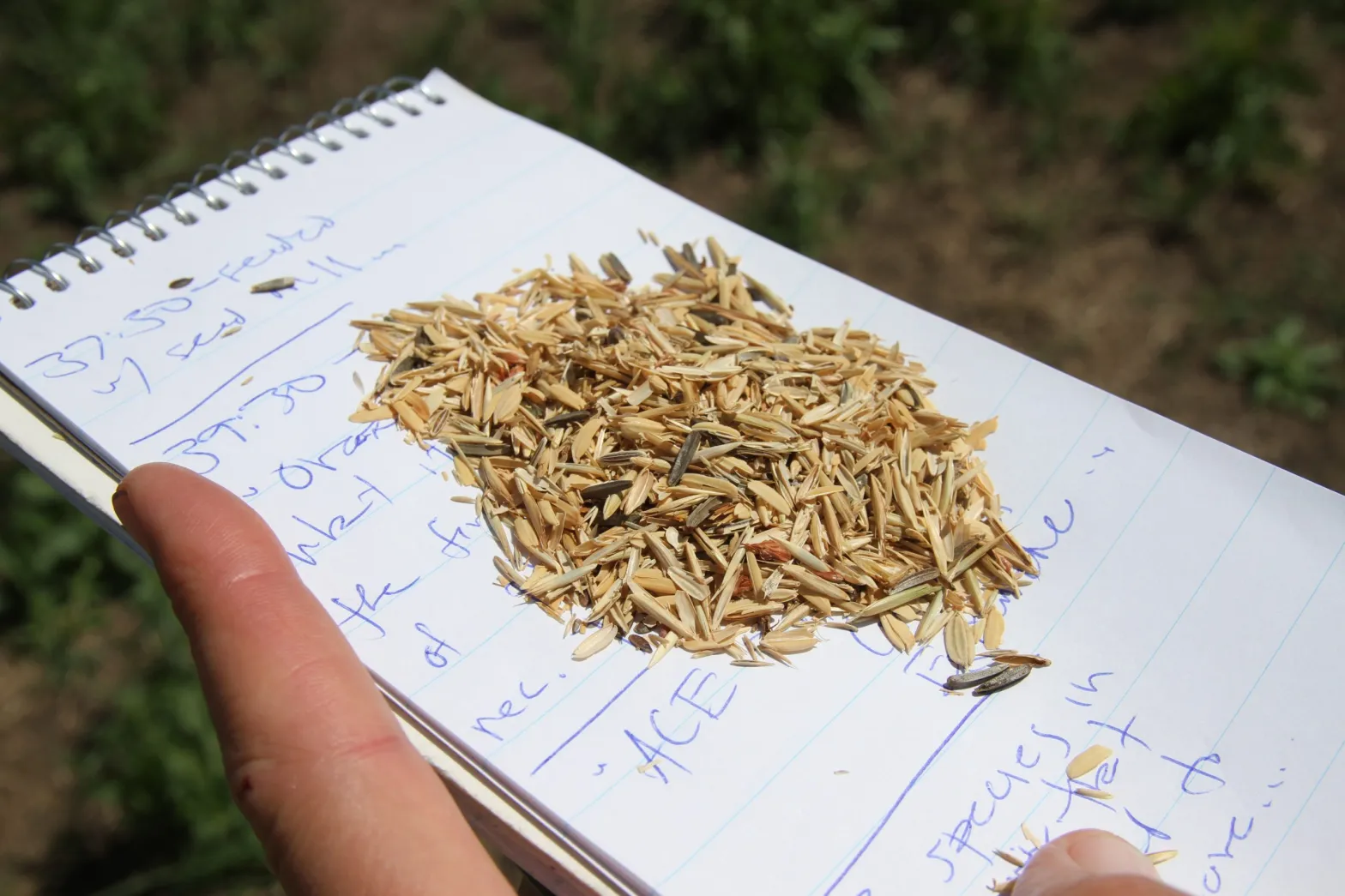
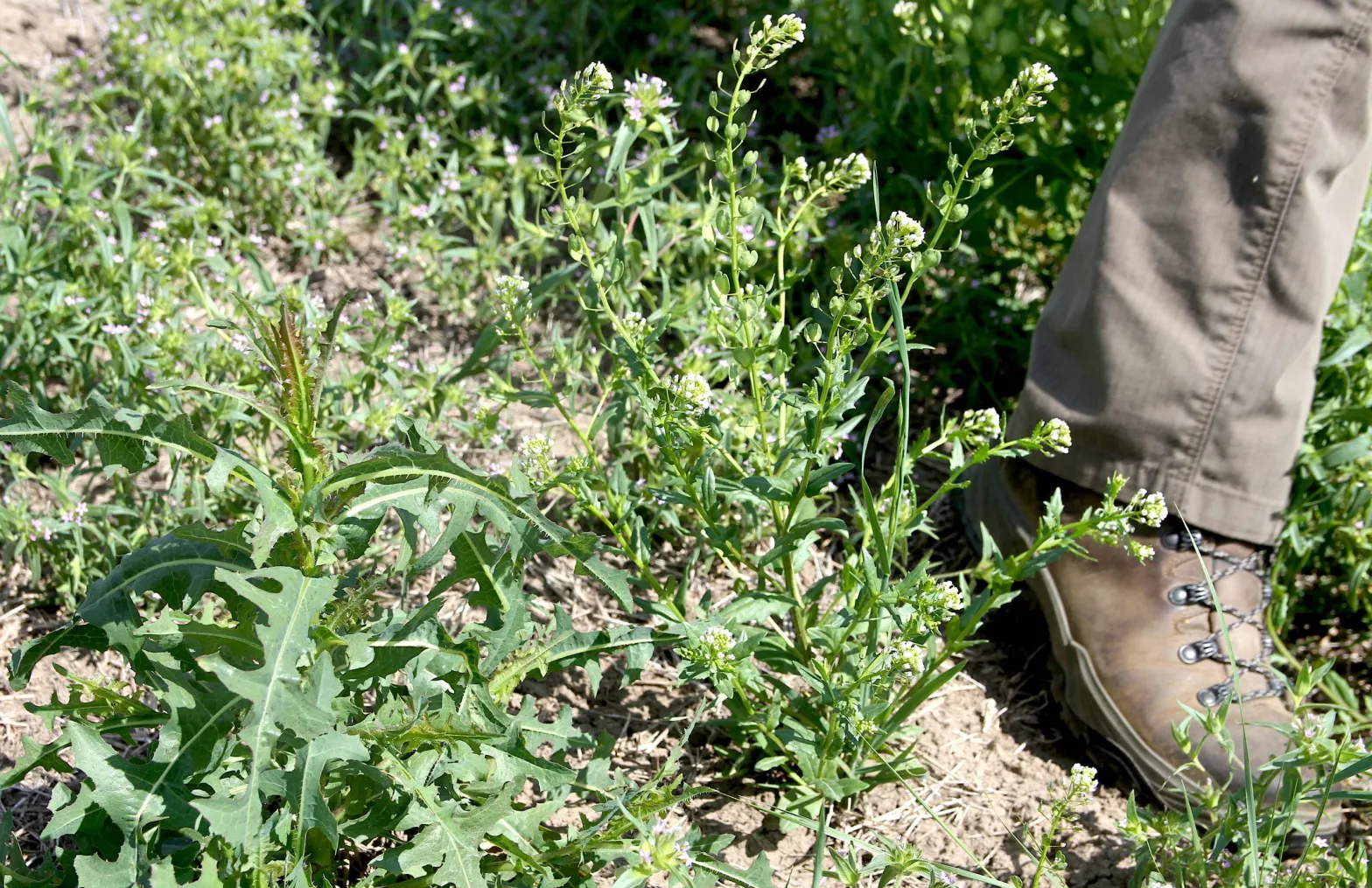
But her solo album โ€œPrivate Dancer,โ€ released in 1984, returned her to the spotlight โ€” and lifted her into the pop stratosphere. Working with younger songwriters, and backed by a smooth, synthesized sound that provided a lustrous wrapping for her raw, urgent vocals, she delivered three mammoth hits:ย the title song, written by Mark Knopfler of Dire Straits;ย โ€œBetter Be Good to Meโ€; andย โ€œWhatโ€™s Love Got to Do With It.โ€ Referring to its โ€œinnovative fusion of old-fashioned soul singing and new wave synth-pop,โ€ Stephen Holden,ย in a reviewย for The New York Times, called the album โ€œa landmark not only in the career of the 45-year-old singer, who has been recording since the late 1950s, but in the evolution of pop-soul music itself.โ€

[…]

The album went on to sell five million copies and ignite a touring career that established Ms. Turner as a worldwide phenomenon. In 1988 she appeared before about 180,000 people at the Maracanรฃ Stadium in Rio de Janeiro, breaking a record for the largest paying audience for a solo artist. After her โ€œTwenty Four Sevenโ€ tour in 2000 sold more than $100 million in tickets, Guinness World Records announced that she had sold more concert tickets than any other solo performer in history.

Coyote Gulchโ€™s excellent EV adventure โ€” #ColoradoRiver Day 6

Coyote Gulch’s Leaf charging at the City of Vail Lionshead parking structure May 24, 2023.

Day 6 was a drive back to Denver from Glenwood Springs to return to work and the urban landscape that has run amok with all the beautiful precipitation. We followed US-6 as much as we could to save charge, see more of the countryside and the Eagle River.

Charging was in Vail (CHAdeMO) where the Leaf reported 56% charge and 118 miles of range. We stopped for lunch in Frisco and charged at the Town of Frisco facility (J1772) and then keeping with the US-6 strategy we climbed up to Loveland Pass. It is pretty much downhill from Loveland Pass to our home in Denver and the Leaf reported 56% charge and 191 miles of range when we got home. You have to love regenerative charging.

Coyote Gulchโ€™s excellent EV adventure โ€” #ColoradoRiver Day 5

Coyote Gulch’s Leaf charging at Red Rock Hyundai in Grand Junction May 23, 2023.

Day 5 was a short drive day from Grand Junction to Glenwood Springs.

Colorado River at Los Colonias Park in Grand Junction May 23, 2023

Before leaving Grand Junction we drove to Los Colonias Park to see what the city was up to. The water level was high in the small craft zone and no one was braving it.

Colorado River from CR-311(?).

I like to get off the Interstate when possible, it takes less charge and you leave the tension and traffic behind. I stumbled upon CR-311(?). It dead-ended and I had to backtrack a ways to get back to I-70 but snagged a short video.

Glenwood wave May 23, 2023.

The Glenwood wave is a favorite for many in Glenwood Springs. I asked a guy who was preparing to engage the wave what the velocity was, he answered with a broad smile, “12,000 cfs.”

Charging was in Grand Junction and then Rifle.

Coyote Gulchโ€™s excellent EV adventure โ€” #ColoradoRiver Day 4

Convective storm obscuring the La Sal mountains along Utah-128 near Castle Valley May 22, 2023, Colorado River mainstem in the foreground.

Day 4 was the longest day so far. We travelled from Grand Junction to Moab along I-70 at first and then along Utah-128. The rainy weather joined us along the way. This route into Moab is one of my favorites as the road winds along the canyon walls near the river. We spotted a few folks testing the high flows in rafts nearer to Moab and a pair of enthusiasts in an inflatable kayak and on a standup paddle board.

The Colorado River near Dewey Bridge May 22, 2023.

The river was all the more impressive along this route, bankfull and moving along at a pace where you could experience the power.

Superbloom along Utah-128 May 22, 2023. A species of Globemallow (I think) in the foreground.

A real treat this wet water year was the super bloom along Utah-128 near Cisco. The desert was so green compared to other years and the wildflowers put on a great show.

Green River at Green River, Utah May 22, 2023.

We left Moab driving by Arches and up to Green River to get a look at the river there. The Green River was also bankfull. There is a restaurant along the river where I’ve seen the tire tracks of off-roaders in the river bed — not this year.

Charging was in Grand Junction at the Phillips 66 on Horizon Drive (CHAdeMO), Moab at Rocky Mountain Power (J1772), and Green River at Green River Coffee (CHAdeMO).

Coyote Gulchโ€™s excellent EV adventure โ€” #ColoradoRiver Day 3

Coyote Gulch’s Leaf in the hotel parking lot upon arriving in Grand Junction May 21, 2023.

Day 3 was a short jaunt from Glenwood Springs to Grand Junction. We stayed on US-6 as much as possible to get closer to the Colorado River along with the hay fields and small towns between the two cities. Spring has sprung in the area and the Colorado River was bankfull all the way.

Charging was in Rifle at the Kum & Go. I charge here whenever I’m in the vicinity becasus they have several ChargePoint (CHAdeMO) chargers, and it is a short walk to restaurants.

Coyote Gulchโ€™s excellent EV adventure โ€” #ColoradoRiver Day 2

We headed over to Glenwood Springs from Kremmling on Day 2 going over Gore Pass to Toponas and Yampa then along CO-131 S. to the Colorado River Road where we joined the Colorado River. The route winds along the river to Dotsero where we picked up I-70 to Glenwood Springs through Glenwood Canyon. The river was runinng bank to bank. We were treated to beautiful cool and wet weather for most of the drive.

Colorado River along the Colorado River Road from CO-131 to Dotsero.

Charging was near Penny’s Diner in Yampa — a ChargePoint fast charger (CHAdeMO connector) installed by the Yampa Valley Electric Association.

Coyote Gulchโ€™s excellent EV adventure โ€” #ColoradoRiver Day 1

Colorado River Kawuneeche Valley May 19, 2023.

We headed up to the west entrance to Rocky Mountain National Park over Berthoud Pass on Day 1 and drove into the park up the Kawuneeche Valley as far as we could for the official start to our jaunt along the Colorado River. It was cloudy (and smoky?) and rained off an on. Cold and wet is pretty much my favorite weather so things were near perfect.

It was great to see the river bank to bank on the way to Kremmling. It was roiling in Byers Canyon and there is a lot of the snowpack left at higher elevations to feed the runoff in the weeks ahead.

First road charge for Coyote Gulch’s Leaf in Kremmling May 19, 2023. Note the Colorado Energy Office’s logo below the connectors on the unused charger.

After driving my 2017 Leaf for six years the range of the new Leaf, greater than 200 miles, helps immensely with range anxiety. The first road charge for the new Leaf was in Granby on the way to Rocky Mountain National Park although we could have easily waited until after the excursion in the park. I always charged the old Leaf in Granby on the way to Steamboat Springs and old habits die hard. Also, the chargers at the Kum & Go have CHAdeMO connectors which the Leaf requires for fast charging. All of the ChargePoint chargers I’ve used in western Colorado have those connectors. The free chargers provided by the Town of Kremmling were working when I tested them.
The charging infrastructure along US 40 has improved greatly since my first EV adventure to Steamboat Springs in 2017 so you can concentrate on the scenery. Much of this is due to the Colorado Energy Office’s efforts.

Moose heading down to the wetlands and the Colorado River in Rocky Mountain National Park May 19, 2023.

Coyote Gulch’s excellent EV adventure — #ColoradoRiver

Coyote Gulch’s shiny new Leaf May 13, 2023

I’m heading up to the Colorado River headwaters with Mrs. Gulch this morning for the start of a few days of touring next to the river. Posting may be intermittent if I’m too awestruck to doomscroll on the Web. There’s also a chance we may find ourselves driving some of the tribs.

Map of the Colorado River drainage basin, created using USGS data. By Shannon1 Creative Commons Attribution-Share Alike 4.0

In case you were looking for a sign to lock your car doors – this is it — #Colorado Parks & Wildlife