Pueblo Board of Water Works 2010 water deliveries

A picture named waterfromtap.jpg

From The Pueblo Chieftain (Chris Woodka):

“We aren’t getting a huge increase in customers, but there has been an increase. The total water use has remained flat since the drought in 2002,” said Terry Book, deputy executive director of the Pueblo Board of Water Works.

The water board pumped 9.03 billion gallons of water in 2010, nearly matching the 9.02 billion gallons used in 1980. Rainfall for Pueblo totaled 11.6 inches in 2010, compared with 11.59 inches in 1980. There were 39,470 customers at the end of 2010, compared with 33,182 in 1980. Besides the increase in numbers of customers — and the homes and lawns that come with them — there is a marked difference in the peak days. The highest daily use 30 years ago was 56.8 million gallons on July 8, 1980, while it was 52.3 million gallons on July 2, 2010. “Without the drought, we were headed for higher and higher peak days,” Book said. “We could see the trend in water use creeping up, so we needed more capacity.”[…]

Last summer, there were fewer 50 million-gallon days than in the past, and in three years out of the eight since 2002, there were no 50 million-gallon days at all. The information jibes with a study updated last year that shows Pueblo customers have voluntarily reduced use by 17 percent since the historic drought of 2002, when Pueblo received 3.94 inches of rainfall.

More Pueblo Board of Water Works coverage here.

San Luis Valley closed-basin salvage project update

A picture named slvdischargerecharge.jpg

Update: More coverage from Matt Hildner writing for The Pueblo Chieftain. From the article:

Some farmers and ranchers near Moffat argue the project has lowered the unconfined aquifer — the shallower of the valley’s two underground water formations and one upon which a number of them depend…

Ken Beck, who manages the project for the U.S. Bureau of Reclamation, doesn’t deny the project may be affecting its neighbors. But there are 132 monitoring wells on the project’s boundaries that are designed to show when the project is causing harm. He brought data that showed no change to many of the wells in the Moffat area and said other project wells that did have a negative effect had been shut off. Beck also said the development of roughly 4,000 acres of groundwater-irrigated private land north of the project since it was authorized also may be affecting the area.

While the north end of the valley got to vent its frustrations at the meeting, the project also has been a disappointment in other parts of the valley because of its low production. Beck said the project has never lived up to initial projections that envisioned pumping as much as 117,000 acre-feet in some years. Currently, it produces between 8 percent and 12 percent of that amount…

After the project’s authorization by Congress, five water user groups in the valley signed an agreement concerning how the project’s water would be used. The 1985 pact, known as the “60/40 Agreement,” called for using project water to lessen the burden on surface water users whose rights often were curtailed to meet the demands of the Rio Grande Compact. Under the agreement, roughly 60 percent of the project’s water would be credited to the Rio Grande’s contribution to the compact and 40 percent would be credited to the Conejos.

From the Valley Courier (Ruth Heide):

The project was designed to capture — through a system of 170 salvage wells, 115 miles of pipeline laterals and a 42-mile long PVC-lined canal — water otherwise going to waste through evapotranspiration. The water would then be used to help the state meet its Rio Grande Compact obligations, water delivery obligations to Mexico and other purposes. Bureau of Reclamation Alamosa Field Division Manager Ken Beck made a presentation about the Closed Basin Project to the Northern San Luis Valley Conservation Roundtable group on Thursday. He discussed the history, purpose and efficiency of the project, which is under the bureau’s jurisdiction…

Beck said he understood the Closed Basin Project was controversial, and he was not there to debate its merits but to explain how it came to be, how it has changed over time and how it is operated now. He told the group of about 50 people that if they were interested in decommissioning the project, they would have to talk with those who have the authority to do that, namely legislators, because it took an act of Congress to construct it, and it would take something of that nature to take it out of commission.

He said the project, which sits on about 125,000 acres, was originally designed to yield 117,000 acre feet of water a year through the pumping of 170 salvage wells, each drilled to between 59 and 123 feet deep. The project has never reached that yield capacity, and the closest it has gotten to it was 43,520 acre feet in 1997. The project yields 15,000-20,000 acre feet of water a year, Beck said. That is with pumping going on 24/7. He said the project is permitted to pump as much as 80,000 acres a year. He said one reason the original yield was off was because the initial estimate for snowpack runoff from the Sangre de Cristo Mountain range was 8,000 acre feet a year…

The number of salvage wells being pumped does not total 170, Beck said. The number of wells pumping at any given time is generally around 90, he said. Beck explained that some of the wells are not being used because of problems with water quality. The water coming out of the wells must meet standards for total dissolved solids that are higher than drinking water standards, Beck said…

In 2001, the bureau began re-drilling wells that were not functioning properly, and this time the wells were constructed more appropriately and more efficiently, Beck said. For example, the original wells were powered by 40 horsepower pumps, which are now being replaced by pumps with .5-7.5 horsepower motors. The project is now realizing nearly half-a-million dollars a year in energy savings, Beck said. When asked where that saved money was now going, Beck said other costs have gone up, so it has been absorbed in other areas.

More Rio Grande River basin coverage here.

RIP Dick MacRavey

A picture named elkriver.jpg

From email from the Colorado Water Congress (Doug Kemper):

Richard MacRavey Tribute/Memorial

Two services have been set for the celebration of Dick’s life. The first one will be at the Colorado State Capitol. The second at Christ’s Episcopal Church.

Celebration of the Life of Richard MacRavey
Friday, March 25 from 12:30 to 2:00 pm

Colorado State Capitol
1st Floor, South Side of the Rotunda

Memorial Service for Richard MacRavey
Saturday, March 26 at 2:00 pm

Christ’s Episcopal Church
615 4th Street
Castle Rock, CO 80104
phone: (303) 688-5185

Here’s an obituary from The Denver Post (Virginia Culver).

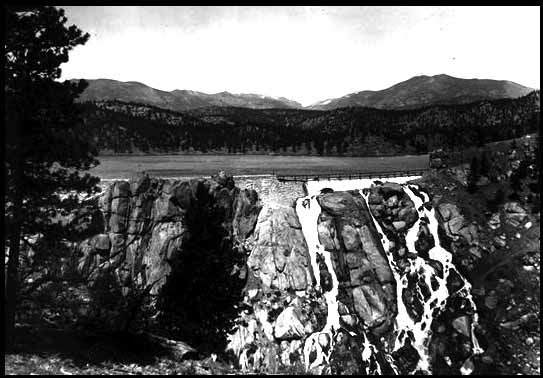
Cheesman Dam maintenance and repair update

A picture named firstwaterovercheesman.jpg

Here’s the release from Denver Water (Lori Peck):

Cheesman Reservoir will be closed to visitors this year, as Denver Water completes essential upgrades to the dam, which was built in 1905. Upper and lower Gill Trail will remain open to hikers who want to access Cheesman Canyon throughout the closure period.

The reservoir has been closed to visitors since Jan. 1, 2010, during the first phase of the project, in which crews completed upgrades to valves inside the dam. Though the utility had planned to open the reservoir this spring, the amount of heavy equipment, site logistics and security needs for the second phase of valve upgrades necessitated a prolonged closure. Cheesman will reopen to visitors May 1, 2012.

“Completing this project is vital to maintaining dam safety, providing a viable water supply and ensuring smooth operations,” said Tom Roode, assistant chief of engineering. “Cheesman is more than 100 years old, and the underwater valves we are replacing were installed in 1905 and the late 1920s. We look forward to opening the reservoir to recreationists next year.”

More Denver Water coverage here.

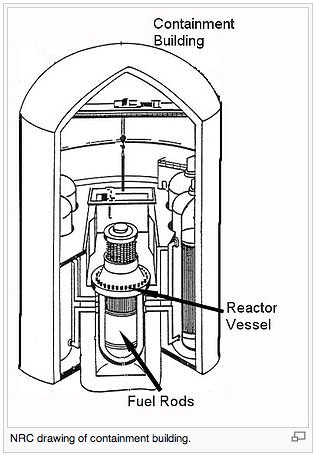
Energy policy — nuclear: Will Japan’s reactor problems put a damper on the new plant planned for Pueblo County?

A picture named nuclearreactorcontainmentbuildingwikipedia.jpg

From the Colorado Indpendent (David O. Williams):

The Pueblo County Commissioners Tuesday and Wednesday will hold hearings on a proposed clean energy park southeast of the city that a local attorney wants to see contain a 3,000-megawatt nuclear power plant. That proposal, first floated in July, was sure to draw big crowds and heated debate both evenings beginning at 5 p.m. in the Jackson Ballroom of the Sangre de Cristo Arts & Conference Center, but in the wake of partial meltdowns at two Japanese nuclear reactors and problems at two other facilities in the wake of Friday’s devastating earthquake, the proposal will likely bring even closer scrutiny. The Japan disaster has sent shockwaves through the world’s resurgent nuclear industry that could impact Colorado’s uranium-mining revival.

Meanwhile, from 9News.com:

Water levels dropped precipitously Monday inside a stricken Japanese nuclear reactor, twice leaving the uranium fuel rods completely exposed and raising the threat of a meltdown, hours after a hydrogen explosion tore through the building housing a different reactor…Water levels were restored after the first decrease but the rods remained exposed late Monday night after the second episode, increasing the risk of the spread of radiation and the potential for an eventual meltdown.

More nuclear coverage here and here.

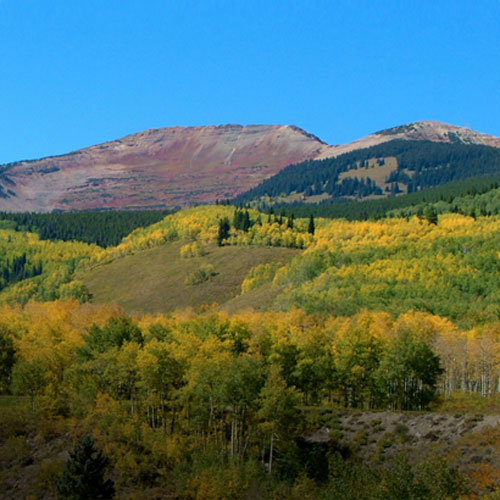
The High Country Citizens’ Alliance and the Western Mining Action Project file lawsuit over prospecting activities at the Mt. Emmons mine

A picture named mountemmons.jpg

From The Crested Butte News (Mark Reaman):

HCCA, along with the Western Mining Action Project, filed the suit in Denver District Court on Wednesday, March 2. “We firmly believe the mining company needs to put up a bond that should address water treatment issues,” explained HCCA executive director Dan Morse.

The Colorado Mined Land Reclamation Board, which oversees all mining decisions in the state, granted final approval for the proposal in January 2011, but failed to require any bonding amount for the treatment of polluted water from the Project.

According to a HCCA press release, “The approved activities include the construction of a mining drift that would be 8 feet wide by 10 feet high generating as much as 15,000 cubic yards of waste material, which is described as having the potential to generate acid mine discharge. This mining drift would be used to conduct a program of delineation drilling of the ore body. Many of the residents of the Town of Crested Butte are concerned about the project’s impacts because the activities would take place within the town’s municipal drinking watershed.”

More Gunnison River basin coverage here.

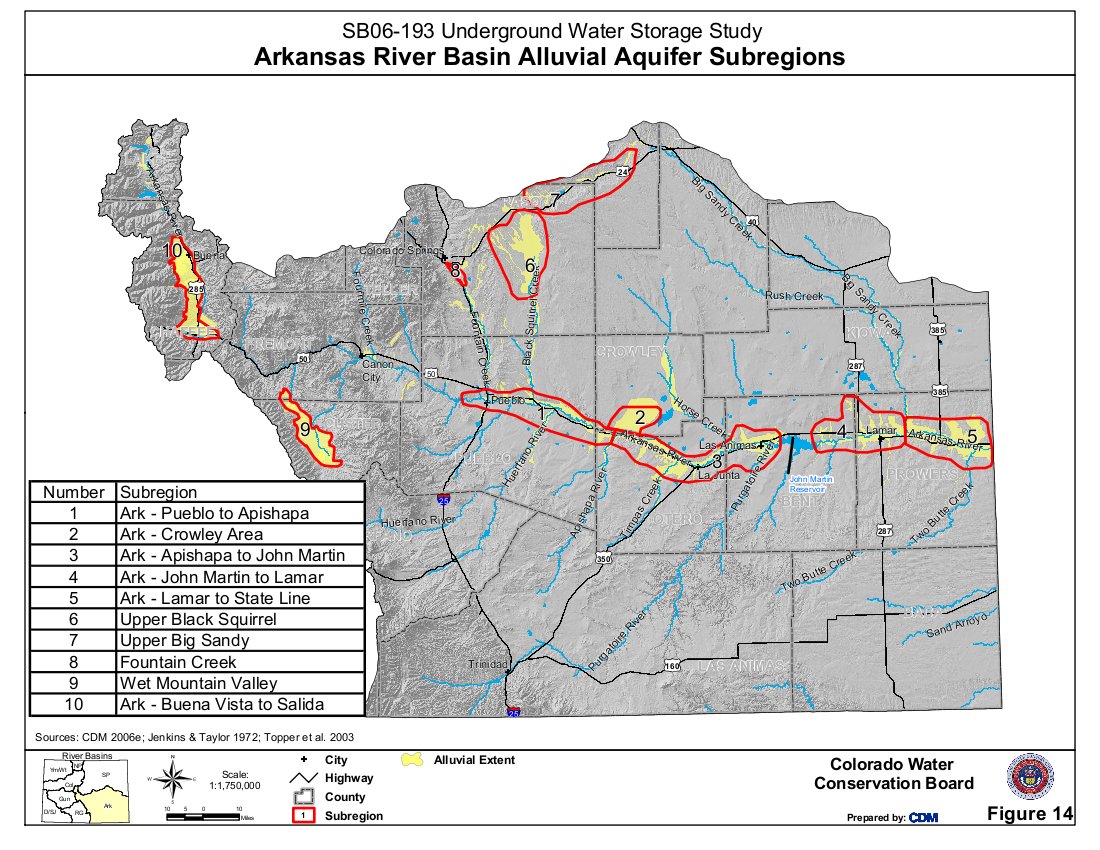
Arkansas River basin dam report

A picture named arkansasbasinalluvialaquifersubregions.jpg

Repairing dams that have been restricted by the State Engineer’s office and/or dredging silted in reservoirs could provide storage for Colorado at a low cost. Here’s a report from Chris Woodka writing for The Pueblo Chieftain. From the article:

As state engineer, [Jeris] Danielson battled with lawmakers over funding for inspectors. The catastrophic failure of the Teton Dam in 1976 renewed interest in the safety of dams program, which has been a responsibility of the state engineer for more than a century. Now, some of the dams that have been restricted over the years might be brought back to life. In fact, there are efforts to revive the two largest restricted reservoirs in the Arkansas River basin.

The Two Rivers Water Co. — Barber is president of the company — is trying to bring back Cucharas Reservoir in Huerfano County by building a new dam downstream of a dam that breached in 1987. The dam, on the Cucharas River in Huerfano County, has a capacity of more than 40,000 acre-feet, more water than Pueblo water customers use in a year. But filling it is problematic because there is rarely enough water in the river at the right time of year. Constructed in the early 1900s, the reservoir was used to irrigate Pueblo County farmland. Two Rivers’ stated goal is to bring at least some of that land back into production. The original dam is restricted to about 7,500 acre-feet of storage because of poor overall construction and movement along the embankment. The new owners intend to construct a new dam downstream to overcome the problem. The cost could reach $30 million — about $1,000 an acre-foot for recovered storage.

The Two Buttes Reservoir straddles the Prowers-Baca county line on Two Buttes Creek, and once had a capacity of 41,000 acre-feet. It is restricted to less than 10,000 acre-feet by dam safety issues, and like Cucharas rarely has water available to fill it. The Division of Wildlife, which has a wildlife area at the Two Buttes site, has been working to remove restrictions on the dam. Plans are not far enough along to estimate costs.

Those two sites, with restrictions totalling more than 64,000 acre-feet, make up 83 percent of the storage lost to restrictions in the Arkansas River basin, said Mark Perry, dam safety engineer for the Division of Water Resources. Overall, there are 44 reservoirs, out of 310 in the Arkansas River basin, that have restrictions. Most amount to a few hundred acre-feet of lost storage each. In total, about 77,500 acre-feet have been lost to restrictions…

Far more common is the unavailability of water at the right time in the right place. In theory, there is massive storage available in the Great Plains Reservoirs, between Eads and Lamar. Fed by ditch canals, five reservoirs in the system could hold 265,000 acre-feet. But, as a presentation by CDM Engineering at last week’s roundtable meeting pointed out, the lakes have been dwindling for the past 10 years because the junior water rights they live on are not in priority…

Lake Henry and Lake Meredith in Crowley County are used by Colorado Springs, Aurora and ditch companies in the winter water program, so maintain higher levels. The cities use the storage to exchange water upstream. The Holbrook Canal stores water in its lakes, under contract, to allow cities to recover water that has been bypassed under a 2004 agreement to maintain flows through Pueblo.

Reservoirs also fill quickly with sediment downstream from Pueblo. Blue Lake, a Fort Lyon Canal reservoir north of Las Animas on Adobe Creek, once was 30 feet deep in places, but now is just 12 feet deep. Crews were able to dig out about 4 feet of sediment before it began to refill again in 2005 after four years of drought. In 2008-09, the Army Corps of Engineers hydraulically dredged John Martin Reservoir to break through 50 years of accumulated sediment — roughly 90,000 cubic yards. In some places, the sediment was 20 to 25 feet deep.

More Arkansas River basin coverage here.

Energy policy — oil and gas: The Niobrara shale play in northern Colorado may get a close look by the Environmental Protection Agency

A picture named niobrarashale.jpg

From the Fort Collins Coloradoan (Bobby Magill):

Responding to public outcry about the risks to drinking water fracking might pose, Congress directed the EPA to conduct a study about how fracking affects drinking water. The EPA’s findings are expected to be made public by the end of 2012, with a more detailed report following in 2014. The EPA’s study plan includes an 11-page list of chemicals the agency has found in fracking fluid, including gelling agents, surfactants, biocides, corrosion inhibitors, lubricators, viscosifiers and the fracturing fluid trimethylbenzene, among others. The Niobrara oil play straddles the state line and stretches from northern Weld, Logan and Larimer counties in Colorado to as far north as Torrington, Wyo…

The EPA will look closely at the mechanics of Niobrara shale fracking in Laramie County, Wyo., which borders Weld County, and study water quality changes with time. The agency also will look at how fracking has impacted water quality in Western Colorado’s Piceance and San Juan basins.

More oil and gas coverage here and here.

Two Rivers hopes to eventually move water to growing cities

A picture named arkbasinditchsystem.jpg

Here’s a in-depth look at drying up agriculture to water suburbs, from Bruce Finley writing for The Denver Post. Click through and read the whole thing. Here’s an excerpt:

“You get kind of nervous when you have people who are on the New York Stock Exchange saying they’re going to put agriculture back into production,” said Jay Winner, manager of the Lower Arkansas Valley Water Conservancy District, devoted to retaining farming water rights across a five-county area. “I’m skeptical,” Winner said, “because from the amount of money they’re sticking into this project, it looks like it’s a big agriculture-municipal transfer.”

When pressed, Two Rivers’ [Gary] Barber acknowledged that the $27 million deal was indeed done with an eye toward eventually selling water to suburbs.

The stealthy and not-so-stealthy shifting of control over Colorado water has continued despite economic doldrums and may be gaining momentum. Farmers often are willing participants, cashing in as relative scarcity makes water more valuable.

Among recent deals:

• Pueblo bought the Bessemer agricultural canal.
• Aurora, Thornton, Brighton and Adams County invested in the Fulton Ditch northeast of Denver.
• Cherry Creek and Arapahoe County water authorities, though still facing court scrutiny, have staked claims to water once allocated for farming.

Also, in the Colorado Springs area, the Donala Water and Sanitation District, which bought a 711-acre ranch near Leadville for its water rights, now is pursuing a change-of-use ruling in state court so that farming water could be harnessed for Front Range housing and lawns.

Similarly, satellite cities Fountain and Widefield spent $3.5 million to acquire developer Mund Shaikly’s 480-acre H2O Ranch at the base of the Sangre de Cristo mountains. The plan is to sustain an anticipated military housing boom by using mountain creek water that once irrigated hayfields. Fountain will let the creek water flow into the Arkansas River, then trap it in Pueblo Reservoir, said Fountain water engineer Curtis Mitchell. “Certainly we’re not in the land business.”

North of Colorado Springs, Woodmoor’s new 1,900-foot-deep municipal wells appear uncertain enough that suburban leaders are mobilizing to buy water rights from farmers in the Arkansas River Valley and plan to construct a delivery pipeline.

Along the Arkansas River, state records indicate suburbs petitioned courts at least 116 times over the past decade to convert agricultural water for municipal use.

Here’s a report about Crowley County and the after effects of Aurora’s purchase of the Rocky Ford Ditch, from Mr. Finley and The Denver Post. From the article:

Concrete-lined irrigation ditches that once delivered water now are bone-dry. Draining water that once irrigated crops to supply suburban housing, lawns and golf courses makes it impossible for farms and the towns that depend on farming to survive. “Once you move water out, it ain’t coming back to the land,” the 74-year-old Valliant, now an irrigation specialist for Colorado State University’s Cooperative Extension station in nearby Rocky Ford, said recently as he rolled past the weeds and a slumping farmhouse surrounded by garbage.

Built in the 1890s, after the Missouri Pacific Railroad and the Colorado Canal were completed, Crowley and its neighbors prospered growing sugar beets, with canning plants, grain elevators, schools, newspapers and even an opera house. One company here broke wild horses and supplied the British army. Residents reveled in a pioneer spirit of transforming a harsh environment — average annual rainfall 12 inches — into a livable town. But farmer debts mounted after a sugar-beet plant closed in 1967. Some farmers eventually gave in as water brokers representing expanding cities approached them offering deals. Today, Crowley ranks among the poorest towns in the poorest county in Colorado. The town population is dwindling — to 162 today from 187 in 2000 — continuing a decline that began when Foxley and others in the 1980s sold off their water.

More Arkansas River basin coverage here.

Energy policy — nuclear: Nuclear power plant in Pueblo County?

A picture named nukeplantcattenomfrance.jpg

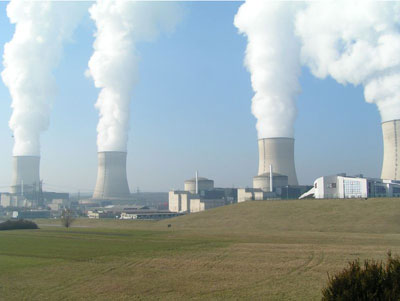
The promise of jobs, tax collections and economic activity is the lure of a plant. Water requirements and the potential for disaster are a couple of the deterrents. Here’s a report about the closest plant to Pueblo County, the Wolf Creek Generating Station Unit 1, northeast of Wichita, from Peter Strescino writing for The Pueblo Chieftain. Here’s an excerpt:

Residents around Wolf Creek were universally in favor of the reactor in telephone interviews. Only the state energy co-chairman of the Sierra Club had a negative reaction to the plant, and he said his doubts had little to do with potential environmental problems…

[Jon Hotaling, the county’s economic development director] said 900 people work at the plant, and average jobs pay about $65,000 a year. That works out to about $58 million in wages annually. Workers at the reactor live in a four-county area, he said, and at first fewer than half lived in Coffey County. “But we worked out the housing issues and now at least 60 percent live in the county.”

More nuclear coverage here and here.

Colorado-Big Thompson Project operations update

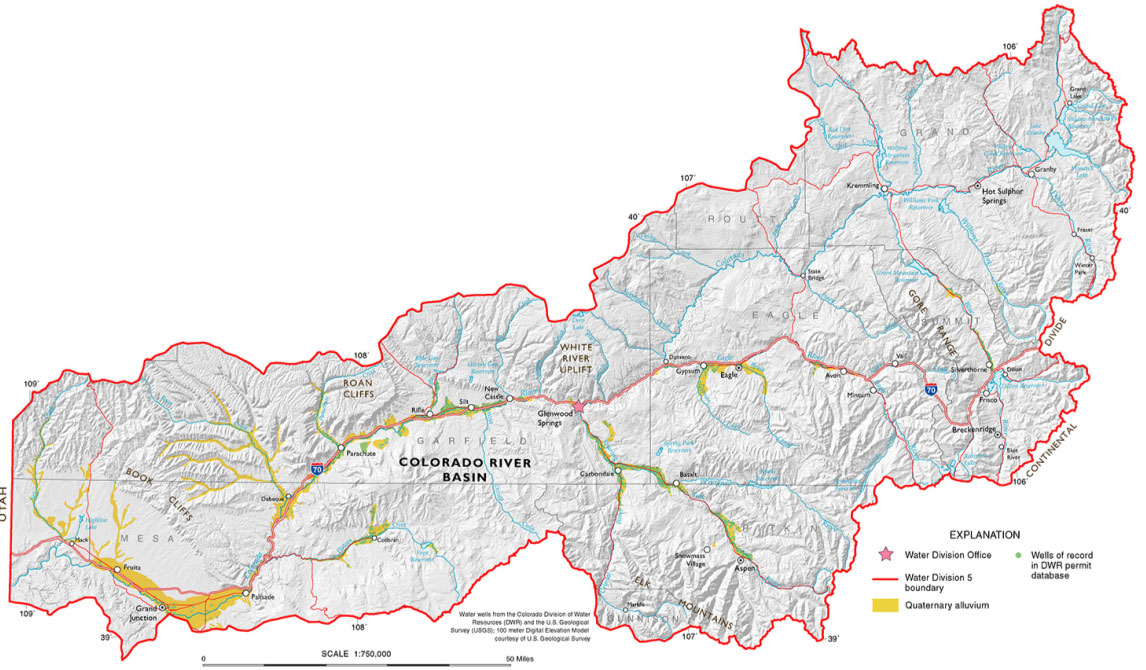
A picture named coloradoriverbasincgs.jpg

From the Sky-Hi Daily News (Tonya Bina):

“Right now, the Colorado Thompson Project, for this time of year, is fairly full, and we haven’t even hit runoff yet,” said Kara Lamb, spokesperson for the Bureau of Reclamation, the agency that owns the project.

The Colorado-Big Thompson Project as a whole is 71 percent of full, according to spokesperson Brian Werner of Northern Colorado Water, the agency that operates the project.

Average snow levels on the Upper Colorado are at about 140 percent of average, with 154 percent of normal snowpack in the Willow Creek basin, he said.

Willow Creek Reservoir is sitting just 2.5 feet from full. In preparation for runoff season, Northern plans to let water out of Willow Creek Reservoir into Willow Creek, which flows into the Colorado River near Windy Gap. “It’s to balance the water coming in with the storage space we have,” Lamb said.

More Colorado-Big Thompson Project coverage here.

Northern Colorado Water Conservancy District Colorado-Big Thompson Project water lease bids due March 18

A picture named coloradobigthompsonmap.jpg

From the Loveland Reporter-Herald:

Bids must be at least $9.32 per acre-foot, a price based on the 2011 agricultural assessments. The sealed bids will be opened at a public meeting, not yet scheduled, and leases will be awarded to the highest bidder. Sealed bids are due by 2 p.m. Friday, March 18, at Northern Water’s headquarters, 220 Water Ave., Berthoud, CO 80513.

More information is available online at www.northernwater.org. On that website, click the regional pool program button for details, bid forms and, later, general bid results.

More Colorado-Big Thompson coverage here.

Basin Roundtable Summit recap

A picture named jacksonlake.jpg

From The Crested Butte News (Alissa Johnson):

“There was good representation among the nine roundtables across the state, and the Gunnison Basin Roundtable in particular was well represented,” [Frank Kugel, Upper Gunnison River Water Conservancy District (UGRWD) board general manager] said. Ten Gunnison Basin Roundtable members attended the summit, just one indication of many that momentum is building around water issues—particularly since the Statewide Water Supply Initiative of 2010 suggested that every waterbasin in Colorado will face water shortages by 2050…

According to UGRWD board member Steve Glazer, discussion highlighted the complexity of the issues at hand.
“It was an interesting dynamic in that there were a lot of water professionals that are on the roundtables… and there were volunteers. There was a noticeable [difference in] knowledge as a result. It was educational, and it was affirmative and contradictory all at the same time,” Glazer said. “Some of the less informed people need a lot of education because they’re not as aware of the intricacies and details.”[…]

“In some circles, especially on the Front Range, people want to see new water projects built,” Kugel continued, “but there are many of us on the Western Slope who believe that we need to address other approaches before we go to new water supply projects.” Some studies, like a report released last week by Water Resource Advocates, suggest that conservation could fill much of the water supply gap. But as Steve Glazer points out, conservation is no easy topic either.

More IBCC — basin roundtables coverage here.

Snowpack/Lake Mead news

A picture named snowpackcolorado03112011

From the Las Vegas Sun (Dylan Scott):

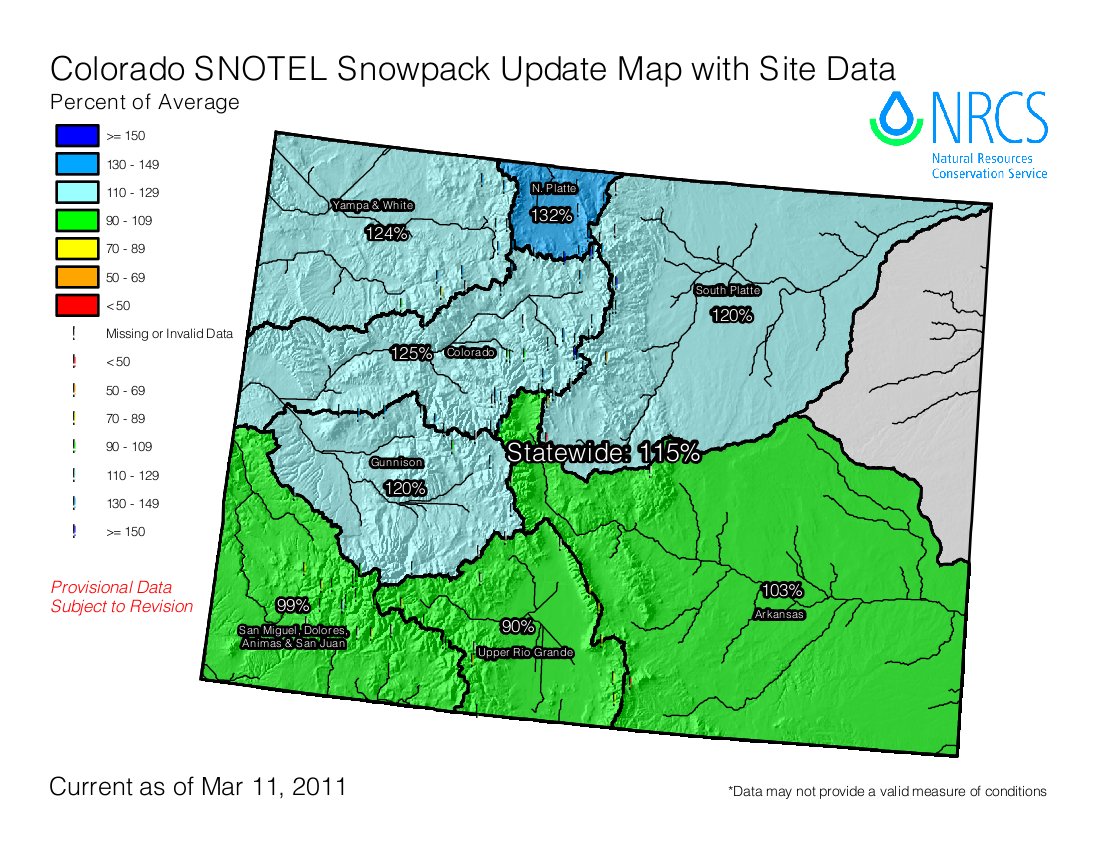
The [Bureau of Reclamation] reported in January that increased snowfall in the Rocky Mountains — more than 30 percent above historical levels — could lead to more water for the lake if Lake Powell’s water level rose to 3,643 feet by April 1. That would trigger the release of an extra 3.13 million acre-feet of water into Lake Mead, officials said, pushing the lake’s surface level up 20 feet or more. Earlier this week, the agency updated its projections and estimated there is a 97 percent chance that Lake Powell will reach the 3,643-foot threshold. In January, the bureau had projected a 76 percent chance. Only a historic plunge, 2.1 million acre-feet, in forecast water volumes for Lake Powell would prevent the extra water from flowing, officials said.

Energy policy — coalbed methane: Las Animas County producers implement substitute water supply plans for produced water

A picture named purgatoireriver.jpg

From The Trinidad Times (Randy Woock):

Las Animas County’s four largest gas companies — Pioneer Natural Resources, El Paso E&P Company, XTO Energy and Red River Ranch Holdings — have implemented SWSPs in order to continue gas production in the about 3,068 CBM wells operating within the central Raton Basin. Industry activities in the area discharge from CBM wells a combined total of about 10 million gallons of produced water per day. The SWSPs were approved by the State Engineer’s Office through March 31, 2011 and are nearing the end of their first approved year of implementation. The SWSPs call for replacement water to come from, “a lease with the City of Trinidad to supply up to 50 acre-feet of fully consumable water from the city’s storage account in Trinidad Reservoir.”[…]

A summer 2009 decision by the Colorado Supreme Court in the Vance v. Simpson case determined that the groundwater produced during CBM drilling production, previously considered a waste by-product, was of “beneficial use,” and thus had to undergo permitting and comply with Colorado groundwater laws. The state then passed an authorization for the State Engineer’s Office to approve alternates such as SWSPs in place of augmentation plans. That authorization for alternates extends from March 31, 2010 to Dec. 31, 2012 in order to provide energy companies in Colorado with extra time to integrate CBM wells that withdraw waters considered tributary and that impact “over-appropriated” streams into the state water court’s adjudication process.

Colorado Division of Water Resources Division 2 Engineer Steve Witte told The Times Independent that the Division had turned down initial requests by the companies to utilize the non-tributary water component of the CBM produced water as a replacement source. “The concern that we have is the native tributary water supply that water rights along the Purgatoire (River) depend upon are not diminished by the withdrawal of groundwater,” Witte said. “The initial proposal was that, of the water that they withdraw from the coal beds, they determined that a portion is tributary and a portion is non-tributary, and they thought that they would simply rely on the non-tributary water as a replacement for the stream depletions that were calculated.

More coalbed methane coverage here and here.

Energy policy — hydroelectric: New plant planned for Carter Lake

A picture named hydroelectricdam.jpg

From the Loveland Connection (Bobby Magill):

PVREA will receive up to 10 million kilowatt-hours of electricity from the Carter Lake hydropower station annually, enough to power about 1,000 homes. “We’re tapping onto an existing (water) outlet, so nothing changes at Carter Lake,” said Northern Water project manager Carl Brouwer. “We don’t change the operation. We don’t change the outflow from the reservoir.”

Today, water flowing from Carter Lake tumbles through a valve, and the energy is dissipated. “What we’re going to do is create electricity out of that instead,” Brouwer said.

The project will include two 1,200 kilowatt turbines, a 2,000 square foot powerhouse and connections to the existing Carter Lake Second Outlet and the St. Vrain Supply Canal.

From International Power & Dam Construction Magazine:

Northern Water’s Board of Directors recently approved a series of resolutions to move ahead with the project, which Northern Water will own, operate and maintain through its Hydro Water Activity Enterprise. It will include two 1300kW turbines supplied by Gilkes, a powerhouse and connections to the existing Carter Lake Second Outlet and the St. Vrain Supply Canal. The project will harness the pressure created by existing releases from the new outlet to make energy.

More hydroelectric coverage here and here.

Green Mountain Reservoir operations update

A picture named blueriver.jpg

From email from Reclamation (Kara Lamb):

Tomorrow morning at 8, Friday March 11, we will increase releases from Green Mountain Dam to the Lower Blue River by 25 cfs. By noon, the Lower Blue should be flowing at about 300 cfs. The reason for the change is Denver Water will be increasing their releases from Dillon Reservoir to the Blue River. Because releases from Dillon Dam flow straight to Green Mountain, we are accommodating the additional water by increasing our own release.

More Green Mountain Reservoir coverage here.

Conservation: Greeley ‘Fix a leak week’ March 14-20

A picture named leakingcopperpipe.jpg

From The Greeley Tribune:

The city of Greeley will mark Fix a Leak Week March 14-20 with two interactive workshops on March 15. Greeley Water Conservation will be at the Water and Sewer Department, 1100 10th St., Suite 300, for both half-hour sessions at 12:15 p.m. and 5:30 p.m. Sponsored by the Environmental Protection Agency, Fix a Leak Week is meant to encourage water conservation by repairing home pipe leaks.

More conservation coverage here.

Interbasin Compact Committee appointments

A picture named gunnisonblackcanyon.jpg

From the Purple Mountain Politics blog at The Durango Herald (Joe Hanel):

[Governor] Hickenlooper re-appointed all six people chosen by former Gov. Bill Ritter to serve on the Interbasin Compact Committee, which is supposed to hash out a first-ever statewide water strategy…

Monday’s (re)appointments include Eric Kuhn of Glenwood Springs, Taylor Hawes of Lafayette, Wayne Vanderschuere of Colorado Springs, Melinda Kassen of Boulder, T. Wright Dickinson of Maybell and Peter Nichols of Carbondale. Each of them has deep experience in water issues, and they have gotten to know each other the past six years as the IBCC has made a tour of what seems to be every budget hotel conference room in the state.

More IBCC — basin roundtables coverage here.

Energy policy — nuclear: Energy Fuels, Inc. scores their license for the proposed Piñon Ridge Mill

A picture named pinonridgesite.jpg

From the Associated Press via the Telluride Daily Planet (Matthew Beaudin):

The company hoping to build the hotly debated mill 60 miles west of Telluride leapt another major hurdle this week when state regulators issued a final radioactive materials license for a uranium mill that would be the country’s first in more than 25 years. The license allows the mill to process up to 700 short tons of uranium ore on a given day but only an annual average of 500 short tons per day. The health department has to approve engineering plans for the mill before construction begins.

From the Denver Business Journal:

The mill will process up to 500 tons of uranium ore a day. While the state permit was the final regulatory hurdle, the project still is being challenged in a lawsuit filed by the Telluride-based Sheep Mountain Alliance.

More Piñon Ridge Mill coverage here. More nuclear coverage here and here.

NIDIS Weekly Climate, Water and Drought Assessment Summary of the Upper Colorado River Basin

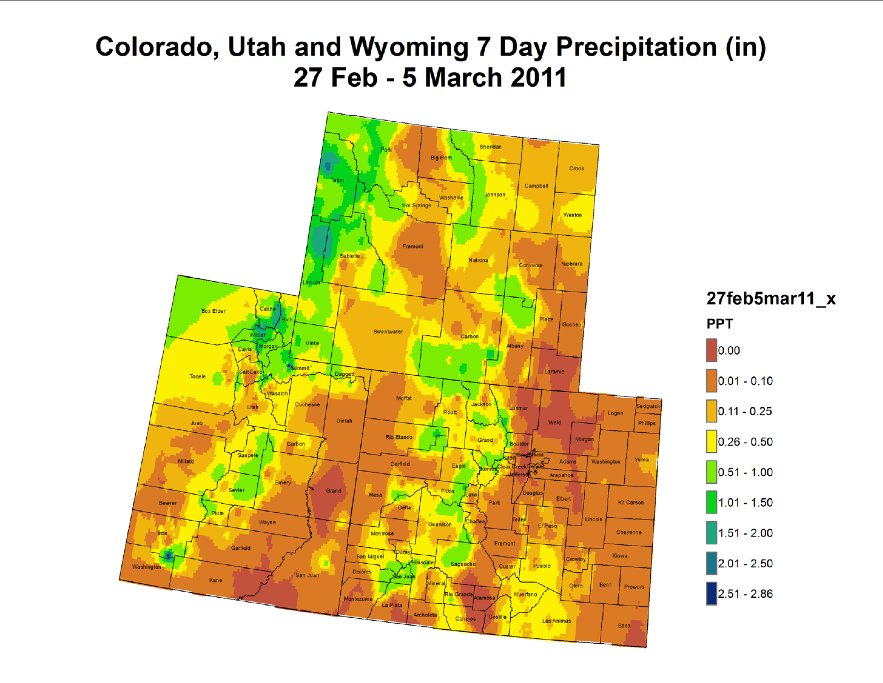
A picture named wycoutprecipfeb27tomarch52011coclimatecenter.jpg

Here are the notes from this week’s webinar.

Snowpack News/Rio Grande Roundtable meeting recap

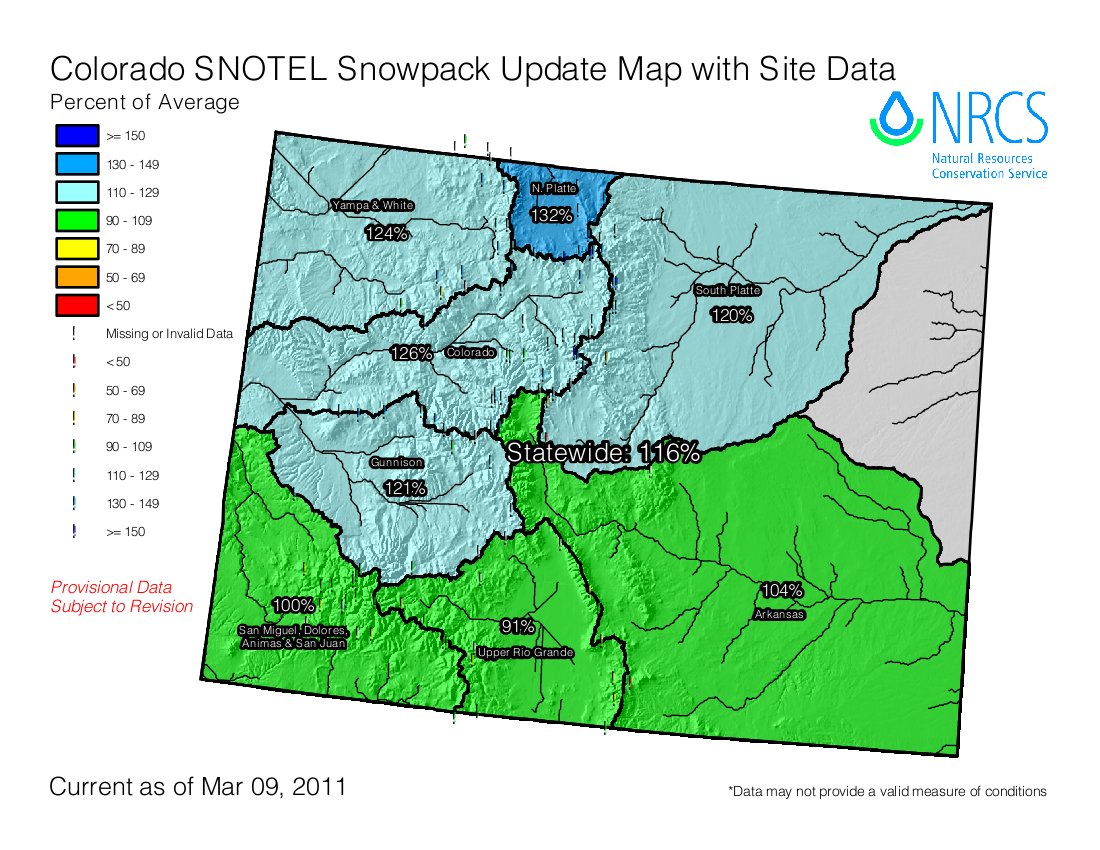
A picture named snowpackcolorado03092011

From the Valley Courier (Ruth Heide):

Matt Hardesty, assistant division engineer for Colorado Division of Water Resources Division 3, told attendees of the Rio Grande Roundtable meeting on Tuesday that the water office is receiving requests to start the irrigation season before April. Division 3 Division Engineer Craig Cotten is considering those requests right now and should make a decision before the end of the week, Hardesty added…

As of Tuesday, the Upper Rio Grande Basin on the west side of the Valley was sitting at 98 percent of average, based on the Natural Resources Conservation Service’s SNOTEL measurements. Wolf Creek Summit measured 105 percent of average, as did the Upper San Juan SNOTEL site, while Lily Pond and Upper Rio Grande SNOTEL sites were 71 percent and 88 percent of average, respectively. Hardesty pointed out that the Sangre de Cristo Mountain on the east side was not looking as healthy in its snowpack, with a total of 77 percent of average as of Tuesday. That percentage averaged in the high points at North Costilla and Whiskey Creek, both over 100 percent of average, with low points such as Apishapa and Wesner Springs, both around 50 percent of average. “Keep in mind these are based on high sites,” Hardesty said. “We still have concern about low and intermediate snowpack.”[…]

Based on a March 3 forecast, the Rio Grande could produce about 440,000 acre feet this year, with 137,200 acre feet obligated downstream. Given how much water has passed downstream already this year and what is expected for the rest of the year, irrigators could face a 12-percent curtailment right out of the starting gate this year to meet the compact, Hardesty explained…

On the Conejos River system, the initial forecast is 243,000 acre feet, of which 88,600 acre feet would be obligated downstream, resulting in a more than 21 percent curtailment “based on streamflow projections right now,” Hardesty said.

More IBCC – basin roundtables coverage here.

2011 Colorado legislation: HB 11-1083 (Hydroelectricity & Pumped Hydro) passes state Senate Agriculture, Natural Resources and Energy Committee

A picture named pumpedstoragehydroelectricschematic.jpg

From The Pueblo Chieftain (Patrick Malone):

Sens. Angela Giron, D-Pueblo, and Kevin Grantham, R-Canon City, presented HB1083 to the Senate Agriculture, Natural Resources and Energy Committee as a job-creating measure and a logical complement to Colorado’s existing renewable energy portfolio.

TransCanada Corp. is in the early stages of exploring the South Slope project, a possible $800 million hydroelectric station near Penrose that could create up to 300 temporary jobs during its construction and 30 permanent positions. “We’re excited about the opportunity to pursue this project.” Bart Jones from the power development division of TransCanada testified. “A company like us will only undergo a project like this if we have support.”[…]

Currently, the Public Utilities Commission is required to consider clean energy and energy-efficient technologies when reviewing applications for electricity acquisition. Solar, geothermal, biomass and methane are some of the modes of energy that fall under that umbrella. Under HB1083, hydroelectricity and pumped hydroelectricity would be added to the list. “This goes a long way toward getting the PUC to look at pump storage in a little different manner,” Jones said…

The bill is structured to protect senior water rights downstream from hydro stations. Engineer Jonah Levine testified that ongoing water consumption would not be a concern under a model like the proposed South Slope project. “A facility should be able to do a one-time fill,” Levine testified. He said evaporation and seepage would represent the only water losses.

Groups that tend to eye hydroelectric projects skeptically, like Trout Unlimited and the Audubon Society, support HB1083 because it would allow the PUC to consider the impact on aquatic life by proposed projects.

More HB 11-1083 coverage here. More 2011 Colorado legislation coverage here.

Arkansas Basin Roundtable update

A picture named arkansasriverbasin.jpg

From The Pueblo Chieftain (Chris Woodka):

The roundtable is working with the Colorado Water Conservation Board on a report of its activities since 2005 — a task every roundtable is undertaking as part of the Statewide Water Supply Initiative. Those reports will go to Gov. John Hickenlooper in June…

In 2009, the roundtable listed its most pressing consumptive and nonconsumptive needs, as well as highlighting major activities. The report also listed how Water Supply Reserve Account funds were spent and detailed the roundtable’s preferences for future water supply projects or activities. Essentially, the roundtable is being asked to polish that report and add what it’s learned since the 2009 report, Barber said…

The [Lower Arkansas Valley Water Conservancy District] board last year sponsored a “tipping point” study that provided a framework for gauging the impact of transferring water out of a rural economy. That study has the potential for building on an earlier roundtable template for considerations that should be made when water is moved out of rural communities. Maintaining agriculture in the Arkansas Valley plays into a larger, statewide need for food security in the future, Brown said. The need for water for nonconsumptive uses for wildlife or recreation was voiced by SeEtta Moss and Reed Dils, who represent those interests on the roundtable. Both said they were encouraged by Hickenlooper’s remarks at last week’s Roundtable Summit in Denver…

Alan Hamel, executive director of the Pueblo Board of Water Works and Dils’ replacement on the CWCB, took that opportunity to remind the roundtable of plans to study the enlargement of Lake Pueblo and Turquoise Lake, which have become mired in a decade of controversy…

Former State Engineer Jeris Danielson, now a water consultant living in La Junta, said the roundtable should consider looking at old storage instead. As state engineer he put restrictions on dams that were no longer safe, and more have been limited since then.

More IBCC — basin roundtables coverage here.

World Water Day 2011 March 22

A picture named worldwaterday2011posterenglish.jpg

From the website:

This is the first time in human history that most of the world’s population live in cities: 3.3 billion people …and the urban landscape continues to grow.

38% of the growth is represented by expanding slums, while the city populations are increasing faster than city infrastructure can adapt.

The objective of World Water Day 2011 is to focus international attention on the impact of rapid urban population growth, industrialization and uncertainties caused by climate change, conflicts and natural disasters on urban water systems.

This year [the] theme [is], Water for cities: responding to the urban challenge, aims to spotlight and encourage governments, organizations, communities, and individuals to actively engage in addressing the defy of urban water management.

Here’s the link to the WWD 2011 event at Colorado State University.

Colorado River Basin: Where does your water come from?

A picture named coloradorivergranby.jpg

Here’s a post from Alan Predergast from the Westword Blogs. Click through for his links to videos on the subject. Here’s an excerpt:

[The video Tapped Out from Colorado Trout Unlimited] starts out with some ignoramus-on-the-street interviews along the Sixteenth Street Mall, in which Denver citizens are asked just that question: “Where does your water come from?” The most common answer? “The sink.”

As much as 60 percent of the metro area’s water consumption goes to landscaping — mostly that nice green grass imported from somewhere else.

More Colorado River basin coverage here.

Energy policy — oil and gas: Questions from South Park about the long-term and hydraulic fracturing

A picture named hydraulicfracturing.jpg

Here’s a guest column written by Doris LeDue that is running in The Denver Post. From the article:

South Park has a nationally recognized heritage area. It provides angling, hunting and many other recreational opportunities. This heritage exists because of diverse populations of wildlife, which depend on a habitat base for their survival. Protection of this habitat base is critical to maintaining this heritage.

Of equal importance is the protection of water resources throughout the area. South Park is a major watershed supplying water to the Denver Metropolitan Area. Residents depend on water from wells to supply their domestic needs. Ranches depend on wells, springs and surface waters for cattle. Fairplay and Hartsel are reliant on wells, as well as surface waters. As Colorado’s population expands (10 million by 2050), the water resources of South Park will become more critical and deserve the highest level of protection…

Our single greatest objection is that there is no requirement to determine the cumulative impacts of such a massive gas production effort in one of Colorado’s most important watersheds. There is poor data on baseline water quality from which future monitoring will depend, as well as uncertainty of the flow patterns of fracturing material and methane gas through geological formations. To their credit Park County is considering funding it’s own base line water quality study.

Can it be demonstrated that if major gas reserves are found and developed throughout South Park, that the wildlife, historical and water resources will be protected both in the present, and long-term future? We believe the answer is No.

More oil and gas coverage here and here.

Colorado River basin: Instream flow right for the Colorado River from Gore Canyon to Glenwood Springs?

A picture named coloradoriverbasincgs.jpg

Here’s a guest column from Jon Stavney writing for the Vail Daily. From the article:

…Front Range diversion projects as well as two other processes now put the focus squarely on Eagle County’s segment of the Colorado River from Gore Canyon to Glenwood Springs. In 2008, Eagle County suggested that the Colorado Water Conservation Board evaluate an in-stream flow right that would quantify and provide certainty for that minimum flow. That request took a back seat to a series of controversial efforts…

The threat of “Wild and Scenic” designation provoked stakeholders to devise an alternative management plan suggesting ways to preserve outstanding resource values without a strict federal mandate. That alternative management plan has been negotiated by 20 stakeholders from both sides of the Continental Divide for years. The Colorado River Water Conservation District, where I serve on the board, is a leader in these stakeholder talks. This stakeholder effort has resulted in a 70-page document just submitted to the BLM and U.S. Forest Service last week. Parties, including Eagle County, are expected by the end of April to indicate formal approval for BLM to include the proposal in the “Management Plan,” thereby bypassing official designation. The plan can be reviewed at www.upcowildandscenic.com.

In the meantime, the Colorado Water Conservation Board has put the in-stream flow filing back on track following a study prepared and submitted by Eagle County, and funded by a grant from the CWCB. The study analyzes minimum flows required throughout the year. Eagle County is working closely with Colorado Division of Wildlife and the stakeholder group to finalize the last details of this streamflow study. That study will provide the data for the instream flow filing to be considered by the CWCB. They are scheduled to start noticing the in-stream flow filing process and accepting comments on this reach of the Colorado River in May so that it can be considered by the CWCB in January of 2012. Their website is www.cwcb.state.co.us.

More Colorado River basin coverage here.

Energy policy — nuclear: The Colorado Department of Public Health and Environment and Cotter Corp. are teaming up to request dismissal of Colorado Citizens Against Toxic Waste lawsuit

A picture named cottercontamination.jpg

From The Pueblo Chieftain (Tracy Harmon):

Attorney Jeffrey Parsons filed an amended lawsuit in January against the state health department on behalf of Canon City residents who are group members. The suit alleges a decommissioning bond, set up to cover costs of eventual closure of the Canon City mill, remains inadequate. Cotter Corp. has agreed to put up a bond for up to $20.8 million by June to cover costs of decommissioning the entire mill when it closes. The state estimates cleanup will cost about $43.7 million while Cotter estimates it would be $23.2 million…

In a response to the lawsuit filed Feb. 23, senior assistant attorneys general Thomas Roan and Jerry Good, working on behalf of the state health department, push for dismissal of the suit. “Colorado Citizens against Toxic Waste claims its members live in close proximity to Cotter’s milling facility and would be adversely affected if the facility is not fully reclaimed . . . if the state lacks sufficient funds to fully decommission and reclaim the facility,” the response reads. The claimed injury is speculative, the attorneys argue, and it alleges no facts to support a claim of an actual or imminent concrete injury. In the event reclamation work stops, “Cotter remains liable for all costs associated with decommissioning,” the response reads. The “remote possibility” that Cotter would not have the finances to fully address the liability is not sufficient to support a finding of injury in fact, the attorneys argue.

More nuclear coverage here and here.

Colorado Water Conservation Board appointments

A picture named grandlake.jpg

From the Colorado Independent (Scot Kersgaard):

The members will serve effective March 3, 2011, and the appointments are dependent upon Senate confirmation. The members appointed are:

· Russ George, Grand Junction (R), term to expire on 02-12-13

· Alan C. Hamel, Pueblo (R), term to expire on 02-12-14

· April D. Montgomery, Norwood (D), term to expire on 02-12-14

· Travis D. Smith, Del Norte, (R), term to expire 02-12-14

More coverage from Chris Woodka writing for The Pueblo Chieftain. From the article:

Alan Hamel, executive director of the Pueblo Board of Water Works, was appointed to the Colorado Water Conservation Board on Tuesday by Gov. John Hickenlooper. Hamel, who previously served on the board from 1994 to 1999 and was its vice-chairman, will represent the Arkansas River basin. Appointments are for three-year terms.

Travis Smith, superintendent of the San Luis Valley Irrigation District, was reappointed to his third term representing the Rio Grande basin on the CWCB. Smith chaired the board in 2007-08…

“I look forward to moving the basin and the state forward. High in my priorities will be working on shared use of water to protect our part of the state,” [Hamel] added…

[Hamel] also is a member of the Front Range Water Council, a group of the state’s largest urban water suppliers who import water from the Western Slope.

Hickenlooper also named Russ George of Grand Junction to fill the term of John Redifer as the Colorado River basin representative. George was an architect of the Interbasin Compact Committee process while he was director of the Department of Natural Resources.

April Montgomery, a Norwood attorney, joined the CWCB in 2009 and was appointed to her first full term representing the Southwest corner of the state.

More CWCB coverage here.

Fryingpan-Arkansas Project: Ruedi Reservoir operations update

A picture named fryingpanarkansasproject.jpg

From email from Reclamation (Kara Lamb):

After receiving the March forecast, we are planning to increase Ruedi releases again. Like last time, this increase will be small–about 30 cfs–and is in anticipation of what we are expecting will be an above-average run-off season late this spring. The gage on the Fryingpan below Ruedi is currently reading about 102 cfs. After the increase late tomorrow afternoon, it will read about 132 cfs. We are planning to increase releases around 5 p.m. tomorrow, Wednesday, March 9, 2011.

More Fryingpan-Arkansas Project coverage here and here.

Erie: New wastewater reclamation facility due to go online on April 1

A picture named biosolids.jpg

From the Boulder Daily Camera (John Aguilar):

The town’s new North Water Reclamation Facility, a $22 million state-of-the-art sewage plant located on the northern outskirts of Erie, will go full capacity April 1. The 85-acre complex off of Colo. 52 — equipped with high-speed turbo blowers, the latest in filtration systems and a 1,000-acre-foot reservoir — will churn through 1.5 million gallons of water a day and produce biosolids safe for use in gardens and farmers’ fields.

Jon Mays, Erie’s water and wastewater operations manager, said the town’s decision to treat its residual solids until they resemble potting soil is unusual. “There are very few plants that go to Class A biosolids,” he said Monday. “We’ll use it on our parks and our open areas.”[…]

Mays pointed out thousands of plastic pieces bobbing in the holding tanks. He said the little discs allow bacteria more surface area on which to perform their decomposing duties. At the end of the line is a screw press, a massive cylindrical machine in which waste is heated, dried out and dropped into a pile for composting.

Left over at the end of the process is water — squeezed through microfilters and past ultraviolet banks of light to remove any remaining pathogens — that can be returned to the system it once came from. “And what goes to Boulder Creek will be cleaner than what is already in Boulder Creek,” Mays said.

More wastewater coverage here and here.

Energy policy — hydroelectric: New plant planned for Carter Lake

A picture named hydroelectricdam.jpg

Here’s the release from the Northern Colorado Water Conservancy District (Brian Werner):

Thanks to the recent completion of a power purchase agreement with Poudre Valley Rural Electric Association, Northern Water is moving forward with construction on a hydropower facility at Carter Lake. Carter Lake is a reservoir of the Colorado-Big Thompson Project system located southwest of Loveland.

The cooperative arrangement will produce 7 million to 10 million kilowatt-hours of clean renewable energy each year – enough to power approximately 1,000 homes.

“We’re pleased that the C-BT will provide a portion of the green, sustainable energy that Poudre Valley needs,” said Northern Water Project Manager Carl Brouwer.

“The Carter Lake hydro project is an example of PVREA’s commitment to pursue renewable energy resources and make them a part of our generation portfolio mix when the make economic sense and bring value to our membership,” said Brad Gaskill, CEO of PVREA.

“PVREA is excited to be a partner and purchase 100 percent of the energy form this green power project.”

Northern Water’s Board of Directors recently approved a series of resolutions to move ahead with the project, which Northern Water will own, operate and maintain. It will include two 1,300 -kw turbines, a 2,000-square-foot powerhouse and connections to the existing Carter Lake Second Outlet and the St. Vrain Supply Canal. The project will harness the pressure created by existing releases from the outlet to make energy.
Northern Water has ordered the hydro facility’s turbines from United Kingdom-based Gilkes, a company that has been manufacturing turbines for nearly 150 years.

A 600-foot power line will link to Poudre Valley REA transmission system.

The $6 million project received a $2 million low-interest loan through the Colorado Water Resources and Power Development Authority. The project will generate about $600,000 a year – money that will go back to repay construction loans as well as help pay for future upgrades.

Construction is set to begin in the fall, with power generation starting as early as mid-2012.

More hydroelectric coverage here and here.

University of Colorado Law School: CU Alumni awards

A picture named bouldercreek.jpg

Here’s the release from Law Week Colorado (Ali McNally):

Water is the most essential chemical to life on Earth, and it’s also the focus of the 30th annual alumni awards from the University of Colorado Law School.

Two prominent Colorado water attorneys, as well as a judge and private practice attorney from Denver, will be recognized Wednesday at the school’s annual alumni awards banquet at the Hyatt Regency in Denver in Denver. Anne Castle, Mark Fogg and Larry Naves are this year’s recipients of Distinguished Achievement Awards. Gunnison attorney L. Richard Bratton will receive the William Lee Knous Award, the law school’s highest alumni award.

Bratton, a 1957 Juris Doctor, is the only award recipient this year who doesn’t currently practice in Denver. After graduating, the Salida native moved to Gunnison to practice water law with Ed Dutcher, who was on the Colorado Water Conservation Board under state Gov. Dan Thornton. After Dutcher became a district judge in Grand Junction, Bratton took over his law practice.

Since then, Bratton’s been an active member of the Colorado Water Congress and received in 2009 the President’s Award from the Colorado Foundation for Water Education. He’s best known for his longtime work representing the Upper Gunnison River Water Conservancy District.

Public sector recipient Castle, who graduated in 1981, was nominated in 2009 by President Barack Obama as assistant secretary for water and science for the U.S. Department of Interior. She currently oversees water and science policy for the U.S. Bureau of Reclamation and the U.S. Geological Survey. Before her appointment, she was a water attorney for 28 years at the Denver office of Holland & Hart.

Fogg, a private practice recipient and 1979 graduate, has a defense practice focused on medical malpractice, medical board matters, anti-competitive claims, hospital-related matters and risk management consulting. He’s a past president of the Denver Bar Association and was inducted in October in the American College of Trial Lawyers.

Before joining in 2010 the Judicial Arbiter Group in Denver, Larry Naves was the chief district judge in Denver. He graduated from the law school in 1974 and started his legal career as a state and then federal public defender, later going into private practice. In 1987, Gov. Dick Lamm appointed him to the bench, where he saw high profile cases like the civil trial of CU professor Ward Churchill.

Pourdre River: Next installment of ‘The Poudre Runs Through It’ March 9

A picture named cachelapoudre.jpg

From the Northern Colorado Business Report:

The next session in the three-part educational series, “The Poudre Runs Through It: Northern Colorado’s Water Future,” will take place Thursday, March 10 from 5:30 to 7:30 pm at the Larimer County Courthouse Office Building, 200 W. Oak St., Fort Collins. This session will address these and other questions: What is Fort Collins’ projected growth and how much more water will that require? Where will that water come from? Are there strategies we could adopt to handle growth with less water?

More Poudre River watershed coverage here.

Summit Forest Health Task Force meeting March 10

A picture named mountainpinebeetles.jpg

From The Summit County Citizens Voice (Bob Berwyn):

The upcoming March 10 meeting of the Summit Forest Health Task Force will focus on the critical connection between forest health and water supplies. According to task force organizer Sandy Briggs, the goals of the roundtable are to increase awareness about the importance of forest vitality on local water supply and quality, to encourage discussion on what forest management practices would best achieve water supply and quality objectives, and to promote collaboration and understanding among stakeholders.

The luncheon meeting (12 p.m. to 1:30 p.m., Frisco Community Center) is free and open to the public. To help the task force plan the lunch, RSVP to Howard Hallman at future1946@yahoo.com or call (970) 468-9134 or (719) 491-1807.

Energy policy — oil and gas: The Colorado Oil and Gas Conservation Commission looks at hydraulic fracturing

A picture named marcellushydraulicfracturing.jpg

Here’s an in-depth report on the COGCC’s recent activity with respect to hydraulic fracturing, from Randy Woock writing for The Trinidad Times. Click through and read the whole thing. Here’s and excerpt:

“The committee stated it couldn’t determine if that had any adverse effects on drinking water supplies because it lacked the information to do so. We’re in the process of reviewing our own records to investigate this subject,” COGCC Director Dave Neslin stated at the commission’s Feb. 22 meeting. “Our regulations do not require operators to report constituents of the fracturing fluids unless we request them to do so under Rule 205 (which governs how the industry may share information on fracing ingredients).”

The larger oil and gas operators in Las Animas County such as XTO Energy and Pioneer Natural Resources, the latter of which alone averaged 160 million cubic feet of gas pumped per day in the fourth quarter of 2010, have informed The Times Independent that neither they nor their contractors have utilized diesel fuel in their fracing operations in the Raton Basin. Pioneer’s Rockies Assets Team Vice President Tom Sheffield, for example, had described the use of diesel in fracing coal seams in the basin as “counterproductive,” stating that diesel use would reduce coalbed methane production by damaging the coal seams.

Gwen Lachelt, Executive Director of southwestern environmental group Earthworks’ Oil and Gas Accountability Project (OGAP), called the use of diesel a “huge concern” in the state’s southern drilling regions. She called for additional oversight on fracing, noting that regulators had “really done nothing” toward diesel concerns before the last few months. “Now some members of Congress have said, ‘you’re still using diesel, what the heck?’ and the regulators are throwing up their hands and saying, ‘so what?’” Lachelt said. “Diesel contains (methyl-t-butyl ether – MTBE), and just a few teaspoons of that can contaminate millions of gallons of water…it’s quite hazardous.”[…]

The COGCC also asserted that its current regulations “should have prevented” the diesel or other ingredients in fracing fluids from contaminating of drinking water resources in Colorado. “The fracturing fluids would have been injected into hydrocarbon-bearing formations at depths that often approach 8,000 feet or more, while most drinking water supplies are less than 1,000 feet deep. Rule 317 required the wells to be cased with steel pipe and the casing to be cemented to create a hydraulic seal,” the memo stated. “This should have ensured that any fluids or hydrocarbons flowing back up the well bore did not come into contact with the shallower aquifers. The memo also pointed to additional protections demanded by the COGCC’s 2009 revised regulations — such as cement bond logs, bradenhead monitoring, public water system setbacks, and water well sampling — as further ensuring water resources…

The COGCC reported that it had contacted all 13 service companies and 15 of the “largest operators” in Colorado that it suspected of having provided information to the House Committee regarding diesel use in the state, with “a number of responses” already received and the investigation ongoing. “This information should help us to assess whether this activity had any effect upon drinking water supplies by allowing us to identify and investigate nearby water wells…(i)f no diesel contamination is identified, then this would indicate that the hydraulic fracturing of the oil and gas well in question did not impact drinking water supplies. If diesel contamination is identified, then this could indicate that hydraulic fracturing of the oil and gas well did impact drinking water supplies and we can seek remediation of such contamination and take further action to ensure that it does not recur,” the COGCC memo stated. “Staff believes that if such impacts had occurred, whether due to the use of diesel fuel or other substances, then they would have been identified during our investigations.”

Meanwhile, here’s a report on the potential for radioactive materials being present in produced water in Garfield County, from John Colson writing for the Glenwood Springs Post Independent. From the article:

There is little possibility that gas drilling activities in Colorado will result in the kind of radioactive wastewater treatment problems reported to be plaguing gas drilling regions in the Northeast, say state officials. That is because water produced by Colorado drilling activities is not dealt with in the same way as water produced by wells in the Marcellus Shale states, said two state agency directors. “No produced water is treated in wastewater treatment plants,” said Dave Neslin, director of the Colorado Oil and Gas Conservation Commission, the agency that regulates gas drilling activities.

More oil and gas coverage here and here.

Interbasin Compact Committee appointments

A picture named ibccroundtable.jpg

From The Pueblo Chieftain (Patrick Malone):

Effective immediately, the members appointed by the governor are: Richard Eric Kuhn, D-Glenwood Springs; Taylor E.C. Hawes, unaffiliated-Lafayette; Wayne Vanderschuere, unaffiliated-Colorado Springs; Melinda R. Kassen, D-Boulder; T. Wright Dickinson, R-Maybell; and Peter D. Nichols, D-Carbondale.

Hickenlooper also appointed Theresa Jehn-Dellaport of Golden to serve a four-year term in a spot reserved for a geologist on the State Board of Examiners of Water Well Construction and Pump Installation Contractors. She will replace Timothy Decker of Montrose.

More IBCC — basin roundtables coverage here.
Colorado River basin: Eric Kuhn profile

A picture named coloradoriverbasin.jpg

Here’s a profile of Colorado River District general manager, Eric Kuhn, from Dennis Webb writing for Grand Junction Daily Sentinel. Click through and read the whole thing. Here’s an excerpt:

For someone who has spent 30 years involved with water issues himself, Kuhn’s pres ent career was something of a fluke. Previously employed as a nuclear engineer for Bechtel Power Corp. in California, he had gone to meet a fellow employee to drive to a nuclear power plant and started leafing through a Wall Street Journal while waiting outside the coworker’s office. There he saw an advertisement for assistant secretary engineer at the river district. He decided to apply, and got the job.

More Colorado River basin coverage here.

Gunnison River basin: The High Country Citizen’s Alliance files lawsuit over Mt. Emmons mine plans

A picture named mountemmons.jpg

From the Associated Press via Bloomberg Businessweek:

The High Country Citizens’ Alliance filed a lawsuit in Denver last week over work planned at Mount Emmons. It says Colorado mining officials should have required U.S. Energy Corp. to post a large enough bond to cover water treatment costs from its proposed work before approving the company’s plans.

More Gunnison River basin coverage here.

Energy policy — nuclear: Energy Fuels, Inc. scores their license for the proposed Piñon Ridge Mill

A picture named conventionaluraniummill.jpg

From Reuters (Keith Coffman):

The Colorado Department of Public Health and Environment (CDPHE) issued a radioactive materials license to Toronto-based Energy Fuels Inc (EFR.TO) allowing the company to process up to 500 tons of uranium ore per day at the site in western Colorado.

The agency gave the project initial approval in January. But the Sheep Mountain Alliance, an environmental coalition in Telluride, Colorado, then sued the state, claiming Colorado regulators failed to follow federal and state law in permitting the mill. The group has asked a Denver judge to revoke the license, and the state has filed a motion seeking to have the lawsuit dismissed. A judge has yet to rule in the case.

More coverage from Gary Harmon writing for The Grand Junction Daily Sentinel. From the article:

Energy Fuels Corp., the Canadian company that hopes to build the mill near Naturita, had until Friday to seek an appeal of the preliminary license. The company sought no appeal, so the license became final today, the Colorado Department of Public Health and Environment said. The license includes a several conditions regarding construction, operations and maintenance.

From the Montrose Daily Press:

The license was issued because Energy Fuels did not request a formal hearing on the state’s decision analysis, though it can request such a hearing under the Colorado Administrative Procedures Act. The mill would be the first built in the nation in about 25 years, and many West End residents have spoken in favor of the operation, as well as the jobs it is projected to bring.

More nuclear coverage here and here.

CWCB: Next Water Availability Task Force meeting March 17

A picture named roadteasttolaplatas032004

From email from the CWCB (Ben Wade):

The meeting is scheduled from 9:30-11:45am at the Colorado Division of Wildlife, 6060 Broadway, Denver, CO, in the Bighorn Room. [Here’s the link to the WATF/FTF web page. Please note that the Colorado State Forest Service will provide an important update on wildfire conditions in the state.

More CWCB coverage here.

Snowpack/precipitation news

A picture named snowpackcolorado03042011

From The Mountain Mail (Joe Stone):

Snowpack in the Arkansas River basin increased during February, to 108 percent of average by March 1 compared to 103 percent Feb. 1. The monthly Basin Outlook Report by the Natural Resources Conservation Service reported mountain precipitation in February rebounded to monthly totals of 124 percent of average – enough to maintain above-average March 1 snowpack during four of the last five years…

Based upon current snowpack measurements, the report predicts above-average to well-above-average runoff for headwater tributaries of the Arkansas River. Southern tributaries, however, will likely experience below-average stream flow. Highest April-September flow volume in the basin is expected in Chalk Creek at Nathrop, where flow may reach 141 percent of average. Reservoir storage in the basin is about 90 percent of average or 58,000 acre-feet below normal for this time of year…

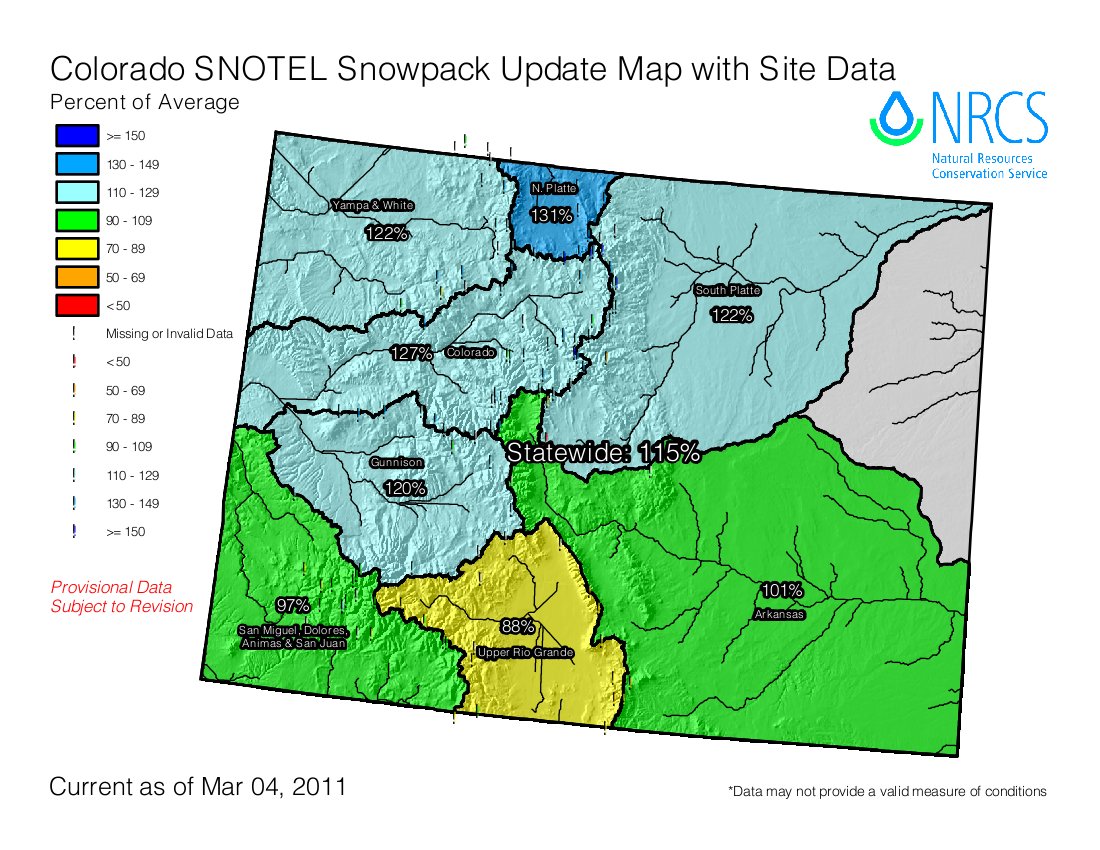
Colorado statewide snowpack by March 1 was 115 percent of average making it the highest March 1 percentage since 2008. Statewide totals are at 131 percent of last year’s statewide readings. Statewide, water year precipitation is now at 118 percent of average, and the South Platte basin is reporting the highest water year percentage in the state at 130-percent of average.

From the Arizona Daily Star (Tony Davis):

if the current numbers hold up, the feds will have enough water to release some extra from Lake Powell to Lake Mead, thereby forestalling shortages on the Central Arizona Project for a few years. Without good runoff, the first shortage could occur as soon as 2012 or 2013.

Locally, however, Tucson’s drought seems worse than ever. We’ve reaped only 1.17 inch of rain since Oct. 1 — the start of the unofficial “water year” used by forecasters — compared to a norm of 4.78 inches.

Aspinall Unit operations update

A picture named curecantibluemesa.jpg

From email from Reclamation (Dan Crabtree):

The Colorado Basin River Forecast Center has released the March 1st Blue Mesa Reservoir April through July inflow forecast in the amount of 800,000 af. The March Colorado River Basin 24 Month-Study Model is calling for increased releases during March and April to provide capacity in Blue Mesa to accommodate this runoff.

Reclamation will be holding off on this release increase in order to allow time for the City of Delta to complete work in the Gunnison River at the wastewater treatment plant. The completion of this work is anticipated to occur within two weeks, at which time the mid-month forecast will have been provided. This will give us a better idea of required increases.

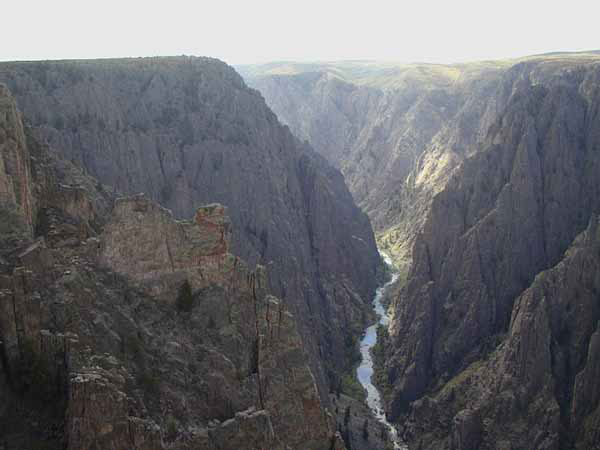
The Black Canyon Water Right 24 hour peak flow target for an April through July forecasted runoff of 800,000 af is 6,369 cfs. Reclamation plans to continue to operate the Aspinall Unit with the intent of allowing this flow target to be met.

More Aspinall Unit coverage here.

Longmont: Water rights and the Beckwith Ditch

A picture named stvrainrockymountainnationalpark.jpg

From The Longmont Times Call (Scott Rochat):

Tuesday marks a century and a half since the beginning of the Beckwith Ditch, the oldest water rights that Longmont owns. In fact, the rights are so old, they predate the city, which wasn’t founded until 1871. It’s not a dramatic spot — just a couple of miles near Golden Ponds that eventually drains into Left Hand Creek. Its water volume is steady but not prodigious — enough to fill one of those ponds given a four-day head start. But it’s the age that matters. Only two other rights on that stretch of the St. Vrain are older. And since Colorado water law is first-come, first-served, that means a steady 14 CFS (cubic feet per second) even in the most drought-ridden of summers…

The Beckwith Ditch, by contrast, had its start with the pre-Longmont homesteaders. More precisely, it had its start with the gold hunters interested in Clear Creek and James Creek — and those who decided there was surer money to be had in selling food and feed to the prospectors…

The city itself didn’t actually own the Beckwith Ditch until 1965, when it acquired a majority of the ditch’s shares. (Today, it holds 83 percent ownership.) This was part of a new policy focus — to acquire the water rights for any area it annexed, partly as a buffer against bad times. The Beckwith, which had started out as a source purely for agricultural supply, would help provide residential water as well.

More St. Vrain Creek coverage here and here.

2011 Colorado legislation update

A picture named washingtonmineillinoisgulc.jpg

Here’s the legislative update for this week from The Pulse — of the Colorado Farm Bureau (Brent Boydston). From the article:

HB1123 – Rep. Coram’s Bill to prohibit transfers from severance related funds to the general fund passed the House Ag Committee and moves on to the House Committee of the Whole. CFB is in support of this measure.

More 2011 Colorado legislation coverage here.

Snowpack news

A picture named snowpackcolorado03042011

From Steamboat Today (Tom Ross):

“We have a number of snow measuring sites in the northern part of the state that have more than 100 inches of snow,” [Chris Pacheco assistant snow survey supervisor with the Natural Resources Conservation Service in Denver] said Friday. “The northern (river) basins are doing really well. We attribute much of that to La Niña.”[…]

He said the Yampa and White River basins’ snowpack, at 124 percent of average, is the highest March 1 snowpack since 1997, when the basin was measured at 142 percent of average. The Tower snowpack measuring site, just northeast of Steamboat Springs at 10,500 feet on Buffalo Pass, has some of the highest snowpack in the region. Pacheco’s agency is reporting that the snow depth on Buffalo Pass had settled down to 133 inches Friday from a high of 144 inches Feb. 26. When the Natural Resources Conservation Service uses the term “snowpack,” it’s really referring to the amount of water stored in the snow, and the 45.9 inches at the Tower site represents 120 percent of average for the date…

The prediction of 120 to 150 percent streamflows in the rivers in Northwest Colorado is a measurement of the total flow for a four- to five-month period in summer, and not an indication of peak flows, he explained. In Routt County, the Elk River snow measuring site close to Mount Zirkel Wilderness Area has a snow depth of 65 inches and the water content is just more than 21 inches, or 129 percent of average. At Crosho Lake, on the edge of the Flat Tops in South Routt, the snow is 51 inches deep and contains 14.6 inches of water. That is 138 percent of average.

Energy policy — hydroelectric: Delta Montrose Electrical Association and Uncompahgre Valley Water Users Association’s power lease application scoping meeting March 9

A picture named microhydroelectricplant.jpg

From the Montrose Daily Press:

The hydropower project would generate electricity by using existing irrigation flows in the South Canal, and generate revenue for the water users association, as well as help DMEA meet legislatively mandated requirements for renewable energy sources. Wednesday’s meeting includes project description and a chance to ask questions. Input can be provided at the meeting, or by e-mail or letter after it. Input can include questions regarding the proposal, significant issues, and information that could help in review of the proposal.

More hydroelectric coverage here and here.

Conservation: How should we manage the remaining undeveloped supplies of water in Colorado?

A picture named telluridevalleyfloororg.jpg

Should we be planning more than 50 years in the future? When mining collapsed in Colorado agriculture and then tourism helped sustain the economy. Bart Miller, Drew Peternell and Becky Long are betting that Coloradans can understand the need for these sustainable wedges in Colorado’s economic mix. Here’s their guest column running in the Summit Daily News. Click through and read the whole thing. Here’s an excerpt:

As Western Slope streams are diverted east, so goes the economic livelihood of many mountain towns and businesses that depend on tourism and recreation.

Many Coloradans live here, and most visitors come here because of our state’s outstanding outdoor resources and opportunities, from trout fishing to rafting — it’s what makes our state special. Recreation is a multi-billion dollar business in Colorado. We degrade our rivers and streams at the risk of undermining not only our economy but also the high quality of life we enjoy as Coloradans.

Colorado’s rivers and streams are at a dangerous tipping point, and we can no longer take their health for granted in water planning.

Our balanced water plan rests on four solid legs: expanded water conservation, water reuse projects, more water sharing between the agricultural and municipal sectors, and “acceptable planned projects,” our name for proposed water supply projects that can meet “smart” guidelines for protecting rivers and the environment.

Conservation is often the cheapest and fastest way to create a new water source. While Denver and other cities have made great strides in promoting conservation, there is much more than could be done. Consider that half of Denver’s water use still goes toward outdoor landscaping. By offering incentives for homeowners to modestly reduce turf and water use, Front Range communities can significantly reduce the need for new water sources.

More conservation coverage here.

Basin Roundtable Summit: An interview with John Stulp

A picture named ibccroundtable.jpg

From The Pueblo Chieftain (Chris Woodka):

“For the last five years, we’ve [Basin roundtables, IBCC, CWCB] been doing a slow dance, but I think the governor’s message is that time is of the essence, and we need to push forward,” said John Stulp, water adviser to Gov. John Hickenlooper. “We’re understanding each other better than we did five years ago…

“One of the big unanswered questions is how to finance projects and if there is a place for the private sector in developing them,” Stulp said. “There probably is a role for the private sector, especially because there increasingly is no federal safety net as there has been in the past.”

Finding the real costs of water should be an issue for the state, Stulp said in addressing some comments about the ability of even large communities to pay for water projects, but that should also come with better explanations to the public about why water projects are needed.

Meanwhile, Chris Woodka takes a look at the real costs of water in this report from The Pueblo Chieftain. From the article:

“Has anyone thought beyond the reports to find ways of convincing the public about how we’re going to fund projects in the future?” asked Reed Dils, of Buena Vista, and a member of the Colorado Water Conservation Board…

“We’ve talked about the concept of full-cost pricing, that people may be paying less for water than it’s worth,” said Mark Pifher, director of Aurora Water. He explained that money from local communities is often leveraged against funding from other sources, so the capital costs are not onerous…

“Don’t forget that the country is spending only 7.5 percent of its income on food,” said T. Wright Dickinson, a rancher from Northwestern Colorado. He said the cost of food is held low, although farmers’ costs are rising.

There was also a question about the relationship of water and power. Eric Kuhn, general manager of the Colorado River Conservation District, noted that most water projects in Colorado have been built using gravity flow, but more energy intensive projects like Southern Delivery System in Colorado Springs and Prairie Waters in Aurora are being built to pump back uphill.

More analysis of the IBCC Strategy from Alissa Johnson writing for The Crested Butte News. From the article:

…the IBCC, created by the 2005 Water for the 21st Century Act, is determined to change the nature of the fight, turning disagreement into cooperative discussion. In a December report to then-Governor Ritter and Governor-elect Hickenlooper, the IBCC outlined a four-part approach to creating a statewide framework for solving Colorado’s water gap. On February 28, the Upper Gunnison River Water Conservancy District Board (UGRWCD) presented the report to the public on behalf of the Gunnison Basin Round Table. Representatives took that public input to the IBCC at the Statewide Roundtable Summit in Westminster, Colo. on Thursday, March 3. It marked the beginning of a long process, one that goes beyond individual basins to look at the health and vitality of Colorado as a whole…

The IBCC’s recommendations are simple in concept: complete already identified projects and processes (IPPs), find new water supplies, rethink agricultural water transfers—the old “buy and dry” philosophy that removes agricultural lands from irrigation—and implement greater water conservation. But there is nothing simple in the recommendations’ implementation. As the IBCC report outlines, each approach must be enacted simultaneously, and even then success isn’t guaranteed. UGRWCD general counsel John McClow explained that calculating the impacts of IPPs is a complex process. “The methodology for calculating these numbers is to begin with county demand, supply and IPPs,” McClow said. “It then expands to the basin [level], then to statewide, so the math is difficult to follow because of rounding and because the projected success rates for IPPs differ among the basins. In addition, the success rate varies in terms of its impact.”

For example, 100 percent successful implementation of Gunnison Basin IPPs would have far less impact than in the Metro Basin. The increase in demand for the Gunnison Basin is projected to be 16,000 to 23,000 acre-feet per year (AFY), while Metro Basin new demand is projected to be 180,000 to 280,000 AFY…

Part of the challenge in addressing water issues comes from the need to meet statewide demand when water rights are managed locally. Trans-mountain diversion of water is sensitive enough, but add to that the component of conservation and it gets even trickier. “When you have a drought, everyone is willing to get on board to get through the rough spot,” said UGRWCD board secretary George Sibley, “but when we are asking people to start conserving in order to enable more water to be freed up to feed more people moving into state, there’s a little less willingness to do that.” But for Sibley, the issue at hand shouldn’t be conservation—it should be demand reduction, and it should include support from the state. “Conservation is where you need people to use less of something,” says Sibley. “Demand reduction is something else, and you won’t find it mentioned much at all in this document. Demand reduction is when you say we aren’t going to let people form bad habits that need to be conserved. We will… develop good habits with the water that’s available, from the start.”

More IBCC — basin roundtables coverage here.