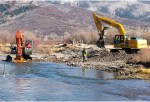
Wattenberg Oil and Gas Field via Free Range Longmont
Here’s the release from Northern Water via The Greeley Tribune:
A meeting in Greeley next week will focus on water-reporting procedures for users providing water to oil and gas operations. The Northern Colorado Water Conservancy is hosting the meeting, which will take place at 1:30 p.m. Monday in Columbine Room A at the University of Northern Colorado’s University Center, 2045 10th Ave.
As Northern Water officials explained in a press release, the significant increase in oil and gas activity in northern Colorado requires a portion of the region’s water supply. In response to the water needs, the Northern Water board adopted rules governing the use of its Colorado-Big Thompson Project water and Windy Gap Project water for such purposes.
The rules require water users providing project water to oil and gas development to periodically report usage information to Northern Water.
To further describe the reporting requirements, Northern Water officials developed water-use reporting and accounting procedures that became effective June 1, 2012. Northern Water officials are now proposing modifications to those procedures. The purpose of Monday’s meeting is to discuss the proposed modifications.
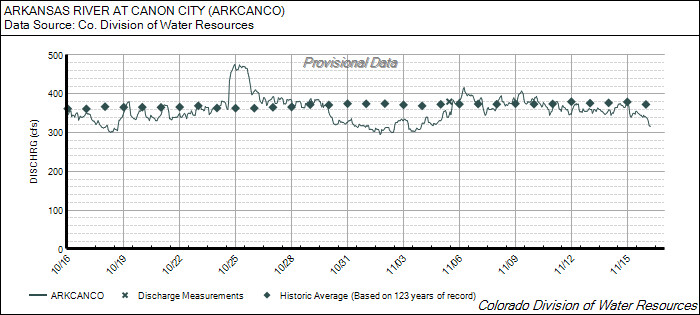
The monsoon rains in August and September still are boosting flows in the Arkansas River. The winter water storage program began Friday with Arkansas River flows that are above average — an unusual development in a year marked by drought.
“The flows are still good at Canon City,” said Bill Tyner, assistant division engineer for the Colorado Division of Water Resources. “We’re still benefitting from the late monsoons, even though we haven’t had any rain for a while.”
There should not be a noticeable drop in Arkansas River readings as the program begins, largely because of the still vigorous flows.
The winter water program allows ditches to store water from Nov. 15-March 15 rather than forcing farmers to irrigate outside the growing season. Water can be stored either in Lake Pueblo, John Martin or reservoirs owned by ditch companies. The amount of water stored depends on weather conditions and can’t be accurately predicted.
On the other hand, releases from upper reservoirs in Lake County will be temporarily cut back slightly during the next week to allow Colorado Parks and Wildlife to work on a project to improve the Helena Ditch diversion structure near Buena Vista. The structure has resulted in rafting deaths in the past, and the state wants to modify it to make a fish passage as well, said Rob White, manager of the Arkansas Headwaters Recreation Area. Meanwhile, the Bureau of Reclamation is projecting that there will be about 45,000 acre-feet of storage space in Turquoise Lake for Fryingpan-Arkansas Project diversions from the West Slope next spring.
If the winter snowpack is greater than average, more space can be created in Turquoise Lake by running water to Lake Pueblo over the winter months. However, there are no plans to do that as long as river levels stay robust, said Roy Vaughan, manager of the Fry-Ark Project.
Red Arrow Mill site Mancos via The Durango Herald FromThe Durango Herald (Joe Hanel) via the Cortez Journal:
The state spent more than $49,000 to stabilize mercury-tainted material at an illegal gold mill in Mancos. Now the state mining board wants Red Arrow Gold Corp. to repay the money, and it moved Wednesday to revoke the company’s mining permit.
Red Arrow owner Craig Liukko did not attend Wednesday’s hearing in Denver, but in letters to regulators, he blamed the problems on a former business partner and a receiver appointed by a bankruptcy court, who has controlled access to Red Arrow’s property since April.
The state excavated and isolated soil at the mill, and it isn’t currently presenting a hazard, said Loretta Pineda, director of the Division of Reclamation, Mining and Safety…
More mercury remains to be removed from the Out West mine north of U.S. Highway 160, mining inspectors said. Pineda’s division is working with the U.S. Environmental Protection Agency on a permanent cleanup. And she still does not know the degree of pollution the mill produced in the past. The EPA is testing samples to figure out if there was a past risk, Pineda said…
On Wednesday, the Mined Land Reclamation Board found Red Arrow in violation of its order from August to clean up the site and pay a $100,000 fine. The board increased the fine to $285,000, increased Red Arrow’s bond and started the procedure to revoke Red Arrow’s mining permit in the next two months.
As part of the cleanup, the state removed mill tailings from a nearby pasture and the Western Excelsior aspen mill, across the street from the Red Arrow operation. Western Excelsior officials thought they were getting sand to patch holes in their lot, said Kyle Hanson, a manager at the aspen mill. The state did a good job of removing the mill tailings, he said…
The mining division spent its entire emergency fund on the initial cleanup, Pineda said. State officials want Red Arrow to repay them…
The Mined Land Reclamation Board also cracked down Wednesday on another Red Arrow property, the Freda mine west of Silverton. Both portals at the mine have collapsed, and stormwater berms have failed, allowing tainted water an tailings to flow off the site toward Ruby Creek, said Wally Erickson, an inspector for the Division of Reclamation, Mining and Safety. The board fined Red Arrow $2,500 for the violations at the Silverton mine.
Colorado Water Plan website screen shot November 1, 2013
FromThe Grand Junction Daily Sentinel (Charles Ashby):
Steve Acquafresca will run for the Colorado House seat being vacated by Rep. Ray Scott, the Mesa County commissioner told fellow Republicans on Friday.
Unlike other candidates who have vied for the seat in recent years, Acquafresca is unique in that he’s already served in the Colorado House. When the now Grand Junction 62-year-old peach grower lived in Cedaredge, where he ran an apple orchard, he represented House District 58, which at the time stretched from eastern Delta County to the Four Corners. He served three terms, getting elected in 1990 and leaving in 1997.
Acquafresca, who’s served on the county commission since 2007 but can’t run again because of term limits, said he has lots of options that he could do after his time on the board ends next year.
But because of several pressing issues, including fears of more water grabs by the Front Range, Acquafresca said he decided the time was right to return to the Colorado Legislature.
“One of the most compelling issues that causes me to announce my candidacy is the fact that the governor has ordered a state water plan to be developed,” he said of Democratic Gov. John Hickenlooper’s May announcement that he wants that plan completed by December 2014.
“When we’ve heard that in the past, it’s generally not a good thing for the West Slope, where 80 percent of the water originates yet the Front Range has 80 percent of the population,” Acquafresca said at the monthly Mesa County Republican Party luncheon at Two Rivers Convention Center. “It is anticipated that legislation will result from that plan in the 2015 session. I want to be over in the 2015 session defending West Slope water rights.” [ed. emphasis mine]
Acquafresca said there aren’t enough people currently serving in the statehouse who worked in local government, saying state legislators could learn a thing or two about drafting budgets, cutting spending and serving the needs of Coloradans without making more demands on them, such as increasing their taxes.
He said the General Assembly needs to adopt a “downsizing spirit” to accomplish its goals.
“We’re really losing the ability to determine our own future over there,” Acquafresca said. “The fact that us Republicans have lost the majority in the Colorado House of Representatives is a big part of the reason why we’re losing the ability to determine our own future, and that’s what I want to turn around.”
Currently, the Democrats control the 65-member House 37-28 and the Senate 18-17. Scott’s seat will become vacant because the two-term representative announced in the summer that he will run for the seat being vacated by Sen. Steve King, R-Grand Junction, who is running for Mesa County Sheriff.
Current Sheriff Stan Hilkey is term-limited and cannot run again.
To date, no Democrat has announced plans to run for the House seat, which primarily encompasses the city of Grand Junction.
More 2014 Colorado November Election coverage here.
From the Leadville Herald (Marcia Martinek) via the The Mountain Mail:
Colorado’s Water Plan was foremost on the mind of state Sen. Gail Schwartz as she visited in her district Nov. 8, including the office of the Herald Democrat.
She explained that Gov. John Hickenlooper in May issued an executive order directing the Colorado Water Conservation Board to develop Colorado’s Water Plan, but the plan itself will be the culmination of more than 8 years work through the Interbasin Compact Committee and the Basin Roundtable process.
Leadville and Lake County are part of the Arkansas Basin Roundtable, which meets monthly in Pueblo and has 53 voting members. Schwartz urges citizens to get involved in the roundtable, especially some of the younger people.
She noted that providing new water storage is especially crucial.
From the Northern Colorado Business Report (Steve Lynn):
High Sierra, which has its roots in Greeley, has developed industry-leading treatment processes, allowing oil companies to turn over their used water to a High Sierra facility, where it is treated and transported back to the oilfields.
This year the company expects to recycle about 2,000 barrels of water daily at its Weld County facilities, up from some 1,500 barrels last year…
High Sierra has operations in the Denver-Julesburg Basin, which includes Northern Colorado, and also works in Wyoming, Oklahoma and Kansas. In Weld County, High Sierra owns two water-recycling facilities, one in Briggsdale and another in Platteville, which company representatives believe are the largest such facilities in Northern Colorado.
“The field seems to be moving toward recycling slowly but surely,” said Doug White, vice president of High Sierra Water.
Companies can use more than 3 million gallons of water per well during hydraulic fracturing, a well-completion technique that involves pumping water, sand and chemicals at high pressures to crack tight shale formations and release oil and natural gas. After the well is complete, water flows back to the surface where it is captured and transported offsite. Most of this contaminated water still is disposed of via deep-injection wells, but growing amounts are treated and reused.
High Sierra Water owns nearly half of the 25 deep-injection wells operating in the greater Wattenberg area. These are designated specifically for wastewater and regulated by state authorities. The greater Wattenberg area spans nearly 3,000 square miles north of Denver and through a substantial portion of Weld County.
High Sierra has developed water-treatment systems that remove elements such as barium, calcium, magnesium, silica, strontium and iron so companies can reuse the water for hydraulic fracturing.
The company has the ability to treat water to match the quality of fresh water, company representatives said. In Wyoming, for example, the company operates a water-treatment facility that has recycled more than 32 million barrels of water and discharged more than 5 million barrels of highly treated water into the New Fork River, a tributary of the Green and Colorado rivers…
Noble Energy said in October that it had recycled about 2 percent of its water so far this year, or 600,000 barrels.
But Noble is in the midst of a major expansion of its water-recycling program. Today, about 80 percent of Noble Energy’s water comes from ponds and wells and 18 percent from cities, while 2 percent is recycled. Noble Energy plans to raise the capacity of its program to recycle 5.8 million barrels of water next year, nearly 10 times more than its current level.
Despite the efforts of companies such as High Sierra Water and Noble Energy, water recycling remains uncommon in Northern Colorado despite heavy drilling activity.
It is more common in Western Colorado, where about half of water used in oil and gas production is recycled, said Ken Carlson, a civil engineering professor at Colorado State University.
Here’s the release from US Representative Scott Tipton’s office:
Today, the House Natural Resources Committee passed Rep. Scott Tipton’s (R-CO) Water Rights Protection Act (H.R.3189) with bipartisan support, clearing the effort to protect privately-held water rights from federal takings for a vote in the House of Representatives.
Over the years, the Forest Service has engaged in numerous attempts to require the transfer of privately-held water rights as a permit condition, amounting to an outright federal taking. During an October 29 House Natural Resources Subcommittee on Public Lands and Environmental Regulation hearing water users testified about their experiences with federal land management agencies interfering with their privately held water rights. Read more here.
“While I am encouraged that the Forest Service acknowledged their flawed and unnecessary policy, and has indicated that their future water rights clause may no longer require the transfer of privately-owned water rights, this clause has yet to be seen, they have aggressively pursued such takings for over two years, and their comments indicate that we will likely only see a temporary fix for one group of water users in one region,” said Tipton. “Water users need certainty that all federal land management agencies, not just the Forest Service, are prohibited from future attempts to take privately-held water rights. Additionally, H.R. 3189 would prohibit future Forest Service officials from shifting course and engaging in similar water grabs in the future.”
The National Ski Areas Association (NSAA) reiterated support for H.R. 3189 in light of the Forest Service announcement.
“Despite this announced change in policy, we still need Congress to pass the Water Rights Protection Act. The policy change announced by the agency this week is the fourth change in Forest Service water policy for ski areas in ten years. These changes are disruptive, create uncertainty and adversely impact our operations, planning and future growth. The ski industry can’t afford to be subjected to a different water policy with each Administration,” wrote Michael Berry, President of NSAA. “Only federal legislation can give us the long term protection we need of an outright statutory prohibition on the taking of our water rights by the federal government. H.R. 3189 is complementary to the agency’s efforts to develop a new policy.”
Tipton’s full statement on the amendment is available here.
Tipton introduced H.R. 3189, the Water Right Protection Act, in September with bipartisan support from Rep. Jared Polis (D-CO). It has received strong support from a broad coalition of local, state and national stakeholders, and a companion bill is being carried in the Senate by John Barrasso (WY).
The Water Rights Protection Act:
Prohibits agencies from implementing a permit condition that requires the transfer of privately-held water rights to the federal government in order to receive or renew a permit for the use of land;
Prohibits the Secretary of the Interior and the Secretary of Agriculture from imposing other conditions that require the transfer of water rights without just compensation;
Upholds longstanding federal deference to state water law;
Has no cost to taxpayers.
Endorsements to date: National Ski Areas Association, American Farm Bureau, National Cattlemen’s Beef Association, Family Farm Alliance, Public Lands Council, National Association of Conservation Districts, Pacific Northwest Ski Area Association, California Ski Industry Association, Colorado Water Congress, Colorado Ski Country USA, Associated Governments of Northwest Colorado, Colorado River Water Conservation District, Southwestern Water Conservation District, Rio Grande Water Conservation District, Upper Arkansas Water Conservancy District, Rio Grande Watershed Association of Conservation Districts, Montrose County Commissioners, Mesa County Commissioners, Montezuma County Commissioners, Conejos County Commissioners, Gunnison County Commissioners, Rio Grande County Commissioners, Montezuma Valley Irrigation Company, Garfield County Commissioners, Aspen Ski Company, Durango Mountain Resort, Crested Butte Mountain Resort, San Luis Valley Water Conservancy District, Center Conservation District and Club 20.
More coverage from John Stroud writing for the Glenwood Springs Post Independent. Here’s an excerpt:
On Wednesday, Forest Service Chief Tom Tidwell issued a statement saying his agency had agreed to a policy change, brokered with the help of U.S. Sen. Mark Udall of Colorado, that would protect water resources without asking ski areas to turn over water rights to the federal government.
Tipton, R-Cortez, responded Thursday after the House committee vote that, while “encouraged” by Tidwell’s statement, it only affects one group of water users.
The water rights bill, which has bipartisan support, is meant to protect the rights of other users as well, including agricultural operations and energy development, according to Tipton and several supporters of the bill from western Colorado…
“They [USFS] have aggressively pursued such takings for over two years, and their comments indicate that we will likely only see a temporary fix for one group of water users in one region,” he said.
Tipton said other federal agencies have also used the practice of requiring the transfer of private water rights in exchange for permitting, amounting to a “taking,” he said.
His bill would prohibit future Forest Service officials and other agencies from changing policy as leadership changes, Tipton said.
The [USFS] told Congress that it no longer plans to force ski areas to turn over their water rights as a condition for maintaining their operating permits.
Even so, the House Committee on Natural Resources passed a bill Thursday by Rep. Scott Tipton, R-Cortez, that would forbid the Forest Service from demanding that permit holders – from ski areas to ranchers – relinquish their water rights…
[US Senator Mark Udall] said, “The Forest Service’s statement on these water rights is a victory for our state and our resort communities that depend on outdoor recreation, and it’s a victory I am proud to have fought for.”
Udall and his staff had several meetings with senior Forest Service officials during the last several months to explain the policy’s potential harm to Colorado, said Udall spokesman Mike Saccone.
The Forest Service has tried sporadically for years to get legal control over snowmaking water rights, because of worries the rights could be sold to real estate developers or others not interested in using the water for skiing.
A federal judge in Denver slapped down the Forest Service’s last attempt in 2012 to make a national ski water policy, but the agency’s attempts to give it another shot upset Republicans and Democrats in the state Legislature and Congress.
“Winter Park owns water rights, like any other ski area,” said Winter Park Resort planner Dough Laraby. “Water rights cost money, and you need them to operate a ski area.”
The National Ski Areas Association, or NSAA, had sued the U.S. Forest Service over the permit changes, winning a victory in 2012 when a U.S. District judge found they violated federal procedural law. The NSAA applauded the federal agency’s recent decision, but said ski areas still need more legislative protections against future policy changes.
“This is the fourth change in 10 years, we can’t afford to be subject to changes with every administration that comes along,” said Geraldine Link, public policy director with the NSAA. “We’re looking to Congress to put protections in place. At a minimum, you can’t take water rights without compensation.”
The U.S. Senate and House of Representatives introduced a bill in late October, called the “Water RIghts Protection Act,” that would prohibit the U.S. Forest Service from adding water rights conditions to permits, including those issued to ski areas that operate on federal forestland, like Winter Park Resort. U.S. Sen. Mark Udall (D-Eldorado Springs), who serves on the Natural Resources Committee but didn’t sponsor the bill, issued a press release welcoming the U.S. Forest Service’s decision to cease water rights takeovers. Udall said it will ensure Colorado’s ski industry can continue to thrive. He helped broker the negotiation after working with the U.S. Department of Agriculture, which houses the Forest Service…
But conservation groups worry ski areas’ retention of water rights will have negative consequences for streams and rivers. They said the proposed legislation puts private interests above the federal government’s responsibility to protect the environment.
More water law coverage here. More NSAA vs. USFS coverage here.
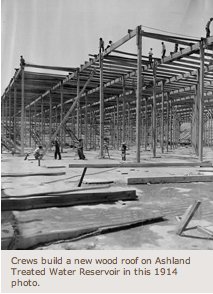
Ashland Reservoir roof construction circa 1914 via Denver Water
Here’s the release from the American Water Works Association via WaterWorld:
On Wednesday, Nov. 13, the American Water Works Association (AWWA) and 10 other major water and municipal groups urged key members of Congress to support pivotal legislation to repair critical water infrastructure across the nation.
The groups requested support for the creation of a Water Infrastructure Finance and Innovation Authority (WIFIA), an innovative federal loan program that would reduce the cost of water projects for local communities and consumers, through a series of letters to U.S. senators and representatives on four decisive committees.
In May, a model WIFIA program was passed as part of the Senate Water Resources Development Act (WRDA), and draft WIFIA legislation is being developed in the U.S. House. WIFIA is expected to be addressed as House and Senate leaders develop a final water resources bill.
“By providing a source of low‐cost capital and promoting innovations in project delivery, WIFIA will help meet the nation’s water infrastructure needs while maintaining full local responsibility, minimizing the federal budgetary impact and creating tens of thousands of American jobs,” the water and municipal groups wrote.
Signatories included AWWA, the U.S. Conference of Mayors, the National League of Cities, the Association of Metropolitan Water Agencies, the American Beverage Association, the Water Environment Federation, the American Council of Engineering Companies, the Water and Sewer Distributors of America, the Water Design-Build Council, the National Ground Water Association, and the WaterReuse Association.
The signatories stressed in the letter that they also support state revolving funds (SRF) programs and want them to continue to thrive. They noted that SRF program alone cannot address the nation’s enormous water infrastructure needs and is rarely able to support large water infrastructure projects. WIFIA is intended to address this gap and provide long‐term, low interest loans for projects over $20 million that cannot always access funding through the SRF programs.
“WIFIA loans will be repaid entirely from local rates and charges — water bills — maintaining full local responsibility for water infrastructure development, but creating a mechanism to provide lower‐cost capital and promote innovations in project finance and delivery,” the letter states. “If a utility can save just two percentage points on the interest rate for a 30‐year loan, that results in a savings of 25 percent in the financing costs of a project. This, in turn, will allow local resources to go farther, accelerating critically needed water infrastructure investment and lowering costs for American families.”
Letters were delivered today to leadership of the House Committee on Transportation and Infrastructure, the House Committee on Energy and Commerce, the Subcommittee on Water Resources and the Environment, and Senate conferees who will deliberate over water resources legislation with their House counterparts, once those House members have been named.
An El Paso County reservoir that has become heavily silted over the last century could get a new lease on life. The Arkansas Basin Roundtable this week passed a grant request of $100,000 for work that would double the capacity of the reservoir to the Colorado Water Conservation Board.
The CWCB still must approve the grant.
Local water providers will chip in $250,000.
The Big Johnson Reservoir, located southeast of Colorado Springs, was completed in 1910 to support agriculture on the Fountain Creek Mutual Irrigation Co. ditch, said Gary Barber, roundtable chairman.
Barber has worked as a consultant in the past for the water providers.
As Fountain, Security, Widefield and Stratmoor Hills began to grow, the municipal areas bought ditch shares. After the 1996 well rules, Big Johnson became important to well augmentation plans of the cities. Over the years, the reservoir has silted up, cutting its court-decreed capacity of 10,000 acre-feet in half. The failure of the dam also could result in flooding much of downtown Fountain, Barber added. The grant would slightly enlarge the dam, remove sediment and improve the outlet works. It also would enhance recreational opportunities on nearby trails and an open space area. The goal is to restore storage to its decreed capacity, making it more useful to area water providers.
“It’s a 100-year-old dam in need of a new outlet works,” Barber told the roundtable.
Meanwhile, the roundtable also approved $250,000 for the Huerfano County Water Conservancy District according to this report from Chris Woodka writing for The Pueblo Chieftain:
Sometimes, it can be expensive just to continue pumping water. The Arkansas Basin Roundtable this week approved $250,000 in state grants to accompany a $280,000 state loan for a project that would allow the Huerfano County Water Conservancy District to use water from a ranch it is buying to augment other water rights. The money will be matched by $50,000 of the district’s own money to build a small augmentation pond that will remove and return water to the Huerfano River at appropriate times to make up depletions from well pumping. The gravityflow system will run through 8-inch-diameter pipes.
The grant and loan follow a $2.2 million loan to the district last month by the Colorado Water Conservation Board.
The district will repay the loans using a property tax.
The district plans to purchase the Camp Ranch and Red Wing Reservoir water rights to support a regional augmentation plan for users on the Huerfano River, said Sandy White, a district board member.
“There are a flock of out-of-priority diversions that have operated for the past five years on substitute water supply plans,” White said, showing the general areas on a map. “Five years is the magic number. Now we need an augmentation plan.”
The area, generally southwest of Walsenburg, has many older communities that rely on wells drilled years ago. In recent years, many of the domestic wells were found to be out of compliance. White said the situation shows that not all pressure on water resources is caused by large cities. There has been some oil and gas exploration in the area.
“We don’t have municipal and industrial uses in the Huerfano River watershed. There are no large cities,” White said. “We have domestic and industrial uses.”
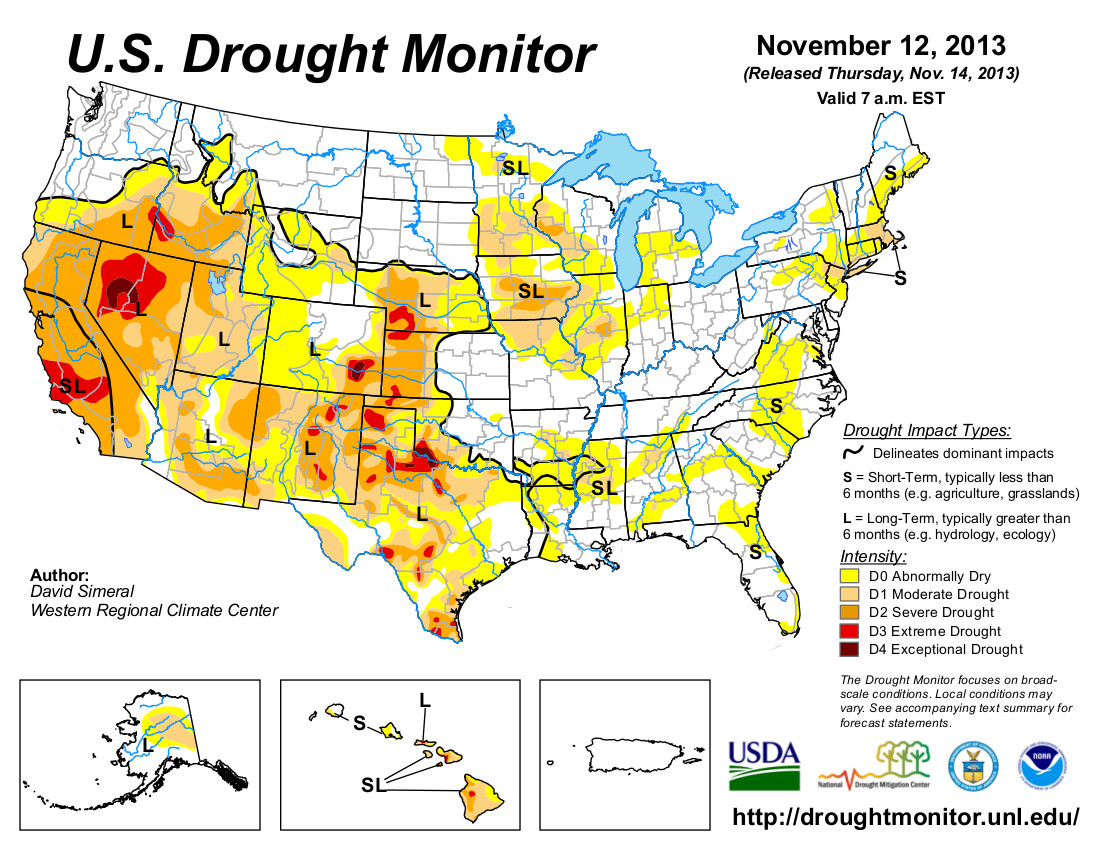
Click here to go to the US Drought Monitor website. Here’s an excerpt:
The Plains
The Plains were generally dry during the past week with the exception of about an inch of precipitation in southeastern Nebraska and southeastern Kansas. In Oklahoma, light rainfall (one-to-two inches) led to minor improvements in areas of Moderate Drought (D1) and Abnormally Dry (D0) in south-central and western regions while conditions deteriorated in north-central Oklahoma as continued dryness degraded soil moisture conditions leading to the slight expansion of areas of Severe Drought (D2) and Moderate Drought (D1). During the past week, temperatures were below normal, especially in the northern tier.
The West
During the past week, most of the active weather in the West occurred across the Pacific Northwest where several storm systems made landfall off the Pacific Ocean delivering rain to the coastal lowlands of Oregon and Washington and snow showers to higher elevations of the northern Cascades as well as portions of northern Idaho, north-central Montana, and northwestern Wyoming. The rest of the West was unseasonably warm and dry during the past week. Through the weekend, daily high temperature records were broken or tied at South Lake Tahoe, California (62°F), Stanley, Idaho (55°F), and Klamath Falls, Oregon (63°F). According to the Natural Resource Conservation Service SNOTEL network, above-average precipitation has been observed across the river basins of south-central Montana, Wyoming, northern Colorado, and north-central New Mexico while the Sierras, southern Cascades, and most of the Intermountain West have been experiencing below-normal precipitation since the beginning of the Water Year, October 1st. For the past week, conditions on the map remained unchanged around the West.
Looking Ahead
The NWS HPC 7-Day Quantitative Precipitation Forecast (QPF) calls for moderate precipitation across the Pacific Northwest, Northern Rockies of Idaho and Montana, and the mountains of western Colorado. Precipitation accumulations of approximately one inch are expected along a north-south corridor extending from the lower Mississippi River Valley to the Upper Great Lakes. The 6-10 day outlooks call for a high probability of above-normal temperatures across most of the West and the Eastern tier, while below-normal temperatures are expected across the Southern Plains and South. Below-normal precipitation is expected across most of the West and central Great Plains while there is a high probability of above-normal precipitation across the eastern third of the Lower 48. With exception of the Aleutians, the rest of Alaska is expected to have below-normal temperatures and a high probability of above average precipitation in the eastern half of the Interior and Southeast Alaska.
As a rancher, Brown said, water rights and conservation are of particular importance to him. If re-elected, he said he would fight to keep the Western Slope’s water on the Western Slope.
“The Front Range wants our Western Slope water,” he alleged, advocating for more storage capacity, both on the Western Slope and Front Range. Referring to the record-breaking floods in Colorado this fall, he pointed out, “If we could store that water on the Front Range, that would relieve demand for a transcontinental diversion of Western Slope water.
Brown added that he will be watching the formation of the new Colorado Water Plan mandated by Gov. Hickenlooper “very carefully; I do not want the federal government to have anything to do with our water plan,” he said. “I have heard they want to be involved; we have Colorado water and I don’t want the feds messing with it.”
More 2014 Colorado November Election coverage here.
Dust streaming across Four Corners April 29, 2009 via MODIS
Here’s the release from the Cooperative Institute for Research in Environmental Science (CIRES):
Reducing the amount of desert dust swept onto snowy Rocky Mountain peaks could help Western water managers deal with the challenges of a warmer future, according to a new study led by researchers at NOAA’s Cooperative Institute for Research in Environmental Sciences (CIRES) at the University of Colorado Boulder.
With support from the CIRES Western Water Assessment (WWA) and NASA’s Interdisciplinary Science program, CIRES’ Jeffrey Deems and his colleagues examined the combined effects of regional warming and dust on the Colorado River, which is fed primarily by snowmelt.
During recent years, desert dust has been settling thick and dark on the snowpack in the northern Rocky Mountain headwaters of the Colorado River, and snowpack is melting out as many as six weeks earlier than it did in the 1800s, according to the new assessment, published last week in Hydrology and Earth System Sciences. Snow dusted with dark particles absorbs more of the Sun’s rays and melts faster than clean snow.
Add the regional warming expected in the future, and the situation seems likely to grow more dire for the 40 million people who depend on the Colorado River for water. The river’s flow falls by more than 20 percent by 2100 in some of the future climate scenarios Deems and his colleagues investigated. Moreover, warming could make dust problems worse, by increasing the risk of drought.
“But we may be able to do something about dust,” said Deems, who works with WWA and CIRES’ National Snow and Ice Data Center. “If the future normal is this extreme dust scenario and we can push that scenario back to lower dust levels with land restoration or management, we could keep the snow in the mountains longer, and maybe even get some of that water back.”
Since the mid-1800s, human land use activities have disturbed Southwestern desert soils and broken up the soil crust that curbs wind erosion, leading to increased dust. In previous research, Deems and his colleagues showed that increasing dustiness leads to accelerated snowpack melt.
That earlier work was based on the moderately dusty years of 2005–2008, with about five times as much dust than in the 1800s. But during 2009, 2010 and 2013, unprecedented amounts of desert dust fell on Colorado snowpacks, about five times more than observed from 2005–2008. Moreover, other researchers have reported that climate change is likely to increase the frequency and intensity of drought in the Southwest, which could increase dust problems further by harming the grasses and shrubs that reduce surface wind speeds.
For the new work, the researchers used climate and hydrology models to investigate the effect of that “extreme dust” on the Colorado River’s flow now and in the future, as the Southwest continues to warm. Snowmelt in the extreme dust scenario shifted even earlier in the season, by another three weeks, pulling peak water levels in the Colorado River to earlier in the spring and leaving less water for later in the year.
“In the Upper Colorado River Basin, the snowpack is our most important reservoir,” said co-author Thomas Painter of NASA’s Jet Propulsion Laboratory. “With continued dusty years and greater warming, water managers will have to make their decisions very early in the season. No longer will they have the nice long snowmelt season, shortened as it already has been, to see how snowmelt runoff is going.”
The research team also found a subtle shift on the total water loss in the Colorado River, from a loss of 5 percent estimated during the moderate dust years of 2005–2008, to a total loss of about 6 percent lost during extremely dusty years. This relatively small change is due primarily to the fact that as snowmelt creeps earlier and earlier in the year, the Sun’s angle in the sky is shallower and provides less energy for evaporation than it does later in the spring.
“Our results suggest that if we can adopt dust-reducing land management strategies and rehabilitate major dust sources, we can keep our snow on the mountains longer, and perhaps offset some of the emerging climate impacts,” said co-author Brad Udall, director of the Getches-Wilkinson Center for Natural Resources, Energy and the Environment at CU-Boulder. “Dust reduction could be a very powerful strategy to help us adapt to the growing impacts of climate change on our precious water supplies in the American Southwest.”
From the Aspen Business Journal (Brent Gardner-Smith):
“While House Resolution 1389’s stated intent (to help resolve a narrow conflict over water rights between the U.S. Forest Service and Colorado’s ski industry) may be legitimate, the bill is written very broadly and will have serious implications for water management across the country,” American Rivers wrote in a one-page document urging opposition to the bill…
On Wednesday, both the the U.S. Forest Service and the Interior Department issued testimony against the bill. Additionally, American Whitewater, the Sierra Club, the Natural Resources Defense Council, Earthjustice and Defenders of Wildlife, and a list of other watershed and river protection organizations are now opposing the bill.
A letter signed by 39 such organizations and submitted to the House Natural Resources Committee on Wednesday stated the bill could “prevent federal agencies from requiring protections for fish and other in-stream resources” and that, if passed, “agencies could be unable to implement reasonable requirements intended to keep water in rivers.”
On Monday, Corbin said Skico’s interest in the bill is confined to protecting water rights held by ski areas, including the four mountains operated by Skico, which together use 200 to 250 million gallons of water each winter for snowmaking.
He said American Rivers’ opposition to the bill has not altered Skico’s support of it.
“We don’t share their apprehension,” said Corbin, after reviewing materials from American Rivers expressing its opposition to the bill. “I understand their concerns, but I think they are probably overreacting.”[…]
The Forest Service released testimony Wednesday in advance of Thursday’s markup session for the bill. The agency said it doesn’t think HR 3189 is necessary, as it is working on a new version of its rule concerning water rights that will “address the concerns associated with the previous ski area water rights clause.”
“We believe these changes will provide assurances to the public and communities that depend on economic activities from ski areas that they will continue to provide recreation opportunities,” the Forest Service stated. “Further, we believe that these objectives can be met without requiring the transfer of privately owned water rights to the government.”
The written testimony from the Forest Service further states “it is not in our interest or policy to take private water rights. Our interest is in sustaining skiing as a recreation opportunity on National Forest System lands now and in the future.”
The Forest Service also raises concerns about its ability to effectively transfer grazing permits if the bill is passed as is.
The Interior Department, which includes the BLM, also released testimony on Wednesday, stating that “the legislation is overly broad and could have numerous unintended consequences.”
The National Ski Areas Association welcomed the Forest Service’s conciliatory language regarding the issue of ski area water rights, but still wants to see the Water Rights Protection Act passed.
“HR 3189 would not hinder the agency’s new approach to water policy,” said Geraldine Link, the director of public policy for the NSAA, in an email. “The new (Forest Service) policy is expected to require ski areas to offer an option to purchase water rights at fair market value to the successor owner of a ski area. (And) the bill prohibits a forced transfer of property to the US.”
Groups such as the National Cattlemen’s Beef Association and the Public Lands Council also support HR 3189, and view it as a way to protect their industry’s water rights…
American Rivers says the hydropower industry and “big western agriculture” are driving the bill, ostensibly written to protect the ski industry, in an effort to “handcuff” the Interior and Agricultural departments and “prevent them from protecting rivers and public lands,” according to a memo on the bill.
Matt Rice, the director of conservation in Colorado for American Rivers, said the group’s opposition to HR 3189 is based on language in the bill that would prohibit “impairment of any water right” by federal agencies under the jurisdiction of either the Interior or Agriculture departments.
Rice said such agencies sometimes require mitigation for hydropower projects that are ultimately licensed by the Federal Energy Regulatory Commission, or FERC. The mitigation, for example, might require that hydropower developers leave some water in a river or in a fish passage structure.
Such a requirement, or mandate, from FERC or an associated federal or state agency, could be considered an “impairment” of a water right by the hydropower industry, according to Rice.
From the Glenwood Springs Post Independent (John Stroud):
U.S. Sen. Mark Udall of Colorado said Wednesday that he welcomed the U.S. Forest Service’s stated intention to not pursue the transfer of water rights from ski areas in exchange for permits to use public lands. Forest Service Chief Tom Tidwell issued the statement to the U.S. House Natural Resources Committee as a result of a compromise that Udall helped to broker…
“We believe that these changes will provide assurances to the public and communities that depend on economic activities from ski areas that they will continue to provide recreation opportunities,” Tidwell said in the Forest Service statement. “We believe that these objectives can be met without requiring the transfer of privately owned water rights to the government.” [ed. emphasis mine]
Udall, who serves on the U.S. Senate Energy and Natural Resources Committee, said the agreement “ensures Colorado’s job-creating ski industry and outdoor recreation businesses can continue to thrive, while protecting the long term availability of activities such as skiing on public land.”
“The Forest Service’s statement on these water rights is a victory for our state and our resort communities that depend on outdoor recreation,” he said…
The Garfield County Board of Commissioners and Associated Governments of Northwest Colorado have both lent their support to the Tipton bill, not only because of the potential impacts on ski areas but on agriculture and energy development in the region.
Eagle County’s two U.S. congressmen successfully snuffed a Forest Service move to take water rights without paying for them. Jared Polis and Scott Tipton have been battling a U.S. Forest Service policy that would force ski areas and other stakeholders to turn over the private water rights before the Forest Service would renew their permit to do business…
“While I welcome the indication of the Forest Service that there may be a change of direction from the previous ski area water clause, we need to ensure that all water users are protected from uncompensated federal takings in the long term, not just for one group of water users, in one region, for a limited time,” Tipton said.
Lawmakers are going ahead with a bipartisan bill to protect water rights, Tipton said. HR 3189 is before the House Natural Resources committee this morning.
The feds have already done it to the owners of the Powderhorn ski area on Western Colorado’s Grand Mesa.
Vail local Andy Daly is part of the group that bought Powderhorn.
Vail Resorts would have had to deal with the Forest Service policy as it renews its operating permit for Breckenridge. The feds have already done it to California’s Alpine Meadows and Washington’s Stevens Pass ski areas…
The reversal came in a statement Wednesday delivered to the Senate Energy and Natural Resources Committee.
“We will be proposing changes to the ski area water clause that address the concerns associated with the previous ski area water rights clause,” Forest Service chief Tom Tidwell said in the statement. “We believe that these changes will provide assurances to the public and communities that depend on economic activities from ski areas that they will continue to provide recreation opportunities. Further, we believe that these objectives can be met without requiring the transfer of privately owned water rights to the government.”
If the Arkansas Basin Roundtable is successful in inserting one sentence in the upcoming state water plan, it would probably read: “Hands off our agricultural water.” Going around the room Wednesday, members voiced their concerns about the goals and objectives section of the basin water plan, which will be folded into a more sweeping document being pushed by Gov. John Hickenlooper.
“The biggest problem I have is all the water that’s been sold,” said John Schweizer, a Rocky Ford farmer who heads both the Catlin Canal and the Arkansas Valley Super Ditch. “The land where the water’s been sold is worthless weeds and junk. We need to stop taking water from agriculture and lease-fallowing is the first decent way I’ve seen to slow it down.”
Others took a harder line.
Crowley County’s representative Rick Kidd pointed out that farmers who are left on large canals where water has been sold, such as the Colorado Canal, can’t run water to their fields during dry years like this one.
In Huerfano County, which is seeing its water resources tighten, there is an even deeper feeling.
“We need to put some demands on our own water staying in our own place,” said Kent Mace, chairman of the Huerfano County Water Conservancy District. “Is there a farmer or rancher who cannot grow a crop every year and stay in business?”
“I think a measurable outcome should be a zero net loss of agriculture production in the Lower Arkansas Valley,” said Jay Winner, general manager of the Lower Arkansas Valley Water Conservancy District.
A majority of the roundtable members and visitors at the meeting voiced the need for more collaboration or efficiency in using water. Others wanted more emphasis on watershed management, recreation and environmental issues.
Nearly everyone agreed that storage should play a major role in the valley’s water future.
“I think the Lower Ark Valley found out that when reservoirs are gone, there was an economic impact,” said SeEtta Moss of the Audubon Society. “They lost a lot of fishermen and birders from the cities spending money in the rural areas.”
Other budget highlights include $44 million in payments and transfers to the city budget, which includes surplus payments; franchise fees from two water districts; payments to the city attorney office; and fees for permits and projects. This year, Utilities issued $130 million in bonds for the major capital projects with a 30-year payback. That puts Utilities’ total debt up to $2.4 billion compared to $4 billion in assets. It means that 16 percent of a customer’s utility bill goes strictly to paying down the debt.
The tentative budget also includes $6.6 million for stormwater-related projects, $5 million for regularly scheduled maintenance and $178 million for the Southern Delivery System project.
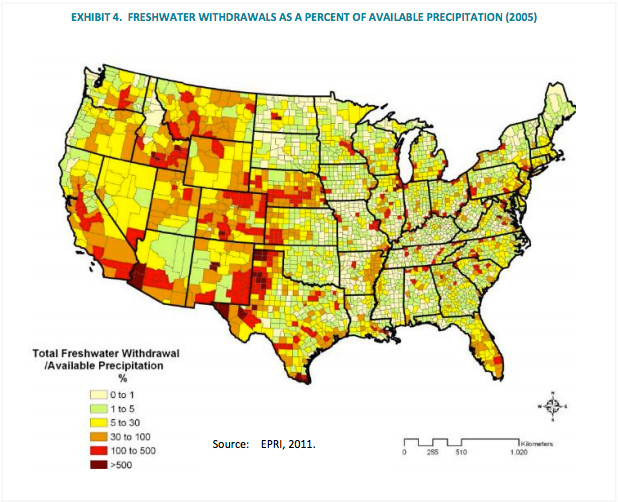
Freshwater withdrawals as a percent of available precipitation (2005) via the EPA
Here’s the release from the Environmental Protection Agency:
EPA is releasing a Synthesis Report on the Importance of Water to the U.S. Economy. This report is intended to help raise the awareness of water’s importance to our national economic welfare, and to summarize information that public and private decision-makers can use to better manage the nation’s water resources. It highlights EPA’s review of the literature and practice on the importance of water to the U.S. economy, identifies key data gaps, and describes the implication of the study’s findings for future research. EPA hopes this report will be a catalyst for a broader discussion about water’s critical role in the U.S. economy.
Water is vital to a productive and growing economy in the United States, and directly affects the production of many goods and services. While some data are available about how important clean and available water is to various economic sectors–including agriculture, tourism, fishing, manufacturing, and energy production — the information is often dispersed and incomplete. Additionally, understanding the economic significance of water is difficult because it depends upon several interacting elements: the volume supplied, where and when it is supplied, whether the supply is reliable, and whether the quality of the water meets the requirements of its intended use.
While the Pueblo Board of Water Works has been systematically replacing pieces of its water system for the past 40 years, there’s still a lot of work to be done. The board Tuesday discussed a 30-year, $150 million capital improvement plan to upgrade aging infrastructure.
“The system on the distribution side is in good shape,” said Terry Book, executive director. “Now, we’re dealing with infrastructure that is 50-100 years old, such as the water main rupture on Albany (in October). There is a finite life to these structures and we have to be proactive.”
Aging infrastructure is one of the most critical needs for water utilities across the country, explained Seth Clayton, director of administrative services.
The Pueblo Board of Water Works will crack open the books on its 2014 budget at a workshop next week in advance of a public hearing. The board is looking at a 3 percent rate increase that would generate an estimated $21.6 million, based on about 8 billion gallons of water use. The increase would mean about a $1 per month increase for the average homeowner, excluding outside watering.
Metered water sales within the city would be supplemented by $9.1 million in outside sales, including $6.3 million to Xcel Energy and Black Hills for power generation, $1 million in contracts with Aurora and $1.8 million in raw water sales. Revenue from all sources would be $34.4 million, an increase of about 4 percent from the 2013 budget.
The workshop begins at noon Tuesday. The public hearing is at 2 p.m. Nov. 19. Both meetings are at 2 p.m. in the William F. Mattoon Board Room of the Alan C. Hamel Administration Building, 319 W. Fourth St.
More:
The Pueblo Board of Water Works plans more than $150 million in capital projects over the next 30 years. Here’s where the money would go: Water main upgrades: $47.5 million Other underground structures: $7.5 million Buildings & water resources: $47 million Large water tanks: $21.7 million Treating/pumping equipment: $11.9 million Transportation, heavy equipment: $10.4 million Computer equipment: $7.5 million
It’s probably no secret: Puebloans would sooner let the yard die than go without cellphones or Internet access.
“As a water utility, we think we don’t have competition, but we’re competing with other utilities,” Administrative Services Director Seth Clayton told the Pueblo Board of Water Works Tuesday. “They have smartphones and a data plan. People have had to make choices.”
The board held a workshop to comb through details of a $34 million budget for 2014. The budget will mean a 3 percent rate hike, which would mean a $1 per month increase for most of the year, with a $3 increase during the summer months.
A public hearing on the budget will be at 2 p.m. Tuesday.
Puebloans have decreased both indoor and outdoor water use in the past decade, even during a drought. That breaks earlier patterns when customers would increase lawn watering in response to drought.
But times have changed. During the past three years, Pueblo has suffered through a drought with rainfall at 40-75 percent of average. Residential water use, which makes up the bulk of the city’s nearly 40,000 water accounts, has stayed relatively flat. In fact, in 2013, when August and September rains eased the blow, overall water consumption is about 5.5 percent below the five-year average. Residential water use is nearly as low as 2009, one of Pueblo’s wettest years.
“It’s good for us on the water supply side, but we’re also operating a water utility,” Clayton said. “There has also been more awareness and education of customers, which is better than what we had pre-drought.”
During the 2011-13 period, electric rates in Pueblo soared, unemployment rates remained high and the water board maintained a philosophy of low rates.
“It’s important to us to keep rates as low as we can,” Clayton said.
The board agreed.
Board member Nick Gradisar pointed out that Colorado Springs residents are paying double what Pueblo pays for minimal water use and even greater amounts as use increases. Pueblo West rates are 40-60 percent higher than in Pueblo, depending on use.
One way the board has kept rates low is to increase the portion of revenue from leases of water it holds for future use. Next year, water leases will bring in more than $8 million, about 25 percent of revenues, compared with about 20 percent a few years ago.
Metered water sales would bring in $23 million if water use remains near recent levels.
The Congreso de las Acequias is the state-wide governing body of the NMAA, comprised of regional delegates across the state. The annual meeting is held in the fall of each year to pass resolutions that guide the strategic direction of the NMAA, and to elect the eleven-member Concilio. Every year, we’re drawing in more and more folks who are dedicated to the cause. The NMAA hopes to continue building the movement throughout the state, protecting our land and water resources for future generations of acequia farmers and ranchers.
The 2013 Congres de las Acequias, “Strengthening Community in Times of Water Scarcity” will take place on Satuday, November 23rd at The Bishop’s Lodge in Santa Fe
“We created the largest artificial watershed in the world,” says Pat Mulroy, the powerful head of the Southern Nevada Water Authority, a wholesaler that supplies Las Vegas.
Water from the Colorado River is piped across deserts, channeled through mountains, and — after being treated in local sewage plants — winds up in rivers that flow to the southern ends of the country:
Some of New Mexico’s share goes into the Rio Grande, eventually flowing south and east through Texas and into the Gulf of Mexico.
What Denver returns to nature flows into the South Platte, a tributary of the Missouri River.
The coastal cities of Southern California dump a good bit of their diversion into the Pacific Ocean.
None of these water bodies is the logical end of the line for the Colorado River, whose natural terminus is a delta at the northern crook of the Gulf of California. A delta that is, ironically, all dried up…
The river’s web, if some have their way, could become even larger. John Kaufman, the man who proposed the Missouri River pipeline, wants to see the artificial boundaries expand. Kaufman is the general manager of Leavenworth Water, which serves 50,000 people in a town that welcomed Lewis and Clark in 1804 during the duo’s westward exploration.
The identity of the pipeline’s proponent, who was anonymous during the Bureau of Reclamation study and is for the first time being named in the media, is important because of where he lives — outside of the natural Colorado River Basin, or in the extended web.
In Kaufman’s vision, Kansas becomes a hydrological keystone for the West, facilitating water transfers that could affect at least 10 states and Mexico.
“We’d hopscotch water across Kansas and sell it to communities in the state,” Kaufman told me during a phone interview last month, explaining the benefit to his home territory. Construction of the pipeline would also supply jobs to Leavenworth, where the intake facilities would be located. At least one groundwater district in western Kansas is advocating for a similar concept, a Missouri River pipeline to the High Plains to compensate for declines in the Ogallala Aquifer, an essential source for irrigation. Kaufman has presented his idea to state and local officials several times this year.
Once the water flows past Kansas, “it’s a horse trade,” Kaufman said. Water delivered to the Front Range would be earmarked for the South Platte River Basin, which includes Denver. (The South Platte, remember, is part of the Missouri River Basin.) A pipeline would close the circle, sending South Platte water, via the Missouri, back uphill. Of course a few drops of the Colorado would be in the pipe, too.
“It’s a reuse project, really,” said Kaufman, who serves on Kansas governor Sam Brownback’s Missouri River advisory committee…
Then there are the swaps. Front Range cities get roughly 72 percent of their supplies from the Colorado River, according to a 2009 study commissioned by the Front Range Water Council. If water from the Missouri were imported, then some of the trans-Rocky diversions could remain within the Colorado River Basin.
Kaufman’s idea — he calls it the Eisenhower Pipeline, in honor of the sponsor of the interstate highway system, which got its start in Kansas — was included in the Bureau of Reclamation’s final report, but top federal officials distanced themselves from the project, once word leaked a few days before the report’s official release last December.
“In my view, [water import] solutions are impractical and not feasible,” said Ken Salazar, Secretary of the Interior at the time. The study actually gave the pipeline high marks for technical feasibility, but the $US 8.6 billion price tag and the high energy costs pushed the pipeline to the bottom of the pile. Conservation was the big winner, deemed to be significantly cheaper and able to deliver more water.
Kaufman knows the scheme is expensive, which is why he says that he needs financial buy-in from the states in the Colorado’s Lower Basin and cooperative agreements among all the Basin states in order to shuffle water supplies.
“It’s not about providing water to the Front Range,” he said. “It’s about providing water to the West.”
Experimental forecasts from Klaus Wolter via the Colorado Climate Center
Click here to go to the website. Scroll down for all the information. Here’s an excerpt:
Latest Monthly Briefing – November 11, 2013
Highlights
Above-average October precipitation in Wyoming and northern and western Colorado further alleviated drought conditions and provided a good start to the winter snowpack.
Precipitation was below-average in Utah and southern and eastern Colorado, though cool temperatures across the region in October helped retain the snow that did fall.
The NOAA CPC climate outlooks show a tilt towards continued wet conditions for Wyoming into the winter months, with no tilt for the rest of the region.
October Precipitation and Temperatures, and Current Drought
In October, storm tracks favored the Northern Plains and left nearly all of Wyoming with above-normal precipitation; much of the state was over 200% of normal. To the south, this wet anomaly extended into northern Colorado and far western Colorado, and a portion of eastern Utah. The rest of Colorado and Utah saw drier-than-normal conditions, including persistently drought-stricken southeastern Colorado.
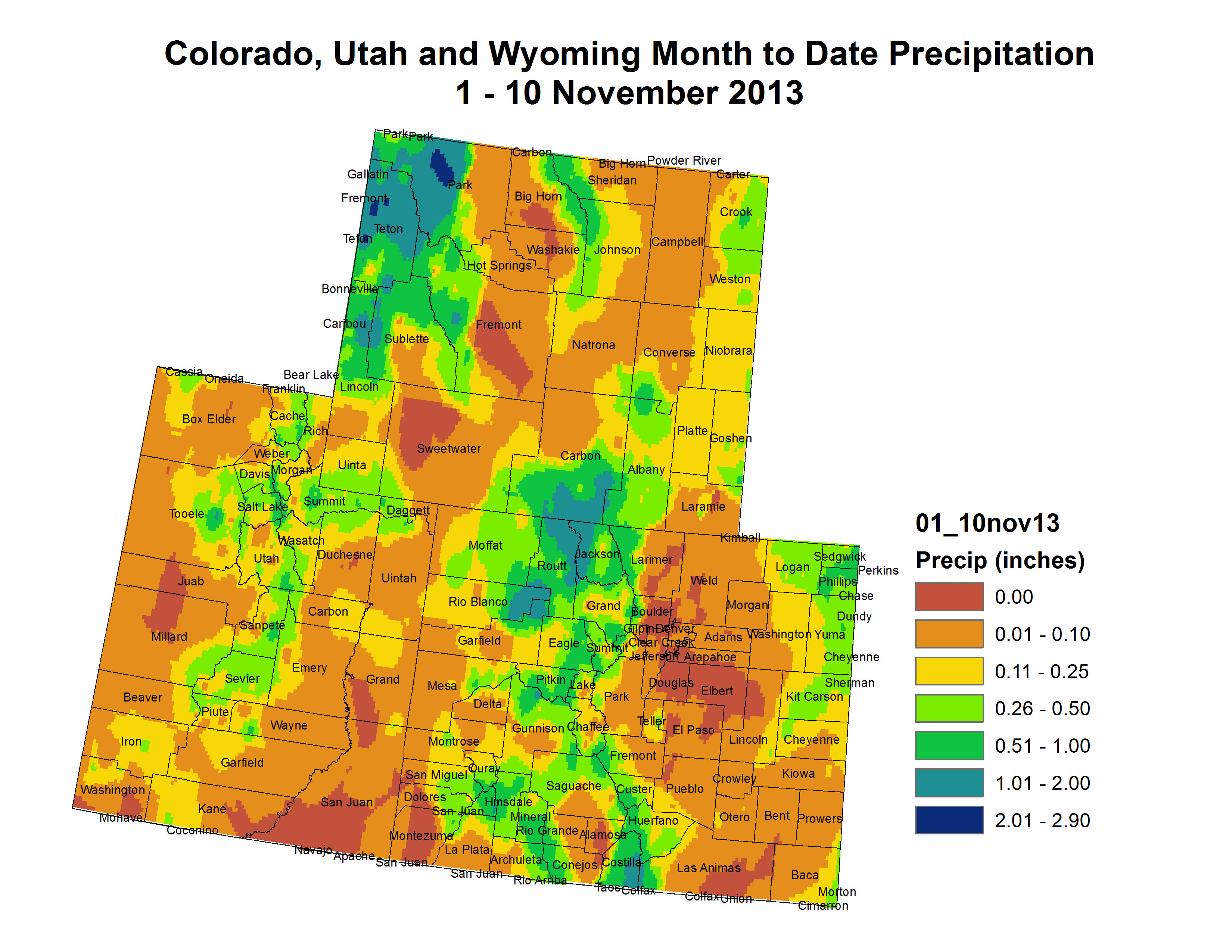
After the relatively dry conditions during the first 10 days of November, the current HPRCC Water Year Precipitation map for 2014 shows essentially the same pattern as for the month of October.
October’s temperatures were cooler than average across the region—and across the entire western US—even in those areas with below-average precipitationWestern US Seasonal Precipitation. Most areas were 2–6°F below average monthly temperatures for October, which helped keep the new snow in the mountains on the ground.
The latest US Drought Monitor, representing conditions as of November 5 Modeled Soil Saturation Index, shows further improvement in the persistent drought conditions over the past month. The most significant improvements were in southern and eastern Wyoming, where D2 and D3 drought conditions on October 1 improved to D0 and D1. Lesser improvements occurred in south-central and northwestern Colorado. The proportion of Wyoming in D2 or worse drought dropped to zero, from 22% on October 1; Utah remained at 16%; and Colorado remained at 12%. Region-wide, the overall drought extent and severity is now lower than it has been since early 2012.
Snowpack
The Current Basin Snowpack map from NRCS Western US Seasonal Precipitation indicates near- to above-average SWE in all but a handful of basins in our region, with the largest positive anomalies in Wyoming, southern Utah, and northwestern Colorado. We are still very early in the snowpack season, and the % of average SWE values are more volatile than later in the season. With average to dry conditions forecasted for the region for the next 5 to 14 days, these values may slip backwards by late November, especially in Utah and much of Colorado where the actual SWE amounts on the ground are generally less than 2″.
Current Streamflows
The maps of current streamflows for Colorado Map of flood and high flow condition (Missouri), Utah Map of real-time streamflow compared to historical streamflow for the day of the year (Missouri), and Wyoming Stream Gauge Map show that streams in the region are generally in lower flow categories than one month ago, but most are still in the normal or above-normal categories. The Colorado River near the CO-UT state line was in the 40th percentile (96% of median flow) on November 9.
Seasonal Climate and Drought Forecasts
The latest monthly Climate Outlook released on October 31 by NOAA CPC shows a slight dry tilt for precipitation for November, 0.5-mo lead extending into extreme southern Colorado, but no tilt elsewhere. The seasonal outlooks released October 17 show a tilt towards wetter conditions for most of Wyoming, but no tilt elsewhere in the region, for the November–January period 3-mo precip forecast, 0.5-mo lead, and no tilt for the December–February period 3-mo precip forecast, 0.5-mo lead. The latest CPC Seasonal Drought Outlook released October 17 projects that the remaining areas of drought conditions (D1 or worse) in our region, mainly in Utah, will persist through at least January Stream Gauge Map.
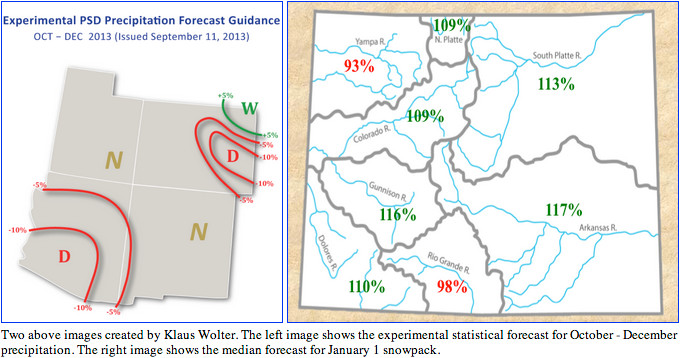
As reported in the October 8 briefing, the PSD Precipitation Forecast Guidance released September 11 for October–December 2013 conditions shows a slight wet tilt for the period for far northeastern Colorado, and a dry tilt for most of eastern Colorado into the northern Front Range. No tilt is forecasted for the rest of Colorado and Utah, indicating equal chances for wet, dry, and middle outcomes. The fall-early winter period historically has shown the least forecast skill of all seasons, though there has been positive skill east of the Continental Divide.
Also reported in the October 8 briefing: in the experimental January 1 SWE forecast for Colorado released in early October, the median (50th percentile) forecast Experimental Precipitation Forecast Guidance calls for above-average January 1 snowpack (109–117% of average) for all basins except the Yampa (93%) and Rio Grande (98%).
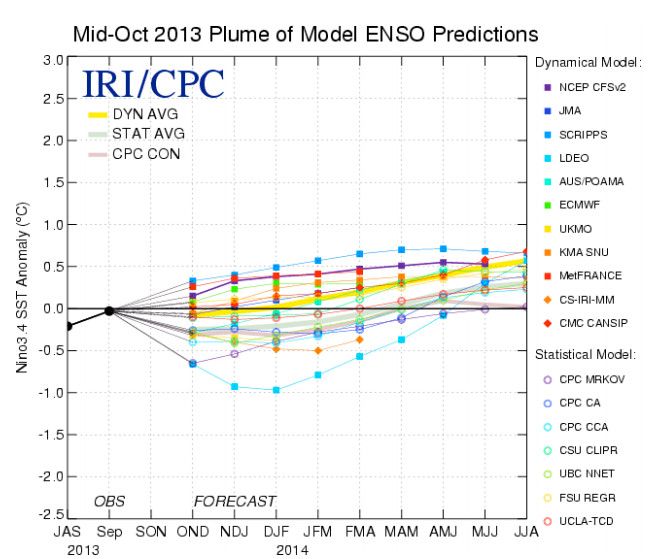
ENSO indicators Stream Gauge MapMap of real-time streamflow compared to historical streamflow for the day of the year (Missouri) are still showing ENSO-neutral conditions, though with a warming trend over the past few months. The models in IRI’s mid-October ENSO Prediction Plume Map of real-time streamflow compared to historical streamflow for the day of the year once again indicate a consensus towards ENSO-neutral conditions continuing through the winter, though now both the dynamical and statistical models are tending towards the warm side of neutral, with a few models sneaking into El Niño territory by spring.
DARCA will be hosting its 12th Annual Convention on February 26-28, 2014. The convention will be held at the Plaza Event Center in Longmont, Colorado, 1850 Industrial Circle, Longmont, CO 80501.
During the three day conference, a wide variety of speakers will discuss their views on timely subjects facing ditch and reservoir companies. This year’s conference is entitled: From Drought to Deluge- Dealing with Uncertainty. The speakers will be addressing flood and recovery issues along the Front Range along with other topics. There will also be three concurrent workshops on the final day of the conference: 1) Water Accounting for Ditch Companies (1/2 day); 2) Conserved Water Statutes – DARCA’s Role (1/2 day); and 3) Information Technologies for Ditch Companies – Web Pages, Excel, and GIS (full day).
You may find of particular interest the pre-convention workshop on Wednesday, February 26, also at the Plaza Event Center. The workshop, Creating Efficiencies and Reducing Transaction Costs for Ditch Companies, will explore how ditch companies can increase their financial viability in today’s complex world.
For information regarding the convention as well as sponsorship or exhibitor opportunities please contact DARCA at (970) 412-1960 or john.mckenzie@darca.org.
At the Community Alliance of the Yampa Valley’s 2013 Yampa Basin Water Forum, [Diane Mitsch Bush] and fellow presenters Kent Vertrees, Kevin McBride and Jay Gallagher talked through the issues and challenges ahead for the state as it races to meet the December 2014 deadline set out by Gov. John Hickenlooper’s executive order for a state water plan draft. Vertrees is a member of the Yampa/White Basin Roundtable, Gallagher represents the Yampa-White River Basin on the Colorado Water Conservation Board, McBride is on the board of the 2013 Colorado Water Congress, and Mitsch Bush serves on state house committees that oversee water issues. All four represent the interests of the Yampa River Basin in the complicated confluence of water and policy.
Their presentation Monday night at Bud Werner Memorial Library briefed attendees on geology, hydrology and water law as it applies to the Yampa River and Colorado.
The Yampa River, being largely a wild river with a natural hydrograph, is an anomaly among Colorado rivers, and as multiple members of the panel pointed out, that gives the basin a chance to buck the constraints of other basins across the state.
The amount of water in the Yampa River Basin is large compared to other basins, McBride said…
There’s pieces of Colorado water law that would push the Yampa toward developing the same constraints faced in the South Platte River Basin, McBride said, but there’s also opportunity to do something different.
There are many constraints on the future water plan outlined in the presentation, such as highly variable annual flows, climate change, existing water laws and interstate and international agreements, local control and balancing the impact on existing uses and future growth.
There are interests on the Front Range that would look to the Yampa as a reservoir for their needs, Mitsch Bush said, and if consensus can’t be reached with them, the Western Slope will have to stand by its interests…
“Here in Northwest Colorado, we can have that wild river in some ways,” Vertrees said about the best case scenario from the state water plan. “We can have smart storage. We can continue to provide for agriculture needs.”
Seasonal Drought Outlook October 17, 2013 through January 31, 2014 via NOAA
Click here to go to the US Drought Monitor website. Here’s an excerpt:
The Plains
In the northern tier, a generally cool and dry pattern was observed over much of the Dakotas and Nebraska. Near-normal, short-term precipitation totals led to the removal of a small area of Abnormally Dry (D0) in eastern South Dakota. In the southern tier, eastern Kansas and eastern Oklahoma received two-to-four inches of rain late last week, but these rains fell in areas currently not experiencing drought. In southwestern Oklahoma, continued dryness led to the expansion of an area of Exceptional Drought (D4) in Harmon County. During the past week, temperatures in the southern tier were slightly above normal.
The West
During the past week, most of the West was dry with the exception of the Pacific Northwest where one-to-two inches of rain fell across the coastal lowlands of Oregon and Washington. Snow showers were observed over the high elevations of the Cascades, Northern and Central Rockies, and Intermountain West. According to the Natural Resource Conservation Service SNOTEL network, mountain snowpack conditions are off to a good start in Oregon, northern Idaho, southwestern Montana, Wyoming, and northern Colorado. Early season snowfall and improving moisture conditions led to one-category improvements in areas of Moderate Drought (D1) and Severe Drought (D2) in Wyoming, northeastern Utah, and northwestern Colorado. The vast majority of the West experienced below normal temperatures during the past week.
Looking Ahead
The NWS HPC 7-Day Quantitative Precipitation Forecast (QPF) calls for moderate to heavy precipitation across the Pacific Northwest. Mountain snow is expected in the northern Sierras (CA), Cascades (OR/WA), Sawtooths (ID), Bitteroots (MT), and Tetons (WY). Modest precipitation totals (less than 1.5”) are expected from eastern Texas extending northeast through the Mississippi Valley, Upper Midwest, and Northeast. The 6-10 day outlooks call for a high probability of above-normal precipitation and below-normal temperatures across the Pacific Northwest, Northern California, and Northern Rockies. In contrast, above-normal temperatures are expected over the southern half of the United States with the exception of southern California. Above-normal precipitation is also expected across the Great Plains Midwest, and South Florida.
…La Plata County sheep and cattle rancher J. Paul Brown addressed a crowd of about 40 people at Christina’s Grill & Bar on Saturday morning to announce his plans to retake the House seat he lost by two percentage points in 2012 to Durango attorney Mike McLachlan. He called the district, which includes La Plata, Archuleta, Hinsdale, Ouray and a portion of Gunnison counties, one of the most beautiful places in the world and one of great importance to the state and nation.
“We are the pull of all of Colorado,” he said. “Tourism, mining, gas and oil, hospitals. It’s a wonderful district.”
While Brown, a Republican, said he is not yet ready to propose specific legislation, he did say he had a long list of issues and possible bills…
“Water is an issue here, and it always will be,” he said. “The Front Range is thirsty. They want our water, and they’ve taken it.”
Brown mentioned water-storage initiatives to keep water on the Western Slope and in the state.
“Six hundred thousand acre feet of water just went to Kansas and Nebraska,” he said. “That’s our water – we just don’t have any way to keep it.”[…]
La Plata County Planning Commissioner and beef rancher Wayne Buck supports Brown’s ideology. He called Brown a politician of moral fiber and character.
“He’s honest, and Lord knows we need honest politicians in Denver and in Washington, D.C.,” Buck said.
Steve House, a healthcare consultant from Brighton, will announce his candidacy for governor Monday in Adams County…
House is now among five Republicans vying to unseat Democratic Gov. John Hickenlooper in 2014. Sen. Greg Brophy of Wray, Secretary of State Scott Gessler, former state Sen. Mike Kopp and former U.S. Rep. Tom Tancredo have all announced their candidacies for governor.
The Big Thompson River Restoration Coalition, sponsored and headed by Wildlands Restoration Volunteers along with various nonprofits, government agencies and community members, held an informational meeting Sunday evening at the Thompson School District Administration Building, with around 50 landowners and interested parties in attendance…
When asked at the meeting what the coalition’s definition of “restoration” is and what it would mean to the property owners, he explained the necessity of protecting infrastructures like bridges, roads and buildings both from current and future conditions.
He also suggested it eventually would be defined by the landowners themselves.
The coalition seeks to figure out the needs of the people and the ecology affected by the river and to bring that information to organizations that will make restorative efforts based on the data gathered and the wishes of the citizens affected.
The issues at hand include: fishing and the fish population, riverbank protection, habitat restoration, infrastructure, ditches and diversions, access for recreation and businesses and individual property…
Step one in the coalition’s vision will be the short-term restoration of important infrastructure. Step two is to form a master plan, which according to Giordanengo, could take as long as six months The current stage in the coalition’s process is mainly information gathering, coordination and fund-raising.
Diane Hoppe at CFWE President’s Award Reception 2012
Here’s a guest column about the urgency behind the Colorado Water Plan, written by Diane Hoppe running in The Greeley Tribune:
The recent flooding in northeast Colorado has drawn our attention to the importance of planning for uncertainty, especially when it comes to water. Whether one lives on the Western Slope or the Eastern Plains, water is what makes Colorado’s productive farms and ranches, our thriving recreational industry, our beautiful environment and our vibrant cities possible.
Despite the recent floods, water is predicted to be in short supply in the future. In the coming decades, there could be a gap between supply and demand of as much as half a million acre-feet per year or more. This scenario is particularly threatening to Colorado’s rural communities. Unless we plan our water future, more agricultural water will be bought to supply our growing cities, drying up hundreds of thousands of acres of productive farmland and jeopardizing the economy and livelihoods of rural Colorado. Northeastern Colorado alone is expected to lose about 20 percent of agricultural land currently under production.
This future is unacceptable. We must have a plan that provides a secure water future for all Coloradans.
The governor recently issued an executive order directing the Colorado Water Conservation Board to develop the Colorado Water Plan. This is an unprecedented undertaking for Colorado, but fortunately much of the work to develop the plan already is done.
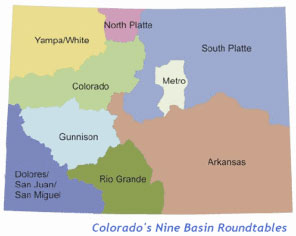
During the drought of 2002-03, the state Legislature commissioned the most comprehensive study ever done of Colorado’s current and future water demands and supplies, the Statewide Water Supply Initiative. In addition, in 2005 the state Legislature created the Interbasin Compact Committee, a group of 27 water leaders representing every major river basin and water constituency. It also created nine Basin Roundtables, groups of water leaders in every major river basin that have been taking an in-depth look at their basin’s water challenges. For the last several years, these groups have been engaged in thoughtful dialogue while working hard to understand Colorado’s water challenges and ways they can be addressed.
Colorado’s Water Plan will not be a top-down plan full of state mandates and requirements. Instead, it will be built on the foundation of the work of the Basin Roundtables, the Colorado Water Conservation Board and the Interbasin Compact Committee. That is a strong foundation. Through their work, these groups have reached consensus on a variety of actions that will lead to a better water future, including support for alternatives to permanent buy-and-dry of agriculture, conservation, projects that meet certain criteria and more.
Each basin is in the process of developing water plans for their region. Until these are completed, we won’t know all that Colorado’s Water Plan will include. What we do know is the plan will be balanced and reflect Colorado’s values. The governor’s executive order specifies that the plan must promote: a productive economy that supports vibrant and sustainable cities, viable and productive agriculture, and a robust skiing, recreation and tourism industry; efficient and effective water infrastructure promoting smart land use; and a strong environment that includes healthy watersheds, rivers and streams and wildlife.
The water board will deliver a draft of the plan to the governor by Dec. 10, 2014, and then work with the governor to finalize the plan no later than December 2015.
To provide your insights and perspectives, please participate in the next meeting of your South Platte Basin Roundtable. To learn who the members are and when they meet, visit http://www.cwcb.state.co.us and go to the Interbasin Compact Committee and Basin Roundtable link. You can also submit your comments to the water board by emailing cowaterplan@state.co.us.
From email from the Colorado Water Conservation Board (Ben Wade):
Pursuant to ISF Rule 5c of the Rules Concerning the Colorado Instream Flow and Natural Lake Level Program, this notice identifies the streams to be considered for instream flow appropriations in 2014. At the January 2014 meeting of the Colorado Water Conservation Board (CWCB), staff may request that the Board form its intent to appropriate instream flow water rights for the streams listed on the attached Instream Flow Appropriation List. The attached list contains a description of the Instream Flow (ISF) Recommendations including stream name, watershed, county, upper terminus, lower terminus, length, and USGS quad sheet name(s).
Copies of the Instream Flow Recommendations and Appendices of data submitted into the Official CWCB Record are available for review by the public during regular business hours (8:00 a.m. – 5:00 p.m.) at the Colorado Water Conservation Board’s Office, located at 1313 Sherman Street, Room 723, Denver, Colorado, 80203. In addition to the CWCB office, copies of the Instream Flow and Natural Lake Level Recommendations are available online at:
Last year, there was no run because the lake was so low, explained Jim White, a aquatic biologist with Colorado Parks and Wildlife.
In low water years, the river carves a wide channel in the lake bed that is too shallow for the kokanee salmon to make their way to spawning grounds, 5 miles up river at a specially designed fish hatchery.
But deeper water triggered a run this year attracting bald eagles to the valley and a line of people at the traditional November fish giveaway in Dolores…
The kokanee spawning zone on the Dolores River is a system of ponds that drain into a concrete-formed “raceway”, controlled by gates, sieves, and fish cages. The females lay their eggs in the fine gravel, and then go off and die, becoming a meal for eagles, bears, and otters.
Some eggs are harvested by biologists and raised in the Durango fish hatchery to be distributed to other hatcheries and lakes, including back to the Dolores.
From the hatchery, they float down river and into McPhee Reservoir, with most becoming a meal for predator fish. Those that survive, about 5 percent, spend 3 to 4 years maturing and then make their way to where they were born to lay eggs.
More Dolores River Watershed coverage here and here.
Proponents of a failed move to secede from Colorado say they will now look to the legislature for help in giving their counties more political clout.
“The issue has not gone away for us,” Phillips County Administrator Randy Schafer said. “We have no voice in how this state is run and we will still try to rectify that.”
Eleven rural Colorado counties voted Tuesday on the question of whether their commissioners should proceed with plans to create a 51st state. Phillips County was one of five counties where the non-binding measure passed.
The other four counties were Cheyenne, Kit Carson, Washington and Yuma. Together, the five counties have a total population of about 29,200.
The measure failed 58 percent to 42 percent in Weld County — population 263,691 — where the 51st state idea first gained traction. Elbert, Lincoln, Logan, Moffat and Sedgwick counties also voted against secession.
Secession critic and retired University of Northern Colorado political science Prof. Steve Mazurana said the notion of breaking up with the Centennial State is all but dead.
“Without Weld County, the efforts to secede will go nowhere, at least for the next decade,” said Mazurana.
Schafer said the 51st state movement will now look to state lawmakers, including State Rep. Jerry Sonnenberg, R-Sterling, to advance a measure in next year’s legislative session to change statewide representation. Once such proposal is the Phillips Plan which would have representatives elected by county, rather than by population.
But University of Colorado law professor Richard Collins said a series of U.S. Supreme Court decisions in the early 1960s cemented the “one man, one vote” concept into law. Those cases will block any move to put rural counties on par with urban counties, he said.
The counties could also try to reshape the boundaries of legislative districts. But the Colorado Supreme Court said redistricting only happens every 10 years.
“So the next time they can do that is 2021,” Collins said. “These efforts are almost as hopeless as the 51st state movement and I thought that was pretty hopeless.”
State Sen. Greg Brophy — who represents many of the 51st state counties — said the counties that voted against secession were just being “pragmatic.”
“I suspect what they were saying with their vote is they liked Colorado as it is,” said Brophy, who is running for governor against incumbent Democrat John Hickenlooper. “They just want a governor to represent them.”
Hickenlooper said he recognizes the frustration of the 51st state followers.
“While voters in six counties rejected the secession plan, we understand that some rural areas still feel underrepresented and are not being heard,” Hickenlooper said. “We remain committed to listening more and working with local communities all across Colorado.”
From the Fort Collins Coloradoan (Patrick Malone):
Voters passed secession initiatives in five rural, northeastern counties, while six counties rejected them. Perhaps more important than how many counties adopted the proposal was one that didn’t — Weld, the most populous and economically influential county where secession was on the ballot.
The five counties that passed secession measures have a combined population of 29,056. Even the least populous state in the nation, Wyoming, has 563,626 residents. Counties that rejected secession have 330,119 residents combined — 263,746 of whom live in Weld.
“There’s no doubt that if Weld had voted for this (Tuesday) night, it would have been a much different story,” said Weld County Commissioner Sean Conway, an architect of the 51st-state movement. “But the voters have spoken. We need to respect the voters’ wishes and look for other avenues to have that discussion.”
The new course for the movement is already taking shape, and it doesn’t involve leaving Colorado — quite the opposite. Conway said the next step is modeled after the measure voters passed in Phillips County on Tuesday, which would add seats in the state Legislature from rural Colorado.
That’s a tall order. It would require a constitutional change in the way legislative seats are apportioned. That would require approval by voters statewide. Before it could even reach the ballot, two-thirds of the Legislature or a sufficient number of petition signatures that would require plenty of urban support is necessary.
In other words, 51st-state organizers would need help from the parts of Colorado they sought to cast off if they are to elevate their political influence…
Instead of fortifying the urge to shake loose, Conway says the secession experiment has reminded rural Coloradans of the need to embrace the rest of the state — and hope that it reciprocates.
“The word came down from the voters: We’re proud to be Coloradans, and we love our state,” he said. “There’s nobody with guns in the street. Everybody got a chance to vote, and at the end of it all, everybody respects each other, even if they don’t agree.”
Here’s the release from the Department of Interior:
Secretary of the Interior Sally Jewell today praised President Obama’s intent to nominate Neil G. Kornze as Director of the Bureau of Land Management (BLM). If confirmed by the U.S. Senate, Kornze would head a bureau that manages more than 245 million acres of public land under a multiple-use and sustained yield mission.
“Neil has helped implement forward-looking reforms at the BLM to promote energy development in areas of minimal conflict, drive landscape-level planning efforts, and dramatically expand the agency’s use of technology to speed up the process for energy permitting,” said Jewell. “For more than a decade, Neil has been a key player in many of the nation’s major natural resource policy issues and has a reputation for being creative and results-oriented. His record at the BLM is marked by an inclusive approach and an openness to new ideas as the agency supports efforts to foster economic opportunities through safe and responsible energy development and increased access to the nation’s system of conservation lands.”
Kornze has led the BLM since March 1, 2013, as Principal Deputy Director, overseeing its conservation, outdoor recreation and energy development programs. Prior to this role, Kornze served as the BLM’s Acting Deputy Director for Policy and Programs since October 2011. He joined the agency in January 2011 as a Senior Advisor to the Director and has worked on a range of issues, including renewable and conventional energy development, transmission siting and conservation policy. He also has been active in tribal consultation, especially regarding oil, gas and renewable energy development in Indian Country.
Kornze played a key role in developing the Western Solar Plan, which established 17 low-conflict zones for commercial solar energy development and also identified lands appropriate for conservation, and the agency’s approval of 47 solar, wind and geothermal utility-scale projects on public lands, as a leader of the Department’s Renewable Energy Strike Team. When built, these projects add up to more than 13,300 megawatts – enough electricity to power 4.6 million homes and support 19,000 construction and operations jobs. He also has been a leader in reforming BLM’s oil and gas program, including the upcoming launch of a nation-wide online permitting system that could significantly reduce drilling permit processing times, and in the bureau’s efforts to enhance and increase visitors to the diverse system of national conservation lands.
Before joining the BLM, Kornze was a Senior Policy Advisor to Senate Majority Leader Harry Reid, working on renewable energy, mining, water, outdoor recreation, rural development and wildlife conservation issues. He worked closely on developing and helping pass critical national legislation, including the Omnibus Public Lands Act of 2009 and the reauthorization of the Secure Rural Schools and Payment-in-Lieu-of-Taxes programs. Raised in Elko, NV, by a family with a long history in mining, Kornze has a master’s degree in International Relations from the London School of Economics and is a Phi Beta Kappa graduate with a degree in Politics from Whitman College in Walla Walla, WA.
The BLM has an annual budget of $1.1 billion and 10,250 employees who carry out a multiple-use and sustained yield mission to sustain the health, diversity and productivity of the public lands – mostly in 12 western states – for the use and enjoyment of present and future generations. The BLM hosts more than 59 million visits annually and administers the National System of Public Lands, which encompasses about 13 percent of the total land surface of the United States and more than 40 percent of all land managed by the federal government. BLM also manages 700 million acres of sub-surface mineral estate across the nation.
“Neil Kornze will bring his western upbringing and values, combined with conservation knowledge, experience, and judgment to the director’s office at BLM,” said Trevor Kincaid of the Denver-based Center for Western Priorities. “Mr. Kornze’s record of finding compromise between divergent positions makes him an ideal candidate for the challenges facing BLM.”
Kornze faces confirmation by the U.S. Senate. U.S. Sen. Orrin Hatch, R-Utah, told the Salt Lake Tribune that while “the fact that Mr. Kornze is from the West is a good thing,” he plans to bring up such issues as sage grouse management and hydraulic fracturing as Kornze’s nomination is considered.
In Colorado, some 1.7 million acres of BLM land are habitat for the greater sage grouse, whose dwindling numbers have led state and federal officials to weigh restrictions on energy development and grazing to protect the bird.
FromThe Grand Junction Daily Sentinel (Gary Harmon):
A former adviser to Sen. Harry Reid, D-Nev., will head the nation’s largest land-management agency, if Neil Kornze is approved by the Senate. President Barack Obama nominated Kornze to head the Bureau of Land Management on Thursday. The agency last had a permanent chief in May 2012.
Kornze’s nomination won quick support from U.S. Sen. Michael Bennet, D-Colo., who cited in a statement his office’s good working relationship with Kornze.
“Being from the West and having demonstrated experience in the Congress and at the bureau make him a qualified candidate for the job,” Bennet said. “We’re looking forward to hearing more about how his priorities for the BLM will help our state balance the need for responsible energy development with recreation and the protection of our public lands and wildlife habitat.”
Kornze grew up in Elko, Nev., and has headed the Bureau of Land Management since March 1. He joined the agency in 2011 as a senior adviser to Director Robert Abbey, working on renewable and conventional energy development and conservation policy. He worked previously with Reid.
U.S. Sen. Mark Udall, D-Colo., is reviewing Kornze’s nomination, Udall’s office said.
Kornze’s position on state water rights is an important issue, U.S. Rep. Scott Tipton, R-Colo., said in a statement.
Tipton has criticized the BLM and U.S. Forest Service for demanding state water rights in exchange for permits to graze or operate on federal lands.
“It’s critically important that the director of the BLM understands the importance of multiple-use of public lands, and strives to achieve a balance of conservation and responsible use of the abundant natural resources on those lands,” Tipton said in a statement.
Western Colorado is dependent on the bureau’s energy policies, David Ludlam of the West Slope Colorado Oil and Gas Association said.
“So the responsibility falls to our community to reach out to Mr. Kornze early, often and constructively to open up access to the natural gas reserves so fundamental to our economy and quality of life,” Ludlam said.
The BLM’s Grand Junction Field Office administers about 1 million acres in Mesa and surrounding counties, including U.S Forest Service lands it manages for the mineral deposits beneath them.
The BLM administers more than 245 million acres of public lands nationwide.
If you are like me, these football afternoons are best when you have the text of a water bill winding through Congress to read. Click here to read US Senator John Barrasso’s companion bill to US Representative Scott Tipton’s bill (H.R. 3189).
More NSAA vs. USFS coverage here. More water law coverage here.
The state interim water resources review committee gave the green light to five bills at its meeting on Oct. 30. It tabled six other bills.
Hydroelectric generation: Sets up guidelines for licensing of hydro projects.
Flexible water markets: Creates a new type of water use, subject to water court approval and consumptive use diversion limits.
Grants for wastewater treatment: Clarifies guidelines for using severance tax money for small communities water and wastewater plants.
Removal of Division of Water Resources printing requirements: Allows more use of electronic copies of reports, rather than requiring printed copies.
Opposing federal special use permit terms: Specifies that water rights obtained by the United States government as a condition of a permit are presumed to be speculative, forfeited but not necessarily abandoned. The right reverts to the prior owner and retains its original priority.
More coverage (Chris Woodka):
Legislation that could allow water rights to be changed for indefinite purposes is expected to be introduced in the next state legislative session. The new law could affect the Pueblo Board of Water Works shares on Bessemer Ditch as well as the Arkansas Valley Super Ditch.
Flexible water markets would be authorized as a new type of water right under a proposed bill that got a green light from the interim water resources committee on an 8-2 vote at its final meeting in October.
State water law now requires an end user to be identified to avoid speculation. The anti-speculation doctrine is a powerful legal tool. For instance, it was employed as the major legal argument for stopping water transfers from the Fort Lyon Canal by High Plains A&M in a 2003 case that was upheld by the state Supreme Court in 2005.
The new bill would allow changes of use of irrigation water rights through fallowing, reduced cropping, deficit irrigation and other alternatives to full irrigation that do not result in permanent dry-up or irrigated lands. Unlike previous attempts at legislation, the bill would still require a court process to determine the historic consumptive use of the water for crops. Only that portion can be removed from a water system, even under existing law. A water right could be used for agriculture, municipal, industrial, recreation or environmental uses in alternate years under the legislation.
The interim committee also wants legislation that would look at property tax implications for partially irrigated farmland, as well as ditchwide quantification of water rights when only some are used for a different purpose.
A flex use water right could be useful in changing Bessemer Ditch water rights purchased by the Pueblo water board in 2009. Under flex marketing, land that was historically irrigated could remain in production rather than drying up the land.
“The board is interested in maintaining flexibility for municipal or agricultural use by whatever mechanism, whether it’s this bill or something else,” said Paul Fanning, legislative administrator for the Pueblo water board.
The bill also could have implications for the Arkansas Valley Super Ditch, which is looking at methods to lease water from lands that are temporarily dried up.
Farmers in the Lower Arkansas Valley want to be able to use their own water to supplement wells, but see legal and engineering hurdles. So, with the help of the Lower Arkansas Valley Water Conservancy District, they are seeking legislation to change replacement requirements for wells.
“We’re not trying to expand our water right, but just continue what we have been doing under the substitute supply plan,” said Paul Casper, a farmer who is a board member of the Holbrook Canal Co. “We want to use our own water on our own land.”
The legislation would allow a farmer to use surface water from existing water rights as replacement water for well depletions on the same ground, provided it already has been part of a well augmentation plan. As it stands now, farmers are required to file for a change of use in water court after operating for 10 years under a substitute water supply plan.
Casper said that is too expensive and takes time. The new law would allow farmers to use water that had already been permitted or decreed for replacement use without a court filing.
Because the law faced opposition from the legislative committee of the Colorado Water Congress, the Lower Ark district pulled it from consideration by the interim water resources committee. But it plans to push for passage of the bill when the Legislature convenes in January.
“We’ve already had engineering over a 10-year period to show that no one’s water rights have been injured,” said Alan Frantz, a Rocky Ford farmer and member of the Catlin Canal board. “The state is requiring additional engineering and lawyers to take it through court.
“In two years, the augmentation group on the Catlin already has spent $300,000 on engineering, and we’re not even close to court,” Frantz said.
Farmers in the future will need to grow more food, even as their sources of water diminish, Frantz said. To grow higher value crops farmers need a steady supply of water throughout the years. Wells provide that at time surface water falls short.
Tyler Karney, manager of the Ordway Feedyard, agreed.
“Any obstacle in front of farmers needs to be removed,” Karney said. “This legislation is helpful to farmers. We need to take the barriers away.”
The Pueblo Board of Water Works will crack open the books on its 2014 budget at a workshop next week in advance of a public hearing. The board is looking at a 3 percent rate increase that would generate an estimated $21.6 million, based on about 8 billion gallons of water use. The increase would mean about a $1 per month increase for the average homeowner, excluding outside watering.
Metered water sales within the city would be supplemented by $9.1 million in outside sales, including $6.3 million to Xcel Energy and Black Hills for power generation, $1 million in contracts with Aurora and $1.8 million in raw water sales.
Revenue from all sources would be $34.4 million, an increase of about 4 percent from the 2013 budget.
The workshop begins at noon Tuesday. The public hearing is at 2 p.m. Nov. 19. Both meetings are at 2 p.m. in the William F. Mattoon Board Room of the Alan C. Hamel Administration Building, 319 W. Fourth St.
The Yampa Valley Stream Improvement charitable trust has been working to improve waterways in the region for more than 30 years, and its work can be seen in clean, smooth-flowing streams all across the area. It tackled its biggest project in 2006, when it set to work on the Yampa River southeast of Steamboat Springs in the Chuck Lewis State Wildlife Area.
Now, after it divvied that task into three phases, the final elements are just a week away from completion. An area of the river that once was a shallow, eroded mess strewn with trash will be one of the premier rainbow trout fisheries in the state. What previously was a stretch of river Steamboat anglers were more likely to avoid will become a fishermen’s paradise…
The project cost about $1 million, and getting to this point has been a monumental task. The funds were raised from private donors, benefit events and through grants from government programs and other organizations.
The first stage, in 2006, involved dragging 88 cars from the river’s banks and cost $100,000…
The trust partnered with the city of Steamboat Springs for the second stage, a $300,000 project upstream of Chuck Lewis. It reconditioned the river, cleaned up a dump, stabilized the banks and moved the river 50 yards back to its channel.
The third stage, which is underway, has heavy equipment digging in the river to create structures for fish habitat, channeling and deepening the river and creating pools. Even the placement of rocks and other breaks in the water were studied to help cut back on the pike population and make a world-class sanctuary for growing trout.
Now the section of river will be used as a rearing ground for a strain of rainbow trout resistant to whirling disease…
Meanwhile streamflow in the Yampa River has dropped below the 10th percentile recently. Here’s a report from Tom Ross writing for Steamboat Today. Here’s an excerpt:
The river was flowing at 64 cubic feet per second Tuesday beneath the Fifth Street Bridge. That compares to the median flow for this date of 117 cfs and the all-time recorded low of 43 cfs on Oct. 9, 1935…
The Yampa and the Elk rivers are among more than 20 rivers throughout Colorado currently flowing in the 10 percent range of their historical averages, according to the U.S. Geological Survey…
The Yampa was flowing on par Oct. 4 at 70 cfs, but the historic graph indicates Oct. 5 is the date when the river flow should begin to pick up to levels above 100 cfs.
Jay Gallagher, of the Mount Werner Water and Sanitation District, said Tuesday that he didn’t have data at his fingertips to confirm the flows in Granite Creek and the Middle Fork of Fish Creek, which feed Fish Creek Reservoir and historically have risen at this time of year. The reservoir, Steamboat’s primary source of domestic water, is about 54 percent full and will drop into the 40 percent range during winter. The dam is releasing about 7 cfs into Fish Creek, and that will continue for about another week before it is dropped to 4 cfs, he said.
The Elk River was flowing at 68 cfs Tuesday at its confluence with the Yampa west of Steamboat. The Yampa was flowing at 36 cfs above Stagecoach Reservoir. Further downstream, above Lake Catamount, the river was flowing at 29 cfs.
Mid-October 2013 Plume of model ENSO predictions via the Climate Prediction Center
Click here for the discussion. Here’s the synopsis:
Synopsis: ENSO-neutral is expected through the Northern Hemisphere spring 2014.
During October, ENSO-neutral persisted, as reflected by near-average sea surface temperatures (SST) across much of the equatorial Pacific Ocean. During the month, slightly below-average SSTs were evident in most of the Niño regions, except for Niño-4, which remained near zero. However, the oceanic heat content (average temperature in the upper 300m of the ocean) rose from near average to slightly above average, due to the eastward shift of a downwelling oceanic Kelvin wave, which was reflected in the above-average subsurface temperatures across the western half of the Pacific. The atmospheric circulation remained largely near average during the month, with generally small departures in equatorial convection and upper and lower-level winds. Collectively, these atmospheric and oceanic conditions reflect ENSO-neutral.
The majority of model forecasts indicate that ENSO-neutral (Niño-3.4 index between -0.5°C and 0.5°C) will persist into the Northern Hemisphere summer 2014 (Fig. 6). Though confidence is highest for ENSO-neutral, there are also growing probabilities for warm conditions (relative to cool conditions) toward the spring/summer 2014. The consensus forecast is for ENSO-neutral to continue through the Northern Hemisphere spring 2014 (see CPC/IRI consensus forecast).