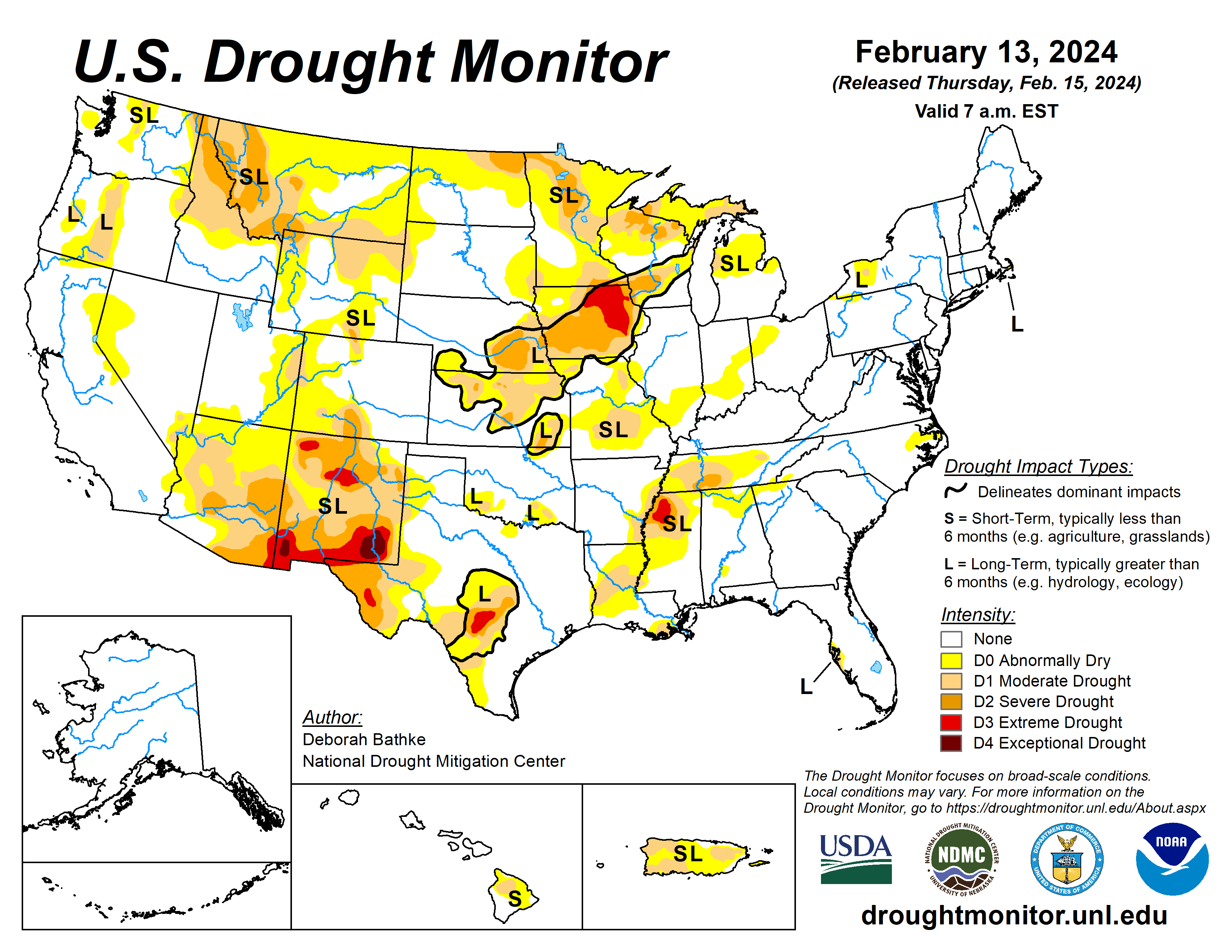
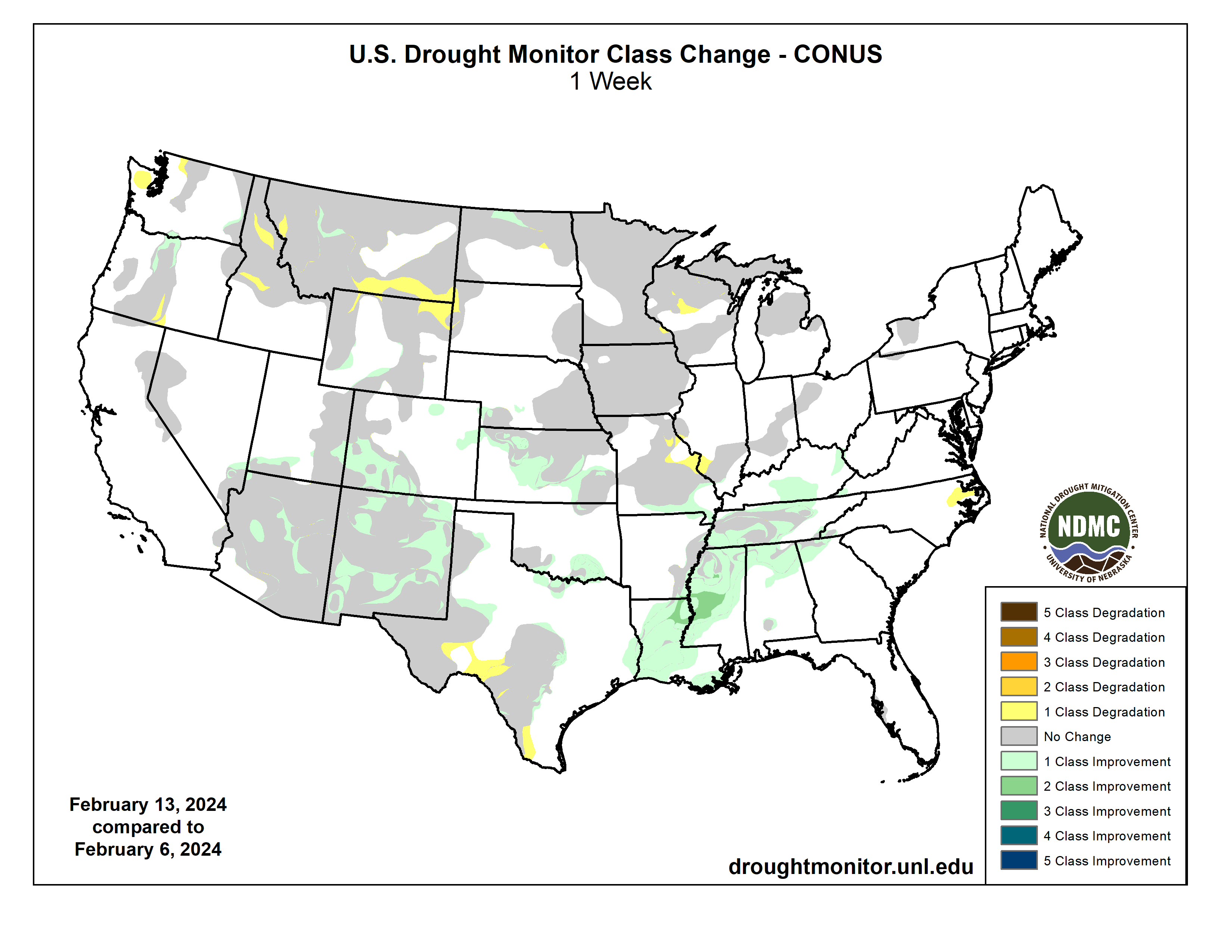
Last week, another round of Pacific storms swept across the West, bringing rain and mountain snow. Storms left over 3 feet of snow in the northern Arizona mountains before dropping more than a foot of snow in the mountains of Colorado and New Mexico. After a slow start to the year, basin snowpack in the Southwest has returned to near-normal conditions. Southwestern states saw improvements to short- and long-term drought conditions. In the Northwest, basin snowpack remains below normal with some of the worst conditions in the northern Rocky Mountains. The lack of snow led to the expansion of drought conditions. The wet pattern continued in the South and Southeast. In the last 30 days, rainfall totals of more than 10 inches (200 to 400 percent of normal) fell in parts of the South and Southeast.
The excess rain brought additional one- and two-category improvements to drought. The Northern Plains and Upper Midwest stayed relatively dry, with temperatures well above normal for the second week in a row. States in the Southern Plains saw pockets of improvements as long-term moisture deficits are finally showing signs of improvement. The winter storm that brought heavy snow to the Northeast on Wednesday occurred at the data cutoff for this week’s map…
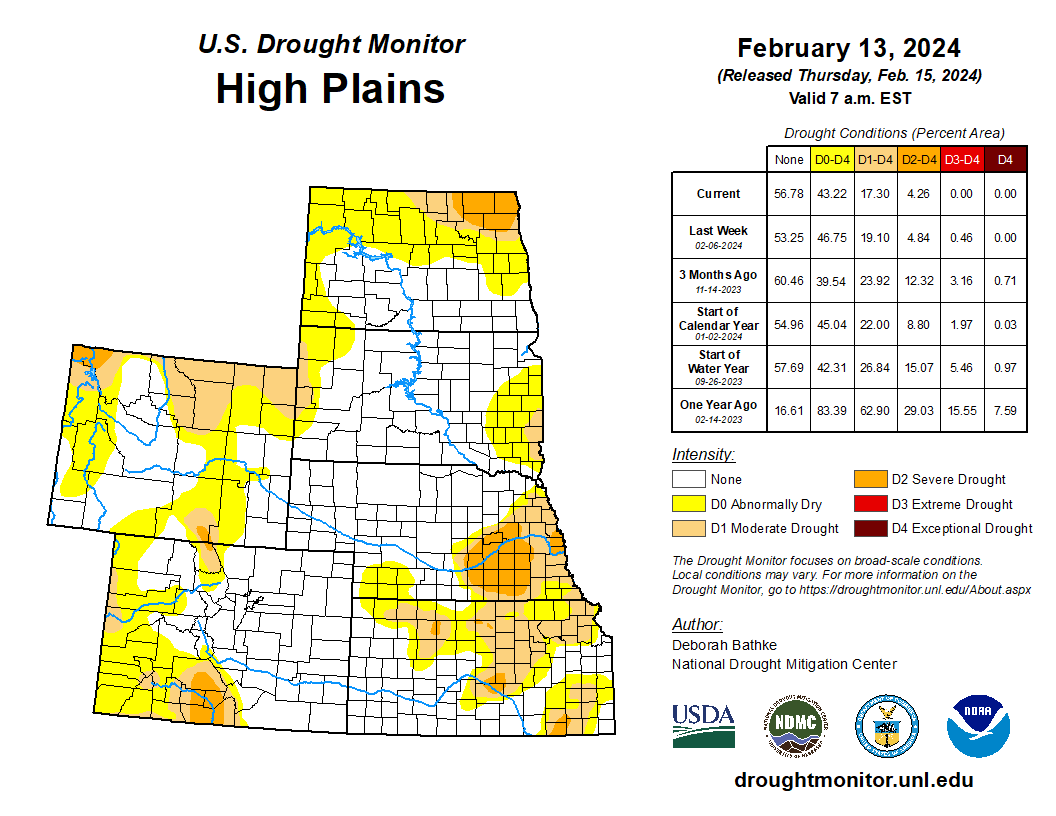
High temperatures averaged about 8 to more than 20 degrees above normal. Precipitation of less than 0. 5 inches fell across much of the Dakotas, Nebraska, and Kansas. Southwest Nebraska, Kansas, and eastern Colorado saw 1-category improvements to long-term drought areas. Short-term moisture deficits have largely been eliminated. A dry signal remains in Nebraska and Kansas at timescales longer than about 6 months and moisture deficits linger in deeper soil levels and ground water. Moderate drought (D1) expanded in western South Dakota, near the Black Hills, and northeast Wyoming due to a lack of snow and below-normal soil moisture levels…
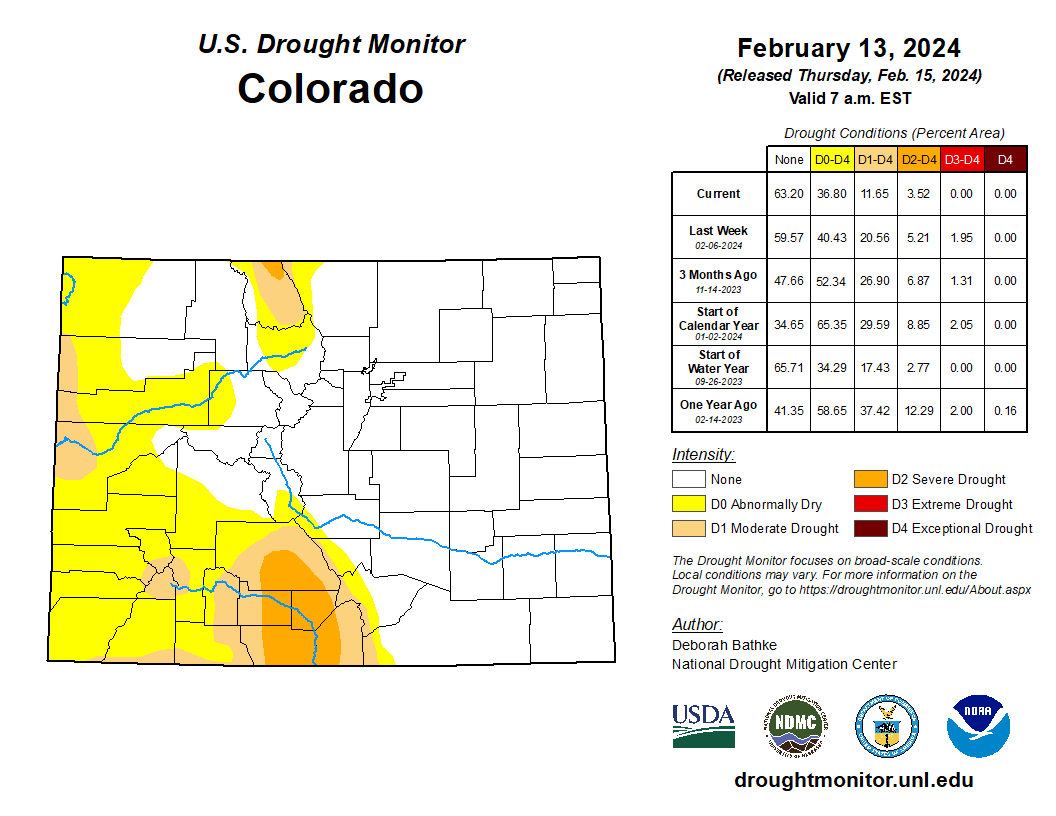
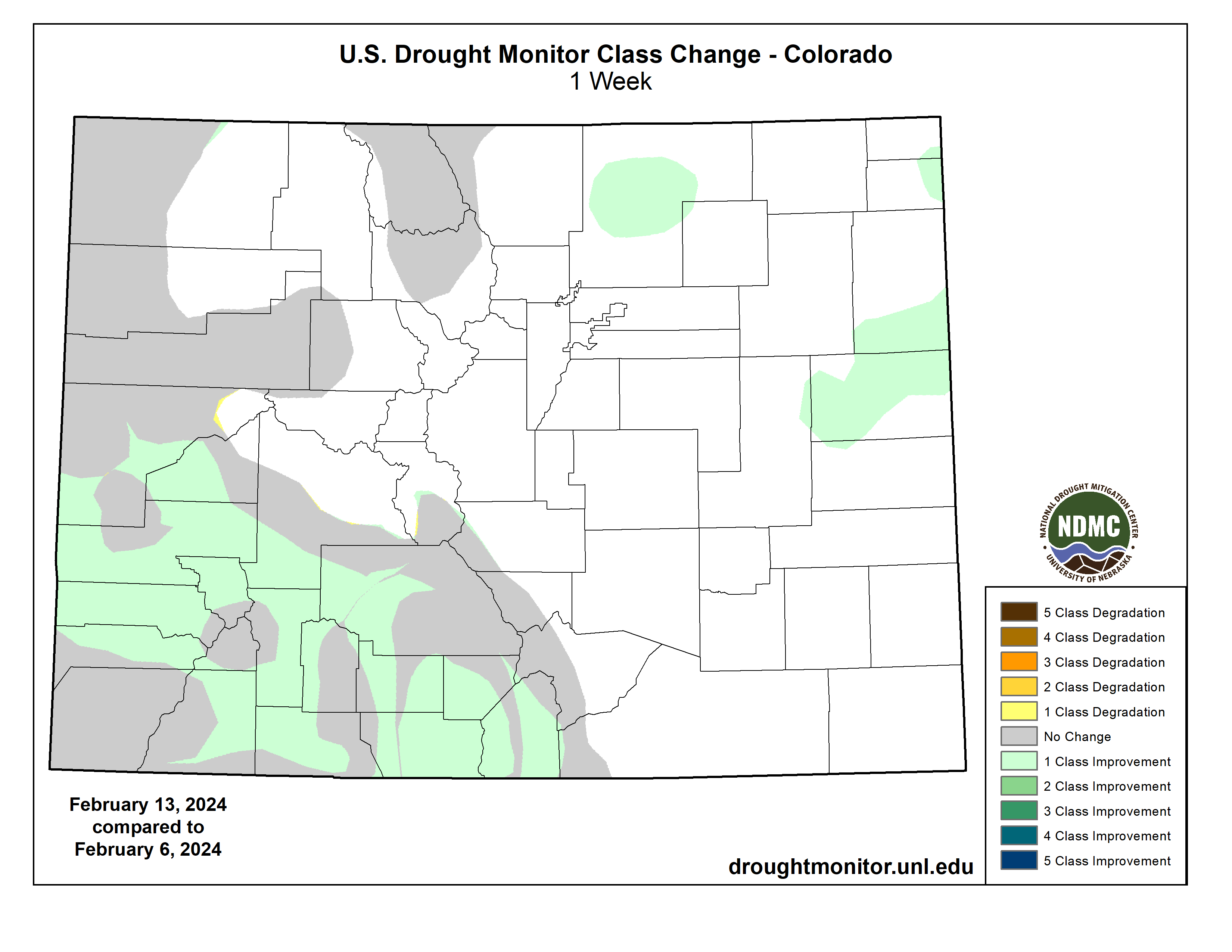
Colorado Drought Monitor one week change map ending February 13, 2024.
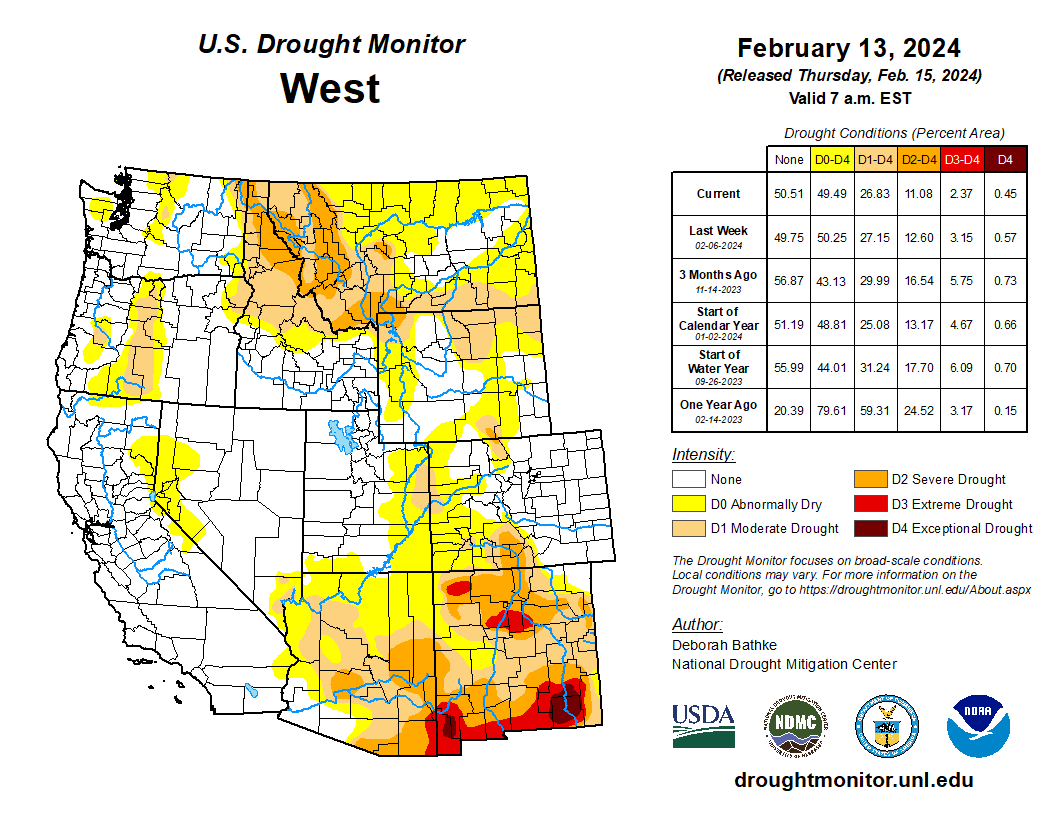
Pacific storms swept across the West again this week, bringing rain and mountain snow. Over 3 feet of snow fell in the northern Arizona mountains. The mountains of Colorado and New Mexico saw over a foot in some locations. The recent storms brought some of the best snowfall totals to date for this year’s snow season. Basin snowpack in the Southwest has returned to near-normal conditions, prompting improvements to areas of moderate (D1), severe (D2), extreme (D3), and exceptional (D4) drought. The largest improvements occurred in New Mexico and southwest Colorado. In the Northwest, basin snowpack remains below normal with some of the worst conditions in the northern Rocky Mountains. This lack of snow led to the expansion of D1 across southern Montana, northern Wyoming, central Idaho, and south-central Oregon. D2 expanded in eastern Idaho and western Montana. D1 improved in southern Washington and northern Oregon where above-normal precipitation over the last six months has helped reduce long-term moisture deficits…
Another round of wet weather brought 2 to 4 inches of rain to parts of Louisiana, Mississippi, and Tennessee. The continued wet weather left a band, stretching from east Texas to northeast Alabama, with rainfall totals of 6 to 12 inches — 200 to 400 percent of normal —over the last 30 days. Much of the region saw 1- and even 2-category improvements to drought conditions. All exceptional drought (D4) has been eliminated. Moderate (D1), severe (D2), and extreme (D3) drought remain in the region where drought signals can still be found in long-term indicators. Despite the record-breaking rainfall over the last several weeks, deficits of 4 to 10 inches over the last six months remain over parts of many parts of the region. Groundwater levels and deeper soil moisture also remain historically low for this time of year in some places. West Texas was the only area where drought expanded. Moderate drought (D1) was added in response to growing long-term moisture deficits and impacts to soil moisture, groundwater, and vegetation…
Looking Ahead
The National Weather Service Weather Prediction Center forecast (valid February 15 – 17, 2024) calls for another round of rainfall to push into the West Coast, bringing heavy rain and high elevation snow to the Cascades, Sierra Nevada, and the Northern Rockies. Polar air from Canada is expected to bring cold, dry air into the Northern Plains. Snow is expected across the Central Plains and Ohio Valley. Heading into the weekend, the extended forecast (valid February 17 – 21, 2024) calls for increased chances of multiple atmospheric river events for parts of central and southern California. Areas of lighter precipitation may spread across other parts of the west. The Upper Midwest and Northeast may see some snowfall. Storms tracking across the Gulf of Mexico may bring rain to Florida. The Climate Prediction Center’s 6-to-10-day outlook (valid February 20 – 24, 2024) calls for an increased probability of above-normal temperatures across most of the continental U.S. (CONUS) and Alaska. Temperatures across southern California, the East Coast, and northern Alaska are expected to be near to below normal. Increased precipitation is expected across California, the interior West, southern Alaska, and the Northeast. Much of the remaining CONUS, northern Alaska, and the Big Island of Hawaii are expected to have below- or near-normal precipitation.
US Drought Monitor one week change map ending February 13, 2024.
Last post, I laid out some reasons why the water mavens now engaged in mapping out Colorado River management strategies beyond 2026 – the year ‘interim’ management strategies expire – should consider laying the Colorado River Compact to rest, archiving it along with most of the chain of subsequent compacts, rules and guidelines, legislated acts, minuted treaties and interim patches and props known as the ‘Law of the River,’ and start over with a new compact that actually reflects contemporary river realities.
One of those reasons was the fact that the Compact had failed from the start in its primary goal: to provide for an ‘equitable division and apportionment of the use of the waters’ that was not driven by the prior appropriation doctrine, which was leading the seven states into an appropriation ‘horse race’ in which California was already lapping the other six states.
Over the past years we have heard again and again, in speech and in print, that the Colorado River Compact is the ‘foundation of the Law of the River.’ That is just not true. The foundational law of all the law governing use of the river is the doctrine of prior appropriation, which all seven of the compact states had adopted from the time they were territories, as a vehicle for the reasonably orderly distribution of essential water among water users in the arid and semi-arid lands. [ed emphasis mine]
That is what we’re going to look into today – the doctrine of prior appropriation that is the foundation on which the formal and informal management of the river is built. (Fools tiptoe in where mavens fear to tread.)
The appropriation doctrine for the use of water in arid regions evolved literally everywhere at once in the arid West, a grassroots ‘common law’ that was only formalized, not created, when states wrote it into their laws and constitutions. ‘Common law’ refers to the ‘justice’ that people agree upon in resolving problems among themselves before there are local governments with sheriffs and judges to apply justice for them.
An appropriator of water could be anyone from an individual to a whole ditch company organized in a number of ways. An appropriation of water was created by just digging a ditch from a stream to put some water to use, and if you were smart posting a dated notice near it and starting a ditch journal at home. But no one needed to be asked for permission, and evidence of actual use amounted to proof of appropriation. ‘The right to divert the unappropriated waters of any natural stream to beneficial uses shall never be denied,’ the Colorado Constitution says.
But as more people came to use the streams, priority of appropriation became an issue that had to be resolved between parties wanting to use the same water in the pre-law period. That was probably resolved reasonably amicably in many cases; but for the rugged American individualist yeomen invented by Thomas Jefferson and John Locke, it could get tense, even violent; and the common rule arrived at among the unruled, when neither side would yield, was that the first user had the better claim, and got his water first, with the subsequent users in ranked priority for what was left. Once county and state offices were set up, land and water appropriation claims could be officially filed, with law enforcement to back them, which made it all easier, but still it occasionally resulted in open competitive conflict, in a nation of rugged individualists.
Appropriation law has developed a reputation today of being terribly complex, but it is all founded on that simple default premise, easily understood even by children on the playground: first come, first served. Although it should be acknowledged that the appropriation and privatization of water from the commons is not a universally accepted ‘God-given’ practice.
It should also be noted that a sociopolitical philosophy underlay appropriation law as it first evolved in the arid lands. The ‘agrarians’ – farmers and would-be farmers in counterrevolutionary retreat from the dominant Industrial Revolution back in the states – wanted to protect themselves from the speculators scouring the continent for investment opportunities for private capital. So their law insisted that no one could appropriate more water than he or she could put directly to use (or show ‘due diligence’ in installing the works to put the water to use). This prevented speculators from appropriating whole streams, to profit from selling or leasing to would-be farmers.
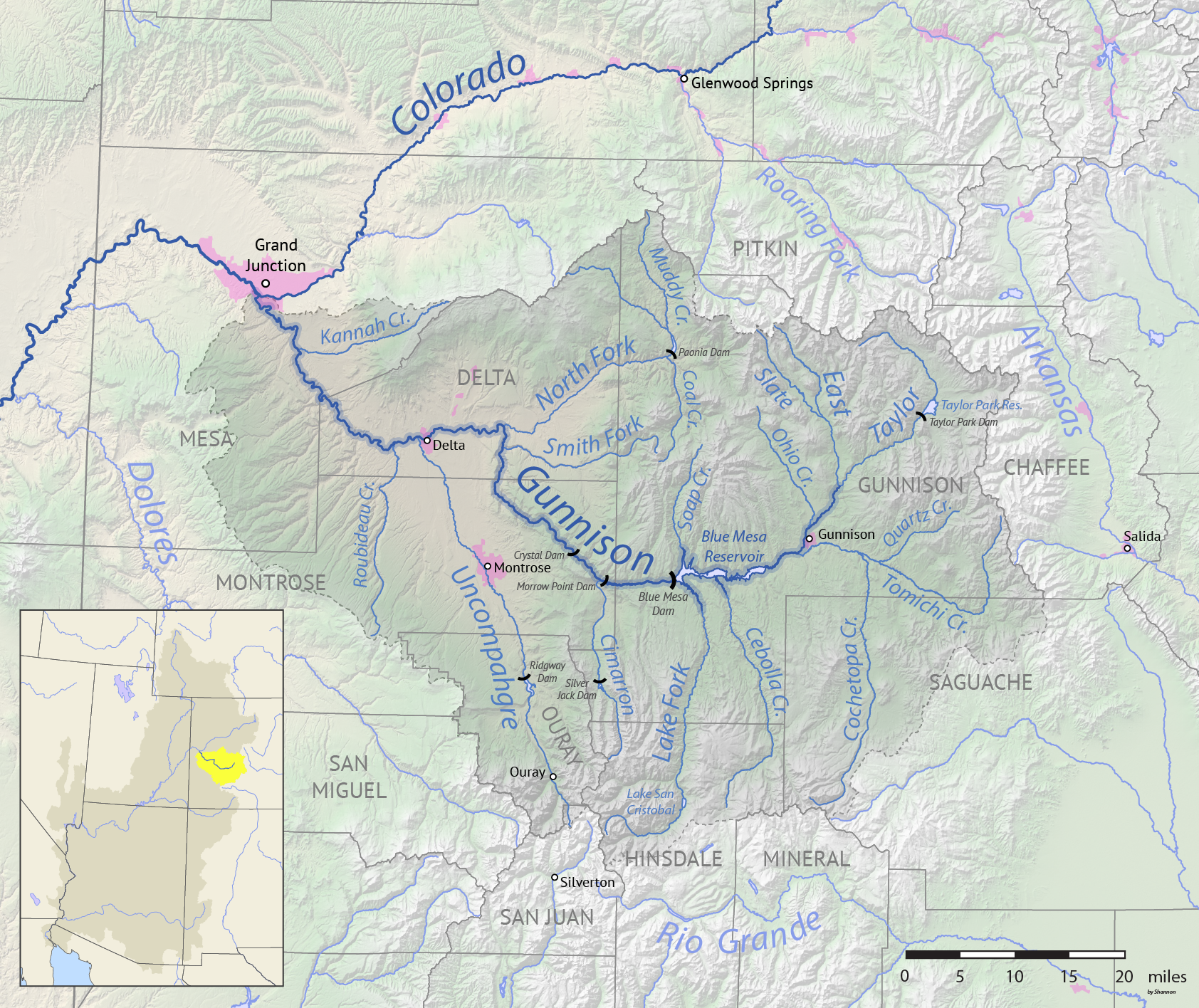
The emerging law also said that no riparian users could keep subsequent appropriators from access to the stream, even if it meant letting a junior user run a ditch through their fields. While appropriation was oriented toward the individual, this condition encouraged collaboration among users on a stream: the first user’s ‘mother ditch’ could be enlarged to carry water to other farms rather than cutting through the first users’ fields. My great grandfather James Short and his brother Frank started a floodplain ditch in the valley of the North Fork of the Gunnison River that, by the time they filed for a water right in 1889, had 21 farmers using the enlarged ‘Short Ditch,’ all named in the decree.
The Short brothers did not create a formal ‘ditch company’ for their often-enlarged ditch, but when it came to settling the mesas and benches above the floodplains, requiring long expensive upstream conveyance ditches, ditch companies were almost necessary, formally registered companies with a large appropriation shared out among the funding members once the system was completed. Entrepreneurs also somehow skirted the speculation issue, purchasing dry uplands at a low price and running a long conveyance ditch to it in order to resell it as irrigated land. Incorporated and unincorporated communities appropriated water for domestic and industrial purposes – the City of Gunnison went from a sagebrush flat to a ‘Tree City’ designation, thanks to a municipal ditch system along its streets.
For those interested in the agrarian roots of the prior appropriations doctrine, an excellent book on the subject is The Colorado Doctrine: Water Rights, Corporations, and Distributive Justice on the American Frontier by legal scholar David Schorr. It is all very straightforward, if not all as simple as the basic premise.
Complexity began to enter the system as users on the streams increased, and all local streams conflued with other streams, all with water users with rights in priority too; seniority in one watershed was not necessarily seniority in the downstream confluence with several watersheds.
State Engineer’s Office Division boundaries. Division 1 in Greeley: South Platte, Laramie & Republican River Basins. Division 2 in Pueblo: Arkansas River Basin. Division 3 in Alamosa: Rio Grande River Basin. Division 4 in Montrose: Gunnison & San Miguel River Basins, & portions of the Dolores River. Division 5 in Glenwood Springs: Colorado River Basin (excluding the Gunnison River Basin). Division 6 in Steamboat Springs: Yampa, White and North Platte River Basins. Division 7 in Durango: San Juan River Basin and portions of the Dolores River.
Hierarchies of state engineer and water commissioners had to compile all of that inter-watershed information and organize it by priority for entire river basins – eight major basins in Colorado alone. This was a formidable task in the pre-computer era; now we can look up water rights in minutes.Other complexities emerged, however, that began to change prior appropriation law – essentially a grafting of the urban-industrial mainstream game plans onto its agrarian roots. This complexity would have been precluded, or at least deferred, by a second simple rule proposed by the explorer-scientist Major John Wesley Powell. In his famously ignored 1877 ‘Report on the Lands of the Arid Regions’ – actually a detailed plan for an agrarian West – Powell proposed that, since the land was essentially worthless without the water, the right to use the water should ‘inher’ in the title for the land – land and water bound together as a single property.
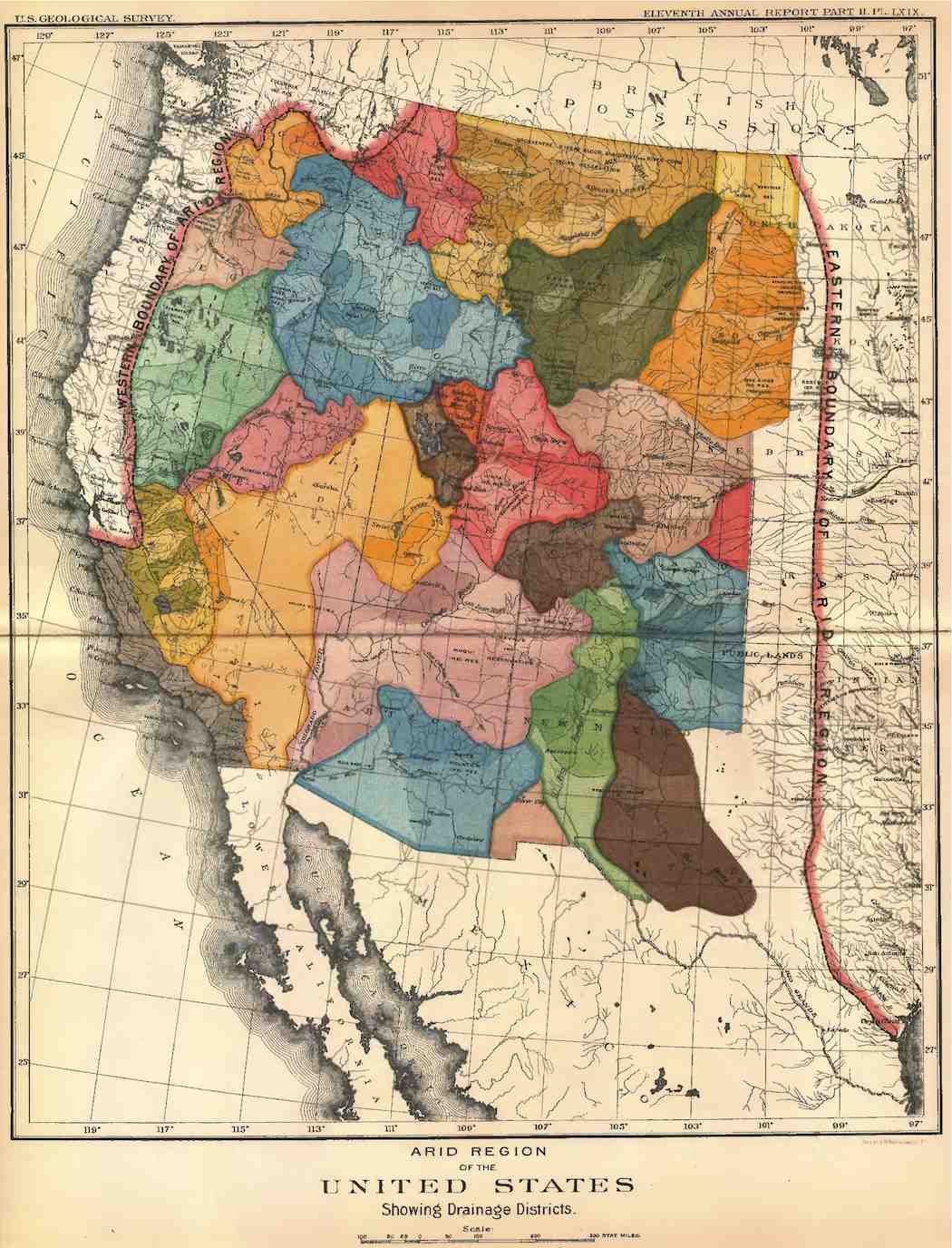
John Wesley Powell’s recommendation for political boundaries in the west by watershed
His recommendation was ignored everywhere. Instead, land titles and water rights evolved as separate ‘properties.’ The right to just use a quantity of water became a property that could be bought and sold, like a piece of land or an automobile, separate from the land it nourished. And the sold water right kept its place in priority with the new owner; seniority went along with the purchase of the right to use the water.This freeing of water rights from their original purpose, alone, made the appropriations laws a powerful engine for the growth of great cities. Growing cities, with their concentrated wealth, could grow well beyond the limits of their own local water supply by buying water rights from users many miles distant and bringing the water to the city.
Laramie and Poudre Tunnel inlet October 3, 2010.
But an incident in two small tributaries of the South Platte River in Colorado’s Front Range led to further complexity – or opportunity, as the western city builders would have seen it. A little water was taken across a ridge from one watershed into another on Colorado’s Front Range. This was contested in water court by users from the basin of origin because they said it limited the future development of their watershed. The court, however, found that insufficient reason to deny this small ‘transbasin diversion.’
But given that foot in the door, the door was pushed open for much larger transbasin diversions – transmountain diversions, even through the Continental Divide, with no legal responsibility on the diverter to compensate the basin of origin for water appropriated or purchased, and the resulting loss of a piece of its future (sine agua nada).
These ‘complexities’ showed up in one form or another in the appropriation laws throughout the arid West. California, as usual, was first to really exploit it, bringing questionably acquired water a hundred miles from the Sierras to the Los Angeles Basin in the first decade of the 20th century. Transmountain diversions have been the cause of most of Colorado’s so-called ‘water wars,’ with the urban-industrial metropolis east of the Continental Divide now taking half a million acre-feet annually from the West Slope’s Colorado River headwaters.
Colorado transmountain diversions via the State Engineer’s office
The ‘great and growing cities’ of the eastern plains also managed to undermine, or at least muddy, the appropriation doctrine’s fundamental anti-speculation mandate, to only appropriate as much water as you could put directly to use. In the 1930s Denver leased and lined the pilot bore for the Moffat Tunnel, to move water through the Divide from the Fraser River on the West Slope. In 1937 the city filed for a Fraser water right that was almost twice as much water as they could put to use, planning to lease the rest to East Slope agricultural users until the growing city needed it.
The leaders of the newly created Colorado River Water Conservation District, protecting the West Slope’s water, challenged that additional water as speculation. The district water court judge agreed with them, and reduced the city’s claim accordingly. But Denver appealed the decision to the Colorado Supreme Court – which reversed the district judge’s finding, determining that ‘it is not speculation but the highest prudence on the part of the city to obtain appropriations of water that will satisfy the needs resulting from a normal increase in population within a reasonable period of time.’
Map credit: AGU
The courts have gone back and forth for decades now, trying to pin down what constitutes ‘prudent’ acquisition of water to meet ‘a normal increase in population within a reasonable period of time.’ But the sprawling urban growth throughout the Southwest since World War II has essentially made distinctions between ’normal growth’ and ‘speculation’ meaningless. And most of that growth has depended on water brought in from distant places – some acquired from farmers, for whom water rights constitute a good retirement package.
The mythographers of money like to say that ‘in the West water flows uphill toward money,’ implying an effortless magnetism for money. The truth is that large quantities of money come out from the concentrated wealth of the cities to suck up – at a considerable but affordable cost – the water (as well as other raw resources) to feed the cities’ growth.
One can argue – I might even – that the anti-capitalist appropriations law as conceived by the agrarian ‘counterrevolutionaries’ was at best a holding action that could not forever hold off the juggernaut of the Industrial Revolution rolling across the continent. One can also point out that, despite all this, the farmers still own the rights to 70-80 percent of Colorado River water. But that is mostly just because the urban-industrial juggernaut hasn’t needed more of it, yet; and in any case most of the agriculture in the Colorado River region is pretty thoroughly industrialized agribusiness. (Only in the headwaters tributaries does one still find a hereditary agrarian ‘agri culture’ – and it is feeling besieged.)
Those major ‘complexifications’ of the original simple idea of prior appropriation law probably barely scratch the surface of the ever more complex evolution of the prior appropriation doctrine, an evolution that goes on despite – or maybe because of – the fact that there is really no more water to appropriate from the exhausted commons.
There is, however, one more complexification that needs to be considered, to really understand where things are today in the Colorado River region, and that is the Colorado River Compact itself, and the rationale behind it that failed in trying to go around the appropriation doctrine rather than going through it.
But I’ve gone on long enough on this post; that will be for next time – with some thoughts on how we could maybe sketch out a compact that might work to address some of the challenges we face, now and beyond 2026, that the current Compact can’t resolve. Stay tuned.
Colorado River “Beginnings”. Photo: Brent Gardner-Smith/Aspen Journalism
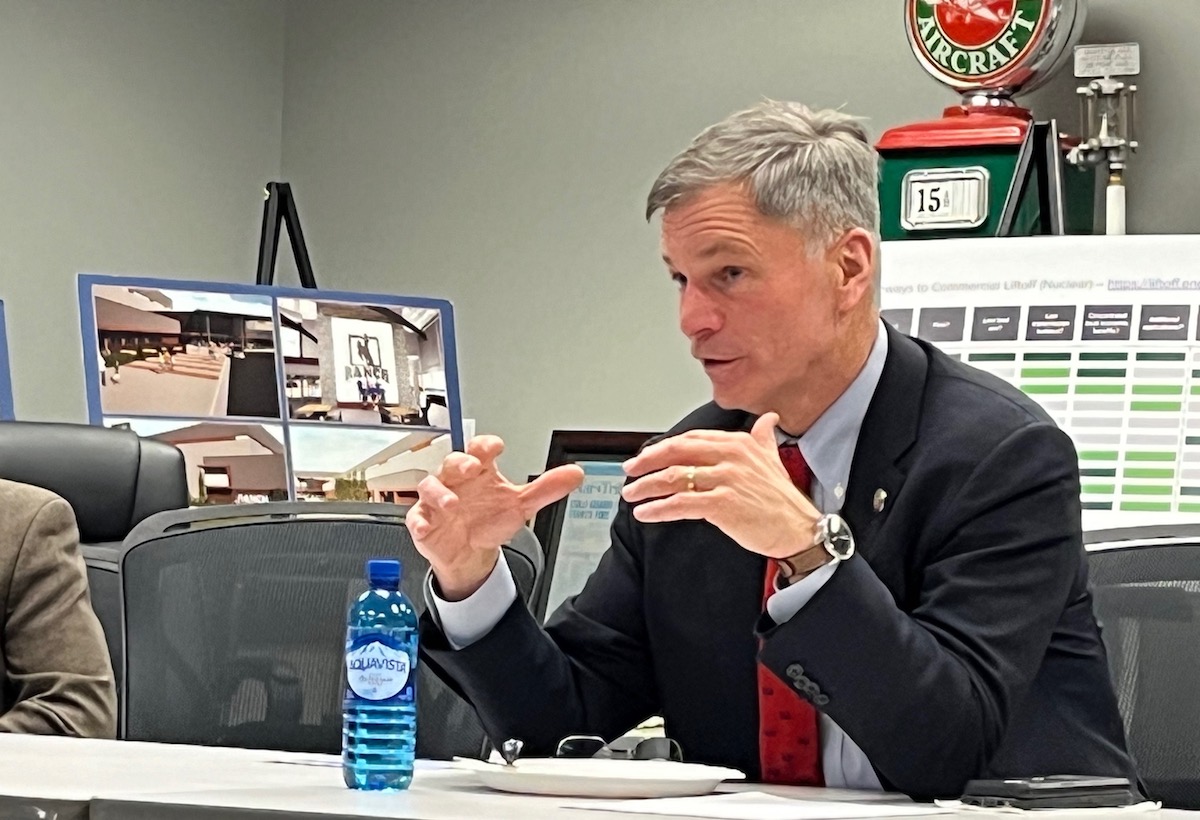
Gov. Mark Gordon spoke with Advance Casper members Feb. 13 2024 in Casper. (Dustin Bleizeffer/WyoFile)
Click the link to read the article on the WyoFile website (Dustin Bleizeffer):
February 14, 2024
Governor Mark Gordon’s push for carbon capture at coal-fired power plants and for pumping planet-warming carbon dioxide underground to produce more oil isn’t a climate crusade, he told business leaders Tuesday in Casper. It’s an acknowledgment of where policies outside Wyoming have driven markets.
Wyoming, the nation’s top coal producer and among its top oil and natural gas producers, can help meet the goal — and the market reality — of reducing carbon emissions into the atmosphere, he said. But the state doesn’t have to abandon its fossil fuels to do it.
Instead, Gordon is on a mission to prove that integrating carbon capture with fossil fuel production and use is not only economically and technically viable, it’s necessary to fill in the energy-availability gaps that renewable energy introduces into the western electricity grid when the sun doesn’t shine and the wind doesn’t blow.
And if people are honest about the full cost and complete carbon life cycles of both renewables and fossil fuel energy, more states will get on board, he said.
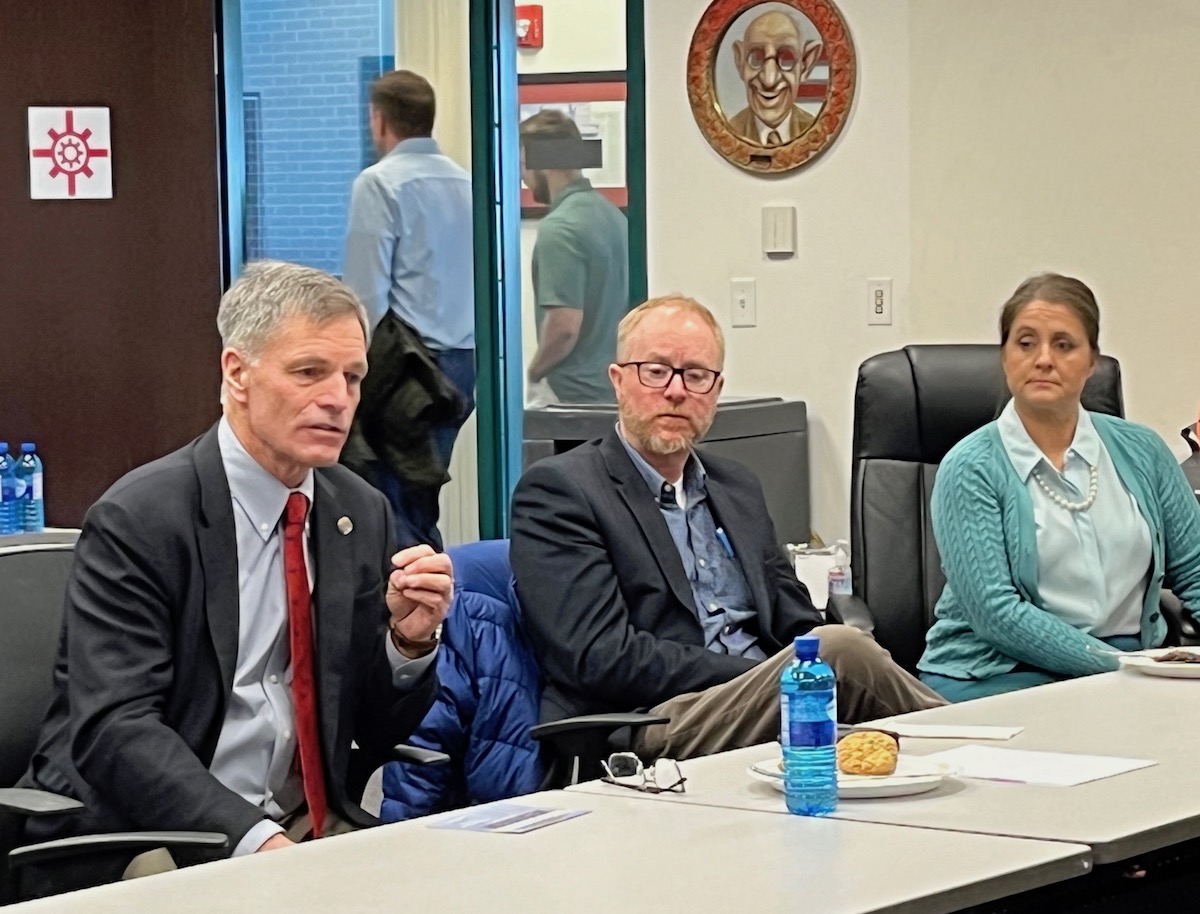
Gov. Mark Gordon visits with Casper business leaders Feb. 13 2024 in Casper. (Dustin Bleizeffer/WyoFile)
“If we can extend the life of these coal plants [by retrofitting them to capture carbon] for a period of time, we can meet that gap,” Gordon told members of Advance Casper, the city’s business and economic development group.
Gordon has been aggressively sharing his energy vision of late. He spoke last fall at Harvard University, which drew a strong rebuke from Wyoming’s far right. He also appeared on “60 Minutes,” where the governor discussed making the state carbon-negative.
One challenge, Gordon explained to members of Advance Casper, is that states that are demanding low-carbon or carbon-free electricity are not fairly distributing those costs, which include the loss of viewsheds and wildlife habitat from wind and solar farms in Wyoming. At the same time, those states don’t want to help pay to capture carbon at Wyoming coal plants, despite their own carbon policies that push costs onto Wyoming ratepayers.
“We need to be able to have the grid pay for the desire to reduce carbon emissions — that’s consumers across” the West, Gordon said.
To that end, Gordon has been lobbying his counterparts in the Western Governors Association. Gordon was elected WGA president last summer, and he established “Decarbonizing the West” as his signature initiative during his one-year tenure.
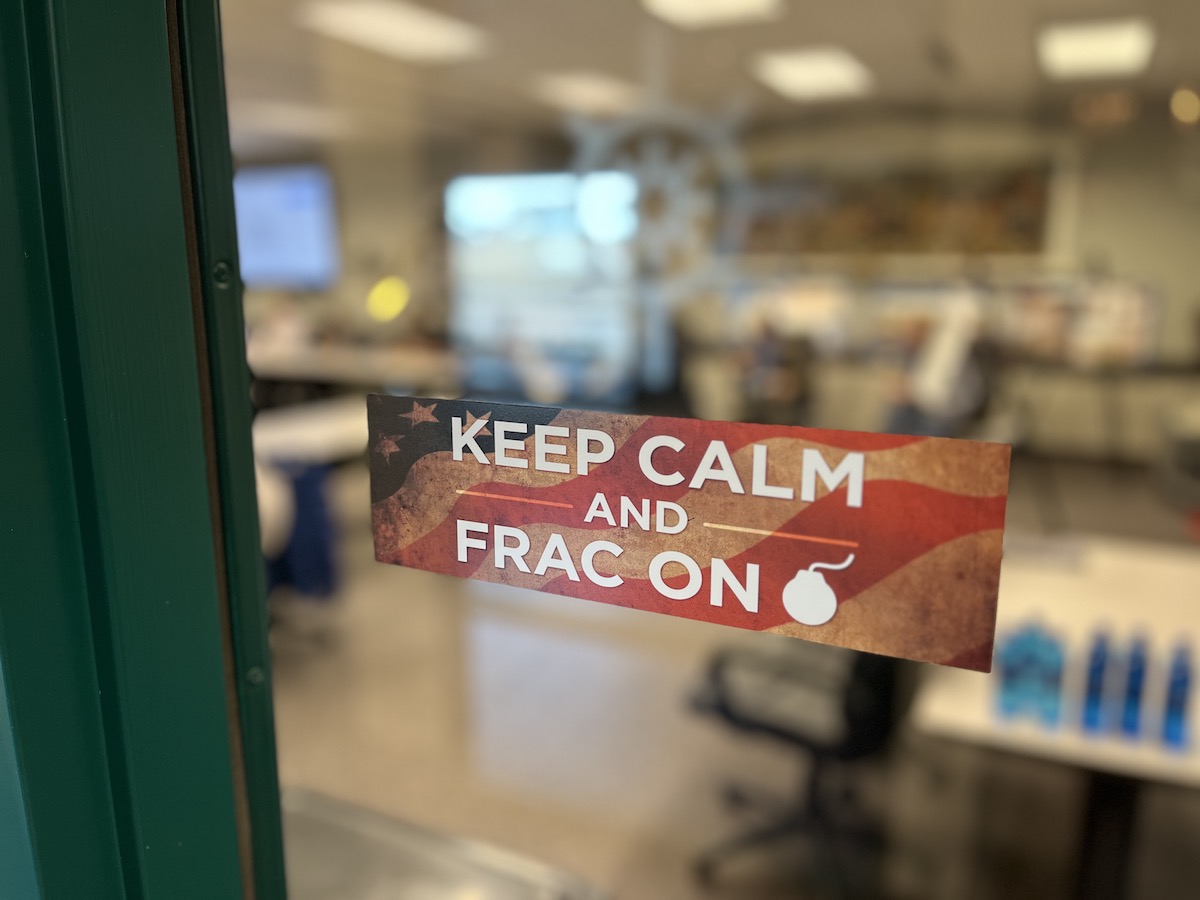
A sticker at Nerd Gas Co. in Casper. (Dustin Bleizeffer/WyoFile)
The initiative spans an all-of-the-above energy strategy, from nuclear and geothermal power to smarter siting of wind and solar development. Bringing some of those western state leaders onboard with his ideas for adding carbon capture to fossil fuels is still a challenge, Gordon said.
Meantime, the Biden administration — although it’s onboard with Wyoming’s carbon capture research efforts — continues to present existential threats to the state’s struggling fossil fuel industries through restrictive rulemakings to cut carbon emissions, the governor maintains.
State of the state’s energy
In his State of the State address on Monday at the Capitol, Gordon said the Legislature’s task of crafting a state budget for the next two years is particularly challenging under the weight of federal policies that the Biden administration continues to pile on fossil fuels — an industry that has “anchored our economy for over a century,” Gordon said.
The weight of Wyoming’s fossil fuel economic anchor has varied greatly in recent years, and it’s the largest factor in setting the state’s budget — in boom times and in bust. Although revenue from Wyoming’s carbon-based energy industries rebounded after the economic shock of the pandemic, markets have begun to settle back into broader trends that point to a continued decline in Wyoming coal consumption and the potential for even more volatility for oil and natural gas.
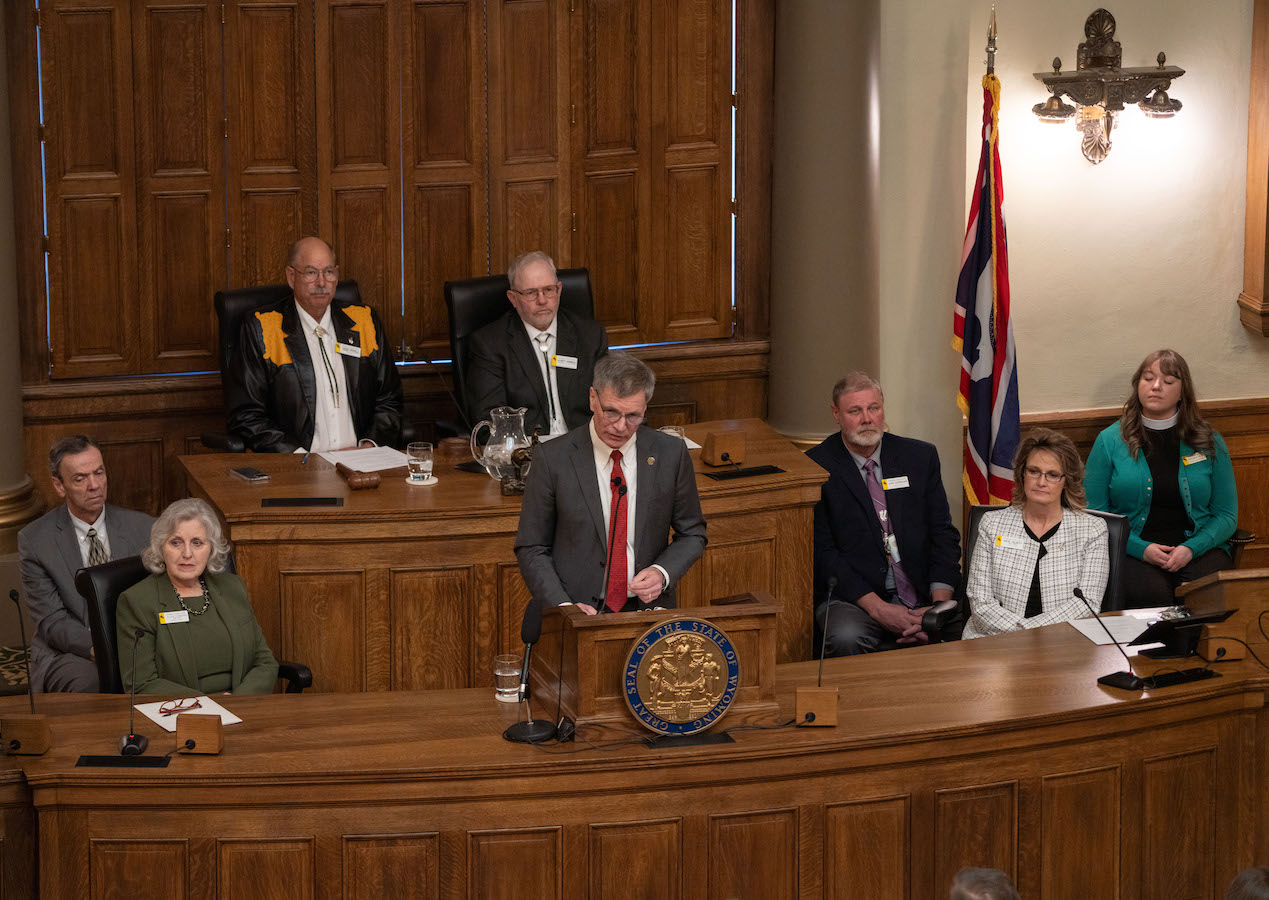
Gov. Mark Gordon gives his State of the State address Feb. 12, 2024, at the Capitol in Cheyenne. (Ashton J. Hacke/WyoFile)
They also represent a federal policy agenda that is “misguided,” “warped” and “unwise” — and, borrowing from a phrase by Gulf War military leader Gen. Norman Schwarzkopf, they amount to “pure, unadulterated ‘bovine scatology,’” Gordon declared.
“Wyoming people know how these policies have left our nation more vulnerable to put our economy — our very way of life — at risk,” Gordon said.
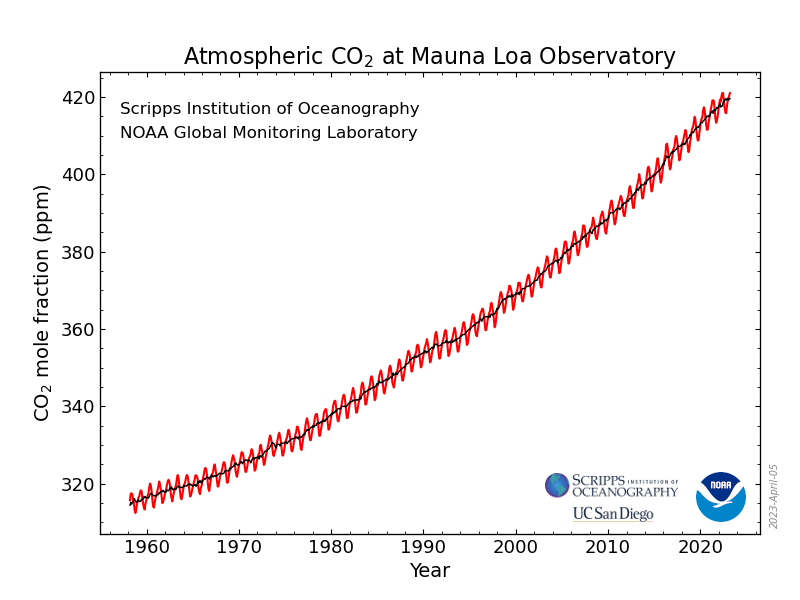
Mauna Loa is WMO Global Atmosphere Watch benchmark station and monitors rising CO2 levels Week of 23 April 2023: 424.40 parts per million Weekly value one year ago: 420.19 ppm Weekly value 10 years ago: 399.32 ppm 📷 http://CO2.Earthhttps://co2.earth/daily-co2. Credit: World Meteorological Organization
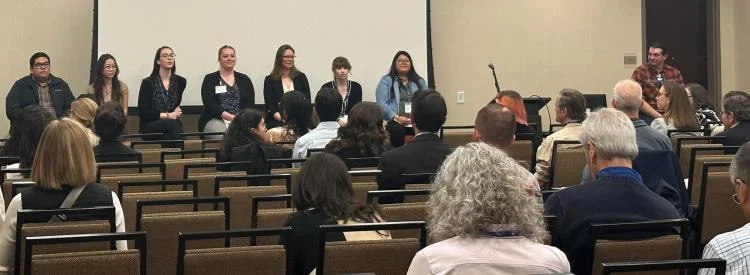
Future leaders panel with Gregor MacGregor. Photo credit: Andrew Teegarden
Phil Weiser and Dan Gibbs. Photo credit: Andrew TeegardenPanel discussion Colorado Water Congress 2024 Annual Convention. Photo credit: Andrew Teegarden
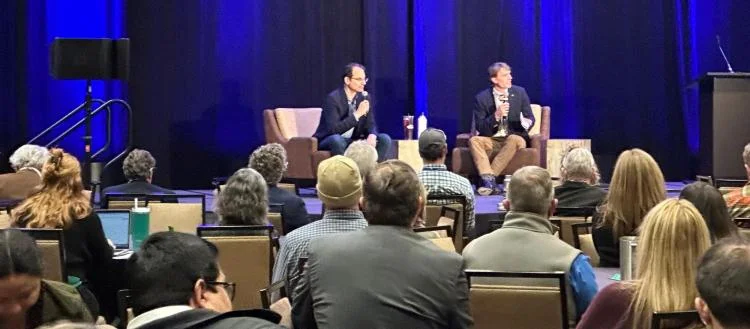
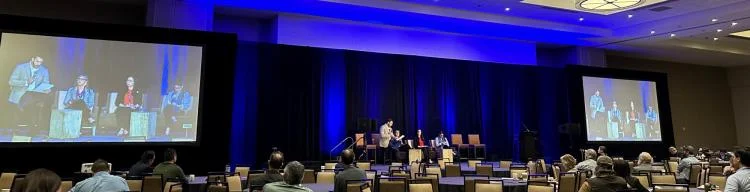
The Colorado Water Congress (CWC) winter convention in Aurora, CO has been buzzing with excitement. The conference kicked off with a series of water related workshops. Gregor MacGregor, Director of the Acequia Assistance Project at the Getches-Wilkinson Center (GWC), moderated a panel on the future generations of water leaders. One of the panelists, Mary Slosson, a 3L at the Colorado Law school, talked about the uncertainties of a legal profession in the water space. All of the students on the panel echoed the idea that we need young leaders to help drive change and that doing so requires organizations to work with the next generation of leaders to remove the barriers to access a career in the water sector. While this was happening, Jackie Corday with Corday Natural Resources Consulting, gave a training on SB23-270, describing how members within the state can restore natural streams without needing to obtain a water right. Other notable highlights included Author Erica Gies presentation on her recent book Water Always Wins which describes how to work with water rather than against it. The conference also jumped into the practical side of water by examining drought, resilience, and risk.
The first day of the conference ended with the POND casino night. The casino night has been a reoccurring event of the winter CWC convention because many of the conference topics center around risk tolerance. During the event, members of the Colorado Water Congress Board and I served as blackjack dealers for the night and helped people press their luck!
Day two of the conference focused on federal funding updates, legislative priorities, and how Colorado leaders plan to address our current issues. KC Becker, EPA Administrator for Region 8, talked about the funding available under the Bipartisan Infrastructure Law and Inflation Reduction Act. KC estimated that Colorado will see approximately $140 million dollars each year over the next three years to use for implementing water projects with an emphasis on disadvantaged communities. In addition, various mayors from across the state discussed how the legislature needs to begin integrating water planning and land use. Specifically, how replacing lawns and other non-usable grass with turf will help cut down on unnecessary water usage. Day two ended with a conversation between Dan Gibbs, the Executive Director of DNR and Phil Weiser, the Colorado Attorney General. They discussed the passion they share for the water community and the need for all water users to come together collectively and compromise to assure a water secure future for Colorado. Phil even gave a shoutout the the late Charles Wilkinson, Colorado Law Professor and namesake of the GWC, for the impact he had on both Phil and the larger water community.
The final day of the conference focused on cooperative action, what priorities states are looking to advance, and recognizing Kevin Rein with the Honorary Life Membership Award for his work as the Colorado State Engineer and Director of the Division of Water Resources. Members of the lower basin pointed to the 2007 guidelines, including the Drought Contingency Plan, and agreements with Mexico as major milestones in the cooperative effort to bridge the gap between the lower and upper basin. States also replied that we must begin looking for unique ways to save water whether that be infrastructure projects, cooperative agreements, or water conservation measures. Ultimately, it will take all of us to align our water usage and supply.
Clearly, a lot of ground was covered during CWC’s winter convention. If there was one take away, it would be that we need to begin analyzing the risk of inaction. [ed. emphasis mine] If we keep waiting to take a stance or begin water infrastructure projects, we will only hurt Colorado and the Colorado River Basin in the long run. One way we can reduce the risks is by working with one another and allowing water to shape the future of our actions.
Click the link to read the article on the InkStain website (John Fleck):
February 10, 2024
Folks in Colorado’s San Luis Valley are engaged in a bold experiment in western water management – charging farmers for the water they use. Jerd Smith [Fresh Water News] explains:
The challenge in the valley is that, with climate change inexorably chomping at the Rio Grande, and the groundwater used to replace the river’s dwindling irrigation supplies, there simply isn’t enough water to keep farming all the acreage they’ve got up there.
The valley is operating under the same two constraints that we see up and down the river – less water flowing in, and requirements established in the Rio Grande Compact to pass some of what does come in to folks downstream – Colorado can’t use it all, but must pass some water along to water users in central New Mexico. Those of us in central New Mexico’s “Middle Rio Grande” (the stretch from Cochiti through Albuquerque to Socorro) get to use some, but must pass some of on to farmers in Southern New Mexico. Under the deal now pending before the U.S. Supreme Court, the southern New Mexican’s (the Elephant Butte Irrigation District and Las Cruces area) must then pass some water across the border to people in Texas and Mexico.
PAYING TO REDUCE USE: PRIVATE V. PUBLIC GOODS
In each of those stretches – Colorado, central New Mexico, and southern New Mexico – we face the challenge of reducing use in order to meet downstream obligations.
In New Mexico, our approach to problems like this has been to treat the water as a private good, and pay its users to not use the water. This year, for example, a pipeline of money from the federal government, through the state, to our local water agency, the Middle Rio Grande Conservancy District, is paying irrigators $700 an acre to not irrigate.
The approach in the San Luis Valley is different. There, farmers who want to pump groundwater (recognizing that groundwater and surface water are an interconnected part of a single system, and that as river flow declines farmers have been pumping groundwater to replace it) have to pay for it. If you want to pump more, you have to pay more. And as it gets scarcer, the price needs to go up.
The legal terminology involving the notion of property rights here is tricky, but as a practical matter this suggests two very different approaches. In New Mexico, we are treating the water as the irrigators property, and paying them to forego its use. In Colorado, they’re treating it as public property, and requiring them to pay if they want to use it.
THE COASIAN SOLUTION
Students of the Berrens-Fleck Lab will recognize this as a version of the classic problem of assigning the property right, as laid out by Ronald Coase in his classic 1960 paper The Problem of Social Cost. Overuse of water in a climate change-constrained system is a classic “externality” – a burden pushed off onto others, rather than the people who get to benefit from the use of water. [ed. emphasis mine]
Coase’s answer – “assign the property right!” – has made his paper one of the most-cited papers in the history of papers, and won him a Nobel prize. Coase’s argument is that by assigning the property right, and starting from that point to figure out who pays and how much to solve the problem, we can converge on solutions. You can either make the people being harmed pay to stop the harm, or the people causing the harm pay to stop the harm.
We can, for example, require the factory polluting our river pay the cost of installing pollution control equipment. Or we can make the folks downstream, or the community as a whole, pay. Either way will work. The question of which approach we take is an ethical and political question.
Colorado has chosen (or at least is trying to chose – this’ll end up in court) one approach. New Mexico has chosen another.
CARTOON COASE
This is a cartoon of Coase’s argument. In the paper (which is a terrific read) he’s making a more nuanced argument involving transaction costs. In both the New Mexico and Colorado cases, the cost of setting up the payment system makes actually carrying out the policies we need super hard. But the cartoon helps frame our approach to western water management challenges more broadly.
This image is fake. There also is no Large Container Ships Full of Money Act. I made that up too. It’s really the “Build Inflation Better Act” or something, I can never get that right. Graphic credit: John Fleck/InkStain
The Colorado example – charge more to use water! – is rare. In the Lower Colorado River right now, we’re paying farmers, through their agricultural districts, giant container ships full of money to reduce their use – the New Mexico approach. We’re treating the water as their property, and paying them not to use it. This is an ethical and political (and possible legal?) choice.
But the key difference between the New Mexico/Lower Colorado approach and the classic Coasian cartoon is who’s doing the paying. In both cases, at least for now, we’re using Other People’s Money (OPM), via the recently passed Large Container Ships Full of Money Act (LCSFMA). Those of us in the West have somehow worked a racket where folks in Maine and Georgia and elsewhere are paying to bail us out of our mess. (To be fair, I’m sure we’re bailing them out in some way too.)
The processes by which we have to figure out how to move all this money and water around – to pay people to not use water, or to charge them for the water they use – are a great example of the power of the deeper insights in Coase’s 1960 paper. Working out the ways things don’t match up to Cartoon Coase is where the real value of the intellectual framework is found.
SOURCES AND METHODS
Two huge thanks. First, to Daniel Rothberg, whose Western Water Notes alerted me to the issue. And to Jerd Smith, for supporting and publishing the great water journalism we all need to understand these issues. If you can, I’d encourage you to contribute to one or the other or both, to support the fundamental underlying knowledge base we all need to move forward on climate change and western water issues.
The Rio Grande flows near Albuquerque as the sun rises over the Sandia Mountains. (Photo by Diana Cervantes for Source NM)