
In a warmer climate, snow levels rise and snow pack decreases by a HUGE amount. Why? Think about the difference in width of the mountain base vs peak. The drop in snow pack area is huge. (This is an idealized graphic, numbers are only to help explain). The result is this… 🧵 1/ pic.twitter.com/q8vmt9O20K
— Jeff Berardelli (@WeatherProf) February 2, 2024
Day: February 3, 2024
Understanding and Predicting Our Precious Western #Colorado Water Supply — Colorado Climate Center #ActOnClimate #ColoradoRiver #COriver #aridification

Click the link to read the post on the Colorado Climate Center website (Goble, P. E., and R. S. Schumacher, 2023: On the Sources of Water Supply Forecast Error in Western Colorado. J. Hydrometeor., 24, 2321–2332, https://doi.org/10.1175/JHM-D-23-0004.1.):
January 31, 2024
The Colorado River is the lifeblood of the desert southwestern United States. Its water is used by a population of over 40 million people, is an important source of hydropower, and is the source of irrigation for a portion of the United States that produces a wide variety of specialty crops. Our beautiful state is home to some of its most productive tributaries. The Colorado Headwaters, Gunnison, San Juan, and Yampa River Basins, all in western Colorado, combine to produce over 50% of the Colorado River’s average annual discharge.
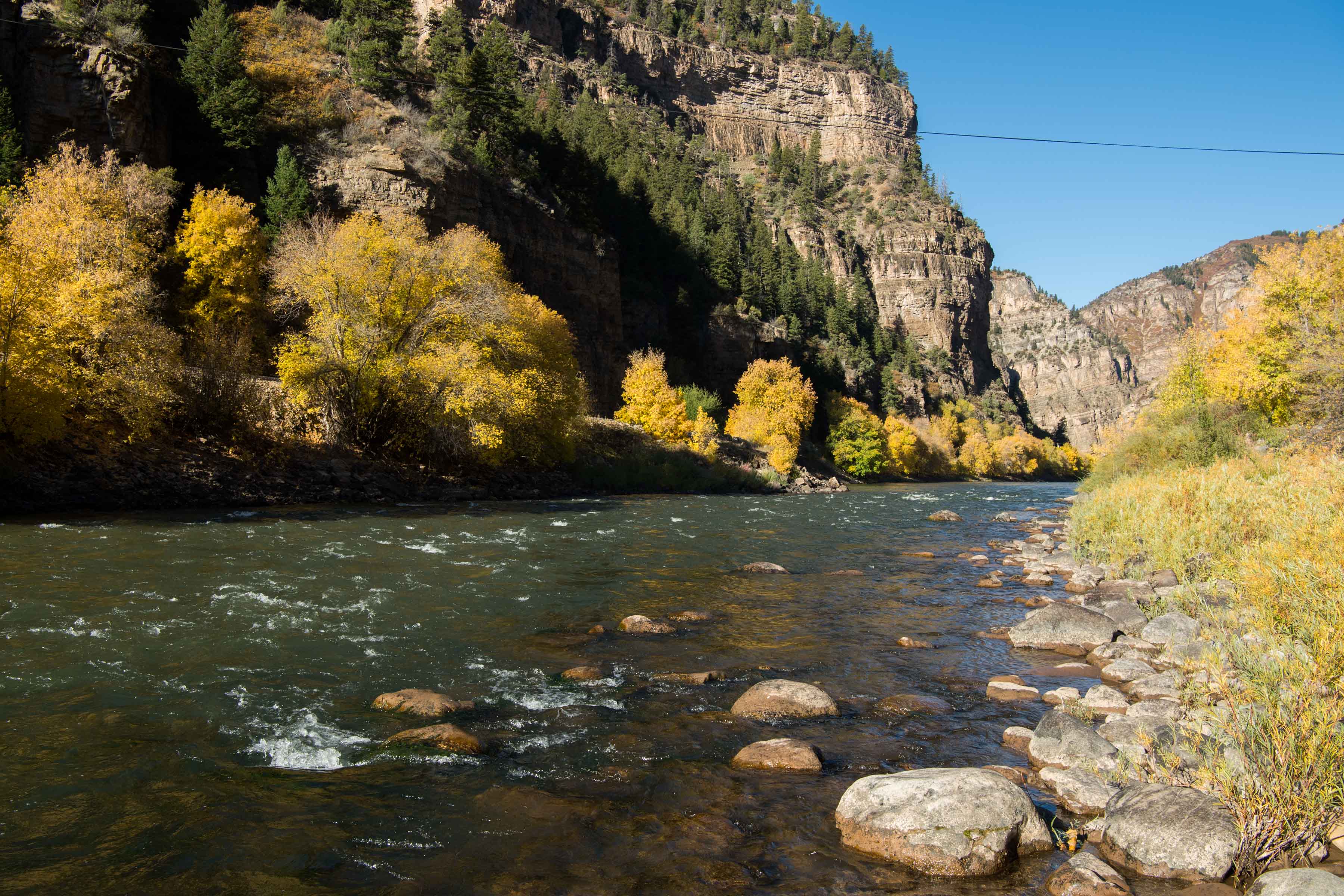
What makes these river basins so productive? Primarily it is snowpack accumulating throughout the cold season (November-April), which melts in the spring and feeds our thirsty lakes, streams, and reservoirs, including trans-basin diversions all the way from Denver to Los Angeles. Some of the Colorado River’s water comes from groundwater and summertime precipitation (an estimated 10-15% according to the Colorado River wiki), but the river is primarily a snow-fed river.

In recent years and decades the Colorado River system has become strained. A combination of climate change, climate variability, and population growth has lead to water demand outpacing water supply along the river system. When this happens curtailments are inevitable; agricultural producers, municipal water managers, hydropower producers, and other water users need to know how much water will be available for the season ahead so they can plan accordingly. To answer this question, water users turn to water supply forecasters, like the Colorado Basin River Forecast Center (CBRFC), and the Natural Resources Conservation Service (NRCS), for answers. April 1st water supply forecasts are crucial to water managers. April 1st is near peak snowpack season, and important benchmark date to those planning for the coming runoff season
April 1st water supply forecasts, such as those produced by CBRFC and NRCS, are fundamentally built around physical and statistical relationships between high elevation precipitation and snowpack measurements in the winter/spring (primarily from the Snowpack Telemetry Network), and gaged streamflow measurements in the spring/summer. After all, the Colorado river is a snow-fed river. This process typically works very well, but 2020 and 2021 yielded much lower than normal runoff despite near normal snowpack at the beginning of April. This rang alarm bells throughout the basin, and raised questions about the role of antecedent soil moisture conditions in the following season’s runoff. Theoretically, if soils are dry at the start of winter due to warm summers and dry autumns, this should reduce runoff in the coming season. As winters snow melts, the water would have to replenish dry soils before filling lakes, streams and reservoirs. 2020 and 2021 were also impacted by dry conditions in western Colorado in April and May. According to the National Centers for Environmental Information April 2021 in particular was the driest April on record for western Colorado.
Both antecedent soil moisture conditions and weather conditions following peak snowpack season negatively impacted western Colorado’s water supply forecast skill in 2020 and 2021. Soil moisture negatively impacted forecasts because it was lower than normal, and not included in all water supply forecast models (it is parametrized in CBRFC’s forecasts). Future weather impacted these forecasts because April and May precipitation were low, and weather forecasting skill is low beyond 7-10 days, so future weather cannot effectively be built into a water supply forecast. Knowing which one of these factors impacted water supply forecasts more is a paramount question because the answer dictates the best pathway for improving forecasts going forward, and how difficult that path will be. Water supply forecast errors from missing or inadequate soil moisture data can be remedied with soil moisture models and observations. Water supply forecast errors stemming from currently unpredictable future weather will persist in the absence of research that adds skill to long-term weather forecasts and seasonal climate outlooks.
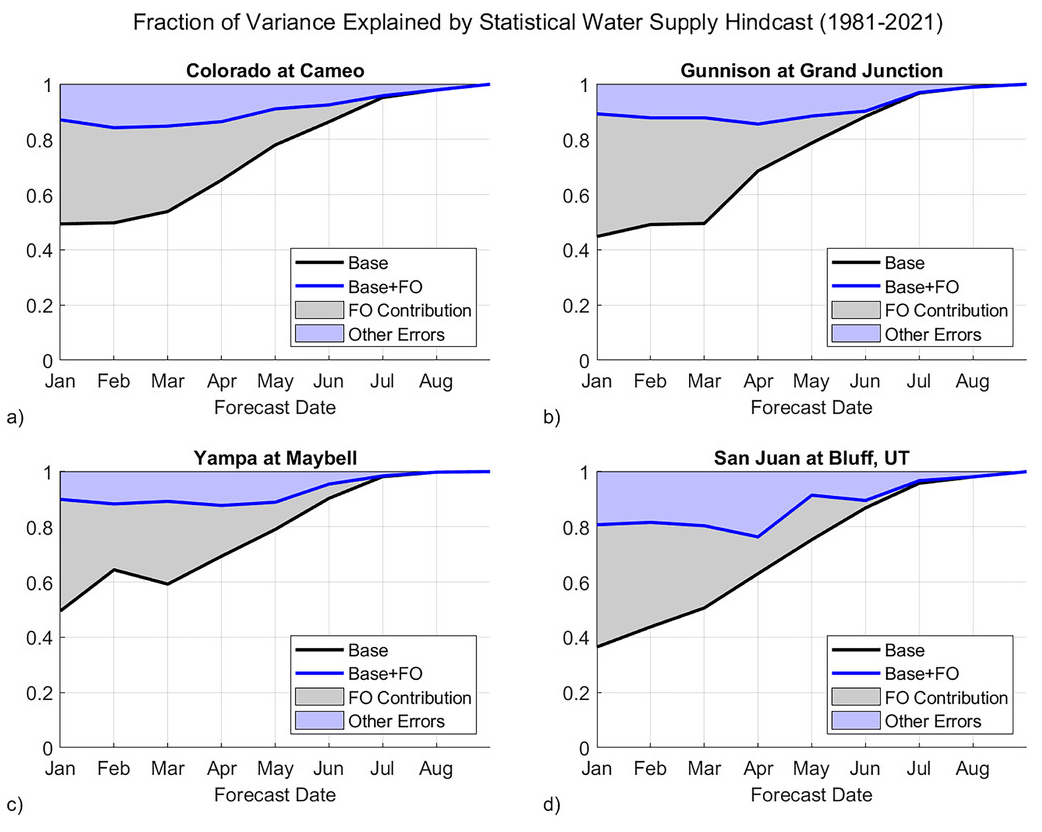
With funding from the National Integrated Drought Information System (NIDIS) the Colorado Climate Center conducted a study to evaluate the role of both soil moisture/groundwater, and future weather after the date of a water supply forecast in predicting spring runoff. To do this, we created hindcasts of April–August streamflows using SNOTEL snowpack and precipitation data from 1981–2021, inputting modeled soil moisture and groundwater data to predict streamflow. In this case, “hindcast” refers to a prediction of streamflow in a previous subset of years using a statistical model that was trained based on a separate subset of years. In this way, we mimicked an actual water supply forecasting environment without including the known answer into the model. Special attention was paid to hindcasts made using October-March data (See the AMS article for a more detailed explanation of the methods).
This study found that, on average, basin soil moisture and groundwater data from across the western Colorado did not contribute significantly to the skill of hindcasts. Future weather explained most of the error in water supply hindcasts made both on and before April 1st (plot 1). 2020 and 2021 were exceptional years. Both 2020 and 2021 were preceded by a hot, dry summer and a dry fall in western Colorado. As a result, hindcasts made with soil moisture and groundwater data were more skillful than those made without (tables 1 and 2).


The long-term issues plaguing the Colorado River system aren’t going anywhere. Climate change, climate variability, and population growth will continue to challenge the status quo operations of this resource. The results of this study are important because they demonstrate that there is a clear ceiling on how skillful we can expect water supply forecasts to be for our precious rivers in western Colorado. Marginal improvements may be possible though more thorough and accurate incorporation of soil moisture data in water supply forecasts. However, April 1st water supply forecasts will continue to face a wide array of uncertainty unless the accuracy of sub-seasonal-to-seasonal forecasts can be greatly improved.

Ignoring Indigenous rights is making the green transition more expensive — @Grist #ActOnClimate

Click the link to read the article on the Grist website (Anita Hofschneider):
February 2, 2024
“If you’re going to develop energy in the U.S. you’ve got to do it with the support of tribal communities.”
In December, a federal judge found that Enel Green Power, an Italian energy corporation operating an 84-turbine wind farm on the Osage Reservation for nearly a decade, had trespassed on Native land. The ruling was a clear victory for the Osage Nation and the company estimated that complying with the order to tear down the turbines would cost nearly $260 million.
Attorneys familiar with Federal Indian law say it’s uncommon for U.S. courts to side so clearly with tribal nations and actually expel developers trespassing on their land. But observers also see the ruling as part of a broader trend: Gone are the days when developers could ignore Indigenous rights with impunity. Now, even if projects that threaten Native land and cultural resources ultimately proceed, they may come with years-long delays that tack on millions of dollars. As more companies look to build wind and solar farms or mine minerals for renewable energy, failing to recognize Indigenous sovereignty could make the clean energy transition a lot more expensive and much further away.
“I think tribes are starting to see that they have more leverage than they thought, and that they’ve previously exercised, over all this infrastructure that’s on their land,” said Pilar Thomas, an attorney, member of the Pascua Yaqui Tribe of Arizona and former deputy director of the Office of Indian Energy Policy and Programs at the U.S. Department of Energy. “They want to make sure that they’re getting their fair share.”
Rick Tallman, a program manager at Colorado School of Mines’ Center for Native American Mining and Energy Sovereignty who has spent more than two decades working on financing and consulting for clean energy projects, calls the Osage Nation ruling a wake-up call.
“If you’re going to develop energy in the U.S. you’ve got to do it with the support of tribal communities,” he said.
According to Tallman, investors don’t like uncertainty. He said a lot of infrastructure funders are very conservative and won’t back a project unless they are confident it will succeed, which includes getting the buy-in of affected Indigenous Nations. There’s no upper limit to how much the project could cost if investors don’t get it right.
One analysis from researchers at First Peoples Worldwide at the University of Colorado at Boulder estimated that resistance to the Dakota Access Pipeline drove the project cost upwards of $7.5 billion. That includes more than $4.3 billion in divestment from banks backing the project and nearly $1.4 billion in additional operating costs, not to mention millions spent to hire law enforcement.
Marion Werkheiser, founding partner of Cultural Heritage Partners, said the costs are so high that some renewable energy projects never even get off the ground, citing the Cape Wind project in Nantucket Sound that was opposed by members of the Wampanoag Tribe.
And it’s not just a U.S. trend; Indigenous peoples around the world are fighting to enforce their rights, especially the right to free, prior and informed consent to projects on their land–a concept enshrined in the United Nations Declaration on the Rights of Indigenous Peoples. However, the U.S. hasn’t codified that into law, and compliance globally is spotty.
“Renewable energies are actually not that good in respecting Indigenous rights,” said Genevieve Rose from the International Work Group for Indigenous Affairs. “They have this feeling that because they bring up something good, something green, that they are automatically a good thing.”
But her colleague David Berger said there’s more awareness and resistance from Indigenous peoples, and companies are being forced to factor in those costs. He pointed to Norway, where the state-owned company that developed an illegal wind farm has agreed to pay Indigenous Sámi people about $675,000 every yearfor the next 25 years for violating their rights. “What’s good is you have that legal structure so communities can push back,” Berger said.
Wesley Furlong, an Anchorage-based senior staff attorney at the Native American Rights Fund, said more tribes are filing lawsuits in the U.S., partly because the legal landscape is changing. For example, the National Historic Preservation Act, a federal law managing the preservation of historic resources, has been around since 1966, but it was only in 1999 that the federal government codified regulations related to communicating with tribes about projects that affect them, and the rules weren’t fully in effect until 2004. Some tribes are just now learning about their rights.
Another reason for the increase in lawsuits is because some tribal nations have more resources to fund litigation. “Indian gaming has been a game-changer for tribes to be able to raise revenue and hire attorneys,” Furlong said.
That combination of more legal tools, more financial resources and more education about Native rights, Furlong said, has led to more tribes getting involved in energy developments on their traditional and ancestral territories, including lands with historic connections and are not owned by a tribe. And he only expects that to continue: Most of the U.S. reserves of lithium, copper, cobalt and nickel — metals key to the clean energy transition — are within 35 miles of Federal Indian Reservations, according to a study by the investment firm MSCI.
That’s something renewable energy developers need to be aware of, said Thomas. “I am a staunch believer that if you are within spitting distance of a tribe that you should be engaged in outreach to the tribe,” she said.
Not every project is going to get buy-in, she adds, but she encourages companies to have patience and continue to reach out to tribes even if they don’t respond. Furlong from the Native American Rights Fund said project proponents may erroneously assume that tribes will always be opposed, forgetting that tribal governments want what’s in the best interest of their citizens
Bottom line, it’s much less costly for companies to invest in tribal consultations and get them right from the get-go, says Daniel Cardenas, the head of the National Tribal Energy Association and a member of the Pit River Tribe who has consulted with tribes and companies regarding fossil fuel projects. “The cost of engagement is almost nothing compared to the cost of what they’re going to have to pay [if they don’t do it right],” he said of developers.
Werkheiser has seen some progress, with some banks, insurance companies and energy developers adopting Indigenous peoples policies to guide their investments and some companies undergoing voluntary certifications to show their projects are ethical and respectful of Indigenous rights. “Financial institutions are recognizing that this is a real business risk and they’re building it into the cost of capital for these companies,” she said.
But overall, change is slow, she said.
“For the most part, the renewable energy developers are repeating the mistakes that fossil fuels developers have made over the years,” she said. “They’re not engaging with tribes early as potential partners and information sources during their planning process, and they are basically deferring their own relationship with tribes to the federal government.”
That’s a mistake, said David Kane, a consultant who leads WindHorse Strategic Initiatives. Energy companies often mistakenly perceive tribal chairs as though they are the equivalent of small-town mayors, rather than recognizing them as heads of state. [ed. emphasis mine]
Because of that, he says companies often disrespect tribes from the beginning by sending lower-level representatives to liaise with them, and many companies may never even step foot on a reservation or go before tribal councils. Developers often complain that it takes a long time to build relationships with tribal members but Kane says it’s better to do so before projects get underway.
“There’s still a lot of mistrust of white men and with good reason,” he said. And the energy industry, including renewables, he said, is still predominantly white and male.
Another challenge is that sometimes companies assume what will work with one tribe will work with another, said Cardenas from the National Tribal Energy Association.
“There’s 574 tribes, and each one operates differently and independently,” he said. “So if you know one tribe, you just know one tribe.”
He thinks tribal nations should be seen as partners, even sponsoring partners, with shared equity in the developments. There’s growing interest: Over the past two decades, tribal nations have pursued hundreds of clean energy projects, with the Inflation Reduction Act recently increasing funding for such projects.
But in the meantime, costly litigation continues. Last week in the U.S., four tribal nations sued a developer to prevent a $10 billion wind energy transmission line from going into operation. And in Oklahoma, the Osage Nation is now seeking damages from Enel. A judge still needs to decide how much that will cost the company.